Cambridge A Level History (pre-2015) 9697 — 2013 May/June Paper 1 · Variant 1
9697/11/M/J/13 · 100 marks · ≈113 min
The question paper and its mark scheme, free to read here and free to download. This is Cambridge’s own paper, exactly as it was sat.
Question paper4 pages
Mark scheme10 pages
Answers below. Sit the paper first if you are practising.
Paper as text
Question paper, page 1
This document consists of 4 printed pages. DC (CW) 59037/3 © UCLES 2013 [Turn over UNIVERSITY OF CAMBRIDGE INTERNATIONAL EXAMINATIONS General Certificate of Education Advanced Subsidiary Level and Advanced Level * 2 9 5 0 4 2 2 0 3 3 * HISTORY 9697/11 Paper 1 Modern European History, 1789–1939 May/June 2013 3 hours Additional Materials: Answer Paper READ THESE INSTRUCTIONS FIRST Write your Centre number, candidate number and name on all the work you hand in. Write in dark blue or black pen. You may use a soft pencil for any rough working. Do not use staples, paper clips, highlighters, glue or correction fluid. Section A Answer Question 1. Section B Answer any three questions. At the end of the examination, fasten all your work securely together. All questions in this paper carry equal marks.
Question paper, page 2
2 9697/11/M/J/13 © UCLES 2013 Section A: The Origins of World War I, 1870–1914 You must answer Question 1. BRITAIN AND WAR 1 Read the Sources, and then answer the question. When answering Question 1, candidates are advised to pay particular attention to the interpretation and evaluation of the Sources both individually and as a group. Source A The theory that Britain cannot engage in a big war means that she would cease to be an independent country. She can be brought to her knees and made to obey the orders of any major country or other countries who can go to war, of which there are several. If the theory is true, the general principles on which our whole foreign policy has rested would be shown to be an empty failure. The balance of power cannot be maintained by a country that cannot fight and which carries no weight. There is commercial panic at the beginning of any war in all countries. Commercial and industrial opinion is generally timid. It follows weak policies. The panic in London business circles has been deliberately influenced by Germany. The argument that Britain cannot go to war in any circumstances is not true. It would be political suicide. Germany has made unceasing efforts to persuade Britain to remain neutral if Germany were at war with France and Russia. Our duty is to support France in her hour of need. France has not sought the quarrel. It has been forced upon her. A memorandum by a senior civil servant in the British Foreign Ministry, 31 July 1914. Source B The British Cabinet has agreed unanimously that the neutrality of Belgium is a grave matter because Belgian neutrality affects feeling in Britain. (This is nonsense. Grey, the British Foreign Minister, does not know what he is to do. I have learned that Britain has already taken war measures! While she is still negotiating! ) I asked Grey if he would give me a promise that Britain would be neutral in a war if Germany respected Belgian neutrality. Grey replied that he could not promise this. (Then he is a false rascal! ) At present, Britain does not have the slightest intention of going to war with Germany. (He lies. He told our Ambassador differently four days ago! ) My impression is that, if it is possible in any way, the British government wants to keep out of the war, but our statements about Belgian neutrality have made an unfavourable impression. (My impression is that Grey is a false dog who is afraid of his own policy. He will not come out into the open against us but prefers to let himself be forced to take action by us.) Report by the German Ambassador to Britain, to his government, 1 August 1914. The Kaiser’s handwritten notes on the report are in italics.
Question paper, page 3
3 9697/11/M/J/13 © UCLES 2013 [Turn over Source C I do not believe that we can rely on British neutrality much longer. I do not know what form British intervention will take nor when it will be. But Britain will not keep out of war if we do not get out of Belgium immediately. The applause for the speech of Grey in Parliament means that, apart from a small minority of its left wing, the British government will have behind it the overwhelming majority of Parliament in any active policy to protect France and Belgium. The news of the invasion of Belgium by German soldiers has brought about a complete reversal of British public opinion, turning against Germany. The appeal of the King of the Belgians, made in moving language, has seriously strengthened this impression. Report to his government by the German Ambassador to Britain, 4 August 1914. Source D With the utmost reluctance and with infinite regret, the British government has been compelled to put this country in a state of war with what for many years past has been a friendly country. I hope to show Parliament how strong and unceasing were the efforts of the Foreign Minister to secure for Europe an honourable and lasting peace – even when the last glimmer of hope seemed to have faded away. Parliament and Britain – and indeed History – will pay him the best tribute that any statesman can deserve: without sacrificing the honour of his country, he tried to preserve the greatest interest of all countries – universal peace. Asquith, British Prime Minister, speaking in Parliament, 6 August 1914. Source E There can be no doubt that British opinion was deeply opposed to becoming involved in a war that seemed to be caused by a minor quarrel in the Balkans. Lloyd George (the Chancellor of the Exchequer in 1914) reported on his consultations with banking and industrial leaders. He said, ‘They were all appalled at the idea of our plunging into the European conflict. It would destroy the whole system of international capitalism with London as its centre. It would hit labour, wages and prices. It would inevitably produce violence and disorder when winter came.’ He added that it would harm trade and manufacturing. The danger to British prosperity was so great that at least three-quarters of the British Cabinet were determined not to be involved unless Britain itself was attacked, which seemed unlikely. A powerful section of the press agreed with the German view of a localised war between Austria and Serbia. Britain was mostly concerned with the crisis in Ireland. A modern American historian considers Britain’s role in 1914, published 1969. Now answer the following question. ‘British opinion was opposed to war with Germany in 1914.’ Use Sources A–E to show how far the evidence confirms this statement.
Question paper, page 4
4 9697/11/M/J/13 © UCLES 2013 Section B You must answer three questions from this section. 2 Why did Robespierre and the Jacobins gain and then lose power in France? 3 Why did the Industrial Revolution lead to demands for greater democracy in the nineteenth century? (You should refer to at least two of Britain, France and Germany in your answer.) 4 Explain why the unified Italy of 1861 was a monarchy and not a republic. 5 How important was public opinion as a reason for European involvement in ‘New Imperialism’ at the end of the nineteenth century? (You should refer to at least two of Britain, France and Germany in your answer.) 6 Why was neither Nicholas II nor Kerensky able to retain power in Russia in 1917? 7 ‘The most important reason why Hitler gained power was the impact of World War I.’ Assess this claim about Germany up to 1934. 8 Did the condition of the lower classes in Russia improve or worsen during the period from 1900 to 1939? Copyright Acknowledgements: Source E D F Fleming; The Origins and Legacies of World War I ; George Allen and Unwin; 1969 Permission to reproduce items where third-party owned material protected by copyright is included has been sought and cleared where possible. Every reasonable effort has been made by the publisher (UCLES) to trace copyright holders, but if any items requiring clearance have unwittingly been included, the publisher will be pleased to make amends at the earliest possible opportunity. University of Cambridge International Examinations is part of the Cambridge Assessment Group. Cambridge Assessment is the brand name of University of Cambridge Local Examinations Syndicate (UCLES), which is itself a department of the University of Cambridge.
Mark scheme, page 1
CAMBRIDGE INTERNATIONAL EXAMINATIONS GCE Advanced Subsidiary Level and GCE Advanced Level MARK SCHEME for the May/June 2013 series 9697 HISTORY 9697/11 Paper 1, maximum raw mark 100 This mark scheme is published as an aid to teachers and candidates, to indicate the requirements of the examination. It shows the basis on which Examiners were instructed to award marks. It does not indicate the details of the discussions that took place at an Examiners’ meeting before marking began, which would have considered the acceptability of alternative answers. Mark schemes should be read in conjunction with the question paper and the Principal Examiner Report for Teachers. Cambridge will not enter into discussions about these mark schemes. Cambridge is publishing the mark schemes for the May/June 2013 series for most IGCSE, GCE Advanced Level and Advanced Subsidiary Level components and some Ordinary Level components.
Mark scheme, page 2
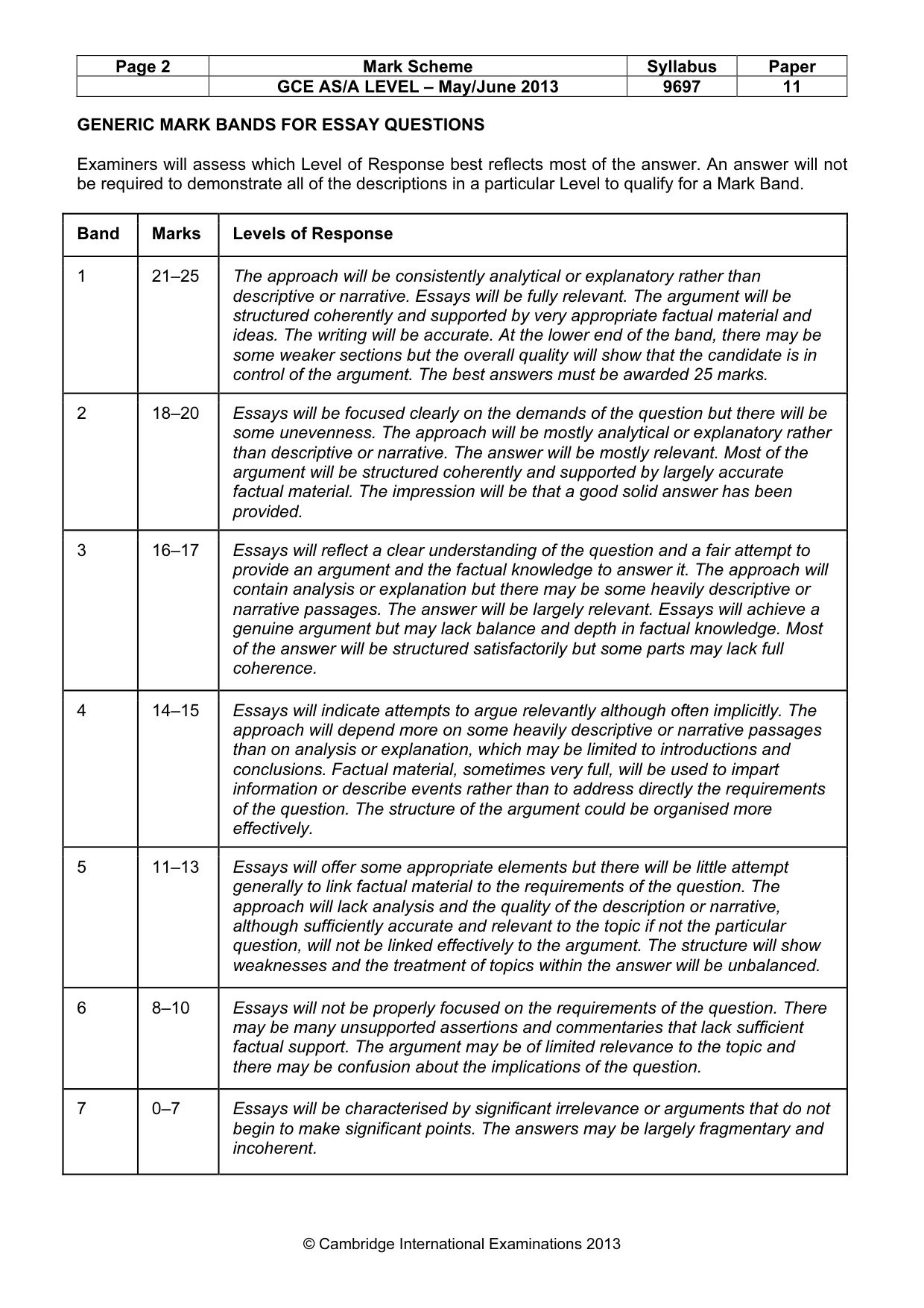
Page 2 Mark Scheme Syllabus Paper GCE AS/A LEVEL – May/June 2013 9697 11 © Cambridge International Examinations 2013 GENERIC MARK BANDS FOR ESSAY QUESTIONS Examiners will assess which Level of Response best reflects most of the answer. An answer will not be required to demonstrate all of the descriptions in a particular Level to qualify for a Mark Band. Band Marks Levels of Response 1 21–25 The approach will be consistently analytical or explanatory rather than descriptive or narrative. Essays will be fully relevant. The argument will be structured coherently and supported by very appropriate factual material and ideas. The writing will be accurate. At the lower end of the band, there may be some weaker sections but the overall quality will show that the candidate is in control of the argument. The best answers must be awarded 25 marks. 2 18–20 Essays will be focused clearly on the demands of the question but there will be some unevenness. The approach will be mostly analytical or explanatory rather than descriptive or narrative. The answer will be mostly relevant. Most of the argument will be structured coherently and supported by largely accurate factual material. The impression will be that a good solid answer has been provided. 3 16–17 Essays will reflect a clear understanding of the question and a fair attempt to provide an argument and the factual knowledge to answer it. The approach will contain analysis or explanation but there may be some heavily descriptive or narrative passages. The answer will be largely relevant. Essays will achieve a genuine argument but may lack balance and depth in factual knowledge. Most of the answer will be structured satisfactorily but some parts may lack full coherence. 4 14–15 Essays will indicate attempts to argue relevantly although often implicitly. The approach will depend more on some heavily descriptive or narrative passages than on analysis or explanation, which may be limited to introductions and conclusions. Factual material, sometimes very full, will be used to impart information or describe events rather than to address directly the requirements of the question. The structure of the argument could be organised more effectively. 5 11–13 Essays will offer some appropriate elements but there will be little attempt generally to link factual material to the requirements of the question. The approach will lack analysis and the quality of the description or narrative, although sufficiently accurate and relevant to the topic if not the particular question, will not be linked effectively to the argument. The structure will show weaknesses and the treatment of topics within the answer will be unbalanced. 6 8–10 Essays will not be properly focused on the requirements of the question. There may be many unsupported assertions and commentaries that lack sufficient factual support. The argument may be of limited relevance to the topic and there may be confusion about the implications of the question. 7 0–7 Essays will be characterised by significant irrelevance or arguments that do not begin to make significant points. The answers may be largely fragmentary and incoherent.
Mark scheme, page 3
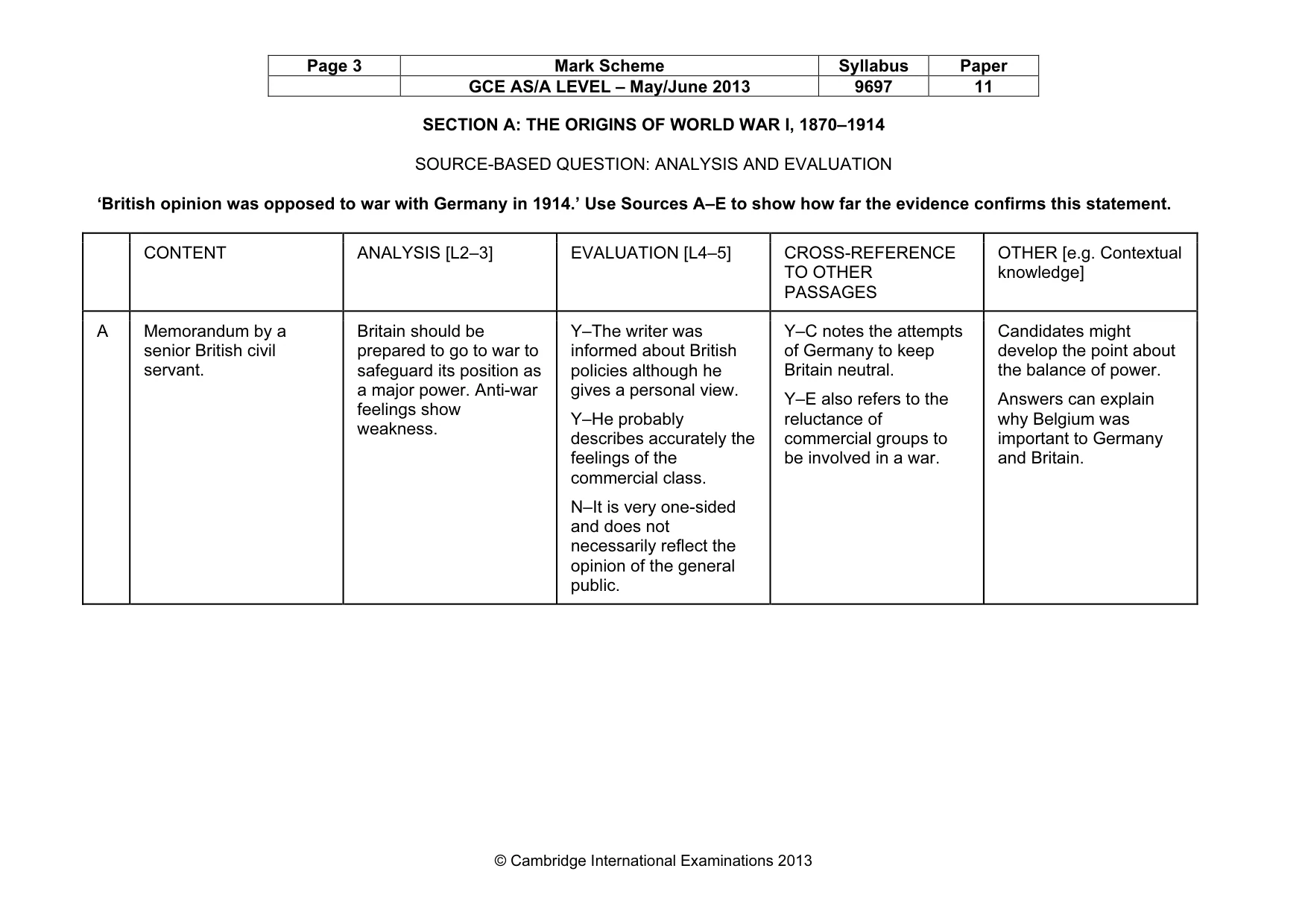
Page 3 Mark Scheme Syllabus Paper GCE AS/A LEVEL – May/June 2013 9697 11 © Cambridge International Examinations 2013 SECTION A: THE ORIGINS OF WORLD WAR I, 1870–1914 SOURCE-BASED QUESTION: ANALYSIS AND EVALUATION ‘British opinion was opposed to war with Germany in 1914.’ Use Sources A–E to show how far the evidence confirms this statement. CONTENT ANALYSIS [L2–3] EVALUATION [L4–5] CROSS-REFERENCE TO OTHER PASSAGES OTHER [e.g. Contextual knowledge] A Memorandum by a senior British civil servant. Britain should be prepared to go to war to safeguard its position as a major power. Anti-war feelings show weakness. Y–The writer was informed about British policies although he gives a personal view. Y–He probably describes accurately the feelings of the commercial class. N–It is very one-sided and does not necessarily reflect the opinion of the general public. Y–C notes the attempts of Germany to keep Britain neutral. Y–E also refers to the reluctance of commercial groups to be involved in a war. Candidates might develop the point about the balance of power. Answers can explain why Belgium was important to Germany and Britain.
Mark scheme, page 4
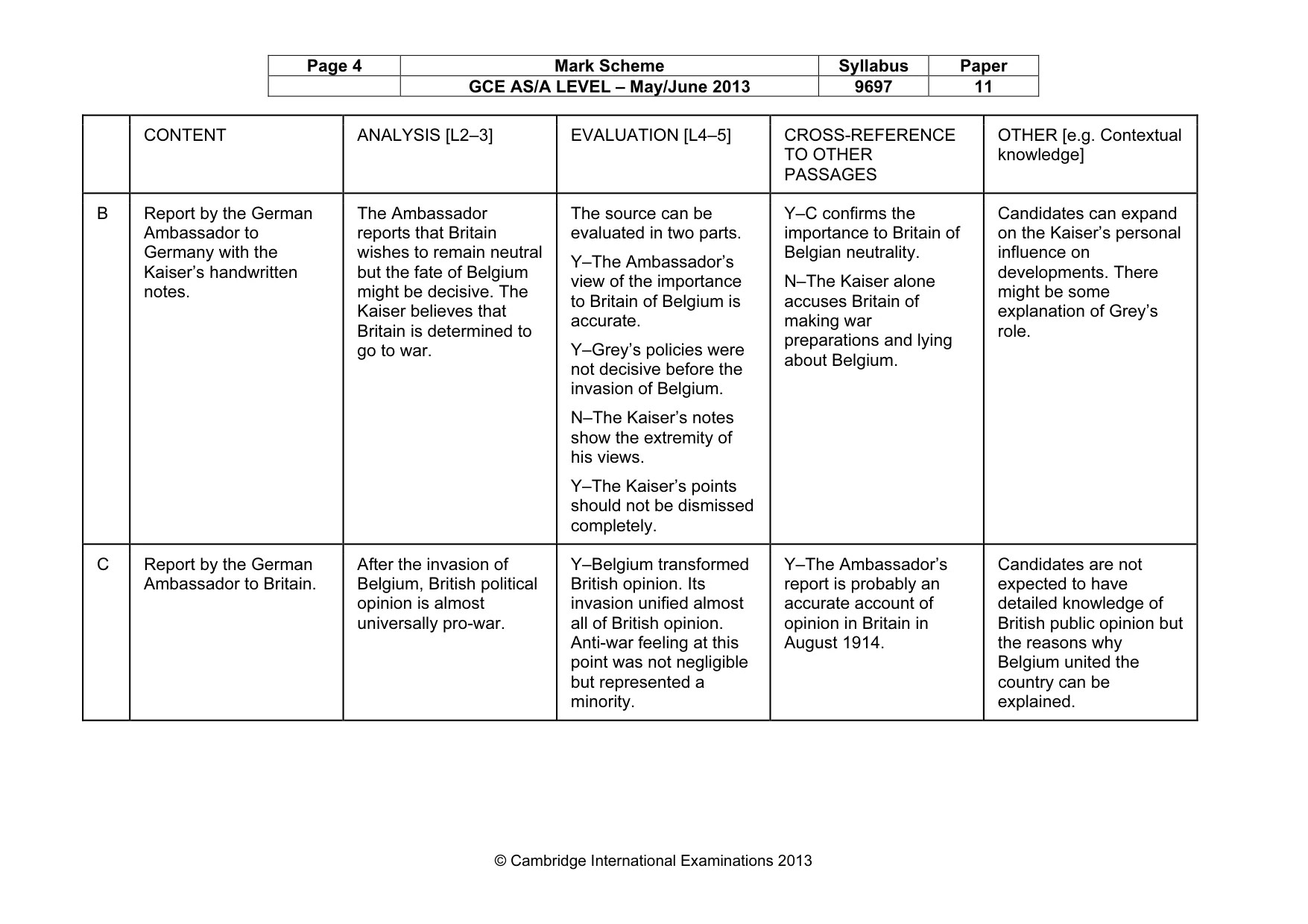
Page 4 Mark Scheme Syllabus Paper GCE AS/A LEVEL – May/June 2013 9697 11 © Cambridge International Examinations 2013 CONTENT ANALYSIS [L2–3] EVALUATION [L4–5] CROSS-REFERENCE TO OTHER PASSAGES OTHER [e.g. Contextual knowledge] B Report by the German Ambassador to Germany with the Kaiser’s handwritten notes. The Ambassador reports that Britain wishes to remain neutral but the fate of Belgium might be decisive. The Kaiser believes that Britain is determined to go to war. The source can be evaluated in two parts. Y–The Ambassador’s view of the importance to Britain of Belgium is accurate. Y–Grey’s policies were not decisive before the invasion of Belgium. N–The Kaiser’s notes show the extremity of his views. Y–The Kaiser’s points should not be dismissed completely. Y–C confirms the importance to Britain of Belgian neutrality. N–The Kaiser alone accuses Britain of making war preparations and lying about Belgium. Candidates can expand on the Kaiser’s personal influence on developments. There might be some explanation of Grey’s role. C Report by the German Ambassador to Britain. After the invasion of Belgium, British political opinion is almost universally pro-war. Y–Belgium transformed British opinion. Its invasion unified almost all of British opinion. Anti-war feeling at this point was not negligible but represented a minority. Y–The Ambassador’s report is probably an accurate account of opinion in Britain in August 1914. Candidates are not expected to have detailed knowledge of British public opinion but the reasons why Belgium united the country can be explained.
Mark scheme, page 5
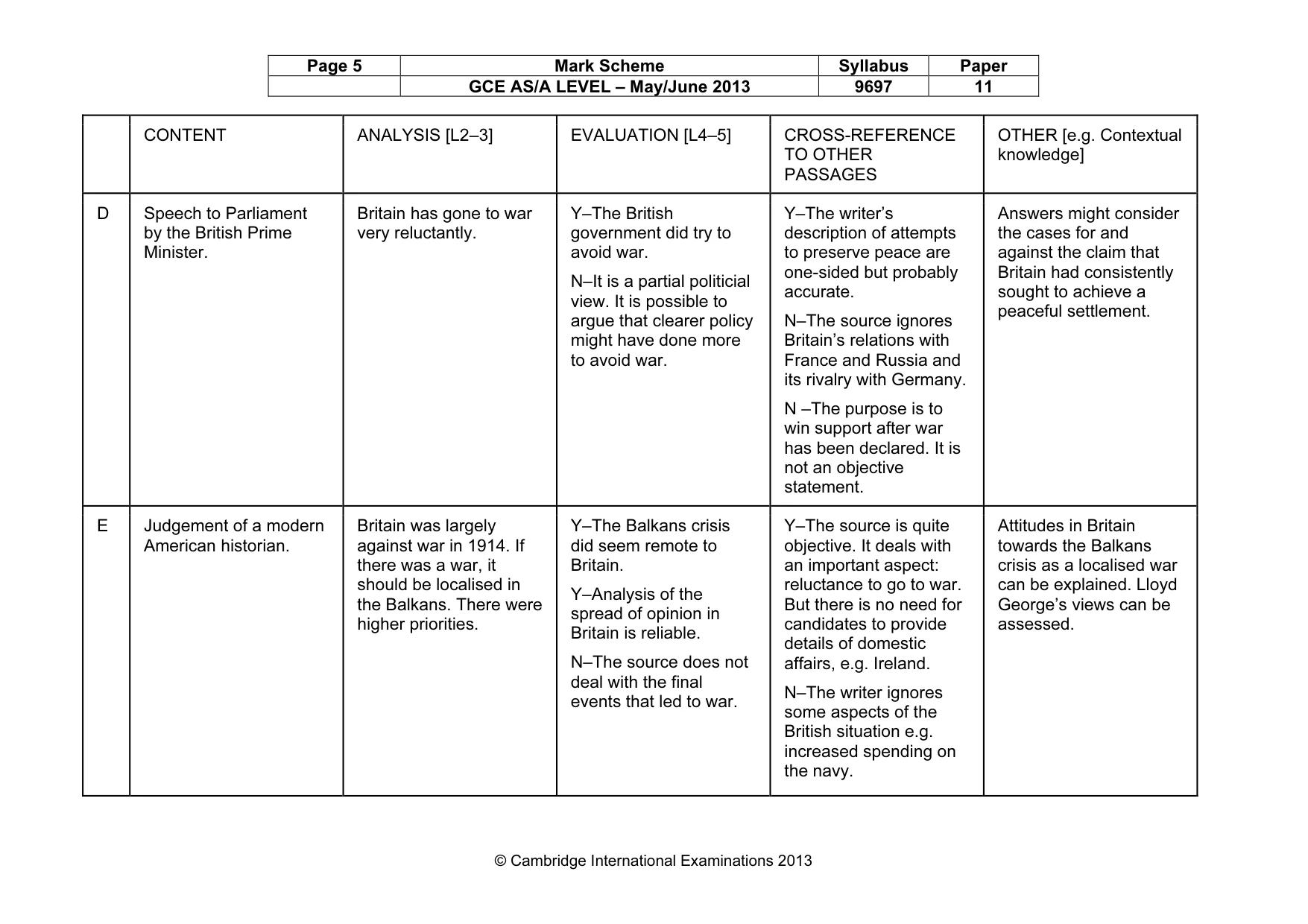
Page 5 Mark Scheme Syllabus Paper GCE AS/A LEVEL – May/June 2013 9697 11 © Cambridge International Examinations 2013 CONTENT ANALYSIS [L2–3] EVALUATION [L4–5] CROSS-REFERENCE TO OTHER PASSAGES OTHER [e.g. Contextual knowledge] D Speech to Parliament by the British Prime Minister. Britain has gone to war very reluctantly. Y–The British government did try to avoid war. N–It is a partial politicial view. It is possible to argue that clearer policy might have done more to avoid war. Y–The writer’s description of attempts to preserve peace are one-sided but probably accurate. N–The source ignores Britain’s relations with France and Russia and its rivalry with Germany. N –The purpose is to win support after war has been declared. It is not an objective statement. Answers might consider the cases for and against the claim that Britain had consistently sought to achieve a peaceful settlement. E Judgement of a modern American historian. Britain was largely against war in 1914. If there was a war, it should be localised in the Balkans. There were higher priorities. Y–The Balkans crisis did seem remote to Britain. Y–Analysis of the spread of opinion in Britain is reliable. N–The source does not deal with the final events that led to war. Y–The source is quite objective. It deals with an important aspect: reluctance to go to war. But there is no need for candidates to provide details of domestic affairs, e.g. Ireland. N–The writer ignores some aspects of the British situation e.g. increased spending on the navy. Attitudes in Britain towards the Balkans crisis as a localised war can be explained. Lloyd George’s views can be assessed.
Mark scheme, page 6
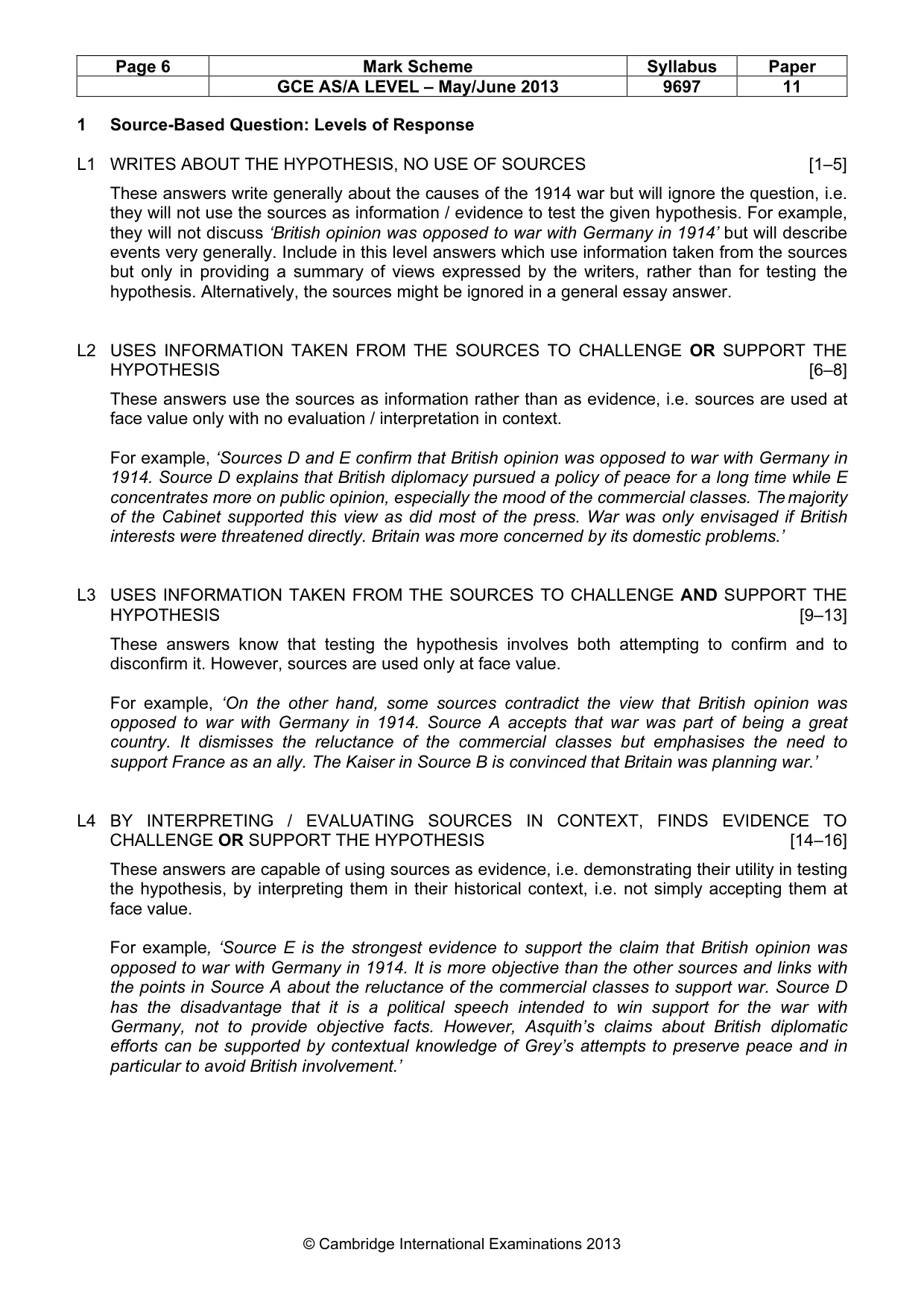
Page 6 Mark Scheme Syllabus Paper GCE AS/A LEVEL – May/June 2013 9697 11 © Cambridge International Examinations 2013 1 Source-Based Question: Levels of Response L1 WRITES ABOUT THE HYPOTHESIS, NO USE OF SOURCES [1–5] These answers write generally about the causes of the 1914 war but will ignore the question, i.e. they will not use the sources as information / evidence to test the given hypothesis. For example, they will not discuss ‘British opinion was opposed to war with Germany in 1914’ but will describe events very generally. Include in this level answers which use information taken from the sources but only in providing a summary of views expressed by the writers, rather than for testing the hypothesis. Alternatively, the sources might be ignored in a general essay answer. L2 USES INFORMATION TAKEN FROM THE SOURCES TO CHALLENGE OR SUPPORT THE HYPOTHESIS [6–8] These answers use the sources as information rather than as evidence, i.e. sources are used at face value only with no evaluation / interpretation in context. For example, ‘Sources D and E confirm that British opinion was opposed to war with Germany in 1914. Source D explains that British diplomacy pursued a policy of peace for a long time while E concentrates more on public opinion, especially the mood of the commercial classes. The majority of the Cabinet supported this view as did most of the press. War was only envisaged if British interests were threatened directly. Britain was more concerned by its domestic problems.’ L3 USES INFORMATION TAKEN FROM THE SOURCES TO CHALLENGE AND SUPPORT THE HYPOTHESIS [9–13] These answers know that testing the hypothesis involves both attempting to confirm and to disconfirm it. However, sources are used only at face value. For example, ‘On the other hand, some sources contradict the view that British opinion was opposed to war with Germany in 1914. Source A accepts that war was part of being a great country. It dismisses the reluctance of the commercial classes but emphasises the need to support France as an ally. The Kaiser in Source B is convinced that Britain was planning war.’ L4 BY INTERPRETING / EVALUATING SOURCES IN CONTEXT, FINDS EVIDENCE TO CHALLENGE OR SUPPORT THE HYPOTHESIS [14–16] These answers are capable of using sources as evidence, i.e. demonstrating their utility in testing the hypothesis, by interpreting them in their historical context, i.e. not simply accepting them at face value. For example, ‘Source E is the strongest evidence to support the claim that British opinion was opposed to war with Germany in 1914. It is more objective than the other sources and links with the points in Source A about the reluctance of the commercial classes to support war. Source D has the disadvantage that it is a political speech intended to win support for the war with Germany, not to provide objective facts. However, Asquith’s claims about British diplomatic efforts can be supported by contextual knowledge of Grey’s attempts to preserve peace and in particular to avoid British involvement.’
Mark scheme, page 7
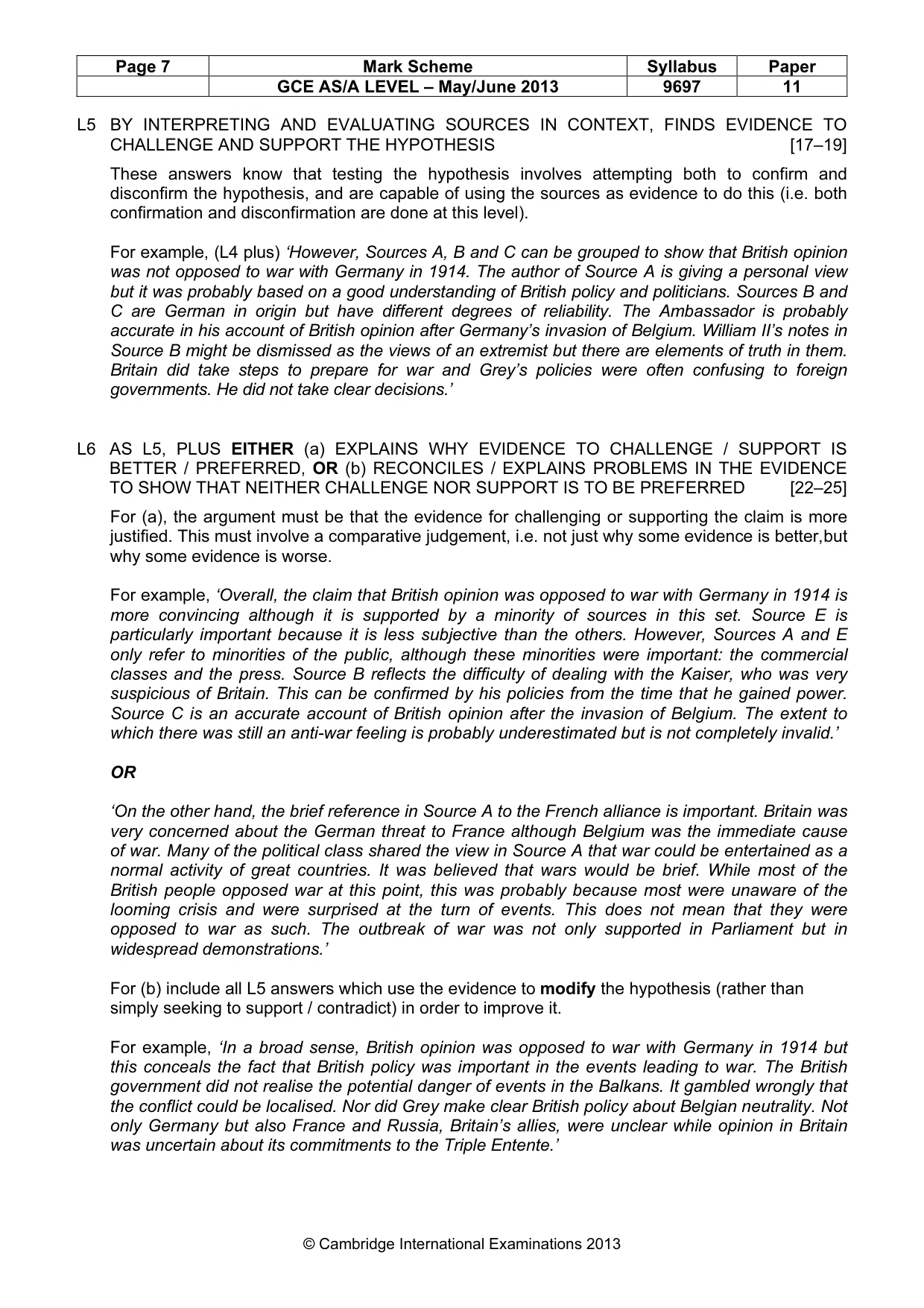
Page 7 Mark Scheme Syllabus Paper GCE AS/A LEVEL – May/June 2013 9697 11 © Cambridge International Examinations 2013 L5 BY INTERPRETING AND EVALUATING SOURCES IN CONTEXT, FINDS EVIDENCE TO CHALLENGE AND SUPPORT THE HYPOTHESIS [17–19] These answers know that testing the hypothesis involves attempting both to confirm and disconfirm the hypothesis, and are capable of using the sources as evidence to do this (i.e. both confirmation and disconfirmation are done at this level). For example, (L4 plus) ‘However, Sources A, B and C can be grouped to show that British opinion was not opposed to war with Germany in 1914. The author of Source A is giving a personal view but it was probably based on a good understanding of British policy and politicians. Sources B and C are German in origin but have different degrees of reliability. The Ambassador is probably accurate in his account of British opinion after Germany’s invasion of Belgium. William II’s notes in Source B might be dismissed as the views of an extremist but there are elements of truth in them. Britain did take steps to prepare for war and Grey’s policies were often confusing to foreign governments. He did not take clear decisions.’ L6 AS L5, PLUS EITHER (a) EXPLAINS WHY EVIDENCE TO CHALLENGE / SUPPORT IS BETTER / PREFERRED, OR (b) RECONCILES / EXPLAINS PROBLEMS IN THE EVIDENCE TO SHOW THAT NEITHER CHALLENGE NOR SUPPORT IS TO BE PREFERRED [22–25] For (a), the argument must be that the evidence for challenging or supporting the claim is more justified. This must involve a comparative judgement, i.e. not just why some evidence is better, but why some evidence is worse. For example, ‘Overall, the claim that British opinion was opposed to war with Germany in 1914 is more convincing although it is supported by a minority of sources in this set. Source E is particularly important because it is less subjective than the others. However, Sources A and E only refer to minorities of the public, although these minorities were important: the commercial classes and the press. Source B reflects the difficulty of dealing with the Kaiser, who was very suspicious of Britain. This can be confirmed by his policies from the time that he gained power. Source C is an accurate account of British opinion after the invasion of Belgium. The extent to which there was still an anti-war feeling is probably underestimated but is not completely invalid.’ OR ‘On the other hand, the brief reference in Source A to the French alliance is important. Britain was very concerned about the German threat to France although Belgium was the immediate cause of war. Many of the political class shared the view in Source A that war could be entertained as a normal activity of great countries. It was believed that wars would be brief. While most of the British people opposed war at this point, this was probably because most were unaware of the looming crisis and were surprised at the turn of events. This does not mean that they were opposed to war as such. The outbreak of war was not only supported in Parliament but in widespread demonstrations.’ For (b) include all L5 answers which use the evidence to modify the hypothesis (rather than simply seeking to support / contradict) in order to improve it. For example, ‘In a broad sense, British opinion was opposed to war with Germany in 1914 but this conceals the fact that British policy was important in the events leading to war. The British government did not realise the potential danger of events in the Balkans. It gambled wrongly that the conflict could be localised. Nor did Grey make clear British policy about Belgian neutrality. Not only Germany but also France and Russia, Britain’s allies, were unclear while opinion in Britain was uncertain about its commitments to the Triple Entente.’
Mark scheme, page 8
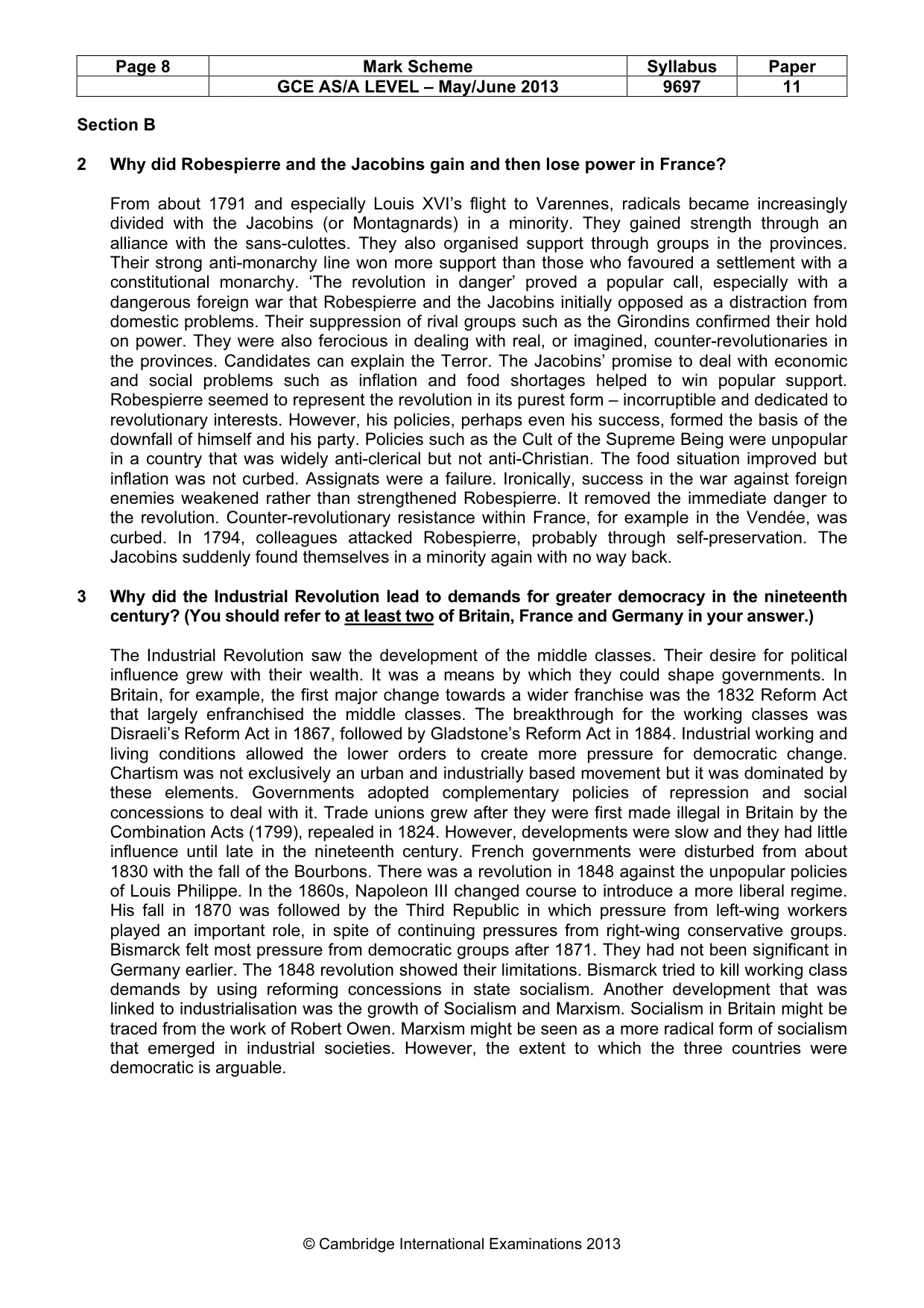
Page 8 Mark Scheme Syllabus Paper GCE AS/A LEVEL – May/June 2013 9697 11 © Cambridge International Examinations 2013 Section B 2 Why did Robespierre and the Jacobins gain and then lose power in France? From about 1791 and especially Louis XVI’s flight to Varennes, radicals became increasingly divided with the Jacobins (or Montagnards) in a minority. They gained strength through an alliance with the sans-culottes. They also organised support through groups in the provinces. Their strong anti-monarchy line won more support than those who favoured a settlement with a constitutional monarchy. ‘The revolution in danger’ proved a popular call, especially with a dangerous foreign war that Robespierre and the Jacobins initially opposed as a distraction from domestic problems. Their suppression of rival groups such as the Girondins confirmed their hold on power. They were also ferocious in dealing with real, or imagined, counter-revolutionaries in the provinces. Candidates can explain the Terror. The Jacobins’ promise to deal with economic and social problems such as inflation and food shortages helped to win popular support. Robespierre seemed to represent the revolution in its purest form – incorruptible and dedicated to revolutionary interests. However, his policies, perhaps even his success, formed the basis of the downfall of himself and his party. Policies such as the Cult of the Supreme Being were unpopular in a country that was widely anti-clerical but not anti-Christian. The food situation improved but inflation was not curbed. Assignats were a failure. Ironically, success in the war against foreign enemies weakened rather than strengthened Robespierre. It removed the immediate danger to the revolution. Counter-revolutionary resistance within France, for example in the Vendée, was curbed. In 1794, colleagues attacked Robespierre, probably through self-preservation. The Jacobins suddenly found themselves in a minority again with no way back. 3 Why did the Industrial Revolution lead to demands for greater democracy in the nineteenth century? (You should refer to at least two of Britain, France and Germany in your answer.) The Industrial Revolution saw the development of the middle classes. Their desire for political influence grew with their wealth. It was a means by which they could shape governments. In Britain, for example, the first major change towards a wider franchise was the 1832 Reform Act that largely enfranchised the middle classes. The breakthrough for the working classes was Disraeli’s Reform Act in 1867, followed by Gladstone’s Reform Act in 1884. Industrial working and living conditions allowed the lower orders to create more pressure for democratic change. Chartism was not exclusively an urban and industrially based movement but it was dominated by these elements. Governments adopted complementary policies of repression and social concessions to deal with it. Trade unions grew after they were first made illegal in Britain by the Combination Acts (1799), repealed in 1824. However, developments were slow and they had little influence until late in the nineteenth century. French governments were disturbed from about 1830 with the fall of the Bourbons. There was a revolution in 1848 against the unpopular policies of Louis Philippe. In the 1860s, Napoleon III changed course to introduce a more liberal regime. His fall in 1870 was followed by the Third Republic in which pressure from left-wing workers played an important role, in spite of continuing pressures from right-wing conservative groups. Bismarck felt most pressure from democratic groups after 1871. They had not been significant in Germany earlier. The 1848 revolution showed their limitations. Bismarck tried to kill working class demands by using reforming concessions in state socialism. Another development that was linked to industrialisation was the growth of Socialism and Marxism. Socialism in Britain might be traced from the work of Robert Owen. Marxism might be seen as a more radical form of socialism that emerged in industrial societies. However, the extent to which the three countries were democratic is arguable.
Mark scheme, page 9
Page 9 Mark Scheme Syllabus Paper GCE AS/A LEVEL – May/June 2013 9697 11 © Cambridge International Examinations 2013 4 Explain why the unified Italy of 1861 was a monarchy and not a republic. The monarchists, looking to Piedmont, had the advantage of Cavour’s skill in reorganising Piedmont, managing the incorporation of other states in northern and central Italy and making the Risorgimento respectable to other European countries. He was realistic, even if this meant the cession of Nice and Savoy to France. Cavour persuaded the republican-minded Garibaldi to hand over his gains in the south although he doubted the wisdom of a wholly unified Italy. The role of Victor Emmanuel II can be explained. This can be contrasted with the republicans who were divided. Mazzini was the most notable but others favoured different forms of republicanism. He was the most famous early advocate of a united Italy. Young Italy gave some a cause to support. However, republicanism was unpopular in many parts of Italy and distrusted in a Europe that was dominated by monarchies. Mazzini faced an Austria that was stronger than during Cavour’s premiership. The 1848–49 revolution, led by Mazzini and Garibaldi, might have been heroic but the rebels were too weak militarily. Pius IX lost his enthusiasm for liberalism and this persuaded many Italian Catholics to oppose the Risorgimento in 1848–49. The Pope’s attitude was less vital in the later stages of unification. Gioberti, who supported a wider Italy under the Pope, was a failure. France supported Pius IX in 1848 but changed its policies to greater neutrality by 1861. Other leaders, such as Manin in Venice, proved ineffective. Their concerns were too local to win significant support. It could be pointed out that Charles Albert, a monarchist with muddled ideas and inadequate support, failed but put down a marker about the leadership of Piedmont. 5 How important was public opinion as a reason for European involvement in ‘New Imperialism’ at the end of the nineteenth century? (You should refer to at least two of Britain, France and Germany in your answer.) Imperial possessions were seen as indicative of a country’s strength. Setbacks, for example Gordon’s death at Khartoum (1885), reflected badly on governments (Gladstone in this case). Disraeli was a convert to empire-building when he considered the polls. There is evidence that Bismarck was reluctant, at first, to be involved in imperialism but this autocratic leader had to bow to public opinion. In France’s Third Republic opinion was more divided although generally favourable. Individuals or groups such as Rhodes, Karl Peters or missionaries became heroes. Other factors that might be considered are economic motives, including the search for raw materials and hopes (mostly frustrated) for markets. There have been arguments about opportunities for the investment of surplus capital. The Hobson-Lenin line which sees it as important has been contradicted by those who point out that more was invested in non-imperial regions. Political factors include the wish to defend national interests abroad or to prevent other countries becoming dominant, hence rivalries in parts of Africa and the Far East. French overseas expansion, even in arid regions of Africa, was partly motivated by a wish to demonstrate recovery after defeat by Prussia in 1870–71. Another theory that might be discussed is the importance of accidents or local crises. A local rising persuaded Britain to exert control over the Sudan. There were parallels in South Africa and the Far East. To achieve the highest bands answers will focus on causes and should provide sufficient overseas examples. 6 Why was neither Nicholas II nor Kerensky able to retain power in Russia in 1917? To achieve the highest bands answers will contain a comparative element which might include the continuing importance of the war or the inability of Nicholas II and Kerensky to provide effective leadership. It will be relevant to provide a background to the February revolution in order to explain the Tsar’s failure but overlong accounts of pre-war developments should be avoided. By February 1917, Nicholas II’s unpopularity and ineptitude were fully exposed. He lost the support of the army that had upheld the regime in 1905. Hopes of political reform were dashed. He also lost the backing of important social groups at the top of society. His personal reputation suffered because of the influence of the Tsarina and Rasputin. Government administrations were unstable. The costs of the war in terms of human loss and economic devastation touched all classes of people. Millions of men were killed or wounded. The infrastructure fell apart. Food
Mark scheme, page 10
Page 10 Mark Scheme Syllabus Paper GCE AS/A LEVEL – May/June 2013 9697 11 © Cambridge International Examinations 2013 shortages were widespread. Kerensky had qualities that brought him to power after the short- lived government of the aristocratic Lvov. He was popular, a good speaker and favoured change towards socialism (but not communism). However, he failed to deal urgently with the most pressing problems that caused unrest: food shortages, the land issue, a liberal constitution and peace. His weaknesses were revealed when he had to rely on the Bolsheviks to suppress Kornilov’s attempted coup. Lenin and the Bolsheviks were a weak force in February 1917, they took advantage of Kerensky’s problems to win support. Lenin made a vital alliance with the Soviets. His populist programme of ‘Peace, Land and Bread’ won support among the masses, who were disillusioned by Kerensky. The October revolution was carried out comparatively easily. It required a small show of force to win power from a helpless Kerensky. 7 ‘The most important reason why Hitler gained power was the impact of World War I.’ Assess this claim about Germany up to 1934. Germany’s war losses were very heavy and their extent and significance can be explained. They included territorial, military and economic punishments. Again, these continued to undermine the Weimar republic. Hitler exploited discontent about the terms in his bid for power, promising to retrieve the losses and strengthen the status of the country. He used force to gain power through the SA. But he also made use of constitutional methods. Hitler pursued power through elections after the failure of the Munich Putsch (1923). He also benefited from the support of groups that believed that he could be controlled. The next steps were to crush political opposition and rival parties. Reference can be made to the Reichstag Fire (1933) and Enabling Act (1933). Hitler became Führer and almost all Germans accepted Führer power. The developments that ensured his power such as propaganda, terror and political economic and social policies can be discussed. The significance of the Wall Street Crash (1929) might be examined. 8 Did the condition of the lower classes in Russia improve or worsen during the period from 1900 to 1939? The condition of the poor was revealed in the 1905 Revolution, which might be a starting point. The peasants were taxed heavily while rents were rising and incomes falling. Workers in towns endured appalling conditions. Witte’s policies had a generally beneficial effect on the Russian economy but did nothing to improve the conditions of the poorest – they probably harmed them. The lower classes gained very little from Nicholas II’s political reforms from 1906. They enjoyed little representation in the Dumas which were ineffective institutions. Stolypin aimed to solve problems by encouraging the more prosperous kulaks and repressing unrest harshly. He removed the powers of the Mir and favoured the Peasant Land Bank, moves that benefited a few. The Bolsheviks’ programme promised to transform the condition of the lower classes. One of Lenin’s popular slogans in 1917 was ‘Peace, Land and Bread’. The basis of Marxism was a proletarian dictatorship. The reality was very different. War Communism was Lenin’s response to dire economic and social conditions. The response of labourers was seen when they refused to co-operate. There were strikes. Animals were killed. Harvests suffered. Lenin showed his most dictatorial side, using the army and secret police to ensure stability. The NEP gave some respite but Lenin made it clear that he regarded it as a temporary concession. Stalin was determined to modernise Russian agriculture and industry. Some of the forceful methods that he used could be mentioned to illustrate the effects of his policies on the lower classes. He encouraged measures in collectivisation that caused widespread famine. Rebuilding industry came at a heavy cost to the workers. The success of his policies can be assessed but there is almost universal agreement about the consequences. It is difficult to decide who suffered more, workers in urban or rural areas. Taken together, millions died. Millions of others suffered in gulags.
What you needed in this session
Cambridge’s own grade thresholds for 2013 May/June, Paper 1 · Variant 1. A higher threshold means an easier paper — the bar moves with how the cohort did.