Cambridge A Level History (pre-2015) 9697 — 2014 May/June Paper 1 · Variant 1
9697/11/M/J/14 · 100 marks · ≈113 min
The question paper and its mark scheme, free to read here and free to download. This is Cambridge’s own paper, exactly as it was sat.
Question paper4 pages
Mark scheme12 pages
Answers below. Sit the paper first if you are practising.
Paper as text
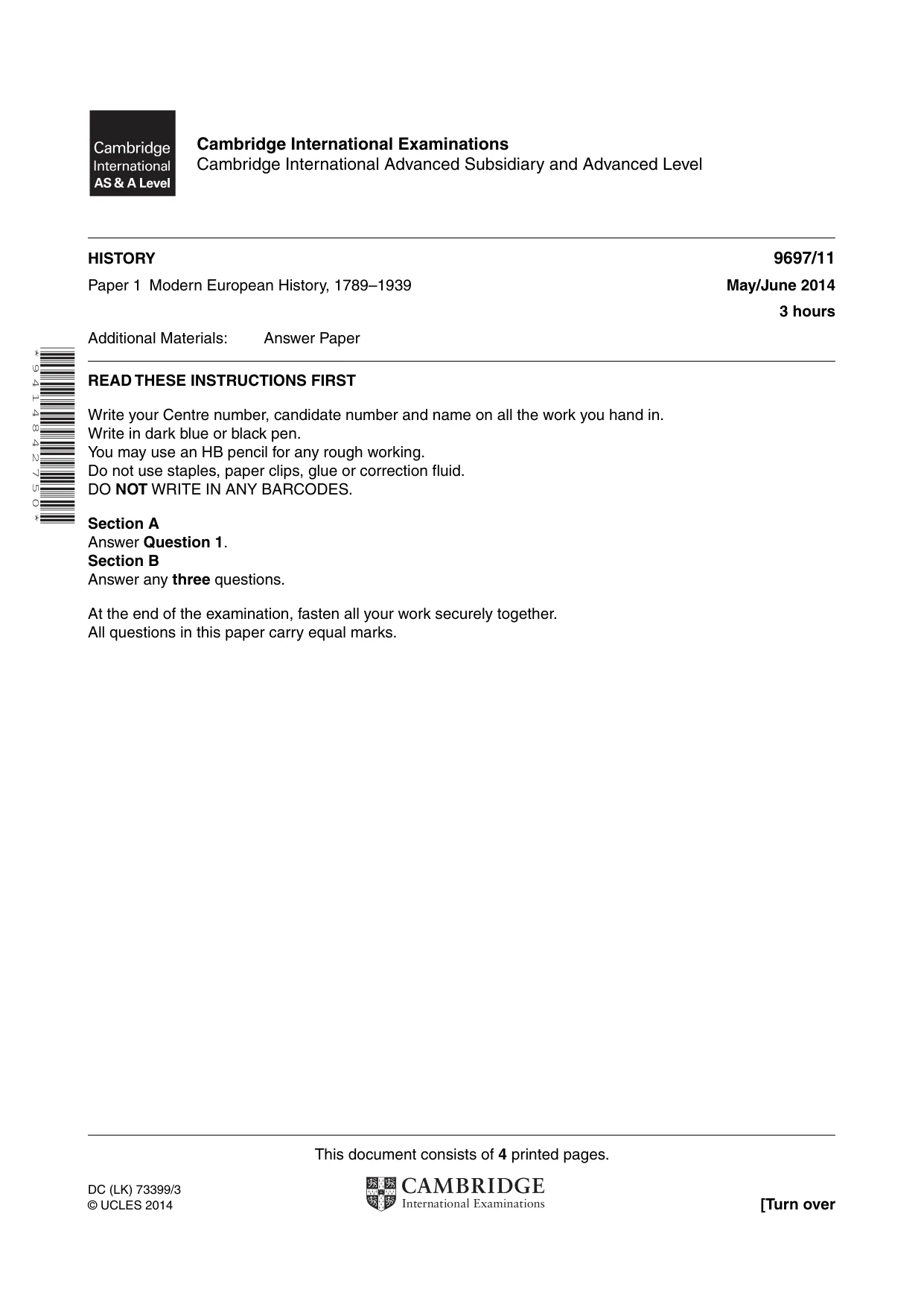
Question paper, page 1
This document consists of 4 printed pages. DC (LK) 73399/3 © UCLES 2014 [Turn over Cambridge International Examinations Cambridge International Advanced Subsidiary and Advanced Level * 9 4 1 4 8 4 2 7 5 0 * HISTORY 9697/11 Paper 1 Modern European History, 1789–1939 May/June 2014 3 hours Additional Materials: Answer Paper READ THESE INSTRUCTIONS FIRST Write your Centre number, candidate number and name on all the work you hand in. Write in dark blue or black pen. You may use an HB pencil for any rough working. Do not use staples, paper clips, glue or correction fluid. DO NOT WRITE IN ANY BARCODES. Section A Answer Question 1. Section B Answer any three questions. At the end of the examination, fasten all your work securely together. All questions in this paper carry equal marks.
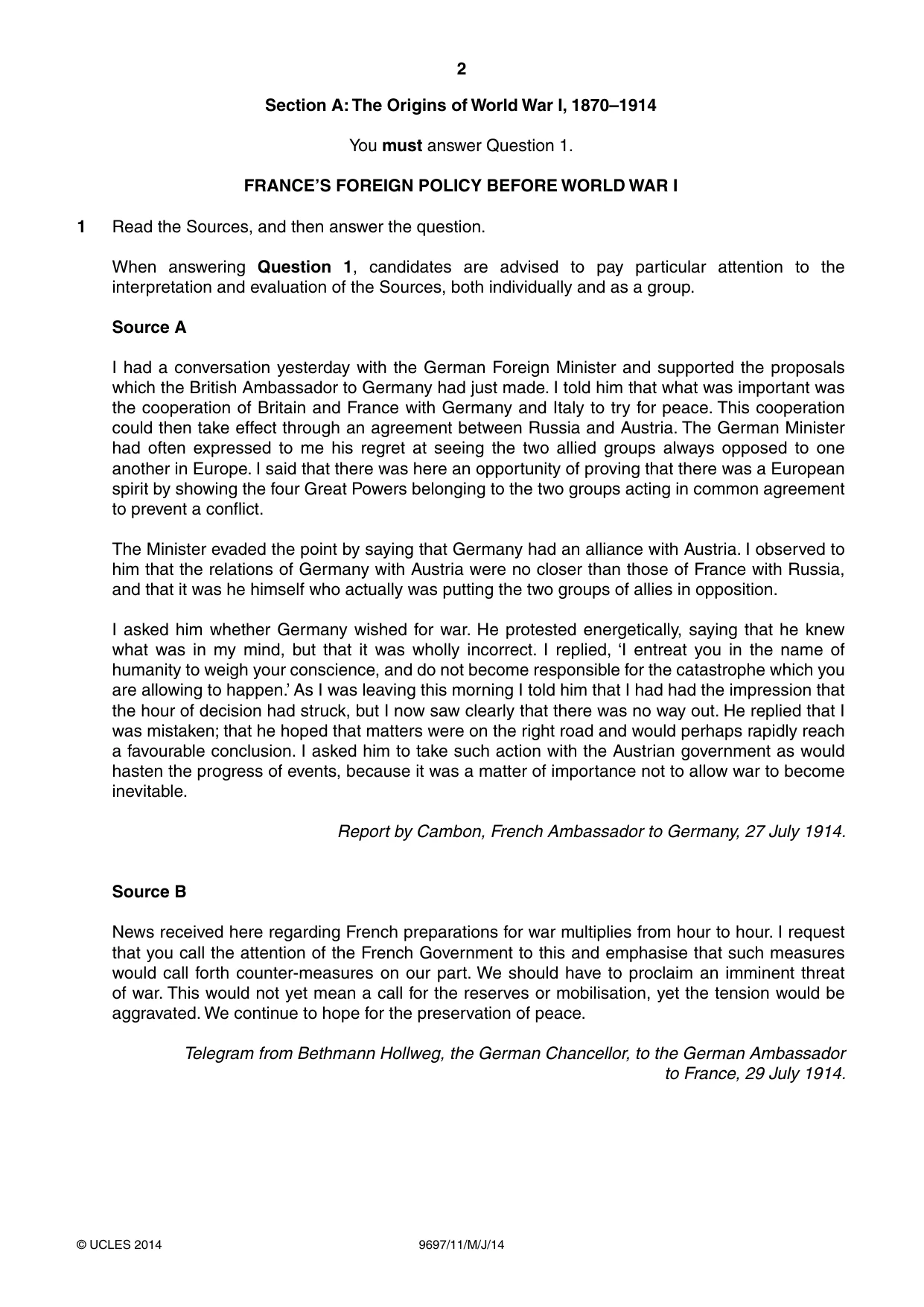
Question paper, page 2
2 9697/11/M/J/14 © UCLES 2014 Section A: The Origins of World War I, 1870–1914 You must answer Question 1. FRANCE’S FOREIGN POLICY BEFORE WORLD WAR I 1 Read the Sources, and then answer the question. When answering Question 1, candidates are advised to pay particular attention to the interpretation and evaluation of the Sources, both individually and as a group. Source A I had a conversation yesterday with the German Foreign Minister and supported the proposals which the British Ambassador to Germany had just made. I told him that what was important was the cooperation of Britain and France with Germany and Italy to try for peace. This cooperation could then take effect through an agreement between Russia and Austria. The German Minister had often expressed to me his regret at seeing the two allied groups always opposed to one another in Europe. I said that there was here an opportunity of proving that there was a European spirit by showing the four Great Powers belonging to the two groups acting in common agreement to prevent a conflict. The Minister evaded the point by saying that Germany had an alliance with Austria. I observed to him that the relations of Germany with Austria were no closer than those of France with Russia, and that it was he himself who actually was putting the two groups of allies in opposition. I asked him whether Germany wished for war. He protested energetically, saying that he knew what was in my mind, but that it was wholly incorrect. I replied, ‘I entreat you in the name of humanity to weigh your conscience, and do not become responsible for the catastrophe which you are allowing to happen.’ As I was leaving this morning I told him that I had had the impression that the hour of decision had struck, but I now saw clearly that there was no way out. He replied that I was mistaken; that he hoped that matters were on the right road and would perhaps rapidly reach a favourable conclusion. I asked him to take such action with the Austrian government as would hasten the progress of events, because it was a matter of importance not to allow war to become inevitable. Report by Cambon, French Ambassador to Germany, 27 July 1914. Source B News received here regarding French preparations for war multiplies from hour to hour. I request that you call the attention of the French Government to this and emphasise that such measures would call forth counter-measures on our part. We should have to proclaim an imminent threat of war. This would not yet mean a call for the reserves or mobilisation, yet the tension would be aggravated. We continue to hope for the preservation of peace. Telegram from Bethmann Hollweg, the German Chancellor, to the German Ambassador to France, 29 July 1914.
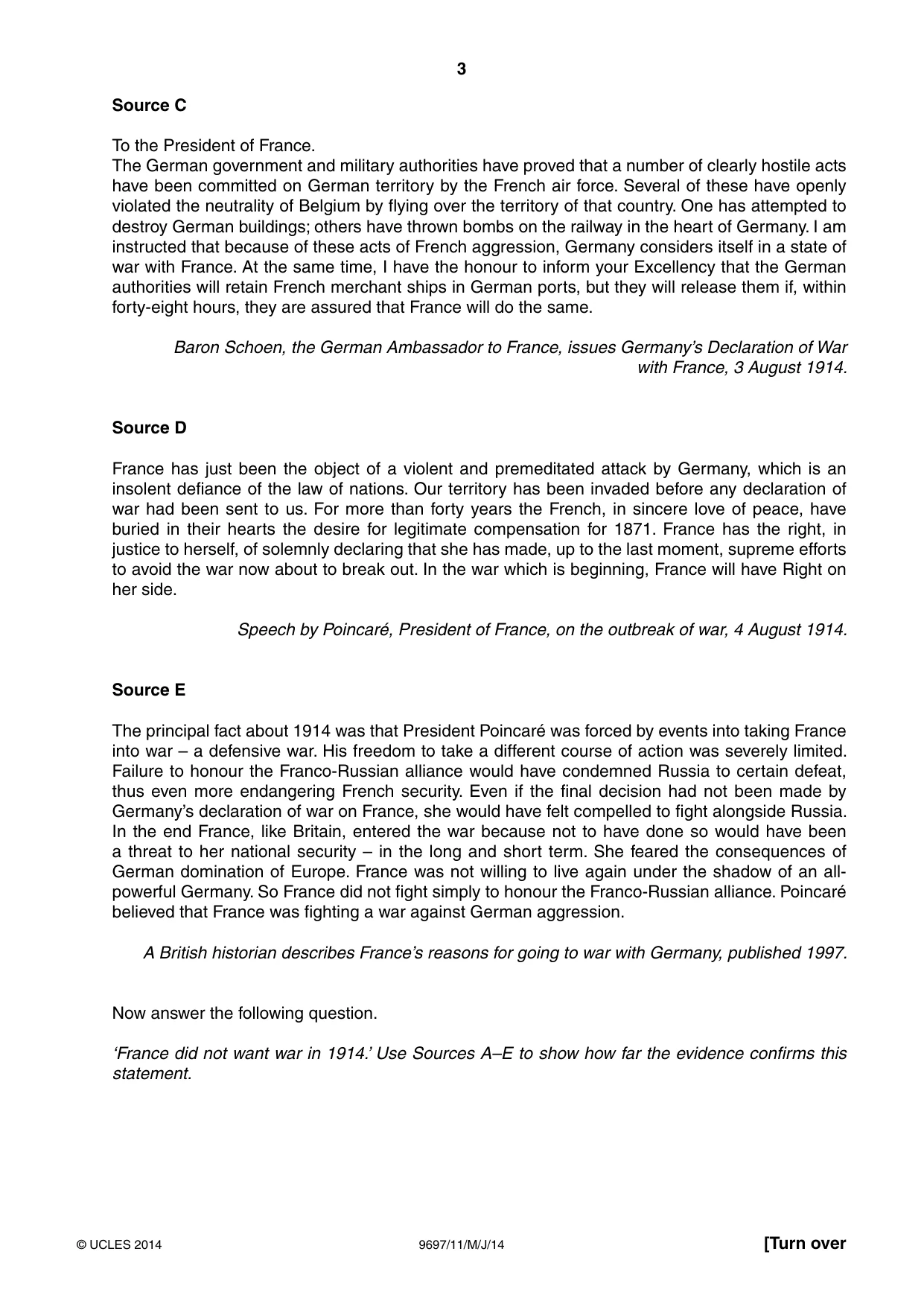
Question paper, page 3
3 9697/11/M/J/14 © UCLES 2014 [Turn over Source C To the President of France. The German government and military authorities have proved that a number of clearly hostile acts have been committed on German territory by the French air force. Several of these have openly violated the neutrality of Belgium by flying over the territory of that country. One has attempted to destroy German buildings; others have thrown bombs on the railway in the heart of Germany. I am instructed that because of these acts of French aggression, Germany considers itself in a state of war with France. At the same time, I have the honour to inform your Excellency that the German authorities will retain French merchant ships in German ports, but they will release them if, within forty-eight hours, they are assured that France will do the same. Baron Schoen, the German Ambassador to France, issues Germany’s Declaration of War with France, 3 August 1914. Source D France has just been the object of a violent and premeditated attack by Germany, which is an insolent defiance of the law of nations. Our territory has been invaded before any declaration of war had been sent to us. For more than forty years the French, in sincere love of peace, have buried in their hearts the desire for legitimate compensation for 1871. France has the right, in justice to herself, of solemnly declaring that she has made, up to the last moment, supreme efforts to avoid the war now about to break out. In the war which is beginning, France will have Right on her side. Speech by Poincaré, President of France, on the outbreak of war, 4 August 1914. Source E The principal fact about 1914 was that President Poincaré was forced by events into taking France into war – a defensive war. His freedom to take a different course of action was severely limited. Failure to honour the Franco-Russian alliance would have condemned Russia to certain defeat, thus even more endangering French security. Even if the final decision had not been made by Germany’s declaration of war on France, she would have felt compelled to fight alongside Russia. In the end France, like Britain, entered the war because not to have done so would have been a threat to her national security – in the long and short term. She feared the consequences of German domination of Europe. France was not willing to live again under the shadow of an all- powerful Germany. So France did not fight simply to honour the Franco-Russian alliance. Poincaré believed that France was fighting a war against German aggression. A British historian describes France’s reasons for going to war with Germany, published 1997. Now answer the following question. ‘France did not want war in 1914.’ Use Sources A–E to show how far the evidence confirms this statement.
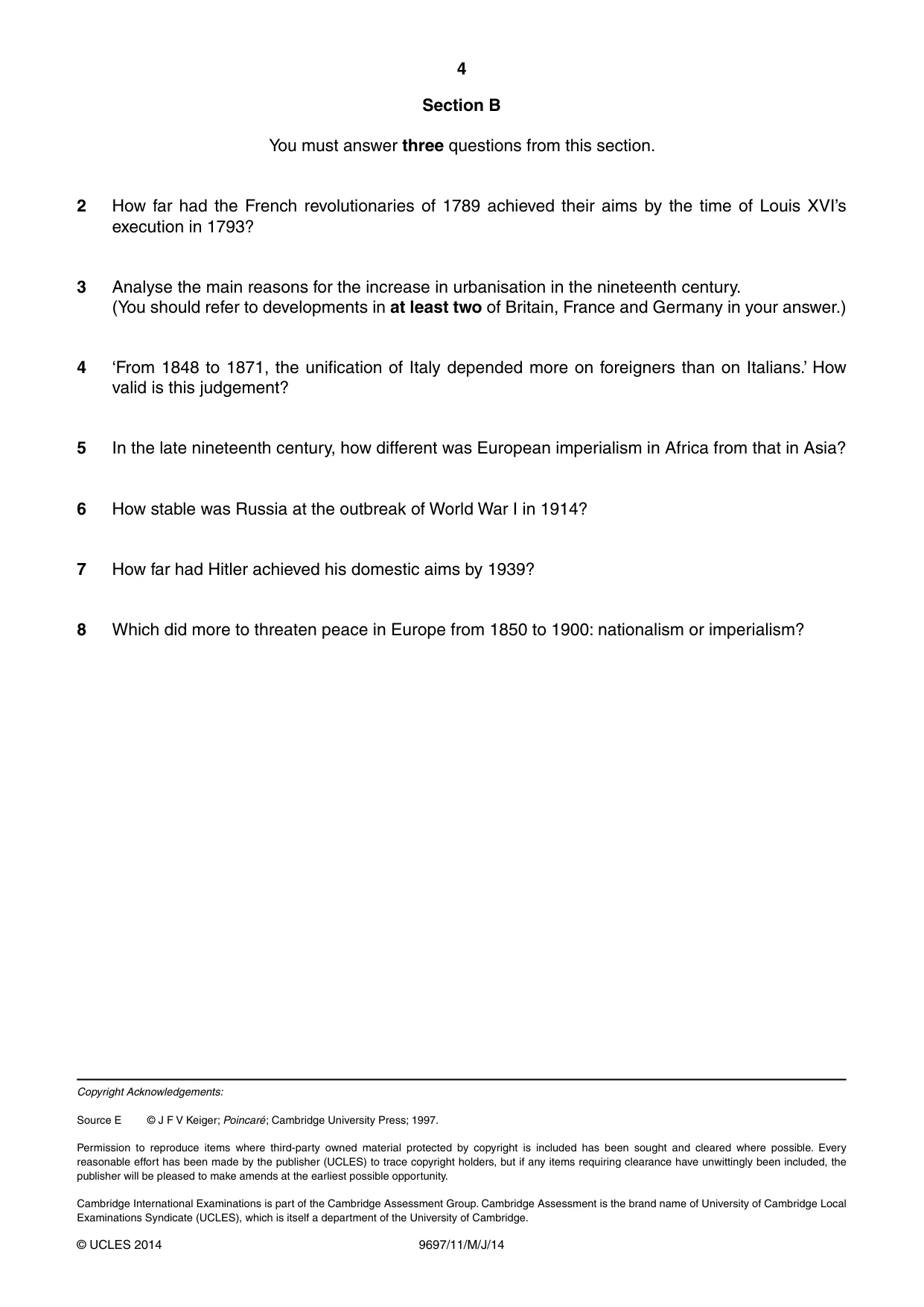
Question paper, page 4
4 9697/11/M/J/14 © UCLES 2014 Section B You must answer three questions from this section. 2 How far had the French revolutionaries of 1789 achieved their aims by the time of Louis XVI’s execution in 1793? 3 Analyse the main reasons for the increase in urbanisation in the nineteenth century. (You should refer to developments in at least two of Britain, France and Germany in your answer.) 4 ‘From 1848 to 1871, the unification of Italy depended more on foreigners than on Italians.’ How valid is this judgement? 5 In the late nineteenth century, how different was European imperialism in Africa from that in Asia? 6 How stable was Russia at the outbreak of World War I in 1914? 7 How far had Hitler achieved his domestic aims by 1939? 8 Which did more to threaten peace in Europe from 1850 to 1900: nationalism or imperialism? Copyright Acknowledgements: Source E © J F V Keiger; Poincaré ; Cambridge University Press; 1997. Permission to reproduce items where third-party owned material protected by copyright is included has been sought and cleared where possible. Every reasonable effort has been made by the publisher (UCLES) to trace copyright holders, but if any items requiring clearance have unwittingly been included, the publisher will be pleased to make amends at the earliest possible opportunity. Cambridge International Examinations is part of the Cambridge Assessment Group. Cambridge Assessment is the brand name of University of Cambridge Local Examinations Syndicate (UCLES), which is itself a department of the University of Cambridge.
Mark scheme, page 1
CAMBRIDGE INTERNATIONAL EXAMINATIONS GCE Advanced Level MARK SCHEME for the May/June 2014 series 9697 HISTORY 9697/11 Paper 1, maximum raw mark 100 This mark scheme is published as an aid to teachers and candidates, to indicate the requirements of the examination. It shows the basis on which Examiners were instructed to award marks. It does not indicate the details of the discussions that took place at an Examiners’ meeting before marking began, which would have considered the acceptability of alternative answers. Mark schemes should be read in conjunction with the question paper and the Principal Examiner Report for Teachers. Cambridge will not enter into discussions about these mark schemes. Cambridge is publishing the mark schemes for the May/June 2014 series for most IGCSE, GCE Advanced Level and Advanced Subsidiary Level components and some Ordinary Level components.
Mark scheme, page 2
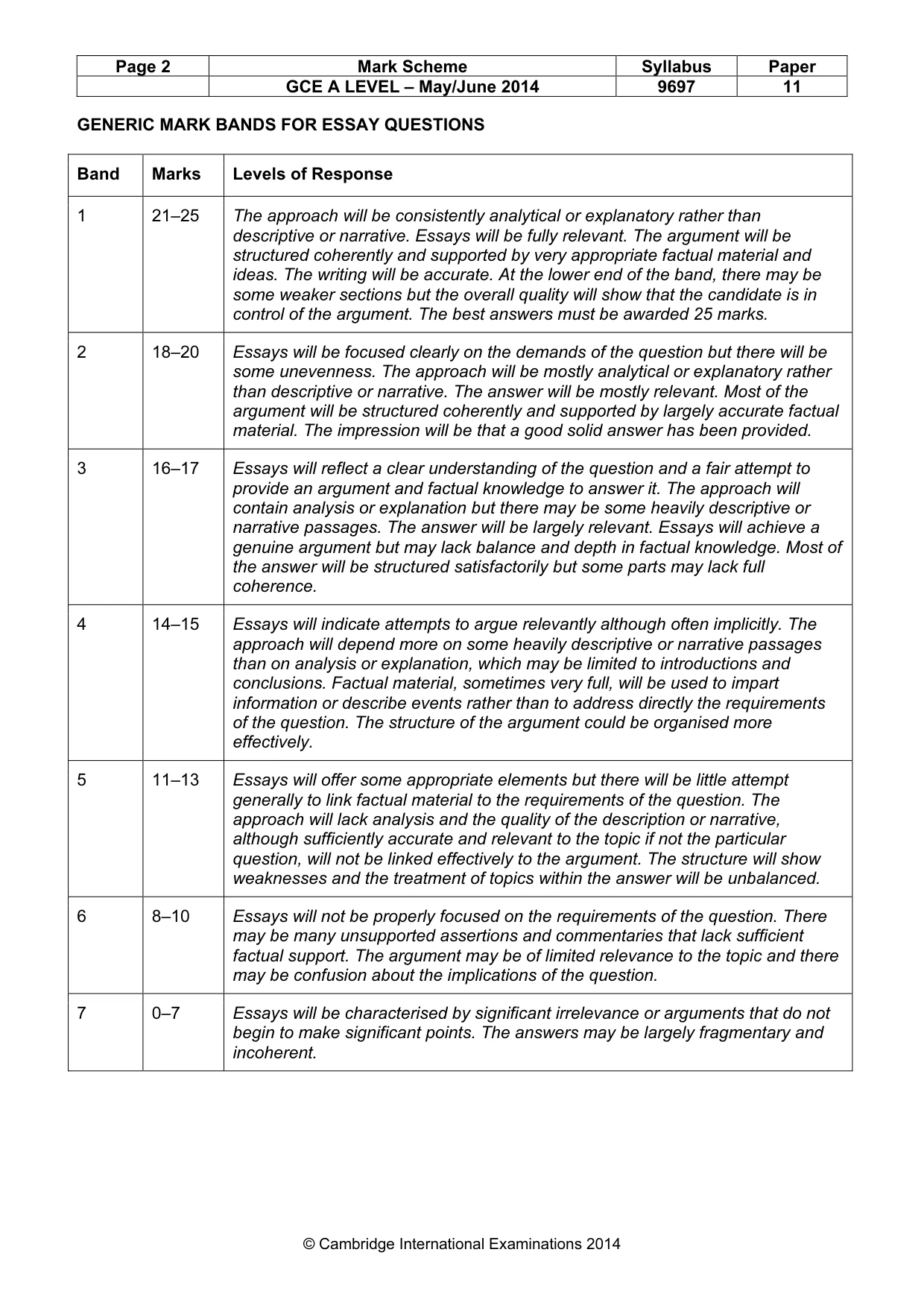
Page 2 Mark Scheme Syllabus Paper GCE A LEVEL – May/June 2014 9697 11 © Cambridge International Examinations 2014 GENERIC MARK BANDS FOR ESSAY QUESTIONS Band Marks Levels of Response 1 21–25 The approach will be consistently analytical or explanatory rather than descriptive or narrative. Essays will be fully relevant. The argument will be structured coherently and supported by very appropriate factual material and ideas. The writing will be accurate. At the lower end of the band, there may be some weaker sections but the overall quality will show that the candidate is in control of the argument. The best answers must be awarded 25 marks. 2 18–20 Essays will be focused clearly on the demands of the question but there will be some unevenness. The approach will be mostly analytical or explanatory rather than descriptive or narrative. The answer will be mostly relevant. Most of the argument will be structured coherently and supported by largely accurate factual material. The impression will be that a good solid answer has been provided. 3 16–17 Essays will reflect a clear understanding of the question and a fair attempt to provide an argument and factual knowledge to answer it. The approach will contain analysis or explanation but there may be some heavily descriptive or narrative passages. The answer will be largely relevant. Essays will achieve a genuine argument but may lack balance and depth in factual knowledge. Most of the answer will be structured satisfactorily but some parts may lack full coherence. 4 14–15 Essays will indicate attempts to argue relevantly although often implicitly. The approach will depend more on some heavily descriptive or narrative passages than on analysis or explanation, which may be limited to introductions and conclusions. Factual material, sometimes very full, will be used to impart information or describe events rather than to address directly the requirements of the question. The structure of the argument could be organised more effectively. 5 11–13 Essays will offer some appropriate elements but there will be little attempt generally to link factual material to the requirements of the question. The approach will lack analysis and the quality of the description or narrative, although sufficiently accurate and relevant to the topic if not the particular question, will not be linked effectively to the argument. The structure will show weaknesses and the treatment of topics within the answer will be unbalanced. 6 8–10 Essays will not be properly focused on the requirements of the question. There may be many unsupported assertions and commentaries that lack sufficient factual support. The argument may be of limited relevance to the topic and there may be confusion about the implications of the question. 7 0–7 Essays will be characterised by significant irrelevance or arguments that do not begin to make significant points. The answers may be largely fragmentary and incoherent.
Mark scheme, page 3
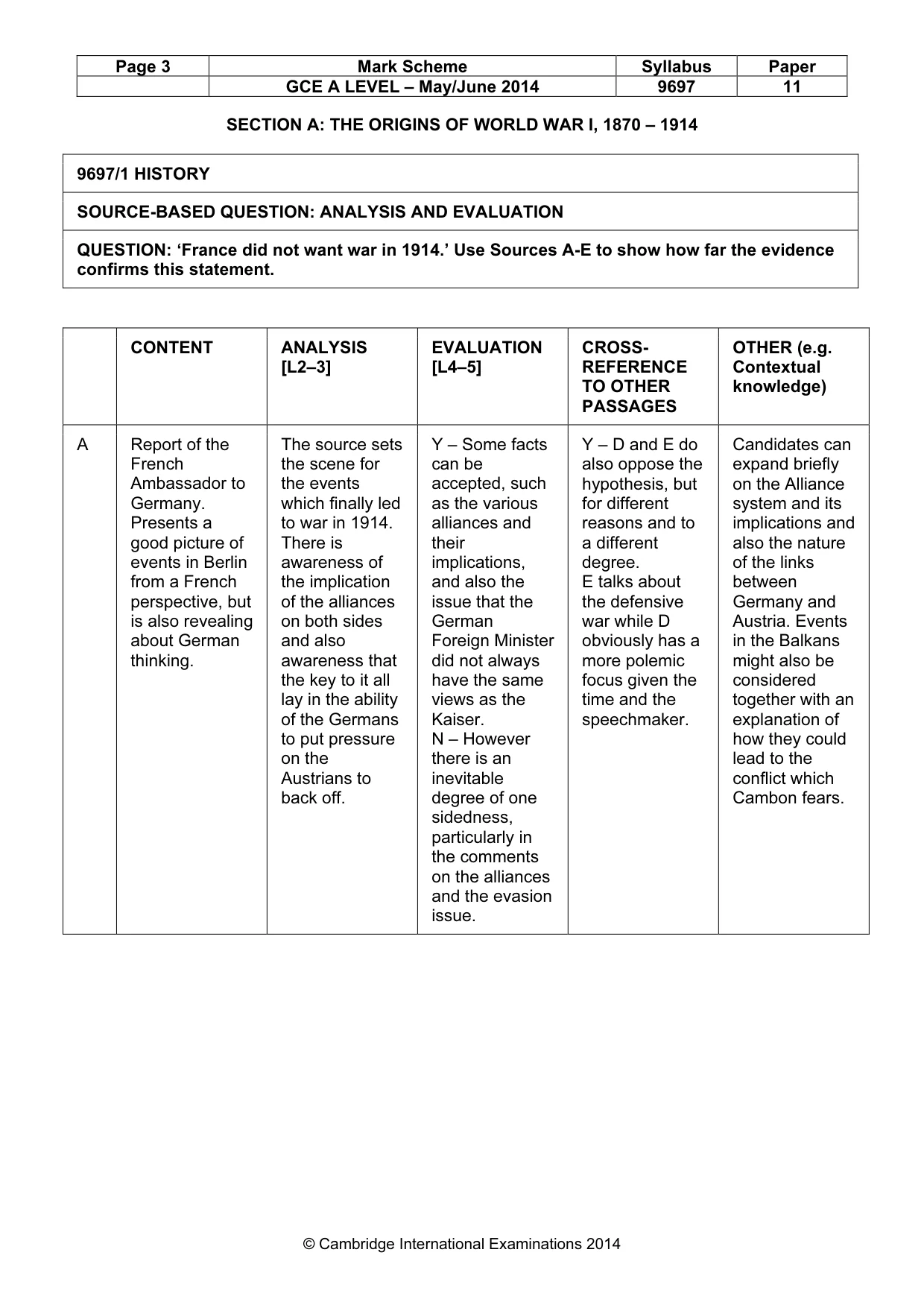
Page 3 Mark Scheme Syllabus Paper GCE A LEVEL – May/June 2014 9697 11 © Cambridge International Examinations 2014 SECTION A: THE ORIGINS OF WORLD WAR I, 1870 – 1914 9697/1 HISTORY SOURCE-BASED QUESTION: ANALYSIS AND EVALUATION QUESTION: ‘France did not want war in 1914.’ Use Sources A-E to show how far the evidence confirms this statement. CONTENT ANALYSIS [L2–3] EVALUATION [L4–5] CROSS- REFERENCE TO OTHER PASSAGES OTHER (e.g. Contextual knowledge) A Report of the French Ambassador to Germany. Presents a good picture of events in Berlin from a French perspective, but is also revealing about German thinking. The source sets the scene for the events which finally led to war in 1914. There is awareness of the implication of the alliances on both sides and also awareness that the key to it all lay in the ability of the Germans to put pressure on the Austrians to back off. Y – Some facts can be accepted, such as the various alliances and their implications, and also the issue that the German Foreign Minister did not always have the same views as the Kaiser. N – However there is an inevitable degree of one sidedness, particularly in the comments on the alliances and the evasion issue. Y – D and E do also oppose the hypothesis, but for different reasons and to a different degree. E talks about the defensive war while D obviously has a more polemic focus given the time and the speechmaker. Candidates can expand briefly on the Alliance system and its implications and also the nature of the links between Germany and Austria. Events in the Balkans might also be considered together with an explanation of how they could lead to the conflict which Cambon fears.
Mark scheme, page 4
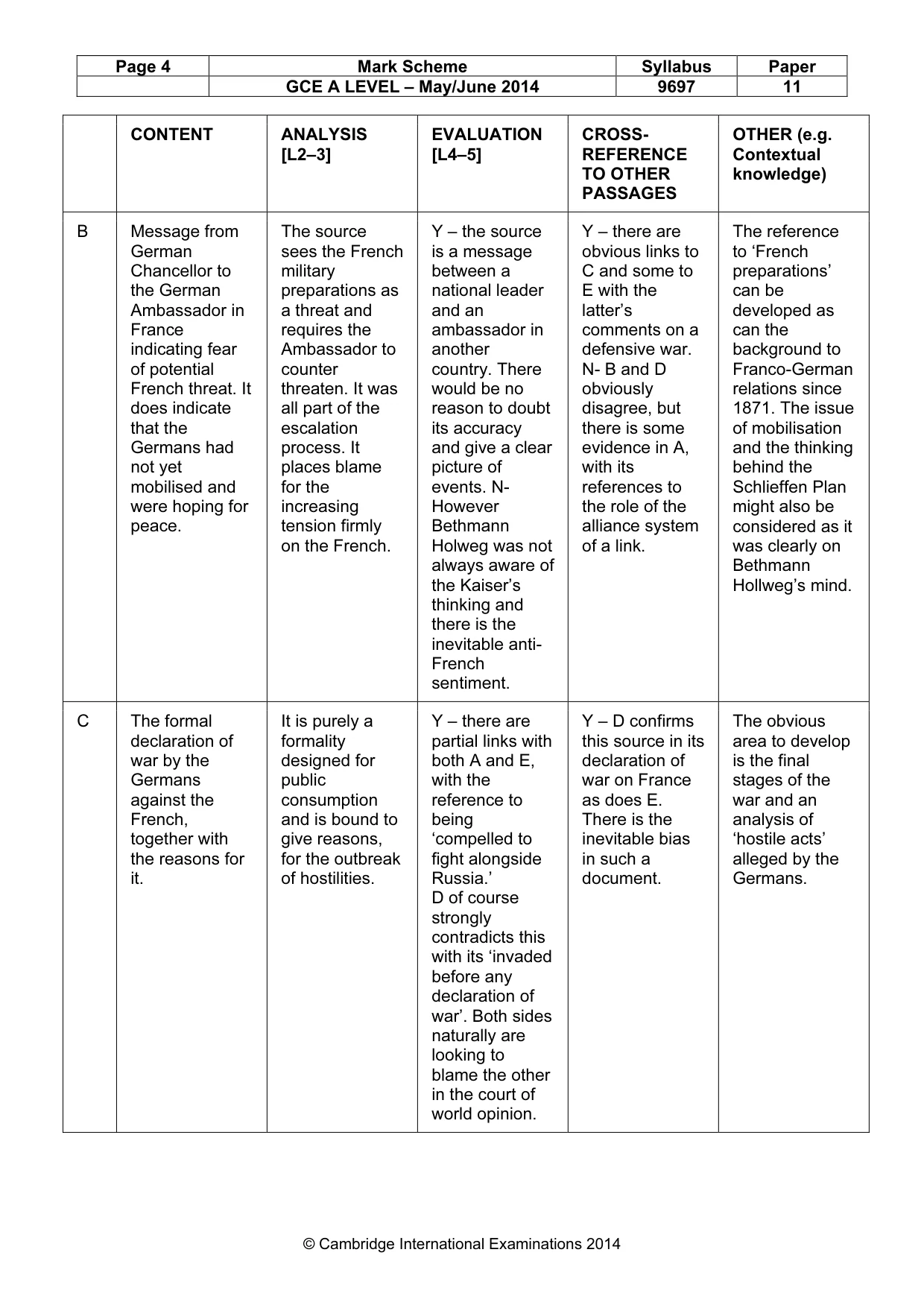
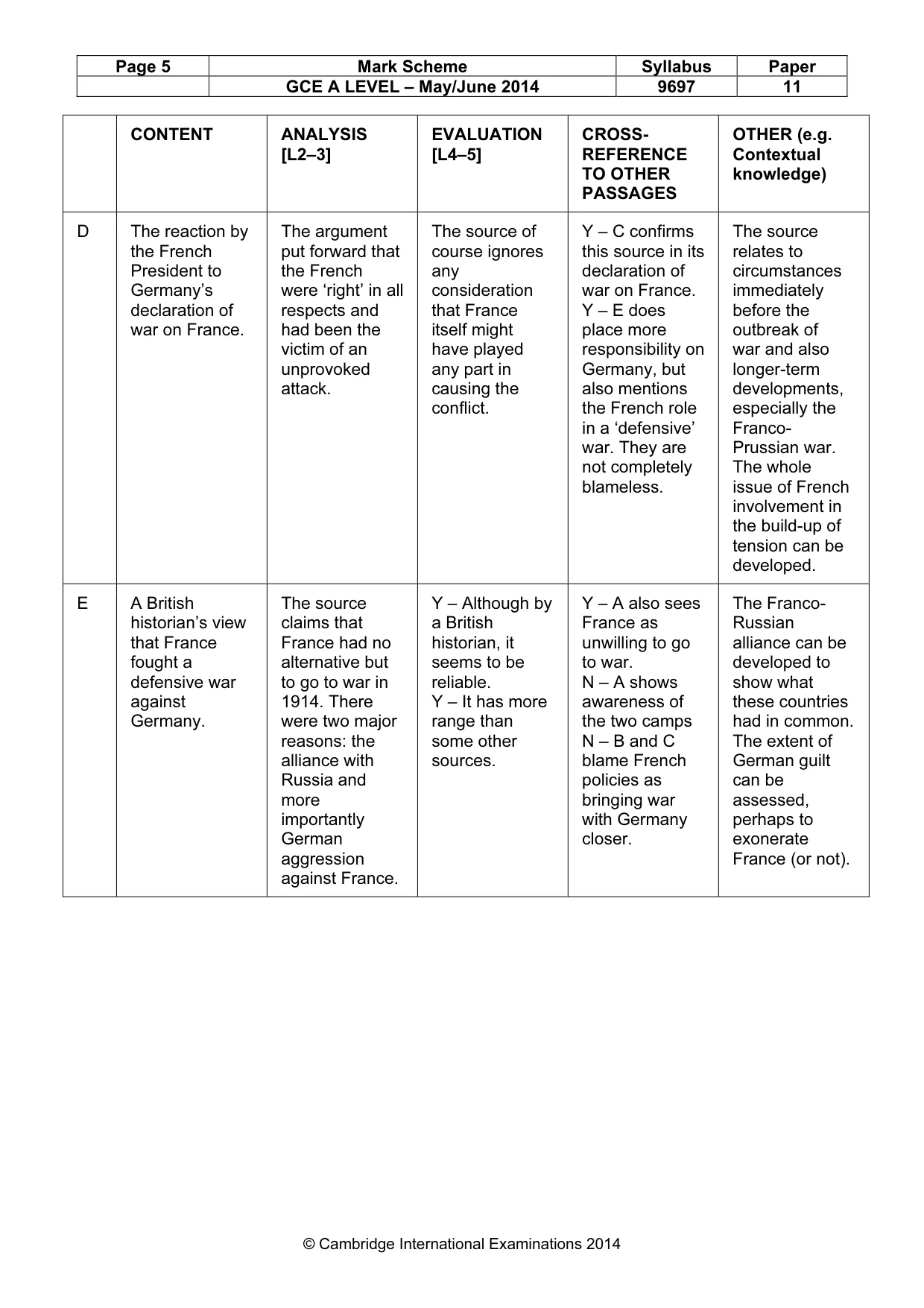
Page 4 Mark Scheme Syllabus Paper GCE A LEVEL – May/June 2014 9697 11 © Cambridge International Examinations 2014 CONTENT ANALYSIS [L2–3] EVALUATION [L4–5] CROSS- REFERENCE TO OTHER PASSAGES OTHER (e.g. Contextual knowledge) B Message from German Chancellor to the German Ambassador in France indicating fear of potential French threat. It does indicate that the Germans had not yet mobilised and were hoping for peace. The source sees the French military preparations as a threat and requires the Ambassador to counter threaten. It was all part of the escalation process. It places blame for the increasing tension firmly on the French. Y – the source is a message between a national leader and an ambassador in another country. There would be no reason to doubt its accuracy and give a clear picture of events. N- However Bethmann Holweg was not always aware of the Kaiser’s thinking and there is the inevitable anti- French sentiment. Y – there are obvious links to C and some to E with the latter’s comments on a defensive war. N- B and D obviously disagree, but there is some evidence in A, with its references to the role of the alliance system of a link. The reference to ‘French preparations’ can be developed as can the background to Franco-German relations since 1871. The issue of mobilisation and the thinking behind the Schlieffen Plan might also be considered as it was clearly on Bethmann Hollweg’s mind. C The formal declaration of war by the Germans against the French, together with the reasons for it. It is purely a formality designed for public consumption and is bound to give reasons, for the outbreak of hostilities. Y – there are partial links with both A and E, with the reference to being ‘compelled to fight alongside Russia.’ D of course strongly contradicts this with its ‘invaded before any declaration of war’. Both sides naturally are looking to blame the other in the court of world opinion. Y – D confirms this source in its declaration of war on France as does E. There is the inevitable bias in such a document. The obvious area to develop is the final stages of the war and an analysis of ‘hostile acts’ alleged by the Germans.
Mark scheme, page 5
Page 5 Mark Scheme Syllabus Paper GCE A LEVEL – May/June 2014 9697 11 © Cambridge International Examinations 2014 CONTENT ANALYSIS [L2–3] EVALUATION [L4–5] CROSS- REFERENCE TO OTHER PASSAGES OTHER (e.g. Contextual knowledge) D The reaction by the French President to Germany’s declaration of war on France. The argument put forward that the French were ‘right’ in all respects and had been the victim of an unprovoked attack. The source of course ignores any consideration that France itself might have played any part in causing the conflict. Y – C confirms this source in its declaration of war on France. Y – E does place more responsibility on Germany, but also mentions the French role in a ‘defensive’ war. They are not completely blameless. The source relates to circumstances immediately before the outbreak of war and also longer-term developments, especially the Franco- Prussian war. The whole issue of French involvement in the build-up of tension can be developed. E A British historian’s view that France fought a defensive war against Germany. The source claims that France had no alternative but to go to war in 1914. There were two major reasons: the alliance with Russia and more importantly German aggression against France. Y – Although by a British historian, it seems to be reliable. Y – It has more range than some other sources. Y – A also sees France as unwilling to go to war. N – A shows awareness of the two camps N – B and C blame French policies as bringing war with Germany closer. The Franco- Russian alliance can be developed to show what these countries had in common. The extent of German guilt can be assessed, perhaps to exonerate France (or not).
Mark scheme, page 6
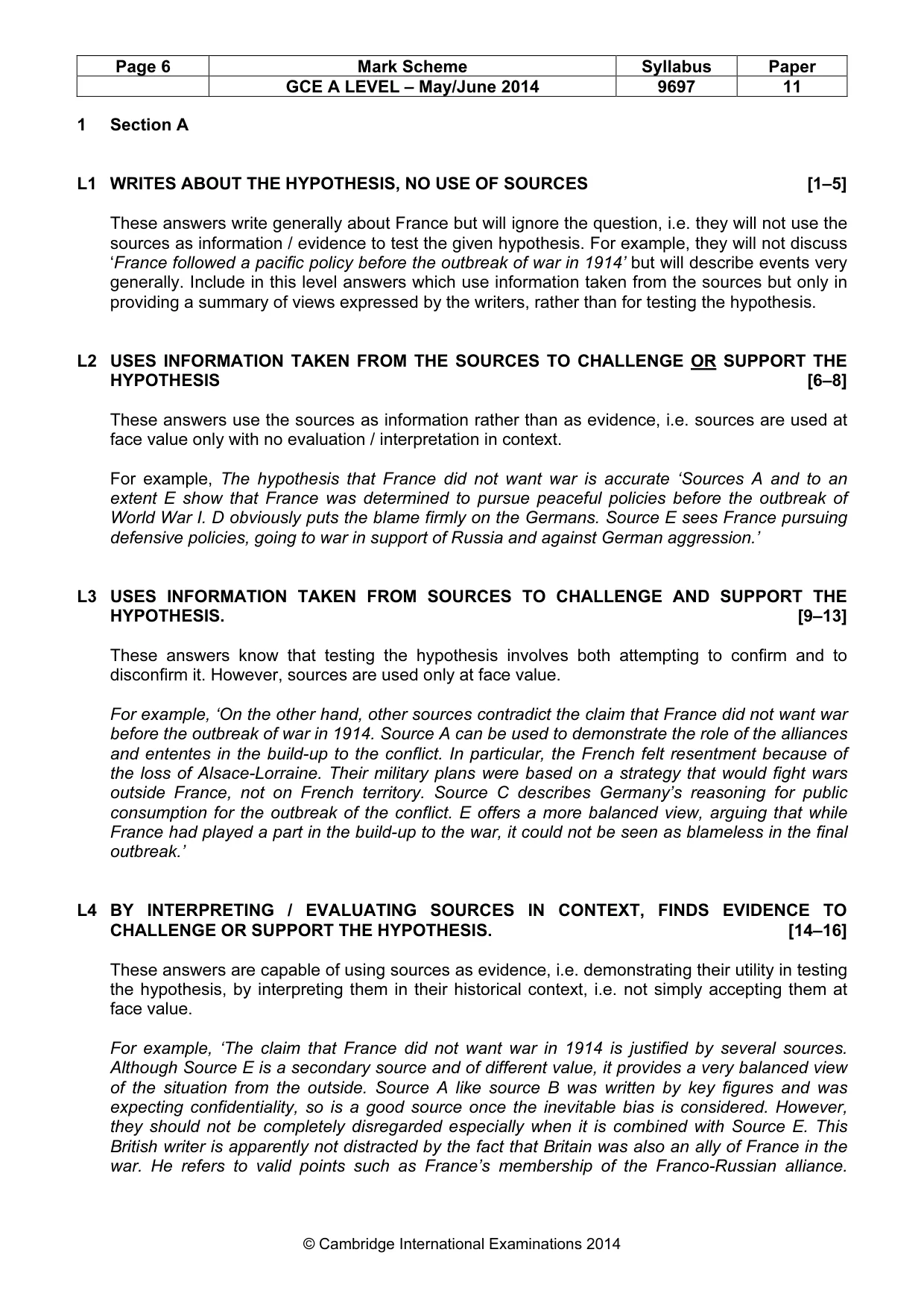
Page 6 Mark Scheme Syllabus Paper GCE A LEVEL – May/June 2014 9697 11 © Cambridge International Examinations 2014 1 Section A L1 WRITES ABOUT THE HYPOTHESIS, NO USE OF SOURCES [1–5] These answers write generally about France but will ignore the question, i.e. they will not use the sources as information / evidence to test the given hypothesis. For example, they will not discuss ‘France followed a pacific policy before the outbreak of war in 1914’ but will describe events very generally. Include in this level answers which use information taken from the sources but only in providing a summary of views expressed by the writers, rather than for testing the hypothesis. L2 USES INFORMATION TAKEN FROM THE SOURCES TO CHALLENGE OR SUPPORT THE HYPOTHESIS [6–8] These answers use the sources as information rather than as evidence, i.e. sources are used at face value only with no evaluation / interpretation in context. For example, The hypothesis that France did not want war is accurate ‘Sources A and to an extent E show that France was determined to pursue peaceful policies before the outbreak of World War I. D obviously puts the blame firmly on the Germans. Source E sees France pursuing defensive policies, going to war in support of Russia and against German aggression.’ L3 USES INFORMATION TAKEN FROM SOURCES TO CHALLENGE AND SUPPORT THE HYPOTHESIS. [9–13] These answers know that testing the hypothesis involves both attempting to confirm and to disconfirm it. However, sources are used only at face value. For example, ‘On the other hand, other sources contradict the claim that France did not want war before the outbreak of war in 1914. Source A can be used to demonstrate the role of the alliances and ententes in the build-up to the conflict. In particular, the French felt resentment because of the loss of Alsace-Lorraine. Their military plans were based on a strategy that would fight wars outside France, not on French territory. Source C describes Germany’s reasoning for public consumption for the outbreak of the conflict. E offers a more balanced view, arguing that while France had played a part in the build-up to the war, it could not be seen as blameless in the final outbreak.’ L4 BY INTERPRETING / EVALUATING SOURCES IN CONTEXT, FINDS EVIDENCE TO CHALLENGE OR SUPPORT THE HYPOTHESIS. [14–16] These answers are capable of using sources as evidence, i.e. demonstrating their utility in testing the hypothesis, by interpreting them in their historical context, i.e. not simply accepting them at face value. For example, ‘The claim that France did not want war in 1914 is justified by several sources. Although Source E is a secondary source and of different value, it provides a very balanced view of the situation from the outside. Source A like source B was written by key figures and was expecting confidentiality, so is a good source once the inevitable bias is considered. However, they should not be completely disregarded especially when it is combined with Source E. This British writer is apparently not distracted by the fact that Britain was also an ally of France in the war. He refers to valid points such as France’s membership of the Franco-Russian alliance.
Mark scheme, page 7
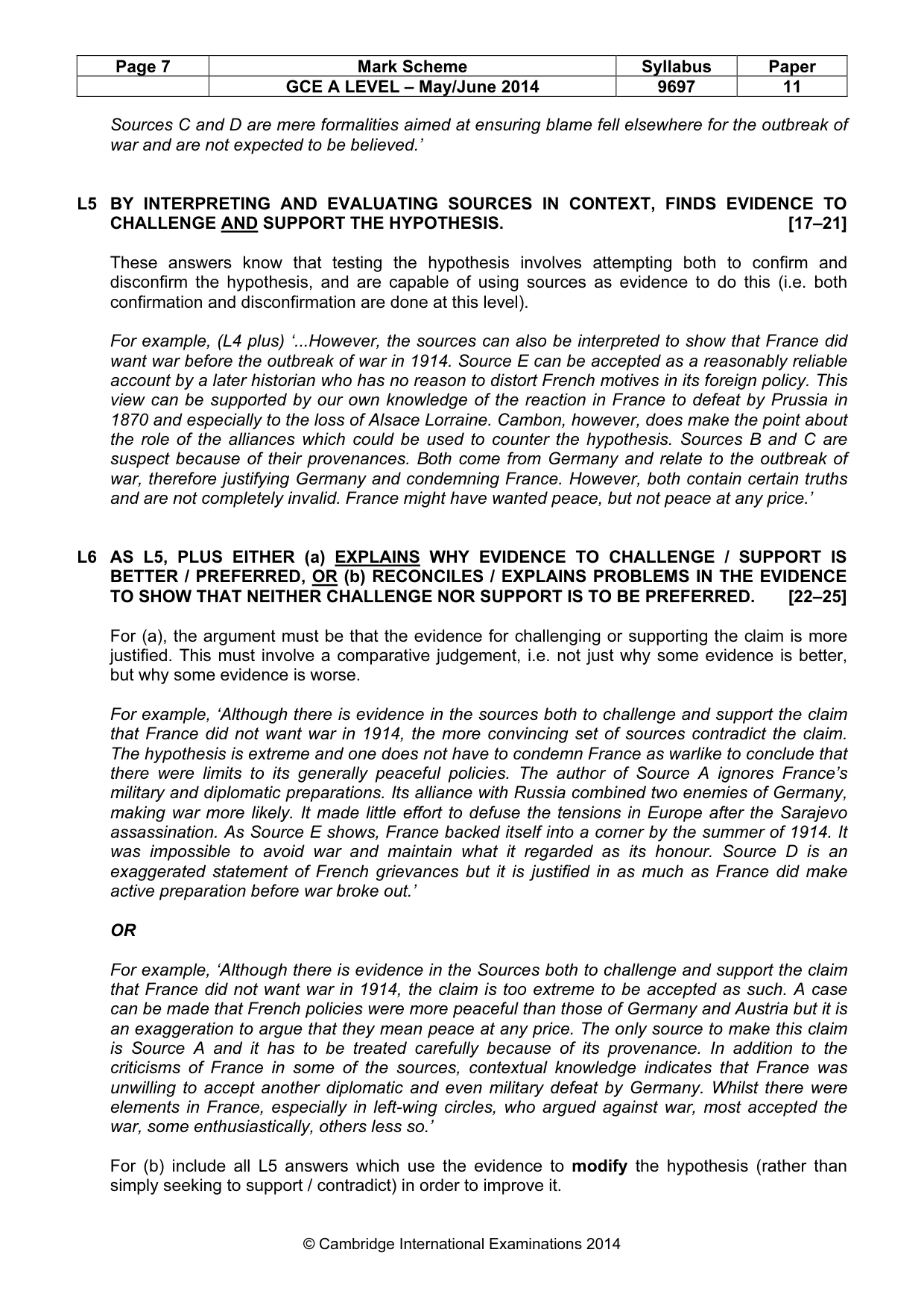
Page 7 Mark Scheme Syllabus Paper GCE A LEVEL – May/June 2014 9697 11 © Cambridge International Examinations 2014 Sources C and D are mere formalities aimed at ensuring blame fell elsewhere for the outbreak of war and are not expected to be believed.’ L5 BY INTERPRETING AND EVALUATING SOURCES IN CONTEXT, FINDS EVIDENCE TO CHALLENGE AND SUPPORT THE HYPOTHESIS. [17–21] These answers know that testing the hypothesis involves attempting both to confirm and disconfirm the hypothesis, and are capable of using sources as evidence to do this (i.e. both confirmation and disconfirmation are done at this level). For example, (L4 plus) ‘...However, the sources can also be interpreted to show that France did want war before the outbreak of war in 1914. Source E can be accepted as a reasonably reliable account by a later historian who has no reason to distort French motives in its foreign policy. This view can be supported by our own knowledge of the reaction in France to defeat by Prussia in 1870 and especially to the loss of Alsace Lorraine. Cambon, however, does make the point about the role of the alliances which could be used to counter the hypothesis. Sources B and C are suspect because of their provenances. Both come from Germany and relate to the outbreak of war, therefore justifying Germany and condemning France. However, both contain certain truths and are not completely invalid. France might have wanted peace, but not peace at any price.’ L6 AS L5, PLUS EITHER (a) EXPLAINS WHY EVIDENCE TO CHALLENGE / SUPPORT IS BETTER / PREFERRED, OR (b) RECONCILES / EXPLAINS PROBLEMS IN THE EVIDENCE TO SHOW THAT NEITHER CHALLENGE NOR SUPPORT IS TO BE PREFERRED. [22–25] For (a), the argument must be that the evidence for challenging or supporting the claim is more justified. This must involve a comparative judgement, i.e. not just why some evidence is better, but why some evidence is worse. For example, ‘Although there is evidence in the sources both to challenge and support the claim that France did not want war in 1914, the more convincing set of sources contradict the claim. The hypothesis is extreme and one does not have to condemn France as warlike to conclude that there were limits to its generally peaceful policies. The author of Source A ignores France’s military and diplomatic preparations. Its alliance with Russia combined two enemies of Germany, making war more likely. It made little effort to defuse the tensions in Europe after the Sarajevo assassination. As Source E shows, France backed itself into a corner by the summer of 1914. It was impossible to avoid war and maintain what it regarded as its honour. Source D is an exaggerated statement of French grievances but it is justified in as much as France did make active preparation before war broke out.’ OR For example, ‘Although there is evidence in the Sources both to challenge and support the claim that France did not want war in 1914, the claim is too extreme to be accepted as such. A case can be made that French policies were more peaceful than those of Germany and Austria but it is an exaggeration to argue that they mean peace at any price. The only source to make this claim is Source A and it has to be treated carefully because of its provenance. In addition to the criticisms of France in some of the sources, contextual knowledge indicates that France was unwilling to accept another diplomatic and even military defeat by Germany. Whilst there were elements in France, especially in left-wing circles, who argued against war, most accepted the war, some enthusiastically, others less so.’ For (b) include all L5 answers which use the evidence to modify the hypothesis (rather than simply seeking to support / contradict) in order to improve it.
Mark scheme, page 8
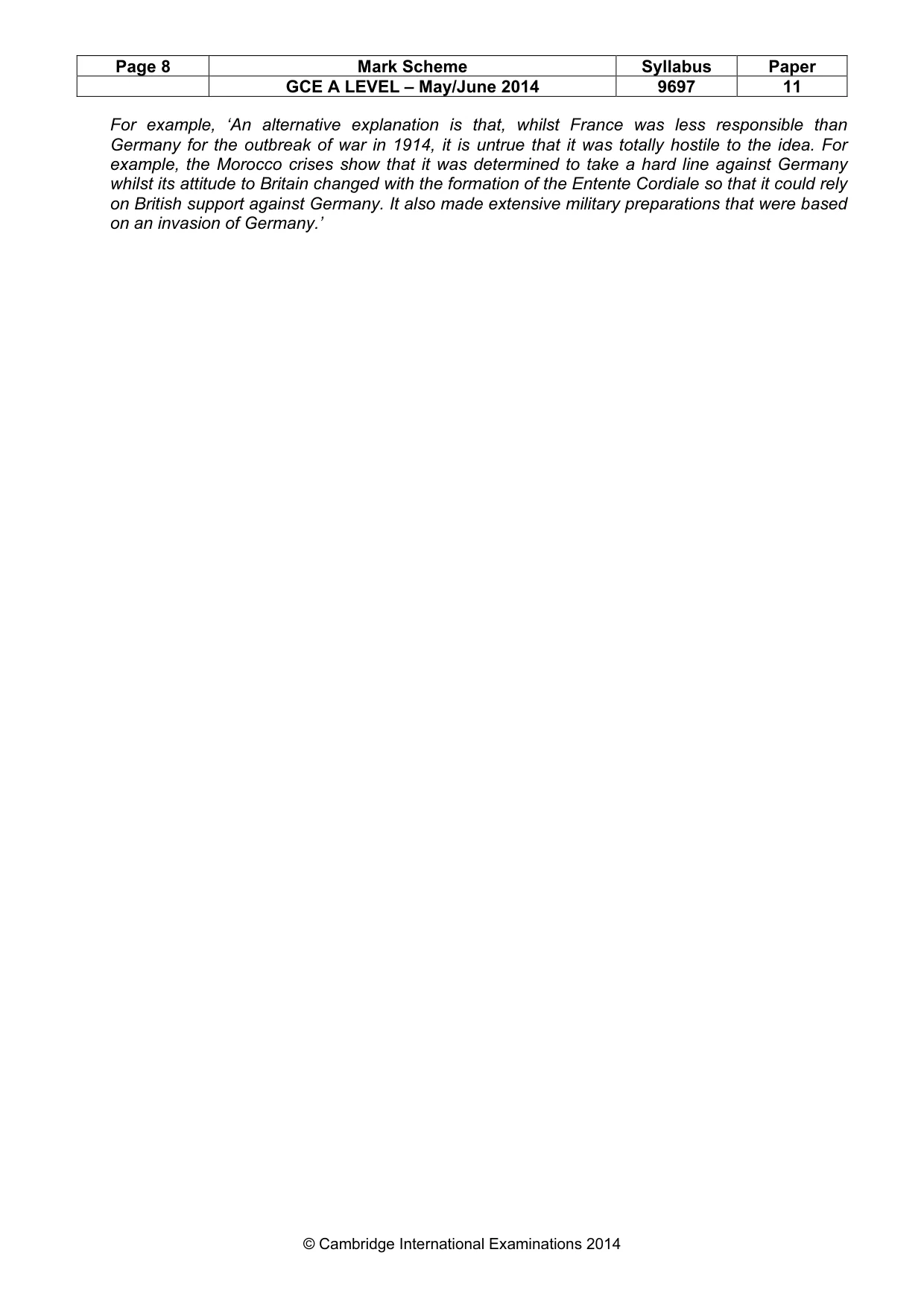
Page 8 Mark Scheme Syllabus Paper GCE A LEVEL – May/June 2014 9697 11 © Cambridge International Examinations 2014 For example, ‘An alternative explanation is that, whilst France was less responsible than Germany for the outbreak of war in 1914, it is untrue that it was totally hostile to the idea. For example, the Morocco crises show that it was determined to take a hard line against Germany whilst its attitude to Britain changed with the formation of the Entente Cordiale so that it could rely on British support against Germany. It also made extensive military preparations that were based on an invasion of Germany.’
Mark scheme, page 9
Page 9 Mark Scheme Syllabus Paper GCE A LEVEL – May/June 2014 9697 11 © Cambridge International Examinations 2014 Section B 2 How far had the French revolutionaries of 1789 achieved their aims by the time of Louis XVI’s execution in 1793? The key issue is the achievement of the revolutionaries’ aims by 1793. Answers in Band 1 (21– 25) can be expected to be clear about the aims in 1789 and about the position in 1793. Candidates might point out that the aims changed between the two salient dates and this gives the opportunity for narrative linked to an argument. The key demand in 1789 probably revolved around the financial situation. France’s debts reflected the high expense of government, incurred largely by an inefficient fiscal system and wasteful expenditure. These were linked to a political system that was increasingly unpopular. Whereas Louis XVI looked to the Estates General to solve his financial problems, the revolutionaries’ priorities focused more on political concessions, especially an end to despotism and moves towards greater representation. This gave rise immediately to the crisis over voting. Issues soon widened to criticism of privileged groups in the Church and nobility. The cahiers of the Third Estate (and to some extent of the nobility) called for constitutional changes, reform of taxes, an end to internal customs barriers and a free press. By 1793 there was massive constitutional change with the end of the monarchy. This went far beyond the demands for reform in 1789. The fiscal system was changed but did not make for efficiency. The tax yield was lower because the administration fell apart. Tax exemptions ended. Feudal obligations were cancelled. In 1789, the representatives of the Third Estate (there were few peasants) wished to uphold property rights. By 1793, property rights were more under threat. Changes in the Church went beyond comparatively moderate reform to a situation in which it was controlled by the state. The political situation in 1793 can be assessed. Did the rule of the Jacobins represent greater representation? In practice, freedom of the press and of expression was not widened under an extremely authoritarian government. 3 Analyse the main reasons for the increase in urbanisation in the nineteenth century. (You should refer to developments in at least two of Britain, France and Germany in your answer.) The key issue is the growth of urbanisation. Candidates are asked to refer to at least two of Britain, France and Germany. Generally accurate references will be given credit but specific examples will be more creditable. In 1800, only 22 cities in the world had populations of more than 100 000. The three countries were largely rural in character. By 1851, a majority in Britain lived in cities but it should be remembered that geographically, Britain was still a country of largely rural areas. Both France and Germany became more urbanised but cities and large towns were more patchy. Large urban areas grew because they provided hubs of employment. Industrial factories were centred on towns rather than the rural areas. In spite of changes in methods of agriculture, first seen in Britain, the rise of population was less in the countryside, partly because agricultural changes offered less employment. A similar trend followed later in Germany but France, whilst showing some overall increase, lagged behind. People decided, or were forced, to seek employment in towns. Social conditions in towns were poor but arguably not worse than in rural areas and, as the nineteenth century continued, changes in hygiene as well as the availability of more food, resulted in a growth of population, mostly centred on towns. The birth rate was higher whilst the death rate fell. Urbanisation went alongside the growth of trade, especially overseas trade. It was encouraged by the rapid increase in railways which facilitated transport for goods as well as people. They created hubs of employment. Towns that were on fast railway lines prospered and increased while others were slow to grow or declined. Towns became centres of banking and investment. They created opportunities for ancillary employment. Coal and steel created towns.
Mark scheme, page 10
Page 10 Mark Scheme Syllabus Paper GCE A LEVEL – May/June 2014 9697 11 © Cambridge International Examinations 2014 4 ‘From 1848 to 1871, the unification of Italy depended more on foreigners than on Italians.’ How valid is this judgement? The key issue is the role of foreigners in Italian unification. Examiners can expect answers in Band 1 (21–25) to consider arguments for and against the claim in the question and to come to a clear convincing argument. Answers do not need to be evenly balanced. The assessment will depend primarily on the quality of the argument. But answers that opt simply for agreement or disagreement without discussing the alternative will probably be less likely to get more than Band 2 (18–20). Moderate answers are likely to be highly descriptive and with little evidence of an argument. Band 5 (11–13) is likely to be appropriate for answers that show basic knowledge of unification during the specified period. However, the question can be tackled chronologically because issues and factors changed. It might be argued that the basic problem of those who wished to unify Italy was that they lacked an effective army that could challenge Austria. This was Mazzini’s error. Italy could not go it alone. Charles Albert was defeated at Custozza (1848) and Novara (1849). France helped to put down the brief Roman Republic. Cavour and Victor Emmanuel realised the importance of securing a foreign ally against Austria. Hence Piedmont’s intervention in the Crimean War. Piedmont benefited in the Plombières agreement (1858) and the ensuing victories at Magenta and Solferino. The ensuing unification of north Italy was the direct outcome. Foreign intervention played a part in the later stages of unification. Garibaldi shared many of Mazzini’s ideals of an Italian-led movement but he was aided in his invasion of the south by Britain’s friendly neutrality. Prussia played its part in securing Venetia after its war with Austria. France had to withdraw its army during the war with Prussia, leaving the way open for Rome to be incorporated in the new Italy. There were other factors that might be considered. These might include the emergence of Piedmont as the dominant Italian state and the crucial work of Cavour, not only in winning foreign support but also in modernising Piedmont. Foreign states would not have helped to unify Italy without him. He made a united Italy more acceptable internationally than Mazzini and even Garibaldi. 5 In the late nineteenth century, how different was European imperialism in Africa from that in Asia? The key issue is the comparison of imperialism in Africa and Asia. ‘How different?’ means that candidates should also explore similar aspects because nobody would claim that the two were completely different. Examiners will not look for an even balance for Band 1 (21–25) but there should be at least 70:30. Band 5 (11–13) will need a basic understanding and knowledge of one region. Africa and Asia are themselves so large that candidates can be selective within them. The differences depended largely on the diverse conditions in Africa and Asia. For example, the less developed political structures of Africa meant that is was easier to establish political control than in Asia. Different methods were needed, for example in China. However, periodically the European powers felt it necessary to resort to force to establish themselves. European governments could take over vast tracts of African land but this was not possible in Asia. The focus was more on the agreements to control trading centres. The trading partners were not equal but Asian countries were not as subservient as African regions. The internal politics of Asian countries presented different problems. Both Africa and Asia offered the raw materials that were increasingly needed by industrialised countries in Europe. These included cotton, silk and oils. This hope was largely fulfilled. There was also the hope that markets would grow for European products. This was a less successful motive. Africa did not contain favourable markets whilst Asian countries sometimes had to be forced to allow the entry of European goods. The issue of investment is more arguable. Some would claim that a high proportion of British investment went to its overseas territories whilst others point out that the majority of European investment did not go to the regions of New Imperialism. There was also the similarity that imperialism in Africa and Asia caused rivalry between European countries.
Mark scheme, page 11
Page 11 Mark Scheme Syllabus Paper GCE A LEVEL – May/June 2014 9697 11 © Cambridge International Examinations 2014 6 How stable was Russia at the outbreak of World War I in 1914? The key issue is the extent to which Russia was stable in 1914. Candidates can take one of two approaches, equally valid. The first might be to focus narrowly on 1914. This will be very relevant but most candidates who take this line might find there is less factual material to support their arguments. The alternative will be to take a wider period but, to be fully relevant, the preceding years must be linked to the key issue. An appropriate starting point for this approach might be the 1905 Revolution or its immediate aftermath. Answers in Band 1 and most in Band 2 (21–25; 18– 20) can be expected to look at positive aspects to assess stability. One of the strengths of the regime was there was no obvious alternative to autocracy. The government was backed by most of the nobility, there was little resistance by the small middle class, and the peasantry largely accepted tsarism. The government could rely on the backing of the powerful Orthodox Church, the army and the police. Radical groups, including the Bolsheviks, were small in number and under control. Many of their leaders, such as Lenin, were in prison or in internal or external exile. Nicholas II’s personal position was strong. However, he represented a weakness because of his hostility to change. He gave little support to reformers such as Stolypin and wasted the opportunity to win wider support after the 1905 Revolution by insisting on autocracy and ignoring the possibilities offered by the Duma. The policy of Russification was popular in Russia but other racial groups suffered discrimination that caused unrest. Most candidates will see the economy as a weakness. Still largely agricultural, it was more backward than Britain, France and Germany, even Austria. A series of strikes demonstrated the unrest in society, for example the Lena Gold Fields. However, credit should be given when candidates understand some of the economic improvements in pre-war Russia. External trade increased. More railways were built. Nevertheless, there were few entrepreneurs and the most powerful social and political groups were not interested in developing a modern economy. Some candidates might refer to the military. Whilst failings were revealed in the war with Japan (1904–05), there was massive investment and some modernisation from 1906. However, these improvements had not resulted in significant change by 1914 although the other major countries saw Russia as a powerful military force in the future. 7 How far had Hitler achieved his domestic aims by 1939? The key issue is the extent to which Hitler achieved his domestic aims by 1939. A clear differentiation between good and moderate answers will probably be candidates’ ability to define Hitler’s domestic aims. The satisfactory but moderate answers up to Band 3 (16–17) might contain relevant but general descriptions. Band 5 (11–13) will require a basic knowledge and understanding of domestic developments. Hitler’s primary aim was to gain personal power. He achieved this completely by 1939. In a one-party state, the only opposition was underground and it was very limited in scope. The Enabling Act (1933) gave Hitler and the Nazis complete power. His position as Führer confirmed this. He achieved his aims to destroy the Weimar Republic, discrediting the ‘November Criminals’. Candidates can refer to his dominance over the law, the police and the Gestapo / SS. Hitler gained dominance over the military, whose members swore an oath of personal loyalty to him. Candidates might well refer to his aims towards the Jews. The anti-Jewish measures were considerable by 1939 but the extent to which he envisaged a Holocaust by that date is arguable. Hitler’s aims were not seriously threatened by opposition to any of his major policies. It was very weak. But the extent of the changes that he wished to introduce was a handicap. Nor were many of his aims clear. He himself was good at propaganda but less effective in turning rhetoric about domestic issues into practice.
Mark scheme, page 12
Page 12 Mark Scheme Syllabus Paper GCE A LEVEL – May/June 2014 9697 11 © Cambridge International Examinations 2014 8 Which did more to threaten peace in Europe from 1850 to 1900: nationalism or imperialism? The key issue is the threat to peace in the second half of the nineteenth century. The specified period shows the limits of relevance. Discussions of the causes of World War I (covered in Question 1) should not be given credit unless mentioned briefly in a conclusion as a contrast to previous conditions. The question ends in 1900. Some leeway might be allowed but not to 1914. Answers in the higher bands should be reasonably but not necessarily equally balanced. The balance can vary according to the argument. To get to Band 5 (11–13), answers should be reasonably secure about one of the stated factors: nationalism and imperialism. Claims in the more successful answers should be supported by accurate knowledge but some in the middle ranges might be heavily descriptive. The answers in Band 1 (21–25) should explain why nationalism and imperialism lead to threats or actual war. The time period is quite long and candidates can select from within it but credit should be given when candidates show a range of understanding. For example, German and Italian nationalism led to the wars of unification in the 1850s to 1871. It can be argued that French nationalism was an element that led to the Franco- Prussian War of 1870. Thereafter, European states were caught between domestic nationalism and attempts to form alliances to curb the extreme nationalism of others. Imperialism led to rivalries outside Europe with some dangerous confrontations, for example at Fashoda (1898). Thoughtful candidates might argue that the two factors were not distinct. To a degree, imperialism was the product of nationalism.
What you needed in this session
Cambridge’s own grade thresholds for 2014 May/June, Paper 1 · Variant 1. A higher threshold means an easier paper — the bar moves with how the cohort did.