Cambridge A Level History 9489 — 2022 May/June Paper 1 · Variant 1
9489/11/M/J/22 · 40 marks · ≈45 min
The question paper and its mark scheme, free to read here and free to download. This is Cambridge’s own paper, exactly as it was sat.
Question paper8 pages
Mark scheme11 pages
Answers below. Sit the paper first if you are practising.
Paper as text
Question paper, page 1
This document has 8 pages. Any blank pages are indicated. [Turn over Cambridge International AS & A Level DC (PQ) 303787/4 © UCLES 2022 * 1 6 4 7 3 1 6 8 7 0 * HISTORY 9489/11 Paper 1 Document Question May/June 2022 1 hour 15 minutes You must answer on the enclosed answer booklet. You will need: Answer booklet (enclosed) INSTRUCTIONS ● Answer one question from one section only. Section A: European option Section B: American option Section C: International option ● Follow the instructions on the front cover of the answer booklet. If you need additional answer paper, ask the invigilator for a continuation booklet. INFORMATION ● The total mark for this paper is 40. ● The number of marks for each question or part question is shown in brackets [ ].
Question paper, page 2
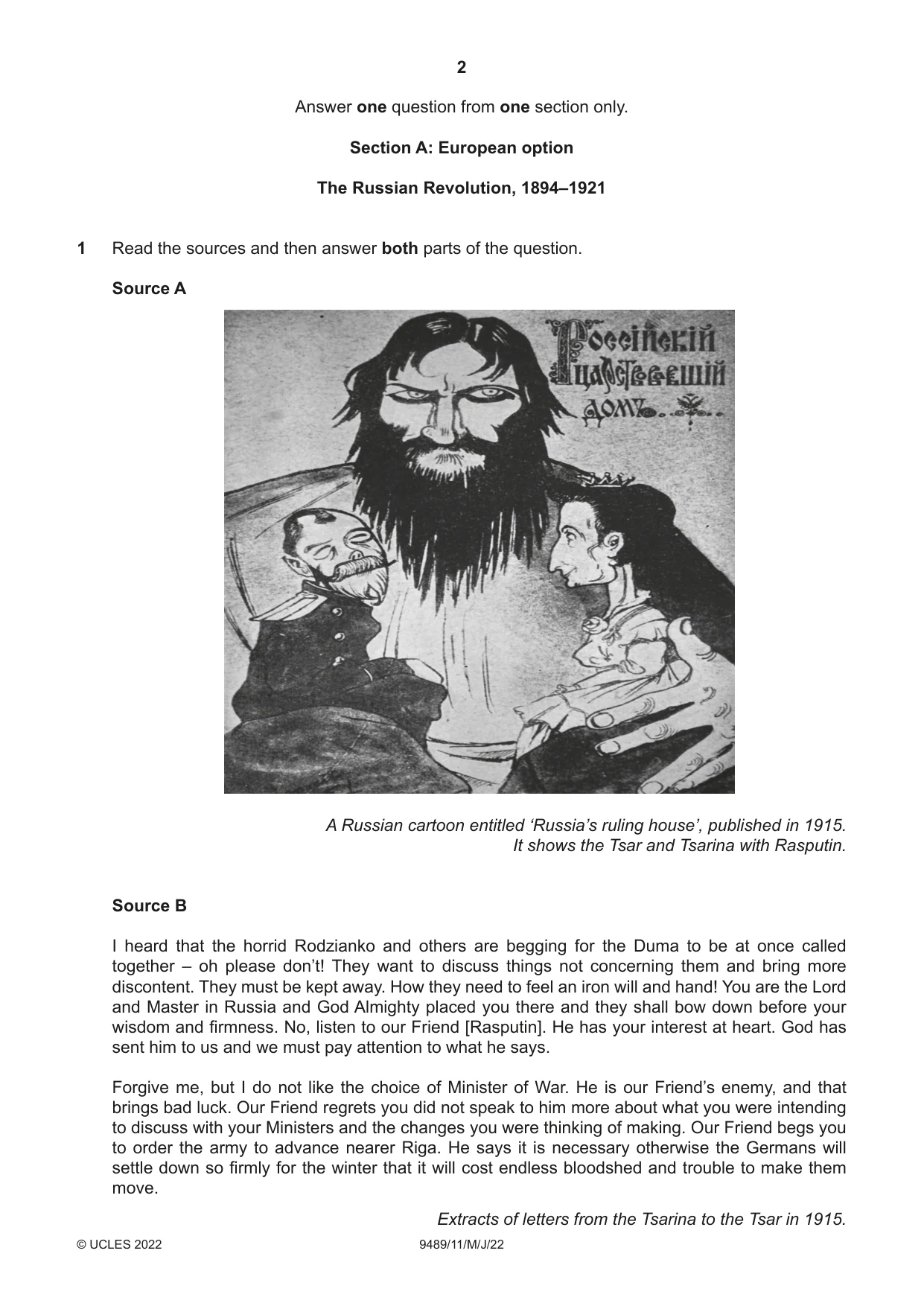
2 9489/11/M/J/22 © UCLES 2022 Answer one question from one section only. Section A: European option The Russian Revolution, 1894–1921 1 Read the sources and then answer both parts of the question. Source A A Russian cartoon entitled ‘Russia’s ruling house’, published in 1915. It shows the Tsar and Tsarina with Rasputin. Source B I heard that the horrid Rodzianko and others are begging for the Duma to be at once called together – oh please don’t! They want to discuss things not concerning them and bring more discontent. They must be kept away. How they need to feel an iron will and hand! You are the Lord and Master in Russia and God Almighty placed you there and they shall bow down before your wisdom and firmness. No, listen to our Friend [Rasputin]. He has your interest at heart. God has sent him to us and we must pay attention to what he says. Forgive me, but I do not like the choice of Minister of War. He is our Friend’s enemy, and that brings bad luck. Our Friend regrets you did not speak to him more about what you were intending to discuss with your Ministers and the changes you were thinking of making. Our Friend begs you to order the army to advance nearer Riga. He says it is necessary otherwise the Germans will settle down so firmly for the winter that it will cost endless bloodshed and trouble to make them move. Extracts of letters from the Tsarina to the Tsar in 1915.
Question paper, page 3
3 9489/11/M/J/22 © UCLES 2022 [Turn over Source C We can no more work with the government than we can lead Russia to victory with it. The Duma declares again and again that the home front must be organised for a successful war. However, the government continues to insist that to organise a country means to organise a revolution, and consciously chooses chaos and disorganisation. Is this stupidity or treason? The government deliberately busies itself with provoking popular outbursts – the involvement of their police in the spring disturbances in the factories is proven – knowing that they could cost us the war. Is this done consciously or not? We have many different reasons for being discontented with this government. But all these reasons boil down to one general one: the incompetence and evil intentions of the present government. In the name of millions of victims and of their spilled blood, in the name of our responsibility to those people who elected us, we shall fight until we get a responsible government. From a speech by the leader of the Kadets to the Fourth Duma, 1 November 1916. Source D Among the better class of officers, I note a great change of late in their attitude towards the Tsar. Daily, it grows greater, more critical and more freely expressed. From time immemorial they have abused the government. In the last year I have noticed a new and sinister trend of feeling towards the Tsar. One by one they have fallen away from him, louder and louder they declare the existing state of affairs to be impossible. They condemn the Tsar as being weak and hesitant, ruled by the Tsarina and keeping in office Ministers not only utterly incompetent, but with pro-German tendencies. No officer or private soldier has a good word to say for the Tsarina. All place her at the head of the pro-German party, all genuinely hate her. From an official Russian report into morale in the army, January 1917. Answer both parts of the question with reference to the sources. (a) Study Sources A and B. How far do Sources A and B agree about the power of the Tsar? [15] (b) Read all of the sources. ‘The Tsarina was responsible for the unpopularity of the Tsarist regime in Russia.’ How far do these sources agree? [25]
Question paper, page 4
4 9489/11/M/J/22 © UCLES 2022 Section B: American option Civil War and Reconstruction, 1861–77 2 Read the sources and then answer both parts of the question. Source A Mr Lincoln’s critics, and he had many, argued that he had no plan of action and wasted opportunities which millions of dollars would not bring back. He worked hard to compensate for the lack of military experience so many of his commanders showed. Mr Lincoln may not have had the knowledge of military matters that Mr Davis had, but he had much political skill as well as strong support from most people in the North. It had been supposed that the Southern people, poor in manufactures, would find themselves ill-prepared to contend with an enemy rich in the means and munitions of war. In some parts of the South there were fears about the wisdom of secession which Mr Davis did little to calm. However, throughout the South, the most patriotic devotion was exhibited. Transportation companies freely offered the use of their lines for transportation and supplies. It was safely estimated that the South entered upon the war with one hundred and fifty thousand small-arms of the best in the world; every village bristled with bayonets. President Davis was welcomed with genuine joy and enthusiasm, to which none of the military pageants of the North could furnish a parallel. From ‘The First Year of the War’, written by a Southern historian and published in Richmond, Virginia, 1862. Source B General Frémont has failed totally. On Sunday night the President ordered him to march from Franklin with his whole force to Harrisburg and intercept the Confederates under General Jackson. Two hours later a reply came. ‘On the march, will be there tomorrow-Frémont.’ Today the President and the War Department were thunderstruck to learn that Frémont was not at Franklin, but far to the North, so of course Jackson’s army escaped. Lincoln is furious at this disobedience and cowardice, but I fear he is too indecisive and too much of a coward himself to properly punish Frémont. If Frémont had obeyed orders the whole rebel force under Jackson would have been destroyed. The Washington correspondent of the Chicago Tribune, in a private letter to his editor, 28 May 1862. Source C The poor President. He is to be pitied; surrounded by so much incompetence and trying with all his might to understand strategy, naval warfare, big guns, the movement of troops, bad military maps, interior and exterior lines and all the technical details in the art of killing. He runs from one house to another, armed with plans, papers, reports and recommendations. He is sometimes good humoured, never angry, occasionally disheartened but always determined to succeed. There have been many more courteous Presidents, but they would not, in such a crisis, have displayed the capacity, honesty, hard work and plain dealing of President Lincoln. A Union officer, writing to his wife, October 1862.
Question paper, page 5
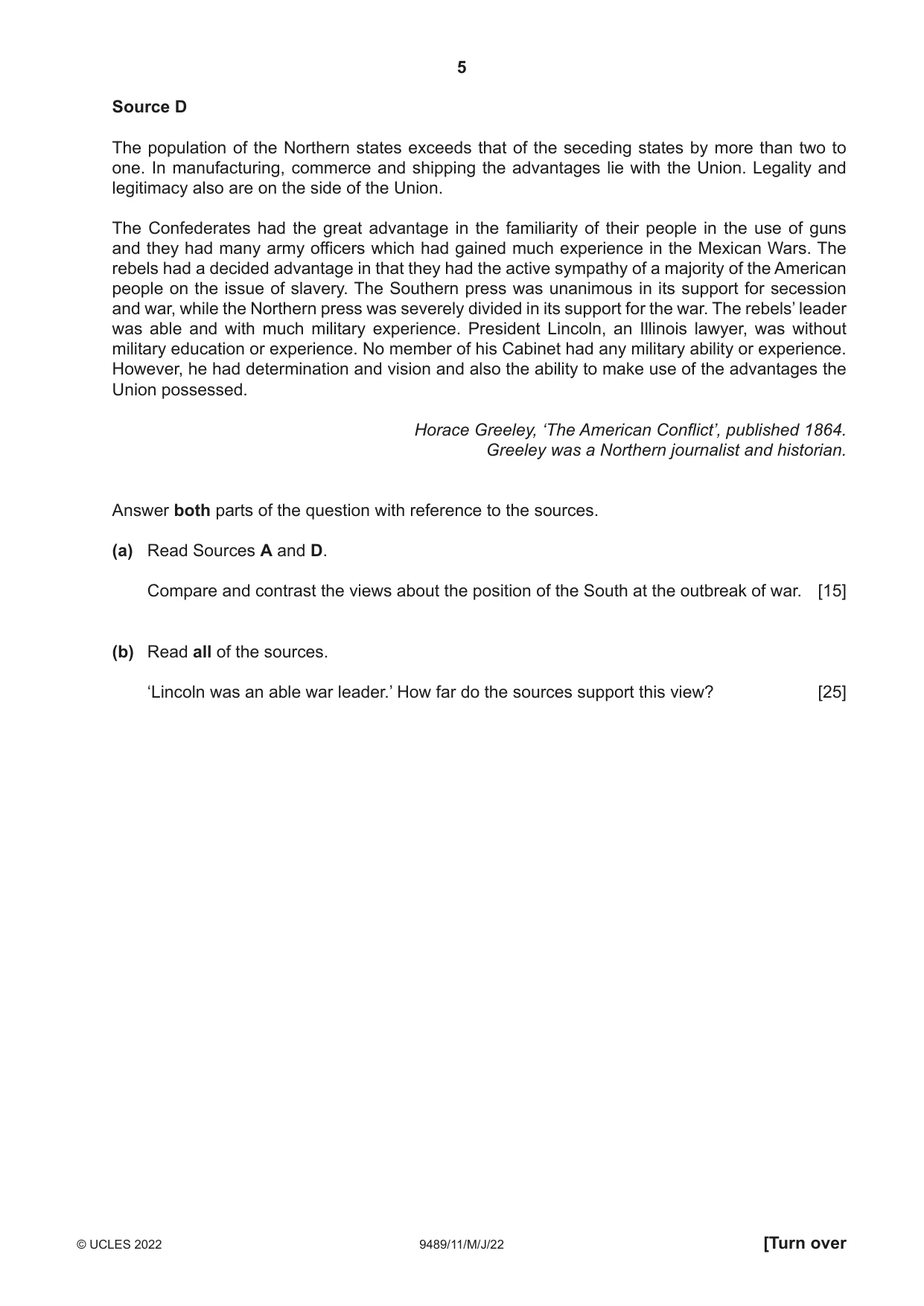
5 9489/11/M/J/22 © UCLES 2022 [Turn over Source D The population of the Northern states exceeds that of the seceding states by more than two to one. In manufacturing, commerce and shipping the advantages lie with the Union. Legality and legitimacy also are on the side of the Union. The Confederates had the great advantage in the familiarity of their people in the use of guns and they had many army officers which had gained much experience in the Mexican Wars. The rebels had a decided advantage in that they had the active sympathy of a majority of the American people on the issue of slavery. The Southern press was unanimous in its support for secession and war, while the Northern press was severely divided in its support for the war. The rebels’ leader was able and with much military experience. President Lincoln, an Illinois lawyer, was without military education or experience. No member of his Cabinet had any military ability or experience. However, he had determination and vision and also the ability to make use of the advantages the Union possessed. Horace Greeley, ‘The American Conflict’, published 1864. Greeley was a Northern journalist and historian. Answer both parts of the question with reference to the sources. (a) Read Sources A and D. Compare and contrast the views about the position of the South at the outbreak of war. [15] (b) Read all of the sources. ‘Lincoln was an able war leader.’ How far do the sources support this view? [25]
Question paper, page 6
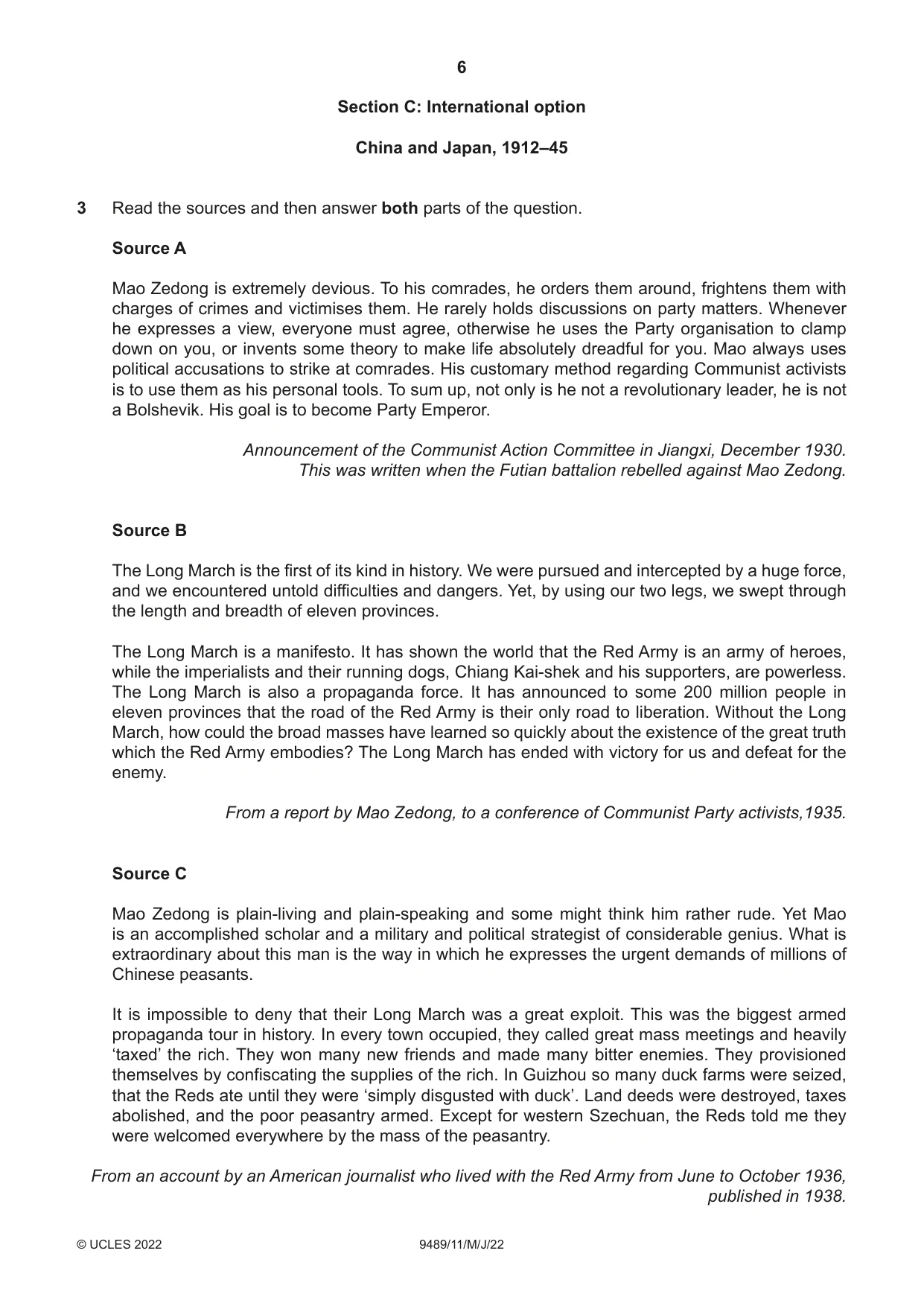
6 9489/11/M/J/22 © UCLES 2022 Section C: International option China and Japan, 1912–45 3 Read the sources and then answer both parts of the question. Source A Mao Zedong is extremely devious. To his comrades, he orders them around, frightens them with charges of crimes and victimises them. He rarely holds discussions on party matters. Whenever he expresses a view, everyone must agree, otherwise he uses the Party organisation to clamp down on you, or invents some theory to make life absolutely dreadful for you. Mao always uses political accusations to strike at comrades. His customary method regarding Communist activists is to use them as his personal tools. To sum up, not only is he not a revolutionary leader, he is not a Bolshevik. His goal is to become Party Emperor. Announcement of the Communist Action Committee in Jiangxi, December 1930. This was written when the Futian battalion rebelled against Mao Zedong. Source B The Long March is the first of its kind in history. We were pursued and intercepted by a huge force, and we encountered untold difficulties and dangers. Yet, by using our two legs, we swept through the length and breadth of eleven provinces. The Long March is a manifesto. It has shown the world that the Red Army is an army of heroes, while the imperialists and their running dogs, Chiang Kai-shek and his supporters, are powerless. The Long March is also a propaganda force. It has announced to some 200 million people in eleven provinces that the road of the Red Army is their only road to liberation. Without the Long March, how could the broad masses have learned so quickly about the existence of the great truth which the Red Army embodies? The Long March has ended with victory for us and defeat for the enemy. From a report by Mao Zedong, to a conference of Communist Party activists,1935. Source C Mao Zedong is plain-living and plain-speaking and some might think him rather rude. Yet Mao is an accomplished scholar and a military and political strategist of considerable genius. What is extraordinary about this man is the way in which he expresses the urgent demands of millions of Chinese peasants. It is impossible to deny that their Long March was a great exploit. This was the biggest armed propaganda tour in history. In every town occupied, they called great mass meetings and heavily ‘taxed’ the rich. They won many new friends and made many bitter enemies. They provisioned themselves by confiscating the supplies of the rich. In Guizhou so many duck farms were seized, that the Reds ate until they were ‘simply disgusted with duck’. Land deeds were destroyed, taxes abolished, and the poor peasantry armed. Except for western Szechuan, the Reds told me they were welcomed everywhere by the mass of the peasantry. From an account by an American journalist who lived with the Red Army from June to October 1936, published in 1938.
Question paper, page 7
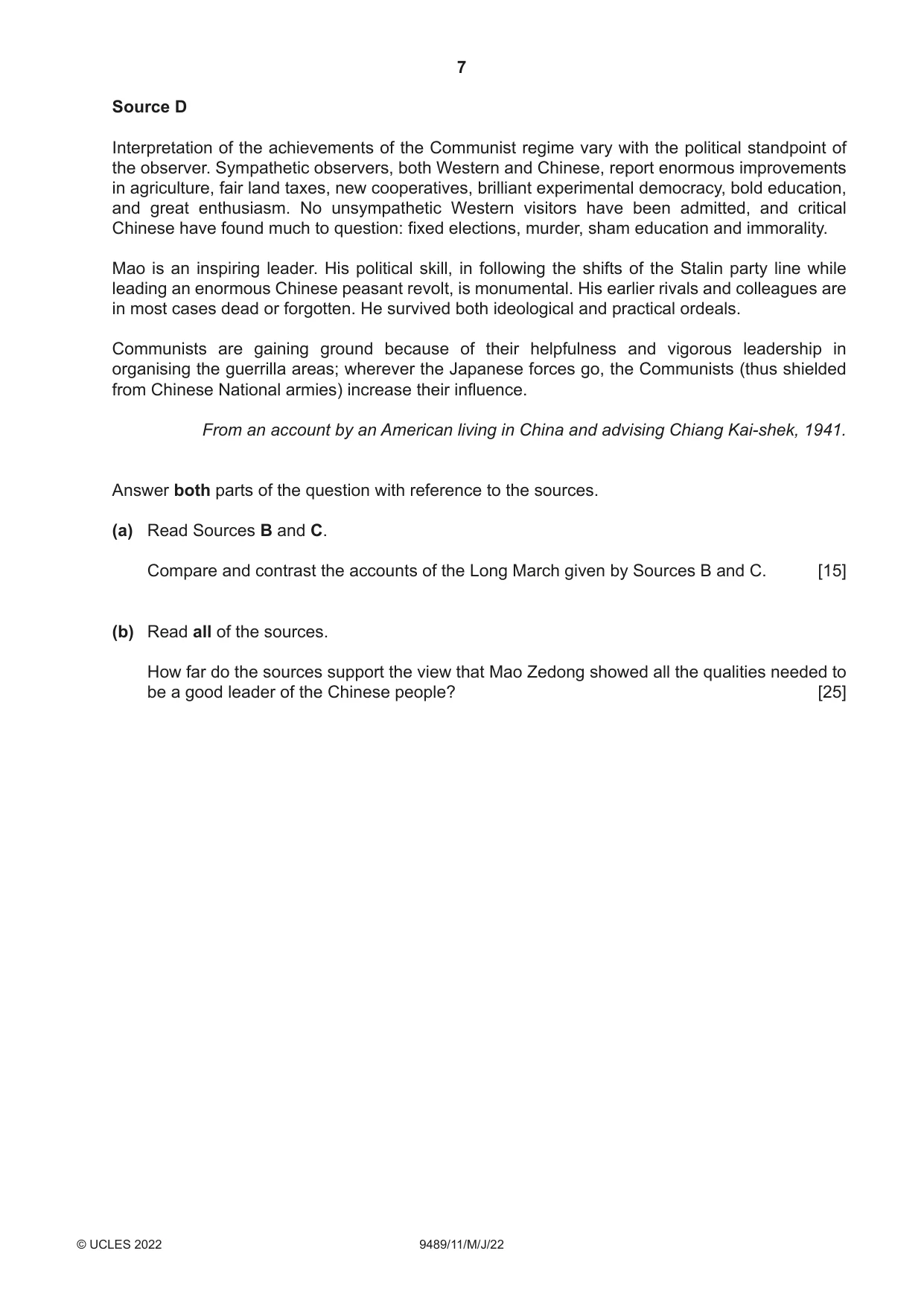
7 9489/11/M/J/22 © UCLES 2022 Source D Interpretation of the achievements of the Communist regime vary with the political standpoint of the observer. Sympathetic observers, both Western and Chinese, report enormous improvements in agriculture, fair land taxes, new cooperatives, brilliant experimental democracy, bold education, and great enthusiasm. No unsympathetic Western visitors have been admitted, and critical Chinese have found much to question: fixed elections, murder, sham education and immorality. Mao is an inspiring leader. His political skill, in following the shifts of the Stalin party line while leading an enormous Chinese peasant revolt, is monumental. His earlier rivals and colleagues are in most cases dead or forgotten. He survived both ideological and practical ordeals. Communists are gaining ground because of their helpfulness and vigorous leadership in organising the guerrilla areas; wherever the Japanese forces go, the Communists (thus shielded from Chinese National armies) increase their influence. From an account by an American living in China and advising Chiang Kai-shek, 1941. Answer both parts of the question with reference to the sources. (a) Read Sources B and C. Compare and contrast the accounts of the Long March given by Sources B and C. [15] (b) Read all of the sources. How far do the sources support the view that Mao Zedong showed all the qualities needed to be a good leader of the Chinese people? [25]
Question paper, page 8
8 9489/11/M/J/22 © UCLES 2022 Permission to reproduce items where third-party owned material protected by copyright is included has been sought and cleared where possible. Every reasonable effort has been made by the publisher (UCLES) to trace copyright holders, but if any items requiring clearance have unwittingly been included, the publisher will be pleased to make amends at the earliest possible opportunity. To avoid the issue of disclosure of answer-related information to candidates, all copyright acknowledgements are reproduced online in the Cambridge Assessment International Education Copyright Acknowledgements Booklet. This is produced for each series of examinations and is freely available to download at www.cambridgeinternational.org after the live examination series. Cambridge Assessment International Education is part of Cambridge Assessment. Cambridge Assessment is the brand name of the University of Cambridge Local Examinations Syndicate (UCLES), which is a department of the University of Cambridge. BLANK PAGE
Mark scheme, page 1
This document consists of 11 printed pages. © UCLES 2022 [Turn over Cambridge International AS & A Level HISTORY 9489/11 Paper 1 Document Question 11 May/June 2022 MARK SCHEME Maximum Mark: 40 Published This mark scheme is published as an aid to teachers and candidates, to indicate the requirements of the examination. It shows the basis on which Examiners were instructed to award marks. It does not indicate the details of the discussions that took place at an Examiners’ meeting before marking began, which would have considered the acceptability of alternative answers. Mark schemes should be read in conjunction with the question paper and the Principal Examiner Report for Teachers. Cambridge International will not enter into discussions about these mark schemes. Cambridge International is publishing the mark schemes for the May/June 2022 series for most Cambridge IGCSE, Cambridge International A and AS Level and Cambridge Pre-U components, and some Cambridge O Level components.
Mark scheme, page 2
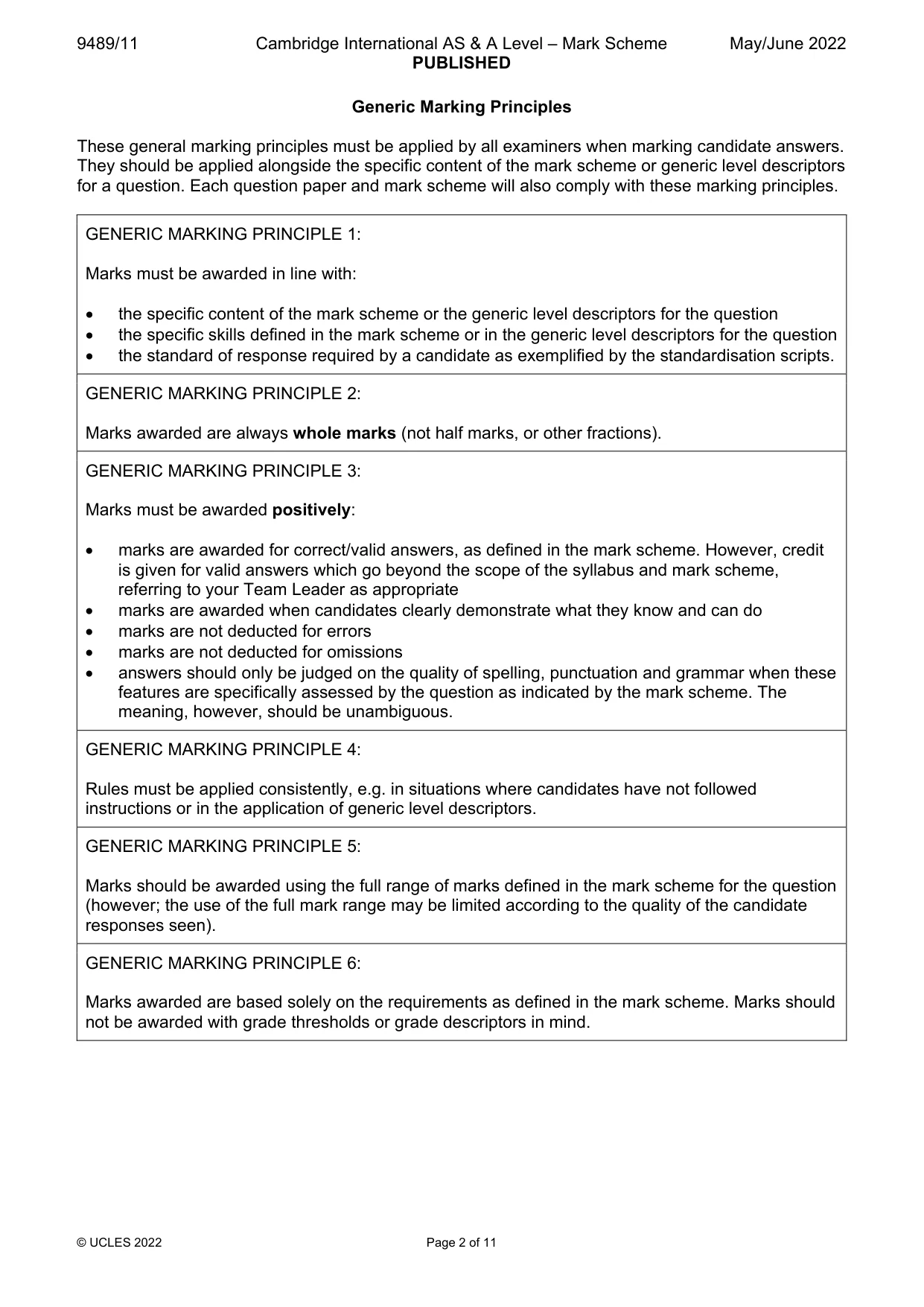
9489/11 Cambridge International AS & A Level – Mark Scheme PUBLISHED May/June 2022 © UCLES 2022 Page 2 of 11 Generic Marking Principles These general marking principles must be applied by all examiners when marking candidate answers. They should be applied alongside the specific content of the mark scheme or generic level descriptors for a question. Each question paper and mark scheme will also comply with these marking principles. GENERIC MARKING PRINCIPLE 1: Marks must be awarded in line with: the specific content of the mark scheme or the generic level descriptors for the question the specific skills defined in the mark scheme or in the generic level descriptors for the question the standard of response required by a candidate as exemplified by the standardisation scripts. GENERIC MARKING PRINCIPLE 2: Marks awarded are always whole marks (not half marks, or other fractions). GENERIC MARKING PRINCIPLE 3: Marks must be awarded positively: marks are awarded for correct/valid answers, as defined in the mark scheme. However, credit is given for valid answers which go beyond the scope of the syllabus and mark scheme, referring to your Team Leader as appropriate marks are awarded when candidates clearly demonstrate what they know and can do marks are not deducted for errors marks are not deducted for omissions answers should only be judged on the quality of spelling, punctuation and grammar when these features are specifically assessed by the question as indicated by the mark scheme. The meaning, however, should be unambiguous. GENERIC MARKING PRINCIPLE 4: Rules must be applied consistently, e.g. in situations where candidates have not followed instructions or in the application of generic level descriptors. GENERIC MARKING PRINCIPLE 5: Marks should be awarded using the full range of marks defined in the mark scheme for the question (however; the use of the full mark range may be limited according to the quality of the candidate responses seen). GENERIC MARKING PRINCIPLE 6: Marks awarded are based solely on the requirements as defined in the mark scheme. Marks should not be awarded with grade thresholds or grade descriptors in mind.
Mark scheme, page 3
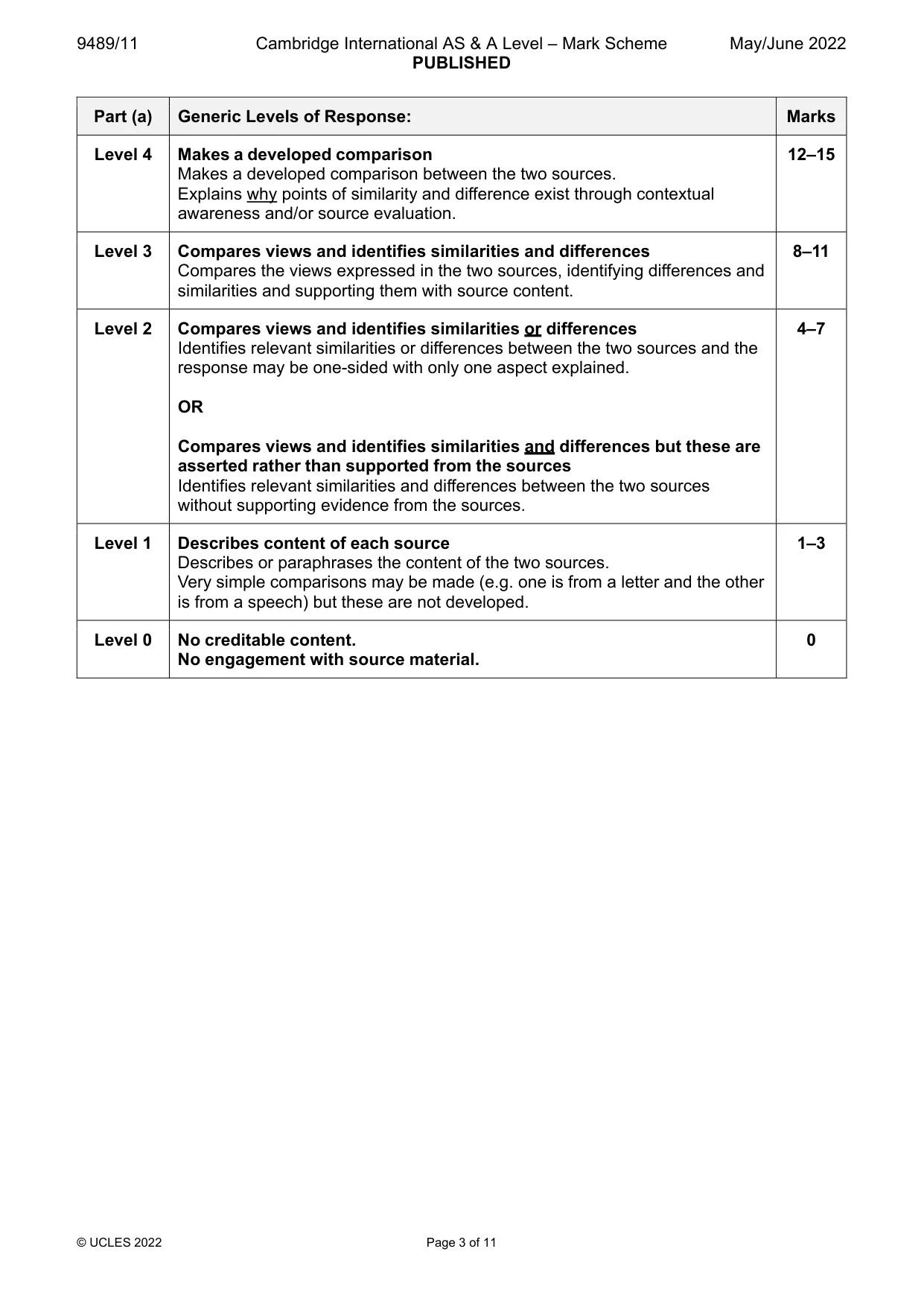
9489/11 Cambridge International AS & A Level – Mark Scheme PUBLISHED May/June 2022 © UCLES 2022 Page 3 of 11 Part (a) Generic Levels of Response: Marks Level 4 Makes a developed comparison Makes a developed comparison between the two sources. Explains why points of similarity and difference exist through contextual awareness and/or source evaluation. 12–15 Level 3 Compares views and identifies similarities and differences Compares the views expressed in the two sources, identifying differences and similarities and supporting them with source content. 8–11 Level 2 Compares views and identifies similarities or differences Identifies relevant similarities or differences between the two sources and the response may be one-sided with only one aspect explained. OR Compares views and identifies similarities and differences but these are asserted rather than supported from the sources Identifies relevant similarities and differences between the two sources without supporting evidence from the sources. 4–7 Level 1 Describes content of each source Describes or paraphrases the content of the two sources. Very simple comparisons may be made (e.g. one is from a letter and the other is from a speech) but these are not developed. 1–3 Level 0 No creditable content. No engagement with source material. 0
Mark scheme, page 4
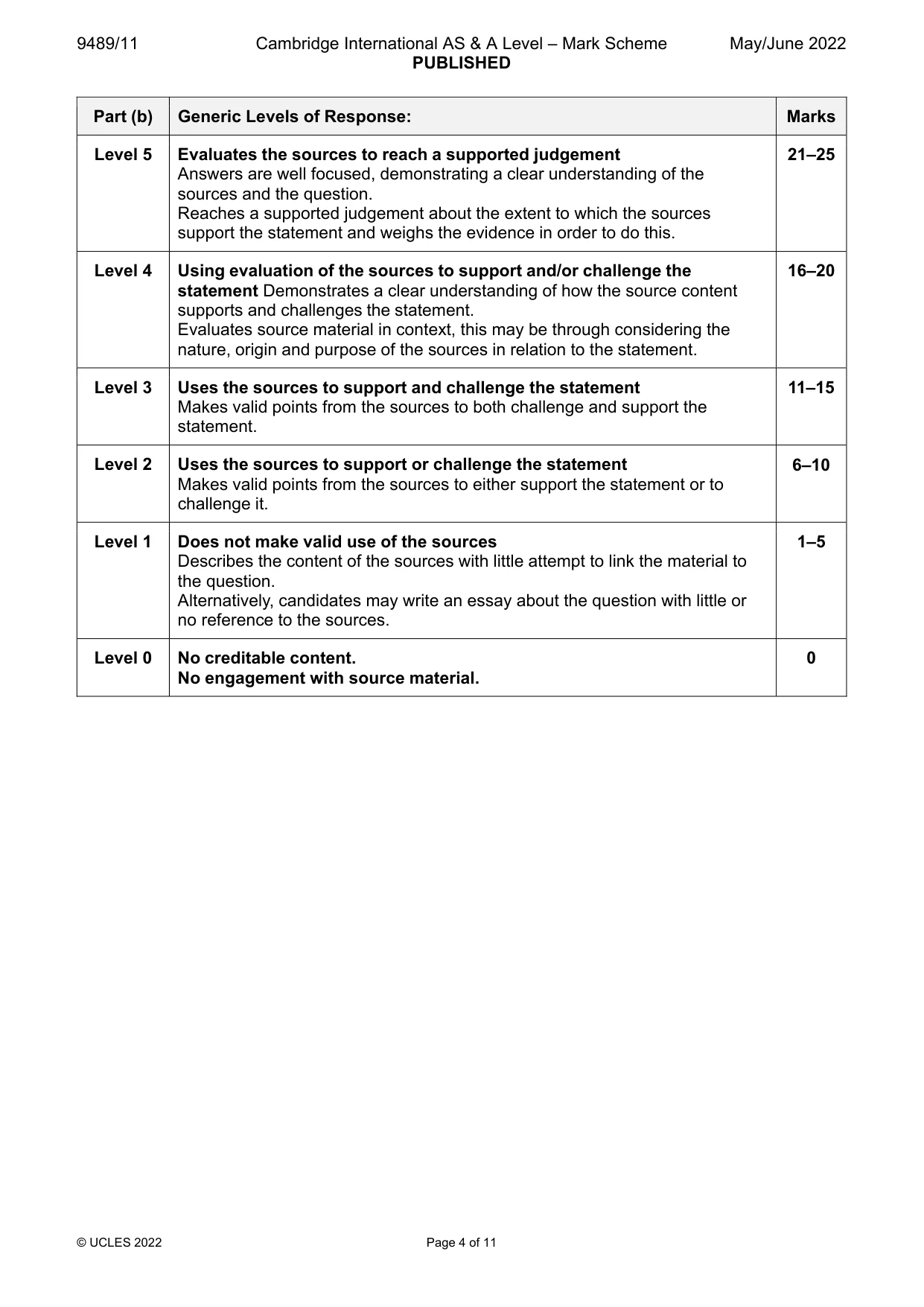
9489/11 Cambridge International AS & A Level – Mark Scheme PUBLISHED May/June 2022 © UCLES 2022 Page 4 of 11 Part (b) Generic Levels of Response: Marks Level 5 Evaluates the sources to reach a supported judgement Answers are well focused, demonstrating a clear understanding of the sources and the question. Reaches a supported judgement about the extent to which the sources support the statement and weighs the evidence in order to do this. 21–25 Level 4 Using evaluation of the sources to support and/or challenge the statement Demonstrates a clear understanding of how the source content supports and challenges the statement. Evaluates source material in context, this may be through considering the nature, origin and purpose of the sources in relation to the statement. 16–20 Level 3 Uses the sources to support and challenge the statement Makes valid points from the sources to both challenge and support the statement. 11–15 Level 2 Uses the sources to support or challenge the statement Makes valid points from the sources to either support the statement or to challenge it. 6–10 Level 1 Does not make valid use of the sources Describes the content of the sources with little attempt to link the material to the question. Alternatively, candidates may write an essay about the question with little or no reference to the sources. 1–5 Level 0 No creditable content. No engagement with source material. 0
Mark scheme, page 5
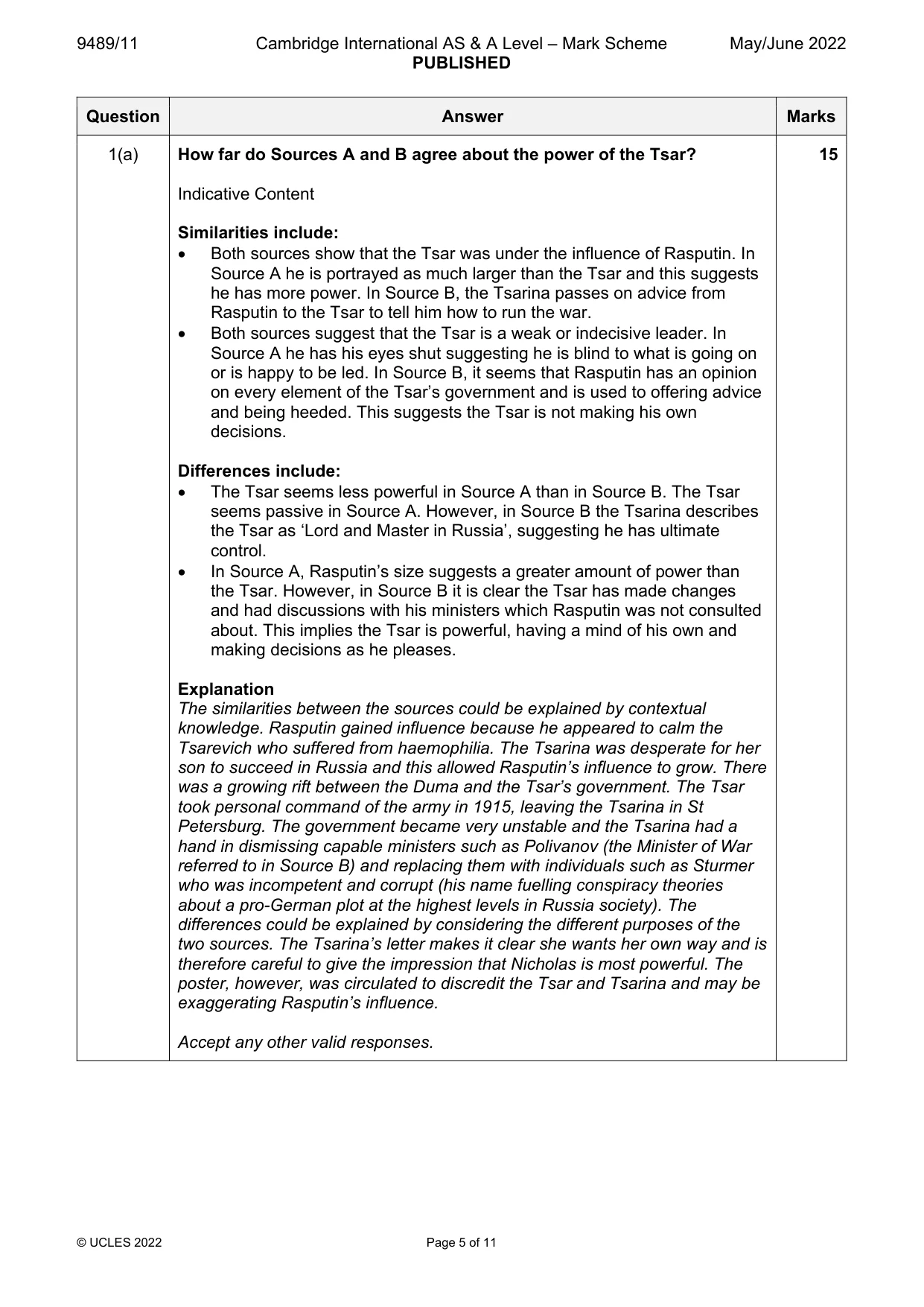
9489/11 Cambridge International AS & A Level – Mark Scheme PUBLISHED May/June 2022 © UCLES 2022 Page 5 of 11 Question Answer Marks 1(a) How far do Sources A and B agree about the power of the Tsar? Indicative Content Similarities include: Both sources show that the Tsar was under the influence of Rasputin. In Source A he is portrayed as much larger than the Tsar and this suggests he has more power. In Source B, the Tsarina passes on advice from Rasputin to the Tsar to tell him how to run the war. Both sources suggest that the Tsar is a weak or indecisive leader. In Source A he has his eyes shut suggesting he is blind to what is going on or is happy to be led. In Source B, it seems that Rasputin has an opinion on every element of the Tsar’s government and is used to offering advice and being heeded. This suggests the Tsar is not making his own decisions. Differences include: The Tsar seems less powerful in Source A than in Source B. The Tsar seems passive in Source A. However, in Source B the Tsarina describes the Tsar as ‘Lord and Master in Russia’, suggesting he has ultimate control. In Source A, Rasputin’s size suggests a greater amount of power than the Tsar. However, in Source B it is clear the Tsar has made changes and had discussions with his ministers which Rasputin was not consulted about. This implies the Tsar is powerful, having a mind of his own and making decisions as he pleases. Explanation The similarities between the sources could be explained by contextual knowledge. Rasputin gained influence because he appeared to calm the Tsarevich who suffered from haemophilia. The Tsarina was desperate for her son to succeed in Russia and this allowed Rasputin’s influence to grow. There was a growing rift between the Duma and the Tsar’s government. The Tsar took personal command of the army in 1915, leaving the Tsarina in St Petersburg. The government became very unstable and the Tsarina had a hand in dismissing capable ministers such as Polivanov (the Minister of War referred to in Source B) and replacing them with individuals such as Sturmer who was incompetent and corrupt (his name fuelling conspiracy theories about a pro-German plot at the highest levels in Russia society). The differences could be explained by considering the different purposes of the two sources. The Tsarina’s letter makes it clear she wants her own way and is therefore careful to give the impression that Nicholas is most powerful. The poster, however, was circulated to discredit the Tsar and Tsarina and may be exaggerating Rasputin’s influence. Accept any other valid responses. 15
Mark scheme, page 6
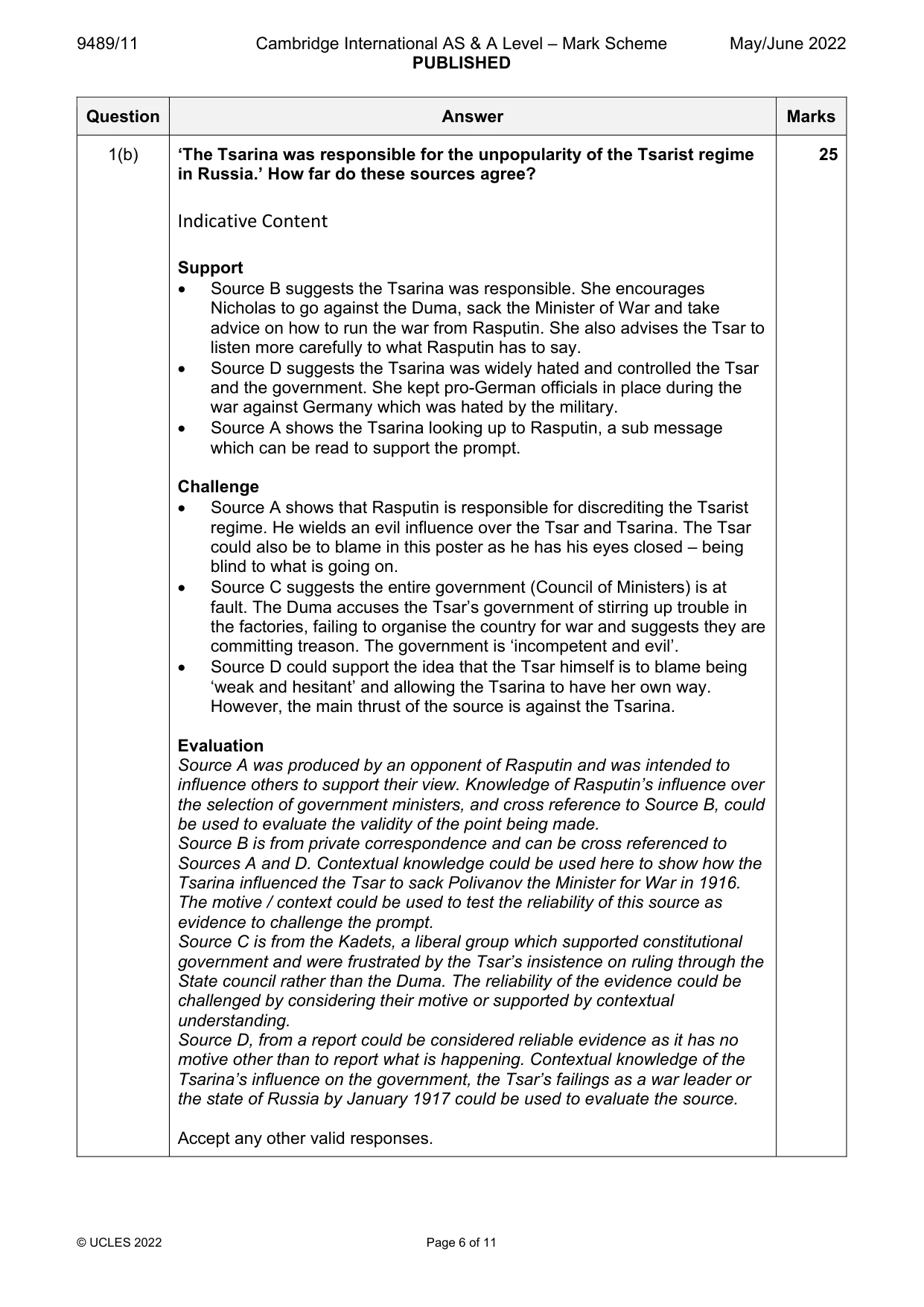
9489/11 Cambridge International AS & A Level – Mark Scheme PUBLISHED May/June 2022 © UCLES 2022 Page 6 of 11 Question Answer Marks 1(b) ‘The Tsarina was responsible for the unpopularity of the Tsarist regime in Russia.’ How far do these sources agree? Indicative Content Support Source B suggests the Tsarina was responsible. She encourages Nicholas to go against the Duma, sack the Minister of War and take advice on how to run the war from Rasputin. She also advises the Tsar to listen more carefully to what Rasputin has to say. Source D suggests the Tsarina was widely hated and controlled the Tsar and the government. She kept pro-German officials in place during the war against Germany which was hated by the military. Source A shows the Tsarina looking up to Rasputin, a sub message which can be read to support the prompt. Challenge Source A shows that Rasputin is responsible for discrediting the Tsarist regime. He wields an evil influence over the Tsar and Tsarina. The Tsar could also be to blame in this poster as he has his eyes closed – being blind to what is going on. Source C suggests the entire government (Council of Ministers) is at fault. The Duma accuses the Tsar’s government of stirring up trouble in the factories, failing to organise the country for war and suggests they are committing treason. The government is ‘incompetent and evil’. Source D could support the idea that the Tsar himself is to blame being ‘weak and hesitant’ and allowing the Tsarina to have her own way. However, the main thrust of the source is against the Tsarina. Evaluation Source A was produced by an opponent of Rasputin and was intended to influence others to support their view. Knowledge of Rasputin’s influence over the selection of government ministers, and cross reference to Source B, could be used to evaluate the validity of the point being made. Source B is from private correspondence and can be cross referenced to Sources A and D. Contextual knowledge could be used here to show how the Tsarina influenced the Tsar to sack Polivanov the Minister for War in 1916. The motive / context could be used to test the reliability of this source as evidence to challenge the prompt. Source C is from the Kadets, a liberal group which supported constitutional government and were frustrated by the Tsar’s insistence on ruling through the State council rather than the Duma. The reliability of the evidence could be challenged by considering their motive or supported by contextual understanding. Source D, from a report could be considered reliable evidence as it has no motive other than to report what is happening. Contextual knowledge of the Tsarina’s influence on the government, the Tsar’s failings as a war leader or the state of Russia by January 1917 could be used to evaluate the source. Accept any other valid responses. 25
Mark scheme, page 7
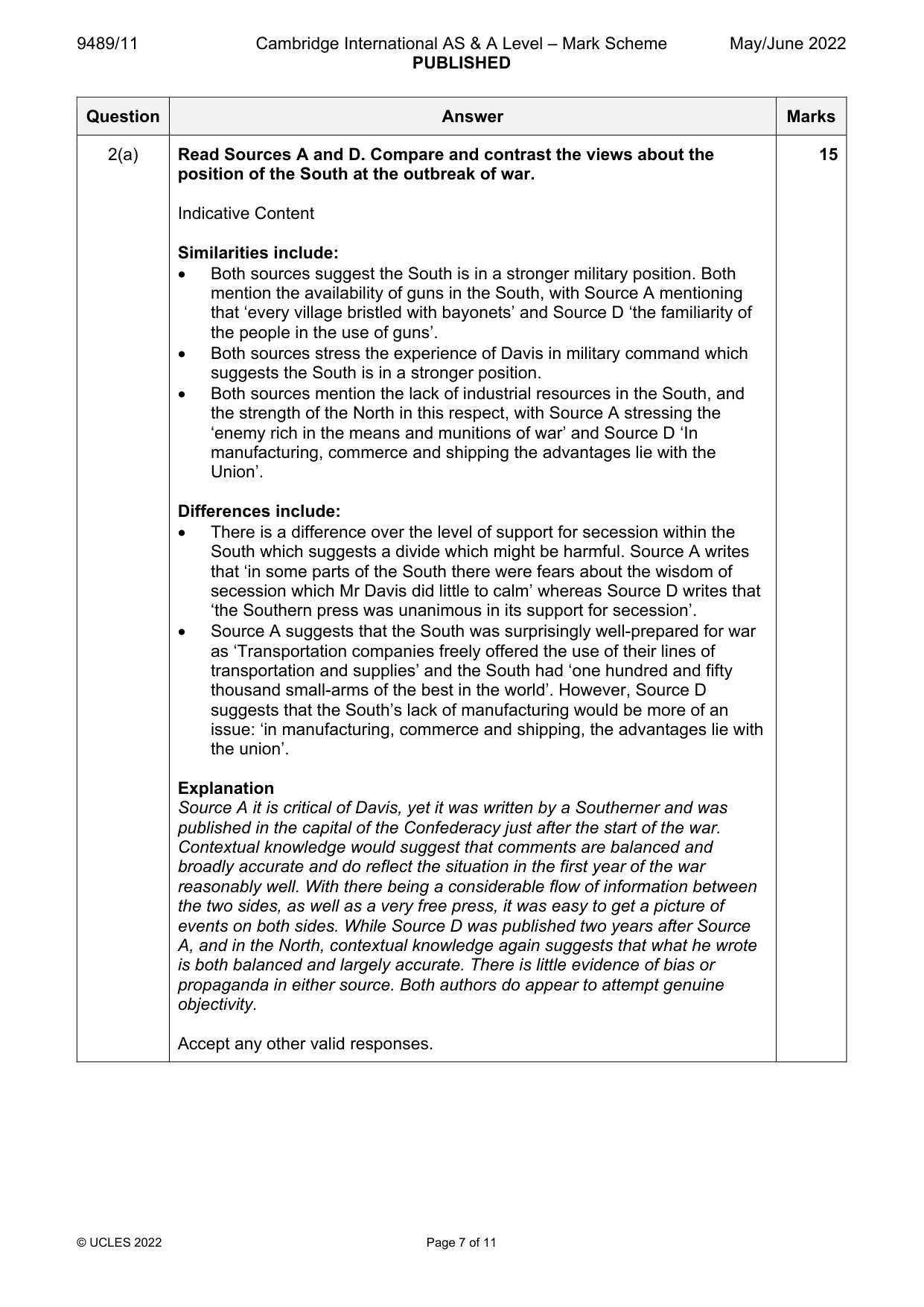
9489/11 Cambridge International AS & A Level – Mark Scheme PUBLISHED May/June 2022 © UCLES 2022 Page 7 of 11 Question Answer Marks 2(a) Read Sources A and D. Compare and contrast the views about the position of the South at the outbreak of war. Indicative Content Similarities include: Both sources suggest the South is in a stronger military position. Both mention the availability of guns in the South, with Source A mentioning that ‘every village bristled with bayonets’ and Source D ‘the familiarity of the people in the use of guns’. Both sources stress the experience of Davis in military command which suggests the South is in a stronger position. Both sources mention the lack of industrial resources in the South, and the strength of the North in this respect, with Source A stressing the ‘enemy rich in the means and munitions of war’ and Source D ‘In manufacturing, commerce and shipping the advantages lie with the Union’. Differences include: There is a difference over the level of support for secession within the South which suggests a divide which might be harmful. Source A writes that ‘in some parts of the South there were fears about the wisdom of secession which Mr Davis did little to calm’ whereas Source D writes that ‘the Southern press was unanimous in its support for secession’. Source A suggests that the South was surprisingly well-prepared for war as ‘Transportation companies freely offered the use of their lines of transportation and supplies’ and the South had ‘one hundred and fifty thousand small-arms of the best in the world’. However, Source D suggests that the South’s lack of manufacturing would be more of an issue: ‘in manufacturing, commerce and shipping, the advantages lie with the union’. Explanation Source A it is critical of Davis, yet it was written by a Southerner and was published in the capital of the Confederacy just after the start of the war. Contextual knowledge would suggest that comments are balanced and broadly accurate and do reflect the situation in the first year of the war reasonably well. With there being a considerable flow of information between the two sides, as well as a very free press, it was easy to get a picture of events on both sides. While Source D was published two years after Source A, and in the North, contextual knowledge again suggests that what he wrote is both balanced and largely accurate. There is little evidence of bias or propaganda in either source. Both authors do appear to attempt genuine objectivity. Accept any other valid responses. 15
Mark scheme, page 8
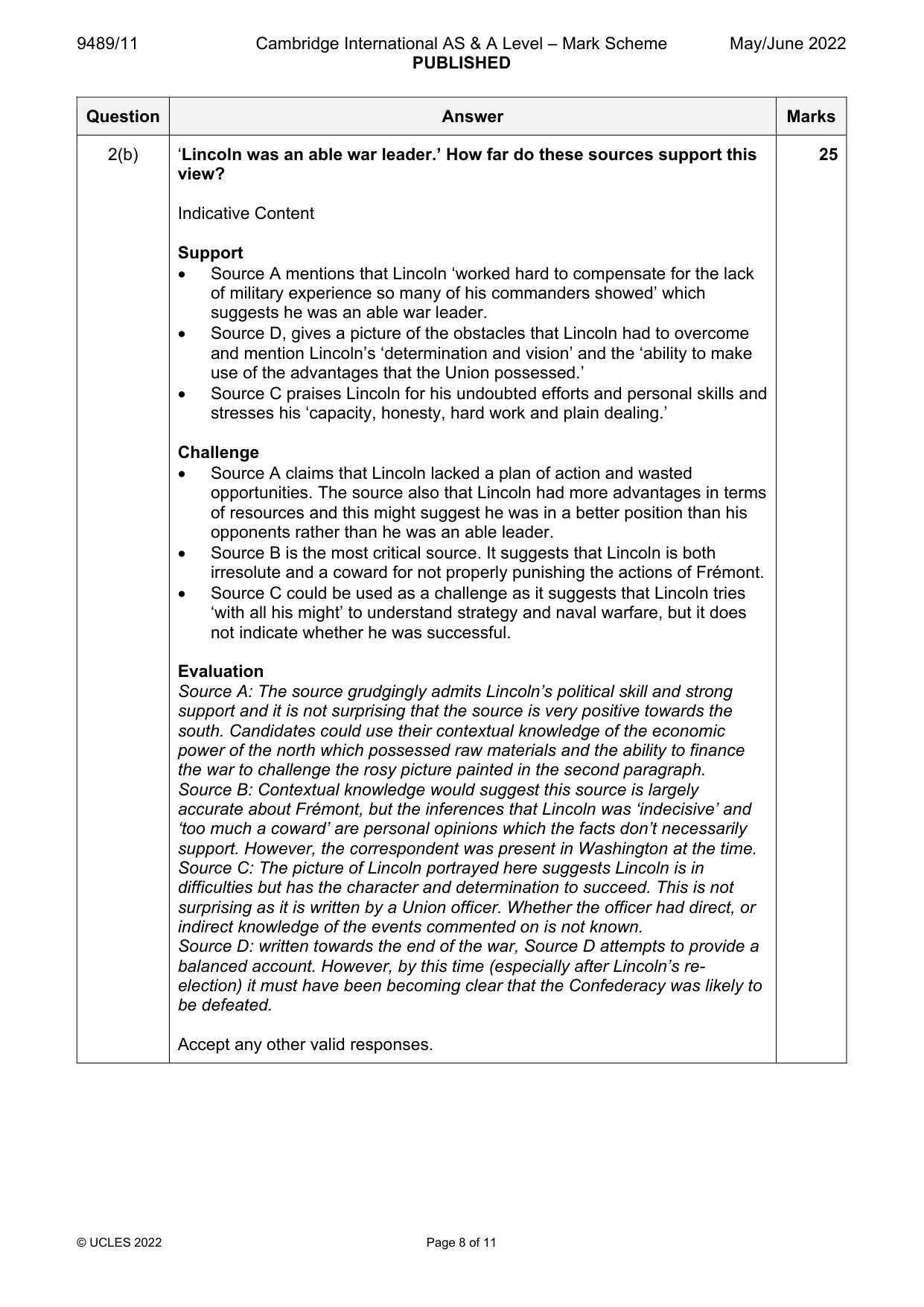
9489/11 Cambridge International AS & A Level – Mark Scheme PUBLISHED May/June 2022 © UCLES 2022 Page 8 of 11 Question Answer Marks 2(b) ‘Lincoln was an able war leader.’ How far do these sources support this view? Indicative Content Support Source A mentions that Lincoln ‘worked hard to compensate for the lack of military experience so many of his commanders showed’ which suggests he was an able war leader. Source D, gives a picture of the obstacles that Lincoln had to overcome and mention Lincoln’s ‘determination and vision’ and the ‘ability to make use of the advantages that the Union possessed.’ Source C praises Lincoln for his undoubted efforts and personal skills and stresses his ‘capacity, honesty, hard work and plain dealing.’ Challenge Source A claims that Lincoln lacked a plan of action and wasted opportunities. The source also that Lincoln had more advantages in terms of resources and this might suggest he was in a better position than his opponents rather than he was an able leader. Source B is the most critical source. It suggests that Lincoln is both irresolute and a coward for not properly punishing the actions of Frémont. Source C could be used as a challenge as it suggests that Lincoln tries ‘with all his might’ to understand strategy and naval warfare, but it does not indicate whether he was successful. Evaluation Source A: The source grudgingly admits Lincoln’s political skill and strong support and it is not surprising that the source is very positive towards the south. Candidates could use their contextual knowledge of the economic power of the north which possessed raw materials and the ability to finance the war to challenge the rosy picture painted in the second paragraph. Source B: Contextual knowledge would suggest this source is largely accurate about Frémont, but the inferences that Lincoln was ‘indecisive’ and ‘too much a coward’ are personal opinions which the facts don’t necessarily support. However, the correspondent was present in Washington at the time. Source C: The picture of Lincoln portrayed here suggests Lincoln is in difficulties but has the character and determination to succeed. This is not surprising as it is written by a Union officer. Whether the officer had direct, or indirect knowledge of the events commented on is not known. Source D: written towards the end of the war, Source D attempts to provide a balanced account. However, by this time (especially after Lincoln’s re- election) it must have been becoming clear that the Confederacy was likely to be defeated. Accept any other valid responses. 25
Mark scheme, page 9
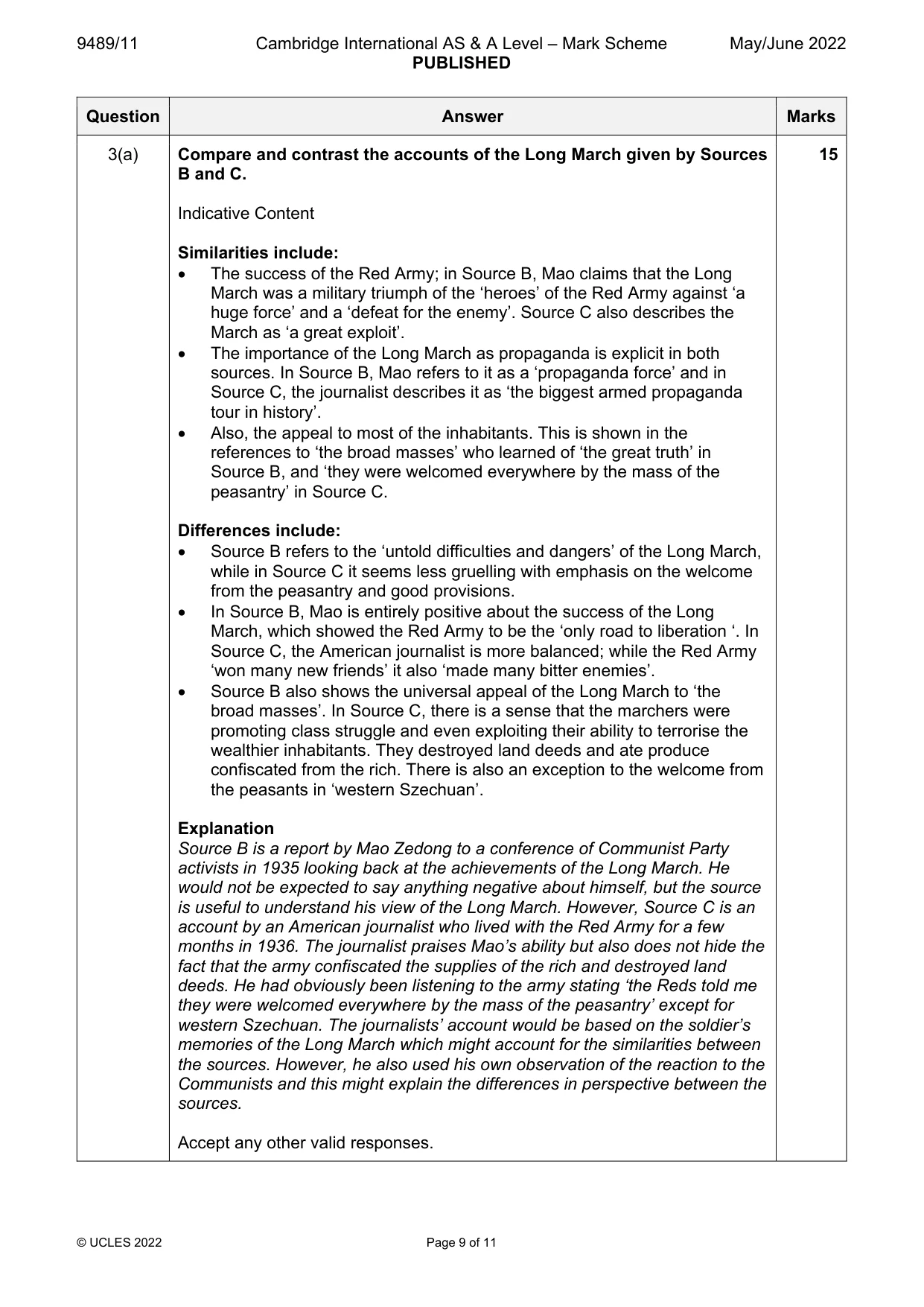
9489/11 Cambridge International AS & A Level – Mark Scheme PUBLISHED May/June 2022 © UCLES 2022 Page 9 of 11 Question Answer Marks 3(a) Compare and contrast the accounts of the Long March given by Sources B and C. Indicative Content Similarities include: The success of the Red Army; in Source B, Mao claims that the Long March was a military triumph of the ‘heroes’ of the Red Army against ‘a huge force’ and a ‘defeat for the enemy’. Source C also describes the March as ‘a great exploit’. The importance of the Long March as propaganda is explicit in both sources. In Source B, Mao refers to it as a ‘propaganda force’ and in Source C, the journalist describes it as ‘the biggest armed propaganda tour in history’. Also, the appeal to most of the inhabitants. This is shown in the references to ‘the broad masses’ who learned of ‘the great truth’ in Source B, and ‘they were welcomed everywhere by the mass of the peasantry’ in Source C. Differences include: Source B refers to the ‘untold difficulties and dangers’ of the Long March, while in Source C it seems less gruelling with emphasis on the welcome from the peasantry and good provisions. In Source B, Mao is entirely positive about the success of the Long March, which showed the Red Army to be the ‘only road to liberation ‘. In Source C, the American journalist is more balanced; while the Red Army ‘won many new friends’ it also ‘made many bitter enemies’. Source B also shows the universal appeal of the Long March to ‘the broad masses’. In Source C, there is a sense that the marchers were promoting class struggle and even exploiting their ability to terrorise the wealthier inhabitants. They destroyed land deeds and ate produce confiscated from the rich. There is also an exception to the welcome from the peasants in ‘western Szechuan’. Explanation Source B is a report by Mao Zedong to a conference of Communist Party activists in 1935 looking back at the achievements of the Long March. He would not be expected to say anything negative about himself, but the source is useful to understand his view of the Long March. However, Source C is an account by an American journalist who lived with the Red Army for a few months in 1936. The journalist praises Mao’s ability but also does not hide the fact that the army confiscated the supplies of the rich and destroyed land deeds. He had obviously been listening to the army stating ‘the Reds told me they were welcomed everywhere by the mass of the peasantry’ except for western Szechuan. The journalists’ account would be based on the soldier’s memories of the Long March which might account for the similarities between the sources. However, he also used his own observation of the reaction to the Communists and this might explain the differences in perspective between the sources. Accept any other valid responses. 15
Mark scheme, page 10
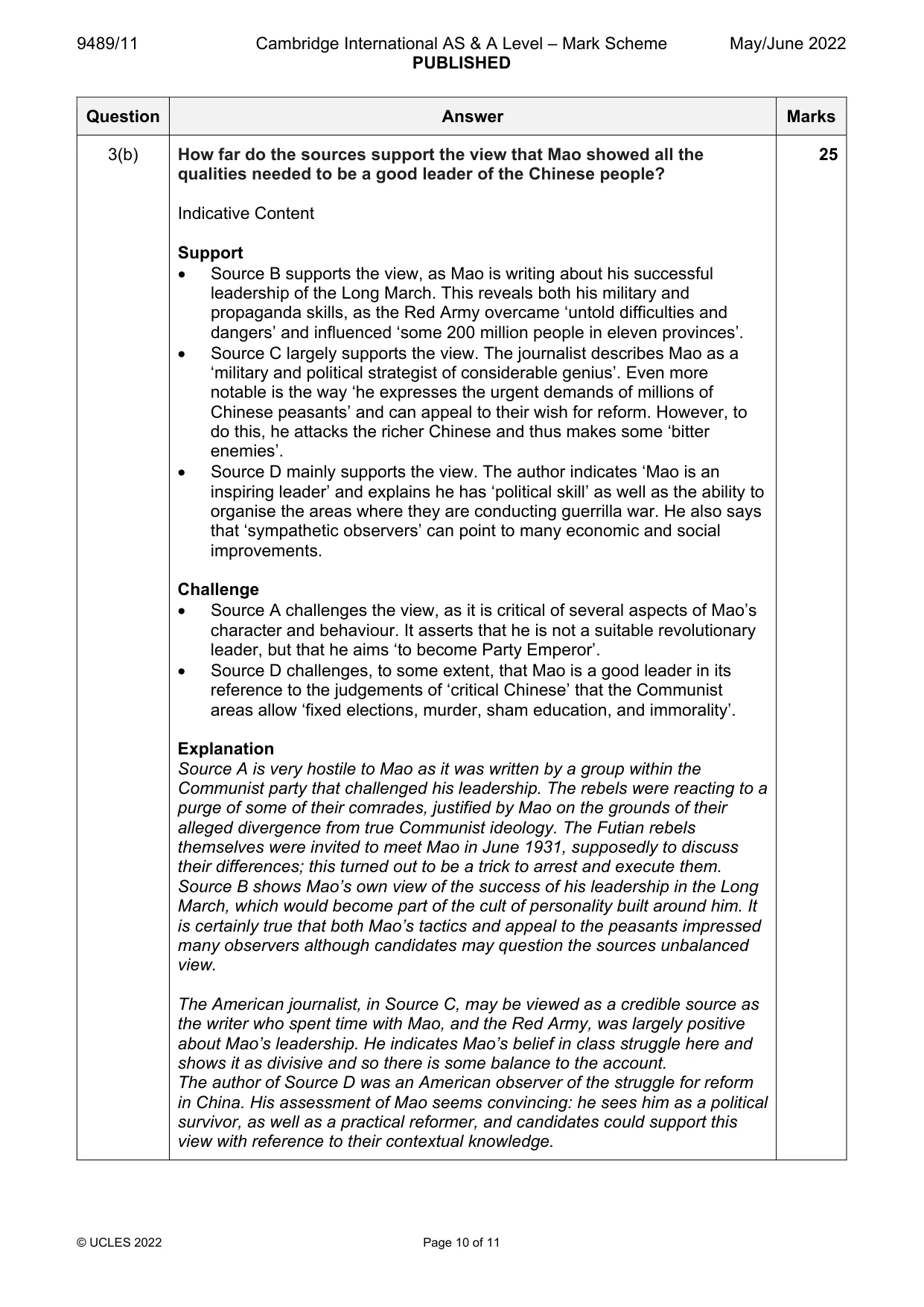
9489/11 Cambridge International AS & A Level – Mark Scheme PUBLISHED May/June 2022 © UCLES 2022 Page 10 of 11 Question Answer Marks 3(b) How far do the sources support the view that Mao showed all the qualities needed to be a good leader of the Chinese people? Indicative Content Support Source B supports the view, as Mao is writing about his successful leadership of the Long March. This reveals both his military and propaganda skills, as the Red Army overcame ‘untold difficulties and dangers’ and influenced ‘some 200 million people in eleven provinces’. Source C largely supports the view. The journalist describes Mao as a ‘military and political strategist of considerable genius’. Even more notable is the way ‘he expresses the urgent demands of millions of Chinese peasants’ and can appeal to their wish for reform. However, to do this, he attacks the richer Chinese and thus makes some ‘bitter enemies’. Source D mainly supports the view. The author indicates ‘Mao is an inspiring leader’ and explains he has ‘political skill’ as well as the ability to organise the areas where they are conducting guerrilla war. He also says that ‘sympathetic observers’ can point to many economic and social improvements. Challenge Source A challenges the view, as it is critical of several aspects of Mao’s character and behaviour. It asserts that he is not a suitable revolutionary leader, but that he aims ‘to become Party Emperor’. Source D challenges, to some extent, that Mao is a good leader in its reference to the judgements of ‘critical Chinese’ that the Communist areas allow ‘fixed elections, murder, sham education, and immorality’. Explanation Source A is very hostile to Mao as it was written by a group within the Communist party that challenged his leadership. The rebels were reacting to a purge of some of their comrades, justified by Mao on the grounds of their alleged divergence from true Communist ideology. The Futian rebels themselves were invited to meet Mao in June 1931, supposedly to discuss their differences; this turned out to be a trick to arrest and execute them. Source B shows Mao’s own view of the success of his leadership in the Long March, which would become part of the cult of personality built around him. It is certainly true that both Mao’s tactics and appeal to the peasants impressed many observers although candidates may question the sources unbalanced view. The American journalist, in Source C, may be viewed as a credible source as the writer who spent time with Mao, and the Red Army, was largely positive about Mao’s leadership. He indicates Mao’s belief in class struggle here and shows it as divisive and so there is some balance to the account. The author of Source D was an American observer of the struggle for reform in China. His assessment of Mao seems convincing: he sees him as a political survivor, as well as a practical reformer, and candidates could support this view with reference to their contextual knowledge. 25
Mark scheme, page 11
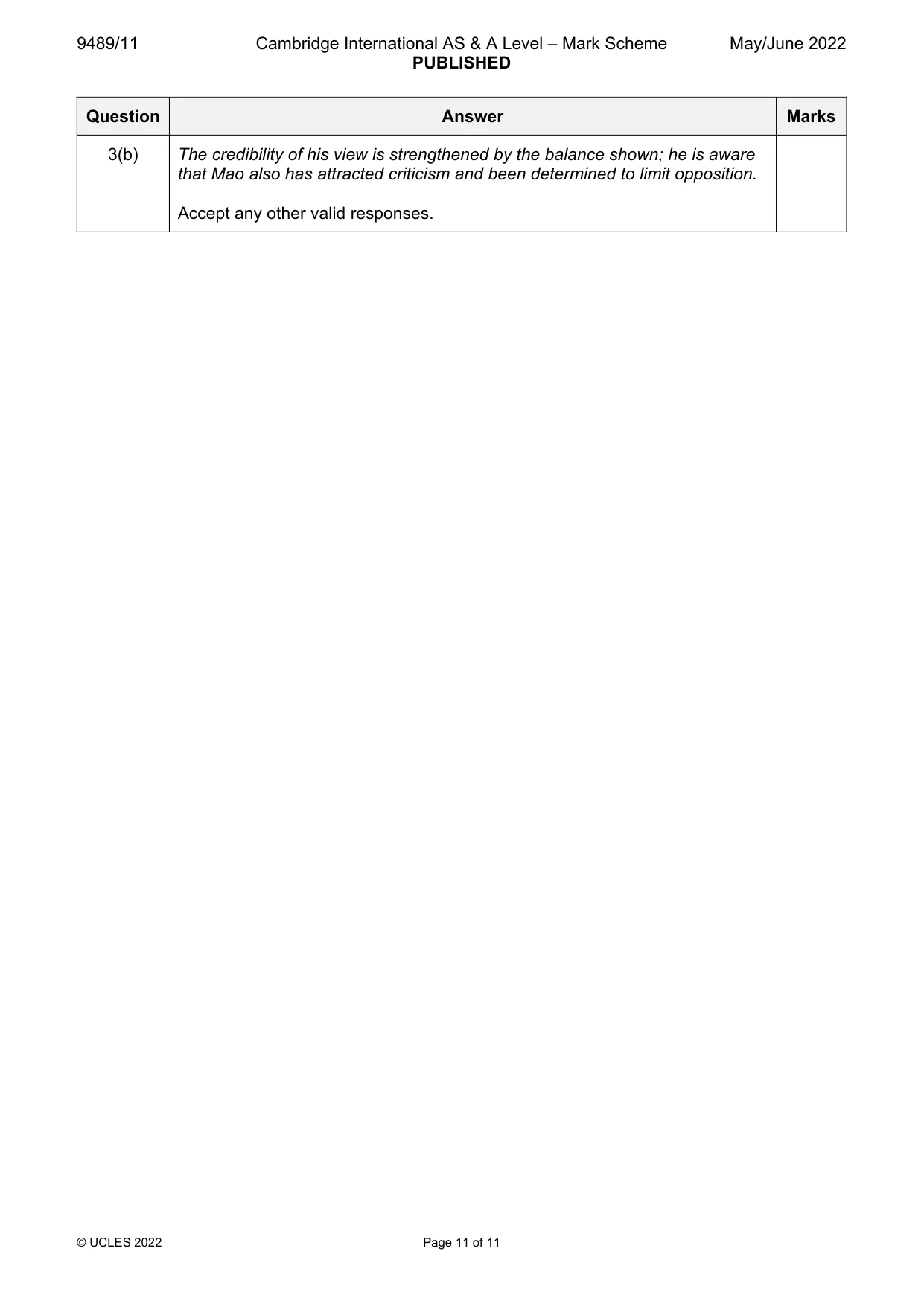
9489/11 Cambridge International AS & A Level – Mark Scheme PUBLISHED May/June 2022 © UCLES 2022 Page 11 of 11 Question Answer Marks 3(b) The credibility of his view is strengthened by the balance shown; he is aware that Mao also has attracted criticism and been determined to limit opposition. Accept any other valid responses.
What you needed in this session
Cambridge’s own grade thresholds for 2022 May/June, Paper 1 · Variant 1. A higher threshold means an easier paper — the bar moves with how the cohort did.