Cambridge A Level History 9489 — 2024 May/June Paper 4 · Variant 1
9489/41/M/J/24 · 60 marks · ≈68 min
The question paper and its mark scheme, free to read here and free to download. This is Cambridge’s own paper, exactly as it was sat.
Question paper4 pages
Mark scheme18 pages
Answers below. Sit the paper first if you are practising.
Paper as text
Question paper, page 1
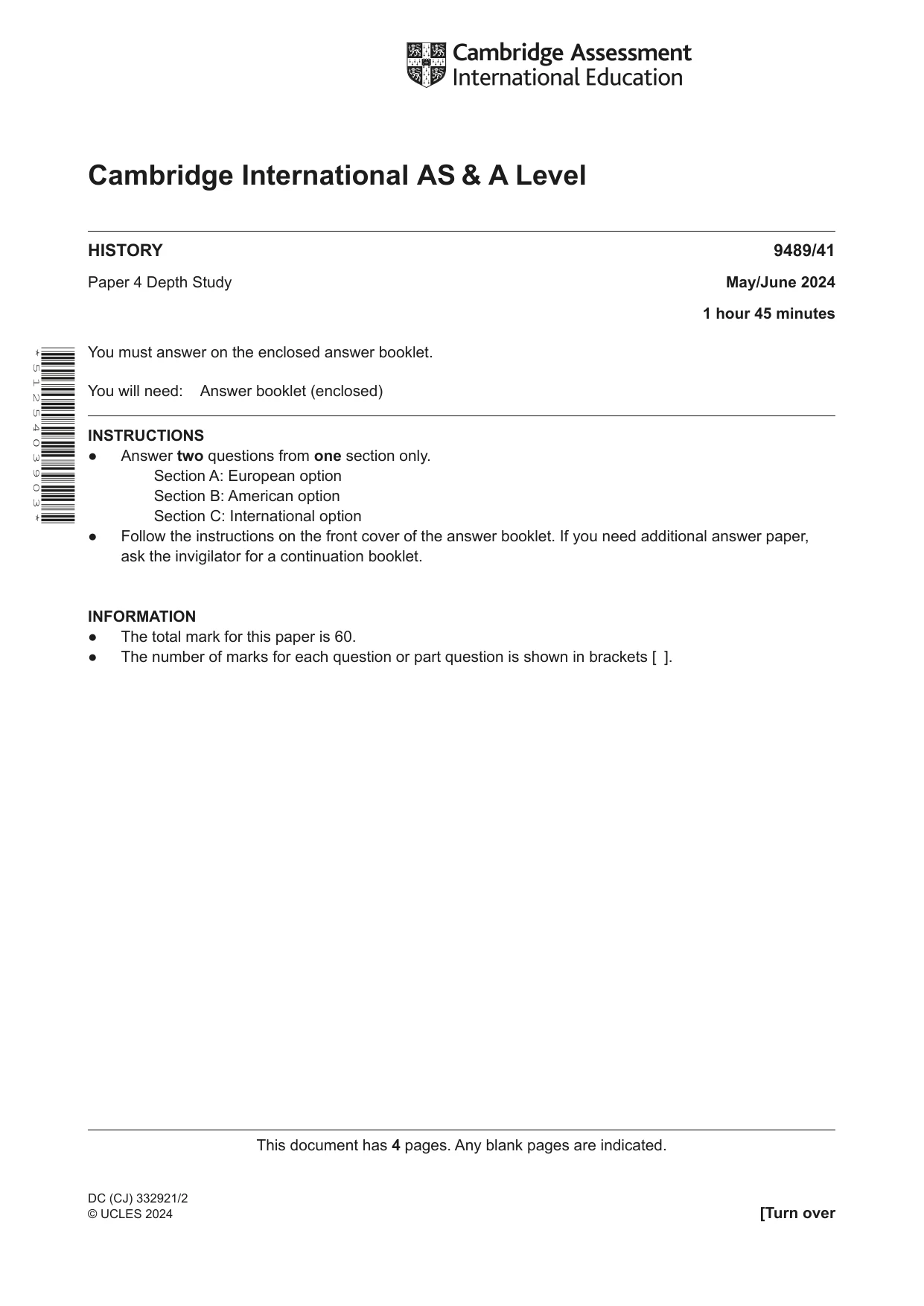
This document has 4 pages. Any blank pages are indicated. [Turn over Cambridge International AS & A Level HISTORY 9489/41 Paper 4 Depth Study May/June 2024 1 hour 45 minutes You must answer on the enclosed answer booklet. You will need: Answer booklet (enclosed) INSTRUCTIONS ● Answer two questions from one section only. Section A: European option Section B: American option Section C: International option ● Follow the instructions on the front cover of the answer booklet. If you need additional answer paper, ask the invigilator for a continuation booklet. INFORMATION ● The total mark for this paper is 60. ● The number of marks for each question or part question is shown in brackets [ ]. * 5 1 2 5 4 0 3 9 0 3 * DC (CJ) 332921/2 © UCLES 2024
Question paper, page 2
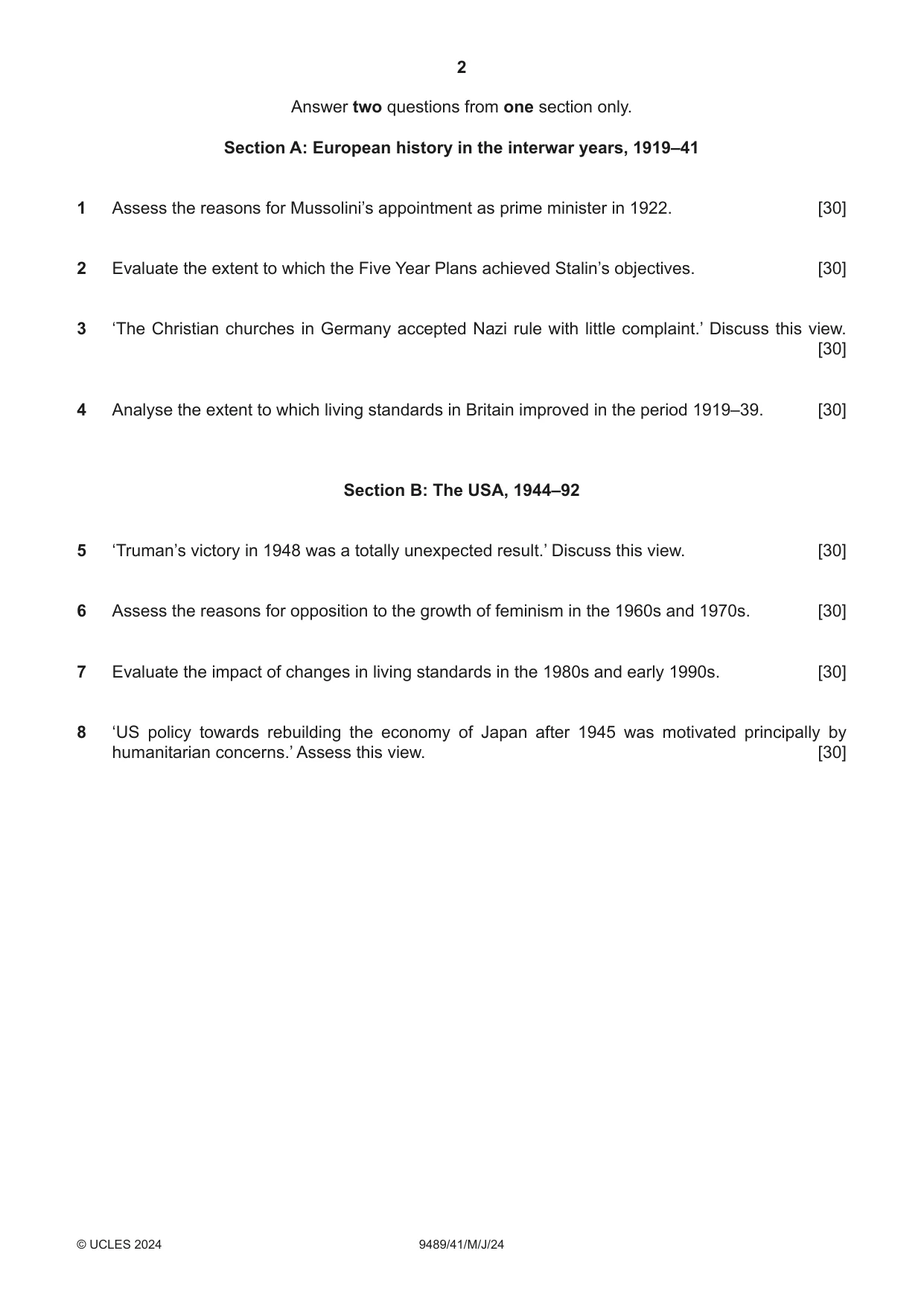
2 9489/41/M/J/24 © UCLES 2024 Answer two questions from one section only. Section A: European history in the interwar years, 1919–41 1 Assess the reasons for Mussolini’s appointment as prime minister in 1922. [30] 2 Evaluate the extent to which the Five Year Plans achieved Stalin’s objectives. [30] 3 ‘The Christian churches in Germany accepted Nazi rule with little complaint.’ Discuss this view. [30] 4 Analyse the extent to which living standards in Britain improved in the period 1919–39. [30] Section B: The USA, 1944–92 5 ‘Truman’s victory in 1948 was a totally unexpected result.’ Discuss this view. [30] 6 Assess the reasons for opposition to the growth of feminism in the 1960s and 1970s. [30] 7 Evaluate the impact of changes in living standards in the 1980s and early 1990s. [30] 8 ‘US policy towards rebuilding the economy of Japan after 1945 was motivated principally by humanitarian concerns.’ Assess this view. [30]
Question paper, page 3
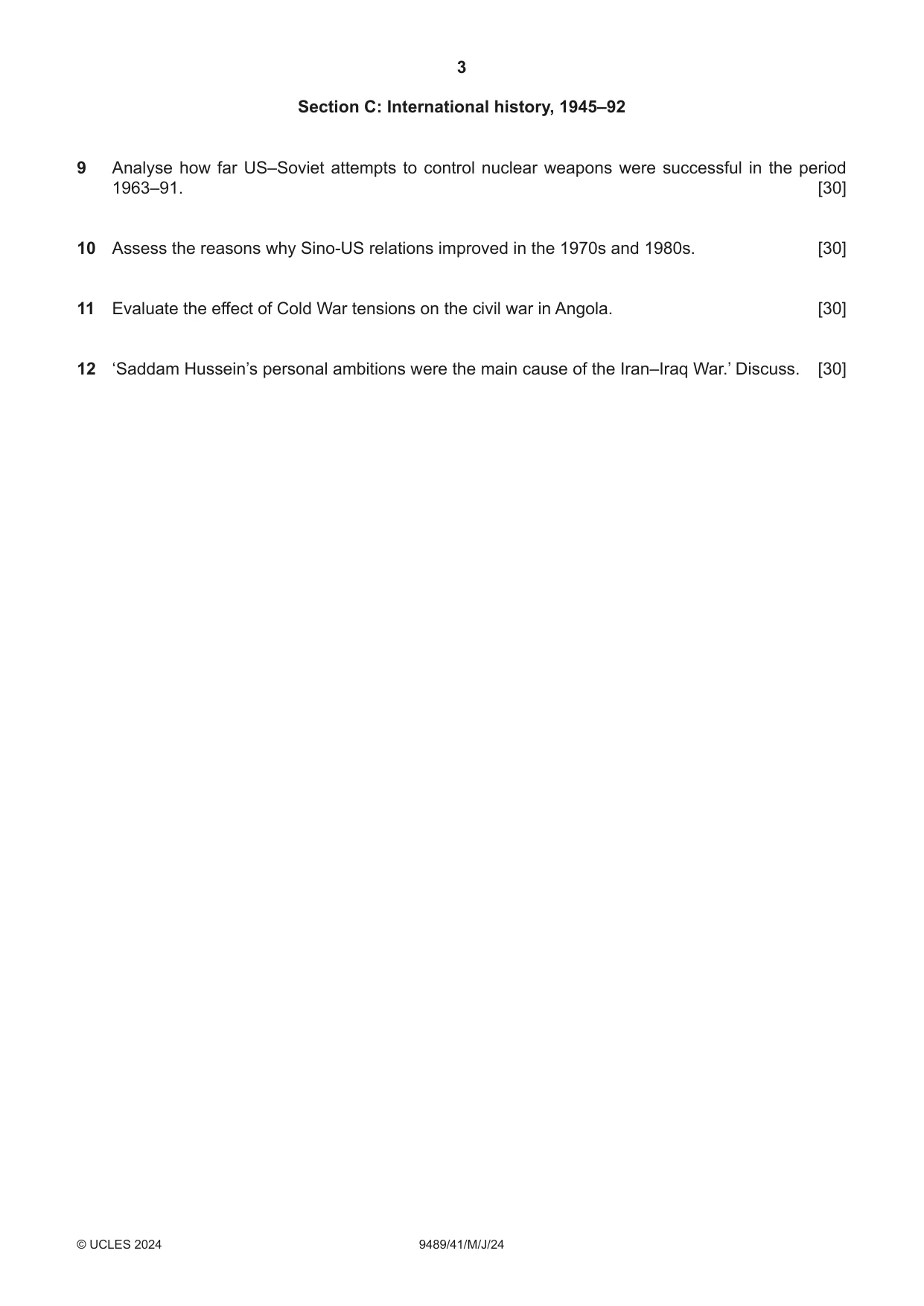
3 9489/41/M/J/24 © UCLES 2024 Section C: International history, 1945–92 9 Analyse how far US–Soviet attempts to control nuclear weapons were successful in the period 1963–91. [30] 10 Assess the reasons why Sino‑US relations improved in the 1970s and 1980s. [30] 11 Evaluate the effect of Cold War tensions on the civil war in Angola. [30] 12 ‘Saddam Hussein’s personal ambitions were the main cause of the Iran–Iraq War.’ Discuss. [30]
Question paper, page 4
4 9489/41/M/J/24 © UCLES 2024 Permission to reproduce items where third‑party owned material protected by copyright is included has been sought and cleared where possible. Every reasonable effort has been made by the publisher (UCLES) to trace copyright holders, but if any items requiring clearance have unwittingly been included, the publisher will be pleased to make amends at the earliest possible opportunity. To avoid the issue of disclosure of answer‑related information to candidates, all copyright acknowledgements are reproduced online in the Cambridge Assessment International Education Copyright Acknowledgements Booklet. This is produced for each series of examinations and is freely available to download at www.cambridgeinternational.org after the live examination series. Cambridge Assessment International Education is part of Cambridge Assessment. Cambridge Assessment is the brand name of the University of Cambridge Local Examinations Syndicate (UCLES), which is a department of the University of Cambridge. BLANK PAGE
Mark scheme, page 1
This document consists of 18 printed pages. © Cambridge University Press & Assessment 2024 [Turn over Cambridge International AS & A Level HISTORY 9489/41 Paper 4 Depth study May/June 2024 MARK SCHEME Maximum Mark: 60 Published This mark scheme is published as an aid to teachers and candidates, to indicate the requirements of the examination. It shows the basis on which Examiners were instructed to award marks. It does not indicate the details of the discussions that took place at an Examiners’ meeting before marking began, which would have considered the acceptability of alternative answers. Mark schemes should be read in conjunction with the question paper and the Principal Examiner Report for Teachers. Cambridge International will not enter into discussions about these mark schemes. Cambridge International is publishing the mark schemes for the May/June 2024 series for most Cambridge IGCSE, Cambridge International A and AS Level and Cambridge Pre-U components, and some Cambridge O Level components.
Mark scheme, page 2
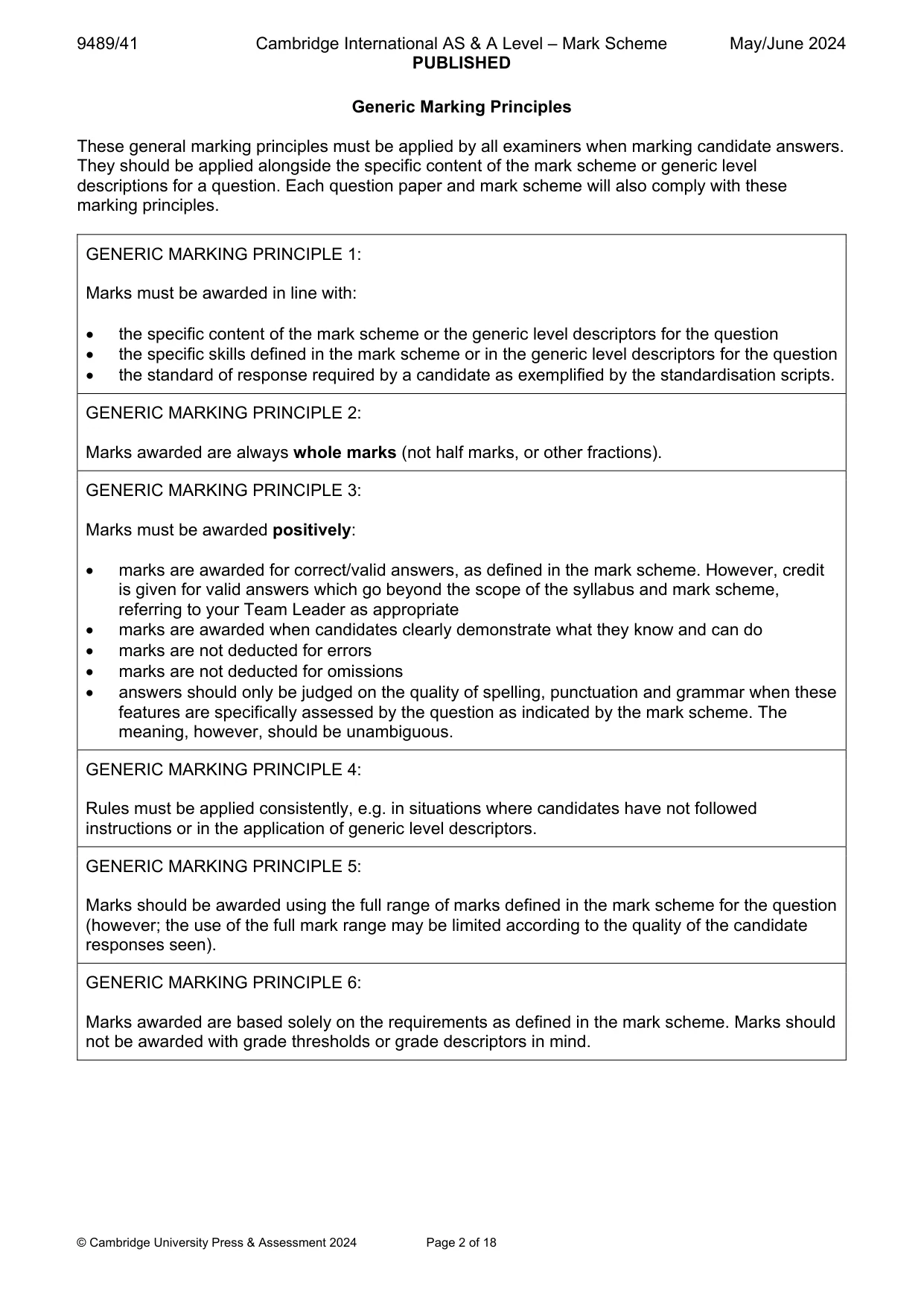
9489/41 Cambridge International AS & A Level – Mark Scheme PUBLISHED May/June 2024 © Cambridge University Press & Assessment 2024 Page 2 of 18 Generic Marking Principles These general marking principles must be applied by all examiners when marking candidate answers. They should be applied alongside the specific content of the mark scheme or generic level descriptions for a question. Each question paper and mark scheme will also comply with these marking principles. GENERIC MARKING PRINCIPLE 1: Marks must be awarded in line with: the specific content of the mark scheme or the generic level descriptors for the question the specific skills defined in the mark scheme or in the generic level descriptors for the question the standard of response required by a candidate as exemplified by the standardisation scripts. GENERIC MARKING PRINCIPLE 2: Marks awarded are always whole marks (not half marks, or other fractions). GENERIC MARKING PRINCIPLE 3: Marks must be awarded positively: marks are awarded for correct/valid answers, as defined in the mark scheme. However, credit is given for valid answers which go beyond the scope of the syllabus and mark scheme, referring to your Team Leader as appropriate marks are awarded when candidates clearly demonstrate what they know and can do marks are not deducted for errors marks are not deducted for omissions answers should only be judged on the quality of spelling, punctuation and grammar when these features are specifically assessed by the question as indicated by the mark scheme. The meaning, however, should be unambiguous. GENERIC MARKING PRINCIPLE 4: Rules must be applied consistently, e.g. in situations where candidates have not followed instructions or in the application of generic level descriptors. GENERIC MARKING PRINCIPLE 5: Marks should be awarded using the full range of marks defined in the mark scheme for the question (however; the use of the full mark range may be limited according to the quality of the candidate responses seen). GENERIC MARKING PRINCIPLE 6: Marks awarded are based solely on the requirements as defined in the mark scheme. Marks should not be awarded with grade thresholds or grade descriptors in mind.
Mark scheme, page 3
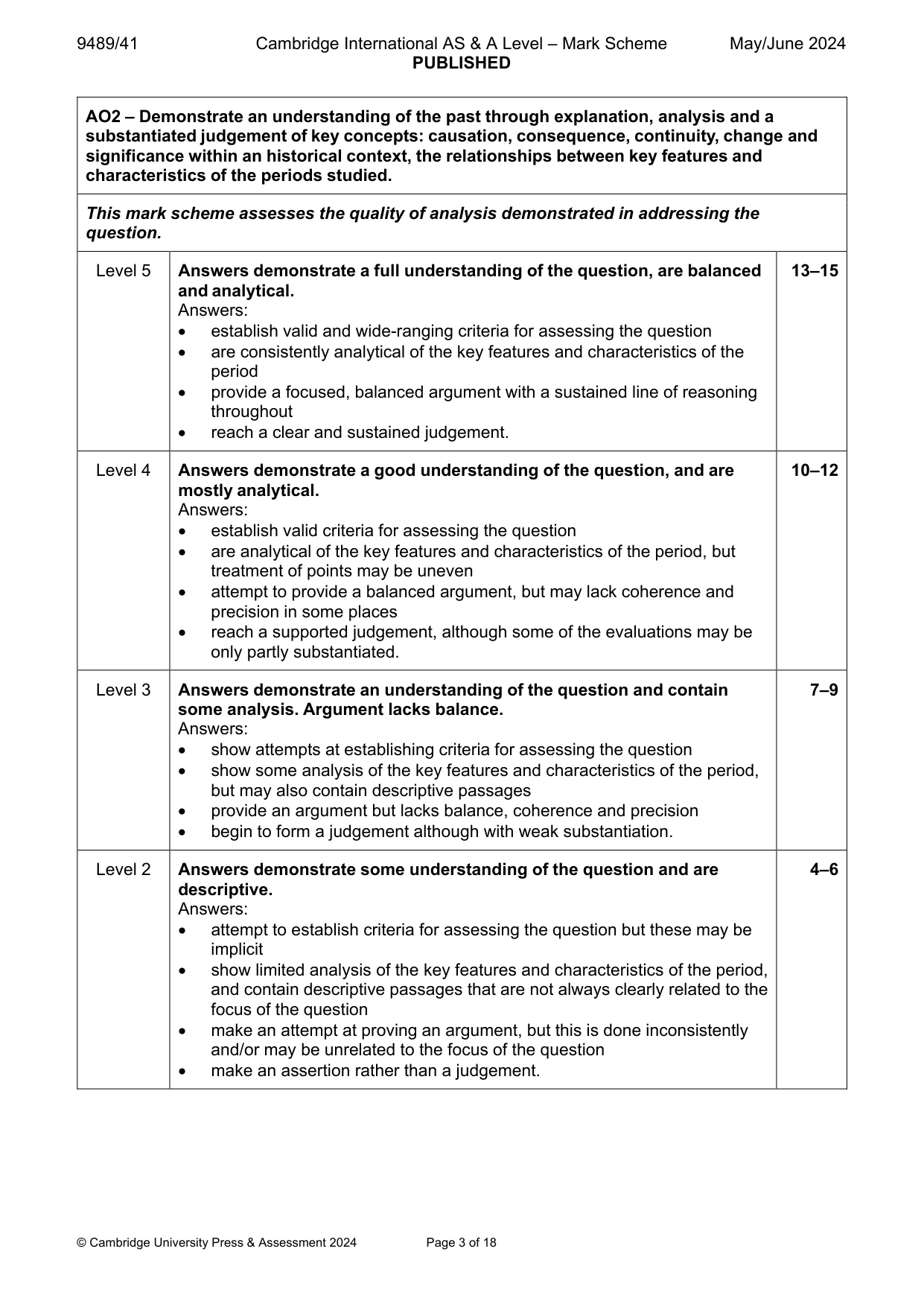
9489/41 Cambridge International AS & A Level – Mark Scheme PUBLISHED May/June 2024 © Cambridge University Press & Assessment 2024 Page 3 of 18 AO2 – Demonstrate an understanding of the past through explanation, analysis and a substantiated judgement of key concepts: causation, consequence, continuity, change and significance within an historical context, the relationships between key features and characteristics of the periods studied. This mark scheme assesses the quality of analysis demonstrated in addressing the question. Level 5 Answers demonstrate a full understanding of the question, are balanced and analytical. Answers: establish valid and wide-ranging criteria for assessing the question are consistently analytical of the key features and characteristics of the period provide a focused, balanced argument with a sustained line of reasoning throughout reach a clear and sustained judgement. 13–15 Level 4 Answers demonstrate a good understanding of the question, and are mostly analytical. Answers: establish valid criteria for assessing the question are analytical of the key features and characteristics of the period, but treatment of points may be uneven attempt to provide a balanced argument, but may lack coherence and precision in some places reach a supported judgement, although some of the evaluations may be only partly substantiated. 10–12 Level 3 Answers demonstrate an understanding of the question and contain some analysis. Argument lacks balance. Answers: show attempts at establishing criteria for assessing the question show some analysis of the key features and characteristics of the period, but may also contain descriptive passages provide an argument but lacks balance, coherence and precision begin to form a judgement although with weak substantiation. 7–9 Level 2 Answers demonstrate some understanding of the question and are descriptive. Answers: attempt to establish criteria for assessing the question but these may be implicit show limited analysis of the key features and characteristics of the period, and contain descriptive passages that are not always clearly related to the focus of the question make an attempt at proving an argument, but this is done inconsistently and/or may be unrelated to the focus of the question make an assertion rather than a judgement. 4–6
Mark scheme, page 4
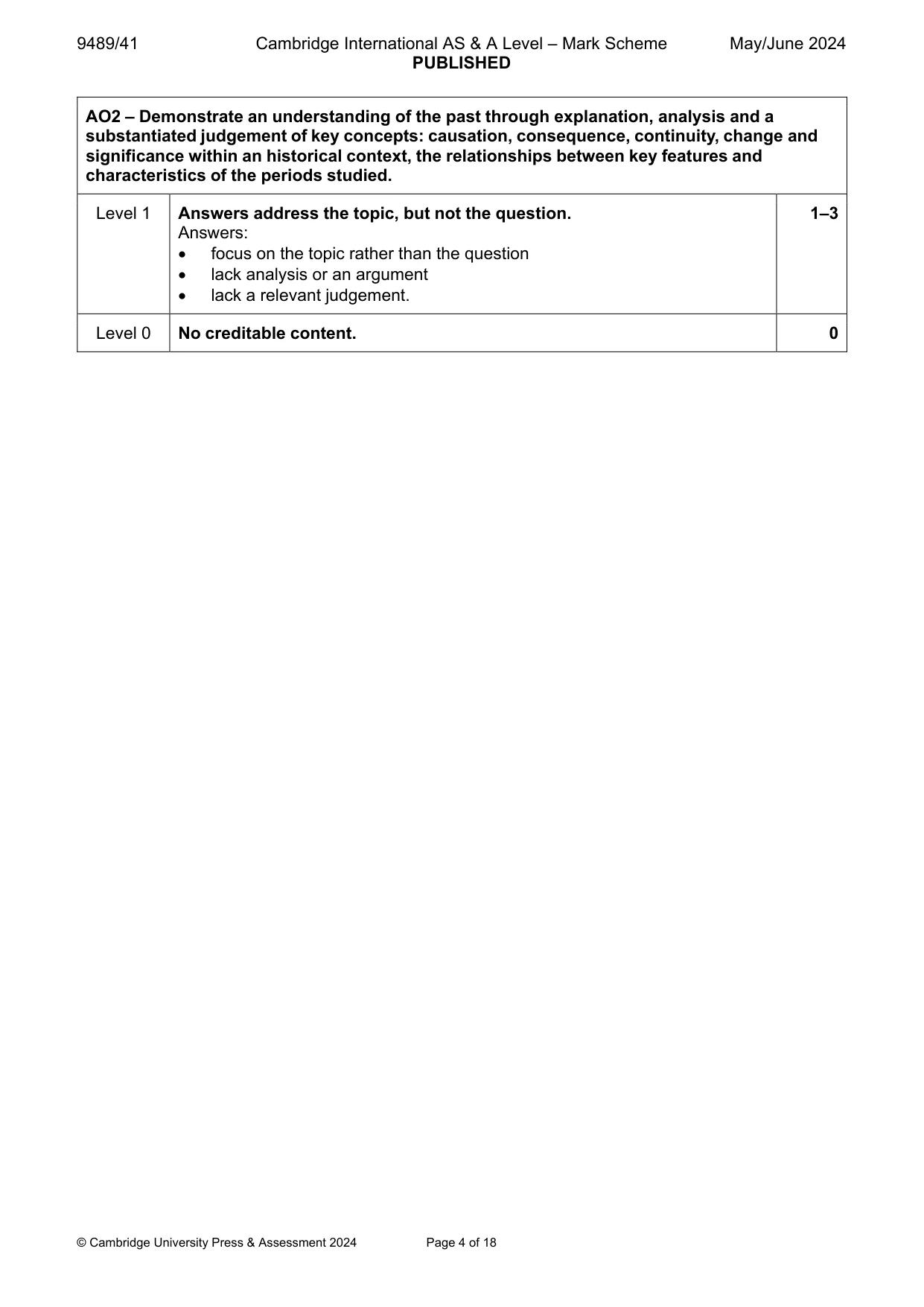
9489/41 Cambridge International AS & A Level – Mark Scheme PUBLISHED May/June 2024 © Cambridge University Press & Assessment 2024 Page 4 of 18 AO2 – Demonstrate an understanding of the past through explanation, analysis and a substantiated judgement of key concepts: causation, consequence, continuity, change and significance within an historical context, the relationships between key features and characteristics of the periods studied. Level 1 Answers address the topic, but not the question. Answers: focus on the topic rather than the question lack analysis or an argument lack a relevant judgement. 1–3 Level 0 No creditable content. 0
Mark scheme, page 5
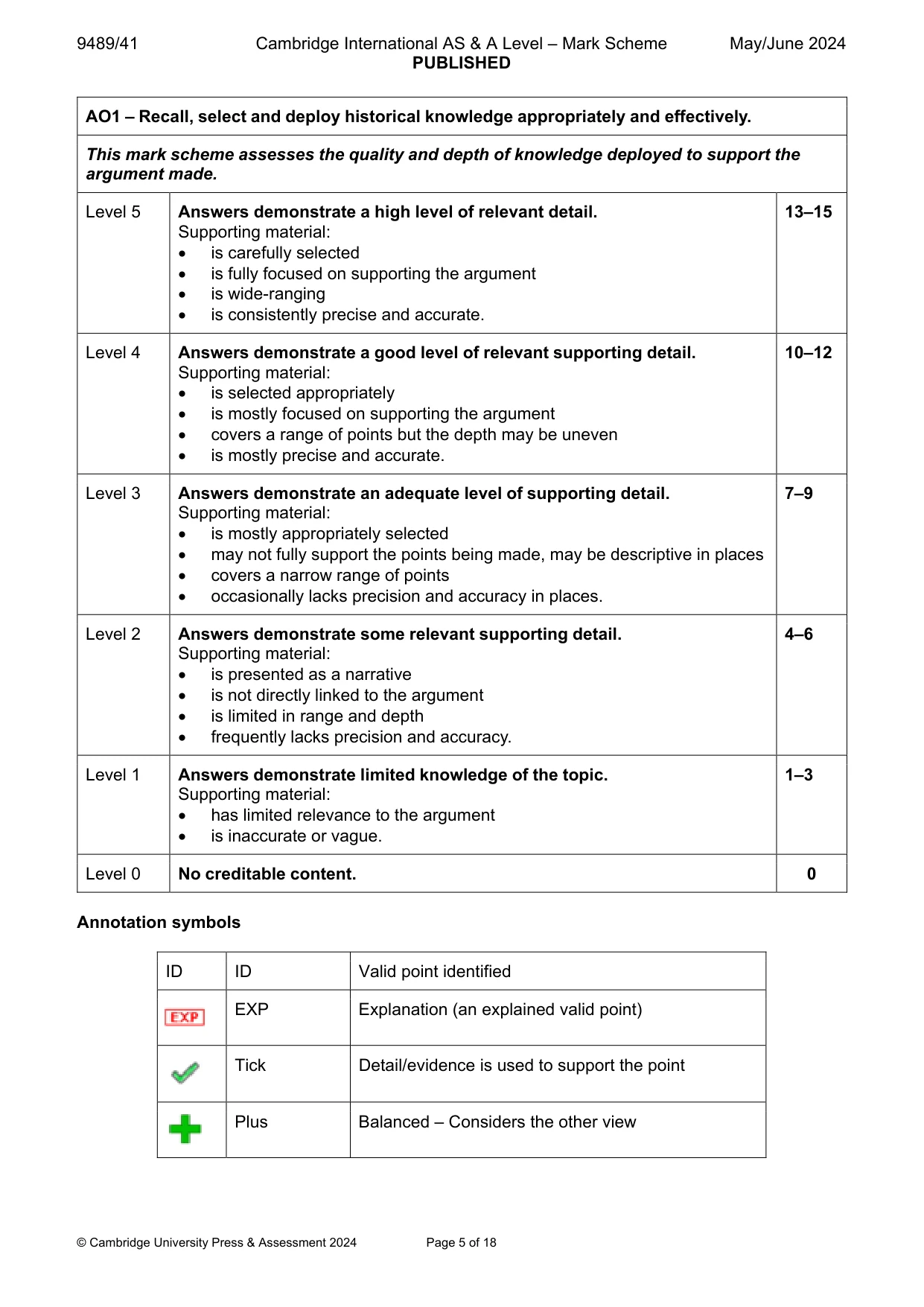
9489/41 Cambridge International AS & A Level – Mark Scheme PUBLISHED May/June 2024 © Cambridge University Press & Assessment 2024 Page 5 of 18 AO1 – Recall, select and deploy historical knowledge appropriately and effectively. This mark scheme assesses the quality and depth of knowledge deployed to support the argument made. Level 5 Answers demonstrate a high level of relevant detail. Supporting material: is carefully selected is fully focused on supporting the argument is wide-ranging is consistently precise and accurate. 13–15 Level 4 Answers demonstrate a good level of relevant supporting detail. Supporting material: is selected appropriately is mostly focused on supporting the argument covers a range of points but the depth may be uneven is mostly precise and accurate. 10–12 Level 3 Answers demonstrate an adequate level of supporting detail. Supporting material: is mostly appropriately selected may not fully support the points being made, may be descriptive in places covers a narrow range of points occasionally lacks precision and accuracy in places. 7–9 Level 2 Answers demonstrate some relevant supporting detail. Supporting material: is presented as a narrative is not directly linked to the argument is limited in range and depth frequently lacks precision and accuracy. 4–6 Level 1 Answers demonstrate limited knowledge of the topic. Supporting material: has limited relevance to the argument is inaccurate or vague. 1–3 Level 0 No creditable content. 0 Annotation symbols ID ID Valid point identified EXP Explanation (an explained valid point) Tick Detail/evidence is used to support the point Plus Balanced – Considers the other view
Mark scheme, page 6
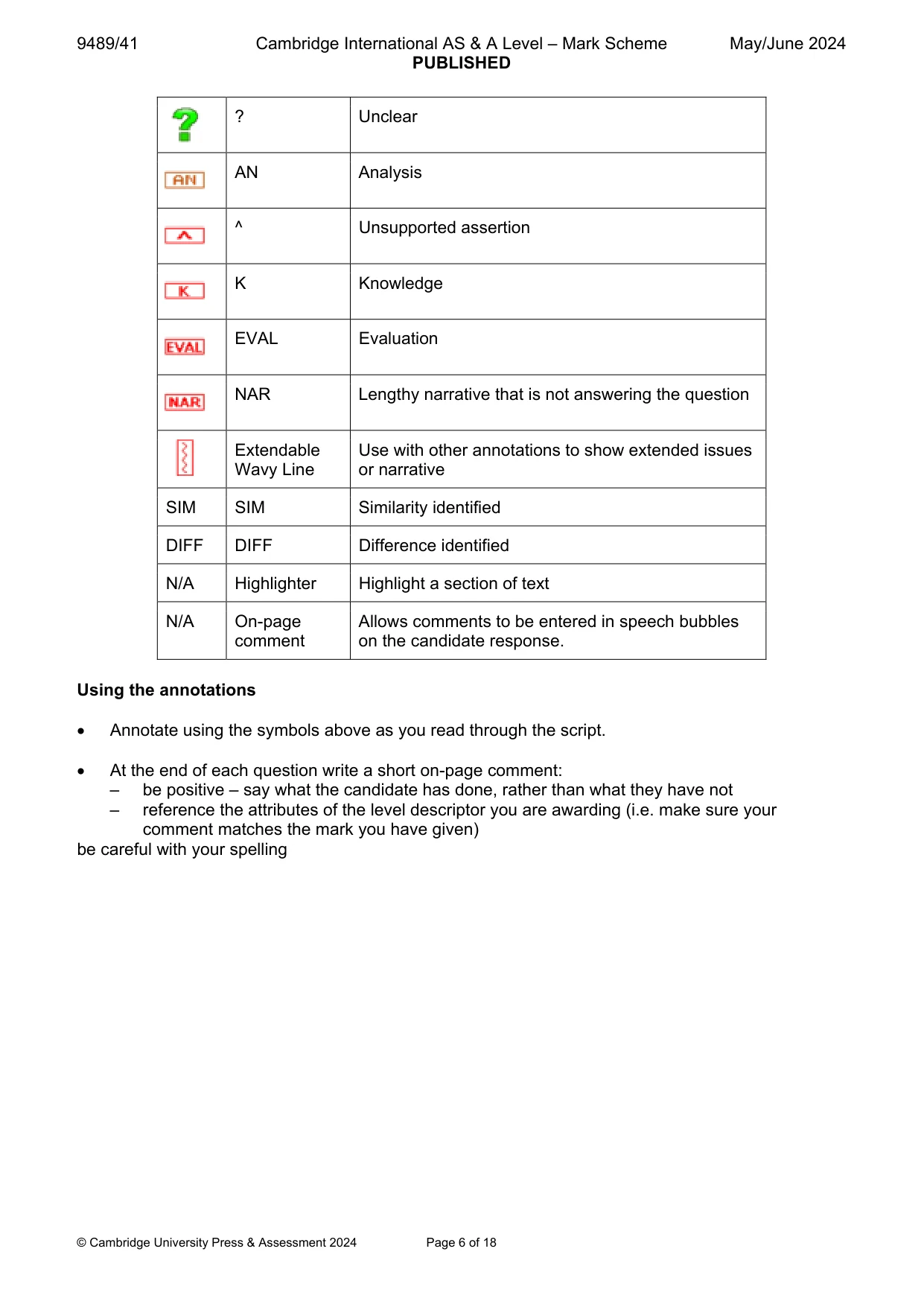
9489/41 Cambridge International AS & A Level – Mark Scheme PUBLISHED May/June 2024 © Cambridge University Press & Assessment 2024 Page 6 of 18 ? Unclear AN Analysis ^ Unsupported assertion K Knowledge EVAL Evaluation NAR Lengthy narrative that is not answering the question Extendable Wavy Line Use with other annotations to show extended issues or narrative SIM SIM Similarity identified DIFF DIFF Difference identified N/A Highlighter Highlight a section of text N/A On-page comment Allows comments to be entered in speech bubbles on the candidate response. Using the annotations Annotate using the symbols above as you read through the script. At the end of each question write a short on-page comment: – be positive – say what the candidate has done, rather than what they have not – reference the attributes of the level descriptor you are awarding (i.e. make sure your comment matches the mark you have given) be careful with your spelling
Mark scheme, page 7
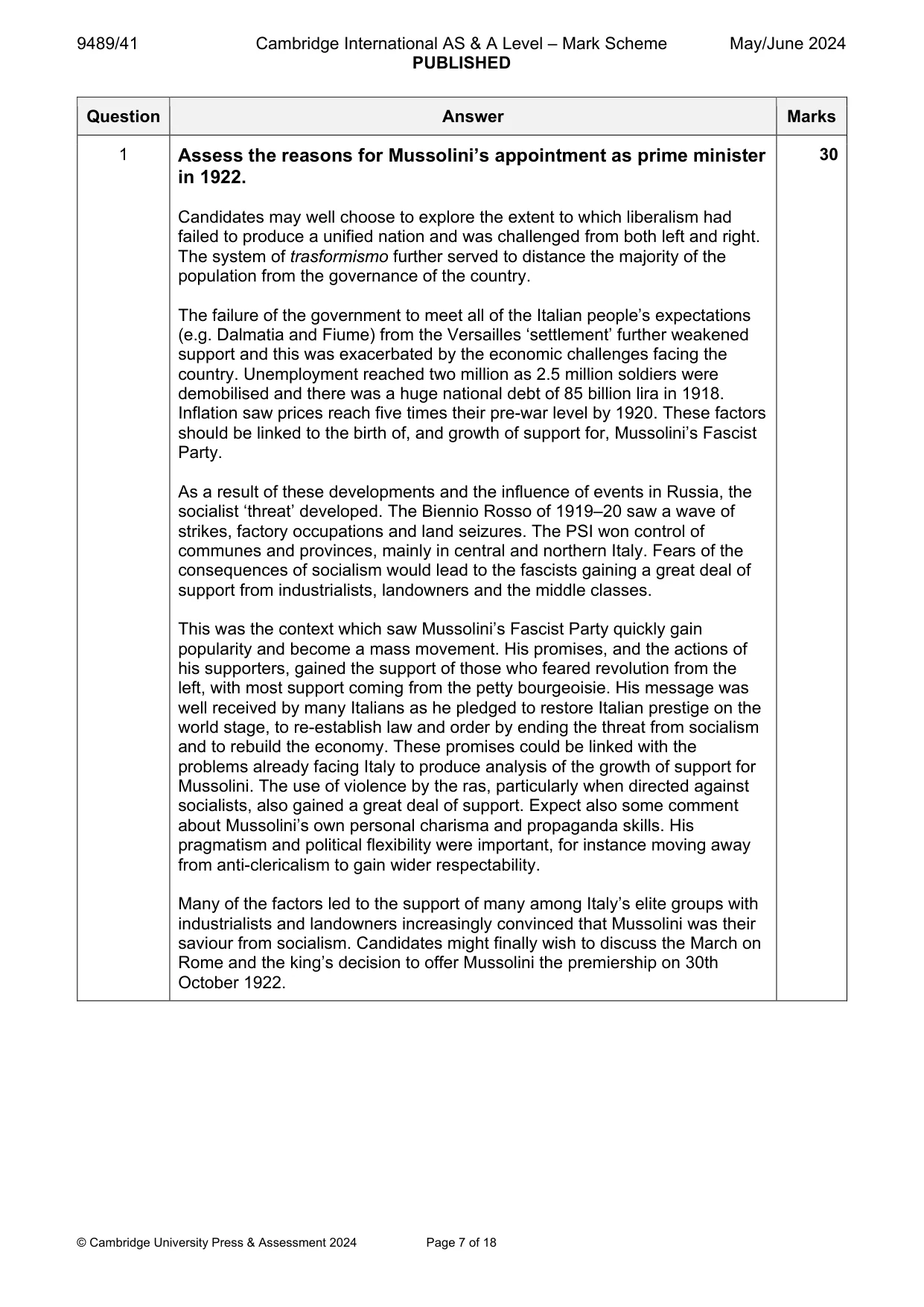
9489/41 Cambridge International AS & A Level – Mark Scheme PUBLISHED May/June 2024 © Cambridge University Press & Assessment 2024 Page 7 of 18 Question Answer Marks 1 Assess the reasons for Mussolini’s appointment as prime minister in 1922. Candidates may well choose to explore the extent to which liberalism had failed to produce a unified nation and was challenged from both left and right. The system of trasformismo further served to distance the majority of the population from the governance of the country. The failure of the government to meet all of the Italian people’s expectations (e.g. Dalmatia and Fiume) from the Versailles ‘settlement’ further weakened support and this was exacerbated by the economic challenges facing the country. Unemployment reached two million as 2.5 million soldiers were demobilised and there was a huge national debt of 85 billion lira in 1918. Inflation saw prices reach five times their pre-war level by 1920. These factors should be linked to the birth of, and growth of support for, Mussolini’s Fascist Party. As a result of these developments and the influence of events in Russia, the socialist ‘threat’ developed. The Biennio Rosso of 1919–20 saw a wave of strikes, factory occupations and land seizures. The PSI won control of communes and provinces, mainly in central and northern Italy. Fears of the consequences of socialism would lead to the fascists gaining a great deal of support from industrialists, landowners and the middle classes. This was the context which saw Mussolini’s Fascist Party quickly gain popularity and become a mass movement. His promises, and the actions of his supporters, gained the support of those who feared revolution from the left, with most support coming from the petty bourgeoisie. His message was well received by many Italians as he pledged to restore Italian prestige on the world stage, to re-establish law and order by ending the threat from socialism and to rebuild the economy. These promises could be linked with the problems already facing Italy to produce analysis of the growth of support for Mussolini. The use of violence by the ras, particularly when directed against socialists, also gained a great deal of support. Expect also some comment about Mussolini’s own personal charisma and propaganda skills. His pragmatism and political flexibility were important, for instance moving away from anti-clericalism to gain wider respectability. Many of the factors led to the support of many among Italy’s elite groups with industrialists and landowners increasingly convinced that Mussolini was their saviour from socialism. Candidates might finally wish to discuss the March on Rome and the king’s decision to offer Mussolini the premiership on 30th October 1922. 30
Mark scheme, page 8
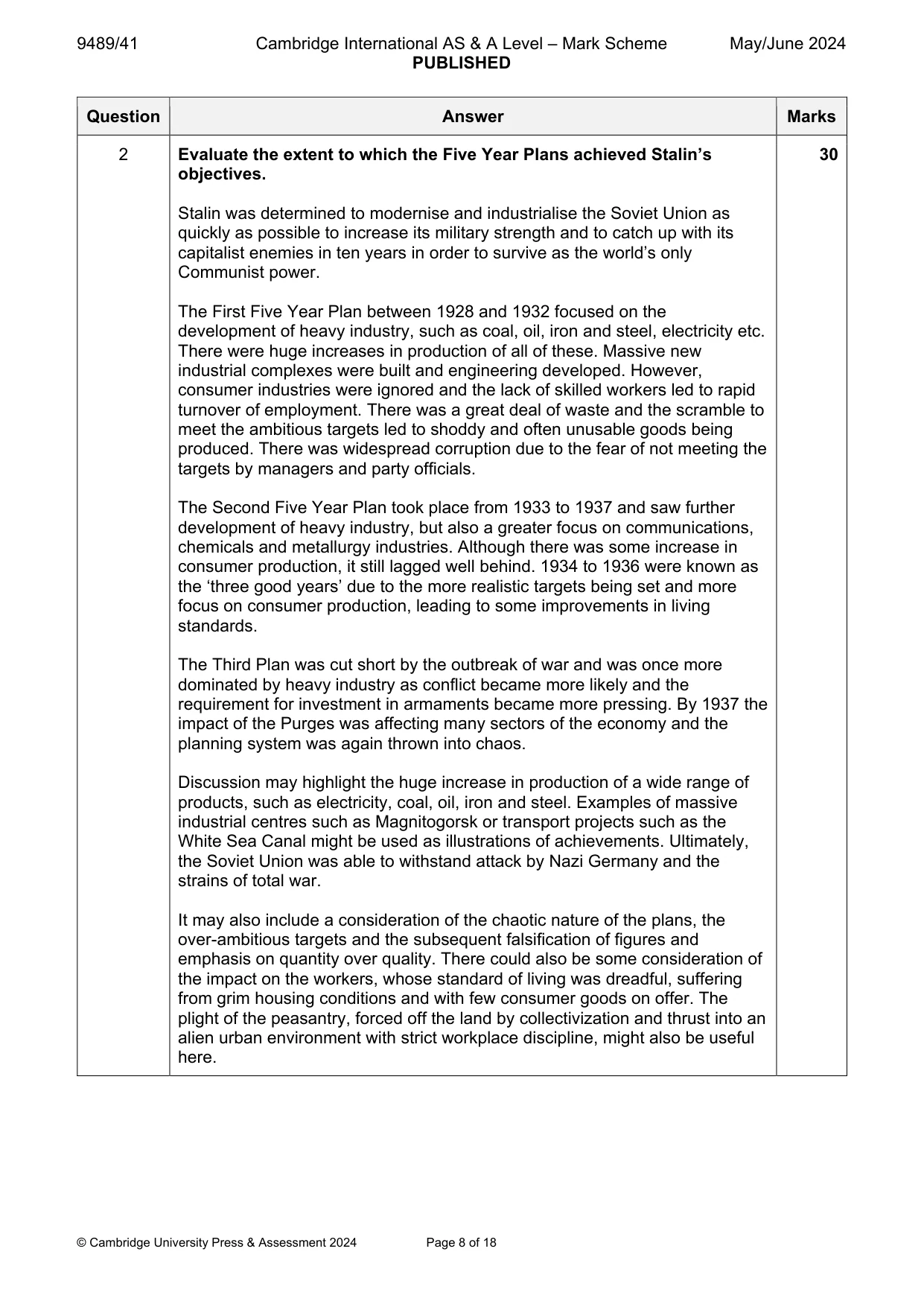
9489/41 Cambridge International AS & A Level – Mark Scheme PUBLISHED May/June 2024 © Cambridge University Press & Assessment 2024 Page 8 of 18 Question Answer Marks 2 Evaluate the extent to which the Five Year Plans achieved Stalin’s objectives. Stalin was determined to modernise and industrialise the Soviet Union as quickly as possible to increase its military strength and to catch up with its capitalist enemies in ten years in order to survive as the world’s only Communist power. The First Five Year Plan between 1928 and 1932 focused on the development of heavy industry, such as coal, oil, iron and steel, electricity etc. There were huge increases in production of all of these. Massive new industrial complexes were built and engineering developed. However, consumer industries were ignored and the lack of skilled workers led to rapid turnover of employment. There was a great deal of waste and the scramble to meet the ambitious targets led to shoddy and often unusable goods being produced. There was widespread corruption due to the fear of not meeting the targets by managers and party officials. The Second Five Year Plan took place from 1933 to 1937 and saw further development of heavy industry, but also a greater focus on communications, chemicals and metallurgy industries. Although there was some increase in consumer production, it still lagged well behind. 1934 to 1936 were known as the ‘three good years’ due to the more realistic targets being set and more focus on consumer production, leading to some improvements in living standards. The Third Plan was cut short by the outbreak of war and was once more dominated by heavy industry as conflict became more likely and the requirement for investment in armaments became more pressing. By 1937 the impact of the Purges was affecting many sectors of the economy and the planning system was again thrown into chaos. Discussion may highlight the huge increase in production of a wide range of products, such as electricity, coal, oil, iron and steel. Examples of massive industrial centres such as Magnitogorsk or transport projects such as the White Sea Canal might be used as illustrations of achievements. Ultimately, the Soviet Union was able to withstand attack by Nazi Germany and the strains of total war. It may also include a consideration of the chaotic nature of the plans, the over-ambitious targets and the subsequent falsification of figures and emphasis on quantity over quality. There could also be some consideration of the impact on the workers, whose standard of living was dreadful, suffering from grim housing conditions and with few consumer goods on offer. The plight of the peasantry, forced off the land by collectivization and thrust into an alien urban environment with strict workplace discipline, might also be useful here. 30
Mark scheme, page 9
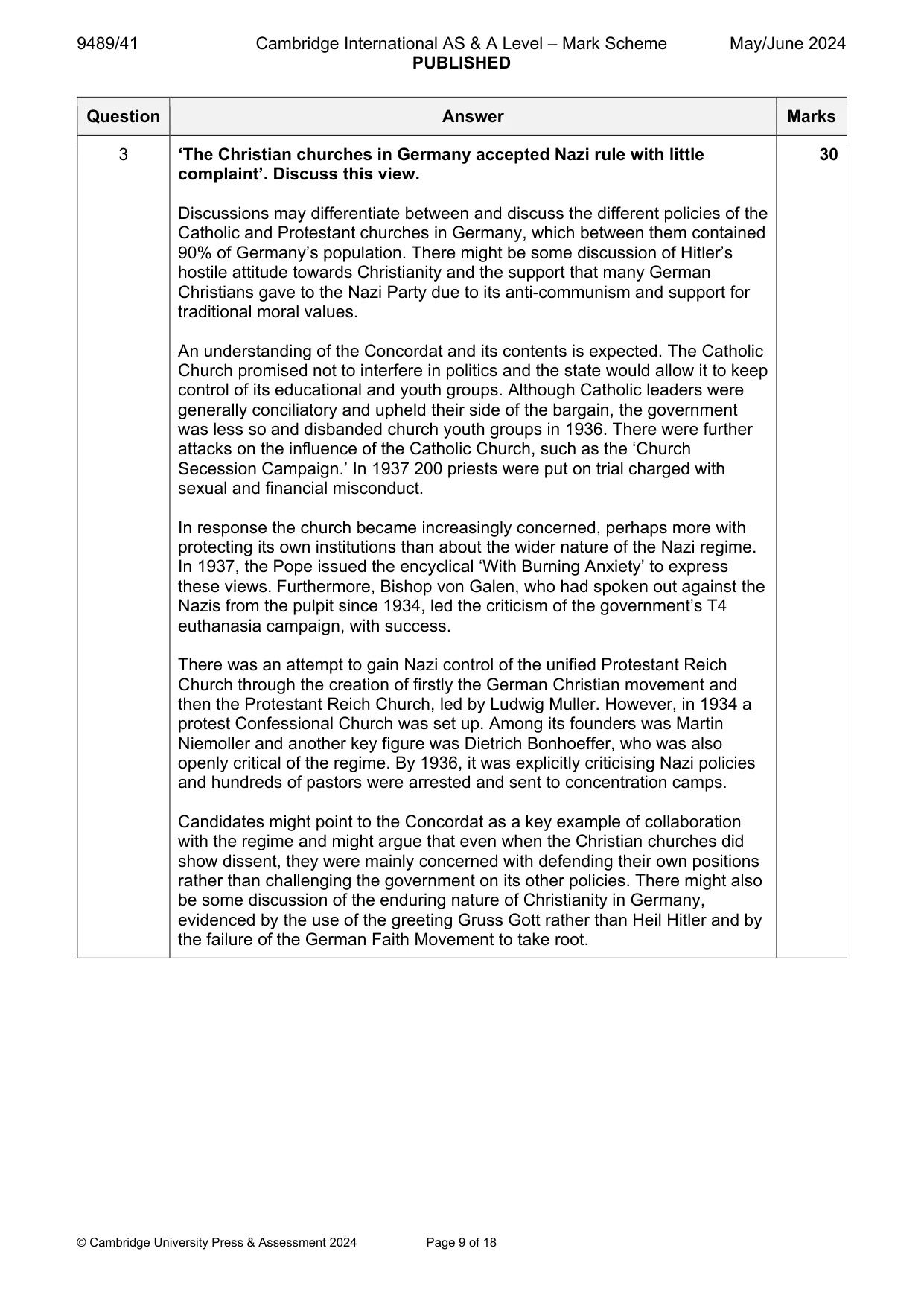
9489/41 Cambridge International AS & A Level – Mark Scheme PUBLISHED May/June 2024 © Cambridge University Press & Assessment 2024 Page 9 of 18 Question Answer Marks 3 ‘The Christian churches in Germany accepted Nazi rule with little complaint’. Discuss this view. Discussions may differentiate between and discuss the different policies of the Catholic and Protestant churches in Germany, which between them contained 90% of Germany’s population. There might be some discussion of Hitler’s hostile attitude towards Christianity and the support that many German Christians gave to the Nazi Party due to its anti-communism and support for traditional moral values. An understanding of the Concordat and its contents is expected. The Catholic Church promised not to interfere in politics and the state would allow it to keep control of its educational and youth groups. Although Catholic leaders were generally conciliatory and upheld their side of the bargain, the government was less so and disbanded church youth groups in 1936. There were further attacks on the influence of the Catholic Church, such as the ‘Church Secession Campaign.’ In 1937 200 priests were put on trial charged with sexual and financial misconduct. In response the church became increasingly concerned, perhaps more with protecting its own institutions than about the wider nature of the Nazi regime. In 1937, the Pope issued the encyclical ‘With Burning Anxiety’ to express these views. Furthermore, Bishop von Galen, who had spoken out against the Nazis from the pulpit since 1934, led the criticism of the government’s T4 euthanasia campaign, with success. There was an attempt to gain Nazi control of the unified Protestant Reich Church through the creation of firstly the German Christian movement and then the Protestant Reich Church, led by Ludwig Muller. However, in 1934 a protest Confessional Church was set up. Among its founders was Martin Niemoller and another key figure was Dietrich Bonhoeffer, who was also openly critical of the regime. By 1936, it was explicitly criticising Nazi policies and hundreds of pastors were arrested and sent to concentration camps. Candidates might point to the Concordat as a key example of collaboration with the regime and might argue that even when the Christian churches did show dissent, they were mainly concerned with defending their own positions rather than challenging the government on its other policies. There might also be some discussion of the enduring nature of Christianity in Germany, evidenced by the use of the greeting Gruss Gott rather than Heil Hitler and by the failure of the German Faith Movement to take root. 30
Mark scheme, page 10
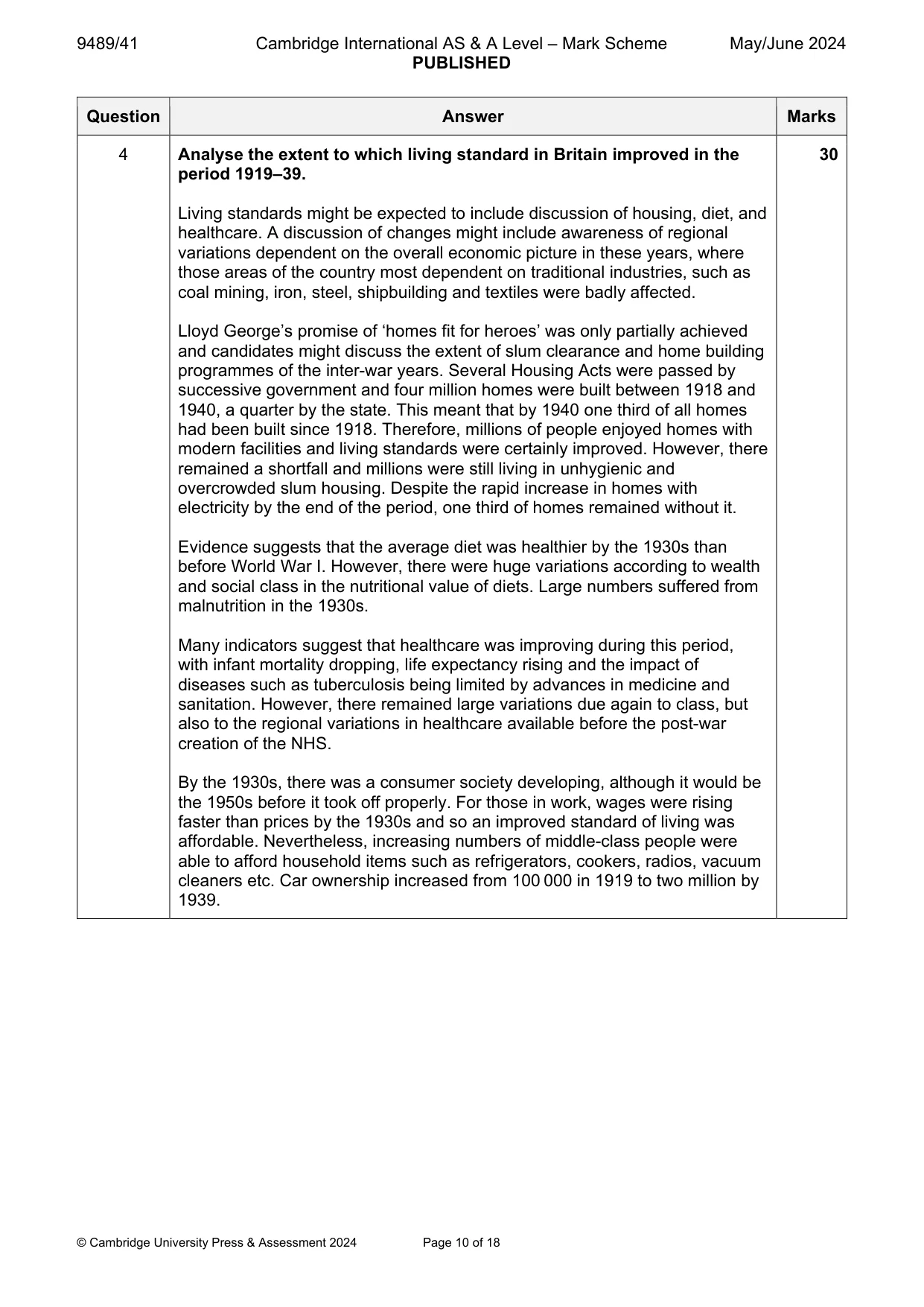
9489/41 Cambridge International AS & A Level – Mark Scheme PUBLISHED May/June 2024 © Cambridge University Press & Assessment 2024 Page 10 of 18 Question Answer Marks 4 Analyse the extent to which living standard in Britain improved in the period 1919–39. Living standards might be expected to include discussion of housing, diet, and healthcare. A discussion of changes might include awareness of regional variations dependent on the overall economic picture in these years, where those areas of the country most dependent on traditional industries, such as coal mining, iron, steel, shipbuilding and textiles were badly affected. Lloyd George’s promise of ‘homes fit for heroes’ was only partially achieved and candidates might discuss the extent of slum clearance and home building programmes of the inter-war years. Several Housing Acts were passed by successive government and four million homes were built between 1918 and 1940, a quarter by the state. This meant that by 1940 one third of all homes had been built since 1918. Therefore, millions of people enjoyed homes with modern facilities and living standards were certainly improved. However, there remained a shortfall and millions were still living in unhygienic and overcrowded slum housing. Despite the rapid increase in homes with electricity by the end of the period, one third of homes remained without it. Evidence suggests that the average diet was healthier by the 1930s than before World War I. However, there were huge variations according to wealth and social class in the nutritional value of diets. Large numbers suffered from malnutrition in the 1930s. Many indicators suggest that healthcare was improving during this period, with infant mortality dropping, life expectancy rising and the impact of diseases such as tuberculosis being limited by advances in medicine and sanitation. However, there remained large variations due again to class, but also to the regional variations in healthcare available before the post-war creation of the NHS. By the 1930s, there was a consumer society developing, although it would be the 1950s before it took off properly. For those in work, wages were rising faster than prices by the 1930s and so an improved standard of living was affordable. Nevertheless, increasing numbers of middle-class people were able to afford household items such as refrigerators, cookers, radios, vacuum cleaners etc. Car ownership increased from 100 000 in 1919 to two million by 1939. 30
Mark scheme, page 11
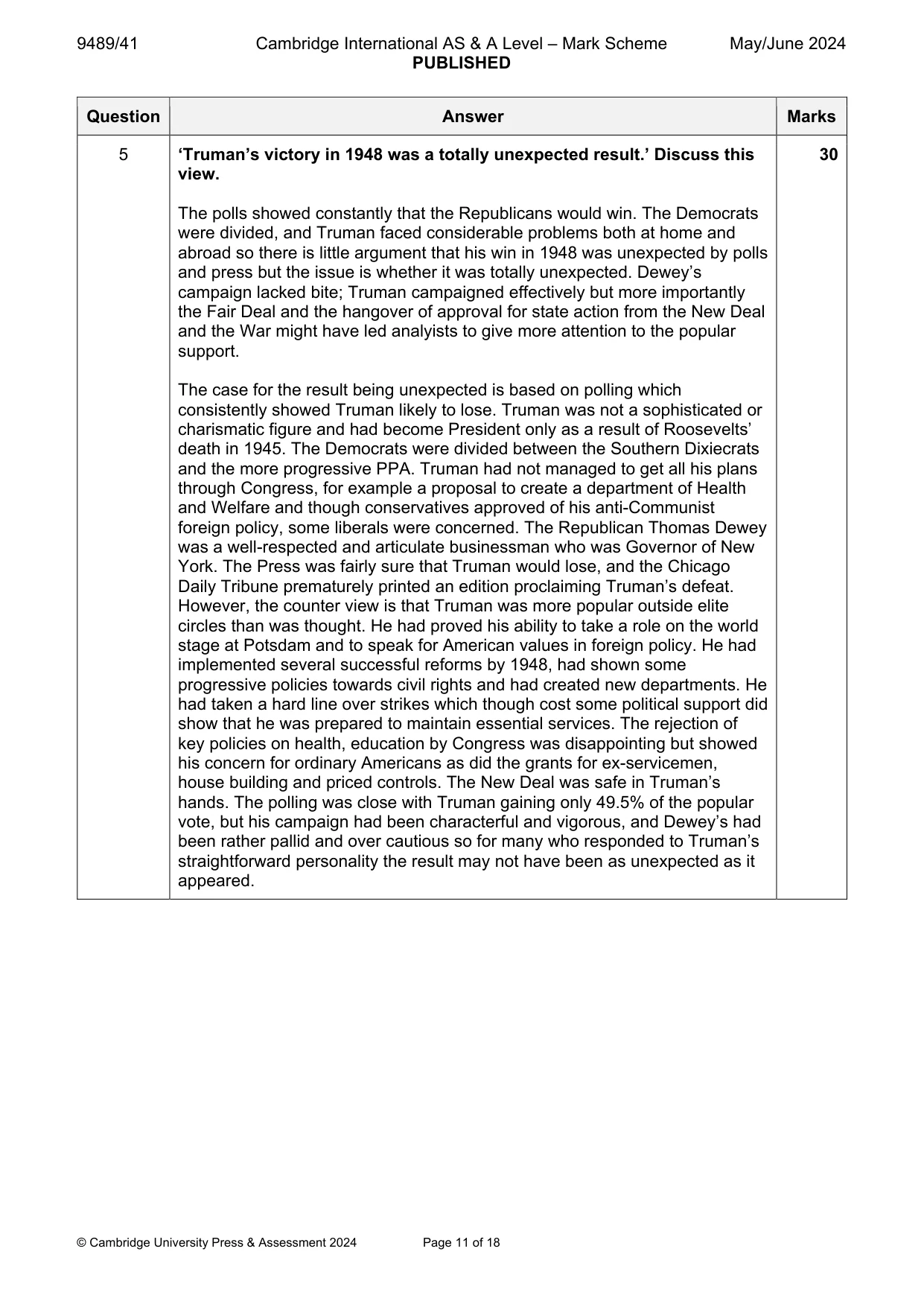
9489/41 Cambridge International AS & A Level – Mark Scheme PUBLISHED May/June 2024 © Cambridge University Press & Assessment 2024 Page 11 of 18 Question Answer Marks 5 ‘Truman’s victory in 1948 was a totally unexpected result.’ Discuss this view. The polls showed constantly that the Republicans would win. The Democrats were divided, and Truman faced considerable problems both at home and abroad so there is little argument that his win in 1948 was unexpected by polls and press but the issue is whether it was totally unexpected. Dewey’s campaign lacked bite; Truman campaigned effectively but more importantly the Fair Deal and the hangover of approval for state action from the New Deal and the War might have led analyists to give more attention to the popular support. The case for the result being unexpected is based on polling which consistently showed Truman likely to lose. Truman was not a sophisticated or charismatic figure and had become President only as a result of Roosevelts’ death in 1945. The Democrats were divided between the Southern Dixiecrats and the more progressive PPA. Truman had not managed to get all his plans through Congress, for example a proposal to create a department of Health and Welfare and though conservatives approved of his anti-Communist foreign policy, some liberals were concerned. The Republican Thomas Dewey was a well-respected and articulate businessman who was Governor of New York. The Press was fairly sure that Truman would lose, and the Chicago Daily Tribune prematurely printed an edition proclaiming Truman’s defeat. However, the counter view is that Truman was more popular outside elite circles than was thought. He had proved his ability to take a role on the world stage at Potsdam and to speak for American values in foreign policy. He had implemented several successful reforms by 1948, had shown some progressive policies towards civil rights and had created new departments. He had taken a hard line over strikes which though cost some political support did show that he was prepared to maintain essential services. The rejection of key policies on health, education by Congress was disappointing but showed his concern for ordinary Americans as did the grants for ex-servicemen, house building and priced controls. The New Deal was safe in Truman’s hands. The polling was close with Truman gaining only 49.5% of the popular vote, but his campaign had been characterful and vigorous, and Dewey’s had been rather pallid and over cautious so for many who responded to Truman’s straightforward personality the result may not have been as unexpected as it appeared. 30
Mark scheme, page 12
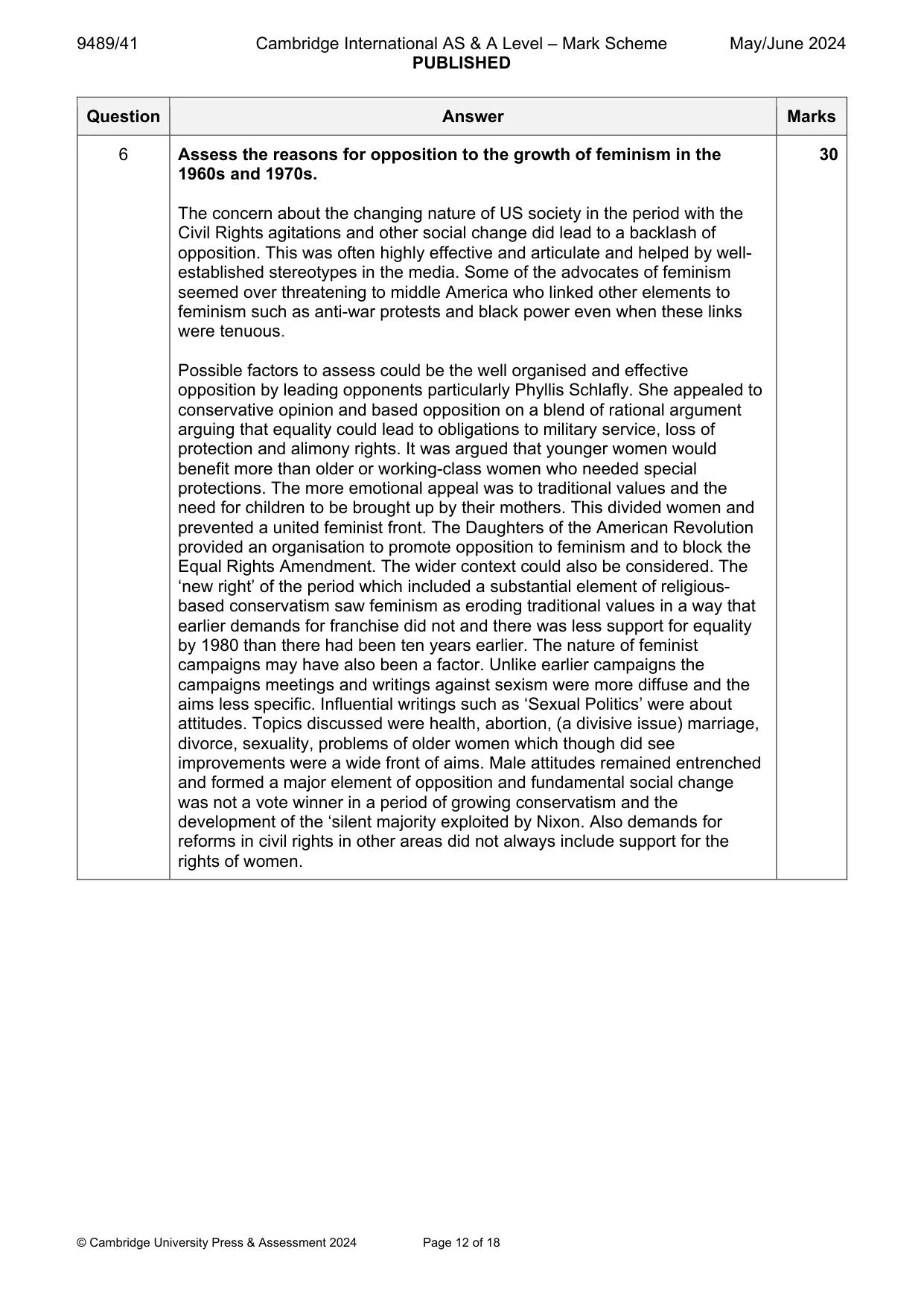
9489/41 Cambridge International AS & A Level – Mark Scheme PUBLISHED May/June 2024 © Cambridge University Press & Assessment 2024 Page 12 of 18 Question Answer Marks 6 Assess the reasons for opposition to the growth of feminism in the 1960s and 1970s. The concern about the changing nature of US society in the period with the Civil Rights agitations and other social change did lead to a backlash of opposition. This was often highly effective and articulate and helped by well- established stereotypes in the media. Some of the advocates of feminism seemed over threatening to middle America who linked other elements to feminism such as anti-war protests and black power even when these links were tenuous. Possible factors to assess could be the well organised and effective opposition by leading opponents particularly Phyllis Schlafly. She appealed to conservative opinion and based opposition on a blend of rational argument arguing that equality could lead to obligations to military service, loss of protection and alimony rights. It was argued that younger women would benefit more than older or working-class women who needed special protections. The more emotional appeal was to traditional values and the need for children to be brought up by their mothers. This divided women and prevented a united feminist front. The Daughters of the American Revolution provided an organisation to promote opposition to feminism and to block the Equal Rights Amendment. The wider context could also be considered. The ‘new right’ of the period which included a substantial element of religious- based conservatism saw feminism as eroding traditional values in a way that earlier demands for franchise did not and there was less support for equality by 1980 than there had been ten years earlier. The nature of feminist campaigns may have also been a factor. Unlike earlier campaigns the campaigns meetings and writings against sexism were more diffuse and the aims less specific. Influential writings such as ‘Sexual Politics’ were about attitudes. Topics discussed were health, abortion, (a divisive issue) marriage, divorce, sexuality, problems of older women which though did see improvements were a wide front of aims. Male attitudes remained entrenched and formed a major element of opposition and fundamental social change was not a vote winner in a period of growing conservatism and the development of the ‘silent majority exploited by Nixon. Also demands for reforms in civil rights in other areas did not always include support for the rights of women. 30
Mark scheme, page 13
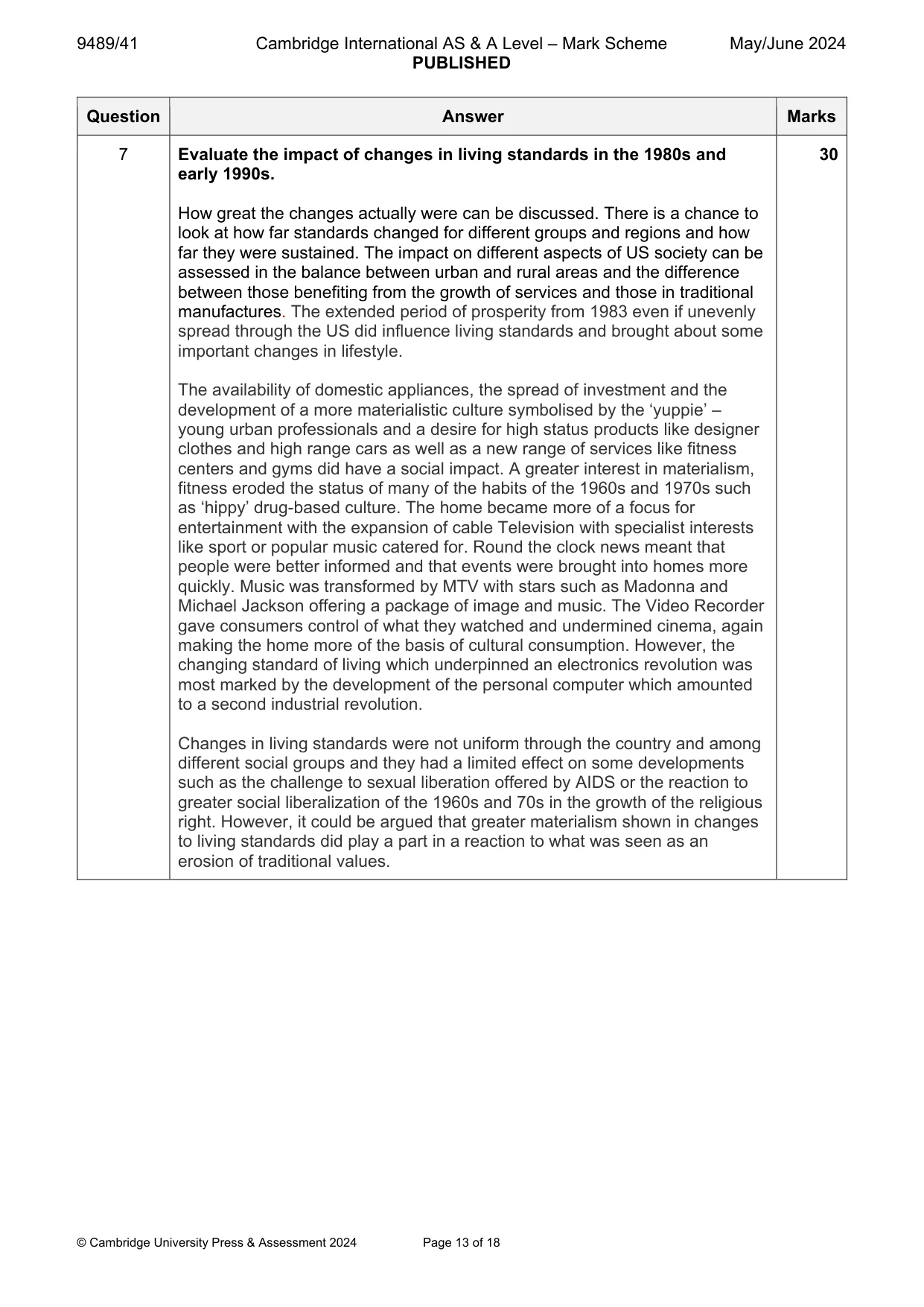
9489/41 Cambridge International AS & A Level – Mark Scheme PUBLISHED May/June 2024 © Cambridge University Press & Assessment 2024 Page 13 of 18 Question Answer Marks 7 Evaluate the impact of changes in living standards in the 1980s and early 1990s. How great the changes actually were can be discussed. There is a chance to look at how far standards changed for different groups and regions and how far they were sustained. The impact on different aspects of US society can be assessed in the balance between urban and rural areas and the difference between those benefiting from the growth of services and those in traditional manufactures. The extended period of prosperity from 1983 even if unevenly spread through the US did influence living standards and brought about some important changes in lifestyle. The availability of domestic appliances, the spread of investment and the development of a more materialistic culture symbolised by the ‘yuppie’ – young urban professionals and a desire for high status products like designer clothes and high range cars as well as a new range of services like fitness centers and gyms did have a social impact. A greater interest in materialism, fitness eroded the status of many of the habits of the 1960s and 1970s such as ‘hippy’ drug-based culture. The home became more of a focus for entertainment with the expansion of cable Television with specialist interests like sport or popular music catered for. Round the clock news meant that people were better informed and that events were brought into homes more quickly. Music was transformed by MTV with stars such as Madonna and Michael Jackson offering a package of image and music. The Video Recorder gave consumers control of what they watched and undermined cinema, again making the home more of the basis of cultural consumption. However, the changing standard of living which underpinned an electronics revolution was most marked by the development of the personal computer which amounted to a second industrial revolution. Changes in living standards were not uniform through the country and among different social groups and they had a limited effect on some developments such as the challenge to sexual liberation offered by AIDS or the reaction to greater social liberalization of the 1960s and 70s in the growth of the religious right. However, it could be argued that greater materialism shown in changes to living standards did play a part in a reaction to what was seen as an erosion of traditional values. 30
Mark scheme, page 14
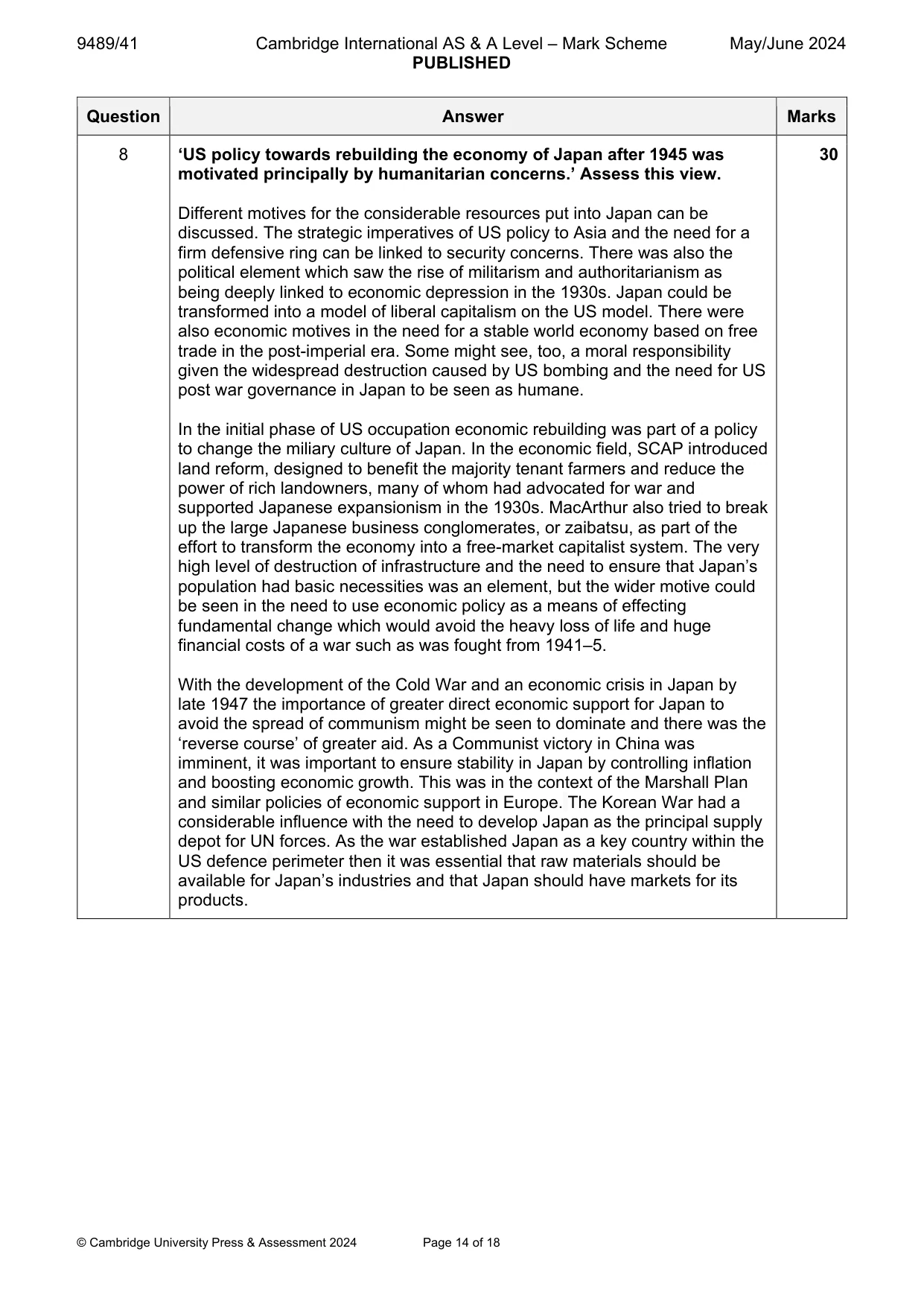
9489/41 Cambridge International AS & A Level – Mark Scheme PUBLISHED May/June 2024 © Cambridge University Press & Assessment 2024 Page 14 of 18 Question Answer Marks 8 ‘US policy towards rebuilding the economy of Japan after 1945 was motivated principally by humanitarian concerns.’ Assess this view. Different motives for the considerable resources put into Japan can be discussed. The strategic imperatives of US policy to Asia and the need for a firm defensive ring can be linked to security concerns. There was also the political element which saw the rise of militarism and authoritarianism as being deeply linked to economic depression in the 1930s. Japan could be transformed into a model of liberal capitalism on the US model. There were also economic motives in the need for a stable world economy based on free trade in the post-imperial era. Some might see, too, a moral responsibility given the widespread destruction caused by US bombing and the need for US post war governance in Japan to be seen as humane. In the initial phase of US occupation economic rebuilding was part of a policy to change the miliary culture of Japan. In the economic field, SCAP introduced land reform, designed to benefit the majority tenant farmers and reduce the power of rich landowners, many of whom had advocated for war and supported Japanese expansionism in the 1930s. MacArthur also tried to break up the large Japanese business conglomerates, or zaibatsu, as part of the effort to transform the economy into a free-market capitalist system. The very high level of destruction of infrastructure and the need to ensure that Japan’s population had basic necessities was an element, but the wider motive could be seen in the need to use economic policy as a means of effecting fundamental change which would avoid the heavy loss of life and huge financial costs of a war such as was fought from 1941–5. With the development of the Cold War and an economic crisis in Japan by late 1947 the importance of greater direct economic support for Japan to avoid the spread of communism might be seen to dominate and there was the ‘reverse course’ of greater aid. As a Communist victory in China was imminent, it was important to ensure stability in Japan by controlling inflation and boosting economic growth. This was in the context of the Marshall Plan and similar policies of economic support in Europe. The Korean War had a considerable influence with the need to develop Japan as the principal supply depot for UN forces. As the war established Japan as a key country within the US defence perimeter then it was essential that raw materials should be available for Japan’s industries and that Japan should have markets for its products. 30
Mark scheme, page 15
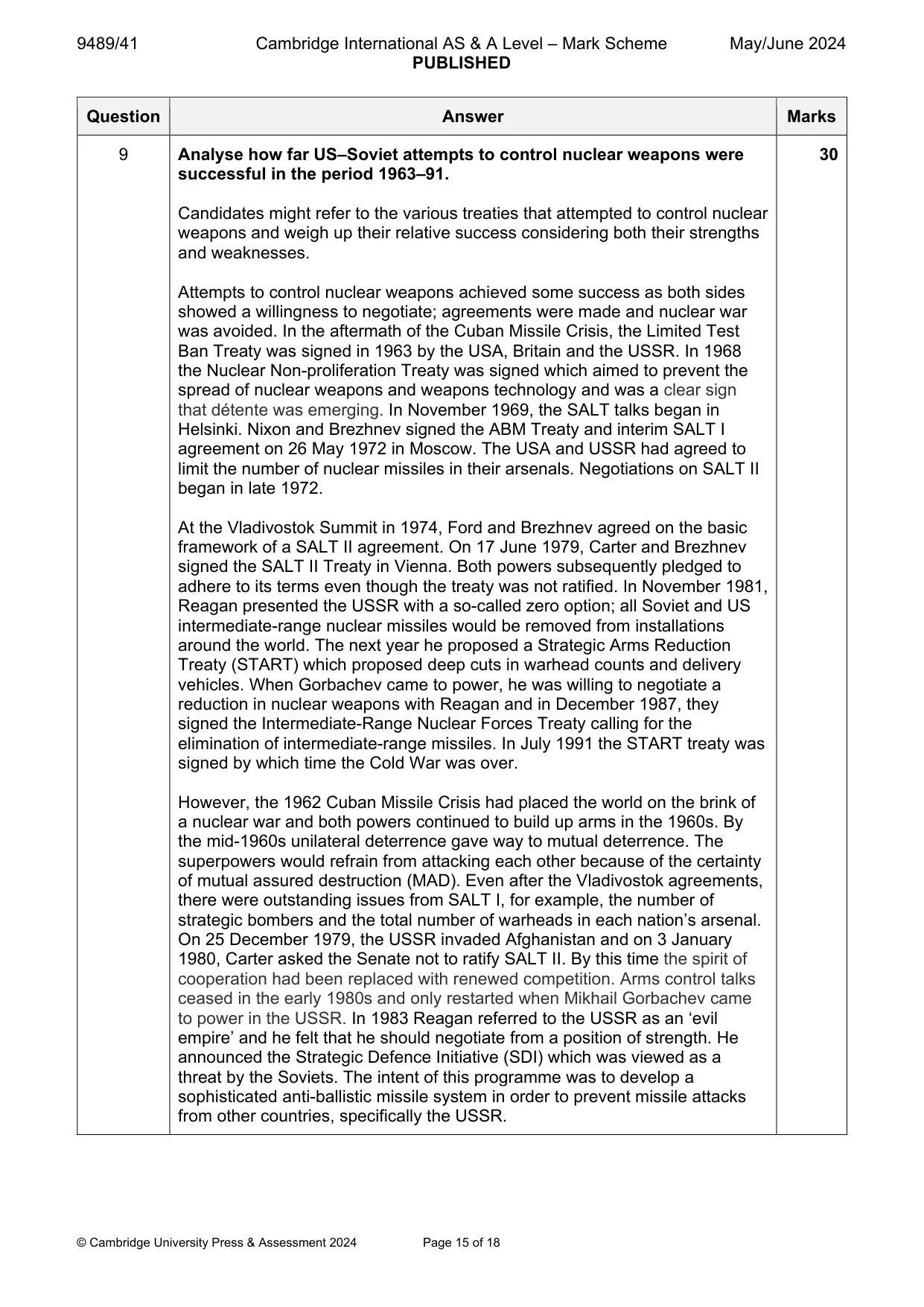
9489/41 Cambridge International AS & A Level – Mark Scheme PUBLISHED May/June 2024 © Cambridge University Press & Assessment 2024 Page 15 of 18 Question Answer Marks 9 Analyse how far US–Soviet attempts to control nuclear weapons were successful in the period 1963–91. Candidates might refer to the various treaties that attempted to control nuclear weapons and weigh up their relative success considering both their strengths and weaknesses. Attempts to control nuclear weapons achieved some success as both sides showed a willingness to negotiate; agreements were made and nuclear war was avoided. In the aftermath of the Cuban Missile Crisis, the Limited Test Ban Treaty was signed in 1963 by the USA, Britain and the USSR. In 1968 the Nuclear Non-proliferation Treaty was signed which aimed to prevent the spread of nuclear weapons and weapons technology and was a clear sign that détente was emerging. In November 1969, the SALT talks began in Helsinki. Nixon and Brezhnev signed the ABM Treaty and interim SALT I agreement on 26 May 1972 in Moscow. The USA and USSR had agreed to limit the number of nuclear missiles in their arsenals. Negotiations on SALT II began in late 1972. At the Vladivostok Summit in 1974, Ford and Brezhnev agreed on the basic framework of a SALT II agreement. On 17 June 1979, Carter and Brezhnev signed the SALT II Treaty in Vienna. Both powers subsequently pledged to adhere to its terms even though the treaty was not ratified. In November 1981, Reagan presented the USSR with a so-called zero option; all Soviet and US intermediate-range nuclear missiles would be removed from installations around the world. The next year he proposed a Strategic Arms Reduction Treaty (START) which proposed deep cuts in warhead counts and delivery vehicles. When Gorbachev came to power, he was willing to negotiate a reduction in nuclear weapons with Reagan and in December 1987, they signed the Intermediate-Range Nuclear Forces Treaty calling for the elimination of intermediate-range missiles. In July 1991 the START treaty was signed by which time the Cold War was over. However, the 1962 Cuban Missile Crisis had placed the world on the brink of a nuclear war and both powers continued to build up arms in the 1960s. By the mid-1960s unilateral deterrence gave way to mutual deterrence. The superpowers would refrain from attacking each other because of the certainty of mutual assured destruction (MAD). Even after the Vladivostok agreements, there were outstanding issues from SALT I, for example, the number of strategic bombers and the total number of warheads in each nation’s arsenal. On 25 December 1979, the USSR invaded Afghanistan and on 3 January 1980, Carter asked the Senate not to ratify SALT II. By this time the spirit of cooperation had been replaced with renewed competition. Arms control talks ceased in the early 1980s and only restarted when Mikhail Gorbachev came to power in the USSR. In 1983 Reagan referred to the USSR as an ‘evil empire’ and he felt that he should negotiate from a position of strength. He announced the Strategic Defence Initiative (SDI) which was viewed as a threat by the Soviets. The intent of this programme was to develop a sophisticated anti-ballistic missile system in order to prevent missile attacks from other countries, specifically the USSR. 30
Mark scheme, page 16
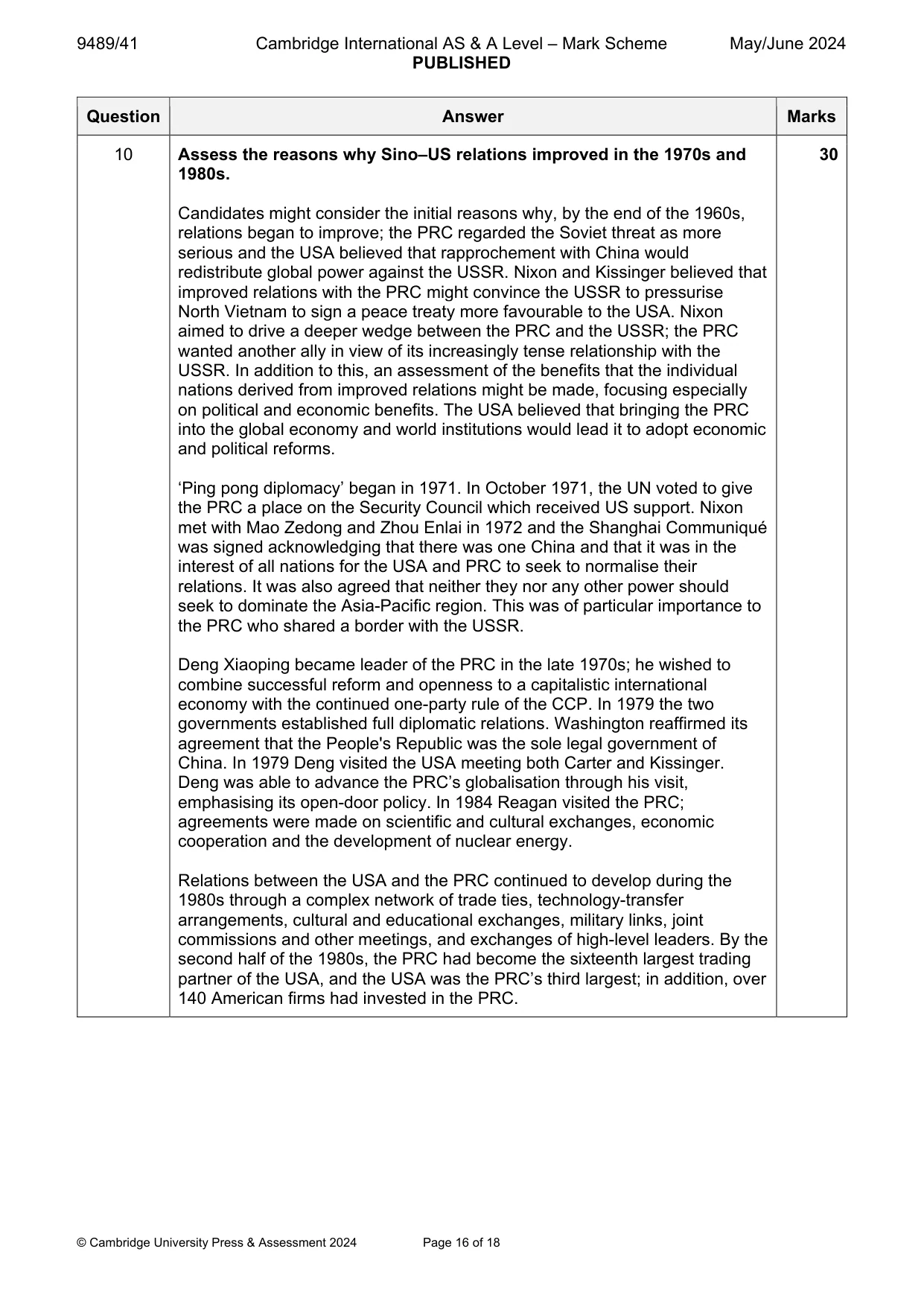
9489/41 Cambridge International AS & A Level – Mark Scheme PUBLISHED May/June 2024 © Cambridge University Press & Assessment 2024 Page 16 of 18 Question Answer Marks 10 Assess the reasons why Sino–US relations improved in the 1970s and 1980s. Candidates might consider the initial reasons why, by the end of the 1960s, relations began to improve; the PRC regarded the Soviet threat as more serious and the USA believed that rapprochement with China would redistribute global power against the USSR. Nixon and Kissinger believed that improved relations with the PRC might convince the USSR to pressurise North Vietnam to sign a peace treaty more favourable to the USA. Nixon aimed to drive a deeper wedge between the PRC and the USSR; the PRC wanted another ally in view of its increasingly tense relationship with the USSR. In addition to this, an assessment of the benefits that the individual nations derived from improved relations might be made, focusing especially on political and economic benefits. The USA believed that bringing the PRC into the global economy and world institutions would lead it to adopt economic and political reforms. ‘Ping pong diplomacy’ began in 1971. In October 1971, the UN voted to give the PRC a place on the Security Council which received US support. Nixon met with Mao Zedong and Zhou Enlai in 1972 and the Shanghai Communiqué was signed acknowledging that there was one China and that it was in the interest of all nations for the USA and PRC to seek to normalise their relations. It was also agreed that neither they nor any other power should seek to dominate the Asia-Pacific region. This was of particular importance to the PRC who shared a border with the USSR. Deng Xiaoping became leader of the PRC in the late 1970s; he wished to combine successful reform and openness to a capitalistic international economy with the continued one-party rule of the CCP. In 1979 the two governments established full diplomatic relations. Washington reaffirmed its agreement that the People's Republic was the sole legal government of China. In 1979 Deng visited the USA meeting both Carter and Kissinger. Deng was able to advance the PRC’s globalisation through his visit, emphasising its open-door policy. In 1984 Reagan visited the PRC; agreements were made on scientific and cultural exchanges, economic cooperation and the development of nuclear energy. Relations between the USA and the PRC continued to develop during the 1980s through a complex network of trade ties, technology-transfer arrangements, cultural and educational exchanges, military links, joint commissions and other meetings, and exchanges of high-level leaders. By the second half of the 1980s, the PRC had become the sixteenth largest trading partner of the USA, and the USA was the PRC’s third largest; in addition, over 140 American firms had invested in the PRC. 30
Mark scheme, page 17
9489/41 Cambridge International AS & A Level – Mark Scheme PUBLISHED May/June 2024 © Cambridge University Press & Assessment 2024 Page 17 of 18 Question Answer Marks 11 Evaluate the effect of Cold War tensions on the civil war in Angola. Candidates might weigh up the influence of both the USSR and the USA on the civil war in Angola and how tension between them affected their intervention. However, the role of Portugal, the main military movements and the availability of natural resources to buy support can also be considered in influencing the course of the war. When Angola achieved its independence from Portugal in 1975, a brutal civil war erupted lasting from 1975 to 2002. The Alvor Agreement with Portugal in January 1975 was for a three-way power sharing government but the MPLA seized control of the capital, Luanda, forcing UNITA and the FNLA to flee. They declared themselves to be Angola’s legitimate government. Portugal refused to enforce the peace agreements or power-sharing decision and simply pulled out of Angola leaving Angola torn in a three-way battle for power which devolved into an armed civil conflict. The three main military movements were united in their anti-colonial struggle but were divided along ethnic and ideological lines. Natural resources played a very significant role in the perpetuation of the Angolan Civil War, allowing the movements to fund a destructive war effort and buy favour with the world’s leading powers who realised the strategic importance of Angola. Diamonds provided a consistent funding for UNITA, allowing it to control much of the Angolan interior, while coastal oil reserves meant the MPLA could maintain control over the centres of power. The balance these resources provided ensured neither side scored a definitive military victory. However, Cold War tensions also prolonged the war. The Angolan Civil War became in part a Cold War proxy war between the USA and the USSR. The USA wanted to extend US political influence and control over Africa’s strategic resources. It provided aid and training to both FNLA and UNITA. The USSR supported the MPLA with military training and equipment. The MPLA also had ties with Castro in Cuba and UNITA asked South Africa for military help. The US Government had encouraged South African intervention but preferred to distance itself from the apartheid regime. Congress refused Ford’s requests for additional funds in 1976. South Africa also withdrew its forces and the MPLA remained as the official government of Angola. UNITA continued the civil war. Henry Kissinger claimed that the USA was forced to intervene in Angola because the USSR was already providing military aid to the MPLA by using Cuban troops but later evidence showed that it was the USA who backed a two-pronged invasion by FNLA from Zaire and from South Africa in support of UNITA. The MPLA was the most organised and best led of the three factions but the USA did not want a negotiated settlement as the USSR supported the MPLA. In August 1985, the Reagan administration won a repeal of the 1976 prohibition against US military aid to rebel forces in Angola. Military assistance began to flow to UNITA in January 1987. Finally, in September 1992, elections were held but Savimbi, the leader of UNITA, refused to accept the result when it became apparent that the MPLA would be the winner and the civil war resumed. 30
Mark scheme, page 18
9489/41 Cambridge International AS & A Level – Mark Scheme PUBLISHED May/June 2024 © Cambridge University Press & Assessment 2024 Page 18 of 18 Question Answer Marks 12 ‘Saddam Hussein’s personal ambitions were the main cause of the Iran–Iraq War.’ Discuss. Saddam’s personal ambitions are likely to be discussed as well as fear of threats to his regime from Iran and the extent to which other Arab nations encouraged him in order to reach an overall judgement. It could be argued that Saddam was an opportunist who seized on the weakness of Iran following the Iranian Revolution to further his personal ambitions in the region. He wished to be recognised as the leading power in the Gulf. His plan was to strike quickly with the ‘whirlwind war’ resulting in a swift victory for Iraq. He aimed to annex Khuzestan and become the regional superpower. Khuzestan’s large ethnic Arab population would allow Saddam to pose as a liberator of Arabs from Persian rule. Iraq could also use a victory in a war with Iran as a means to advance Saddam’s regional ambitions, bolstering Iraq’s claim as a leader of the pan- Arab cause, particularly since Egypt had been marginalised after signing a separate peace treaty with Israel in 1979. A successful invasion of Iran would enlarge Iraq’s petroleum reserves and make it the region’s most dominant power. Victory against Iran would inspire Arabs and prepare the Iraqi military for an eventual war with Israel. Saddam also saw the war as an opportunity to reverse the humiliation that Iraq had experienced at the hands of Iran and to reassert his country’s sovereignty over both banks of the Shatt al-Arab. Prior to 1979, the rivalry between Iran and Iraq had been characterised by Iranian dominance. His plan was to strike quickly with the ‘whirlwind war’ resulting in a swift victory. However, other Gulf states such as Saudi Arabia and Kuwait urged Iraq to attack Iran, as they feared that an Islamic revolution would take place within their own borders and this could be the opportunity to demonstrate his strength. It can also be argued that it was fear rather than ambition that drove Saddam to war, fear that the Iranian Revolution would threaten his own regime. The timing of the war suggests that the decision for war corresponds, not with the weakening of Iran, but with its attempts to export the revolution. Saddam only acted against Iran in September 1980 when he became convinced that the Iranian regime was taking direct action to overthrow him. Ayatollah Khomeini rejected an Iraqi-Iranian friendship request and called on Iraqis to overthrow the Ba’ath government and for an Islamic revolution in Iraq. Iraq had a secular Sunni-led government and Khomeini hoped that Iraq’s large Shiite population would topple it. With threats to the security of his regime, Saddam’s motive for war was to force Iran to stop interfering in Iraq’s internal affairs. In the face of Iraqi military superiority, the invasion could lead to a collapse of the Iranian regime and an Iraqi victory. 30
What you needed in this session
Cambridge’s own grade thresholds for 2024 May/June, Paper 4 · Variant 1. A higher threshold means an easier paper — the bar moves with how the cohort did.