Cambridge A Level History 9489 — 2022 May/June Paper 1 · Variant 2
9489/12/M/J/22 · 40 marks · ≈45 min
The question paper and its mark scheme, free to read here and free to download. This is Cambridge’s own paper, exactly as it was sat.
Question paper8 pages
Mark scheme11 pages
Answers below. Sit the paper first if you are practising.
Paper as text
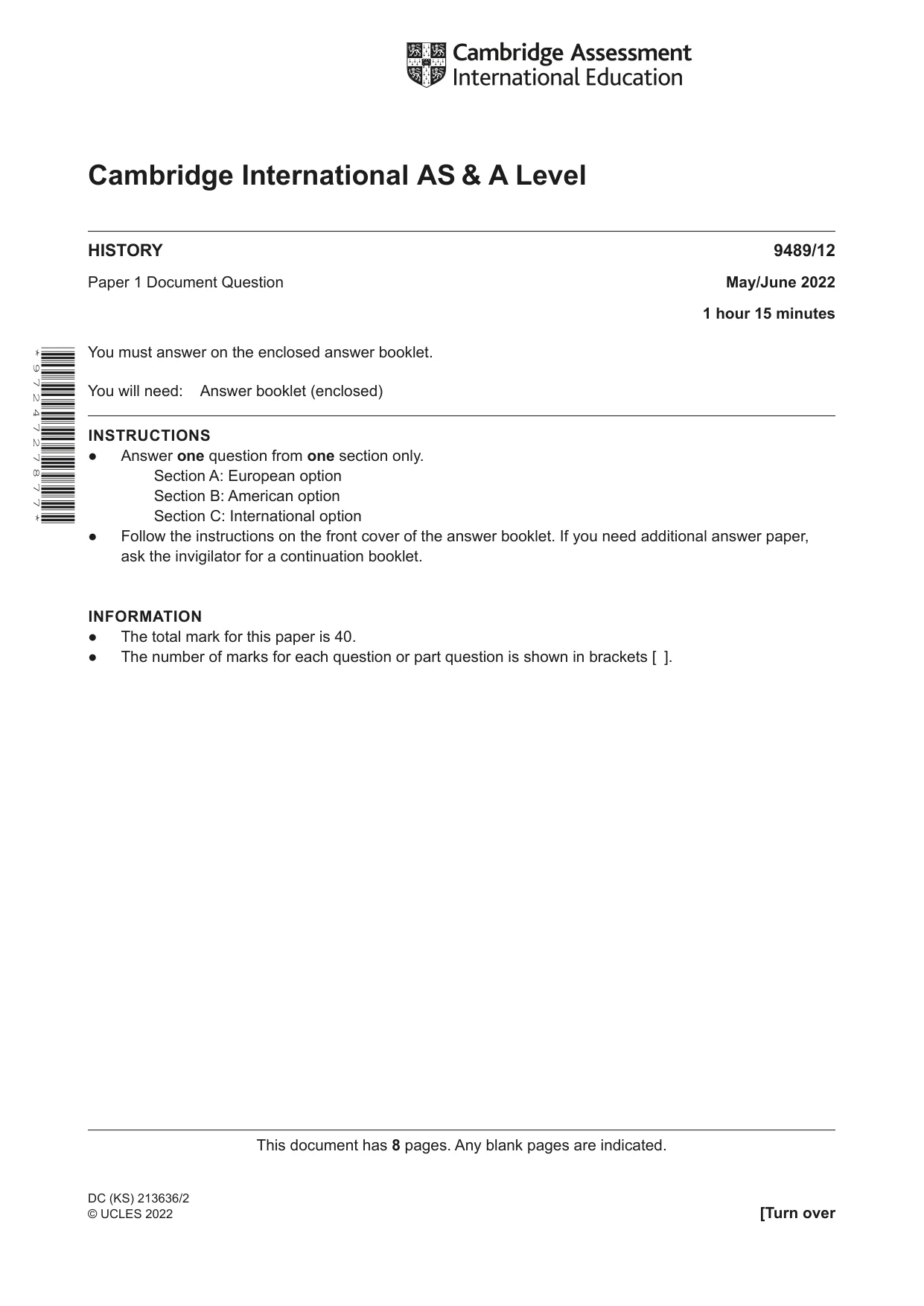
Question paper, page 1
This document has 8 pages. Any blank pages are indicated. [Turn over Cambridge International AS & A Level * 9 7 2 4 7 2 7 8 7 7 * DC (KS) 213636/2 © UCLES 2022 HISTORY 9489/12 Paper 1 Document Question May/June 2022 1 hour 15 minutes You must answer on the enclosed answer booklet. You will need: Answer booklet (enclosed) INSTRUCTIONS ● Answer one question from one section only. Section A: European option Section B: American option Section C: International option ● Follow the instructions on the front cover of the answer booklet. If you need additional answer paper, ask the invigilator for a continuation booklet. INFORMATION ● The total mark for this paper is 40. ● The number of marks for each question or part question is shown in brackets [ ].
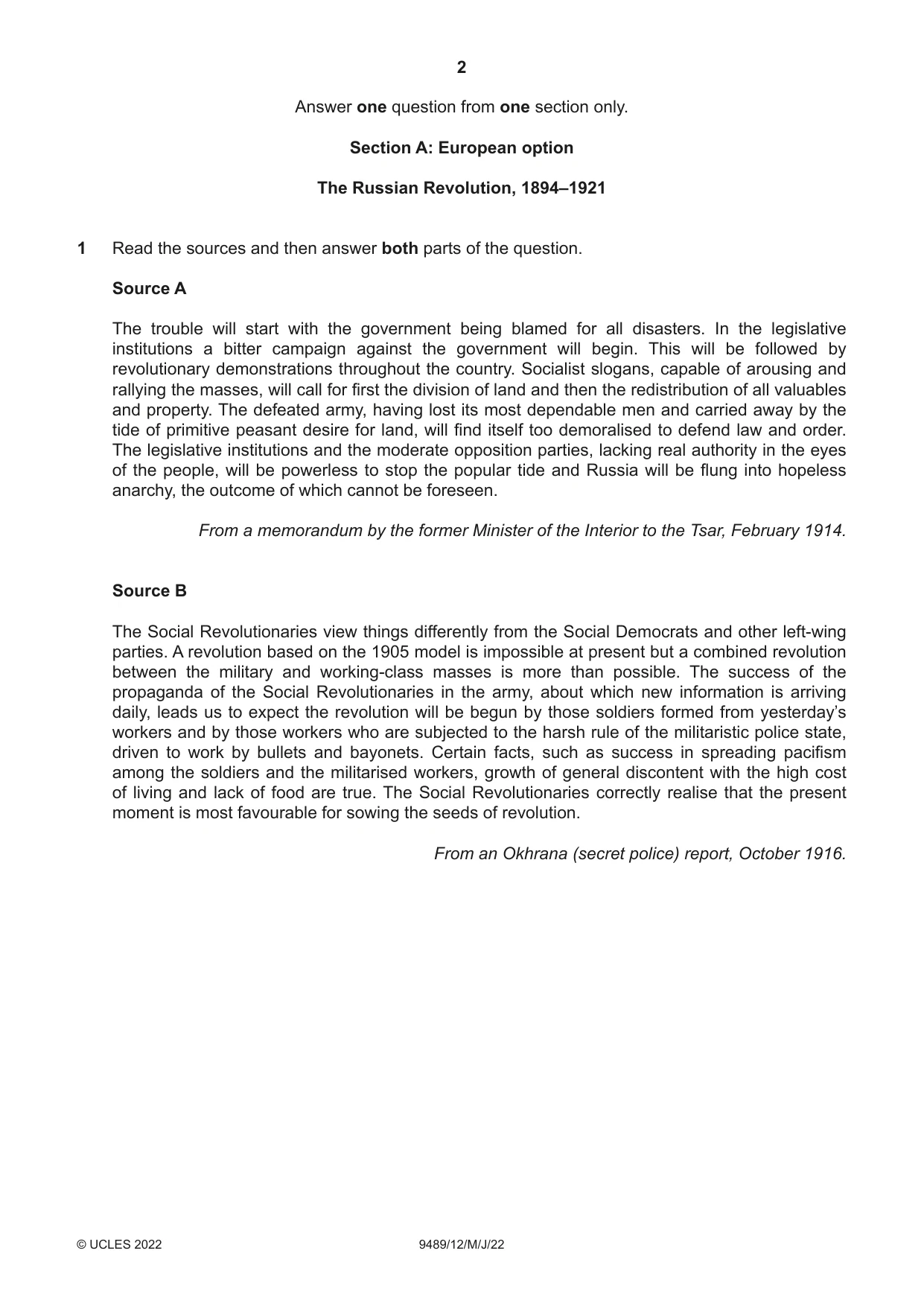
Question paper, page 2
2 9489/12/M/J/22 © UCLES 2022 Answer one question from one section only. Section A: European option The Russian Revolution, 1894–1921 1 Read the sources and then answer both parts of the question. Source A The trouble will start with the government being blamed for all disasters. In the legislative institutions a bitter campaign against the government will begin. This will be followed by revolutionary demonstrations throughout the country. Socialist slogans, capable of arousing and rallying the masses, will call for first the division of land and then the redistribution of all valuables and property. The defeated army, having lost its most dependable men and carried away by the tide of primitive peasant desire for land, will find itself too demoralised to defend law and order. The legislative institutions and the moderate opposition parties, lacking real authority in the eyes of the people, will be powerless to stop the popular tide and Russia will be flung into hopeless anarchy, the outcome of which cannot be foreseen. From a memorandum by the former Minister of the Interior to the Tsar, February 1914. Source B The Social Revolutionaries view things differently from the Social Democrats and other left-wing parties. A revolution based on the 1905 model is impossible at present but a combined revolution between the military and working-class masses is more than possible. The success of the propaganda of the Social Revolutionaries in the army, about which new information is arriving daily, leads us to expect the revolution will be begun by those soldiers formed from yesterday’s workers and by those workers who are subjected to the harsh rule of the militaristic police state, driven to work by bullets and bayonets. Certain facts, such as success in spreading pacifism among the soldiers and the militarised workers, growth of general discontent with the high cost of living and lack of food are true. The Social Revolutionaries correctly realise that the present moment is most favourable for sowing the seeds of revolution. From an Okhrana (secret police) report, October 1916.
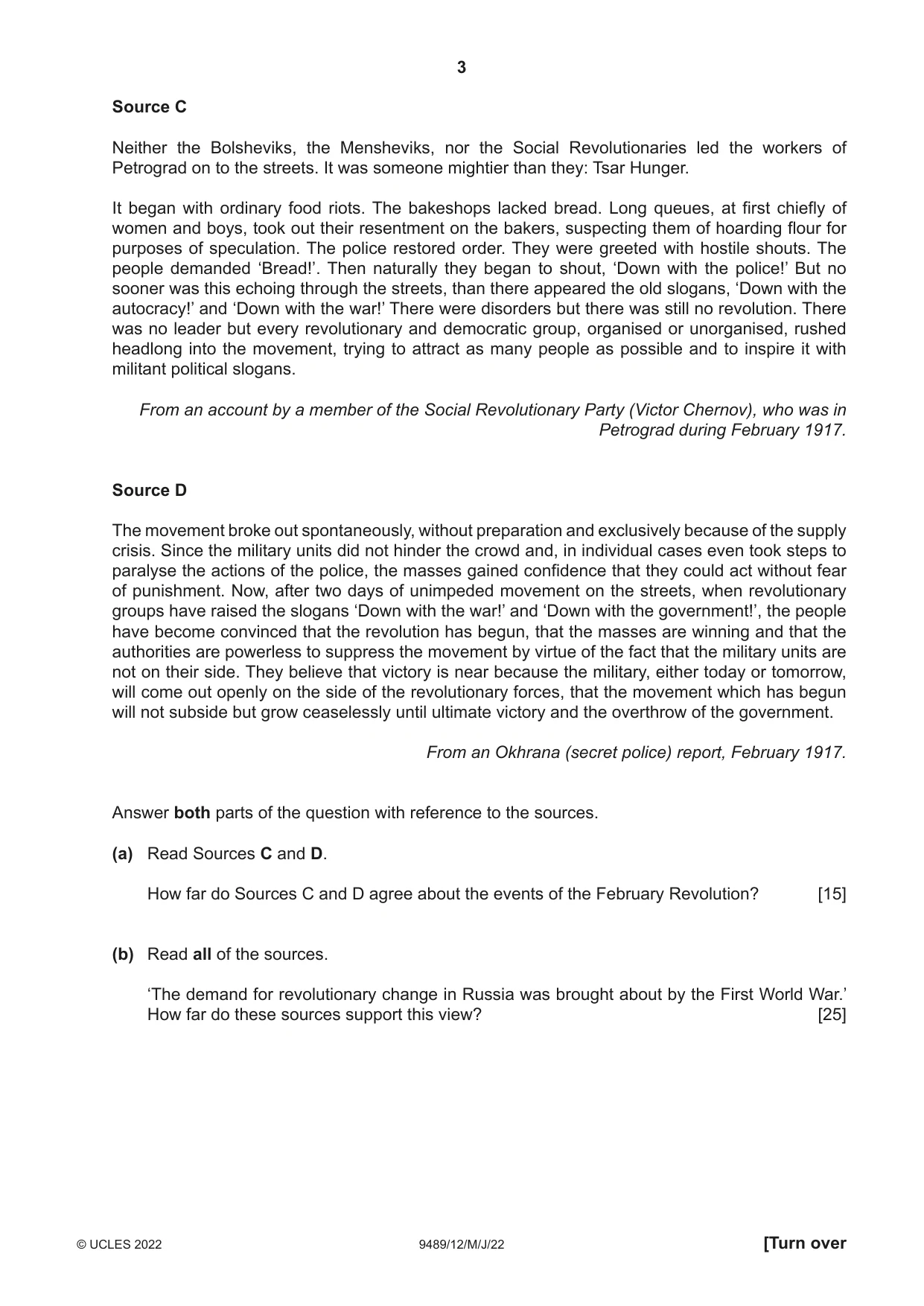
Question paper, page 3
3 9489/12/M/J/22 © UCLES 2022 [Turn over Source C Neither the Bolsheviks, the Mensheviks, nor the Social Revolutionaries led the workers of Petrograd on to the streets. It was someone mightier than they: Tsar Hunger. It began with ordinary food riots. The bakeshops lacked bread. Long queues, at first chiefly of women and boys, took out their resentment on the bakers, suspecting them of hoarding flour for purposes of speculation. The police restored order. They were greeted with hostile shouts. The people demanded ‘Bread!’. Then naturally they began to shout, ‘Down with the police!’ But no sooner was this echoing through the streets, than there appeared the old slogans, ‘Down with the autocracy!’ and ‘Down with the war!’ There were disorders but there was still no revolution. There was no leader but every revolutionary and democratic group, organised or unorganised, rushed headlong into the movement, trying to attract as many people as possible and to inspire it with militant political slogans. From an account by a member of the Social Revolutionary Party (Victor Chernov), who was in Petrograd during February 1917. Source D The movement broke out spontaneously, without preparation and exclusively because of the supply crisis. Since the military units did not hinder the crowd and, in individual cases even took steps to paralyse the actions of the police, the masses gained confidence that they could act without fear of punishment. Now, after two days of unimpeded movement on the streets, when revolutionary groups have raised the slogans ‘Down with the war!’ and ‘Down with the government!’, the people have become convinced that the revolution has begun, that the masses are winning and that the authorities are powerless to suppress the movement by virtue of the fact that the military units are not on their side. They believe that victory is near because the military, either today or tomorrow, will come out openly on the side of the revolutionary forces, that the movement which has begun will not subside but grow ceaselessly until ultimate victory and the overthrow of the government. From an Okhrana (secret police) report, February 1917. Answer both parts of the question with reference to the sources. (a) Read Sources C and D. How far do Sources C and D agree about the events of the February Revolution? [15] (b) Read all of the sources. ‘The demand for revolutionary change in Russia was brought about by the First World War.’ How far do these sources support this view? [25]
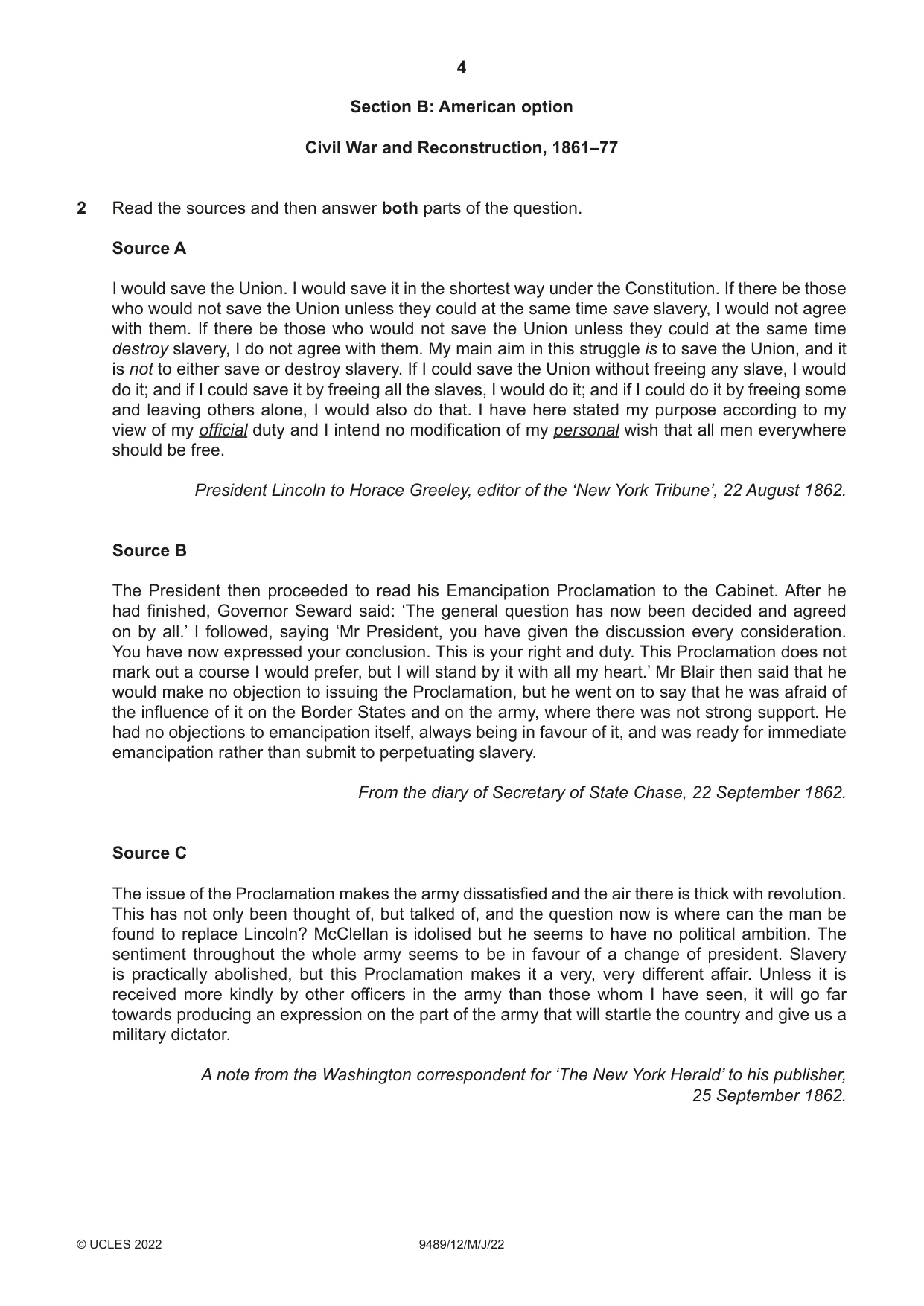
Question paper, page 4
4 9489/12/M/J/22 © UCLES 2022 Section B: American option Civil War and Reconstruction, 1861–77 2 Read the sources and then answer both parts of the question. Source A I would save the Union. I would save it in the shortest way under the Constitution. If there be those who would not save the Union unless they could at the same time save slavery, I would not agree with them. If there be those who would not save the Union unless they could at the same time destroy slavery, I do not agree with them. My main aim in this struggle is to save the Union, and it is not to either save or destroy slavery. If I could save the Union without freeing any slave, I would do it; and if I could save it by freeing all the slaves, I would do it; and if I could do it by freeing some and leaving others alone, I would also do that. I have here stated my purpose according to my view of my official duty and I intend no modification of my personal wish that all men everywhere should be free. President Lincoln to Horace Greeley, editor of the ‘New York Tribune’, 22 August 1862. Source B The President then proceeded to read his Emancipation Proclamation to the Cabinet. After he had finished, Governor Seward said: ‘The general question has now been decided and agreed on by all.’ I followed, saying ‘Mr President, you have given the discussion every consideration. You have now expressed your conclusion. This is your right and duty. This Proclamation does not mark out a course I would prefer, but I will stand by it with all my heart.’ Mr Blair then said that he would make no objection to issuing the Proclamation, but he went on to say that he was afraid of the influence of it on the Border States and on the army, where there was not strong support. He had no objections to emancipation itself, always being in favour of it, and was ready for immediate emancipation rather than submit to perpetuating slavery. From the diary of Secretary of State Chase, 22 September 1862. Source C The issue of the Proclamation makes the army dissatisfied and the air there is thick with revolution. This has not only been thought of, but talked of, and the question now is where can the man be found to replace Lincoln? McClellan is idolised but he seems to have no political ambition. The sentiment throughout the whole army seems to be in favour of a change of president. Slavery is practically abolished, but this Proclamation makes it a very, very different affair. Unless it is received more kindly by other officers in the army than those whom I have seen, it will go far towards producing an expression on the part of the army that will startle the country and give us a military dictator. A note from the Washington correspondent for ‘The New York Herald’ to his publisher, 25 September 1862.
Question paper, page 5
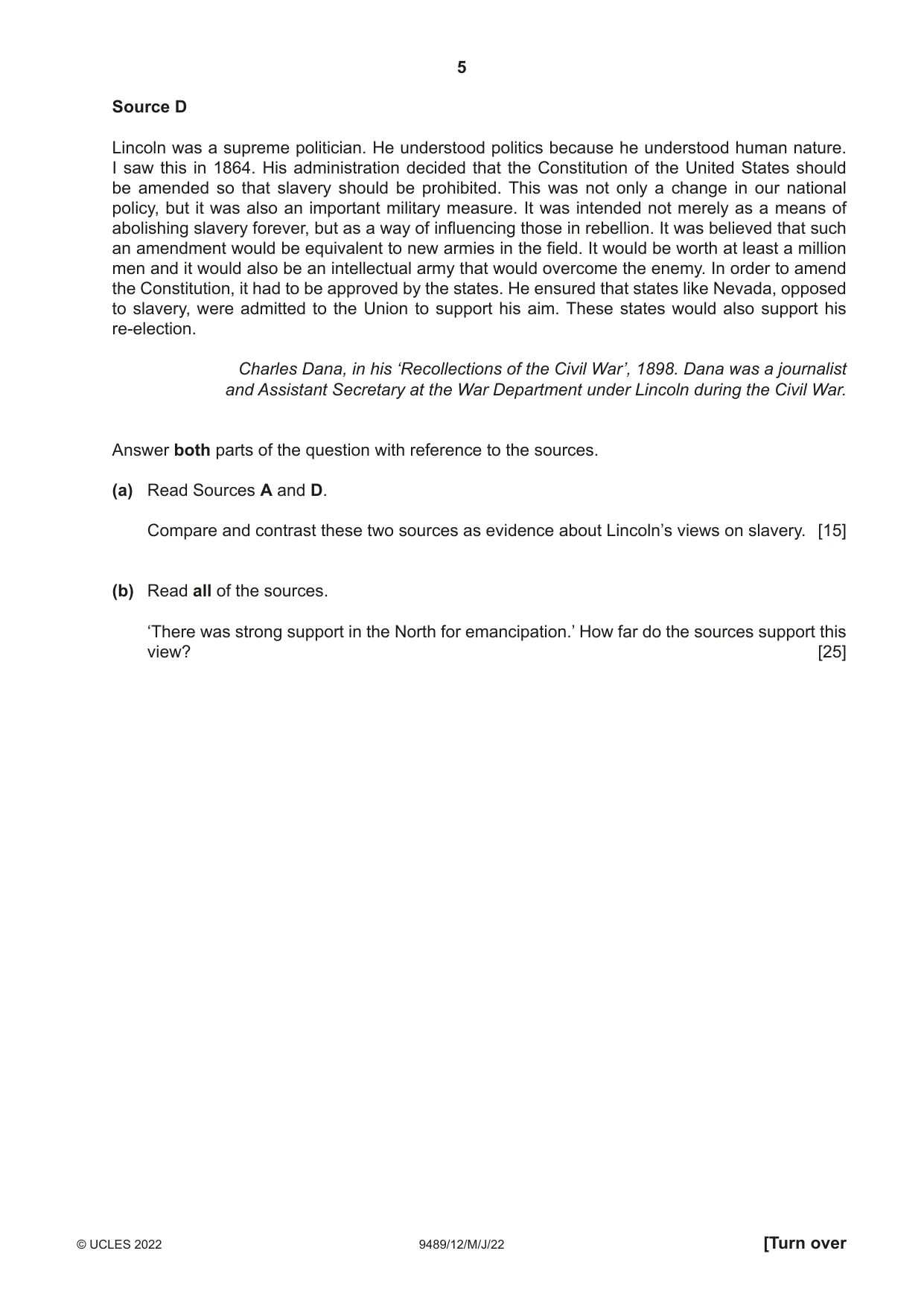
5 9489/12/M/J/22 © UCLES 2022 [Turn over Source D Lincoln was a supreme politician. He understood politics because he understood human nature. I saw this in 1864. His administration decided that the Constitution of the United States should be amended so that slavery should be prohibited. This was not only a change in our national policy, but it was also an important military measure. It was intended not merely as a means of abolishing slavery forever, but as a way of influencing those in rebellion. It was believed that such an amendment would be equivalent to new armies in the field. It would be worth at least a million men and it would also be an intellectual army that would overcome the enemy. In order to amend the Constitution, it had to be approved by the states. He ensured that states like Nevada, opposed to slavery, were admitted to the Union to support his aim. These states would also support his re-election. Charles Dana, in his ‘Recollections of the Civil War’, 1898. Dana was a journalist and Assistant Secretary at the War Department under Lincoln during the Civil War. Answer both parts of the question with reference to the sources. (a) Read Sources A and D. Compare and contrast these two sources as evidence about Lincoln’s views on slavery. [15] (b) Read all of the sources. ‘There was strong support in the North for emancipation.’ How far do the sources support this view? [25]
Question paper, page 6
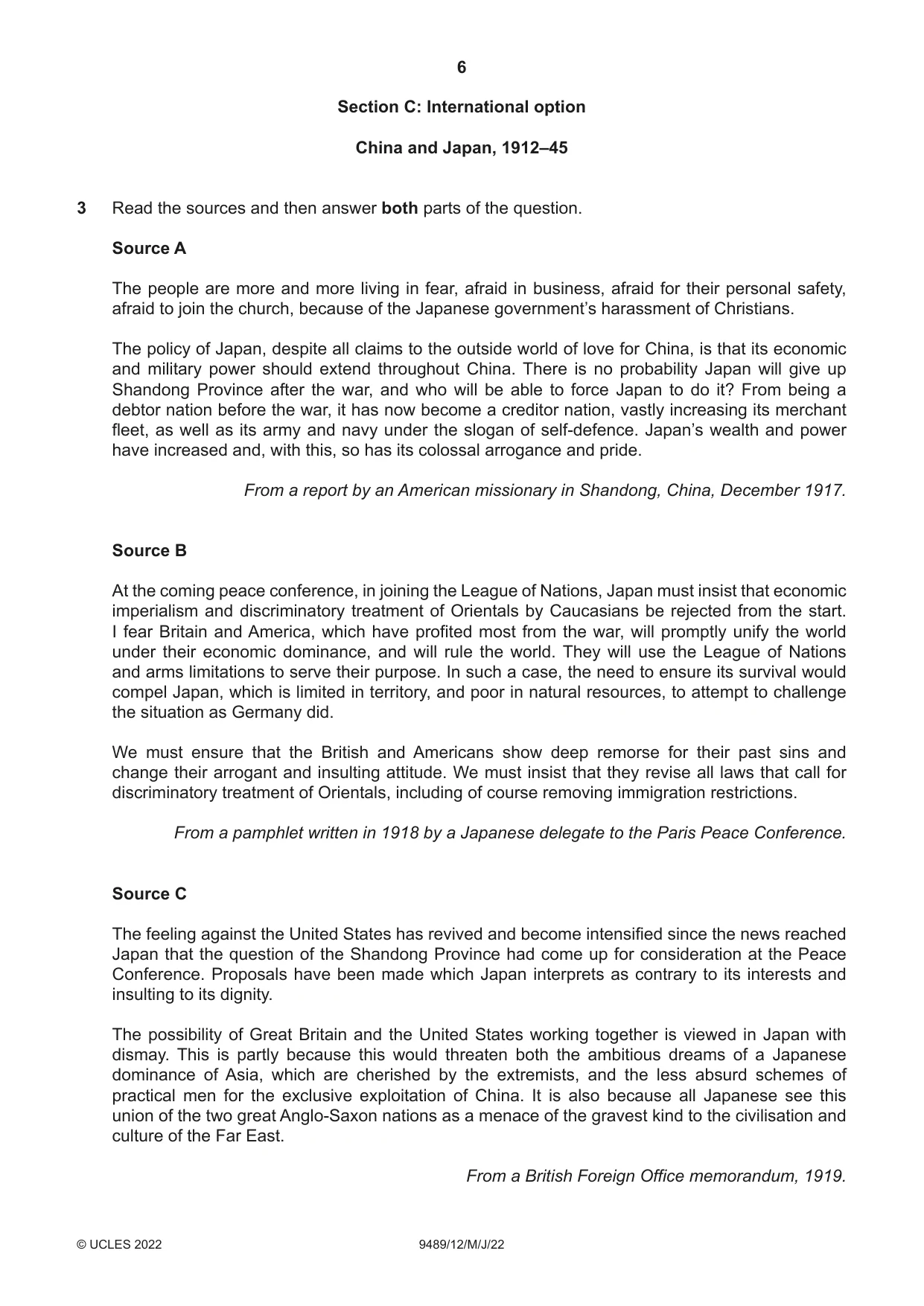
6 9489/12/M/J/22 © UCLES 2022 Section C: International option China and Japan, 1912–45 3 Read the sources and then answer both parts of the question. Source A The people are more and more living in fear, afraid in business, afraid for their personal safety, afraid to join the church, because of the Japanese government’s harassment of Christians. The policy of Japan, despite all claims to the outside world of love for China, is that its economic and military power should extend throughout China. There is no probability Japan will give up Shandong Province after the war, and who will be able to force Japan to do it? From being a debtor nation before the war, it has now become a creditor nation, vastly increasing its merchant fleet, as well as its army and navy under the slogan of self-defence. Japan’s wealth and power have increased and, with this, so has its colossal arrogance and pride. From a report by an American missionary in Shandong, China, December 1917. Source B At the coming peace conference, in joining the League of Nations, Japan must insist that economic imperialism and discriminatory treatment of Orientals by Caucasians be rejected from the start. I fear Britain and America, which have profited most from the war, will promptly unify the world under their economic dominance, and will rule the world. They will use the League of Nations and arms limitations to serve their purpose. In such a case, the need to ensure its survival would compel Japan, which is limited in territory, and poor in natural resources, to attempt to challenge the situation as Germany did. We must ensure that the British and Americans show deep remorse for their past sins and change their arrogant and insulting attitude. We must insist that they revise all laws that call for discriminatory treatment of Orientals, including of course removing immigration restrictions. From a pamphlet written in 1918 by a Japanese delegate to the Paris Peace Conference. Source C The feeling against the United States has revived and become intensified since the news reached Japan that the question of the Shandong Province had come up for consideration at the Peace Conference. Proposals have been made which Japan interprets as contrary to its interests and insulting to its dignity. The possibility of Great Britain and the United States working together is viewed in Japan with dismay. This is partly because this would threaten both the ambitious dreams of a Japanese dominance of Asia, which are cherished by the extremists, and the less absurd schemes of practical men for the exclusive exploitation of China. It is also because all Japanese see this union of the two great Anglo-Saxon nations as a menace of the gravest kind to the civilisation and culture of the Far East. From a British Foreign Office memorandum, 1919.
Question paper, page 7
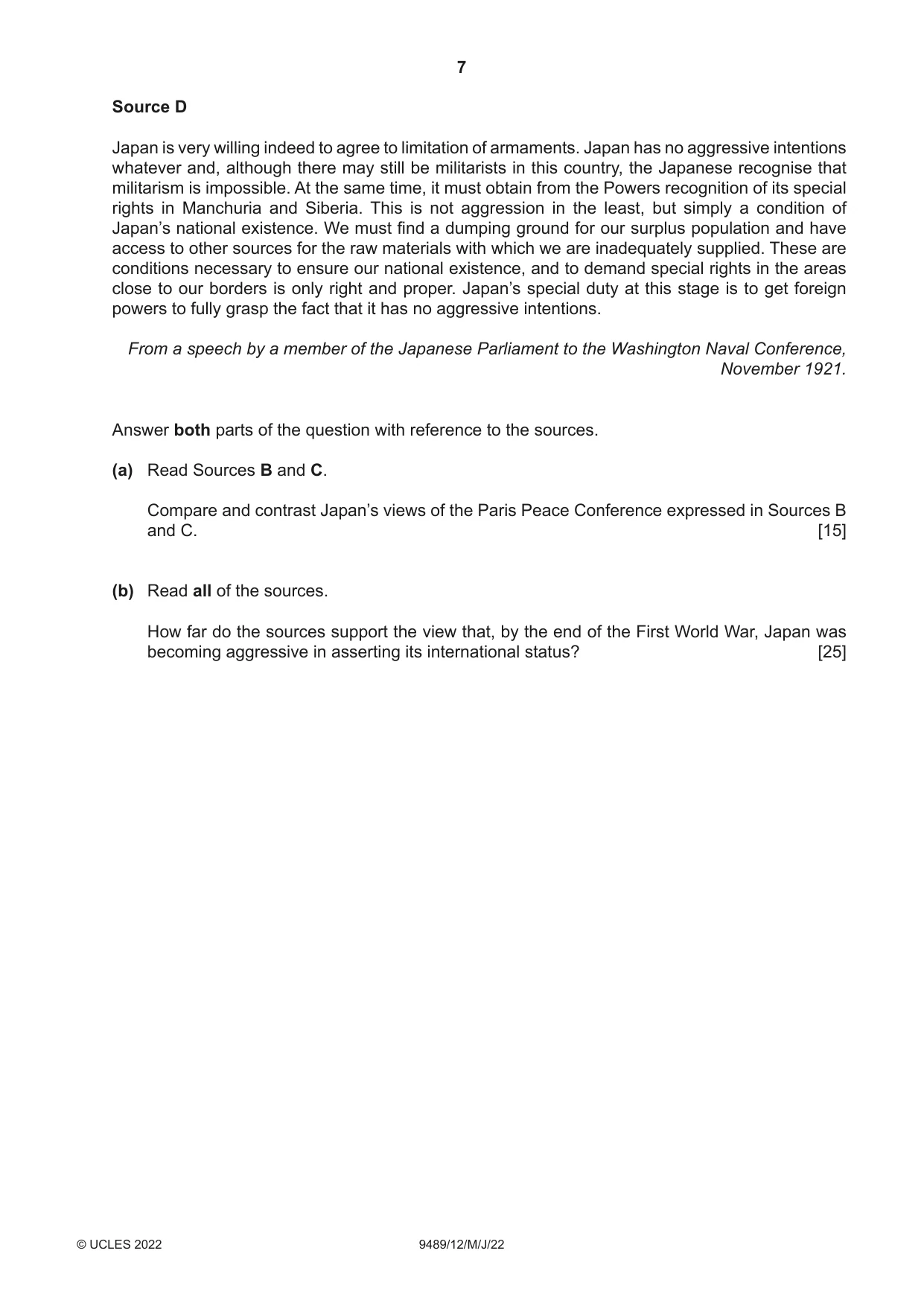
7 9489/12/M/J/22 © UCLES 2022 Source D Japan is very willing indeed to agree to limitation of armaments. Japan has no aggressive intentions whatever and, although there may still be militarists in this country, the Japanese recognise that militarism is impossible. At the same time, it must obtain from the Powers recognition of its special rights in Manchuria and Siberia. This is not aggression in the least, but simply a condition of Japan’s national existence. We must find a dumping ground for our surplus population and have access to other sources for the raw materials with which we are inadequately supplied. These are conditions necessary to ensure our national existence, and to demand special rights in the areas close to our borders is only right and proper. Japan’s special duty at this stage is to get foreign powers to fully grasp the fact that it has no aggressive intentions. From a speech by a member of the Japanese Parliament to the Washington Naval Conference, November 1921. Answer both parts of the question with reference to the sources. (a) Read Sources B and C. Compare and contrast Japan’s views of the Paris Peace Conference expressed in Sources B and C. [15] (b) Read all of the sources. How far do the sources support the view that, by the end of the First World War, Japan was becoming aggressive in asserting its international status? [25]
Question paper, page 8
8 9489/12/M/J/22 © UCLES 2022 Permission to reproduce items where third-party owned material protected by copyright is included has been sought and cleared where possible. Every reasonable effort has been made by the publisher (UCLES) to trace copyright holders, but if any items requiring clearance have unwittingly been included, the publisher will be pleased to make amends at the earliest possible opportunity. To avoid the issue of disclosure of answer-related information to candidates, all copyright acknowledgements are reproduced online in the Cambridge Assessment International Education Copyright Acknowledgements Booklet. This is produced for each series of examinations and is freely available to download at www.cambridgeinternational.org after the live examination series. Cambridge Assessment International Education is part of Cambridge Assessment. Cambridge Assessment is the brand name of the University of Cambridge Local Examinations Syndicate (UCLES), which is a department of the University of Cambridge. BLANK PAGE
Mark scheme, page 1
This document consists of 11 printed pages. © UCLES 2022 [Turn over Cambridge International AS & A Level HISTORY 9489/12 Paper 1 Document Question 12 May/June 2022 MARK SCHEME Maximum Mark: 40 Published This mark scheme is published as an aid to teachers and candidates, to indicate the requirements of the examination. It shows the basis on which Examiners were instructed to award marks. It does not indicate the details of the discussions that took place at an Examiners’ meeting before marking began, which would have considered the acceptability of alternative answers. Mark schemes should be read in conjunction with the question paper and the Principal Examiner Report for Teachers. Cambridge International will not enter into discussions about these mark schemes. Cambridge International is publishing the mark schemes for the May/June 2022 series for most Cambridge IGCSE, Cambridge International A and AS Level and Cambridge Pre-U components, and some Cambridge O Level components.
Mark scheme, page 2
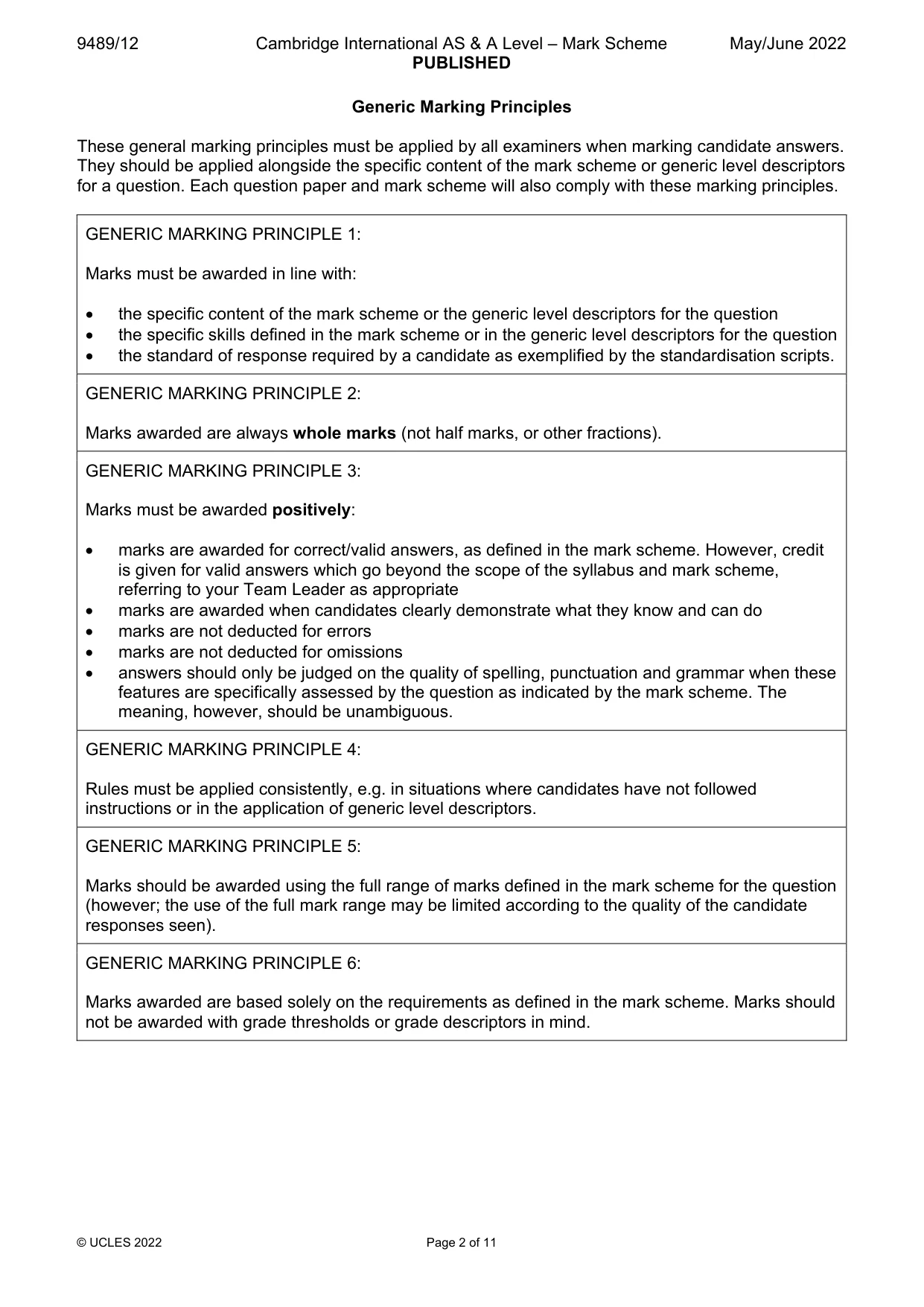
9489/12 Cambridge International AS & A Level – Mark Scheme PUBLISHED May/June 2022 © UCLES 2022 Page 2 of 11 Generic Marking Principles These general marking principles must be applied by all examiners when marking candidate answers. They should be applied alongside the specific content of the mark scheme or generic level descriptors for a question. Each question paper and mark scheme will also comply with these marking principles. GENERIC MARKING PRINCIPLE 1: Marks must be awarded in line with: the specific content of the mark scheme or the generic level descriptors for the question the specific skills defined in the mark scheme or in the generic level descriptors for the question the standard of response required by a candidate as exemplified by the standardisation scripts. GENERIC MARKING PRINCIPLE 2: Marks awarded are always whole marks (not half marks, or other fractions). GENERIC MARKING PRINCIPLE 3: Marks must be awarded positively: marks are awarded for correct/valid answers, as defined in the mark scheme. However, credit is given for valid answers which go beyond the scope of the syllabus and mark scheme, referring to your Team Leader as appropriate marks are awarded when candidates clearly demonstrate what they know and can do marks are not deducted for errors marks are not deducted for omissions answers should only be judged on the quality of spelling, punctuation and grammar when these features are specifically assessed by the question as indicated by the mark scheme. The meaning, however, should be unambiguous. GENERIC MARKING PRINCIPLE 4: Rules must be applied consistently, e.g. in situations where candidates have not followed instructions or in the application of generic level descriptors. GENERIC MARKING PRINCIPLE 5: Marks should be awarded using the full range of marks defined in the mark scheme for the question (however; the use of the full mark range may be limited according to the quality of the candidate responses seen). GENERIC MARKING PRINCIPLE 6: Marks awarded are based solely on the requirements as defined in the mark scheme. Marks should not be awarded with grade thresholds or grade descriptors in mind.
Mark scheme, page 3
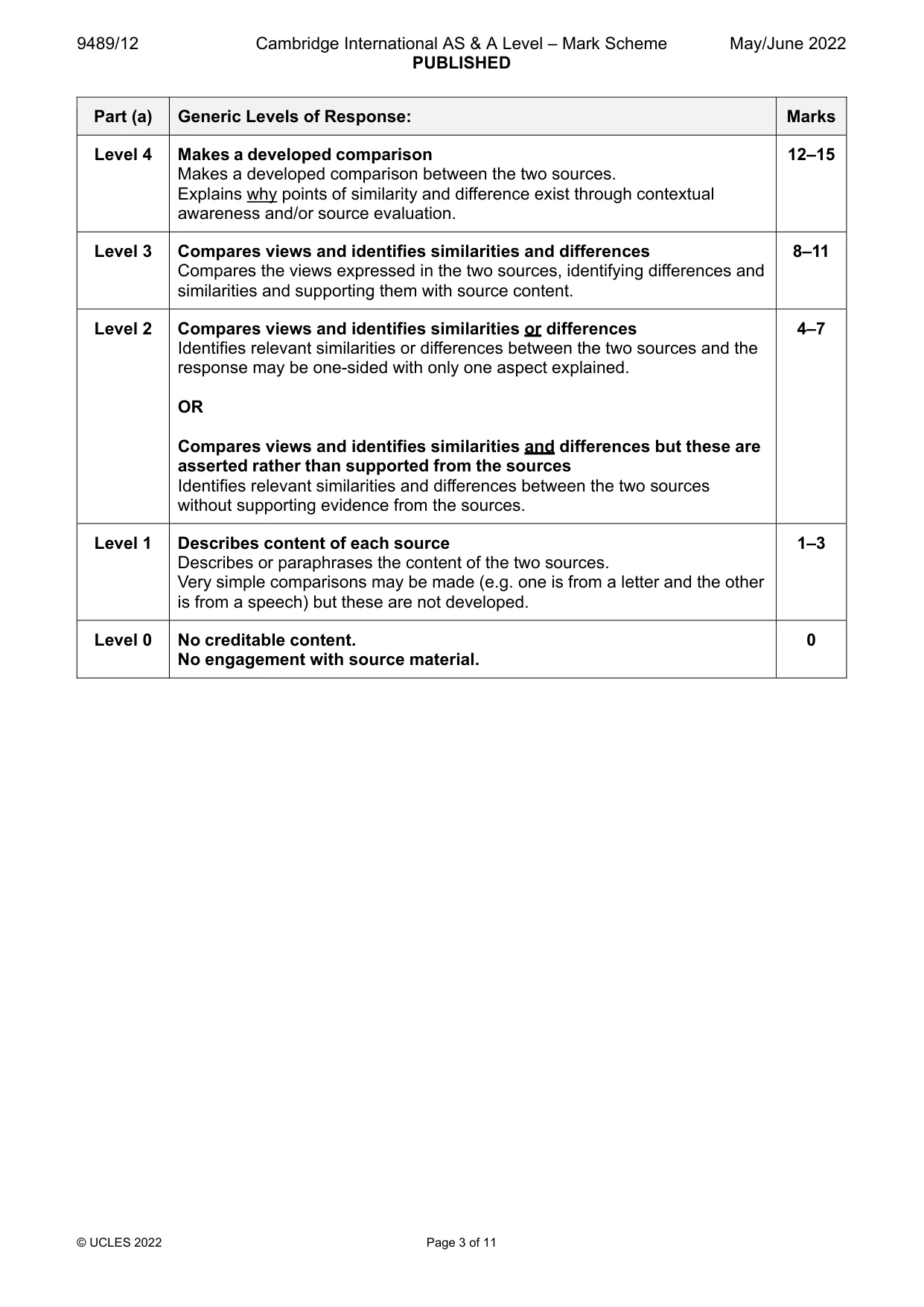
9489/12 Cambridge International AS & A Level – Mark Scheme PUBLISHED May/June 2022 © UCLES 2022 Page 3 of 11 Part (a) Generic Levels of Response: Marks Level 4 Makes a developed comparison Makes a developed comparison between the two sources. Explains why points of similarity and difference exist through contextual awareness and/or source evaluation. 12–15 Level 3 Compares views and identifies similarities and differences Compares the views expressed in the two sources, identifying differences and similarities and supporting them with source content. 8–11 Level 2 Compares views and identifies similarities or differences Identifies relevant similarities or differences between the two sources and the response may be one-sided with only one aspect explained. OR Compares views and identifies similarities and differences but these are asserted rather than supported from the sources Identifies relevant similarities and differences between the two sources without supporting evidence from the sources. 4–7 Level 1 Describes content of each source Describes or paraphrases the content of the two sources. Very simple comparisons may be made (e.g. one is from a letter and the other is from a speech) but these are not developed. 1–3 Level 0 No creditable content. No engagement with source material. 0
Mark scheme, page 4
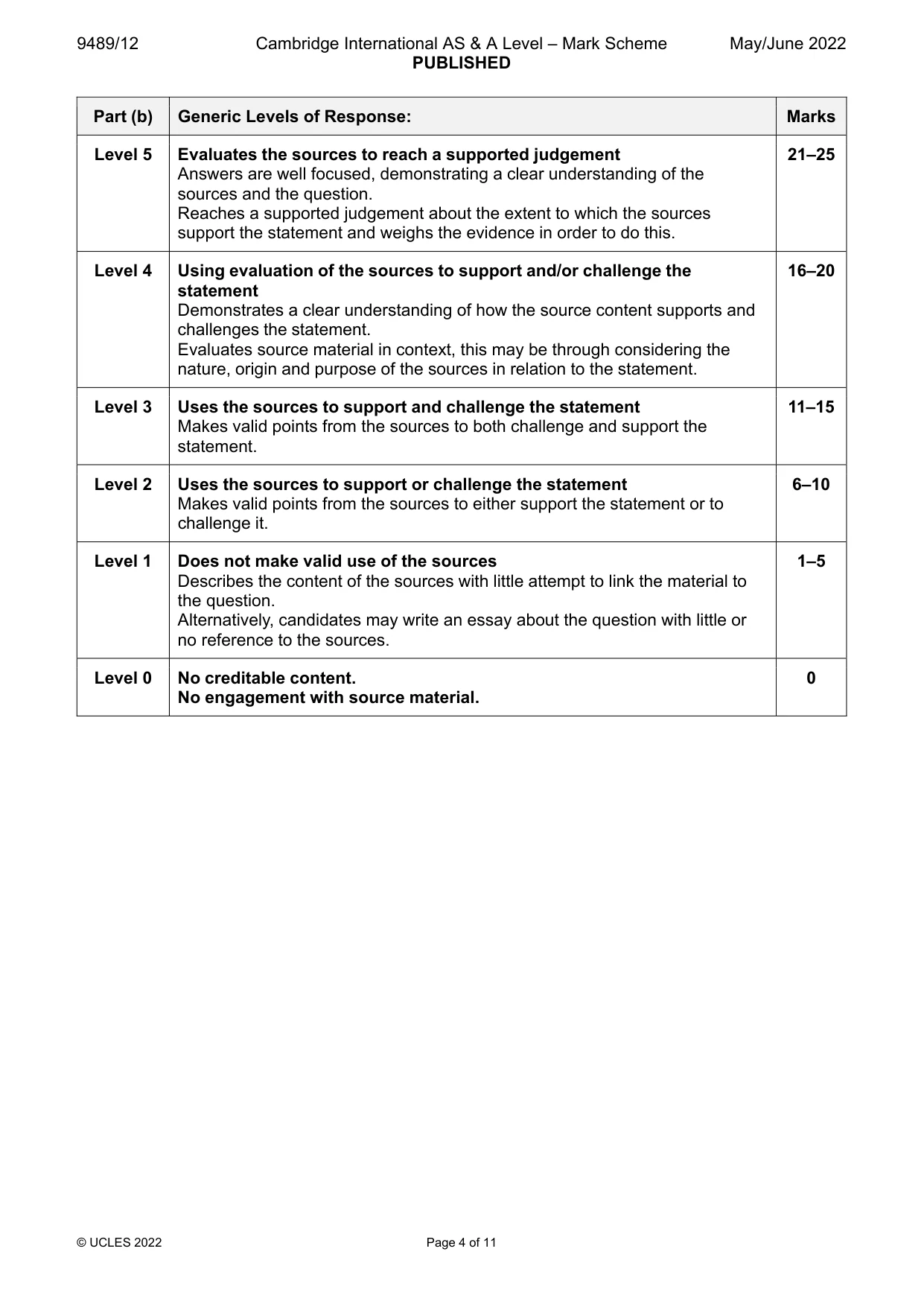
9489/12 Cambridge International AS & A Level – Mark Scheme PUBLISHED May/June 2022 © UCLES 2022 Page 4 of 11 Part (b) Generic Levels of Response: Marks Level 5 Evaluates the sources to reach a supported judgement Answers are well focused, demonstrating a clear understanding of the sources and the question. Reaches a supported judgement about the extent to which the sources support the statement and weighs the evidence in order to do this. 21–25 Level 4 Using evaluation of the sources to support and/or challenge the statement Demonstrates a clear understanding of how the source content supports and challenges the statement. Evaluates source material in context, this may be through considering the nature, origin and purpose of the sources in relation to the statement. 16–20 Level 3 Uses the sources to support and challenge the statement Makes valid points from the sources to both challenge and support the statement. 11–15 Level 2 Uses the sources to support or challenge the statement Makes valid points from the sources to either support the statement or to challenge it. 6–10 Level 1 Does not make valid use of the sources Describes the content of the sources with little attempt to link the material to the question. Alternatively, candidates may write an essay about the question with little or no reference to the sources. 1–5 Level 0 No creditable content. No engagement with source material. 0
Mark scheme, page 5
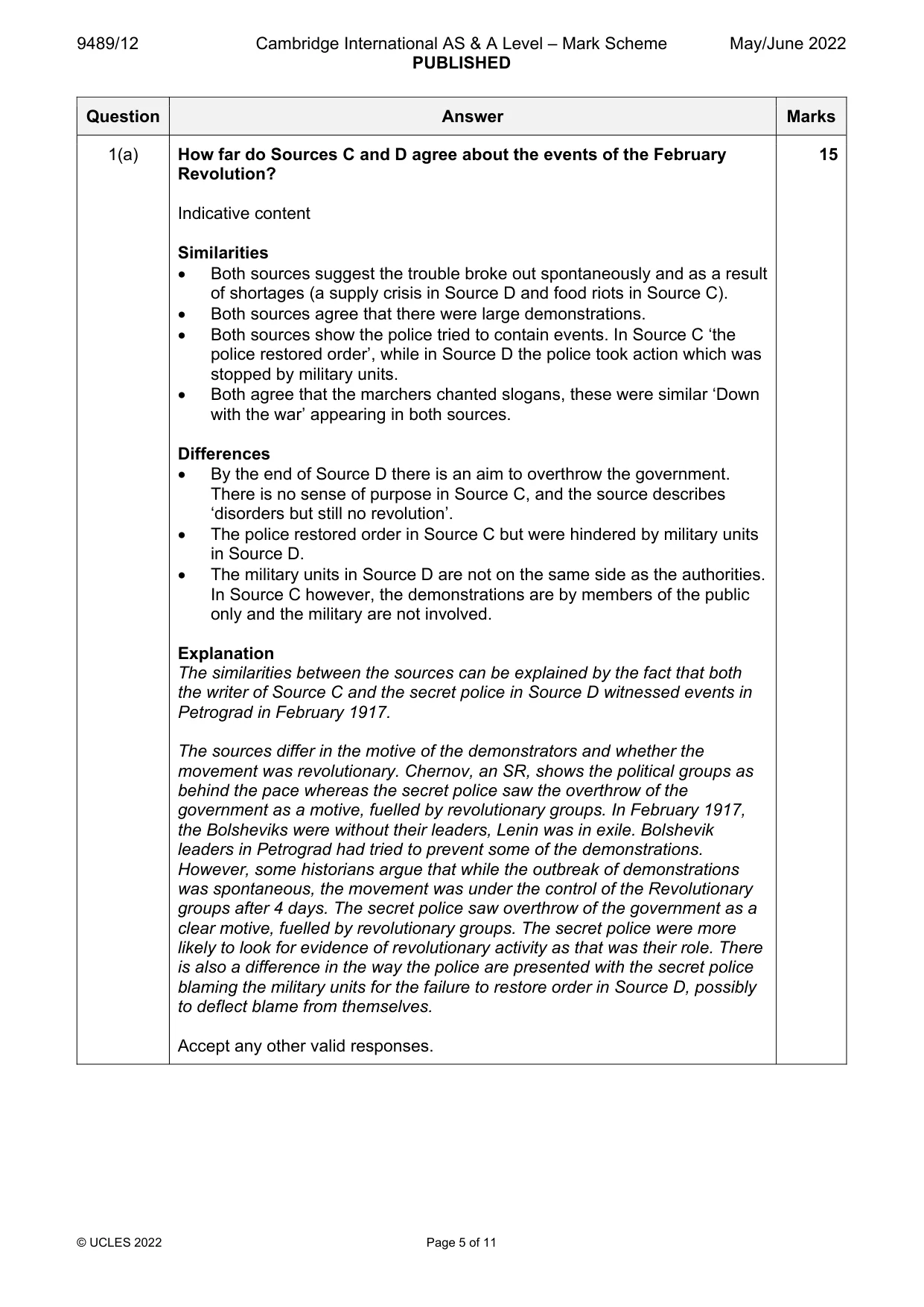
9489/12 Cambridge International AS & A Level – Mark Scheme PUBLISHED May/June 2022 © UCLES 2022 Page 5 of 11 Question Answer Marks 1(a) How far do Sources C and D agree about the events of the February Revolution? Indicative content Similarities Both sources suggest the trouble broke out spontaneously and as a result of shortages (a supply crisis in Source D and food riots in Source C). Both sources agree that there were large demonstrations. Both sources show the police tried to contain events. In Source C ‘the police restored order’, while in Source D the police took action which was stopped by military units. Both agree that the marchers chanted slogans, these were similar ‘Down with the war’ appearing in both sources. Differences By the end of Source D there is an aim to overthrow the government. There is no sense of purpose in Source C, and the source describes ‘disorders but still no revolution’. The police restored order in Source C but were hindered by military units in Source D. The military units in Source D are not on the same side as the authorities. In Source C however, the demonstrations are by members of the public only and the military are not involved. Explanation The similarities between the sources can be explained by the fact that both the writer of Source C and the secret police in Source D witnessed events in Petrograd in February 1917. The sources differ in the motive of the demonstrators and whether the movement was revolutionary. Chernov, an SR, shows the political groups as behind the pace whereas the secret police saw the overthrow of the government as a motive, fuelled by revolutionary groups. In February 1917, the Bolsheviks were without their leaders, Lenin was in exile. Bolshevik leaders in Petrograd had tried to prevent some of the demonstrations. However, some historians argue that while the outbreak of demonstrations was spontaneous, the movement was under the control of the Revolutionary groups after 4 days. The secret police saw overthrow of the government as a clear motive, fuelled by revolutionary groups. The secret police were more likely to look for evidence of revolutionary activity as that was their role. There is also a difference in the way the police are presented with the secret police blaming the military units for the failure to restore order in Source D, possibly to deflect blame from themselves. Accept any other valid responses. 15
Mark scheme, page 6
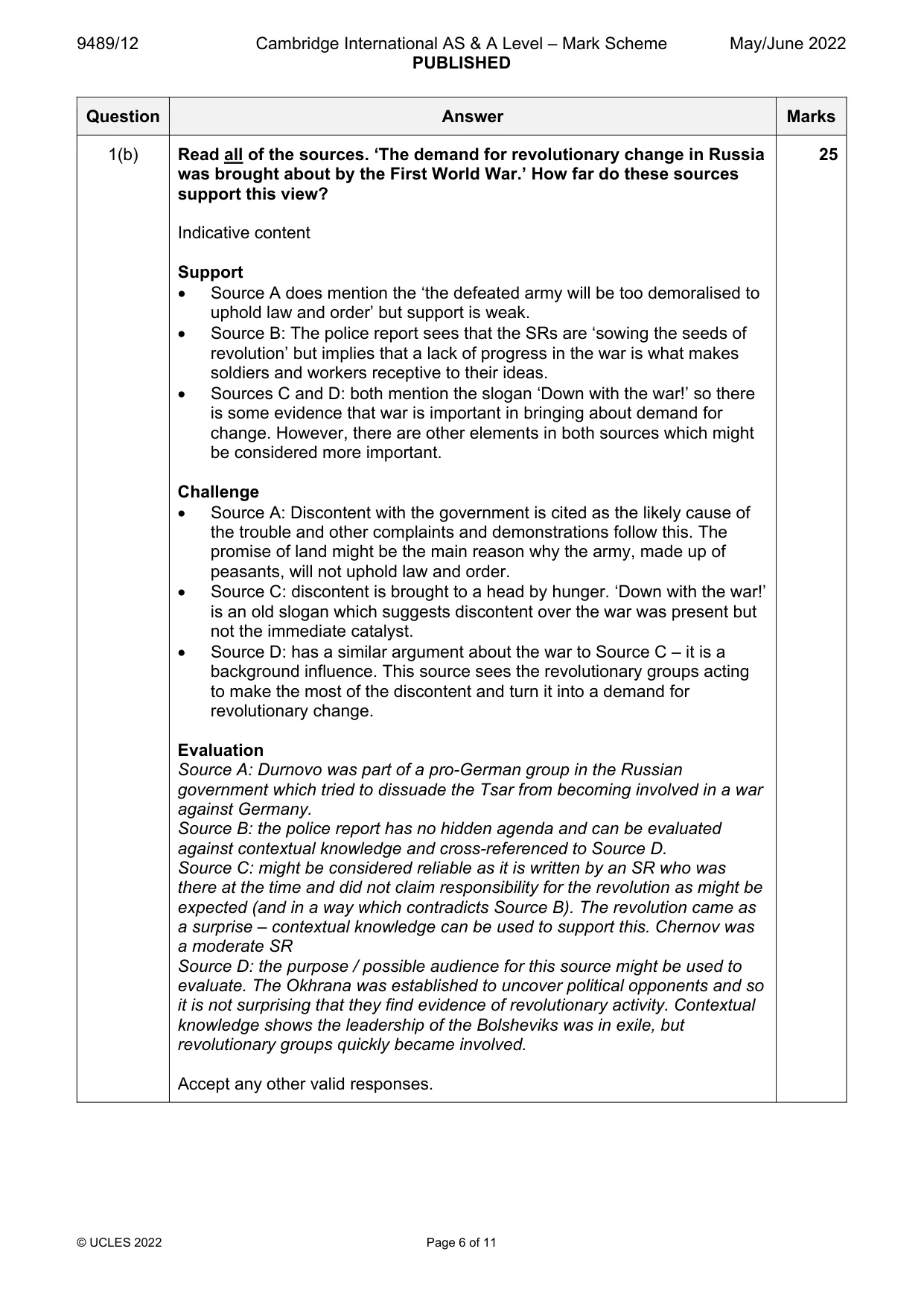
9489/12 Cambridge International AS & A Level – Mark Scheme PUBLISHED May/June 2022 © UCLES 2022 Page 6 of 11 Question Answer Marks 1(b) Read all of the sources. ‘The demand for revolutionary change in Russia was brought about by the First World War.’ How far do these sources support this view? Indicative content Support Source A does mention the ‘the defeated army will be too demoralised to uphold law and order’ but support is weak. Source B: The police report sees that the SRs are ‘sowing the seeds of revolution’ but implies that a lack of progress in the war is what makes soldiers and workers receptive to their ideas. Sources C and D: both mention the slogan ‘Down with the war!’ so there is some evidence that war is important in bringing about demand for change. However, there are other elements in both sources which might be considered more important. Challenge Source A: Discontent with the government is cited as the likely cause of the trouble and other complaints and demonstrations follow this. The promise of land might be the main reason why the army, made up of peasants, will not uphold law and order. Source C: discontent is brought to a head by hunger. ‘Down with the war!’ is an old slogan which suggests discontent over the war was present but not the immediate catalyst. Source D: has a similar argument about the war to Source C – it is a background influence. This source sees the revolutionary groups acting to make the most of the discontent and turn it into a demand for revolutionary change. Evaluation Source A: Durnovo was part of a pro-German group in the Russian government which tried to dissuade the Tsar from becoming involved in a war against Germany. Source B: the police report has no hidden agenda and can be evaluated against contextual knowledge and cross-referenced to Source D. Source C: might be considered reliable as it is written by an SR who was there at the time and did not claim responsibility for the revolution as might be expected (and in a way which contradicts Source B). The revolution came as a surprise – contextual knowledge can be used to support this. Chernov was a moderate SR Source D: the purpose / possible audience for this source might be used to evaluate. The Okhrana was established to uncover political opponents and so it is not surprising that they find evidence of revolutionary activity. Contextual knowledge shows the leadership of the Bolsheviks was in exile, but revolutionary groups quickly became involved. Accept any other valid responses. 25
Mark scheme, page 7
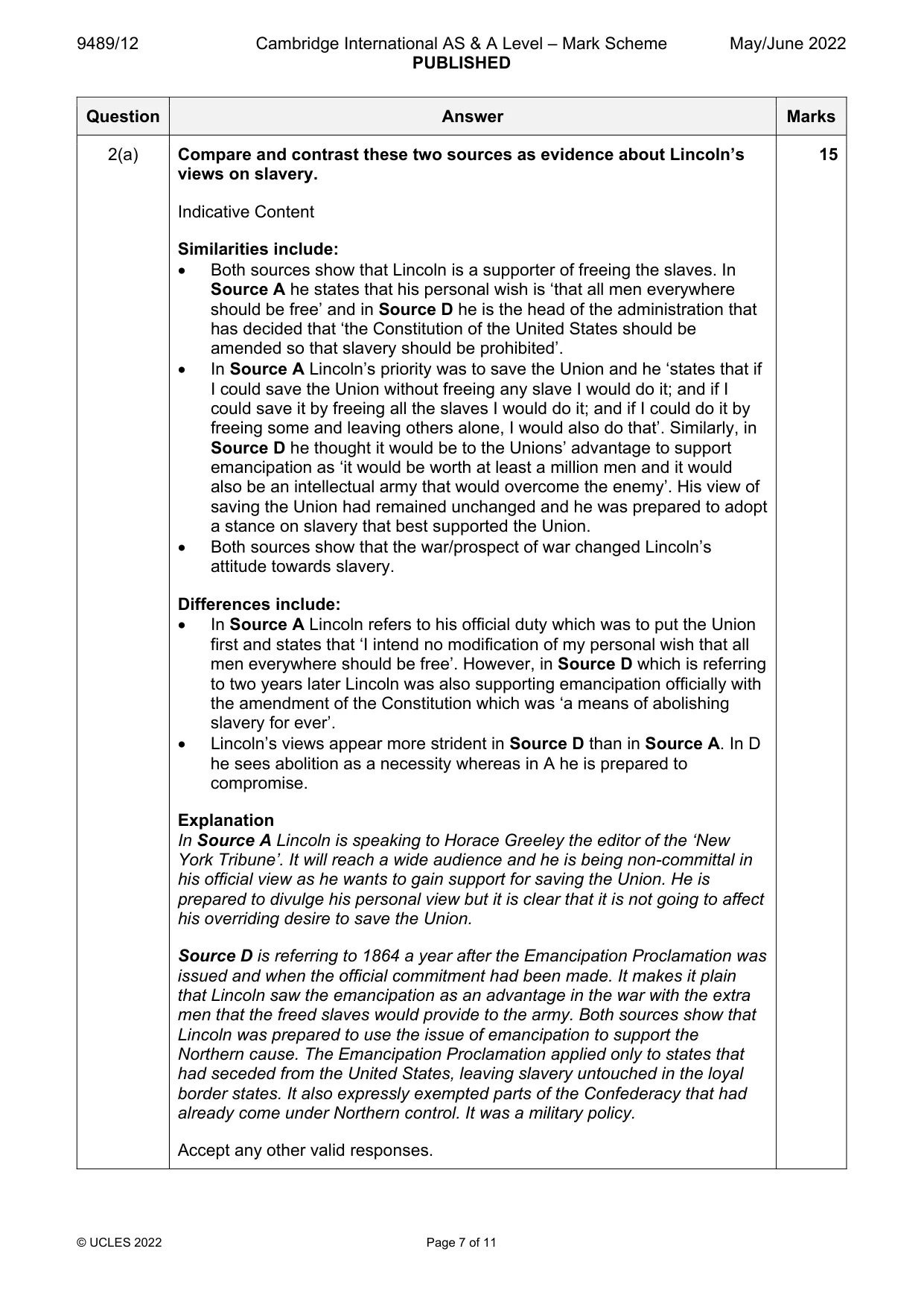
9489/12 Cambridge International AS & A Level – Mark Scheme PUBLISHED May/June 2022 © UCLES 2022 Page 7 of 11 Question Answer Marks 2(a) Compare and contrast these two sources as evidence about Lincoln’s views on slavery. Indicative Content Similarities include: Both sources show that Lincoln is a supporter of freeing the slaves. In Source A he states that his personal wish is ‘that all men everywhere should be free’ and in Source D he is the head of the administration that has decided that ‘the Constitution of the United States should be amended so that slavery should be prohibited’. In Source A Lincoln’s priority was to save the Union and he ‘states that if I could save the Union without freeing any slave I would do it; and if I could save it by freeing all the slaves I would do it; and if I could do it by freeing some and leaving others alone, I would also do that’. Similarly, in Source D he thought it would be to the Unions’ advantage to support emancipation as ‘it would be worth at least a million men and it would also be an intellectual army that would overcome the enemy’. His view of saving the Union had remained unchanged and he was prepared to adopt a stance on slavery that best supported the Union. Both sources show that the war/prospect of war changed Lincoln’s attitude towards slavery. Differences include: In Source A Lincoln refers to his official duty which was to put the Union first and states that ‘I intend no modification of my personal wish that all men everywhere should be free’. However, in Source D which is referring to two years later Lincoln was also supporting emancipation officially with the amendment of the Constitution which was ‘a means of abolishing slavery for ever’. Lincoln’s views appear more strident in Source D than in Source A. In D he sees abolition as a necessity whereas in A he is prepared to compromise. Explanation In Source A Lincoln is speaking to Horace Greeley the editor of the ‘New York Tribune’. It will reach a wide audience and he is being non-committal in his official view as he wants to gain support for saving the Union. He is prepared to divulge his personal view but it is clear that it is not going to affect his overriding desire to save the Union. Source D is referring to 1864 a year after the Emancipation Proclamation was issued and when the official commitment had been made. It makes it plain that Lincoln saw the emancipation as an advantage in the war with the extra men that the freed slaves would provide to the army. Both sources show that Lincoln was prepared to use the issue of emancipation to support the Northern cause. The Emancipation Proclamation applied only to states that had seceded from the United States, leaving slavery untouched in the loyal border states. It also expressly exempted parts of the Confederacy that had already come under Northern control. It was a military policy. Accept any other valid responses. 15
Mark scheme, page 8
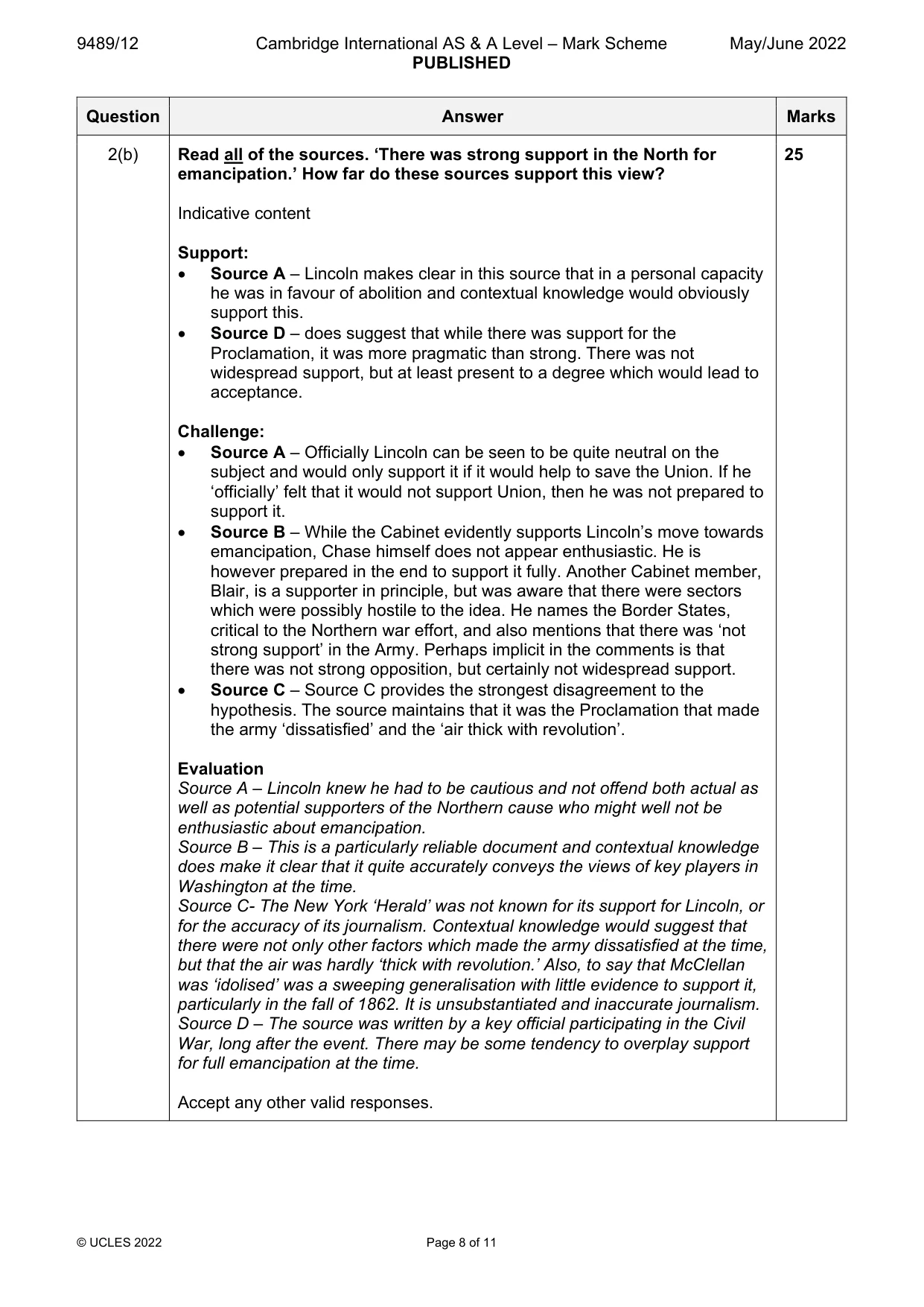
9489/12 Cambridge International AS & A Level – Mark Scheme PUBLISHED May/June 2022 © UCLES 2022 Page 8 of 11 Question Answer Marks 2(b) Read all of the sources. ‘There was strong support in the North for emancipation.’ How far do these sources support this view? Indicative content Support: Source A – Lincoln makes clear in this source that in a personal capacity he was in favour of abolition and contextual knowledge would obviously support this. Source D – does suggest that while there was support for the Proclamation, it was more pragmatic than strong. There was not widespread support, but at least present to a degree which would lead to acceptance. Challenge: Source A – Officially Lincoln can be seen to be quite neutral on the subject and would only support it if it would help to save the Union. If he ‘officially’ felt that it would not support Union, then he was not prepared to support it. Source B – While the Cabinet evidently supports Lincoln’s move towards emancipation, Chase himself does not appear enthusiastic. He is however prepared in the end to support it fully. Another Cabinet member, Blair, is a supporter in principle, but was aware that there were sectors which were possibly hostile to the idea. He names the Border States, critical to the Northern war effort, and also mentions that there was ‘not strong support’ in the Army. Perhaps implicit in the comments is that there was not strong opposition, but certainly not widespread support. Source C – Source C provides the strongest disagreement to the hypothesis. The source maintains that it was the Proclamation that made the army ‘dissatisfied’ and the ‘air thick with revolution’. Evaluation Source A – Lincoln knew he had to be cautious and not offend both actual as well as potential supporters of the Northern cause who might well not be enthusiastic about emancipation. Source B – This is a particularly reliable document and contextual knowledge does make it clear that it quite accurately conveys the views of key players in Washington at the time. Source C- The New York ‘Herald’ was not known for its support for Lincoln, or for the accuracy of its journalism. Contextual knowledge would suggest that there were not only other factors which made the army dissatisfied at the time, but that the air was hardly ‘thick with revolution.’ Also, to say that McClellan was ‘idolised’ was a sweeping generalisation with little evidence to support it, particularly in the fall of 1862. It is unsubstantiated and inaccurate journalism. Source D – The source was written by a key official participating in the Civil War, long after the event. There may be some tendency to overplay support for full emancipation at the time. Accept any other valid responses. 25
Mark scheme, page 9
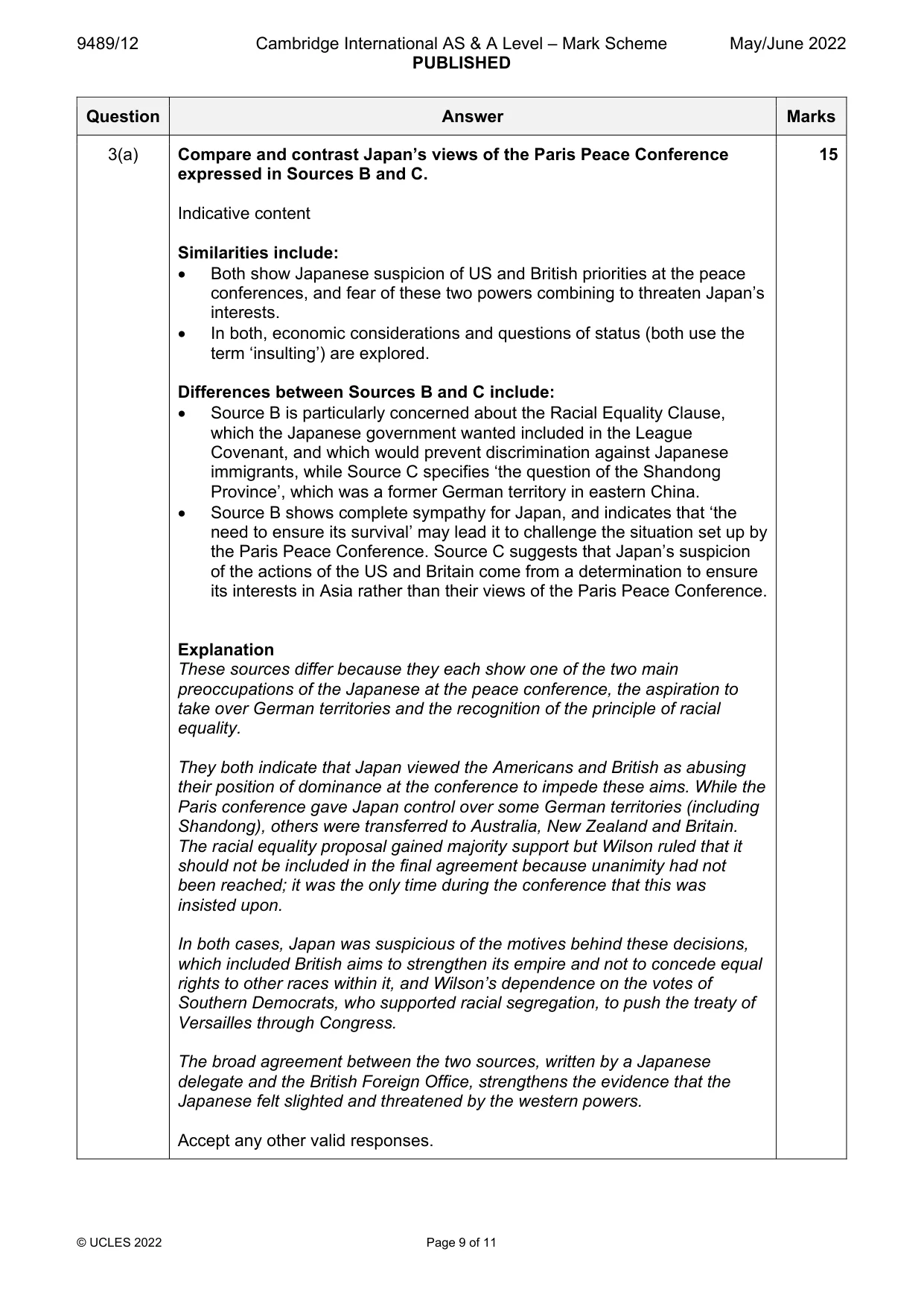
9489/12 Cambridge International AS & A Level – Mark Scheme PUBLISHED May/June 2022 © UCLES 2022 Page 9 of 11 Question Answer Marks 3(a) Compare and contrast Japan’s views of the Paris Peace Conference expressed in Sources B and C. Indicative content Similarities include: Both show Japanese suspicion of US and British priorities at the peace conferences, and fear of these two powers combining to threaten Japan’s interests. In both, economic considerations and questions of status (both use the term ‘insulting’) are explored. Differences between Sources B and C include: Source B is particularly concerned about the Racial Equality Clause, which the Japanese government wanted included in the League Covenant, and which would prevent discrimination against Japanese immigrants, while Source C specifies ‘the question of the Shandong Province’, which was a former German territory in eastern China. Source B shows complete sympathy for Japan, and indicates that ‘the need to ensure its survival’ may lead it to challenge the situation set up by the Paris Peace Conference. Source C suggests that Japan’s suspicion of the actions of the US and Britain come from a determination to ensure its interests in Asia rather than their views of the Paris Peace Conference. Explanation These sources differ because they each show one of the two main preoccupations of the Japanese at the peace conference, the aspiration to take over German territories and the recognition of the principle of racial equality. They both indicate that Japan viewed the Americans and British as abusing their position of dominance at the conference to impede these aims. While the Paris conference gave Japan control over some German territories (including Shandong), others were transferred to Australia, New Zealand and Britain. The racial equality proposal gained majority support but Wilson ruled that it should not be included in the final agreement because unanimity had not been reached; it was the only time during the conference that this was insisted upon. In both cases, Japan was suspicious of the motives behind these decisions, which included British aims to strengthen its empire and not to concede equal rights to other races within it, and Wilson’s dependence on the votes of Southern Democrats, who supported racial segregation, to push the treaty of Versailles through Congress. The broad agreement between the two sources, written by a Japanese delegate and the British Foreign Office, strengthens the evidence that the Japanese felt slighted and threatened by the western powers. Accept any other valid responses. 15
Mark scheme, page 10
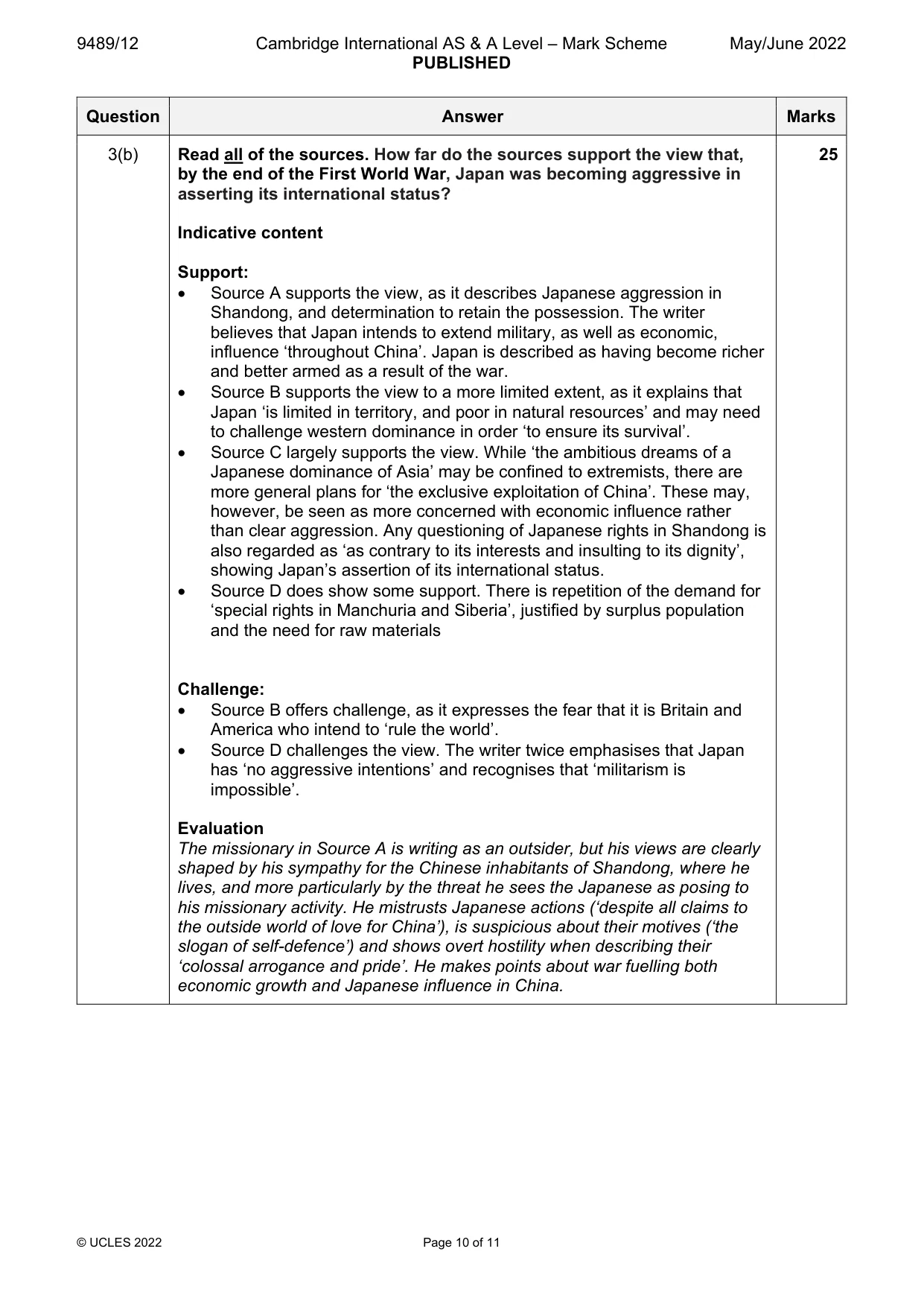
9489/12 Cambridge International AS & A Level – Mark Scheme PUBLISHED May/June 2022 © UCLES 2022 Page 10 of 11 Question Answer Marks 3(b) Read all of the sources. How far do the sources support the view that, by the end of the First World War, Japan was becoming aggressive in asserting its international status? Indicative content Support: Source A supports the view, as it describes Japanese aggression in Shandong, and determination to retain the possession. The writer believes that Japan intends to extend military, as well as economic, influence ‘throughout China’. Japan is described as having become richer and better armed as a result of the war. Source B supports the view to a more limited extent, as it explains that Japan ‘is limited in territory, and poor in natural resources’ and may need to challenge western dominance in order ‘to ensure its survival’. Source C largely supports the view. While ‘the ambitious dreams of a Japanese dominance of Asia’ may be confined to extremists, there are more general plans for ‘the exclusive exploitation of China’. These may, however, be seen as more concerned with economic influence rather than clear aggression. Any questioning of Japanese rights in Shandong is also regarded as ‘as contrary to its interests and insulting to its dignity’, showing Japan’s assertion of its international status. Source D does show some support. There is repetition of the demand for ‘special rights in Manchuria and Siberia’, justified by surplus population and the need for raw materials Challenge: Source B offers challenge, as it expresses the fear that it is Britain and America who intend to ‘rule the world’. Source D challenges the view. The writer twice emphasises that Japan has ‘no aggressive intentions’ and recognises that ‘militarism is impossible’. Evaluation The missionary in Source A is writing as an outsider, but his views are clearly shaped by his sympathy for the Chinese inhabitants of Shandong, where he lives, and more particularly by the threat he sees the Japanese as posing to his missionary activity. He mistrusts Japanese actions (‘despite all claims to the outside world of love for China’), is suspicious about their motives (‘the slogan of self-defence’) and shows overt hostility when describing their ‘colossal arrogance and pride’. He makes points about war fuelling both economic growth and Japanese influence in China. 25
Mark scheme, page 11
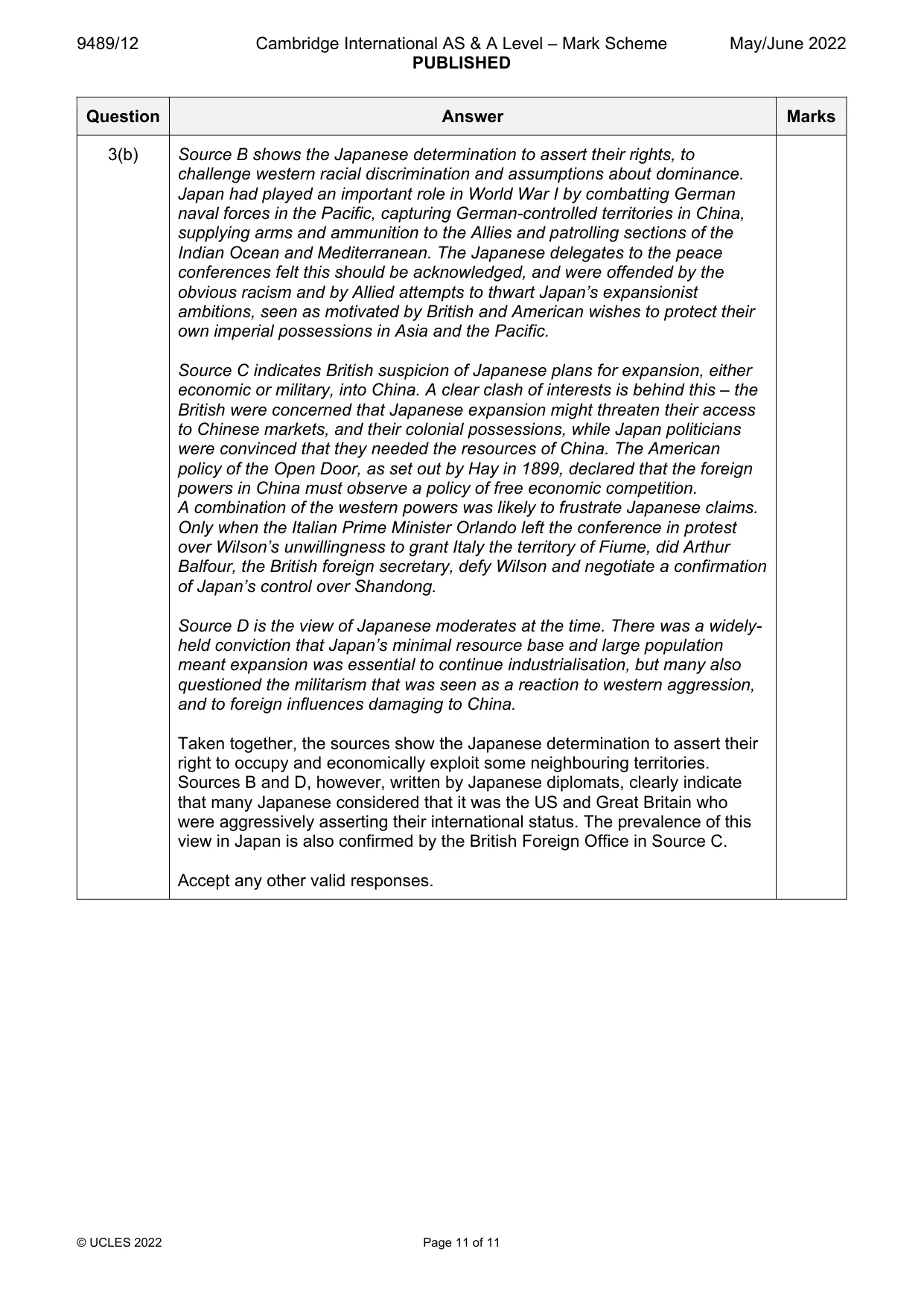
9489/12 Cambridge International AS & A Level – Mark Scheme PUBLISHED May/June 2022 © UCLES 2022 Page 11 of 11 Question Answer Marks 3(b) Source B shows the Japanese determination to assert their rights, to challenge western racial discrimination and assumptions about dominance. Japan had played an important role in World War I by combatting German naval forces in the Pacific, capturing German-controlled territories in China, supplying arms and ammunition to the Allies and patrolling sections of the Indian Ocean and Mediterranean. The Japanese delegates to the peace conferences felt this should be acknowledged, and were offended by the obvious racism and by Allied attempts to thwart Japan’s expansionist ambitions, seen as motivated by British and American wishes to protect their own imperial possessions in Asia and the Pacific. Source C indicates British suspicion of Japanese plans for expansion, either economic or military, into China. A clear clash of interests is behind this – the British were concerned that Japanese expansion might threaten their access to Chinese markets, and their colonial possessions, while Japan politicians were convinced that they needed the resources of China. The American policy of the Open Door, as set out by Hay in 1899, declared that the foreign powers in China must observe a policy of free economic competition. A combination of the western powers was likely to frustrate Japanese claims. Only when the Italian Prime Minister Orlando left the conference in protest over Wilson’s unwillingness to grant Italy the territory of Fiume, did Arthur Balfour, the British foreign secretary, defy Wilson and negotiate a confirmation of Japan’s control over Shandong. Source D is the view of Japanese moderates at the time. There was a widely- held conviction that Japan’s minimal resource base and large population meant expansion was essential to continue industrialisation, but many also questioned the militarism that was seen as a reaction to western aggression, and to foreign influences damaging to China. Taken together, the sources show the Japanese determination to assert their right to occupy and economically exploit some neighbouring territories. Sources B and D, however, written by Japanese diplomats, clearly indicate that many Japanese considered that it was the US and Great Britain who were aggressively asserting their international status. The prevalence of this view in Japan is also confirmed by the British Foreign Office in Source C. Accept any other valid responses.
What you needed in this session
Cambridge’s own grade thresholds for 2022 May/June, Paper 1 · Variant 2. A higher threshold means an easier paper — the bar moves with how the cohort did.