Cambridge A Level History 9489 — 2022 Feb/March Paper 3 · Variant 2
9489/32/F/M/22 · 3 questions · 40 marks · ≈45 min
The question paper and its mark scheme, free to read here and free to download. This is Cambridge’s own paper, exactly as it was sat.
Question paper8 pages

Mark scheme8 pages
Answers below. Sit the paper first if you are practising.
Questions as text
Q1 · Read the extract and then answer the question
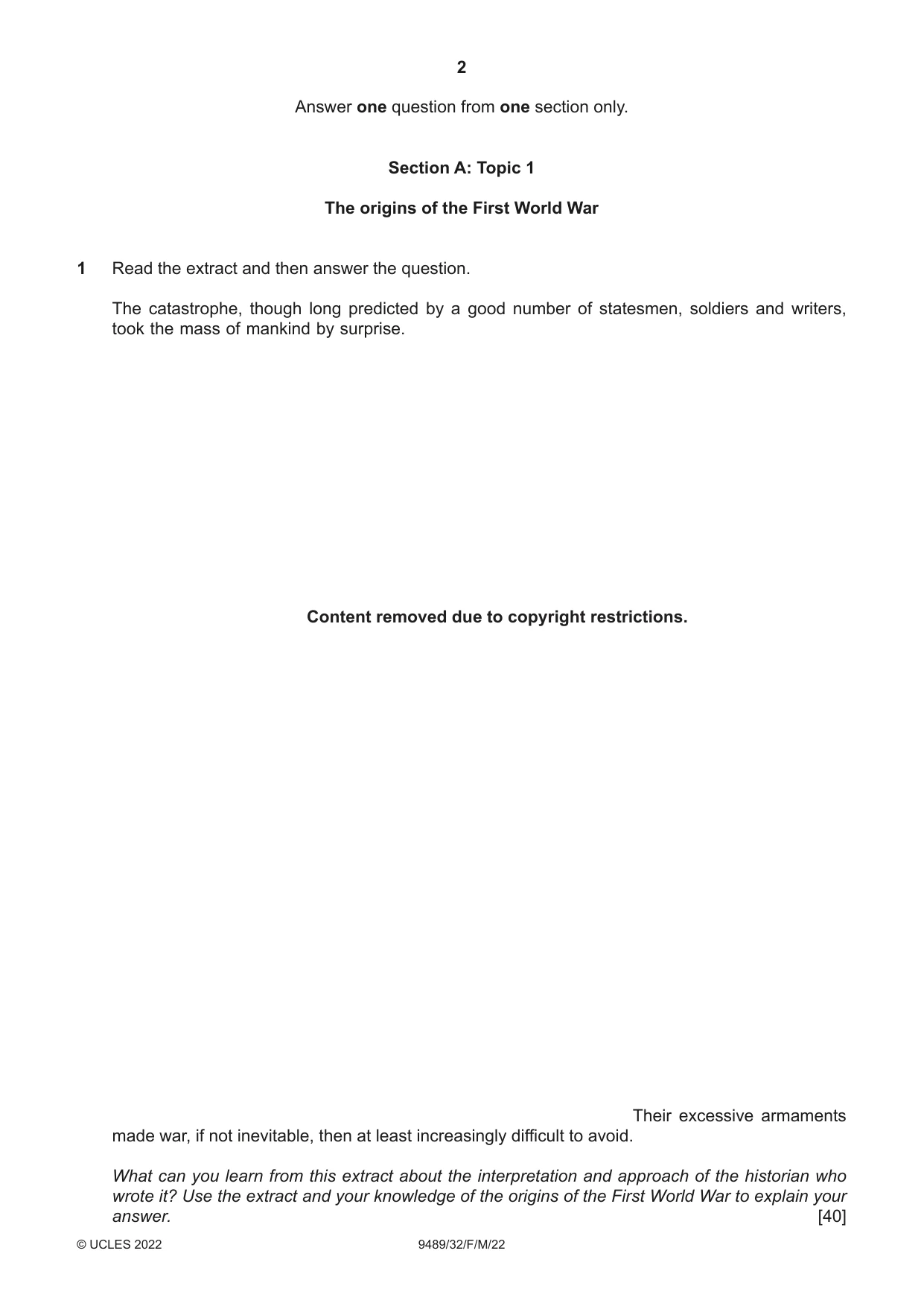
1 Read the extract and then answer the question. The catastrophe, though long predicted by a good number of statesmen, soldiers and writers, took the mass of mankind by surprise. Content removed due to copyright restrictions. Their excessive armaments made war, if not inevitable, then at least increasingly difficult to avoid. What can you learn from this extract about the interpretation and approach of the historian who wrote it? Use the extract and your knowledge of the origins of the First World War to explain your answer. [40]
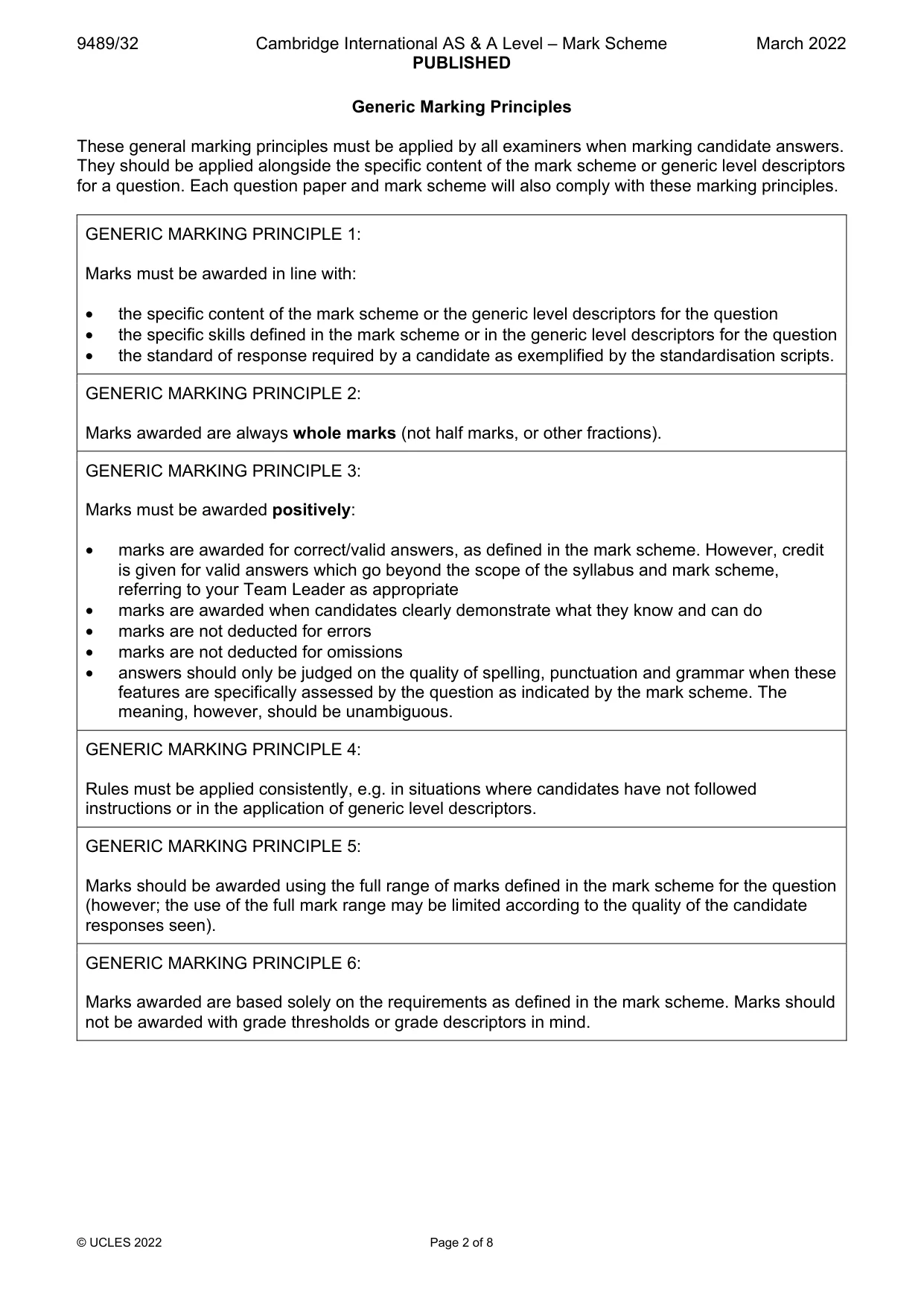
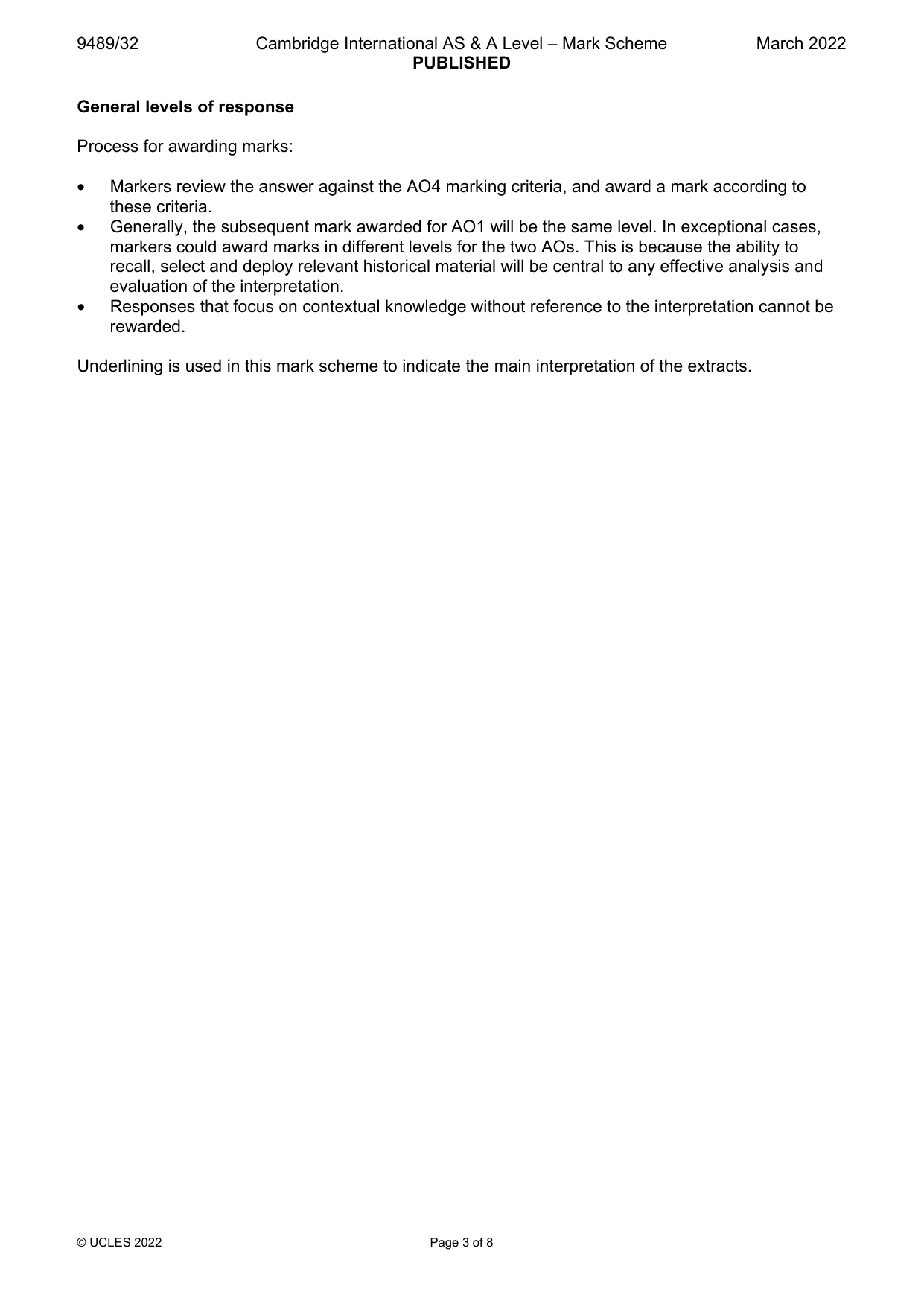
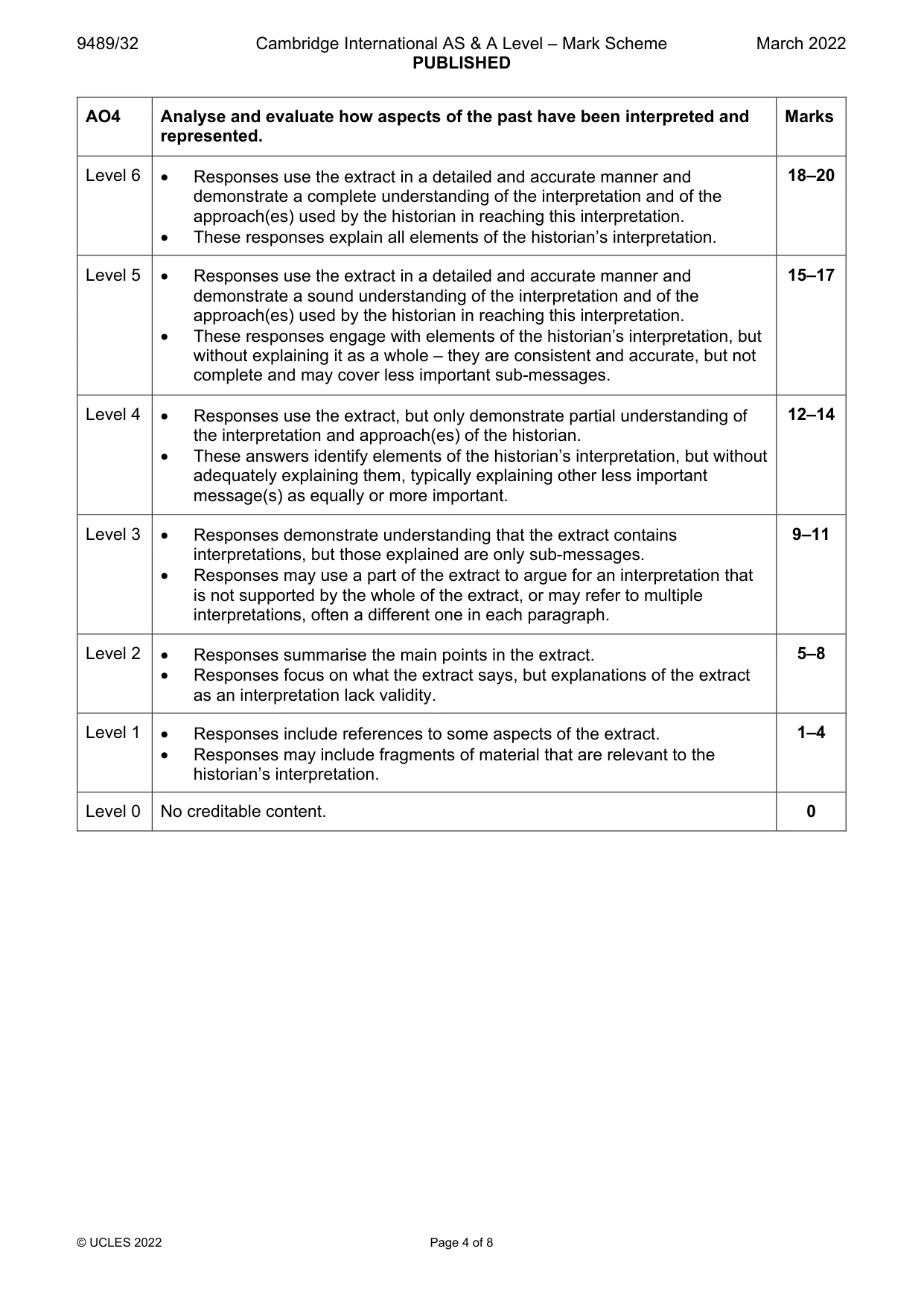
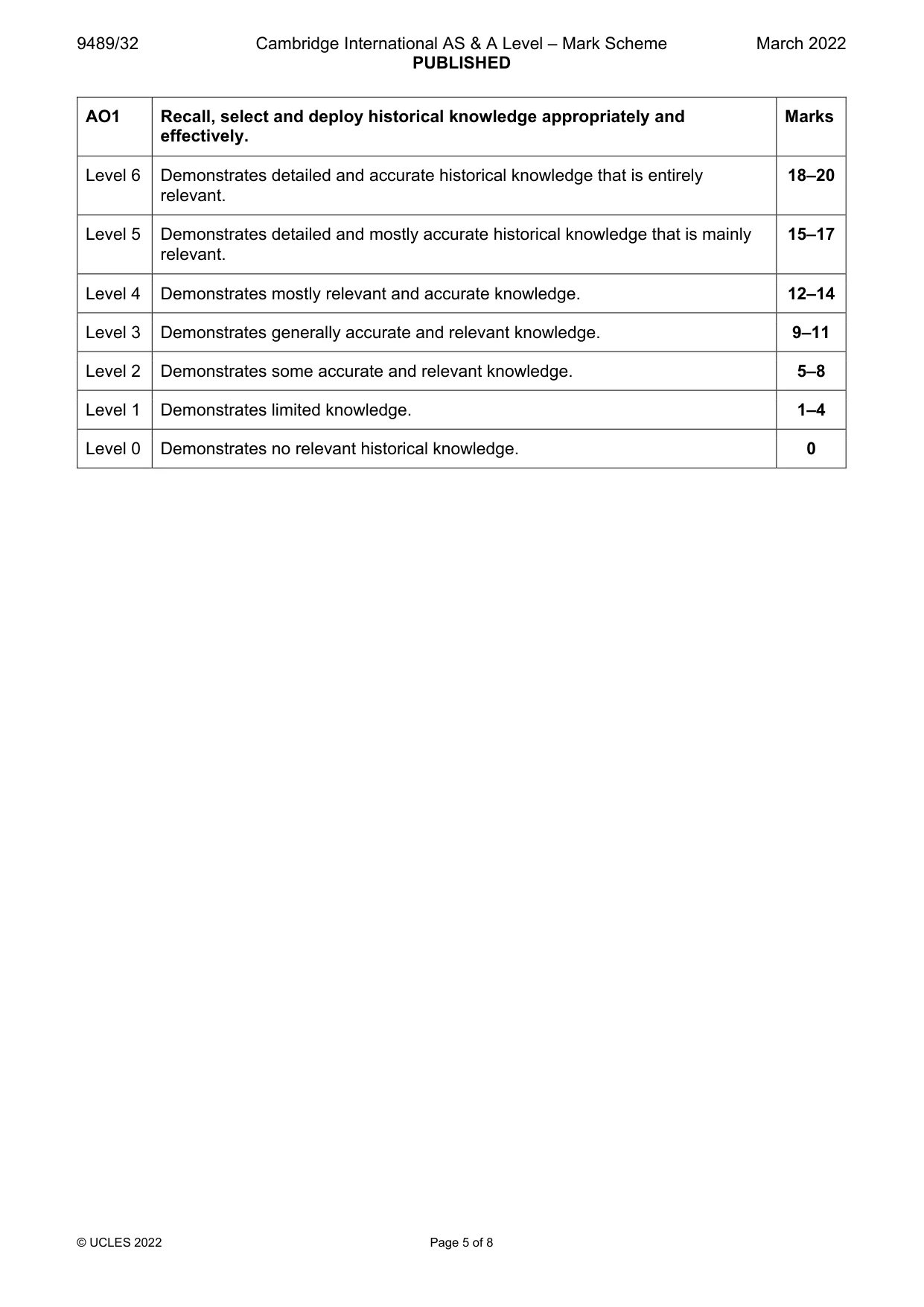
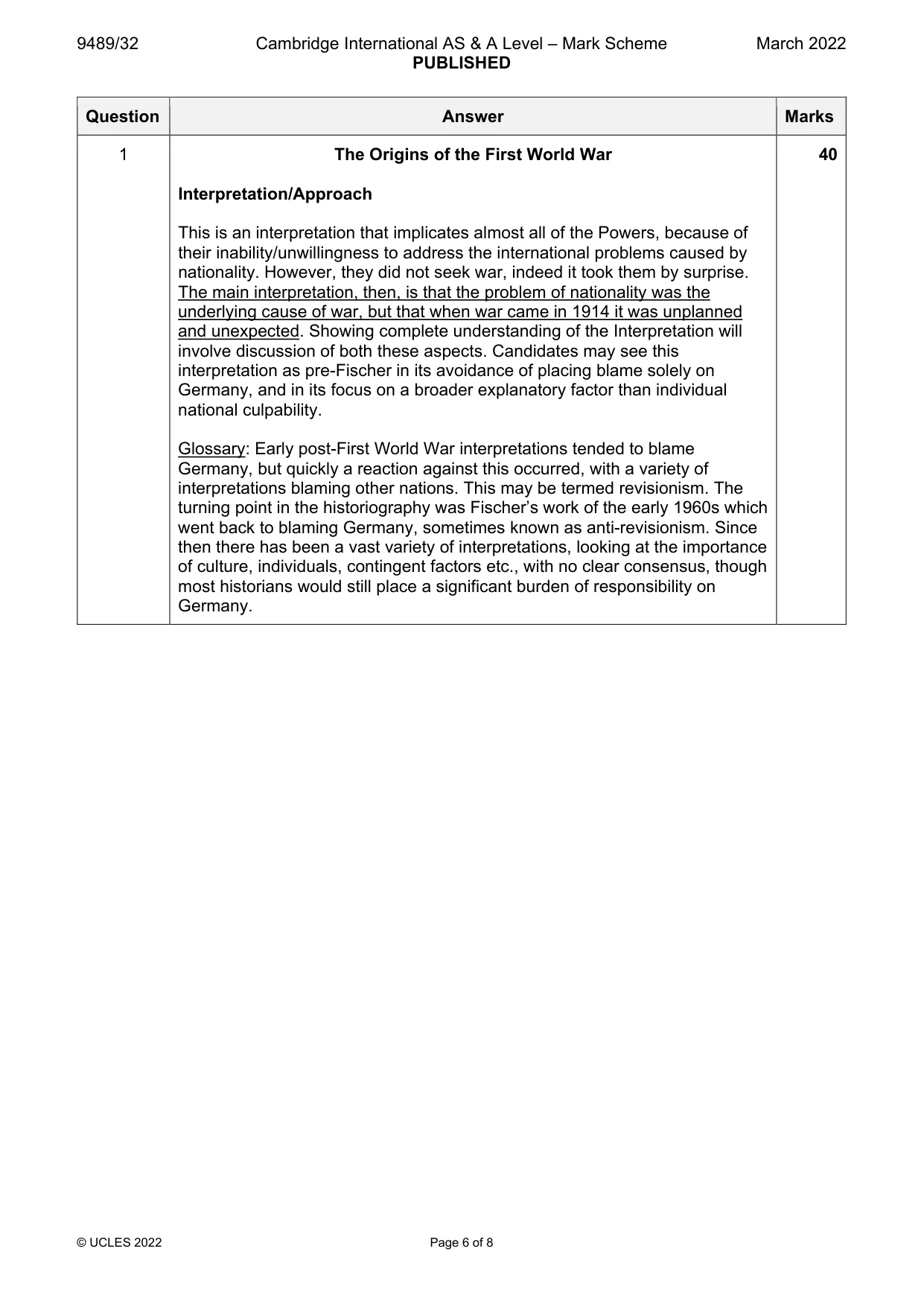
Mark scheme: Question Answer Marks 1 The Origins of the First World War 40 Interpretation/Approach This is an interpretation that implicates almost all of the Powers, because of their inability/unwillingness to address the international problems caused by nationality. However, they did not seek war, indeed it took them by surprise. The main interpretation, then, is that the problem of nationality was the underlying cause of war, but that when war came in 1914 it was unplanned and unexpected. Showing complete understanding of the Interpretation will involve discussion of both these aspects. Candidates may see this interpretation as pre-Fischer in its avoidance of placing blame solely on Germany, and in its focus on a broader explanatory factor than individual national culpability. Glossary: Early post-First World War interpretations tended to blame Germany, but quickly a reaction against this occurred, with a variety of interpretations blaming other nations. This may be termed revisionism. The turning point in the historiography was Fischer’s work of the early 1960s which went back to blaming Germany, sometimes known as anti-revisionism. Since then there has been a vast variety of interpretations, looking at the importance of culture, individuals, contingent factors etc., with no clear consensus, though most historians would still place a significant burden of responsibility on Germany.
Q2 · Read the extract and then answer the question
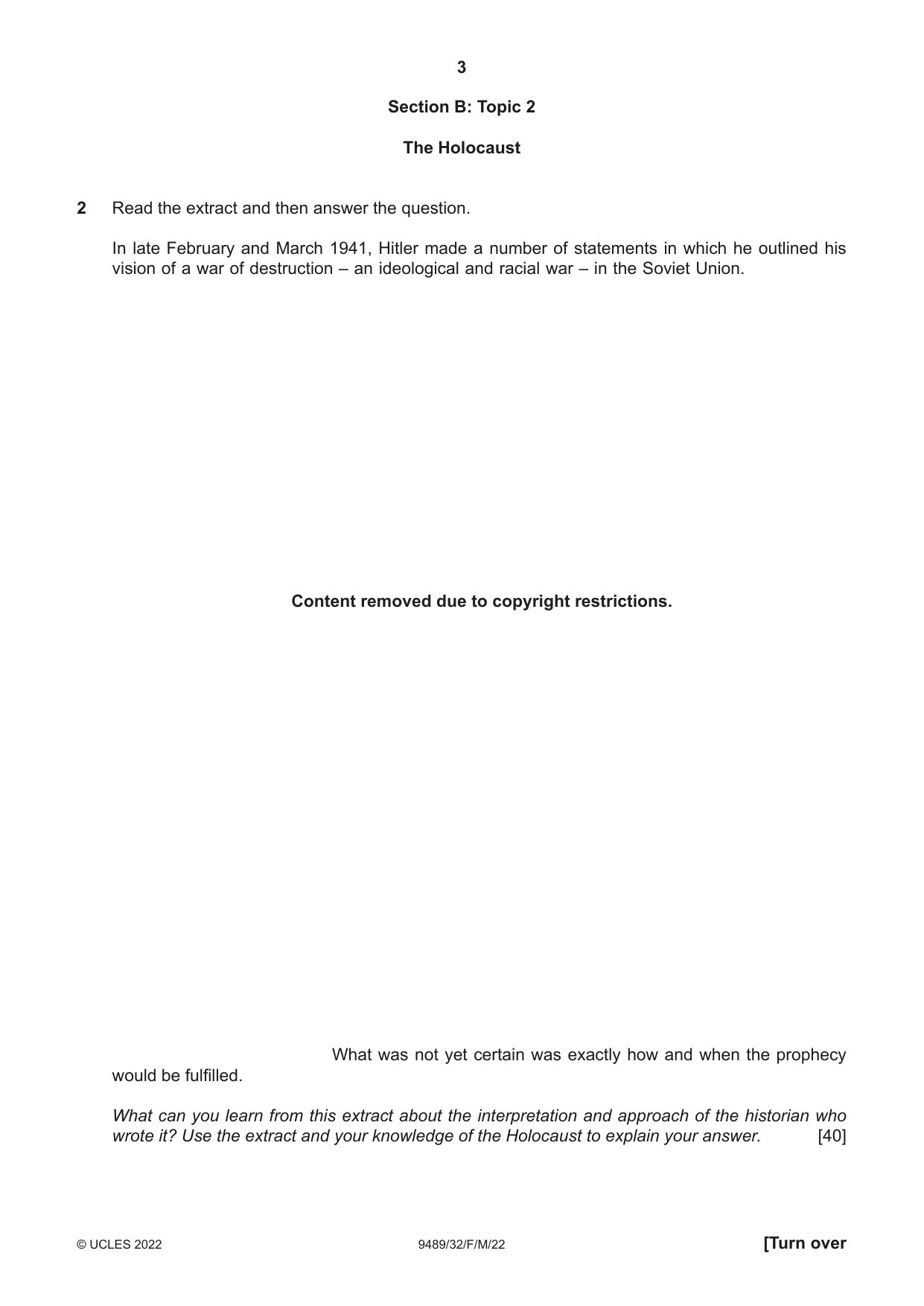
2 Read the extract and then answer the question. In late February and March 1941, Hitler made a number of statements in which he outlined his vision of a war of destruction – an ideological and racial war – in the Soviet Union. Content removed due to copyright restrictions. What was not yet certain was exactly how and when the prophecy would be fulfilled. What can you learn from this extract about the interpretation and approach of the historian who wrote it? Use the extract and your knowledge of the Holocaust to explain your answer. [40] Section C: Topic 3 The origins and development of the Cold War
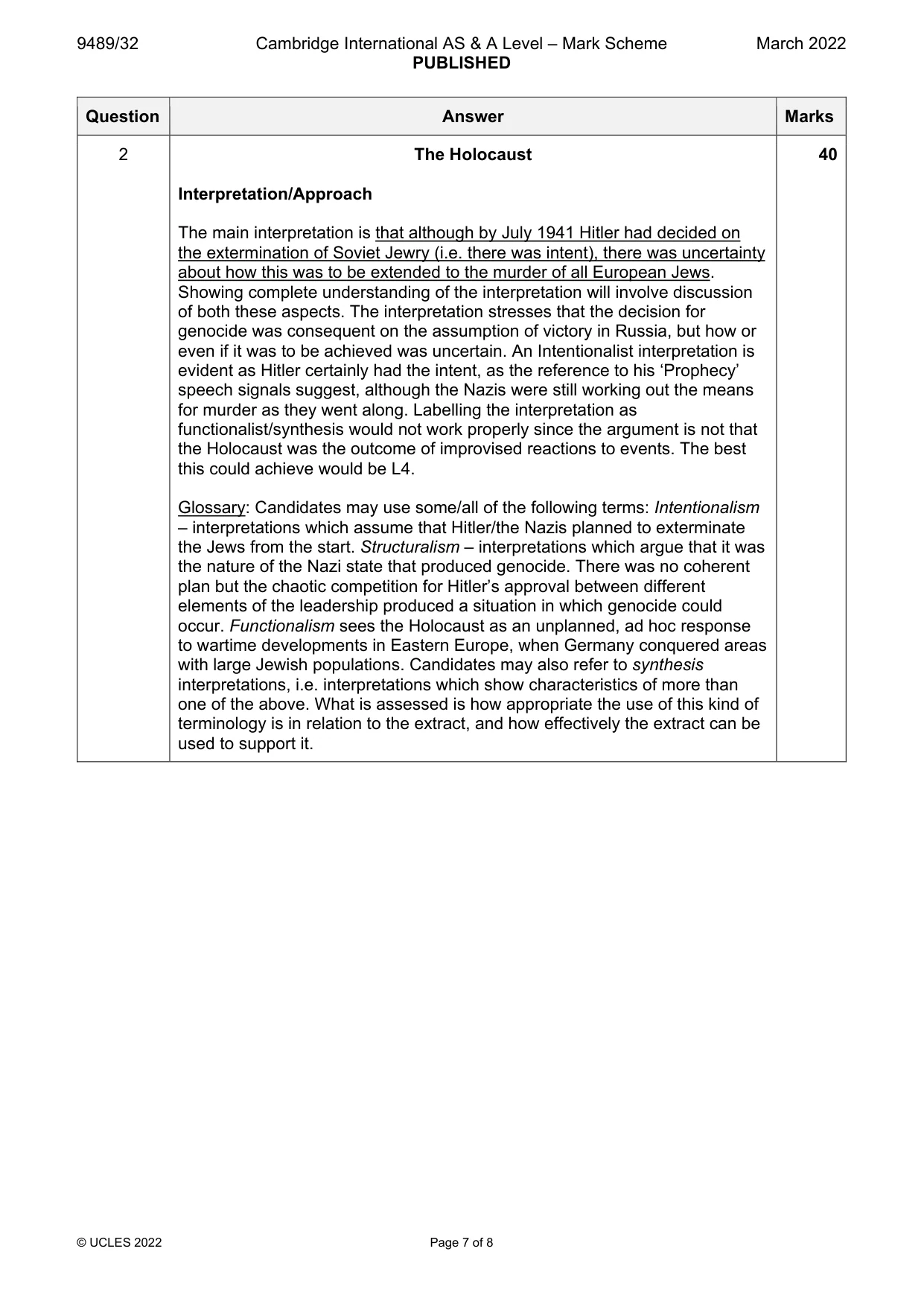
Mark scheme: 2 The Holocaust 40 Interpretation/Approach The main interpretation is that although by July 1941 Hitler had decided on the extermination of Soviet Jewry (i.e. there was intent), there was uncertainty about how this was to be extended to the murder of all European Jews. Showing complete understanding of the interpretation will involve discussion of both these aspects. The interpretation stresses that the decision for genocide was consequent on the assumption of victory in Russia, but how or even if it was to be achieved was uncertain. An Intentionalist interpretation is evident as Hitler certainly had the intent, as the reference to his ‘Prophecy’ speech signals suggest, although the Nazis were still working out the means for murder as they went along. Labelling the interpretation as functionalist/synthesis would not work properly since the argument is not that the Holocaust was the outcome of improvised reactions to events. The best this could achieve would be L4. Glossary: Candidates may use some/all of the following terms: Intentionalism – interpretations which assume that Hitler/the Nazis planned to exterminate the Jews from the start. Structuralism – interpretations which argue that it was the nature of the Nazi state that produced genocide. There was no coherent plan but the chaotic competition for Hitler’s approval between different elements of the leadership produced a situation in which genocide could occur. Functionalism sees the Holocaust as an unplanned, ad hoc response to wartime developments in Eastern Europe, when Germany conquered areas with large Jewish populations. Candidates may also refer to synthesis interpretations, i.e. interpretations which show characteristics of more than one of the above. What is assessed is how appropriate the use of this kind of terminology is in relation to the extract, and how effectively the extract can be used to support it.
Q3 · Read the extract and then answer the question
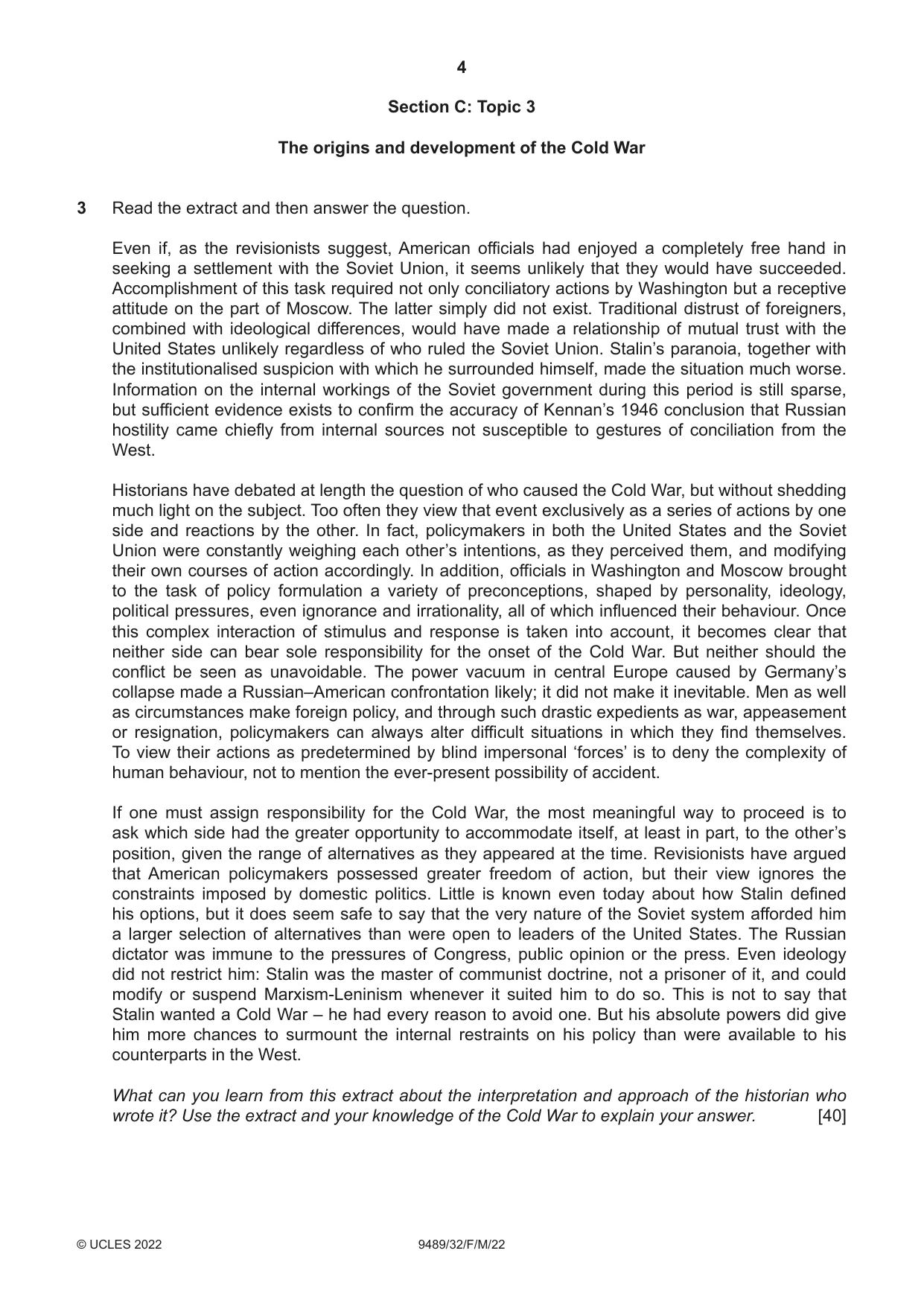
3 Read the extract and then answer the question. Even if, as the revisionists suggest, American officials had enjoyed a completely free hand in seeking a settlement with the Soviet Union, it seems unlikely that they would have succeeded. Accomplishment of this task required not only conciliatory actions by Washington but a receptive attitude on the part of Moscow. The latter simply did not exist. Traditional distrust of foreigners, combined with ideological differences, would have made a relationship of mutual trust with the United States unlikely regardless of who ruled the Soviet Union. Stalin’s paranoia, together with the institutionalised suspicion with which he surrounded himself, made the situation much worse. Information on the internal workings of the Soviet government during this period is still sparse, but sufficient evidence exists to confirm the accuracy of Kennan’s 1946 conclusion that Russian hostility came chiefly from internal sources not susceptible to gestures of conciliation from the West. Historians have debated at length the question of who caused the Cold War, but without shedding much light on the subject. Too often they view that event exclusively as a series of actions by one side and reactions by the other. In fact, policymakers in both the United States and the Soviet Union were constantly weighing each other’s intentions, as they perceived them, and modifying their own courses of action accordingly. In addition, officials in Washington and Moscow brought to the task of policy formulation a variety of preconceptions, shaped by personality, ideology, political pressures, even ignorance and irrationality, all of which influenced their behaviour. Once this complex interaction of stimulus and response is taken into account, it becomes clear that neither side can bear sole responsibility for the onset of the Cold War. But neither should the conflict be seen as unavoidable. The power vacuum in central Europe caused by Germany’s collapse made a Russian–American confrontation likely; it did not make it inevitable. Men as well as circumstances make foreign policy, and through such drastic expedients as war, appeasement or resignation, policymakers can always alter difficult situations in which they find themselves. To view their actions as predetermined by blind impersonal ‘forces’ is to deny the complexity of human behaviour, not to mention the ever-present possibility of accident. If one must assign responsibility for the Cold War, the most meaningful way to proceed is to ask which side had the greater opportunity to accommodate itself, at least in part, to the other’s position, given the range of alternatives as they appeared at the time. Revisionists have argued that American policymakers possessed greater freedom of action, but their view ignores the constraints imposed by domestic politics. Little is known even today about how Stalin defined his options, but it does seem safe to say that the very nature of the Soviet system afforded him a larger selection of alternatives than were open to leaders of the United States. The Russian dictator was immune to the pressures of Congress, public opinion or the press. Even ideology did not restrict him: Stalin was the master of communist doctrine, not a prisoner of it, and could modify or suspend Marxism-Leninism whenever it suited him to do so. This is not to say that Stalin wanted a Cold War – he had every reason to avoid one. But his absolute powers did give him more chances to surmount the internal restraints on his policy than were available to his counterparts in the West. What can you learn from this extract about the interpretation and approach of the historian who wrote it? Use the extract and your knowledge of the Cold War to explain your answer. [40]
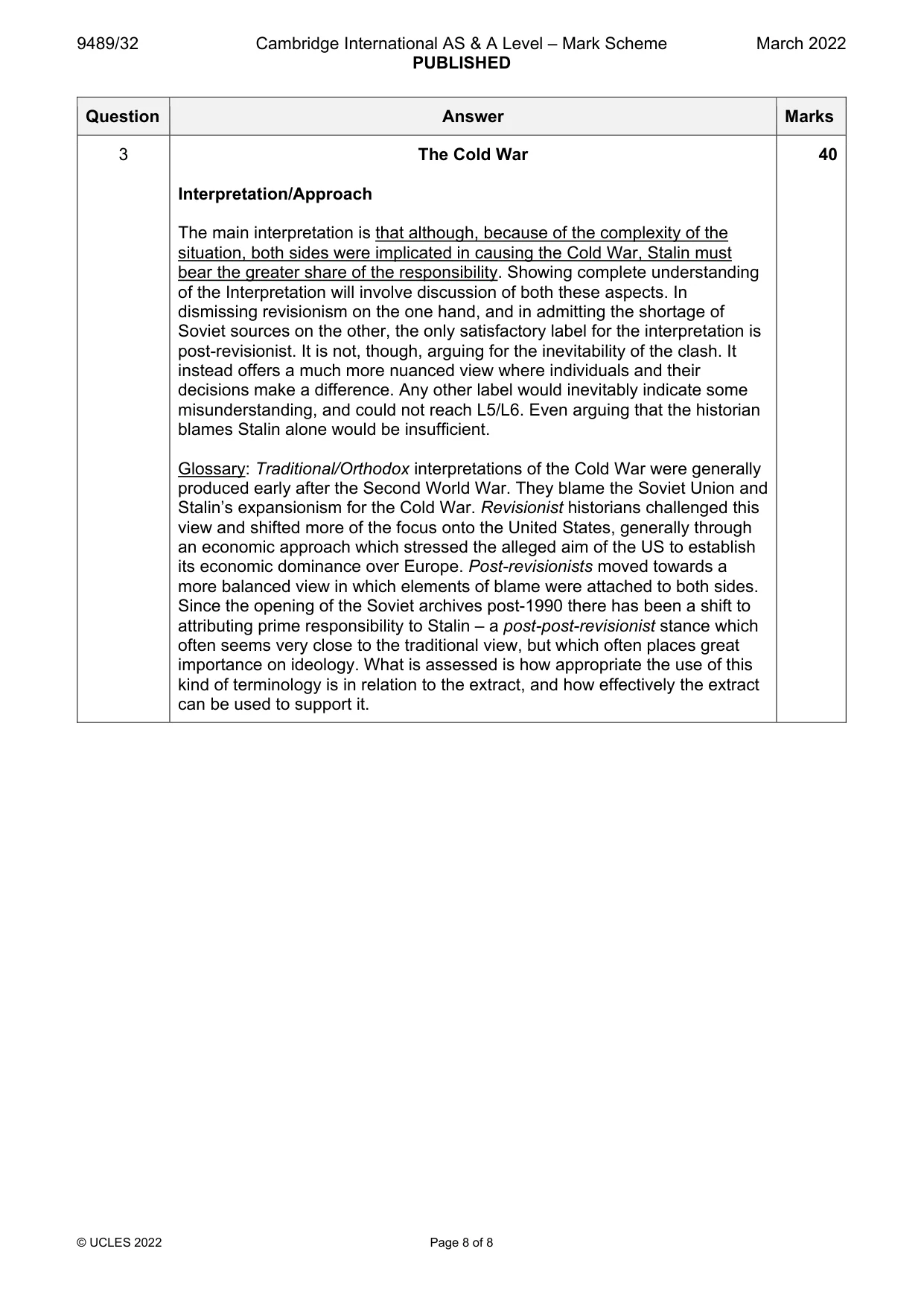
Mark scheme: 3 The Cold War 40 Interpretation/Approach The main interpretation is that although, because of the complexity of the situation, both sides were implicated in causing the Cold War, Stalin must bear the greater share of the responsibility. Showing complete understanding of the Interpretation will involve discussion of both these aspects. In dismissing revisionism on the one hand, and in admitting the shortage of Soviet sources on the other, the only satisfactory label for the interpretation is post-revisionist. It is not, though, arguing for the inevitability of the clash. It instead offers a much more nuanced view where individuals and their decisions make a difference. Any other label would inevitably indicate some misunderstanding, and could not reach L5/L6. Even arguing that the historian blames Stalin alone would be insufficient. Glossary: Traditional/Orthodox interpretations of the Cold War were generally produced early after the Second World War. They blame the Soviet Union and Stalin’s expansionism for the Cold War. Revisionist historians challenged this view and shifted more of the focus onto the United States, generally through an economic approach which stressed the alleged aim of the US to establish its economic dominance over Europe. Post-revisionists moved towards a more balanced view in which elements of blame were attached to both sides. Since the opening of the Soviet archives post-1990 there has been a shift to attributing prime responsibility to Stalin – a post-post-revisionist stance which often seems very close to the traditional view, but which often places great importance on ideology. What is assessed is how appropriate the use of this kind of terminology is in relation to the extract, and how effectively the extract can be used to support it.
What was in this paper
The subtopics covered by these 3 questions, and how many questions each got. Open one in a new tab to see every Cambridge question on it.
What you needed in this session
Cambridge’s own grade thresholds for 2022 Feb/March, Paper 3 · Variant 2. A higher threshold means an easier paper — the bar moves with how the cohort did.