Cambridge A Level History 9389 — 2018 Oct/Nov Paper 3 · Variant 2
9389/32/O/N/18 · 3 questions · 40 marks · ≈45 min
The question paper and its mark scheme, free to read here and free to download. This is Cambridge’s own paper, exactly as it was sat.
Question paper4 pages
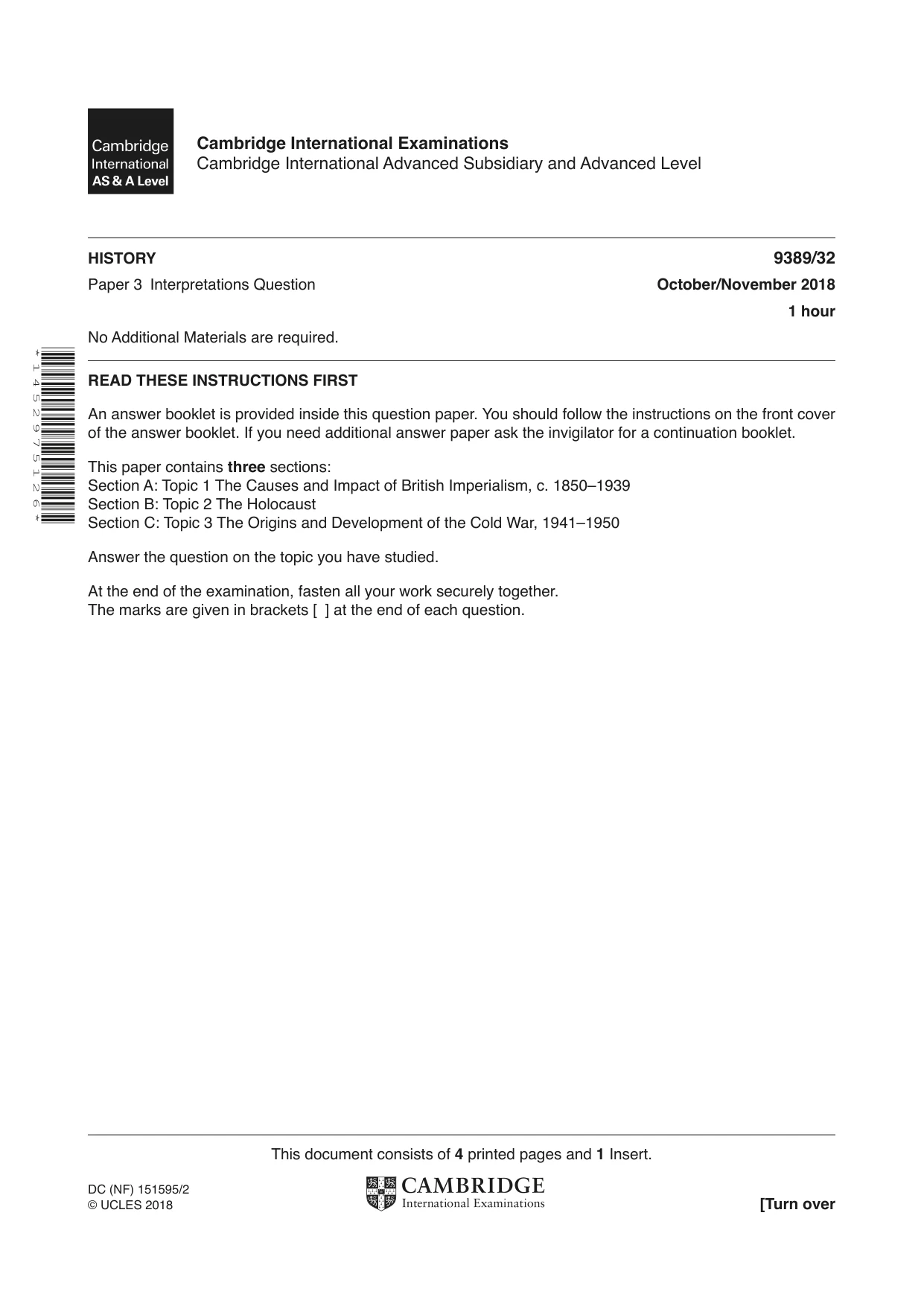
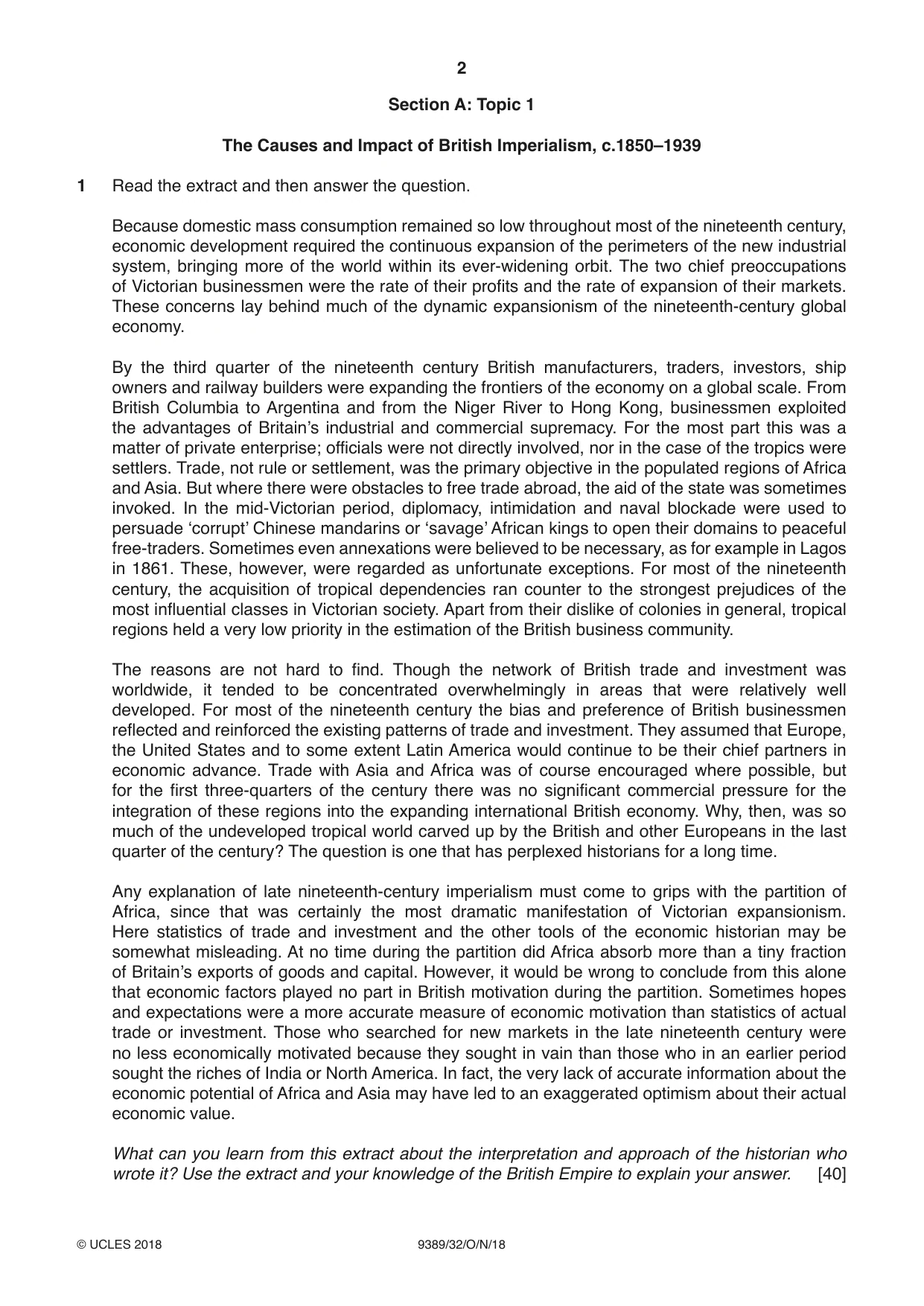
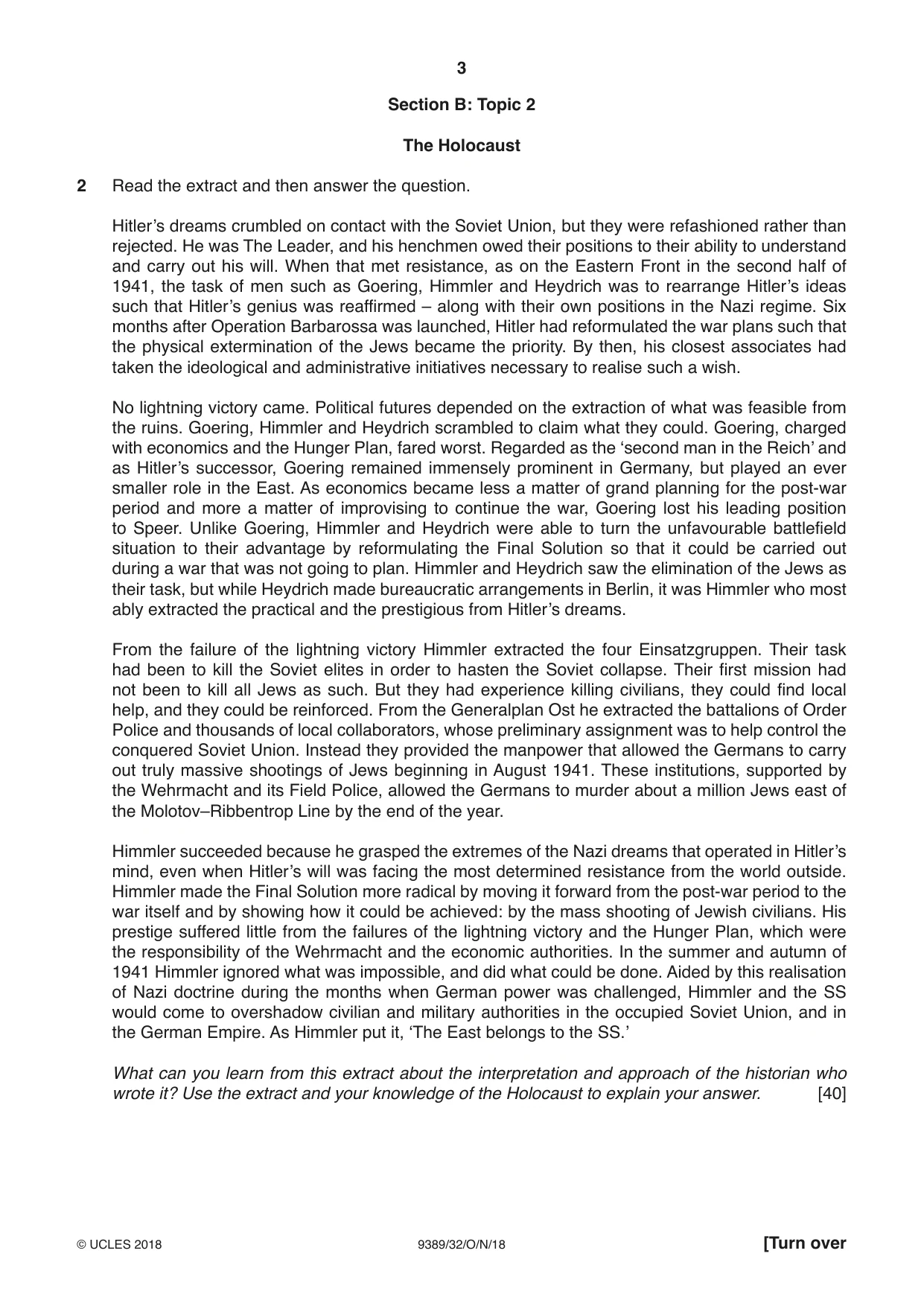
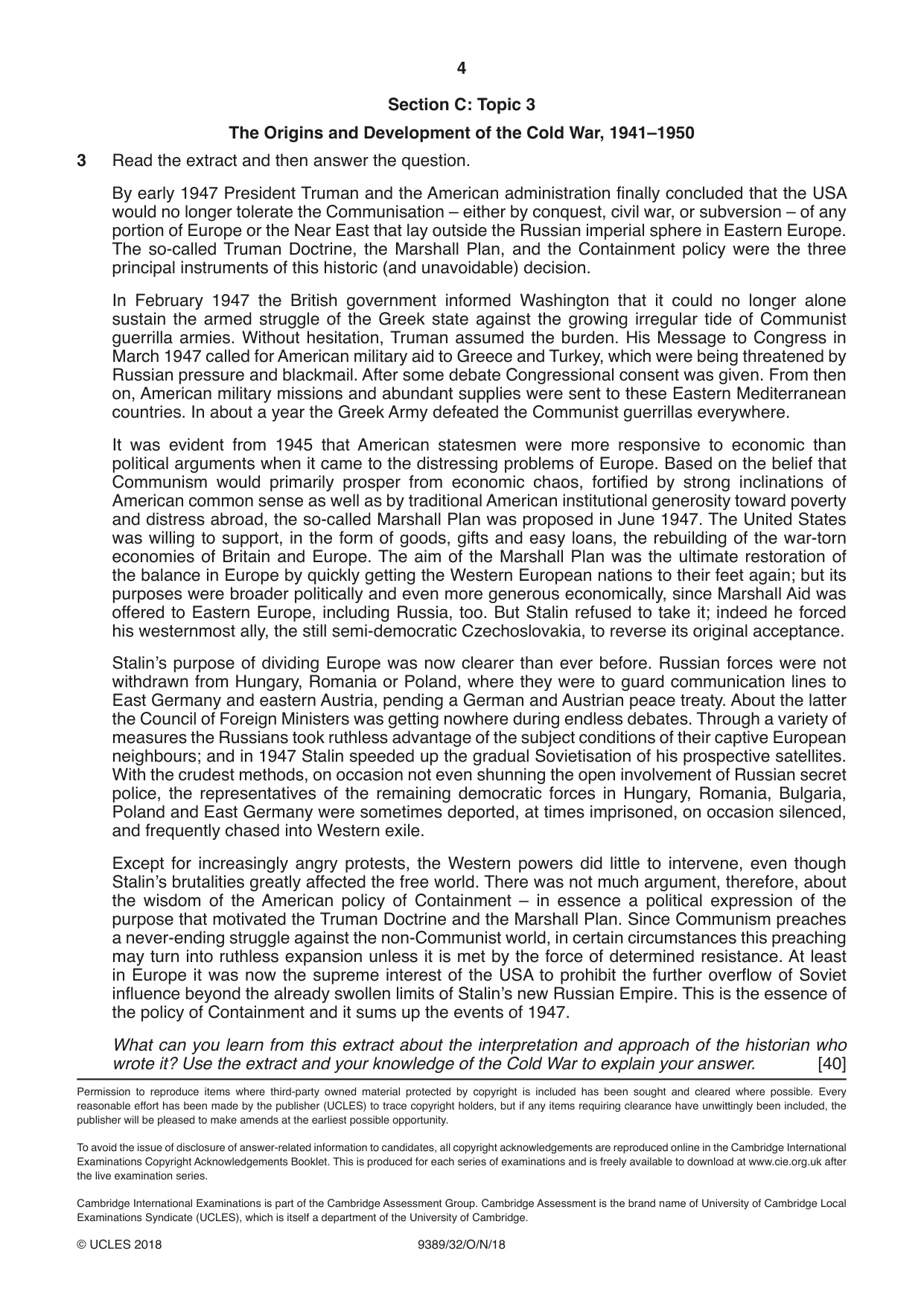
Mark scheme7 pages
Answers below. Sit the paper first if you are practising.
Questions as text
Q1 · Read the extract and then answer the question
1 Read the extract and then answer the question. Because domestic mass consumption remained so low throughout most of the nineteenth century, economic development required the continuous expansion of the perimeters of the new industrial system, bringing more of the world within its ever-widening orbit. The two chief preoccupations of Victorian businessmen were the rate of their profits and the rate of expansion of their markets. These concerns lay behind much of the dynamic expansionism of the nineteenth-century global economy. By the third quarter of the nineteenth century British manufacturers, traders, investors, ship owners and railway builders were expanding the frontiers of the economy on a global scale. From British Columbia to Argentina and from the Niger River to Hong Kong, businessmen exploited the advantages of Britain’s industrial and commercial supremacy. For the most part this was a matter of private enterprise; officials were not directly involved, nor in the case of the tropics were settlers. Trade, not rule or settlement, was the primary objective in the populated regions of Africa and Asia. But where there were obstacles to free trade abroad, the aid of the state was sometimes invoked. In the mid-Victorian period, diplomacy, intimidation and naval blockade were used to persuade ‘corrupt’ Chinese mandarins or ‘savage’ African kings to open their domains to peaceful free-traders. Sometimes even annexations were believed to be necessary, as for example in Lagos in 1861. These, however, were regarded as unfortunate exceptions. For most of the nineteenth century, the acquisition of tropical dependencies ran counter to the strongest prejudices of the most influential classes in Victorian society. Apart from their dislike of colonies in general, tropical regions held a very low priority in the estimation of the British business community. The reasons are not hard to find. Though the network of British trade and investment was worldwide, it tended to be concentrated overwhelmingly in areas that were relatively well developed. For most of the nineteenth century the bias and preference of British businessmen reflected and reinforced the existing patterns of trade and investment. They assumed that Europe, the United States and to some extent Latin America would continue to be their chief partners in economic advance. Trade with Asia and Africa was of course encouraged where possible, but for the first three-quarters of the century there was no significant commercial pressure for the integration of these regions into the expanding international British economy. Why, then, was so much of the undeveloped tropical world carved up by the British and other Europeans in the last quarter of the century? The question is one that has perplexed historians for a long time. Any explanation of late nineteenth-century imperialism must come to grips with the partition of Africa, since that was certainly the most dramatic manifestation of Victorian expansionism. Here statistics of trade and investment and the other tools of the economic historian may be somewhat misleading. At no time during the partition did Africa absorb more than a tiny fraction of Britain’s exports of goods and capital. However, it would be wrong to conclude from this alone that economic factors played no part in British motivation during the partition. Sometimes hopes and expectations were a more accurate measure of economic motivation than statistics of actual trade or investment. Those who searched for new markets in the late nineteenth century were no less economically motivated because they sought in vain than those who in an earlier period sought the riches of India or North America. In fact, the very lack of accurate information about the economic potential of Africa and Asia may have led to an exaggerated optimism about their actual economic value. What can you learn from this extract about the interpretation and approach of the historian who wrote it? Use the extract and your knowledge of the British Empire to explain your answer. [40]
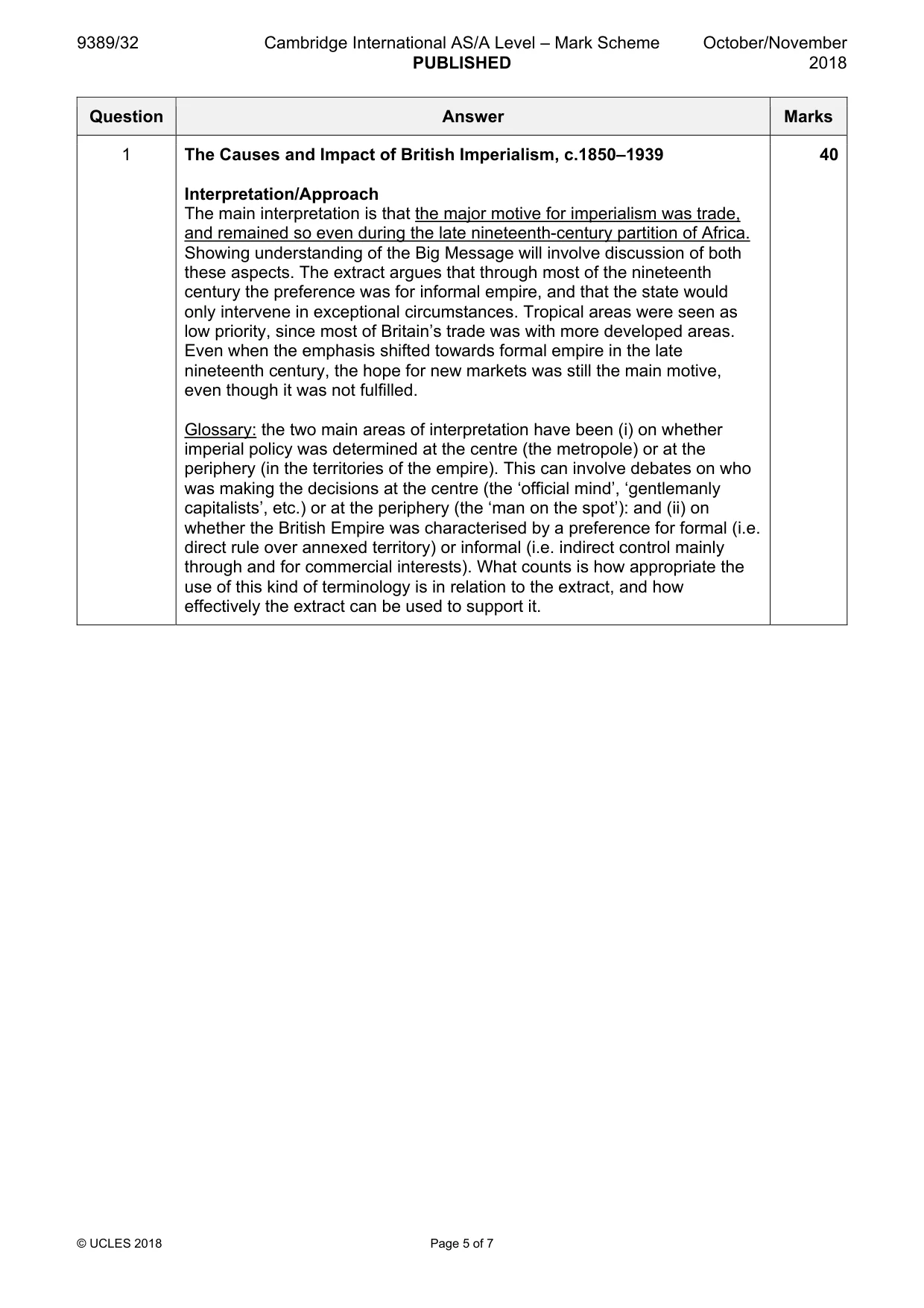
Mark scheme: Question Answer Marks 1 The Causes and Impact of British Imperialism, c.1850–1939 40 Interpretation/Approach The main interpretation is that the major motive for imperialism was trade, and remained so even during the late nineteenth-century partition of Africa. Showing understanding of the Big Message will involve discussion of both these aspects. The extract argues that through most of the nineteenth century the preference was for informal empire, and that the state would only intervene in exceptional circumstances. Tropical areas were seen as low priority, since most of Britain’s trade was with more developed areas. Even when the emphasis shifted towards formal empire in the late nineteenth century, the hope for new markets was still the main motive, even though it was not fulfilled. Glossary: the two main areas of interpretation have been (i) on whether imperial policy was determined at the centre (the metropole) or at the periphery (in the territories of the empire). This can involve debates on who was making the decisions at the centre (the ‘official mind’, ‘gentlemanly capitalists’, etc.) or at the periphery (the ‘man on the spot’): and (ii) on whether the British Empire was characterised by a preference for formal (i.e. direct rule over annexed territory) or informal (i.e. indirect control mainly through and for commercial interests). What counts is how appropriate the use of this kind of terminology is in relation to the extract, and how effectively the extract can be used to support it.
Q2 · Read the extract and then answer the question
2 Read the extract and then answer the question. Hitler’s dreams crumbled on contact with the Soviet Union, but they were refashioned rather than rejected. He was The Leader, and his henchmen owed their positions to their ability to understand and carry out his will. When that met resistance, as on the Eastern Front in the second half of 1941, the task of men such as Goering, Himmler and Heydrich was to rearrange Hitler’s ideas such that Hitler’s genius was reaffirmed – along with their own positions in the Nazi regime. Six months after Operation Barbarossa was launched, Hitler had reformulated the war plans such that the physical extermination of the Jews became the priority. By then, his closest associates had taken the ideological and administrative initiatives necessary to realise such a wish. No lightning victory came. Political futures depended on the extraction of what was feasible from the ruins. Goering, Himmler and Heydrich scrambled to claim what they could. Goering, charged with economics and the Hunger Plan, fared worst. Regarded as the ‘second man in the Reich’ and as Hitler’s successor, Goering remained immensely prominent in Germany, but played an ever smaller role in the East. As economics became less a matter of grand planning for the post-war period and more a matter of improvising to continue the war, Goering lost his leading position to Speer. Unlike Goering, Himmler and Heydrich were able to turn the unfavourable battlefield situation to their advantage by reformulating the Final Solution so that it could be carried out during a war that was not going to plan. Himmler and Heydrich saw the elimination of the Jews as their task, but while Heydrich made bureaucratic arrangements in Berlin, it was Himmler who most ably extracted the practical and the prestigious from Hitler’s dreams. From the failure of the lightning victory Himmler extracted the four Einsatzgruppen. Their task had been to kill the Soviet elites in order to hasten the Soviet collapse. Their first mission had not been to kill all Jews as such. But they had experience killing civilians, they could find local help, and they could be reinforced. From the Generalplan Ost he extracted the battalions of Order Police and thousands of local collaborators, whose preliminary assignment was to help control the conquered Soviet Union. Instead they provided the manpower that allowed the Germans to carry out truly massive shootings of Jews beginning in August 1941. These institutions, supported by the Wehrmacht and its Field Police, allowed the Germans to murder about a million Jews east of the Molotov–Ribbentrop Line by the end of the year. Himmler succeeded because he grasped the extremes of the Nazi dreams that operated in Hitler’s mind, even when Hitler’s will was facing the most determined resistance from the world outside. Himmler made the Final Solution more radical by moving it forward from the post-war period to the war itself and by showing how it could be achieved: by the mass shooting of Jewish civilians. His prestige suffered little from the failures of the lightning victory and the Hunger Plan, which were the responsibility of the Wehrmacht and the economic authorities. In the summer and autumn of 1941 Himmler ignored what was impossible, and did what could be done. Aided by this realisation of Nazi doctrine during the months when German power was challenged, Himmler and the SS would come to overshadow civilian and military authorities in the occupied Soviet Union, and in the German Empire. As Himmler put it, ‘The East belongs to the SS.’ What can you learn from this extract about the interpretation and approach of the historian who wrote it? Use the extract and your knowledge of the Holocaust to explain your answer. [40] Section C: Topic 3 The Origins and Development of the Cold War, 1941–1950
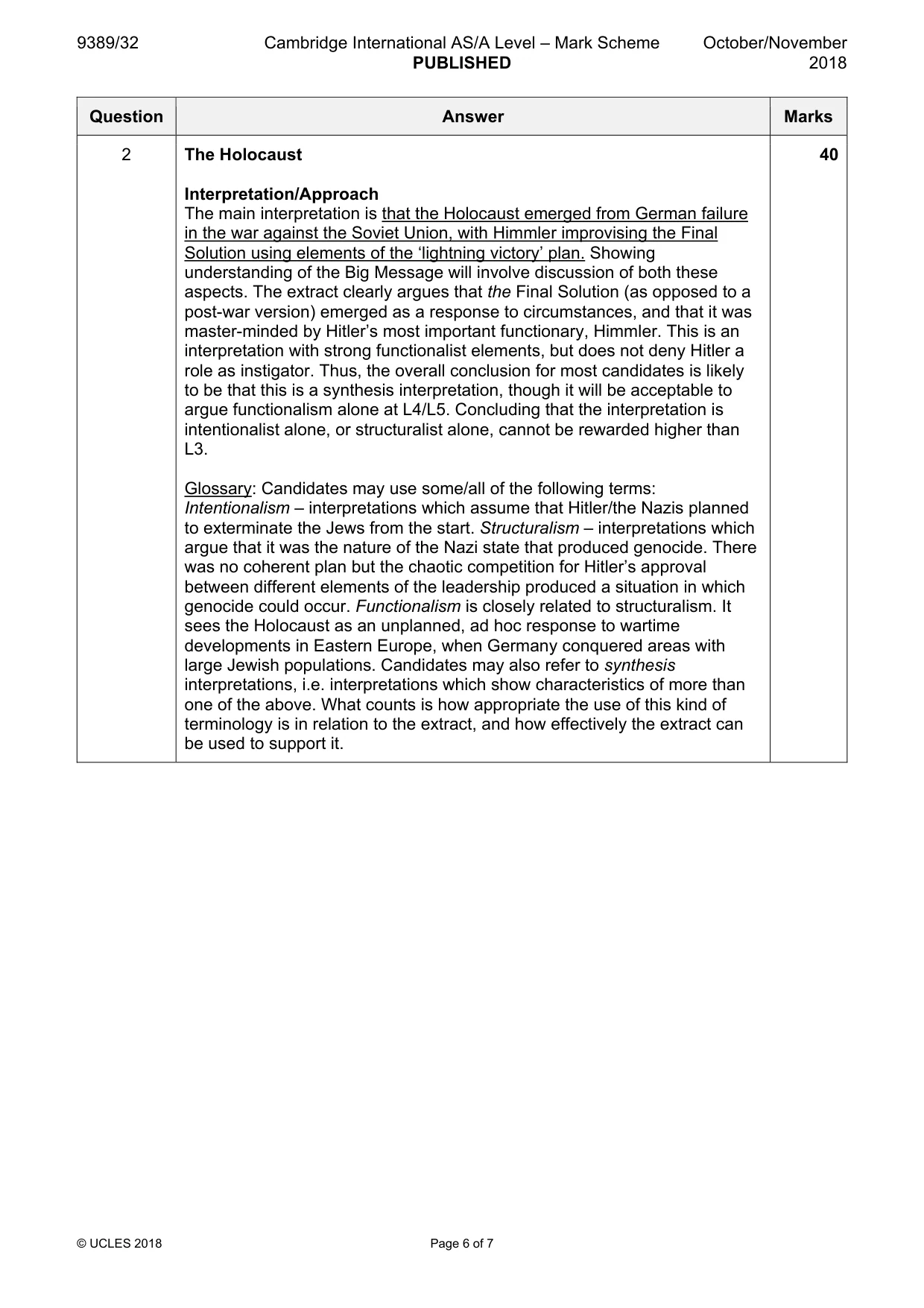
Mark scheme: 2 The Holocaust 40 Interpretation/Approach The main interpretation is that the Holocaust emerged from German failure in the war against the Soviet Union, with Himmler improvising the Final Solution using elements of the ‘lightning victory’ plan. Showing understanding of the Big Message will involve discussion of both these aspects. The extract clearly argues that the Final Solution (as opposed to a post-war version) emerged as a response to circumstances, and that it was master-minded by Hitler’s most important functionary, Himmler. This is an interpretation with strong functionalist elements, but does not deny Hitler a role as instigator. Thus, the overall conclusion for most candidates is likely to be that this is a synthesis interpretation, though it will be acceptable to argue functionalism alone at L4/L5. Concluding that the interpretation is intentionalist alone, or structuralist alone, cannot be rewarded higher than L3. Glossary: Candidates may use some/all of the following terms: Intentionalism – interpretations which assume that Hitler/the Nazis planned to exterminate the Jews from the start. Structuralism – interpretations which argue that it was the nature of the Nazi state that produced genocide. There was no coherent plan but the chaotic competition for Hitler’s approval between different elements of the leadership produced a situation in which genocide could occur. Functionalism is closely related to structuralism. It sees the Holocaust as an unplanned, ad hoc response to wartime developments in Eastern Europe, when Germany conquered areas with large Jewish populations. Candidates may also refer to synthesis interpretations, i.e. interpretations which show characteristics of more than one of the above. What counts is how appropriate the use of this kind of terminology is in relation to the extract, and how effectively the extract can be used to support it.
Q3 · Read the extract and then answer the question
3 Read the extract and then answer the question. By early 1947 President Truman and the American administration finally concluded that the USA would no longer tolerate the Communisation – either by conquest, civil war, or subversion – of any portion of Europe or the Near East that lay outside the Russian imperial sphere in Eastern Europe. The so-called Truman Doctrine, the Marshall Plan, and the Containment policy were the three principal instruments of this historic (and unavoidable) decision. In February 1947 the British government informed Washington that it could no longer alone sustain the armed struggle of the Greek state against the growing irregular tide of Communist guerrilla armies. Without hesitation, Truman assumed the burden. His Message to Congress in March 1947 called for American military aid to Greece and Turkey, which were being threatened by Russian pressure and blackmail. After some debate Congressional consent was given. From then on, American military missions and abundant supplies were sent to these Eastern Mediterranean countries. In about a year the Greek Army defeated the Communist guerrillas everywhere. It was evident from 1945 that American statesmen were more responsive to economic than political arguments when it came to the distressing problems of Europe. Based on the belief that Communism would primarily prosper from economic chaos, fortified by strong inclinations of American common sense as well as by traditional American institutional generosity toward poverty and distress abroad, the so-called Marshall Plan was proposed in June 1947. The United States was willing to support, in the form of goods, gifts and easy loans, the rebuilding of the war-torn economies of Britain and Europe. The aim of the Marshall Plan was the ultimate restoration of the balance in Europe by quickly getting the Western European nations to their feet again; but its purposes were broader politically and even more generous economically, since Marshall Aid was offered to Eastern Europe, including Russia, too. But Stalin refused to take it; indeed he forced his westernmost ally, the still semi-democratic Czechoslovakia, to reverse its original acceptance. Stalin’s purpose of dividing Europe was now clearer than ever before. Russian forces were not withdrawn from Hungary, Romania or Poland, where they were to guard communication lines to East Germany and eastern Austria, pending a German and Austrian peace treaty. About the latter the Council of Foreign Ministers was getting nowhere during endless debates. Through a variety of measures the Russians took ruthless advantage of the subject conditions of their captive European neighbours; and in 1947 Stalin speeded up the gradual Sovietisation of his prospective satellites. With the crudest methods, on occasion not even shunning the open involvement of Russian secret police, the representatives of the remaining democratic forces in Hungary, Romania, Bulgaria, Poland and East Germany were sometimes deported, at times imprisoned, on occasion silenced, and frequently chased into Western exile. Except for increasingly angry protests, the Western powers did little to intervene, even though Stalin’s brutalities greatly affected the free world. There was not much argument, therefore, about the wisdom of the American policy of Containment – in essence a political expression of the purpose that motivated the Truman Doctrine and the Marshall Plan. Since Communism preaches a never-ending struggle against the non-Communist world, in certain circumstances this preaching may turn into ruthless expansion unless it is met by the force of determined resistance. At least in Europe it was now the supreme interest of the USA to prohibit the further overflow of Soviet influence beyond the already swollen limits of Stalin’s new Russian Empire. This is the essence of the policy of Containment and it sums up the events of 1947. What can you learn from this extract about the interpretation and approach of the historian who wrote it? Use the extract and your knowledge of the Cold War to explain your answer. [40]
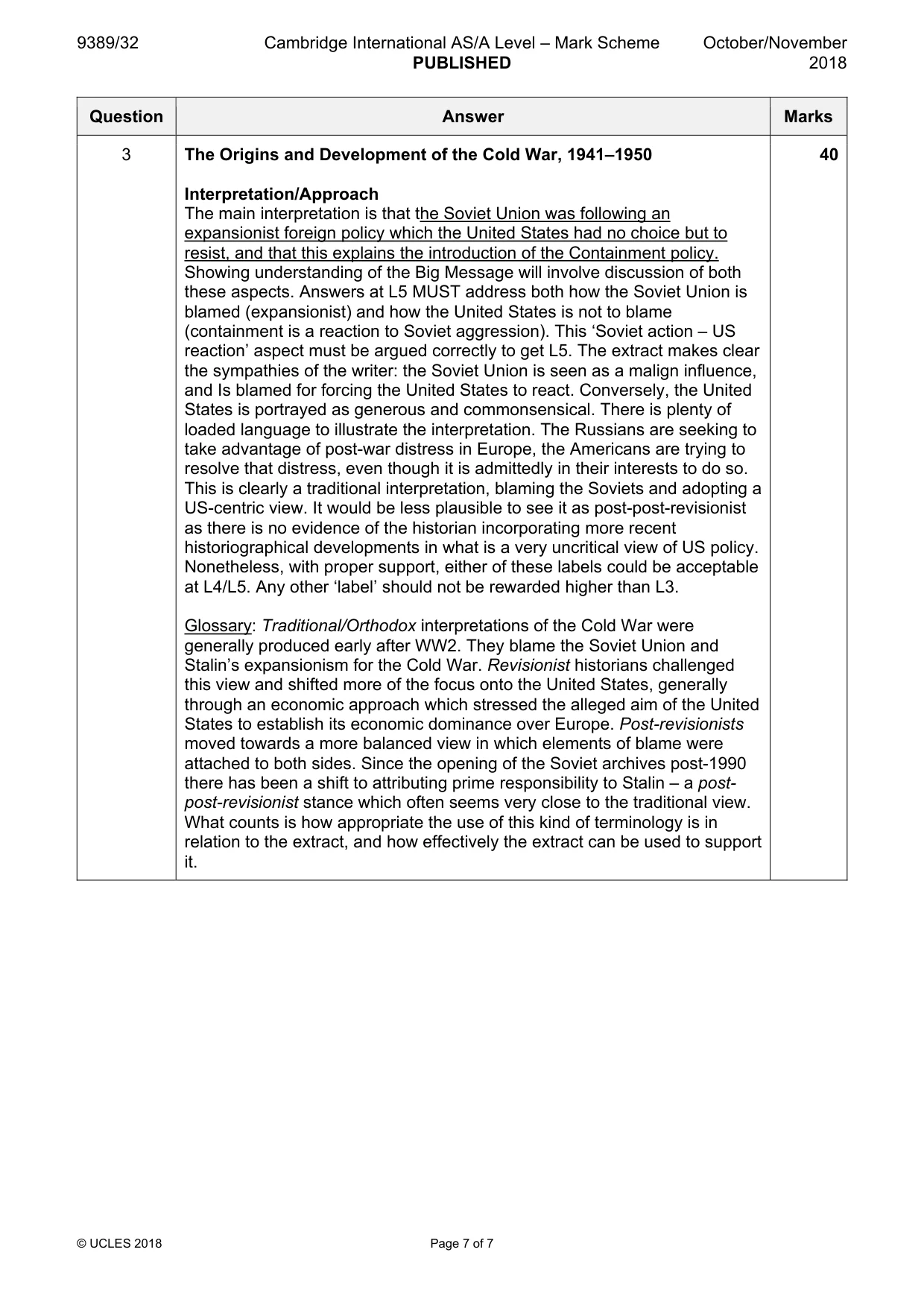
Mark scheme: 3 The Origins and Development of the Cold War, 1941–1950 40 Interpretation/Approach The main interpretation is that the Soviet Union was following an expansionist foreign policy which the United States had no choice but to resist, and that this explains the introduction of the Containment policy. Showing understanding of the Big Message will involve discussion of both these aspects. Answers at L5 MUST address both how the Soviet Union is blamed (expansionist) and how the United States is not to blame (containment is a reaction to Soviet aggression). This ‘Soviet action – US reaction’ aspect must be argued correctly to get L5. The extract makes clear the sympathies of the writer: the Soviet Union is seen as a malign influence, and Is blamed for forcing the United States to react. Conversely, the United States is portrayed as generous and commonsensical. There is plenty of loaded language to illustrate the interpretation. The Russians are seeking to take advantage of post-war distress in Europe, the Americans are trying to resolve that distress, even though it is admittedly in their interests to do so. This is clearly a traditional interpretation, blaming the Soviets and adopting a US-centric view. It would be less plausible to see it as post-post-revisionist as there is no evidence of the historian incorporating more recent historiographical developments in what is a very uncritical view of US policy. Nonetheless, with proper support, either of these labels could be acceptable at L4/L5. Any other ‘label’ should not be rewarded higher than L3. Glossary: Traditional/Orthodox interpretations of the Cold War were generally produced early after WW2. They blame the Soviet Union and Stalin’s expansionism for the Cold War. Revisionist historians challenged this view and shifted more of the focus onto the United States, generally through an economic approach which stressed the alleged aim of the United States to establish its economic dominance over Europe. Post-revisionists moved towards a more balanced view in which elements of blame were attached to both sides. Since the opening of the Soviet archives post-1990 there has been a shift to attributing prime responsibility to Stalin – a post- post-revisionist stance which often seems very close to the traditional view. What counts is how appropriate the use of this kind of terminology is in relation to the extract, and how effectively the extract can be used to support it.
What you needed in this session
Cambridge’s own grade thresholds for 2018 Oct/Nov, Paper 3 · Variant 2. A higher threshold means an easier paper — the bar moves with how the cohort did.