Cambridge A Level History 9389 — 2018 Oct/Nov Paper 3 · Variant 1
9389/31/O/N/18 · 3 questions · 40 marks · ≈45 min
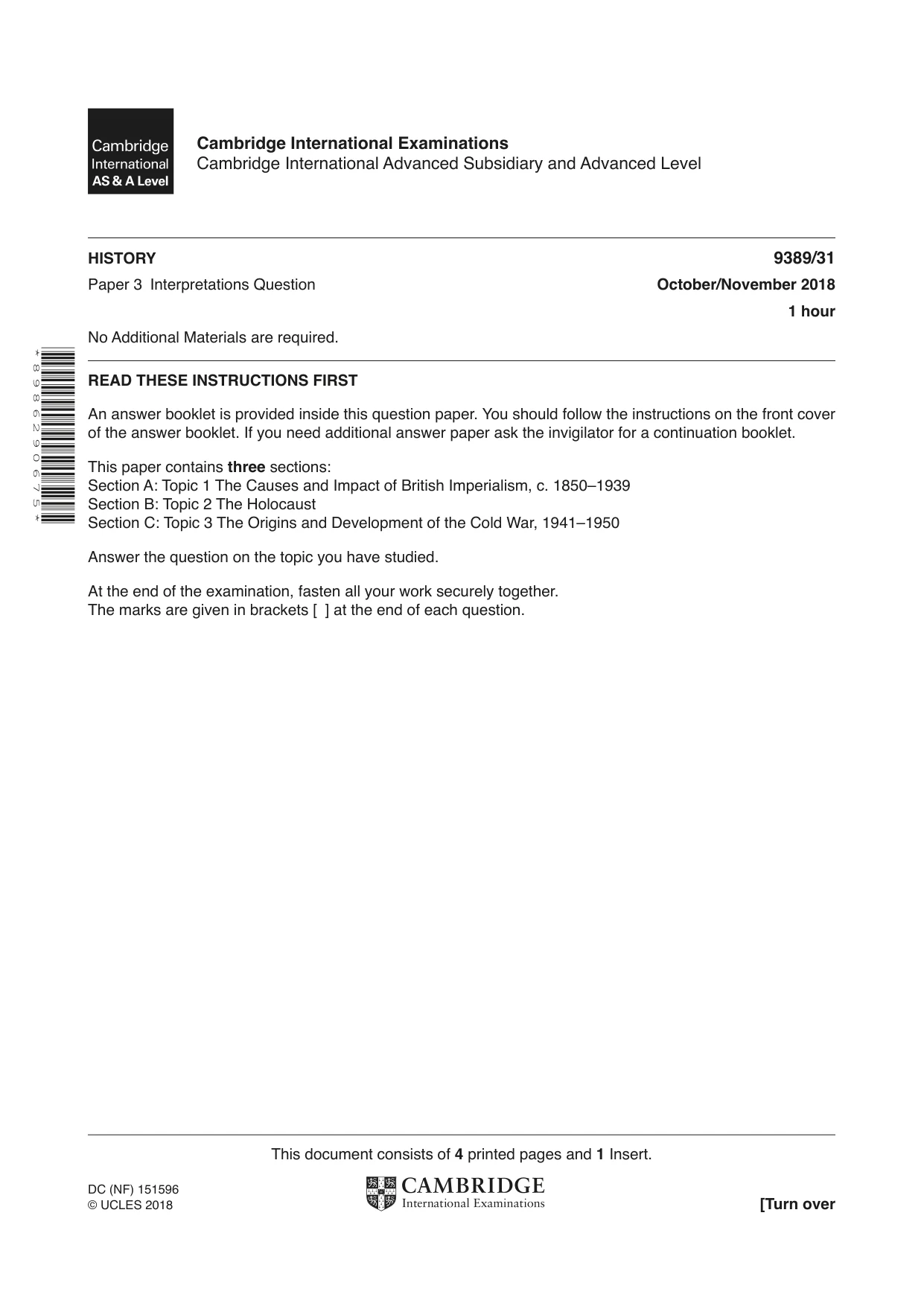
The question paper and its mark scheme, free to read here and free to download. This is Cambridge’s own paper, exactly as it was sat.
Question paper4 pages
Mark scheme7 pages
Answers below. Sit the paper first if you are practising.
Questions as text
Q1 · Read the extract and then answer the question
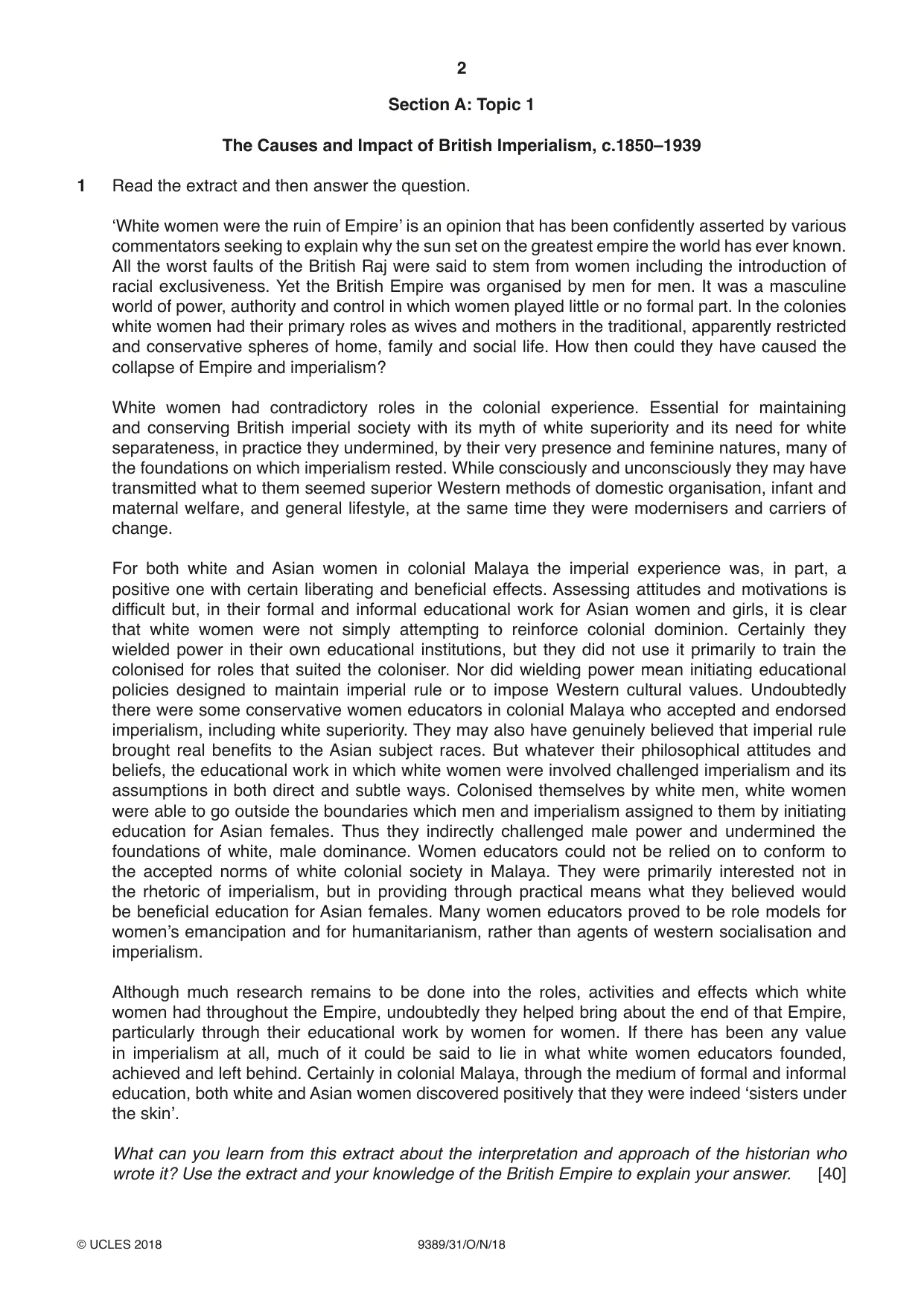
1 Read the extract and then answer the question. ‘White women were the ruin of Empire’ is an opinion that has been confidently asserted by various commentators seeking to explain why the sun set on the greatest empire the world has ever known. All the worst faults of the British Raj were said to stem from women including the introduction of racial exclusiveness. Yet the British Empire was organised by men for men. It was a masculine world of power, authority and control in which women played little or no formal part. In the colonies white women had their primary roles as wives and mothers in the traditional, apparently restricted and conservative spheres of home, family and social life. How then could they have caused the collapse of Empire and imperialism? White women had contradictory roles in the colonial experience. Essential for maintaining and conserving British imperial society with its myth of white superiority and its need for white separateness, in practice they undermined, by their very presence and feminine natures, many of the foundations on which imperialism rested. While consciously and unconsciously they may have transmitted what to them seemed superior Western methods of domestic organisation, infant and maternal welfare, and general lifestyle, at the same time they were modernisers and carriers of change. For both white and Asian women in colonial Malaya the imperial experience was, in part, a positive one with certain liberating and beneficial effects. Assessing attitudes and motivations is difficult but, in their formal and informal educational work for Asian women and girls, it is clear that white women were not simply attempting to reinforce colonial dominion. Certainly they wielded power in their own educational institutions, but they did not use it primarily to train the colonised for roles that suited the coloniser. Nor did wielding power mean initiating educational policies designed to maintain imperial rule or to impose Western cultural values. Undoubtedly there were some conservative women educators in colonial Malaya who accepted and endorsed imperialism, including white superiority. They may also have genuinely believed that imperial rule brought real benefits to the Asian subject races. But whatever their philosophical attitudes and beliefs, the educational work in which white women were involved challenged imperialism and its assumptions in both direct and subtle ways. Colonised themselves by white men, white women were able to go outside the boundaries which men and imperialism assigned to them by initiating education for Asian females. Thus they indirectly challenged male power and undermined the foundations of white, male dominance. Women educators could not be relied on to conform to the accepted norms of white colonial society in Malaya. They were primarily interested not in the rhetoric of imperialism, but in providing through practical means what they believed would be beneficial education for Asian females. Many women educators proved to be role models for women’s emancipation and for humanitarianism, rather than agents of western socialisation and imperialism. Although much research remains to be done into the roles, activities and effects which white women had throughout the Empire, undoubtedly they helped bring about the end of that Empire, particularly through their educational work by women for women. If there has been any value in imperialism at all, much of it could be said to lie in what white women educators founded, achieved and left behind. Certainly in colonial Malaya, through the medium of formal and informal education, both white and Asian women discovered positively that they were indeed ‘sisters under the skin’. What can you learn from this extract about the interpretation and approach of the historian who wrote it? Use the extract and your knowledge of the British Empire to explain your answer. [40]
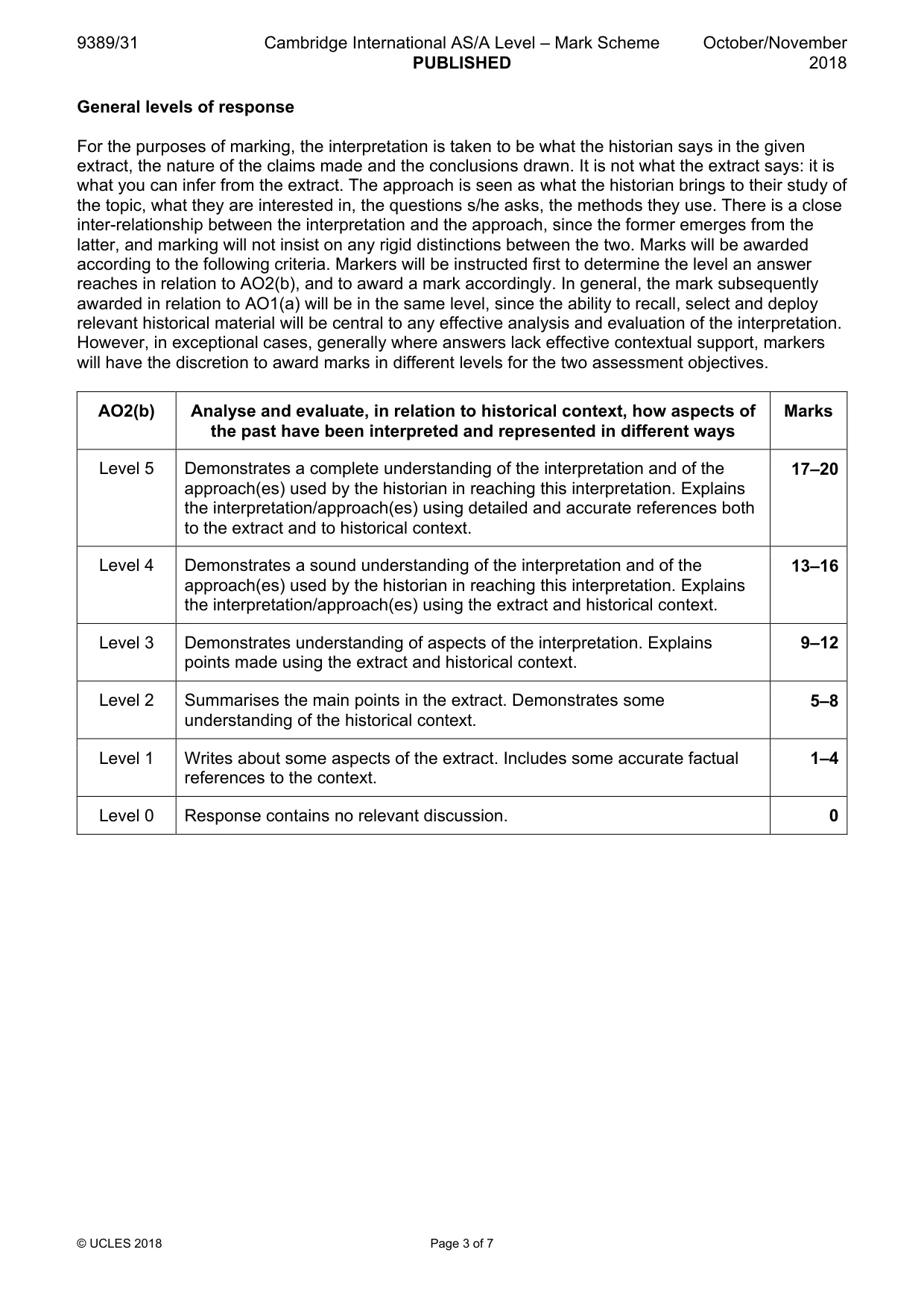
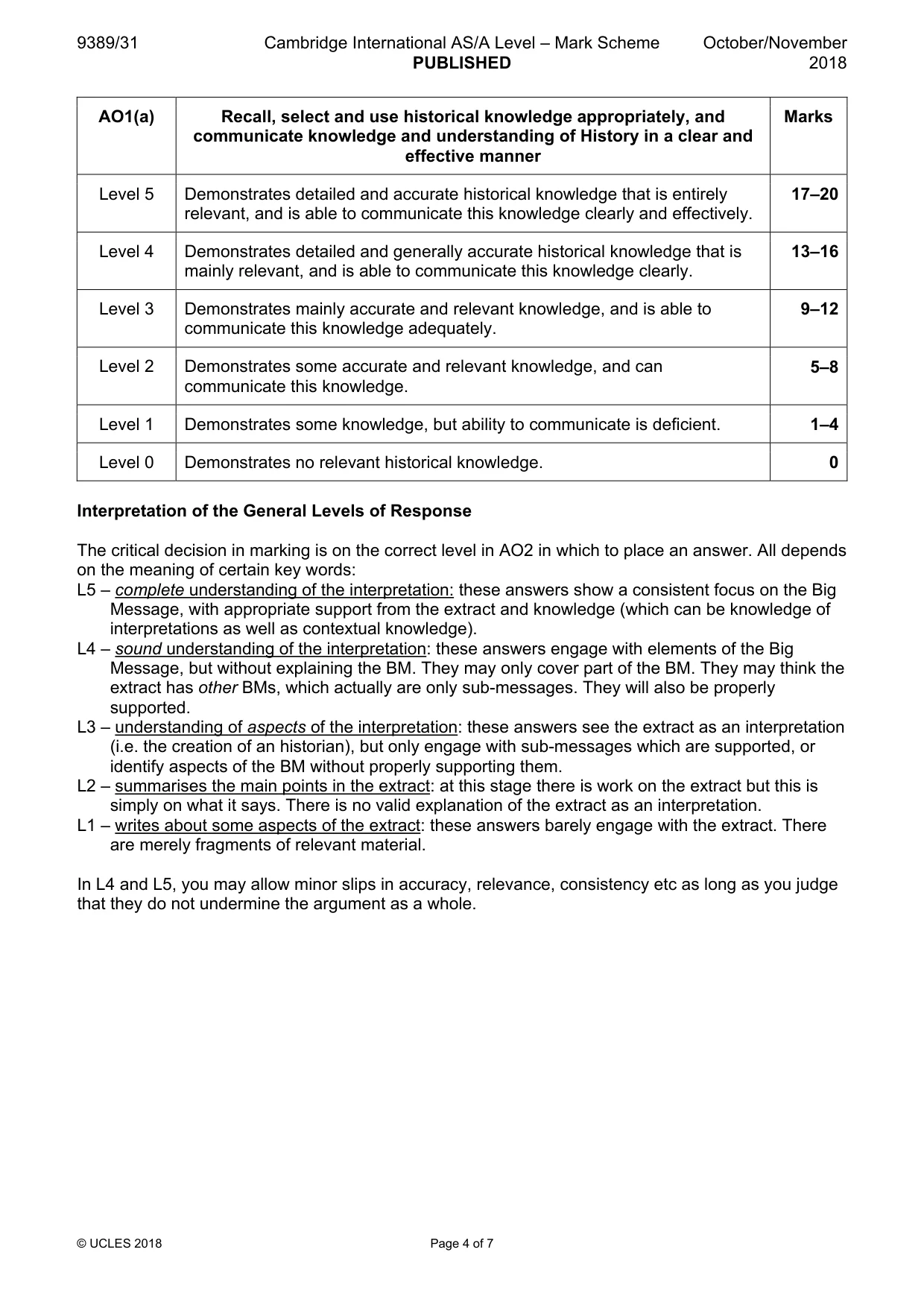
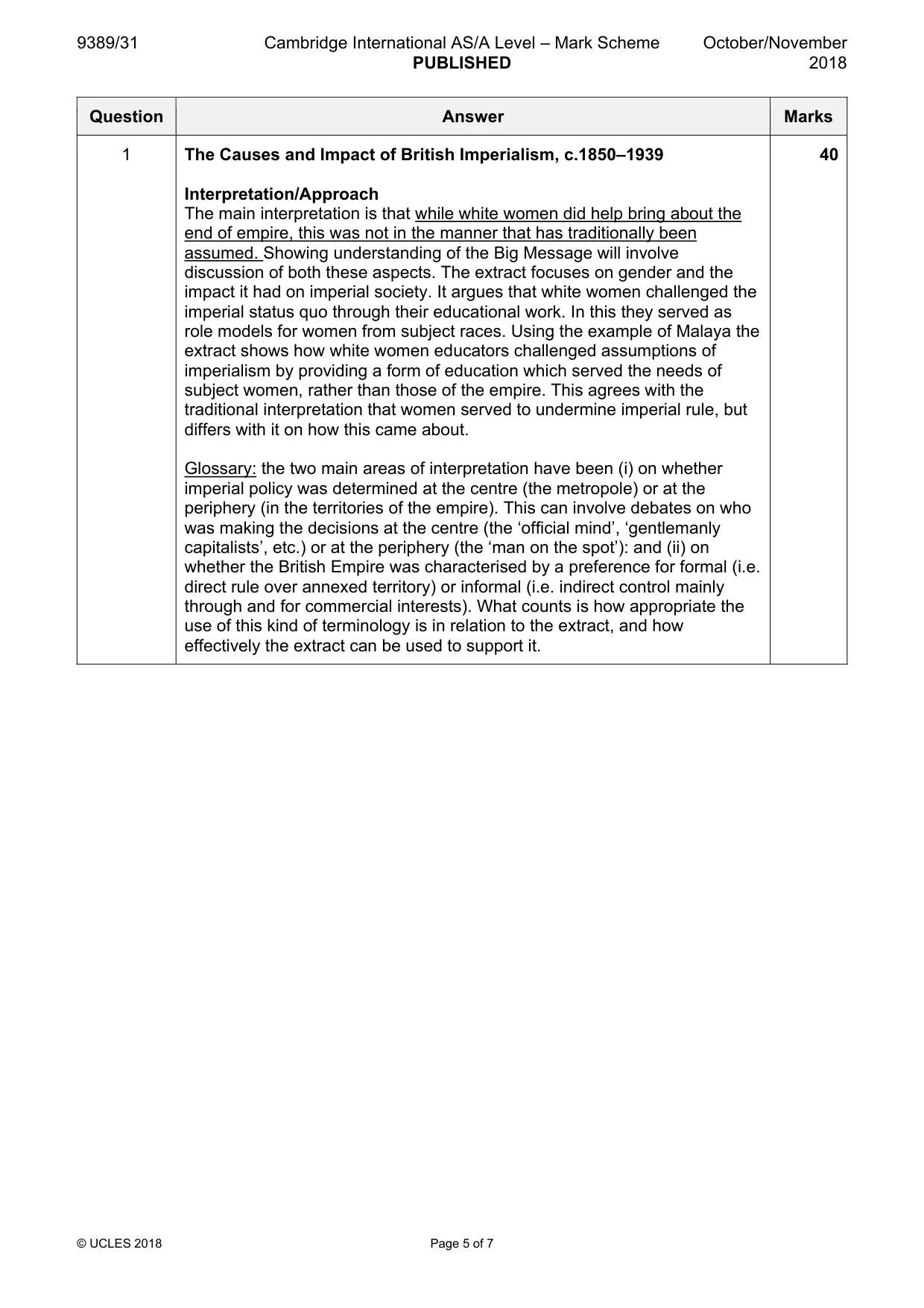
Mark scheme: Question Answer Marks 1 The Causes and Impact of British Imperialism, c.1850–1939 40 Interpretation/Approach The main interpretation is that while white women did help bring about the end of empire, this was not in the manner that has traditionally been assumed. Showing understanding of the Big Message will involve discussion of both these aspects. The extract focuses on gender and the impact it had on imperial society. It argues that white women challenged the imperial status quo through their educational work. In this they served as role models for women from subject races. Using the example of Malaya the extract shows how white women educators challenged assumptions of imperialism by providing a form of education which served the needs of subject women, rather than those of the empire. This agrees with the traditional interpretation that women served to undermine imperial rule, but differs with it on how this came about. Glossary: the two main areas of interpretation have been (i) on whether imperial policy was determined at the centre (the metropole) or at the periphery (in the territories of the empire). This can involve debates on who was making the decisions at the centre (the ‘official mind’, ‘gentlemanly capitalists’, etc.) or at the periphery (the ‘man on the spot’): and (ii) on whether the British Empire was characterised by a preference for formal (i.e. direct rule over annexed territory) or informal (i.e. indirect control mainly through and for commercial interests). What counts is how appropriate the use of this kind of terminology is in relation to the extract, and how effectively the extract can be used to support it.
Q2 · Read the extract and then answer the question
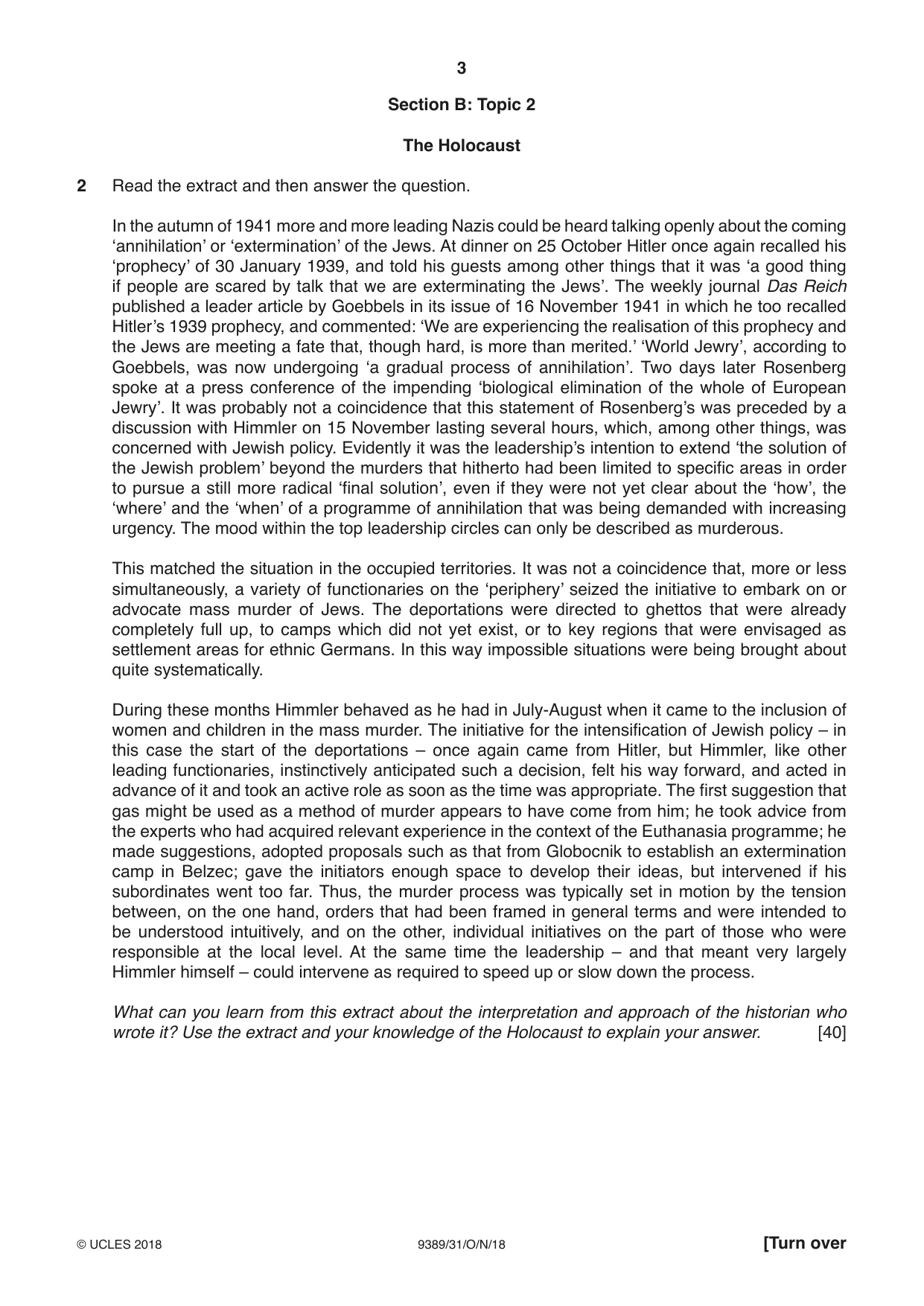
2 Read the extract and then answer the question. In the autumn of 1941 more and more leading Nazis could be heard talking openly about the coming ‘annihilation’ or ‘extermination’ of the Jews. At dinner on 25 October Hitler once again recalled his ‘prophecy’ of 30 January 1939, and told his guests among other things that it was ‘a good thing if people are scared by talk that we are exterminating the Jews’. The weekly journal Das Reich published a leader article by Goebbels in its issue of 16 November 1941 in which he too recalled Hitler’s 1939 prophecy, and commented: ‘We are experiencing the realisation of this prophecy and the Jews are meeting a fate that, though hard, is more than merited.’ ‘World Jewry’, according to Goebbels, was now undergoing ‘a gradual process of annihilation’. Two days later Rosenberg spoke at a press conference of the impending ‘biological elimination of the whole of European Jewry’. It was probably not a coincidence that this statement of Rosenberg’s was preceded by a discussion with Himmler on 15 November lasting several hours, which, among other things, was concerned with Jewish policy. Evidently it was the leadership’s intention to extend ‘the solution of the Jewish problem’ beyond the murders that hitherto had been limited to specific areas in order to pursue a still more radical ‘final solution’, even if they were not yet clear about the ‘how’, the ‘where’ and the ‘when’ of a programme of annihilation that was being demanded with increasing urgency. The mood within the top leadership circles can only be described as murderous. This matched the situation in the occupied territories. It was not a coincidence that, more or less simultaneously, a variety of functionaries on the ‘periphery’ seized the initiative to embark on or advocate mass murder of Jews. The deportations were directed to ghettos that were already completely full up, to camps which did not yet exist, or to key regions that were envisaged as settlement areas for ethnic Germans. In this way impossible situations were being brought about quite systematically. During these months Himmler behaved as he had in July-August when it came to the inclusion of women and children in the mass murder. The initiative for the intensification of Jewish policy – in this case the start of the deportations – once again came from Hitler, but Himmler, like other leading functionaries, instinctively anticipated such a decision, felt his way forward, and acted in advance of it and took an active role as soon as the time was appropriate. The first suggestion that gas might be used as a method of murder appears to have come from him; he took advice from the experts who had acquired relevant experience in the context of the Euthanasia programme; he made suggestions, adopted proposals such as that from Globocnik to establish an extermination camp in Belzec; gave the initiators enough space to develop their ideas, but intervened if his subordinates went too far. Thus, the murder process was typically set in motion by the tension between, on the one hand, orders that had been framed in general terms and were intended to be understood intuitively, and on the other, individual initiatives on the part of those who were responsible at the local level. At the same time the leadership – and that meant very largely Himmler himself – could intervene as required to speed up or slow down the process. What can you learn from this extract about the interpretation and approach of the historian who wrote it? Use the extract and your knowledge of the Holocaust to explain your answer. [40] Section C: Topic 3 The Origins and Development of the Cold War, 1941–1950
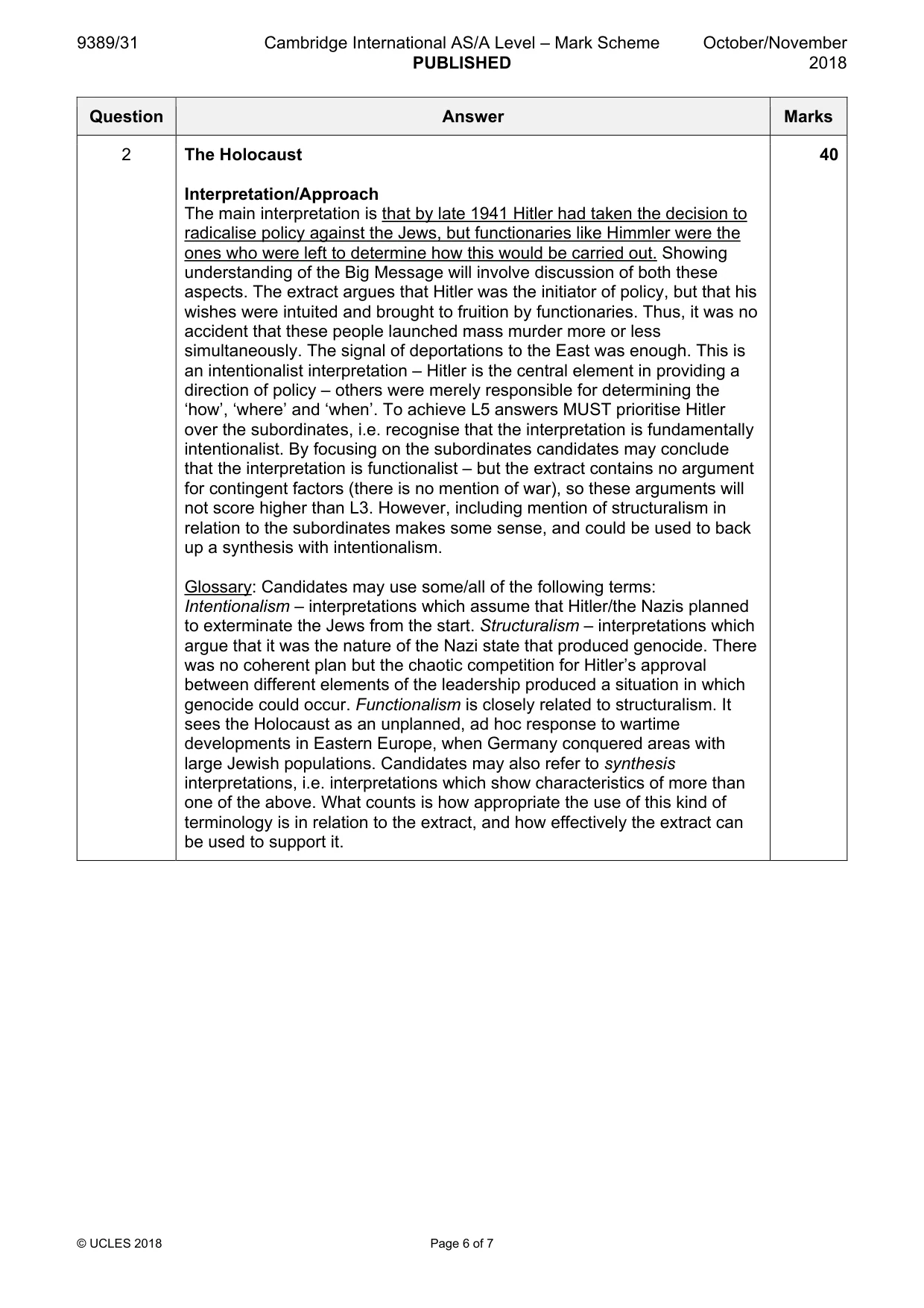
Mark scheme: 2 The Holocaust 40 Interpretation/Approach The main interpretation is that by late 1941 Hitler had taken the decision to radicalise policy against the Jews, but functionaries like Himmler were the ones who were left to determine how this would be carried out. Showing understanding of the Big Message will involve discussion of both these aspects. The extract argues that Hitler was the initiator of policy, but that his wishes were intuited and brought to fruition by functionaries. Thus, it was no accident that these people launched mass murder more or less simultaneously. The signal of deportations to the East was enough. This is an intentionalist interpretation – Hitler is the central element in providing a direction of policy – others were merely responsible for determining the ‘how’, ‘where’ and ‘when’. To achieve L5 answers MUST prioritise Hitler over the subordinates, i.e. recognise that the interpretation is fundamentally intentionalist. By focusing on the subordinates candidates may conclude that the interpretation is functionalist – but the extract contains no argument for contingent factors (there is no mention of war), so these arguments will not score higher than L3. However, including mention of structuralism in relation to the subordinates makes some sense, and could be used to back up a synthesis with intentionalism. Glossary: Candidates may use some/all of the following terms: Intentionalism – interpretations which assume that Hitler/the Nazis planned to exterminate the Jews from the start. Structuralism – interpretations which argue that it was the nature of the Nazi state that produced genocide. There was no coherent plan but the chaotic competition for Hitler’s approval between different elements of the leadership produced a situation in which genocide could occur. Functionalism is closely related to structuralism. It sees the Holocaust as an unplanned, ad hoc response to wartime developments in Eastern Europe, when Germany conquered areas with large Jewish populations. Candidates may also refer to synthesis interpretations, i.e. interpretations which show characteristics of more than one of the above. What counts is how appropriate the use of this kind of terminology is in relation to the extract, and how effectively the extract can be used to support it.
Q3 · Read the extract and then answer the question
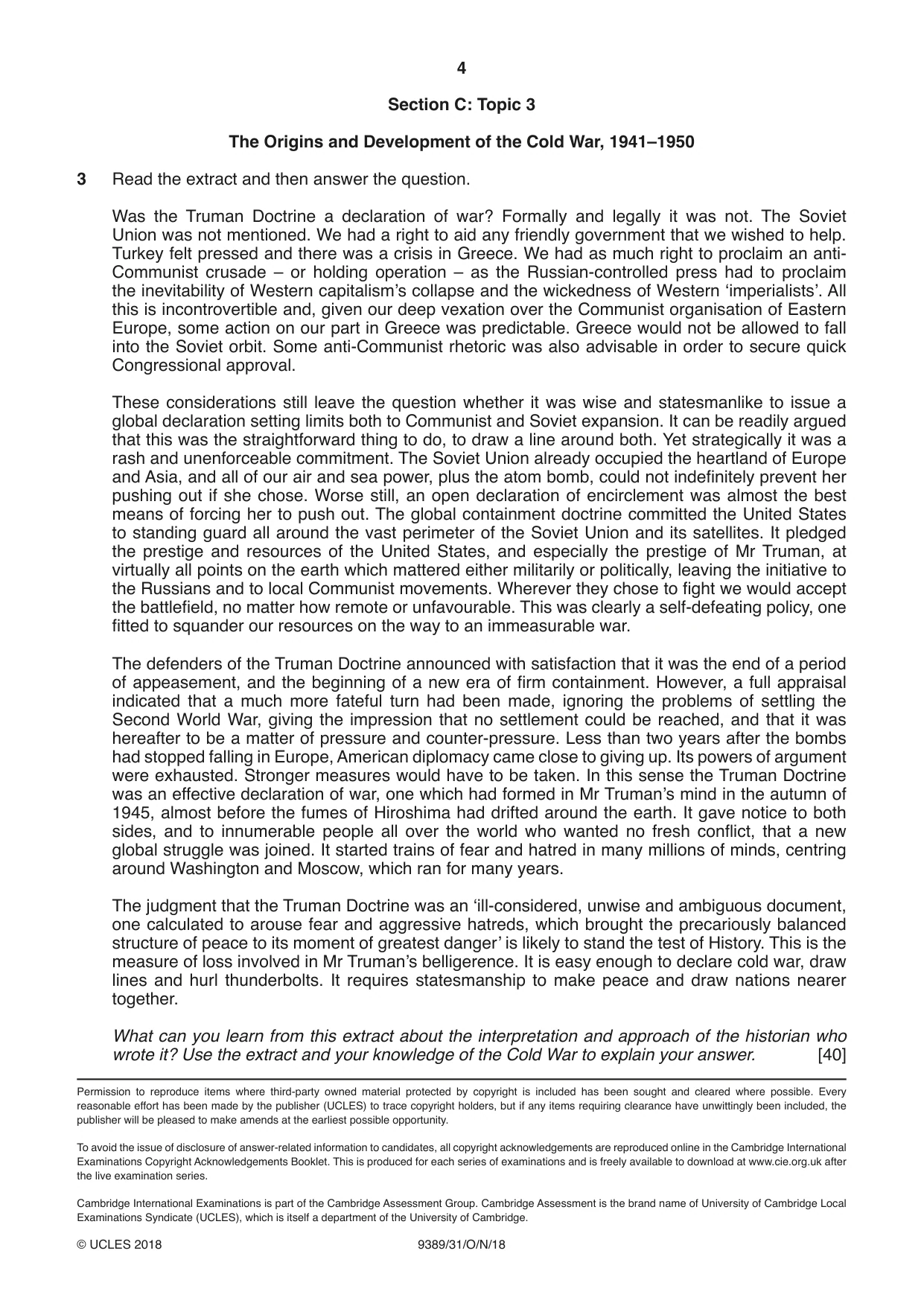
3 Read the extract and then answer the question. Was the Truman Doctrine a declaration of war? Formally and legally it was not. The Soviet Union was not mentioned. We had a right to aid any friendly government that we wished to help. Turkey felt pressed and there was a crisis in Greece. We had as much right to proclaim an anti- Communist crusade – or holding operation – as the Russian-controlled press had to proclaim the inevitability of Western capitalism’s collapse and the wickedness of Western ‘imperialists’. All this is incontrovertible and, given our deep vexation over the Communist organisation of Eastern Europe, some action on our part in Greece was predictable. Greece would not be allowed to fall into the Soviet orbit. Some anti-Communist rhetoric was also advisable in order to secure quick Congressional approval. These considerations still leave the question whether it was wise and statesmanlike to issue a global declaration setting limits both to Communist and Soviet expansion. It can be readily argued that this was the straightforward thing to do, to draw a line around both. Yet strategically it was a rash and unenforceable commitment. The Soviet Union already occupied the heartland of Europe and Asia, and all of our air and sea power, plus the atom bomb, could not indefinitely prevent her pushing out if she chose. Worse still, an open declaration of encirclement was almost the best means of forcing her to push out. The global containment doctrine committed the United States to standing guard all around the vast perimeter of the Soviet Union and its satellites. It pledged the prestige and resources of the United States, and especially the prestige of Mr Truman, at virtually all points on the earth which mattered either militarily or politically, leaving the initiative to the Russians and to local Communist movements. Wherever they chose to fight we would accept the battlefield, no matter how remote or unfavourable. This was clearly a self-defeating policy, one fitted to squander our resources on the way to an immeasurable war. The defenders of the Truman Doctrine announced with satisfaction that it was the end of a period of appeasement, and the beginning of a new era of firm containment. However, a full appraisal indicated that a much more fateful turn had been made, ignoring the problems of settling the Second World War, giving the impression that no settlement could be reached, and that it was hereafter to be a matter of pressure and counter-pressure. Less than two years after the bombs had stopped falling in Europe, American diplomacy came close to giving up. Its powers of argument were exhausted. Stronger measures would have to be taken. In this sense the Truman Doctrine was an effective declaration of war, one which had formed in Mr Truman’s mind in the autumn of 1945, almost before the fumes of Hiroshima had drifted around the earth. It gave notice to both sides, and to innumerable people all over the world who wanted no fresh conflict, that a new global struggle was joined. It started trains of fear and hatred in many millions of minds, centring around Washington and Moscow, which ran for many years. The judgment that the Truman Doctrine was an ‘ill-considered, unwise and ambiguous document, one calculated to arouse fear and aggressive hatreds, which brought the precariously balanced structure of peace to its moment of greatest danger’ is likely to stand the test of History. This is the measure of loss involved in Mr Truman’s belligerence. It is easy enough to declare cold war, draw lines and hurl thunderbolts. It requires statesmanship to make peace and draw nations nearer together. What can you learn from this extract about the interpretation and approach of the historian who wrote it? Use the extract and your knowledge of the Cold War to explain your answer. [40]
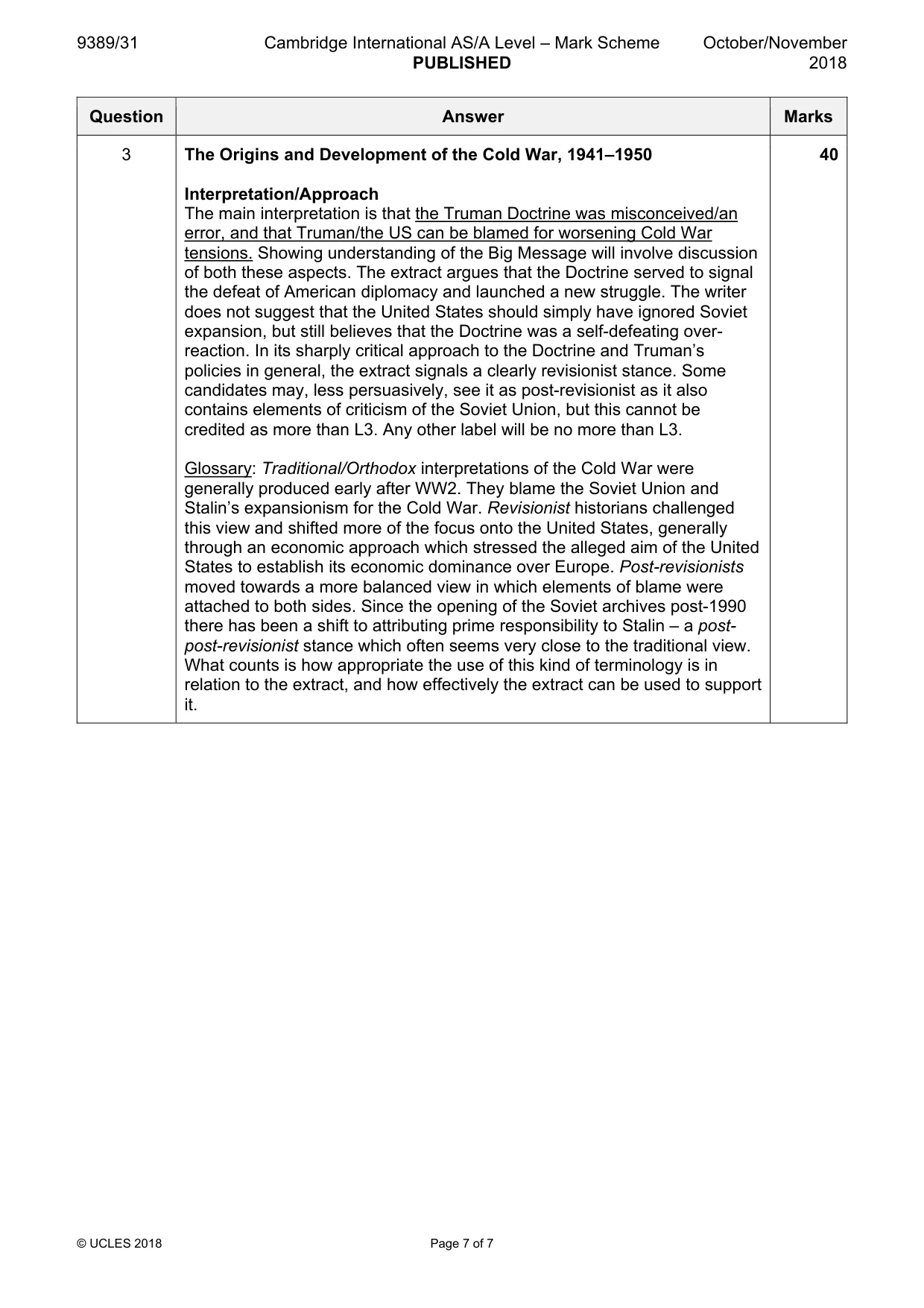
Mark scheme: 3 The Origins and Development of the Cold War, 1941–1950 40 Interpretation/Approach The main interpretation is that the Truman Doctrine was misconceived/an error, and that Truman/the US can be blamed for worsening Cold War tensions. Showing understanding of the Big Message will involve discussion of both these aspects. The extract argues that the Doctrine served to signal the defeat of American diplomacy and launched a new struggle. The writer does not suggest that the United States should simply have ignored Soviet expansion, but still believes that the Doctrine was a self-defeating over- reaction. In its sharply critical approach to the Doctrine and Truman’s policies in general, the extract signals a clearly revisionist stance. Some candidates may, less persuasively, see it as post-revisionist as it also contains elements of criticism of the Soviet Union, but this cannot be credited as more than L3. Any other label will be no more than L3. Glossary: Traditional/Orthodox interpretations of the Cold War were generally produced early after WW2. They blame the Soviet Union and Stalin’s expansionism for the Cold War. Revisionist historians challenged this view and shifted more of the focus onto the United States, generally through an economic approach which stressed the alleged aim of the United States to establish its economic dominance over Europe. Post-revisionists moved towards a more balanced view in which elements of blame were attached to both sides. Since the opening of the Soviet archives post-1990 there has been a shift to attributing prime responsibility to Stalin – a post- post-revisionist stance which often seems very close to the traditional view. What counts is how appropriate the use of this kind of terminology is in relation to the extract, and how effectively the extract can be used to support it.
What you needed in this session
Cambridge’s own grade thresholds for 2018 Oct/Nov, Paper 3 · Variant 1. A higher threshold means an easier paper — the bar moves with how the cohort did.