Cambridge A Level History 9389 — 2018 Oct/Nov Paper 2 · Variant 3
9389/23/O/N/18 · 12 questions · 60 marks · ≈68 min
The question paper and its mark scheme, free to read here and free to download. This is Cambridge’s own paper, exactly as it was sat.
Question paper4 pages
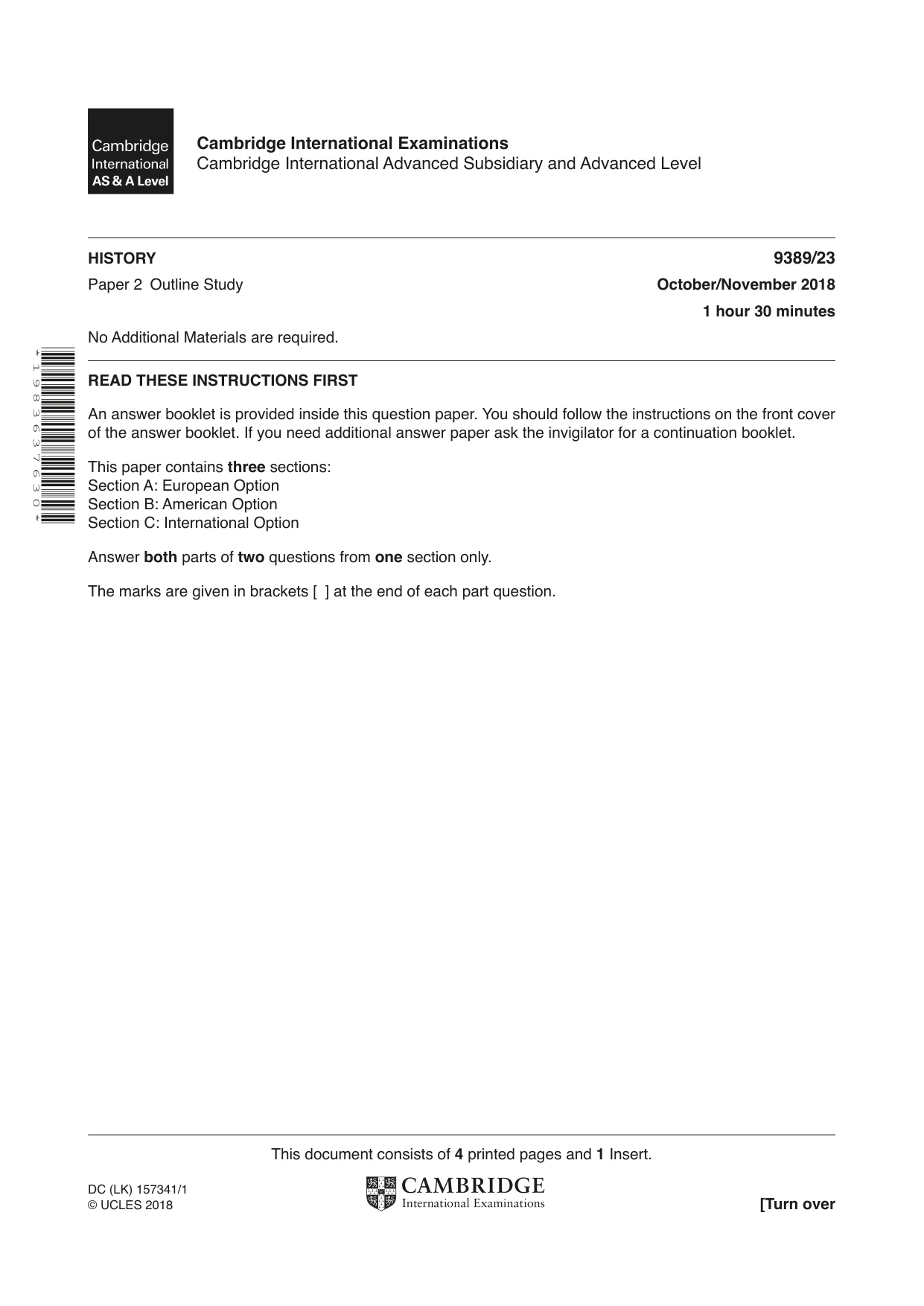
Mark scheme26 pages
Answers below. Sit the paper first if you are practising.

Questions as text
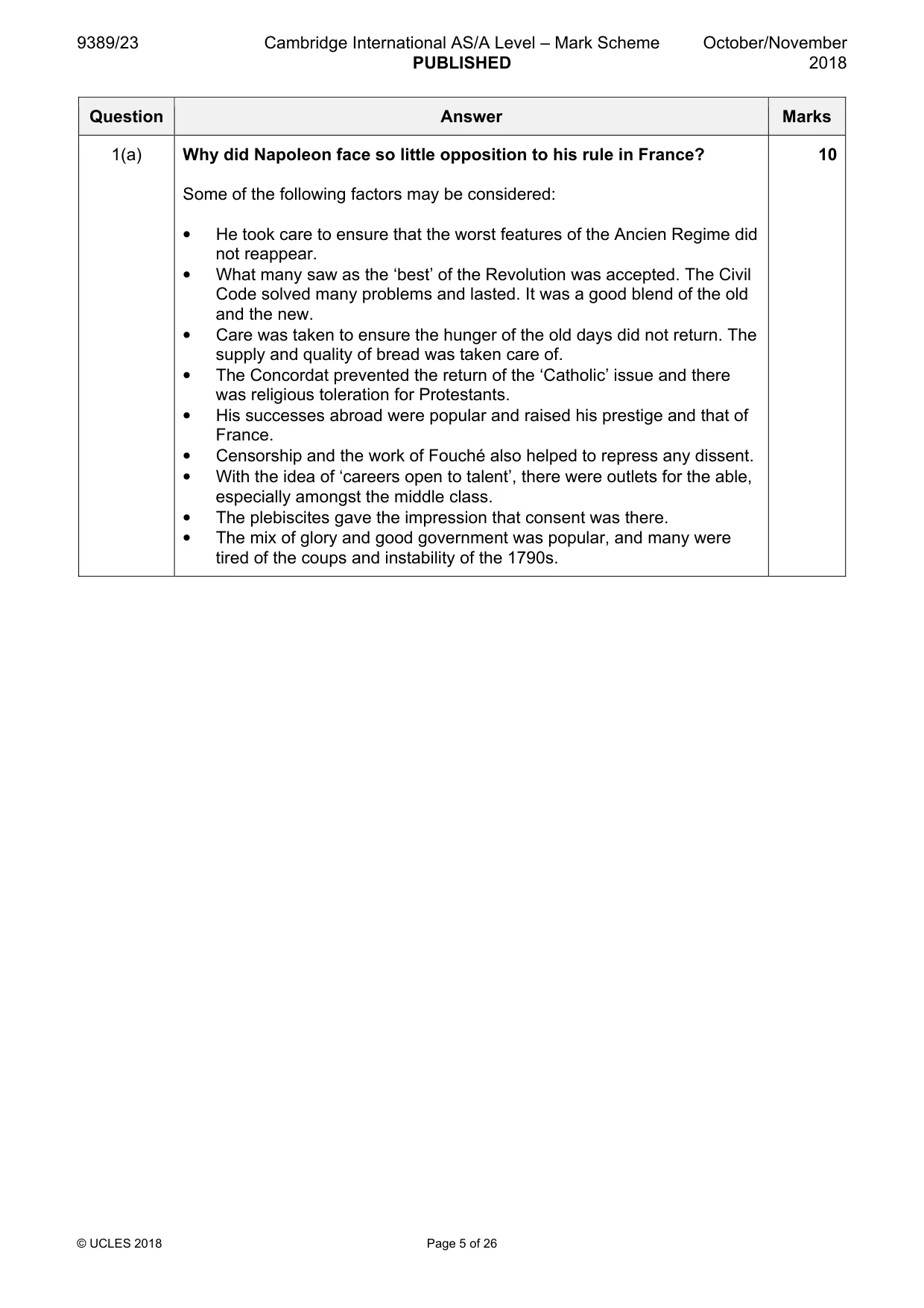
Q1 · France, 1789–1814 (a) Why did Napoleon face so little opposition to his rule in France?
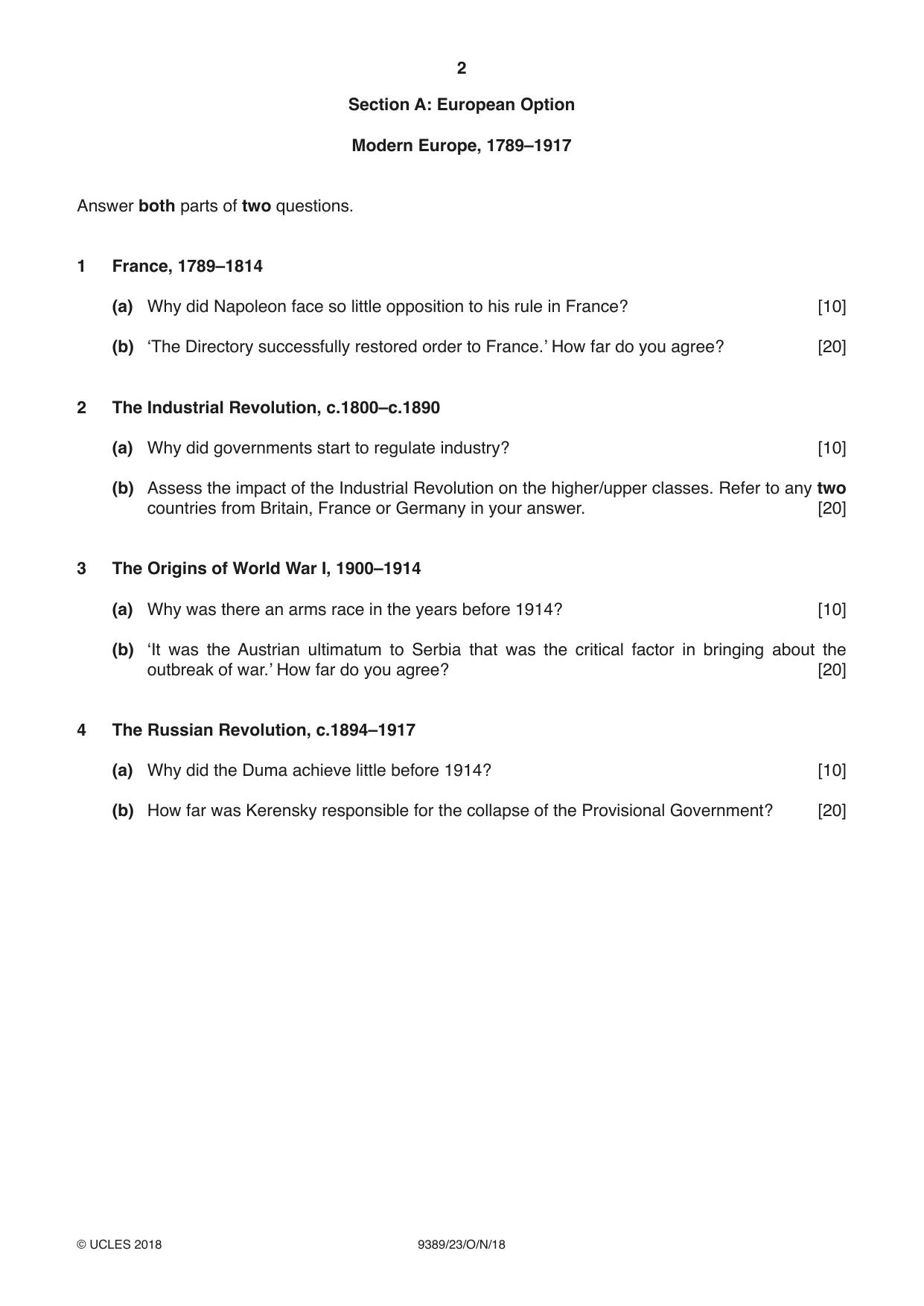
1 France, 1789–1814 (a) Why did Napoleon face so little opposition to his rule in France? [10] (b) ‘The Directory successfully restored order to France.’ How far do you agree? [20]
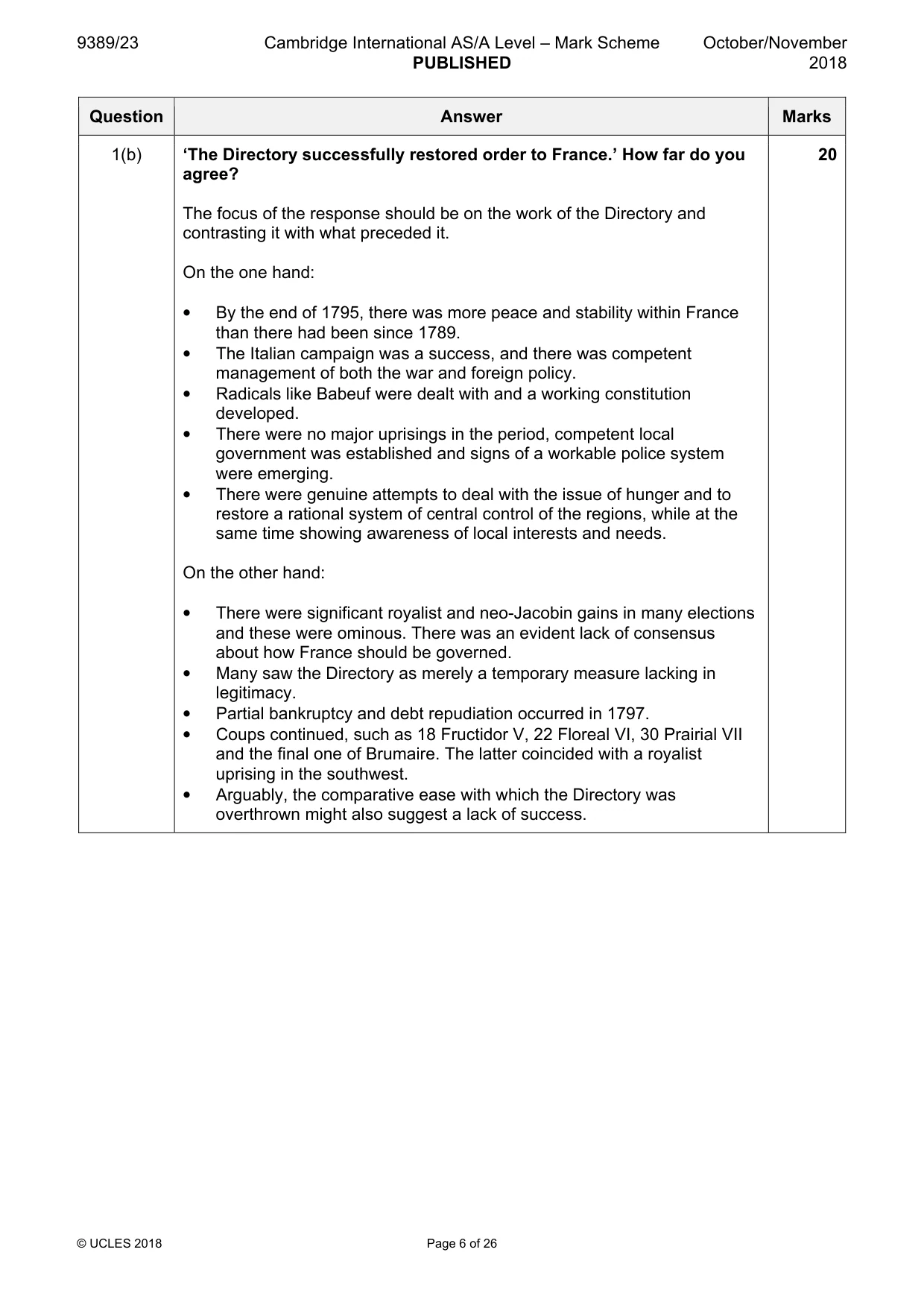
Mark scheme: Question Answer Marks 1(a) Why did Napoleon face so little opposition to his rule in France? 10 Some of the following factors may be considered: • He took care to ensure that the worst features of the Ancien Regime did not reappear. • What many saw as the ‘best’ of the Revolution was accepted. The Civil Code solved many problems and lasted. It was a good blend of the old and the new. • Care was taken to ensure the hunger of the old days did not return. The supply and quality of bread was taken care of. • The Concordat prevented the return of the ‘Catholic’ issue and there was religious toleration for Protestants. • His successes abroad were popular and raised his prestige and that of France. • Censorship and the work of Fouché also helped to repress any dissent. • With the idea of ‘careers open to talent’, there were outlets for the able, especially amongst the middle class. • The plebiscites gave the impression that consent was there. • The mix of glory and good government was popular, and many were tired of the coups and instability of the 1790s. 1(b) ‘The Directory successfully restored order to France.’ How far do you 20 agree? The focus of the response should be on the work of the Directory and contrasting it with what preceded it. On the one hand: • By the end of 1795, there was more peace and stability within France than there had been since 1789. • The Italian campaign was a success, and there was competent management of both the war and foreign policy. • Radicals like Babeuf were dealt with and a working constitution developed. • There were no major uprisings in the period, competent local government was established and signs of a workable police system were emerging. • There were genuine attempts to deal with the issue of hunger and to restore a rational system of central control of the regions, while at the same time showing awareness of local interests and needs. On the other hand: • There were significant royalist and neo-Jacobin gains in many elections and these were ominous. There was an evident lack of consensus about how France should be governed. • Many saw the Directory as merely a temporary measure lacking in legitimacy. • Partial bankruptcy and debt repudiation occurred in 1797. • Coups continued, such as 18 Fructidor V, 22 Floreal VI, 30 Prairial VII and the final one of Brumaire. The latter coincided with a royalist uprising in the southwest. • Arguably, the comparative ease with which the Directory was overthrown might also suggest a lack of success.
Q2 · The Industrial Revolution, c.1800–c.1890 (a) Why did governments start to regulate…
2 The Industrial Revolution, c.1800–c.1890 (a) Why did governments start to regulate industry? [10] (b) Assess the impact of the Industrial Revolution on the higher/upper classes. Refer to any two countries from Britain, France or Germany in your answer. [20]
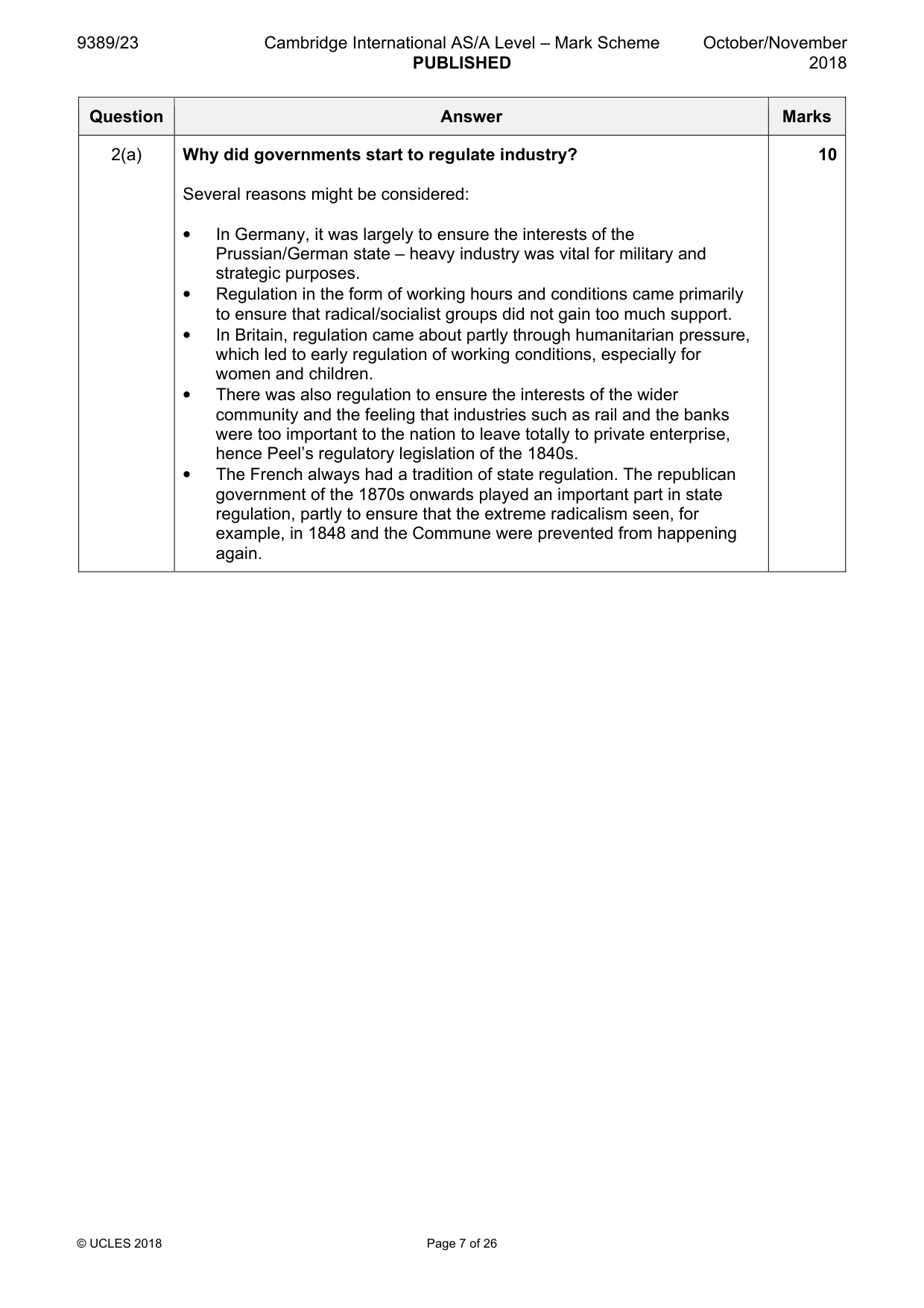
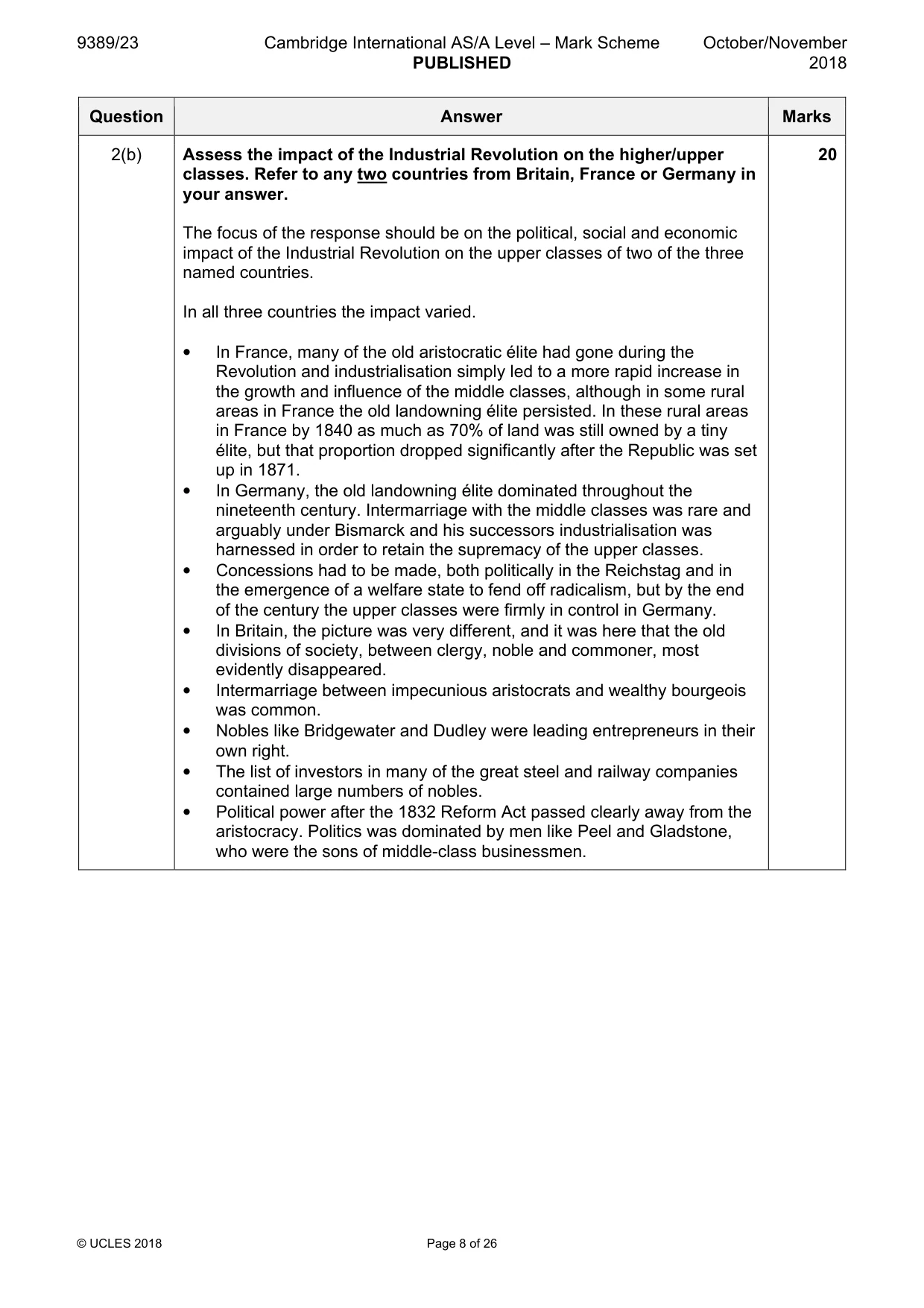
Mark scheme: 2(a) Why did governments start to regulate industry? 10 Several reasons might be considered: • In Germany, it was largely to ensure the interests of the Prussian/German state – heavy industry was vital for military and strategic purposes. • Regulation in the form of working hours and conditions came primarily to ensure that radical/socialist groups did not gain too much support. • In Britain, regulation came about partly through humanitarian pressure, which led to early regulation of working conditions, especially for women and children. • There was also regulation to ensure the interests of the wider community and the feeling that industries such as rail and the banks were too important to the nation to leave totally to private enterprise, hence Peel’s regulatory legislation of the 1840s. • The French always had a tradition of state regulation. The republican government of the 1870s onwards played an important part in state regulation, partly to ensure that the extreme radicalism seen, for example, in 1848 and the Commune were prevented from happening again. 2(b) Assess the impact of the Industrial Revolution on the higher/upper 20 classes. Refer to any two countries from Britain, France or Germany in your answer. The focus of the response should be on the political, social and economic impact of the Industrial Revolution on the upper classes of two of the three named countries. In all three countries the impact varied. • In France, many of the old aristocratic élite had gone during the Revolution and industrialisation simply led to a more rapid increase in the growth and influence of the middle classes, although in some rural areas in France the old landowning élite persisted. In these rural areas in France by 1840 as much as 70% of land was still owned by a tiny élite, but that proportion dropped significantly after the Republic was set up in 1871. • In Germany, the old landowning élite dominated throughout the nineteenth century. Intermarriage with the middle classes was rare and arguably under Bismarck and his successors industrialisation was harnessed in order to retain the supremacy of the upper classes. • Concessions had to be made, both politically in the Reichstag and in the emergence of a welfare state to fend off radicalism, but by the end of the century the upper classes were firmly in control in Germany. • In Britain, the picture was very different, and it was here that the old divisions of society, between clergy, noble and commoner, most evidently disappeared. • Intermarriage between impecunious aristocrats and wealthy bourgeois was common. • Nobles like Bridgewater and Dudley were leading entrepreneurs in their own right. • The list of investors in many of the great steel and railway companies contained large numbers of nobles. • Political power after the 1832 Reform Act passed clearly away from the aristocracy. Politics was dominated by men like Peel and Gladstone, who were the sons of middle-class businessmen.
Q3 · The Origins of World War I, 1900–1914 (a) Why was there an arms race in the years before…
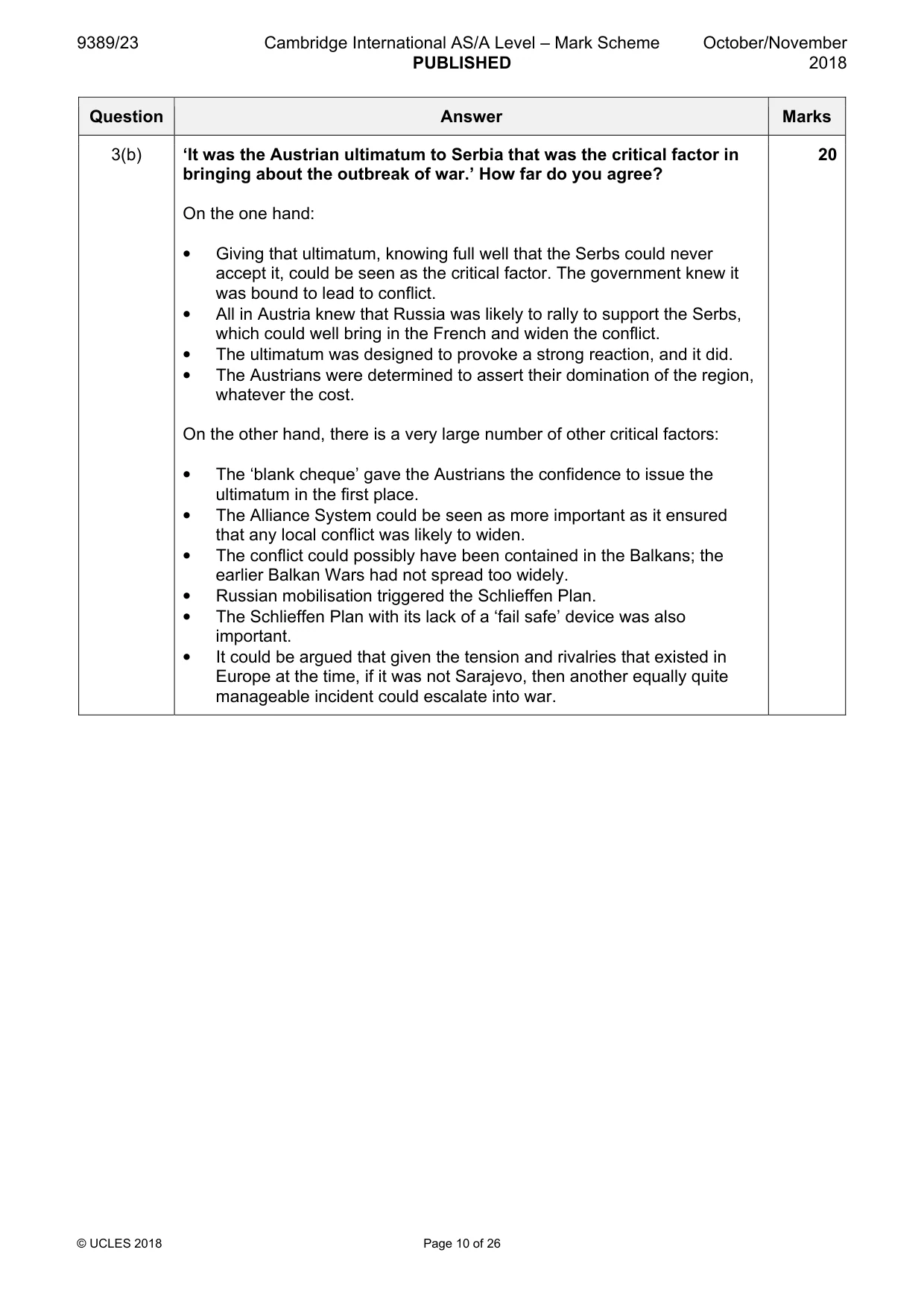
3 The Origins of World War I, 1900–1914 (a) Why was there an arms race in the years before 1914? [10] (b) ‘It was the Austrian ultimatum to Serbia that was the critical factor in bringing about the outbreak of war.’ How far do you agree? [20]
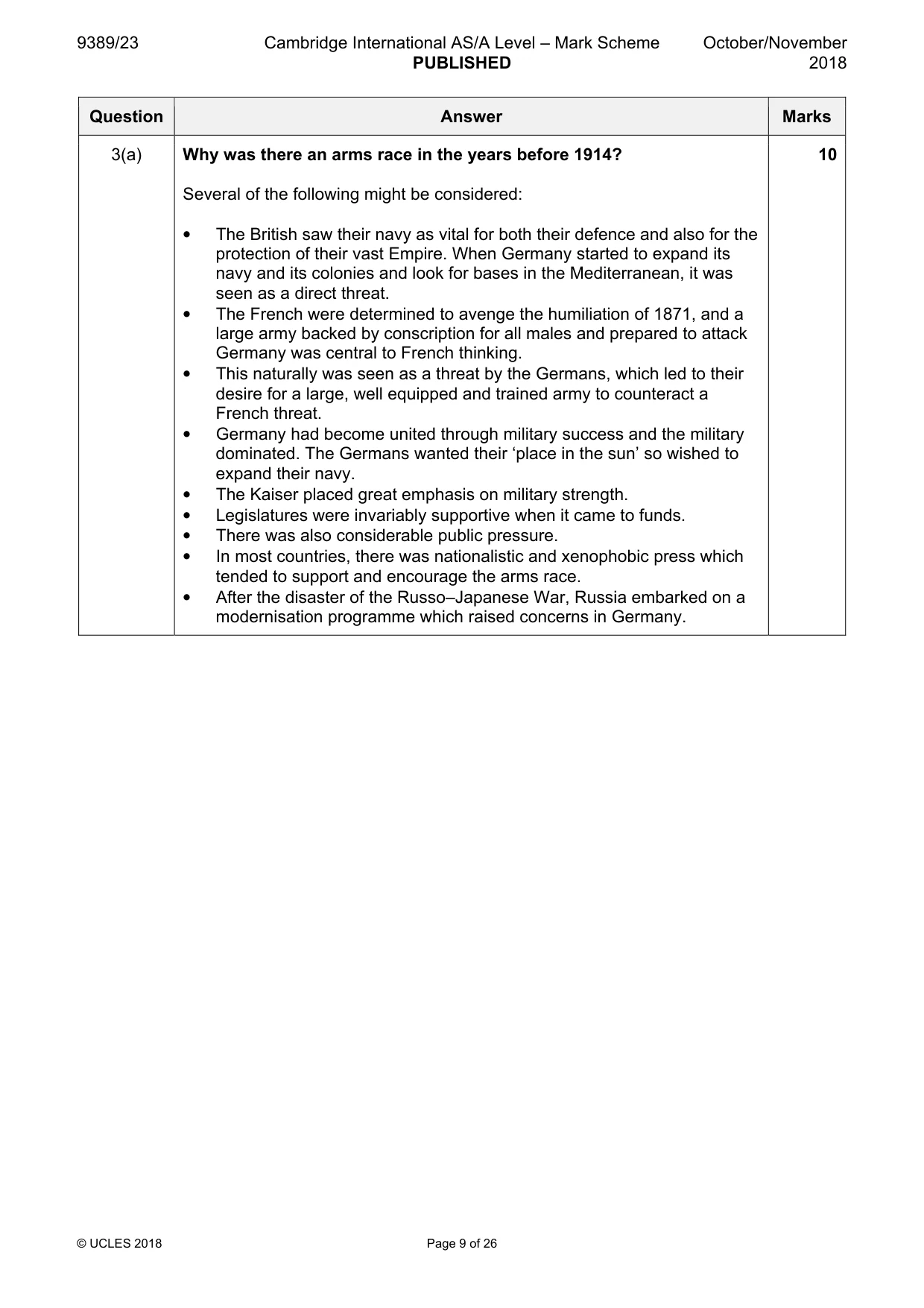
Mark scheme: 3(a) Why was there an arms race in the years before 1914? 10 Several of the following might be considered: • The British saw their navy as vital for both their defence and also for the protection of their vast Empire. When Germany started to expand its navy and its colonies and look for bases in the Mediterranean, it was seen as a direct threat. • The French were determined to avenge the humiliation of 1871, and a large army backed by conscription for all males and prepared to attack Germany was central to French thinking. • This naturally was seen as a threat by the Germans, which led to their desire for a large, well equipped and trained army to counteract a French threat. • Germany had become united through military success and the military dominated. The Germans wanted their ‘place in the sun’ so wished to expand their navy. • The Kaiser placed great emphasis on military strength. • Legislatures were invariably supportive when it came to funds. • There was also considerable public pressure. • In most countries, there was nationalistic and xenophobic press which tended to support and encourage the arms race. • After the disaster of the Russo–Japanese War, Russia embarked on a modernisation programme which raised concerns in Germany. 3(b) ‘It was the Austrian ultimatum to Serbia that was the critical factor in 20 bringing about the outbreak of war.’ How far do you agree? On the one hand: • Giving that ultimatum, knowing full well that the Serbs could never accept it, could be seen as the critical factor. The government knew it was bound to lead to conflict. • All in Austria knew that Russia was likely to rally to support the Serbs, which could well bring in the French and widen the conflict. • The ultimatum was designed to provoke a strong reaction, and it did. • The Austrians were determined to assert their domination of the region, whatever the cost. On the other hand, there is a very large number of other critical factors: • The ‘blank cheque’ gave the Austrians the confidence to issue the ultimatum in the first place. • The Alliance System could be seen as more important as it ensured that any local conflict was likely to widen. • The conflict could possibly have been contained in the Balkans; the earlier Balkan Wars had not spread too widely. • Russian mobilisation triggered the Schlieffen Plan. • The Schlieffen Plan with its lack of a ‘fail safe’ device was also important. • It could be argued that given the tension and rivalries that existed in Europe at the time, if it was not Sarajevo, then another equally quite manageable incident could escalate into war.
Q4 · The Russian Revolution, c.1894–1917 (a) Why did the Duma achieve little before 1914?
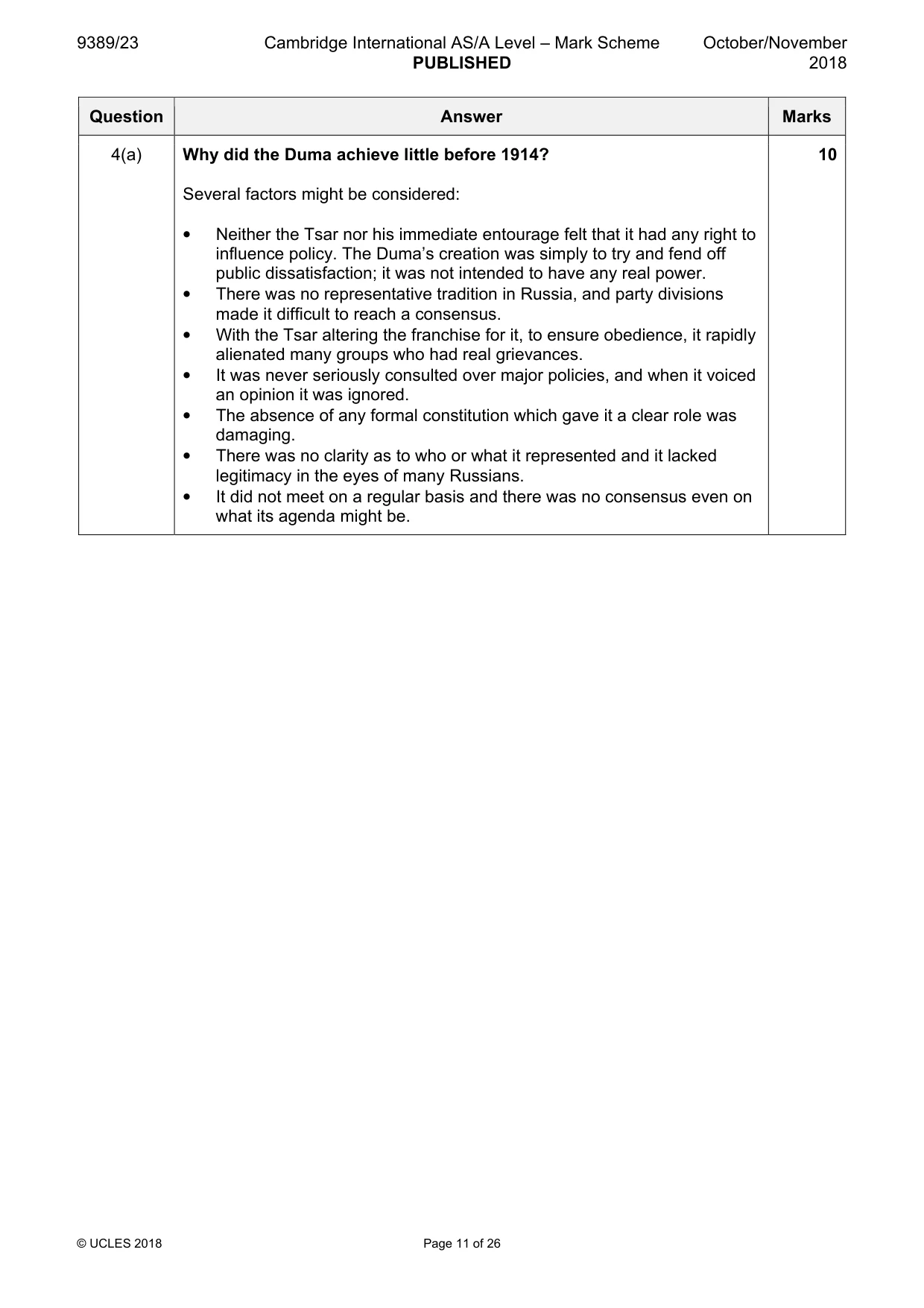
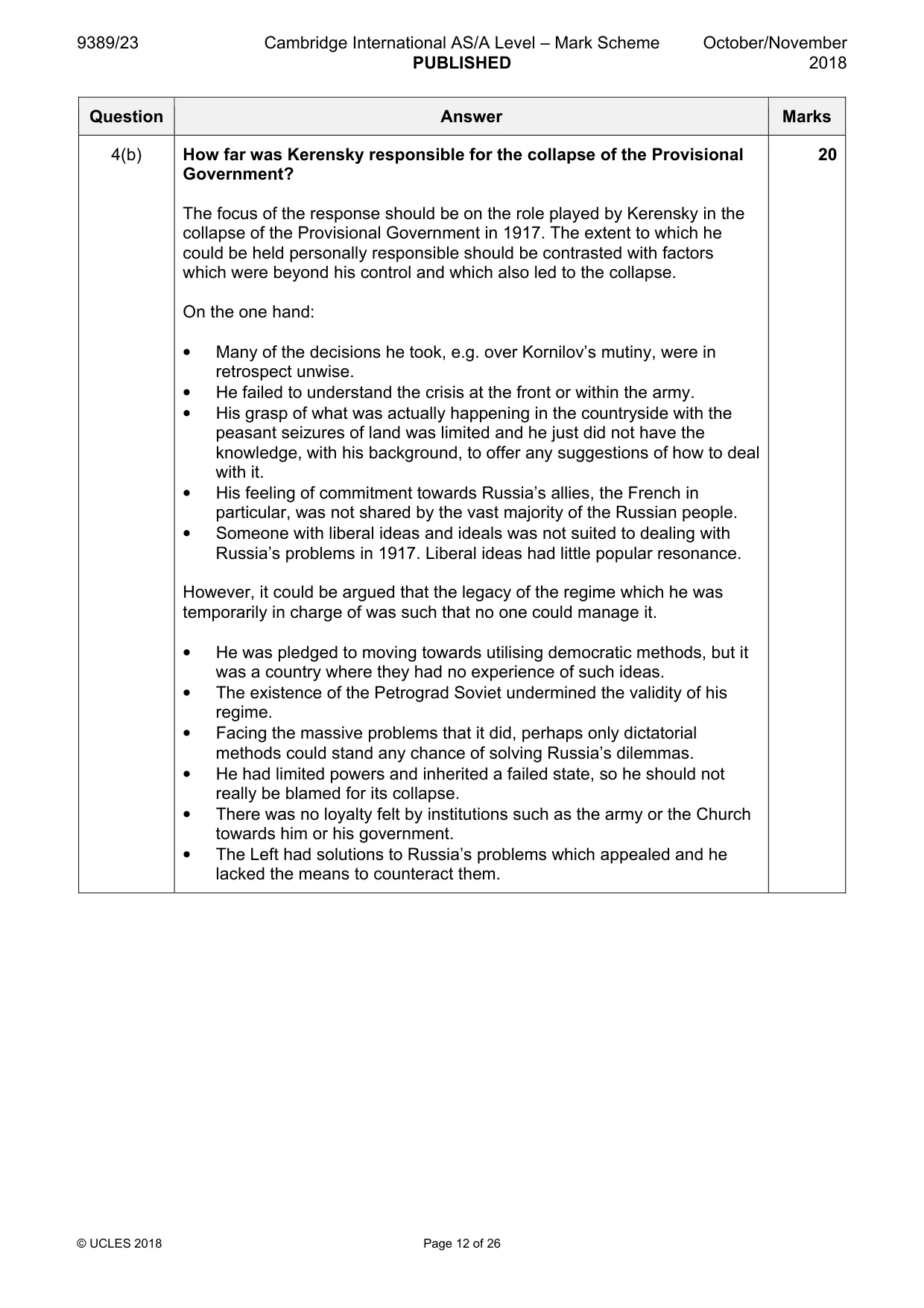
4 The Russian Revolution, c.1894–1917 (a) Why did the Duma achieve little before 1914? [10] (b) How far was Kerensky responsible for the collapse of the Provisional Government? [20]
Mark scheme: 4(a) Why did the Duma achieve little before 1914? 10 Several factors might be considered: • Neither the Tsar nor his immediate entourage felt that it had any right to influence policy. The Duma’s creation was simply to try and fend off public dissatisfaction; it was not intended to have any real power. • There was no representative tradition in Russia, and party divisions made it difficult to reach a consensus. • With the Tsar altering the franchise for it, to ensure obedience, it rapidly alienated many groups who had real grievances. • It was never seriously consulted over major policies, and when it voiced an opinion it was ignored. • The absence of any formal constitution which gave it a clear role was damaging. • There was no clarity as to who or what it represented and it lacked legitimacy in the eyes of many Russians. • It did not meet on a regular basis and there was no consensus even on what its agenda might be. 4(b) How far was Kerensky responsible for the collapse of the Provisional 20 Government? The focus of the response should be on the role played by Kerensky in the collapse of the Provisional Government in 1917. The extent to which he could be held personally responsible should be contrasted with factors which were beyond his control and which also led to the collapse. On the one hand: • Many of the decisions he took, e.g. over Kornilov’s mutiny, were in retrospect unwise. • He failed to understand the crisis at the front or within the army. • His grasp of what was actually happening in the countryside with the peasant seizures of land was limited and he just did not have the knowledge, with his background, to offer any suggestions of how to deal with it. • His feeling of commitment towards Russia’s allies, the French in particular, was not shared by the vast majority of the Russian people. • Someone with liberal ideas and ideals was not suited to dealing with Russia’s problems in 1917. Liberal ideas had little popular resonance. However, it could be argued that the legacy of the regime which he was temporarily in charge of was such that no one could manage it. • He was pledged to moving towards utilising democratic methods, but it was a country where they had no experience of such ideas. • The existence of the Petrograd Soviet undermined the validity of his regime. • Facing the massive problems that it did, perhaps only dictatorial methods could stand any chance of solving Russia’s dilemmas. • He had limited powers and inherited a failed state, so he should not really be blamed for its collapse. • There was no loyalty felt by institutions such as the army or the Church towards him or his government. • The Left had solutions to Russia’s problems which appealed and he lacked the means to counteract them.
Q5 · The expansion of US power from the 1840s to the 1930s (a) Why did the USA gain special…
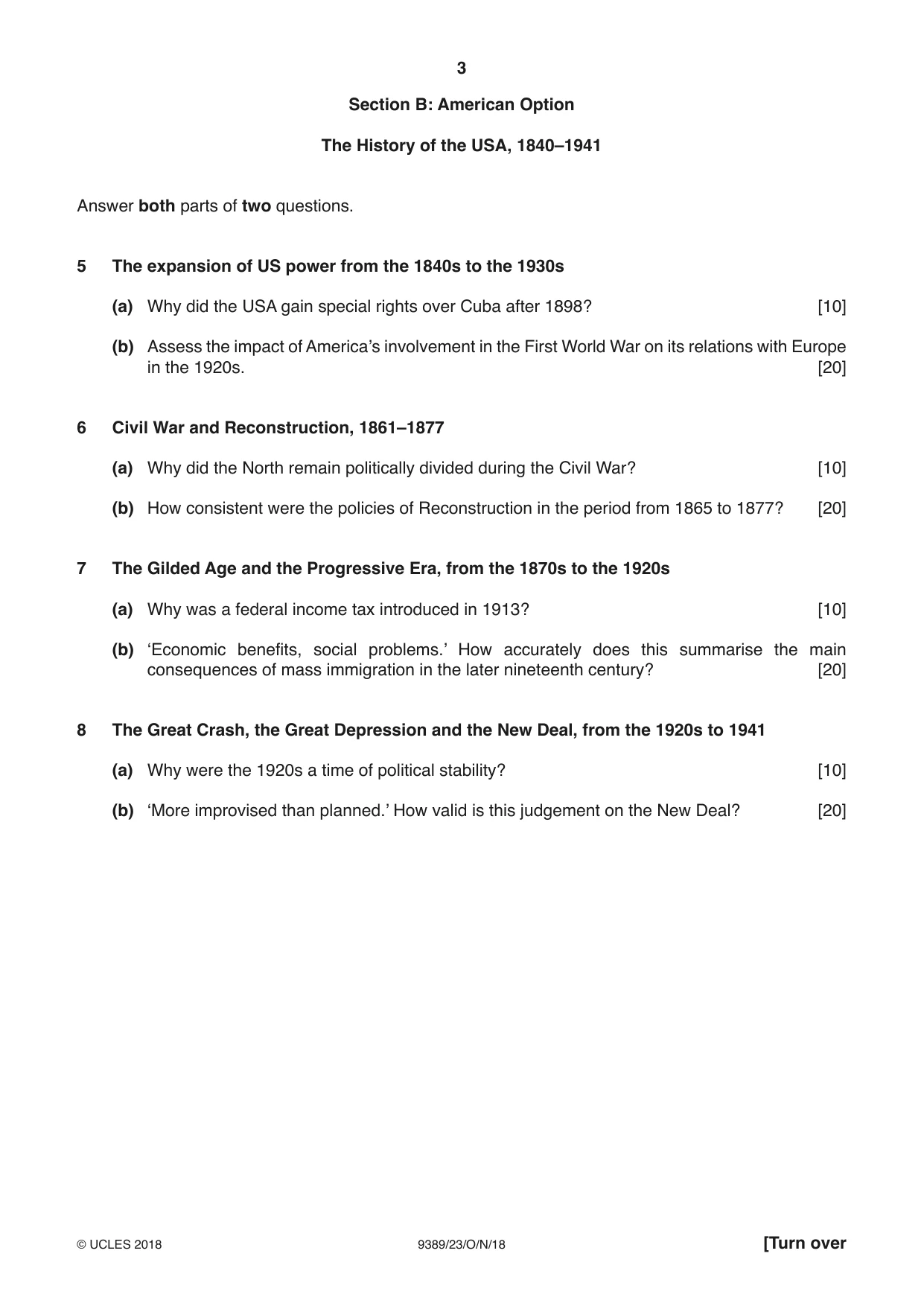
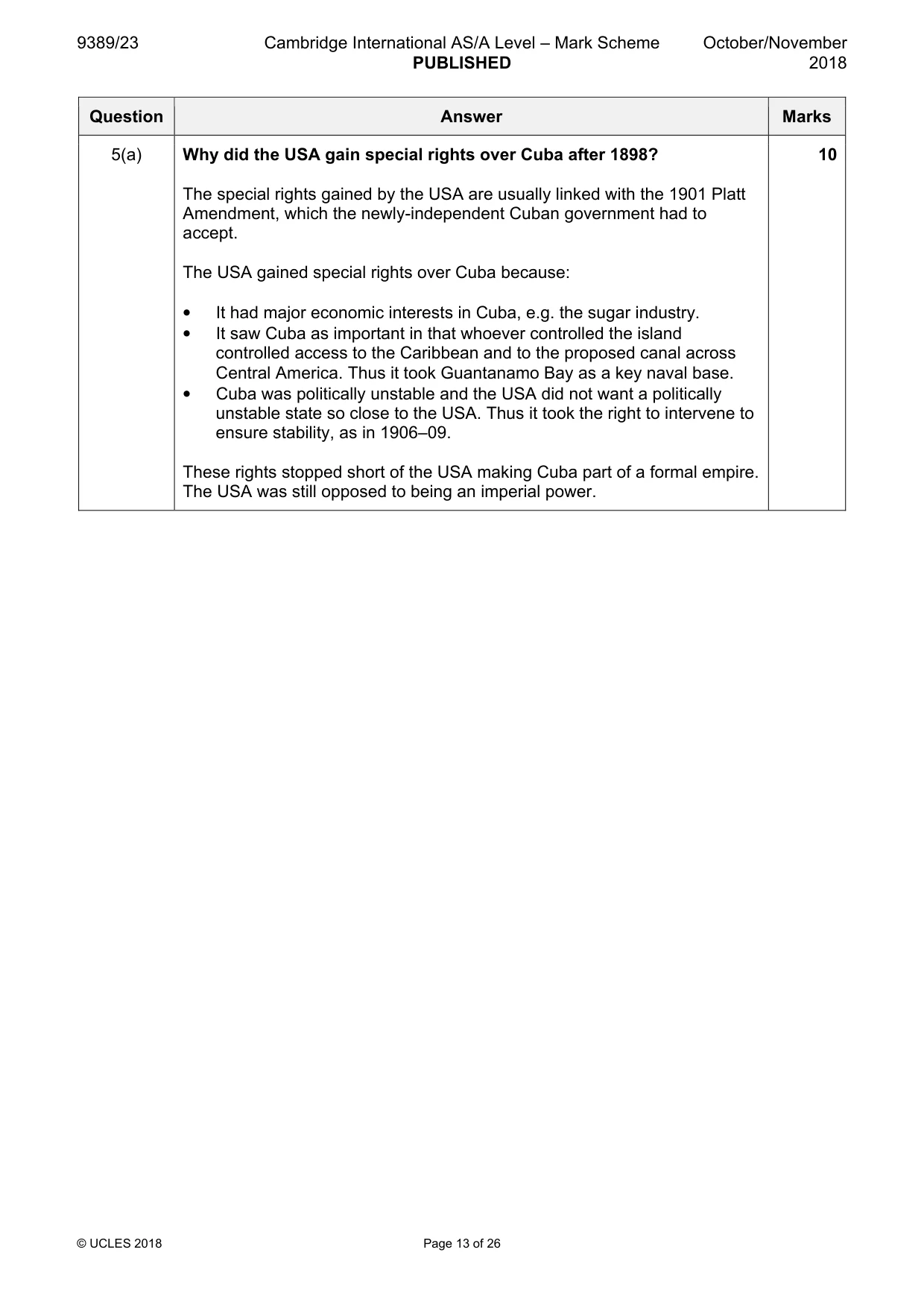
5 The expansion of US power from the 1840s to the 1930s (a) Why did the USA gain special rights over Cuba after 1898? [10] (b) Assess the impact of America’s involvement in the First World War on its relations with Europe in the 1920s. [20]
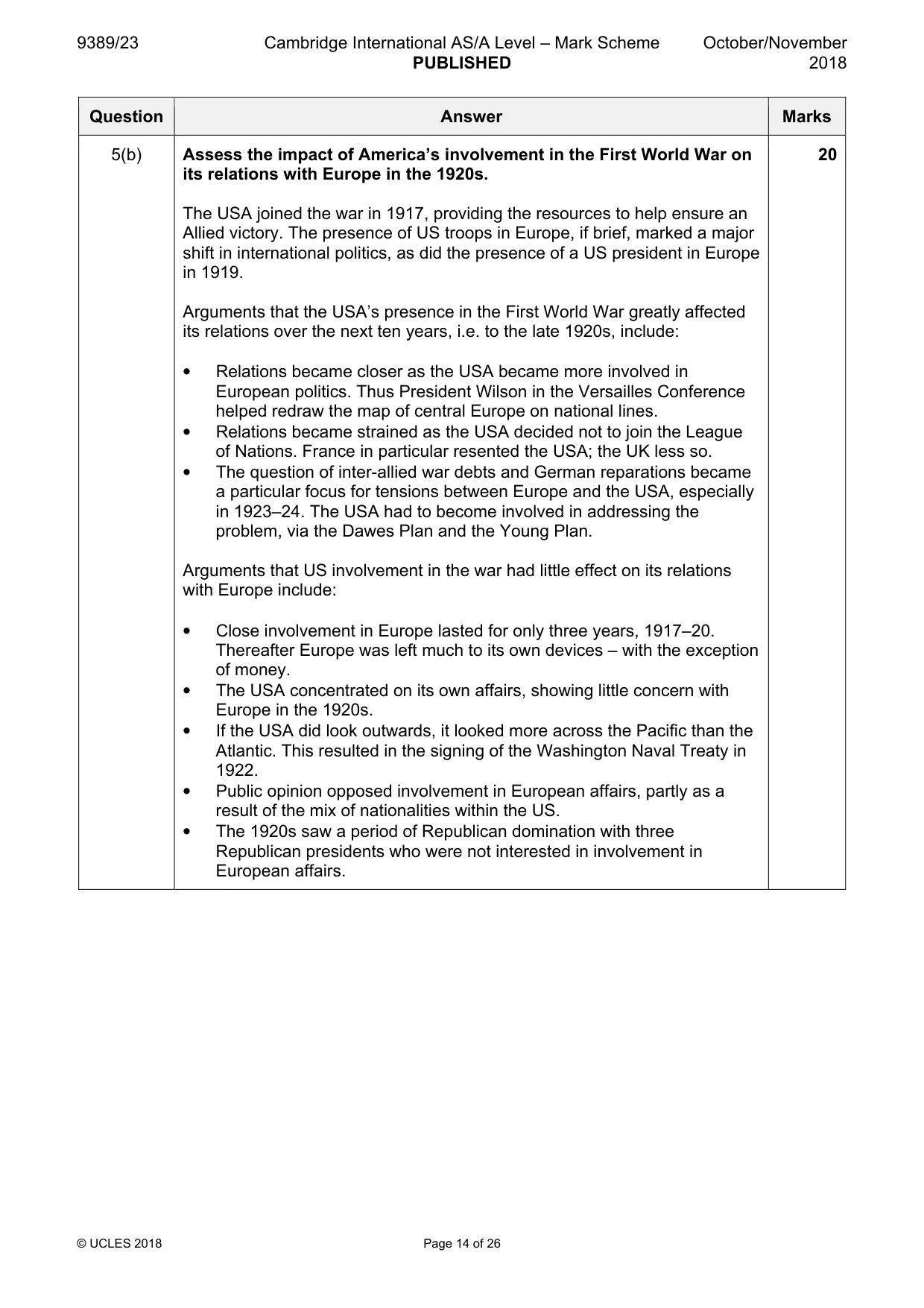
Mark scheme: 5(a) Why did the USA gain special rights over Cuba after 1898? 10 The special rights gained by the USA are usually linked with the 1901 Platt Amendment, which the newly-independent Cuban government had to accept. The USA gained special rights over Cuba because: • It had major economic interests in Cuba, e.g. the sugar industry. • It saw Cuba as important in that whoever controlled the island controlled access to the Caribbean and to the proposed canal across Central America. Thus it took Guantanamo Bay as a key naval base. • Cuba was politically unstable and the USA did not want a politically unstable state so close to the USA. Thus it took the right to intervene to ensure stability, as in 1906–09. These rights stopped short of the USA making Cuba part of a formal empire. The USA was still opposed to being an imperial power. 5(b) Assess the impact of America’s involvement in the First World War on 20 its relations with Europe in the 1920s. The USA joined the war in 1917, providing the resources to help ensure an Allied victory. The presence of US troops in Europe, if brief, marked a major shift in international politics, as did the presence of a US president in Europe in 1919. Arguments that the USA’s presence in the First World War greatly affected its relations over the next ten years, i.e. to the late 1920s, include: • Relations became closer as the USA became more involved in European politics. Thus President Wilson in the Versailles Conference helped redraw the map of central Europe on national lines. • Relations became strained as the USA decided not to join the League of Nations. France in particular resented the USA; the UK less so. • The question of inter-allied war debts and German reparations became a particular focus for tensions between Europe and the USA, especially in 1923–24. The USA had to become involved in addressing the problem, via the Dawes Plan and the Young Plan. Arguments that US involvement in the war had little effect on its relations with Europe include: • Close involvement in Europe lasted for only three years, 1917–20. Thereafter Europe was left much to its own devices – with the exception of money. • The USA concentrated on its own affairs, showing little concern with Europe in the 1920s. • If the USA did look outwards, it looked more across the Pacific than the Atlantic. This resulted in the signing of the Washington Naval Treaty in 1922. • Public opinion opposed involvement in European affairs, partly as a result of the mix of nationalities within the US. • The 1920s saw a period of Republican domination with three Republican presidents who were not interested in involvement in European affairs.
Q6 · Civil War and Reconstruction, 1861–1877 (a) Why did the North remain politically divided…
6 Civil War and Reconstruction, 1861–1877 (a) Why did the North remain politically divided during the Civil War? [10] (b) How consistent were the policies of Reconstruction in the period from 1865 to 1877? [20]
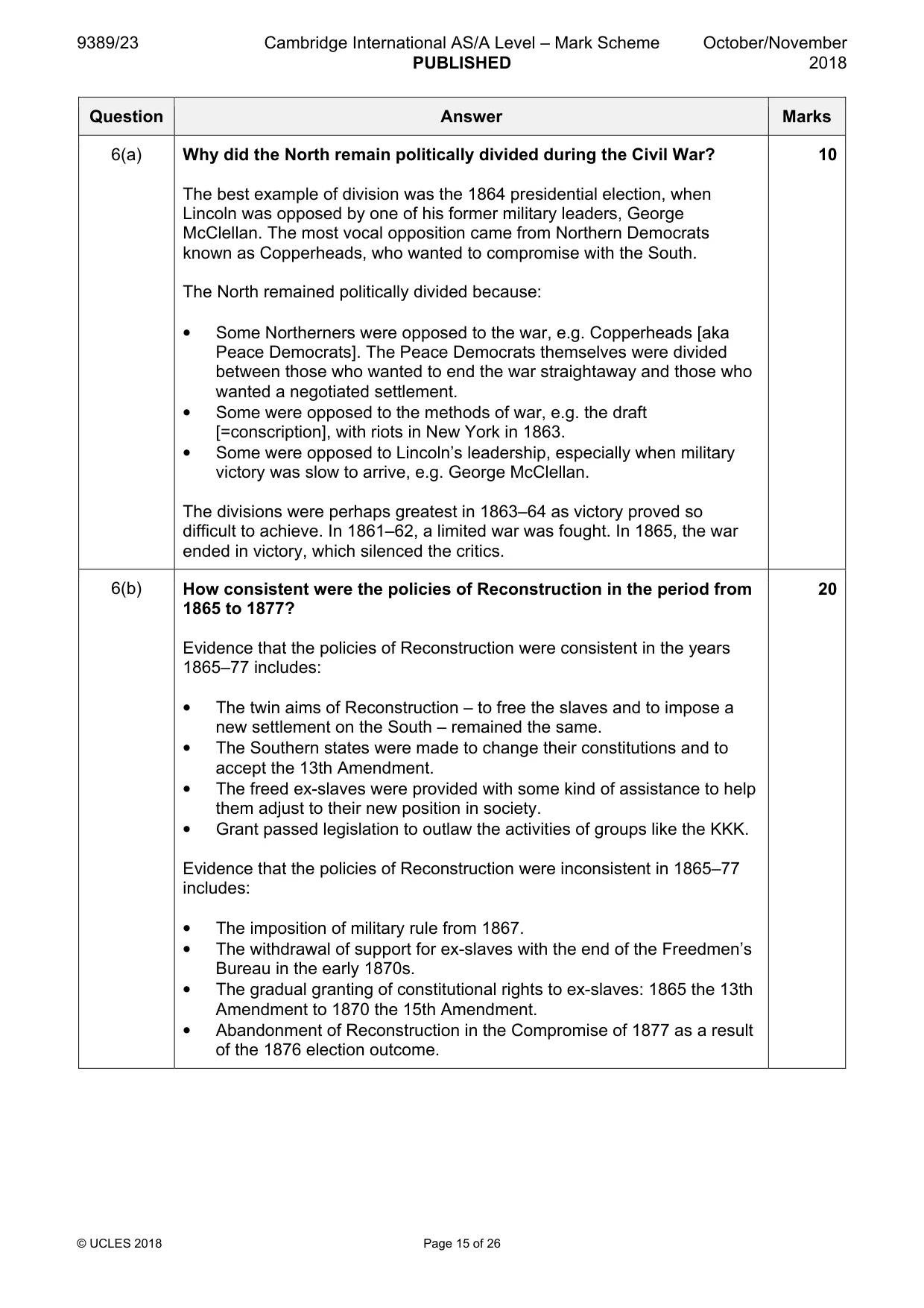
Mark scheme: 6(a) Why did the North remain politically divided during the Civil War? 10 The best example of division was the 1864 presidential election, when Lincoln was opposed by one of his former military leaders, George McClellan. The most vocal opposition came from Northern Democrats known as Copperheads, who wanted to compromise with the South. The North remained politically divided because: • Some Northerners were opposed to the war, e.g. Copperheads [aka Peace Democrats]. The Peace Democrats themselves were divided between those who wanted to end the war straightaway and those who wanted a negotiated settlement. • Some were opposed to the methods of war, e.g. the draft [=conscription], with riots in New York in 1863. • Some were opposed to Lincoln’s leadership, especially when military victory was slow to arrive, e.g. George McClellan. The divisions were perhaps greatest in 1863–64 as victory proved so difficult to achieve. In 1861–62, a limited war was fought. In 1865, the war ended in victory, which silenced the critics. 6(b) How consistent were the policies of Reconstruction in the period from 20 1865 to 1877? Evidence that the policies of Reconstruction were consistent in the years 1865–77 includes: • The twin aims of Reconstruction – to free the slaves and to impose a new settlement on the South – remained the same. • The Southern states were made to change their constitutions and to accept the 13th Amendment. • The freed ex-slaves were provided with some kind of assistance to help them adjust to their new position in society. • Grant passed legislation to outlaw the activities of groups like the KKK. Evidence that the policies of Reconstruction were inconsistent in 1865–77 includes: • The imposition of military rule from 1867. • The withdrawal of support for ex-slaves with the end of the Freedmen’s Bureau in the early 1870s. • The gradual granting of constitutional rights to ex-slaves: 1865 the 13th Amendment to 1870 the 15th Amendment. • Abandonment of Reconstruction in the Compromise of 1877 as a result of the 1876 election outcome.
Q7 · The Gilded Age and the Progressive Era, from the 1870s to the 1920s (a) Why was a federal…
7 The Gilded Age and the Progressive Era, from the 1870s to the 1920s (a) Why was a federal income tax introduced in 1913? [10] (b) ‘Economic benefits, social problems.’ How accurately does this summarise the main consequences of mass immigration in the later nineteenth century? [20]
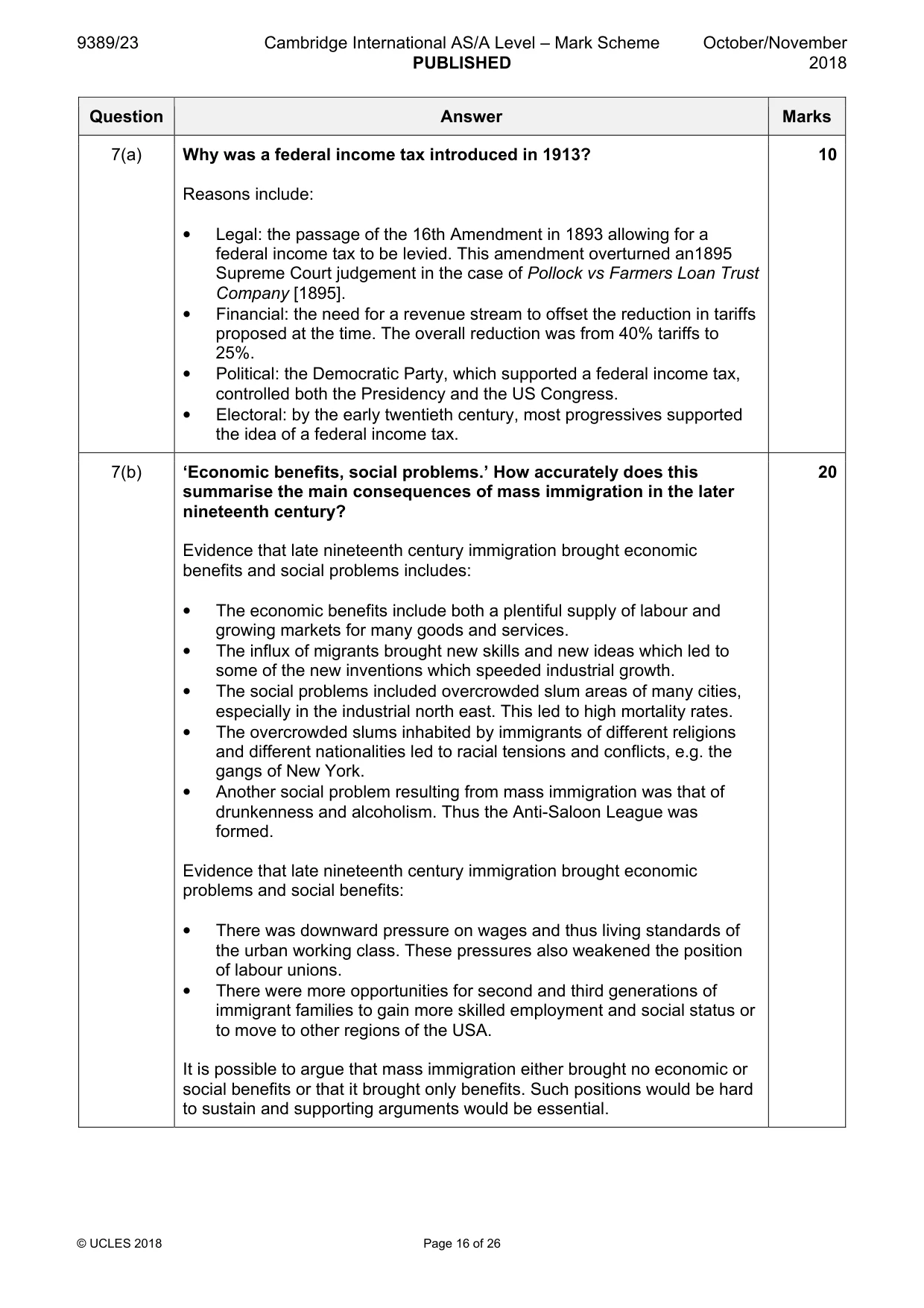
Mark scheme: 7(a) Why was a federal income tax introduced in 1913? 10 Reasons include: • Legal: the passage of the 16th Amendment in 1893 allowing for a federal income tax to be levied. This amendment overturned an1895 Supreme Court judgement in the case of Pollock vs Farmers Loan Trust Company [1895]. • Financial: the need for a revenue stream to offset the reduction in tariffs proposed at the time. The overall reduction was from 40% tariffs to 25%. • Political: the Democratic Party, which supported a federal income tax, controlled both the Presidency and the US Congress. • Electoral: by the early twentieth century, most progressives supported the idea of a federal income tax. 7(b) ‘Economic benefits, social problems.’ How accurately does this 20 summarise the main consequences of mass immigration in the later nineteenth century? Evidence that late nineteenth century immigration brought economic benefits and social problems includes: • The economic benefits include both a plentiful supply of labour and growing markets for many goods and services. • The influx of migrants brought new skills and new ideas which led to some of the new inventions which speeded industrial growth. • The social problems included overcrowded slum areas of many cities, especially in the industrial north east. This led to high mortality rates. • The overcrowded slums inhabited by immigrants of different religions and different nationalities led to racial tensions and conflicts, e.g. the gangs of New York. • Another social problem resulting from mass immigration was that of drunkenness and alcoholism. Thus the Anti-Saloon League was formed. Evidence that late nineteenth century immigration brought economic problems and social benefits: • There was downward pressure on wages and thus living standards of the urban working class. These pressures also weakened the position of labour unions. • There were more opportunities for second and third generations of immigrant families to gain more skilled employment and social status or to move to other regions of the USA. It is possible to argue that mass immigration either brought no economic or social benefits or that it brought only benefits. Such positions would be hard to sustain and supporting arguments would be essential.
Q8 · The Great Crash, the Great Depression and the New Deal, from the 1920s to 1941 (a) Why…
8 The Great Crash, the Great Depression and the New Deal, from the 1920s to 1941 (a) Why were the 1920s a time of political stability? [10] (b) ‘More improvised than planned.’ How valid is this judgement on the New Deal? [20] Section C: International Option International Relations, 1871–1945 Answer both parts of two questions.
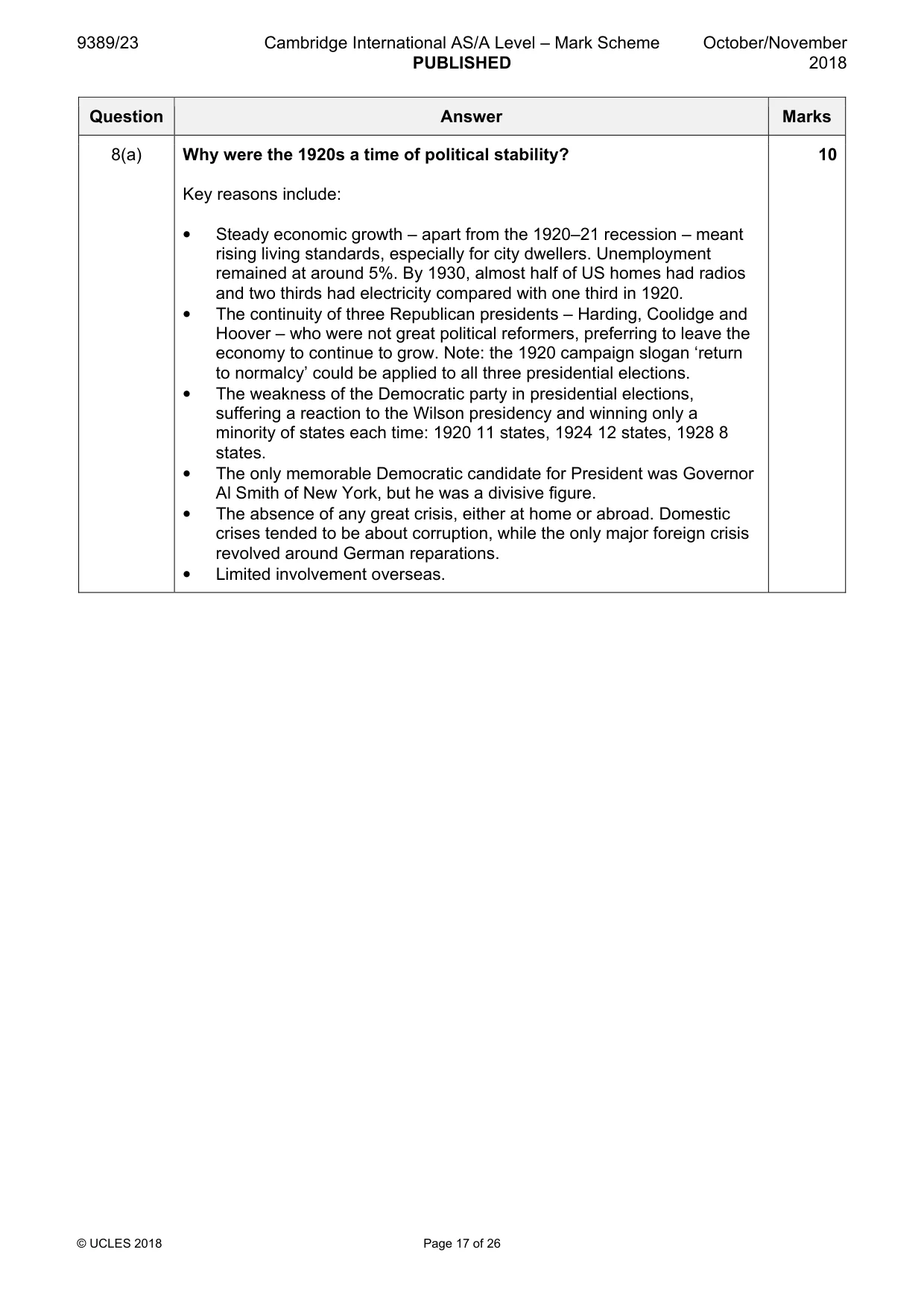
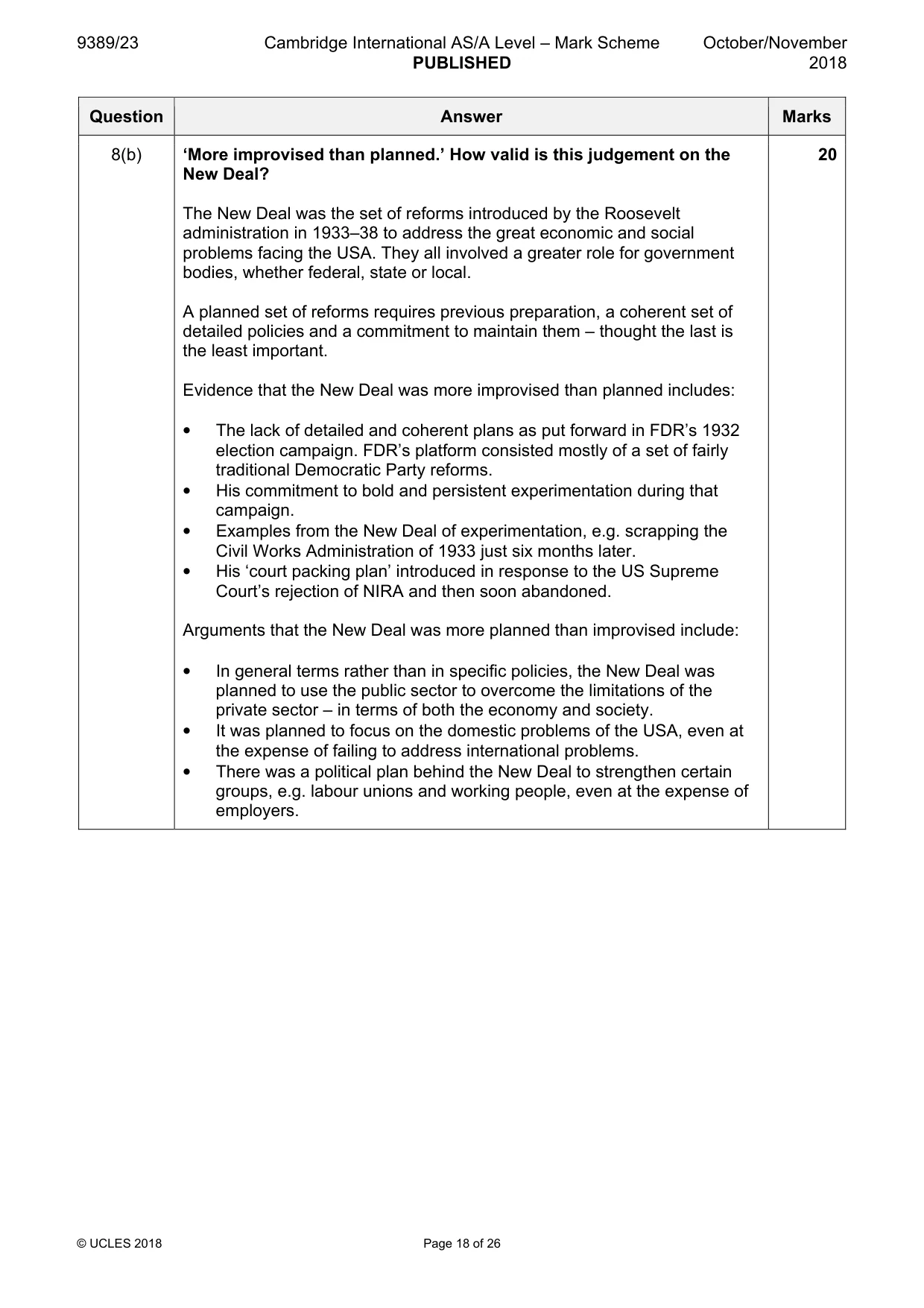
Mark scheme: 8(a) Why were the 1920s a time of political stability? 10 Key reasons include: • Steady economic growth – apart from the 1920–21 recession – meant rising living standards, especially for city dwellers. Unemployment remained at around 5%. By 1930, almost half of US homes had radios and two thirds had electricity compared with one third in 1920. • The continuity of three Republican presidents – Harding, Coolidge and Hoover – who were not great political reformers, preferring to leave the economy to continue to grow. Note: the 1920 campaign slogan ‘return to normalcy’ could be applied to all three presidential elections. • The weakness of the Democratic party in presidential elections, suffering a reaction to the Wilson presidency and winning only a minority of states each time: 1920 11 states, 1924 12 states, 1928 8 states. • The only memorable Democratic candidate for President was Governor Al Smith of New York, but he was a divisive figure. • The absence of any great crisis, either at home or abroad. Domestic crises tended to be about corruption, while the only major foreign crisis revolved around German reparations. • Limited involvement overseas. 8(b) ‘More improvised than planned.’ How valid is this judgement on the 20 New Deal? The New Deal was the set of reforms introduced by the Roosevelt administration in 1933–38 to address the great economic and social problems facing the USA. They all involved a greater role for government bodies, whether federal, state or local. A planned set of reforms requires previous preparation, a coherent set of detailed policies and a commitment to maintain them – thought the last is the least important. Evidence that the New Deal was more improvised than planned includes: • The lack of detailed and coherent plans as put forward in FDR’s 1932 election campaign. FDR’s platform consisted mostly of a set of fairly traditional Democratic Party reforms. • His commitment to bold and persistent experimentation during that campaign. • Examples from the New Deal of experimentation, e.g. scrapping the Civil Works Administration of 1933 just six months later. • His ‘court packing plan’ introduced in response to the US Supreme Court’s rejection of NIRA and then soon abandoned. Arguments that the New Deal was more planned than improvised include: • In general terms rather than in specific policies, the New Deal was planned to use the public sector to overcome the limitations of the private sector – in terms of both the economy and society. • It was planned to focus on the domestic problems of the USA, even at the expense of failing to address international problems. • There was a political plan behind the New Deal to strengthen certain groups, e.g. labour unions and working people, even at the expense of employers.
Q9 · International Relations, 1871–1918 (a) Why did Bismarck establish the Dreikaiserbund in…
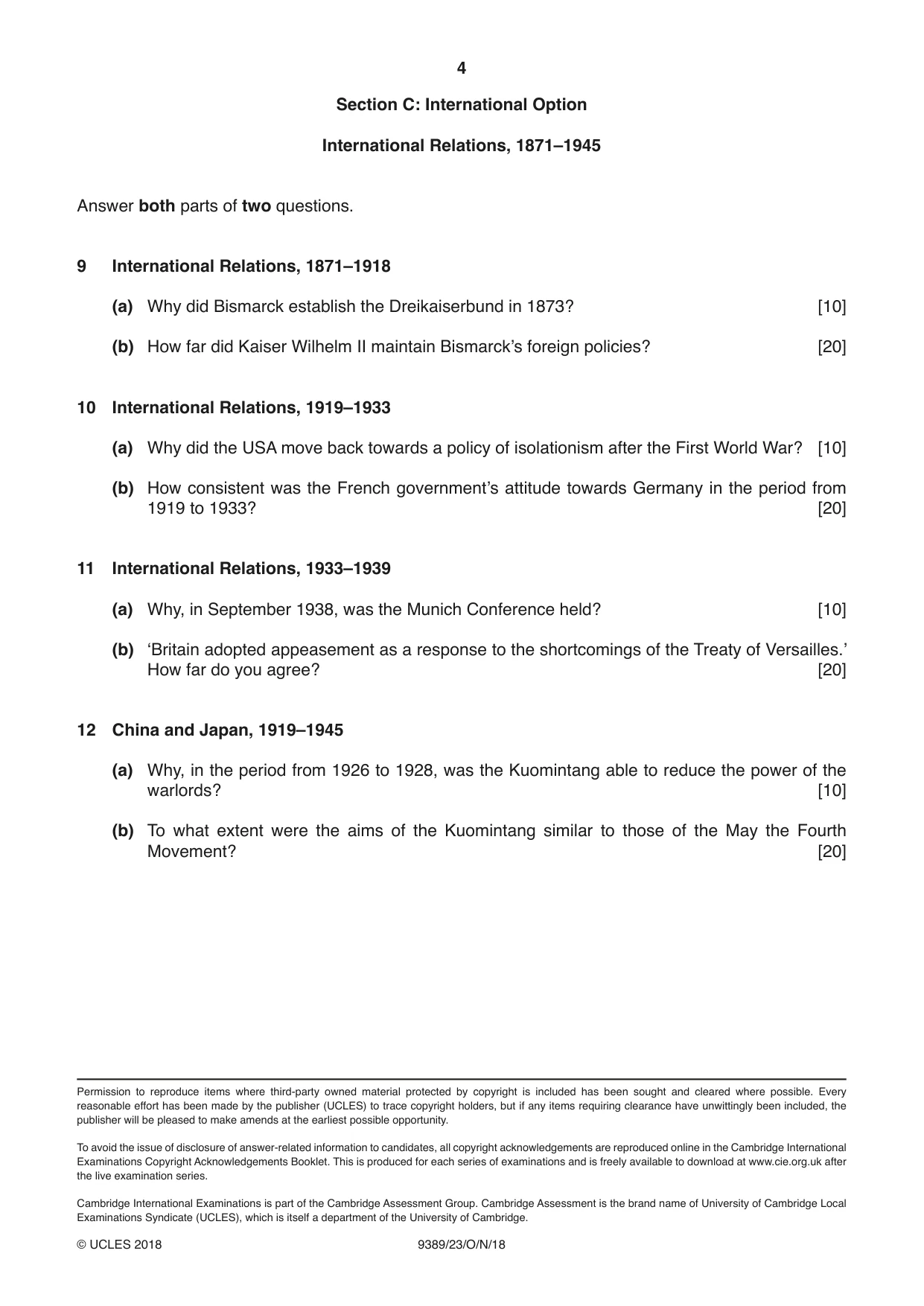
9 International Relations, 1871–1918 (a) Why did Bismarck establish the Dreikaiserbund in 1873? [10] (b) How far did Kaiser Wilhelm II maintain Bismarck’s foreign policies? [20]
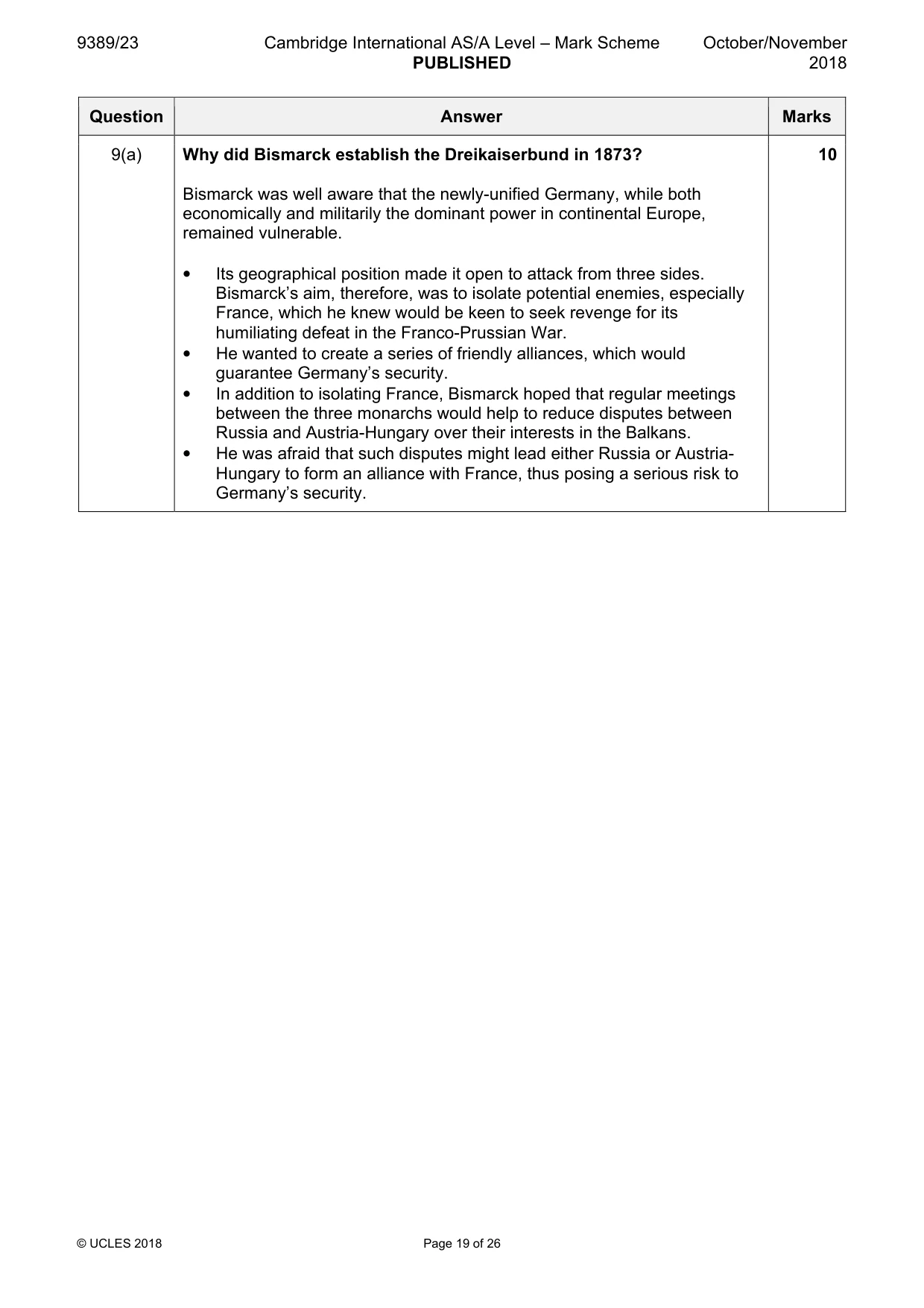
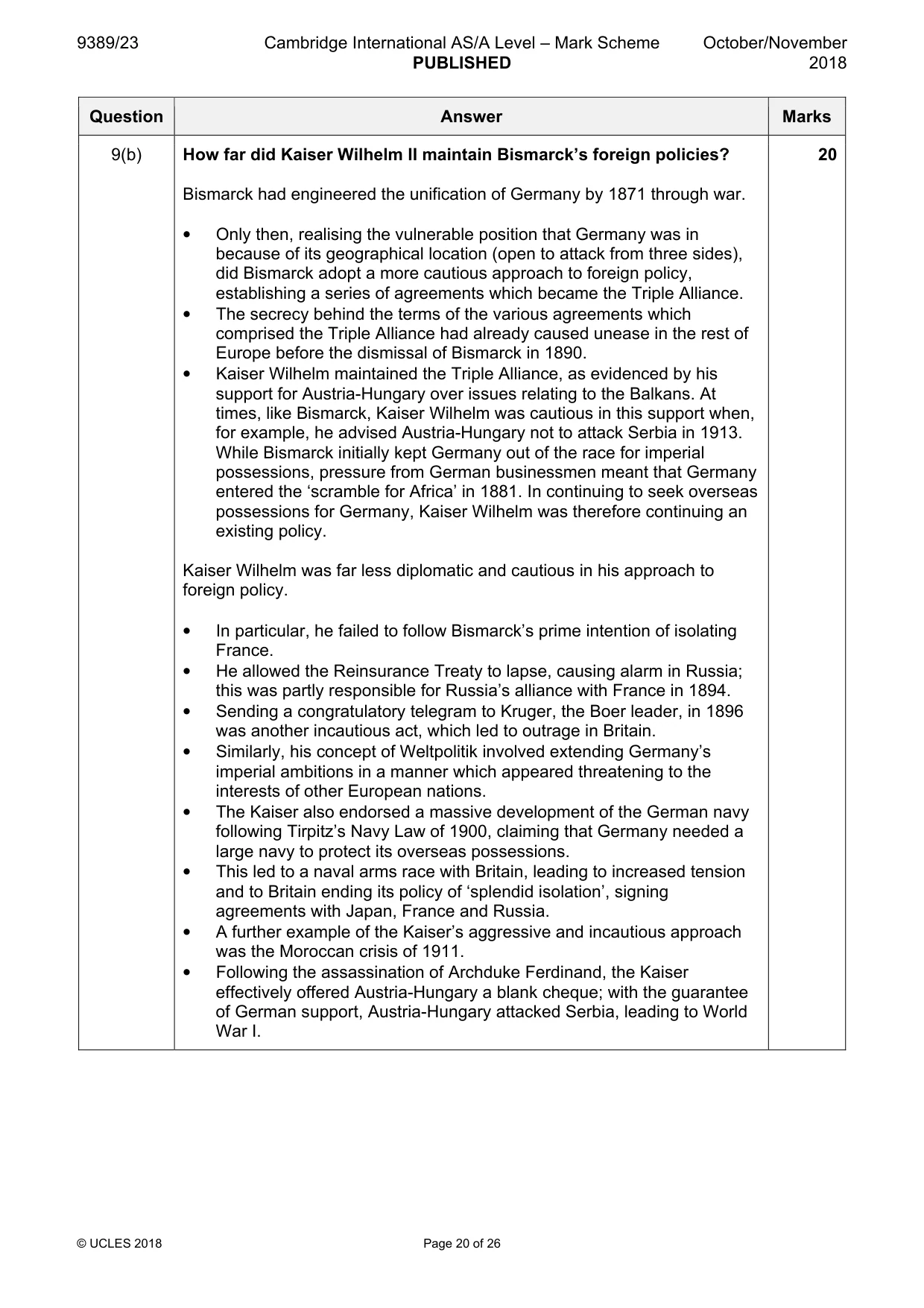
Mark scheme: 9(a) Why did Bismarck establish the Dreikaiserbund in 1873? 10 Bismarck was well aware that the newly-unified Germany, while both economically and militarily the dominant power in continental Europe, remained vulnerable. • Its geographical position made it open to attack from three sides. Bismarck’s aim, therefore, was to isolate potential enemies, especially France, which he knew would be keen to seek revenge for its humiliating defeat in the Franco-Prussian War. • He wanted to create a series of friendly alliances, which would guarantee Germany’s security. • In addition to isolating France, Bismarck hoped that regular meetings between the three monarchs would help to reduce disputes between Russia and Austria-Hungary over their interests in the Balkans. • He was afraid that such disputes might lead either Russia or Austria- Hungary to form an alliance with France, thus posing a serious risk to Germany’s security. 9(b) How far did Kaiser Wilhelm II maintain Bismarck’s foreign policies? 20 Bismarck had engineered the unification of Germany by 1871 through war. • Only then, realising the vulnerable position that Germany was in because of its geographical location (open to attack from three sides), did Bismarck adopt a more cautious approach to foreign policy, establishing a series of agreements which became the Triple Alliance. • The secrecy behind the terms of the various agreements which comprised the Triple Alliance had already caused unease in the rest of Europe before the dismissal of Bismarck in 1890. • Kaiser Wilhelm maintained the Triple Alliance, as evidenced by his support for Austria-Hungary over issues relating to the Balkans. At times, like Bismarck, Kaiser Wilhelm was cautious in this support when, for example, he advised Austria-Hungary not to attack Serbia in 1913. While Bismarck initially kept Germany out of the race for imperial possessions, pressure from German businessmen meant that Germany entered the ‘scramble for Africa’ in 1881. In continuing to seek overseas possessions for Germany, Kaiser Wilhelm was therefore continuing an existing policy. Kaiser Wilhelm was far less diplomatic and cautious in his approach to foreign policy. • In particular, he failed to follow Bismarck’s prime intention of isolating France. • He allowed the Reinsurance Treaty to lapse, causing alarm in Russia; this was partly responsible for Russia’s alliance with France in 1894. • Sending a congratulatory telegram to Kruger, the Boer leader, in 1896 was another incautious act, which led to outrage in Britain. • Similarly, his concept of Weltpolitik involved extending Germany’s imperial ambitions in a manner which appeared threatening to the interests of other European nations. • The Kaiser also endorsed a massive development of the German navy following Tirpitz’s Navy Law of 1900, claiming that Germany needed a large navy to protect its overseas possessions. • This led to a naval arms race with Britain, leading to increased tension and to Britain ending its policy of ‘splendid isolation’, signing agreements with Japan, France and Russia. • A further example of the Kaiser’s aggressive and incautious approach was the Moroccan crisis of 1911. • Following the assassination of Archduke Ferdinand, the Kaiser effectively offered Austria-Hungary a blank cheque; with the guarantee of German support, Austria-Hungary attacked Serbia, leading to World War I.
Q10 · International Relations, 1919–1933 (a) Why did the USA move back towards a policy of…
10 International Relations, 1919–1933 (a) Why did the USA move back towards a policy of isolationism after the First World War? [10] (b) How consistent was the French government’s attitude towards Germany in the period from 1919 to 1933? [20]
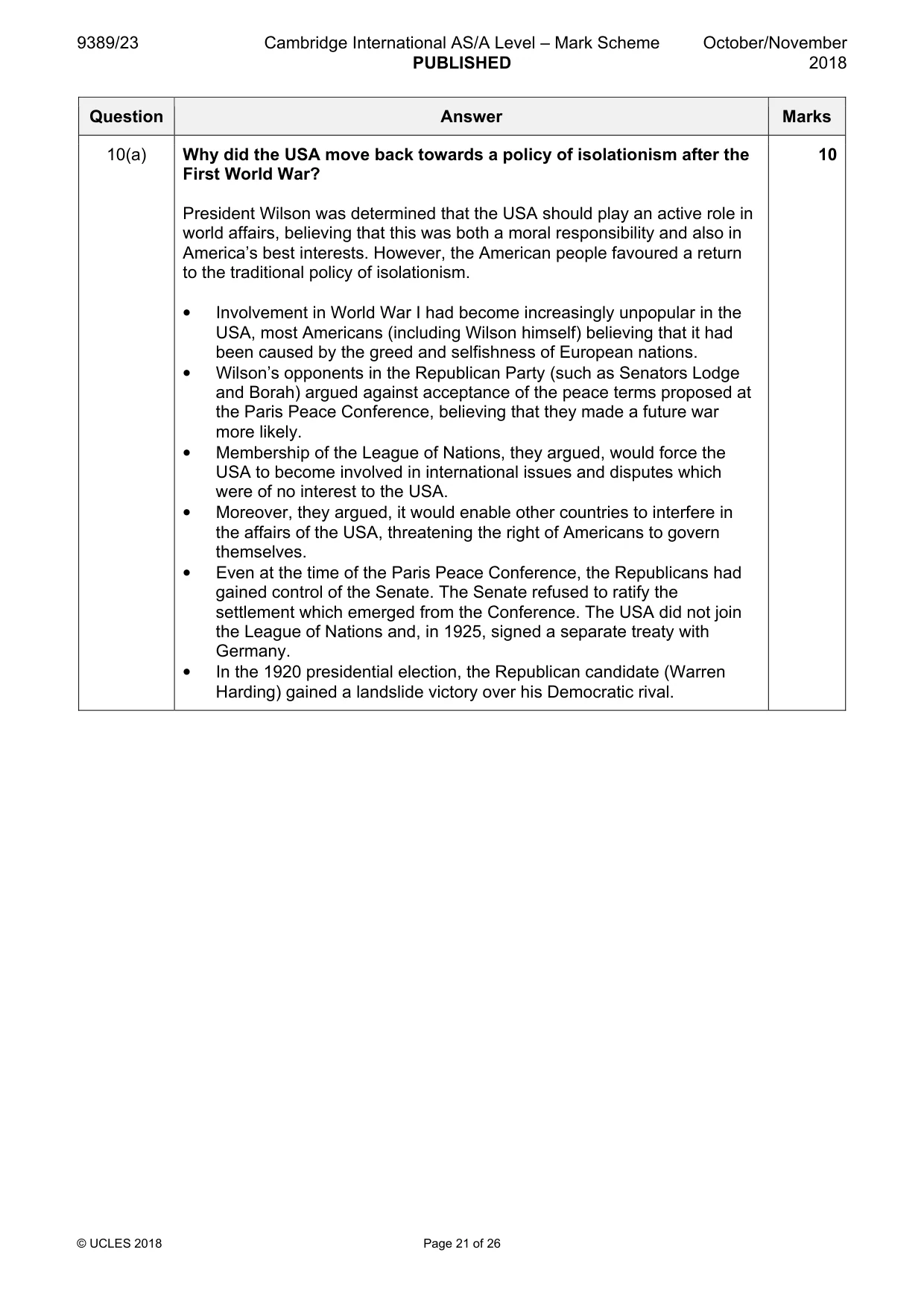
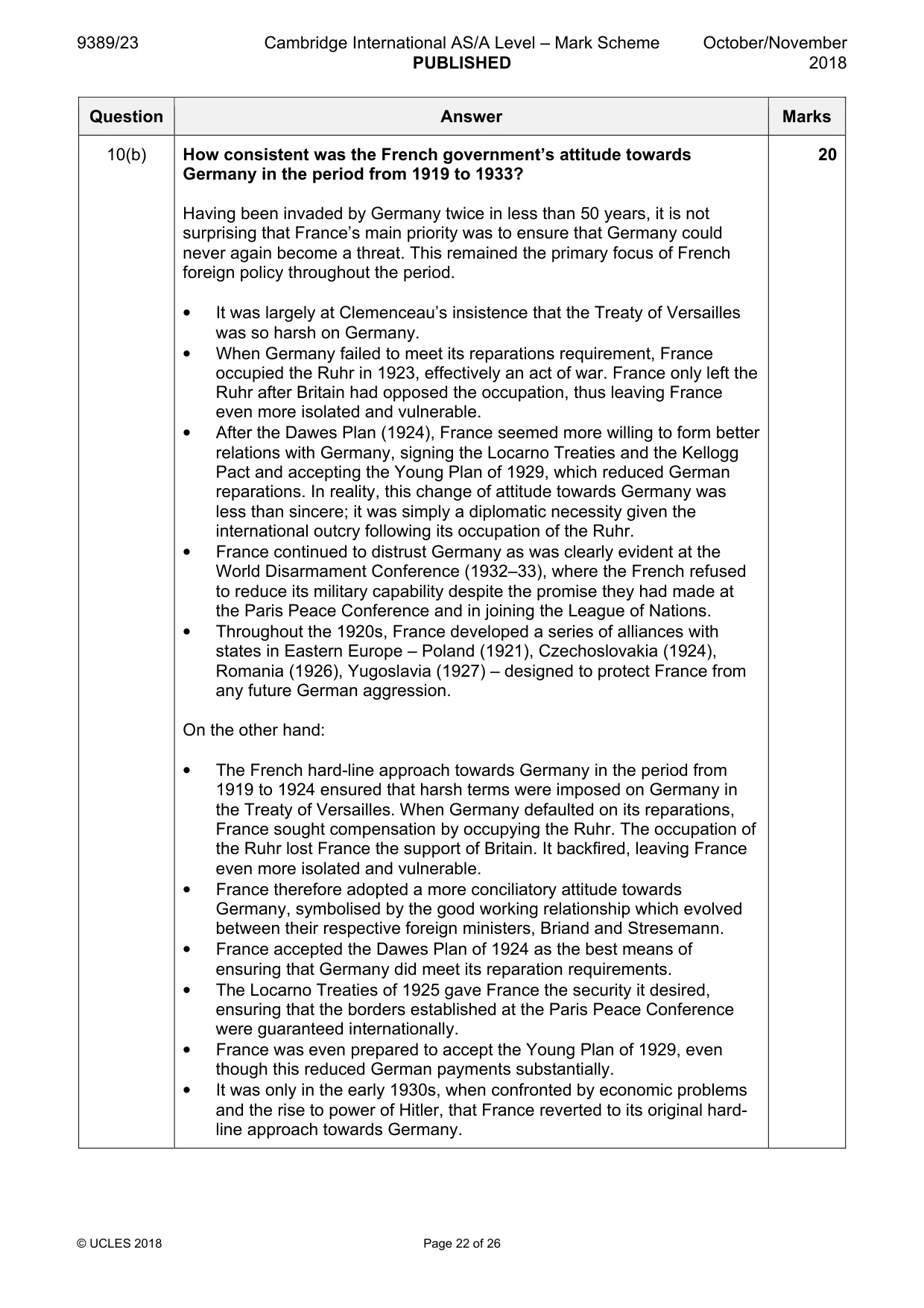
Mark scheme: 10(a) Why did the USA move back towards a policy of isolationism after the 10 First World War? President Wilson was determined that the USA should play an active role in world affairs, believing that this was both a moral responsibility and also in America’s best interests. However, the American people favoured a return to the traditional policy of isolationism. • Involvement in World War I had become increasingly unpopular in the USA, most Americans (including Wilson himself) believing that it had been caused by the greed and selfishness of European nations. • Wilson’s opponents in the Republican Party (such as Senators Lodge and Borah) argued against acceptance of the peace terms proposed at the Paris Peace Conference, believing that they made a future war more likely. • Membership of the League of Nations, they argued, would force the USA to become involved in international issues and disputes which were of no interest to the USA. • Moreover, they argued, it would enable other countries to interfere in the affairs of the USA, threatening the right of Americans to govern themselves. • Even at the time of the Paris Peace Conference, the Republicans had gained control of the Senate. The Senate refused to ratify the settlement which emerged from the Conference. The USA did not join the League of Nations and, in 1925, signed a separate treaty with Germany. • In the 1920 presidential election, the Republican candidate (Warren Harding) gained a landslide victory over his Democratic rival. 10(b) How consistent was the French government’s attitude towards 20 Germany in the period from 1919 to 1933? Having been invaded by Germany twice in less than 50 years, it is not surprising that France’s main priority was to ensure that Germany could never again become a threat. This remained the primary focus of French foreign policy throughout the period. • It was largely at Clemenceau’s insistence that the Treaty of Versailles was so harsh on Germany. • When Germany failed to meet its reparations requirement, France occupied the Ruhr in 1923, effectively an act of war. France only left the Ruhr after Britain had opposed the occupation, thus leaving France even more isolated and vulnerable. • After the Dawes Plan (1924), France seemed more willing to form better relations with Germany, signing the Locarno Treaties and the Kellogg Pact and accepting the Young Plan of 1929, which reduced German reparations. In reality, this change of attitude towards Germany was less than sincere; it was simply a diplomatic necessity given the international outcry following its occupation of the Ruhr. • France continued to distrust Germany as was clearly evident at the World Disarmament Conference (1932–33), where the French refused to reduce its military capability despite the promise they had made at the Paris Peace Conference and in joining the League of Nations. • Throughout the 1920s, France developed a series of alliances with states in Eastern Europe – Poland (1921), Czechoslovakia (1924), Romania (1926), Yugoslavia (1927) – designed to protect France from any future German aggression. On the other hand: • The French hard-line approach towards Germany in the period from 1919 to 1924 ensured that harsh terms were imposed on Germany in the Treaty of Versailles. When Germany defaulted on its reparations, France sought compensation by occupying the Ruhr. The occupation of the Ruhr lost France the support of Britain. It backfired, leaving France even more isolated and vulnerable. • France therefore adopted a more conciliatory attitude towards Germany, symbolised by the good working relationship which evolved between their respective foreign ministers, Briand and Stresemann. • France accepted the Dawes Plan of 1924 as the best means of ensuring that Germany did meet its reparation requirements. • The Locarno Treaties of 1925 gave France the security it desired, ensuring that the borders established at the Paris Peace Conference were guaranteed internationally. • France was even prepared to accept the Young Plan of 1929, even though this reduced German payments substantially. • It was only in the early 1930s, when confronted by economic problems and the rise to power of Hitler, that France reverted to its original hard- line approach towards Germany.
Q11 · International Relations, 1933–1939 (a) Why, in September 1938, was the Munich Conference…
11 International Relations, 1933–1939 (a) Why, in September 1938, was the Munich Conference held? [10] (b) ‘Britain adopted appeasement as a response to the shortcomings of the Treaty of Versailles.’ How far do you agree? [20]
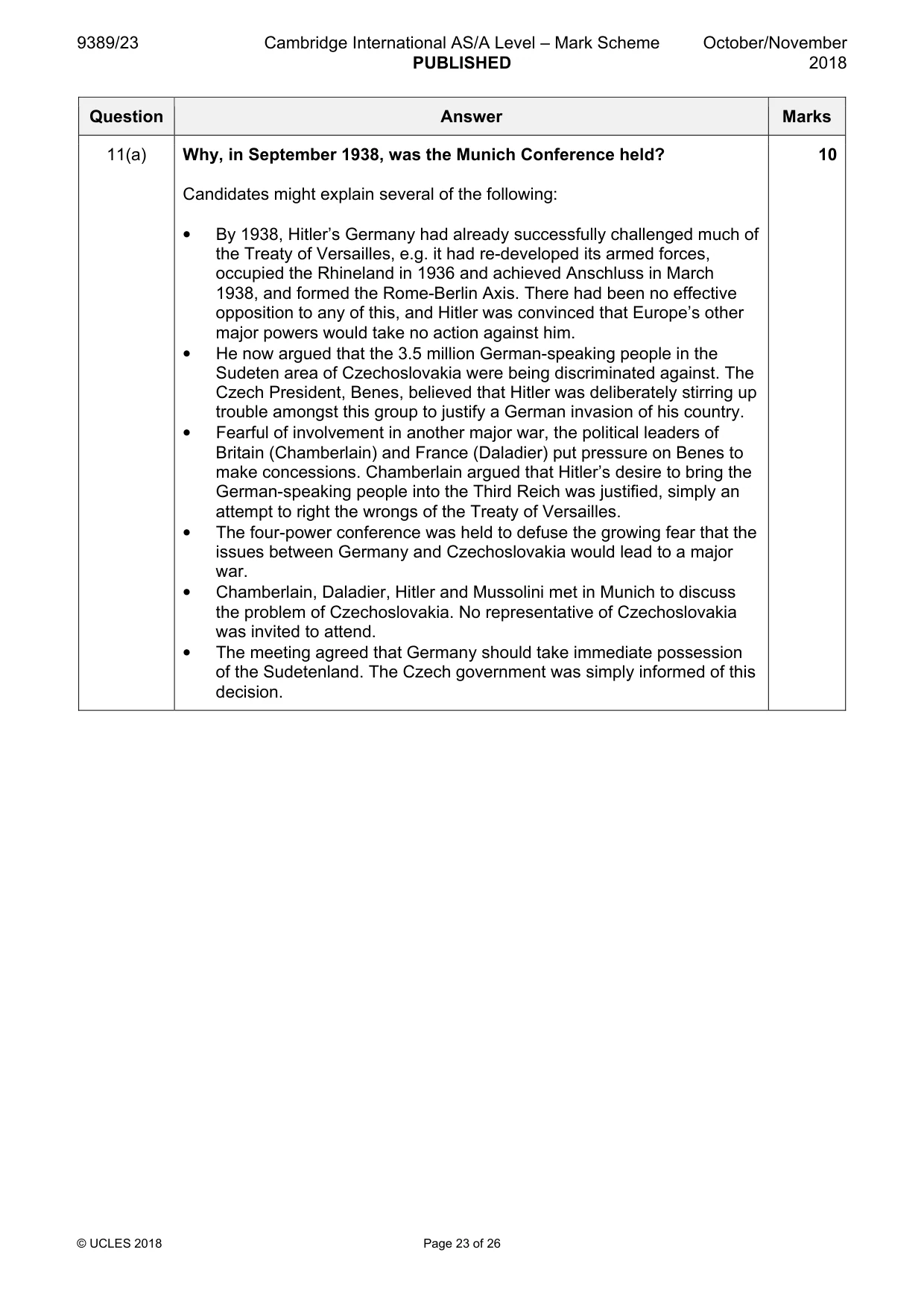
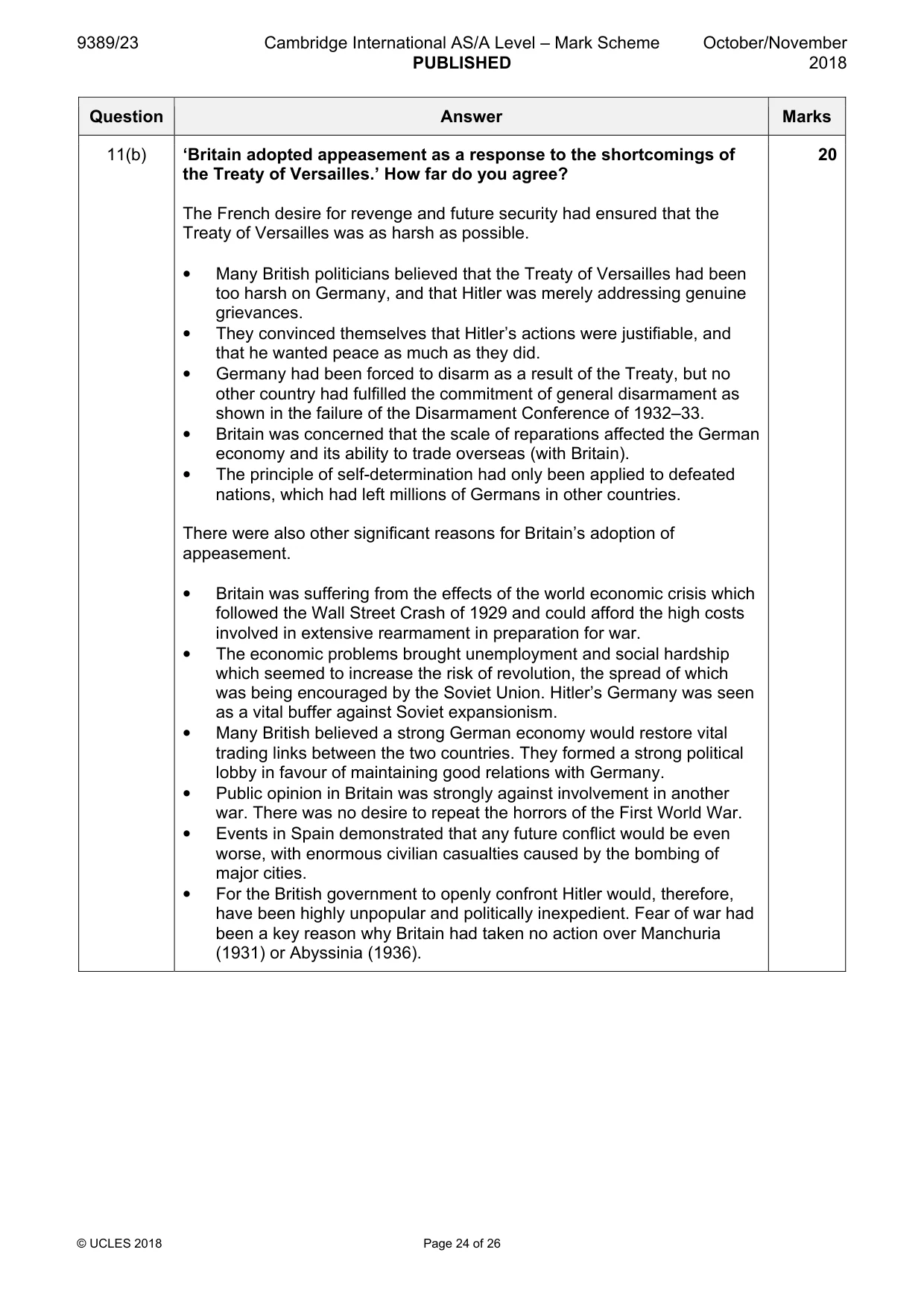
Mark scheme: 11(a) Why, in September 1938, was the Munich Conference held? 10 Candidates might explain several of the following: • By 1938, Hitler’s Germany had already successfully challenged much of the Treaty of Versailles, e.g. it had re-developed its armed forces, occupied the Rhineland in 1936 and achieved Anschluss in March 1938, and formed the Rome-Berlin Axis. There had been no effective opposition to any of this, and Hitler was convinced that Europe’s other major powers would take no action against him. • He now argued that the 3.5 million German-speaking people in the Sudeten area of Czechoslovakia were being discriminated against. The Czech President, Benes, believed that Hitler was deliberately stirring up trouble amongst this group to justify a German invasion of his country. • Fearful of involvement in another major war, the political leaders of Britain (Chamberlain) and France (Daladier) put pressure on Benes to make concessions. Chamberlain argued that Hitler’s desire to bring the German-speaking people into the Third Reich was justified, simply an attempt to right the wrongs of the Treaty of Versailles. • The four-power conference was held to defuse the growing fear that the issues between Germany and Czechoslovakia would lead to a major war. • Chamberlain, Daladier, Hitler and Mussolini met in Munich to discuss the problem of Czechoslovakia. No representative of Czechoslovakia was invited to attend. • The meeting agreed that Germany should take immediate possession of the Sudetenland. The Czech government was simply informed of this decision. 11(b) ‘Britain adopted appeasement as a response to the shortcomings of 20 the Treaty of Versailles.’ How far do you agree? The French desire for revenge and future security had ensured that the Treaty of Versailles was as harsh as possible. • Many British politicians believed that the Treaty of Versailles had been too harsh on Germany, and that Hitler was merely addressing genuine grievances. • They convinced themselves that Hitler’s actions were justifiable, and that he wanted peace as much as they did. • Germany had been forced to disarm as a result of the Treaty, but no other country had fulfilled the commitment of general disarmament as shown in the failure of the Disarmament Conference of 1932–33. • Britain was concerned that the scale of reparations affected the German economy and its ability to trade overseas (with Britain). • The principle of self-determination had only been applied to defeated nations, which had left millions of Germans in other countries. There were also other significant reasons for Britain’s adoption of appeasement. • Britain was suffering from the effects of the world economic crisis which followed the Wall Street Crash of 1929 and could afford the high costs involved in extensive rearmament in preparation for war. • The economic problems brought unemployment and social hardship which seemed to increase the risk of revolution, the spread of which was being encouraged by the Soviet Union. Hitler’s Germany was seen as a vital buffer against Soviet expansionism. • Many British believed a strong German economy would restore vital trading links between the two countries. They formed a strong political lobby in favour of maintaining good relations with Germany. • Public opinion in Britain was strongly against involvement in another war. There was no desire to repeat the horrors of the First World War. • Events in Spain demonstrated that any future conflict would be even worse, with enormous civilian casualties caused by the bombing of major cities. • For the British government to openly confront Hitler would, therefore, have been highly unpopular and politically inexpedient. Fear of war had been a key reason why Britain had taken no action over Manchuria (1931) or Abyssinia (1936).
Q12 · China and Japan, 1919–1945 (a) Why, in the period from 1926 to 1928, was the Kuomintang…
12 China and Japan, 1919–1945 (a) Why, in the period from 1926 to 1928, was the Kuomintang able to reduce the power of the warlords? [10] (b) To what extent were the aims of the Kuomintang similar to those of the May the Fourth Movement? [20]
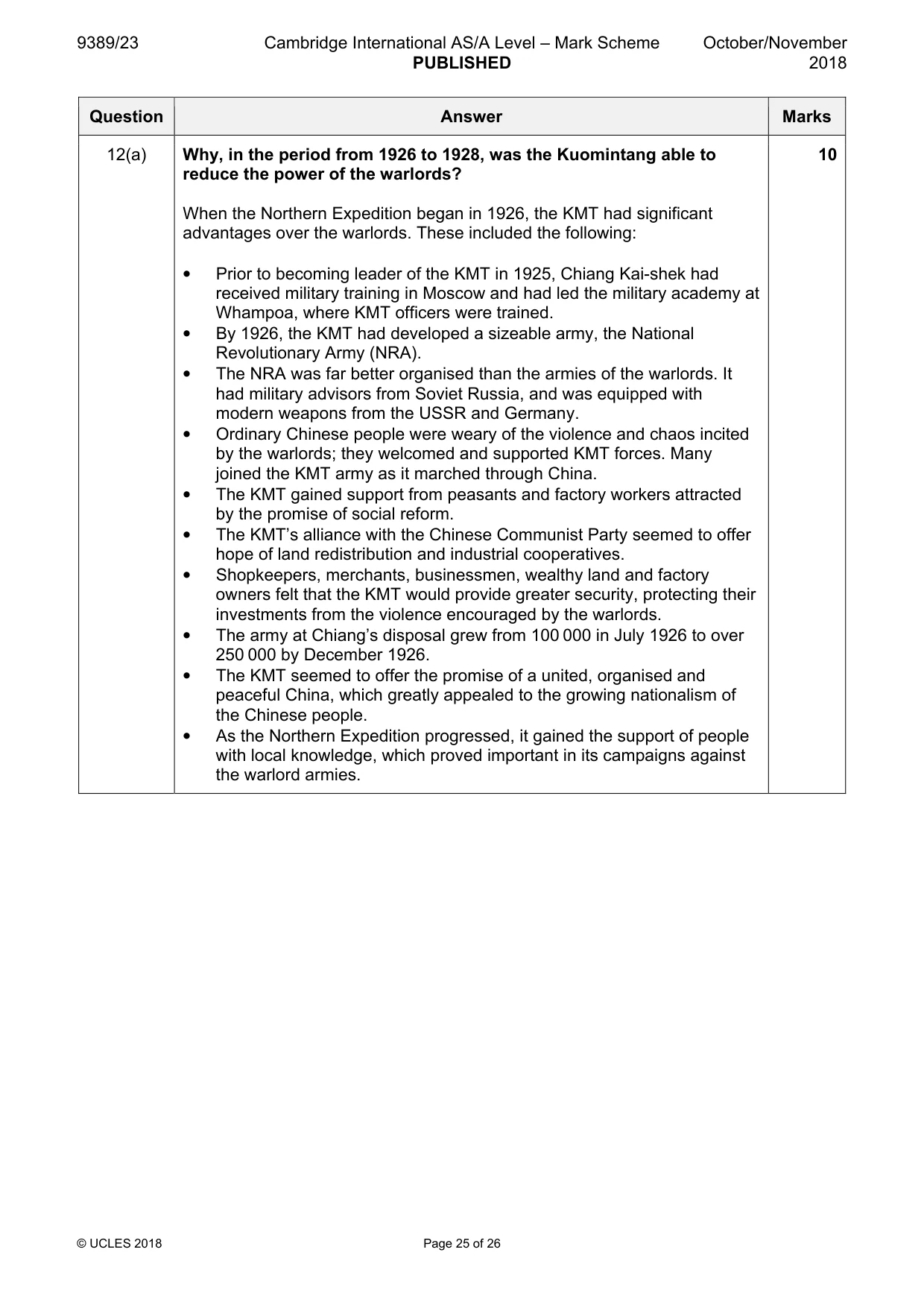
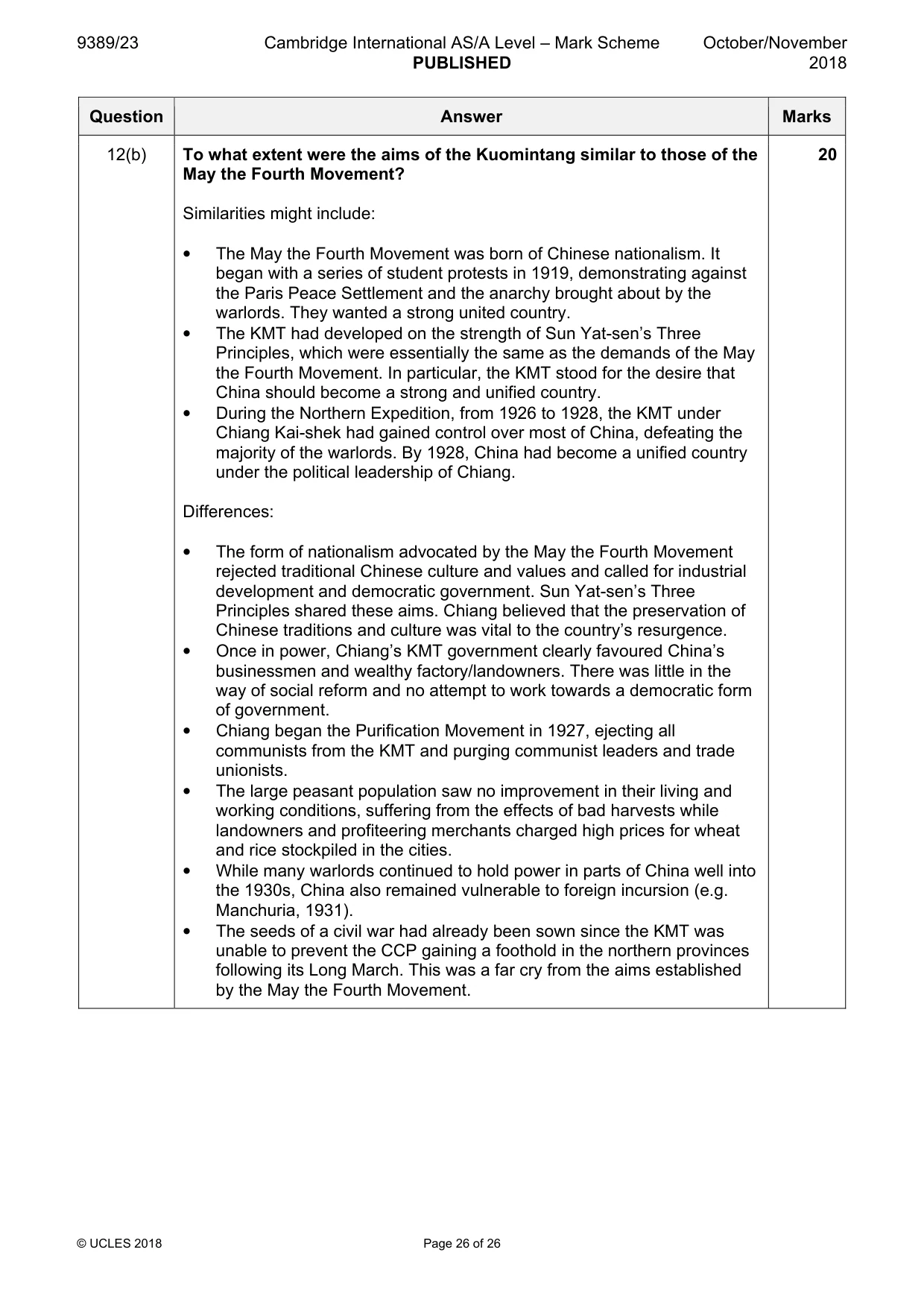
Mark scheme: 12(a) Why, in the period from 1926 to 1928, was the Kuomintang able to 10 reduce the power of the warlords? When the Northern Expedition began in 1926, the KMT had significant advantages over the warlords. These included the following: • Prior to becoming leader of the KMT in 1925, Chiang Kai-shek had received military training in Moscow and had led the military academy at Whampoa, where KMT officers were trained. • By 1926, the KMT had developed a sizeable army, the National Revolutionary Army (NRA). • The NRA was far better organised than the armies of the warlords. It had military advisors from Soviet Russia, and was equipped with modern weapons from the USSR and Germany. • Ordinary Chinese people were weary of the violence and chaos incited by the warlords; they welcomed and supported KMT forces. Many joined the KMT army as it marched through China. • The KMT gained support from peasants and factory workers attracted by the promise of social reform. • The KMT’s alliance with the Chinese Communist Party seemed to offer hope of land redistribution and industrial cooperatives. • Shopkeepers, merchants, businessmen, wealthy land and factory owners felt that the KMT would provide greater security, protecting their investments from the violence encouraged by the warlords. • The army at Chiang’s disposal grew from 100 000 in July 1926 to over 250 000 by December 1926. • The KMT seemed to offer the promise of a united, organised and peaceful China, which greatly appealed to the growing nationalism of the Chinese people. • As the Northern Expedition progressed, it gained the support of people with local knowledge, which proved important in its campaigns against the warlord armies. 12(b) To what extent were the aims of the Kuomintang similar to those of the 20 May the Fourth Movement? Similarities might include: • The May the Fourth Movement was born of Chinese nationalism. It began with a series of student protests in 1919, demonstrating against the Paris Peace Settlement and the anarchy brought about by the warlords. They wanted a strong united country. • The KMT had developed on the strength of Sun Yat-sen’s Three Principles, which were essentially the same as the demands of the May the Fourth Movement. In particular, the KMT stood for the desire that China should become a strong and unified country. • During the Northern Expedition, from 1926 to 1928, the KMT under Chiang Kai-shek had gained control over most of China, defeating the majority of the warlords. By 1928, China had become a unified country under the political leadership of Chiang. Differences: • The form of nationalism advocated by the May the Fourth Movement rejected traditional Chinese culture and values and called for industrial development and democratic government. Sun Yat-sen’s Three Principles shared these aims. Chiang believed that the preservation of Chinese traditions and culture was vital to the country’s resurgence. • Once in power, Chiang’s KMT government clearly favoured China’s businessmen and wealthy factory/landowners. There was little in the way of social reform and no attempt to work towards a democratic form of government. • Chiang began the Purification Movement in 1927, ejecting all communists from the KMT and purging communist leaders and trade unionists. • The large peasant population saw no improvement in their living and working conditions, suffering from the effects of bad harvests while landowners and profiteering merchants charged high prices for wheat and rice stockpiled in the cities. • While many warlords continued to hold power in parts of China well into the 1930s, China also remained vulnerable to foreign incursion (e.g. Manchuria, 1931). • The seeds of a civil war had already been sown since the KMT was unable to prevent the CCP gaining a foothold in the northern provinces following its Long March. This was a far cry from the aims established by the May the Fourth Movement.
What you needed in this session
Cambridge’s own grade thresholds for 2018 Oct/Nov, Paper 2 · Variant 3. A higher threshold means an easier paper — the bar moves with how the cohort did.