Cambridge A Level History 9389 — 2018 Oct/Nov Paper 1 · Variant 3
9389/13/O/N/18 · 40 marks · ≈45 min
The question paper and its mark scheme, free to read here and free to download. This is Cambridge’s own paper, exactly as it was sat.
Question paper8 pages
Mark scheme12 pages
Answers below. Sit the paper first if you are practising.
Paper as text
Question paper, page 1
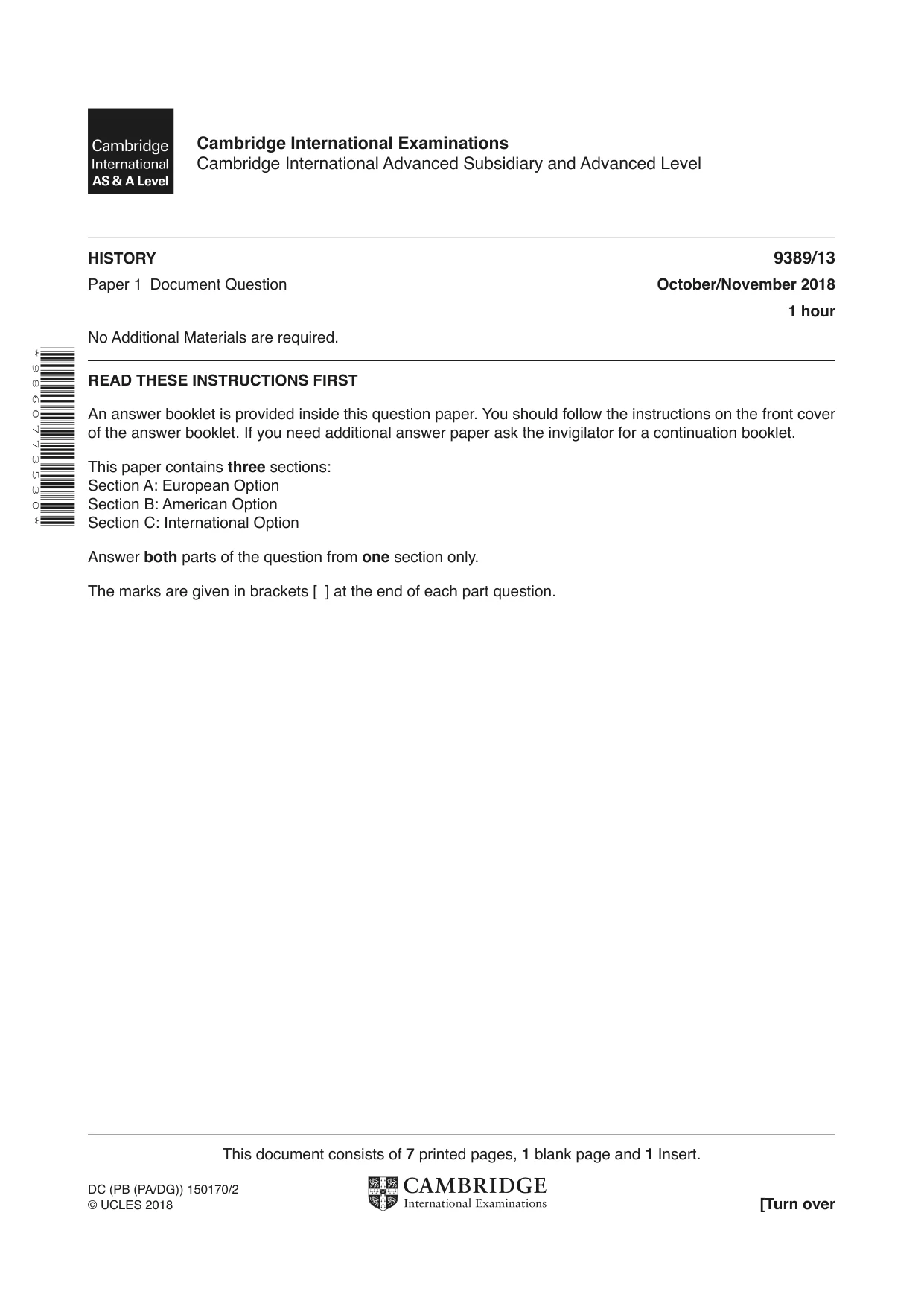
This document consists of 7 printed pages, 1 blank page and 1 Insert. DC (PB (PA/DG)) 150170/2 © UCLES 2018 [Turn over Cambridge International Examinations Cambridge International Advanced Subsidiary and Advanced Level * 9 8 6 0 7 7 3 5 3 0 * HISTORY 9389/13 Paper 1 Document Question October/November 2018 1 hour No Additional Materials are required. READ THESE INSTRUCTIONS FIRST An answer booklet is provided inside this question paper. You should follow the instructions on the front cover of the answer booklet. If you need additional answer paper ask the invigilator for a continuation booklet. This paper contains three sections: Section A: European Option Section B: American Option Section C: International Option Answer both parts of the question from one section only. The marks are given in brackets [ ] at the end of each part question.
Question paper, page 2
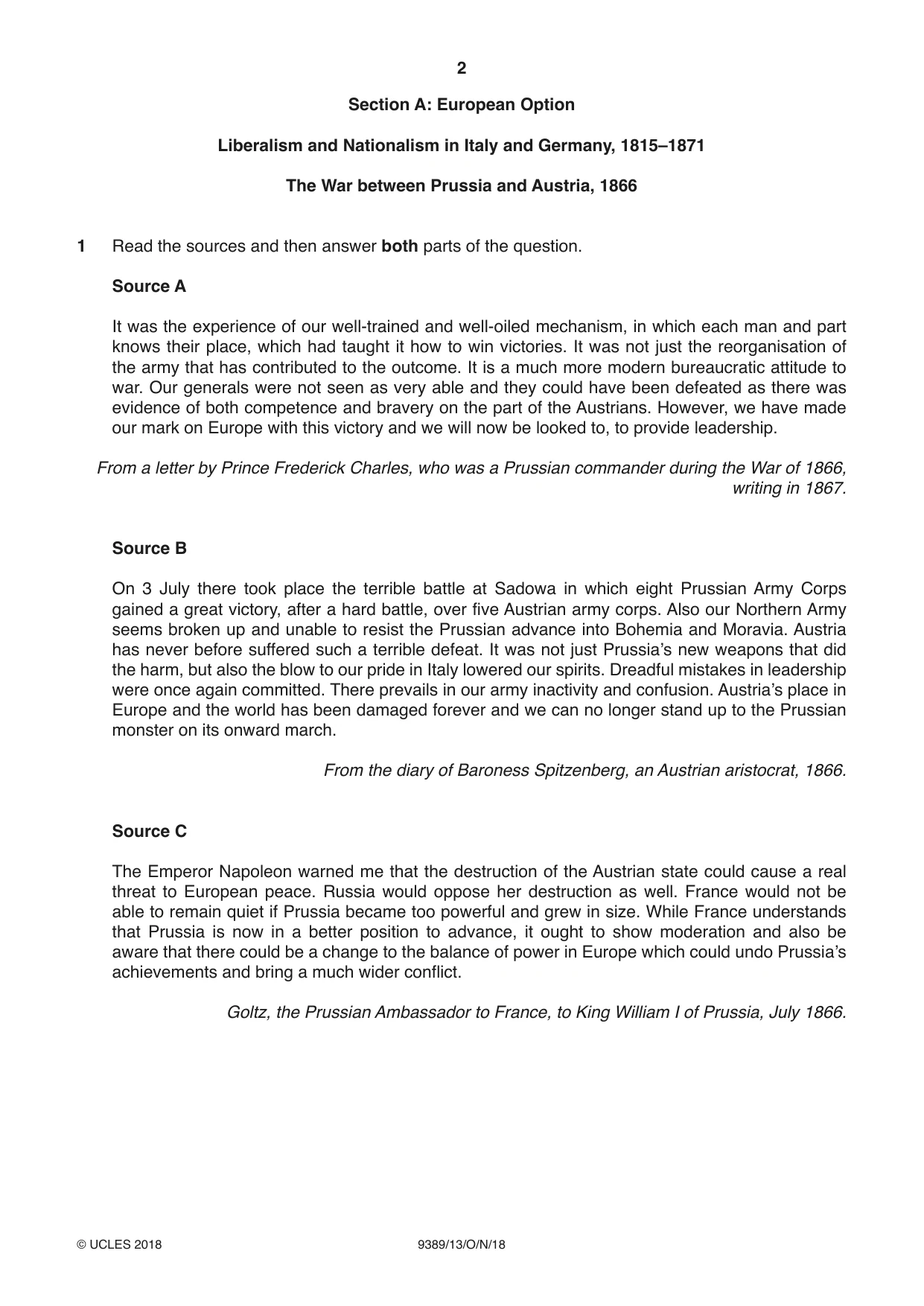
2 9389/13/O/N/18 © UCLES 2018 Section A: European Option Liberalism and Nationalism in Italy and Germany, 1815–1871 The War between Prussia and Austria, 1866 1 Read the sources and then answer both parts of the question. Source A It was the experience of our well-trained and well-oiled mechanism, in which each man and part knows their place, which had taught it how to win victories. It was not just the reorganisation of the army that has contributed to the outcome. It is a much more modern bureaucratic attitude to war. Our generals were not seen as very able and they could have been defeated as there was evidence of both competence and bravery on the part of the Austrians. However, we have made our mark on Europe with this victory and we will now be looked to, to provide leadership. From a letter by Prince Frederick Charles, who was a Prussian commander during the War of 1866, writing in 1867. Source B On 3 July there took place the terrible battle at Sadowa in which eight Prussian Army Corps gained a great victory, after a hard battle, over five Austrian army corps. Also our Northern Army seems broken up and unable to resist the Prussian advance into Bohemia and Moravia. Austria has never before suffered such a terrible defeat. It was not just Prussia’s new weapons that did the harm, but also the blow to our pride in Italy lowered our spirits. Dreadful mistakes in leadership were once again committed. There prevails in our army inactivity and confusion. Austria’s place in Europe and the world has been damaged forever and we can no longer stand up to the Prussian monster on its onward march. From the diary of Baroness Spitzenberg, an Austrian aristocrat, 1866. Source C The Emperor Napoleon warned me that the destruction of the Austrian state could cause a real threat to European peace. Russia would oppose her destruction as well. France would not be able to remain quiet if Prussia became too powerful and grew in size. While France understands that Prussia is now in a better position to advance, it ought to show moderation and also be aware that there could be a change to the balance of power in Europe which could undo Prussia’s achievements and bring a much wider conflict. Goltz, the Prussian Ambassador to France, to King William I of Prussia, July 1866.
Question paper, page 3
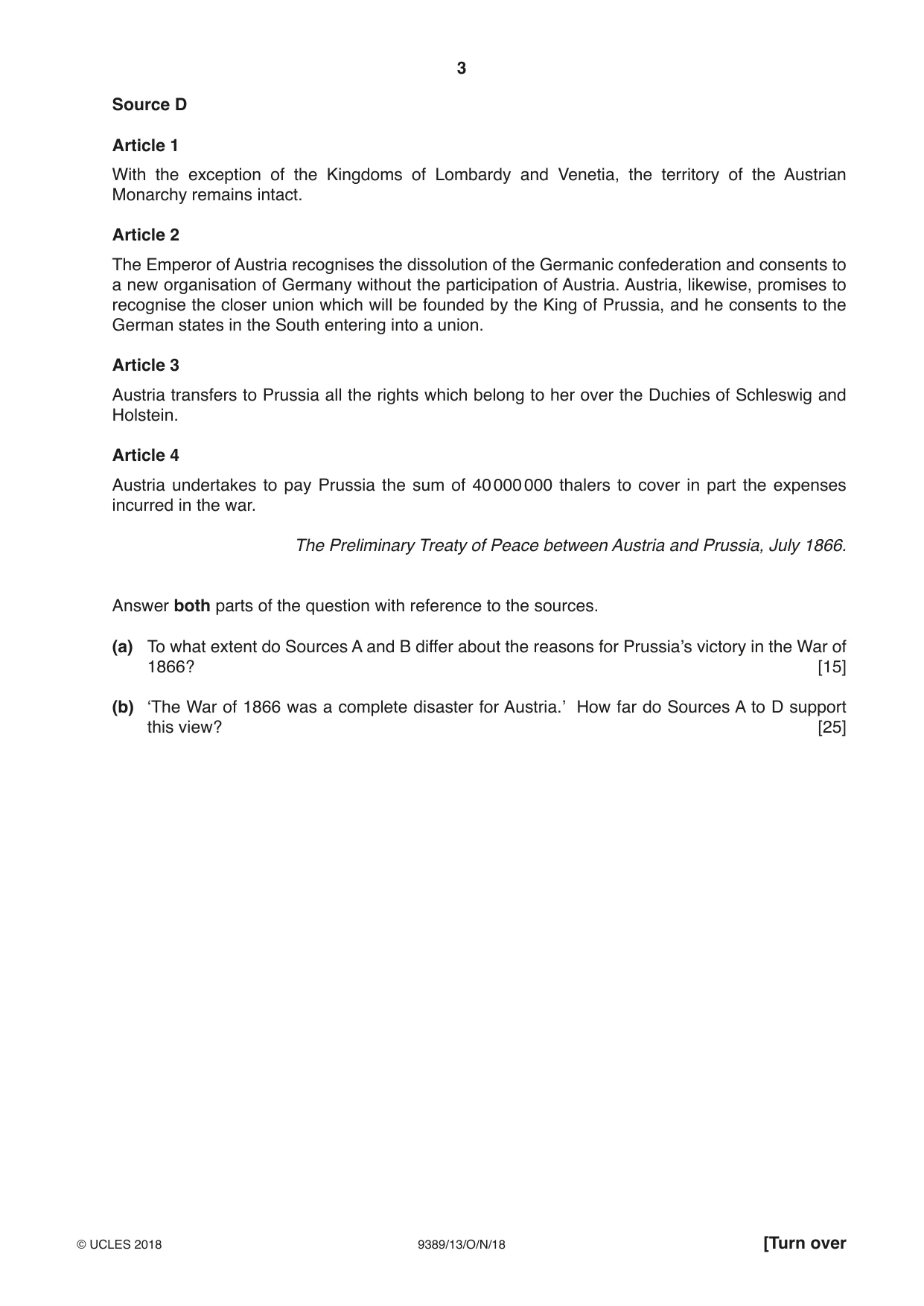
3 9389/13/O/N/18 © UCLES 2018 [Turn over Source D Article 1 With the exception of the Kingdoms of Lombardy and Venetia, the territory of the Austrian Monarchy remains intact. Article 2 The Emperor of Austria recognises the dissolution of the Germanic confederation and consents to a new organisation of Germany without the participation of Austria. Austria, likewise, promises to recognise the closer union which will be founded by the King of Prussia, and he consents to the German states in the South entering into a union. Article 3 Austria transfers to Prussia all the rights which belong to her over the Duchies of Schleswig and Holstein. Article 4 Austria undertakes to pay Prussia the sum of 40 000 000 thalers to cover in part the expenses incurred in the war. The Preliminary Treaty of Peace between Austria and Prussia, July 1866. Answer both parts of the question with reference to the sources. (a) To what extent do Sources A and B differ about the reasons for Prussia’s victory in the War of 1866? [15] (b) ‘The War of 1866 was a complete disaster for Austria.’ How far do Sources A to D support this view? [25]
Question paper, page 4
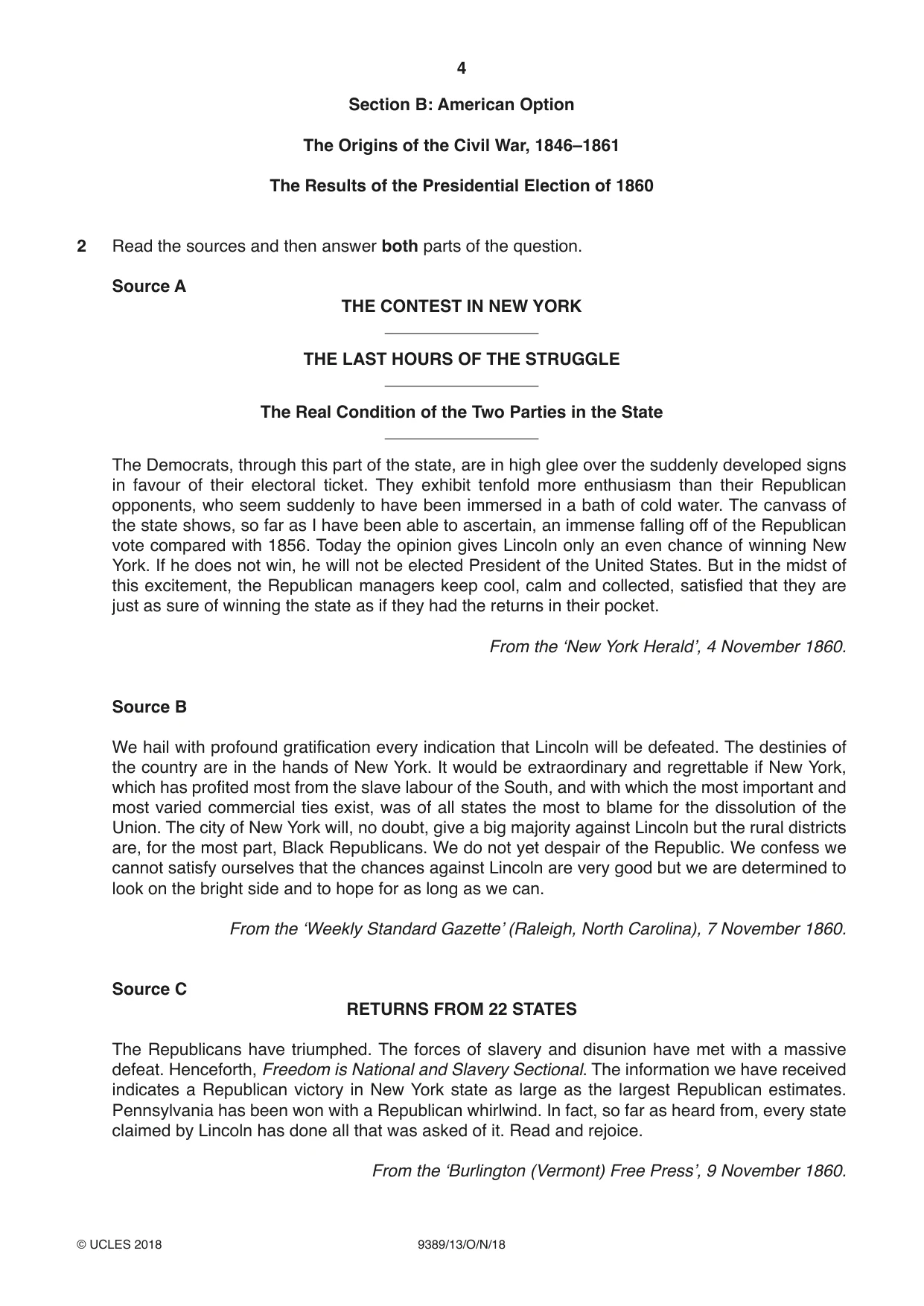
4 9389/13/O/N/18 © UCLES 2018 Section B: American Option The Origins of the Civil War, 1846–1861 The Results of the Presidential Election of 1860 2 Read the sources and then answer both parts of the question. Source A THE CONTEST IN NEW YORK THE LAST HOURS OF THE STRUGGLE The Real Condition of the Two Parties in the State The Democrats, through this part of the state, are in high glee over the suddenly developed signs in favour of their electoral ticket. They exhibit tenfold more enthusiasm than their Republican opponents, who seem suddenly to have been immersed in a bath of cold water. The canvass of the state shows, so far as I have been able to ascertain, an immense falling off of the Republican vote compared with 1856. Today the opinion gives Lincoln only an even chance of winning New York. If he does not win, he will not be elected President of the United States. But in the midst of this excitement, the Republican managers keep cool, calm and collected, satisfied that they are just as sure of winning the state as if they had the returns in their pocket. From the ‘New York Herald’, 4 November 1860. Source B We hail with profound gratification every indication that Lincoln will be defeated. The destinies of the country are in the hands of New York. It would be extraordinary and regrettable if New York, which has profited most from the slave labour of the South, and with which the most important and most varied commercial ties exist, was of all states the most to blame for the dissolution of the Union. The city of New York will, no doubt, give a big majority against Lincoln but the rural districts are, for the most part, Black Republicans. We do not yet despair of the Republic. We confess we cannot satisfy ourselves that the chances against Lincoln are very good but we are determined to look on the bright side and to hope for as long as we can. From the ‘Weekly Standard Gazette’ (Raleigh, North Carolina), 7 November 1860. Source C RETURNS FROM 22 STATES The Republicans have triumphed. The forces of slavery and disunion have met with a massive defeat. Henceforth, Freedom is National and Slavery Sectional. The information we have received indicates a Republican victory in New York state as large as the largest Republican estimates. Pennsylvania has been won with a Republican whirlwind. In fact, so far as heard from, every state claimed by Lincoln has done all that was asked of it. Read and rejoice. From the ‘Burlington (Vermont) Free Press’, 9 November 1860.
Question paper, page 5
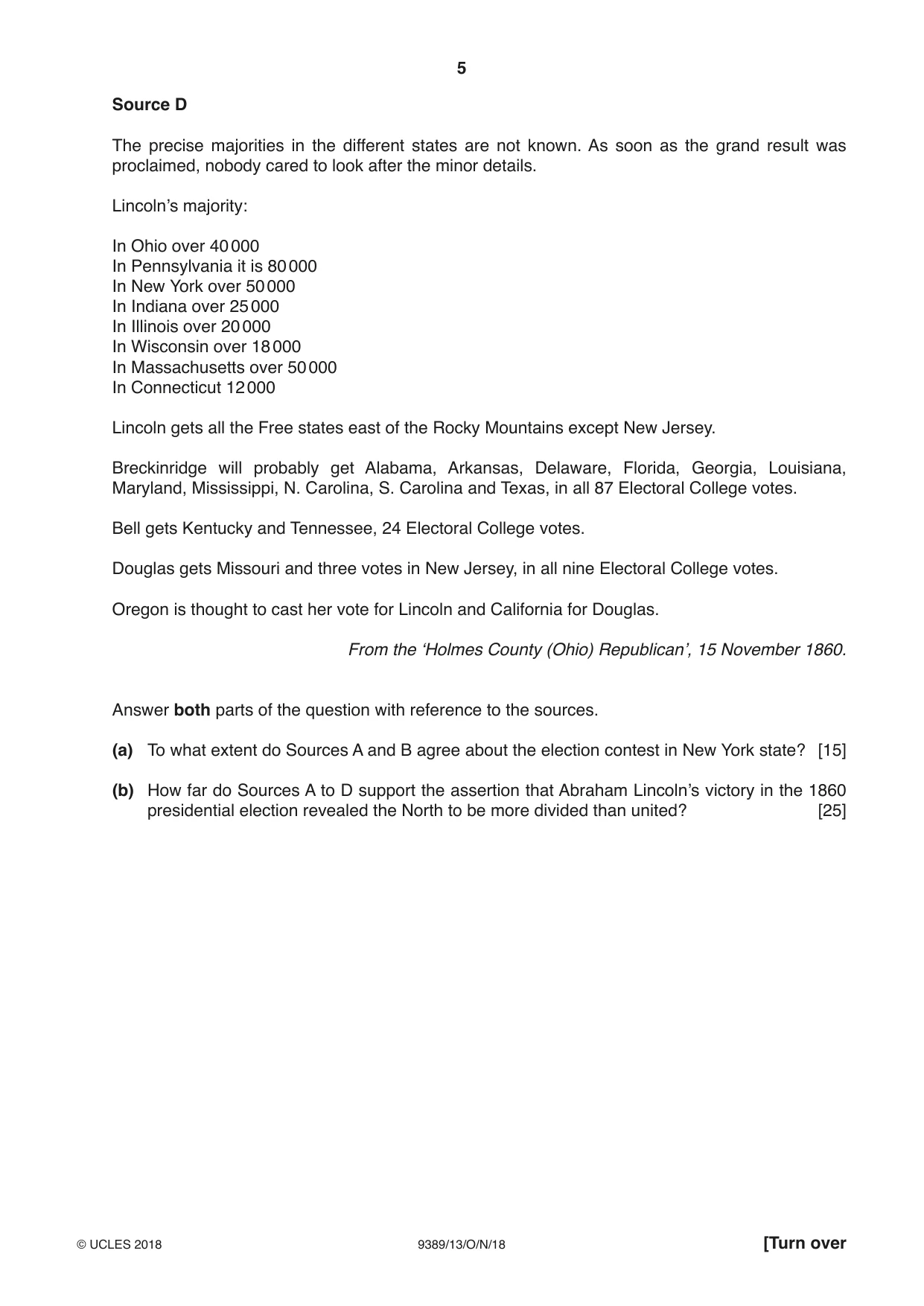
5 9389/13/O/N/18 © UCLES 2018 [Turn over Source D The precise majorities in the different states are not known. As soon as the grand result was proclaimed, nobody cared to look after the minor details. Lincoln’s majority: In Ohio over 40 000 In Pennsylvania it is 80 000 In New York over 50 000 In Indiana over 25 000 In Illinois over 20 000 In Wisconsin over 18 000 In Massachusetts over 50 000 In Connecticut 12 000 Lincoln gets all the Free states east of the Rocky Mountains except New Jersey. Breckinridge will probably get Alabama, Arkansas, Delaware, Florida, Georgia, Louisiana, Maryland, Mississippi, N. Carolina, S. Carolina and Texas, in all 87 Electoral College votes. Bell gets Kentucky and Tennessee, 24 Electoral College votes. Douglas gets Missouri and three votes in New Jersey, in all nine Electoral College votes. Oregon is thought to cast her vote for Lincoln and California for Douglas. From the ‘Holmes County (Ohio) Republican’, 15 November 1860. Answer both parts of the question with reference to the sources. (a) To what extent do Sources A and B agree about the election contest in New York state? [15] (b) How far do Sources A to D support the assertion that Abraham Lincoln’s victory in the 1860 presidential election revealed the North to be more divided than united? [25]
Question paper, page 6
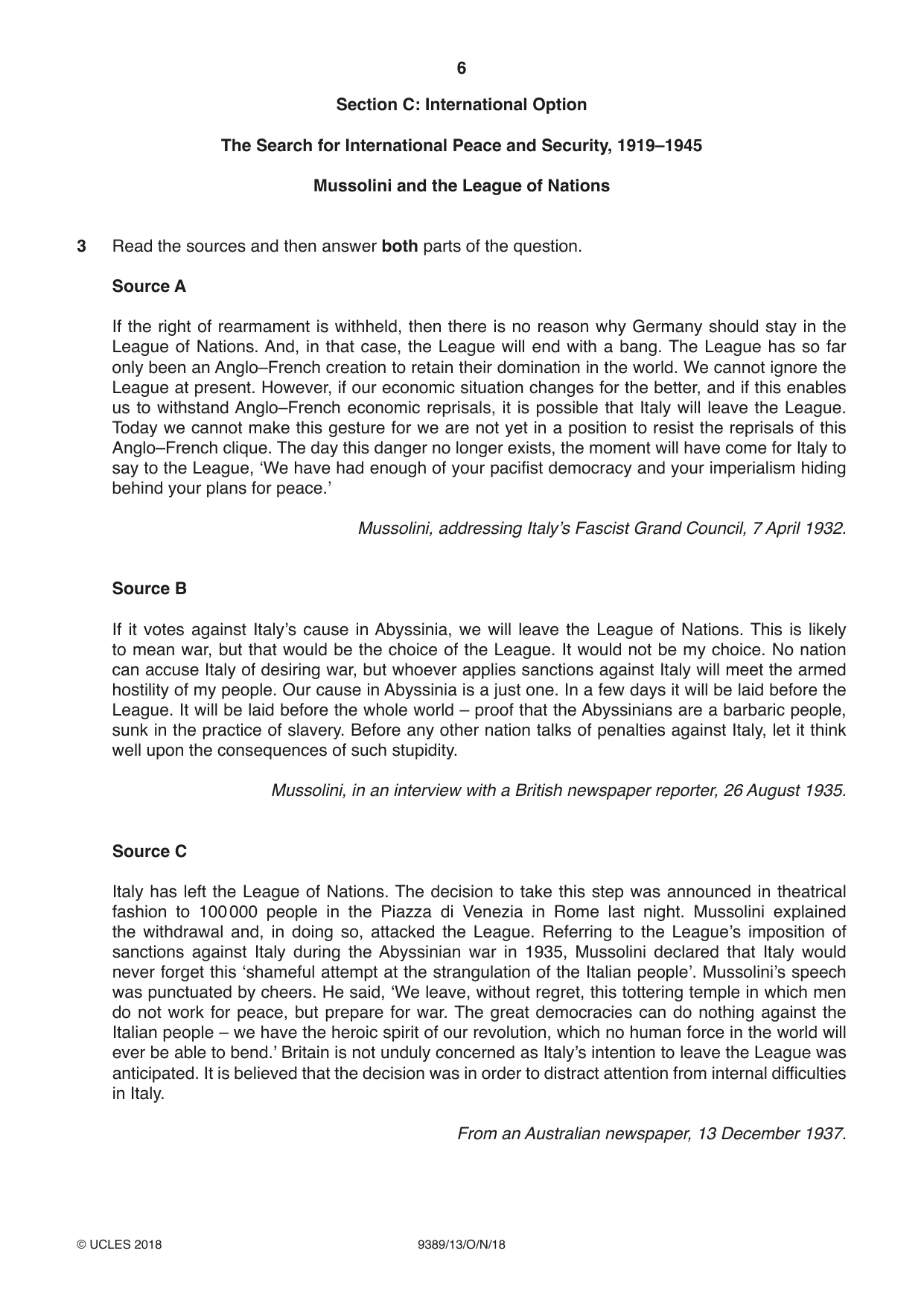
6 9389/13/O/N/18 © UCLES 2018 Section C: International Option The Search for International Peace and Security, 1919–1945 Mussolini and the League of Nations 3 Read the sources and then answer both parts of the question. Source A If the right of rearmament is withheld, then there is no reason why Germany should stay in the League of Nations. And, in that case, the League will end with a bang. The League has so far only been an Anglo–French creation to retain their domination in the world. We cannot ignore the League at present. However, if our economic situation changes for the better, and if this enables us to withstand Anglo–French economic reprisals, it is possible that Italy will leave the League. Today we cannot make this gesture for we are not yet in a position to resist the reprisals of this Anglo–French clique. The day this danger no longer exists, the moment will have come for Italy to say to the League, ‘We have had enough of your pacifist democracy and your imperialism hiding behind your plans for peace.’ Mussolini, addressing Italy’s Fascist Grand Council, 7 April 1932. Source B If it votes against Italy’s cause in Abyssinia, we will leave the League of Nations. This is likely to mean war, but that would be the choice of the League. It would not be my choice. No nation can accuse Italy of desiring war, but whoever applies sanctions against Italy will meet the armed hostility of my people. Our cause in Abyssinia is a just one. In a few days it will be laid before the League. It will be laid before the whole world – proof that the Abyssinians are a barbaric people, sunk in the practice of slavery. Before any other nation talks of penalties against Italy, let it think well upon the consequences of such stupidity. Mussolini, in an interview with a British newspaper reporter, 26 August 1935. Source C Italy has left the League of Nations. The decision to take this step was announced in theatrical fashion to 100 000 people in the Piazza di Venezia in Rome last night. Mussolini explained the withdrawal and, in doing so, attacked the League. Referring to the League’s imposition of sanctions against Italy during the Abyssinian war in 1935, Mussolini declared that Italy would never forget this ‘shameful attempt at the strangulation of the Italian people’. Mussolini’s speech was punctuated by cheers. He said, ‘We leave, without regret, this tottering temple in which men do not work for peace, but prepare for war. The great democracies can do nothing against the Italian people – we have the heroic spirit of our revolution, which no human force in the world will ever be able to bend.’ Britain is not unduly concerned as Italy’s intention to leave the League was anticipated. It is believed that the decision was in order to distract attention from internal difficulties in Italy. From an Australian newspaper, 13 December 1937.
Question paper, page 7
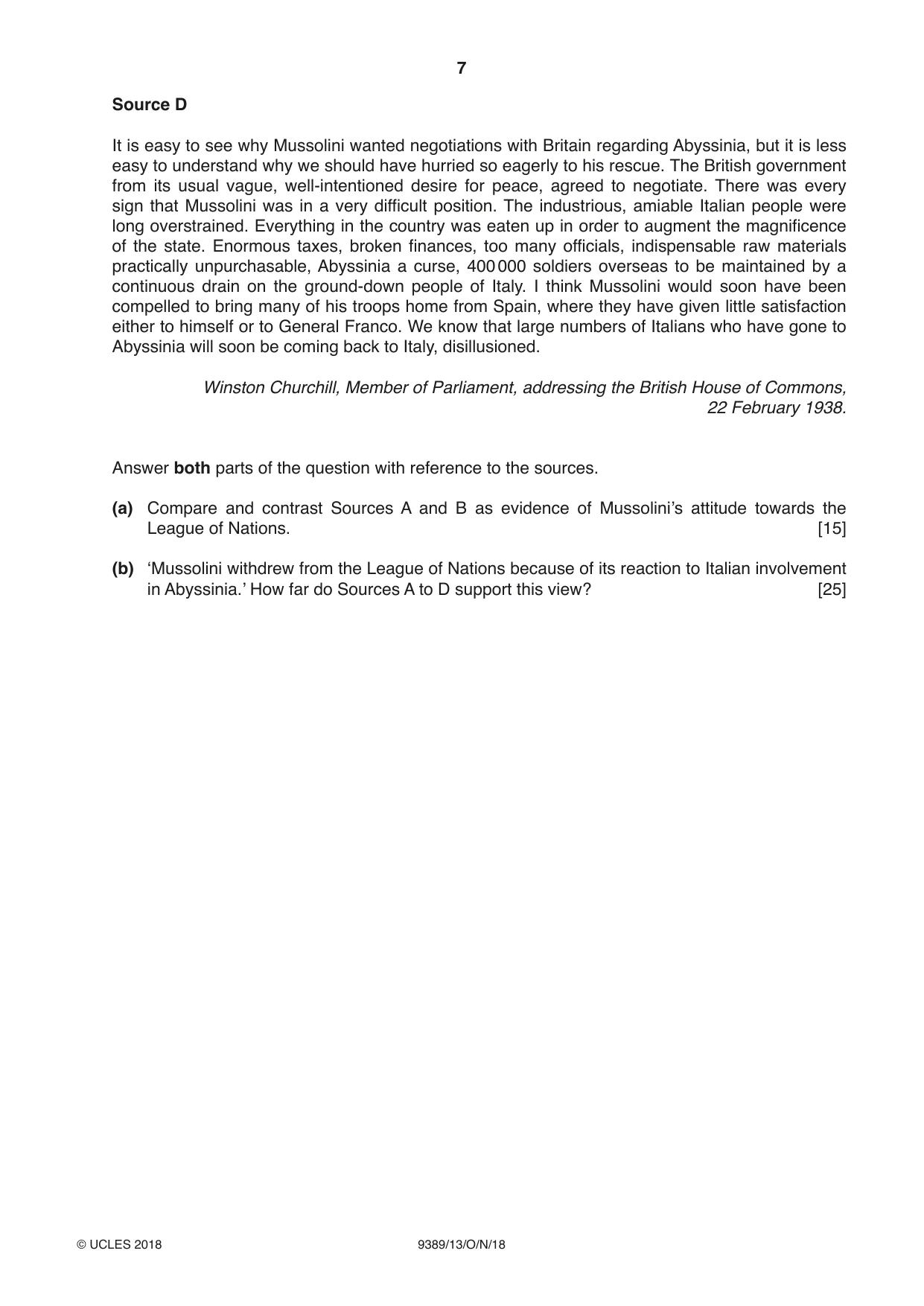
7 9389/13/O/N/18 © UCLES 2018 Source D It is easy to see why Mussolini wanted negotiations with Britain regarding Abyssinia, but it is less easy to understand why we should have hurried so eagerly to his rescue. The British government from its usual vague, well-intentioned desire for peace, agreed to negotiate. There was every sign that Mussolini was in a very difficult position. The industrious, amiable Italian people were long overstrained. Everything in the country was eaten up in order to augment the magnificence of the state. Enormous taxes, broken finances, too many officials, indispensable raw materials practically unpurchasable, Abyssinia a curse, 400 000 soldiers overseas to be maintained by a continuous drain on the ground-down people of Italy. I think Mussolini would soon have been compelled to bring many of his troops home from Spain, where they have given little satisfaction either to himself or to General Franco. We know that large numbers of Italians who have gone to Abyssinia will soon be coming back to Italy, disillusioned. Winston Churchill, Member of Parliament, addressing the British House of Commons, 22 February 1938. Answer both parts of the question with reference to the sources. (a) Compare and contrast Sources A and B as evidence of Mussolini’s attitude towards the League of Nations. [15] (b) ‘Mussolini withdrew from the League of Nations because of its reaction to Italian involvement in Abyssinia.’ How far do Sources A to D support this view? [25]
Question paper, page 8
8 9389/13/O/N/18 © UCLES 2018 BLANK PAGE Permission to reproduce items where third-party owned material protected by copyright is included has been sought and cleared where possible. Every reasonable effort has been made by the publisher (UCLES) to trace copyright holders, but if any items requiring clearance have unwittingly been included, the publisher will be pleased to make amends at the earliest possible opportunity. To avoid the issue of disclosure of answer-related information to candidates, all copyright acknowledgements are reproduced online in the Cambridge International Examinations Copyright Acknowledgements Booklet. This is produced for each series of examinations and is freely available to download at www.cie.org.uk after the live examination series. Cambridge International Examinations is part of the Cambridge Assessment Group. Cambridge Assessment is the brand name of University of Cambridge Local Examinations Syndicate (UCLES), which is itself a department of the University of Cambridge.
Mark scheme, page 1
This document consists of 12 printed pages. © UCLES 2018 [Turn over Cambridge Assessment International Education Cambridge International Advanced Subsidiary and Advanced Level HISTORY 9389/13 Paper 1 Document Question October/November 2018 MARK SCHEME Maximum Mark: 40 Published This mark scheme is published as an aid to teachers and candidates, to indicate the requirements of the examination. It shows the basis on which Examiners were instructed to award marks. It does not indicate the details of the discussions that took place at an Examiners’ meeting before marking began, which would have considered the acceptability of alternative answers. Mark schemes should be read in conjunction with the question paper and the Principal Examiner Report for Teachers. Cambridge International will not enter into discussions about these mark schemes. Cambridge International is publishing the mark schemes for the October/November 2018 series for most Cambridge IGCSE™, Cambridge International A and AS Level components and some Cambridge O Level components.
Mark scheme, page 2
9389/13 Cambridge International AS/A Level – Mark Scheme PUBLISHED October/November 2018 © UCLES 2018 Page 2 of 12 Generic Marking Principles These general marking principles must be applied by all examiners when marking candidate answers. They should be applied alongside the specific content of the mark scheme or generic level descriptors for a question. Each question paper and mark scheme will also comply with these marking principles. GENERIC MARKING PRINCIPLE 1: Marks must be awarded in line with: • the specific content of the mark scheme or the generic level descriptors for the question • the specific skills defined in the mark scheme or in the generic level descriptors for the question • the standard of response required by a candidate as exemplified by the standardisation scripts. GENERIC MARKING PRINCIPLE 2: Marks awarded are always whole marks (not half marks, or other fractions). GENERIC MARKING PRINCIPLE 3: Marks must be awarded positively: • marks are awarded for correct/valid answers, as defined in the mark scheme. However, credit is given for valid answers which go beyond the scope of the syllabus and mark scheme, referring to your Team Leader as appropriate • marks are awarded when candidates clearly demonstrate what they know and can do • marks are not deducted for errors • marks are not deducted for omissions • answers should only be judged on the quality of spelling, punctuation and grammar when these features are specifically assessed by the question as indicated by the mark scheme. The meaning, however, should be unambiguous. GENERIC MARKING PRINCIPLE 4: Rules must be applied consistently e.g. in situations where candidates have not followed instructions or in the application of generic level descriptors.
Mark scheme, page 3
9389/13 Cambridge International AS/A Level – Mark Scheme PUBLISHED October/November 2018 © UCLES 2018 Page 3 of 12 GENERIC MARKING PRINCIPLE 5: Marks should be awarded using the full range of marks defined in the mark scheme for the question (however; the use of the full mark range may be limited according to the quality of the candidate responses seen). GENERIC MARKING PRINCIPLE 6: Marks awarded are based solely on the requirements as defined in the mark scheme. Marks should not be awarded with grade thresholds or grade descriptors in mind.
Mark scheme, page 4
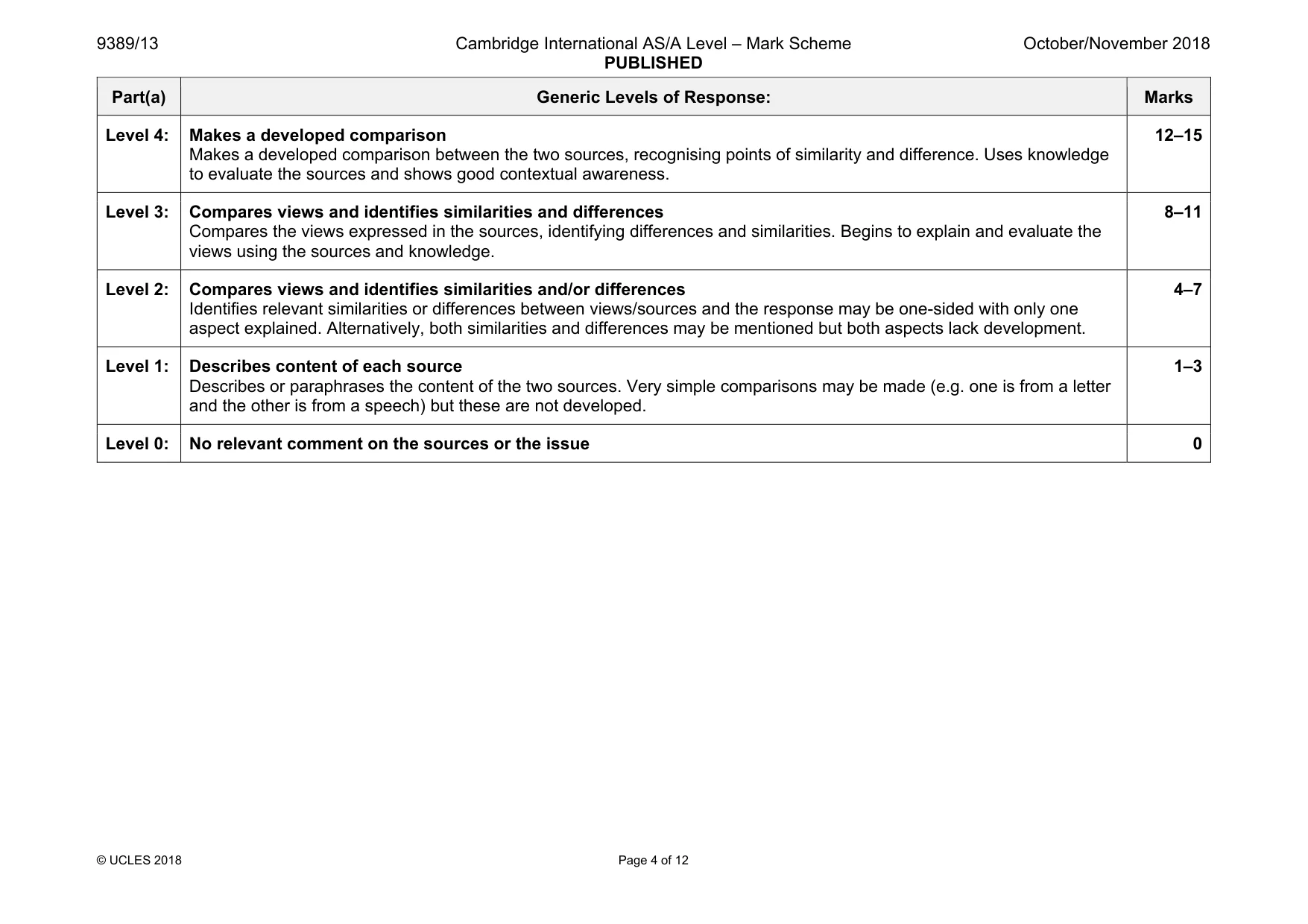
9389/13 Cambridge International AS/A Level – Mark Scheme PUBLISHED October/November 2018 © UCLES 2018 Page 4 of 12 Part(a) Generic Levels of Response: Marks Level 4: Makes a developed comparison Makes a developed comparison between the two sources, recognising points of similarity and difference. Uses knowledge to evaluate the sources and shows good contextual awareness. 12–15 Level 3: Compares views and identifies similarities and differences Compares the views expressed in the sources, identifying differences and similarities. Begins to explain and evaluate the views using the sources and knowledge. 8–11 Level 2: Compares views and identifies similarities and/or differences Identifies relevant similarities or differences between views/sources and the response may be one-sided with only one aspect explained. Alternatively, both similarities and differences may be mentioned but both aspects lack development. 4–7 Level 1: Describes content of each source Describes or paraphrases the content of the two sources. Very simple comparisons may be made (e.g. one is from a letter and the other is from a speech) but these are not developed. 1–3 Level 0: No relevant comment on the sources or the issue 0
Mark scheme, page 5
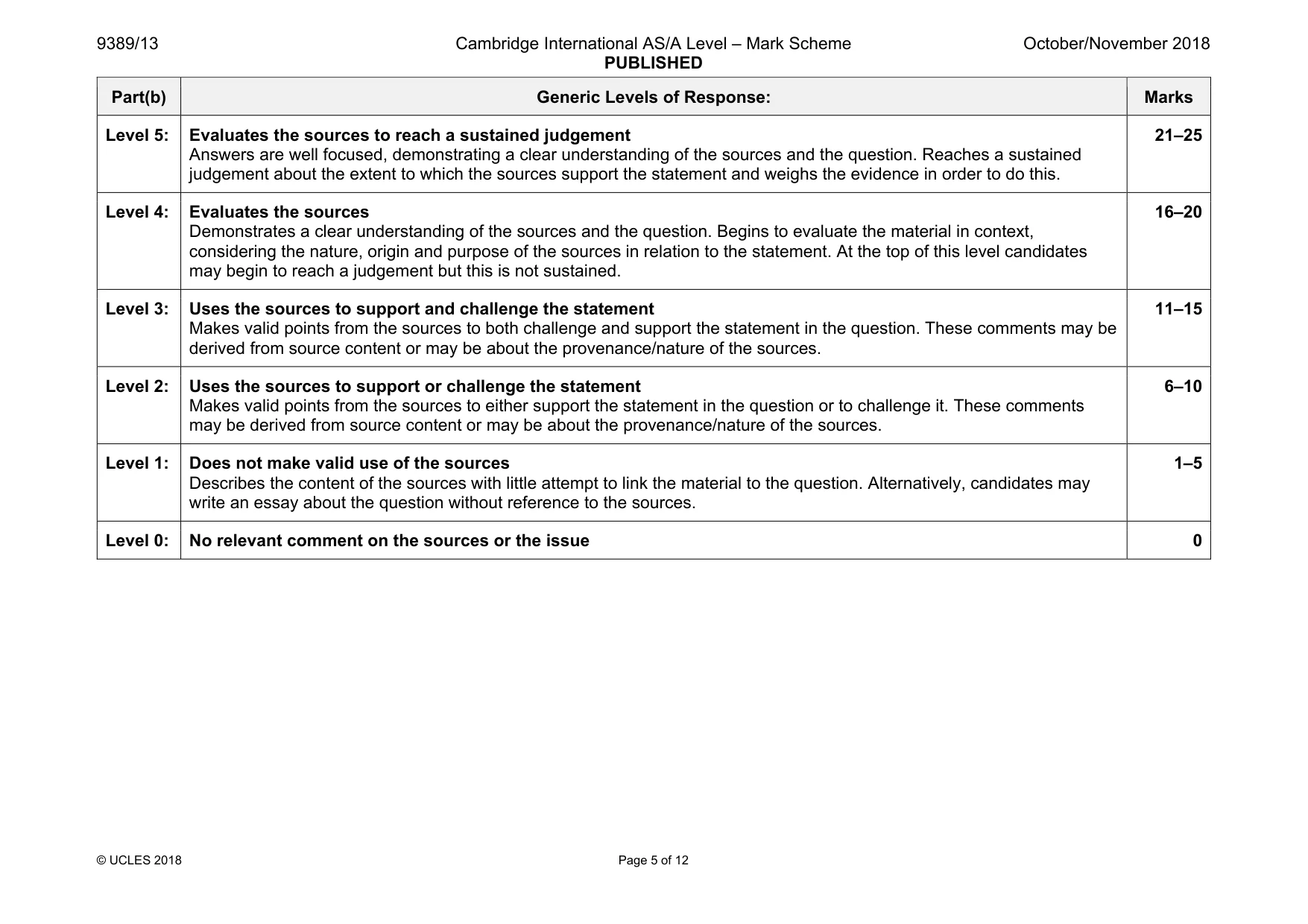
9389/13 Cambridge International AS/A Level – Mark Scheme PUBLISHED October/November 2018 © UCLES 2018 Page 5 of 12 Part(b) Generic Levels of Response: Marks Level 5: Evaluates the sources to reach a sustained judgement Answers are well focused, demonstrating a clear understanding of the sources and the question. Reaches a sustained judgement about the extent to which the sources support the statement and weighs the evidence in order to do this. 21–25 Level 4: Evaluates the sources Demonstrates a clear understanding of the sources and the question. Begins to evaluate the material in context, considering the nature, origin and purpose of the sources in relation to the statement. At the top of this level candidates may begin to reach a judgement but this is not sustained. 16–20 Level 3: Uses the sources to support and challenge the statement Makes valid points from the sources to both challenge and support the statement in the question. These comments may be derived from source content or may be about the provenance/nature of the sources. 11–15 Level 2: Uses the sources to support or challenge the statement Makes valid points from the sources to either support the statement in the question or to challenge it. These comments may be derived from source content or may be about the provenance/nature of the sources. 6–10 Level 1: Does not make valid use of the sources Describes the content of the sources with little attempt to link the material to the question. Alternatively, candidates may write an essay about the question without reference to the sources. 1–5 Level 0: No relevant comment on the sources or the issue 0
Mark scheme, page 6
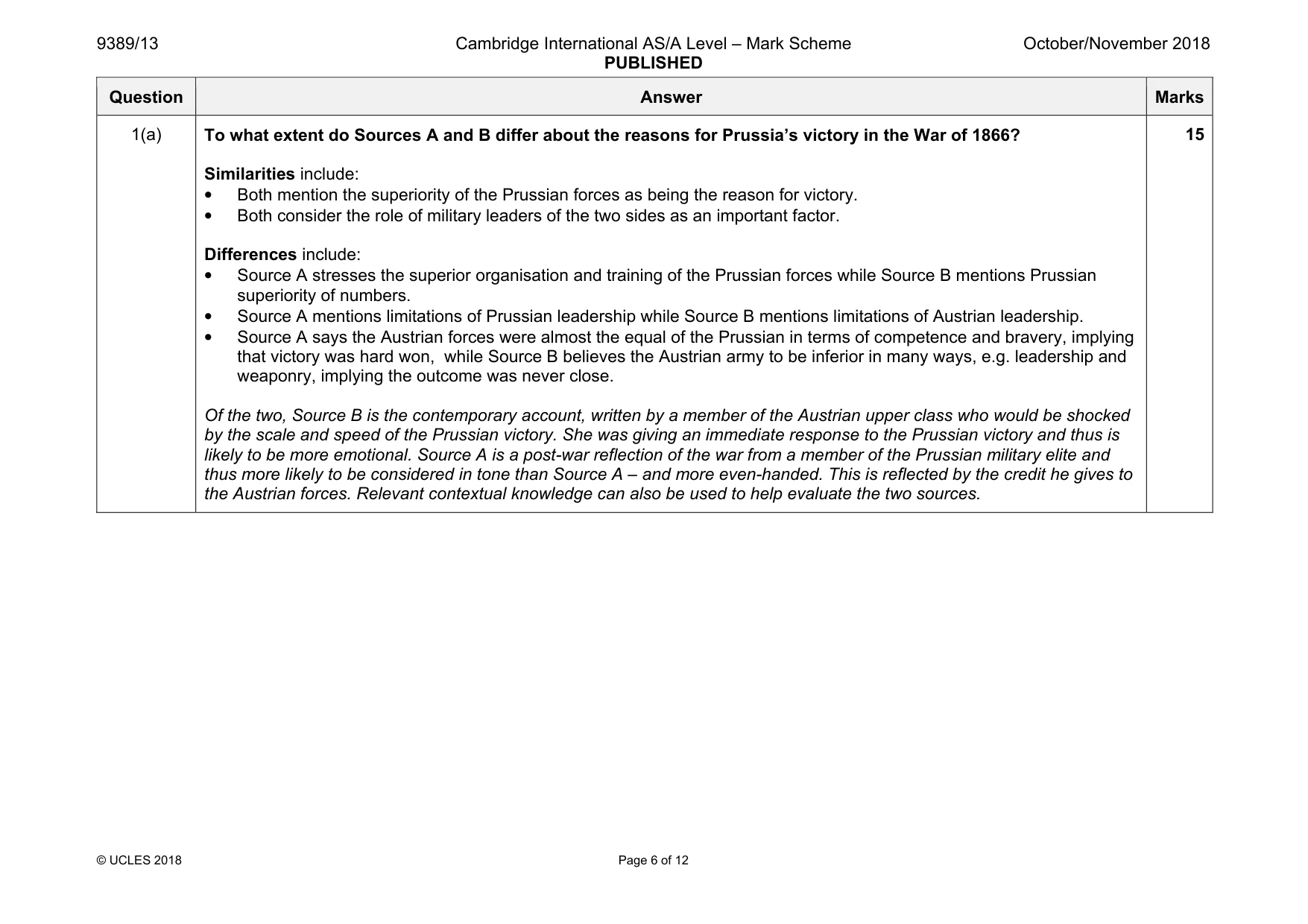
9389/13 Cambridge International AS/A Level – Mark Scheme PUBLISHED October/November 2018 © UCLES 2018 Page 6 of 12 Question Answer Marks 1(a) To what extent do Sources A and B differ about the reasons for Prussia’s victory in the War of 1866? Similarities include: • Both mention the superiority of the Prussian forces as being the reason for victory. • Both consider the role of military leaders of the two sides as an important factor. Differences include: • Source A stresses the superior organisation and training of the Prussian forces while Source B mentions Prussian superiority of numbers. • Source A mentions limitations of Prussian leadership while Source B mentions limitations of Austrian leadership. • Source A says the Austrian forces were almost the equal of the Prussian in terms of competence and bravery, implying that victory was hard won, while Source B believes the Austrian army to be inferior in many ways, e.g. leadership and weaponry, implying the outcome was never close. Of the two, Source B is the contemporary account, written by a member of the Austrian upper class who would be shocked by the scale and speed of the Prussian victory. She was giving an immediate response to the Prussian victory and thus is likely to be more emotional. Source A is a post-war reflection of the war from a member of the Prussian military elite and thus more likely to be considered in tone than Source A – and more even-handed. This is reflected by the credit he gives to the Austrian forces. Relevant contextual knowledge can also be used to help evaluate the two sources. 15
Mark scheme, page 7
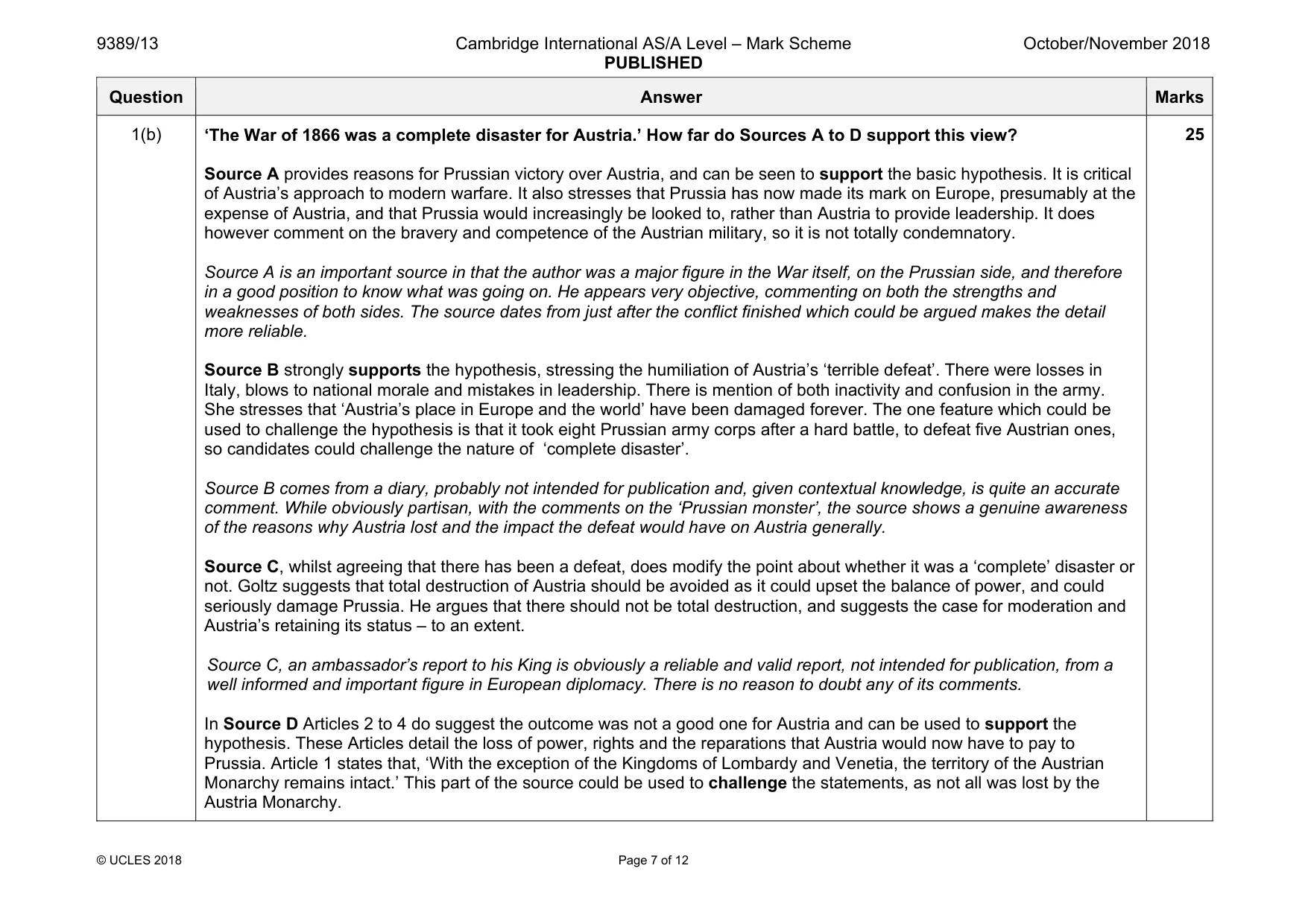
9389/13 Cambridge International AS/A Level – Mark Scheme PUBLISHED October/November 2018 © UCLES 2018 Page 7 of 12 Question Answer Marks 1(b) ‘The War of 1866 was a complete disaster for Austria.’ How far do Sources A to D support this view? Source A provides reasons for Prussian victory over Austria, and can be seen to support the basic hypothesis. It is critical of Austria’s approach to modern warfare. It also stresses that Prussia has now made its mark on Europe, presumably at the expense of Austria, and that Prussia would increasingly be looked to, rather than Austria to provide leadership. It does however comment on the bravery and competence of the Austrian military, so it is not totally condemnatory. Source A is an important source in that the author was a major figure in the War itself, on the Prussian side, and therefore in a good position to know what was going on. He appears very objective, commenting on both the strengths and weaknesses of both sides. The source dates from just after the conflict finished which could be argued makes the detail more reliable. Source B strongly supports the hypothesis, stressing the humiliation of Austria’s ‘terrible defeat’. There were losses in Italy, blows to national morale and mistakes in leadership. There is mention of both inactivity and confusion in the army. She stresses that ‘Austria’s place in Europe and the world’ have been damaged forever. The one feature which could be used to challenge the hypothesis is that it took eight Prussian army corps after a hard battle, to defeat five Austrian ones, so candidates could challenge the nature of ‘complete disaster’. Source B comes from a diary, probably not intended for publication and, given contextual knowledge, is quite an accurate comment. While obviously partisan, with the comments on the ‘Prussian monster’, the source shows a genuine awareness of the reasons why Austria lost and the impact the defeat would have on Austria generally. Source C, whilst agreeing that there has been a defeat, does modify the point about whether it was a ‘complete’ disaster or not. Goltz suggests that total destruction of Austria should be avoided as it could upset the balance of power, and could seriously damage Prussia. He argues that there should not be total destruction, and suggests the case for moderation and Austria’s retaining its status – to an extent. Source C, an ambassador’s report to his King is obviously a reliable and valid report, not intended for publication, from a well informed and important figure in European diplomacy. There is no reason to doubt any of its comments. In Source D Articles 2 to 4 do suggest the outcome was not a good one for Austria and can be used to support the hypothesis. These Articles detail the loss of power, rights and the reparations that Austria would now have to pay to Prussia. Article 1 states that, ‘With the exception of the Kingdoms of Lombardy and Venetia, the territory of the Austrian Monarchy remains intact.’ This part of the source could be used to challenge the statements, as not all was lost by the Austria Monarchy. 25
Mark scheme, page 8
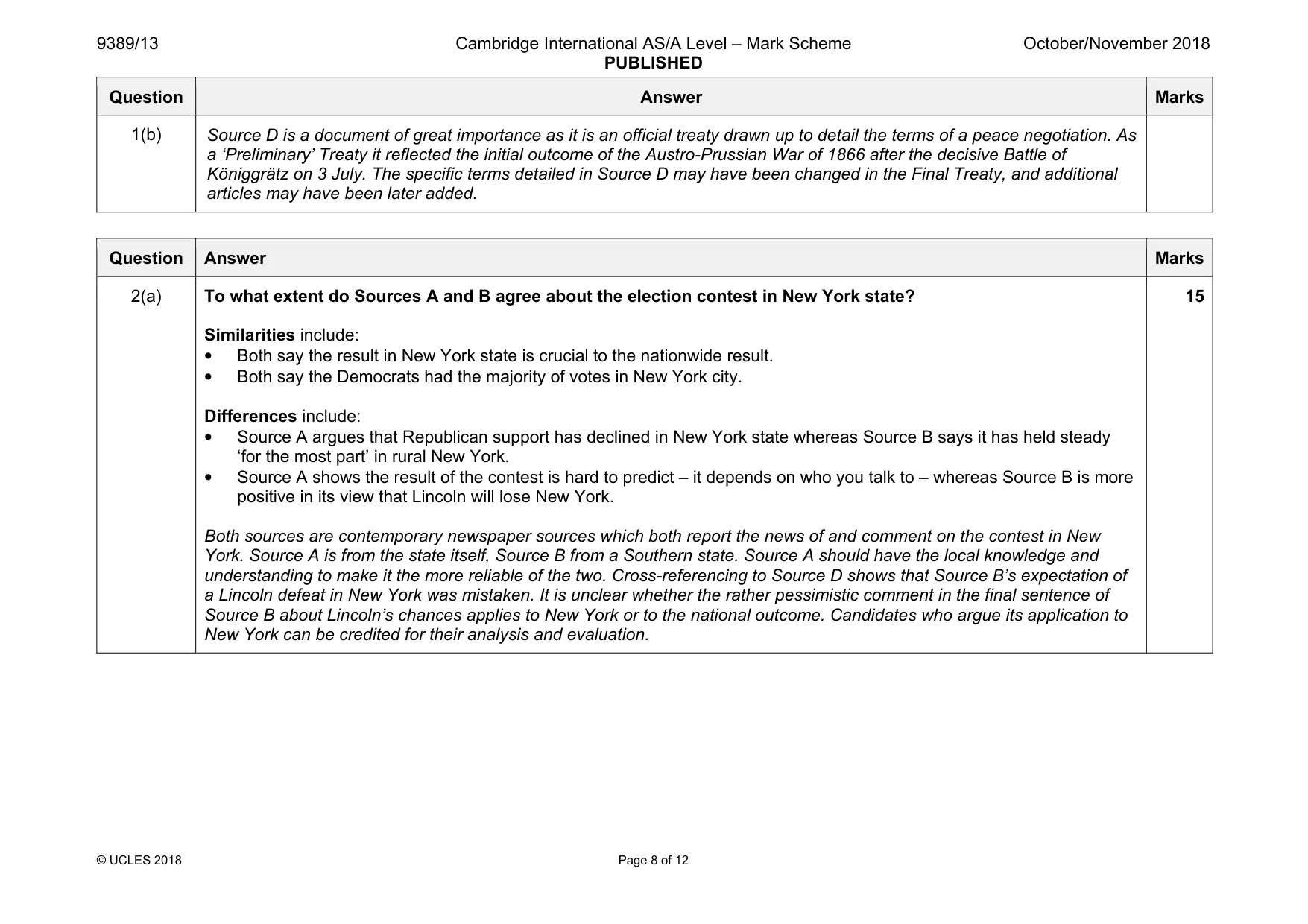
9389/13 Cambridge International AS/A Level – Mark Scheme PUBLISHED October/November 2018 © UCLES 2018 Page 8 of 12 Question Answer Marks 1(b) Source D is a document of great importance as it is an official treaty drawn up to detail the terms of a peace negotiation. As a ‘Preliminary’ Treaty it reflected the initial outcome of the Austro-Prussian War of 1866 after the decisive Battle of Königgrätz on 3 July. The specific terms detailed in Source D may have been changed in the Final Treaty, and additional articles may have been later added. Question Answer Marks 2(a) To what extent do Sources A and B agree about the election contest in New York state? Similarities include: • Both say the result in New York state is crucial to the nationwide result. • Both say the Democrats had the majority of votes in New York city. Differences include: • Source A argues that Republican support has declined in New York state whereas Source B says it has held steady ‘for the most part’ in rural New York. • Source A shows the result of the contest is hard to predict – it depends on who you talk to – whereas Source B is more positive in its view that Lincoln will lose New York. Both sources are contemporary newspaper sources which both report the news of and comment on the contest in New York. Source A is from the state itself, Source B from a Southern state. Source A should have the local knowledge and understanding to make it the more reliable of the two. Cross-referencing to Source D shows that Source B’s expectation of a Lincoln defeat in New York was mistaken. It is unclear whether the rather pessimistic comment in the final sentence of Source B about Lincoln’s chances applies to New York or to the national outcome. Candidates who argue its application to New York can be credited for their analysis and evaluation. 15
Mark scheme, page 9
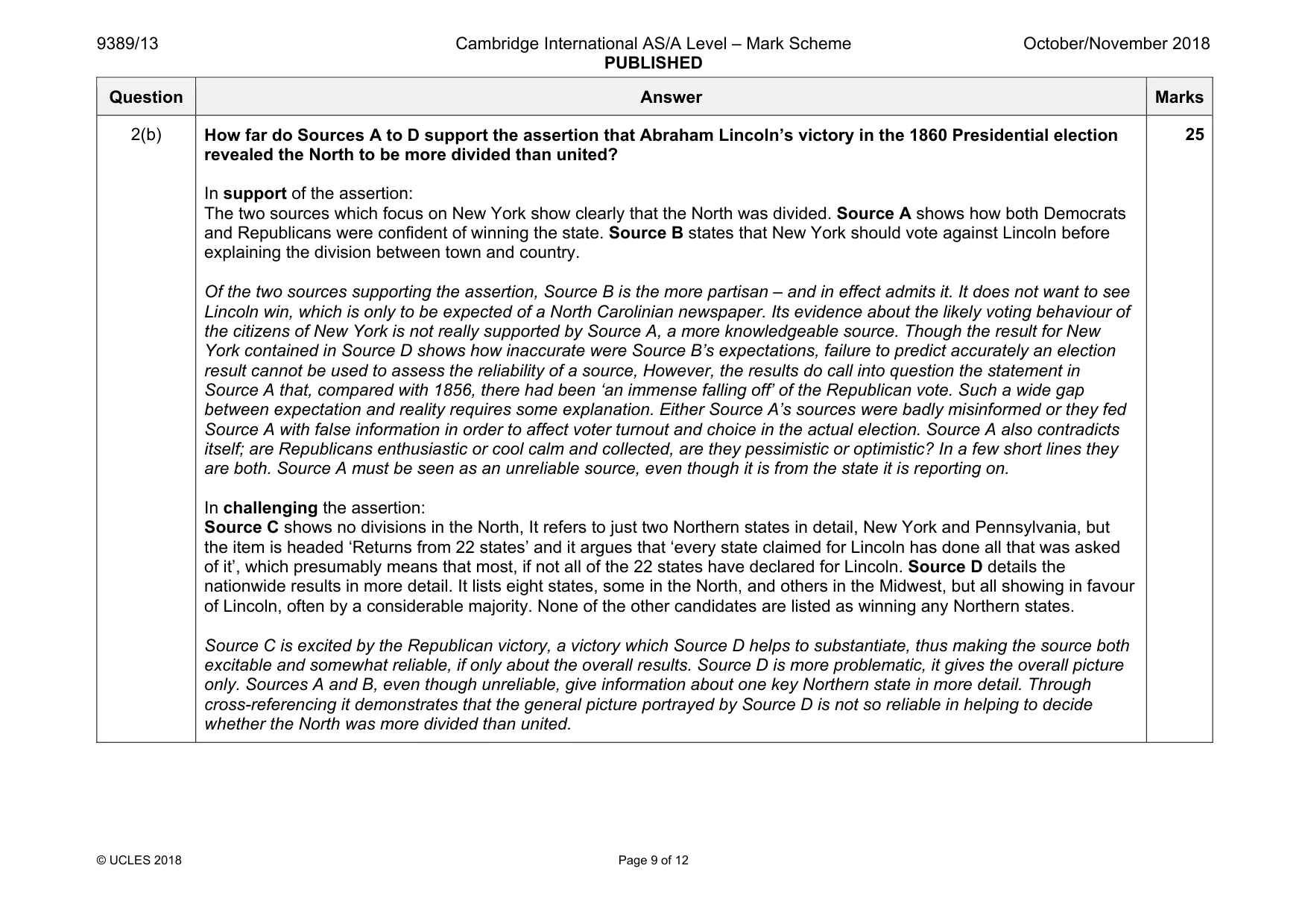
9389/13 Cambridge International AS/A Level – Mark Scheme PUBLISHED October/November 2018 © UCLES 2018 Page 9 of 12 Question Answer Marks 2(b) How far do Sources A to D support the assertion that Abraham Lincoln’s victory in the 1860 Presidential election revealed the North to be more divided than united? In support of the assertion: The two sources which focus on New York show clearly that the North was divided. Source A shows how both Democrats and Republicans were confident of winning the state. Source B states that New York should vote against Lincoln before explaining the division between town and country. Of the two sources supporting the assertion, Source B is the more partisan – and in effect admits it. It does not want to see Lincoln win, which is only to be expected of a North Carolinian newspaper. Its evidence about the likely voting behaviour of the citizens of New York is not really supported by Source A, a more knowledgeable source. Though the result for New York contained in Source D shows how inaccurate were Source B’s expectations, failure to predict accurately an election result cannot be used to assess the reliability of a source, However, the results do call into question the statement in Source A that, compared with 1856, there had been ‘an immense falling off’ of the Republican vote. Such a wide gap between expectation and reality requires some explanation. Either Source A’s sources were badly misinformed or they fed Source A with false information in order to affect voter turnout and choice in the actual election. Source A also contradicts itself; are Republicans enthusiastic or cool calm and collected, are they pessimistic or optimistic? In a few short lines they are both. Source A must be seen as an unreliable source, even though it is from the state it is reporting on. In challenging the assertion: Source C shows no divisions in the North, It refers to just two Northern states in detail, New York and Pennsylvania, but the item is headed ‘Returns from 22 states’ and it argues that ‘every state claimed for Lincoln has done all that was asked of it’, which presumably means that most, if not all of the 22 states have declared for Lincoln. Source D details the nationwide results in more detail. It lists eight states, some in the North, and others in the Midwest, but all showing in favour of Lincoln, often by a considerable majority. None of the other candidates are listed as winning any Northern states. Source C is excited by the Republican victory, a victory which Source D helps to substantiate, thus making the source both excitable and somewhat reliable, if only about the overall results. Source D is more problematic, it gives the overall picture only. Sources A and B, even though unreliable, give information about one key Northern state in more detail. Through cross-referencing it demonstrates that the general picture portrayed by Source D is not so reliable in helping to decide whether the North was more divided than united. 25
Mark scheme, page 10
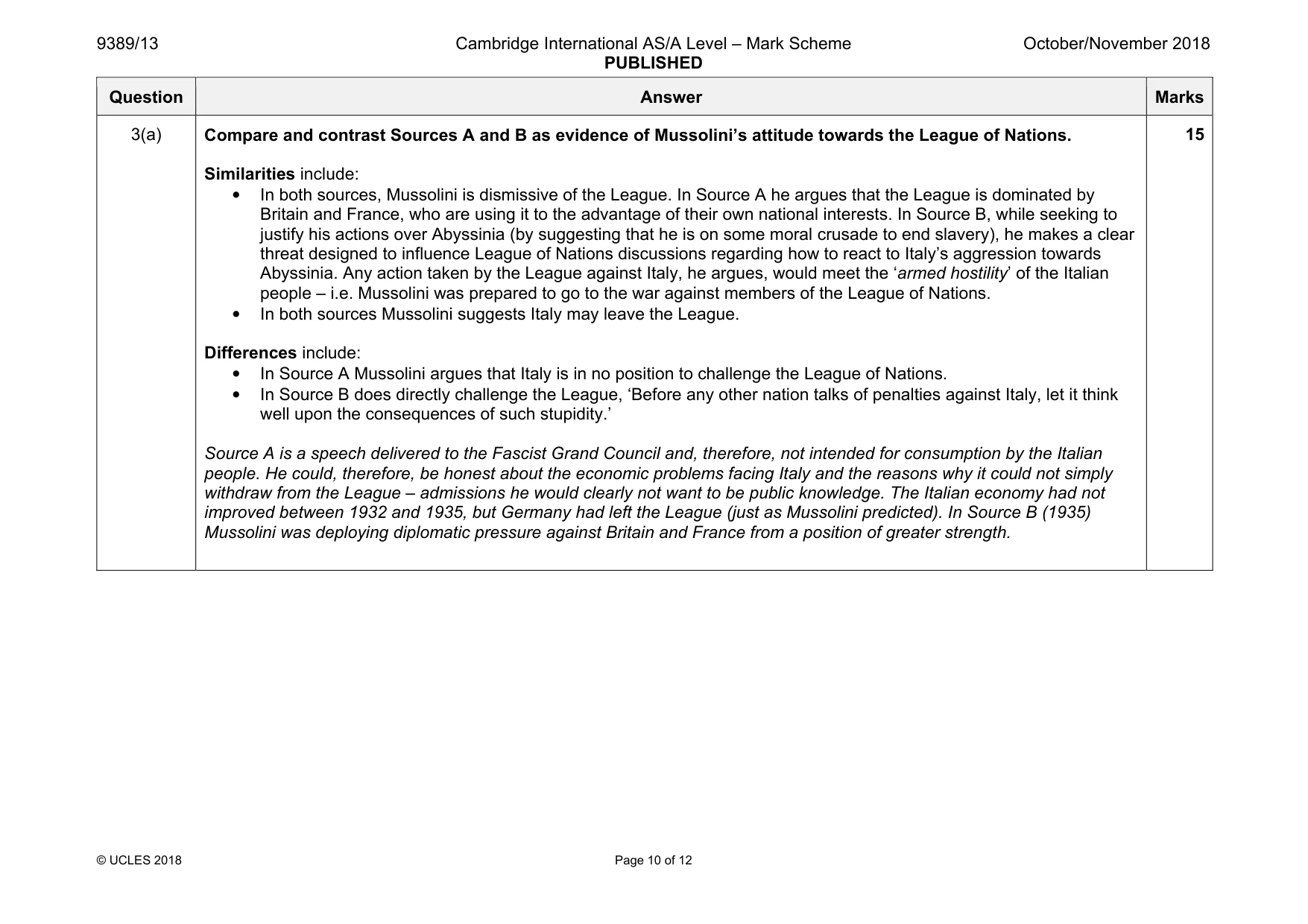
9389/13 Cambridge International AS/A Level – Mark Scheme PUBLISHED October/November 2018 © UCLES 2018 Page 10 of 12 Question Answer Marks 3(a) Compare and contrast Sources A and B as evidence of Mussolini’s attitude towards the League of Nations. Similarities include: • In both sources, Mussolini is dismissive of the League. In Source A he argues that the League is dominated by Britain and France, who are using it to the advantage of their own national interests. In Source B, while seeking to justify his actions over Abyssinia (by suggesting that he is on some moral crusade to end slavery), he makes a clear threat designed to influence League of Nations discussions regarding how to react to Italy’s aggression towards Abyssinia. Any action taken by the League against Italy, he argues, would meet the ‘armed hostility’ of the Italian people – i.e. Mussolini was prepared to go to the war against members of the League of Nations. • In both sources Mussolini suggests Italy may leave the League. Differences include: • In Source A Mussolini argues that Italy is in no position to challenge the League of Nations. • In Source B does directly challenge the League, ‘Before any other nation talks of penalties against Italy, let it think well upon the consequences of such stupidity.’ Source A is a speech delivered to the Fascist Grand Council and, therefore, not intended for consumption by the Italian people. He could, therefore, be honest about the economic problems facing Italy and the reasons why it could not simply withdraw from the League – admissions he would clearly not want to be public knowledge. The Italian economy had not improved between 1932 and 1935, but Germany had left the League (just as Mussolini predicted). In Source B (1935) Mussolini was deploying diplomatic pressure against Britain and France from a position of greater strength. 15
Mark scheme, page 11
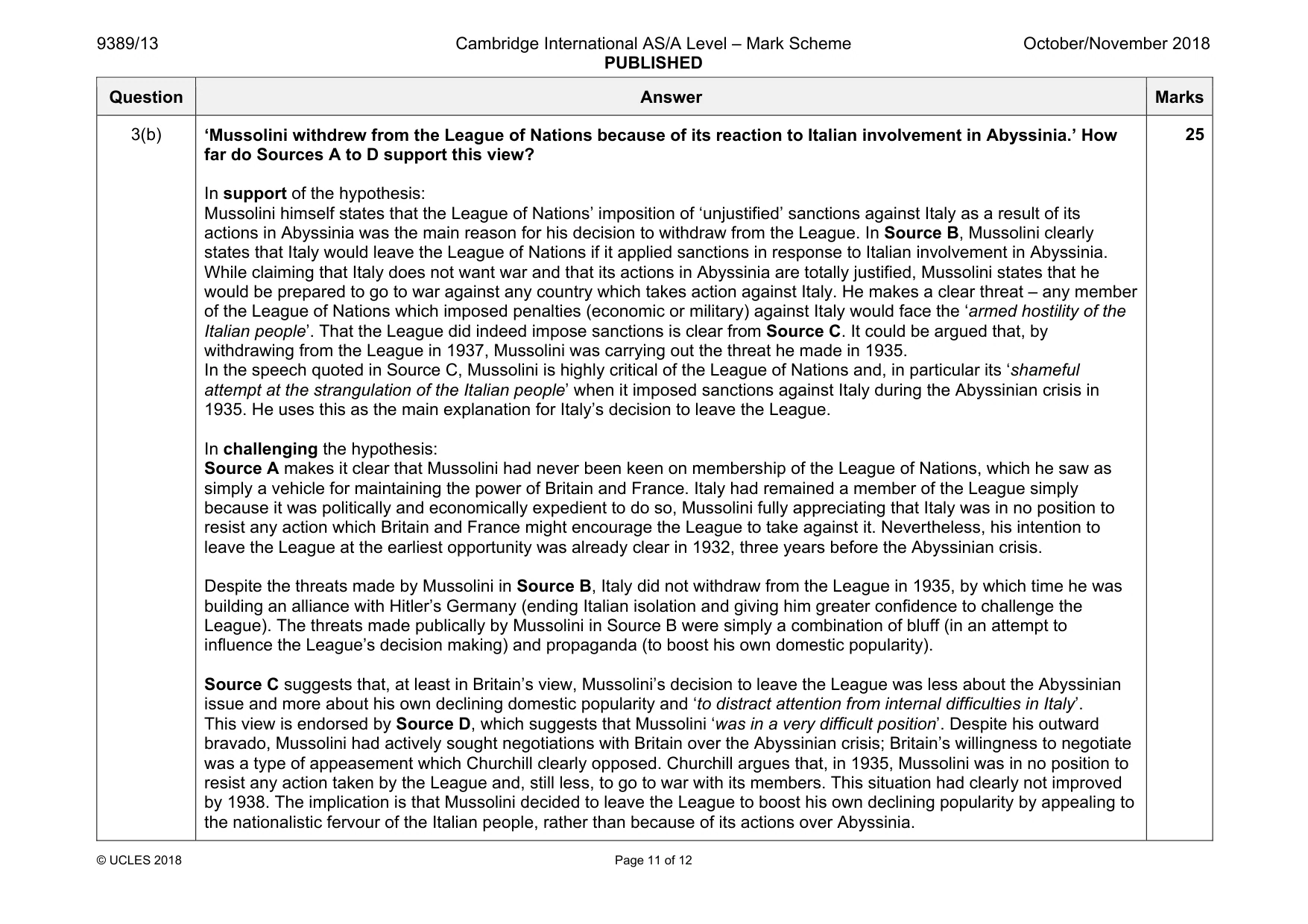
9389/13 Cambridge International AS/A Level – Mark Scheme PUBLISHED October/November 2018 © UCLES 2018 Page 11 of 12 Question Answer Marks 3(b) ‘Mussolini withdrew from the League of Nations because of its reaction to Italian involvement in Abyssinia.’ How far do Sources A to D support this view? In support of the hypothesis: Mussolini himself states that the League of Nations’ imposition of ‘unjustified’ sanctions against Italy as a result of its actions in Abyssinia was the main reason for his decision to withdraw from the League. In Source B, Mussolini clearly states that Italy would leave the League of Nations if it applied sanctions in response to Italian involvement in Abyssinia. While claiming that Italy does not want war and that its actions in Abyssinia are totally justified, Mussolini states that he would be prepared to go to war against any country which takes action against Italy. He makes a clear threat – any member of the League of Nations which imposed penalties (economic or military) against Italy would face the ‘armed hostility of the Italian people’. That the League did indeed impose sanctions is clear from Source C. It could be argued that, by withdrawing from the League in 1937, Mussolini was carrying out the threat he made in 1935. In the speech quoted in Source C, Mussolini is highly critical of the League of Nations and, in particular its ‘shameful attempt at the strangulation of the Italian people’ when it imposed sanctions against Italy during the Abyssinian crisis in 1935. He uses this as the main explanation for Italy’s decision to leave the League. In challenging the hypothesis: Source A makes it clear that Mussolini had never been keen on membership of the League of Nations, which he saw as simply a vehicle for maintaining the power of Britain and France. Italy had remained a member of the League simply because it was politically and economically expedient to do so, Mussolini fully appreciating that Italy was in no position to resist any action which Britain and France might encourage the League to take against it. Nevertheless, his intention to leave the League at the earliest opportunity was already clear in 1932, three years before the Abyssinian crisis. Despite the threats made by Mussolini in Source B, Italy did not withdraw from the League in 1935, by which time he was building an alliance with Hitler’s Germany (ending Italian isolation and giving him greater confidence to challenge the League). The threats made publically by Mussolini in Source B were simply a combination of bluff (in an attempt to influence the League’s decision making) and propaganda (to boost his own domestic popularity). Source C suggests that, at least in Britain’s view, Mussolini’s decision to leave the League was less about the Abyssinian issue and more about his own declining domestic popularity and ‘to distract attention from internal difficulties in Italy’. This view is endorsed by Source D, which suggests that Mussolini ‘was in a very difficult position’. Despite his outward bravado, Mussolini had actively sought negotiations with Britain over the Abyssinian crisis; Britain’s willingness to negotiate was a type of appeasement which Churchill clearly opposed. Churchill argues that, in 1935, Mussolini was in no position to resist any action taken by the League and, still less, to go to war with its members. This situation had clearly not improved by 1938. The implication is that Mussolini decided to leave the League to boost his own declining popularity by appealing to the nationalistic fervour of the Italian people, rather than because of its actions over Abyssinia. 25
Mark scheme, page 12
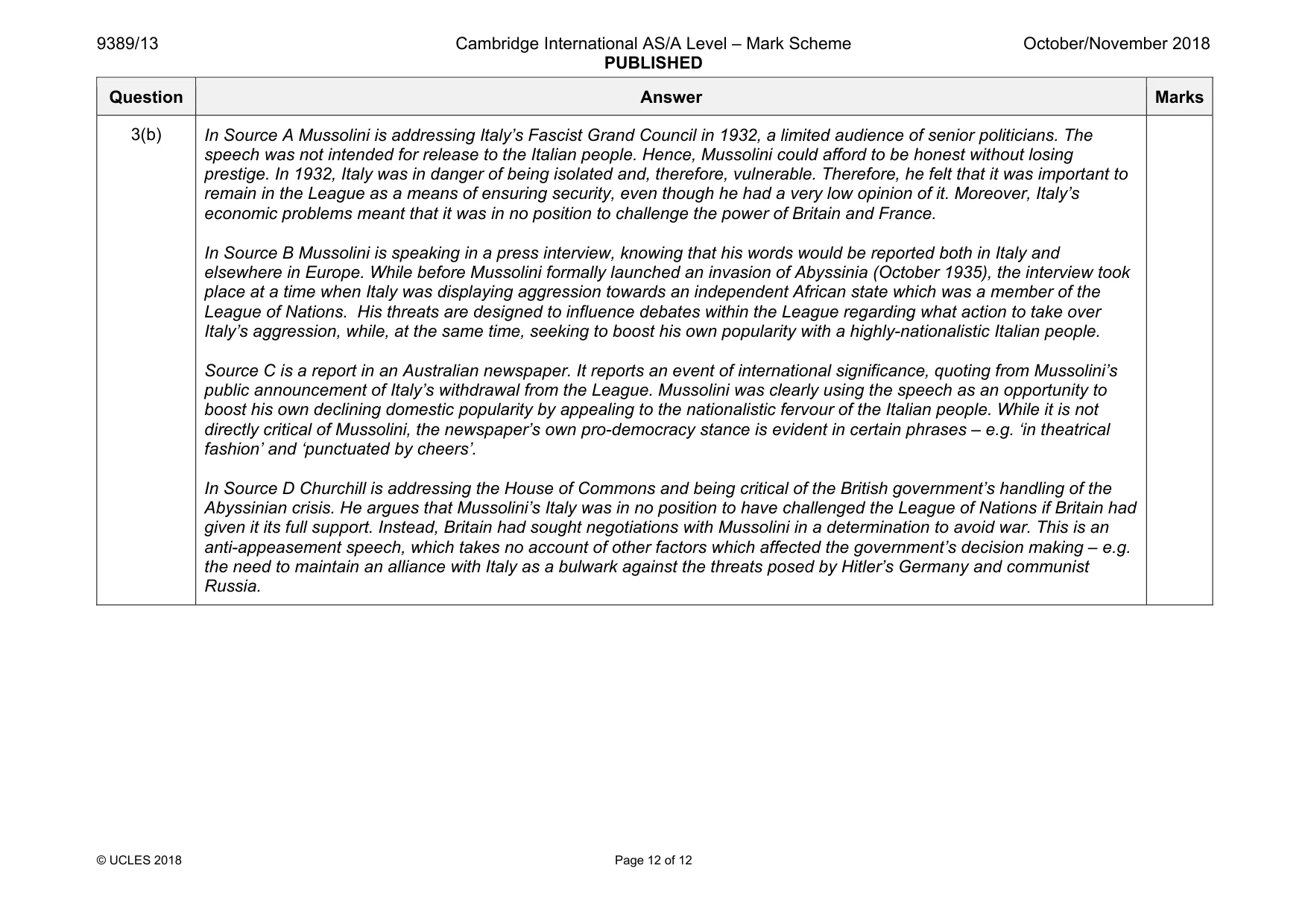
9389/13 Cambridge International AS/A Level – Mark Scheme PUBLISHED October/November 2018 © UCLES 2018 Page 12 of 12 Question Answer Marks 3(b) In Source A Mussolini is addressing Italy’s Fascist Grand Council in 1932, a limited audience of senior politicians. The speech was not intended for release to the Italian people. Hence, Mussolini could afford to be honest without losing prestige. In 1932, Italy was in danger of being isolated and, therefore, vulnerable. Therefore, he felt that it was important to remain in the League as a means of ensuring security, even though he had a very low opinion of it. Moreover, Italy’s economic problems meant that it was in no position to challenge the power of Britain and France. In Source B Mussolini is speaking in a press interview, knowing that his words would be reported both in Italy and elsewhere in Europe. While before Mussolini formally launched an invasion of Abyssinia (October 1935), the interview took place at a time when Italy was displaying aggression towards an independent African state which was a member of the League of Nations. His threats are designed to influence debates within the League regarding what action to take over Italy’s aggression, while, at the same time, seeking to boost his own popularity with a highly-nationalistic Italian people. Source C is a report in an Australian newspaper. It reports an event of international significance, quoting from Mussolini’s public announcement of Italy’s withdrawal from the League. Mussolini was clearly using the speech as an opportunity to boost his own declining domestic popularity by appealing to the nationalistic fervour of the Italian people. While it is not directly critical of Mussolini, the newspaper’s own pro-democracy stance is evident in certain phrases – e.g. ‘in theatrical fashion’ and ‘punctuated by cheers’. In Source D Churchill is addressing the House of Commons and being critical of the British government’s handling of the Abyssinian crisis. He argues that Mussolini’s Italy was in no position to have challenged the League of Nations if Britain had given it its full support. Instead, Britain had sought negotiations with Mussolini in a determination to avoid war. This is an anti-appeasement speech, which takes no account of other factors which affected the government’s decision making – e.g. the need to maintain an alliance with Italy as a bulwark against the threats posed by Hitler’s Germany and communist Russia.
What you needed in this session
Cambridge’s own grade thresholds for 2018 Oct/Nov, Paper 1 · Variant 3. A higher threshold means an easier paper — the bar moves with how the cohort did.