Cambridge A Level History 9389 — 2015 May/June Paper 1 · Variant 3
9389/13/M/J/15 · 40 marks · ≈45 min
The question paper and its mark scheme, free to read here and free to download. This is Cambridge’s own paper, exactly as it was sat.
Question paper8 pages
Mark scheme9 pages
Answers below. Sit the paper first if you are practising.
Paper as text
Question paper, page 1
This document consists of 7 printed pages and 1 blank page. DC (LEG) 92189/3 © UCLES 2015 [Turn over * 0 0 2 2 9 4 0 1 2 4 * HISTORY 9389/13 Paper 1 Document Question May/June 2015 1 hour Additional Materials: Answer Booklet/Paper READ THESE INSTRUCTIONS FIRST If you have been given an Answer Booklet, follow the instructions on the front cover of the Booklet. Write your Centre number, candidate number and name on all the work you hand in. Write in dark blue or black pen. Do not use staples, paper clips, glue or correction fluid. DO NOT WRITE IN ANY BARCODES. This paper contains three sections: Section A: European Option Section B: American Option Section C: International Option Answer both parts of the question from one section only. At the end of the examination, fasten all your work securely together. The marks are given in brackets [ ] at the end of each part question. Cambridge International Examinations Cambridge International Advanced Subsidiary and Advanced Level
Question paper, page 2
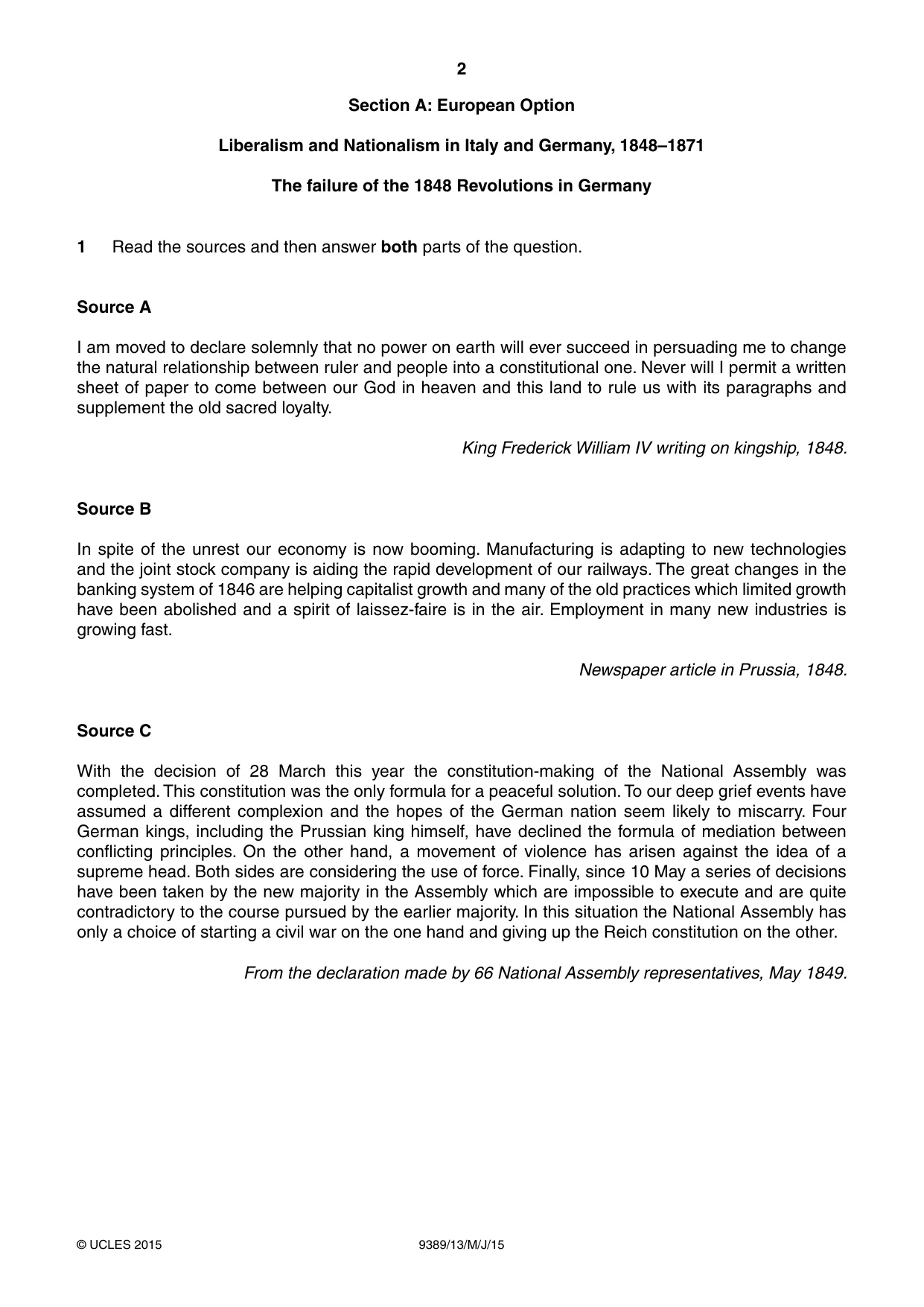
2 9389/13/M/J/15 © UCLES 2015 Section A: European Option Liberalism and Nationalism in Italy and Germany, 1848–1871 The failure of the 1848 Revolutions in Germany 1 Read the sources and then answer both parts of the question. Source A I am moved to declare solemnly that no power on earth will ever succeed in persuading me to change the natural relationship between ruler and people into a constitutional one. Never will I permit a written sheet of paper to come between our God in heaven and this land to rule us with its paragraphs and supplement the old sacred loyalty. King Frederick William IV writing on kingship, 1848. Source B In spite of the unrest our economy is now booming. Manufacturing is adapting to new technologies and the joint stock company is aiding the rapid development of our railways. The great changes in the banking system of 1846 are helping capitalist growth and many of the old practices which limited growth have been abolished and a spirit of laissez-faire is in the air. Employment in many new industries is growing fast. Newspaper article in Prussia, 1848. Source C With the decision of 28 March this year the constitution-making of the National Assembly was completed. This constitution was the only formula for a peaceful solution. To our deep grief events have assumed a different complexion and the hopes of the German nation seem likely to miscarry. Four German kings, including the Prussian king himself, have declined the formula of mediation between conflicting principles. On the other hand, a movement of violence has arisen against the idea of a supreme head. Both sides are considering the use of force. Finally, since 10 May a series of decisions have been taken by the new majority in the Assembly which are impossible to execute and are quite contradictory to the course pursued by the earlier majority. In this situation the National Assembly has only a choice of starting a civil war on the one hand and giving up the Reich constitution on the other. From the declaration made by 66 National Assembly representatives, May 1849.
Question paper, page 3
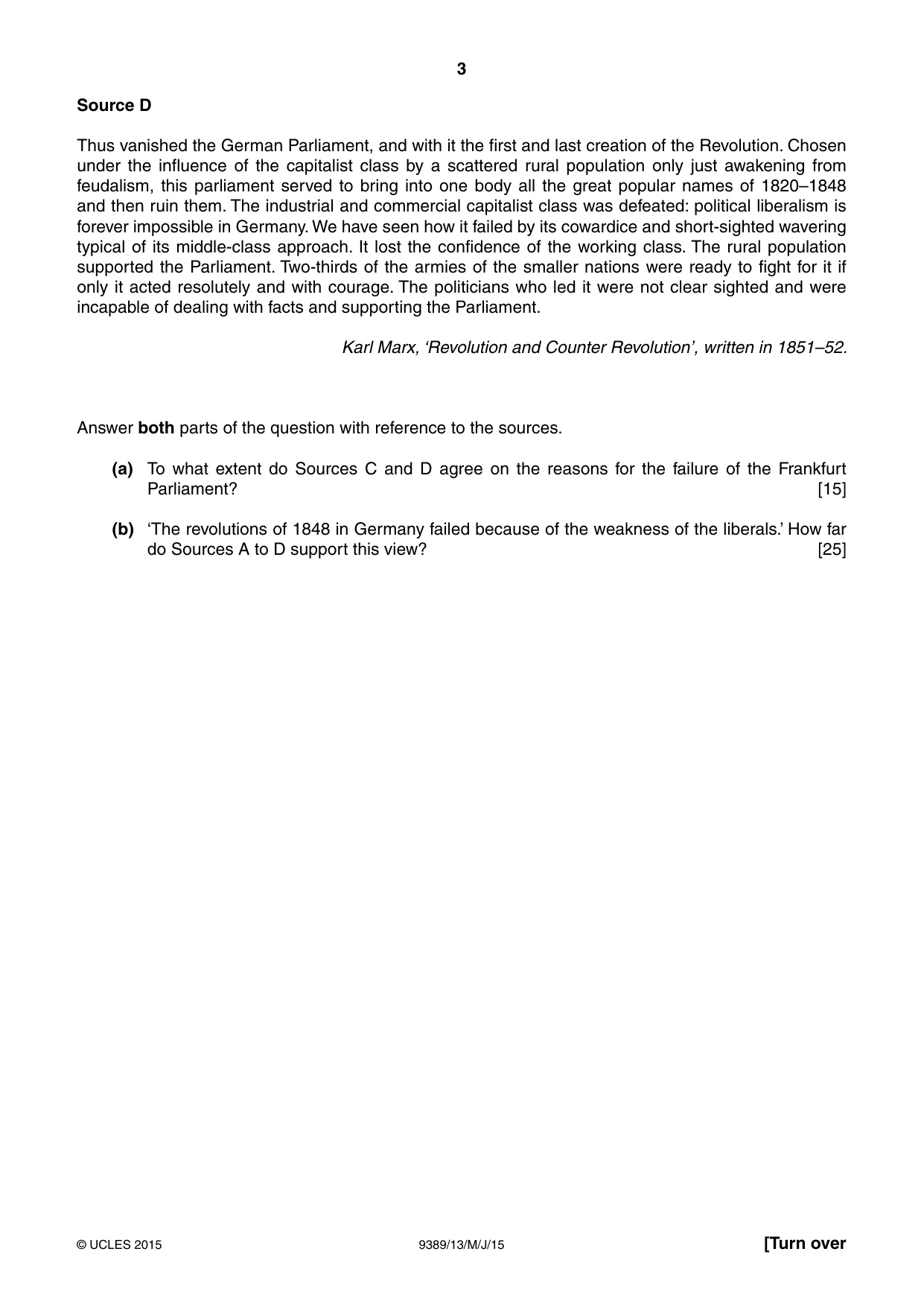
3 9389/13/M/J/15 © UCLES 2015 [Turn over Source D Thus vanished the German Parliament, and with it the first and last creation of the Revolution. Chosen under the influence of the capitalist class by a scattered rural population only just awakening from feudalism, this parliament served to bring into one body all the great popular names of 1820–1848 and then ruin them. The industrial and commercial capitalist class was defeated: political liberalism is forever impossible in Germany. We have seen how it failed by its cowardice and short-sighted wavering typical of its middle-class approach. It lost the confidence of the working class. The rural population supported the Parliament. Two-thirds of the armies of the smaller nations were ready to fight for it if only it acted resolutely and with courage. The politicians who led it were not clear sighted and were incapable of dealing with facts and supporting the Parliament. Karl Marx, ‘Revolution and Counter Revolution’, written in 1851–52. Answer both parts of the question with reference to the sources. (a) To what extent do Sources C and D agree on the reasons for the failure of the Frankfurt Parliament? [15] (b) ‘The revolutions of 1848 in Germany failed because of the weakness of the liberals.’ How far do Sources A to D support this view? [25]
Question paper, page 4
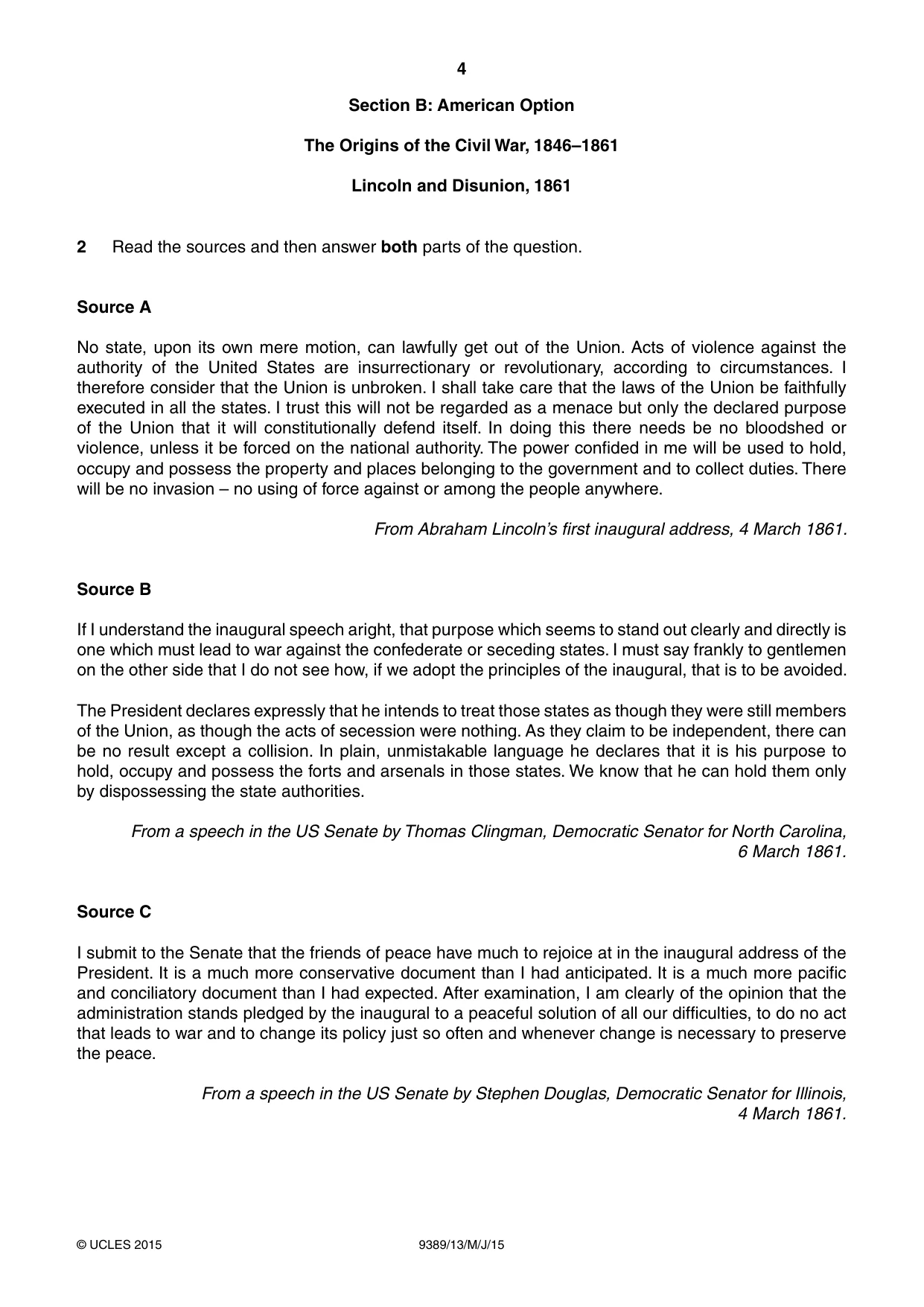
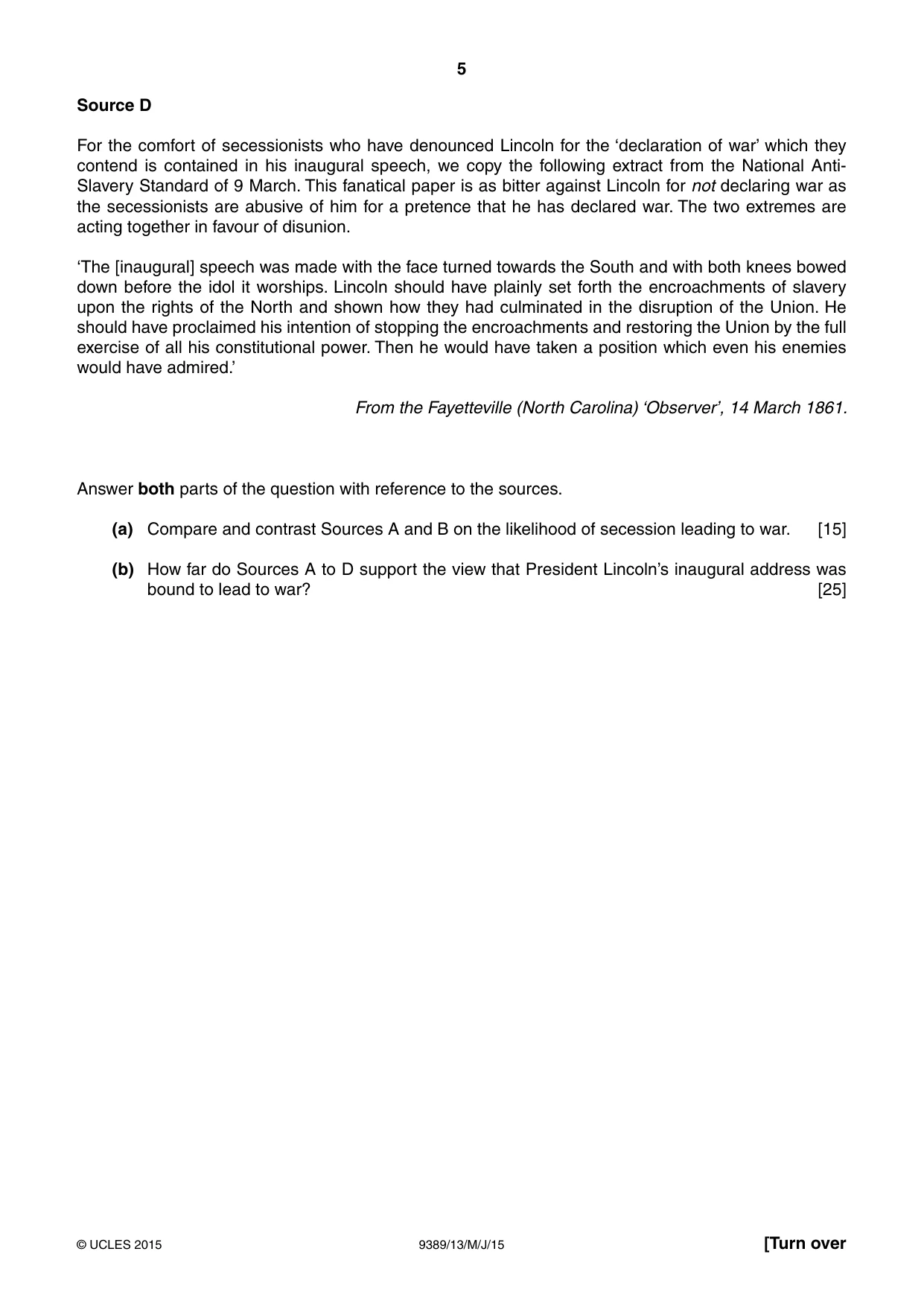
4 9389/13/M/J/15 © UCLES 2015 Section B: American Option The Origins of the Civil War, 1846–1861 Lincoln and Disunion, 1861 2 Read the sources and then answer both parts of the question. Source A No state, upon its own mere motion, can lawfully get out of the Union. Acts of violence against the authority of the United States are insurrectionary or revolutionary, according to circumstances. I therefore consider that the Union is unbroken. I shall take care that the laws of the Union be faithfully executed in all the states. I trust this will not be regarded as a menace but only the declared purpose of the Union that it will constitutionally defend itself. In doing this there needs be no bloodshed or violence, unless it be forced on the national authority. The power confided in me will be used to hold, occupy and possess the property and places belonging to the government and to collect duties. There will be no invasion – no using of force against or among the people anywhere. From Abraham Lincoln’s first inaugural address, 4 March 1861. Source B If I understand the inaugural speech aright, that purpose which seems to stand out clearly and directly is one which must lead to war against the confederate or seceding states. I must say frankly to gentlemen on the other side that I do not see how, if we adopt the principles of the inaugural, that is to be avoided. The President declares expressly that he intends to treat those states as though they were still members of the Union, as though the acts of secession were nothing. As they claim to be independent, there can be no result except a collision. In plain, unmistakable language he declares that it is his purpose to hold, occupy and possess the forts and arsenals in those states. We know that he can hold them only by dispossessing the state authorities. From a speech in the US Senate by Thomas Clingman, Democratic Senator for North Carolina, 6 March 1861. Source C I submit to the Senate that the friends of peace have much to rejoice at in the inaugural address of the President. It is a much more conservative document than I had anticipated. It is a much more pacific and conciliatory document than I had expected. After examination, I am clearly of the opinion that the administration stands pledged by the inaugural to a peaceful solution of all our difficulties, to do no act that leads to war and to change its policy just so often and whenever change is necessary to preserve the peace. From a speech in the US Senate by Stephen Douglas, Democratic Senator for Illinois, 4 March 1861.
Question paper, page 5
5 9389/13/M/J/15 © UCLES 2015 [Turn over Source D For the comfort of secessionists who have denounced Lincoln for the ‘declaration of war’ which they contend is contained in his inaugural speech, we copy the following extract from the National Anti- Slavery Standard of 9 March. This fanatical paper is as bitter against Lincoln for not declaring war as the secessionists are abusive of him for a pretence that he has declared war. The two extremes are acting together in favour of disunion. ‘The [inaugural] speech was made with the face turned towards the South and with both knees bowed down before the idol it worships. Lincoln should have plainly set forth the encroachments of slavery upon the rights of the North and shown how they had culminated in the disruption of the Union. He should have proclaimed his intention of stopping the encroachments and restoring the Union by the full exercise of all his constitutional power. Then he would have taken a position which even his enemies would have admired.’ From the Fayetteville (North Carolina) ‘Observer’, 14 March 1861. Answer both parts of the question with reference to the sources. (a) Compare and contrast Sources A and B on the likelihood of secession leading to war. [15] (b) How far do Sources A to D support the view that President Lincoln’s inaugural address was bound to lead to war? [25]
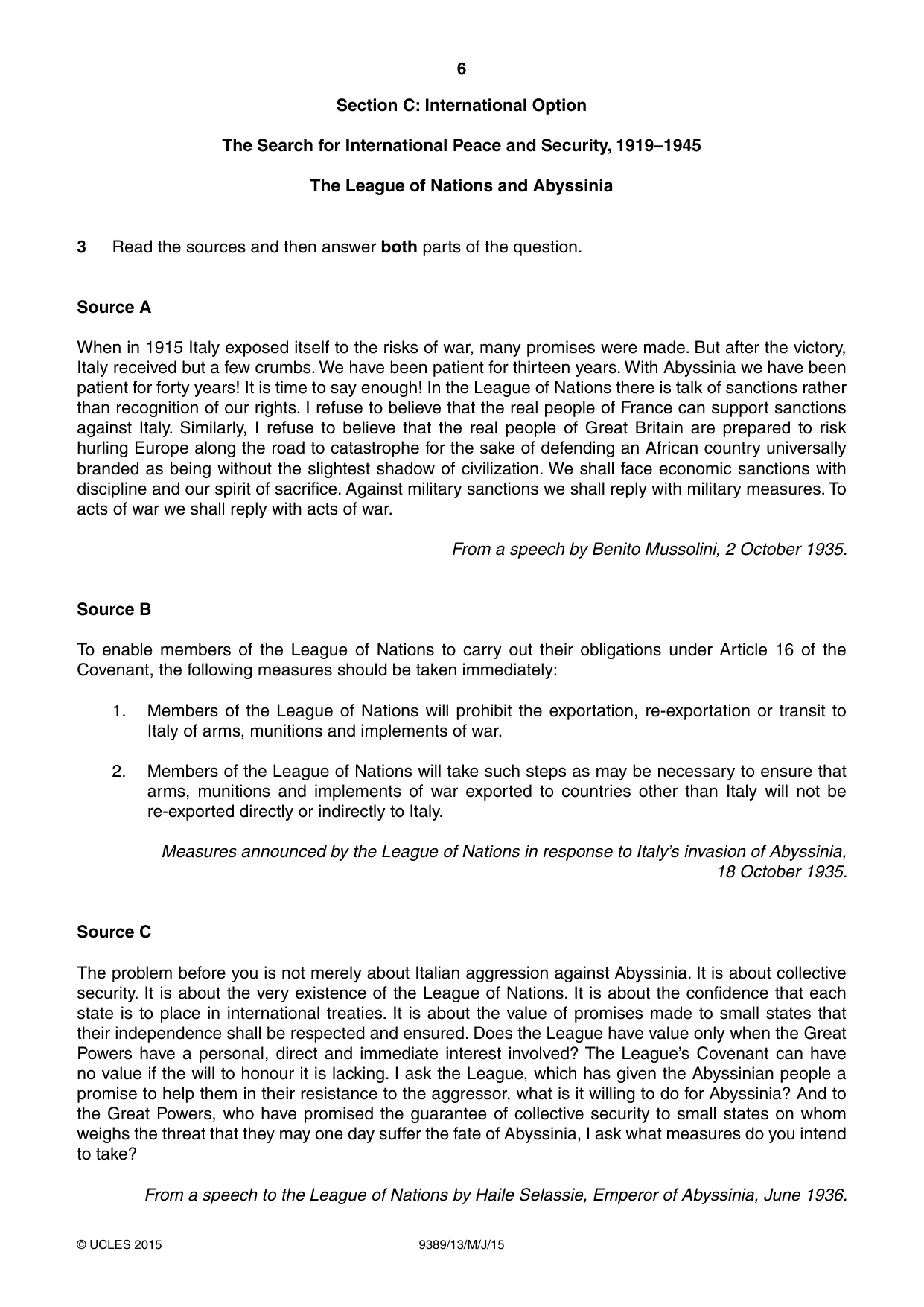
Question paper, page 6
6 9389/13/M/J/15 © UCLES 2015 Section C: International Option The Search for International Peace and Security, 1919–1945 The League of Nations and Abyssinia 3 Read the sources and then answer both parts of the question. Source A When in 1915 Italy exposed itself to the risks of war, many promises were made. But after the victory, Italy received but a few crumbs. We have been patient for thirteen years. With Abyssinia we have been patient for forty years! It is time to say enough! In the League of Nations there is talk of sanctions rather than recognition of our rights. I refuse to believe that the real people of France can support sanctions against Italy. Similarly, I refuse to believe that the real people of Great Britain are prepared to risk hurling Europe along the road to catastrophe for the sake of defending an African country universally branded as being without the slightest shadow of civilization. We shall face economic sanctions with discipline and our spirit of sacrifice. Against military sanctions we shall reply with military measures. To acts of war we shall reply with acts of war. From a speech by Benito Mussolini, 2 October 1935. Source B To enable members of the League of Nations to carry out their obligations under Article 16 of the Covenant, the following measures should be taken immediately: 1. Members of the League of Nations will prohibit the exportation, re-exportation or transit to Italy of arms, munitions and implements of war. 2. Members of the League of Nations will take such steps as may be necessary to ensure that arms, munitions and implements of war exported to countries other than Italy will not be re-exported directly or indirectly to Italy. Measures announced by the League of Nations in response to Italy’s invasion of Abyssinia, 18 October 1935. Source C The problem before you is not merely about Italian aggression against Abyssinia. It is about collective security. It is about the very existence of the League of Nations. It is about the confidence that each state is to place in international treaties. It is about the value of promises made to small states that their independence shall be respected and ensured. Does the League have value only when the Great Powers have a personal, direct and immediate interest involved? The League’s Covenant can have no value if the will to honour it is lacking. I ask the League, which has given the Abyssinian people a promise to help them in their resistance to the aggressor, what is it willing to do for Abyssinia? And to the Great Powers, who have promised the guarantee of collective security to small states on whom weighs the threat that they may one day suffer the fate of Abyssinia, I ask what measures do you intend to take? From a speech to the League of Nations by Haile Selassie, Emperor of Abyssinia, June 1936.
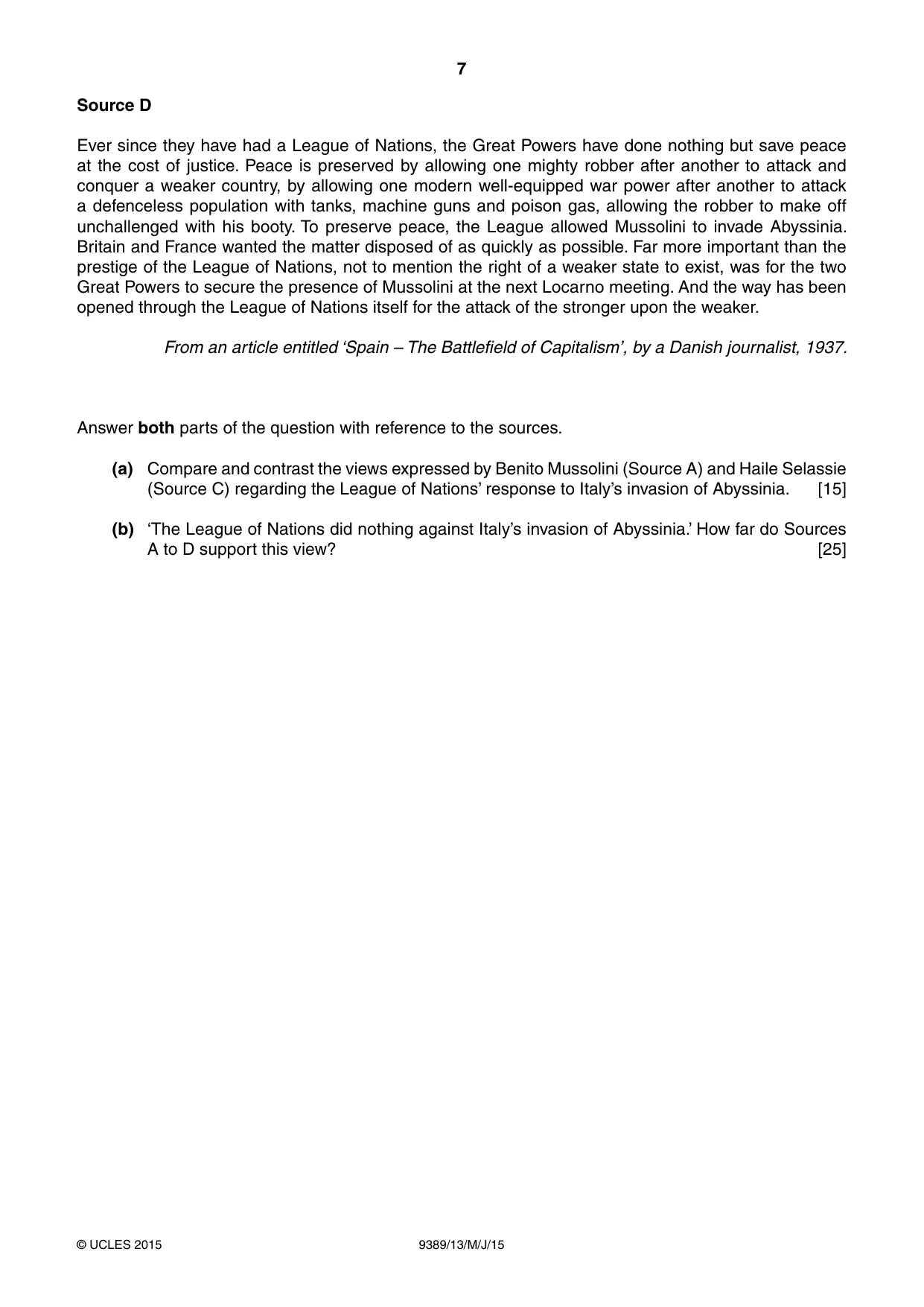
Question paper, page 7
7 9389/13/M/J/15 © UCLES 2015 Source D Ever since they have had a League of Nations, the Great Powers have done nothing but save peace at the cost of justice. Peace is preserved by allowing one mighty robber after another to attack and conquer a weaker country, by allowing one modern well-equipped war power after another to attack a defenceless population with tanks, machine guns and poison gas, allowing the robber to make off unchallenged with his booty. To preserve peace, the League allowed Mussolini to invade Abyssinia. Britain and France wanted the matter disposed of as quickly as possible. Far more important than the prestige of the League of Nations, not to mention the right of a weaker state to exist, was for the two Great Powers to secure the presence of Mussolini at the next Locarno meeting. And the way has been opened through the League of Nations itself for the attack of the stronger upon the weaker. From an article entitled ‘Spain – The Battlefield of Capitalism’, by a Danish journalist, 1937. Answer both parts of the question with reference to the sources. (a) Compare and contrast the views expressed by Benito Mussolini (Source A) and Haile Selassie (Source C) regarding the League of Nations’ response to Italy’s invasion of Abyssinia. [15] (b) ‘The League of Nations did nothing against Italy’s invasion of Abyssinia.’ How far do Sources A to D support this view? [25]
Question paper, page 8
8 9389/13/M/J/15 © UCLES 2015 BLANK PAGE Permission to reproduce items where third-party owned material protected by copyright is included has been sought and cleared where possible. Every reasonable effort has been made by the publisher (UCLES) to trace copyright holders, but if any items requiring clearance have unwittingly been included, the publisher will be pleased to make amends at the earliest possible opportunity. To avoid the issue of disclosure of answer-related information to candidates, all copyright acknowledgements are reproduced online in the Cambridge International Examinations Copyright Acknowledgements Booklet. This is produced for each series of examinations and is freely available to download at www.cie.org.uk after the live examination series. Cambridge International Examinations is part of the Cambridge Assessment Group. Cambridge Assessment is the brand name of University of Cambridge Local Examinations Syndicate (UCLES), which is itself a department of the University of Cambridge.
Mark scheme, page 1
® IGCSE is the registered trademark of Cambridge International Examinations. CAMBRIDGE INTERNATIONAL EXAMINATIONS Cambridge International Advanced Subsidiary and Advanced Level MARK SCHEME for the May/June 2015 series 9389 HISTORY 9389/13 Paper 1 (Document Question 13), maximum raw mark 40 This mark scheme is published as an aid to teachers and candidates, to indicate the requirements of the examination. It shows the basis on which Examiners were instructed to award marks. It does not indicate the details of the discussions that took place at an Examiners’ meeting before marking began, which would have considered the acceptability of alternative answers. Mark schemes should be read in conjunction with the question paper and the Principal Examiner Report for Teachers. Cambridge will not enter into discussions about these mark schemes. Cambridge is publishing the mark schemes for the May/June 2015 series for most Cambridge IGCSE®, Cambridge International A and AS Level components and some Cambridge O Level components
Mark scheme, page 2
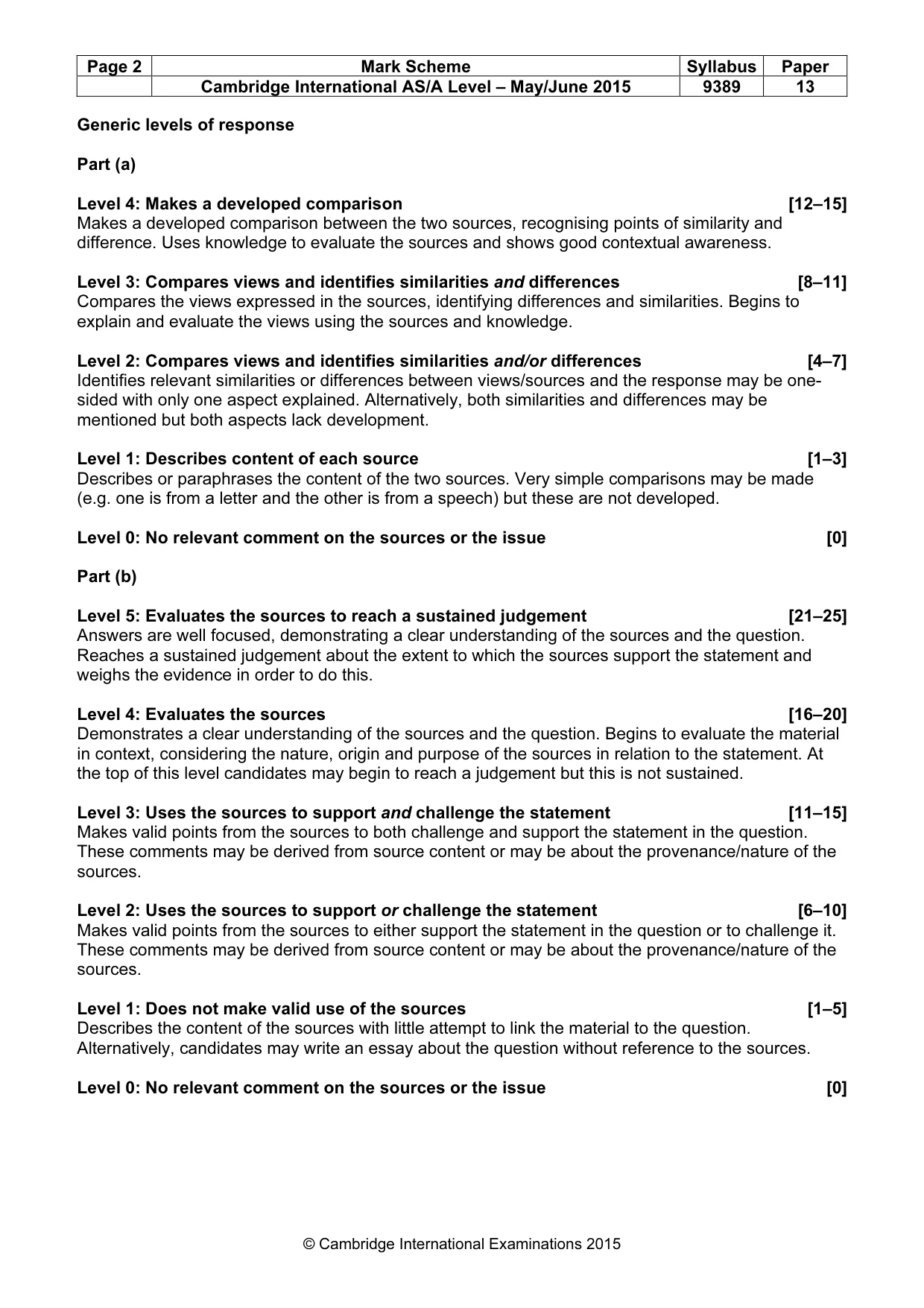
Page 2 Mark Scheme Syllabus Paper Cambridge International AS/A Level – May/June 2015 9389 13 © Cambridge International Examinations 2015 Generic levels of response Part (a) Level 4: Makes a developed comparison [12–15] Makes a developed comparison between the two sources, recognising points of similarity and difference. Uses knowledge to evaluate the sources and shows good contextual awareness. Level 3: Compares views and identifies similarities and differences [8–11] Compares the views expressed in the sources, identifying differences and similarities. Begins to explain and evaluate the views using the sources and knowledge. Level 2: Compares views and identifies similarities and/or differences [4–7] Identifies relevant similarities or differences between views/sources and the response may be one- sided with only one aspect explained. Alternatively, both similarities and differences may be mentioned but both aspects lack development. Level 1: Describes content of each source [1–3] Describes or paraphrases the content of the two sources. Very simple comparisons may be made (e.g. one is from a letter and the other is from a speech) but these are not developed. Level 0: No relevant comment on the sources or the issue [0] Part (b) Level 5: Evaluates the sources to reach a sustained judgement [21–25] Answers are well focused, demonstrating a clear understanding of the sources and the question. Reaches a sustained judgement about the extent to which the sources support the statement and weighs the evidence in order to do this. Level 4: Evaluates the sources [16–20] Demonstrates a clear understanding of the sources and the question. Begins to evaluate the material in context, considering the nature, origin and purpose of the sources in relation to the statement. At the top of this level candidates may begin to reach a judgement but this is not sustained. Level 3: Uses the sources to support and challenge the statement [11–15] Makes valid points from the sources to both challenge and support the statement in the question. These comments may be derived from source content or may be about the provenance/nature of the sources. Level 2: Uses the sources to support or challenge the statement [6–10] Makes valid points from the sources to either support the statement in the question or to challenge it. These comments may be derived from source content or may be about the provenance/nature of the sources. Level 1: Does not make valid use of the sources [1–5] Describes the content of the sources with little attempt to link the material to the question. Alternatively, candidates may write an essay about the question without reference to the sources. Level 0: No relevant comment on the sources or the issue [0]
Mark scheme, page 3
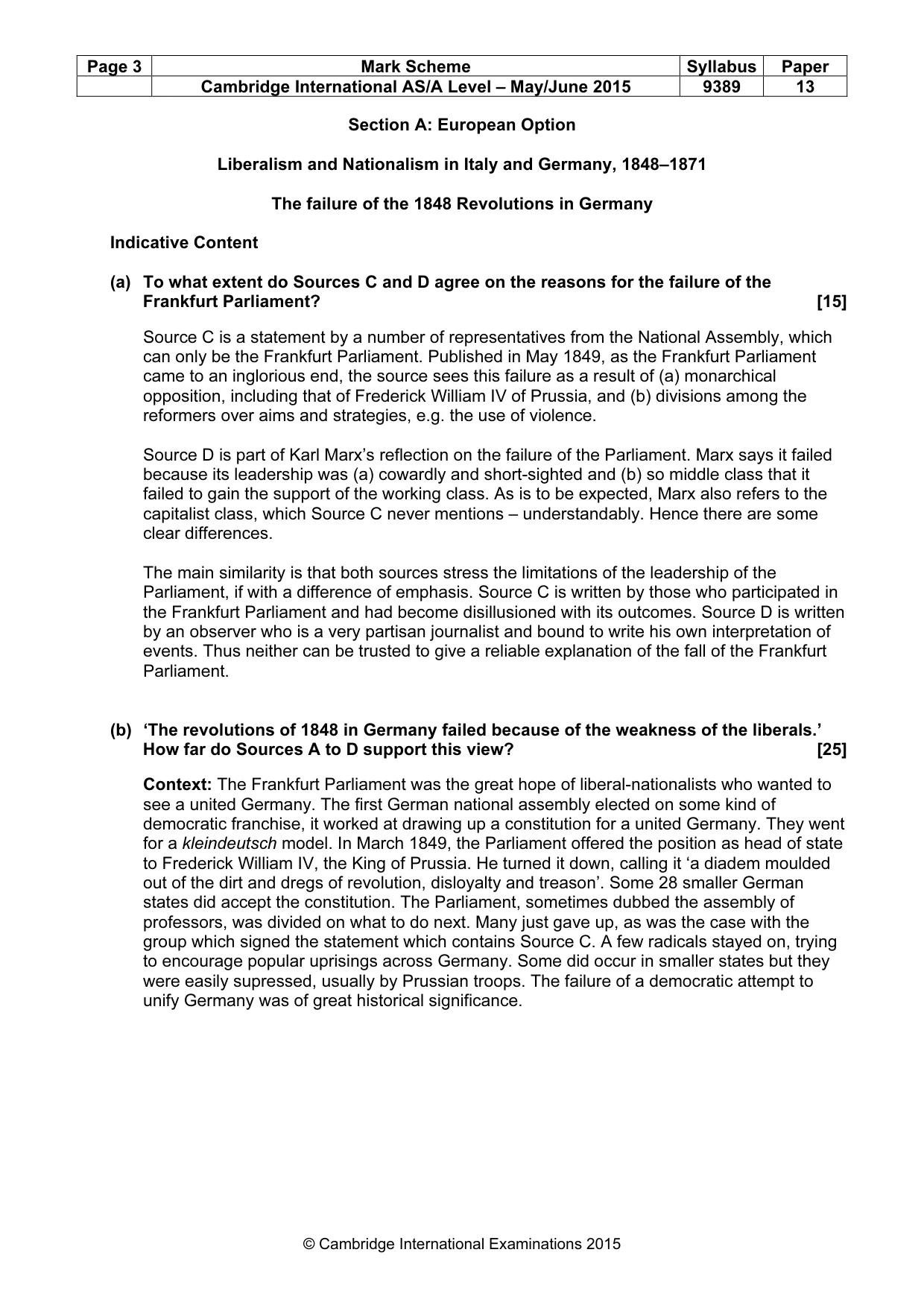
Page 3 Mark Scheme Syllabus Paper Cambridge International AS/A Level – May/June 2015 9389 13 © Cambridge International Examinations 2015 Section A: European Option Liberalism and Nationalism in Italy and Germany, 1848–1871 The failure of the 1848 Revolutions in Germany Indicative Content (a) To what extent do Sources C and D agree on the reasons for the failure of the Frankfurt Parliament? [15] Source C is a statement by a number of representatives from the National Assembly, which can only be the Frankfurt Parliament. Published in May 1849, as the Frankfurt Parliament came to an inglorious end, the source sees this failure as a result of (a) monarchical opposition, including that of Frederick William IV of Prussia, and (b) divisions among the reformers over aims and strategies, e.g. the use of violence. Source D is part of Karl Marx’s reflection on the failure of the Parliament. Marx says it failed because its leadership was (a) cowardly and short-sighted and (b) so middle class that it failed to gain the support of the working class. As is to be expected, Marx also refers to the capitalist class, which Source C never mentions – understandably. Hence there are some clear differences. The main similarity is that both sources stress the limitations of the leadership of the Parliament, if with a difference of emphasis. Source C is written by those who participated in the Frankfurt Parliament and had become disillusioned with its outcomes. Source D is written by an observer who is a very partisan journalist and bound to write his own interpretation of events. Thus neither can be trusted to give a reliable explanation of the fall of the Frankfurt Parliament. (b) ‘The revolutions of 1848 in Germany failed because of the weakness of the liberals.’ How far do Sources A to D support this view? [25] Context: The Frankfurt Parliament was the great hope of liberal-nationalists who wanted to see a united Germany. The first German national assembly elected on some kind of democratic franchise, it worked at drawing up a constitution for a united Germany. They went for a kleindeutsch model. In March 1849, the Parliament offered the position as head of state to Frederick William IV, the King of Prussia. He turned it down, calling it ‘a diadem moulded out of the dirt and dregs of revolution, disloyalty and treason’. Some 28 smaller German states did accept the constitution. The Parliament, sometimes dubbed the assembly of professors, was divided on what to do next. Many just gave up, as was the case with the group which signed the statement which contains Source C. A few radicals stayed on, trying to encourage popular uprisings across Germany. Some did occur in smaller states but they were easily supressed, usually by Prussian troops. The failure of a democratic attempt to unify Germany was of great historical significance.
Mark scheme, page 4
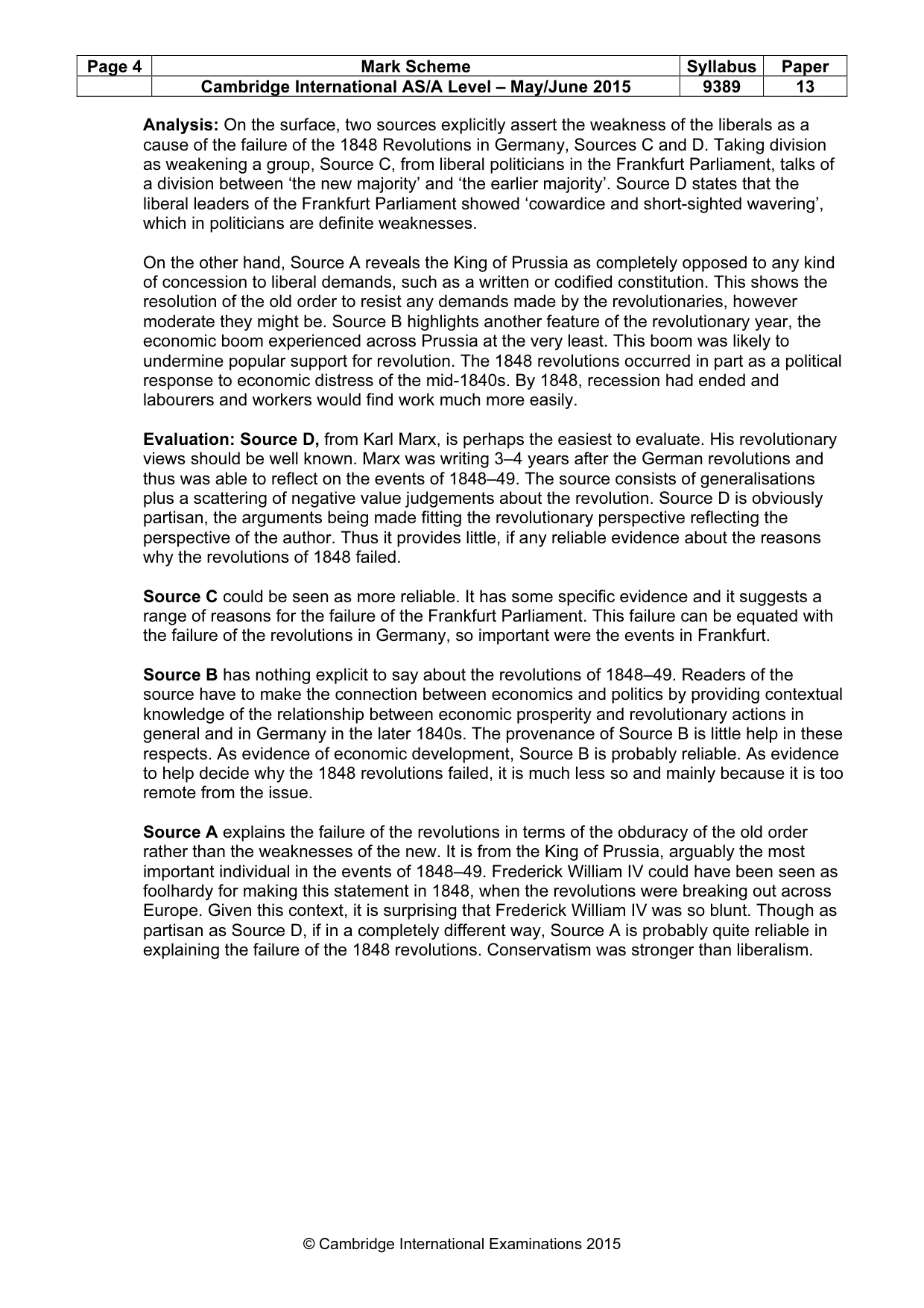
Page 4 Mark Scheme Syllabus Paper Cambridge International AS/A Level – May/June 2015 9389 13 © Cambridge International Examinations 2015 Analysis: On the surface, two sources explicitly assert the weakness of the liberals as a cause of the failure of the 1848 Revolutions in Germany, Sources C and D. Taking division as weakening a group, Source C, from liberal politicians in the Frankfurt Parliament, talks of a division between ‘the new majority’ and ‘the earlier majority’. Source D states that the liberal leaders of the Frankfurt Parliament showed ‘cowardice and short-sighted wavering’, which in politicians are definite weaknesses. On the other hand, Source A reveals the King of Prussia as completely opposed to any kind of concession to liberal demands, such as a written or codified constitution. This shows the resolution of the old order to resist any demands made by the revolutionaries, however moderate they might be. Source B highlights another feature of the revolutionary year, the economic boom experienced across Prussia at the very least. This boom was likely to undermine popular support for revolution. The 1848 revolutions occurred in part as a political response to economic distress of the mid-1840s. By 1848, recession had ended and labourers and workers would find work much more easily. Evaluation: Source D, from Karl Marx, is perhaps the easiest to evaluate. His revolutionary views should be well known. Marx was writing 3–4 years after the German revolutions and thus was able to reflect on the events of 1848–49. The source consists of generalisations plus a scattering of negative value judgements about the revolution. Source D is obviously partisan, the arguments being made fitting the revolutionary perspective reflecting the perspective of the author. Thus it provides little, if any reliable evidence about the reasons why the revolutions of 1848 failed. Source C could be seen as more reliable. It has some specific evidence and it suggests a range of reasons for the failure of the Frankfurt Parliament. This failure can be equated with the failure of the revolutions in Germany, so important were the events in Frankfurt. Source B has nothing explicit to say about the revolutions of 1848–49. Readers of the source have to make the connection between economics and politics by providing contextual knowledge of the relationship between economic prosperity and revolutionary actions in general and in Germany in the later 1840s. The provenance of Source B is little help in these respects. As evidence of economic development, Source B is probably reliable. As evidence to help decide why the 1848 revolutions failed, it is much less so and mainly because it is too remote from the issue. Source A explains the failure of the revolutions in terms of the obduracy of the old order rather than the weaknesses of the new. It is from the King of Prussia, arguably the most important individual in the events of 1848–49. Frederick William IV could have been seen as foolhardy for making this statement in 1848, when the revolutions were breaking out across Europe. Given this context, it is surprising that Frederick William IV was so blunt. Though as partisan as Source D, if in a completely different way, Source A is probably quite reliable in explaining the failure of the 1848 revolutions. Conservatism was stronger than liberalism.
Mark scheme, page 5
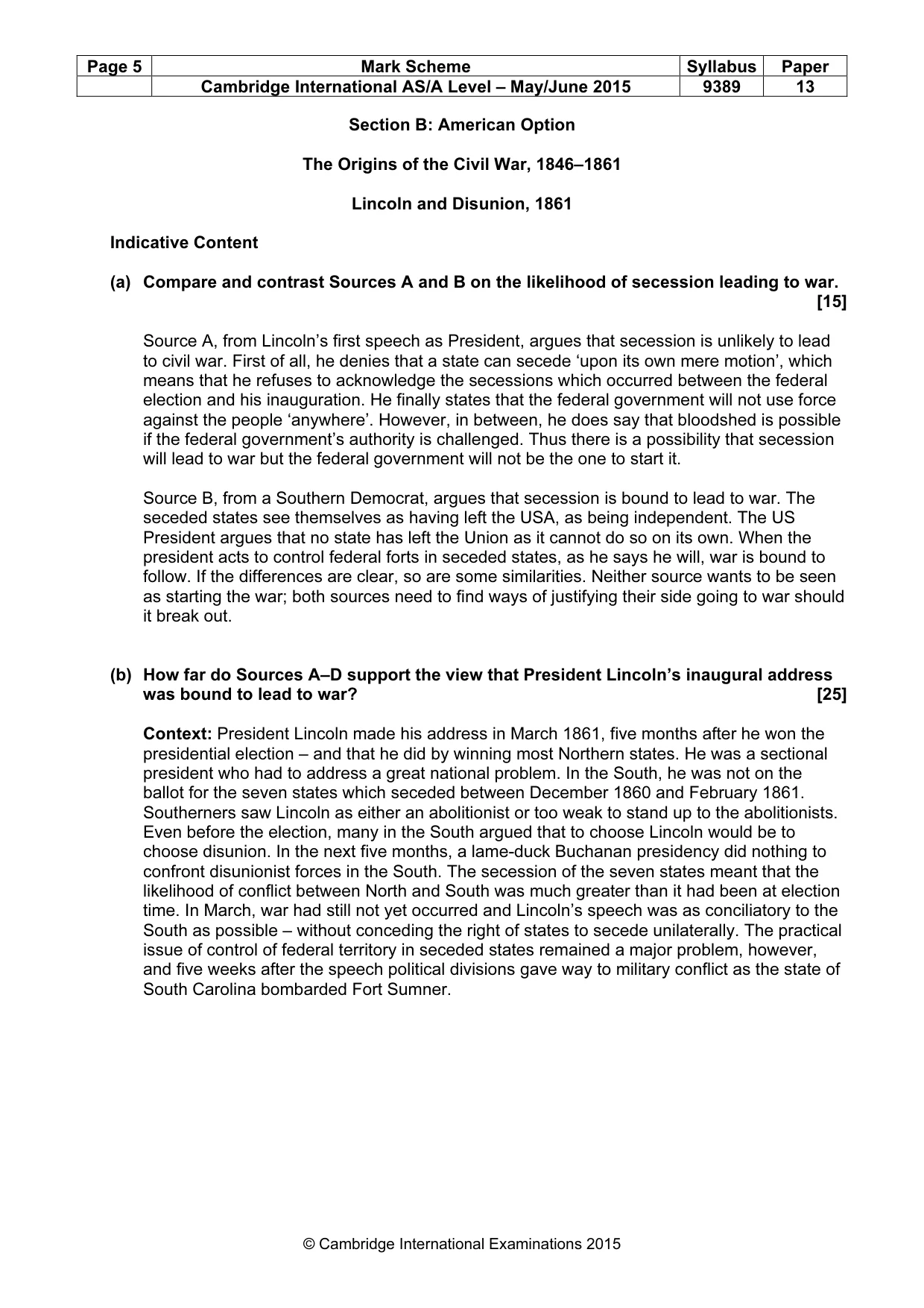
Page 5 Mark Scheme Syllabus Paper Cambridge International AS/A Level – May/June 2015 9389 13 © Cambridge International Examinations 2015 Section B: American Option The Origins of the Civil War, 1846–1861 Lincoln and Disunion, 1861 Indicative Content (a) Compare and contrast Sources A and B on the likelihood of secession leading to war. [15] Source A, from Lincoln’s first speech as President, argues that secession is unlikely to lead to civil war. First of all, he denies that a state can secede ‘upon its own mere motion’, which means that he refuses to acknowledge the secessions which occurred between the federal election and his inauguration. He finally states that the federal government will not use force against the people ‘anywhere’. However, in between, he does say that bloodshed is possible if the federal government’s authority is challenged. Thus there is a possibility that secession will lead to war but the federal government will not be the one to start it. Source B, from a Southern Democrat, argues that secession is bound to lead to war. The seceded states see themselves as having left the USA, as being independent. The US President argues that no state has left the Union as it cannot do so on its own. When the president acts to control federal forts in seceded states, as he says he will, war is bound to follow. If the differences are clear, so are some similarities. Neither source wants to be seen as starting the war; both sources need to find ways of justifying their side going to war should it break out. (b) How far do Sources A–D support the view that President Lincoln’s inaugural address was bound to lead to war? [25] Context: President Lincoln made his address in March 1861, five months after he won the presidential election – and that he did by winning most Northern states. He was a sectional president who had to address a great national problem. In the South, he was not on the ballot for the seven states which seceded between December 1860 and February 1861. Southerners saw Lincoln as either an abolitionist or too weak to stand up to the abolitionists. Even before the election, many in the South argued that to choose Lincoln would be to choose disunion. In the next five months, a lame-duck Buchanan presidency did nothing to confront disunionist forces in the South. The secession of the seven states meant that the likelihood of conflict between North and South was much greater than it had been at election time. In March, war had still not yet occurred and Lincoln’s speech was as conciliatory to the South as possible – without conceding the right of states to secede unilaterally. The practical issue of control of federal territory in seceded states remained a major problem, however, and five weeks after the speech political divisions gave way to military conflict as the state of South Carolina bombarded Fort Sumner.
Mark scheme, page 6
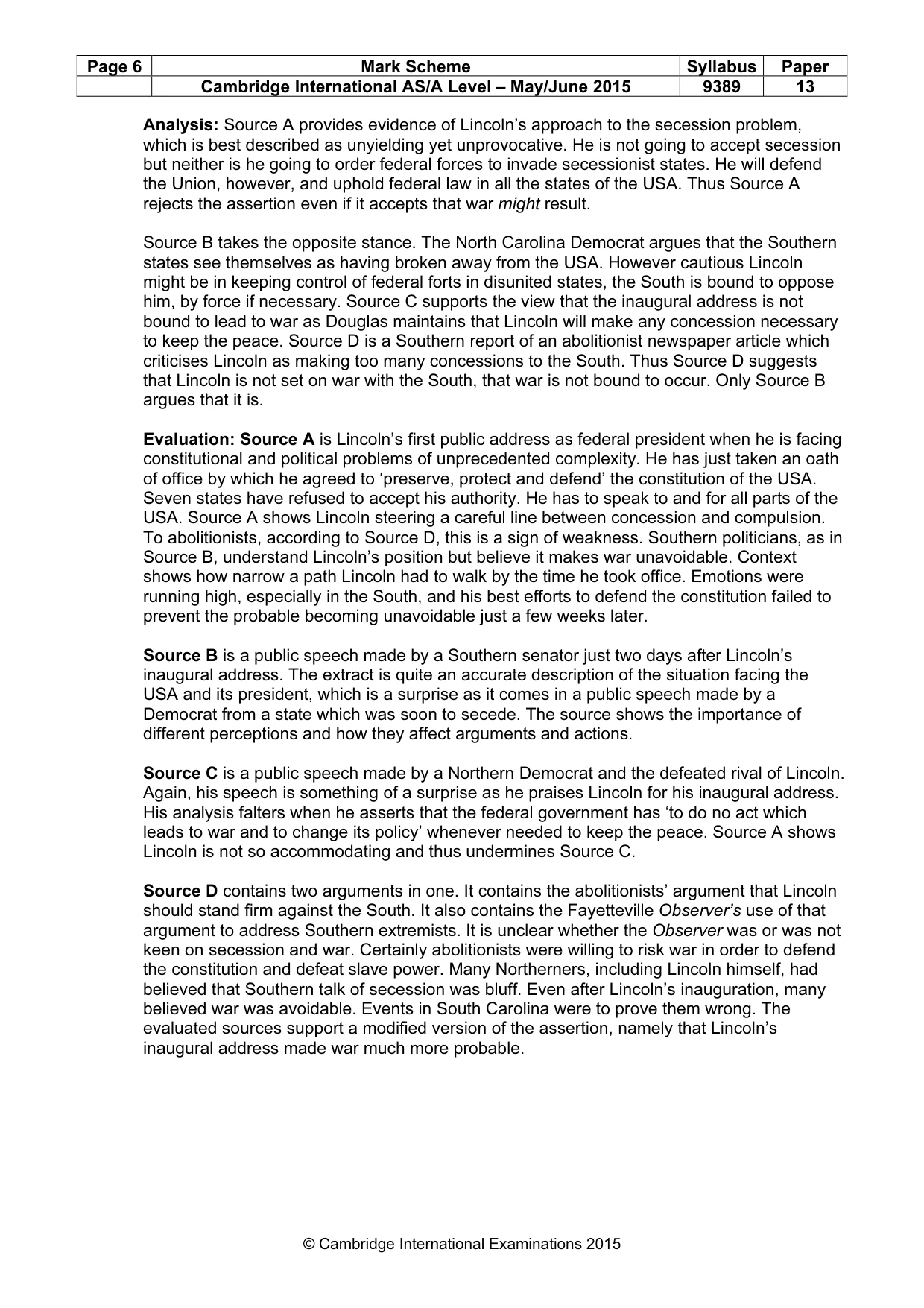
Page 6 Mark Scheme Syllabus Paper Cambridge International AS/A Level – May/June 2015 9389 13 © Cambridge International Examinations 2015 Analysis: Source A provides evidence of Lincoln’s approach to the secession problem, which is best described as unyielding yet unprovocative. He is not going to accept secession but neither is he going to order federal forces to invade secessionist states. He will defend the Union, however, and uphold federal law in all the states of the USA. Thus Source A rejects the assertion even if it accepts that war might result. Source B takes the opposite stance. The North Carolina Democrat argues that the Southern states see themselves as having broken away from the USA. However cautious Lincoln might be in keeping control of federal forts in disunited states, the South is bound to oppose him, by force if necessary. Source C supports the view that the inaugural address is not bound to lead to war as Douglas maintains that Lincoln will make any concession necessary to keep the peace. Source D is a Southern report of an abolitionist newspaper article which criticises Lincoln as making too many concessions to the South. Thus Source D suggests that Lincoln is not set on war with the South, that war is not bound to occur. Only Source B argues that it is. Evaluation: Source A is Lincoln’s first public address as federal president when he is facing constitutional and political problems of unprecedented complexity. He has just taken an oath of office by which he agreed to ‘preserve, protect and defend’ the constitution of the USA. Seven states have refused to accept his authority. He has to speak to and for all parts of the USA. Source A shows Lincoln steering a careful line between concession and compulsion. To abolitionists, according to Source D, this is a sign of weakness. Southern politicians, as in Source B, understand Lincoln’s position but believe it makes war unavoidable. Context shows how narrow a path Lincoln had to walk by the time he took office. Emotions were running high, especially in the South, and his best efforts to defend the constitution failed to prevent the probable becoming unavoidable just a few weeks later. Source B is a public speech made by a Southern senator just two days after Lincoln’s inaugural address. The extract is quite an accurate description of the situation facing the USA and its president, which is a surprise as it comes in a public speech made by a Democrat from a state which was soon to secede. The source shows the importance of different perceptions and how they affect arguments and actions. Source C is a public speech made by a Northern Democrat and the defeated rival of Lincoln. Again, his speech is something of a surprise as he praises Lincoln for his inaugural address. His analysis falters when he asserts that the federal government has ‘to do no act which leads to war and to change its policy’ whenever needed to keep the peace. Source A shows Lincoln is not so accommodating and thus undermines Source C. Source D contains two arguments in one. It contains the abolitionists’ argument that Lincoln should stand firm against the South. It also contains the Fayetteville Observer’s use of that argument to address Southern extremists. It is unclear whether the Observer was or was not keen on secession and war. Certainly abolitionists were willing to risk war in order to defend the constitution and defeat slave power. Many Northerners, including Lincoln himself, had believed that Southern talk of secession was bluff. Even after Lincoln’s inauguration, many believed war was avoidable. Events in South Carolina were to prove them wrong. The evaluated sources support a modified version of the assertion, namely that Lincoln’s inaugural address made war much more probable.
Mark scheme, page 7
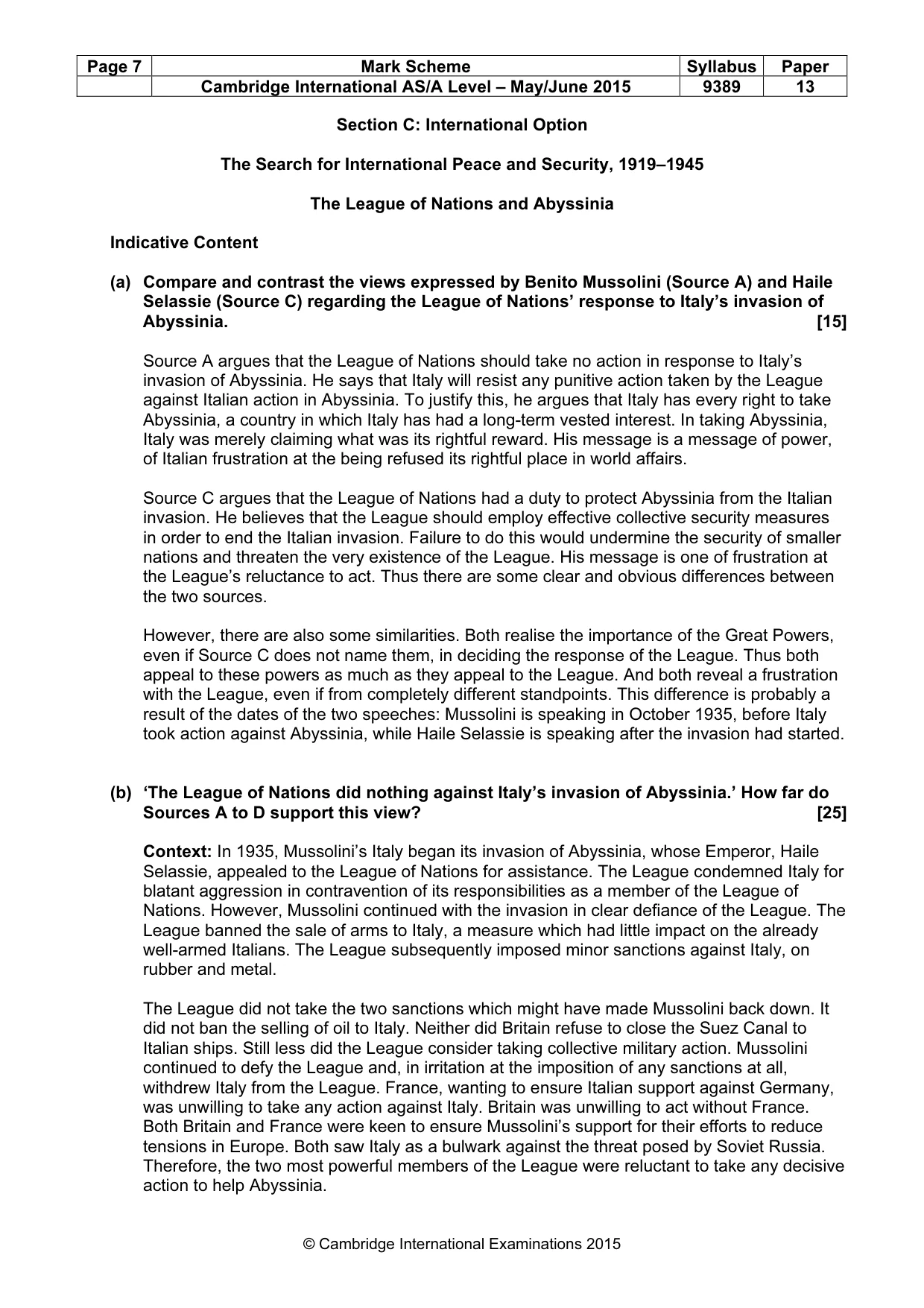
Page 7 Mark Scheme Syllabus Paper Cambridge International AS/A Level – May/June 2015 9389 13 © Cambridge International Examinations 2015 Section C: International Option The Search for International Peace and Security, 1919–1945 The League of Nations and Abyssinia Indicative Content (a) Compare and contrast the views expressed by Benito Mussolini (Source A) and Haile Selassie (Source C) regarding the League of Nations’ response to Italy’s invasion of Abyssinia. [15] Source A argues that the League of Nations should take no action in response to Italy’s invasion of Abyssinia. He says that Italy will resist any punitive action taken by the League against Italian action in Abyssinia. To justify this, he argues that Italy has every right to take Abyssinia, a country in which Italy has had a long-term vested interest. In taking Abyssinia, Italy was merely claiming what was its rightful reward. His message is a message of power, of Italian frustration at the being refused its rightful place in world affairs. Source C argues that the League of Nations had a duty to protect Abyssinia from the Italian invasion. He believes that the League should employ effective collective security measures in order to end the Italian invasion. Failure to do this would undermine the security of smaller nations and threaten the very existence of the League. His message is one of frustration at the League’s reluctance to act. Thus there are some clear and obvious differences between the two sources. However, there are also some similarities. Both realise the importance of the Great Powers, even if Source C does not name them, in deciding the response of the League. Thus both appeal to these powers as much as they appeal to the League. And both reveal a frustration with the League, even if from completely different standpoints. This difference is probably a result of the dates of the two speeches: Mussolini is speaking in October 1935, before Italy took action against Abyssinia, while Haile Selassie is speaking after the invasion had started. (b) ‘The League of Nations did nothing against Italy’s invasion of Abyssinia.’ How far do Sources A to D support this view? [25] Context: In 1935, Mussolini’s Italy began its invasion of Abyssinia, whose Emperor, Haile Selassie, appealed to the League of Nations for assistance. The League condemned Italy for blatant aggression in contravention of its responsibilities as a member of the League of Nations. However, Mussolini continued with the invasion in clear defiance of the League. The League banned the sale of arms to Italy, a measure which had little impact on the already well-armed Italians. The League subsequently imposed minor sanctions against Italy, on rubber and metal. The League did not take the two sanctions which might have made Mussolini back down. It did not ban the selling of oil to Italy. Neither did Britain refuse to close the Suez Canal to Italian ships. Still less did the League consider taking collective military action. Mussolini continued to defy the League and, in irritation at the imposition of any sanctions at all, withdrew Italy from the League. France, wanting to ensure Italian support against Germany, was unwilling to take any action against Italy. Britain was unwilling to act without France. Both Britain and France were keen to ensure Mussolini’s support for their efforts to reduce tensions in Europe. Both saw Italy as a bulwark against the threat posed by Soviet Russia. Therefore, the two most powerful members of the League were reluctant to take any decisive action to help Abyssinia.
Mark scheme, page 8
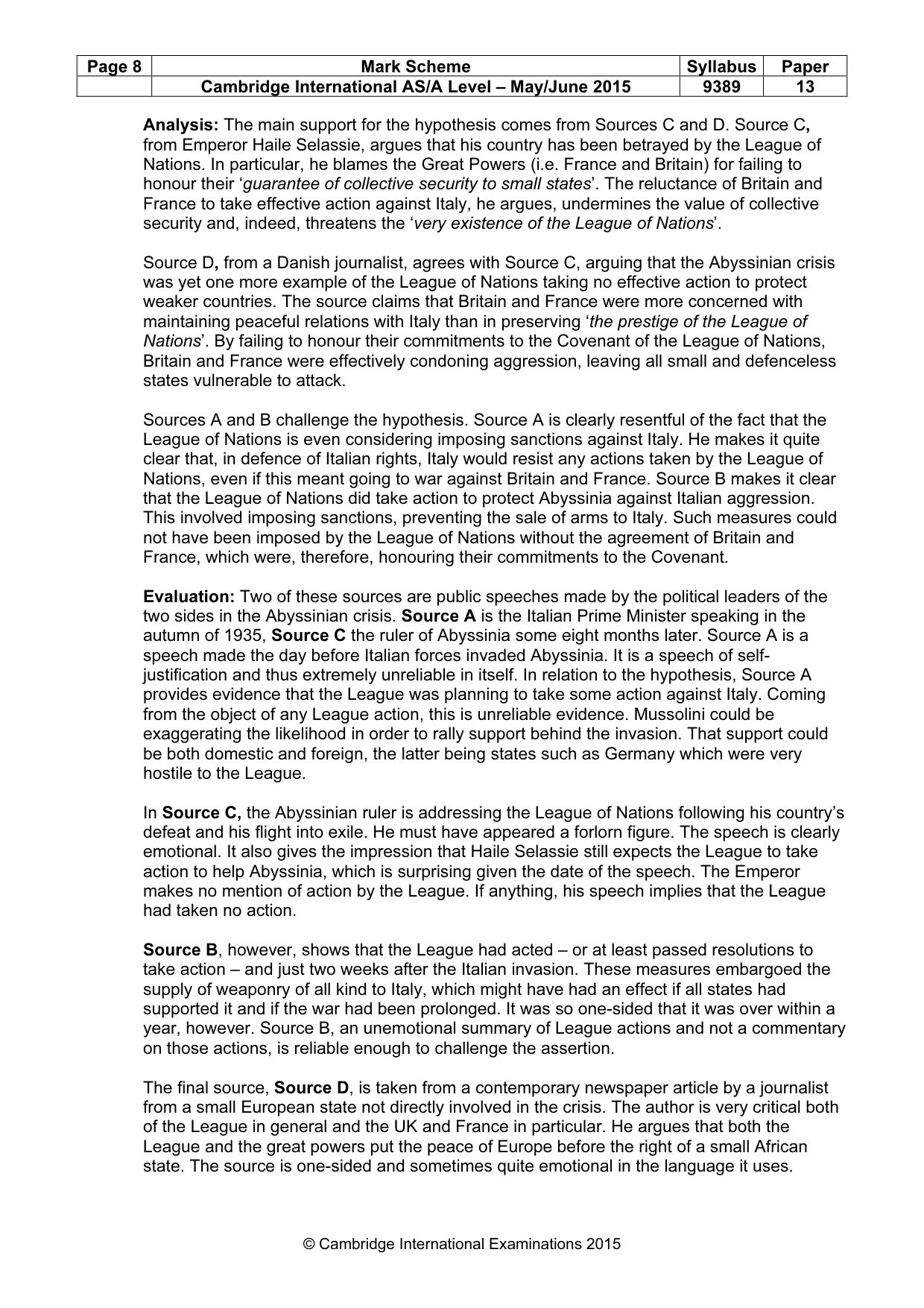
Page 8 Mark Scheme Syllabus Paper Cambridge International AS/A Level – May/June 2015 9389 13 © Cambridge International Examinations 2015 Analysis: The main support for the hypothesis comes from Sources C and D. Source C, from Emperor Haile Selassie, argues that his country has been betrayed by the League of Nations. In particular, he blames the Great Powers (i.e. France and Britain) for failing to honour their ‘guarantee of collective security to small states’. The reluctance of Britain and France to take effective action against Italy, he argues, undermines the value of collective security and, indeed, threatens the ‘very existence of the League of Nations’. Source D, from a Danish journalist, agrees with Source C, arguing that the Abyssinian crisis was yet one more example of the League of Nations taking no effective action to protect weaker countries. The source claims that Britain and France were more concerned with maintaining peaceful relations with Italy than in preserving ‘the prestige of the League of Nations’. By failing to honour their commitments to the Covenant of the League of Nations, Britain and France were effectively condoning aggression, leaving all small and defenceless states vulnerable to attack. Sources A and B challenge the hypothesis. Source A is clearly resentful of the fact that the League of Nations is even considering imposing sanctions against Italy. He makes it quite clear that, in defence of Italian rights, Italy would resist any actions taken by the League of Nations, even if this meant going to war against Britain and France. Source B makes it clear that the League of Nations did take action to protect Abyssinia against Italian aggression. This involved imposing sanctions, preventing the sale of arms to Italy. Such measures could not have been imposed by the League of Nations without the agreement of Britain and France, which were, therefore, honouring their commitments to the Covenant. Evaluation: Two of these sources are public speeches made by the political leaders of the two sides in the Abyssinian crisis. Source A is the Italian Prime Minister speaking in the autumn of 1935, Source C the ruler of Abyssinia some eight months later. Source A is a speech made the day before Italian forces invaded Abyssinia. It is a speech of self- justification and thus extremely unreliable in itself. In relation to the hypothesis, Source A provides evidence that the League was planning to take some action against Italy. Coming from the object of any League action, this is unreliable evidence. Mussolini could be exaggerating the likelihood in order to rally support behind the invasion. That support could be both domestic and foreign, the latter being states such as Germany which were very hostile to the League. In Source C, the Abyssinian ruler is addressing the League of Nations following his country’s defeat and his flight into exile. He must have appeared a forlorn figure. The speech is clearly emotional. It also gives the impression that Haile Selassie still expects the League to take action to help Abyssinia, which is surprising given the date of the speech. The Emperor makes no mention of action by the League. If anything, his speech implies that the League had taken no action. Source B, however, shows that the League had acted – or at least passed resolutions to take action – and just two weeks after the Italian invasion. These measures embargoed the supply of weaponry of all kind to Italy, which might have had an effect if all states had supported it and if the war had been prolonged. It was so one-sided that it was over within a year, however. Source B, an unemotional summary of League actions and not a commentary on those actions, is reliable enough to challenge the assertion. The final source, Source D, is taken from a contemporary newspaper article by a journalist from a small European state not directly involved in the crisis. The author is very critical both of the League in general and the UK and France in particular. He argues that both the League and the great powers put the peace of Europe before the right of a small African state. The source is one-sided and sometimes quite emotional in the language it uses.
Mark scheme, page 9
Page 9 Mark Scheme Syllabus Paper Cambridge International AS/A Level – May/June 2015 9389 13 © Cambridge International Examinations 2015 Contextual knowledge does support the article in that Italy did use tanks, machine guns and poison gas against Abyssinia. And contextual knowledge helps support Source C and its attack on the ineffectiveness of the League. Although Source B is reliable, the information it provides is misleading. The League might have introduced policies against Italy but they had little effect as other resources key to a successful war were not embargoed, such as oil. The hypothesis, if amended by adding ‘effective’ after ‘nothing’, is valid.
What you needed in this session
Cambridge’s own grade thresholds for 2015 May/June, Paper 1 · Variant 3. A higher threshold means an easier paper — the bar moves with how the cohort did.