Cambridge A Level History 9389 — 2014 Oct/Nov Paper 1 · Variant 3
9389/13/O/N/14 · 40 marks · ≈45 min
The question paper and its mark scheme, free to read here and free to download. This is Cambridge’s own paper, exactly as it was sat.
Question paper8 pages

Mark scheme9 pages
Answers below. Sit the paper first if you are practising.
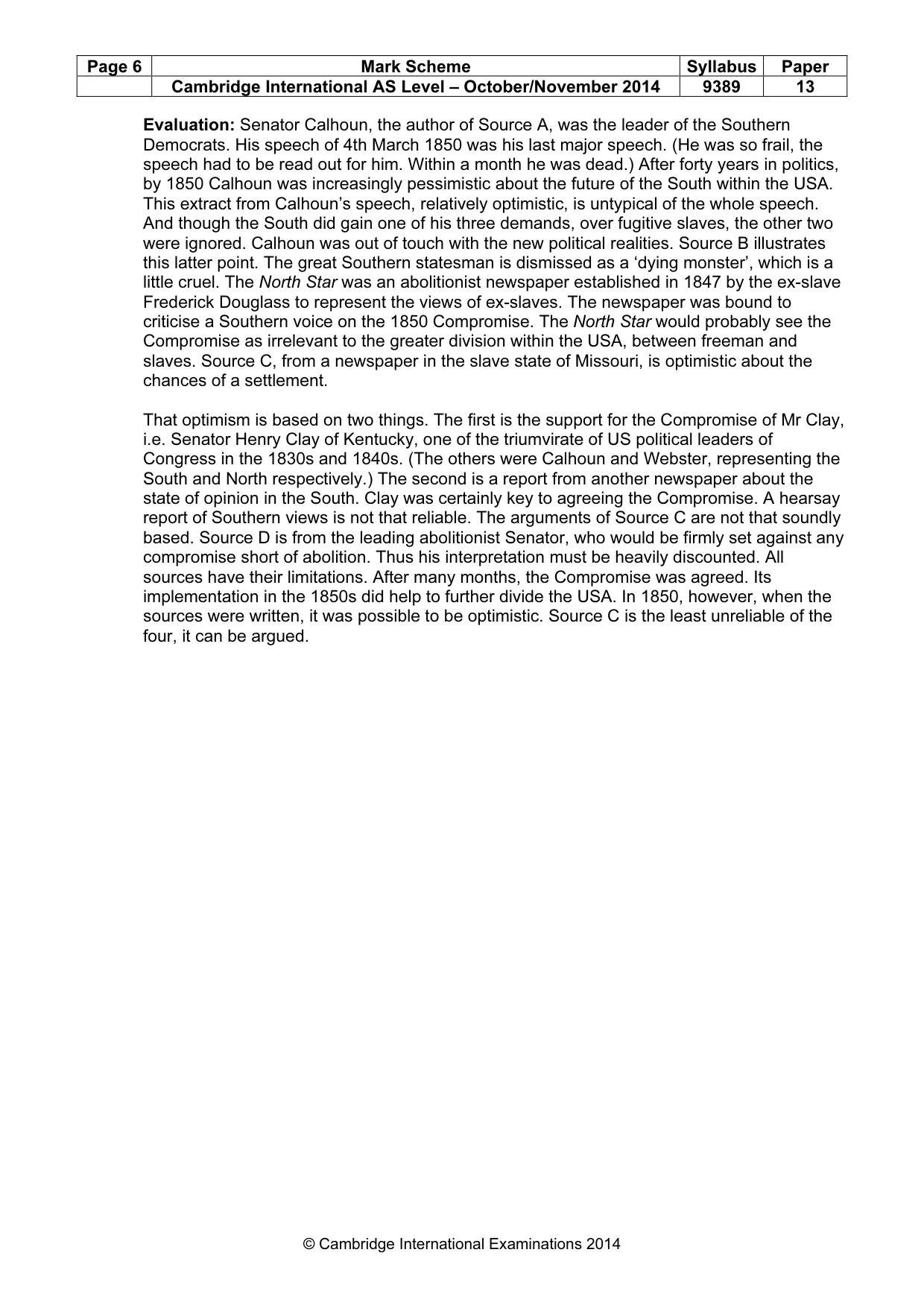
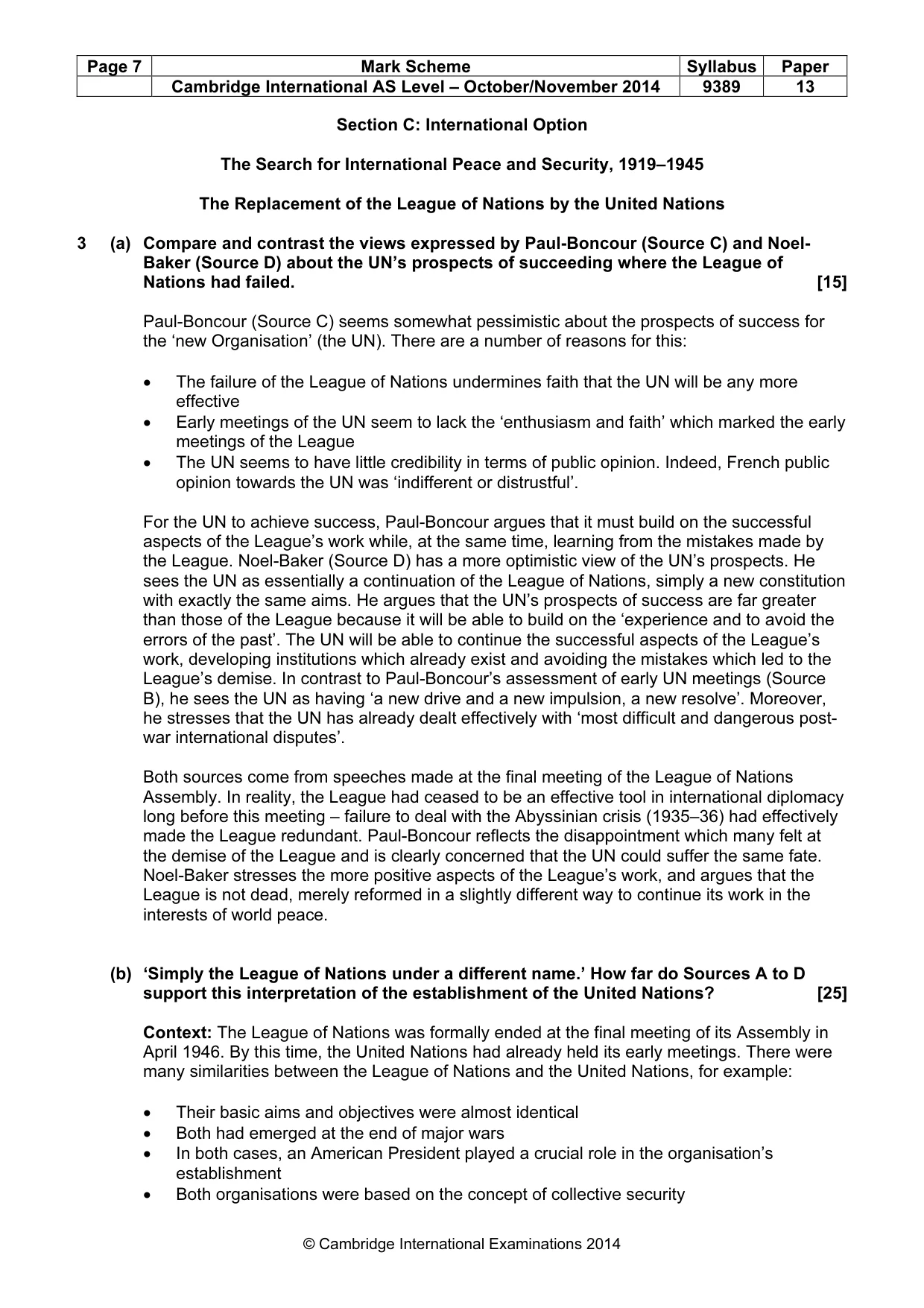
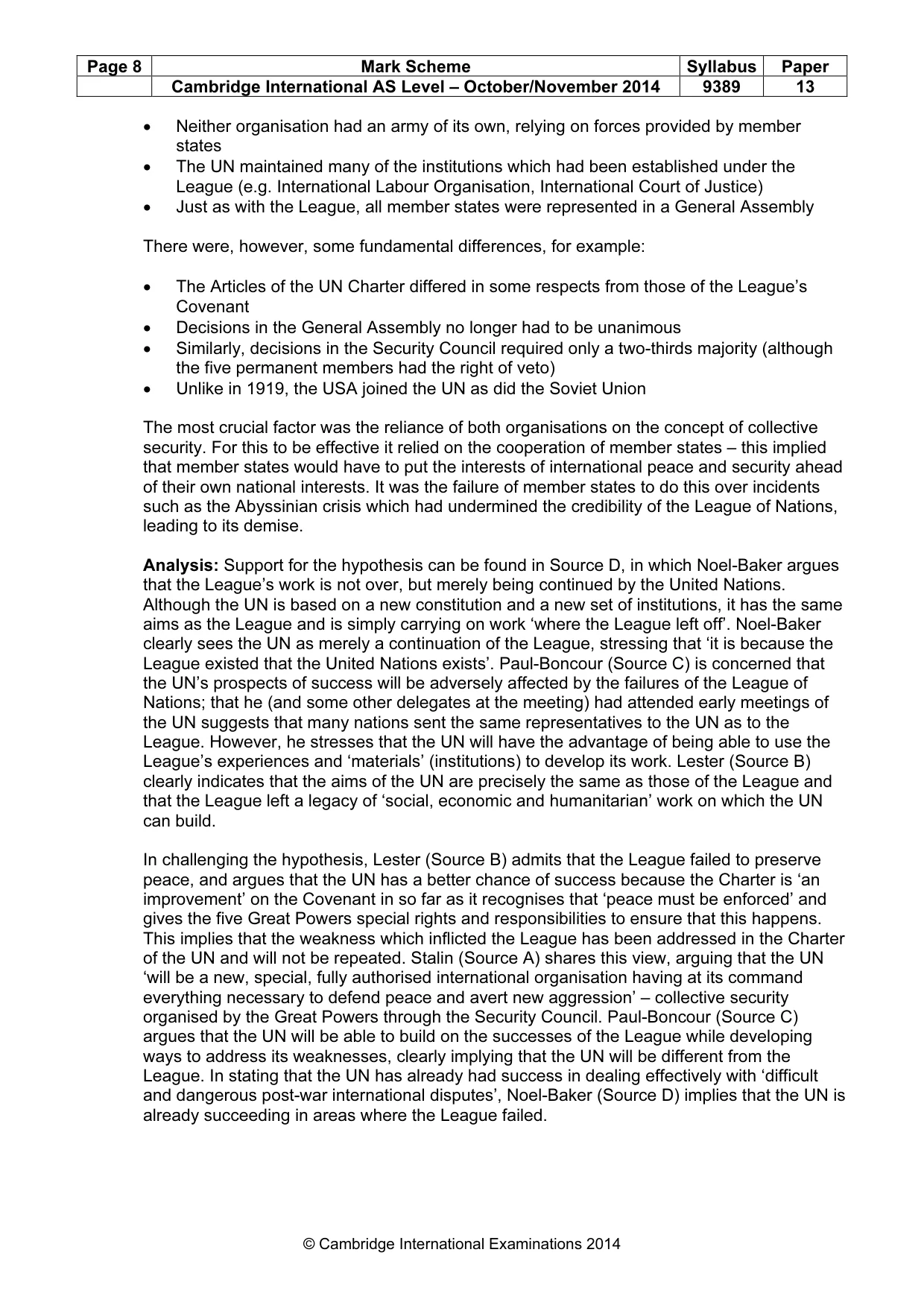
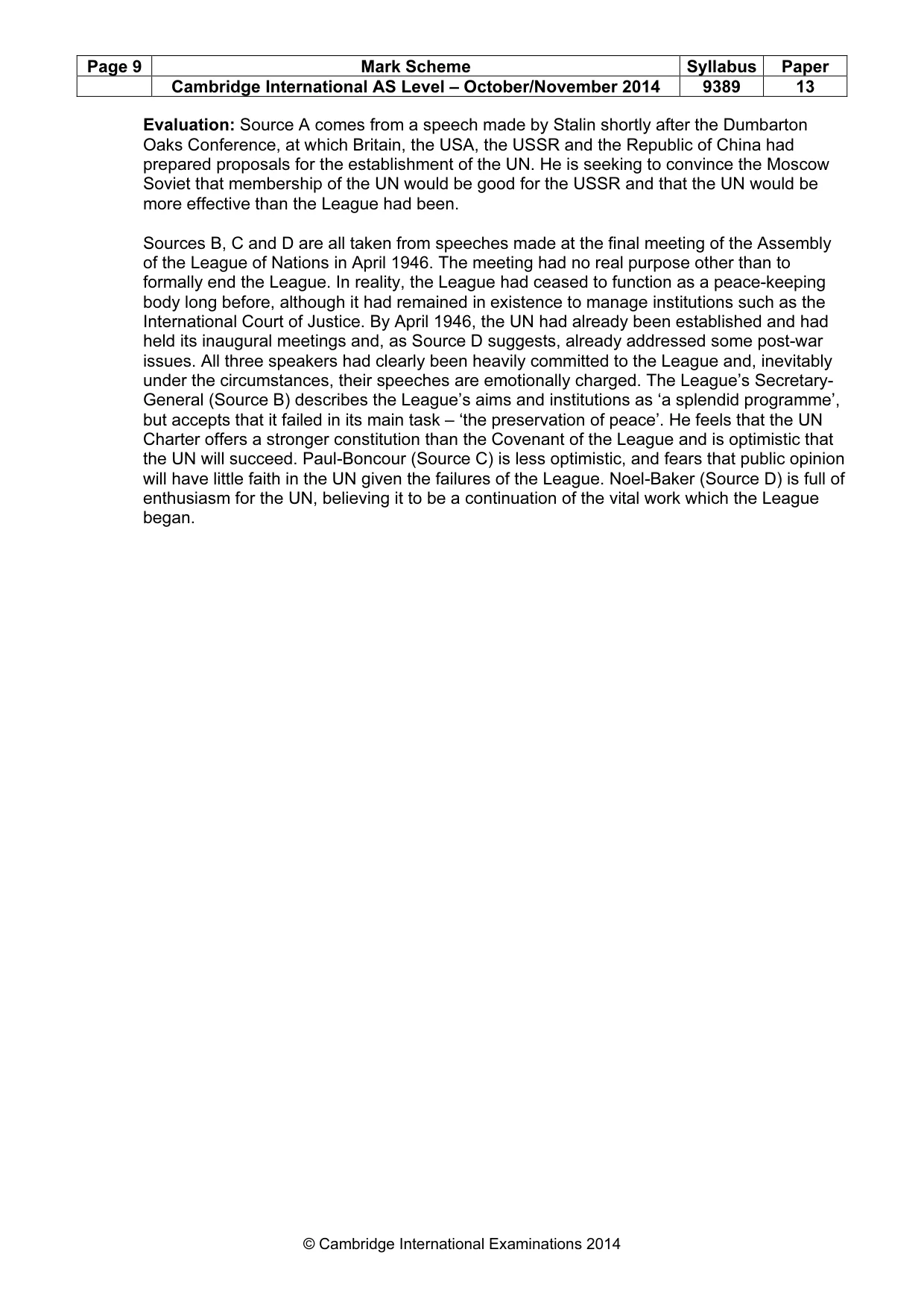
Paper as text
Question paper, page 1
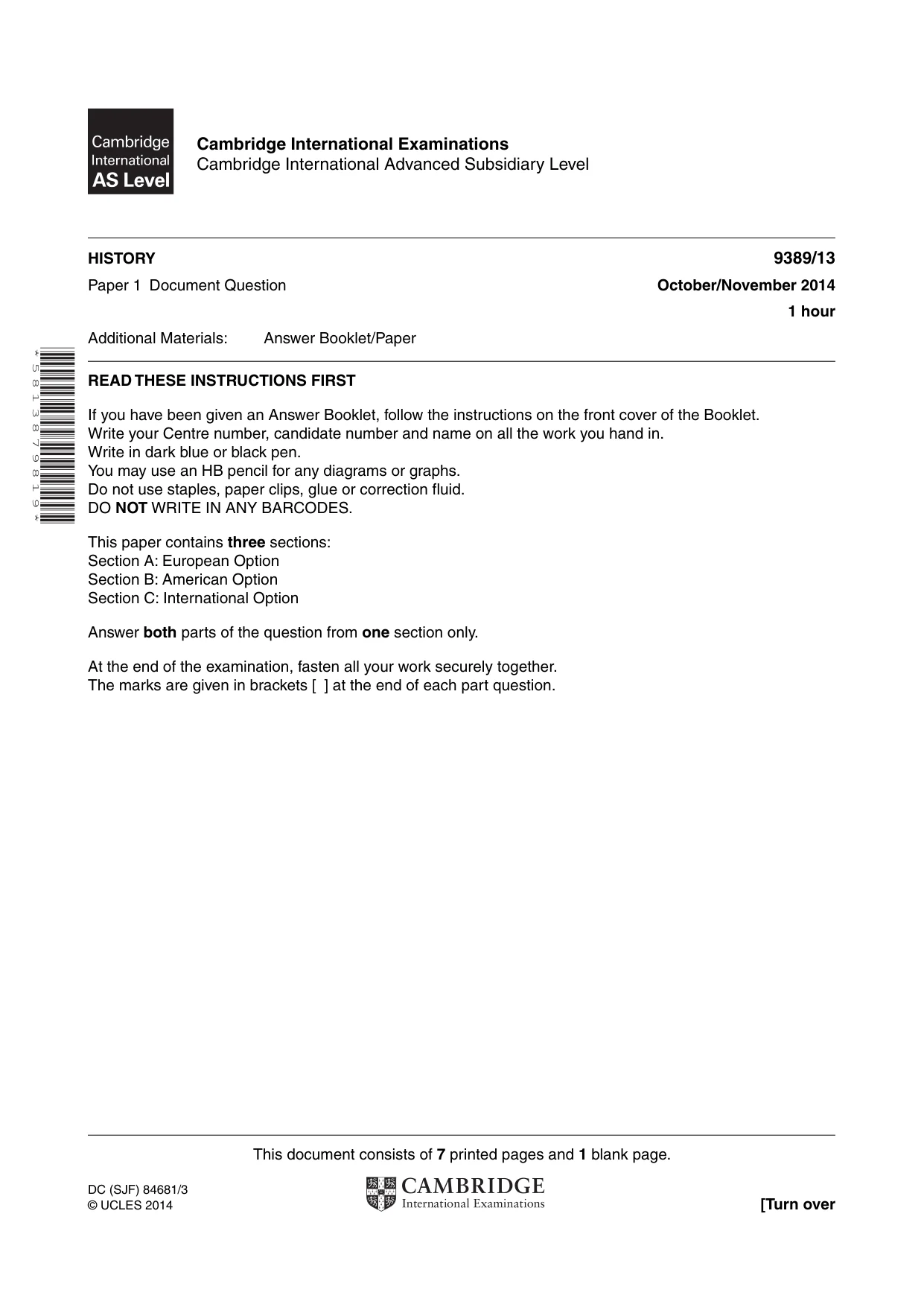
This document consists of 7 printed pages and 1 blank page. DC (SJF) 84681/3 © UCLES 2014 [Turn over Cambridge International Examinations Cambridge International Advanced Subsidiary Level * 5 8 1 3 8 7 9 8 1 9 * HISTORY 9389/13 Paper 1 Document Question October/November 2014 1 hour Additional Materials: Answer Booklet/Paper READ THESE INSTRUCTIONS FIRST If you have been given an Answer Booklet, follow the instructions on the front cover of the Booklet. Write your Centre number, candidate number and name on all the work you hand in. Write in dark blue or black pen. You may use an HB pencil for any diagrams or graphs. Do not use staples, paper clips, glue or correction fluid. DO NOT WRITE IN ANY BARCODES. This paper contains three sections: Section A: European Option Section B: American Option Section C: International Option Answer both parts of the question from one section only. At the end of the examination, fasten all your work securely together. The marks are given in brackets [ ] at the end of each part question.
Question paper, page 2
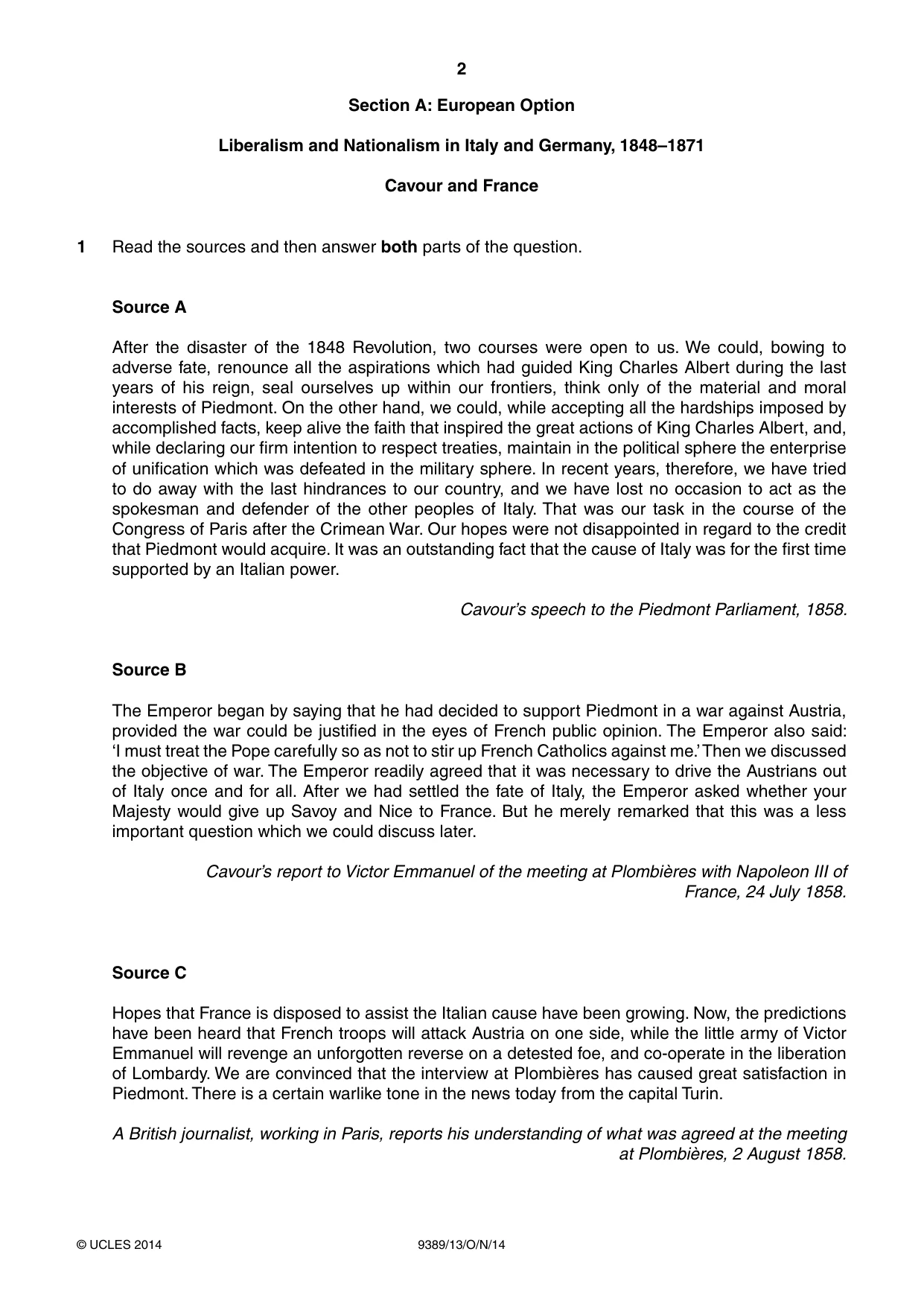
2 9389/13/O/N/14 © UCLES 2014 Section A: European Option Liberalism and Nationalism in Italy and Germany, 1848–1871 Cavour and France 1 Read the sources and then answer both parts of the question. Source A After the disaster of the 1848 Revolution, two courses were open to us. We could, bowing to adverse fate, renounce all the aspirations which had guided King Charles Albert during the last years of his reign, seal ourselves up within our frontiers, think only of the material and moral interests of Piedmont. On the other hand, we could, while accepting all the hardships imposed by accomplished facts, keep alive the faith that inspired the great actions of King Charles Albert, and, while declaring our firm intention to respect treaties, maintain in the political sphere the enterprise of unification which was defeated in the military sphere. In recent years, therefore, we have tried to do away with the last hindrances to our country, and we have lost no occasion to act as the spokesman and defender of the other peoples of Italy. That was our task in the course of the Congress of Paris after the Crimean War. Our hopes were not disappointed in regard to the credit that Piedmont would acquire. It was an outstanding fact that the cause of Italy was for the first time supported by an Italian power. Cavour’s speech to the Piedmont Parliament, 1858. Source B The Emperor began by saying that he had decided to support Piedmont in a war against Austria, provided the war could be justified in the eyes of French public opinion. The Emperor also said: ‘I must treat the Pope carefully so as not to stir up French Catholics against me.’ Then we discussed the objective of war. The Emperor readily agreed that it was necessary to drive the Austrians out of Italy once and for all. After we had settled the fate of Italy, the Emperor asked whether your Majesty would give up Savoy and Nice to France. But he merely remarked that this was a less important question which we could discuss later. Cavour’s report to Victor Emmanuel of the meeting at Plombières with Napoleon III of France, 24 July 1858. Source C Hopes that France is disposed to assist the Italian cause have been growing. Now, the predictions have been heard that French troops will attack Austria on one side, while the little army of Victor Emmanuel will revenge an unforgotten reverse on a detested foe, and co-operate in the liberation of Lombardy. We are convinced that the interview at Plombières has caused great satisfaction in Piedmont. There is a certain warlike tone in the news today from the capital Turin. A British journalist, working in Paris, reports his understanding of what was agreed at the meeting at Plombières, 2 August 1858.
Question paper, page 3
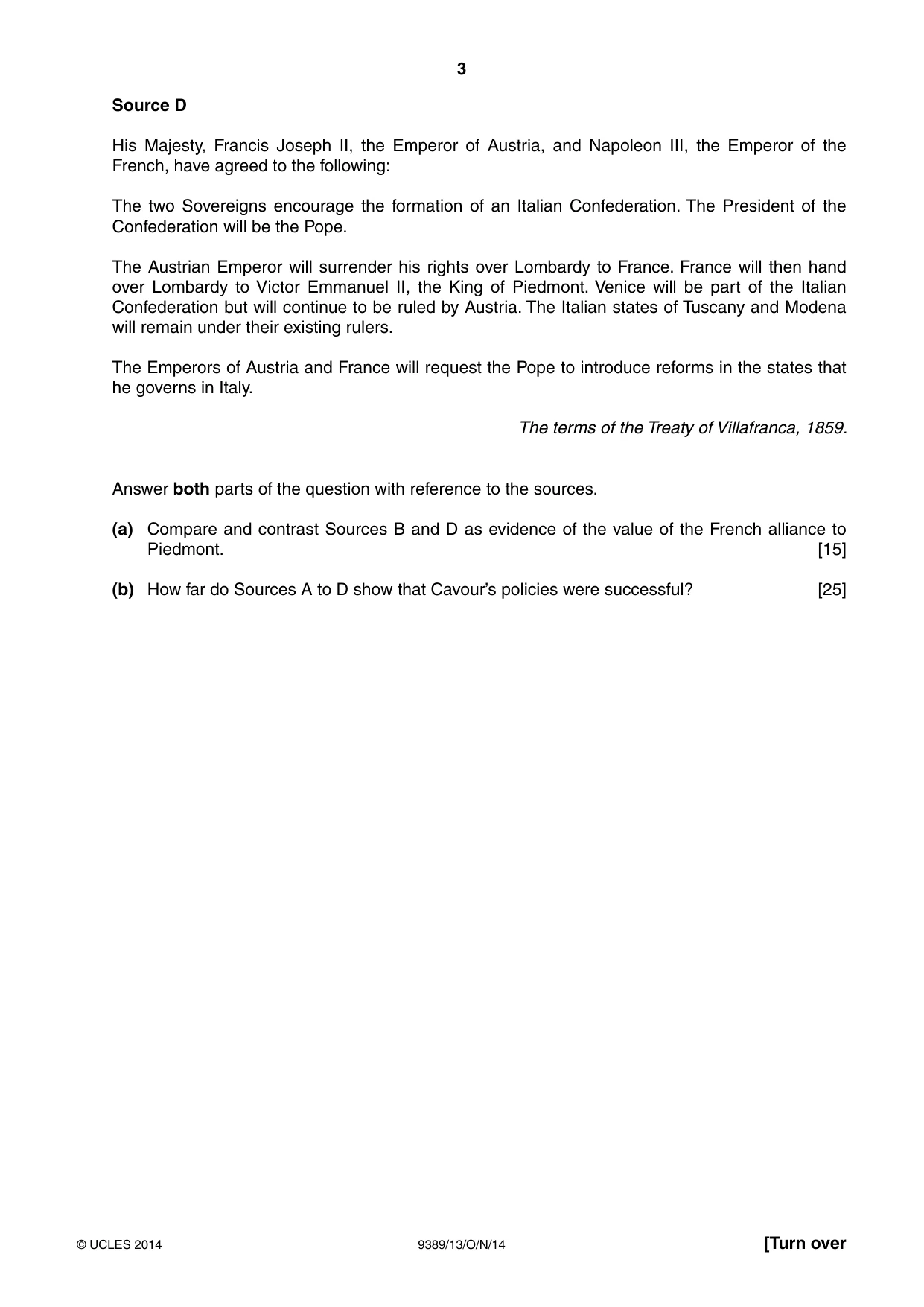
3 9389/13/O/N/14 © UCLES 2014 [Turn over Source D His Majesty, Francis Joseph II, the Emperor of Austria, and Napoleon III, the Emperor of the French, have agreed to the following: The two Sovereigns encourage the formation of an Italian Confederation. The President of the Confederation will be the Pope. The Austrian Emperor will surrender his rights over Lombardy to France. France will then hand over Lombardy to Victor Emmanuel II, the King of Piedmont. Venice will be part of the Italian Confederation but will continue to be ruled by Austria. The Italian states of Tuscany and Modena will remain under their existing rulers. The Emperors of Austria and France will request the Pope to introduce reforms in the states that he governs in Italy. The terms of the Treaty of Villafranca, 1859. Answer both parts of the question with reference to the sources. (a) Compare and contrast Sources B and D as evidence of the value of the French alliance to Piedmont. [15] (b) How far do Sources A to D show that Cavour’s policies were successful? [25]
Question paper, page 4
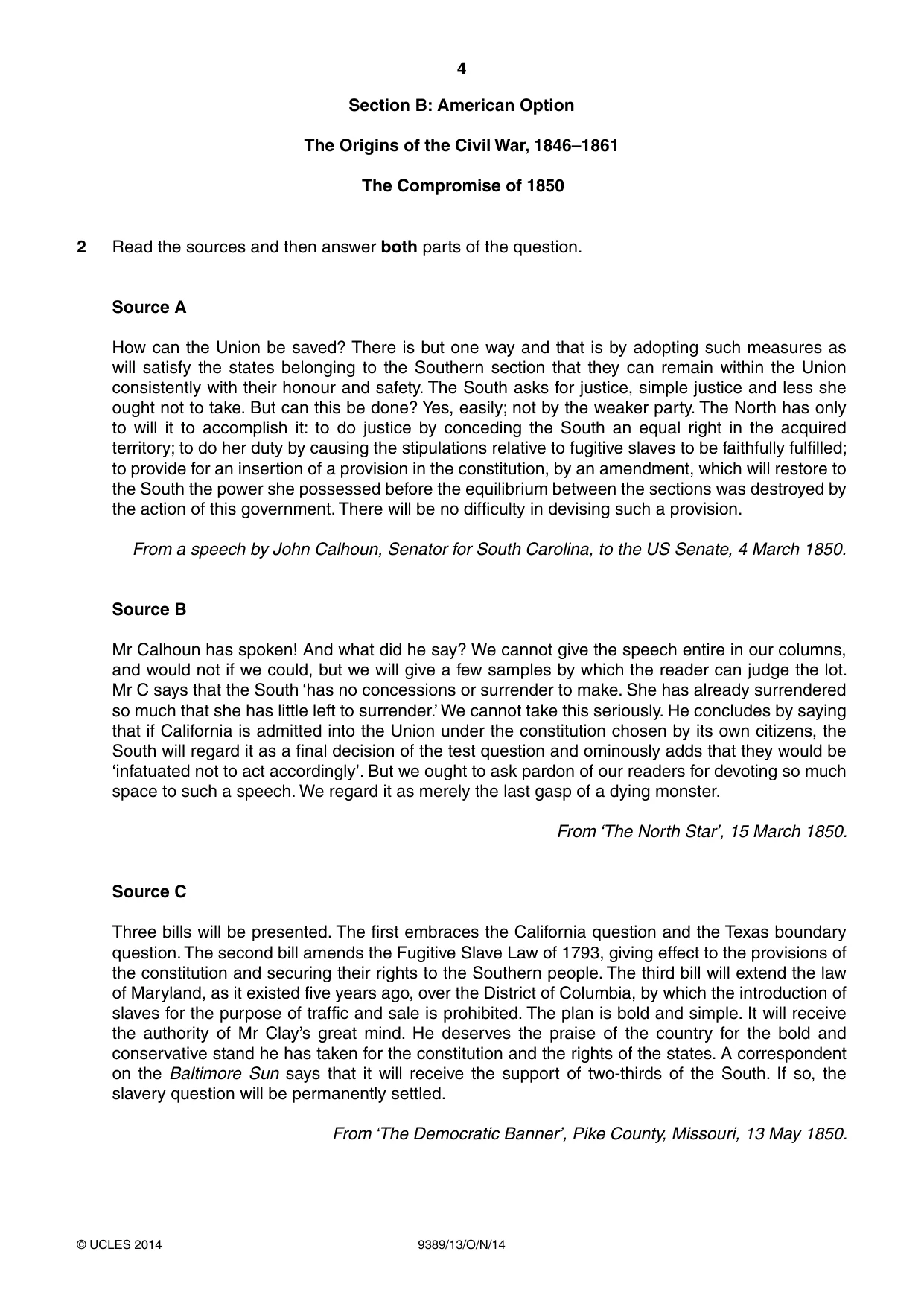
4 9389/13/O/N/14 © UCLES 2014 Section B: American Option The Origins of the Civil War, 1846–1861 The Compro mise of 1850 2 Read the sources and then answer both parts of the question. Source A How can the Union be saved? There is but one way and that is by adopting such measures as will satisfy the states belonging to the Southern section that they can remain within the Union consistently with their honour and safety. The South asks for justice, simple justice and less she ought not to take. But can this be done? Yes, easily; not by the weaker party. The North has only to will it to accomplish it: to do justice by conceding the South an equal right in the acquired territory; to do her duty by causing the stipulations relative to fugitive slaves to be faithfully fulfilled; to provide for an insertion of a provision in the constitution, by an amendment, which will restore to the South the power she possessed before the equilibrium between the sections was destroyed by the action of this government. There will be no difficulty in devising such a provision. From a speech by John Calhoun, Senator for South Carolina, to the US Senate, 4 March 1850. Source B Mr Calhoun has spoken! And what did he say? We cannot give the speech entire in our columns, and would not if we could, but we will give a few samples by which the reader can judge the lot. Mr C says that the South ‘has no concessions or surrender to make. She has already surrendered so much that she has little left to surrender.’ We cannot take this seriously. He concludes by saying that if California is admitted into the Union under the constitution chosen by its own citizens, the South will regard it as a final decision of the test question and ominously adds that they would be ‘infatuated not to act accordingly’. But we ought to ask pardon of our readers for devoting so much space to such a speech. We regard it as merely the last gasp of a dying monster. From ‘The North Star’, 15 March 1850. Source C Three bills will be presented. The first embraces the California question and the Texas boundary question. The second bill amends the Fugitive Slave Law of 1793, giving effect to the provisions of the constitution and securing their rights to the Southern people. The third bill will extend the law of Maryland, as it existed five years ago, over the District of Columbia, by which the introduction of slaves for the purpose of traffic and sale is prohibited. The plan is bold and simple. It will receive the authority of Mr Clay’s great mind. He deserves the praise of the country for the bold and conservative stand he has taken for the constitution and the rights of the states. A correspondent on the Baltimore Sun says that it will receive the support of two-thirds of the South. If so, the slavery question will be permanently settled. From ‘The Democratic Banner’, Pike County, Missouri, 13 May 1850.
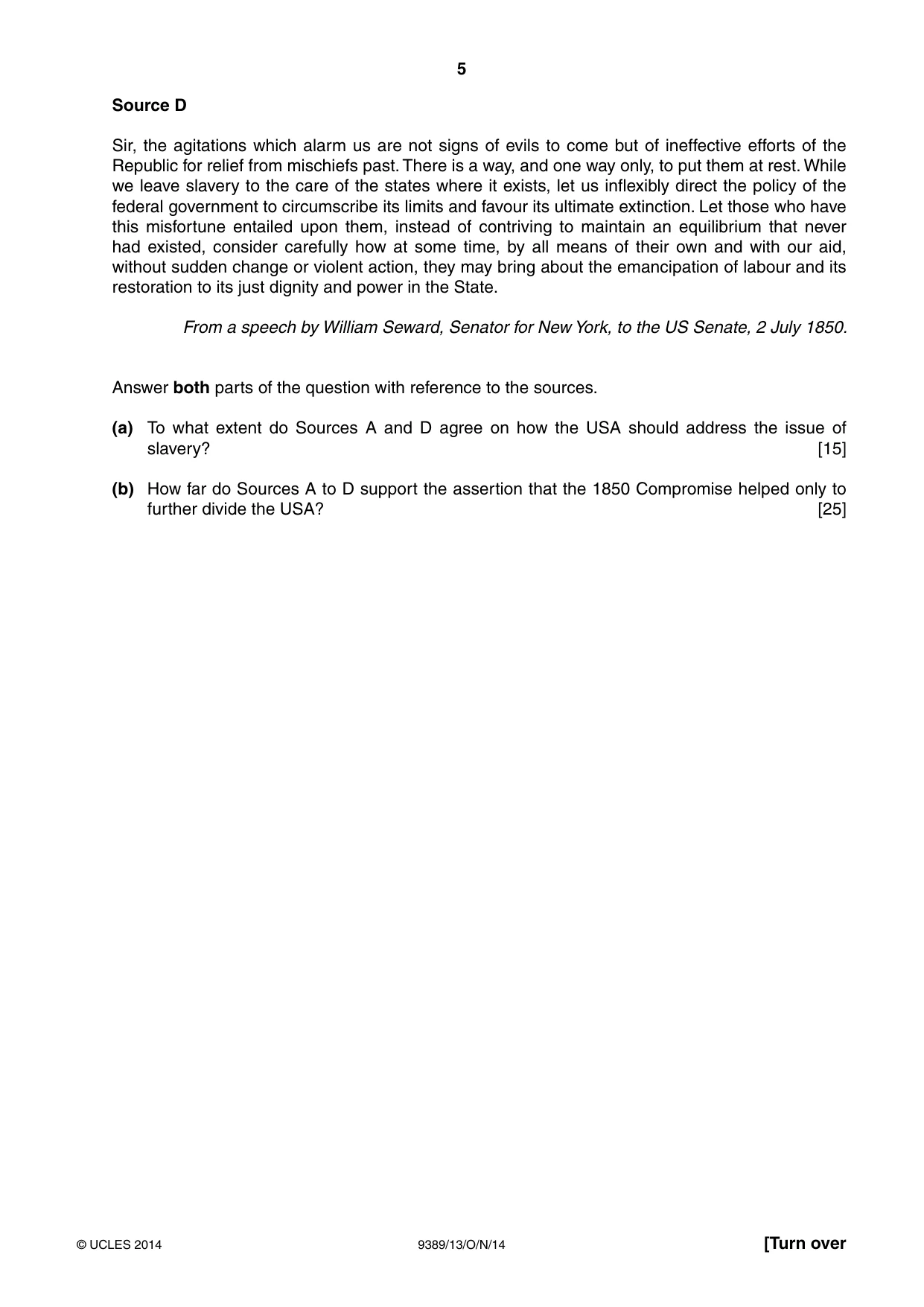
Question paper, page 5
5 9389/13/O/N/14 © UCLES 2014 [Turn over Source D Sir, the agitations which alarm us are not signs of evils to come but of ineffective efforts of the Republic for relief from mischiefs past. There is a way, and one way only, to put them at rest. While we leave slavery to the care of the states where it exists, let us inflexibly direct the policy of the federal government to circumscribe its limits and favour its ultimate extinction. Let those who have this misfortune entailed upon them, instead of contriving to maintain an equilibrium that never had existed, consider carefully how at some time, by all means of their own and with our aid, without sudden change or violent action, they may bring about the emancipation of labour and its restoration to its just dignity and power in the State. From a speech by William Seward, Senator for New York, to the US Senate, 2 July 1850. Answer both parts of the question with reference to the sources. (a) To what extent do Sources A and D agree on how the USA should address the issue of slavery? [15] (b) How far do Sources A to D support the assertion that the 1850 Compromise helped only to further divide the USA? [25]
Question paper, page 6
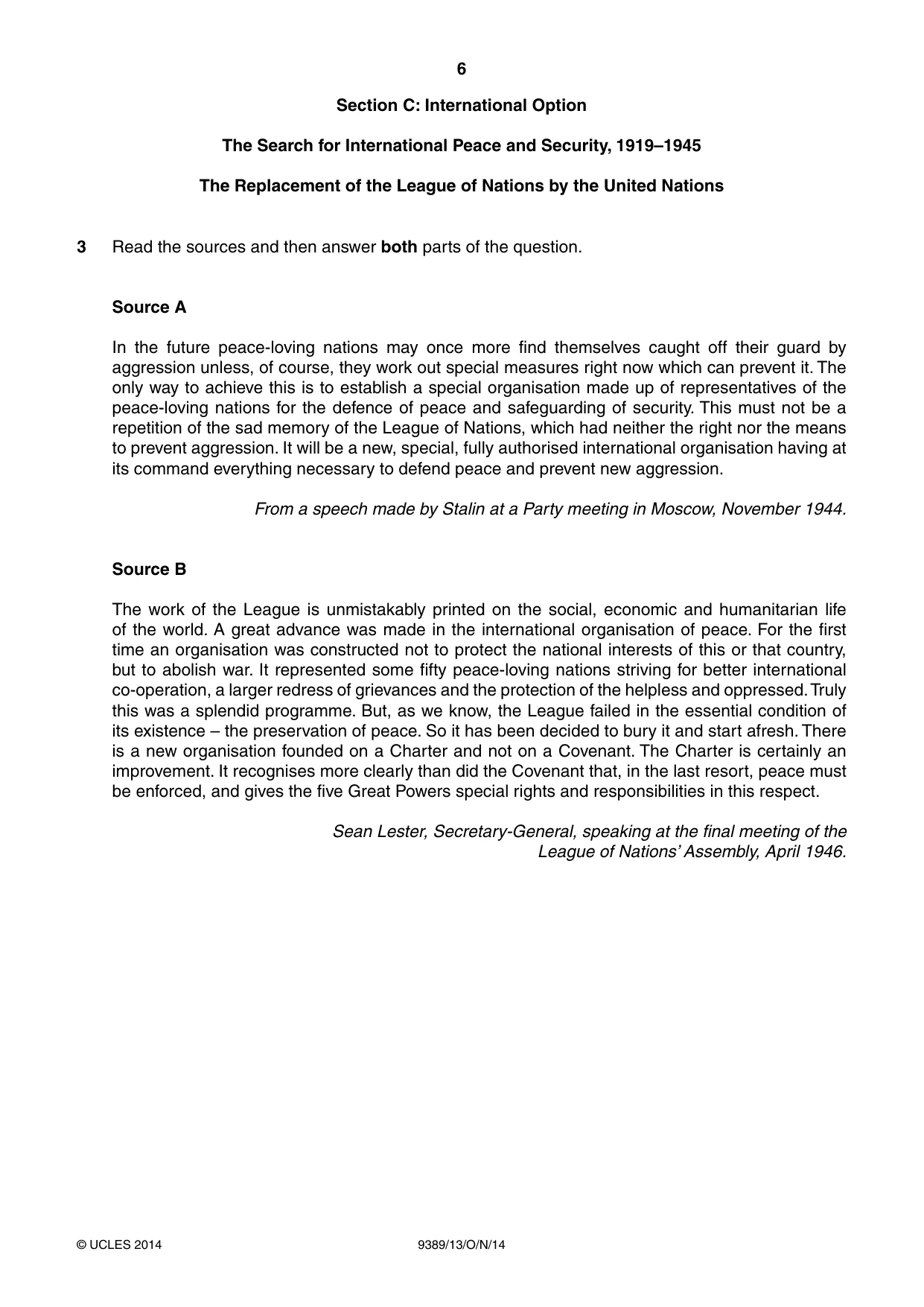
6 9389/13/O/N/14 © UCLES 2014 Section C: International Option The Search for International Peace and Security, 1919–1945 The Replacement of the League of Nations by the United Nations 3 Read the sources and then answer both parts of the question. Source A In the future peace-loving nations may once more find themselves caught off their guard by aggression unless, of course, they work out special measures right now which can prevent it. The only way to achieve this is to establish a special organisation made up of representatives of the peace-loving nations for the defence of peace and safeguarding of security. This must not be a repetition of the sad memory of the League of Nations, which had neither the right nor the means to prevent aggression. It will be a new, special, fully authorised international organisation having at its command everything necessary to defend peace and prevent new aggression. From a speech made by Stalin at a Party meeting in Moscow, November 1944. Source B The work of the League is unmistakably printed on the social, economic and humanitarian life of the world. A great advance was made in the international organisation of peace. For the first time an organisation was constructed not to protect the national interests of this or that country, but to abolish war. It represented some fifty peace-loving nations striving for better international co-operation, a larger redress of grievances and the protection of the helpless and oppressed. Truly this was a splendid programme. But, as we know, the League failed in the essential condition of its existence – the preservation of peace. So it has been decided to bury it and start afresh. There is a new organisation founded on a Charter and not on a Covenant. The Charter is certainly an improvement. It recognises more clearly than did the Covenant that, in the last resort, peace must be enforced, and gives the five Great Powers special rights and responsibilities in this respect. Sean Lester, Secretary-General, speaking at the final meeting of the League of Nations’ Assembly, April 1946.
Question paper, page 7
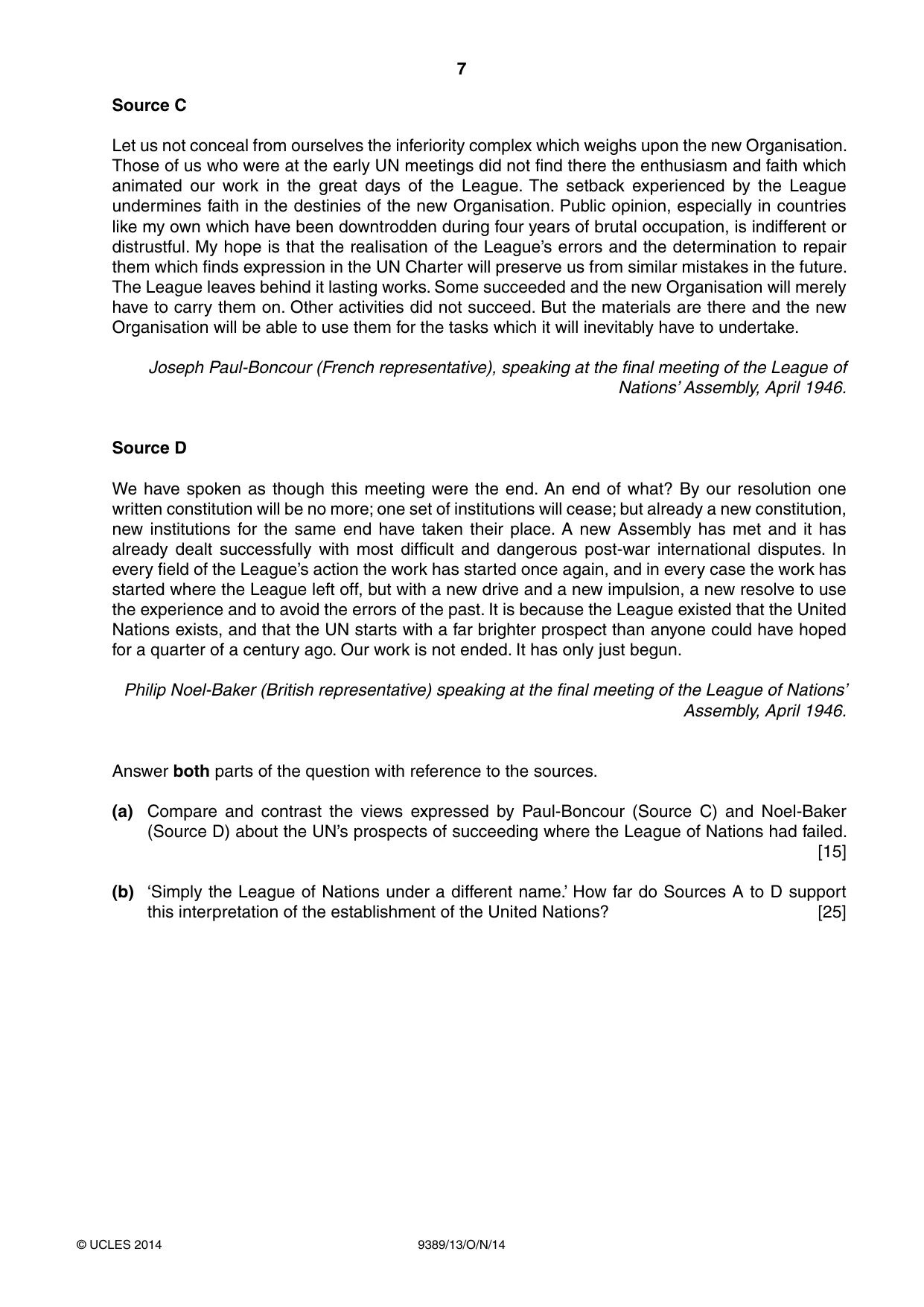
7 9389/13/O/N/14 © UCLES 2014 Source C Let us not conceal from ourselves the inferiority complex which weighs upon the new Organisation. Those of us who were at the early UN meetings did not find there the enthusiasm and faith which animated our work in the great days of the League. The setback experienced by the League undermines faith in the destinies of the new Organisation. Public opinion, especially in countries like my own which have been downtrodden during four years of brutal occupation, is indifferent or distrustful. My hope is that the realisation of the League’s errors and the determination to repair them which finds expression in the UN Charter will preserve us from similar mistakes in the future. The League leaves behind it lasting works. Some succeeded and the new Organisation will merely have to carry them on. Other activities did not succeed. But the materials are there and the new Organisation will be able to use them for the tasks which it will inevitably have to undertake. Joseph Paul-Boncour (French representative), speaking at the final meeting of the League of Nations’ Assembly, April 1946. Source D We have spoken as though this meeting were the end. An end of what? By our resolution one written constitution will be no more; one set of institutions will cease; but already a new constitution, new institutions for the same end have taken their place. A new Assembly has met and it has already dealt successfully with most difficult and dangerous post-war international disputes. In every field of the League’s action the work has started once again, and in every case the work has started where the League left off, but with a new drive and a new impulsion, a new resolve to use the experience and to avoid the errors of the past. It is because the League existed that the United Nations exists, and that the UN starts with a far brighter prospect than anyone could have hoped for a quarter of a century ago. Our work is not ended. It has only just begun. Philip Noel-Baker (British representative) speaking at the final meeting of the League of Nations’ Assembly, April 1946. Answer both parts of the question with reference to the sources. (a) Compare and contrast the views expressed by Paul-Boncour (Source C) and Noel-Baker (Source D) about the UN’s prospects of succeeding where the League of Nations had failed. [15] (b) ‘Simply the League of Nations under a different name.’ How far do Sources A to D support this interpretation of the establishment of the United Nations? [25]
Question paper, page 8
8 9389/13/O/N/14 © UCLES 2014 Permission to reproduce items where third-party owned material protected by copyright is included has been sought and cleared where possible. Every reasonable effort has been made by the publisher (UCLES) to trace copyright holders, but if any items requiring clearance have unwittingly been included, the publisher will be pleased to make amends at the earliest possible opportunity. Cambridge International Examinations is part of the Cambridge Assessment Group. Cambridge Assessment is the brand name of University of Cambridge Local Examinations Syndicate (UCLES), which is itself a department of the University of Cambridge. BLANK PAGE
Mark scheme, page 1
® IGCSE is the registered trademark of Cambridge International Examinations. CAMBRIDGE INTERNATIONAL EXAMINATIONS Cambridge International Advanced Subsidiary Level MARK SCHEME for the October/November 2014 series 9389 HISTORY 9389/13 Paper 1 (Document Question), maximum raw mark 40 This mark scheme is published as an aid to teachers and candidates, to indicate the requirements of the examination. It shows the basis on which Examiners were instructed to award marks. It does not indicate the details of the discussions that took place at an Examiners’ meeting before marking began, which would have considered the acceptability of alternative answers. Mark schemes should be read in conjunction with the question paper and the Principal Examiner Report for Teachers. Cambridge will not enter into discussions about these mark schemes. Cambridge is publishing the mark schemes for the October/November 2014 series for most Cambridge IGCSE®, Cambridge International A and AS Level components and some Cambridge O Level components.
Mark scheme, page 2
Page 2 Mark Scheme Syllabus Paper Cambridge International AS Level – October/November 2014 9389 13 © Cambridge International Examinations 2014 Generic levels of response Part (a) Level 4: Makes a developed comparison [12–15] Makes a developed comparison between the two sources, recognising points of similarity and difference. Uses knowledge to evaluate the sources and shows good contextual awareness. Level 3: Compares views and identifies similarities and differences [8–11] Compares the views expressed in the sources, identifying differences and similarities. Begins to explain and evaluate the views using the sources and knowledge. Level 2: Compares views and identifies similarities and /or differences [4–7] Identifies relevant similarities or differences between views/sources and the response may be one- sided with only one aspect explained. Alternatively, both similarities and differences may be mentioned but both aspects lack development. Level 1: Describes content of each source [1–3] Describes or paraphrases the content of the two sources. Very simple comparisons may be made (e.g. one is from a letter and the other is from a speech) but these are not developed. Level 0: No relevant comment on the sources or the issue [0] Part (b) Level 5: Evaluates the sources to reach a sustained judgement [21–25] Answers are well focused, demonstrating a clear understanding of the sources and the question. Reaches a sustained judgement about the extent to which the sources support the statement and weighs the evidence in order to do this. Level 4: Evaluates the sources [16–20] Demonstrates a clear understanding of the sources and the question. Begins to evaluate the material in context, considering the nature, origin and purpose of the sources in relation to the statement. At the top of this level candidates may begin to reach a judgement but this is not sustained. Level 3: Uses the sources to support and challenge the statement [11–15] Makes valid points from the sources to both challenge and support the statement in the question. These comments may be derived from source content or may be about the provenance/nature of the sources. Level 2: Uses the sources to support or challenge the statement [6–10] Makes valid points from the sources to either support the statement in the question or to challenge it. These comments may be derived from source content or may be about the provenance/nature of the sources. Level 1: Does not make valid use of sources [1–5] Describes the content of the sources with little attempt to link the material to the question. Alternatively, candidates may write an essay about the question without reference to the sources. Level 0: No relevant comment on the sources or the issue [0]
Mark scheme, page 3
Page 3 Mark Scheme Syllabus Paper Cambridge International AS Level – October/November 2014 9389 13 © Cambridge International Examinations 2014 Section A: European Option Liberalism and Nationalism in Italy and Germany, 1848–1871 Cavour and France 1 (a) Compare and contrast Sources B and D as evidence of the value of the French alliance to Piedmont. [15] Source A is a (presumably) private report from Cavour, prime minister of Piedmont, to his monarch about the meeting he had had with Napoleon III. As Cavour explains, the two men had struck a deal to drive Austria out of Italy ‘once and for all’. Source D is the main terms of the agreement to end the fighting reached by Austria and France in July 1859 without Piedmont’s involvement. The ‘treaty’ was strictly an armistice; the final peace treaty was the Treaty of Zurich, signed in November 1859, which did include Piedmont. Villafranca caused Cavour to resign. He returned to power in January 1860. The two sources are similar in that they are both concerned with going to war with Austria and with the outcomes of that war. The differences are clear cut: Source A concerns itself with planning the war; Source D with the outcomes. Further differences can be highlighted. Source A talks of Austria being driven out of Italy ‘once and for all’. Source D shows Venice, a shorthand for Venetia, continuing to be ruled by Austria. Also, the two great powers had agreed that Italy should be a confederation headed by the Pope. This might be explained by the statement in Source A that Napoleon III said ‘I must treat the Pope carefully’. However, it was the last thing that Cavour wanted. No wonder he resigned. (b) How far do Sources A to D show that Cavour’s policies were successful? [25] Context: Cavour was the prime minister of Piedmont from 1852 to 1859 and 1860 to 1861. He was briefly the prime minister of Italy before illness forced his resignation and premature death. Any judgement of his policies requires some consideration of his aims. Views about his aims varied – and still vary. At the time, idealists of the left and reactionaries of the right did not trust him. They saw him as a self-serving opportunist, betraying either the revolution or the old order. Many doubted his Italian nationalism and/or his commitment to the Italian people. Cavour was essentially a pragmatic moderniser, keen to reform both Piedmont and, if the opportunity arose, Italy as well. He looked to Britain and France as economic and political examples to follow. As prime minister he modernised the Piedmontese economy. The Crimean war of the mid-1850s and its outcomes gave him opportunities to build the power of Piedmont in the north which he ruthlessly exploited – only to lose control of them as Napoleon III lost his nerve and Garibaldi regained his. Cavour managed to acquire some control of events in 1860, helping to ensure that the new Italy was led by Piedmont and headed by its king. At the moment of success and still relatively young, he died suddenly of malaria. He was seen as having achieved success for both Piedmont and Italy, at least in the short term. Analysis: The four sources, from 1858–59, cover the second war of independence, a crucial period in Cavour’s career. The first two are from Cavour himself. In Source A, he makes no mention of the coming conflict, even though he helped plan it. If anything, he turns away from warfare to politics as a means of achieving his goals. These goals, however, do include turning away from ‘only … the material and moral interests of Piedmont’, instead putting Piedmont at the head of the nationalist cause. The role of Piedmont in the Crimean war had already helped advance that cause. Source A shows Cavour publicly proclaiming the success of his policies. Source B shows him reporting to the king of Piedmont key points of his meeting with Napoleon III at Plombieres. The report shows France willing to join Piedmont to kick Austria out of Italy, which must count as a success for Cavour. Source C
Mark scheme, page 4
Page 4 Mark Scheme Syllabus Paper Cambridge International AS Level – October/November 2014 9389 13 © Cambridge International Examinations 2014 confirms the main outcome of the Plombieres meeting and the enthusiasm it has created in Piedmont. Source D lists the main terms of the armistice agreed by France and Austria to stop fighting the war which, in Source B, France and Piedmont had agreed. These terms show that Austria would remain in control of Venice and thus remain in Italy, something which Plombieres had not agreed. Thus Source D shows that Cavour’s policies were not successful. It is the only one of the four which clearly argues thus. Evaluation: Cavour was a politician who was both pragmatic and opportunistic, neither revolutionary nor reactionary. While trying to deal with the complex consequences of the 1848–49 revolutions and wars in Italy, he was also trying to achieve his own goals, which were often unclear. His speeches and writings should therefore be analysed and evaluated with great care. He tailored what he said and wrote more to his readership and audience than did most political leaders. Thus Source A, his public speech to the Piedmont parliament in 1858, portrayed Cavour’s leadership of Piedmont in a very favourable light. He asserts that Piedmont was defending the peoples of Italy in the Crimean war. Italian states and peoples were never under threat from Russia. Certainly, Piedmont gained some credit from its allies for its involvement but that was no great deal. Source A is too self-serving to have much reliability. Source B, part of a longer report from Cavour, seems to be an accurate summary of what was agreed in that France did go to war with Austria in alliance with Piedmont, perhaps because it is a private dispatch about a very sensitive topic: France and Piedmont were planning to provoke Austria into war. Ideally, though, a French account on the meeting is needed to confirm or deny Cavour’s report. Source C, written a week later by a British journalist writing from Paris for his British readers, uses restrained language which is likely to be a reliable account of the rumours of war which had become widespread in Paris and Turin. This helps confirm the key part of Source B. Source D contains the key terms of the armistice agreed between France and Austria – but not Piedmont. Contextual knowledge confirms the reliability of Source D. Thus Sources B, C and D can be seen as more reliable than not. They show that Cavour’s policies achieve some but not total success.
Mark scheme, page 5
Page 5 Mark Scheme Syllabus Paper Cambridge International AS Level – October/November 2014 9389 13 © Cambridge International Examinations 2014 Section B: American Option The Origins of the Civil War, 1846–1861 The Compromise of 1850 2 (a) To what extent do Sources A and D agree on how the USA should address the issue of slavery? [15] Source A argues that the issue of slavery is best addressed by making concessions to the South. Three are specified: equal rights in ‘the acquired territory’, i.e. the Mexican Cession; the proper enforcement of Fugitive Slave law; a constitutional amendment restoring equilibrium between North and South. The first means the possibility of slavery being established in new territories and states such as California. Source D believes the better approach is to contain slavery within its existing limits. Thus the federal government should allow slavery no chance to establish itself in the new territories and states. This is in complete opposition to the first demand made by Source A. Source D also indirectly attacks Source A’s third proposal when it rejects the idea of maintaining an equilibrium between North and South. Source D believes such a balance never existed in the first place. On the fugitive slave law, Source D is silent. (b) How far do Sources A to D support the assertion that the 1850 Compromise helped only to further divide the USA? [25] Context: The 1850 Compromise was a complex series of laws and policies which involved both sections making some concessions – as was an essential part of the US political process. It was necessary because the acquisition of new states and territories in 1845–48 upset the delicate balance between slave and non-slave states. Agreeing the Compromise was a long and difficult process. The North conceded a new Fugitive Slave law, harsher than its predecessor, which the South expected Northern states to uphold thereafter. The South conceded the entry of California into the USA as a free state – it had wanted the state divided – and the abolition of the slave trade in Washington DC. Both compromised over the territories of New Mexico and Utah: the North abandoned the Wilmot Proviso, the South conceded the principle of popular sovereignty. The South had conceded something which they could not affect thereafter – the governance of the new lands – in order to make gains with regard to the treatment of fugitive slaves, which were to prove illusory. The North had conceded something – a harsher Fugitive Slave law – the success of which depended upon its cooperation. Many Northern states refused to cooperate. In effect, the expansion of slavery which the South hoped for did not materialise, despite their fiercest efforts in Kansas. Analysis: Source A argues that the proposed Compromise need not cause further division of the USA so long as at its heart was a series of concessions to the South. Source B is a commentary on Calhoun’s speech. It is a very critical commentary. It explains the implications of the speech, namely that if the concessions were not made by the North, then the South would have ‘to act accordingly’. What that action might be is not spelt out. Secession might be one possibility. Source C supports the assertion, arguing that the complex set of three measures, with the backing of Senator Clay, should be acceptable to the South and thus settle the various issues dividing North and South. Source D argues that the Compromise might work so long as it involves no concessions to the South, i.e. is no compromise. Sources A and D are in complete contrast to each other. Source B dismisses Calhoun. Source C is the most positive of the four.
Mark scheme, page 6
Page 6 Mark Scheme Syllabus Paper Cambridge International AS Level – October/November 2014 9389 13 © Cambridge International Examinations 2014 Evaluation: Senator Calhoun, the author of Source A, was the leader of the Southern Democrats. His speech of 4th March 1850 was his last major speech. (He was so frail, the speech had to be read out for him. Within a month he was dead.) After forty years in politics, by 1850 Calhoun was increasingly pessimistic about the future of the South within the USA. This extract from Calhoun’s speech, relatively optimistic, is untypical of the whole speech. And though the South did gain one of his three demands, over fugitive slaves, the other two were ignored. Calhoun was out of touch with the new political realities. Source B illustrates this latter point. The great Southern statesman is dismissed as a ‘dying monster’, which is a little cruel. The North Star was an abolitionist newspaper established in 1847 by the ex-slave Frederick Douglass to represent the views of ex-slaves. The newspaper was bound to criticise a Southern voice on the 1850 Compromise. The North Star would probably see the Compromise as irrelevant to the greater division within the USA, between freeman and slaves. Source C, from a newspaper in the slave state of Missouri, is optimistic about the chances of a settlement. That optimism is based on two things. The first is the support for the Compromise of Mr Clay, i.e. Senator Henry Clay of Kentucky, one of the triumvirate of US political leaders of Congress in the 1830s and 1840s. (The others were Calhoun and Webster, representing the South and North respectively.) The second is a report from another newspaper about the state of opinion in the South. Clay was certainly key to agreeing the Compromise. A hearsay report of Southern views is not that reliable. The arguments of Source C are not that soundly based. Source D is from the leading abolitionist Senator, who would be firmly set against any compromise short of abolition. Thus his interpretation must be heavily discounted. All sources have their limitations. After many months, the Compromise was agreed. Its implementation in the 1850s did help to further divide the USA. In 1850, however, when the sources were written, it was possible to be optimistic. Source C is the least unreliable of the four, it can be argued.
Mark scheme, page 7
Page 7 Mark Scheme Syllabus Paper Cambridge International AS Level – October/November 2014 9389 13 © Cambridge International Examinations 2014 Section C: International Option The Search for International Peace and Security, 1919–1945 The Replacement of the League of Nations by the United Nations 3 (a) Compare and contrast the views expressed by Paul-Boncour (Source C) and Noel- Baker (Source D) about the UN’s prospects of succeeding where the League of Nations had failed. [15] Paul-Boncour (Source C) seems somewhat pessimistic about the prospects of success for the ‘new Organisation’ (the UN). There are a number of reasons for this: • The failure of the League of Nations undermines faith that the UN will be any more effective • Early meetings of the UN seem to lack the ‘enthusiasm and faith’ which marked the early meetings of the League • The UN seems to have little credibility in terms of public opinion. Indeed, French public opinion towards the UN was ‘indifferent or distrustful’. For the UN to achieve success, Paul-Boncour argues that it must build on the successful aspects of the League’s work while, at the same time, learning from the mistakes made by the League. Noel-Baker (Source D) has a more optimistic view of the UN’s prospects. He sees the UN as essentially a continuation of the League of Nations, simply a new constitution with exactly the same aims. He argues that the UN’s prospects of success are far greater than those of the League because it will be able to build on the ‘experience and to avoid the errors of the past’. The UN will be able to continue the successful aspects of the League’s work, developing institutions which already exist and avoiding the mistakes which led to the League’s demise. In contrast to Paul-Boncour’s assessment of early UN meetings (Source B), he sees the UN as having ‘a new drive and a new impulsion, a new resolve’. Moreover, he stresses that the UN has already dealt effectively with ‘most difficult and dangerous post- war international disputes’. Both sources come from speeches made at the final meeting of the League of Nations Assembly. In reality, the League had ceased to be an effective tool in international diplomacy long before this meeting – failure to deal with the Abyssinian crisis (1935–36) had effectively made the League redundant. Paul-Boncour reflects the disappointment which many felt at the demise of the League and is clearly concerned that the UN could suffer the same fate. Noel-Baker stresses the more positive aspects of the League’s work, and argues that the League is not dead, merely reformed in a slightly different way to continue its work in the interests of world peace. (b) ‘Simply the League of Nations under a different name.’ How far do Sources A to D support this interpretation of the establishment of the United Nations? [25] Context: The League of Nations was formally ended at the final meeting of its Assembly in April 1946. By this time, the United Nations had already held its early meetings. There were many similarities between the League of Nations and the United Nations, for example: • Their basic aims and objectives were almost identical • Both had emerged at the end of major wars • In both cases, an American President played a crucial role in the organisation’s establishment • Both organisations were based on the concept of collective security
Mark scheme, page 8
Page 8 Mark Scheme Syllabus Paper Cambridge International AS Level – October/November 2014 9389 13 © Cambridge International Examinations 2014 • Neither organisation had an army of its own, relying on forces provided by member states • The UN maintained many of the institutions which had been established under the League (e.g. International Labour Organisation, International Court of Justice) • Just as with the League, all member states were represented in a General Assembly There were, however, some fundamental differences, for example: • The Articles of the UN Charter differed in some respects from those of the League’s Covenant • Decisions in the General Assembly no longer had to be unanimous • Similarly, decisions in the Security Council required only a two-thirds majority (although the five permanent members had the right of veto) • Unlike in 1919, the USA joined the UN as did the Soviet Union The most crucial factor was the reliance of both organisations on the concept of collective security. For this to be effective it relied on the cooperation of member states – this implied that member states would have to put the interests of international peace and security ahead of their own national interests. It was the failure of member states to do this over incidents such as the Abyssinian crisis which had undermined the credibility of the League of Nations, leading to its demise. Analysis: Support for the hypothesis can be found in Source D, in which Noel-Baker argues that the League’s work is not over, but merely being continued by the United Nations. Although the UN is based on a new constitution and a new set of institutions, it has the same aims as the League and is simply carrying on work ‘where the League left off’. Noel-Baker clearly sees the UN as merely a continuation of the League, stressing that ‘it is because the League existed that the United Nations exists’. Paul-Boncour (Source C) is concerned that the UN’s prospects of success will be adversely affected by the failures of the League of Nations; that he (and some other delegates at the meeting) had attended early meetings of the UN suggests that many nations sent the same representatives to the UN as to the League. However, he stresses that the UN will have the advantage of being able to use the League’s experiences and ‘materials’ (institutions) to develop its work. Lester (Source B) clearly indicates that the aims of the UN are precisely the same as those of the League and that the League left a legacy of ‘social, economic and humanitarian’ work on which the UN can build. In challenging the hypothesis, Lester (Source B) admits that the League failed to preserve peace, and argues that the UN has a better chance of success because the Charter is ‘an improvement’ on the Covenant in so far as it recognises that ‘peace must be enforced’ and gives the five Great Powers special rights and responsibilities to ensure that this happens. This implies that the weakness which inflicted the League has been addressed in the Charter of the UN and will not be repeated. Stalin (Source A) shares this view, arguing that the UN ‘will be a new, special, fully authorised international organisation having at its command everything necessary to defend peace and avert new aggression’ – collective security organised by the Great Powers through the Security Council. Paul-Boncour (Source C) argues that the UN will be able to build on the successes of the League while developing ways to address its weaknesses, clearly implying that the UN will be different from the League. In stating that the UN has already had success in dealing effectively with ‘difficult and dangerous post-war international disputes’, Noel-Baker (Source D) implies that the UN is already succeeding in areas where the League failed.
Mark scheme, page 9
Page 9 Mark Scheme Syllabus Paper Cambridge International AS Level – October/November 2014 9389 13 © Cambridge International Examinations 2014 Evaluation: Source A comes from a speech made by Stalin shortly after the Dumbarton Oaks Conference, at which Britain, the USA, the USSR and the Republic of China had prepared proposals for the establishment of the UN. He is seeking to convince the Moscow Soviet that membership of the UN would be good for the USSR and that the UN would be more effective than the League had been. Sources B, C and D are all taken from speeches made at the final meeting of the Assembly of the League of Nations in April 1946. The meeting had no real purpose other than to formally end the League. In reality, the League had ceased to function as a peace-keeping body long before, although it had remained in existence to manage institutions such as the International Court of Justice. By April 1946, the UN had already been established and had held its inaugural meetings and, as Source D suggests, already addressed some post-war issues. All three speakers had clearly been heavily committed to the League and, inevitably under the circumstances, their speeches are emotionally charged. The League’s Secretary- General (Source B) describes the League’s aims and institutions as ‘a splendid programme’, but accepts that it failed in its main task – ‘the preservation of peace’. He feels that the UN Charter offers a stronger constitution than the Covenant of the League and is optimistic that the UN will succeed. Paul-Boncour (Source C) is less optimistic, and fears that public opinion will have little faith in the UN given the failures of the League. Noel-Baker (Source D) is full of enthusiasm for the UN, believing it to be a continuation of the vital work which the League began.
What you needed in this session
Cambridge’s own grade thresholds for 2014 Oct/Nov, Paper 1 · Variant 3. A higher threshold means an easier paper — the bar moves with how the cohort did.