Cambridge A Level Geography 9696 — 2011 May/June Paper 3 · Variant 2
9696/32/M/J/11 · 50 marks · ≈56 min
The question paper and its mark scheme, free to read here and free to download. This is Cambridge’s own paper, exactly as it was sat.
Question paper4 pages

Mark scheme9 pages
Answers below. Sit the paper first if you are practising.
Paper as text
Question paper, page 1
READ THESE INSTRUCTIONS FIRST If you have been given an Answer Booklet, follow the instructions on the front cover of the Booklet. Write your Centre number, candidate number and name on all the work you hand in. Write in dark blue or black pen. You may use a soft pencil for any diagrams, graphs or rough working. Do not use staples, paper clips, highlighters, glue or correction fl uid. Answer two questions only. Each question answered must be from a different topic. Sketch maps and diagrams should be drawn whenever they serve to illustrate an answer. You should make reference to appropriate examples studied in the fi eld or the classroom, even where such examples are not specifi cally requested by the question. All the Figures and the Photographs referred to in the questions are contained in the Insert. At the end of the examination, fasten all your work securely together. The number of marks is given in brackets [ ] at the end of each question or part question. GEOGRAPHY 9696/32 Paper 3 Advanced Human Options May/June 2011 1 hour 30 minutes Additional Materials: Answer Booklet/Paper UNIVERSITY OF CAMBRIDGE INTERNATIONAL EXAMINATIONS General Certifi cate of Education Advanced Subsidiary Level and Advanced Level This document consists of 3 printed pages, 1 blank page and 1 Insert. [Turn over IB11 06_9696_32/RP © UCLES 2011 *5918183524*
Question paper, page 2
2 9696/32/M/J/11 © UCLES 2011 Production, location and change Only one question may be answered from this topic. 1 (a) Fig. 1 shows a simple agricultural system. Using a systems approach, such as that shown in Fig. 1, compare and contrast intensive and extensive agricultural production. [10] (b) ‘Agriculture is the best way of achieving growth in LEDCs.’ With reference to examples, how far do you agree? [15] 2 (a) (i) Define the terms industrial inertia and industrial agglomeration. [4] (ii) Explain the disadvantages that may result from industrial agglomeration. [6] (b) To what extent is the informal sector of more importance to individuals than to the economy of a country? [15] Environmental management Only one question may be answered from this topic. 3 (a) Photographs A and B show two ways that sustainability is being promoted at Marina Barrage, a new development in Singapore, an NIC in Asia. Briefly describe the initiatives shown and explain the potential benefits and limitations of each in seeking to achieve sustainability. [10] (b) With reference to one named country, evaluate the success of its electrical energy strategy. [15] 4 (a) With the help of examples, describe and explain the main sources of air pollution. [10] (b) Assess the effectiveness of the measures taken to protect one or more environments at risk. [15]
Question paper, page 3
3 9696/32/M/J/11 © UCLES 2011 [Turn over Global interdependence Only one question may be answered from this topic. 5 (a) Describe the nature and explain the role of Fair Trade. [10] (b) Assess why it can be difficult for some countries to engage in global trade. [15] 6 Fig. 2 shows the tourism life cycle model. (a) (i) Describe how the character of a tourist area or resort may change between the stages of ‘development’ and ‘stagnation’. [4] (ii) With reference to examples you have studied, outline the factors that may influence whether a tourist area or resort experiences ‘rejuvenation’ or ‘decline’. [6] (b) To what extent is it inevitable that ecotourism will eventually lead to the same problems as conventional tourism? [15] Economic transition Only one question may be answered from this topic. 7 (a) Explain the main human causes of global inequalities in social and economic wellbeing. [10] (b) ‘In world development, the North wins over the South’. How far do you agree? [15] 8 (a) Fig. 3 shows income poverty in Vietnam, an LEDC in Asia, by province, in 2008. (i) Describe the spatial inequalities in income poverty in Vietnam shown in Fig. 3. [5] (ii) Explain the limitations of the index and the mapping in Fig. 3 for studying spatial inequalities. [5] (b) Assess why regional disparities within a country or countries are difficult to overcome. [15]
Question paper, page 4
4 Permission to reproduce items where third-party owned material protected by copyright is included has been sought and cleared where possible. Every reasonable effort has been made by the publisher (UCLES) to trace copyright holders, but if any items requiring clearance have unwittingly been included, the publisher will be pleased to make amends at the earliest possible opportunity. University of Cambridge International Examinations is part of the Cambridge Assessment Group. Cambridge Assessment is the brand name of University of Cambridge Local Examinations Syndicate (UCLES), which is itself a department of the University of Cambridge. 9696/32/M/J/11 © UCLES 2011 BLANK PAGE
Mark scheme, page 1
UNIVERSITY OF CAMBRIDGE INTERNATIONAL EXAMINATIONS GCE Advanced Subsidiary Level and GCE Advanced Level MARK SCHEME for the May/June 2011 question paper for the guidance of teachers 9696 GEOGRAPHY 9696/32 Paper 3 (Advanced Human Options), maximum raw mark 50 This mark scheme is published as an aid to teachers and candidates, to indicate the requirements of the examination. It shows the basis on which Examiners were instructed to award marks. It does not indicate the details of the discussions that took place at an Examiners’ meeting before marking began, which would have considered the acceptability of alternative answers. Mark schemes must be read in conjunction with the question papers and the report on the examination. • Cambridge will not enter into discussions or correspondence in connection with these mark schemes. Cambridge is publishing the mark schemes for the May/June 2011 question papers for most IGCSE, GCE Advanced Level and Advanced Subsidiary Level syllabuses and some Ordinary Level syllabuses.
Mark scheme, page 2
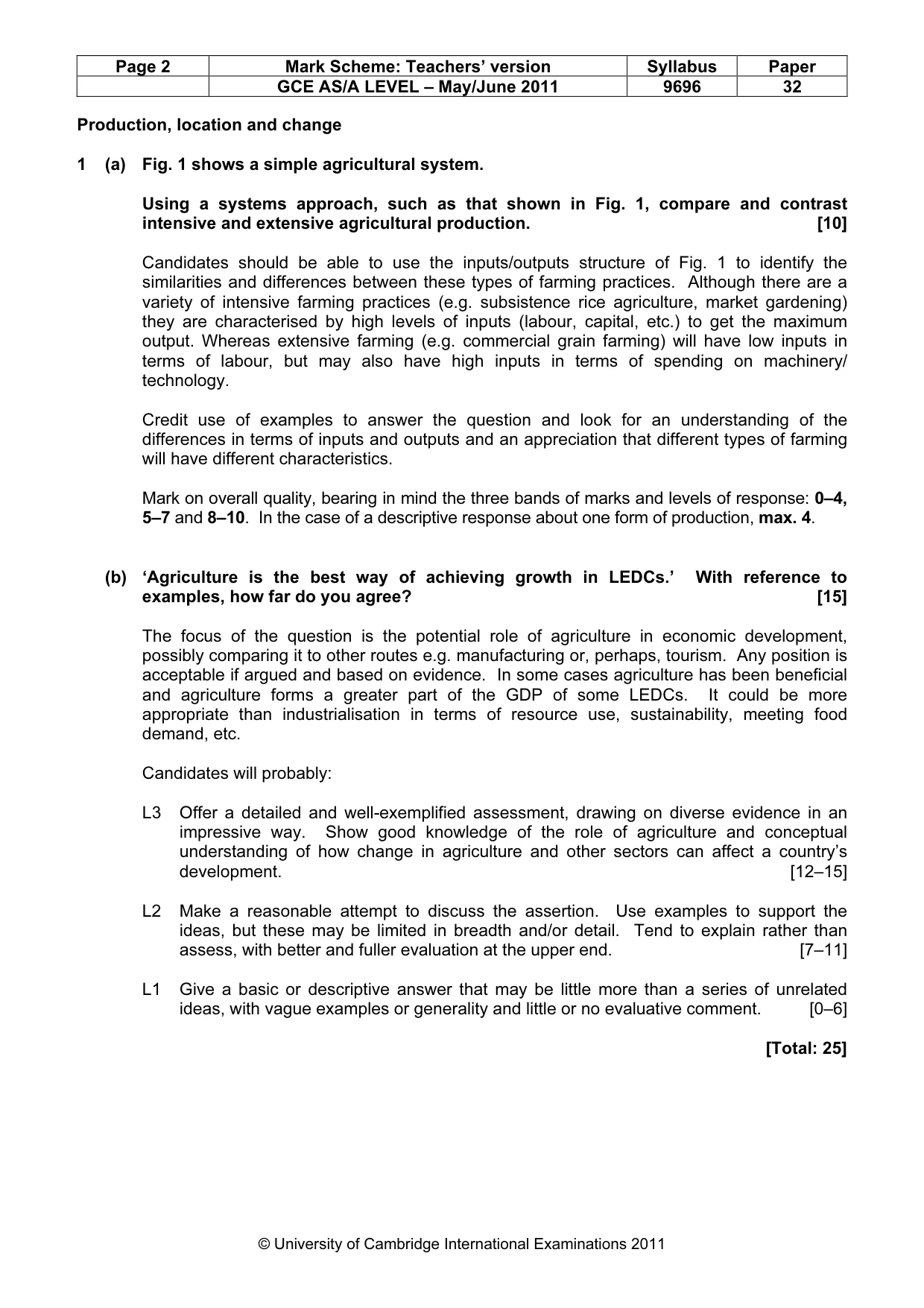
Page 2 Mark Scheme: Teachers’ version Syllabus Paper GCE AS/A LEVEL – May/June 2011 9696 32 © University of Cambridge International Examinations 2011 Production, location and change 1 (a) Fig. 1 shows a simple agricultural system. Using a systems approach, such as that shown in Fig. 1, compare and contrast intensive and extensive agricultural production. [10] Candidates should be able to use the inputs/outputs structure of Fig. 1 to identify the similarities and differences between these types of farming practices. Although there are a variety of intensive farming practices (e.g. subsistence rice agriculture, market gardening) they are characterised by high levels of inputs (labour, capital, etc.) to get the maximum output. Whereas extensive farming (e.g. commercial grain farming) will have low inputs in terms of labour, but may also have high inputs in terms of spending on machinery/ technology. Credit use of examples to answer the question and look for an understanding of the differences in terms of inputs and outputs and an appreciation that different types of farming will have different characteristics. Mark on overall quality, bearing in mind the three bands of marks and levels of response: 0–4, 5–7 and 8–10. In the case of a descriptive response about one form of production, max. 4. (b) ‘Agriculture is the best way of achieving growth in LEDCs.’ With reference to examples, how far do you agree? [15] The focus of the question is the potential role of agriculture in economic development, possibly comparing it to other routes e.g. manufacturing or, perhaps, tourism. Any position is acceptable if argued and based on evidence. In some cases agriculture has been beneficial and agriculture forms a greater part of the GDP of some LEDCs. It could be more appropriate than industrialisation in terms of resource use, sustainability, meeting food demand, etc. Candidates will probably: L3 Offer a detailed and well-exemplified assessment, drawing on diverse evidence in an impressive way. Show good knowledge of the role of agriculture and conceptual understanding of how change in agriculture and other sectors can affect a country’s development. [12–15] L2 Make a reasonable attempt to discuss the assertion. Use examples to support the ideas, but these may be limited in breadth and/or detail. Tend to explain rather than assess, with better and fuller evaluation at the upper end. [7–11] L1 Give a basic or descriptive answer that may be little more than a series of unrelated ideas, with vague examples or generality and little or no evaluative comment. [0–6] [Total: 25]
Mark scheme, page 3
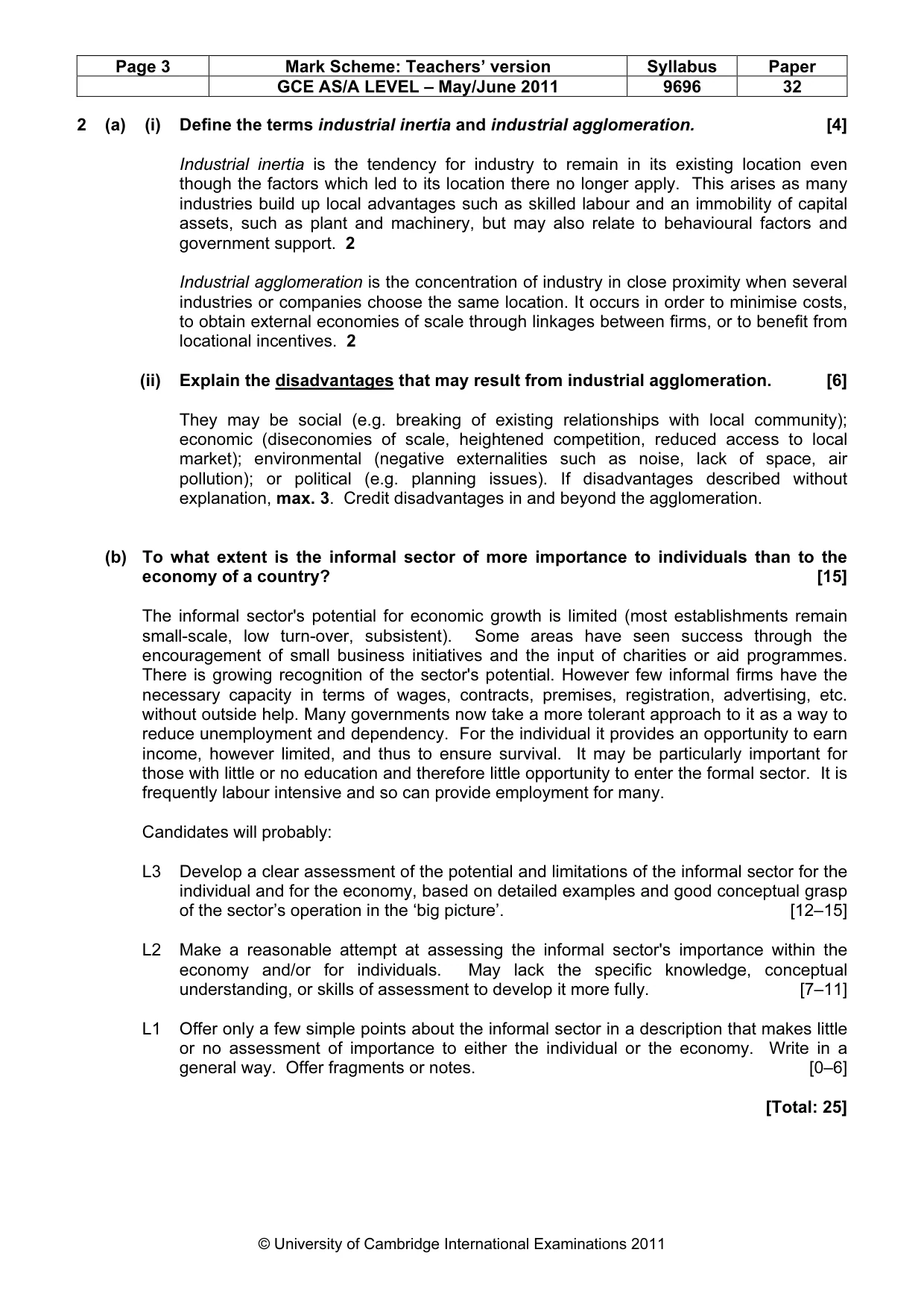
Page 3 Mark Scheme: Teachers’ version Syllabus Paper GCE AS/A LEVEL – May/June 2011 9696 32 © University of Cambridge International Examinations 2011 2 (a) (i) Define the terms industrial inertia and industrial agglomeration. [4] Industrial inertia is the tendency for industry to remain in its existing location even though the factors which led to its location there no longer apply. This arises as many industries build up local advantages such as skilled labour and an immobility of capital assets, such as plant and machinery, but may also relate to behavioural factors and government support. 2 Industrial agglomeration is the concentration of industry in close proximity when several industries or companies choose the same location. It occurs in order to minimise costs, to obtain external economies of scale through linkages between firms, or to benefit from locational incentives. 2 (ii) Explain the disadvantages that may result from industrial agglomeration. [6] They may be social (e.g. breaking of existing relationships with local community); economic (diseconomies of scale, heightened competition, reduced access to local market); environmental (negative externalities such as noise, lack of space, air pollution); or political (e.g. planning issues). If disadvantages described without explanation, max. 3. Credit disadvantages in and beyond the agglomeration. (b) To what extent is the informal sector of more importance to individuals than to the economy of a country? [15] The informal sector's potential for economic growth is limited (most establishments remain small-scale, low turn-over, subsistent). Some areas have seen success through the encouragement of small business initiatives and the input of charities or aid programmes. There is growing recognition of the sector's potential. However few informal firms have the necessary capacity in terms of wages, contracts, premises, registration, advertising, etc. without outside help. Many governments now take a more tolerant approach to it as a way to reduce unemployment and dependency. For the individual it provides an opportunity to earn income, however limited, and thus to ensure survival. It may be particularly important for those with little or no education and therefore little opportunity to enter the formal sector. It is frequently labour intensive and so can provide employment for many. Candidates will probably: L3 Develop a clear assessment of the potential and limitations of the informal sector for the individual and for the economy, based on detailed examples and good conceptual grasp of the sector’s operation in the ‘big picture’. [12–15] L2 Make a reasonable attempt at assessing the informal sector's importance within the economy and/or for individuals. May lack the specific knowledge, conceptual understanding, or skills of assessment to develop it more fully. [7–11] L1 Offer only a few simple points about the informal sector in a description that makes little or no assessment of importance to either the individual or the economy. Write in a general way. Offer fragments or notes. [0–6] [Total: 25]
Mark scheme, page 4
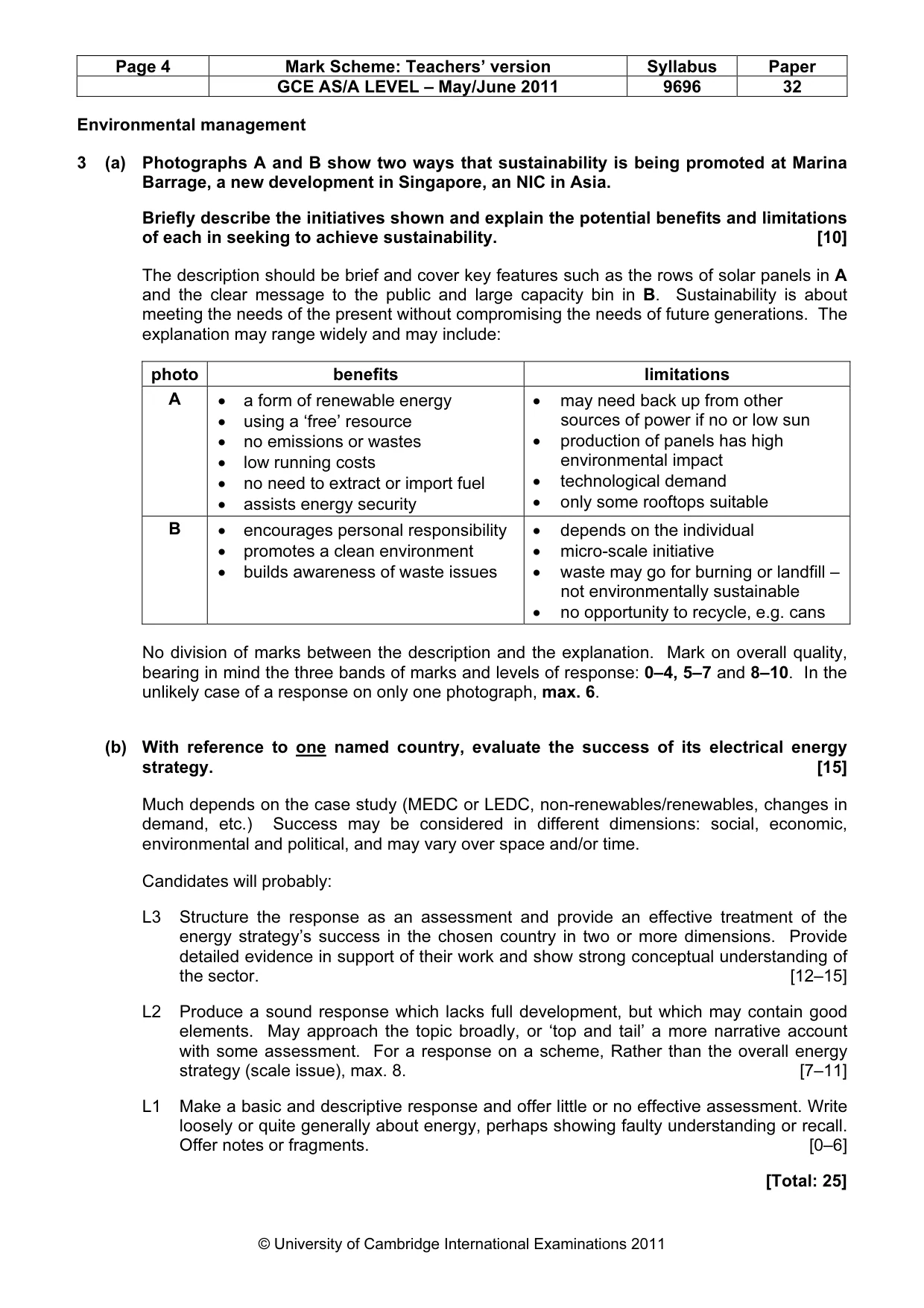
Page 4 Mark Scheme: Teachers’ version Syllabus Paper GCE AS/A LEVEL – May/June 2011 9696 32 © University of Cambridge International Examinations 2011 Environmental management 3 (a) Photographs A and B show two ways that sustainability is being promoted at Marina Barrage, a new development in Singapore, an NIC in Asia. Briefly describe the initiatives shown and explain the potential benefits and limitations of each in seeking to achieve sustainability. [10] The description should be brief and cover key features such as the rows of solar panels in A and the clear message to the public and large capacity bin in B. Sustainability is about meeting the needs of the present without compromising the needs of future generations. The explanation may range widely and may include: photo benefits limitations A • a form of renewable energy • using a ‘free’ resource • no emissions or wastes • low running costs • no need to extract or import fuel • assists energy security • may need back up from other sources of power if no or low sun • production of panels has high environmental impact • technological demand • only some rooftops suitable B • encourages personal responsibility • promotes a clean environment • builds awareness of waste issues • depends on the individual • micro-scale initiative • waste may go for burning or landfill – not environmentally sustainable • no opportunity to recycle, e.g. cans No division of marks between the description and the explanation. Mark on overall quality, bearing in mind the three bands of marks and levels of response: 0–4, 5–7 and 8–10. In the unlikely case of a response on only one photograph, max. 6. (b) With reference to one named country, evaluate the success of its electrical energy strategy. [15] Much depends on the case study (MEDC or LEDC, non-renewables/renewables, changes in demand, etc.) Success may be considered in different dimensions: social, economic, environmental and political, and may vary over space and/or time. Candidates will probably: L3 Structure the response as an assessment and provide an effective treatment of the energy strategy’s success in the chosen country in two or more dimensions. Provide detailed evidence in support of their work and show strong conceptual understanding of the sector. [12–15] L2 Produce a sound response which lacks full development, but which may contain good elements. May approach the topic broadly, or ‘top and tail’ a more narrative account with some assessment. For a response on a scheme, Rather than the overall energy strategy (scale issue), max. 8. [7–11] L1 Make a basic and descriptive response and offer little or no effective assessment. Write loosely or quite generally about energy, perhaps showing faulty understanding or recall. Offer notes or fragments. [0–6] [Total: 25]
Mark scheme, page 5
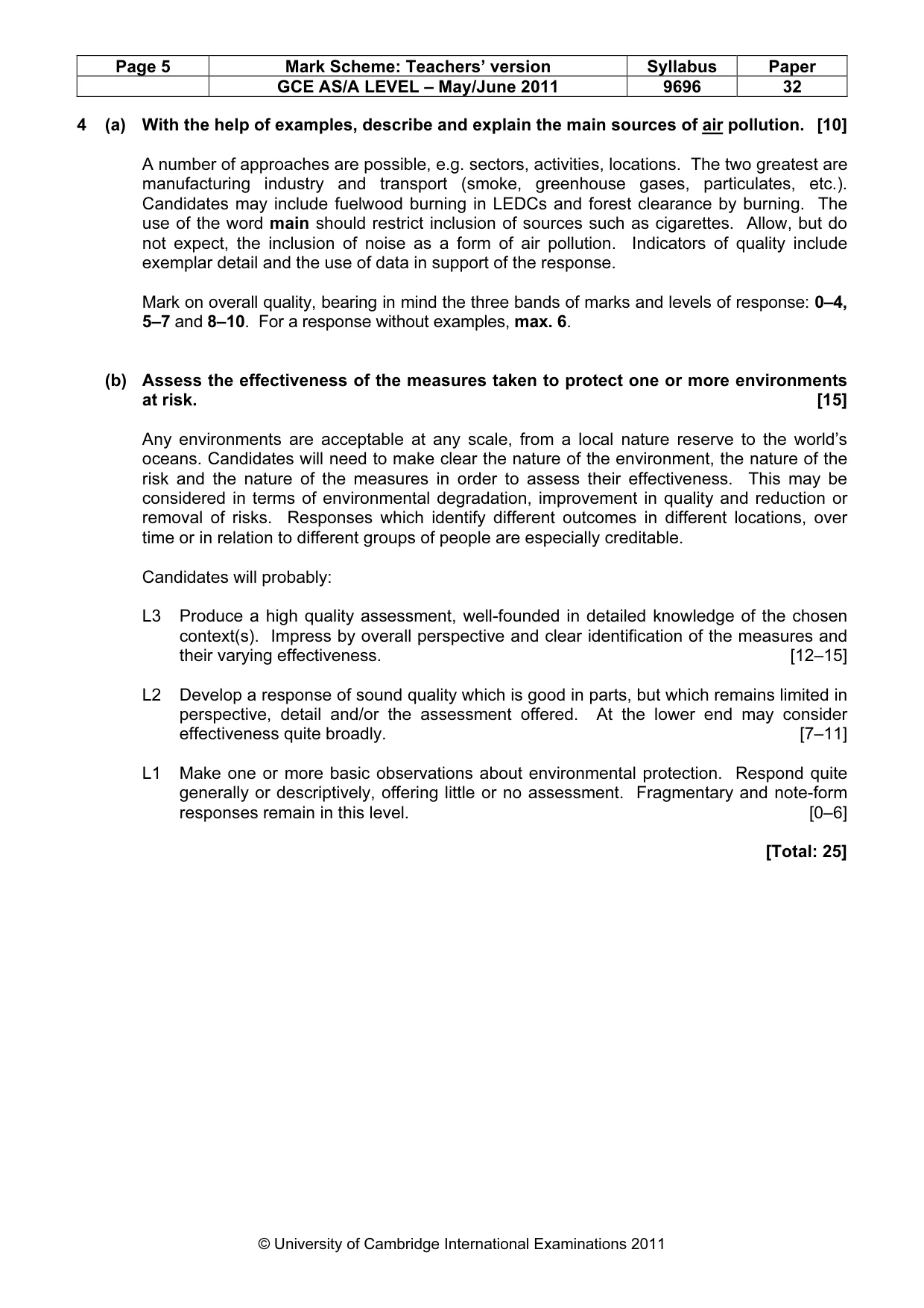
Page 5 Mark Scheme: Teachers’ version Syllabus Paper GCE AS/A LEVEL – May/June 2011 9696 32 © University of Cambridge International Examinations 2011 4 (a) With the help of examples, describe and explain the main sources of air pollution. [10] A number of approaches are possible, e.g. sectors, activities, locations. The two greatest are manufacturing industry and transport (smoke, greenhouse gases, particulates, etc.). Candidates may include fuelwood burning in LEDCs and forest clearance by burning. The use of the word main should restrict inclusion of sources such as cigarettes. Allow, but do not expect, the inclusion of noise as a form of air pollution. Indicators of quality include exemplar detail and the use of data in support of the response. Mark on overall quality, bearing in mind the three bands of marks and levels of response: 0–4, 5–7 and 8–10. For a response without examples, max. 6. (b) Assess the effectiveness of the measures taken to protect one or more environments at risk. [15] Any environments are acceptable at any scale, from a local nature reserve to the world’s oceans. Candidates will need to make clear the nature of the environment, the nature of the risk and the nature of the measures in order to assess their effectiveness. This may be considered in terms of environmental degradation, improvement in quality and reduction or removal of risks. Responses which identify different outcomes in different locations, over time or in relation to different groups of people are especially creditable. Candidates will probably: L3 Produce a high quality assessment, well-founded in detailed knowledge of the chosen context(s). Impress by overall perspective and clear identification of the measures and their varying effectiveness. [12–15] L2 Develop a response of sound quality which is good in parts, but which remains limited in perspective, detail and/or the assessment offered. At the lower end may consider effectiveness quite broadly. [7–11] L1 Make one or more basic observations about environmental protection. Respond quite generally or descriptively, offering little or no assessment. Fragmentary and note-form responses remain in this level. [0–6] [Total: 25]
Mark scheme, page 6
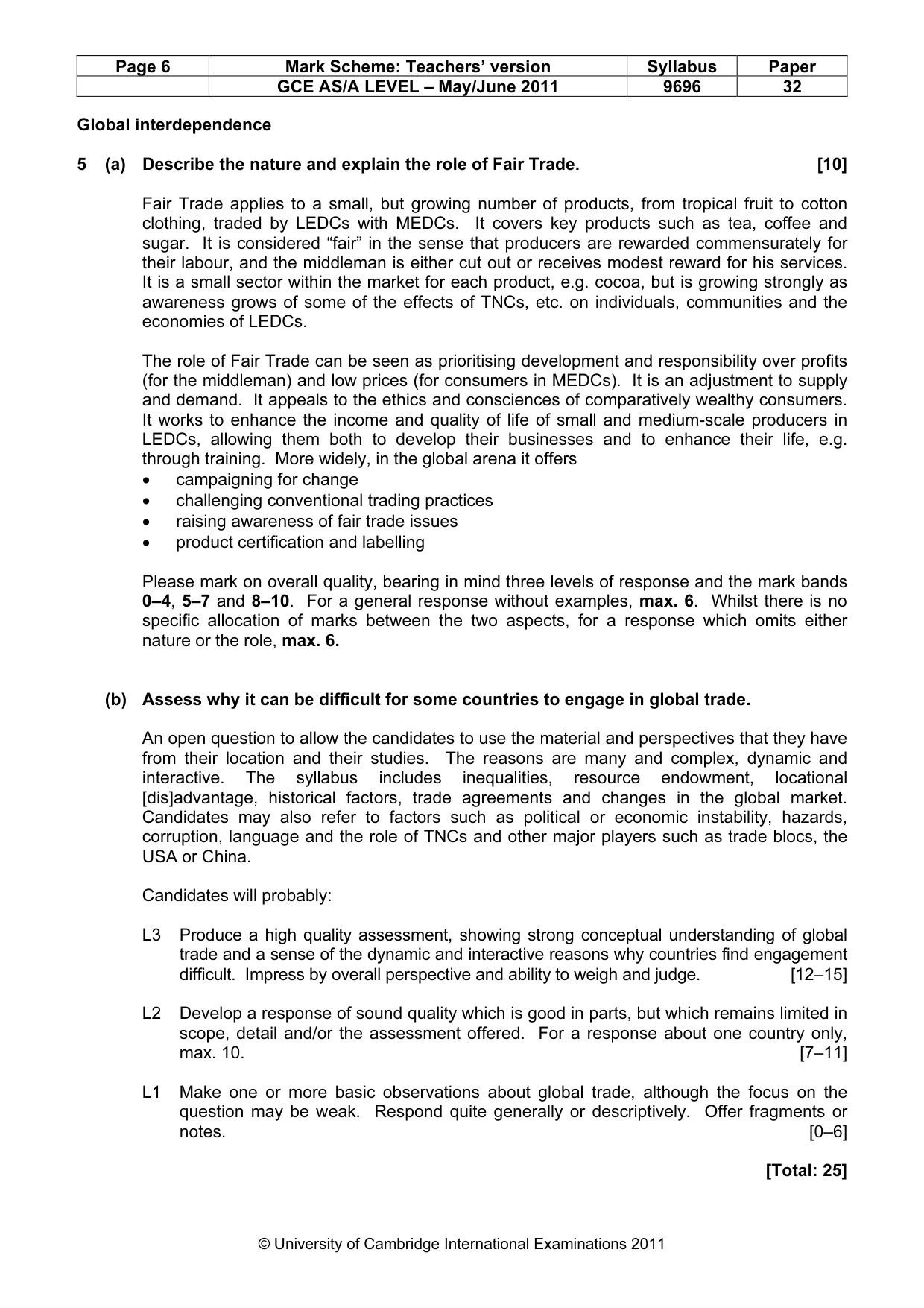
Page 6 Mark Scheme: Teachers’ version Syllabus Paper GCE AS/A LEVEL – May/June 2011 9696 32 © University of Cambridge International Examinations 2011 Global interdependence 5 (a) Describe the nature and explain the role of Fair Trade. [10] Fair Trade applies to a small, but growing number of products, from tropical fruit to cotton clothing, traded by LEDCs with MEDCs. It covers key products such as tea, coffee and sugar. It is considered “fair” in the sense that producers are rewarded commensurately for their labour, and the middleman is either cut out or receives modest reward for his services. It is a small sector within the market for each product, e.g. cocoa, but is growing strongly as awareness grows of some of the effects of TNCs, etc. on individuals, communities and the economies of LEDCs. The role of Fair Trade can be seen as prioritising development and responsibility over profits (for the middleman) and low prices (for consumers in MEDCs). It is an adjustment to supply and demand. It appeals to the ethics and consciences of comparatively wealthy consumers. It works to enhance the income and quality of life of small and medium-scale producers in LEDCs, allowing them both to develop their businesses and to enhance their life, e.g. through training. More widely, in the global arena it offers • campaigning for change • challenging conventional trading practices • raising awareness of fair trade issues • product certification and labelling Please mark on overall quality, bearing in mind three levels of response and the mark bands 0–4, 5–7 and 8–10. For a general response without examples, max. 6. Whilst there is no specific allocation of marks between the two aspects, for a response which omits either nature or the role, max. 6. (b) Assess why it can be difficult for some countries to engage in global trade. An open question to allow the candidates to use the material and perspectives that they have from their location and their studies. The reasons are many and complex, dynamic and interactive. The syllabus includes inequalities, resource endowment, locational [dis]advantage, historical factors, trade agreements and changes in the global market. Candidates may also refer to factors such as political or economic instability, hazards, corruption, language and the role of TNCs and other major players such as trade blocs, the USA or China. Candidates will probably: L3 Produce a high quality assessment, showing strong conceptual understanding of global trade and a sense of the dynamic and interactive reasons why countries find engagement difficult. Impress by overall perspective and ability to weigh and judge. [12–15] L2 Develop a response of sound quality which is good in parts, but which remains limited in scope, detail and/or the assessment offered. For a response about one country only, max. 10. [7–11] L1 Make one or more basic observations about global trade, although the focus on the question may be weak. Respond quite generally or descriptively. Offer fragments or notes. [0–6] [Total: 25]
Mark scheme, page 7
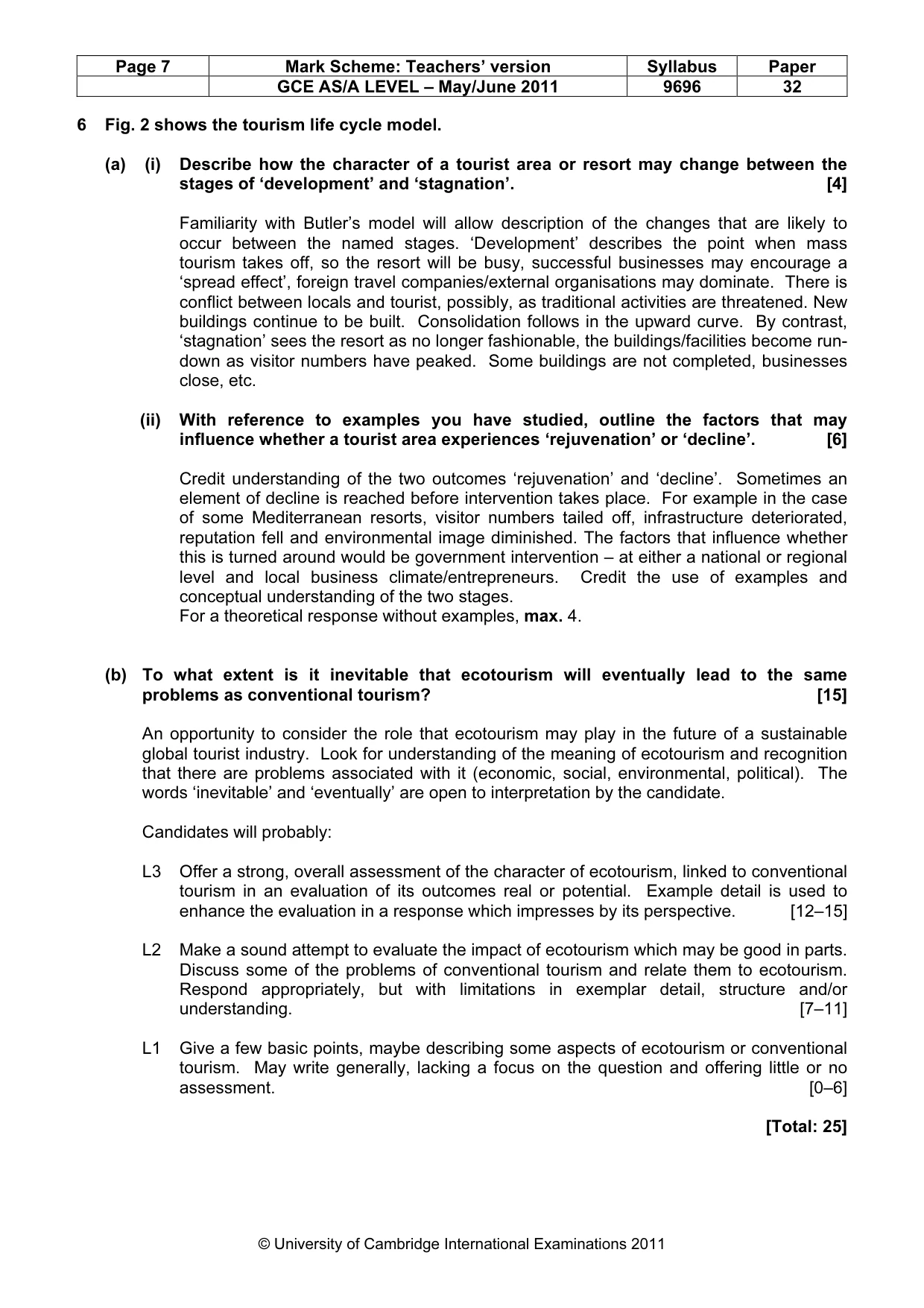
Page 7 Mark Scheme: Teachers’ version Syllabus Paper GCE AS/A LEVEL – May/June 2011 9696 32 © University of Cambridge International Examinations 2011 6 Fig. 2 shows the tourism life cycle model. (a) (i) Describe how the character of a tourist area or resort may change between the stages of ‘development’ and ‘stagnation’. [4] Familiarity with Butler’s model will allow description of the changes that are likely to occur between the named stages. ‘Development’ describes the point when mass tourism takes off, so the resort will be busy, successful businesses may encourage a ‘spread effect’, foreign travel companies/external organisations may dominate. There is conflict between locals and tourist, possibly, as traditional activities are threatened. New buildings continue to be built. Consolidation follows in the upward curve. By contrast, ‘stagnation’ sees the resort as no longer fashionable, the buildings/facilities become run- down as visitor numbers have peaked. Some buildings are not completed, businesses close, etc. (ii) With reference to examples you have studied, outline the factors that may influence whether a tourist area experiences ‘rejuvenation’ or ‘decline’. [6] Credit understanding of the two outcomes ‘rejuvenation’ and ‘decline’. Sometimes an element of decline is reached before intervention takes place. For example in the case of some Mediterranean resorts, visitor numbers tailed off, infrastructure deteriorated, reputation fell and environmental image diminished. The factors that influence whether this is turned around would be government intervention – at either a national or regional level and local business climate/entrepreneurs. Credit the use of examples and conceptual understanding of the two stages. For a theoretical response without examples, max. 4. (b) To what extent is it inevitable that ecotourism will eventually lead to the same problems as conventional tourism? [15] An opportunity to consider the role that ecotourism may play in the future of a sustainable global tourist industry. Look for understanding of the meaning of ecotourism and recognition that there are problems associated with it (economic, social, environmental, political). The words ‘inevitable’ and ‘eventually’ are open to interpretation by the candidate. Candidates will probably: L3 Offer a strong, overall assessment of the character of ecotourism, linked to conventional tourism in an evaluation of its outcomes real or potential. Example detail is used to enhance the evaluation in a response which impresses by its perspective. [12–15] L2 Make a sound attempt to evaluate the impact of ecotourism which may be good in parts. Discuss some of the problems of conventional tourism and relate them to ecotourism. Respond appropriately, but with limitations in exemplar detail, structure and/or understanding. [7–11] L1 Give a few basic points, maybe describing some aspects of ecotourism or conventional tourism. May write generally, lacking a focus on the question and offering little or no assessment. [0–6] [Total: 25]
Mark scheme, page 8
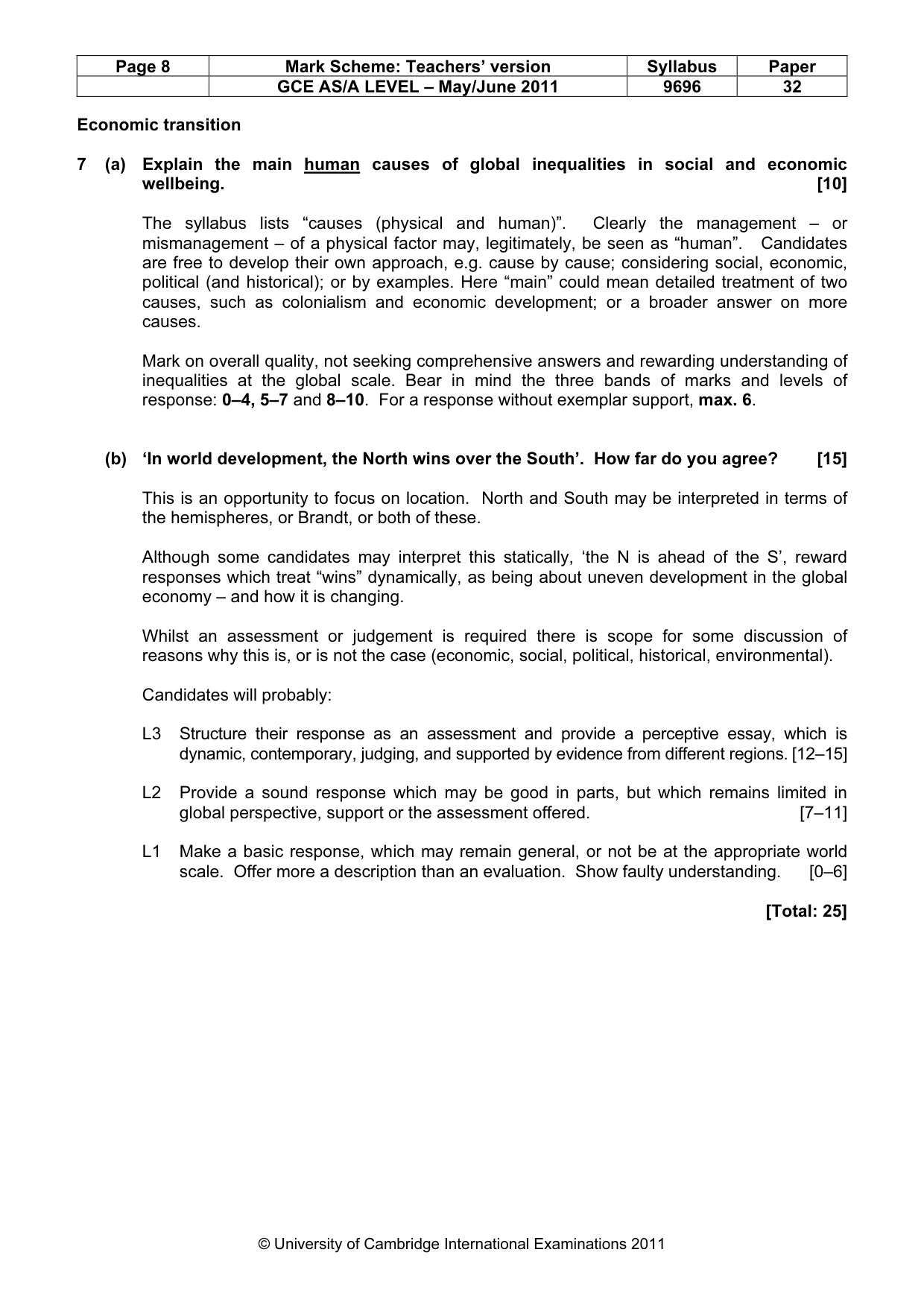
Page 8 Mark Scheme: Teachers’ version Syllabus Paper GCE AS/A LEVEL – May/June 2011 9696 32 © University of Cambridge International Examinations 2011 Economic transition 7 (a) Explain the main human causes of global inequalities in social and economic wellbeing. [10] The syllabus lists “causes (physical and human)”. Clearly the management – or mismanagement – of a physical factor may, legitimately, be seen as “human”. Candidates are free to develop their own approach, e.g. cause by cause; considering social, economic, political (and historical); or by examples. Here “main” could mean detailed treatment of two causes, such as colonialism and economic development; or a broader answer on more causes. Mark on overall quality, not seeking comprehensive answers and rewarding understanding of inequalities at the global scale. Bear in mind the three bands of marks and levels of response: 0–4, 5–7 and 8–10. For a response without exemplar support, max. 6. (b) ‘In world development, the North wins over the South’. How far do you agree? [15] This is an opportunity to focus on location. North and South may be interpreted in terms of the hemispheres, or Brandt, or both of these. Although some candidates may interpret this statically, ‘the N is ahead of the S’, reward responses which treat “wins” dynamically, as being about uneven development in the global economy – and how it is changing. Whilst an assessment or judgement is required there is scope for some discussion of reasons why this is, or is not the case (economic, social, political, historical, environmental). Candidates will probably: L3 Structure their response as an assessment and provide a perceptive essay, which is dynamic, contemporary, judging, and supported by evidence from different regions. [12–15] L2 Provide a sound response which may be good in parts, but which remains limited in global perspective, support or the assessment offered. [7–11] L1 Make a basic response, which may remain general, or not be at the appropriate world scale. Offer more a description than an evaluation. Show faulty understanding. [0–6] [Total: 25]
Mark scheme, page 9
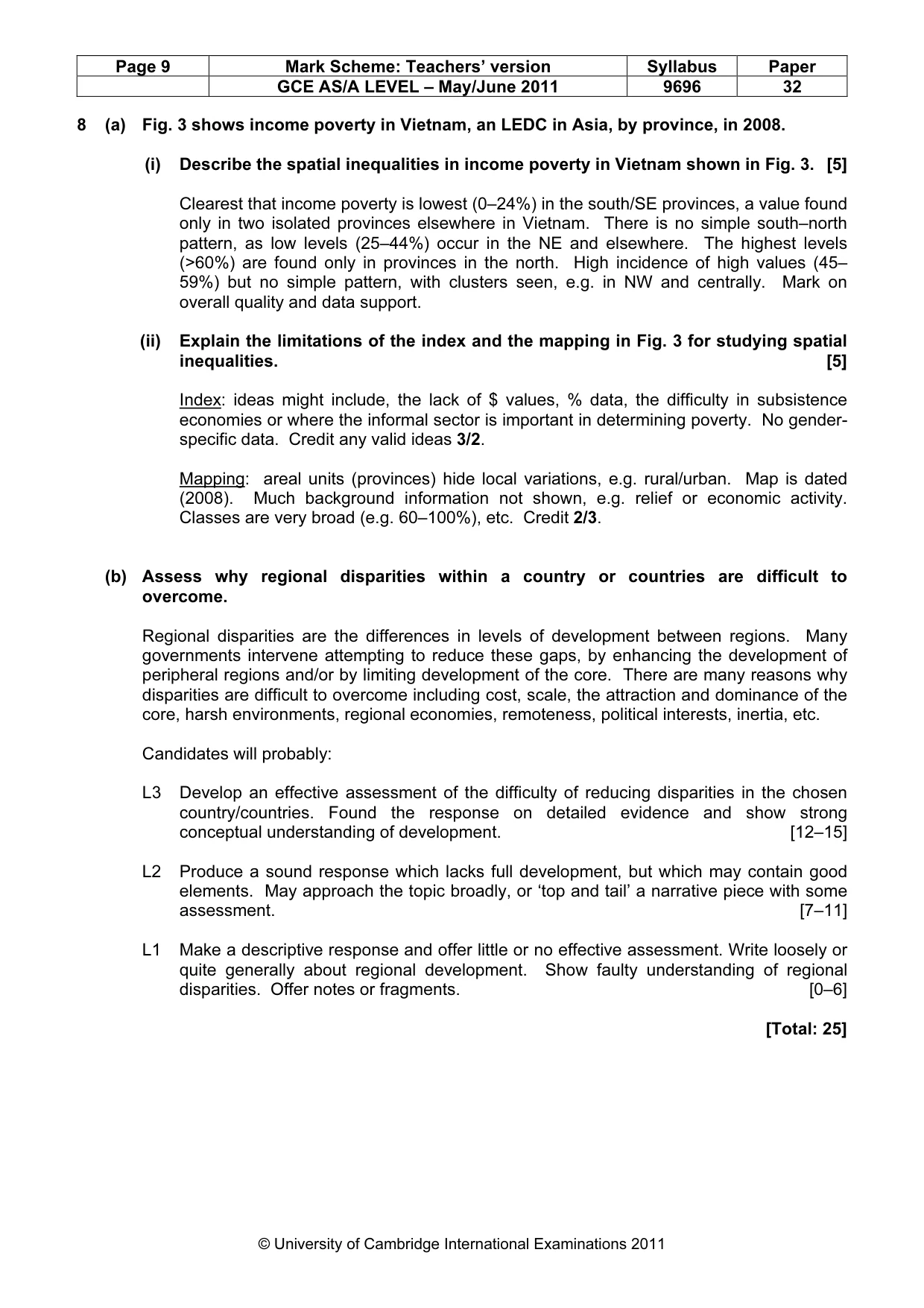
Page 9 Mark Scheme: Teachers’ version Syllabus Paper GCE AS/A LEVEL – May/June 2011 9696 32 © University of Cambridge International Examinations 2011 8 (a) Fig. 3 shows income poverty in Vietnam, an LEDC in Asia, by province, in 2008. (i) Describe the spatial inequalities in income poverty in Vietnam shown in Fig. 3. [5] Clearest that income poverty is lowest (0–24%) in the south/SE provinces, a value found only in two isolated provinces elsewhere in Vietnam. There is no simple south–north pattern, as low levels (25–44%) occur in the NE and elsewhere. The highest levels (>60%) are found only in provinces in the north. High incidence of high values (45– 59%) but no simple pattern, with clusters seen, e.g. in NW and centrally. Mark on overall quality and data support. (ii) Explain the limitations of the index and the mapping in Fig. 3 for studying spatial inequalities. [5] Index: ideas might include, the lack of $ values, % data, the difficulty in subsistence economies or where the informal sector is important in determining poverty. No gender- specific data. Credit any valid ideas 3/2. Mapping: areal units (provinces) hide local variations, e.g. rural/urban. Map is dated (2008). Much background information not shown, e.g. relief or economic activity. Classes are very broad (e.g. 60–100%), etc. Credit 2/3. (b) Assess why regional disparities within a country or countries are difficult to overcome. Regional disparities are the differences in levels of development between regions. Many governments intervene attempting to reduce these gaps, by enhancing the development of peripheral regions and/or by limiting development of the core. There are many reasons why disparities are difficult to overcome including cost, scale, the attraction and dominance of the core, harsh environments, regional economies, remoteness, political interests, inertia, etc. Candidates will probably: L3 Develop an effective assessment of the difficulty of reducing disparities in the chosen country/countries. Found the response on detailed evidence and show strong conceptual understanding of development. [12–15] L2 Produce a sound response which lacks full development, but which may contain good elements. May approach the topic broadly, or ‘top and tail’ a narrative piece with some assessment. [7–11] L1 Make a descriptive response and offer little or no effective assessment. Write loosely or quite generally about regional development. Show faulty understanding of regional disparities. Offer notes or fragments. [0–6] [Total: 25]
What you needed in this session
Cambridge’s own grade thresholds for 2011 May/June, Paper 3 · Variant 2. A higher threshold means an easier paper — the bar moves with how the cohort did.