Cambridge A Level General Paper (AS Level only) 8004 — 2013 May/June Paper 1 · Variant 2
8004/12/M/J/13 · 100 marks · ≈113 min
The question paper and its mark scheme, free to read here and free to download. This is Cambridge’s own paper, exactly as it was sat.
Question paper2 pages
Mark scheme11 pages
Answers below. Sit the paper first if you are practising.
Paper as text
Question paper, page 1
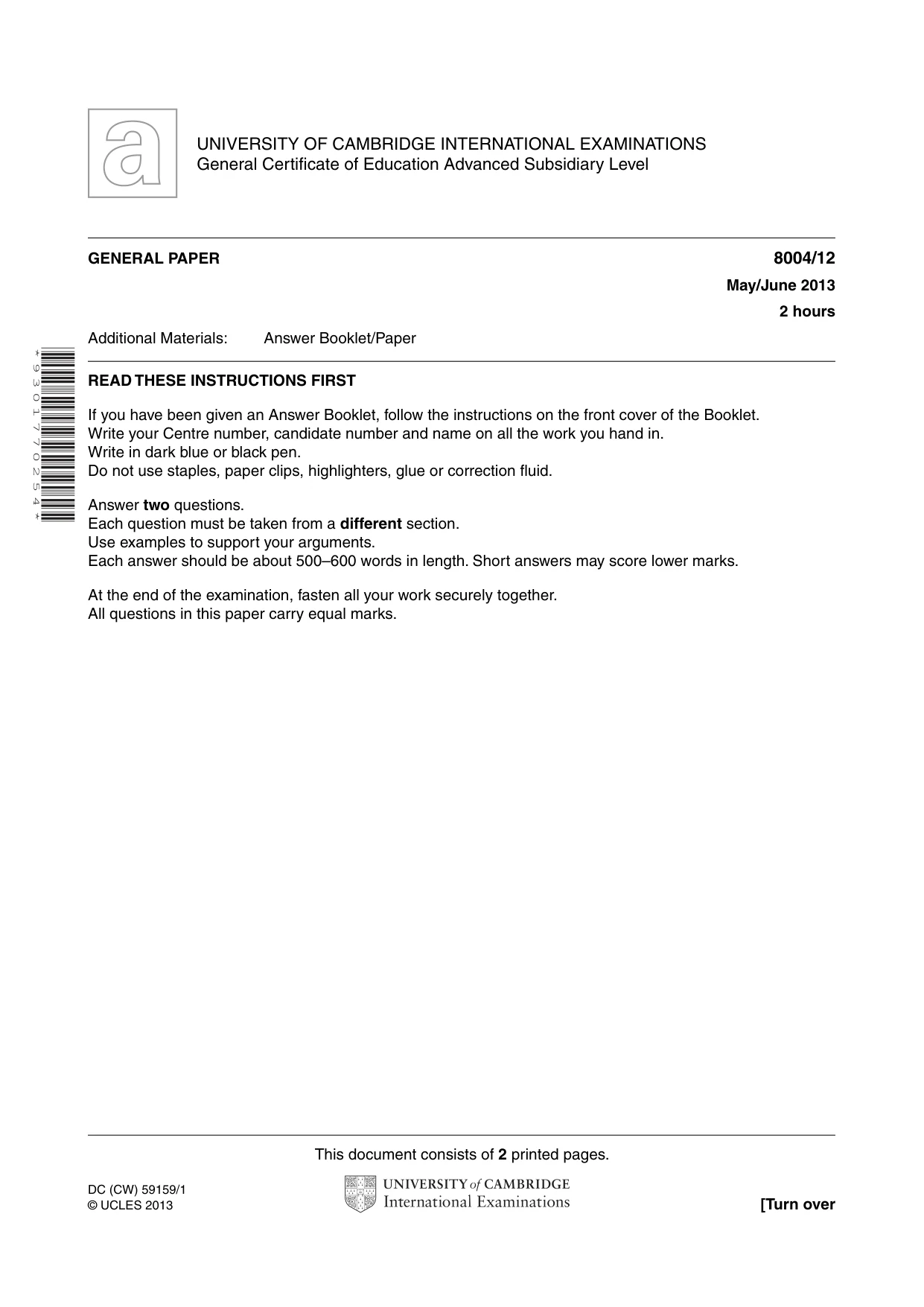
This document consists of 2 printed pages. DC (CW) 59159/1 © UCLES 2013 [Turn over UNIVERSITY OF CAMBRIDGE INTERNATIONAL EXAMINATIONS General Certificate of Education Advanced Subsidiary Level * 9 3 0 1 7 7 0 2 5 4 * GENERAL PAPER 8004/12 May/June 2013 2 hours Additional Materials: Answer Booklet/Paper READ THESE INSTRUCTIONS FIRST If you have been given an Answer Booklet, follow the instructions on the front cover of the Booklet. Write your Centre number, candidate number and name on all the work you hand in. Write in dark blue or black pen. Do not use staples, paper clips, highlighters, glue or correction fluid. Answer two questions. Each question must be taken from a different section. Use examples to support your arguments. Each answer should be about 500–600 words in length. Short answers may score lower marks. At the end of the examination, fasten all your work securely together. All questions in this paper carry equal marks.
Question paper, page 2
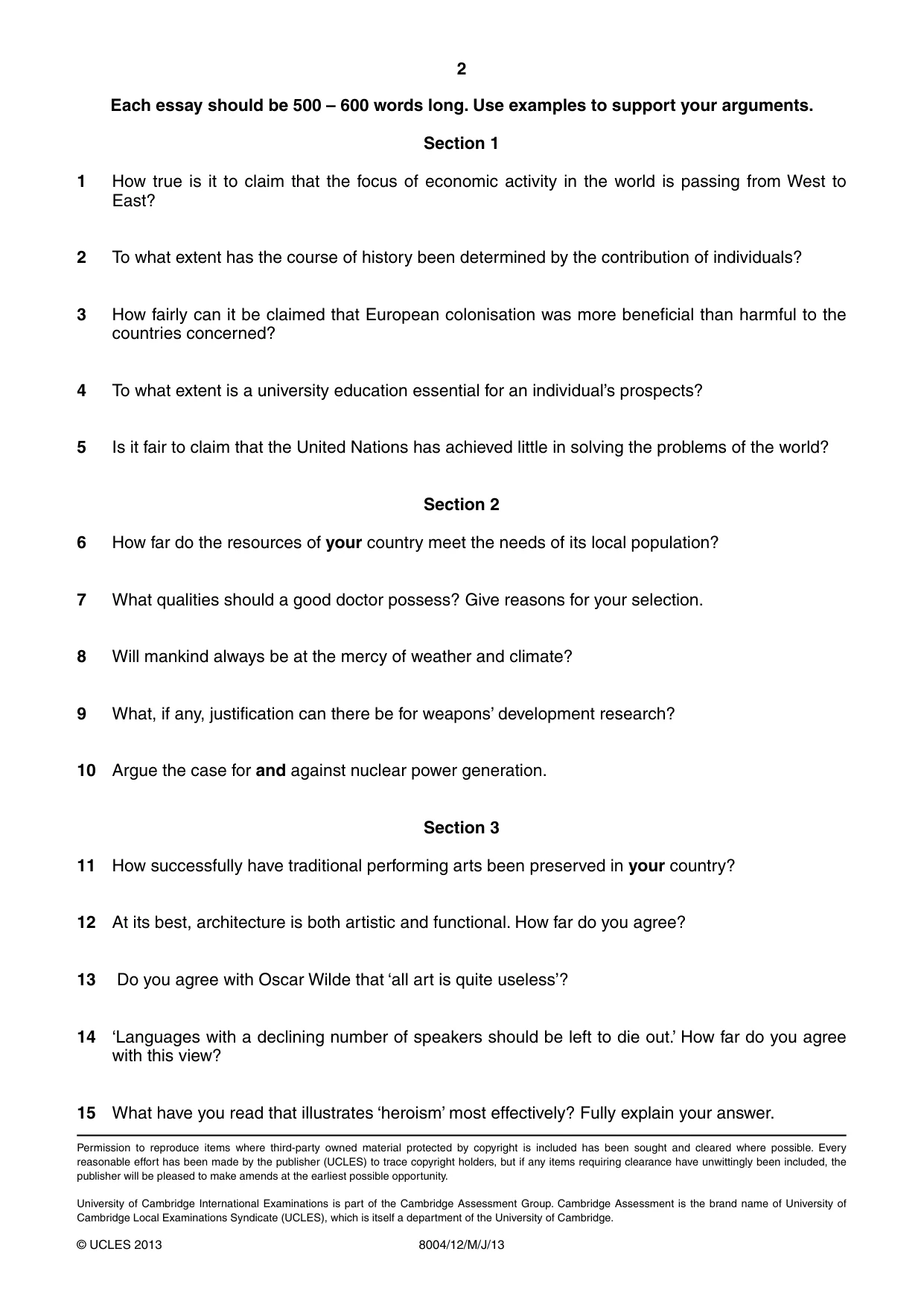
2 8004/12/M/J/13 © UCLES 2013 Permission to reproduce items where third-party owned material protected by copyright is included has been sought and cleared where possible. Every reasonable effort has been made by the publisher (UCLES) to trace copyright holders, but if any items requiring clearance have unwittingly been included, the publisher will be pleased to make amends at the earliest possible opportunity. University of Cambridge International Examinations is part of the Cambridge Assessment Group. Cambridge Assessment is the brand name of University of Cambridge Local Examinations Syndicate (UCLES), which is itself a department of the University of Cambridge. Each essay should be 500 – 600 words long. Use examples to support your arguments. Section 1 1 How true is it to claim that the focus of economic activity in the world is passing from West to East? 2 To what extent has the course of history been determined by the contribution of individuals? 3 How fairly can it be claimed that European colonisation was more beneficial than harmful to the countries concerned? 4 To what extent is a university education essential for an individual’s prospects? 5 Is it fair to claim that the United Nations has achieved little in solving the problems of the world? Section 2 6 How far do the resources of your country meet the needs of its local population? 7 What qualities should a good doctor possess? Give reasons for your selection. 8 Will mankind always be at the mercy of weather and climate? 9 What, if any, justification can there be for weapons’ development research? 10 Argue the case for and against nuclear power generation. Section 3 11 How successfully have traditional performing arts been preserved in your country? 12 At its best, architecture is both artistic and functional. How far do you agree? 13 Do you agree with Oscar Wilde that ‘all art is quite useless’? 14 ‘Languages with a declining number of speakers should be left to die out.’ How far do you agree with this view? 15 What have you read that illustrates ‘heroism’ most effectively? Fully explain your answer.
Mark scheme, page 1
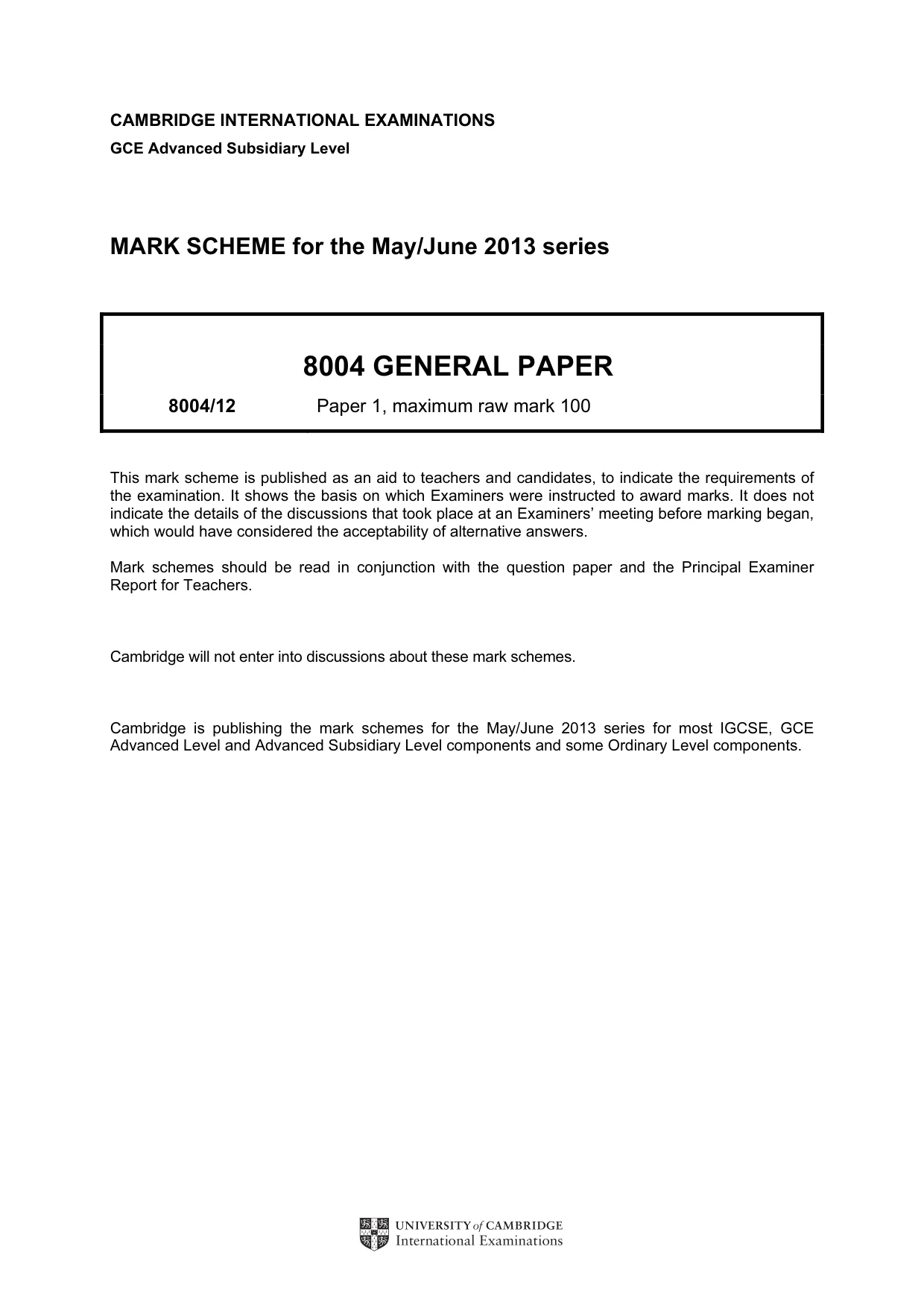
CAMBRIDGE INTERNATIONAL EXAMINATIONS GCE Advanced Subsidiary Level MARK SCHEME for the May/June 2013 series 8004 GENERAL PAPER 8004/12 Paper 1, maximum raw mark 100 This mark scheme is published as an aid to teachers and candidates, to indicate the requirements of the examination. It shows the basis on which Examiners were instructed to award marks. It does not indicate the details of the discussions that took place at an Examiners’ meeting before marking began, which would have considered the acceptability of alternative answers. Mark schemes should be read in conjunction with the question paper and the Principal Examiner Report for Teachers. Cambridge will not enter into discussions about these mark schemes. Cambridge is publishing the mark schemes for the May/June 2013 series for most IGCSE, GCE Advanced Level and Advanced Subsidiary Level components and some Ordinary Level components.
Mark scheme, page 2
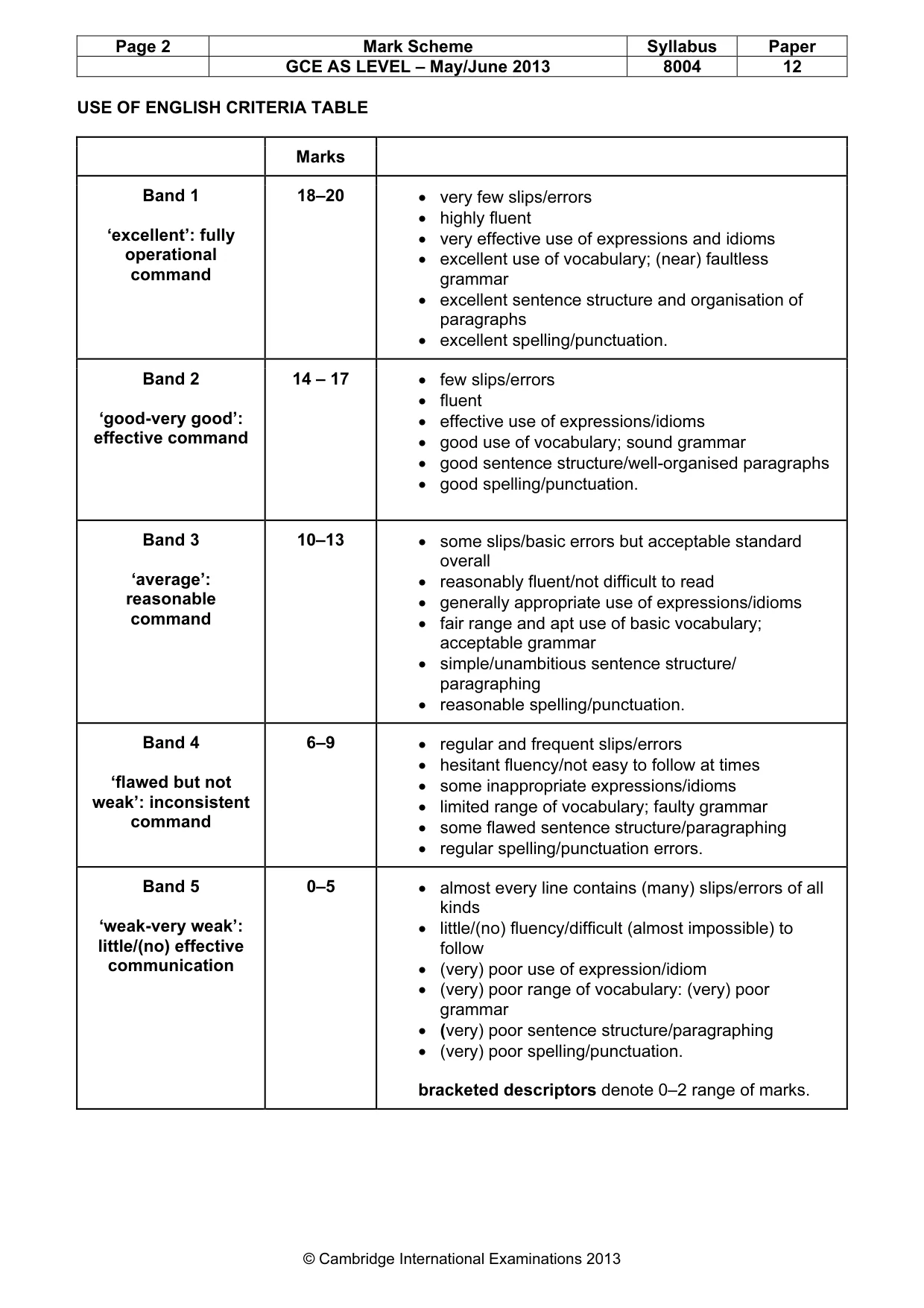
Page 2 Mark Scheme Syllabus Paper GCE AS LEVEL – May/June 2013 8004 12 © Cambridge International Examinations 2013 USE OF ENGLISH CRITERIA TABLE Marks Band 1 ‘excellent’: fully operational command 18–20 • very few slips/errors • highly fluent • very effective use of expressions and idioms • excellent use of vocabulary; (near) faultless grammar • excellent sentence structure and organisation of paragraphs • excellent spelling/punctuation. Band 2 ‘good-very good’: effective command 14 – 17 • few slips/errors • fluent • effective use of expressions/idioms • good use of vocabulary; sound grammar • good sentence structure/well-organised paragraphs • good spelling/punctuation. Band 3 ‘average’: reasonable command 10–13 • some slips/basic errors but acceptable standard overall • reasonably fluent/not difficult to read • generally appropriate use of expressions/idioms • fair range and apt use of basic vocabulary; acceptable grammar • simple/unambitious sentence structure/ paragraphing • reasonable spelling/punctuation. Band 4 ‘flawed but not weak’: inconsistent command 6–9 • regular and frequent slips/errors • hesitant fluency/not easy to follow at times • some inappropriate expressions/idioms • limited range of vocabulary; faulty grammar • some flawed sentence structure/paragraphing • regular spelling/punctuation errors. Band 5 ‘weak-very weak’: little/(no) effective communication 0–5 • almost every line contains (many) slips/errors of all kinds • little/(no) fluency/difficult (almost impossible) to follow • (very) poor use of expression/idiom • (very) poor range of vocabulary: (very) poor grammar • (very) poor sentence structure/paragraphing • (very) poor spelling/punctuation. bracketed descriptors denote 0–2 range of marks.
Mark scheme, page 3
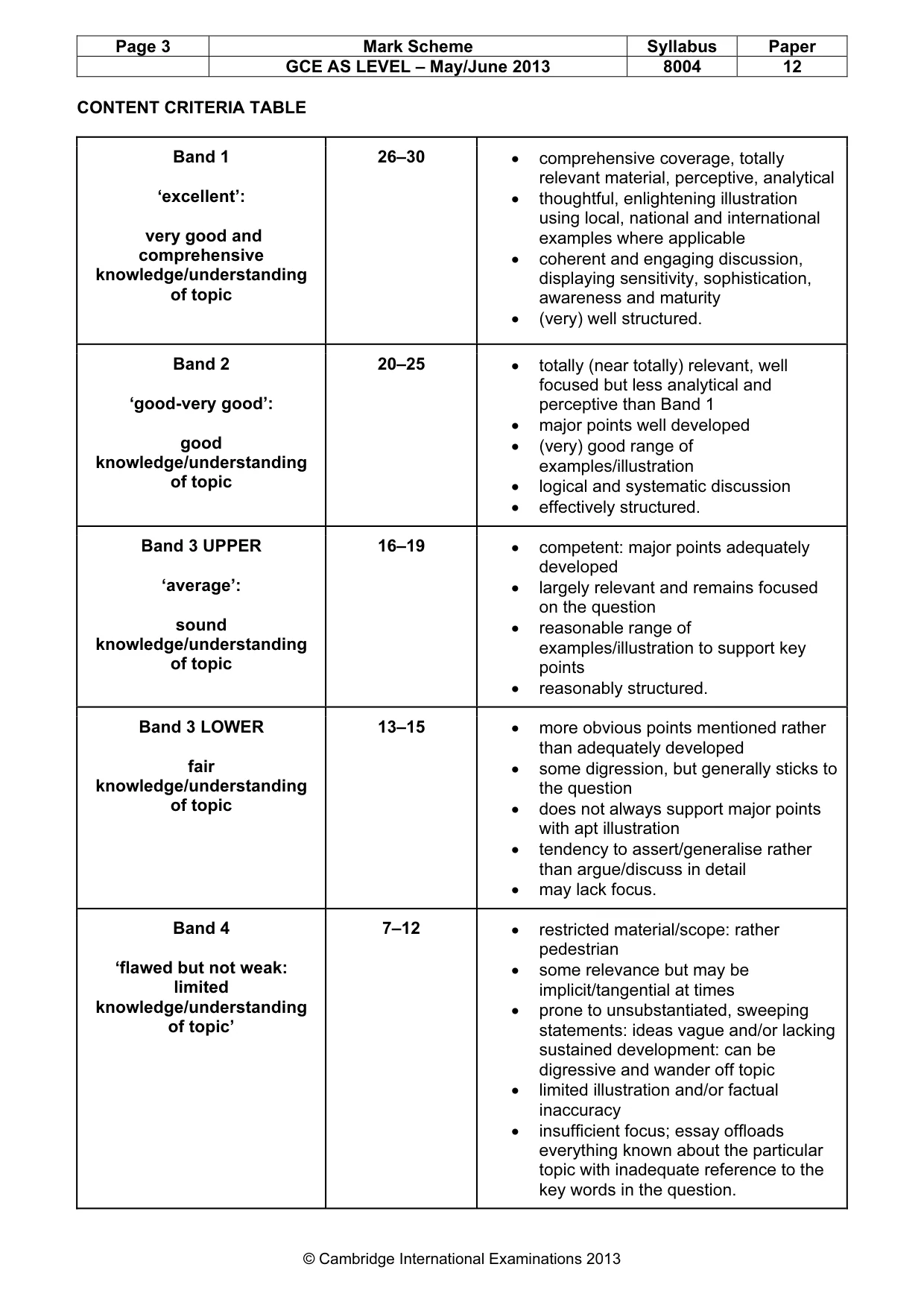
Page 3 Mark Scheme Syllabus Paper GCE AS LEVEL – May/June 2013 8004 12 © Cambridge International Examinations 2013 CONTENT CRITERIA TABLE Band 1 ‘excellent’: very good and comprehensive knowledge/understanding of topic 26–30 • comprehensive coverage, totally relevant material, perceptive, analytical • thoughtful, enlightening illustration using local, national and international examples where applicable • coherent and engaging discussion, displaying sensitivity, sophistication, awareness and maturity • (very) well structured. Band 2 ‘good-very good’: good knowledge/understanding of topic 20–25 • totally (near totally) relevant, well focused but less analytical and perceptive than Band 1 • major points well developed • (very) good range of examples/illustration • logical and systematic discussion • effectively structured. Band 3 UPPER ‘average’: sound knowledge/understanding of topic 16–19 • competent: major points adequately developed • largely relevant and remains focused on the question • reasonable range of examples/illustration to support key points • reasonably structured. Band 3 LOWER fair knowledge/understanding of topic 13–15 • more obvious points mentioned rather than adequately developed • some digression, but generally sticks to the question • does not always support major points with apt illustration • tendency to assert/generalise rather than argue/discuss in detail • may lack focus. Band 4 ‘flawed but not weak: limited knowledge/understanding of topic’ 7–12 • restricted material/scope: rather pedestrian • some relevance but may be implicit/tangential at times • prone to unsubstantiated, sweeping statements: ideas vague and/or lacking sustained development: can be digressive and wander off topic • limited illustration and/or factual inaccuracy • insufficient focus; essay offloads everything known about the particular topic with inadequate reference to the key words in the question.
Mark scheme, page 4
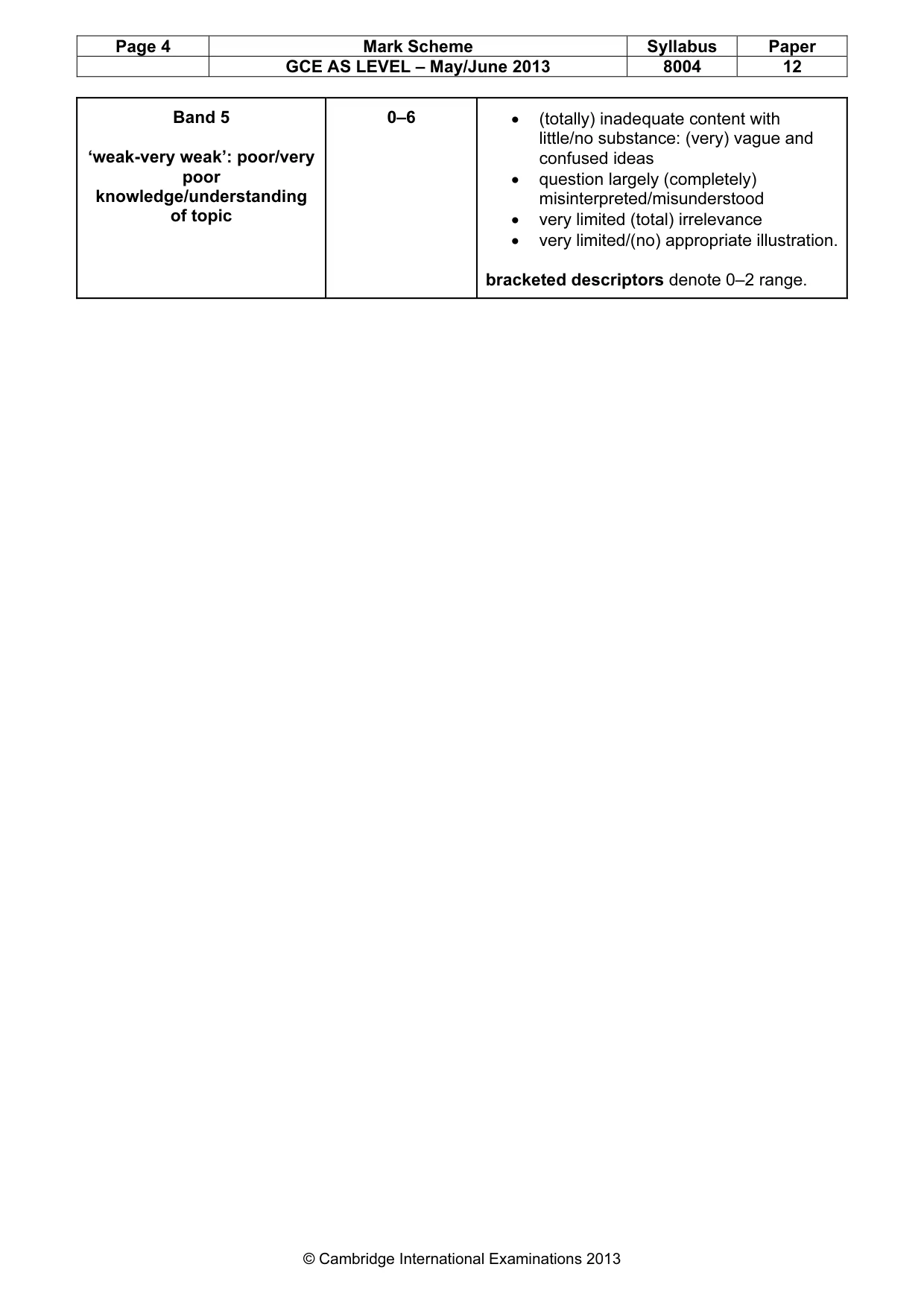
Page 4 Mark Scheme Syllabus Paper GCE AS LEVEL – May/June 2013 8004 12 © Cambridge International Examinations 2013 Band 5 ‘weak-very weak’: poor/very poor knowledge/understanding of topic 0–6 • (totally) inadequate content with little/no substance: (very) vague and confused ideas • question largely (completely) misinterpreted/misunderstood • very limited (total) irrelevance • very limited/(no) appropriate illustration. bracketed descriptors denote 0–2 range.
Mark scheme, page 5
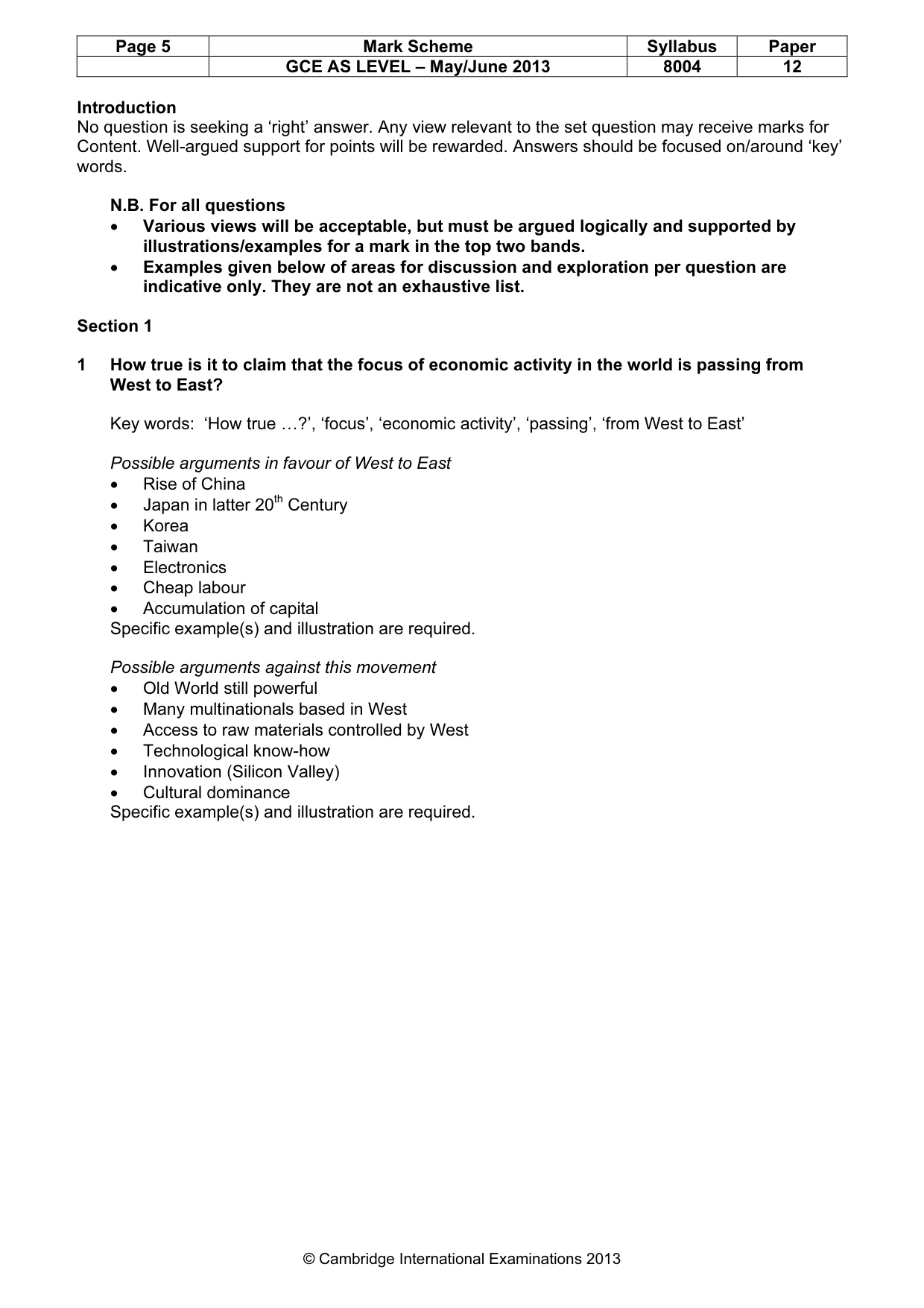
Page 5 Mark Scheme Syllabus Paper GCE AS LEVEL – May/June 2013 8004 12 © Cambridge International Examinations 2013 Introduction No question is seeking a ‘right’ answer. Any view relevant to the set question may receive marks for Content. Well-argued support for points will be rewarded. Answers should be focused on/around ‘key’ words. N.B. For all questions • Various views will be acceptable, but must be argued logically and supported by illustrations/examples for a mark in the top two bands. • Examples given below of areas for discussion and exploration per question are indicative only. They are not an exhaustive list. Section 1 1 How true is it to claim that the focus of economic activity in the world is passing from West to East? Key words: ‘How true …?’, ‘focus’, ‘economic activity’, ‘passing’, ‘from West to East’ Possible arguments in favour of West to East • Rise of China • Japan in latter 20th Century • Korea • Taiwan • Electronics • Cheap labour • Accumulation of capital Specific example(s) and illustration are required. Possible arguments against this movement • Old World still powerful • Many multinationals based in West • Access to raw materials controlled by West • Technological know-how • Innovation (Silicon Valley) • Cultural dominance Specific example(s) and illustration are required.
Mark scheme, page 6
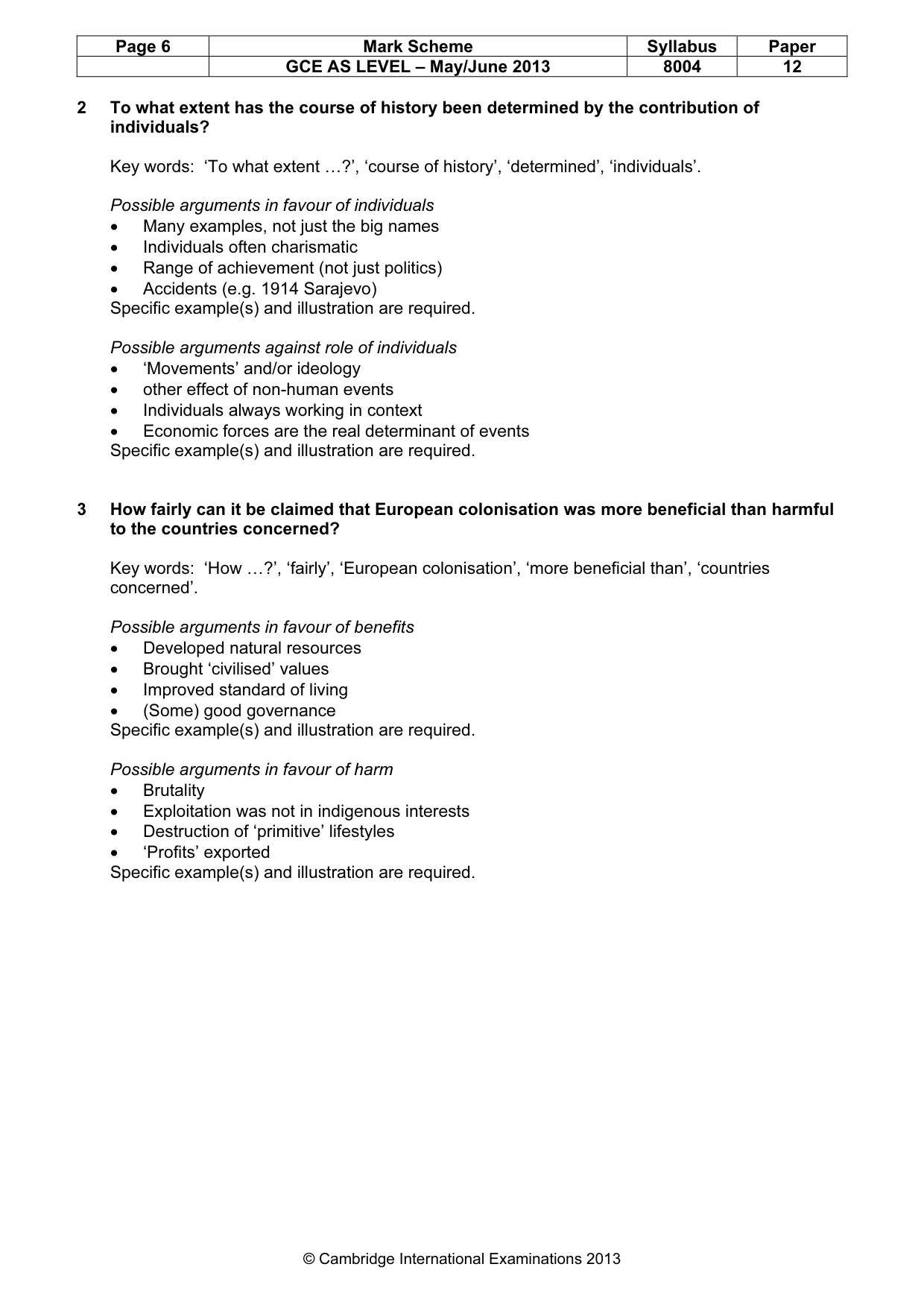
Page 6 Mark Scheme Syllabus Paper GCE AS LEVEL – May/June 2013 8004 12 © Cambridge International Examinations 2013 2 To what extent has the course of history been determined by the contribution of individuals? Key words: ‘To what extent …?’, ‘course of history’, ‘determined’, ‘individuals’. Possible arguments in favour of individuals • Many examples, not just the big names • Individuals often charismatic • Range of achievement (not just politics) • Accidents (e.g. 1914 Sarajevo) Specific example(s) and illustration are required. Possible arguments against role of individuals • ‘Movements’ and/or ideology • other effect of non-human events • Individuals always working in context • Economic forces are the real determinant of events Specific example(s) and illustration are required. 3 How fairly can it be claimed that European colonisation was more beneficial than harmful to the countries concerned? Key words: ‘How …?’, ‘fairly’, ‘European colonisation’, ‘more beneficial than’, ‘countries concerned’. Possible arguments in favour of benefits • Developed natural resources • Brought ‘civilised’ values • Improved standard of living • (Some) good governance Specific example(s) and illustration are required. Possible arguments in favour of harm • Brutality • Exploitation was not in indigenous interests • Destruction of ‘primitive’ lifestyles • ‘Profits’ exported Specific example(s) and illustration are required.
Mark scheme, page 7
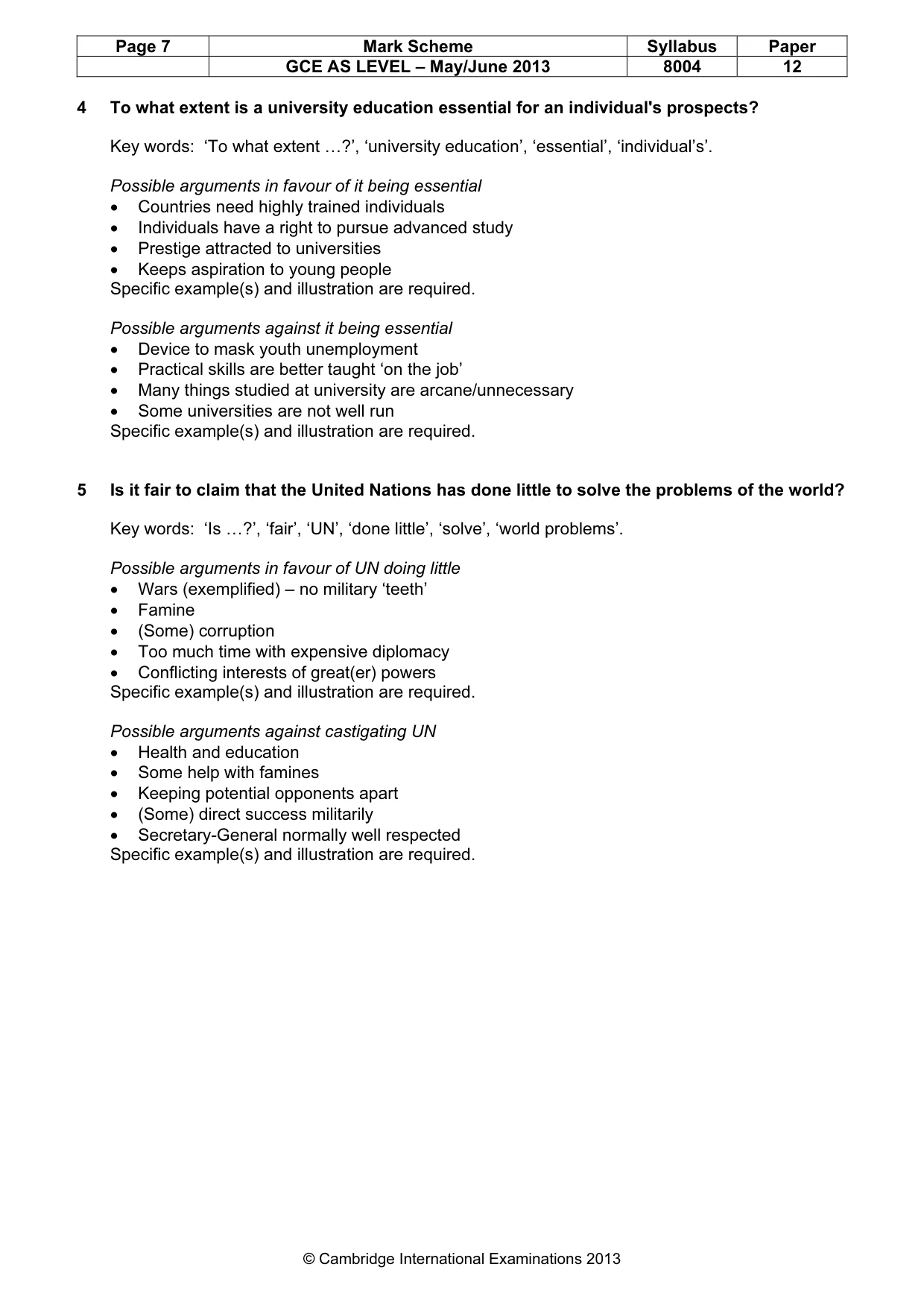
Page 7 Mark Scheme Syllabus Paper GCE AS LEVEL – May/June 2013 8004 12 © Cambridge International Examinations 2013 4 To what extent is a university education essential for an individual's prospects? Key words: ‘To what extent …?’, ‘university education’, ‘essential’, ‘individual’s’. Possible arguments in favour of it being essential • Countries need highly trained individuals • Individuals have a right to pursue advanced study • Prestige attracted to universities • Keeps aspiration to young people Specific example(s) and illustration are required. Possible arguments against it being essential • Device to mask youth unemployment • Practical skills are better taught ‘on the job’ • Many things studied at university are arcane/unnecessary • Some universities are not well run Specific example(s) and illustration are required. 5 Is it fair to claim that the United Nations has done little to solve the problems of the world? Key words: ‘Is …?’, ‘fair’, ‘UN’, ‘done little’, ‘solve’, ‘world problems’. Possible arguments in favour of UN doing little • Wars (exemplified) – no military ‘teeth’ • Famine • (Some) corruption • Too much time with expensive diplomacy • Conflicting interests of great(er) powers Specific example(s) and illustration are required. Possible arguments against castigating UN • Health and education • Some help with famines • Keeping potential opponents apart • (Some) direct success militarily • Secretary-General normally well respected Specific example(s) and illustration are required.
Mark scheme, page 8
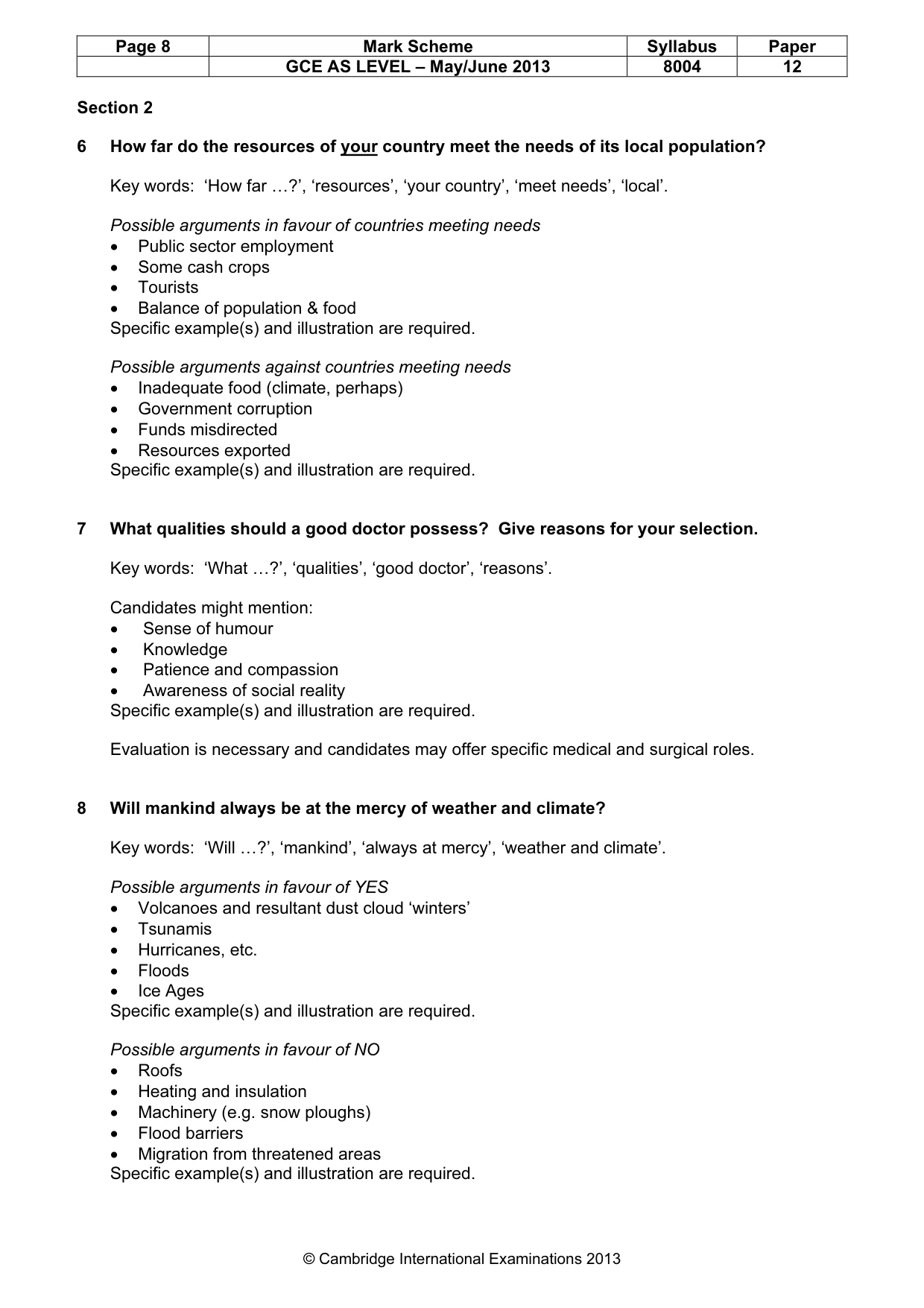
Page 8 Mark Scheme Syllabus Paper GCE AS LEVEL – May/June 2013 8004 12 © Cambridge International Examinations 2013 Section 2 6 How far do the resources of your country meet the needs of its local population? Key words: ‘How far …?’, ‘resources’, ‘your country’, ‘meet needs’, ‘local’. Possible arguments in favour of countries meeting needs • Public sector employment • Some cash crops • Tourists • Balance of population & food Specific example(s) and illustration are required. Possible arguments against countries meeting needs • Inadequate food (climate, perhaps) • Government corruption • Funds misdirected • Resources exported Specific example(s) and illustration are required. 7 What qualities should a good doctor possess? Give reasons for your selection. Key words: ‘What …?’, ‘qualities’, ‘good doctor’, ‘reasons’. Candidates might mention: • Sense of humour • Knowledge • Patience and compassion • Awareness of social reality Specific example(s) and illustration are required. Evaluation is necessary and candidates may offer specific medical and surgical roles. 8 Will mankind always be at the mercy of weather and climate? Key words: ‘Will …?’, ‘mankind’, ‘always at mercy’, ‘weather and climate’. Possible arguments in favour of YES • Volcanoes and resultant dust cloud ‘winters’ • Tsunamis • Hurricanes, etc. • Floods • Ice Ages Specific example(s) and illustration are required. Possible arguments in favour of NO • Roofs • Heating and insulation • Machinery (e.g. snow ploughs) • Flood barriers • Migration from threatened areas Specific example(s) and illustration are required.
Mark scheme, page 9
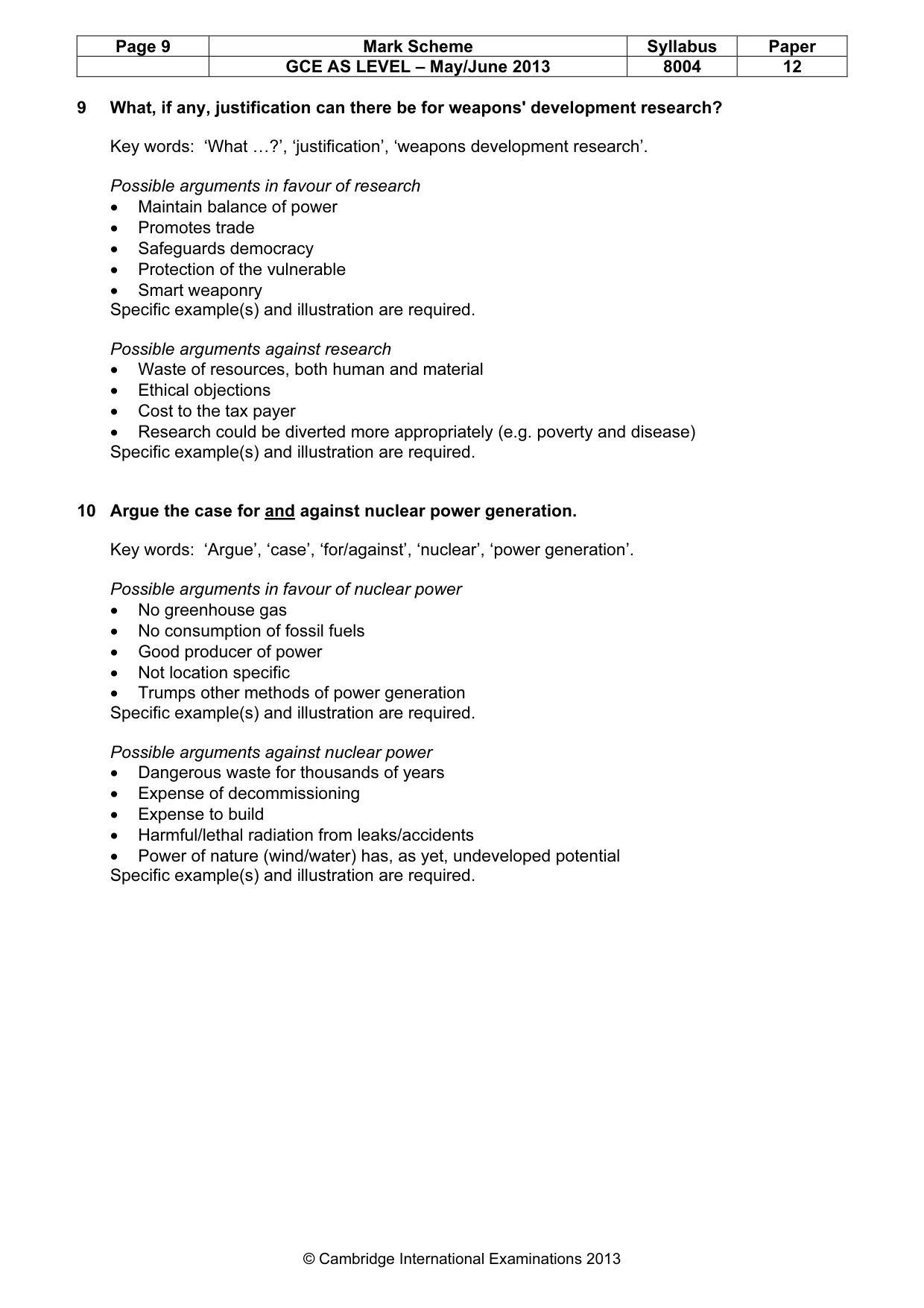
Page 9 Mark Scheme Syllabus Paper GCE AS LEVEL – May/June 2013 8004 12 © Cambridge International Examinations 2013 9 What, if any, justification can there be for weapons' development research? Key words: ‘What …?’, ‘justification’, ‘weapons development research’. Possible arguments in favour of research • Maintain balance of power • Promotes trade • Safeguards democracy • Protection of the vulnerable • Smart weaponry Specific example(s) and illustration are required. Possible arguments against research • Waste of resources, both human and material • Ethical objections • Cost to the tax payer • Research could be diverted more appropriately (e.g. poverty and disease) Specific example(s) and illustration are required. 10 Argue the case for and against nuclear power generation. Key words: ‘Argue’, ‘case’, ‘for/against’, ‘nuclear’, ‘power generation’. Possible arguments in favour of nuclear power • No greenhouse gas • No consumption of fossil fuels • Good producer of power • Not location specific • Trumps other methods of power generation Specific example(s) and illustration are required. Possible arguments against nuclear power • Dangerous waste for thousands of years • Expense of decommissioning • Expense to build • Harmful/lethal radiation from leaks/accidents • Power of nature (wind/water) has, as yet, undeveloped potential Specific example(s) and illustration are required.
Mark scheme, page 10
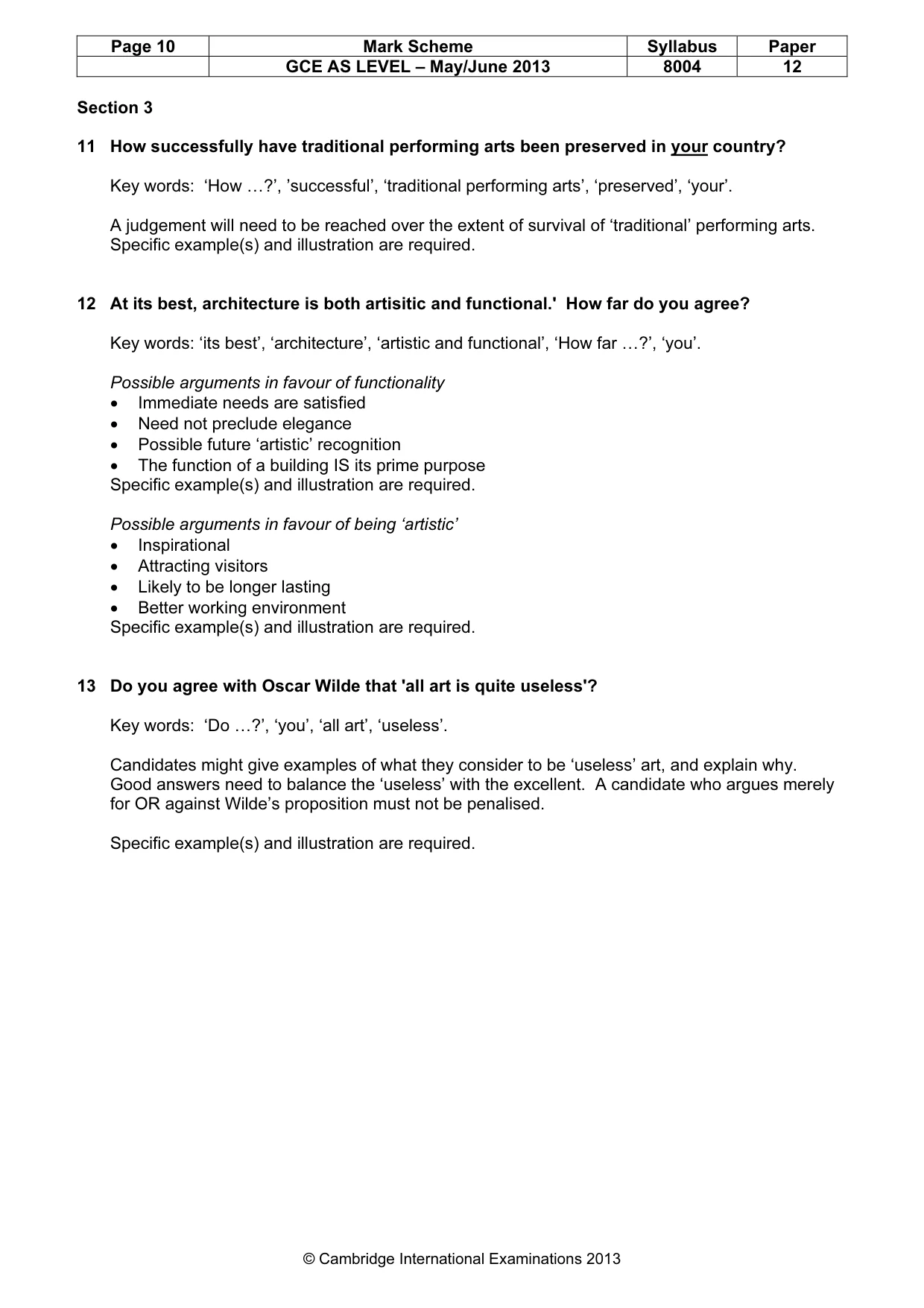
Page 10 Mark Scheme Syllabus Paper GCE AS LEVEL – May/June 2013 8004 12 © Cambridge International Examinations 2013 Section 3 11 How successfully have traditional performing arts been preserved in your country? Key words: ‘How …?’, ’successful’, ‘traditional performing arts’, ‘preserved’, ‘your’. A judgement will need to be reached over the extent of survival of ‘traditional’ performing arts. Specific example(s) and illustration are required. 12 At its best, architecture is both artisitic and functional.' How far do you agree? Key words: ‘its best’, ‘architecture’, ‘artistic and functional’, ‘How far …?’, ‘you’. Possible arguments in favour of functionality • Immediate needs are satisfied • Need not preclude elegance • Possible future ‘artistic’ recognition • The function of a building IS its prime purpose Specific example(s) and illustration are required. Possible arguments in favour of being ‘artistic’ • Inspirational • Attracting visitors • Likely to be longer lasting • Better working environment Specific example(s) and illustration are required. 13 Do you agree with Oscar Wilde that 'all art is quite useless'? Key words: ‘Do …?’, ‘you’, ‘all art’, ‘useless’. Candidates might give examples of what they consider to be ‘useless’ art, and explain why. Good answers need to balance the ‘useless’ with the excellent. A candidate who argues merely for OR against Wilde’s proposition must not be penalised. Specific example(s) and illustration are required.
Mark scheme, page 11
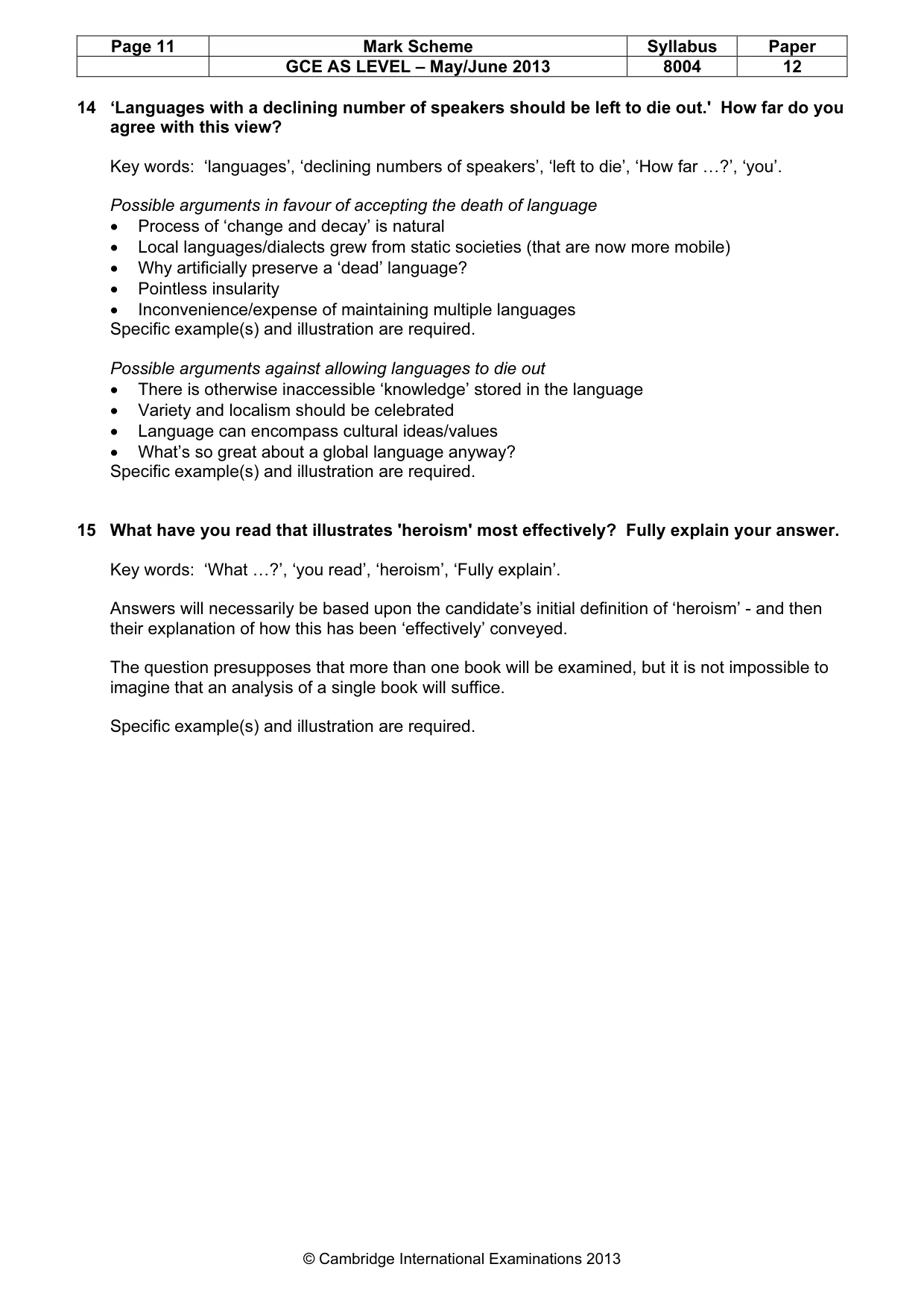
Page 11 Mark Scheme Syllabus Paper GCE AS LEVEL – May/June 2013 8004 12 © Cambridge International Examinations 2013 14 ‘Languages with a declining number of speakers should be left to die out.' How far do you agree with this view? Key words: ‘languages’, ‘declining numbers of speakers’, ‘left to die’, ‘How far …?’, ‘you’. Possible arguments in favour of accepting the death of language • Process of ‘change and decay’ is natural • Local languages/dialects grew from static societies (that are now more mobile) • Why artificially preserve a ‘dead’ language? • Pointless insularity • Inconvenience/expense of maintaining multiple languages Specific example(s) and illustration are required. Possible arguments against allowing languages to die out • There is otherwise inaccessible ‘knowledge’ stored in the language • Variety and localism should be celebrated • Language can encompass cultural ideas/values • What’s so great about a global language anyway? Specific example(s) and illustration are required. 15 What have you read that illustrates 'heroism' most effectively? Fully explain your answer. Key words: ‘What …?’, ‘you read’, ‘heroism’, ‘Fully explain’. Answers will necessarily be based upon the candidate’s initial definition of ‘heroism’ - and then their explanation of how this has been ‘effectively’ conveyed. The question presupposes that more than one book will be examined, but it is not impossible to imagine that an analysis of a single book will suffice. Specific example(s) and illustration are required.
What you needed in this session
Cambridge’s own grade thresholds for 2013 May/June, Paper 1 · Variant 2. A higher threshold means an easier paper — the bar moves with how the cohort did.