Cambridge A Level General Paper (AS Level only) 8004 — 2013 May/June Paper 1 · Variant 1
8004/11/M/J/13 · 100 marks · ≈113 min
The question paper and its mark scheme, free to read here and free to download. This is Cambridge’s own paper, exactly as it was sat.
Question paper2 pages
Mark scheme12 pages
Answers below. Sit the paper first if you are practising.
Paper as text
Question paper, page 1
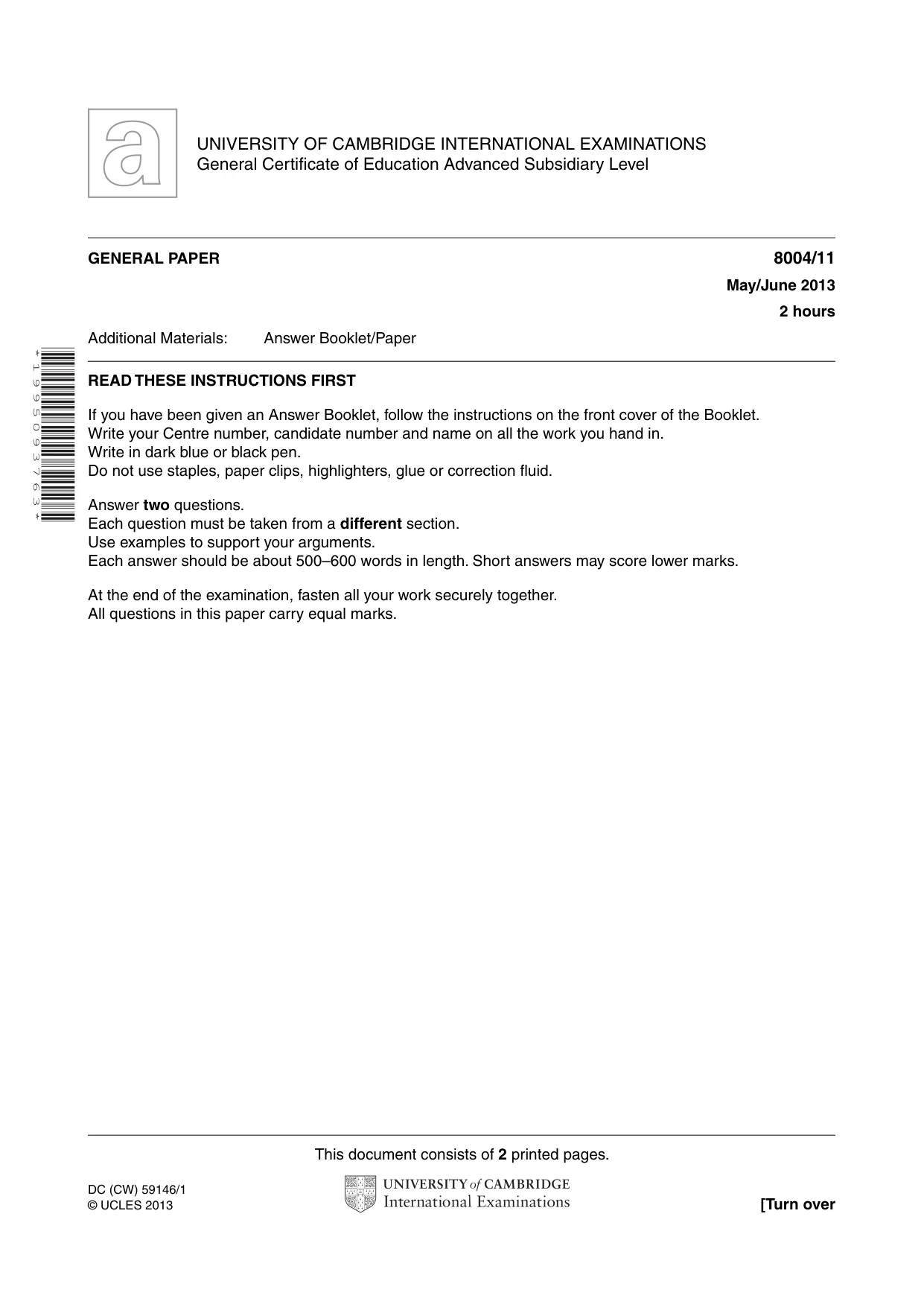
This document consists of 2 printed pages. DC (CW) 59146/1 © UCLES 2013 [Turn over UNIVERSITY OF CAMBRIDGE INTERNATIONAL EXAMINATIONS General Certificate of Education Advanced Subsidiary Level * 1 9 9 5 0 9 3 7 6 3 * GENERAL PAPER 8004/11 May/June 2013 2 hours Additional Materials: Answer Booklet/Paper READ THESE INSTRUCTIONS FIRST If you have been given an Answer Booklet, follow the instructions on the front cover of the Booklet. Write your Centre number, candidate number and name on all the work you hand in. Write in dark blue or black pen. Do not use staples, paper clips, highlighters, glue or correction fluid. Answer two questions. Each question must be taken from a different section. Use examples to support your arguments. Each answer should be about 500–600 words in length. Short answers may score lower marks. At the end of the examination, fasten all your work securely together. All questions in this paper carry equal marks.
Question paper, page 2
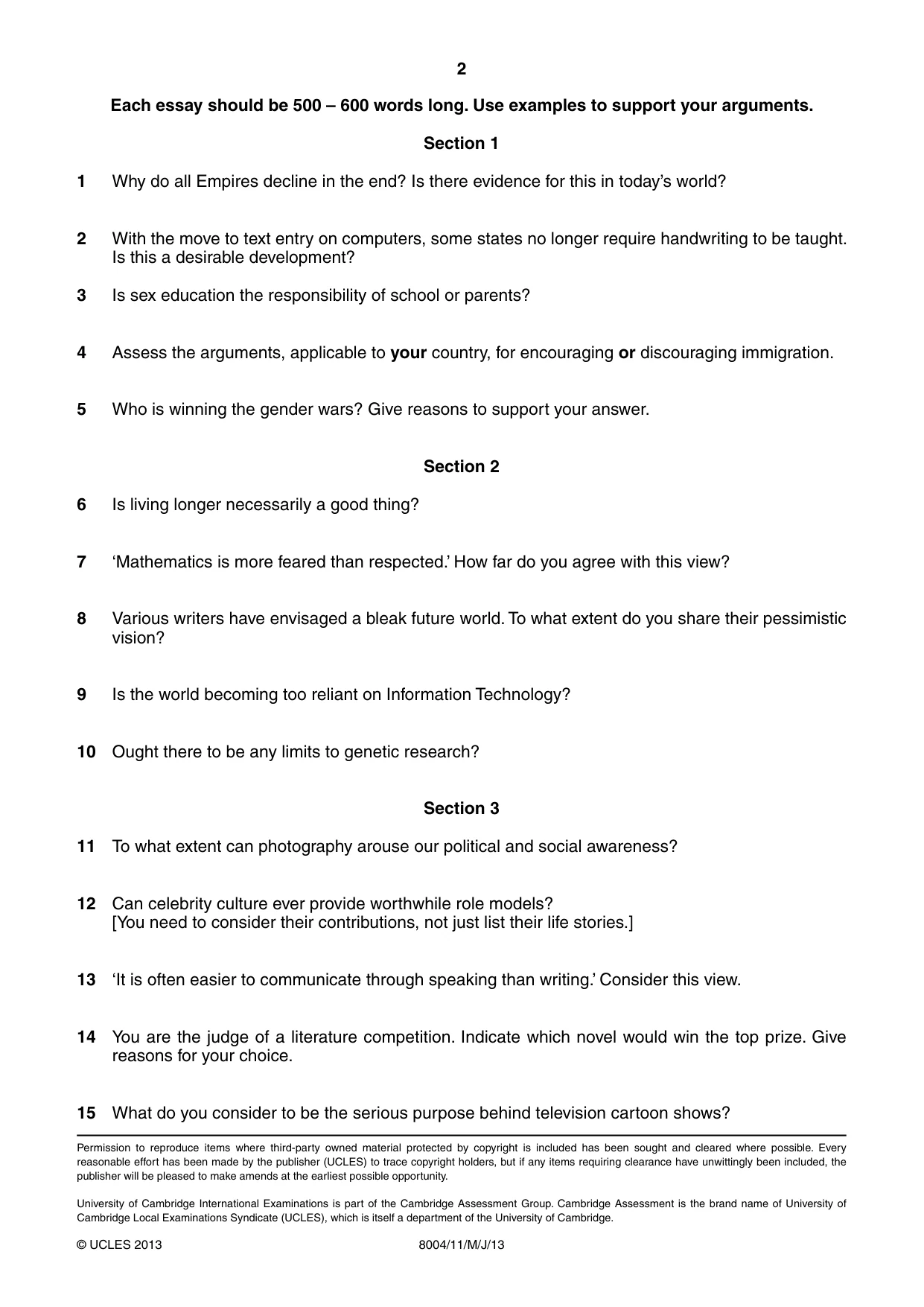
2 8004/11/M/J/13 © UCLES 2013 Permission to reproduce items where third-party owned material protected by copyright is included has been sought and cleared where possible. Every reasonable effort has been made by the publisher (UCLES) to trace copyright holders, but if any items requiring clearance have unwittingly been included, the publisher will be pleased to make amends at the earliest possible opportunity. University of Cambridge International Examinations is part of the Cambridge Assessment Group. Cambridge Assessment is the brand name of University of Cambridge Local Examinations Syndicate (UCLES), which is itself a department of the University of Cambridge. Each essay should be 500 – 600 words long. Use examples to support your arguments. Section 1 1 Why do all Empires decline in the end? Is there evidence for this in today’s world? 2 With the move to text entry on computers, some states no longer require handwriting to be taught. Is this a desirable development? 3 Is sex education the responsibility of school or parents? 4 Assess the arguments, applicable to your country, for encouraging or discouraging immigration. 5 Who is winning the gender wars? Give reasons to support your answer. Section 2 6 Is living longer necessarily a good thing? 7 ‘Mathematics is more feared than respected.’ How far do you agree with this view? 8 Various writers have envisaged a bleak future world. To what extent do you share their pessimistic vision? 9 Is the world becoming too reliant on Information Technology? 10 Ought there to be any limits to genetic research? Section 3 11 To what extent can photography arouse our political and social awareness? 12 Can celebrity culture ever provide worthwhile role models? [You need to consider their contributions, not just list their life stories.] 13 ‘It is often easier to communicate through speaking than writing.’ Consider this view. 14 You are the judge of a literature competition. Indicate which novel would win the top prize. Give reasons for your choice. 15 What do you consider to be the serious purpose behind television cartoon shows?
Mark scheme, page 1
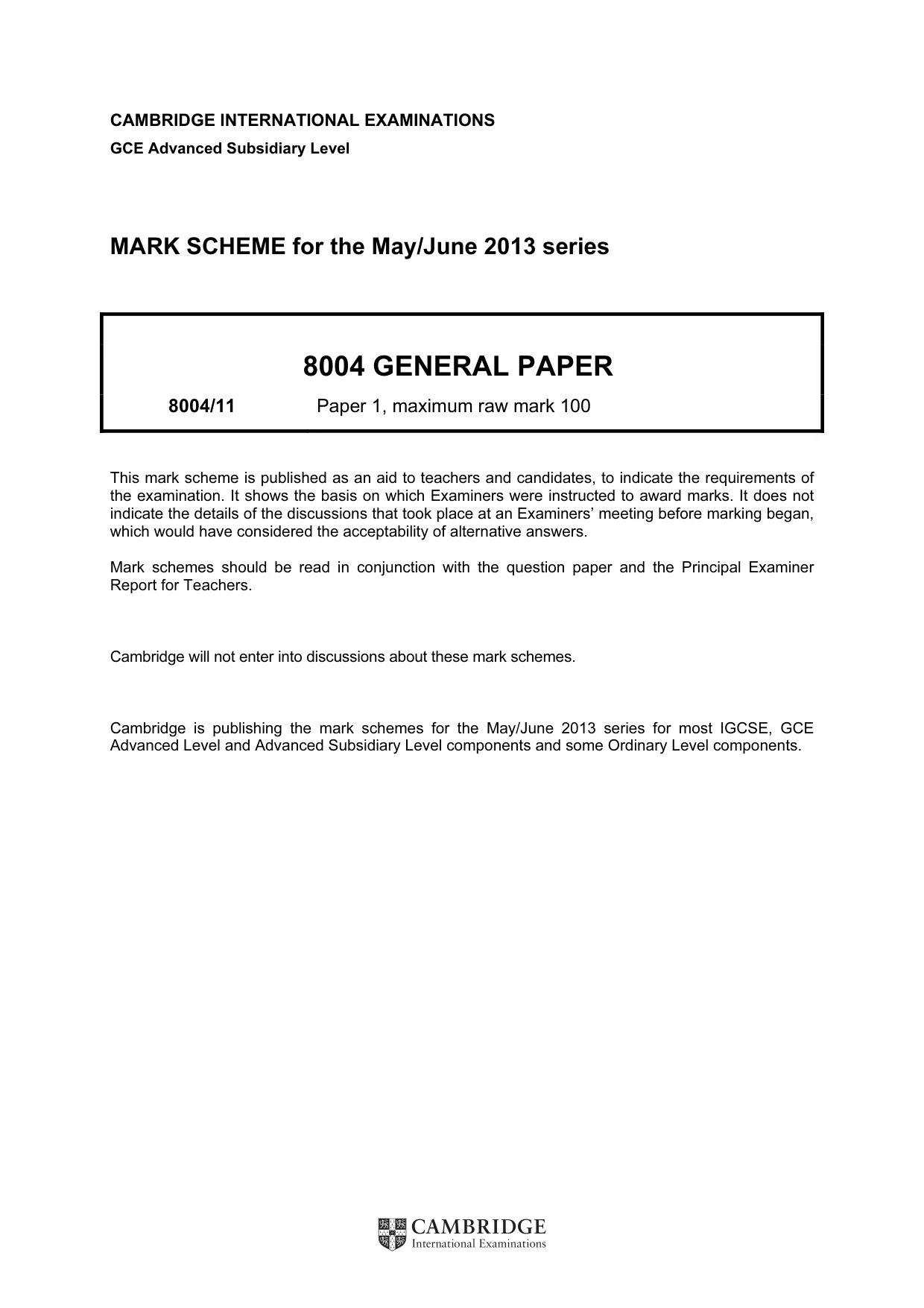
CAMBRIDGE INTERNATIONAL EXAMINATIONS GCE Advanced Subsidiary Level MARK SCHEME for the May/June 2013 series 8004 GENERAL PAPER 8004/11 Paper 1, maximum raw mark 100 This mark scheme is published as an aid to teachers and candidates, to indicate the requirements of the examination. It shows the basis on which Examiners were instructed to award marks. It does not indicate the details of the discussions that took place at an Examiners’ meeting before marking began, which would have considered the acceptability of alternative answers. Mark schemes should be read in conjunction with the question paper and the Principal Examiner Report for Teachers. Cambridge will not enter into discussions about these mark schemes. Cambridge is publishing the mark schemes for the May/June 2013 series for most IGCSE, GCE Advanced Level and Advanced Subsidiary Level components and some Ordinary Level components.
Mark scheme, page 2
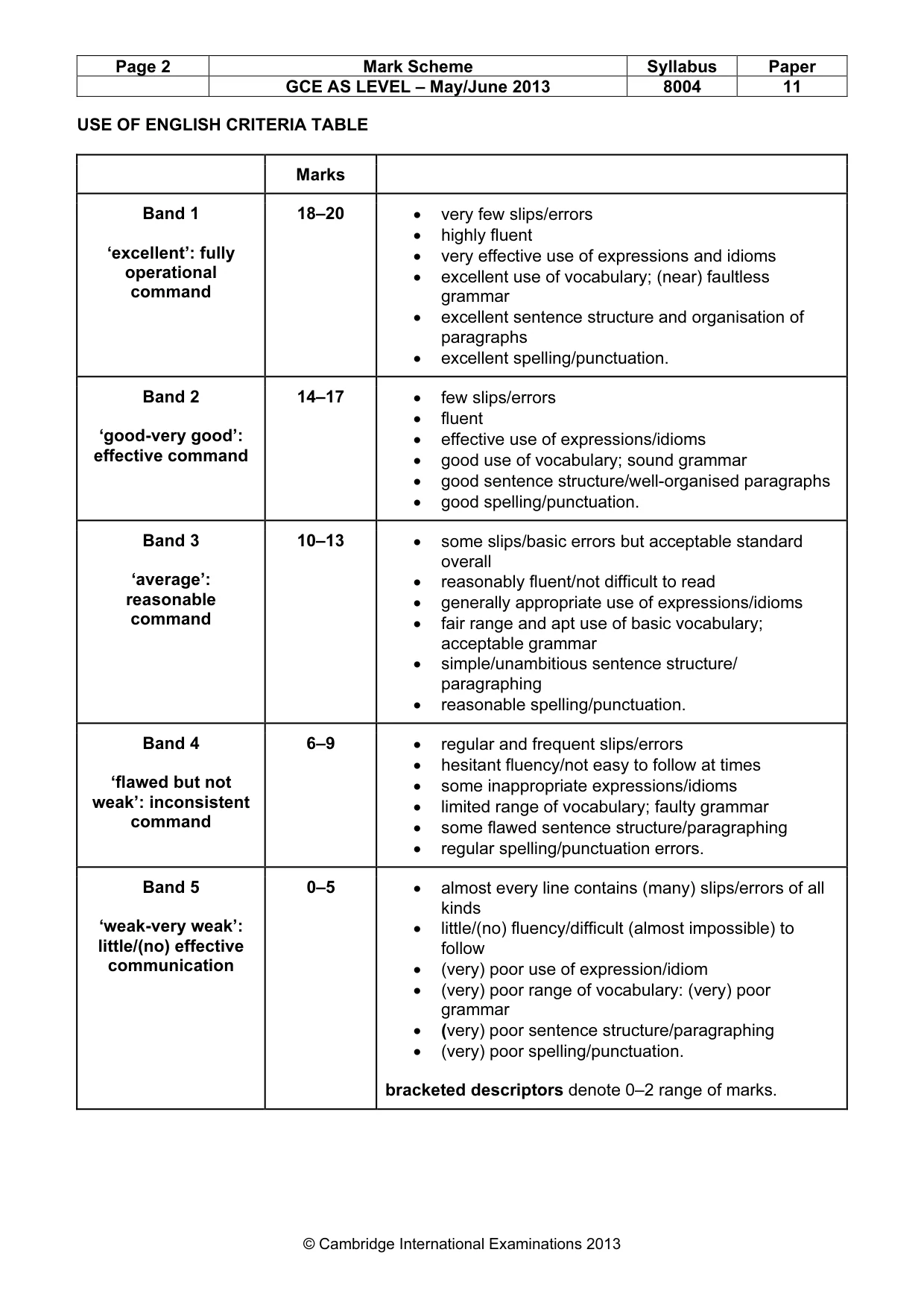
Page 2 Mark Scheme Syllabus Paper GCE AS LEVEL – May/June 2013 8004 11 © Cambridge International Examinations 2013 USE OF ENGLISH CRITERIA TABLE Marks Band 1 ‘excellent’: fully operational command 18–20 • very few slips/errors • highly fluent • very effective use of expressions and idioms • excellent use of vocabulary; (near) faultless grammar • excellent sentence structure and organisation of paragraphs • excellent spelling/punctuation. Band 2 ‘good-very good’: effective command 14–17 • few slips/errors • fluent • effective use of expressions/idioms • good use of vocabulary; sound grammar • good sentence structure/well-organised paragraphs • good spelling/punctuation. Band 3 ‘average’: reasonable command 10–13 • some slips/basic errors but acceptable standard overall • reasonably fluent/not difficult to read • generally appropriate use of expressions/idioms • fair range and apt use of basic vocabulary; acceptable grammar • simple/unambitious sentence structure/ paragraphing • reasonable spelling/punctuation. Band 4 ‘flawed but not weak’: inconsistent command 6–9 • regular and frequent slips/errors • hesitant fluency/not easy to follow at times • some inappropriate expressions/idioms • limited range of vocabulary; faulty grammar • some flawed sentence structure/paragraphing • regular spelling/punctuation errors. Band 5 ‘weak-very weak’: little/(no) effective communication 0–5 • almost every line contains (many) slips/errors of all kinds • little/(no) fluency/difficult (almost impossible) to follow • (very) poor use of expression/idiom • (very) poor range of vocabulary: (very) poor grammar • (very) poor sentence structure/paragraphing • (very) poor spelling/punctuation. bracketed descriptors denote 0–2 range of marks.
Mark scheme, page 3
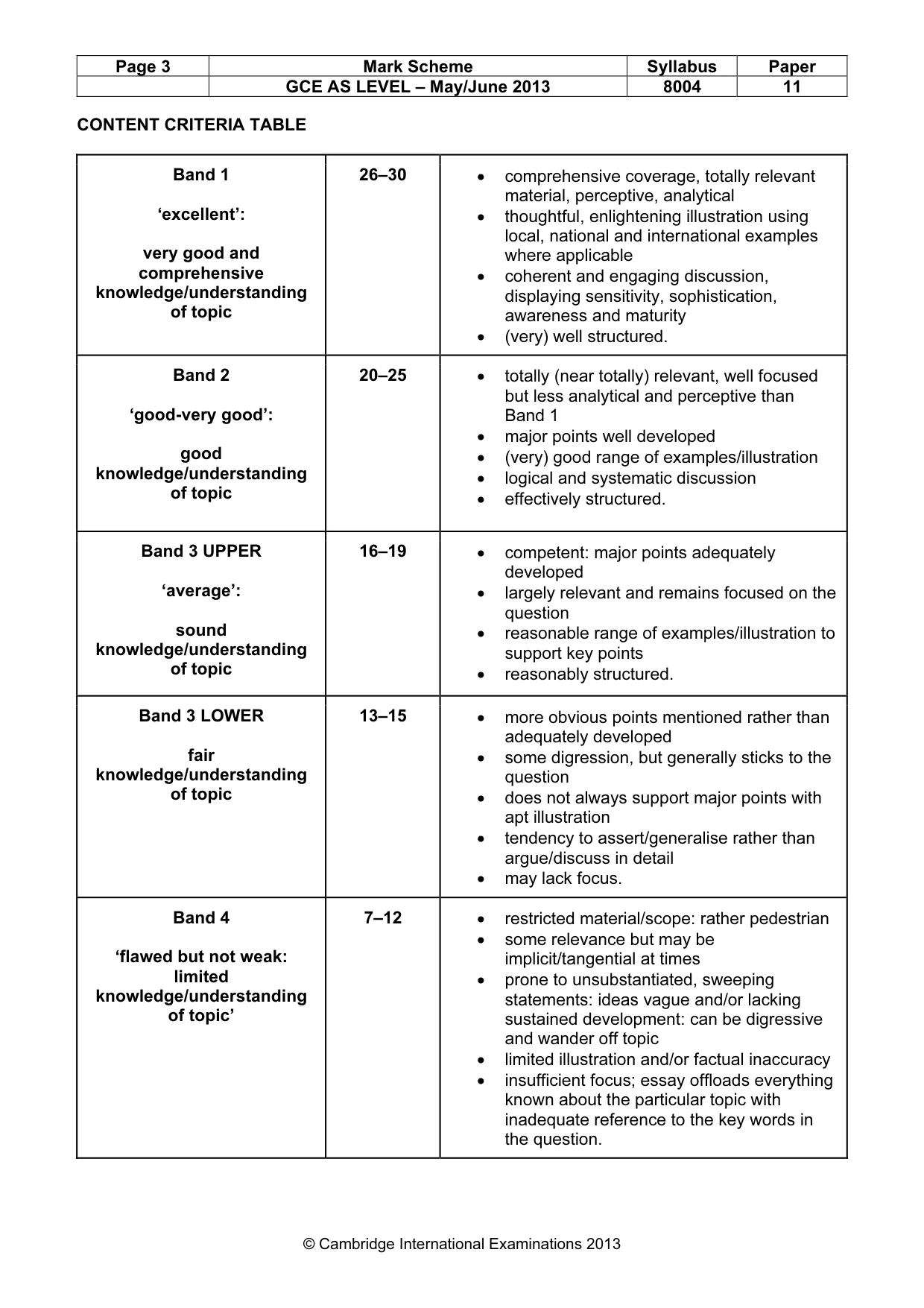
Page 3 Mark Scheme Syllabus Paper GCE AS LEVEL – May/June 2013 8004 11 © Cambridge International Examinations 2013 CONTENT CRITERIA TABLE Band 1 ‘excellent’: very good and comprehensive knowledge/understanding of topic 26–30 • comprehensive coverage, totally relevant material, perceptive, analytical • thoughtful, enlightening illustration using local, national and international examples where applicable • coherent and engaging discussion, displaying sensitivity, sophistication, awareness and maturity • (very) well structured. Band 2 ‘good-very good’: good knowledge/understanding of topic 20–25 • totally (near totally) relevant, well focused but less analytical and perceptive than Band 1 • major points well developed • (very) good range of examples/illustration • logical and systematic discussion • effectively structured. Band 3 UPPER ‘average’: sound knowledge/understanding of topic 16–19 • competent: major points adequately developed • largely relevant and remains focused on the question • reasonable range of examples/illustration to support key points • reasonably structured. Band 3 LOWER fair knowledge/understanding of topic 13–15 • more obvious points mentioned rather than adequately developed • some digression, but generally sticks to the question • does not always support major points with apt illustration • tendency to assert/generalise rather than argue/discuss in detail • may lack focus. Band 4 ‘flawed but not weak: limited knowledge/understanding of topic’ 7–12 • restricted material/scope: rather pedestrian • some relevance but may be implicit/tangential at times • prone to unsubstantiated, sweeping statements: ideas vague and/or lacking sustained development: can be digressive and wander off topic • limited illustration and/or factual inaccuracy • insufficient focus; essay offloads everything known about the particular topic with inadequate reference to the key words in the question.
Mark scheme, page 4
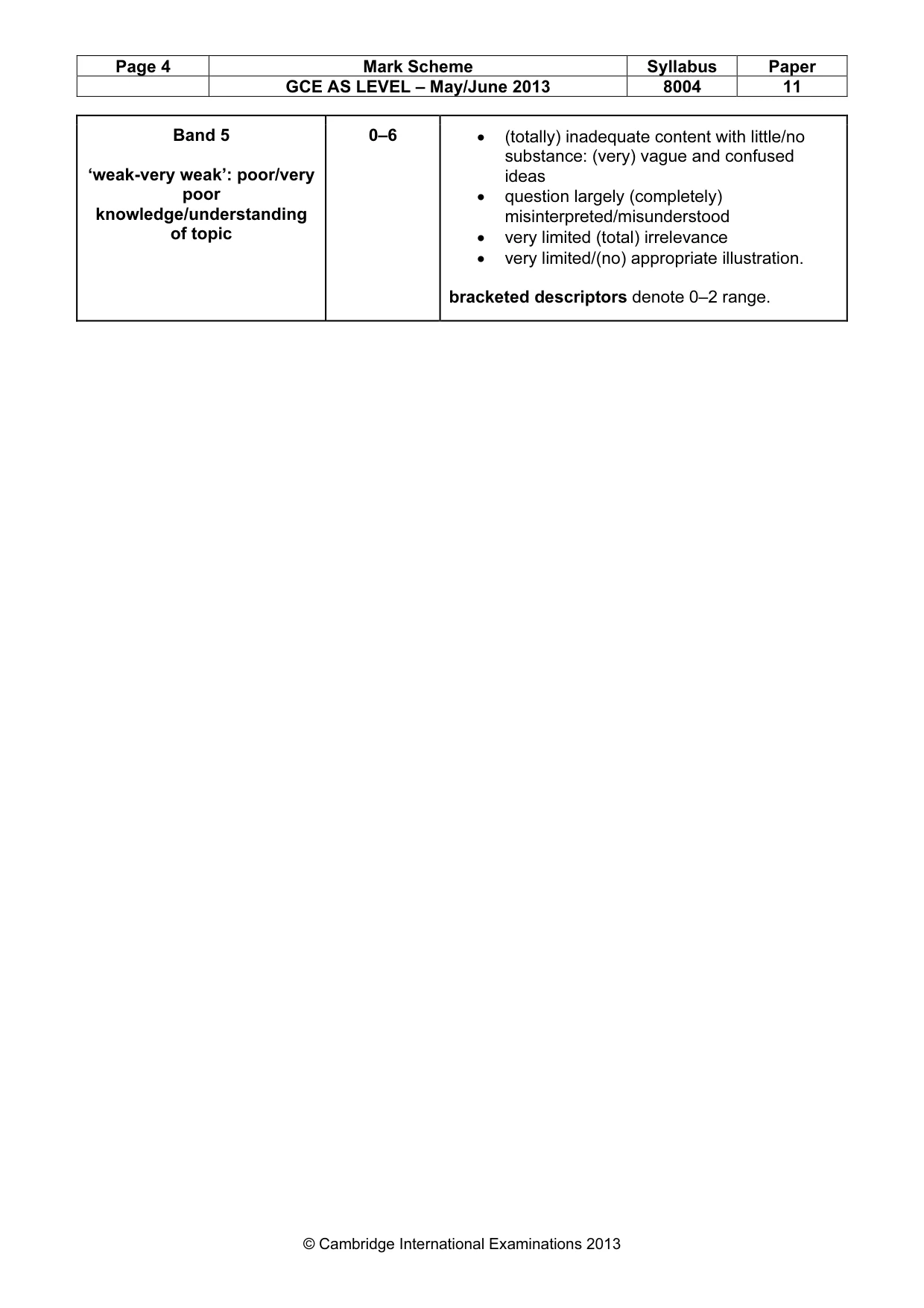
Page 4 Mark Scheme Syllabus Paper GCE AS LEVEL – May/June 2013 8004 11 © Cambridge International Examinations 2013 Band 5 ‘weak-very weak’: poor/very poor knowledge/understanding of topic 0–6 • (totally) inadequate content with little/no substance: (very) vague and confused ideas • question largely (completely) misinterpreted/misunderstood • very limited (total) irrelevance • very limited/(no) appropriate illustration. bracketed descriptors denote 0–2 range.
Mark scheme, page 5
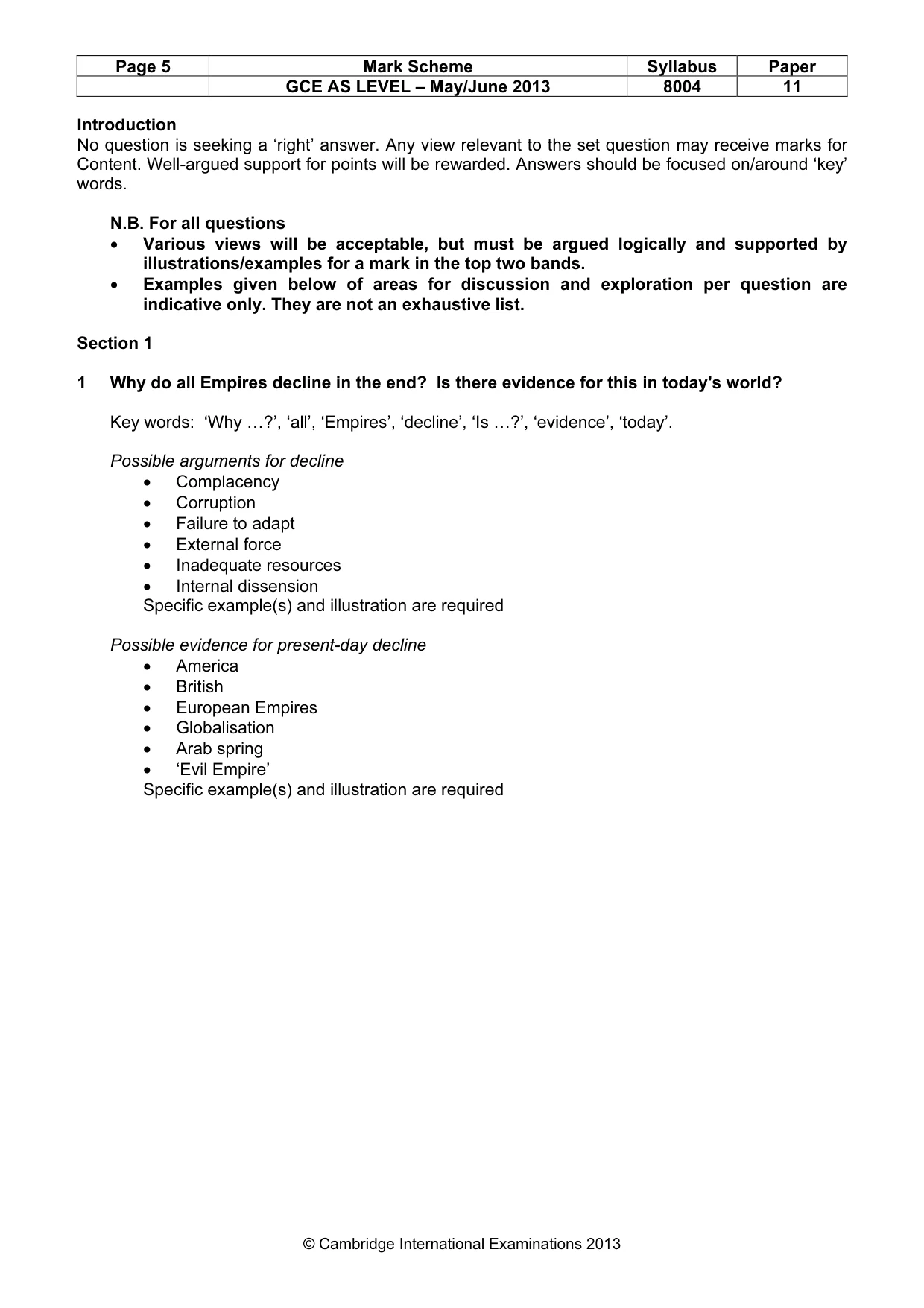
Page 5 Mark Scheme Syllabus Paper GCE AS LEVEL – May/June 2013 8004 11 © Cambridge International Examinations 2013 Introduction No question is seeking a ‘right’ answer. Any view relevant to the set question may receive marks for Content. Well-argued support for points will be rewarded. Answers should be focused on/around ‘key’ words. N.B. For all questions • Various views will be acceptable, but must be argued logically and supported by illustrations/examples for a mark in the top two bands. • Examples given below of areas for discussion and exploration per question are indicative only. They are not an exhaustive list. Section 1 1 Why do all Empires decline in the end? Is there evidence for this in today's world? Key words: ‘Why …?’, ‘all’, ‘Empires’, ‘decline’, ‘Is …?’, ‘evidence’, ‘today’. Possible arguments for decline • Complacency • Corruption • Failure to adapt • External force • Inadequate resources • Internal dissension Specific example(s) and illustration are required Possible evidence for present-day decline • America • British • European Empires • Globalisation • Arab spring • ‘Evil Empire’ Specific example(s) and illustration are required
Mark scheme, page 6
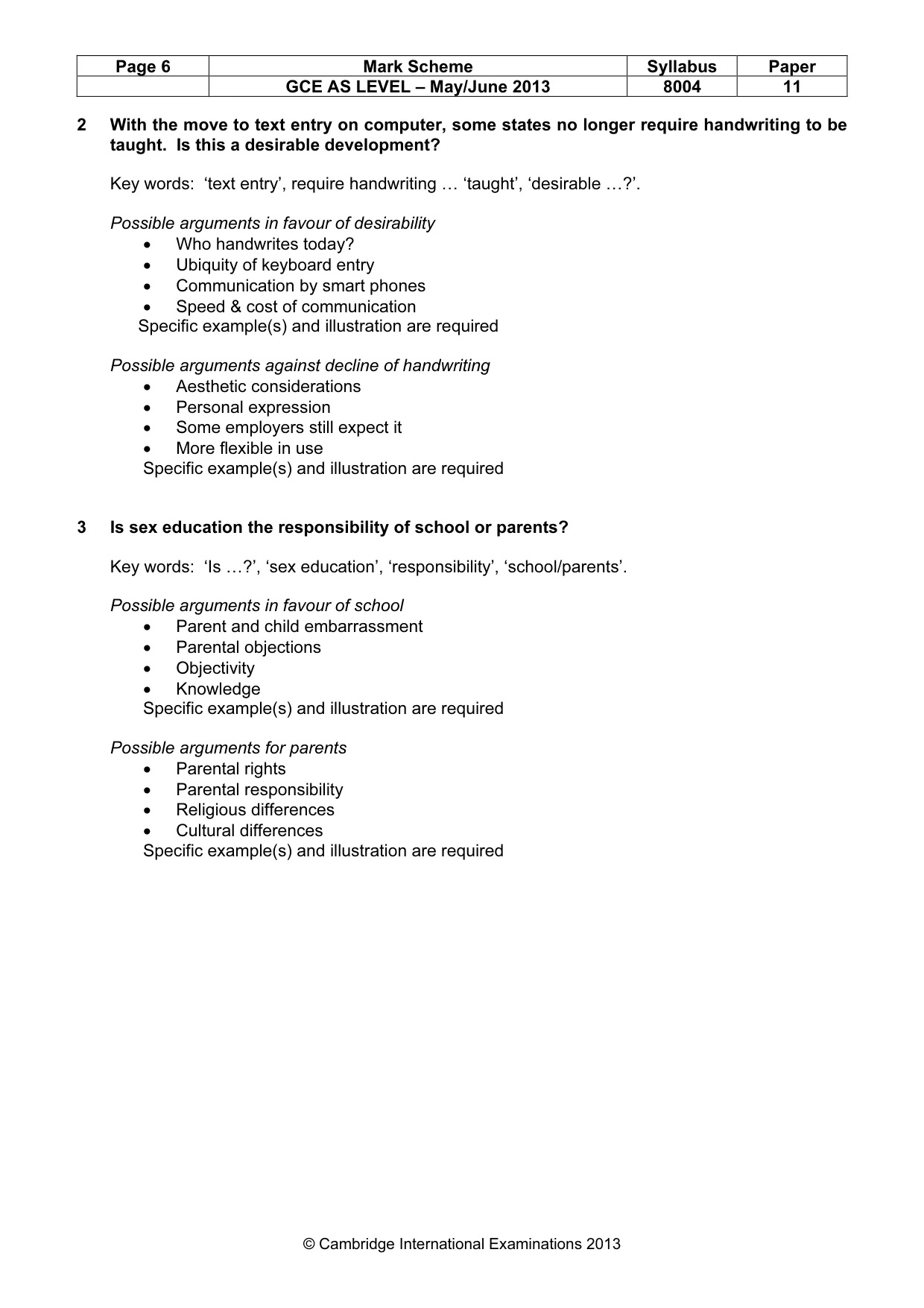
Page 6 Mark Scheme Syllabus Paper GCE AS LEVEL – May/June 2013 8004 11 © Cambridge International Examinations 2013 2 With the move to text entry on computer, some states no longer require handwriting to be taught. Is this a desirable development? Key words: ‘text entry’, require handwriting … ‘taught’, ‘desirable …?’. Possible arguments in favour of desirability • Who handwrites today? • Ubiquity of keyboard entry • Communication by smart phones • Speed & cost of communication Specific example(s) and illustration are required Possible arguments against decline of handwriting • Aesthetic considerations • Personal expression • Some employers still expect it • More flexible in use Specific example(s) and illustration are required 3 Is sex education the responsibility of school or parents? Key words: ‘Is …?’, ‘sex education’, ‘responsibility’, ‘school/parents’. Possible arguments in favour of school • Parent and child embarrassment • Parental objections • Objectivity • Knowledge Specific example(s) and illustration are required Possible arguments for parents • Parental rights • Parental responsibility • Religious differences • Cultural differences Specific example(s) and illustration are required
Mark scheme, page 7
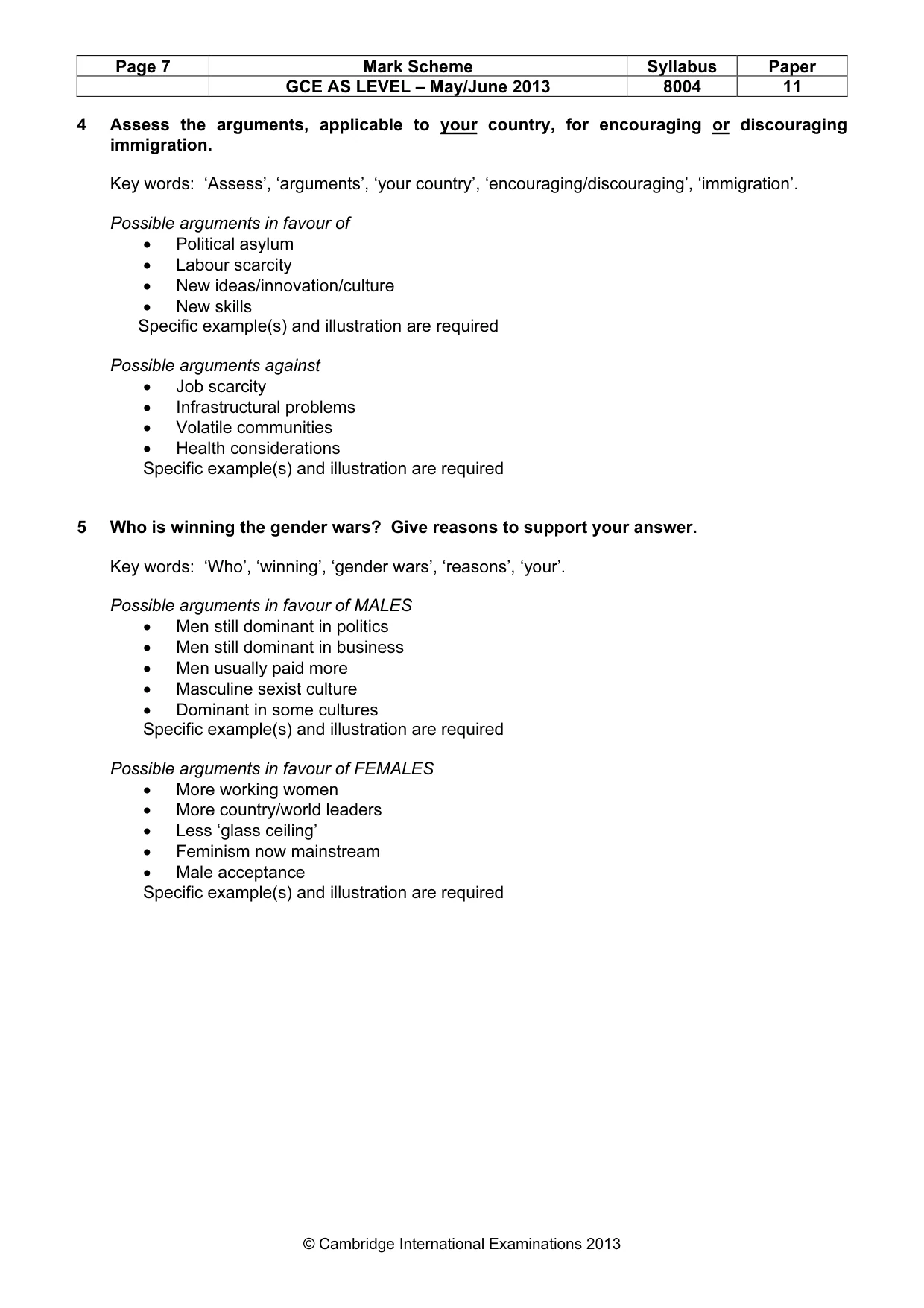
Page 7 Mark Scheme Syllabus Paper GCE AS LEVEL – May/June 2013 8004 11 © Cambridge International Examinations 2013 4 Assess the arguments, applicable to your country, for encouraging or discouraging immigration. Key words: ‘Assess’, ‘arguments’, ‘your country’, ‘encouraging/discouraging’, ‘immigration’. Possible arguments in favour of • Political asylum • Labour scarcity • New ideas/innovation/culture • New skills Specific example(s) and illustration are required Possible arguments against • Job scarcity • Infrastructural problems • Volatile communities • Health considerations Specific example(s) and illustration are required 5 Who is winning the gender wars? Give reasons to support your answer. Key words: ‘Who’, ‘winning’, ‘gender wars’, ‘reasons’, ‘your’. Possible arguments in favour of MALES • Men still dominant in politics • Men still dominant in business • Men usually paid more • Masculine sexist culture • Dominant in some cultures Specific example(s) and illustration are required Possible arguments in favour of FEMALES • More working women • More country/world leaders • Less ‘glass ceiling’ • Feminism now mainstream • Male acceptance Specific example(s) and illustration are required
Mark scheme, page 8
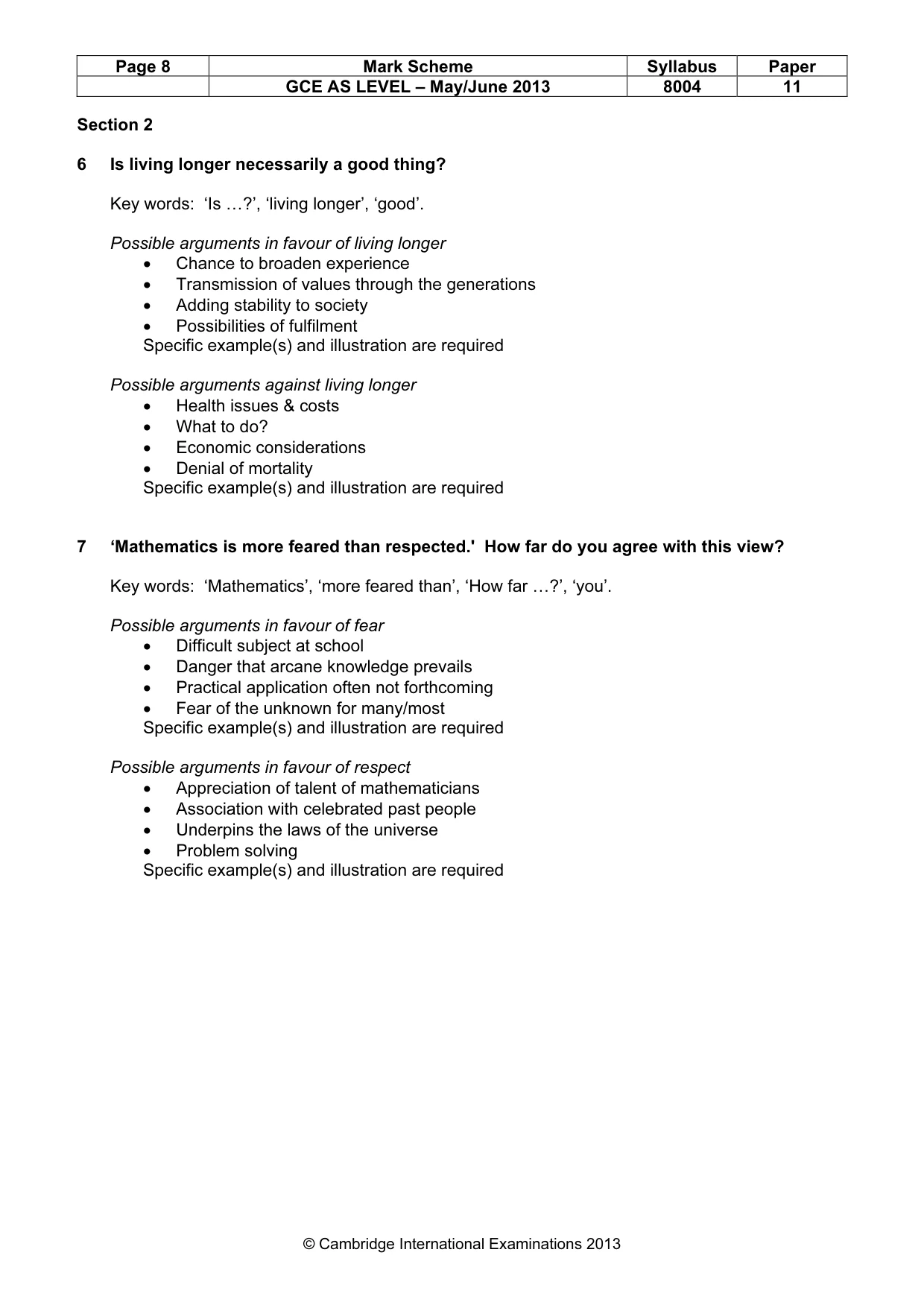
Page 8 Mark Scheme Syllabus Paper GCE AS LEVEL – May/June 2013 8004 11 © Cambridge International Examinations 2013 Section 2 6 Is living longer necessarily a good thing? Key words: ‘Is …?’, ‘living longer’, ‘good’. Possible arguments in favour of living longer • Chance to broaden experience • Transmission of values through the generations • Adding stability to society • Possibilities of fulfilment Specific example(s) and illustration are required Possible arguments against living longer • Health issues & costs • What to do? • Economic considerations • Denial of mortality Specific example(s) and illustration are required 7 ‘Mathematics is more feared than respected.' How far do you agree with this view? Key words: ‘Mathematics’, ‘more feared than’, ‘How far …?’, ‘you’. Possible arguments in favour of fear • Difficult subject at school • Danger that arcane knowledge prevails • Practical application often not forthcoming • Fear of the unknown for many/most Specific example(s) and illustration are required Possible arguments in favour of respect • Appreciation of talent of mathematicians • Association with celebrated past people • Underpins the laws of the universe • Problem solving Specific example(s) and illustration are required
Mark scheme, page 9
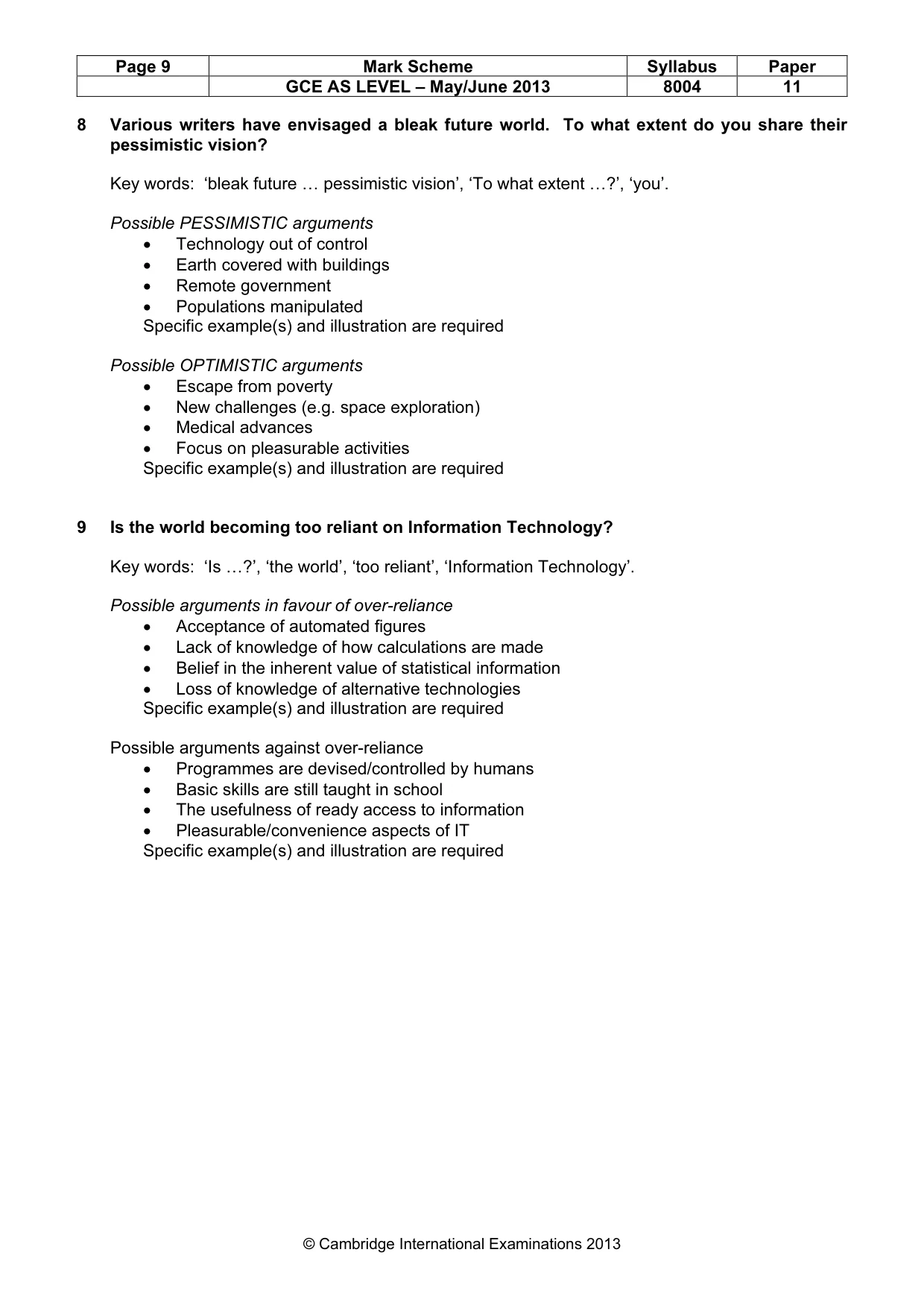
Page 9 Mark Scheme Syllabus Paper GCE AS LEVEL – May/June 2013 8004 11 © Cambridge International Examinations 2013 8 Various writers have envisaged a bleak future world. To what extent do you share their pessimistic vision? Key words: ‘bleak future … pessimistic vision’, ‘To what extent …?’, ‘you’. Possible PESSIMISTIC arguments • Technology out of control • Earth covered with buildings • Remote government • Populations manipulated Specific example(s) and illustration are required Possible OPTIMISTIC arguments • Escape from poverty • New challenges (e.g. space exploration) • Medical advances • Focus on pleasurable activities Specific example(s) and illustration are required 9 Is the world becoming too reliant on Information Technology? Key words: ‘Is …?’, ‘the world’, ‘too reliant’, ‘Information Technology’. Possible arguments in favour of over-reliance • Acceptance of automated figures • Lack of knowledge of how calculations are made • Belief in the inherent value of statistical information • Loss of knowledge of alternative technologies Specific example(s) and illustration are required Possible arguments against over-reliance • Programmes are devised/controlled by humans • Basic skills are still taught in school • The usefulness of ready access to information • Pleasurable/convenience aspects of IT Specific example(s) and illustration are required
Mark scheme, page 10
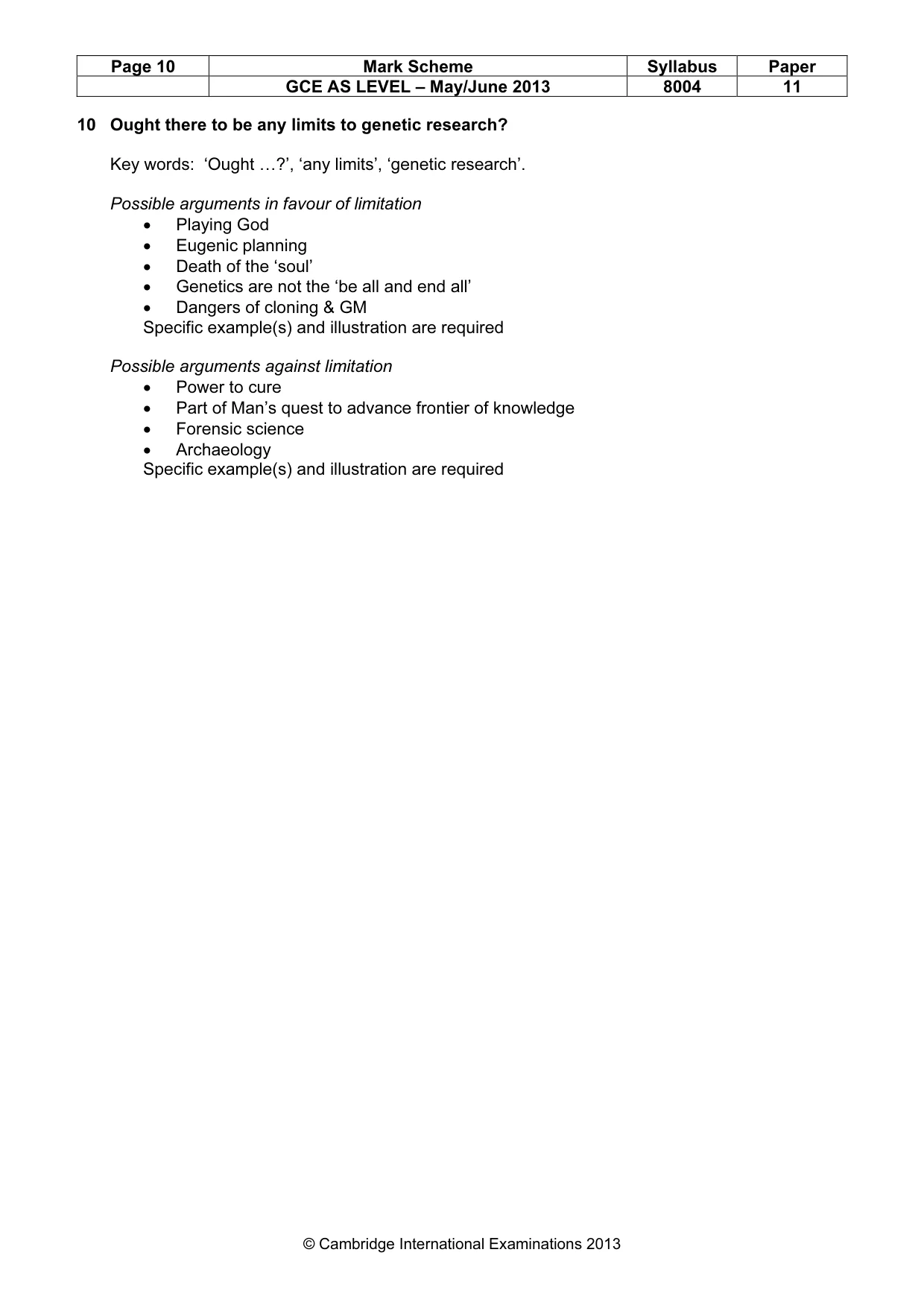
Page 10 Mark Scheme Syllabus Paper GCE AS LEVEL – May/June 2013 8004 11 © Cambridge International Examinations 2013 10 Ought there to be any limits to genetic research? Key words: ‘Ought …?’, ‘any limits’, ‘genetic research’. Possible arguments in favour of limitation • Playing God • Eugenic planning • Death of the ‘soul’ • Genetics are not the ‘be all and end all’ • Dangers of cloning & GM Specific example(s) and illustration are required Possible arguments against limitation • Power to cure • Part of Man’s quest to advance frontier of knowledge • Forensic science • Archaeology Specific example(s) and illustration are required
Mark scheme, page 11
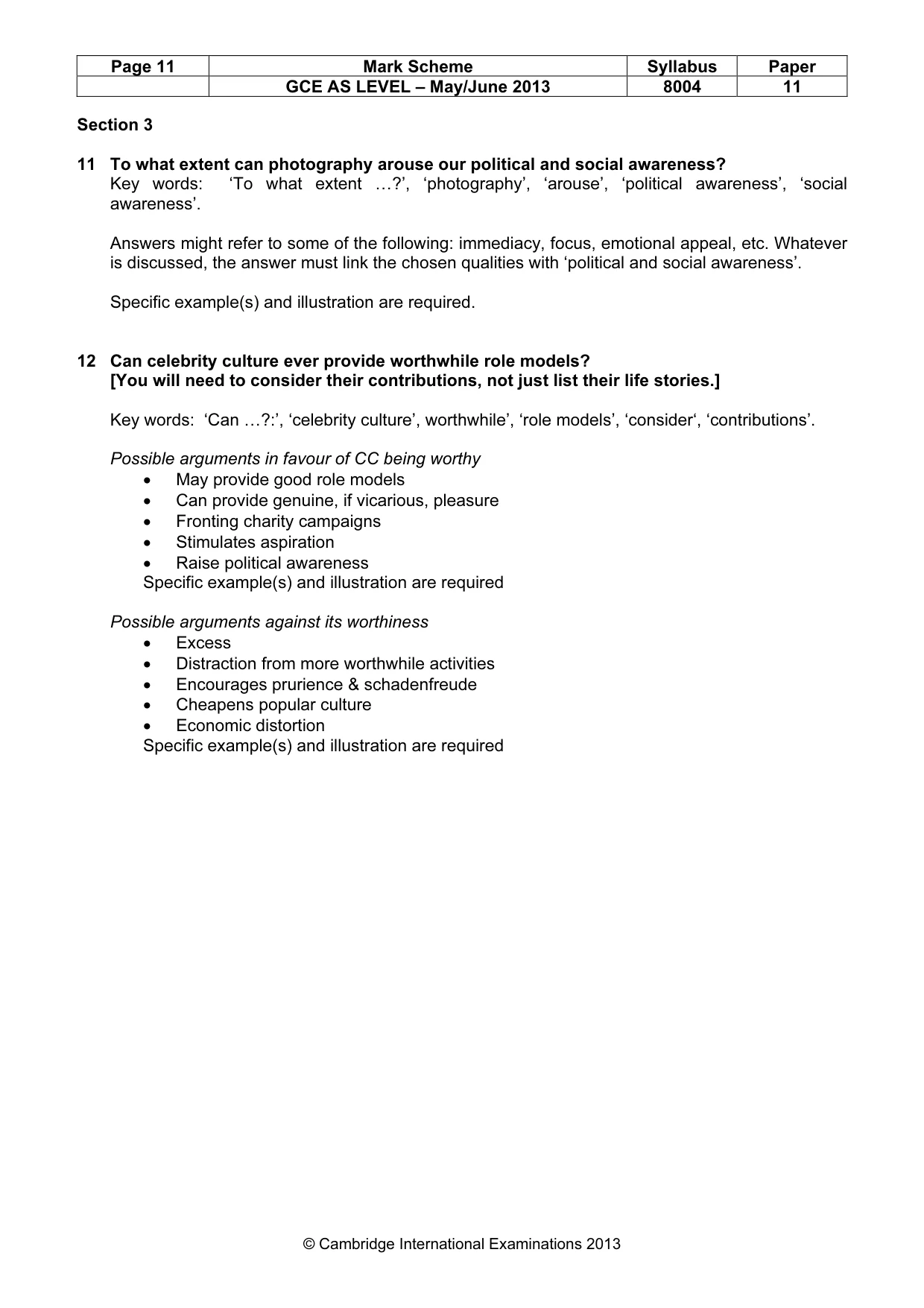
Page 11 Mark Scheme Syllabus Paper GCE AS LEVEL – May/June 2013 8004 11 © Cambridge International Examinations 2013 Section 3 11 To what extent can photography arouse our political and social awareness? Key words: ‘To what extent …?’, ‘photography’, ‘arouse’, ‘political awareness’, ‘social awareness’. Answers might refer to some of the following: immediacy, focus, emotional appeal, etc. Whatever is discussed, the answer must link the chosen qualities with ‘political and social awareness’. Specific example(s) and illustration are required. 12 Can celebrity culture ever provide worthwhile role models? [You will need to consider their contributions, not just list their life stories.] Key words: ‘Can …?:’, ‘celebrity culture’, worthwhile’, ‘role models’, ‘consider‘, ‘contributions’. Possible arguments in favour of CC being worthy • May provide good role models • Can provide genuine, if vicarious, pleasure • Fronting charity campaigns • Stimulates aspiration • Raise political awareness Specific example(s) and illustration are required Possible arguments against its worthiness • Excess • Distraction from more worthwhile activities • Encourages prurience & schadenfreude • Cheapens popular culture • Economic distortion Specific example(s) and illustration are required
Mark scheme, page 12
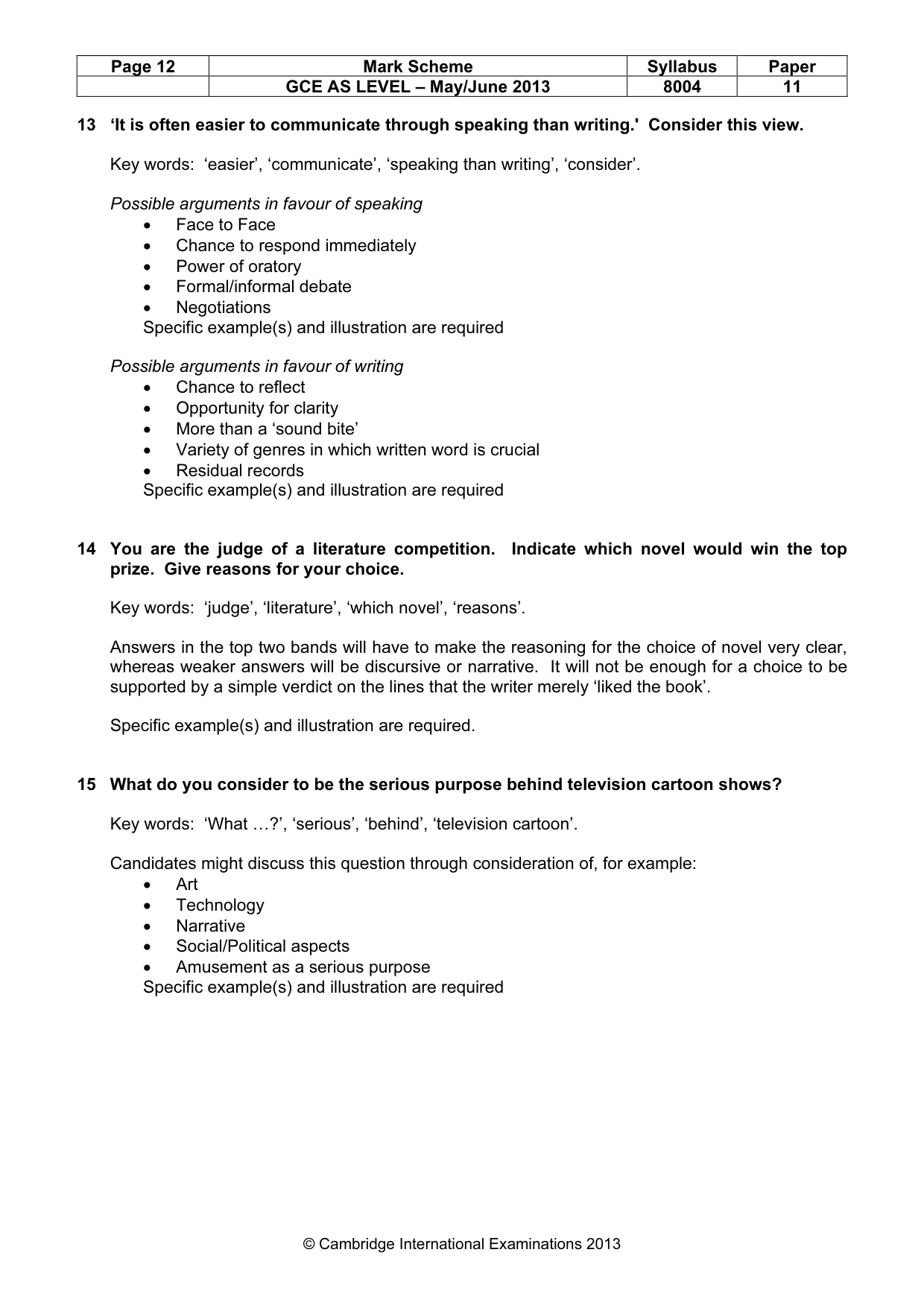
Page 12 Mark Scheme Syllabus Paper GCE AS LEVEL – May/June 2013 8004 11 © Cambridge International Examinations 2013 13 ‘It is often easier to communicate through speaking than writing.' Consider this view. Key words: ‘easier’, ‘communicate’, ‘speaking than writing’, ‘consider’. Possible arguments in favour of speaking • Face to Face • Chance to respond immediately • Power of oratory • Formal/informal debate • Negotiations Specific example(s) and illustration are required Possible arguments in favour of writing • Chance to reflect • Opportunity for clarity • More than a ‘sound bite’ • Variety of genres in which written word is crucial • Residual records Specific example(s) and illustration are required 14 You are the judge of a literature competition. Indicate which novel would win the top prize. Give reasons for your choice. Key words: ‘judge’, ‘literature’, ‘which novel’, ‘reasons’. Answers in the top two bands will have to make the reasoning for the choice of novel very clear, whereas weaker answers will be discursive or narrative. It will not be enough for a choice to be supported by a simple verdict on the lines that the writer merely ‘liked the book’. Specific example(s) and illustration are required. 15 What do you consider to be the serious purpose behind television cartoon shows? Key words: ‘What …?’, ‘serious’, ‘behind’, ‘television cartoon’. Candidates might discuss this question through consideration of, for example: • Art • Technology • Narrative • Social/Political aspects • Amusement as a serious purpose Specific example(s) and illustration are required
What you needed in this session
Cambridge’s own grade thresholds for 2013 May/June, Paper 1 · Variant 1. A higher threshold means an easier paper — the bar moves with how the cohort did.