Cambridge A Level General Paper (AS Level only) 8004 — 2011 Oct/Nov Paper 1 · Variant 2
8004/12/O/N/11 · 100 marks · ≈113 min
The question paper and its mark scheme, free to read here and free to download. This is Cambridge’s own paper, exactly as it was sat.
Question paper2 pages
Mark scheme9 pages
Answers below. Sit the paper first if you are practising.
Paper as text
Question paper, page 1
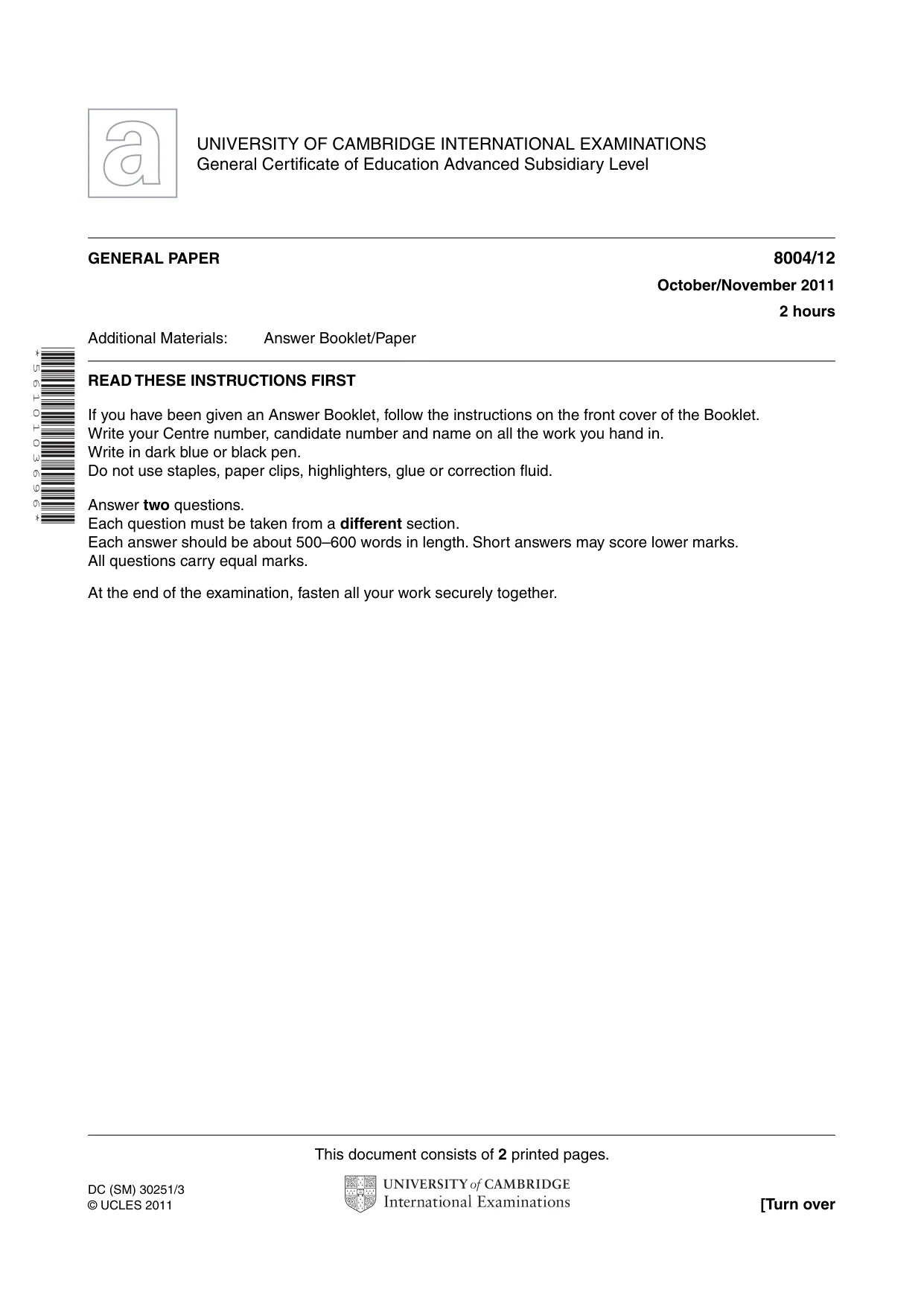
* 5 6 1 0 1 0 3 6 9 6 * This document consists of 2 printed pages. DC (SM) 30251/3 © UCLES 2011 [Turn over UNIVERSITY OF CAMBRIDGE INTERNATIONAL EXAMINATIONS General Certificate of Education Advanced Subsidiary Level READ THESE INSTRUCTIONS FIRST If you have been given an Answer Booklet, follow the instructions on the front cover of the Booklet. Write your Centre number, candidate number and name on all the work you hand in. Write in dark blue or black pen. Do not use staples, paper clips, highlighters, glue or correction fluid. Answer two questions. Each question must be taken from a different section. Each answer should be about 500–600 words in length. Short answers may score lower marks. All questions carry equal marks. At the end of the examination, fasten all your work securely together. GENERAL PAPER 8004/12 October/November 2011 2 hours Additional Materials: Answer Booklet/Paper
Question paper, page 2
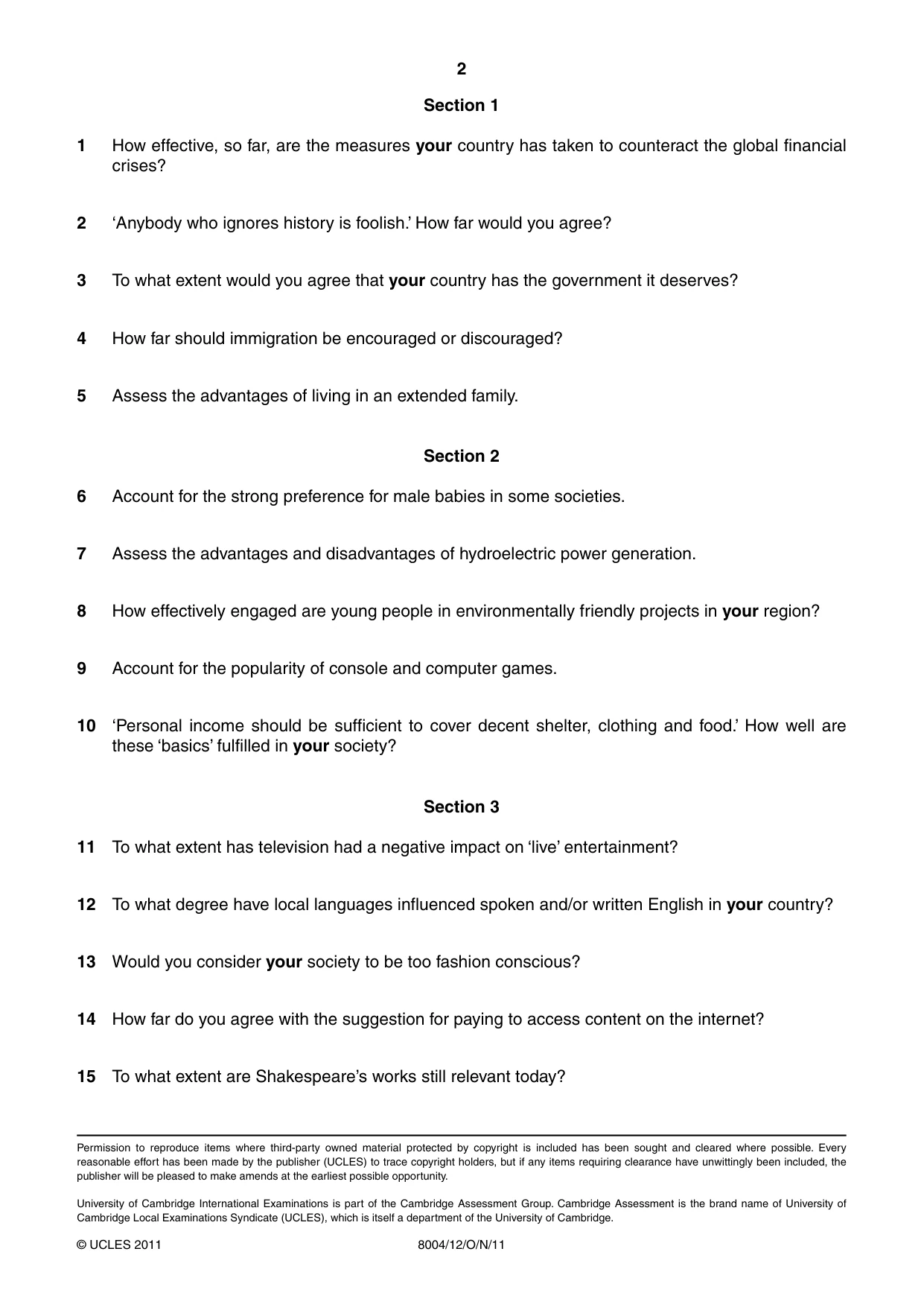
2 8004/12/O/N/11 © UCLES 2011 Permission to reproduce items where third-party owned material protected by copyright is included has been sought and cleared where possible. Every reasonable effort has been made by the publisher (UCLES) to trace copyright holders, but if any items requiring clearance have unwittingly been included, the publisher will be pleased to make amends at the earliest possible opportunity. University of Cambridge International Examinations is part of the Cambridge Assessment Group. Cambridge Assessment is the brand name of University of Cambridge Local Examinations Syndicate (UCLES), which is itself a department of the University of Cambridge. Section 1 1 How effective, so far, are the measures your country has taken to counteract the global financial crises? 2 ‘Anybody who ignores history is foolish.’ How far would you agree? 3 To what extent would you agree that your country has the government it deserves? 4 How far should immigration be encouraged or discouraged? 5 Assess the advantages of living in an extended family. Section 2 6 Account for the strong preference for male babies in some societies. 7 Assess the advantages and disadvantages of hydroelectric power generation. 8 How effectively engaged are young people in environmentally friendly projects in your region? 9 Account for the popularity of console and computer games. 10 ‘Personal income should be sufficient to cover decent shelter, clothing and food.’ How well are these ‘basics’ fulfilled in your society? Section 3 11 To what extent has television had a negative impact on ‘live’ entertainment? 12 To what degree have local languages influenced spoken and/or written English in your country? 13 Would you consider your society to be too fashion conscious? 14 How far do you agree with the suggestion for paying to access content on the internet? 15 To what extent are Shakespeare’s works still relevant today?
Mark scheme, page 1
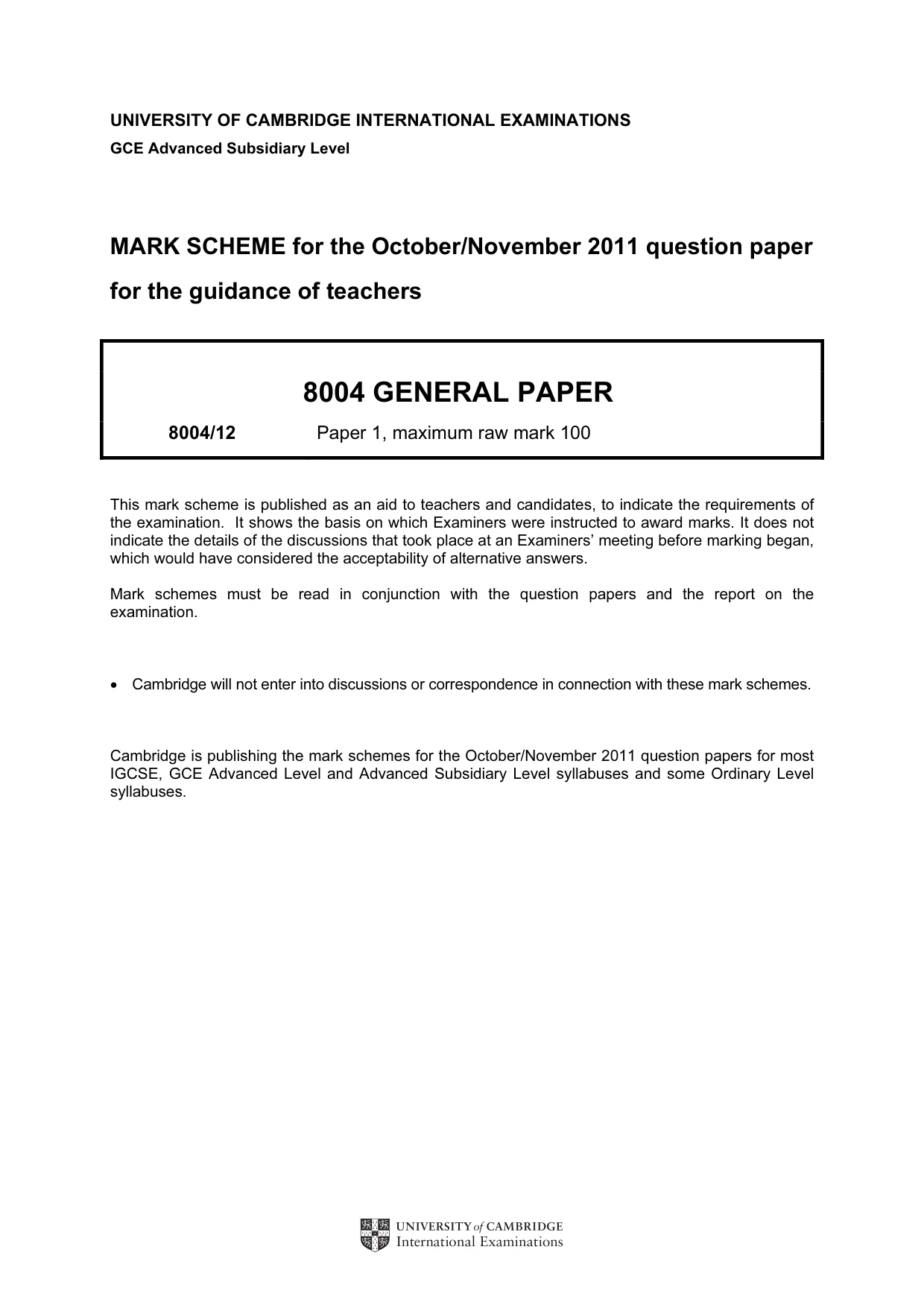
UNIVERSITY OF CAMBRIDGE INTERNATIONAL EXAMINATIONS GCE Advanced Subsidiary Level MARK SCHEME for the October/November 2011 question paper for the guidance of teachers 8004 GENERAL PAPER 8004/12 Paper 1, maximum raw mark 100 This mark scheme is published as an aid to teachers and candidates, to indicate the requirements of the examination. It shows the basis on which Examiners were instructed to award marks. It does not indicate the details of the discussions that took place at an Examiners’ meeting before marking began, which would have considered the acceptability of alternative answers. Mark schemes must be read in conjunction with the question papers and the report on the examination. • Cambridge will not enter into discussions or correspondence in connection with these mark schemes. Cambridge is publishing the mark schemes for the October/November 2011 question papers for most IGCSE, GCE Advanced Level and Advanced Subsidiary Level syllabuses and some Ordinary Level syllabuses.
Mark scheme, page 2
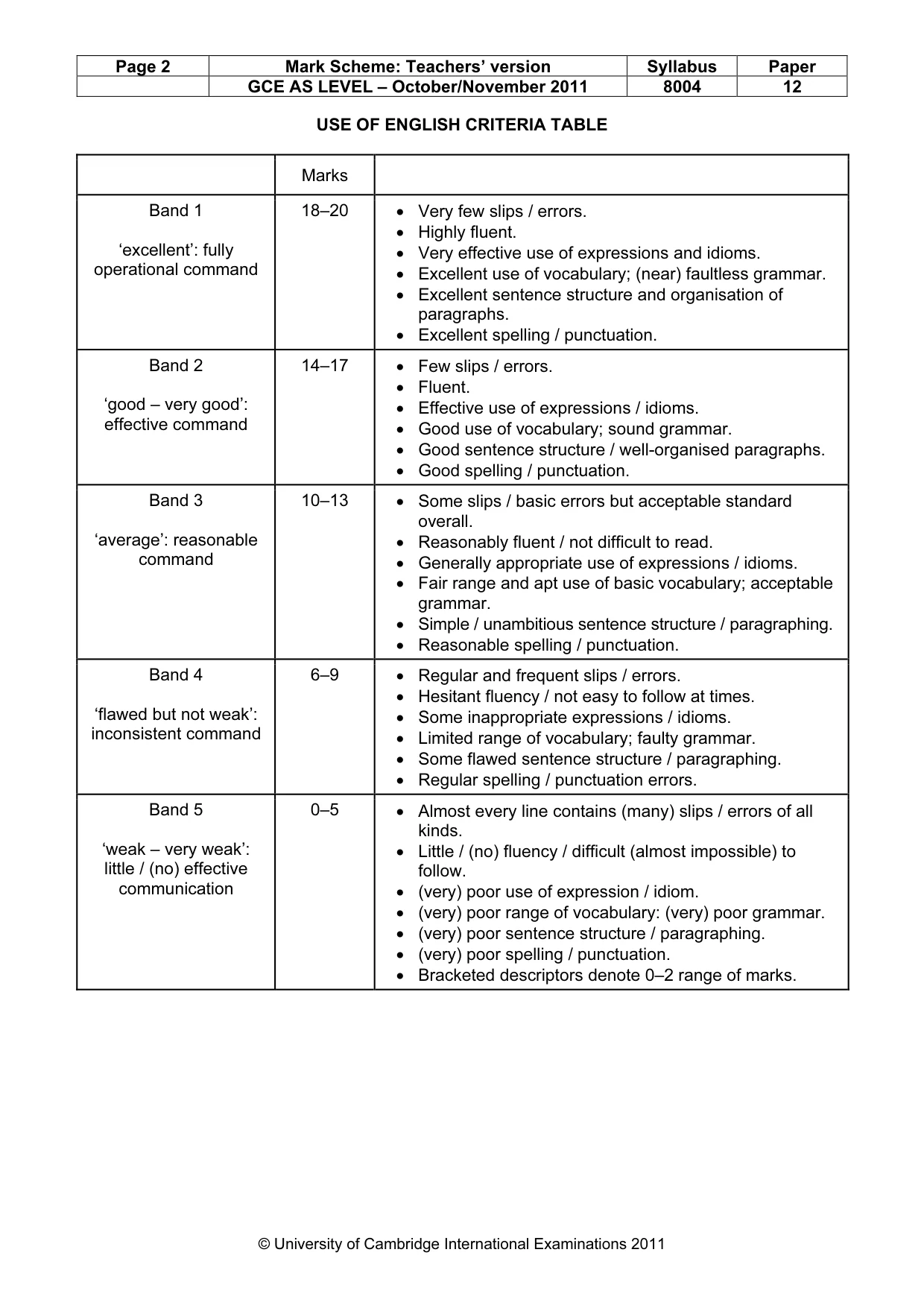
Page 2 Mark Scheme: Teachers’ version Syllabus Paper GCE AS LEVEL – October/November 2011 8004 12 © University of Cambridge International Examinations 2011 USE OF ENGLISH CRITERIA TABLE Marks Band 1 ‘excellent’: fully operational command 18–20 • Very few slips / errors. • Highly fluent. • Very effective use of expressions and idioms. • Excellent use of vocabulary; (near) faultless grammar. • Excellent sentence structure and organisation of paragraphs. • Excellent spelling / punctuation. Band 2 ‘good – very good’: effective command 14–17 • Few slips / errors. • Fluent. • Effective use of expressions / idioms. • Good use of vocabulary; sound grammar. • Good sentence structure / well-organised paragraphs. • Good spelling / punctuation. Band 3 ‘average’: reasonable command 10–13 • Some slips / basic errors but acceptable standard overall. • Reasonably fluent / not difficult to read. • Generally appropriate use of expressions / idioms. • Fair range and apt use of basic vocabulary; acceptable grammar. • Simple / unambitious sentence structure / paragraphing. • Reasonable spelling / punctuation. Band 4 ‘flawed but not weak’: inconsistent command 6–9 • Regular and frequent slips / errors. • Hesitant fluency / not easy to follow at times. • Some inappropriate expressions / idioms. • Limited range of vocabulary; faulty grammar. • Some flawed sentence structure / paragraphing. • Regular spelling / punctuation errors. Band 5 ‘weak – very weak’: little / (no) effective communication 0–5 • Almost every line contains (many) slips / errors of all kinds. • Little / (no) fluency / difficult (almost impossible) to follow. • (very) poor use of expression / idiom. • (very) poor range of vocabulary: (very) poor grammar. • (very) poor sentence structure / paragraphing. • (very) poor spelling / punctuation. • Bracketed descriptors denote 0–2 range of marks.
Mark scheme, page 3
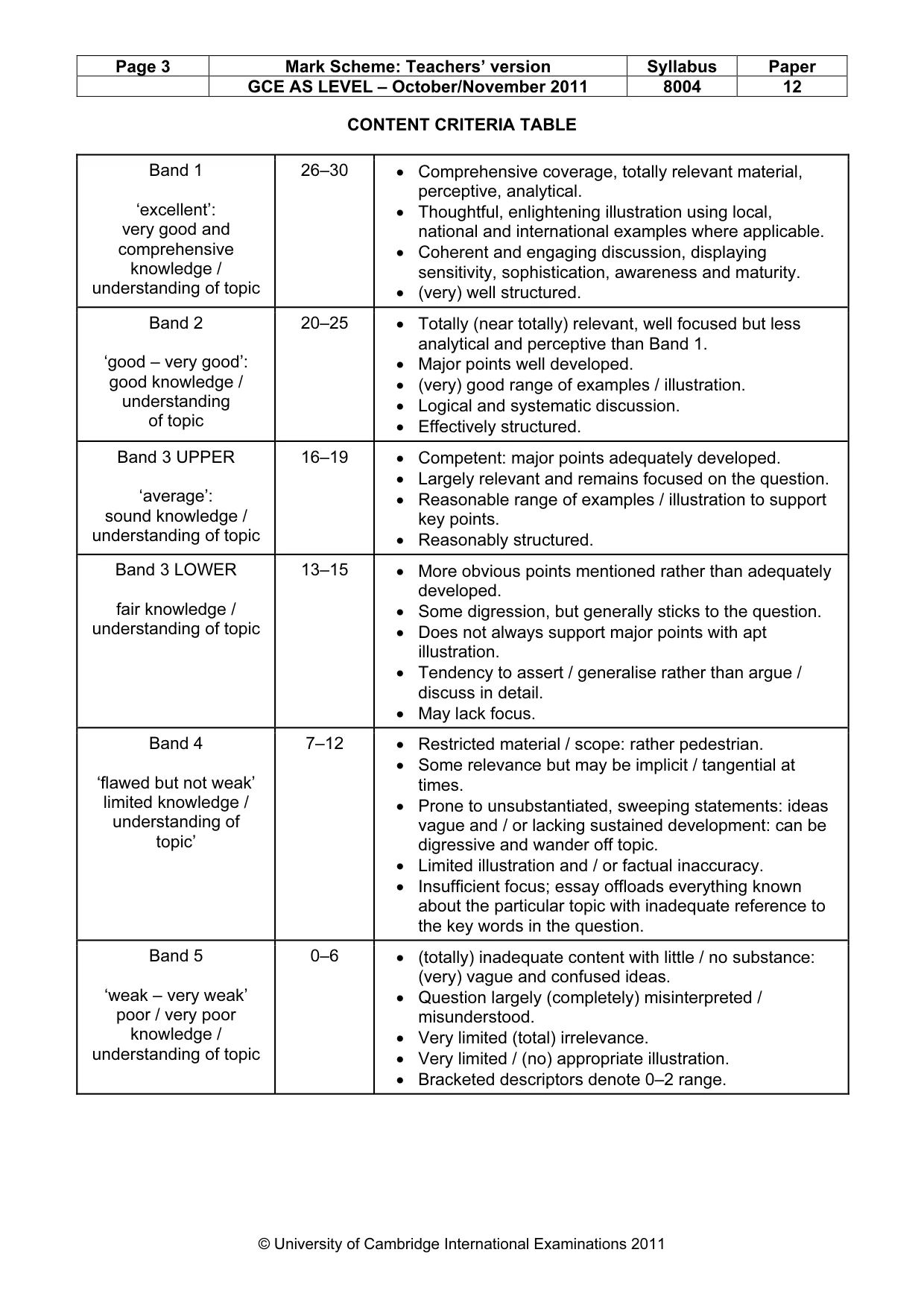
Page 3 Mark Scheme: Teachers’ version Syllabus Paper GCE AS LEVEL – October/November 2011 8004 12 © University of Cambridge International Examinations 2011 CONTENT CRITERIA TABLE Band 1 ‘excellent’: very good and comprehensive knowledge / understanding of topic 26–30 • Comprehensive coverage, totally relevant material, perceptive, analytical. • Thoughtful, enlightening illustration using local, national and international examples where applicable. • Coherent and engaging discussion, displaying sensitivity, sophistication, awareness and maturity. • (very) well structured. Band 2 ‘good – very good’: good knowledge / understanding of topic 20–25 • Totally (near totally) relevant, well focused but less analytical and perceptive than Band 1. • Major points well developed. • (very) good range of examples / illustration. • Logical and systematic discussion. • Effectively structured. Band 3 UPPER ‘average’: sound knowledge / understanding of topic 16–19 • Competent: major points adequately developed. • Largely relevant and remains focused on the question. • Reasonable range of examples / illustration to support key points. • Reasonably structured. Band 3 LOWER fair knowledge / understanding of topic 13–15 • More obvious points mentioned rather than adequately developed. • Some digression, but generally sticks to the question. • Does not always support major points with apt illustration. • Tendency to assert / generalise rather than argue / discuss in detail. • May lack focus. Band 4 ‘flawed but not weak’ limited knowledge / understanding of topic’ 7–12 • Restricted material / scope: rather pedestrian. • Some relevance but may be implicit / tangential at times. • Prone to unsubstantiated, sweeping statements: ideas vague and / or lacking sustained development: can be digressive and wander off topic. • Limited illustration and / or factual inaccuracy. • Insufficient focus; essay offloads everything known about the particular topic with inadequate reference to the key words in the question. Band 5 ‘weak – very weak’ poor / very poor knowledge / understanding of topic 0–6 • (totally) inadequate content with little / no substance: (very) vague and confused ideas. • Question largely (completely) misinterpreted / misunderstood. • Very limited (total) irrelevance. • Very limited / (no) appropriate illustration. • Bracketed descriptors denote 0–2 range.
Mark scheme, page 4
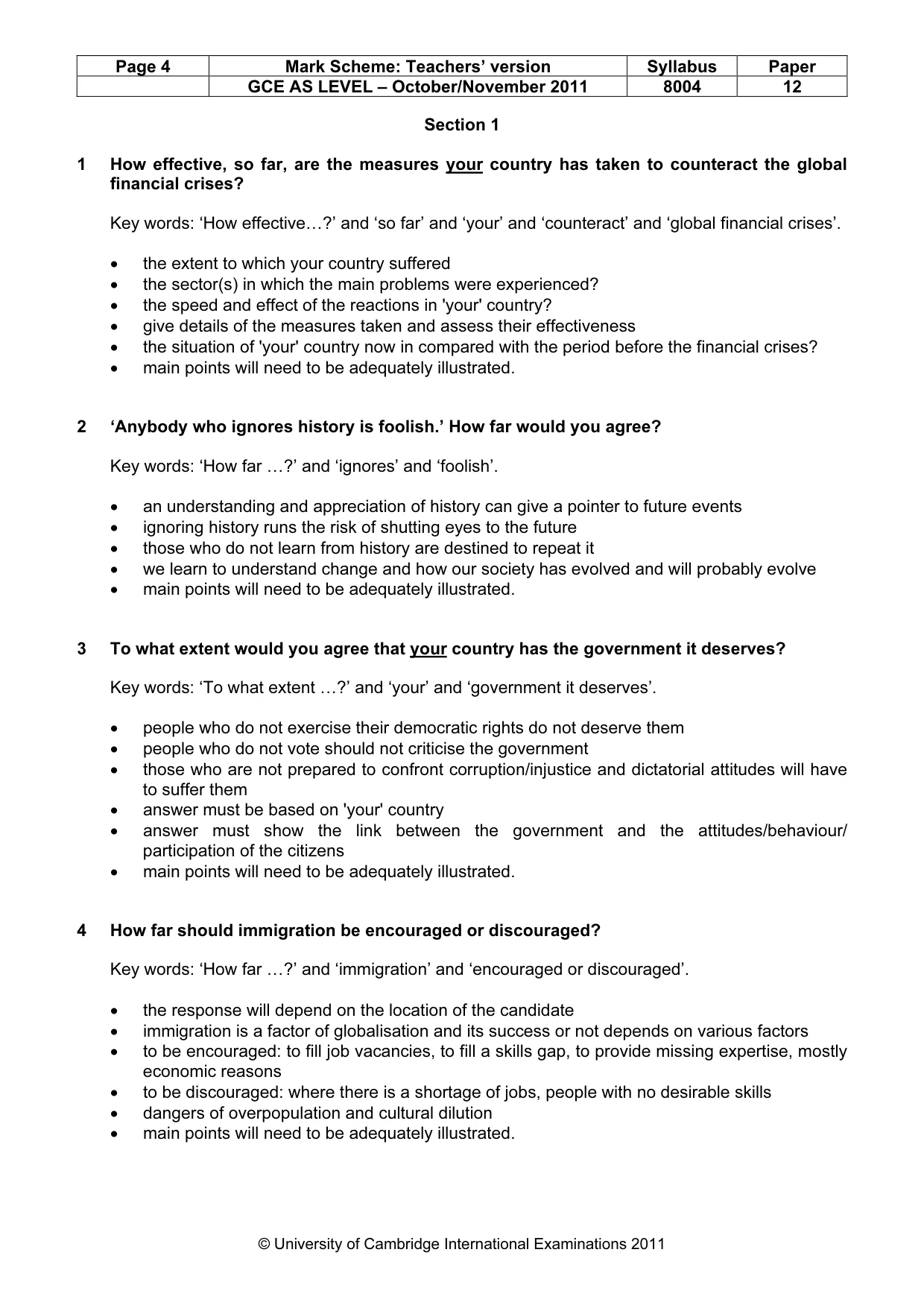
Page 4 Mark Scheme: Teachers’ version Syllabus Paper GCE AS LEVEL – October/November 2011 8004 12 © University of Cambridge International Examinations 2011 Section 1 1 How effective, so far, are the measures your country has taken to counteract the global financial crises? Key words: ‘How effective…?’ and ‘so far’ and ‘your’ and ‘counteract’ and ‘global financial crises’. • the extent to which your country suffered • the sector(s) in which the main problems were experienced? • the speed and effect of the reactions in 'your' country? • give details of the measures taken and assess their effectiveness • the situation of 'your' country now in compared with the period before the financial crises? • main points will need to be adequately illustrated. 2 ‘Anybody who ignores history is foolish.’ How far would you agree? Key words: ‘How far …?’ and ‘ignores’ and ‘foolish’. • an understanding and appreciation of history can give a pointer to future events • ignoring history runs the risk of shutting eyes to the future • those who do not learn from history are destined to repeat it • we learn to understand change and how our society has evolved and will probably evolve • main points will need to be adequately illustrated. 3 To what extent would you agree that your country has the government it deserves? Key words: ‘To what extent …?’ and ‘your’ and ‘government it deserves’. • people who do not exercise their democratic rights do not deserve them • people who do not vote should not criticise the government • those who are not prepared to confront corruption/injustice and dictatorial attitudes will have to suffer them • answer must be based on 'your' country • answer must show the link between the government and the attitudes/behaviour/ participation of the citizens • main points will need to be adequately illustrated. 4 How far should immigration be encouraged or discouraged? Key words: ‘How far …?’ and ‘immigration’ and ‘encouraged or discouraged’. • the response will depend on the location of the candidate • immigration is a factor of globalisation and its success or not depends on various factors • to be encouraged: to fill job vacancies, to fill a skills gap, to provide missing expertise, mostly economic reasons • to be discouraged: where there is a shortage of jobs, people with no desirable skills • dangers of overpopulation and cultural dilution • main points will need to be adequately illustrated.
Mark scheme, page 5
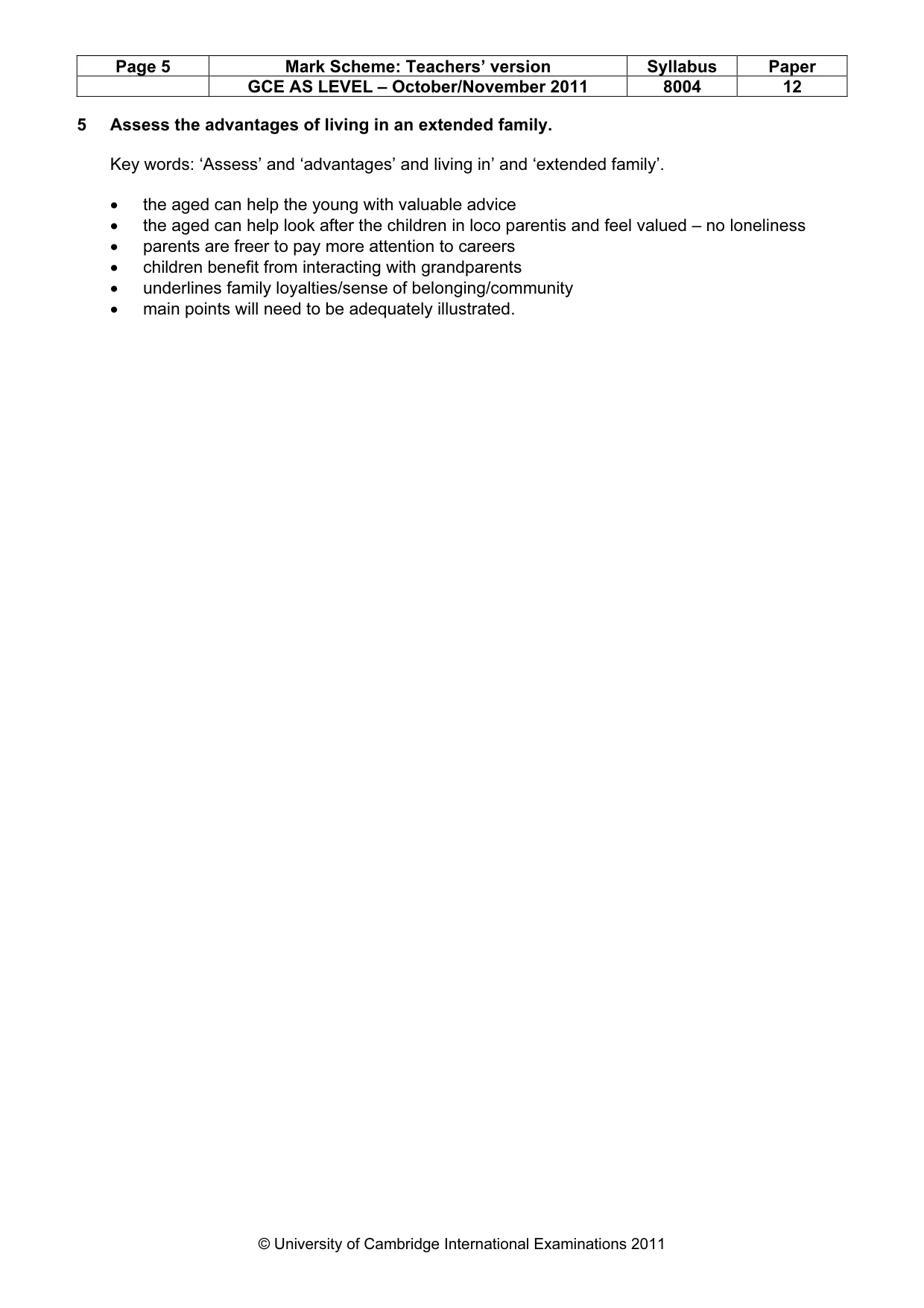
Page 5 Mark Scheme: Teachers’ version Syllabus Paper GCE AS LEVEL – October/November 2011 8004 12 © University of Cambridge International Examinations 2011 5 Assess the advantages of living in an extended family. Key words: ‘Assess’ and ‘advantages’ and living in’ and ‘extended family’. • the aged can help the young with valuable advice • the aged can help look after the children in loco parentis and feel valued – no loneliness • parents are freer to pay more attention to careers • children benefit from interacting with grandparents • underlines family loyalties/sense of belonging/community • main points will need to be adequately illustrated.
Mark scheme, page 6
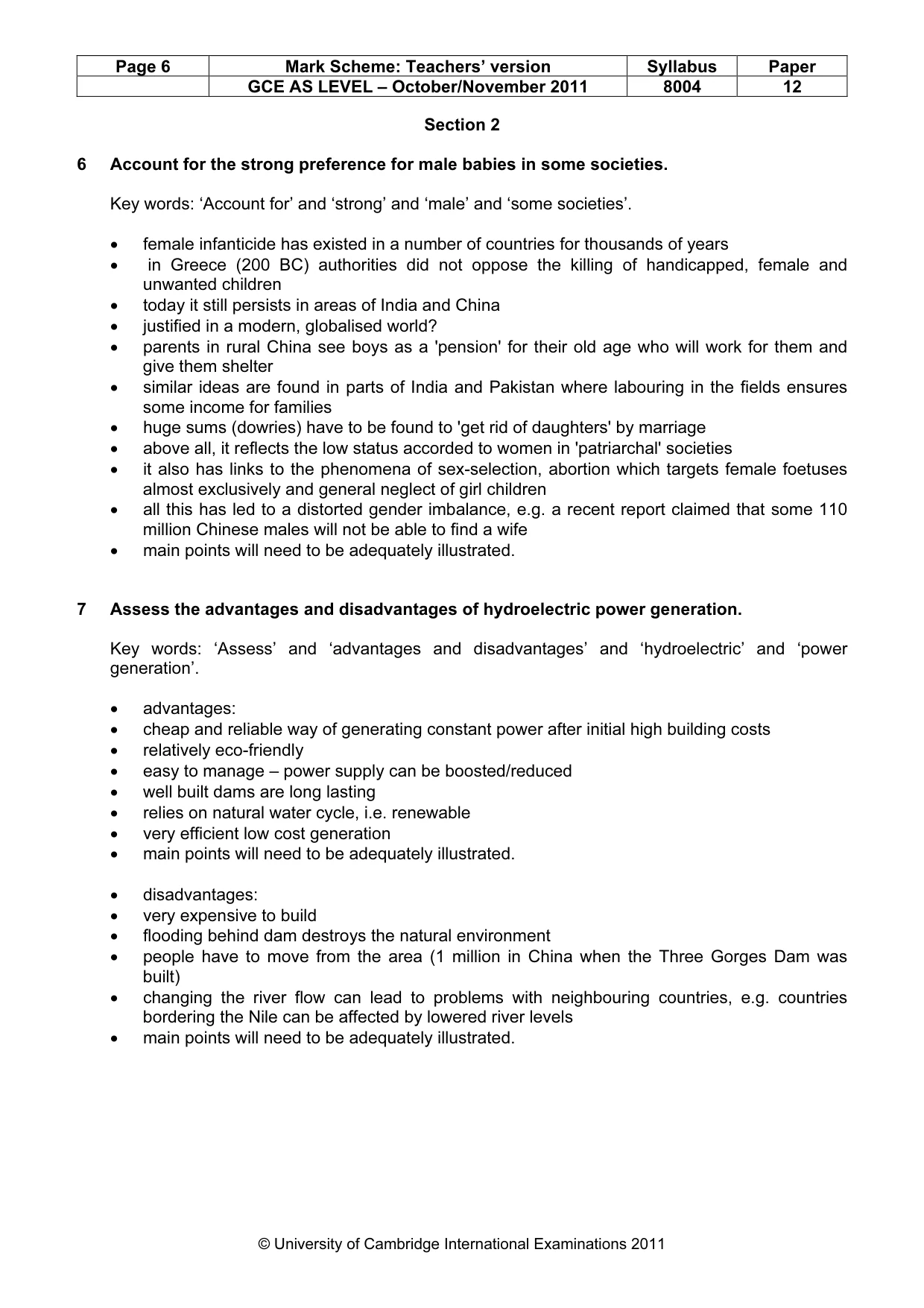
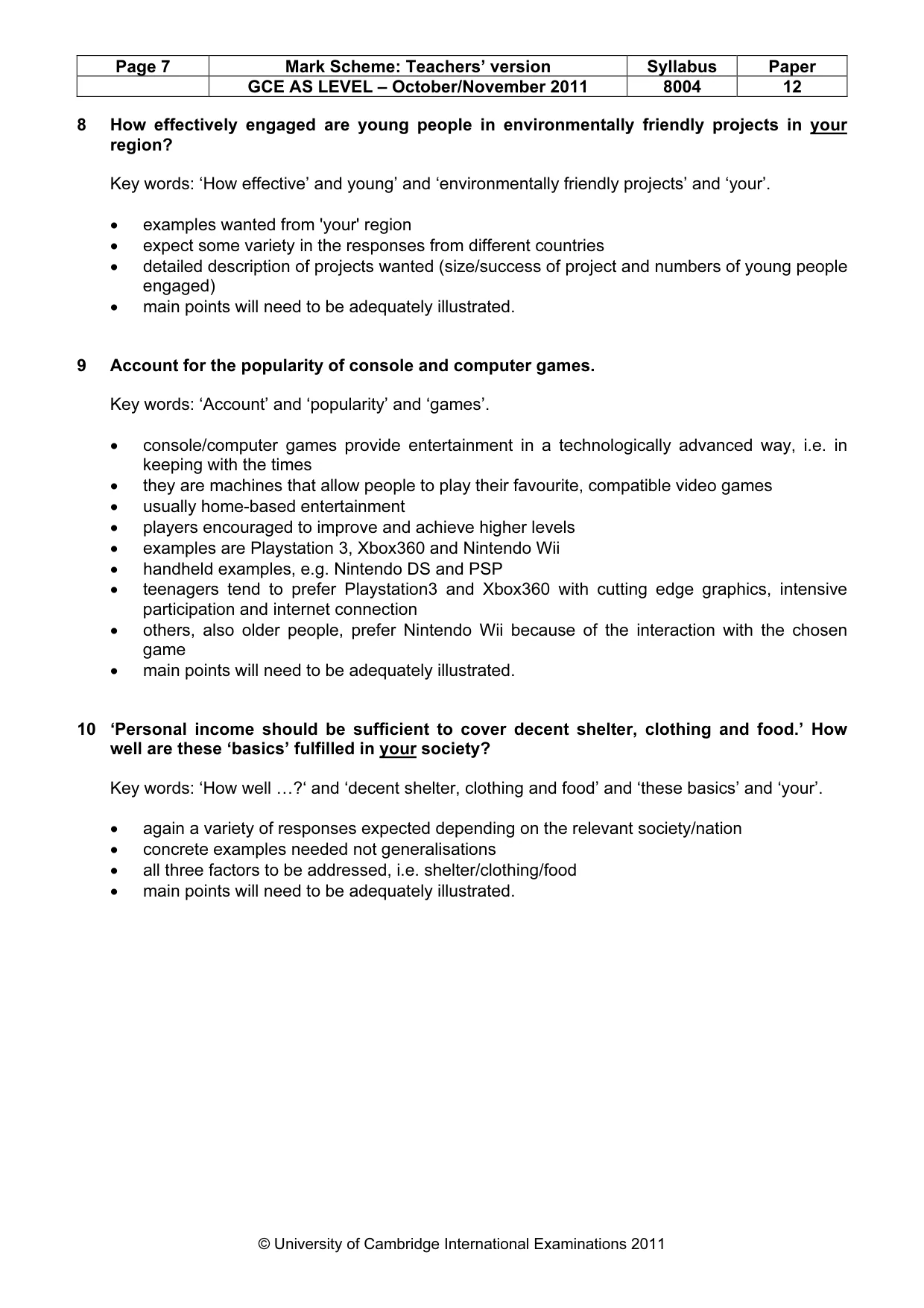
Page 6 Mark Scheme: Teachers’ version Syllabus Paper GCE AS LEVEL – October/November 2011 8004 12 © University of Cambridge International Examinations 2011 Section 2 6 Account for the strong preference for male babies in some societies. Key words: ‘Account for’ and ‘strong’ and ‘male’ and ‘some societies’. • female infanticide has existed in a number of countries for thousands of years • in Greece (200 BC) authorities did not oppose the killing of handicapped, female and unwanted children • today it still persists in areas of India and China • justified in a modern, globalised world? • parents in rural China see boys as a 'pension' for their old age who will work for them and give them shelter • similar ideas are found in parts of India and Pakistan where labouring in the fields ensures some income for families • huge sums (dowries) have to be found to 'get rid of daughters' by marriage • above all, it reflects the low status accorded to women in 'patriarchal' societies • it also has links to the phenomena of sex-selection, abortion which targets female foetuses almost exclusively and general neglect of girl children • all this has led to a distorted gender imbalance, e.g. a recent report claimed that some 110 million Chinese males will not be able to find a wife • main points will need to be adequately illustrated. 7 Assess the advantages and disadvantages of hydroelectric power generation. Key words: ‘Assess’ and ‘advantages and disadvantages’ and ‘hydroelectric’ and ‘power generation’. • advantages: • cheap and reliable way of generating constant power after initial high building costs • relatively eco-friendly • easy to manage – power supply can be boosted/reduced • well built dams are long lasting • relies on natural water cycle, i.e. renewable • very efficient low cost generation • main points will need to be adequately illustrated. • disadvantages: • very expensive to build • flooding behind dam destroys the natural environment • people have to move from the area (1 million in China when the Three Gorges Dam was built) • changing the river flow can lead to problems with neighbouring countries, e.g. countries bordering the Nile can be affected by lowered river levels • main points will need to be adequately illustrated.
Mark scheme, page 7
Page 7 Mark Scheme: Teachers’ version Syllabus Paper GCE AS LEVEL – October/November 2011 8004 12 © University of Cambridge International Examinations 2011 8 How effectively engaged are young people in environmentally friendly projects in your region? Key words: ‘How effective’ and young’ and ‘environmentally friendly projects’ and ‘your’. • examples wanted from 'your' region • expect some variety in the responses from different countries • detailed description of projects wanted (size/success of project and numbers of young people engaged) • main points will need to be adequately illustrated. 9 Account for the popularity of console and computer games. Key words: ‘Account’ and ‘popularity’ and ‘games’. • console/computer games provide entertainment in a technologically advanced way, i.e. in keeping with the times • they are machines that allow people to play their favourite, compatible video games • usually home-based entertainment • players encouraged to improve and achieve higher levels • examples are Playstation 3, Xbox360 and Nintendo Wii • handheld examples, e.g. Nintendo DS and PSP • teenagers tend to prefer Playstation3 and Xbox360 with cutting edge graphics, intensive participation and internet connection • others, also older people, prefer Nintendo Wii because of the interaction with the chosen game • main points will need to be adequately illustrated. 10 ‘Personal income should be sufficient to cover decent shelter, clothing and food.’ How well are these ‘basics’ fulfilled in your society? Key words: ‘How well …?‘ and ‘decent shelter, clothing and food’ and ‘these basics’ and ‘your’. • again a variety of responses expected depending on the relevant society/nation • concrete examples needed not generalisations • all three factors to be addressed, i.e. shelter/clothing/food • main points will need to be adequately illustrated.
Mark scheme, page 8
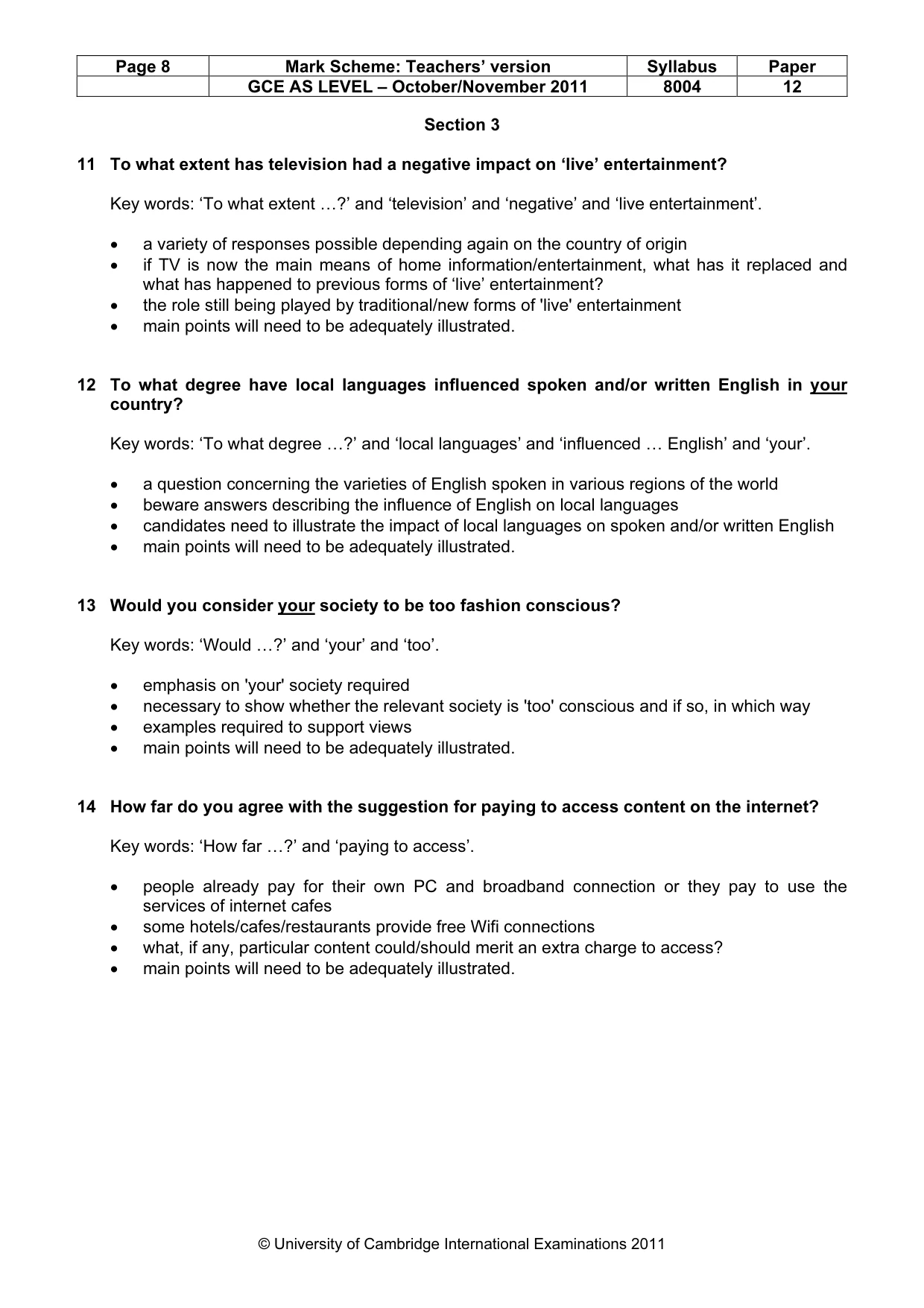
Page 8 Mark Scheme: Teachers’ version Syllabus Paper GCE AS LEVEL – October/November 2011 8004 12 © University of Cambridge International Examinations 2011 Section 3 11 To what extent has television had a negative impact on ‘live’ entertainment? Key words: ‘To what extent …?’ and ‘television’ and ‘negative’ and ‘live entertainment’. • a variety of responses possible depending again on the country of origin • if TV is now the main means of home information/entertainment, what has it replaced and what has happened to previous forms of ‘live’ entertainment? • the role still being played by traditional/new forms of 'live' entertainment • main points will need to be adequately illustrated. 12 To what degree have local languages influenced spoken and/or written English in your country? Key words: ‘To what degree …?’ and ‘local languages’ and ‘influenced … English’ and ‘your’. • a question concerning the varieties of English spoken in various regions of the world • beware answers describing the influence of English on local languages • candidates need to illustrate the impact of local languages on spoken and/or written English • main points will need to be adequately illustrated. 13 Would you consider your society to be too fashion conscious? Key words: ‘Would …?’ and ‘your’ and ‘too’. • emphasis on 'your' society required • necessary to show whether the relevant society is 'too' conscious and if so, in which way • examples required to support views • main points will need to be adequately illustrated. 14 How far do you agree with the suggestion for paying to access content on the internet? Key words: ‘How far …?’ and ‘paying to access’. • people already pay for their own PC and broadband connection or they pay to use the services of internet cafes • some hotels/cafes/restaurants provide free Wifi connections • what, if any, particular content could/should merit an extra charge to access? • main points will need to be adequately illustrated.
Mark scheme, page 9
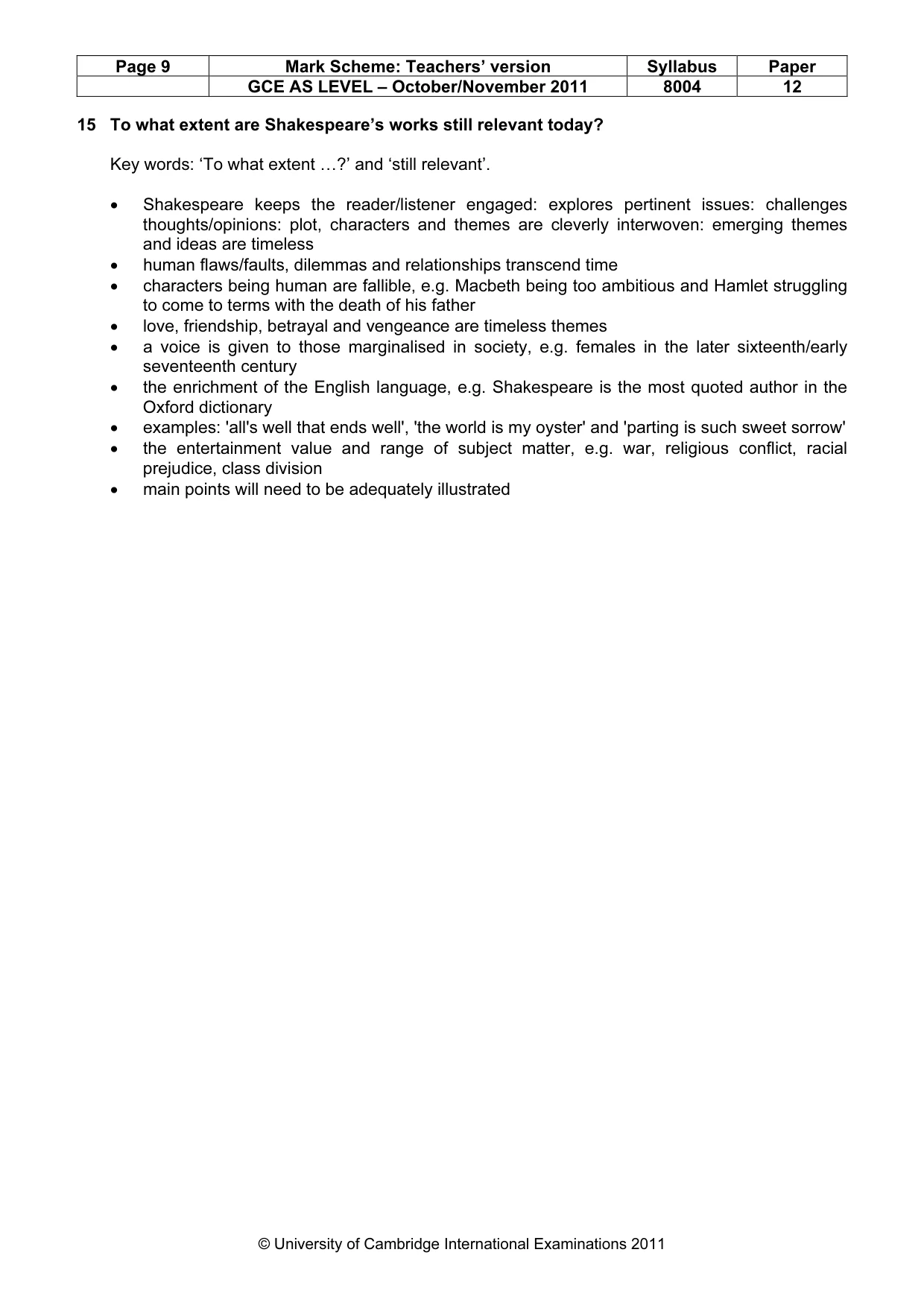
Page 9 Mark Scheme: Teachers’ version Syllabus Paper GCE AS LEVEL – October/November 2011 8004 12 © University of Cambridge International Examinations 2011 15 To what extent are Shakespeare’s works still relevant today? Key words: ‘To what extent …?’ and ‘still relevant’. • Shakespeare keeps the reader/listener engaged: explores pertinent issues: challenges thoughts/opinions: plot, characters and themes are cleverly interwoven: emerging themes and ideas are timeless • human flaws/faults, dilemmas and relationships transcend time • characters being human are fallible, e.g. Macbeth being too ambitious and Hamlet struggling to come to terms with the death of his father • love, friendship, betrayal and vengeance are timeless themes • a voice is given to those marginalised in society, e.g. females in the later sixteenth/early seventeenth century • the enrichment of the English language, e.g. Shakespeare is the most quoted author in the Oxford dictionary • examples: 'all's well that ends well', 'the world is my oyster' and 'parting is such sweet sorrow' • the entertainment value and range of subject matter, e.g. war, religious conflict, racial prejudice, class division • main points will need to be adequately illustrated
What you needed in this session
Cambridge’s own grade thresholds for 2011 Oct/Nov, Paper 1 · Variant 2. A higher threshold means an easier paper — the bar moves with how the cohort did.