Cambridge A Level General Paper (AS Level only) 8004 — 2011 Oct/Nov Paper 1 · Variant 1
8004/11/O/N/11 · 100 marks · ≈113 min
The question paper and its mark scheme, free to read here and free to download. This is Cambridge’s own paper, exactly as it was sat.
Question paper2 pages
Mark scheme9 pages
Answers below. Sit the paper first if you are practising.
Paper as text
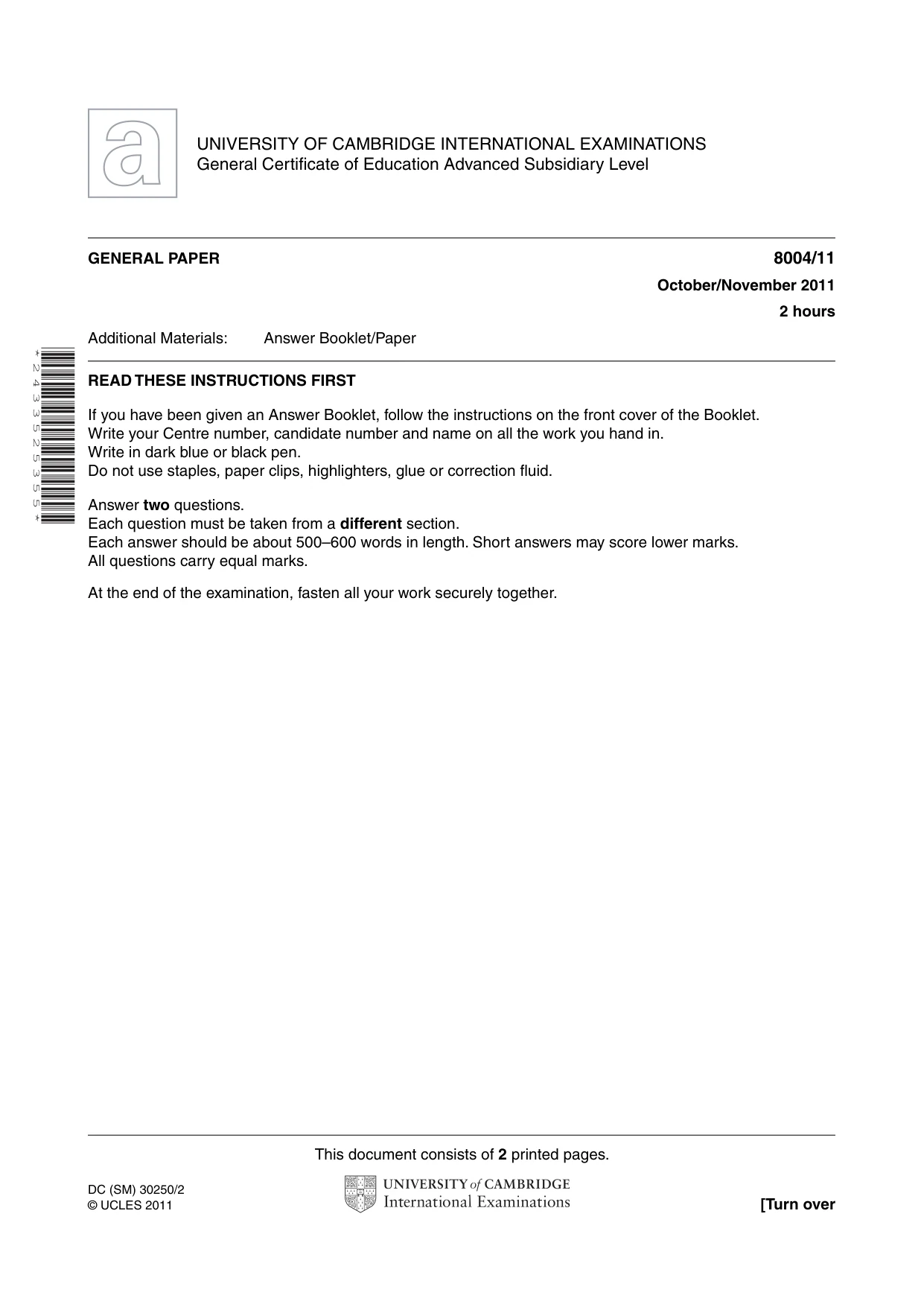
Question paper, page 1
* 2 4 3 3 5 2 5 3 5 5 * This document consists of 2 printed pages. DC (SM) 30250/2 © UCLES 2011 [Turn over UNIVERSITY OF CAMBRIDGE INTERNATIONAL EXAMINATIONS General Certificate of Education Advanced Subsidiary Level READ THESE INSTRUCTIONS FIRST If you have been given an Answer Booklet, follow the instructions on the front cover of the Booklet. Write your Centre number, candidate number and name on all the work you hand in. Write in dark blue or black pen. Do not use staples, paper clips, highlighters, glue or correction fluid. Answer two questions. Each question must be taken from a different section. Each answer should be about 500–600 words in length. Short answers may score lower marks. All questions carry equal marks. At the end of the examination, fasten all your work securely together. GENERAL PAPER 8004/11 October/November 2011 2 hours Additional Materials: Answer Booklet/Paper
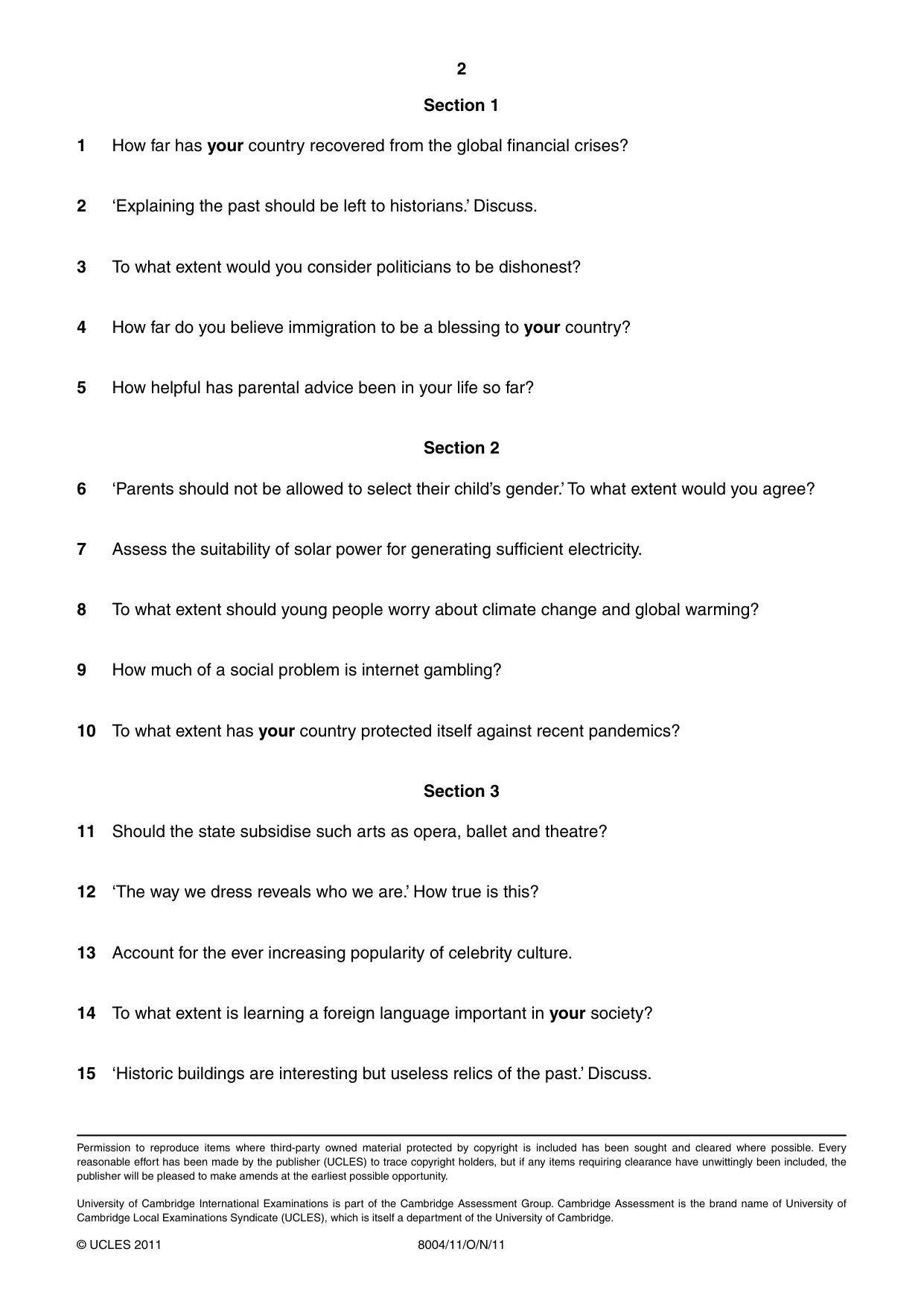
Question paper, page 2
2 8004/11/O/N/11 © UCLES 2011 Permission to reproduce items where third-party owned material protected by copyright is included has been sought and cleared where possible. Every reasonable effort has been made by the publisher (UCLES) to trace copyright holders, but if any items requiring clearance have unwittingly been included, the publisher will be pleased to make amends at the earliest possible opportunity. University of Cambridge International Examinations is part of the Cambridge Assessment Group. Cambridge Assessment is the brand name of University of Cambridge Local Examinations Syndicate (UCLES), which is itself a department of the University of Cambridge. Section 1 1 How far has your country recovered from the global financial crises? 2 ‘Explaining the past should be left to historians.’ Discuss. 3 To what extent would you consider politicians to be dishonest? 4 How far do you believe immigration to be a blessing to your country? 5 How helpful has parental advice been in your life so far? Section 2 6 ‘Parents should not be allowed to select their child’s gender.’ To what extent would you agree? 7 Assess the suitability of solar power for generating sufficient electricity. 8 To what extent should young people worry about climate change and global warming? 9 How much of a social problem is internet gambling? 10 To what extent has your country protected itself against recent pandemics? Section 3 11 Should the state subsidise such arts as opera, ballet and theatre? 12 ‘The way we dress reveals who we are.’ How true is this? 13 Account for the ever increasing popularity of celebrity culture. 14 To what extent is learning a foreign language important in your society? 15 ‘Historic buildings are interesting but useless relics of the past.’ Discuss.
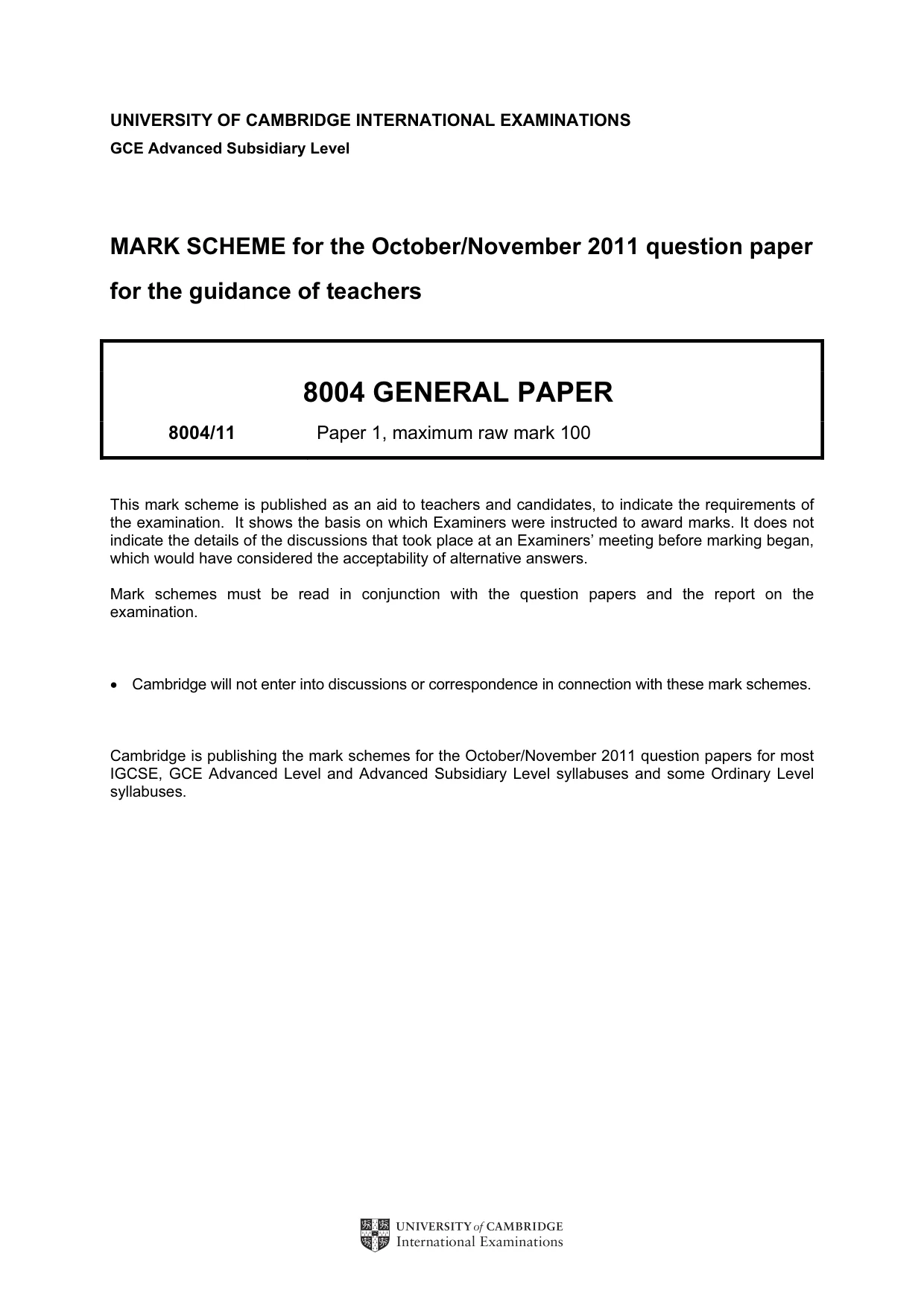
Mark scheme, page 1
UNIVERSITY OF CAMBRIDGE INTERNATIONAL EXAMINATIONS GCE Advanced Subsidiary Level MARK SCHEME for the October/November 2011 question paper for the guidance of teachers 8004 GENERAL PAPER 8004/11 Paper 1, maximum raw mark 100 This mark scheme is published as an aid to teachers and candidates, to indicate the requirements of the examination. It shows the basis on which Examiners were instructed to award marks. It does not indicate the details of the discussions that took place at an Examiners’ meeting before marking began, which would have considered the acceptability of alternative answers. Mark schemes must be read in conjunction with the question papers and the report on the examination. • Cambridge will not enter into discussions or correspondence in connection with these mark schemes. Cambridge is publishing the mark schemes for the October/November 2011 question papers for most IGCSE, GCE Advanced Level and Advanced Subsidiary Level syllabuses and some Ordinary Level syllabuses.
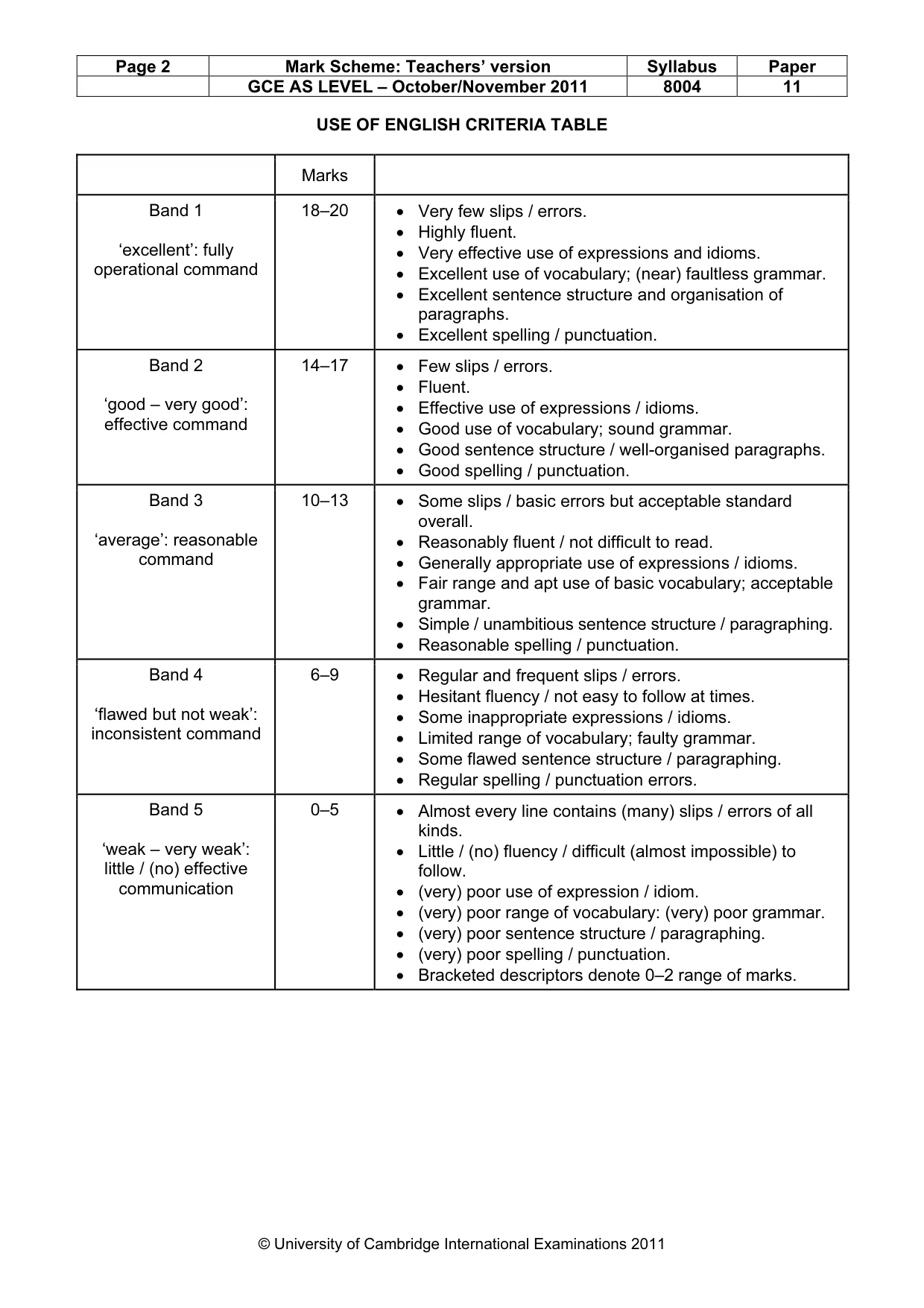
Mark scheme, page 2
Page 2 Mark Scheme: Teachers’ version Syllabus Paper GCE AS LEVEL – October/November 2011 8004 11 © University of Cambridge International Examinations 2011 USE OF ENGLISH CRITERIA TABLE Marks Band 1 ‘excellent’: fully operational command 18–20 • Very few slips / errors. • Highly fluent. • Very effective use of expressions and idioms. • Excellent use of vocabulary; (near) faultless grammar. • Excellent sentence structure and organisation of paragraphs. • Excellent spelling / punctuation. Band 2 ‘good – very good’: effective command 14–17 • Few slips / errors. • Fluent. • Effective use of expressions / idioms. • Good use of vocabulary; sound grammar. • Good sentence structure / well-organised paragraphs. • Good spelling / punctuation. Band 3 ‘average’: reasonable command 10–13 • Some slips / basic errors but acceptable standard overall. • Reasonably fluent / not difficult to read. • Generally appropriate use of expressions / idioms. • Fair range and apt use of basic vocabulary; acceptable grammar. • Simple / unambitious sentence structure / paragraphing. • Reasonable spelling / punctuation. Band 4 ‘flawed but not weak’: inconsistent command 6–9 • Regular and frequent slips / errors. • Hesitant fluency / not easy to follow at times. • Some inappropriate expressions / idioms. • Limited range of vocabulary; faulty grammar. • Some flawed sentence structure / paragraphing. • Regular spelling / punctuation errors. Band 5 ‘weak – very weak’: little / (no) effective communication 0–5 • Almost every line contains (many) slips / errors of all kinds. • Little / (no) fluency / difficult (almost impossible) to follow. • (very) poor use of expression / idiom. • (very) poor range of vocabulary: (very) poor grammar. • (very) poor sentence structure / paragraphing. • (very) poor spelling / punctuation. • Bracketed descriptors denote 0–2 range of marks.
Mark scheme, page 3
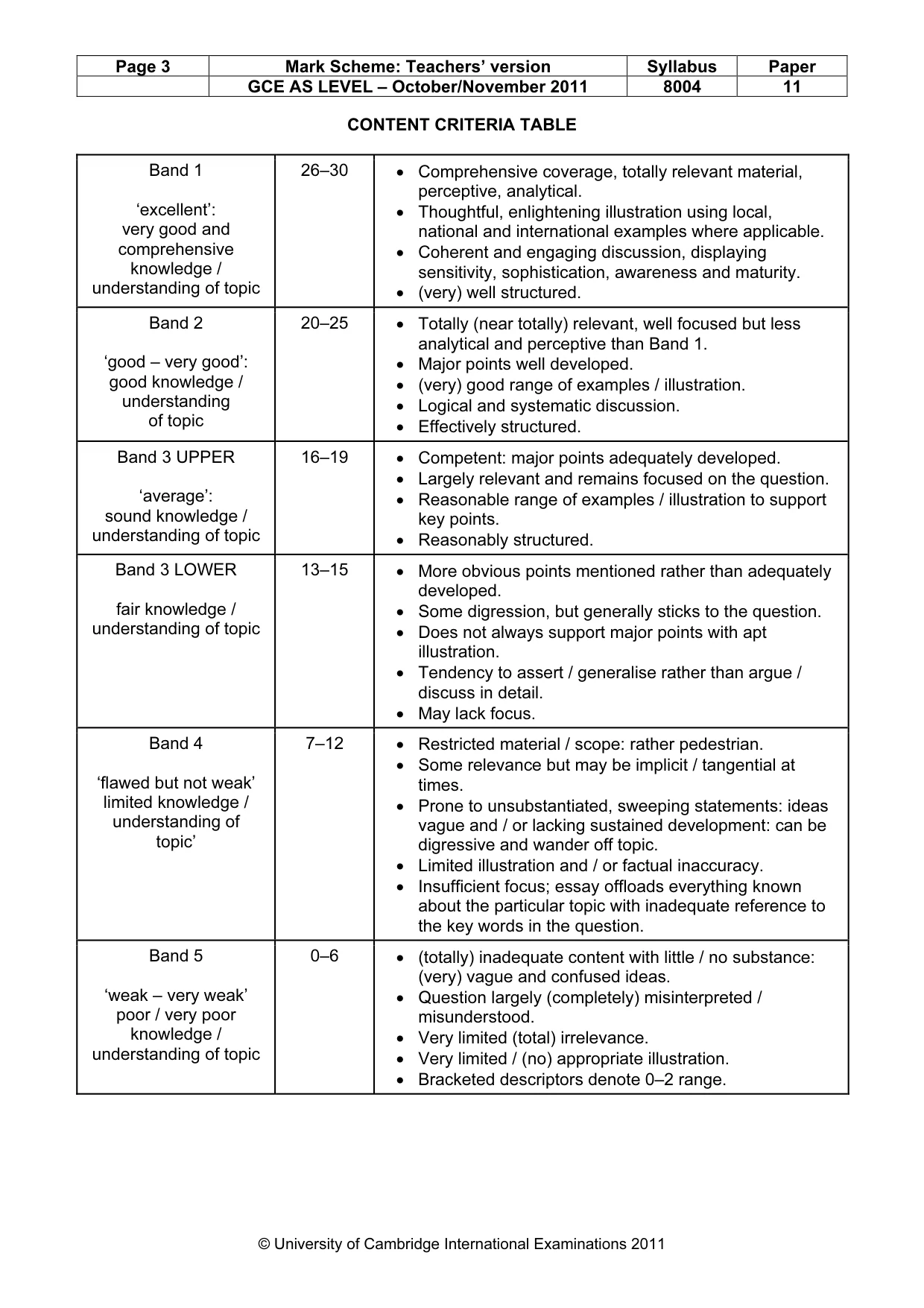
Page 3 Mark Scheme: Teachers’ version Syllabus Paper GCE AS LEVEL – October/November 2011 8004 11 © University of Cambridge International Examinations 2011 CONTENT CRITERIA TABLE Band 1 ‘excellent’: very good and comprehensive knowledge / understanding of topic 26–30 • Comprehensive coverage, totally relevant material, perceptive, analytical. • Thoughtful, enlightening illustration using local, national and international examples where applicable. • Coherent and engaging discussion, displaying sensitivity, sophistication, awareness and maturity. • (very) well structured. Band 2 ‘good – very good’: good knowledge / understanding of topic 20–25 • Totally (near totally) relevant, well focused but less analytical and perceptive than Band 1. • Major points well developed. • (very) good range of examples / illustration. • Logical and systematic discussion. • Effectively structured. Band 3 UPPER ‘average’: sound knowledge / understanding of topic 16–19 • Competent: major points adequately developed. • Largely relevant and remains focused on the question. • Reasonable range of examples / illustration to support key points. • Reasonably structured. Band 3 LOWER fair knowledge / understanding of topic 13–15 • More obvious points mentioned rather than adequately developed. • Some digression, but generally sticks to the question. • Does not always support major points with apt illustration. • Tendency to assert / generalise rather than argue / discuss in detail. • May lack focus. Band 4 ‘flawed but not weak’ limited knowledge / understanding of topic’ 7–12 • Restricted material / scope: rather pedestrian. • Some relevance but may be implicit / tangential at times. • Prone to unsubstantiated, sweeping statements: ideas vague and / or lacking sustained development: can be digressive and wander off topic. • Limited illustration and / or factual inaccuracy. • Insufficient focus; essay offloads everything known about the particular topic with inadequate reference to the key words in the question. Band 5 ‘weak – very weak’ poor / very poor knowledge / understanding of topic 0–6 • (totally) inadequate content with little / no substance: (very) vague and confused ideas. • Question largely (completely) misinterpreted / misunderstood. • Very limited (total) irrelevance. • Very limited / (no) appropriate illustration. • Bracketed descriptors denote 0–2 range.
Mark scheme, page 4
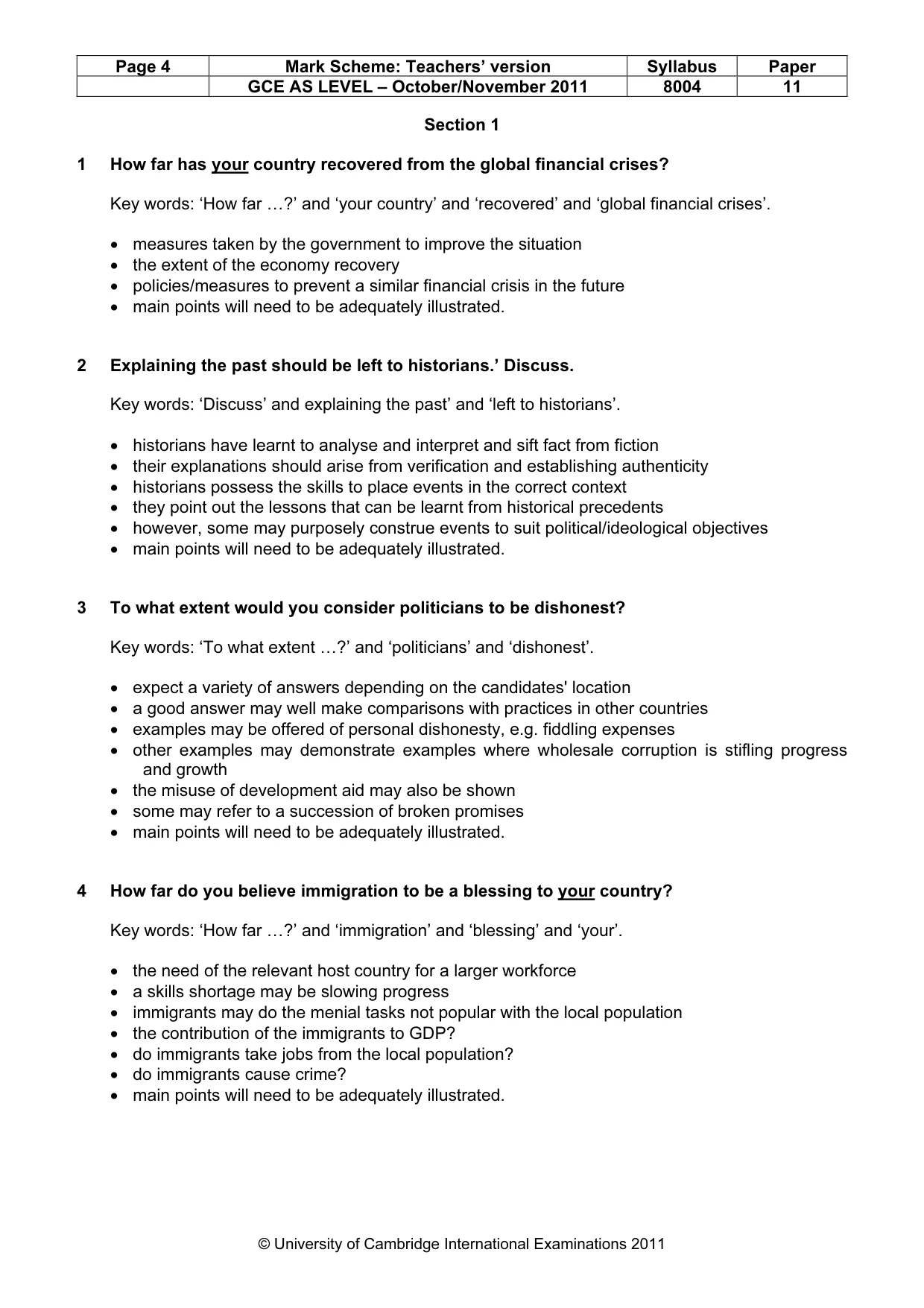
Page 4 Mark Scheme: Teachers’ version Syllabus Paper GCE AS LEVEL – October/November 2011 8004 11 © University of Cambridge International Examinations 2011 Section 1 1 How far has your country recovered from the global financial crises? Key words: ‘How far …?’ and ‘your country’ and ‘recovered’ and ‘global financial crises’. • measures taken by the government to improve the situation • the extent of the economy recovery • policies/measures to prevent a similar financial crisis in the future • main points will need to be adequately illustrated. 2 Explaining the past should be left to historians.’ Discuss. Key words: ‘Discuss’ and explaining the past’ and ‘left to historians’. • historians have learnt to analyse and interpret and sift fact from fiction • their explanations should arise from verification and establishing authenticity • historians possess the skills to place events in the correct context • they point out the lessons that can be learnt from historical precedents • however, some may purposely construe events to suit political/ideological objectives • main points will need to be adequately illustrated. 3 To what extent would you consider politicians to be dishonest? Key words: ‘To what extent …?’ and ‘politicians’ and ‘dishonest’. • expect a variety of answers depending on the candidates' location • a good answer may well make comparisons with practices in other countries • examples may be offered of personal dishonesty, e.g. fiddling expenses • other examples may demonstrate examples where wholesale corruption is stifling progress and growth • the misuse of development aid may also be shown • some may refer to a succession of broken promises • main points will need to be adequately illustrated. 4 How far do you believe immigration to be a blessing to your country? Key words: ‘How far …?’ and ‘immigration’ and ‘blessing’ and ‘your’. • the need of the relevant host country for a larger workforce • a skills shortage may be slowing progress • immigrants may do the menial tasks not popular with the local population • the contribution of the immigrants to GDP? • do immigrants take jobs from the local population? • do immigrants cause crime? • main points will need to be adequately illustrated.
Mark scheme, page 5
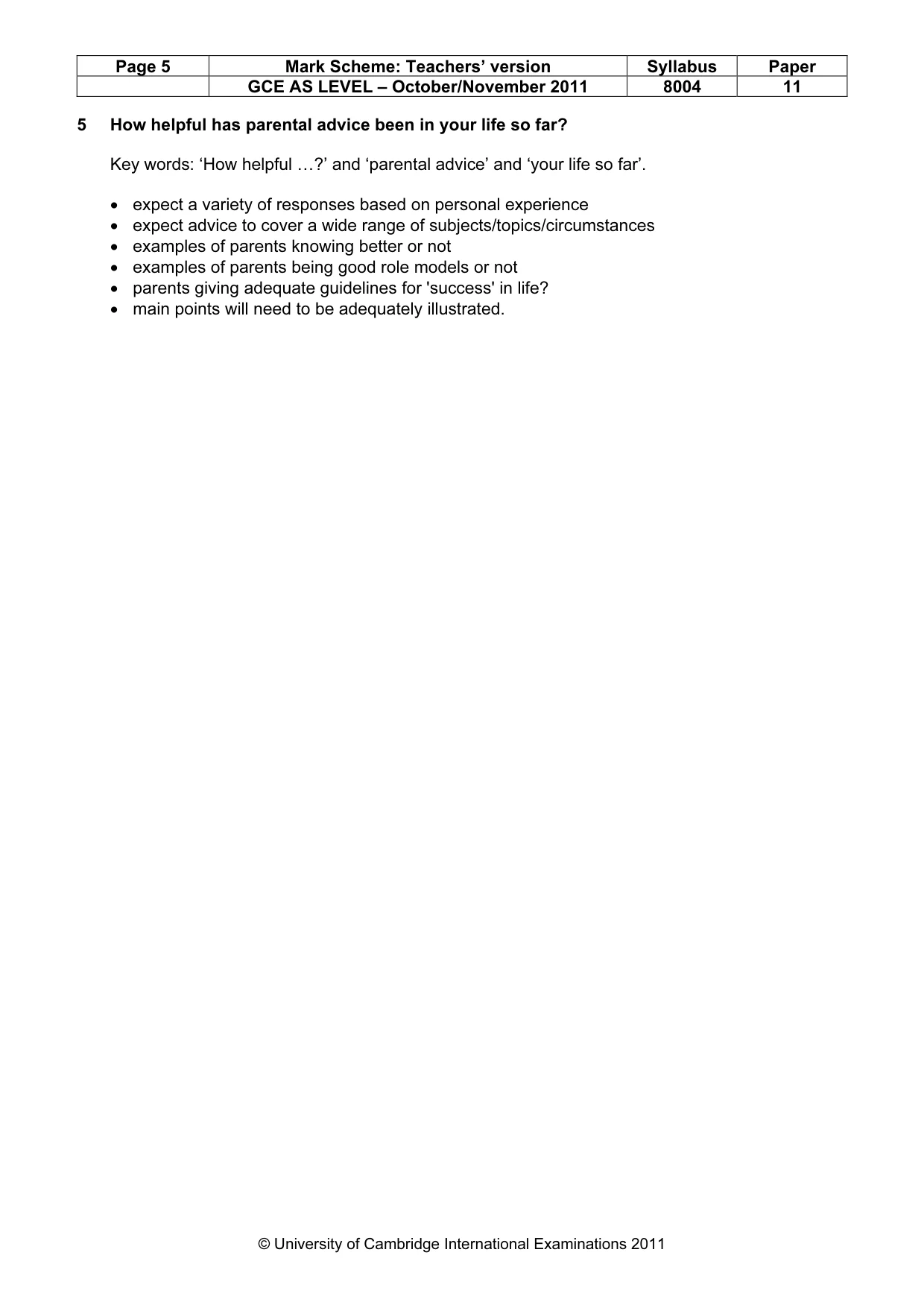
Page 5 Mark Scheme: Teachers’ version Syllabus Paper GCE AS LEVEL – October/November 2011 8004 11 © University of Cambridge International Examinations 2011 5 How helpful has parental advice been in your life so far? Key words: ‘How helpful …?’ and ‘parental advice’ and ‘your life so far’. • expect a variety of responses based on personal experience • expect advice to cover a wide range of subjects/topics/circumstances • examples of parents knowing better or not • examples of parents being good role models or not • parents giving adequate guidelines for 'success' in life? • main points will need to be adequately illustrated.
Mark scheme, page 6
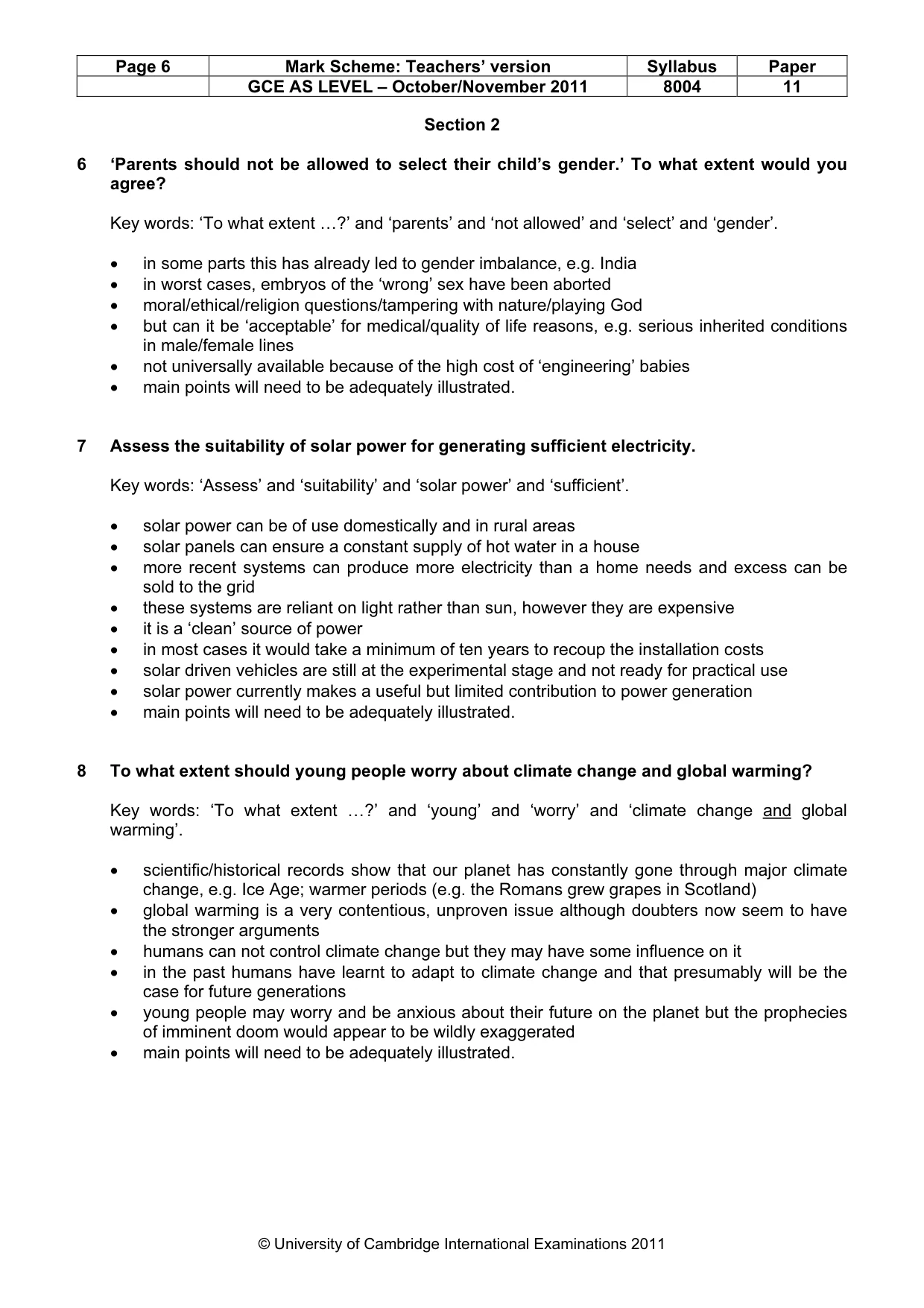
Page 6 Mark Scheme: Teachers’ version Syllabus Paper GCE AS LEVEL – October/November 2011 8004 11 © University of Cambridge International Examinations 2011 Section 2 6 ‘Parents should not be allowed to select their child’s gender.’ To what extent would you agree? Key words: ‘To what extent …?’ and ‘parents’ and ‘not allowed’ and ‘select’ and ‘gender’. • in some parts this has already led to gender imbalance, e.g. India • in worst cases, embryos of the ‘wrong’ sex have been aborted • moral/ethical/religion questions/tampering with nature/playing God • but can it be ‘acceptable’ for medical/quality of life reasons, e.g. serious inherited conditions in male/female lines • not universally available because of the high cost of ‘engineering’ babies • main points will need to be adequately illustrated. 7 Assess the suitability of solar power for generating sufficient electricity. Key words: ‘Assess’ and ‘suitability’ and ‘solar power’ and ‘sufficient’. • solar power can be of use domestically and in rural areas • solar panels can ensure a constant supply of hot water in a house • more recent systems can produce more electricity than a home needs and excess can be sold to the grid • these systems are reliant on light rather than sun, however they are expensive • it is a ‘clean’ source of power • in most cases it would take a minimum of ten years to recoup the installation costs • solar driven vehicles are still at the experimental stage and not ready for practical use • solar power currently makes a useful but limited contribution to power generation • main points will need to be adequately illustrated. 8 To what extent should young people worry about climate change and global warming? Key words: ‘To what extent …?’ and ‘young’ and ‘worry’ and ‘climate change and global warming’. • scientific/historical records show that our planet has constantly gone through major climate change, e.g. Ice Age; warmer periods (e.g. the Romans grew grapes in Scotland) • global warming is a very contentious, unproven issue although doubters now seem to have the stronger arguments • humans can not control climate change but they may have some influence on it • in the past humans have learnt to adapt to climate change and that presumably will be the case for future generations • young people may worry and be anxious about their future on the planet but the prophecies of imminent doom would appear to be wildly exaggerated • main points will need to be adequately illustrated.
Mark scheme, page 7
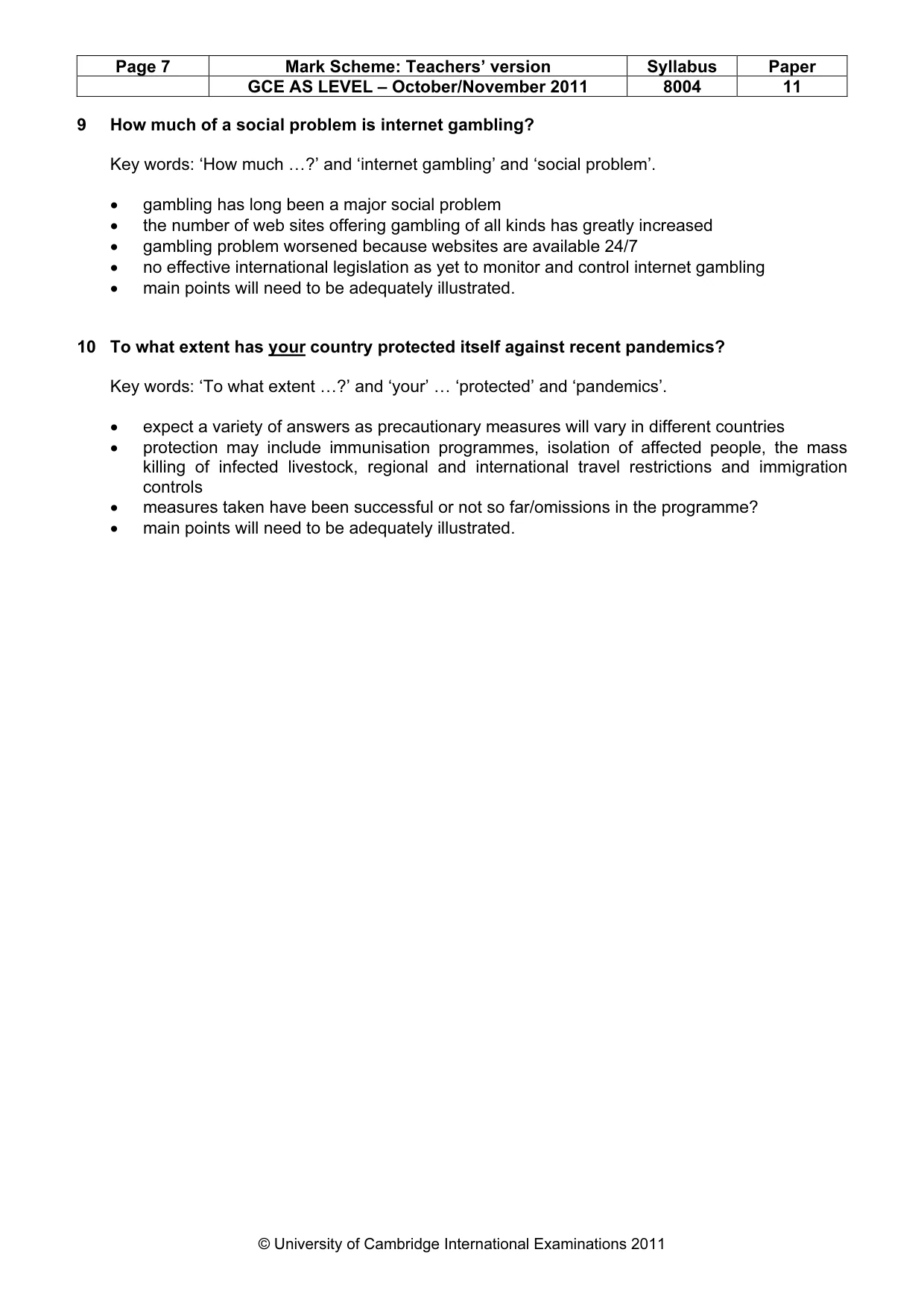
Page 7 Mark Scheme: Teachers’ version Syllabus Paper GCE AS LEVEL – October/November 2011 8004 11 © University of Cambridge International Examinations 2011 9 How much of a social problem is internet gambling? Key words: ‘How much …?’ and ‘internet gambling’ and ‘social problem’. • gambling has long been a major social problem • the number of web sites offering gambling of all kinds has greatly increased • gambling problem worsened because websites are available 24/7 • no effective international legislation as yet to monitor and control internet gambling • main points will need to be adequately illustrated. 10 To what extent has your country protected itself against recent pandemics? Key words: ‘To what extent …?’ and ‘your’ … ‘protected’ and ‘pandemics’. • expect a variety of answers as precautionary measures will vary in different countries • protection may include immunisation programmes, isolation of affected people, the mass killing of infected livestock, regional and international travel restrictions and immigration controls • measures taken have been successful or not so far/omissions in the programme? • main points will need to be adequately illustrated.
Mark scheme, page 8
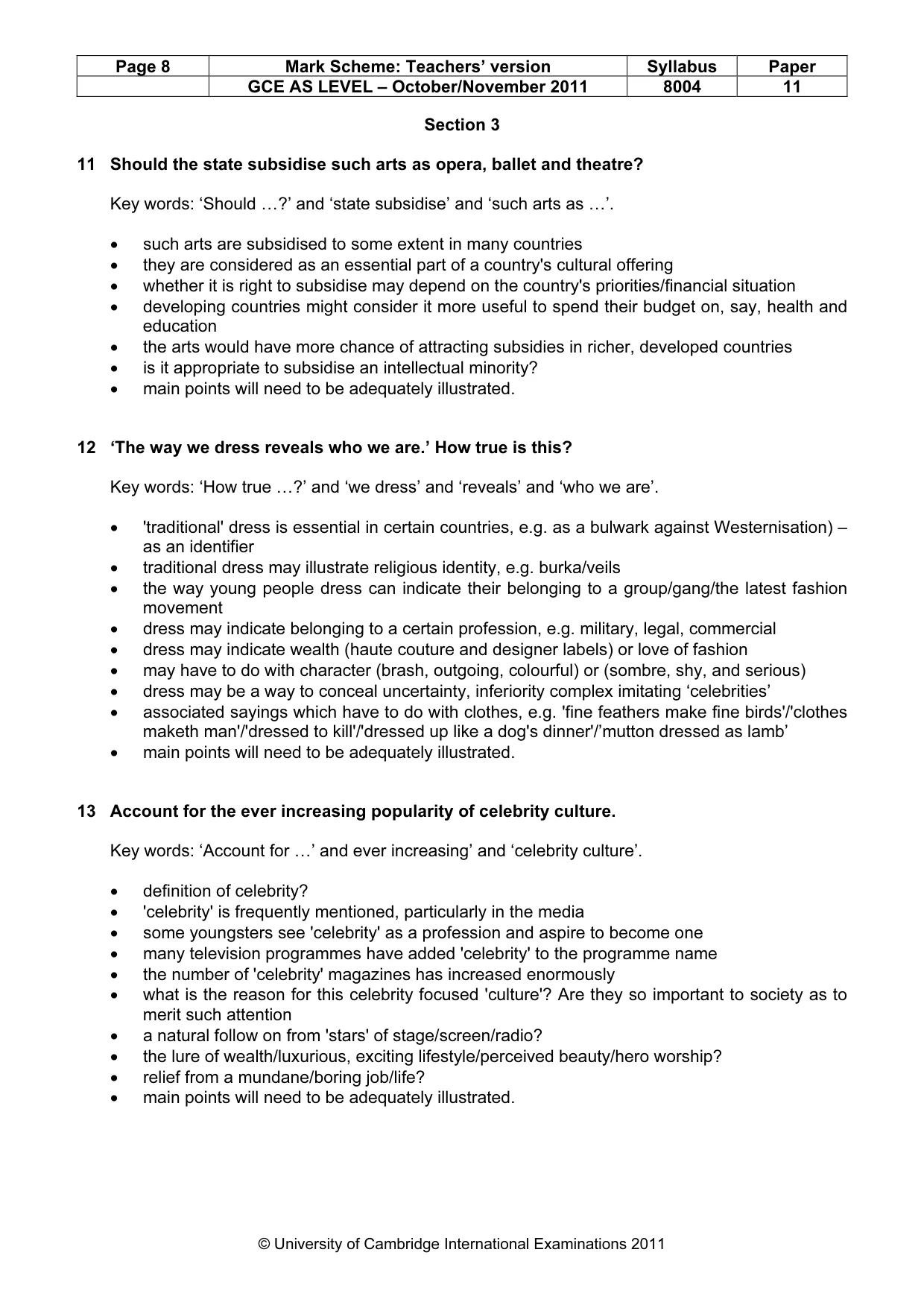
Page 8 Mark Scheme: Teachers’ version Syllabus Paper GCE AS LEVEL – October/November 2011 8004 11 © University of Cambridge International Examinations 2011 Section 3 11 Should the state subsidise such arts as opera, ballet and theatre? Key words: ‘Should …?’ and ‘state subsidise’ and ‘such arts as …’. • such arts are subsidised to some extent in many countries • they are considered as an essential part of a country's cultural offering • whether it is right to subsidise may depend on the country's priorities/financial situation • developing countries might consider it more useful to spend their budget on, say, health and education • the arts would have more chance of attracting subsidies in richer, developed countries • is it appropriate to subsidise an intellectual minority? • main points will need to be adequately illustrated. 12 ‘The way we dress reveals who we are.’ How true is this? Key words: ‘How true …?’ and ‘we dress’ and ‘reveals’ and ‘who we are’. • 'traditional' dress is essential in certain countries, e.g. as a bulwark against Westernisation) – as an identifier • traditional dress may illustrate religious identity, e.g. burka/veils • the way young people dress can indicate their belonging to a group/gang/the latest fashion movement • dress may indicate belonging to a certain profession, e.g. military, legal, commercial • dress may indicate wealth (haute couture and designer labels) or love of fashion • may have to do with character (brash, outgoing, colourful) or (sombre, shy, and serious) • dress may be a way to conceal uncertainty, inferiority complex imitating ‘celebrities’ • associated sayings which have to do with clothes, e.g. 'fine feathers make fine birds'/'clothes maketh man'/'dressed to kill'/'dressed up like a dog's dinner'/’mutton dressed as lamb’ • main points will need to be adequately illustrated. 13 Account for the ever increasing popularity of celebrity culture. Key words: ‘Account for …’ and ever increasing’ and ‘celebrity culture’. • definition of celebrity? • 'celebrity' is frequently mentioned, particularly in the media • some youngsters see 'celebrity' as a profession and aspire to become one • many television programmes have added 'celebrity' to the programme name • the number of 'celebrity' magazines has increased enormously • what is the reason for this celebrity focused 'culture'? Are they so important to society as to merit such attention • a natural follow on from 'stars' of stage/screen/radio? • the lure of wealth/luxurious, exciting lifestyle/perceived beauty/hero worship? • relief from a mundane/boring job/life? • main points will need to be adequately illustrated.
Mark scheme, page 9
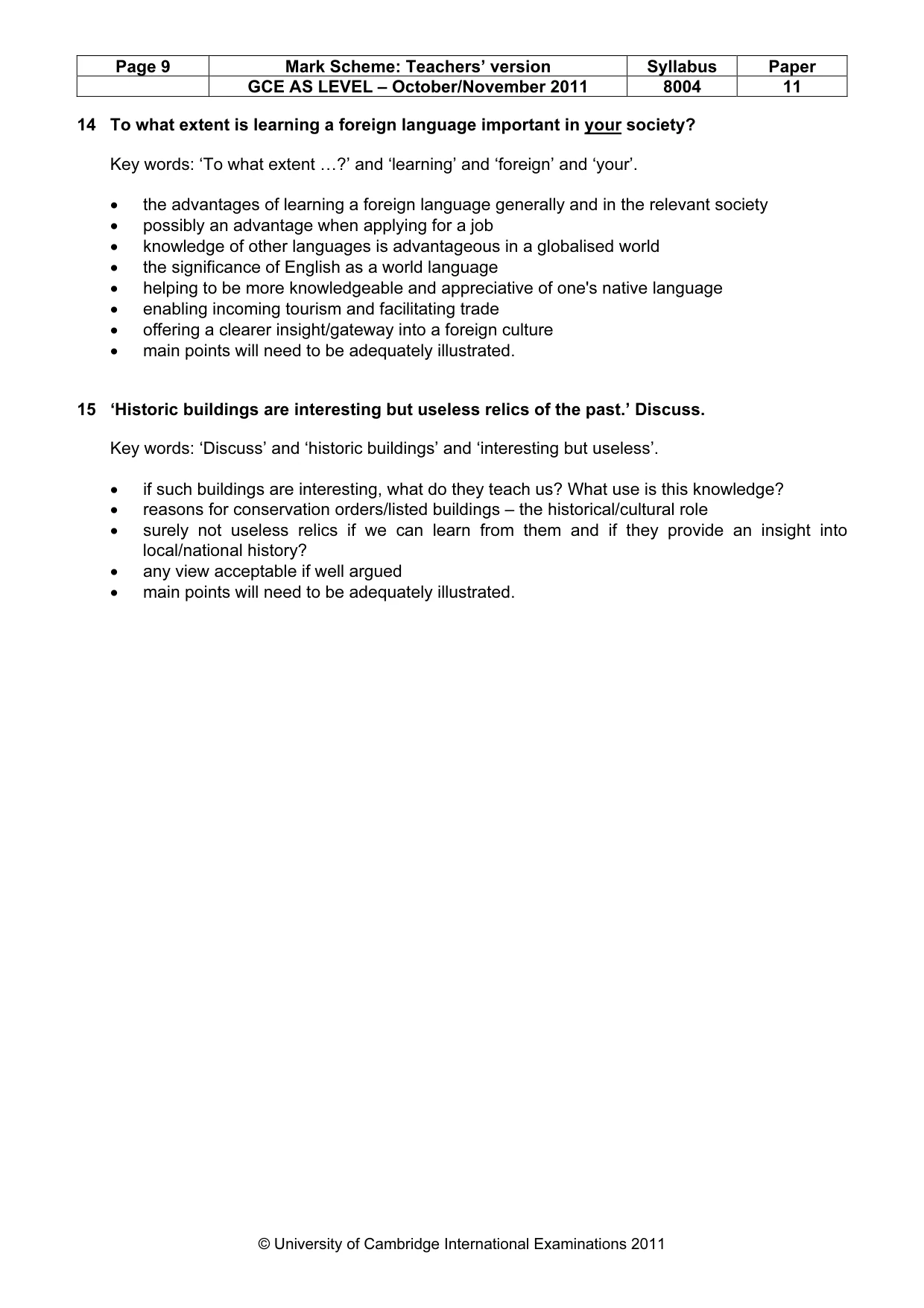
Page 9 Mark Scheme: Teachers’ version Syllabus Paper GCE AS LEVEL – October/November 2011 8004 11 © University of Cambridge International Examinations 2011 14 To what extent is learning a foreign language important in your society? Key words: ‘To what extent …?’ and ‘learning’ and ‘foreign’ and ‘your’. • the advantages of learning a foreign language generally and in the relevant society • possibly an advantage when applying for a job • knowledge of other languages is advantageous in a globalised world • the significance of English as a world language • helping to be more knowledgeable and appreciative of one's native language • enabling incoming tourism and facilitating trade • offering a clearer insight/gateway into a foreign culture • main points will need to be adequately illustrated. 15 ‘Historic buildings are interesting but useless relics of the past.’ Discuss. Key words: ‘Discuss’ and ‘historic buildings’ and ‘interesting but useless’. • if such buildings are interesting, what do they teach us? What use is this knowledge? • reasons for conservation orders/listed buildings – the historical/cultural role • surely not useless relics if we can learn from them and if they provide an insight into local/national history? • any view acceptable if well argued • main points will need to be adequately illustrated.
What you needed in this session
Cambridge’s own grade thresholds for 2011 Oct/Nov, Paper 1 · Variant 1. A higher threshold means an easier paper — the bar moves with how the cohort did.