Cambridge A Level General Paper (AS Level only) 8004 — 2011 May/June Paper 1 · Variant 2
8004/12/M/J/11 · 100 marks · ≈113 min
The question paper and its mark scheme, free to read here and free to download. This is Cambridge’s own paper, exactly as it was sat.
Question paper2 pages
Mark scheme12 pages
Answers below. Sit the paper first if you are practising.
Paper as text
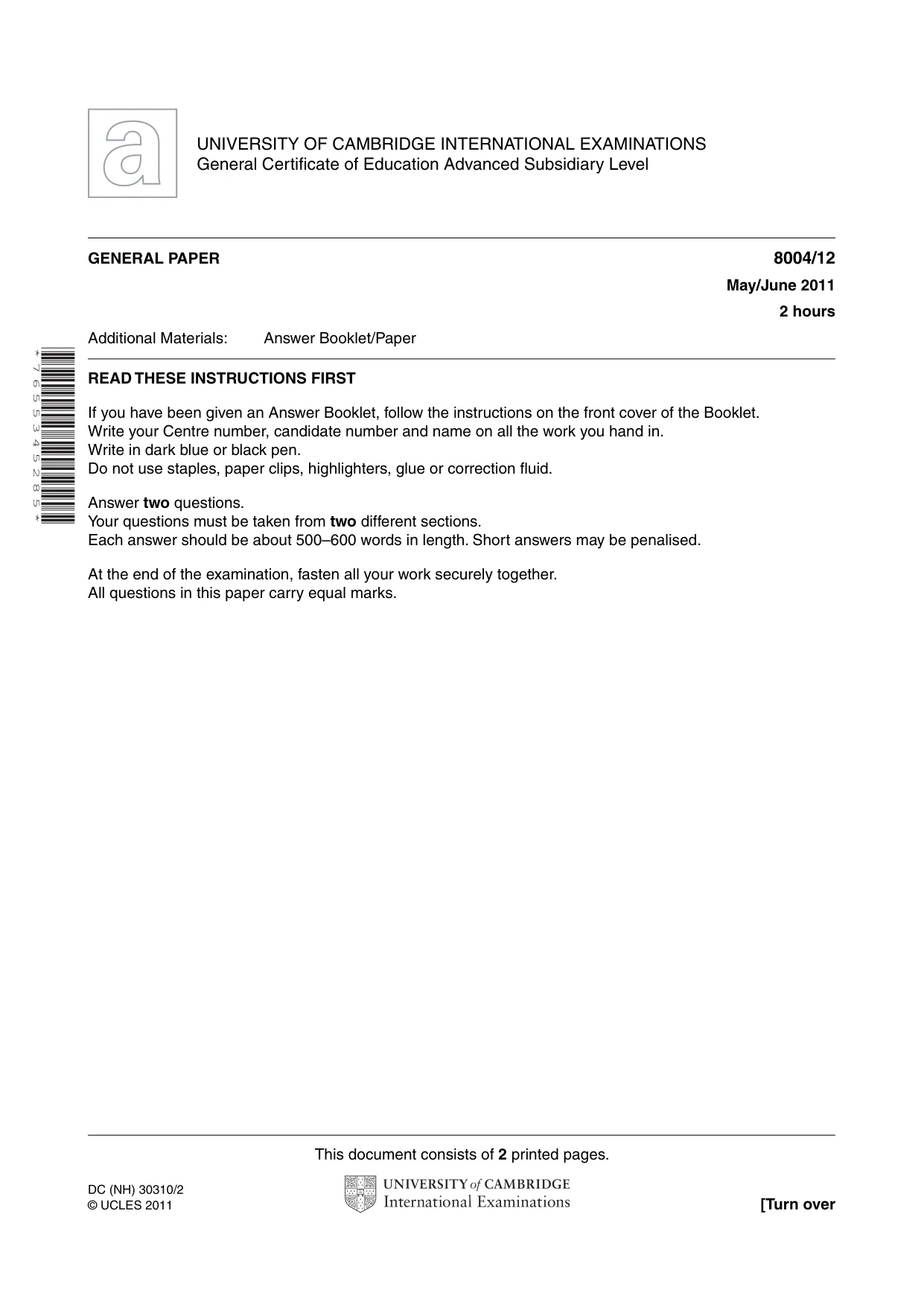
Question paper, page 1
This document consists of 2 printed pages. DC (NH) 30310/2 © UCLES 2011 [Turn over UNIVERSITY OF CAMBRIDGE INTERNATIONAL EXAMINATIONS General Certificate of Education Advanced Subsidiary Level READ THESE INSTRUCTIONS FIRST If you have been given an Answer Booklet, follow the instructions on the front cover of the Booklet. Write your Centre number, candidate number and name on all the work you hand in. Write in dark blue or black pen. Do not use staples, paper clips, highlighters, glue or correction fluid. Answer two questions. Your questions must be taken from two different sections. Each answer should be about 500–600 words in length. Short answers may be penalised. At the end of the examination, fasten all your work securely together. All questions in this paper carry equal marks. * 7 6 5 5 3 4 5 2 8 5 * GENERAL PAPER 8004/12 May/June 2011 2 hours Additional Materials: Answer Booklet/Paper
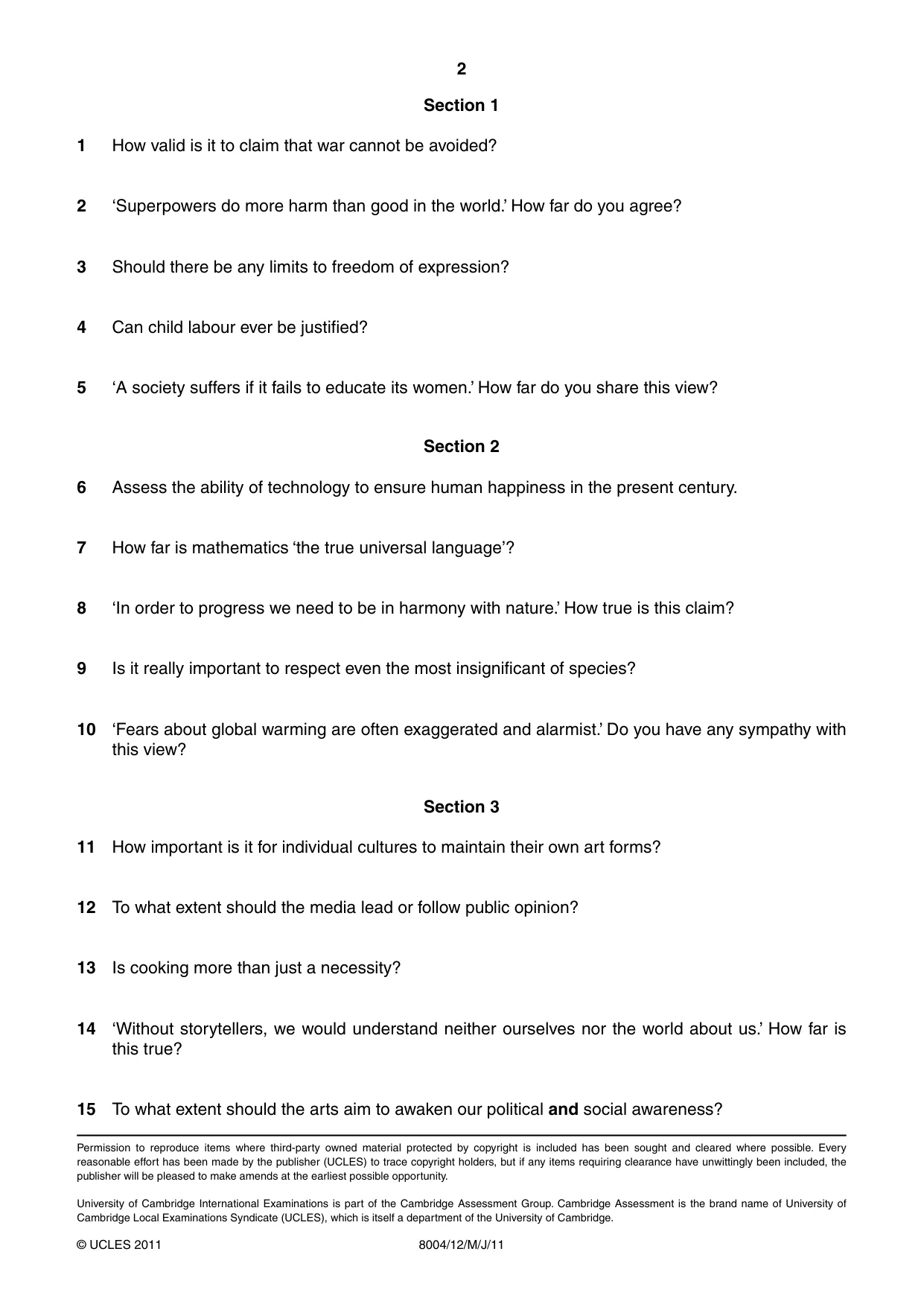
Question paper, page 2
2 8004/12/M/J/11 © UCLES 2011 Section 1 1 How valid is it to claim that war cannot be avoided? 2 ‘Superpowers do more harm than good in the world.’ How far do you agree? 3 Should there be any limits to freedom of expression? 4 Can child labour ever be justified? 5 ‘A society suffers if it fails to educate its women.’ How far do you share this view? Section 2 6 Assess the ability of technology to ensure human happiness in the present century. 7 How far is mathematics ‘the true universal language’? 8 ‘In order to progress we need to be in harmony with nature.’ How true is this claim? 9 Is it really important to respect even the most insignificant of species? 10 ‘Fears about global warming are often exaggerated and alarmist.’ Do you have any sympathy with this view? Section 3 11 How important is it for individual cultures to maintain their own art forms? 12 To what extent should the media lead or follow public opinion? 13 Is cooking more than just a necessity? 14 ‘Without storytellers, we would understand neither ourselves nor the world about us.’ How far is this true? 15 To what extent should the arts aim to awaken our political and social awareness? Permission to reproduce items where third-party owned material protected by copyright is included has been sought and cleared where possible. Every reasonable effort has been made by the publisher (UCLES) to trace copyright holders, but if any items requiring clearance have unwittingly been included, the publisher will be pleased to make amends at the earliest possible opportunity. University of Cambridge International Examinations is part of the Cambridge Assessment Group. Cambridge Assessment is the brand name of University of Cambridge Local Examinations Syndicate (UCLES), which is itself a department of the University of Cambridge.
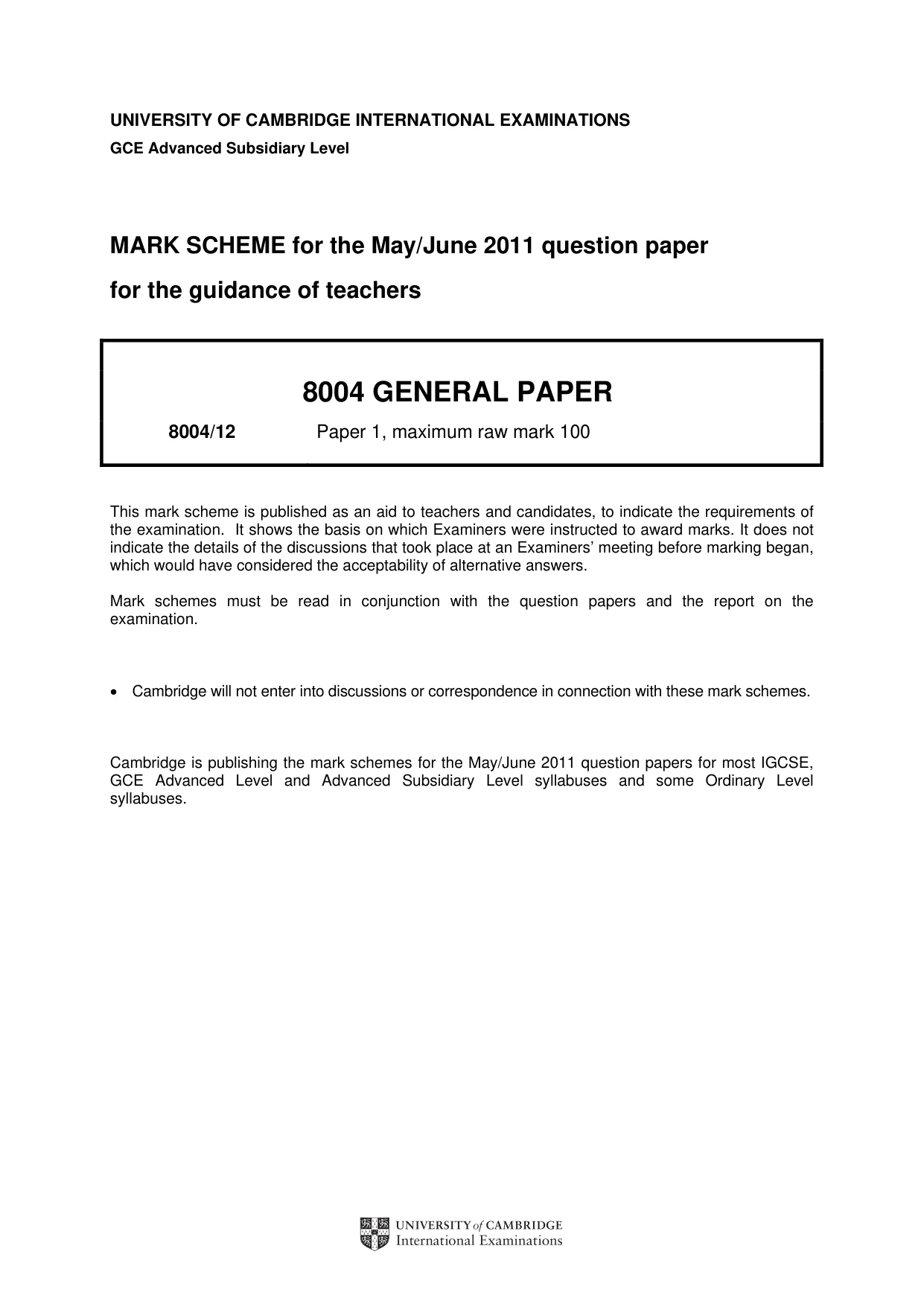
Mark scheme, page 1
UNIVERSITY OF CAMBRIDGE INTERNATIONAL EXAMINATIONS GCE Advanced Subsidiary Level MARK SCHEME for the May/June 2011 question paper for the guidance of teachers 8004 GENERAL PAPER 8004/12 Paper 1, maximum raw mark 100 This mark scheme is published as an aid to teachers and candidates, to indicate the requirements of the examination. It shows the basis on which Examiners were instructed to award marks. It does not indicate the details of the discussions that took place at an Examiners’ meeting before marking began, which would have considered the acceptability of alternative answers. Mark schemes must be read in conjunction with the question papers and the report on the examination. • Cambridge will not enter into discussions or correspondence in connection with these mark schemes. Cambridge is publishing the mark schemes for the May/June 2011 question papers for most IGCSE, GCE Advanced Level and Advanced Subsidiary Level syllabuses and some Ordinary Level syllabuses.
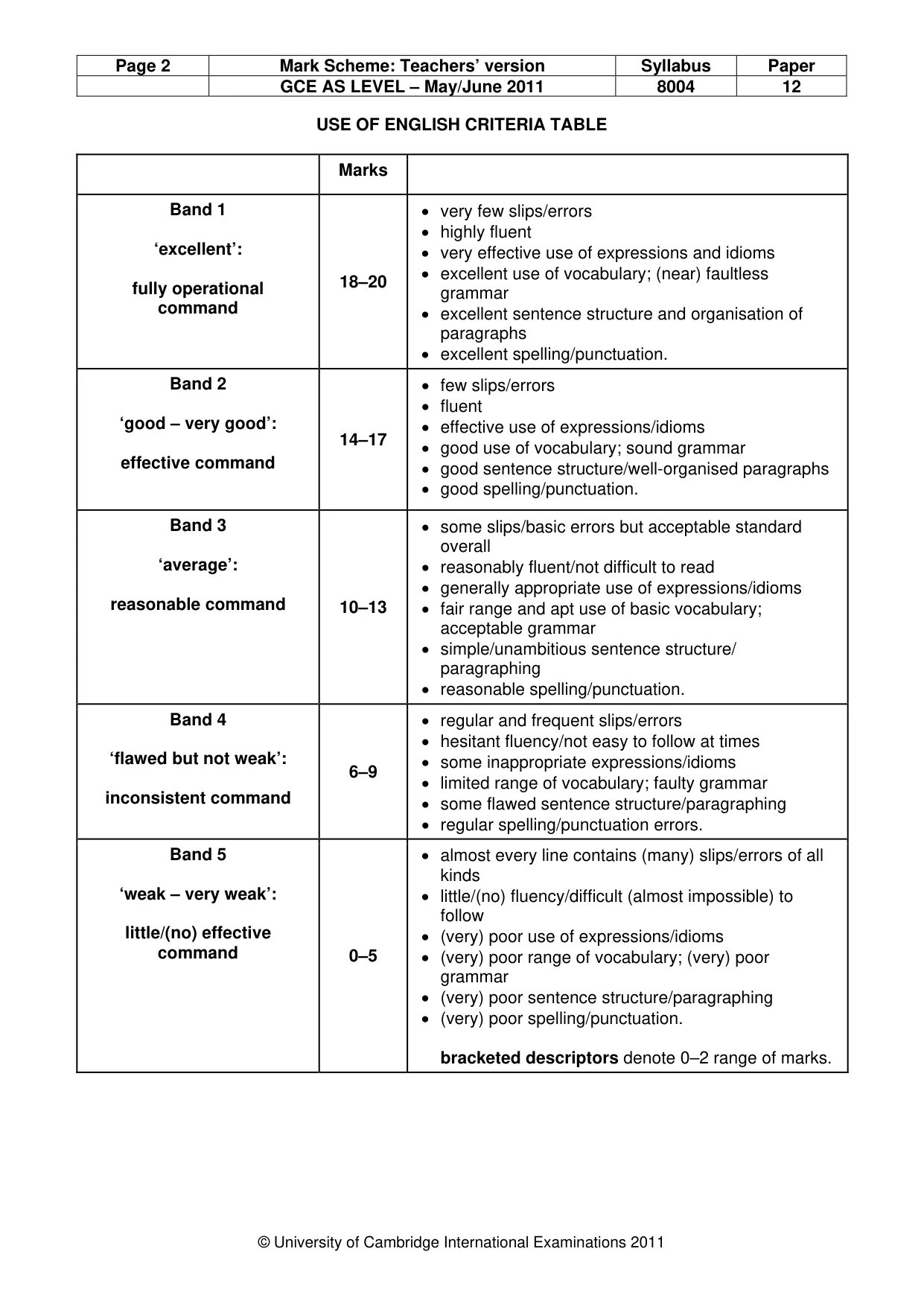
Mark scheme, page 2
Page 2 Mark Scheme: Teachers’ version Syllabus Paper GCE AS LEVEL – May/June 2011 8004 12 © University of Cambridge International Examinations 2011 USE OF ENGLISH CRITERIA TABLE Marks Band 1 ‘excellent’: fully operational command 18–20 • very few slips/errors • highly fluent • very effective use of expressions and idioms • excellent use of vocabulary; (near) faultless grammar • excellent sentence structure and organisation of paragraphs • excellent spelling/punctuation. Band 2 ‘good – very good’: effective command 14–17 • few slips/errors • fluent • effective use of expressions/idioms • good use of vocabulary; sound grammar • good sentence structure/well-organised paragraphs • good spelling/punctuation. Band 3 ‘average’: reasonable command 10–13 • some slips/basic errors but acceptable standard overall • reasonably fluent/not difficult to read • generally appropriate use of expressions/idioms • fair range and apt use of basic vocabulary; acceptable grammar • simple/unambitious sentence structure/ paragraphing • reasonable spelling/punctuation. Band 4 ‘flawed but not weak’: inconsistent command 6–9 • regular and frequent slips/errors • hesitant fluency/not easy to follow at times • some inappropriate expressions/idioms • limited range of vocabulary; faulty grammar • some flawed sentence structure/paragraphing • regular spelling/punctuation errors. Band 5 ‘weak – very weak’: little/(no) effective command 0–5 • almost every line contains (many) slips/errors of all kinds • little/(no) fluency/difficult (almost impossible) to follow • (very) poor use of expressions/idioms • (very) poor range of vocabulary; (very) poor grammar • (very) poor sentence structure/paragraphing • (very) poor spelling/punctuation. bracketed descriptors denote 0–2 range of marks.
Mark scheme, page 3
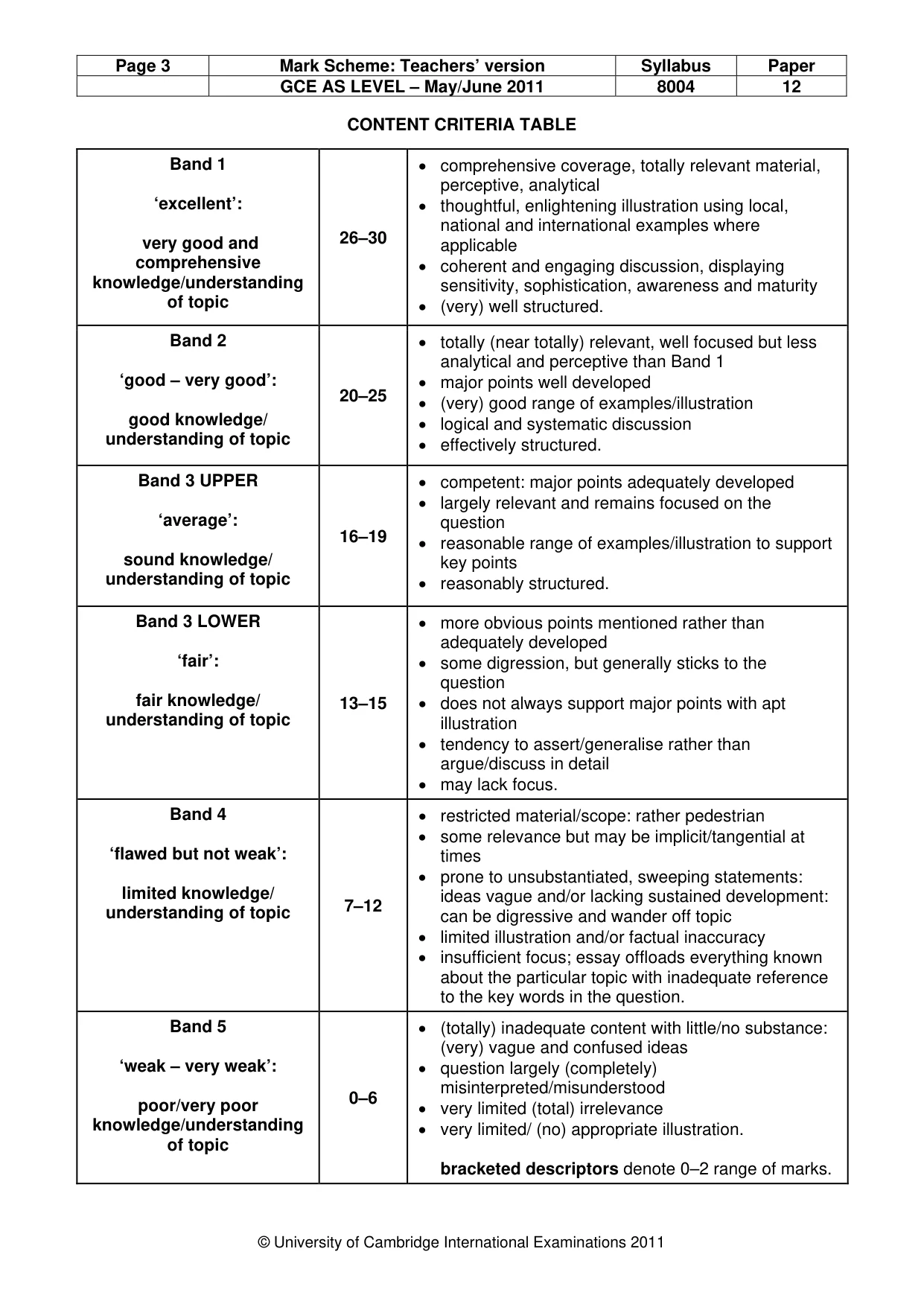
Page 3 Mark Scheme: Teachers’ version Syllabus Paper GCE AS LEVEL – May/June 2011 8004 12 © University of Cambridge International Examinations 2011 CONTENT CRITERIA TABLE Band 1 ‘excellent’: very good and comprehensive knowledge/understanding of topic 26–30 • comprehensive coverage, totally relevant material, perceptive, analytical • thoughtful, enlightening illustration using local, national and international examples where applicable • coherent and engaging discussion, displaying sensitivity, sophistication, awareness and maturity • (very) well structured. Band 2 ‘good – very good’: good knowledge/ understanding of topic 20–25 • totally (near totally) relevant, well focused but less analytical and perceptive than Band 1 • major points well developed • (very) good range of examples/illustration • logical and systematic discussion • effectively structured. Band 3 UPPER ‘average’: sound knowledge/ understanding of topic 16–19 • competent: major points adequately developed • largely relevant and remains focused on the question • reasonable range of examples/illustration to support key points • reasonably structured. Band 3 LOWER ‘fair’: fair knowledge/ understanding of topic 13–15 • more obvious points mentioned rather than adequately developed • some digression, but generally sticks to the question • does not always support major points with apt illustration • tendency to assert/generalise rather than argue/discuss in detail • may lack focus. Band 4 ‘flawed but not weak’: limited knowledge/ understanding of topic 7–12 • restricted material/scope: rather pedestrian • some relevance but may be implicit/tangential at times • prone to unsubstantiated, sweeping statements: ideas vague and/or lacking sustained development: can be digressive and wander off topic • limited illustration and/or factual inaccuracy • insufficient focus; essay offloads everything known about the particular topic with inadequate reference to the key words in the question. Band 5 ‘weak – very weak’: poor/very poor knowledge/understanding of topic 0–6 • (totally) inadequate content with little/no substance: (very) vague and confused ideas • question largely (completely) misinterpreted/misunderstood • very limited (total) irrelevance • very limited/ (no) appropriate illustration. bracketed descriptors denote 0–2 range of marks.
Mark scheme, page 4
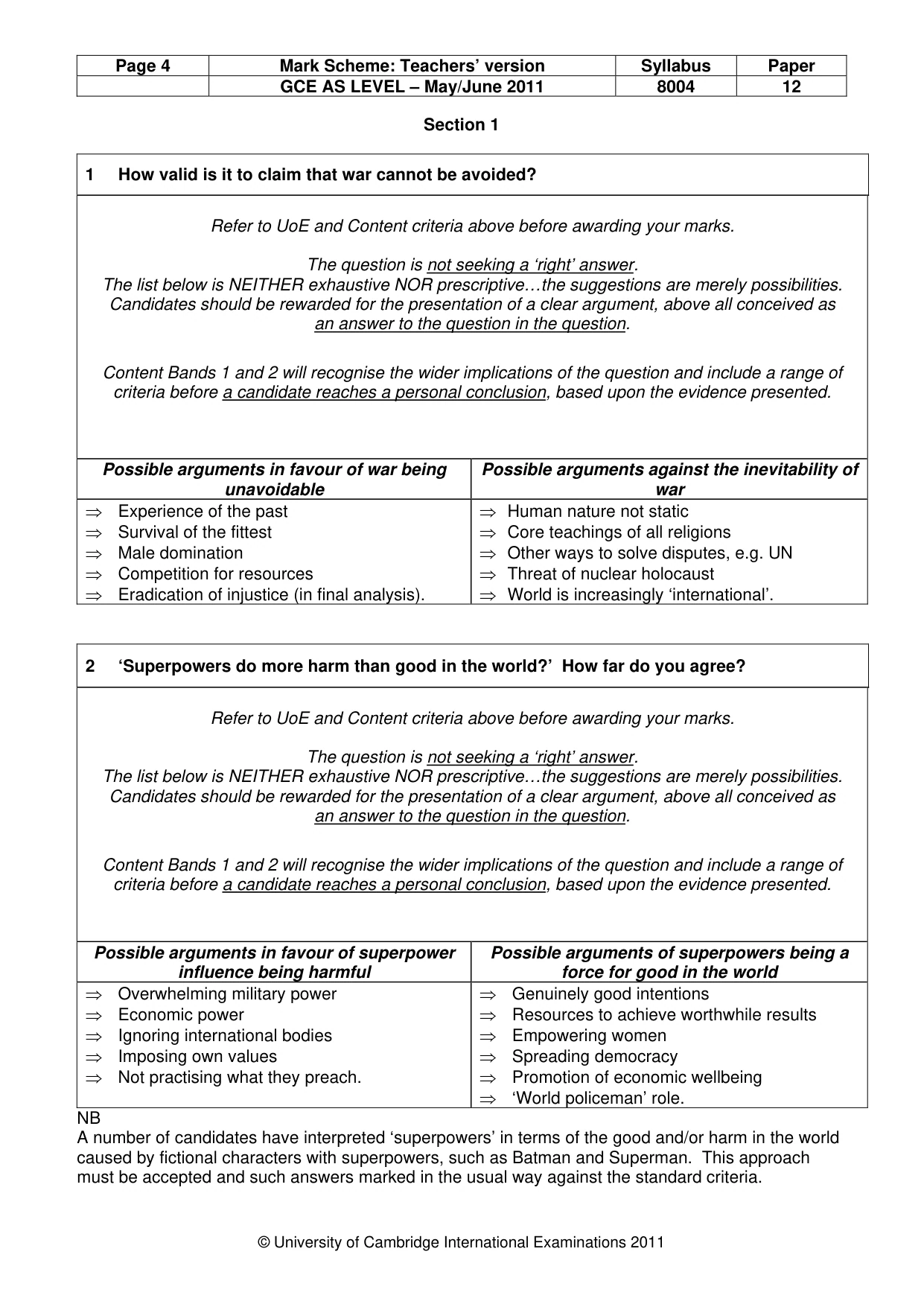
Page 4 Mark Scheme: Teachers’ version Syllabus Paper GCE AS LEVEL – May/June 2011 8004 12 © University of Cambridge International Examinations 2011 Section 1 1 How valid is it to claim that war cannot be avoided? Refer to UoE and Content criteria above before awarding your marks. The question is not seeking a ‘right’ answer. The list below is NEITHER exhaustive NOR prescriptive…the suggestions are merely possibilities. Candidates should be rewarded for the presentation of a clear argument, above all conceived as an answer to the question in the question. Content Bands 1 and 2 will recognise the wider implications of the question and include a range of criteria before a candidate reaches a personal conclusion, based upon the evidence presented. Possible arguments in favour of war being unavoidable Possible arguments against the inevitability of war ⇒ Experience of the past ⇒ Survival of the fittest ⇒ Male domination ⇒ Competition for resources ⇒ Eradication of injustice (in final analysis). ⇒ Human nature not static ⇒ Core teachings of all religions ⇒ Other ways to solve disputes, e.g. UN ⇒ Threat of nuclear holocaust ⇒ World is increasingly ‘international’. 2 ‘Superpowers do more harm than good in the world?’ How far do you agree? Refer to UoE and Content criteria above before awarding your marks. The question is not seeking a ‘right’ answer. The list below is NEITHER exhaustive NOR prescriptive…the suggestions are merely possibilities. Candidates should be rewarded for the presentation of a clear argument, above all conceived as an answer to the question in the question. Content Bands 1 and 2 will recognise the wider implications of the question and include a range of criteria before a candidate reaches a personal conclusion, based upon the evidence presented. Possible arguments in favour of superpower influence being harmful Possible arguments of superpowers being a force for good in the world ⇒ Overwhelming military power ⇒ Economic power ⇒ Ignoring international bodies ⇒ Imposing own values ⇒ Not practising what they preach. ⇒ Genuinely good intentions ⇒ Resources to achieve worthwhile results ⇒ Empowering women ⇒ Spreading democracy ⇒ Promotion of economic wellbeing ⇒ ‘World policeman’ role. NB A number of candidates have interpreted ‘superpowers’ in terms of the good and/or harm in the world caused by fictional characters with superpowers, such as Batman and Superman. This approach must be accepted and such answers marked in the usual way against the standard criteria.
Mark scheme, page 5
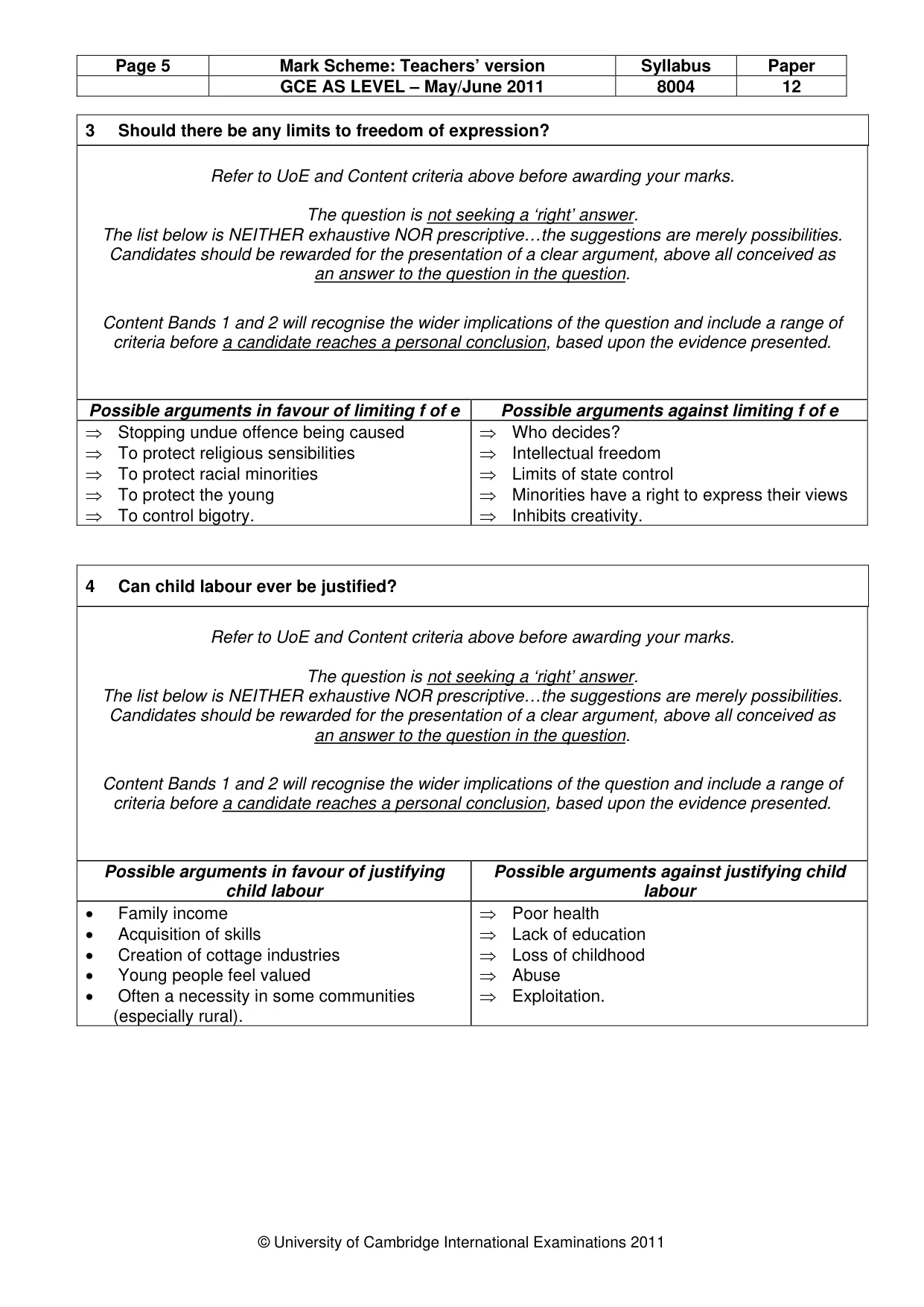
Page 5 Mark Scheme: Teachers’ version Syllabus Paper GCE AS LEVEL – May/June 2011 8004 12 © University of Cambridge International Examinations 2011 3 Should there be any limits to freedom of expression? Refer to UoE and Content criteria above before awarding your marks. The question is not seeking a ‘right’ answer. The list below is NEITHER exhaustive NOR prescriptive…the suggestions are merely possibilities. Candidates should be rewarded for the presentation of a clear argument, above all conceived as an answer to the question in the question. Content Bands 1 and 2 will recognise the wider implications of the question and include a range of criteria before a candidate reaches a personal conclusion, based upon the evidence presented. Possible arguments in favour of limiting f of e Possible arguments against limiting f of e ⇒ Stopping undue offence being caused ⇒ To protect religious sensibilities ⇒ To protect racial minorities ⇒ To protect the young ⇒ To control bigotry. ⇒ Who decides? ⇒ Intellectual freedom ⇒ Limits of state control ⇒ Minorities have a right to express their views ⇒ Inhibits creativity. 4 Can child labour ever be justified? Refer to UoE and Content criteria above before awarding your marks. The question is not seeking a ‘right’ answer. The list below is NEITHER exhaustive NOR prescriptive…the suggestions are merely possibilities. Candidates should be rewarded for the presentation of a clear argument, above all conceived as an answer to the question in the question. Content Bands 1 and 2 will recognise the wider implications of the question and include a range of criteria before a candidate reaches a personal conclusion, based upon the evidence presented. Possible arguments in favour of justifying child labour Possible arguments against justifying child labour • Family income • Acquisition of skills • Creation of cottage industries • Young people feel valued • Often a necessity in some communities (especially rural). ⇒ Poor health ⇒ Lack of education ⇒ Loss of childhood ⇒ Abuse ⇒ Exploitation.
Mark scheme, page 6
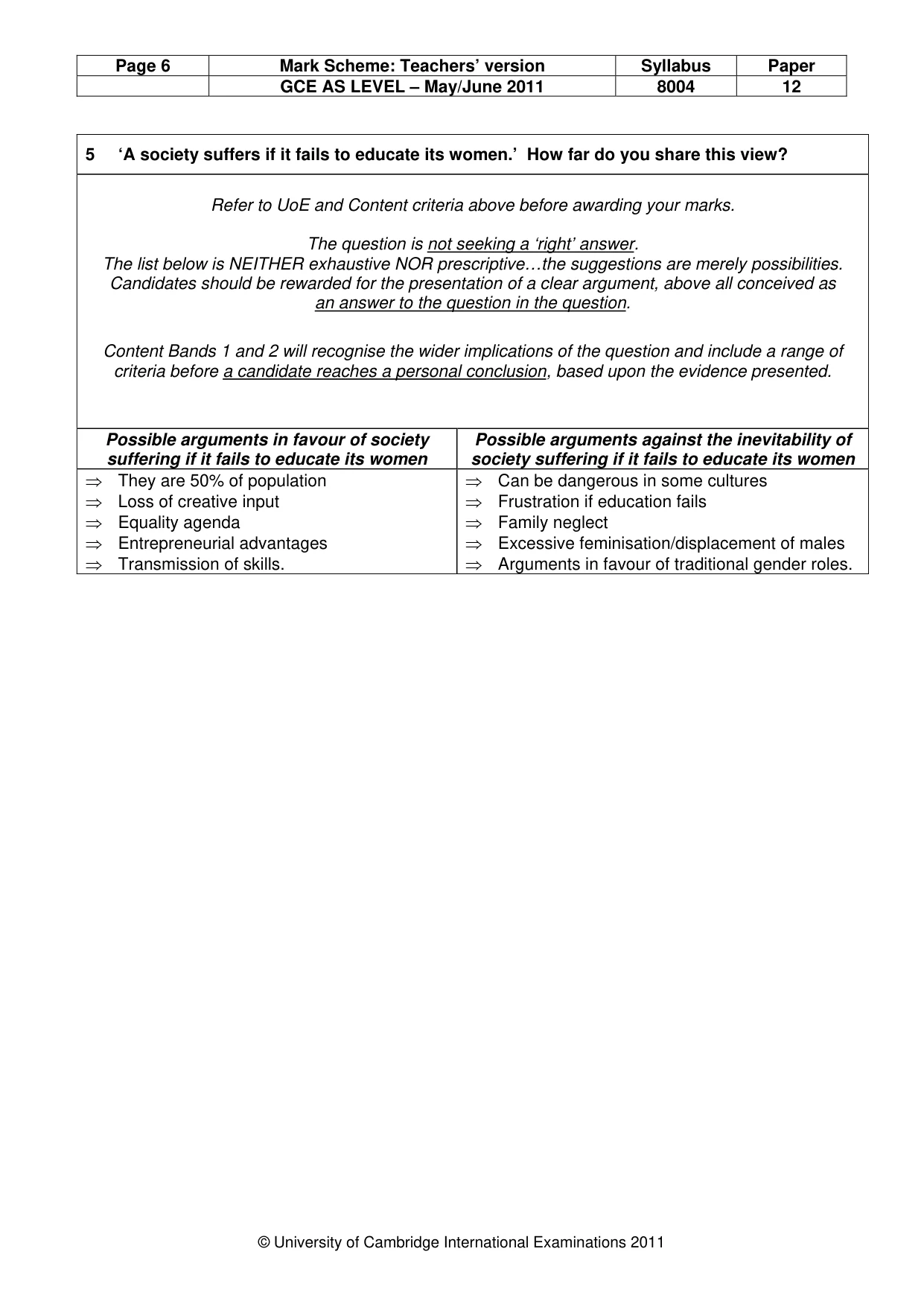
Page 6 Mark Scheme: Teachers’ version Syllabus Paper GCE AS LEVEL – May/June 2011 8004 12 © University of Cambridge International Examinations 2011 5 ‘A society suffers if it fails to educate its women.’ How far do you share this view? Refer to UoE and Content criteria above before awarding your marks. The question is not seeking a ‘right’ answer. The list below is NEITHER exhaustive NOR prescriptive…the suggestions are merely possibilities. Candidates should be rewarded for the presentation of a clear argument, above all conceived as an answer to the question in the question. Content Bands 1 and 2 will recognise the wider implications of the question and include a range of criteria before a candidate reaches a personal conclusion, based upon the evidence presented. Possible arguments in favour of society suffering if it fails to educate its women Possible arguments against the inevitability of society suffering if it fails to educate its women ⇒ They are 50% of population ⇒ Loss of creative input ⇒ Equality agenda ⇒ Entrepreneurial advantages ⇒ Transmission of skills. ⇒ Can be dangerous in some cultures ⇒ Frustration if education fails ⇒ Family neglect ⇒ Excessive feminisation/displacement of males ⇒ Arguments in favour of traditional gender roles.
Mark scheme, page 7
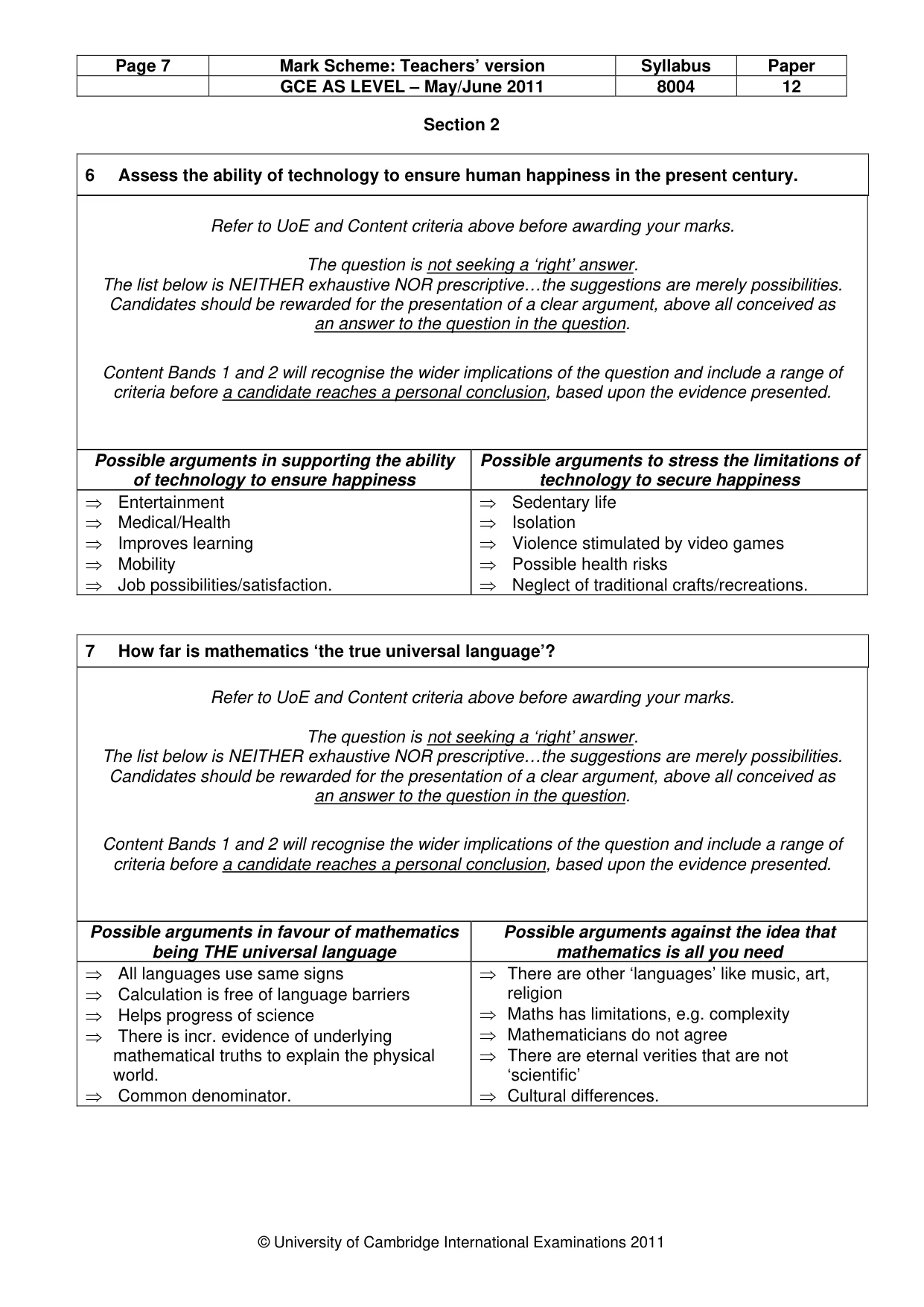
Page 7 Mark Scheme: Teachers’ version Syllabus Paper GCE AS LEVEL – May/June 2011 8004 12 © University of Cambridge International Examinations 2011 Section 2 6 Assess the ability of technology to ensure human happiness in the present century. Refer to UoE and Content criteria above before awarding your marks. The question is not seeking a ‘right’ answer. The list below is NEITHER exhaustive NOR prescriptive…the suggestions are merely possibilities. Candidates should be rewarded for the presentation of a clear argument, above all conceived as an answer to the question in the question. Content Bands 1 and 2 will recognise the wider implications of the question and include a range of criteria before a candidate reaches a personal conclusion, based upon the evidence presented. Possible arguments in supporting the ability of technology to ensure happiness Possible arguments to stress the limitations of technology to secure happiness ⇒ Entertainment ⇒ Medical/Health ⇒ Improves learning ⇒ Mobility ⇒ Job possibilities/satisfaction. ⇒ Sedentary life ⇒ Isolation ⇒ Violence stimulated by video games ⇒ Possible health risks ⇒ Neglect of traditional crafts/recreations. 7 How far is mathematics ‘the true universal language’? Refer to UoE and Content criteria above before awarding your marks. The question is not seeking a ‘right’ answer. The list below is NEITHER exhaustive NOR prescriptive…the suggestions are merely possibilities. Candidates should be rewarded for the presentation of a clear argument, above all conceived as an answer to the question in the question. Content Bands 1 and 2 will recognise the wider implications of the question and include a range of criteria before a candidate reaches a personal conclusion, based upon the evidence presented. Possible arguments in favour of mathematics being THE universal language Possible arguments against the idea that mathematics is all you need ⇒ All languages use same signs ⇒ Calculation is free of language barriers ⇒ Helps progress of science ⇒ There is incr. evidence of underlying mathematical truths to explain the physical world. ⇒ Common denominator. ⇒ There are other ‘languages’ like music, art, religion ⇒ Maths has limitations, e.g. complexity ⇒ Mathematicians do not agree ⇒ There are eternal verities that are not ‘scientific’ ⇒ Cultural differences.
Mark scheme, page 8
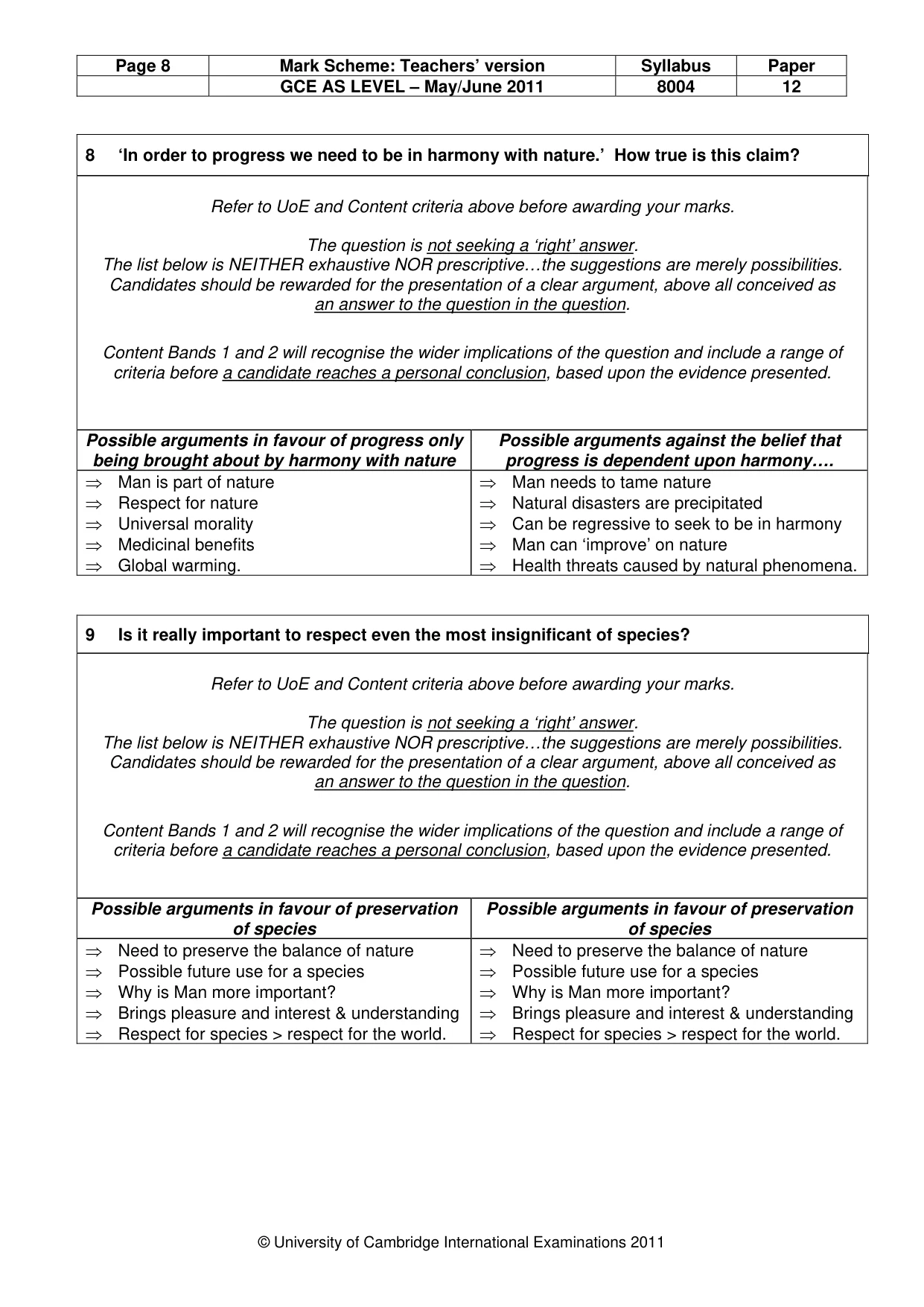
Page 8 Mark Scheme: Teachers’ version Syllabus Paper GCE AS LEVEL – May/June 2011 8004 12 © University of Cambridge International Examinations 2011 8 ‘In order to progress we need to be in harmony with nature.’ How true is this claim? Refer to UoE and Content criteria above before awarding your marks. The question is not seeking a ‘right’ answer. The list below is NEITHER exhaustive NOR prescriptive…the suggestions are merely possibilities. Candidates should be rewarded for the presentation of a clear argument, above all conceived as an answer to the question in the question. Content Bands 1 and 2 will recognise the wider implications of the question and include a range of criteria before a candidate reaches a personal conclusion, based upon the evidence presented. Possible arguments in favour of progress only being brought about by harmony with nature Possible arguments against the belief that progress is dependent upon harmony…. ⇒ Man is part of nature ⇒ Respect for nature ⇒ Universal morality ⇒ Medicinal benefits ⇒ Global warming. ⇒ Man needs to tame nature ⇒ Natural disasters are precipitated ⇒ Can be regressive to seek to be in harmony ⇒ Man can ‘improve’ on nature ⇒ Health threats caused by natural phenomena. 9 Is it really important to respect even the most insignificant of species? Refer to UoE and Content criteria above before awarding your marks. The question is not seeking a ‘right’ answer. The list below is NEITHER exhaustive NOR prescriptive…the suggestions are merely possibilities. Candidates should be rewarded for the presentation of a clear argument, above all conceived as an answer to the question in the question. Content Bands 1 and 2 will recognise the wider implications of the question and include a range of criteria before a candidate reaches a personal conclusion, based upon the evidence presented. Possible arguments in favour of preservation of species Possible arguments in favour of preservation of species ⇒ Need to preserve the balance of nature ⇒ Possible future use for a species ⇒ Why is Man more important? ⇒ Brings pleasure and interest & understanding ⇒ Respect for species > respect for the world. ⇒ Need to preserve the balance of nature ⇒ Possible future use for a species ⇒ Why is Man more important? ⇒ Brings pleasure and interest & understanding ⇒ Respect for species > respect for the world.
Mark scheme, page 9
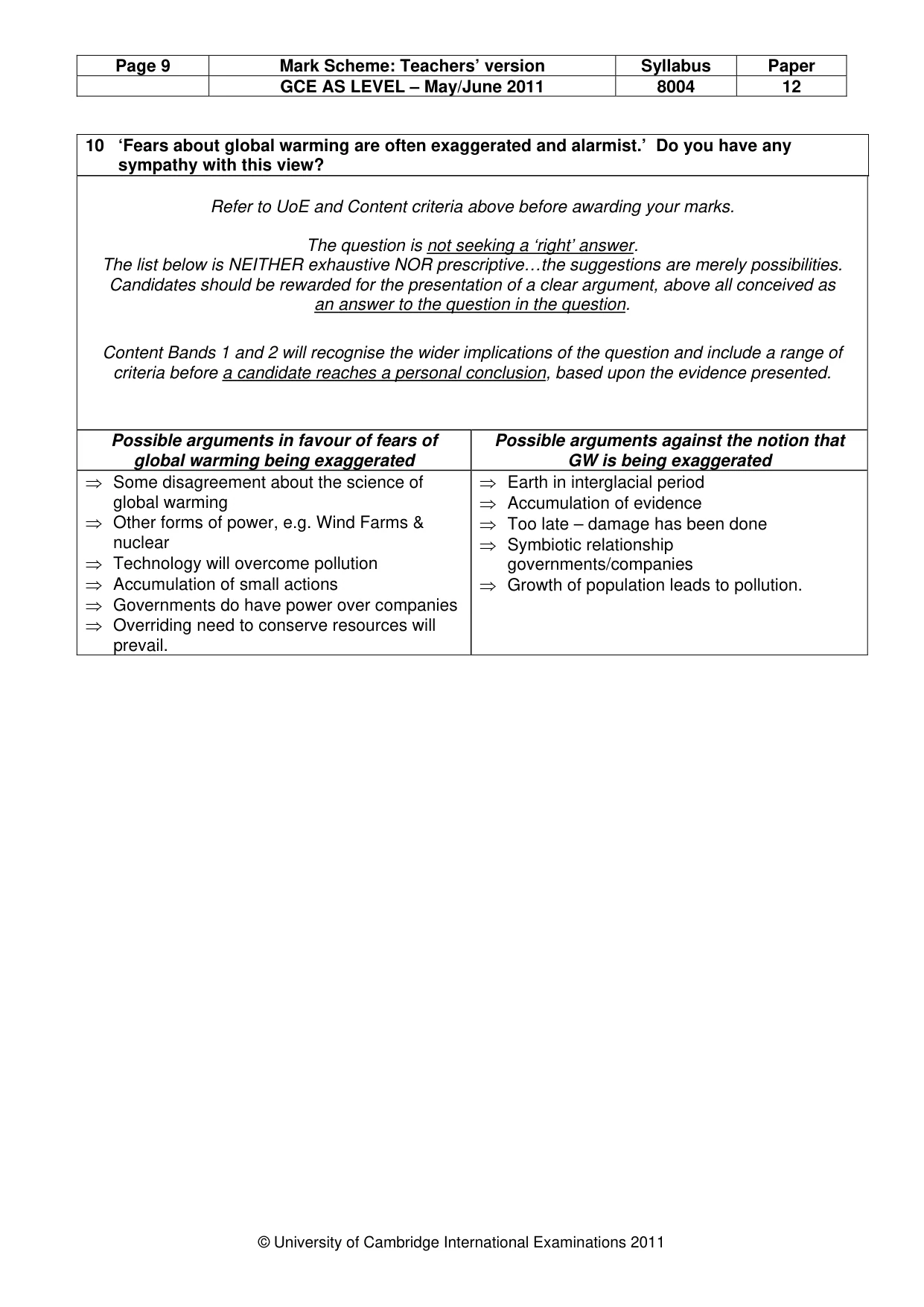
Page 9 Mark Scheme: Teachers’ version Syllabus Paper GCE AS LEVEL – May/June 2011 8004 12 © University of Cambridge International Examinations 2011 10 ‘Fears about global warming are often exaggerated and alarmist.’ Do you have any sympathy with this view? Refer to UoE and Content criteria above before awarding your marks. The question is not seeking a ‘right’ answer. The list below is NEITHER exhaustive NOR prescriptive…the suggestions are merely possibilities. Candidates should be rewarded for the presentation of a clear argument, above all conceived as an answer to the question in the question. Content Bands 1 and 2 will recognise the wider implications of the question and include a range of criteria before a candidate reaches a personal conclusion, based upon the evidence presented. Possible arguments in favour of fears of global warming being exaggerated Possible arguments against the notion that GW is being exaggerated ⇒ Some disagreement about the science of global warming ⇒ Other forms of power, e.g. Wind Farms & nuclear ⇒ Technology will overcome pollution ⇒ Accumulation of small actions ⇒ Governments do have power over companies ⇒ Overriding need to conserve resources will prevail. ⇒ Earth in interglacial period ⇒ Accumulation of evidence ⇒ Too late – damage has been done ⇒ Symbiotic relationship governments/companies ⇒ Growth of population leads to pollution.
Mark scheme, page 10
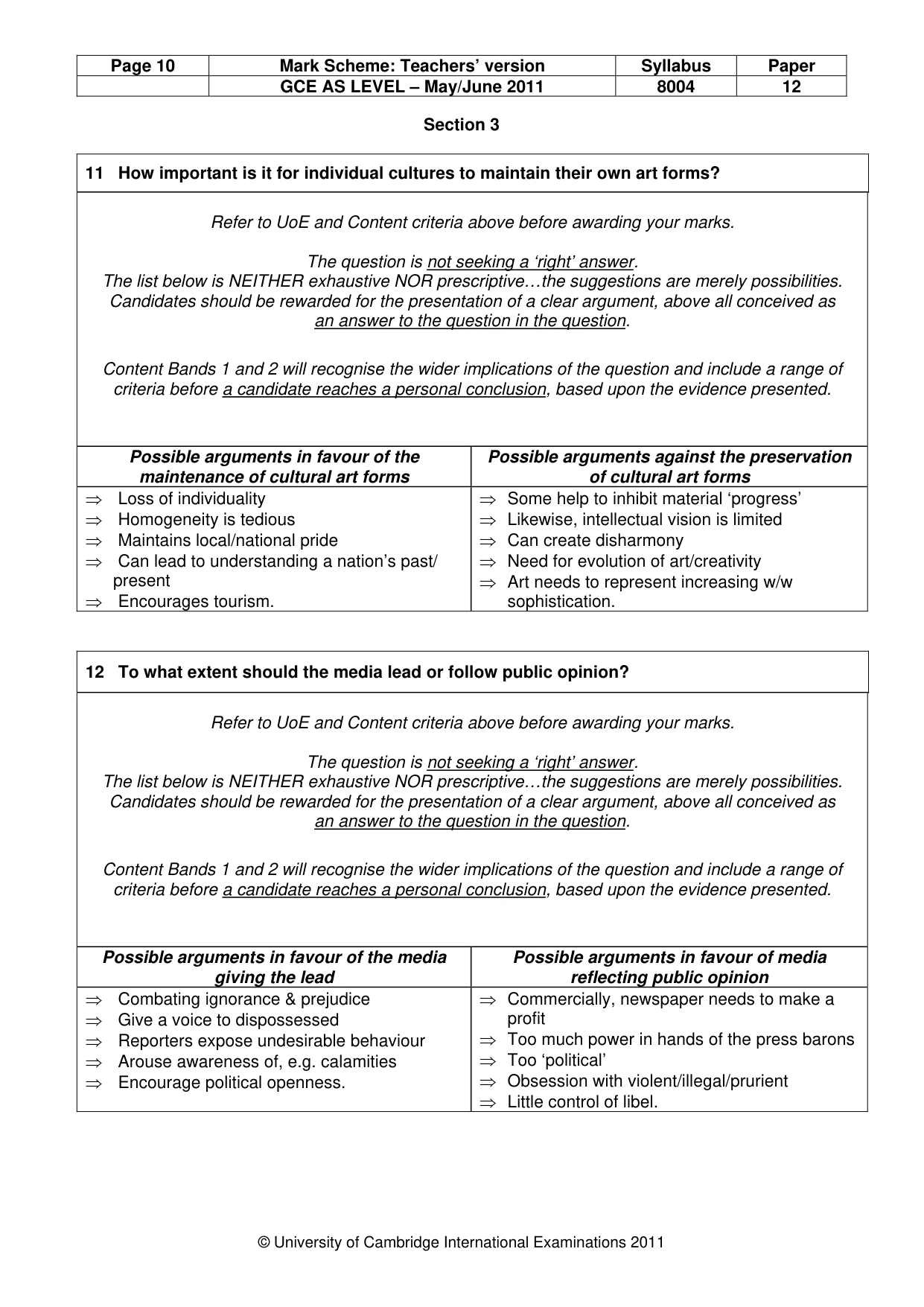
Page 10 Mark Scheme: Teachers’ version Syllabus Paper GCE AS LEVEL – May/June 2011 8004 12 © University of Cambridge International Examinations 2011 Section 3 11 How important is it for individual cultures to maintain their own art forms? Refer to UoE and Content criteria above before awarding your marks. The question is not seeking a ‘right’ answer. The list below is NEITHER exhaustive NOR prescriptive…the suggestions are merely possibilities. Candidates should be rewarded for the presentation of a clear argument, above all conceived as an answer to the question in the question. Content Bands 1 and 2 will recognise the wider implications of the question and include a range of criteria before a candidate reaches a personal conclusion, based upon the evidence presented. Possible arguments in favour of the maintenance of cultural art forms Possible arguments against the preservation of cultural art forms ⇒ Loss of individuality ⇒ Homogeneity is tedious ⇒ Maintains local/national pride ⇒ Can lead to understanding a nation’s past/ present ⇒ Encourages tourism. ⇒ Some help to inhibit material ‘progress’ ⇒ Likewise, intellectual vision is limited ⇒ Can create disharmony ⇒ Need for evolution of art/creativity ⇒ Art needs to represent increasing w/w sophistication. 12 To what extent should the media lead or follow public opinion? Refer to UoE and Content criteria above before awarding your marks. The question is not seeking a ‘right’ answer. The list below is NEITHER exhaustive NOR prescriptive…the suggestions are merely possibilities. Candidates should be rewarded for the presentation of a clear argument, above all conceived as an answer to the question in the question. Content Bands 1 and 2 will recognise the wider implications of the question and include a range of criteria before a candidate reaches a personal conclusion, based upon the evidence presented. Possible arguments in favour of the media giving the lead Possible arguments in favour of media reflecting public opinion ⇒ Combating ignorance & prejudice ⇒ Give a voice to dispossessed ⇒ Reporters expose undesirable behaviour ⇒ Arouse awareness of, e.g. calamities ⇒ Encourage political openness. ⇒ Commercially, newspaper needs to make a profit ⇒ Too much power in hands of the press barons ⇒ Too ‘political’ ⇒ Obsession with violent/illegal/prurient ⇒ Little control of libel.
Mark scheme, page 11
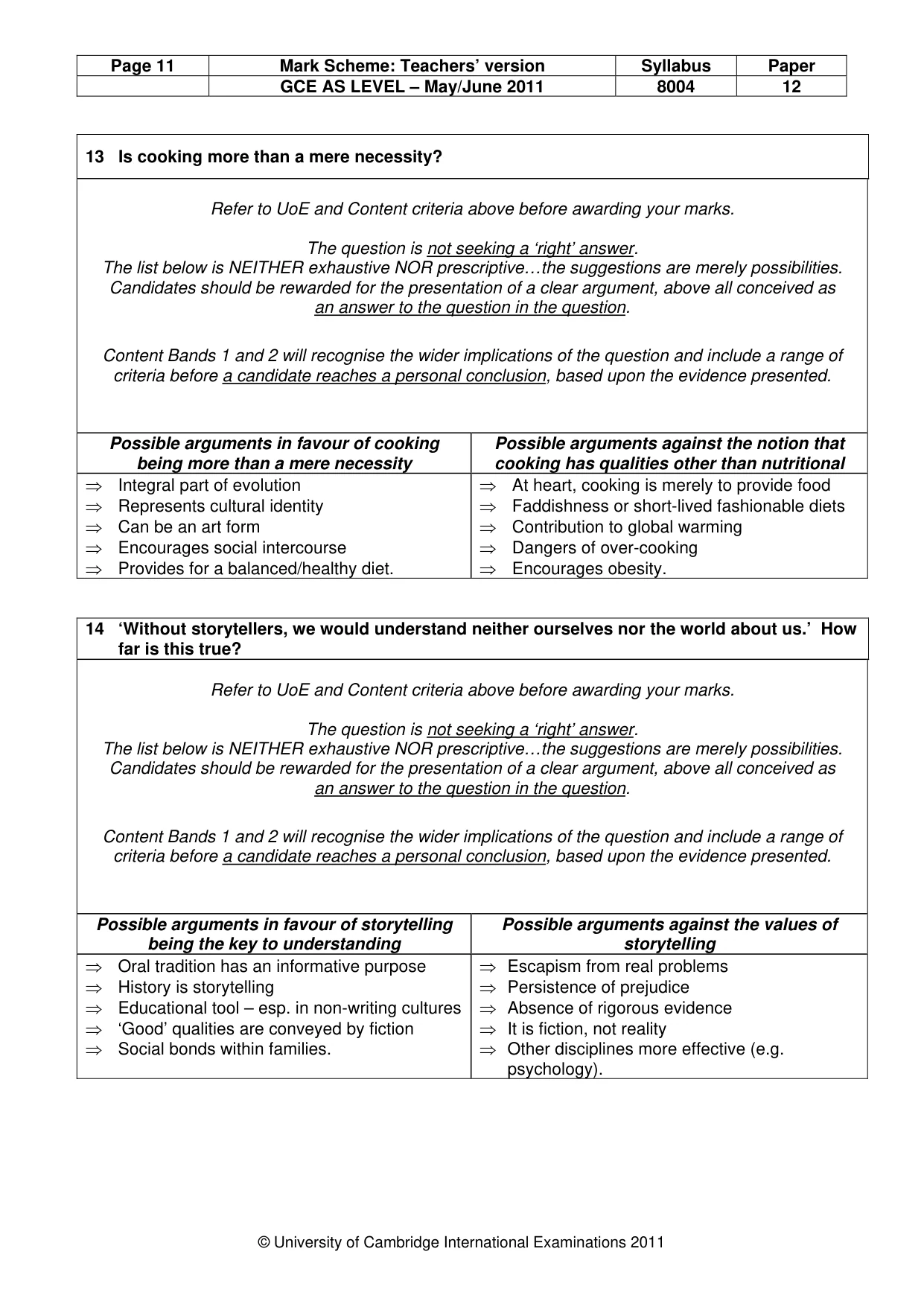
Page 11 Mark Scheme: Teachers’ version Syllabus Paper GCE AS LEVEL – May/June 2011 8004 12 © University of Cambridge International Examinations 2011 13 Is cooking more than a mere necessity? Refer to UoE and Content criteria above before awarding your marks. The question is not seeking a ‘right’ answer. The list below is NEITHER exhaustive NOR prescriptive…the suggestions are merely possibilities. Candidates should be rewarded for the presentation of a clear argument, above all conceived as an answer to the question in the question. Content Bands 1 and 2 will recognise the wider implications of the question and include a range of criteria before a candidate reaches a personal conclusion, based upon the evidence presented. Possible arguments in favour of cooking being more than a mere necessity Possible arguments against the notion that cooking has qualities other than nutritional ⇒ Integral part of evolution ⇒ Represents cultural identity ⇒ Can be an art form ⇒ Encourages social intercourse ⇒ Provides for a balanced/healthy diet. ⇒ At heart, cooking is merely to provide food ⇒ Faddishness or short-lived fashionable diets ⇒ Contribution to global warming ⇒ Dangers of over-cooking ⇒ Encourages obesity. 14 ‘Without storytellers, we would understand neither ourselves nor the world about us.’ How far is this true? Refer to UoE and Content criteria above before awarding your marks. The question is not seeking a ‘right’ answer. The list below is NEITHER exhaustive NOR prescriptive…the suggestions are merely possibilities. Candidates should be rewarded for the presentation of a clear argument, above all conceived as an answer to the question in the question. Content Bands 1 and 2 will recognise the wider implications of the question and include a range of criteria before a candidate reaches a personal conclusion, based upon the evidence presented. Possible arguments in favour of storytelling being the key to understanding Possible arguments against the values of storytelling ⇒ Oral tradition has an informative purpose ⇒ History is storytelling ⇒ Educational tool – esp. in non-writing cultures ⇒ ‘Good’ qualities are conveyed by fiction ⇒ Social bonds within families. ⇒ Escapism from real problems ⇒ Persistence of prejudice ⇒ Absence of rigorous evidence ⇒ It is fiction, not reality ⇒ Other disciplines more effective (e.g. psychology).
Mark scheme, page 12
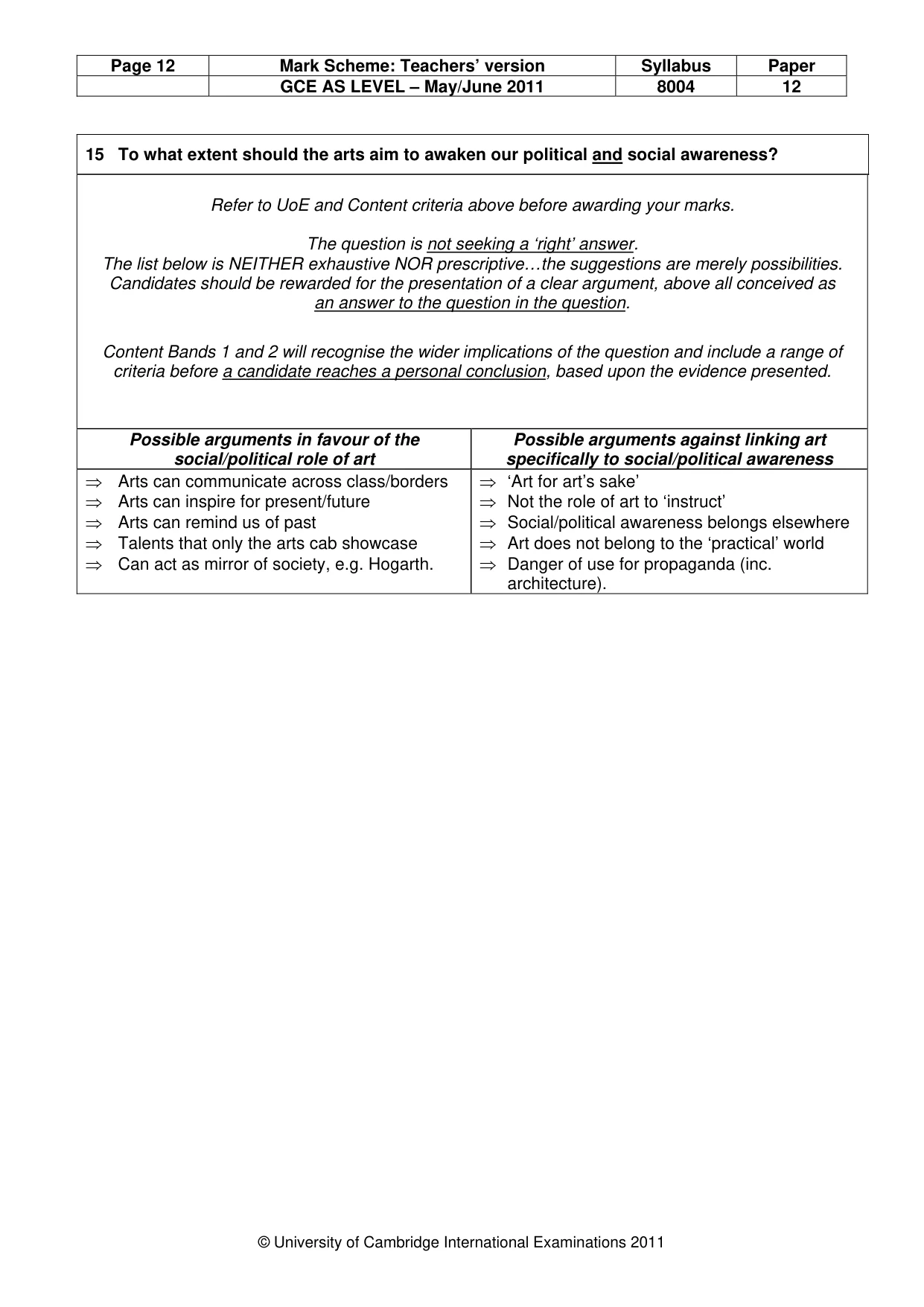
Page 12 Mark Scheme: Teachers’ version Syllabus Paper GCE AS LEVEL – May/June 2011 8004 12 © University of Cambridge International Examinations 2011 15 To what extent should the arts aim to awaken our political and social awareness? Refer to UoE and Content criteria above before awarding your marks. The question is not seeking a ‘right’ answer. The list below is NEITHER exhaustive NOR prescriptive…the suggestions are merely possibilities. Candidates should be rewarded for the presentation of a clear argument, above all conceived as an answer to the question in the question. Content Bands 1 and 2 will recognise the wider implications of the question and include a range of criteria before a candidate reaches a personal conclusion, based upon the evidence presented. Possible arguments in favour of the social/political role of art Possible arguments against linking art specifically to social/political awareness ⇒ Arts can communicate across class/borders ⇒ Arts can inspire for present/future ⇒ Arts can remind us of past ⇒ Talents that only the arts cab showcase ⇒ Can act as mirror of society, e.g. Hogarth. ⇒ ‘Art for art’s sake’ ⇒ Not the role of art to ‘instruct’ ⇒ Social/political awareness belongs elsewhere ⇒ Art does not belong to the ‘practical’ world ⇒ Danger of use for propaganda (inc. architecture).
What you needed in this session
Cambridge’s own grade thresholds for 2011 May/June, Paper 1 · Variant 2. A higher threshold means an easier paper — the bar moves with how the cohort did.