Cambridge A Level General Paper (AS Level only) 8004 — 2011 May/June Paper 1 · Variant 1
8004/11/M/J/11 · 100 marks · ≈113 min
The question paper and its mark scheme, free to read here and free to download. This is Cambridge’s own paper, exactly as it was sat.
Question paper2 pages
Mark scheme12 pages
Answers below. Sit the paper first if you are practising.
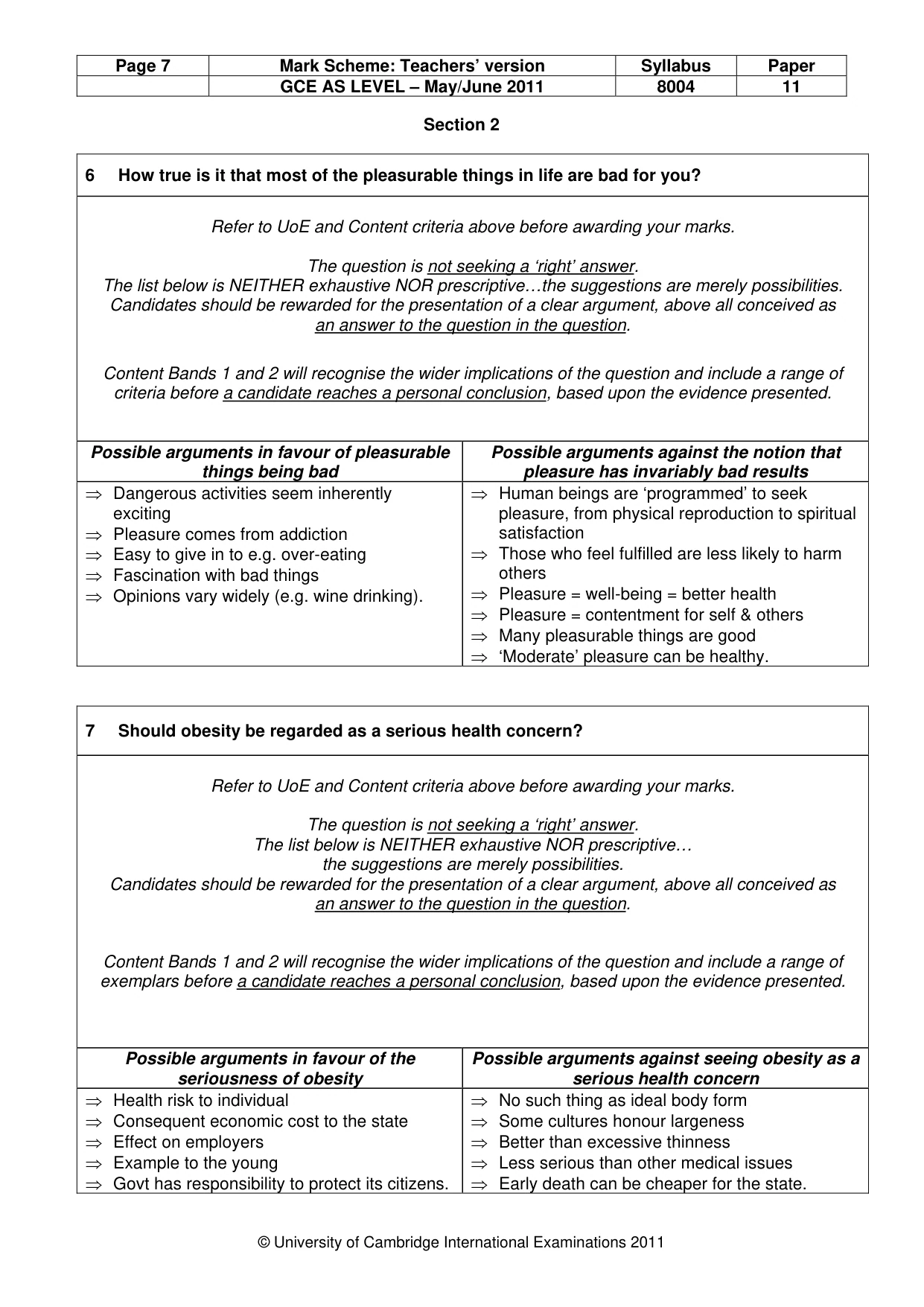
Paper as text
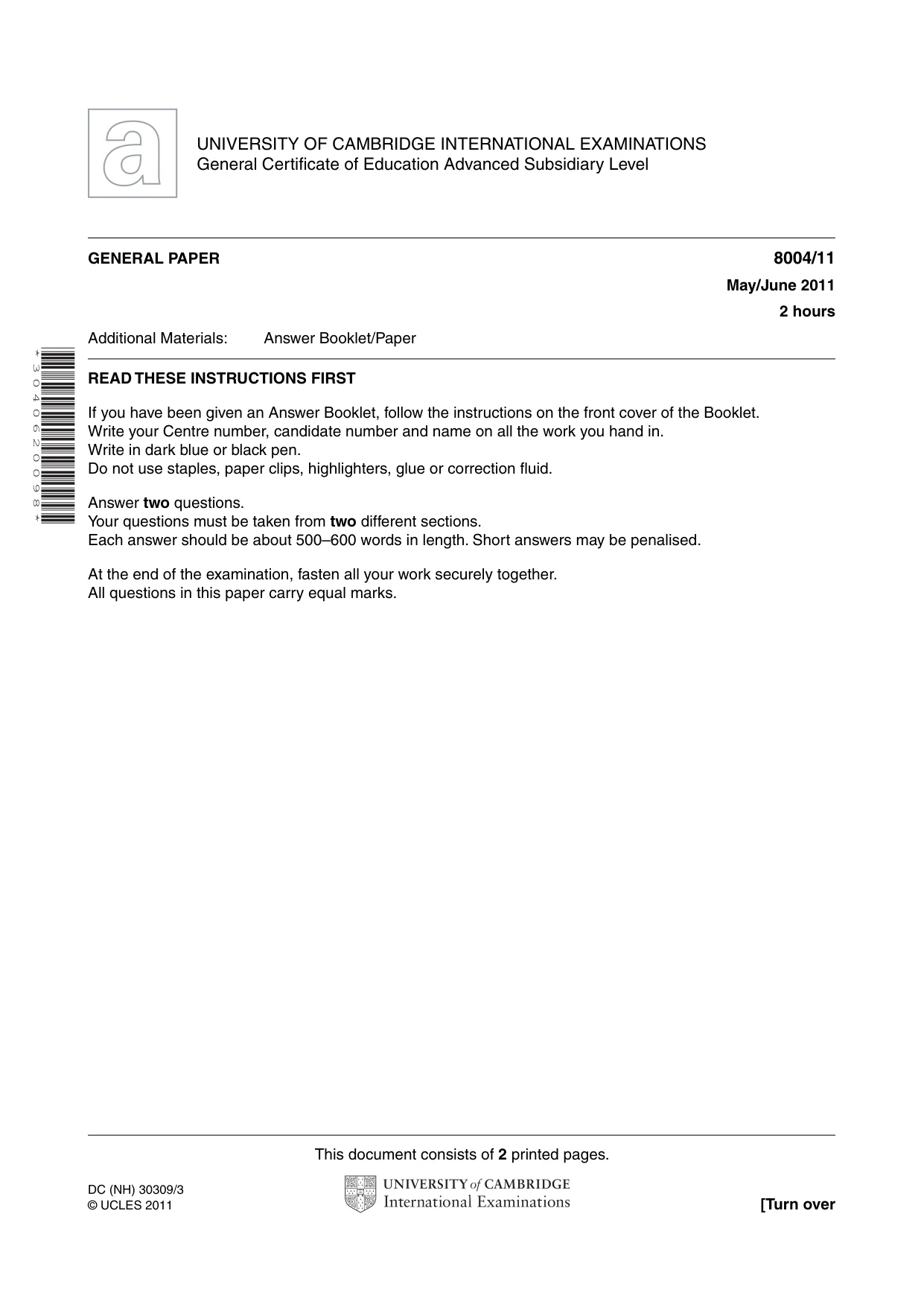
Question paper, page 1
This document consists of 2 printed pages. DC (NH) 30309/3 © UCLES 2011 [Turn over UNIVERSITY OF CAMBRIDGE INTERNATIONAL EXAMINATIONS General Certificate of Education Advanced Subsidiary Level READ THESE INSTRUCTIONS FIRST If you have been given an Answer Booklet, follow the instructions on the front cover of the Booklet. Write your Centre number, candidate number and name on all the work you hand in. Write in dark blue or black pen. Do not use staples, paper clips, highlighters, glue or correction fluid. Answer two questions. Your questions must be taken from two different sections. Each answer should be about 500–600 words in length. Short answers may be penalised. At the end of the examination, fasten all your work securely together. All questions in this paper carry equal marks. * 3 0 4 0 6 2 0 0 9 8 * GENERAL PAPER 8004/11 May/June 2011 2 hours Additional Materials: Answer Booklet/Paper
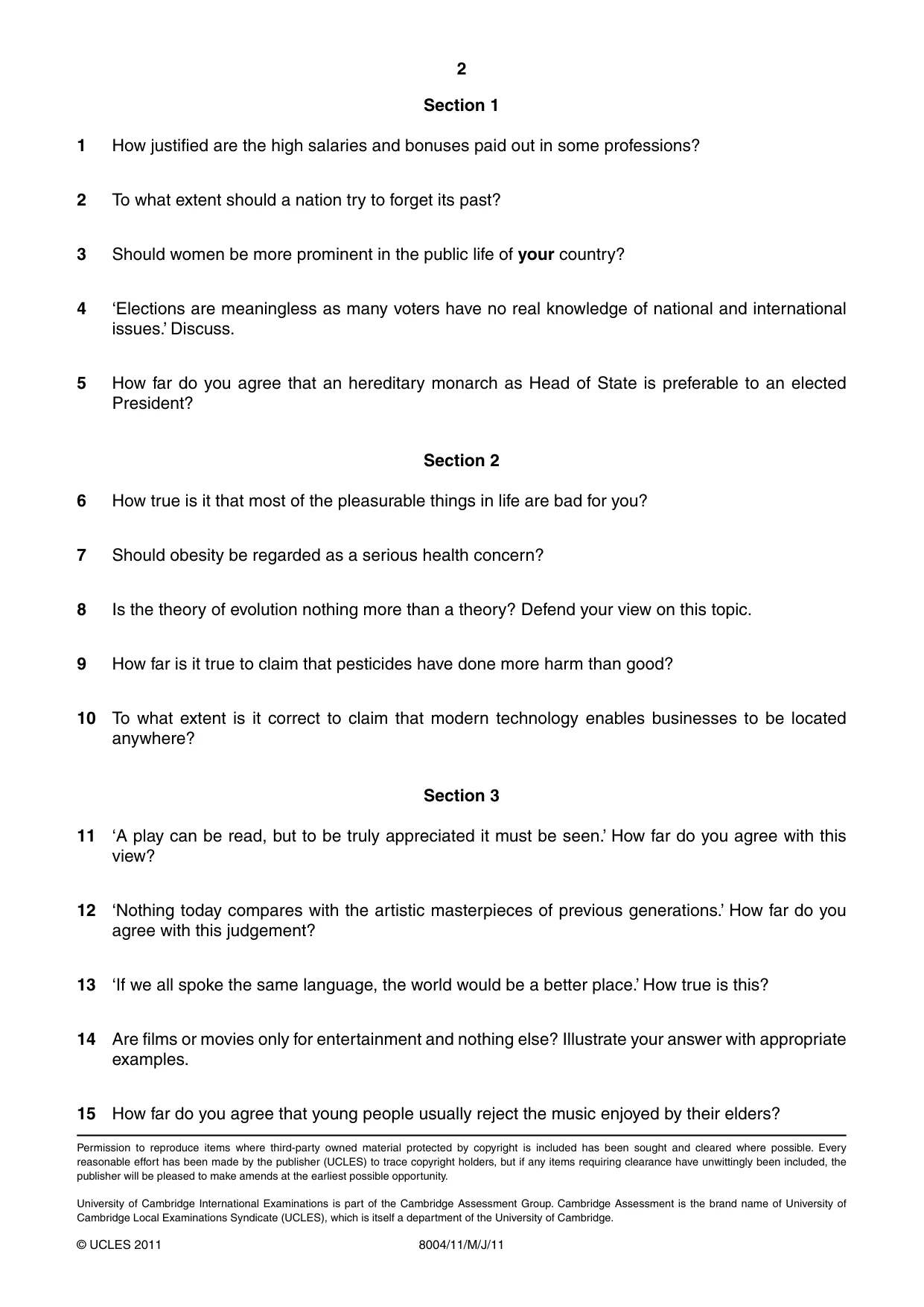
Question paper, page 2
2 8004/11/M/J/11 © UCLES 2011 Section 1 1 How justified are the high salaries and bonuses paid out in some professions? 2 To what extent should a nation try to forget its past? 3 Should women be more prominent in the public life of your country? 4 ‘Elections are meaningless as many voters have no real knowledge of national and international issues.’ Discuss. 5 How far do you agree that an hereditary monarch as Head of State is preferable to an elected President? Section 2 6 How true is it that most of the pleasurable things in life are bad for you? 7 Should obesity be regarded as a serious health concern? 8 Is the theory of evolution nothing more than a theory? Defend your view on this topic. 9 How far is it true to claim that pesticides have done more harm than good? 10 To what extent is it correct to claim that modern technology enables businesses to be located anywhere? Section 3 11 ‘A play can be read, but to be truly appreciated it must be seen.’ How far do you agree with this view? 12 ‘Nothing today compares with the artistic masterpieces of previous generations.’ How far do you agree with this judgement? 13 ‘If we all spoke the same language, the world would be a better place.’ How true is this? 14 Are films or movies only for entertainment and nothing else? Illustrate your answer with appropriate examples. 15 How far do you agree that young people usually reject the music enjoyed by their elders? Permission to reproduce items where third-party owned material protected by copyright is included has been sought and cleared where possible. Every reasonable effort has been made by the publisher (UCLES) to trace copyright holders, but if any items requiring clearance have unwittingly been included, the publisher will be pleased to make amends at the earliest possible opportunity. University of Cambridge International Examinations is part of the Cambridge Assessment Group. Cambridge Assessment is the brand name of University of Cambridge Local Examinations Syndicate (UCLES), which is itself a department of the University of Cambridge.
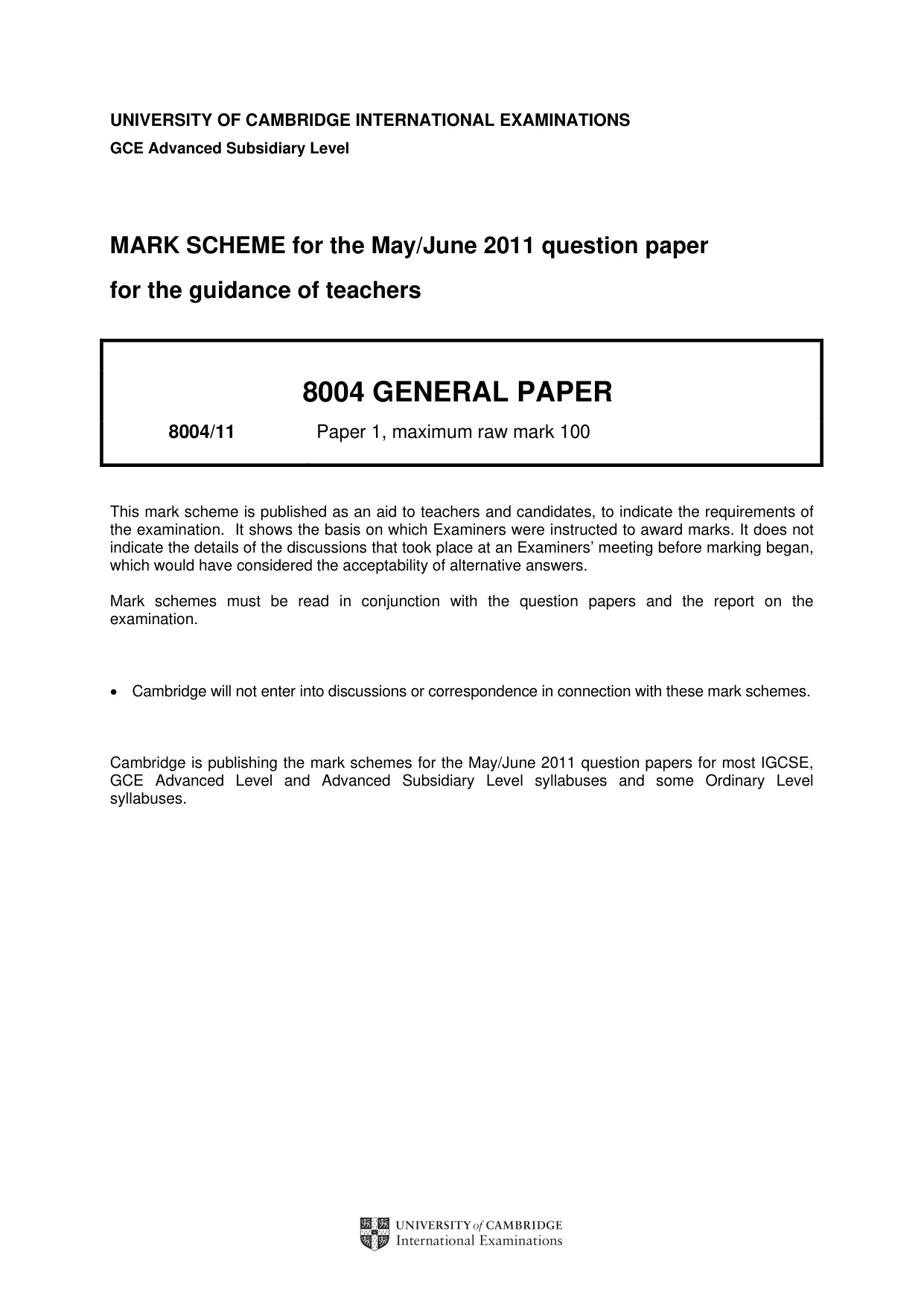
Mark scheme, page 1
UNIVERSITY OF CAMBRIDGE INTERNATIONAL EXAMINATIONS GCE Advanced Subsidiary Level MARK SCHEME for the May/June 2011 question paper for the guidance of teachers 8004 GENERAL PAPER 8004/11 Paper 1, maximum raw mark 100 This mark scheme is published as an aid to teachers and candidates, to indicate the requirements of the examination. It shows the basis on which Examiners were instructed to award marks. It does not indicate the details of the discussions that took place at an Examiners’ meeting before marking began, which would have considered the acceptability of alternative answers. Mark schemes must be read in conjunction with the question papers and the report on the examination. • Cambridge will not enter into discussions or correspondence in connection with these mark schemes. Cambridge is publishing the mark schemes for the May/June 2011 question papers for most IGCSE, GCE Advanced Level and Advanced Subsidiary Level syllabuses and some Ordinary Level syllabuses.
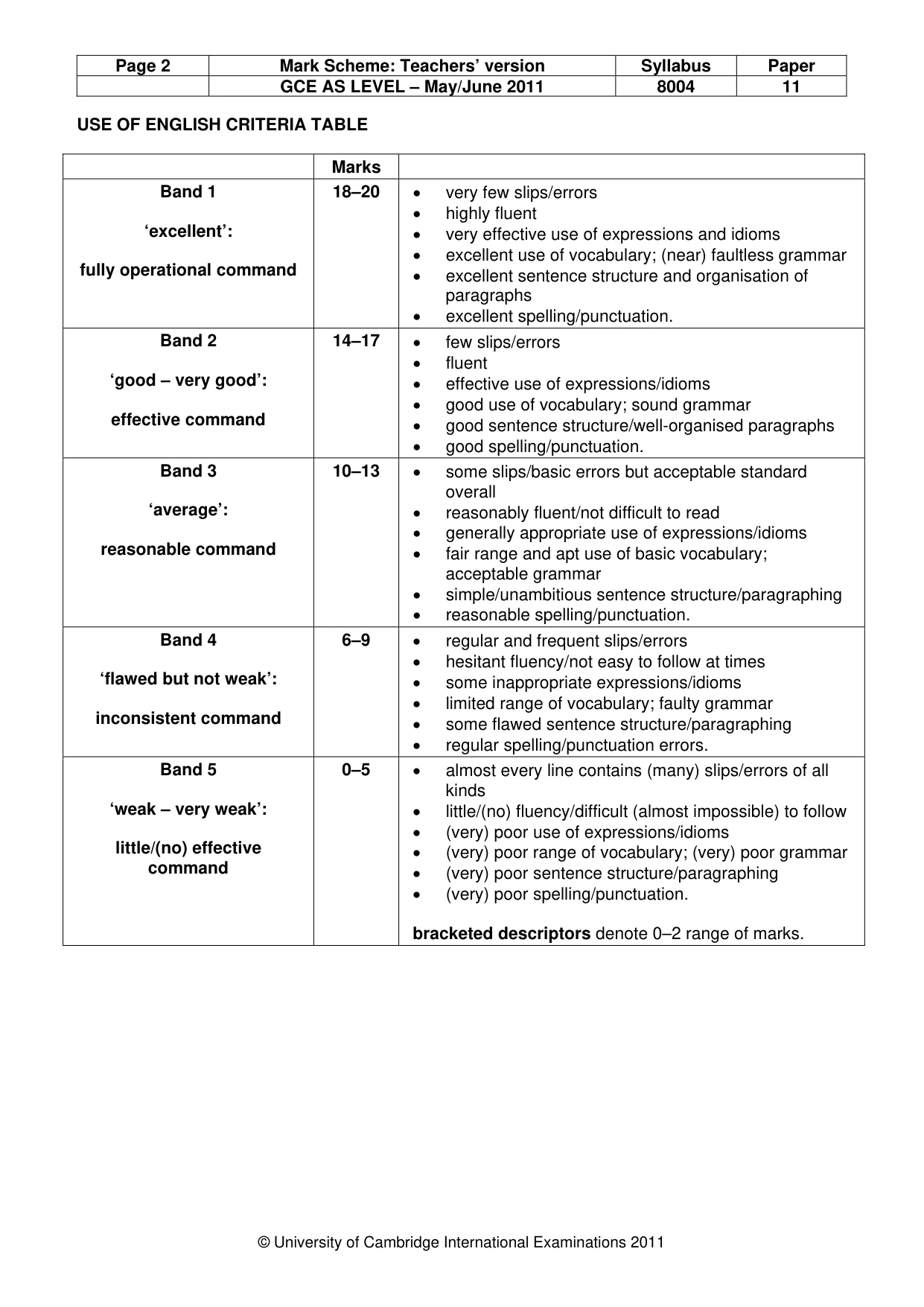
Mark scheme, page 2
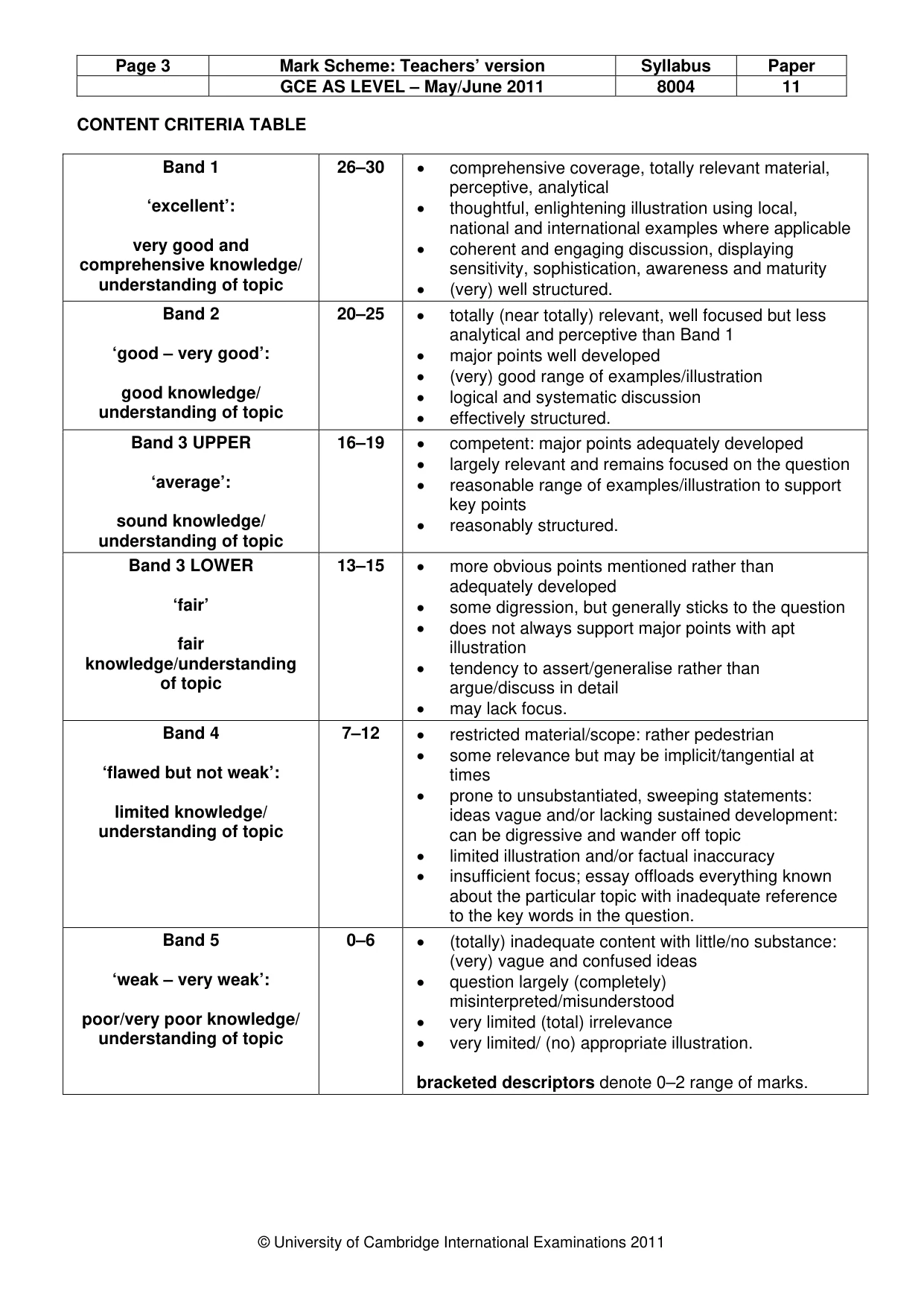
Page 2 Mark Scheme: Teachers’ version Syllabus Paper GCE AS LEVEL – May/June 2011 8004 11 © University of Cambridge International Examinations 2011 USE OF ENGLISH CRITERIA TABLE Marks Band 1 ‘excellent’: fully operational command 18–20 • very few slips/errors • highly fluent • very effective use of expressions and idioms • excellent use of vocabulary; (near) faultless grammar • excellent sentence structure and organisation of paragraphs • excellent spelling/punctuation. Band 2 ‘good – very good’: effective command 14–17 • few slips/errors • fluent • effective use of expressions/idioms • good use of vocabulary; sound grammar • good sentence structure/well-organised paragraphs • good spelling/punctuation. Band 3 ‘average’: reasonable command 10–13 • some slips/basic errors but acceptable standard overall • reasonably fluent/not difficult to read • generally appropriate use of expressions/idioms • fair range and apt use of basic vocabulary; acceptable grammar • simple/unambitious sentence structure/paragraphing • reasonable spelling/punctuation. Band 4 ‘flawed but not weak’: inconsistent command 6–9 • regular and frequent slips/errors • hesitant fluency/not easy to follow at times • some inappropriate expressions/idioms • limited range of vocabulary; faulty grammar • some flawed sentence structure/paragraphing • regular spelling/punctuation errors. Band 5 ‘weak – very weak’: little/(no) effective command 0–5 • almost every line contains (many) slips/errors of all kinds • little/(no) fluency/difficult (almost impossible) to follow • (very) poor use of expressions/idioms • (very) poor range of vocabulary; (very) poor grammar • (very) poor sentence structure/paragraphing • (very) poor spelling/punctuation. bracketed descriptors denote 0–2 range of marks.
Mark scheme, page 3
Page 3 Mark Scheme: Teachers’ version Syllabus Paper GCE AS LEVEL – May/June 2011 8004 11 © University of Cambridge International Examinations 2011 CONTENT CRITERIA TABLE Band 1 ‘excellent’: very good and comprehensive knowledge/ understanding of topic 26–30 • comprehensive coverage, totally relevant material, perceptive, analytical • thoughtful, enlightening illustration using local, national and international examples where applicable • coherent and engaging discussion, displaying sensitivity, sophistication, awareness and maturity • (very) well structured. Band 2 ‘good – very good’: good knowledge/ understanding of topic 20–25 • totally (near totally) relevant, well focused but less analytical and perceptive than Band 1 • major points well developed • (very) good range of examples/illustration • logical and systematic discussion • effectively structured. Band 3 UPPER ‘average’: sound knowledge/ understanding of topic 16–19 • competent: major points adequately developed • largely relevant and remains focused on the question • reasonable range of examples/illustration to support key points • reasonably structured. Band 3 LOWER ‘fair’ fair knowledge/understanding of topic 13–15 • more obvious points mentioned rather than adequately developed • some digression, but generally sticks to the question • does not always support major points with apt illustration • tendency to assert/generalise rather than argue/discuss in detail • may lack focus. Band 4 ‘flawed but not weak’: limited knowledge/ understanding of topic 7–12 • restricted material/scope: rather pedestrian • some relevance but may be implicit/tangential at times • prone to unsubstantiated, sweeping statements: ideas vague and/or lacking sustained development: can be digressive and wander off topic • limited illustration and/or factual inaccuracy • insufficient focus; essay offloads everything known about the particular topic with inadequate reference to the key words in the question. Band 5 ‘weak – very weak’: poor/very poor knowledge/ understanding of topic 0–6 • (totally) inadequate content with little/no substance: (very) vague and confused ideas • question largely (completely) misinterpreted/misunderstood • very limited (total) irrelevance • very limited/ (no) appropriate illustration. bracketed descriptors denote 0–2 range of marks.
Mark scheme, page 4
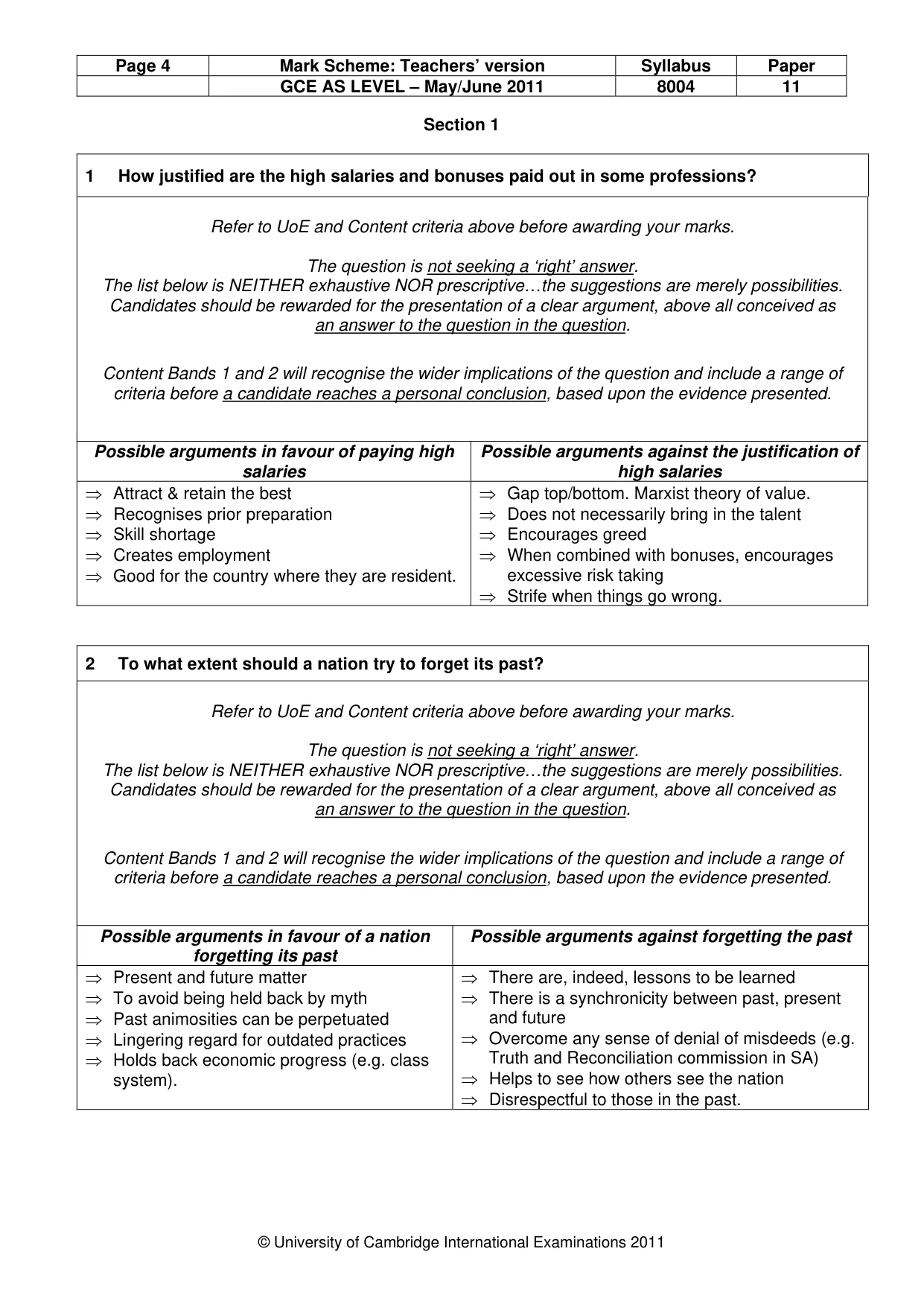
Page 4 Mark Scheme: Teachers’ version Syllabus Paper GCE AS LEVEL – May/June 2011 8004 11 © University of Cambridge International Examinations 2011 Section 1 1 How justified are the high salaries and bonuses paid out in some professions? Refer to UoE and Content criteria above before awarding your marks. The question is not seeking a ‘right’ answer. The list below is NEITHER exhaustive NOR prescriptive…the suggestions are merely possibilities. Candidates should be rewarded for the presentation of a clear argument, above all conceived as an answer to the question in the question. Content Bands 1 and 2 will recognise the wider implications of the question and include a range of criteria before a candidate reaches a personal conclusion, based upon the evidence presented. Possible arguments in favour of paying high salaries Possible arguments against the justification of high salaries ⇒ Attract & retain the best ⇒ Recognises prior preparation ⇒ Skill shortage ⇒ Creates employment ⇒ Good for the country where they are resident. ⇒ Gap top/bottom. Marxist theory of value. ⇒ Does not necessarily bring in the talent ⇒ Encourages greed ⇒ When combined with bonuses, encourages excessive risk taking ⇒ Strife when things go wrong. 2 To what extent should a nation try to forget its past? Refer to UoE and Content criteria above before awarding your marks. The question is not seeking a ‘right’ answer. The list below is NEITHER exhaustive NOR prescriptive…the suggestions are merely possibilities. Candidates should be rewarded for the presentation of a clear argument, above all conceived as an answer to the question in the question. Content Bands 1 and 2 will recognise the wider implications of the question and include a range of criteria before a candidate reaches a personal conclusion, based upon the evidence presented. Possible arguments in favour of a nation forgetting its past Possible arguments against forgetting the past ⇒ Present and future matter ⇒ To avoid being held back by myth ⇒ Past animosities can be perpetuated ⇒ Lingering regard for outdated practices ⇒ Holds back economic progress (e.g. class system). ⇒ There are, indeed, lessons to be learned ⇒ There is a synchronicity between past, present and future ⇒ Overcome any sense of denial of misdeeds (e.g. Truth and Reconciliation commission in SA) ⇒ Helps to see how others see the nation ⇒ Disrespectful to those in the past.
Mark scheme, page 5
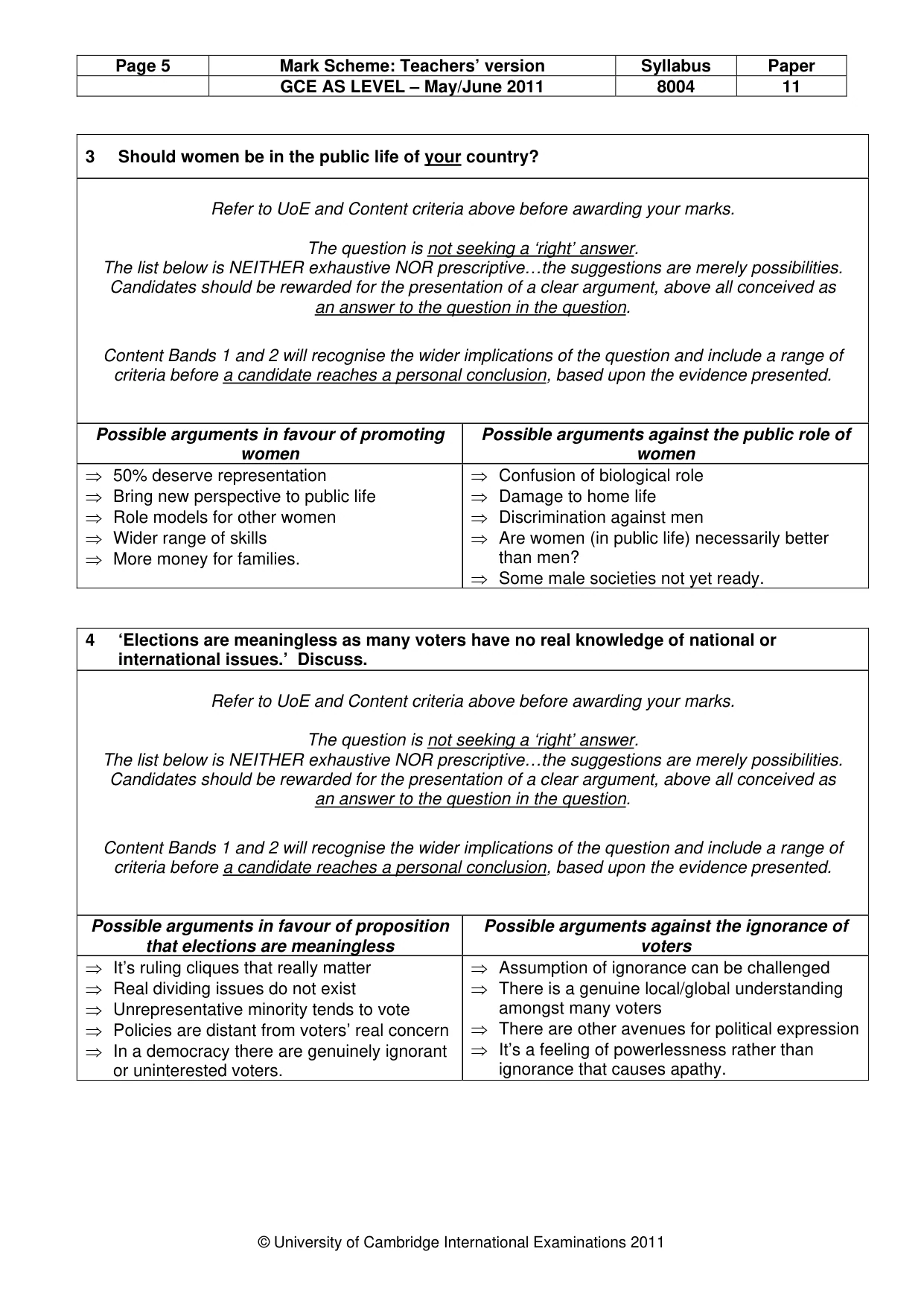
Page 5 Mark Scheme: Teachers’ version Syllabus Paper GCE AS LEVEL – May/June 2011 8004 11 © University of Cambridge International Examinations 2011 3 Should women be in the public life of your country? Refer to UoE and Content criteria above before awarding your marks. The question is not seeking a ‘right’ answer. The list below is NEITHER exhaustive NOR prescriptive…the suggestions are merely possibilities. Candidates should be rewarded for the presentation of a clear argument, above all conceived as an answer to the question in the question. Content Bands 1 and 2 will recognise the wider implications of the question and include a range of criteria before a candidate reaches a personal conclusion, based upon the evidence presented. Possible arguments in favour of promoting women Possible arguments against the public role of women ⇒ 50% deserve representation ⇒ Bring new perspective to public life ⇒ Role models for other women ⇒ Wider range of skills ⇒ More money for families. ⇒ Confusion of biological role ⇒ Damage to home life ⇒ Discrimination against men ⇒ Are women (in public life) necessarily better than men? ⇒ Some male societies not yet ready. 4 ‘Elections are meaningless as many voters have no real knowledge of national or international issues.’ Discuss. Refer to UoE and Content criteria above before awarding your marks. The question is not seeking a ‘right’ answer. The list below is NEITHER exhaustive NOR prescriptive…the suggestions are merely possibilities. Candidates should be rewarded for the presentation of a clear argument, above all conceived as an answer to the question in the question. Content Bands 1 and 2 will recognise the wider implications of the question and include a range of criteria before a candidate reaches a personal conclusion, based upon the evidence presented. Possible arguments in favour of proposition that elections are meaningless Possible arguments against the ignorance of voters ⇒ It’s ruling cliques that really matter ⇒ Real dividing issues do not exist ⇒ Unrepresentative minority tends to vote ⇒ Policies are distant from voters’ real concern ⇒ In a democracy there are genuinely ignorant or uninterested voters. ⇒ Assumption of ignorance can be challenged ⇒ There is a genuine local/global understanding amongst many voters ⇒ There are other avenues for political expression ⇒ It’s a feeling of powerlessness rather than ignorance that causes apathy.
Mark scheme, page 6
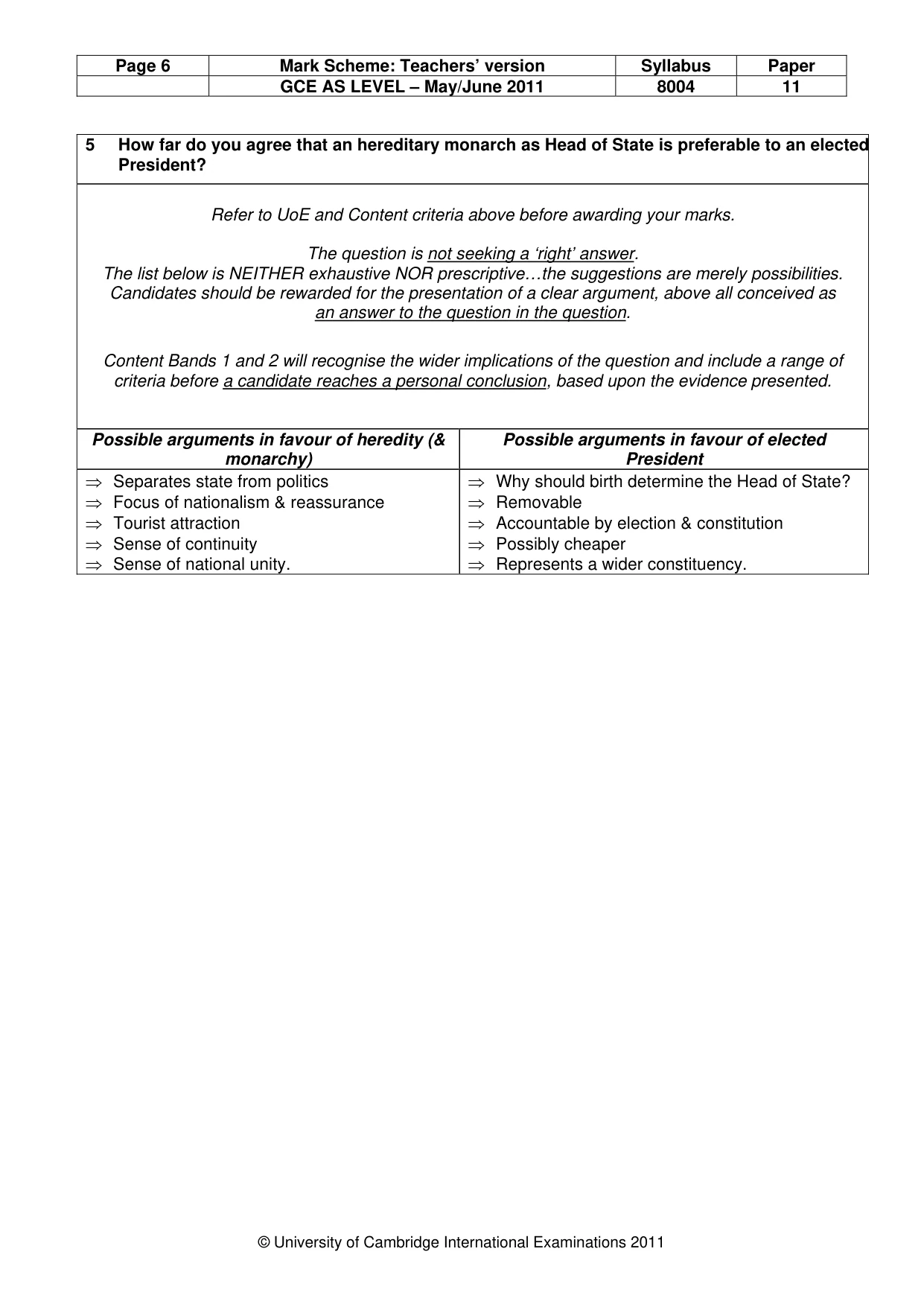
Page 6 Mark Scheme: Teachers’ version Syllabus Paper GCE AS LEVEL – May/June 2011 8004 11 © University of Cambridge International Examinations 2011 5 How far do you agree that an hereditary monarch as Head of State is preferable to an elected President? Refer to UoE and Content criteria above before awarding your marks. The question is not seeking a ‘right’ answer. The list below is NEITHER exhaustive NOR prescriptive…the suggestions are merely possibilities. Candidates should be rewarded for the presentation of a clear argument, above all conceived as an answer to the question in the question. Content Bands 1 and 2 will recognise the wider implications of the question and include a range of criteria before a candidate reaches a personal conclusion, based upon the evidence presented. Possible arguments in favour of heredity (& monarchy) Possible arguments in favour of elected President ⇒ Separates state from politics ⇒ Focus of nationalism & reassurance ⇒ Tourist attraction ⇒ Sense of continuity ⇒ Sense of national unity. ⇒ Why should birth determine the Head of State? ⇒ Removable ⇒ Accountable by election & constitution ⇒ Possibly cheaper ⇒ Represents a wider constituency.
Mark scheme, page 7
Page 7 Mark Scheme: Teachers’ version Syllabus Paper GCE AS LEVEL – May/June 2011 8004 11 © University of Cambridge International Examinations 2011 Section 2 6 How true is it that most of the pleasurable things in life are bad for you? Refer to UoE and Content criteria above before awarding your marks. The question is not seeking a ‘right’ answer. The list below is NEITHER exhaustive NOR prescriptive…the suggestions are merely possibilities. Candidates should be rewarded for the presentation of a clear argument, above all conceived as an answer to the question in the question. Content Bands 1 and 2 will recognise the wider implications of the question and include a range of criteria before a candidate reaches a personal conclusion, based upon the evidence presented. Possible arguments in favour of pleasurable things being bad Possible arguments against the notion that pleasure has invariably bad results ⇒ Dangerous activities seem inherently exciting ⇒ Pleasure comes from addiction ⇒ Easy to give in to e.g. over-eating ⇒ Fascination with bad things ⇒ Opinions vary widely (e.g. wine drinking). ⇒ Human beings are ‘programmed’ to seek pleasure, from physical reproduction to spiritual satisfaction ⇒ Those who feel fulfilled are less likely to harm others ⇒ Pleasure = well-being = better health ⇒ Pleasure = contentment for self & others ⇒ Many pleasurable things are good ⇒ ‘Moderate’ pleasure can be healthy. 7 Should obesity be regarded as a serious health concern? Refer to UoE and Content criteria above before awarding your marks. The question is not seeking a ‘right’ answer. The list below is NEITHER exhaustive NOR prescriptive… the suggestions are merely possibilities. Candidates should be rewarded for the presentation of a clear argument, above all conceived as an answer to the question in the question. Content Bands 1 and 2 will recognise the wider implications of the question and include a range of exemplars before a candidate reaches a personal conclusion, based upon the evidence presented. Possible arguments in favour of the seriousness of obesity Possible arguments against seeing obesity as a serious health concern ⇒ Health risk to individual ⇒ Consequent economic cost to the state ⇒ Effect on employers ⇒ Example to the young ⇒ Govt has responsibility to protect its citizens. ⇒ No such thing as ideal body form ⇒ Some cultures honour largeness ⇒ Better than excessive thinness ⇒ Less serious than other medical issues ⇒ Early death can be cheaper for the state.
Mark scheme, page 8
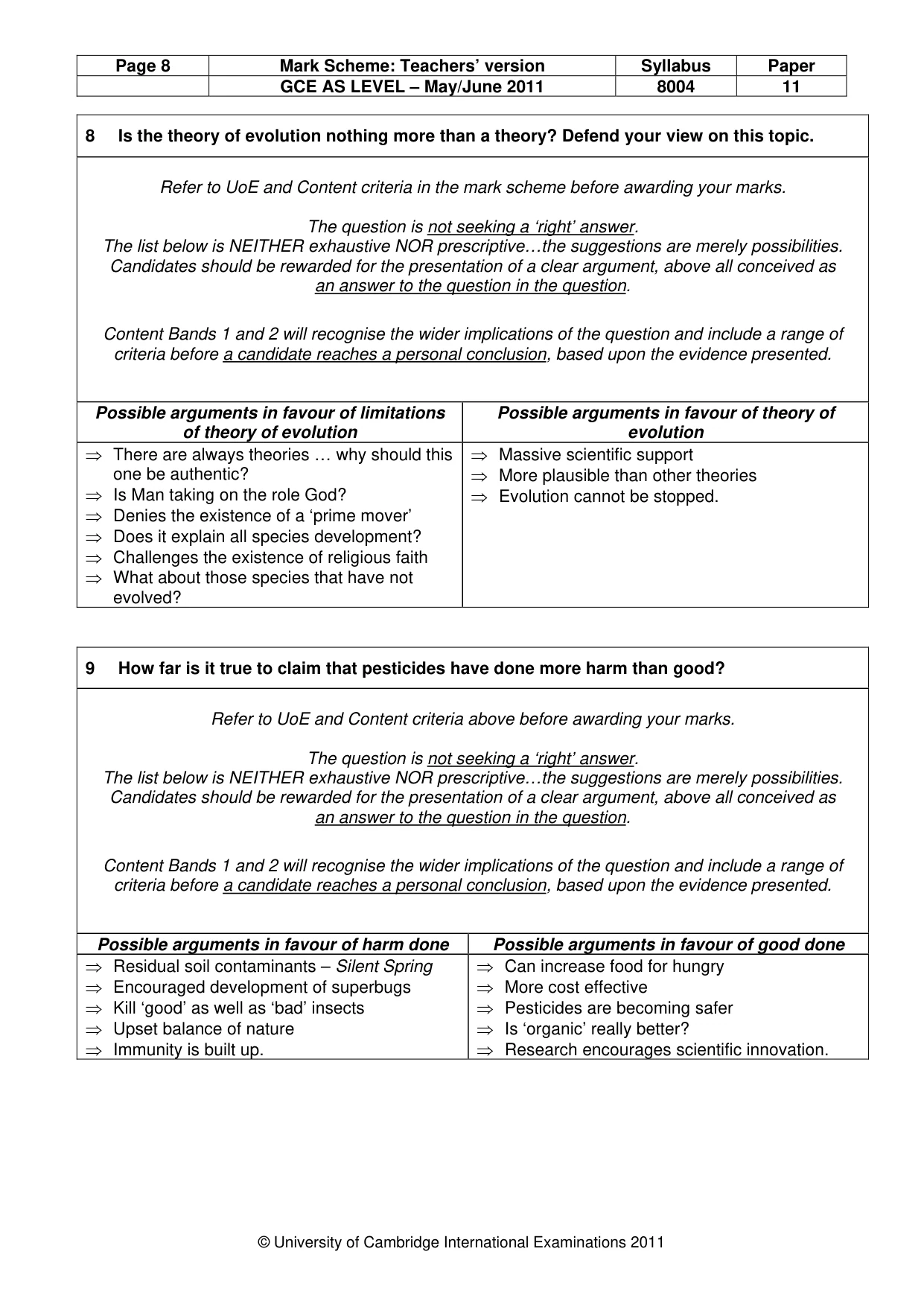
Page 8 Mark Scheme: Teachers’ version Syllabus Paper GCE AS LEVEL – May/June 2011 8004 11 © University of Cambridge International Examinations 2011 8 Is the theory of evolution nothing more than a theory? Defend your view on this topic. Refer to UoE and Content criteria in the mark scheme before awarding your marks. The question is not seeking a ‘right’ answer. The list below is NEITHER exhaustive NOR prescriptive…the suggestions are merely possibilities. Candidates should be rewarded for the presentation of a clear argument, above all conceived as an answer to the question in the question. Content Bands 1 and 2 will recognise the wider implications of the question and include a range of criteria before a candidate reaches a personal conclusion, based upon the evidence presented. Possible arguments in favour of limitations of theory of evolution Possible arguments in favour of theory of evolution ⇒ There are always theories … why should this one be authentic? ⇒ Is Man taking on the role God? ⇒ Denies the existence of a ‘prime mover’ ⇒ Does it explain all species development? ⇒ Challenges the existence of religious faith ⇒ What about those species that have not evolved? ⇒ Massive scientific support ⇒ More plausible than other theories ⇒ Evolution cannot be stopped. 9 How far is it true to claim that pesticides have done more harm than good? Refer to UoE and Content criteria above before awarding your marks. The question is not seeking a ‘right’ answer. The list below is NEITHER exhaustive NOR prescriptive…the suggestions are merely possibilities. Candidates should be rewarded for the presentation of a clear argument, above all conceived as an answer to the question in the question. Content Bands 1 and 2 will recognise the wider implications of the question and include a range of criteria before a candidate reaches a personal conclusion, based upon the evidence presented. Possible arguments in favour of harm done Possible arguments in favour of good done ⇒ Residual soil contaminants – Silent Spring ⇒ Encouraged development of superbugs ⇒ Kill ‘good’ as well as ‘bad’ insects ⇒ Upset balance of nature ⇒ Immunity is built up. ⇒ Can increase food for hungry ⇒ More cost effective ⇒ Pesticides are becoming safer ⇒ Is ‘organic’ really better? ⇒ Research encourages scientific innovation.
Mark scheme, page 9
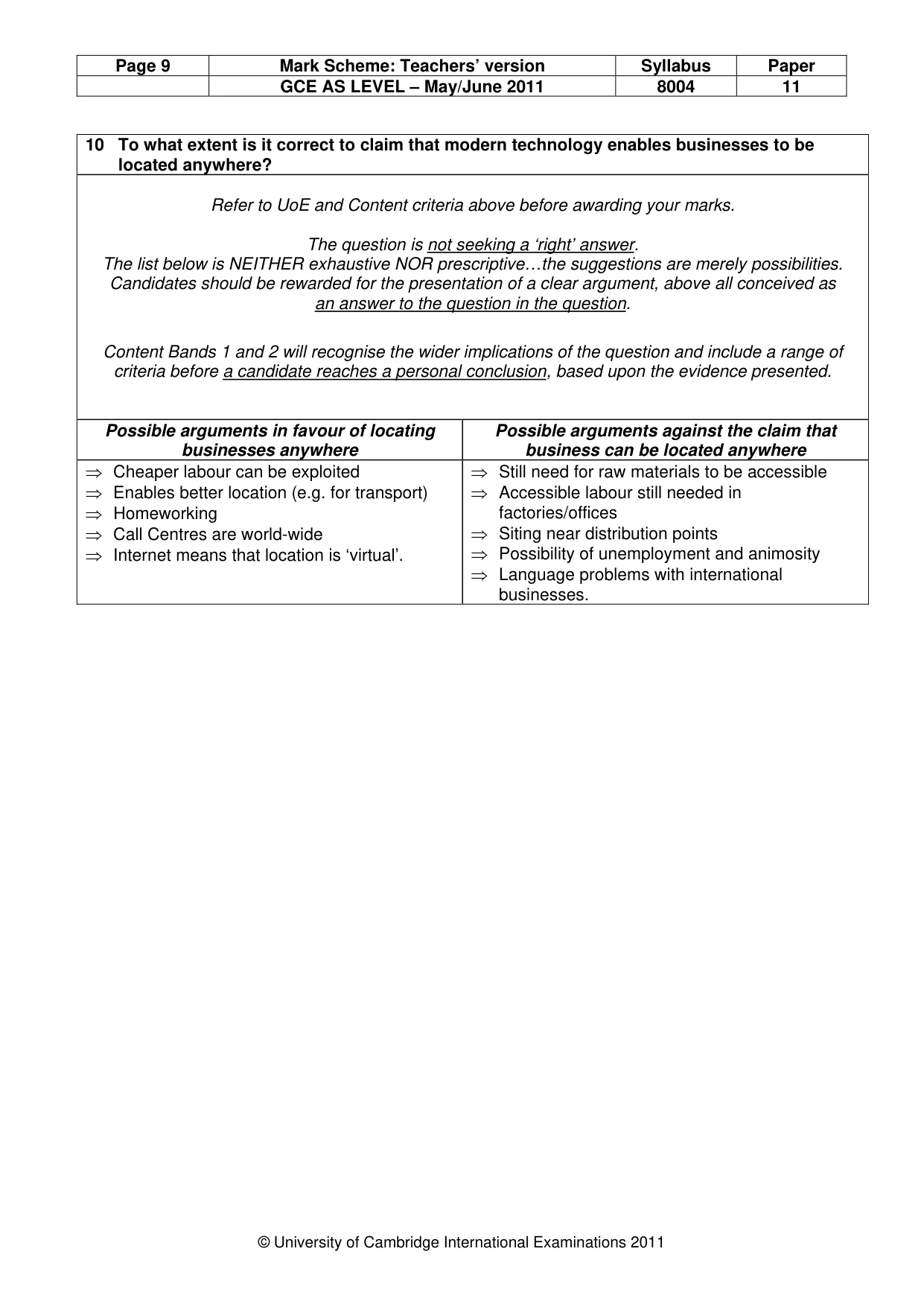
Page 9 Mark Scheme: Teachers’ version Syllabus Paper GCE AS LEVEL – May/June 2011 8004 11 © University of Cambridge International Examinations 2011 10 To what extent is it correct to claim that modern technology enables businesses to be located anywhere? Refer to UoE and Content criteria above before awarding your marks. The question is not seeking a ‘right’ answer. The list below is NEITHER exhaustive NOR prescriptive…the suggestions are merely possibilities. Candidates should be rewarded for the presentation of a clear argument, above all conceived as an answer to the question in the question. Content Bands 1 and 2 will recognise the wider implications of the question and include a range of criteria before a candidate reaches a personal conclusion, based upon the evidence presented. Possible arguments in favour of locating businesses anywhere Possible arguments against the claim that business can be located anywhere ⇒ Cheaper labour can be exploited ⇒ Enables better location (e.g. for transport) ⇒ Homeworking ⇒ Call Centres are world-wide ⇒ Internet means that location is ‘virtual’. ⇒ Still need for raw materials to be accessible ⇒ Accessible labour still needed in factories/offices ⇒ Siting near distribution points ⇒ Possibility of unemployment and animosity ⇒ Language problems with international businesses.
Mark scheme, page 10
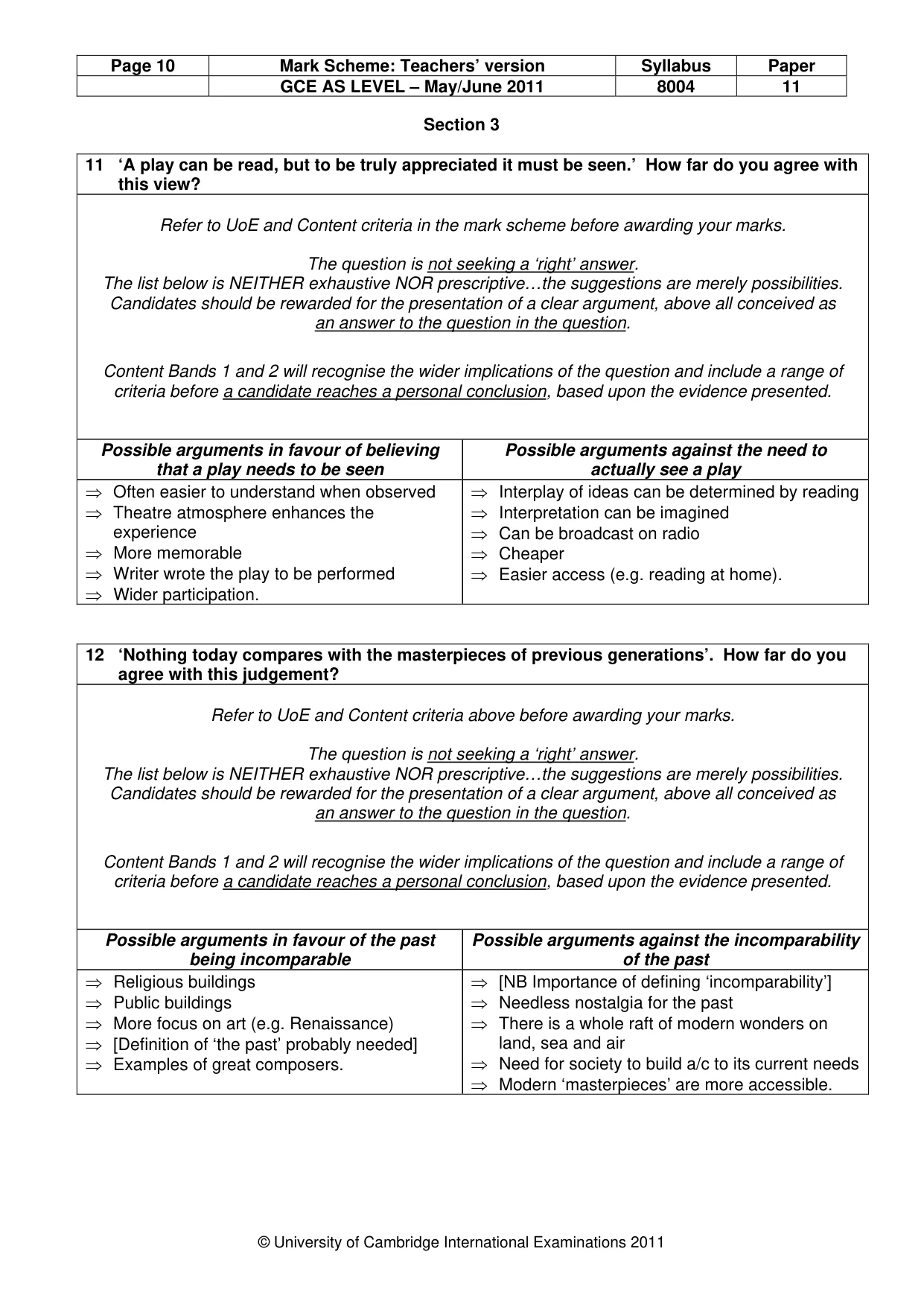
Page 10 Mark Scheme: Teachers’ version Syllabus Paper GCE AS LEVEL – May/June 2011 8004 11 © University of Cambridge International Examinations 2011 Section 3 11 ‘A play can be read, but to be truly appreciated it must be seen.’ How far do you agree with this view? Refer to UoE and Content criteria in the mark scheme before awarding your marks. The question is not seeking a ‘right’ answer. The list below is NEITHER exhaustive NOR prescriptive…the suggestions are merely possibilities. Candidates should be rewarded for the presentation of a clear argument, above all conceived as an answer to the question in the question. Content Bands 1 and 2 will recognise the wider implications of the question and include a range of criteria before a candidate reaches a personal conclusion, based upon the evidence presented. Possible arguments in favour of believing that a play needs to be seen Possible arguments against the need to actually see a play ⇒ Often easier to understand when observed ⇒ Theatre atmosphere enhances the experience ⇒ More memorable ⇒ Writer wrote the play to be performed ⇒ Wider participation. ⇒ Interplay of ideas can be determined by reading ⇒ Interpretation can be imagined ⇒ Can be broadcast on radio ⇒ Cheaper ⇒ Easier access (e.g. reading at home). 12 ‘Nothing today compares with the masterpieces of previous generations’. How far do you agree with this judgement? Refer to UoE and Content criteria above before awarding your marks. The question is not seeking a ‘right’ answer. The list below is NEITHER exhaustive NOR prescriptive…the suggestions are merely possibilities. Candidates should be rewarded for the presentation of a clear argument, above all conceived as an answer to the question in the question. Content Bands 1 and 2 will recognise the wider implications of the question and include a range of criteria before a candidate reaches a personal conclusion, based upon the evidence presented. Possible arguments in favour of the past being incomparable Possible arguments against the incomparability of the past ⇒ Religious buildings ⇒ Public buildings ⇒ More focus on art (e.g. Renaissance) ⇒ [Definition of ‘the past’ probably needed] ⇒ Examples of great composers. ⇒ [NB Importance of defining ‘incomparability’] ⇒ Needless nostalgia for the past ⇒ There is a whole raft of modern wonders on land, sea and air ⇒ Need for society to build a/c to its current needs ⇒ Modern ‘masterpieces’ are more accessible.
Mark scheme, page 11
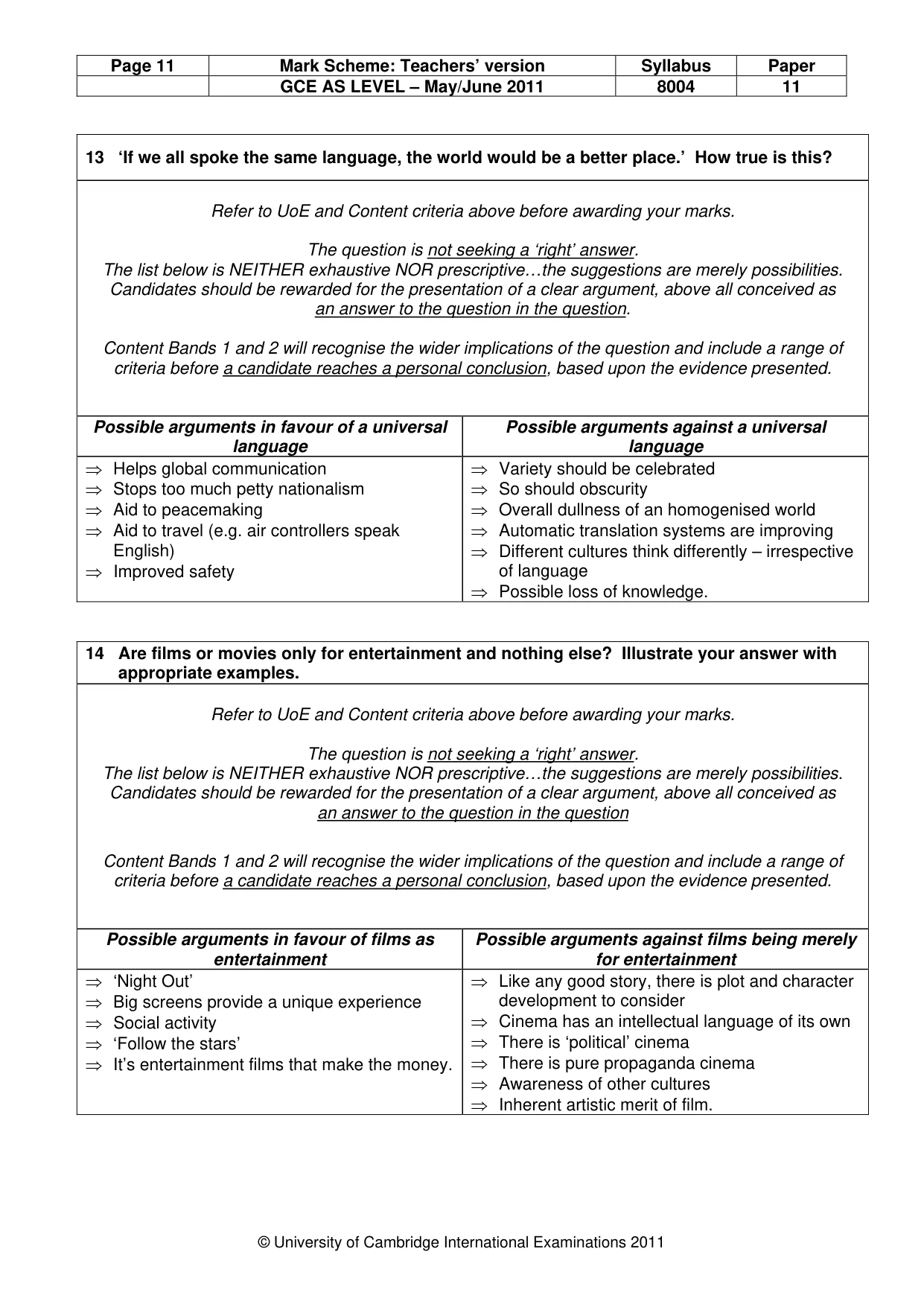
Page 11 Mark Scheme: Teachers’ version Syllabus Paper GCE AS LEVEL – May/June 2011 8004 11 © University of Cambridge International Examinations 2011 13 ‘If we all spoke the same language, the world would be a better place.’ How true is this? Refer to UoE and Content criteria above before awarding your marks. The question is not seeking a ‘right’ answer. The list below is NEITHER exhaustive NOR prescriptive…the suggestions are merely possibilities. Candidates should be rewarded for the presentation of a clear argument, above all conceived as an answer to the question in the question. Content Bands 1 and 2 will recognise the wider implications of the question and include a range of criteria before a candidate reaches a personal conclusion, based upon the evidence presented. Possible arguments in favour of a universal language Possible arguments against a universal language ⇒ Helps global communication ⇒ Stops too much petty nationalism ⇒ Aid to peacemaking ⇒ Aid to travel (e.g. air controllers speak English) ⇒ Improved safety ⇒ Variety should be celebrated ⇒ So should obscurity ⇒ Overall dullness of an homogenised world ⇒ Automatic translation systems are improving ⇒ Different cultures think differently – irrespective of language ⇒ Possible loss of knowledge. 14 Are films or movies only for entertainment and nothing else? Illustrate your answer with appropriate examples. Refer to UoE and Content criteria above before awarding your marks. The question is not seeking a ‘right’ answer. The list below is NEITHER exhaustive NOR prescriptive…the suggestions are merely possibilities. Candidates should be rewarded for the presentation of a clear argument, above all conceived as an answer to the question in the question Content Bands 1 and 2 will recognise the wider implications of the question and include a range of criteria before a candidate reaches a personal conclusion, based upon the evidence presented. Possible arguments in favour of films as entertainment Possible arguments against films being merely for entertainment ⇒ ‘Night Out’ ⇒ Big screens provide a unique experience ⇒ Social activity ⇒ ‘Follow the stars’ ⇒ It’s entertainment films that make the money. ⇒ Like any good story, there is plot and character development to consider ⇒ Cinema has an intellectual language of its own ⇒ There is ‘political’ cinema ⇒ There is pure propaganda cinema ⇒ Awareness of other cultures ⇒ Inherent artistic merit of film.
Mark scheme, page 12
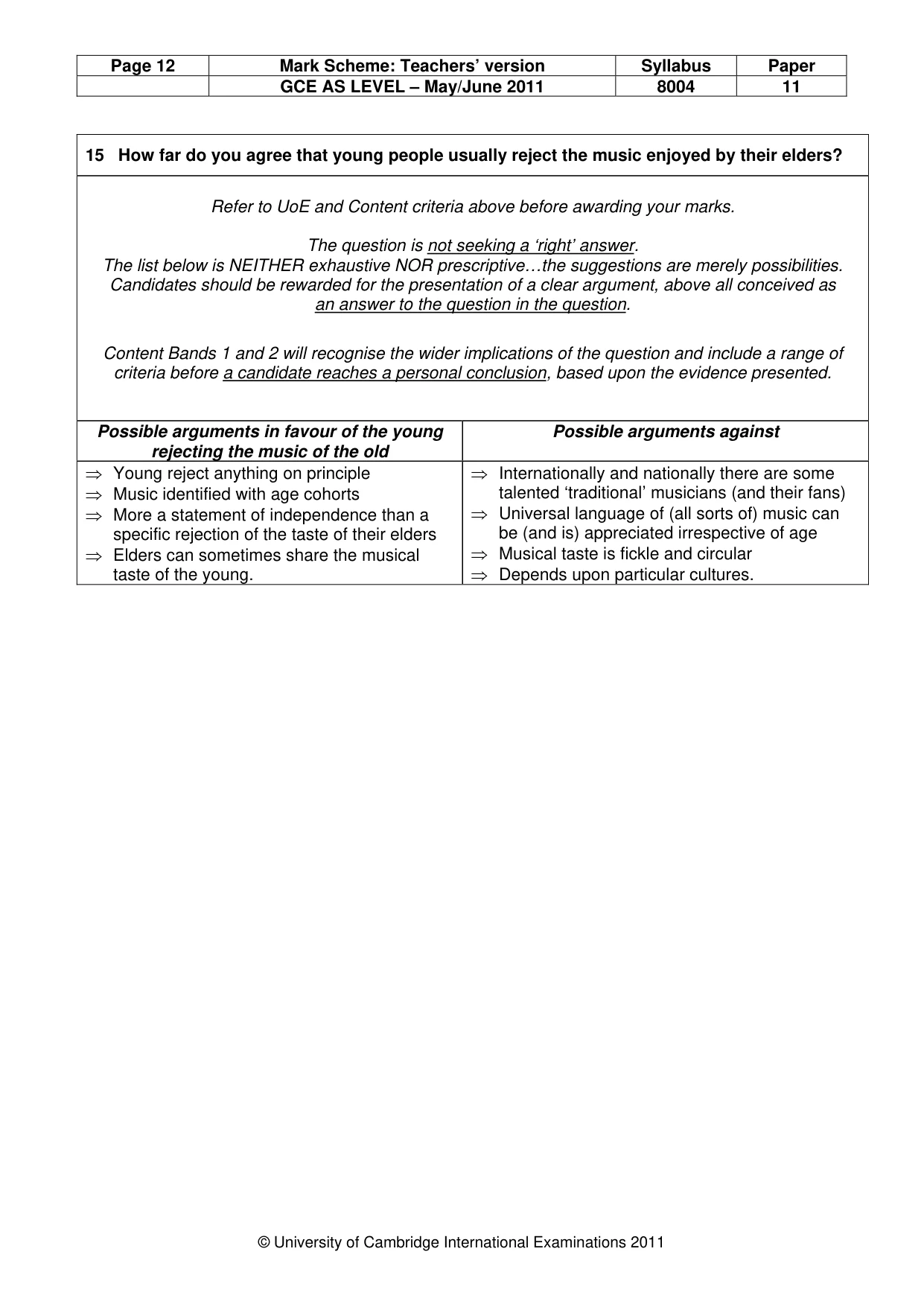
Page 12 Mark Scheme: Teachers’ version Syllabus Paper GCE AS LEVEL – May/June 2011 8004 11 © University of Cambridge International Examinations 2011 15 How far do you agree that young people usually reject the music enjoyed by their elders? Refer to UoE and Content criteria above before awarding your marks. The question is not seeking a ‘right’ answer. The list below is NEITHER exhaustive NOR prescriptive…the suggestions are merely possibilities. Candidates should be rewarded for the presentation of a clear argument, above all conceived as an answer to the question in the question. Content Bands 1 and 2 will recognise the wider implications of the question and include a range of criteria before a candidate reaches a personal conclusion, based upon the evidence presented. Possible arguments in favour of the young rejecting the music of the old Possible arguments against ⇒ Young reject anything on principle ⇒ Music identified with age cohorts ⇒ More a statement of independence than a specific rejection of the taste of their elders ⇒ Elders can sometimes share the musical taste of the young. ⇒ Internationally and nationally there are some talented ‘traditional’ musicians (and their fans) ⇒ Universal language of (all sorts of) music can be (and is) appreciated irrespective of age ⇒ Musical taste is fickle and circular ⇒ Depends upon particular cultures.
What you needed in this session
Cambridge’s own grade thresholds for 2011 May/June, Paper 1 · Variant 1. A higher threshold means an easier paper — the bar moves with how the cohort did.