Cambridge A Level General Paper (AS Level only) 8001 — 2015 Oct/Nov Paper 2 · Variant 3
8001/23/O/N/15 · 50 marks · ≈56 min
The question paper and its mark scheme, free to read here and free to download. This is Cambridge’s own paper, exactly as it was sat.
Question paper12 pages
Mark scheme8 pages
Answers below. Sit the paper first if you are practising.
Paper as text
Question paper, page 1
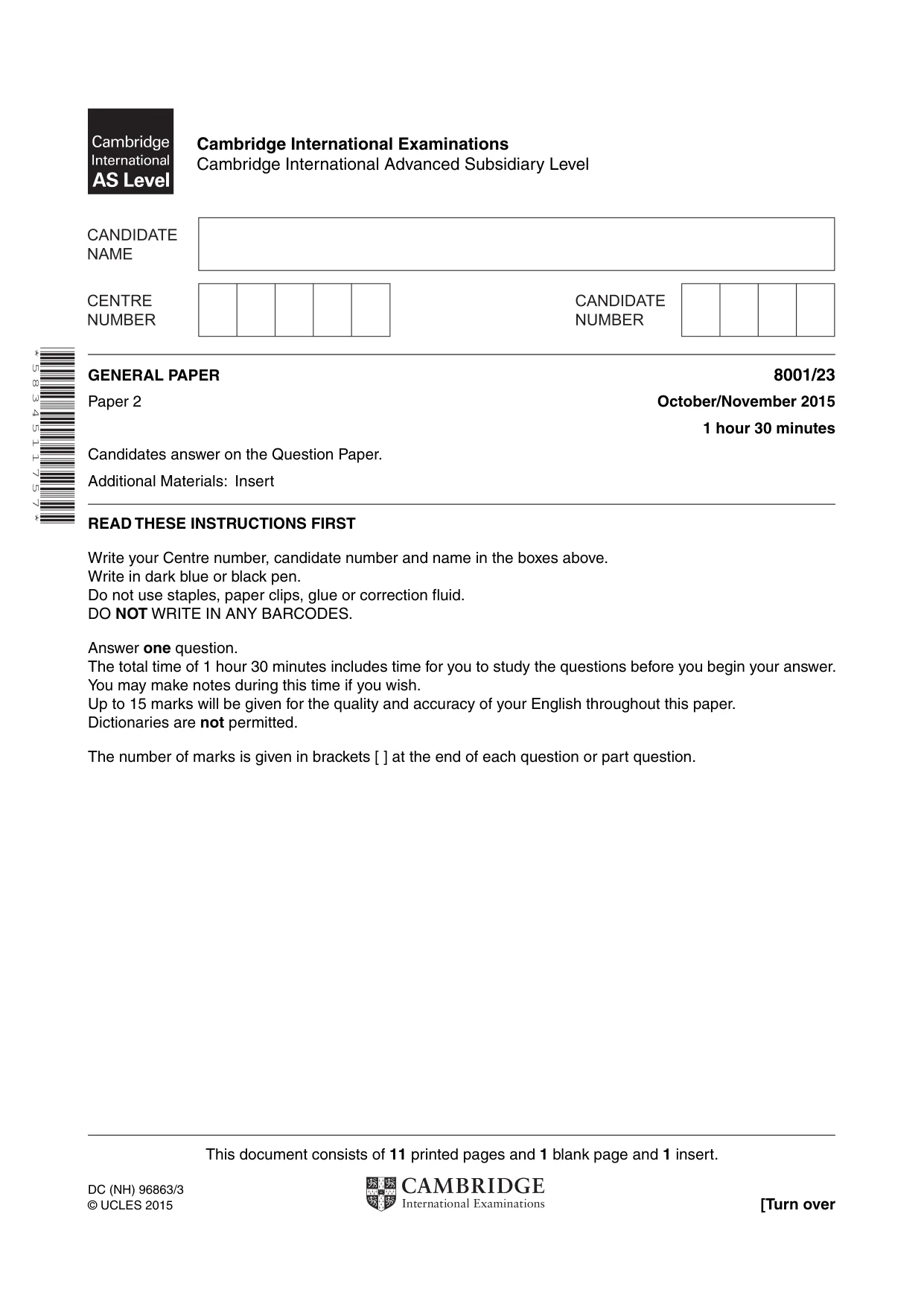
This document consists of 11 printed pages and 1 blank page and 1 insert. DC (NH) 96863/3 © UCLES 2015 [Turn over * 5 8 3 4 5 1 1 7 5 7 * GENERAL PAPER 8001/23 Paper 2 October/November 2015 1 hour 30 minutes Candidates answer on the Question Paper. Additional Materials: Insert READ THESE INSTRUCTIONS FIRST Write your Centre number, candidate number and name in the boxes above. Write in dark blue or black pen. Do not use staples, paper clips, glue or correction fluid. DO NOT WRITE IN ANY BARCODES. Answer one question. The total time of 1 hour 30 minutes includes time for you to study the questions before you begin your answer. You may make notes during this time if you wish. Up to 15 marks will be given for the quality and accuracy of your English throughout this paper. Dictionaries are not permitted. The number of marks is given in brackets [ ] at the end of each question or part question. Cambridge International Examinations Cambridge International Advanced Subsidiary Level
Question paper, page 2
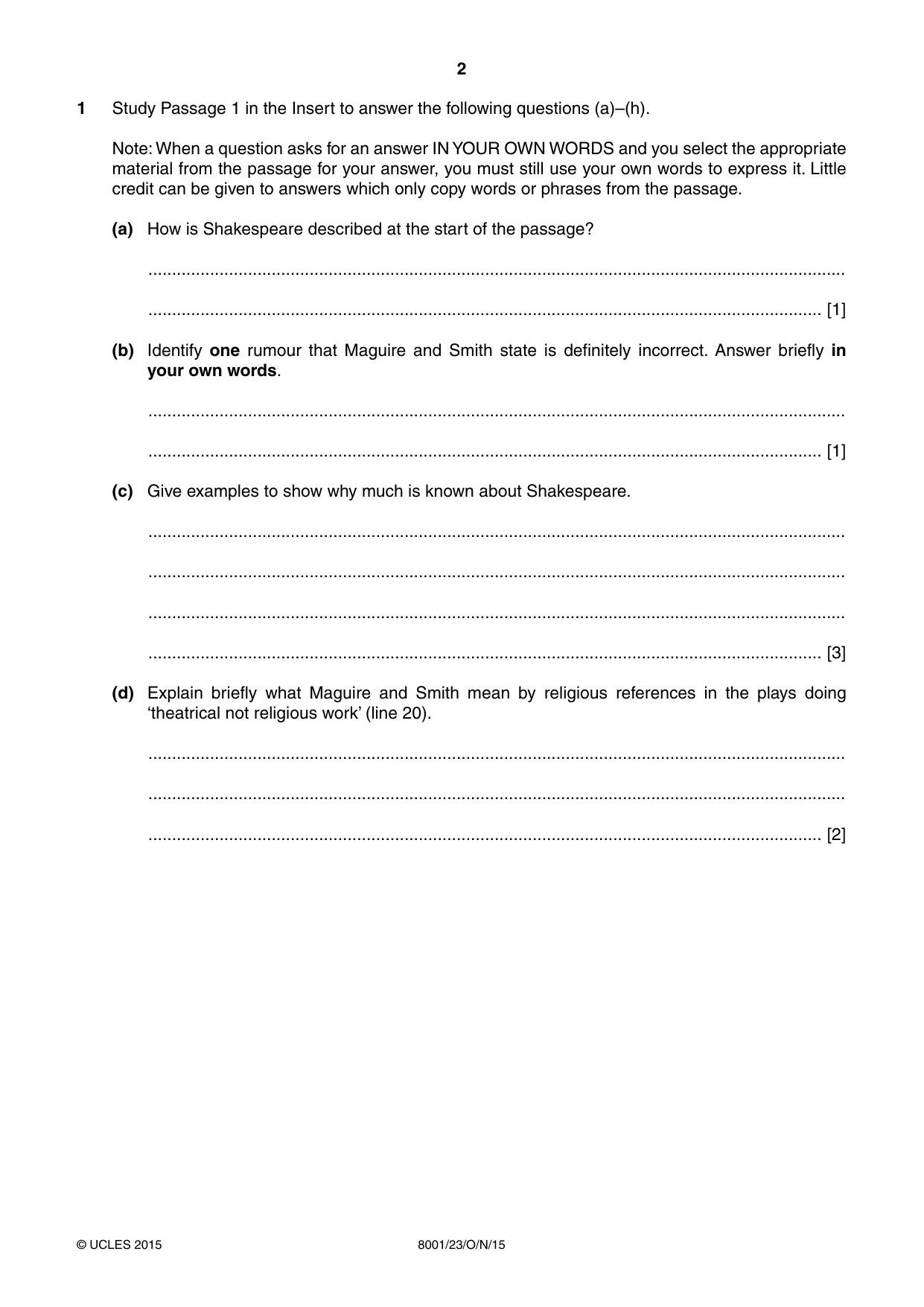
2 8001/23/O/N/15 © UCLES 2015 1 Study Passage 1 in the Insert to answer the following questions (a)–(h). Note: When a question asks for an answer IN YOUR OWN WORDS and you select the appropriate material from the passage for your answer, you must still use your own words to express it. Little credit can be given to answers which only copy words or phrases from the passage. (a) How is Shakespeare described at the start of the passage? … … [1] (b) Identify one rumour that Maguire and Smith state is definitely incorrect. Answer briefly in your own words. … … [1] (c) Give examples to show why much is known about Shakespeare. … … … … [3] (d) Explain briefly what Maguire and Smith mean by religious references in the plays doing ‘theatrical not religious work’ (line 20). … … … [2]
Question paper, page 3
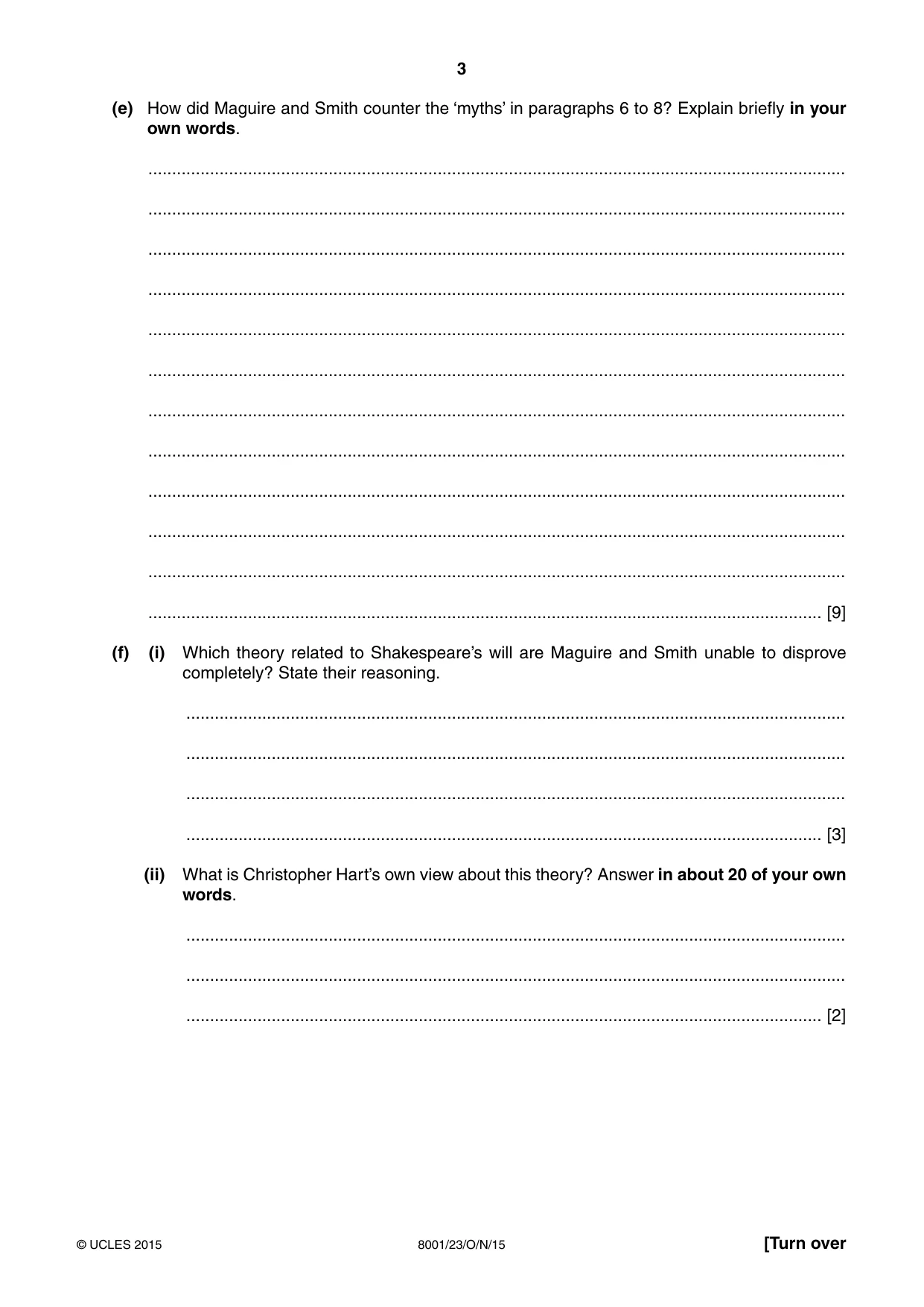
3 8001/23/O/N/15 © UCLES 2015 [Turn over (e) How did Maguire and Smith counter the ‘myths’ in paragraphs 6 to 8? Explain briefly in your own words. … … … … … … … … … … … … [9] (f) (i) Which theory related to Shakespeare’s will are Maguire and Smith unable to disprove completely? State their reasoning. … … … … [3] (ii) What is Christopher Hart’s own view about this theory? Answer in about 20 of your own words. … … … [2]
Question paper, page 4
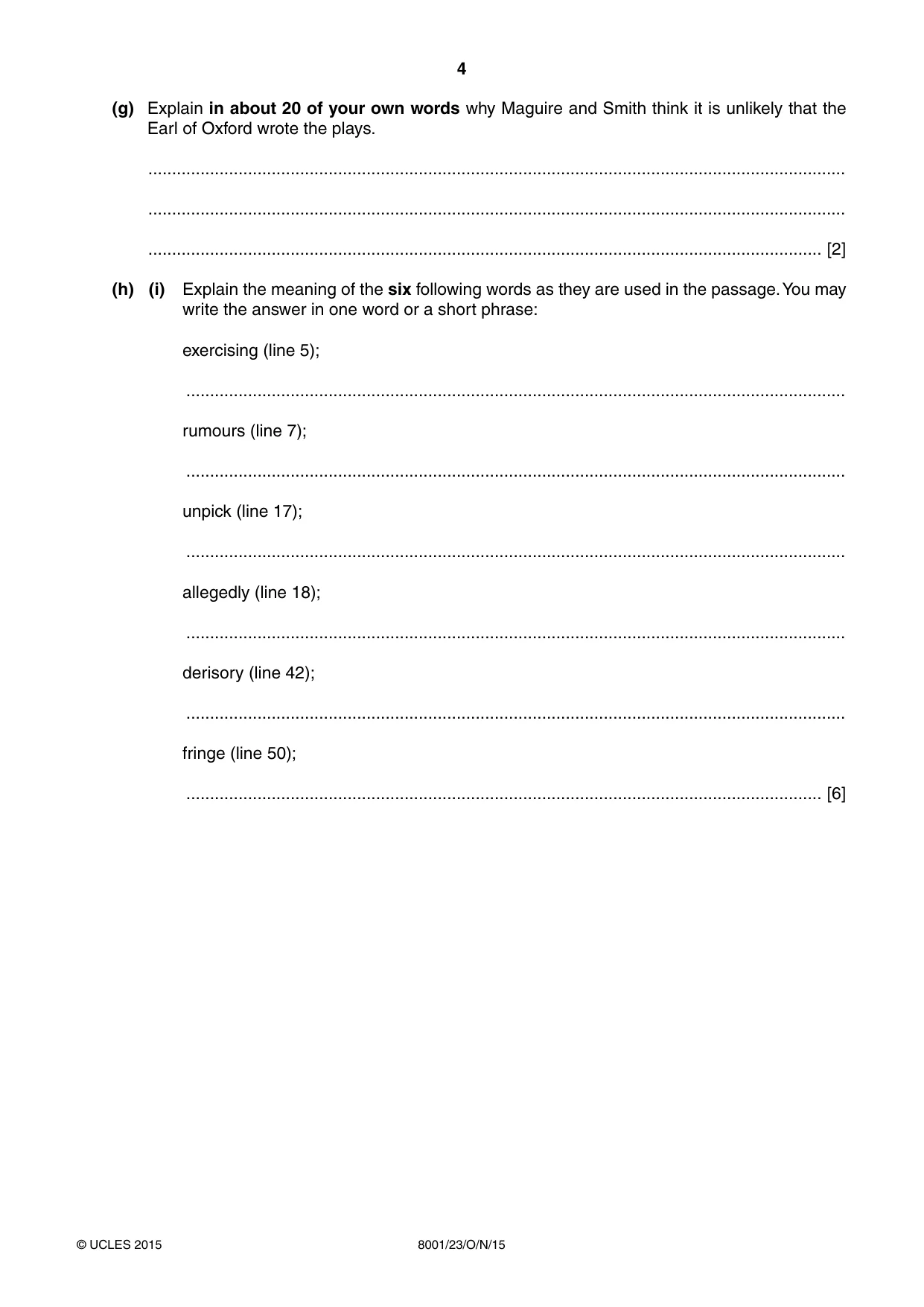
4 8001/23/O/N/15 © UCLES 2015 (g) Explain in about 20 of your own words why Maguire and Smith think it is unlikely that the Earl of Oxford wrote the plays. … … … [2] (h) (i) Explain the meaning of the six following words as they are used in the passage. You may write the answer in one word or a short phrase: exercising (line 5); … rumours (line 7); …………… … unpick (line 17); … allegedly (line 18); … derisory (line 42); … fringe (line 50); … [6]
Question paper, page 5
5 8001/23/O/N/15 © UCLES 2015 [Turn over (ii) Use these words in six separate sentences to illustrate their meanings as used in the passage. Your sentences should not deal with the subject matter of the passage. … … … … … … … … … … … … [6] Note: Up to an additional 15 marks will be available for use of English.
Question paper, page 6
6 8001/23/O/N/15 © UCLES 2015 2 Study Passage 2 in the Insert to answer the following questions (a)–(g). Note: When a question asks for an answer IN YOUR OWN WORDS and you select the appropriate material from the passage for your answer, you must still use your own words to express it. Little credit can be given to answers which only copy words or phrases from the passage. (a) From the passage identify the word or phrase that means: (i) showing the capacity to understand hidden truths (Introduction) … [1] (ii) the organisation of moving and supplying (lines 19–21) … [1] (iii) advancing up a hierarchical organisation (lines 19–21) … [1] (iv) praising enthusiastically the positives (lines 24–30) … [1] (v) will have the pick of any opportunities available (lines 33–38) … [1] (vi) fearful of confined spaces (lines 39–44) … [1] (b) Suggest a question Belle could have asked Mr Forti in line 4, and briefly give your reasoning. Question: … [1] Your reasoning in about 20 words: … … … [2]
Question paper, page 7
7 8001/23/O/N/15 © UCLES 2015 [Turn over (c) Which description, (i), (ii) or (iii), could best describe Mr Forti’s character as shown in lines 5–10, and why? (i) He is an extrovert who enjoys analysing the bigger picture and bouncing innovative ideas off his co-workers in a collaborative atmosphere. (ii) He has an eye for precision, ensuring that everything is double-checked before he completes any task because of his perfectionism. (iii) He is a loner, working in isolation in an academic environment, researching obscure topics and occasionally publishing a book. Description: …[1] Reasoning in about 20 words: … … … [2] (d) What in the passage suggests that Mr Forti is not a trained careers advisor? Give 6 examples with your reasoning. … … … … … … … … … … … … … … … … [12]
Question paper, page 8
8 8001/23/O/N/15 © UCLES 2015 (e) Explain why Mr Forti is so positive about a career in retail management. … … … [2] (f) What did Mr Forti finally do that led to a breakthrough in the interview for Belle, and how did this help her? … … … [2] (g) (i) What career suggestion could Mr Forti have made that would suit Belle (line 51)? Give a reason for your choice. … … [2] (ii) How would you complete Belle’s final sentence (line 53)? … … [1] (iii) What positives about herself could Belle take from the interview? … … … [2] (iv) Which emotion do you think Belle is feeling at the end of the interview? Explain why. … … …[2] Note: Up to an additional 15 marks will be available for use of English.
Question paper, page 9
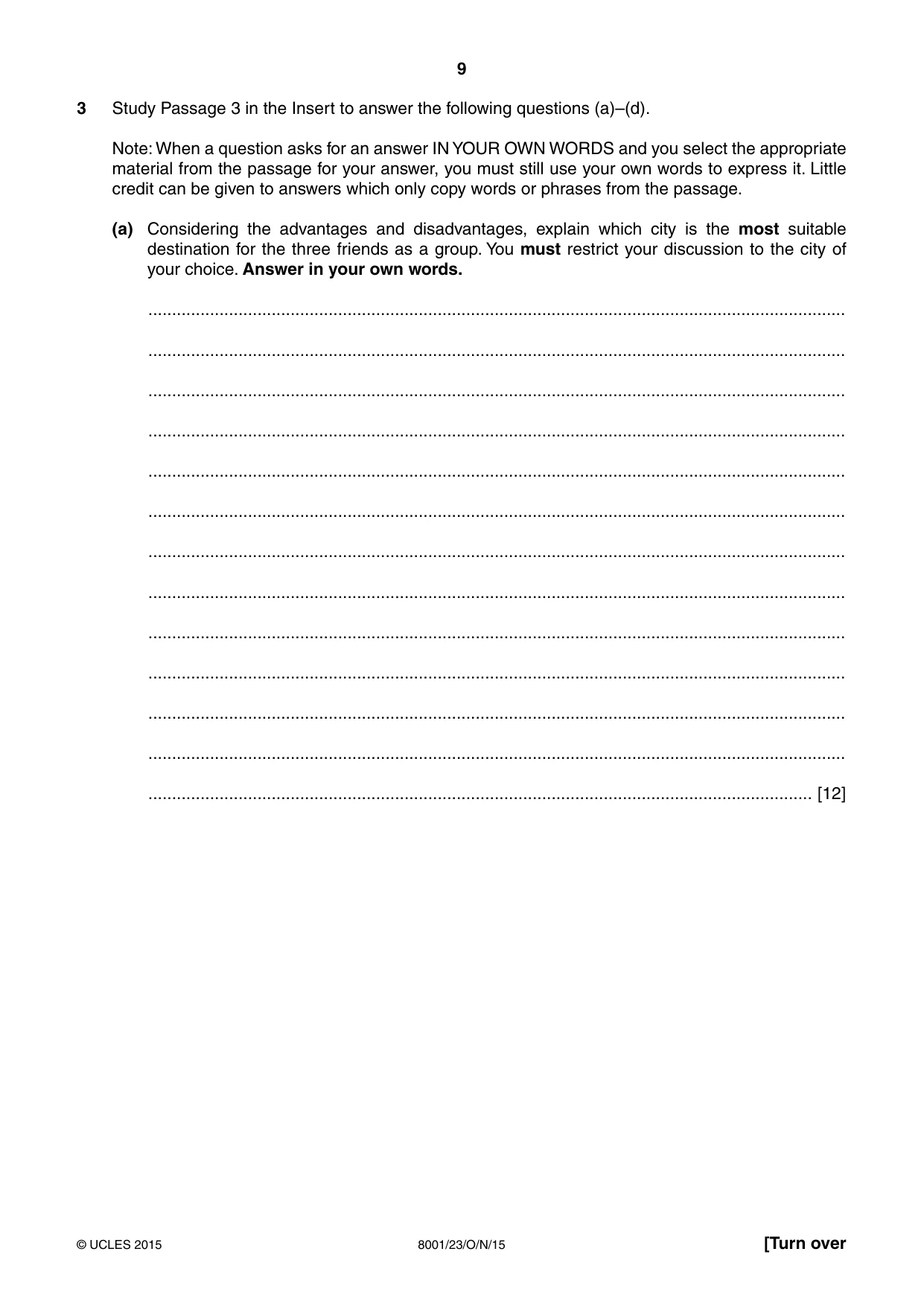
9 8001/23/O/N/15 © UCLES 2015 [Turn over 3 Study Passage 3 in the Insert to answer the following questions (a)–(d). Note: When a question asks for an answer IN YOUR OWN WORDS and you select the appropriate material from the passage for your answer, you must still use your own words to express it. Little credit can be given to answers which only copy words or phrases from the passage. (a) Considering the advantages and disadvantages, explain which city is the most suitable destination for the three friends as a group. You must restrict your discussion to the city of your choice. Answer in your own words. … … … … … … … … … … … … … [12]
Question paper, page 10
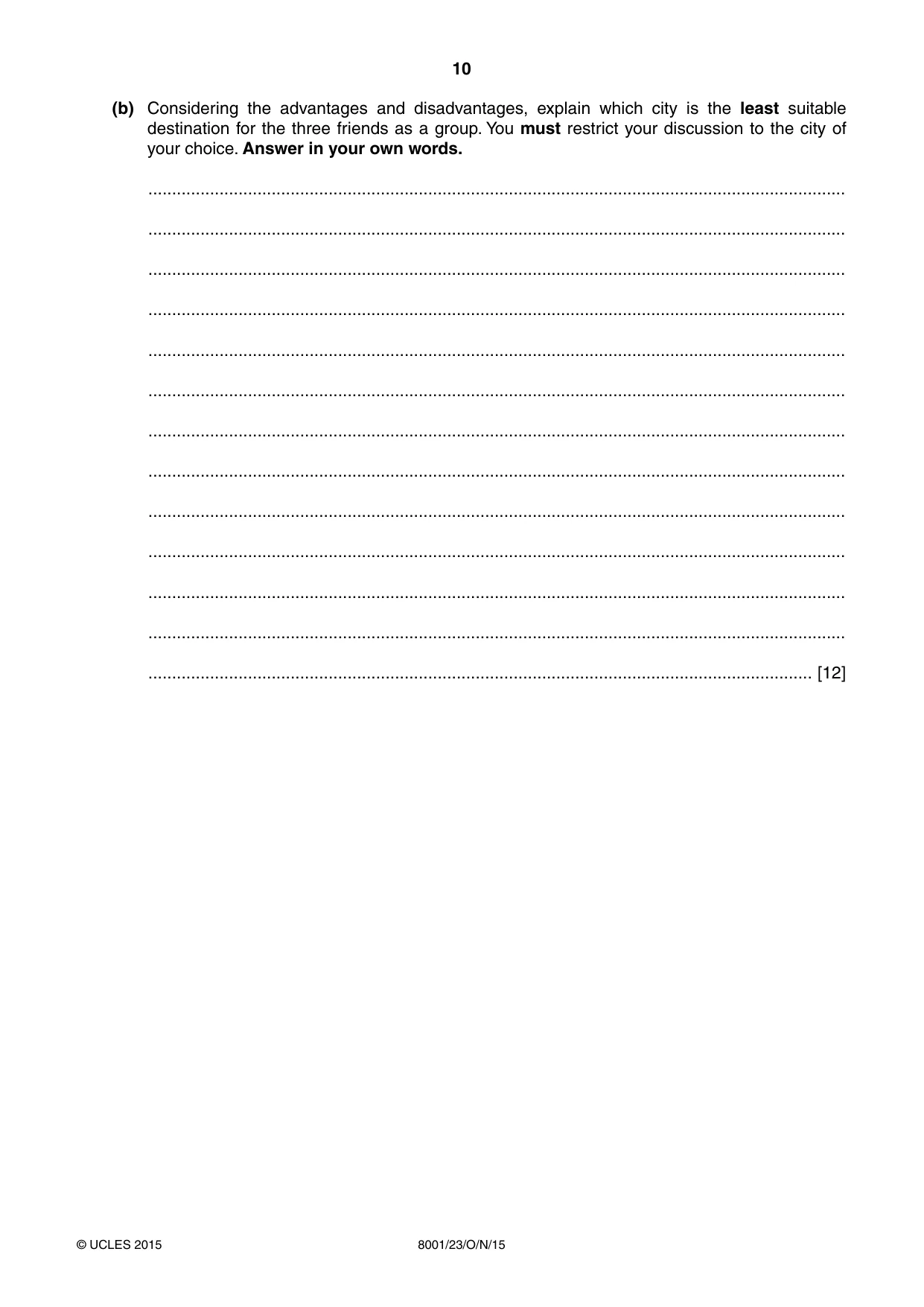
10 8001/23/O/N/15 © UCLES 2015 (b) Considering the advantages and disadvantages, explain which city is the least suitable destination for the three friends as a group. You must restrict your discussion to the city of your choice. Answer in your own words. … … … … … … … … … … … … … [12]
Question paper, page 11
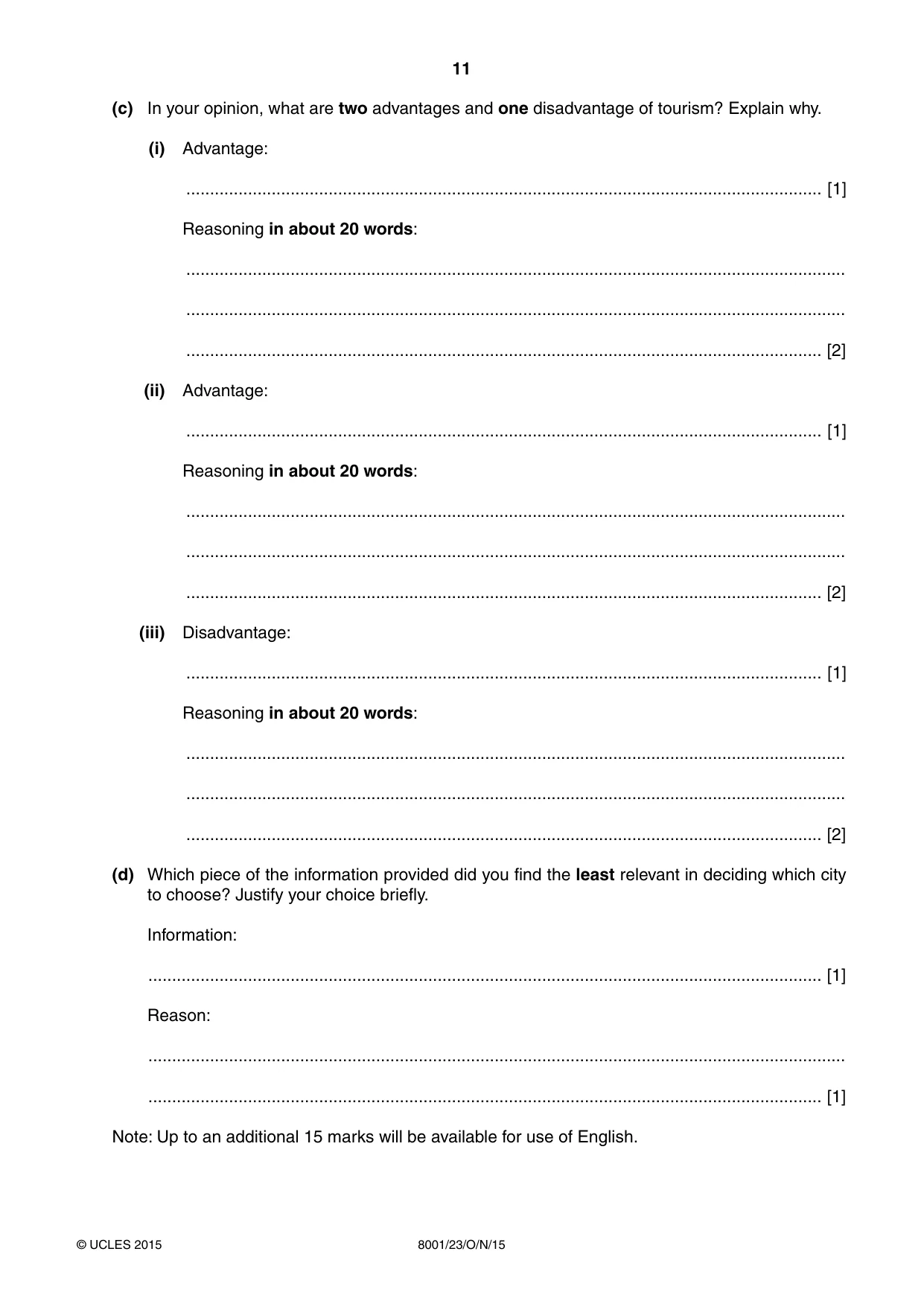
11 8001/23/O/N/15 © UCLES 2015 (c) In your opinion, what are two advantages and one disadvantage of tourism? Explain why. (i) Advantage: … [1] Reasoning in about 20 words: … … … [2] (ii) Advantage: …… … [1] Reasoning in about 20 words: … … … [2] (iii) Disadvantage: … [1] Reasoning in about 20 words: … … … [2] (d) Which piece of the information provided did you find the least relevant in deciding which city to choose? Justify your choice briefly. Information: … [1] Reason: … … [1] Note: Up to an additional 15 marks will be available for use of English.
Question paper, page 12
12 8001/23/O/N/15 © UCLES 2015 Permission to reproduce items where third-party owned material protected by copyright is included has been sought and cleared where possible. Every reasonable effort has been made by the publisher (UCLES) to trace copyright holders, but if any items requiring clearance have unwittingly been included, the publisher will be pleased to make amends at the earliest possible opportunity. To avoid the issue of disclosure of answer-related information to candidates, all copyright acknowledgements are reproduced online in the Cambridge International Examinations Copyright Acknowledgements Booklet. This is produced for each series of examinations and is freely available to download at www.cie.org.uk after the live examination series. Cambridge International Examinations is part of the Cambridge Assessment Group. Cambridge Assessment is the brand name of University of Cambridge Local Examinations Syndicate (UCLES), which is itself a department of the University of Cambridge. BLANK PAGE
Mark scheme, page 1
® IGCSE is the registered trademark of Cambridge International Examinations. CAMBRIDGE INTERNATIONAL EXAMINATIONS Cambridge International Advanced Subsidiary Level MARK SCHEME for the October/November 2015 series 8001 GENERAL PAPER 8001/23 Paper 2, maximum raw mark 50 This mark scheme is published as an aid to teachers and candidates, to indicate the requirements of the examination. It shows the basis on which Examiners were instructed to award marks. It does not indicate the details of the discussions that took place at an Examiners’ meeting before marking began, which would have considered the acceptability of alternative answers. Mark schemes should be read in conjunction with the question paper and the Principal Examiner Report for Teachers. Cambridge will not enter into discussions about these mark schemes. Cambridge is publishing the mark schemes for the October/November 2015 series for most Cambridge IGCSE®, Cambridge International A and AS Level components and some Cambridge O Level components.
Mark scheme, page 2
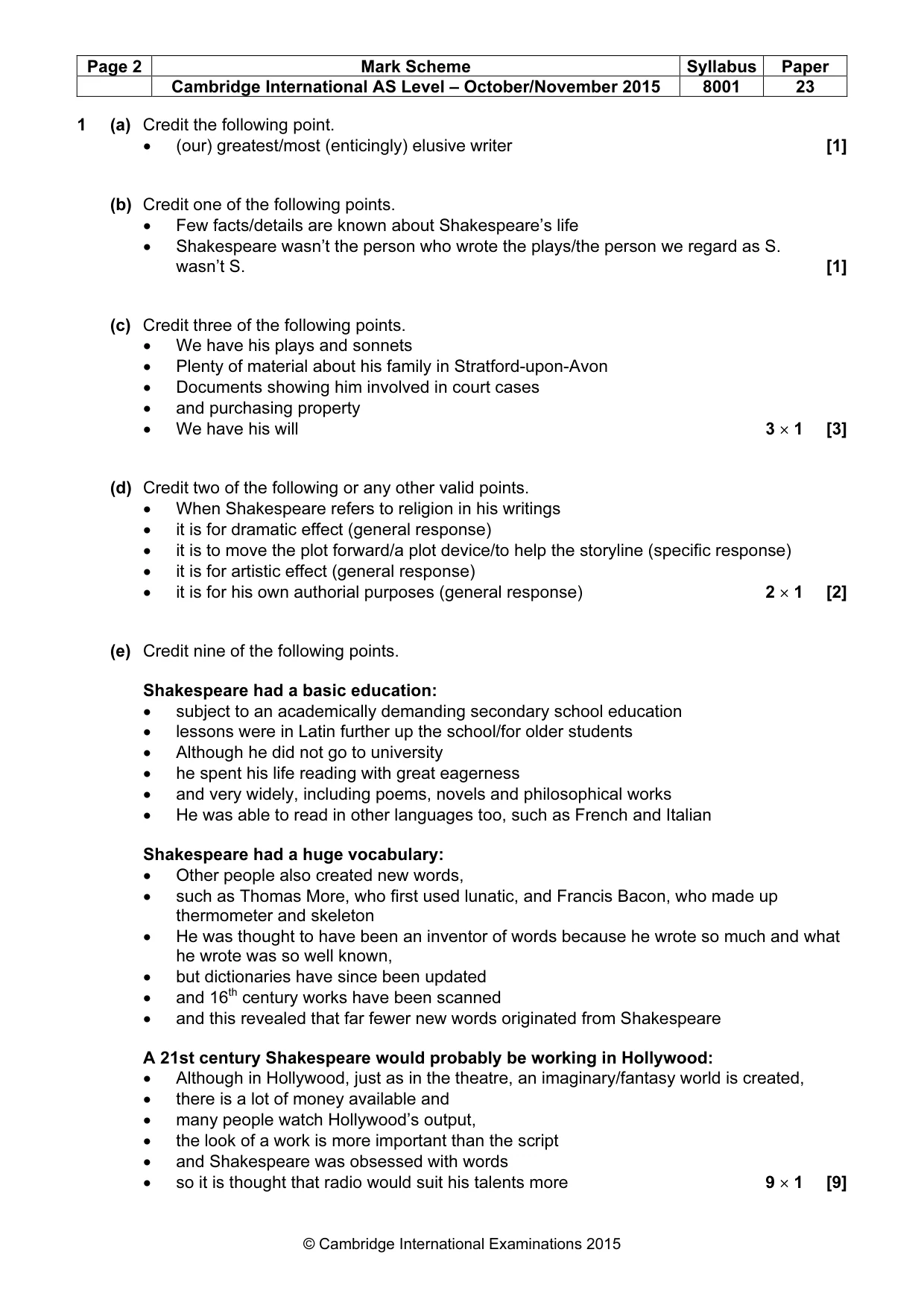
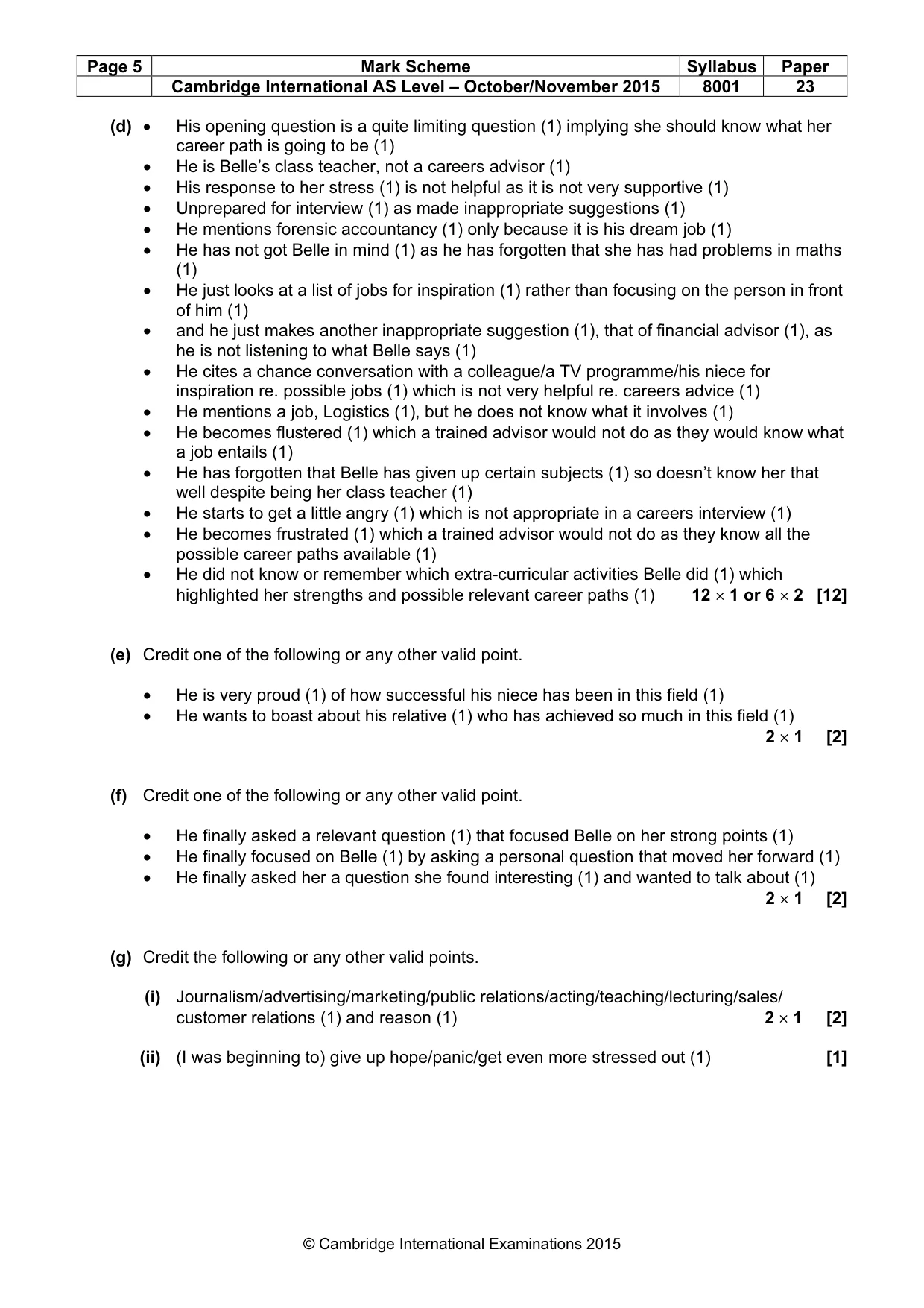
Page 2 Mark Scheme Syllabus Paper Cambridge International AS Level – October/November 2015 8001 23 © Cambridge International Examinations 2015 1 (a) Credit the following point. • (our) greatest/most (enticingly) elusive writer [1] (b) Credit one of the following points. • Few facts/details are known about Shakespeare’s life • Shakespeare wasn’t the person who wrote the plays/the person we regard as S. wasn’t S. [1] (c) Credit three of the following points. • We have his plays and sonnets • Plenty of material about his family in Stratford-upon-Avon • Documents showing him involved in court cases • and purchasing property • We have his will 3 × 1 [3] (d) Credit two of the following or any other valid points. • When Shakespeare refers to religion in his writings • it is for dramatic effect (general response) • it is to move the plot forward/a plot device/to help the storyline (specific response) • it is for artistic effect (general response) • it is for his own authorial purposes (general response) 2 × 1 [2] (e) Credit nine of the following points. Shakespeare had a basic education: • subject to an academically demanding secondary school education • lessons were in Latin further up the school/for older students • Although he did not go to university • he spent his life reading with great eagerness • and very widely, including poems, novels and philosophical works • He was able to read in other languages too, such as French and Italian Shakespeare had a huge vocabulary: • Other people also created new words, • such as Thomas More, who first used lunatic, and Francis Bacon, who made up thermometer and skeleton • He was thought to have been an inventor of words because he wrote so much and what he wrote was so well known, • but dictionaries have since been updated • and 16th century works have been scanned • and this revealed that far fewer new words originated from Shakespeare A 21st century Shakespeare would probably be working in Hollywood: • Although in Hollywood, just as in the theatre, an imaginary/fantasy world is created, • there is a lot of money available and • many people watch Hollywood’s output, • the look of a work is more important than the script • and Shakespeare was obsessed with words • so it is thought that radio would suit his talents more 9 × 1 [9]
Mark scheme, page 3
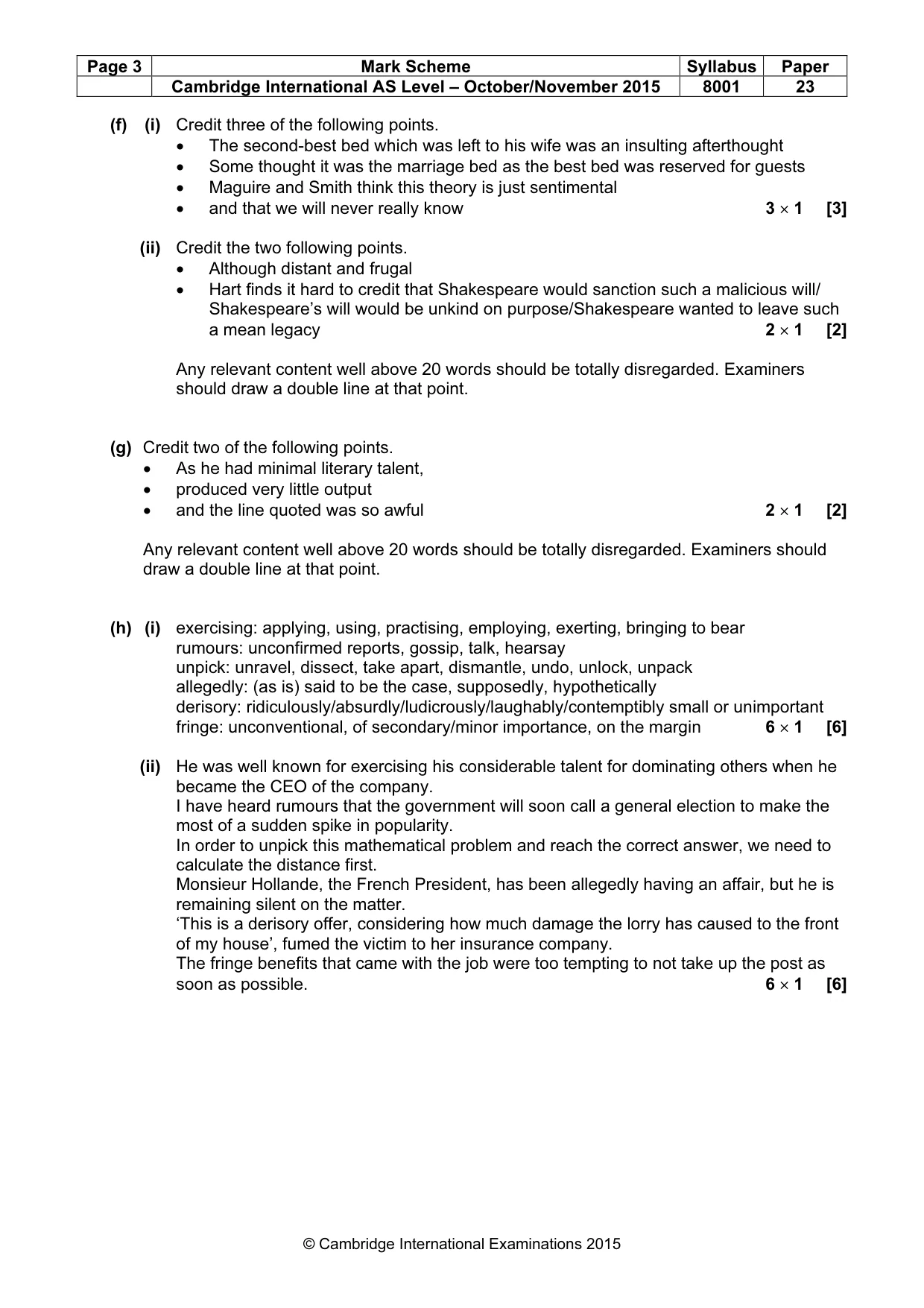
Page 3 Mark Scheme Syllabus Paper Cambridge International AS Level – October/November 2015 8001 23 © Cambridge International Examinations 2015 (f) (i) Credit three of the following points. • The second-best bed which was left to his wife was an insulting afterthought • Some thought it was the marriage bed as the best bed was reserved for guests • Maguire and Smith think this theory is just sentimental • and that we will never really know 3 × 1 [3] (ii) Credit the two following points. • Although distant and frugal • Hart finds it hard to credit that Shakespeare would sanction such a malicious will/ Shakespeare’s will would be unkind on purpose/Shakespeare wanted to leave such a mean legacy 2 × 1 [2] Any relevant content well above 20 words should be totally disregarded. Examiners should draw a double line at that point. (g) Credit two of the following points. • As he had minimal literary talent, • produced very little output • and the line quoted was so awful 2 × 1 [2] Any relevant content well above 20 words should be totally disregarded. Examiners should draw a double line at that point. (h) (i) exercising: applying, using, practising, employing, exerting, bringing to bear rumours: unconfirmed reports, gossip, talk, hearsay unpick: unravel, dissect, take apart, dismantle, undo, unlock, unpack allegedly: (as is) said to be the case, supposedly, hypothetically derisory: ridiculously/absurdly/ludicrously/laughably/contemptibly small or unimportant fringe: unconventional, of secondary/minor importance, on the margin 6 × 1 [6] (ii) He was well known for exercising his considerable talent for dominating others when he became the CEO of the company. I have heard rumours that the government will soon call a general election to make the most of a sudden spike in popularity. In order to unpick this mathematical problem and reach the correct answer, we need to calculate the distance first. Monsieur Hollande, the French President, has been allegedly having an affair, but he is remaining silent on the matter. ‘This is a derisory offer, considering how much damage the lorry has caused to the front of my house’, fumed the victim to her insurance company. The fringe benefits that came with the job were too tempting to not take up the post as soon as possible. 6 × 1 [6]
Mark scheme, page 4
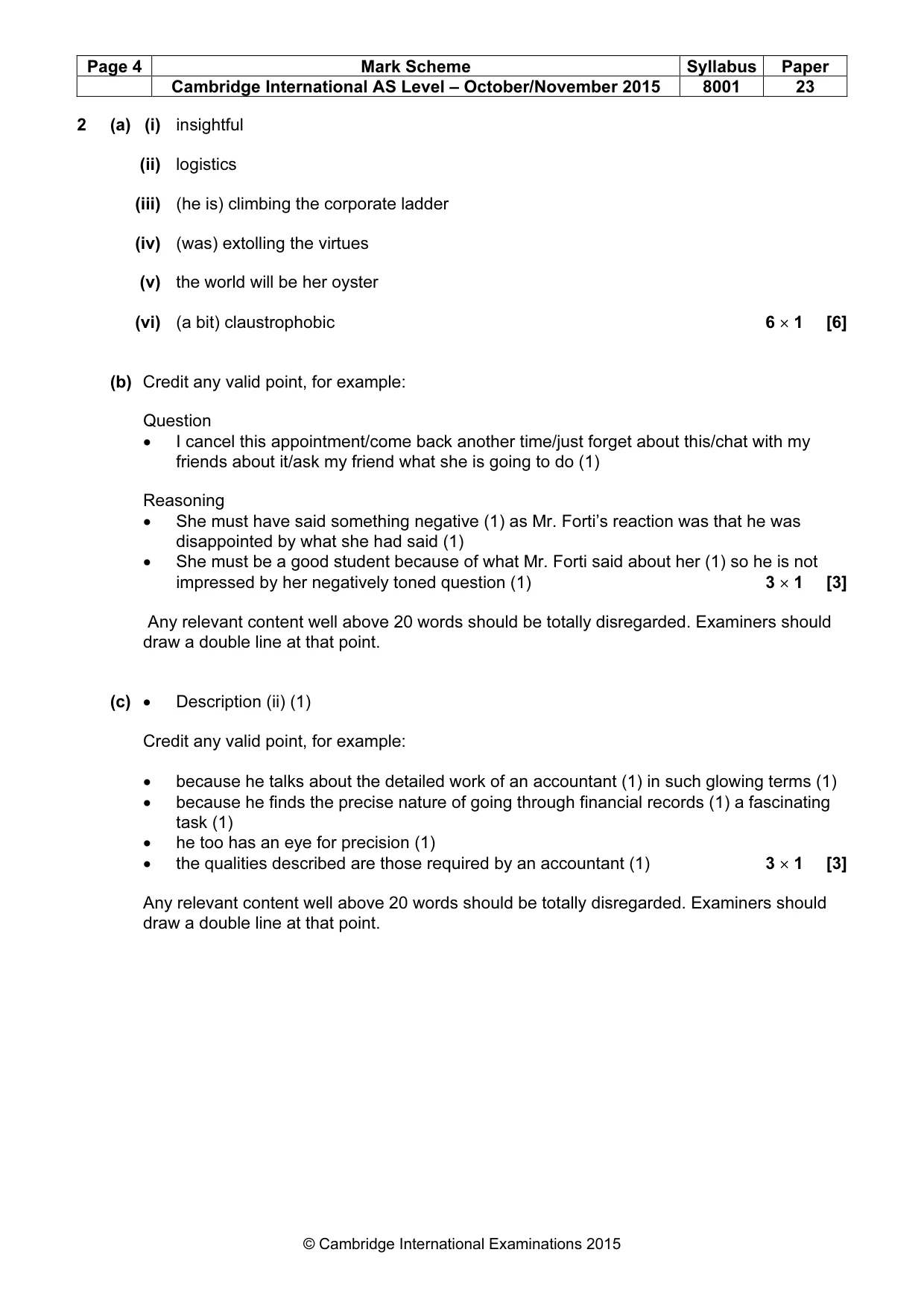
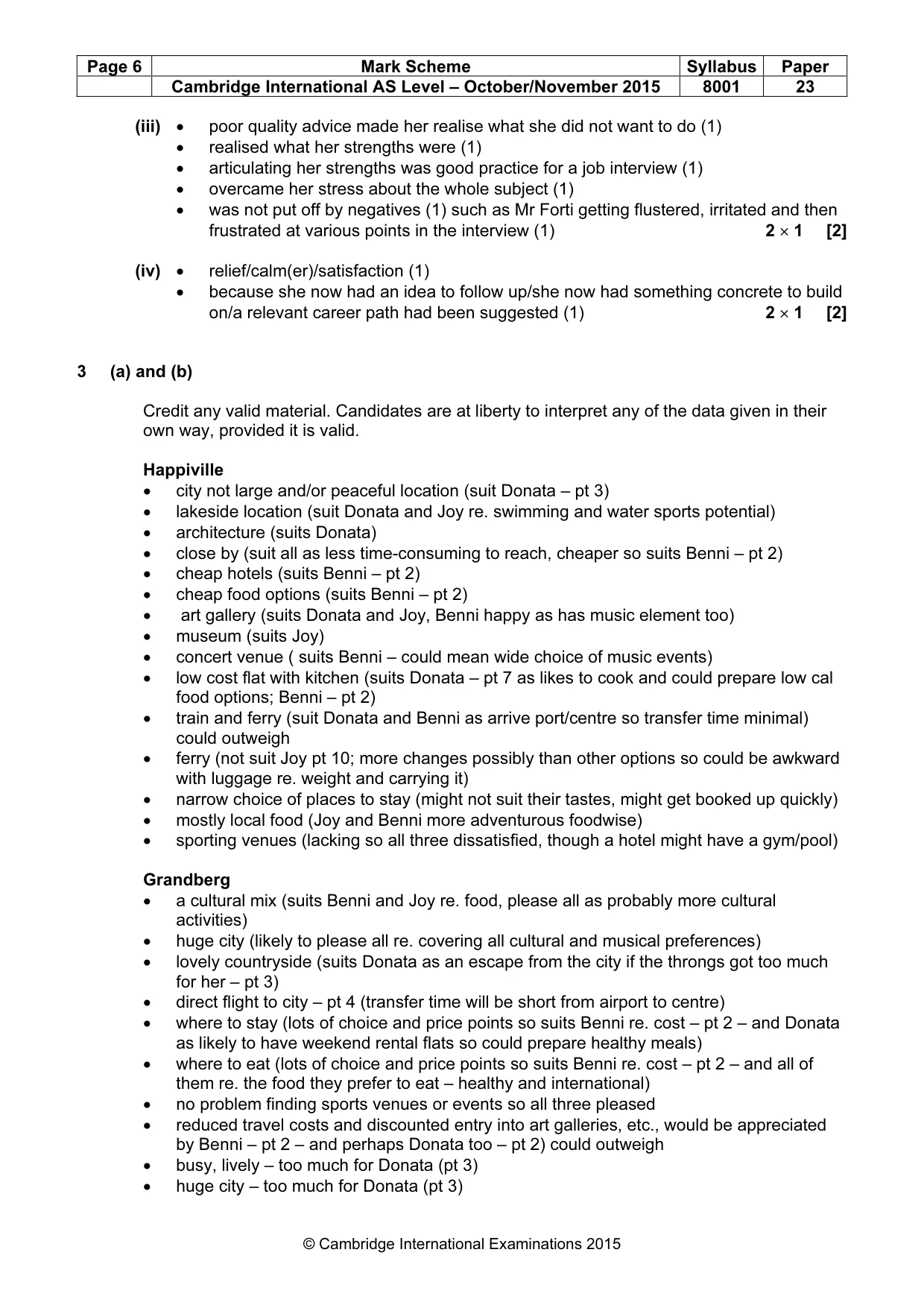
Page 4 Mark Scheme Syllabus Paper Cambridge International AS Level – October/November 2015 8001 23 © Cambridge International Examinations 2015 2 (a) (i) insightful (ii) logistics (iii) (he is) climbing the corporate ladder (iv) (was) extolling the virtues (v) the world will be her oyster (vi) (a bit) claustrophobic 6 × 1 [6] (b) Credit any valid point, for example: Question • I cancel this appointment/come back another time/just forget about this/chat with my friends about it/ask my friend what she is going to do (1) Reasoning • She must have said something negative (1) as Mr. Forti’s reaction was that he was disappointed by what she had said (1) • She must be a good student because of what Mr. Forti said about her (1) so he is not impressed by her negatively toned question (1) 3 × 1 [3] Any relevant content well above 20 words should be totally disregarded. Examiners should draw a double line at that point. (c) • Description (ii) (1) Credit any valid point, for example: • because he talks about the detailed work of an accountant (1) in such glowing terms (1) • because he finds the precise nature of going through financial records (1) a fascinating task (1) • he too has an eye for precision (1) • the qualities described are those required by an accountant (1) 3 × 1 [3] Any relevant content well above 20 words should be totally disregarded. Examiners should draw a double line at that point.
Mark scheme, page 5
Page 5 Mark Scheme Syllabus Paper Cambridge International AS Level – October/November 2015 8001 23 © Cambridge International Examinations 2015 (d) • His opening question is a quite limiting question (1) implying she should know what her career path is going to be (1) • He is Belle’s class teacher, not a careers advisor (1) • His response to her stress (1) is not helpful as it is not very supportive (1) • Unprepared for interview (1) as made inappropriate suggestions (1) • He mentions forensic accountancy (1) only because it is his dream job (1) • He has not got Belle in mind (1) as he has forgotten that she has had problems in maths (1) • He just looks at a list of jobs for inspiration (1) rather than focusing on the person in front of him (1) • and he just makes another inappropriate suggestion (1), that of financial advisor (1), as he is not listening to what Belle says (1) • He cites a chance conversation with a colleague/a TV programme/his niece for inspiration re. possible jobs (1) which is not very helpful re. careers advice (1) • He mentions a job, Logistics (1), but he does not know what it involves (1) • He becomes flustered (1) which a trained advisor would not do as they would know what a job entails (1) • He has forgotten that Belle has given up certain subjects (1) so doesn’t know her that well despite being her class teacher (1) • He starts to get a little angry (1) which is not appropriate in a careers interview (1) • He becomes frustrated (1) which a trained advisor would not do as they know all the possible career paths available (1) • He did not know or remember which extra-curricular activities Belle did (1) which highlighted her strengths and possible relevant career paths (1) 12 × 1 or 6 × 2 [12] (e) Credit one of the following or any other valid point. • He is very proud (1) of how successful his niece has been in this field (1) • He wants to boast about his relative (1) who has achieved so much in this field (1) 2 × 1 [2] (f) Credit one of the following or any other valid point. • He finally asked a relevant question (1) that focused Belle on her strong points (1) • He finally focused on Belle (1) by asking a personal question that moved her forward (1) • He finally asked her a question she found interesting (1) and wanted to talk about (1) 2 × 1 [2] (g) Credit the following or any other valid points. (i) Journalism/advertising/marketing/public relations/acting/teaching/lecturing/sales/ customer relations (1) and reason (1) 2 × 1 [2] (ii) (I was beginning to) give up hope/panic/get even more stressed out (1) [1]
Mark scheme, page 6
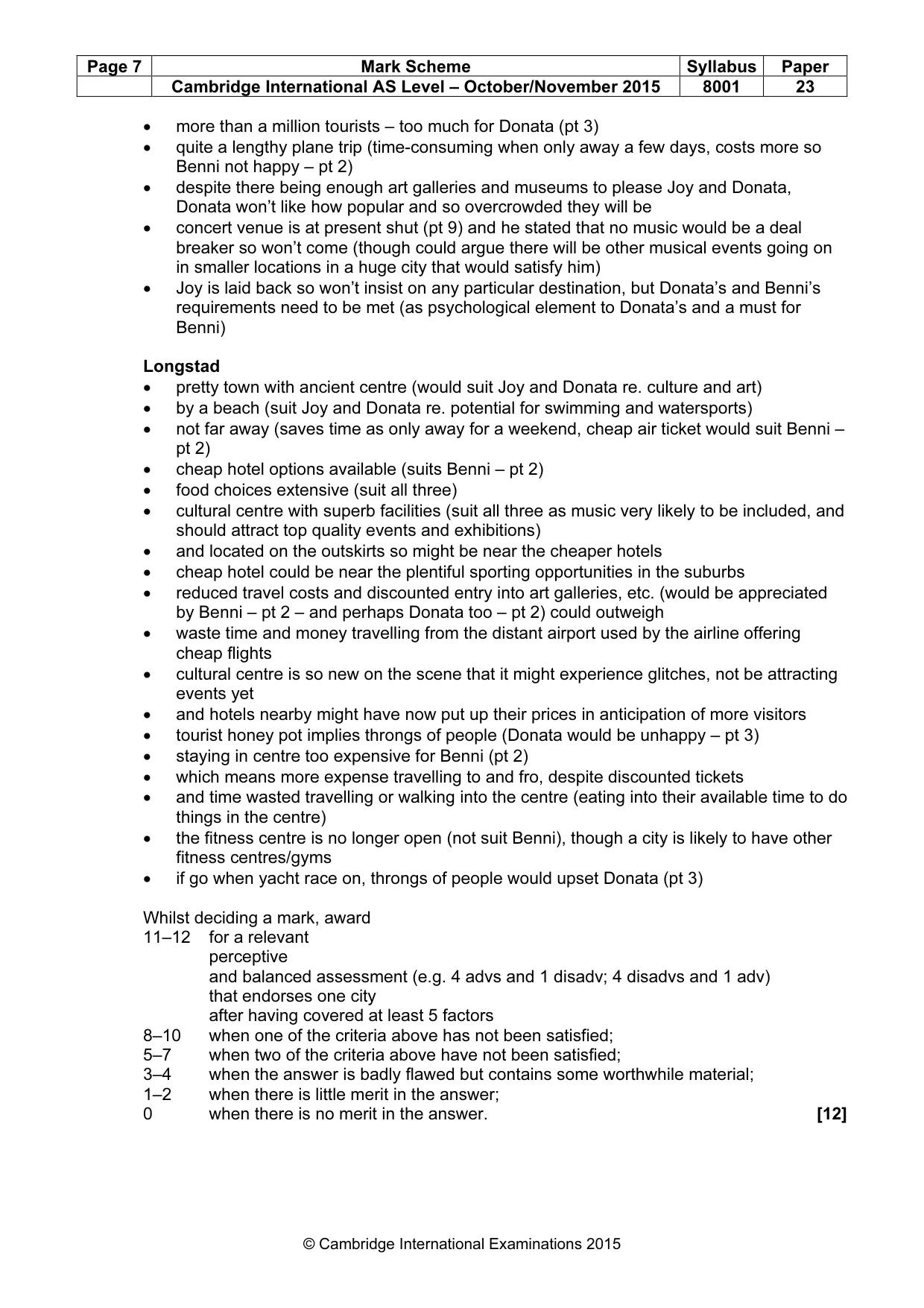
Page 6 Mark Scheme Syllabus Paper Cambridge International AS Level – October/November 2015 8001 23 © Cambridge International Examinations 2015 (iii) • poor quality advice made her realise what she did not want to do (1) • realised what her strengths were (1) • articulating her strengths was good practice for a job interview (1) • overcame her stress about the whole subject (1) • was not put off by negatives (1) such as Mr Forti getting flustered, irritated and then frustrated at various points in the interview (1) 2 × 1 [2] (iv) • relief/calm(er)/satisfaction (1) • because she now had an idea to follow up/she now had something concrete to build on/a relevant career path had been suggested (1) 2 × 1 [2] 3 (a) and (b) Credit any valid material. Candidates are at liberty to interpret any of the data given in their own way, provided it is valid. Happiville • city not large and/or peaceful location (suit Donata – pt 3) • lakeside location (suit Donata and Joy re. swimming and water sports potential) • architecture (suits Donata) • close by (suit all as less time-consuming to reach, cheaper so suits Benni – pt 2) • cheap hotels (suits Benni – pt 2) • cheap food options (suits Benni – pt 2) • art gallery (suits Donata and Joy, Benni happy as has music element too) • museum (suits Joy) • concert venue ( suits Benni – could mean wide choice of music events) • low cost flat with kitchen (suits Donata – pt 7 as likes to cook and could prepare low cal food options; Benni – pt 2) • train and ferry (suit Donata and Benni as arrive port/centre so transfer time minimal) could outweigh • ferry (not suit Joy pt 10; more changes possibly than other options so could be awkward with luggage re. weight and carrying it) • narrow choice of places to stay (might not suit their tastes, might get booked up quickly) • mostly local food (Joy and Benni more adventurous foodwise) • sporting venues (lacking so all three dissatisfied, though a hotel might have a gym/pool) Grandberg • a cultural mix (suits Benni and Joy re. food, please all as probably more cultural activities) • huge city (likely to please all re. covering all cultural and musical preferences) • lovely countryside (suits Donata as an escape from the city if the throngs got too much for her – pt 3) • direct flight to city – pt 4 (transfer time will be short from airport to centre) • where to stay (lots of choice and price points so suits Benni re. cost – pt 2 – and Donata as likely to have weekend rental flats so could prepare healthy meals) • where to eat (lots of choice and price points so suits Benni re. cost – pt 2 – and all of them re. the food they prefer to eat – healthy and international) • no problem finding sports venues or events so all three pleased • reduced travel costs and discounted entry into art galleries, etc., would be appreciated by Benni – pt 2 – and perhaps Donata too – pt 2) could outweigh • busy, lively – too much for Donata (pt 3) • huge city – too much for Donata (pt 3)
Mark scheme, page 7
Page 7 Mark Scheme Syllabus Paper Cambridge International AS Level – October/November 2015 8001 23 © Cambridge International Examinations 2015 • more than a million tourists – too much for Donata (pt 3) • quite a lengthy plane trip (time-consuming when only away a few days, costs more so Benni not happy – pt 2) • despite there being enough art galleries and museums to please Joy and Donata, Donata won’t like how popular and so overcrowded they will be • concert venue is at present shut (pt 9) and he stated that no music would be a deal breaker so won’t come (though could argue there will be other musical events going on in smaller locations in a huge city that would satisfy him) • Joy is laid back so won’t insist on any particular destination, but Donata’s and Benni’s requirements need to be met (as psychological element to Donata’s and a must for Benni) Longstad • pretty town with ancient centre (would suit Joy and Donata re. culture and art) • by a beach (suit Joy and Donata re. potential for swimming and watersports) • not far away (saves time as only away for a weekend, cheap air ticket would suit Benni – pt 2) • cheap hotel options available (suits Benni – pt 2) • food choices extensive (suit all three) • cultural centre with superb facilities (suit all three as music very likely to be included, and should attract top quality events and exhibitions) • and located on the outskirts so might be near the cheaper hotels • cheap hotel could be near the plentiful sporting opportunities in the suburbs • reduced travel costs and discounted entry into art galleries, etc. (would be appreciated by Benni – pt 2 – and perhaps Donata too – pt 2) could outweigh • waste time and money travelling from the distant airport used by the airline offering cheap flights • cultural centre is so new on the scene that it might experience glitches, not be attracting events yet • and hotels nearby might have now put up their prices in anticipation of more visitors • tourist honey pot implies throngs of people (Donata would be unhappy – pt 3) • staying in centre too expensive for Benni (pt 2) • which means more expense travelling to and fro, despite discounted tickets • and time wasted travelling or walking into the centre (eating into their available time to do things in the centre) • the fitness centre is no longer open (not suit Benni), though a city is likely to have other fitness centres/gyms • if go when yacht race on, throngs of people would upset Donata (pt 3) Whilst deciding a mark, award 11–12 for a relevant perceptive and balanced assessment (e.g. 4 advs and 1 disadv; 4 disadvs and 1 adv) that endorses one city after having covered at least 5 factors 8–10 when one of the criteria above has not been satisfied; 5–7 when two of the criteria above have not been satisfied; 3–4 when the answer is badly flawed but contains some worthwhile material; 1–2 when there is little merit in the answer; 0 when there is no merit in the answer. [12]
Mark scheme, page 8
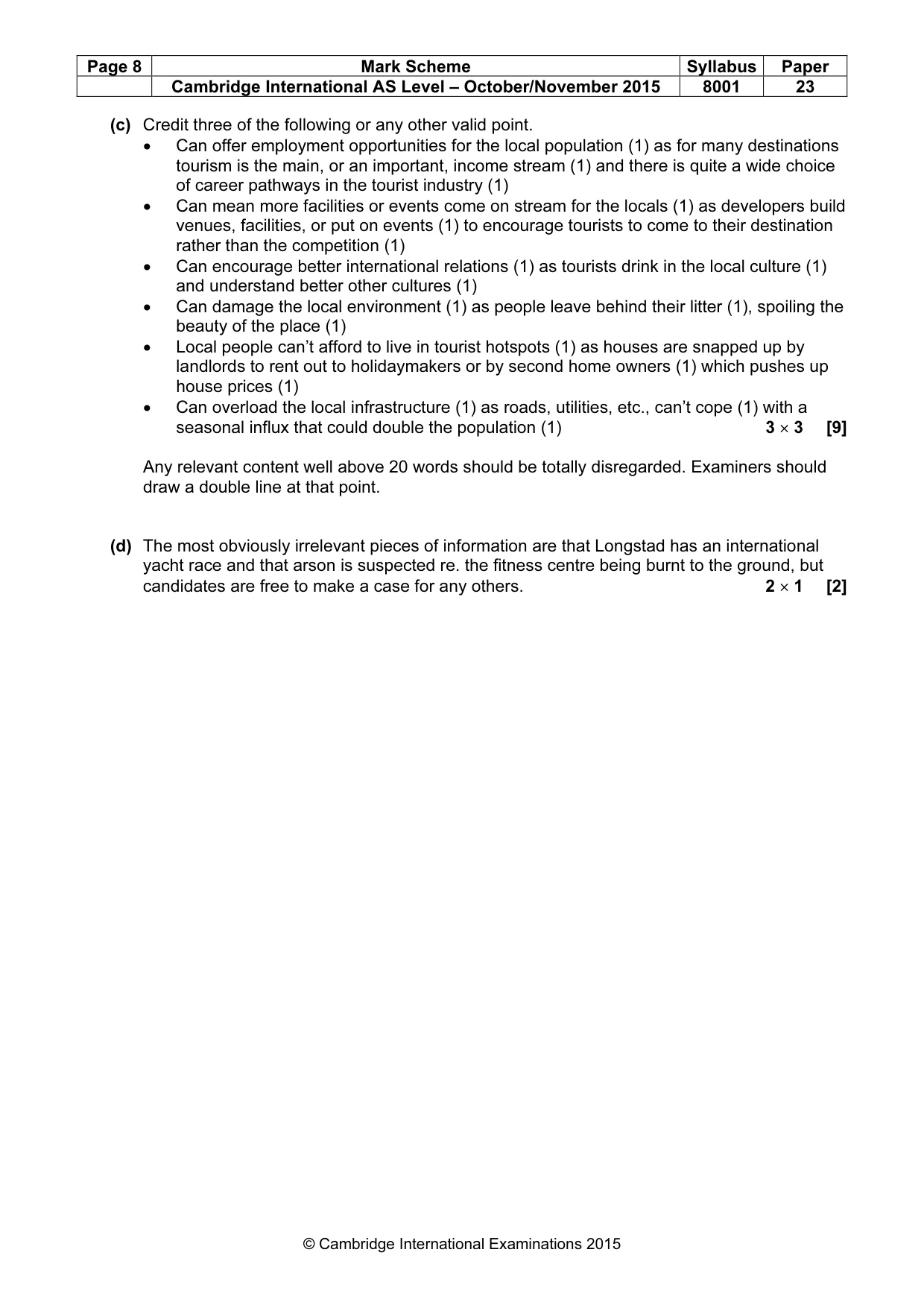
Page 8 Mark Scheme Syllabus Paper Cambridge International AS Level – October/November 2015 8001 23 © Cambridge International Examinations 2015 (c) Credit three of the following or any other valid point. • Can offer employment opportunities for the local population (1) as for many destinations tourism is the main, or an important, income stream (1) and there is quite a wide choice of career pathways in the tourist industry (1) • Can mean more facilities or events come on stream for the locals (1) as developers build venues, facilities, or put on events (1) to encourage tourists to come to their destination rather than the competition (1) • Can encourage better international relations (1) as tourists drink in the local culture (1) and understand better other cultures (1) • Can damage the local environment (1) as people leave behind their litter (1), spoiling the beauty of the place (1) • Local people can’t afford to live in tourist hotspots (1) as houses are snapped up by landlords to rent out to holidaymakers or by second home owners (1) which pushes up house prices (1) • Can overload the local infrastructure (1) as roads, utilities, etc., can’t cope (1) with a seasonal influx that could double the population (1) 3 × 3 [9] Any relevant content well above 20 words should be totally disregarded. Examiners should draw a double line at that point. (d) The most obviously irrelevant pieces of information are that Longstad has an international yacht race and that arson is suspected re. the fitness centre being burnt to the ground, but candidates are free to make a case for any others. 2 × 1 [2]
What you needed in this session
Cambridge’s own grade thresholds for 2015 Oct/Nov, Paper 2 · Variant 3. A higher threshold means an easier paper — the bar moves with how the cohort did.