Cambridge A Level General Paper (AS Level only) 8001 — 2016 Oct/Nov Paper 2 · Variant 3
8001/23/O/N/16 · 50 marks · ≈56 min
The question paper and its mark scheme, free to read here and free to download. This is Cambridge’s own paper, exactly as it was sat.
Question paper12 pages


Mark scheme7 pages
Answers below. Sit the paper first if you are practising.
Paper as text
Question paper, page 1
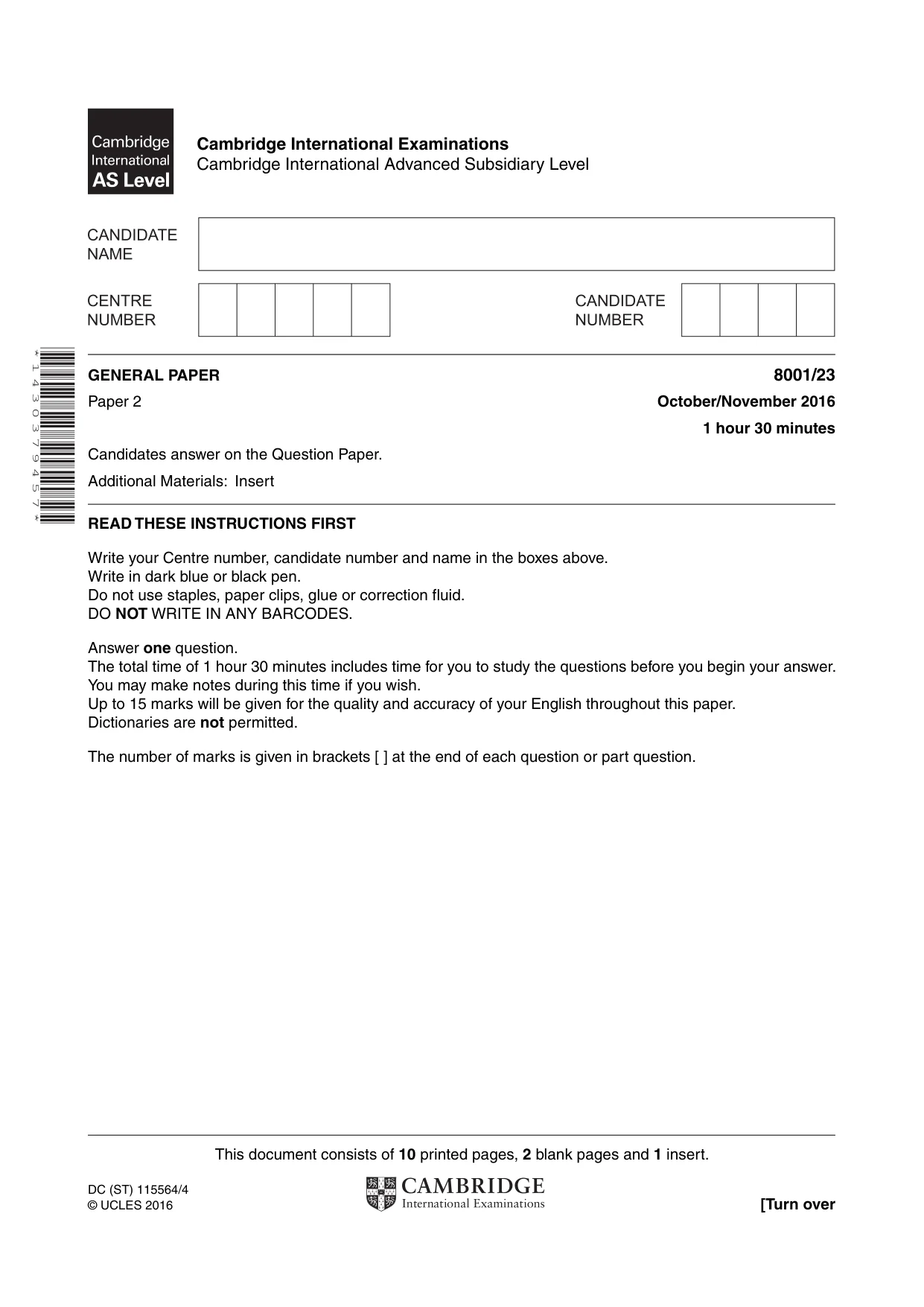
This document consists of 10 printed pages, 2 blank pages and 1 insert. DC (ST) 115564/4 © UCLES 2016 [Turn over Cambridge International Examinations Cambridge International Advanced Subsidiary Level * 1 4 3 0 3 7 9 4 5 7 * GENERAL PAPER 8001/23 Paper 2 October/November 2016 1 hour 30 minutes Candidates answer on the Question Paper. Additional Materials: Insert READ THESE INSTRUCTIONS FIRST Write your Centre number, candidate number and name in the boxes above. Write in dark blue or black pen. Do not use staples, paper clips, glue or correction fluid. DO NOT WRITE IN ANY BARCODES. Answer one question. The total time of 1 hour 30 minutes includes time for you to study the questions before you begin your answer. You may make notes during this time if you wish. Up to 15 marks will be given for the quality and accuracy of your English throughout this paper. Dictionaries are not permitted. The number of marks is given in brackets [ ] at the end of each question or part question.
Question paper, page 2
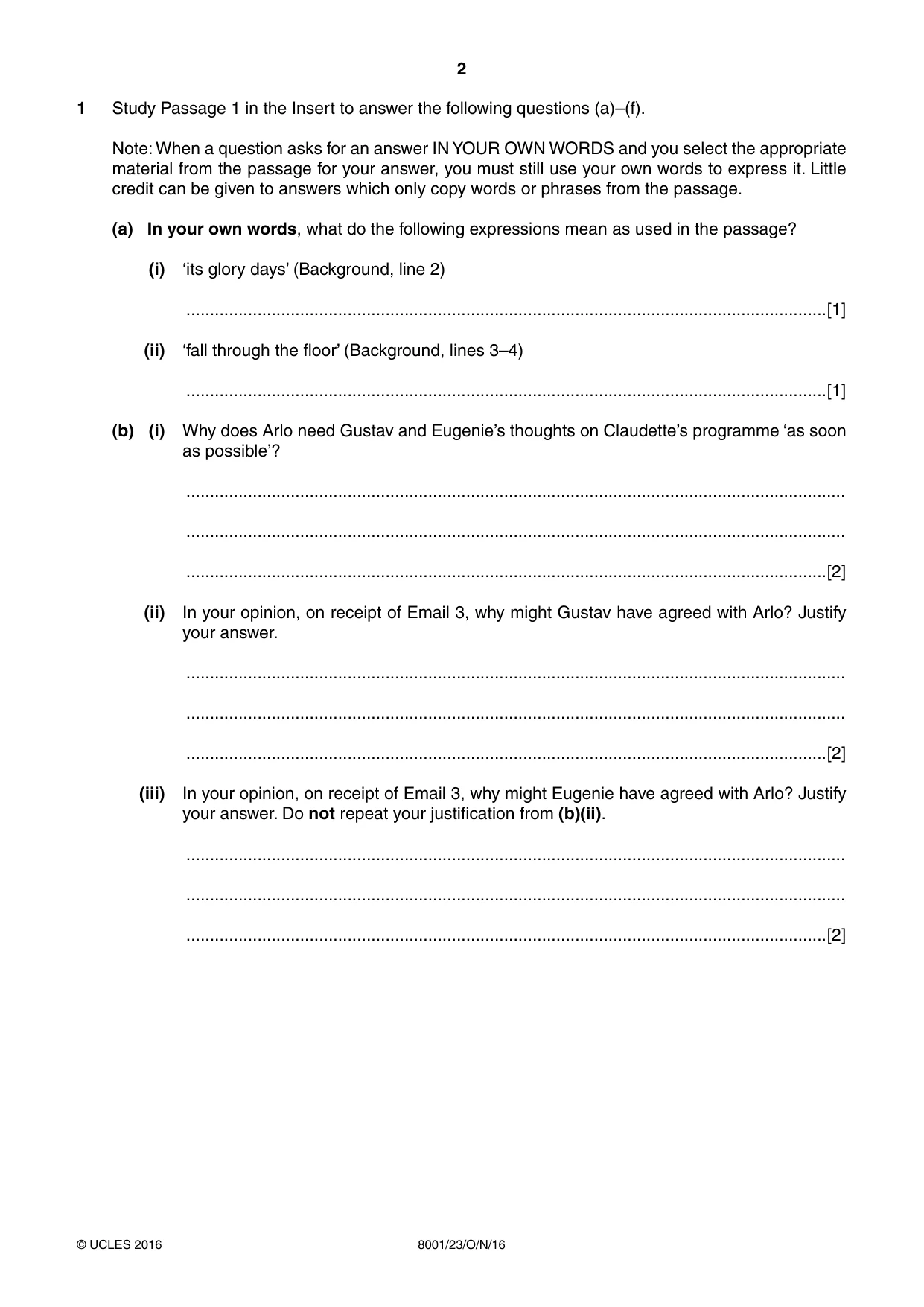
2 8001/23/O/N/16 © UCLES 2016 1 Study Passage 1 in the Insert to answer the following questions (a)–(f). Note: When a question asks for an answer IN YOUR OWN WORDS and you select the appropriate material from the passage for your answer, you must still use your own words to express it. Little credit can be given to answers which only copy words or phrases from the passage. (a) In your own words, what do the following expressions mean as used in the passage? (i) ‘its glory days’ (Background, line 2) …[1] (ii) ‘fall through the floor’ (Background, lines 3–4) …[1] (b) (i) Why does Arlo need Gustav and Eugenie’s thoughts on Claudette’s programme ‘as soon as possible’? … … …[2] (ii) In your opinion, on receipt of Email 3, why might Gustav have agreed with Arlo? Justify your answer. … … …[2] (iii) In your opinion, on receipt of Email 3, why might Eugenie have agreed with Arlo? Justify your answer. Do not repeat your justification from (b)(ii). … … …[2]
Question paper, page 3
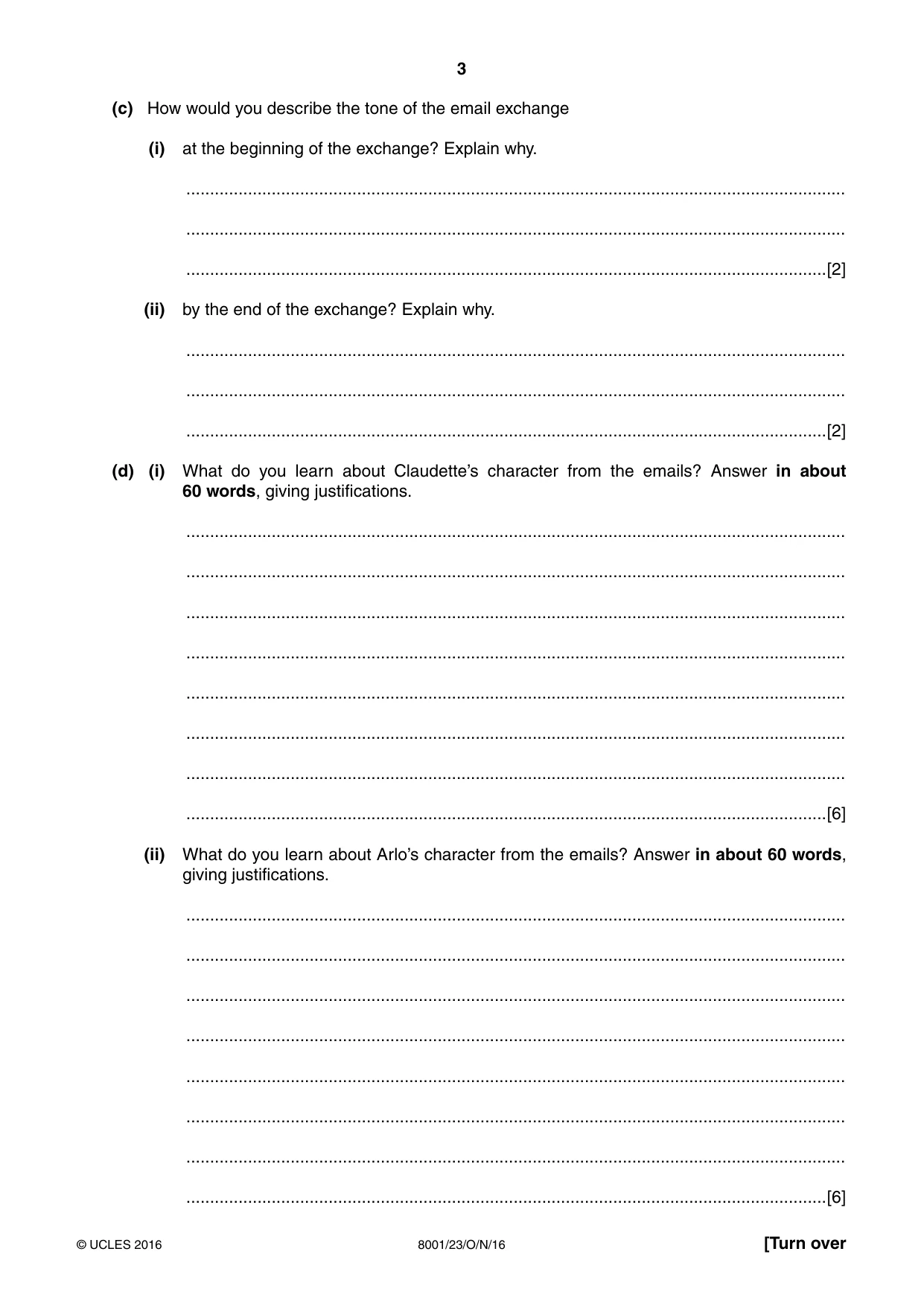
3 8001/23/O/N/16 © UCLES 2016 [Turn over (c) How would you describe the tone of the email exchange (i) at the beginning of the exchange? Explain why. … … …[2] (ii) by the end of the exchange? Explain why. … … …[2] (d) (i) What do you learn about Claudette’s character from the emails? Answer in about 60 words, giving justifications. … … … … … … … …[6] (ii) What do you learn about Arlo’s character from the emails? Answer in about 60 words, giving justifications. … … … … … … … …[6]
Question paper, page 4
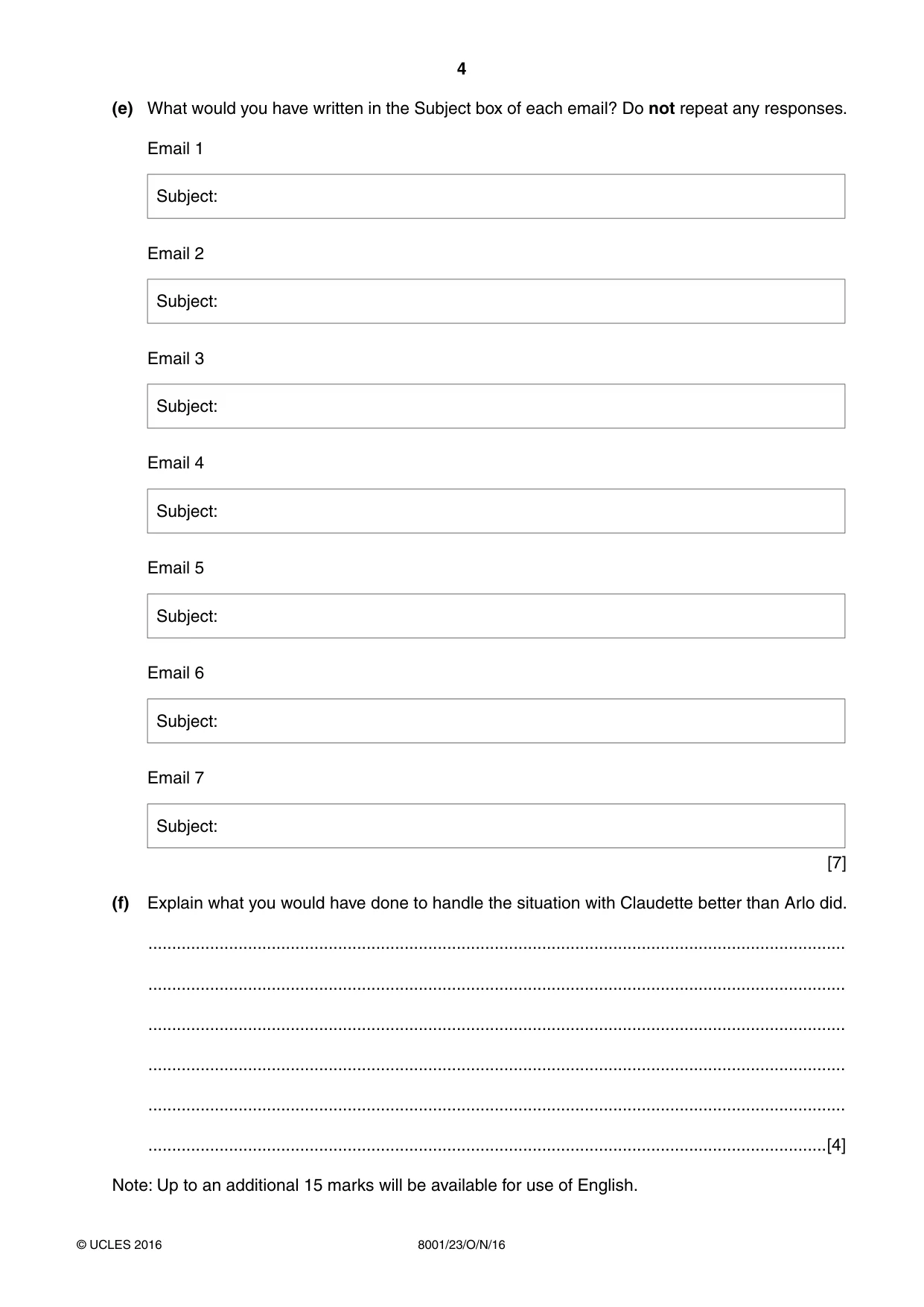
4 8001/23/O/N/16 © UCLES 2016 (e) What would you have written in the Subject box of each email? Do not repeat any responses. Email 1 Subject: Email 2 Subject: Email 3 Subject: Email 4 Subject: Email 5 Subject: Email 6 Subject: Email 7 Subject: [7] (f) Explain what you would have done to handle the situation with Claudette better than Arlo did. … … … … … …[4] Note: Up to an additional 15 marks will be available for use of English.
Question paper, page 5
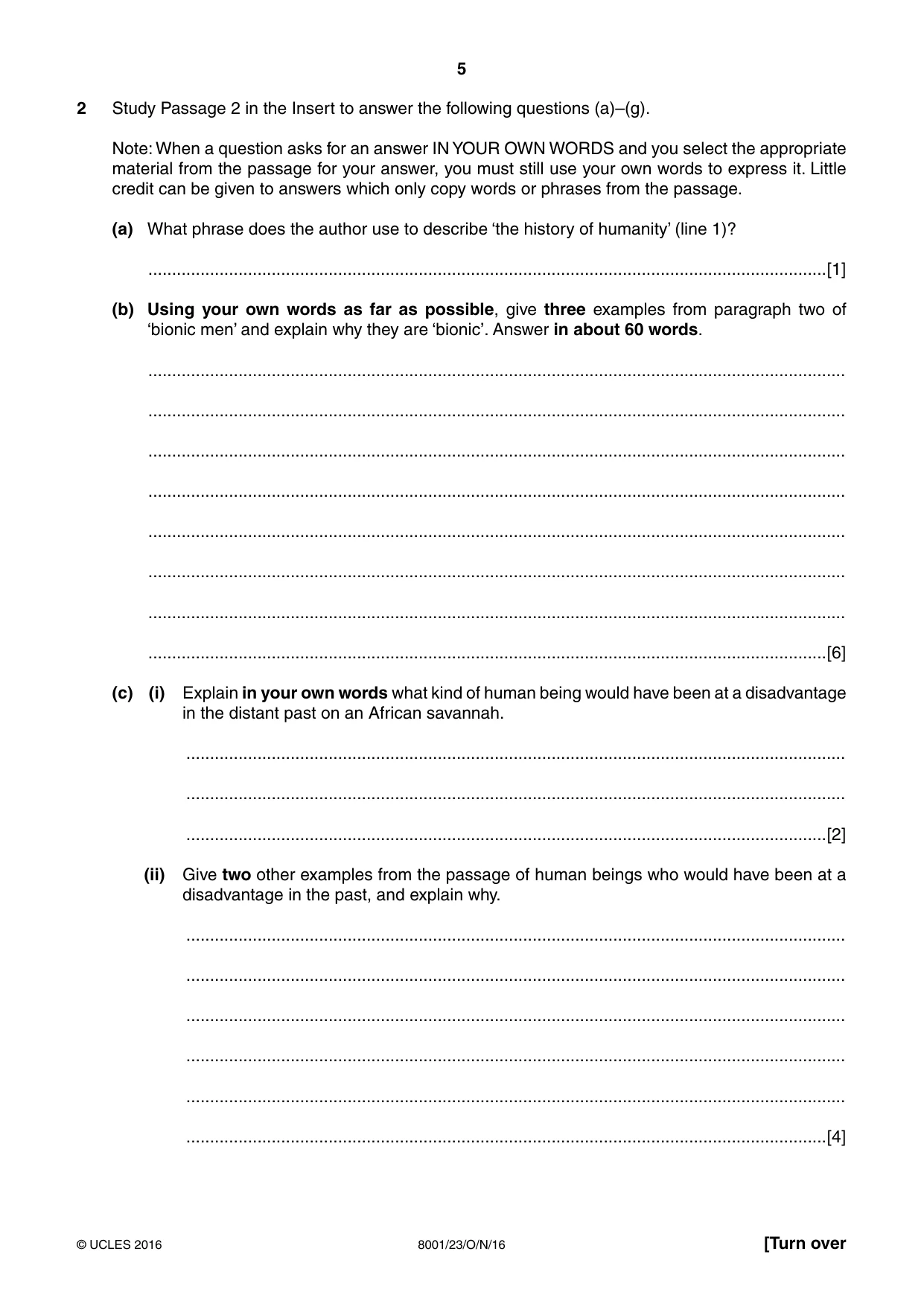
5 8001/23/O/N/16 © UCLES 2016 [Turn over 2 Study Passage 2 in the Insert to answer the following questions (a)–(g). Note: When a question asks for an answer IN YOUR OWN WORDS and you select the appropriate material from the passage for your answer, you must still use your own words to express it. Little credit can be given to answers which only copy words or phrases from the passage. (a) What phrase does the author use to describe ‘the history of humanity’ (line 1)? …[1] (b) Using your own words as far as possible, give three examples from paragraph two of ‘bionic men’ and explain why they are ‘bionic’. Answer in about 60 words. … … … … … … … …[6] (c) (i) Explain in your own words what kind of human being would have been at a disadvantage in the distant past on an African savannah. … … …[2] (ii) Give two other examples from the passage of human beings who would have been at a disadvantage in the past, and explain why. … … … … … …[4]
Question paper, page 6
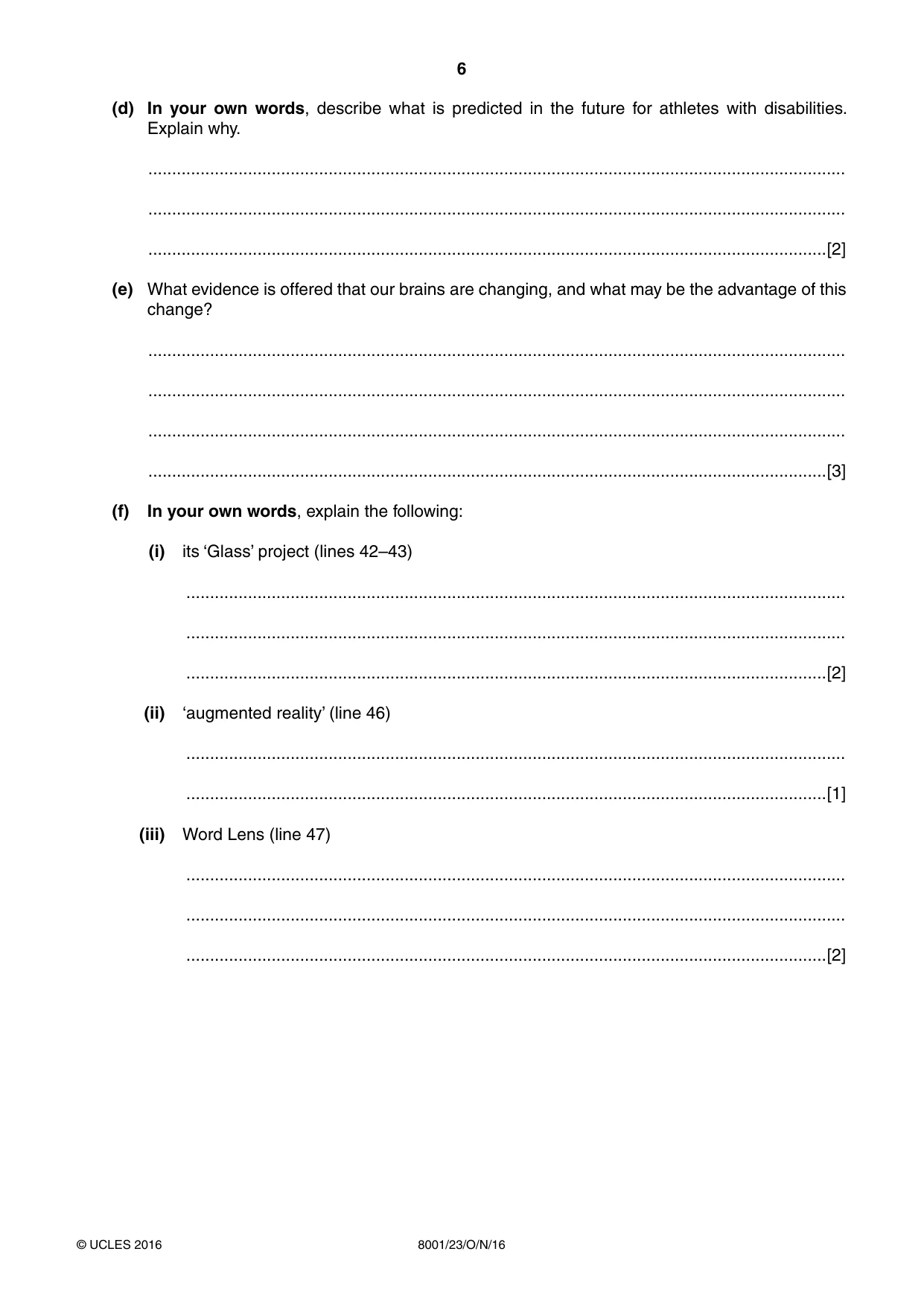
6 8001/23/O/N/16 © UCLES 2016 (d) In your own words, describe what is predicted in the future for athletes with disabilities. Explain why. … … …[2] (e) What evidence is offered that our brains are changing, and what may be the advantage of this change? … … … …[3] (f) In your own words, explain the following: (i) its ‘Glass’ project (lines 42–43) … … …[2] (ii) ‘augmented reality’ (line 46) … …[1] (iii) Word Lens (line 47) … … …[2]
Question paper, page 7
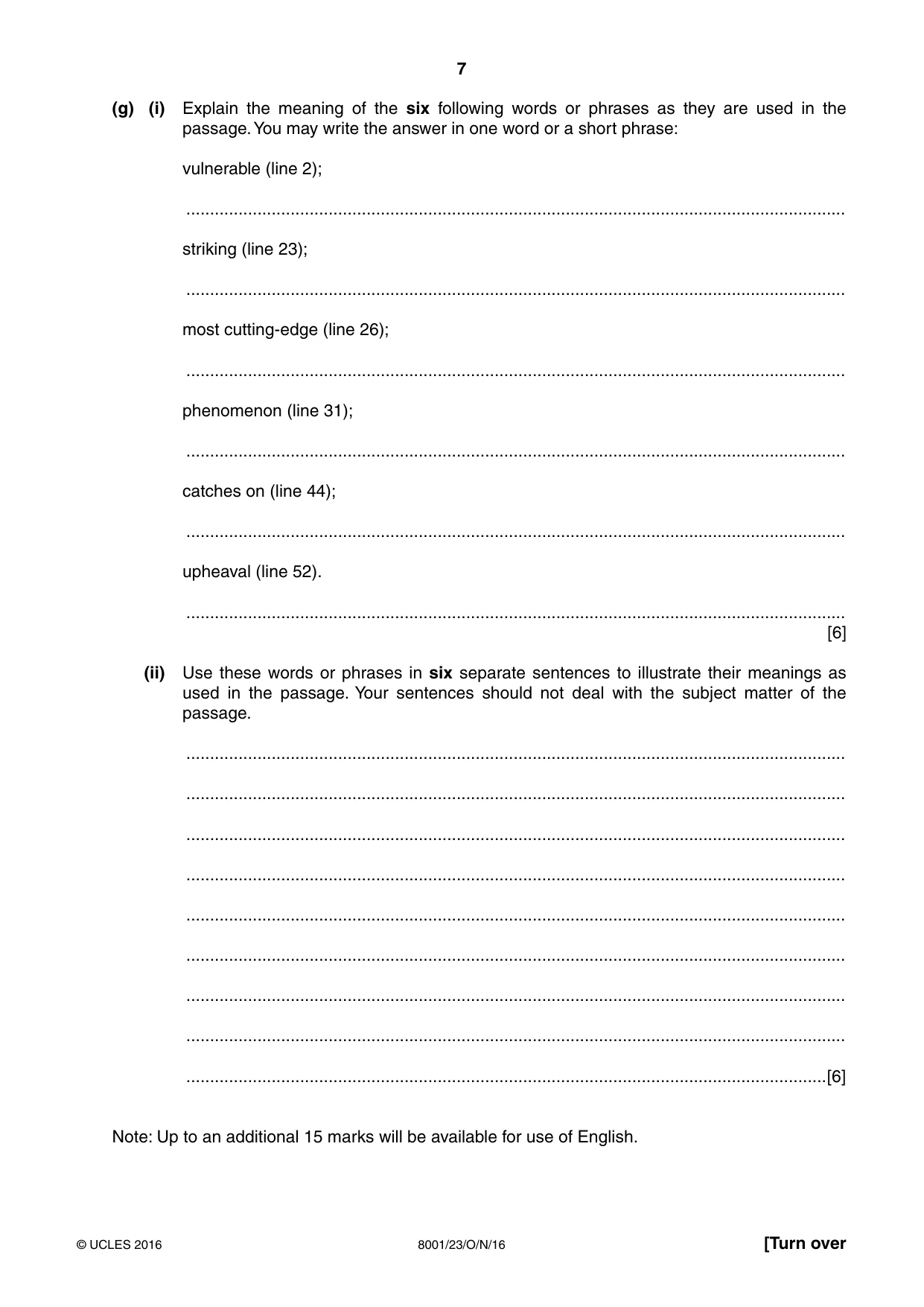
7 8001/23/O/N/16 © UCLES 2016 [Turn over (g) (i) Explain the meaning of the six following words or phrases as they are used in the passage. You may write the answer in one word or a short phrase: vulnerable (line 2); … striking (line 23); … most cutting-edge (line 26); … phenomenon (line 31); … catches on (line 44); … upheaval (line 52). … [6] (ii) Use these words or phrases in six separate sentences to illustrate their meanings as used in the passage. Your sentences should not deal with the subject matter of the passage. … … … … … … … … …[6] Note: Up to an additional 15 marks will be available for use of English.
Question paper, page 8
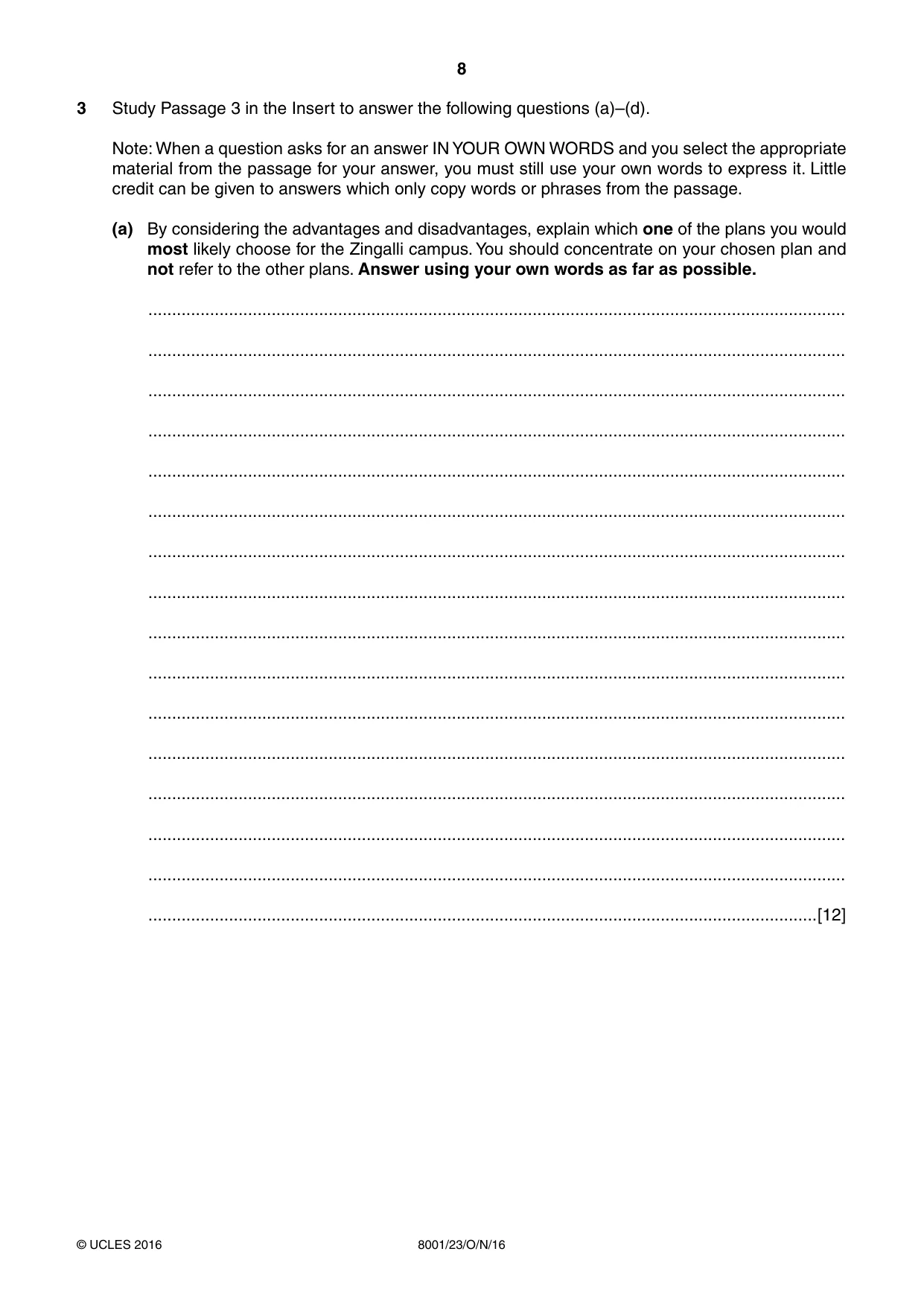
8 8001/23/O/N/16 © UCLES 2016 3 Study Passage 3 in the Insert to answer the following questions (a)–(d). Note: When a question asks for an answer IN YOUR OWN WORDS and you select the appropriate material from the passage for your answer, you must still use your own words to express it. Little credit can be given to answers which only copy words or phrases from the passage. (a) By considering the advantages and disadvantages, explain which one of the plans you would most likely choose for the Zingalli campus. You should concentrate on your chosen plan and not refer to the other plans. Answer using your own words as far as possible. … … … … … … … … … … … … … … … …[12]
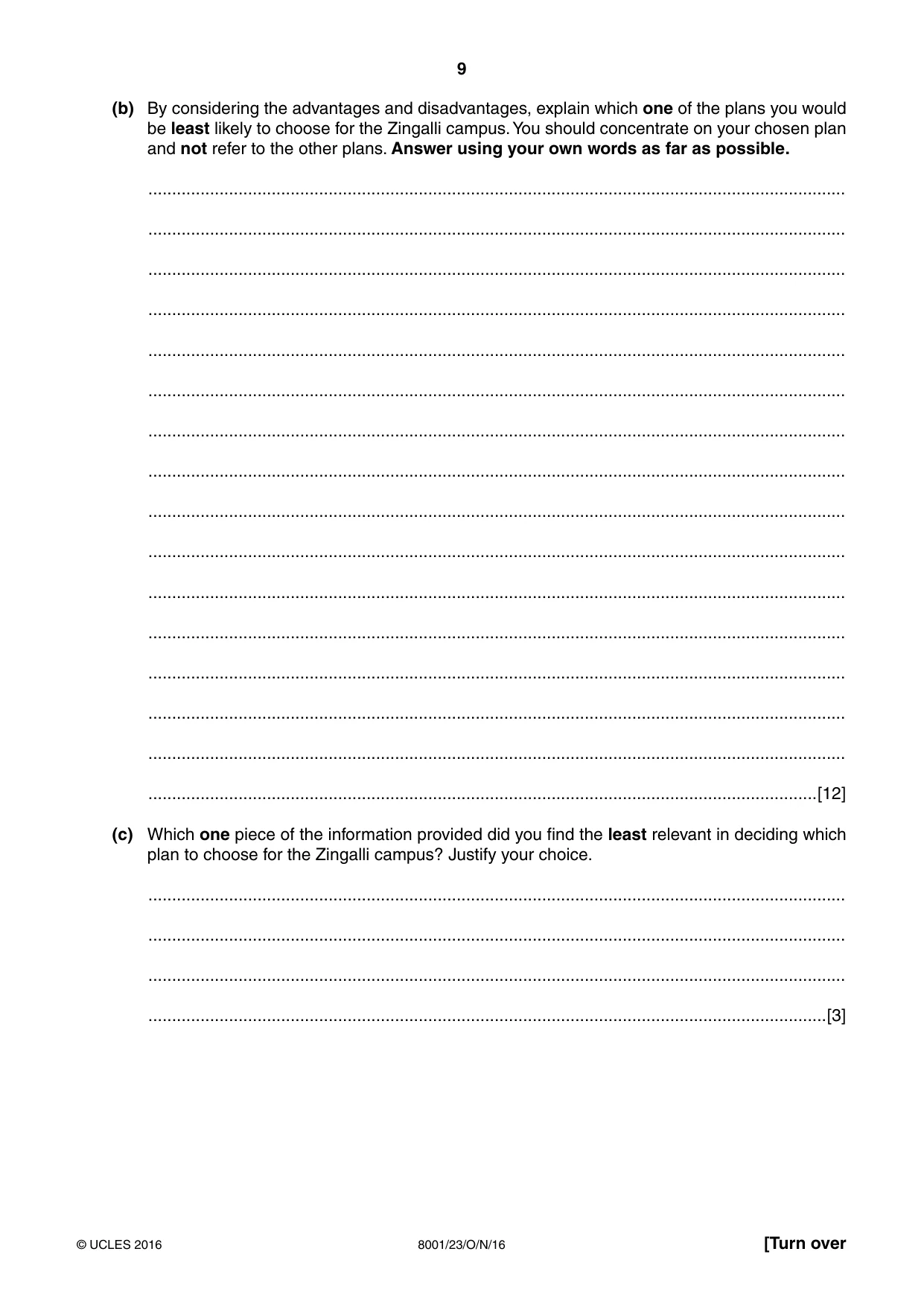
Question paper, page 9
9 8001/23/O/N/16 © UCLES 2016 [Turn over (b) By considering the advantages and disadvantages, explain which one of the plans you would be least likely to choose for the Zingalli campus. You should concentrate on your chosen plan and not refer to the other plans. Answer using your own words as far as possible. … … … … … … … … … … … … … … … …[12] (c) Which one piece of the information provided did you find the least relevant in deciding which plan to choose for the Zingalli campus? Justify your choice. … … … …[3]
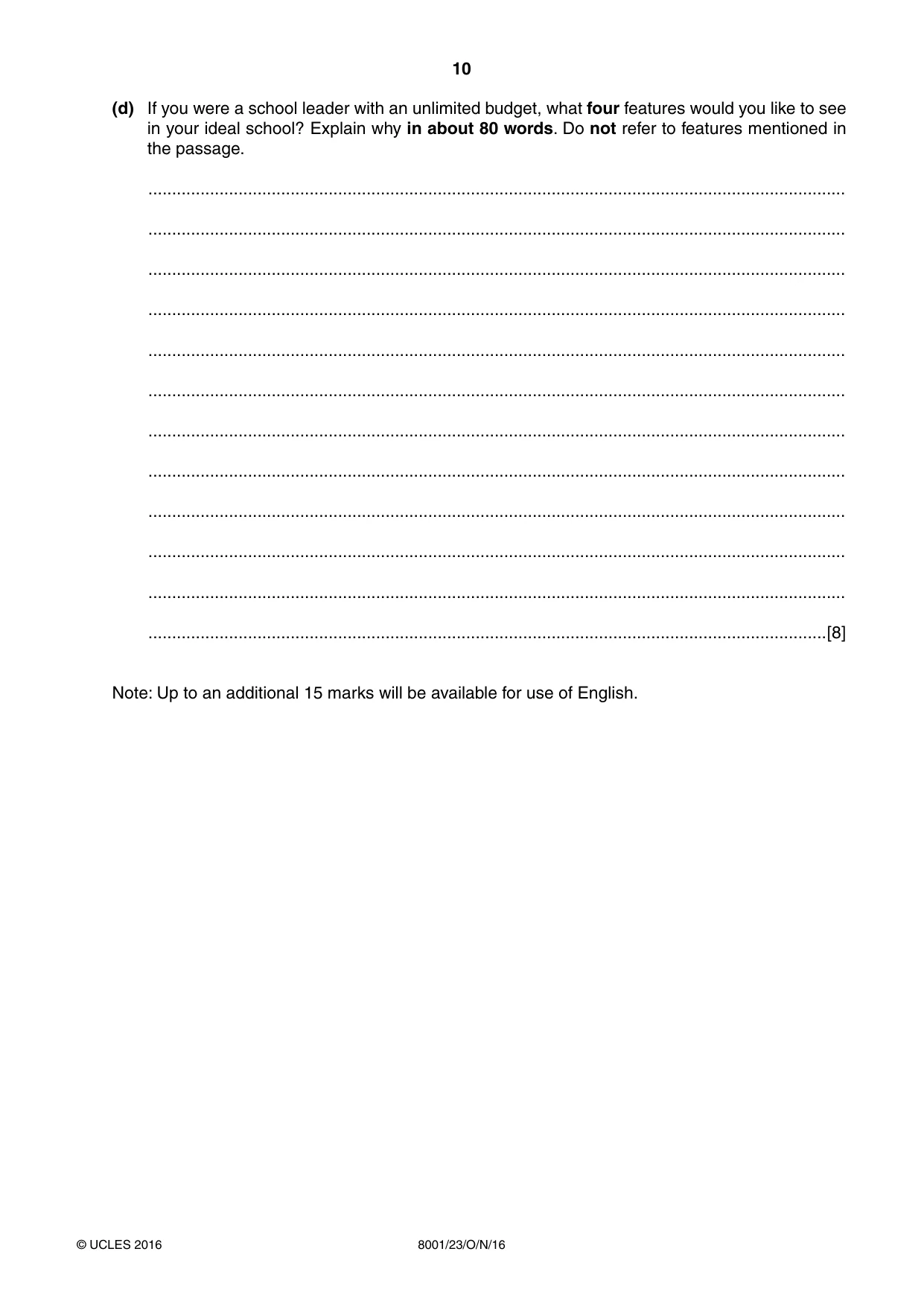
Question paper, page 10
10 8001/23/O/N/16 © UCLES 2016 (d) If you were a school leader with an unlimited budget, what four features would you like to see in your ideal school? Explain why in about 80 words. Do not refer to features mentioned in the passage. … … … … … … … … … … … …[8] Note: Up to an additional 15 marks will be available for use of English.
Question paper, page 11
11 8001/23/O/N/16 © UCLES 2016 BLANK PAGE
Question paper, page 12
12 8001/23/O/N/16 © UCLES 2016 Permission to reproduce items where third-party owned material protected by copyright is included has been sought and cleared where possible. Every reasonable effort has been made by the publisher (UCLES) to trace copyright holders, but if any items requiring clearance have unwittingly been included, the publisher will be pleased to make amends at the earliest possible opportunity. To avoid the issue of disclosure of answer-related information to candidates, all copyright acknowledgements are reproduced online in the Cambridge International Examinations Copyright Acknowledgements Booklet. This is produced for each series of examinations and is freely available to download at www.cie.org.uk after the live examination series. Cambridge International Examinations is part of the Cambridge Assessment Group. Cambridge Assessment is the brand name of University of Cambridge Local Examinations Syndicate (UCLES), which is itself a department of the University of Cambridge. BLANK PAGE
Mark scheme, page 1
® IGCSE is the registered trademark of Cambridge International Examinations. This document consists of 7 printed pages. © UCLES 2016 [Turn over Cambridge International Examinations Cambridge International Advanced Subsidiary Level GENERAL PAPER 8001/23 Paper 2 October/November 2016 MARK SCHEME Maximum Mark: 50 Published This mark scheme is published as an aid to teachers and candidates, to indicate the requirements of the examination. It shows the basis on which Examiners were instructed to award marks. It does not indicate the details of the discussions that took place at an Examiners’ meeting before marking began, which would have considered the acceptability of alternative answers. Mark schemes should be read in conjunction with the question paper and the Principal Examiner Report for Teachers. Cambridge will not enter into discussions about these mark schemes. Cambridge is publishing the mark schemes for the October/November 2016 series for most Cambridge IGCSE®, Cambridge International A and AS Level components and some Cambridge O Level components.
Mark scheme, page 2
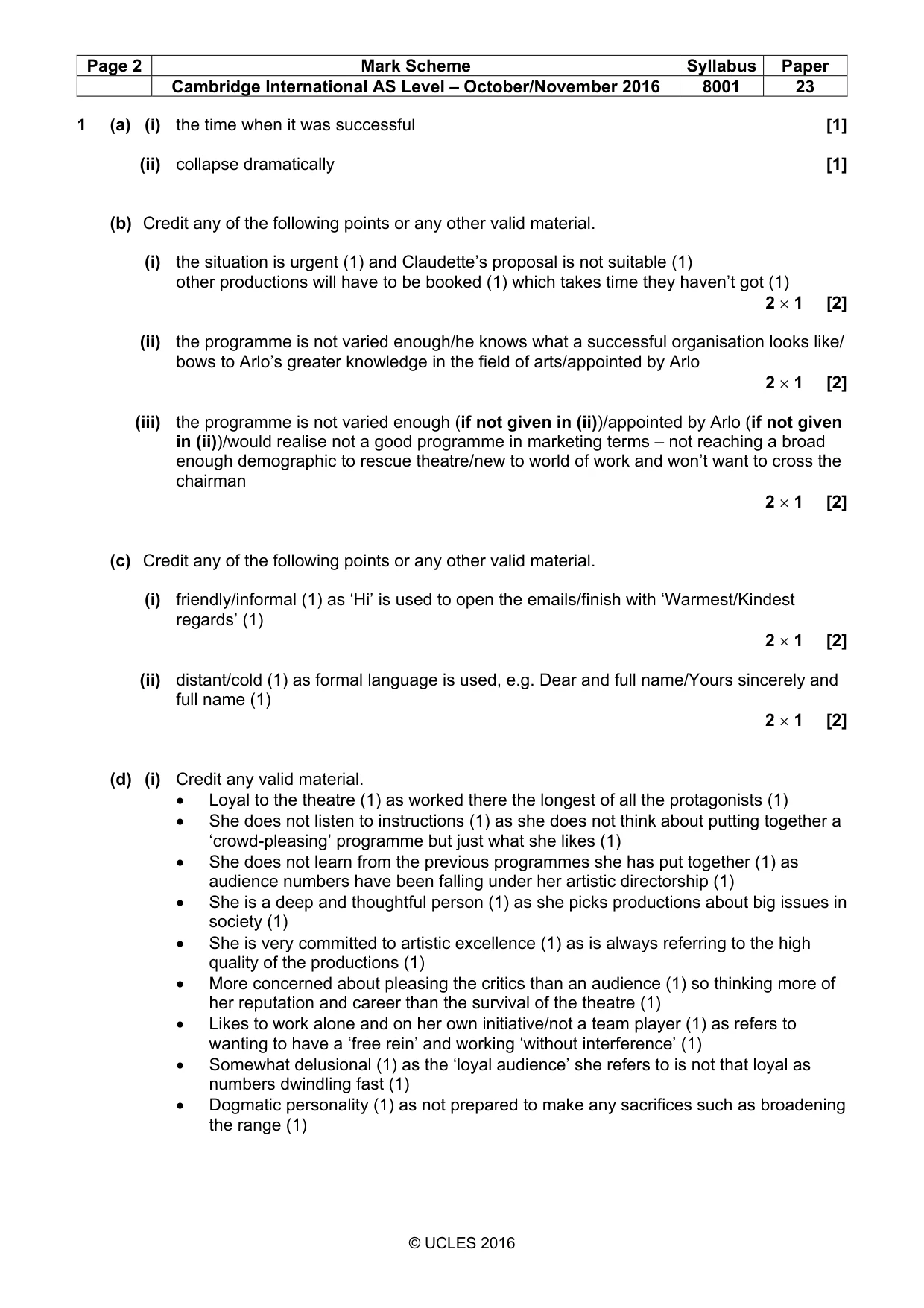
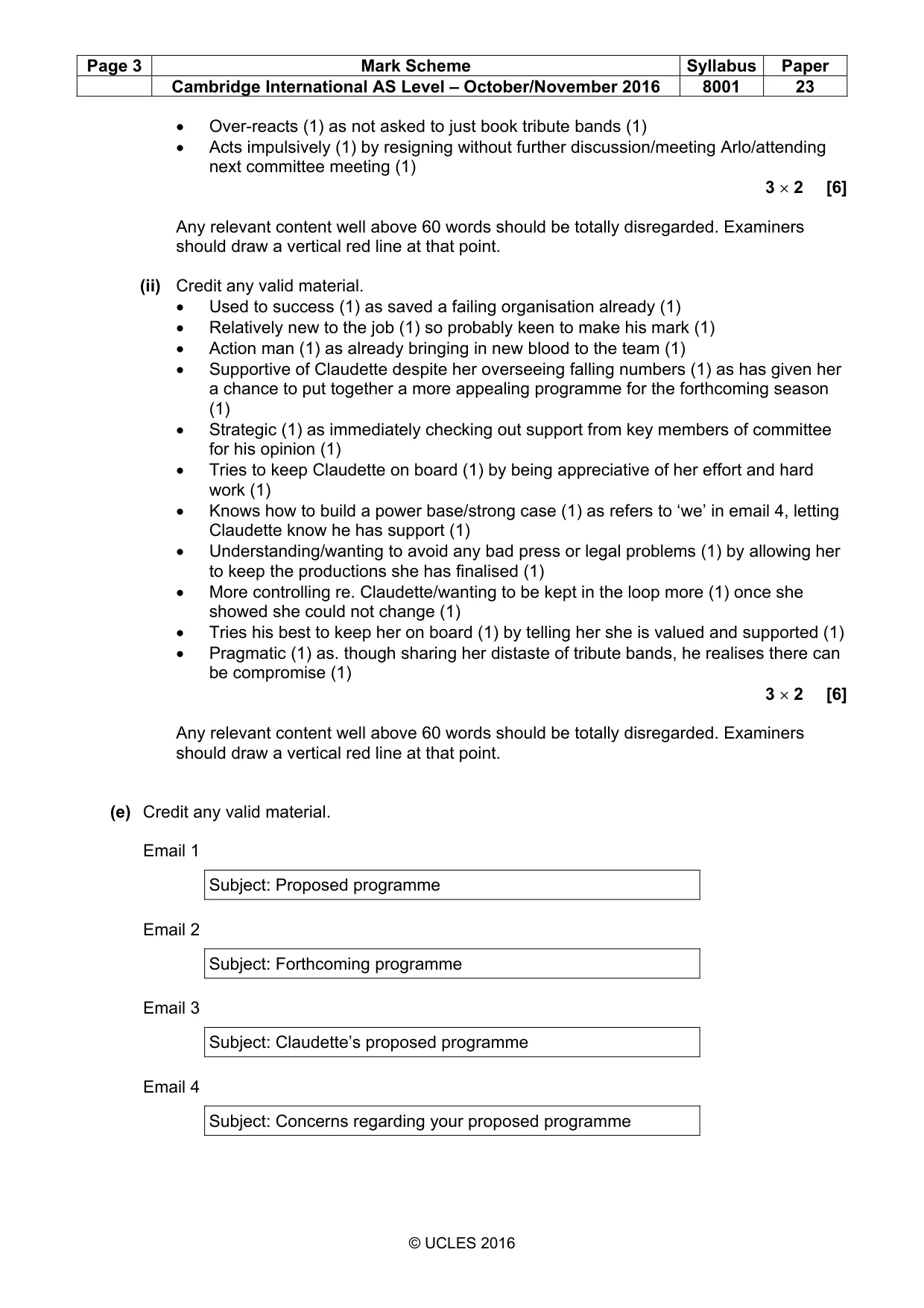
Page 2 Mark Scheme Syllabus Paper Cambridge International AS Level – October/November 2016 8001 23 © UCLES 2016 1 (a) (i) the time when it was successful [1] (ii) collapse dramatically [1] (b) Credit any of the following points or any other valid material. (i) the situation is urgent (1) and Claudette’s proposal is not suitable (1) other productions will have to be booked (1) which takes time they haven’t got (1) 2 × 1 [2] (ii) the programme is not varied enough/he knows what a successful organisation looks like/ bows tofArlo’s greater knowledge in the field of arts/appointed by Arlo 2 × 1 [2] (iii) the programme is not varied enough (if not given in (ii))/appointed by Arlo (if not given in (ii))/would realise not a good programme in marketing terms – not reaching a broad enough demographic to rescue theatre/new to world of work and won’t want to cross the chairman 2 × 1 [2] (c) Credit any of the following points or any other valid material. (i) friendly/informal (1) as ‘Hi’ is used to open the emails/finish with ‘Warmest/Kindest regards’ (1) 2 × 1 [2] (ii) distant/cold (1) as formal language is used, e.g. Dear and full name/Yours sincerely and full name (1) 2 × 1 [2] (d) (i) Credit any valid material. • Loyal to the theatre (1) as worked there the longest of all the protagonists (1) • She does not listen to instructions (1) as she does not think about putting together a ‘crowd-pleasing’ programme but just what she likes (1) • She does not learn from the previous programmes she has put together (1) as audience numbers have been falling under her artistic directorship (1) • She is a deep and thoughtful person (1) as she picks productions about big issues in society (1) • She is very committed to artistic excellence (1) as is always referring to the high quality of the productions (1) • More concerned about pleasing the critics than an audience (1) so thinking more of her reputation and career than the survival of the theatre (1) • Likes to work alone and on her own initiative/not a team player (1) as refers to wanting to have a ‘free rein’ and working ‘without interference’ (1) • Somewhat delusional (1) as the ‘loyal audience’ she refers to is not that loyal as numbers dwindling fast (1) • Dogmatic personality (1) as not prepared to make any sacrifices such as broadening the range (1)
Mark scheme, page 3
Page 3 Mark Scheme Syllabus Paper Cambridge International AS Level – October/November 2016 8001 23 © UCLES 2016 • Over-reacts (1) as not asked to just book tribute bands (1) • Acts impulsively (1) by resigning without further discussion/meeting Arlo/attending next committee meeting (1) 3 × 2 [6] Any relevant content well above 60 words should be totally disregarded. Examiners should draw a vertical red line at that point. (ii) Credit any valid material. • Used to success (1) as saved a failing organisation already (1) • Relatively new to the job (1) so probably keen to make his mark (1) • Action man (1) as already bringing in new blood to the team (1) • Supportive of Claudette despite her overseeing falling numbers (1) as has given her a chance to put together a more appealing programme for the forthcoming season (1) • Strategic (1) as immediately checking out support from key members of committee for his opinion (1) • Tries to keep Claudette on board (1) by being appreciative of her effort and hard work (1) • Knows how to build a power base/strong case (1) as refers to ‘we’ in email 4, letting Claudette know he has support (1) • Understanding/wanting to avoid any bad press or legal problems (1) by allowing her to keep the productions she has finalised (1) • More controlling re. Claudette/wanting to be kept in the loop more (1) once she showed she could not change (1) • Tries his best to keep her on board (1) by telling her she is valued and supported (1) • Pragmatic (1) as. though sharing her distaste of tribute bands, he realises there can be compromise (1) 3 × 2 [6] Any relevant content well above 60 words should be totally disregarded. Examiners should draw a vertical red line at that point. (e) Credit any valid material. Email 1 Subject: Proposed programme Email 2 Subject: Forthcoming programme Email 3 Subject: Claudette’s proposed programme Email 4 Subject: Concerns regarding your proposed programme
Mark scheme, page 4
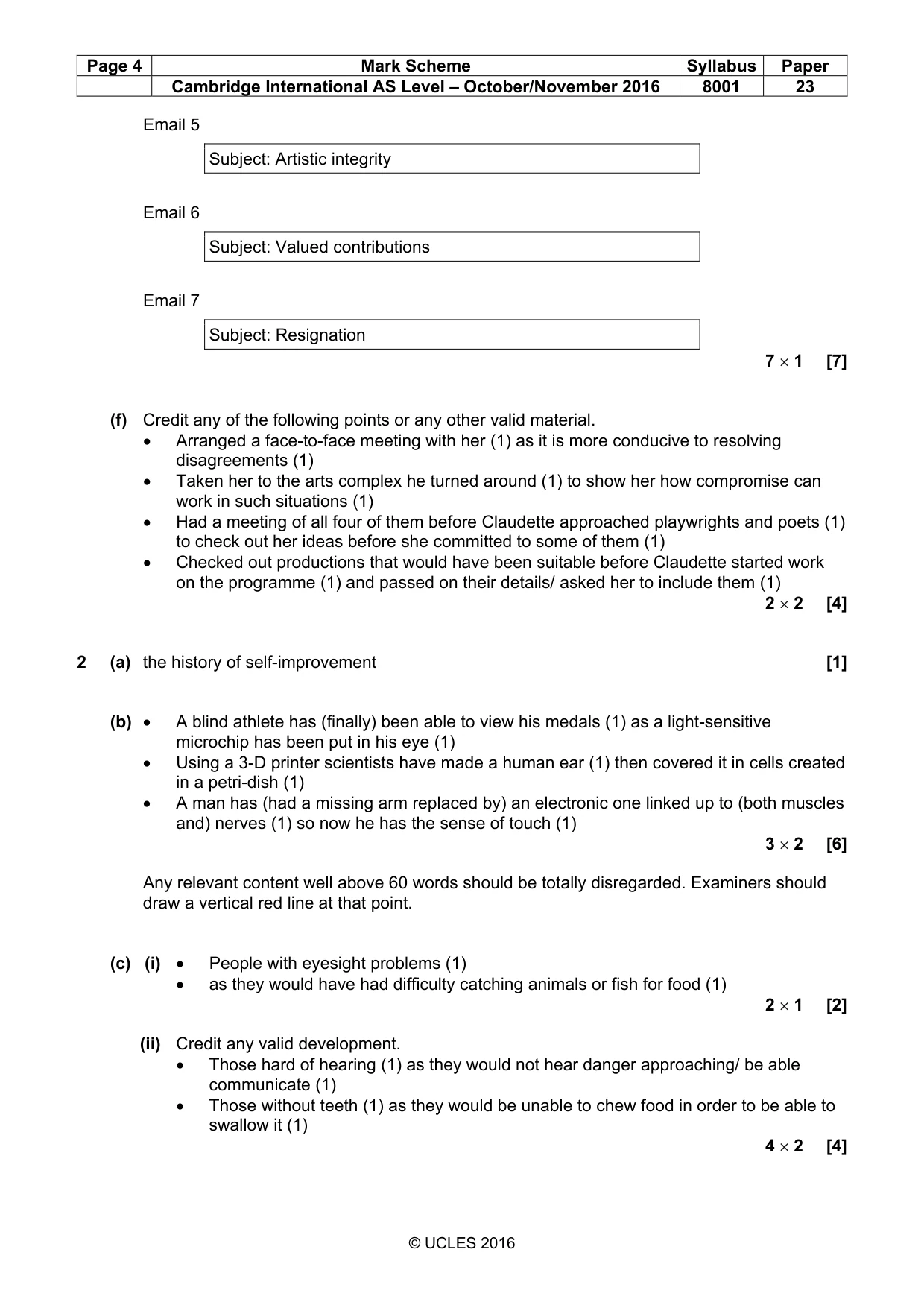
Page 4 Mark Scheme Syllabus Paper Cambridge International AS Level – October/November 2016 8001 23 © UCLES 2016 Email 5 Subject: Artistic integrity Email 6 Subject: Valued contributions Email 7 Subject: Resignation 7 × 1 [7] (f) Credit any of the following points or any other valid material. • Arranged a face-to-face meeting with her (1) as it is more conducive to resolving disagreements (1) • Taken her to the arts complex he turned around (1) to show her how compromise can work in such situations (1) • Had a meeting of all four of them before Claudette approached playwrights and poets (1) to check out her ideas before she committed to some of them (1) • Checked out productions that would have been suitable before Claudette started work on the programme (1) and passed on their details/ asked her to include them (1) 2 × 2 [4] 2 (a) the history of self-improvement [1] (b) • A blind athlete has (finally) been able to view his medals (1) as a light-sensitive microchip has been put in his eye (1) • Using a 3-D printer scientists have made a human ear (1) then covered it in cells created in a petri-dish (1) • A man has (had a missing arm replaced by) an electronic one linked up to (both muscles and) nerves (1) so now he has the sense of touch (1) 3 × 2 [6] Any relevant content well above 60 words should be totally disregarded. Examiners should draw a vertical red line at that point. (c) (i) • People with eyesight problems (1) • as they would have had difficulty catching animals or fish for food (1) 2 × 1 [2] (ii) Credit any valid development. • Those hard of hearing (1) as they would not hear danger approaching/ be able communicate (1) • Those without teeth (1) as they would be unable to chew food in order to be able to swallow it (1) 4 × 2 [4]
Mark scheme, page 5
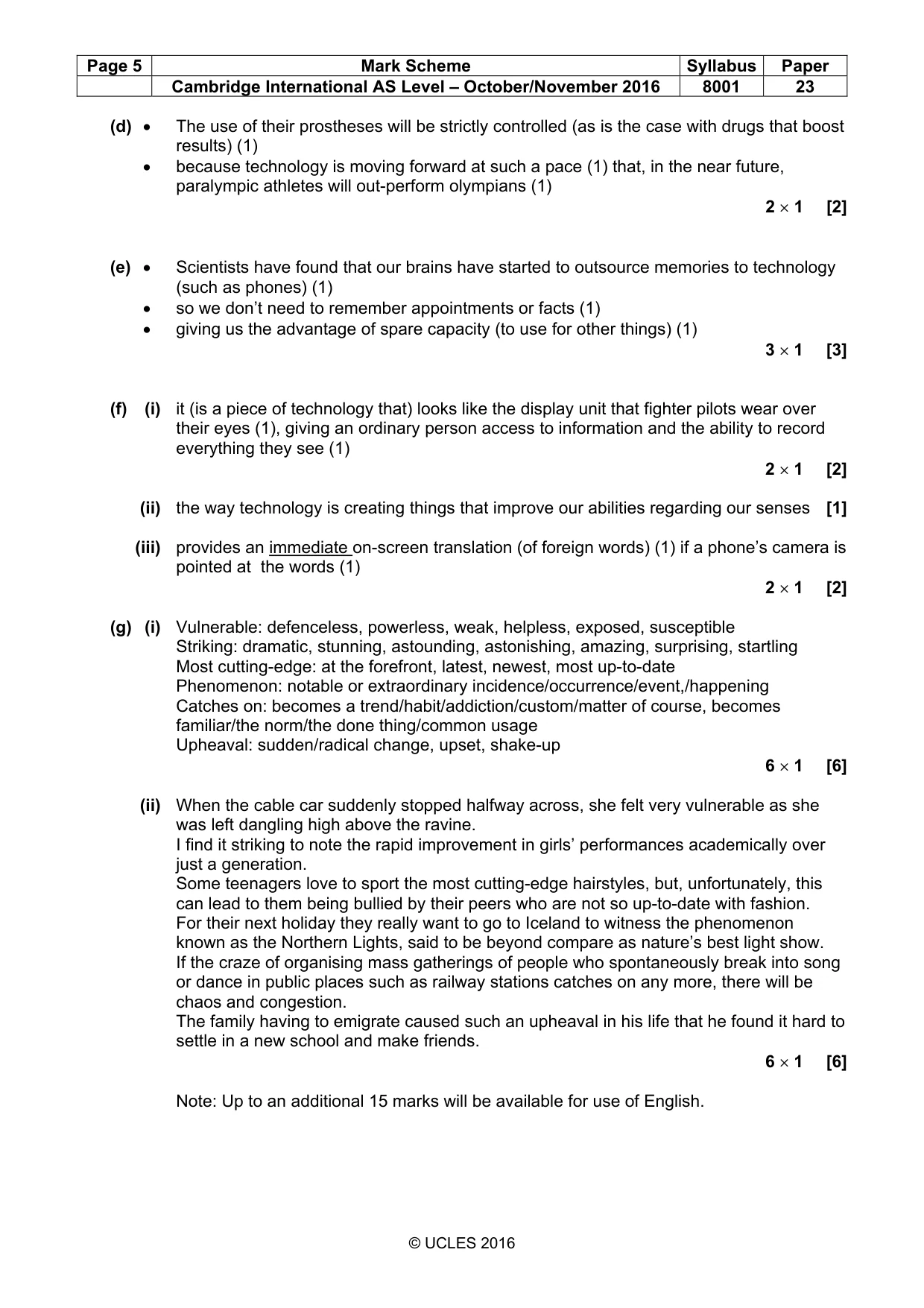
Page 5 Mark Scheme Syllabus Paper Cambridge International AS Level – October/November 2016 8001 23 © UCLES 2016 (d) • The use of their prostheses will be strictly controlled (as is the case with drugs that boost results) (1) • because technology is moving forward at such a pace (1) that, in the near future, paralympic athletes willfout-perform olympians (1) 2 × 1 [2] (e) • Scientists have found that our brains have started to outsource memories to technology (such as phones) (1) • so we don’t need to remember appointments or facts (1) • giving us the advantage of spare capacity (to use for other things) (1) 3 × 1 [3] (f) (i) it (is a piece of technology that) looks like the display unit that fighter pilots wear over their eyes (1), giving an ordinary person access to information and the ability to record everything they see (1) 2 × 1 [2] (ii) the way technology is creating things that improve our abilities regarding our senses [1] (iii) provides an immediate on-screen translation (of foreign words) (1) if a phone’s camera is pointed at the words (1) 2 × 1 [2] (g) (i) Vulnerable: defenceless, powerless, weak, helpless, exposed, susceptible Striking: dramatic, stunning, astounding, astonishing, amazing, surprising, startling Most cutting-edge: at the forefront, latest, newest, most up-to-date Phenomenon: notable or extraordinary incidence/occurrence/event,/happening Catches on: becomes a trend/habit/addiction/custom/matter of course, becomes familiar/the norm/thefdone thing/common usage Upheaval: sudden/radical change, upset, shake-up 6 × 1 [6] (ii) When the cable car suddenly stopped halfway across, she felt very vulnerable as she was left dangling high above the ravine. I find it striking to note the rapid improvement in girls’ performances academically over just a generation. Some teenagers love to sport the most cutting-edge hairstyles, but, unfortunately, this can lead to them being bullied by their peers who are not so up-to-date with fashion. For their next holiday they really want to go to Iceland to witness the phenomenon known as the Northern Lights, said to be beyond compare as nature’s best light show. If the craze of organising mass gatherings of people who spontaneously break into song or dance in public places such as railway stations catches on any more, there will be chaos and congestion. The family having to emigrate caused such an upheaval in his life that he found it hard to settle in a new school and make friends. 6 × 1 [6] Note: Up to an additional 15 marks will be available for use of English.
Mark scheme, page 6
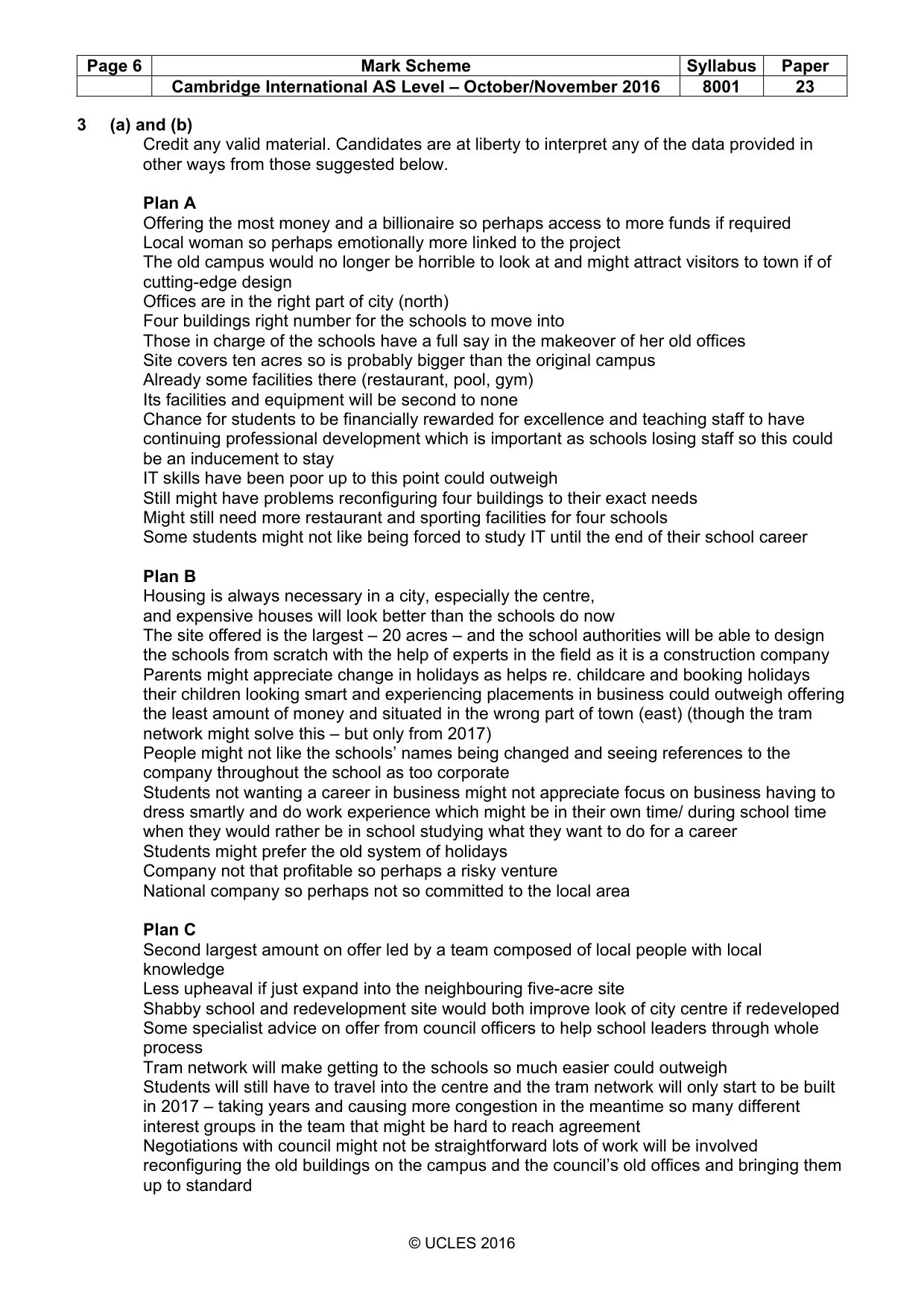
Page 6 Mark Scheme Syllabus Paper Cambridge International AS Level – October/November 2016 8001 23 © UCLES 2016 3 (a) and (b) Credit any valid material. Candidates are at liberty to interpret any of the data provided in other ways from those suggested below. Plan A Offering the most money and a billionaire so perhaps access to more funds if required Local woman so perhaps emotionally more linked to the project The old campus would no longer be horrible to look at and might attract visitors to town if of cutting-edge design Offices are in the right part of city (north) Four buildings right number for the schools to move into Those in charge of the schools have a full say in the makeover of her old offices Site covers ten acres so is probably bigger than the original campus Already some facilities there (restaurant, pool, gym) Its facilities and equipment will be second to none Chance for students to be financially rewarded for excellence and teaching staff to have continuing professional development which is important as schools losing staff so this could be an inducement to stay IT skills have been poor up to this point could outweigh Still might have problems reconfiguring four buildings to their exact needs Might still need more restaurant and sporting facilities for four schools Some students might not like being forced to study IT until the end of their school career Plan B Housing is always necessary in a city, especially the centre, and expensive houses will look better than the schools do now The site offered is the largest – 20 acres – and the school authorities will be able to design the schools from scratch with the help of experts in the field as it is a construction company Parents might appreciate change in holidays as helps re. childcare and booking holidays their children looking smart and experiencing placements in business could outweigh offering the least amount of money and situated in the wrong part of town (east) (though the tram network might solve this – but only from 2017) People might not like the schools’ names being changed and seeing references to the company throughout the school as too corporate Students not wanting a career in business might not appreciate focus on business having to dress smartly and do work experience which might be in their own time/ during school time when they would rather be in school studying what they want to do for a career Students might prefer the old system of holidays Company not that profitable so perhaps a risky venture National company so perhaps not so committed to the local area Plan C Second largest amount on offer led by a team composed of local people with local knowledge Less upheaval if just expand into the neighbouring five-acre site Shabby school and redevelopment site would both improve look of city centre if redeveloped Some specialist advice on offer from council officers to help school leaders through whole process Tram network will make getting to the schools so much easier could outweigh Students will still have to travel into the centre and the tram network will only start to be built in 2017 – taking years and causing more congestion in the meantime so many different interest groups in the team that might be hard to reach agreement Negotiations with council might not be straightforward lots of work will be involved reconfiguring the old buildings on the campus and the council’s old offices and bringing them up to standard
Mark scheme, page 7
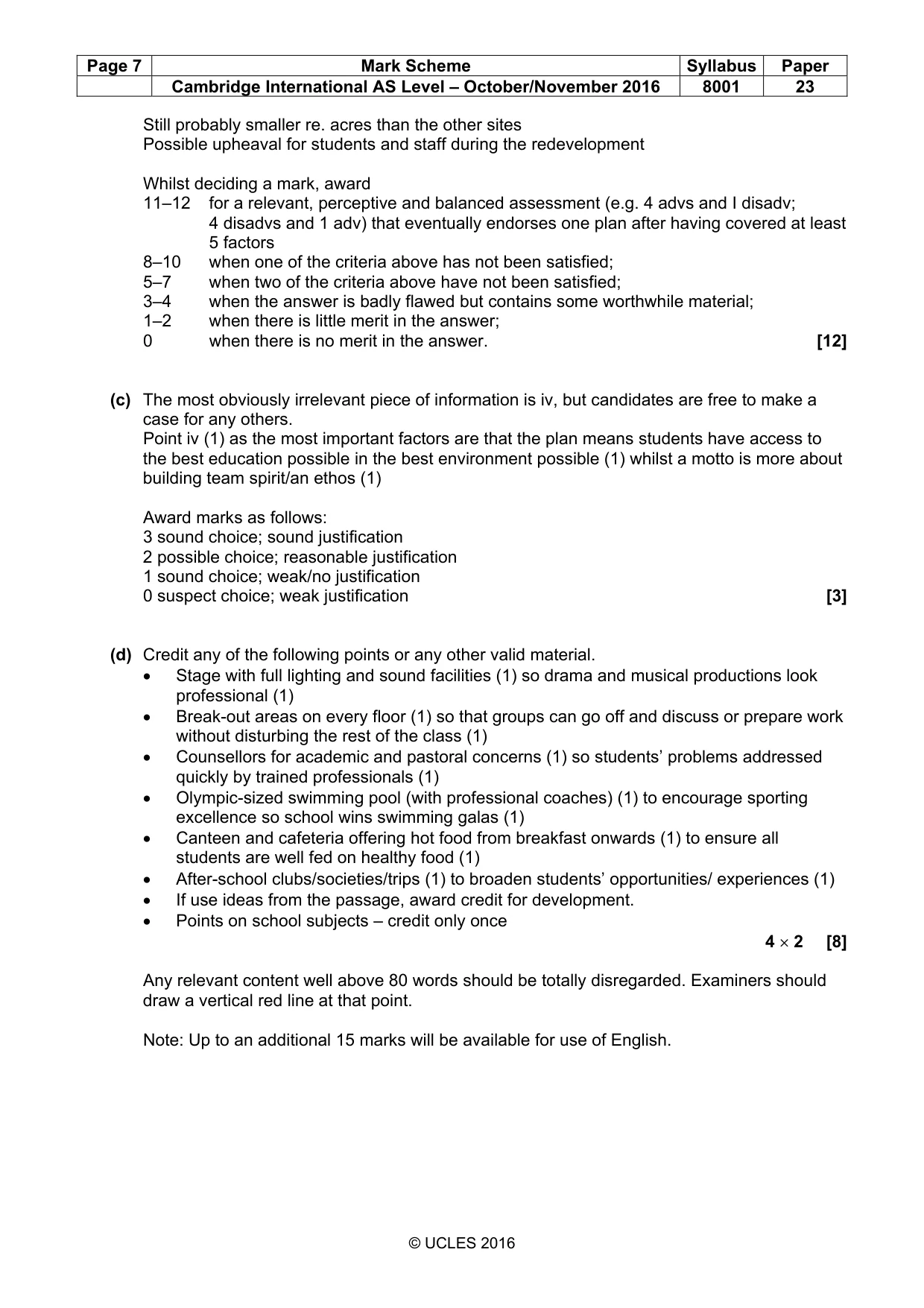
Page 7 Mark Scheme Syllabus Paper Cambridge International AS Level – October/November 2016 8001 23 © UCLES 2016 Still probably smaller re. acres than the other sites Possible upheaval for students and staff during the redevelopment Whilst deciding a mark, award 11–12 for a relevant, perceptive and balanced assessment (e.g. 4 advs and I disadv; 4 disadvs and 1 adv) that eventually endorses one plan after having covered at least 5 factors 8–10 when one of the criteria above has not been satisfied; 5–7 when two of the criteria above have not been satisfied; 3–4 when the answer is badly flawed but contains some worthwhile material; 1–2 when there is little merit in the answer; 0 when there is no merit in the answer. [12] (c) The most obviously irrelevant piece of information is iv, but candidates are free to make a case for any others. Point iv (1) as the most important factors are that the plan means students have access to the best education possible in the best environment possible (1) whilst a motto is more about building team spirit/an ethos (1) Award marks as follows: 3 sound choice; sound justification 2 possible choice; reasonable justification 1 sound choice; weak/no justification 0 suspect choice; weak justification [3] (d) Credit any of the following points or any other valid material. • Stage with full lighting and sound facilities (1) so drama and musical productions look professional (1) • Break-out areas on every floor (1) so that groups can go off and discuss or prepare work without disturbing the rest of the class (1) • Counsellors for academic and pastoral concerns (1) so students’ problems addressed quickly by trained professionals (1) • Olympic-sized swimming pool (with professional coaches) (1) to encourage sporting excellence so school wins swimming galas (1) • Canteen and cafeteria offering hot food from breakfast onwards (1) to ensure all students are well fed on healthy food (1) • After-school clubs/societies/trips (1) to broaden students’ opportunities/ experiences (1) • If use ideas from the passage, award credit for development. • Points on school subjects – credit only once 4 × 2 [8] Any relevant content well above 80 words should be totally disregarded. Examiners should draw a vertical red line at that point. Note: Up to an additional 15 marks will be available for use of English.
What you needed in this session
Cambridge’s own grade thresholds for 2016 Oct/Nov, Paper 2 · Variant 3. A higher threshold means an easier paper — the bar moves with how the cohort did.