Cambridge A Level General Paper (AS Level only) 8001 — 2015 Oct/Nov Paper 2 · Variant 2
8001/22/O/N/15 · 50 marks · ≈56 min
The question paper and its mark scheme, free to read here and free to download. This is Cambridge’s own paper, exactly as it was sat.
Question paper12 pages


Mark scheme8 pages
Answers below. Sit the paper first if you are practising.
Paper as text
Question paper, page 1
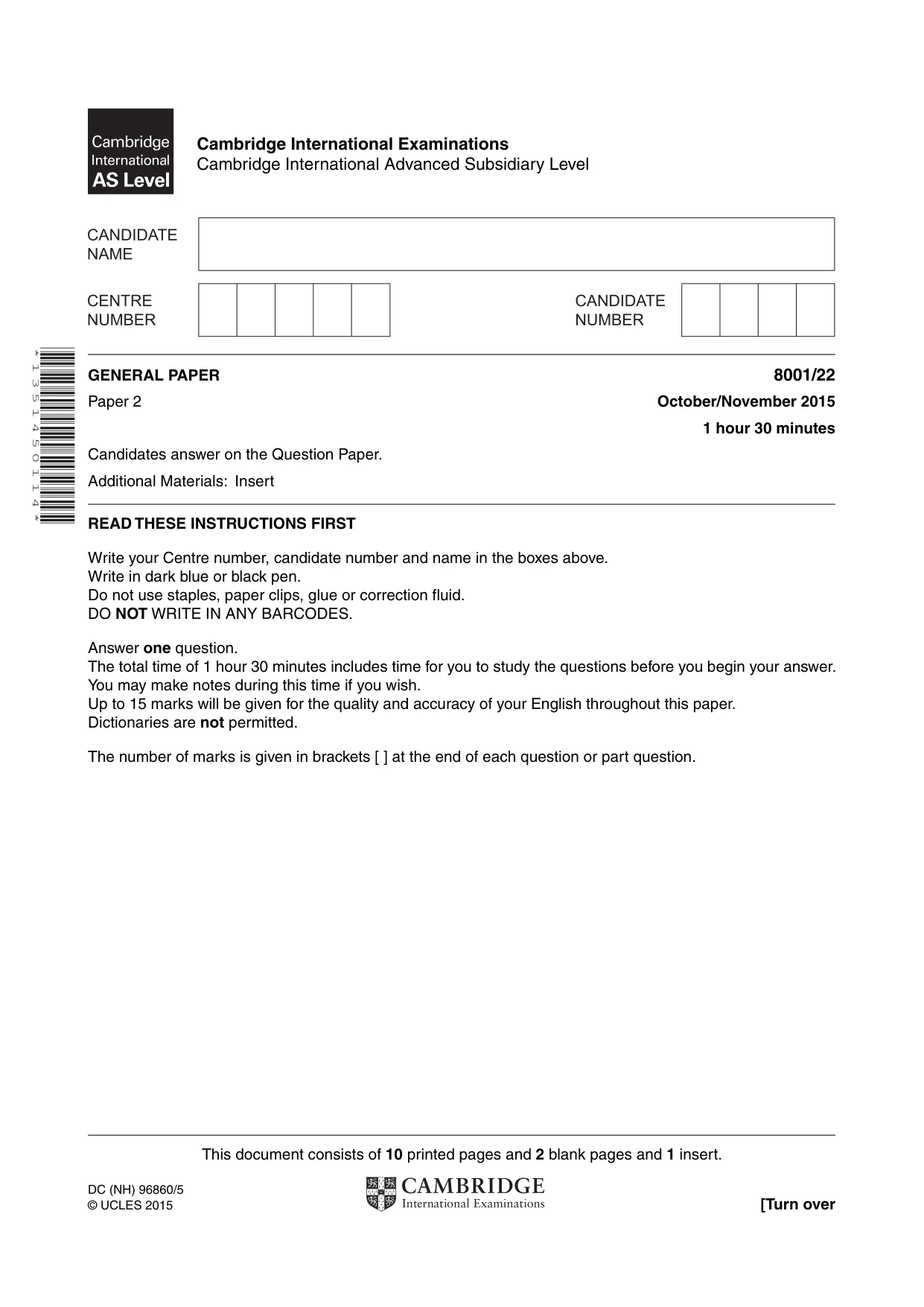
This document consists of 10 printed pages and 2 blank pages and 1 insert. DC (NH) 96860/5 © UCLES 2015 [Turn over * 1 3 5 1 4 5 0 1 1 4 * GENERAL PAPER 8001/22 Paper 2 October/November 2015 1 hour 30 minutes Candidates answer on the Question Paper. Additional Materials: Insert READ THESE INSTRUCTIONS FIRST Write your Centre number, candidate number and name in the boxes above. Write in dark blue or black pen. Do not use staples, paper clips, glue or correction fluid. DO NOT WRITE IN ANY BARCODES. Answer one question. The total time of 1 hour 30 minutes includes time for you to study the questions before you begin your answer. You may make notes during this time if you wish. Up to 15 marks will be given for the quality and accuracy of your English throughout this paper. Dictionaries are not permitted. The number of marks is given in brackets [ ] at the end of each question or part question. Cambridge International Examinations Cambridge International Advanced Subsidiary Level
Question paper, page 2
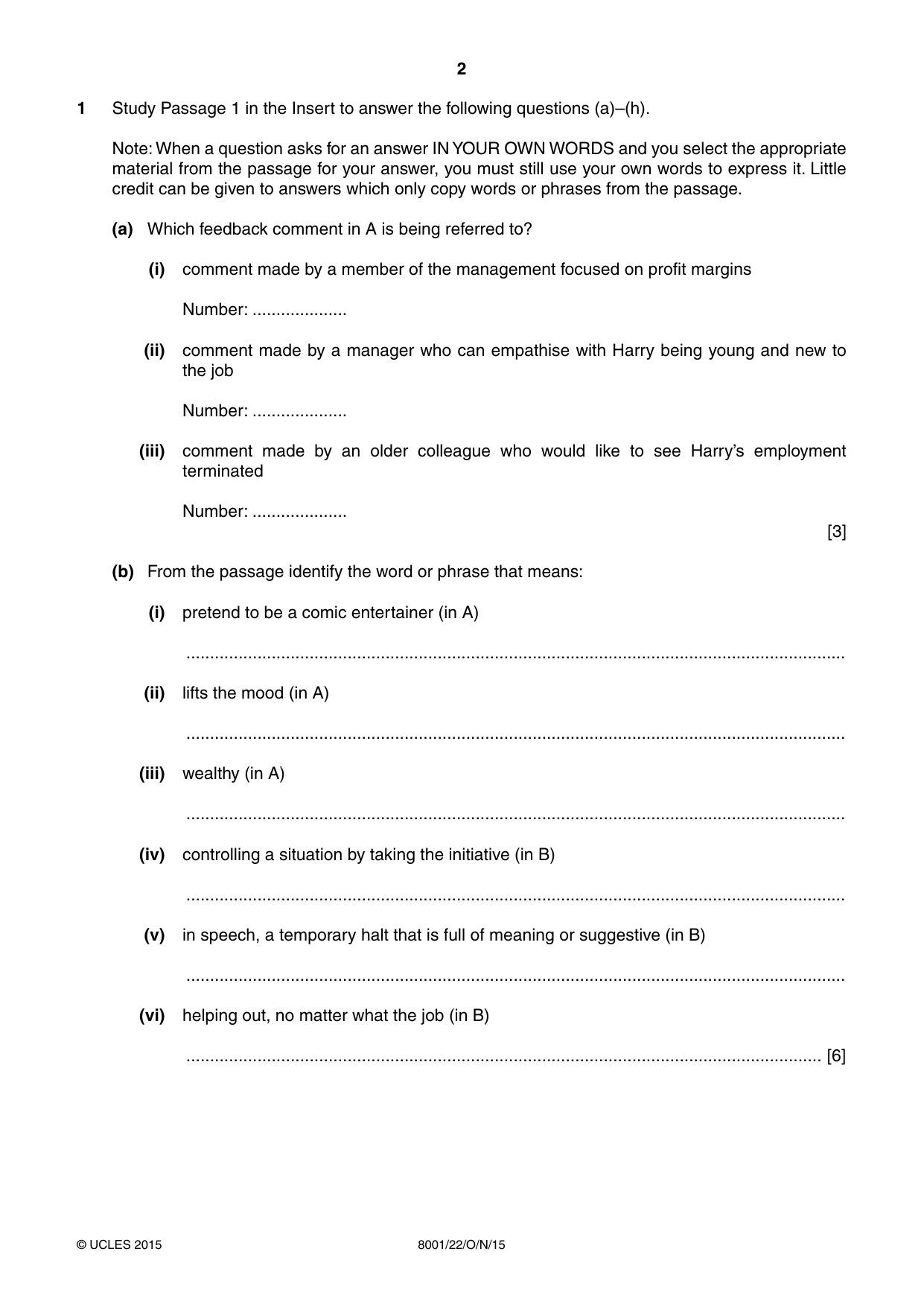
2 8001/22/O/N/15 © UCLES 2015 1 Study Passage 1 in the Insert to answer the following questions (a)–(h). Note: When a question asks for an answer IN YOUR OWN WORDS and you select the appropriate material from the passage for your answer, you must still use your own words to express it. Little credit can be given to answers which only copy words or phrases from the passage. (a) Which feedback comment in A is being referred to? (i) comment made by a member of the management focused on profit margins Number: … (ii) comment made by a manager who can empathise with Harry being young and new to the job Number: … (iii) comment made by an older colleague who would like to see Harry’s employment terminated Number: … [3] (b) From the passage identify the word or phrase that means: (i) pretend to be a comic entertainer (in A) … (ii) lifts the mood (in A) … (iii) wealthy (in A) … (iv) controlling a situation by taking the initiative (in B) … (v) in speech, a temporary halt that is full of meaning or suggestive (in B) … (vi) helping out, no matter what the job (in B) … [6]
Question paper, page 3
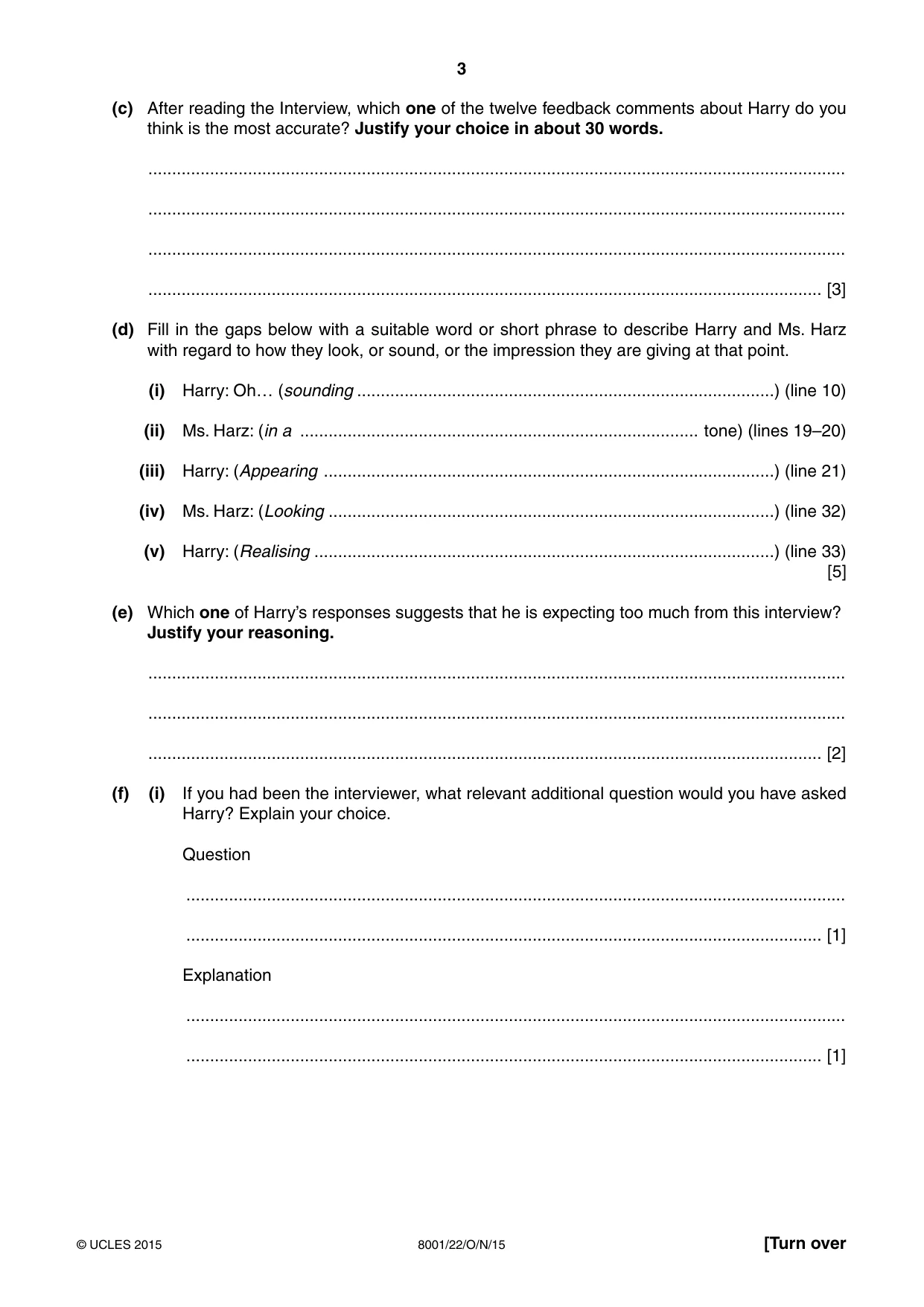
3 8001/22/O/N/15 © UCLES 2015 [Turn over (c) After reading the Interview, which one of the twelve feedback comments about Harry do you think is the most accurate? Justify your choice in about 30 words. … … … … [3] (d) Fill in the gaps below with a suitable word or short phrase to describe Harry and Ms. Harz with regard to how they look, or sound, or the impression they are giving at that point. (i) Harry: Oh… (sounding …) (line 10) (ii) Ms. Harz: (in a … tone) (lines 19–20) (iii) Harry: (Appearing …) (line 21) (iv) Ms. Harz: (Looking …) (line 32) (v) Harry: (Realising …) (line 33) [5] (e) Which one of Harry’s responses suggests that he is expecting too much from this interview? Justify your reasoning. … … … [2] (f) (i) If you had been the interviewer, what relevant additional question would you have asked Harry? Explain your choice. Question … … [1] Explanation … … [1]
Question paper, page 4
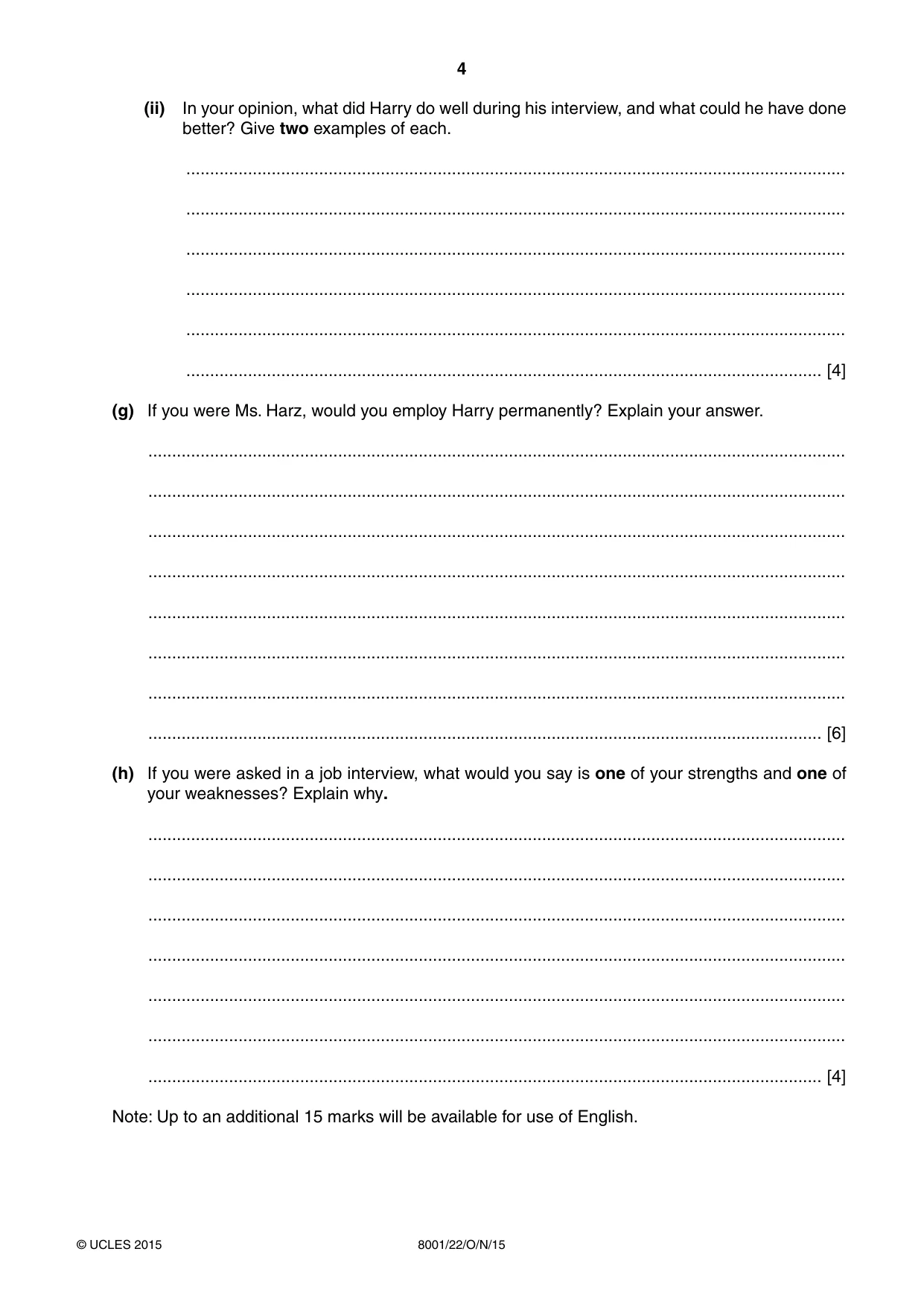
4 8001/22/O/N/15 © UCLES 2015 (ii) In your opinion, what did Harry do well during his interview, and what could he have done better? Give two examples of each. … … … … … … [4] (g) If you were Ms. Harz, would you employ Harry permanently? Explain your answer. … … … … … … … … [6] (h) If you were asked in a job interview, what would you say is one of your strengths and one of your weaknesses? Explain why. … … … … … … … [4] Note: Up to an additional 15 marks will be available for use of English.
Question paper, page 5
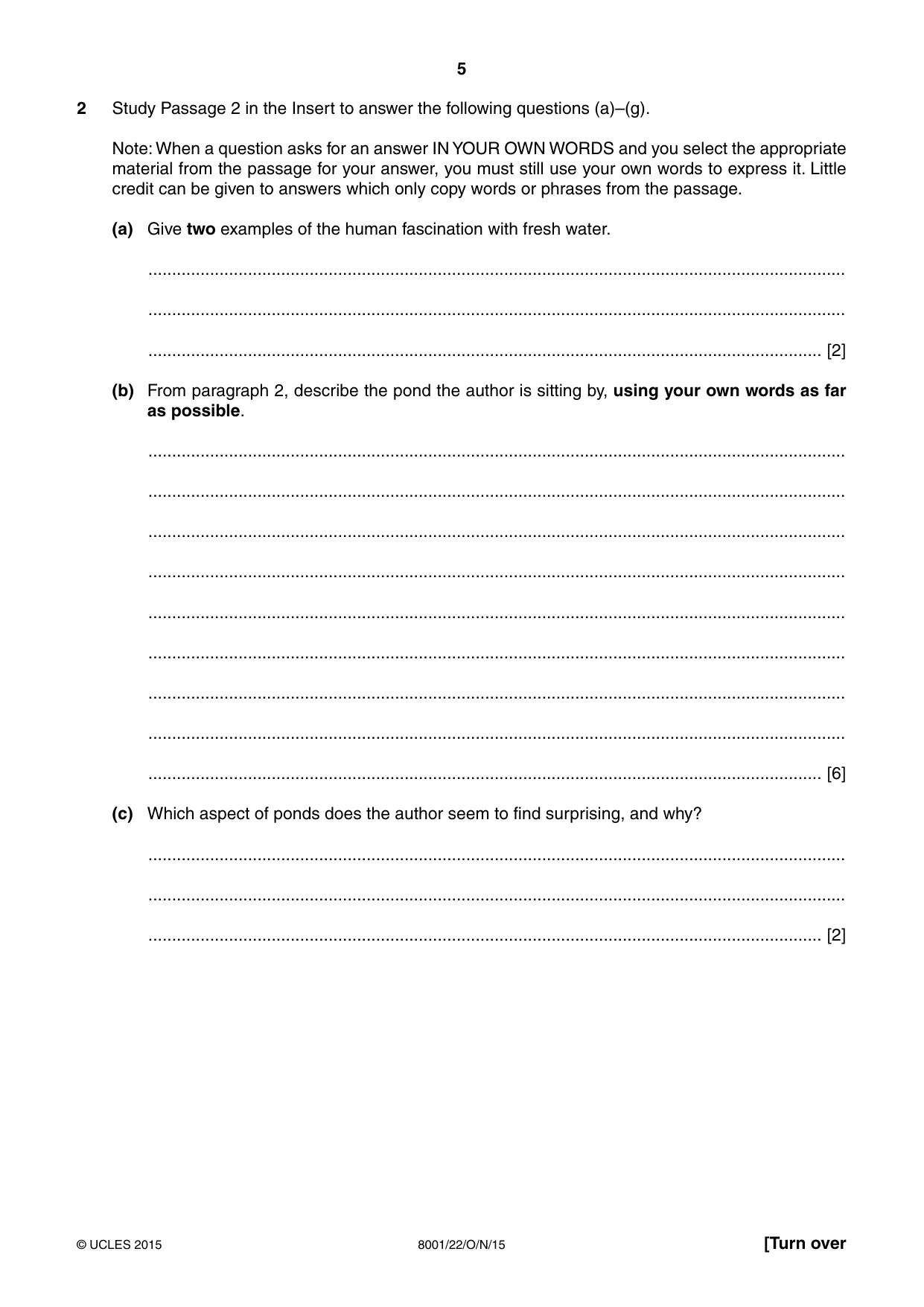
5 8001/22/O/N/15 © UCLES 2015 [Turn over 2 Study Passage 2 in the Insert to answer the following questions (a)–(g). Note: When a question asks for an answer IN YOUR OWN WORDS and you select the appropriate material from the passage for your answer, you must still use your own words to express it. Little credit can be given to answers which only copy words or phrases from the passage. (a) Give two examples of the human fascination with fresh water. … … … [2] (b) From paragraph 2, describe the pond the author is sitting by, using your own words as far as possible. … … … … … … … … … [6] (c) Which aspect of ponds does the author seem to find surprising, and why? … … … [2]
Question paper, page 6
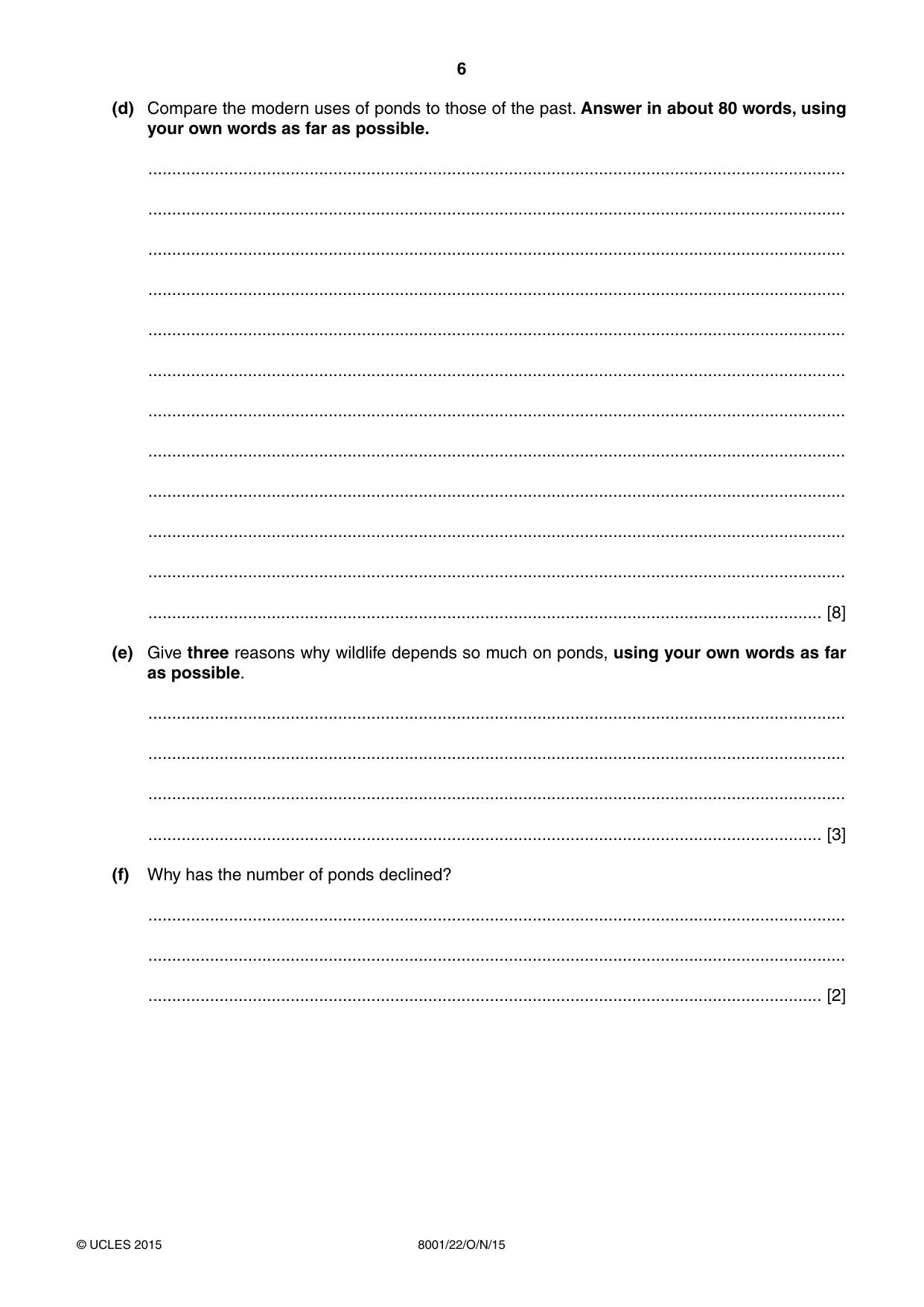
6 8001/22/O/N/15 © UCLES 2015 (d) Compare the modern uses of ponds to those of the past. Answer in about 80 words, using your own words as far as possible. … … … … … … … … … … … … [8] (e) Give three reasons why wildlife depends so much on ponds, using your own words as far as possible. … … … … [3] (f) Why has the number of ponds declined? … … … [2]
Question paper, page 7
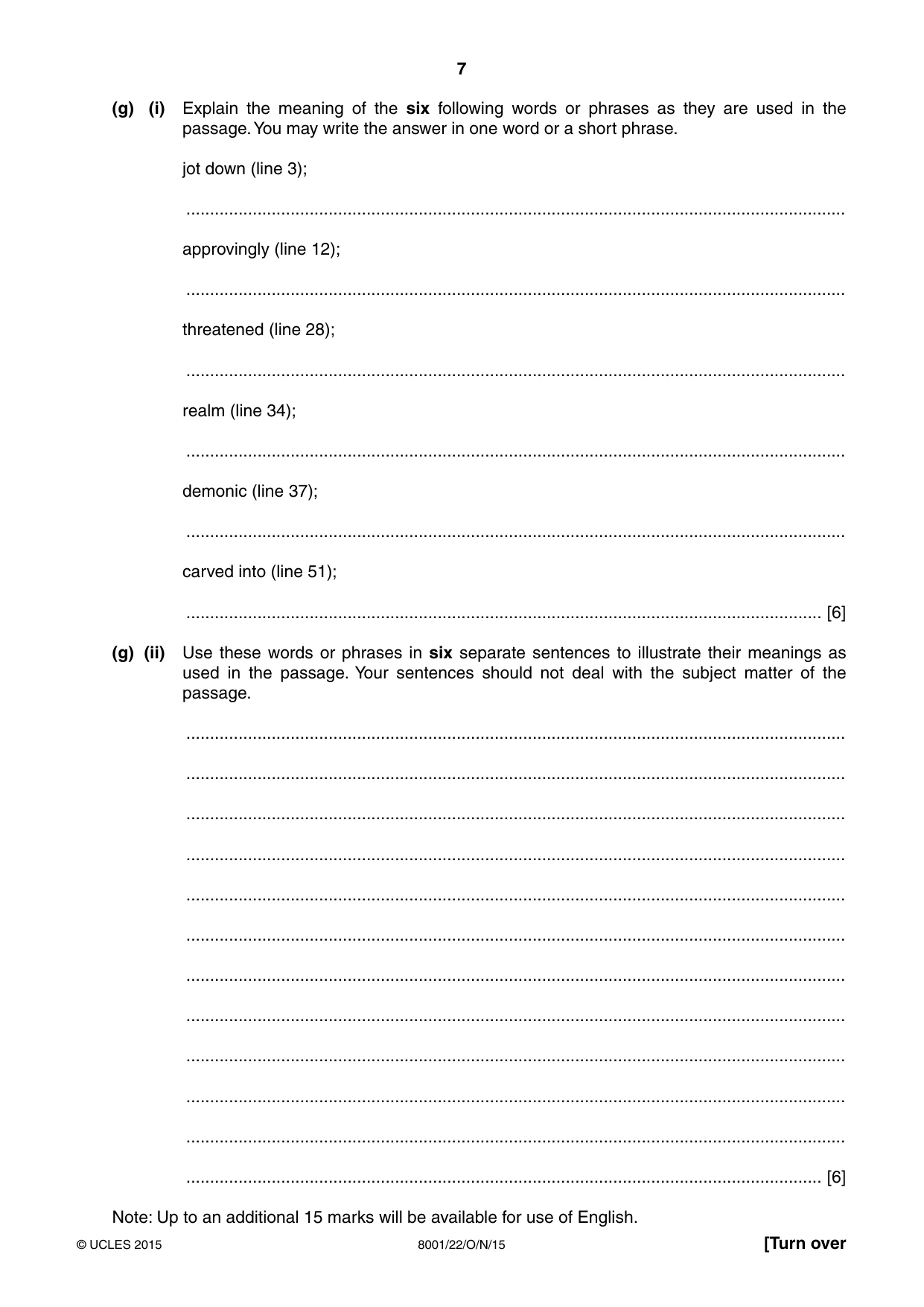
7 8001/22/O/N/15 © UCLES 2015 [Turn over (g) (i) Explain the meaning of the six following words or phrases as they are used in the passage. You may write the answer in one word or a short phrase. jot down (line 3); … approvingly (line 12); … threatened (line 28); … realm (line 34); … demonic (line 37); … carved into (line 51); … [6] (g) (ii) Use these words or phrases in six separate sentences to illustrate their meanings as used in the passage. Your sentences should not deal with the subject matter of the passage. … … … … … … … … … … … … [6] Note: Up to an additional 15 marks will be available for use of English.
Question paper, page 8
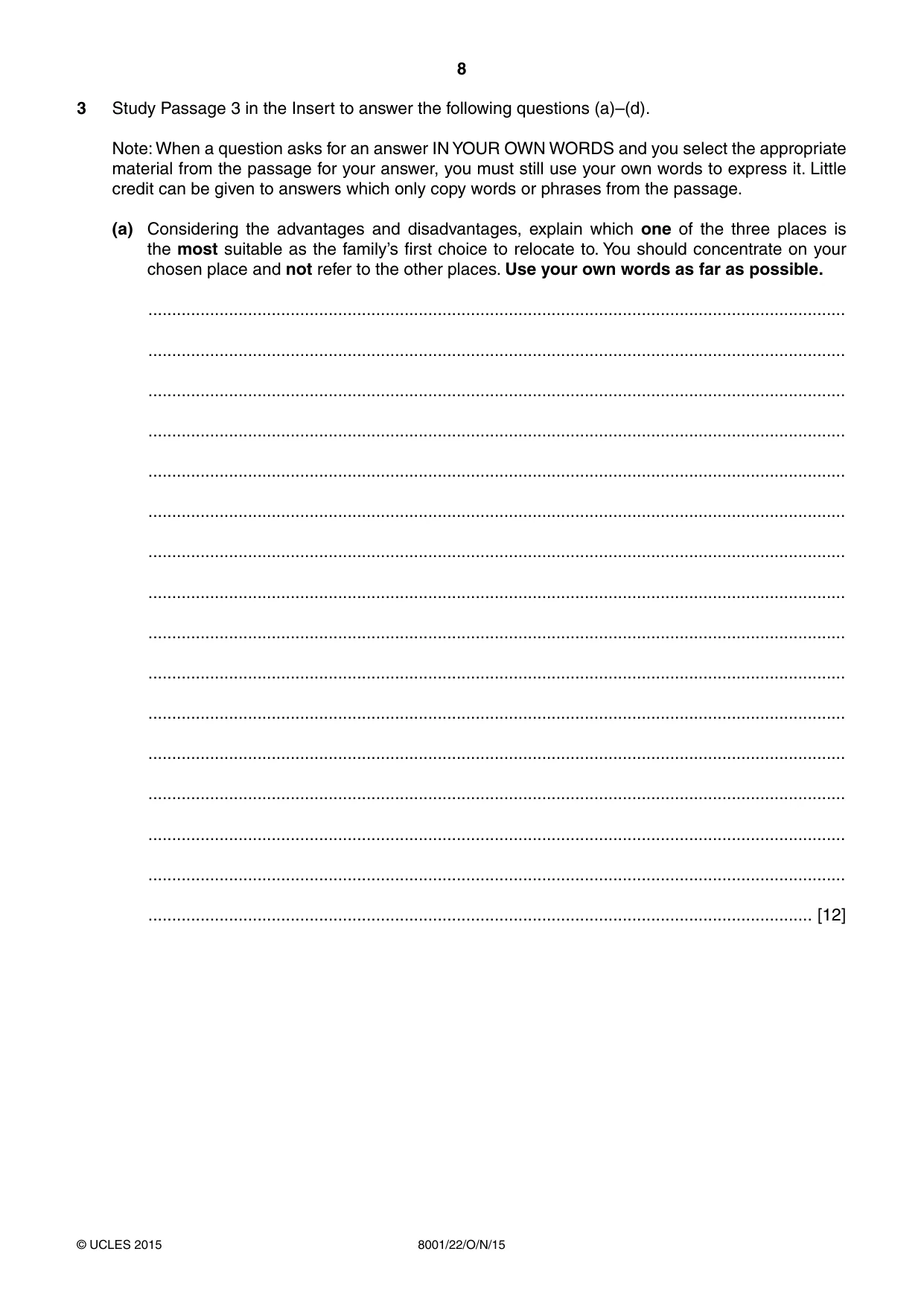
8 8001/22/O/N/15 © UCLES 2015 3 Study Passage 3 in the Insert to answer the following questions (a)–(d). Note: When a question asks for an answer IN YOUR OWN WORDS and you select the appropriate material from the passage for your answer, you must still use your own words to express it. Little credit can be given to answers which only copy words or phrases from the passage. (a) Considering the advantages and disadvantages, explain which one of the three places is the most suitable as the family’s first choice to relocate to. You should concentrate on your chosen place and not refer to the other places. Use your own words as far as possible. … … … … … … … … … … … … … … … … [12]
Question paper, page 9
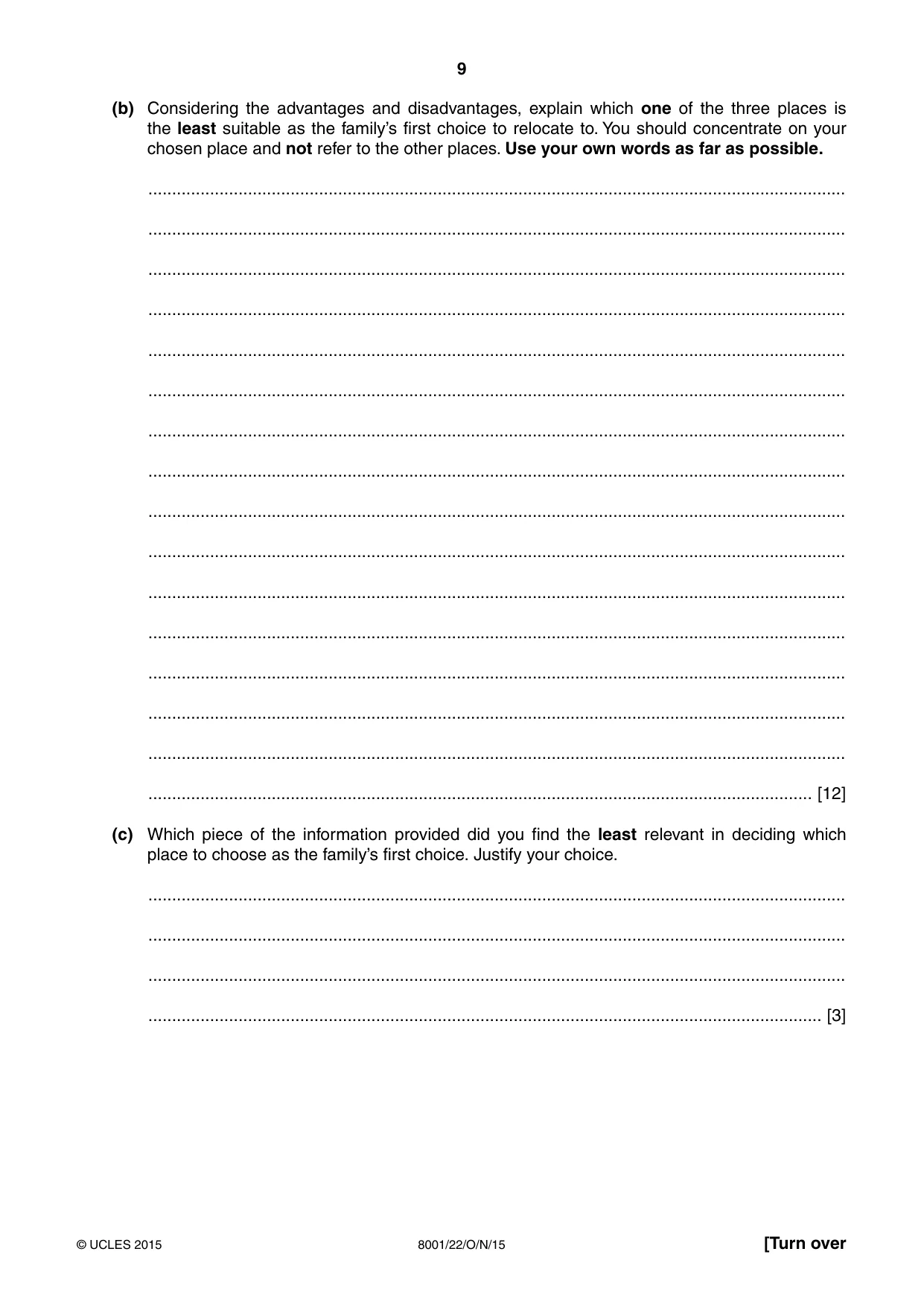
9 8001/22/O/N/15 © UCLES 2015 [Turn over (b) Considering the advantages and disadvantages, explain which one of the three places is the least suitable as the family’s first choice to relocate to. You should concentrate on your chosen place and not refer to the other places. Use your own words as far as possible. … … … … … … … … … … … … … … … … [12] (c) Which piece of the information provided did you find the least relevant in deciding which place to choose as the family’s first choice. Justify your choice. … … … … [3]
Question paper, page 10
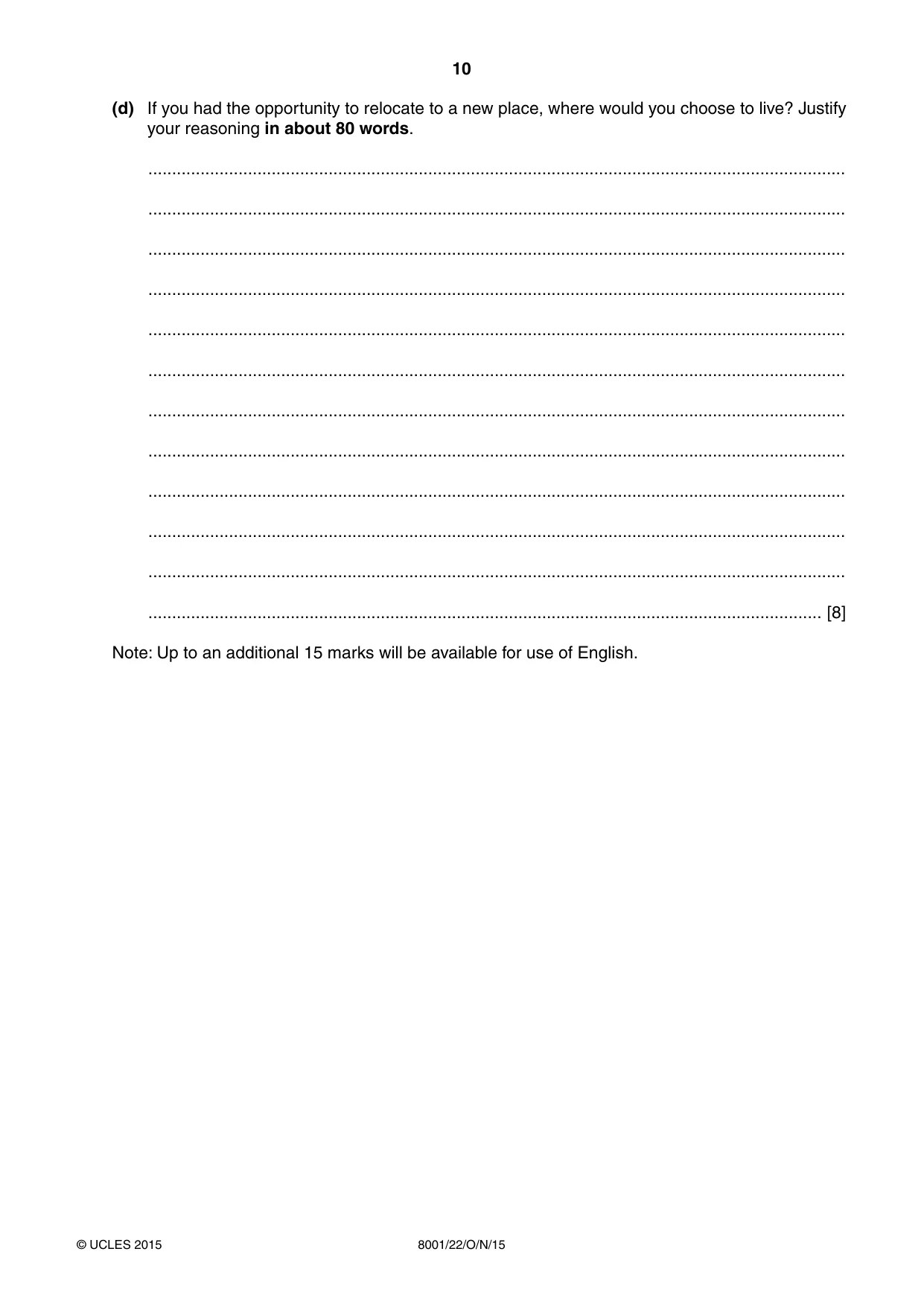
10 8001/22/O/N/15 © UCLES 2015 (d) If you had the opportunity to relocate to a new place, where would you choose to live? Justify your reasoning in about 80 words. … … … … … … … … … … … … [8] Note: Up to an additional 15 marks will be available for use of English.
Question paper, page 11
11 8001/22/O/N/15 © UCLES 2015 BLANK PAGE
Question paper, page 12
12 8001/22/O/N/15 © UCLES 2015 Permission to reproduce items where third-party owned material protected by copyright is included has been sought and cleared where possible. Every reasonable effort has been made by the publisher (UCLES) to trace copyright holders, but if any items requiring clearance have unwittingly been included, the publisher will be pleased to make amends at the earliest possible opportunity. To avoid the issue of disclosure of answer-related information to candidates, all copyright acknowledgements are reproduced online in the Cambridge International Examinations Copyright Acknowledgements Booklet. This is produced for each series of examinations and is freely available to download at www.cie.org.uk after the live examination series. Cambridge International Examinations is part of the Cambridge Assessment Group. Cambridge Assessment is the brand name of University of Cambridge Local Examinations Syndicate (UCLES), which is itself a department of the University of Cambridge. BLANK PAGE
Mark scheme, page 1
® IGCSE is the registered trademark of Cambridge International Examinations. CAMBRIDGE INTERNATIONAL EXAMINATIONS Cambridge International Advanced Subsidiary Level MARK SCHEME for the October/November 2015 series 8001 GENERAL PAPER 8001/22 Paper 2, maximum raw mark 50 This mark scheme is published as an aid to teachers and candidates, to indicate the requirements of the examination. It shows the basis on which Examiners were instructed to award marks. It does not indicate the details of the discussions that took place at an Examiners’ meeting before marking began, which would have considered the acceptability of alternative answers. Mark schemes should be read in conjunction with the question paper and the Principal Examiner Report for Teachers. Cambridge will not enter into discussions about these mark schemes. Cambridge is publishing the mark schemes for the October/November 2015 series for most Cambridge IGCSE®, Cambridge International A and AS Level components and some Cambridge O Level components.
Mark scheme, page 2
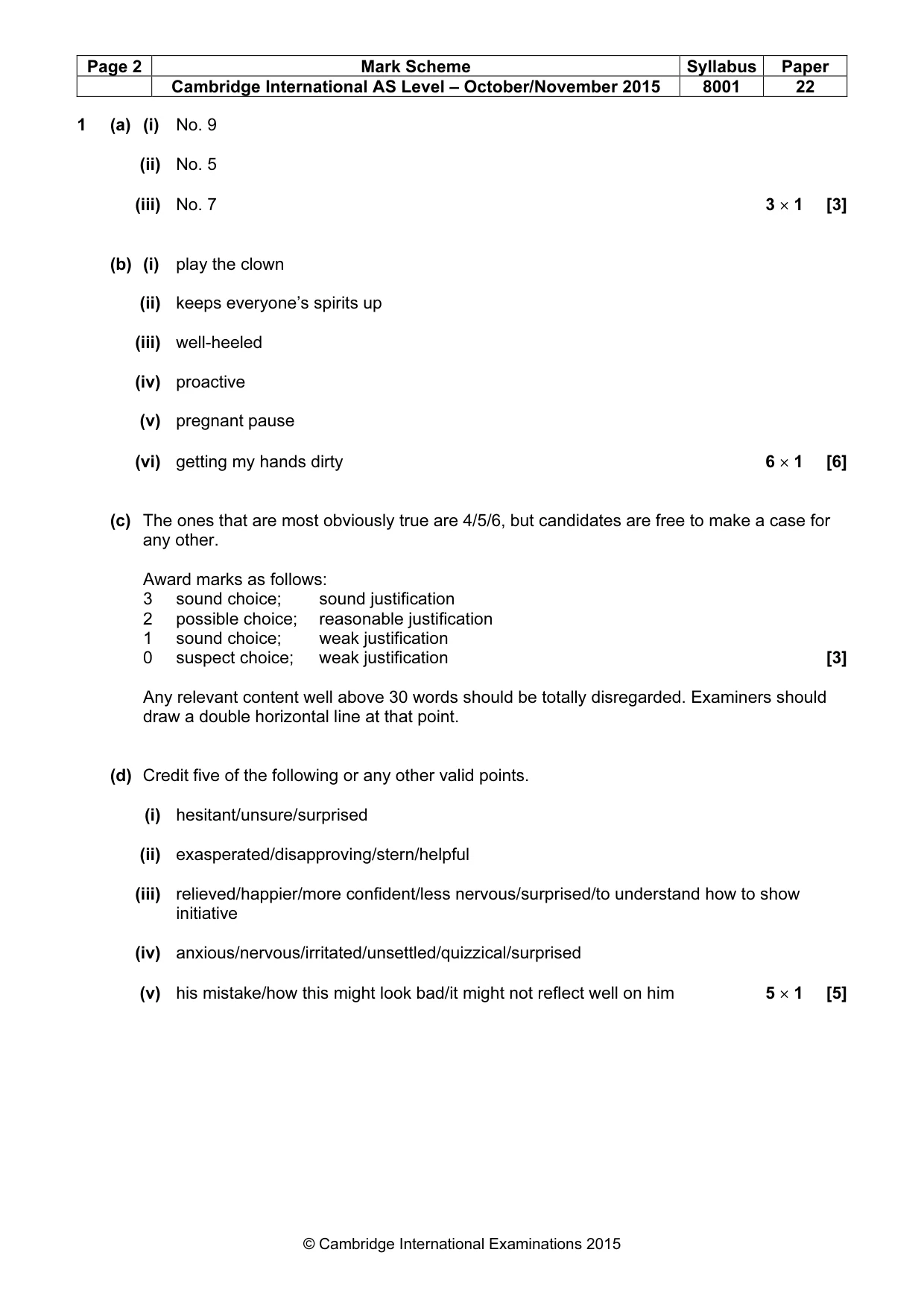
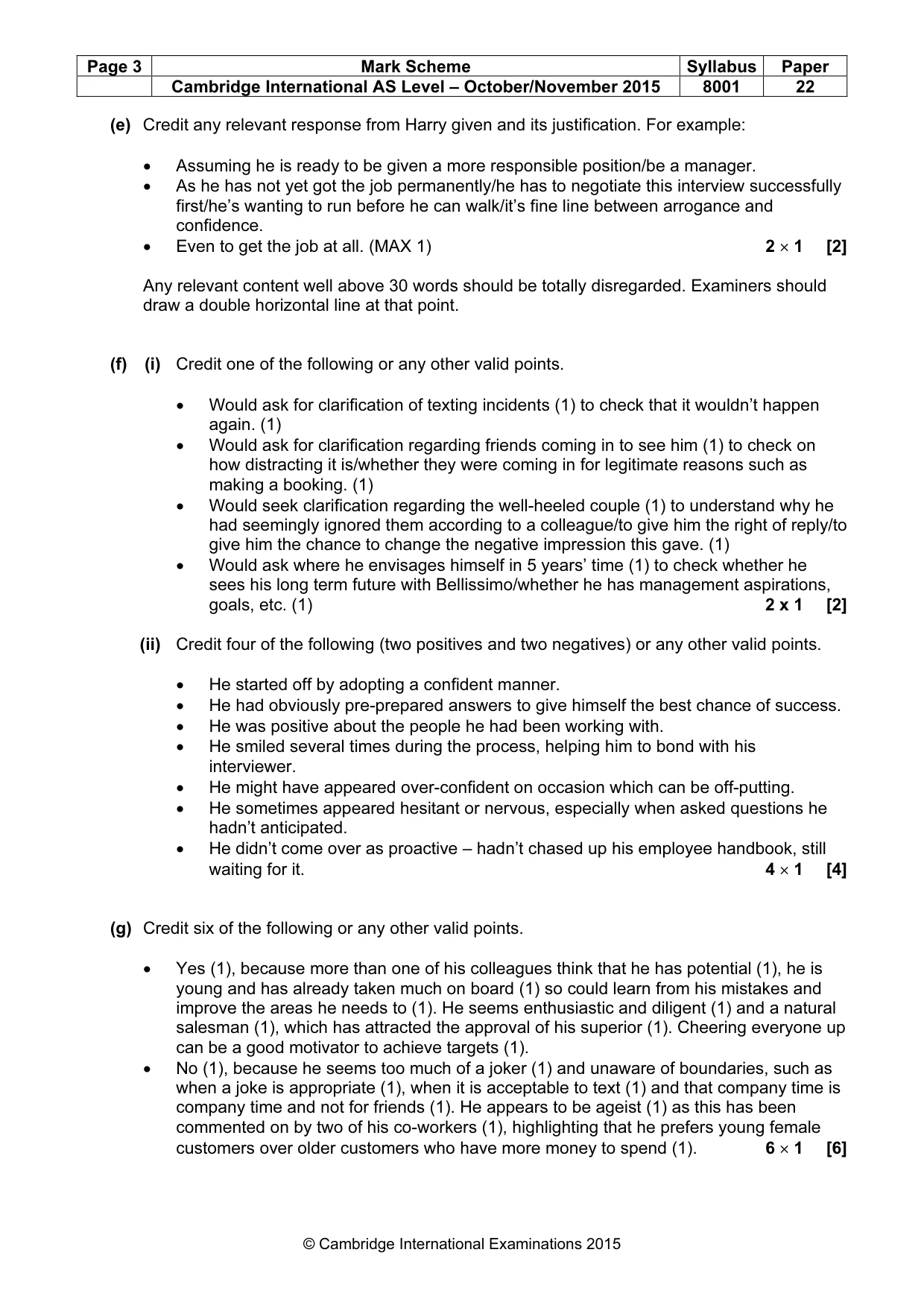
Page 2 Mark Scheme Syllabus Paper Cambridge International AS Level – October/November 2015 8001 22 © Cambridge International Examinations 2015 1 (a) (i) No. 9 (ii) No. 5 (iii) No. 7 3 × 1 [3] (b) (i) play the clown (ii) keeps everyone’s spirits up (iii) well-heeled (iv) proactive (v) pregnant pause (vi) getting my hands dirty 6 × 1 [6] (c) The ones that are most obviously true are 4/5/6, but candidates are free to make a case for any other. Award marks as follows: 3 sound choice; sound justification 2 possible choice; reasonable justification 1 sound choice; weak justification 0 suspect choice; weak justification [3] Any relevant content well above 30 words should be totally disregarded. Examiners should draw a double horizontal line at that point. (d) Credit five of the following or any other valid points. (i) hesitant/unsure/surprised (ii) exasperated/disapproving/stern/helpful (iii) relieved/happier/more confident/less nervous/surprised/to understand how to show initiative (iv) anxious/nervous/irritated/unsettled/quizzical/surprised (v) his mistake/how this might look bad/it might not reflect well on him 5 × 1 [5]
Mark scheme, page 3
Page 3 Mark Scheme Syllabus Paper Cambridge International AS Level – October/November 2015 8001 22 © Cambridge International Examinations 2015 (e) Credit any relevant response from Harry given and its justification. For example: • Assuming he is ready to be given a more responsible position/be a manager. • As he has not yet got the job permanently/he has to negotiate this interview successfully first/he’s wanting to run before he can walk/it’s fine line between arrogance and confidence. • Even to get the job at all. (MAX 1) 2 × 1 [2] Any relevant content well above 30 words should be totally disregarded. Examiners should draw a double horizontal line at that point. (f) (i) Credit one of the following or any other valid points. • Would ask for clarification of texting incidents (1) to check that it wouldn’t happen again. (1) • Would ask for clarification regarding friends coming in to see him (1) to check on how distracting it is/whether they were coming in for legitimate reasons such as making a booking. (1) • Would seek clarification regarding the well-heeled couple (1) to understand why he had seemingly ignored them according to a colleague/to give him the right of reply/to give him the chance to change the negative impression this gave. (1) • Would ask where he envisages himself in 5 years’ time (1) to check whether he sees his long term future with Bellissimo/whether he has management aspirations, goals, etc. (1) 2 x 1 [2] (ii) Credit four of the following (two positives and two negatives) or any other valid points. • He started off by adopting a confident manner. • He had obviously pre-prepared answers to give himself the best chance of success. • He was positive about the people he had been working with. • He smiled several times during the process, helping him to bond with his interviewer. • He might have appeared over-confident on occasion which can be off-putting. • He sometimes appeared hesitant or nervous, especially when asked questions he hadn’t anticipated. • He didn’t come over as proactive – hadn’t chased up his employee handbook, still waiting for it. 4 × 1 [4] (g) Credit six of the following or any other valid points. • Yes (1), because more than one of his colleagues think that he has potential (1), he is young and has already taken much on board (1) so could learn from his mistakes and improve the areas he needs to (1). He seems enthusiastic and diligent (1) and a natural salesman (1), which has attracted the approval of his superior (1). Cheering everyone up can be a good motivator to achieve targets (1). • No (1), because he seems too much of a joker (1) and unaware of boundaries, such as when a joke is appropriate (1), when it is acceptable to text (1) and that company time is company time and not for friends (1). He appears to be ageist (1) as this has been commented on by two of his co-workers (1), highlighting that he prefers young female customers over older customers who have more money to spend (1). 6 × 1 [6]
Mark scheme, page 4
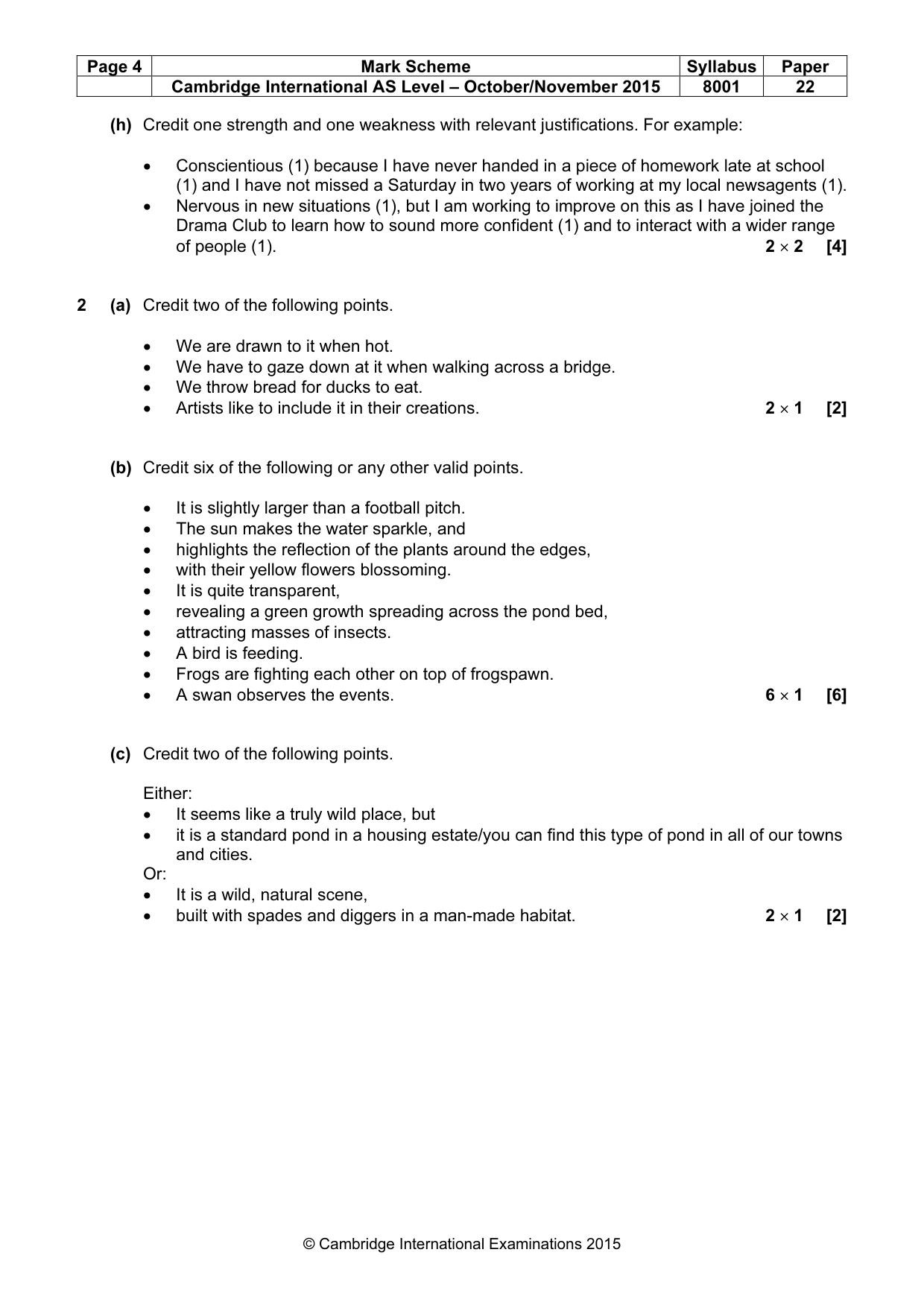
Page 4 Mark Scheme Syllabus Paper Cambridge International AS Level – October/November 2015 8001 22 © Cambridge International Examinations 2015 (h) Credit one strength and one weakness with relevant justifications. For example: • Conscientious (1) because I have never handed in a piece of homework late at school (1) and I have not missed a Saturday in two years of working at my local newsagents (1). • Nervous in new situations (1), but I am working to improve on this as I have joined the Drama Club to learn how to sound more confident (1) and to interact with a wider range of people (1). 2 × 2 [4] 2 (a) Credit two of the following points. • We are drawn to it when hot. • We have to gaze down at it when walking across a bridge. • We throw bread for ducks to eat. • Artists like to include it in their creations. 2 × 1 [2] (b) Credit six of the following or any other valid points. • It is slightly larger than a football pitch. • The sun makes the water sparkle, and • highlights the reflection of the plants around the edges, • with their yellow flowers blossoming. • It is quite transparent, • revealing a green growth spreading across the pond bed, • attracting masses of insects. • A bird is feeding. • Frogs are fighting each other on top of frogspawn. • A swan observes the events. 6 × 1 [6] (c) Credit two of the following points. Either: • It seems like a truly wild place, but • it is a standard pond in a housing estate/you can find this type of pond in all of our towns and cities. Or: • It is a wild, natural scene, • built with spades and diggers in a man-made habitat. 2 × 1 [2]
Mark scheme, page 5
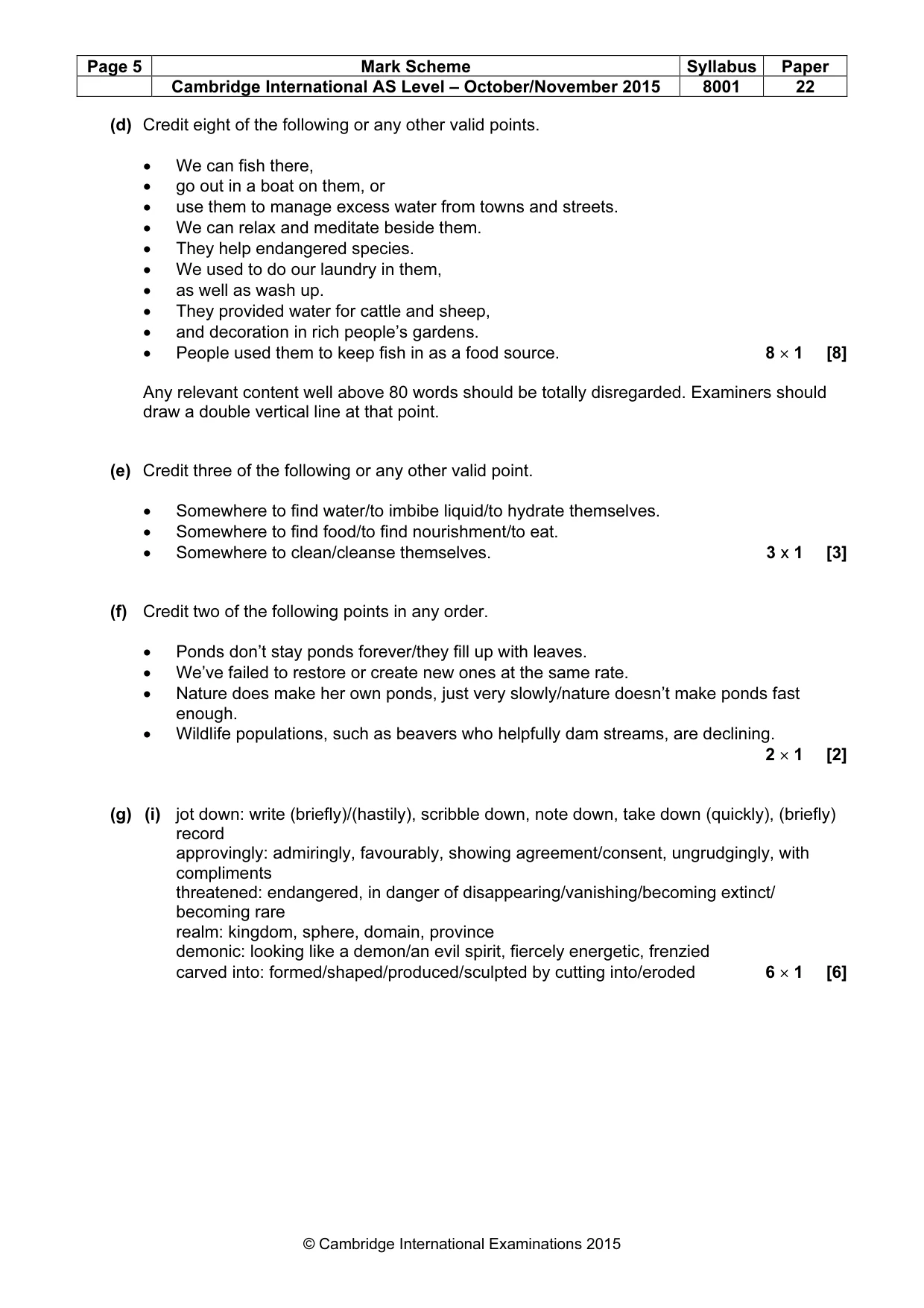
Page 5 Mark Scheme Syllabus Paper Cambridge International AS Level – October/November 2015 8001 22 © Cambridge International Examinations 2015 (d) Credit eight of the following or any other valid points. • We can fish there, • go out in a boat on them, or • use them to manage excess water from towns and streets. • We can relax and meditate beside them. • They help endangered species. • We used to do our laundry in them, • as well as wash up. • They provided water for cattle and sheep, • and decoration in rich people’s gardens. • People used them to keep fish in as a food source. 8 × 1 [8] Any relevant content well above 80 words should be totally disregarded. Examiners should draw a double vertical line at that point. (e) Credit three of the following or any other valid point. • Somewhere to find water/to imbibe liquid/to hydrate themselves. • Somewhere to find food/to find nourishment/to eat. • Somewhere to clean/cleanse themselves. 3 x 1 [3] (f) Credit two of the following points in any order. • Ponds don’t stay ponds forever/they fill up with leaves. • We’ve failed to restore or create new ones at the same rate. • Nature does make her own ponds, just very slowly/nature doesn’t make ponds fast enough. • Wildlife populations, such as beavers who helpfully dam streams, are declining. 2 × 1 [2] (g) (i) jot down: write (briefly)/(hastily), scribble down, note down, take down (quickly), (briefly) record approvingly: admiringly, favourably, showing agreement/consent, ungrudgingly, with compliments threatened: endangered, in danger of disappearing/vanishing/becoming extinct/ becoming rare realm: kingdom, sphere, domain, province demonic: looking like a demon/an evil spirit, fiercely energetic, frenzied carved into: formed/shaped/produced/sculpted by cutting into/eroded 6 × 1 [6]
Mark scheme, page 6
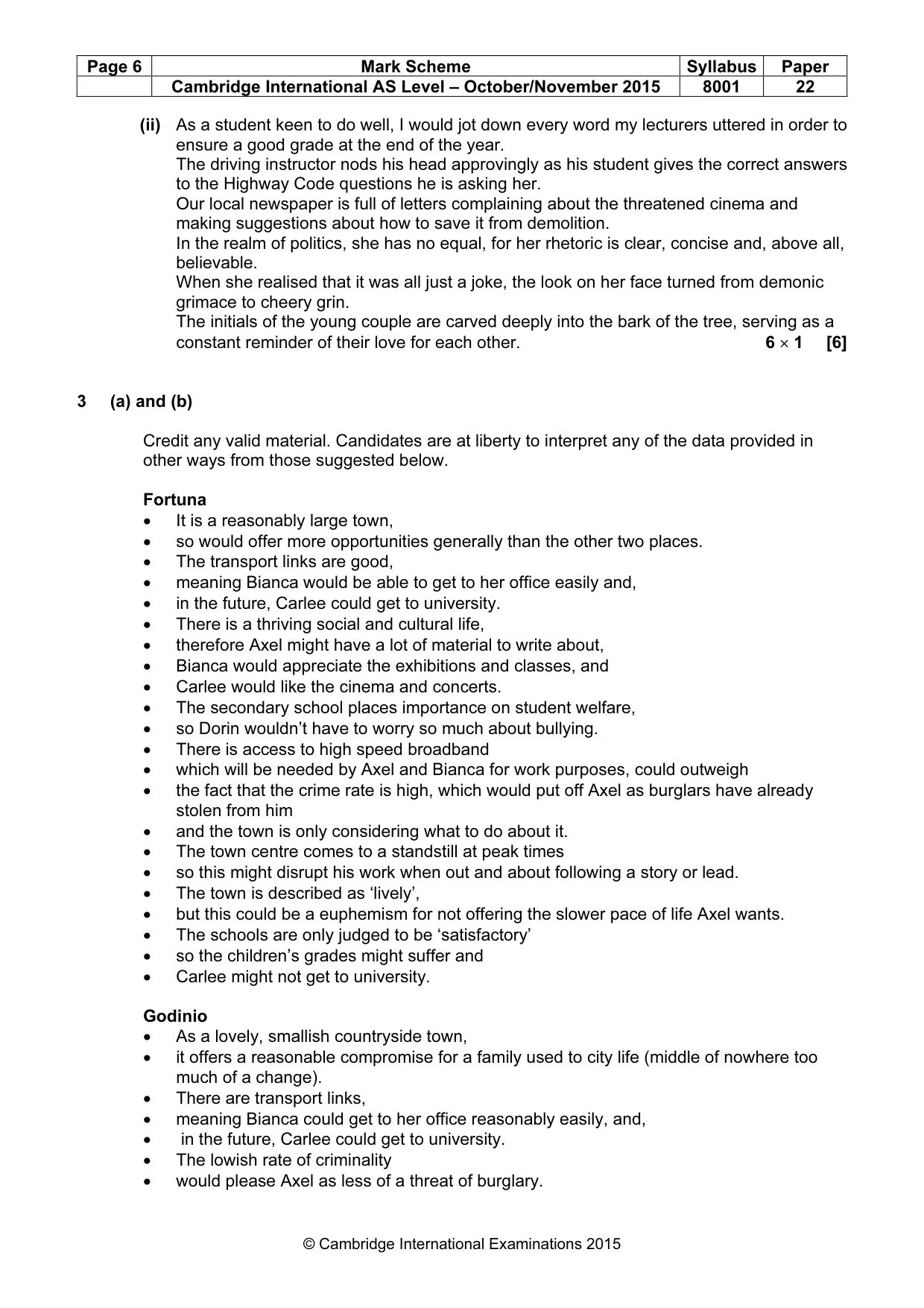
Page 6 Mark Scheme Syllabus Paper Cambridge International AS Level – October/November 2015 8001 22 © Cambridge International Examinations 2015 (ii) As a student keen to do well, I would jot down every word my lecturers uttered in order to ensure a good grade at the end of the year. The driving instructor nods his head approvingly as his student gives the correct answers to the Highway Code questions he is asking her. Our local newspaper is full of letters complaining about the threatened cinema and making suggestions about how to save it from demolition. In the realm of politics, she has no equal, for her rhetoric is clear, concise and, above all, believable. When she realised that it was all just a joke, the look on her face turned from demonic grimace to cheery grin. The initials of the young couple are carved deeply into the bark of the tree, serving as a constant reminder of their love for each other. 6 × 1 [6] 3 (a) and (b) Credit any valid material. Candidates are at liberty to interpret any of the data provided in other ways from those suggested below. Fortuna • It is a reasonably large town, • so would offer more opportunities generally than the other two places. • The transport links are good, • meaning Bianca would be able to get to her office easily and, • in the future, Carlee could get to university. • There is a thriving social and cultural life, • therefore Axel might have a lot of material to write about, • Bianca would appreciate the exhibitions and classes, and • Carlee would like the cinema and concerts. • The secondary school places importance on student welfare, • so Dorin wouldn’t have to worry so much about bullying. • There is access to high speed broadband • which will be needed by Axel and Bianca for work purposes, could outweigh • the fact that the crime rate is high, which would put off Axel as burglars have already stolen from him • and the town is only considering what to do about it. • The town centre comes to a standstill at peak times • so this might disrupt his work when out and about following a story or lead. • The town is described as ‘lively’, • but this could be a euphemism for not offering the slower pace of life Axel wants. • The schools are only judged to be ‘satisfactory’ • so the children’s grades might suffer and • Carlee might not get to university. Godinio • As a lovely, smallish countryside town, • it offers a reasonable compromise for a family used to city life (middle of nowhere too much of a change). • There are transport links, • meaning Bianca could get to her office reasonably easily, and, • in the future, Carlee could get to university. • The lowish rate of criminality • would please Axel as less of a threat of burglary.
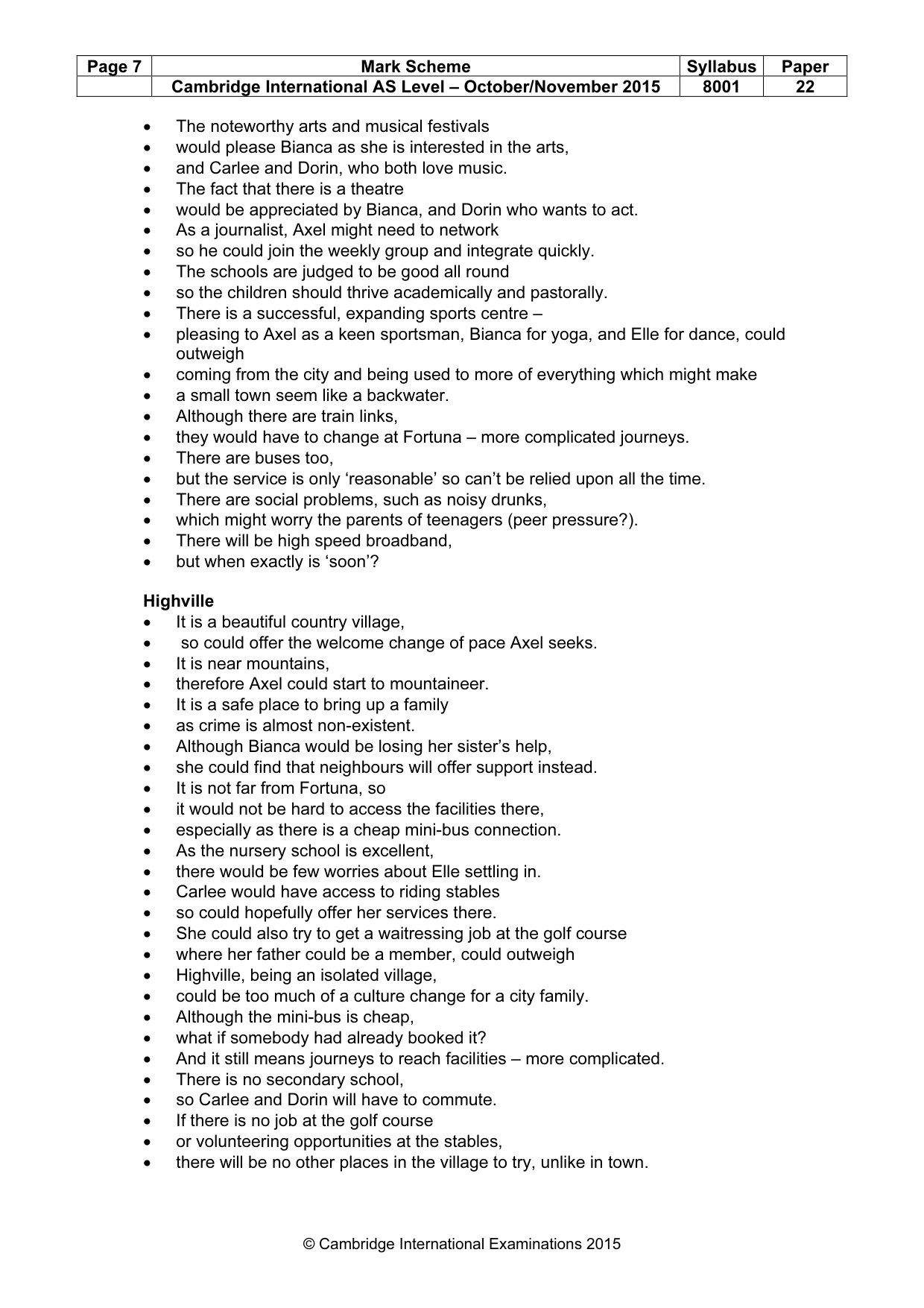
Mark scheme, page 7
Page 7 Mark Scheme Syllabus Paper Cambridge International AS Level – October/November 2015 8001 22 © Cambridge International Examinations 2015 • The noteworthy arts and musical festivals • would please Bianca as she is interested in the arts, • and Carlee and Dorin, who both love music. • The fact that there is a theatre • would be appreciated by Bianca, and Dorin who wants to act. • As a journalist, Axel might need to network • so he could join the weekly group and integrate quickly. • The schools are judged to be good all round • so the children should thrive academically and pastorally. • There is a successful, expanding sports centre – • pleasing to Axel as a keen sportsman, Bianca for yoga, and Elle for dance, could outweigh • coming from the city and being used to more of everything which might make • a small town seem like a backwater. • Although there are train links, • they would have to change at Fortuna – more complicated journeys. • There are buses too, • but the service is only ‘reasonable’ so can’t be relied upon all the time. • There are social problems, such as noisy drunks, • which might worry the parents of teenagers (peer pressure?). • There will be high speed broadband, • but when exactly is ‘soon’? Highville • It is a beautiful country village, • so could offer the welcome change of pace Axel seeks. • It is near mountains, • therefore Axel could start to mountaineer. • It is a safe place to bring up a family • as crime is almost non-existent. • Although Bianca would be losing her sister’s help, • she could find that neighbours will offer support instead. • It is not far from Fortuna, so • it would not be hard to access the facilities there, • especially as there is a cheap mini-bus connection. • As the nursery school is excellent, • there would be few worries about Elle settling in. • Carlee would have access to riding stables • so could hopefully offer her services there. • She could also try to get a waitressing job at the golf course • where her father could be a member, could outweigh • Highville, being an isolated village, • could be too much of a culture change for a city family. • Although the mini-bus is cheap, • what if somebody had already booked it? • And it still means journeys to reach facilities – more complicated. • There is no secondary school, • so Carlee and Dorin will have to commute. • If there is no job at the golf course • or volunteering opportunities at the stables, • there will be no other places in the village to try, unlike in town.
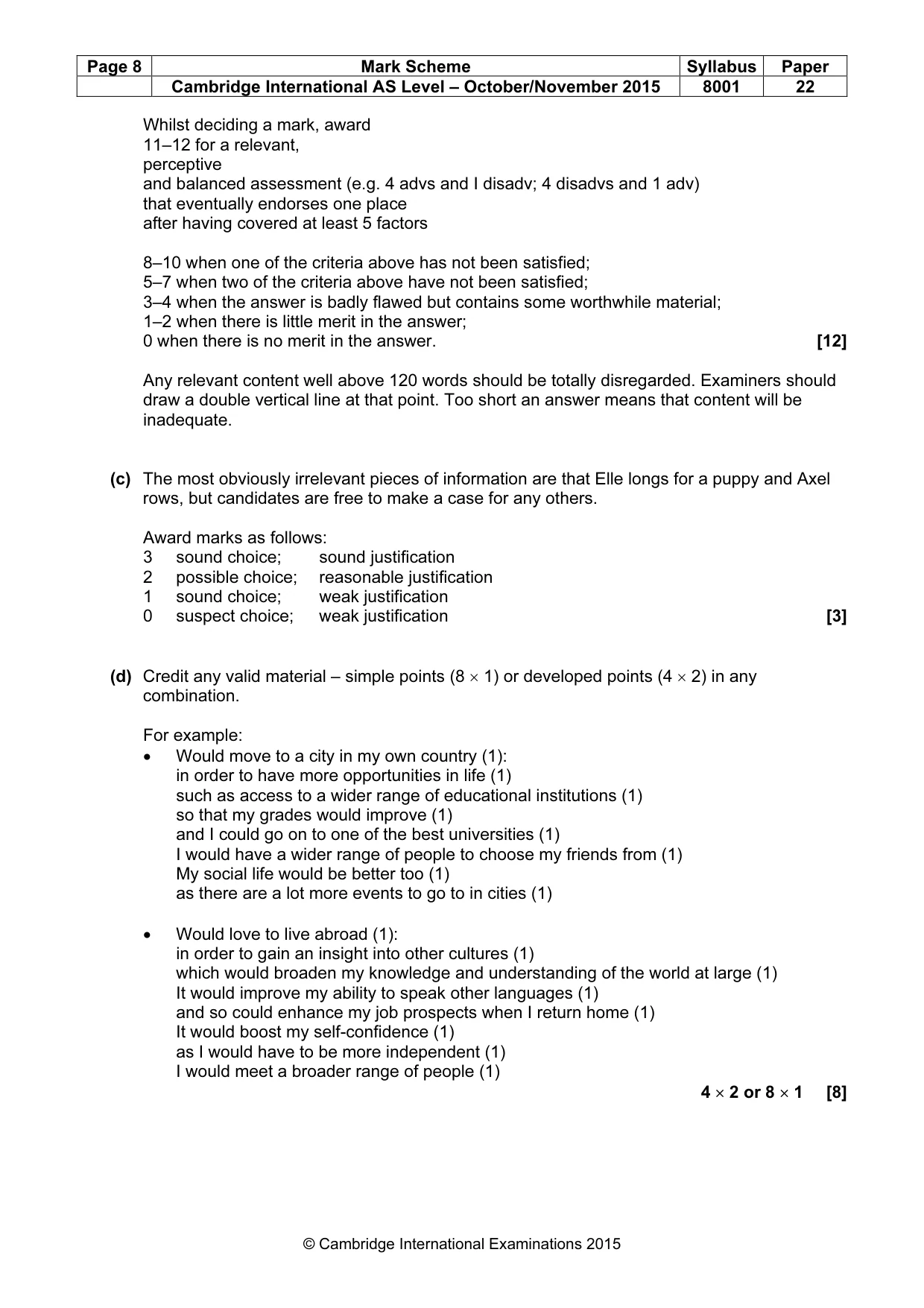
Mark scheme, page 8
Page 8 Mark Scheme Syllabus Paper Cambridge International AS Level – October/November 2015 8001 22 © Cambridge International Examinations 2015 Whilst deciding a mark, award 11–12 for a relevant, perceptive and balanced assessment (e.g. 4 advs and I disadv; 4 disadvs and 1 adv) that eventually endorses one place after having covered at least 5 factors 8–10 when one of the criteria above has not been satisfied; 5–7 when two of the criteria above have not been satisfied; 3–4 when the answer is badly flawed but contains some worthwhile material; 1–2 when there is little merit in the answer; 0 when there is no merit in the answer. [12] Any relevant content well above 120 words should be totally disregarded. Examiners should draw a double vertical line at that point. Too short an answer means that content will be inadequate. (c) The most obviously irrelevant pieces of information are that Elle longs for a puppy and Axel rows, but candidates are free to make a case for any others. Award marks as follows: 3 sound choice; sound justification 2 possible choice; reasonable justification 1 sound choice; weak justification 0 suspect choice; weak justification [3] (d) Credit any valid material – simple points (8 × 1) or developed points (4 × 2) in any combination. For example: • Would move to a city in my own country (1): in order to have more opportunities in life (1) such as access to a wider range of educational institutions (1) so that my grades would improve (1) and I could go on to one of the best universities (1) I would have a wider range of people to choose my friends from (1) My social life would be better too (1) as there are a lot more events to go to in cities (1) • Would love to live abroad (1): in order to gain an insight into other cultures (1) which would broaden my knowledge and understanding of the world at large (1) It would improve my ability to speak other languages (1) and so could enhance my job prospects when I return home (1) It would boost my self-confidence (1) as I would have to be more independent (1) I would meet a broader range of people (1) 4 × 2 or 8 × 1 [8]
What you needed in this session
Cambridge’s own grade thresholds for 2015 Oct/Nov, Paper 2 · Variant 2. A higher threshold means an easier paper — the bar moves with how the cohort did.