Cambridge A Level Food Studies 9336 — 2017 Oct/Nov Paper 1 · Variant 1
9336/11/O/N/17 · 100 marks · ≈113 min
The question paper and its mark scheme, free to read here and free to download. This is Cambridge’s own paper, exactly as it was sat.
Question paper8 pages


Mark scheme14 pages
Answers below. Sit the paper first if you are practising.
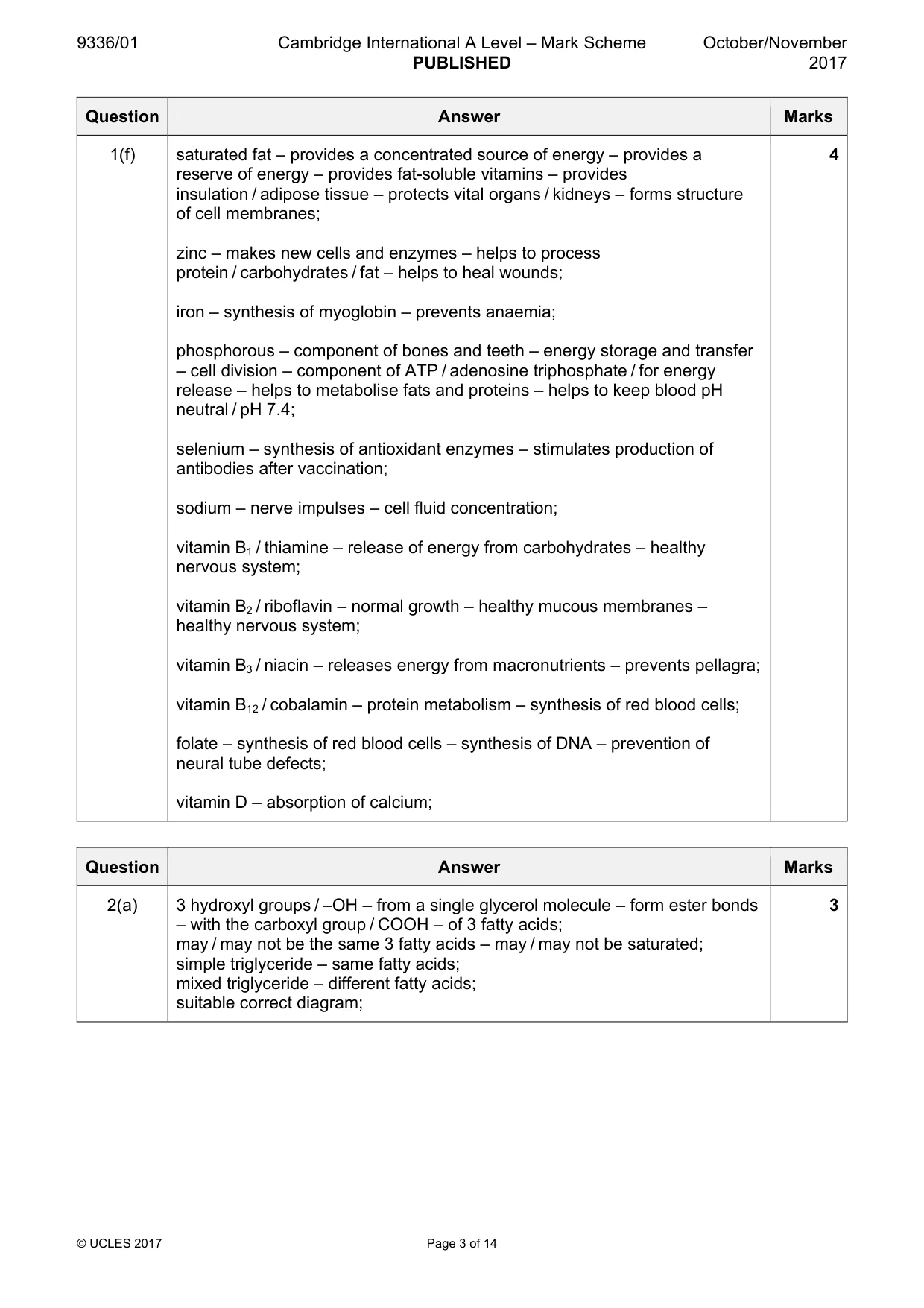
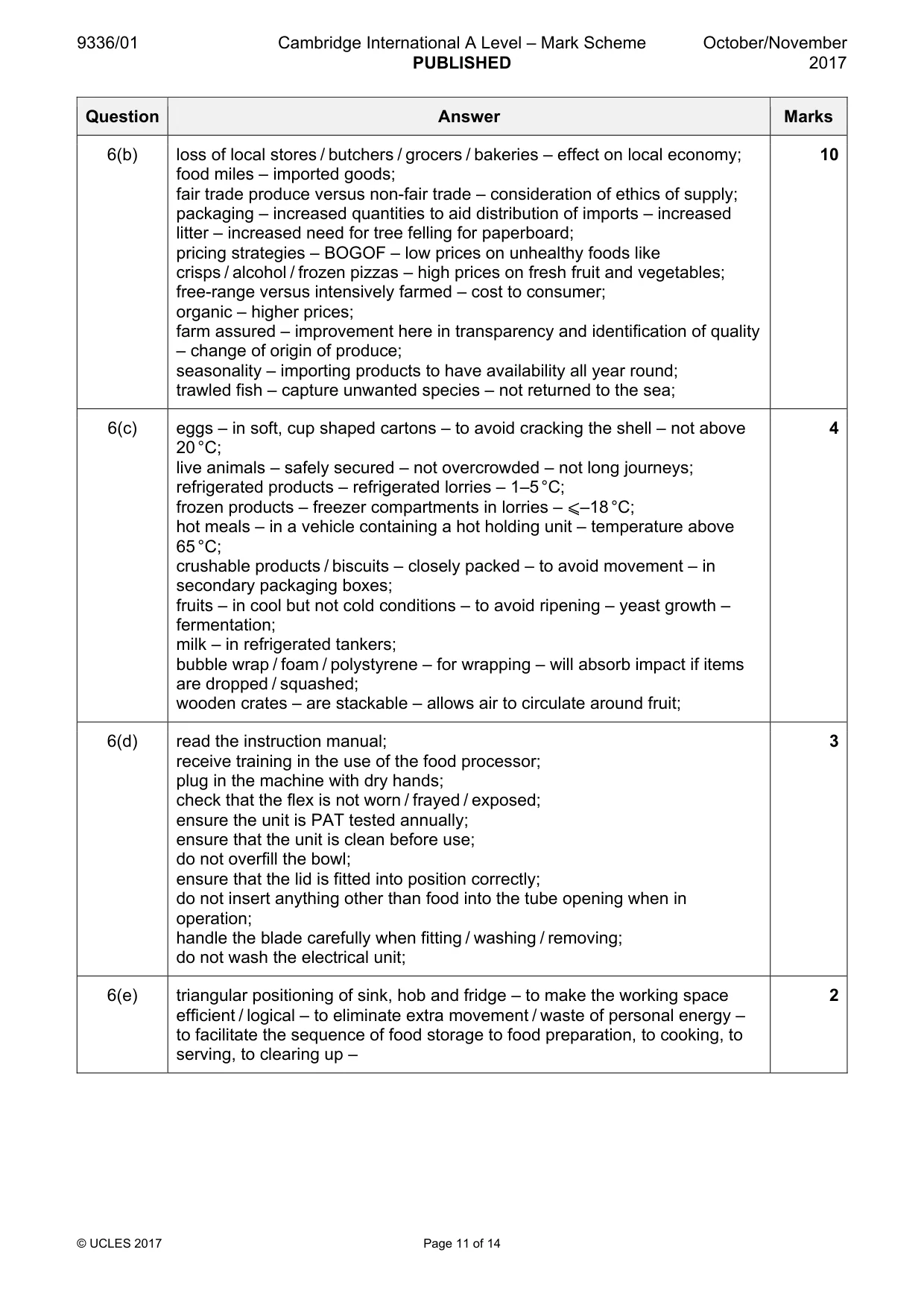
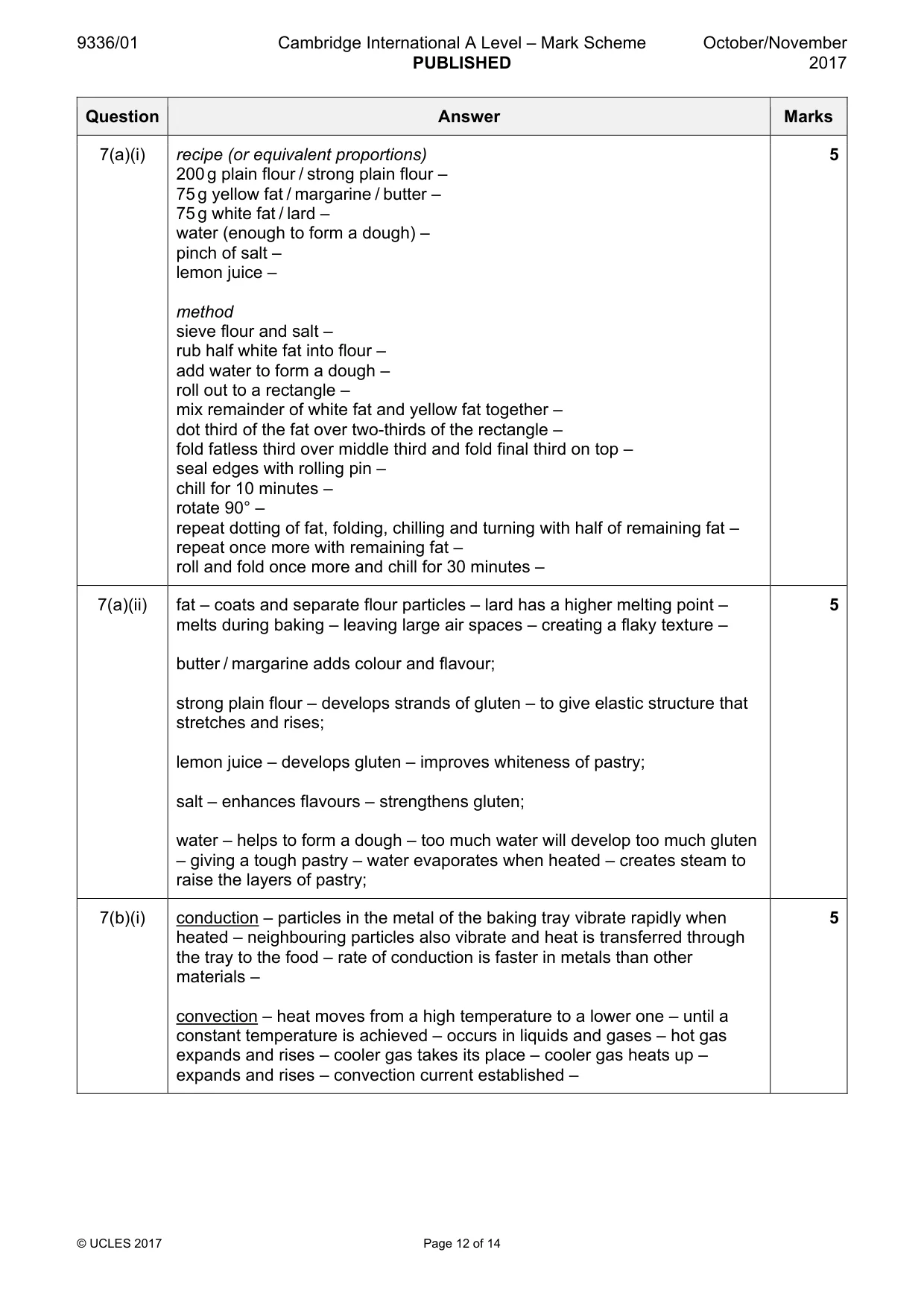
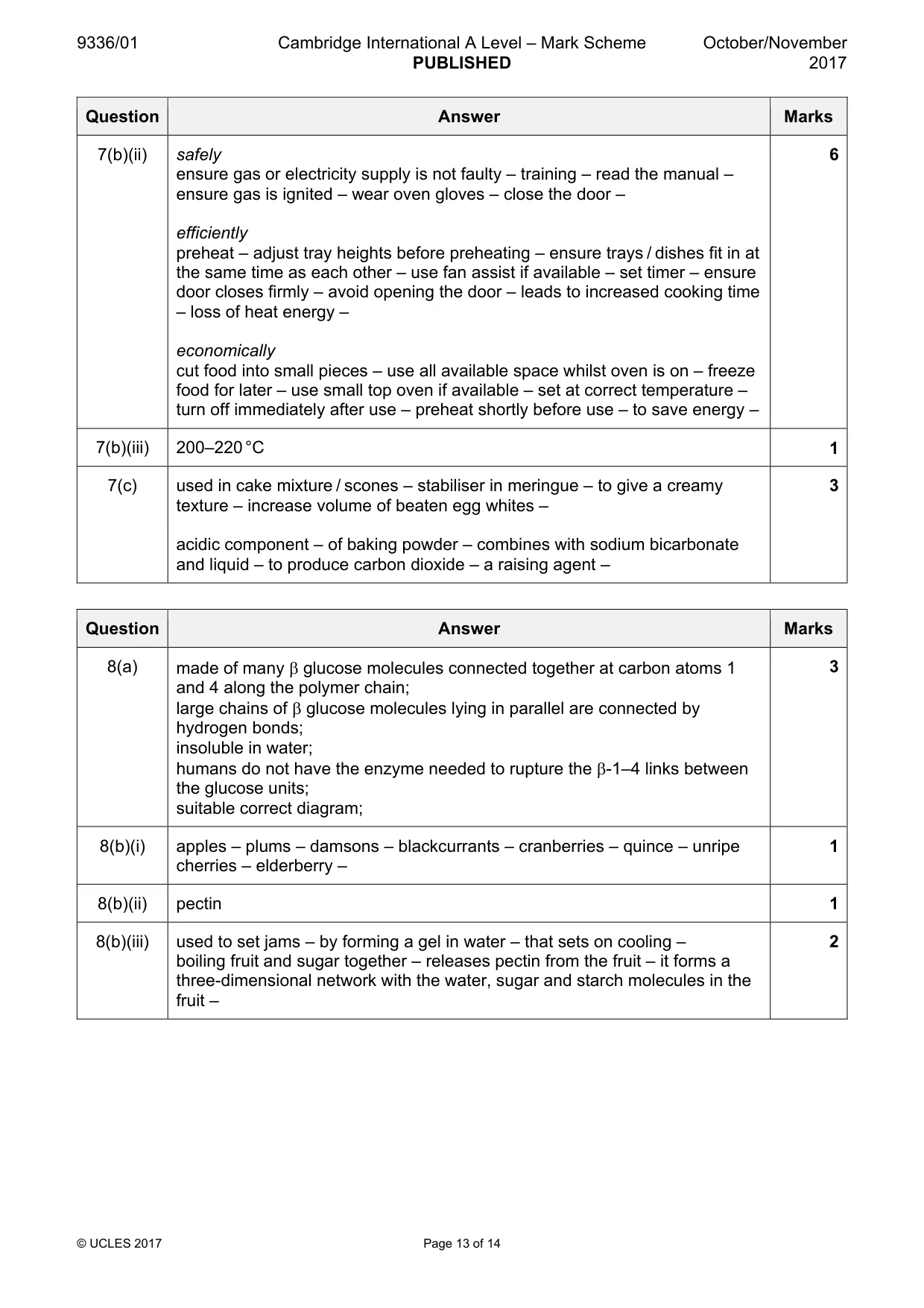
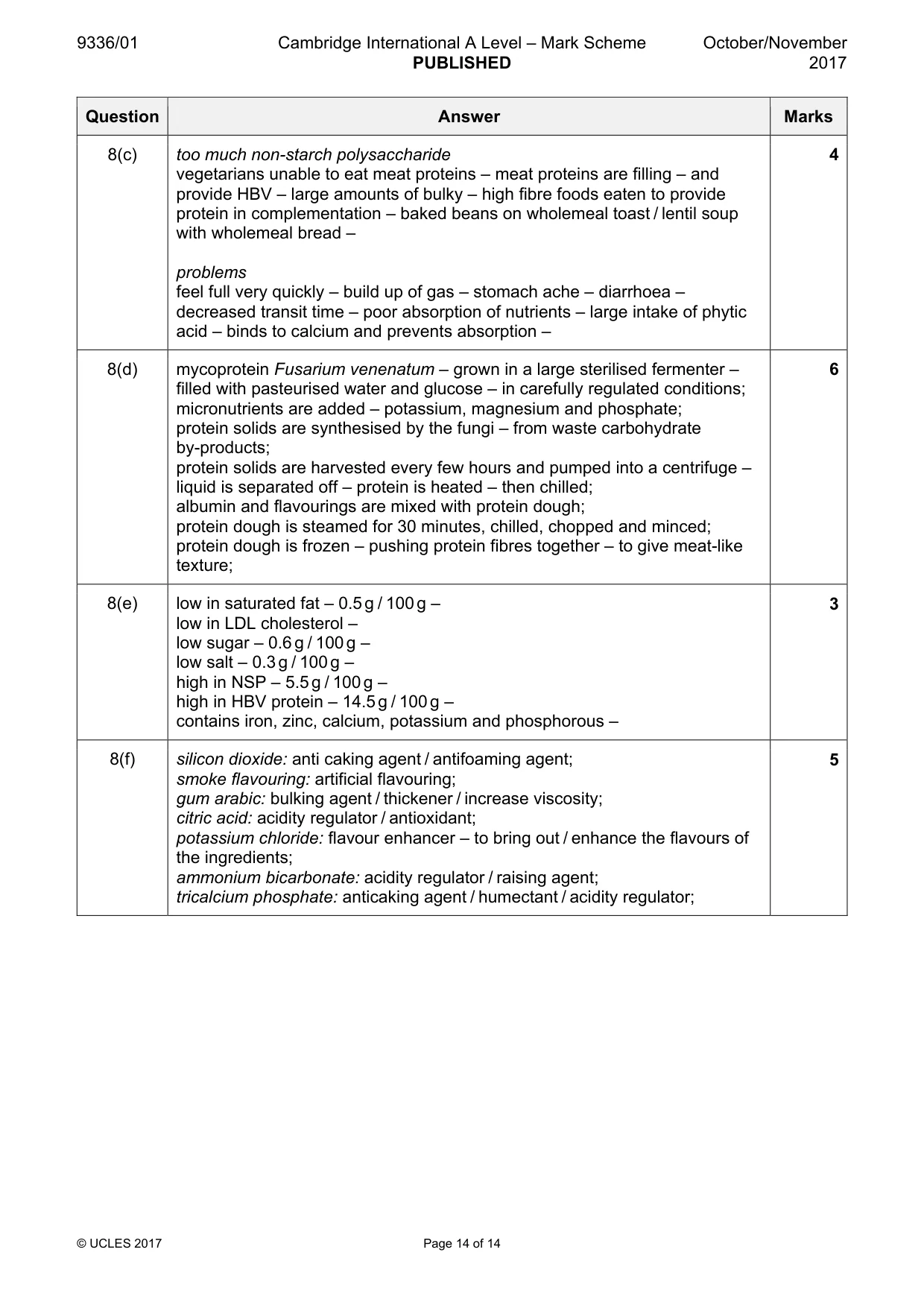
Paper as text
Question paper, page 1
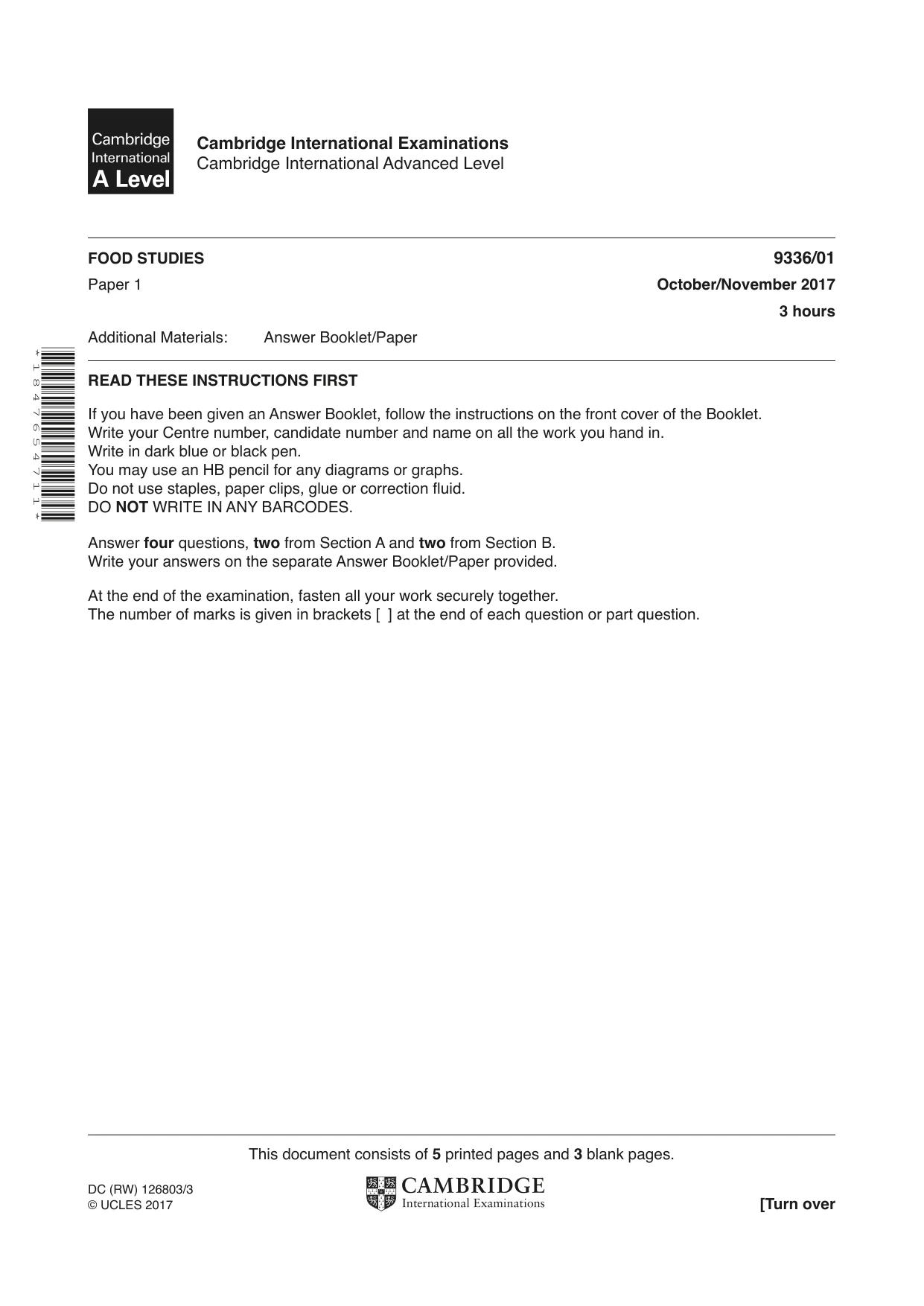
This document consists of 5 printed pages and 3 blank pages. DC (RW) 126803/3 © UCLES 2017 [Turn over Cambridge International Examinations Cambridge International Advanced Level * 1 8 4 7 6 5 4 7 1 1 * FOOD STUDIES 9336/01 Paper 1 October/November 2017 3 hours Additional Materials: Answer Booklet/Paper READ THESE INSTRUCTIONS FIRST If you have been given an Answer Booklet, follow the instructions on the front cover of the Booklet. Write your Centre number, candidate number and name on all the work you hand in. Write in dark blue or black pen. You may use an HB pencil for any diagrams or graphs. Do not use staples, paper clips, glue or correction fluid. DO NOT WRITE IN ANY BARCODES. Answer four questions, two from Section A and two from Section B. Write your answers on the separate Answer Booklet/Paper provided. At the end of the examination, fasten all your work securely together. The number of marks is given in brackets [ ] at the end of each question or part question.
Question paper, page 2
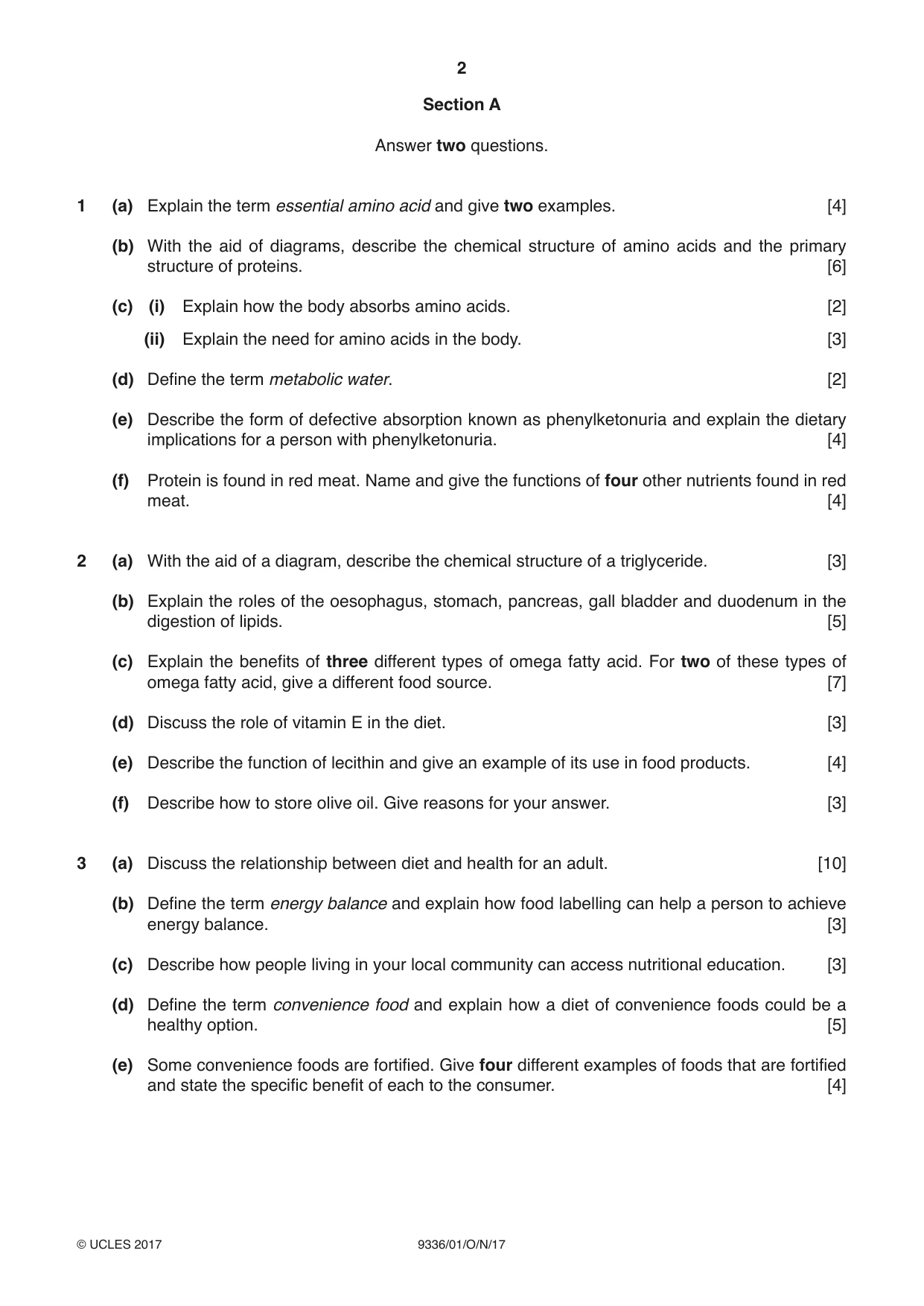
2 9336/01/O/N/17 © UCLES 2017 Section A Answer two questions. 1 (a) Explain the term essential amino acid and give two examples. [4] (b) With the aid of diagrams, describe the chemical structure of amino acids and the primary structure of proteins. [6] (c) (i) Explain how the body absorbs amino acids. [2] (ii) Explain the need for amino acids in the body. [3] (d) Define the term metabolic water. [2] (e) Describe the form of defective absorption known as phenylketonuria and explain the dietary implications for a person with phenylketonuria. [4] (f) Protein is found in red meat. Name and give the functions of four other nutrients found in red meat. [4] 2 (a) With the aid of a diagram, describe the chemical structure of a triglyceride. [3] (b) Explain the roles of the oesophagus, stomach, pancreas, gall bladder and duodenum in the digestion of lipids. [5] (c) Explain the benefits of three different types of omega fatty acid. For two of these types of omega fatty acid, give a different food source. [7] (d) Discuss the role of vitamin E in the diet. [3] (e) Describe the function of lecithin and give an example of its use in food products. [4] (f) Describe how to store olive oil. Give reasons for your answer. [3] 3 (a) Discuss the relationship between diet and health for an adult. [10] (b) Define the term energy balance and explain how food labelling can help a person to achieve energy balance. [3] (c) Describe how people living in your local community can access nutritional education. [3] (d) Define the term convenience food and explain how a diet of convenience foods could be a healthy option. [5] (e) Some convenience foods are fortified. Give four different examples of foods that are fortified and state the specific benefit of each to the consumer. [4]
Question paper, page 3
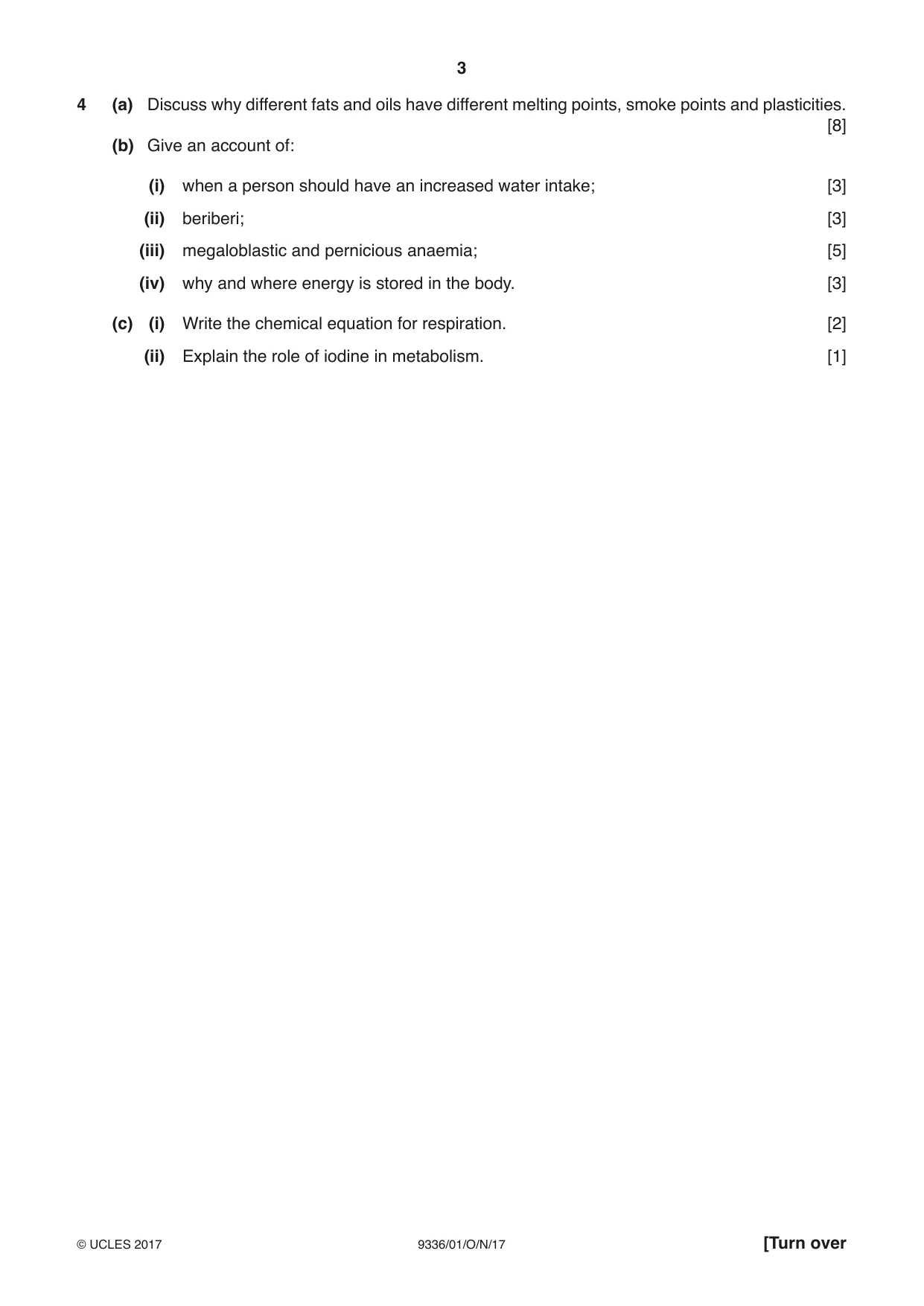
3 9336/01/O/N/17 © UCLES 2017 [Turn over 4 (a) Discuss why different fats and oils have different melting points, smoke points and plasticities. [8] (b) Give an account of: (i) when a person should have an increased water intake; [3] (ii) beriberi; [3] (iii) megaloblastic and pernicious anaemia; [5] (iv) why and where energy is stored in the body. [3] (c) (i) Write the chemical equation for respiration. [2] (ii) Explain the role of iodine in metabolism. [1]
Question paper, page 4
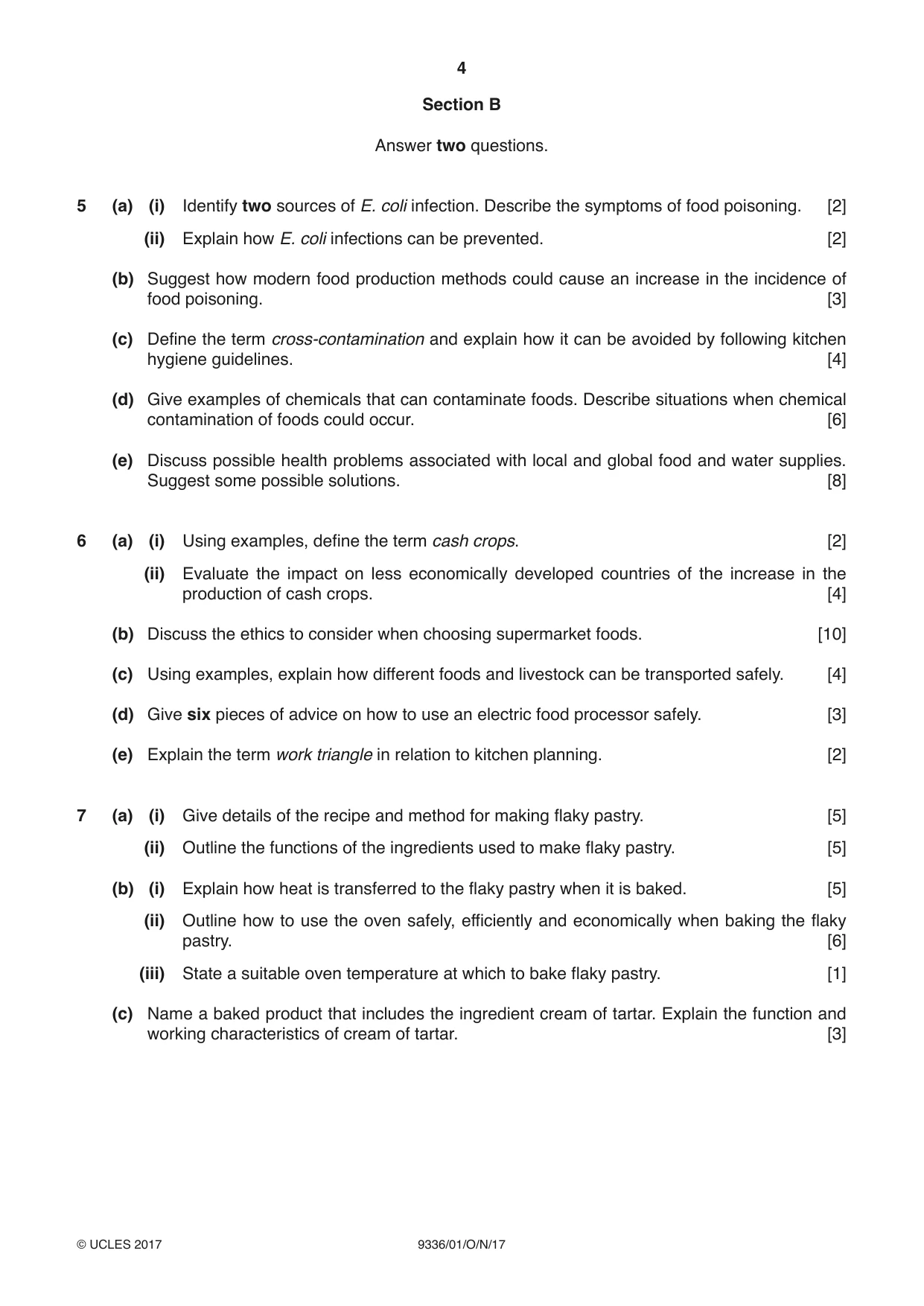
4 9336/01/O/N/17 © UCLES 2017 Section B Answer two questions. 5 (a) (i) Identify two sources of E. coli infection. Describe the symptoms of food poisoning. [2] (ii) Explain how E. coli infections can be prevented. [2] (b) Suggest how modern food production methods could cause an increase in the incidence of food poisoning. [3] (c) Define the term cross-contamination and explain how it can be avoided by following kitchen hygiene guidelines. [4] (d) Give examples of chemicals that can contaminate foods. Describe situations when chemical contamination of foods could occur. [6] (e) Discuss possible health problems associated with local and global food and water supplies. Suggest some possible solutions. [8] 6 (a) (i) Using examples, define the term cash crops. [2] (ii) Evaluate the impact on less economically developed countries of the increase in the production of cash crops. [4] (b) Discuss the ethics to consider when choosing supermarket foods. [10] (c) Using examples, explain how different foods and livestock can be transported safely. [4] (d) Give six pieces of advice on how to use an electric food processor safely. [3] (e) Explain the term work triangle in relation to kitchen planning. [2] 7 (a) (i) Give details of the recipe and method for making flaky pastry. [5] (ii) Outline the functions of the ingredients used to make flaky pastry. [5] (b) (i) Explain how heat is transferred to the flaky pastry when it is baked. [5] (ii) Outline how to use the oven safely, efficiently and economically when baking the flaky pastry. [6] (iii) State a suitable oven temperature at which to bake flaky pastry. [1] (c) Name a baked product that includes the ingredient cream of tartar. Explain the function and working characteristics of cream of tartar. [3]
Question paper, page 5
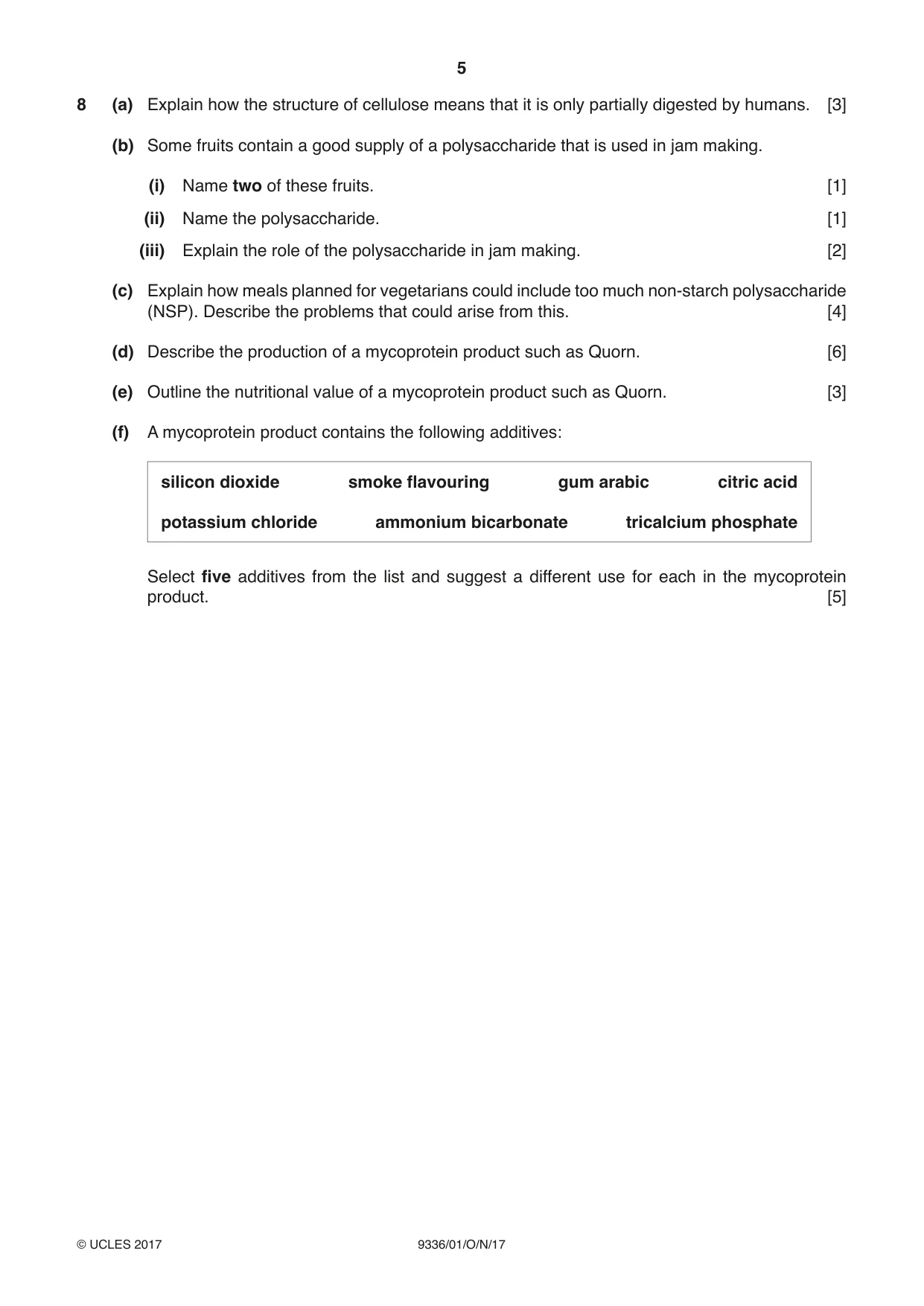
5 9336/01/O/N/17 © UCLES 2017 8 (a) Explain how the structure of cellulose means that it is only partially digested by humans. [3] (b) Some fruits contain a good supply of a polysaccharide that is used in jam making. (i) Name two of these fruits. [1] (ii) Name the polysaccharide. [1] (iii) Explain the role of the polysaccharide in jam making. [2] (c) Explain how meals planned for vegetarians could include too much non-starch polysaccharide (NSP). Describe the problems that could arise from this. [4] (d) Describe the production of a mycoprotein product such as Quorn. [6] (e) Outline the nutritional value of a mycoprotein product such as Quorn. [3] (f) A mycoprotein product contains the following additives: silicon dioxide smoke flavouring gum arabic citric acid potassium chloride ammonium bicarbonate tricalcium phosphate Select five additives from the list and suggest a different use for each in the mycoprotein product. [5]
Question paper, page 6
6 9336/01/O/N/17 © UCLES 2017 BLANK PAGE
Question paper, page 7
7 9336/01/O/N/17 © UCLES 2017 BLANK PAGE
Question paper, page 8
8 9336/01/O/N/17 © UCLES 2017 BLANK PAGE Permission to reproduce items where third-party owned material protected by copyright is included has been sought and cleared where possible. Every reasonable effort has been made by the publisher (UCLES) to trace copyright holders, but if any items requiring clearance have unwittingly been included, the publisher will be pleased to make amends at the earliest possible opportunity. To avoid the issue of disclosure of answer-related information to candidates, all copyright acknowledgements are reproduced online in the Cambridge International Examinations Copyright Acknowledgements Booklet. This is produced for each series of examinations and is freely available to download at www.cie.org.uk after the live examination series. Cambridge International Examinations is part of the Cambridge Assessment Group. Cambridge Assessment is the brand name of University of Cambridge Local Examinations Syndicate (UCLES), which is itself a department of the University of Cambridge.
Mark scheme, page 1
® IGCSE is a registered trademark. This document consists of 14 printed pages. © UCLES 2017 [Turn over Cambridge Assessment International Education Cambridge International Advanced Level FOOD STUDIES 9336/01 Paper 1 Theory October/November 2017 MARK SCHEME Maximum Mark: 100 Published This mark scheme is published as an aid to teachers and candidates, to indicate the requirements of the examination. It shows the basis on which Examiners were instructed to award marks. It does not indicate the details of the discussions that took place at an Examiners’ meeting before marking began, which would have considered the acceptability of alternative answers. Mark schemes should be read in conjunction with the question paper and the Principal Examiner Report for Teachers. Cambridge International will not enter into discussions about these mark schemes. Cambridge International is publishing the mark schemes for the October/November 2017 series for most Cambridge IGCSE®, Cambridge International A and AS Level components and some Cambridge O Level components.
Mark scheme, page 2
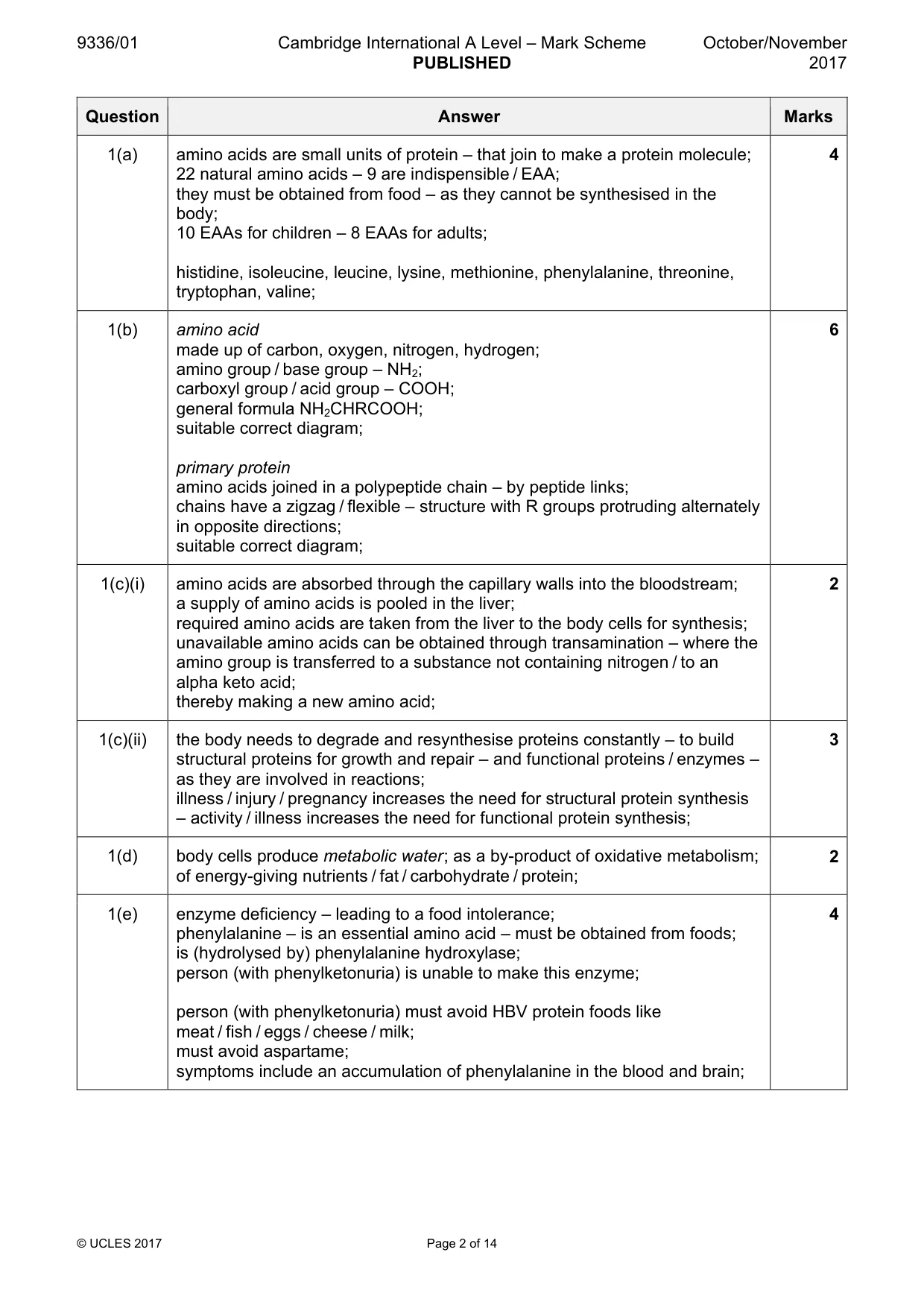
9336/01 Cambridge International A Level – Mark Scheme PUBLISHED October/November 2017 © UCLES 2017 Page 2 of 14 Question Answer Marks 1(a) amino acids are small units of protein – that join to make a protein molecule; 22 natural amino acids – 9 are indispensible / EAA; they must be obtained from food – as they cannot be synthesised in the body; 10 EAAs for children – 8 EAAs for adults; histidine, isoleucine, leucine, lysine, methionine, phenylalanine, threonine, tryptophan, valine; 4 1(b) amino acid made up of carbon, oxygen, nitrogen, hydrogen; amino group / base group – NH2; carboxyl group / acid group – COOH; general formula NH2CHRCOOH; suitable correct diagram; primary protein amino acids joined in a polypeptide chain – by peptide links; chains have a zigzag / flexible – structure with R groups protruding alternately in opposite directions; suitable correct diagram; 6 1(c)(i) amino acids are absorbed through the capillary walls into the bloodstream; a supply of amino acids is pooled in the liver; required amino acids are taken from the liver to the body cells for synthesis; unavailable amino acids can be obtained through transamination – where the amino group is transferred to a substance not containing nitrogen / to an alpha keto acid; thereby making a new amino acid; 2 1(c)(ii) the body needs to degrade and resynthesise proteins constantly – to build structural proteins for growth and repair – and functional proteins / enzymes – as they are involved in reactions; illness / injury / pregnancy increases the need for structural protein synthesis – activity / illness increases the need for functional protein synthesis; 3 1(d) body cells produce metabolic water ; as a by-product of oxidative metabolism; of energy-giving nutrients / fat / carbohydrate / protein; 2 1(e) enzyme deficiency – leading to a food intolerance; phenylalanine – is an essential amino acid – must be obtained from foods; is (hydrolysed by) phenylalanine hydroxylase; person (with phenylketonuria) is unable to make this enzyme; person (with phenylketonuria) must avoid HBV protein foods like meat / fish / eggs / cheese / milk; must avoid aspartame; symptoms include an accumulation of phenylalanine in the blood and brain; 4
Mark scheme, page 3
9336/01 Cambridge International A Level – Mark Scheme PUBLISHED October/November 2017 © UCLES 2017 Page 3 of 14 Question Answer Marks 1(f) saturated fat – provides a concentrated source of energy – provides a reserve of energy – provides fat-soluble vitamins – provides insulation / adipose tissue – protects vital organs / kidneys – forms structure of cell membranes; zinc – makes new cells and enzymes – helps to process protein / carbohydrates / fat – helps to heal wounds; iron – synthesis of myoglobin – prevents anaemia; phosphorous – component of bones and teeth – energy storage and transfer – cell division – component of ATP / adenosine triphosphate / for energy release – helps to metabolise fats and proteins – helps to keep blood pH neutral / pH 7.4; selenium – synthesis of antioxidant enzymes – stimulates production of antibodies after vaccination; sodium – nerve impulses – cell fluid concentration; vitamin B1 / thiamine – release of energy from carbohydrates – healthy nervous system; vitamin B2 / riboflavin – normal growth – healthy mucous membranes – healthy nervous system; vitamin B3 / niacin – releases energy from macronutrients – prevents pellagra; vitamin B12 / cobalamin – protein metabolism – synthesis of red blood cells; folate – synthesis of red blood cells – synthesis of DNA – prevention of neural tube defects; vitamin D – absorption of calcium; 4 Question Answer Marks 2(a) 3 hydroxyl groups / –OH – from a single glycerol molecule – form ester bonds – with the carboxyl group / COOH – of 3 fatty acids; may / may not be the same 3 fatty acids – may / may not be saturated; simple triglyceride – same fatty acids; mixed triglyceride – different fatty acids; suitable correct diagram; 3
Mark scheme, page 4
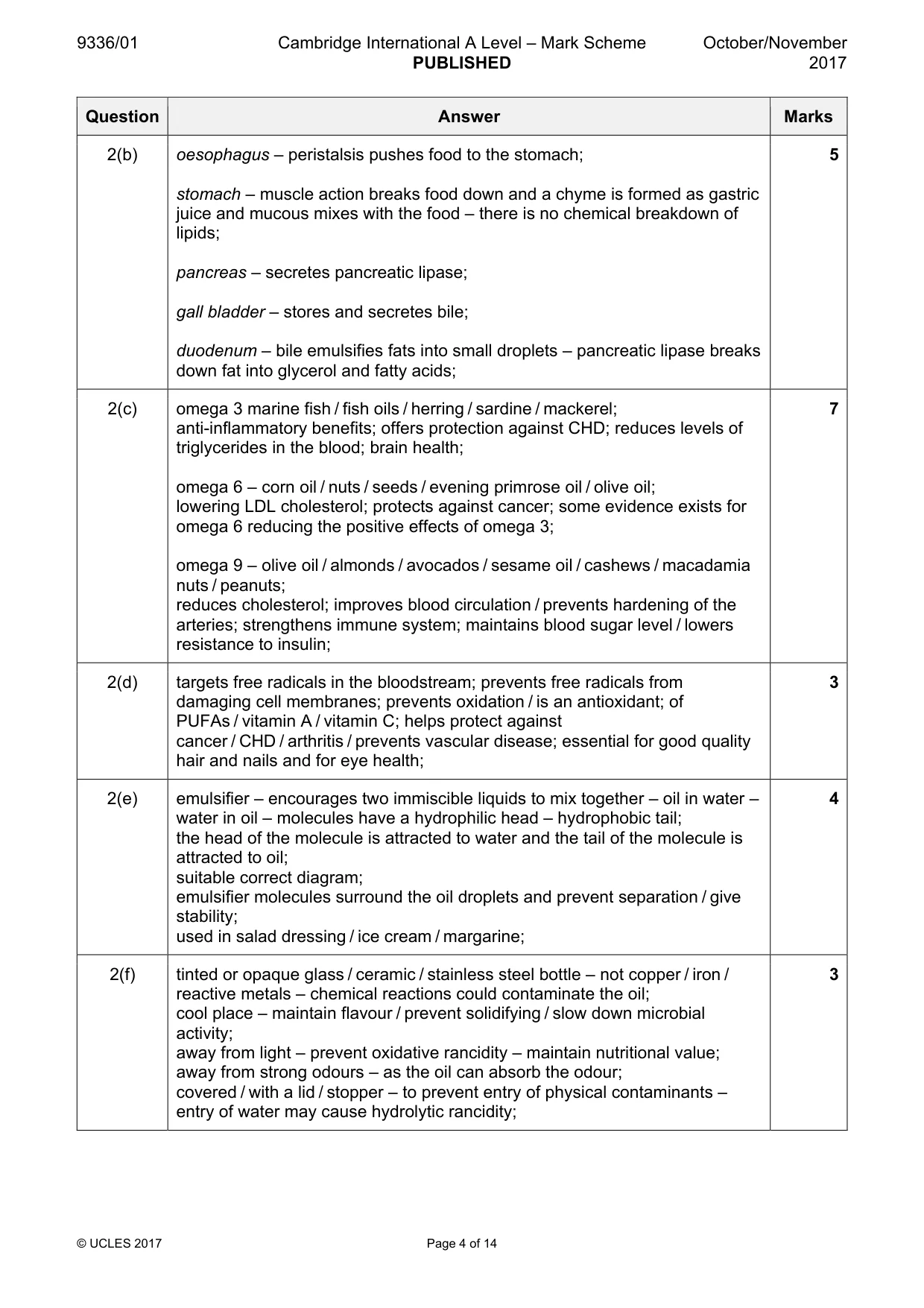
9336/01 Cambridge International A Level – Mark Scheme PUBLISHED October/November 2017 © UCLES 2017 Page 4 of 14 Question Answer Marks 2(b) oesophagus – peristalsis pushes food to the stomach; stomach – muscle action breaks food down and a chyme is formed as gastric juice and mucous mixes with the food – there is no chemical breakdown of lipids; pancreas – secretes pancreatic lipase; gall bladder – stores and secretes bile; duodenum – bile emulsifies fats into small droplets – pancreatic lipase breaks down fat into glycerol and fatty acids; 5 2(c) omega 3 marine fish / fish oils / herring / sardine / mackerel; anti-inflammatory benefits; offers protection against CHD; reduces levels of triglycerides in the blood; brain health; omega 6 – corn oil / nuts / seeds / evening primrose oil / olive oil; lowering LDL cholesterol; protects against cancer; some evidence exists for omega 6 reducing the positive effects of omega 3; omega 9 – olive oil / almonds / avocados / sesame oil / cashews / macadamia nuts / peanuts; reduces cholesterol; improves blood circulation / prevents hardening of the arteries; strengthens immune system; maintains blood sugar level / lowers resistance to insulin; 7 2(d) targets free radicals in the bloodstream; prevents free radicals from damaging cell membranes; prevents oxidation / is an antioxidant; of PUFAs / vitamin A / vitamin C; helps protect against cancer / CHD / arthritis / prevents vascular disease; essential for good quality hair and nails and for eye health; 3 2(e) emulsifier – encourages two immiscible liquids to mix together – oil in water – water in oil – molecules have a hydrophilic head – hydrophobic tail; the head of the molecule is attracted to water and the tail of the molecule is attracted to oil; suitable correct diagram; emulsifier molecules surround the oil droplets and prevent separation / give stability; used in salad dressing / ice cream / margarine; 4 2(f) tinted or opaque glass / ceramic / stainless steel bottle – not copper / iron / reactive metals – chemical reactions could contaminate the oil; cool place – maintain flavour / prevent solidifying / slow down microbial activity; away from light – prevent oxidative rancidity – maintain nutritional value; away from strong odours – as the oil can absorb the odour; covered / with a lid / stopper – to prevent entry of physical contaminants – entry of water may cause hydrolytic rancidity; 3
Mark scheme, page 5
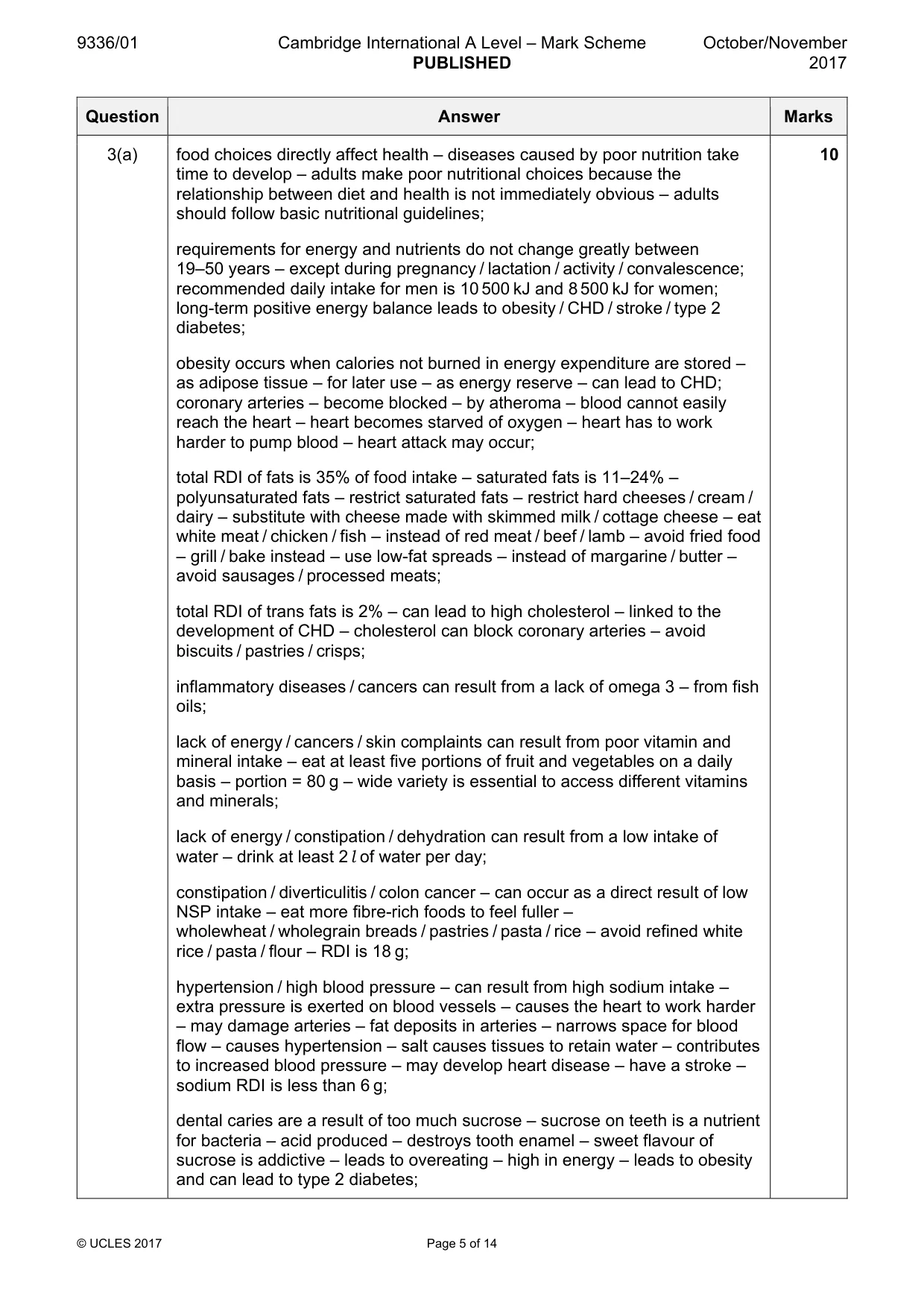
9336/01 Cambridge International A Level – Mark Scheme PUBLISHED October/November 2017 © UCLES 2017 Page 5 of 14 Question Answer Marks 3(a) food choices directly affect health – diseases caused by poor nutrition take time to develop – adults make poor nutritional choices because the relationship between diet and health is not immediately obvious – adults should follow basic nutritional guidelines; requirements for energy and nutrients do not change greatly between 19–50 years – except during pregnancy / lactation / activity / convalescence; recommended daily intake for men is 10 500 kJ and 8 500 kJ for women; long-term positive energy balance leads to obesity / CHD / stroke / type 2 diabetes; obesity occurs when calories not burned in energy expenditure are stored – as adipose tissue – for later use – as energy reserve – can lead to CHD; coronary arteries – become blocked – by atheroma – blood cannot easily reach the heart – heart becomes starved of oxygen – heart has to work harder to pump blood – heart attack may occur; total RDI of fats is 35% of food intake – saturated fats is 11–24% – polyunsaturated fats – restrict saturated fats – restrict hard cheeses / cream / dairy – substitute with cheese made with skimmed milk / cottage cheese – eat white meat / chicken / fish – instead of red meat / beef / lamb – avoid fried food – grill / bake instead – use low-fat spreads – instead of margarine / butter – avoid sausages / processed meats; total RDI of trans fats is 2% – can lead to high cholesterol – linked to the development of CHD – cholesterol can block coronary arteries – avoid biscuits / pastries / crisps; inflammatory diseases / cancers can result from a lack of omega 3 – from fish oils; lack of energy / cancers / skin complaints can result from poor vitamin and mineral intake – eat at least five portions of fruit and vegetables on a daily basis – portion = 80 g – wide variety is essential to access different vitamins and minerals; lack of energy / constipation / dehydration can result from a low intake of water – drink at least 2 l of water per day; constipation / diverticulitis / colon cancer – can occur as a direct result of low NSP intake – eat more fibre-rich foods to feel fuller – wholewheat / wholegrain breads / pastries / pasta / rice – avoid refined white rice / pasta / flour – RDI is 18 g; hypertension / high blood pressure – can result from high sodium intake – extra pressure is exerted on blood vessels – causes the heart to work harder – may damage arteries – fat deposits in arteries – narrows space for blood flow – causes hypertension – salt causes tissues to retain water – contributes to increased blood pressure – may develop heart disease – have a stroke – sodium RDI is less than 6 g; dental caries are a result of too much sucrose – sucrose on teeth is a nutrient for bacteria – acid produced – destroys tooth enamel – sweet flavour of sucrose is addictive – leads to overeating – high in energy – leads to obesity and can lead to type 2 diabetes; 10
Mark scheme, page 6
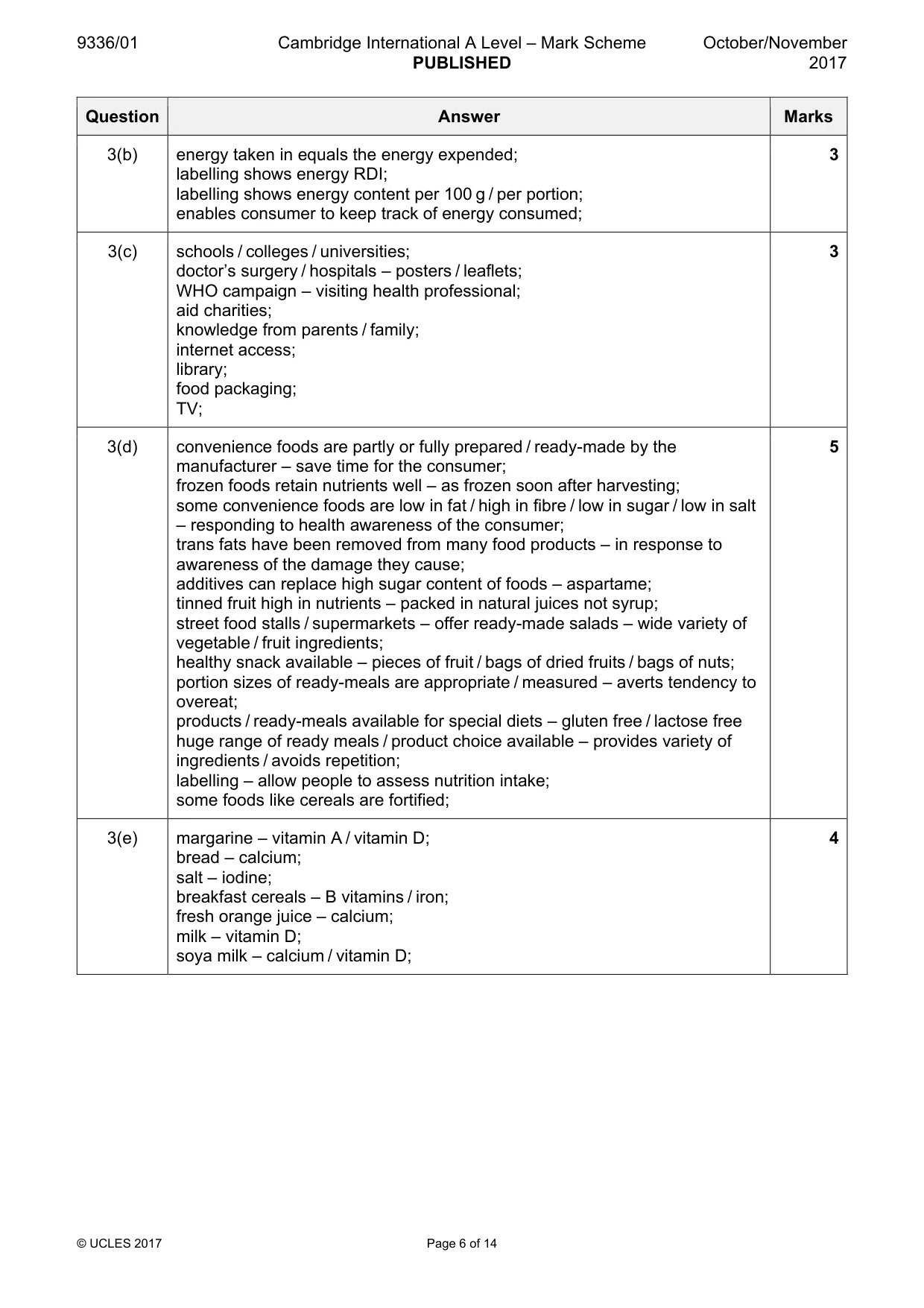
9336/01 Cambridge International A Level – Mark Scheme PUBLISHED October/November 2017 © UCLES 2017 Page 6 of 14 Question Answer Marks 3(b) energy taken in equals the energy expended; labelling shows energy RDI; labelling shows energy content per 100 g / per portion; enables consumer to keep track of energy consumed; 3 3(c) schools / colleges / universities; doctor’s surgery / hospitals – posters / leaflets; WHO campaign – visiting health professional; aid charities; knowledge from parents / family; internet access; library; food packaging; TV; 3 3(d) convenience foods are partly or fully prepared / ready-made by the manufacturer – save time for the consumer; frozen foods retain nutrients well – as frozen soon after harvesting; some convenience foods are low in fat / high in fibre / low in sugar / low in salt – responding to health awareness of the consumer; trans fats have been removed from many food products – in response to awareness of the damage they cause; additives can replace high sugar content of foods – aspartame; tinned fruit high in nutrients – packed in natural juices not syrup; street food stalls / supermarkets – offer ready-made salads – wide variety of vegetable / fruit ingredients; healthy snack available – pieces of fruit / bags of dried fruits / bags of nuts; portion sizes of ready-meals are appropriate / measured – averts tendency to overeat; products / ready-meals available for special diets – gluten free / lactose free huge range of ready meals / product choice available – provides variety of ingredients / avoids repetition; labelling – allow people to assess nutrition intake; some foods like cereals are fortified; 5 3(e) margarine – vitamin A / vitamin D; bread – calcium; salt – iodine; breakfast cereals – B vitamins / iron; fresh orange juice – calcium; milk – vitamin D; soya milk – calcium / vitamin D; 4
Mark scheme, page 7
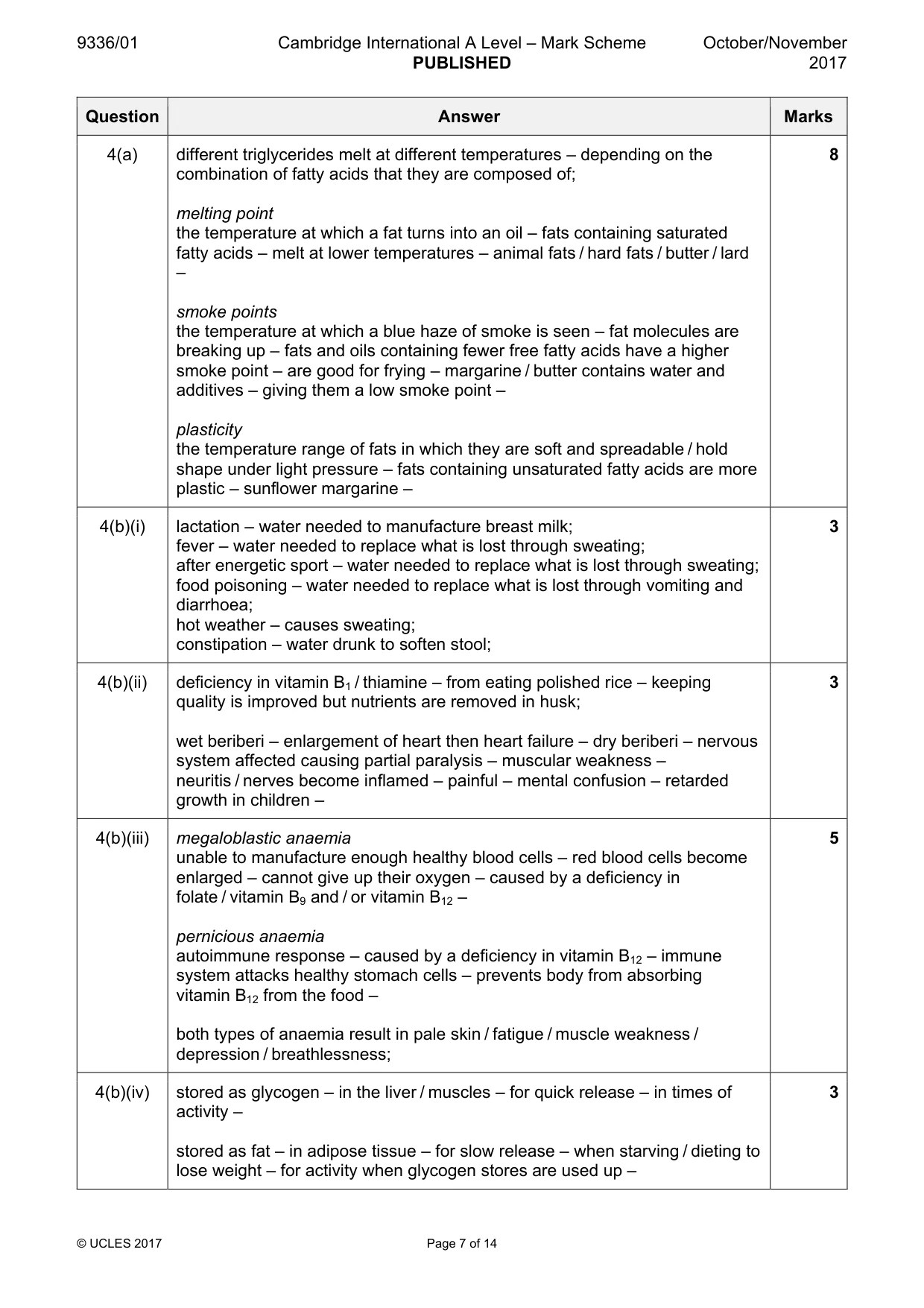
9336/01 Cambridge International A Level – Mark Scheme PUBLISHED October/November 2017 © UCLES 2017 Page 7 of 14 Question Answer Marks 4(a) different triglycerides melt at different temperatures – depending on the combination of fatty acids that they are composed of; melting point the temperature at which a fat turns into an oil – fats containing saturated fatty acids – melt at lower temperatures – animal fats / hard fats / butter / lard – smoke points the temperature at which a blue haze of smoke is seen – fat molecules are breaking up – fats and oils containing fewer free fatty acids have a higher smoke point – are good for frying – margarine / butter contains water and additives – giving them a low smoke point – plasticity the temperature range of fats in which they are soft and spreadable / hold shape under light pressure – fats containing unsaturated fatty acids are more plastic – sunflower margarine – 8 4(b)(i) lactation – water needed to manufacture breast milk; fever – water needed to replace what is lost through sweating; after energetic sport – water needed to replace what is lost through sweating; food poisoning – water needed to replace what is lost through vomiting and diarrhoea; hot weather – causes sweating; constipation – water drunk to soften stool; 3 4(b)(ii) deficiency in vitamin B1 / thiamine – from eating polished rice – keeping quality is improved but nutrients are removed in husk; wet beriberi – enlargement of heart then heart failure – dry beriberi – nervous system affected causing partial paralysis – muscular weakness – neuritis / nerves become inflamed – painful – mental confusion – retarded growth in children – 3 4(b)(iii) megaloblastic anaemia unable to manufacture enough healthy blood cells – red blood cells become enlarged – cannot give up their oxygen – caused by a deficiency in folate / vitamin B9 and / or vitamin B12 – pernicious anaemia autoimmune response – caused by a deficiency in vitamin B12 – immune system attacks healthy stomach cells – prevents body from absorbing vitamin B12 from the food – both types of anaemia result in pale skin / fatigue / muscle weakness / depression / breathlessness; 5 4(b)(iv) stored as glycogen – in the liver / muscles – for quick release – in times of activity – stored as fat – in adipose tissue – for slow release – when starving / dieting to lose weight – for activity when glycogen stores are used up – 3
Mark scheme, page 8
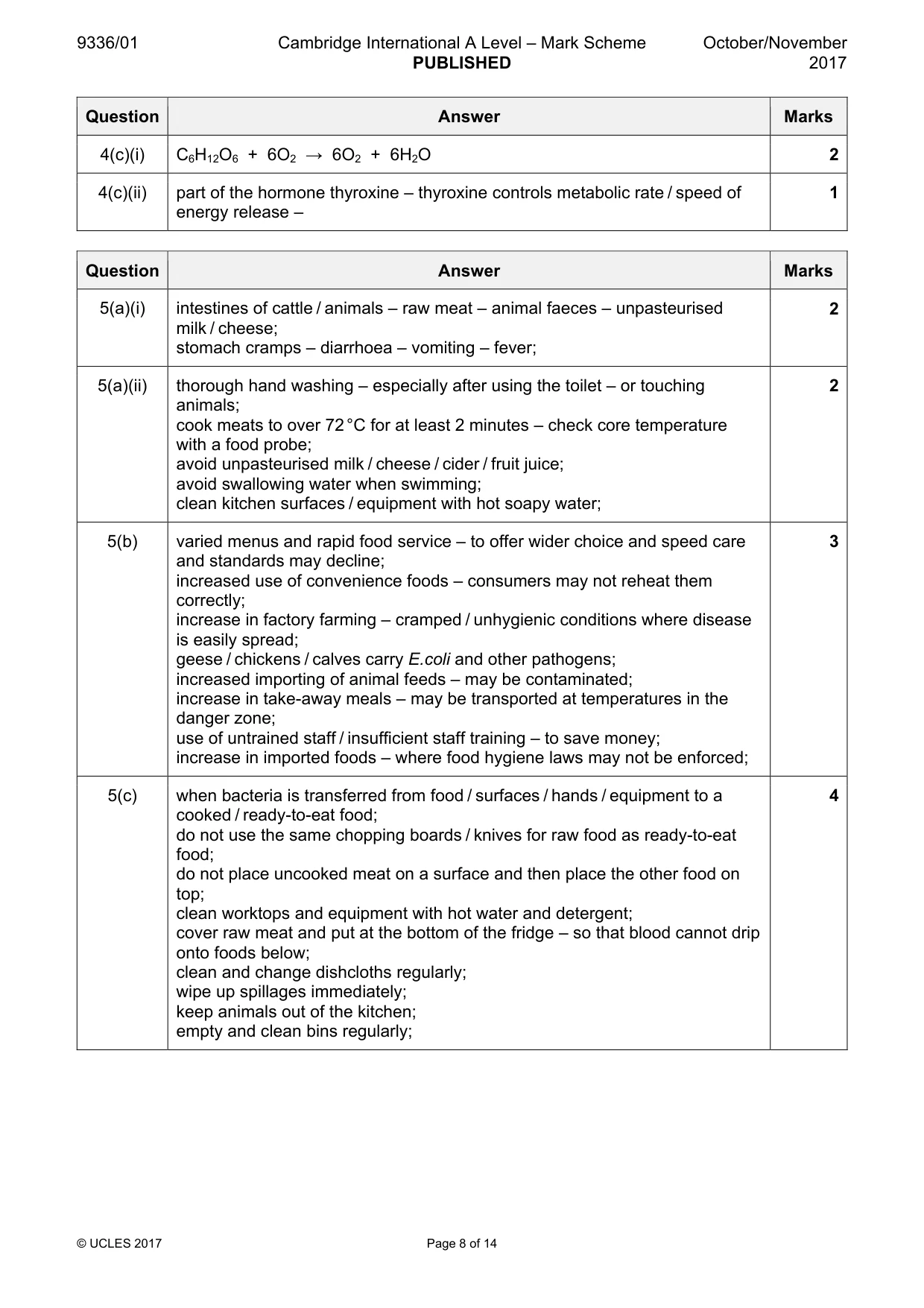
9336/01 Cambridge International A Level – Mark Scheme PUBLISHED October/November 2017 © UCLES 2017 Page 8 of 14 Question Answer Marks 4(c)(i) C6H12O6 + 6O2 → 6O2 + 6H2O 2 4(c)(ii) part of the hormone thyroxine – thyroxine controls metabolic rate / speed of energy release – 1 Question Answer Marks 5(a)(i) intestines of cattle / animals – raw meat – animal faeces – unpasteurised milk / cheese; stomach cramps – diarrhoea – vomiting – fever; 2 5(a)(ii) thorough hand washing – especially after using the toilet – or touching animals; cook meats to over 72 °C for at least 2 minutes – check core temperature with a food probe; avoid unpasteurised milk / cheese / cider / fruit juice; avoid swallowing water when swimming; clean kitchen surfaces / equipment with hot soapy water; 2 5(b) varied menus and rapid food service – to offer wider choice and speed care and standards may decline; increased use of convenience foods – consumers may not reheat them correctly; increase in factory farming – cramped / unhygienic conditions where disease is easily spread; geese / chickens / calves carry E.coli and other pathogens; increased importing of animal feeds – may be contaminated; increase in take-away meals – may be transported at temperatures in the danger zone; use of untrained staff / insufficient staff training – to save money; increase in imported foods – where food hygiene laws may not be enforced; 3 5(c) when bacteria is transferred from food / surfaces / hands / equipment to a cooked / ready-to-eat food; do not use the same chopping boards / knives for raw food as ready-to-eat food; do not place uncooked meat on a surface and then place the other food on top; clean worktops and equipment with hot water and detergent; cover raw meat and put at the bottom of the fridge – so that blood cannot drip onto foods below; clean and change dishcloths regularly; wipe up spillages immediately; keep animals out of the kitchen; empty and clean bins regularly; 4
Mark scheme, page 9
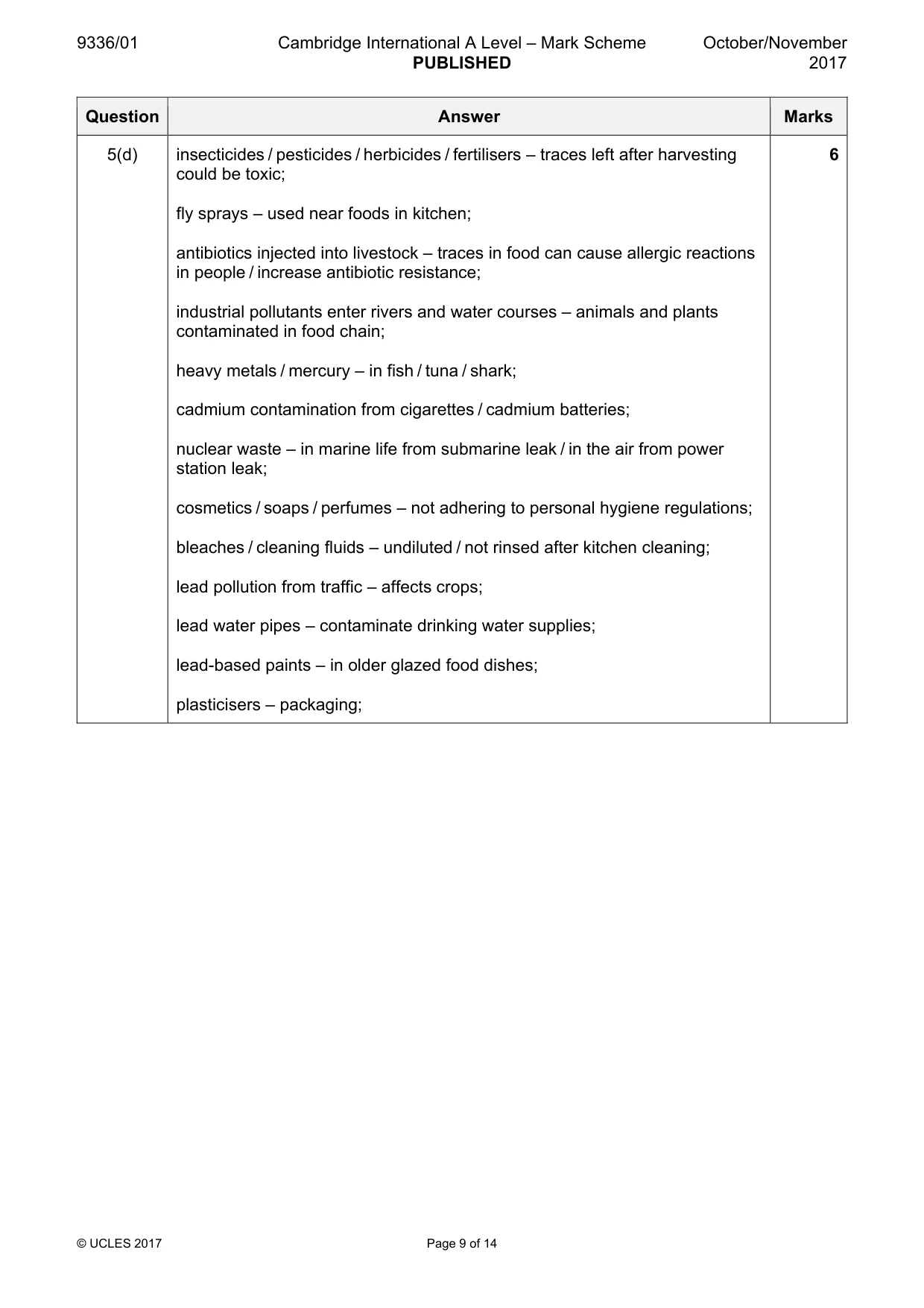
9336/01 Cambridge International A Level – Mark Scheme PUBLISHED October/November 2017 © UCLES 2017 Page 9 of 14 Question Answer Marks 5(d) insecticides / pesticides / herbicides / fertilisers – traces left after harvesting could be toxic; fly sprays – used near foods in kitchen; antibiotics injected into livestock – traces in food can cause allergic reactions in people / increase antibiotic resistance; industrial pollutants enter rivers and water courses – animals and plants contaminated in food chain; heavy metals / mercury – in fish / tuna / shark; cadmium contamination from cigarettes / cadmium batteries; nuclear waste – in marine life from submarine leak / in the air from power station leak; cosmetics / soaps / perfumes – not adhering to personal hygiene regulations; bleaches / cleaning fluids – undiluted / not rinsed after kitchen cleaning; lead pollution from traffic – affects crops; lead water pipes – contaminate drinking water supplies; lead-based paints – in older glazed food dishes; plasticisers – packaging; 6
Mark scheme, page 10
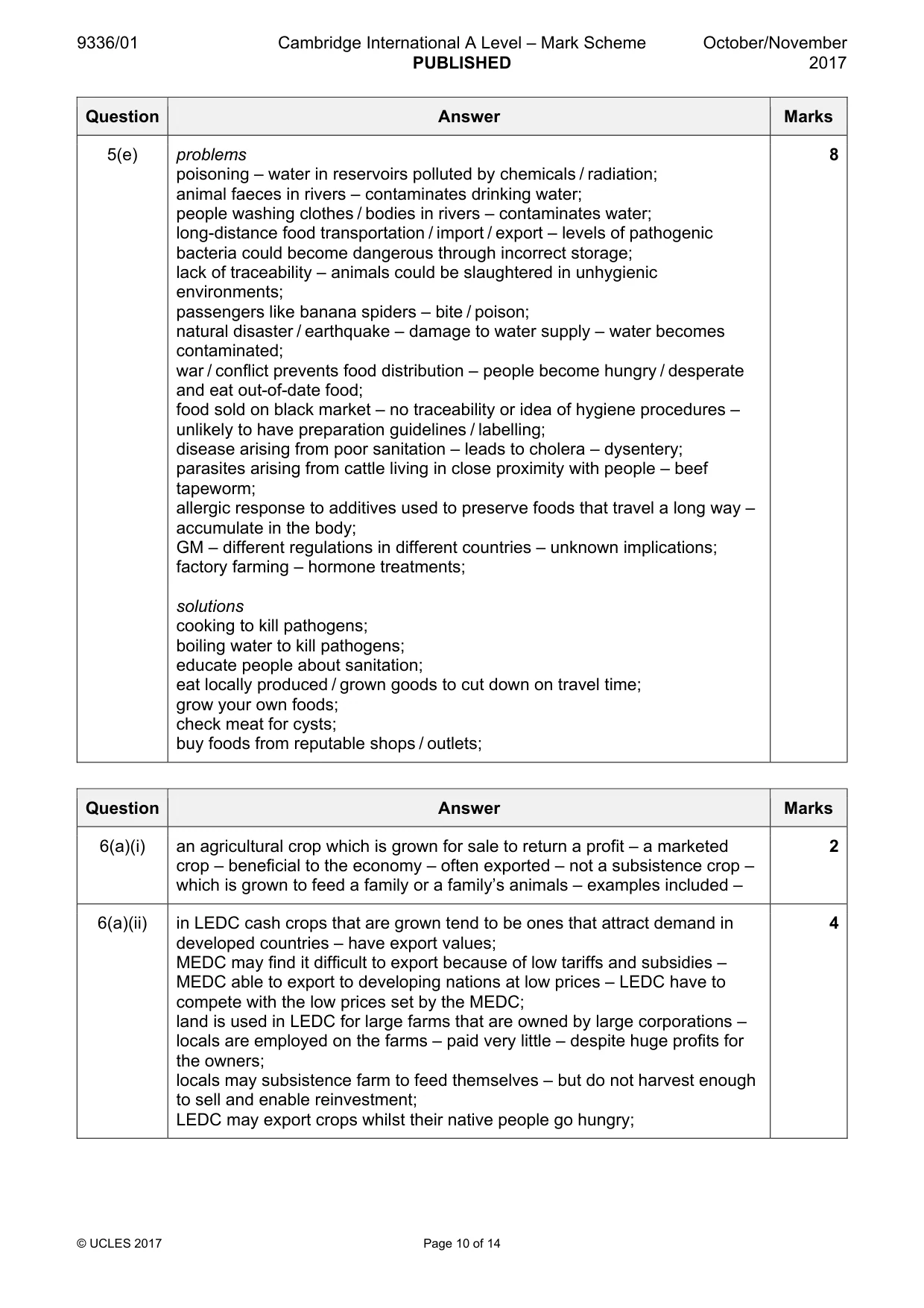
9336/01 Cambridge International A Level – Mark Scheme PUBLISHED October/November 2017 © UCLES 2017 Page 10 of 14 Question Answer Marks 5(e) problems poisoning – water in reservoirs polluted by chemicals / radiation; animal faeces in rivers – contaminates drinking water; people washing clothes / bodies in rivers – contaminates water; long-distance food transportation / import / export – levels of pathogenic bacteria could become dangerous through incorrect storage; lack of traceability – animals could be slaughtered in unhygienic environments; passengers like banana spiders – bite / poison; natural disaster / earthquake – damage to water supply – water becomes contaminated; war / conflict prevents food distribution – people become hungry / desperate and eat out-of-date food; food sold on black market – no traceability or idea of hygiene procedures – unlikely to have preparation guidelines / labelling; disease arising from poor sanitation – leads to cholera – dysentery; parasites arising from cattle living in close proximity with people – beef tapeworm; allergic response to additives used to preserve foods that travel a long way – accumulate in the body; GM – different regulations in different countries – unknown implications; factory farming – hormone treatments; solutions cooking to kill pathogens; boiling water to kill pathogens; educate people about sanitation; eat locally produced / grown goods to cut down on travel time; grow your own foods; check meat for cysts; buy foods from reputable shops / outlets; 8 Question Answer Marks 6(a)(i) an agricultural crop which is grown for sale to return a profit – a marketed crop – beneficial to the economy – often exported – not a subsistence crop – which is grown to feed a family or a family’s animals – examples included – 2 6(a)(ii) in LEDC cash crops that are grown tend to be ones that attract demand in developed countries – have export values; MEDC may find it difficult to export because of low tariffs and subsidies – MEDC able to export to developing nations at low prices – LEDC have to compete with the low prices set by the MEDC; land is used in LEDC for large farms that are owned by large corporations – locals are employed on the farms – paid very little – despite huge profits for the owners; locals may subsistence farm to feed themselves – but do not harvest enough to sell and enable reinvestment; LEDC may export crops whilst their native people go hungry; 4
Mark scheme, page 11
9336/01 Cambridge International A Level – Mark Scheme PUBLISHED October/November 2017 © UCLES 2017 Page 11 of 14 Question Answer Marks 6(b) loss of local stores / butchers / grocers / bakeries – effect on local economy; food miles – imported goods; fair trade produce versus non-fair trade – consideration of ethics of supply; packaging – increased quantities to aid distribution of imports – increased litter – increased need for tree felling for paperboard; pricing strategies – BOGOF – low prices on unhealthy foods like crisps / alcohol / frozen pizzas – high prices on fresh fruit and vegetables; free-range versus intensively farmed – cost to consumer; organic – higher prices; farm assured – improvement here in transparency and identification of quality – change of origin of produce; seasonality – importing products to have availability all year round; trawled fish – capture unwanted species – not returned to the sea; 10 6(c) eggs – in soft, cup shaped cartons – to avoid cracking the shell – not above 20 °C; live animals – safely secured – not overcrowded – not long journeys; refrigerated products – refrigerated lorries – 1–5 °C; frozen products – freezer compartments in lorries – ⩽–18 °C; hot meals – in a vehicle containing a hot holding unit – temperature above 65 °C; crushable products / biscuits – closely packed – to avoid movement – in secondary packaging boxes; fruits – in cool but not cold conditions – to avoid ripening – yeast growth – fermentation; milk – in refrigerated tankers; bubble wrap / foam / polystyrene – for wrapping – will absorb impact if items are dropped / squashed; wooden crates – are stackable – allows air to circulate around fruit; 4 6(d) read the instruction manual; receive training in the use of the food processor; plug in the machine with dry hands; check that the flex is not worn / frayed / exposed; ensure the unit is PAT tested annually; ensure that the unit is clean before use; do not overfill the bowl; ensure that the lid is fitted into position correctly; do not insert anything other than food into the tube opening when in operation; handle the blade carefully when fitting / washing / removing; do not wash the electrical unit; 3 6(e) triangular positioning of sink, hob and fridge – to make the working space efficient / logical – to eliminate extra movement / waste of personal energy – to facilitate the sequence of food storage to food preparation, to cooking, to serving, to clearing up – 2
Mark scheme, page 12
9336/01 Cambridge International A Level – Mark Scheme PUBLISHED October/November 2017 © UCLES 2017 Page 12 of 14 Question Answer Marks 7(a)(i) recipe (or equivalent proportions) 200 g plain flour / strong plain flour – 75 g yellow fat / margarine / butter – 75 g white fat / lard – water (enough to form a dough) – pinch of salt – lemon juice – method sieve flour and salt – rub half white fat into flour – add water to form a dough – roll out to a rectangle – mix remainder of white fat and yellow fat together – dot third of the fat over two-thirds of the rectangle – fold fatless third over middle third and fold final third on top – seal edges with rolling pin – chill for 10 minutes – rotate 90° – repeat dotting of fat, folding, chilling and turning with half of remaining fat – repeat once more with remaining fat – roll and fold once more and chill for 30 minutes – 5 7(a)(ii) fat – coats and separate flour particles – lard has a higher melting point – melts during baking – leaving large air spaces – creating a flaky texture – butter / margarine adds colour and flavour; strong plain flour – develops strands of gluten – to give elastic structure that stretches and rises; lemon juice – develops gluten – improves whiteness of pastry; salt – enhances flavours – strengthens gluten; water – helps to form a dough – too much water will develop too much gluten – giving a tough pastry – water evaporates when heated – creates steam to raise the layers of pastry; 5 7(b)(i) conduction – particles in the metal of the baking tray vibrate rapidly when heated – neighbouring particles also vibrate and heat is transferred through the tray to the food – rate of conduction is faster in metals than other materials – convection – heat moves from a high temperature to a lower one – until a constant temperature is achieved – occurs in liquids and gases – hot gas expands and rises – cooler gas takes its place – cooler gas heats up – expands and rises – convection current established – 5
Mark scheme, page 13
9336/01 Cambridge International A Level – Mark Scheme PUBLISHED October/November 2017 © UCLES 2017 Page 13 of 14 Question Answer Marks 7(b)(ii) safely ensure gas or electricity supply is not faulty – training – read the manual – ensure gas is ignited – wear oven gloves – close the door – efficiently preheat – adjust tray heights before preheating – ensure trays / dishes fit in at the same time as each other – use fan assist if available – set timer – ensure door closes firmly – avoid opening the door – leads to increased cooking time – loss of heat energy – economically cut food into small pieces – use all available space whilst oven is on – freeze food for later – use small top oven if available – set at correct temperature – turn off immediately after use – preheat shortly before use – to save energy – 6 7(b)(iii) 200–220 °C 1 7(c) used in cake mixture / scones – stabiliser in meringue – to give a creamy texture – increase volume of beaten egg whites – acidic component – of baking powder – combines with sodium bicarbonate and liquid – to produce carbon dioxide – a raising agent – 3 Question Answer Marks 8(a) made of many β glucose molecules connected together at carbon atoms 1 and 4 along the polymer chain; large chains of β glucose molecules lying in parallel are connected by hydrogen bonds; insoluble in water; humans do not have the enzyme needed to rupture the β-1–4 links between the glucose units; suitable correct diagram; 3 8(b)(i) apples – plums – damsons – blackcurrants – cranberries – quince – unripe cherries – elderberry – 1 8(b)(ii) pectin 1 8(b)(iii) used to set jams – by forming a gel in water – that sets on cooling – boiling fruit and sugar together – releases pectin from the fruit – it forms a three-dimensional network with the water, sugar and starch molecules in the fruit – 2
Mark scheme, page 14
9336/01 Cambridge International A Level – Mark Scheme PUBLISHED October/November 2017 © UCLES 2017 Page 14 of 14 Question Answer Marks 8(c) too much non-starch polysaccharide vegetarians unable to eat meat proteins – meat proteins are filling – and provide HBV – large amounts of bulky – high fibre foods eaten to provide protein in complementation – baked beans on wholemeal toast / lentil soup with wholemeal bread – problems feel full very quickly – build up of gas – stomach ache – diarrhoea – decreased transit time – poor absorption of nutrients – large intake of phytic acid – binds to calcium and prevents absorption – 4 8(d) mycoprotein Fusarium venenatum – grown in a large sterilised fermenter – filled with pasteurised water and glucose – in carefully regulated conditions; micronutrients are added – potassium, magnesium and phosphate; protein solids are synthesised by the fungi – from waste carbohydrate by-products; protein solids are harvested every few hours and pumped into a centrifuge – liquid is separated off – protein is heated – then chilled; albumin and flavourings are mixed with protein dough; protein dough is steamed for 30 minutes, chilled, chopped and minced; protein dough is frozen – pushing protein fibres together – to give meat-like texture; 6 8(e) low in saturated fat – 0.5 g / 100 g – low in LDL cholesterol – low sugar – 0.6 g / 100 g – low salt – 0.3 g / 100 g – high in NSP – 5.5 g / 100 g – high in HBV protein – 14.5 g / 100 g – contains iron, zinc, calcium, potassium and phosphorous – 3 8(f) silicon dioxide: anti caking agent / antifoaming agent; smoke flavouring: artificial flavouring; gum arabic: bulking agent / thickener / increase viscosity; citric acid: acidity regulator / antioxidant; potassium chloride: flavour enhancer – to bring out / enhance the flavours of the ingredients; ammonium bicarbonate: acidity regulator / raising agent; tricalcium phosphate: anticaking agent / humectant / acidity regulator; 5
What you needed in this session
Cambridge’s own grade thresholds for 2017 Oct/Nov, Paper 1 · Variant 1. A higher threshold means an easier paper — the bar moves with how the cohort did.