Cambridge A Level Food Studies 9336 — 2013 Oct/Nov Paper 1 · Variant 1
9336/11/O/N/13 · 100 marks · ≈113 min
The question paper and its mark scheme, free to read here and free to download. This is Cambridge’s own paper, exactly as it was sat.
Question paper4 pages
Mark scheme18 pages
Answers below. Sit the paper first if you are practising.
Paper as text
Question paper, page 1
This document consists of 4 printed pages. DC (AC) 58617/1 © UCLES 2013 [Turn over UNIVERSITY OF CAMBRIDGE INTERNATIONAL EXAMINATIONS General Certificate of Education Advanced Level READ THESE INSTRUCTIONS FIRST If you have been given an Answer Booklet, follow the instructions on the front cover of the Booklet. Write your Centre number, candidate number and name on all the work you hand in. Write in dark blue or black pen. You may use a soft pencil for any diagrams, graphs or rough working. Do not use staples, paper clips, highlighters, glue or correction fluid. Answer four questions, two from Section A and two from Section B. Write your answers on the separate Answer Booklet/Paper provided. You are reminded of the need for good English and clear presentation in your answers. At the end of the examination, fasten all your work securely together. The number of marks is given in brackets [ ] at the end of each question or part question. * 7 4 3 6 0 3 4 2 9 0 * FOOD STUDIES 9336/01 Paper 1 October/November 2013 3 hours Additional Materials: Answer Booklet/Paper
Question paper, page 2
2 9336/01/O/N/13 © UCLES 2013 Section A Answer two questions. 1 Many people suffer from deficiency diseases at some stage of their life. Discuss the causes, symptoms and remedies for the following deficiency diseases: (a) anaemia; [5] (b) osteoporosis; [5] (c) goitre; [5] (d) night-blindness; [5] (e) scurvy. [5] 2 Discuss: (a) the digestion of food in the small intestine; [12] (b) the absorption of nutrients in the ileum. [13] 3 Fats and oils have different characteristics and have many different uses in the preparation of dishes. (a) Discuss this statement, illustrating your answer with named examples of fats and oils. [10] (b) Explain the following terms relating to fats and oils: (i) rancidity; [3] (ii) smoke point; [3] (iii) hydrogenation. [3] (c) Current nutritional advice is to reduce the amount of fat in the diet. Give reasons for this advice. [6] 4 (a) Describe the primary and secondary structure of protein. [6] (b) Proteins can be classified as globular or fibrous. Discuss the characteristics and properties of each type, illustrating your answer with named examples. [7] (c) Explain, with examples, the effects of the following on protein: (i) heat; (ii) agitation; (iii) acids. [8] (d) Define deamination and discuss its importance in nutrition. [4] [Section A Total: 50 marks]
Question paper, page 3
3 © UCLES 2013 9336/01/O/N/13 [Turn over Section B Answer two questions. 5 (a) Discuss factors which influence the choice of food for individuals in your area. [15] (b) State your understanding of the term Recommended Daily Intake (RDI) and discuss its importance to the individual. [3] (c) Nutritional information, although not a legal requirement, can be found on many food packages. Discuss the importance of this information to the consumer. [7] 6 (a) Identify different reasons for including sauces when planning and preparing meals. Give examples to illustrate your answer. [6] (b) Describe and explain the following processes which may occur when making sauces: (i) gelatinisation; [5] (ii) emulsification; [5] (iii) coagulation. [5] (c) Explain the term syneresis and give examples to support your answer. [4] 7 (a) Discuss factors which may make food dangerous to consume. [10] (b) Many outbreaks of food poisoning can be traced to poor preparation, cooking and storage of chicken. Explain why it is important to: (i) thaw frozen chicken completely before cooking; (ii) cook chicken thoroughly; (iii) serve immediately. [10] (c) Freezing is a popular method of preserving food. (i) Explain the principles of deep freezing. (ii) Give advice on the use of a domestic freezer. [5]
Question paper, page 4
4 9336/01/O/N/13 © UCLES 2013 Permission to reproduce items where third-party owned material protected by copyright is included has been sought and cleared where possible. Every reasonable effort has been made by the publisher (UCLES) to trace copyright holders, but if any items requiring clearance have unwittingly been included, the publisher will be pleased to make amends at the earliest possible opportunity. University of Cambridge International Examinations is part of the Cambridge Assessment Group. Cambridge Assessment is the brand name of University of Cambridge Local Examinations Syndicate (UCLES), which is itself a department of the University of Cambridge. 8 Milk is often referred to as a perfect food. (a) Identify the nutrients in milk and explain the importance of each nutrient for the development of babies. [12] (b) Discuss problems associated with a diet which consists only of milk. [6] (c) Consider the advantages and disadvantages of breast-feeding and bottle-feeding using formula milk. [7] [Section B Total: 50 marks] [Total for Paper: 100 marks]
Mark scheme, page 1
CAMBRIDGE INTERNATIONAL EXAMINATIONS GCE Advanced Level MARK SCHEME for the October/November 2013 series 9336 FOOD STUDIES 9336/01 Paper 1 (Theory), maximum raw mark 100 This mark scheme is published as an aid to teachers and candidates, to indicate the requirements of the examination. It shows the basis on which Examiners were instructed to award marks. It does not indicate the details of the discussions that took place at an Examiners’ meeting before marking began, which would have considered the acceptability of alternative answers. Mark schemes should be read in conjunction with the question paper and the Principal Examiner Report for Teachers. Cambridge will not enter into discussions about these mark schemes. Cambridge is publishing the mark schemes for the October/November 2013 series for most IGCSE, GCE Advanced Level and Advanced Subsidiary Level components and some Ordinary Level components.
Mark scheme, page 2
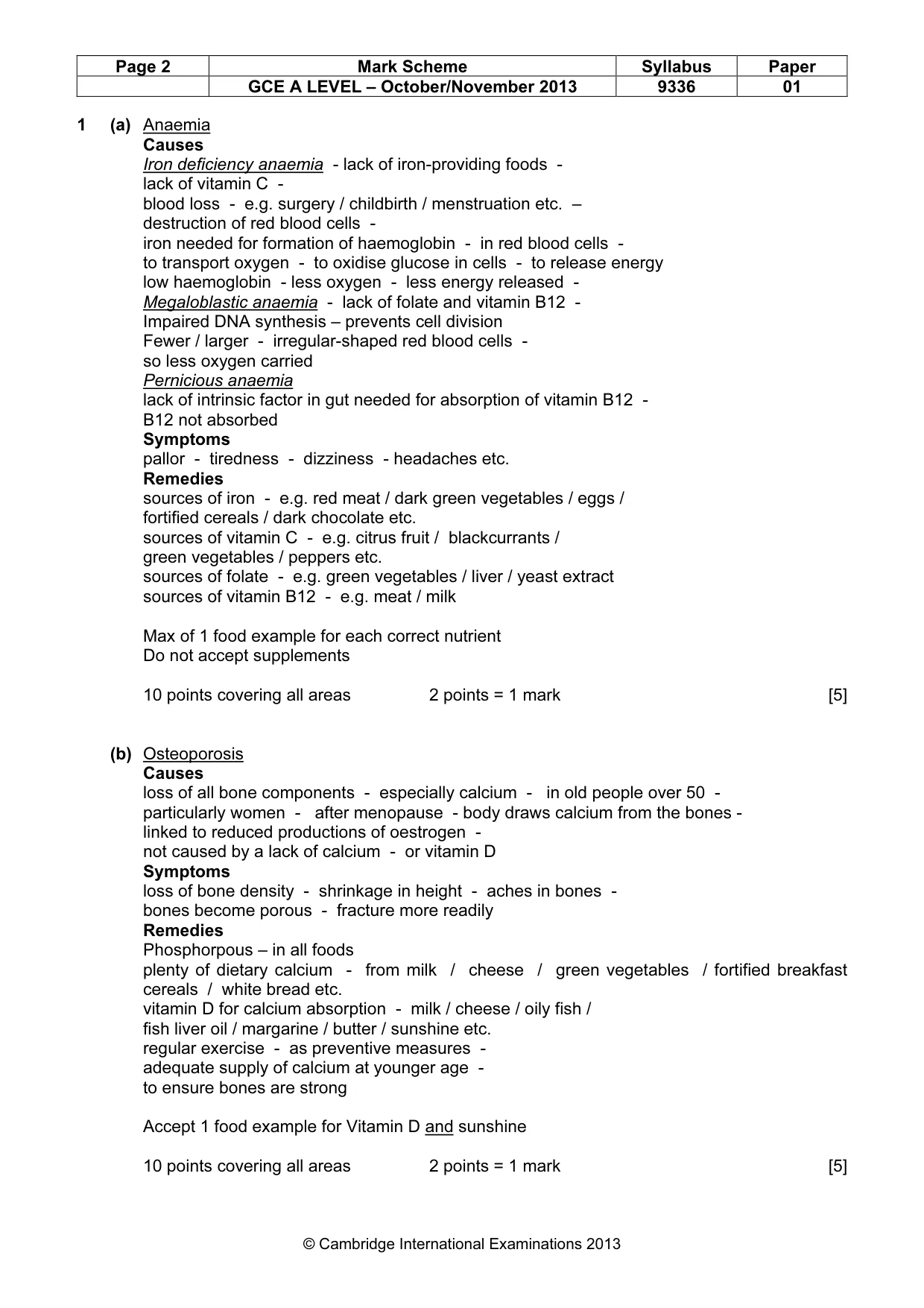
Page 2 Mark Scheme Syllabus Paper GCE A LEVEL – October/November 2013 9336 01 © Cambridge International Examinations 2013 1 (a) Anaemia Causes Iron deficiency anaemia - lack of iron-providing foods - lack of vitamin C - blood loss - e.g. surgery / childbirth / menstruation etc. – destruction of red blood cells - iron needed for formation of haemoglobin - in red blood cells - to transport oxygen - to oxidise glucose in cells - to release energy low haemoglobin - less oxygen - less energy released - Megaloblastic anaemia - lack of folate and vitamin B12 - Impaired DNA synthesis – prevents cell division Fewer / larger - irregular-shaped red blood cells - so less oxygen carried Pernicious anaemia lack of intrinsic factor in gut needed for absorption of vitamin B12 - B12 not absorbed Symptoms pallor - tiredness - dizziness - headaches etc. Remedies sources of iron - e.g. red meat / dark green vegetables / eggs / fortified cereals / dark chocolate etc. sources of vitamin C - e.g. citrus fruit / blackcurrants / green vegetables / peppers etc. sources of folate - e.g. green vegetables / liver / yeast extract sources of vitamin B12 - e.g. meat / milk Max of 1 food example for each correct nutrient Do not accept supplements 10 points covering all areas 2 points = 1 mark [5] (b) Osteoporosis Causes loss of all bone components - especially calcium - in old people over 50 - particularly women - after menopause - body draws calcium from the bones - linked to reduced productions of oestrogen - not caused by a lack of calcium - or vitamin D Symptoms loss of bone density - shrinkage in height - aches in bones - bones become porous - fracture more readily Remedies Phosphorpous – in all foods plenty of dietary calcium - from milk / cheese / green vegetables / fortified breakfast cereals / white bread etc. vitamin D for calcium absorption - milk / cheese / oily fish / fish liver oil / margarine / butter / sunshine etc. regular exercise - as preventive measures - adequate supply of calcium at younger age - to ensure bones are strong Accept 1 food example for Vitamin D and sunshine 10 points covering all areas 2 points = 1 mark [5]
Mark scheme, page 3
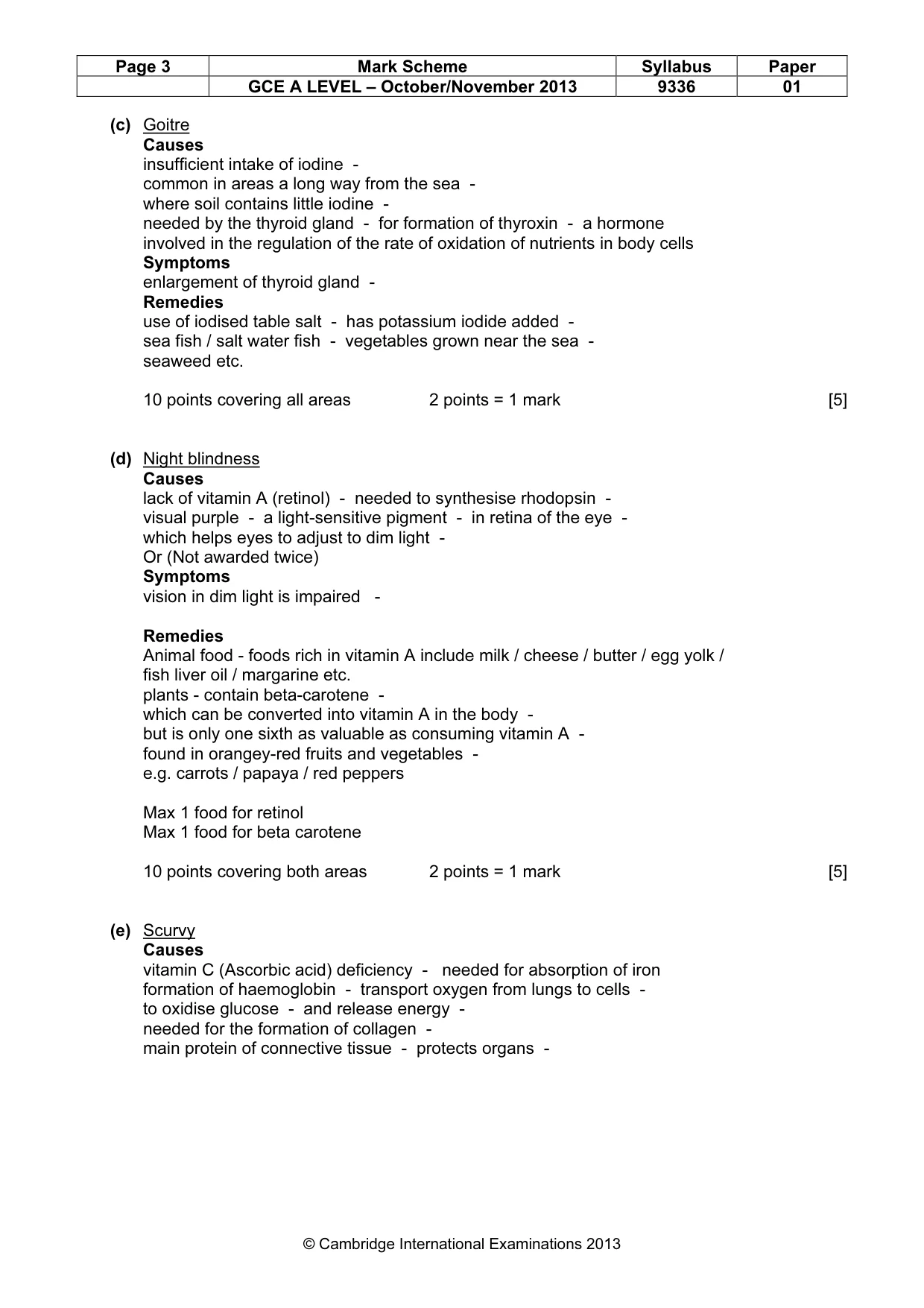
Page 3 Mark Scheme Syllabus Paper GCE A LEVEL – October/November 2013 9336 01 © Cambridge International Examinations 2013 (c) Goitre Causes insufficient intake of iodine - common in areas a long way from the sea - where soil contains little iodine - needed by the thyroid gland - for formation of thyroxin - a hormone involved in the regulation of the rate of oxidation of nutrients in body cells Symptoms enlargement of thyroid gland - Remedies use of iodised table salt - has potassium iodide added - sea fish / salt water fish - vegetables grown near the sea - seaweed etc. 10 points covering all areas 2 points = 1 mark [5] (d) Night blindness Causes lack of vitamin A (retinol) - needed to synthesise rhodopsin - visual purple - a light-sensitive pigment - in retina of the eye - which helps eyes to adjust to dim light - Or (Not awarded twice) Symptoms vision in dim light is impaired - Remedies Animal food - foods rich in vitamin A include milk / cheese / butter / egg yolk / fish liver oil / margarine etc. plants - contain beta-carotene - which can be converted into vitamin A in the body - but is only one sixth as valuable as consuming vitamin A - found in orangey-red fruits and vegetables - e.g. carrots / papaya / red peppers Max 1 food for retinol Max 1 food for beta carotene 10 points covering both areas 2 points = 1 mark [5] (e) Scurvy Causes vitamin C (Ascorbic acid) deficiency - needed for absorption of iron formation of haemoglobin - transport oxygen from lungs to cells - to oxidise glucose - and release energy - needed for the formation of collagen - main protein of connective tissue - protects organs -
Mark scheme, page 4
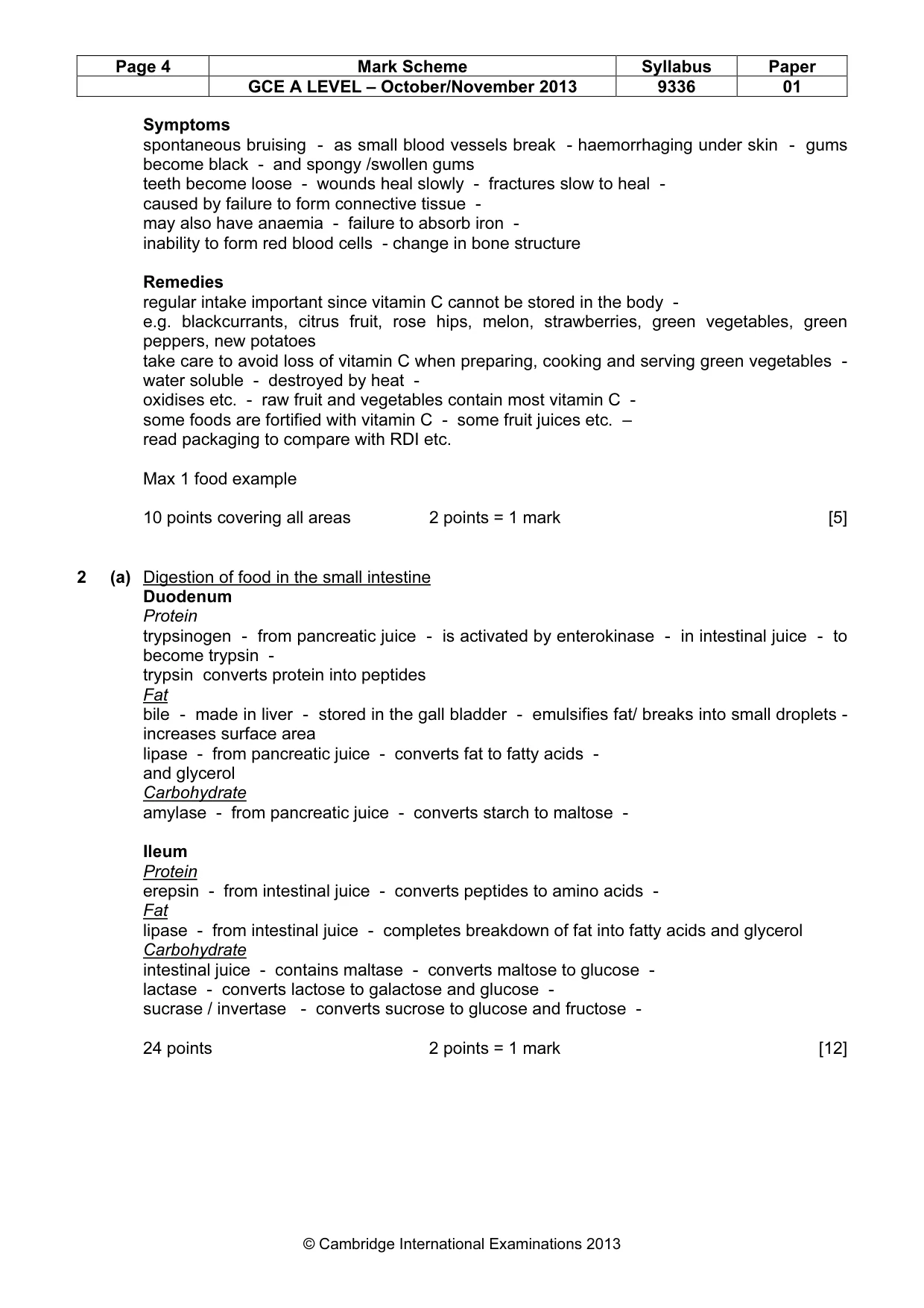
Page 4 Mark Scheme Syllabus Paper GCE A LEVEL – October/November 2013 9336 01 © Cambridge International Examinations 2013 Symptoms spontaneous bruising - as small blood vessels break - haemorrhaging under skin - gums become black - and spongy /swollen gums teeth become loose - wounds heal slowly - fractures slow to heal - caused by failure to form connective tissue - may also have anaemia - failure to absorb iron - inability to form red blood cells - change in bone structure Remedies regular intake important since vitamin C cannot be stored in the body - e.g. blackcurrants, citrus fruit, rose hips, melon, strawberries, green vegetables, green peppers, new potatoes take care to avoid loss of vitamin C when preparing, cooking and serving green vegetables - water soluble - destroyed by heat - oxidises etc. - raw fruit and vegetables contain most vitamin C - some foods are fortified with vitamin C - some fruit juices etc. – read packaging to compare with RDI etc. Max 1 food example 10 points covering all areas 2 points = 1 mark [5] 2 (a) Digestion of food in the small intestine Duodenum Protein trypsinogen - from pancreatic juice - is activated by enterokinase - in intestinal juice - to become trypsin - trypsin converts protein into peptides Fat bile - made in liver - stored in the gall bladder - emulsifies fat/ breaks into small droplets - increases surface area lipase - from pancreatic juice - converts fat to fatty acids - and glycerol Carbohydrate amylase - from pancreatic juice - converts starch to maltose - Ileum Protein erepsin - from intestinal juice - converts peptides to amino acids - Fat lipase - from intestinal juice - completes breakdown of fat into fatty acids and glycerol Carbohydrate intestinal juice - contains maltase - converts maltose to glucose - lactase - converts lactose to galactose and glucose - sucrase / invertase - converts sucrose to glucose and fructose - 24 points 2 points = 1 mark [12]
Mark scheme, page 5
Page 5 Mark Scheme Syllabus Paper GCE A LEVEL – October/November 2013 9336 01 © Cambridge International Examinations 2013 (b) Absorption of nutrients in the ileum Protein amino acids absorbed through microvilli - by active transport - into blood capillaries - of villi - then to liver - via hepatic portal vein Fat glycerol and fatty acids - reform into fats - in walls of villi - pass into lacteal - then into lymphatic system - by diffusion - and active transport - now called chylomicrons Carbohydrate villi - finger-like projections - increase surface area of ileum - (can show on a diagram) - well supplied with blood capillaries - monosaccharides (glucose, galactose, fructose) absorbed directly into bloodstream - pass to liver - via hepatic portal vein Minerals only about one third of calcium is absorbed - remainder is lost from the body in faeces - vitamin D aids absorption otherwise little would be absorbed - lactose increases absorption - phytic acid - and oxalic acid - react with calcium - preventing absorption only about 5%-20% iron is absorbed - depends on the body’s need for iron - depends on the form of iron - haem iron - ferrous - more easily absorbed - non-haem iron - ferric - can be reduced to ferrous - by vitamin C - so aids iron absorption - phytic acid - oxalic acid - and tannin - reduce iron absorption Vitamins vitamin A and vitamin D are fat soluble - absorbed with fat N.B. Avoid crediting some information more than once e.g. villi - liver - hepatic portal vein etc. 26 points 2 points = 1 mark [13]
Mark scheme, page 6
Page 6 Mark Scheme Syllabus Paper GCE A LEVEL – October/November 2013 9336 01 © Cambridge International Examinations 2013 3 (a) Characteristics of fats and oils and uses in preparation of dishes Characteristics fats are esters - result of reaction between acids and alcohol - 3 hydroxyl groups of the glycerol molecule can each combine with a fatty acid molecule to give a triglyceride - a type of ester - each molecule could have more than one type of fatty acid - glycerol common to all difference between fats and oils due to different fatty acids in composition - saturated fatty acids - all carbon molecules saturated with hydrogen - hard - all c-c bonds within molecule are single - monounsaturated - one double bond between adjacent carbon atoms - can take up more hydrogen - soft fat - polyunsaturated - more than one double bond between adjacent carbon atoms can take up more hydrogen - saturated fats usually from animals - polyunsaturated usually from plants fish oils are unsaturated - double bonds are a point of weakness - can readily be broken by a range of substances - Max 4 for correct diagrams cis fatty acids - hydrogen atoms on same side of double bond - trans fatty acids - hydrogen atoms diagonally opposite each other at double bond - DO NOT CREDIT in (a) and (b) (could give some of this information in a diagram) fats melt over a range of temperatures - depending on fatty acids - as temperature rises some fatty acids will melt - others remain solid - this allows solid triglycerides to move within the fat - fat is spreadable - softer fats spread more readily - shape changes with pressure - plasticity of fat affects creaming and shortening properties - pure fats such as lard have more shortening power than butter or margarine - because they contain water - creaming power of a fat is measured by its capacity to incorporate air bubbles a fat with a wide plastic range is best for creaming - hydrogenated vegetable fats are better than butter - butter has a narrow plastic range - fats and oils have different smoke points - high smoke point for frying - otherwise food will absorb fat or oil - different fatty acids have different flavours - affect acceptability - oils hydrogenated to form fats - process can be halted at varying stages - to give desired hardness for intended use etc. last points should not be credited in section (a) and (b) Uses spreading - flavouring - forming an emulsion - shortening - aeration - frying - adding colour - improving keeping quality - emulsifies with moisture - to retain moisture - e.g. in rich cakes 1 use + 1 fat example = 1 mark increasing calorific value without adding bulk - e.g. fried foods etc. sealing - melted butter on pate sets on cooling - prevents surface drying - lubrication - prevents food sticking to cake tins etc. - makes food easier to eat - e.g. butter on bread compared with dry bread etc. Max 5 for characteristics Max 5 for uses of fat 20 points 2 points = 1 mark [10]
Mark scheme, page 7
Page 7 Mark Scheme Syllabus Paper GCE A LEVEL – October/November 2013 9336 01 © Cambridge International Examinations 2013 (b) (i) Rancidity refers to the spoilage of fats and oils - hard fats are resistant to oxidative rancidity - contain fewer double bonds - fish oils are highly unsaturated - more susceptible to this type of rancidity - give unpleasant odour - and flavour - caused by formation of aldehydes and ketones - accelerated by heat - light - traces of metals e.g. copper, iron - oxidative rancidity produces free radicals - anti-oxidants absorb oxygen - prevent formation of free radicals - e.g. vitamins A, C and E - enzymes / lipase hydrolyses fats - breaking them down to glycerol and fatty acids unpleasant taste of rancid butter due to the fatty acid butyric acid - can be reduced by storing in a cool, dark place - non-metal container well wrapped 6 points 2 points = 1 mark [3] (ii) Smoke point the point at which a fat or oil begins to decompose - because the temperature is too high - depends on the percentage of free glycerol within the fat - or the ease with which fats are hydrolised to release glycerol - irreversible - smoke point will affect choice of fat for deep frying - deep frying needs a fat or oil with a higher smoke point - heating above smoke point causes fats and oils to ignite - flavour and smell affected - bitter flavour - acrid smell - acrolin - free fatty acids reduce the temperature of the smoke point breakdown of glycerol leads to acrolein - irreversible 6 points 2 points = 1 mark [3] (iii) Hydrogenation process by which oils are converted into fats - vegetable oils are more readily available in some countries - unsaturated fats become saturated - degree of hydrogenation can be controlled - nickel catalyst - can be trans fatty acids - hydrogen atoms opposite at double bond or cis fatty acids - hydrogen atoms on same side of double bond research has shown that trans fatty acids are more unhealthy - association with cholesterol - and CHD to give fats with different degrees of hardness by addition of hydrogen - across a double bond - use in the manufacture of margarine and cooking fats do not credit same pts as in a e.g. trans and cis fatty acids 6 points 2 points = 1 mark [3]
Mark scheme, page 8
Page 8 Mark Scheme Syllabus Paper GCE A LEVEL – October/November 2013 9336 01 © Cambridge International Examinations 2013 (c) Reasons for reducing fat in the diet high fat intake may cause obesity - caused by accumulation of fat - classified as obese if more than 1/3 of body weight is fat - by overeating /more calories than required - excess fat is stored - under skin/as adipose tissue - and around internal organs - usually less active - so calories not burnt off - more weight gain - puts strain on the heart - coronary heart disease - strokes - hypertension - poor blood circulation - when arteries are narrowed - more difficult for blood to flow - may damage artery walls - breathing difficulties low self-esteem - problems during surgery - arthritis - additional weight on joints - saturated fat - usually from animals - contains cholesterol - deposited on artery walls - narrows /blocks - leads to heart attack if coronary artery is blocked or stroke if blood vessel in brains is blocked - diabetes mellitus - high level of blood glucose - not enough insulin - produced by pancreas - glucose excreted in urine - may cause damage to nervous system/ eyes/ kidneys/ feet etc. 12 points 2 points = 1 mark [6] 4 (a) Structure of protein Primary Structure protein chain is a sequence of amino-acids amino acids combine through their amino and carboxyl groups known as a peptide bond most basic / simplest protein structure two amino acids (condense to) form a dipeptide - water eliminated – condensation reaction polypeptides formed when many amino acids combine polypeptides are chains of hundreds or thousands of amino acids 22 amino acids in food Linked together in a variety of combinations to make many different protein Secondary Structure primary structure of protein is folded to form an alpha helix/spiral - and beta pleated sheet stability of structure depends on presence of hydrogen bonds Allow diagrams – max 2 12 points covering both areas 2 points = 1 mark [6]
Mark scheme, page 9
Page 9 Mark Scheme Syllabus Paper GCE A LEVEL – October/November 2013 9336 01 © Cambridge International Examinations 2013 (b) Globular and fibrous proteins Globular are bonded or compact shaped molecules - round ball - albumins - e.g. ovalbumin (egg white), lactalbumin, blood plasma soluble in water - and dilute salt solutions - coagulated by heat globulins - e.g. lactoglobulin (milk, egg white, muscle cells, blood plasma) insoluble in water - dissolve in dilute solutions of electrolytes - coagulate on heating- correct ref. to tertiary and quaternary structure Fibrous fibrous molecules - many twisted in helices - can give elasticity or strength others in form of pleated sheets insoluble in water - and dilute solutions of salts collagen - inelastic - high tensile strength - connective tissue - e.g. meat, fish converted to gelatine - by prolonged contact with boiling water - gelatine soluble in water - more susceptible to enzymic digestion elastin - present in elastic tissues - e.g. artery walls (meat), skin, tendons unchanged by heat- correct ref. to tertiary structure 14 points to include named types of protein named examples of types identified structure of globular and fibrous protein reference to solubility, coagulation etc. 2 points = 1 mark [7] Diagrams – max 2 (c) Effects of heat, agitation and acids Heat - denaturation begins at 40 ºC coagulation - begins at approx. 60 ºC - setting - e.g. custards coating - e.g. fish binding - rissoles setting of gluten - e.g. bread - to hold risen structure of baked goods Lactalbumin forms skin on milk Agitation - foam formation - unfolding of globular proteins - to entangle air - causes partial coagulation of protein - whisking of egg white - e.g. meringue whisking of egg and sugar to trap air - e.g. sponge cakes Acid - inactivation of enzymes / denaturation - above optimum pH marinade meat in lemon juice / vinegar / wine - soften protein food preservation - e.g. pickled herring bacteria in milk ferment lactose into lactic acid - pH lowered - milk protein coagulates - forms a curd / curdles Must discuss all 3 for full marks 16 points - at least 3 points from each area 2 points = 1 mark [8]
Mark scheme, page 10
Page 10 Mark Scheme Syllabus Paper GCE A LEVEL – October/November 2013 9336 01 © Cambridge International Examinations 2013 (d) Deamination removal of nitrogen from amino acids / amino group deamination occurs if protein intake is greater than need in liver - produces ammonia – converted to urea leaves body via kidneys - in urine - toxic - deaminated molecules are converted to pyruvic acid - which is oxidised to release energy - or stored as fat - 8 points 2 points = 1 mark [4] 5 (a) Factors affecting food choice Availability of food depends on where people live - type of land - climate - hurricanes - droughts - how they affect the cultivation of particular foods - foods grown locally - land may not favour animal rearing - or growing particular crops - availability of transport to bring foods grown elsewhere - different foods grow / are available in different countries - those in developing countries may have little choice of food - no trade with others - poor countries cannot afford to import foods - depends mainly on staple food - rice / maize etc. – cannot afford agricultural developments therefore little variety - wealthy countries import food - e.g. bananas / coffee / oranges etc. - wealthier countries have developed technologically - new preservation methods - canned / dried etc. - ownership of home freezers - new storing methods - previously unknown - e.g. AFD - creation of new foods -- e.g. TVP - increases availability of convenience foods - more expensive - depends on income - more people work outside the home in developed countries - more disposable income - foods in season - home-grown produce - proximity to local markets - storage facilities - left-over food to use - etc. Culture and religion choose foods liked by families - habits - conditioning - each culture has its own eating patterns - and styles of cooking - may be influenced by availability of low-prices, locally-grown food - e.g. rice in China and India / potatoes in Britain - wheat used for pasta in Italy - and for bread in UK - vegetarian families - children must follow - same attitude towards foods - may not be able to change until old enough to make own food choices - each culture has its own foods - often based on religious beliefs - e.g. cow sacred to Hindus - Jew and Muslims must have animals slaughtered in a particular way - Roman Catholics eat fish on Fridays - some dishes associated with festivals - Christmas cake - Turkey for Thanksgiving in USA - dishes associated with occasions - wedding cake / birthday cake with candles
Mark scheme, page 11
Page 11 Mark Scheme Syllabus Paper GCE A LEVEL – October/November 2013 9336 01 © Cambridge International Examinations 2013 Advertising and packaging choice can be affected by how foods are shown to consumers - television / newspaper adverts - displays in stores - taste-testing - some advertisements appeal to children - sweets / McDonald’s - children more easily persuaded than adults - sweets at till - tempted by free gifts / money off coupons / special offers - to introduce new foods - attracted by colours of packaging - endorsements - health claims - peer pressure - advertising convinces people that they ‘should’ buy certain foods - packaging gives information - what is in package - some may be poor readers - serving suggestions - make food look appealing - may give nutritional information - manufacturers consider their role as educators - some people choose foods with the least packaging - environmental issues - waste of resources - others find packaged foods easier to store - boxes easy to stack - saves time - can be stored as soon as food is brought home protects food from damage - contamination - tampering Physiological and psychological attributes depends how hungry the individual is - time available - appearance - flavour - aroma and texture of food - likes and dislikes - importance for appreciation of food - will repeat if experience is favourable - individual perceptions of food - occasion - entertaining - creating an impression - comfort food - relief from stress, boredom etc. – easy to eat too much in some circumstances - snack foods etc. - Nutritional knowledge and skill food choice may be affected by its nutritional value - knowledge from school /home - may depend on level of education - differs between countries - nutrition may not be taught to everyone in school publicity campaigns in media - to increase awareness - and knowledge - need to know the functions - and dangers of food - sources of nutrients - in order to choose wisely - well-publicised dangers of excess fat / sugar / salt danger of CHD / obesity / hypertension - greater in affluent countries - cheaper sources of HBV protein are just as valuable in diet - milk / cheese / eggs - cheaper cuts of meat can be tenderised - complementary proteins used - cereals / pulses / nuts in same meal - improve quality of HBV protein - skill may depend on teaching in school - or at home - younger people may lack skill - less time spent at home - paid work outside home - more use of processed food - reduces preparation and cooking skills - may avoid certain meat / fish / fruit etc. – may buy convenience foods - e.g. puff pastry or may be skilled at limited dishes - choose foods to make those - lack variety - may cook as a pastime - cake decoration etc. – learn how to choose accordingly - expect success - to avoid waste - if dishes do not turn out well, will not repeat - more costly to buy ready-made food - but know the result to expect - to pay for reliability - - e.g. choux pastry etc.
Mark scheme, page 12
Page 12 Mark Scheme Syllabus Paper GCE A LEVEL – October/November 2013 9336 01 © Cambridge International Examinations 2013 Cost depends on money available to spend on food - need to budget - poorer people must spend a higher proportion of income on food - staple foods cheap - filling - can be basis of meals - local recipes etc. - may be a status symbol for rich people - spend more than they can afford - e.g. smoked salmon / caviar - cost is not related to nutritional value - may depend on supply available - or demand for the food - cheaper foods can have high nutritive value - e.g. milk / cheese / eggs - can choose cheaper sources of HBV - DO NOT CREDIT IF CREDITED ELSEWHERE pulses / cereals etc. - protein complementation - grow own produce - keep chickens for family consumption - use food in season - special offers - buy locally - reduce transport cost - foods in season are usually cheaper - make rather than buy ready-made food - careful use of convenience foods - nutritious diet may need not be expensive - reduce purchase of junk food - judge amount required - to avoid waste - use left-over foods - poor people may receive government help - free school meals /food aid poverty limits choice of food - those with unlimited income may make poor choices - convenience foods often contain a lot of fat - high sugar - high salt - risk of obesity - CHD - hypertension - low in NSP - etc. Half marks for 1-2 sections. Must discuss all sections for full marks 30 points 2 points = 1 mark (credit same point only once) [15] (b) Recommended Daily Intake (RDI) RDI is the estimated intake of nutrients to achieve healthy living. 1 whole mark for this statement The RDI varies between individuals according to their age and activity level. It represents an approximate amount of each nutrient required each day. Can help individuals to assess whether the food eaten is adequate for their daily need. They can compare the nutritional value of the food eaten with the nutritional requirement. Make definition more explicit Allows individuals to plan meals so that they do not exceed their RDI - Especially important to avoid deficiency diseases - or consuming more energy-giving food than the body can use. RDI is only a guide - can see how diet could be improved to supply RDI s etc. Definition of RDI 1 mark + 4 points 2 points = 1 mark [3] (c) Importance of nutritional information on packaging allows individuals to monitor intake of nutrients - compare with RDI may be on a special diet - diabetic - CHD - hypertension etc. need to avoid / have a reduced intake of fat / saturated fat / salt / sugar etc. can compare the nutritional value of different products and make choices - can learn that different foods and be used together to compensate for high / low levels of particular nutrients to give an average intake - may be controlling calorie intake - can calculate the total value of food eaten given per 100g - for easy comparison between products - and per product - so that calories consumed can be calculated etc. 14 points 2 points = 1 mark [7]
Mark scheme, page 13
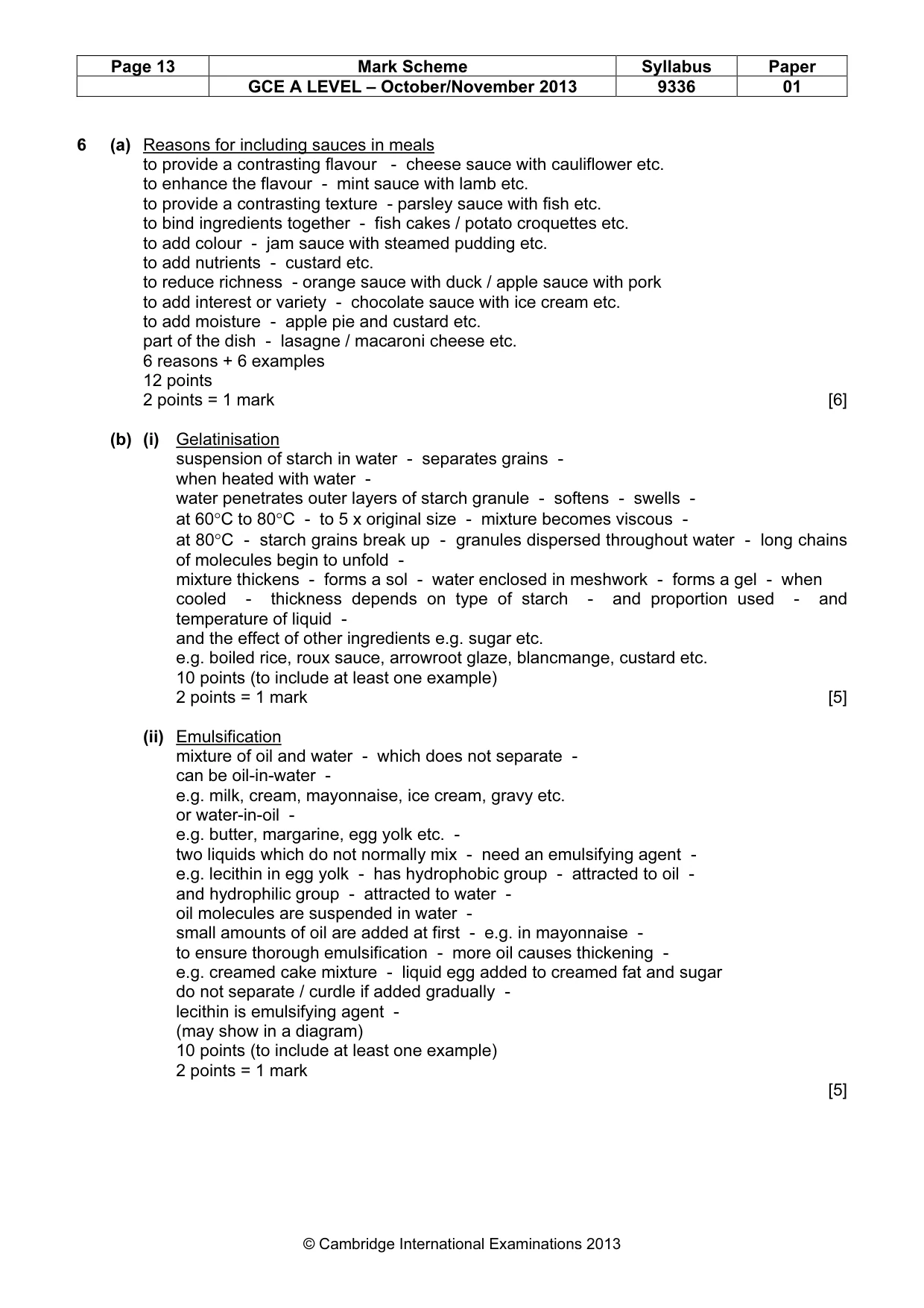
Page 13 Mark Scheme Syllabus Paper GCE A LEVEL – October/November 2013 9336 01 © Cambridge International Examinations 2013 6 (a) Reasons for including sauces in meals to provide a contrasting flavour - cheese sauce with cauliflower etc. to enhance the flavour - mint sauce with lamb etc. to provide a contrasting texture - parsley sauce with fish etc. to bind ingredients together - fish cakes / potato croquettes etc. to add colour - jam sauce with steamed pudding etc. to add nutrients - custard etc. to reduce richness - orange sauce with duck / apple sauce with pork to add interest or variety - chocolate sauce with ice cream etc. to add moisture - apple pie and custard etc. part of the dish - lasagne / macaroni cheese etc. 6 reasons + 6 examples 12 points 2 points = 1 mark [6] (b) (i) Gelatinisation suspension of starch in water - separates grains - when heated with water - water penetrates outer layers of starch granule - softens - swells - at 60°C to 80°C - to 5 x original size - mixture becomes viscous - at 80°C - starch grains break up - granules dispersed throughout water - long chains of molecules begin to unfold - mixture thickens - forms a sol - water enclosed in meshwork - forms a gel - when cooled - thickness depends on type of starch - and proportion used - and temperature of liquid - and the effect of other ingredients e.g. sugar etc. e.g. boiled rice, roux sauce, arrowroot glaze, blancmange, custard etc. 10 points (to include at least one example) 2 points = 1 mark [5] (ii) Emulsification mixture of oil and water - which does not separate - can be oil-in-water - e.g. milk, cream, mayonnaise, ice cream, gravy etc. or water-in-oil - e.g. butter, margarine, egg yolk etc. - two liquids which do not normally mix - need an emulsifying agent - e.g. lecithin in egg yolk - has hydrophobic group - attracted to oil - and hydrophilic group - attracted to water - oil molecules are suspended in water - small amounts of oil are added at first - e.g. in mayonnaise - to ensure thorough emulsification - more oil causes thickening - e.g. creamed cake mixture - liquid egg added to creamed fat and sugar do not separate / curdle if added gradually - lecithin is emulsifying agent - (may show in a diagram) 10 points (to include at least one example) 2 points = 1 mark [5]
Mark scheme, page 14
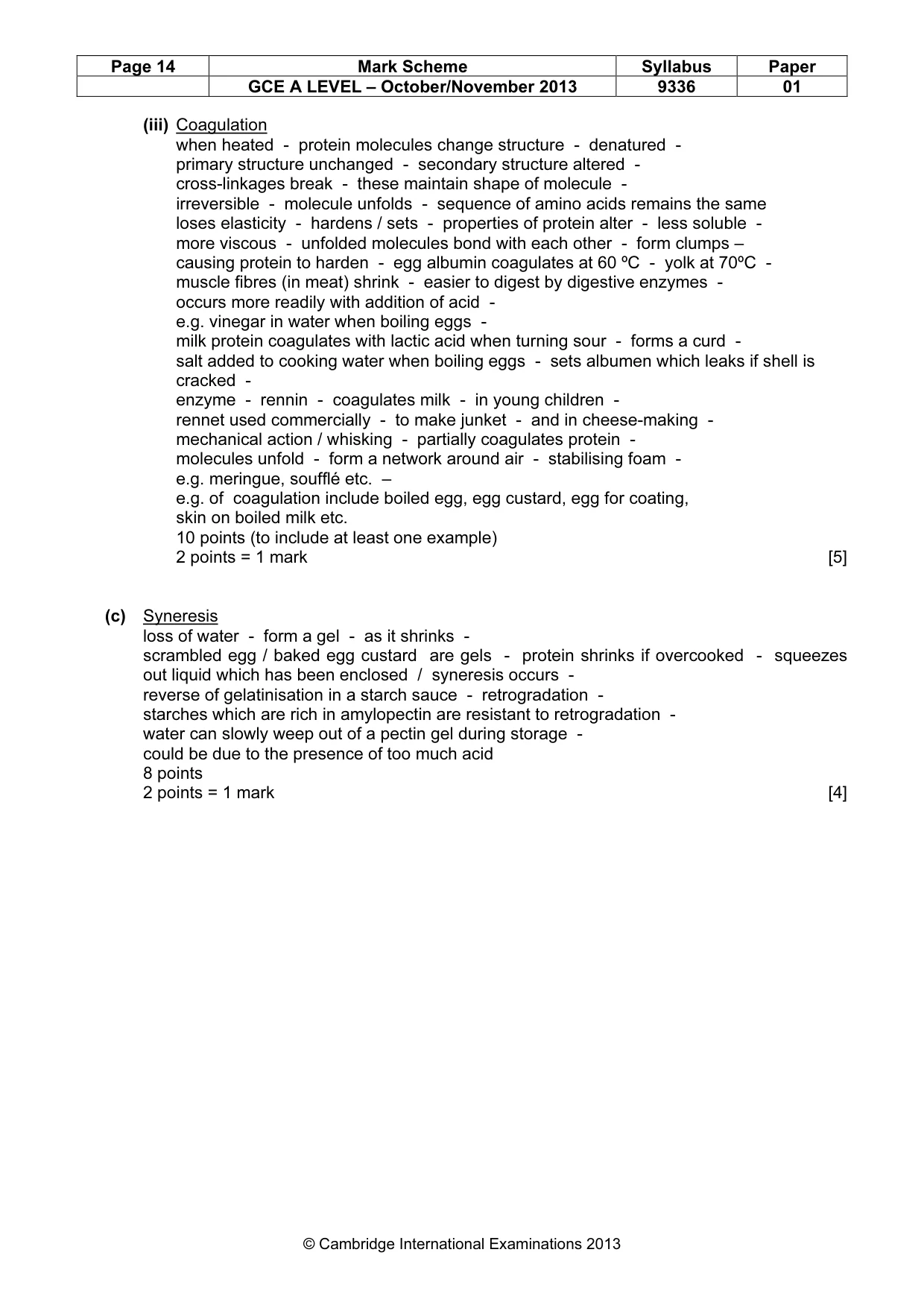
Page 14 Mark Scheme Syllabus Paper GCE A LEVEL – October/November 2013 9336 01 © Cambridge International Examinations 2013 (iii) Coagulation when heated - protein molecules change structure - denatured - primary structure unchanged - secondary structure altered - cross-linkages break - these maintain shape of molecule - irreversible - molecule unfolds - sequence of amino acids remains the same loses elasticity - hardens / sets - properties of protein alter - less soluble - more viscous - unfolded molecules bond with each other - form clumps – causing protein to harden - egg albumin coagulates at 60 ºC - yolk at 70ºC - muscle fibres (in meat) shrink - easier to digest by digestive enzymes - occurs more readily with addition of acid - e.g. vinegar in water when boiling eggs - milk protein coagulates with lactic acid when turning sour - forms a curd - salt added to cooking water when boiling eggs - sets albumen which leaks if shell is cracked - enzyme - rennin - coagulates milk - in young children - rennet used commercially - to make junket - and in cheese-making - mechanical action / whisking - partially coagulates protein - molecules unfold - form a network around air - stabilising foam - e.g. meringue, soufflé etc. – e.g. of coagulation include boiled egg, egg custard, egg for coating, skin on boiled milk etc. 10 points (to include at least one example) 2 points = 1 mark [5] (c) Syneresis loss of water - form a gel - as it shrinks - scrambled egg / baked egg custard are gels - protein shrinks if overcooked - squeezes out liquid which has been enclosed / syneresis occurs - reverse of gelatinisation in a starch sauce - retrogradation - starches which are rich in amylopectin are resistant to retrogradation - water can slowly weep out of a pectin gel during storage - could be due to the presence of too much acid 8 points 2 points = 1 mark [4]
Mark scheme, page 15
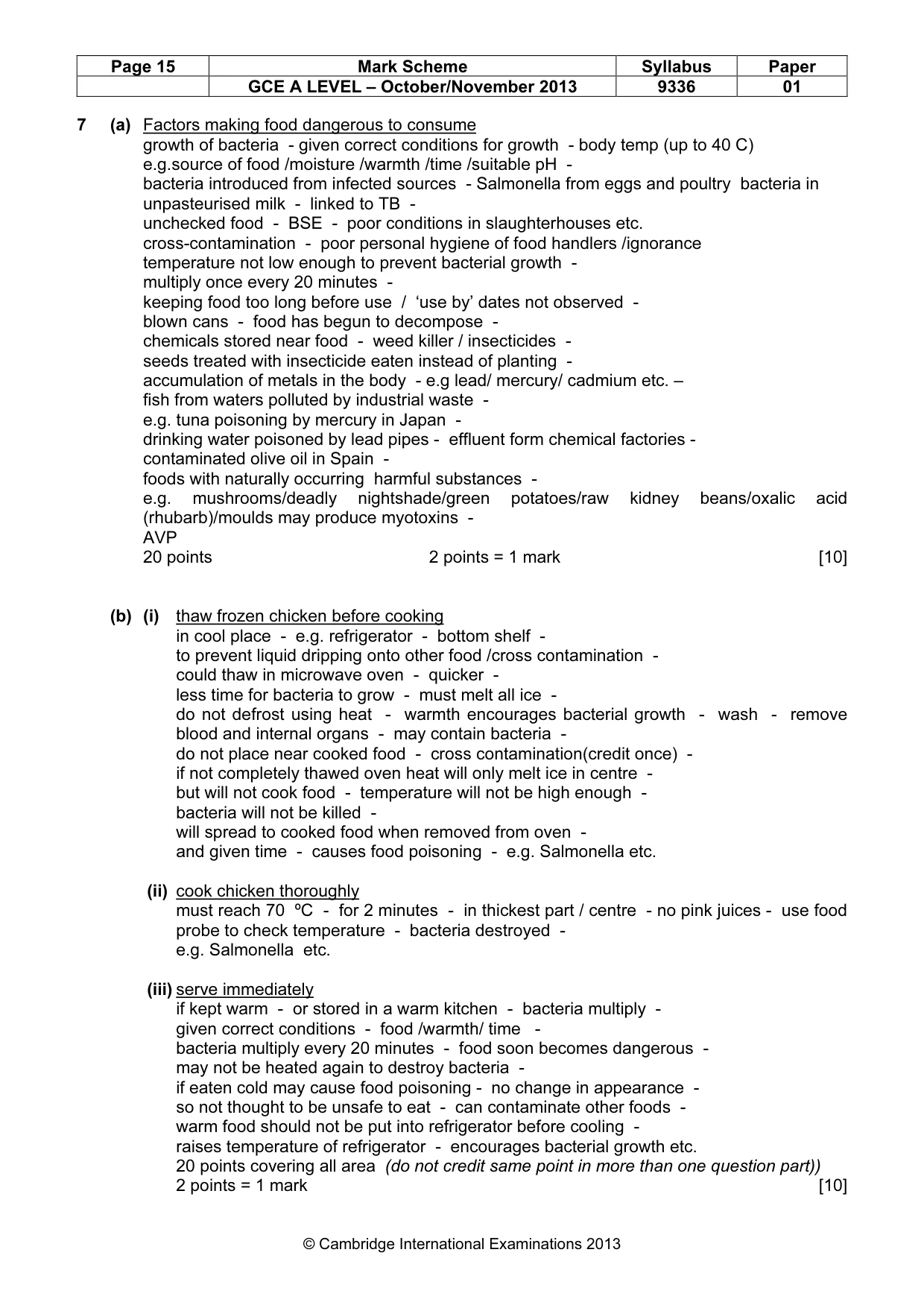
Page 15 Mark Scheme Syllabus Paper GCE A LEVEL – October/November 2013 9336 01 © Cambridge International Examinations 2013 7 (a) Factors making food dangerous to consume growth of bacteria - given correct conditions for growth - body temp (up to 40 C) e.g.source of food /moisture /warmth /time /suitable pH - bacteria introduced from infected sources - Salmonella from eggs and poultry bacteria in unpasteurised milk - linked to TB - unchecked food - BSE - poor conditions in slaughterhouses etc. cross-contamination - poor personal hygiene of food handlers /ignorance temperature not low enough to prevent bacterial growth - multiply once every 20 minutes - keeping food too long before use / ‘use by’ dates not observed - blown cans - food has begun to decompose - chemicals stored near food - weed killer / insecticides - seeds treated with insecticide eaten instead of planting - accumulation of metals in the body - e.g lead/ mercury/ cadmium etc. – fish from waters polluted by industrial waste - e.g. tuna poisoning by mercury in Japan - drinking water poisoned by lead pipes - effluent form chemical factories - contaminated olive oil in Spain - foods with naturally occurring harmful substances - e.g. mushrooms/deadly nightshade/green potatoes/raw kidney beans/oxalic acid (rhubarb)/moulds may produce myotoxins - AVP 20 points 2 points = 1 mark [10] (b) (i) thaw frozen chicken before cooking in cool place - e.g. refrigerator - bottom shelf - to prevent liquid dripping onto other food /cross contamination - could thaw in microwave oven - quicker - less time for bacteria to grow - must melt all ice - do not defrost using heat - warmth encourages bacterial growth - wash - remove blood and internal organs - may contain bacteria - do not place near cooked food - cross contamination(credit once) - if not completely thawed oven heat will only melt ice in centre - but will not cook food - temperature will not be high enough - bacteria will not be killed - will spread to cooked food when removed from oven - and given time - causes food poisoning - e.g. Salmonella etc. (ii) cook chicken thoroughly must reach 70 ºC - for 2 minutes - in thickest part / centre - no pink juices - use food probe to check temperature - bacteria destroyed - e.g. Salmonella etc. (iii) serve immediately if kept warm - or stored in a warm kitchen - bacteria multiply - given correct conditions - food /warmth/ time - bacteria multiply every 20 minutes - food soon becomes dangerous - may not be heated again to destroy bacteria - if eaten cold may cause food poisoning - no change in appearance - so not thought to be unsafe to eat - can contaminate other foods - warm food should not be put into refrigerator before cooling - raises temperature of refrigerator - encourages bacterial growth etc. 20 points covering all area (do not credit same point in more than one question part)) 2 points = 1 mark [10]
Mark scheme, page 16
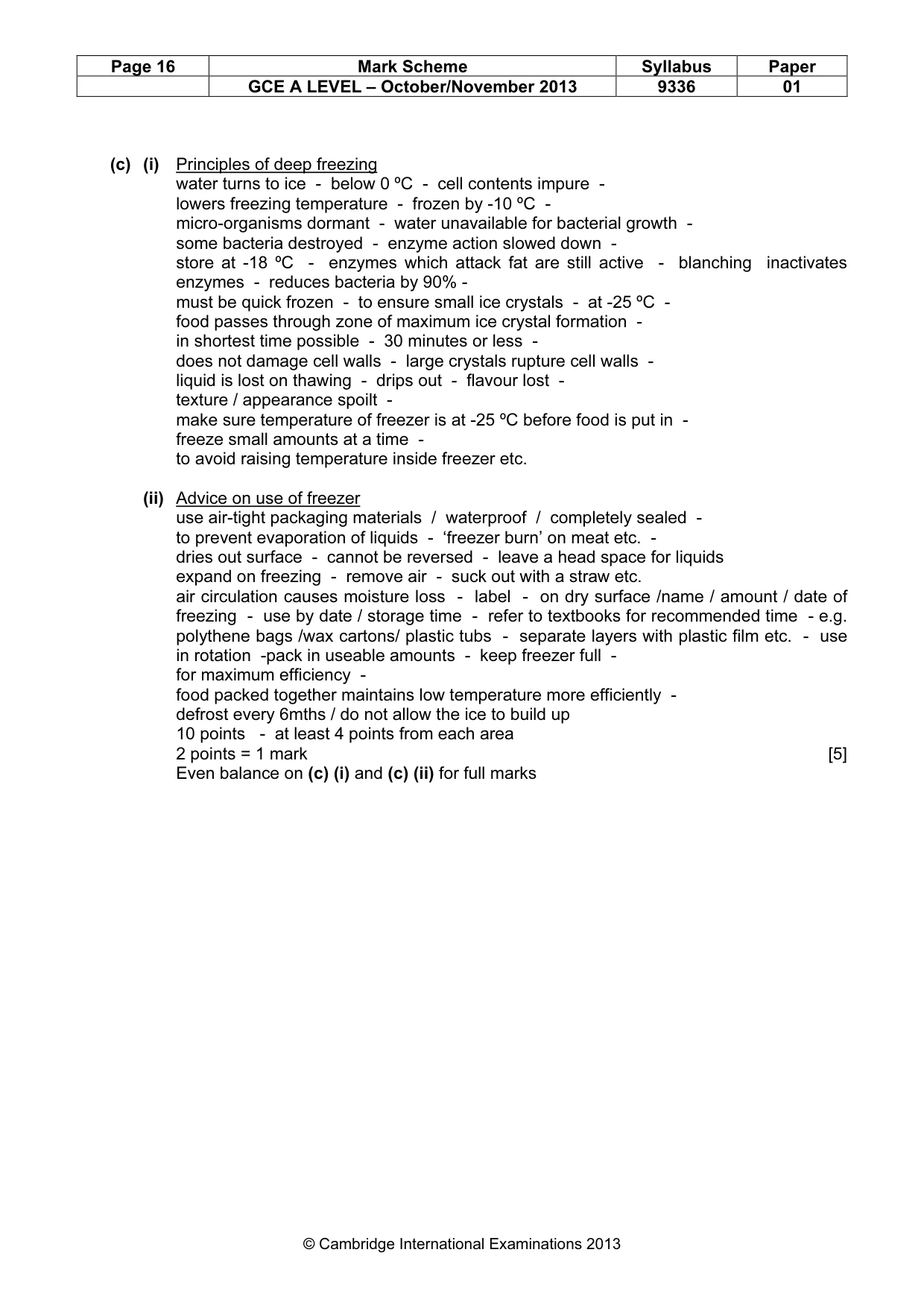
Page 16 Mark Scheme Syllabus Paper GCE A LEVEL – October/November 2013 9336 01 © Cambridge International Examinations 2013 (c) (i) Principles of deep freezing water turns to ice - below 0 ºC - cell contents impure - lowers freezing temperature - frozen by -10 ºC - micro-organisms dormant - water unavailable for bacterial growth - some bacteria destroyed - enzyme action slowed down - store at -18 ºC - enzymes which attack fat are still active - blanching inactivates enzymes - reduces bacteria by 90% - must be quick frozen - to ensure small ice crystals - at -25 ºC - food passes through zone of maximum ice crystal formation - in shortest time possible - 30 minutes or less - does not damage cell walls - large crystals rupture cell walls - liquid is lost on thawing - drips out - flavour lost - texture / appearance spoilt - make sure temperature of freezer is at -25 ºC before food is put in - freeze small amounts at a time - to avoid raising temperature inside freezer etc. (ii) Advice on use of freezer use air-tight packaging materials / waterproof / completely sealed - to prevent evaporation of liquids - ‘freezer burn’ on meat etc. - dries out surface - cannot be reversed - leave a head space for liquids expand on freezing - remove air - suck out with a straw etc. air circulation causes moisture loss - label - on dry surface /name / amount / date of freezing - use by date / storage time - refer to textbooks for recommended time - e.g. polythene bags /wax cartons/ plastic tubs - separate layers with plastic film etc. - use in rotation -pack in useable amounts - keep freezer full - for maximum efficiency - food packed together maintains low temperature more efficiently - defrost every 6mths / do not allow the ice to build up 10 points - at least 4 points from each area 2 points = 1 mark [5] Even balance on (c) (i) and (c) (ii) for full marks
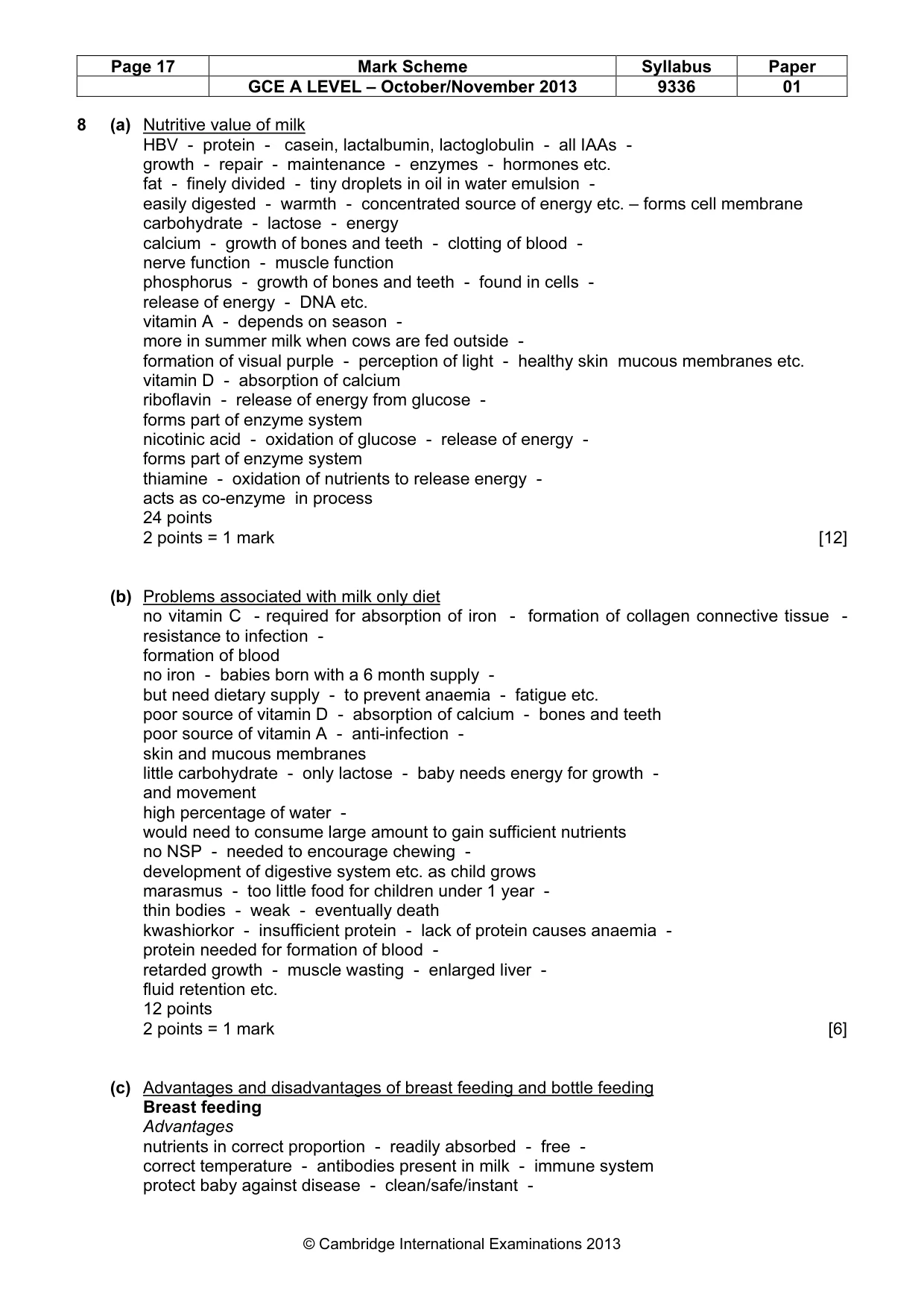
Mark scheme, page 17
Page 17 Mark Scheme Syllabus Paper GCE A LEVEL – October/November 2013 9336 01 © Cambridge International Examinations 2013 8 (a) Nutritive value of milk HBV - protein - casein, lactalbumin, lactoglobulin - all IAAs - growth - repair - maintenance - enzymes - hormones etc. fat - finely divided - tiny droplets in oil in water emulsion - easily digested - warmth - concentrated source of energy etc. – forms cell membrane carbohydrate - lactose - energy calcium - growth of bones and teeth - clotting of blood - nerve function - muscle function phosphorus - growth of bones and teeth - found in cells - release of energy - DNA etc. vitamin A - depends on season - more in summer milk when cows are fed outside - formation of visual purple - perception of light - healthy skin mucous membranes etc. vitamin D - absorption of calcium riboflavin - release of energy from glucose - forms part of enzyme system nicotinic acid - oxidation of glucose - release of energy - forms part of enzyme system thiamine - oxidation of nutrients to release energy - acts as co-enzyme in process 24 points 2 points = 1 mark [12] (b) Problems associated with milk only diet no vitamin C - required for absorption of iron - formation of collagen connective tissue - resistance to infection - formation of blood no iron - babies born with a 6 month supply - but need dietary supply - to prevent anaemia - fatigue etc. poor source of vitamin D - absorption of calcium - bones and teeth poor source of vitamin A - anti-infection - skin and mucous membranes little carbohydrate - only lactose - baby needs energy for growth - and movement high percentage of water - would need to consume large amount to gain sufficient nutrients no NSP - needed to encourage chewing - development of digestive system etc. as child grows marasmus - too little food for children under 1 year - thin bodies - weak - eventually death kwashiorkor - insufficient protein - lack of protein causes anaemia - protein needed for formation of blood - retarded growth - muscle wasting - enlarged liver - fluid retention etc. 12 points 2 points = 1 mark [6] (c) Advantages and disadvantages of breast feeding and bottle feeding Breast feeding Advantages nutrients in correct proportion - readily absorbed - free - correct temperature - antibodies present in milk - immune system protect baby against disease - clean/safe/instant -
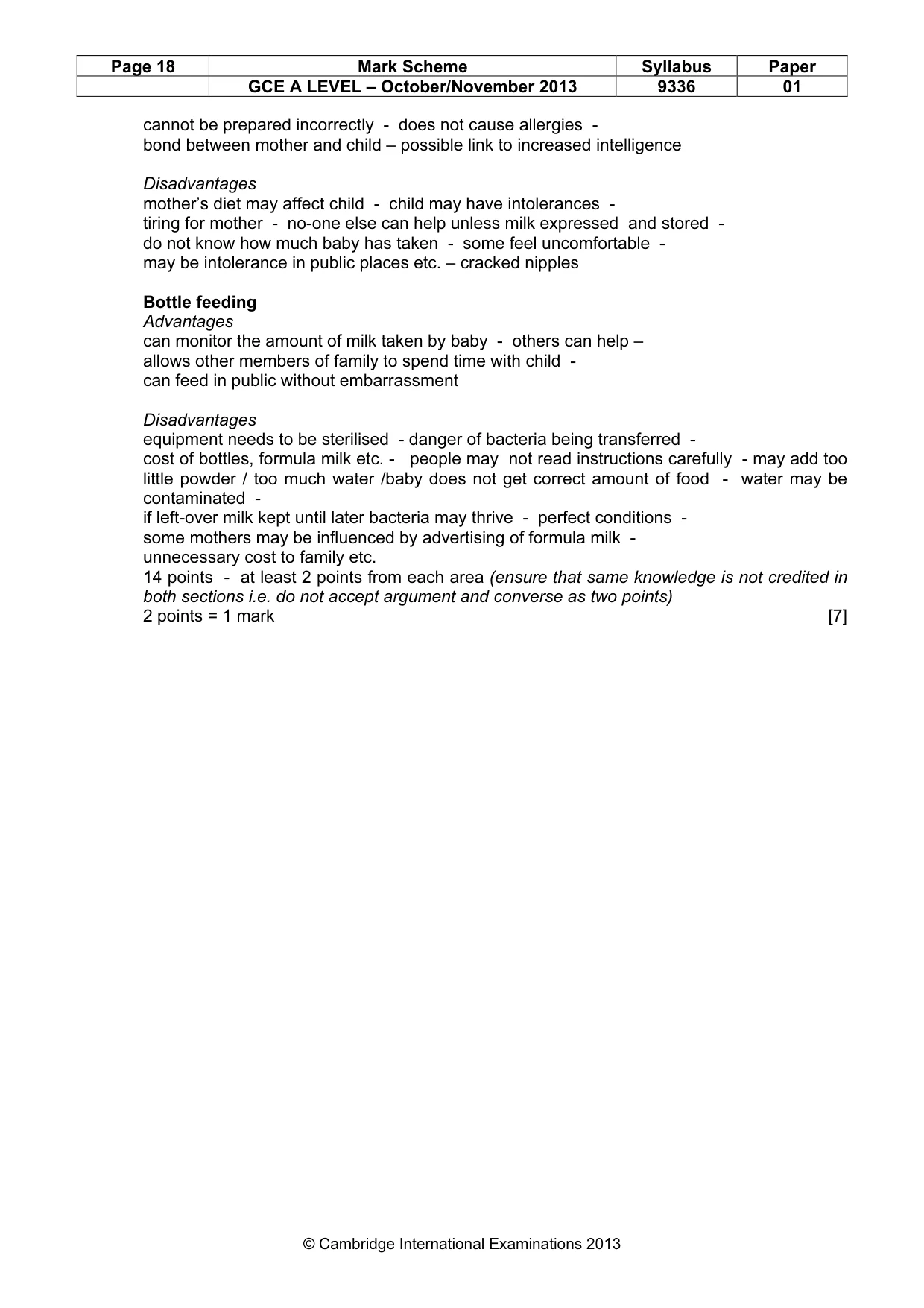
Mark scheme, page 18
Page 18 Mark Scheme Syllabus Paper GCE A LEVEL – October/November 2013 9336 01 © Cambridge International Examinations 2013 cannot be prepared incorrectly - does not cause allergies - bond between mother and child – possible link to increased intelligence Disadvantages mother’s diet may affect child - child may have intolerances - tiring for mother - no-one else can help unless milk expressed and stored - do not know how much baby has taken - some feel uncomfortable - may be intolerance in public places etc. – cracked nipples Bottle feeding Advantages can monitor the amount of milk taken by baby - others can help – allows other members of family to spend time with child - can feed in public without embarrassment Disadvantages equipment needs to be sterilised - danger of bacteria being transferred - cost of bottles, formula milk etc. - people may not read instructions carefully - may add too little powder / too much water /baby does not get correct amount of food - water may be contaminated - if left-over milk kept until later bacteria may thrive - perfect conditions - some mothers may be influenced by advertising of formula milk - unnecessary cost to family etc. 14 points - at least 2 points from each area (ensure that same knowledge is not credited in both sections i.e. do not accept argument and converse as two points) 2 points = 1 mark [7]
What you needed in this session
Cambridge’s own grade thresholds for 2013 Oct/Nov, Paper 1 · Variant 1. A higher threshold means an easier paper — the bar moves with how the cohort did.