Cambridge A Level Food Studies 9336 — 2014 Oct/Nov Paper 1 · Variant 1
9336/11/O/N/14 · 100 marks · ≈113 min
The question paper and its mark scheme, free to read here and free to download. This is Cambridge’s own paper, exactly as it was sat.
Question paper4 pages
Mark scheme16 pages
Answers below. Sit the paper first if you are practising.
Paper as text
Question paper, page 1
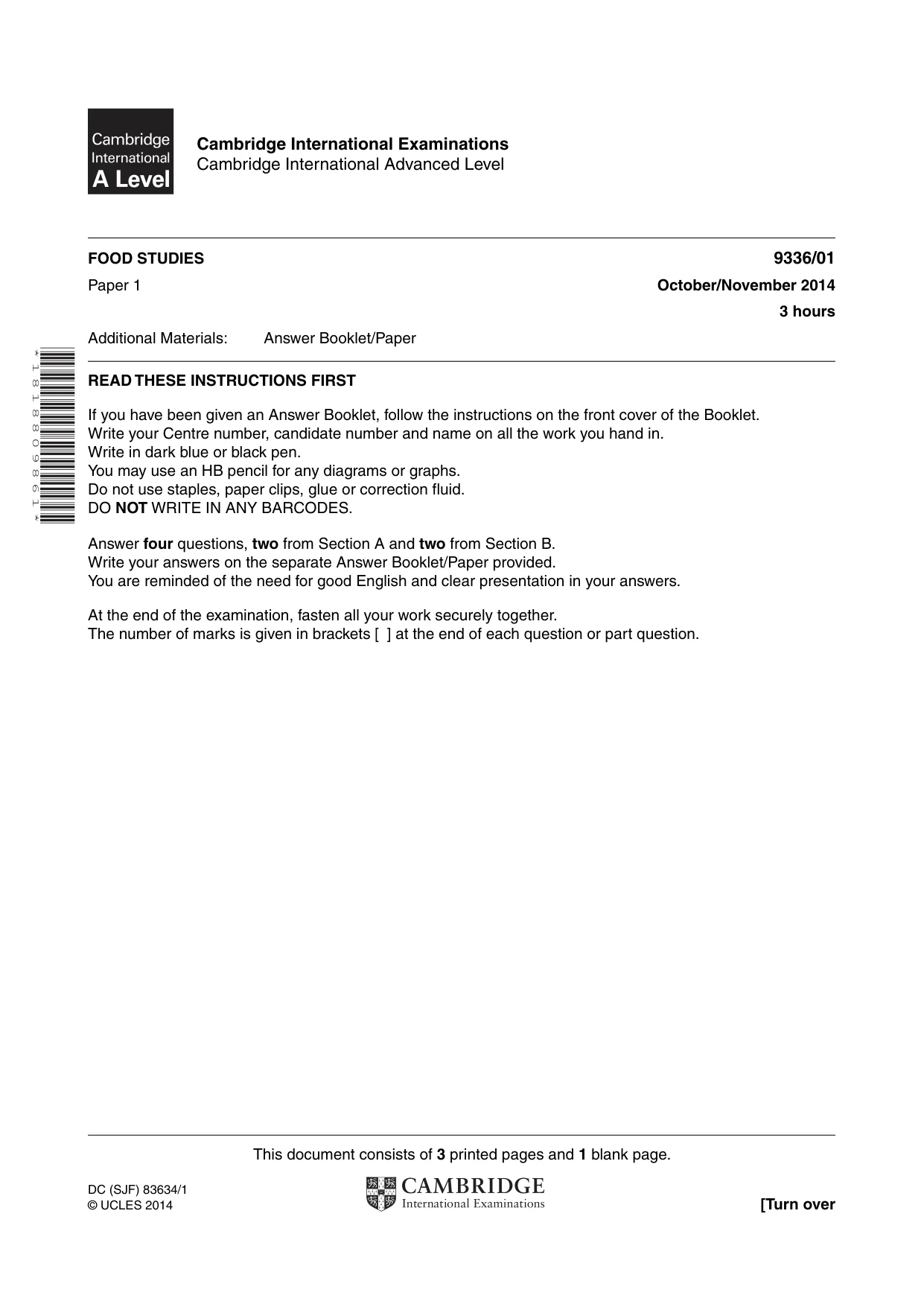
This document consists of 3 printed pages and 1 blank page. DC (SJF) 83634/1 © UCLES 2014 [Turn over Cambridge International Examinations Cambridge International Advanced Level * 1 8 1 8 8 0 9 8 6 1 * FOOD STUDIES 9336/01 Paper 1 October/November 2014 3 hours Additional Materials: Answer Booklet/Paper READ THESE INSTRUCTIONS FIRST If you have been given an Answer Booklet, follow the instructions on the front cover of the Booklet. Write your Centre number, candidate number and name on all the work you hand in. Write in dark blue or black pen. You may use an HB pencil for any diagrams or graphs. Do not use staples, paper clips, glue or correction fluid. DO NOT WRITE IN ANY BARCODES. Answer four questions, two from Section A and two from Section B. Write your answers on the separate Answer Booklet/Paper provided. You are reminded of the need for good English and clear presentation in your answers. At the end of the examination, fasten all your work securely together. The number of marks is given in brackets [ ] at the end of each question or part question.
Question paper, page 2
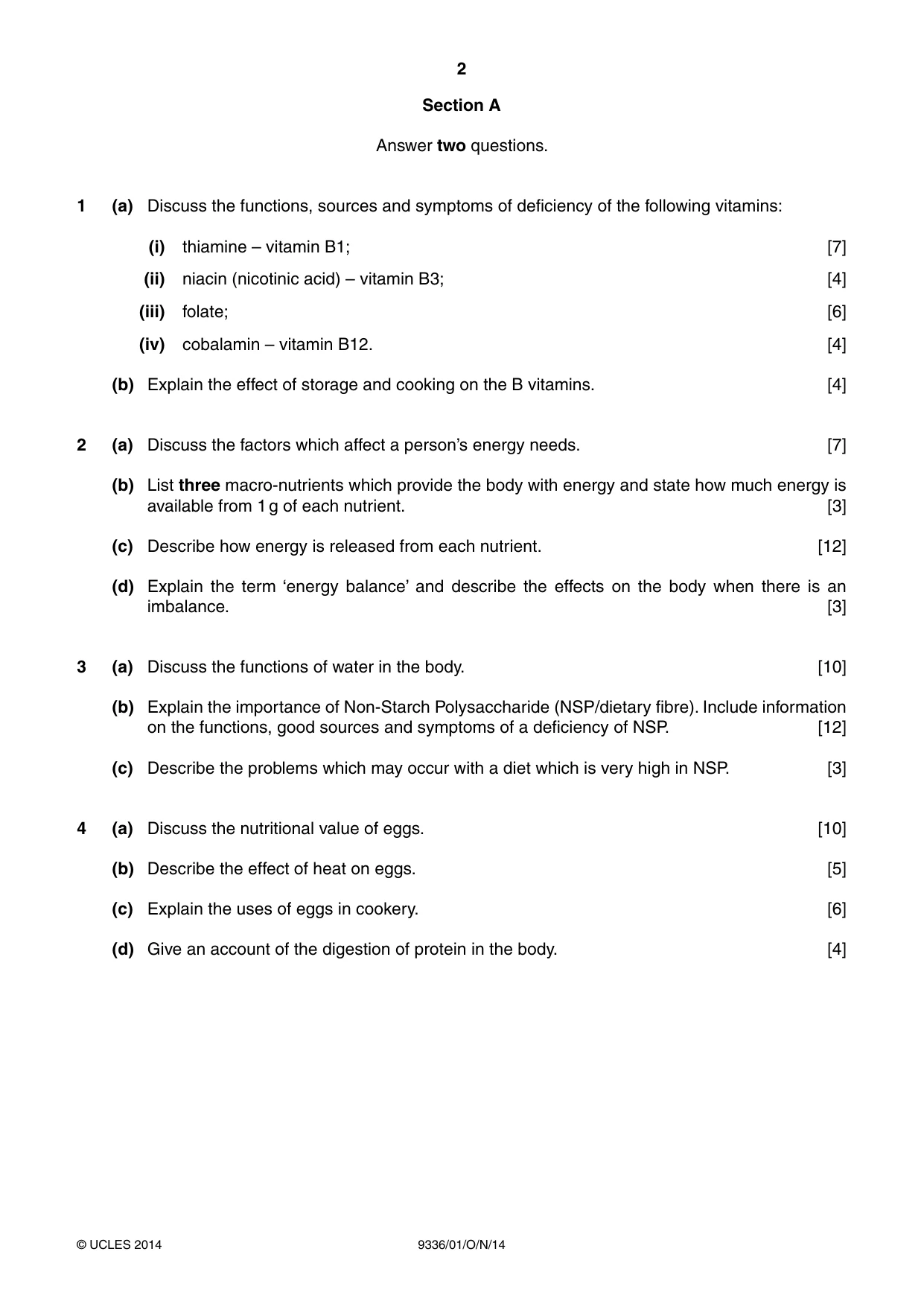
2 9336/01/O/N/14 © UCLES 2014 Section A Answer two questions. 1 (a) Discuss the functions, sources and symptoms of deficiency of the following vitamins: (i) thiamine – vitamin B1; [7] (ii) niacin (nicotinic acid) – vitamin B3; [4] (iii) folate; [6] (iv) cobalamin – vitamin B12. [4] (b) Explain the effect of storage and cooking on the B vitamins. [4] 2 (a) Discuss the factors which affect a person’s energy needs. [7] (b) List three macro-nutrients which provide the body with energy and state how much energy is available from 1 g of each nutrient. [3] (c) Describe how energy is released from each nutrient. [12] (d) Explain the term ‘energy balance’ and describe the effects on the body when there is an imbalance. [3] 3 (a) Discuss the functions of water in the body. [10] (b) Explain the importance of Non-Starch Polysaccharide (NSP/dietary fibre). Include information on the functions, good sources and symptoms of a deficiency of NSP. [12] (c) Describe the problems which may occur with a diet which is very high in NSP. [3] 4 (a) Discuss the nutritional value of eggs. [10] (b) Describe the effect of heat on eggs. [5] (c) Explain the uses of eggs in cookery. [6] (d) Give an account of the digestion of protein in the body. [4]
Question paper, page 3
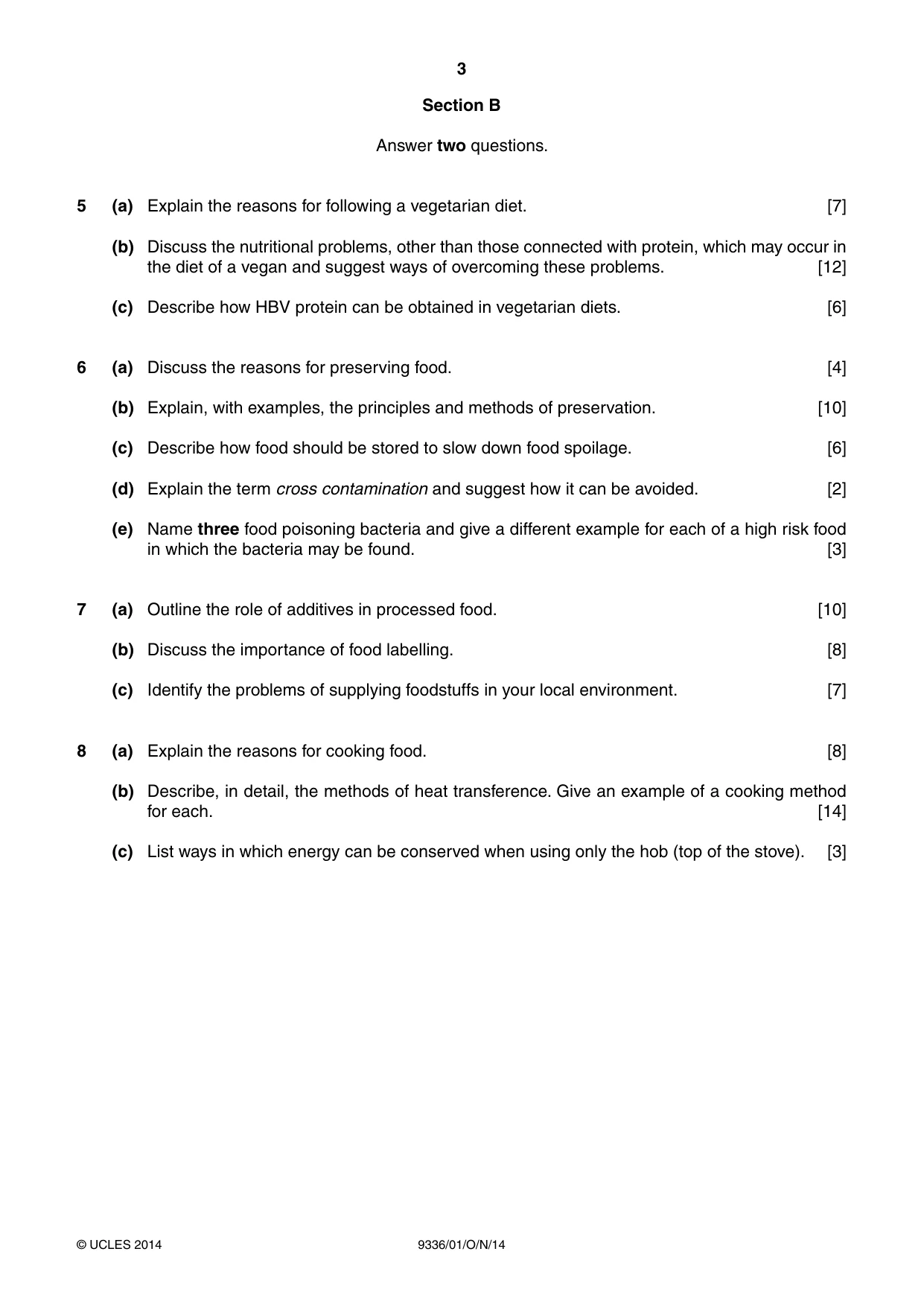
3 9336/01/O/N/14 © UCLES 2014 Section B Answer two questions. 5 (a) Explain the reasons for following a vegetarian diet. [7] (b) Discuss the nutritional problems, other than those connected with protein, which may occur in the diet of a vegan and suggest ways of overcoming these problems. [12] (c) Describe how HBV protein can be obtained in vegetarian diets. [6] 6 (a) Discuss the reasons for preserving food. [4] (b) Explain, with examples, the principles and methods of preservation. [10] (c) Describe how food should be stored to slow down food spoilage. [6] (d) Explain the term cross contamination and suggest how it can be avoided. [2] (e) Name three food poisoning bacteria and give a different example for each of a high risk food in which the bacteria may be found. [3] 7 (a) Outline the role of additives in processed food. [10] (b) Discuss the importance of food labelling. [8] (c) Identify the problems of supplying foodstuffs in your local environment. [7] 8 (a) Explain the reasons for cooking food. [8] (b) Describe, in detail, the methods of heat transference. Give an example of a cooking method for each. [14] (c) List ways in which energy can be conserved when using only the hob (top of the stove). [3]
Question paper, page 4
4 9336/01/O/N/14 © UCLES 2014 Permission to reproduce items where third-party owned material protected by copyright is included has been sought and cleared where possible. Every reasonable effort has been made by the publisher (UCLES) to trace copyright holders, but if any items requiring clearance have unwittingly been included, the publisher will be pleased to make amends at the earliest possible opportunity. Cambridge International Examinations is part of the Cambridge Assessment Group. Cambridge Assessment is the brand name of University of Cambridge Local Examinations Syndicate (UCLES), which is itself a department of the University of Cambridge. BLANK PAGE
Mark scheme, page 1
® IGCSE is the registered trademark of Cambridge International Examinations. CAMBRIDGE INTERNATIONAL EXAMINATIONS Cambridge International Advanced Level MARK SCHEME for the October/November 2014 series 9336 FOOD STUDIES 9336/01 Paper 1 (Theory), maximum raw mark 100 This mark scheme is published as an aid to teachers and candidates, to indicate the requirements of the examination. It shows the basis on which Examiners were instructed to award marks. It does not indicate the details of the discussions that took place at an Examiners’ meeting before marking began, which would have considered the acceptability of alternative answers. Mark schemes should be read in conjunction with the question paper and the Principal Examiner Report for Teachers. Cambridge will not enter into discussions about these mark schemes. Cambridge is publishing the mark schemes for the October/November 2014 series for most Cambridge IGCSE®, Cambridge International A and AS Level components and some Cambridge O Level components.
Mark scheme, page 2
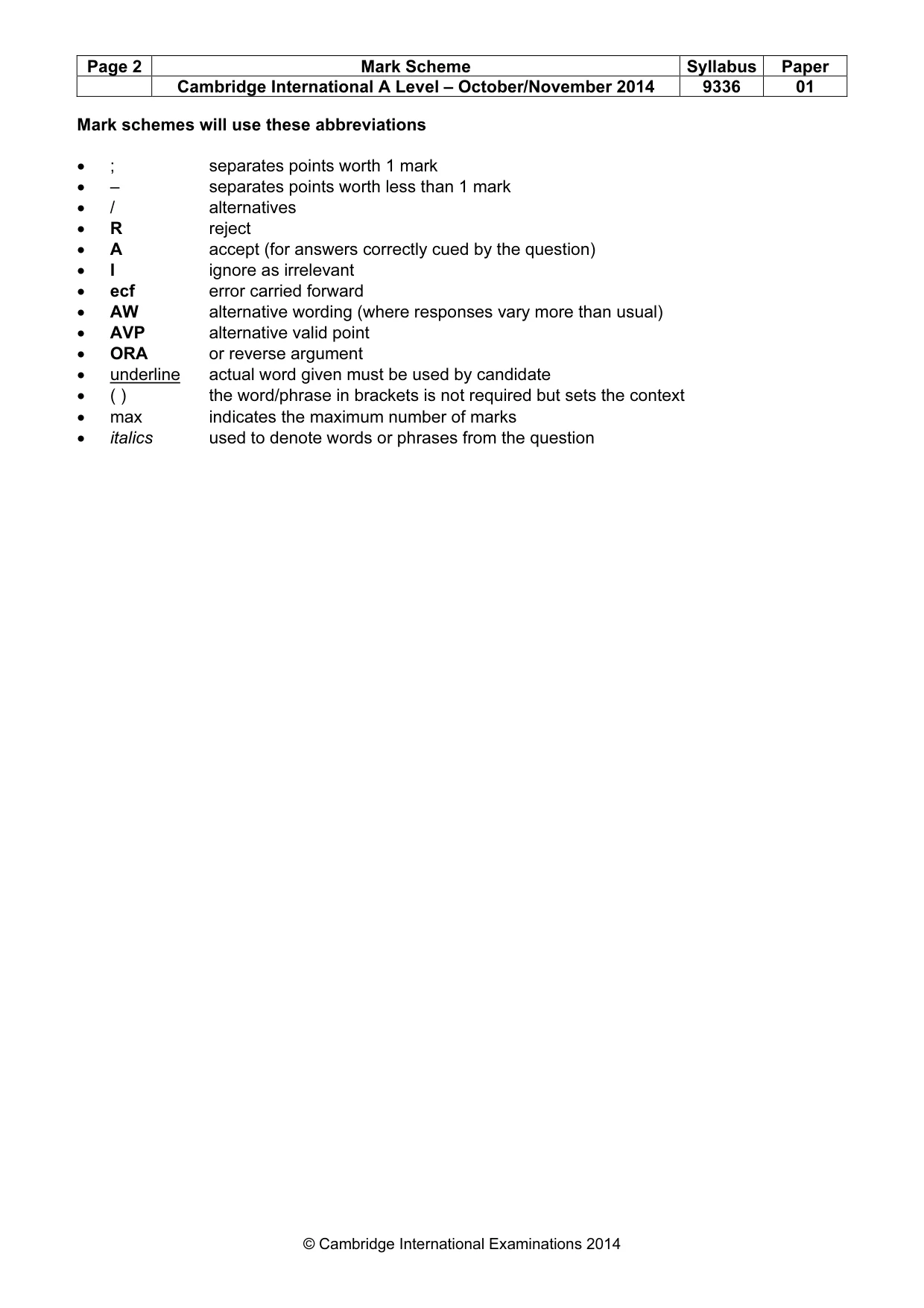
Page 2 Mark Scheme Syllabus Paper Cambridge International A Level – October/November 2014 9336 01 © Cambridge International Examinations 2014 Mark schemes will use these abbreviations • ; separates points worth 1 mark • – separates points worth less than 1 mark • / alternatives • R reject • A accept (for answers correctly cued by the question) • I ignore as irrelevant • ecf error carried forward • AW alternative wording (where responses vary more than usual) • AVP alternative valid point • ORA or reverse argument • underline actual word given must be used by candidate • ( ) the word/phrase in brackets is not required but sets the context • max indicates the maximum number of marks • italics used to denote words or phrases from the question
Mark scheme, page 3
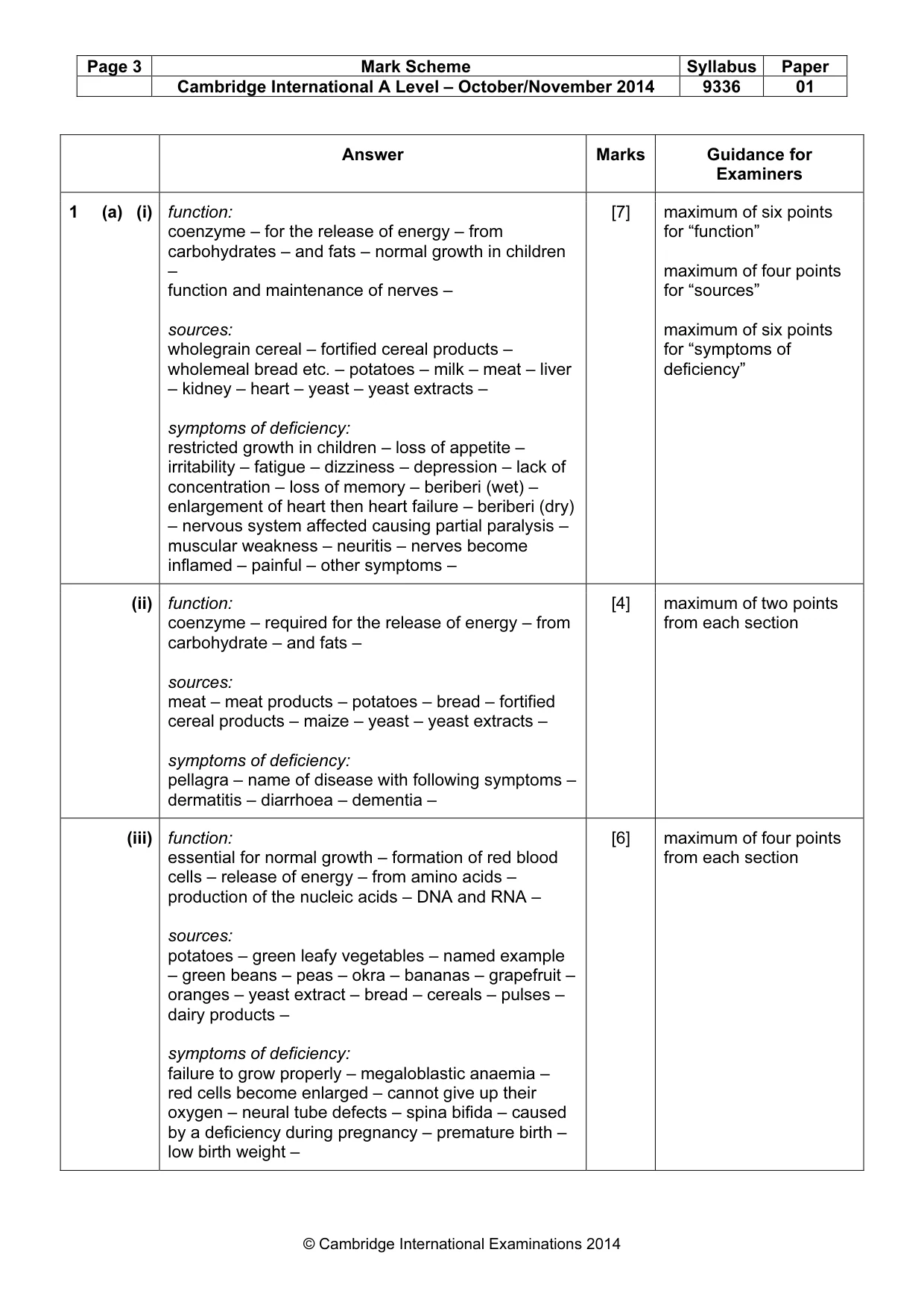
Page 3 Mark Scheme Syllabus Paper Cambridge International A Level – October/November 2014 9336 01 © Cambridge International Examinations 2014 Answer Marks Guidance for Examiners 1 (a) (i) function: coenzyme – for the release of energy – from carbohydrates – and fats – normal growth in children – function and maintenance of nerves – sources: wholegrain cereal – fortified cereal products – wholemeal bread etc. – potatoes – milk – meat – liver – kidney – heart – yeast – yeast extracts – symptoms of deficiency: restricted growth in children – loss of appetite – irritability – fatigue – dizziness – depression – lack of concentration – loss of memory – beriberi (wet) – enlargement of heart then heart failure – beriberi (dry) – nervous system affected causing partial paralysis – muscular weakness – neuritis – nerves become inflamed – painful – other symptoms – [7] maximum of six points for “function” maximum of four points for “sources” maximum of six points for “symptoms of deficiency” (ii) function: coenzyme – required for the release of energy – from carbohydrate – and fats – sources: meat – meat products – potatoes – bread – fortified cereal products – maize – yeast – yeast extracts – symptoms of deficiency: pellagra – name of disease with following symptoms – dermatitis – diarrhoea – dementia – [4] maximum of two points from each section (iii) function: essential for normal growth – formation of red blood cells – release of energy – from amino acids – production of the nucleic acids – DNA and RNA – sources: potatoes – green leafy vegetables – named example – green beans – peas – okra – bananas – grapefruit – oranges – yeast extract – bread – cereals – pulses – dairy products – symptoms of deficiency: failure to grow properly – megaloblastic anaemia – red cells become enlarged – cannot give up their oxygen – neural tube defects – spina bifida – caused by a deficiency during pregnancy – premature birth – low birth weight – [6] maximum of four points from each section
Mark scheme, page 4
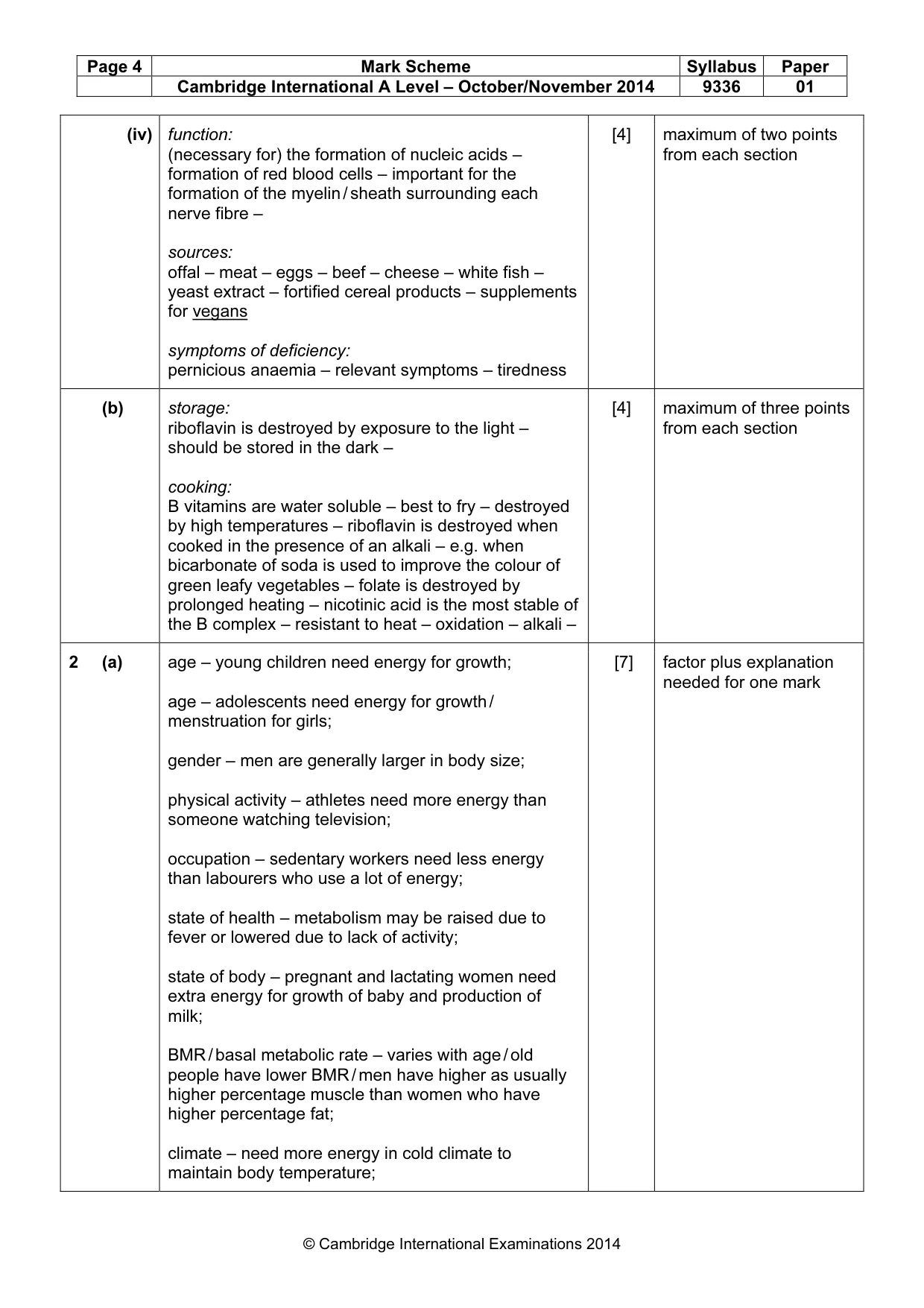
Page 4 Mark Scheme Syllabus Paper Cambridge International A Level – October/November 2014 9336 01 © Cambridge International Examinations 2014 (iv) function: (necessary for) the formation of nucleic acids – formation of red blood cells – important for the formation of the myelin / sheath surrounding each nerve fibre – sources: offal – meat – eggs – beef – cheese – white fish – yeast extract – fortified cereal products – supplements for vegans symptoms of deficiency: pernicious anaemia – relevant symptoms – tiredness [4] maximum of two points from each section (b) storage: riboflavin is destroyed by exposure to the light – should be stored in the dark – cooking: B vitamins are water soluble – best to fry – destroyed by high temperatures – riboflavin is destroyed when cooked in the presence of an alkali – e.g. when bicarbonate of soda is used to improve the colour of green leafy vegetables – folate is destroyed by prolonged heating – nicotinic acid is the most stable of the B complex – resistant to heat – oxidation – alkali – [4] maximum of three points from each section 2 (a) age – young children need energy for growth; age – adolescents need energy for growth / menstruation for girls; gender – men are generally larger in body size; physical activity – athletes need more energy than someone watching television; occupation – sedentary workers need less energy than labourers who use a lot of energy; state of health – metabolism may be raised due to fever or lowered due to lack of activity; state of body – pregnant and lactating women need extra energy for growth of baby and production of milk; BMR / basal metabolic rate – varies with age / old people have lower BMR / men have higher as usually higher percentage muscle than women who have higher percentage fat; climate – need more energy in cold climate to maintain body temperature; [7] factor plus explanation needed for one mark
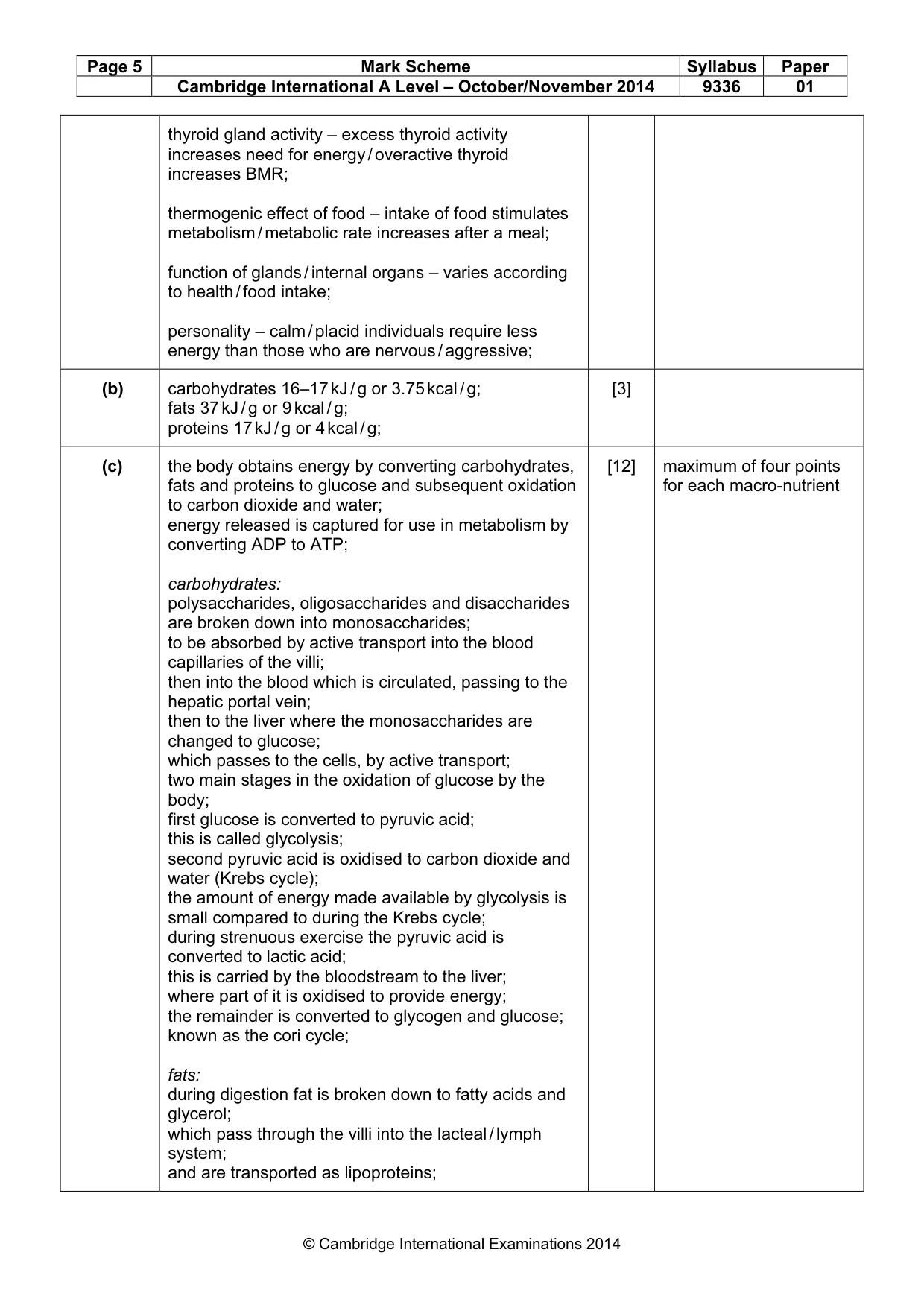
Mark scheme, page 5
Page 5 Mark Scheme Syllabus Paper Cambridge International A Level – October/November 2014 9336 01 © Cambridge International Examinations 2014 thyroid gland activity – excess thyroid activity increases need for energy / overactive thyroid increases BMR; thermogenic effect of food – intake of food stimulates metabolism / metabolic rate increases after a meal; function of glands / internal organs – varies according to health / food intake; personality – calm / placid individuals require less energy than those who are nervous / aggressive; (b) carbohydrates 16–17 kJ / g or 3.75 kcal / g; fats 37 kJ / g or 9 kcal / g; proteins 17 kJ / g or 4 kcal / g; [3] (c) the body obtains energy by converting carbohydrates, fats and proteins to glucose and subsequent oxidation to carbon dioxide and water; energy released is captured for use in metabolism by converting ADP to ATP; carbohydrates: polysaccharides, oligosaccharides and disaccharides are broken down into monosaccharides; to be absorbed by active transport into the blood capillaries of the villi; then into the blood which is circulated, passing to the hepatic portal vein; then to the liver where the monosaccharides are changed to glucose; which passes to the cells, by active transport; two main stages in the oxidation of glucose by the body; first glucose is converted to pyruvic acid; this is called glycolysis; second pyruvic acid is oxidised to carbon dioxide and water (Krebs cycle); the amount of energy made available by glycolysis is small compared to during the Krebs cycle; during strenuous exercise the pyruvic acid is converted to lactic acid; this is carried by the bloodstream to the liver; where part of it is oxidised to provide energy; the remainder is converted to glycogen and glucose; known as the cori cycle; fats: during digestion fat is broken down to fatty acids and glycerol; which pass through the villi into the lacteal / lymph system; and are transported as lipoproteins; [12] maximum of four points for each macro-nutrient
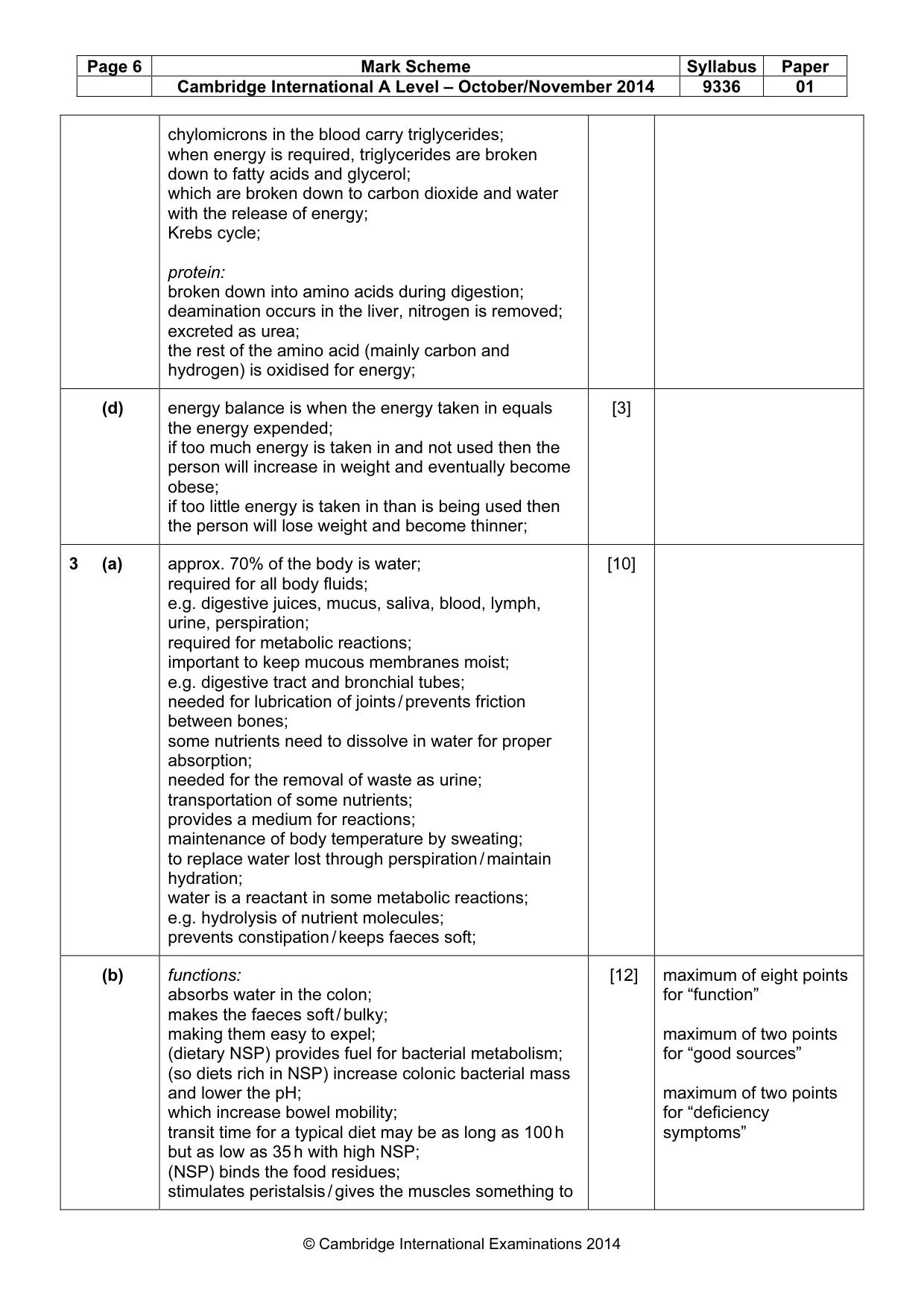
Mark scheme, page 6
Page 6 Mark Scheme Syllabus Paper Cambridge International A Level – October/November 2014 9336 01 © Cambridge International Examinations 2014 chylomicrons in the blood carry triglycerides; when energy is required, triglycerides are broken down to fatty acids and glycerol; which are broken down to carbon dioxide and water with the release of energy; Krebs cycle; protein: broken down into amino acids during digestion; deamination occurs in the liver, nitrogen is removed; excreted as urea; the rest of the amino acid (mainly carbon and hydrogen) is oxidised for energy; (d) energy balance is when the energy taken in equals the energy expended; if too much energy is taken in and not used then the person will increase in weight and eventually become obese; if too little energy is taken in than is being used then the person will lose weight and become thinner; [3] 3 (a) approx. 70% of the body is water; required for all body fluids; e.g. digestive juices, mucus, saliva, blood, lymph, urine, perspiration; required for metabolic reactions; important to keep mucous membranes moist; e.g. digestive tract and bronchial tubes; needed for lubrication of joints / prevents friction between bones; some nutrients need to dissolve in water for proper absorption; needed for the removal of waste as urine; transportation of some nutrients; provides a medium for reactions; maintenance of body temperature by sweating; to replace water lost through perspiration / maintain hydration; water is a reactant in some metabolic reactions; e.g. hydrolysis of nutrient molecules; prevents constipation / keeps faeces soft; [10] (b) functions: absorbs water in the colon; makes the faeces soft / bulky; making them easy to expel; (dietary NSP) provides fuel for bacterial metabolism; (so diets rich in NSP) increase colonic bacterial mass and lower the pH; which increase bowel mobility; transit time for a typical diet may be as long as 100 h but as low as 35 h with high NSP; (NSP) binds the food residues; stimulates peristalsis / gives the muscles something to [12] maximum of eight points for “function” maximum of two points for “good sources” maximum of two points for “deficiency symptoms”
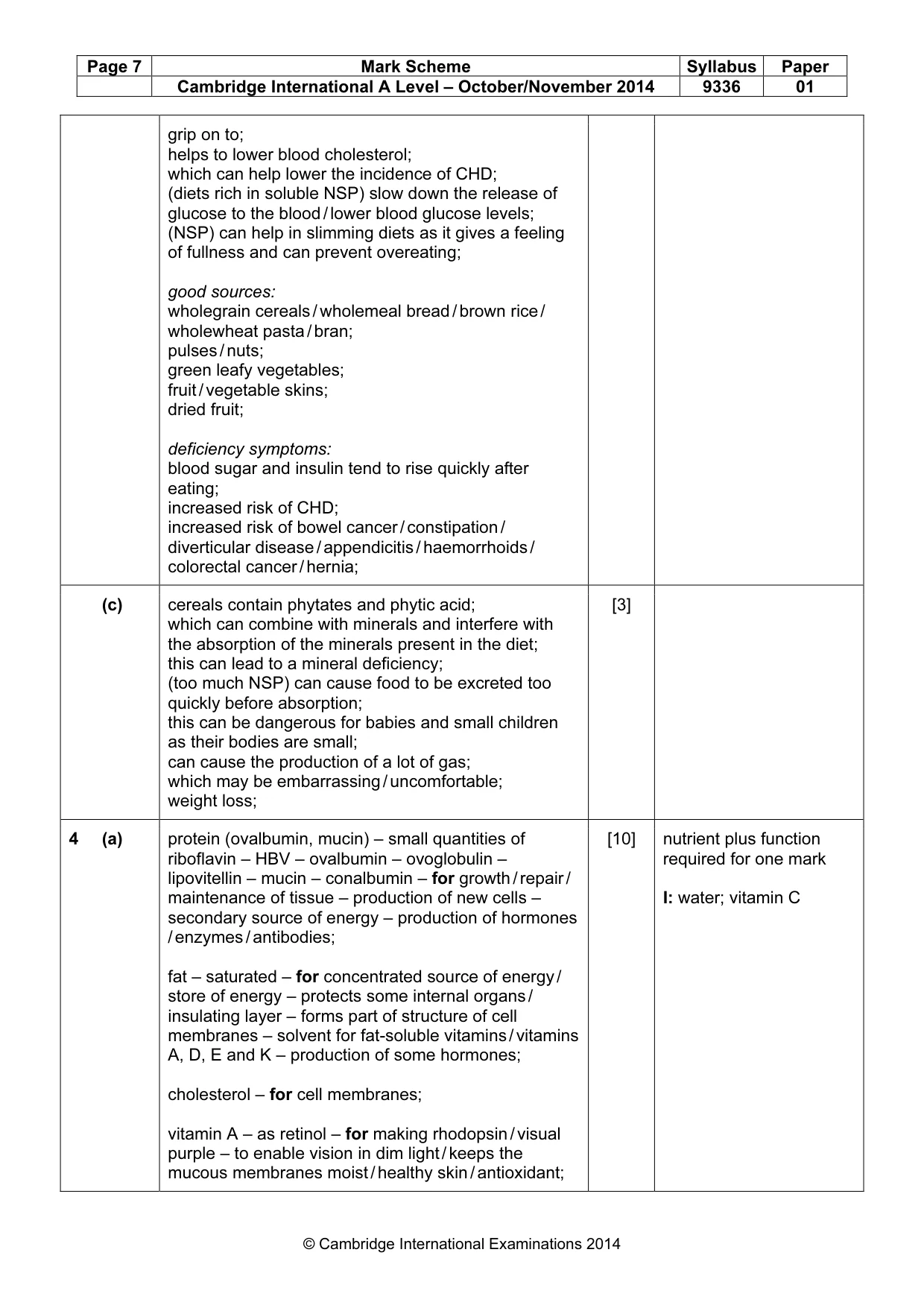
Mark scheme, page 7
Page 7 Mark Scheme Syllabus Paper Cambridge International A Level – October/November 2014 9336 01 © Cambridge International Examinations 2014 grip on to; helps to lower blood cholesterol; which can help lower the incidence of CHD; (diets rich in soluble NSP) slow down the release of glucose to the blood / lower blood glucose levels; (NSP) can help in slimming diets as it gives a feeling of fullness and can prevent overeating; good sources: wholegrain cereals / wholemeal bread / brown rice / wholewheat pasta / bran; pulses / nuts; green leafy vegetables; fruit / vegetable skins; dried fruit; deficiency symptoms: blood sugar and insulin tend to rise quickly after eating; increased risk of CHD; increased risk of bowel cancer / constipation / diverticular disease / appendicitis / haemorrhoids / colorectal cancer / hernia; (c) cereals contain phytates and phytic acid; which can combine with minerals and interfere with the absorption of the minerals present in the diet; this can lead to a mineral deficiency; (too much NSP) can cause food to be excreted too quickly before absorption; this can be dangerous for babies and small children as their bodies are small; can cause the production of a lot of gas; which may be embarrassing / uncomfortable; weight loss; [3] 4 (a) protein (ovalbumin, mucin) – small quantities of riboflavin – HBV – ovalbumin – ovoglobulin – lipovitellin – mucin – conalbumin – for growth / repair / maintenance of tissue – production of new cells – secondary source of energy – production of hormones / enzymes / antibodies; fat – saturated – for concentrated source of energy / store of energy – protects some internal organs / insulating layer – forms part of structure of cell membranes – solvent for fat-soluble vitamins / vitamins A, D, E and K – production of some hormones; cholesterol – for cell membranes; vitamin A – as retinol – for making rhodopsin / visual purple – to enable vision in dim light / keeps the mucous membranes moist / healthy skin / antioxidant; [10] nutrient plus function required for one mark I: water; vitamin C
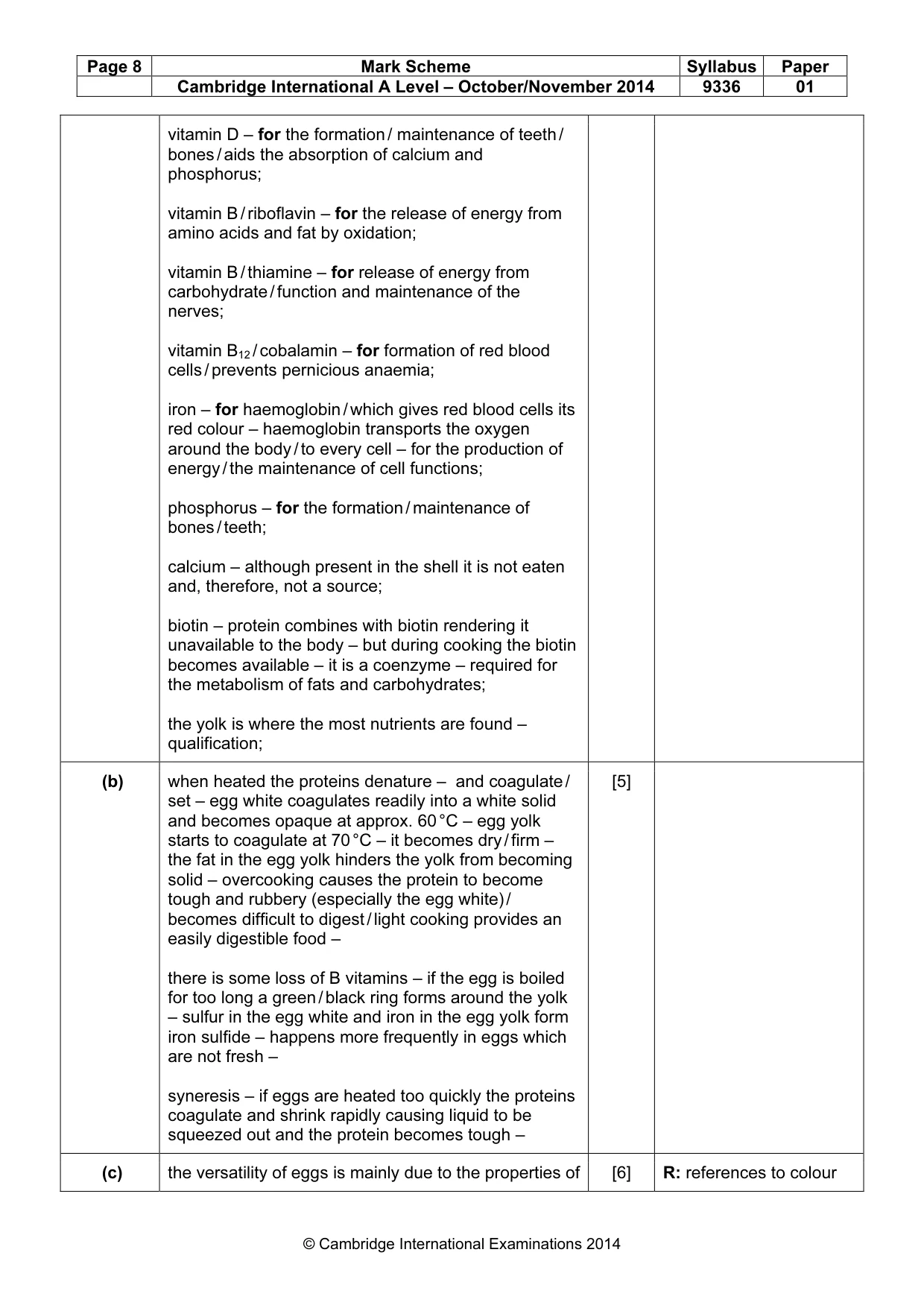
Mark scheme, page 8
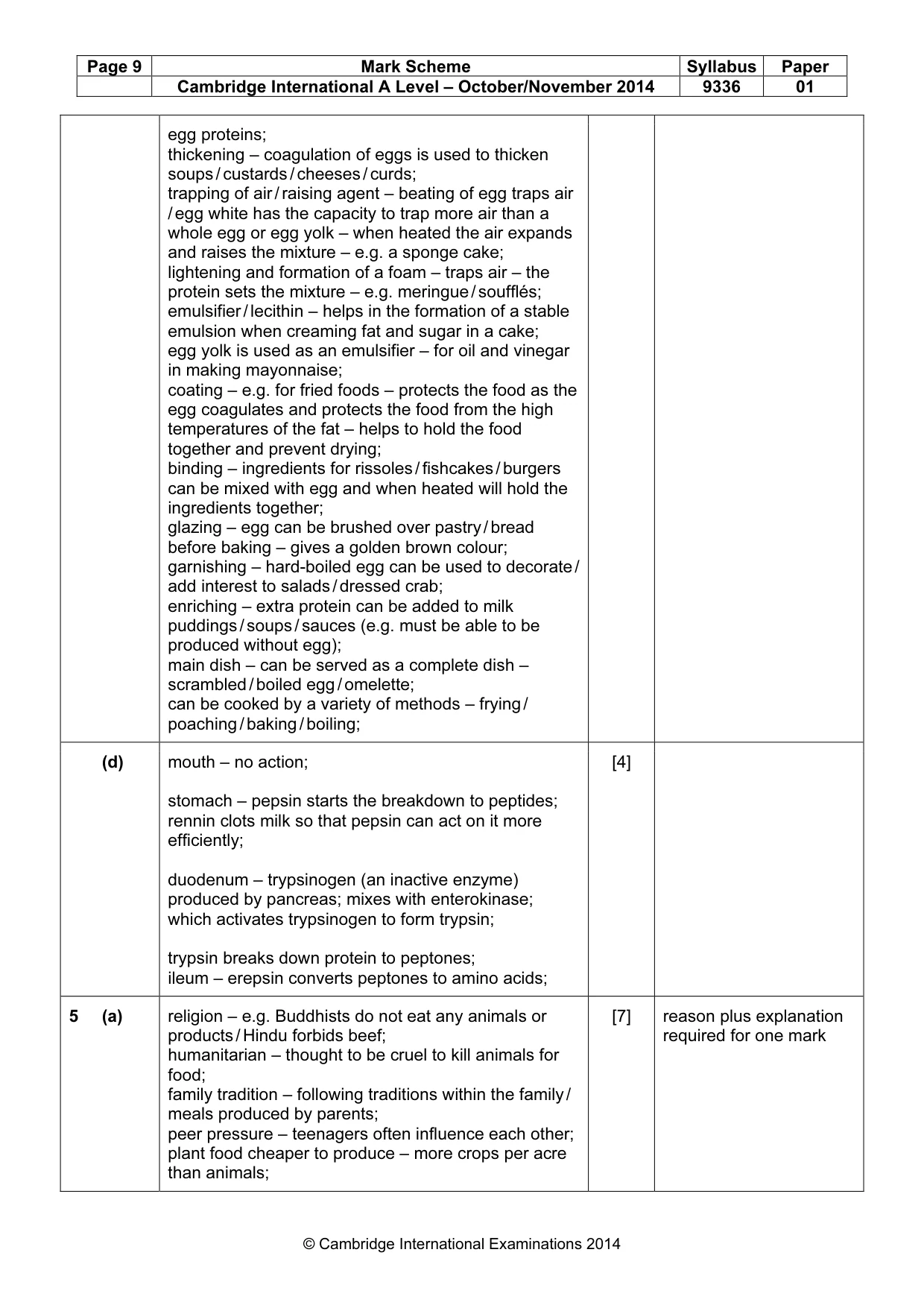
Page 8 Mark Scheme Syllabus Paper Cambridge International A Level – October/November 2014 9336 01 © Cambridge International Examinations 2014 vitamin D – for the formation / maintenance of teeth / bones / aids the absorption of calcium and phosphorus; vitamin B / riboflavin – for the release of energy from amino acids and fat by oxidation; vitamin B / thiamine – for release of energy from carbohydrate / function and maintenance of the nerves; vitamin B12 / cobalamin – for formation of red blood cells / prevents pernicious anaemia; iron – for haemoglobin / which gives red blood cells its red colour – haemoglobin transports the oxygen around the body / to every cell – for the production of energy / the maintenance of cell functions; phosphorus – for the formation / maintenance of bones / teeth; calcium – although present in the shell it is not eaten and, therefore, not a source; biotin – protein combines with biotin rendering it unavailable to the body – but during cooking the biotin becomes available – it is a coenzyme – required for the metabolism of fats and carbohydrates; the yolk is where the most nutrients are found – qualification; (b) when heated the proteins denature – and coagulate / set – egg white coagulates readily into a white solid and becomes opaque at approx. 60 °C – egg yolk starts to coagulate at 70 °C – it becomes dry / firm – the fat in the egg yolk hinders the yolk from becoming solid – overcooking causes the protein to become tough and rubbery (especially the egg white) / becomes difficult to digest / light cooking provides an easily digestible food – there is some loss of B vitamins – if the egg is boiled for too long a green / black ring forms around the yolk – sulfur in the egg white and iron in the egg yolk form iron sulfide – happens more frequently in eggs which are not fresh – syneresis – if eggs are heated too quickly the proteins coagulate and shrink rapidly causing liquid to be squeezed out and the protein becomes tough – [5] (c) the versatility of eggs is mainly due to the properties of [6] R: references to colour
Mark scheme, page 9
Page 9 Mark Scheme Syllabus Paper Cambridge International A Level – October/November 2014 9336 01 © Cambridge International Examinations 2014 egg proteins; thickening – coagulation of eggs is used to thicken soups / custards / cheeses / curds; trapping of air / raising agent – beating of egg traps air / egg white has the capacity to trap more air than a whole egg or egg yolk – when heated the air expands and raises the mixture – e.g. a sponge cake; lightening and formation of a foam – traps air – the protein sets the mixture – e.g. meringue / soufflés; emulsifier / lecithin – helps in the formation of a stable emulsion when creaming fat and sugar in a cake; egg yolk is used as an emulsifier – for oil and vinegar in making mayonnaise; coating – e.g. for fried foods – protects the food as the egg coagulates and protects the food from the high temperatures of the fat – helps to hold the food together and prevent drying; binding – ingredients for rissoles / fishcakes / burgers can be mixed with egg and when heated will hold the ingredients together; glazing – egg can be brushed over pastry / bread before baking – gives a golden brown colour; garnishing – hard-boiled egg can be used to decorate / add interest to salads / dressed crab; enriching – extra protein can be added to milk puddings / soups / sauces (e.g. must be able to be produced without egg); main dish – can be served as a complete dish – scrambled / boiled egg / omelette; can be cooked by a variety of methods – frying / poaching / baking / boiling; (d) mouth – no action; stomach – pepsin starts the breakdown to peptides; rennin clots milk so that pepsin can act on it more efficiently; duodenum – trypsinogen (an inactive enzyme) produced by pancreas; mixes with enterokinase; which activates trypsinogen to form trypsin; trypsin breaks down protein to peptones; ileum – erepsin converts peptones to amino acids; [4] 5 (a) religion – e.g. Buddhists do not eat any animals or products / Hindu forbids beef; humanitarian – thought to be cruel to kill animals for food; family tradition – following traditions within the family / meals produced by parents; peer pressure – teenagers often influence each other; plant food cheaper to produce – more crops per acre than animals; [7] reason plus explanation required for one mark
Mark scheme, page 10
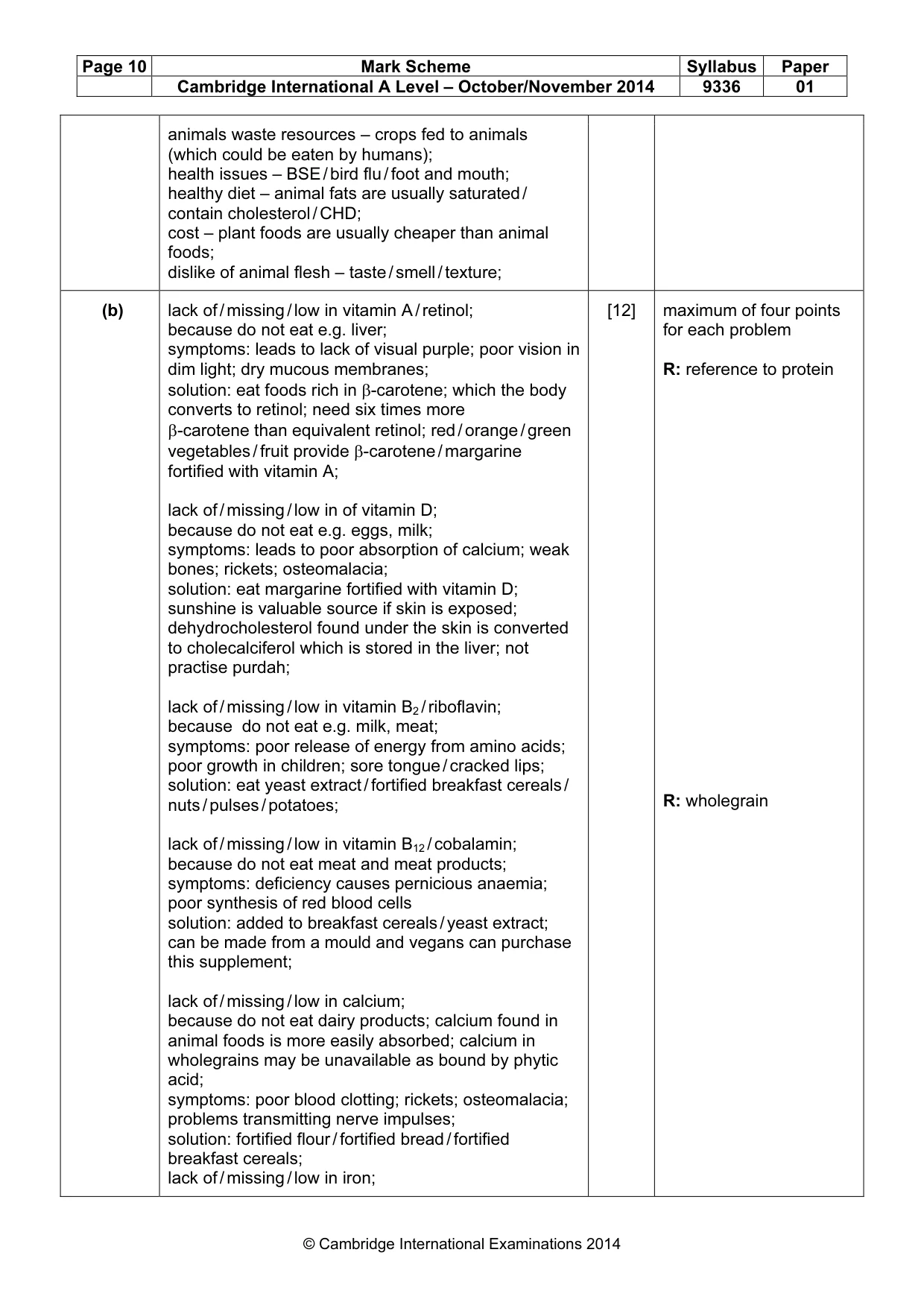
Page 10 Mark Scheme Syllabus Paper Cambridge International A Level – October/November 2014 9336 01 © Cambridge International Examinations 2014 animals waste resources – crops fed to animals (which could be eaten by humans); health issues – BSE / bird flu / foot and mouth; healthy diet – animal fats are usually saturated / contain cholesterol / CHD; cost – plant foods are usually cheaper than animal foods; dislike of animal flesh – taste / smell / texture; (b) lack of / missing / low in vitamin A / retinol; because do not eat e.g. liver; symptoms: leads to lack of visual purple; poor vision in dim light; dry mucous membranes; solution: eat foods rich in β-carotene; which the body converts to retinol; need six times more β-carotene than equivalent retinol; red / orange / green vegetables / fruit provide β-carotene / margarine fortified with vitamin A; lack of / missing / low in of vitamin D; because do not eat e.g. eggs, milk; symptoms: leads to poor absorption of calcium; weak bones; rickets; osteomalacia; solution: eat margarine fortified with vitamin D; sunshine is valuable source if skin is exposed; dehydrocholesterol found under the skin is converted to cholecalciferol which is stored in the liver; not practise purdah; lack of / missing / low in vitamin B2 / riboflavin; because do not eat e.g. milk, meat; symptoms: poor release of energy from amino acids; poor growth in children; sore tongue / cracked lips; solution: eat yeast extract / fortified breakfast cereals / nuts / pulses / potatoes; lack of / missing / low in vitamin B12 / cobalamin; because do not eat meat and meat products; symptoms: deficiency causes pernicious anaemia; poor synthesis of red blood cells solution: added to breakfast cereals / yeast extract; can be made from a mould and vegans can purchase this supplement; lack of / missing / low in calcium; because do not eat dairy products; calcium found in animal foods is more easily absorbed; calcium in wholegrains may be unavailable as bound by phytic acid; symptoms: poor blood clotting; rickets; osteomalacia; problems transmitting nerve impulses; solution: fortified flour / fortified bread / fortified breakfast cereals; lack of / missing / low in iron; [12] maximum of four points for each problem R: reference to protein R: wholegrain
Mark scheme, page 11
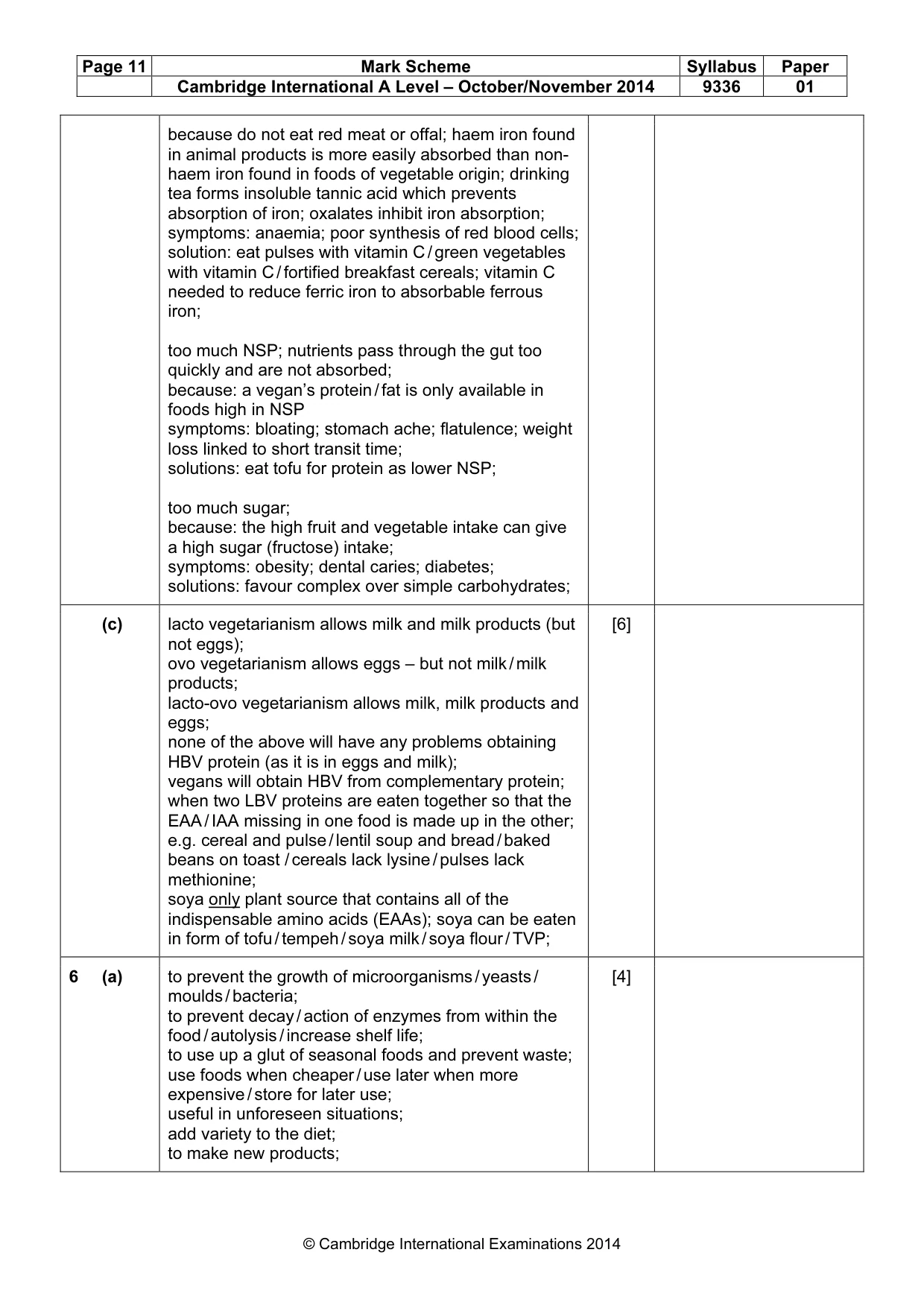
Page 11 Mark Scheme Syllabus Paper Cambridge International A Level – October/November 2014 9336 01 © Cambridge International Examinations 2014 because do not eat red meat or offal; haem iron found in animal products is more easily absorbed than non- haem iron found in foods of vegetable origin; drinking tea forms insoluble tannic acid which prevents absorption of iron; oxalates inhibit iron absorption; symptoms: anaemia; poor synthesis of red blood cells; solution: eat pulses with vitamin C / green vegetables with vitamin C / fortified breakfast cereals; vitamin C needed to reduce ferric iron to absorbable ferrous iron; too much NSP; nutrients pass through the gut too quickly and are not absorbed; because: a vegan’s protein / fat is only available in foods high in NSP symptoms: bloating; stomach ache; flatulence; weight loss linked to short transit time; solutions: eat tofu for protein as lower NSP; too much sugar; because: the high fruit and vegetable intake can give a high sugar (fructose) intake; symptoms: obesity; dental caries; diabetes; solutions: favour complex over simple carbohydrates; (c) lacto vegetarianism allows milk and milk products (but not eggs); ovo vegetarianism allows eggs – but not milk / milk products; lacto-ovo vegetarianism allows milk, milk products and eggs; none of the above will have any problems obtaining HBV protein (as it is in eggs and milk); vegans will obtain HBV from complementary protein; when two LBV proteins are eaten together so that the EAA / IAA missing in one food is made up in the other; e.g. cereal and pulse / lentil soup and bread / baked beans on toast / cereals lack lysine / pulses lack methionine; soya only plant source that contains all of the indispensable amino acids (EAAs); soya can be eaten in form of tofu / tempeh / soya milk / soya flour / TVP; [6] 6 (a) to prevent the growth of microorganisms / yeasts / moulds / bacteria; to prevent decay / action of enzymes from within the food / autolysis / increase shelf life; to use up a glut of seasonal foods and prevent waste; use foods when cheaper / use later when more expensive / store for later use; useful in unforeseen situations; add variety to the diet; to make new products; [4]
Mark scheme, page 12
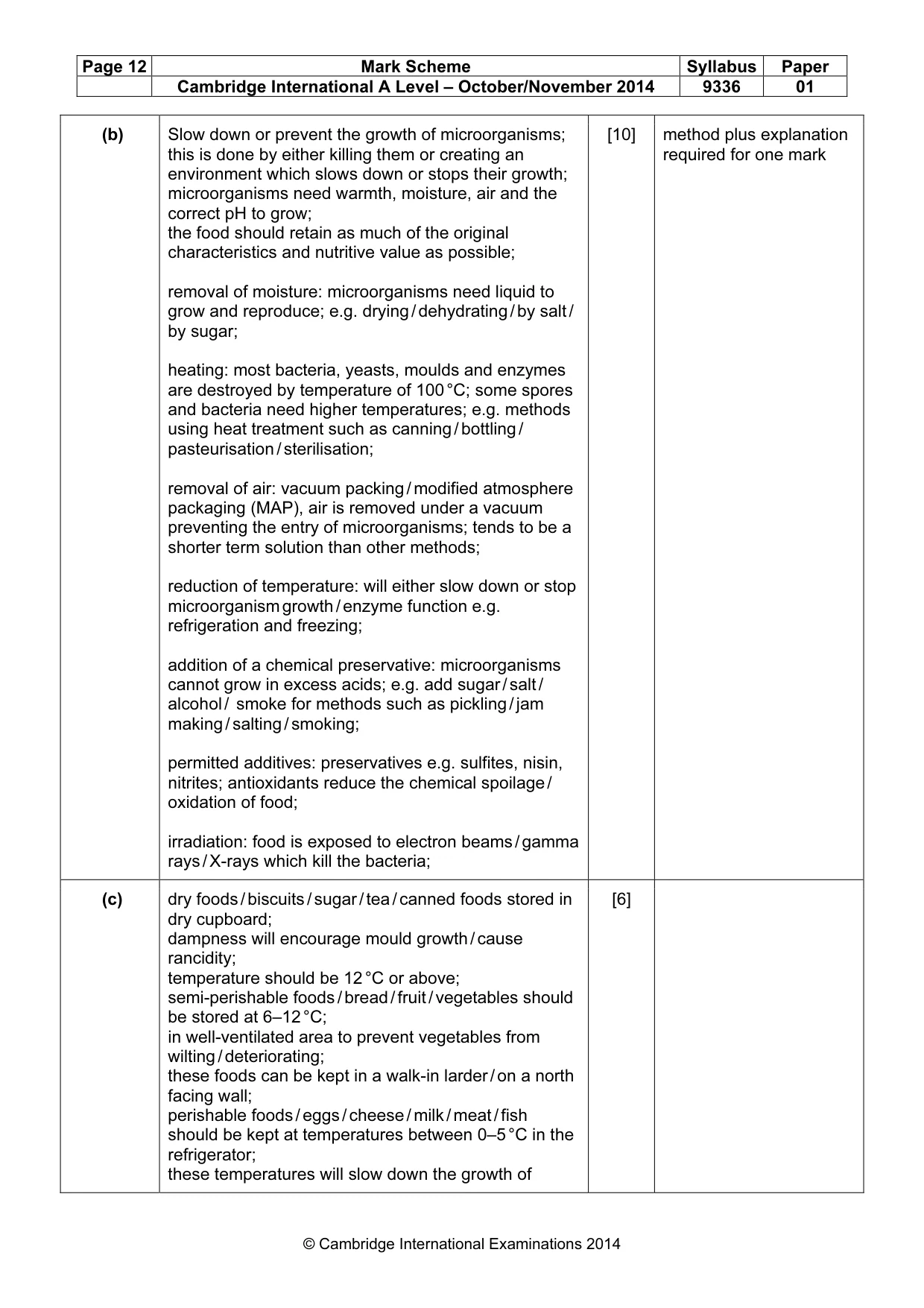
Page 12 Mark Scheme Syllabus Paper Cambridge International A Level – October/November 2014 9336 01 © Cambridge International Examinations 2014 (b) Slow down or prevent the growth of microorganisms; this is done by either killing them or creating an environment which slows down or stops their growth; microorganisms need warmth, moisture, air and the correct pH to grow; the food should retain as much of the original characteristics and nutritive value as possible; removal of moisture: microorganisms need liquid to grow and reproduce; e.g. drying / dehydrating / by salt / by sugar; heating: most bacteria, yeasts, moulds and enzymes are destroyed by temperature of 100 °C; some spores and bacteria need higher temperatures; e.g. methods using heat treatment such as canning / bottling / pasteurisation / sterilisation; removal of air: vacuum packing / modified atmosphere packaging (MAP), air is removed under a vacuum preventing the entry of microorganisms; tends to be a shorter term solution than other methods; reduction of temperature: will either slow down or stop microorganism growth / enzyme function e.g. refrigeration and freezing; addition of a chemical preservative: microorganisms cannot grow in excess acids; e.g. add sugar / salt / alcohol / smoke for methods such as pickling / jam making / salting / smoking; permitted additives: preservatives e.g. sulfites, nisin, nitrites; antioxidants reduce the chemical spoilage / oxidation of food; irradiation: food is exposed to electron beams / gamma rays / X-rays which kill the bacteria; [10] method plus explanation required for one mark (c) dry foods / biscuits / sugar / tea / canned foods stored in dry cupboard; dampness will encourage mould growth / cause rancidity; temperature should be 12 °C or above; semi-perishable foods / bread / fruit / vegetables should be stored at 6–12 °C; in well-ventilated area to prevent vegetables from wilting / deteriorating; these foods can be kept in a walk-in larder / on a north facing wall; perishable foods / eggs / cheese / milk / meat / fish should be kept at temperatures between 0–5 °C in the refrigerator; these temperatures will slow down the growth of [6]
Mark scheme, page 13
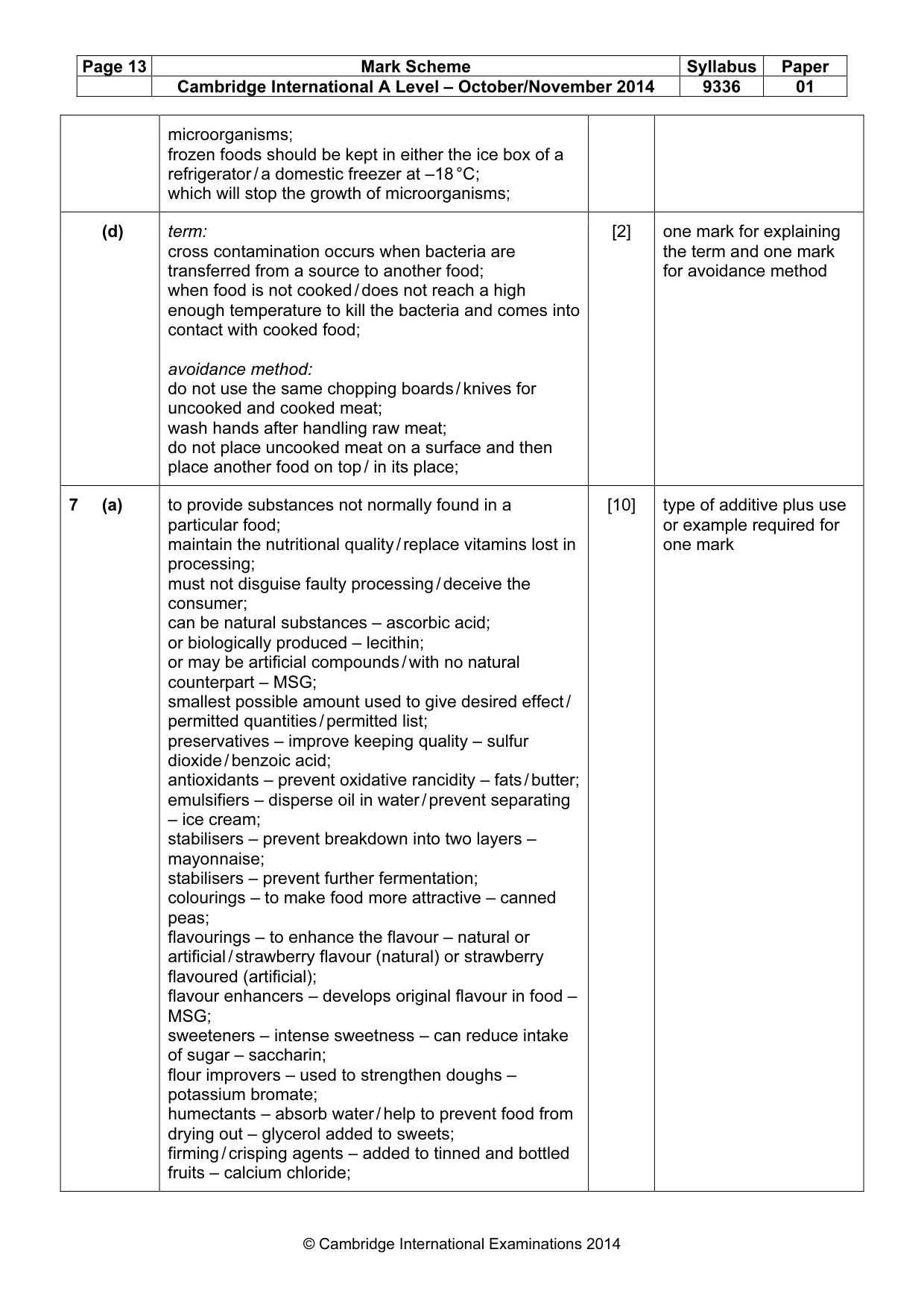
Page 13 Mark Scheme Syllabus Paper Cambridge International A Level – October/November 2014 9336 01 © Cambridge International Examinations 2014 microorganisms; frozen foods should be kept in either the ice box of a refrigerator / a domestic freezer at –18 °C; which will stop the growth of microorganisms; (d) term: cross contamination occurs when bacteria are transferred from a source to another food; when food is not cooked / does not reach a high enough temperature to kill the bacteria and comes into contact with cooked food; avoidance method: do not use the same chopping boards / knives for uncooked and cooked meat; wash hands after handling raw meat; do not place uncooked meat on a surface and then place another food on top / in its place; [2] one mark for explaining the term and one mark for avoidance method 7 (a) to provide substances not normally found in a particular food; maintain the nutritional quality / replace vitamins lost in processing; must not disguise faulty processing / deceive the consumer; can be natural substances – ascorbic acid; or biologically produced – lecithin; or may be artificial compounds / with no natural counterpart – MSG; smallest possible amount used to give desired effect / permitted quantities / permitted list; preservatives – improve keeping quality – sulfur dioxide / benzoic acid; antioxidants – prevent oxidative rancidity – fats / butter; emulsifiers – disperse oil in water / prevent separating – ice cream; stabilisers – prevent breakdown into two layers – mayonnaise; stabilisers – prevent further fermentation; colourings – to make food more attractive – canned peas; flavourings – to enhance the flavour – natural or artificial / strawberry flavour (natural) or strawberry flavoured (artificial); flavour enhancers – develops original flavour in food – MSG; sweeteners – intense sweetness – can reduce intake of sugar – saccharin; flour improvers – used to strengthen doughs – potassium bromate; humectants – absorb water / help to prevent food from drying out – glycerol added to sweets; firming / crisping agents – added to tinned and bottled fruits – calcium chloride; [10] type of additive plus use or example required for one mark
Mark scheme, page 14
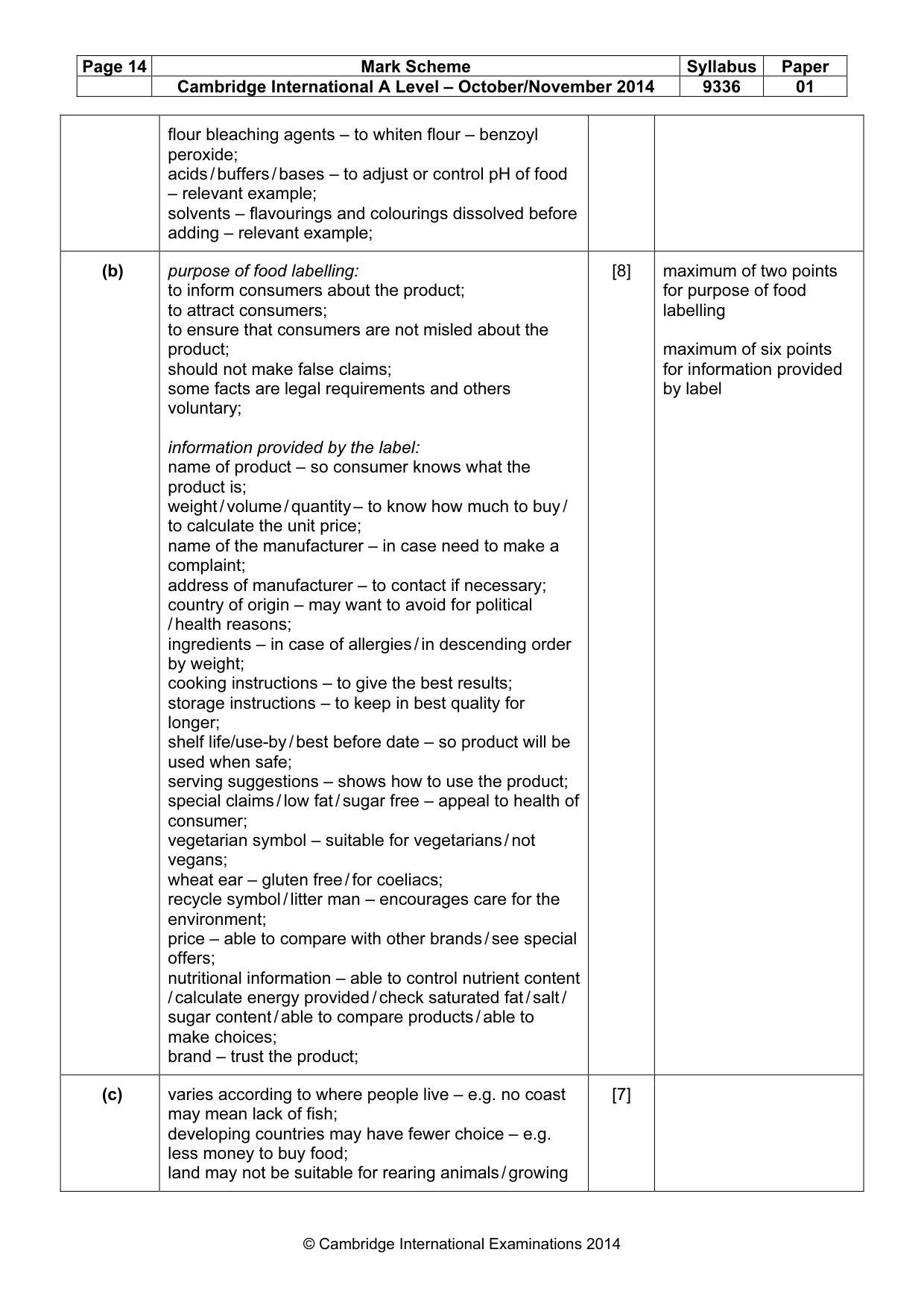
Page 14 Mark Scheme Syllabus Paper Cambridge International A Level – October/November 2014 9336 01 © Cambridge International Examinations 2014 flour bleaching agents – to whiten flour – benzoyl peroxide; acids / buffers / bases – to adjust or control pH of food – relevant example; solvents – flavourings and colourings dissolved before adding – relevant example; (b) purpose of food labelling: to inform consumers about the product; to attract consumers; to ensure that consumers are not misled about the product; should not make false claims; some facts are legal requirements and others voluntary; information provided by the label: name of product – so consumer knows what the product is; weight / volume / quantity – to know how much to buy / to calculate the unit price; name of the manufacturer – in case need to make a complaint; address of manufacturer – to contact if necessary; country of origin – may want to avoid for political / health reasons; ingredients – in case of allergies / in descending order by weight; cooking instructions – to give the best results; storage instructions – to keep in best quality for longer; shelf life/use-by / best before date – so product will be used when safe; serving suggestions – shows how to use the product; special claims / low fat / sugar free – appeal to health of consumer; vegetarian symbol – suitable for vegetarians / not vegans; wheat ear – gluten free / for coeliacs; recycle symbol / litter man – encourages care for the environment; price – able to compare with other brands / see special offers; nutritional information – able to control nutrient content / calculate energy provided / check saturated fat / salt / sugar content / able to compare products / able to make choices; brand – trust the product; [8] maximum of two points for purpose of food labelling maximum of six points for information provided by label (c) varies according to where people live – e.g. no coast may mean lack of fish; developing countries may have fewer choice – e.g. less money to buy food; land may not be suitable for rearing animals / growing [7]
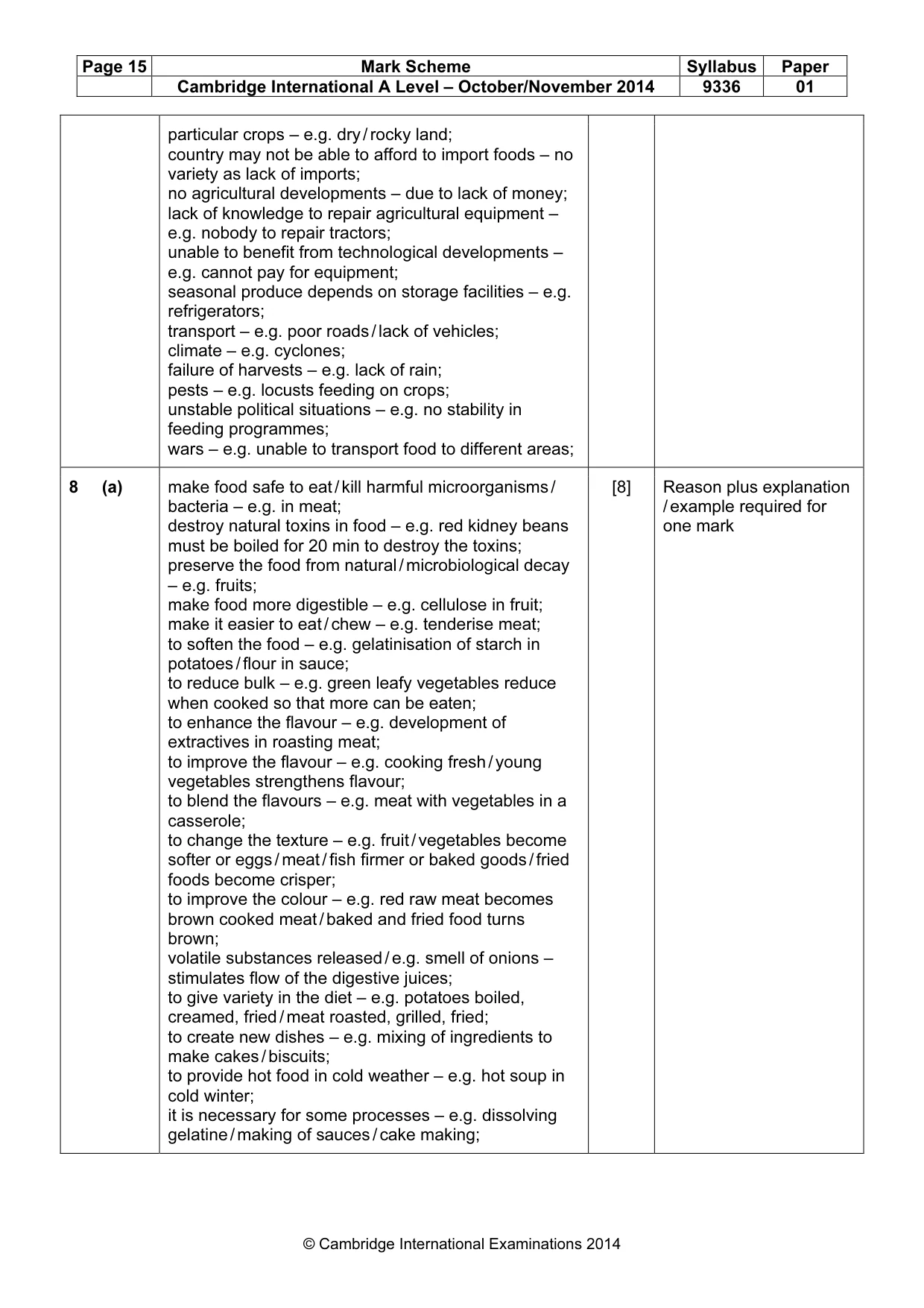
Mark scheme, page 15
Page 15 Mark Scheme Syllabus Paper Cambridge International A Level – October/November 2014 9336 01 © Cambridge International Examinations 2014 particular crops – e.g. dry / rocky land; country may not be able to afford to import foods – no variety as lack of imports; no agricultural developments – due to lack of money; lack of knowledge to repair agricultural equipment – e.g. nobody to repair tractors; unable to benefit from technological developments – e.g. cannot pay for equipment; seasonal produce depends on storage facilities – e.g. refrigerators; transport – e.g. poor roads / lack of vehicles; climate – e.g. cyclones; failure of harvests – e.g. lack of rain; pests – e.g. locusts feeding on crops; unstable political situations – e.g. no stability in feeding programmes; wars – e.g. unable to transport food to different areas; 8 (a) make food safe to eat / kill harmful microorganisms / bacteria – e.g. in meat; destroy natural toxins in food – e.g. red kidney beans must be boiled for 20 min to destroy the toxins; preserve the food from natural / microbiological decay – e.g. fruits; make food more digestible – e.g. cellulose in fruit; make it easier to eat / chew – e.g. tenderise meat; to soften the food – e.g. gelatinisation of starch in potatoes / flour in sauce; to reduce bulk – e.g. green leafy vegetables reduce when cooked so that more can be eaten; to enhance the flavour – e.g. development of extractives in roasting meat; to improve the flavour – e.g. cooking fresh / young vegetables strengthens flavour; to blend the flavours – e.g. meat with vegetables in a casserole; to change the texture – e.g. fruit / vegetables become softer or eggs / meat / fish firmer or baked goods / fried foods become crisper; to improve the colour – e.g. red raw meat becomes brown cooked meat / baked and fried food turns brown; volatile substances released / e.g. smell of onions – stimulates flow of the digestive juices; to give variety in the diet – e.g. potatoes boiled, creamed, fried / meat roasted, grilled, fried; to create new dishes – e.g. mixing of ingredients to make cakes / biscuits; to provide hot food in cold weather – e.g. hot soup in cold winter; it is necessary for some processes – e.g. dissolving gelatine / making of sauces / cake making; [8] Reason plus explanation / example required for one mark
Mark scheme, page 16
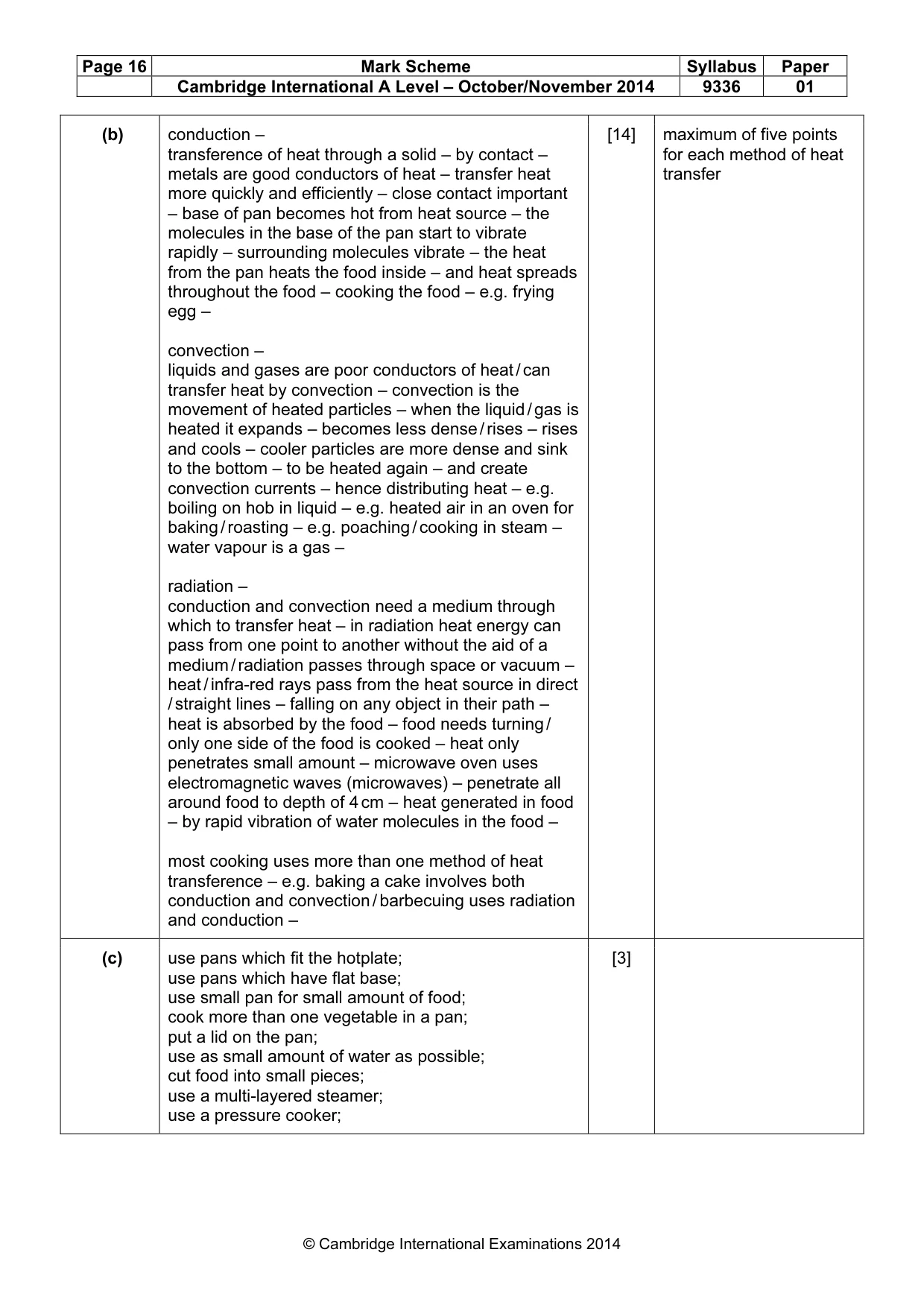
Page 16 Mark Scheme Syllabus Paper Cambridge International A Level – October/November 2014 9336 01 © Cambridge International Examinations 2014 (b) conduction – transference of heat through a solid – by contact – metals are good conductors of heat – transfer heat more quickly and efficiently – close contact important – base of pan becomes hot from heat source – the molecules in the base of the pan start to vibrate rapidly – surrounding molecules vibrate – the heat from the pan heats the food inside – and heat spreads throughout the food – cooking the food – e.g. frying egg – convection – liquids and gases are poor conductors of heat / can transfer heat by convection – convection is the movement of heated particles – when the liquid / gas is heated it expands – becomes less dense / rises – rises and cools – cooler particles are more dense and sink to the bottom – to be heated again – and create convection currents – hence distributing heat – e.g. boiling on hob in liquid – e.g. heated air in an oven for baking / roasting – e.g. poaching / cooking in steam – water vapour is a gas – radiation – conduction and convection need a medium through which to transfer heat – in radiation heat energy can pass from one point to another without the aid of a medium / radiation passes through space or vacuum – heat / infra-red rays pass from the heat source in direct / straight lines – falling on any object in their path – heat is absorbed by the food – food needs turning / only one side of the food is cooked – heat only penetrates small amount – microwave oven uses electromagnetic waves (microwaves) – penetrate all around food to depth of 4 cm – heat generated in food – by rapid vibration of water molecules in the food – most cooking uses more than one method of heat transference – e.g. baking a cake involves both conduction and convection / barbecuing uses radiation and conduction – [14] maximum of five points for each method of heat transfer (c) use pans which fit the hotplate; use pans which have flat base; use small pan for small amount of food; cook more than one vegetable in a pan; put a lid on the pan; use as small amount of water as possible; cut food into small pieces; use a multi-layered steamer; use a pressure cooker; [3]
What you needed in this session
Cambridge’s own grade thresholds for 2014 Oct/Nov, Paper 1 · Variant 1. A higher threshold means an easier paper — the bar moves with how the cohort did.