Cambridge A Level Environmental Management (AS only) 8291 — 2015 May/June Paper 2 · Variant 2
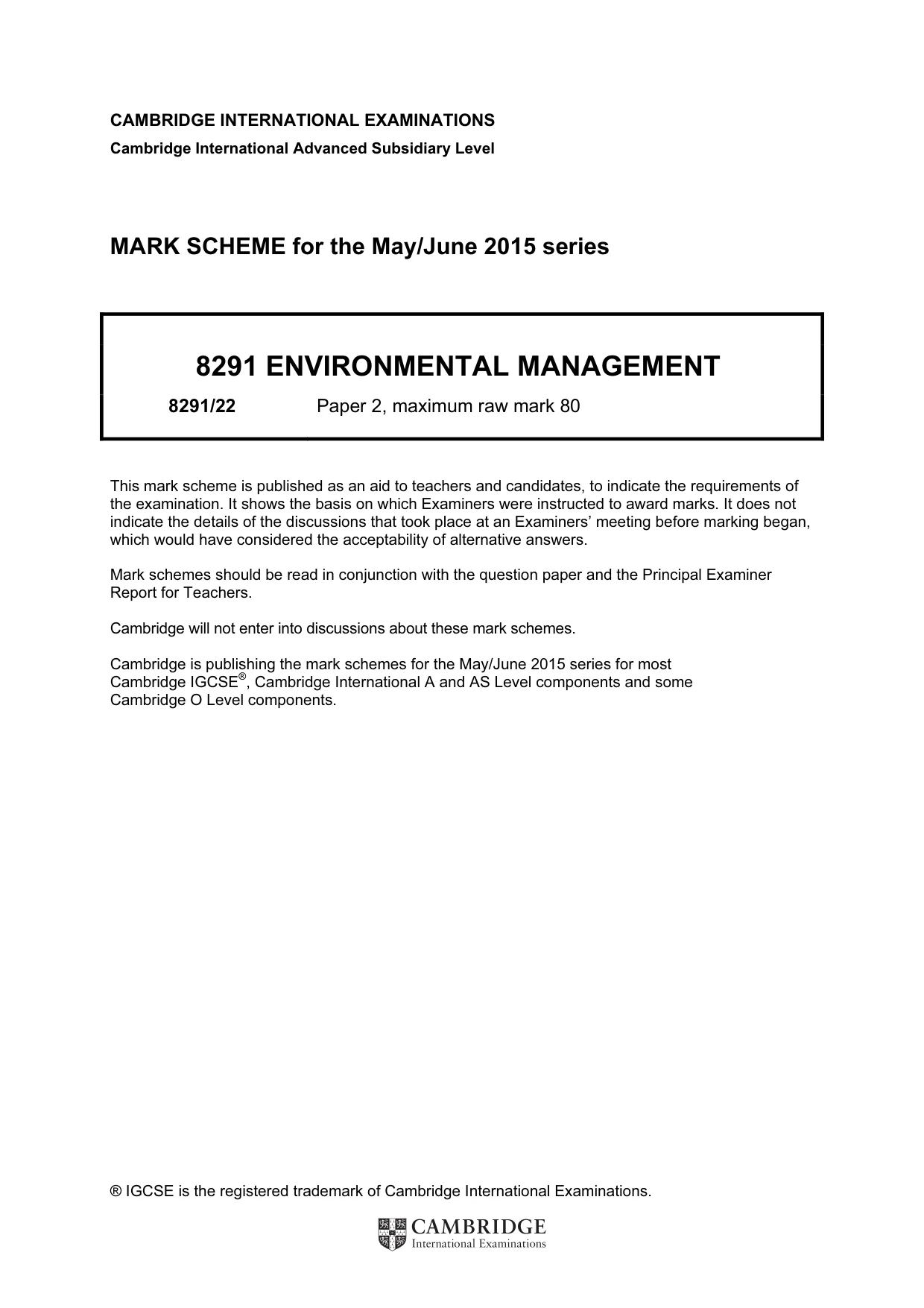
8291/22/M/J/15 · 80 marks · ≈90 min
The question paper and its mark scheme, free to read here and free to download. This is Cambridge’s own paper, exactly as it was sat.
Question paper12 pages
Mark scheme9 pages
Answers below. Sit the paper first if you are practising.
Paper as text
Question paper, page 1
This document consists of 11 printed pages and 1 blank page. DC (NF/SW) 91777/3 © UCLES 2015 [Turn over Cambridge International Examinations Cambridge International Advanced Subsidiary Level * 7 5 6 8 8 3 0 7 0 2 * ENVIRONMENTAL MANAGEMENT 8291/22 Paper 2 Hydrosphere and Biosphere May/June 2015 1 hour 30 minutes Additional Materials: Answer Booklet/Paper READ THESE INSTRUCTIONS FIRST Write your Centre number, candidate number and name on all the work you hand in. Write in dark blue or black pen. You may use an HB pencil for any diagrams or graphs. Do not use staples, paper clips, glue or correction fluid. DO NOT WRITE IN ANY BARCODES. Electronic calculators may be used. You may lose marks if you do not show your working or if you do not use appropriate units. Section A Answer all questions. Write your answers in the spaces provided on the question paper. Section B Answer one question from this section. Answer the question on the separate answer paper provided. At the end of the examination, 1. fasten all separate answer paper securely to the question paper; 2. enter the question number from Section B in the grid opposite. For Examiner’s Use Section A 1 2 Section B Total
Question paper, page 2
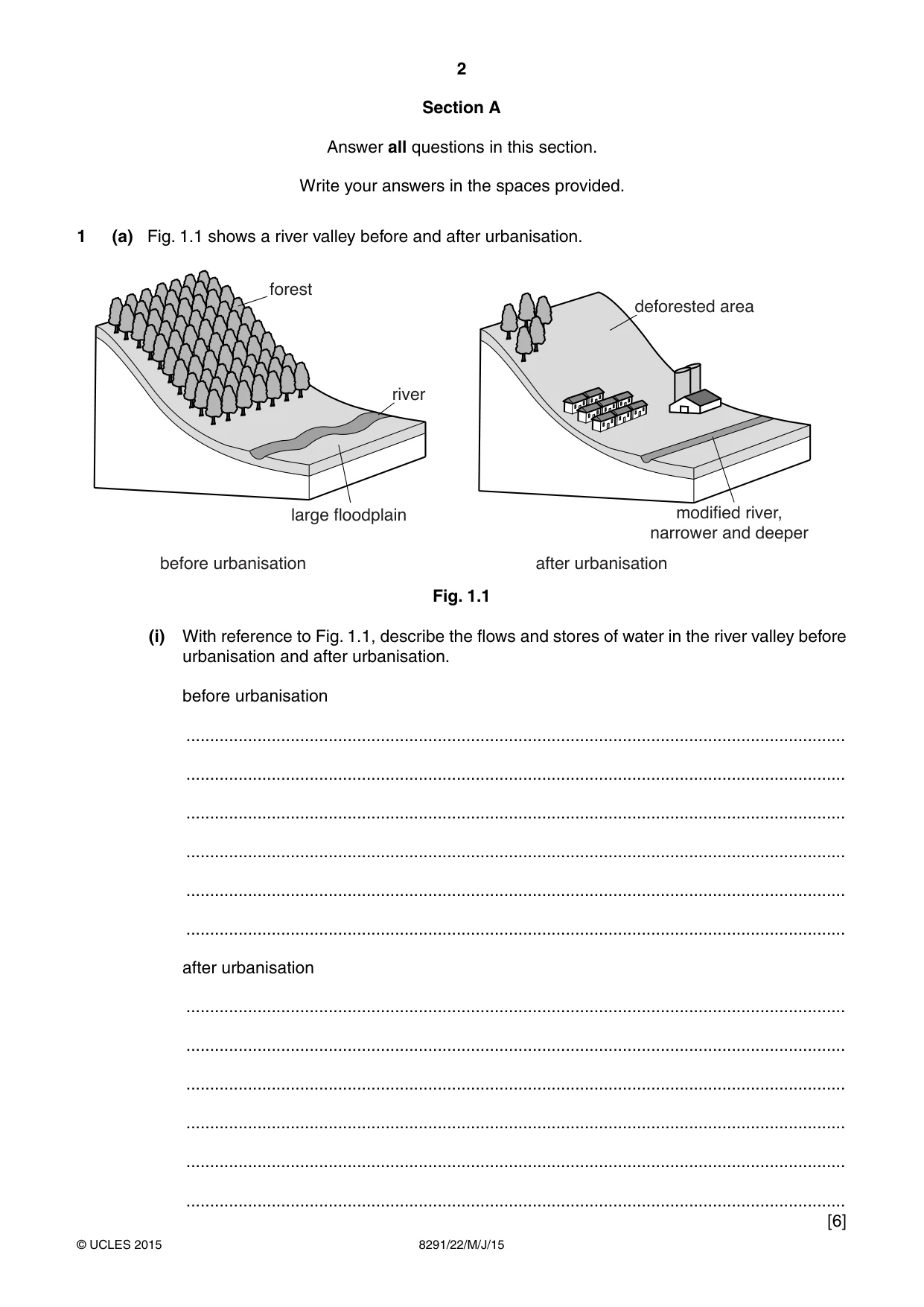
2 8291/22/M/J/15 © UCLES 2015 Section A Answer all questions in this section. Write your answers in the spaces provided. 1 (a) Fig. 1.1 shows a river valley before and after urbanisation. forest river large floodplain modified river, narrower and deeper before urbanisation after urbanisation deforested area Fig. 1.1 (i) With reference to Fig. 1.1, describe the flows and stores of water in the river valley before urbanisation and after urbanisation. before urbanisation … … … … … … after urbanisation … … … … … … [6]
Question paper, page 3
3 8291/22/M/J/15 © UCLES 2015 [Turn over (ii) Explain how urbanisation would increase the likelihood of flooding within a river valley. … … … … … … [3] (iii) State one measure which can be used in a river valley to reduce the likelihood of flooding. … … [1]
Question paper, page 4
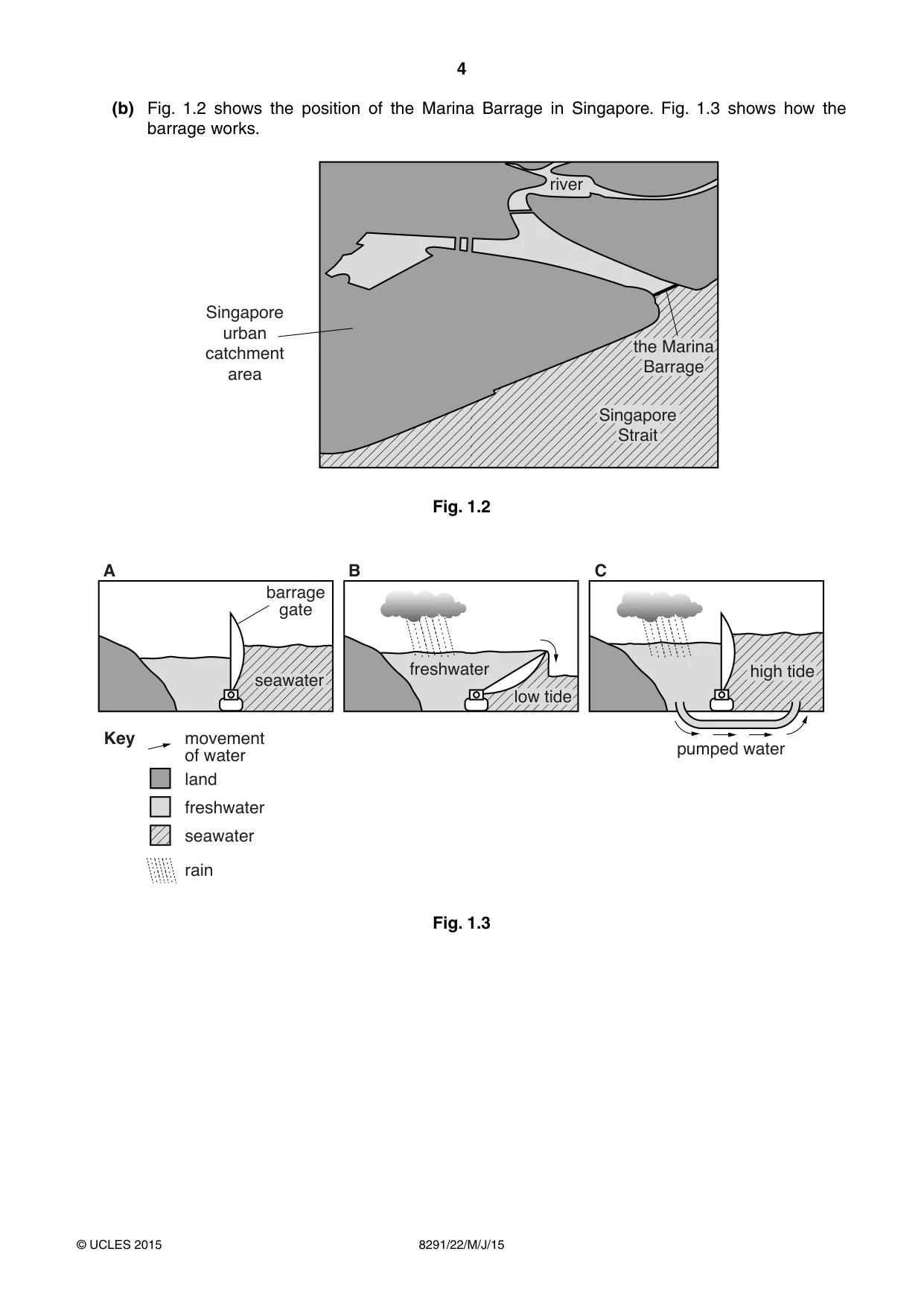
4 8291/22/M/J/15 © UCLES 2015 (b) Fig. 1.2 shows the position of the Marina Barrage in Singapore. Fig. 1.3 shows how the barrage works. Singapore urban catchment area Singapore Strait river the Marina Barrage Fig. 1.2 seawater freshwater pumped water barrage gate low tide high tide A B C Key movement of water land freshwater seawater rain Fig. 1.3
Question paper, page 5
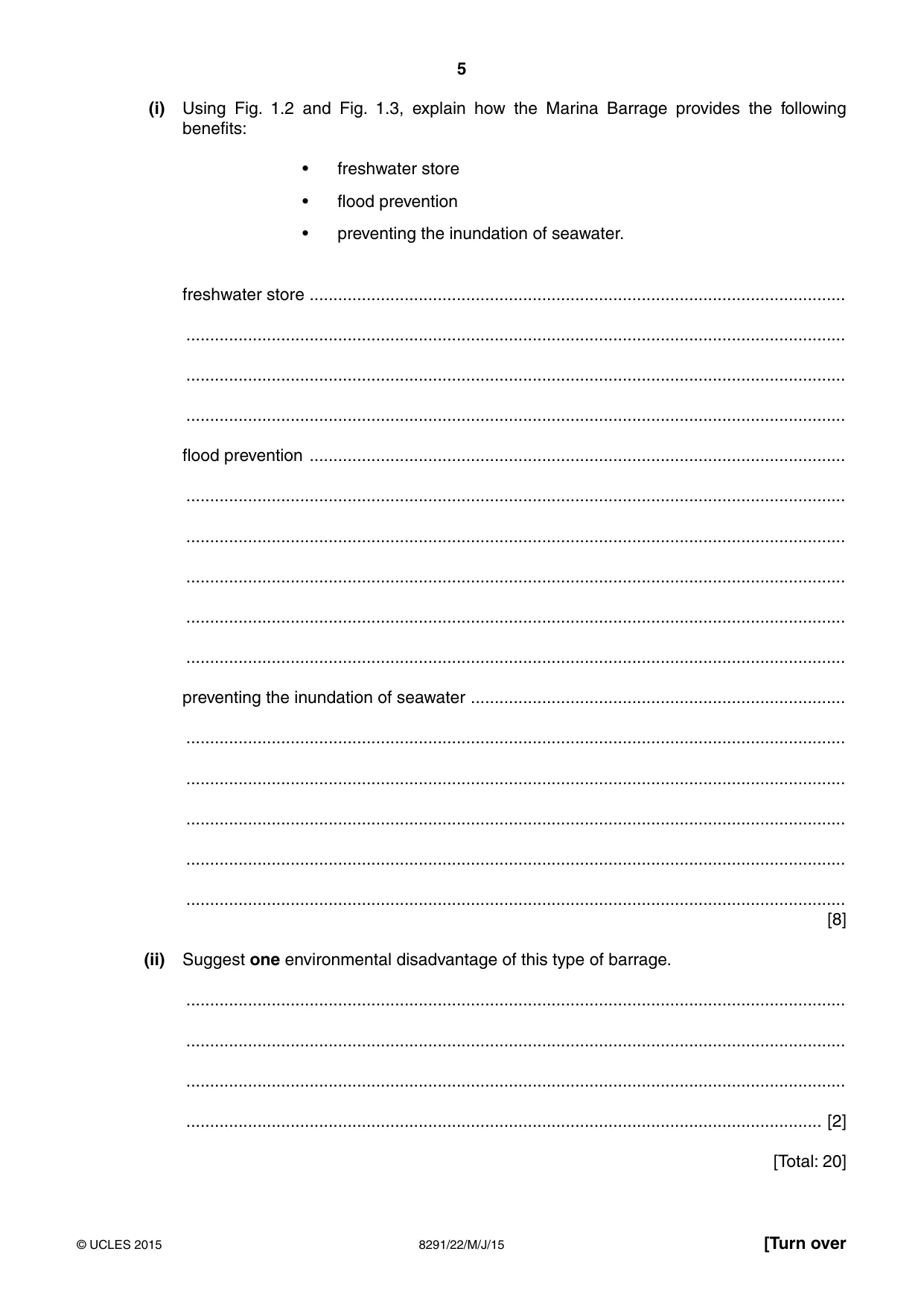
5 8291/22/M/J/15 © UCLES 2015 [Turn over (i) Using Fig. 1.2 and Fig. 1.3, explain how the Marina Barrage provides the following benefits: • freshwater store • flood prevention • preventing the inundation of seawater. freshwater store … … … … flood prevention … … … … … … preventing the inundation of seawater … … … … … … [8] (ii) Suggest one environmental disadvantage of this type of barrage. … … … … [2] [Total: 20]
Question paper, page 6
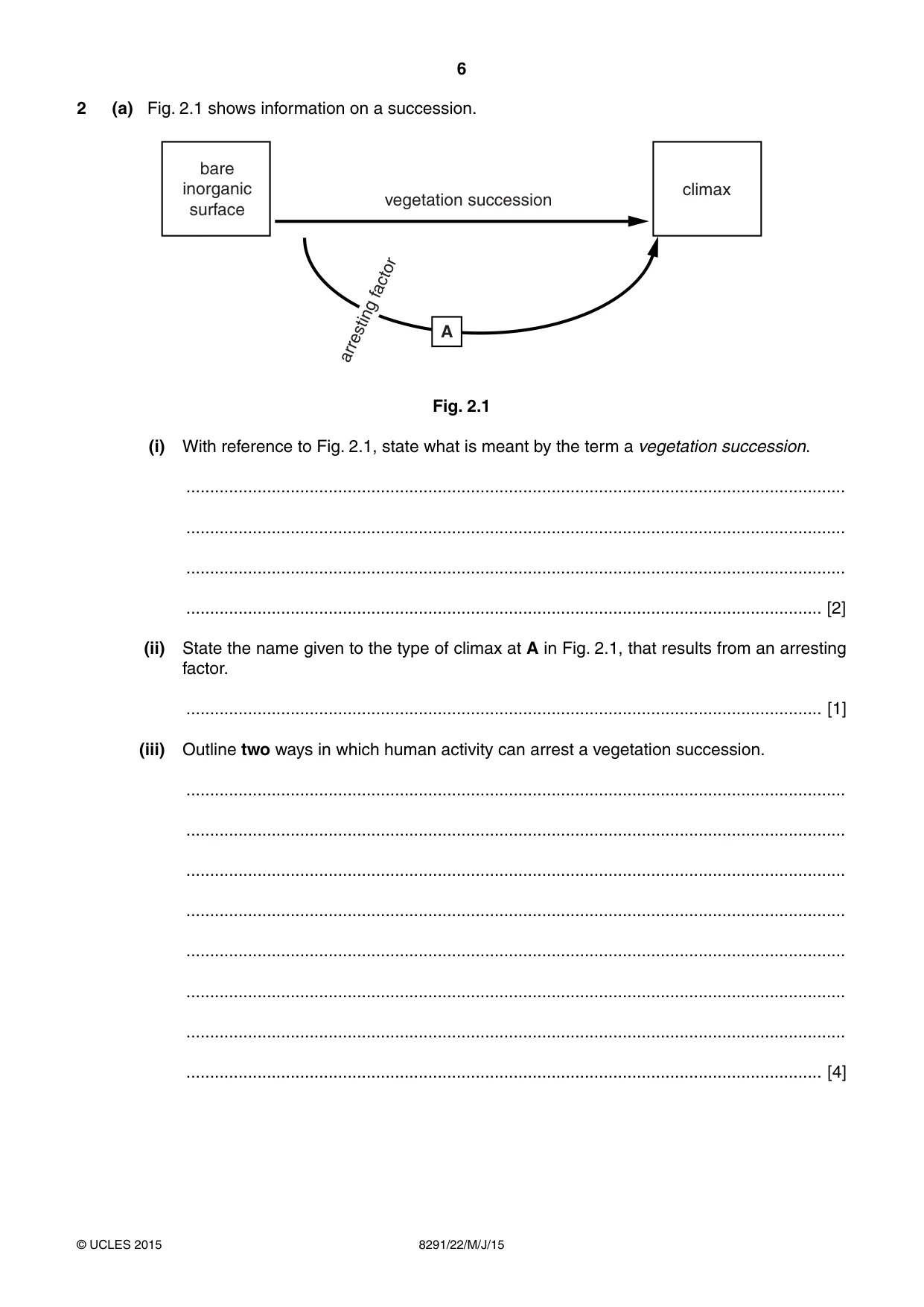
6 8291/22/M/J/15 © UCLES 2015 2 (a) Fig. 2.1 shows information on a succession. bare inorganic surface climax A arresting factor vegetation succession Fig. 2.1 (i) With reference to Fig. 2.1, state what is meant by the term a vegetation succession. … … … … [2] (ii) State the name given to the type of climax at A in Fig. 2.1, that results from an arresting factor. … [1] (iii) Outline two ways in which human activity can arrest a vegetation succession. … … … … … … … … [4]
Question paper, page 7
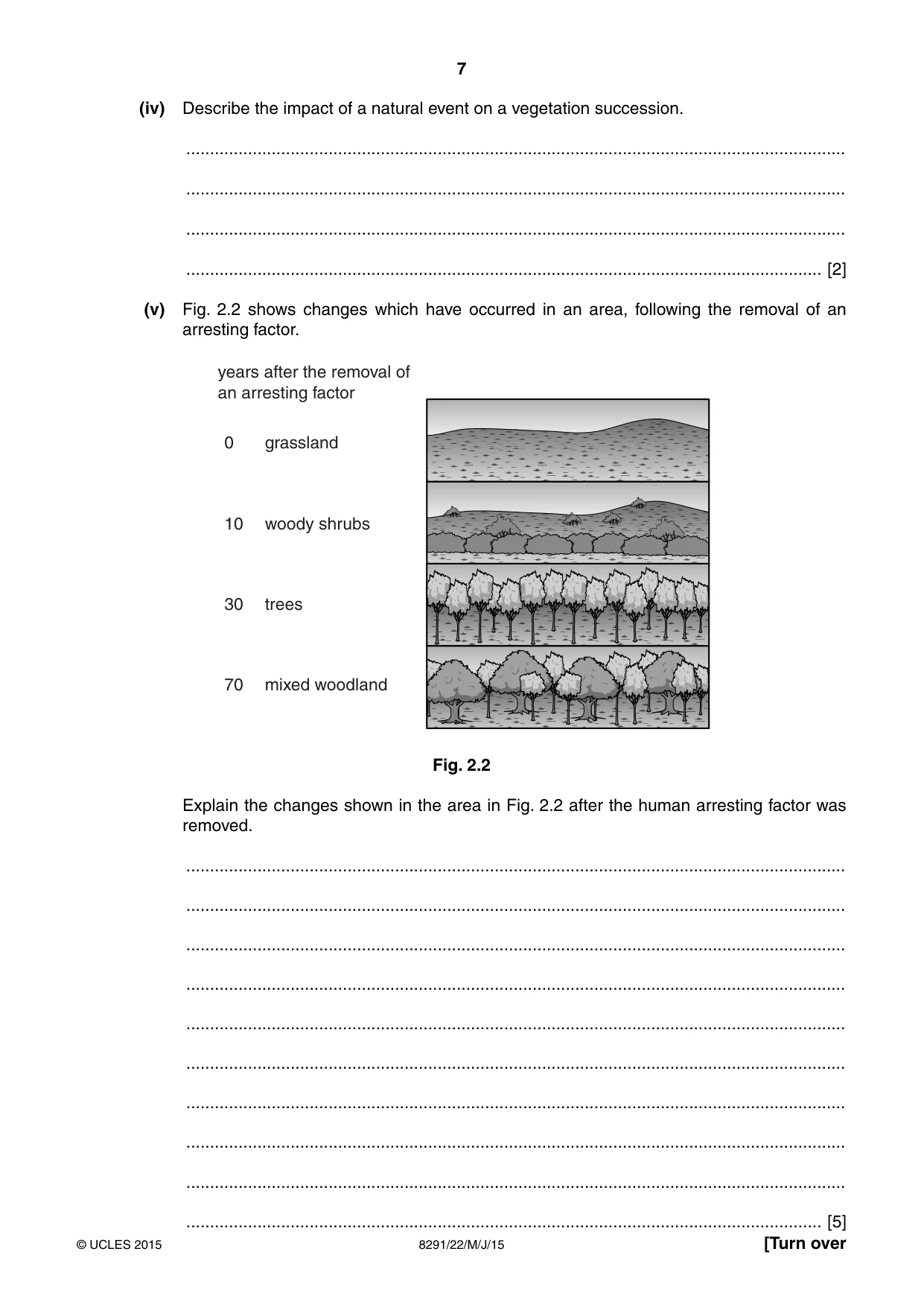
7 8291/22/M/J/15 © UCLES 2015 [Turn over (iv) Describe the impact of a natural event on a vegetation succession. … … … … [2] (v) Fig. 2.2 shows changes which have occurred in an area, following the removal of an arresting factor. 0 10 30 70 grassland woody shrubs trees mixed woodland years after the removal of an arresting factor Fig. 2.2 Explain the changes shown in the area in Fig. 2.2 after the human arresting factor was removed. … … … … … … … … … … [5]
Question paper, page 8
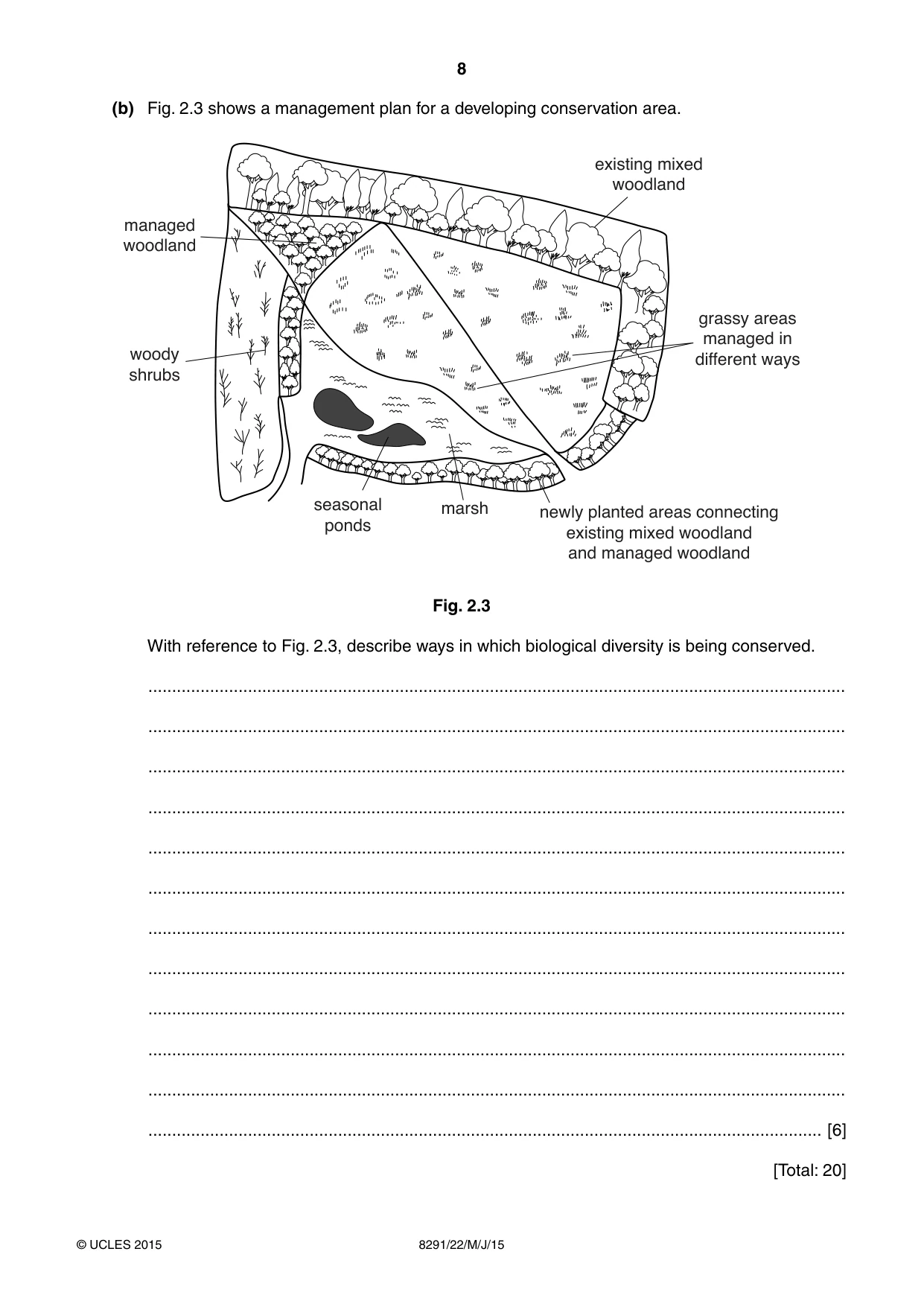
8 8291/22/M/J/15 © UCLES 2015 (b) Fig. 2.3 shows a management plan for a developing conservation area. grassy areas managed in different ways existing mixed woodland newly planted areas connecting existing mixed woodland and managed woodland marsh seasonal ponds woody shrubs managed woodland Fig. 2.3 With reference to Fig. 2.3, describe ways in which biological diversity is being conserved. … … … … … … … … … … … … [6] [Total: 20]
Question paper, page 9
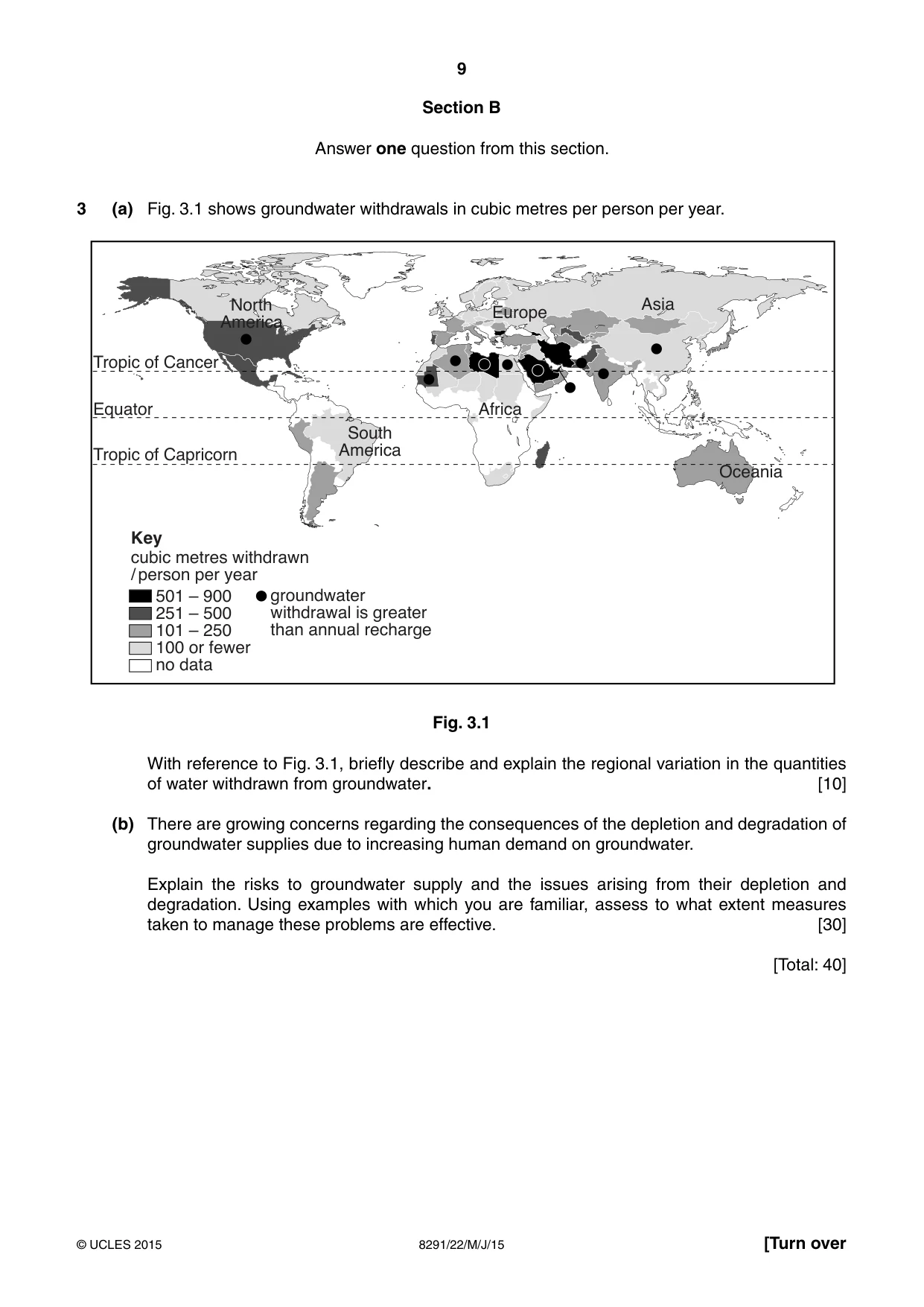
9 8291/22/M/J/15 © UCLES 2015 [Turn over Section B Answer one question from this section. 3 (a) Fig. 3.1 shows groundwater withdrawals in cubic metres per person per year. 501 – 900 251 – 500 101 – 250 100 or fewer no data Key cubic metres withdrawn / person per year groundwater withdrawal is greater than annual recharge North America Tropic of Cancer Equator Tropic of Capricorn South America Africa Oceania Asia Europe Fig. 3.1 With reference to Fig. 3.1, briefly describe and explain the regional variation in the quantities of water withdrawn from groundwater. [10] (b) There are growing concerns regarding the consequences of the depletion and degradation of groundwater supplies due to increasing human demand on groundwater. Explain the risks to groundwater supply and the issues arising from their depletion and degradation. Using examples with which you are familiar, assess to what extent measures taken to manage these problems are effective. [30] [Total: 40]
Question paper, page 10
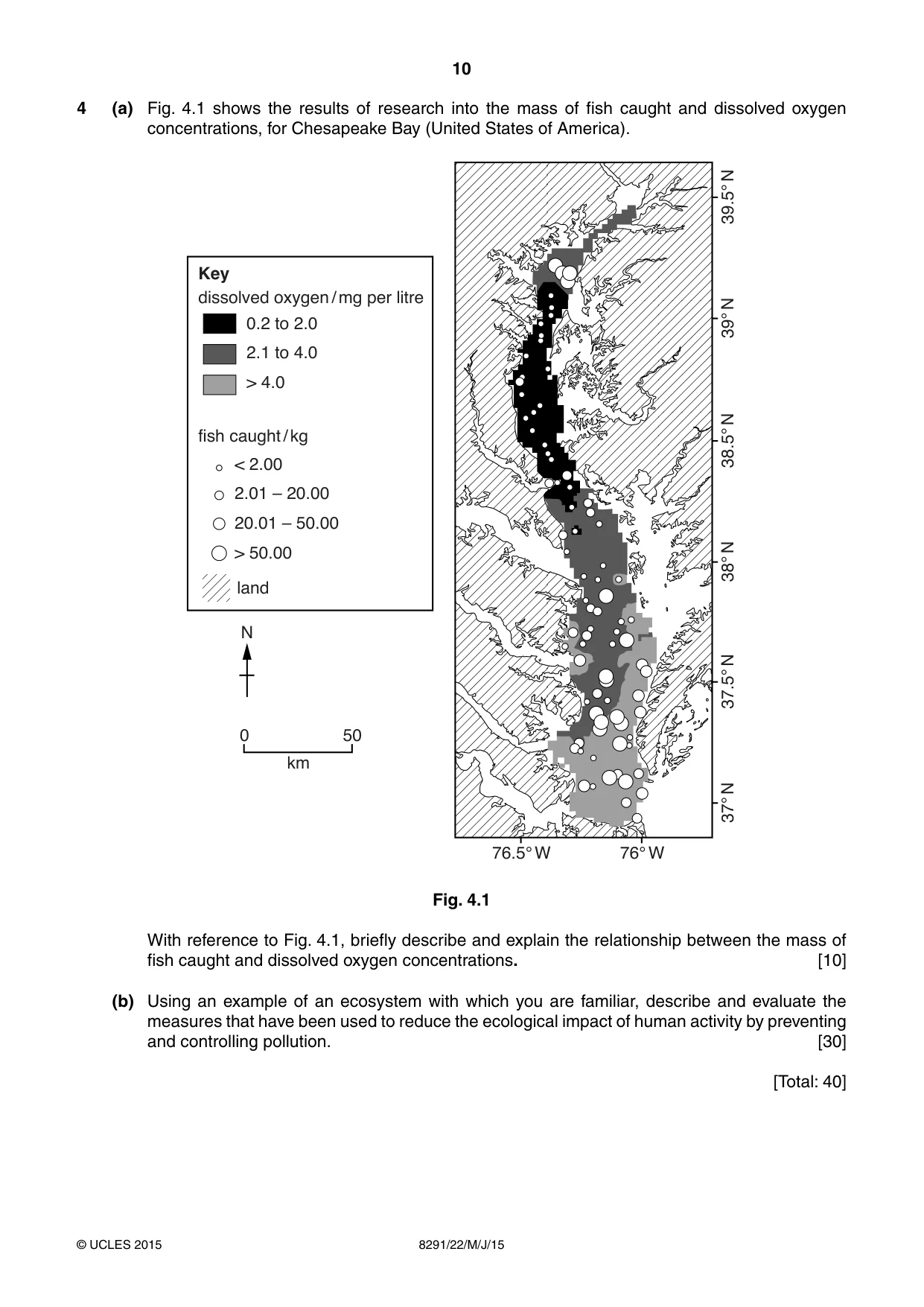
10 8291/22/M/J/15 © UCLES 2015 4 (a) Fig. 4.1 shows the results of research into the mass of fish caught and dissolved oxygen concentrations, for Chesapeake Bay (United States of America). 76.5° W 76° W 37° N 37.5° N 38° N 38.5° N 39° N 39.5° N 0.2 to 2.0 2.1 to 4.0 > 4.0 < 2.00 2.01 – 20.00 20.01 – 50.00 > 50.00 land dissolved oxygen / mg per litre fish caught / kg Key 0 50 km N Fig. 4.1 With reference to Fig. 4.1, briefly describe and explain the relationship between the mass of fish caught and dissolved oxygen concentrations. [10] (b) Using an example of an ecosystem with which you are familiar, describe and evaluate the measures that have been used to reduce the ecological impact of human activity by preventing and controlling pollution. [30] [Total: 40]
Question paper, page 11
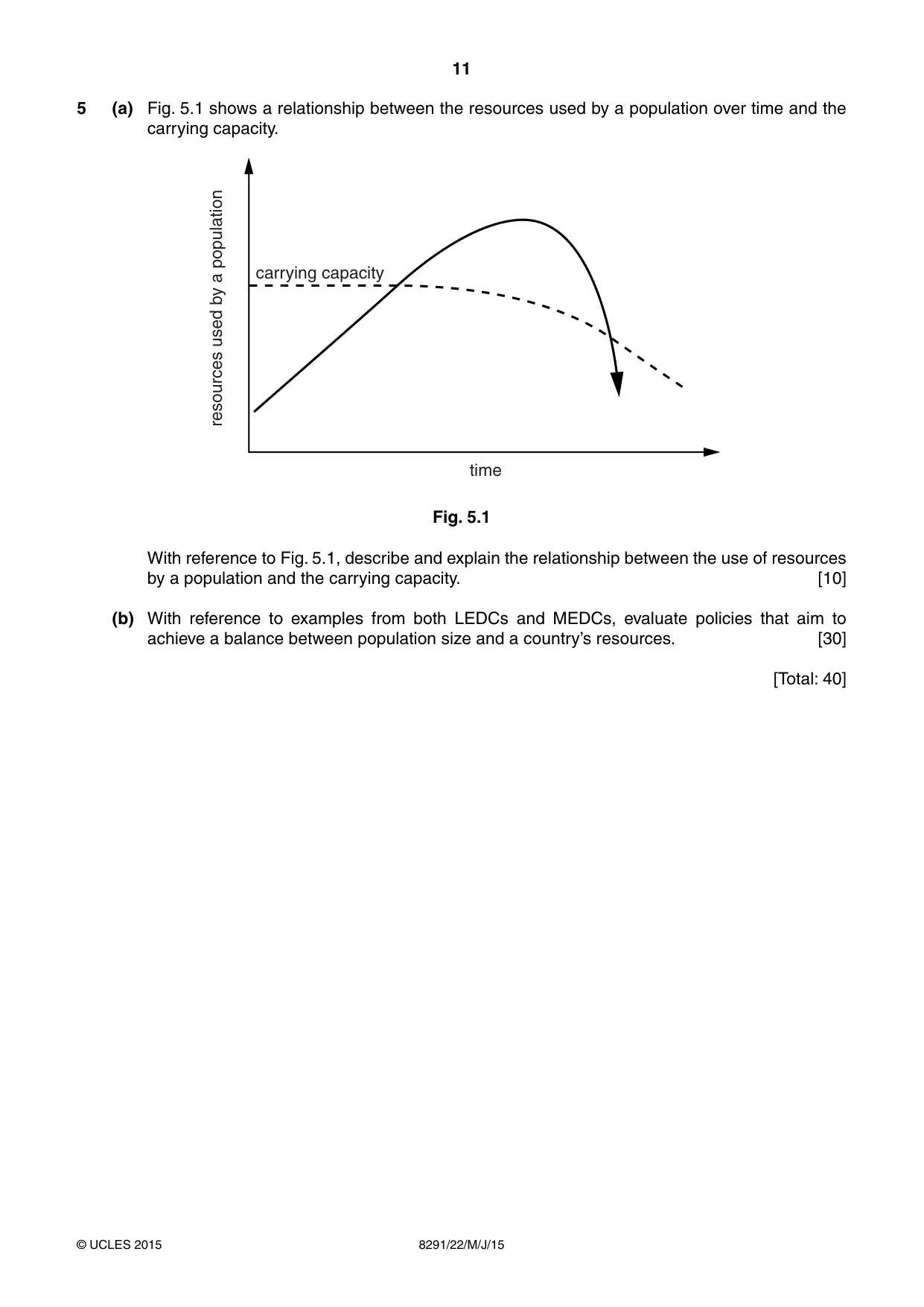
11 8291/22/M/J/15 © UCLES 2015 5 (a) Fig. 5.1 shows a relationship between the resources used by a population over time and the carrying capacity. carrying capacity resources used by a population time Fig. 5.1 With reference to Fig. 5.1, describe and explain the relationship between the use of resources by a population and the carrying capacity. [10] (b) With reference to examples from both LEDCs and MEDCs, evaluate policies that aim to achieve a balance between population size and a country’s resources. [30] [Total: 40]
Question paper, page 12
12 8291/22/M/J/15 © UCLES 2015 BLANK PAGE Permission to reproduce items where third-party owned material protected by copyright is included has been sought and cleared where possible. Every reasonable effort has been made by the publisher (UCLES) to trace copyright holders, but if any items requiring clearance have unwittingly been included, the publisher will be pleased to make amends at the earliest possible opportunity. To avoid the issue of disclosure of answer-related information to candidates, all copyright acknowledgements are reproduced online in the Cambridge International Examinations Copyright Acknowledgements Booklet. This is produced for each series of examinations and is freely available to download at www.cie.org.uk after the live examination series. Cambridge International Examinations is part of the Cambridge Assessment Group. Cambridge Assessment is the brand name of University of Cambridge Local Examinations Syndicate (UCLES), which is itself a department of the University of Cambridge.
Mark scheme, page 1
® IGCSE is the registered trademark of Cambridge International Examinations. CAMBRIDGE INTERNATIONAL EXAMINATIONS Cambridge International Advanced Subsidiary Level MARK SCHEME for the May/June 2015 series 8291 ENVIRONMENTAL MANAGEMENT 8291/22 Paper 2, maximum raw mark 80 This mark scheme is published as an aid to teachers and candidates, to indicate the requirements of the examination. It shows the basis on which Examiners were instructed to award marks. It does not indicate the details of the discussions that took place at an Examiners’ meeting before marking began, which would have considered the acceptability of alternative answers. Mark schemes should be read in conjunction with the question paper and the Principal Examiner Report for Teachers. Cambridge will not enter into discussions about these mark schemes. Cambridge is publishing the mark schemes for the May/June 2015 series for most Cambridge IGCSE®, Cambridge International A and AS Level components and some Cambridge O Level components.
Mark scheme, page 2
Page 2 Mark Scheme Syllabus Paper Cambridge International AS Level – May/June 2015 8291 22 © Cambridge International Examinations 2015 General notes Symbols used in Environmental Management mark schemes. / separates alternatives for a marking point – other valid ways of expressing the same idea are also credited ; separates points for the award of a mark [3] indicates the number of marks available italic indicates that this is information about the marking points and is not required to gain credit italic text is also used for comments about alternatives that should be accepted, ignored or rejected ora or reverse argument – shows that an argument from an alternative viewpoint will be credited AW alternative wording, sometimes called ‘or words to that effect’ – AW is used when there are many different ways of expressing the same idea ( ) the word / phrase in brackets is not required to gain marks but sets the context of the response for credit e.g. (nuclear) waste – nuclear is not needed but if it was described as a domestic waste then no mark is awarded volcanic underlined words – the answer must contain exactly this word ecf error carried forward – if an incorrect answer is given to part of a question, and this answer is subsequently used by a candidate in later parts of the question, this indicates that the candidate’s incorrect answer will be used as a starting point for marking the later parts of the question
Mark scheme, page 3
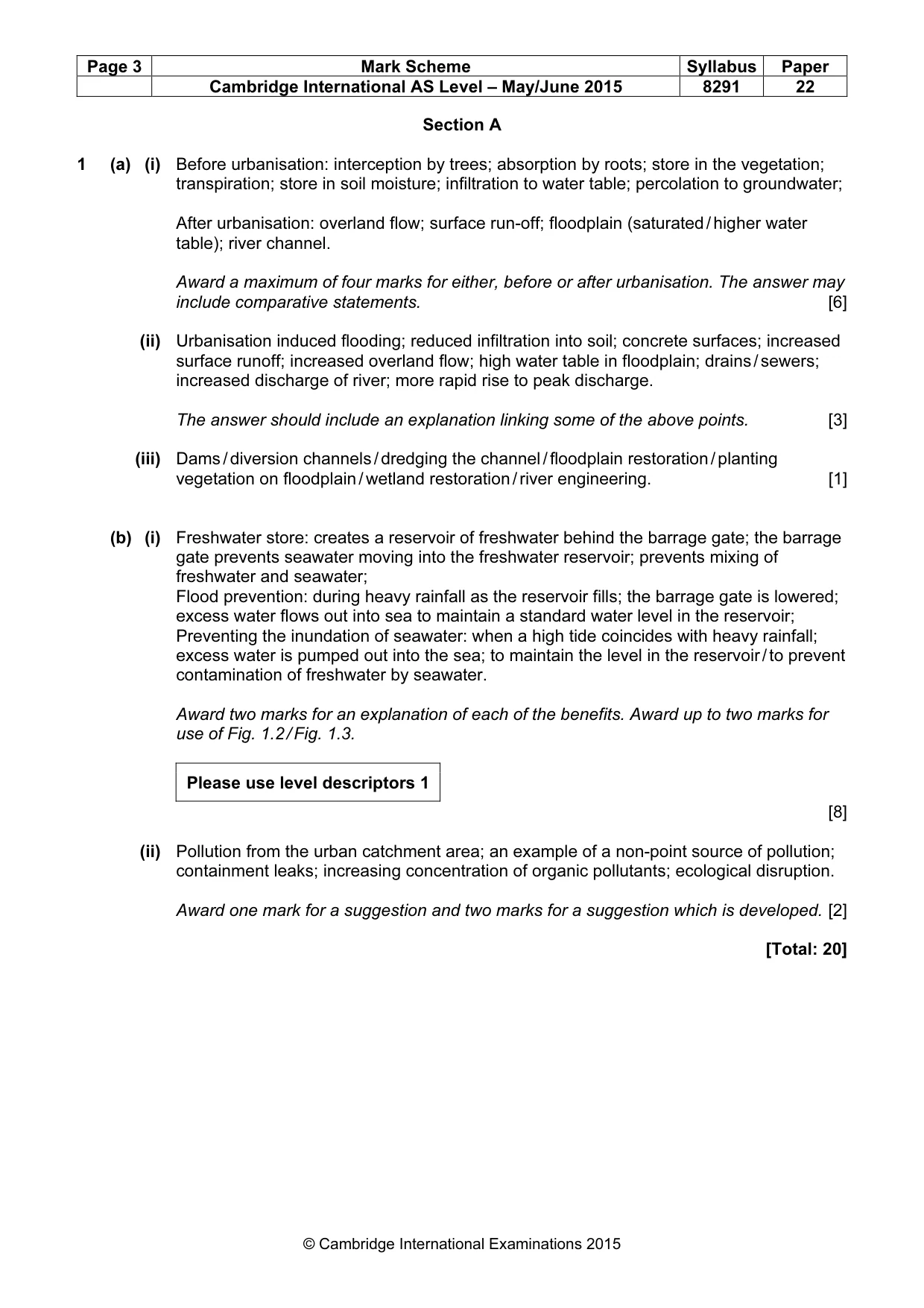
Page 3 Mark Scheme Syllabus Paper Cambridge International AS Level – May/June 2015 8291 22 © Cambridge International Examinations 2015 Section A 1 (a) (i) Before urbanisation: interception by trees; absorption by roots; store in the vegetation; transpiration; store in soil moisture; infiltration to water table; percolation to groundwater; After urbanisation: overland flow; surface run-off; floodplain (saturated / higher water table); river channel. Award a maximum of four marks for either, before or after urbanisation. The answer may include comparative statements. [6] (ii) Urbanisation induced flooding; reduced infiltration into soil; concrete surfaces; increased surface runoff; increased overland flow; high water table in floodplain; drains / sewers; increased discharge of river; more rapid rise to peak discharge. The answer should include an explanation linking some of the above points. [3] (iii) Dams / diversion channels / dredging the channel / floodplain restoration / planting vegetation on floodplain / wetland restoration / river engineering. [1] (b) (i) Freshwater store: creates a reservoir of freshwater behind the barrage gate; the barrage gate prevents seawater moving into the freshwater reservoir; prevents mixing of freshwater and seawater; Flood prevention: during heavy rainfall as the reservoir fills; the barrage gate is lowered; excess water flows out into sea to maintain a standard water level in the reservoir; Preventing the inundation of seawater: when a high tide coincides with heavy rainfall; excess water is pumped out into the sea; to maintain the level in the reservoir / to prevent contamination of freshwater by seawater. Award two marks for an explanation of each of the benefits. Award up to two marks for use of Fig. 1.2 / Fig. 1.3. Please use level descriptors 1 [8] (ii) Pollution from the urban catchment area; an example of a non-point source of pollution; containment leaks; increasing concentration of organic pollutants; ecological disruption. Award one mark for a suggestion and two marks for a suggestion which is developed. [2] [Total: 20]
Mark scheme, page 4
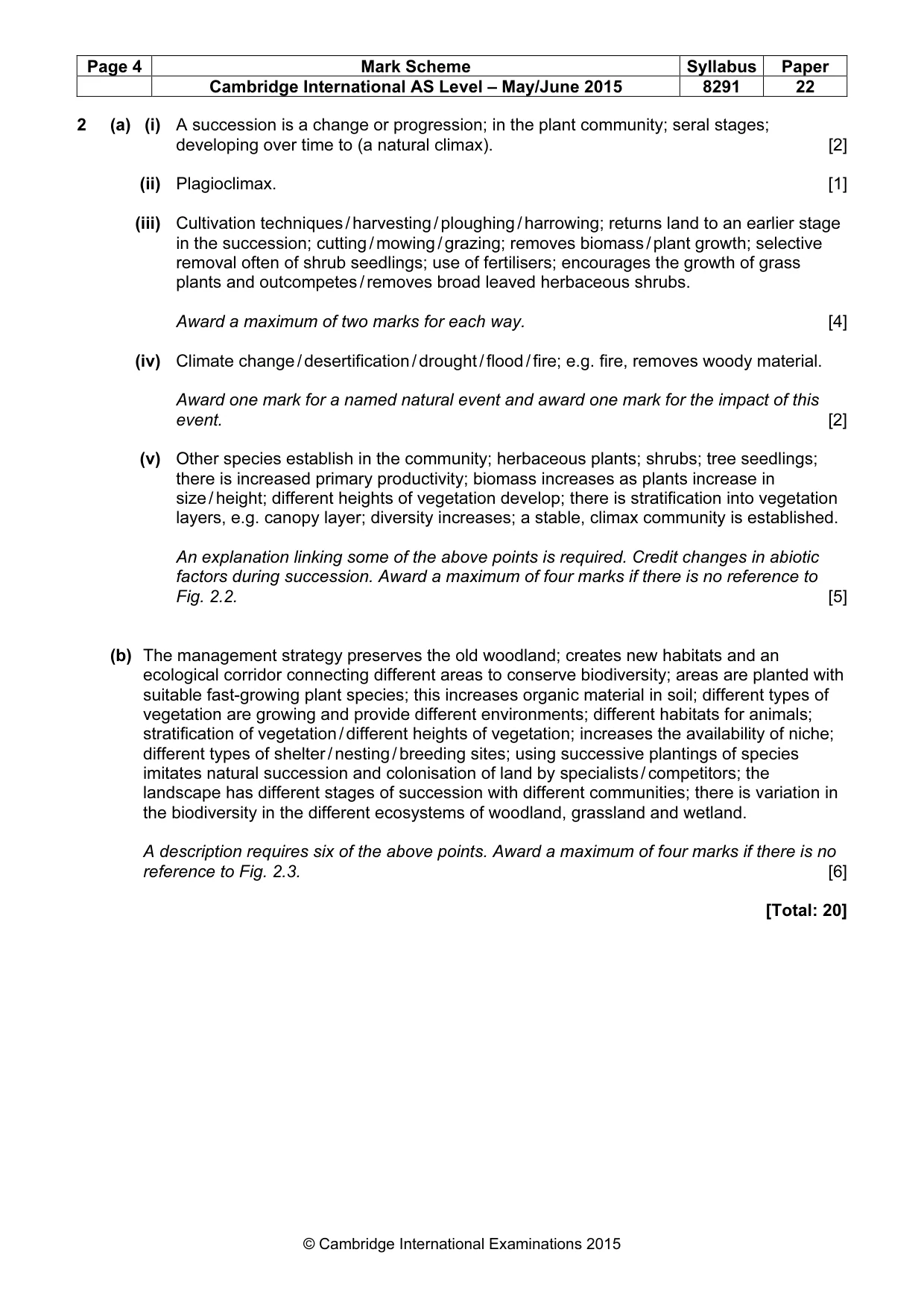
Page 4 Mark Scheme Syllabus Paper Cambridge International AS Level – May/June 2015 8291 22 © Cambridge International Examinations 2015 2 (a) (i) A succession is a change or progression; in the plant community; seral stages; developing over time to (a natural climax). [2] (ii) Plagioclimax. [1] (iii) Cultivation techniques / harvesting / ploughing / harrowing; returns land to an earlier stage in the succession; cutting / mowing / grazing; removes biomass / plant growth; selective removal often of shrub seedlings; use of fertilisers; encourages the growth of grass plants and outcompetes / removes broad leaved herbaceous shrubs. Award a maximum of two marks for each way. [4] (iv) Climate change / desertification / drought / flood / fire; e.g. fire, removes woody material. Award one mark for a named natural event and award one mark for the impact of this event. [2] (v) Other species establish in the community; herbaceous plants; shrubs; tree seedlings; there is increased primary productivity; biomass increases as plants increase in size / height; different heights of vegetation develop; there is stratification into vegetation layers, e.g. canopy layer; diversity increases; a stable, climax community is established. An explanation linking some of the above points is required. Credit changes in abiotic factors during succession. Award a maximum of four marks if there is no reference to Fig. 2.2. [5] (b) The management strategy preserves the old woodland; creates new habitats and an ecological corridor connecting different areas to conserve biodiversity; areas are planted with suitable fast-growing plant species; this increases organic material in soil; different types of vegetation are growing and provide different environments; different habitats for animals; stratification of vegetation / different heights of vegetation; increases the availability of niche; different types of shelter / nesting / breeding sites; using successive plantings of species imitates natural succession and colonisation of land by specialists / competitors; the landscape has different stages of succession with different communities; there is variation in the biodiversity in the different ecosystems of woodland, grassland and wetland. A description requires six of the above points. Award a maximum of four marks if there is no reference to Fig. 2.3. [6] [Total: 20]
Mark scheme, page 5
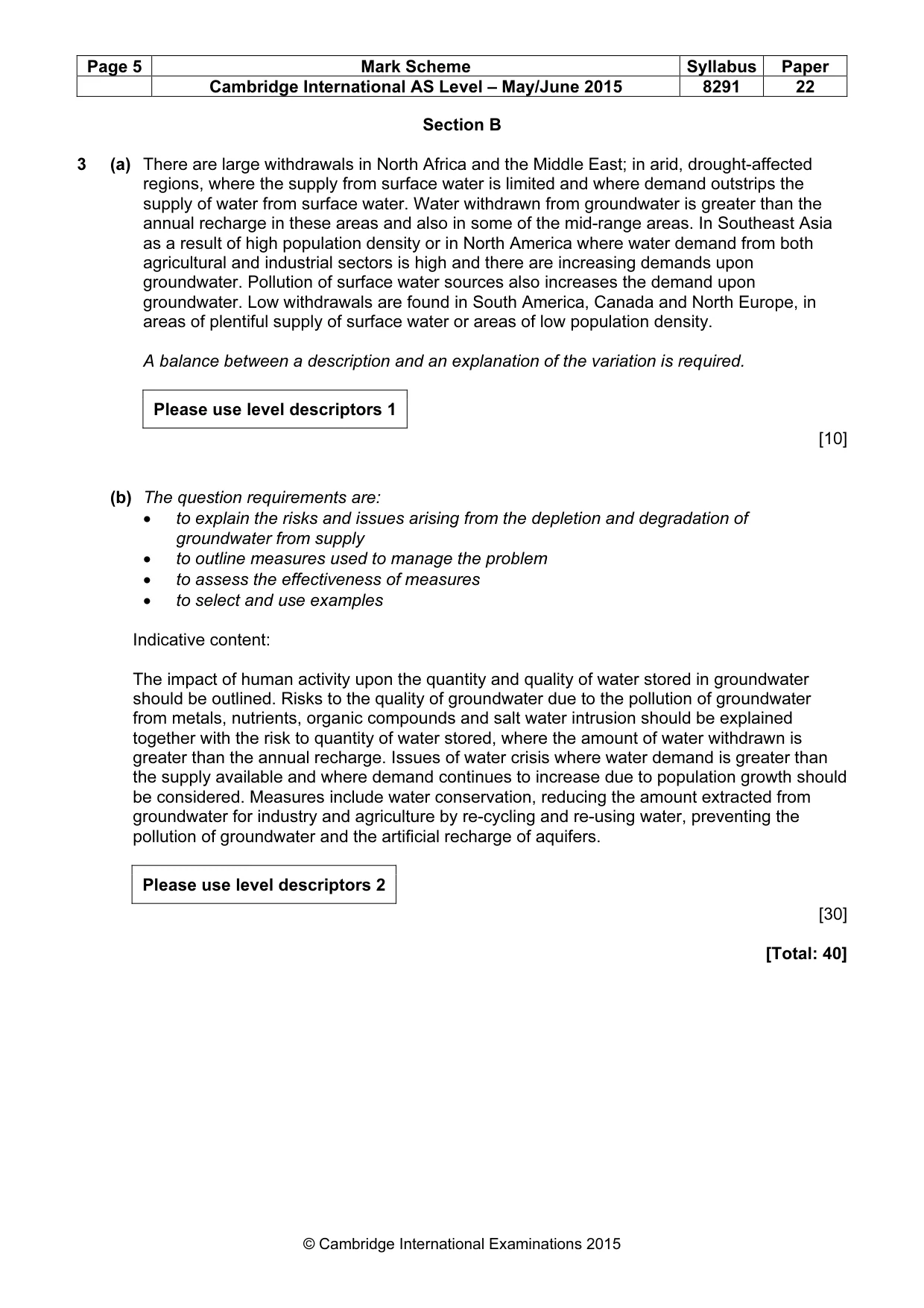
Page 5 Mark Scheme Syllabus Paper Cambridge International AS Level – May/June 2015 8291 22 © Cambridge International Examinations 2015 Section B 3 (a) There are large withdrawals in North Africa and the Middle East; in arid, drought-affected regions, where the supply from surface water is limited and where demand outstrips the supply of water from surface water. Water withdrawn from groundwater is greater than the annual recharge in these areas and also in some of the mid-range areas. In Southeast Asia as a result of high population density or in North America where water demand from both agricultural and industrial sectors is high and there are increasing demands upon groundwater. Pollution of surface water sources also increases the demand upon groundwater. Low withdrawals are found in South America, Canada and North Europe, in areas of plentiful supply of surface water or areas of low population density. A balance between a description and an explanation of the variation is required. Please use level descriptors 1 [10] (b) The question requirements are: • to explain the risks and issues arising from the depletion and degradation of groundwater from supply • to outline measures used to manage the problem • to assess the effectiveness of measures • to select and use examples Indicative content: The impact of human activity upon the quantity and quality of water stored in groundwater should be outlined. Risks to the quality of groundwater due to the pollution of groundwater from metals, nutrients, organic compounds and salt water intrusion should be explained together with the risk to quantity of water stored, where the amount of water withdrawn is greater than the annual recharge. Issues of water crisis where water demand is greater than the supply available and where demand continues to increase due to population growth should be considered. Measures include water conservation, reducing the amount extracted from groundwater for industry and agriculture by re-cycling and re-using water, preventing the pollution of groundwater and the artificial recharge of aquifers. Please use level descriptors 2 [30] [Total: 40]
Mark scheme, page 6
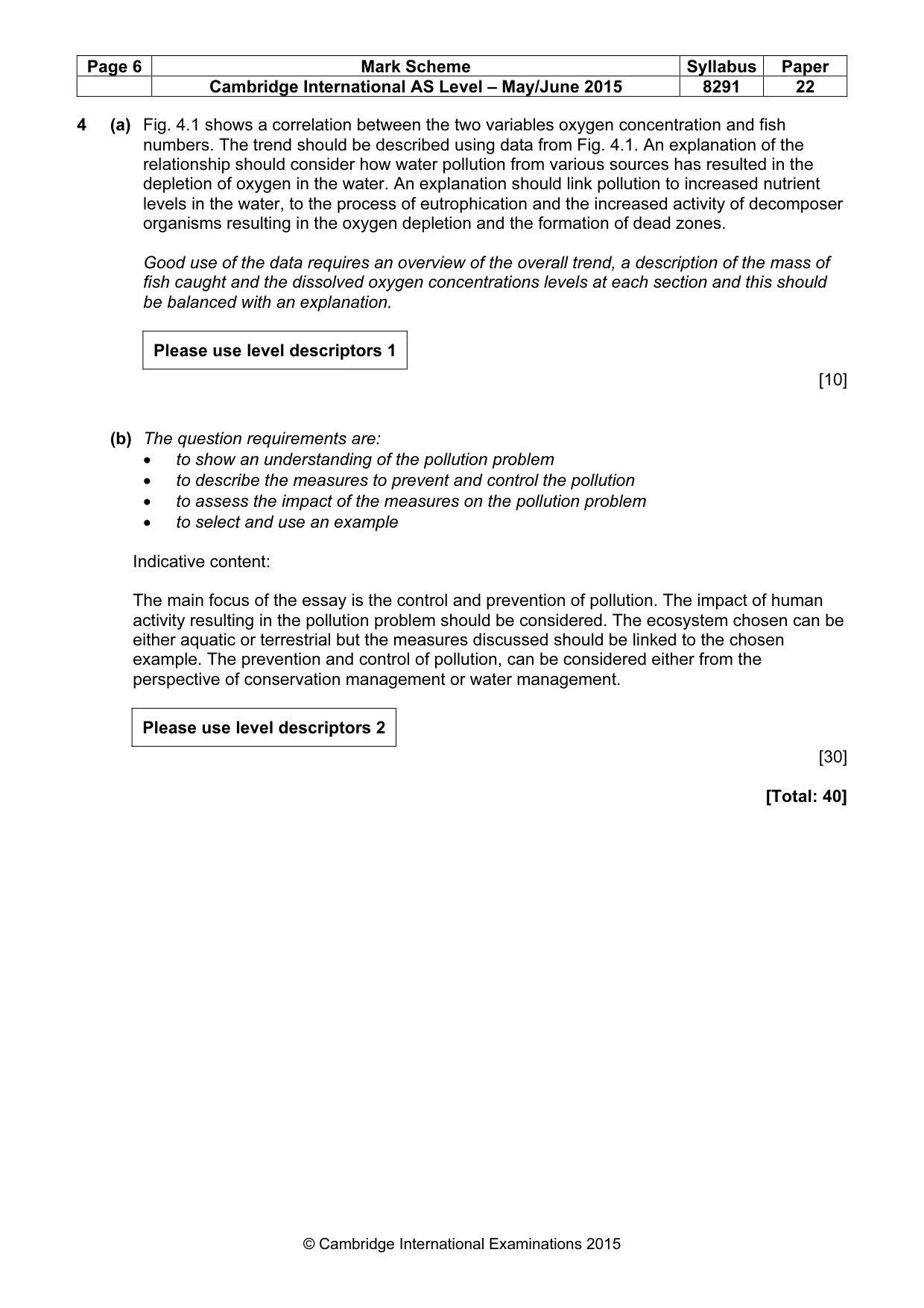
Page 6 Mark Scheme Syllabus Paper Cambridge International AS Level – May/June 2015 8291 22 © Cambridge International Examinations 2015 4 (a) Fig. 4.1 shows a correlation between the two variables oxygen concentration and fish numbers. The trend should be described using data from Fig. 4.1. An explanation of the relationship should consider how water pollution from various sources has resulted in the depletion of oxygen in the water. An explanation should link pollution to increased nutrient levels in the water, to the process of eutrophication and the increased activity of decomposer organisms resulting in the oxygen depletion and the formation of dead zones. Good use of the data requires an overview of the overall trend, a description of the mass of fish caught and the dissolved oxygen concentrations levels at each section and this should be balanced with an explanation. Please use level descriptors 1 [10] (b) The question requirements are: • to show an understanding of the pollution problem • to describe the measures to prevent and control the pollution • to assess the impact of the measures on the pollution problem • to select and use an example Indicative content: The main focus of the essay is the control and prevention of pollution. The impact of human activity resulting in the pollution problem should be considered. The ecosystem chosen can be either aquatic or terrestrial but the measures discussed should be linked to the chosen example. The prevention and control of pollution, can be considered either from the perspective of conservation management or water management. Please use level descriptors 2 [30] [Total: 40]
Mark scheme, page 7
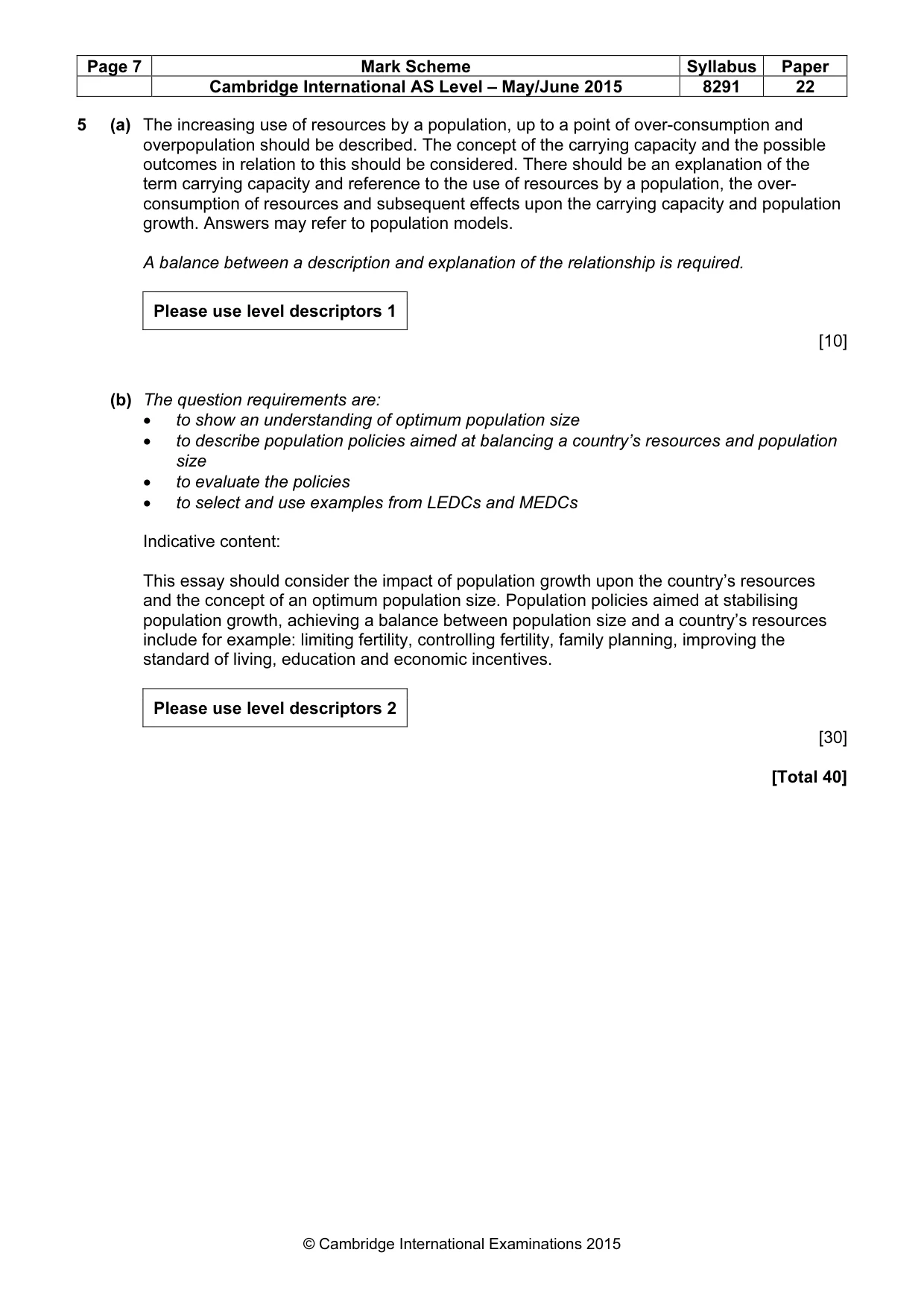
Page 7 Mark Scheme Syllabus Paper Cambridge International AS Level – May/June 2015 8291 22 © Cambridge International Examinations 2015 5 (a) The increasing use of resources by a population, up to a point of over-consumption and overpopulation should be described. The concept of the carrying capacity and the possible outcomes in relation to this should be considered. There should be an explanation of the term carrying capacity and reference to the use of resources by a population, the over- consumption of resources and subsequent effects upon the carrying capacity and population growth. Answers may refer to population models. A balance between a description and explanation of the relationship is required. Please use level descriptors 1 [10] (b) The question requirements are: • to show an understanding of optimum population size • to describe population policies aimed at balancing a country’s resources and population size • to evaluate the policies • to select and use examples from LEDCs and MEDCs Indicative content: This essay should consider the impact of population growth upon the country’s resources and the concept of an optimum population size. Population policies aimed at stabilising population growth, achieving a balance between population size and a country’s resources include for example: limiting fertility, controlling fertility, family planning, improving the standard of living, education and economic incentives. Please use level descriptors 2 [30] [Total 40]
Mark scheme, page 8
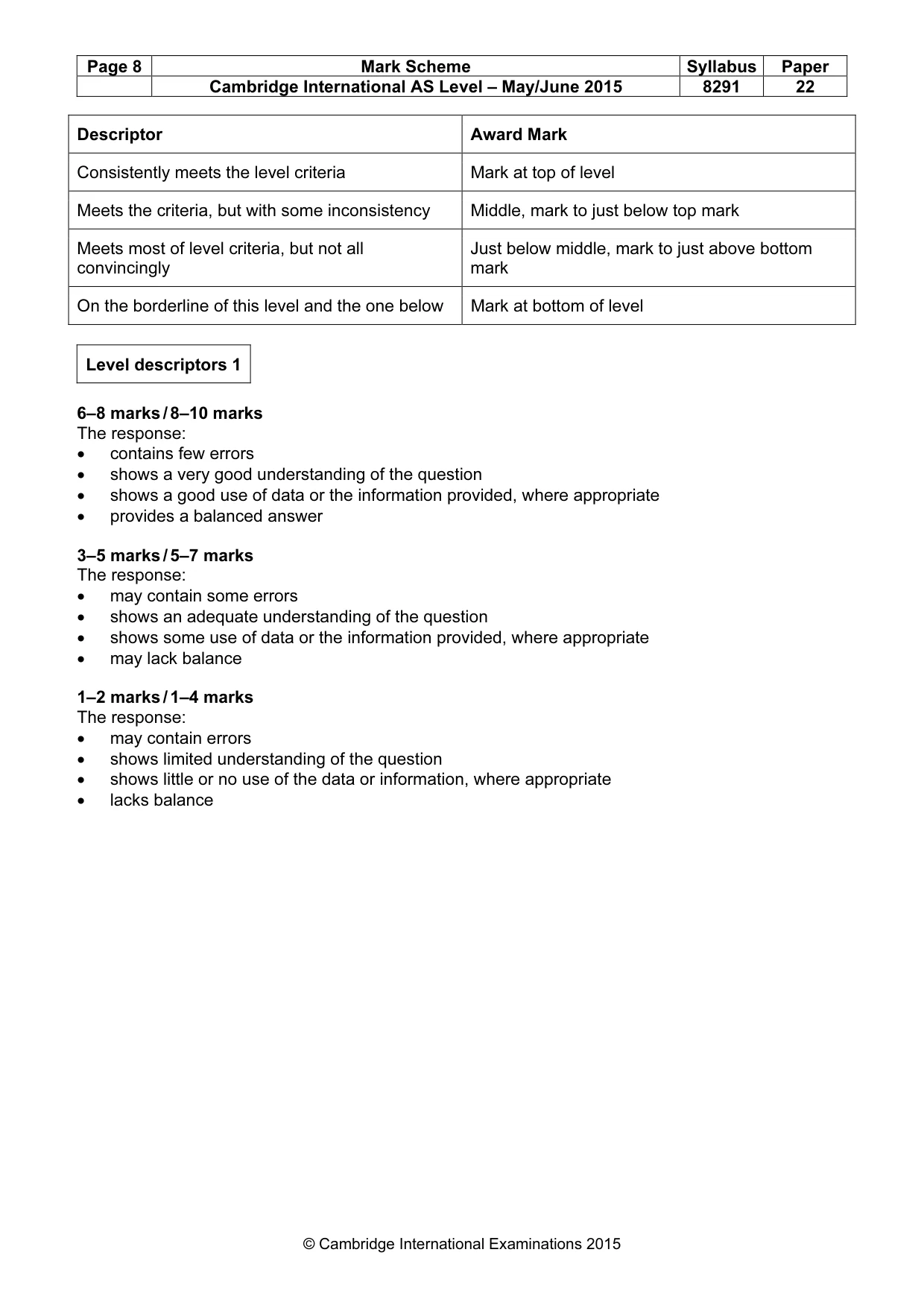
Page 8 Mark Scheme Syllabus Paper Cambridge International AS Level – May/June 2015 8291 22 © Cambridge International Examinations 2015 Descriptor Award Mark Consistently meets the level criteria Mark at top of level Meets the criteria, but with some inconsistency Middle, mark to just below top mark Meets most of level criteria, but not all convincingly Just below middle, mark to just above bottom mark On the borderline of this level and the one below Mark at bottom of level Level descriptors 1 6–8 marks / 8–10 marks The response: • contains few errors • shows a very good understanding of the question • shows a good use of data or the information provided, where appropriate • provides a balanced answer 3–5 marks / 5–7 marks The response: • may contain some errors • shows an adequate understanding of the question • shows some use of data or the information provided, where appropriate • may lack balance 1–2 marks / 1–4 marks The response: • may contain errors • shows limited understanding of the question • shows little or no use of the data or information, where appropriate • lacks balance
Mark scheme, page 9
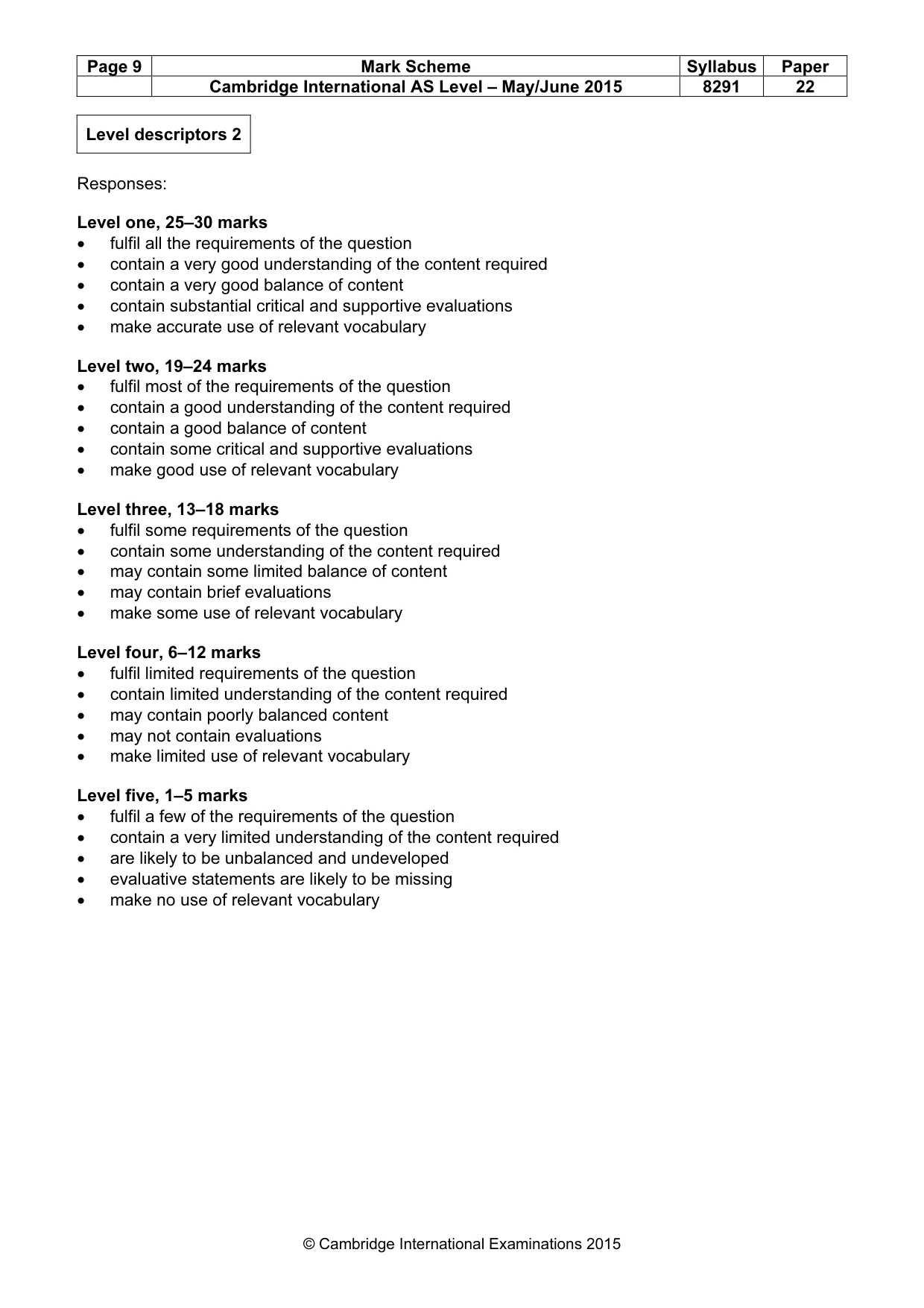
Page 9 Mark Scheme Syllabus Paper Cambridge International AS Level – May/June 2015 8291 22 © Cambridge International Examinations 2015 Level descriptors 2 Responses: Level one, 25–30 marks • fulfil all the requirements of the question • contain a very good understanding of the content required • contain a very good balance of content • contain substantial critical and supportive evaluations • make accurate use of relevant vocabulary Level two, 19–24 marks • fulfil most of the requirements of the question • contain a good understanding of the content required • contain a good balance of content • contain some critical and supportive evaluations • make good use of relevant vocabulary Level three, 13–18 marks • fulfil some requirements of the question • contain some understanding of the content required • may contain some limited balance of content • may contain brief evaluations • make some use of relevant vocabulary Level four, 6–12 marks • fulfil limited requirements of the question • contain limited understanding of the content required • may contain poorly balanced content • may not contain evaluations • make limited use of relevant vocabulary Level five, 1–5 marks • fulfil a few of the requirements of the question • contain a very limited understanding of the content required • are likely to be unbalanced and undeveloped • evaluative statements are likely to be missing • make no use of relevant vocabulary
What you needed in this session
Cambridge’s own grade thresholds for 2015 May/June, Paper 2 · Variant 2. A higher threshold means an easier paper — the bar moves with how the cohort did.