Cambridge A Level English - Language AS and A Level (from 2014) 9093 — 2023 May/June Paper 3 · Variant 3
9093/33/M/J/23 · 50 marks · ≈56 min
The question paper and its mark scheme, free to read here and free to download. This is Cambridge’s own paper, exactly as it was sat.
Question paper8 pages

Mark scheme13 pages
Answers below. Sit the paper first if you are practising.
Paper as text
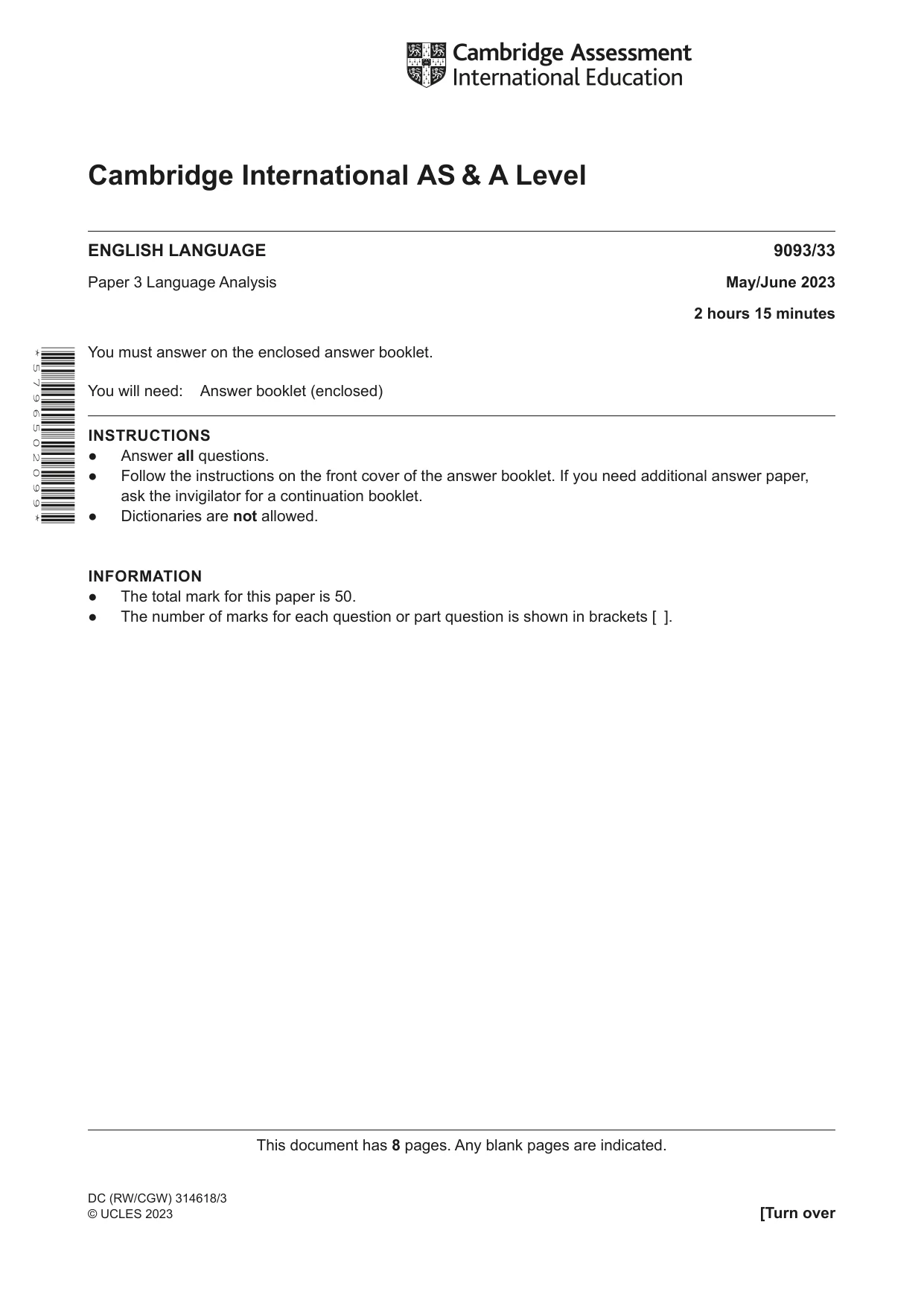
Question paper, page 1
This document has 8 pages. Any blank pages are indicated. [Turn over Cambridge International AS & A Level ENGLISH LANGUAGE 9093/33 Paper 3 Language Analysis May/June 2023 2 hours 15 minutes You must answer on the enclosed answer booklet. You will need: Answer booklet (enclosed) INSTRUCTIONS ● Answer all questions. ● Follow the instructions on the front cover of the answer booklet. If you need additional answer paper, ask the invigilator for a continuation booklet. ● Dictionaries are not allowed. INFORMATION ● The total mark for this paper is 50. ● The number of marks for each question or part question is shown in brackets [ ]. * 5 7 9 6 5 0 2 0 9 9 * DC (RW/CGW) 314618/3 © UCLES 2023
Question paper, page 2
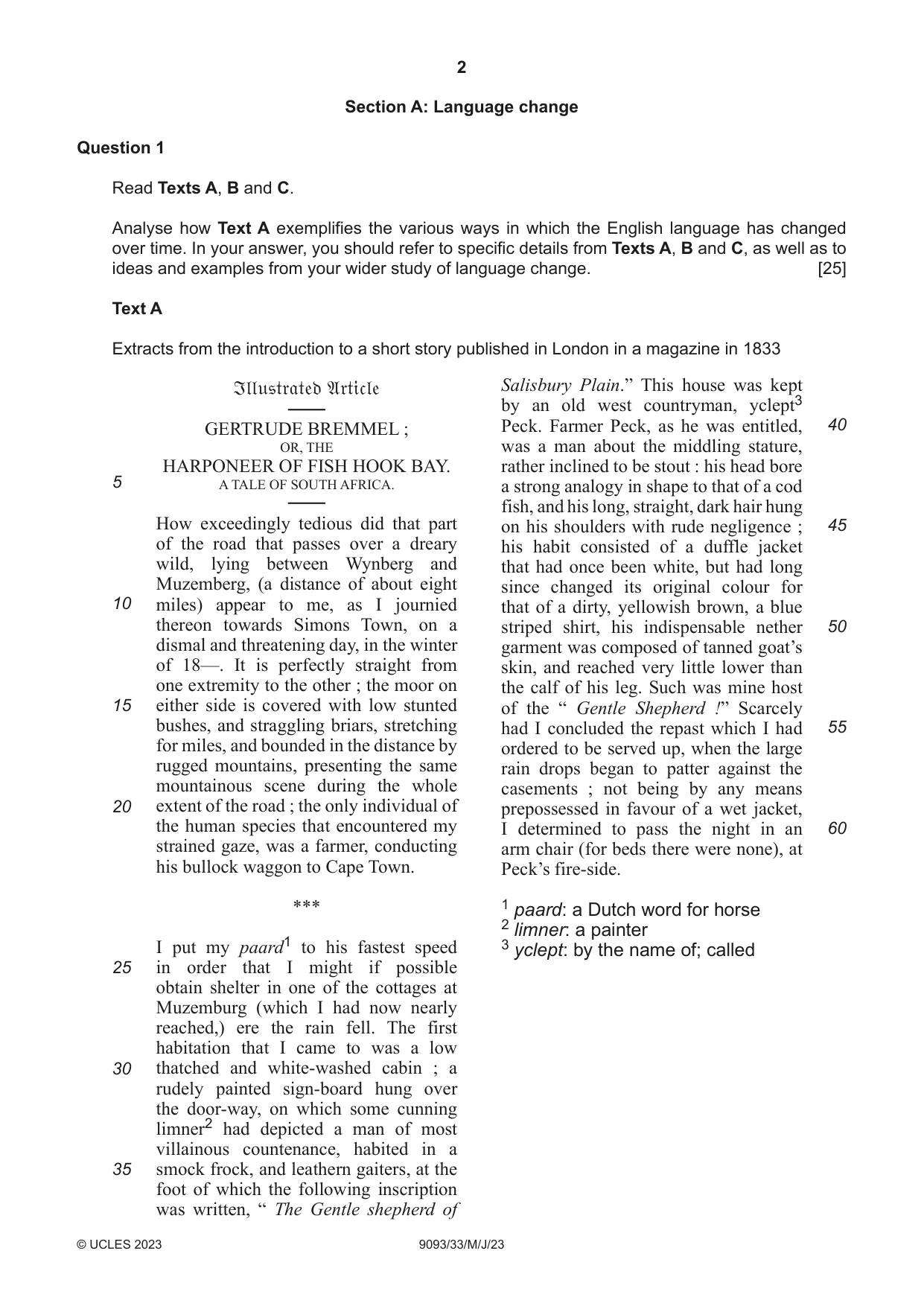
2 9093/33/M/J/23 © UCLES 2023 Section A: Language change Question 1 Read Texts A, B and C. Analyse how Text A exemplifies the various ways in which the English language has changed over time. In your answer, you should refer to specific details from Texts A, B and C, as well as to ideas and examples from your wider study of language change. [25] Text A Extracts from the introduction to a short story published in London in a magazine in 1833 5 10 15 20 25 30 35 Illustrated Article GERTRUDE BREMMEL ; OR, THE HARPONEER OF FISH HOOK BAY. A TALE OF SOUTH AFRICA. How exceedingly tedious did that part of the road that passes over a dreary wild, lying between Wynberg and Muzemberg, (a distance of about eight miles) appear to me, as I journied thereon towards Simons Town, on a dismal and threatening day, in the winter of 18—. It is perfectly straight from one extremity to the other ; the moor on either side is covered with low stunted bushes, and straggling briars, stretching for miles, and bounded in the distance by rugged mountains, presenting the same mountainous scene during the whole extent of the road ; the only individual of the human species that encountered my strained gaze, was a farmer, conducting his bullock waggon to Cape Town. *** I put my paard1 to his fastest speed in order that I might if possible obtain shelter in one of the cottages at Muzemburg (which I had now nearly reached,) ere the rain fell. The first habitation that I came to was a low thatched and white‑washed cabin ; a rudely painted sign‑board hung over the door‑way, on which some cunning limner2 had depicted a man of most villainous countenance, habited in a smock frock, and leathern gaiters, at the foot of which the following inscription was written, “ The Gentle shepherd of Salisbury Plain.” This house was kept by an old west countryman, yclept3 Peck. Farmer Peck, as he was entitled, was a man about the middling stature, rather inclined to be stout : his head bore a strong analogy in shape to that of a cod fish, and his long, straight, dark hair hung on his shoulders with rude negligence ; his habit consisted of a duffle jacket that had once been white, but had long since changed its original colour for that of a dirty, yellowish brown, a blue striped shirt, his indispensable nether garment was composed of tanned goat’s skin, and reached very little lower than the calf of his leg. Such was mine host of the “ Gentle Shepherd !” Scarcely had I concluded the repast which I had ordered to be served up, when the large rain drops began to patter against the casements ; not being by any means prepossessed in favour of a wet jacket, I determined to pass the night in an arm chair (for beds there were none), at Peck’s fire‑side. 1 paard: a Dutch word for horse 2 limner: a painter 3 yclept: by the name of; called 40 45 50 55 60
Question paper, page 3
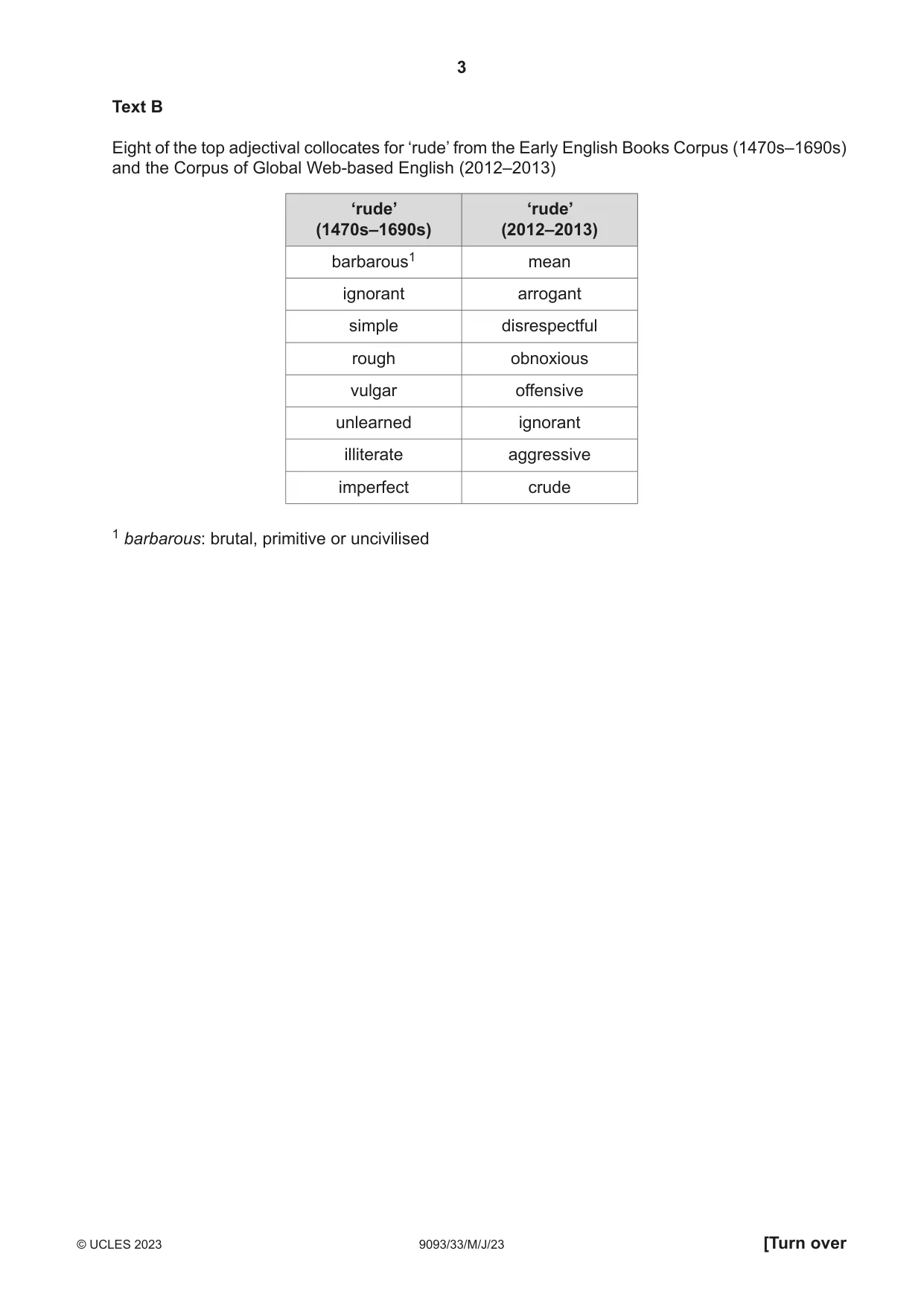
3 9093/33/M/J/23 © UCLES 2023 [Turn over Text B Eight of the top adjectival collocates for ‘rude’ from the Early English Books Corpus (1470s–1690s) and the Corpus of Global Web‑based English (2012–2013) ‘rude’ (1470s–1690s) ‘rude’ (2012–2013) barbarous1 mean ignorant arrogant simple disrespectful rough obnoxious vulgar offensive unlearned ignorant illiterate aggressive imperfect crude 1 barbarous: brutal, primitive or uncivilised
Question paper, page 4
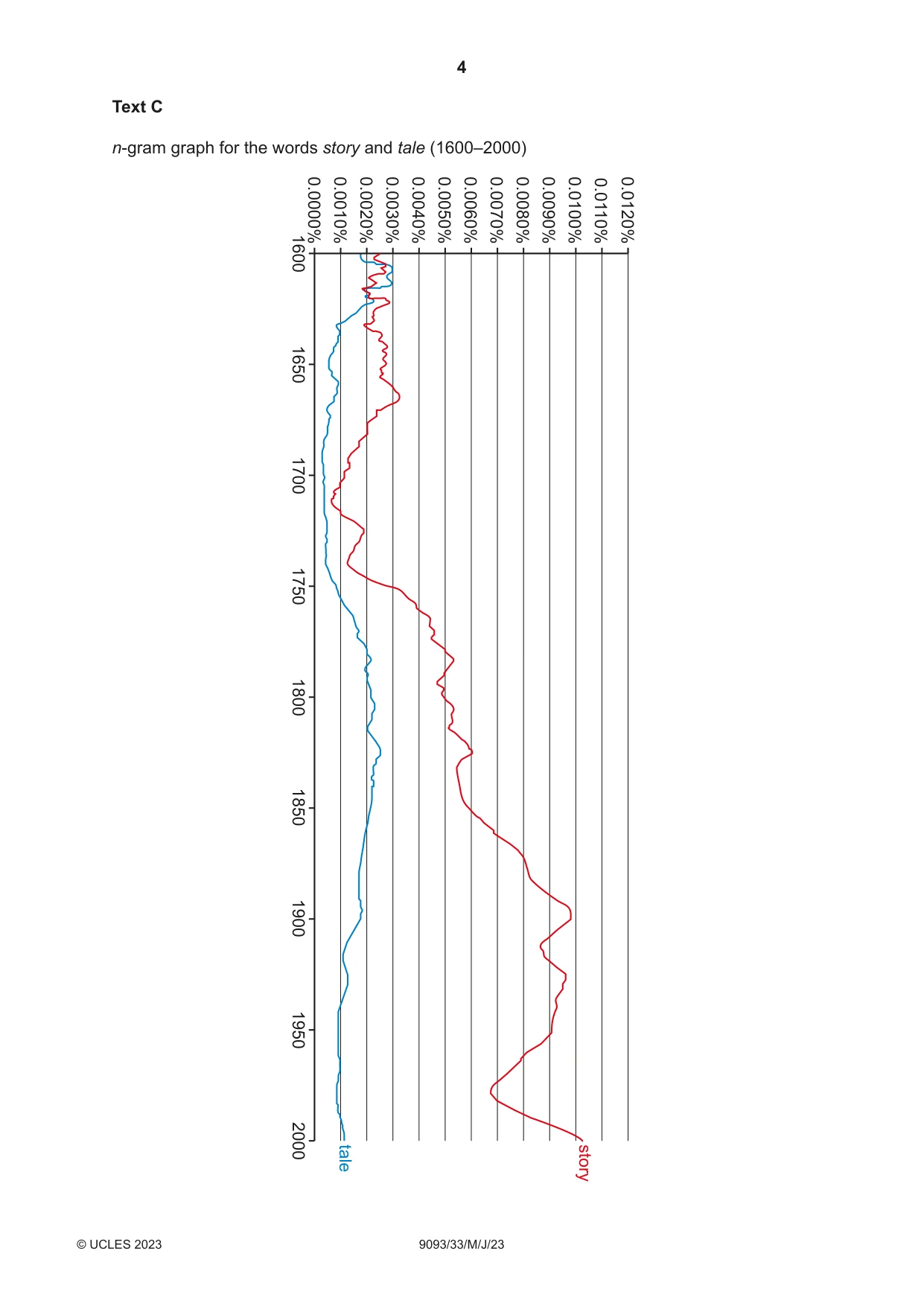
4 9093/33/M/J/23 © UCLES 2023 Text C n‑gram graph for the words story and tale (1600–2000) 1600 0.0000% 0.0010% 0.0020% 0.0030% 0.0040% 0.0050% 0.0060% tale story 0.0070% 0.0080% 0.0090% 0.0100% 0.0110% 0.0120% 1650 1700 1750 1800 1850 1900 1950 2000
Question paper, page 5
5 9093/33/M/J/23 © UCLES 2023 [Turn over BLANK PAGE
Question paper, page 6
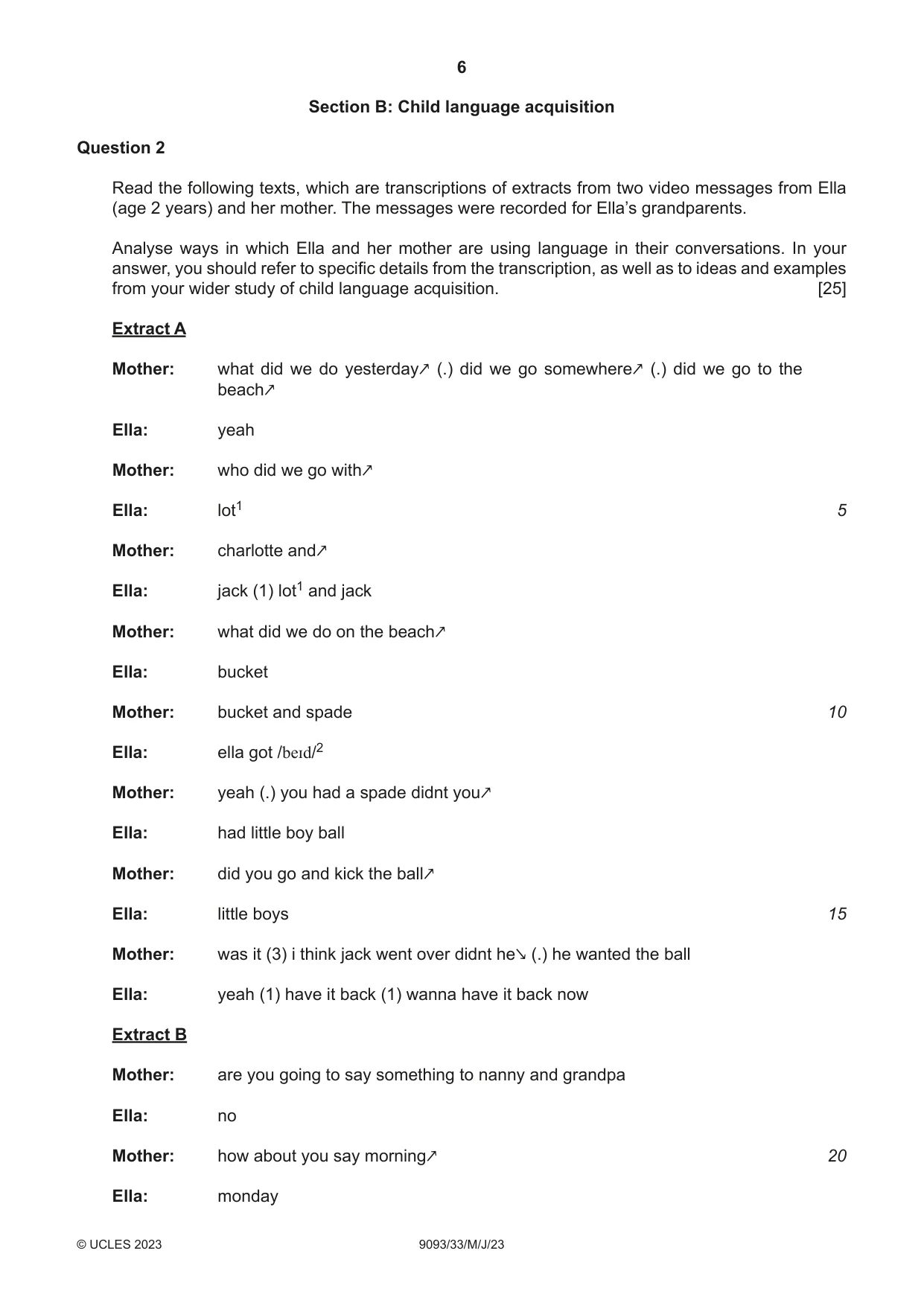
6 9093/33/M/J/23 © UCLES 2023 Section B: Child language acquisition Question 2 Read the following texts, which are transcriptions of extracts from two video messages from Ella (age 2 years) and her mother. The messages were recorded for Ella’s grandparents. Analyse ways in which Ella and her mother are using language in their conversations. In your answer, you should refer to specific details from the transcription, as well as to ideas and examples from your wider study of child language acquisition. [25] Extract A Mother: what did we do yesterday↗ (.) did we go somewhere↗ (.) did we go to the beach↗ Ella: yeah Mother: who did we go with↗ Ella: lot1 Mother: charlotte and↗ Ella: jack (1) lot1 and jack Mother: what did we do on the beach↗ Ella: bucket Mother: bucket and spade Ella: ella got /beɪd/2 Mother: yeah (.) you had a spade didnt you↗ Ella: had little boy ball Mother: did you go and kick the ball↗ Ella: little boys Mother: was it (3) i think jack went over didnt he↘ (.) he wanted the ball Ella: yeah (1) have it back (1) wanna have it back now Extract B Mother: are you going to say something to nanny and grandpa Ella: no Mother: how about you say morning↗ Ella: monday 5 10 15 20
Question paper, page 7
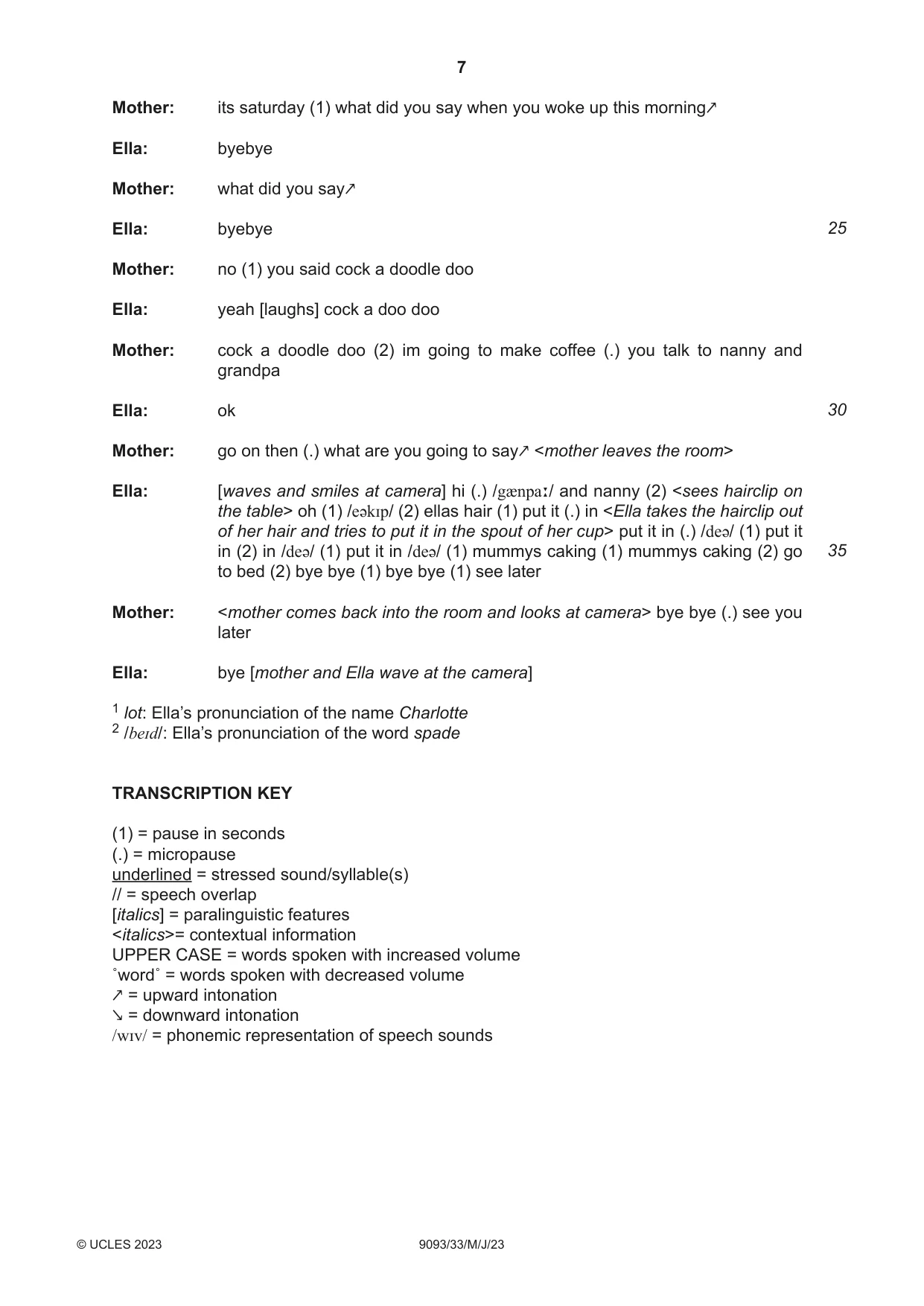
7 9093/33/M/J/23 © UCLES 2023 Mother: its saturday (1) what did you say when you woke up this morning↗ Ella: byebye Mother: what did you say↗ Ella: byebye Mother: no (1) you said cock a doodle doo Ella: yeah [laughs] cock a doo doo Mother: cock a doodle doo (2) im going to make coffee (.) you talk to nanny and grandpa Ella: ok Mother: go on then (.) what are you going to say↗ <mother leaves the room> Ella: [waves and smiles at camera] hi (.) /gænpaː/ and nanny (2) <sees hairclip on the table> oh (1) /eəkɪp/ (2) ellas hair (1) put it (.) in <Ella takes the hairclip out of her hair and tries to put it in the spout of her cup> put it in (.) /deə/ (1) put it in (2) in /deə/ (1) put it in /deə/ (1) mummys caking (1) mummys caking (2) go to bed (2) bye bye (1) bye bye (1) see later Mother: <mother comes back into the room and looks at camera> bye bye (.) see you later Ella: bye [mother and Ella wave at the camera] 1 lot: Ella’s pronunciation of the name Charlotte 2 /beɪd/: Ella’s pronunciation of the word spade TRANSCRIPTION KEY (1) = pause in seconds (.) = micropause underlined = stressed sound/syllable(s) // = speech overlap [italics] = paralinguistic features <italics>= contextual information UPPER CASE = words spoken with increased volume ˚word˚ = words spoken with decreased volume ↗ = upward intonation ↘ = downward intonation /wɪv/ = phonemic representation of speech sounds 25 30 35
Question paper, page 8
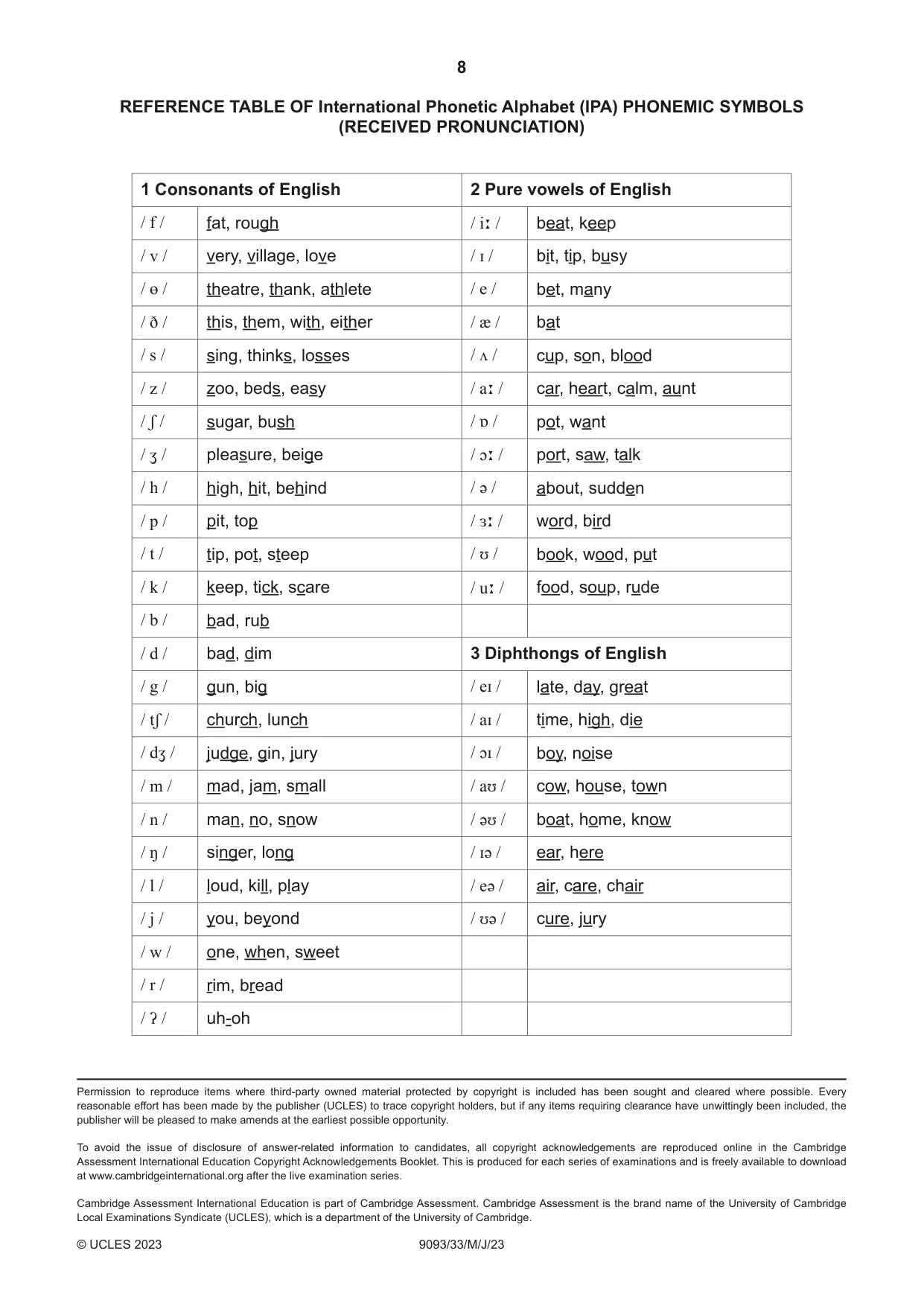
8 9093/33/M/J/23 © UCLES 2023 Permission to reproduce items where third‑party owned material protected by copyright is included has been sought and cleared where possible. Every reasonable effort has been made by the publisher (UCLES) to trace copyright holders, but if any items requiring clearance have unwittingly been included, the publisher will be pleased to make amends at the earliest possible opportunity. To avoid the issue of disclosure of answer‑related information to candidates, all copyright acknowledgements are reproduced online in the Cambridge Assessment International Education Copyright Acknowledgements Booklet. This is produced for each series of examinations and is freely available to download at www.cambridgeinternational.org after the live examination series. Cambridge Assessment International Education is part of Cambridge Assessment. Cambridge Assessment is the brand name of the University of Cambridge Local Examinations Syndicate (UCLES), which is a department of the University of Cambridge. REFERENCE TABLE OF International Phonetic Alphabet (IPA) PHONEMIC SYMBOLS (RECEIVED PRONUNCIATION) 1 Consonants of English 2 Pure vowels of English / f / fat, rough / iː / beat, keep / v / very, village, love / ɪ / bit, tip, busy / ɵ / theatre, thank, athlete / e / bet, many / ð / this, them, with, either / æ / bat / s / sing, thinks, losses / ʌ / cup, son, blood / z / zoo, beds, easy / aː / car, heart, calm, aunt / ʃ / sugar, bush / ɒ / pot, want / ʒ / pleasure, beige / ɔː / port, saw, talk / h / high, hit, behind / ə / about, sudden / p / pit, top / ɜː / word, bird / t / tip, pot, steep / ʊ / book, wood, put / k / keep, tick, scare / uː / food, soup, rude / b / bad, rub / d / bad, dim 3 Diphthongs of English / g / gun, big / eɪ / late, day, great / tʃ / church, lunch / aɪ / time, high, die / dʒ / judge, gin, jury / ɔɪ / boy, noise / m / mad, jam, small / aʊ / cow, house, town / n / man, no, snow / əʊ / boat, home, know / ŋ / singer, long / ɪə / ear, here / l / loud, kill, play / eə / air, care, chair / j / you, beyond / ʊə / cure, jury / w / one, when, sweet / r / rim, bread / ʔ / uh‑oh
Mark scheme, page 1
This document consists of 13 printed pages. © UCLES 2023 [Turn over Cambridge International A Level ENGLISH LANGUAGE 9093/33 Paper 3 Language Analysis May/June 2023 MARK SCHEME Maximum Mark: 50 Published This mark scheme is published as an aid to teachers and candidates, to indicate the requirements of the examination. It shows the basis on which Examiners were instructed to award marks. It does not indicate the details of the discussions that took place at an Examiners’ meeting before marking began, which would have considered the acceptability of alternative answers. Mark schemes should be read in conjunction with the question paper and the Principal Examiner Report for Teachers. Cambridge International will not enter into discussions about these mark schemes. Cambridge International is publishing the mark schemes for the May/June 2023 series for most Cambridge IGCSE, Cambridge International A and AS Level and Cambridge Pre-U components, and some Cambridge O Level components.
Mark scheme, page 2
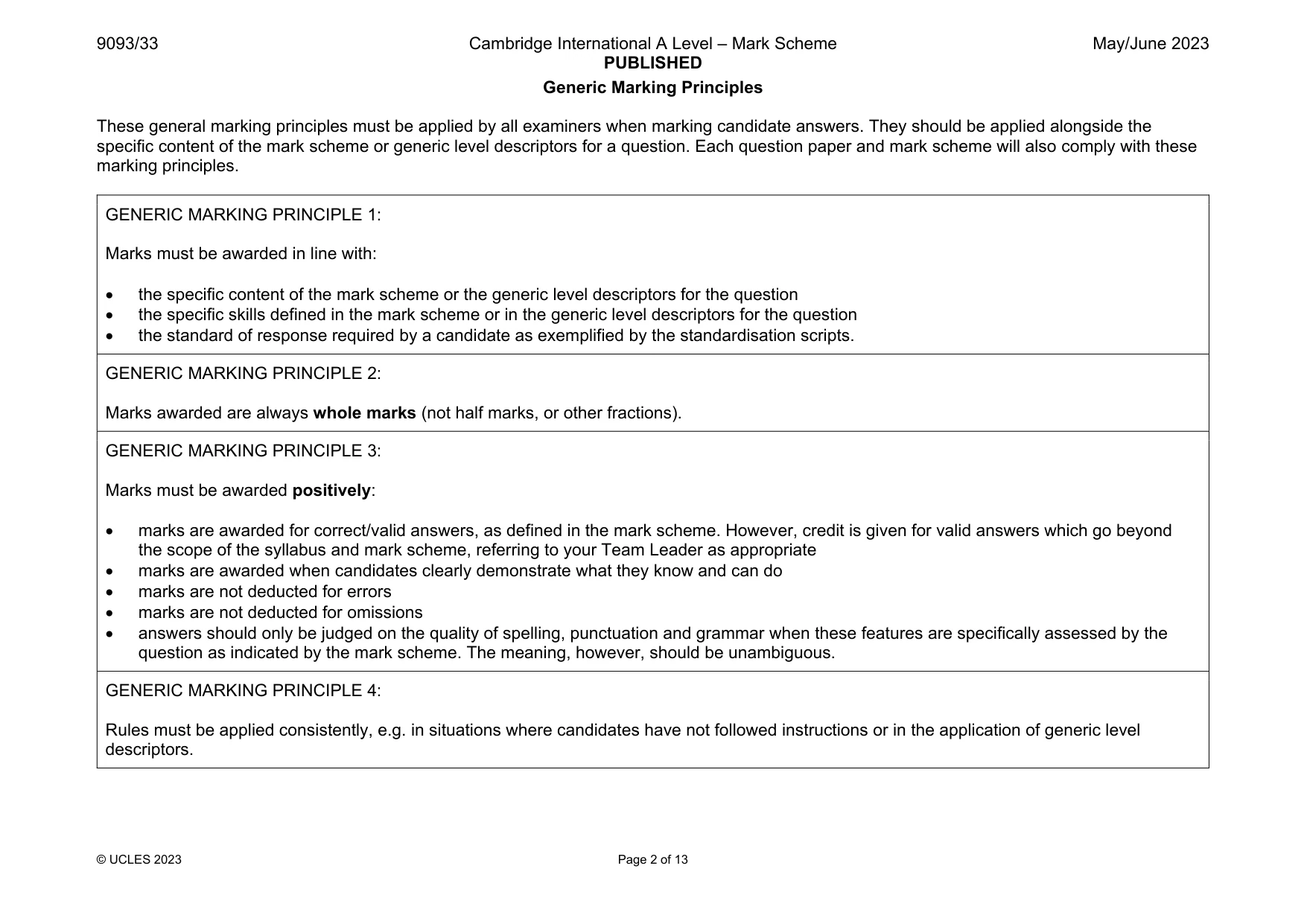
9093/33 Cambridge International A Level – Mark Scheme PUBLISHED May/June 2023 © UCLES 2023 Page 2 of 13 Generic Marking Principles These general marking principles must be applied by all examiners when marking candidate answers. They should be applied alongside the specific content of the mark scheme or generic level descriptors for a question. Each question paper and mark scheme will also comply with these marking principles. GENERIC MARKING PRINCIPLE 1: Marks must be awarded in line with: the specific content of the mark scheme or the generic level descriptors for the question the specific skills defined in the mark scheme or in the generic level descriptors for the question the standard of response required by a candidate as exemplified by the standardisation scripts. GENERIC MARKING PRINCIPLE 2: Marks awarded are always whole marks (not half marks, or other fractions). GENERIC MARKING PRINCIPLE 3: Marks must be awarded positively: marks are awarded for correct/valid answers, as defined in the mark scheme. However, credit is given for valid answers which go beyond the scope of the syllabus and mark scheme, referring to your Team Leader as appropriate marks are awarded when candidates clearly demonstrate what they know and can do marks are not deducted for errors marks are not deducted for omissions answers should only be judged on the quality of spelling, punctuation and grammar when these features are specifically assessed by the question as indicated by the mark scheme. The meaning, however, should be unambiguous. GENERIC MARKING PRINCIPLE 4: Rules must be applied consistently, e.g. in situations where candidates have not followed instructions or in the application of generic level descriptors.
Mark scheme, page 3
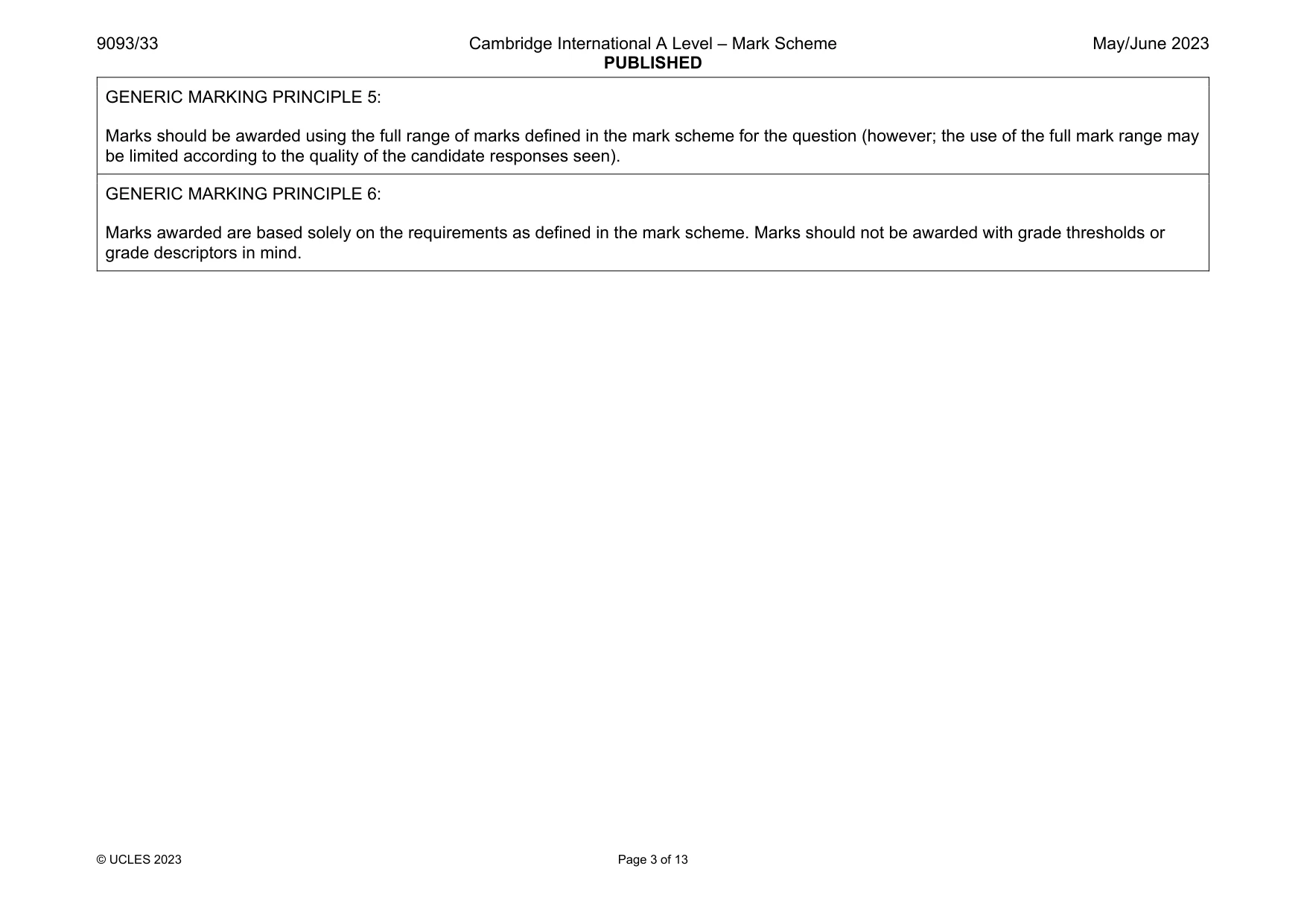
9093/33 Cambridge International A Level – Mark Scheme PUBLISHED May/June 2023 © UCLES 2023 Page 3 of 13 GENERIC MARKING PRINCIPLE 5: Marks should be awarded using the full range of marks defined in the mark scheme for the question (however; the use of the full mark range may be limited according to the quality of the candidate responses seen). GENERIC MARKING PRINCIPLE 6: Marks awarded are based solely on the requirements as defined in the mark scheme. Marks should not be awarded with grade thresholds or grade descriptors in mind.
Mark scheme, page 4
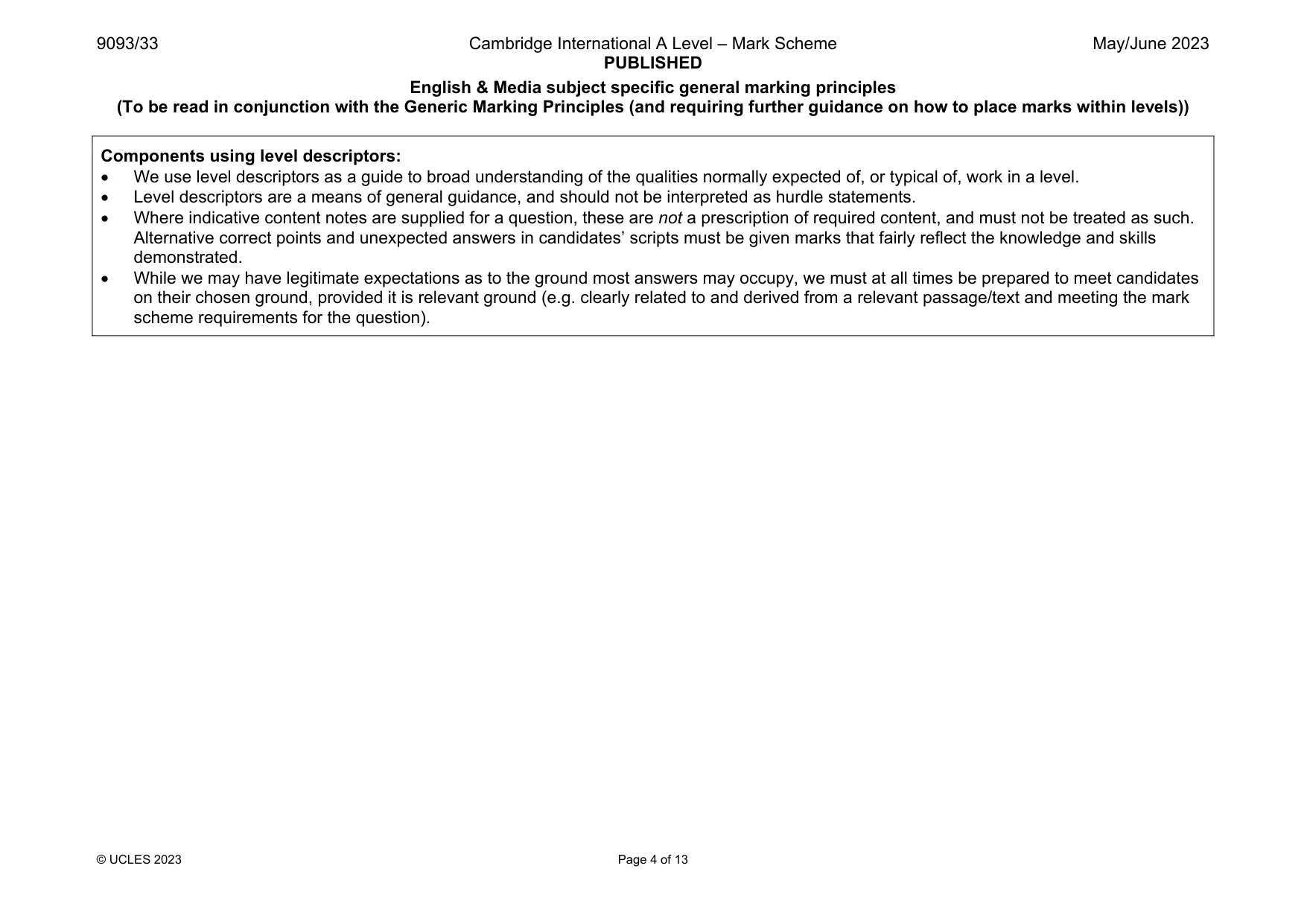
9093/33 Cambridge International A Level – Mark Scheme PUBLISHED May/June 2023 © UCLES 2023 Page 4 of 13 English & Media subject specific general marking principles (To be read in conjunction with the Generic Marking Principles (and requiring further guidance on how to place marks within levels)) Components using level descriptors: We use level descriptors as a guide to broad understanding of the qualities normally expected of, or typical of, work in a level. Level descriptors are a means of general guidance, and should not be interpreted as hurdle statements. Where indicative content notes are supplied for a question, these are not a prescription of required content, and must not be treated as such. Alternative correct points and unexpected answers in candidates’ scripts must be given marks that fairly reflect the knowledge and skills demonstrated. While we may have legitimate expectations as to the ground most answers may occupy, we must at all times be prepared to meet candidates on their chosen ground, provided it is relevant ground (e.g. clearly related to and derived from a relevant passage/text and meeting the mark scheme requirements for the question).
Mark scheme, page 5
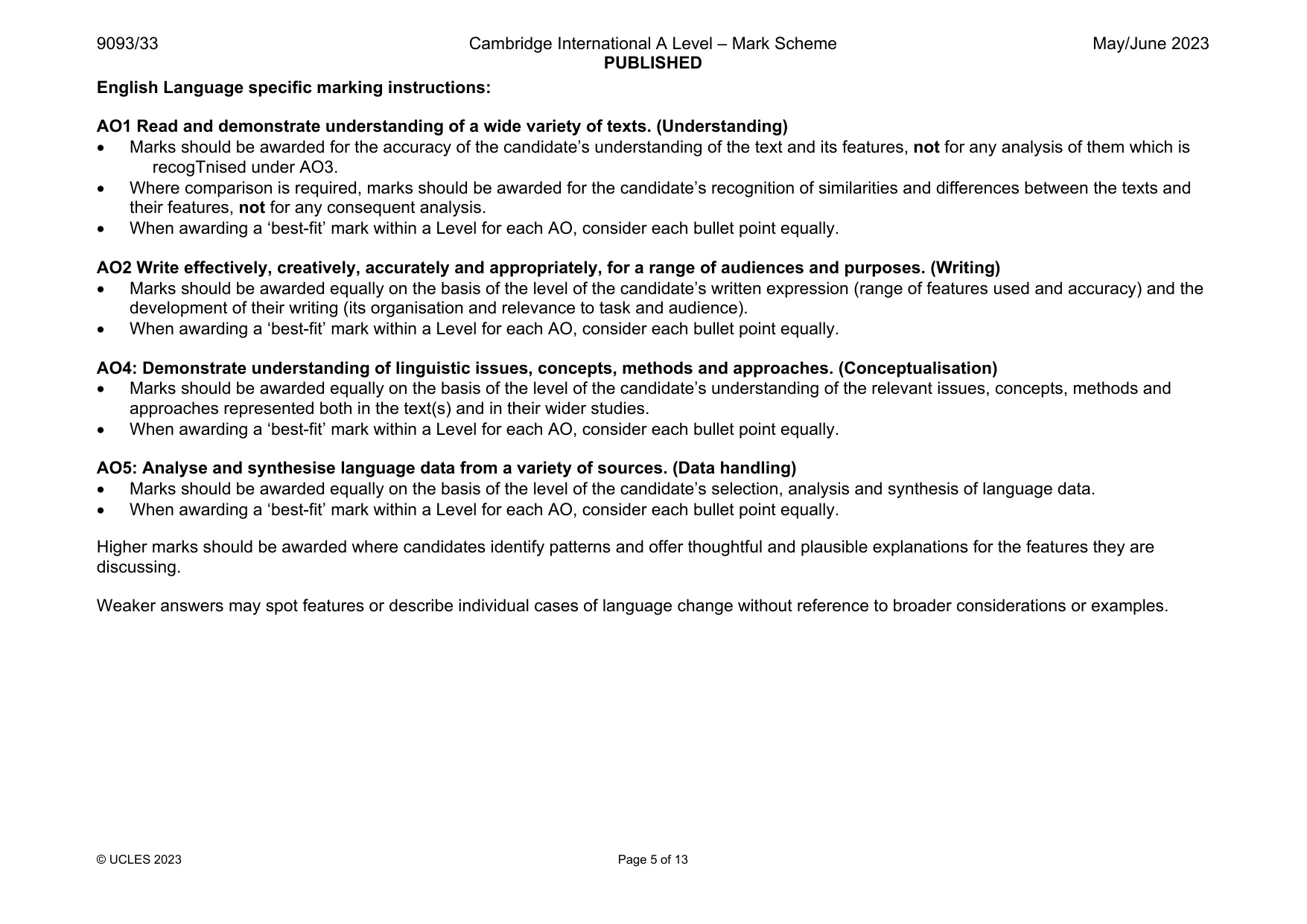
9093/33 Cambridge International A Level – Mark Scheme PUBLISHED May/June 2023 © UCLES 2023 Page 5 of 13 English Language specific marking instructions: AO1 Read and demonstrate understanding of a wide variety of texts. (Understanding) Marks should be awarded for the accuracy of the candidate’s understanding of the text and its features, not for any analysis of them which is recogTnised under AO3. Where comparison is required, marks should be awarded for the candidate’s recognition of similarities and differences between the texts and their features, not for any consequent analysis. When awarding a ‘best-fit’ mark within a Level for each AO, consider each bullet point equally. AO2 Write effectively, creatively, accurately and appropriately, for a range of audiences and purposes. (Writing) Marks should be awarded equally on the basis of the level of the candidate’s written expression (range of features used and accuracy) and the development of their writing (its organisation and relevance to task and audience). When awarding a ‘best-fit’ mark within a Level for each AO, consider each bullet point equally. AO4: Demonstrate understanding of linguistic issues, concepts, methods and approaches. (Conceptualisation) Marks should be awarded equally on the basis of the level of the candidate’s understanding of the relevant issues, concepts, methods and approaches represented both in the text(s) and in their wider studies. When awarding a ‘best-fit’ mark within a Level for each AO, consider each bullet point equally. AO5: Analyse and synthesise language data from a variety of sources. (Data handling) Marks should be awarded equally on the basis of the level of the candidate’s selection, analysis and synthesis of language data. When awarding a ‘best-fit’ mark within a Level for each AO, consider each bullet point equally. Higher marks should be awarded where candidates identify patterns and offer thoughtful and plausible explanations for the features they are discussing. Weaker answers may spot features or describe individual cases of language change without reference to broader considerations or examples.
Mark scheme, page 6
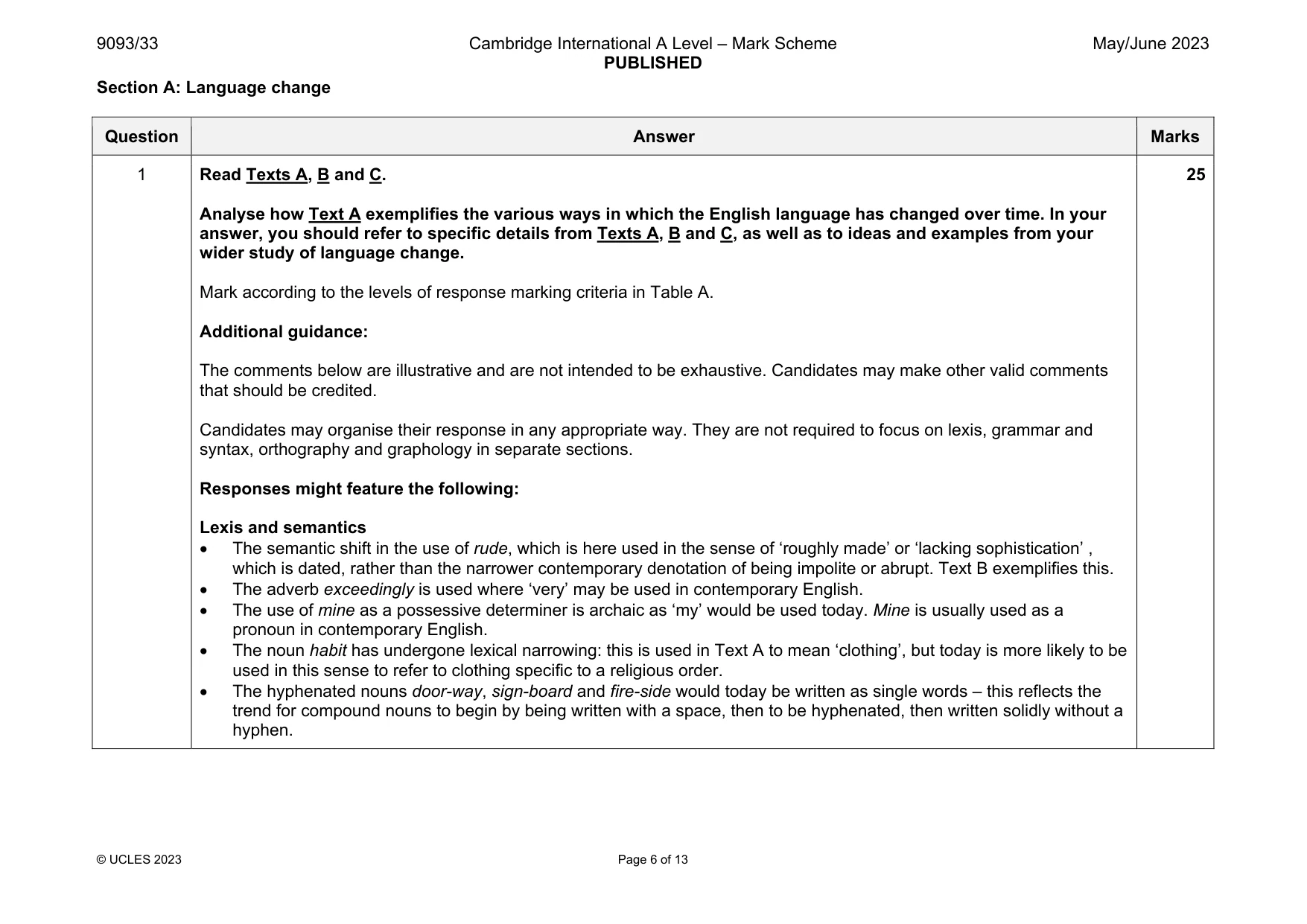
9093/33 Cambridge International A Level – Mark Scheme PUBLISHED May/June 2023 © UCLES 2023 Page 6 of 13 Section A: Language change Question Answer Marks 1 Read Texts A, B and C. Analyse how Text A exemplifies the various ways in which the English language has changed over time. In your answer, you should refer to specific details from Texts A, B and C, as well as to ideas and examples from your wider study of language change. Mark according to the levels of response marking criteria in Table A. Additional guidance: The comments below are illustrative and are not intended to be exhaustive. Candidates may make other valid comments that should be credited. Candidates may organise their response in any appropriate way. They are not required to focus on lexis, grammar and syntax, orthography and graphology in separate sections. Responses might feature the following: Lexis and semantics The semantic shift in the use of rude, which is here used in the sense of ‘roughly made’ or ‘lacking sophistication’ , which is dated, rather than the narrower contemporary denotation of being impolite or abrupt. Text B exemplifies this. The adverb exceedingly is used where ‘very’ may be used in contemporary English. The use of mine as a possessive determiner is archaic as ‘my’ would be used today. Mine is usually used as a pronoun in contemporary English. The noun habit has undergone lexical narrowing: this is used in Text A to mean ‘clothing’, but today is more likely to be used in this sense to refer to clothing specific to a religious order. The hyphenated nouns door-way, sign-board and fire-side would today be written as single words – this reflects the trend for compound nouns to begin by being written with a space, then to be hyphenated, then written solidly without a hyphen. 25
Mark scheme, page 7
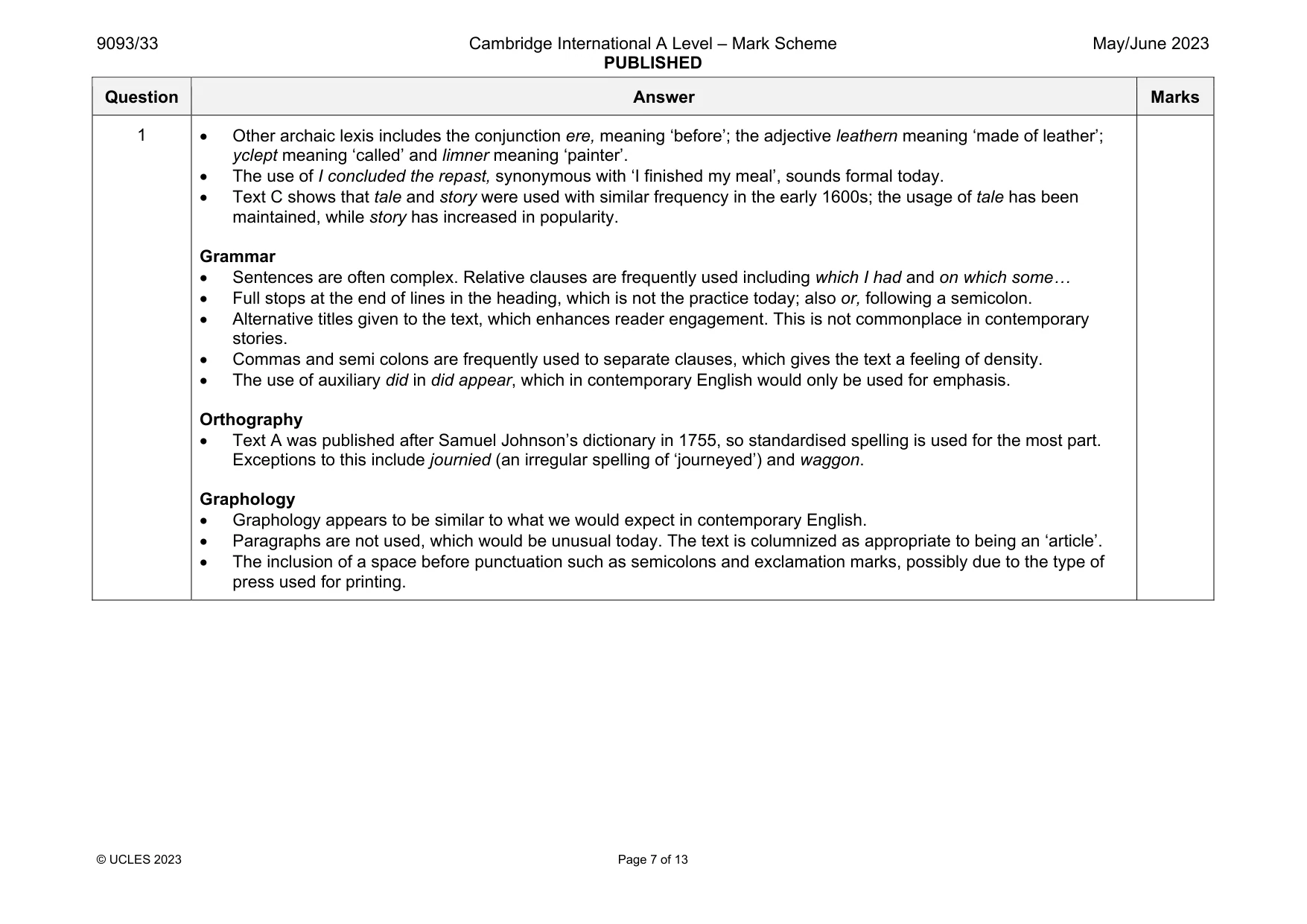
9093/33 Cambridge International A Level – Mark Scheme PUBLISHED May/June 2023 © UCLES 2023 Page 7 of 13 Question Answer Marks 1 Other archaic lexis includes the conjunction ere, meaning ‘before’; the adjective leathern meaning ‘made of leather’; yclept meaning ‘called’ and limner meaning ‘painter’. The use of I concluded the repast, synonymous with ‘I finished my meal’, sounds formal today. Text C shows that tale and story were used with similar frequency in the early 1600s; the usage of tale has been maintained, while story has increased in popularity. Grammar Sentences are often complex. Relative clauses are frequently used including which I had and on which some… Full stops at the end of lines in the heading, which is not the practice today; also or, following a semicolon. Alternative titles given to the text, which enhances reader engagement. This is not commonplace in contemporary stories. Commas and semi colons are frequently used to separate clauses, which gives the text a feeling of density. The use of auxiliary did in did appear, which in contemporary English would only be used for emphasis. Orthography Text A was published after Samuel Johnson’s dictionary in 1755, so standardised spelling is used for the most part. Exceptions to this include journied (an irregular spelling of ‘journeyed’) and waggon. Graphology Graphology appears to be similar to what we would expect in contemporary English. Paragraphs are not used, which would be unusual today. The text is columnized as appropriate to being an ‘article’. The inclusion of a space before punctuation such as semicolons and exclamation marks, possibly due to the type of press used for printing.
Mark scheme, page 8
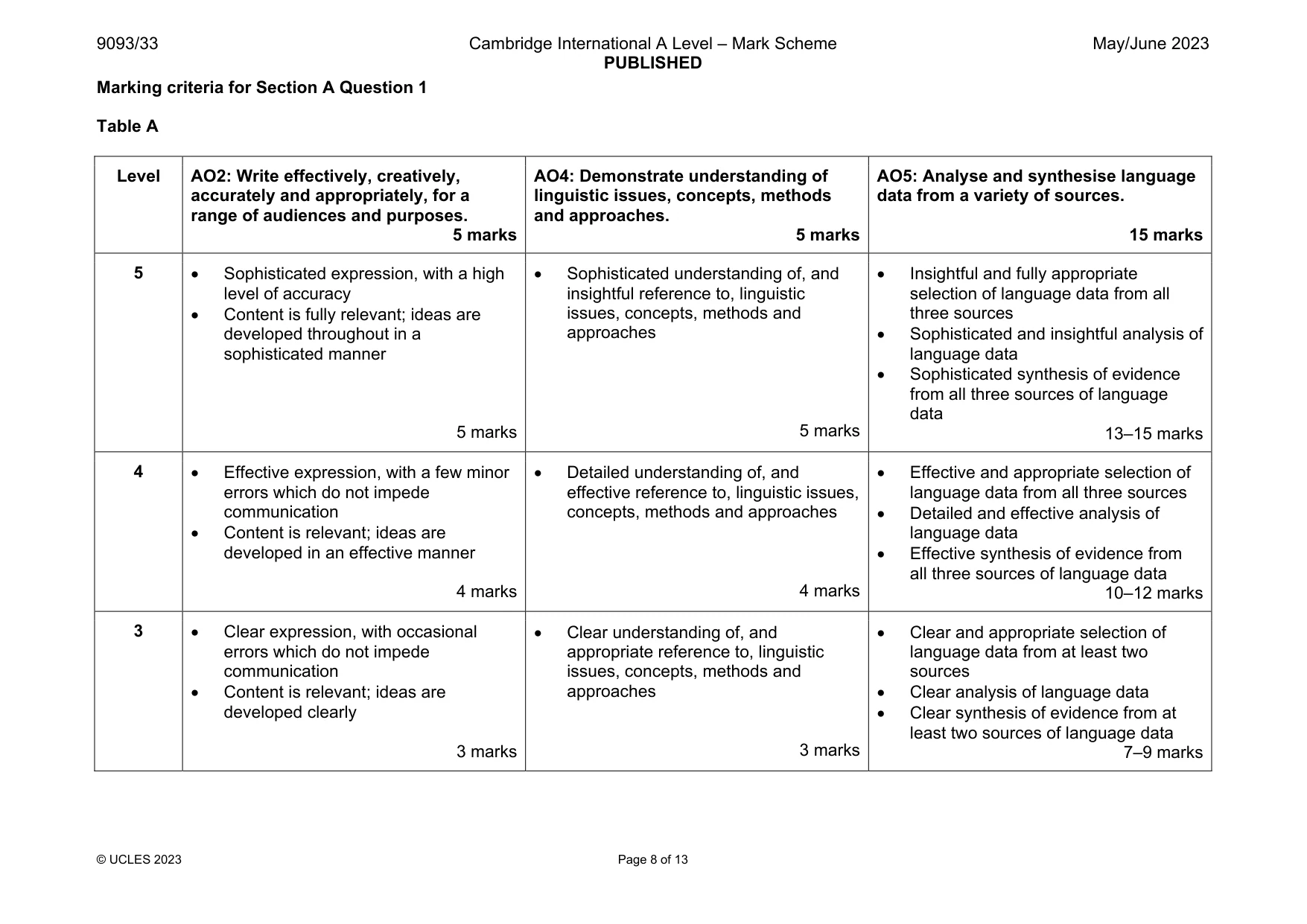
9093/33 Cambridge International A Level – Mark Scheme PUBLISHED May/June 2023 © UCLES 2023 Page 8 of 13 Marking criteria for Section A Question 1 Table A Level AO2: Write effectively, creatively, accurately and appropriately, for a range of audiences and purposes. 5 marks AO4: Demonstrate understanding of linguistic issues, concepts, methods and approaches. 5 marks AO5: Analyse and synthesise language data from a variety of sources. 15 marks 5 Sophisticated expression, with a high level of accuracy Content is fully relevant; ideas are developed throughout in a sophisticated manner 5 marks Sophisticated understanding of, and insightful reference to, linguistic issues, concepts, methods and approaches 5 marks Insightful and fully appropriate selection of language data from all three sources Sophisticated and insightful analysis of language data Sophisticated synthesis of evidence from all three sources of language data 13–15 marks 4 Effective expression, with a few minor errors which do not impede communication Content is relevant; ideas are developed in an effective manner 4 marks Detailed understanding of, and effective reference to, linguistic issues, concepts, methods and approaches 4 marks Effective and appropriate selection of language data from all three sources Detailed and effective analysis of language data Effective synthesis of evidence from all three sources of language data 10–12 marks 3 Clear expression, with occasional errors which do not impede communication Content is relevant; ideas are developed clearly 3 marks Clear understanding of, and appropriate reference to, linguistic issues, concepts, methods and approaches 3 marks Clear and appropriate selection of language data from at least two sources Clear analysis of language data Clear synthesis of evidence from at least two sources of language data 7–9 marks
Mark scheme, page 9
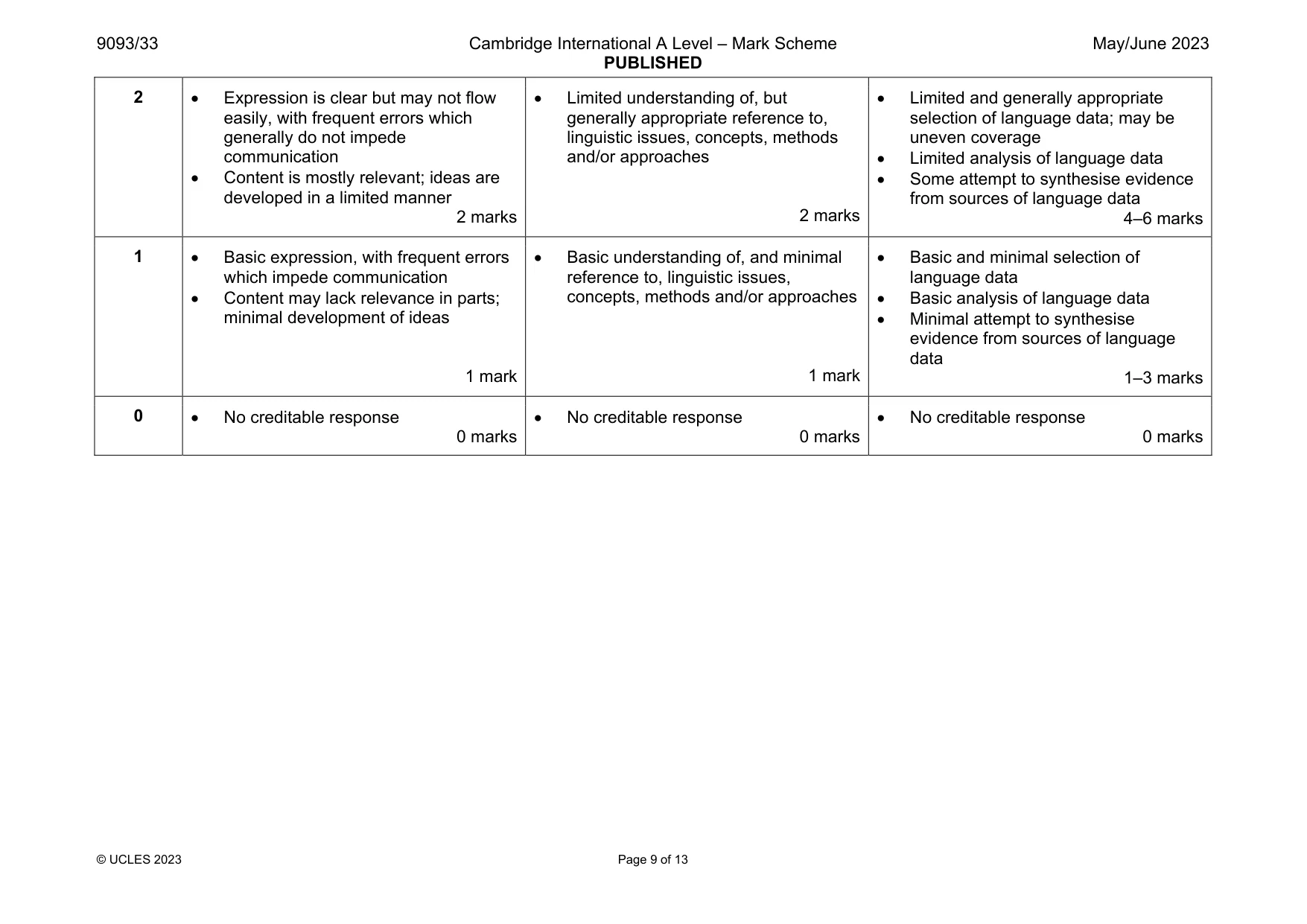
9093/33 Cambridge International A Level – Mark Scheme PUBLISHED May/June 2023 © UCLES 2023 Page 9 of 13 2 Expression is clear but may not flow easily, with frequent errors which generally do not impede communication Content is mostly relevant; ideas are developed in a limited manner 2 marks Limited understanding of, but generally appropriate reference to, linguistic issues, concepts, methods and/or approaches 2 marks Limited and generally appropriate selection of language data; may be uneven coverage Limited analysis of language data Some attempt to synthesise evidence from sources of language data 4–6 marks 1 Basic expression, with frequent errors which impede communication Content may lack relevance in parts; minimal development of ideas 1 mark Basic understanding of, and minimal reference to, linguistic issues, concepts, methods and/or approaches 1 mark Basic and minimal selection of language data Basic analysis of language data Minimal attempt to synthesise evidence from sources of language data 1–3 marks 0 No creditable response 0 marks No creditable response 0 marks No creditable response 0 marks
Mark scheme, page 10
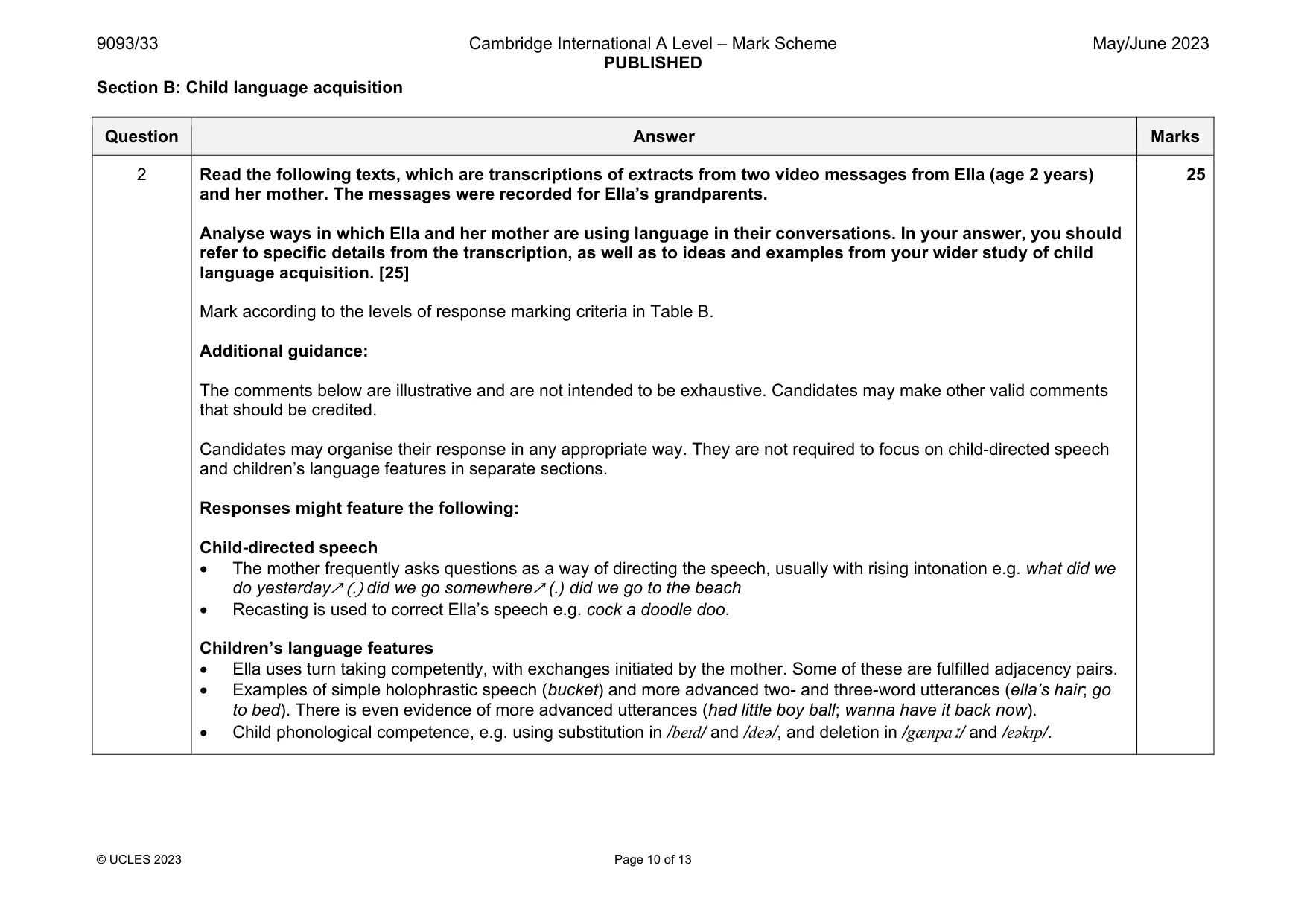
9093/33 Cambridge International A Level – Mark Scheme PUBLISHED May/June 2023 © UCLES 2023 Page 10 of 13 Section B: Child language acquisition Question Answer Marks 2 Read the following texts, which are transcriptions of extracts from two video messages from Ella (age 2 years) and her mother. The messages were recorded for Ella’s grandparents. Analyse ways in which Ella and her mother are using language in their conversations. In your answer, you should refer to specific details from the transcription, as well as to ideas and examples from your wider study of child language acquisition. [25] Mark according to the levels of response marking criteria in Table B. Additional guidance: The comments below are illustrative and are not intended to be exhaustive. Candidates may make other valid comments that should be credited. Candidates may organise their response in any appropriate way. They are not required to focus on child-directed speech and children’s language features in separate sections. Responses might feature the following: Child-directed speech The mother frequently asks questions as a way of directing the speech, usually with rising intonation e.g. what did we do yesterday↗ (.) did we go somewhere↗ (.) did we go to the beach Recasting is used to correct Ella’s speech e.g. cock a doodle doo. Children’s language features Ella uses turn taking competently, with exchanges initiated by the mother. Some of these are fulfilled adjacency pairs. Examples of simple holophrastic speech (bucket) and more advanced two- and three-word utterances (ella’s hair; go to bed). There is even evidence of more advanced utterances (had little boy ball; wanna have it back now). Child phonological competence, e.g. using substitution in /beɪd/ and /deə/, and deletion in /gænpaː/ and /eəkɪp/. 25
Mark scheme, page 11
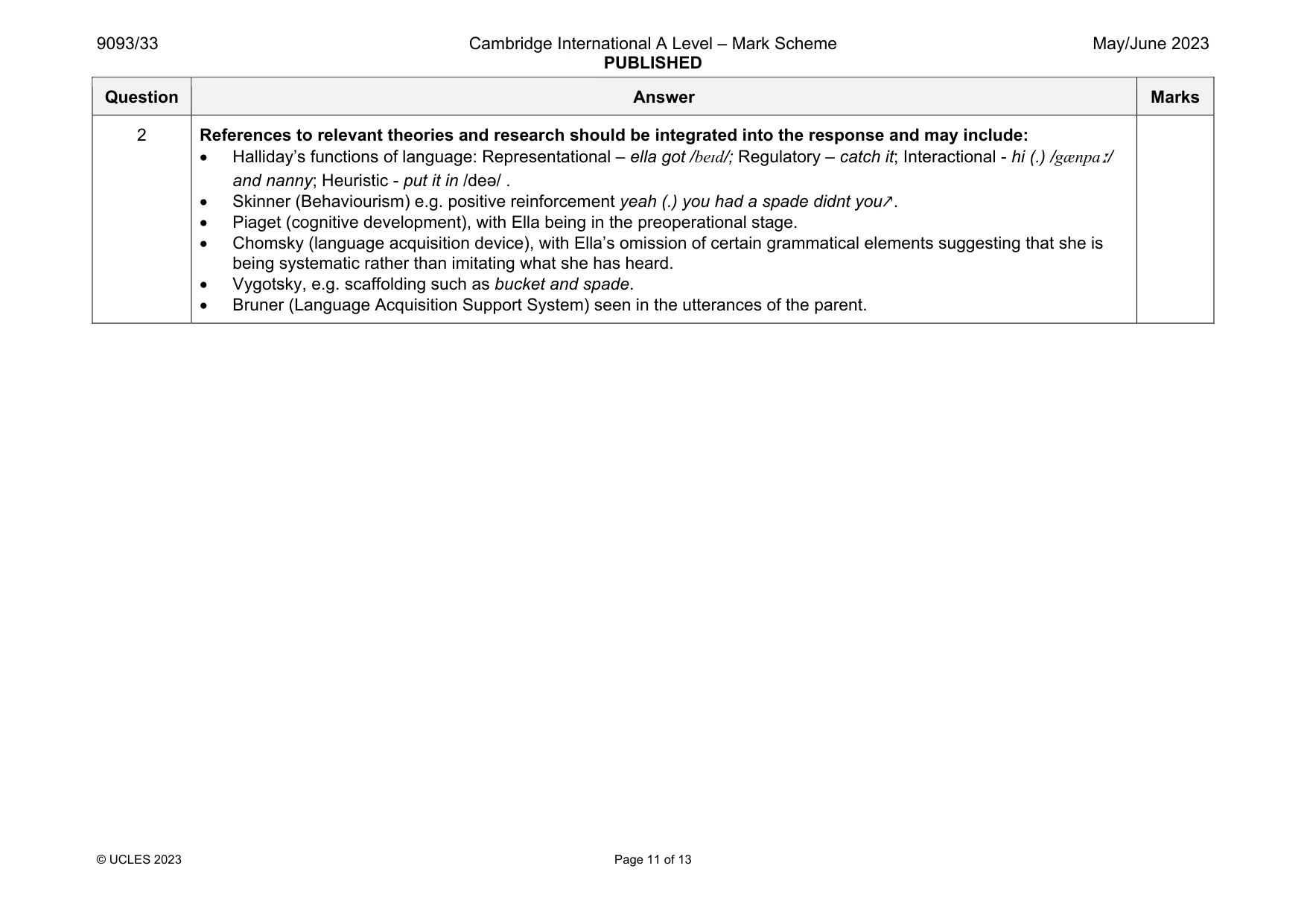
9093/33 Cambridge International A Level – Mark Scheme PUBLISHED May/June 2023 © UCLES 2023 Page 11 of 13 Question Answer Marks 2 References to relevant theories and research should be integrated into the response and may include: Halliday’s functions of language: Representational – ella got /beɪd/; Regulatory – catch it; Interactional - hi (.) /gænpaː/ and nanny; Heuristic - put it in /deə/ . Skinner (Behaviourism) e.g. positive reinforcement yeah (.) you had a spade didnt you↗. Piaget (cognitive development), with Ella being in the preoperational stage. Chomsky (language acquisition device), with Ella’s omission of certain grammatical elements suggesting that she is being systematic rather than imitating what she has heard. Vygotsky, e.g. scaffolding such as bucket and spade. Bruner (Language Acquisition Support System) seen in the utterances of the parent.
Mark scheme, page 12
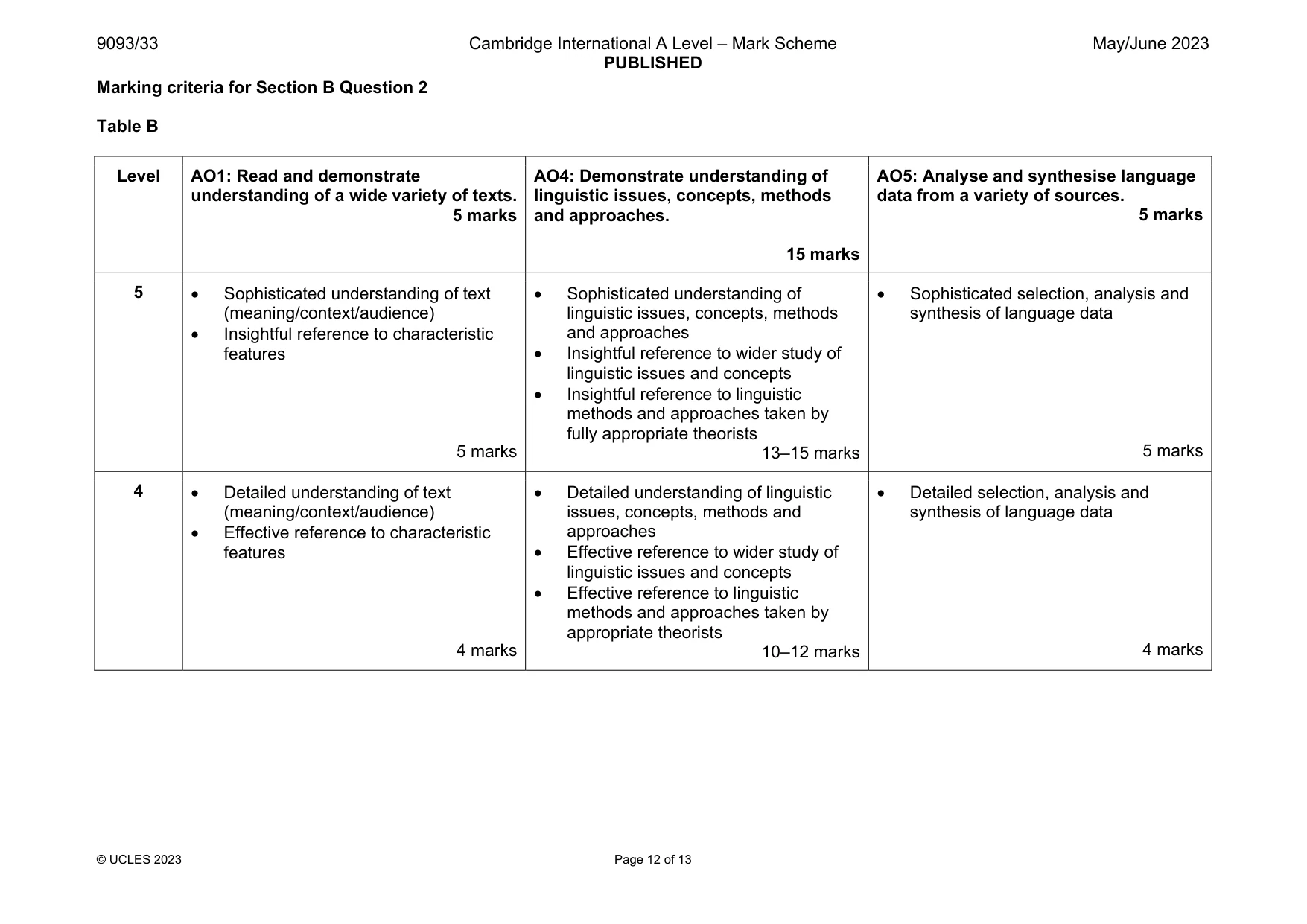
9093/33 Cambridge International A Level – Mark Scheme PUBLISHED May/June 2023 © UCLES 2023 Page 12 of 13 Marking criteria for Section B Question 2 Table B Level AO1: Read and demonstrate understanding of a wide variety of texts. 5 marks AO4: Demonstrate understanding of linguistic issues, concepts, methods and approaches. 15 marks AO5: Analyse and synthesise language data from a variety of sources. 5 marks 5 Sophisticated understanding of text (meaning/context/audience) Insightful reference to characteristic features 5 marks Sophisticated understanding of linguistic issues, concepts, methods and approaches Insightful reference to wider study of linguistic issues and concepts Insightful reference to linguistic methods and approaches taken by fully appropriate theorists 13–15 marks Sophisticated selection, analysis and synthesis of language data 5 marks 4 Detailed understanding of text (meaning/context/audience) Effective reference to characteristic features 4 marks Detailed understanding of linguistic issues, concepts, methods and approaches Effective reference to wider study of linguistic issues and concepts Effective reference to linguistic methods and approaches taken by appropriate theorists 10–12 marks Detailed selection, analysis and synthesis of language data 4 marks
Mark scheme, page 13
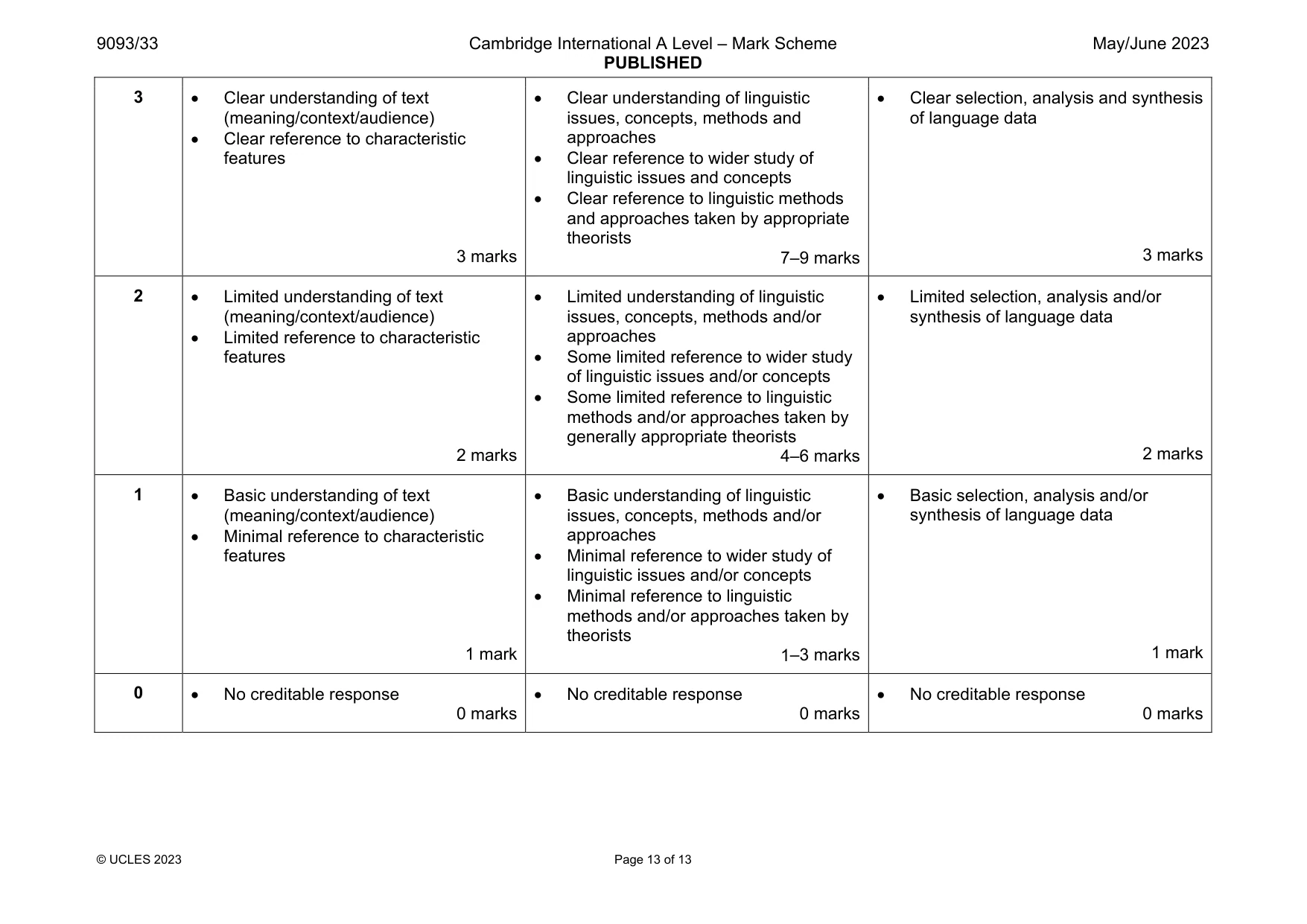
9093/33 Cambridge International A Level – Mark Scheme PUBLISHED May/June 2023 © UCLES 2023 Page 13 of 13 3 Clear understanding of text (meaning/context/audience) Clear reference to characteristic features 3 marks Clear understanding of linguistic issues, concepts, methods and approaches Clear reference to wider study of linguistic issues and concepts Clear reference to linguistic methods and approaches taken by appropriate theorists 7–9 marks Clear selection, analysis and synthesis of language data 3 marks 2 Limited understanding of text (meaning/context/audience) Limited reference to characteristic features 2 marks Limited understanding of linguistic issues, concepts, methods and/or approaches Some limited reference to wider study of linguistic issues and/or concepts Some limited reference to linguistic methods and/or approaches taken by generally appropriate theorists 4–6 marks Limited selection, analysis and/or synthesis of language data 2 marks 1 Basic understanding of text (meaning/context/audience) Minimal reference to characteristic features 1 mark Basic understanding of linguistic issues, concepts, methods and/or approaches Minimal reference to wider study of linguistic issues and/or concepts Minimal reference to linguistic methods and/or approaches taken by theorists 1–3 marks Basic selection, analysis and/or synthesis of language data 1 mark 0 No creditable response 0 marks No creditable response 0 marks No creditable response 0 marks
What you needed in this session
Cambridge’s own grade thresholds for 2023 May/June, Paper 3 · Variant 3. A higher threshold means an easier paper — the bar moves with how the cohort did.