Cambridge A Level English - Language AS and A Level (from 2014) 9093 — 2022 Oct/Nov Paper 1 · Variant 3
9093/13/O/N/22 · 50 marks · ≈56 min
The question paper and its mark scheme, free to read here and free to download. This is Cambridge’s own paper, exactly as it was sat.
Question paper8 pages
Mark scheme15 pages
Answers below. Sit the paper first if you are practising.
Paper as text
Question paper, page 1
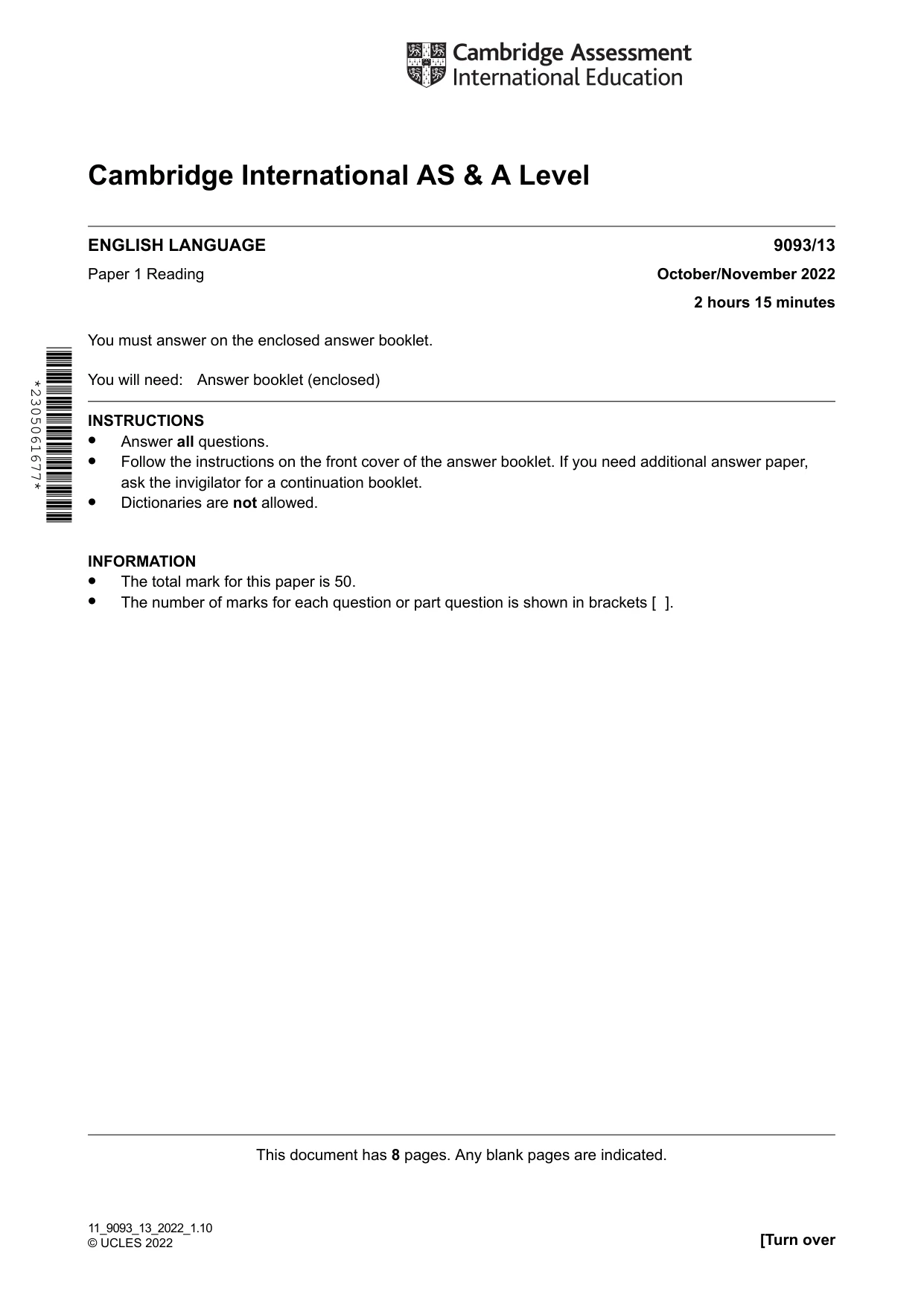
Cambridge International AS & A Level 9093/13 October/November 2022 2 hours 15 minutes ENGLISH LANGUAGE Paper 1 Reading You must answer on the enclosed answer booklet. You will need: Answer booklet (enclosed) INSTRUCTIONS • Answer all questions. • Follow the instructions on the front cover of the answer booklet. If you need additional answer paper, ask the invigilator for a continuation booklet. • Dictionaries are not allowed. INFORMATION • The total mark for this paper is 50. • The number of marks for each question or part question is shown in brackets [ ]. This document has 8 pages. Any blank pages are indicated. [Turn over 11_9093_13_2022_1.10 © UCLES 2022 *2305061677*
Question paper, page 2
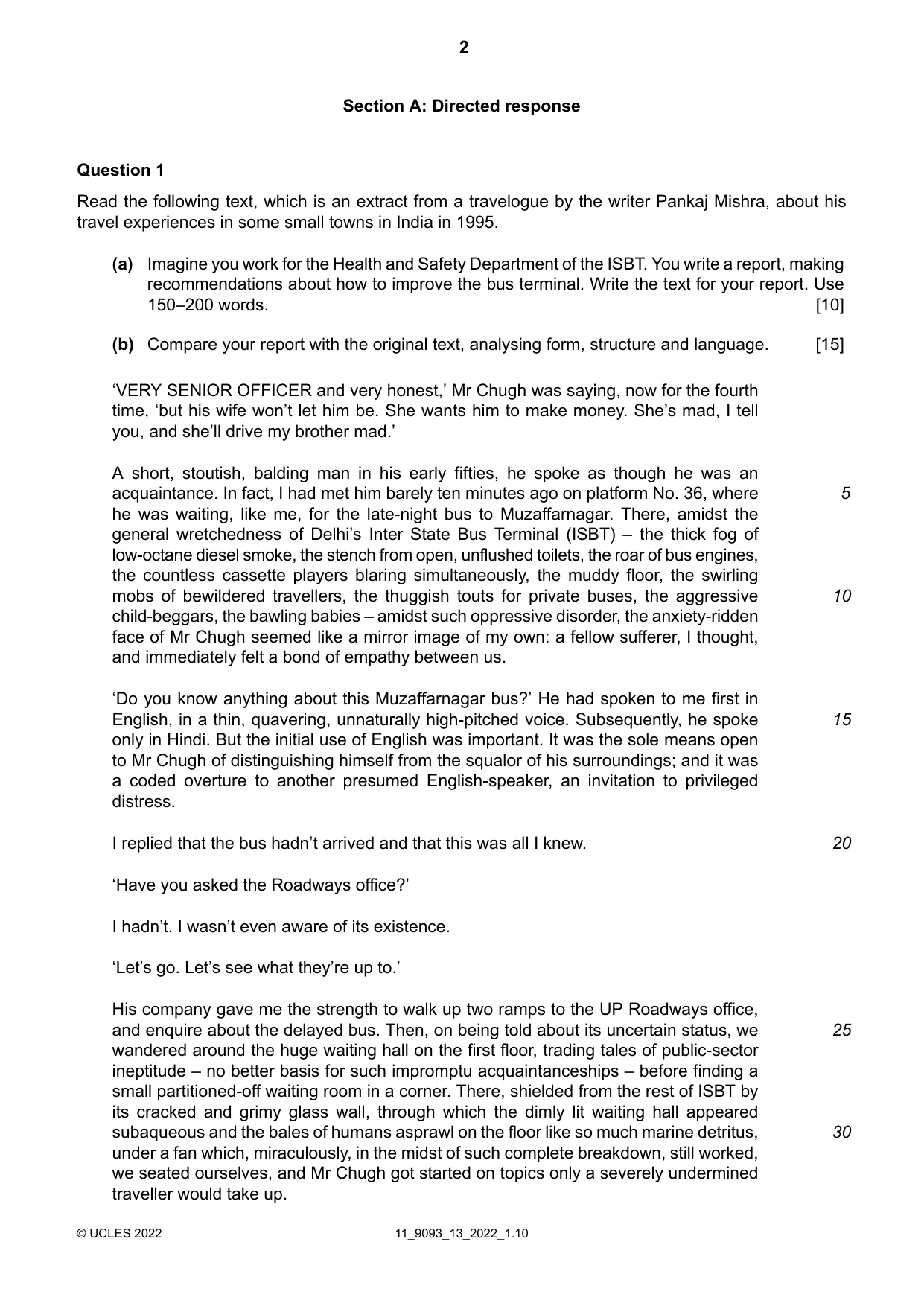
30 25 20 15 10 5 Section A: Directed response Question 1 Read the following text, which is an extract from a travelogue by the writer Pankaj Mishra, about his travel experiences in some small towns in India in 1995. Imagine you work for the Health and Safety Department of the ISBT. You write a report, making recommendations about how to improve the bus terminal. Write the text for your report. Use 150–200 words. [10] (a) Compare your report with the original text, analysing form, structure and language. [15] (b) ‘VERY SENIOR OFFICER and very honest,’ Mr Chugh was saying, now for the fourth time, ‘but his wife won’t let him be. She wants him to make money. She’s mad, I tell you, and she’ll drive my brother mad.’ A short, stoutish, balding man in his early fifties, he spoke as though he was an acquaintance. In fact, I had met him barely ten minutes ago on platform No. 36, where he was waiting, like me, for the late-night bus to Muzaffarnagar. There, amidst the general wretchedness of Delhi’s Inter State Bus Terminal (ISBT) – the thick fog of low-octane diesel smoke, the stench from open, unflushed toilets, the roar of bus engines, the countless cassette players blaring simultaneously, the muddy floor, the swirling mobs of bewildered travellers, the thuggish touts for private buses, the aggressive child-beggars, the bawling babies – amidst such oppressive disorder, the anxiety-ridden face of Mr Chugh seemed like a mirror image of my own: a fellow sufferer, I thought, and immediately felt a bond of empathy between us. ‘Do you know anything about this Muzaffarnagar bus?’ He had spoken to me first in English, in a thin, quavering, unnaturally high-pitched voice. Subsequently, he spoke only in Hindi. But the initial use of English was important. It was the sole means open to Mr Chugh of distinguishing himself from the squalor of his surroundings; and it was a coded overture to another presumed English-speaker, an invitation to privileged distress. I replied that the bus hadn’t arrived and that this was all I knew. ‘Have you asked the Roadways office?’ I hadn’t. I wasn’t even aware of its existence. ‘Let’s go. Let’s see what they’re up to.’ His company gave me the strength to walk up two ramps to the UP Roadways office, and enquire about the delayed bus. Then, on being told about its uncertain status, we wandered around the huge waiting hall on the first floor, trading tales of public-sector ineptitude – no better basis for such impromptu acquaintanceships – before finding a small partitioned-off waiting room in a corner. There, shielded from the rest of ISBT by its cracked and grimy glass wall, through which the dimly lit waiting hall appeared subaqueous and the bales of humans asprawl on the floor like so much marine detritus, under a fan which, miraculously, in the midst of such complete breakdown, still worked, we seated ourselves, and Mr Chugh got started on topics only a severely undermined traveller would take up. 11_9093_13_2022_1.10 © UCLES 2022 2
Question paper, page 3
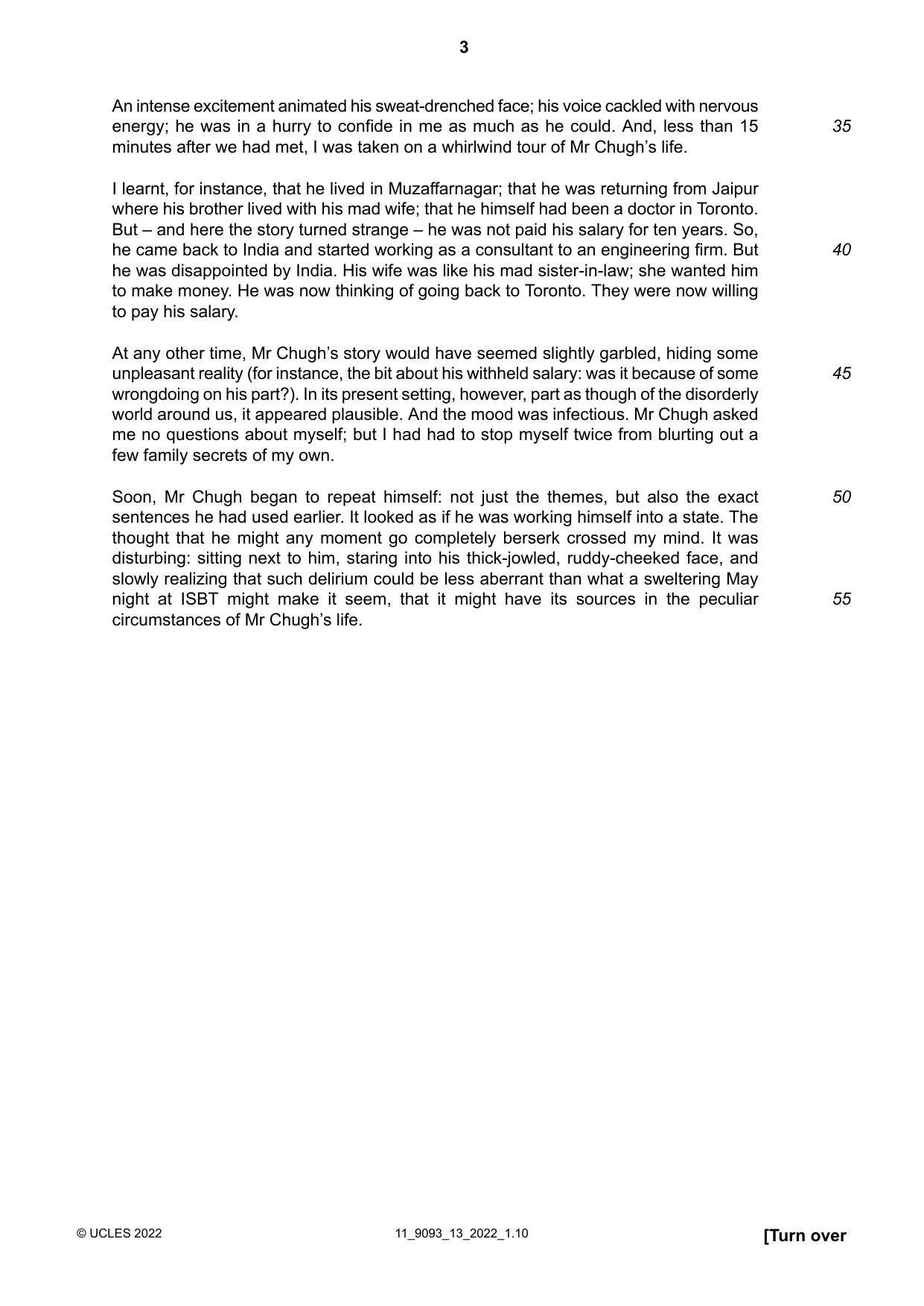
55 50 45 40 35 An intense excitement animated his sweat-drenched face; his voice cackled with nervous energy; he was in a hurry to confide in me as much as he could. And, less than 15 minutes after we had met, I was taken on a whirlwind tour of Mr Chugh’s life. I learnt, for instance, that he lived in Muzaffarnagar; that he was returning from Jaipur where his brother lived with his mad wife; that he himself had been a doctor in Toronto. But – and here the story turned strange – he was not paid his salary for ten years. So, he came back to India and started working as a consultant to an engineering firm. But he was disappointed by India. His wife was like his mad sister-in-law; she wanted him to make money. He was now thinking of going back to Toronto. They were now willing to pay his salary. At any other time, Mr Chugh’s story would have seemed slightly garbled, hiding some unpleasant reality (for instance, the bit about his withheld salary: was it because of some wrongdoing on his part?). In its present setting, however, part as though of the disorderly world around us, it appeared plausible. And the mood was infectious. Mr Chugh asked me no questions about myself; but I had had to stop myself twice from blurting out a few family secrets of my own. Soon, Mr Chugh began to repeat himself: not just the themes, but also the exact sentences he had used earlier. It looked as if he was working himself into a state. The thought that he might any moment go completely berserk crossed my mind. It was disturbing: sitting next to him, staring into his thick-jowled, ruddy-cheeked face, and slowly realizing that such delirium could be less aberrant than what a sweltering May night at ISBT might make it seem, that it might have its sources in the peculiar circumstances of Mr Chugh’s life. [Turn over 11_9093_13_2022_1.10 © UCLES 2022 3
Question paper, page 4
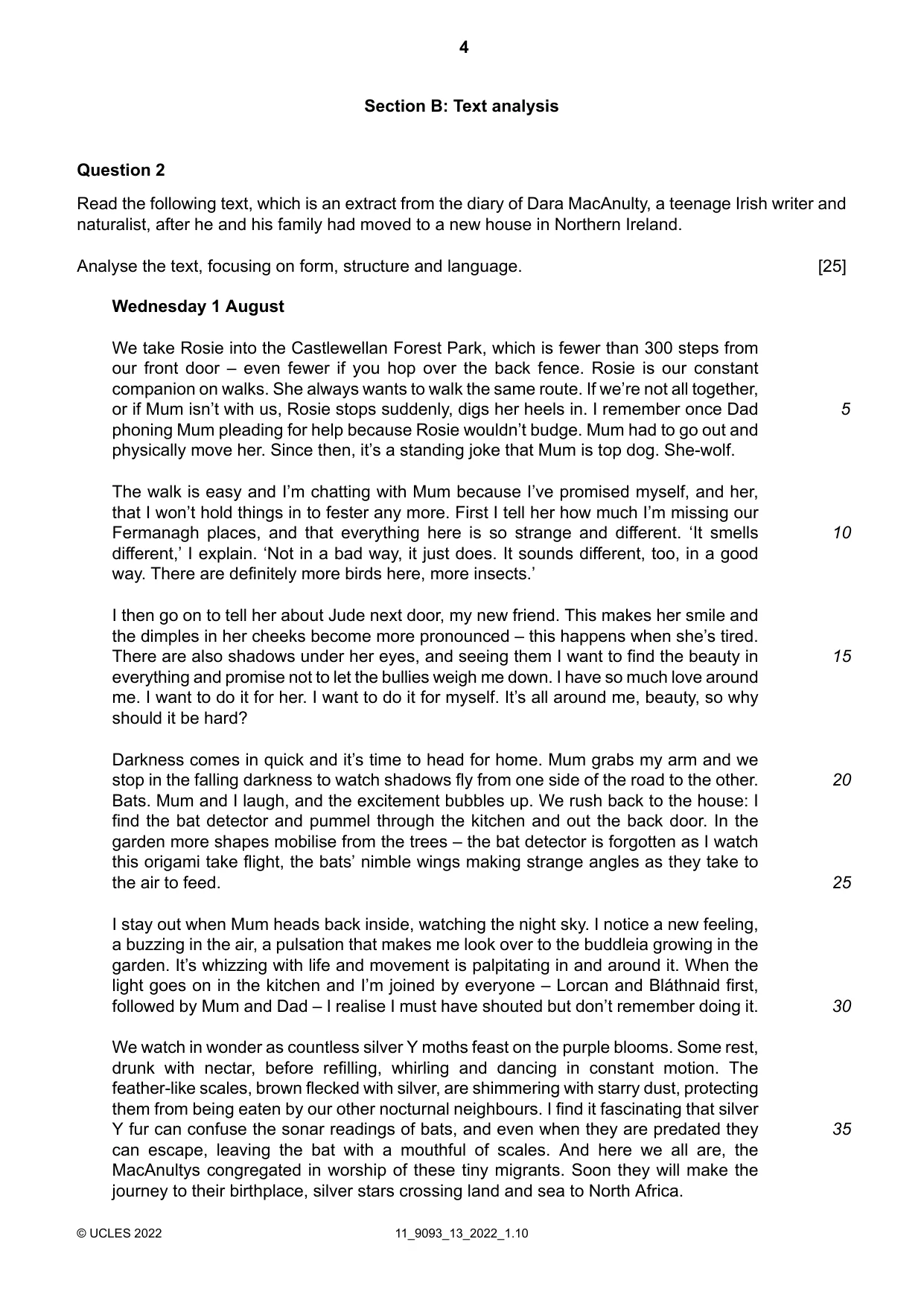
35 30 25 20 15 10 5 Section B: Text analysis Question 2 Read the following text, which is an extract from the diary of Dara MacAnulty, a teenage Irish writer and naturalist, after he and his family had moved to a new house in Northern Ireland. Analyse the text, focusing on form, structure and language. [25] Wednesday 1 August We take Rosie into the Castlewellan Forest Park, which is fewer than 300 steps from our front door – even fewer if you hop over the back fence. Rosie is our constant companion on walks. She always wants to walk the same route. If we’re not all together, or if Mum isn’t with us, Rosie stops suddenly, digs her heels in. I remember once Dad phoning Mum pleading for help because Rosie wouldn’t budge. Mum had to go out and physically move her. Since then, it’s a standing joke that Mum is top dog. She-wolf. The walk is easy and I’m chatting with Mum because I’ve promised myself, and her, that I won’t hold things in to fester any more. First I tell her how much I’m missing our Fermanagh places, and that everything here is so strange and different. ‘It smells different,’ I explain. ‘Not in a bad way, it just does. It sounds different, too, in a good way. There are definitely more birds here, more insects.’ I then go on to tell her about Jude next door, my new friend. This makes her smile and the dimples in her cheeks become more pronounced – this happens when she’s tired. There are also shadows under her eyes, and seeing them I want to find the beauty in everything and promise not to let the bullies weigh me down. I have so much love around me. I want to do it for her. I want to do it for myself. It’s all around me, beauty, so why should it be hard? Darkness comes in quick and it’s time to head for home. Mum grabs my arm and we stop in the falling darkness to watch shadows fly from one side of the road to the other. Bats. Mum and I laugh, and the excitement bubbles up. We rush back to the house: I find the bat detector and pummel through the kitchen and out the back door. In the garden more shapes mobilise from the trees – the bat detector is forgotten as I watch this origami take flight, the bats’ nimble wings making strange angles as they take to the air to feed. I stay out when Mum heads back inside, watching the night sky. I notice a new feeling, a buzzing in the air, a pulsation that makes me look over to the buddleia growing in the garden. It’s whizzing with life and movement is palpitating in and around it. When the light goes on in the kitchen and I’m joined by everyone – Lorcan and Bláthnaid first, followed by Mum and Dad – I realise I must have shouted but don’t remember doing it. We watch in wonder as countless silver Y moths feast on the purple blooms. Some rest, drunk with nectar, before refilling, whirling and dancing in constant motion. The feather-like scales, brown flecked with silver, are shimmering with starry dust, protecting them from being eaten by our other nocturnal neighbours. I find it fascinating that silver Y fur can confuse the sonar readings of bats, and even when they are predated they can escape, leaving the bat with a mouthful of scales. And here we all are, the MacAnultys congregated in worship of these tiny migrants. Soon they will make the journey to their birthplace, silver stars crossing land and sea to North Africa. 11_9093_13_2022_1.10 © UCLES 2022 4
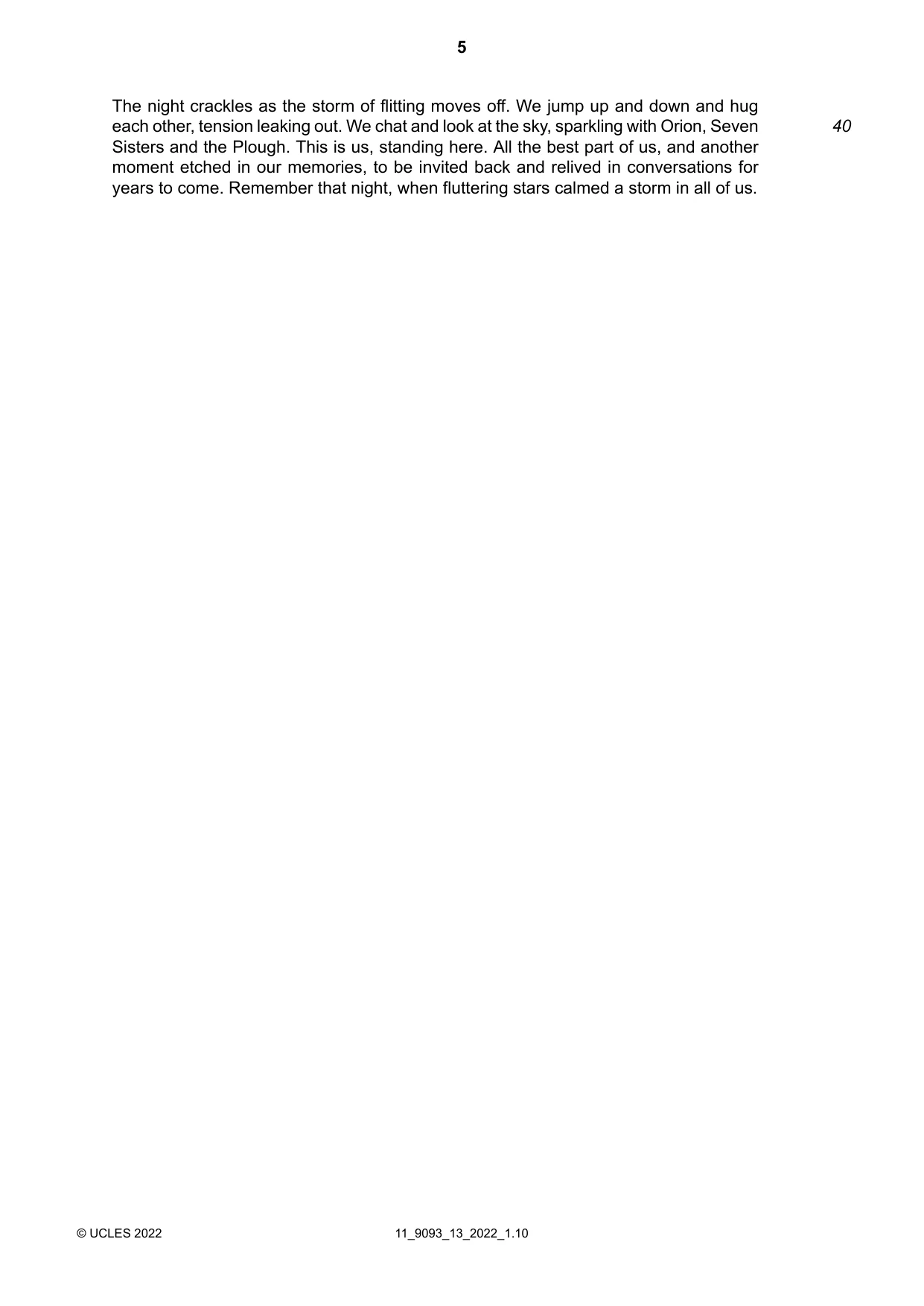
Question paper, page 5
40 The night crackles as the storm of flitting moves off. We jump up and down and hug each other, tension leaking out. We chat and look at the sky, sparkling with Orion, Seven Sisters and the Plough. This is us, standing here. All the best part of us, and another moment etched in our memories, to be invited back and relived in conversations for years to come. Remember that night, when fluttering stars calmed a storm in all of us. 11_9093_13_2022_1.10 © UCLES 2022 5
Question paper, page 6
BLANK PAGE 11_9093_13_2022_1.10 © UCLES 2022 6
Question paper, page 7
BLANK PAGE 11_9093_13_2022_1.10 © UCLES 2022 7
Question paper, page 8
BLANK PAGE Permission to reproduce items where third-party owned material protected by copyright is included has been sought and cleared where possible. Every reasonable effort has been made by the publisher (UCLES) to trace copyright holders, but if any items requiring clearance have unwittingly been included, the publisher will be pleased to make amends at the earliest possible opportunity. To avoid the issue of disclosure of answer-related information to candidates, all copyright acknowledgements are reproduced online in the Cambridge Assessment International Education Copyright Acknowledgements Booklet. This is produced for each series of examinations and is freely available to download at www.cambridgeinternational.org after the live examination series. Cambridge Assessment International Education is part of Cambridge Assessment. Cambridge Assessment is the brand name of the University of Cambridge Local Examinations Syndicate (UCLES), which is a department of the University of Cambridge. 11_9093_13_2022_1.10 © UCLES 2022 8
Mark scheme, page 1
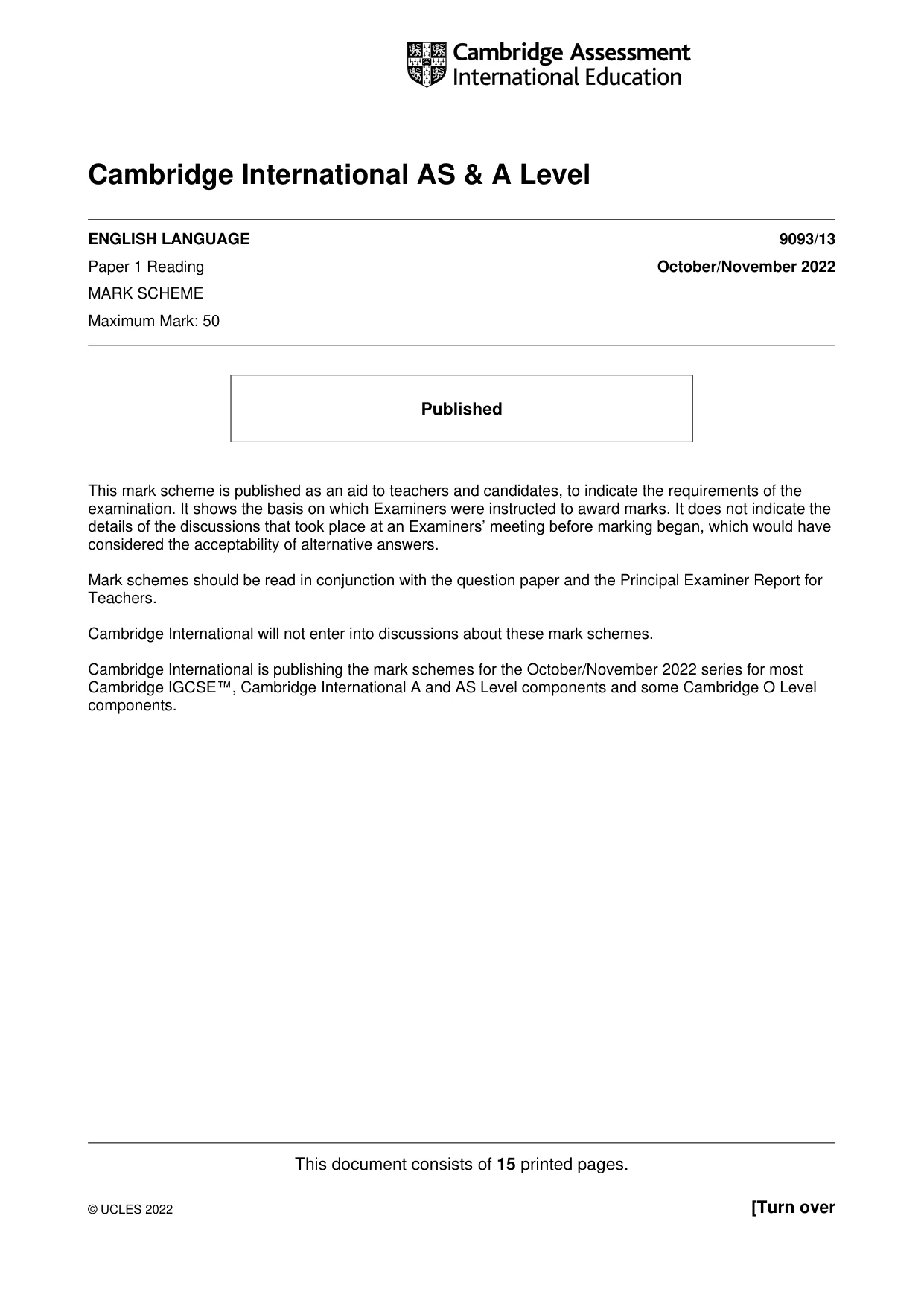
This document consists of 15 printed pages. © UCLES 2022 [Turn over Cambridge International AS & A Level ENGLISH LANGUAGE 9093/13 Paper 1 Reading October/November 2022 MARK SCHEME Maximum Mark: 50 Published This mark scheme is published as an aid to teachers and candidates, to indicate the requirements of the examination. It shows the basis on which Examiners were instructed to award marks. It does not indicate the details of the discussions that took place at an Examiners’ meeting before marking began, which would have considered the acceptability of alternative answers. Mark schemes should be read in conjunction with the question paper and the Principal Examiner Report for Teachers. Cambridge International will not enter into discussions about these mark schemes. Cambridge International is publishing the mark schemes for the October/November 2022 series for most Cambridge IGCSE™, Cambridge International A and AS Level components and some Cambridge O Level components.
Mark scheme, page 2
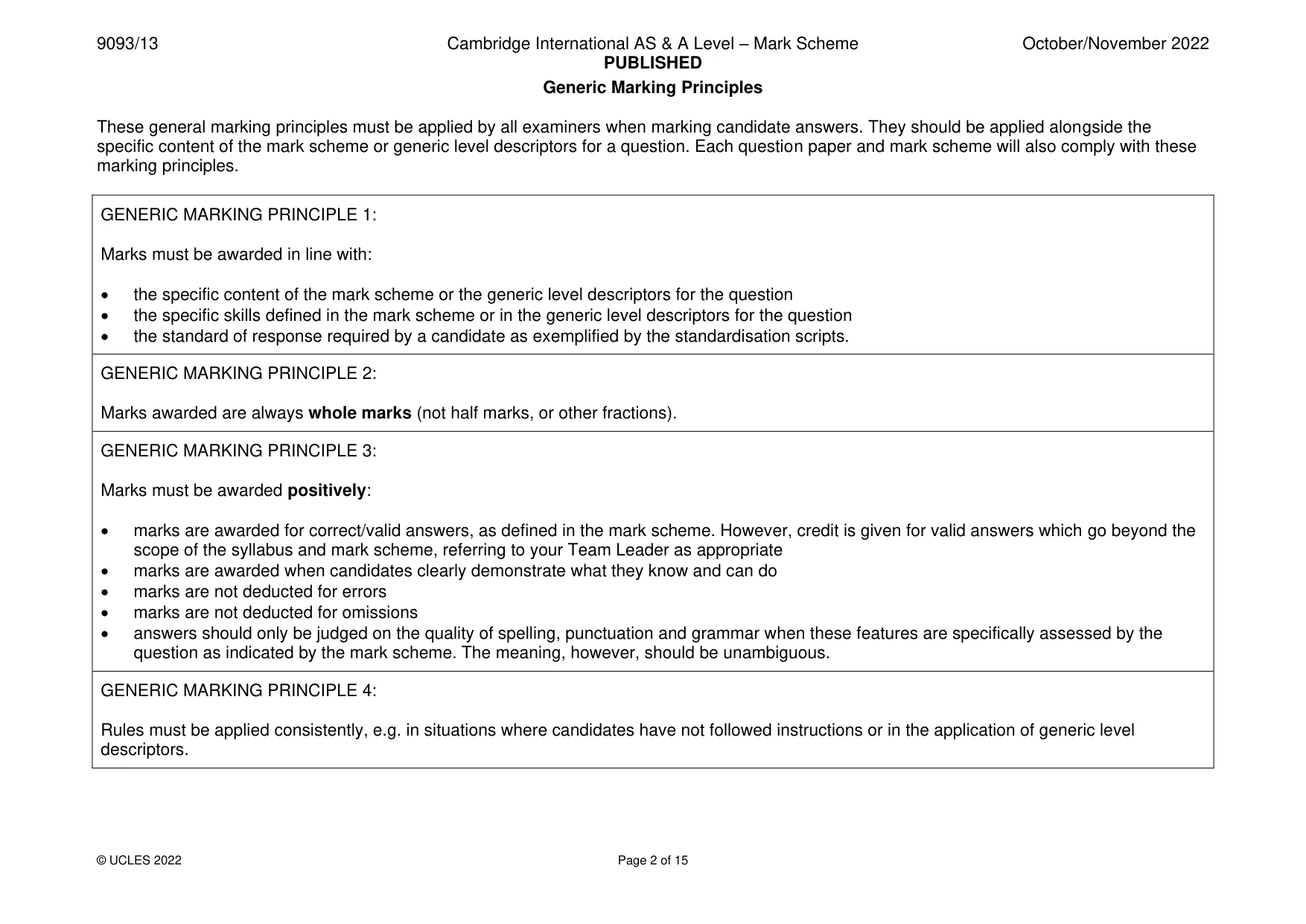
9093/13 Cambridge International AS & A Level – Mark Scheme PUBLISHED October/November 2022 © UCLES 2022 Page 2 of 15 Generic Marking Principles These general marking principles must be applied by all examiners when marking candidate answers. They should be applied alongside the specific content of the mark scheme or generic level descriptors for a question. Each question paper and mark scheme will also comply with these marking principles. GENERIC MARKING PRINCIPLE 1: Marks must be awarded in line with: • the specific content of the mark scheme or the generic level descriptors for the question • the specific skills defined in the mark scheme or in the generic level descriptors for the question • the standard of response required by a candidate as exemplified by the standardisation scripts. GENERIC MARKING PRINCIPLE 2: Marks awarded are always whole marks (not half marks, or other fractions). GENERIC MARKING PRINCIPLE 3: Marks must be awarded positively: • marks are awarded for correct/valid answers, as defined in the mark scheme. However, credit is given for valid answers which go beyond the scope of the syllabus and mark scheme, referring to your Team Leader as appropriate • marks are awarded when candidates clearly demonstrate what they know and can do • marks are not deducted for errors • marks are not deducted for omissions • answers should only be judged on the quality of spelling, punctuation and grammar when these features are specifically assessed by the question as indicated by the mark scheme. The meaning, however, should be unambiguous. GENERIC MARKING PRINCIPLE 4: Rules must be applied consistently, e.g. in situations where candidates have not followed instructions or in the application of generic level descriptors.
Mark scheme, page 3
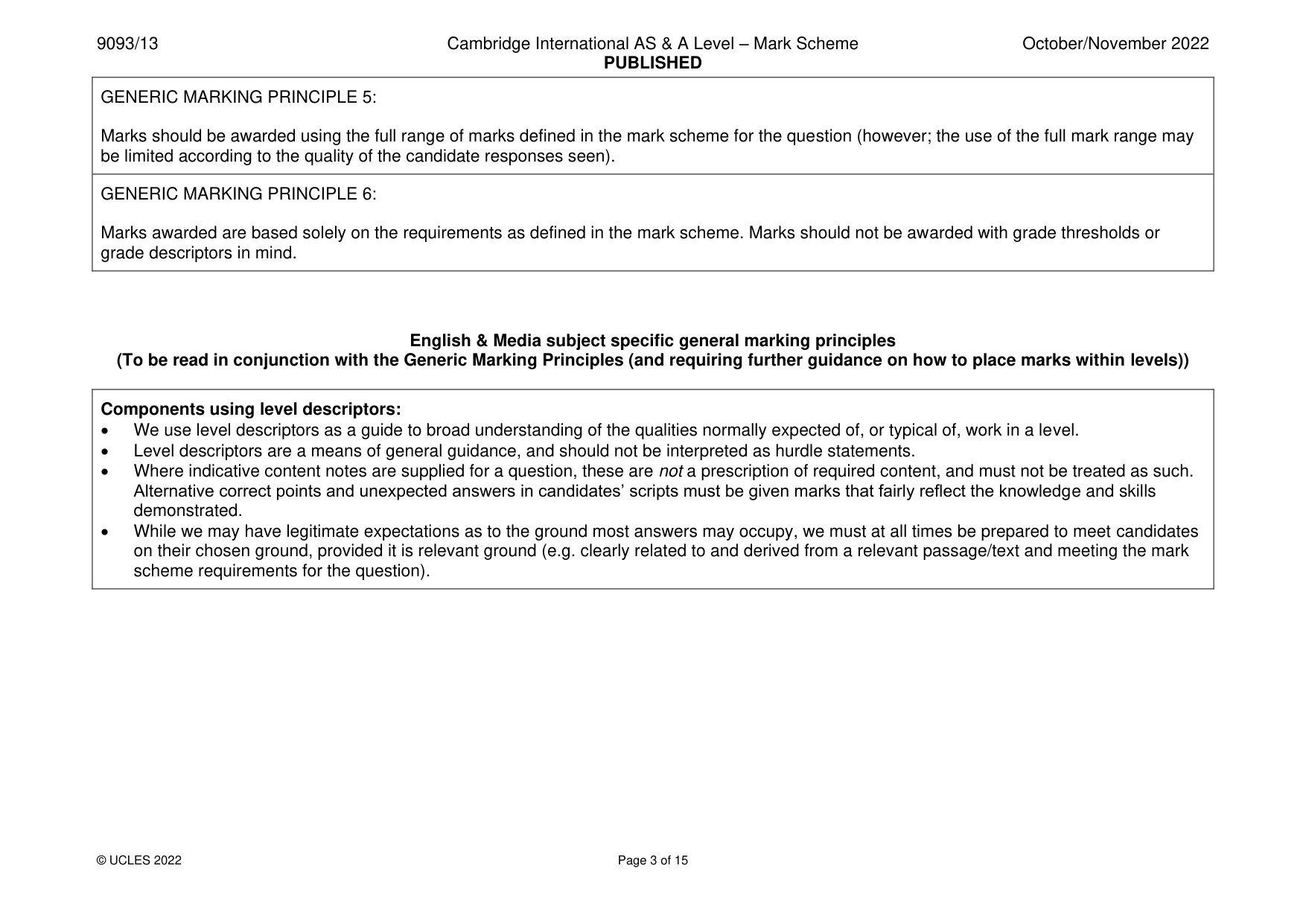
9093/13 Cambridge International AS & A Level – Mark Scheme PUBLISHED October/November 2022 © UCLES 2022 Page 3 of 15 GENERIC MARKING PRINCIPLE 5: Marks should be awarded using the full range of marks defined in the mark scheme for the question (however; the use of the full mark range may be limited according to the quality of the candidate responses seen). GENERIC MARKING PRINCIPLE 6: Marks awarded are based solely on the requirements as defined in the mark scheme. Marks should not be awarded with grade thresholds or grade descriptors in mind. English & Media subject specific general marking principles (To be read in conjunction with the Generic Marking Principles (and requiring further guidance on how to place marks within levels)) Components using level descriptors: • We use level descriptors as a guide to broad understanding of the qualities normally expected of, or typical of, work in a level. • Level descriptors are a means of general guidance, and should not be interpreted as hurdle statements. • Where indicative content notes are supplied for a question, these are not a prescription of required content, and must not be treated as such. Alternative correct points and unexpected answers in candidates’ scripts must be given marks that fairly reflect the knowledge and skills demonstrated. • While we may have legitimate expectations as to the ground most answers may occupy, we must at all times be prepared to meet candidates on their chosen ground, provided it is relevant ground (e.g. clearly related to and derived from a relevant passage/text and meeting the mark scheme requirements for the question).
Mark scheme, page 4
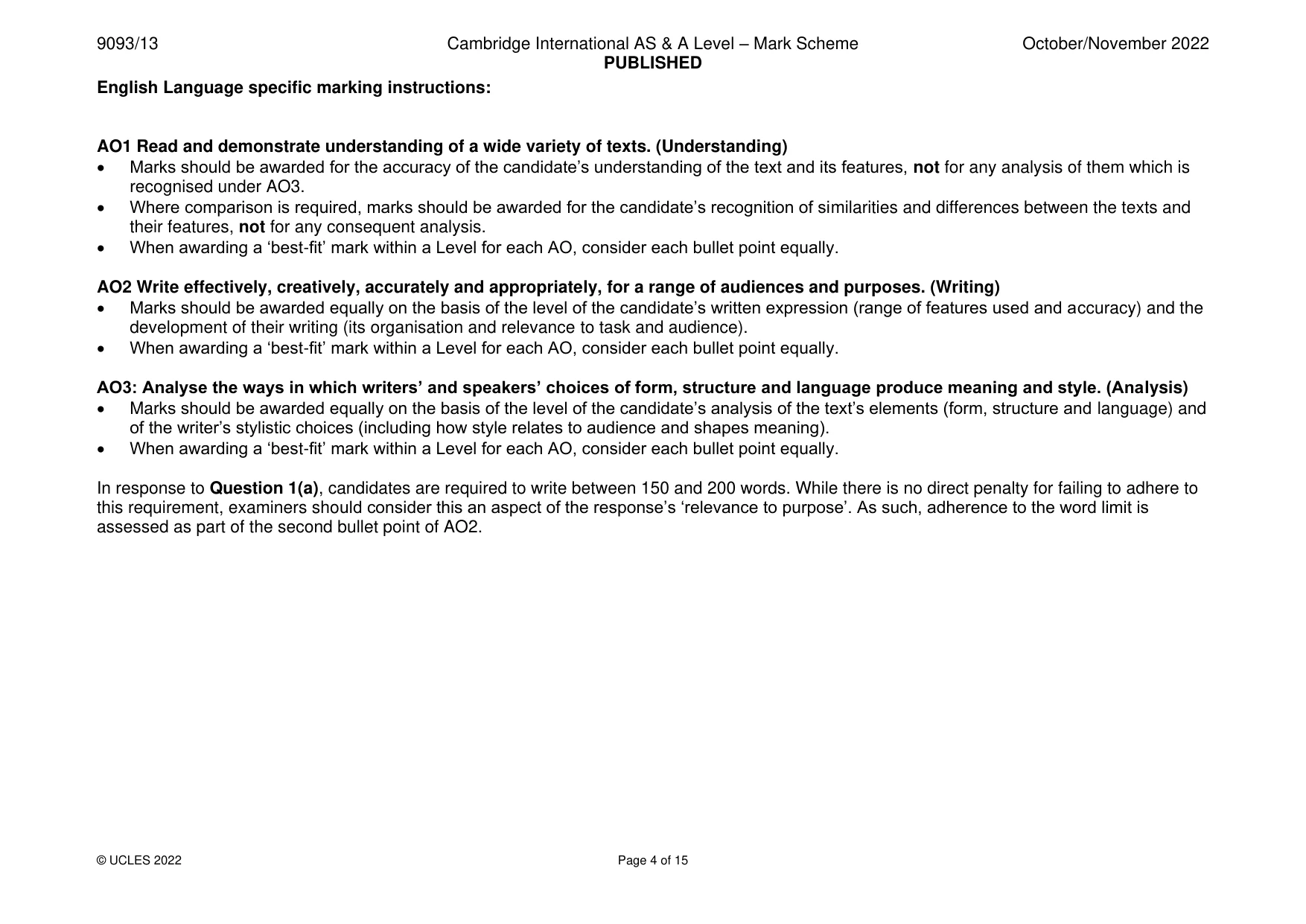
9093/13 Cambridge International AS & A Level – Mark Scheme PUBLISHED October/November 2022 © UCLES 2022 Page 4 of 15 English Language specific marking instructions: AO1 Read and demonstrate understanding of a wide variety of texts. (Understanding) • Marks should be awarded for the accuracy of the candidate’s understanding of the text and its features, not for any analysis of them which is recognised under AO3. • Where comparison is required, marks should be awarded for the candidate’s recognition of similarities and differences between the texts and their features, not for any consequent analysis. • When awarding a ‘best-fit’ mark within a Level for each AO, consider each bullet point equally. AO2 Write effectively, creatively, accurately and appropriately, for a range of audiences and purposes. (Writing) • Marks should be awarded equally on the basis of the level of the candidate’s written expression (range of features used and accuracy) and the development of their writing (its organisation and relevance to task and audience). • When awarding a ‘best-fit’ mark within a Level for each AO, consider each bullet point equally. AO3: Analyse the ways in which writers’ and speakers’ choices of form, structure and language produce meaning and style. (Analysis) • Marks should be awarded equally on the basis of the level of the candidate’s analysis of the text’s elements (form, structure and language) and of the writer’s stylistic choices (including how style relates to audience and shapes meaning). • When awarding a ‘best-fit’ mark within a Level for each AO, consider each bullet point equally. In response to Question 1(a), candidates are required to write between 150 and 200 words. While there is no direct penalty for failing to adhere to this requirement, examiners should consider this an aspect of the response’s ‘relevance to purpose’. As such, adherence to the word limit is assessed as part of the second bullet point of AO2.
Mark scheme, page 5
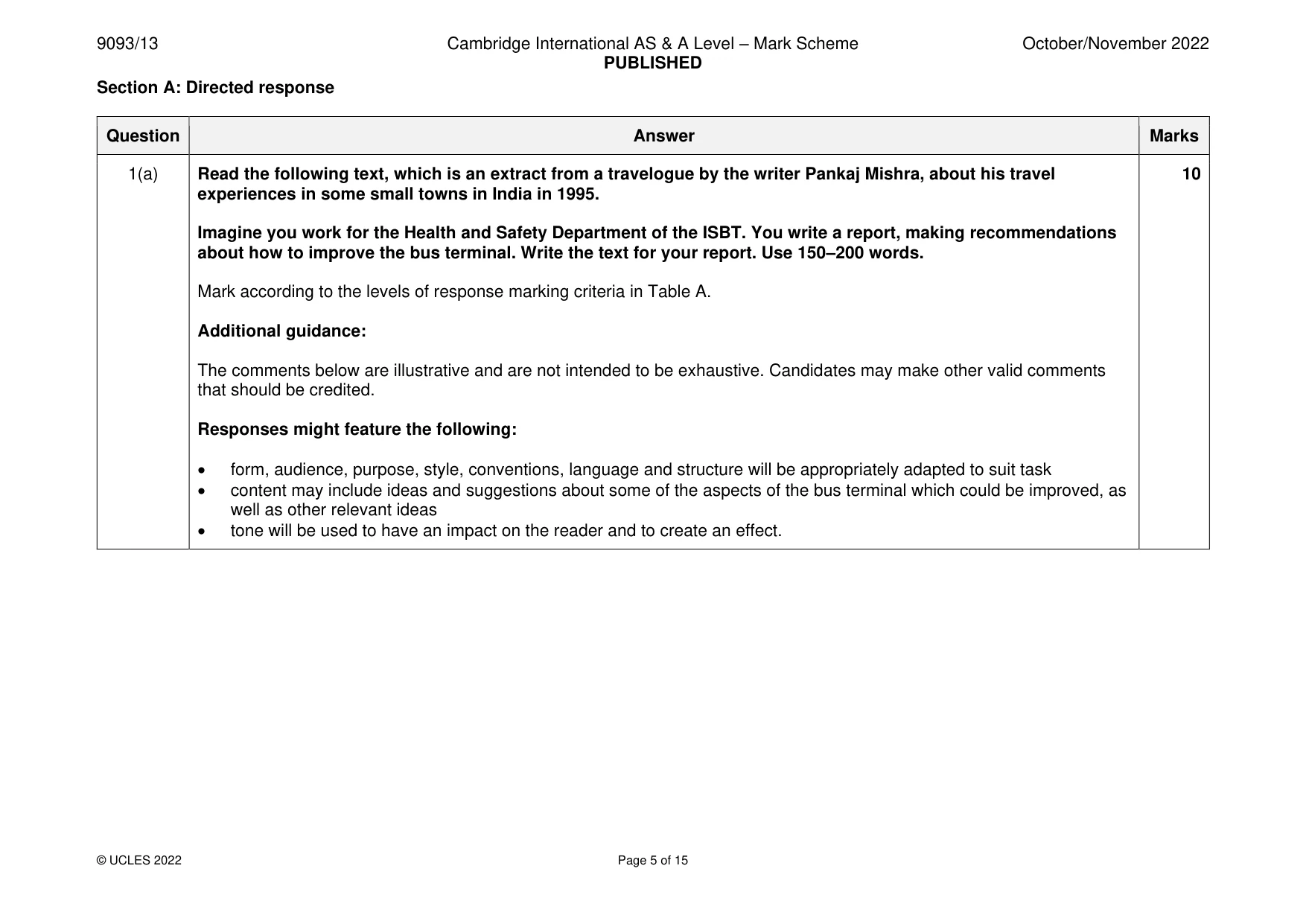
9093/13 Cambridge International AS & A Level – Mark Scheme PUBLISHED October/November 2022 © UCLES 2022 Page 5 of 15 Section A: Directed response Question Answer Marks 1(a) Read the following text, which is an extract from a travelogue by the writer Pankaj Mishra, about his travel experiences in some small towns in India in 1995. Imagine you work for the Health and Safety Department of the ISBT. You write a report, making recommendations about how to improve the bus terminal. Write the text for your report. Use 150–200 words. Mark according to the levels of response marking criteria in Table A. Additional guidance: The comments below are illustrative and are not intended to be exhaustive. Candidates may make other valid comments that should be credited. Responses might feature the following: • form, audience, purpose, style, conventions, language and structure will be appropriately adapted to suit task • content may include ideas and suggestions about some of the aspects of the bus terminal which could be improved, as well as other relevant ideas • tone will be used to have an impact on the reader and to create an effect. 10
Mark scheme, page 6
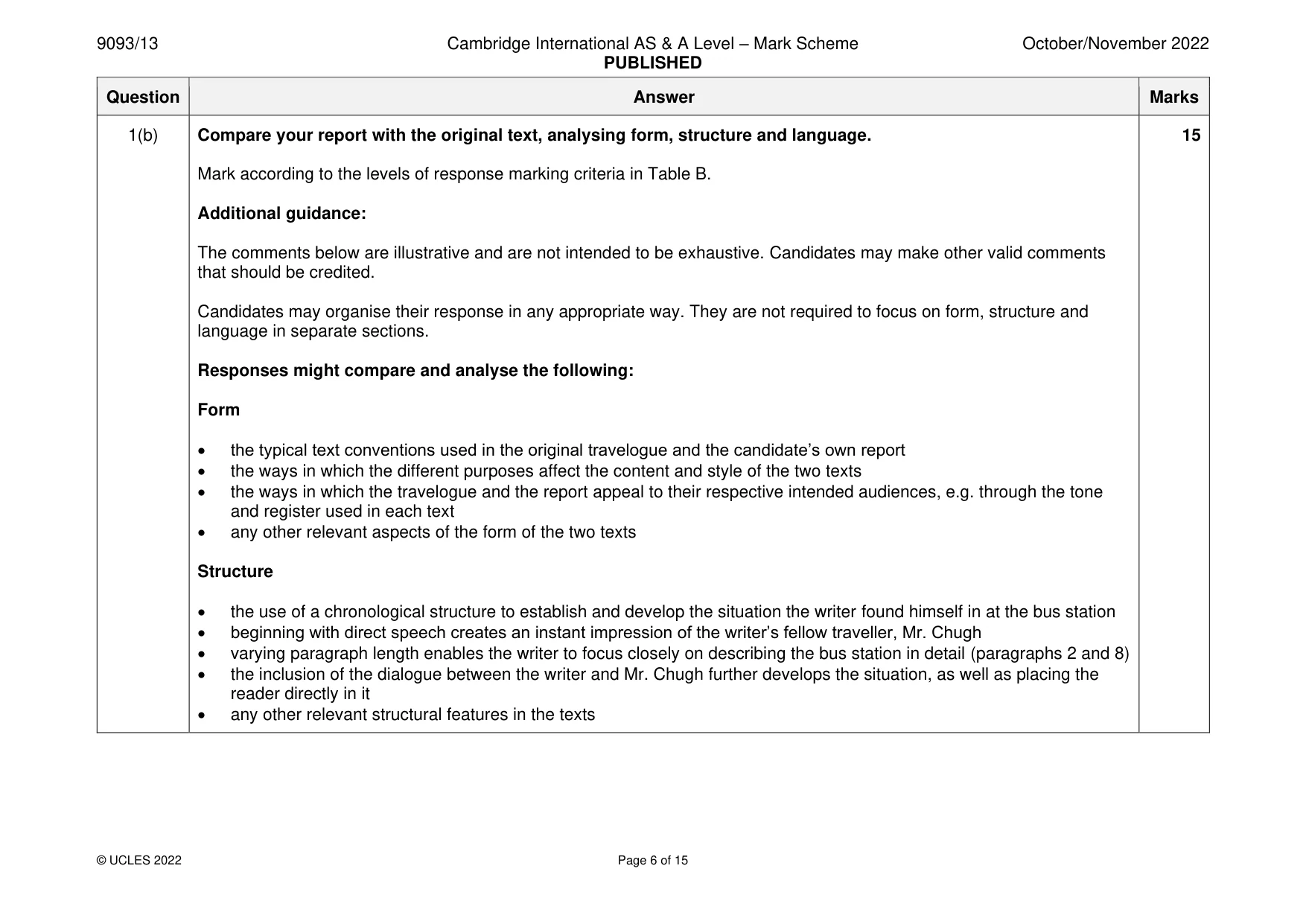
9093/13 Cambridge International AS & A Level – Mark Scheme PUBLISHED October/November 2022 © UCLES 2022 Page 6 of 15 Question Answer Marks 1(b) Compare your report with the original text, analysing form, structure and language. Mark according to the levels of response marking criteria in Table B. Additional guidance: The comments below are illustrative and are not intended to be exhaustive. Candidates may make other valid comments that should be credited. Candidates may organise their response in any appropriate way. They are not required to focus on form, structure and language in separate sections. Responses might compare and analyse the following: Form • the typical text conventions used in the original travelogue and the candidate’s own report • the ways in which the different purposes affect the content and style of the two texts • the ways in which the travelogue and the report appeal to their respective intended audiences, e.g. through the tone and register used in each text • any other relevant aspects of the form of the two texts Structure • the use of a chronological structure to establish and develop the situation the writer found himself in at the bus station • beginning with direct speech creates an instant impression of the writer’s fellow traveller, Mr. Chugh • varying paragraph length enables the writer to focus closely on describing the bus station in detail (paragraphs 2 and 8) • the inclusion of the dialogue between the writer and Mr. Chugh further develops the situation, as well as placing the reader directly in it • any other relevant structural features in the texts 15
Mark scheme, page 7
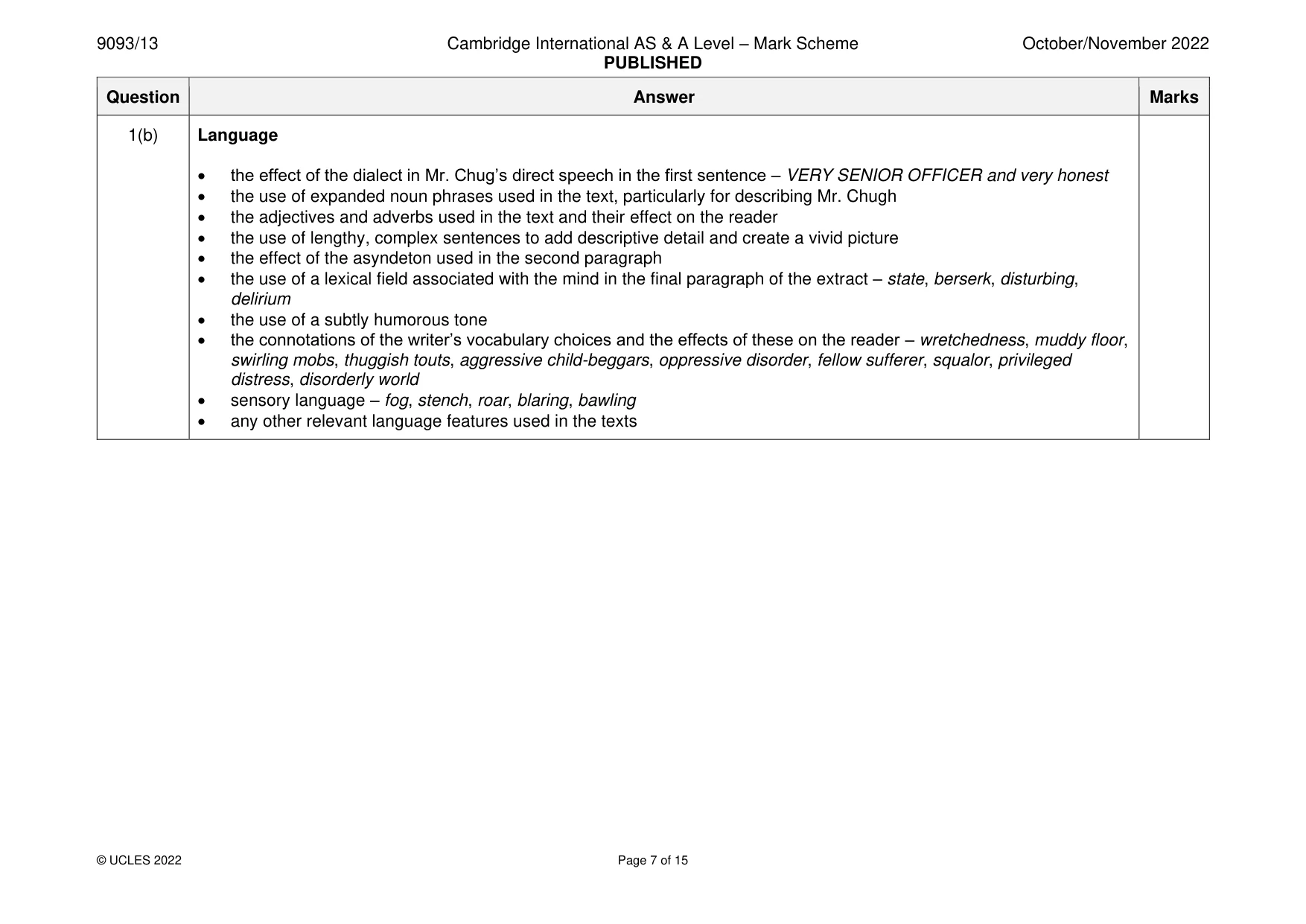
9093/13 Cambridge International AS & A Level – Mark Scheme PUBLISHED October/November 2022 © UCLES 2022 Page 7 of 15 Question Answer Marks 1(b) Language • the effect of the dialect in Mr. Chug’s direct speech in the first sentence – VERY SENIOR OFFICER and very honest • the use of expanded noun phrases used in the text, particularly for describing Mr. Chugh • the adjectives and adverbs used in the text and their effect on the reader • the use of lengthy, complex sentences to add descriptive detail and create a vivid picture • the effect of the asyndeton used in the second paragraph • the use of a lexical field associated with the mind in the final paragraph of the extract – state, berserk, disturbing, delirium • the use of a subtly humorous tone • the connotations of the writer’s vocabulary choices and the effects of these on the reader – wretchedness, muddy floor, swirling mobs, thuggish touts, aggressive child-beggars, oppressive disorder, fellow sufferer, squalor, privileged distress, disorderly world • sensory language – fog, stench, roar, blaring, bawling • any other relevant language features used in the texts
Mark scheme, page 8
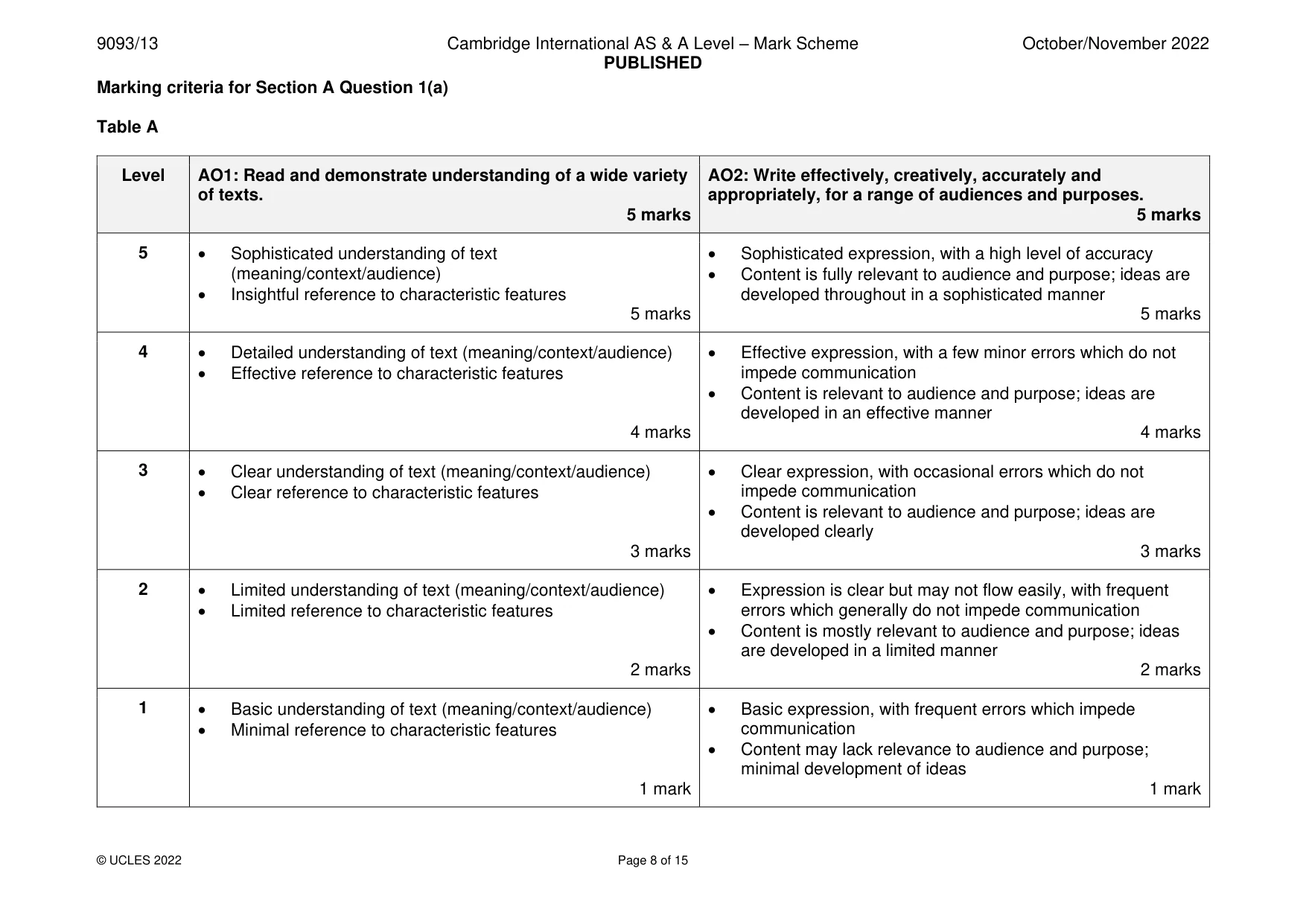
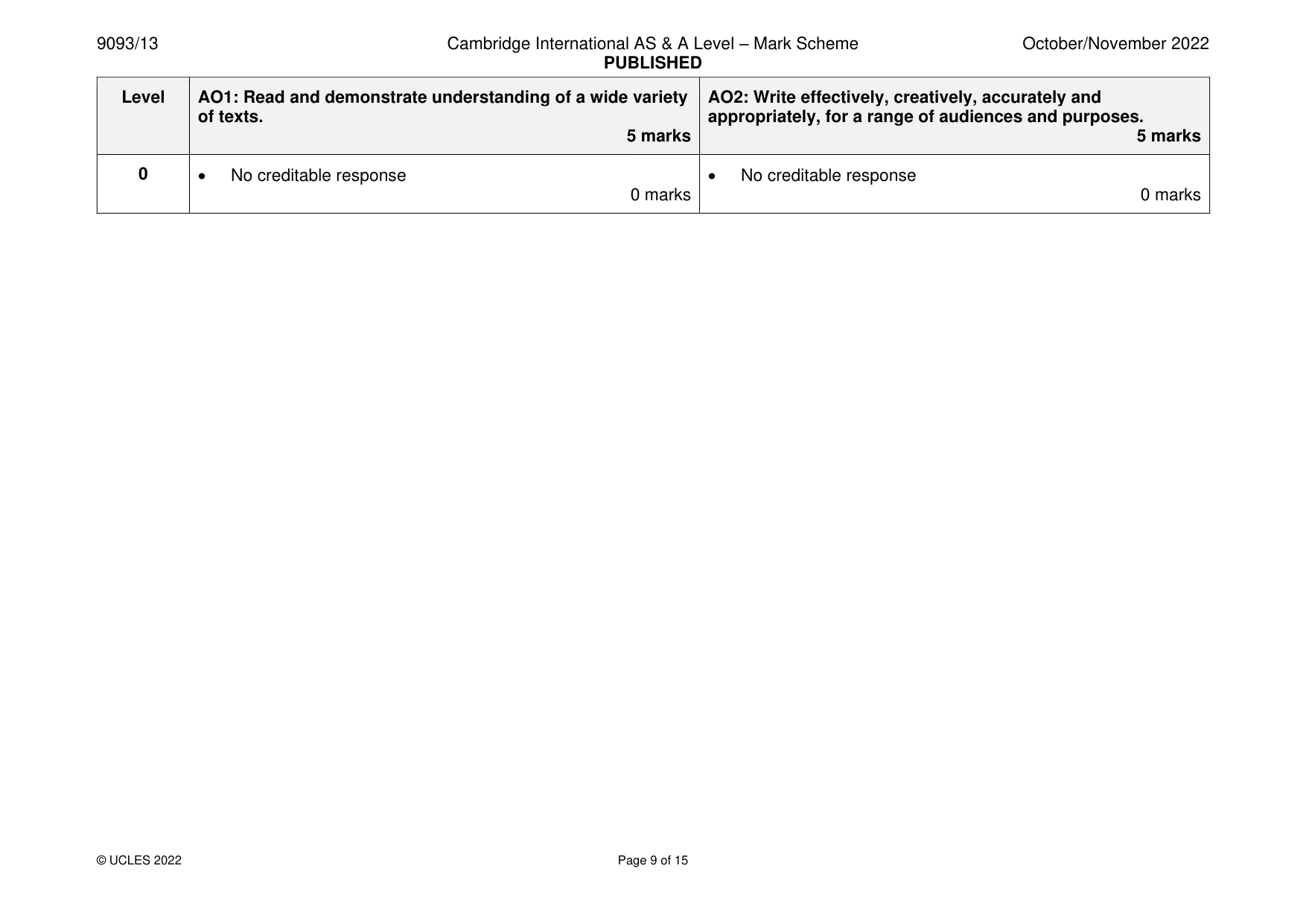
9093/13 Cambridge International AS & A Level – Mark Scheme PUBLISHED October/November 2022 © UCLES 2022 Page 8 of 15 Marking criteria for Section A Question 1(a) Table A Level AO1: Read and demonstrate understanding of a wide variety of texts. 5 marks AO2: Write effectively, creatively, accurately and appropriately, for a range of audiences and purposes. 5 marks 5 • Sophisticated understanding of text (meaning/context/audience) • Insightful reference to characteristic features 5 marks • Sophisticated expression, with a high level of accuracy • Content is fully relevant to audience and purpose; ideas are developed throughout in a sophisticated manner 5 marks 4 • Detailed understanding of text (meaning/context/audience) • Effective reference to characteristic features 4 marks • Effective expression, with a few minor errors which do not impede communication • Content is relevant to audience and purpose; ideas are developed in an effective manner 4 marks 3 • Clear understanding of text (meaning/context/audience) • Clear reference to characteristic features 3 marks • Clear expression, with occasional errors which do not impede communication • Content is relevant to audience and purpose; ideas are developed clearly 3 marks 2 • Limited understanding of text (meaning/context/audience) • Limited reference to characteristic features 2 marks • Expression is clear but may not flow easily, with frequent errors which generally do not impede communication • Content is mostly relevant to audience and purpose; ideas are developed in a limited manner 2 marks 1 • Basic understanding of text (meaning/context/audience) • Minimal reference to characteristic features 1 mark • Basic expression, with frequent errors which impede communication • Content may lack relevance to audience and purpose; minimal development of ideas 1 mark
Mark scheme, page 9
9093/13 Cambridge International AS & A Level – Mark Scheme PUBLISHED October/November 2022 © UCLES 2022 Page 9 of 15 Level AO1: Read and demonstrate understanding of a wide variety of texts. 5 marks AO2: Write effectively, creatively, accurately and appropriately, for a range of audiences and purposes. 5 marks 0 • No creditable response 0 marks • No creditable response 0 marks
Mark scheme, page 10
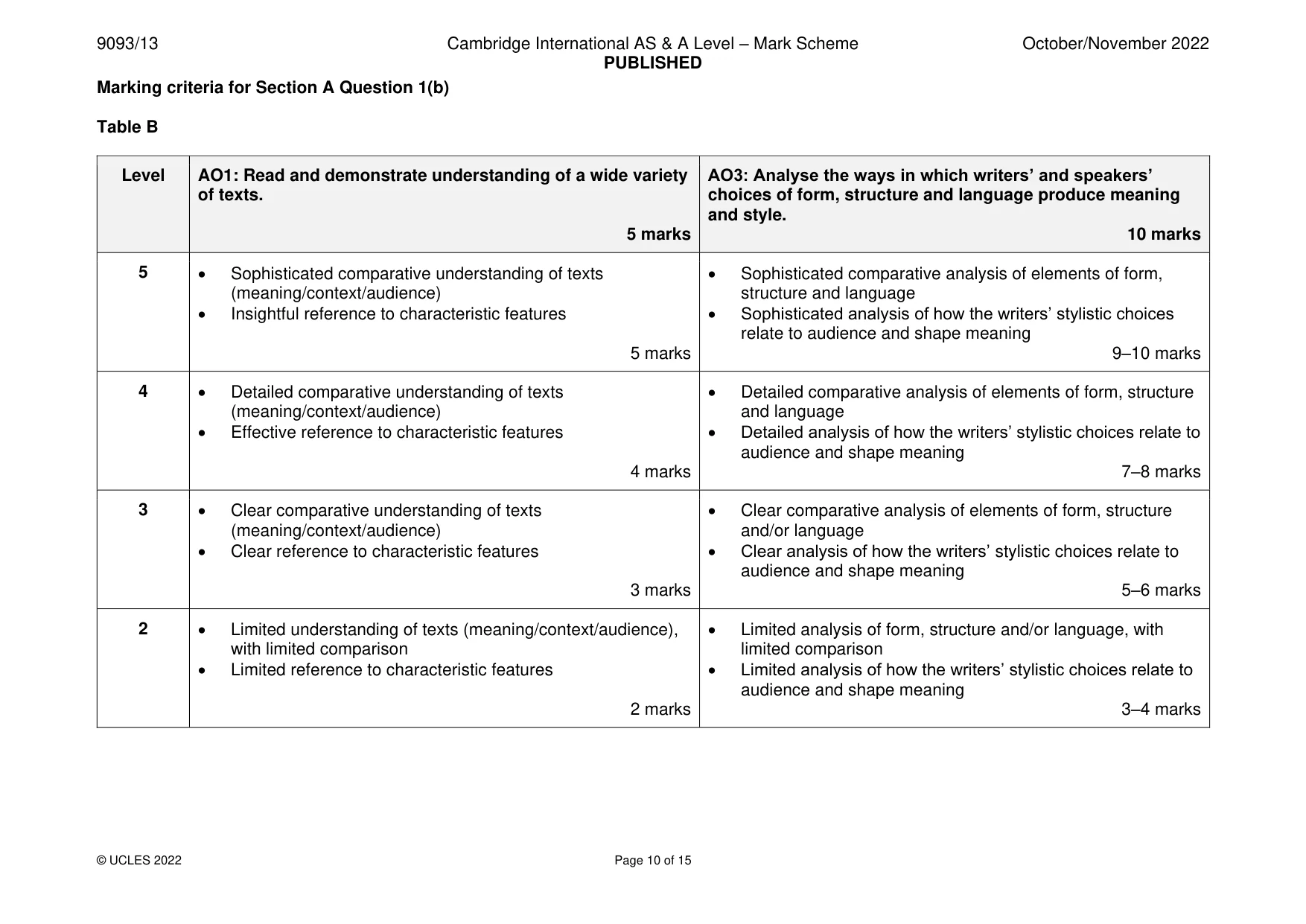
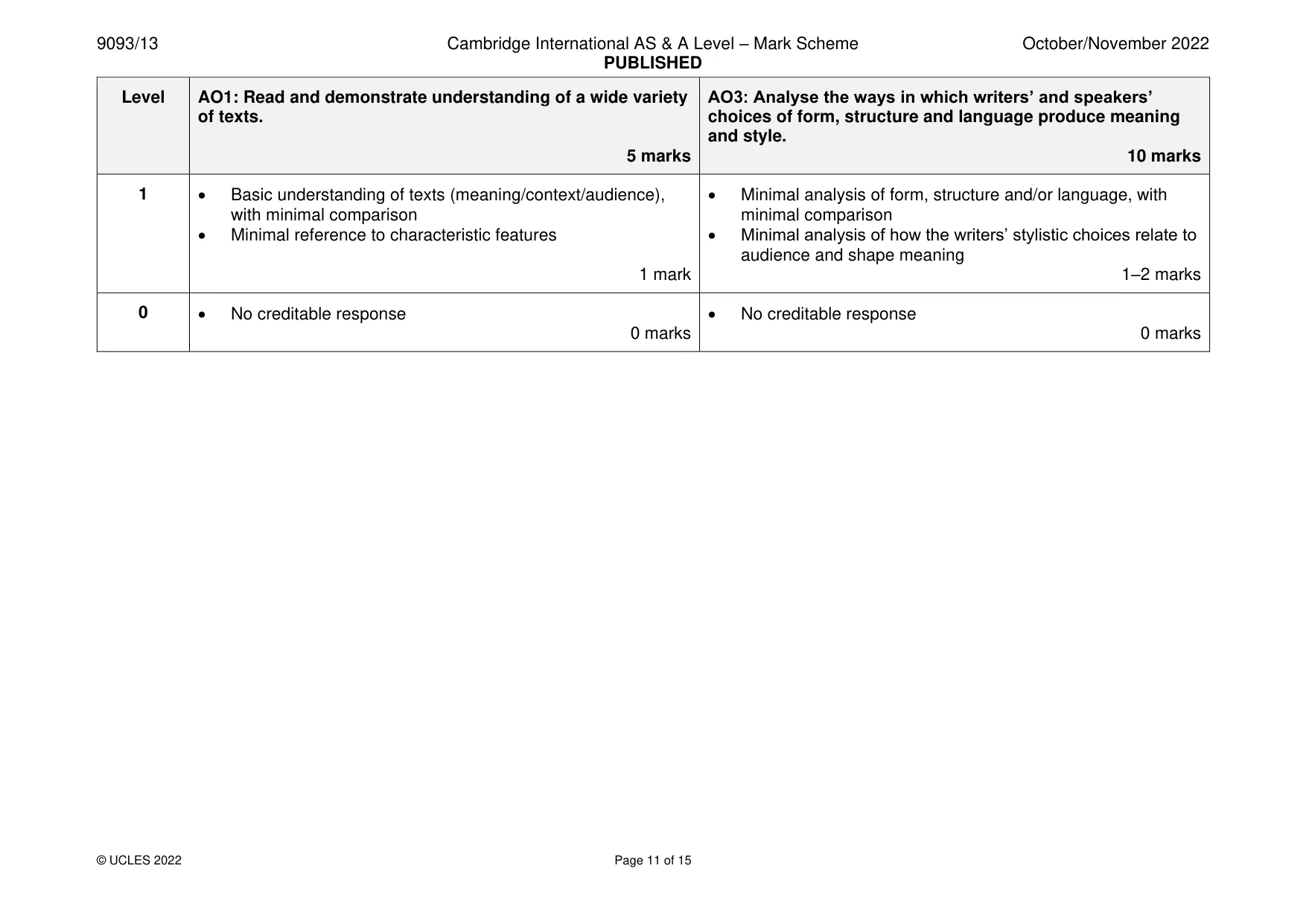
9093/13 Cambridge International AS & A Level – Mark Scheme PUBLISHED October/November 2022 © UCLES 2022 Page 10 of 15 Marking criteria for Section A Question 1(b) Table B Level AO1: Read and demonstrate understanding of a wide variety of texts. 5 marks AO3: Analyse the ways in which writers’ and speakers’ choices of form, structure and language produce meaning and style. 10 marks 5 • Sophisticated comparative understanding of texts (meaning/context/audience) • Insightful reference to characteristic features 5 marks • Sophisticated comparative analysis of elements of form, structure and language • Sophisticated analysis of how the writers’ stylistic choices relate to audience and shape meaning 9–10 marks 4 • Detailed comparative understanding of texts (meaning/context/audience) • Effective reference to characteristic features 4 marks • Detailed comparative analysis of elements of form, structure and language • Detailed analysis of how the writers’ stylistic choices relate to audience and shape meaning 7–8 marks 3 • Clear comparative understanding of texts (meaning/context/audience) • Clear reference to characteristic features 3 marks • Clear comparative analysis of elements of form, structure and/or language • Clear analysis of how the writers’ stylistic choices relate to audience and shape meaning 5–6 marks 2 • Limited understanding of texts (meaning/context/audience), with limited comparison • Limited reference to characteristic features 2 marks • Limited analysis of form, structure and/or language, with limited comparison • Limited analysis of how the writers’ stylistic choices relate to audience and shape meaning 3–4 marks
Mark scheme, page 11
9093/13 Cambridge International AS & A Level – Mark Scheme PUBLISHED October/November 2022 © UCLES 2022 Page 11 of 15 Level AO1: Read and demonstrate understanding of a wide variety of texts. 5 marks AO3: Analyse the ways in which writers’ and speakers’ choices of form, structure and language produce meaning and style. 10 marks 1 • Basic understanding of texts (meaning/context/audience), with minimal comparison • Minimal reference to characteristic features 1 mark • Minimal analysis of form, structure and/or language, with minimal comparison • Minimal analysis of how the writers’ stylistic choices relate to audience and shape meaning 1–2 marks 0 • No creditable response 0 marks • No creditable response 0 marks
Mark scheme, page 12
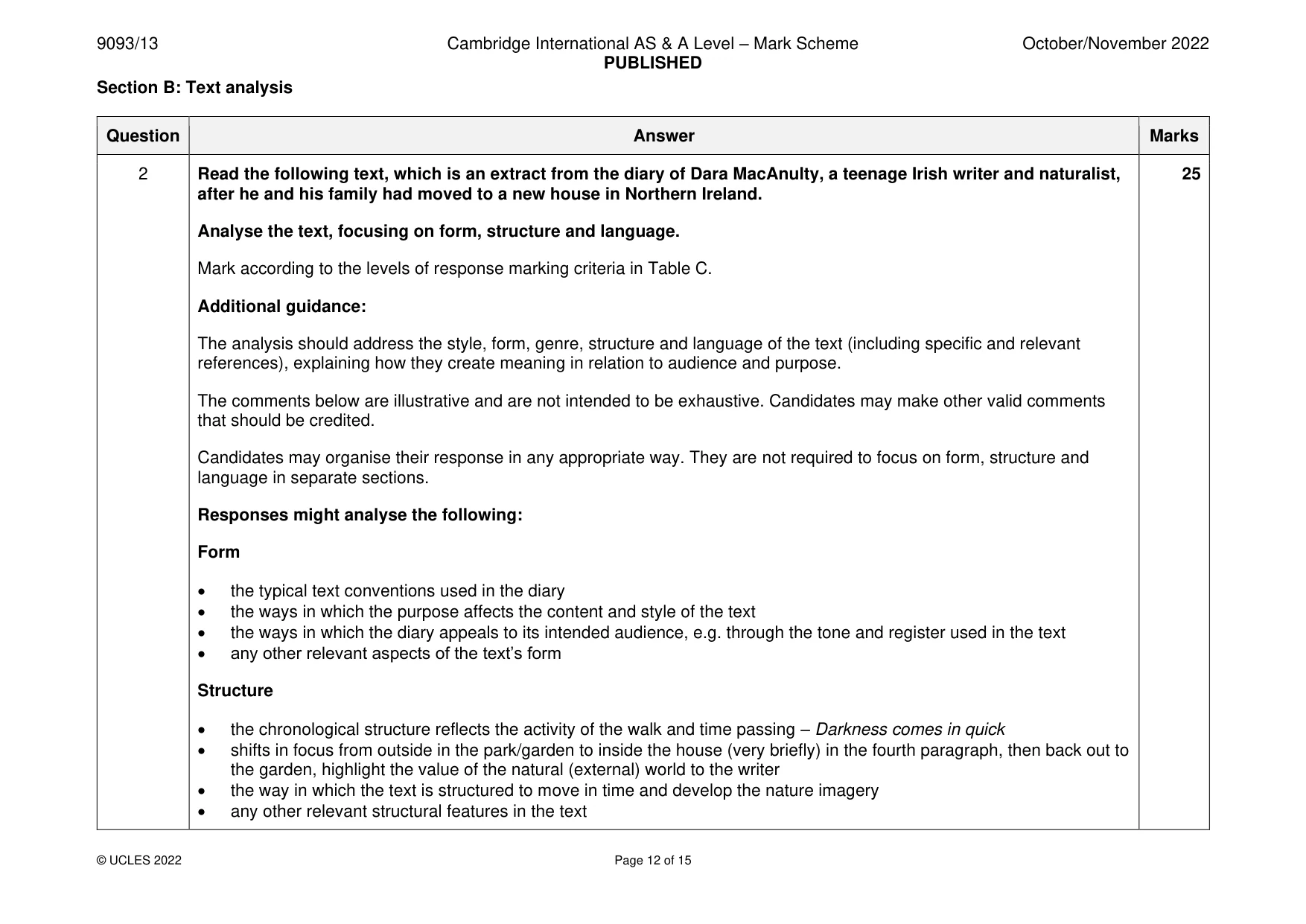
9093/13 Cambridge International AS & A Level – Mark Scheme PUBLISHED October/November 2022 © UCLES 2022 Page 12 of 15 Section B: Text analysis Question Answer Marks 2 Read the following text, which is an extract from the diary of Dara MacAnulty, a teenage Irish writer and naturalist, after he and his family had moved to a new house in Northern Ireland. Analyse the text, focusing on form, structure and language. Mark according to the levels of response marking criteria in Table C. Additional guidance: The analysis should address the style, form, genre, structure and language of the text (including specific and relevant references), explaining how they create meaning in relation to audience and purpose. The comments below are illustrative and are not intended to be exhaustive. Candidates may make other valid comments that should be credited. Candidates may organise their response in any appropriate way. They are not required to focus on form, structure and language in separate sections. Responses might analyse the following: Form • the typical text conventions used in the diary • the ways in which the purpose affects the content and style of the text • the ways in which the diary appeals to its intended audience, e.g. through the tone and register used in the text • any other relevant aspects of the text’s form Structure • the chronological structure reflects the activity of the walk and time passing – Darkness comes in quick • shifts in focus from outside in the park/garden to inside the house (very briefly) in the fourth paragraph, then back out to the garden, highlight the value of the natural (external) world to the writer • the way in which the text is structured to move in time and develop the nature imagery • any other relevant structural features in the text 25
Mark scheme, page 13
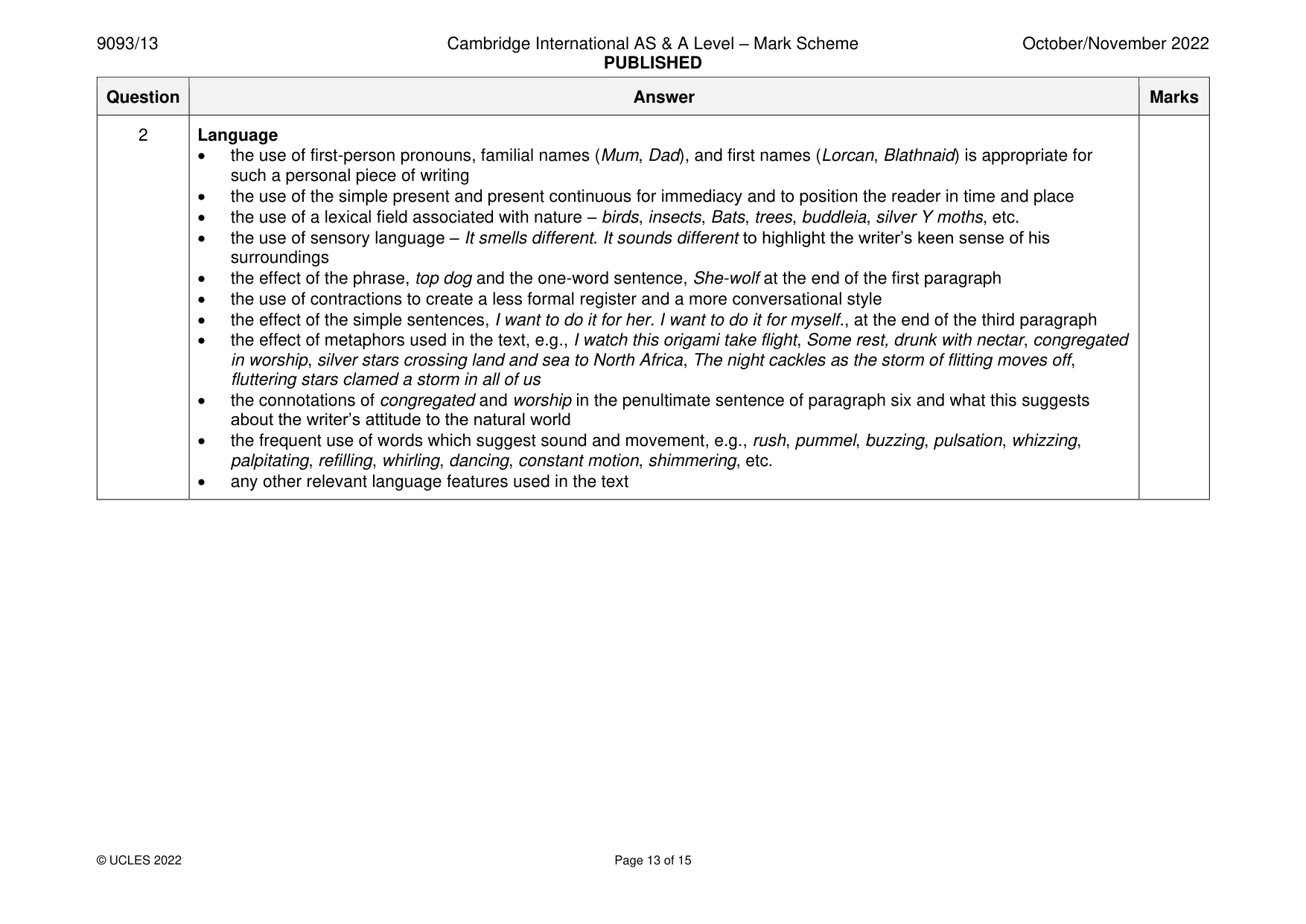
9093/13 Cambridge International AS & A Level – Mark Scheme PUBLISHED October/November 2022 © UCLES 2022 Page 13 of 15 Question Answer Marks 2 Language • the use of first-person pronouns, familial names (Mum, Dad), and first names (Lorcan, Blathnaid) is appropriate for such a personal piece of writing • the use of the simple present and present continuous for immediacy and to position the reader in time and place • the use of a lexical field associated with nature – birds, insects, Bats, trees, buddleia, silver Y moths, etc. • the use of sensory language – It smells different. It sounds different to highlight the writer’s keen sense of his surroundings • the effect of the phrase, top dog and the one-word sentence, She-wolf at the end of the first paragraph • the use of contractions to create a less formal register and a more conversational style • the effect of the simple sentences, I want to do it for her. I want to do it for myself., at the end of the third paragraph • the effect of metaphors used in the text, e.g., I watch this origami take flight, Some rest, drunk with nectar, congregated in worship, silver stars crossing land and sea to North Africa, The night cackles as the storm of flitting moves off, fluttering stars clamed a storm in all of us • the connotations of congregated and worship in the penultimate sentence of paragraph six and what this suggests about the writer’s attitude to the natural world • the frequent use of words which suggest sound and movement, e.g., rush, pummel, buzzing, pulsation, whizzing, palpitating, refilling, whirling, dancing, constant motion, shimmering, etc. • any other relevant language features used in the text
Mark scheme, page 14
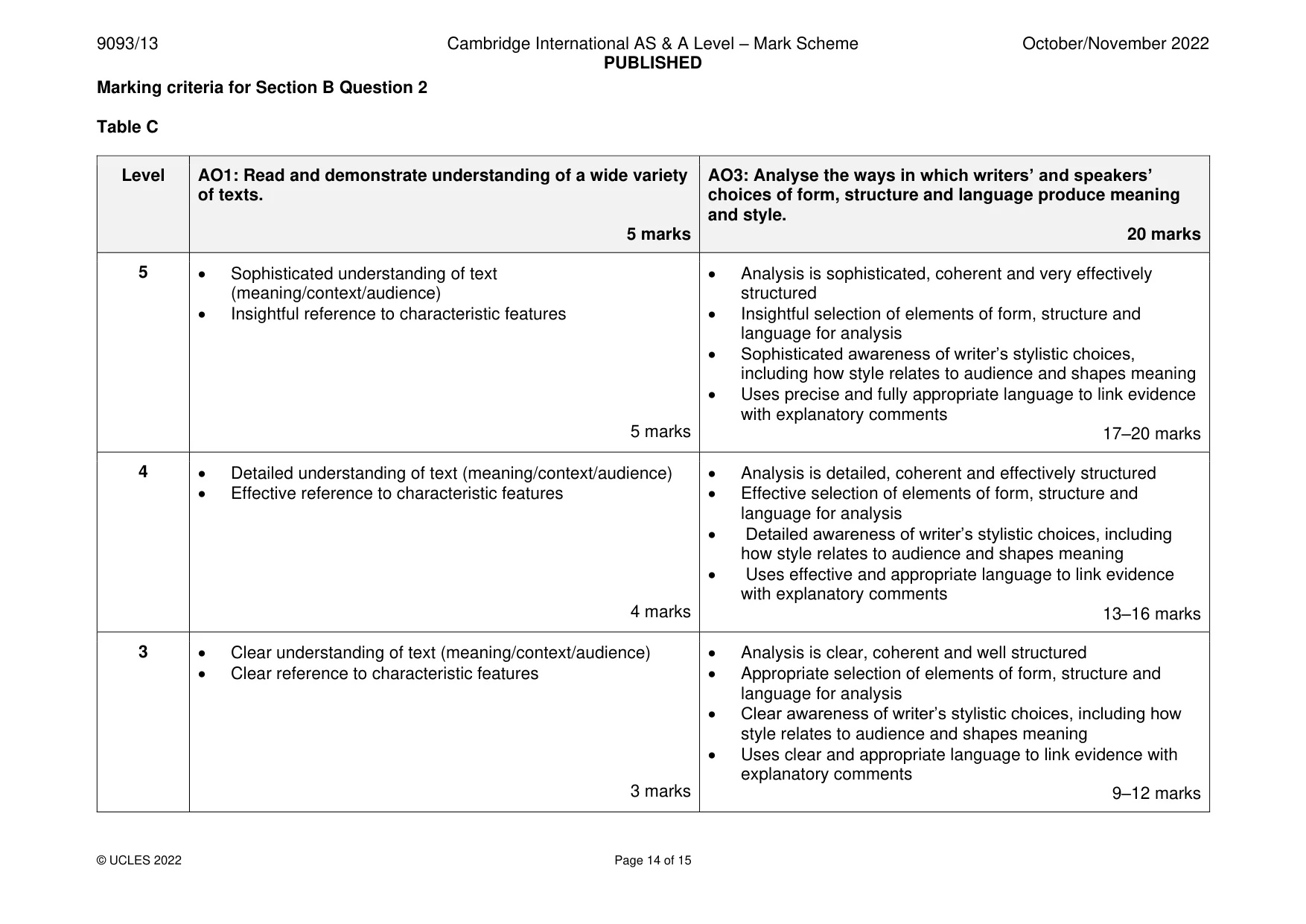
9093/13 Cambridge International AS & A Level – Mark Scheme PUBLISHED October/November 2022 © UCLES 2022 Page 14 of 15 Marking criteria for Section B Question 2 Table C Level AO1: Read and demonstrate understanding of a wide variety of texts. 5 marks AO3: Analyse the ways in which writers’ and speakers’ choices of form, structure and language produce meaning and style. 20 marks 5 • Sophisticated understanding of text (meaning/context/audience) • Insightful reference to characteristic features 5 marks • Analysis is sophisticated, coherent and very effectively structured • Insightful selection of elements of form, structure and language for analysis • Sophisticated awareness of writer’s stylistic choices, including how style relates to audience and shapes meaning • Uses precise and fully appropriate language to link evidence with explanatory comments 17–20 marks 4 • Detailed understanding of text (meaning/context/audience) • Effective reference to characteristic features 4 marks • Analysis is detailed, coherent and effectively structured • Effective selection of elements of form, structure and language for analysis • Detailed awareness of writer’s stylistic choices, including how style relates to audience and shapes meaning • Uses effective and appropriate language to link evidence with explanatory comments 13–16 marks 3 • Clear understanding of text (meaning/context/audience) • Clear reference to characteristic features 3 marks • Analysis is clear, coherent and well structured • Appropriate selection of elements of form, structure and language for analysis • Clear awareness of writer’s stylistic choices, including how style relates to audience and shapes meaning • Uses clear and appropriate language to link evidence with explanatory comments 9–12 marks
Mark scheme, page 15
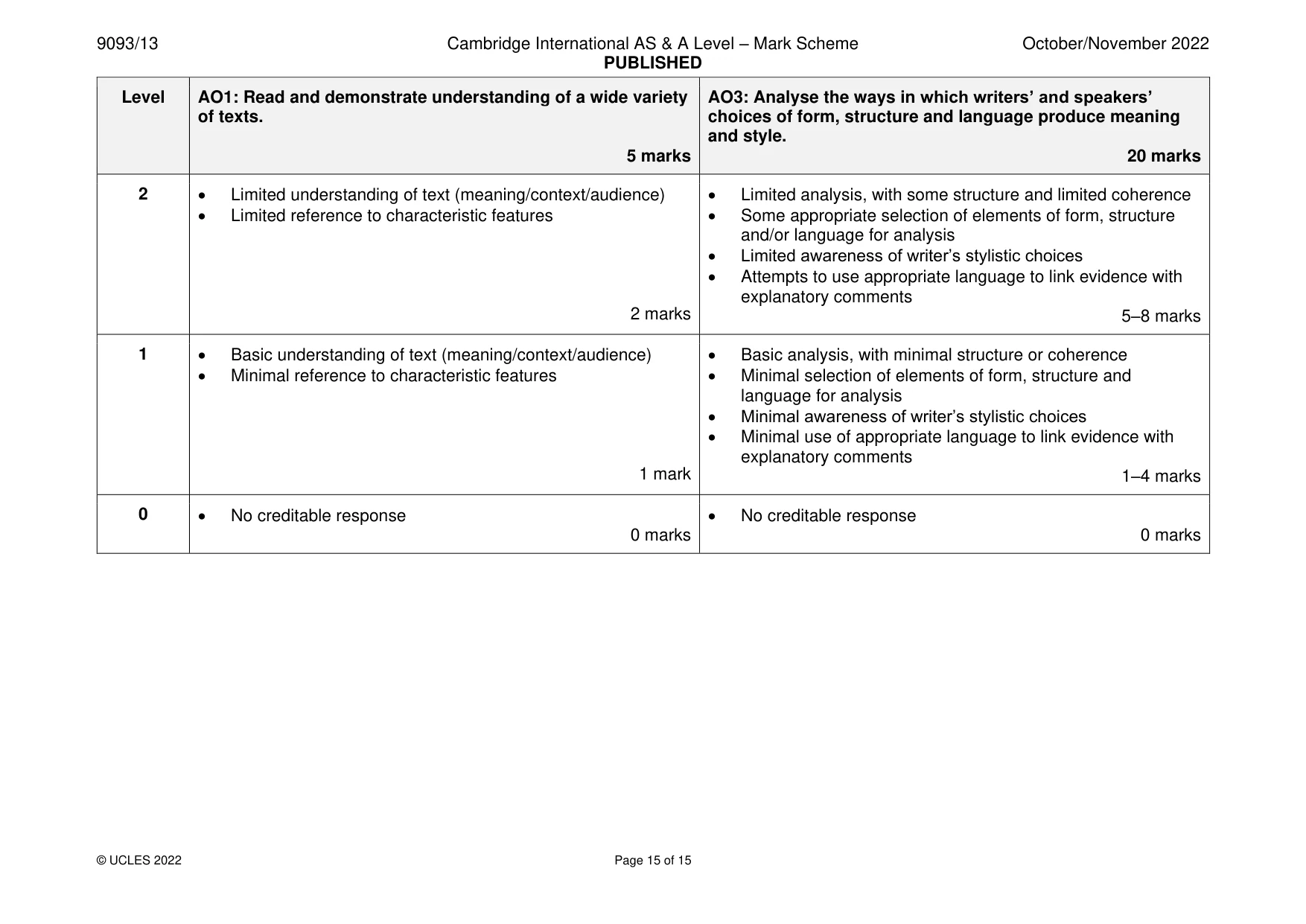
9093/13 Cambridge International AS & A Level – Mark Scheme PUBLISHED October/November 2022 © UCLES 2022 Page 15 of 15 Level AO1: Read and demonstrate understanding of a wide variety of texts. 5 marks AO3: Analyse the ways in which writers’ and speakers’ choices of form, structure and language produce meaning and style. 20 marks 2 • Limited understanding of text (meaning/context/audience) • Limited reference to characteristic features 2 marks • Limited analysis, with some structure and limited coherence • Some appropriate selection of elements of form, structure and/or language for analysis • Limited awareness of writer’s stylistic choices • Attempts to use appropriate language to link evidence with explanatory comments 5–8 marks 1 • Basic understanding of text (meaning/context/audience) • Minimal reference to characteristic features 1 mark • Basic analysis, with minimal structure or coherence • Minimal selection of elements of form, structure and language for analysis • Minimal awareness of writer’s stylistic choices • Minimal use of appropriate language to link evidence with explanatory comments 1–4 marks 0 • No creditable response 0 marks • No creditable response 0 marks
What you needed in this session
Cambridge’s own grade thresholds for 2022 Oct/Nov, Paper 1 · Variant 3. A higher threshold means an easier paper — the bar moves with how the cohort did.