Cambridge A Level English - Language AS and A Level (from 2014) 9093 — 2022 Oct/Nov Paper 1 · Variant 1
9093/11/O/N/22 · 50 marks · ≈56 min
The question paper and its mark scheme, free to read here and free to download. This is Cambridge’s own paper, exactly as it was sat.
Question paper8 pages
Mark scheme15 pages
Answers below. Sit the paper first if you are practising.
Paper as text
Question paper, page 1
Cambridge International AS & A Level 9093/11 October/November 2022 2 hours 15 minutes ENGLISH LANGUAGE Paper 1 Reading You must answer on the enclosed answer booklet. You will need: Answer booklet (enclosed) INSTRUCTIONS • Answer all questions. • Follow the instructions on the front cover of the answer booklet. If you need additional answer paper, ask the invigilator for a continuation booklet. • Dictionaries are not allowed. INFORMATION • The total mark for this paper is 50. • The number of marks for each question or part question is shown in brackets [ ]. This document has 8 pages. Any blank pages are indicated. [Turn over 11_9093_11_2022_1.20 © UCLES 2022 *1339193888*
Question paper, page 2
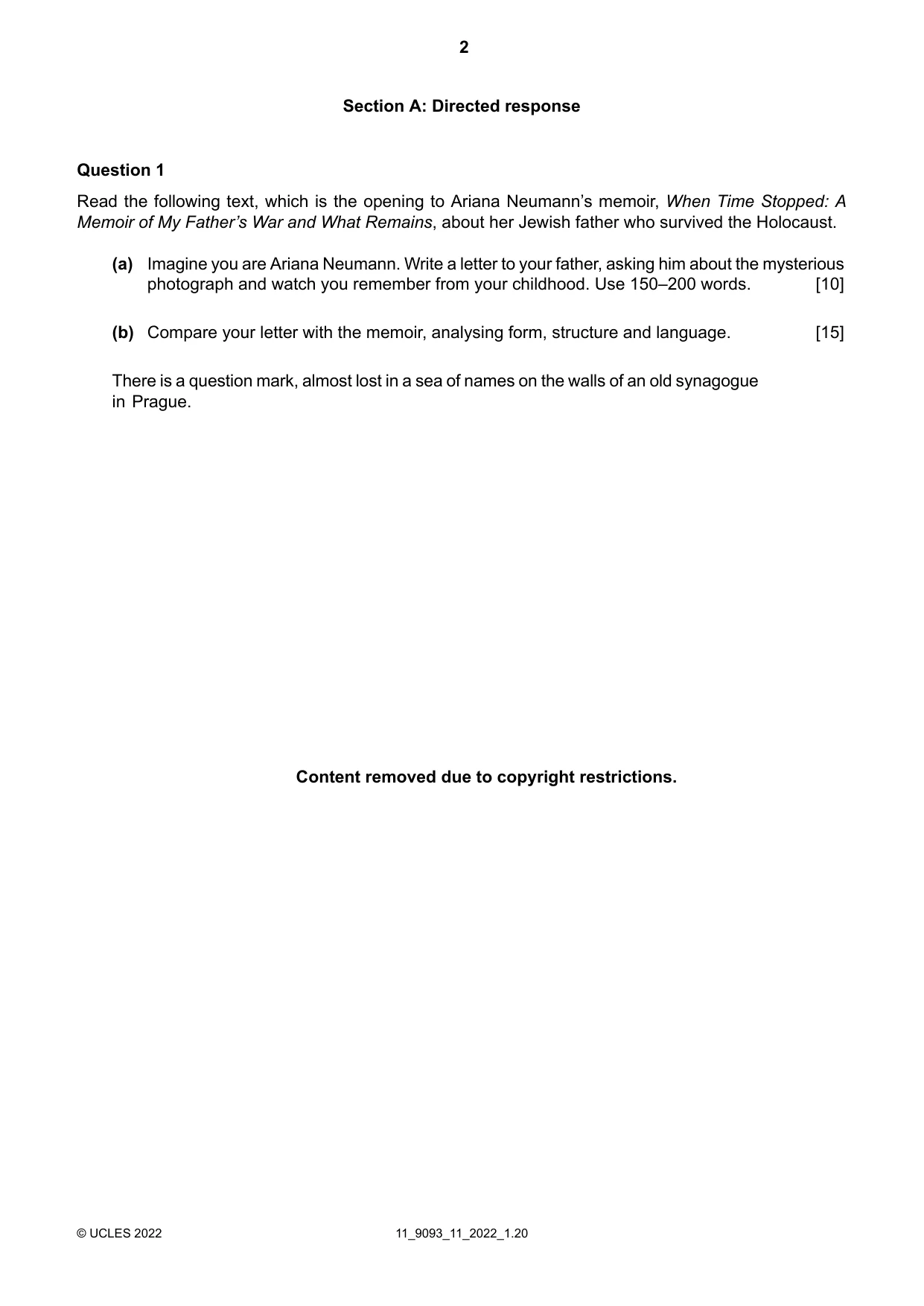
Section A: Directed response Question 1 Read the following text, which is the opening to Ariana Neumann’s memoir, When Time Stopped: A Memoir of My Father’s War and What Remains, about her Jewish father who survived the Holocaust. Imagine you are Ariana Neumann. Write a letter to your father, asking him about the mysterious photograph and watch you remember from your childhood. Use 150–200 words. [10] (a) Compare your letter with the memoir, analysing form, structure and language. [15] (b) There is a question mark, almost lost in a sea of names on the walls of an old synagogue in Prague. 11_9093_11_2022_1.20 © UCLES 2022 2 Content removed due to copyright restrictions.
Question paper, page 3
Made in 1732 at the Old Watch Street Shop for Export Trade India’. [Turn over 11_9093_11_2022_1.20 © UCLES 2022 3 Content removed due to copyright restrictions.
Question paper, page 4
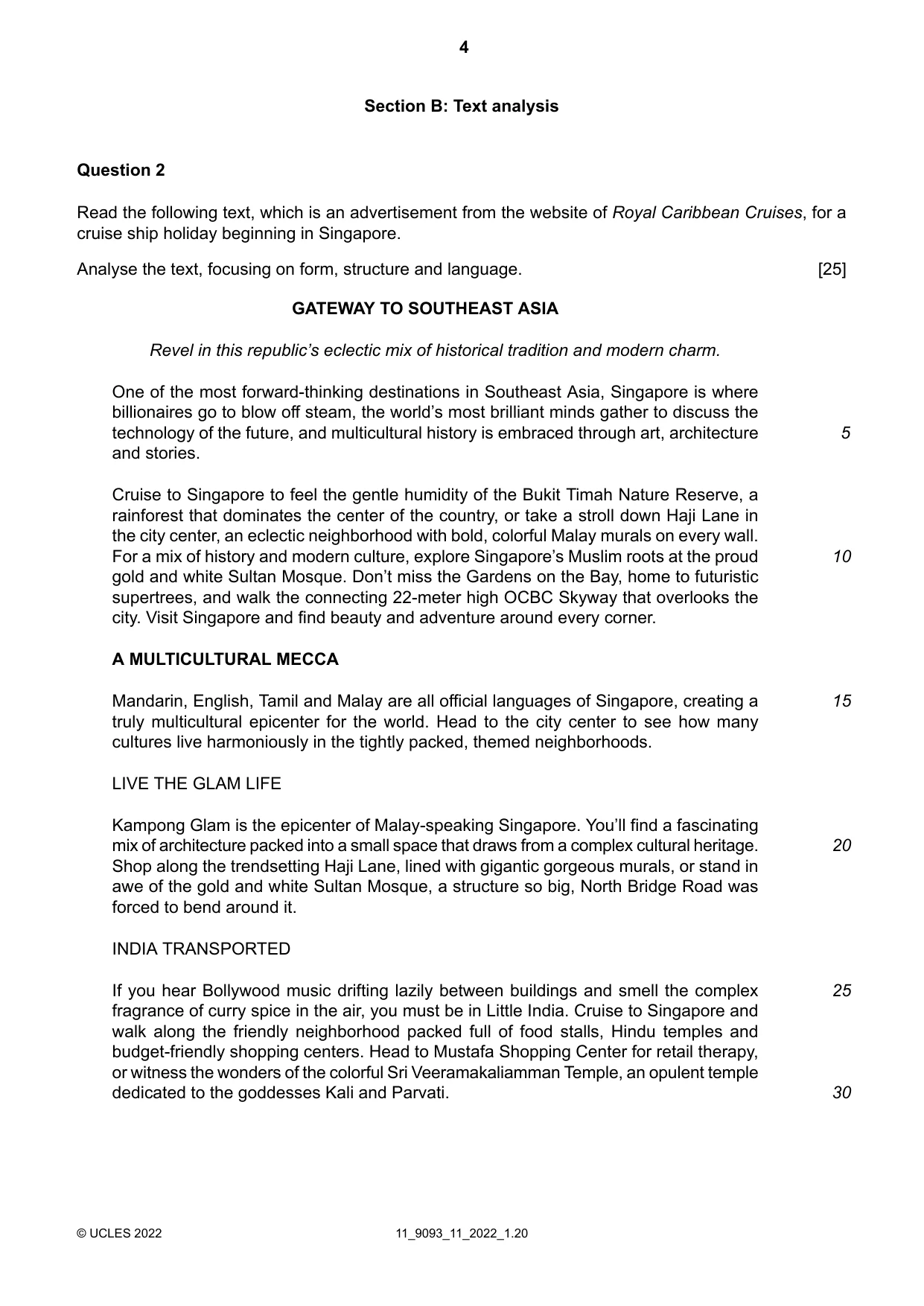
30 25 20 15 10 5 Section B: Text analysis Question 2 Read the following text, which is an advertisement from the website of Royal Caribbean Cruises, for a cruise ship holiday beginning in Singapore. Analyse the text, focusing on form, structure and language. [25] GATEWAY TO SOUTHEAST ASIA Revel in this republic’s eclectic mix of historical tradition and modern charm. One of the most forward-thinking destinations in Southeast Asia, Singapore is where billionaires go to blow off steam, the world’s most brilliant minds gather to discuss the technology of the future, and multicultural history is embraced through art, architecture and stories. Cruise to Singapore to feel the gentle humidity of the Bukit Timah Nature Reserve, a rainforest that dominates the center of the country, or take a stroll down Haji Lane in the city center, an eclectic neighborhood with bold, colorful Malay murals on every wall. For a mix of history and modern culture, explore Singapore’s Muslim roots at the proud gold and white Sultan Mosque. Don’t miss the Gardens on the Bay, home to futuristic supertrees, and walk the connecting 22-meter high OCBC Skyway that overlooks the city. Visit Singapore and find beauty and adventure around every corner. A MULTICULTURAL MECCA Mandarin, English, Tamil and Malay are all official languages of Singapore, creating a truly multicultural epicenter for the world. Head to the city center to see how many cultures live harmoniously in the tightly packed, themed neighborhoods. LIVE THE GLAM LIFE Kampong Glam is the epicenter of Malay-speaking Singapore. You’ll find a fascinating mix of architecture packed into a small space that draws from a complex cultural heritage. Shop along the trendsetting Haji Lane, lined with gigantic gorgeous murals, or stand in awe of the gold and white Sultan Mosque, a structure so big, North Bridge Road was forced to bend around it. INDIA TRANSPORTED If you hear Bollywood music drifting lazily between buildings and smell the complex fragrance of curry spice in the air, you must be in Little India. Cruise to Singapore and walk along the friendly neighborhood packed full of food stalls, Hindu temples and budget-friendly shopping centers. Head to Mustafa Shopping Center for retail therapy, or witness the wonders of the colorful Sri Veeramakaliamman Temple, an opulent temple dedicated to the goddesses Kali and Parvati. 11_9093_11_2022_1.20 © UCLES 2022 4
Question paper, page 5
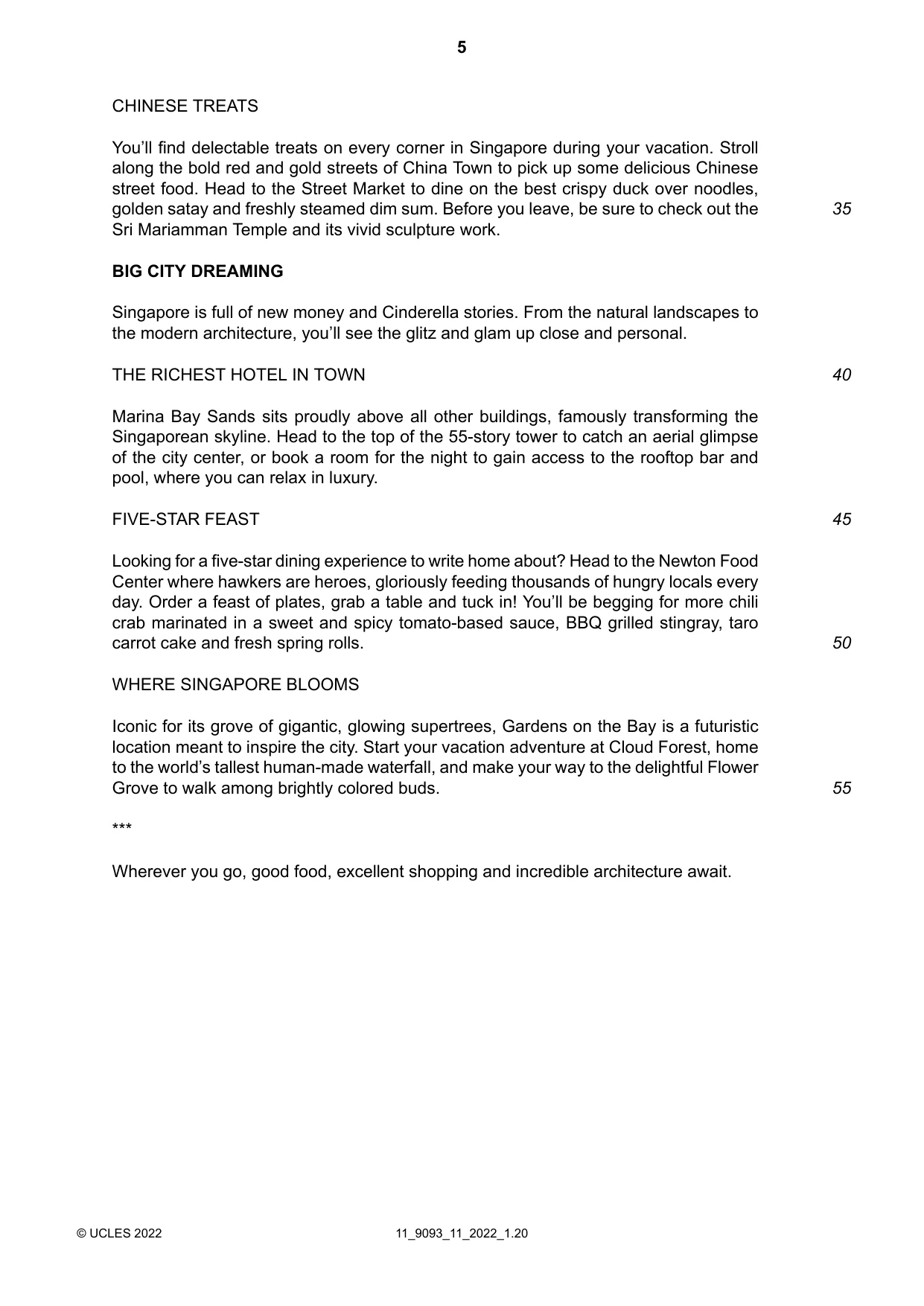
55 50 45 40 35 CHINESE TREATS You’ll find delectable treats on every corner in Singapore during your vacation. Stroll along the bold red and gold streets of China Town to pick up some delicious Chinese street food. Head to the Street Market to dine on the best crispy duck over noodles, golden satay and freshly steamed dim sum. Before you leave, be sure to check out the Sri Mariamman Temple and its vivid sculpture work. BIG CITY DREAMING Singapore is full of new money and Cinderella stories. From the natural landscapes to the modern architecture, you’ll see the glitz and glam up close and personal. THE RICHEST HOTEL IN TOWN Marina Bay Sands sits proudly above all other buildings, famously transforming the Singaporean skyline. Head to the top of the 55-story tower to catch an aerial glimpse of the city center, or book a room for the night to gain access to the rooftop bar and pool, where you can relax in luxury. FIVE-STAR FEAST Looking for a five-star dining experience to write home about? Head to the Newton Food Center where hawkers are heroes, gloriously feeding thousands of hungry locals every day. Order a feast of plates, grab a table and tuck in! You’ll be begging for more chili crab marinated in a sweet and spicy tomato-based sauce, BBQ grilled stingray, taro carrot cake and fresh spring rolls. WHERE SINGAPORE BLOOMS Iconic for its grove of gigantic, glowing supertrees, Gardens on the Bay is a futuristic location meant to inspire the city. Start your vacation adventure at Cloud Forest, home to the world’s tallest human-made waterfall, and make your way to the delightful Flower Grove to walk among brightly colored buds. *** Wherever you go, good food, excellent shopping and incredible architecture await. 11_9093_11_2022_1.20 © UCLES 2022 5
Question paper, page 6
BLANK PAGE 11_9093_11_2022_1.20 © UCLES 2022 6
Question paper, page 7
BLANK PAGE 11_9093_11_2022_1.20 © UCLES 2022 7
Question paper, page 8
BLANK PAGE Permission to reproduce items where third-party owned material protected by copyright is included has been sought and cleared where possible. Every reasonable effort has been made by the publisher (UCLES) to trace copyright holders, but if any items requiring clearance have unwittingly been included, the publisher will be pleased to make amends at the earliest possible opportunity. To avoid the issue of disclosure of answer-related information to candidates, all copyright acknowledgements are reproduced online in the Cambridge Assessment International Education Copyright Acknowledgements Booklet. This is produced for each series of examinations and is freely available to download at www.cambridgeinternational.org after the live examination series. Cambridge Assessment International Education is part of Cambridge Assessment. Cambridge Assessment is the brand name of the University of Cambridge Local Examinations Syndicate (UCLES), which is a department of the University of Cambridge. 11_9093_11_2022_1.20 © UCLES 2022 8
Mark scheme, page 1
This document consists of 15 printed pages. © UCLES 2022 [Turn over Cambridge International AS & A Level ENGLISH LANGUAGE 9093/11 Paper 1 Reading October/November 2022 MARK SCHEME Maximum Mark: 50 Published This mark scheme is published as an aid to teachers and candidates, to indicate the requirements of the examination. It shows the basis on which Examiners were instructed to award marks. It does not indicate the details of the discussions that took place at an Examiners’ meeting before marking began, which would have considered the acceptability of alternative answers. Mark schemes should be read in conjunction with the question paper and the Principal Examiner Report for Teachers. Cambridge International will not enter into discussions about these mark schemes. Cambridge International is publishing the mark schemes for the October/November 2022 series for most Cambridge IGCSE™, Cambridge International A and AS Level components and some Cambridge O Level components.
Mark scheme, page 2
9093/11 Cambridge International AS & A Level – Mark Scheme PUBLISHED October/November 2022 © UCLES 2022 Page 2 of 15 Generic Marking Principles These general marking principles must be applied by all examiners when marking candidate answers. They should be applied alongside the specific content of the mark scheme or generic level descriptors for a question. Each question paper and mark scheme will also comply with these marking principles. GENERIC MARKING PRINCIPLE 1: Marks must be awarded in line with: • the specific content of the mark scheme or the generic level descriptors for the question • the specific skills defined in the mark scheme or in the generic level descriptors for the question • the standard of response required by a candidate as exemplified by the standardisation scripts. GENERIC MARKING PRINCIPLE 2: Marks awarded are always whole marks (not half marks, or other fractions). GENERIC MARKING PRINCIPLE 3: Marks must be awarded positively: • marks are awarded for correct/valid answers, as defined in the mark scheme. However, credit is given for valid answers which go beyond the scope of the syllabus and mark scheme, referring to your Team Leader as appropriate • marks are awarded when candidates clearly demonstrate what they know and can do • marks are not deducted for errors • marks are not deducted for omissions • answers should only be judged on the quality of spelling, punctuation and grammar when these features are specifically assessed by the question as indicated by the mark scheme. The meaning, however, should be unambiguous. GENERIC MARKING PRINCIPLE 4: Rules must be applied consistently, e.g. in situations where candidates have not followed instructions or in the application of generic level descriptors.
Mark scheme, page 3
9093/11 Cambridge International AS & A Level – Mark Scheme PUBLISHED October/November 2022 © UCLES 2022 Page 3 of 15 GENERIC MARKING PRINCIPLE 5: Marks should be awarded using the full range of marks defined in the mark scheme for the question (however; the use of the full mark range may be limited according to the quality of the candidate responses seen). GENERIC MARKING PRINCIPLE 6: Marks awarded are based solely on the requirements as defined in the mark scheme. Marks should not be awarded with grade thresholds or grade descriptors in mind. English & Media subject specific general marking principles (To be read in conjunction with the Generic Marking Principles (and requiring further guidance on how to place marks within levels)) Components using level descriptors: • We use level descriptors as a guide to broad understanding of the qualities normally expected of, or typical of, work in a level. • Level descriptors are a means of general guidance, and should not be interpreted as hurdle statements. • Where indicative content notes are supplied for a question, these are not a prescription of required content, and must not be treated as such. Alternative correct points and unexpected answers in candidates’ scripts must be given marks that fairly reflect the knowledge and skills demonstrated. • While we may have legitimate expectations as to the ground most answers may occupy, we must at all times be prepared to meet candidates on their chosen ground, provided it is relevant ground (e.g. clearly related to and derived from a relevant passage/text and meeting the mark scheme requirements for the question).
Mark scheme, page 4
9093/11 Cambridge International AS & A Level – Mark Scheme PUBLISHED October/November 2022 © UCLES 2022 Page 4 of 15 English Language specific marking instructions: AO1 Read and demonstrate understanding of a wide variety of texts. (Understanding) • Marks should be awarded for the accuracy of the candidate’s understanding of the text and its features, not for any analysis of them which is recognised under AO3. • Where comparison is required, marks should be awarded for the candidate’s recognition of similarities and differences between the texts and their features, not for any consequent analysis. • When awarding a ‘best-fit’ mark within a Level for each AO, consider each bullet point equally. AO2 Write effectively, creatively, accurately and appropriately, for a range of audiences and purposes. (Writing) • Marks should be awarded equally on the basis of the level of the candidate’s written expression (range of features used and accuracy) and the development of their writing (its organisation and relevance to task and audience). • When awarding a ‘best-fit’ mark within a Level for each AO, consider each bullet point equally. AO3: Analyse the ways in which writers’ and speakers’ choices of form, structure and language produce meaning and style. (Analysis) • Marks should be awarded equally on the basis of the level of the candidate’s analysis of the text’s elements (form, structure and language) and of the writer’s stylistic choices (including how style relates to audience and shapes meaning). • When awarding a ‘best-fit’ mark within a Level for each AO, consider each bullet point equally. In response to Question 1(a), candidates are required to write between 150 and 200 words. While there is no direct penalty for failing to adhere to this requirement, examiners should consider this an aspect of the response’s ‘relevance to purpose’. As such, adherence to the word limit is assessed as part of the second bullet point of AO2.
Mark scheme, page 5
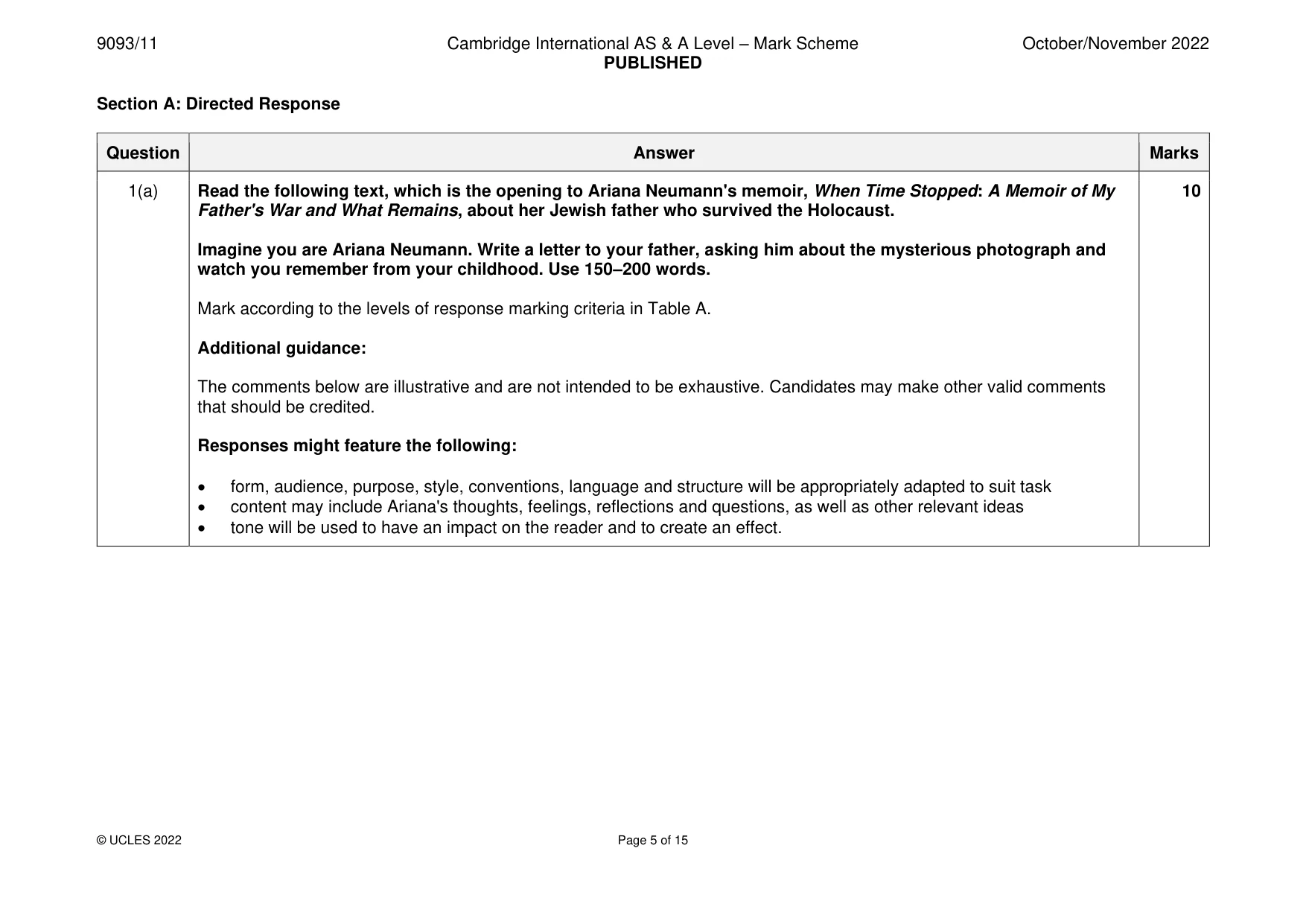
9093/11 Cambridge International AS & A Level – Mark Scheme PUBLISHED October/November 2022 © UCLES 2022 Page 5 of 15 Section A: Directed Response Question Answer Marks 1(a) Read the following text, which is the opening to Ariana Neumann's memoir, When Time Stopped: A Memoir of My Father's War and What Remains, about her Jewish father who survived the Holocaust. Imagine you are Ariana Neumann. Write a letter to your father, asking him about the mysterious photograph and watch you remember from your childhood. Use 150–200 words. Mark according to the levels of response marking criteria in Table A. Additional guidance: The comments below are illustrative and are not intended to be exhaustive. Candidates may make other valid comments that should be credited. Responses might feature the following: • form, audience, purpose, style, conventions, language and structure will be appropriately adapted to suit task • content may include Ariana's thoughts, feelings, reflections and questions, as well as other relevant ideas • tone will be used to have an impact on the reader and to create an effect. 10
Mark scheme, page 6
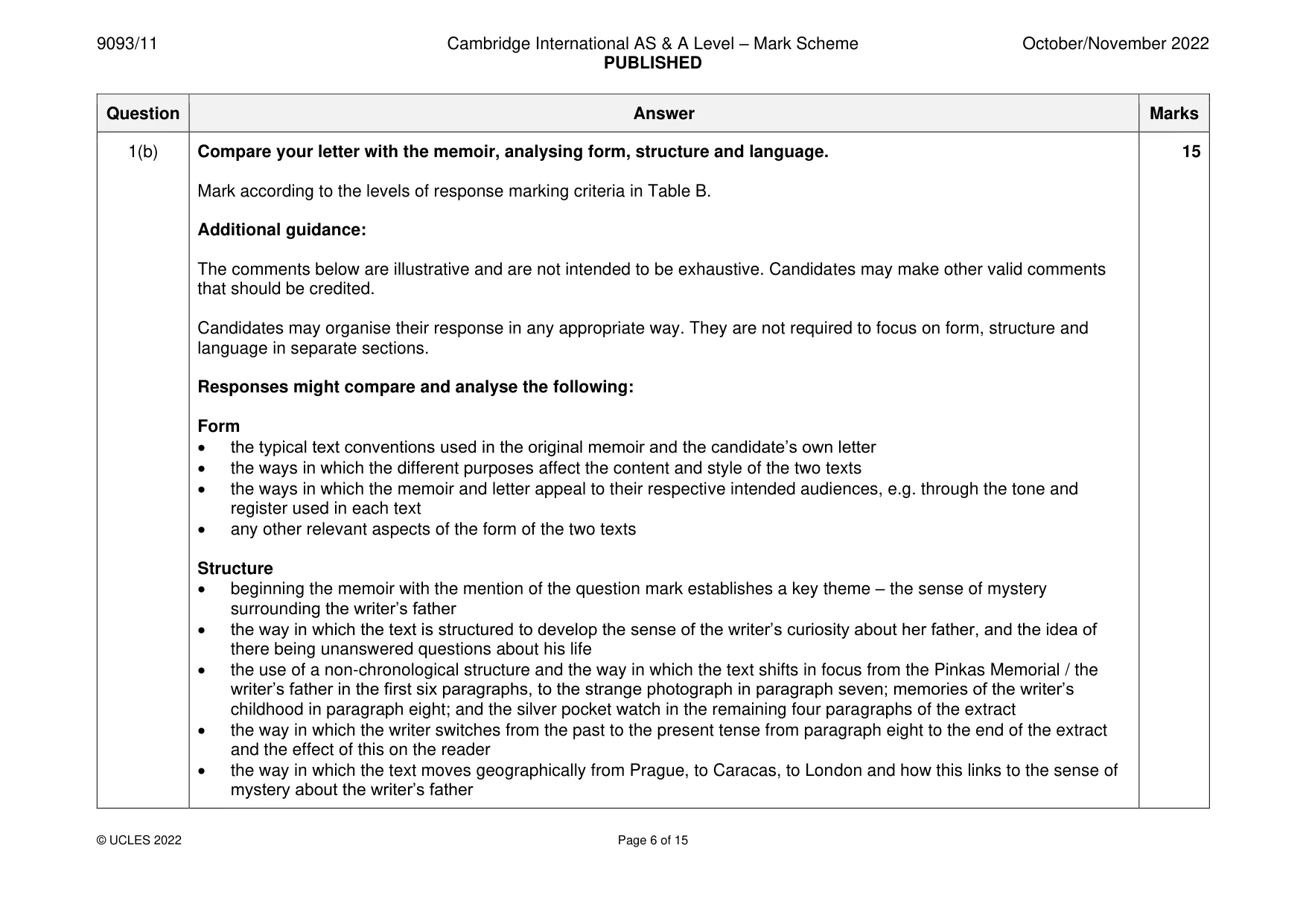
9093/11 Cambridge International AS & A Level – Mark Scheme PUBLISHED October/November 2022 © UCLES 2022 Page 6 of 15 Question Answer Marks 1(b) Compare your letter with the memoir, analysing form, structure and language. Mark according to the levels of response marking criteria in Table B. Additional guidance: The comments below are illustrative and are not intended to be exhaustive. Candidates may make other valid comments that should be credited. Candidates may organise their response in any appropriate way. They are not required to focus on form, structure and language in separate sections. Responses might compare and analyse the following: Form • the typical text conventions used in the original memoir and the candidate’s own letter • the ways in which the different purposes affect the content and style of the two texts • the ways in which the memoir and letter appeal to their respective intended audiences, e.g. through the tone and register used in each text • any other relevant aspects of the form of the two texts Structure • beginning the memoir with the mention of the question mark establishes a key theme – the sense of mystery surrounding the writer’s father • the way in which the text is structured to develop the sense of the writer’s curiosity about her father, and the idea of there being unanswered questions about his life • the use of a non-chronological structure and the way in which the text shifts in focus from the Pinkas Memorial / the writer’s father in the first six paragraphs, to the strange photograph in paragraph seven; memories of the writer’s childhood in paragraph eight; and the silver pocket watch in the remaining four paragraphs of the extract • the way in which the writer switches from the past to the present tense from paragraph eight to the end of the extract and the effect of this on the reader • the way in which the text moves geographically from Prague, to Caracas, to London and how this links to the sense of mystery about the writer’s father 15
Mark scheme, page 7
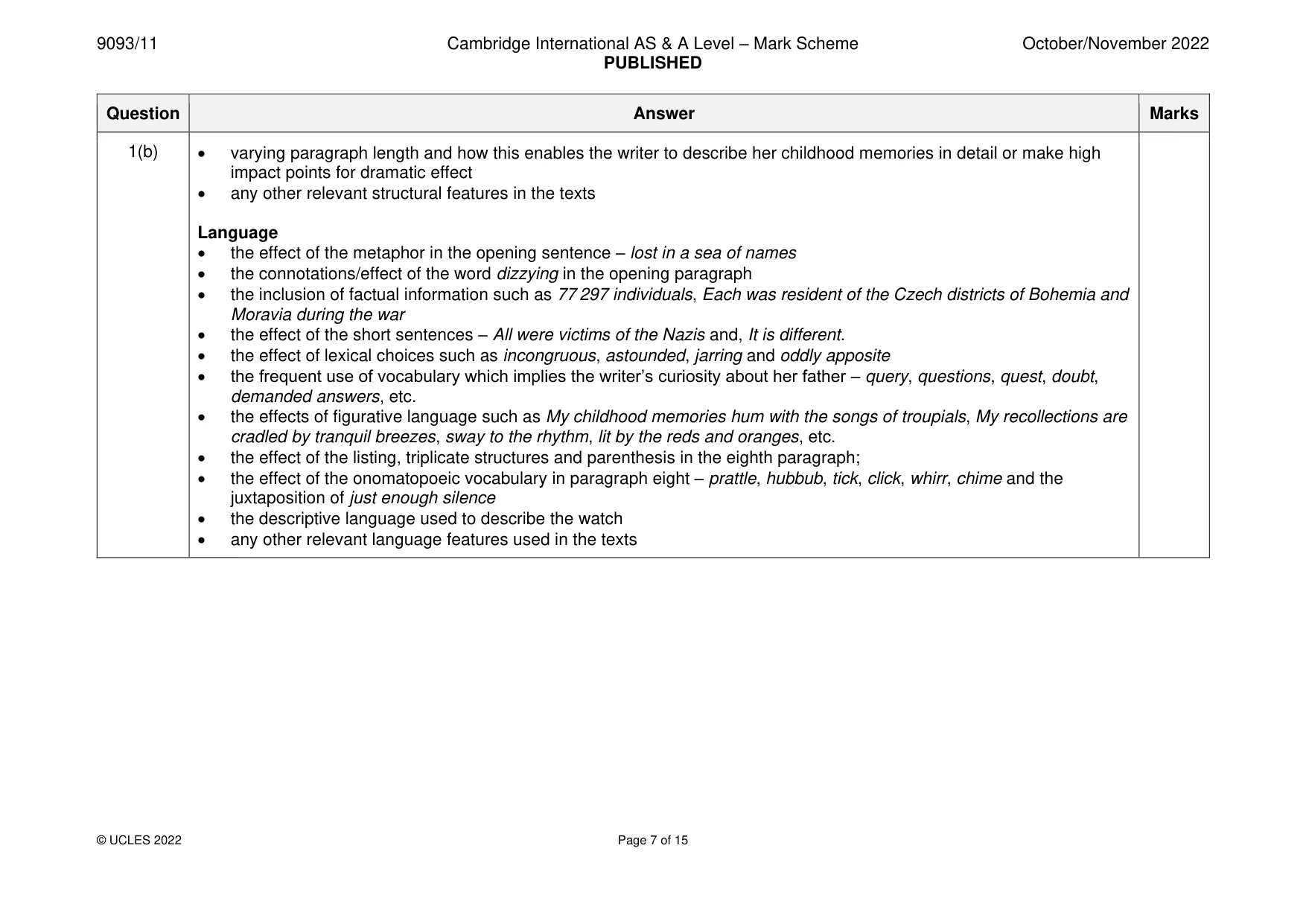
9093/11 Cambridge International AS & A Level – Mark Scheme PUBLISHED October/November 2022 © UCLES 2022 Page 7 of 15 Question Answer Marks 1(b) • varying paragraph length and how this enables the writer to describe her childhood memories in detail or make high impact points for dramatic effect • any other relevant structural features in the texts Language • the effect of the metaphor in the opening sentence – lost in a sea of names • the connotations/effect of the word dizzying in the opening paragraph • the inclusion of factual information such as 77 297 individuals, Each was resident of the Czech districts of Bohemia and Moravia during the war • the effect of the short sentences – All were victims of the Nazis and, It is different. • the effect of lexical choices such as incongruous, astounded, jarring and oddly apposite • the frequent use of vocabulary which implies the writer’s curiosity about her father – query, questions, quest, doubt, demanded answers, etc. • the effects of figurative language such as My childhood memories hum with the songs of troupials, My recollections are cradled by tranquil breezes, sway to the rhythm, lit by the reds and oranges, etc. • the effect of the listing, triplicate structures and parenthesis in the eighth paragraph; • the effect of the onomatopoeic vocabulary in paragraph eight – prattle, hubbub, tick, click, whirr, chime and the juxtaposition of just enough silence • the descriptive language used to describe the watch • any other relevant language features used in the texts
Mark scheme, page 8
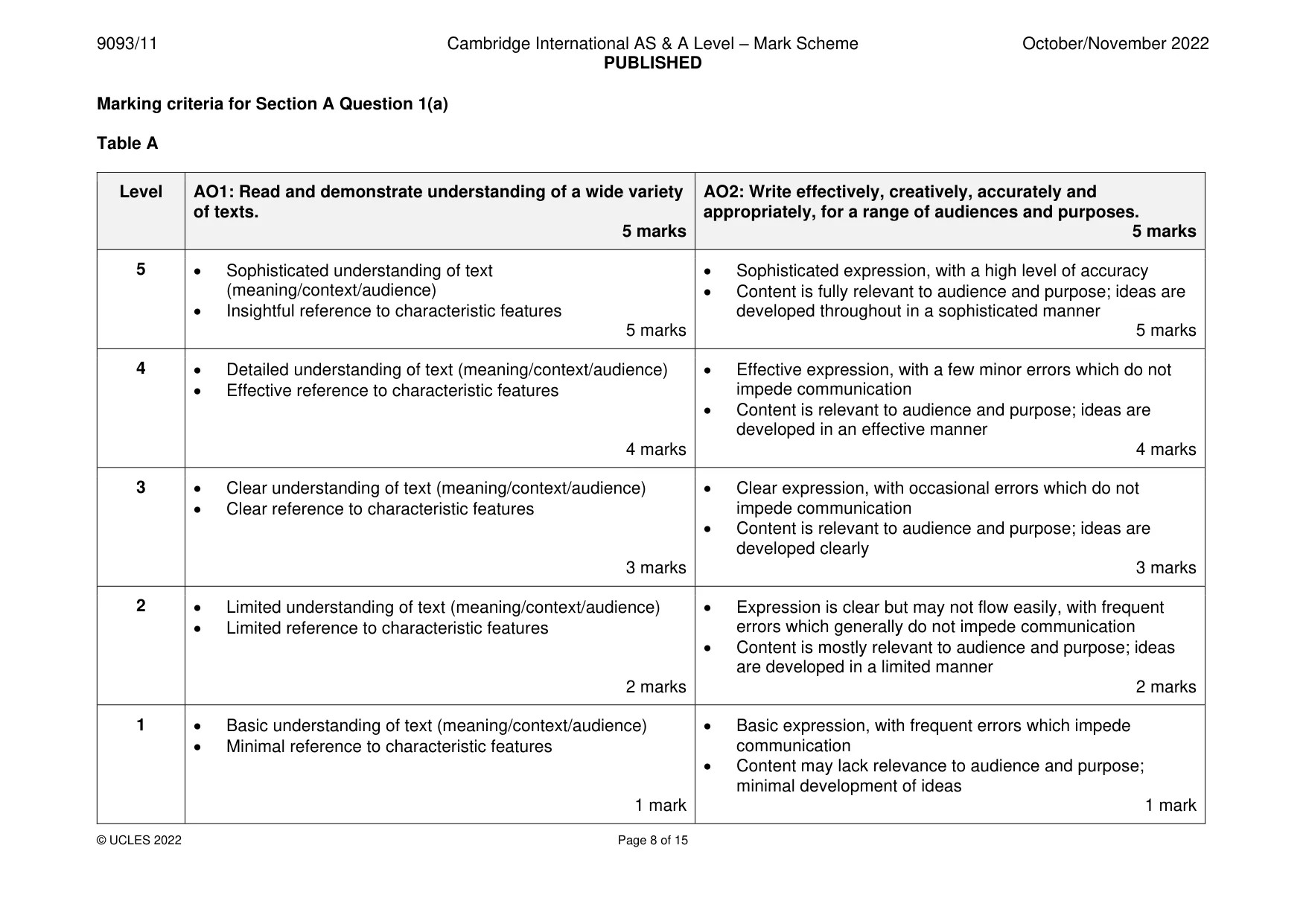
9093/11 Cambridge International AS & A Level – Mark Scheme PUBLISHED October/November 2022 © UCLES 2022 Page 8 of 15 Marking criteria for Section A Question 1(a) Table A Level AO1: Read and demonstrate understanding of a wide variety of texts. 5 marks AO2: Write effectively, creatively, accurately and appropriately, for a range of audiences and purposes. 5 marks 5 • Sophisticated understanding of text (meaning/context/audience) • Insightful reference to characteristic features 5 marks • Sophisticated expression, with a high level of accuracy • Content is fully relevant to audience and purpose; ideas are developed throughout in a sophisticated manner 5 marks 4 • Detailed understanding of text (meaning/context/audience) • Effective reference to characteristic features 4 marks • Effective expression, with a few minor errors which do not impede communication • Content is relevant to audience and purpose; ideas are developed in an effective manner 4 marks 3 • Clear understanding of text (meaning/context/audience) • Clear reference to characteristic features 3 marks • Clear expression, with occasional errors which do not impede communication • Content is relevant to audience and purpose; ideas are developed clearly 3 marks 2 • Limited understanding of text (meaning/context/audience) • Limited reference to characteristic features 2 marks • Expression is clear but may not flow easily, with frequent errors which generally do not impede communication • Content is mostly relevant to audience and purpose; ideas are developed in a limited manner 2 marks 1 • Basic understanding of text (meaning/context/audience) • Minimal reference to characteristic features 1 mark • Basic expression, with frequent errors which impede communication • Content may lack relevance to audience and purpose; minimal development of ideas 1 mark
Mark scheme, page 9
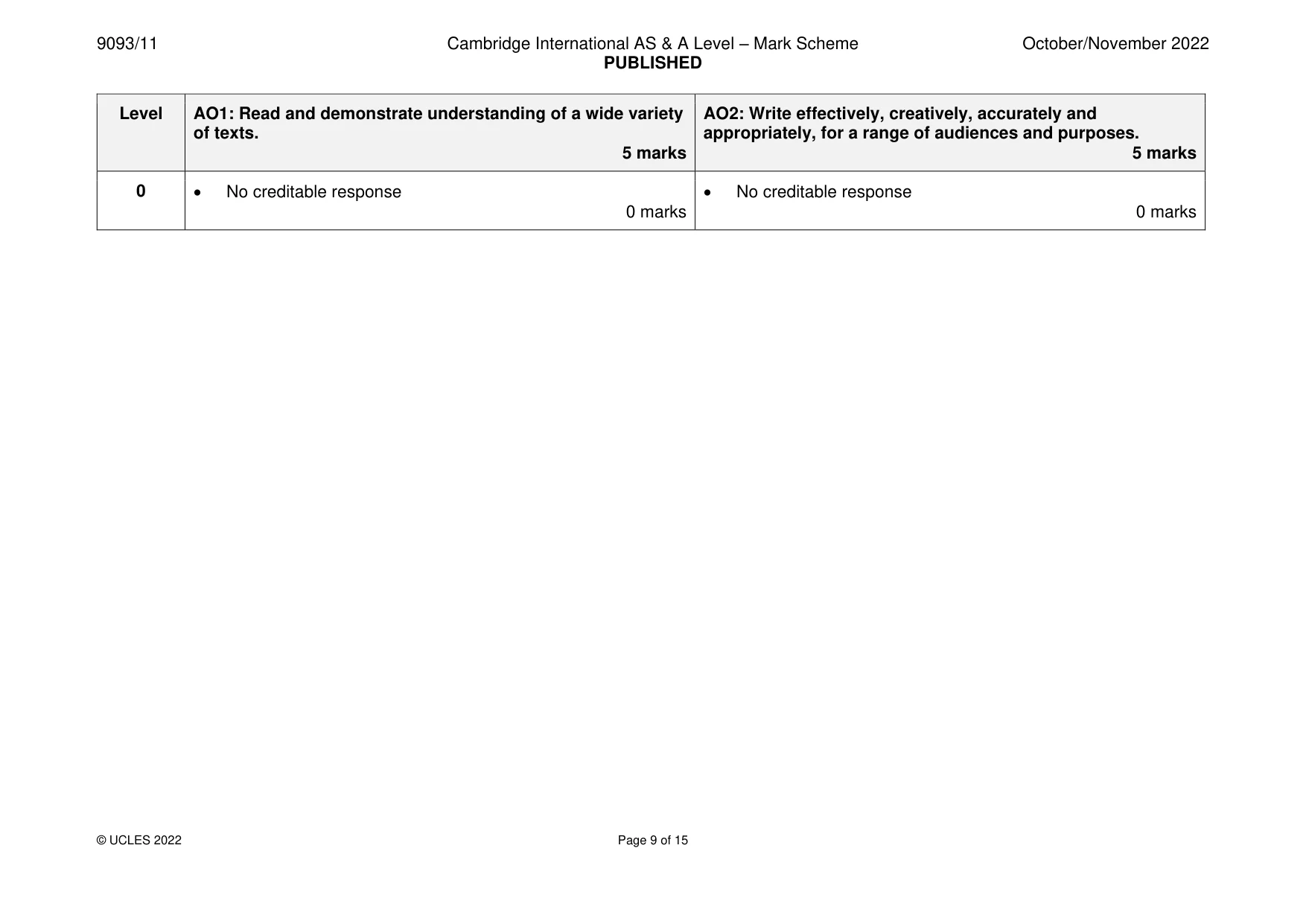
9093/11 Cambridge International AS & A Level – Mark Scheme PUBLISHED October/November 2022 © UCLES 2022 Page 9 of 15 Level AO1: Read and demonstrate understanding of a wide variety of texts. 5 marks AO2: Write effectively, creatively, accurately and appropriately, for a range of audiences and purposes. 5 marks 0 • No creditable response 0 marks • No creditable response 0 marks
Mark scheme, page 10
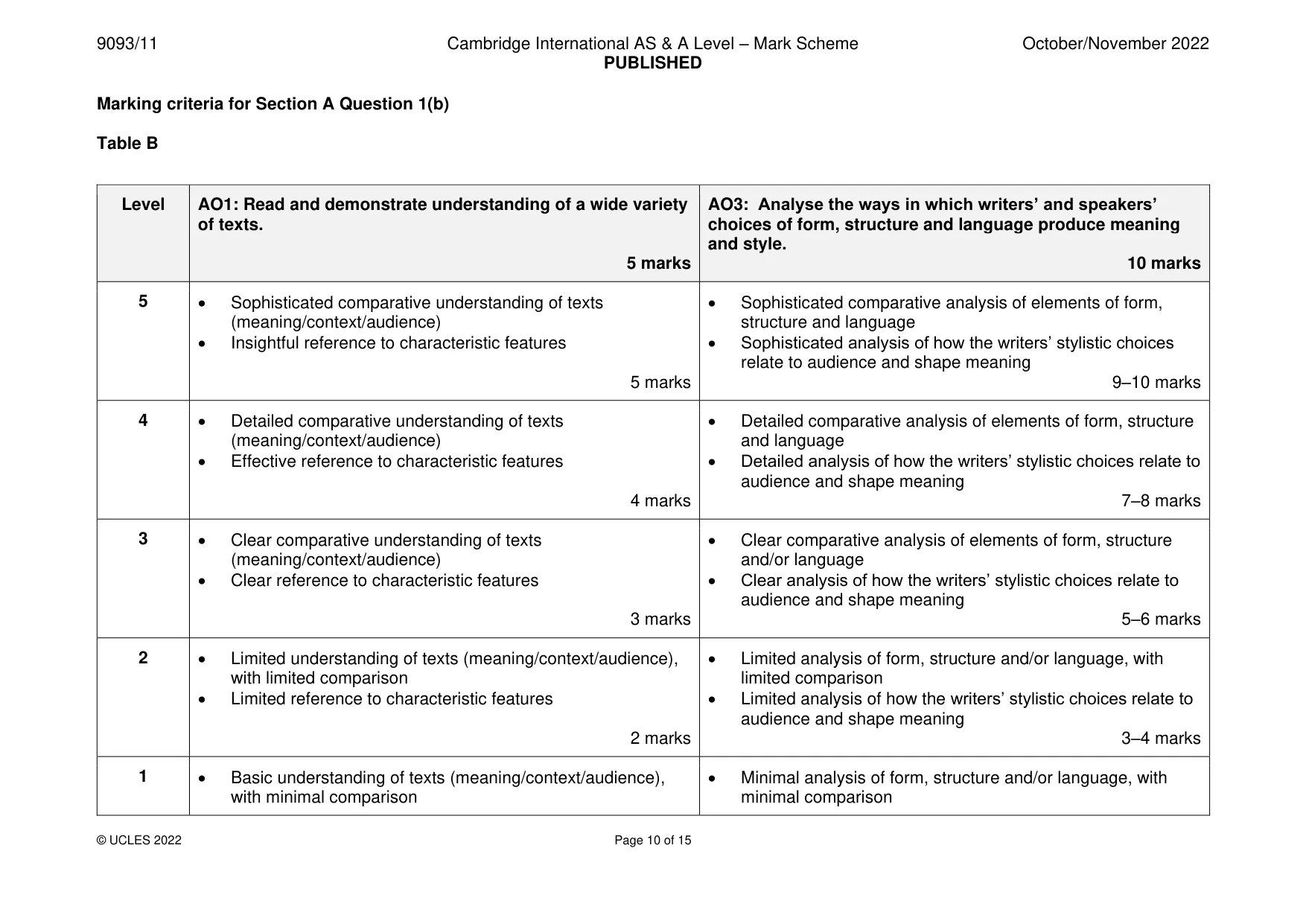
9093/11 Cambridge International AS & A Level – Mark Scheme PUBLISHED October/November 2022 © UCLES 2022 Page 10 of 15 Marking criteria for Section A Question 1(b) Table B Level AO1: Read and demonstrate understanding of a wide variety of texts. 5 marks AO3: Analyse the ways in which writers’ and speakers’ choices of form, structure and language produce meaning and style. 10 marks 5 • Sophisticated comparative understanding of texts (meaning/context/audience) • Insightful reference to characteristic features 5 marks • Sophisticated comparative analysis of elements of form, structure and language • Sophisticated analysis of how the writers’ stylistic choices relate to audience and shape meaning 9–10 marks 4 • Detailed comparative understanding of texts (meaning/context/audience) • Effective reference to characteristic features 4 marks • Detailed comparative analysis of elements of form, structure and language • Detailed analysis of how the writers’ stylistic choices relate to audience and shape meaning 7–8 marks 3 • Clear comparative understanding of texts (meaning/context/audience) • Clear reference to characteristic features 3 marks • Clear comparative analysis of elements of form, structure and/or language • Clear analysis of how the writers’ stylistic choices relate to audience and shape meaning 5–6 marks 2 • Limited understanding of texts (meaning/context/audience), with limited comparison • Limited reference to characteristic features 2 marks • Limited analysis of form, structure and/or language, with limited comparison • Limited analysis of how the writers’ stylistic choices relate to audience and shape meaning 3–4 marks 1 • Basic understanding of texts (meaning/context/audience), with minimal comparison • Minimal analysis of form, structure and/or language, with minimal comparison
Mark scheme, page 11
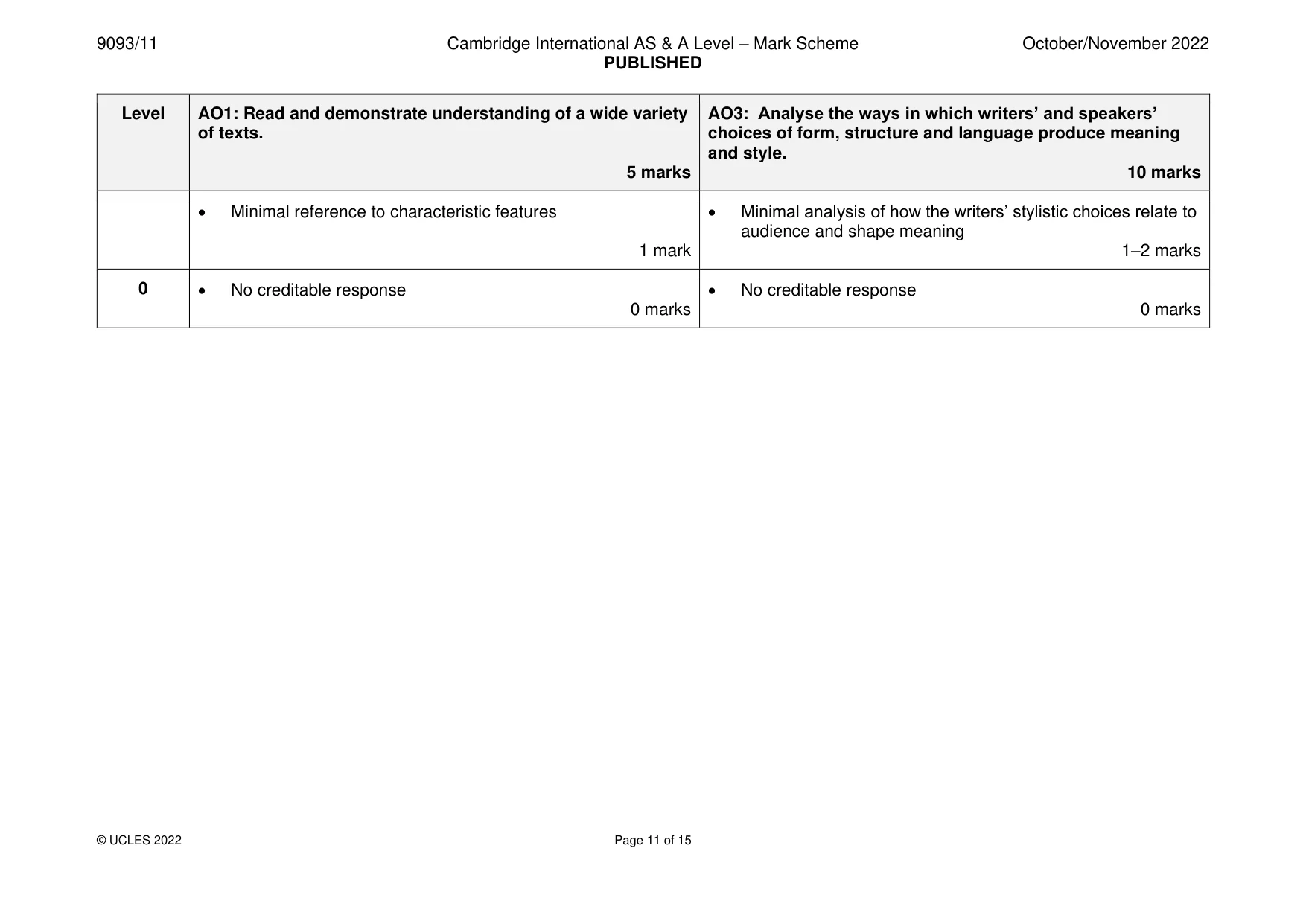
9093/11 Cambridge International AS & A Level – Mark Scheme PUBLISHED October/November 2022 © UCLES 2022 Page 11 of 15 Level AO1: Read and demonstrate understanding of a wide variety of texts. 5 marks AO3: Analyse the ways in which writers’ and speakers’ choices of form, structure and language produce meaning and style. 10 marks • Minimal reference to characteristic features 1 mark • Minimal analysis of how the writers’ stylistic choices relate to audience and shape meaning 1–2 marks 0 • No creditable response 0 marks • No creditable response 0 marks
Mark scheme, page 12
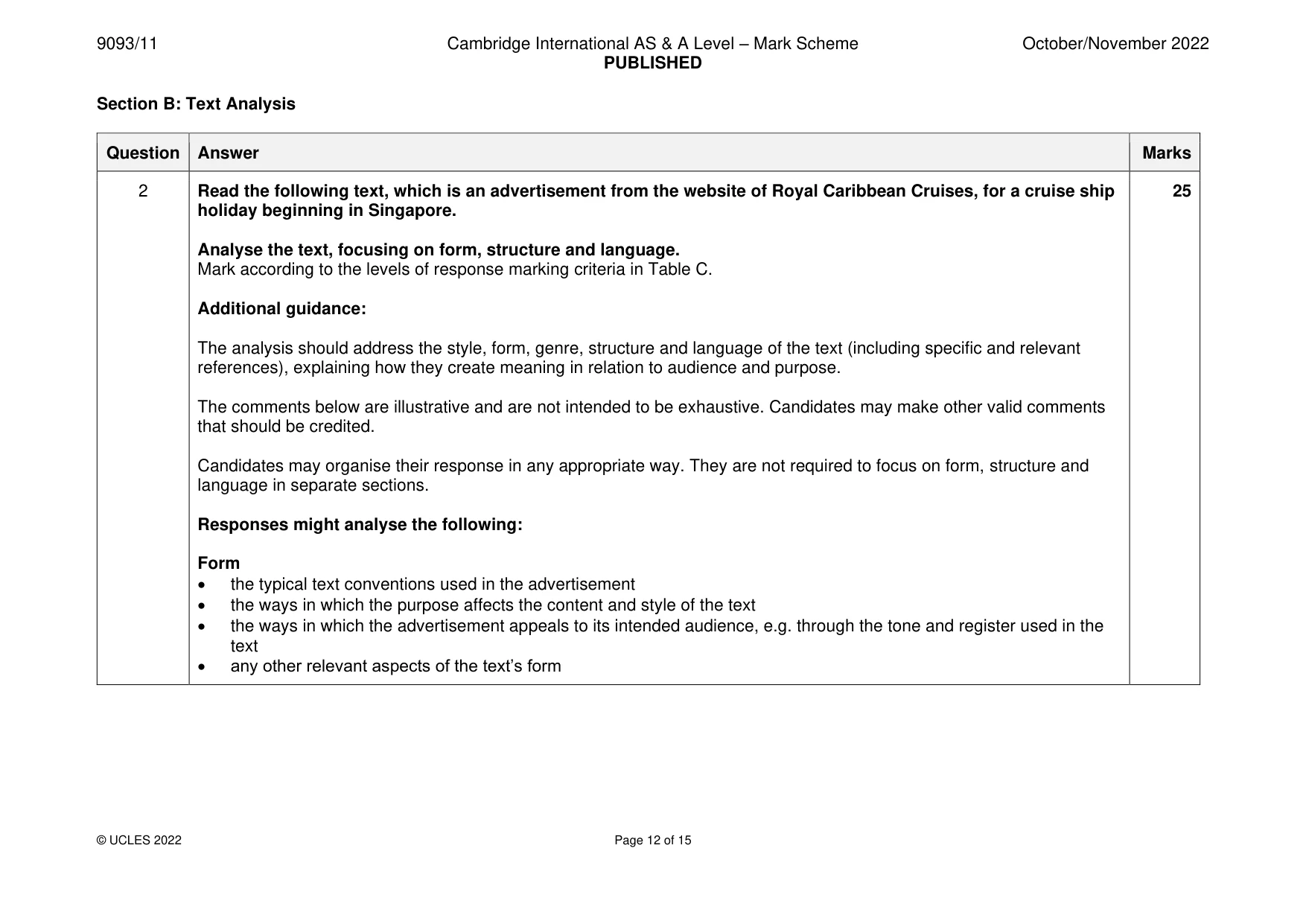
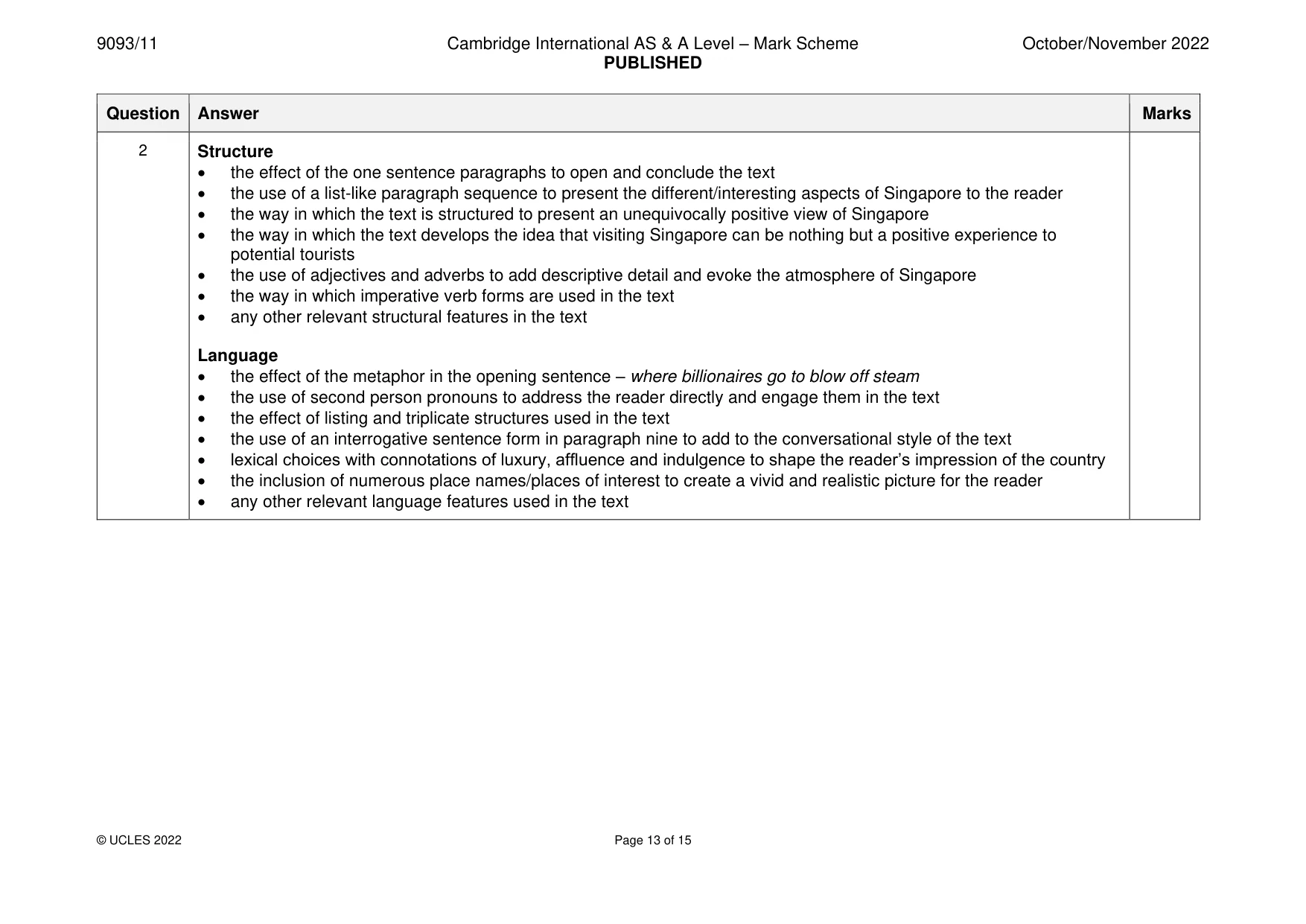
9093/11 Cambridge International AS & A Level – Mark Scheme PUBLISHED October/November 2022 © UCLES 2022 Page 12 of 15 Section B: Text Analysis Question Answer Marks 2 Read the following text, which is an advertisement from the website of Royal Caribbean Cruises, for a cruise ship holiday beginning in Singapore. Analyse the text, focusing on form, structure and language. Mark according to the levels of response marking criteria in Table C. Additional guidance: The analysis should address the style, form, genre, structure and language of the text (including specific and relevant references), explaining how they create meaning in relation to audience and purpose. The comments below are illustrative and are not intended to be exhaustive. Candidates may make other valid comments that should be credited. Candidates may organise their response in any appropriate way. They are not required to focus on form, structure and language in separate sections. Responses might analyse the following: Form • the typical text conventions used in the advertisement • the ways in which the purpose affects the content and style of the text • the ways in which the advertisement appeals to its intended audience, e.g. through the tone and register used in the text • any other relevant aspects of the text’s form 25
Mark scheme, page 13
9093/11 Cambridge International AS & A Level – Mark Scheme PUBLISHED October/November 2022 © UCLES 2022 Page 13 of 15 Question Answer Marks 2 Structure • the effect of the one sentence paragraphs to open and conclude the text • the use of a list-like paragraph sequence to present the different/interesting aspects of Singapore to the reader • the way in which the text is structured to present an unequivocally positive view of Singapore • the way in which the text develops the idea that visiting Singapore can be nothing but a positive experience to potential tourists • the use of adjectives and adverbs to add descriptive detail and evoke the atmosphere of Singapore • the way in which imperative verb forms are used in the text • any other relevant structural features in the text Language • the effect of the metaphor in the opening sentence – where billionaires go to blow off steam • the use of second person pronouns to address the reader directly and engage them in the text • the effect of listing and triplicate structures used in the text • the use of an interrogative sentence form in paragraph nine to add to the conversational style of the text • lexical choices with connotations of luxury, affluence and indulgence to shape the reader’s impression of the country • the inclusion of numerous place names/places of interest to create a vivid and realistic picture for the reader • any other relevant language features used in the text
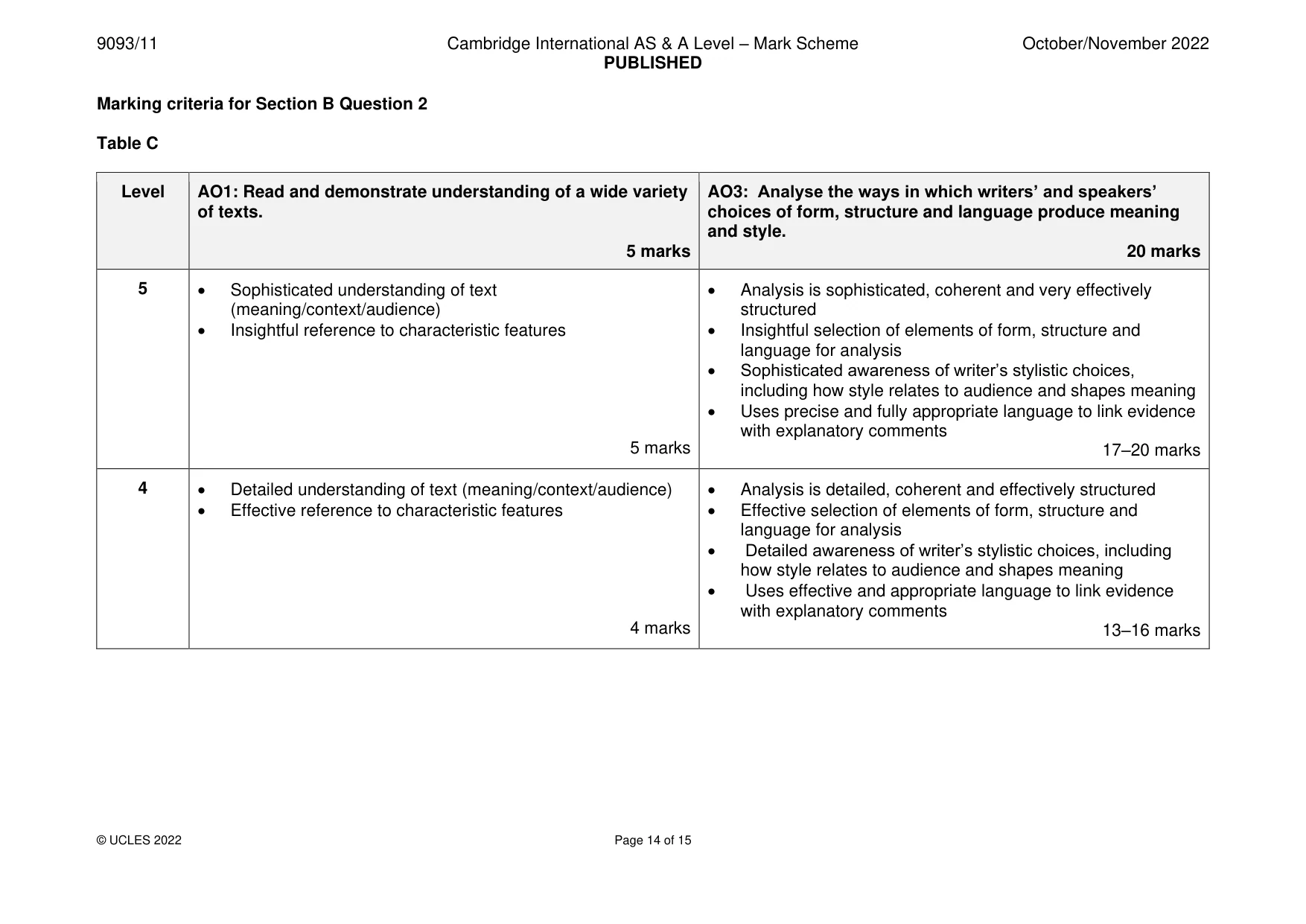
Mark scheme, page 14
9093/11 Cambridge International AS & A Level – Mark Scheme PUBLISHED October/November 2022 © UCLES 2022 Page 14 of 15 Marking criteria for Section B Question 2 Table C Level AO1: Read and demonstrate understanding of a wide variety of texts. 5 marks AO3: Analyse the ways in which writers’ and speakers’ choices of form, structure and language produce meaning and style. 20 marks 5 • Sophisticated understanding of text (meaning/context/audience) • Insightful reference to characteristic features 5 marks • Analysis is sophisticated, coherent and very effectively structured • Insightful selection of elements of form, structure and language for analysis • Sophisticated awareness of writer’s stylistic choices, including how style relates to audience and shapes meaning • Uses precise and fully appropriate language to link evidence with explanatory comments 17–20 marks 4 • Detailed understanding of text (meaning/context/audience) • Effective reference to characteristic features 4 marks • Analysis is detailed, coherent and effectively structured • Effective selection of elements of form, structure and language for analysis • Detailed awareness of writer’s stylistic choices, including how style relates to audience and shapes meaning • Uses effective and appropriate language to link evidence with explanatory comments 13–16 marks
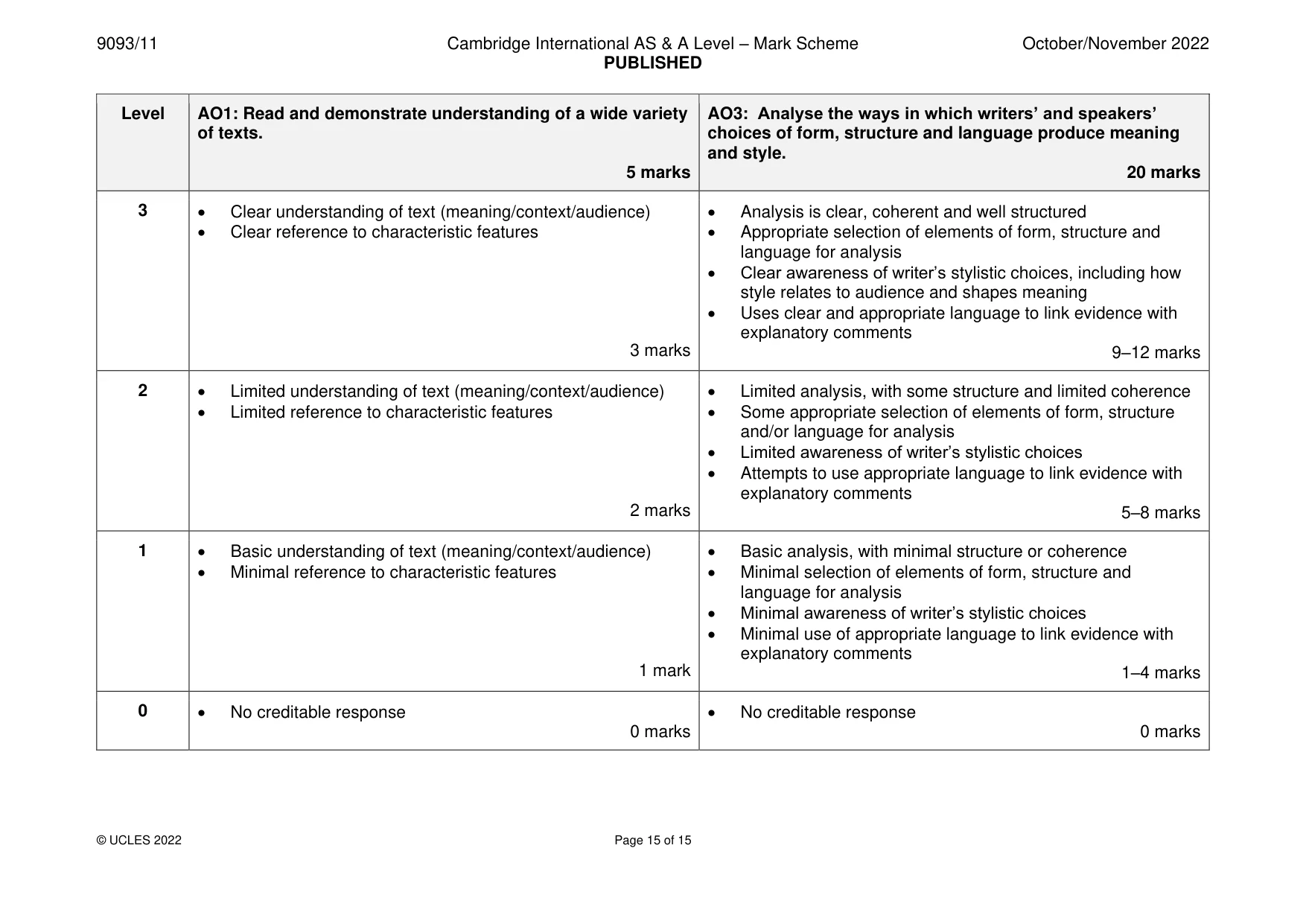
Mark scheme, page 15
9093/11 Cambridge International AS & A Level – Mark Scheme PUBLISHED October/November 2022 © UCLES 2022 Page 15 of 15 Level AO1: Read and demonstrate understanding of a wide variety of texts. 5 marks AO3: Analyse the ways in which writers’ and speakers’ choices of form, structure and language produce meaning and style. 20 marks 3 • Clear understanding of text (meaning/context/audience) • Clear reference to characteristic features 3 marks • Analysis is clear, coherent and well structured • Appropriate selection of elements of form, structure and language for analysis • Clear awareness of writer’s stylistic choices, including how style relates to audience and shapes meaning • Uses clear and appropriate language to link evidence with explanatory comments 9–12 marks 2 • Limited understanding of text (meaning/context/audience) • Limited reference to characteristic features 2 marks • Limited analysis, with some structure and limited coherence • Some appropriate selection of elements of form, structure and/or language for analysis • Limited awareness of writer’s stylistic choices • Attempts to use appropriate language to link evidence with explanatory comments 5–8 marks 1 • Basic understanding of text (meaning/context/audience) • Minimal reference to characteristic features 1 mark • Basic analysis, with minimal structure or coherence • Minimal selection of elements of form, structure and language for analysis • Minimal awareness of writer’s stylistic choices • Minimal use of appropriate language to link evidence with explanatory comments 1–4 marks 0 • No creditable response 0 marks • No creditable response 0 marks
What you needed in this session
Cambridge’s own grade thresholds for 2022 Oct/Nov, Paper 1 · Variant 1. A higher threshold means an easier paper — the bar moves with how the cohort did.