Cambridge A Level English - Language AS and A Level (from 2014) 9093 — 2022 May/June Paper 1 · Variant 2
9093/12/M/J/22 · 50 marks · ≈56 min
The question paper and its mark scheme, free to read here and free to download. This is Cambridge’s own paper, exactly as it was sat.
Question paper8 pages

Mark scheme16 pages
Answers below. Sit the paper first if you are practising.
Paper as text
Question paper, page 1
Cambridge International AS & A Level 9093/12 May/June 2022 2 hours 15 minutes ENGLISH LANGUAGE Paper 1 Reading You must answer on the enclosed answer booklet. You will need: Answer booklet (enclosed) INSTRUCTIONS • Answer all questions. • Follow the instructions on the front cover of the answer booklet. If you need additional answer paper, ask the invigilator for a continuation booklet. • Dictionaries are not allowed. INFORMATION • The total mark for this paper is 50. • The number of marks for each question or part question is shown in brackets [ ]. This document has 8 pages. Any blank pages are indicated. [Turn over 06_9093_12_2022_1.11 © UCLES 2022 *7612025594*
Question paper, page 2
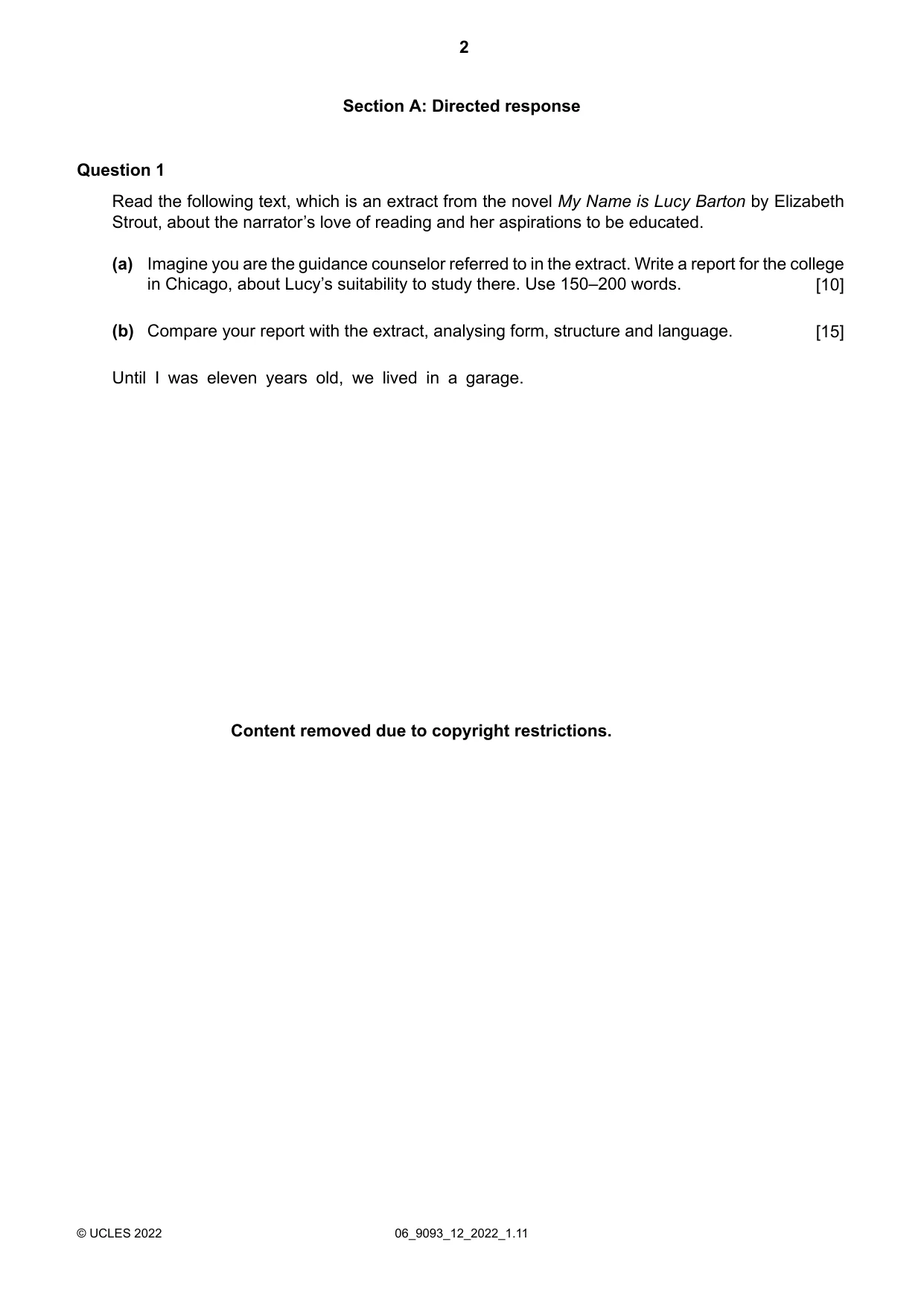
Section A: Directed response Question 1 Read the following text, which is an extract from the novel My Name is Lucy Barton by Elizabeth Strout, about the narrator’s love of reading and her aspirations to be educated. Imagine you are the guidance counselor referred to in the extract. Write a report for the college in Chicago, about Lucy’s suitability to study there. Use 150–200 words. [10] (a) Compare your report with the extract, analysing form, structure and language. [15] (b) Until I was eleven years old, we lived in a garage. 06_9093_12_2022_1.11 © UCLES 2022 2 Content removed due to copyright restrictions.
Question paper, page 3
I kept thinking that for a long time, until I fell asleep. [Turn over 06_9093_12_2022_1.11 © UCLES 2022 3 Content removed due to copyright restrictions.
Question paper, page 4
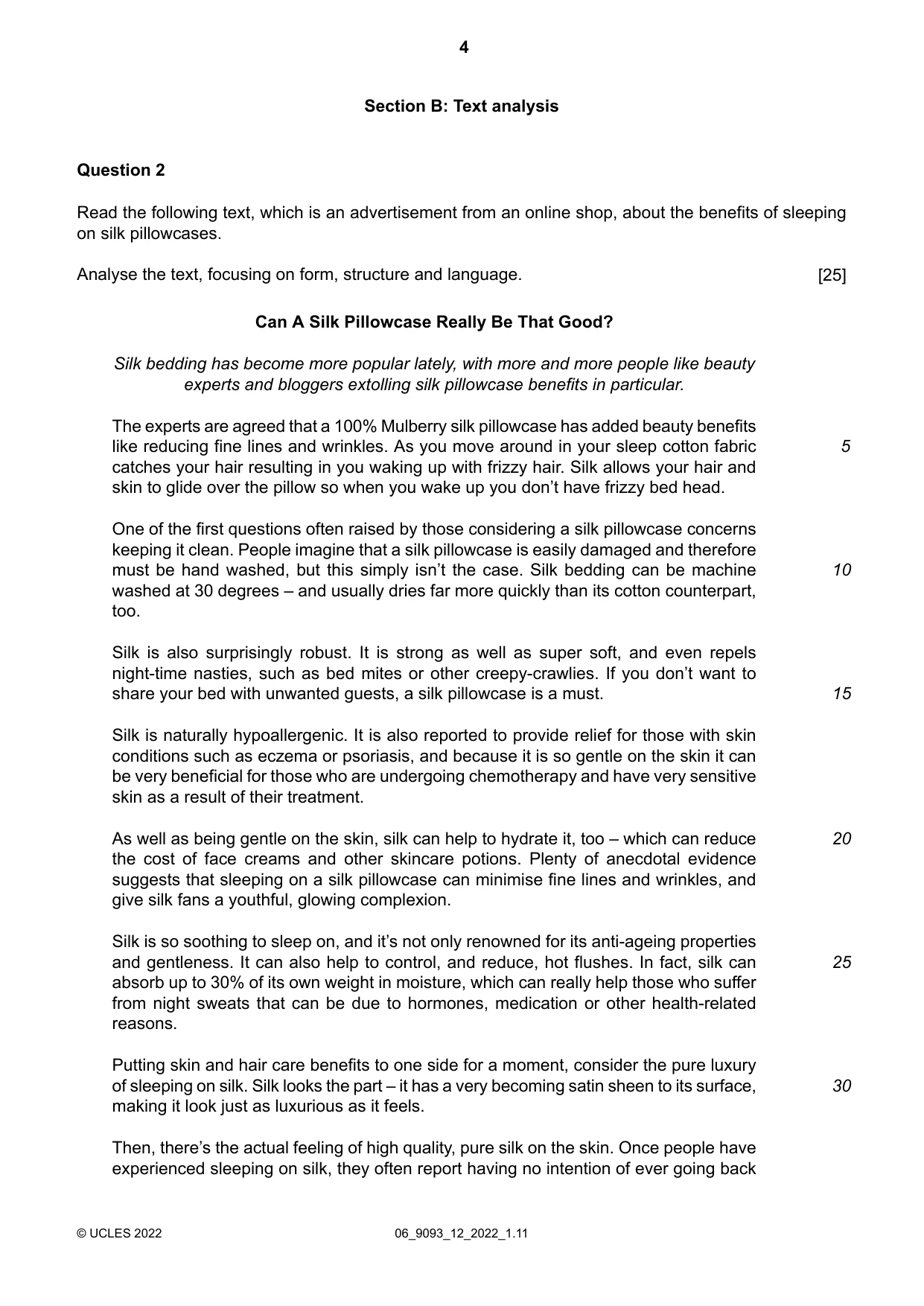
30 25 20 15 10 5 Section B: Text analysis Question 2 Read the following text, which is an advertisement from an online shop, about the benefits of sleeping on silk pillowcases. Analyse the text, focusing on form, structure and language. [25] Can A Silk Pillowcase Really Be That Good? Silk bedding has become more popular lately, with more and more people like beauty experts and bloggers extolling silk pillowcase benefits in particular. The experts are agreed that a 100% Mulberry silk pillowcase has added beauty benefits like reducing fine lines and wrinkles. As you move around in your sleep cotton fabric catches your hair resulting in you waking up with frizzy hair. Silk allows your hair and skin to glide over the pillow so when you wake up you don’t have frizzy bed head. One of the first questions often raised by those considering a silk pillowcase concerns keeping it clean. People imagine that a silk pillowcase is easily damaged and therefore must be hand washed, but this simply isn’t the case. Silk bedding can be machine washed at 30 degrees – and usually dries far more quickly than its cotton counterpart, too. Silk is also surprisingly robust. It is strong as well as super soft, and even repels night-time nasties, such as bed mites or other creepy-crawlies. If you don’t want to share your bed with unwanted guests, a silk pillowcase is a must. Silk is naturally hypoallergenic. It is also reported to provide relief for those with skin conditions such as eczema or psoriasis, and because it is so gentle on the skin it can be very beneficial for those who are undergoing chemotherapy and have very sensitive skin as a result of their treatment. As well as being gentle on the skin, silk can help to hydrate it, too – which can reduce the cost of face creams and other skincare potions. Plenty of anecdotal evidence suggests that sleeping on a silk pillowcase can minimise fine lines and wrinkles, and give silk fans a youthful, glowing complexion. Silk is so soothing to sleep on, and it’s not only renowned for its anti-ageing properties and gentleness. It can also help to control, and reduce, hot flushes. In fact, silk can absorb up to 30% of its own weight in moisture, which can really help those who suffer from night sweats that can be due to hormones, medication or other health-related reasons. Putting skin and hair care benefits to one side for a moment, consider the pure luxury of sleeping on silk. Silk looks the part – it has a very becoming satin sheen to its surface, making it look just as luxurious as it feels. Then, there’s the actual feeling of high quality, pure silk on the skin. Once people have experienced sleeping on silk, they often report having no intention of ever going back 06_9093_12_2022_1.11 © UCLES 2022 4
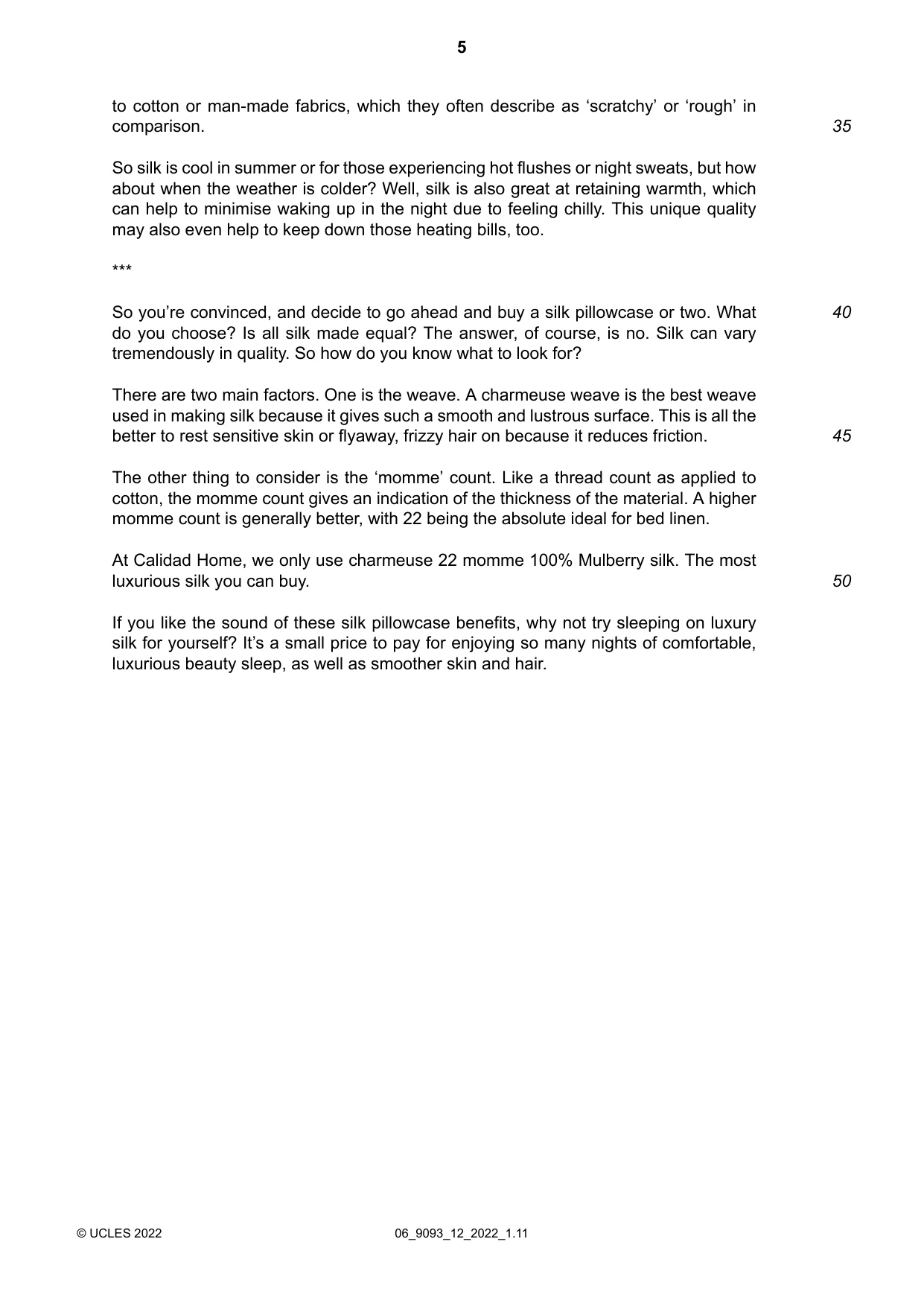
Question paper, page 5
50 45 40 35 to cotton or man-made fabrics, which they often describe as ‘scratchy’ or ‘rough’ in comparison. So silk is cool in summer or for those experiencing hot flushes or night sweats, but how about when the weather is colder? Well, silk is also great at retaining warmth, which can help to minimise waking up in the night due to feeling chilly. This unique quality may also even help to keep down those heating bills, too. *** So you’re convinced, and decide to go ahead and buy a silk pillowcase or two. What do you choose? Is all silk made equal? The answer, of course, is no. Silk can vary tremendously in quality. So how do you know what to look for? There are two main factors. One is the weave. A charmeuse weave is the best weave used in making silk because it gives such a smooth and lustrous surface. This is all the better to rest sensitive skin or flyaway, frizzy hair on because it reduces friction. The other thing to consider is the ‘momme’ count. Like a thread count as applied to cotton, the momme count gives an indication of the thickness of the material. A higher momme count is generally better, with 22 being the absolute ideal for bed linen. At Calidad Home, we only use charmeuse 22 momme 100% Mulberry silk. The most luxurious silk you can buy. If you like the sound of these silk pillowcase benefits, why not try sleeping on luxury silk for yourself? It’s a small price to pay for enjoying so many nights of comfortable, luxurious beauty sleep, as well as smoother skin and hair. 06_9093_12_2022_1.11 © UCLES 2022 5
Question paper, page 6
BLANK PAGE 06_9093_12_2022_1.11 © UCLES 2022 6
Question paper, page 7
BLANK PAGE 06_9093_12_2022_1.11 © UCLES 2022 7
Question paper, page 8
BLANK PAGE Permission to reproduce items where third-party owned material protected by copyright is included has been sought and cleared where possible. Every reasonable effort has been made by the publisher (UCLES) to trace copyright holders, but if any items requiring clearance have unwittingly been included, the publisher will be pleased to make amends at the earliest possible opportunity. To avoid the issue of disclosure of answer-related information to candidates, all copyright acknowledgements are reproduced online in the Cambridge Assessment International Education Copyright Acknowledgements Booklet. This is produced for each series of examinations and is freely available to download at www.cambridgeinternational.org after the live examination series. Cambridge Assessment International Education is part of Cambridge Assessment. Cambridge Assessment is the brand name of the University of Cambridge Local Examinations Syndicate (UCLES), which is a department of the University of Cambridge. 06_9093_12_2022_1.11 © UCLES 2022 8
Mark scheme, page 1
This document consists of 16 printed pages. © UCLES 2022 [Turn over Cambridge International AS & A Level ENGLISH LANGUAGE 9093/12 Paper 1 Reading May/June 2022 MARK SCHEME Maximum Mark: 50 Published This mark scheme is published as an aid to teachers and candidates, to indicate the requirements of the examination. It shows the basis on which Examiners were instructed to award marks. It does not indicate the details of the discussions that took place at an Examiners’ meeting before marking began, which would have considered the acceptability of alternative answers. Mark schemes should be read in conjunction with the question paper and the Principal Examiner Report for Teachers. Cambridge International will not enter into discussions about these mark schemes. Cambridge International is publishing the mark schemes for the May/June 2022 series for most Cambridge IGCSE, Cambridge International A and AS Level and Cambridge Pre-U components, and some Cambridge O Level components.
Mark scheme, page 2
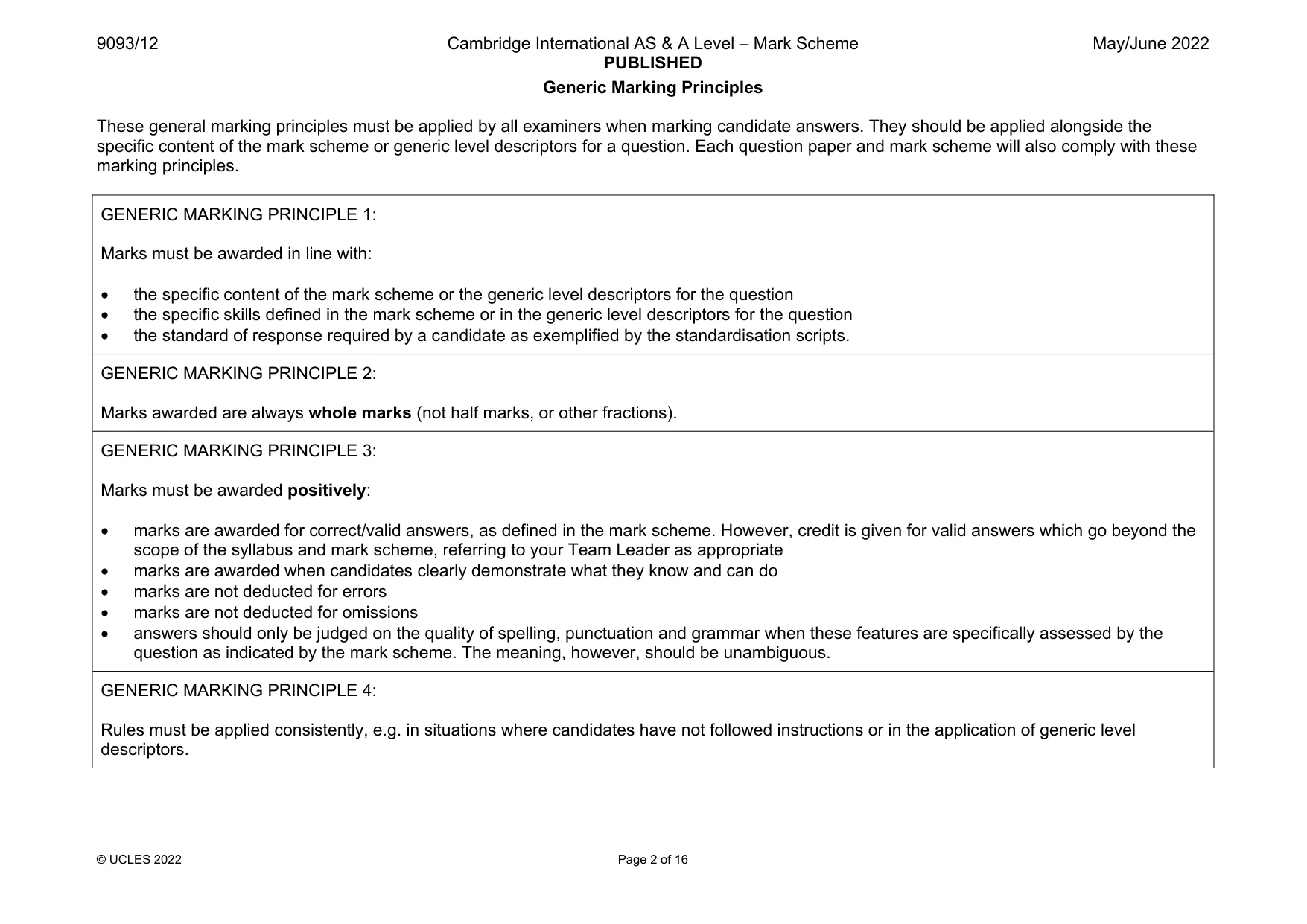
9093/12 Cambridge International AS & A Level – Mark Scheme PUBLISHED May/June 2022 © UCLES 2022 Page 2 of 16 Generic Marking Principles These general marking principles must be applied by all examiners when marking candidate answers. They should be applied alongside the specific content of the mark scheme or generic level descriptors for a question. Each question paper and mark scheme will also comply with these marking principles. GENERIC MARKING PRINCIPLE 1: Marks must be awarded in line with: the specific content of the mark scheme or the generic level descriptors for the question the specific skills defined in the mark scheme or in the generic level descriptors for the question the standard of response required by a candidate as exemplified by the standardisation scripts. GENERIC MARKING PRINCIPLE 2: Marks awarded are always whole marks (not half marks, or other fractions). GENERIC MARKING PRINCIPLE 3: Marks must be awarded positively: marks are awarded for correct/valid answers, as defined in the mark scheme. However, credit is given for valid answers which go beyond the scope of the syllabus and mark scheme, referring to your Team Leader as appropriate marks are awarded when candidates clearly demonstrate what they know and can do marks are not deducted for errors marks are not deducted for omissions answers should only be judged on the quality of spelling, punctuation and grammar when these features are specifically assessed by the question as indicated by the mark scheme. The meaning, however, should be unambiguous. GENERIC MARKING PRINCIPLE 4: Rules must be applied consistently, e.g. in situations where candidates have not followed instructions or in the application of generic level descriptors.
Mark scheme, page 3
9093/12 Cambridge International AS & A Level – Mark Scheme PUBLISHED May/June 2022 © UCLES 2022 Page 3 of 16 GENERIC MARKING PRINCIPLE 5: Marks should be awarded using the full range of marks defined in the mark scheme for the question (however; the use of the full mark range may be limited according to the quality of the candidate responses seen). GENERIC MARKING PRINCIPLE 6: Marks awarded are based solely on the requirements as defined in the mark scheme. Marks should not be awarded with grade thresholds or grade descriptors in mind.
Mark scheme, page 4
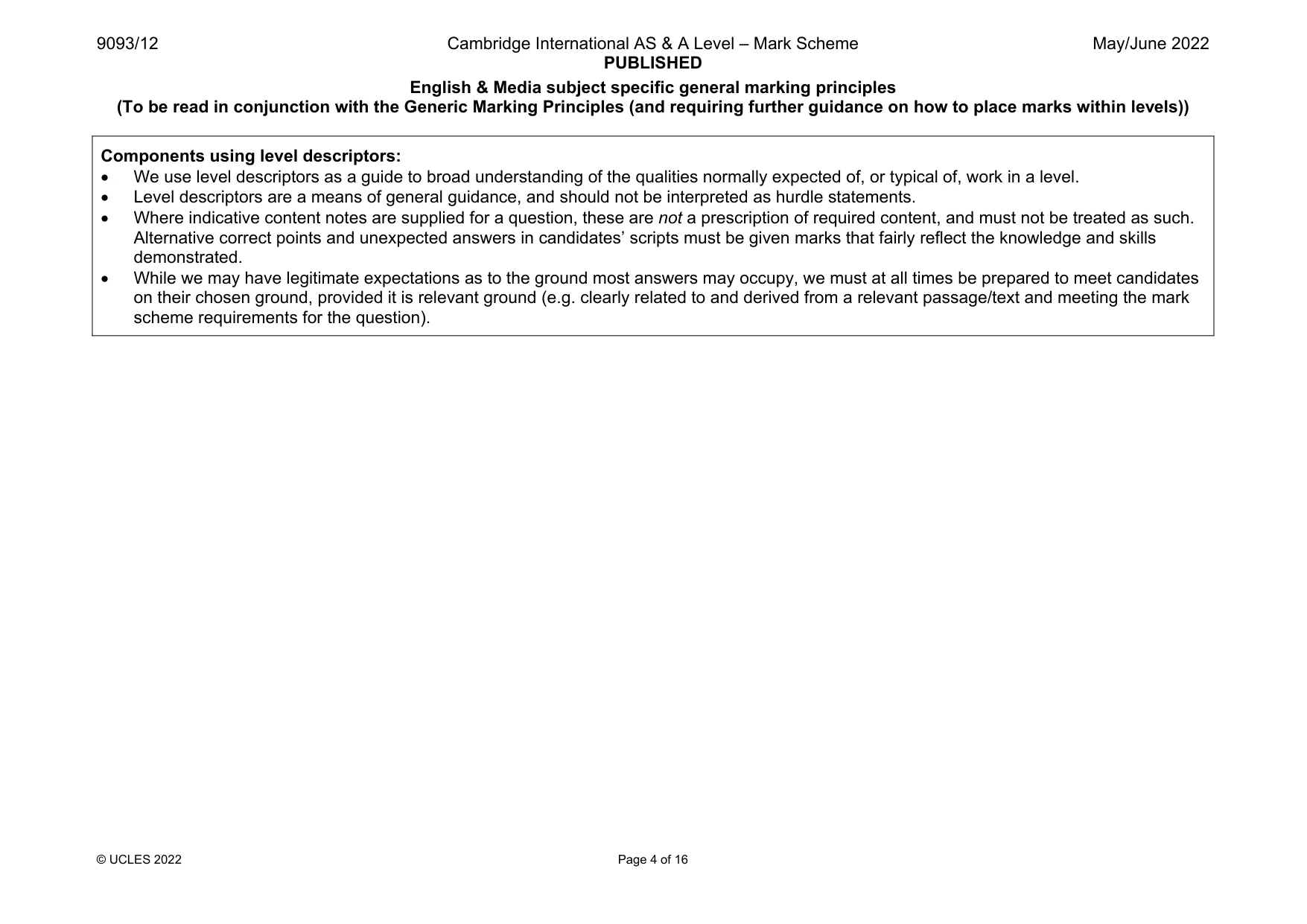
9093/12 Cambridge International AS & A Level – Mark Scheme PUBLISHED May/June 2022 © UCLES 2022 Page 4 of 16 English & Media subject specific general marking principles (To be read in conjunction with the Generic Marking Principles (and requiring further guidance on how to place marks within levels)) Components using level descriptors: We use level descriptors as a guide to broad understanding of the qualities normally expected of, or typical of, work in a level. Level descriptors are a means of general guidance, and should not be interpreted as hurdle statements. Where indicative content notes are supplied for a question, these are not a prescription of required content, and must not be treated as such. Alternative correct points and unexpected answers in candidates’ scripts must be given marks that fairly reflect the knowledge and skills demonstrated. While we may have legitimate expectations as to the ground most answers may occupy, we must at all times be prepared to meet candidates on their chosen ground, provided it is relevant ground (e.g. clearly related to and derived from a relevant passage/text and meeting the mark scheme requirements for the question).
Mark scheme, page 5
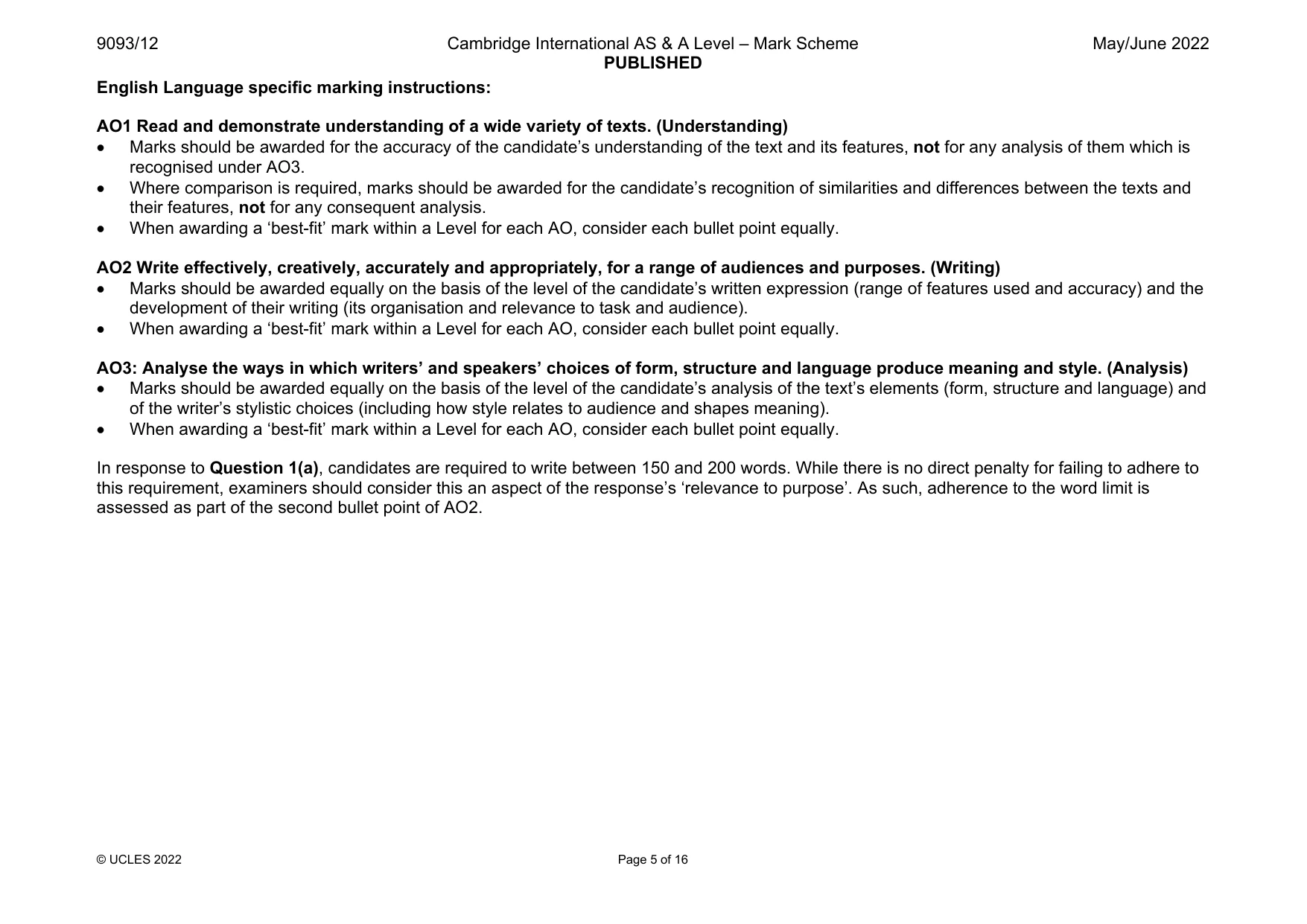
9093/12 Cambridge International AS & A Level – Mark Scheme PUBLISHED May/June 2022 © UCLES 2022 Page 5 of 16 English Language specific marking instructions: AO1 Read and demonstrate understanding of a wide variety of texts. (Understanding) Marks should be awarded for the accuracy of the candidate’s understanding of the text and its features, not for any analysis of them which is recognised under AO3. Where comparison is required, marks should be awarded for the candidate’s recognition of similarities and differences between the texts and their features, not for any consequent analysis. When awarding a ‘best-fit’ mark within a Level for each AO, consider each bullet point equally. AO2 Write effectively, creatively, accurately and appropriately, for a range of audiences and purposes. (Writing) Marks should be awarded equally on the basis of the level of the candidate’s written expression (range of features used and accuracy) and the development of their writing (its organisation and relevance to task and audience). When awarding a ‘best-fit’ mark within a Level for each AO, consider each bullet point equally. AO3: Analyse the ways in which writers’ and speakers’ choices of form, structure and language produce meaning and style. (Analysis) Marks should be awarded equally on the basis of the level of the candidate’s analysis of the text’s elements (form, structure and language) and of the writer’s stylistic choices (including how style relates to audience and shapes meaning). When awarding a ‘best-fit’ mark within a Level for each AO, consider each bullet point equally. In response to Question 1(a), candidates are required to write between 150 and 200 words. While there is no direct penalty for failing to adhere to this requirement, examiners should consider this an aspect of the response’s ‘relevance to purpose’. As such, adherence to the word limit is assessed as part of the second bullet point of AO2.
Mark scheme, page 6
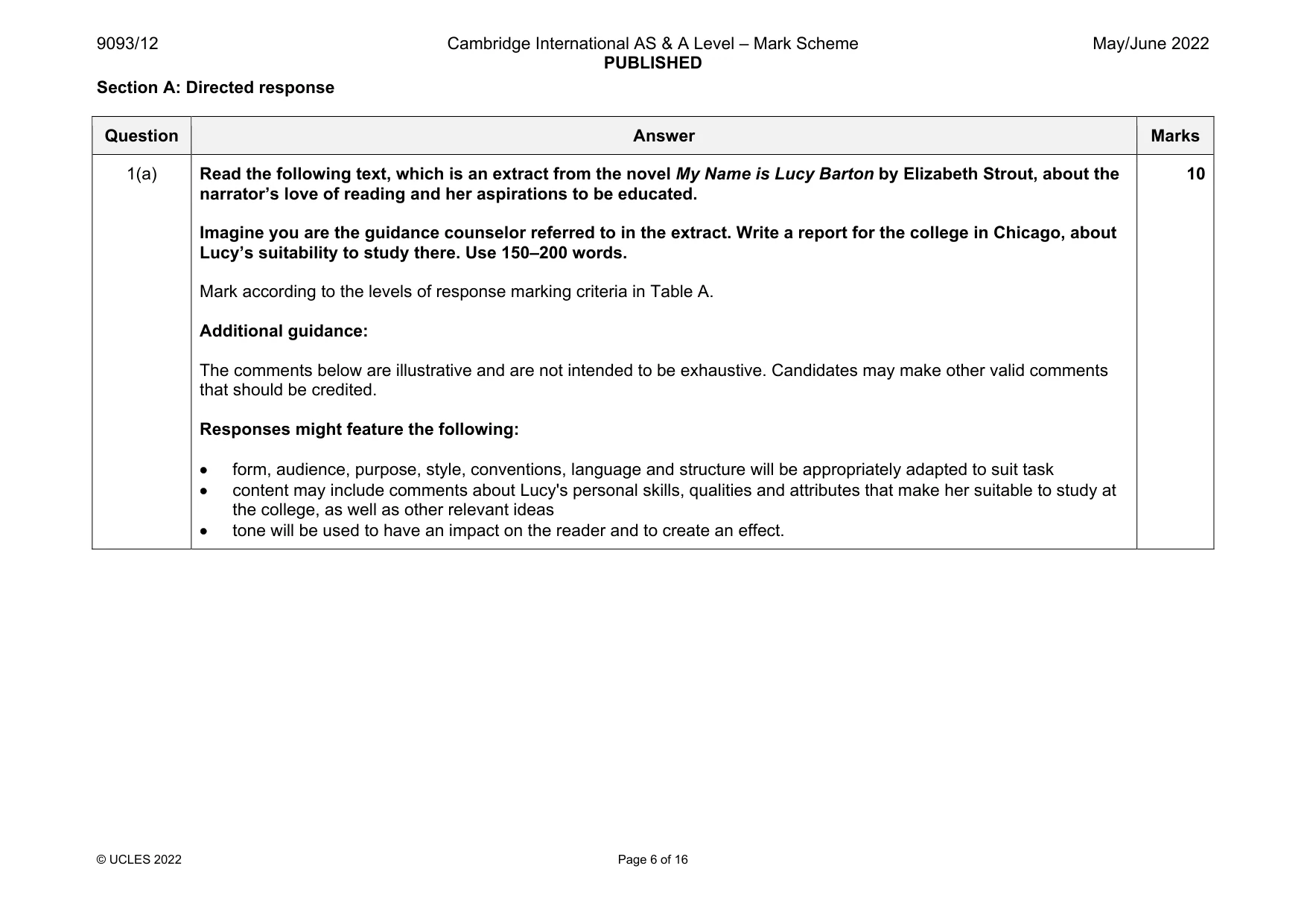
9093/12 Cambridge International AS & A Level – Mark Scheme PUBLISHED May/June 2022 © UCLES 2022 Page 6 of 16 Section A: Directed response Question Answer Marks 1(a) Read the following text, which is an extract from the novel My Name is Lucy Barton by Elizabeth Strout, about the narrator’s love of reading and her aspirations to be educated. Imagine you are the guidance counselor referred to in the extract. Write a report for the college in Chicago, about Lucy’s suitability to study there. Use 150–200 words. Mark according to the levels of response marking criteria in Table A. Additional guidance: The comments below are illustrative and are not intended to be exhaustive. Candidates may make other valid comments that should be credited. Responses might feature the following: form, audience, purpose, style, conventions, language and structure will be appropriately adapted to suit task content may include comments about Lucy's personal skills, qualities and attributes that make her suitable to study at the college, as well as other relevant ideas tone will be used to have an impact on the reader and to create an effect. 10
Mark scheme, page 7
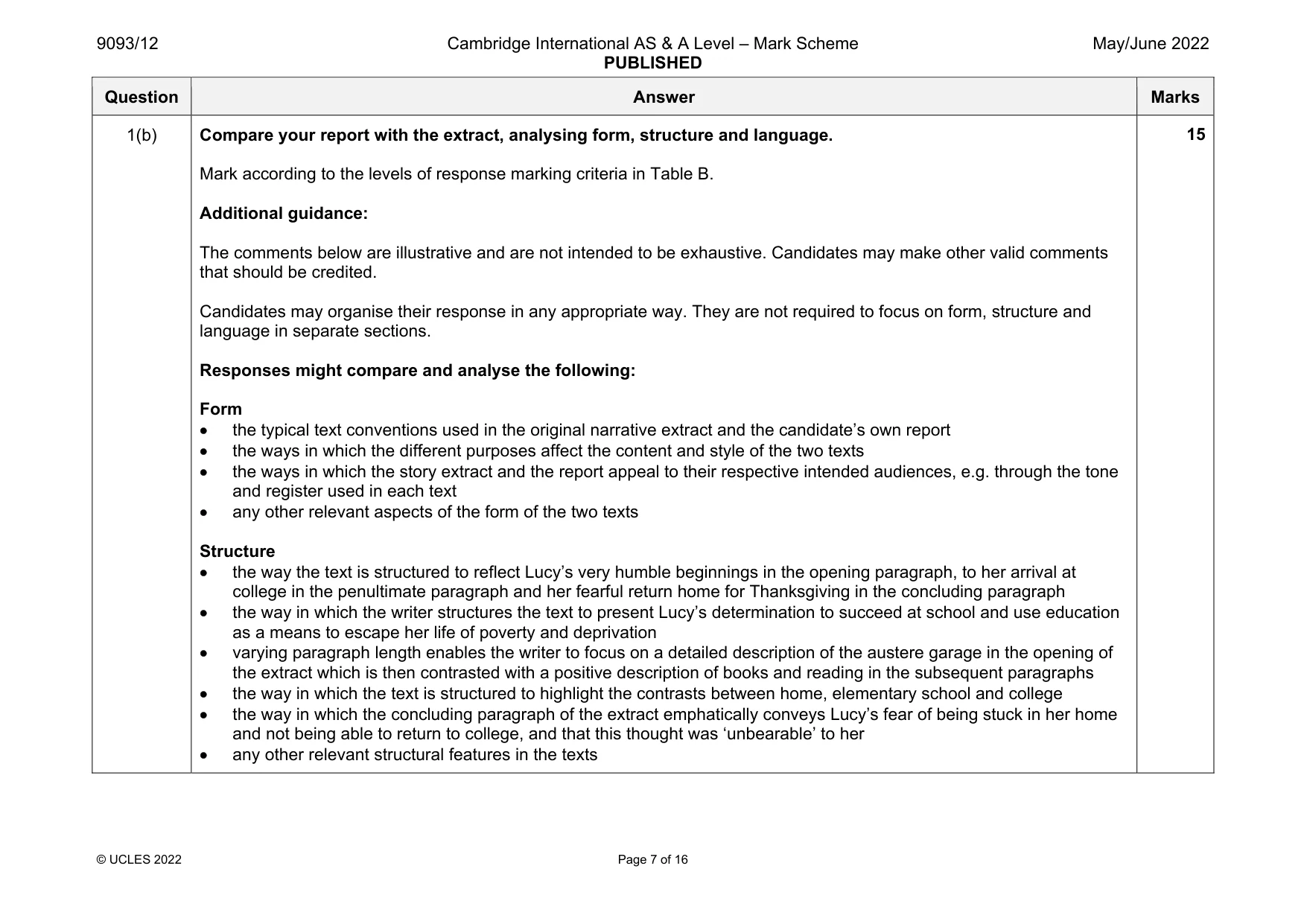
9093/12 Cambridge International AS & A Level – Mark Scheme PUBLISHED May/June 2022 © UCLES 2022 Page 7 of 16 Question Answer Marks 1(b) Compare your report with the extract, analysing form, structure and language. Mark according to the levels of response marking criteria in Table B. Additional guidance: The comments below are illustrative and are not intended to be exhaustive. Candidates may make other valid comments that should be credited. Candidates may organise their response in any appropriate way. They are not required to focus on form, structure and language in separate sections. Responses might compare and analyse the following: Form the typical text conventions used in the original narrative extract and the candidate’s own report the ways in which the different purposes affect the content and style of the two texts the ways in which the story extract and the report appeal to their respective intended audiences, e.g. through the tone and register used in each text any other relevant aspects of the form of the two texts Structure the way the text is structured to reflect Lucy’s very humble beginnings in the opening paragraph, to her arrival at college in the penultimate paragraph and her fearful return home for Thanksgiving in the concluding paragraph the way in which the writer structures the text to present Lucy’s determination to succeed at school and use education as a means to escape her life of poverty and deprivation varying paragraph length enables the writer to focus on a detailed description of the austere garage in the opening of the extract which is then contrasted with a positive description of books and reading in the subsequent paragraphs the way in which the text is structured to highlight the contrasts between home, elementary school and college the way in which the concluding paragraph of the extract emphatically conveys Lucy’s fear of being stuck in her home and not being able to return to college, and that this thought was ‘unbearable’ to her any other relevant structural features in the texts 15
Mark scheme, page 8
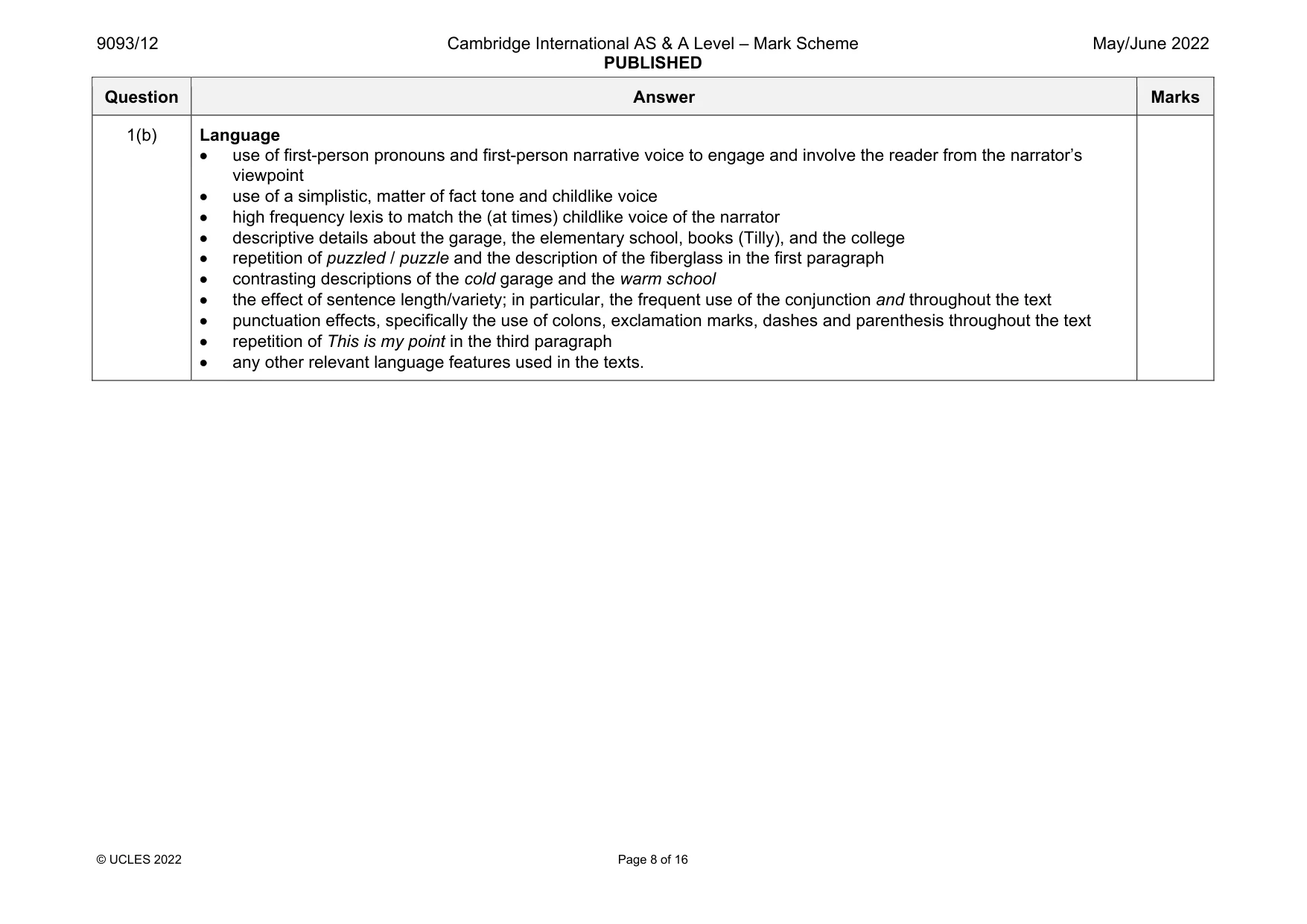
9093/12 Cambridge International AS & A Level – Mark Scheme PUBLISHED May/June 2022 © UCLES 2022 Page 8 of 16 Question Answer Marks 1(b) Language use of first-person pronouns and first-person narrative voice to engage and involve the reader from the narrator’s viewpoint use of a simplistic, matter of fact tone and childlike voice high frequency lexis to match the (at times) childlike voice of the narrator descriptive details about the garage, the elementary school, books (Tilly), and the college repetition of puzzled / puzzle and the description of the fiberglass in the first paragraph contrasting descriptions of the cold garage and the warm school the effect of sentence length/variety; in particular, the frequent use of the conjunction and throughout the text punctuation effects, specifically the use of colons, exclamation marks, dashes and parenthesis throughout the text repetition of This is my point in the third paragraph any other relevant language features used in the texts.
Mark scheme, page 9
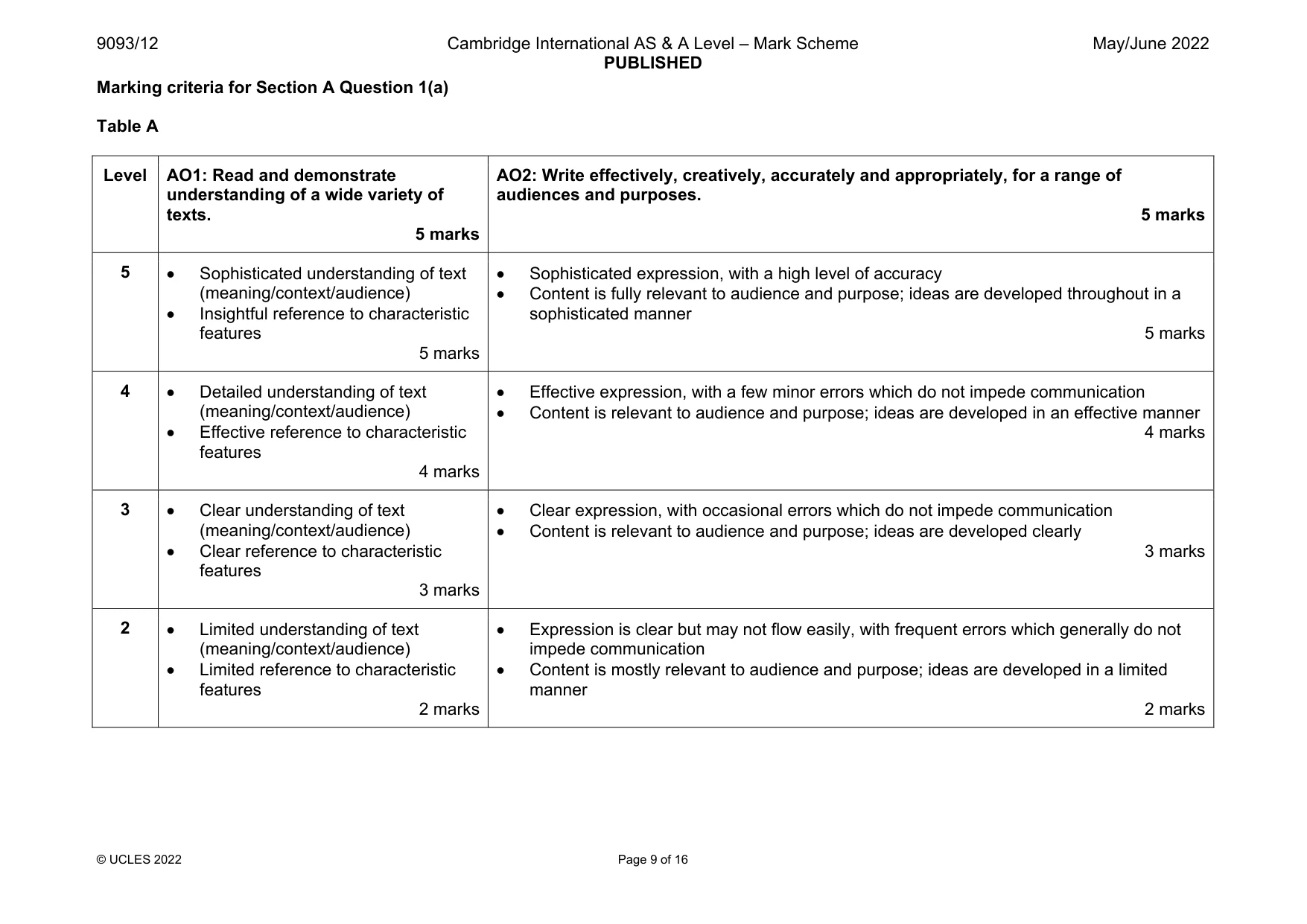
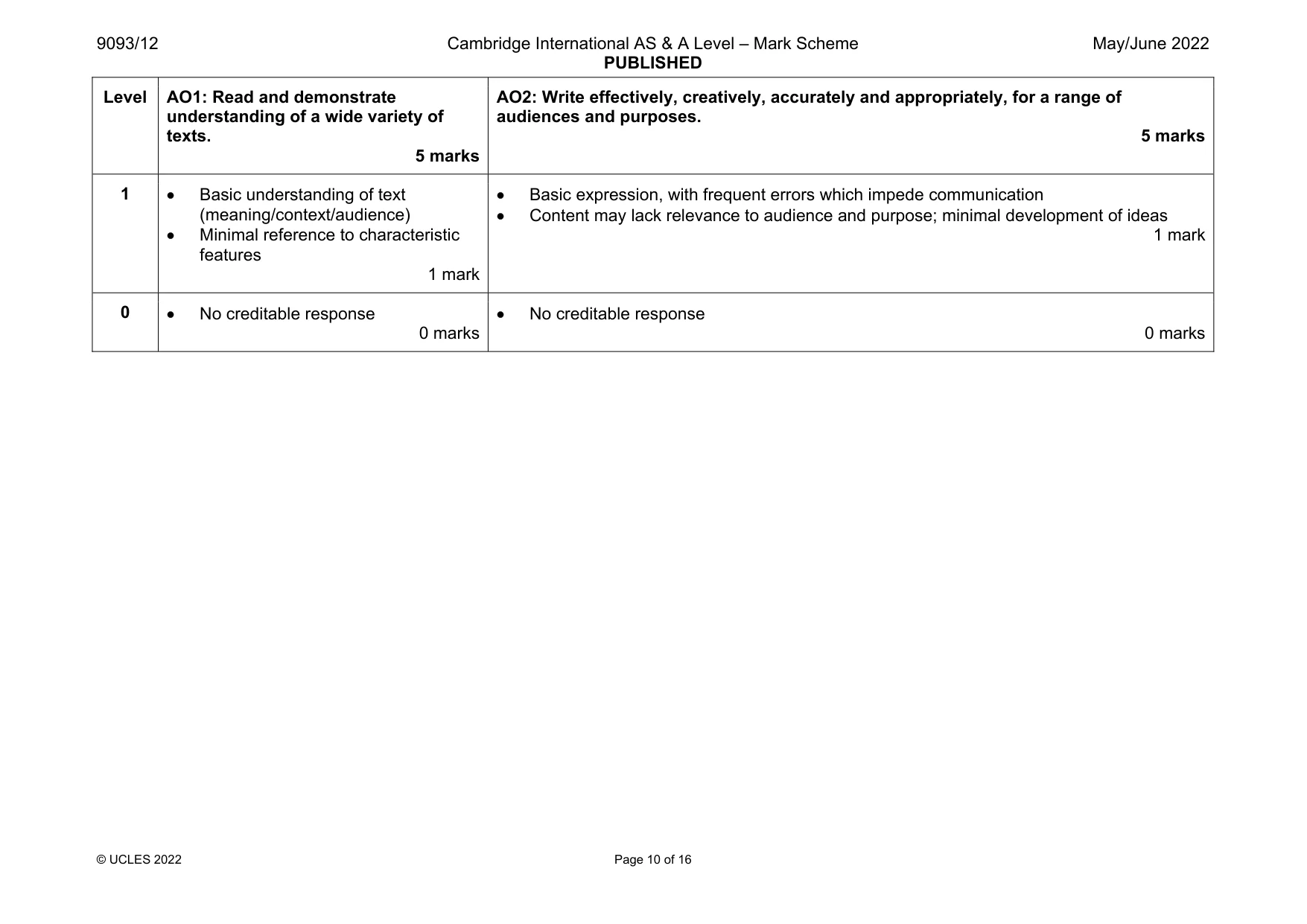
9093/12 Cambridge International AS & A Level – Mark Scheme PUBLISHED May/June 2022 © UCLES 2022 Page 9 of 16 Marking criteria for Section A Question 1(a) Table A Level AO1: Read and demonstrate understanding of a wide variety of texts. 5 marks AO2: Write effectively, creatively, accurately and appropriately, for a range of audiences and purposes. 5 marks 5 Sophisticated understanding of text (meaning/context/audience) Insightful reference to characteristic features 5 marks Sophisticated expression, with a high level of accuracy Content is fully relevant to audience and purpose; ideas are developed throughout in a sophisticated manner 5 marks 4 Detailed understanding of text (meaning/context/audience) Effective reference to characteristic features 4 marks Effective expression, with a few minor errors which do not impede communication Content is relevant to audience and purpose; ideas are developed in an effective manner 4 marks 3 Clear understanding of text (meaning/context/audience) Clear reference to characteristic features 3 marks Clear expression, with occasional errors which do not impede communication Content is relevant to audience and purpose; ideas are developed clearly 3 marks 2 Limited understanding of text (meaning/context/audience) Limited reference to characteristic features 2 marks Expression is clear but may not flow easily, with frequent errors which generally do not impede communication Content is mostly relevant to audience and purpose; ideas are developed in a limited manner 2 marks
Mark scheme, page 10
9093/12 Cambridge International AS & A Level – Mark Scheme PUBLISHED May/June 2022 © UCLES 2022 Page 10 of 16 Level AO1: Read and demonstrate understanding of a wide variety of texts. 5 marks AO2: Write effectively, creatively, accurately and appropriately, for a range of audiences and purposes. 5 marks 1 Basic understanding of text (meaning/context/audience) Minimal reference to characteristic features 1 mark Basic expression, with frequent errors which impede communication Content may lack relevance to audience and purpose; minimal development of ideas 1 mark 0 No creditable response 0 marks No creditable response 0 marks
Mark scheme, page 11
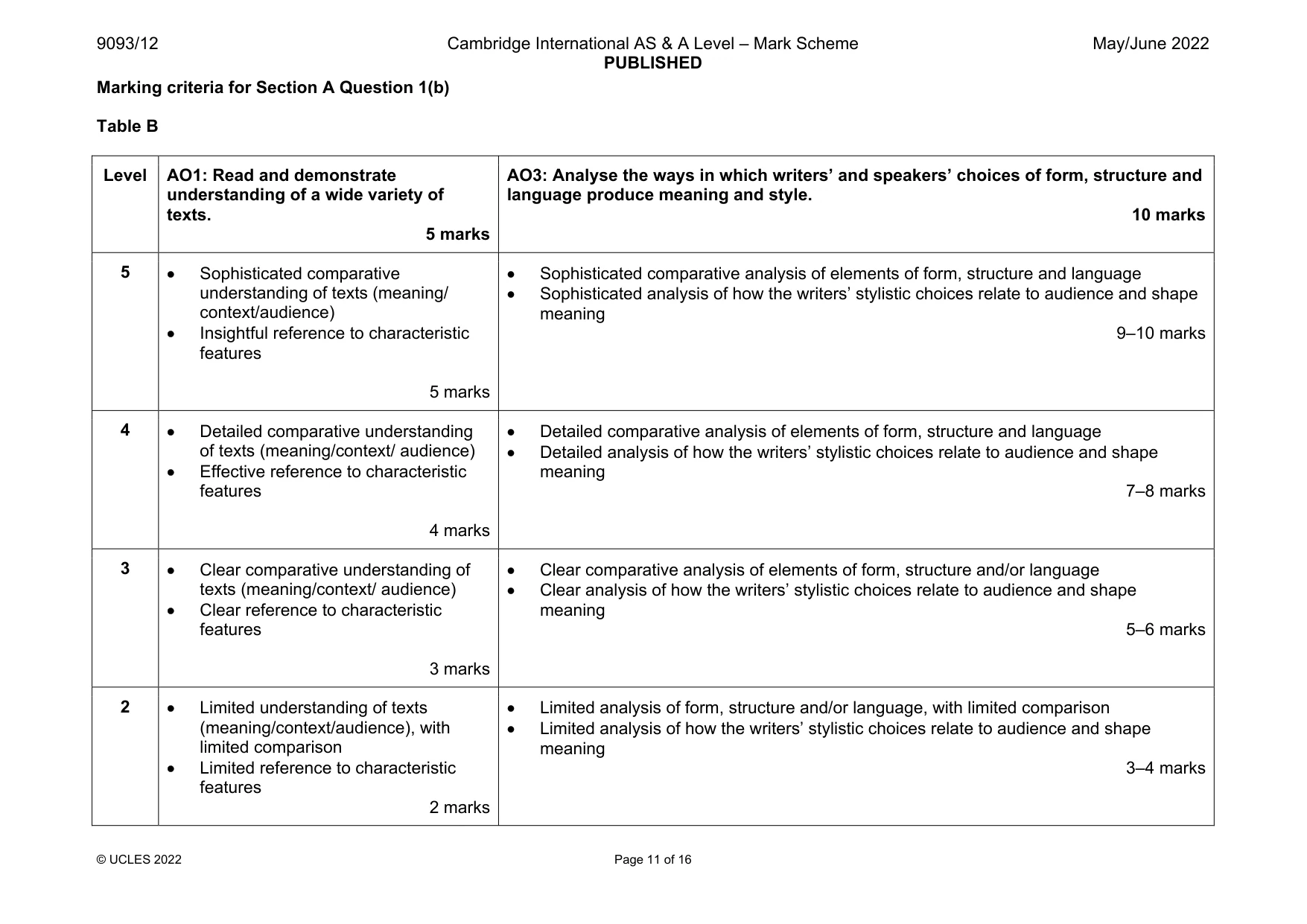
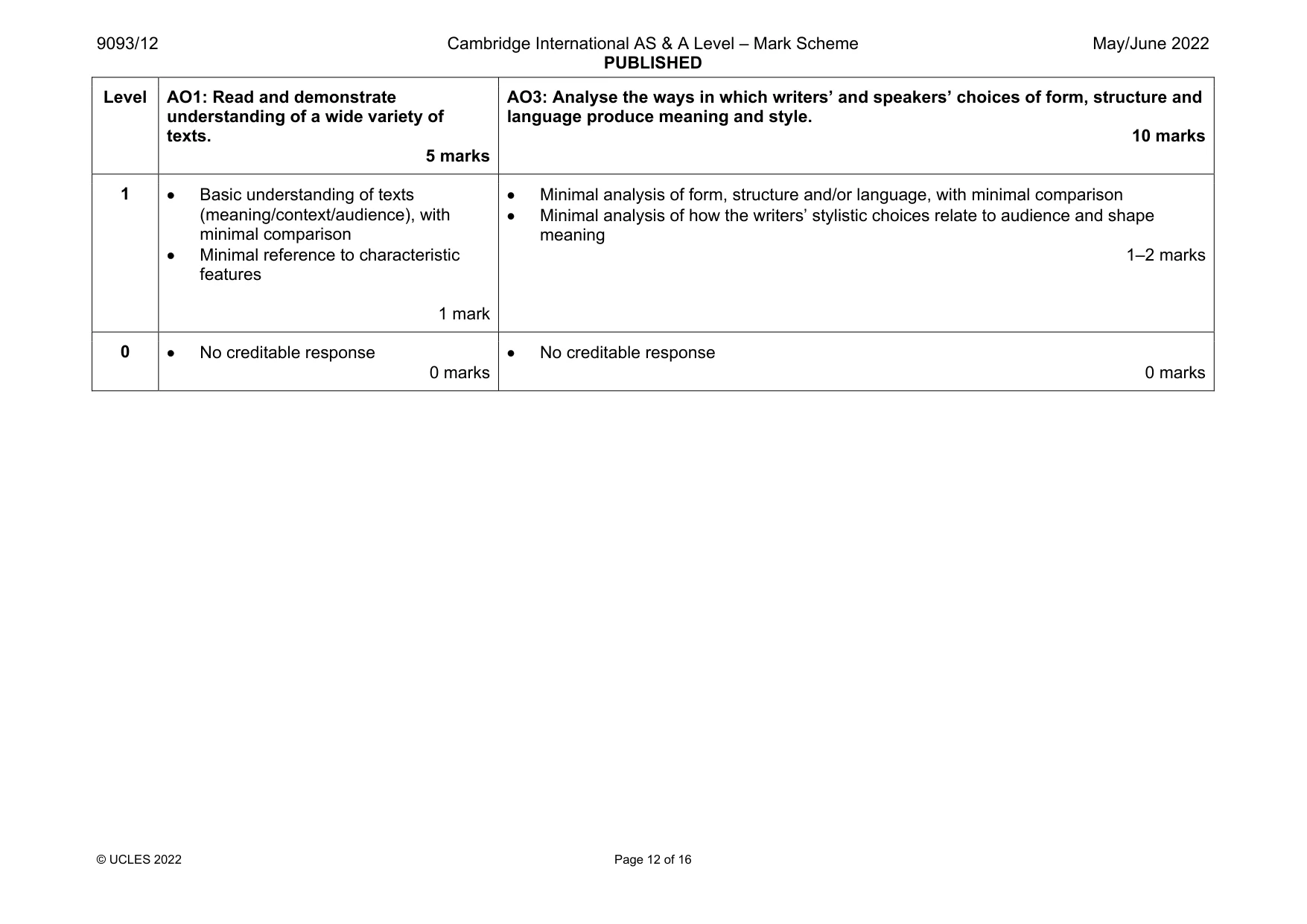
9093/12 Cambridge International AS & A Level – Mark Scheme PUBLISHED May/June 2022 © UCLES 2022 Page 11 of 16 Marking criteria for Section A Question 1(b) Table B Level AO1: Read and demonstrate understanding of a wide variety of texts. 5 marks AO3: Analyse the ways in which writers’ and speakers’ choices of form, structure and language produce meaning and style. 10 marks 5 Sophisticated comparative understanding of texts (meaning/ context/audience) Insightful reference to characteristic features 5 marks Sophisticated comparative analysis of elements of form, structure and language Sophisticated analysis of how the writers’ stylistic choices relate to audience and shape meaning 9–10 marks 4 Detailed comparative understanding of texts (meaning/context/ audience) Effective reference to characteristic features 4 marks Detailed comparative analysis of elements of form, structure and language Detailed analysis of how the writers’ stylistic choices relate to audience and shape meaning 7–8 marks 3 Clear comparative understanding of texts (meaning/context/ audience) Clear reference to characteristic features 3 marks Clear comparative analysis of elements of form, structure and/or language Clear analysis of how the writers’ stylistic choices relate to audience and shape meaning 5–6 marks 2 Limited understanding of texts (meaning/context/audience), with limited comparison Limited reference to characteristic features 2 marks Limited analysis of form, structure and/or language, with limited comparison Limited analysis of how the writers’ stylistic choices relate to audience and shape meaning 3–4 marks
Mark scheme, page 12
9093/12 Cambridge International AS & A Level – Mark Scheme PUBLISHED May/June 2022 © UCLES 2022 Page 12 of 16 Level AO1: Read and demonstrate understanding of a wide variety of texts. 5 marks AO3: Analyse the ways in which writers’ and speakers’ choices of form, structure and language produce meaning and style. 10 marks 1 Basic understanding of texts (meaning/context/audience), with minimal comparison Minimal reference to characteristic features 1 mark Minimal analysis of form, structure and/or language, with minimal comparison Minimal analysis of how the writers’ stylistic choices relate to audience and shape meaning 1–2 marks 0 No creditable response 0 marks No creditable response 0 marks
Mark scheme, page 13
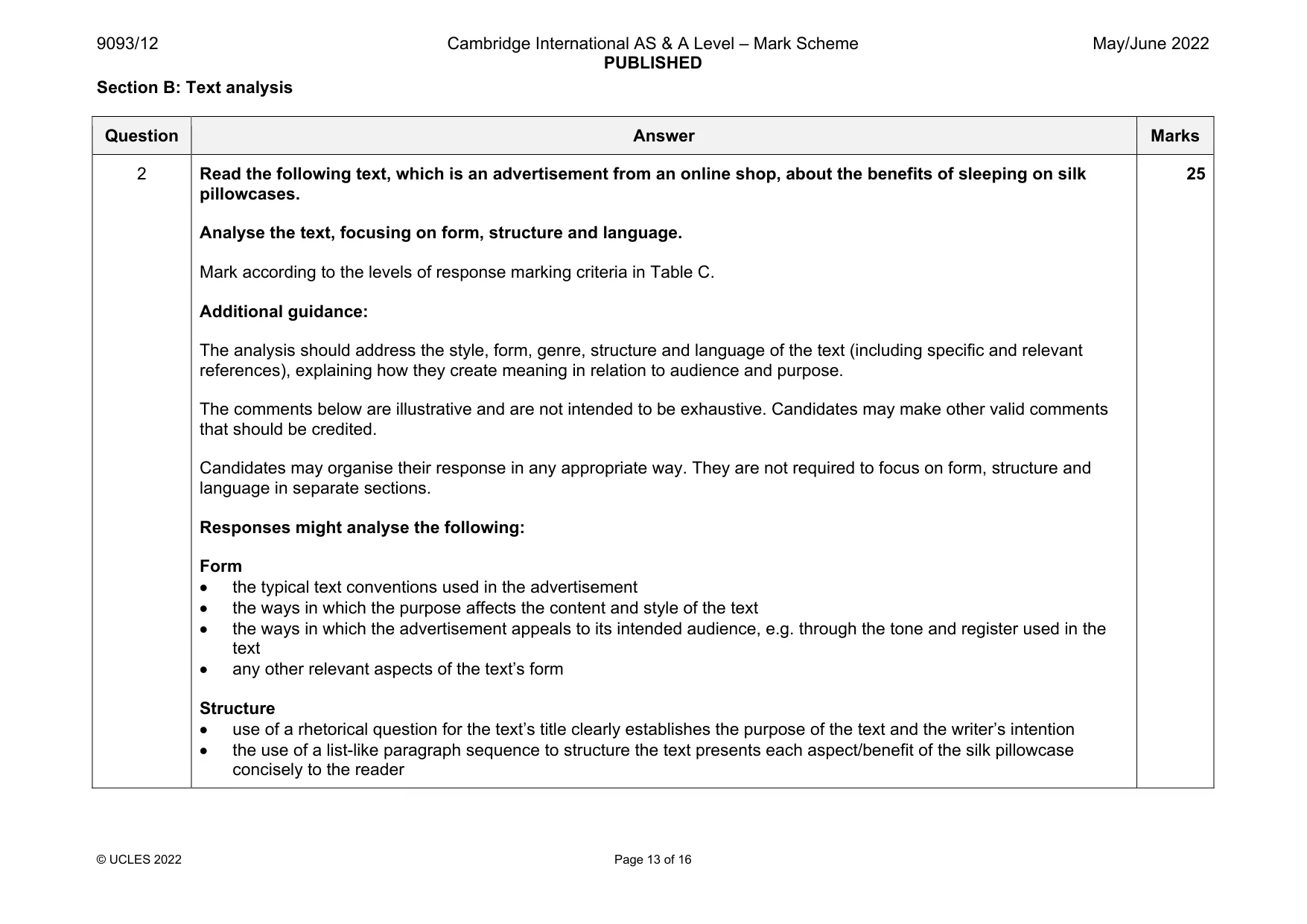
9093/12 Cambridge International AS & A Level – Mark Scheme PUBLISHED May/June 2022 © UCLES 2022 Page 13 of 16 Section B: Text analysis Question Answer Marks 2 Read the following text, which is an advertisement from an online shop, about the benefits of sleeping on silk pillowcases. Analyse the text, focusing on form, structure and language. Mark according to the levels of response marking criteria in Table C. Additional guidance: The analysis should address the style, form, genre, structure and language of the text (including specific and relevant references), explaining how they create meaning in relation to audience and purpose. The comments below are illustrative and are not intended to be exhaustive. Candidates may make other valid comments that should be credited. Candidates may organise their response in any appropriate way. They are not required to focus on form, structure and language in separate sections. Responses might analyse the following: Form the typical text conventions used in the advertisement the ways in which the purpose affects the content and style of the text the ways in which the advertisement appeals to its intended audience, e.g. through the tone and register used in the text any other relevant aspects of the text’s form Structure use of a rhetorical question for the text’s title clearly establishes the purpose of the text and the writer’s intention the use of a list-like paragraph sequence to structure the text presents each aspect/benefit of the silk pillowcase concisely to the reader 25
Mark scheme, page 14
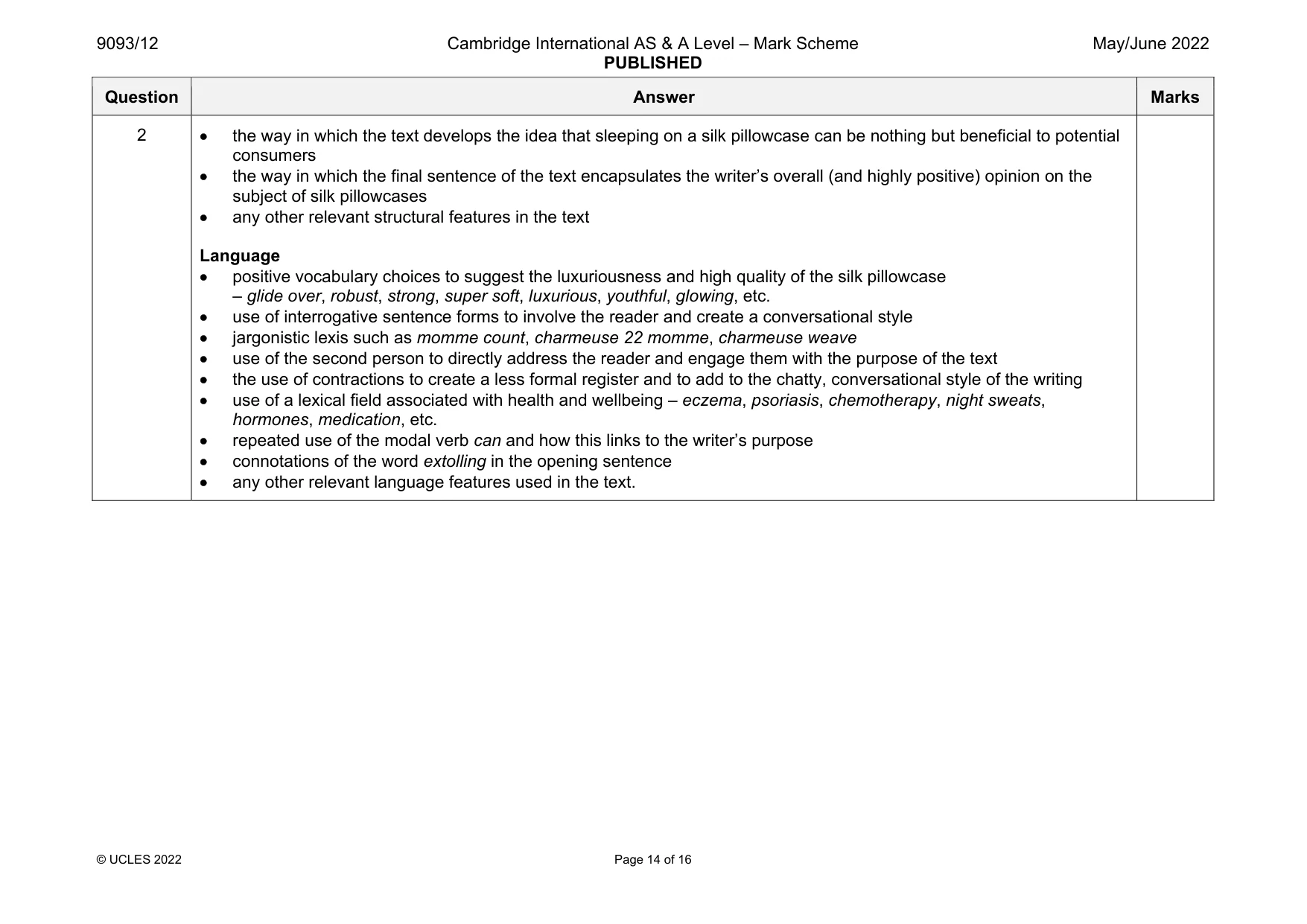
9093/12 Cambridge International AS & A Level – Mark Scheme PUBLISHED May/June 2022 © UCLES 2022 Page 14 of 16 Question Answer Marks 2 the way in which the text develops the idea that sleeping on a silk pillowcase can be nothing but beneficial to potential consumers the way in which the final sentence of the text encapsulates the writer’s overall (and highly positive) opinion on the subject of silk pillowcases any other relevant structural features in the text Language positive vocabulary choices to suggest the luxuriousness and high quality of the silk pillowcase – glide over, robust, strong, super soft, luxurious, youthful, glowing, etc. use of interrogative sentence forms to involve the reader and create a conversational style jargonistic lexis such as momme count, charmeuse 22 momme, charmeuse weave use of the second person to directly address the reader and engage them with the purpose of the text the use of contractions to create a less formal register and to add to the chatty, conversational style of the writing use of a lexical field associated with health and wellbeing – eczema, psoriasis, chemotherapy, night sweats, hormones, medication, etc. repeated use of the modal verb can and how this links to the writer’s purpose connotations of the word extolling in the opening sentence any other relevant language features used in the text.
Mark scheme, page 15
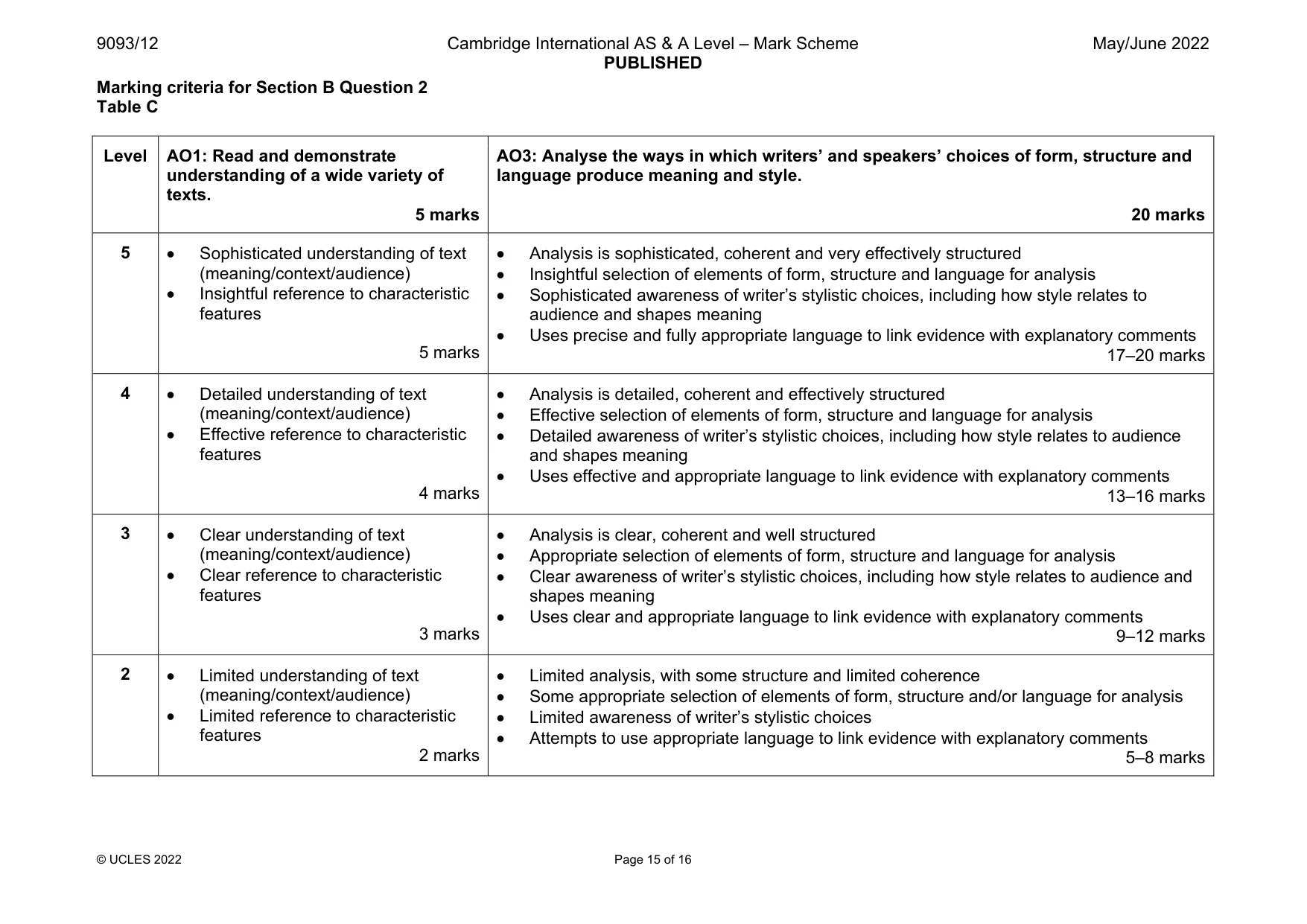
9093/12 Cambridge International AS & A Level – Mark Scheme PUBLISHED May/June 2022 © UCLES 2022 Page 15 of 16 Marking criteria for Section B Question 2 Table C Level AO1: Read and demonstrate understanding of a wide variety of texts. 5 marks AO3: Analyse the ways in which writers’ and speakers’ choices of form, structure and language produce meaning and style. 20 marks 5 Sophisticated understanding of text (meaning/context/audience) Insightful reference to characteristic features 5 marks Analysis is sophisticated, coherent and very effectively structured Insightful selection of elements of form, structure and language for analysis Sophisticated awareness of writer’s stylistic choices, including how style relates to audience and shapes meaning Uses precise and fully appropriate language to link evidence with explanatory comments 17–20 marks 4 Detailed understanding of text (meaning/context/audience) Effective reference to characteristic features 4 marks Analysis is detailed, coherent and effectively structured Effective selection of elements of form, structure and language for analysis Detailed awareness of writer’s stylistic choices, including how style relates to audience and shapes meaning Uses effective and appropriate language to link evidence with explanatory comments 13–16 marks 3 Clear understanding of text (meaning/context/audience) Clear reference to characteristic features 3 marks Analysis is clear, coherent and well structured Appropriate selection of elements of form, structure and language for analysis Clear awareness of writer’s stylistic choices, including how style relates to audience and shapes meaning Uses clear and appropriate language to link evidence with explanatory comments 9–12 marks 2 Limited understanding of text (meaning/context/audience) Limited reference to characteristic features 2 marks Limited analysis, with some structure and limited coherence Some appropriate selection of elements of form, structure and/or language for analysis Limited awareness of writer’s stylistic choices Attempts to use appropriate language to link evidence with explanatory comments 5–8 marks
Mark scheme, page 16
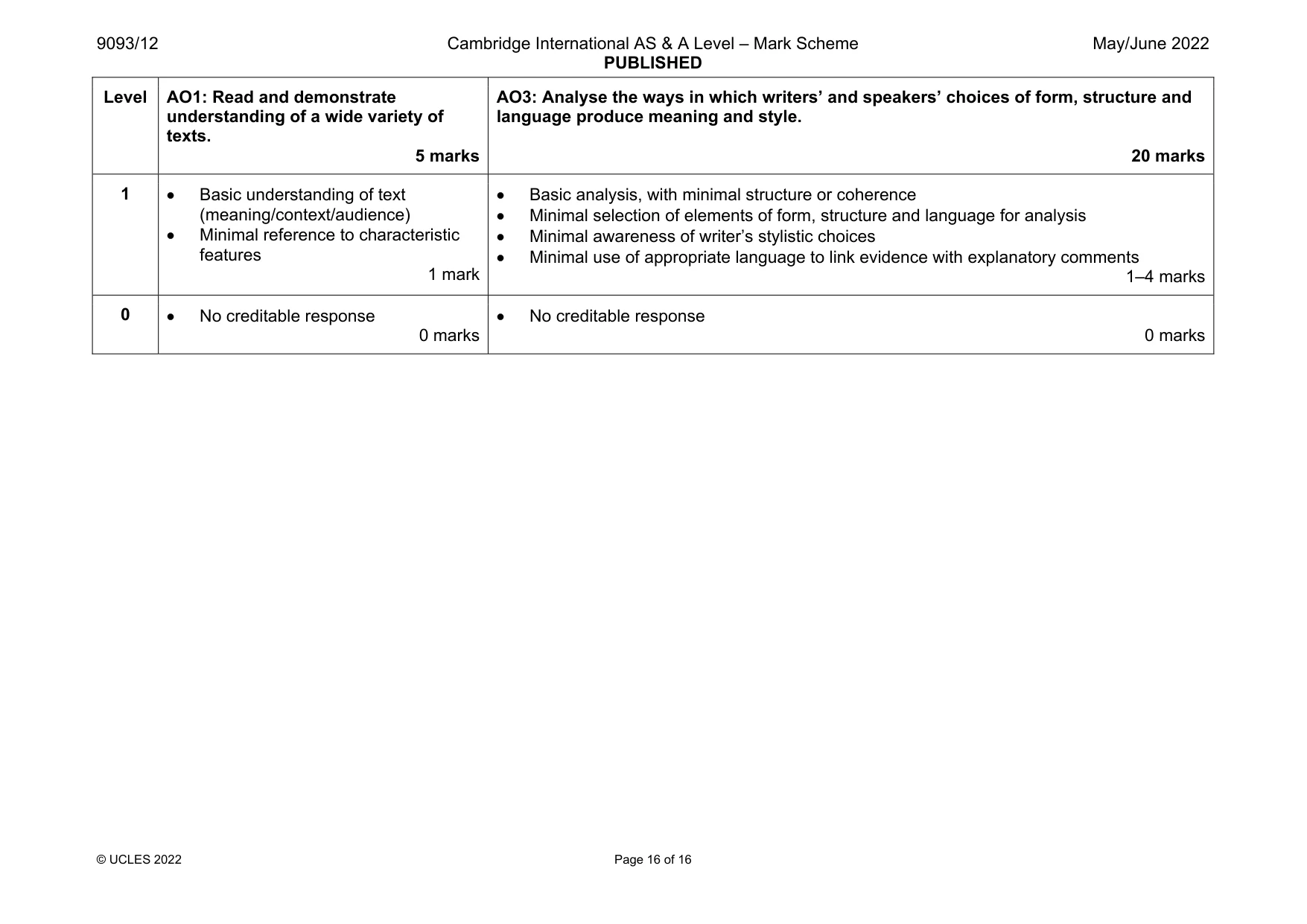
9093/12 Cambridge International AS & A Level – Mark Scheme PUBLISHED May/June 2022 © UCLES 2022 Page 16 of 16 Level AO1: Read and demonstrate understanding of a wide variety of texts. 5 marks AO3: Analyse the ways in which writers’ and speakers’ choices of form, structure and language produce meaning and style. 20 marks 1 Basic understanding of text (meaning/context/audience) Minimal reference to characteristic features 1 mark Basic analysis, with minimal structure or coherence Minimal selection of elements of form, structure and language for analysis Minimal awareness of writer’s stylistic choices Minimal use of appropriate language to link evidence with explanatory comments 1–4 marks 0 No creditable response 0 marks No creditable response 0 marks
What you needed in this session
Cambridge’s own grade thresholds for 2022 May/June, Paper 1 · Variant 2. A higher threshold means an easier paper — the bar moves with how the cohort did.