Cambridge A Level English - Language AS and A Level (from 2014) 9093 — 2021 May/June Paper 3 · Variant 1
9093/31/M/J/21 · 50 marks · ≈56 min
The question paper and its mark scheme, free to read here and free to download. This is Cambridge’s own paper, exactly as it was sat.
Question paper8 pages
Mark scheme12 pages
Answers below. Sit the paper first if you are practising.
Paper as text
Question paper, page 1
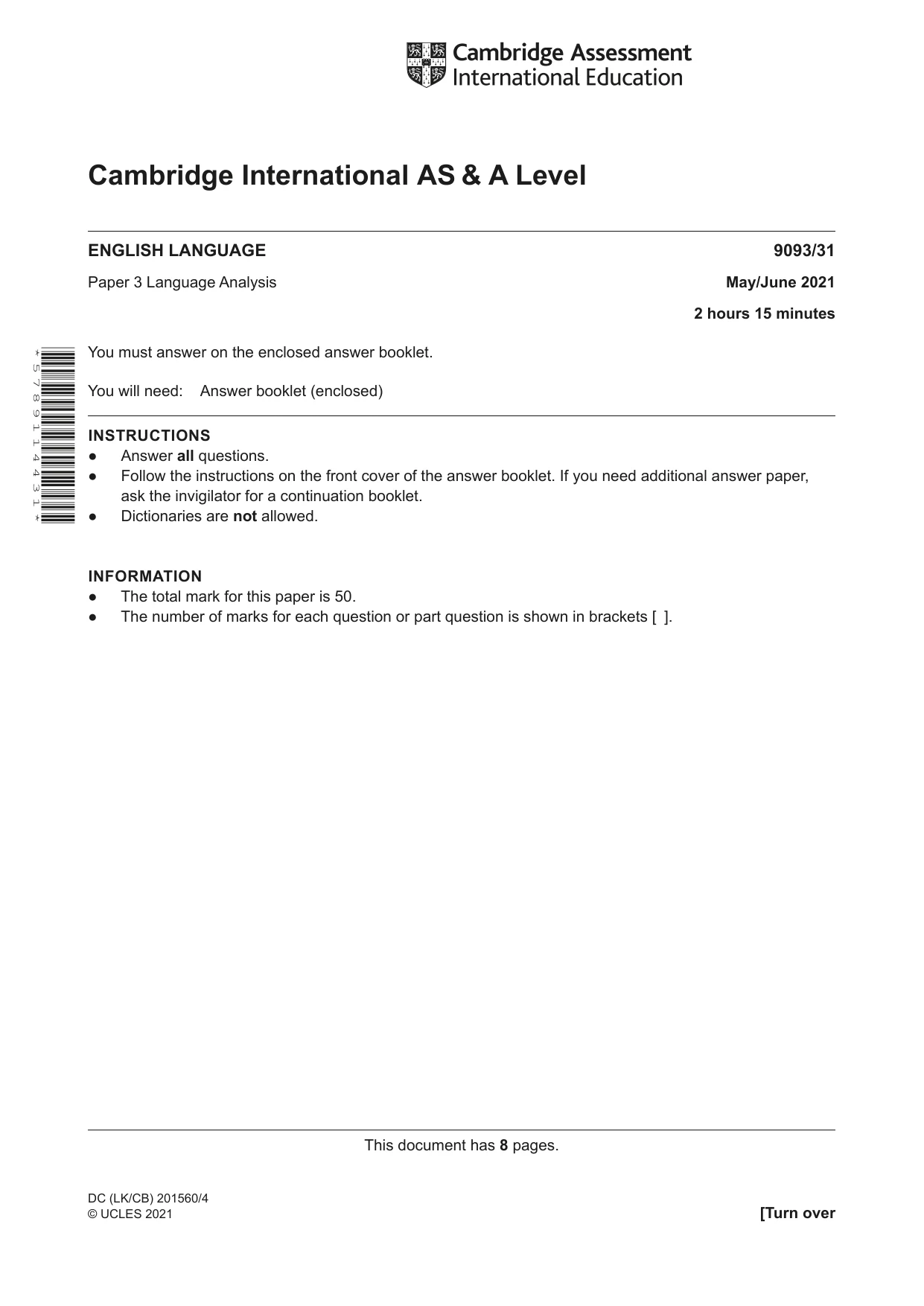
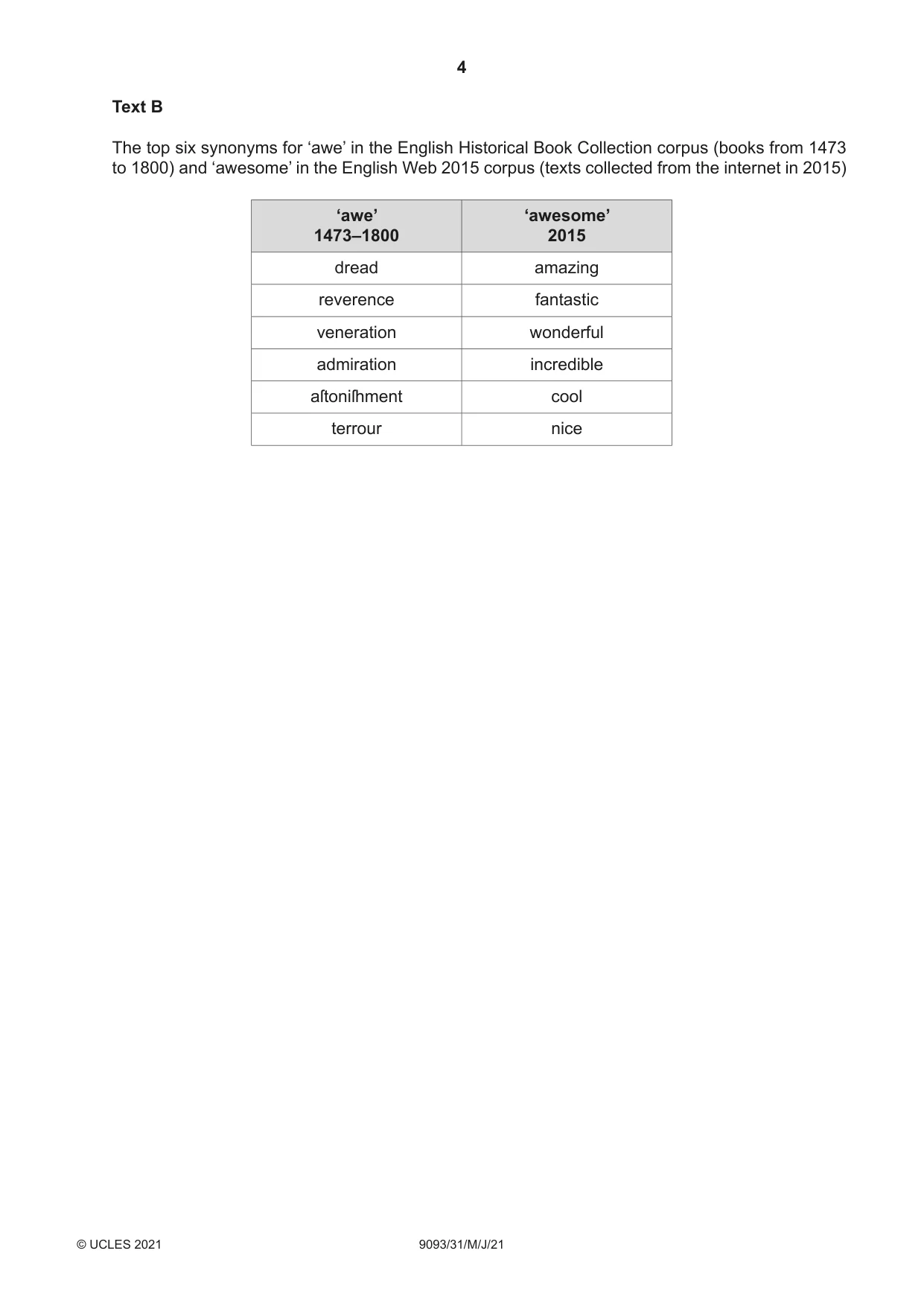
This document has 8 pages. Cambridge International AS & A Level ENGLISH LANGUAGE 9093/31 Paper 3 Language Analysis May/June 2021 2 hours 15 minutes You must answer on the enclosed answer booklet. You will need: Answer booklet (enclosed) INSTRUCTIONS ● Answer all questions. ● Follow the instructions on the front cover of the answer booklet. If you need additional answer paper, ask the invigilator for a continuation booklet. ● Dictionaries are not allowed. INFORMATION ● The total mark for this paper is 50. ● The number of marks for each question or part question is shown in brackets [ ]. DC (LK/CB) 201560/4 © UCLES 2021 [Turn over * 5 7 8 9 1 1 4 4 3 1 *
Question paper, page 2
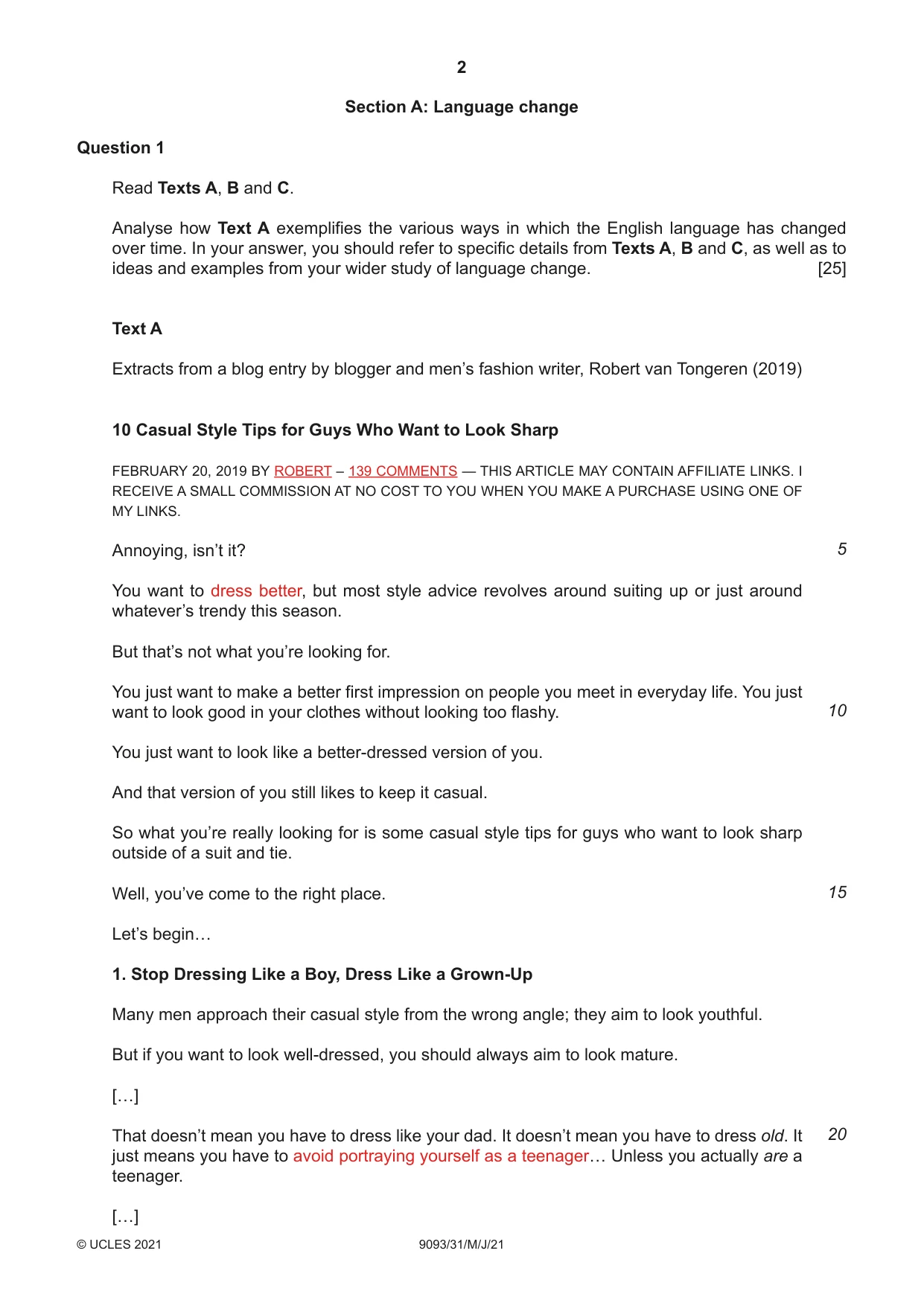
2 9093/31/M/J/21 © UCLES 2021 Section A: Language change Question 1 Read Texts A, B and C. Analyse how Text A exemplifies the various ways in which the English language has changed over time. In your answer, you should refer to specific details from Texts A, B and C, as well as to ideas and examples from your wider study of language change. [25] Text A Extracts from a blog entry by blogger and men’s fashion writer, Robert van Tongeren (2019) 10 Casual Style Tips for Guys Who Want to Look Sharp FEBRUARY 20, 2019 BY ROBERT – 139 COMMENTS — THIS ARTICLE MAY CONTAIN AFFILIATE LINKS. I RECEIVE A SMALL COMMISSION AT NO COST TO YOU WHEN YOU MAKE A PURCHASE USING ONE OF MY LINKS. Annoying, isn’t it? You want to dress better, but most style advice revolves around suiting up or just around whatever’s trendy this season. But that’s not what you’re looking for. You just want to make a better first impression on people you meet in everyday life. You just want to look good in your clothes without looking too flashy. You just want to look like a better-dressed version of you. And that version of you still likes to keep it casual. So what you’re really looking for is some casual style tips for guys who want to look sharp outside of a suit and tie. Well, you’ve come to the right place. Let’s begin… 1. Stop Dressing Like a Boy, Dress Like a Grown-Up Many men approach their casual style from the wrong angle; they aim to look youthful. But if you want to look well-dressed, you should always aim to look mature. […] That doesn’t mean you have to dress like your dad. It doesn’t mean you have to dress old. It just means you have to avoid portraying yourself as a teenager… Unless you actually are a teenager. […] 5 10 15 20
Question paper, page 3
3 9093/31/M/J/21 © UCLES 2021 [Turn over 3. Rock Jeans That Actually Make You Look Good The go-to casual legwear for any guy is a pair of jeans. And nothing is wrong with that. Many men come to my site looking to move on from the T-shirt and jeans look. But jeans can look amazing, as long as you’re wearing the right pair. […] And FYI — avoid baggy jeans. You want to avoid having to pull up your jeans every two seconds. They should keep themselves up without a belt. Also, they should not pool around your ankles. Also, avoid embellishments. That means: No excessive distress, no rips, and none of that bleaching nonsense. And finally — this should go without saying, but I have to say it anyway — Avoid big logos anywhere on your outfit, PERIOD. Instead, keep your jeans simple. Go for a clean, dark-blue pair that fits like the ones suggested below. Trust me; you’ll look awesome. 25 30 35
Question paper, page 4
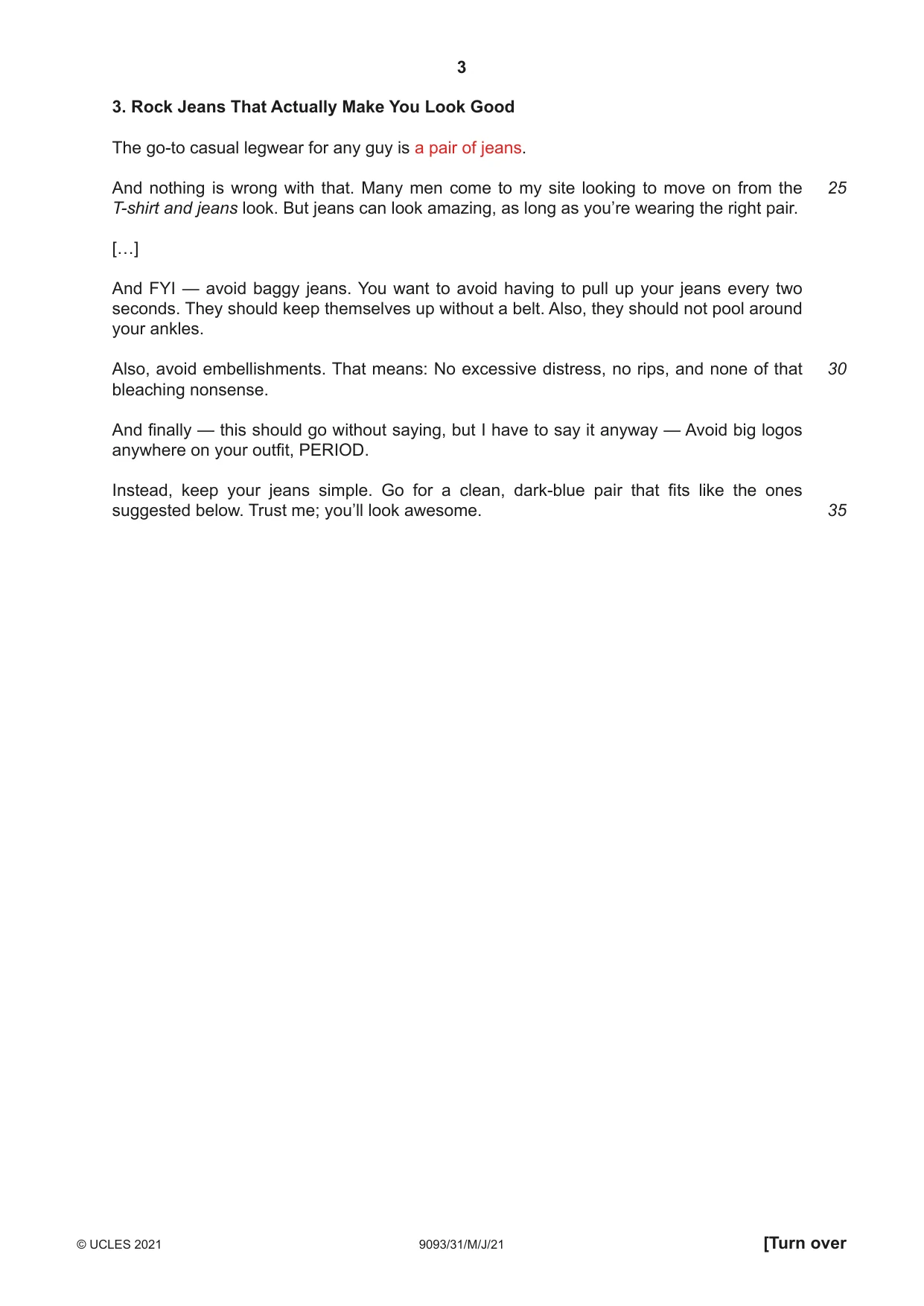
4 9093/31/M/J/21 © UCLES 2021 Text B The top six synonyms for ‘awe’ in the English Historical Book Collection corpus (books from 1473 to 1800) and ‘awesome’ in the English Web 2015 corpus (texts collected from the internet in 2015) ‘awe’ 1473–1800 ‘awesome’ 2015 dread amazing reverence fantastic veneration wonderful admiration incredible aſtoniſhment cool terrour nice
Question paper, page 5
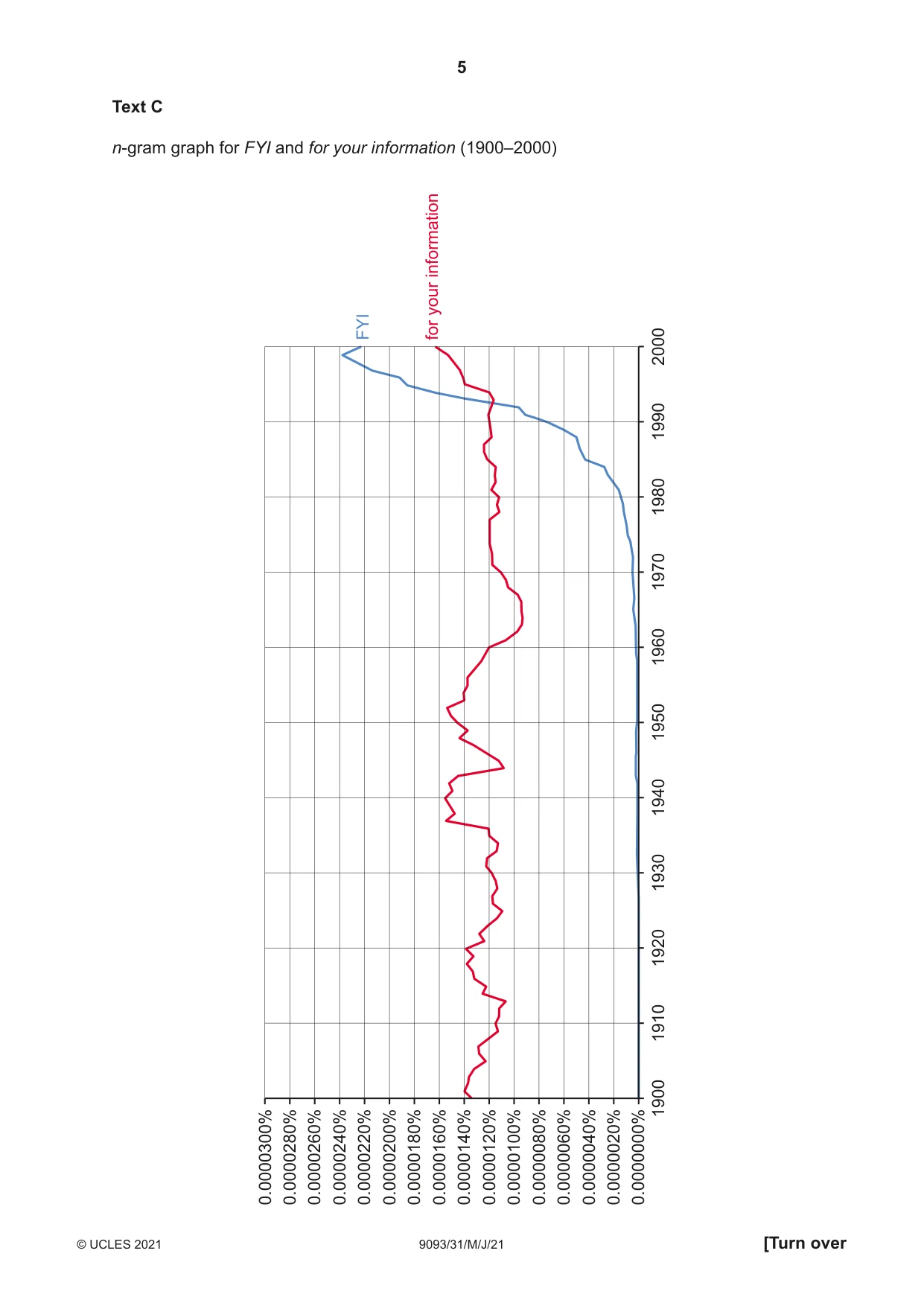
5 9093/31/M/J/21 © UCLES 2021 [Turn over Text C n-gram graph for FYI and for your information (1900–2000) 1900 0.0000000% 0.0000020% 0.0000040% 0.0000060% 0.0000080% 0.0000100% 0.0000120% 0.0000140% 0.0000160% 0.0000180% 0.0000200% 0.0000220% 0.0000240% 0.0000260% 0.0000280% 0.0000300% 1910 1920 1930 1940 1950 1960 1970 1980 1990 2000 FYI for your information
Question paper, page 6
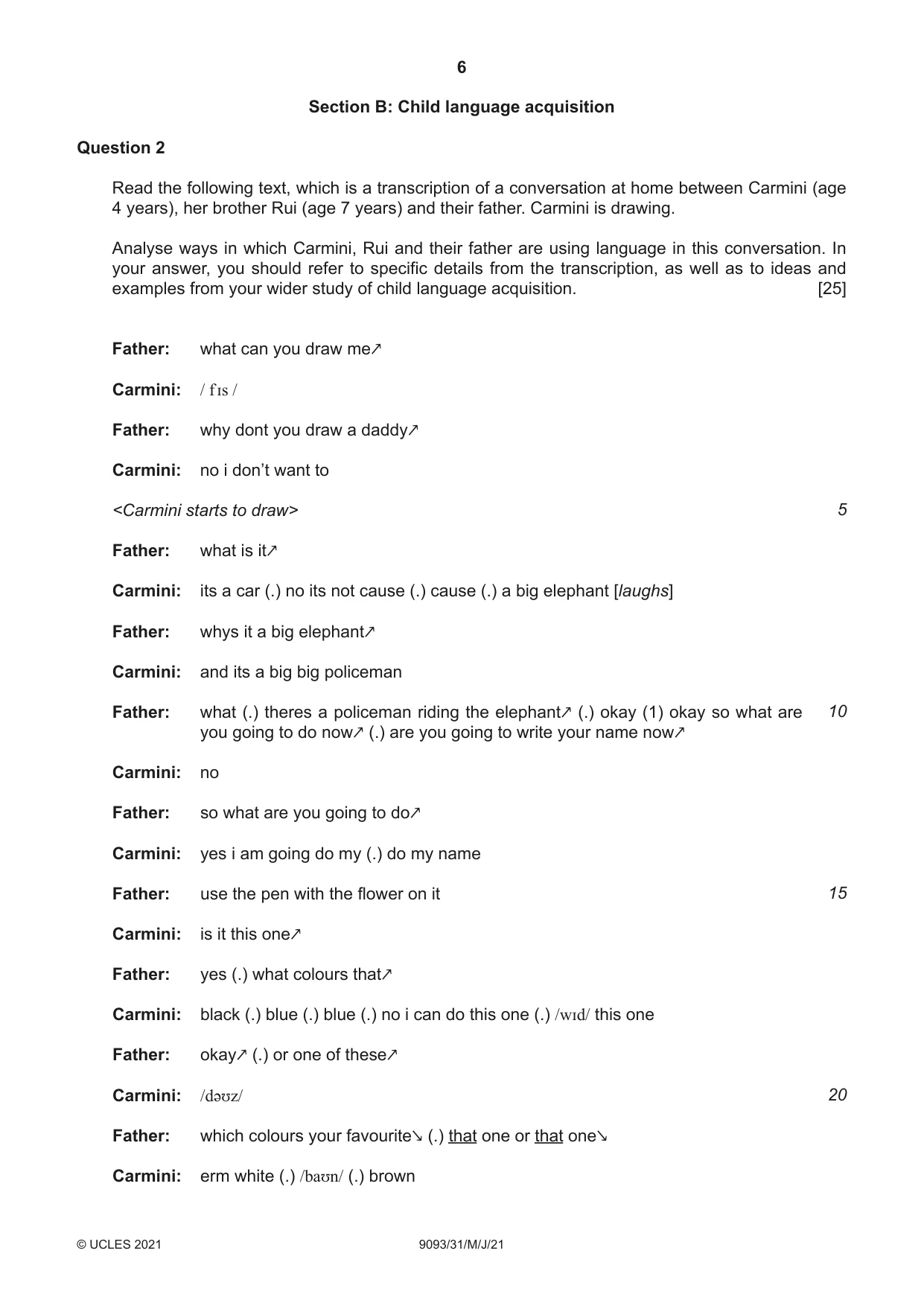
6 9093/31/M/J/21 © UCLES 2021 Section B: Child language acquisition Question 2 Read the following text, which is a transcription of a conversation at home between Carmini (age 4 years), her brother Rui (age 7 years) and their father. Carmini is drawing. Analyse ways in which Carmini, Rui and their father are using language in this conversation. In your answer, you should refer to specific details from the transcription, as well as to ideas and examples from your wider study of child language acquisition. [25] Father: what can you draw me↗ Carmini: / f ɪs / Father: why dont you draw a daddy↗ Carmini: no i don’t want to <Carmini starts to draw> Father: what is it↗ Carmini: its a car (.) no its not cause (.) cause (.) a big elephant [laughs] Father: whys it a big elephant↗ Carmini: and its a big big policeman Father: what (.) theres a policeman riding the elephant↗ (.) okay (1) okay so what are you going to do now↗ (.) are you going to write your name now↗ Carmini: no Father: so what are you going to do↗ Carmini: yes i am going do my (.) do my name Father: use the pen with the flower on it Carmini: is it this one↗ Father: yes (.) what colours that↗ Carmini: black (.) blue (.) blue (.) no i can do this one (.) /wɪd/ this one Father: okay↗ (.) or one of these↗ Carmini: /dəʊz/ Father: which colours your favourite↘ (.) that one or that one↘ Carmini: erm white (.) /baʊn/ (.) brown 5 10 15 20
Question paper, page 7
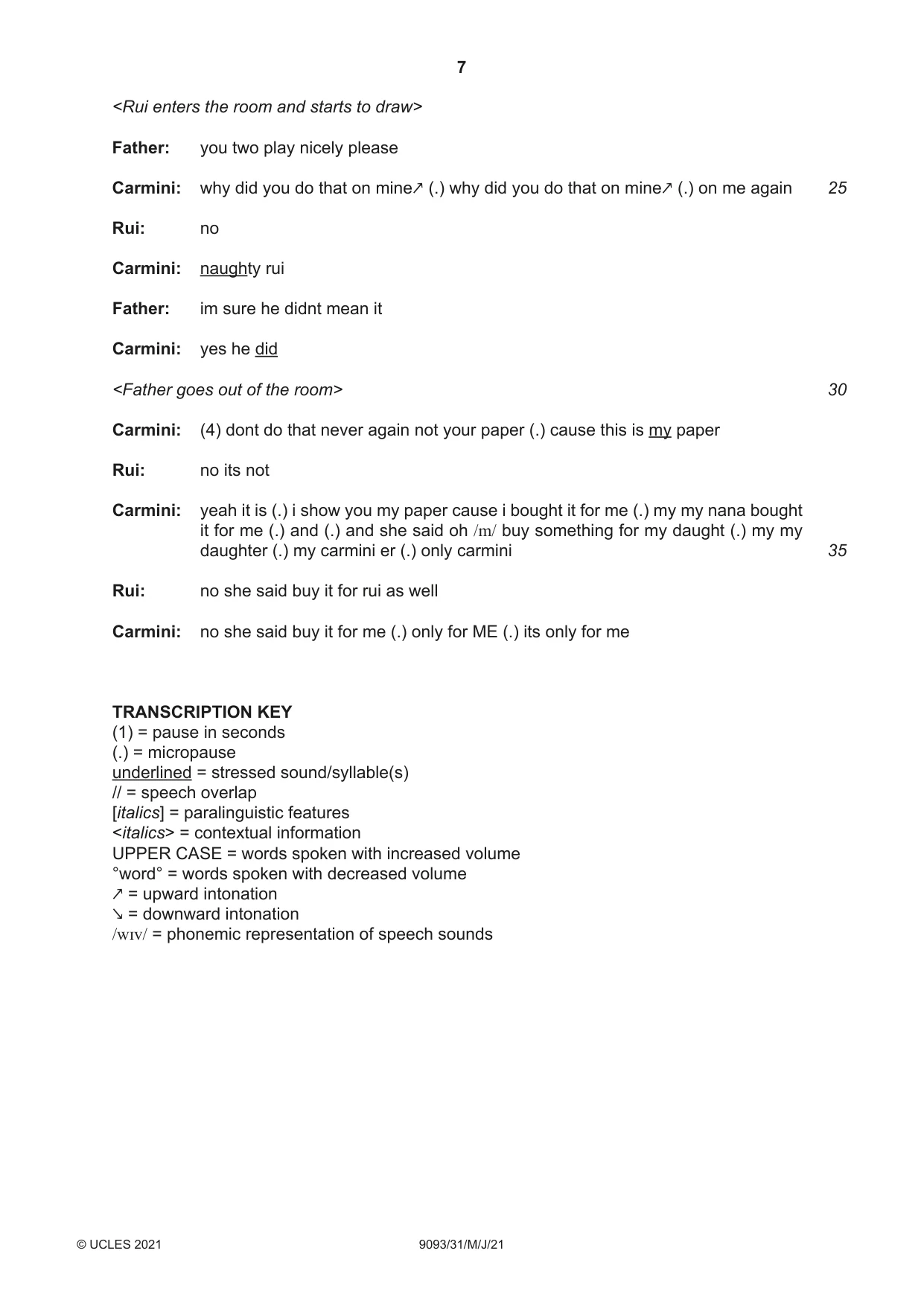
7 9093/31/M/J/21 © UCLES 2021 <Rui enters the room and starts to draw> Father: you two play nicely please Carmini: why did you do that on mine↗ (.) why did you do that on mine↗ (.) on me again Rui: no Carmini: naughty rui Father: im sure he didnt mean it Carmini: yes he did <Father goes out of the room> Carmini: (4) dont do that never again not your paper (.) cause this is my paper Rui: no its not Carmini: yeah it is (.) i show you my paper cause i bought it for me (.) my my nana bought it for me (.) and (.) and she said oh /m/ buy something for my daught (.) my my daughter (.) my carmini er (.) only carmini Rui: no she said buy it for rui as well Carmini: no she said buy it for me (.) only for ME (.) its only for me TRANSCRIPTION KEY (1) = pause in seconds (.) = micropause underlined = stressed sound/syllable(s) // = speech overlap [italics] = paralinguistic features <italics> = contextual information UPPER CASE = words spoken with increased volume °word° = words spoken with decreased volume ↗ = upward intonation ↘ = downward intonation /wɪv/ = phonemic representation of speech sounds 25 30 35
Question paper, page 8
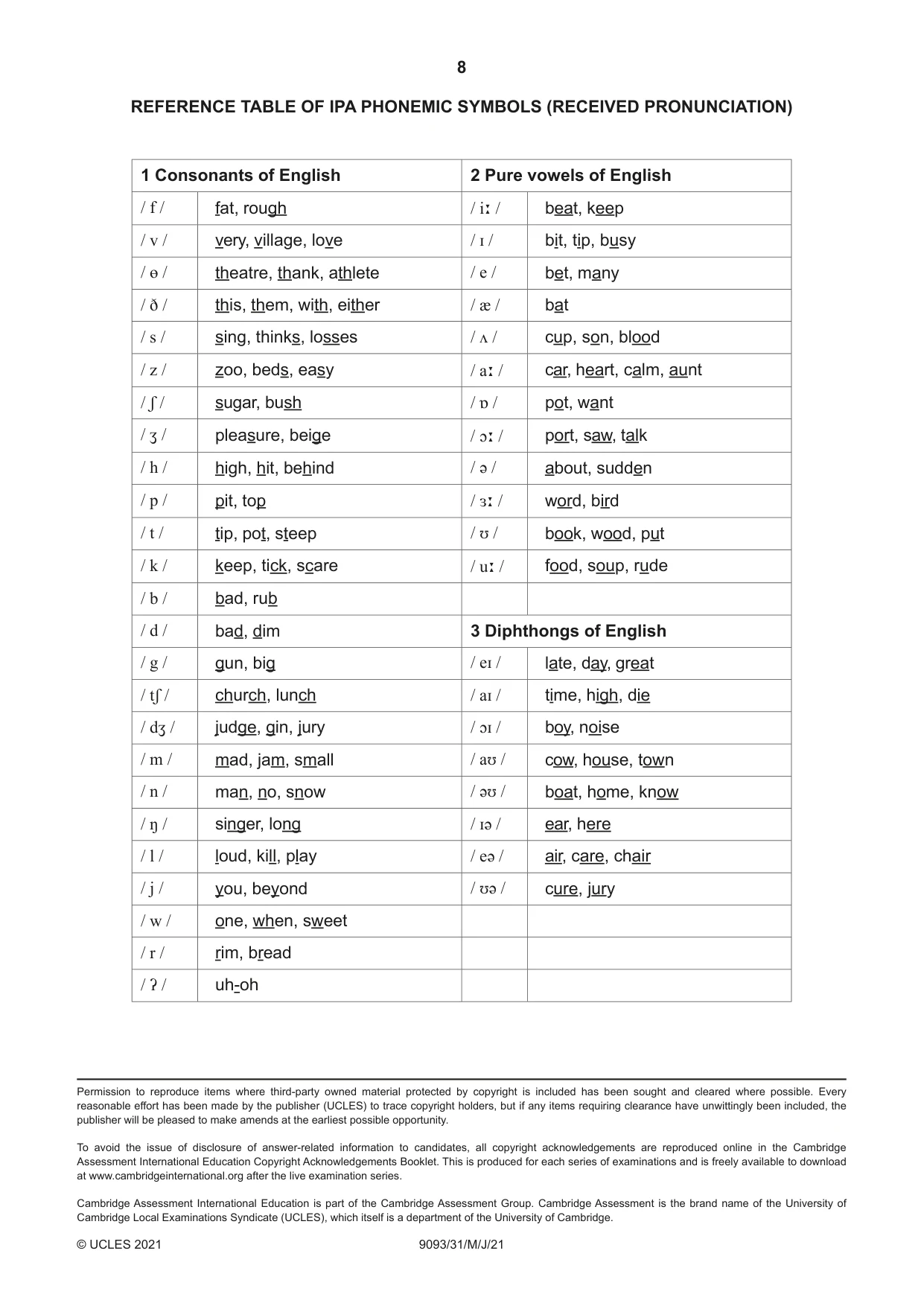
8 9093/31/M/J/21 © UCLES 2021 Permission to reproduce items where third-party owned material protected by copyright is included has been sought and cleared where possible. Every reasonable effort has been made by the publisher (UCLES) to trace copyright holders, but if any items requiring clearance have unwittingly been included, the publisher will be pleased to make amends at the earliest possible opportunity. To avoid the issue of disclosure of answer-related information to candidates, all copyright acknowledgements are reproduced online in the Cambridge Assessment International Education Copyright Acknowledgements Booklet. This is produced for each series of examinations and is freely available to download at www.cambridgeinternational.org after the live examination series. Cambridge Assessment International Education is part of the Cambridge Assessment Group. Cambridge Assessment is the brand name of the University of Cambridge Local Examinations Syndicate (UCLES), which itself is a department of the University of Cambridge. REFERENCE TABLE OF IPA PHONEMIC SYMBOLS (RECEIVED PRONUNCIATION) 1 Consonants of English 2 Pure vowels of English / f / fat, rough / iː / beat, keep / v / very, village, love / ɪ / bit, tip, busy / ɵ / theatre, thank, athlete / e / bet, many / ð / this, them, with, either / æ / bat / s / sing, thinks, losses / ʌ / cup, son, blood / z / zoo, beds, easy / aː / car, heart, calm, aunt / ʃ / sugar, bush / ɒ / pot, want / ʒ / pleasure, beige / ɔː / port, saw, talk / h / high, hit, behind / ə / about, sudden / p / pit, top / ɜː / word, bird / t / tip, pot, steep / ʊ / book, wood, put / k / keep, tick, scare / uː / food, soup, rude / b / bad, rub / d / bad, dim 3 Diphthongs of English / g / gun, big / eɪ / late, day, great / tʃ / church, lunch / aɪ / time, high, die / dʒ / judge, gin, jury / ɔɪ / boy, noise / m / mad, jam, small / aʊ / cow, house, town / n / man, no, snow / əʊ / boat, home, know / ŋ / singer, long / ɪə / ear, here / l / loud, kill, play / eə / air, care, chair / j / you, beyond / ʊə / cure, jury / w / one, when, sweet / r / rim, bread / ʔ / uh-oh
Mark scheme, page 1
This document consists of 12 printed pages. © UCLES 2021 [Turn over Cambridge International A Level ENGLISH LANGUAGE 9093/31 Paper 3 Language Analysis May/June 2021 MARK SCHEME Maximum Mark: 50 Published This mark scheme is published as an aid to teachers and candidates, to indicate the requirements of the examination. It shows the basis on which Examiners were instructed to award marks. It does not indicate the details of the discussions that took place at an Examiners’ meeting before marking began, which would have considered the acceptability of alternative answers. Mark schemes should be read in conjunction with the question paper and the Principal Examiner Report for Teachers. Cambridge International will not enter into discussions about these mark schemes. Cambridge International is publishing the mark schemes for the May/June 2021 series for most Cambridge IGCSE™, Cambridge International A and AS Level components and some Cambridge O Level components.
Mark scheme, page 2
9093/31 Cambridge International A Level – Mark Scheme PUBLISHED May/June 2021 © UCLES 2021 Page 2 of 12 Generic Marking Principles These general marking principles must be applied by all examiners when marking candidate answers. They should be applied alongside the specific content of the mark scheme or generic level descriptors for a question. Each question paper and mark scheme will also comply with these marking principles. GENERIC MARKING PRINCIPLE 1: Marks must be awarded in line with: • the specific content of the mark scheme or the generic level descriptors for the question • the specific skills defined in the mark scheme or in the generic level descriptors for the question • the standard of response required by a candidate as exemplified by the standardisation scripts. GENERIC MARKING PRINCIPLE 2: Marks awarded are always whole marks (not half marks, or other fractions). GENERIC MARKING PRINCIPLE 3: Marks must be awarded positively: • marks are awarded for correct/valid answers, as defined in the mark scheme. However, credit is given for valid answers which go beyond the scope of the syllabus and mark scheme, referring to your Team Leader as appropriate • marks are awarded when candidates clearly demonstrate what they know and can do • marks are not deducted for errors • marks are not deducted for omissions • answers should only be judged on the quality of spelling, punctuation and grammar when these features are specifically assessed by the question as indicated by the mark scheme. The meaning, however, should be unambiguous. GENERIC MARKING PRINCIPLE 4: Rules must be applied consistently, e.g. in situations where candidates have not followed instructions or in the application of generic level descriptors.
Mark scheme, page 3
9093/31 Cambridge International A Level – Mark Scheme PUBLISHED May/June 2021 © UCLES 2021 Page 3 of 12 GENERIC MARKING PRINCIPLE 5: Marks should be awarded using the full range of marks defined in the mark scheme for the question (however; the use of the full mark range may be limited according to the quality of the candidate responses seen). GENERIC MARKING PRINCIPLE 6: Marks awarded are based solely on the requirements as defined in the mark scheme. Marks should not be awarded with grade thresholds or grade descriptors in mind. English & Media subject specific general marking principles (To be read in conjunction with the Generic Marking Principles (and requiring further guidance on how to place marks within levels)) Components using level descriptors: • We use level descriptors as a guide to broad understanding of the qualities normally expected of, or typical of, work in a level. • Level descriptors are a means of general guidance, and should not be interpreted as hurdle statements. • Where indicative content notes are supplied for a question, these are not a prescription of required content, and must not be treated as such. Alternative correct points and unexpected answers in candidates’ scripts must be given marks that fairly reflect the knowledge and skills demonstrated. • While we may have legitimate expectations as to the ground most answers may occupy, we must at all times be prepared to meet candidates on their chosen ground, provided it is relevant ground (e.g. clearly related to and derived from a relevant passage/text and meeting the mark scheme requirements for the question).
Mark scheme, page 4
9093/31 Cambridge International A Level – Mark Scheme PUBLISHED May/June 2021 © UCLES 2021 Page 4 of 12 English Language specific marking instructions: AO1: Read and demonstrate understanding of a wide variety of texts. (Understanding) • Marks should be awarded for the accuracy of the candidate’s understanding of the text and its features, not for any analysis of them which is recognised under AO3. • Where comparison is required, marks should be awarded for the candidate’s recognition of similarities and differences between the texts and their features, not for any consequent analysis. • When awarding a ‘best-fit’ mark within a Level for each AO, consider each bullet point equally. AO2: Write effectively, creatively, accurately and appropriately, for a range of audiences and purposes. (Writing) • Marks should be awarded equally on the basis of the level of the candidate’s written expression (range of features used and accuracy) and the development of their writing (its organisation and relevance to task and audience). • When awarding a ‘best-fit’ mark within a Level for each AO, consider each bullet point equally. AO4: Demonstrate understanding of linguistic issues, concepts, methods and approaches. (Conceptualisation) • Marks should be awarded equally on the basis of the level of the candidate’s understanding of the relevant issues, concepts, methods and approaches represented both in the text(s) and in their wider studies. • When awarding a ‘best-fit’ mark within a Level for each AO, consider each bullet point equally. AO5: Analyse and synthesise language data from a variety of sources. (Data handling) • Marks should be awarded equally on the basis of the level of the candidate’s selection, analysis and synthesis of language data. • When awarding a ‘best-fit’ mark within a Level for each AO, consider each bullet point equally. Higher marks should be awarded where candidates identify patterns and offer thoughtful and plausible explanations for the features they are discussing. Weaker answers may spot features or describe individual cases of language change without reference to broader considerations or examples.
Mark scheme, page 5
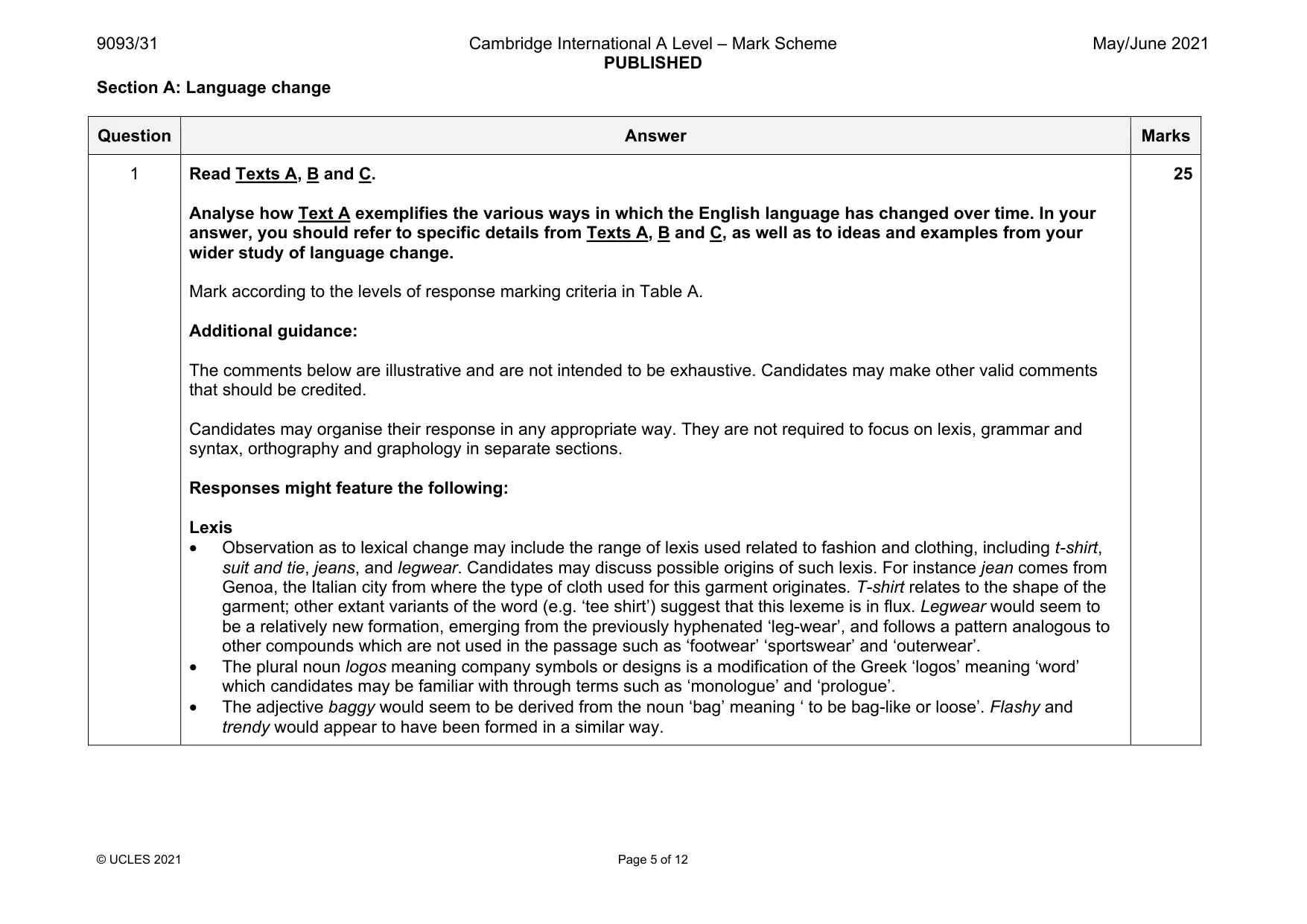
9093/31 Cambridge International A Level – Mark Scheme PUBLISHED May/June 2021 © UCLES 2021 Page 5 of 12 Section A: Language change Question Answer Marks 1 Read Texts A, B and C. Analyse how Text A exemplifies the various ways in which the English language has changed over time. In your answer, you should refer to specific details from Texts A, B and C, as well as to ideas and examples from your wider study of language change. Mark according to the levels of response marking criteria in Table A. Additional guidance: The comments below are illustrative and are not intended to be exhaustive. Candidates may make other valid comments that should be credited. Candidates may organise their response in any appropriate way. They are not required to focus on lexis, grammar and syntax, orthography and graphology in separate sections. Responses might feature the following: Lexis • Observation as to lexical change may include the range of lexis used related to fashion and clothing, including t-shirt, suit and tie, jeans, and legwear. Candidates may discuss possible origins of such lexis. For instance jean comes from Genoa, the Italian city from where the type of cloth used for this garment originates. T-shirt relates to the shape of the garment; other extant variants of the word (e.g. ‘tee shirt’) suggest that this lexeme is in flux. Legwear would seem to be a relatively new formation, emerging from the previously hyphenated ‘leg-wear’, and follows a pattern analogous to other compounds which are not used in the passage such as ‘footwear’ ‘sportswear’ and ‘outerwear’. • The plural noun logos meaning company symbols or designs is a modification of the Greek ‘logos’ meaning ‘word’ which candidates may be familiar with through terms such as ‘monologue’ and ‘prologue’. • The adjective baggy would seem to be derived from the noun ‘bag’ meaning ‘ to be bag-like or loose’. Flashy and trendy would appear to have been formed in a similar way. 25
Mark scheme, page 6
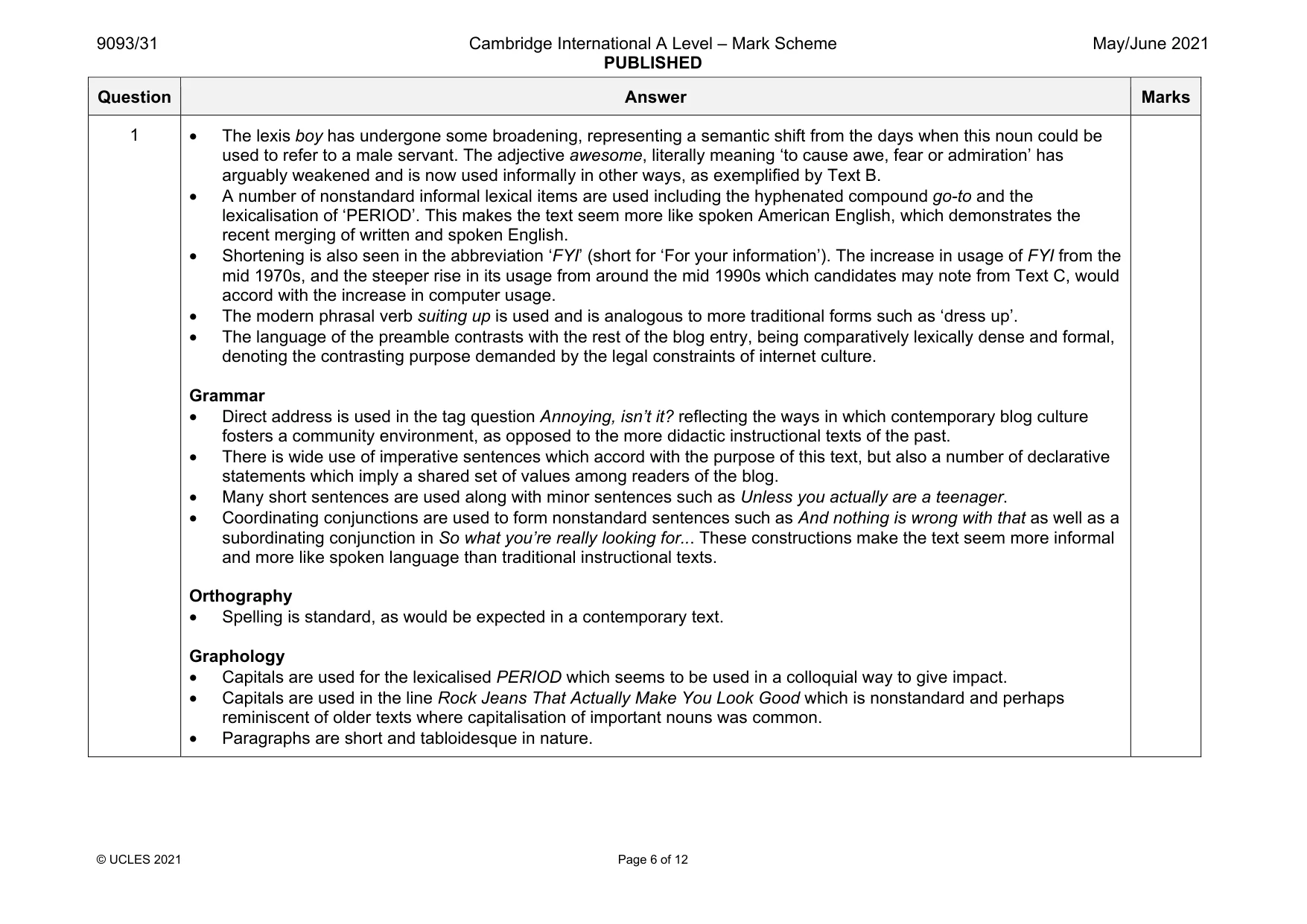
9093/31 Cambridge International A Level – Mark Scheme PUBLISHED May/June 2021 © UCLES 2021 Page 6 of 12 Question Answer Marks 1 • The lexis boy has undergone some broadening, representing a semantic shift from the days when this noun could be used to refer to a male servant. The adjective awesome, literally meaning ‘to cause awe, fear or admiration’ has arguably weakened and is now used informally in other ways, as exemplified by Text B. • A number of nonstandard informal lexical items are used including the hyphenated compound go-to and the lexicalisation of ‘PERIOD’. This makes the text seem more like spoken American English, which demonstrates the recent merging of written and spoken English. • Shortening is also seen in the abbreviation ‘FYI’ (short for ‘For your information’). The increase in usage of FYI from the mid 1970s, and the steeper rise in its usage from around the mid 1990s which candidates may note from Text C, would accord with the increase in computer usage. • The modern phrasal verb suiting up is used and is analogous to more traditional forms such as ‘dress up’. • The language of the preamble contrasts with the rest of the blog entry, being comparatively lexically dense and formal, denoting the contrasting purpose demanded by the legal constraints of internet culture. Grammar • Direct address is used in the tag question Annoying, isn’t it? reflecting the ways in which contemporary blog culture fosters a community environment, as opposed to the more didactic instructional texts of the past. • There is wide use of imperative sentences which accord with the purpose of this text, but also a number of declarative statements which imply a shared set of values among readers of the blog. • Many short sentences are used along with minor sentences such as Unless you actually are a teenager. • Coordinating conjunctions are used to form nonstandard sentences such as And nothing is wrong with that as well as a subordinating conjunction in So what you’re really looking for... These constructions make the text seem more informal and more like spoken language than traditional instructional texts. Orthography • Spelling is standard, as would be expected in a contemporary text. Graphology • Capitals are used for the lexicalised PERIOD which seems to be used in a colloquial way to give impact. • Capitals are used in the line Rock Jeans That Actually Make You Look Good which is nonstandard and perhaps reminiscent of older texts where capitalisation of important nouns was common. • Paragraphs are short and tabloidesque in nature.
Mark scheme, page 7
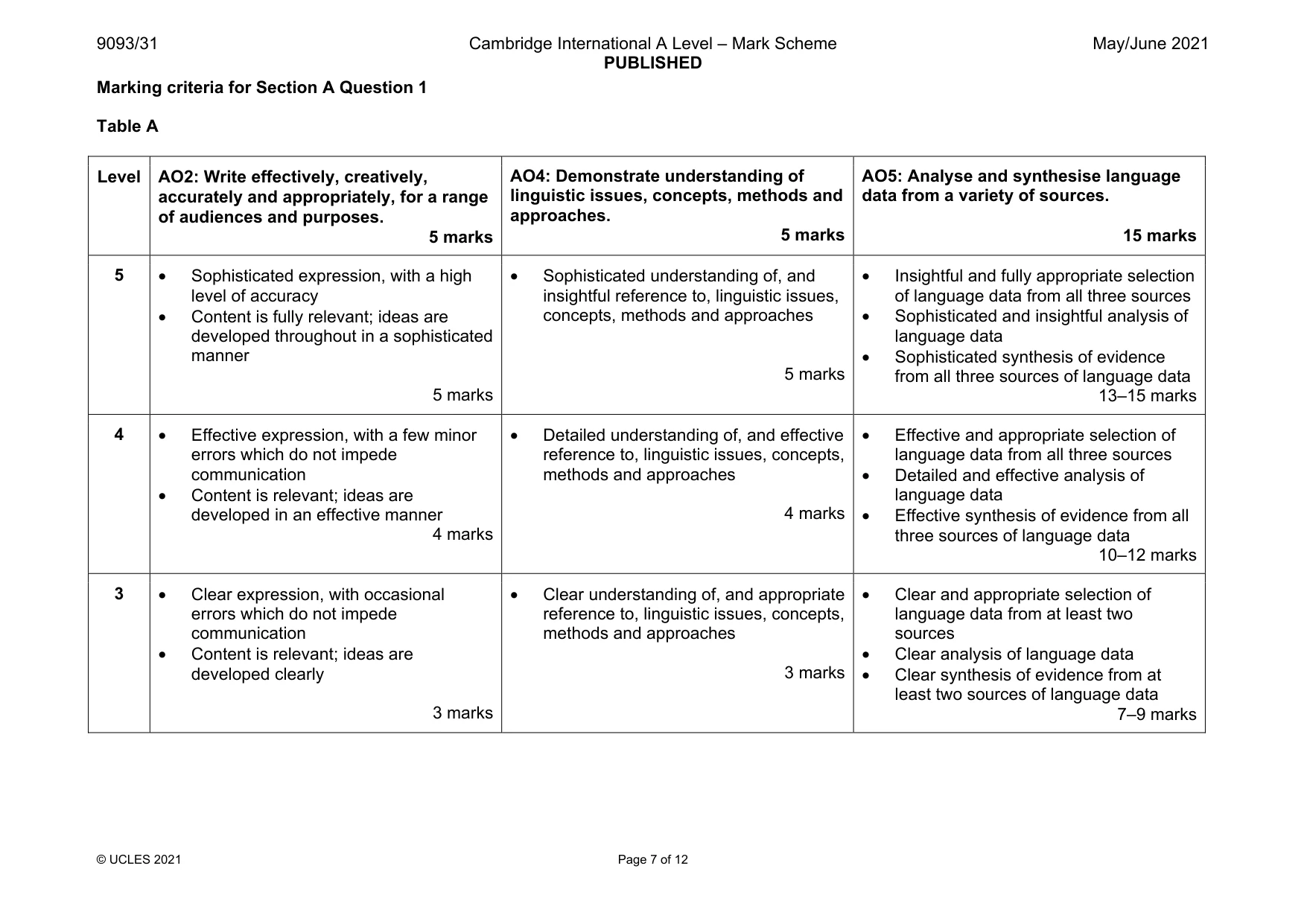
9093/31 Cambridge International A Level – Mark Scheme PUBLISHED May/June 2021 © UCLES 2021 Page 7 of 12 Marking criteria for Section A Question 1 Table A Level AO2: Write effectively, creatively, accurately and appropriately, for a range of audiences and purposes. 5 marks AO4: Demonstrate understanding of linguistic issues, concepts, methods and approaches. 5 marks AO5: Analyse and synthesise language data from a variety of sources. 15 marks 5 • Sophisticated expression, with a high level of accuracy • Content is fully relevant; ideas are developed throughout in a sophisticated manner 5 marks • Sophisticated understanding of, and insightful reference to, linguistic issues, concepts, methods and approaches 5 marks • Insightful and fully appropriate selection of language data from all three sources • Sophisticated and insightful analysis of language data • Sophisticated synthesis of evidence from all three sources of language data 13–15 marks 4 • Effective expression, with a few minor errors which do not impede communication • Content is relevant; ideas are developed in an effective manner 4 marks • Detailed understanding of, and effective reference to, linguistic issues, concepts, methods and approaches 4 marks • Effective and appropriate selection of language data from all three sources • Detailed and effective analysis of language data • Effective synthesis of evidence from all three sources of language data 10–12 marks 3 • Clear expression, with occasional errors which do not impede communication • Content is relevant; ideas are developed clearly 3 marks • Clear understanding of, and appropriate reference to, linguistic issues, concepts, methods and approaches 3 marks • Clear and appropriate selection of language data from at least two sources • Clear analysis of language data • Clear synthesis of evidence from at least two sources of language data 7–9 marks
Mark scheme, page 8
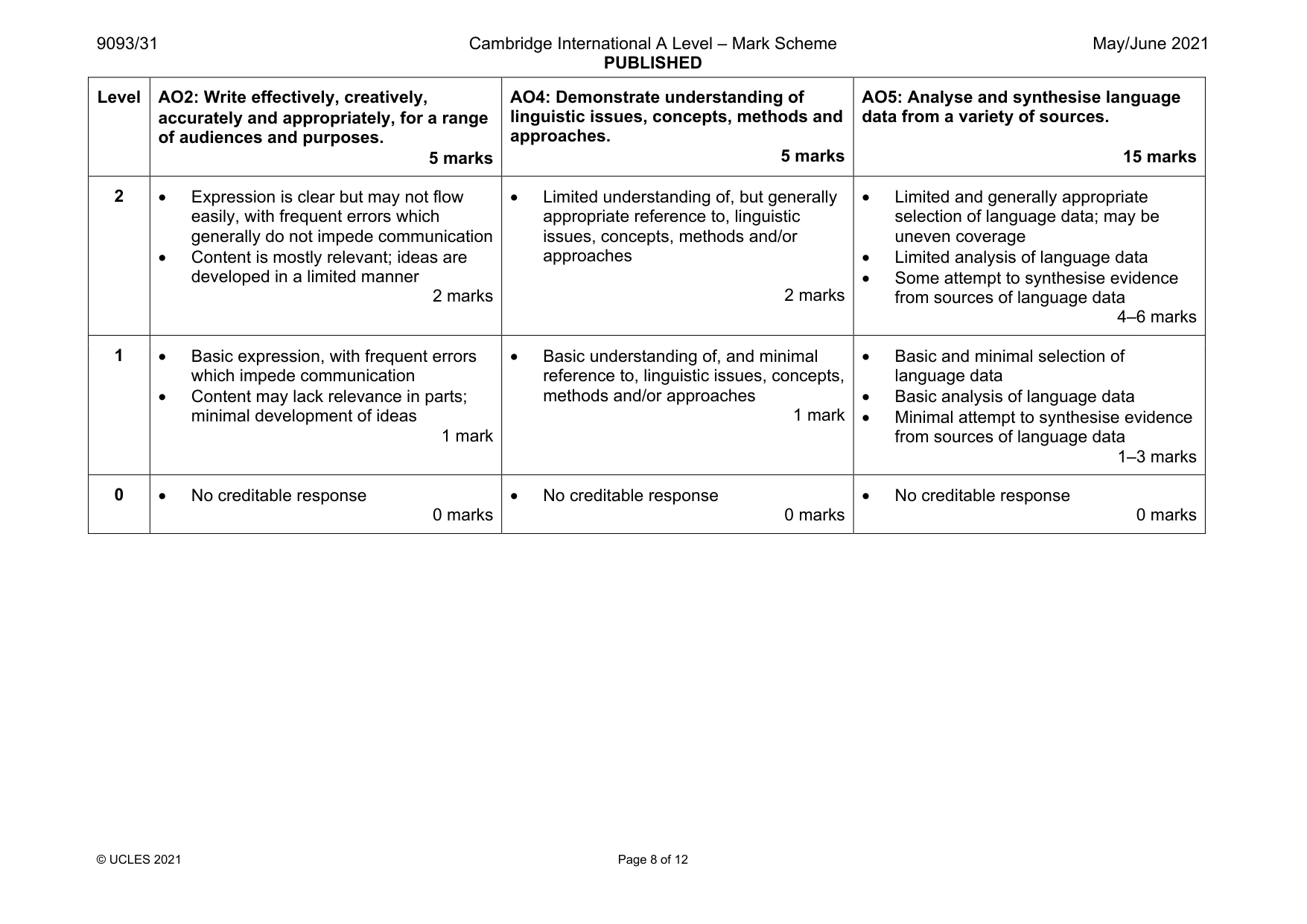
9093/31 Cambridge International A Level – Mark Scheme PUBLISHED May/June 2021 © UCLES 2021 Page 8 of 12 Level AO2: Write effectively, creatively, accurately and appropriately, for a range of audiences and purposes. 5 marks AO4: Demonstrate understanding of linguistic issues, concepts, methods and approaches. 5 marks AO5: Analyse and synthesise language data from a variety of sources. 15 marks 2 • Expression is clear but may not flow easily, with frequent errors which generally do not impede communication • Content is mostly relevant; ideas are developed in a limited manner 2 marks • Limited understanding of, but generally appropriate reference to, linguistic issues, concepts, methods and/or approaches 2 marks • Limited and generally appropriate selection of language data; may be uneven coverage • Limited analysis of language data • Some attempt to synthesise evidence from sources of language data 4–6 marks 1 • Basic expression, with frequent errors which impede communication • Content may lack relevance in parts; minimal development of ideas 1 mark • Basic understanding of, and minimal reference to, linguistic issues, concepts, methods and/or approaches 1 mark • Basic and minimal selection of language data • Basic analysis of language data • Minimal attempt to synthesise evidence from sources of language data 1–3 marks 0 • No creditable response 0 marks • No creditable response 0 marks • No creditable response 0 marks
Mark scheme, page 9
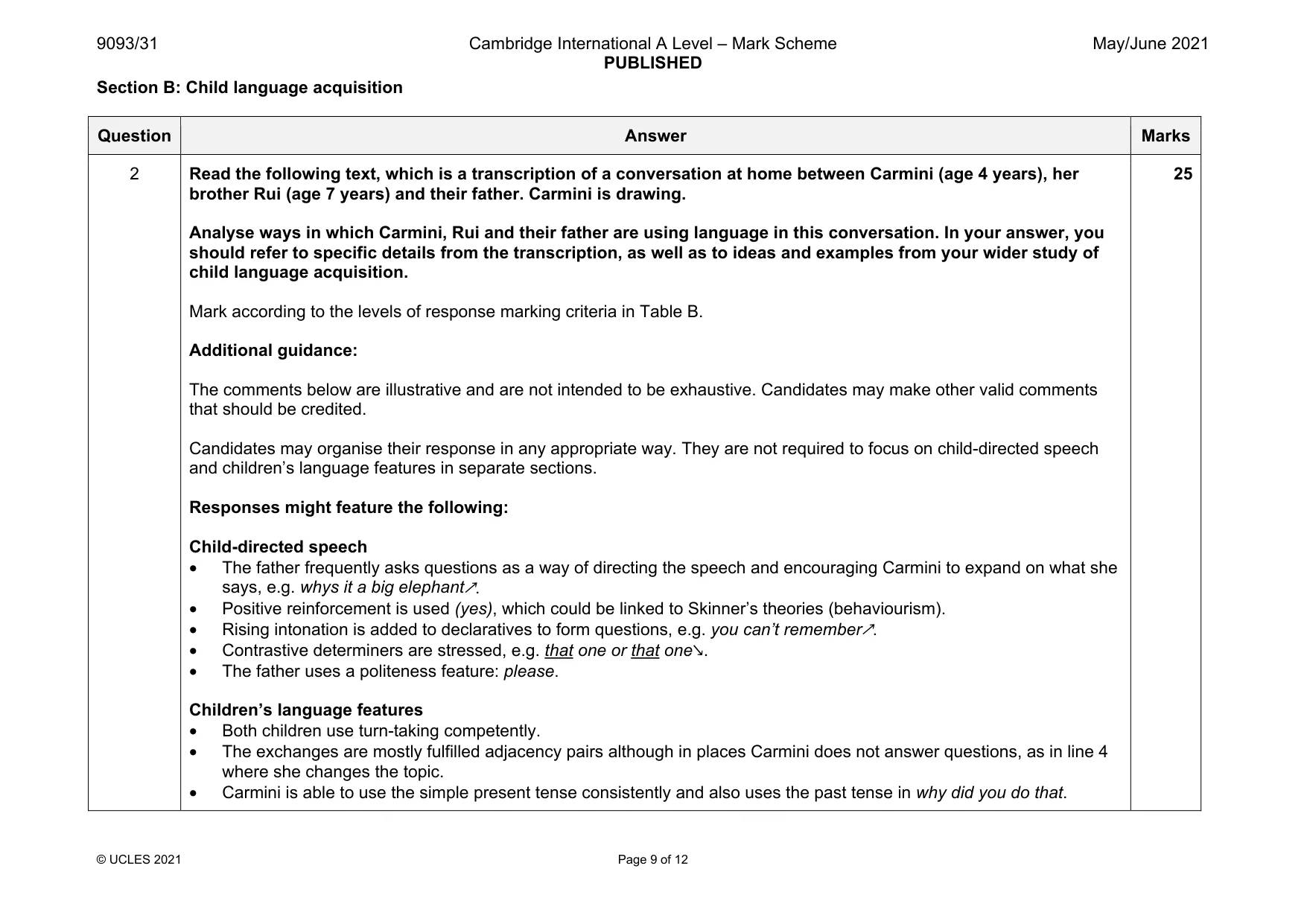
9093/31 Cambridge International A Level – Mark Scheme PUBLISHED May/June 2021 © UCLES 2021 Page 9 of 12 Section B: Child language acquisition Question Answer Marks 2 Read the following text, which is a transcription of a conversation at home between Carmini (age 4 years), her brother Rui (age 7 years) and their father. Carmini is drawing. Analyse ways in which Carmini, Rui and their father are using language in this conversation. In your answer, you should refer to specific details from the transcription, as well as to ideas and examples from your wider study of child language acquisition. Mark according to the levels of response marking criteria in Table B. Additional guidance: The comments below are illustrative and are not intended to be exhaustive. Candidates may make other valid comments that should be credited. Candidates may organise their response in any appropriate way. They are not required to focus on child-directed speech and children’s language features in separate sections. Responses might feature the following: Child-directed speech • The father frequently asks questions as a way of directing the speech and encouraging Carmini to expand on what she says, e.g. whys it a big elephant↗. • Positive reinforcement is used (yes), which could be linked to Skinner’s theories (behaviourism). • Rising intonation is added to declaratives to form questions, e.g. you can’t remember↗. • Contrastive determiners are stressed, e.g. that one or that one↘. • The father uses a politeness feature: please. Children’s language features • Both children use turn-taking competently. • The exchanges are mostly fulfilled adjacency pairs although in places Carmini does not answer questions, as in line 4 where she changes the topic. • Carmini is able to use the simple present tense consistently and also uses the past tense in why did you do that. 25
Mark scheme, page 10
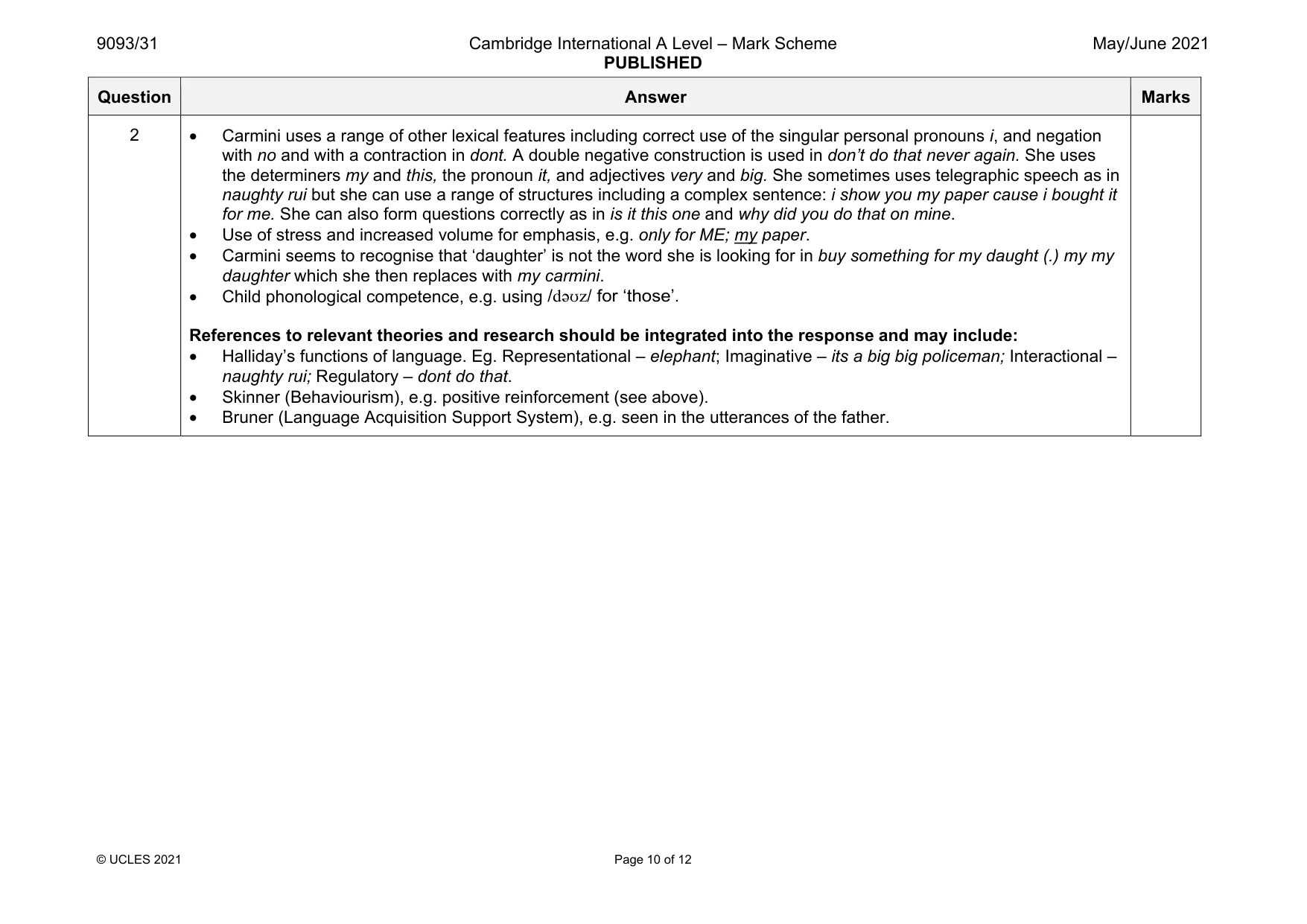
9093/31 Cambridge International A Level – Mark Scheme PUBLISHED May/June 2021 © UCLES 2021 Page 10 of 12 Question Answer Marks 2 • Carmini uses a range of other lexical features including correct use of the singular personal pronouns i, and negation with no and with a contraction in dont. A double negative construction is used in don’t do that never again. She uses the determiners my and this, the pronoun it, and adjectives very and big. She sometimes uses telegraphic speech as in naughty rui but she can use a range of structures including a complex sentence: i show you my paper cause i bought it for me. She can also form questions correctly as in is it this one and why did you do that on mine. • Use of stress and increased volume for emphasis, e.g. only for ME; my paper. • Carmini seems to recognise that ‘daughter’ is not the word she is looking for in buy something for my daught (.) my my daughter which she then replaces with my carmini. • Child phonological competence, e.g. using /dəʊz/ for ‘those’. References to relevant theories and research should be integrated into the response and may include: • Halliday’s functions of language. Eg. Representational – elephant; Imaginative – its a big big policeman; Interactional – naughty rui; Regulatory – dont do that. • Skinner (Behaviourism), e.g. positive reinforcement (see above). • Bruner (Language Acquisition Support System), e.g. seen in the utterances of the father.
Mark scheme, page 11
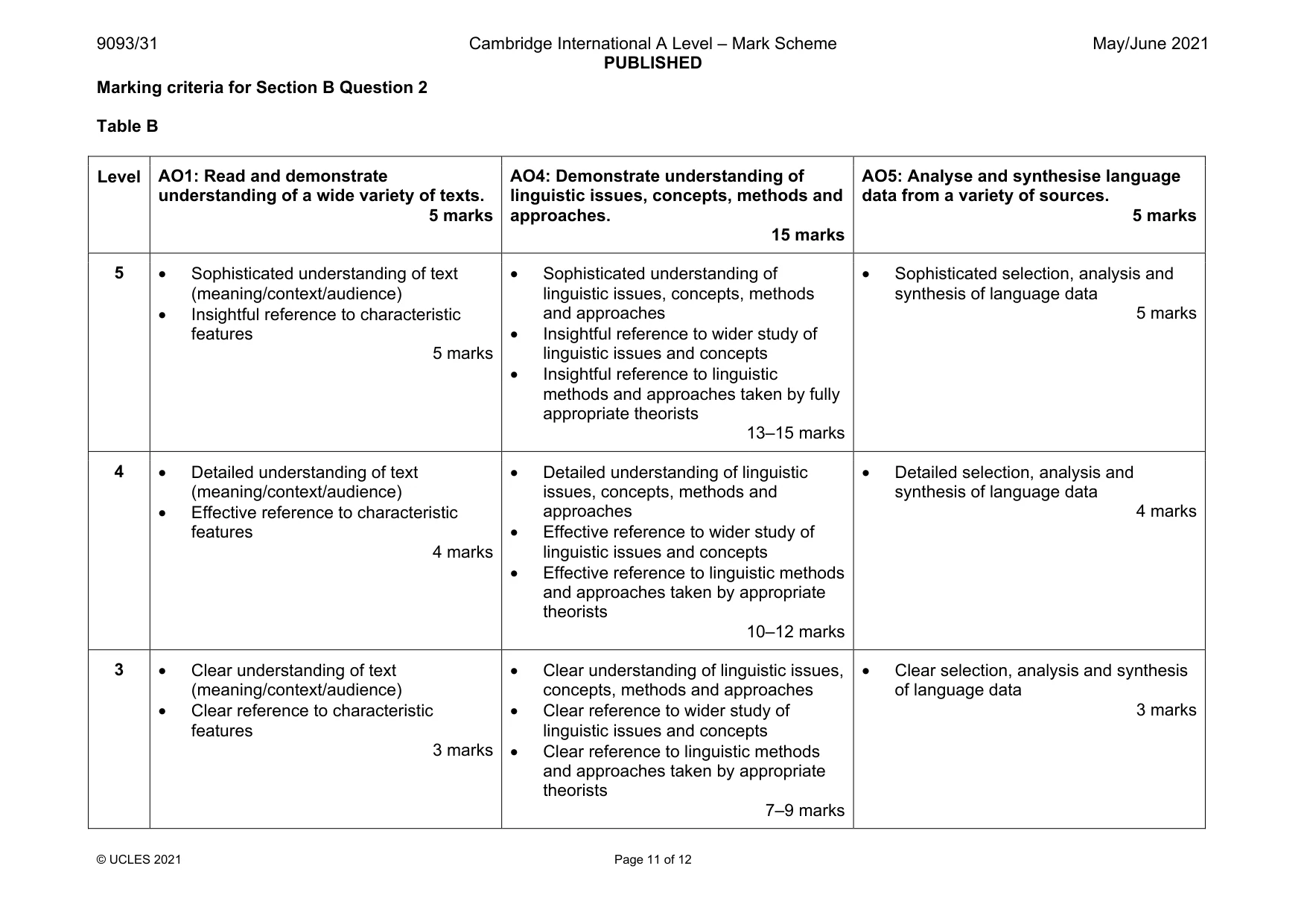
9093/31 Cambridge International A Level – Mark Scheme PUBLISHED May/June 2021 © UCLES 2021 Page 11 of 12 Marking criteria for Section B Question 2 Table B Level AO1: Read and demonstrate understanding of a wide variety of texts. 5 marks AO4: Demonstrate understanding of linguistic issues, concepts, methods and approaches. 15 marks AO5: Analyse and synthesise language data from a variety of sources. 5 marks 5 • Sophisticated understanding of text (meaning/context/audience) • Insightful reference to characteristic features 5 marks • Sophisticated understanding of linguistic issues, concepts, methods and approaches • Insightful reference to wider study of linguistic issues and concepts • Insightful reference to linguistic methods and approaches taken by fully appropriate theorists 13–15 marks • Sophisticated selection, analysis and synthesis of language data 5 marks 4 • Detailed understanding of text (meaning/context/audience) • Effective reference to characteristic features 4 marks • Detailed understanding of linguistic issues, concepts, methods and approaches • Effective reference to wider study of linguistic issues and concepts • Effective reference to linguistic methods and approaches taken by appropriate theorists 10–12 marks • Detailed selection, analysis and synthesis of language data 4 marks 3 • Clear understanding of text (meaning/context/audience) • Clear reference to characteristic features 3 marks • Clear understanding of linguistic issues, concepts, methods and approaches • Clear reference to wider study of linguistic issues and concepts • Clear reference to linguistic methods and approaches taken by appropriate theorists 7–9 marks • Clear selection, analysis and synthesis of language data 3 marks
Mark scheme, page 12
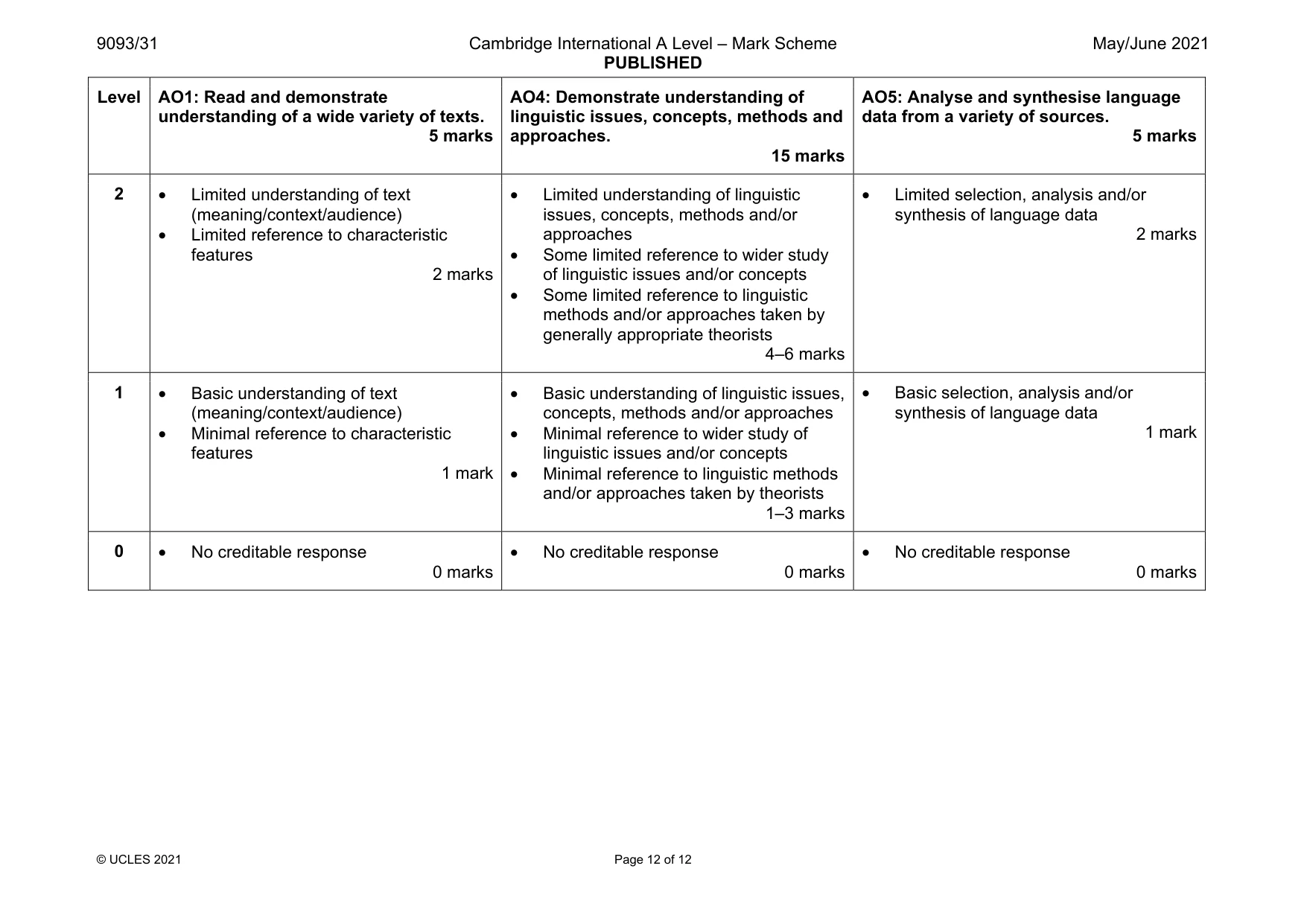
9093/31 Cambridge International A Level – Mark Scheme PUBLISHED May/June 2021 © UCLES 2021 Page 12 of 12 Level AO1: Read and demonstrate understanding of a wide variety of texts. 5 marks AO4: Demonstrate understanding of linguistic issues, concepts, methods and approaches. 15 marks AO5: Analyse and synthesise language data from a variety of sources. 5 marks 2 • Limited understanding of text (meaning/context/audience) • Limited reference to characteristic features 2 marks • Limited understanding of linguistic issues, concepts, methods and/or approaches • Some limited reference to wider study of linguistic issues and/or concepts • Some limited reference to linguistic methods and/or approaches taken by generally appropriate theorists 4–6 marks • Limited selection, analysis and/or synthesis of language data 2 marks 1 • Basic understanding of text (meaning/context/audience) • Minimal reference to characteristic features 1 mark • Basic understanding of linguistic issues, concepts, methods and/or approaches • Minimal reference to wider study of linguistic issues and/or concepts • Minimal reference to linguistic methods and/or approaches taken by theorists 1–3 marks • Basic selection, analysis and/or synthesis of language data 1 mark 0 • No creditable response 0 marks • No creditable response 0 marks • No creditable response 0 marks
What you needed in this session
Cambridge’s own grade thresholds for 2021 May/June, Paper 3 · Variant 1. A higher threshold means an easier paper — the bar moves with how the cohort did.