Cambridge A Level English - Language AS and A Level (from 2014) 9093 — 2021 May/June Paper 3 · Variant 3
9093/33/M/J/21 · 50 marks · ≈56 min
The question paper and its mark scheme, free to read here and free to download. This is Cambridge’s own paper, exactly as it was sat.
Question paper8 pages
Mark scheme12 pages
Answers below. Sit the paper first if you are practising.
Paper as text
Question paper, page 1
This document has 8 pages. Any blank pages are indicated. Cambridge International AS & A Level DC (PQ) 212079 © UCLES 2021 [Turn over * 8 0 0 6 8 7 0 8 2 0 * ENGLISH LANGUAGE 9093/33 Paper 3 Language Analysis May/June 2021 2 hours 15 minutes You must answer on the enclosed answer booklet. You will need: Answer booklet (enclosed) INSTRUCTIONS ● Answer all questions. ● Follow the instructions on the front cover of the answer booklet. If you need additional answer paper, ask the invigilator for a continuation booklet. ● Dictionaries are not allowed. INFORMATION ● The total mark for this paper is 50. ● The number of marks for each question or part question is shown in brackets [ ].
Question paper, page 2
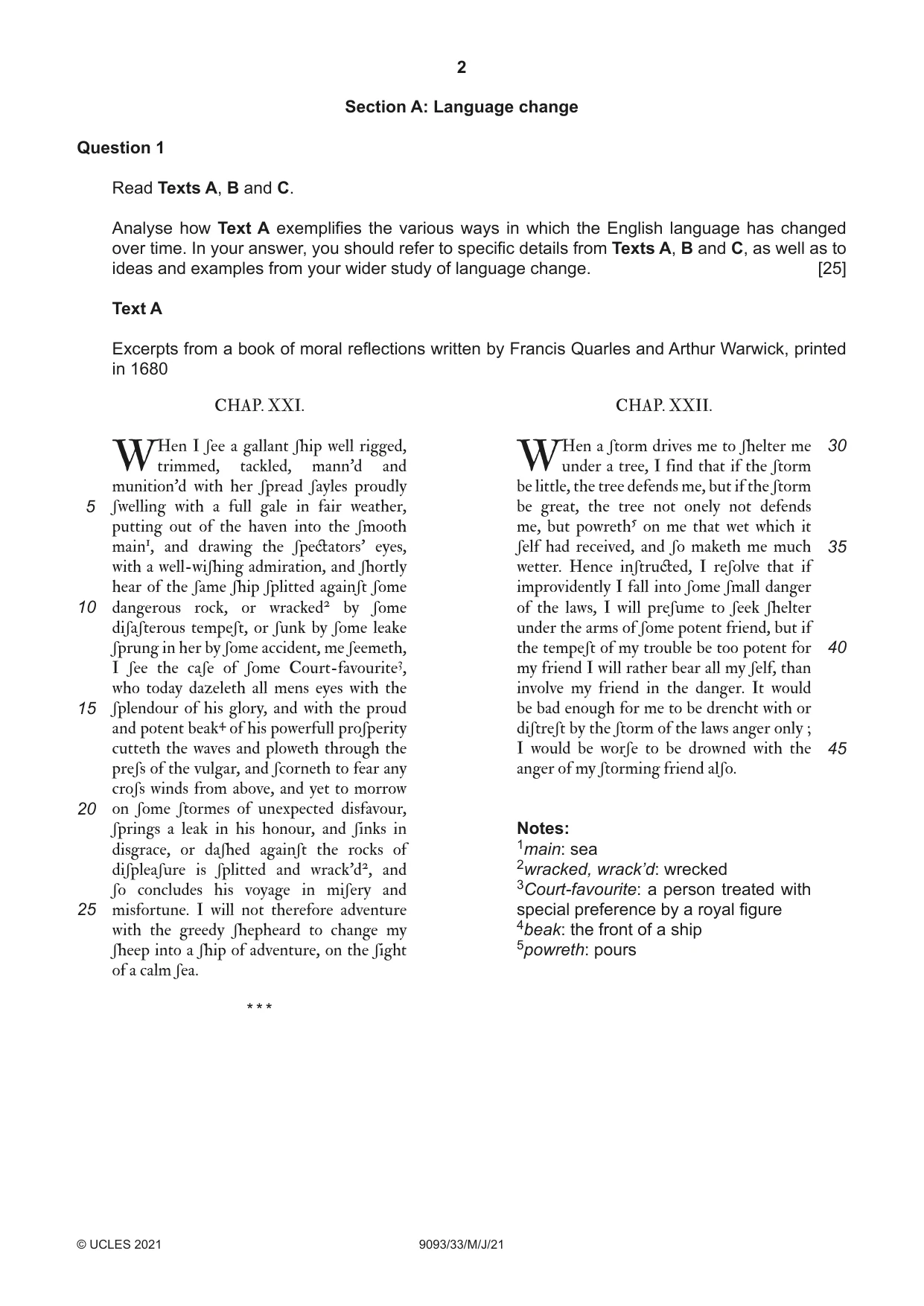
2 9093/33/M/J/21 © UCLES 2021 Section A: Language change Question 1 Read Texts A, B and C. Analyse how Text A exemplifies the various ways in which the English language has changed over time. In your answer, you should refer to specific details from Texts A, B and C, as well as to ideas and examples from your wider study of language change. [25] Text A Excerpts from a book of moral reflections written by Francis Quarles and Arthur Warwick, printed in 1680 CHAP. XXI. W Hen I ʃee a gallant ʃhip well rigged, trimmed, tackled, mann’d and munition’d with her ʃpread ʃayles proudly ʃwelling with a full gale in fair weather, putting out of the haven into the ʃmooth main1, and drawing the ʃpectators’ eyes, with a well-wiʃhing admiration, and ʃhortly hear of the ʃame ʃhip ʃplitted againʃt ʃome dangerous rock, or wracked2 by ʃome diʃaʃterous tempeʃt, or ʃunk by ʃome leake ʃprung in her by ʃome accident, me ʃeemeth, I ʃee the caʃe of ʃome Court-favourite3, who today dazeleth all mens eyes with the ʃplendour of his glory, and with the proud and potent beak4 of his powerfull proʃperity cutteth the waves and ploweth through the preʃs of the vulgar, and ʃcorneth to fear any croʃs winds from above, and yet to morrow on ʃome ʃtormes of unexpected disfavour, ʃprings a leak in his honour, and ʃinks in disgrace, or daʃhed againʃt the rocks of diʃpleaʃure is ʃplitted and wrack’d2, and ʃo concludes his voyage in miʃery and misfortune. I will not therefore adventure with the greedy ʃhepheard to change my ʃheep into a ʃhip of adventure, on the ʃight of a calm ʃea. * * * CHAP. XXII. W Hen a ʃtorm drives me to ʃhelter me under a tree, I find that if the ʃtorm be little, the tree defends me, but if the ʃtorm be great, the tree not onely not defends me, but powreth5 on me that wet which it ʃelf had received, and ʃo maketh me much wetter. Hence inʃtructed, I reʃolve that if improvidently I fall into ʃome ʃmall danger of the laws, I will preʃume to ʃeek ʃhelter under the arms of ʃome potent friend, but if the tempeʃt of my trouble be too potent for my friend I will rather bear all my ʃelf, than involve my friend in the danger. It would be bad enough for me to be drencht with or diʃtreʃt by the ʃtorm of the laws anger only ; I would be worʃe to be drowned with the anger of my ʃtorming friend alʃo. Notes: 1main: sea 2wracked, wrack’d: wrecked 3Court-favourite: a person treated with special preference by a royal figure 4beak: the front of a ship 5powreth: pours 5 10 15 20 25 30 35 40 45
Question paper, page 3
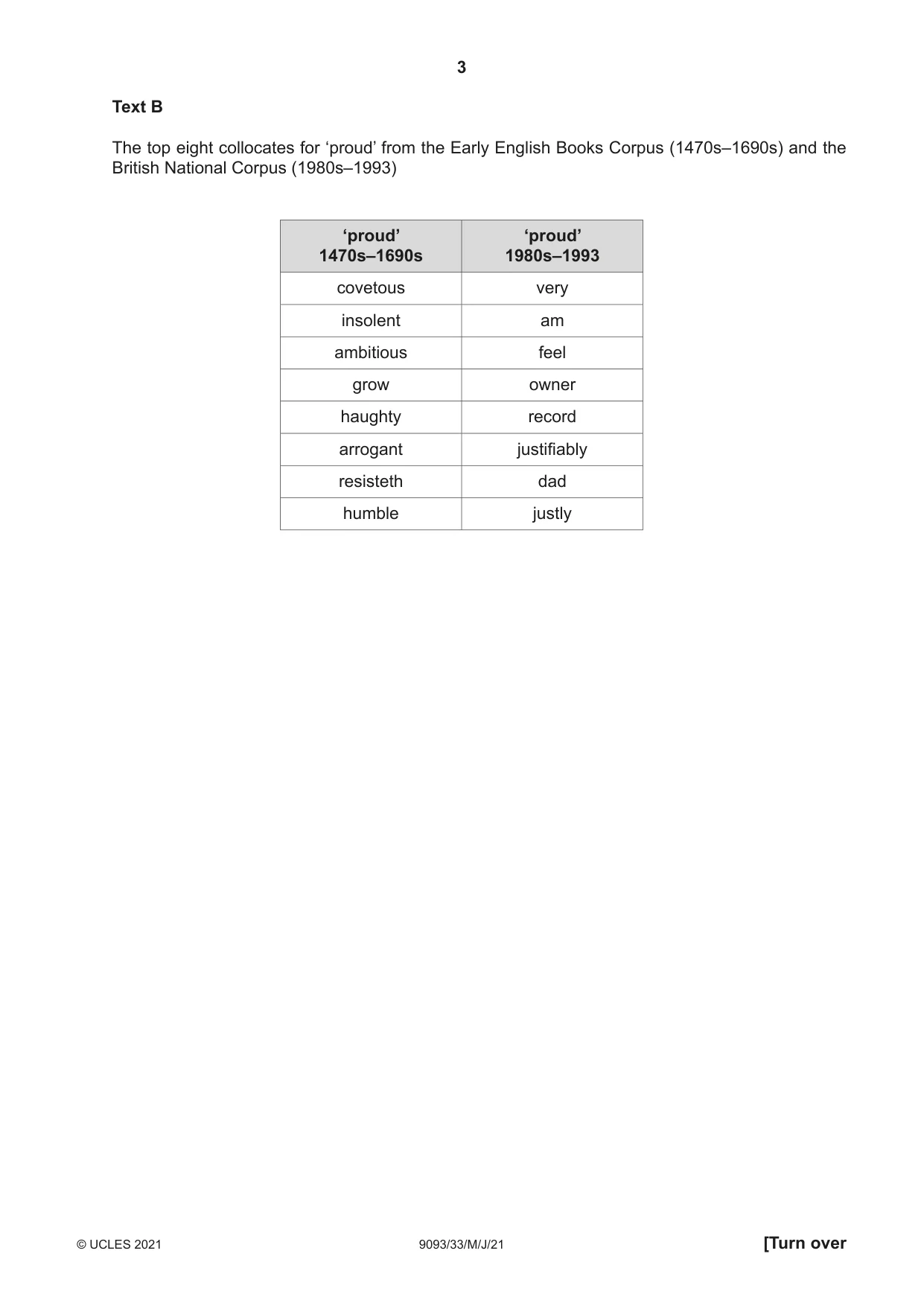
3 9093/33/M/J/21 © UCLES 2021 [Turn over Text B The top eight collocates for ‘proud’ from the Early English Books Corpus (1470s–1690s) and the British National Corpus (1980s–1993) ‘proud’ 1470s–1690s ‘proud’ 1980s–1993 covetous very insolent am ambitious feel grow owner haughty record arrogant justifiably resisteth dad humble justly
Question paper, page 4
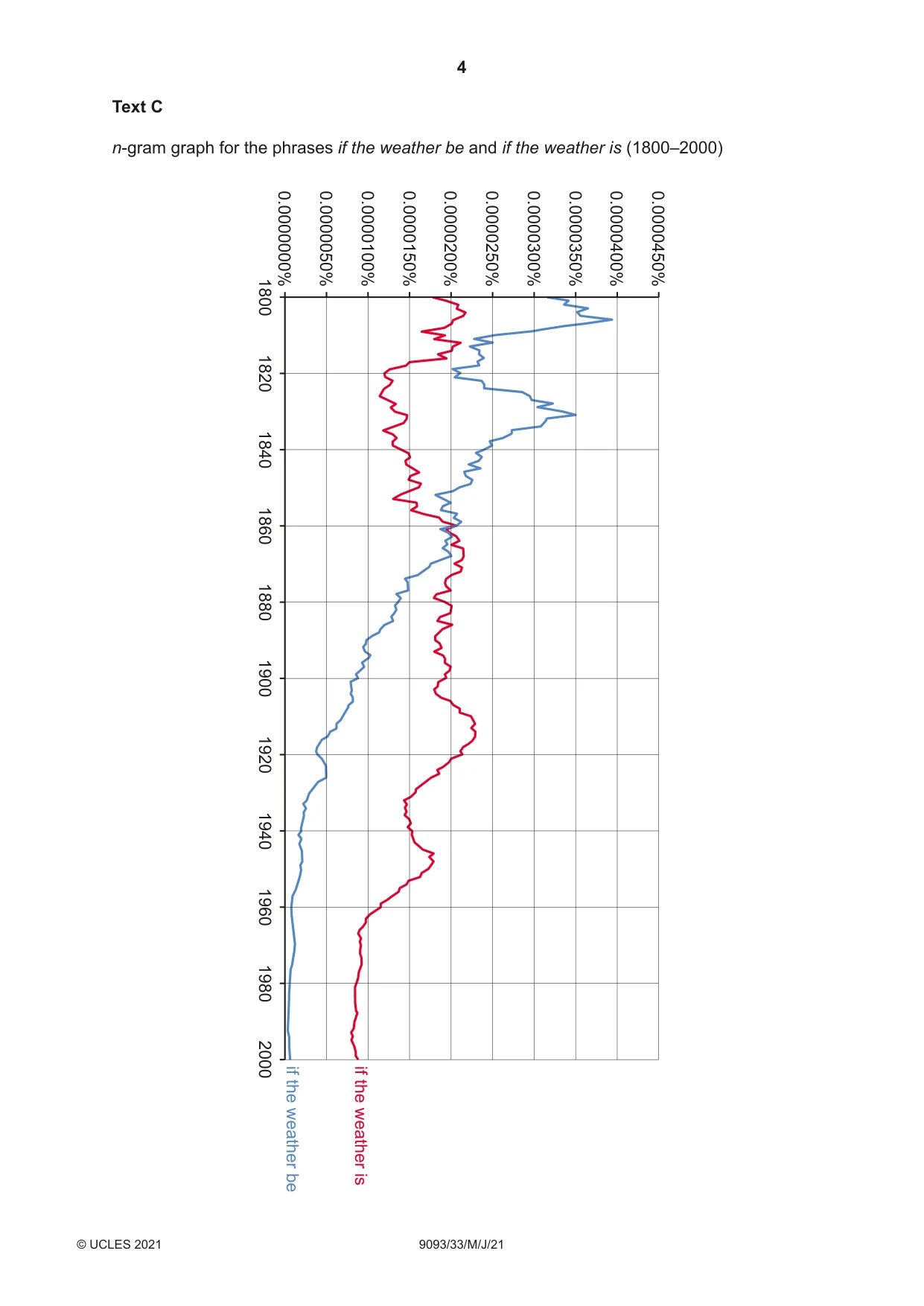
4 9093/33/M/J/21 © UCLES 2021 Text C n-gram graph for the phrases if the weather be and if the weather is (1800–2000) 1800 0.0000000% 0.0000050% 0.0000100% 0.0000150% 0.0000200% 0.0000250% 0.0000300% 0.0000350% 0.0000400% 0.0000450% 1820 1840 1860 1880 1900 1920 1940 1960 1980 2000 if the weather be if the weather is
Question paper, page 5
5 9093/33/M/J/21 © UCLES 2021 [Turn over BLANK PAGE
Question paper, page 6
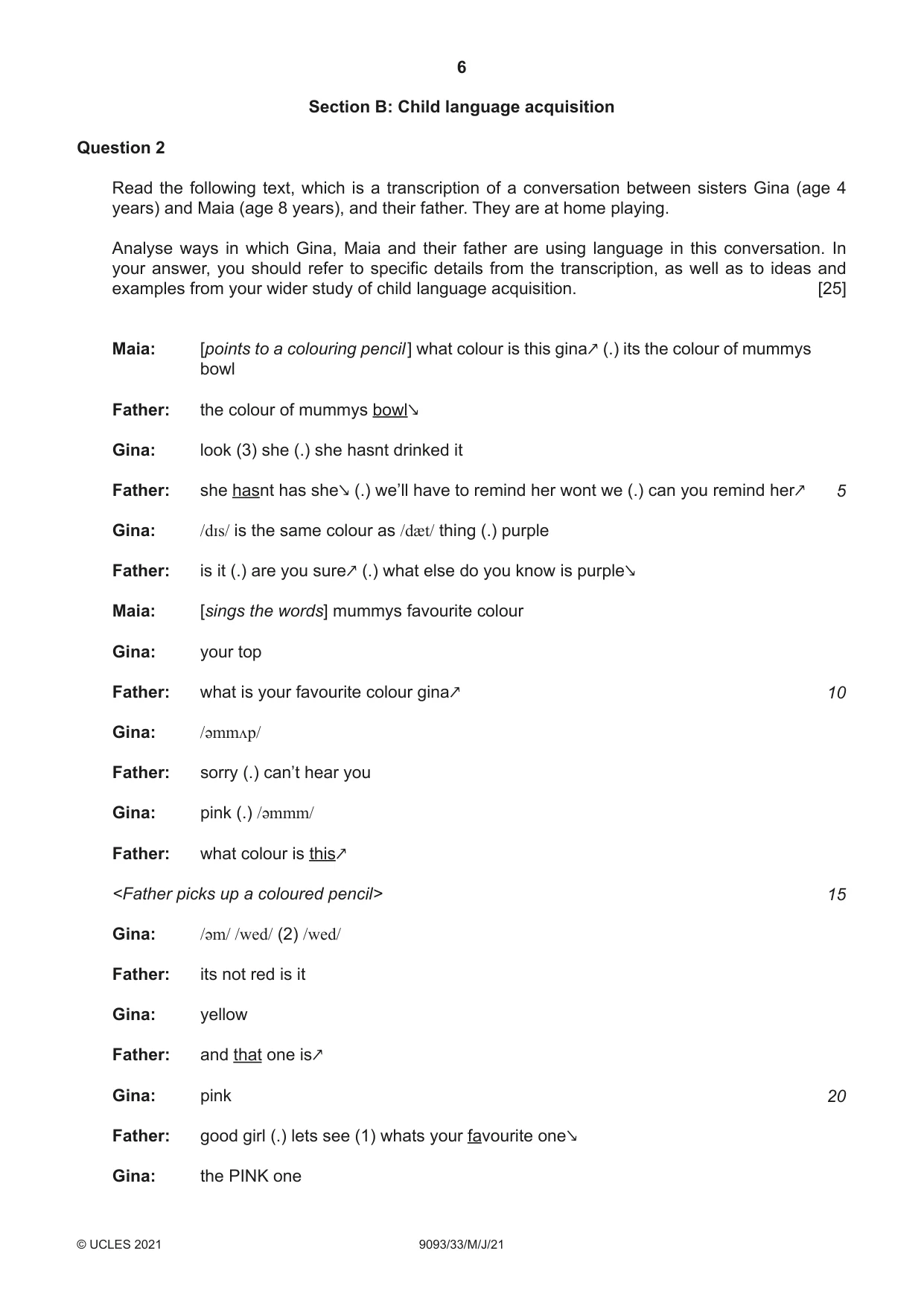
6 9093/33/M/J/21 © UCLES 2021 Section B: Child language acquisition Question 2 Read the following text, which is a transcription of a conversation between sisters Gina (age 4 years) and Maia (age 8 years), and their father. They are at home playing. Analyse ways in which Gina, Maia and their father are using language in this conversation. In your answer, you should refer to specific details from the transcription, as well as to ideas and examples from your wider study of child language acquisition. [25] Maia: [points to a colouring pencil ] what colour is this gina↗ (.) its the colour of mummys bowl Father: the colour of mummys bowl↘ Gina: look (3) she (.) she hasnt drinked it Father: she hasnt has she↘ (.) we’ll have to remind her wont we (.) can you remind her↗ Gina: /dɪs/ is the same colour as /dæt/ thing (.) purple Father: is it (.) are you sure↗ (.) what else do you know is purple↘ Maia: [sings the words] mummys favourite colour Gina: your top Father: what is your favourite colour gina↗ Gina: /əmmʌp/ Father: sorry (.) can’t hear you Gina: pink (.) /əmmm/ Father: what colour is this↗ <Father picks up a coloured pencil> Gina: /əm/ /wed/ (2) /wed/ Father: its not red is it Gina: yellow Father: and that one is↗ Gina: pink Father: good girl (.) lets see (1) whats your favourite one↘ Gina: the PINK one 5 10 15 20
Question paper, page 7
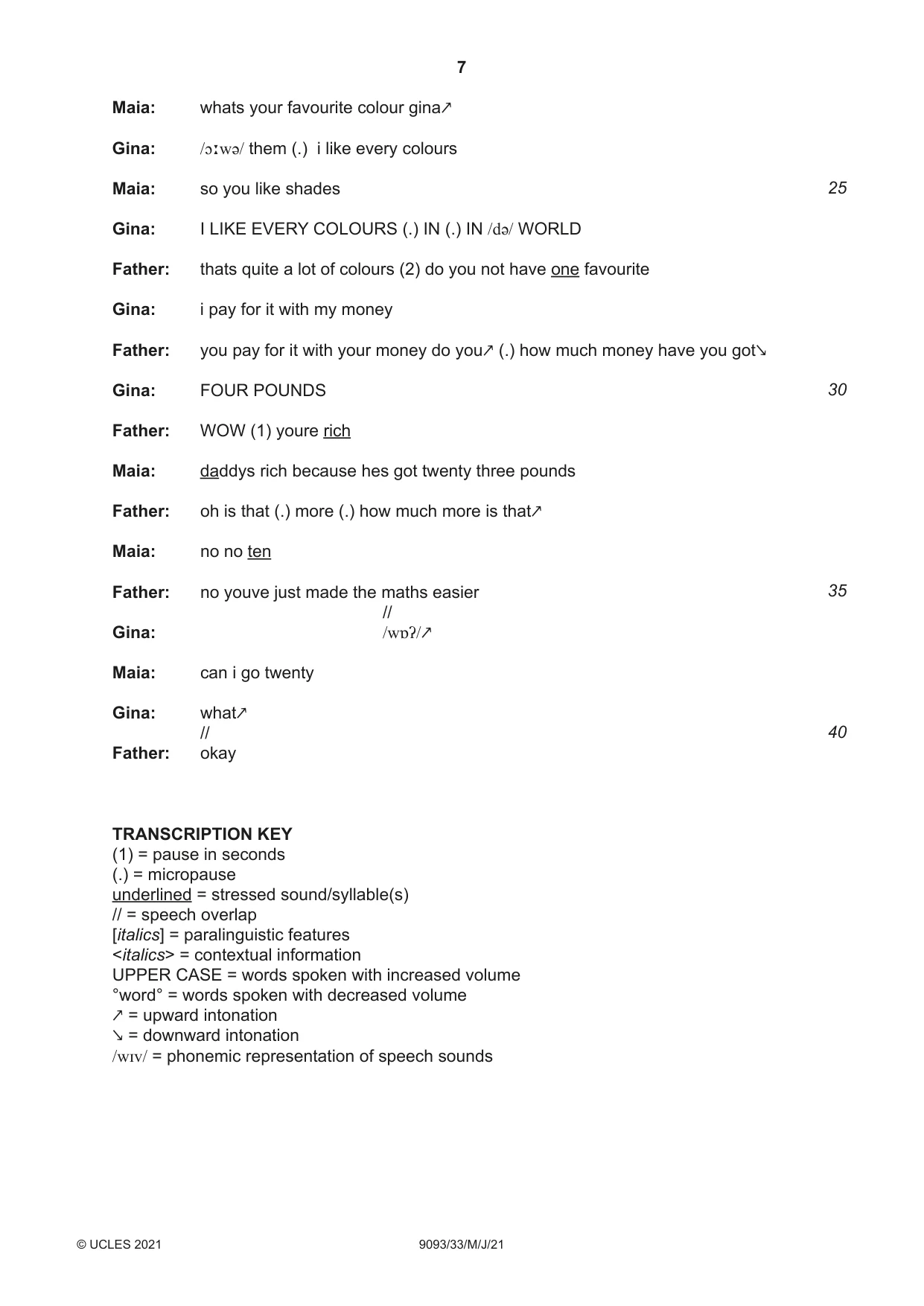
7 9093/33/M/J/21 © UCLES 2021 Maia: whats your favourite colour gina↗ Gina: /ɔːwə/ them (.) i like every colours Maia: so you like shades Gina: I LIKE EVERY COLOURS (.) IN (.) IN /də/ WORLD Father: thats quite a lot of colours (2) do you not have one favourite Gina: i pay for it with my money Father: you pay for it with your money do you↗ (.) how much money have you got↘ Gina: FOUR POUNDS Father: WOW (1) youre rich Maia: daddys rich because hes got twenty three pounds Father: oh is that (.) more (.) how much more is that↗ Maia: no no ten Father: no youve just made the maths easier // Gina: /wɒʔ/↗ Maia: can i go twenty Gina: what↗ // Father: okay TRANSCRIPTION KEY (1) = pause in seconds (.) = micropause underlined = stressed sound/syllable(s) // = speech overlap [italics] = paralinguistic features <italics> = contextual information UPPER CASE = words spoken with increased volume °word° = words spoken with decreased volume ↗ = upward intonation ↘ = downward intonation /wɪv/ = phonemic representation of speech sounds 25 30 35 40
Question paper, page 8
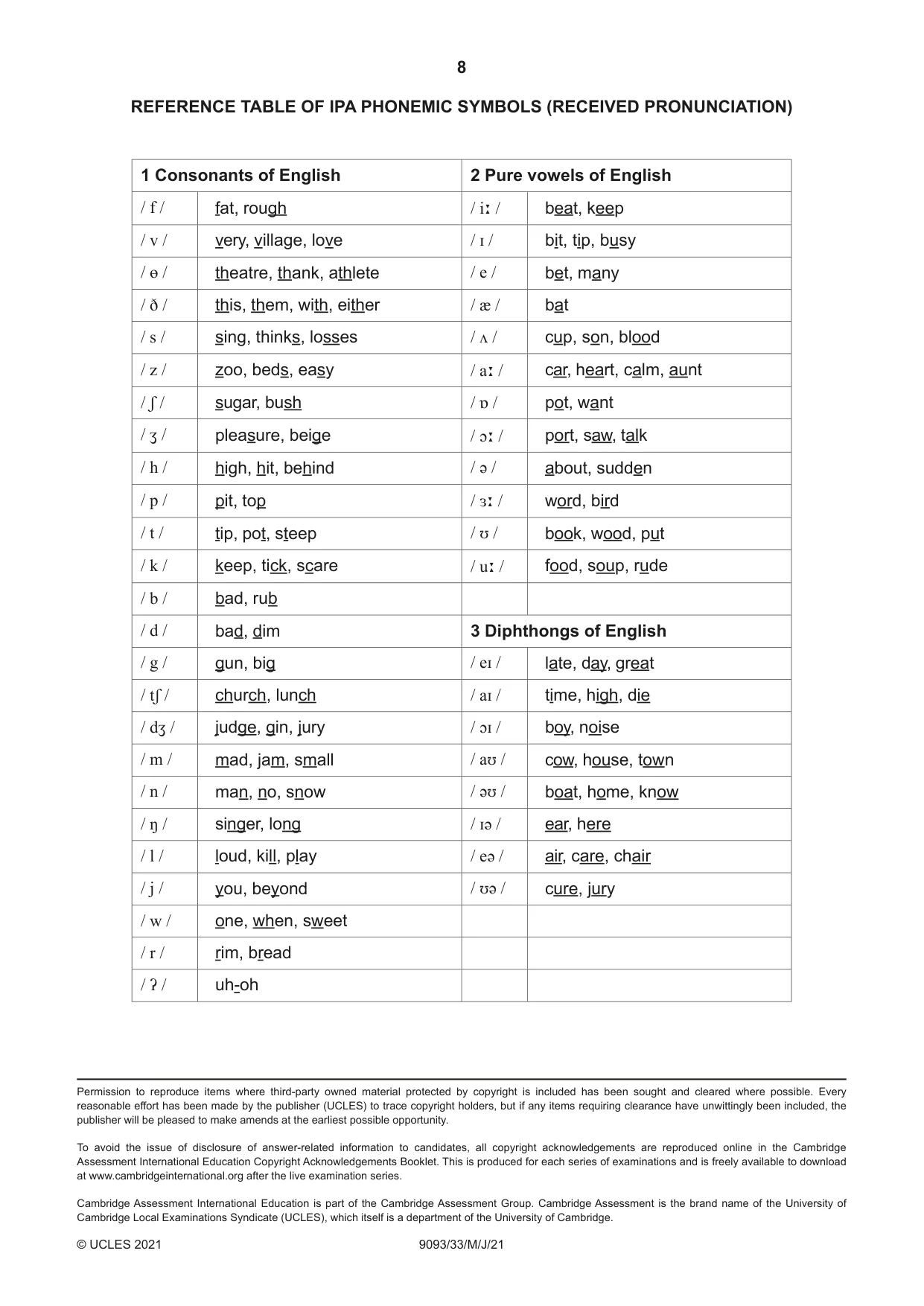
8 9093/33/M/J/21 © UCLES 2021 Permission to reproduce items where third-party owned material protected by copyright is included has been sought and cleared where possible. Every reasonable effort has been made by the publisher (UCLES) to trace copyright holders, but if any items requiring clearance have unwittingly been included, the publisher will be pleased to make amends at the earliest possible opportunity. To avoid the issue of disclosure of answer-related information to candidates, all copyright acknowledgements are reproduced online in the Cambridge Assessment International Education Copyright Acknowledgements Booklet. This is produced for each series of examinations and is freely available to download at www.cambridgeinternational.org after the live examination series. Cambridge Assessment International Education is part of the Cambridge Assessment Group. Cambridge Assessment is the brand name of the University of Cambridge Local Examinations Syndicate (UCLES), which itself is a department of the University of Cambridge. REFERENCE TABLE OF IPA PHONEMIC SYMBOLS (RECEIVED PRONUNCIATION) 1 Consonants of English 2 Pure vowels of English / f / fat, rough / iː / beat, keep / v / very, village, love / ɪ / bit, tip, busy / ɵ / theatre, thank, athlete / e / bet, many / ð / this, them, with, either / æ / bat / s / sing, thinks, losses / ʌ / cup, son, blood / z / zoo, beds, easy / aː / car, heart, calm, aunt / ʃ / sugar, bush / ɒ / pot, want / ʒ / pleasure, beige / ɔː / port, saw, talk / h / high, hit, behind / ə / about, sudden / p / pit, top / ɜː / word, bird / t / tip, pot, steep / ʊ / book, wood, put / k / keep, tick, scare / uː / food, soup, rude / b / bad, rub / d / bad, dim 3 Diphthongs of English / g / gun, big / eɪ / late, day, great / tʃ / church, lunch / aɪ / time, high, die / dʒ / judge, gin, jury / ɔɪ / boy, noise / m / mad, jam, small / aʊ / cow, house, town / n / man, no, snow / əʊ / boat, home, know / ŋ / singer, long / ɪə / ear, here / l / loud, kill, play / eə / air, care, chair / j / you, beyond / ʊə / cure, jury / w / one, when, sweet / r / rim, bread / ʔ / uh-oh
Mark scheme, page 1
This document consists of 12 printed pages. © UCLES 2021 [Turn over Cambridge International A Level ENGLISH LANGUAGE 9093/33 Paper 3 Language Analysis May/June 2021 MARK SCHEME Maximum Mark: 50 Published This mark scheme is published as an aid to teachers and candidates, to indicate the requirements of the examination. It shows the basis on which Examiners were instructed to award marks. It does not indicate the details of the discussions that took place at an Examiners’ meeting before marking began, which would have considered the acceptability of alternative answers. Mark schemes should be read in conjunction with the question paper and the Principal Examiner Report for Teachers. Cambridge International will not enter into discussions about these mark schemes. Cambridge International is publishing the mark schemes for the May/June 2021 series for most Cambridge IGCSE™, Cambridge International A and AS Level components and some Cambridge O Level components.
Mark scheme, page 2
9093/33 Cambridge International A Level – Mark Scheme PUBLISHED May/June 2021 © UCLES 2021 Page 2 of 12 Generic Marking Principles These general marking principles must be applied by all examiners when marking candidate answers. They should be applied alongside the specific content of the mark scheme or generic level descriptors for a question. Each question paper and mark scheme will also comply with these marking principles. GENERIC MARKING PRINCIPLE 1: Marks must be awarded in line with: • the specific content of the mark scheme or the generic level descriptors for the question • the specific skills defined in the mark scheme or in the generic level descriptors for the question • the standard of response required by a candidate as exemplified by the standardisation scripts. GENERIC MARKING PRINCIPLE 2: Marks awarded are always whole marks (not half marks, or other fractions). GENERIC MARKING PRINCIPLE 3: Marks must be awarded positively: • marks are awarded for correct/valid answers, as defined in the mark scheme. However, credit is given for valid answers which go beyond the scope of the syllabus and mark scheme, referring to your Team Leader as appropriate • marks are awarded when candidates clearly demonstrate what they know and can do • marks are not deducted for errors • marks are not deducted for omissions • answers should only be judged on the quality of spelling, punctuation and grammar when these features are specifically assessed by the question as indicated by the mark scheme. The meaning, however, should be unambiguous. GENERIC MARKING PRINCIPLE 4: Rules must be applied consistently, e.g. in situations where candidates have not followed instructions or in the application of generic level descriptors.
Mark scheme, page 3
9093/33 Cambridge International A Level – Mark Scheme PUBLISHED May/June 2021 © UCLES 2021 Page 3 of 12 GENERIC MARKING PRINCIPLE 5: Marks should be awarded using the full range of marks defined in the mark scheme for the question (however; the use of the full mark range may be limited according to the quality of the candidate responses seen). GENERIC MARKING PRINCIPLE 6: Marks awarded are based solely on the requirements as defined in the mark scheme. Marks should not be awarded with grade thresholds or grade descriptors in mind. English & Media subject specific general marking principles (To be read in conjunction with the Generic Marking Principles (and requiring further guidance on how to place marks within levels)) Components using level descriptors: • We use level descriptors as a guide to broad understanding of the qualities normally expected of, or typical of, work in a level. • Level descriptors are a means of general guidance, and should not be interpreted as hurdle statements. • Where indicative content notes are supplied for a question, these are not a prescription of required content, and must not be treated as such. Alternative correct points and unexpected answers in candidates’ scripts must be given marks that fairly reflect the knowledge and skills demonstrated. • While we may have legitimate expectations as to the ground most answers may occupy, we must at all times be prepared to meet candidates on their chosen ground, provided it is relevant ground (e.g. clearly related to and derived from a relevant passage/text and meeting the mark scheme requirements for the question).
Mark scheme, page 4
9093/33 Cambridge International A Level – Mark Scheme PUBLISHED May/June 2021 © UCLES 2021 Page 4 of 12 English Language specific marking instructions: AO1: Read and demonstrate understanding of a wide variety of texts. (Understanding) • Marks should be awarded for the accuracy of the candidate’s understanding of the text and its features, not for any analysis of them which is recognised under AO3. • Where comparison is required, marks should be awarded for the candidate’s recognition of similarities and differences between the texts and their features, not for any consequent analysis. • When awarding a ‘best-fit’ mark within a Level for each AO, consider each bullet point equally. AO2: Write effectively, creatively, accurately and appropriately, for a range of audiences and purposes. (Writing) • Marks should be awarded equally on the basis of the level of the candidate’s written expression (range of features used and accuracy) and the development of their writing (its organisation and relevance to task and audience). • When awarding a ‘best-fit’ mark within a Level for each AO, consider each bullet point equally. AO4: Demonstrate understanding of linguistic issues, concepts, methods and approaches. (Conceptualisation) • Marks should be awarded equally on the basis of the level of the candidate’s understanding of the relevant issues, concepts, methods and approaches represented both in the text(s) and in their wider studies. • When awarding a ‘best-fit’ mark within a Level for each AO, consider each bullet point equally. AO5: Analyse and synthesise language data from a variety of sources. (Data handling) • Marks should be awarded equally on the basis of the level of the candidate’s selection, analysis and synthesis of language data. • When awarding a ‘best-fit’ mark within a Level for each AO, consider each bullet point equally. Higher marks should be awarded where candidates identify patterns and offer thoughtful and plausible explanations for the features they are discussing. Weaker answers may spot features or describe individual cases of language change without reference to broader considerations or examples.
Mark scheme, page 5
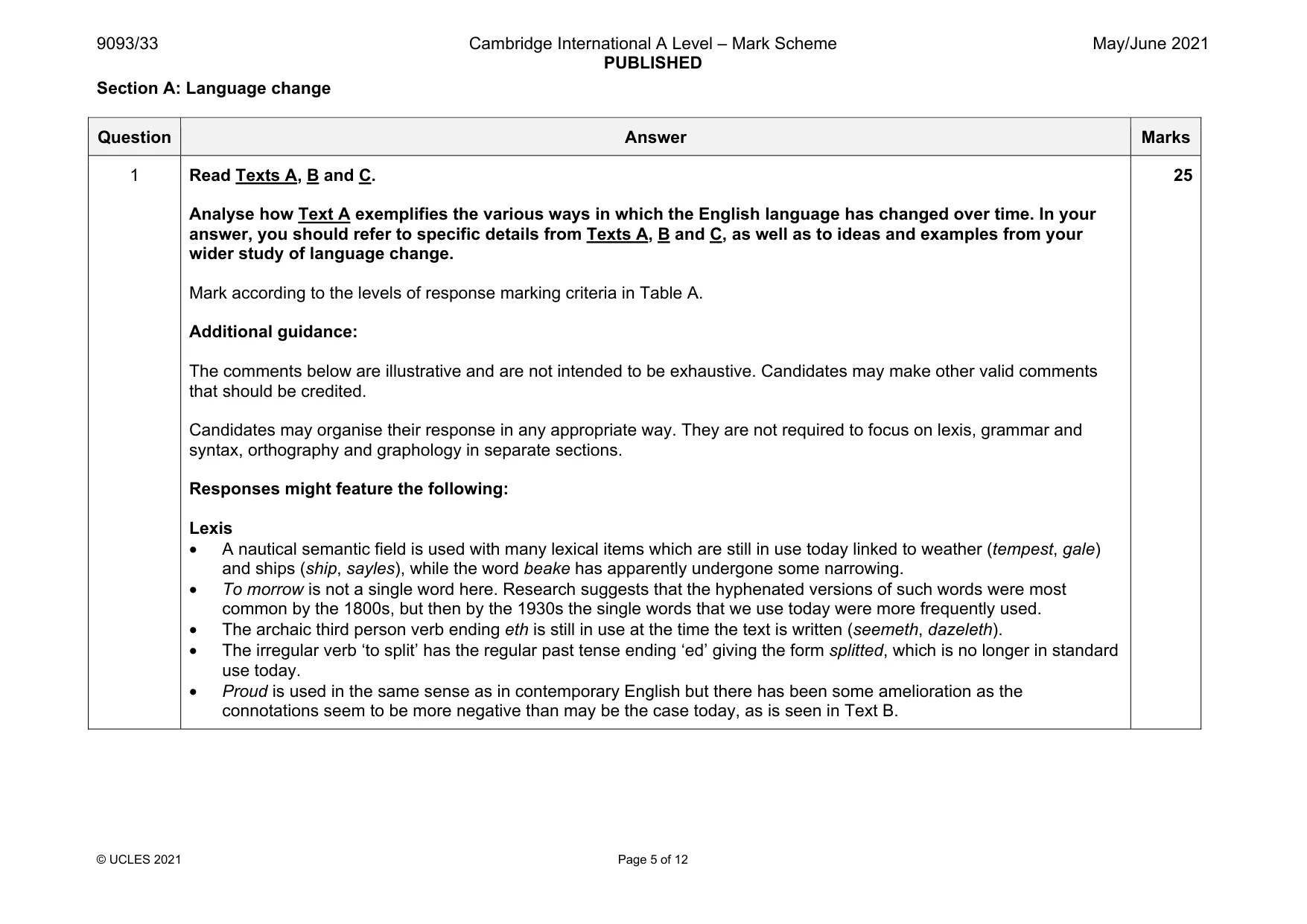
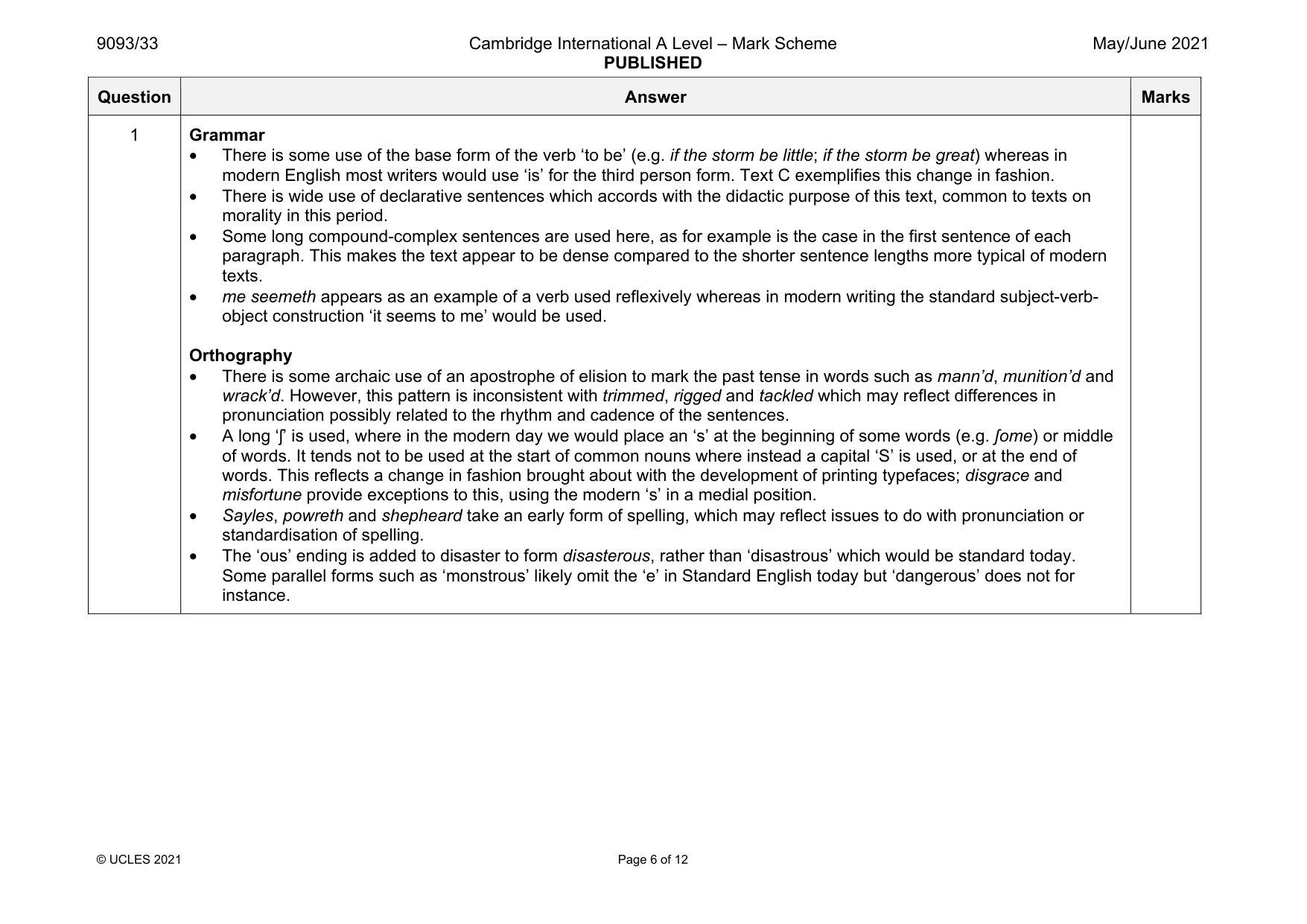
9093/33 Cambridge International A Level – Mark Scheme PUBLISHED May/June 2021 © UCLES 2021 Page 5 of 12 Section A: Language change Question Answer Marks 1 Read Texts A, B and C. Analyse how Text A exemplifies the various ways in which the English language has changed over time. In your answer, you should refer to specific details from Texts A, B and C, as well as to ideas and examples from your wider study of language change. Mark according to the levels of response marking criteria in Table A. Additional guidance: The comments below are illustrative and are not intended to be exhaustive. Candidates may make other valid comments that should be credited. Candidates may organise their response in any appropriate way. They are not required to focus on lexis, grammar and syntax, orthography and graphology in separate sections. Responses might feature the following: Lexis • A nautical semantic field is used with many lexical items which are still in use today linked to weather (tempest, gale) and ships (ship, sayles), while the word beake has apparently undergone some narrowing. • To morrow is not a single word here. Research suggests that the hyphenated versions of such words were most common by the 1800s, but then by the 1930s the single words that we use today were more frequently used. • The archaic third person verb ending eth is still in use at the time the text is written (seemeth, dazeleth). • The irregular verb ‘to split’ has the regular past tense ending ‘ed’ giving the form splitted, which is no longer in standard use today. • Proud is used in the same sense as in contemporary English but there has been some amelioration as the connotations seem to be more negative than may be the case today, as is seen in Text B. 25
Mark scheme, page 6
9093/33 Cambridge International A Level – Mark Scheme PUBLISHED May/June 2021 © UCLES 2021 Page 6 of 12 Question Answer Marks 1 Grammar • There is some use of the base form of the verb ‘to be’ (e.g. if the storm be little; if the storm be great) whereas in modern English most writers would use ‘is’ for the third person form. Text C exemplifies this change in fashion. • There is wide use of declarative sentences which accords with the didactic purpose of this text, common to texts on morality in this period. • Some long compound-complex sentences are used here, as for example is the case in the first sentence of each paragraph. This makes the text appear to be dense compared to the shorter sentence lengths more typical of modern texts. • me seemeth appears as an example of a verb used reflexively whereas in modern writing the standard subject-verb- object construction ‘it seems to me’ would be used. Orthography • There is some archaic use of an apostrophe of elision to mark the past tense in words such as mann’d, munition’d and wrack’d. However, this pattern is inconsistent with trimmed, rigged and tackled which may reflect differences in pronunciation possibly related to the rhythm and cadence of the sentences. • A long ‘ʃ’ is used, where in the modern day we would place an ‘s’ at the beginning of some words (e.g. ʃome) or middle of words. It tends not to be used at the start of common nouns where instead a capital ‘S’ is used, or at the end of words. This reflects a change in fashion brought about with the development of printing typefaces; disgrace and misfortune provide exceptions to this, using the modern ‘s’ in a medial position. • Sayles, powreth and shepheard take an early form of spelling, which may reflect issues to do with pronunciation or standardisation of spelling. • The ‘ous’ ending is added to disaster to form disasterous, rather than ‘disastrous’ which would be standard today. Some parallel forms such as ‘monstrous’ likely omit the ‘e’ in Standard English today but ‘dangerous’ does not for instance.
Mark scheme, page 7
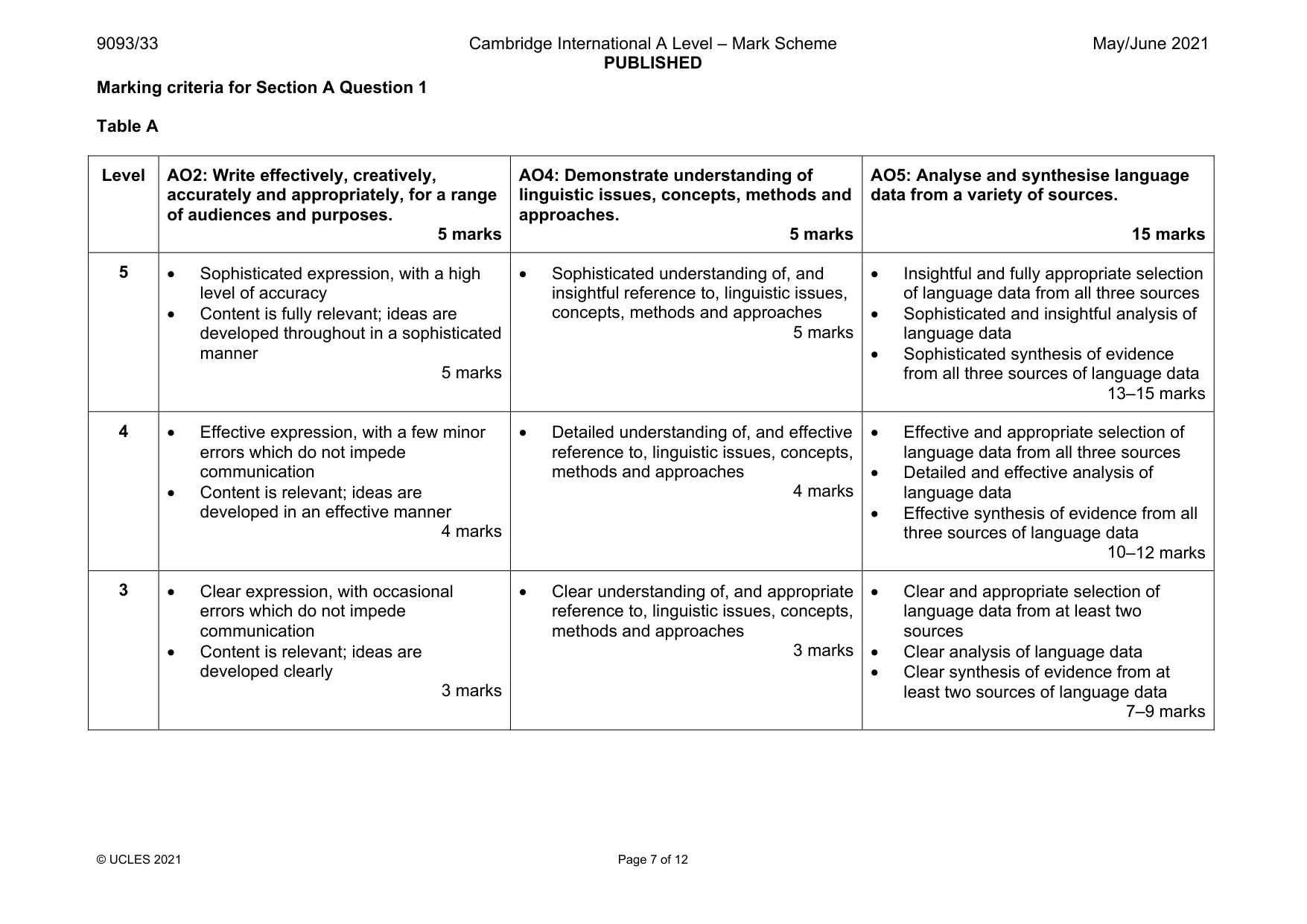
9093/33 Cambridge International A Level – Mark Scheme PUBLISHED May/June 2021 © UCLES 2021 Page 7 of 12 Marking criteria for Section A Question 1 Table A Level AO2: Write effectively, creatively, accurately and appropriately, for a range of audiences and purposes. 5 marks AO4: Demonstrate understanding of linguistic issues, concepts, methods and approaches. 5 marks AO5: Analyse and synthesise language data from a variety of sources. 15 marks 5 • Sophisticated expression, with a high level of accuracy • Content is fully relevant; ideas are developed throughout in a sophisticated manner 5 marks • Sophisticated understanding of, and insightful reference to, linguistic issues, concepts, methods and approaches 5 marks • Insightful and fully appropriate selection of language data from all three sources • Sophisticated and insightful analysis of language data • Sophisticated synthesis of evidence from all three sources of language data 13–15 marks 4 • Effective expression, with a few minor errors which do not impede communication • Content is relevant; ideas are developed in an effective manner 4 marks • Detailed understanding of, and effective reference to, linguistic issues, concepts, methods and approaches 4 marks • Effective and appropriate selection of language data from all three sources • Detailed and effective analysis of language data • Effective synthesis of evidence from all three sources of language data 10–12 marks 3 • Clear expression, with occasional errors which do not impede communication • Content is relevant; ideas are developed clearly 3 marks • Clear understanding of, and appropriate reference to, linguistic issues, concepts, methods and approaches 3 marks • Clear and appropriate selection of language data from at least two sources • Clear analysis of language data • Clear synthesis of evidence from at least two sources of language data 7–9 marks
Mark scheme, page 8
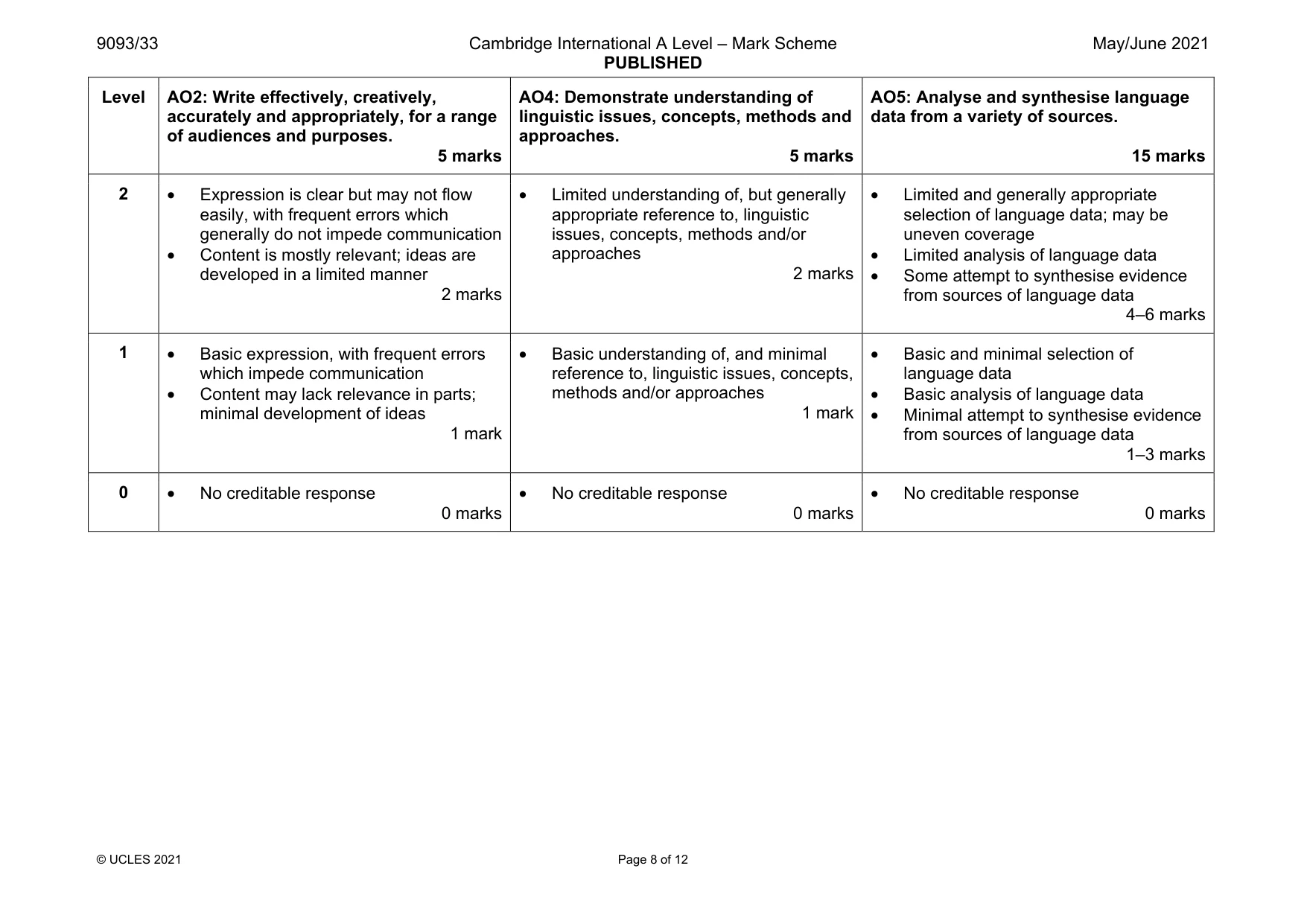
9093/33 Cambridge International A Level – Mark Scheme PUBLISHED May/June 2021 © UCLES 2021 Page 8 of 12 Level AO2: Write effectively, creatively, accurately and appropriately, for a range of audiences and purposes. 5 marks AO4: Demonstrate understanding of linguistic issues, concepts, methods and approaches. 5 marks AO5: Analyse and synthesise language data from a variety of sources. 15 marks 2 • Expression is clear but may not flow easily, with frequent errors which generally do not impede communication • Content is mostly relevant; ideas are developed in a limited manner 2 marks • Limited understanding of, but generally appropriate reference to, linguistic issues, concepts, methods and/or approaches 2 marks • Limited and generally appropriate selection of language data; may be uneven coverage • Limited analysis of language data • Some attempt to synthesise evidence from sources of language data 4–6 marks 1 • Basic expression, with frequent errors which impede communication • Content may lack relevance in parts; minimal development of ideas 1 mark • Basic understanding of, and minimal reference to, linguistic issues, concepts, methods and/or approaches 1 mark • Basic and minimal selection of language data • Basic analysis of language data • Minimal attempt to synthesise evidence from sources of language data 1–3 marks 0 • No creditable response 0 marks • No creditable response 0 marks • No creditable response 0 marks
Mark scheme, page 9
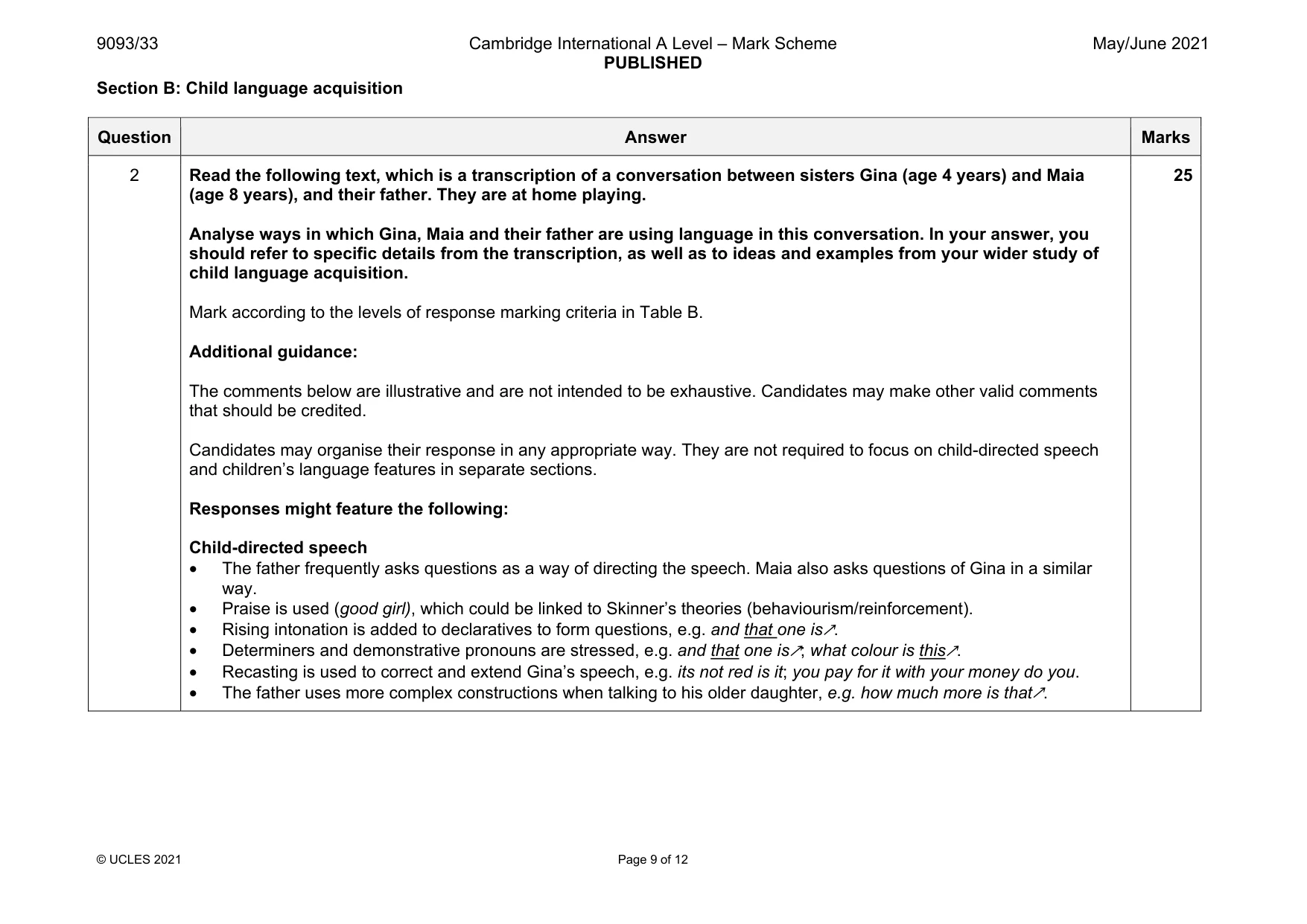
9093/33 Cambridge International A Level – Mark Scheme PUBLISHED May/June 2021 © UCLES 2021 Page 9 of 12 Section B: Child language acquisition Question Answer Marks 2 Read the following text, which is a transcription of a conversation between sisters Gina (age 4 years) and Maia (age 8 years), and their father. They are at home playing. Analyse ways in which Gina, Maia and their father are using language in this conversation. In your answer, you should refer to specific details from the transcription, as well as to ideas and examples from your wider study of child language acquisition. Mark according to the levels of response marking criteria in Table B. Additional guidance: The comments below are illustrative and are not intended to be exhaustive. Candidates may make other valid comments that should be credited. Candidates may organise their response in any appropriate way. They are not required to focus on child-directed speech and children’s language features in separate sections. Responses might feature the following: Child-directed speech • The father frequently asks questions as a way of directing the speech. Maia also asks questions of Gina in a similar way. • Praise is used (good girl), which could be linked to Skinner’s theories (behaviourism/reinforcement). • Rising intonation is added to declaratives to form questions, e.g. and that one is↗. • Determiners and demonstrative pronouns are stressed, e.g. and that one is↗; what colour is this↗. • Recasting is used to correct and extend Gina’s speech, e.g. its not red is it; you pay for it with your money do you. • The father uses more complex constructions when talking to his older daughter, e.g. how much more is that↗. 25
Mark scheme, page 10
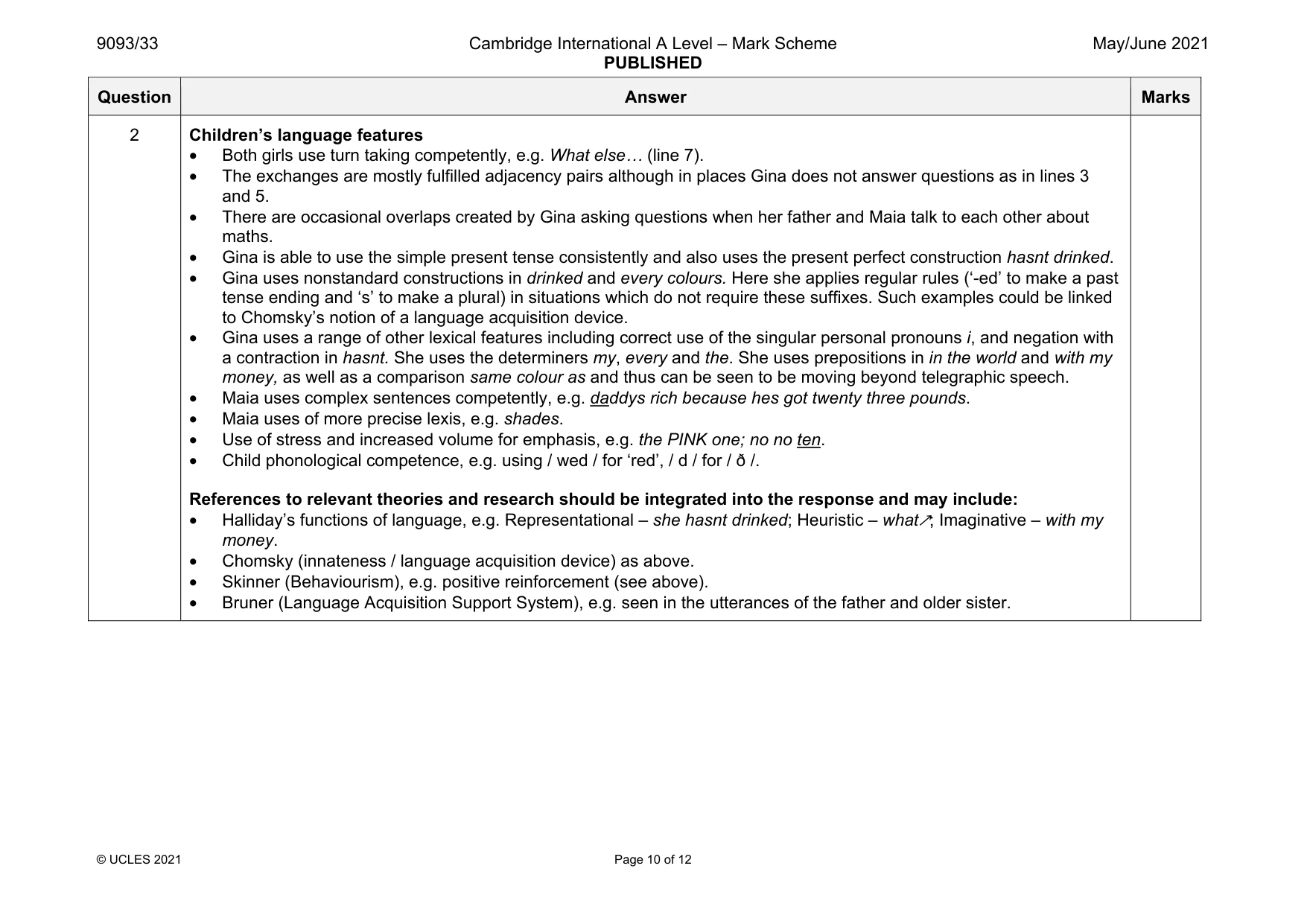
9093/33 Cambridge International A Level – Mark Scheme PUBLISHED May/June 2021 © UCLES 2021 Page 10 of 12 Question Answer Marks 2 Children’s language features • Both girls use turn taking competently, e.g. What else… (line 7). • The exchanges are mostly fulfilled adjacency pairs although in places Gina does not answer questions as in lines 3 and 5. • There are occasional overlaps created by Gina asking questions when her father and Maia talk to each other about maths. • Gina is able to use the simple present tense consistently and also uses the present perfect construction hasnt drinked. • Gina uses nonstandard constructions in drinked and every colours. Here she applies regular rules (‘-ed’ to make a past tense ending and ‘s’ to make a plural) in situations which do not require these suffixes. Such examples could be linked to Chomsky’s notion of a language acquisition device. • Gina uses a range of other lexical features including correct use of the singular personal pronouns i, and negation with a contraction in hasnt. She uses the determiners my, every and the. She uses prepositions in in the world and with my money, as well as a comparison same colour as and thus can be seen to be moving beyond telegraphic speech. • Maia uses complex sentences competently, e.g. daddys rich because hes got twenty three pounds. • Maia uses of more precise lexis, e.g. shades. • Use of stress and increased volume for emphasis, e.g. the PINK one; no no ten. • Child phonological competence, e.g. using / wed / for ‘red’, / d / for / ð /. References to relevant theories and research should be integrated into the response and may include: • Halliday’s functions of language, e.g. Representational – she hasnt drinked; Heuristic – what↗; Imaginative – with my money. • Chomsky (innateness / language acquisition device) as above. • Skinner (Behaviourism), e.g. positive reinforcement (see above). • Bruner (Language Acquisition Support System), e.g. seen in the utterances of the father and older sister.
Mark scheme, page 11
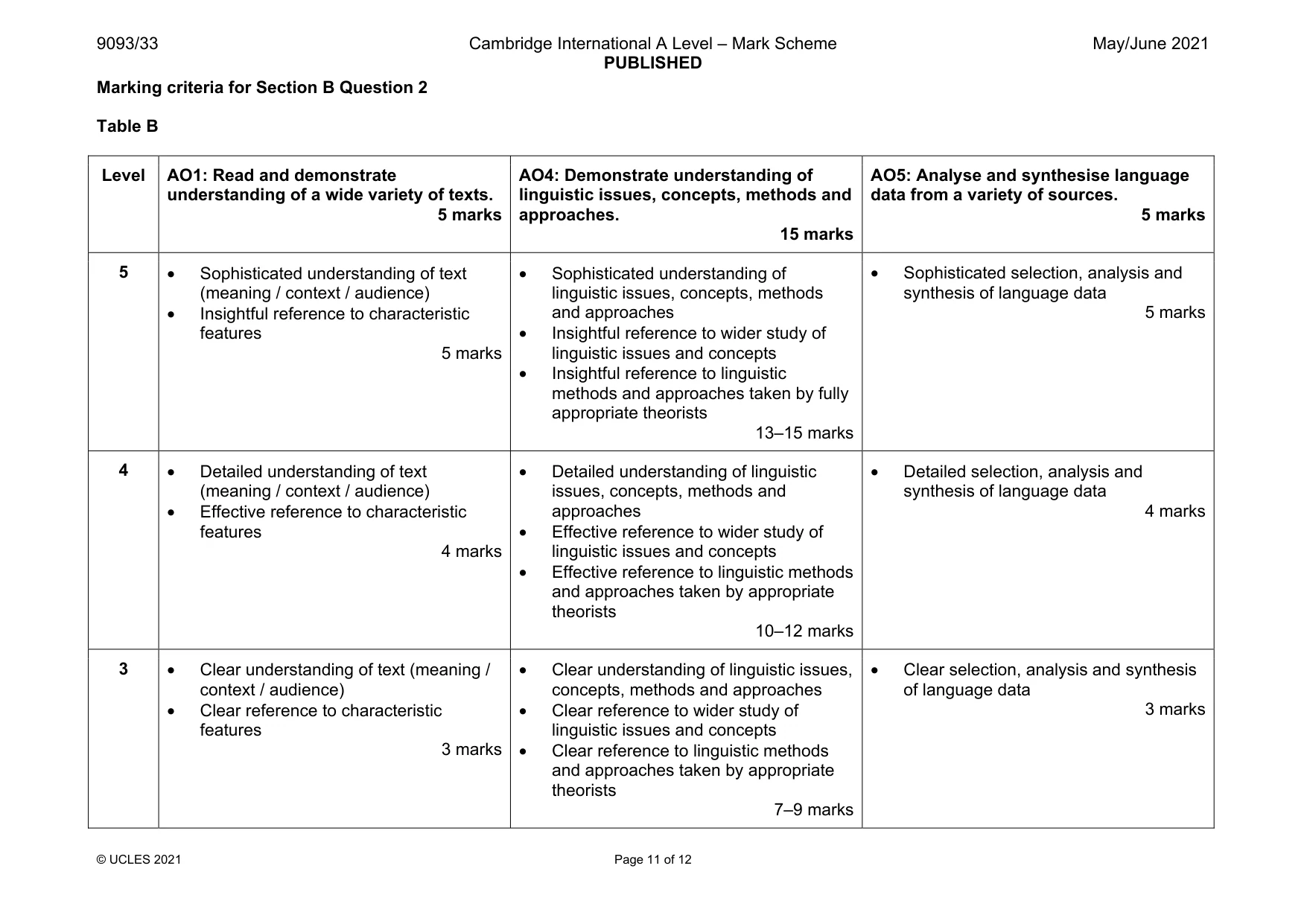
9093/33 Cambridge International A Level – Mark Scheme PUBLISHED May/June 2021 © UCLES 2021 Page 11 of 12 Marking criteria for Section B Question 2 Table B Level AO1: Read and demonstrate understanding of a wide variety of texts. 5 marks AO4: Demonstrate understanding of linguistic issues, concepts, methods and approaches. 15 marks AO5: Analyse and synthesise language data from a variety of sources. 5 marks 5 • Sophisticated understanding of text (meaning / context / audience) • Insightful reference to characteristic features 5 marks • Sophisticated understanding of linguistic issues, concepts, methods and approaches • Insightful reference to wider study of linguistic issues and concepts • Insightful reference to linguistic methods and approaches taken by fully appropriate theorists 13–15 marks • Sophisticated selection, analysis and synthesis of language data 5 marks 4 • Detailed understanding of text (meaning / context / audience) • Effective reference to characteristic features 4 marks • Detailed understanding of linguistic issues, concepts, methods and approaches • Effective reference to wider study of linguistic issues and concepts • Effective reference to linguistic methods and approaches taken by appropriate theorists 10–12 marks • Detailed selection, analysis and synthesis of language data 4 marks 3 • Clear understanding of text (meaning / context / audience) • Clear reference to characteristic features 3 marks • Clear understanding of linguistic issues, concepts, methods and approaches • Clear reference to wider study of linguistic issues and concepts • Clear reference to linguistic methods and approaches taken by appropriate theorists 7–9 marks • Clear selection, analysis and synthesis of language data 3 marks
Mark scheme, page 12
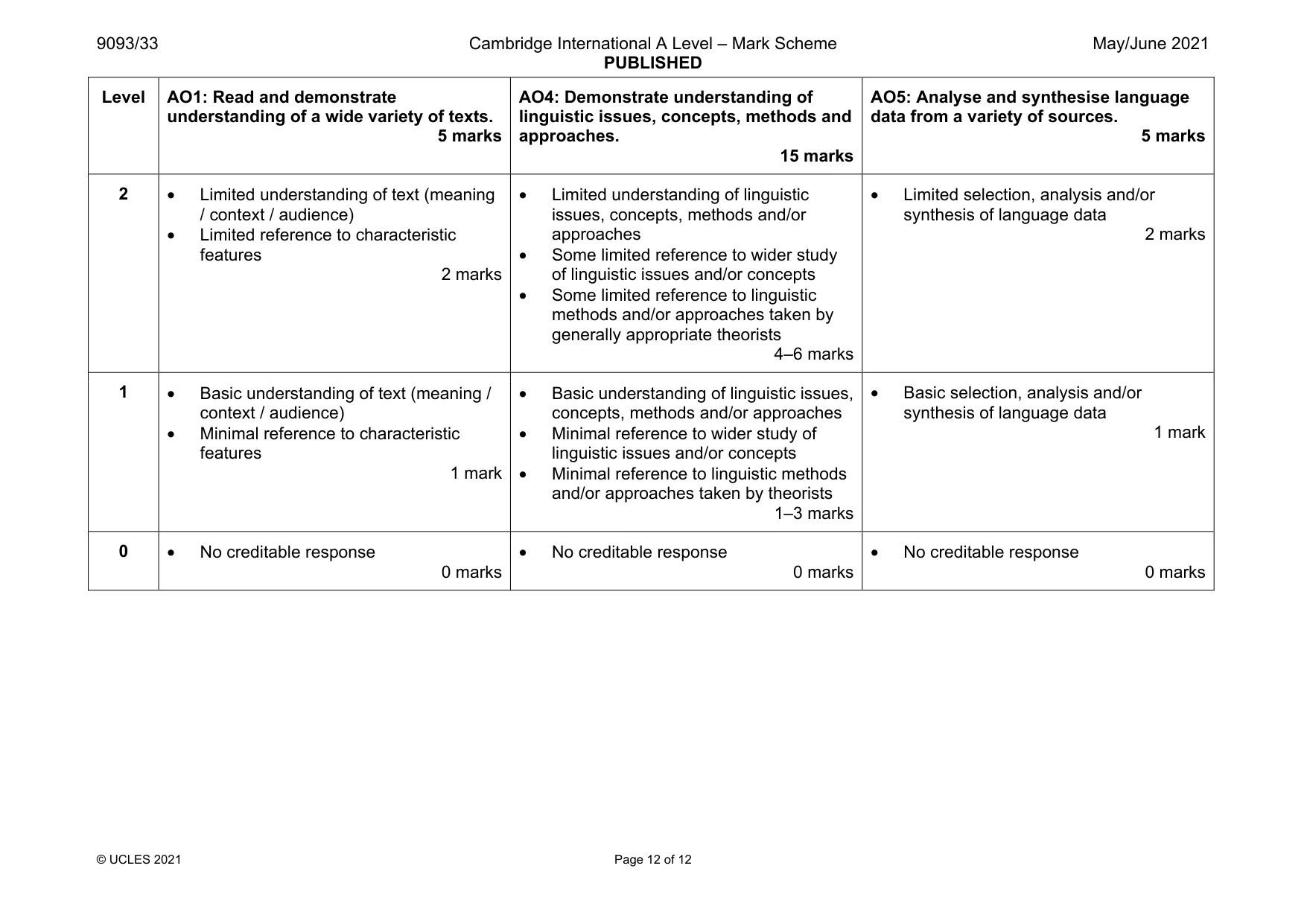
9093/33 Cambridge International A Level – Mark Scheme PUBLISHED May/June 2021 © UCLES 2021 Page 12 of 12 Level AO1: Read and demonstrate understanding of a wide variety of texts. 5 marks AO4: Demonstrate understanding of linguistic issues, concepts, methods and approaches. 15 marks AO5: Analyse and synthesise language data from a variety of sources. 5 marks 2 • Limited understanding of text (meaning / context / audience) • Limited reference to characteristic features 2 marks • Limited understanding of linguistic issues, concepts, methods and/or approaches • Some limited reference to wider study of linguistic issues and/or concepts • Some limited reference to linguistic methods and/or approaches taken by generally appropriate theorists 4–6 marks • Limited selection, analysis and/or synthesis of language data 2 marks 1 • Basic understanding of text (meaning / context / audience) • Minimal reference to characteristic features 1 mark • Basic understanding of linguistic issues, concepts, methods and/or approaches • Minimal reference to wider study of linguistic issues and/or concepts • Minimal reference to linguistic methods and/or approaches taken by theorists 1–3 marks • Basic selection, analysis and/or synthesis of language data 1 mark 0 • No creditable response 0 marks • No creditable response 0 marks • No creditable response 0 marks
What you needed in this session
Cambridge’s own grade thresholds for 2021 May/June, Paper 3 · Variant 3. A higher threshold means an easier paper — the bar moves with how the cohort did.