Cambridge A Level English - Language AS and A Level (from 2014) 9093 — 2020 May/June Paper 3 · Variant 1
9093/31/M/J/20
The question paper and its mark scheme, free to read here and free to download. This is Cambridge’s own paper, exactly as it was sat.
Question paper8 pages


Mark scheme7 pages
Answers below. Sit the paper first if you are practising.
Paper as text
Question paper, page 1
Cambridge International AS & A Level DC (KS) 181193/1 © UCLES 2020 [Turn over * 9 1 0 7 2 6 2 1 6 4 * This document has 8 pages. Blank pages are indicated. ENGLISH LANGUAGE 9093/31 Paper 3 Text Analysis May/June 2020 2 hours 15 minutes You must answer on the enclosed answer booklet. You will need: Answer booklet (enclosed) INSTRUCTIONS ● Answer two questions. ● Follow the instructions on the front cover of the answer booklet. If you need additional answer paper, ask the invigilator for a continuation booklet. ● You are reminded of the need for good English and clear presentation in your answers. INFORMATION ● The total mark for this paper is 50. ● The number of marks for each question or part question is shown in brackets [ ].
Question paper, page 2
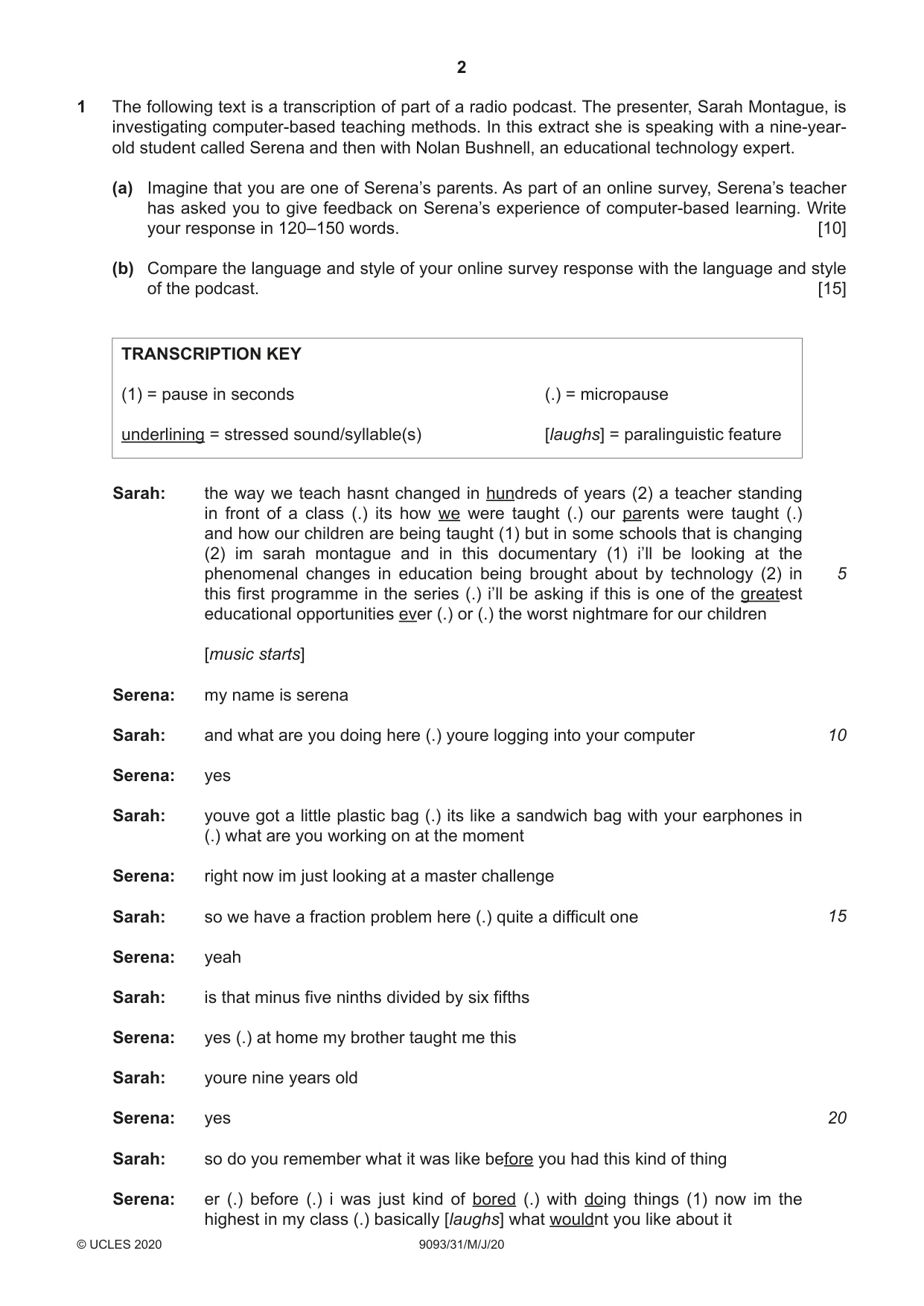
2 9093/31/M/J/20 © UCLES 2020 1 The following text is a transcription of part of a radio podcast. The presenter, Sarah Montague, is investigating computer-based teaching methods. In this extract she is speaking with a nine-year- old student called Serena and then with Nolan Bushnell, an educational technology expert. (a) Imagine that you are one of Serena’s parents. As part of an online survey, Serena’s teacher has asked you to give feedback on Serena’s experience of computer-based learning. Write your response in 120–150 words. [10] (b) Compare the language and style of your online survey response with the language and style of the podcast. [15] TRANSCRIPTION KEY (1) = pause in seconds (.) = micropause underlining = stressed sound/syllable(s) [laughs] = paralinguistic feature Sarah: the way we teach hasnt changed in hundreds of years (2) a teacher standing in front of a class (.) its how we were taught (.) our parents were taught (.) and how our children are being taught (1) but in some schools that is changing (2) im sarah montague and in this documentary (1) i’ll be looking at the phenomenal changes in education being brought about by technology (2) in this first programme in the series (.) i’ll be asking if this is one of the greatest educational opportunities ever (.) or (.) the worst nightmare for our children [music starts] Serena: my name is serena Sarah: and what are you doing here (.) youre logging into your computer Serena: yes Sarah: youve got a little plastic bag (.) its like a sandwich bag with your earphones in (.) what are you working on at the moment Serena: right now im just looking at a master challenge Sarah: so we have a fraction problem here (.) quite a difficult one Serena: yeah Sarah: is that minus five ninths divided by six fifths Serena: yes (.) at home my brother taught me this Sarah: youre nine years old Serena: yes Sarah: so do you remember what it was like before you had this kind of thing Serena: er (.) before (.) i was just kind of bored (.) with doing things (1) now im the highest in my class (.) basically [laughs] what wouldnt you like about it 5 10 15 20
Question paper, page 3
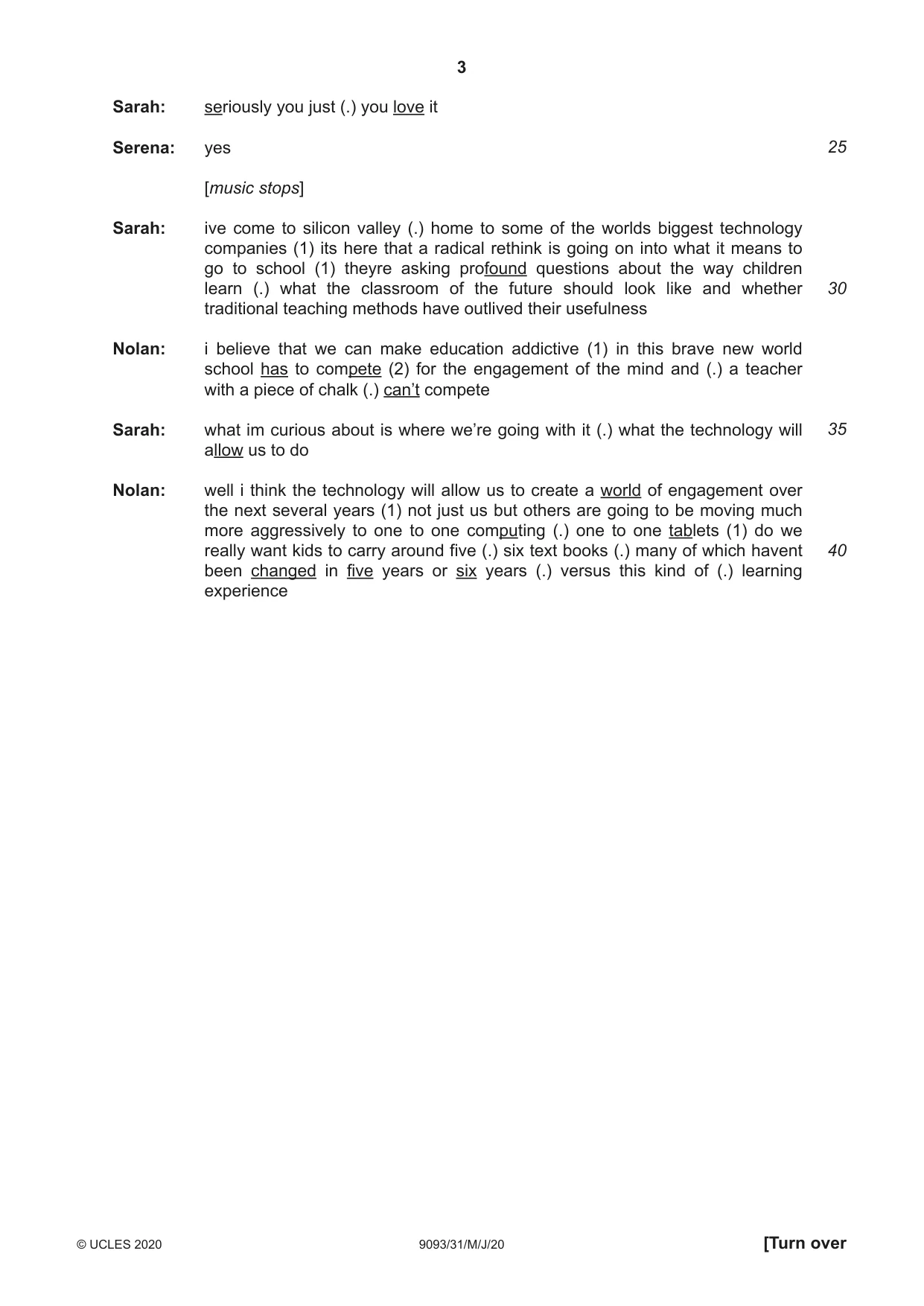
3 9093/31/M/J/20 © UCLES 2020 [Turn over Sarah: seriously you just (.) you love it Serena: yes [music stops] Sarah: ive come to silicon valley (.) home to some of the worlds biggest technology companies (1) its here that a radical rethink is going on into what it means to go to school (1) theyre asking profound questions about the way children learn (.) what the classroom of the future should look like and whether traditional teaching methods have outlived their usefulness Nolan: i believe that we can make education addictive (1) in this brave new world school has to compete (2) for the engagement of the mind and (.) a teacher with a piece of chalk (.) can’t compete Sarah: what im curious about is where we’re going with it (.) what the technology will allow us to do Nolan: well i think the technology will allow us to create a world of engagement over the next several years (1) not just us but others are going to be moving much more aggressively to one to one computing (.) one to one tablets (1) do we really want kids to carry around five (.) six text books (.) many of which havent been changed in five years or six years (.) versus this kind of (.) learning experience 25 30 35 40
Question paper, page 4
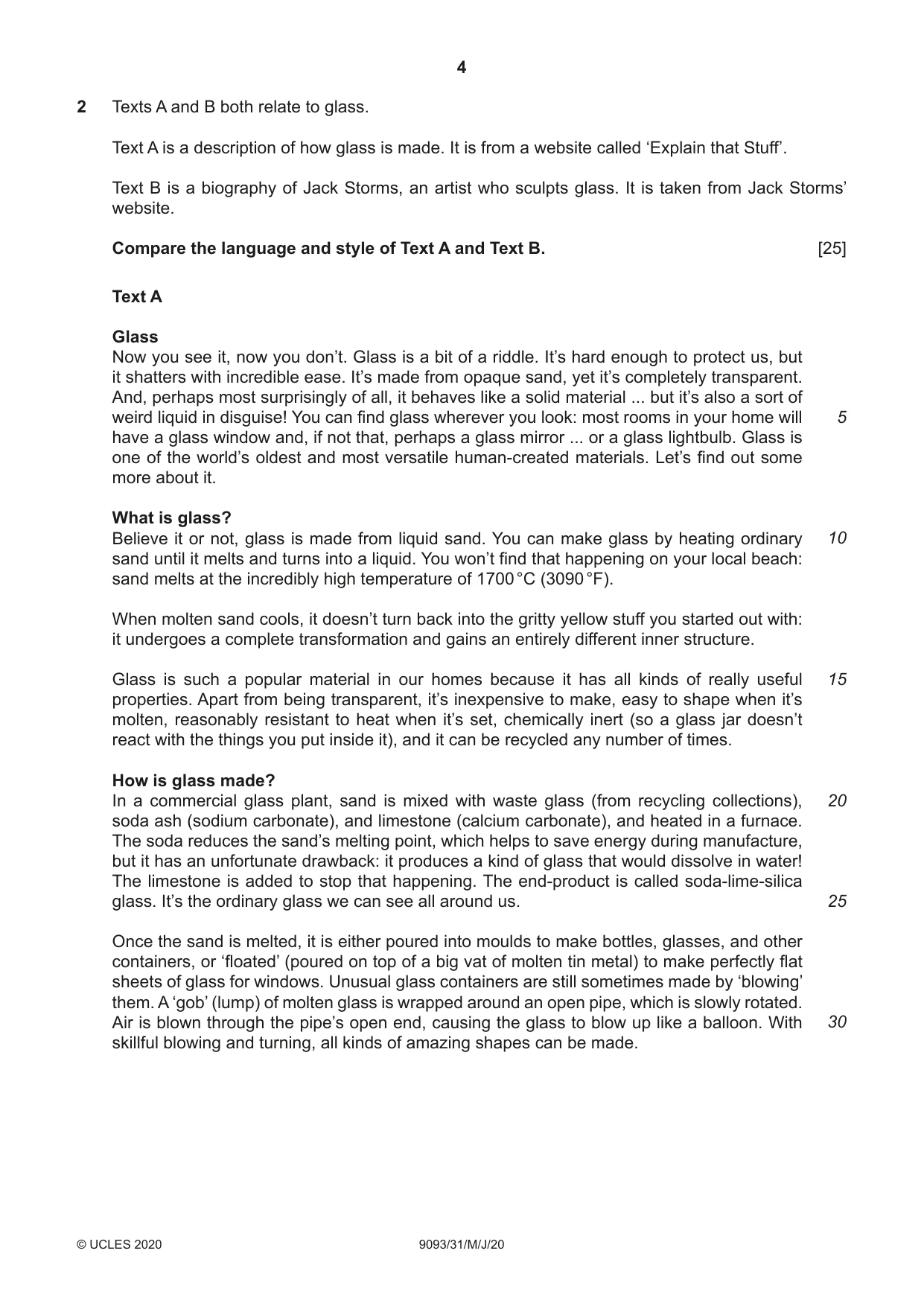
4 9093/31/M/J/20 © UCLES 2020 2 Texts A and B both relate to glass. Text A is a description of how glass is made. It is from a website called ‘Explain that Stuff’. Text B is a biography of Jack Storms, an artist who sculpts glass. It is taken from Jack Storms’ website. Compare the language and style of Text A and Text B. [25] Text A Glass Now you see it, now you don’t. Glass is a bit of a riddle. It’s hard enough to protect us, but it shatters with incredible ease. It’s made from opaque sand, yet it’s completely transparent. And, perhaps most surprisingly of all, it behaves like a solid material ... but it’s also a sort of weird liquid in disguise! You can find glass wherever you look: most rooms in your home will have a glass window and, if not that, perhaps a glass mirror ... or a glass lightbulb. Glass is one of the world’s oldest and most versatile human-created materials. Let’s find out some more about it. What is glass? Believe it or not, glass is made from liquid sand. You can make glass by heating ordinary sand until it melts and turns into a liquid. You won’t find that happening on your local beach: sand melts at the incredibly high temperature of 1700 °C (3090 °F). When molten sand cools, it doesn’t turn back into the gritty yellow stuff you started out with: it undergoes a complete transformation and gains an entirely different inner structure. Glass is such a popular material in our homes because it has all kinds of really useful properties. Apart from being transparent, it’s inexpensive to make, easy to shape when it’s molten, reasonably resistant to heat when it’s set, chemically inert (so a glass jar doesn’t react with the things you put inside it), and it can be recycled any number of times. How is glass made? In a commercial glass plant, sand is mixed with waste glass (from recycling collections), soda ash (sodium carbonate), and limestone (calcium carbonate), and heated in a furnace. The soda reduces the sand’s melting point, which helps to save energy during manufacture, but it has an unfortunate drawback: it produces a kind of glass that would dissolve in water! The limestone is added to stop that happening. The end-product is called soda-lime-silica glass. It’s the ordinary glass we can see all around us. Once the sand is melted, it is either poured into moulds to make bottles, glasses, and other containers, or ‘floated’ (poured on top of a big vat of molten tin metal) to make perfectly flat sheets of glass for windows. Unusual glass containers are still sometimes made by ‘blowing’ them. A ‘gob’ (lump) of molten glass is wrapped around an open pipe, which is slowly rotated. Air is blown through the pipe’s open end, causing the glass to blow up like a balloon. With skillful blowing and turning, all kinds of amazing shapes can be made. 5 10 15 20 25 30
Question paper, page 5
5 9093/31/M/J/20 © UCLES 2020 Text B Beginnings... If you would have asked a 12-year-old Jack Storms what he wanted to do with his life, he’d have paused, then blurted a vague answer, something akin to ‘I don’t know. Art?’ He’d always been good at it. The passion was there too – an excess of it, even. The more he learned about art, the more he realized just how much he wanted to make a name for himself in the field – a field that’s been explored to the point of exhaustion throughout history. What Jack Storms didn’t know then was that he’d discover something that would push back the frontiers of contemporary art in a significant way. Experimentation During his junior year at Plymouth State University, Jack snagged a job working for a glass artist who’d been experimenting with a technique that captured Jack’s imagination – combining lead crystal and dichroic glass1 using a cold-glass process. There was a moment of revelation. Fascinated by its potential, Jack spent a year learning the ropes of the technique. But to Jack, there was always more – more aspects to dig into, more ideas to sift through, more designs to test out and call his own. Perfecting His Art After mustering the gumption to open his own studio in 2004, Jack delved deeper into the process, spending hours upon hours perfecting his creations and even inventing a cold-working lathe. It became immediately obvious to Jack that producing work which is effortlessly perfect would require an overwhelming amount of effort. And it all starts at the core. Working with blocks of lead crystal, he cuts them several times, grinding and polishing each slice. Then, with the precision of a surgeon, he inserts dichroic glass between them at every stage, pausing to glue and cure them before repeating the process. The end result? Glass sculptures – shaped like cubes, eggs and even champagne glasses and wine bottles – that flaunt a chaotic display of colour, pieces that not only passively draw attention but demand it with urgency. World Recognition It took several years of guesswork, a boatload of tenacity and a viral video or two, but fast forward 13 years, and Jack’s business is running full swing. Looking closely at any of his pieces, especially when the colours within emerge to hit the daylight and furiously sparkle, there’s ample evidence that Jack successfully turned an amorphous vision into a clear-cut reality. 1dichroic glass: glass which displays different colours when viewed from different directions 5 10 15 20 25 30
Question paper, page 6
6 9093/31/M/J/20 © UCLES 2020 BLANK PAGE
Question paper, page 7
7 9093/31/M/J/20 © UCLES 2020 BLANK PAGE
Question paper, page 8
8 9093/31/M/J/20 © UCLES 2020 Permission to reproduce items where third-party owned material protected by copyright is included has been sought and cleared where possible. Every reasonable effort has been made by the publisher (UCLES) to trace copyright holders, but if any items requiring clearance have unwittingly been included, the publisher will be pleased to make amends at the earliest possible opportunity. To avoid the issue of disclosure of answer-related information to candidates, all copyright acknowledgements are reproduced online in the Cambridge Assessment International Education Copyright Acknowledgements Booklet. This is produced for each series of examinations and is freely available to download at www.cambridgeinternational.org after the live examination series. Cambridge Assessment International Education is part of the Cambridge Assessment Group. Cambridge Assessment is the brand name of the University of Cambridge Local Examinations Syndicate (UCLES), which itself is a department of the University of Cambridge. BLANK PAGE
Mark scheme, page 1
This document consists of 7 printed pages. © UCLES 2020 [Turn over Cambridge International A Level ENGLISH LANGUAGE 9093/31 Paper 1 Text Analysis May/June 2020 MARK SCHEME Maximum Mark: 50 Published Students did not sit exam papers in the June 2020 series due to the Covid-19 global pandemic. This mark scheme is published to support teachers and students and should be read together with the question paper. It shows the requirements of the exam. The answer column of the mark scheme shows the proposed basis on which Examiners would award marks for this exam. Where appropriate, this column also provides the most likely acceptable alternative responses expected from students. Examiners usually review the mark scheme after they have seen student responses and update the mark scheme if appropriate. In the June series, Examiners were unable to consider the acceptability of alternative responses, as there were no student responses to consider. Mark schemes should usually be read together with the Principal Examiner Report for Teachers. However, because students did not sit exam papers, there is no Principal Examiner Report for Teachers for the June 2020 series. Cambridge International will not enter into discussions about these mark schemes. Cambridge International is publishing the mark schemes for the June 2020 series for most Cambridge IGCSE™ and Cambridge International A & AS Level components, and some Cambridge O Level components.
Mark scheme, page 2
9093/31 Cambridge International A Level – Mark Scheme PUBLISHED May/June 2020 © UCLES 2020 Page 2 of 7 Generic Marking Principles These general marking principles must be applied by all examiners when marking candidate answers. They should be applied alongside the specific content of the mark scheme or generic level descriptors for a question. Each question paper and mark scheme will also comply with these marking principles. GENERIC MARKING PRINCIPLE 1: Marks must be awarded in line with: • the specific content of the mark scheme or the generic level descriptors for the question • the specific skills defined in the mark scheme or in the generic level descriptors for the question • the standard of response required by a candidate as exemplified by the standardisation scripts. GENERIC MARKING PRINCIPLE 2: Marks awarded are always whole marks (not half marks, or other fractions). GENERIC MARKING PRINCIPLE 3: Marks must be awarded positively: • marks are awarded for correct/valid answers, as defined in the mark scheme. However, credit is given for valid answers which go beyond the scope of the syllabus and mark scheme, referring to your Team Leader as appropriate • marks are awarded when candidates clearly demonstrate what they know and can do • marks are not deducted for errors • marks are not deducted for omissions • answers should only be judged on the quality of spelling, punctuation and grammar when these features are specifically assessed by the question as indicated by the mark scheme. The meaning, however, should be unambiguous. GENERIC MARKING PRINCIPLE 4: Rules must be applied consistently e.g. in situations where candidates have not followed instructions or in the application of generic level descriptors. GENERIC MARKING PRINCIPLE 5: Marks should be awarded using the full range of marks defined in the mark scheme for the question (however; the use of the full mark range may be limited according to the quality of the candidate responses seen). GENERIC MARKING PRINCIPLE 6: Marks awarded are based solely on the requirements as defined in the mark scheme. Marks should not be awarded with grade thresholds or grade descriptors in mind.
Mark scheme, page 3
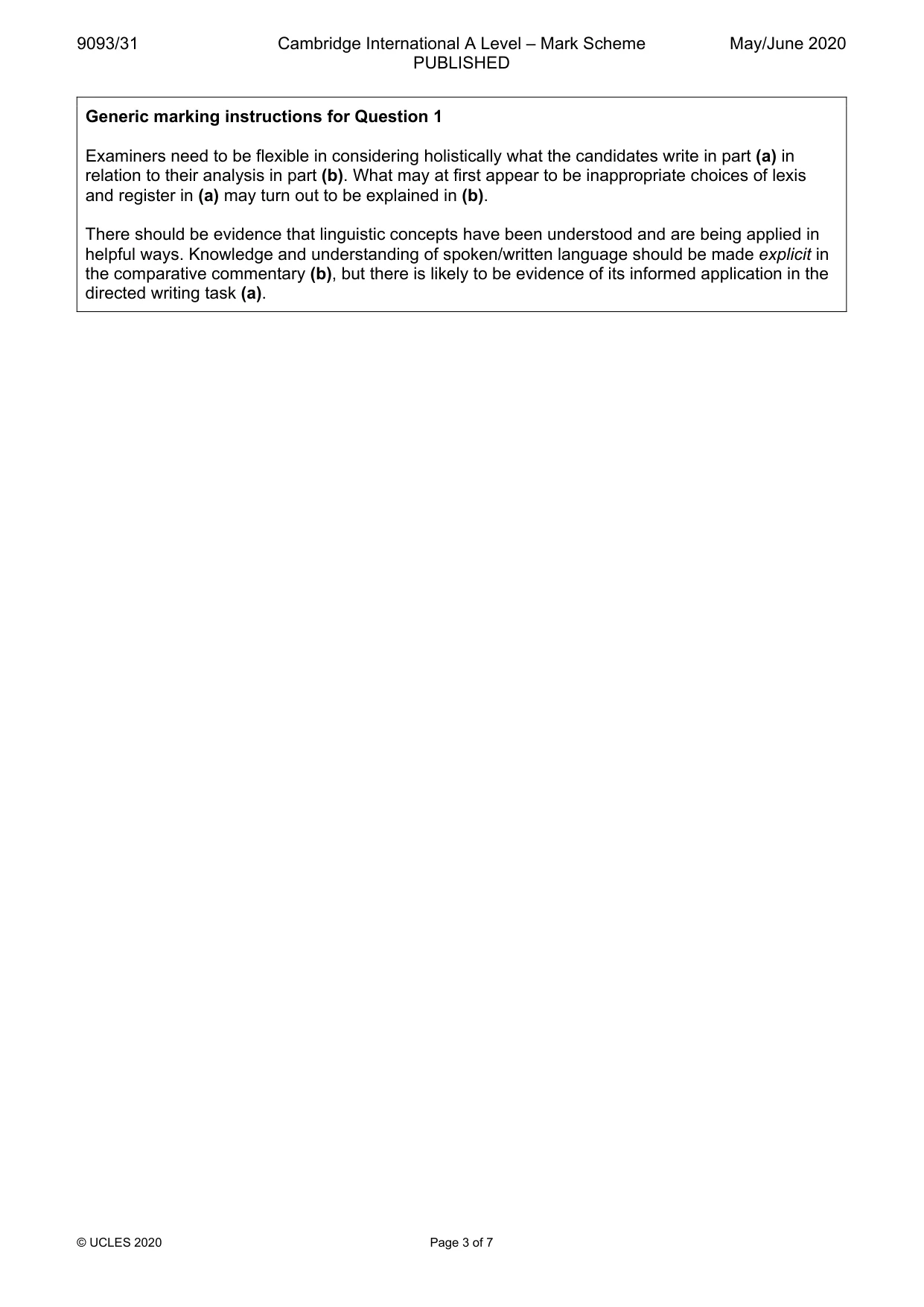
9093/31 Cambridge International A Level – Mark Scheme PUBLISHED May/June 2020 © UCLES 2020 Page 3 of 7 Generic marking instructions for Question 1 Examiners need to be flexible in considering holistically what the candidates write in part (a) in relation to their analysis in part (b). What may at first appear to be inappropriate choices of lexis and register in (a) may turn out to be explained in (b). There should be evidence that linguistic concepts have been understood and are being applied in helpful ways. Knowledge and understanding of spoken/written language should be made explicit in the comparative commentary (b), but there is likely to be evidence of its informed application in the directed writing task (a).
Mark scheme, page 4
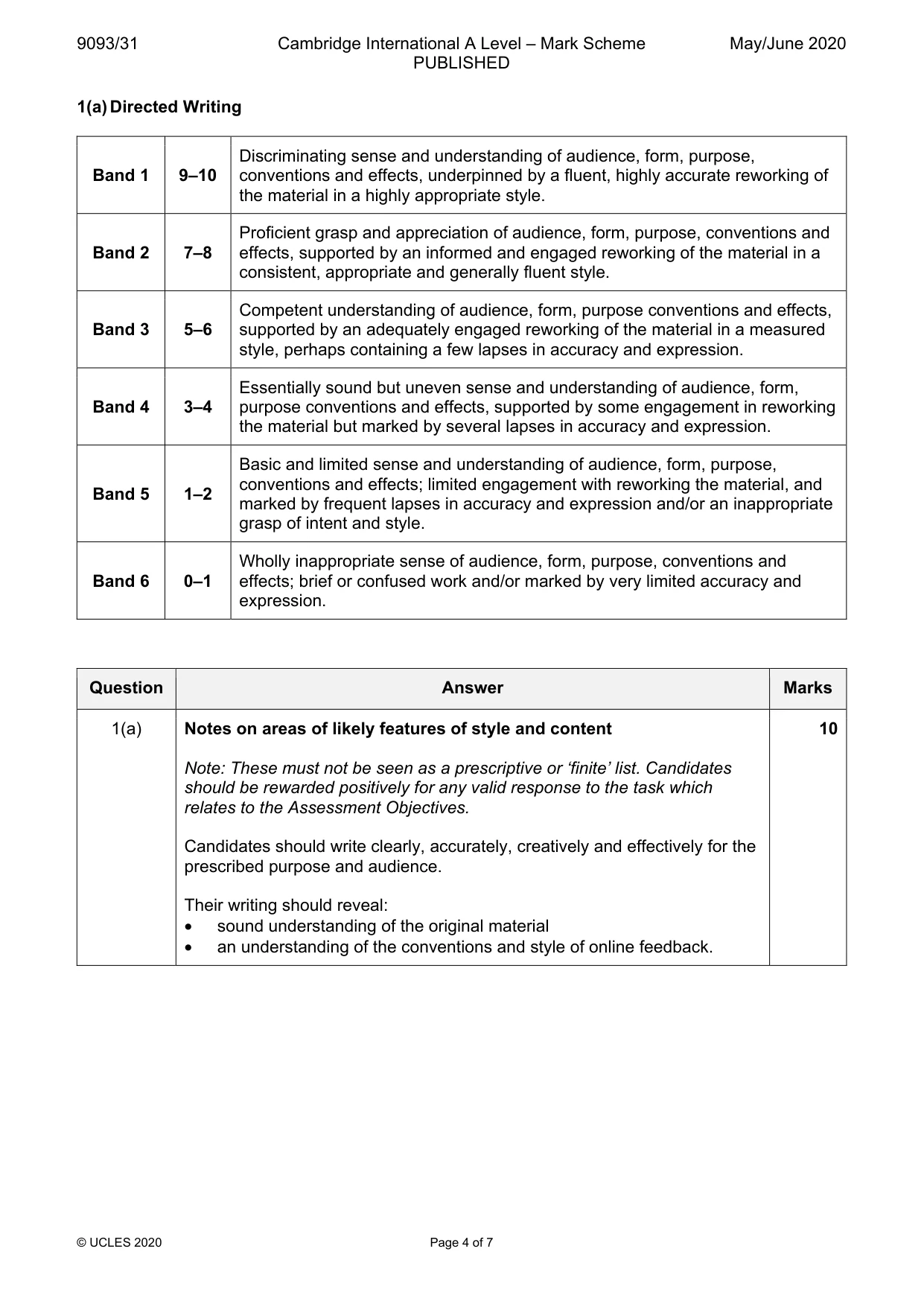
9093/31 Cambridge International A Level – Mark Scheme PUBLISHED May/June 2020 © UCLES 2020 Page 4 of 7 1(a) Directed Writing Band 1 9–10 Discriminating sense and understanding of audience, form, purpose, conventions and effects, underpinned by a fluent, highly accurate reworking of the material in a highly appropriate style. Band 2 7–8 Proficient grasp and appreciation of audience, form, purpose, conventions and effects, supported by an informed and engaged reworking of the material in a consistent, appropriate and generally fluent style. Band 3 5–6 Competent understanding of audience, form, purpose conventions and effects, supported by an adequately engaged reworking of the material in a measured style, perhaps containing a few lapses in accuracy and expression. Band 4 3–4 Essentially sound but uneven sense and understanding of audience, form, purpose conventions and effects, supported by some engagement in reworking the material but marked by several lapses in accuracy and expression. Band 5 1–2 Basic and limited sense and understanding of audience, form, purpose, conventions and effects; limited engagement with reworking the material, and marked by frequent lapses in accuracy and expression and/or an inappropriate grasp of intent and style. Band 6 0–1 Wholly inappropriate sense of audience, form, purpose, conventions and effects; brief or confused work and/or marked by very limited accuracy and expression. Question Answer Marks 1(a) Notes on areas of likely features of style and content Note: These must not be seen as a prescriptive or ‘finite’ list. Candidates should be rewarded positively for any valid response to the task which relates to the Assessment Objectives. Candidates should write clearly, accurately, creatively and effectively for the prescribed purpose and audience. Their writing should reveal: • sound understanding of the original material • an understanding of the conventions and style of online feedback. 10
Mark scheme, page 5
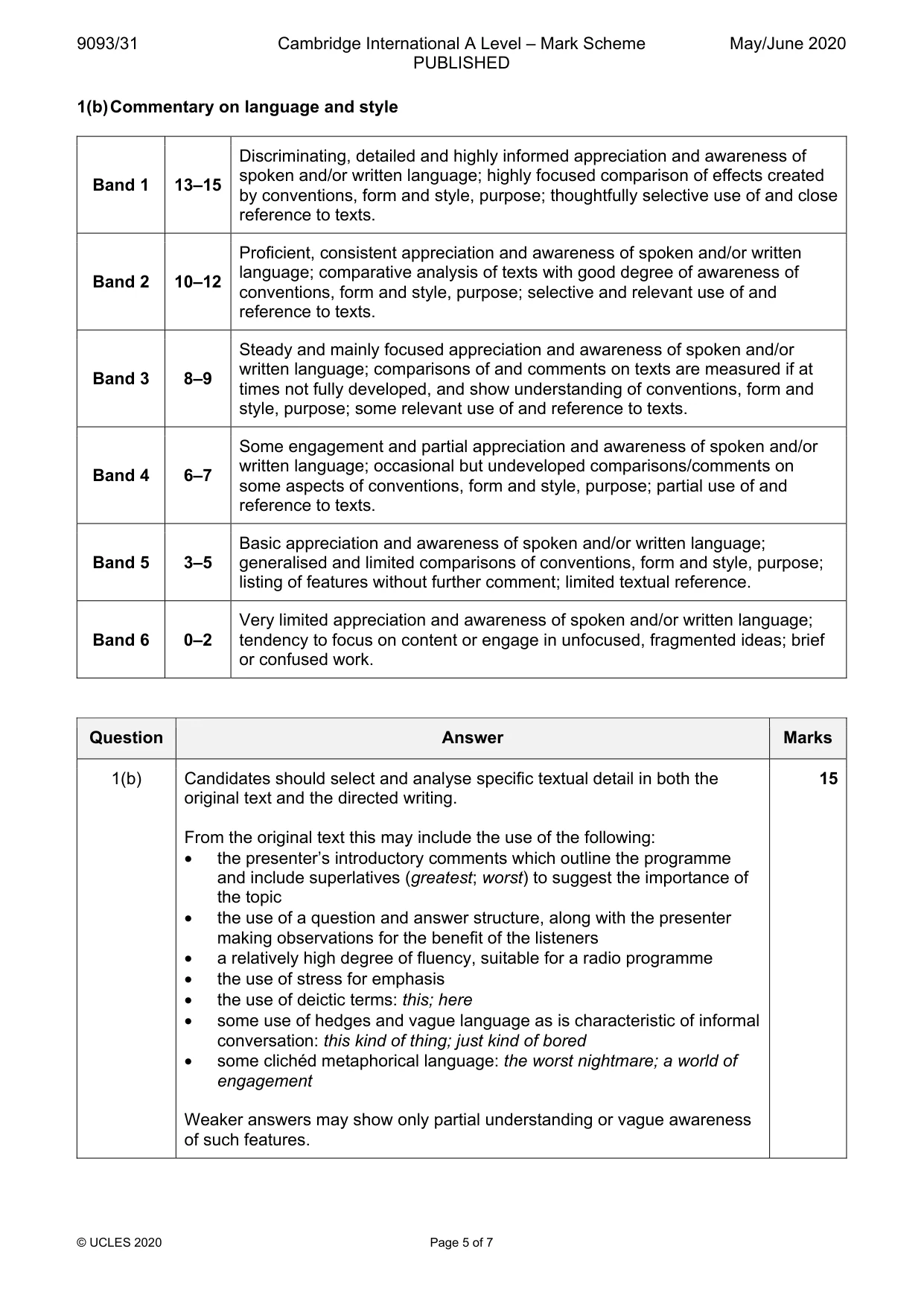
9093/31 Cambridge International A Level – Mark Scheme PUBLISHED May/June 2020 © UCLES 2020 Page 5 of 7 1(b) Commentary on language and style Band 1 13–15 Discriminating, detailed and highly informed appreciation and awareness of spoken and/or written language; highly focused comparison of effects created by conventions, form and style, purpose; thoughtfully selective use of and close reference to texts. Band 2 10–12 Proficient, consistent appreciation and awareness of spoken and/or written language; comparative analysis of texts with good degree of awareness of conventions, form and style, purpose; selective and relevant use of and reference to texts. Band 3 8–9 Steady and mainly focused appreciation and awareness of spoken and/or written language; comparisons of and comments on texts are measured if at times not fully developed, and show understanding of conventions, form and style, purpose; some relevant use of and reference to texts. Band 4 6–7 Some engagement and partial appreciation and awareness of spoken and/or written language; occasional but undeveloped comparisons/comments on some aspects of conventions, form and style, purpose; partial use of and reference to texts. Band 5 3–5 Basic appreciation and awareness of spoken and/or written language; generalised and limited comparisons of conventions, form and style, purpose; listing of features without further comment; limited textual reference. Band 6 0–2 Very limited appreciation and awareness of spoken and/or written language; tendency to focus on content or engage in unfocused, fragmented ideas; brief or confused work. Question Answer Marks 1(b) Candidates should select and analyse specific textual detail in both the original text and the directed writing. From the original text this may include the use of the following: • the presenter’s introductory comments which outline the programme and include superlatives (greatest; worst) to suggest the importance of the topic • the use of a question and answer structure, along with the presenter making observations for the benefit of the listeners • a relatively high degree of fluency, suitable for a radio programme • the use of stress for emphasis • the use of deictic terms: this; here • some use of hedges and vague language as is characteristic of informal conversation: this kind of thing; just kind of bored • some clichéd metaphorical language: the worst nightmare; a world of engagement Weaker answers may show only partial understanding or vague awareness of such features. 15
Mark scheme, page 6
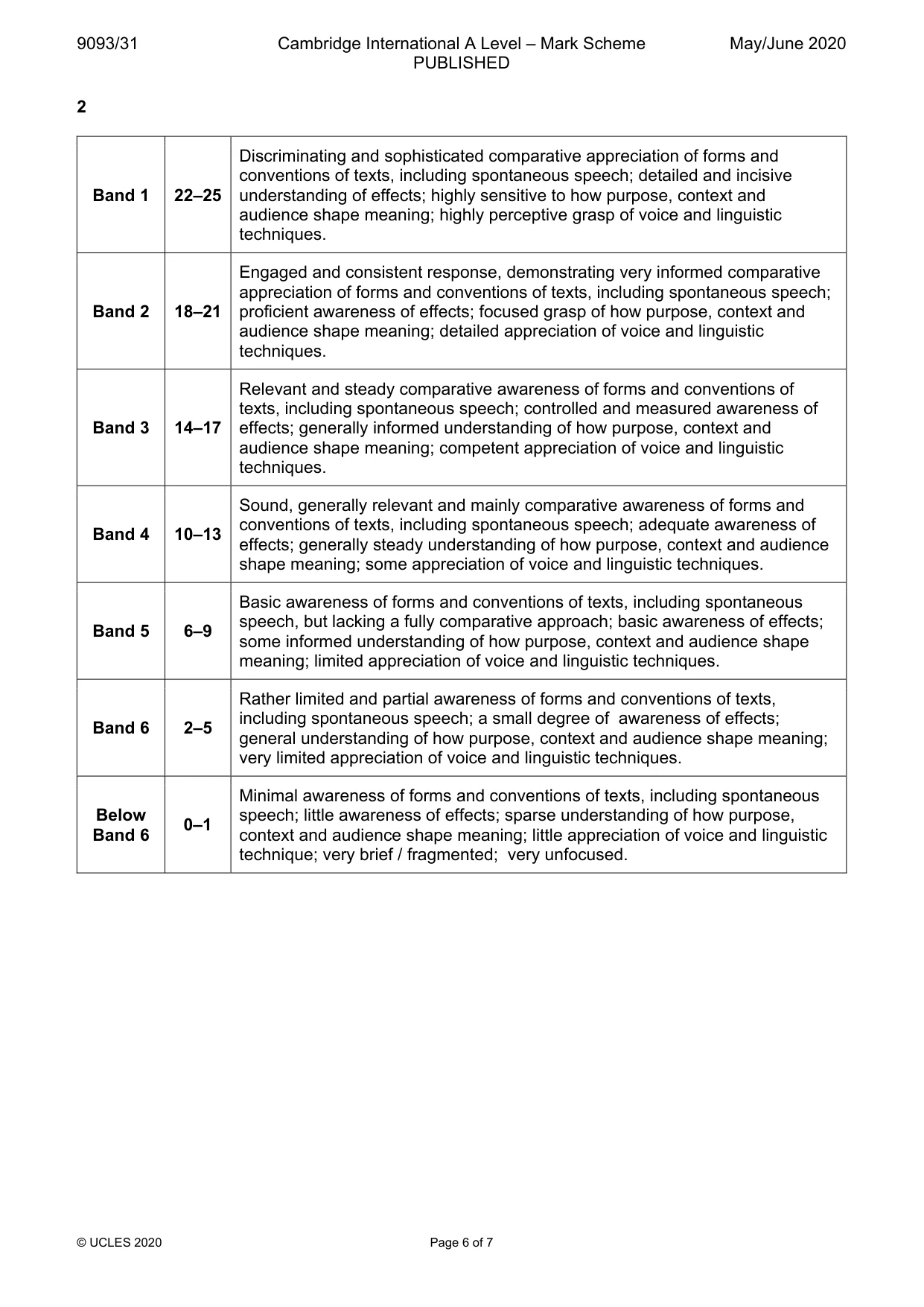
9093/31 Cambridge International A Level – Mark Scheme PUBLISHED May/June 2020 © UCLES 2020 Page 6 of 7 2 Band 1 22–25 Discriminating and sophisticated comparative appreciation of forms and conventions of texts, including spontaneous speech; detailed and incisive understanding of effects; highly sensitive to how purpose, context and audience shape meaning; highly perceptive grasp of voice and linguistic techniques. Band 2 18–21 Engaged and consistent response, demonstrating very informed comparative appreciation of forms and conventions of texts, including spontaneous speech; proficient awareness of effects; focused grasp of how purpose, context and audience shape meaning; detailed appreciation of voice and linguistic techniques. Band 3 14–17 Relevant and steady comparative awareness of forms and conventions of texts, including spontaneous speech; controlled and measured awareness of effects; generally informed understanding of how purpose, context and audience shape meaning; competent appreciation of voice and linguistic techniques. Band 4 10–13 Sound, generally relevant and mainly comparative awareness of forms and conventions of texts, including spontaneous speech; adequate awareness of effects; generally steady understanding of how purpose, context and audience shape meaning; some appreciation of voice and linguistic techniques. Band 5 6–9 Basic awareness of forms and conventions of texts, including spontaneous speech, but lacking a fully comparative approach; basic awareness of effects; some informed understanding of how purpose, context and audience shape meaning; limited appreciation of voice and linguistic techniques. Band 6 2–5 Rather limited and partial awareness of forms and conventions of texts, including spontaneous speech; a small degree of awareness of effects; general understanding of how purpose, context and audience shape meaning; very limited appreciation of voice and linguistic techniques. Below Band 6 0–1 Minimal awareness of forms and conventions of texts, including spontaneous speech; little awareness of effects; sparse understanding of how purpose, context and audience shape meaning; little appreciation of voice and linguistic technique; very brief / fragmented; very unfocused.
Mark scheme, page 7
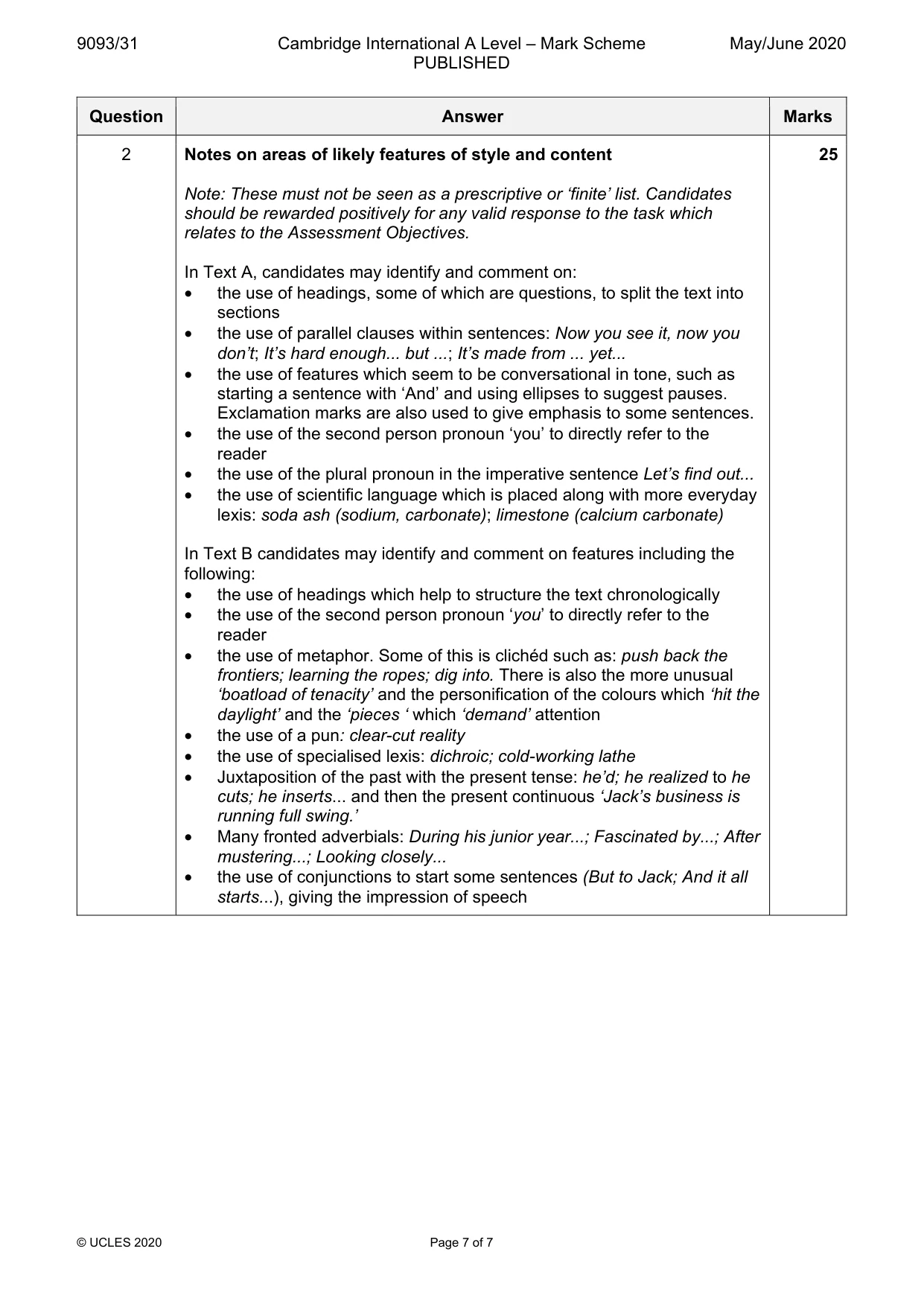
9093/31 Cambridge International A Level – Mark Scheme PUBLISHED May/June 2020 © UCLES 2020 Page 7 of 7 Question Answer Marks 2 Notes on areas of likely features of style and content Note: These must not be seen as a prescriptive or ‘finite’ list. Candidates should be rewarded positively for any valid response to the task which relates to the Assessment Objectives. In Text A, candidates may identify and comment on: • the use of headings, some of which are questions, to split the text into sections • the use of parallel clauses within sentences: Now you see it, now you don’t; It’s hard enough... but ...; It’s made from ... yet... • the use of features which seem to be conversational in tone, such as starting a sentence with ‘And’ and using ellipses to suggest pauses. Exclamation marks are also used to give emphasis to some sentences. • the use of the second person pronoun ‘you’ to directly refer to the reader • the use of the plural pronoun in the imperative sentence Let’s find out... • the use of scientific language which is placed along with more everyday lexis: soda ash (sodium, carbonate); limestone (calcium carbonate) In Text B candidates may identify and comment on features including the following: • the use of headings which help to structure the text chronologically • the use of the second person pronoun ‘you’ to directly refer to the reader • the use of metaphor. Some of this is clichéd such as: push back the frontiers; learning the ropes; dig into. There is also the more unusual ‘boatload of tenacity’ and the personification of the colours which ‘hit the daylight’ and the ‘pieces ‘ which ‘demand’ attention • the use of a pun: clear-cut reality • the use of specialised lexis: dichroic; cold-working lathe • Juxtaposition of the past with the present tense: he’d; he realized to he cuts; he inserts... and then the present continuous ‘Jack’s business is running full swing.’ • Many fronted adverbials: During his junior year...; Fascinated by...; After mustering...; Looking closely... • the use of conjunctions to start some sentences (But to Jack; And it all starts...), giving the impression of speech 25