Cambridge A Level English - Language AS and A Level (from 2014) 9093 — 2020 May/June Paper 3 · Variant 3
9093/33/M/J/20
The question paper and its mark scheme, free to read here and free to download. This is Cambridge’s own paper, exactly as it was sat.
Question paper8 pages
Mark scheme7 pages
Answers below. Sit the paper first if you are practising.
Paper as text
Question paper, page 1
Cambridge International AS & A Level DC (SLM) 196076 © UCLES 2020 [Turn over * 6 7 7 0 1 6 1 2 2 1 * This document has 8 pages. Blank pages are indicated. ENGLISH LANGUAGE 9093/33 Paper 3 Text Analysis May/June 2020 2 hours 15 minutes You must answer on the enclosed answer booklet. You will need: Answer booklet (enclosed) INSTRUCTIONS ● Answer two questions. ● Follow the instructions on the front cover of the answer booklet. If you need additional answer paper, ask the invigilator for a continuation booklet. ● You are reminded of the need for good English and clear presentation in your answers. INFORMATION ● The total mark for this paper is 50. ● The number of marks for each question or part question is shown in brackets [ ].
Question paper, page 2
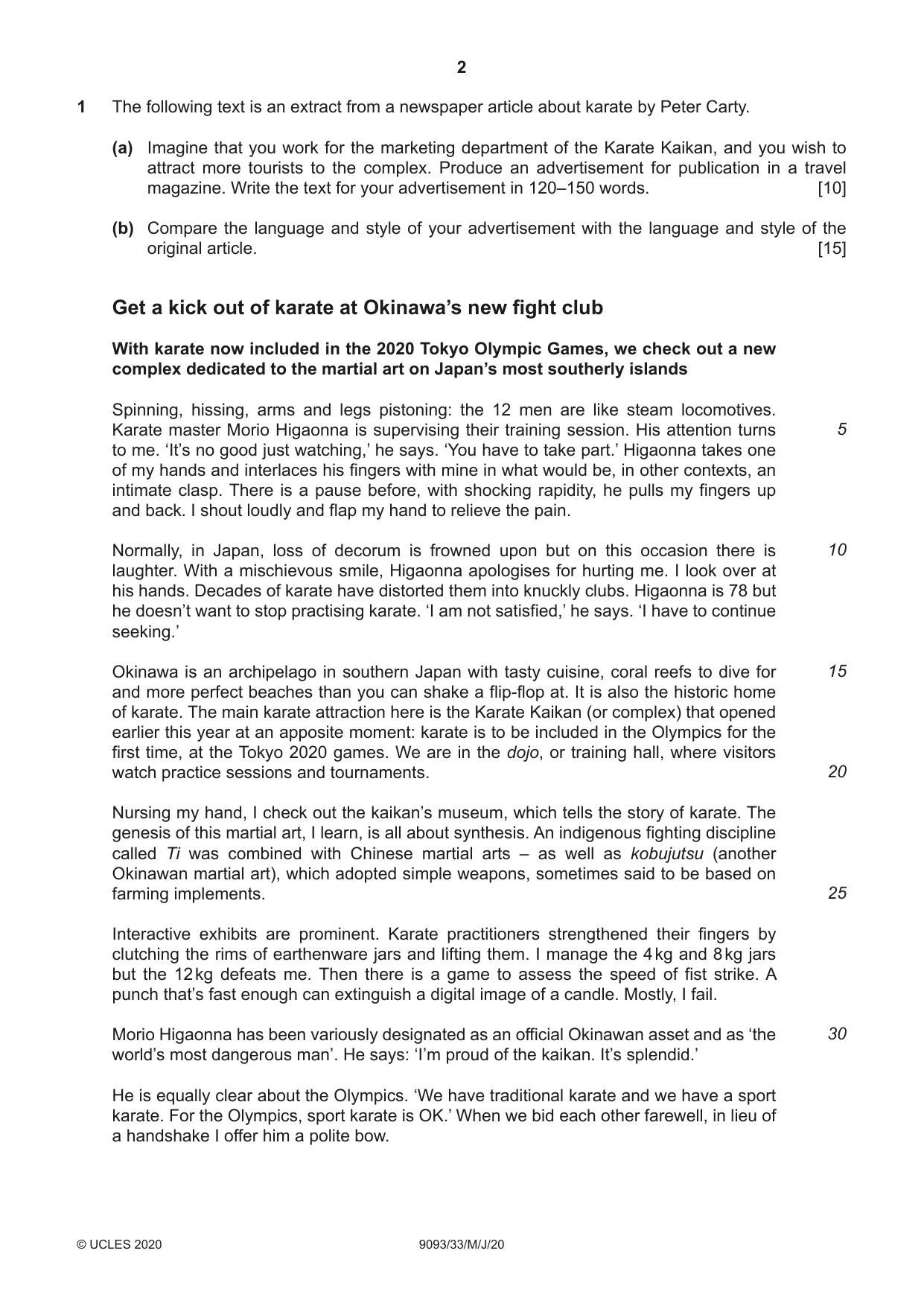
2 9093/33/M/J/20 © UCLES 2020 1 The following text is an extract from a newspaper article about karate by Peter Carty. (a) Imagine that you work for the marketing department of the Karate Kaikan, and you wish to attract more tourists to the complex. Produce an advertisement for publication in a travel magazine. Write the text for your advertisement in 120–150 words. [10] (b) Compare the language and style of your advertisement with the language and style of the original article. [15] Get a kick out of karate at Okinawa’s new fight club With karate now included in the 2020 Tokyo Olympic Games, we check out a new complex dedicated to the martial art on Japan’s most southerly islands Spinning, hissing, arms and legs pistoning: the 12 men are like steam locomotives. Karate master Morio Higaonna is supervising their training session. His attention turns to me. ‘It’s no good just watching,’ he says. ‘You have to take part.’ Higaonna takes one of my hands and interlaces his fingers with mine in what would be, in other contexts, an intimate clasp. There is a pause before, with shocking rapidity, he pulls my fingers up and back. I shout loudly and flap my hand to relieve the pain. Normally, in Japan, loss of decorum is frowned upon but on this occasion there is laughter. With a mischievous smile, Higaonna apologises for hurting me. I look over at his hands. Decades of karate have distorted them into knuckly clubs. Higaonna is 78 but he doesn’t want to stop practising karate. ‘I am not satisfied,’ he says. ‘I have to continue seeking.’ Okinawa is an archipelago in southern Japan with tasty cuisine, coral reefs to dive for and more perfect beaches than you can shake a flip-flop at. It is also the historic home of karate. The main karate attraction here is the Karate Kaikan (or complex) that opened earlier this year at an apposite moment: karate is to be included in the Olympics for the first time, at the Tokyo 2020 games. We are in the dojo, or training hall, where visitors watch practice sessions and tournaments. Nursing my hand, I check out the kaikan’s museum, which tells the story of karate. The genesis of this martial art, I learn, is all about synthesis. An indigenous fighting discipline called Ti was combined with Chinese martial arts – as well as kobujutsu (another Okinawan martial art), which adopted simple weapons, sometimes said to be based on farming implements. Interactive exhibits are prominent. Karate practitioners strengthened their fingers by clutching the rims of earthenware jars and lifting them. I manage the 4 kg and 8 kg jars but the 12 kg defeats me. Then there is a game to assess the speed of fist strike. A punch that’s fast enough can extinguish a digital image of a candle. Mostly, I fail. Morio Higaonna has been variously designated as an official Okinawan asset and as ‘the world’s most dangerous man’. He says: ‘I’m proud of the kaikan. It’s splendid.’ He is equally clear about the Olympics. ‘We have traditional karate and we have a sport karate. For the Olympics, sport karate is OK.’ When we bid each other farewell, in lieu of a handshake I offer him a polite bow. 5 10 15 20 25 30
Question paper, page 3
3 9093/33/M/J/20 © UCLES 2020 [Turn over BLANK PAGE
Question paper, page 4
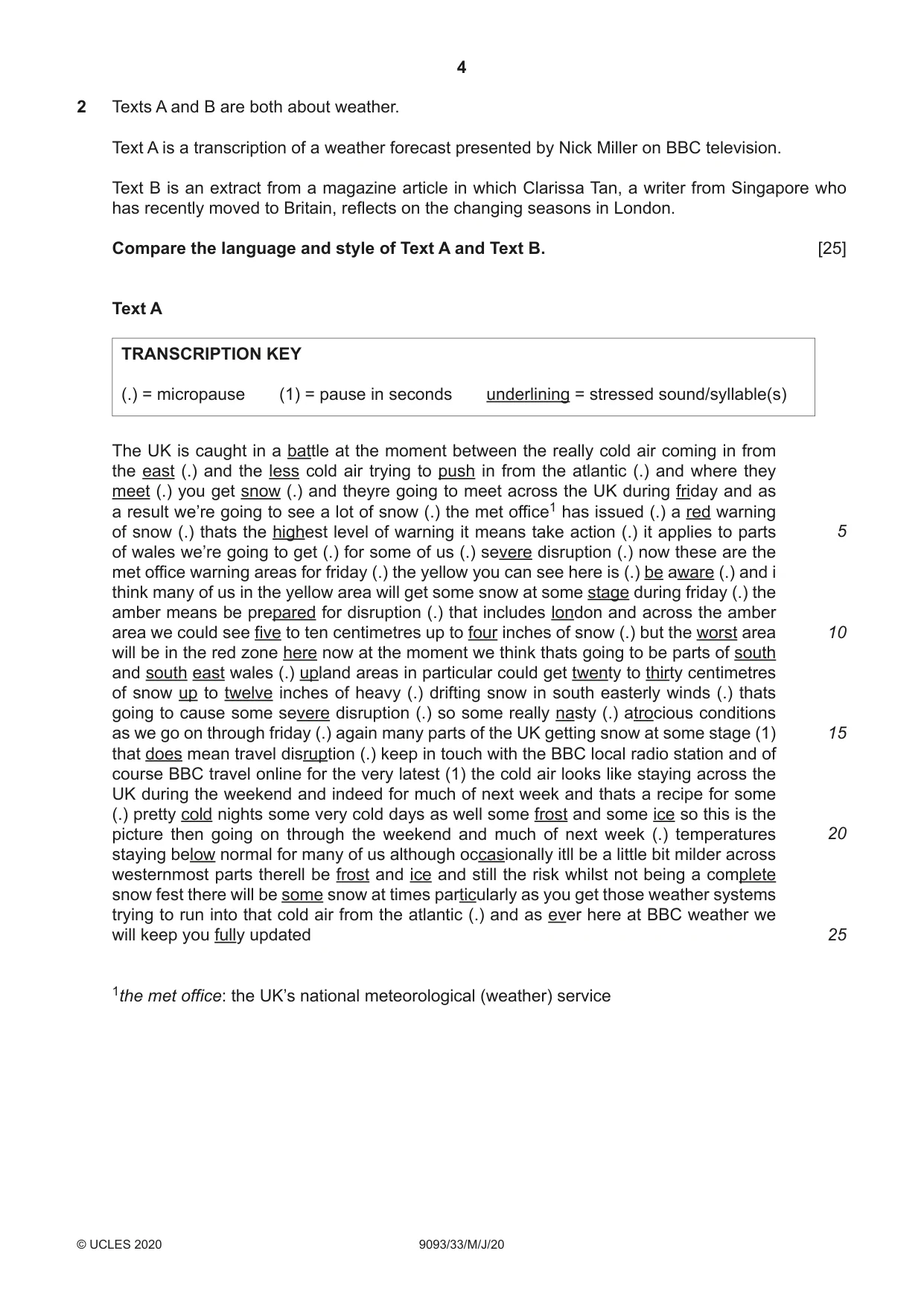
4 9093/33/M/J/20 © UCLES 2020 2 Texts A and B are both about weather. Text A is a transcription of a weather forecast presented by Nick Miller on BBC television. Text B is an extract from a magazine article in which Clarissa Tan, a writer from Singapore who has recently moved to Britain, reflects on the changing seasons in London. Compare the language and style of Text A and Text B. [25] Text A TRANSCRIPTION KEY (.) = micropause (1) = pause in seconds underlining = stressed sound/syllable(s) The UK is caught in a battle at the moment between the really cold air coming in from the east (.) and the less cold air trying to push in from the atlantic (.) and where they meet (.) you get snow (.) and theyre going to meet across the UK during friday and as a result we’re going to see a lot of snow (.) the met office1 has issued (.) a red warning of snow (.) thats the highest level of warning it means take action (.) it applies to parts of wales we’re going to get (.) for some of us (.) severe disruption (.) now these are the met office warning areas for friday (.) the yellow you can see here is (.) be aware (.) and i think many of us in the yellow area will get some snow at some stage during friday (.) the amber means be prepared for disruption (.) that includes london and across the amber area we could see five to ten centimetres up to four inches of snow (.) but the worst area will be in the red zone here now at the moment we think thats going to be parts of south and south east wales (.) upland areas in particular could get twenty to thirty centimetres of snow up to twelve inches of heavy (.) drifting snow in south easterly winds (.) thats going to cause some severe disruption (.) so some really nasty (.) atrocious conditions as we go on through friday (.) again many parts of the UK getting snow at some stage (1) that does mean travel disruption (.) keep in touch with the BBC local radio station and of course BBC travel online for the very latest (1) the cold air looks like staying across the UK during the weekend and indeed for much of next week and thats a recipe for some (.) pretty cold nights some very cold days as well some frost and some ice so this is the picture then going on through the weekend and much of next week (.) temperatures staying below normal for many of us although occasionally itll be a little bit milder across westernmost parts therell be frost and ice and still the risk whilst not being a complete snow fest there will be some snow at times particularly as you get those weather systems trying to run into that cold air from the atlantic (.) and as ever here at BBC weather we will keep you fully updated 1the met office: the UK’s national meteorological (weather) service 5 10 15 20 25
Question paper, page 5
5 9093/33/M/J/20 © UCLES 2020 Text B The exquisite joy of my first snowfall! So that’s what snow looks like. On Saturday night, standing at my window, I did not at once recognise what that white stuff was gathering all over the kerbs and cars. It looks like the world’s being frosted, I thought. And then I realised – it’s exactly that. I pressed my nose against the pane and saw, through the dark, my first flakes falling. It was only after arriving in Britain half a year ago that I experienced autumn and winter – and the lapsing of one into the other – for the first time. In Singapore, where I lived, there are no seasons. The climate is extremely warm all year round. Daylight and twilight arrive at the same times every day. Here, I find the flow of the seasons beautiful and somewhat unsettling. In autumn I watched in awe as trees all over London blazed into reds and yellows. But my wonder turned into a vague worry when their leaves started falling and the trees’ ‘arms’ showed, shorn of their dressings. How mournful, I thought. Yet – how beautiful it made the ground. Parks and pavements became carpeted in gold as all around, leaves wafted down. At a certain moment, it seemed to me, everyone in Britain became alert to an unspoken common call. Out came scarves and boots and long coats, mitts and gloves and woolly hats. Jackets got puffier, jumpers thicker. Come October everyone, in syncopation, set back their clocks by one hour. A kind of rite of winter was being performed, I realised. I was impressed by the sense of national coordination, as well as gripped by new and trivial anxieties. I did not know what to wear. Or, rather, I knew what to wear but not how to wear it. I come from a land of perpetual sun, where T-shirts, shorts, sandals and even flip-flops are acceptable all-year-round gear unless you’re stepping into an office. Still, as the weeks pass, I find myself more in step with the weather. On weekends I walk for hours, never breaking into a sweat; this for me is luxury. I have no map, no destination – I follow the course of the sun. In the cold months, it gives off a beautiful light but little heat. How strange it feels to be chasing the sun! Sometimes I miss the tropics. I miss the predictable warmth, the languid afternoons, the joy of knowing you can dive into a swimming pool at any time, night or day. Yet there’s something in the passing of the seasons, something that stirs me. It’s grand. It is the whirl of time – a tangible, giant display of the cycle of life. 5 10 15 20 25 30
Question paper, page 6
6 9093/33/M/J/20 © UCLES 2020 BLANK PAGE
Question paper, page 7
7 9093/33/M/J/20 © UCLES 2020 BLANK PAGE
Question paper, page 8
8 9093/33/M/J/20 © UCLES 2020 Permission to reproduce items where third-party owned material protected by copyright is included has been sought and cleared where possible. Every reasonable effort has been made by the publisher (UCLES) to trace copyright holders, but if any items requiring clearance have unwittingly been included, the publisher will be pleased to make amends at the earliest possible opportunity. To avoid the issue of disclosure of answer-related information to candidates, all copyright acknowledgements are reproduced online in the Cambridge Assessment International Education Copyright Acknowledgements Booklet. This is produced for each series of examinations and is freely available to download at www.cambridgeinternational.org after the live examination series. Cambridge Assessment International Education is part of the Cambridge Assessment Group. Cambridge Assessment is the brand name of the University of Cambridge Local Examinations Syndicate (UCLES), which itself is a department of the University of Cambridge. BLANK PAGE
Mark scheme, page 1
This document consists of 7 printed pages. © UCLES 2020 [Turn over Cambridge International A Level ENGLISH LANGUAGE 9093/33 Paper 3 Text Analysis May/June 2020 MARK SCHEME Maximum Mark: 50 Published Students did not sit exam papers in the June 2020 series due to the Covid-19 global pandemic. This mark scheme is published to support teachers and students and should be read together with the question paper. It shows the requirements of the exam. The answer column of the mark scheme shows the proposed basis on which Examiners would award marks for this exam. Where appropriate, this column also provides the most likely acceptable alternative responses expected from students. Examiners usually review the mark scheme after they have seen student responses and update the mark scheme if appropriate. In the June series, Examiners were unable to consider the acceptability of alternative responses, as there were no student responses to consider. Mark schemes should usually be read together with the Principal Examiner Report for Teachers. However, because students did not sit exam papers, there is no Principal Examiner Report for Teachers for the June 2020 series. Cambridge International will not enter into discussions about these mark schemes. Cambridge International is publishing the mark schemes for the June 2020 series for most Cambridge IGCSE™ and Cambridge International A & AS Level components, and some Cambridge O Level components.
Mark scheme, page 2
9093/33 Cambridge International A Level – Mark Scheme PUBLISHED May/June 2020 © UCLES 2020 Page 2 of 7 Generic Marking Principles These general marking principles must be applied by all examiners when marking candidate answers. They should be applied alongside the specific content of the mark scheme or generic level descriptors for a question. Each question paper and mark scheme will also comply with these marking principles. GENERIC MARKING PRINCIPLE 1: Marks must be awarded in line with: • the specific content of the mark scheme or the generic level descriptors for the question • the specific skills defined in the mark scheme or in the generic level descriptors for the question • the standard of response required by a candidate as exemplified by the standardisation scripts. GENERIC MARKING PRINCIPLE 2: Marks awarded are always whole marks (not half marks, or other fractions). GENERIC MARKING PRINCIPLE 3: Marks must be awarded positively: • marks are awarded for correct/valid answers, as defined in the mark scheme. However, credit is given for valid answers which go beyond the scope of the syllabus and mark scheme, referring to your Team Leader as appropriate • marks are awarded when candidates clearly demonstrate what they know and can do • marks are not deducted for errors • marks are not deducted for omissions • answers should only be judged on the quality of spelling, punctuation and grammar when these features are specifically assessed by the question as indicated by the mark scheme. The meaning, however, should be unambiguous. GENERIC MARKING PRINCIPLE 4: Rules must be applied consistently e.g. in situations where candidates have not followed instructions or in the application of generic level descriptors. GENERIC MARKING PRINCIPLE 5: Marks should be awarded using the full range of marks defined in the mark scheme for the question (however; the use of the full mark range may be limited according to the quality of the candidate responses seen). GENERIC MARKING PRINCIPLE 6: Marks awarded are based solely on the requirements as defined in the mark scheme. Marks should not be awarded with grade thresholds or grade descriptors in mind.
Mark scheme, page 3
9093/33 Cambridge International A Level – Mark Scheme PUBLISHED May/June 2020 © UCLES 2020 Page 3 of 7 Generic marking instructions for Question 1 Examiners need to be flexible in considering holistically what the candidates write in part (a) in relation to their analysis in part (b). What may at first appear to be inappropriate choices of lexis and register in (a) may turn out to be explained in (b). There should be evidence that linguistic concepts have been understood and are being applied in helpful ways. Knowledge and understanding of spoken/written language should be made explicit in the comparative commentary (b), but there is likely to be evidence of its informed application in the directed writing task (a).
Mark scheme, page 4
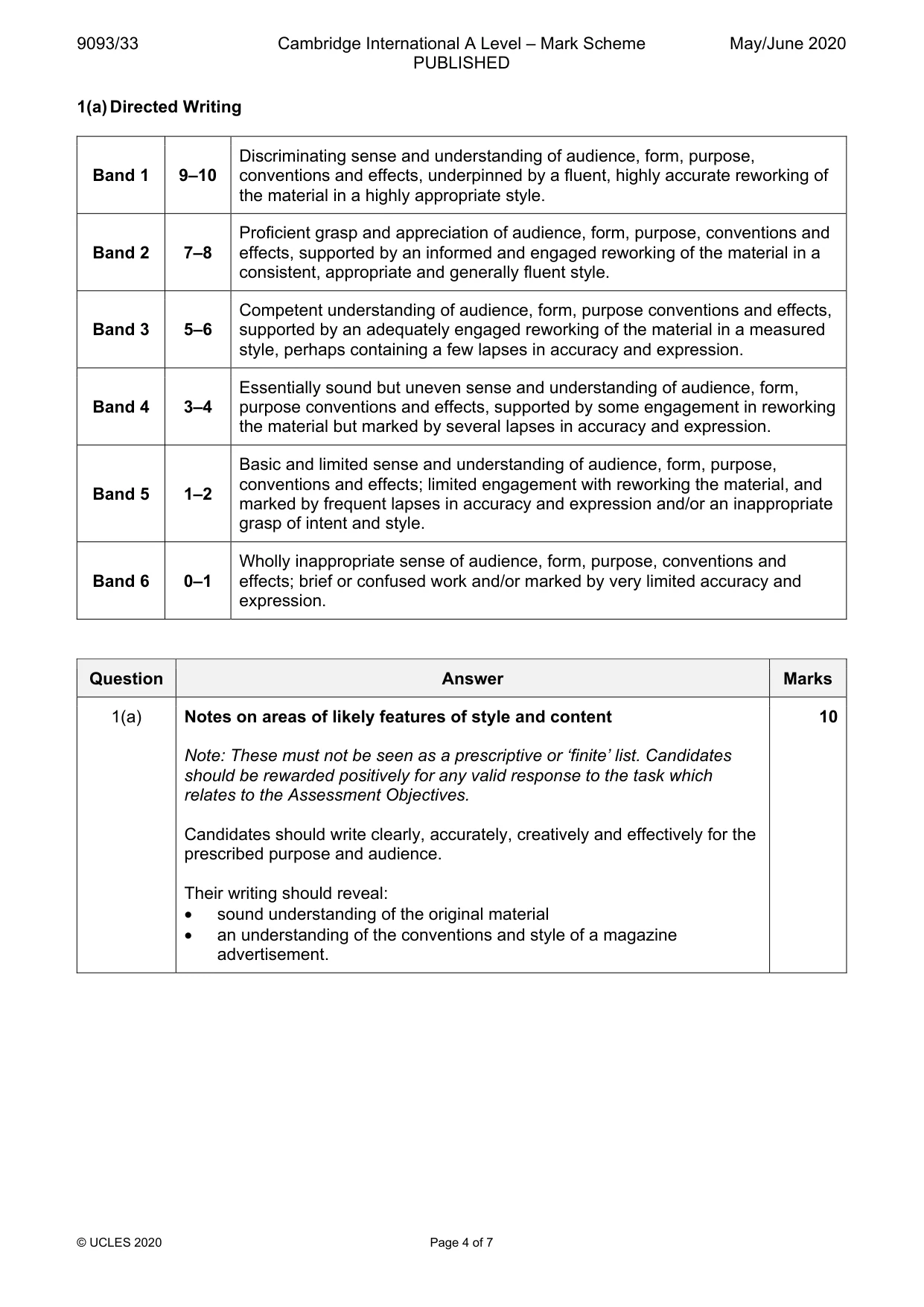
9093/33 Cambridge International A Level – Mark Scheme PUBLISHED May/June 2020 © UCLES 2020 Page 4 of 7 1(a) Directed Writing Band 1 9–10 Discriminating sense and understanding of audience, form, purpose, conventions and effects, underpinned by a fluent, highly accurate reworking of the material in a highly appropriate style. Band 2 7–8 Proficient grasp and appreciation of audience, form, purpose, conventions and effects, supported by an informed and engaged reworking of the material in a consistent, appropriate and generally fluent style. Band 3 5–6 Competent understanding of audience, form, purpose conventions and effects, supported by an adequately engaged reworking of the material in a measured style, perhaps containing a few lapses in accuracy and expression. Band 4 3–4 Essentially sound but uneven sense and understanding of audience, form, purpose conventions and effects, supported by some engagement in reworking the material but marked by several lapses in accuracy and expression. Band 5 1–2 Basic and limited sense and understanding of audience, form, purpose, conventions and effects; limited engagement with reworking the material, and marked by frequent lapses in accuracy and expression and/or an inappropriate grasp of intent and style. Band 6 0–1 Wholly inappropriate sense of audience, form, purpose, conventions and effects; brief or confused work and/or marked by very limited accuracy and expression. Question Answer Marks 1(a) Notes on areas of likely features of style and content Note: These must not be seen as a prescriptive or ‘finite’ list. Candidates should be rewarded positively for any valid response to the task which relates to the Assessment Objectives. Candidates should write clearly, accurately, creatively and effectively for the prescribed purpose and audience. Their writing should reveal: • sound understanding of the original material • an understanding of the conventions and style of a magazine advertisement. 10
Mark scheme, page 5
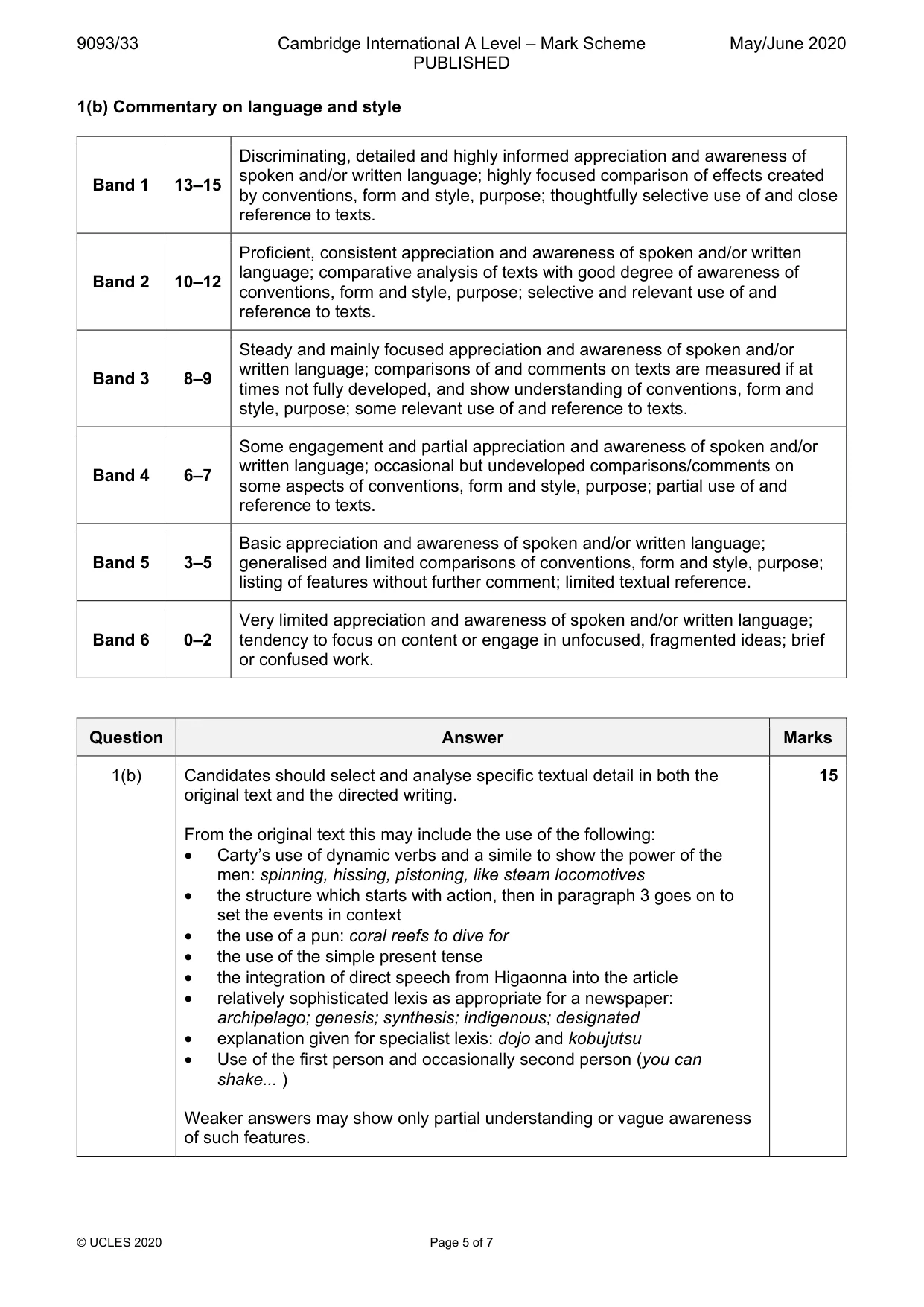
9093/33 Cambridge International A Level – Mark Scheme PUBLISHED May/June 2020 © UCLES 2020 Page 5 of 7 1(b) Commentary on language and style Band 1 13–15 Discriminating, detailed and highly informed appreciation and awareness of spoken and/or written language; highly focused comparison of effects created by conventions, form and style, purpose; thoughtfully selective use of and close reference to texts. Band 2 10–12 Proficient, consistent appreciation and awareness of spoken and/or written language; comparative analysis of texts with good degree of awareness of conventions, form and style, purpose; selective and relevant use of and reference to texts. Band 3 8–9 Steady and mainly focused appreciation and awareness of spoken and/or written language; comparisons of and comments on texts are measured if at times not fully developed, and show understanding of conventions, form and style, purpose; some relevant use of and reference to texts. Band 4 6–7 Some engagement and partial appreciation and awareness of spoken and/or written language; occasional but undeveloped comparisons/comments on some aspects of conventions, form and style, purpose; partial use of and reference to texts. Band 5 3–5 Basic appreciation and awareness of spoken and/or written language; generalised and limited comparisons of conventions, form and style, purpose; listing of features without further comment; limited textual reference. Band 6 0–2 Very limited appreciation and awareness of spoken and/or written language; tendency to focus on content or engage in unfocused, fragmented ideas; brief or confused work. Question Answer Marks 1(b) Candidates should select and analyse specific textual detail in both the original text and the directed writing. From the original text this may include the use of the following: • Carty’s use of dynamic verbs and a simile to show the power of the men: spinning, hissing, pistoning, like steam locomotives • the structure which starts with action, then in paragraph 3 goes on to set the events in context • the use of a pun: coral reefs to dive for • the use of the simple present tense • the integration of direct speech from Higaonna into the article • relatively sophisticated lexis as appropriate for a newspaper: archipelago; genesis; synthesis; indigenous; designated • explanation given for specialist lexis: dojo and kobujutsu • Use of the first person and occasionally second person (you can shake... ) Weaker answers may show only partial understanding or vague awareness of such features. 15
Mark scheme, page 6
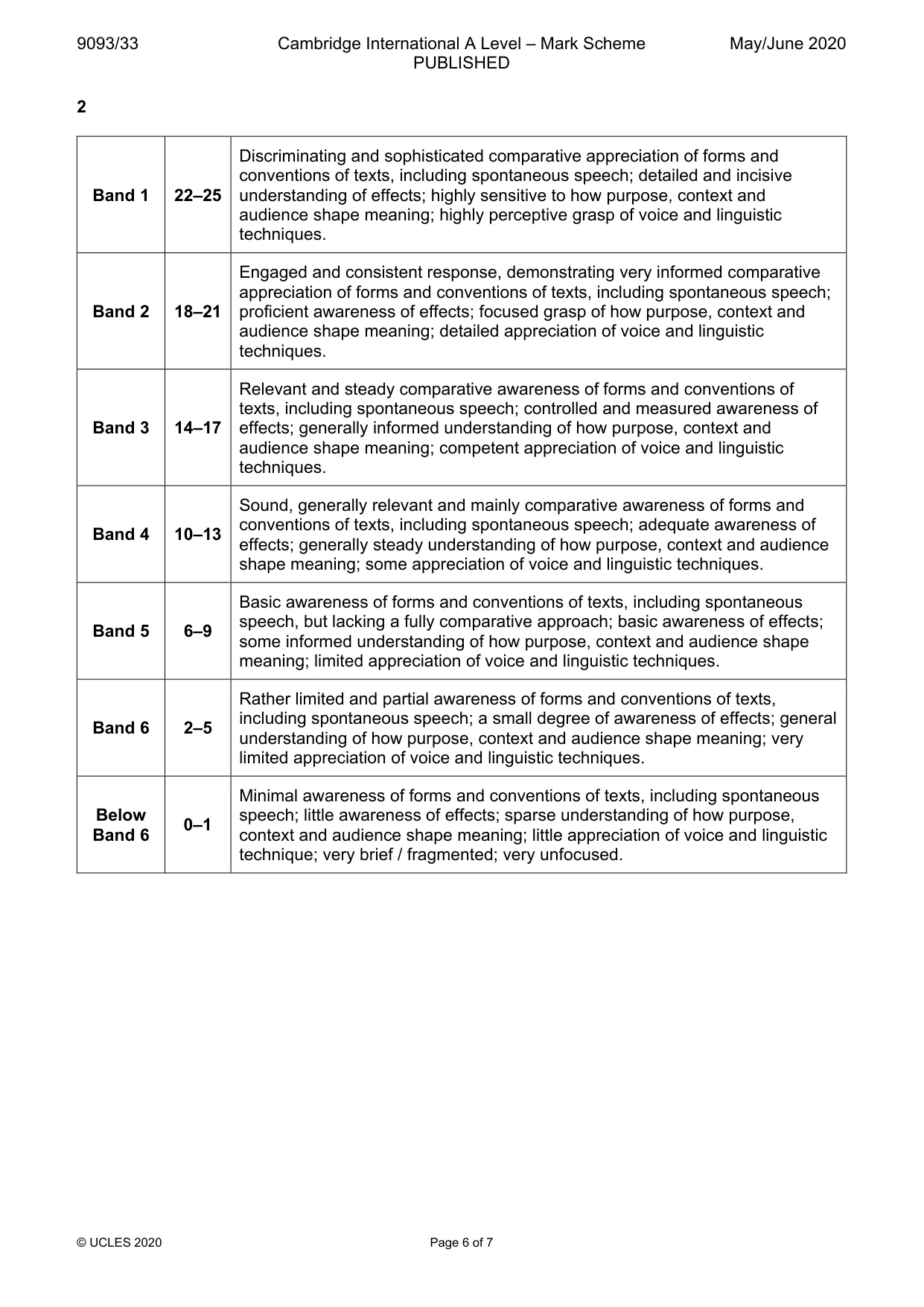
9093/33 Cambridge International A Level – Mark Scheme PUBLISHED May/June 2020 © UCLES 2020 Page 6 of 7 2 Band 1 22–25 Discriminating and sophisticated comparative appreciation of forms and conventions of texts, including spontaneous speech; detailed and incisive understanding of effects; highly sensitive to how purpose, context and audience shape meaning; highly perceptive grasp of voice and linguistic techniques. Band 2 18–21 Engaged and consistent response, demonstrating very informed comparative appreciation of forms and conventions of texts, including spontaneous speech; proficient awareness of effects; focused grasp of how purpose, context and audience shape meaning; detailed appreciation of voice and linguistic techniques. Band 3 14–17 Relevant and steady comparative awareness of forms and conventions of texts, including spontaneous speech; controlled and measured awareness of effects; generally informed understanding of how purpose, context and audience shape meaning; competent appreciation of voice and linguistic techniques. Band 4 10–13 Sound, generally relevant and mainly comparative awareness of forms and conventions of texts, including spontaneous speech; adequate awareness of effects; generally steady understanding of how purpose, context and audience shape meaning; some appreciation of voice and linguistic techniques. Band 5 6–9 Basic awareness of forms and conventions of texts, including spontaneous speech, but lacking a fully comparative approach; basic awareness of effects; some informed understanding of how purpose, context and audience shape meaning; limited appreciation of voice and linguistic techniques. Band 6 2–5 Rather limited and partial awareness of forms and conventions of texts, including spontaneous speech; a small degree of awareness of effects; general understanding of how purpose, context and audience shape meaning; very limited appreciation of voice and linguistic techniques. Below Band 6 0–1 Minimal awareness of forms and conventions of texts, including spontaneous speech; little awareness of effects; sparse understanding of how purpose, context and audience shape meaning; little appreciation of voice and linguistic technique; very brief / fragmented; very unfocused.
Mark scheme, page 7
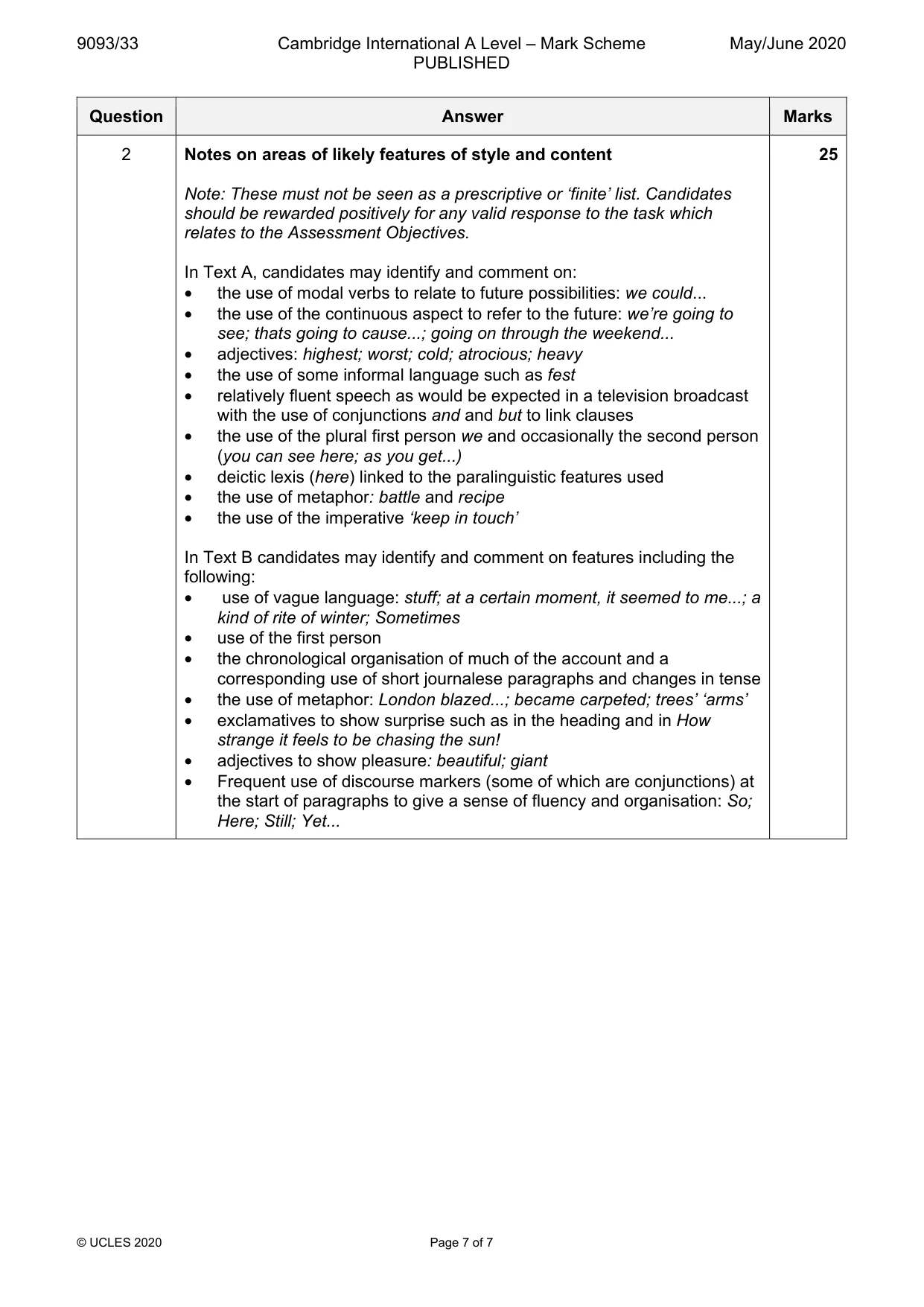
9093/33 Cambridge International A Level – Mark Scheme PUBLISHED May/June 2020 © UCLES 2020 Page 7 of 7 Question Answer Marks 2 Notes on areas of likely features of style and content Note: These must not be seen as a prescriptive or ‘finite’ list. Candidates should be rewarded positively for any valid response to the task which relates to the Assessment Objectives. In Text A, candidates may identify and comment on: • the use of modal verbs to relate to future possibilities: we could... • the use of the continuous aspect to refer to the future: we’re going to see; thats going to cause...; going on through the weekend... • adjectives: highest; worst; cold; atrocious; heavy • the use of some informal language such as fest • relatively fluent speech as would be expected in a television broadcast with the use of conjunctions and and but to link clauses • the use of the plural first person we and occasionally the second person (you can see here; as you get...) • deictic lexis (here) linked to the paralinguistic features used • the use of metaphor: battle and recipe • the use of the imperative ‘keep in touch’ In Text B candidates may identify and comment on features including the following: • use of vague language: stuff; at a certain moment, it seemed to me...; a kind of rite of winter; Sometimes • use of the first person • the chronological organisation of much of the account and a corresponding use of short journalese paragraphs and changes in tense • the use of metaphor: London blazed...; became carpeted; trees’ ‘arms’ • exclamatives to show surprise such as in the heading and in How strange it feels to be chasing the sun! • adjectives to show pleasure: beautiful; giant • Frequent use of discourse markers (some of which are conjunctions) at the start of paragraphs to give a sense of fluency and organisation: So; Here; Still; Yet... 25