Cambridge A Level English - Language AS and A Level (from 2014) 9093 — 2019 Oct/Nov Paper 4 · Variant 2
9093/42/O/N/19 · 50 marks · ≈56 min
The question paper and its mark scheme, free to read here and free to download. This is Cambridge’s own paper, exactly as it was sat.
Question paper8 pages

Mark scheme8 pages
Answers below. Sit the paper first if you are practising.
Paper as text
Question paper, page 1
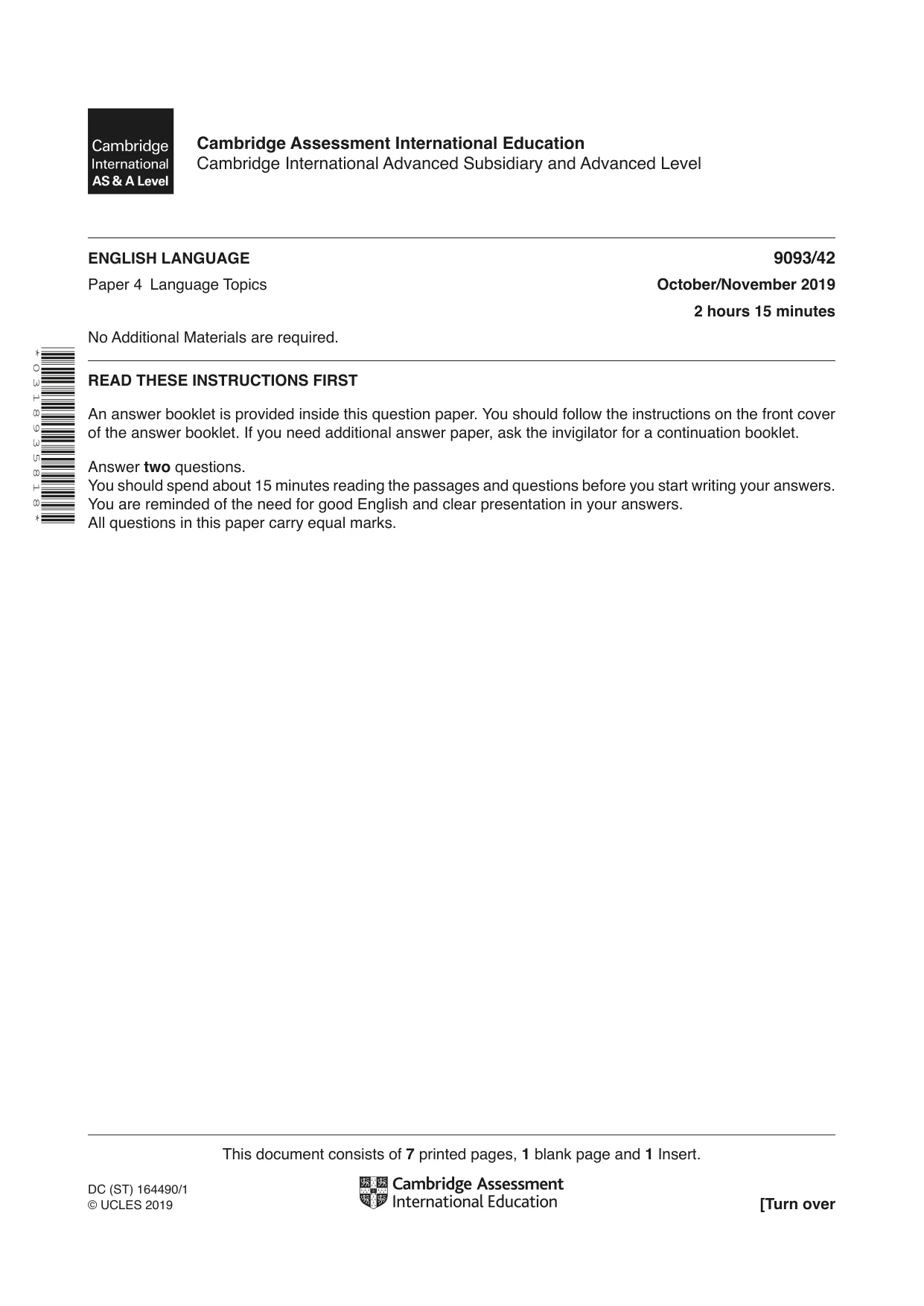
This document consists of 7 printed pages, 1 blank page and 1 Insert. DC (ST) 164490/1 © UCLES 2019 [Turn over Cambridge Assessment International Education Cambridge International Advanced Subsidiary and Advanced Level * 0 3 1 8 9 3 5 8 1 8 * ENGLISH LANGUAGE 9093/42 Paper 4 Language Topics October/November 2019 2 hours 15 minutes No Additional Materials are required. READ THESE INSTRUCTIONS FIRST An answer booklet is provided inside this question paper. You should follow the instructions on the front cover of the answer booklet. If you need additional answer paper, ask the invigilator for a continuation booklet. Answer two questions. You should spend about 15 minutes reading the passages and questions before you start writing your answers. You are reminded of the need for good English and clear presentation in your answers. All questions in this paper carry equal marks.
Question paper, page 2
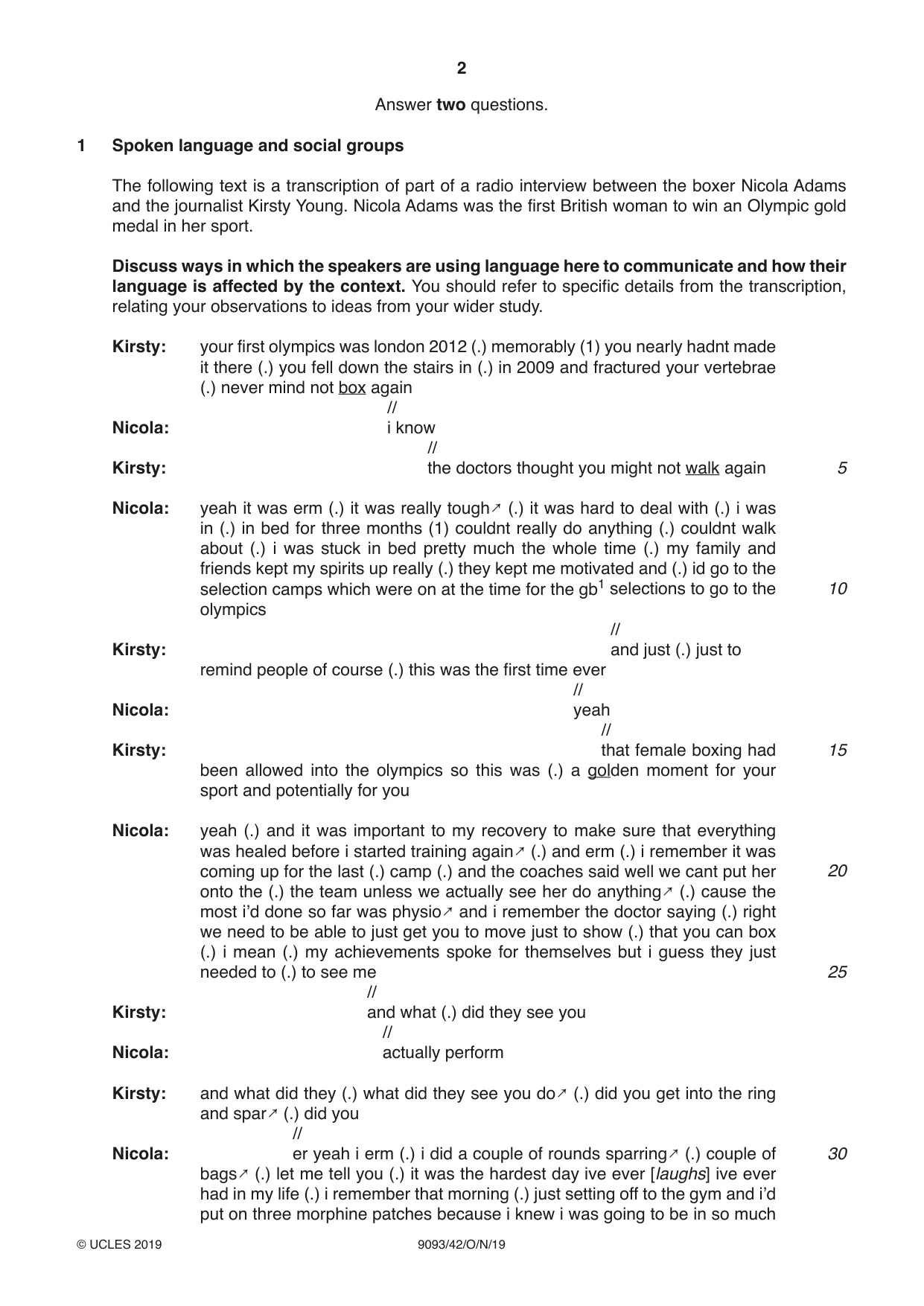
2 9093/42/O/N/19 © UCLES 2019 Answer two questions. 1 Spoken language and social groups The following text is a transcription of part of a radio interview between the boxer Nicola Adams and the journalist Kirsty Young. Nicola Adams was the first British woman to win an Olympic gold medal in her sport. Discuss ways in which the speakers are using language here to communicate and how their language is affected by the context. You should refer to specific details from the transcription, relating your observations to ideas from your wider study. Kirsty: your first olympics was london 2012 (.) memorably (1) you nearly hadnt made it there (.) you fell down the stairs in (.) in 2009 and fractured your vertebrae (.) never mind not box again // Nicola: i know // Kirsty: the doctors thought you might not walk again Nicola: yeah it was erm (.) it was really tough↗ (.) it was hard to deal with (.) i was in (.) in bed for three months (1) couldnt really do anything (.) couldnt walk about (.) i was stuck in bed pretty much the whole time (.) my family and friends kept my spirits up really (.) they kept me motivated and (.) id go to the selection camps which were on at the time for the gb1 selections to go to the olympics // Kirsty: and just (.) just to remind people of course (.) this was the first time ever // Nicola: yeah // Kirsty: that female boxing had been allowed into the olympics so this was (.) a golden moment for your sport and potentially for you Nicola: yeah (.) and it was important to my recovery to make sure that everything was healed before i started training again↗ (.) and erm (.) i remember it was coming up for the last (.) camp (.) and the coaches said well we cant put her onto the (.) the team unless we actually see her do anything↗ (.) cause the most i’d done so far was physio↗ and i remember the doctor saying (.) right we need to be able to just get you to move just to show (.) that you can box (.) i mean (.) my achievements spoke for themselves but i guess they just needed to (.) to see me // Kirsty: and what (.) did they see you // Nicola: actually perform Kirsty: and what did they (.) what did they see you do↗ (.) did you get into the ring and spar↗ (.) did you // Nicola: er yeah i erm (.) i did a couple of rounds sparring↗ (.) couple of bags↗ (.) let me tell you (.) it was the hardest day ive ever [laughs] ive ever had in my life (.) i remember that morning (.) just setting off to the gym and i’d put on three morphine patches because i knew i was going to be in so much 5 10 15 20 25 30
Question paper, page 3
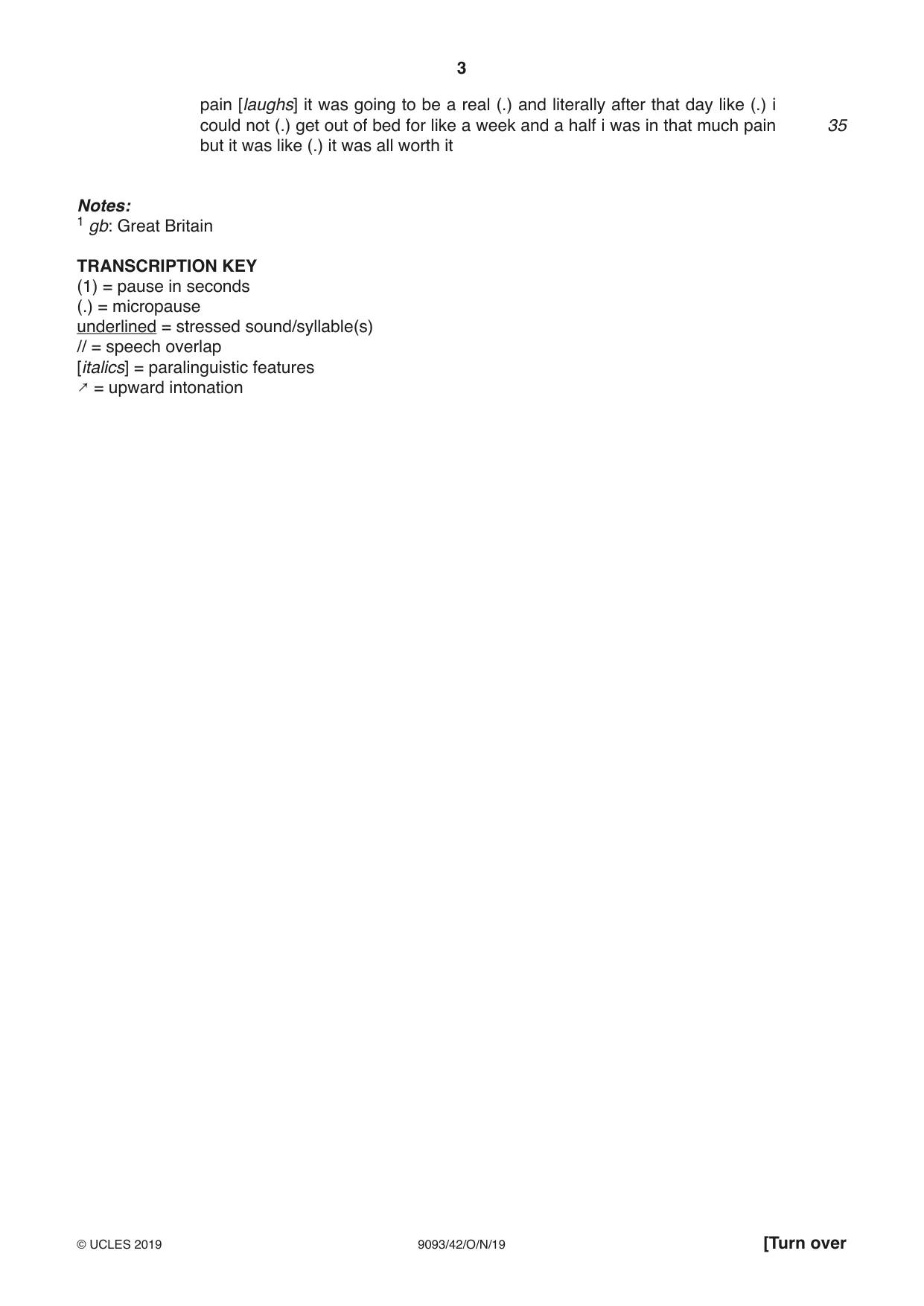
3 9093/42/O/N/19 © UCLES 2019 [Turn over pain [laughs] it was going to be a real (.) and literally after that day like (.) i could not (.) get out of bed for like a week and a half i was in that much pain but it was like (.) it was all worth it Notes: 1 gb: Great Britain TRANSCRIPTION KEY (1) = pause in seconds (.) = micropause underlined = stressed sound/syllable(s) // = speech overlap [italics] = paralinguistic features ↗ = upward intonation 35
Question paper, page 4
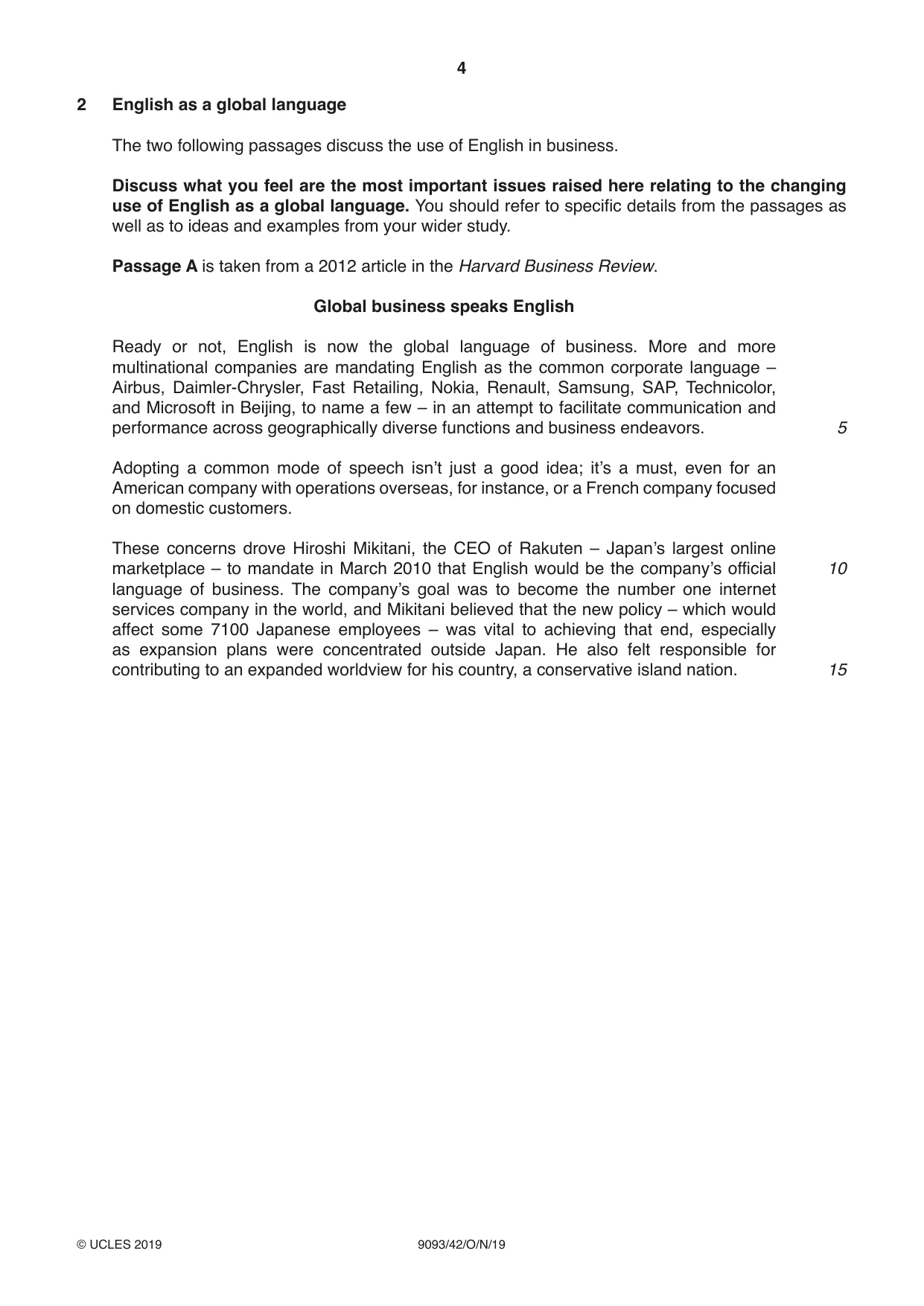
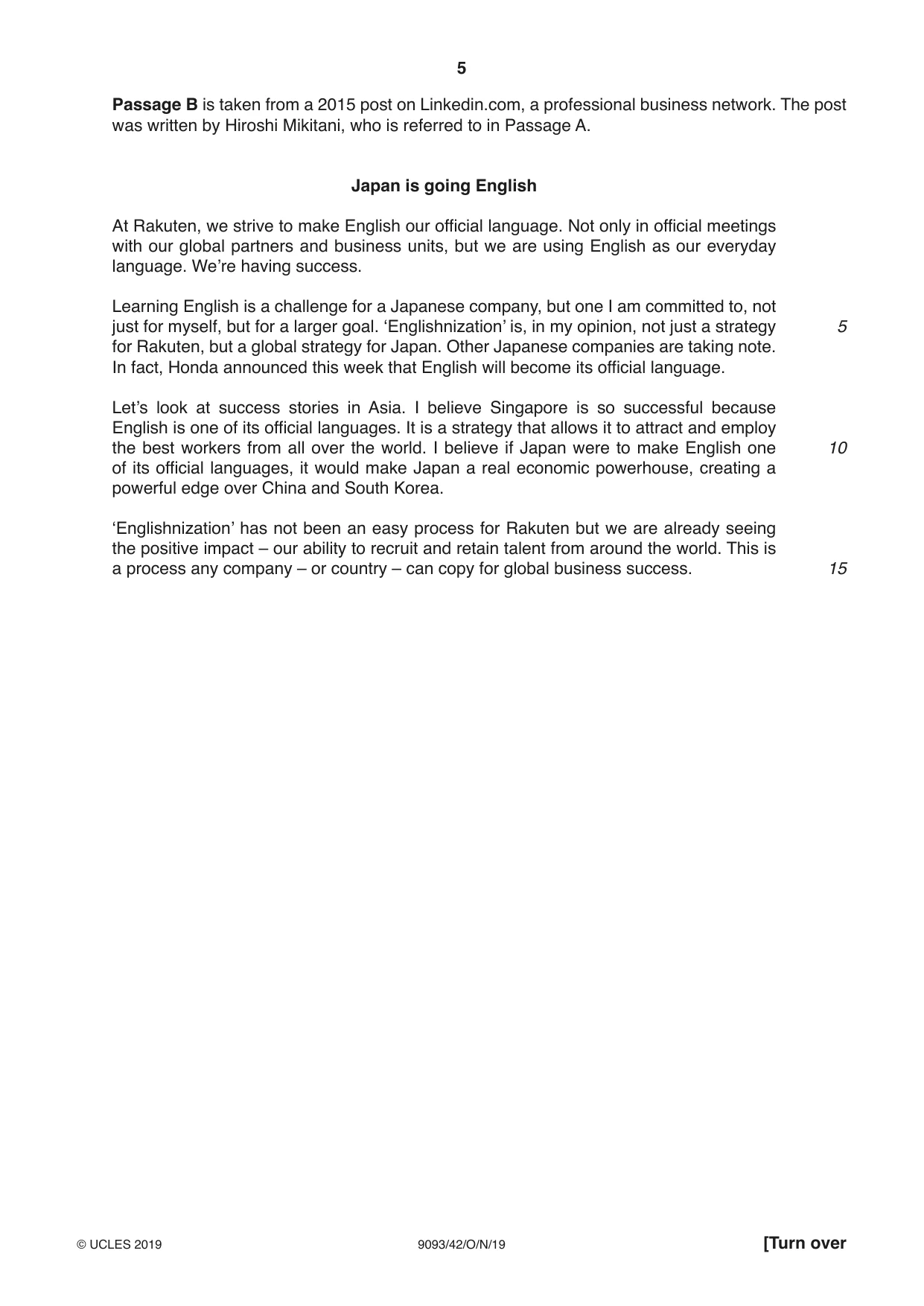
4 9093/42/O/N/19 © UCLES 2019 2 English as a global language The two following passages discuss the use of English in business. Discuss what you feel are the most important issues raised here relating to the changing use of English as a global language. You should refer to specific details from the passages as well as to ideas and examples from your wider study. Passage A is taken from a 2012 article in the Harvard Business Review. Global business speaks English Ready or not, English is now the global language of business. More and more multinational companies are mandating English as the common corporate language – Airbus, Daimler-Chrysler, Fast Retailing, Nokia, Renault, Samsung, SAP, Technicolor, and Microsoft in Beijing, to name a few – in an attempt to facilitate communication and performance across geographically diverse functions and business endeavors. Adopting a common mode of speech isn’t just a good idea; it’s a must, even for an American company with operations overseas, for instance, or a French company focused on domestic customers. These concerns drove Hiroshi Mikitani, the CEO of Rakuten – Japan’s largest online marketplace – to mandate in March 2010 that English would be the company’s official language of business. The company’s goal was to become the number one internet services company in the world, and Mikitani believed that the new policy – which would affect some 7100 Japanese employees – was vital to achieving that end, especially as expansion plans were concentrated outside Japan. He also felt responsible for contributing to an expanded worldview for his country, a conservative island nation. 5 10 15
Question paper, page 5
5 9093/42/O/N/19 © UCLES 2019 [Turn over Passage B is taken from a 2015 post on Linkedin.com, a professional business network. The post was written by Hiroshi Mikitani, who is referred to in Passage A. Japan is going English At Rakuten, we strive to make English our official language. Not only in official meetings with our global partners and business units, but we are using English as our everyday language. We’re having success. Learning English is a challenge for a Japanese company, but one I am committed to, not just for myself, but for a larger goal. ‘Englishnization’ is, in my opinion, not just a strategy for Rakuten, but a global strategy for Japan. Other Japanese companies are taking note. In fact, Honda announced this week that English will become its official language. Let’s look at success stories in Asia. I believe Singapore is so successful because English is one of its official languages. It is a strategy that allows it to attract and employ the best workers from all over the world. I believe if Japan were to make English one of its official languages, it would make Japan a real economic powerhouse, creating a powerful edge over China and South Korea. ‘Englishnization’ has not been an easy process for Rakuten but we are already seeing the positive impact – our ability to recruit and retain talent from around the world. This is a process any company – or country – can copy for global business success. 5 10 15
Question paper, page 6
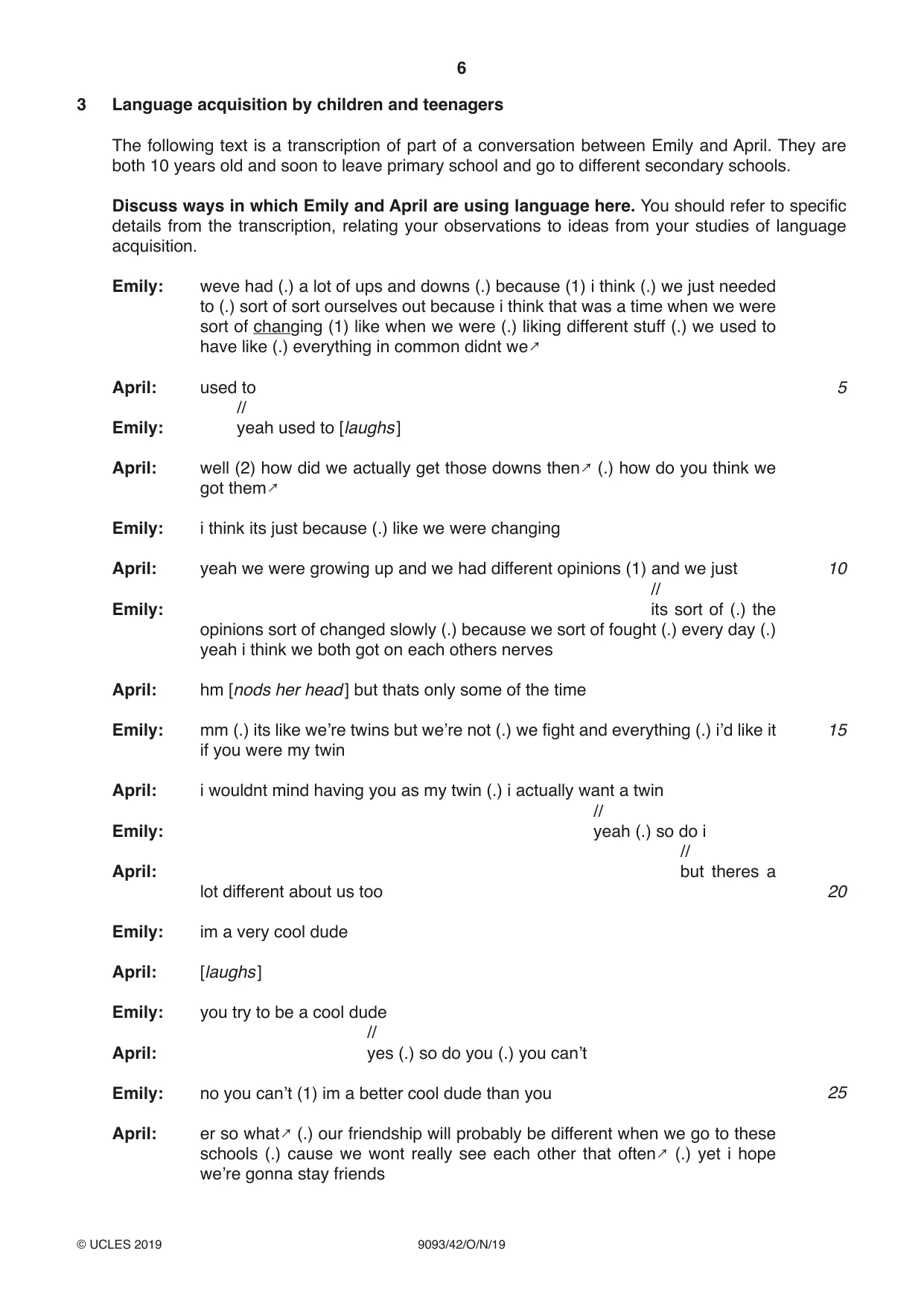
6 9093/42/O/N/19 © UCLES 2019 3 Language acquisition by children and teenagers The following text is a transcription of part of a conversation between Emily and April. They are both 10 years old and soon to leave primary school and go to different secondary schools. Discuss ways in which Emily and April are using language here. You should refer to specific details from the transcription, relating your observations to ideas from your studies of language acquisition. Emily: weve had (.) a lot of ups and downs (.) because (1) i think (.) we just needed to (.) sort of sort ourselves out because i think that was a time when we were sort of changing (1) like when we were (.) liking different stuff (.) we used to have like (.) everything in common didnt we↗ April: used to // Emily: yeah used to [laughs ] April: well (2) how did we actually get those downs then↗ (.) how do you think we got them↗ Emily: i think its just because (.) like we were changing April: yeah we were growing up and we had different opinions (1) and we just // Emily: its sort of (.) the opinions sort of changed slowly (.) because we sort of fought (.) every day (.) yeah i think we both got on each others nerves April: hm [nods her head ] but thats only some of the time Emily: mm (.) its like we’re twins but we’re not (.) we fight and everything (.) i’d like it if you were my twin April: i wouldnt mind having you as my twin (.) i actually want a twin // Emily: yeah (.) so do i // April: but theres a lot different about us too Emily: im a very cool dude April: [laughs ] Emily: you try to be a cool dude // April: yes (.) so do you (.) you can’t Emily: no you can’t (1) im a better cool dude than you April: er so what↗ (.) our friendship will probably be different when we go to these schools (.) cause we wont really see each other that often↗ (.) yet i hope we’re gonna stay friends 5 10 15 20 25
Question paper, page 7
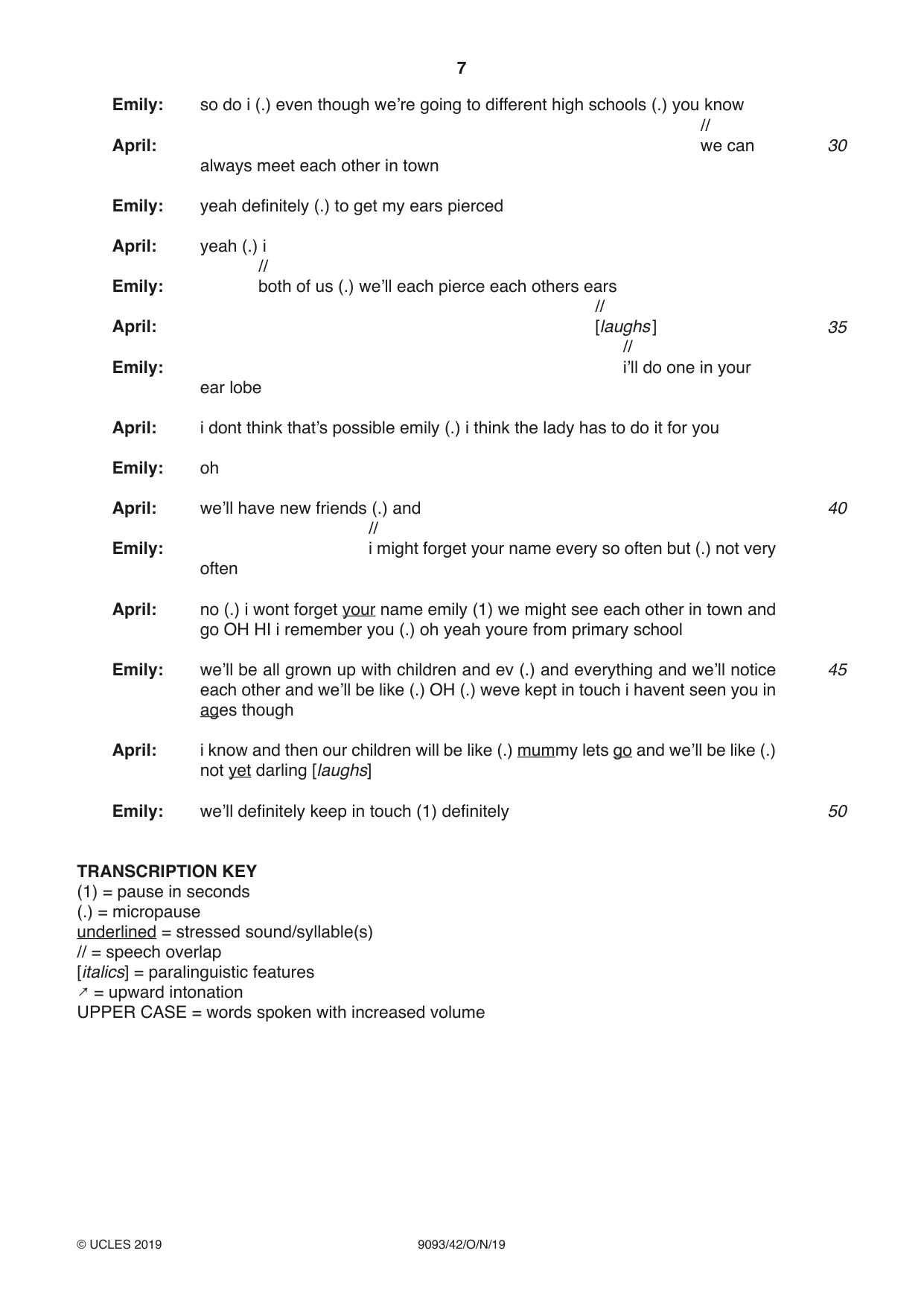
7 9093/42/O/N/19 © UCLES 2019 Emily: so do i (.) even though we’re going to different high schools (.) you know // April: we can always meet each other in town Emily: yeah definitely (.) to get my ears pierced April: yeah (.) i // Emily: both of us (.) we’ll each pierce each others ears // April: [laughs ] // Emily: i’ll do one in your ear lobe April: i dont think that’s possible emily (.) i think the lady has to do it for you Emily: oh April: we’ll have new friends (.) and // Emily: i might forget your name every so often but (.) not very often April: no (.) i wont forget your name emily (1) we might see each other in town and go OH HI i remember you (.) oh yeah youre from primary school Emily: we’ll be all grown up with children and ev (.) and everything and we’ll notice each other and we’ll be like (.) OH (.) weve kept in touch i havent seen you in ages though April: i know and then our children will be like (.) mummy lets go and we’ll be like (.) not yet darling [laughs] Emily: we’ll definitely keep in touch (1) definitely TRANSCRIPTION KEY (1) = pause in seconds (.) = micropause underlined = stressed sound/syllable(s) // = speech overlap [italics] = paralinguistic features ↗ = upward intonation UPPER CASE = words spoken with increased volume 30 35 40 45 50
Question paper, page 8
8 9093/42/O/N/19 © UCLES 2019 BLANK PAGE Permission to reproduce items where third-party owned material protected by copyright is included has been sought and cleared where possible. Every reasonable effort has been made by the publisher (UCLES) to trace copyright holders, but if any items requiring clearance have unwittingly been included, the publisher will be pleased to make amends at the earliest possible opportunity. To avoid the issue of disclosure of answer-related information to candidates, all copyright acknowledgements are reproduced online in the Cambridge Assessment International Education Copyright Acknowledgements Booklet. This is produced for each series of examinations and is freely available to download at www.cambridgeinternational.org after the live examination series. Cambridge Assessment International Education is part of the Cambridge Assessment Group. Cambridge Assessment is the brand name of the University of Cambridge Local Examinations Syndicate (UCLES), which itself is a department of the University of Cambridge.
Mark scheme, page 1
This document consists of 8 printed pages. © UCLES 2019 [Turn over Cambridge Assessment International Education Cambridge International Advanced Level ENGLISH LANGUAGE 9093/42 Paper 4 Language Topics October/November 2019 MARK SCHEME Maximum Mark: 50 Published This mark scheme is published as an aid to teachers and candidates, to indicate the requirements of the examination. It shows the basis on which Examiners were instructed to award marks. It does not indicate the details of the discussions that took place at an Examiners’ meeting before marking began, which would have considered the acceptability of alternative answers. Mark schemes should be read in conjunction with the question paper and the Principal Examiner Report for Teachers. Cambridge International will not enter into discussions about these mark schemes. Cambridge International is publishing the mark schemes for the October/November 2019 series for most Cambridge IGCSE™, Cambridge International A and AS Level components and some Cambridge O Level components.
Mark scheme, page 2
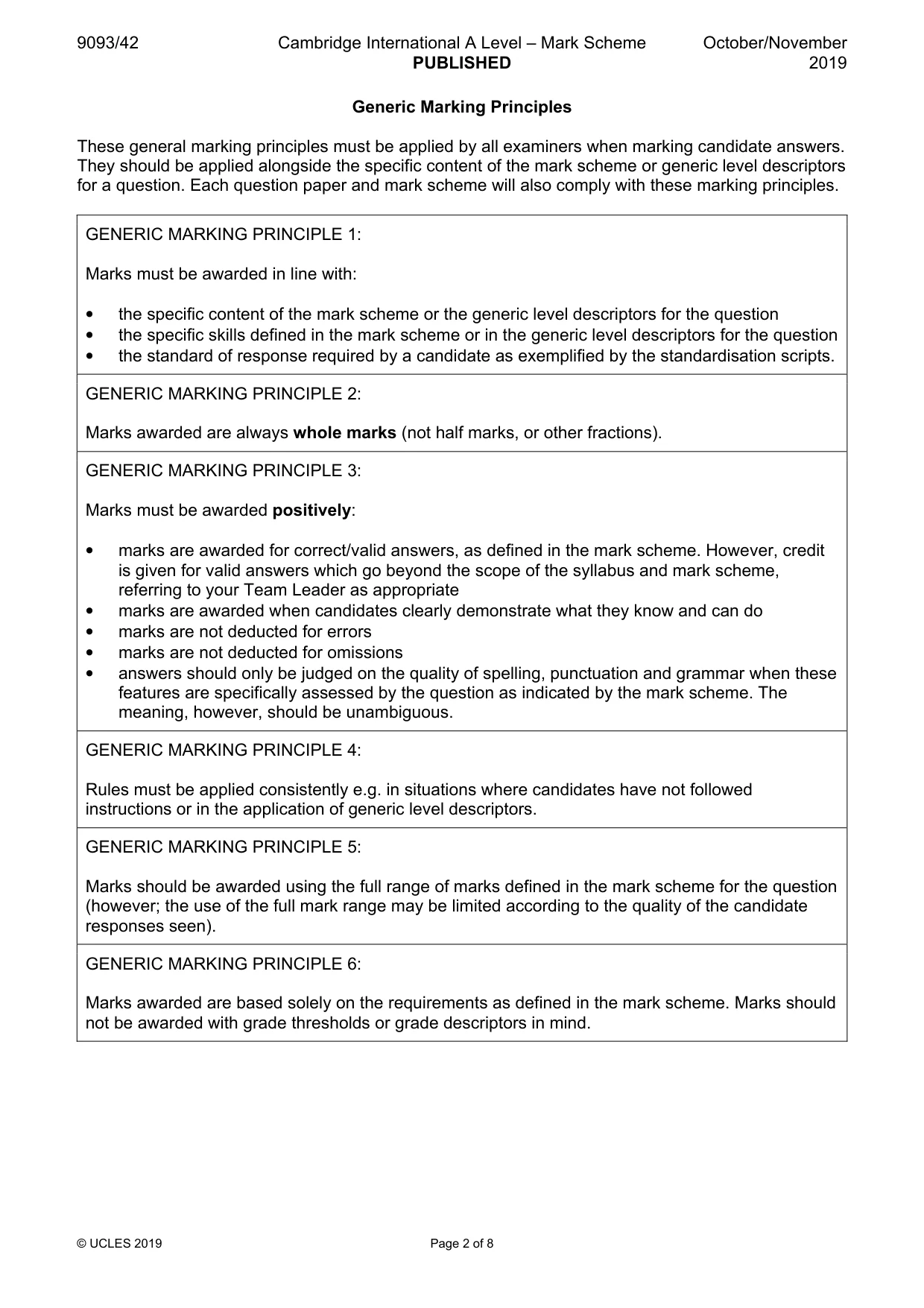
9093/42 Cambridge International A Level – Mark Scheme PUBLISHED October/November 2019 © UCLES 2019 Page 2 of 8 Generic Marking Principles These general marking principles must be applied by all examiners when marking candidate answers. They should be applied alongside the specific content of the mark scheme or generic level descriptors for a question. Each question paper and mark scheme will also comply with these marking principles. GENERIC MARKING PRINCIPLE 1: Marks must be awarded in line with: • the specific content of the mark scheme or the generic level descriptors for the question • the specific skills defined in the mark scheme or in the generic level descriptors for the question • the standard of response required by a candidate as exemplified by the standardisation scripts. GENERIC MARKING PRINCIPLE 2: Marks awarded are always whole marks (not half marks, or other fractions). GENERIC MARKING PRINCIPLE 3: Marks must be awarded positively: • marks are awarded for correct/valid answers, as defined in the mark scheme. However, credit is given for valid answers which go beyond the scope of the syllabus and mark scheme, referring to your Team Leader as appropriate • marks are awarded when candidates clearly demonstrate what they know and can do • marks are not deducted for errors • marks are not deducted for omissions • answers should only be judged on the quality of spelling, punctuation and grammar when these features are specifically assessed by the question as indicated by the mark scheme. The meaning, however, should be unambiguous. GENERIC MARKING PRINCIPLE 4: Rules must be applied consistently e.g. in situations where candidates have not followed instructions or in the application of generic level descriptors. GENERIC MARKING PRINCIPLE 5: Marks should be awarded using the full range of marks defined in the mark scheme for the question (however; the use of the full mark range may be limited according to the quality of the candidate responses seen). GENERIC MARKING PRINCIPLE 6: Marks awarded are based solely on the requirements as defined in the mark scheme. Marks should not be awarded with grade thresholds or grade descriptors in mind.
Mark scheme, page 3
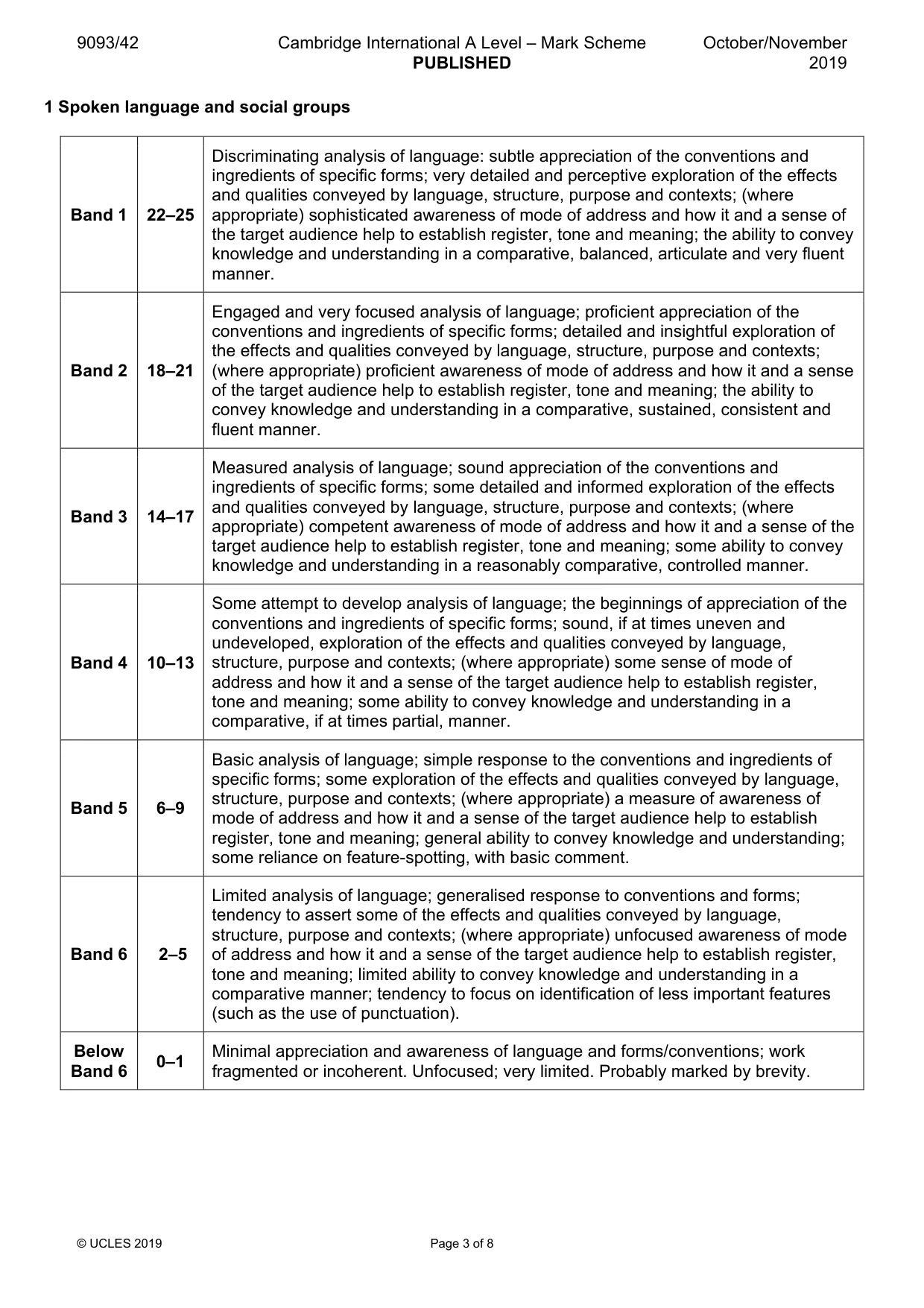
9093/42 Cambridge International A Level – Mark Scheme PUBLISHED October/November 2019 © UCLES 2019 Page 3 of 8 1 Spoken language and social groups Band 1 22–25 Discriminating analysis of language: subtle appreciation of the conventions and ingredients of specific forms; very detailed and perceptive exploration of the effects and qualities conveyed by language, structure, purpose and contexts; (where appropriate) sophisticated awareness of mode of address and how it and a sense of the target audience help to establish register, tone and meaning; the ability to convey knowledge and understanding in a comparative, balanced, articulate and very fluent manner. Band 2 18–21 Engaged and very focused analysis of language; proficient appreciation of the conventions and ingredients of specific forms; detailed and insightful exploration of the effects and qualities conveyed by language, structure, purpose and contexts; (where appropriate) proficient awareness of mode of address and how it and a sense of the target audience help to establish register, tone and meaning; the ability to convey knowledge and understanding in a comparative, sustained, consistent and fluent manner. Band 3 14–17 Measured analysis of language; sound appreciation of the conventions and ingredients of specific forms; some detailed and informed exploration of the effects and qualities conveyed by language, structure, purpose and contexts; (where appropriate) competent awareness of mode of address and how it and a sense of the target audience help to establish register, tone and meaning; some ability to convey knowledge and understanding in a reasonably comparative, controlled manner. Band 4 10–13 Some attempt to develop analysis of language; the beginnings of appreciation of the conventions and ingredients of specific forms; sound, if at times uneven and undeveloped, exploration of the effects and qualities conveyed by language, structure, purpose and contexts; (where appropriate) some sense of mode of address and how it and a sense of the target audience help to establish register, tone and meaning; some ability to convey knowledge and understanding in a comparative, if at times partial, manner. Band 5 6–9 Basic analysis of language; simple response to the conventions and ingredients of specific forms; some exploration of the effects and qualities conveyed by language, structure, purpose and contexts; (where appropriate) a measure of awareness of mode of address and how it and a sense of the target audience help to establish register, tone and meaning; general ability to convey knowledge and understanding; some reliance on feature-spotting, with basic comment. Band 6 2–5 Limited analysis of language; generalised response to conventions and forms; tendency to assert some of the effects and qualities conveyed by language, structure, purpose and contexts; (where appropriate) unfocused awareness of mode of address and how it and a sense of the target audience help to establish register, tone and meaning; limited ability to convey knowledge and understanding in a comparative manner; tendency to focus on identification of less important features (such as the use of punctuation). Below Band 6 0–1 Minimal appreciation and awareness of language and forms/conventions; work fragmented or incoherent. Unfocused; very limited. Probably marked by brevity.
Mark scheme, page 4
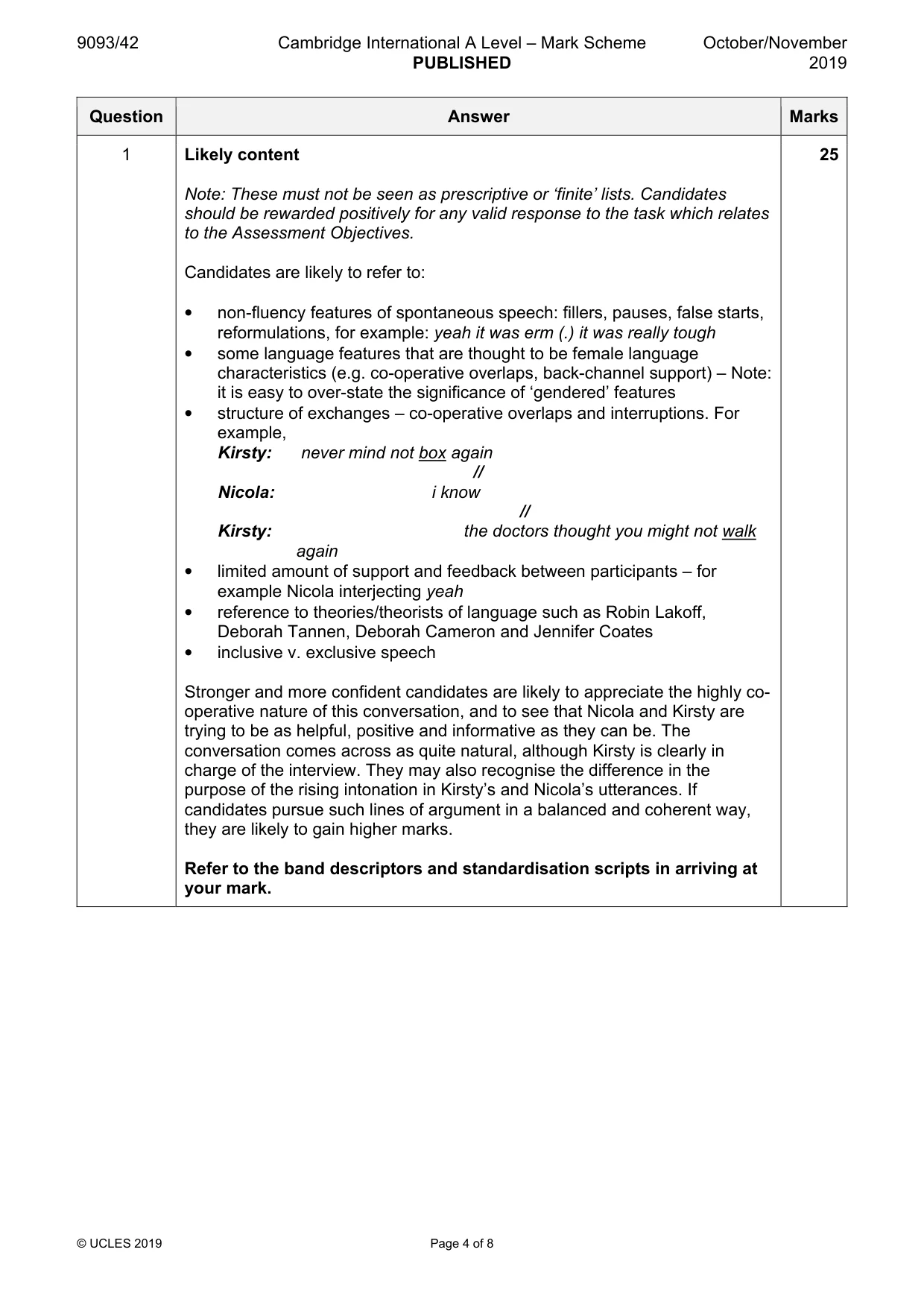
9093/42 Cambridge International A Level – Mark Scheme PUBLISHED October/November 2019 © UCLES 2019 Page 4 of 8 Question Answer Marks 1 Likely content Note: These must not be seen as prescriptive or ‘finite’ lists. Candidates should be rewarded positively for any valid response to the task which relates to the Assessment Objectives. Candidates are likely to refer to: • non-fluency features of spontaneous speech: fillers, pauses, false starts, reformulations, for example: yeah it was erm (.) it was really tough • some language features that are thought to be female language characteristics (e.g. co-operative overlaps, back-channel support) – Note: it is easy to over-state the significance of ‘gendered’ features • structure of exchanges – co-operative overlaps and interruptions. For example, Kirsty: never mind not box again // Nicola: i know // Kirsty: the doctors thought you might not walk again • limited amount of support and feedback between participants – for example Nicola interjecting yeah • reference to theories/theorists of language such as Robin Lakoff, Deborah Tannen, Deborah Cameron and Jennifer Coates • inclusive v. exclusive speech Stronger and more confident candidates are likely to appreciate the highly co- operative nature of this conversation, and to see that Nicola and Kirsty are trying to be as helpful, positive and informative as they can be. The conversation comes across as quite natural, although Kirsty is clearly in charge of the interview. They may also recognise the difference in the purpose of the rising intonation in Kirsty’s and Nicola’s utterances. If candidates pursue such lines of argument in a balanced and coherent way, they are likely to gain higher marks. Refer to the band descriptors and standardisation scripts in arriving at your mark. 25
Mark scheme, page 5
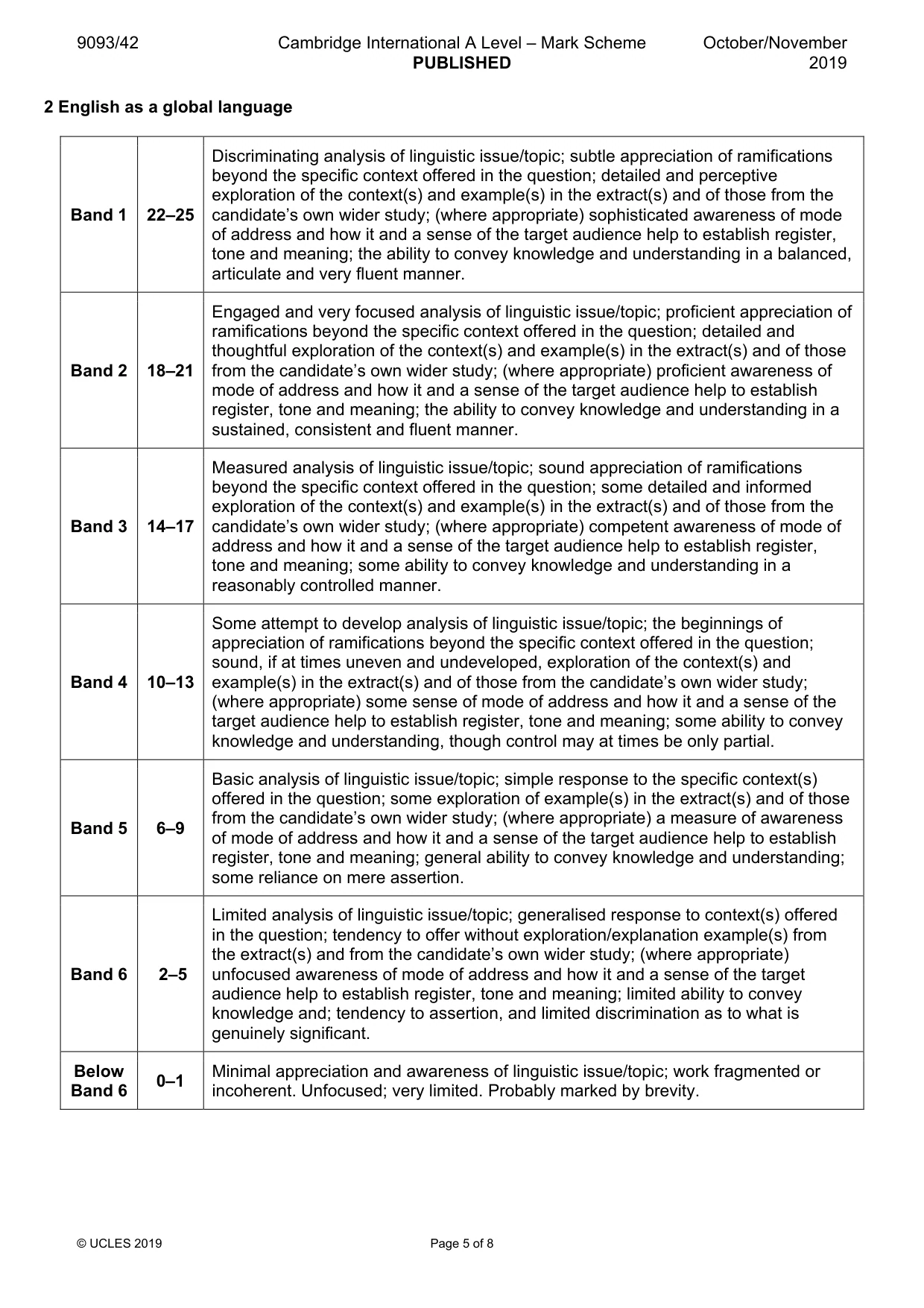
9093/42 Cambridge International A Level – Mark Scheme PUBLISHED October/November 2019 © UCLES 2019 Page 5 of 8 2 English as a global language Band 1 22–25 Discriminating analysis of linguistic issue/topic; subtle appreciation of ramifications beyond the specific context offered in the question; detailed and perceptive exploration of the context(s) and example(s) in the extract(s) and of those from the candidate’s own wider study; (where appropriate) sophisticated awareness of mode of address and how it and a sense of the target audience help to establish register, tone and meaning; the ability to convey knowledge and understanding in a balanced, articulate and very fluent manner. Band 2 18–21 Engaged and very focused analysis of linguistic issue/topic; proficient appreciation of ramifications beyond the specific context offered in the question; detailed and thoughtful exploration of the context(s) and example(s) in the extract(s) and of those from the candidate’s own wider study; (where appropriate) proficient awareness of mode of address and how it and a sense of the target audience help to establish register, tone and meaning; the ability to convey knowledge and understanding in a sustained, consistent and fluent manner. Band 3 14–17 Measured analysis of linguistic issue/topic; sound appreciation of ramifications beyond the specific context offered in the question; some detailed and informed exploration of the context(s) and example(s) in the extract(s) and of those from the candidate’s own wider study; (where appropriate) competent awareness of mode of address and how it and a sense of the target audience help to establish register, tone and meaning; some ability to convey knowledge and understanding in a reasonably controlled manner. Band 4 10–13 Some attempt to develop analysis of linguistic issue/topic; the beginnings of appreciation of ramifications beyond the specific context offered in the question; sound, if at times uneven and undeveloped, exploration of the context(s) and example(s) in the extract(s) and of those from the candidate’s own wider study; (where appropriate) some sense of mode of address and how it and a sense of the target audience help to establish register, tone and meaning; some ability to convey knowledge and understanding, though control may at times be only partial. Band 5 6–9 Basic analysis of linguistic issue/topic; simple response to the specific context(s) offered in the question; some exploration of example(s) in the extract(s) and of those from the candidate’s own wider study; (where appropriate) a measure of awareness of mode of address and how it and a sense of the target audience help to establish register, tone and meaning; general ability to convey knowledge and understanding; some reliance on mere assertion. Band 6 2–5 Limited analysis of linguistic issue/topic; generalised response to context(s) offered in the question; tendency to offer without exploration/explanation example(s) from the extract(s) and from the candidate’s own wider study; (where appropriate) unfocused awareness of mode of address and how it and a sense of the target audience help to establish register, tone and meaning; limited ability to convey knowledge and; tendency to assertion, and limited discrimination as to what is genuinely significant. Below Band 6 0–1 Minimal appreciation and awareness of linguistic issue/topic; work fragmented or incoherent. Unfocused; very limited. Probably marked by brevity.
Mark scheme, page 6
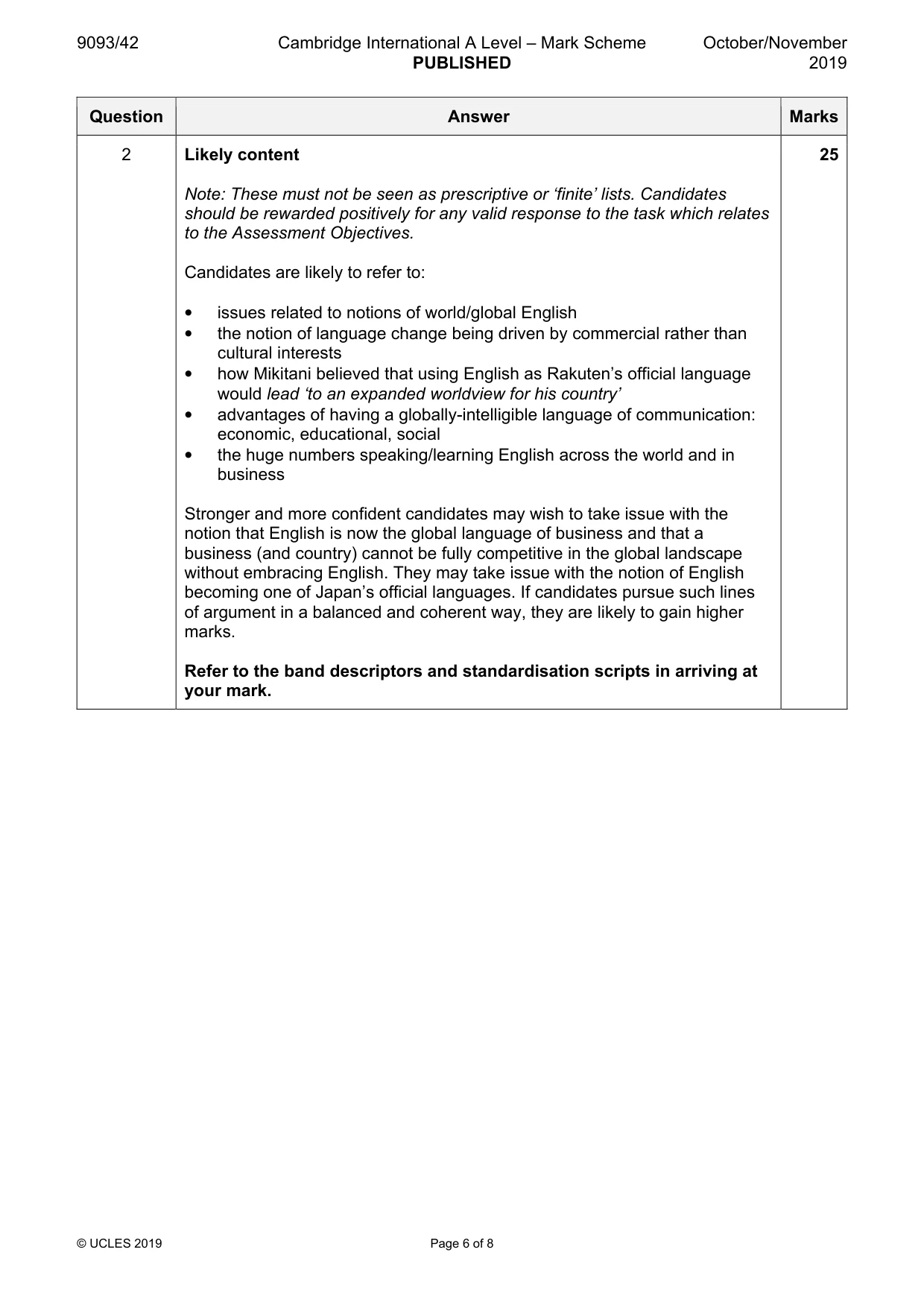
9093/42 Cambridge International A Level – Mark Scheme PUBLISHED October/November 2019 © UCLES 2019 Page 6 of 8 Question Answer Marks 2 Likely content Note: These must not be seen as prescriptive or ‘finite’ lists. Candidates should be rewarded positively for any valid response to the task which relates to the Assessment Objectives. Candidates are likely to refer to: • issues related to notions of world/global English • the notion of language change being driven by commercial rather than cultural interests • how Mikitani believed that using English as Rakuten’s official language would lead ‘to an expanded worldview for his country’ • advantages of having a globally-intelligible language of communication: economic, educational, social • the huge numbers speaking/learning English across the world and in business Stronger and more confident candidates may wish to take issue with the notion that English is now the global language of business and that a business (and country) cannot be fully competitive in the global landscape without embracing English. They may take issue with the notion of English becoming one of Japan’s official languages. If candidates pursue such lines of argument in a balanced and coherent way, they are likely to gain higher marks. Refer to the band descriptors and standardisation scripts in arriving at your mark. 25
Mark scheme, page 7
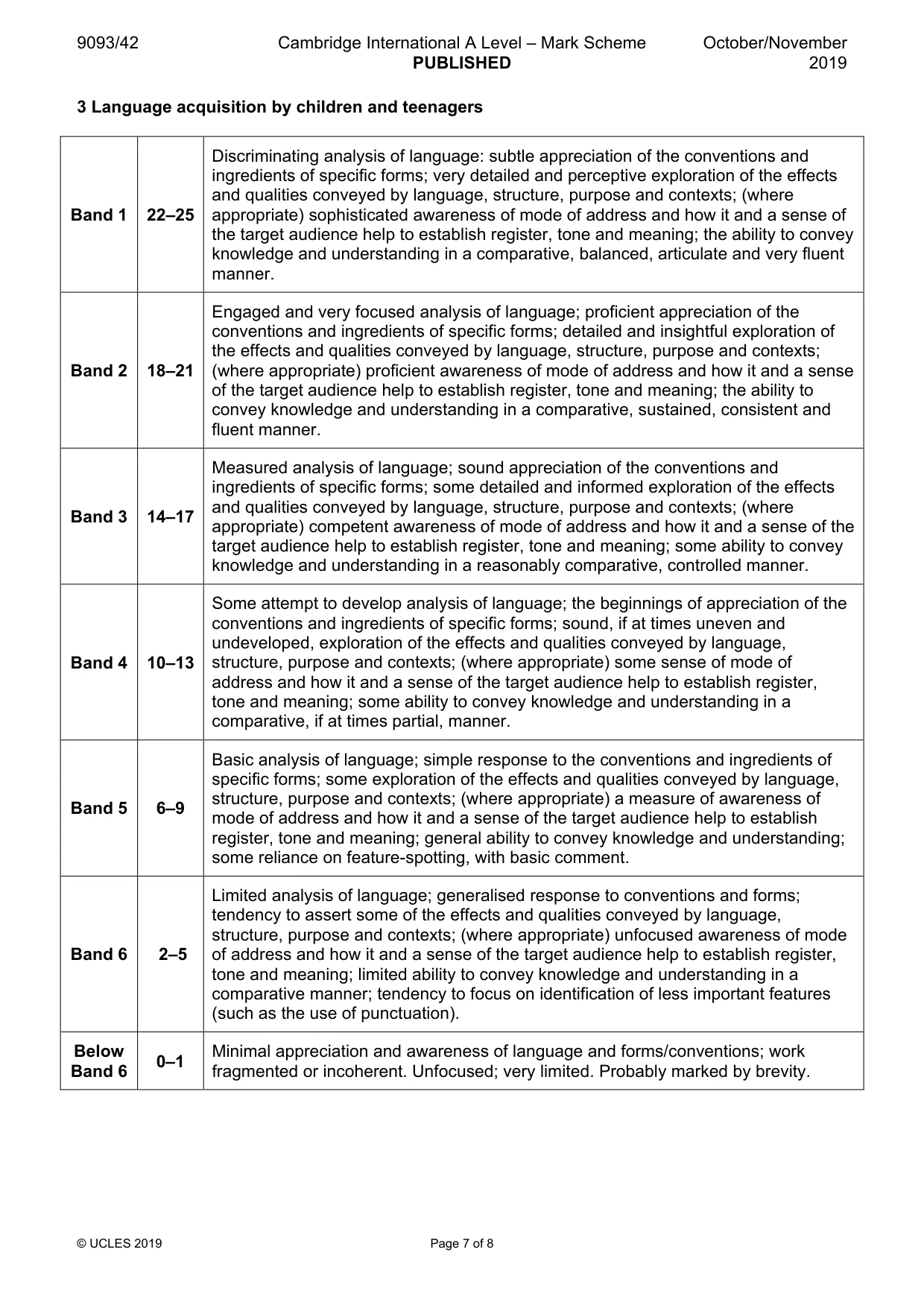
9093/42 Cambridge International A Level – Mark Scheme PUBLISHED October/November 2019 © UCLES 2019 Page 7 of 8 3 Language acquisition by children and teenagers Band 1 22–25 Discriminating analysis of language: subtle appreciation of the conventions and ingredients of specific forms; very detailed and perceptive exploration of the effects and qualities conveyed by language, structure, purpose and contexts; (where appropriate) sophisticated awareness of mode of address and how it and a sense of the target audience help to establish register, tone and meaning; the ability to convey knowledge and understanding in a comparative, balanced, articulate and very fluent manner. Band 2 18–21 Engaged and very focused analysis of language; proficient appreciation of the conventions and ingredients of specific forms; detailed and insightful exploration of the effects and qualities conveyed by language, structure, purpose and contexts; (where appropriate) proficient awareness of mode of address and how it and a sense of the target audience help to establish register, tone and meaning; the ability to convey knowledge and understanding in a comparative, sustained, consistent and fluent manner. Band 3 14–17 Measured analysis of language; sound appreciation of the conventions and ingredients of specific forms; some detailed and informed exploration of the effects and qualities conveyed by language, structure, purpose and contexts; (where appropriate) competent awareness of mode of address and how it and a sense of the target audience help to establish register, tone and meaning; some ability to convey knowledge and understanding in a reasonably comparative, controlled manner. Band 4 10–13 Some attempt to develop analysis of language; the beginnings of appreciation of the conventions and ingredients of specific forms; sound, if at times uneven and undeveloped, exploration of the effects and qualities conveyed by language, structure, purpose and contexts; (where appropriate) some sense of mode of address and how it and a sense of the target audience help to establish register, tone and meaning; some ability to convey knowledge and understanding in a comparative, if at times partial, manner. Band 5 6–9 Basic analysis of language; simple response to the conventions and ingredients of specific forms; some exploration of the effects and qualities conveyed by language, structure, purpose and contexts; (where appropriate) a measure of awareness of mode of address and how it and a sense of the target audience help to establish register, tone and meaning; general ability to convey knowledge and understanding; some reliance on feature-spotting, with basic comment. Band 6 2–5 Limited analysis of language; generalised response to conventions and forms; tendency to assert some of the effects and qualities conveyed by language, structure, purpose and contexts; (where appropriate) unfocused awareness of mode of address and how it and a sense of the target audience help to establish register, tone and meaning; limited ability to convey knowledge and understanding in a comparative manner; tendency to focus on identification of less important features (such as the use of punctuation). Below Band 6 0–1 Minimal appreciation and awareness of language and forms/conventions; work fragmented or incoherent. Unfocused; very limited. Probably marked by brevity.
Mark scheme, page 8
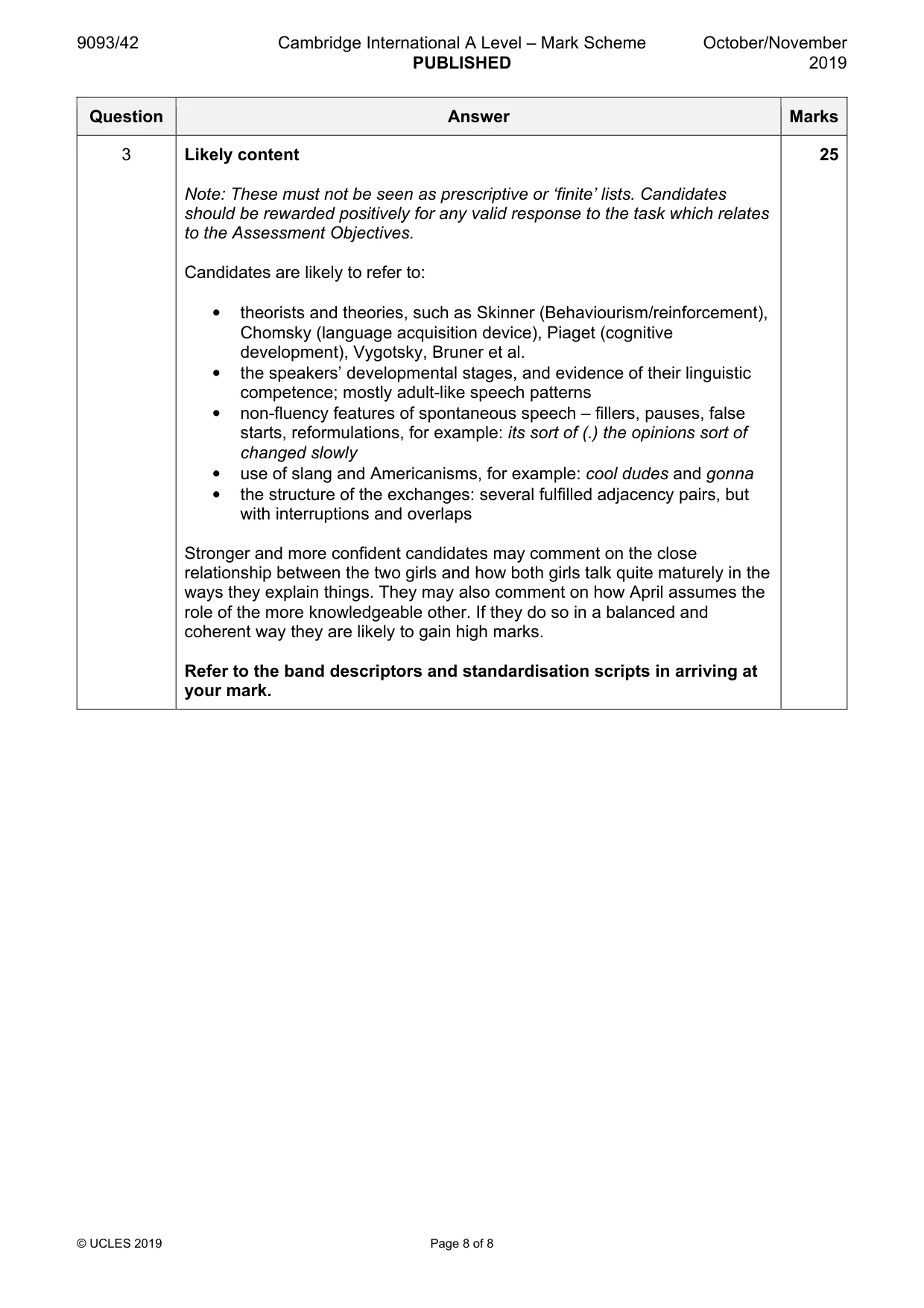
9093/42 Cambridge International A Level – Mark Scheme PUBLISHED October/November 2019 © UCLES 2019 Page 8 of 8 Question Answer Marks 3 Likely content Note: These must not be seen as prescriptive or ‘finite’ lists. Candidates should be rewarded positively for any valid response to the task which relates to the Assessment Objectives. Candidates are likely to refer to: • theorists and theories, such as Skinner (Behaviourism/reinforcement), Chomsky (language acquisition device), Piaget (cognitive development), Vygotsky, Bruner et al. • the speakers’ developmental stages, and evidence of their linguistic competence; mostly adult-like speech patterns • non-fluency features of spontaneous speech – fillers, pauses, false starts, reformulations, for example: its sort of (.) the opinions sort of changed slowly • use of slang and Americanisms, for example: cool dudes and gonna • the structure of the exchanges: several fulfilled adjacency pairs, but with interruptions and overlaps Stronger and more confident candidates may comment on the close relationship between the two girls and how both girls talk quite maturely in the ways they explain things. They may also comment on how April assumes the role of the more knowledgeable other. If they do so in a balanced and coherent way they are likely to gain high marks. Refer to the band descriptors and standardisation scripts in arriving at your mark. 25
What you needed in this session
Cambridge’s own grade thresholds for 2019 Oct/Nov, Paper 4 · Variant 2. A higher threshold means an easier paper — the bar moves with how the cohort did.