Cambridge A Level English - Language AS and A Level (from 2014) 9093 — 2019 Feb/March Paper 4 · Variant 2
9093/42/F/M/19 · 50 marks · ≈56 min
The question paper and its mark scheme, free to read here and free to download. This is Cambridge’s own paper, exactly as it was sat.
Question paper8 pages


Mark scheme8 pages
Answers below. Sit the paper first if you are practising.
Paper as text
Question paper, page 1
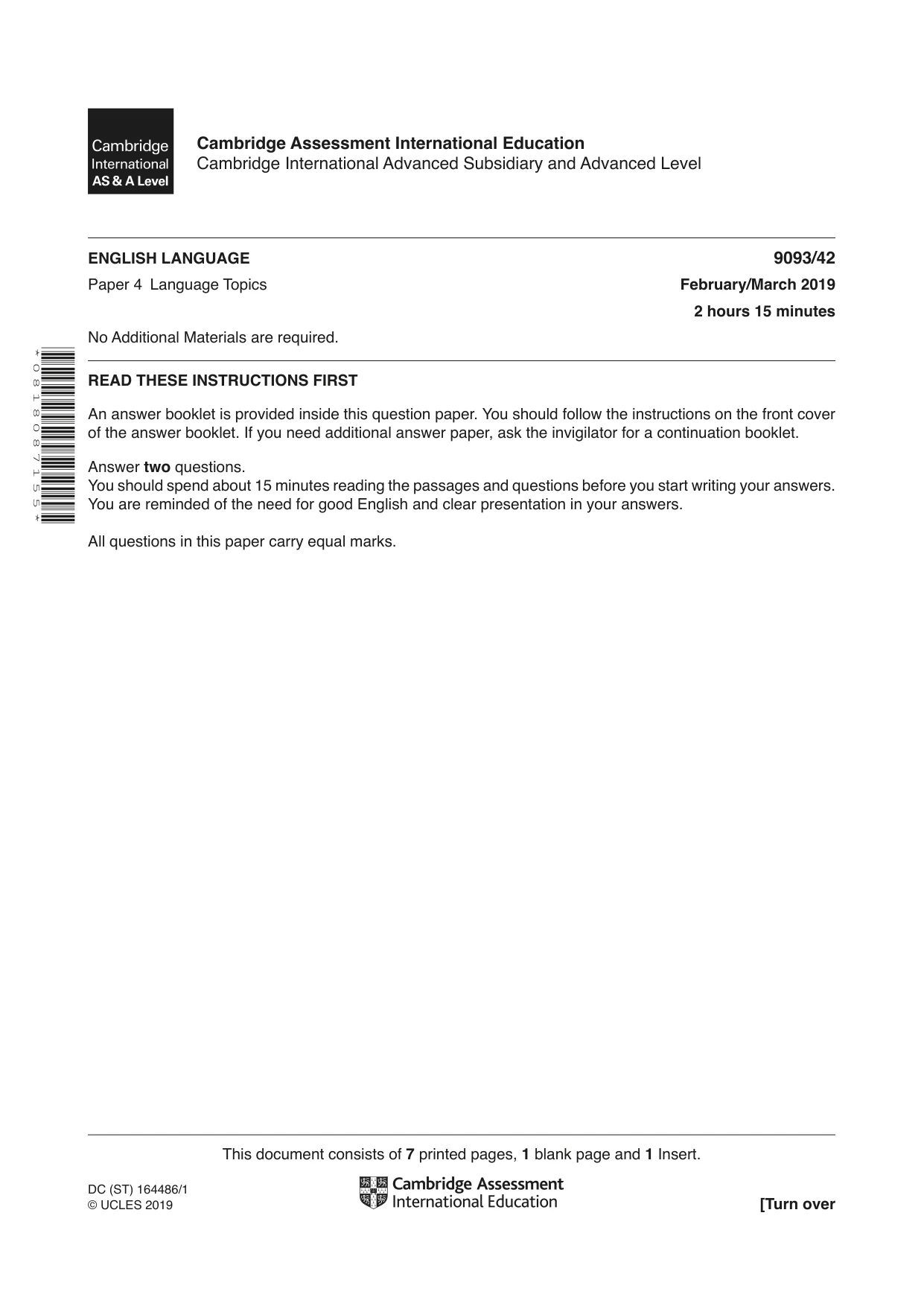
This document consists of 7 printed pages, 1 blank page and 1 Insert. DC (ST) 164486/1 © UCLES 2019 [Turn over Cambridge Assessment International Education Cambridge International Advanced Subsidiary and Advanced Level * 0 8 1 8 0 8 7 1 5 5 * ENGLISH LANGUAGE 9093/42 Paper 4 Language Topics February/March 2019 2 hours 15 minutes No Additional Materials are required. READ THESE INSTRUCTIONS FIRST An answer booklet is provided inside this question paper. You should follow the instructions on the front cover of the answer booklet. If you need additional answer paper, ask the invigilator for a continuation booklet. Answer two questions. You should spend about 15 minutes reading the passages and questions before you start writing your answers. You are reminded of the need for good English and clear presentation in your answers. All questions in this paper carry equal marks.
Question paper, page 2
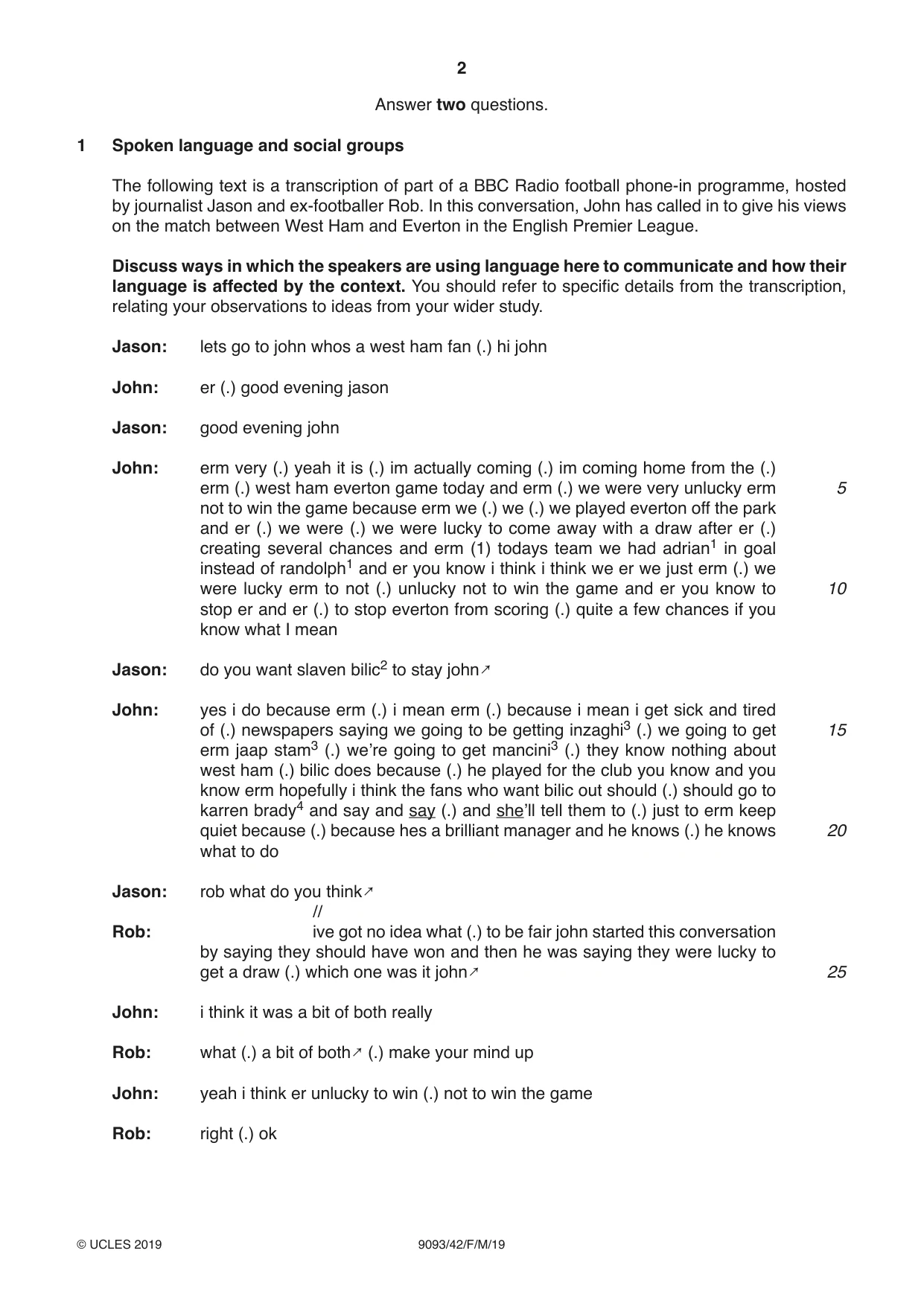
2 9093/42/F/M/19 © UCLES 2019 Answer two questions. 1 Spoken language and social groups The following text is a transcription of part of a BBC Radio football phone-in programme, hosted by journalist Jason and ex-footballer Rob. In this conversation, John has called in to give his views on the match between West Ham and Everton in the English Premier League. Discuss ways in which the speakers are using language here to communicate and how their language is affected by the context. You should refer to specific details from the transcription, relating your observations to ideas from your wider study. Jason: lets go to john whos a west ham fan (.) hi john John: er (.) good evening jason Jason: good evening john John: erm very (.) yeah it is (.) im actually coming (.) im coming home from the (.) erm (.) west ham everton game today and erm (.) we were very unlucky erm not to win the game because erm we (.) we (.) we played everton off the park and er (.) we were (.) we were lucky to come away with a draw after er (.) creating several chances and erm (1) todays team we had adrian1 in goal instead of randolph1 and er you know i think i think we er we just erm (.) we were lucky erm to not (.) unlucky not to win the game and er you know to stop er and er (.) to stop everton from scoring (.) quite a few chances if you know what I mean Jason: do you want slaven bilic2 to stay john↗ John: yes i do because erm (.) i mean erm (.) because i mean i get sick and tired of (.) newspapers saying we going to be getting inzaghi3 (.) we going to get erm jaap stam3 (.) we’re going to get mancini3 (.) they know nothing about west ham (.) bilic does because (.) he played for the club you know and you know erm hopefully i think the fans who want bilic out should (.) should go to karren brady4 and say and say (.) and she’ll tell them to (.) just to erm keep quiet because (.) because hes a brilliant manager and he knows (.) he knows what to do Jason: rob what do you think↗ // Rob: ive got no idea what (.) to be fair john started this conversation by saying they should have won and then he was saying they were lucky to get a draw (.) which one was it john↗ John: i think it was a bit of both really Rob: what (.) a bit of both↗ (.) make your mind up John: yeah i think er unlucky to win (.) not to win the game Rob: right (.) ok 5 10 15 20 25
Question paper, page 3
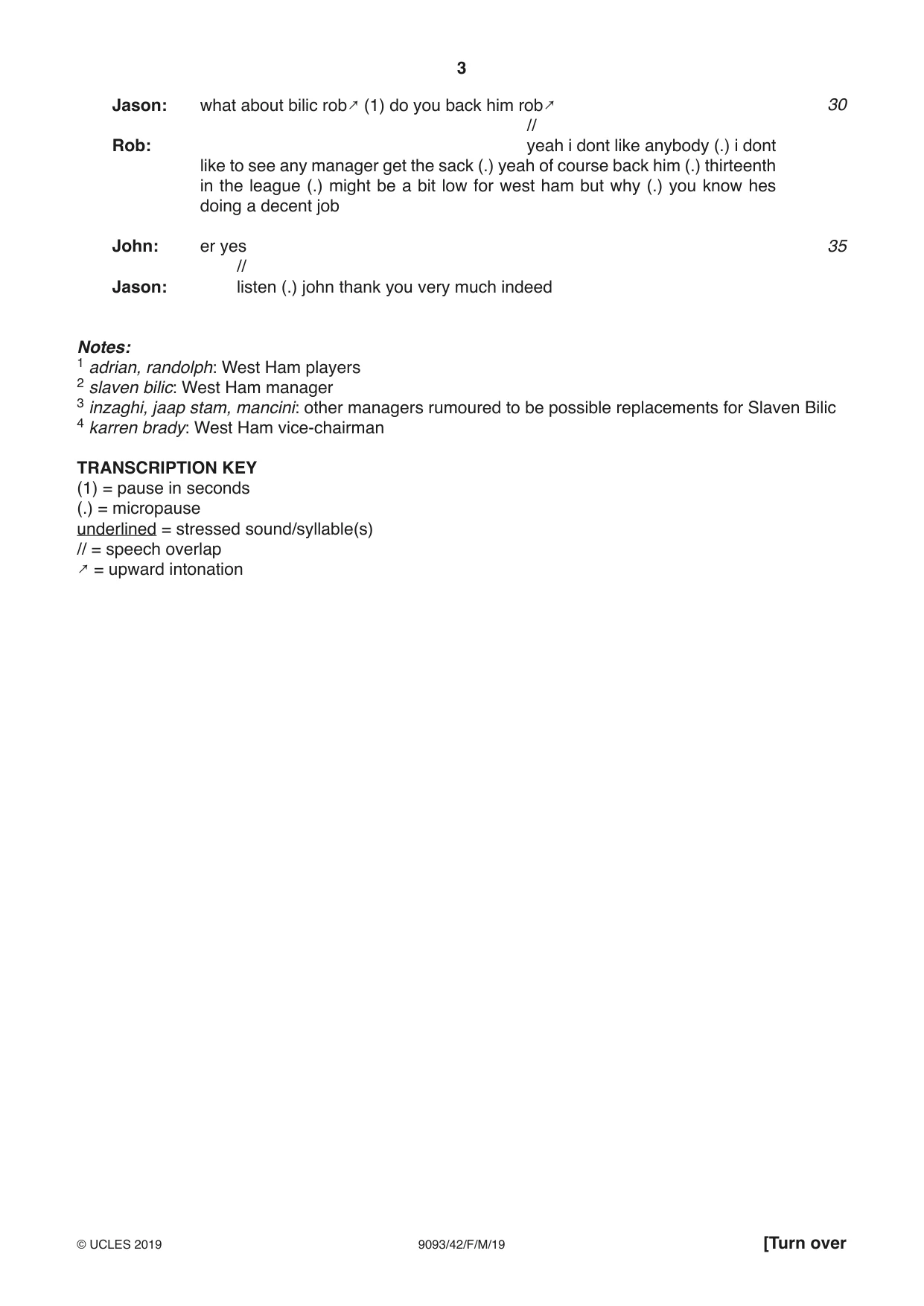
3 9093/42/F/M/19 © UCLES 2019 [Turn over Jason: what about bilic rob↗ (1) do you back him rob↗ // Rob: yeah i dont like anybody (.) i dont like to see any manager get the sack (.) yeah of course back him (.) thirteenth in the league (.) might be a bit low for west ham but why (.) you know hes doing a decent job John: er yes // Jason: listen (.) john thank you very much indeed Notes: 1 adrian, randolph: West Ham players 2 slaven bilic: West Ham manager 3 inzaghi, jaap stam, mancini: other managers rumoured to be possible replacements for Slaven Bilic 4 karren brady: West Ham vice-chairman TRANSCRIPTION KEY (1) = pause in seconds (.) = micropause underlined = stressed sound/syllable(s) // = speech overlap ↗ = upward intonation 30 35
Question paper, page 4
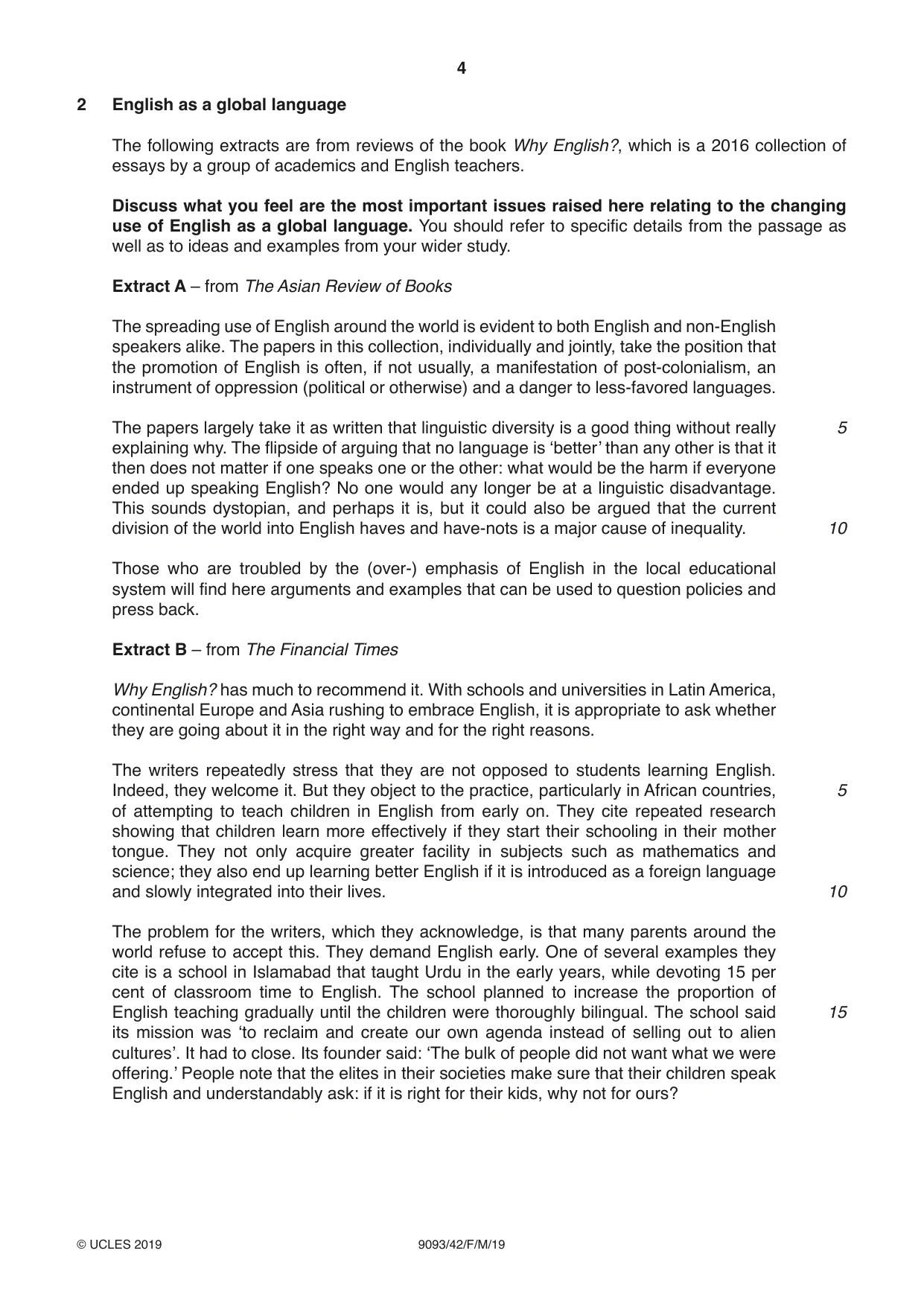
4 9093/42/F/M/19 © UCLES 2019 2 English as a global language The following extracts are from reviews of the book Why English?, which is a 2016 collection of essays by a group of academics and English teachers. Discuss what you feel are the most important issues raised here relating to the changing use of English as a global language. You should refer to specific details from the passage as well as to ideas and examples from your wider study. Extract A – from The Asian Review of Books The spreading use of English around the world is evident to both English and non-English speakers alike. The papers in this collection, individually and jointly, take the position that the promotion of English is often, if not usually, a manifestation of post-colonialism, an instrument of oppression (political or otherwise) and a danger to less-favored languages. The papers largely take it as written that linguistic diversity is a good thing without really explaining why. The flipside of arguing that no language is ‘better’ than any other is that it then does not matter if one speaks one or the other: what would be the harm if everyone ended up speaking English? No one would any longer be at a linguistic disadvantage. This sounds dystopian, and perhaps it is, but it could also be argued that the current division of the world into English haves and have-nots is a major cause of inequality. Those who are troubled by the (over-) emphasis of English in the local educational system will find here arguments and examples that can be used to question policies and press back. Extract B – from The Financial Times Why English? has much to recommend it. With schools and universities in Latin America, continental Europe and Asia rushing to embrace English, it is appropriate to ask whether they are going about it in the right way and for the right reasons. The writers repeatedly stress that they are not opposed to students learning English. Indeed, they welcome it. But they object to the practice, particularly in African countries, of attempting to teach children in English from early on. They cite repeated research showing that children learn more effectively if they start their schooling in their mother tongue. They not only acquire greater facility in subjects such as mathematics and science; they also end up learning better English if it is introduced as a foreign language and slowly integrated into their lives. The problem for the writers, which they acknowledge, is that many parents around the world refuse to accept this. They demand English early. One of several examples they cite is a school in Islamabad that taught Urdu in the early years, while devoting 15 per cent of classroom time to English. The school planned to increase the proportion of English teaching gradually until the children were thoroughly bilingual. The school said its mission was ‘to reclaim and create our own agenda instead of selling out to alien cultures’. It had to close. Its founder said: ‘The bulk of people did not want what we were offering.’ People note that the elites in their societies make sure that their children speak English and understandably ask: if it is right for their kids, why not for ours? 5 10 5 10 15
Question paper, page 5
5 9093/42/F/M/19 © UCLES 2019 [Turn over TURN OVER FOR QUESTION 3.
Question paper, page 6
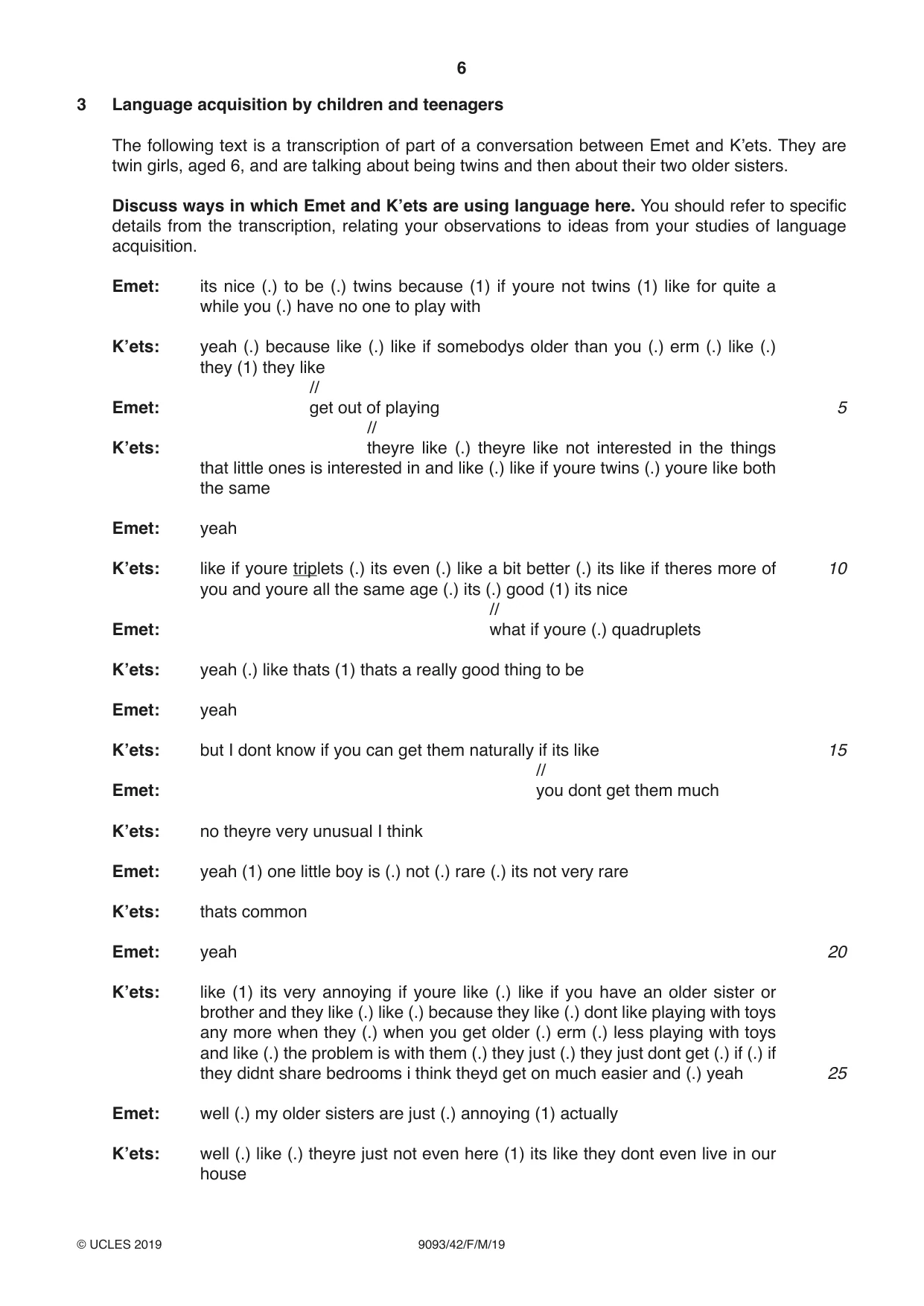
6 9093/42/F/M/19 © UCLES 2019 3 Language acquisition by children and teenagers The following text is a transcription of part of a conversation between Emet and K’ets. They are twin girls, aged 6, and are talking about being twins and then about their two older sisters. Discuss ways in which Emet and K’ets are using language here. You should refer to specific details from the transcription, relating your observations to ideas from your studies of language acquisition. Emet: its nice (.) to be (.) twins because (1) if youre not twins (1) like for quite a while you (.) have no one to play with K’ets: yeah (.) because like (.) like if somebodys older than you (.) erm (.) like (.) they (1) they like // Emet: get out of playing // K’ets: theyre like (.) theyre like not interested in the things that little ones is interested in and like (.) like if youre twins (.) youre like both the same Emet: yeah K’ets: like if youre triplets (.) its even (.) like a bit better (.) its like if theres more of you and youre all the same age (.) its (.) good (1) its nice // Emet: what if youre (.) quadruplets K’ets: yeah (.) like thats (1) thats a really good thing to be Emet: yeah K’ets: but I dont know if you can get them naturally if its like // Emet: you dont get them much K’ets: no theyre very unusual I think Emet: yeah (1) one little boy is (.) not (.) rare (.) its not very rare K’ets: thats common Emet: yeah K’ets: like (1) its very annoying if youre like (.) like if you have an older sister or brother and they like (.) like (.) because they like (.) dont like playing with toys any more when they (.) when you get older (.) erm (.) less playing with toys and like (.) the problem is with them (.) they just (.) they just dont get (.) if (.) if they didnt share bedrooms i think theyd get on much easier and (.) yeah Emet: well (.) my older sisters are just (.) annoying (1) actually K’ets: well (.) like (.) theyre just not even here (1) its like they dont even live in our house 5 10 15 20 25
Question paper, page 7
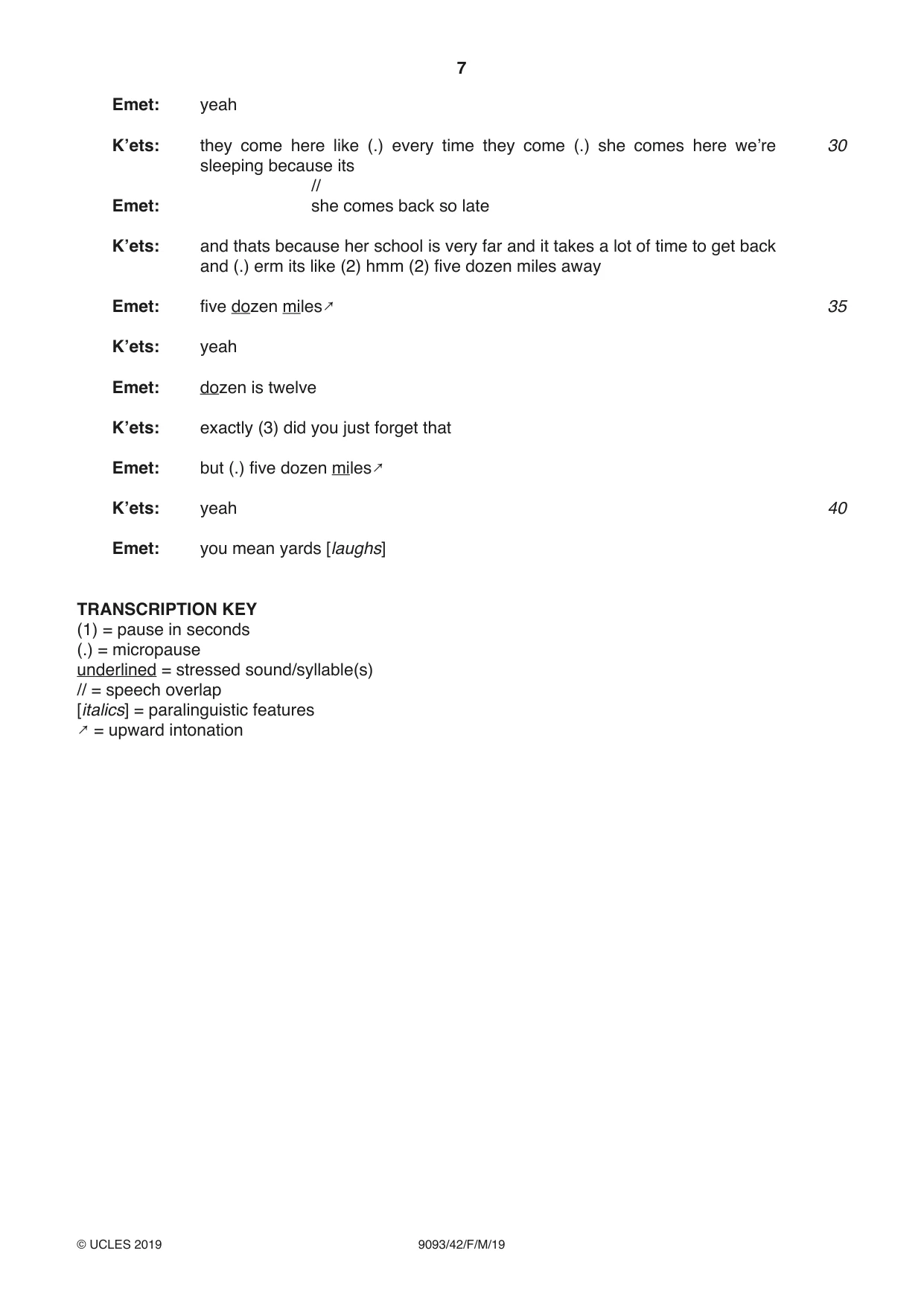
7 9093/42/F/M/19 © UCLES 2019 Emet: yeah K’ets: they come here like (.) every time they come (.) she comes here we’re sleeping because its // Emet: she comes back so late K’ets: and thats because her school is very far and it takes a lot of time to get back and (.) erm its like (2) hmm (2) five dozen miles away Emet: five dozen miles↗ K’ets: yeah Emet: dozen is twelve K’ets: exactly (3) did you just forget that Emet: but (.) five dozen miles↗ K’ets: yeah Emet: you mean yards [laughs] TRANSCRIPTION KEY (1) = pause in seconds (.) = micropause underlined = stressed sound/syllable(s) // = speech overlap [italics] = paralinguistic features ↗ = upward intonation 30 35 40
Question paper, page 8
8 9093/42/F/M/19 © UCLES 2019 BLANK PAGE Permission to reproduce items where third-party owned material protected by copyright is included has been sought and cleared where possible. Every reasonable effort has been made by the publisher (UCLES) to trace copyright holders, but if any items requiring clearance have unwittingly been included, the publisher will be pleased to make amends at the earliest possible opportunity. To avoid the issue of disclosure of answer-related information to candidates, all copyright acknowledgements are reproduced online in the Cambridge Assessment International Education Copyright Acknowledgements Booklet. This is produced for each series of examinations and is freely available to download at www.cambridgeinternational.org after the live examination series. Cambridge Assessment International Education is part of the Cambridge Assessment Group. Cambridge Assessment is the brand name of the University of Cambridge Local Examinations Syndicate (UCLES), which itself is a department of the University of Cambridge.
Mark scheme, page 1
This document consists of 8 printed pages. © UCLES 2019 [Turn over Cambridge Assessment International Education Cambridge International Advanced Level ENGLISH LANGUAGE 9093/42 Paper 4 Language Topics March 2019 MARK SCHEME Maximum Mark: 50 Published This mark scheme is published as an aid to teachers and candidates, to indicate the requirements of the examination. It shows the basis on which Examiners were instructed to award marks. It does not indicate the details of the discussions that took place at an Examiners’ meeting before marking began, which would have considered the acceptability of alternative answers. Mark schemes should be read in conjunction with the question paper and the Principal Examiner Report for Teachers. Cambridge International will not enter into discussions about these mark schemes. Cambridge International is publishing the mark schemes for the March 2019 series for most Cambridge IGCSE™, Cambridge International A and AS Level components and some Cambridge O Level components.
Mark scheme, page 2
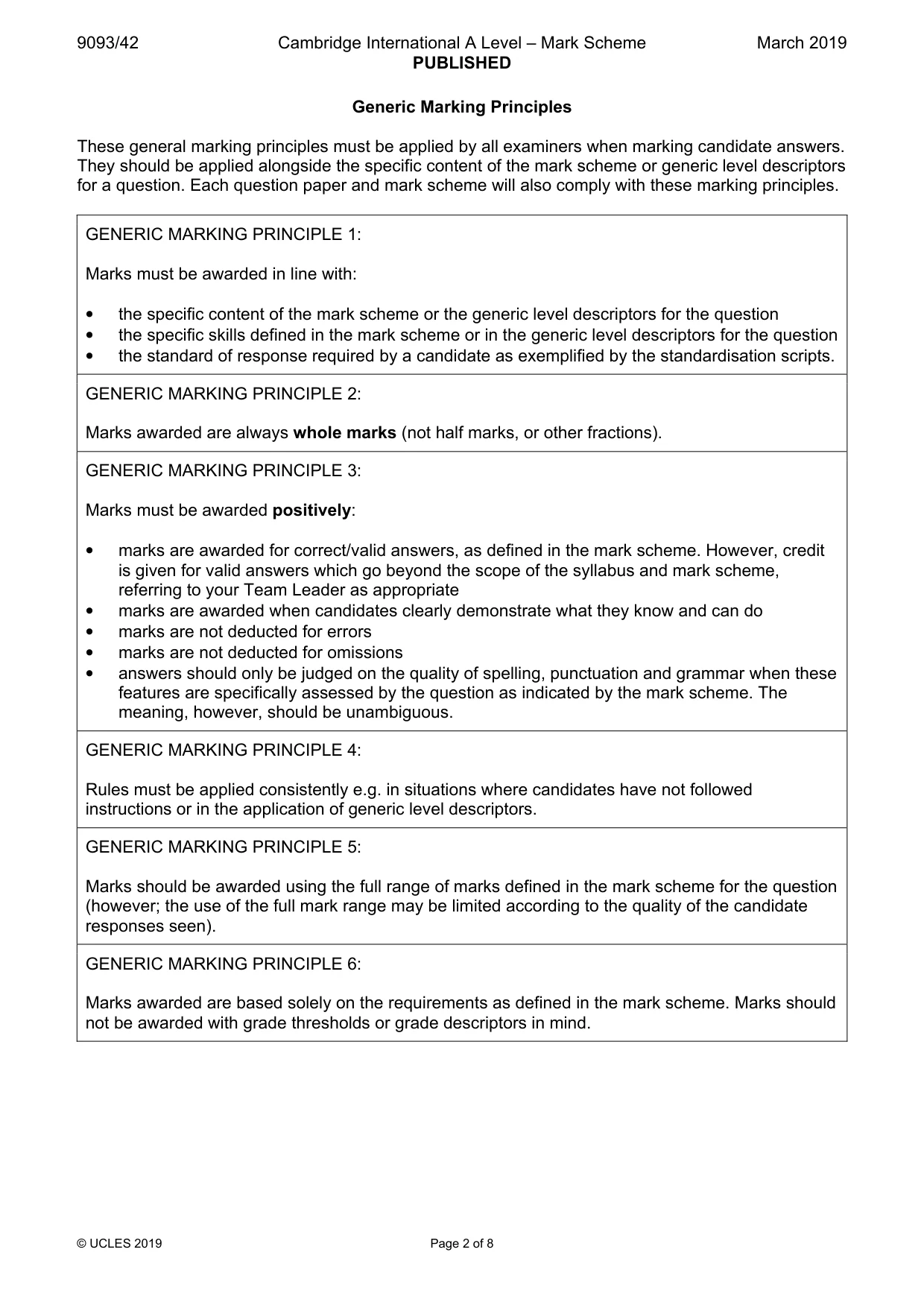
9093/42 Cambridge International A Level – Mark Scheme PUBLISHED March 2019 © UCLES 2019 Page 2 of 8 Generic Marking Principles These general marking principles must be applied by all examiners when marking candidate answers. They should be applied alongside the specific content of the mark scheme or generic level descriptors for a question. Each question paper and mark scheme will also comply with these marking principles. GENERIC MARKING PRINCIPLE 1: Marks must be awarded in line with: • the specific content of the mark scheme or the generic level descriptors for the question • the specific skills defined in the mark scheme or in the generic level descriptors for the question • the standard of response required by a candidate as exemplified by the standardisation scripts. GENERIC MARKING PRINCIPLE 2: Marks awarded are always whole marks (not half marks, or other fractions). GENERIC MARKING PRINCIPLE 3: Marks must be awarded positively: • marks are awarded for correct/valid answers, as defined in the mark scheme. However, credit is given for valid answers which go beyond the scope of the syllabus and mark scheme, referring to your Team Leader as appropriate • marks are awarded when candidates clearly demonstrate what they know and can do • marks are not deducted for errors • marks are not deducted for omissions • answers should only be judged on the quality of spelling, punctuation and grammar when these features are specifically assessed by the question as indicated by the mark scheme. The meaning, however, should be unambiguous. GENERIC MARKING PRINCIPLE 4: Rules must be applied consistently e.g. in situations where candidates have not followed instructions or in the application of generic level descriptors. GENERIC MARKING PRINCIPLE 5: Marks should be awarded using the full range of marks defined in the mark scheme for the question (however; the use of the full mark range may be limited according to the quality of the candidate responses seen). GENERIC MARKING PRINCIPLE 6: Marks awarded are based solely on the requirements as defined in the mark scheme. Marks should not be awarded with grade thresholds or grade descriptors in mind.
Mark scheme, page 3
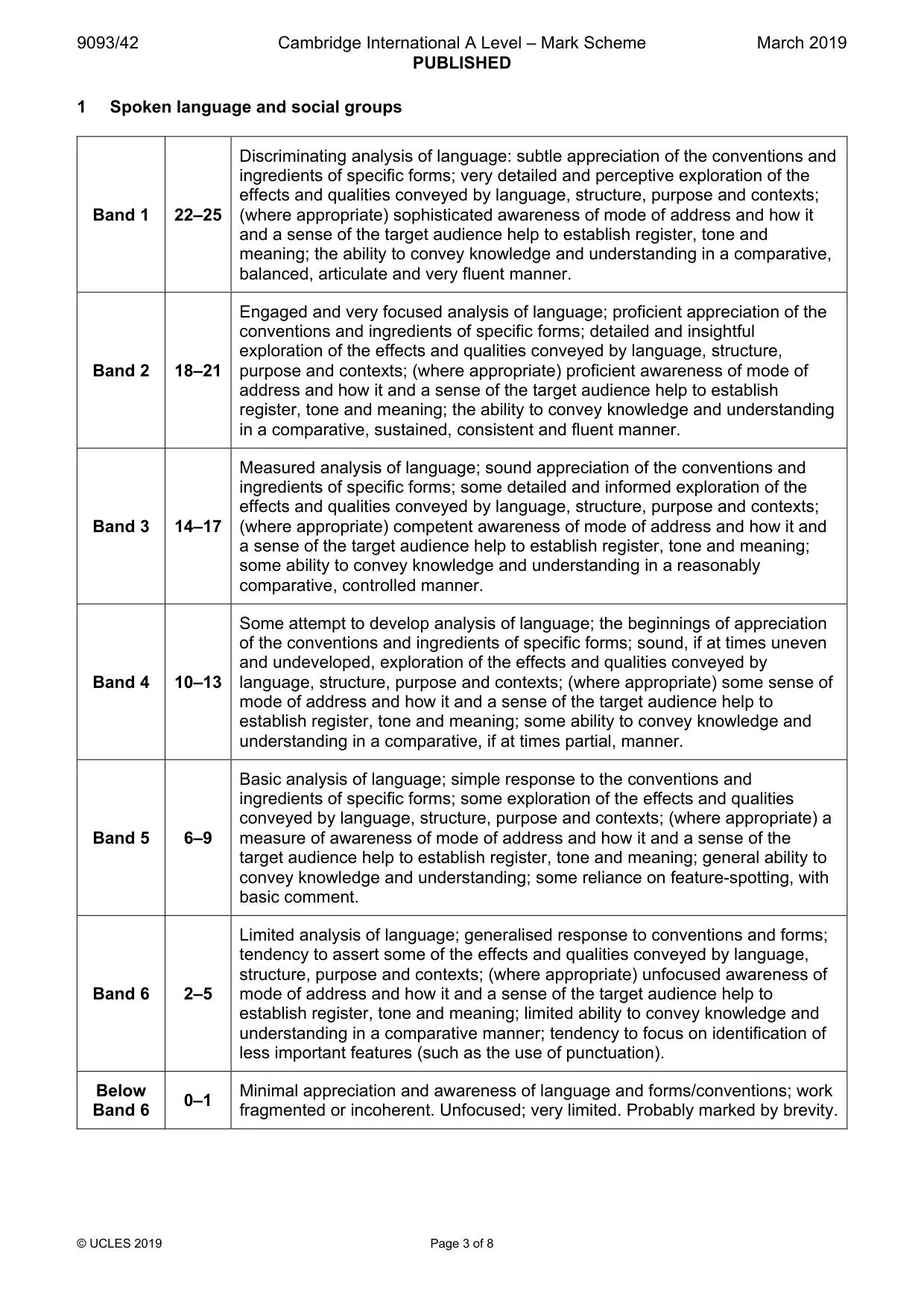
9093/42 Cambridge International A Level – Mark Scheme PUBLISHED March 2019 © UCLES 2019 Page 3 of 8 1 Spoken language and social groups Band 1 22–25 Discriminating analysis of language: subtle appreciation of the conventions and ingredients of specific forms; very detailed and perceptive exploration of the effects and qualities conveyed by language, structure, purpose and contexts; (where appropriate) sophisticated awareness of mode of address and how it and a sense of the target audience help to establish register, tone and meaning; the ability to convey knowledge and understanding in a comparative, balanced, articulate and very fluent manner. Band 2 18–21 Engaged and very focused analysis of language; proficient appreciation of the conventions and ingredients of specific forms; detailed and insightful exploration of the effects and qualities conveyed by language, structure, purpose and contexts; (where appropriate) proficient awareness of mode of address and how it and a sense of the target audience help to establish register, tone and meaning; the ability to convey knowledge and understanding in a comparative, sustained, consistent and fluent manner. Band 3 14–17 Measured analysis of language; sound appreciation of the conventions and ingredients of specific forms; some detailed and informed exploration of the effects and qualities conveyed by language, structure, purpose and contexts; (where appropriate) competent awareness of mode of address and how it and a sense of the target audience help to establish register, tone and meaning; some ability to convey knowledge and understanding in a reasonably comparative, controlled manner. Band 4 10–13 Some attempt to develop analysis of language; the beginnings of appreciation of the conventions and ingredients of specific forms; sound, if at times uneven and undeveloped, exploration of the effects and qualities conveyed by language, structure, purpose and contexts; (where appropriate) some sense of mode of address and how it and a sense of the target audience help to establish register, tone and meaning; some ability to convey knowledge and understanding in a comparative, if at times partial, manner. Band 5 6–9 Basic analysis of language; simple response to the conventions and ingredients of specific forms; some exploration of the effects and qualities conveyed by language, structure, purpose and contexts; (where appropriate) a measure of awareness of mode of address and how it and a sense of the target audience help to establish register, tone and meaning; general ability to convey knowledge and understanding; some reliance on feature-spotting, with basic comment. Band 6 2–5 Limited analysis of language; generalised response to conventions and forms; tendency to assert some of the effects and qualities conveyed by language, structure, purpose and contexts; (where appropriate) unfocused awareness of mode of address and how it and a sense of the target audience help to establish register, tone and meaning; limited ability to convey knowledge and understanding in a comparative manner; tendency to focus on identification of less important features (such as the use of punctuation). Below Band 6 0–1 Minimal appreciation and awareness of language and forms/conventions; work fragmented or incoherent. Unfocused; very limited. Probably marked by brevity.
Mark scheme, page 4
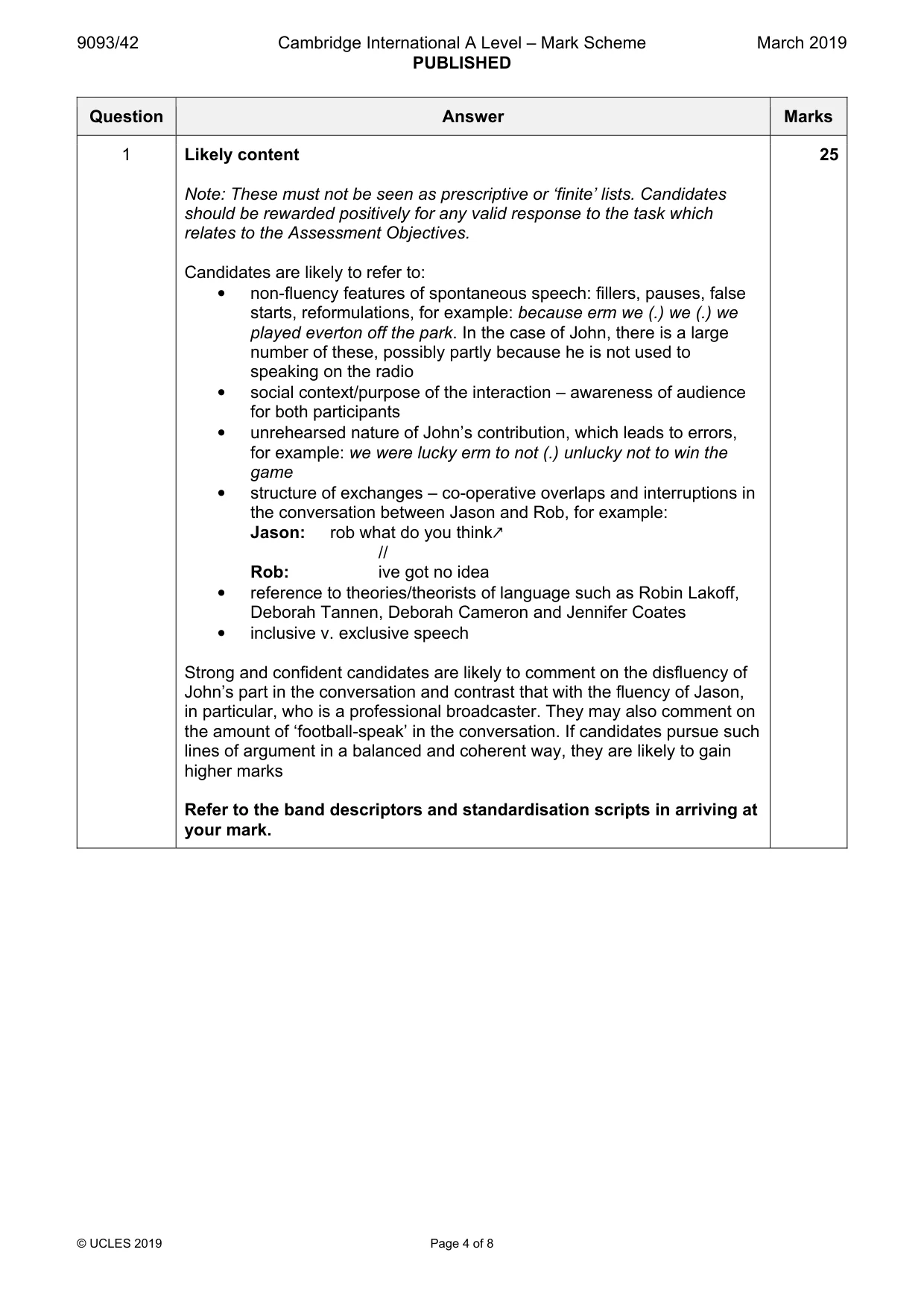
9093/42 Cambridge International A Level – Mark Scheme PUBLISHED March 2019 © UCLES 2019 Page 4 of 8 Question Answer Marks 1 Likely content Note: These must not be seen as prescriptive or ‘finite’ lists. Candidates should be rewarded positively for any valid response to the task which relates to the Assessment Objectives. Candidates are likely to refer to: • non-fluency features of spontaneous speech: fillers, pauses, false starts, reformulations, for example: because erm we (.) we (.) we played everton off the park. In the case of John, there is a large number of these, possibly partly because he is not used to speaking on the radio • social context/purpose of the interaction – awareness of audience for both participants • unrehearsed nature of John’s contribution, which leads to errors, for example: we were lucky erm to not (.) unlucky not to win the game • structure of exchanges – co-operative overlaps and interruptions in the conversation between Jason and Rob, for example: Jason: rob what do you think↗ // Rob: ive got no idea • reference to theories/theorists of language such as Robin Lakoff, Deborah Tannen, Deborah Cameron and Jennifer Coates • inclusive v. exclusive speech Strong and confident candidates are likely to comment on the disfluency of John’s part in the conversation and contrast that with the fluency of Jason, in particular, who is a professional broadcaster. They may also comment on the amount of ‘football-speak’ in the conversation. If candidates pursue such lines of argument in a balanced and coherent way, they are likely to gain higher marks Refer to the band descriptors and standardisation scripts in arriving at your mark. 25
Mark scheme, page 5
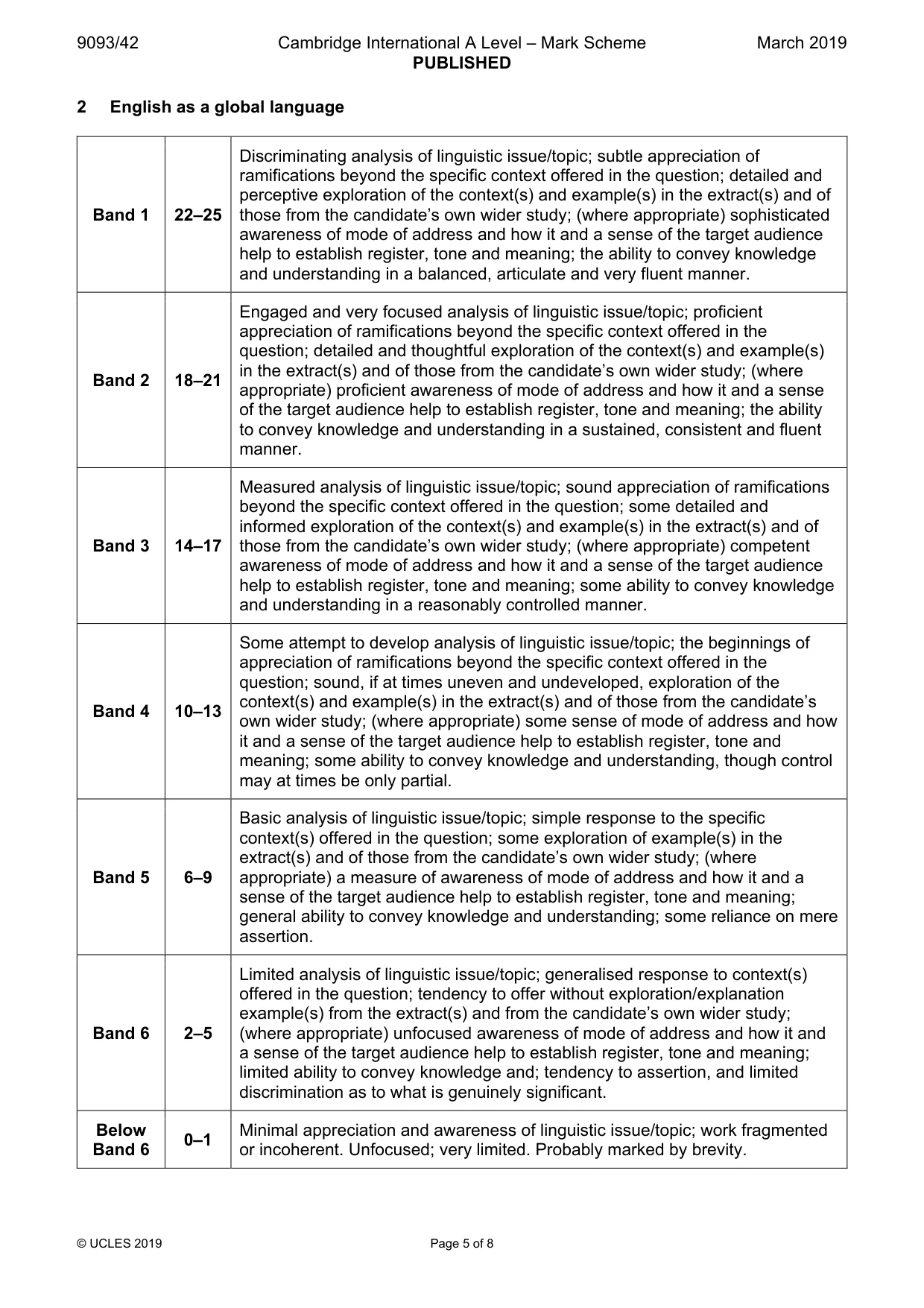
9093/42 Cambridge International A Level – Mark Scheme PUBLISHED March 2019 © UCLES 2019 Page 5 of 8 2 English as a global language Band 1 22–25 Discriminating analysis of linguistic issue/topic; subtle appreciation of ramifications beyond the specific context offered in the question; detailed and perceptive exploration of the context(s) and example(s) in the extract(s) and of those from the candidate’s own wider study; (where appropriate) sophisticated awareness of mode of address and how it and a sense of the target audience help to establish register, tone and meaning; the ability to convey knowledge and understanding in a balanced, articulate and very fluent manner. Band 2 18–21 Engaged and very focused analysis of linguistic issue/topic; proficient appreciation of ramifications beyond the specific context offered in the question; detailed and thoughtful exploration of the context(s) and example(s) in the extract(s) and of those from the candidate’s own wider study; (where appropriate) proficient awareness of mode of address and how it and a sense of the target audience help to establish register, tone and meaning; the ability to convey knowledge and understanding in a sustained, consistent and fluent manner. Band 3 14–17 Measured analysis of linguistic issue/topic; sound appreciation of ramifications beyond the specific context offered in the question; some detailed and informed exploration of the context(s) and example(s) in the extract(s) and of those from the candidate’s own wider study; (where appropriate) competent awareness of mode of address and how it and a sense of the target audience help to establish register, tone and meaning; some ability to convey knowledge and understanding in a reasonably controlled manner. Band 4 10–13 Some attempt to develop analysis of linguistic issue/topic; the beginnings of appreciation of ramifications beyond the specific context offered in the question; sound, if at times uneven and undeveloped, exploration of the context(s) and example(s) in the extract(s) and of those from the candidate’s own wider study; (where appropriate) some sense of mode of address and how it and a sense of the target audience help to establish register, tone and meaning; some ability to convey knowledge and understanding, though control may at times be only partial. Band 5 6–9 Basic analysis of linguistic issue/topic; simple response to the specific context(s) offered in the question; some exploration of example(s) in the extract(s) and of those from the candidate’s own wider study; (where appropriate) a measure of awareness of mode of address and how it and a sense of the target audience help to establish register, tone and meaning; general ability to convey knowledge and understanding; some reliance on mere assertion. Band 6 2–5 Limited analysis of linguistic issue/topic; generalised response to context(s) offered in the question; tendency to offer without exploration/explanation example(s) from the extract(s) and from the candidate’s own wider study; (where appropriate) unfocused awareness of mode of address and how it and a sense of the target audience help to establish register, tone and meaning; limited ability to convey knowledge and; tendency to assertion, and limited discrimination as to what is genuinely significant. Below Band 6 0–1 Minimal appreciation and awareness of linguistic issue/topic; work fragmented or incoherent. Unfocused; very limited. Probably marked by brevity.
Mark scheme, page 6
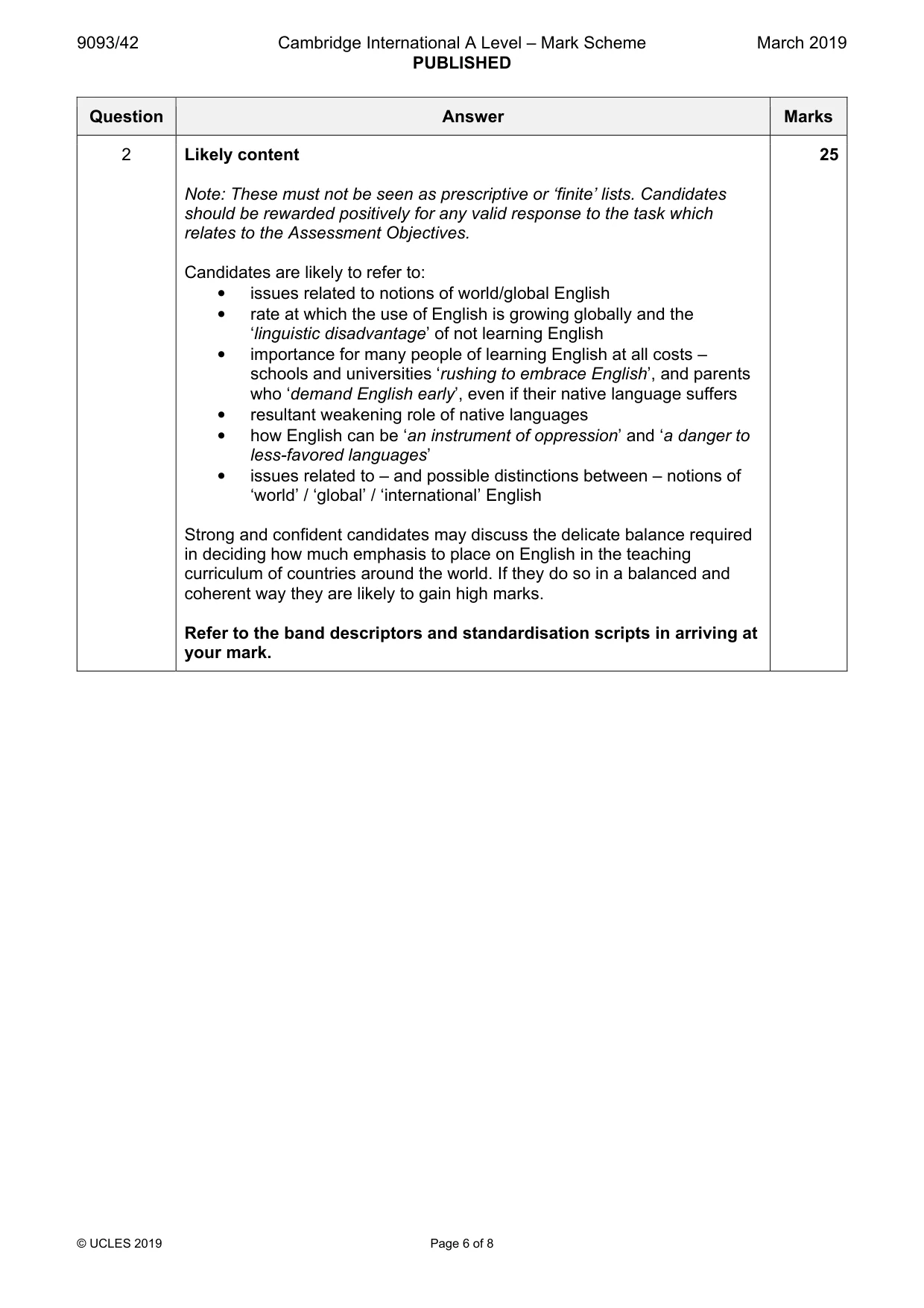
9093/42 Cambridge International A Level – Mark Scheme PUBLISHED March 2019 © UCLES 2019 Page 6 of 8 Question Answer Marks 2 Likely content Note: These must not be seen as prescriptive or ‘finite’ lists. Candidates should be rewarded positively for any valid response to the task which relates to the Assessment Objectives. Candidates are likely to refer to: • issues related to notions of world/global English • rate at which the use of English is growing globally and the ‘linguistic disadvantage’ of not learning English • importance for many people of learning English at all costs – schools and universities ‘rushing to embrace English’, and parents who ‘demand English early’, even if their native language suffers • resultant weakening role of native languages • how English can be ‘an instrument of oppression’ and ‘a danger to less-favored languages’ • issues related to – and possible distinctions between – notions of ‘world’ / ‘global’ / ‘international’ English Strong and confident candidates may discuss the delicate balance required in deciding how much emphasis to place on English in the teaching curriculum of countries around the world. If they do so in a balanced and coherent way they are likely to gain high marks. Refer to the band descriptors and standardisation scripts in arriving at your mark. 25
Mark scheme, page 7
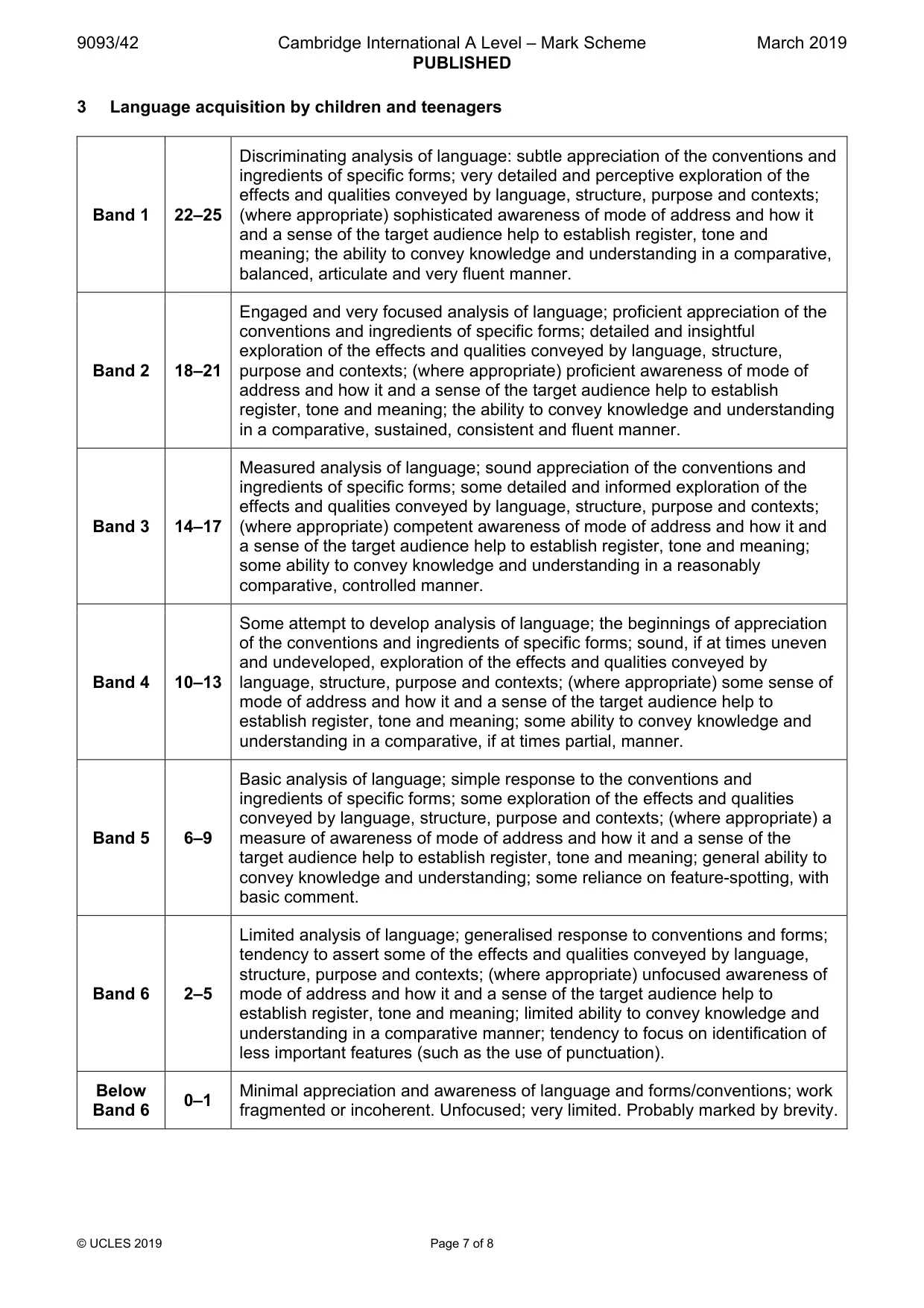
9093/42 Cambridge International A Level – Mark Scheme PUBLISHED March 2019 © UCLES 2019 Page 7 of 8 3 Language acquisition by children and teenagers Band 1 22–25 Discriminating analysis of language: subtle appreciation of the conventions and ingredients of specific forms; very detailed and perceptive exploration of the effects and qualities conveyed by language, structure, purpose and contexts; (where appropriate) sophisticated awareness of mode of address and how it and a sense of the target audience help to establish register, tone and meaning; the ability to convey knowledge and understanding in a comparative, balanced, articulate and very fluent manner. Band 2 18–21 Engaged and very focused analysis of language; proficient appreciation of the conventions and ingredients of specific forms; detailed and insightful exploration of the effects and qualities conveyed by language, structure, purpose and contexts; (where appropriate) proficient awareness of mode of address and how it and a sense of the target audience help to establish register, tone and meaning; the ability to convey knowledge and understanding in a comparative, sustained, consistent and fluent manner. Band 3 14–17 Measured analysis of language; sound appreciation of the conventions and ingredients of specific forms; some detailed and informed exploration of the effects and qualities conveyed by language, structure, purpose and contexts; (where appropriate) competent awareness of mode of address and how it and a sense of the target audience help to establish register, tone and meaning; some ability to convey knowledge and understanding in a reasonably comparative, controlled manner. Band 4 10–13 Some attempt to develop analysis of language; the beginnings of appreciation of the conventions and ingredients of specific forms; sound, if at times uneven and undeveloped, exploration of the effects and qualities conveyed by language, structure, purpose and contexts; (where appropriate) some sense of mode of address and how it and a sense of the target audience help to establish register, tone and meaning; some ability to convey knowledge and understanding in a comparative, if at times partial, manner. Band 5 6–9 Basic analysis of language; simple response to the conventions and ingredients of specific forms; some exploration of the effects and qualities conveyed by language, structure, purpose and contexts; (where appropriate) a measure of awareness of mode of address and how it and a sense of the target audience help to establish register, tone and meaning; general ability to convey knowledge and understanding; some reliance on feature-spotting, with basic comment. Band 6 2–5 Limited analysis of language; generalised response to conventions and forms; tendency to assert some of the effects and qualities conveyed by language, structure, purpose and contexts; (where appropriate) unfocused awareness of mode of address and how it and a sense of the target audience help to establish register, tone and meaning; limited ability to convey knowledge and understanding in a comparative manner; tendency to focus on identification of less important features (such as the use of punctuation). Below Band 6 0–1 Minimal appreciation and awareness of language and forms/conventions; work fragmented or incoherent. Unfocused; very limited. Probably marked by brevity.
Mark scheme, page 8
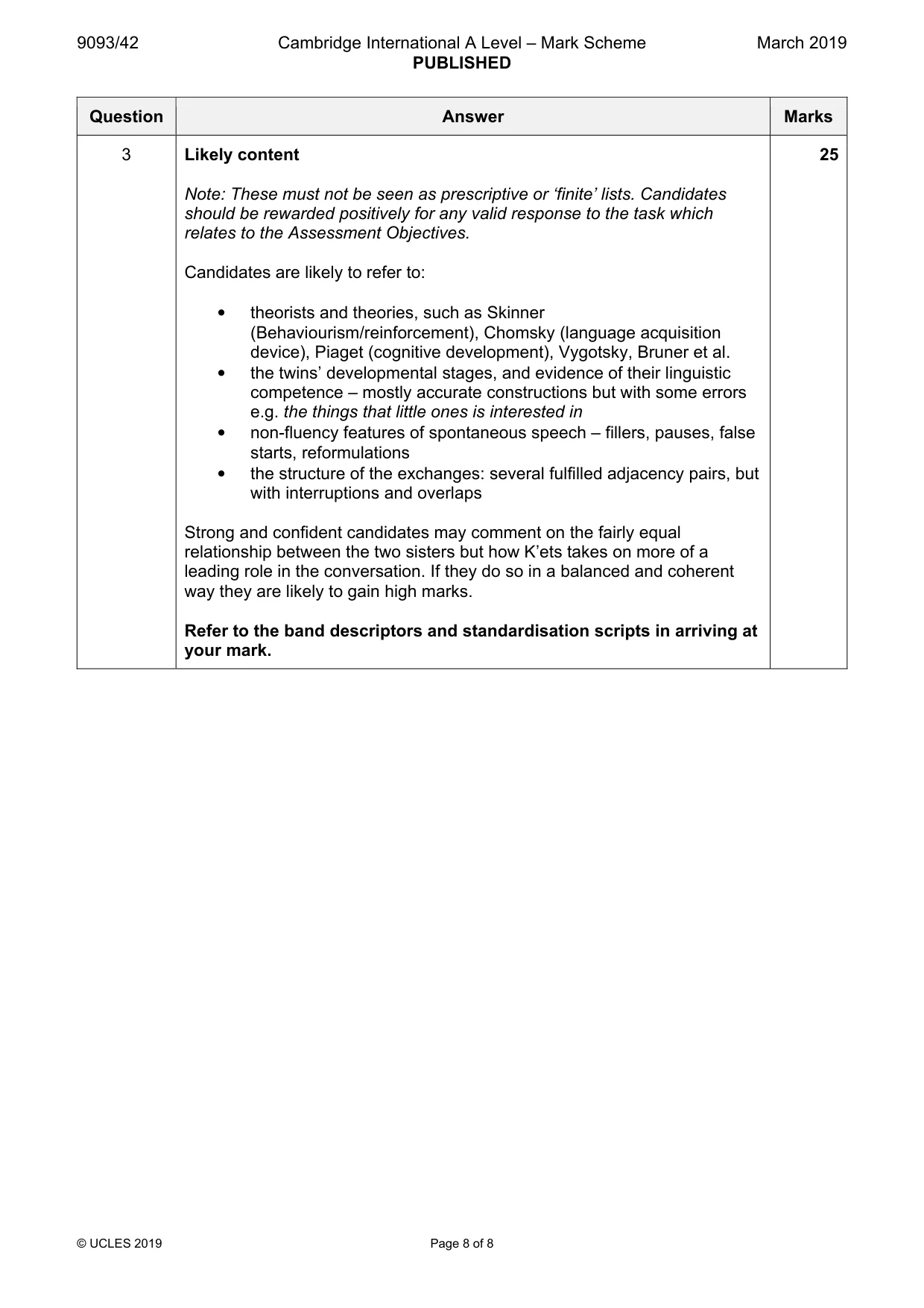
9093/42 Cambridge International A Level – Mark Scheme PUBLISHED March 2019 © UCLES 2019 Page 8 of 8 Question Answer Marks 3 Likely content Note: These must not be seen as prescriptive or ‘finite’ lists. Candidates should be rewarded positively for any valid response to the task which relates to the Assessment Objectives. Candidates are likely to refer to: • theorists and theories, such as Skinner (Behaviourism/reinforcement), Chomsky (language acquisition device), Piaget (cognitive development), Vygotsky, Bruner et al. • the twins’ developmental stages, and evidence of their linguistic competence – mostly accurate constructions but with some errors e.g. the things that little ones is interested in • non-fluency features of spontaneous speech – fillers, pauses, false starts, reformulations • the structure of the exchanges: several fulfilled adjacency pairs, but with interruptions and overlaps Strong and confident candidates may comment on the fairly equal relationship between the two sisters but how K’ets takes on more of a leading role in the conversation. If they do so in a balanced and coherent way they are likely to gain high marks. Refer to the band descriptors and standardisation scripts in arriving at your mark. 25
What you needed in this session
Cambridge’s own grade thresholds for 2019 Feb/March, Paper 4 · Variant 2. A higher threshold means an easier paper — the bar moves with how the cohort did.