Cambridge A Level English - Language AS and A Level (from 2014) 9093 — 2018 May/June Paper 3 · Variant 1
9093/31/M/J/18 · 50 marks · ≈56 min
The question paper and its mark scheme, free to read here and free to download. This is Cambridge’s own paper, exactly as it was sat.
Question paper8 pages


Mark scheme8 pages
Answers below. Sit the paper first if you are practising.
Paper as text
Question paper, page 1
This document consists of 5 printed pages, 3 blank pages and 1 Insert. DC (SCD (JB)) 146609/1 © UCLES 2018 [Turn over Cambridge International Examinations Cambridge International Advanced Subsidiary and Advanced Level * 9 9 7 3 5 8 6 8 4 9 * ENGLISH LANGUAGE 9093/31 Paper 3 Text Analysis May/June 2018 2 hours 15 minutes No Additional Materials are required. READ THESE INSTRUCTIONS FIRST An answer booklet is provided inside this question paper. You should follow the instructions on the front cover of the answer booklet. If you need additional answer paper, ask the invigilator for a continuation booklet. Answer two questions. You should spend about 15 minutes reading the passages and questions before you start writing your answers. You are reminded of the need for good English and clear presentation in your answers. The number of marks is given in brackets [ ] at the end of each question or part question. Both questions carry equal marks.
Question paper, page 2
2 9093/31/M/J/18 © UCLES 2018 1 The following text is an online newspaper article about classical music, written by Chitra Swaminathan. (a) Imagine that the owners of a new music venue near to where you live have asked you to advise them on whether or not classical music concerts would be popular. Write your advice in an email of 120–150 words. [10] (b) Compare the language and style of your advice with the language and style of Swaminathan’s article. [15] The Triumph of Classicism In the Twitter age of instant gratification and selfie moments, classical music has held its own and strides gracefully yet robustly into the New Year, says Chitra Swaminathan When we asked the classical musician with rock-star appeal, Ustad Zakir Hussain, how he makes his music so provocative and thrilling, he laughed as he ran his fingers through his thinning but famous mop of curls. Picking up the tabla1, he said, “This looks small but it has enough space to hold rhythm ideas that can last another century.” 5 10 15 20 25 30 35 He was in Chennai2 recently for a concert, and was trying to make himself heard over the buzz of selfie-obsessed fans and autograph-hunters forming an impenetrable ring around him. In his characteristic nonchalant manner he said, “Call me what you want to, showman, global collaborator, modernist, cross-genre musician. But I know for sure I am a hard-core classicist. This ancient genre is so adaptable and flexible that composers and musicians are constantly inspired to either rework their music along its rules or simply walk down its well-trodden path.” If you had even remotely begun to believe the doomsday prophets about the death of the classical, you should have been at The Music Academy last Sunday to dust off your clapometer and prove them wrong. The hall seemed to struggle for breath as extra chairs were laid out in every available nook and cranny for the huge turn-out that evening. Listeners queued up more than an hour before the concert. Whether eight or 80, everyone sat in rapt attention till the last note was rendered. Classical music now thrives in an eclectic and pluralist culture. It has taken its place gracefully in these times and is a significant part of the current choice. It has drawn liberally from varied reservoirs that reach far beyond sniffy cultural snobs. The strength of the classical has ensured that progressive bands such as Agam and Filter Coffee work their repertoires around traditional compositions. In its October show in the city, Agam had the audience of appreciative elders and swinging youngsters literally eating out of its hand. “Classical music is no longer the pompous art of the past,” says flautist Shriram Sampath of Filter Coffee, whose speciality is a thick brew of notes from Northern and Southern India. “Actually, classical is more progressive because rock and pop remain with their templated sound,” says Shriram, who left the listeners asking for more at his gig last August.
Question paper, page 3
3 9093/31/M/J/18 © UCLES 2018 [Turn over The demise of classical music has been predicted for many years now, but if last year was any indication, we can confidently say that 2016 will continue to see classical musicians firmly cement their place in audience hearts. 1tabla: a small drum or pair of drums, played with the hands 2Chennai: a large city in Southern India
Question paper, page 4
4 9093/31/M/J/18 © UCLES 2018 2 Texts A and B are about the Marathon des Sables (MdS), an annual footrace which takes place over several days in the Sahara desert. Text A is an extract from an online diary account written by Alastair Humphreys, a participant in the Marathon des Sables. Text B is a transcription of part of a radio show. The presenter, Anne Diamond, is interviewing Greg Whyte, another participant in the Marathon des Sables. Compare the language and style of Text A and Text B. [25] Text A Day 2 The heat rose, above 40°C, and I got my first blister. Water was becoming more precious. I knocked back loads of salt tablets and gritted my teeth across a never-ending shimmering gravel plain that pulsed heat all the way to the end of the day. Whilst huffing and labouring, slathered in suncream, yearning for my next issue of mineral water, I shuffled past a lady herding her goats. She was barefoot, relaxed and entirely comfortable with her environment. She was tough and her life was tough. She was smiling, I was not. 5 10 15 20 25 30 Day 3 Today was more like running on the beach, with stretches of flat, soft sand that wore me down as dehydration pounded at my head. “Running” is putting it a bit strong: all of us developed our own pace of the “Sahara Shuffle” and your position on any day was determined by whether you were able to keep shuffling when all about you had been reduced by the heat or sand to a mere walk or march. The best way to imagine the speed of the “Sahara Shuffle” is to think of the pace that footballers trot up and down the sideline of the pitch before they come on as substitutes. It is the slowest possible jog that you can do once you break out of a walk. It is very, very slow. It is all that you can achieve in the Sahara desert. The MdS is entirely about body management. If your feet hurt, stop and tape them up. If you are tired, deal with it. Drink more. Eat salt. Eat food. If you do not you will slow down and lose places. Day 4 I ran, faster than I would have liked, to the foot of the large jebel (mountain). My strategy was to push hard until it was too hot, march fast but steady through the heat of the day, then leg it until sunset and just grit out the darkness until I finished. Up and over the jebel. Through the sand dunes. Across a gravel plain. Keep up with the blokes ahead, but don’t get caught up in a race too early. Pace yourself, take it steady. And all the time I managed to keep on shuffling. Sunset and I was racing well. I was running now, faster than I had done all race, faster than I had done for months. I still felt great. With 5 miles to go a fellow runner caught up with me. Settling into a rhythm we began to push each other harder and harder. The sun was gone, the glowsticks bounced on our packs, our weak head torches picked a vague route through the gravel and soft sand. And we ran. We were racing for the finish and bed. I felt absolutely glorious.
Question paper, page 5
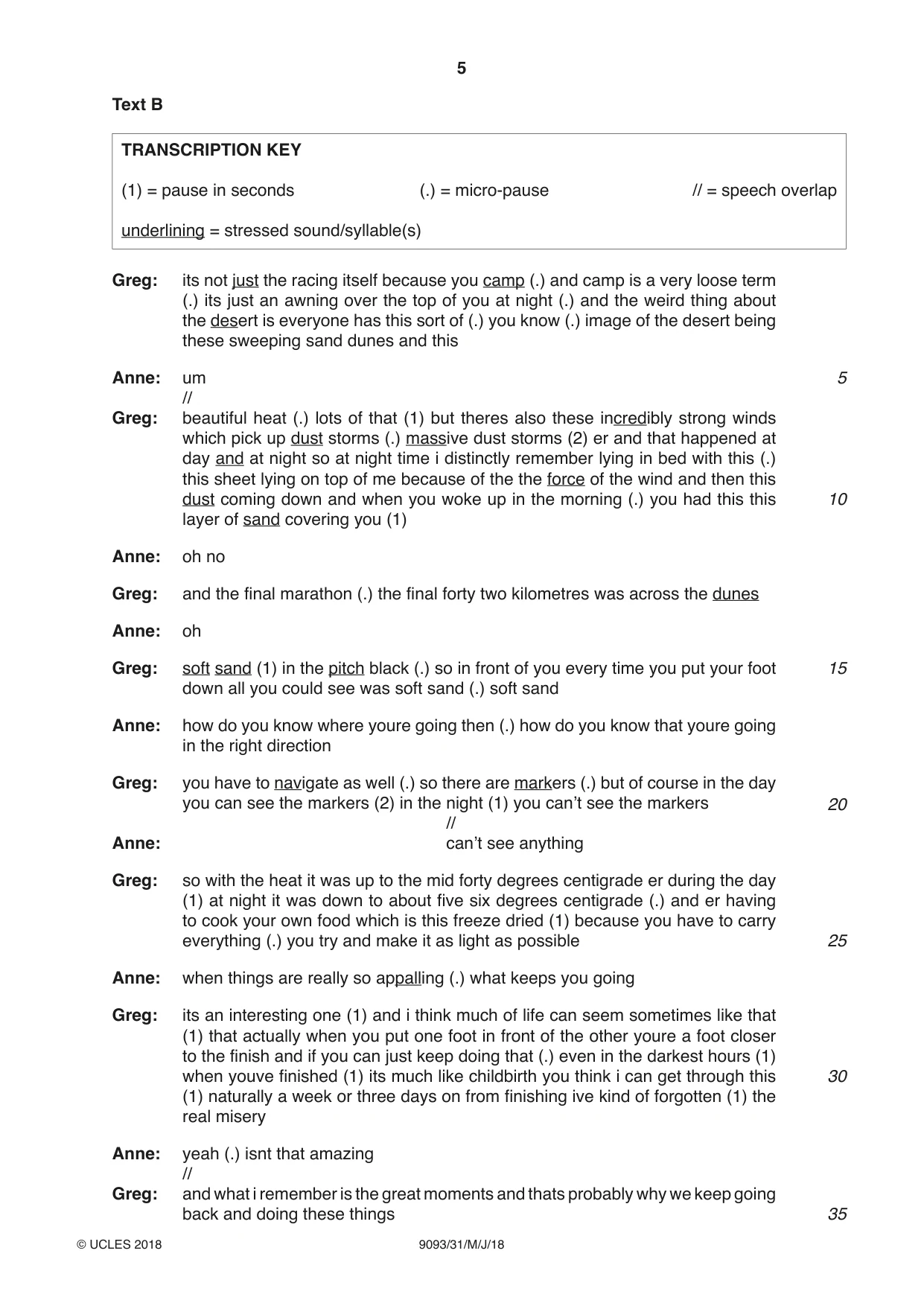
5 9093/31/M/J/18 © UCLES 2018 Text B Greg: its not just the racing itself because you camp (.) and camp is a very loose term (.) its just an awning over the top of you at night (.) and the weird thing about the desert is everyone has this sort of (.) you know (.) image of the desert being these sweeping sand dunes and this Anne: um 5 10 15 20 25 30 35 // Greg: beautiful heat (.) lots of that (1) but theres also these incredibly strong winds which pick up dust storms (.) massive dust storms (2) er and that happened at day and at night so at night time i distinctly remember lying in bed with this (.) this sheet lying on top of me because of the the force of the wind and then this dust coming down and when you woke up in the morning (.) you had this this layer of sand covering you (1) Anne: oh no Greg: and the final marathon (.) the final forty two kilometres was across the dunes Anne: oh Greg: soft sand (1) in the pitch black (.) so in front of you every time you put your foot down all you could see was soft sand (.) soft sand Anne: how do you know where youre going then (.) how do you know that youre going in the right direction Greg: you have to navigate as well (.) so there are markers (.) but of course in the day you can see the markers (2) in the night (1) you can’t see the markers // Anne: can’t see anything Greg: so with the heat it was up to the mid forty degrees centigrade er during the day (1) at night it was down to about five six degrees centigrade (.) and er having to cook your own food which is this freeze dried (1) because you have to carry everything (.) you try and make it as light as possible Anne: when things are really so appalling (.) what keeps you going Greg: its an interesting one (1) and i think much of life can seem sometimes like that (1) that actually when you put one foot in front of the other youre a foot closer to the finish and if you can just keep doing that (.) even in the darkest hours (1) when youve finished (1) its much like childbirth you think i can get through this (1) naturally a week or three days on from finishing ive kind of forgotten (1) the real misery Anne: yeah (.) isnt that amazing // Greg: and what i remember is the great moments and thats probably why we keep going back and doing these things TRANSCRIPTION KEY (1) = pause in seconds (.) = micro-pause // = speech overlap underlining = stressed sound/syllable(s)
Question paper, page 6
6 9093/31/M/J/18 © UCLES 2018 BLANK PAGE
Question paper, page 7
7 9093/31/M/J/18 © UCLES 2018 BLANK PAGE
Question paper, page 8
8 9093/31/M/J/18 © UCLES 2018 Permission to reproduce items where third-party owned material protected by copyright is included has been sought and cleared where possible. Every reasonable effort has been made by the publisher (UCLES) to trace copyright holders, but if any items requiring clearance have unwittingly been included, the publisher will be pleased to make amends at the earliest possible opportunity. To avoid the issue of disclosure of answer-related information to candidates, all copyright acknowledgements are reproduced online in the Cambridge International Examinations Copyright Acknowledgements Booklet. This is produced for each series of examinations and is freely available to download at www.cie.org.uk after the live examination series. Cambridge International Examinations is part of the Cambridge Assessment Group. Cambridge Assessment is the brand name of University of Cambridge Local Examinations Syndicate (UCLES), which is itself a department of the University of Cambridge. BLANK PAGE
Mark scheme, page 1
IGCSE™ is a registered trademark. This document consists of 8 printed pages. © UCLES 2018 [Turn over Cambridge Assessment International Education Cambridge International Advanced Level ENGLISH LANGUAGE 9093/31 Paper 3 Text Analysis May/June 2018 MARK SCHEME Maximum Mark: 50 Published This mark scheme is published as an aid to teachers and candidates, to indicate the requirements of the examination. It shows the basis on which Examiners were instructed to award marks. It does not indicate the details of the discussions that took place at an Examiners’ meeting before marking began, which would have considered the acceptability of alternative answers. Mark schemes should be read in conjunction with the question paper and the Principal Examiner Report for Teachers. Cambridge International will not enter into discussions about these mark schemes. Cambridge International is publishing the mark schemes for the May/June 2018 series for most Cambridge IGCSE™, Cambridge International A and AS Level and Cambridge Pre-U components, and some Cambridge O Level components.
Mark scheme, page 2
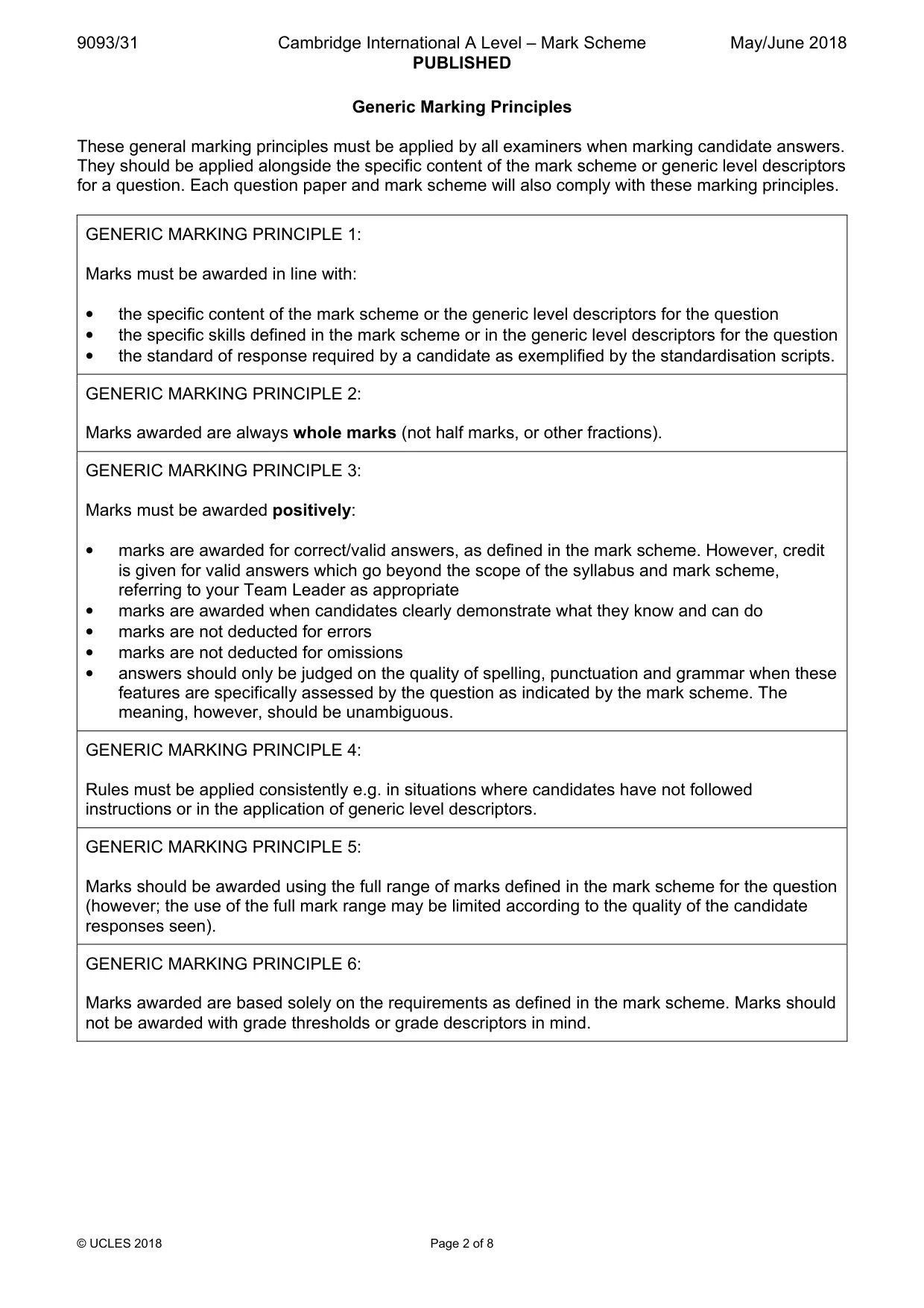
9093/31 Cambridge International A Level – Mark Scheme PUBLISHED May/June 2018 © UCLES 2018 Page 2 of 8 Generic Marking Principles These general marking principles must be applied by all examiners when marking candidate answers. They should be applied alongside the specific content of the mark scheme or generic level descriptors for a question. Each question paper and mark scheme will also comply with these marking principles. GENERIC MARKING PRINCIPLE 1: Marks must be awarded in line with: • the specific content of the mark scheme or the generic level descriptors for the question • the specific skills defined in the mark scheme or in the generic level descriptors for the question • the standard of response required by a candidate as exemplified by the standardisation scripts. GENERIC MARKING PRINCIPLE 2: Marks awarded are always whole marks (not half marks, or other fractions). GENERIC MARKING PRINCIPLE 3: Marks must be awarded positively: • marks are awarded for correct/valid answers, as defined in the mark scheme. However, credit is given for valid answers which go beyond the scope of the syllabus and mark scheme, referring to your Team Leader as appropriate • marks are awarded when candidates clearly demonstrate what they know and can do • marks are not deducted for errors • marks are not deducted for omissions • answers should only be judged on the quality of spelling, punctuation and grammar when these features are specifically assessed by the question as indicated by the mark scheme. The meaning, however, should be unambiguous. GENERIC MARKING PRINCIPLE 4: Rules must be applied consistently e.g. in situations where candidates have not followed instructions or in the application of generic level descriptors. GENERIC MARKING PRINCIPLE 5: Marks should be awarded using the full range of marks defined in the mark scheme for the question (however; the use of the full mark range may be limited according to the quality of the candidate responses seen). GENERIC MARKING PRINCIPLE 6: Marks awarded are based solely on the requirements as defined in the mark scheme. Marks should not be awarded with grade thresholds or grade descriptors in mind.
Mark scheme, page 3
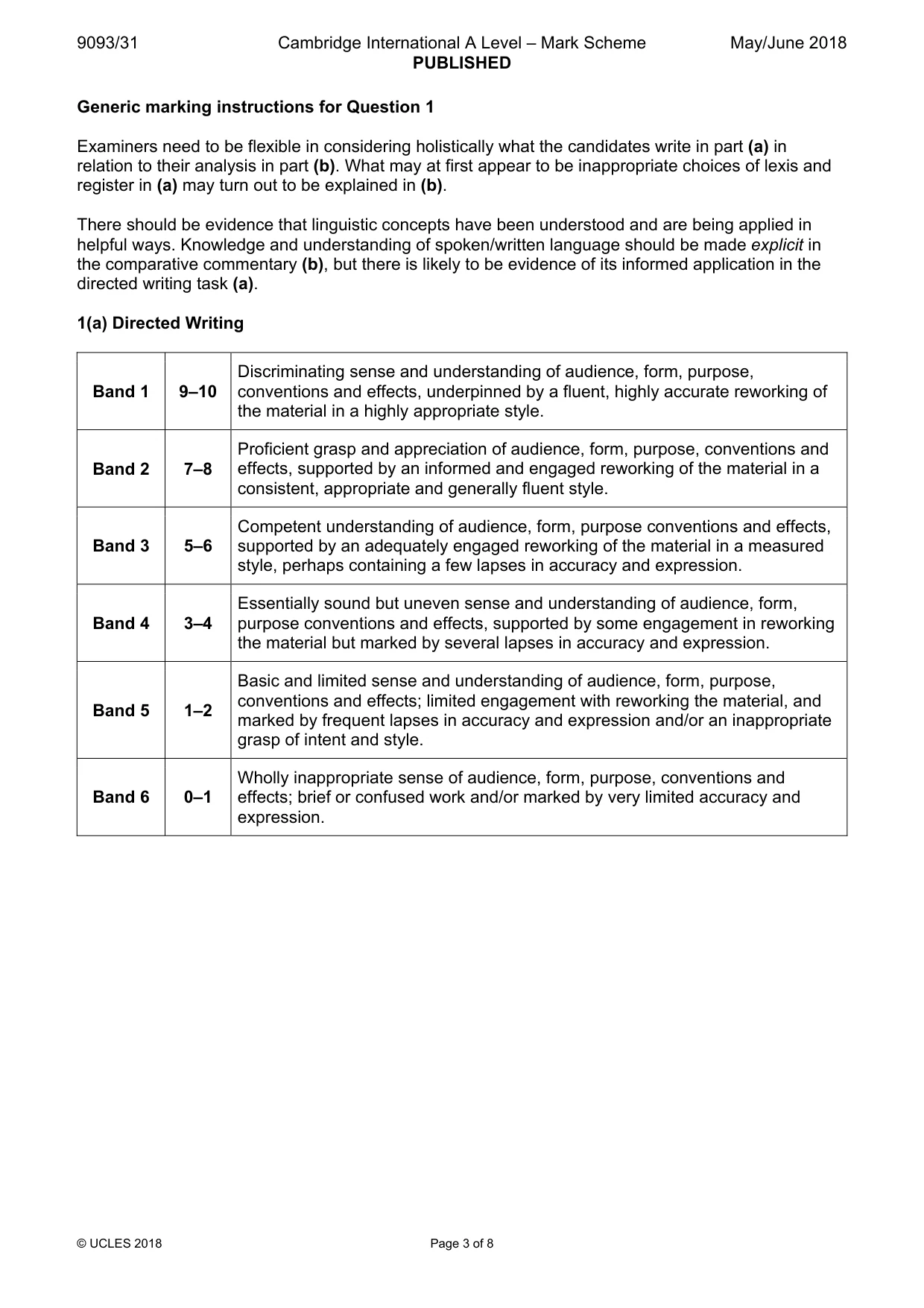
9093/31 Cambridge International A Level – Mark Scheme PUBLISHED May/June 2018 © UCLES 2018 Page 3 of 8 Generic marking instructions for Question 1 Examiners need to be flexible in considering holistically what the candidates write in part (a) in relation to their analysis in part (b). What may at first appear to be inappropriate choices of lexis and register in (a) may turn out to be explained in (b). There should be evidence that linguistic concepts have been understood and are being applied in helpful ways. Knowledge and understanding of spoken/written language should be made explicit in the comparative commentary (b), but there is likely to be evidence of its informed application in the directed writing task (a). 1(a) Directed Writing Band 1 9–10 Discriminating sense and understanding of audience, form, purpose, conventions and effects, underpinned by a fluent, highly accurate reworking of the material in a highly appropriate style. Band 2 7–8 Proficient grasp and appreciation of audience, form, purpose, conventions and effects, supported by an informed and engaged reworking of the material in a consistent, appropriate and generally fluent style. Band 3 5–6 Competent understanding of audience, form, purpose conventions and effects, supported by an adequately engaged reworking of the material in a measured style, perhaps containing a few lapses in accuracy and expression. Band 4 3–4 Essentially sound but uneven sense and understanding of audience, form, purpose conventions and effects, supported by some engagement in reworking the material but marked by several lapses in accuracy and expression. Band 5 1–2 Basic and limited sense and understanding of audience, form, purpose, conventions and effects; limited engagement with reworking the material, and marked by frequent lapses in accuracy and expression and/or an inappropriate grasp of intent and style. Band 6 0–1 Wholly inappropriate sense of audience, form, purpose, conventions and effects; brief or confused work and/or marked by very limited accuracy and expression.
Mark scheme, page 4
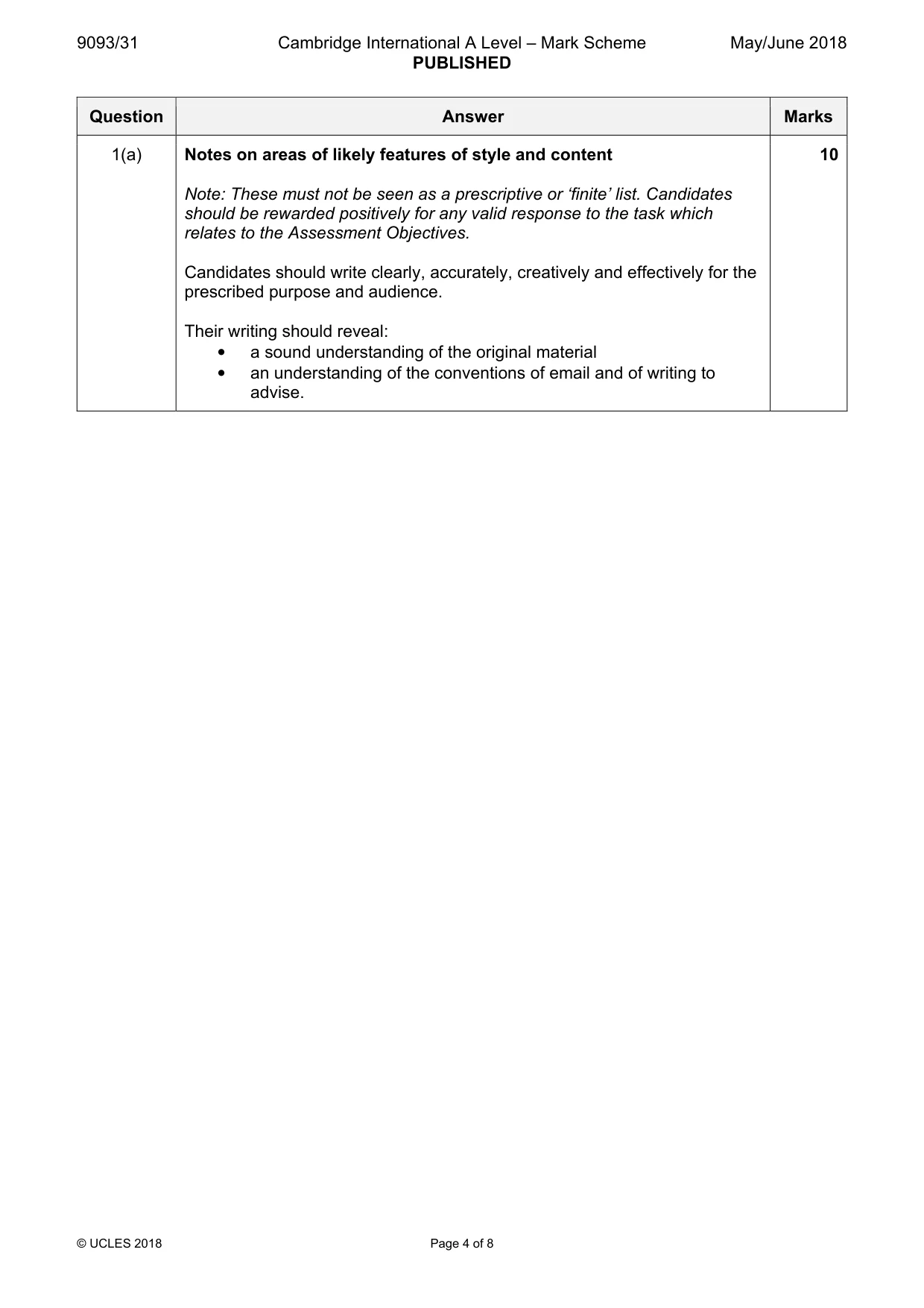
9093/31 Cambridge International A Level – Mark Scheme PUBLISHED May/June 2018 © UCLES 2018 Page 4 of 8 Question Answer Marks 1(a) Notes on areas of likely features of style and content Note: These must not be seen as a prescriptive or ‘finite’ list. Candidates should be rewarded positively for any valid response to the task which relates to the Assessment Objectives. Candidates should write clearly, accurately, creatively and effectively for the prescribed purpose and audience. Their writing should reveal: • a sound understanding of the original material • an understanding of the conventions of email and of writing to advise. 10
Mark scheme, page 5
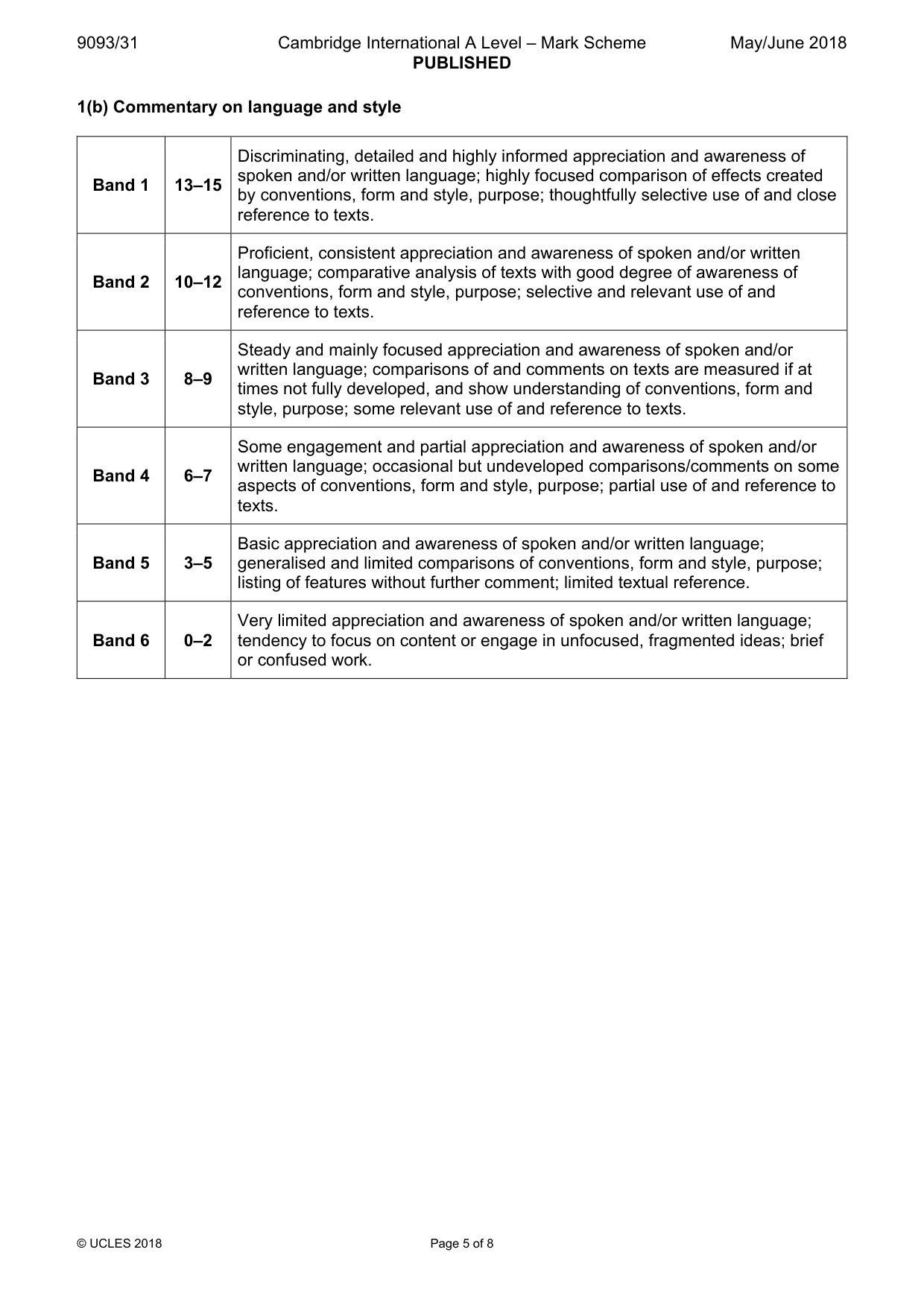
9093/31 Cambridge International A Level – Mark Scheme PUBLISHED May/June 2018 © UCLES 2018 Page 5 of 8 1(b) Commentary on language and style Band 1 13–15 Discriminating, detailed and highly informed appreciation and awareness of spoken and/or written language; highly focused comparison of effects created by conventions, form and style, purpose; thoughtfully selective use of and close reference to texts. Band 2 10–12 Proficient, consistent appreciation and awareness of spoken and/or written language; comparative analysis of texts with good degree of awareness of conventions, form and style, purpose; selective and relevant use of and reference to texts. Band 3 8–9 Steady and mainly focused appreciation and awareness of spoken and/or written language; comparisons of and comments on texts are measured if at times not fully developed, and show understanding of conventions, form and style, purpose; some relevant use of and reference to texts. Band 4 6–7 Some engagement and partial appreciation and awareness of spoken and/or written language; occasional but undeveloped comparisons/comments on some aspects of conventions, form and style, purpose; partial use of and reference to texts. Band 5 3–5 Basic appreciation and awareness of spoken and/or written language; generalised and limited comparisons of conventions, form and style, purpose; listing of features without further comment; limited textual reference. Band 6 0–2 Very limited appreciation and awareness of spoken and/or written language; tendency to focus on content or engage in unfocused, fragmented ideas; brief or confused work.
Mark scheme, page 6
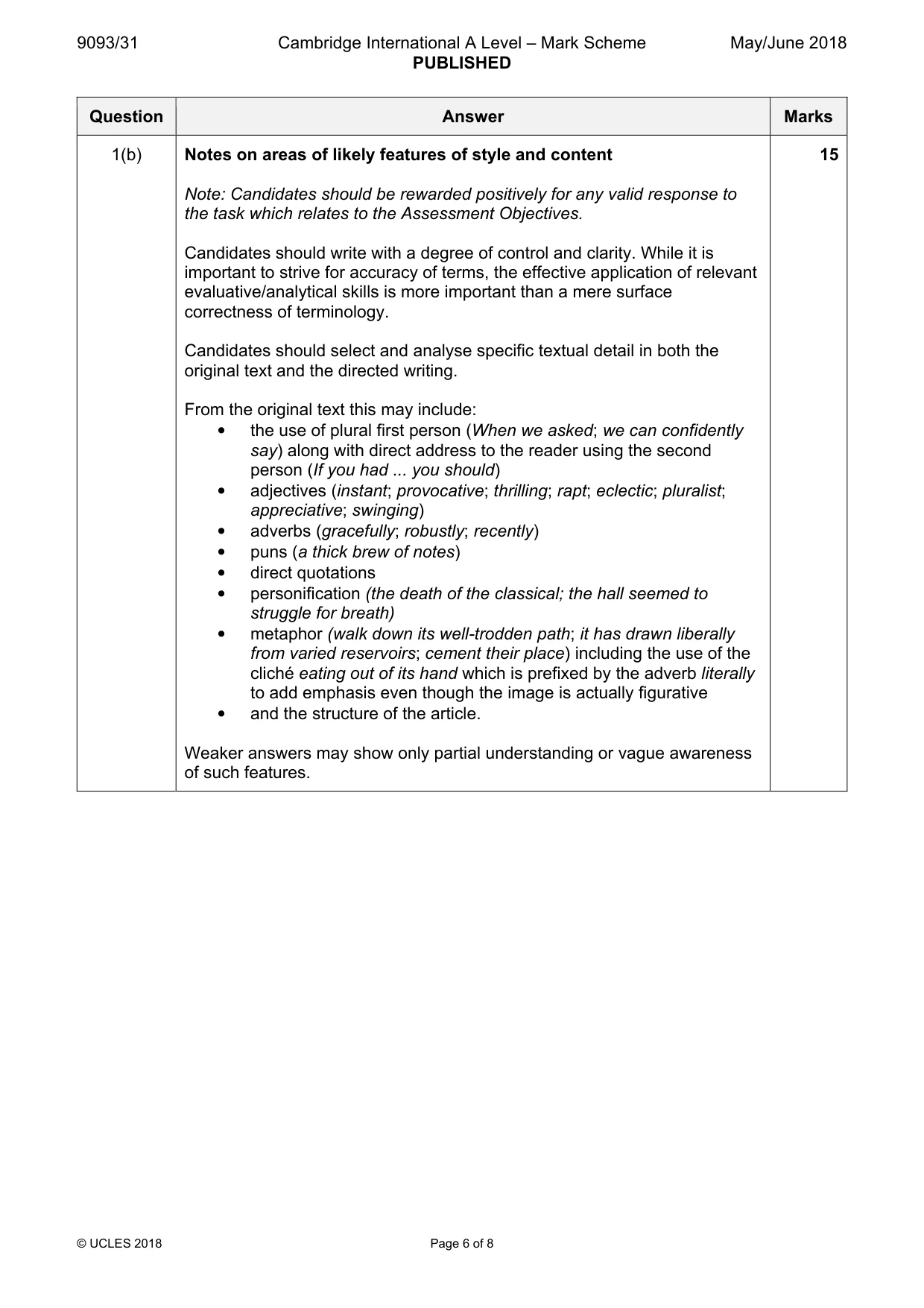
9093/31 Cambridge International A Level – Mark Scheme PUBLISHED May/June 2018 © UCLES 2018 Page 6 of 8 Question Answer Marks 1(b) Notes on areas of likely features of style and content Note: Candidates should be rewarded positively for any valid response to the task which relates to the Assessment Objectives. Candidates should write with a degree of control and clarity. While it is important to strive for accuracy of terms, the effective application of relevant evaluative/analytical skills is more important than a mere surface correctness of terminology. Candidates should select and analyse specific textual detail in both the original text and the directed writing. From the original text this may include: • the use of plural first person (When we asked; we can confidently say) along with direct address to the reader using the second person (If you had ... you should) • adjectives (instant; provocative; thrilling; rapt; eclectic; pluralist; appreciative; swinging) • adverbs (gracefully; robustly; recently) • puns (a thick brew of notes) • direct quotations • personification (the death of the classical; the hall seemed to struggle for breath) • metaphor (walk down its well-trodden path; it has drawn liberally from varied reservoirs; cement their place) including the use of the cliché eating out of its hand which is prefixed by the adverb literally to add emphasis even though the image is actually figurative • and the structure of the article. Weaker answers may show only partial understanding or vague awareness of such features. 15
Mark scheme, page 7
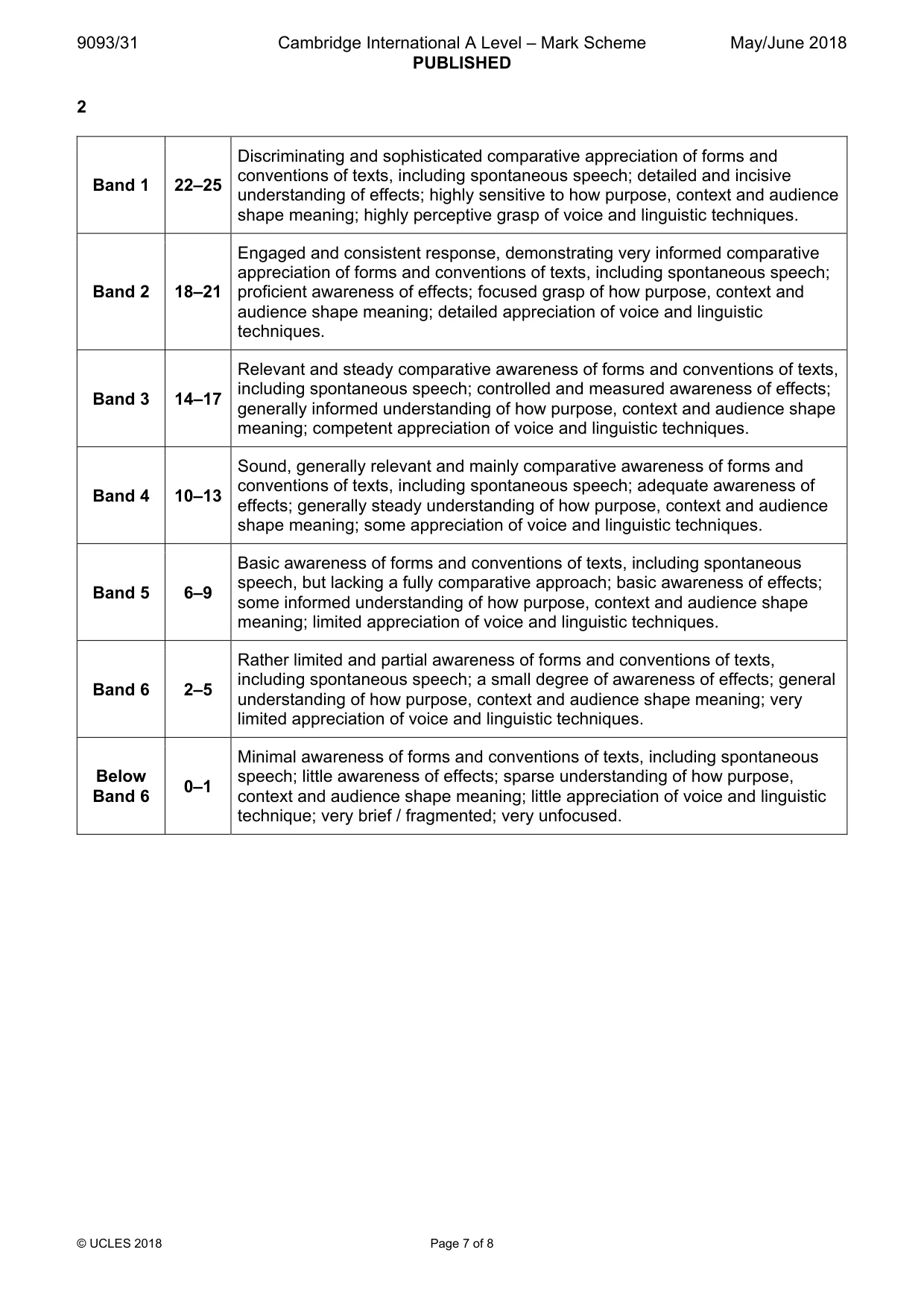
9093/31 Cambridge International A Level – Mark Scheme PUBLISHED May/June 2018 © UCLES 2018 Page 7 of 8 2 Band 1 22–25 Discriminating and sophisticated comparative appreciation of forms and conventions of texts, including spontaneous speech; detailed and incisive understanding of effects; highly sensitive to how purpose, context and audience shape meaning; highly perceptive grasp of voice and linguistic techniques. Band 2 18–21 Engaged and consistent response, demonstrating very informed comparative appreciation of forms and conventions of texts, including spontaneous speech; proficient awareness of effects; focused grasp of how purpose, context and audience shape meaning; detailed appreciation of voice and linguistic techniques. Band 3 14–17 Relevant and steady comparative awareness of forms and conventions of texts, including spontaneous speech; controlled and measured awareness of effects; generally informed understanding of how purpose, context and audience shape meaning; competent appreciation of voice and linguistic techniques. Band 4 10–13 Sound, generally relevant and mainly comparative awareness of forms and conventions of texts, including spontaneous speech; adequate awareness of effects; generally steady understanding of how purpose, context and audience shape meaning; some appreciation of voice and linguistic techniques. Band 5 6–9 Basic awareness of forms and conventions of texts, including spontaneous speech, but lacking a fully comparative approach; basic awareness of effects; some informed understanding of how purpose, context and audience shape meaning; limited appreciation of voice and linguistic techniques. Band 6 2–5 Rather limited and partial awareness of forms and conventions of texts, including spontaneous speech; a small degree of awareness of effects; general understanding of how purpose, context and audience shape meaning; very limited appreciation of voice and linguistic techniques. Below Band 6 0–1 Minimal awareness of forms and conventions of texts, including spontaneous speech; little awareness of effects; sparse understanding of how purpose, context and audience shape meaning; little appreciation of voice and linguistic technique; very brief / fragmented; very unfocused.
Mark scheme, page 8
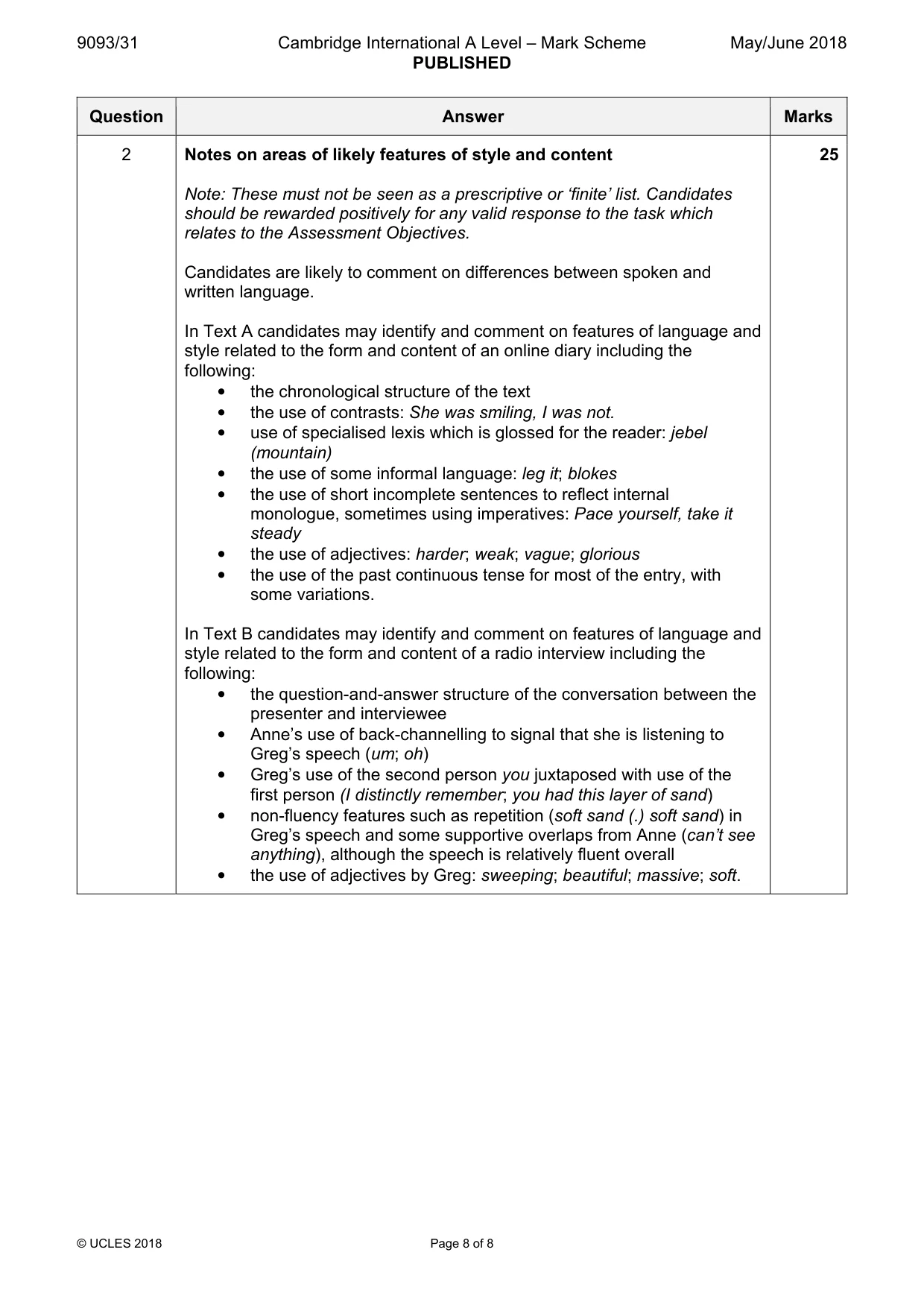
9093/31 Cambridge International A Level – Mark Scheme PUBLISHED May/June 2018 © UCLES 2018 Page 8 of 8 Question Answer Marks 2 Notes on areas of likely features of style and content Note: These must not be seen as a prescriptive or ‘finite’ list. Candidates should be rewarded positively for any valid response to the task which relates to the Assessment Objectives. Candidates are likely to comment on differences between spoken and written language. In Text A candidates may identify and comment on features of language and style related to the form and content of an online diary including the following: • the chronological structure of the text • the use of contrasts: She was smiling, I was not. • use of specialised lexis which is glossed for the reader: jebel (mountain) • the use of some informal language: leg it; blokes • the use of short incomplete sentences to reflect internal monologue, sometimes using imperatives: Pace yourself, take it steady • the use of adjectives: harder; weak; vague; glorious • the use of the past continuous tense for most of the entry, with some variations. In Text B candidates may identify and comment on features of language and style related to the form and content of a radio interview including the following: • the question-and-answer structure of the conversation between the presenter and interviewee • Anne’s use of back-channelling to signal that she is listening to Greg’s speech (um; oh) • Greg’s use of the second person you juxtaposed with use of the first person (I distinctly remember; you had this layer of sand) • non-fluency features such as repetition (soft sand (.) soft sand) in Greg’s speech and some supportive overlaps from Anne (can’t see anything), although the speech is relatively fluent overall • the use of adjectives by Greg: sweeping; beautiful; massive; soft. 25
What you needed in this session
Cambridge’s own grade thresholds for 2018 May/June, Paper 3 · Variant 1. A higher threshold means an easier paper — the bar moves with how the cohort did.