Cambridge A Level English - Language AS and A Level (from 2014) 9093 — 2018 May/June Paper 3 · Variant 3
9093/33/M/J/18 · 50 marks · ≈56 min
The question paper and its mark scheme, free to read here and free to download. This is Cambridge’s own paper, exactly as it was sat.
Question paper8 pages
Mark scheme8 pages
Answers below. Sit the paper first if you are practising.
Paper as text
Question paper, page 1
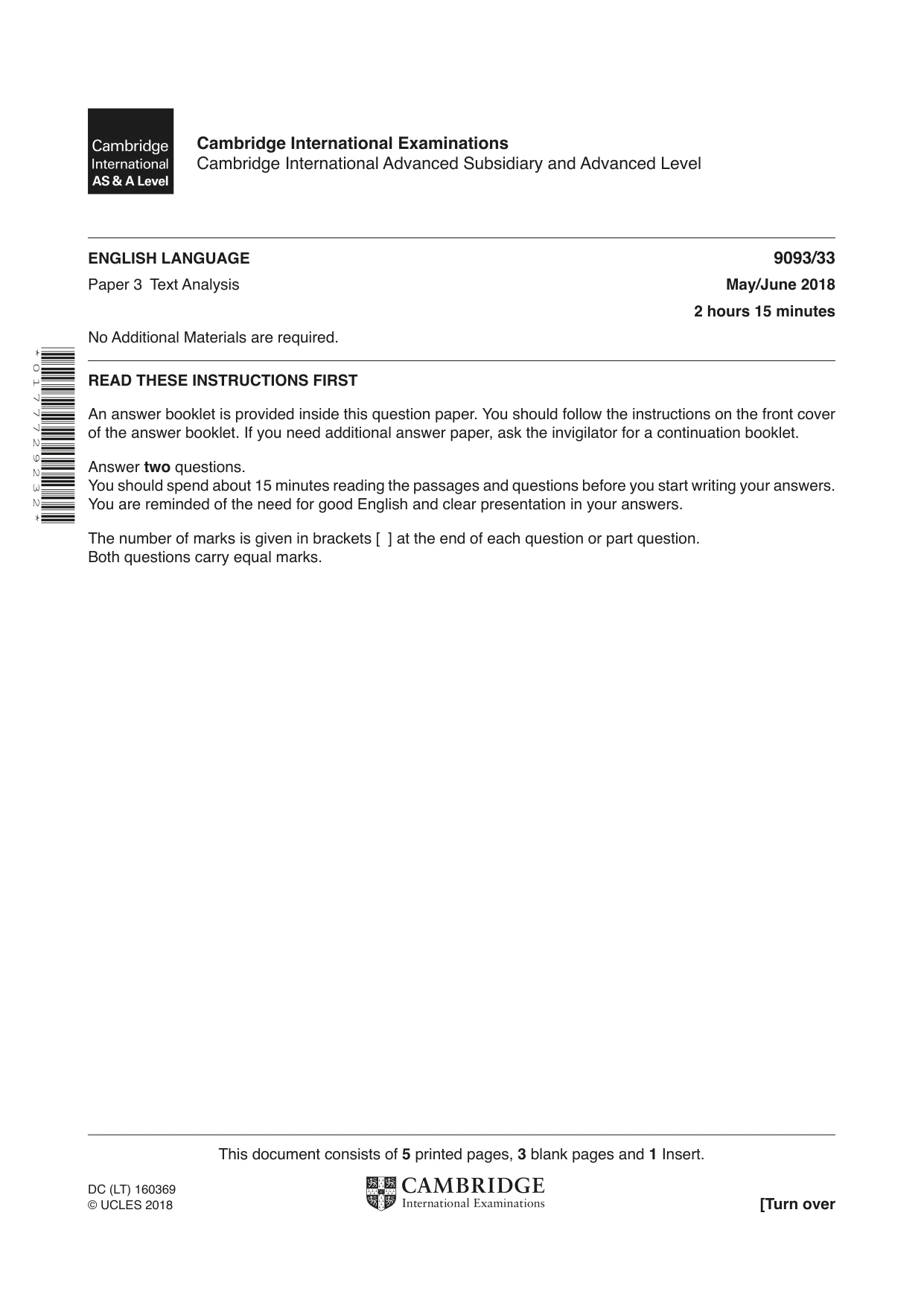
* 0 1 7 7 7 2 9 2 3 2 * This document consists of 5 printed pages, 3 blank pages and 1 Insert. DC (LT) 160369 © UCLES 2018 [Turn over Cambridge International Examinations Cambridge International Advanced Subsidiary and Advanced Level ENGLISH LANGUAGE 9093/33 Paper 3 Text Analysis May/June 2018 2 hours 15 minutes No Additional Materials are required. READ THESE INSTRUCTIONS FIRST An answer booklet is provided inside this question paper. You should follow the instructions on the front cover of the answer booklet. If you need additional answer paper, ask the invigilator for a continuation booklet. Answer two questions. You should spend about 15 minutes reading the passages and questions before you start writing your answers. You are reminded of the need for good English and clear presentation in your answers. The number of marks is given in brackets [ ] at the end of each question or part question. Both questions carry equal marks.
Question paper, page 2
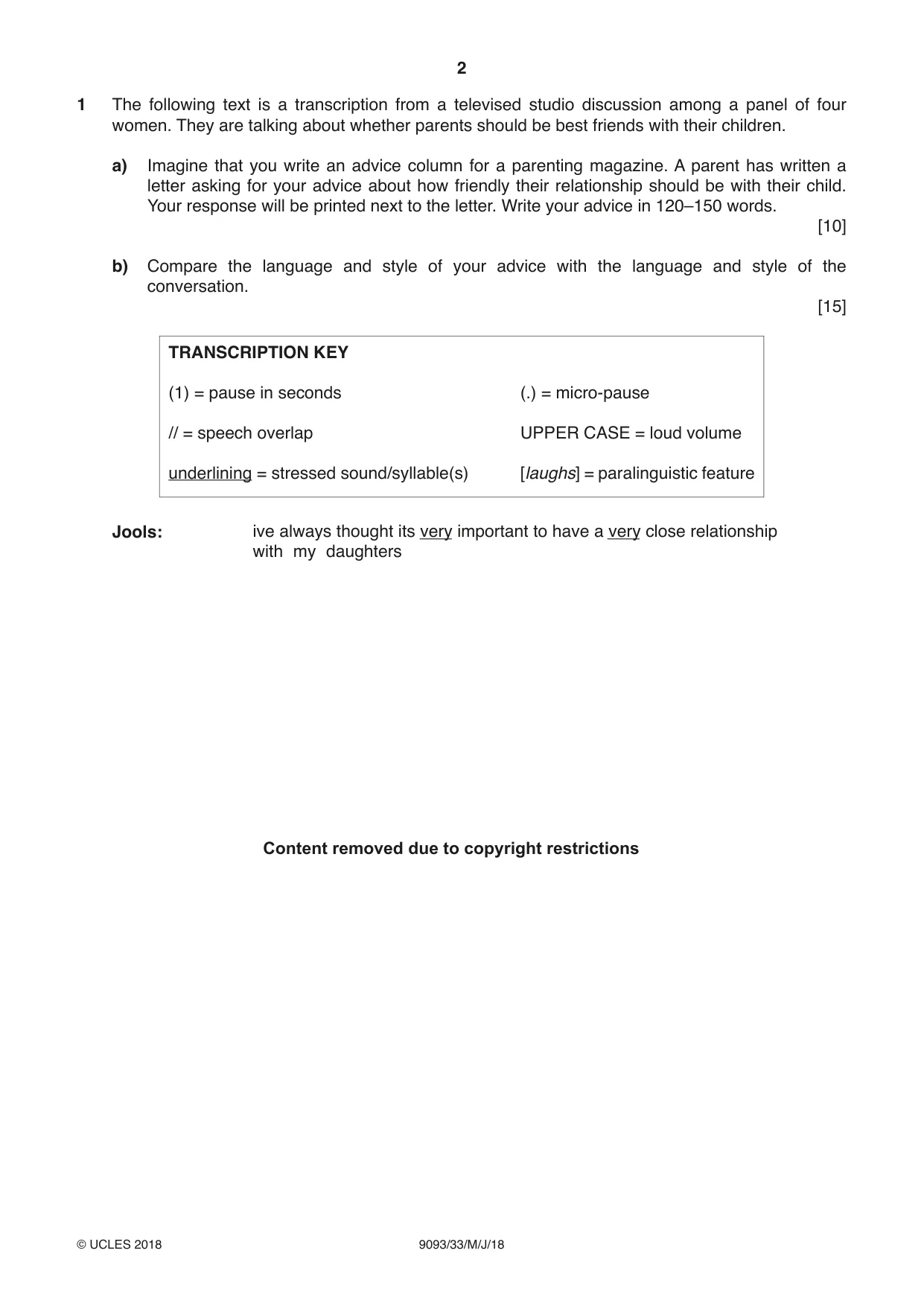
2 9093/33/M/J/18 © UCLES 2018 1 The following text is a transcription from a televised studio discussion among a panel of four women. They are talking about whether parents should be best friends with their children. a) Imagine that you write an advice column for a parenting magazine. A parent has written a letter asking for your advice about how friendly their relationship should be with their child. Your response will be printed next to the letter. Write your advice in 120–150 words. [10] b) Compare the language and style of your advice with the language and style of the conversation. [15] TRANSCRIPTION KEY (1) = pause in seconds (.) = micro-pause // = speech overlap UPPER CASE = loud volume underlining = stressed sound/syllable(s) [laughs] = paralinguistic feature Jools: ive always thought its very important to have a very close relationship with my daughters Content removed due to copyright restrictions
Question paper, page 3
9093/33/M/J/18 © UCLES 2018 [Turn over Cath: Content removed due to copyright restrictions certainly if theyve got an emotional problem they know they can talk to me about anything 3
Question paper, page 4
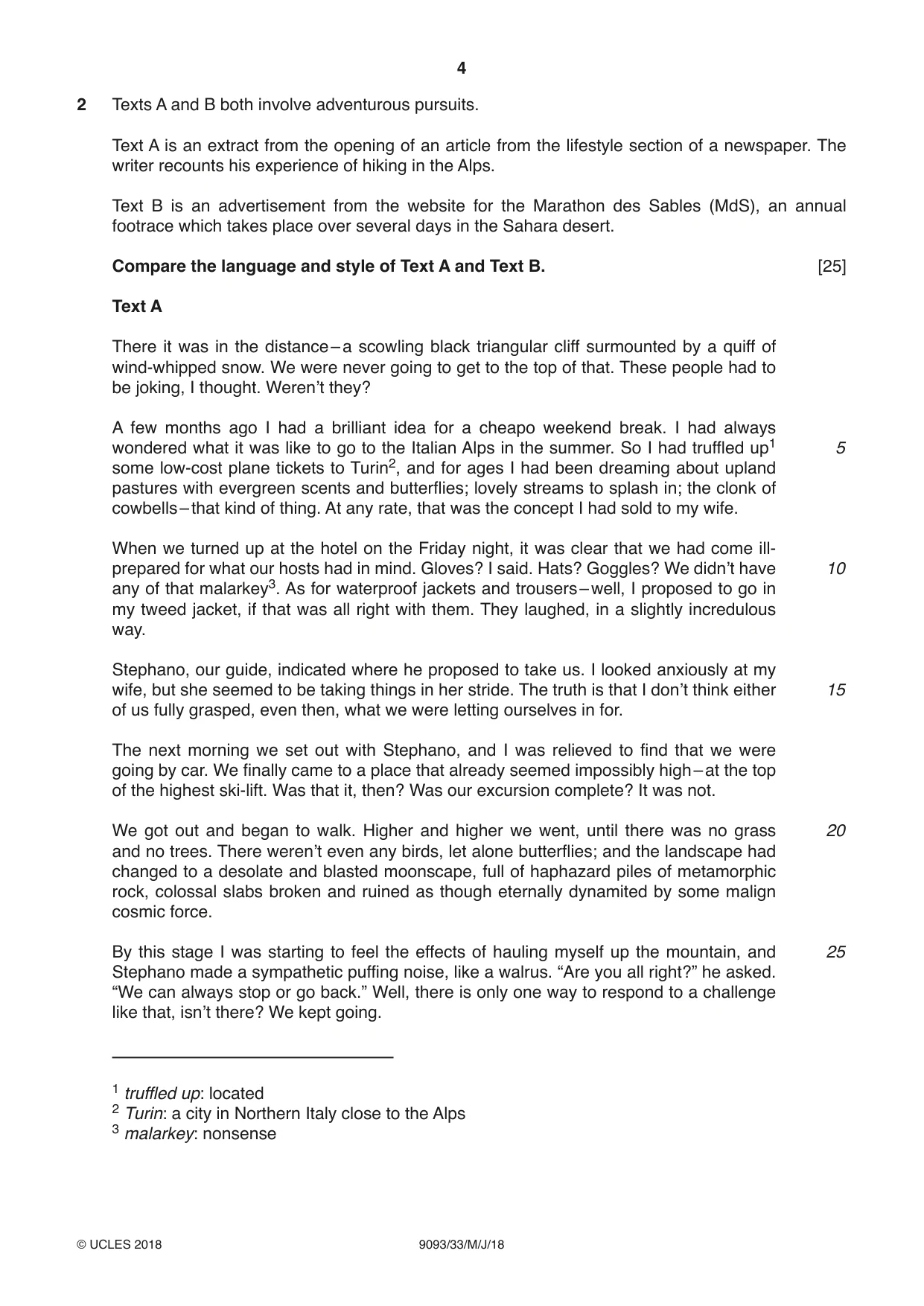
4 9093/33/M/J/18 © UCLES 2018 2 Texts A and B both involve adventurous pursuits. Text A is an extract from the opening of an article from the lifestyle section of a newspaper. The writer recounts his experience of hiking in the Alps. Text B is an advertisement from the website for the Marathon des Sables (MdS), an annual footrace which takes place over several days in the Sahara desert. Compare the language and style of Text A and Text B. [25] Text A There it was in the distance – a scowling black triangular cliff surmounted by a quiff of wind-whipped snow. We were never going to get to the top of that. These people had to be joking, I thought. Weren’t they? A few months ago I had a brilliant idea for a cheapo weekend break. I had always wondered what it was like to go to the Italian Alps in the summer. So I had truffled up1 some low-cost plane tickets to Turin2, and for ages I had been dreaming about upland pastures with evergreen scents and butterflies; lovely streams to splash in; the clonk of cowbells – that kind of thing. At any rate, that was the concept I had sold to my wife. When we turned up at the hotel on the Friday night, it was clear that we had come ill- prepared for what our hosts had in mind. Gloves? I said. Hats? Goggles? We didn’t have any of that malarkey3. As for waterproof jackets and trousers – well, I proposed to go in my tweed jacket, if that was all right with them. They laughed, in a slightly incredulous way. Stephano, our guide, indicated where he proposed to take us. I looked anxiously at my wife, but she seemed to be taking things in her stride. The truth is that I don’t think either of us fully grasped, even then, what we were letting ourselves in for. The next morning we set out with Stephano, and I was relieved to find that we were going by car. We finally came to a place that already seemed impossibly high – at the top of the highest ski-lift. Was that it, then? Was our excursion complete? It was not. We got out and began to walk. Higher and higher we went, until there was no grass and no trees. There weren’t even any birds, let alone butterflies; and the landscape had changed to a desolate and blasted moonscape, full of haphazard piles of metamorphic rock, colossal slabs broken and ruined as though eternally dynamited by some malign cosmic force. By this stage I was starting to feel the effects of hauling myself up the mountain, and Stephano made a sympathetic puffing noise, like a walrus. “Are you all right?” he asked. “We can always stop or go back.” Well, there is only one way to respond to a challenge like that, isn’t there? We kept going. 1 truffled up: located 2 Turin: a city in Northern Italy close to the Alps 3 malarkey: nonsense 5 10 15 20 25
Question paper, page 5
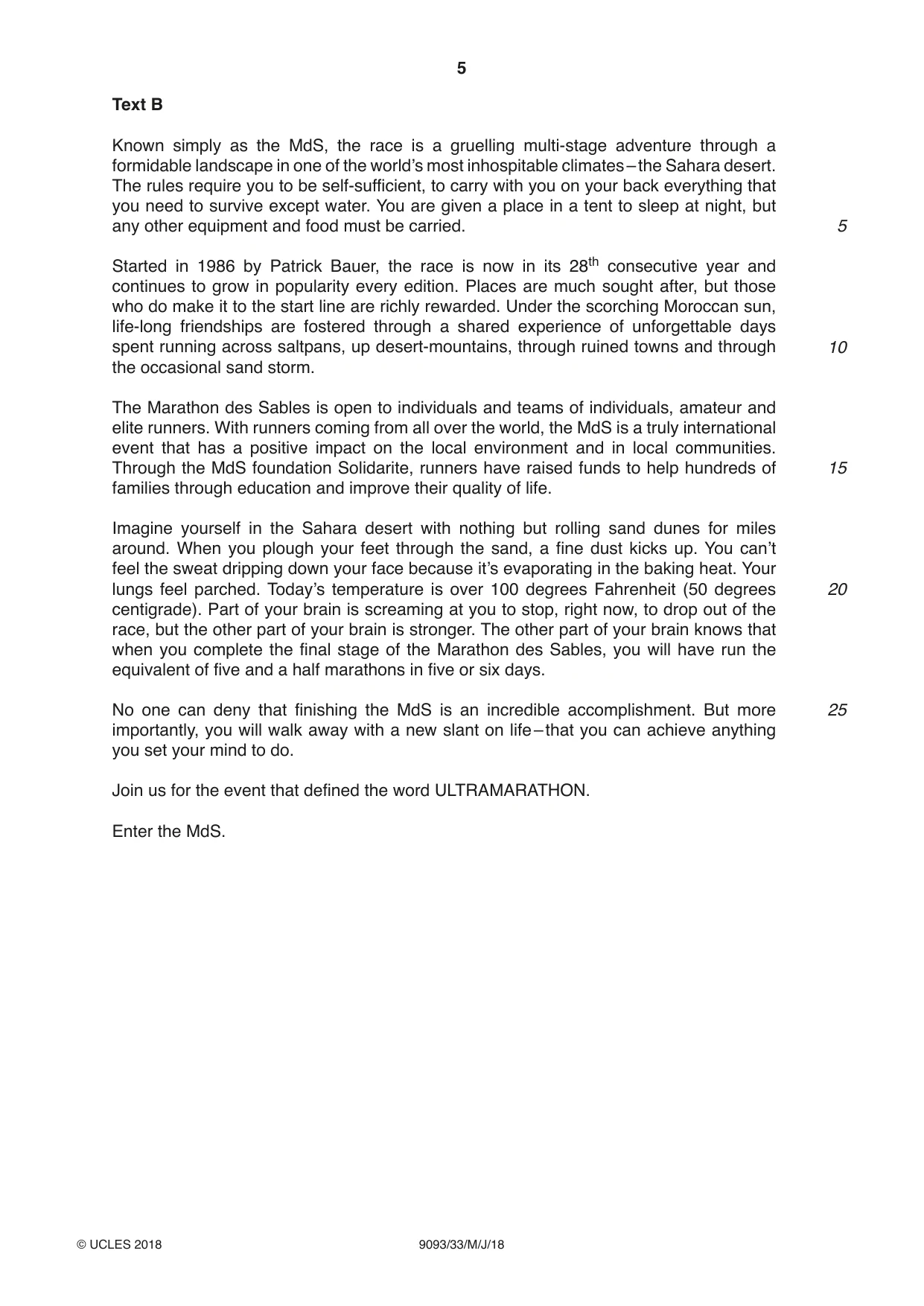
5 9093/33/M/J/18 © UCLES 2018 Text B Known simply as the MdS, the race is a gruelling multi-stage adventure through a formidable landscape in one of the world’s most inhospitable climates – the Sahara desert. The rules require you to be self-sufficient, to carry with you on your back everything that you need to survive except water. You are given a place in a tent to sleep at night, but any other equipment and food must be carried. Started in 1986 by Patrick Bauer, the race is now in its 28th consecutive year and continues to grow in popularity every edition. Places are much sought after, but those who do make it to the start line are richly rewarded. Under the scorching Moroccan sun, life-long friendships are fostered through a shared experience of unforgettable days spent running across saltpans, up desert-mountains, through ruined towns and through the occasional sand storm. The Marathon des Sables is open to individuals and teams of individuals, amateur and elite runners. With runners coming from all over the world, the MdS is a truly international event that has a positive impact on the local environment and in local communities. Through the MdS foundation Solidarite, runners have raised funds to help hundreds of families through education and improve their quality of life. Imagine yourself in the Sahara desert with nothing but rolling sand dunes for miles around. When you plough your feet through the sand, a fine dust kicks up. You can’t feel the sweat dripping down your face because it’s evaporating in the baking heat. Your lungs feel parched. Today’s temperature is over 100 degrees Fahrenheit (50 degrees centigrade). Part of your brain is screaming at you to stop, right now, to drop out of the race, but the other part of your brain is stronger. The other part of your brain knows that when you complete the final stage of the Marathon des Sables, you will have run the equivalent of five and a half marathons in five or six days. No one can deny that finishing the MdS is an incredible accomplishment. But more importantly, you will walk away with a new slant on life – that you can achieve anything you set your mind to do. Join us for the event that defined the word ULTRAMARATHON. Enter the MdS. 5 10 15 20 25
Question paper, page 6
6 9093/33/M/J/18 © UCLES 2018 BLANK PAGE
Question paper, page 7
7 9093/33/M/J/18 © UCLES 2018 BLANK PAGE
Question paper, page 8
8 9093/33/M/J/18 © UCLES 2018 BLANK PAGE Permission to reproduce items where third-party owned material protected by copyright is included has been sought and cleared where possible. Every reasonable effort has been made by the publisher (UCLES) to trace copyright holders, but if any items requiring clearance have unwittingly been included, the publisher will be pleased to make amends at the earliest possible opportunity. To avoid the issue of disclosure of answer-related information to candidates, all copyright acknowledgements are reproduced online in the Cambridge International Examinations Copyright Acknowledgements Booklet. This is produced for each series of examinations and is freely available to download at www.cie.org.uk after the live examination series. Cambridge International Examinations is part of the Cambridge Assessment Group. Cambridge Assessment is the brand name of University of Cambridge Local Examinations Syndicate (UCLES), which is itself a department of the University of Cambridge.
Mark scheme, page 1
IGCSE™ is a registered trademark. This document consists of 8 printed pages. © UCLES 2018 [Turn over Cambridge Assessment International Education Cambridge International Advanced Level ENGLISH LANGUAGE 9093/33 Paper 3 Text Analysis May/June 2018 MARK SCHEME Maximum Mark: 50 Published This mark scheme is published as an aid to teachers and candidates, to indicate the requirements of the examination. It shows the basis on which Examiners were instructed to award marks. It does not indicate the details of the discussions that took place at an Examiners’ meeting before marking began, which would have considered the acceptability of alternative answers. Mark schemes should be read in conjunction with the question paper and the Principal Examiner Report for Teachers. Cambridge International will not enter into discussions about these mark schemes. Cambridge International is publishing the mark schemes for the May/June 2018 series for most Cambridge IGCSE™, Cambridge International A and AS Level and Cambridge Pre-U components, and some Cambridge O Level components.
Mark scheme, page 2
9093/33 Cambridge International A Level – Mark Scheme PUBLISHED May/June 2018 © UCLES 2018 Page 2 of 8 Generic Marking Principles These general marking principles must be applied by all examiners when marking candidate answers. They should be applied alongside the specific content of the mark scheme or generic level descriptors for a question. Each question paper and mark scheme will also comply with these marking principles. GENERIC MARKING PRINCIPLE 1: Marks must be awarded in line with: • the specific content of the mark scheme or the generic level descriptors for the question • the specific skills defined in the mark scheme or in the generic level descriptors for the question • the standard of response required by a candidate as exemplified by the standardisation scripts. GENERIC MARKING PRINCIPLE 2: Marks awarded are always whole marks (not half marks, or other fractions). GENERIC MARKING PRINCIPLE 3: Marks must be awarded positively: • marks are awarded for correct/valid answers, as defined in the mark scheme. However, credit is given for valid answers which go beyond the scope of the syllabus and mark scheme, referring to your Team Leader as appropriate • marks are awarded when candidates clearly demonstrate what they know and can do • marks are not deducted for errors • marks are not deducted for omissions • answers should only be judged on the quality of spelling, punctuation and grammar when these features are specifically assessed by the question as indicated by the mark scheme. The meaning, however, should be unambiguous. GENERIC MARKING PRINCIPLE 4: Rules must be applied consistently e.g. in situations where candidates have not followed instructions or in the application of generic level descriptors. GENERIC MARKING PRINCIPLE 5: Marks should be awarded using the full range of marks defined in the mark scheme for the question (however; the use of the full mark range may be limited according to the quality of the candidate responses seen). GENERIC MARKING PRINCIPLE 6: Marks awarded are based solely on the requirements as defined in the mark scheme. Marks should not be awarded with grade thresholds or grade descriptors in mind.
Mark scheme, page 3
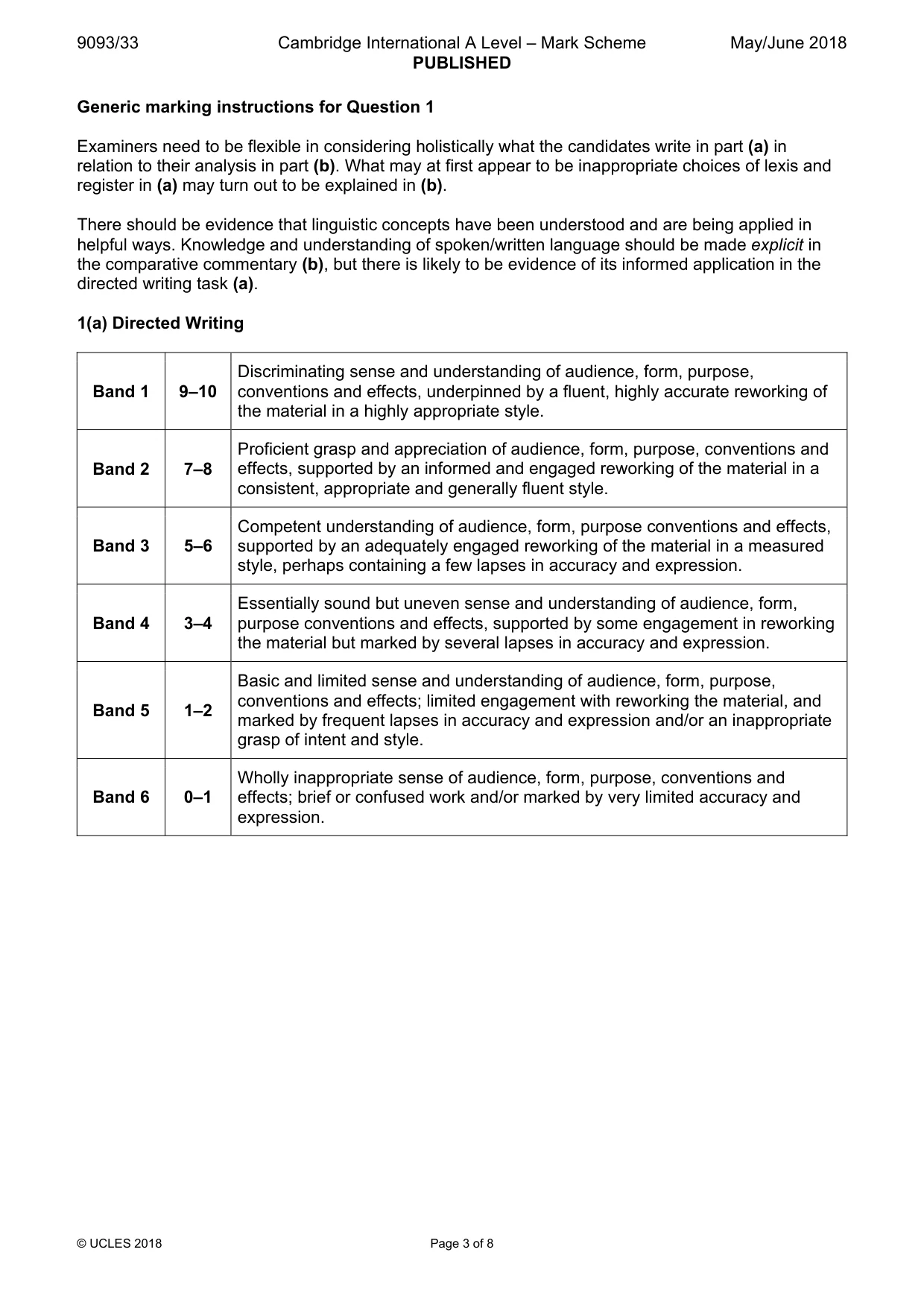
9093/33 Cambridge International A Level – Mark Scheme PUBLISHED May/June 2018 © UCLES 2018 Page 3 of 8 Generic marking instructions for Question 1 Examiners need to be flexible in considering holistically what the candidates write in part (a) in relation to their analysis in part (b). What may at first appear to be inappropriate choices of lexis and register in (a) may turn out to be explained in (b). There should be evidence that linguistic concepts have been understood and are being applied in helpful ways. Knowledge and understanding of spoken/written language should be made explicit in the comparative commentary (b), but there is likely to be evidence of its informed application in the directed writing task (a). 1(a) Directed Writing Band 1 9–10 Discriminating sense and understanding of audience, form, purpose, conventions and effects, underpinned by a fluent, highly accurate reworking of the material in a highly appropriate style. Band 2 7–8 Proficient grasp and appreciation of audience, form, purpose, conventions and effects, supported by an informed and engaged reworking of the material in a consistent, appropriate and generally fluent style. Band 3 5–6 Competent understanding of audience, form, purpose conventions and effects, supported by an adequately engaged reworking of the material in a measured style, perhaps containing a few lapses in accuracy and expression. Band 4 3–4 Essentially sound but uneven sense and understanding of audience, form, purpose conventions and effects, supported by some engagement in reworking the material but marked by several lapses in accuracy and expression. Band 5 1–2 Basic and limited sense and understanding of audience, form, purpose, conventions and effects; limited engagement with reworking the material, and marked by frequent lapses in accuracy and expression and/or an inappropriate grasp of intent and style. Band 6 0–1 Wholly inappropriate sense of audience, form, purpose, conventions and effects; brief or confused work and/or marked by very limited accuracy and expression.
Mark scheme, page 4
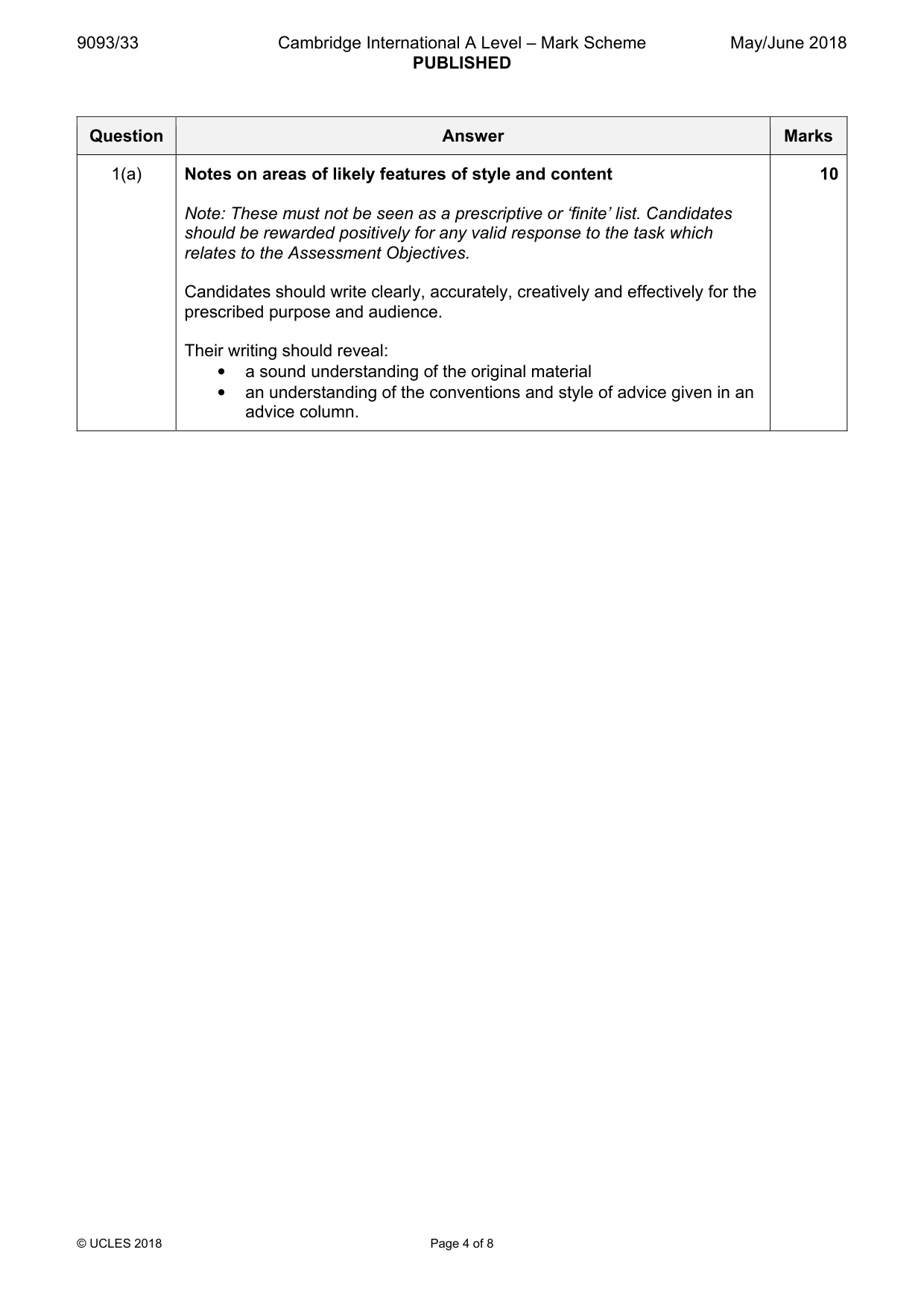
9093/33 Cambridge International A Level – Mark Scheme PUBLISHED May/June 2018 © UCLES 2018 Page 4 of 8 Question Answer Marks 1(a) Notes on areas of likely features of style and content Note: These must not be seen as a prescriptive or ‘finite’ list. Candidates should be rewarded positively for any valid response to the task which relates to the Assessment Objectives. Candidates should write clearly, accurately, creatively and effectively for the prescribed purpose and audience. Their writing should reveal: • a sound understanding of the original material • an understanding of the conventions and style of advice given in an advice column. 10
Mark scheme, page 5
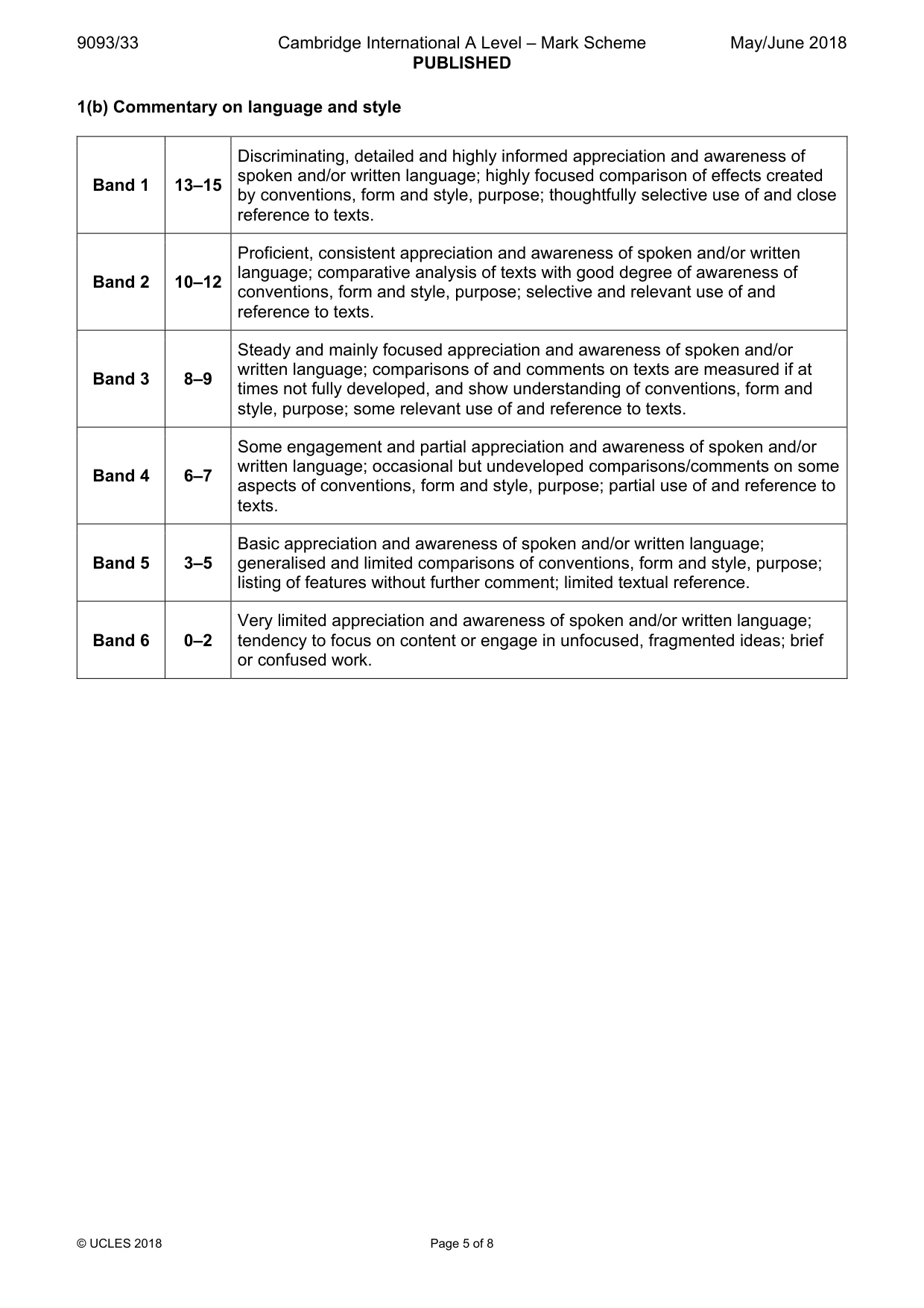
9093/33 Cambridge International A Level – Mark Scheme PUBLISHED May/June 2018 © UCLES 2018 Page 5 of 8 1(b) Commentary on language and style Band 1 13–15 Discriminating, detailed and highly informed appreciation and awareness of spoken and/or written language; highly focused comparison of effects created by conventions, form and style, purpose; thoughtfully selective use of and close reference to texts. Band 2 10–12 Proficient, consistent appreciation and awareness of spoken and/or written language; comparative analysis of texts with good degree of awareness of conventions, form and style, purpose; selective and relevant use of and reference to texts. Band 3 8–9 Steady and mainly focused appreciation and awareness of spoken and/or written language; comparisons of and comments on texts are measured if at times not fully developed, and show understanding of conventions, form and style, purpose; some relevant use of and reference to texts. Band 4 6–7 Some engagement and partial appreciation and awareness of spoken and/or written language; occasional but undeveloped comparisons/comments on some aspects of conventions, form and style, purpose; partial use of and reference to texts. Band 5 3–5 Basic appreciation and awareness of spoken and/or written language; generalised and limited comparisons of conventions, form and style, purpose; listing of features without further comment; limited textual reference. Band 6 0–2 Very limited appreciation and awareness of spoken and/or written language; tendency to focus on content or engage in unfocused, fragmented ideas; brief or confused work.
Mark scheme, page 6
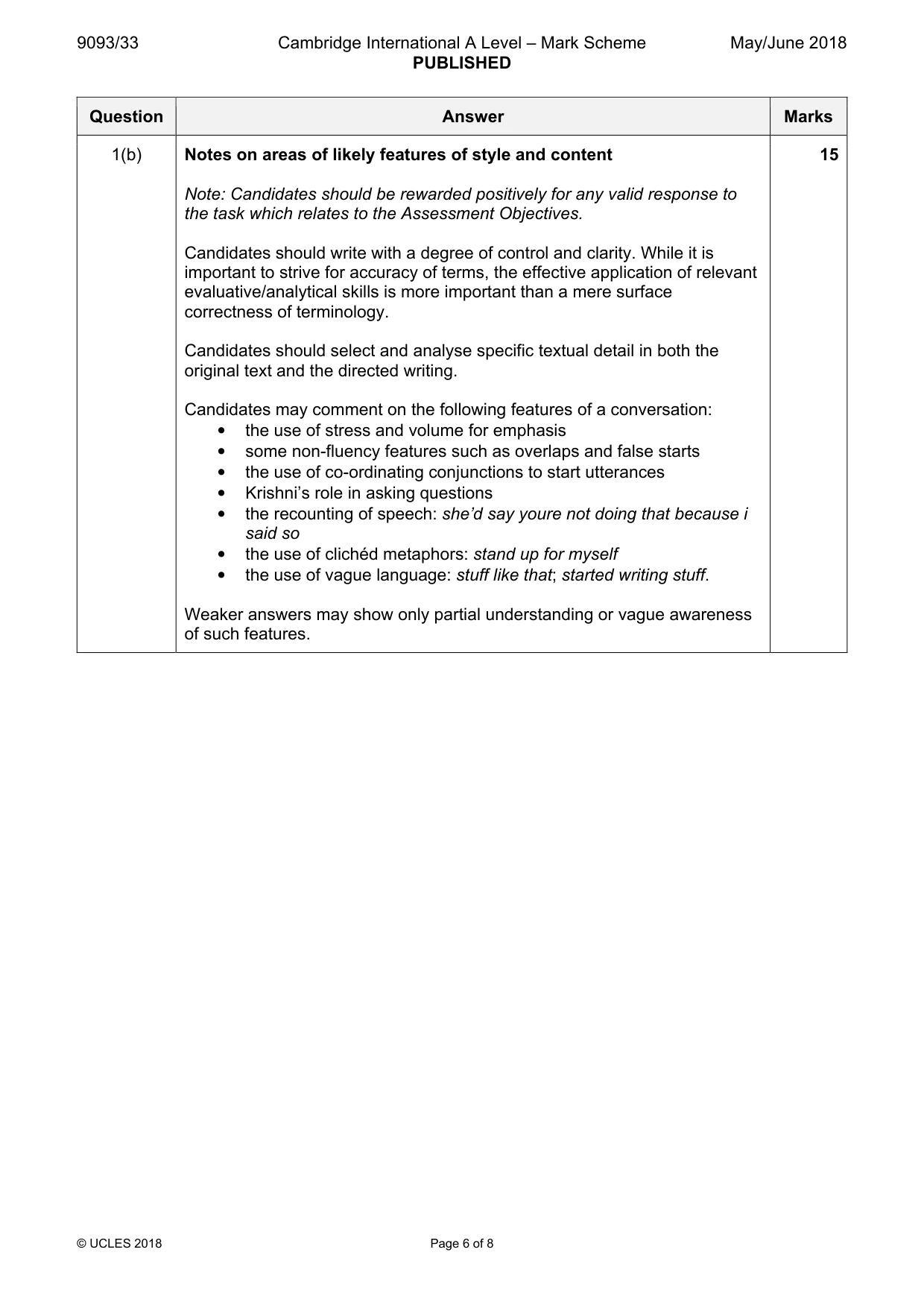
9093/33 Cambridge International A Level – Mark Scheme PUBLISHED May/June 2018 © UCLES 2018 Page 6 of 8 Question Answer Marks 1(b) Notes on areas of likely features of style and content Note: Candidates should be rewarded positively for any valid response to the task which relates to the Assessment Objectives. Candidates should write with a degree of control and clarity. While it is important to strive for accuracy of terms, the effective application of relevant evaluative/analytical skills is more important than a mere surface correctness of terminology. Candidates should select and analyse specific textual detail in both the original text and the directed writing. Candidates may comment on the following features of a conversation: • the use of stress and volume for emphasis • some non-fluency features such as overlaps and false starts • the use of co-ordinating conjunctions to start utterances • Krishni’s role in asking questions • the recounting of speech: she’d say youre not doing that because i said so • the use of clichéd metaphors: stand up for myself • the use of vague language: stuff like that; started writing stuff. Weaker answers may show only partial understanding or vague awareness of such features. 15
Mark scheme, page 7
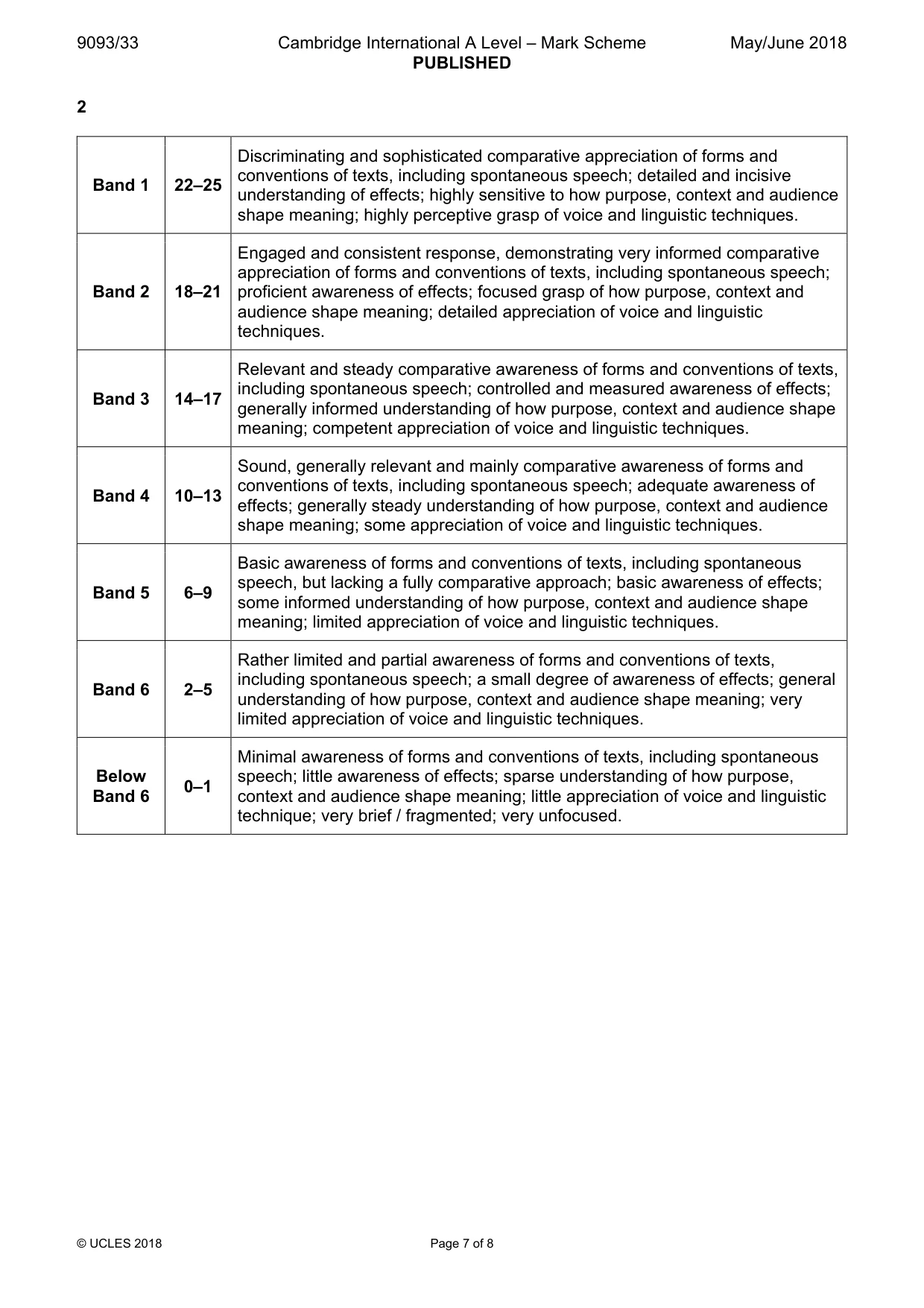
9093/33 Cambridge International A Level – Mark Scheme PUBLISHED May/June 2018 © UCLES 2018 Page 7 of 8 2 Band 1 22–25 Discriminating and sophisticated comparative appreciation of forms and conventions of texts, including spontaneous speech; detailed and incisive understanding of effects; highly sensitive to how purpose, context and audience shape meaning; highly perceptive grasp of voice and linguistic techniques. Band 2 18–21 Engaged and consistent response, demonstrating very informed comparative appreciation of forms and conventions of texts, including spontaneous speech; proficient awareness of effects; focused grasp of how purpose, context and audience shape meaning; detailed appreciation of voice and linguistic techniques. Band 3 14–17 Relevant and steady comparative awareness of forms and conventions of texts, including spontaneous speech; controlled and measured awareness of effects; generally informed understanding of how purpose, context and audience shape meaning; competent appreciation of voice and linguistic techniques. Band 4 10–13 Sound, generally relevant and mainly comparative awareness of forms and conventions of texts, including spontaneous speech; adequate awareness of effects; generally steady understanding of how purpose, context and audience shape meaning; some appreciation of voice and linguistic techniques. Band 5 6–9 Basic awareness of forms and conventions of texts, including spontaneous speech, but lacking a fully comparative approach; basic awareness of effects; some informed understanding of how purpose, context and audience shape meaning; limited appreciation of voice and linguistic techniques. Band 6 2–5 Rather limited and partial awareness of forms and conventions of texts, including spontaneous speech; a small degree of awareness of effects; general understanding of how purpose, context and audience shape meaning; very limited appreciation of voice and linguistic techniques. Below Band 6 0–1 Minimal awareness of forms and conventions of texts, including spontaneous speech; little awareness of effects; sparse understanding of how purpose, context and audience shape meaning; little appreciation of voice and linguistic technique; very brief / fragmented; very unfocused.
Mark scheme, page 8
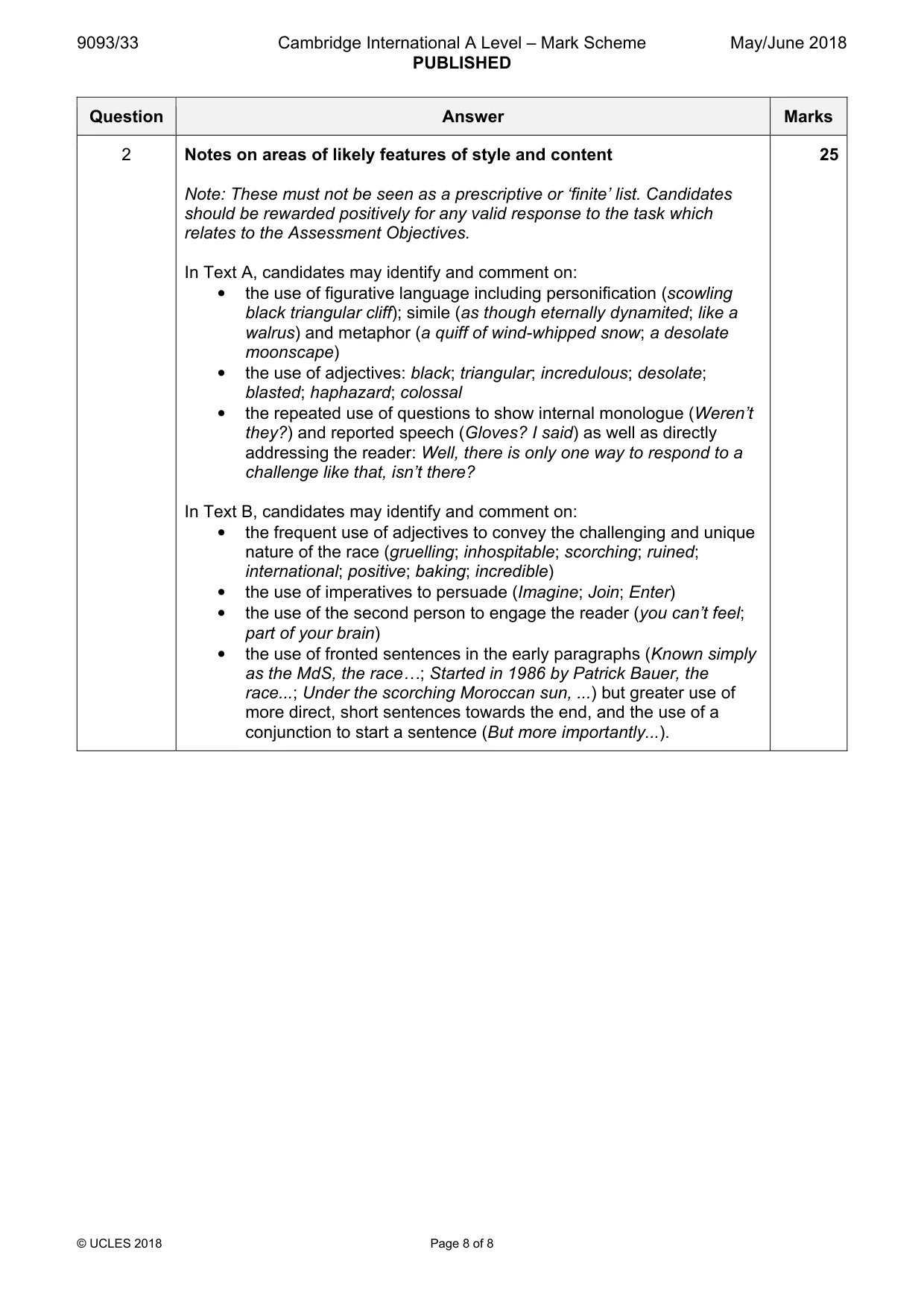
9093/33 Cambridge International A Level – Mark Scheme PUBLISHED May/June 2018 © UCLES 2018 Page 8 of 8 Question Answer Marks 2 Notes on areas of likely features of style and content Note: These must not be seen as a prescriptive or ‘finite’ list. Candidates should be rewarded positively for any valid response to the task which relates to the Assessment Objectives. In Text A, candidates may identify and comment on: • the use of figurative language including personification (scowling black triangular cliff); simile (as though eternally dynamited; like a walrus) and metaphor (a quiff of wind-whipped snow; a desolate moonscape) • the use of adjectives: black; triangular; incredulous; desolate; blasted; haphazard; colossal • the repeated use of questions to show internal monologue (Weren’t they?) and reported speech (Gloves? I said) as well as directly addressing the reader: Well, there is only one way to respond to a challenge like that, isn’t there? In Text B, candidates may identify and comment on: • the frequent use of adjectives to convey the challenging and unique nature of the race (gruelling; inhospitable; scorching; ruined; international; positive; baking; incredible) • the use of imperatives to persuade (Imagine; Join; Enter) • the use of the second person to engage the reader (you can’t feel; part of your brain) • the use of fronted sentences in the early paragraphs (Known simply as the MdS, the race«; Started in 1986 by Patrick Bauer, the race...; Under the scorching Moroccan sun, ...) but greater use of more direct, short sentences towards the end, and the use of a conjunction to start a sentence (But more importantly...). 25
What you needed in this session
Cambridge’s own grade thresholds for 2018 May/June, Paper 3 · Variant 3. A higher threshold means an easier paper — the bar moves with how the cohort did.