Cambridge A Level English - Language AS and A Level (from 2014) 9093 — 2017 Oct/Nov Paper 1 · Variant 2
9093/12/O/N/17 · 50 marks · ≈56 min
The question paper and its mark scheme, free to read here and free to download. This is Cambridge’s own paper, exactly as it was sat.
Question paper8 pages

Mark scheme4 pages
Answers below. Sit the paper first if you are practising.
Paper as text
Question paper, page 1
This document consists of 6 printed pages, 2 blank pages and 1 Insert. DC (RCL (JDA)) 130854/3 © UCLES 2017 [Turn over Cambridge International Examinations Cambridge International Advanced Subsidiary and Advanced Level * 0 8 3 1 4 8 1 2 1 6 * ENGLISH LANGUAGE 9093/12 Paper 1 Passages October/November 2017 2 hours 15 minutes No Additional Materials are required. READ THESE INSTRUCTIONS FIRST An answer booklet is provided inside this question paper. You should follow the instructions on the front cover of the answer booklet. If you need additional answer paper, ask the invigilator for a continuation booklet. Answer two questions: Question 1 and either Question 2 or Question 3. You should spend about 15 minutes reading the passages and questions before you start writing your answers. You are reminded of the need for good English and clear presentation in your answers. The number of marks is given in brackets [ ] at the end of each question or part question.
Question paper, page 2
2 9093/12/O/N/17 © UCLES 2017 Answer Question 1 and either Question 2 or Question 3. 1 The following is a magazine article about people taking up running. (a) Comment on the style and language of the article. [15] (b) Write the opening of an article (120–150 words) about taking up a different hobby or activity. Base your answer closely on the style and language of the original. [10] MAY 7, 2015 CONGRATULATIONS, YOU’RE A RUNNER NOW Hey, buddy! You’re receiving this letter because I recently saw you choking your way through a one-mile jaunt around the neighborhood. ‘It’s spring!’ you thought. ‘Maybe I’ll go for a run!’ You laced up your sneakers, and you got out there. You did it (barely)! I’m Marcus, the senior associate running ambassador at ‘Runners, Runners, Everywhere’, and I’ll be your go-to guy for life as a brand-new runner. This will be a challenging time; you might even be asking yourself, as you’re lying on the floor, perspiring through your high-school-volleyball T-shirt, ‘Am I a runner?’ Yes. Yes, you are. You’re one of us now, and it’s important that you tell everyone you know about it immediately and purchase the required gear. We certainly can’t have you running in that again. First and foremost, know that, as a runner, you are an athlete. You are not just shedding those winter pounds. Those people go to the gym. You went outside. Attached is a list of running groups in your area. They’re all ready to welcome you with open arms, and won’t all sprint out of sight two blocks in, leaving you to find your way back to the designated meeting spot. All paces are welcome!!! Your next step is to get yourself to a running-specialty store. We at ‘Runners, Runners, Everywhere’ have experienced exactly what you’re going through (albeit, like, a really, really long time ago). So drop by! I’ll have you run on a treadmill while wearing a pencil skirt, because you came all the way uptown from work for this. I’ll use scientific expertise to diagnose your stride. I’ll also hook you up with running socks, headbands, underwear, and tank tops that cost eighty-six dollars; trust me: they make a world of difference! Next step: your first race. It’s an important decision every runner must make, one that will establish how committed you are to your new life style. A 5 K? 10 K? 8 K? 6.2 K? Runner to runner, just go right for the half-marathon. This will set you up with a super-long training schedule, meaning more weeks to talk about it on social media. Which, I cannot stress enough, is one of the key aspects of being a runner. If a runner collapses in joy at the finish line but no one Instagrams it, did she collapse at all? Post photos plus commentary on your morning run, your evening run, your vacation run; show us your kit, your medals, your post-run celebration. Let us see your sneakered feet—on grass, on sand, in the snow, on a track. Share it all! Everyone you know is incredibly invested in your new endeavor. Plus, when people see your progress you’ll inspire a whole new crop of runners. They’ll think, ‘If that idiot can do it, I can probably do it.’ You could be that idiot! 5 10 15 20 25 30 35
Question paper, page 3
3 9093/12/O/N/17 © UCLES 2017 [Turn over And please visit us at the shop once you’ve completed your half-marathon. We’ll give you a congratulatory certificate and a list of full marathons to sign up for. After you’ve completed one of those, we’ll upgrade your membership to Actual Runner. 40
Question paper, page 4
4 9093/12/O/N/17 © UCLES 2017 2 The following is a newspaper article about the attractions of Lake Baringo in Kenya as a holiday destination. (a) Comment on the language and style of the article and the ways in which it creates a sense of place. [15] (b) Basing your answer closely on the style and language of the original, write the opening of a similar article (120–150 words) about a tourist destination in your own country. [10] Island life on Lake Baringo The first stunning sight upon setting sail on Lake Baringo is a Goliath heron wading in the marshes. It’s the world’s largest heron, this one is out hunting. We haven’t even had to search for it. With a beautiful lake that’s dazzling jade-green in the midday sun, it’s a world of superlatives. Everything is stunning. Next on the list is a Verraux’s eagle owl perched high on a shady tree. It is Africa’s largest owl. With its droopy pink eyelids that make it easy for anyone to identify it, it opens its huge round eyes just to keep watch on us. Life’s good for this top predator – there’s plenty of food for it to hunt around the lake. I’m with Peter Leweri, the boat captain at Island Camp on Ol Kokwa Island inside Lake Baringo. Colour intensity The sail from Kampi ya Samaki on the mainland to Island Camp on the lake’s largest island – Ol Kokwa – is filled with Great cormorants, African darters and fairytale-like White terns that we’re told are migrating by. Hopping on to the island paradise that’s now actually in three parts thanks to the phenomenal water increase between 2010 and 2014, is like stepping into a dream world. Gibralter Rock across Ol Kokwa is awash in deep copper-red. The vertical rock outcrop shows marks of the lake level going down. But the two end bits of the rock island still look like they are tiny islets on their own. “The lake’s at a nice, sustainable level now,” says Dr Bonnie Dunbar of Island Camp, who has been monitoring the lake for some years. It’s good for the tilapia1 and a bonanza for the local fisherman on the island. Fabulous catch Leweri is at hand to sail us around the island. Submerged trees in the water pose as natural sculptures adorned with hundreds of Red-rumped swallows on the dry branches. “They are migratory,” he tells. Here to escape the cold northern winter, these fast-flying birds scoop up insects in mid-air. A trio of the nobly-attired African fish eagle enjoys the sun perched on the submerged trees. Leweri throws the fish but they are so well fed that at first they ignore him. On the second throw, the African fish eagle lifts and scoops the fish from the water surface with outstretched talons and wings. It’s a picture-perfect shot. Suddenly, a crocodile appears, swimming leisurely, and we round the bend to the furthest end of the island. The water level is going down. The previous year, the hot springs at the end of the island were submerged – now we can see them, white hot steam drifting upwards. Splashes of red aloes and pink-flowered desert rose break the monotony of bare rocks. There are only a few kadishes2 asail on the lake looking worn and withered, some left to dry on the rocky shores. At the village, Francis Lekae steps off the motor-boat and returns with his catch for the day – tilapia and catfish. It’s been a good morning for him with a tally of 40. 5 10 15 20 25 30 35 40
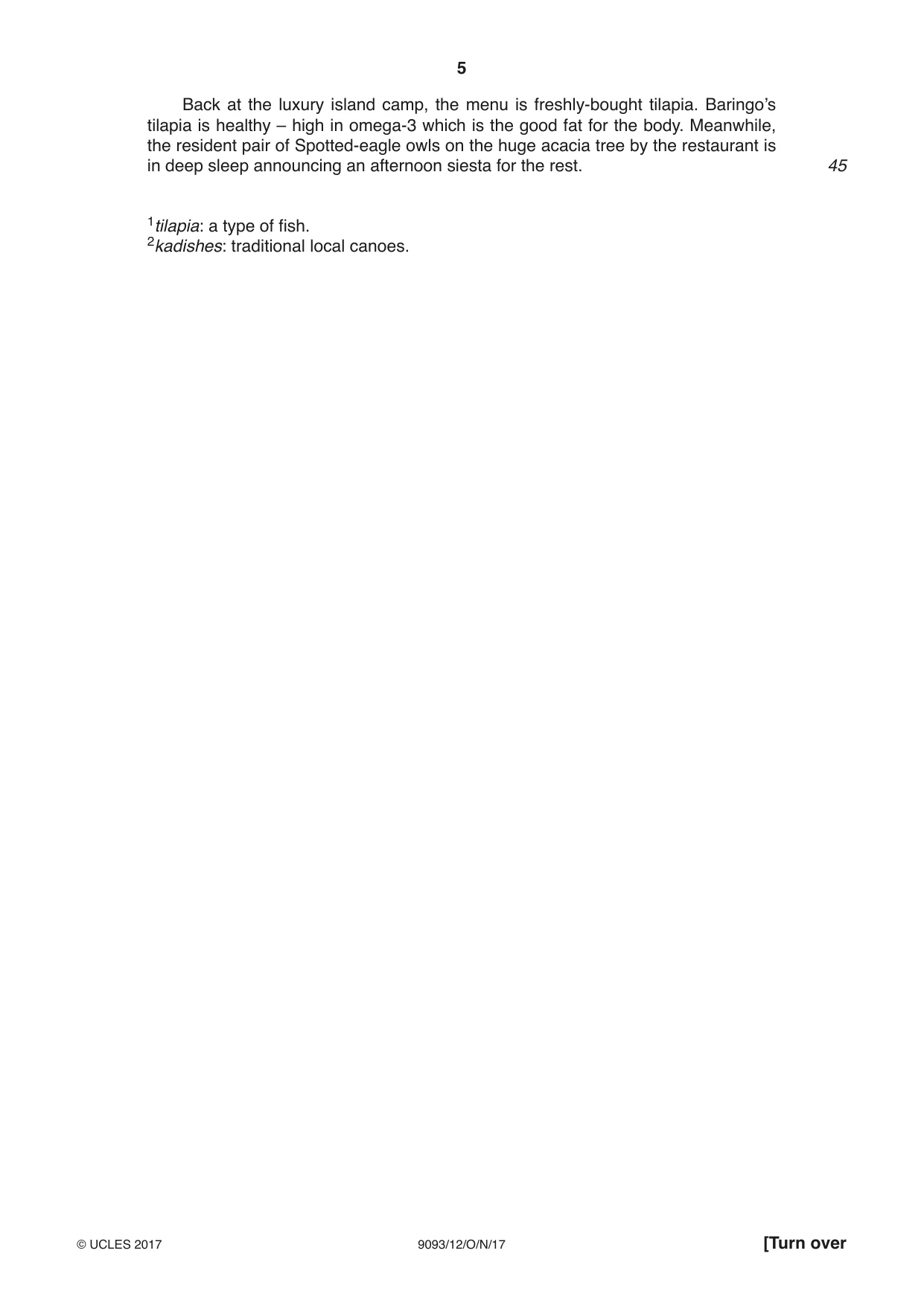
Question paper, page 5
5 9093/12/O/N/17 © UCLES 2017 [Turn over Back at the luxury island camp, the menu is freshly-bought tilapia. Baringo’s tilapia is healthy – high in omega-3 which is the good fat for the body. Meanwhile, the resident pair of Spotted-eagle owls on the huge acacia tree by the restaurant is in deep sleep announcing an afternoon siesta for the rest. 1tilapia: a type of fish. 2kadishes: traditional local canoes. 45
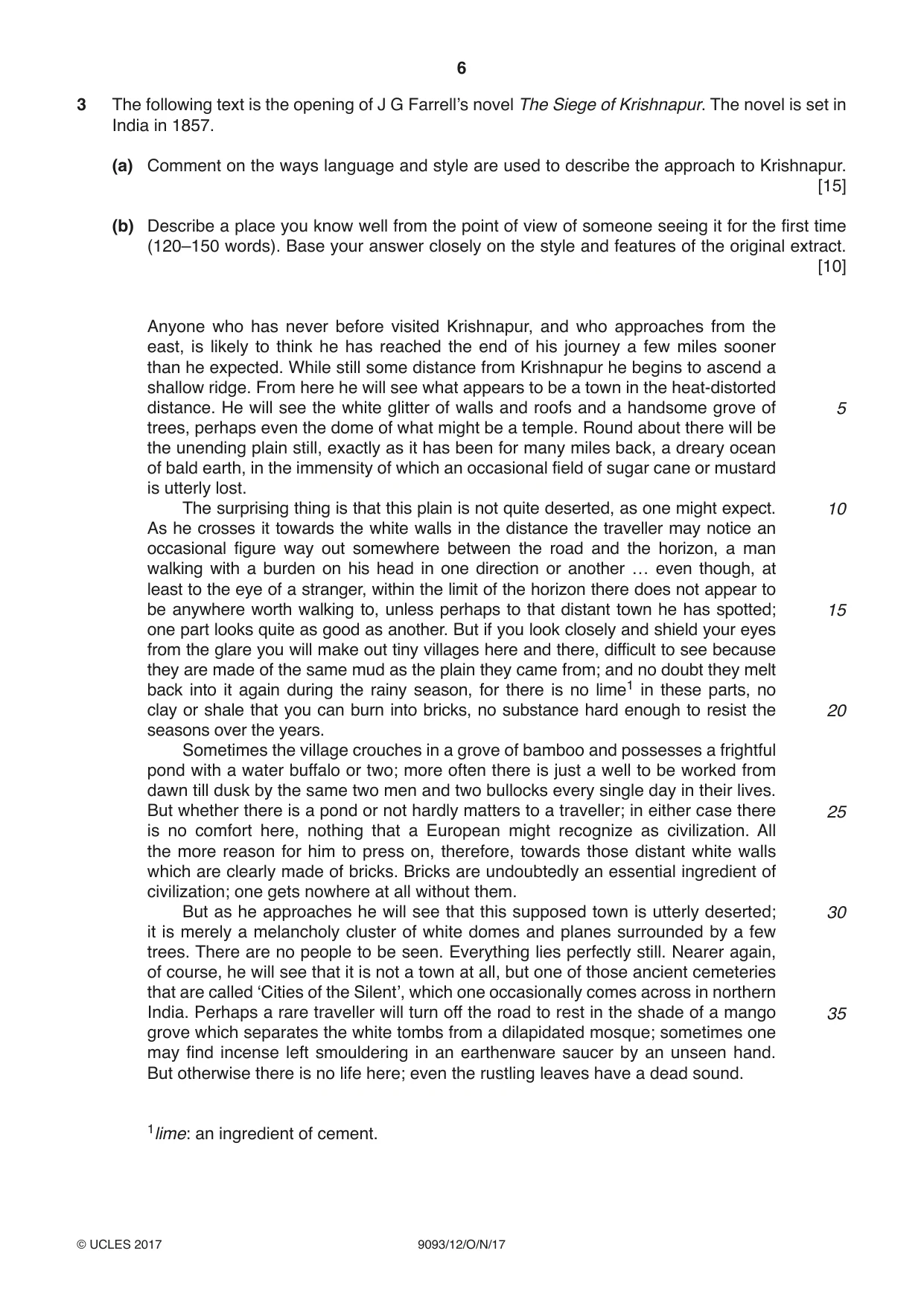
Question paper, page 6
6 9093/12/O/N/17 © UCLES 2017 3 The following text is the opening of J G Farrell’s novel The Siege of Krishnapur. The novel is set in India in 1857. (a) Comment on the ways language and style are used to describe the approach to Krishnapur. [15] (b) Describe a place you know well from the point of view of someone seeing it for the first time (120–150 words). Base your answer closely on the style and features of the original extract. [10] Anyone who has never before visited Krishnapur, and who approaches from the east, is likely to think he has reached the end of his journey a few miles sooner than he expected. While still some distance from Krishnapur he begins to ascend a shallow ridge. From here he will see what appears to be a town in the heat-distorted distance. He will see the white glitter of walls and roofs and a handsome grove of trees, perhaps even the dome of what might be a temple. Round about there will be the unending plain still, exactly as it has been for many miles back, a dreary ocean of bald earth, in the immensity of which an occasional field of sugar cane or mustard is utterly lost. The surprising thing is that this plain is not quite deserted, as one might expect. As he crosses it towards the white walls in the distance the traveller may notice an occasional figure way out somewhere between the road and the horizon, a man walking with a burden on his head in one direction or another … even though, at least to the eye of a stranger, within the limit of the horizon there does not appear to be anywhere worth walking to, unless perhaps to that distant town he has spotted; one part looks quite as good as another. But if you look closely and shield your eyes from the glare you will make out tiny villages here and there, difficult to see because they are made of the same mud as the plain they came from; and no doubt they melt back into it again during the rainy season, for there is no lime1 in these parts, no clay or shale that you can burn into bricks, no substance hard enough to resist the seasons over the years. Sometimes the village crouches in a grove of bamboo and possesses a frightful pond with a water buffalo or two; more often there is just a well to be worked from dawn till dusk by the same two men and two bullocks every single day in their lives. But whether there is a pond or not hardly matters to a traveller; in either case there is no comfort here, nothing that a European might recognize as civilization. All the more reason for him to press on, therefore, towards those distant white walls which are clearly made of bricks. Bricks are undoubtedly an essential ingredient of civilization; one gets nowhere at all without them. But as he approaches he will see that this supposed town is utterly deserted; it is merely a melancholy cluster of white domes and planes surrounded by a few trees. There are no people to be seen. Everything lies perfectly still. Nearer again, of course, he will see that it is not a town at all, but one of those ancient cemeteries that are called ‘Cities of the Silent’, which one occasionally comes across in northern India. Perhaps a rare traveller will turn off the road to rest in the shade of a mango grove which separates the white tombs from a dilapidated mosque; sometimes one may find incense left smouldering in an earthenware saucer by an unseen hand. But otherwise there is no life here; even the rustling leaves have a dead sound. 1lime: an ingredient of cement. 5 10 15 20 25 30 35
Question paper, page 7
7 9093/12/O/N/17 © UCLES 2017 BLANK PAGE
Question paper, page 8
8 9093/12/O/N/17 © UCLES 2017 BLANK PAGE Permission to reproduce items where third-party owned material protected by copyright is included has been sought and cleared where possible. Every reasonable effort has been made by the publisher (UCLES) to trace copyright holders, but if any items requiring clearance have unwittingly been included, the publisher will be pleased to make amends at the earliest possible opportunity. To avoid the issue of disclosure of answer-related information to candidates, all copyright acknowledgements are reproduced online in the Cambridge International Examinations Copyright Acknowledgements Booklet. This is produced for each series of examinations and is freely available to download at www.cie.org.uk after the live examination series. Cambridge International Examinations is part of the Cambridge Assessment Group. Cambridge Assessment is the brand name of University of Cambridge Local Examinations Syndicate (UCLES), which is itself a department of the University of Cambridge.
Mark scheme, page 1
® IGCSE is a registered trademark. This document consists of 4 printed pages. © UCLES 2017 [Turn over Cambridge Assessment International Education Cambridge International Advanced Subsidiary and Advanced Level ENGLISH LANGUAGE 9093/12 Paper 1 Passages October/November 2017 MARK SCHEME Maximum Mark: 50 Published This mark scheme is published as an aid to teachers and candidates, to indicate the requirements of the examination. It shows the basis on which Examiners were instructed to award marks. It does not indicate the details of the discussions that took place at an Examiners’ meeting before marking began, which would have considered the acceptability of alternative answers. Mark schemes should be read in conjunction with the question paper and the Principal Examiner Report for Teachers. Cambridge International will not enter into discussions about these mark schemes. Cambridge International is publishing the mark schemes for the October/November 2017 series for most Cambridge IGCSE®, Cambridge International A and AS Level components and some Cambridge O Level components.
Mark scheme, page 2
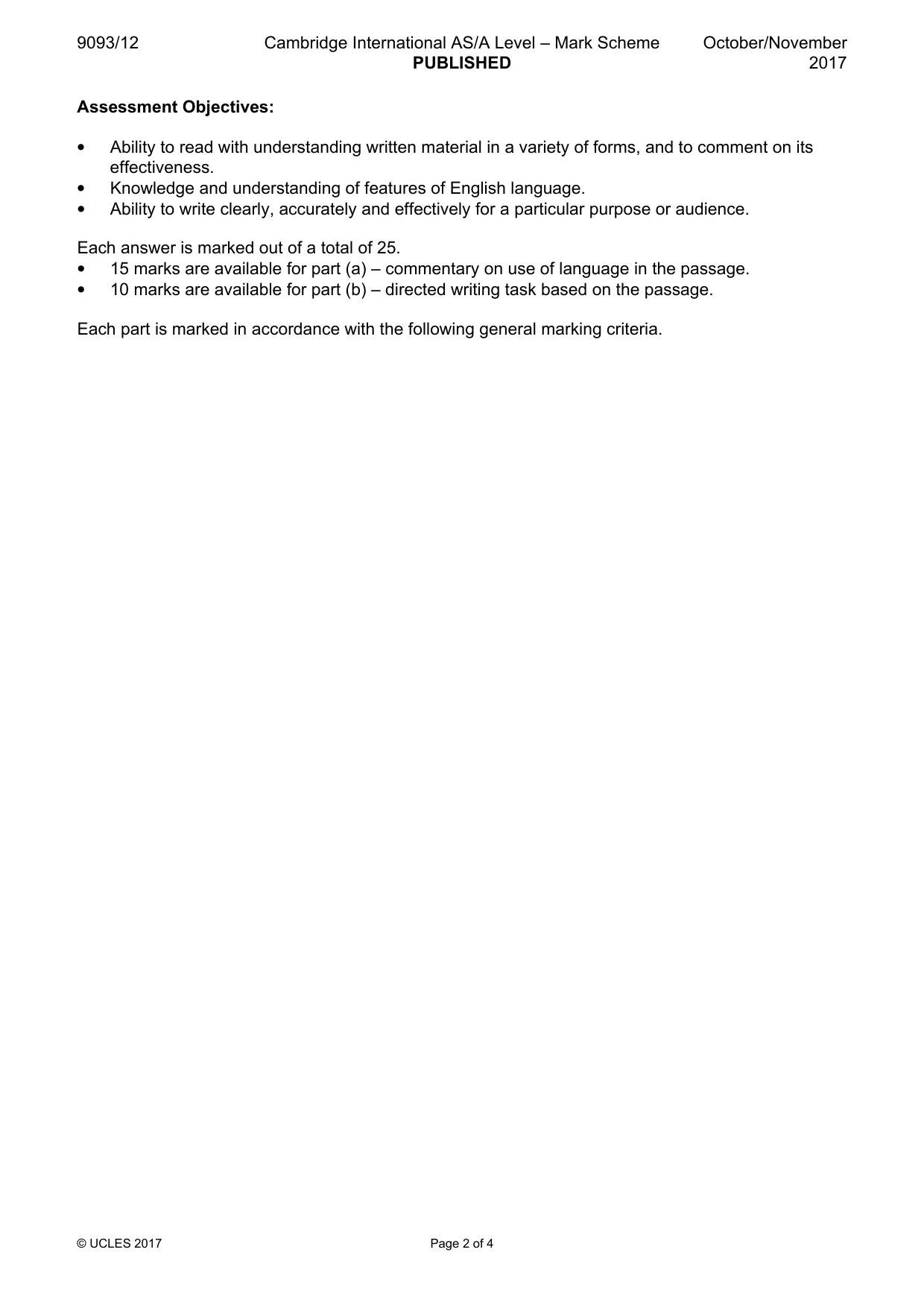
9093/12 Cambridge International AS/A Level – Mark Scheme PUBLISHED October/November 2017 © UCLES 2017 Page 2 of 4 Assessment Objectives: • Ability to read with understanding written material in a variety of forms, and to comment on its effectiveness. • Knowledge and understanding of features of English language. • Ability to write clearly, accurately and effectively for a particular purpose or audience. Each answer is marked out of a total of 25. • 15 marks are available for part (a) – commentary on use of language in the passage. • 10 marks are available for part (b) – directed writing task based on the passage. Each part is marked in accordance with the following general marking criteria.
Mark scheme, page 3
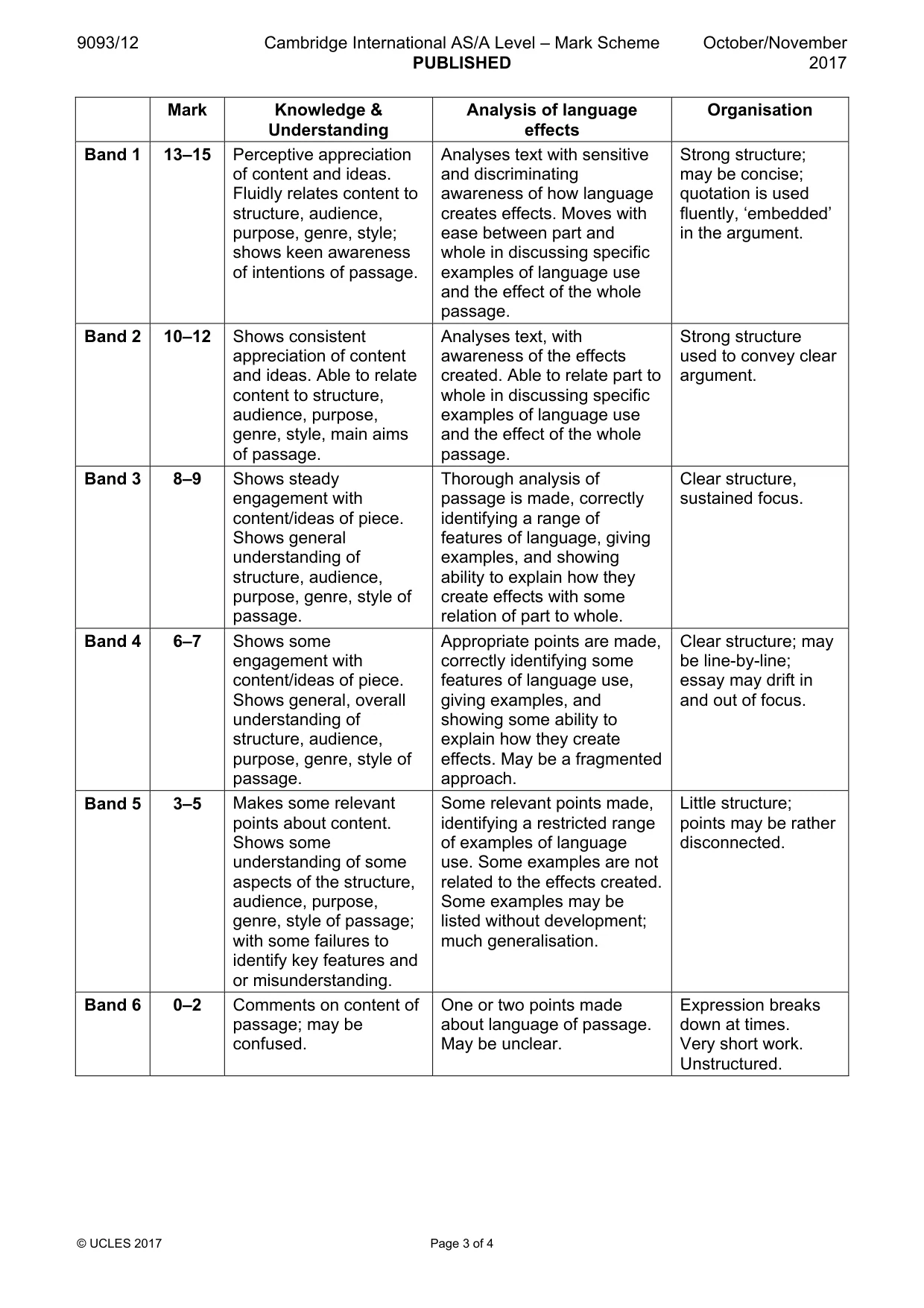
9093/12 Cambridge International AS/A Level – Mark Scheme PUBLISHED October/November 2017 © UCLES 2017 Page 3 of 4 Mark Knowledge & Understanding Analysis of language effects Organisation Band 1 13–15 Perceptive appreciation of content and ideas. Fluidly relates content to structure, audience, purpose, genre, style; shows keen awareness of intentions of passage. Analyses text with sensitive and discriminating awareness of how language creates effects. Moves with ease between part and whole in discussing specific examples of language use and the effect of the whole passage. Strong structure; may be concise; quotation is used fluently, ‘embedded’ in the argument. Band 2 10–12 Shows consistent appreciation of content and ideas. Able to relate content to structure, audience, purpose, genre, style, main aims of passage. Analyses text, with awareness of the effects created. Able to relate part to whole in discussing specific examples of language use and the effect of the whole passage. Strong structure used to convey clear argument. Band 3 8–9 Shows steady engagement with content/ideas of piece. Shows general understanding of structure, audience, purpose, genre, style of passage. Thorough analysis of passage is made, correctly identifying a range of features of language, giving examples, and showing ability to explain how they create effects with some relation of part to whole. Clear structure, sustained focus. Band 4 6–7 Shows some engagement with content/ideas of piece. Shows general, overall understanding of structure, audience, purpose, genre, style of passage. Appropriate points are made, correctly identifying some features of language use, giving examples, and showing some ability to explain how they create effects. May be a fragmented approach. Clear structure; may be line-by-line; essay may drift in and out of focus. Band 5 3–5 Makes some relevant points about content. Shows some understanding of some aspects of the structure, audience, purpose, genre, style of passage; with some failures to identify key features and or misunderstanding. Some relevant points made, identifying a restricted range of examples of language use. Some examples are not related to the effects created. Some examples may be listed without development; much generalisation. Little structure; points may be rather disconnected. Band 6 0–2 Comments on content of passage; may be confused. One or two points made about language of passage. May be unclear. Expression breaks down at times. Very short work. Unstructured.
Mark scheme, page 4
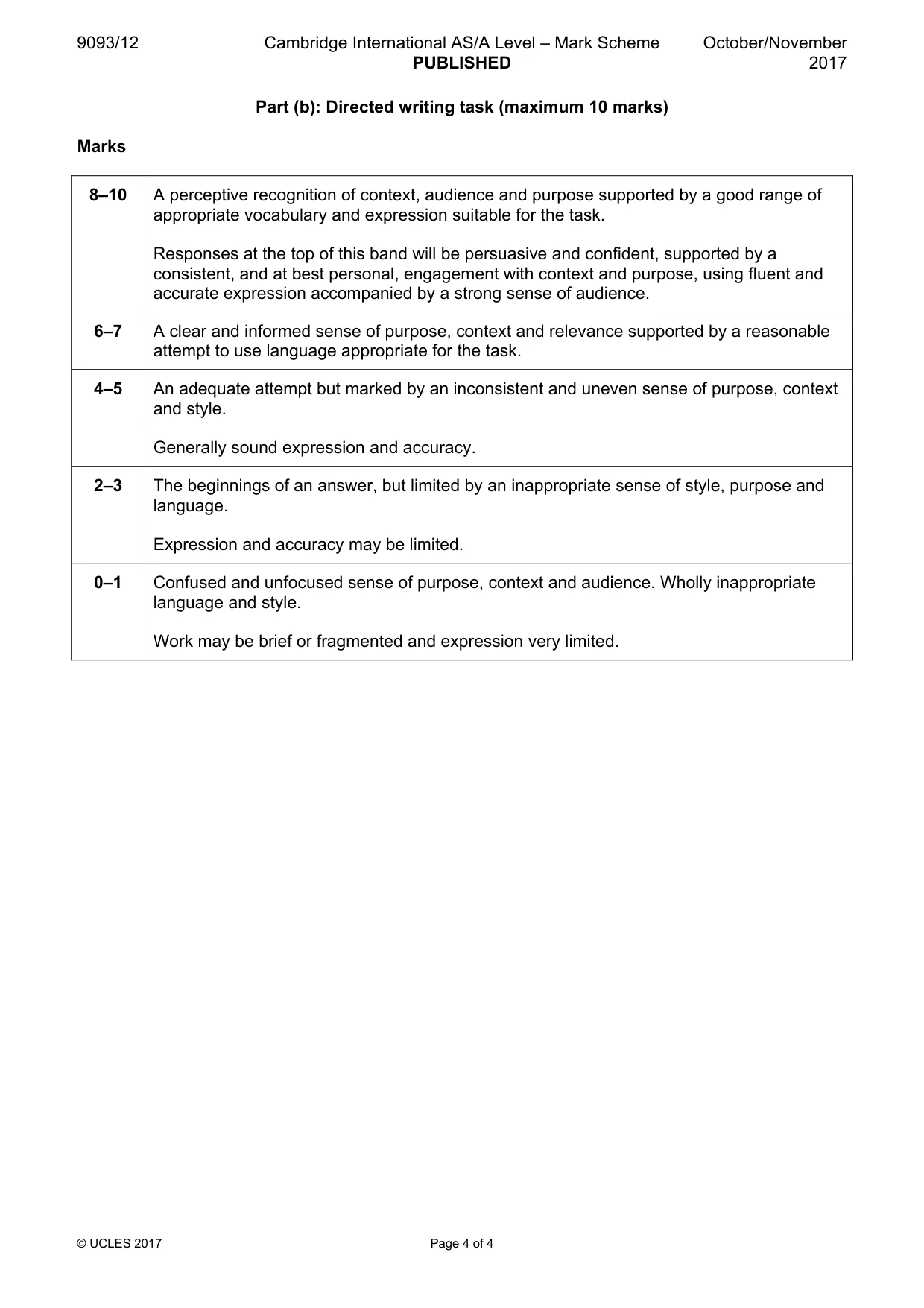
9093/12 Cambridge International AS/A Level – Mark Scheme PUBLISHED October/November 2017 © UCLES 2017 Page 4 of 4 Part (b): Directed writing task (maximum 10 marks) Marks 8–10 A perceptive recognition of context, audience and purpose supported by a good range of appropriate vocabulary and expression suitable for the task. Responses at the top of this band will be persuasive and confident, supported by a consistent, and at best personal, engagement with context and purpose, using fluent and accurate expression accompanied by a strong sense of audience. 6–7 A clear and informed sense of purpose, context and relevance supported by a reasonable attempt to use language appropriate for the task. 4–5 An adequate attempt but marked by an inconsistent and uneven sense of purpose, context and style. Generally sound expression and accuracy. 2–3 The beginnings of an answer, but limited by an inappropriate sense of style, purpose and language. Expression and accuracy may be limited. 0–1 Confused and unfocused sense of purpose, context and audience. Wholly inappropriate language and style. Work may be brief or fragmented and expression very limited.
What you needed in this session
Cambridge’s own grade thresholds for 2017 Oct/Nov, Paper 1 · Variant 2. A higher threshold means an easier paper — the bar moves with how the cohort did.