Cambridge A Level English - Language AS and A Level (from 2014) 9093 — 2017 Oct/Nov Paper 1 · Variant 1
9093/11/O/N/17 · 50 marks · ≈56 min
The question paper and its mark scheme, free to read here and free to download. This is Cambridge’s own paper, exactly as it was sat.
Question paper8 pages

Mark scheme4 pages
Answers below. Sit the paper first if you are practising.
Paper as text
Question paper, page 1
This document consists of 7 printed pages, 1 blank page and 1 Insert. DC (RCL/JDA) 130753/2 © UCLES 2017 [Turn over Cambridge International Examinations Cambridge International Advanced Subsidiary and Advanced Level * 4 7 7 5 2 8 2 1 9 0 * ENGLISH LANGUAGE 9093/11 Paper 1 Passages October/November 2017 2 hours 15 minutes No Additional Materials are required. READ THESE INSTRUCTIONS FIRST An answer booklet is provided inside this question paper. You should follow the instructions on the front cover of the answer booklet. If you need additional answer paper, ask the invigilator for a continuation booklet. Answer two questions: Question 1 and either Question 2 or Question 3. You should spend about 15 minutes reading the passages and questions before you start writing your answers. You are reminded of the need for good English and clear presentation in your answers. The number of marks is given in brackets [ ] at the end of each question or part question.
Question paper, page 2
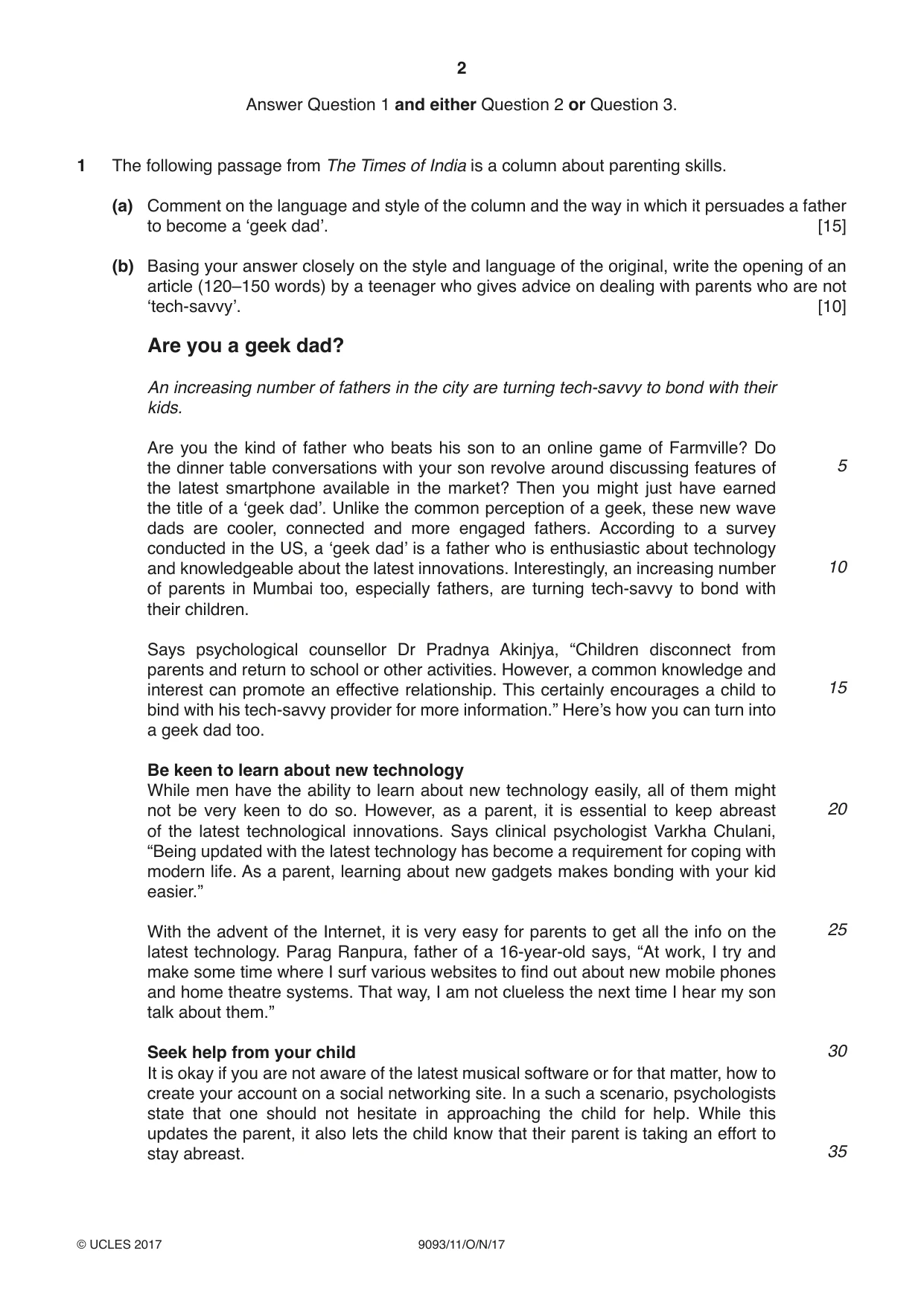
2 9093/11/O/N/17 © UCLES 2017 Answer Question 1 and either Question 2 or Question 3. 1 The following passage from The Times of India is a column about parenting skills. (a) Comment on the language and style of the column and the way in which it persuades a father to become a ‘geek dad’. [15] (b) Basing your answer closely on the style and language of the original, write the opening of an article (120–150 words) by a teenager who gives advice on dealing with parents who are not ‘tech-savvy’. [10] Are you a geek dad? An increasing number of fathers in the city are turning tech-savvy to bond with their kids. Are you the kind of father who beats his son to an online game of Farmville? Do the dinner table conversations with your son revolve around discussing features of the latest smartphone available in the market? Then you might just have earned the title of a ‘geek dad’. Unlike the common perception of a geek, these new wave dads are cooler, connected and more engaged fathers. According to a survey conducted in the US, a ‘geek dad’ is a father who is enthusiastic about technology and knowledgeable about the latest innovations. Interestingly, an increasing number of parents in Mumbai too, especially fathers, are turning tech-savvy to bond with their children. Says psychological counsellor Dr Pradnya Akinjya, “Children disconnect from parents and return to school or other activities. However, a common knowledge and interest can promote an effective relationship. This certainly encourages a child to bind with his tech-savvy provider for more information.” Here’s how you can turn into a geek dad too. Be keen to learn about new technology While men have the ability to learn about new technology easily, all of them might not be very keen to do so. However, as a parent, it is essential to keep abreast of the latest technological innovations. Says clinical psychologist Varkha Chulani, “Being updated with the latest technology has become a requirement for coping with modern life. As a parent, learning about new gadgets makes bonding with your kid easier.” With the advent of the Internet, it is very easy for parents to get all the info on the latest technology. Parag Ranpura, father of a 16-year-old says, “At work, I try and make some time where I surf various websites to find out about new mobile phones and home theatre systems. That way, I am not clueless the next time I hear my son talk about them.” Seek help from your child It is okay if you are not aware of the latest musical software or for that matter, how to create your account on a social networking site. In a such a scenario, psychologists state that one should not hesitate in approaching the child for help. While this updates the parent, it also lets the child know that their parent is taking an effort to stay abreast. 5 10 15 20 25 30 35
Question paper, page 3
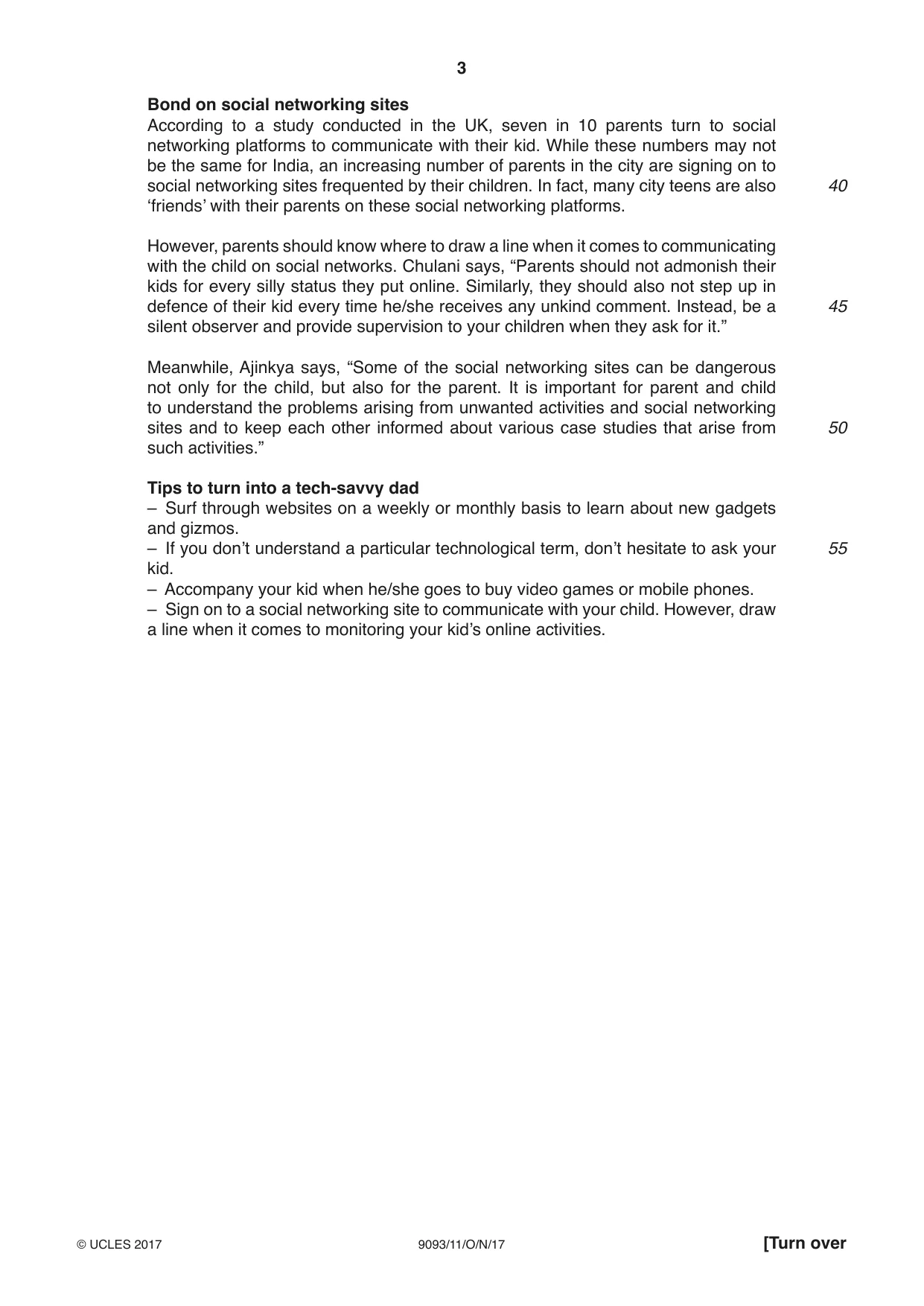
3 9093/11/O/N/17 © UCLES 2017 [Turn over Bond on social networking sites According to a study conducted in the UK, seven in 10 parents turn to social networking platforms to communicate with their kid. While these numbers may not be the same for India, an increasing number of parents in the city are signing on to social networking sites frequented by their children. In fact, many city teens are also ‘friends’ with their parents on these social networking platforms. However, parents should know where to draw a line when it comes to communicating with the child on social networks. Chulani says, “Parents should not admonish their kids for every silly status they put online. Similarly, they should also not step up in defence of their kid every time he/she receives any unkind comment. Instead, be a silent observer and provide supervision to your children when they ask for it.” Meanwhile, Ajinkya says, “Some of the social networking sites can be dangerous not only for the child, but also for the parent. It is important for parent and child to understand the problems arising from unwanted activities and social networking sites and to keep each other informed about various case studies that arise from such activities.” Tips to turn into a tech-savvy dad – Surf through websites on a weekly or monthly basis to learn about new gadgets and gizmos. – If you don’t understand a particular technological term, don’t hesitate to ask your kid. – Accompany your kid when he/she goes to buy video games or mobile phones. – Sign on to a social networking site to communicate with your child. However, draw a line when it comes to monitoring your kid’s online activities. 40 45 50 55
Question paper, page 4
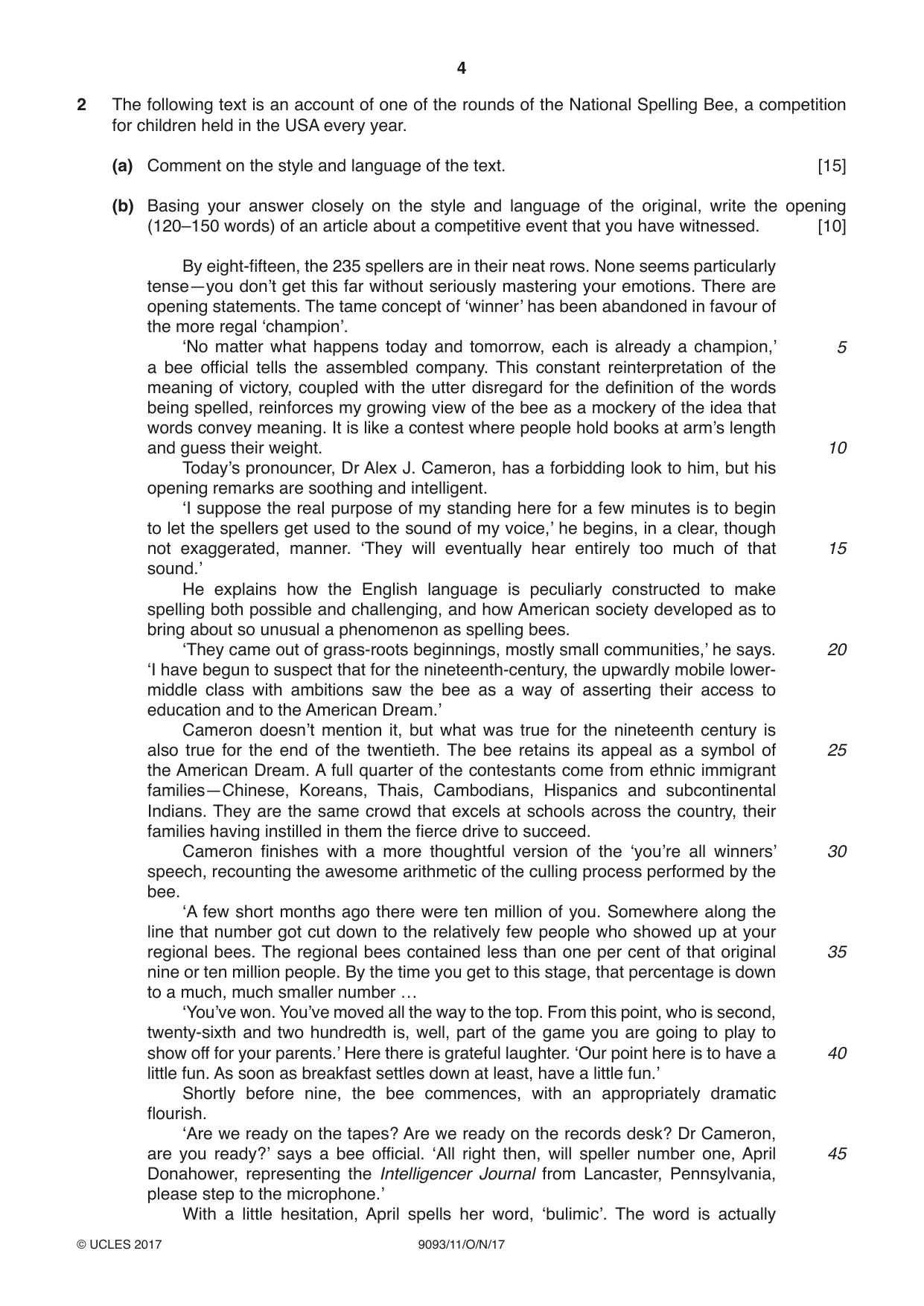
4 9093/11/O/N/17 © UCLES 2017 2 The following text is an account of one of the rounds of the National Spelling Bee, a competition for children held in the USA every year. (a) Comment on the style and language of the text. [15] (b) Basing your answer closely on the style and language of the original, write the opening (120–150 words) of an article about a competitive event that you have witnessed. [10] By eight-fifteen, the 235 spellers are in their neat rows. None seems particularly tense—you don’t get this far without seriously mastering your emotions. There are opening statements. The tame concept of ‘winner’ has been abandoned in favour of the more regal ‘champion’. ‘No matter what happens today and tomorrow, each is already a champion,’ a bee official tells the assembled company. This constant reinterpretation of the meaning of victory, coupled with the utter disregard for the definition of the words being spelled, reinforces my growing view of the bee as a mockery of the idea that words convey meaning. It is like a contest where people hold books at arm’s length and guess their weight. Today’s pronouncer, Dr Alex J. Cameron, has a forbidding look to him, but his opening remarks are soothing and intelligent. ‘I suppose the real purpose of my standing here for a few minutes is to begin to let the spellers get used to the sound of my voice,’ he begins, in a clear, though not exaggerated, manner. ‘They will eventually hear entirely too much of that sound.’ He explains how the English language is peculiarly constructed to make spelling both possible and challenging, and how American society developed as to bring about so unusual a phenomenon as spelling bees. ‘They came out of grass-roots beginnings, mostly small communities,’ he says. ‘I have begun to suspect that for the nineteenth-century, the upwardly mobile lower- middle class with ambitions saw the bee as a way of asserting their access to education and to the American Dream.’ Cameron doesn’t mention it, but what was true for the nineteenth century is also true for the end of the twentieth. The bee retains its appeal as a symbol of the American Dream. A full quarter of the contestants come from ethnic immigrant families—Chinese, Koreans, Thais, Cambodians, Hispanics and subcontinental Indians. They are the same crowd that excels at schools across the country, their families having instilled in them the fierce drive to succeed. Cameron finishes with a more thoughtful version of the ‘you’re all winners’ speech, recounting the awesome arithmetic of the culling process performed by the bee. ‘A few short months ago there were ten million of you. Somewhere along the line that number got cut down to the relatively few people who showed up at your regional bees. The regional bees contained less than one per cent of that original nine or ten million people. By the time you get to this stage, that percentage is down to a much, much smaller number … ‘You’ve won. You’ve moved all the way to the top. From this point, who is second, twenty-sixth and two hundredth is, well, part of the game you are going to play to show off for your parents.’ Here there is grateful laughter. ‘Our point here is to have a little fun. As soon as breakfast settles down at least, have a little fun.’ Shortly before nine, the bee commences, with an appropriately dramatic flourish. ‘Are we ready on the tapes? Are we ready on the records desk? Dr Cameron, are you ready?’ says a bee official. ‘All right then, will speller number one, April Donahower, representing the Intelligencer Journal from Lancaster, Pennsylvania, please step to the microphone.’ With a little hesitation, April spells her word, ‘bulimic’. The word is actually 5 10 15 20 25 30 35 40 45
Question paper, page 5
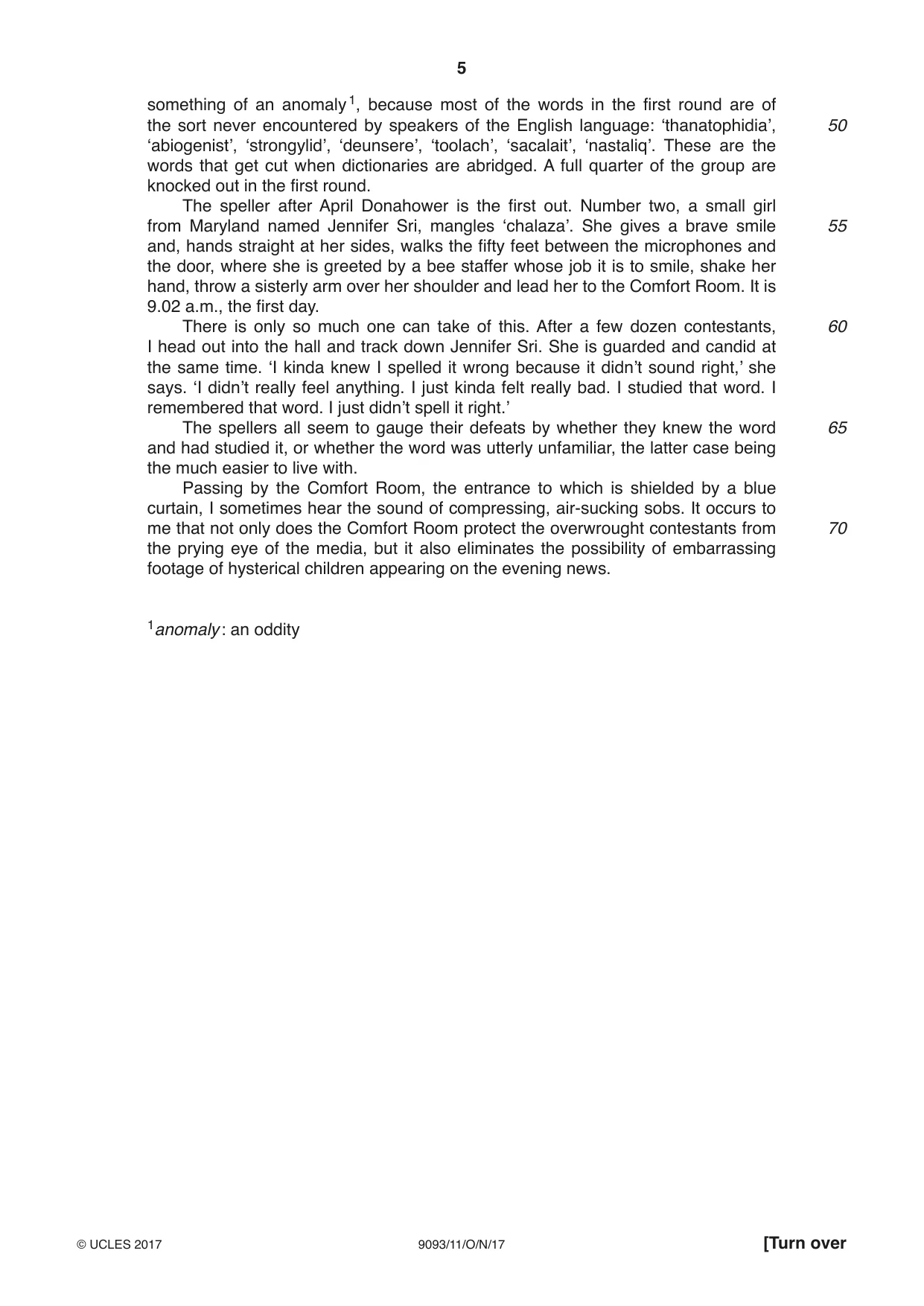
5 9093/11/O/N/17 © UCLES 2017 [Turn over something of an anomaly 1, because most of the words in the first round are of the sort never encountered by speakers of the English language: ‘thanatophidia’, ‘abiogenist’, ‘strongylid’, ‘deunsere’, ‘toolach’, ‘sacalait’, ‘nastaliq’. These are the words that get cut when dictionaries are abridged. A full quarter of the group are knocked out in the first round. The speller after April Donahower is the first out. Number two, a small girl from Maryland named Jennifer Sri, mangles ‘chalaza’. She gives a brave smile and, hands straight at her sides, walks the fifty feet between the microphones and the door, where she is greeted by a bee staffer whose job it is to smile, shake her hand, throw a sisterly arm over her shoulder and lead her to the Comfort Room. It is 9.02 a.m., the first day. There is only so much one can take of this. After a few dozen contestants, I head out into the hall and track down Jennifer Sri. She is guarded and candid at the same time. ‘I kinda knew I spelled it wrong because it didn’t sound right,’ she says. ‘I didn’t really feel anything. I just kinda felt really bad. I studied that word. I remembered that word. I just didn’t spell it right.’ The spellers all seem to gauge their defeats by whether they knew the word and had studied it, or whether the word was utterly unfamiliar, the latter case being the much easier to live with. Passing by the Comfort Room, the entrance to which is shielded by a blue curtain, I sometimes hear the sound of compressing, air-sucking sobs. It occurs to me that not only does the Comfort Room protect the overwrought contestants from the prying eye of the media, but it also eliminates the possibility of embarrassing footage of hysterical children appearing on the evening news. 1anomaly : an oddity 50 55 60 65 70
Question paper, page 6
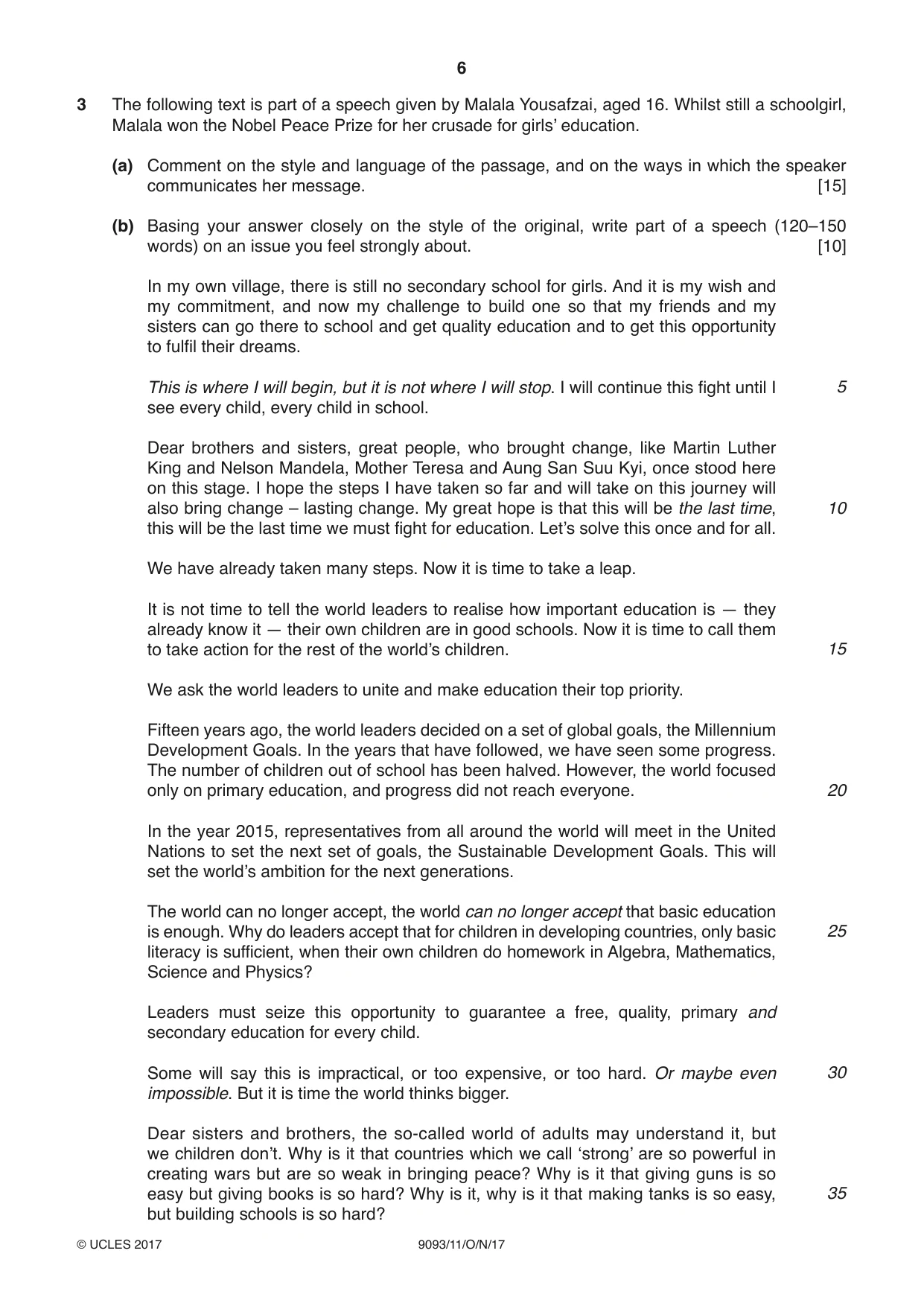
6 9093/11/O/N/17 © UCLES 2017 3 The following text is part of a speech given by Malala Yousafzai, aged 16. Whilst still a schoolgirl, Malala won the Nobel Peace Prize for her crusade for girls’ education. (a) Comment on the style and language of the passage, and on the ways in which the speaker communicates her message. [15] (b) Basing your answer closely on the style of the original, write part of a speech (120–150 words) on an issue you feel strongly about. [10] In my own village, there is still no secondary school for girls. And it is my wish and my commitment, and now my challenge to build one so that my friends and my sisters can go there to school and get quality education and to get this opportunity to fulfil their dreams. This is where I will begin, but it is not where I will stop. I will continue this fight until I see every child, every child in school. Dear brothers and sisters, great people, who brought change, like Martin Luther King and Nelson Mandela, Mother Teresa and Aung San Suu Kyi, once stood here on this stage. I hope the steps I have taken so far and will take on this journey will also bring change – lasting change. My great hope is that this will be the last time, this will be the last time we must fight for education. Let’s solve this once and for all. We have already taken many steps. Now it is time to take a leap. It is not time to tell the world leaders to realise how important education is — they already know it — their own children are in good schools. Now it is time to call them to take action for the rest of the world’s children. We ask the world leaders to unite and make education their top priority. Fifteen years ago, the world leaders decided on a set of global goals, the Millennium Development Goals. In the years that have followed, we have seen some progress. The number of children out of school has been halved. However, the world focused only on primary education, and progress did not reach everyone. In the year 2015, representatives from all around the world will meet in the United Nations to set the next set of goals, the Sustainable Development Goals. This will set the world’s ambition for the next generations. The world can no longer accept, the world can no longer accept that basic education is enough. Why do leaders accept that for children in developing countries, only basic literacy is sufficient, when their own children do homework in Algebra, Mathematics, Science and Physics? Leaders must seize this opportunity to guarantee a free, quality, primary and secondary education for every child. Some will say this is impractical, or too expensive, or too hard. Or maybe even impossible. But it is time the world thinks bigger. Dear sisters and brothers, the so-called world of adults may understand it, but we children don’t. Why is it that countries which we call ‘strong’ are so powerful in creating wars but are so weak in bringing peace? Why is it that giving guns is so easy but giving books is so hard? Why is it, why is it that making tanks is so easy, but building schools is so hard? 5 10 15 20 25 30 35
Question paper, page 7
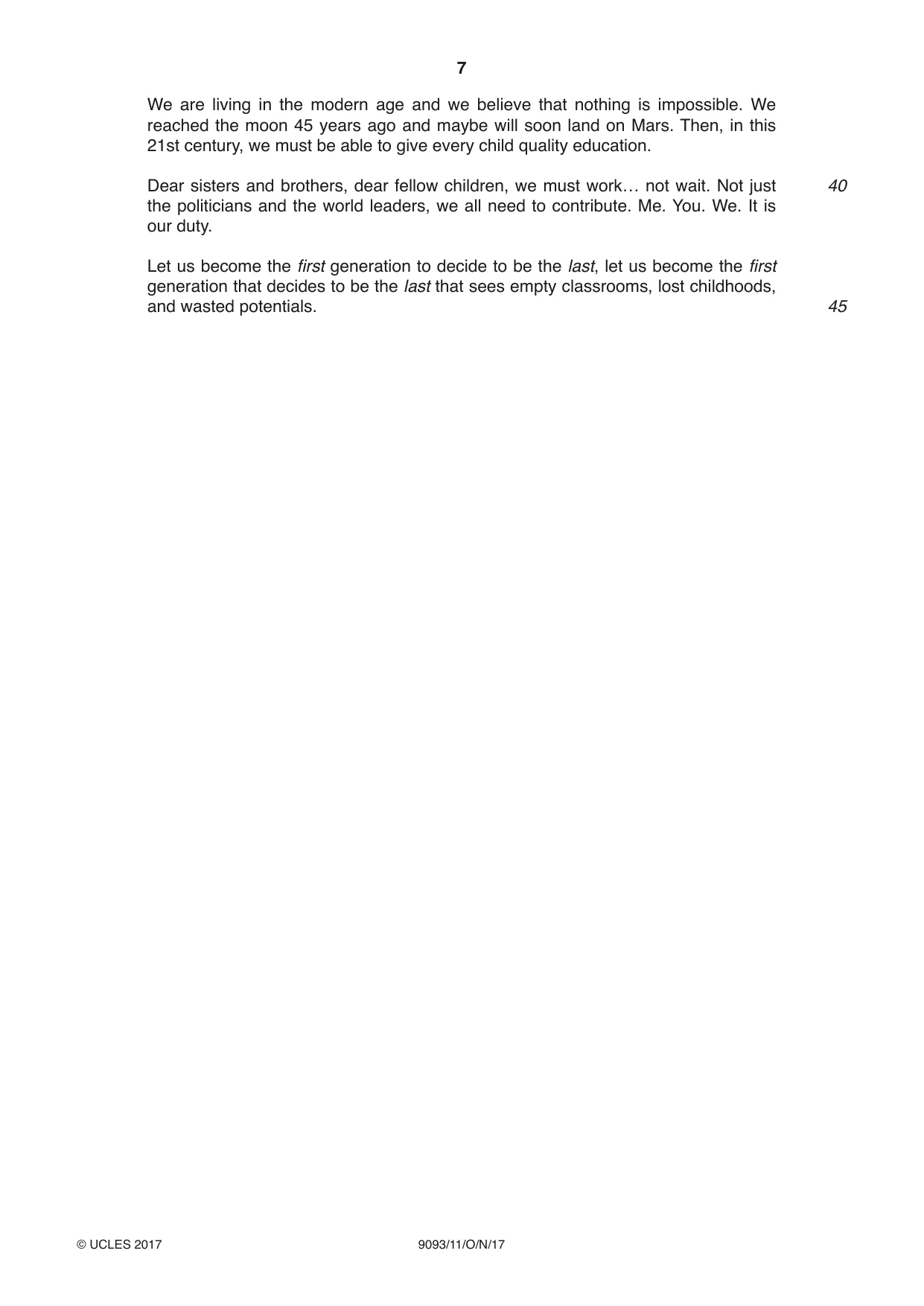
7 9093/11/O/N/17 © UCLES 2017 We are living in the modern age and we believe that nothing is impossible. We reached the moon 45 years ago and maybe will soon land on Mars. Then, in this 21st century, we must be able to give every child quality education. Dear sisters and brothers, dear fellow children, we must work… not wait. Not just the politicians and the world leaders, we all need to contribute. Me. You. We. It is our duty. Let us become the first generation to decide to be the last, let us become the first generation that decides to be the last that sees empty classrooms, lost childhoods, and wasted potentials. 40 45
Question paper, page 8
8 9093/11/O/N/17 © UCLES 2017 Permission to reproduce items where third-party owned material protected by copyright is included has been sought and cleared where possible. Every reasonable effort has been made by the publisher (UCLES) to trace copyright holders, but if any items requiring clearance have unwittingly been included, the publisher will be pleased to make amends at the earliest possible opportunity. To avoid the issue of disclosure of answer-related information to candidates, all copyright acknowledgements are reproduced online in the Cambridge International Examinations Copyright Acknowledgements Booklet. This is produced for each series of examinations and is freely available to download at www.cie.org.uk after the live examination series. Cambridge International Examinations is part of the Cambridge Assessment Group. Cambridge Assessment is the brand name of University of Cambridge Local Examinations Syndicate (UCLES), which is itself a department of the University of Cambridge. BLANK PAGE
Mark scheme, page 1
® IGCSE is a registered trademark. This document consists of 4 printed pages. © UCLES 2017 [Turn over Cambridge Assessment International Education Cambridge International Advanced Subsidiary and Advanced Level ENGLISH LANGUAGE 9093/11 Paper 1 Passages October/November 2017 MARK SCHEME Maximum Mark: 50 Published This mark scheme is published as an aid to teachers and candidates, to indicate the requirements of the examination. It shows the basis on which Examiners were instructed to award marks. It does not indicate the details of the discussions that took place at an Examiners’ meeting before marking began, which would have considered the acceptability of alternative answers. Mark schemes should be read in conjunction with the question paper and the Principal Examiner Report for Teachers. Cambridge International will not enter into discussions about these mark schemes. Cambridge International is publishing the mark schemes for the October/November 2017 series for most Cambridge IGCSE®, Cambridge International A and AS Level components and some Cambridge O Level components.
Mark scheme, page 2
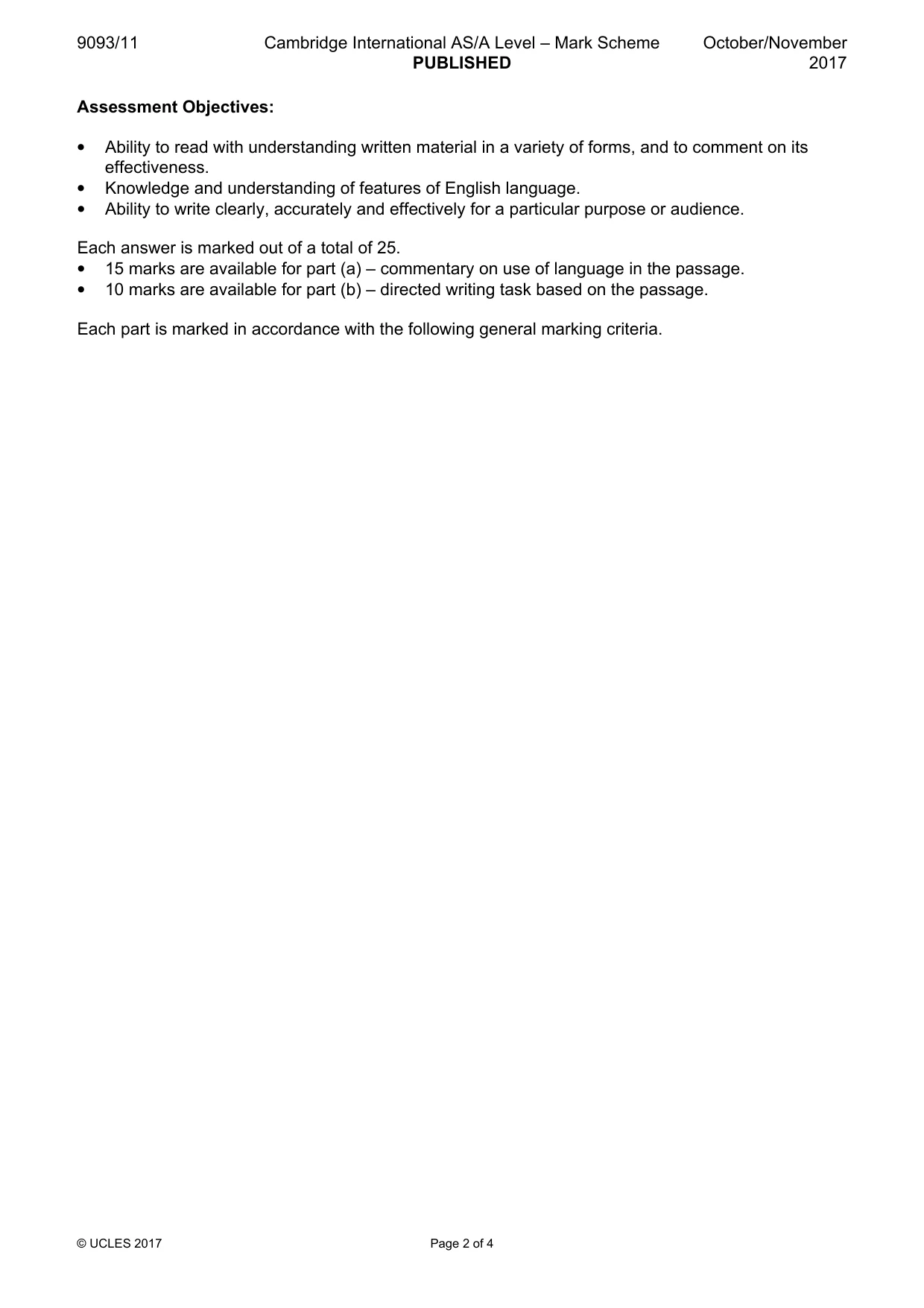
9093/11 Cambridge International AS/A Level – Mark Scheme PUBLISHED October/November 2017 © UCLES 2017 Page 2 of 4 Assessment Objectives: • Ability to read with understanding written material in a variety of forms, and to comment on its effectiveness. • Knowledge and understanding of features of English language. • Ability to write clearly, accurately and effectively for a particular purpose or audience. Each answer is marked out of a total of 25. • 15 marks are available for part (a) – commentary on use of language in the passage. • 10 marks are available for part (b) – directed writing task based on the passage. Each part is marked in accordance with the following general marking criteria.
Mark scheme, page 3
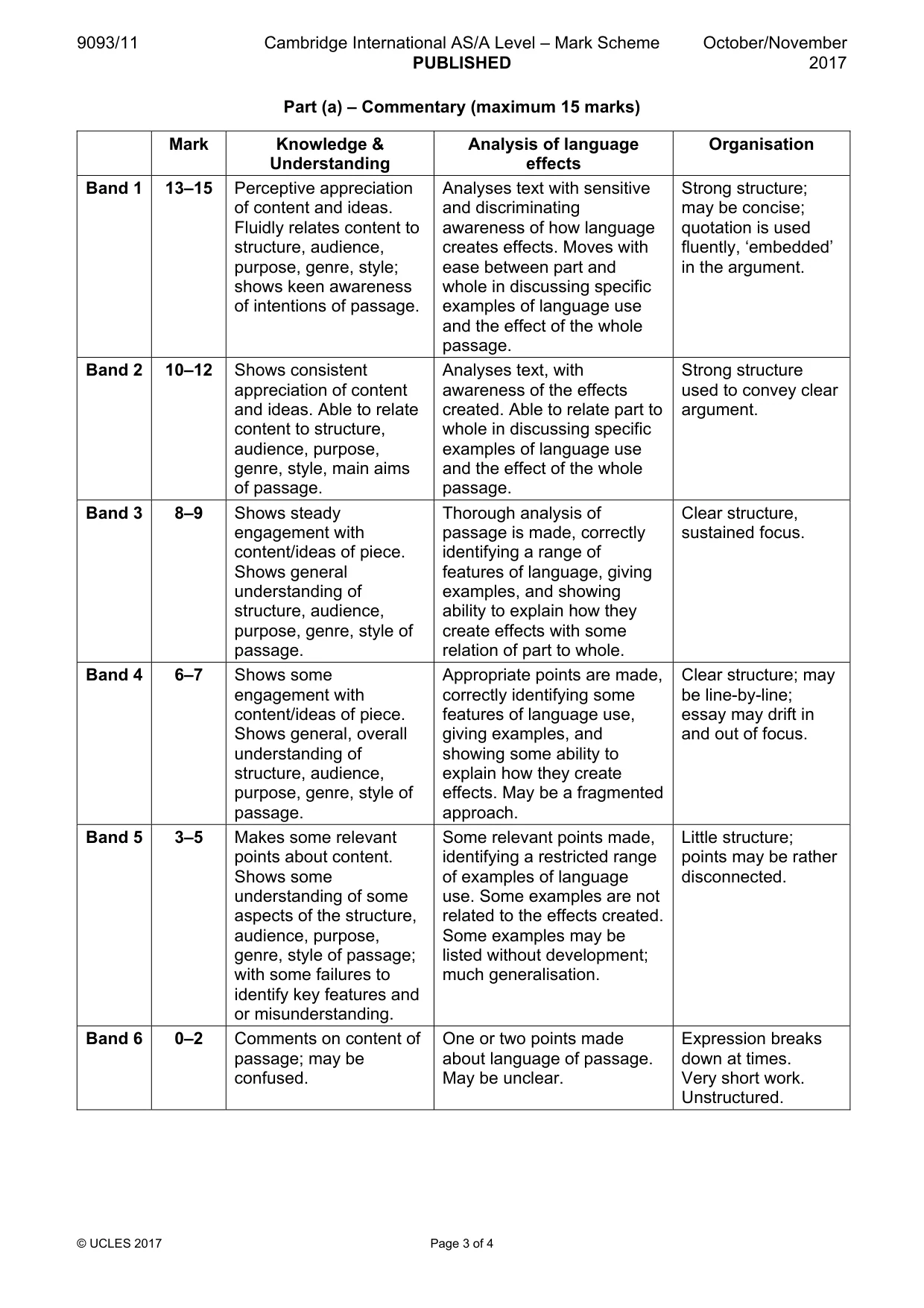
9093/11 Cambridge International AS/A Level – Mark Scheme PUBLISHED October/November 2017 © UCLES 2017 Page 3 of 4 Part (a) – Commentary (maximum 15 marks) Mark Knowledge & Understanding Analysis of language effects Organisation Band 1 13–15 Perceptive appreciation of content and ideas. Fluidly relates content to structure, audience, purpose, genre, style; shows keen awareness of intentions of passage. Analyses text with sensitive and discriminating awareness of how language creates effects. Moves with ease between part and whole in discussing specific examples of language use and the effect of the whole passage. Strong structure; may be concise; quotation is used fluently, ‘embedded’ in the argument. Band 2 10–12 Shows consistent appreciation of content and ideas. Able to relate content to structure, audience, purpose, genre, style, main aims of passage. Analyses text, with awareness of the effects created. Able to relate part to whole in discussing specific examples of language use and the effect of the whole passage. Strong structure used to convey clear argument. Band 3 8–9 Shows steady engagement with content/ideas of piece. Shows general understanding of structure, audience, purpose, genre, style of passage. Thorough analysis of passage is made, correctly identifying a range of features of language, giving examples, and showing ability to explain how they create effects with some relation of part to whole. Clear structure, sustained focus. Band 4 6–7 Shows some engagement with content/ideas of piece. Shows general, overall understanding of structure, audience, purpose, genre, style of passage. Appropriate points are made, correctly identifying some features of language use, giving examples, and showing some ability to explain how they create effects. May be a fragmented approach. Clear structure; may be line-by-line; essay may drift in and out of focus. Band 5 3–5 Makes some relevant points about content. Shows some understanding of some aspects of the structure, audience, purpose, genre, style of passage; with some failures to identify key features and or misunderstanding. Some relevant points made, identifying a restricted range of examples of language use. Some examples are not related to the effects created. Some examples may be listed without development; much generalisation. Little structure; points may be rather disconnected. Band 6 0–2 Comments on content of passage; may be confused. One or two points made about language of passage. May be unclear. Expression breaks down at times. Very short work. Unstructured.
Mark scheme, page 4
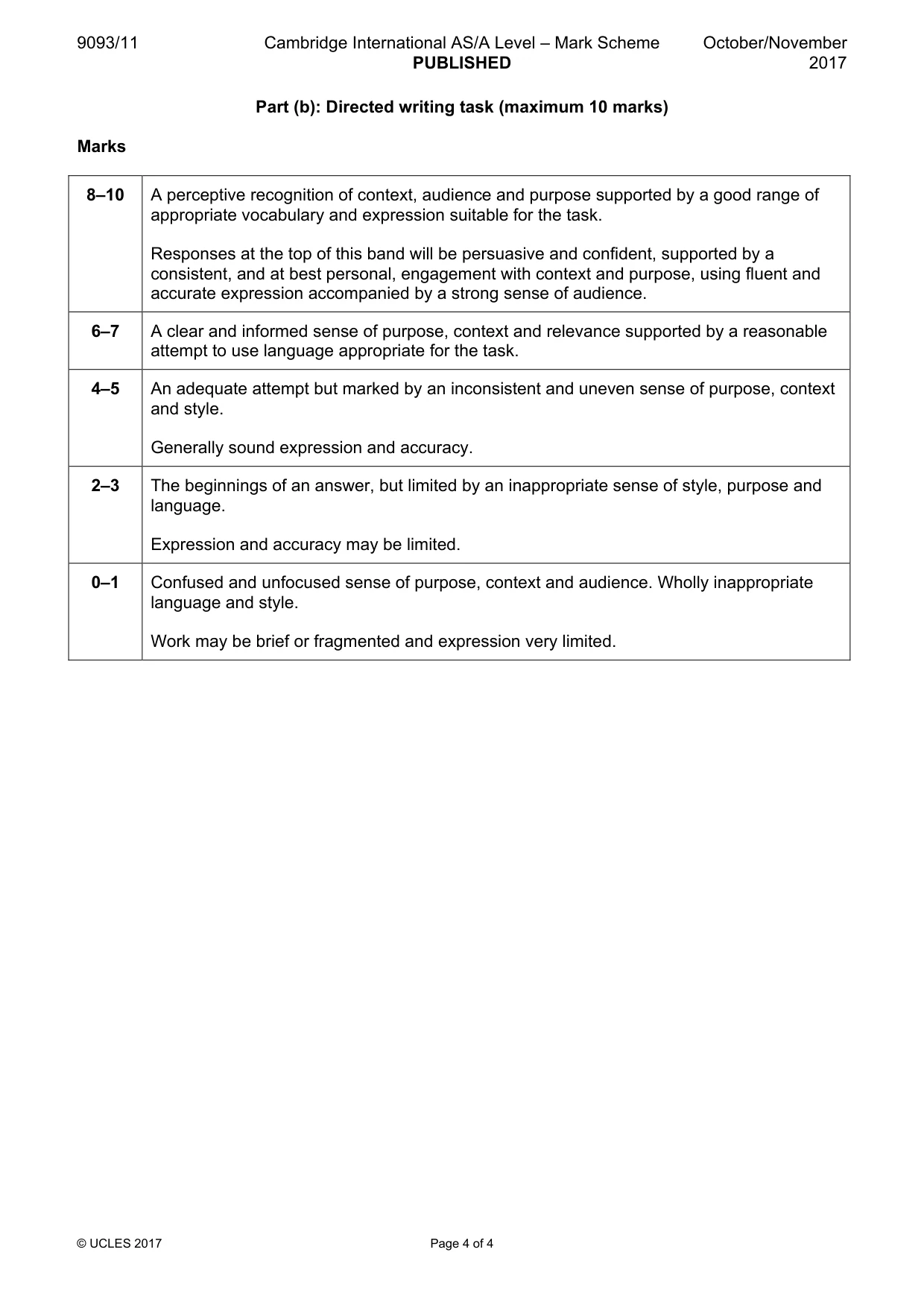
9093/11 Cambridge International AS/A Level – Mark Scheme PUBLISHED October/November 2017 © UCLES 2017 Page 4 of 4 Part (b): Directed writing task (maximum 10 marks) Marks 8–10 A perceptive recognition of context, audience and purpose supported by a good range of appropriate vocabulary and expression suitable for the task. Responses at the top of this band will be persuasive and confident, supported by a consistent, and at best personal, engagement with context and purpose, using fluent and accurate expression accompanied by a strong sense of audience. 6–7 A clear and informed sense of purpose, context and relevance supported by a reasonable attempt to use language appropriate for the task. 4–5 An adequate attempt but marked by an inconsistent and uneven sense of purpose, context and style. Generally sound expression and accuracy. 2–3 The beginnings of an answer, but limited by an inappropriate sense of style, purpose and language. Expression and accuracy may be limited. 0–1 Confused and unfocused sense of purpose, context and audience. Wholly inappropriate language and style. Work may be brief or fragmented and expression very limited.
What you needed in this session
Cambridge’s own grade thresholds for 2017 Oct/Nov, Paper 1 · Variant 1. A higher threshold means an easier paper — the bar moves with how the cohort did.