Cambridge A Level English - Language AS and A Level (from 2014) 9093 — 2017 May/June Paper 4 · Variant 2
9093/42/M/J/17 · 50 marks · ≈56 min
The question paper and its mark scheme, free to read here and free to download. This is Cambridge’s own paper, exactly as it was sat.
Question paper8 pages

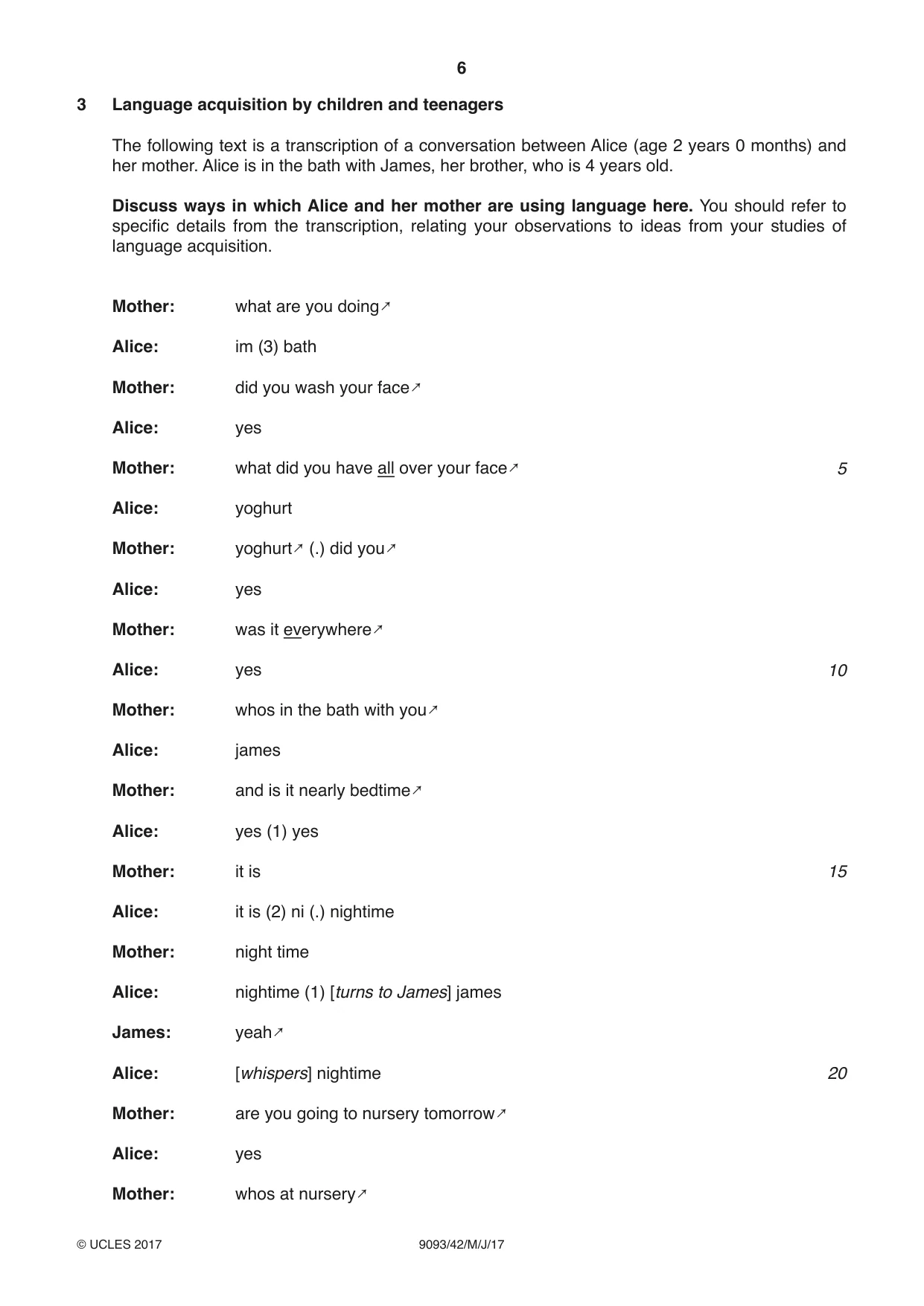
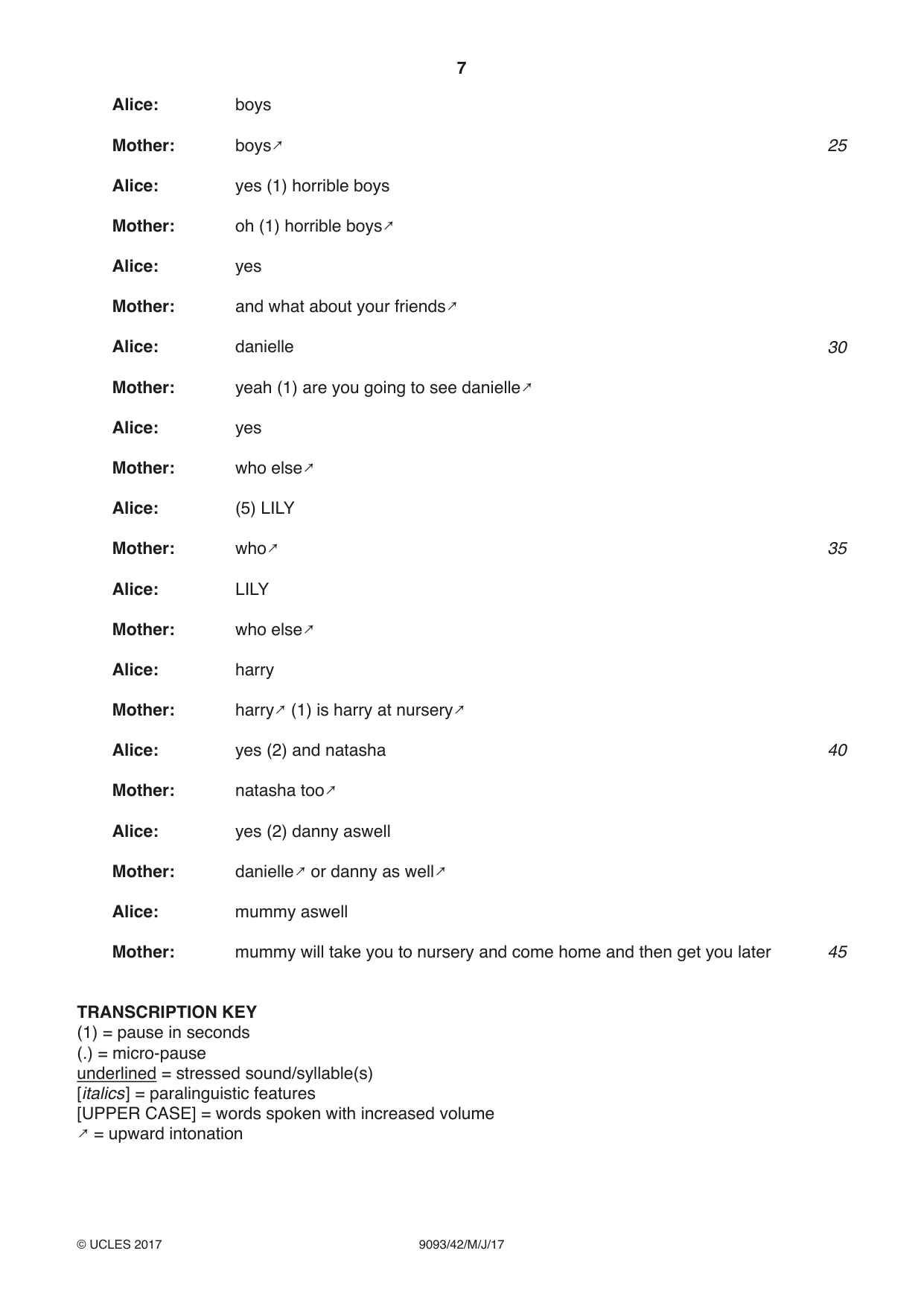

Mark scheme7 pages
Answers below. Sit the paper first if you are practising.
Paper as text
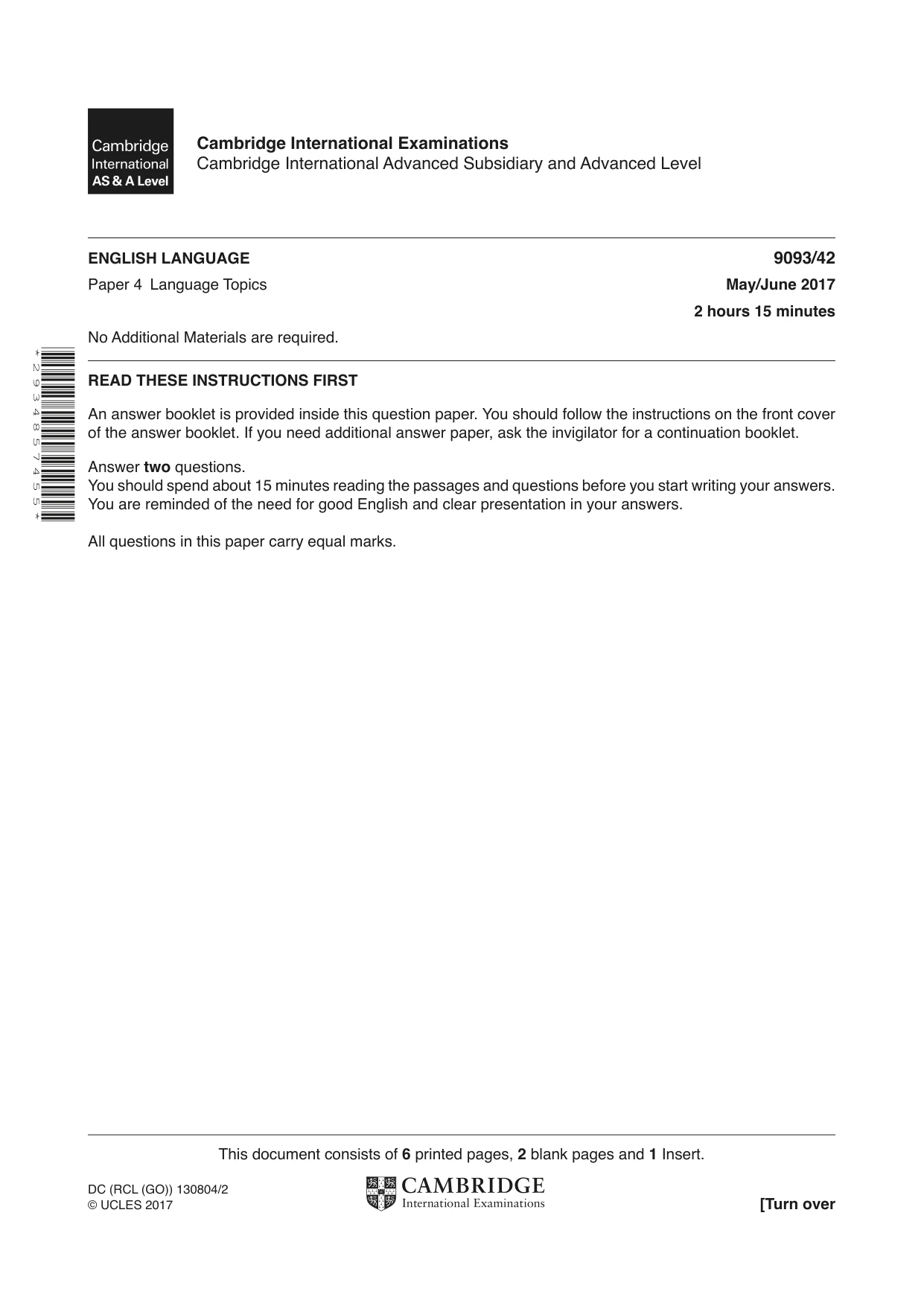
Question paper, page 1
This document consists of 6 printed pages, 2 blank pages and 1 Insert. DC (RCL (GO)) 130804/2 © UCLES 2017 [Turn over Cambridge International Examinations Cambridge International Advanced Subsidiary and Advanced Level * 2 9 3 4 8 5 7 4 5 5 * ENGLISH LANGUAGE 9093/42 Paper 4 Language Topics May/June 2017 2 hours 15 minutes No Additional Materials are required. READ THESE INSTRUCTIONS FIRST An answer booklet is provided inside this question paper. You should follow the instructions on the front cover of the answer booklet. If you need additional answer paper, ask the invigilator for a continuation booklet. Answer two questions. You should spend about 15 minutes reading the passages and questions before you start writing your answers. You are reminded of the need for good English and clear presentation in your answers. All questions in this paper carry equal marks.
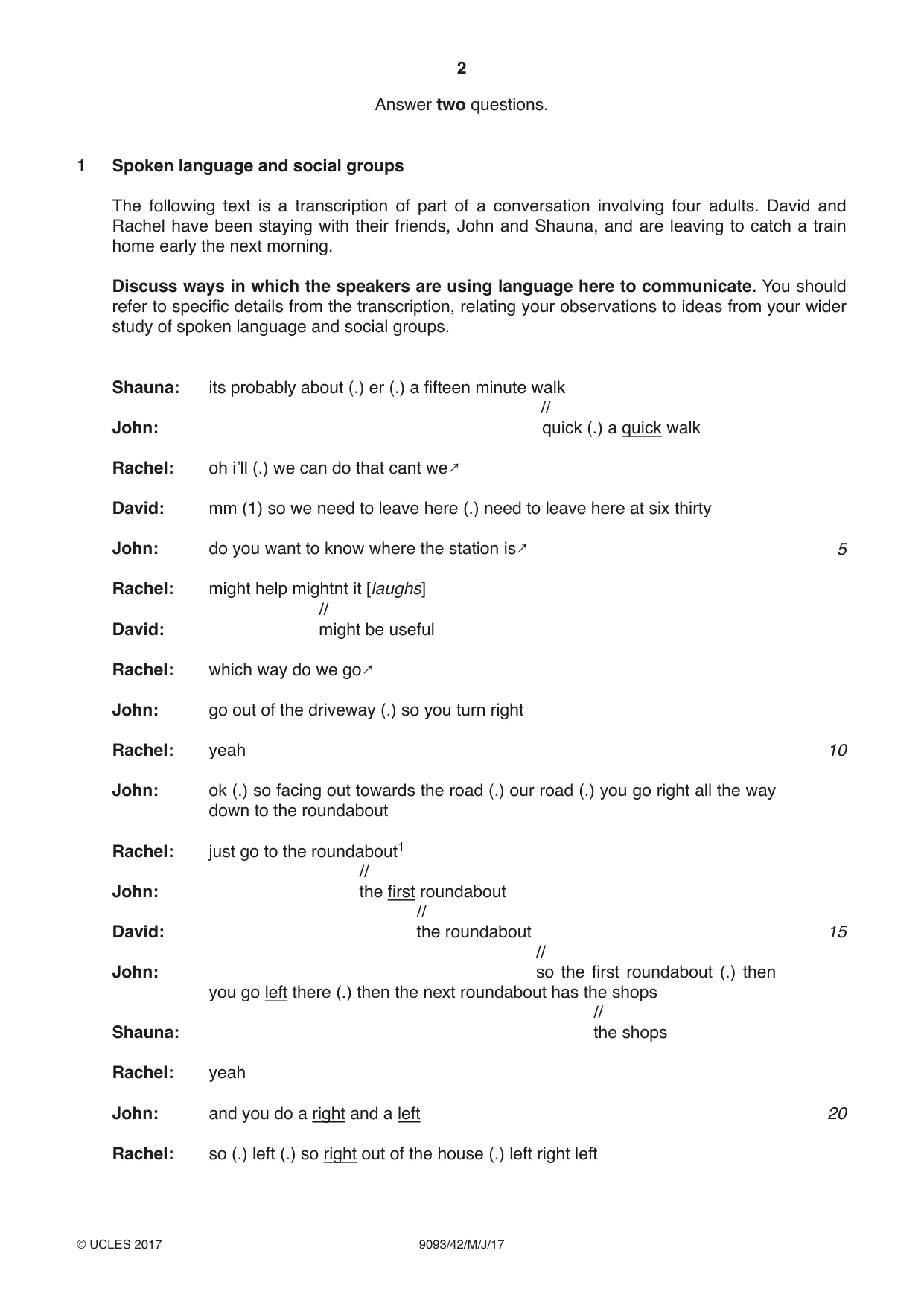
Question paper, page 2
2 9093/42/M/J/17 © UCLES 2017 Answer two questions. 1 Spoken language and social groups The following text is a transcription of part of a conversation involving four adults. David and Rachel have been staying with their friends, John and Shauna, and are leaving to catch a train home early the next morning. Discuss ways in which the speakers are using language here to communicate. You should refer to specific details from the transcription, relating your observations to ideas from your wider study of spoken language and social groups. Shauna: its probably about (.) er (.) a fifteen minute walk // John: quick (.) a quick walk Rachel: oh i’ll (.) we can do that cant we↗ David: mm (1) so we need to leave here (.) need to leave here at six thirty John: do you want to know where the station is↗ Rachel: might help mightnt it [laughs] // David: might be useful Rachel: which way do we go↗ John: go out of the driveway (.) so you turn right Rachel: yeah John: ok (.) so facing out towards the road (.) our road (.) you go right all the way down to the roundabout Rachel: just go to the roundabout1 // John: the first roundabout // David: the roundabout // John: so the first roundabout (.) then you go left there (.) then the next roundabout has the shops // Shauna: the shops Rachel: yeah John: and you do a right and a left Rachel: so (.) left (.) so right out of the house (.) left right left 5 10 15 20
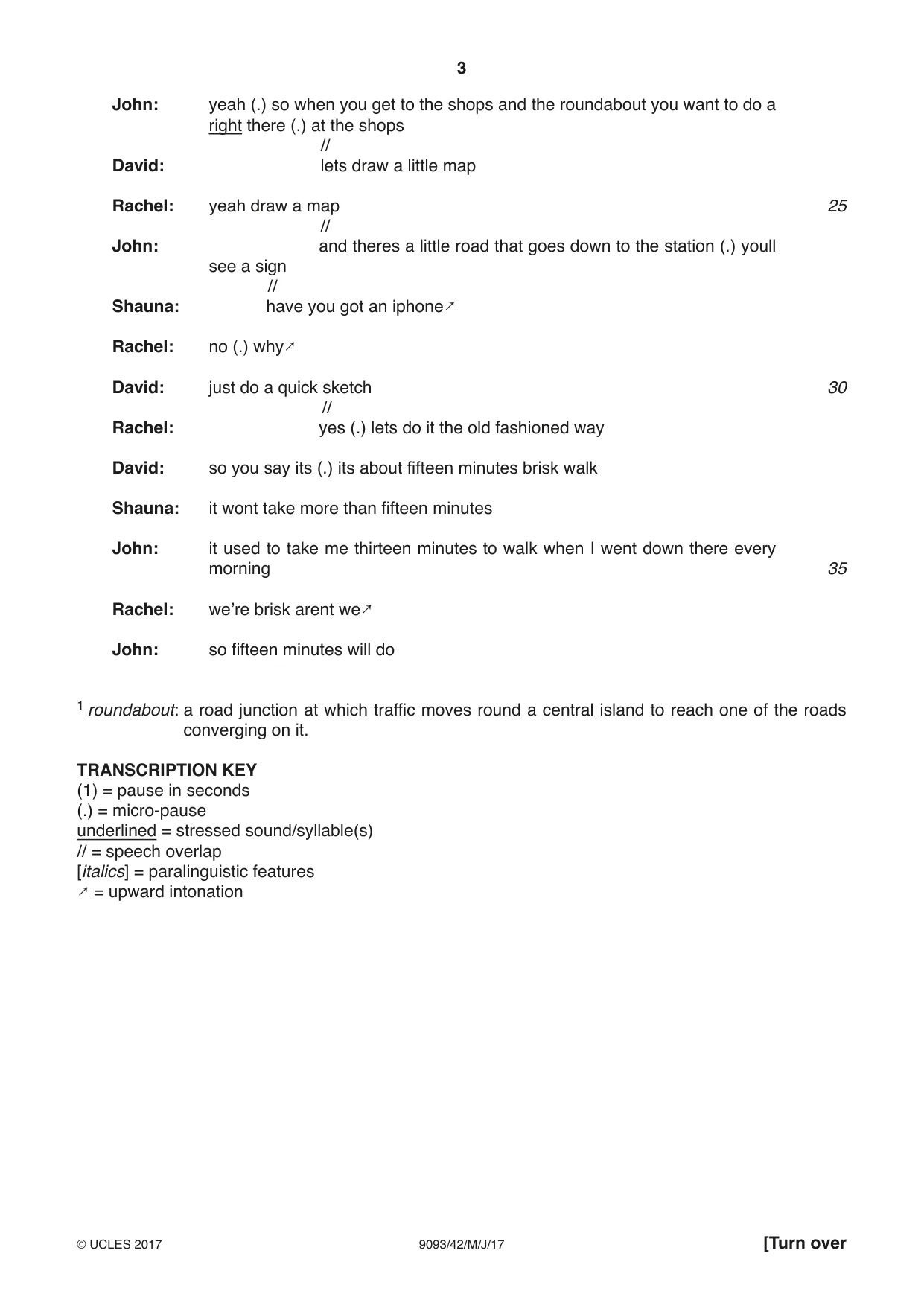
Question paper, page 3
3 9093/42/M/J/17 © UCLES 2017 [Turn over John: yeah (.) so when you get to the shops and the roundabout you want to do a right there (.) at the shops // David: lets draw a little map Rachel: yeah draw a map // John: and theres a little road that goes down to the station (.) youll see a sign // Shauna: have you got an iphone↗ Rachel: no (.) why↗ David: just do a quick sketch // Rachel: yes (.) lets do it the old fashioned way David: so you say its (.) its about fifteen minutes brisk walk Shauna: it wont take more than fifteen minutes John: it used to take me thirteen minutes to walk when I went down there every morning Rachel: we’re brisk arent we↗ John: so fifteen minutes will do 1 roundabout: a road junction at which traffic moves round a central island to reach one of the roads converging on it. TRANSCRIPTION KEY (1) = pause in seconds (.) = micro-pause underlined = stressed sound/syllable(s) // = speech overlap [italics] = paralinguistic features ↗ = upward intonation 25 30 35
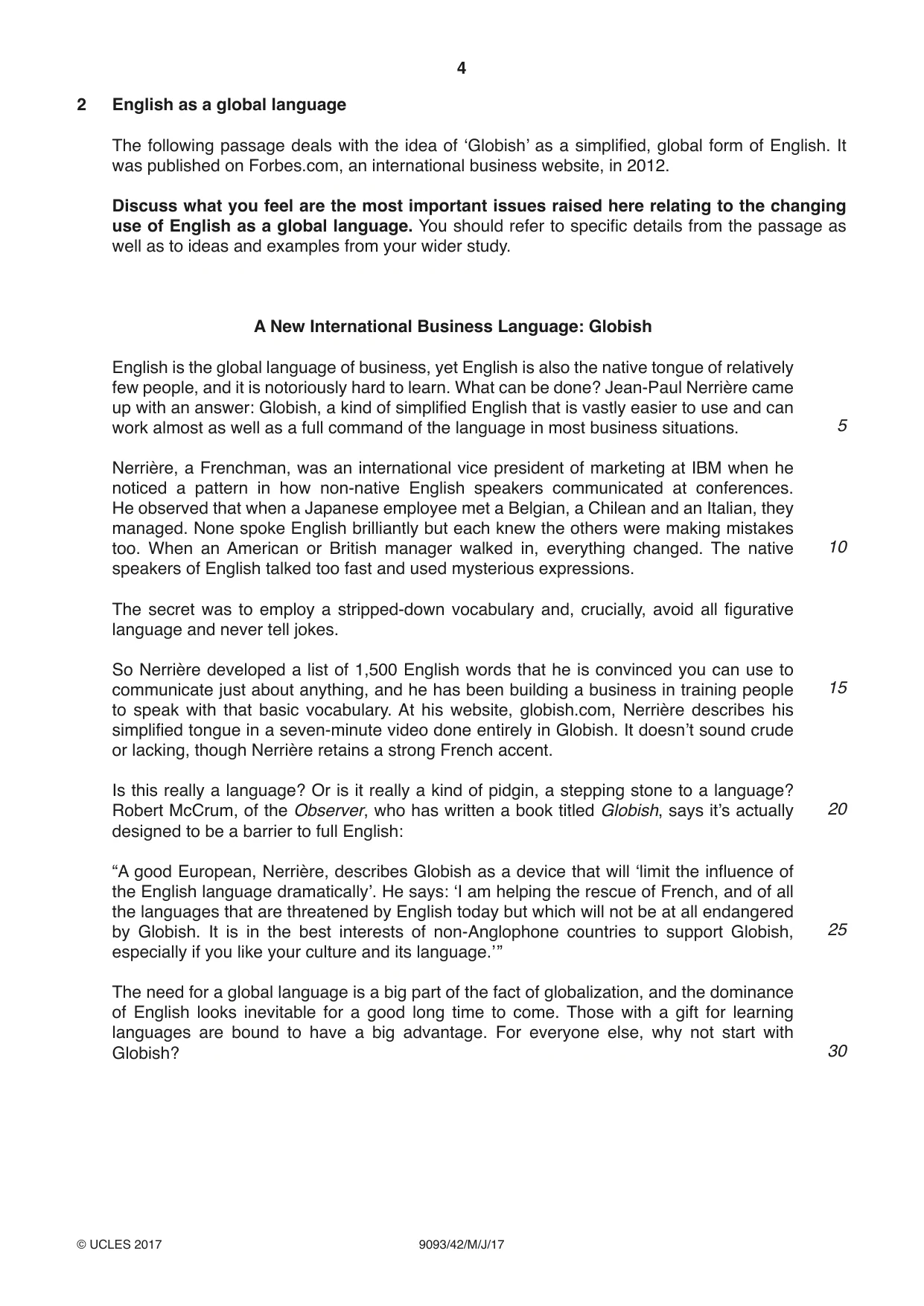
Question paper, page 4
4 9093/42/M/J/17 © UCLES 2017 2 English as a global language The following passage deals with the idea of ‘Globish’ as a simplified, global form of English. It was published on Forbes.com, an international business website, in 2012. Discuss what you feel are the most important issues raised here relating to the changing use of English as a global language. You should refer to specific details from the passage as well as to ideas and examples from your wider study. A New International Business Language: Globish English is the global language of business, yet English is also the native tongue of relatively few people, and it is notoriously hard to learn. What can be done? Jean-Paul Nerrière came up with an answer: Globish, a kind of simplified English that is vastly easier to use and can work almost as well as a full command of the language in most business situations. Nerrière, a Frenchman, was an international vice president of marketing at IBM when he noticed a pattern in how non-native English speakers communicated at conferences. He observed that when a Japanese employee met a Belgian, a Chilean and an Italian, they managed. None spoke English brilliantly but each knew the others were making mistakes too. When an American or British manager walked in, everything changed. The native speakers of English talked too fast and used mysterious expressions. The secret was to employ a stripped-down vocabulary and, crucially, avoid all figurative language and never tell jokes. So Nerrière developed a list of 1,500 English words that he is convinced you can use to communicate just about anything, and he has been building a business in training people to speak with that basic vocabulary. At his website, globish.com, Nerrière describes his simplified tongue in a seven-minute video done entirely in Globish. It doesn’t sound crude or lacking, though Nerrière retains a strong French accent. Is this really a language? Or is it really a kind of pidgin, a stepping stone to a language? Robert McCrum, of the Observer, who has written a book titled Globish, says it’s actually designed to be a barrier to full English: “A good European, Nerrière, describes Globish as a device that will ‘limit the influence of the English language dramatically’. He says: ‘I am helping the rescue of French, and of all the languages that are threatened by English today but which will not be at all endangered by Globish. It is in the best interests of non-Anglophone countries to support Globish, especially if you like your culture and its language.’ ” The need for a global language is a big part of the fact of globalization, and the dominance of English looks inevitable for a good long time to come. Those with a gift for learning languages are bound to have a big advantage. For everyone else, why not start with Globish? 5 10 15 20 25 30
Question paper, page 5
5 9093/42/M/J/17 © UCLES 2017 [Turn over BLANK PAGE
Question paper, page 6
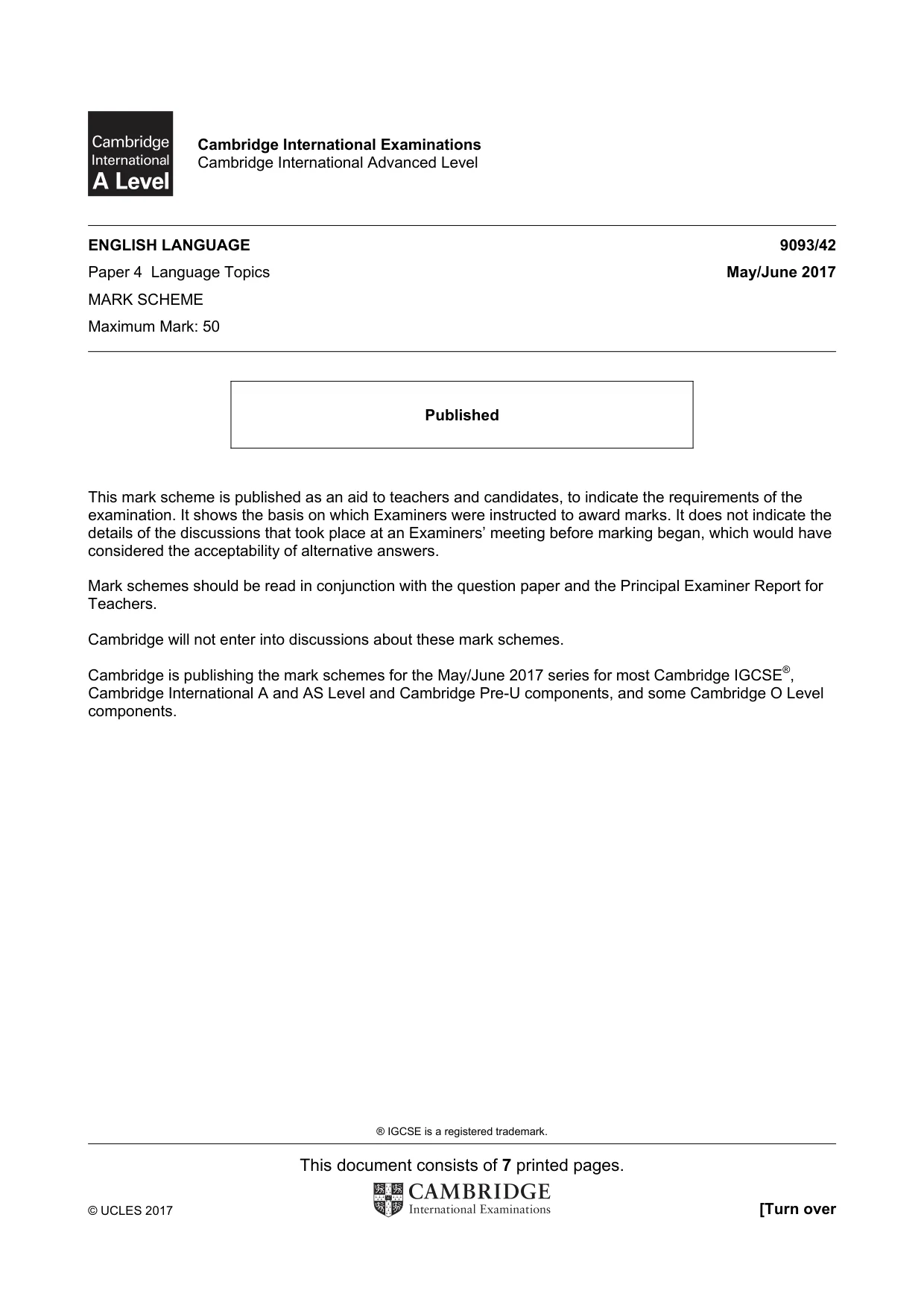
6 9093/42/M/J/17 © UCLES 2017 3 Language acquisition by children and teenagers The following text is a transcription of a conversation between Alice (age 2 years 0 months) and her mother. Alice is in the bath with James, her brother, who is 4 years old. Discuss ways in which Alice and her mother are using language here. You should refer to specific details from the transcription, relating your observations to ideas from your studies of language acquisition. Mother: what are you doing↗ Alice: im (3) bath Mother: did you wash your face↗ Alice: yes Mother: what did you have all over your face↗ Alice: yoghurt Mother: yoghurt↗ (.) did you↗ Alice: yes Mother: was it everywhere↗ Alice: yes Mother: whos in the bath with you↗ Alice: james Mother: and is it nearly bedtime↗ Alice: yes (1) yes Mother: it is Alice: it is (2) ni (.) nightime Mother: night time Alice: nightime (1) [turns to James] james James: yeah↗ Alice: [whispers] nightime Mother: are you going to nursery tomorrow↗ Alice: yes Mother: whos at nursery↗ 5 10 15 20
Question paper, page 7
7 9093/42/M/J/17 © UCLES 2017 Alice: boys Mother: boys↗ Alice: yes (1) horrible boys Mother: oh (1) horrible boys↗ Alice: yes Mother: and what about your friends↗ Alice: danielle Mother: yeah (1) are you going to see danielle↗ Alice: yes Mother: who else↗ Alice: (5) LILY Mother: who↗ Alice: LILY Mother: who else↗ Alice: harry Mother: harry↗ (1) is harry at nursery↗ Alice: yes (2) and natasha Mother: natasha too↗ Alice: yes (2) danny aswell Mother: danielle↗ or danny as well↗ Alice: mummy aswell Mother: mummy will take you to nursery and come home and then get you later TRANSCRIPTION KEY (1) = pause in seconds (.) = micro-pause underlined = stressed sound/syllable(s) [italics ] = paralinguistic features [UPPER CASE] = words spoken with increased volume ↗ = upward intonation 25 30 35 40 45
Question paper, page 8
8 9093/42/M/J/17 © UCLES 2017 BLANK PAGE Permission to reproduce items where third-party owned material protected by copyright is included has been sought and cleared where possible. Every reasonable effort has been made by the publisher (UCLES) to trace copyright holders, but if any items requiring clearance have unwittingly been included, the publisher will be pleased to make amends at the earliest possible opportunity. To avoid the issue of disclosure of answer-related information to candidates, all copyright acknowledgements are reproduced online in the Cambridge International Examinations Copyright Acknowledgements Booklet. This is produced for each series of examinations and is freely available to download at www.cie.org.uk after the live examination series. Cambridge International Examinations is part of the Cambridge Assessment Group. Cambridge Assessment is the brand name of University of Cambridge Local Examinations Syndicate (UCLES), which is itself a department of the University of Cambridge.
Mark scheme, page 1
® IGCSE is a registered trademark. This document consists of 7 printed pages. © UCLES 2017 [Turn over Cambridge International Examinations Cambridge International Advanced Level ENGLISH LANGUAGE 9093/42 Paper 4 Language Topics May/June 2017 MARK SCHEME Maximum Mark: 50 Published This mark scheme is published as an aid to teachers and candidates, to indicate the requirements of the examination. It shows the basis on which Examiners were instructed to award marks. It does not indicate the details of the discussions that took place at an Examiners’ meeting before marking began, which would have considered the acceptability of alternative answers. Mark schemes should be read in conjunction with the question paper and the Principal Examiner Report for Teachers. Cambridge will not enter into discussions about these mark schemes. Cambridge is publishing the mark schemes for the May/June 2017 series for most Cambridge IGCSE®, Cambridge International A and AS Level and Cambridge Pre-U components, and some Cambridge O Level components.
Mark scheme, page 2
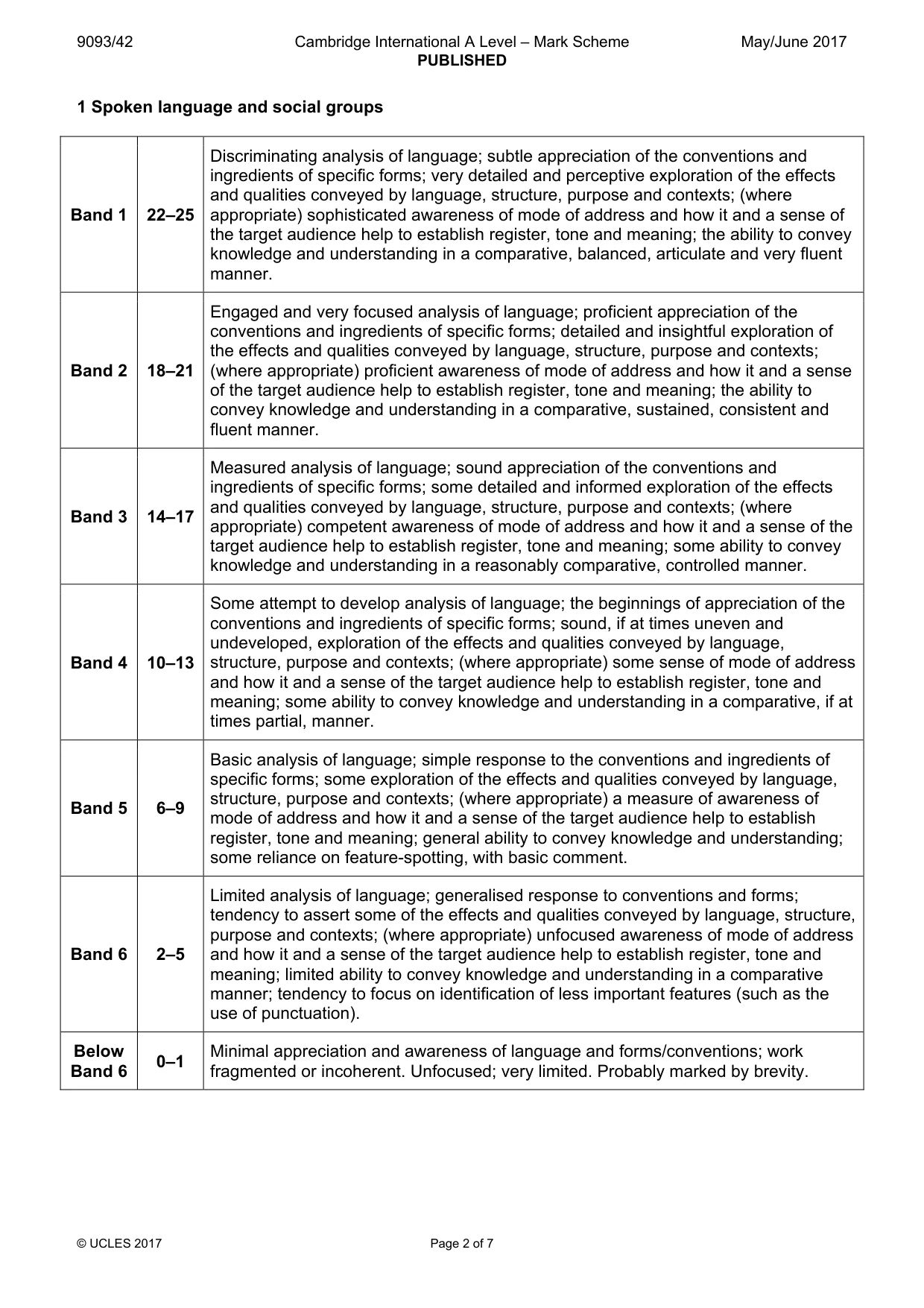
9093/42 Cambridge International A Level – Mark Scheme PUBLISHED May/June 2017 © UCLES 2017 Page 2 of 7 1 Spoken language and social groups Band 1 22–25 Discriminating analysis of language; subtle appreciation of the conventions and ingredients of specific forms; very detailed and perceptive exploration of the effects and qualities conveyed by language, structure, purpose and contexts; (where appropriate) sophisticated awareness of mode of address and how it and a sense of the target audience help to establish register, tone and meaning; the ability to convey knowledge and understanding in a comparative, balanced, articulate and very fluent manner. Band 2 18–21 Engaged and very focused analysis of language; proficient appreciation of the conventions and ingredients of specific forms; detailed and insightful exploration of the effects and qualities conveyed by language, structure, purpose and contexts; (where appropriate) proficient awareness of mode of address and how it and a sense of the target audience help to establish register, tone and meaning; the ability to convey knowledge and understanding in a comparative, sustained, consistent and fluent manner. Band 3 14–17 Measured analysis of language; sound appreciation of the conventions and ingredients of specific forms; some detailed and informed exploration of the effects and qualities conveyed by language, structure, purpose and contexts; (where appropriate) competent awareness of mode of address and how it and a sense of the target audience help to establish register, tone and meaning; some ability to convey knowledge and understanding in a reasonably comparative, controlled manner. Band 4 10–13 Some attempt to develop analysis of language; the beginnings of appreciation of the conventions and ingredients of specific forms; sound, if at times uneven and undeveloped, exploration of the effects and qualities conveyed by language, structure, purpose and contexts; (where appropriate) some sense of mode of address and how it and a sense of the target audience help to establish register, tone and meaning; some ability to convey knowledge and understanding in a comparative, if at times partial, manner. Band 5 6–9 Basic analysis of language; simple response to the conventions and ingredients of specific forms; some exploration of the effects and qualities conveyed by language, structure, purpose and contexts; (where appropriate) a measure of awareness of mode of address and how it and a sense of the target audience help to establish register, tone and meaning; general ability to convey knowledge and understanding; some reliance on feature-spotting, with basic comment. Band 6 2–5 Limited analysis of language; generalised response to conventions and forms; tendency to assert some of the effects and qualities conveyed by language, structure, purpose and contexts; (where appropriate) unfocused awareness of mode of address and how it and a sense of the target audience help to establish register, tone and meaning; limited ability to convey knowledge and understanding in a comparative manner; tendency to focus on identification of less important features (such as the use of punctuation). Below Band 6 0–1 Minimal appreciation and awareness of language and forms/conventions; work fragmented or incoherent. Unfocused; very limited. Probably marked by brevity.
Mark scheme, page 3
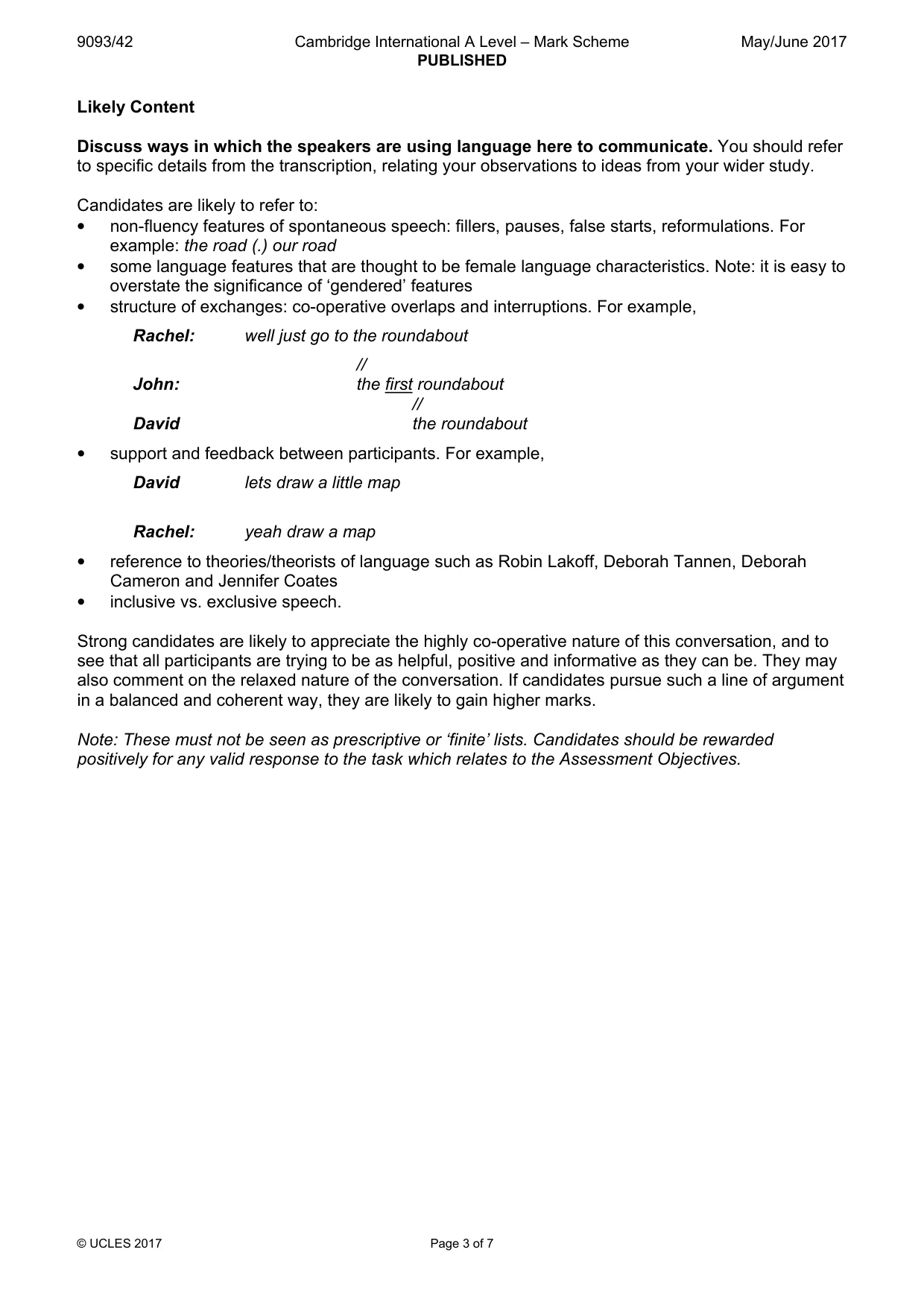
9093/42 Cambridge International A Level – Mark Scheme PUBLISHED May/June 2017 © UCLES 2017 Page 3 of 7 Likely Content Discuss ways in which the speakers are using language here to communicate. You should refer to specific details from the transcription, relating your observations to ideas from your wider study. Candidates are likely to refer to: • non-fluency features of spontaneous speech: fillers, pauses, false starts, reformulations. For example: the road (.) our road • some language features that are thought to be female language characteristics. Note: it is easy to overstate the significance of ‘gendered’ features • structure of exchanges: co-operative overlaps and interruptions. For example, Rachel: well just go to the roundabout // John: the first roundabout // David the roundabout • support and feedback between participants. For example, David lets draw a little map Rachel: yeah draw a map • reference to theories/theorists of language such as Robin Lakoff, Deborah Tannen, Deborah Cameron and Jennifer Coates • inclusive vs. exclusive speech. Strong candidates are likely to appreciate the highly co-operative nature of this conversation, and to see that all participants are trying to be as helpful, positive and informative as they can be. They may also comment on the relaxed nature of the conversation. If candidates pursue such a line of argument in a balanced and coherent way, they are likely to gain higher marks. Note: These must not be seen as prescriptive or ‘finite’ lists. Candidates should be rewarded positively for any valid response to the task which relates to the Assessment Objectives.
Mark scheme, page 4
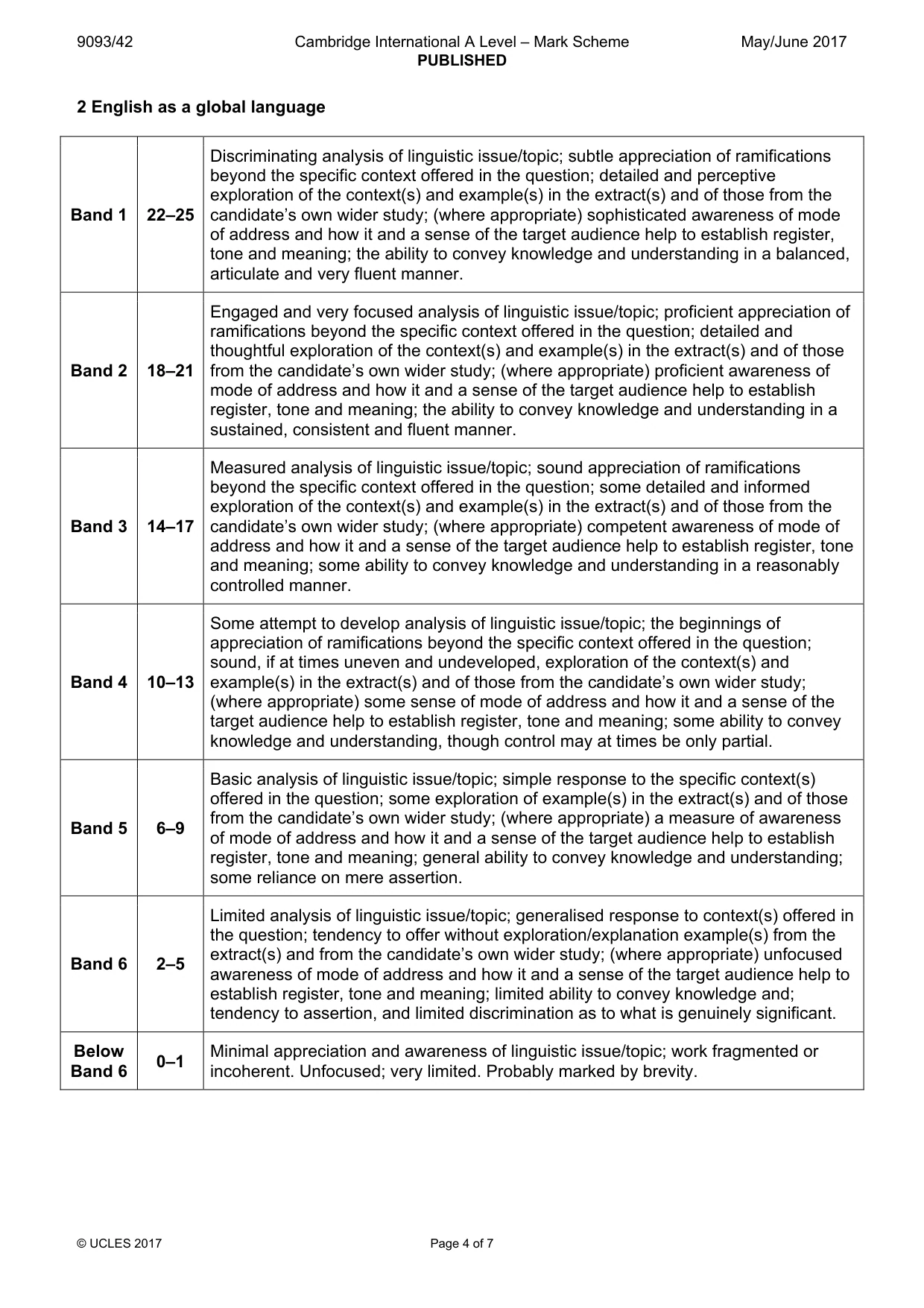
9093/42 Cambridge International A Level – Mark Scheme PUBLISHED May/June 2017 © UCLES 2017 Page 4 of 7 2 English as a global language Band 1 22–25 Discriminating analysis of linguistic issue/topic; subtle appreciation of ramifications beyond the specific context offered in the question; detailed and perceptive exploration of the context(s) and example(s) in the extract(s) and of those from the candidate’s own wider study; (where appropriate) sophisticated awareness of mode of address and how it and a sense of the target audience help to establish register, tone and meaning; the ability to convey knowledge and understanding in a balanced, articulate and very fluent manner. Band 2 18–21 Engaged and very focused analysis of linguistic issue/topic; proficient appreciation of ramifications beyond the specific context offered in the question; detailed and thoughtful exploration of the context(s) and example(s) in the extract(s) and of those from the candidate’s own wider study; (where appropriate) proficient awareness of mode of address and how it and a sense of the target audience help to establish register, tone and meaning; the ability to convey knowledge and understanding in a sustained, consistent and fluent manner. Band 3 14–17 Measured analysis of linguistic issue/topic; sound appreciation of ramifications beyond the specific context offered in the question; some detailed and informed exploration of the context(s) and example(s) in the extract(s) and of those from the candidate’s own wider study; (where appropriate) competent awareness of mode of address and how it and a sense of the target audience help to establish register, tone and meaning; some ability to convey knowledge and understanding in a reasonably controlled manner. Band 4 10–13 Some attempt to develop analysis of linguistic issue/topic; the beginnings of appreciation of ramifications beyond the specific context offered in the question; sound, if at times uneven and undeveloped, exploration of the context(s) and example(s) in the extract(s) and of those from the candidate’s own wider study; (where appropriate) some sense of mode of address and how it and a sense of the target audience help to establish register, tone and meaning; some ability to convey knowledge and understanding, though control may at times be only partial. Band 5 6–9 Basic analysis of linguistic issue/topic; simple response to the specific context(s) offered in the question; some exploration of example(s) in the extract(s) and of those from the candidate’s own wider study; (where appropriate) a measure of awareness of mode of address and how it and a sense of the target audience help to establish register, tone and meaning; general ability to convey knowledge and understanding; some reliance on mere assertion. Band 6 2–5 Limited analysis of linguistic issue/topic; generalised response to context(s) offered in the question; tendency to offer without exploration/explanation example(s) from the extract(s) and from the candidate’s own wider study; (where appropriate) unfocused awareness of mode of address and how it and a sense of the target audience help to establish register, tone and meaning; limited ability to convey knowledge and; tendency to assertion, and limited discrimination as to what is genuinely significant. Below Band 6 0–1 Minimal appreciation and awareness of linguistic issue/topic; work fragmented or incoherent. Unfocused; very limited. Probably marked by brevity.
Mark scheme, page 5
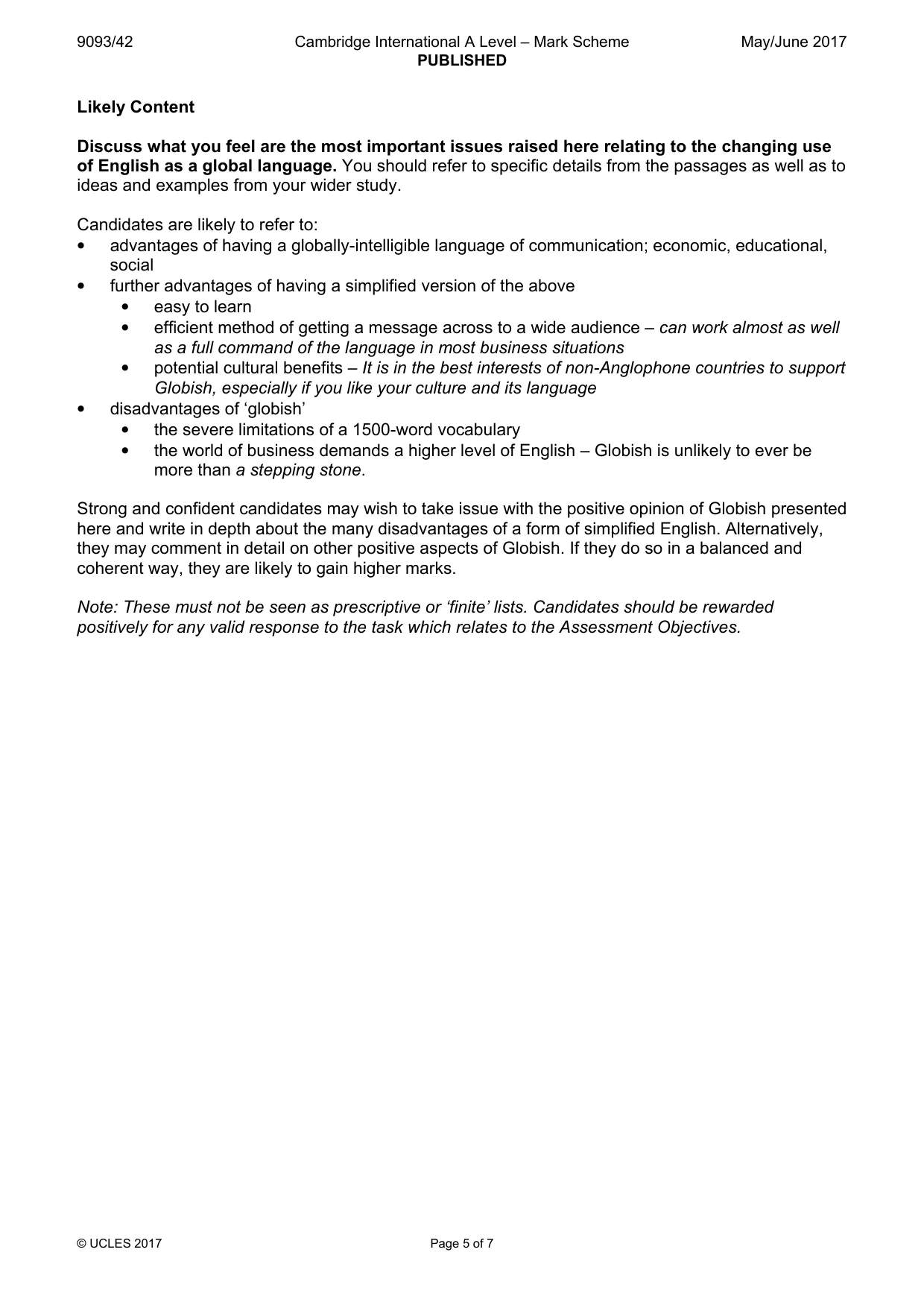
9093/42 Cambridge International A Level – Mark Scheme PUBLISHED May/June 2017 © UCLES 2017 Page 5 of 7 Likely Content Discuss what you feel are the most important issues raised here relating to the changing use of English as a global language. You should refer to specific details from the passages as well as to ideas and examples from your wider study. Candidates are likely to refer to: • advantages of having a globally-intelligible language of communication; economic, educational, social • further advantages of having a simplified version of the above • easy to learn • efficient method of getting a message across to a wide audience – can work almost as well as a full command of the language in most business situations • potential cultural benefits – It is in the best interests of non-Anglophone countries to support Globish, especially if you like your culture and its language • disadvantages of ‘globish’ • the severe limitations of a 1500-word vocabulary • the world of business demands a higher level of English – Globish is unlikely to ever be more than a stepping stone. Strong and confident candidates may wish to take issue with the positive opinion of Globish presented here and write in depth about the many disadvantages of a form of simplified English. Alternatively, they may comment in detail on other positive aspects of Globish. If they do so in a balanced and coherent way, they are likely to gain higher marks. Note: These must not be seen as prescriptive or ‘finite’ lists. Candidates should be rewarded positively for any valid response to the task which relates to the Assessment Objectives.
Mark scheme, page 6
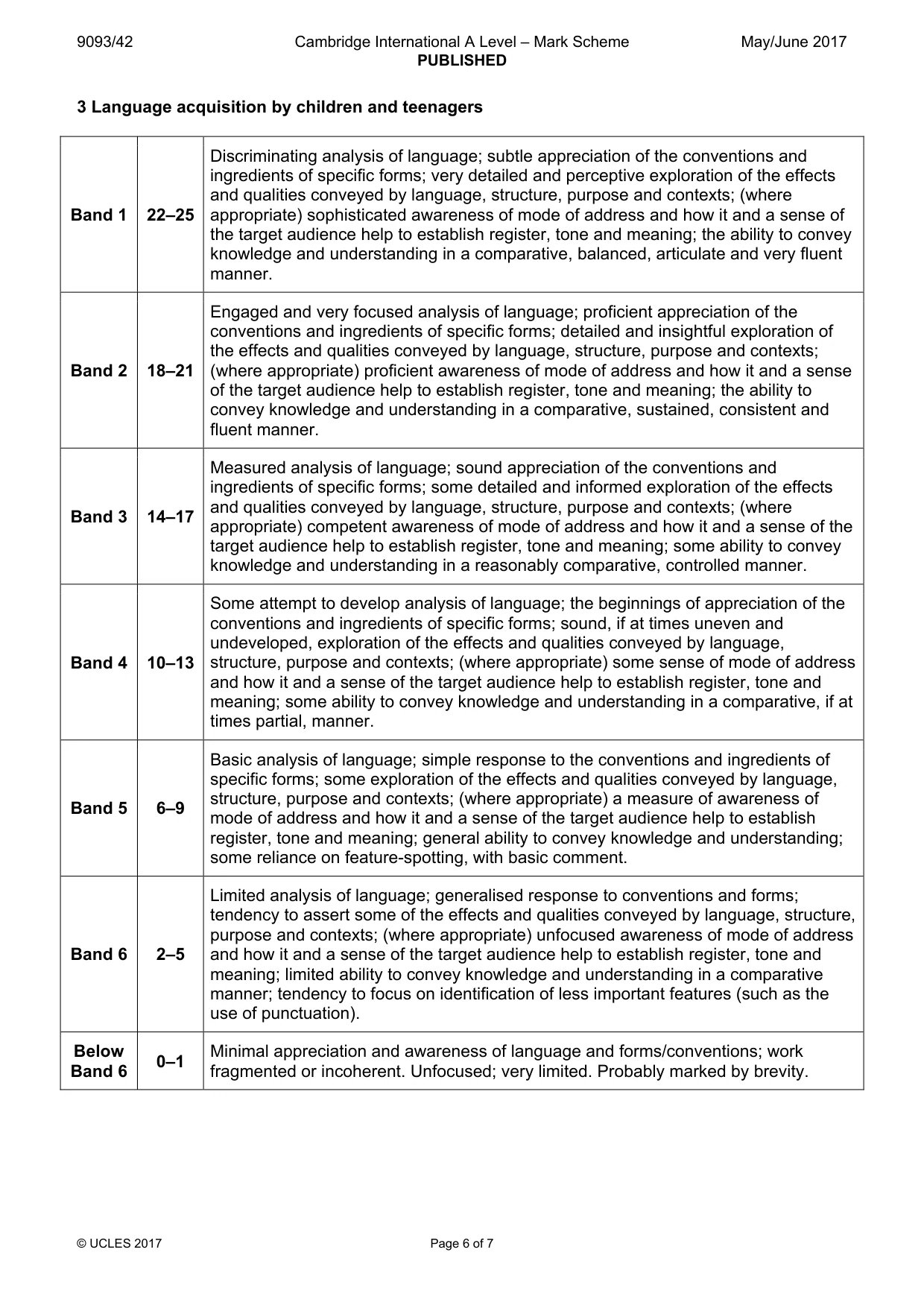
9093/42 Cambridge International A Level – Mark Scheme PUBLISHED May/June 2017 © UCLES 2017 Page 6 of 7 3 Language acquisition by children and teenagers Band 1 22–25 Discriminating analysis of language; subtle appreciation of the conventions and ingredients of specific forms; very detailed and perceptive exploration of the effects and qualities conveyed by language, structure, purpose and contexts; (where appropriate) sophisticated awareness of mode of address and how it and a sense of the target audience help to establish register, tone and meaning; the ability to convey knowledge and understanding in a comparative, balanced, articulate and very fluent manner. Band 2 18–21 Engaged and very focused analysis of language; proficient appreciation of the conventions and ingredients of specific forms; detailed and insightful exploration of the effects and qualities conveyed by language, structure, purpose and contexts; (where appropriate) proficient awareness of mode of address and how it and a sense of the target audience help to establish register, tone and meaning; the ability to convey knowledge and understanding in a comparative, sustained, consistent and fluent manner. Band 3 14–17 Measured analysis of language; sound appreciation of the conventions and ingredients of specific forms; some detailed and informed exploration of the effects and qualities conveyed by language, structure, purpose and contexts; (where appropriate) competent awareness of mode of address and how it and a sense of the target audience help to establish register, tone and meaning; some ability to convey knowledge and understanding in a reasonably comparative, controlled manner. Band 4 10–13 Some attempt to develop analysis of language; the beginnings of appreciation of the conventions and ingredients of specific forms; sound, if at times uneven and undeveloped, exploration of the effects and qualities conveyed by language, structure, purpose and contexts; (where appropriate) some sense of mode of address and how it and a sense of the target audience help to establish register, tone and meaning; some ability to convey knowledge and understanding in a comparative, if at times partial, manner. Band 5 6–9 Basic analysis of language; simple response to the conventions and ingredients of specific forms; some exploration of the effects and qualities conveyed by language, structure, purpose and contexts; (where appropriate) a measure of awareness of mode of address and how it and a sense of the target audience help to establish register, tone and meaning; general ability to convey knowledge and understanding; some reliance on feature-spotting, with basic comment. Band 6 2–5 Limited analysis of language; generalised response to conventions and forms; tendency to assert some of the effects and qualities conveyed by language, structure, purpose and contexts; (where appropriate) unfocused awareness of mode of address and how it and a sense of the target audience help to establish register, tone and meaning; limited ability to convey knowledge and understanding in a comparative manner; tendency to focus on identification of less important features (such as the use of punctuation). Below Band 6 0–1 Minimal appreciation and awareness of language and forms/conventions; work fragmented or incoherent. Unfocused; very limited. Probably marked by brevity.
Mark scheme, page 7
9093/42 Cambridge International A Level – Mark Scheme PUBLISHED May/June 2017 © UCLES 2017 Page 7 of 7 Likely Content Discuss ways in which Alice and her mother are using language here. You should refer to specific details from the transcriptions, relating your observations to ideas from your studies of language acquisition. Candidates are likely to refer to: • child-directed speech, e.g. the mother’s use of a range of question types to elicit response • other uses of “caretaker” speech • theorists and theories, such as Skinner (Behaviourism/reinforcement), Chomsky (language acquisition device), Piaget (cognitive development), Vygotsky, Bruner et al. • Alice’s developmental stage and linguistic competence – there are examples of simple holophrastic speech (nightime ) and telegraphic speech (im (3) bath, horrible boys) but also more complex structures (it is (2) ni (.) nightime) • Alice’s compound words – nightime, aswell • evidence of at least three of Halliday’s functions of language: Personal – horrible boys: Representational – im (3) bath: Interactional – james • topic management and agenda-setting • turn-taking in conversation; no evident interruption or overlap. Note: These must not be seen as prescriptive or ‘finite’ lists. Candidates should be rewarded positively for any valid response to the task which relates to the Assessment Objectives.
What you needed in this session
Cambridge’s own grade thresholds for 2017 May/June, Paper 4 · Variant 2. A higher threshold means an easier paper — the bar moves with how the cohort did.