Cambridge A Level English - Language AS and A Level (from 2014) 9093 — 2017 Feb/March Paper 4 · Variant 2
9093/42/F/M/17 · 50 marks · ≈56 min
The question paper and its mark scheme, free to read here and free to download. This is Cambridge’s own paper, exactly as it was sat.
Question paper8 pages


Mark scheme7 pages
Answers below. Sit the paper first if you are practising.
Paper as text
Question paper, page 1
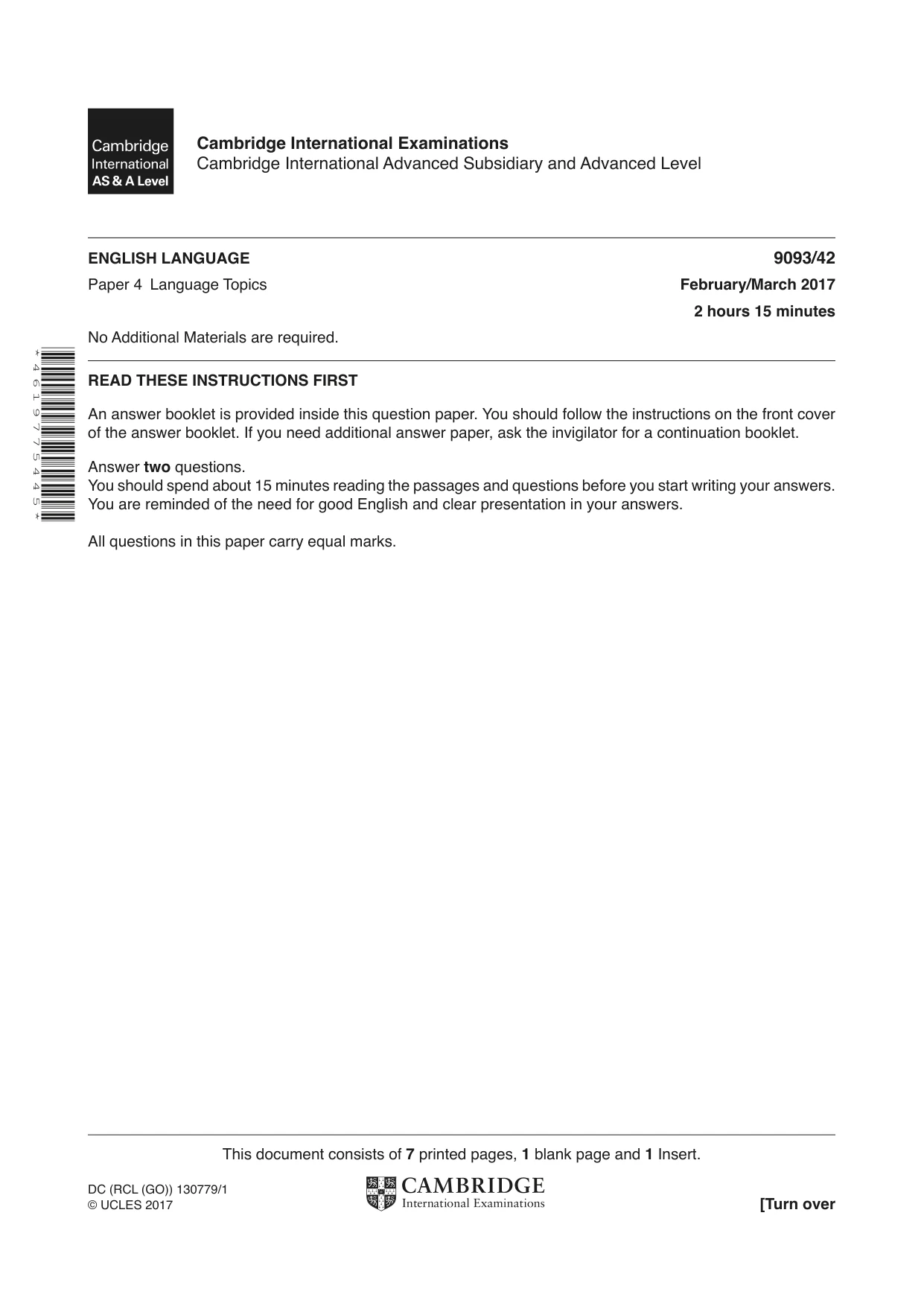
This document consists of 7 printed pages, 1 blank page and 1 Insert. DC (RCL (GO)) 130779/1 © UCLES 2017 [Turn over Cambridge International Examinations Cambridge International Advanced Subsidiary and Advanced Level * 4 6 1 9 7 7 5 4 4 5 * ENGLISH LANGUAGE 9093/42 Paper 4 Language Topics February/March 2017 2 hours 15 minutes No Additional Materials are required. READ THESE INSTRUCTIONS FIRST An answer booklet is provided inside this question paper. You should follow the instructions on the front cover of the answer booklet. If you need additional answer paper, ask the invigilator for a continuation booklet. Answer two questions. You should spend about 15 minutes reading the passages and questions before you start writing your answers. You are reminded of the need for good English and clear presentation in your answers. All questions in this paper carry equal marks.
Question paper, page 2
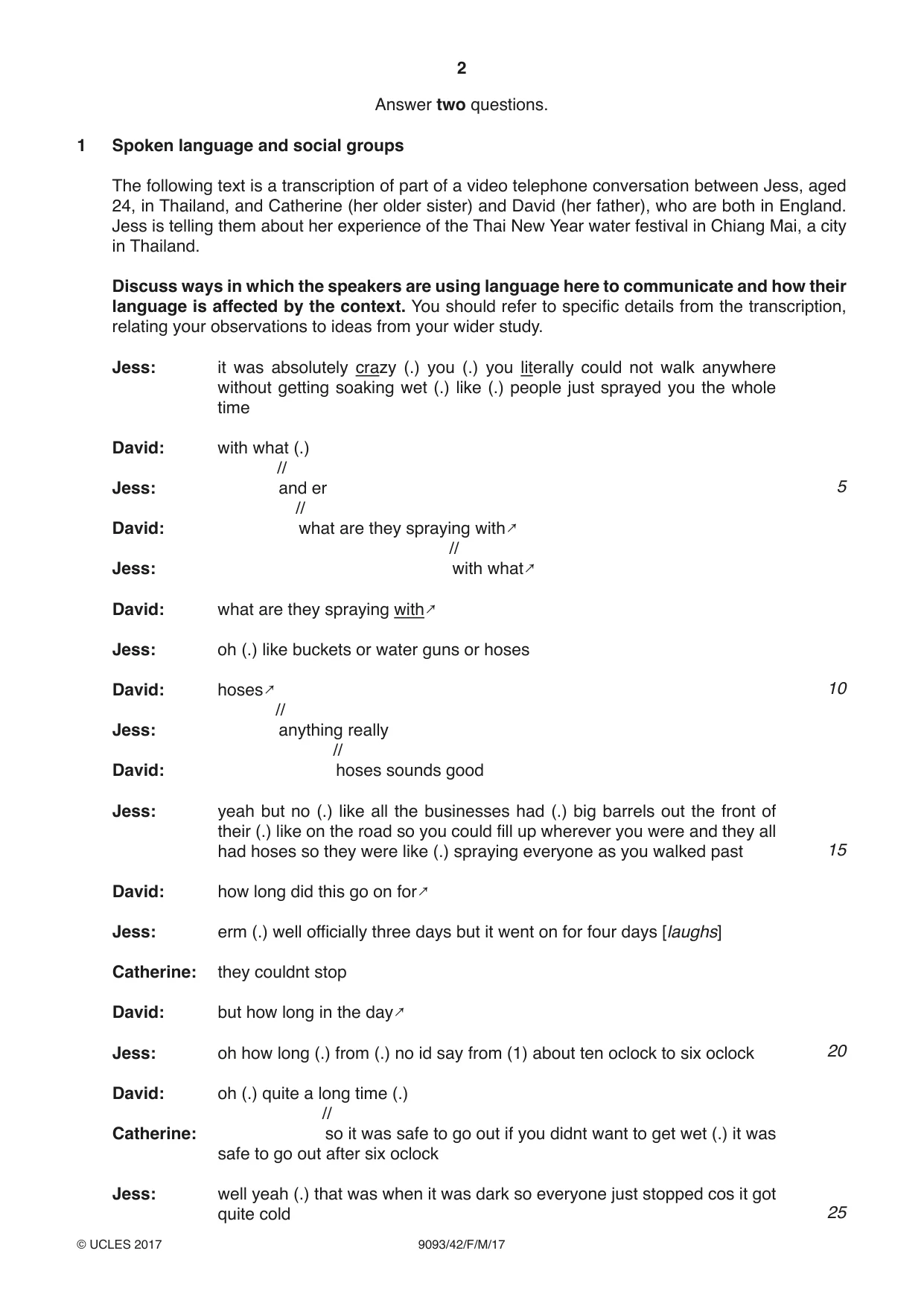
2 9093/42/F/M/17 © UCLES 2017 Answer two questions. 1 Spoken language and social groups The following text is a transcription of part of a video telephone conversation between Jess, aged 24, in Thailand, and Catherine (her older sister) and David (her father), who are both in England. Jess is telling them about her experience of the Thai New Year water festival in Chiang Mai, a city in Thailand. Discuss ways in which the speakers are using language here to communicate and how their language is affected by the context. You should refer to specific details from the transcription, relating your observations to ideas from your wider study. Jess: it was absolutely crazy (.) you (.) you literally could not walk anywhere without getting soaking wet (.) like (.) people just sprayed you the whole time David: with what (.) // Jess: and er // David: what are they spraying with↗ // Jess: with what↗ David: what are they spraying with↗ Jess: oh (.) like buckets or water guns or hoses David: hoses↗ // Jess: anything really // David: hoses sounds good Jess: yeah but no (.) like all the businesses had (.) big barrels out the front of their (.) like on the road so you could fill up wherever you were and they all had hoses so they were like (.) spraying everyone as you walked past David: how long did this go on for↗ Jess: erm (.) well officially three days but it went on for four days [laughs] Catherine: they couldnt stop David: but how long in the day↗ Jess: oh how long (.) from (.) no id say from (1) about ten oclock to six oclock David: oh (.) quite a long time (.) // Catherine: so it was safe to go out if you didnt want to get wet (.) it was safe to go out after six oclock Jess: well yeah (.) that was when it was dark so everyone just stopped cos it got quite cold 5 10 15 20 25
Question paper, page 3
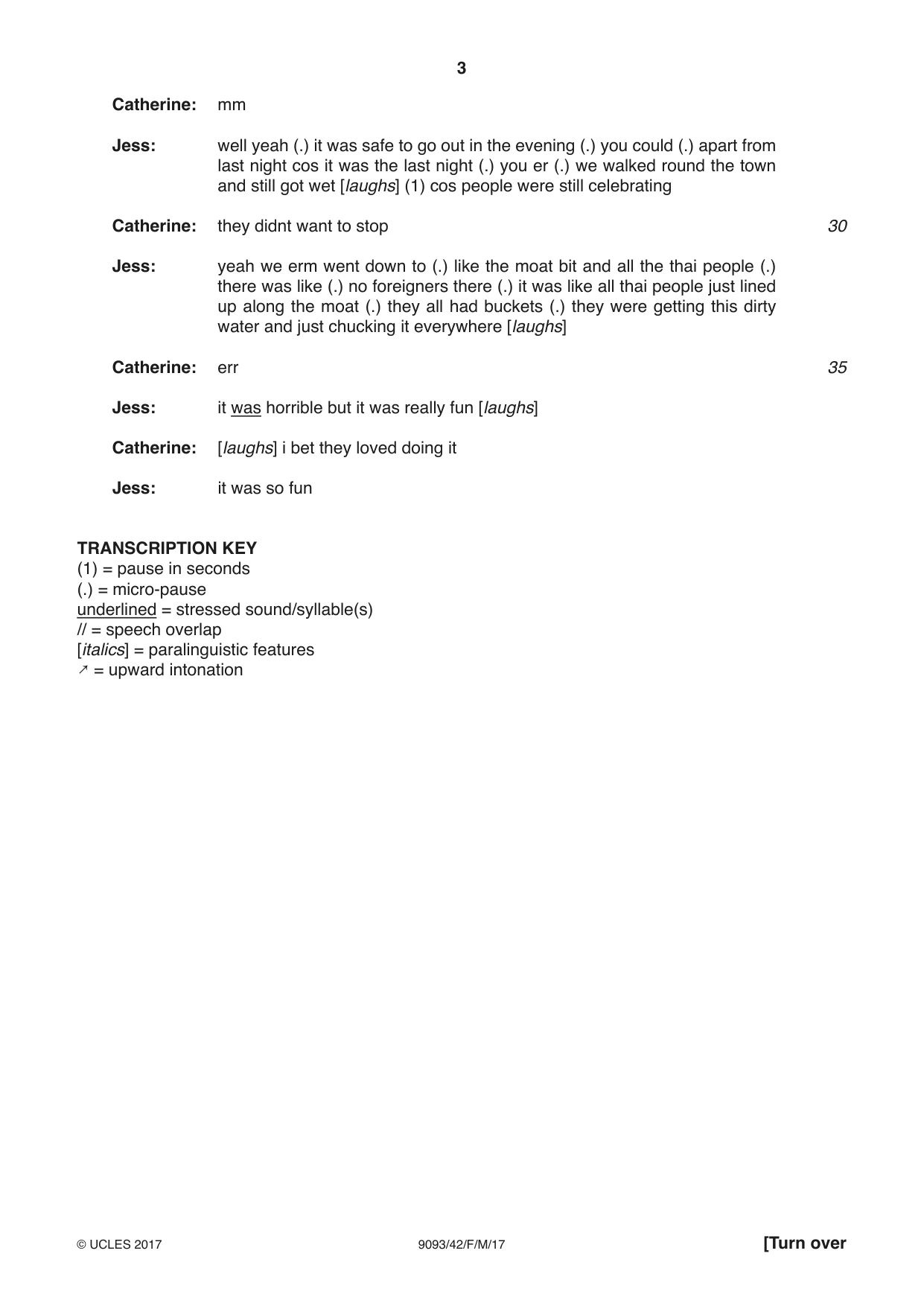
3 9093/42/F/M/17 © UCLES 2017 [Turn over Catherine: mm Jess: well yeah (.) it was safe to go out in the evening (.) you could (.) apart from last night cos it was the last night (.) you er (.) we walked round the town and still got wet [laughs] (1) cos people were still celebrating Catherine: they didnt want to stop Jess: yeah we erm went down to (.) like the moat bit and all the thai people (.) there was like (.) no foreigners there (.) it was like all thai people just lined up along the moat (.) they all had buckets (.) they were getting this dirty water and just chucking it everywhere [laughs] Catherine: err Jess: it was horrible but it was really fun [laughs] Catherine: [laughs] i bet they loved doing it Jess: it was so fun TRANSCRIPTION KEY (1) = pause in seconds (.) = micro-pause underlined = stressed sound/syllable(s) // = speech overlap [italics] = paralinguistic features ↗ = upward intonation 30 35
Question paper, page 4
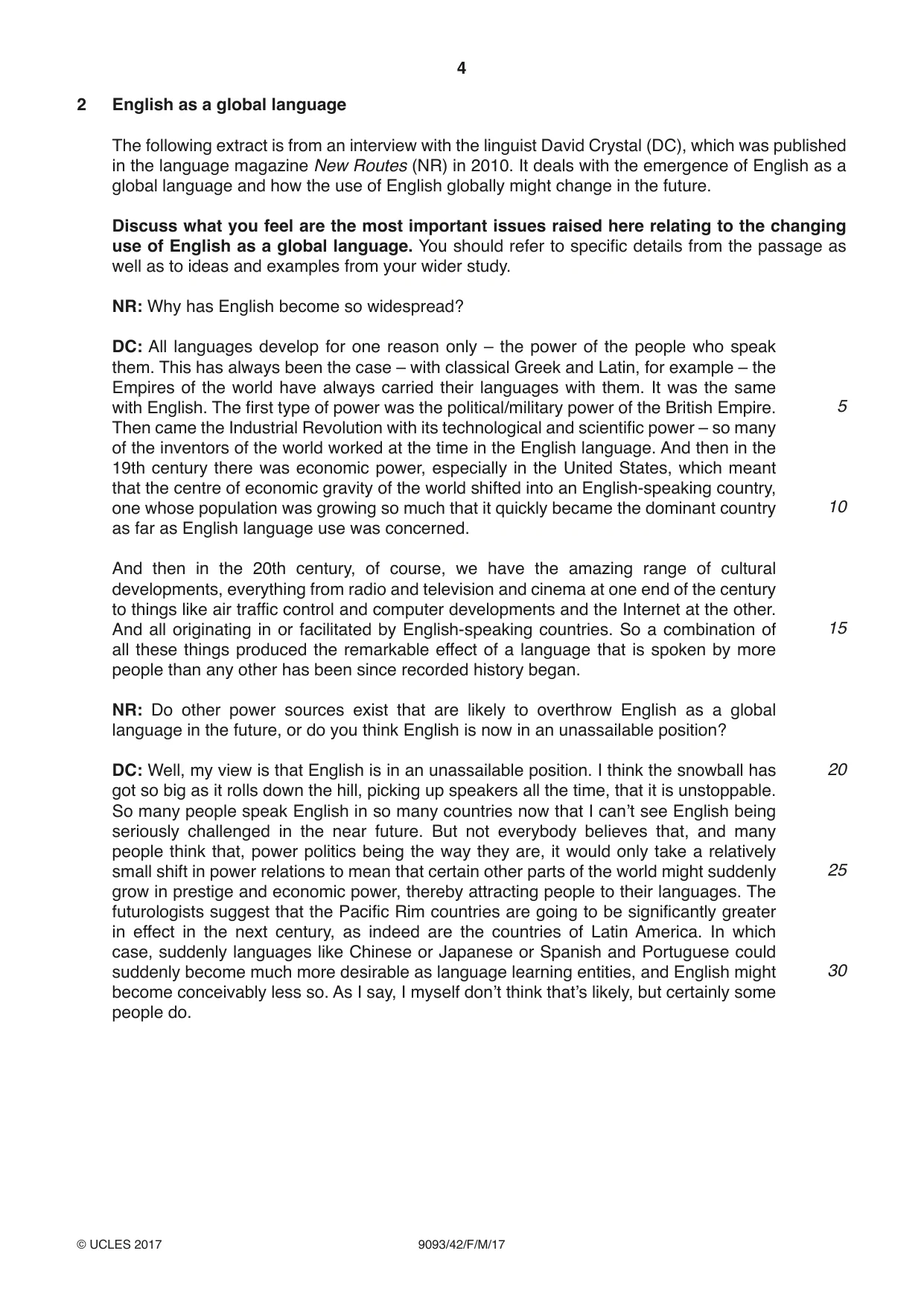
4 9093/42/F/M/17 © UCLES 2017 2 English as a global language The following extract is from an interview with the linguist David Crystal (DC), which was published in the language magazine New Routes (NR) in 2010. It deals with the emergence of English as a global language and how the use of English globally might change in the future. Discuss what you feel are the most important issues raised here relating to the changing use of English as a global language. You should refer to specific details from the passage as well as to ideas and examples from your wider study. NR: Why has English become so widespread? DC: All languages develop for one reason only – the power of the people who speak them. This has always been the case – with classical Greek and Latin, for example – the Empires of the world have always carried their languages with them. It was the same with English. The first type of power was the political/military power of the British Empire. Then came the Industrial Revolution with its technological and scientific power – so many of the inventors of the world worked at the time in the English language. And then in the 19th century there was economic power, especially in the United States, which meant that the centre of economic gravity of the world shifted into an English-speaking country, one whose population was growing so much that it quickly became the dominant country as far as English language use was concerned. And then in the 20th century, of course, we have the amazing range of cultural developments, everything from radio and television and cinema at one end of the century to things like air traffic control and computer developments and the Internet at the other. And all originating in or facilitated by English-speaking countries. So a combination of all these things produced the remarkable effect of a language that is spoken by more people than any other has been since recorded history began. NR: Do other power sources exist that are likely to overthrow English as a global language in the future, or do you think English is now in an unassailable position? DC: Well, my view is that English is in an unassailable position. I think the snowball has got so big as it rolls down the hill, picking up speakers all the time, that it is unstoppable. So many people speak English in so many countries now that I can’t see English being seriously challenged in the near future. But not everybody believes that, and many people think that, power politics being the way they are, it would only take a relatively small shift in power relations to mean that certain other parts of the world might suddenly grow in prestige and economic power, thereby attracting people to their languages. The futurologists suggest that the Pacific Rim countries are going to be significantly greater in effect in the next century, as indeed are the countries of Latin America. In which case, suddenly languages like Chinese or Japanese or Spanish and Portuguese could suddenly become much more desirable as language learning entities, and English might become conceivably less so. As I say, I myself don’t think that’s likely, but certainly some people do. 5 10 15 20 25 30
Question paper, page 5
5 9093/42/F/M/17 © UCLES 2017 [Turn over TURN OVER FOR QUESTION 3.
Question paper, page 6
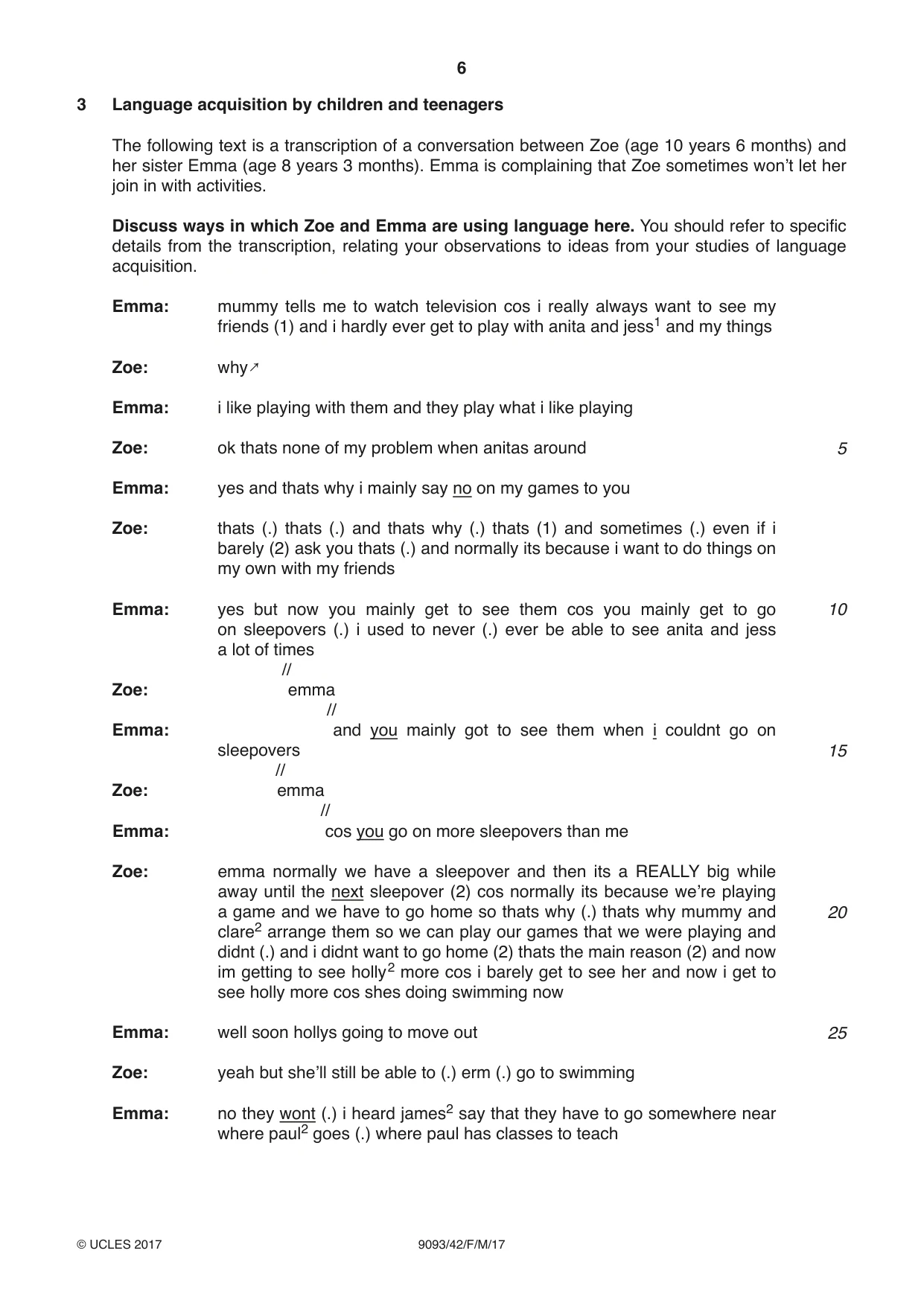
6 9093/42/F/M/17 © UCLES 2017 3 Language acquisition by children and teenagers The following text is a transcription of a conversation between Zoe (age 10 years 6 months) and her sister Emma (age 8 years 3 months). Emma is complaining that Zoe sometimes won’t let her join in with activities. Discuss ways in which Zoe and Emma are using language here. You should refer to specific details from the transcription, relating your observations to ideas from your studies of language acquisition. Emma: mummy tells me to watch television cos i really always want to see my friends (1) and i hardly ever get to play with anita and jess1 and my things Zoe: why↗ Emma: i like playing with them and they play what i like playing Zoe: ok thats none of my problem when anitas around Emma: yes and thats why i mainly say no on my games to you Zoe: thats (.) thats (.) and thats why (.) thats (1) and sometimes (.) even if i barely (2) ask you thats (.) and normally its because i want to do things on my own with my friends Emma: yes but now you mainly get to see them cos you mainly get to go on sleepovers (.) i used to never (.) ever be able to see anita and jess a lot of times // Zoe: emma // Emma: and you mainly got to see them when i couldnt go on sleepovers // Zoe: emma // Emma: cos you go on more sleepovers than me Zoe: emma normally we have a sleepover and then its a REALLY big while away until the next sleepover (2) cos normally its because we’re playing a game and we have to go home so thats why (.) thats why mummy and clare2 arrange them so we can play our games that we were playing and didnt (.) and i didnt want to go home (2) thats the main reason (2) and now im getting to see holly 2 more cos i barely get to see her and now i get to see holly more cos shes doing swimming now Emma: well soon hollys going to move out Zoe: yeah but she’ll still be able to (.) erm (.) go to swimming Emma: no they wont (.) i heard james2 say that they have to go somewhere near where paul2 goes (.) where paul has classes to teach 5 10 15 20 25
Question paper, page 7
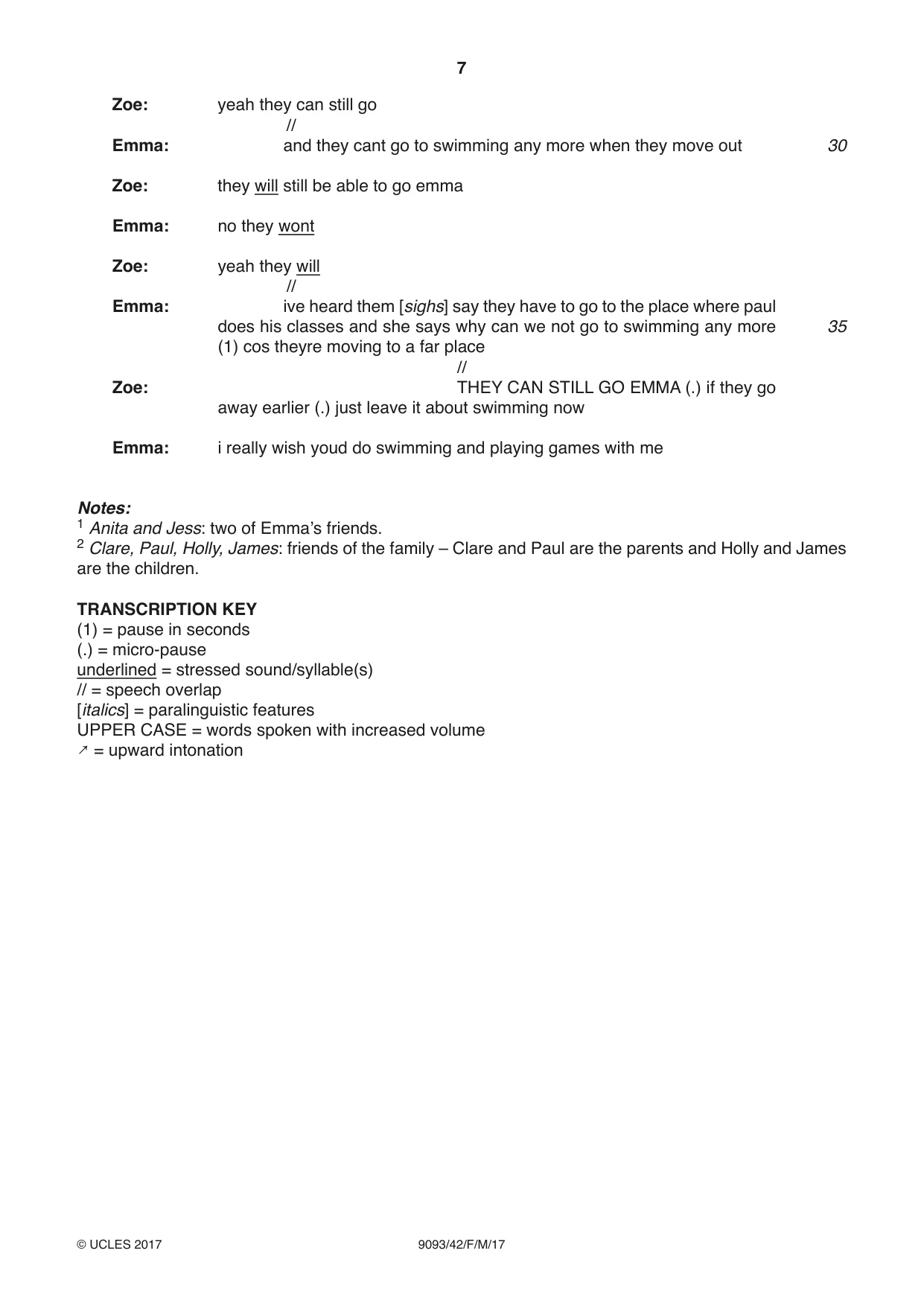
7 9093/42/F/M/17 © UCLES 2017 Zoe: yeah they can still go // Emma: and they cant go to swimming any more when they move out Zoe: they will still be able to go emma Emma: no they wont Zoe: yeah they will // Emma: ive heard them [sighs] say they have to go to the place where paul does his classes and she says why can we not go to swimming any more (1) cos theyre moving to a far place // Zoe: THEY CAN STILL GO EMMA (.) if they go away earlier (.) just leave it about swimming now Emma: i really wish youd do swimming and playing games with me Notes: 1 Anita and Jess: two of Emma’s friends. 2 Clare, Paul, Holly, James: friends of the family – Clare and Paul are the parents and Holly and James are the children. TRANSCRIPTION KEY (1) = pause in seconds (.) = micro-pause underlined = stressed sound/syllable(s) // = speech overlap [italics] = paralinguistic features UPPER CASE = words spoken with increased volume ↗ = upward intonation 30 35
Question paper, page 8
8 9093/42/F/M/17 © UCLES 2017 Permission to reproduce items where third-party owned material protected by copyright is included has been sought and cleared where possible. Every reasonable effort has been made by the publisher (UCLES) to trace copyright holders, but if any items requiring clearance have unwittingly been included, the publisher will be pleased to make amends at the earliest possible opportunity. To avoid the issue of disclosure of answer-related information to candidates, all copyright acknowledgements are reproduced online in the Cambridge International Examinations Copyright Acknowledgements Booklet. This is produced for each series of examinations and is freely available to download at www.cie.org.uk after the live examination series. Cambridge International Examinations is part of the Cambridge Assessment Group. Cambridge Assessment is the brand name of University of Cambridge Local Examinations Syndicate (UCLES), which is itself a department of the University of Cambridge. BLANK PAGE
Mark scheme, page 1
® IGCSE is a registered trademark. This document consists of 7 printed pages. © UCLES 2017 [Turn over Cambridge International Examinations Cambridge International Advanced Level ENGLISH LANGUAGE 9093/42 Paper 4 Language Topics March 2017 MARK SCHEME Maximum Mark: 50 Published This mark scheme is published as an aid to teachers and candidates, to indicate the requirements of the examination. It shows the basis on which Examiners were instructed to award marks. It does not indicate the details of the discussions that took place at an Examiners’ meeting before marking began, which would have considered the acceptability of alternative answers. Mark schemes should be read in conjunction with the question paper and the Principal Examiner Report for Teachers. Cambridge will not enter into discussions about these mark schemes. Cambridge is publishing the mark schemes for the March 2017 series for most Cambridge IGCSE®, Cambridge International A and AS Level components and some Cambridge O Level components.
Mark scheme, page 2
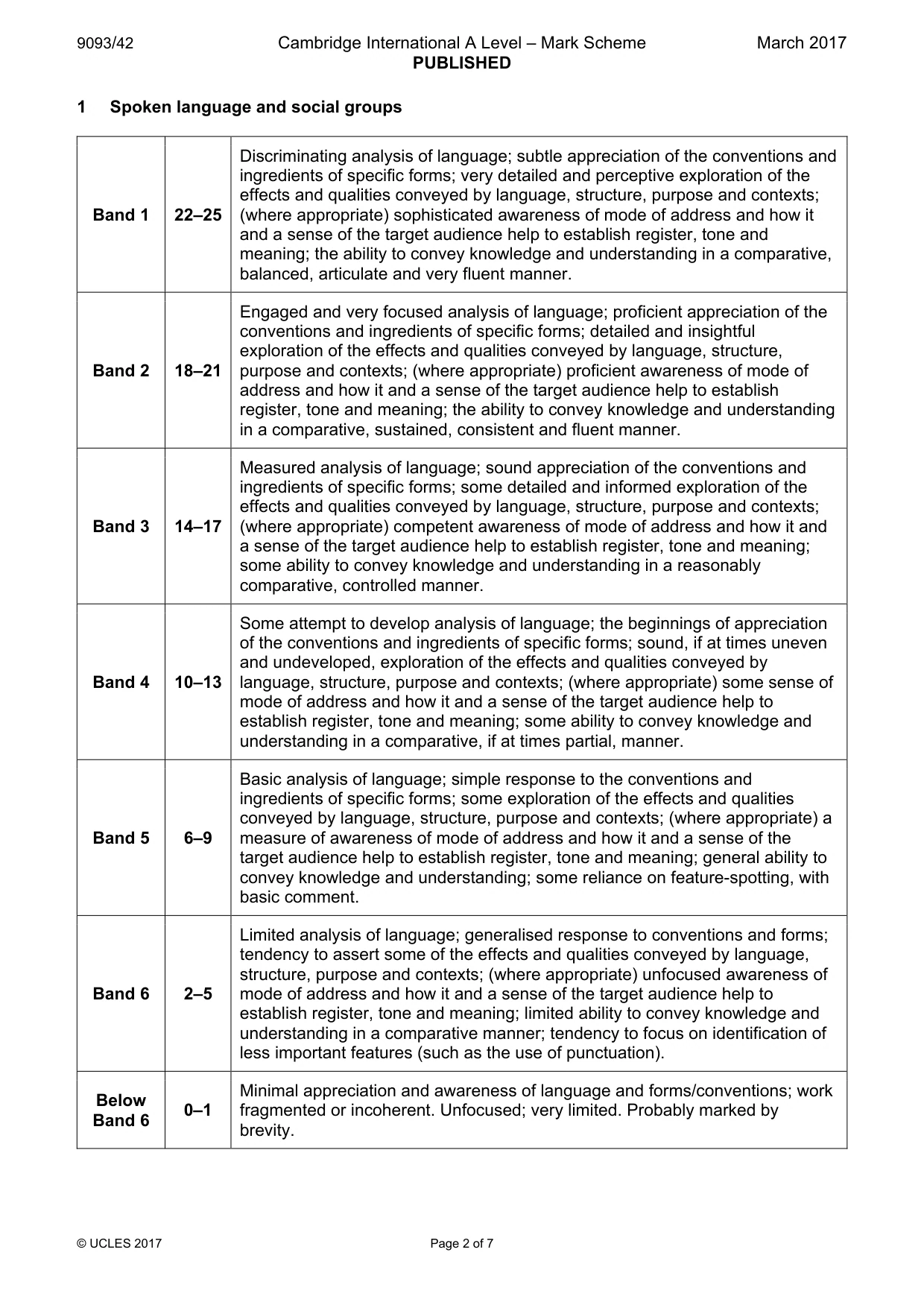
9093/42 Cambridge International A Level – Mark Scheme PUBLISHED March 2017 © UCLES 2017 Page 2 of 7 1 Spoken language and social groups Band 1 22–25 Discriminating analysis of language; subtle appreciation of the conventions and ingredients of specific forms; very detailed and perceptive exploration of the effects and qualities conveyed by language, structure, purpose and contexts; (where appropriate) sophisticated awareness of mode of address and how it and a sense of the target audience help to establish register, tone and meaning; the ability to convey knowledge and understanding in a comparative, balanced, articulate and very fluent manner. Band 2 18–21 Engaged and very focused analysis of language; proficient appreciation of the conventions and ingredients of specific forms; detailed and insightful exploration of the effects and qualities conveyed by language, structure, purpose and contexts; (where appropriate) proficient awareness of mode of address and how it and a sense of the target audience help to establish register, tone and meaning; the ability to convey knowledge and understanding in a comparative, sustained, consistent and fluent manner. Band 3 14–17 Measured analysis of language; sound appreciation of the conventions and ingredients of specific forms; some detailed and informed exploration of the effects and qualities conveyed by language, structure, purpose and contexts; (where appropriate) competent awareness of mode of address and how it and a sense of the target audience help to establish register, tone and meaning; some ability to convey knowledge and understanding in a reasonably comparative, controlled manner. Band 4 10–13 Some attempt to develop analysis of language; the beginnings of appreciation of the conventions and ingredients of specific forms; sound, if at times uneven and undeveloped, exploration of the effects and qualities conveyed by language, structure, purpose and contexts; (where appropriate) some sense of mode of address and how it and a sense of the target audience help to establish register, tone and meaning; some ability to convey knowledge and understanding in a comparative, if at times partial, manner. Band 5 6–9 Basic analysis of language; simple response to the conventions and ingredients of specific forms; some exploration of the effects and qualities conveyed by language, structure, purpose and contexts; (where appropriate) a measure of awareness of mode of address and how it and a sense of the target audience help to establish register, tone and meaning; general ability to convey knowledge and understanding; some reliance on feature-spotting, with basic comment. Band 6 2–5 Limited analysis of language; generalised response to conventions and forms; tendency to assert some of the effects and qualities conveyed by language, structure, purpose and contexts; (where appropriate) unfocused awareness of mode of address and how it and a sense of the target audience help to establish register, tone and meaning; limited ability to convey knowledge and understanding in a comparative manner; tendency to focus on identification of less important features (such as the use of punctuation). Below Band 6 0–1 Minimal appreciation and awareness of language and forms/conventions; work fragmented or incoherent. Unfocused; very limited. Probably marked by brevity.
Mark scheme, page 3
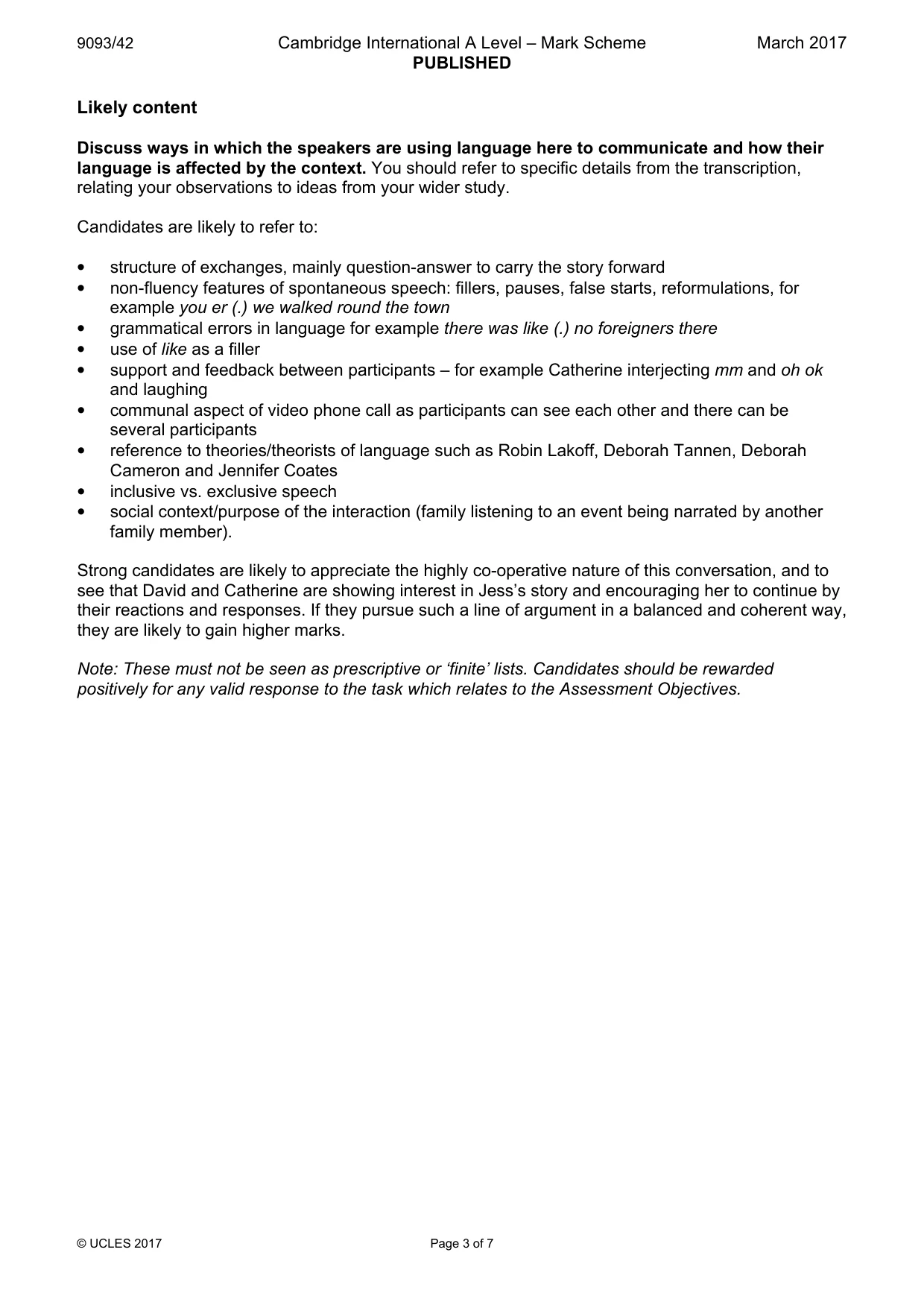
9093/42 Cambridge International A Level – Mark Scheme PUBLISHED March 2017 © UCLES 2017 Page 3 of 7 Likely content Discuss ways in which the speakers are using language here to communicate and how their language is affected by the context. You should refer to specific details from the transcription, relating your observations to ideas from your wider study. Candidates are likely to refer to: • structure of exchanges, mainly question-answer to carry the story forward • non-fluency features of spontaneous speech: fillers, pauses, false starts, reformulations, for example you er (.) we walked round the town • grammatical errors in language for example there was like (.) no foreigners there • use of like as a filler • support and feedback between participants – for example Catherine interjecting mm and oh ok and laughing • communal aspect of video phone call as participants can see each other and there can be several participants • reference to theories/theorists of language such as Robin Lakoff, Deborah Tannen, Deborah Cameron and Jennifer Coates • inclusive vs. exclusive speech • social context/purpose of the interaction (family listening to an event being narrated by another family member). Strong candidates are likely to appreciate the highly co-operative nature of this conversation, and to see that David and Catherine are showing interest in Jess’s story and encouraging her to continue by their reactions and responses. If they pursue such a line of argument in a balanced and coherent way, they are likely to gain higher marks. Note: These must not be seen as prescriptive or ‘finite’ lists. Candidates should be rewarded positively for any valid response to the task which relates to the Assessment Objectives.
Mark scheme, page 4
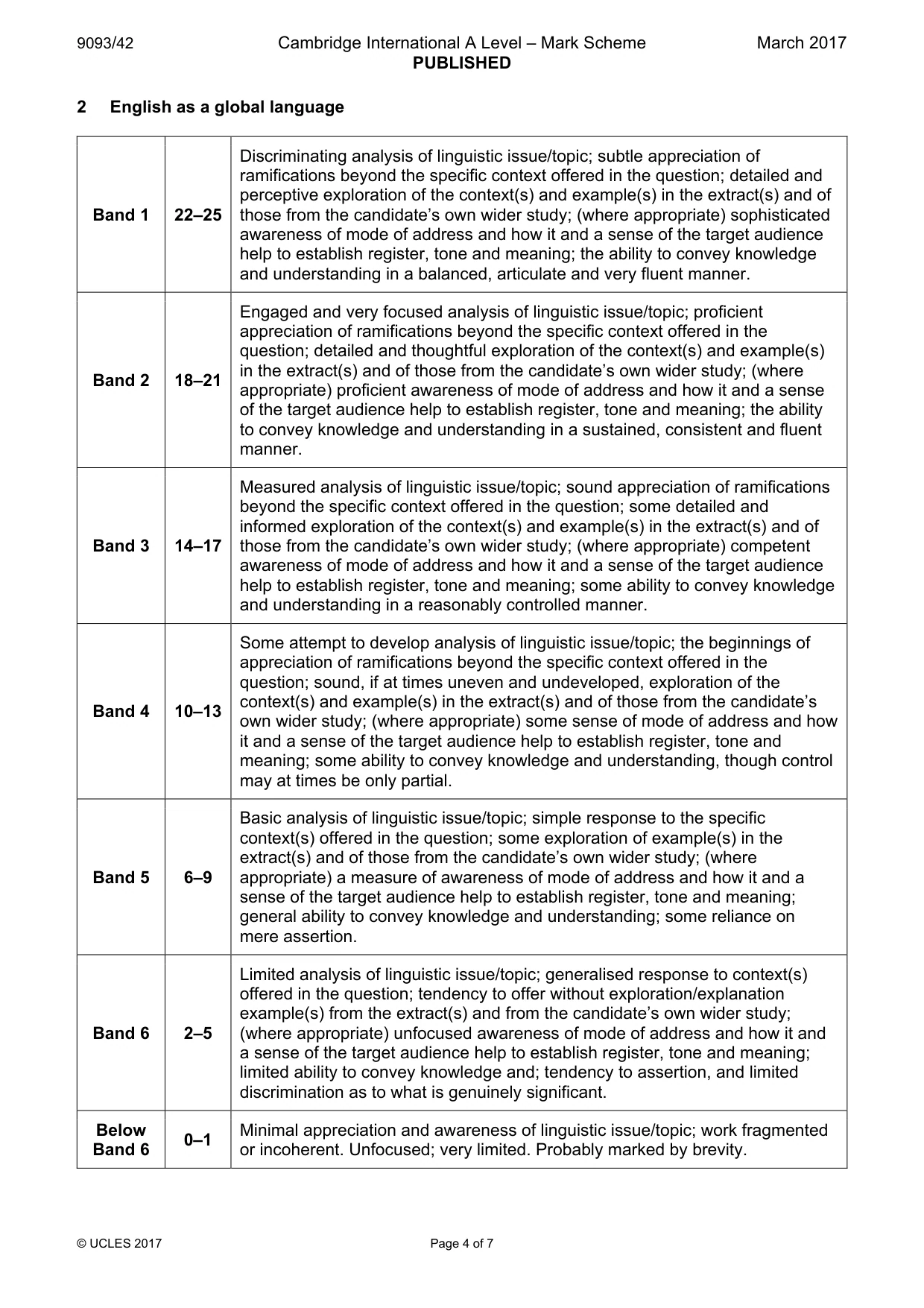
9093/42 Cambridge International A Level – Mark Scheme PUBLISHED March 2017 © UCLES 2017 Page 4 of 7 2 English as a global language Band 1 22–25 Discriminating analysis of linguistic issue/topic; subtle appreciation of ramifications beyond the specific context offered in the question; detailed and perceptive exploration of the context(s) and example(s) in the extract(s) and of those from the candidate’s own wider study; (where appropriate) sophisticated awareness of mode of address and how it and a sense of the target audience help to establish register, tone and meaning; the ability to convey knowledge and understanding in a balanced, articulate and very fluent manner. Band 2 18–21 Engaged and very focused analysis of linguistic issue/topic; proficient appreciation of ramifications beyond the specific context offered in the question; detailed and thoughtful exploration of the context(s) and example(s) in the extract(s) and of those from the candidate’s own wider study; (where appropriate) proficient awareness of mode of address and how it and a sense of the target audience help to establish register, tone and meaning; the ability to convey knowledge and understanding in a sustained, consistent and fluent manner. Band 3 14–17 Measured analysis of linguistic issue/topic; sound appreciation of ramifications beyond the specific context offered in the question; some detailed and informed exploration of the context(s) and example(s) in the extract(s) and of those from the candidate’s own wider study; (where appropriate) competent awareness of mode of address and how it and a sense of the target audience help to establish register, tone and meaning; some ability to convey knowledge and understanding in a reasonably controlled manner. Band 4 10–13 Some attempt to develop analysis of linguistic issue/topic; the beginnings of appreciation of ramifications beyond the specific context offered in the question; sound, if at times uneven and undeveloped, exploration of the context(s) and example(s) in the extract(s) and of those from the candidate’s own wider study; (where appropriate) some sense of mode of address and how it and a sense of the target audience help to establish register, tone and meaning; some ability to convey knowledge and understanding, though control may at times be only partial. Band 5 6–9 Basic analysis of linguistic issue/topic; simple response to the specific context(s) offered in the question; some exploration of example(s) in the extract(s) and of those from the candidate’s own wider study; (where appropriate) a measure of awareness of mode of address and how it and a sense of the target audience help to establish register, tone and meaning; general ability to convey knowledge and understanding; some reliance on mere assertion. Band 6 2–5 Limited analysis of linguistic issue/topic; generalised response to context(s) offered in the question; tendency to offer without exploration/explanation example(s) from the extract(s) and from the candidate’s own wider study; (where appropriate) unfocused awareness of mode of address and how it and a sense of the target audience help to establish register, tone and meaning; limited ability to convey knowledge and; tendency to assertion, and limited discrimination as to what is genuinely significant. Below Band 6 0–1 Minimal appreciation and awareness of linguistic issue/topic; work fragmented or incoherent. Unfocused; very limited. Probably marked by brevity.
Mark scheme, page 5
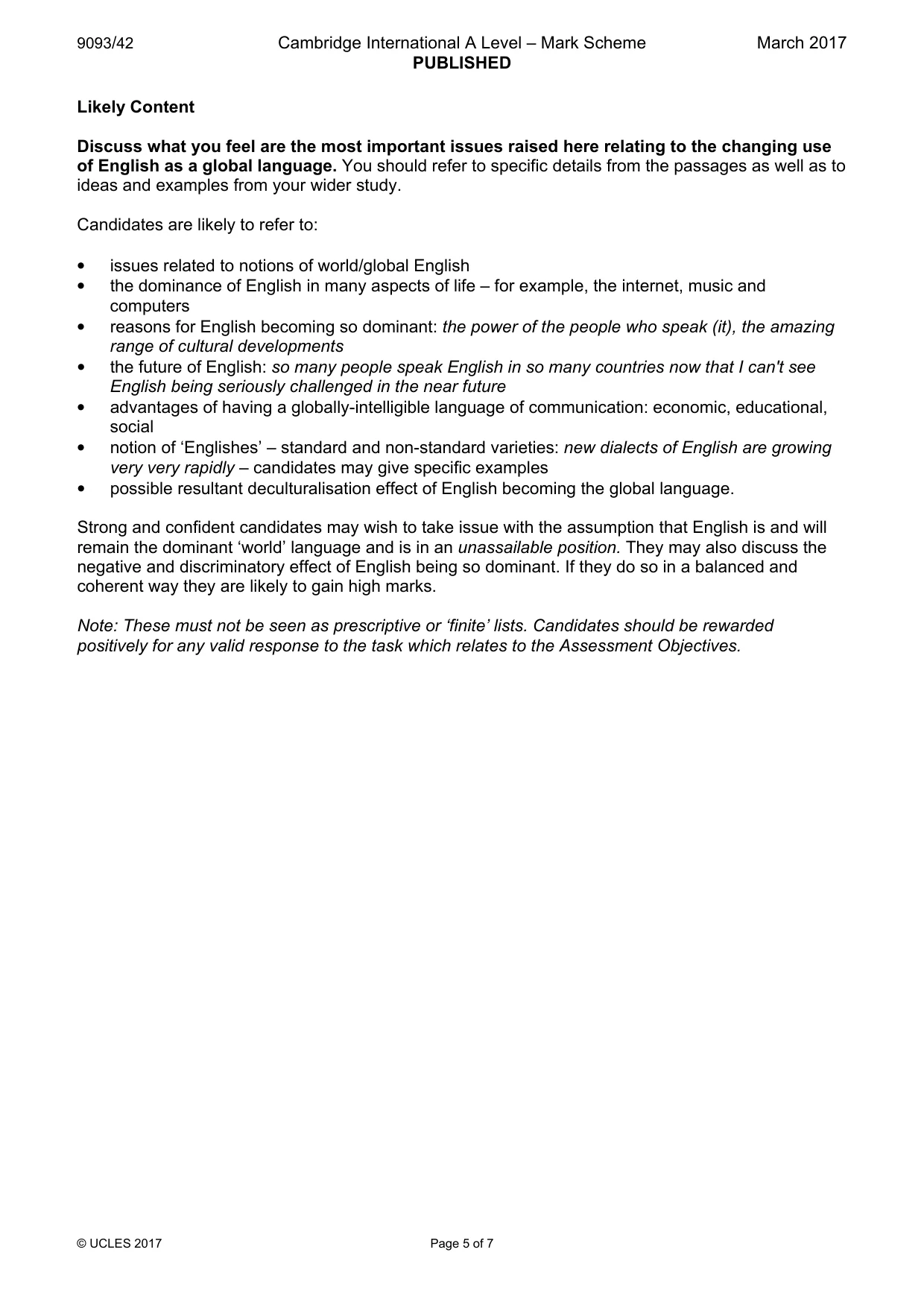
9093/42 Cambridge International A Level – Mark Scheme PUBLISHED March 2017 © UCLES 2017 Page 5 of 7 Likely Content Discuss what you feel are the most important issues raised here relating to the changing use of English as a global language. You should refer to specific details from the passages as well as to ideas and examples from your wider study. Candidates are likely to refer to: • issues related to notions of world/global English • the dominance of English in many aspects of life – for example, the internet, music and computers • reasons for English becoming so dominant: the power of the people who speak (it), the amazing range of cultural developments • the future of English: so many people speak English in so many countries now that I can't see English being seriously challenged in the near future • advantages of having a globally-intelligible language of communication: economic, educational, social • notion of ‘Englishes’ – standard and non-standard varieties: new dialects of English are growing very very rapidly – candidates may give specific examples • possible resultant deculturalisation effect of English becoming the global language. Strong and confident candidates may wish to take issue with the assumption that English is and will remain the dominant ‘world’ language and is in an unassailable position. They may also discuss the negative and discriminatory effect of English being so dominant. If they do so in a balanced and coherent way they are likely to gain high marks. Note: These must not be seen as prescriptive or ‘finite’ lists. Candidates should be rewarded positively for any valid response to the task which relates to the Assessment Objectives.
Mark scheme, page 6
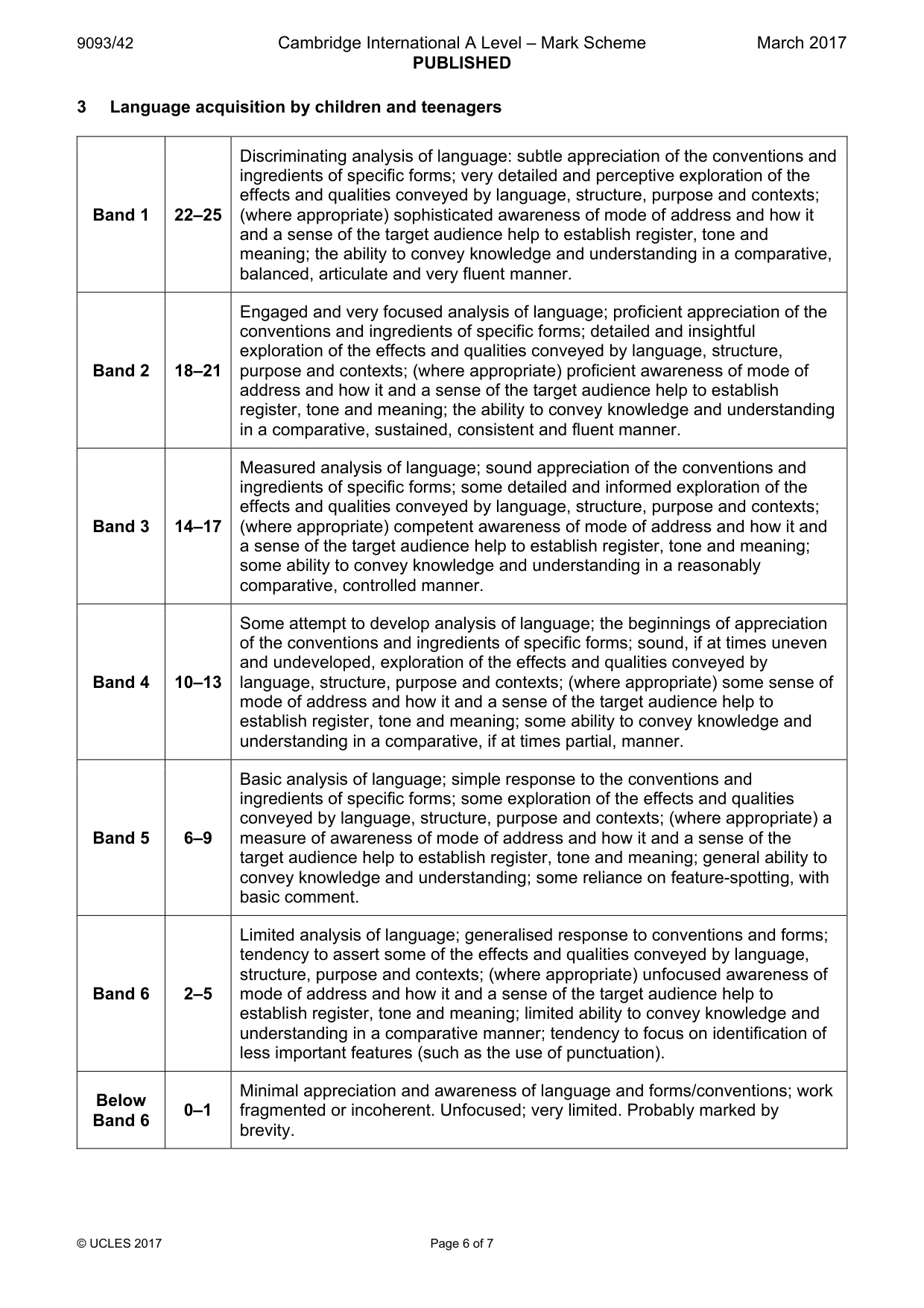
9093/42 Cambridge International A Level – Mark Scheme PUBLISHED March 2017 © UCLES 2017 Page 6 of 7 3 Language acquisition by children and teenagers Band 1 22–25 Discriminating analysis of language: subtle appreciation of the conventions and ingredients of specific forms; very detailed and perceptive exploration of the effects and qualities conveyed by language, structure, purpose and contexts; (where appropriate) sophisticated awareness of mode of address and how it and a sense of the target audience help to establish register, tone and meaning; the ability to convey knowledge and understanding in a comparative, balanced, articulate and very fluent manner. Band 2 18–21 Engaged and very focused analysis of language; proficient appreciation of the conventions and ingredients of specific forms; detailed and insightful exploration of the effects and qualities conveyed by language, structure, purpose and contexts; (where appropriate) proficient awareness of mode of address and how it and a sense of the target audience help to establish register, tone and meaning; the ability to convey knowledge and understanding in a comparative, sustained, consistent and fluent manner. Band 3 14–17 Measured analysis of language; sound appreciation of the conventions and ingredients of specific forms; some detailed and informed exploration of the effects and qualities conveyed by language, structure, purpose and contexts; (where appropriate) competent awareness of mode of address and how it and a sense of the target audience help to establish register, tone and meaning; some ability to convey knowledge and understanding in a reasonably comparative, controlled manner. Band 4 10–13 Some attempt to develop analysis of language; the beginnings of appreciation of the conventions and ingredients of specific forms; sound, if at times uneven and undeveloped, exploration of the effects and qualities conveyed by language, structure, purpose and contexts; (where appropriate) some sense of mode of address and how it and a sense of the target audience help to establish register, tone and meaning; some ability to convey knowledge and understanding in a comparative, if at times partial, manner. Band 5 6–9 Basic analysis of language; simple response to the conventions and ingredients of specific forms; some exploration of the effects and qualities conveyed by language, structure, purpose and contexts; (where appropriate) a measure of awareness of mode of address and how it and a sense of the target audience help to establish register, tone and meaning; general ability to convey knowledge and understanding; some reliance on feature-spotting, with basic comment. Band 6 2–5 Limited analysis of language; generalised response to conventions and forms; tendency to assert some of the effects and qualities conveyed by language, structure, purpose and contexts; (where appropriate) unfocused awareness of mode of address and how it and a sense of the target audience help to establish register, tone and meaning; limited ability to convey knowledge and understanding in a comparative manner; tendency to focus on identification of less important features (such as the use of punctuation). Below Band 6 0–1 Minimal appreciation and awareness of language and forms/conventions; work fragmented or incoherent. Unfocused; very limited. Probably marked by brevity.
Mark scheme, page 7
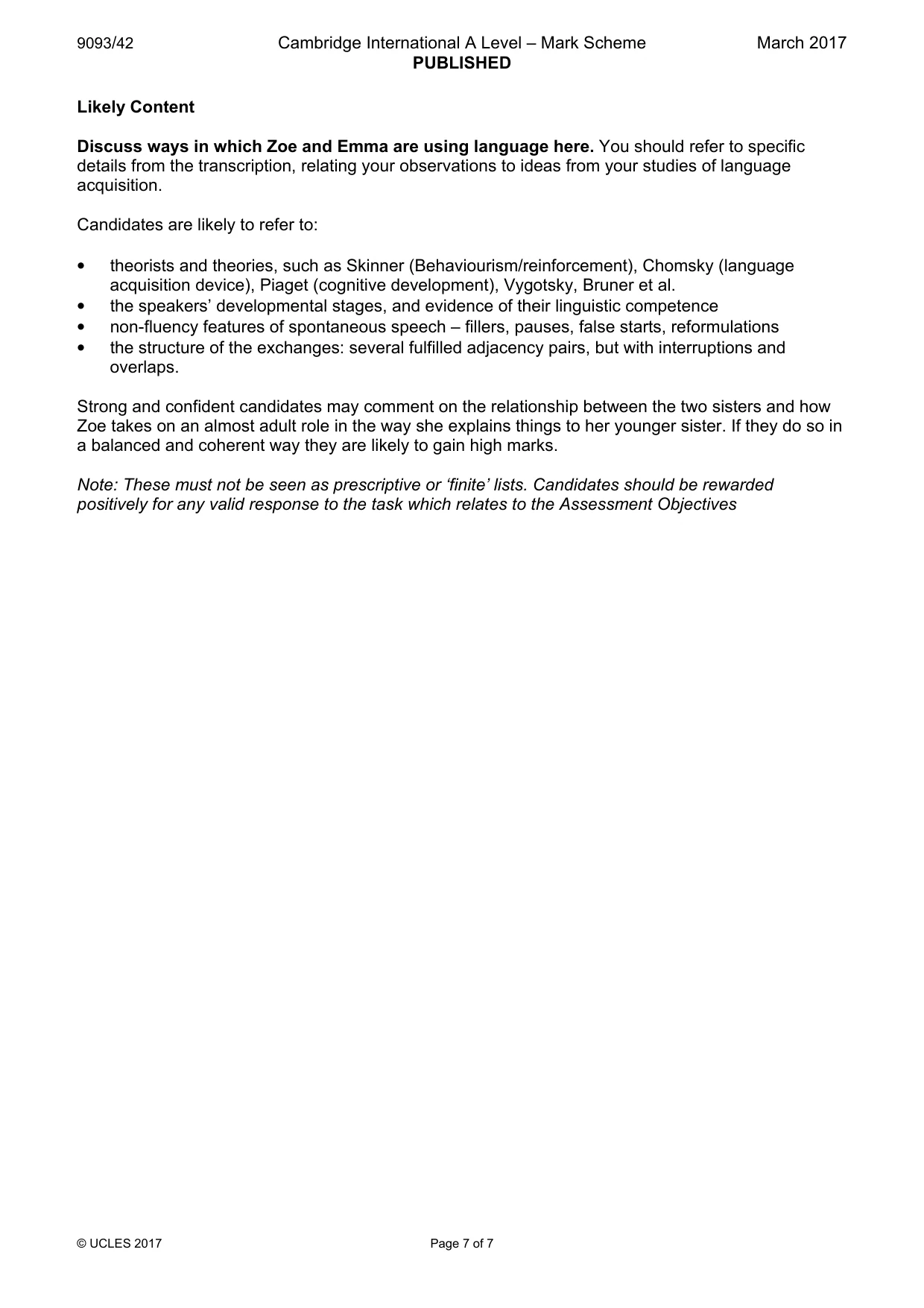
9093/42 Cambridge International A Level – Mark Scheme PUBLISHED March 2017 © UCLES 2017 Page 7 of 7 Likely Content Discuss ways in which Zoe and Emma are using language here. You should refer to specific details from the transcription, relating your observations to ideas from your studies of language acquisition. Candidates are likely to refer to: • theorists and theories, such as Skinner (Behaviourism/reinforcement), Chomsky (language acquisition device), Piaget (cognitive development), Vygotsky, Bruner et al. • the speakers’ developmental stages, and evidence of their linguistic competence • non-fluency features of spontaneous speech – fillers, pauses, false starts, reformulations • the structure of the exchanges: several fulfilled adjacency pairs, but with interruptions and overlaps. Strong and confident candidates may comment on the relationship between the two sisters and how Zoe takes on an almost adult role in the way she explains things to her younger sister. If they do so in a balanced and coherent way they are likely to gain high marks. Note: These must not be seen as prescriptive or ‘finite’ lists. Candidates should be rewarded positively for any valid response to the task which relates to the Assessment Objectives
What you needed in this session
Cambridge’s own grade thresholds for 2017 Feb/March, Paper 4 · Variant 2. A higher threshold means an easier paper — the bar moves with how the cohort did.