Cambridge A Level English - Language AS and A Level (from 2014) 9093 — 2016 May/June Paper 1 · Variant 2
9093/12/M/J/16 · 50 marks · ≈56 min
The question paper and its mark scheme, free to read here and free to download. This is Cambridge’s own paper, exactly as it was sat.
Question paper8 pages
Mark scheme3 pages
Answers below. Sit the paper first if you are practising.
Paper as text
Question paper, page 1
This document consists of 7 printed pages, 1 blank page and 1 insert. DC (LEG) 106680/3 © UCLES 2016 [Turn over Cambridge International Examinations Cambridge International Advanced Subsidiary and Advanced Level * 6 5 5 5 6 8 5 4 9 6 * ENGLISH LANGUAGE 9093/12 Paper 1 Passages May/June 2016 2 hours 15 minutes No Additional Materials are required. READ THESE INSTRUCTIONS FIRST An answer booklet is provided inside this question paper. You should follow the instructions on the front cover of the answer booklet. If you need additional answer paper, ask the invigilator for a continuation booklet. Answer two questions: Question 1 and either Question 2 or Question 3. You should spend about 15 minutes reading the passages and questions before you start writing your answers. You are reminded of the need for good English and clear presentation in your answers. The number of marks is given in brackets [ ] at the end of each question or part question.
Question paper, page 2
2 9093/12/M/J/16 © UCLES 2016 Answer Question 1 and either Question 2 or Question 3. 1 The article below is a newspaper opinion column that discusses contact with work during holiday periods. (a) Comment on the language and style of the extract. [15] (b) The same writer publishes a second article complaining about another problem in modern life. Write the opening of this article (between 120–150 words). Base your article closely on the style and language of the original extract. [10] Out of office, out of mind – free yourself from inbox tyranny on holiday We should all follow car maker Daimler’s lead and release ourselves from the evils of the out-of-office reply while away Preparing to go on holiday has always required a checklist – passport, swimming costume, that first volume of Karl Ove Knausgård you’ve been meaning to read because everyone says it’s amazing (spoiler: it is). But in the modern era there is another decision that could make or break your holiday: how will you set your email out-of-office reply? Will you simply say, for example, that you are on “holiday” or will you announce grandly that you are on “annual leave”? More importantly, will you stick to what your out-of-office says? Do you plan to check your email while away or blithely ignore it all? Best, surely, just to commit it to the digital inferno. The German car maker Daimler is offering its employees a blissful solution. With the company’s “mail on holiday” inbox feature, correspondents will be told to contact someone else because all email sent to this person while they are on holiday will just be deleted. That’s right: destroyed. Gone. Imagine the calm of getting home. No horrifically bulging inbox. Nothing to “catch up” on. A sneaky brutality is concealed within this notion of having to catch up on stuff after your holiday, as though office life were an engrossing television drama filled with excitement and dragons. If you are obliged to catch up on what you’ve “missed” while on holiday, that implies you shouldn’t really have been on holiday. It is a reminder that time off is a gift in return for your servitude during the rest of the year. The fear that catching up on a fortnight’s email will be epically disgusting labour convinces people to check their email while away. Some say they need to “keep in touch” with the office, as if it were a friend. (Such fake friendship usually operates in only one direction, like “loyalty” to a supermarket.) Unfortunately, science seems to confirm what we already knew: that worrying about the office will ruin your holiday. The neuroscientist David Levitin recently declared the importance, in addition to naps and daydreaming, of taking “true vacations without work” for optimum mental functioning. 5 10 15 20 25 30
Question paper, page 3
3 9093/12/M/J/16 © UCLES 2016 [Turn over Our European cousins are at the forefront of more humane approaches to work communication. Earlier this year some French workers benefited from a new agreement obliging them to disconnect from work communication after office hours. But for something like Daimler’s brutal total-email-zapping holiday system to gain widespread acceptance is a problem a little like that of world communism: it has to happen all at once and everywhere. While there are still people who assiduously work on their supposed holiday, they’ll be making the refuseniks1 look bad, even if they’re not plotting to steal their jobs. For everyone’s psychic comfort, it is crucial we avoid sending out mixed messages. I recently received an out-of-office reply from someone who said they were on holiday and not reading emails, but that if I were to email them and add the word “Urgent” in the subject line they would in fact read it and do something. Naturally, I instantly re-sent the same email, with “Urgent” bolted on, thus doubling the volume of email this poor person had received from me while on a supposedly relaxing trip. Of course, I felt sorry for the recipient. At the same time, the out-of-office message had literally asked for it. What is needed is a go-slow solidarity movement. Let us all set our out-of-office wording to manage expectations violently downwards. A little poetic licence should be acceptable too. For instance: “I’m on holiday, on the moon. As you may be aware, there is no Wi-Fi or phone signal on the moon. See you when I get back!” Workers of the world unite: you have nothing to lose but your two-week backlog of reply-all email chains. Notes: 1 refusenik : someone who refuses to do a task. 35 40 45 50
Question paper, page 4
4 9093/12/M/J/16 © UCLES 2016 2 The following text is from Langston Hughes’s autobiography The Big Sea (1940). In this extract he recalls journeying back to the United States from Africa with a pet monkey. (a) Comment on the language and style of the passage. [15] (b) Later, Langston Hughes recalls arriving at the docks in America, where the monkey escapes once again. Write the opening of this new account (between 120–150 words). Base your answer closely on the style and language of the original. [10] It made him furious to have to get back in his cage, when it was time for me to go to work. Content removed due to copyright restrictions.
Question paper, page 5
5 9093/12/M/J/16 © UCLES 2016 [Turn over But finally he leaped chattering into my arms and devoured a prune. Content removed due to copyright restrictions.
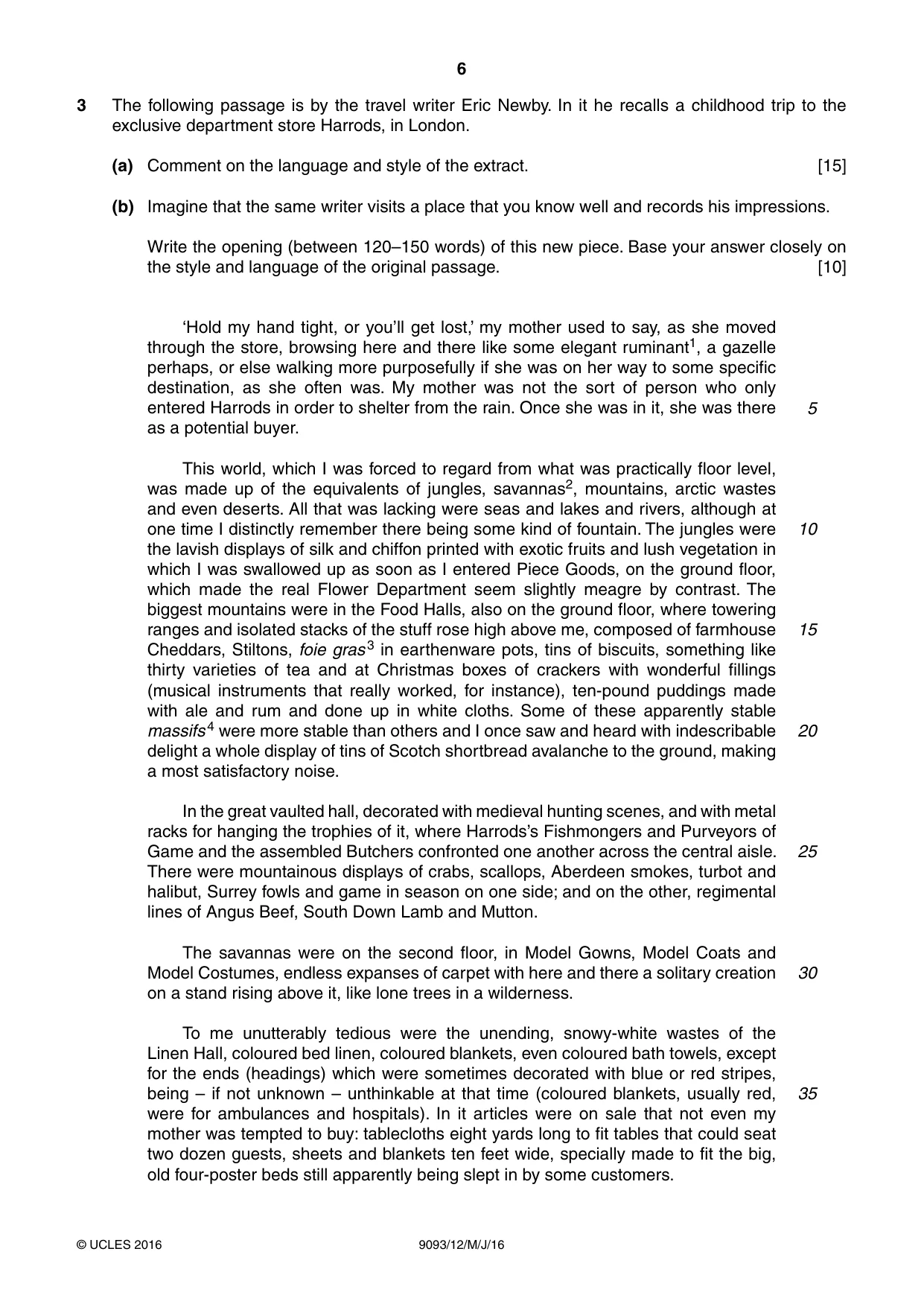
Question paper, page 6
6 9093/12/M/J/16 © UCLES 2016 3 The following passage is by the travel writer Eric Newby. In it he recalls a childhood trip to the exclusive department store Harrods, in London. (a) Comment on the language and style of the extract. [15] (b) Imagine that the same writer visits a place that you know well and records his impressions. Write the opening (between 120–150 words) of this new piece. Base your answer closely on the style and language of the original passage. [10] ‘Hold my hand tight, or you’ll get lost,’ my mother used to say, as she moved through the store, browsing here and there like some elegant ruminant1, a gazelle perhaps, or else walking more purposefully if she was on her way to some specific destination, as she often was. My mother was not the sort of person who only entered Harrods in order to shelter from the rain. Once she was in it, she was there as a potential buyer. This world, which I was forced to regard from what was practically floor level, was made up of the equivalents of jungles, savannas2, mountains, arctic wastes and even deserts. All that was lacking were seas and lakes and rivers, although at one time I distinctly remember there being some kind of fountain. The jungles were the lavish displays of silk and chiffon printed with exotic fruits and lush vegetation in which I was swallowed up as soon as I entered Piece Goods, on the ground floor, which made the real Flower Department seem slightly meagre by contrast. The biggest mountains were in the Food Halls, also on the ground floor, where towering ranges and isolated stacks of the stuff rose high above me, composed of farmhouse Cheddars, Stiltons, foie gras 3 in earthenware pots, tins of biscuits, something like thirty varieties of tea and at Christmas boxes of crackers with wonderful fillings (musical instruments that really worked, for instance), ten-pound puddings made with ale and rum and done up in white cloths. Some of these apparently stable massifs 4 were more stable than others and I once saw and heard with indescribable delight a whole display of tins of Scotch shortbread avalanche to the ground, making a most satisfactory noise. In the great vaulted hall, decorated with medieval hunting scenes, and with metal racks for hanging the trophies of it, where Harrods’s Fishmongers and Purveyors of Game and the assembled Butchers confronted one another across the central aisle. There were mountainous displays of crabs, scallops, Aberdeen smokes, turbot and halibut, Surrey fowls and game in season on one side; and on the other, regimental lines of Angus Beef, South Down Lamb and Mutton. The savannas were on the second floor, in Model Gowns, Model Coats and Model Costumes, endless expanses of carpet with here and there a solitary creation on a stand rising above it, like lone trees in a wilderness. To me unutterably tedious were the unending, snowy-white wastes of the Linen Hall, coloured bed linen, coloured blankets, even coloured bath towels, except for the ends (headings) which were sometimes decorated with blue or red stripes, being – if not unknown – unthinkable at that time (coloured blankets, usually red, were for ambulances and hospitals). In it articles were on sale that not even my mother was tempted to buy: tablecloths eight yards long to fit tables that could seat two dozen guests, sheets and blankets ten feet wide, specially made to fit the big, old four-poster beds still apparently being slept in by some customers. 5 10 15 20 25 30 35
Question paper, page 7
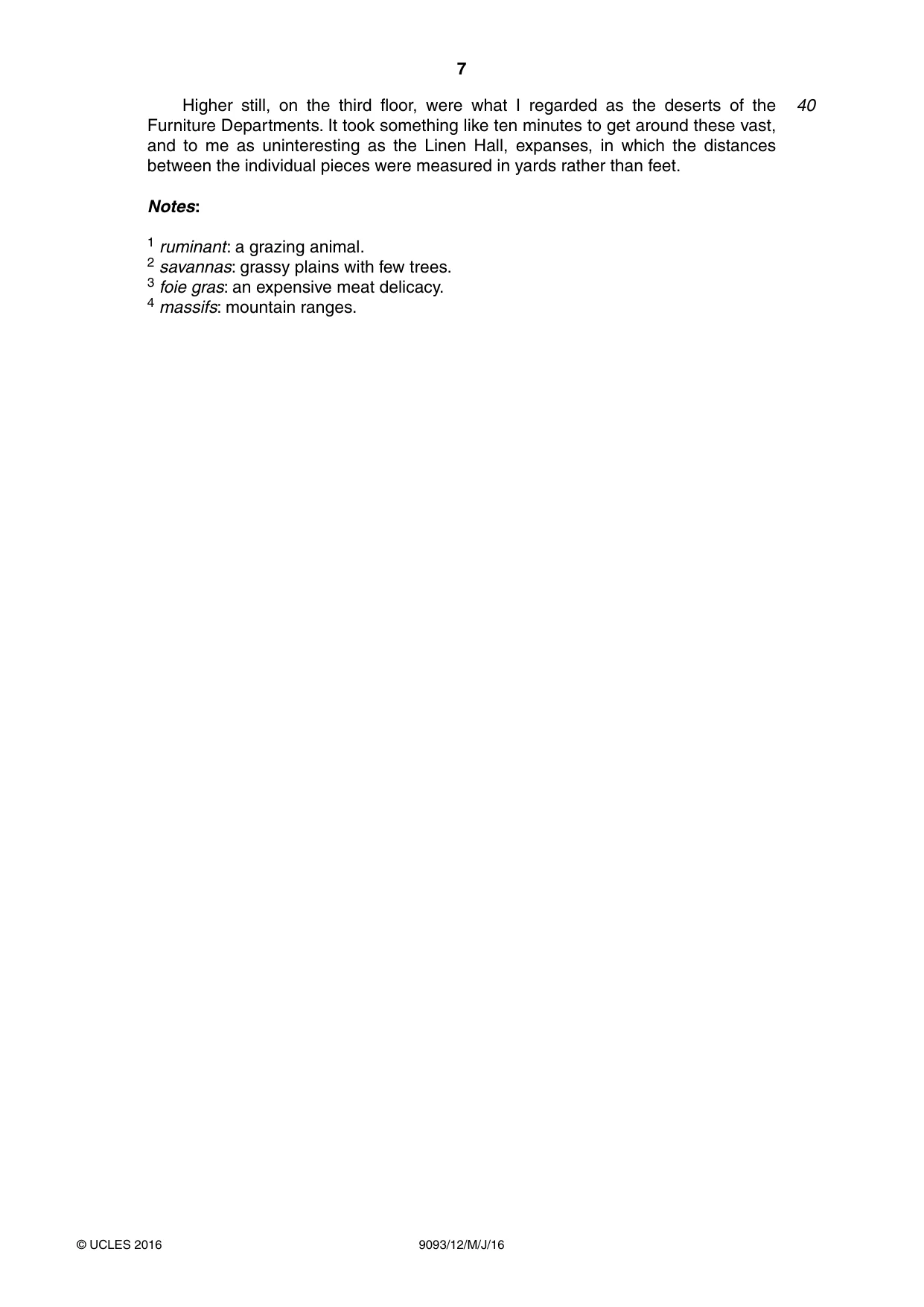
7 9093/12/M/J/16 © UCLES 2016 Higher still, on the third floor, were what I regarded as the deserts of the Furniture Departments. It took something like ten minutes to get around these vast, and to me as uninteresting as the Linen Hall, expanses, in which the distances between the individual pieces were measured in yards rather than feet. Notes: 1 ruminant : a grazing animal. 2 savannas: grassy plains with few trees. 3 foie gras: an expensive meat delicacy. 4 massifs: mountain ranges. 40
Question paper, page 8
8 9093/12/M/J/16 © UCLES 2016 BLANK PAGE Permission to reproduce items where third-party owned material protected by copyright is included has been sought and cleared where possible. Every reasonable effort has been made by the publisher (UCLES) to trace copyright holders, but if any items requiring clearance have unwittingly been included, the publisher will be pleased to make amends at the earliest possible opportunity. To avoid the issue of disclosure of answer-related information to candidates, all copyright acknowledgements are reproduced online in the Cambridge International Examinations Copyright Acknowledgements Booklet. This is produced for each series of examinations and is freely available to download at www.cie.org.uk after the live examination series. Cambridge International Examinations is part of the Cambridge Assessment Group. Cambridge Assessment is the brand name of University of Cambridge Local Examinations Syndicate (UCLES), which is itself a department of the University of Cambridge.
Mark scheme, page 1
® IGCSE is the registered trademark of Cambridge International Examinations. This document consists of 3 printed pages. © UCLES 2016 [Turn over Cambridge International Examinations Cambridge International Advanced Subsidiary and Advanced Level ENGLISH LANGUAGE 9093/12 Paper 1 Passages May/June 2016 MARK SCHEME Maximum Mark: 50 Published This mark scheme is published as an aid to teachers and candidates, to indicate the requirements of the examination. It shows the basis on which Examiners were instructed to award marks. It does not indicate the details of the discussions that took place at an Examiners’ meeting before marking began, which would have considered the acceptability of alternative answers. Mark schemes should be read in conjunction with the question paper and the Principal Examiner Report for Teachers. Cambridge will not enter into discussions about these mark schemes. Cambridge is publishing the mark schemes for the May/June 2016 series for most Cambridge IGCSE®, Cambridge International A and AS Level components and some Cambridge O Level components.
Mark scheme, page 2
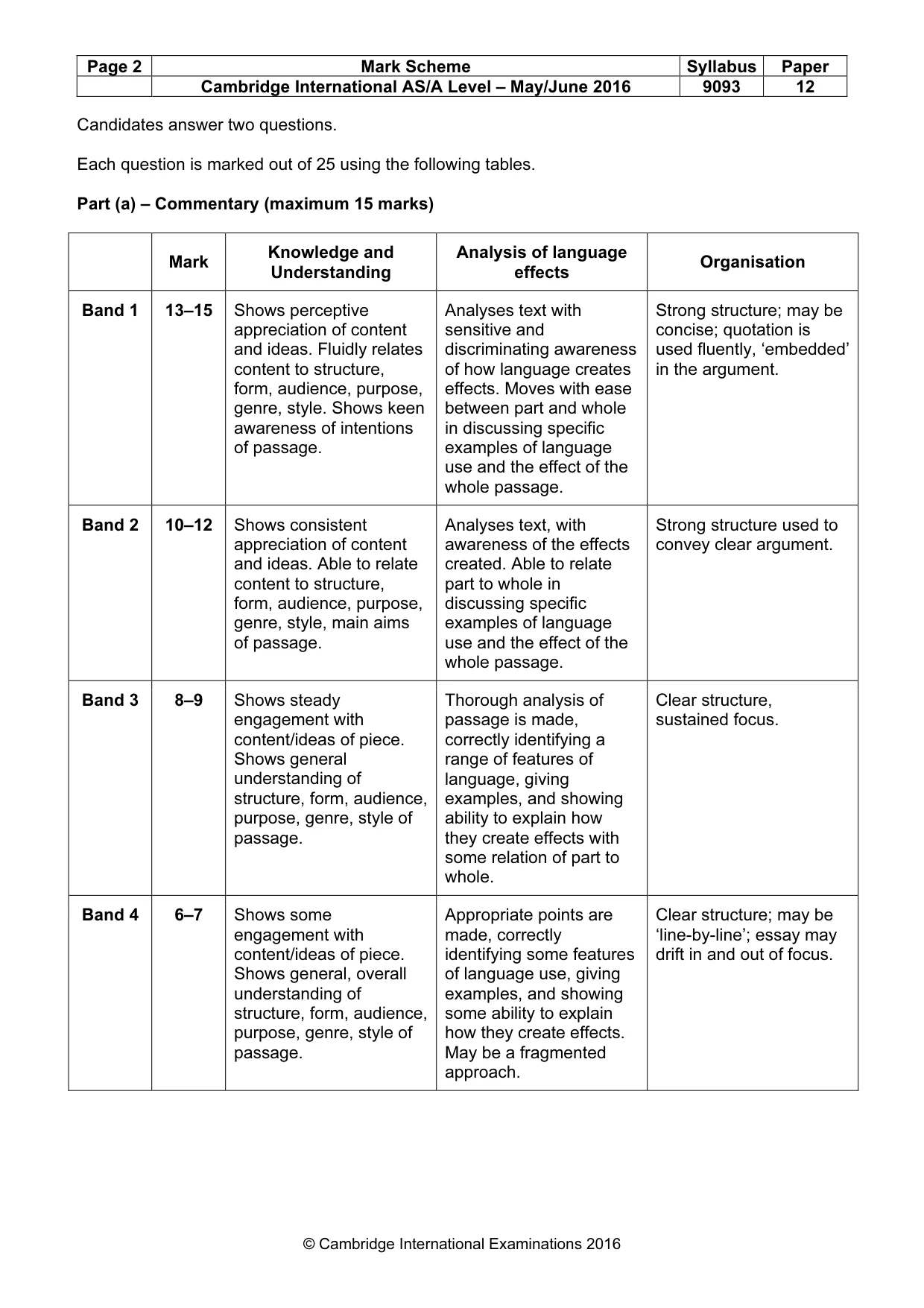
Page 2 Mark Scheme Syllabus Paper Cambridge International AS/A Level – May/June 2016 9093 12 © Cambridge International Examinations 2016 Candidates answer two questions. Each question is marked out of 25 using the following tables. Part (a) – Commentary (maximum 15 marks) Mark Knowledge and Understanding Analysis of language effects Organisation Band 1 13–15 Shows perceptive appreciation of content and ideas. Fluidly relates content to structure, form, audience, purpose, genre, style. Shows keen awareness of intentions of passage. Analyses text with sensitive and discriminating awareness of how language creates effects. Moves with ease between part and whole in discussing specific examples of language use and the effect of the whole passage. Strong structure; may be concise; quotation is used fluently, ‘embedded’ in the argument. Band 2 10–12 Shows consistent appreciation of content and ideas. Able to relate content to structure, form, audience, purpose, genre, style, main aims of passage. Analyses text, with awareness of the effects created. Able to relate part to whole in discussing specific examples of language use and the effect of the whole passage. Strong structure used to convey clear argument. Band 3 8–9 Shows steady engagement with content/ideas of piece. Shows general understanding of structure, form, audience, purpose, genre, style of passage. Thorough analysis of passage is made, correctly identifying a range of features of language, giving examples, and showing ability to explain how they create effects with some relation of part to whole. Clear structure, sustained focus. Band 4 6–7 Shows some engagement with content/ideas of piece. Shows general, overall understanding of structure, form, audience, purpose, genre, style of passage. Appropriate points are made, correctly identifying some features of language use, giving examples, and showing some ability to explain how they create effects. May be a fragmented approach. Clear structure; may be ‘line-by-line’; essay may drift in and out of focus.
Mark scheme, page 3
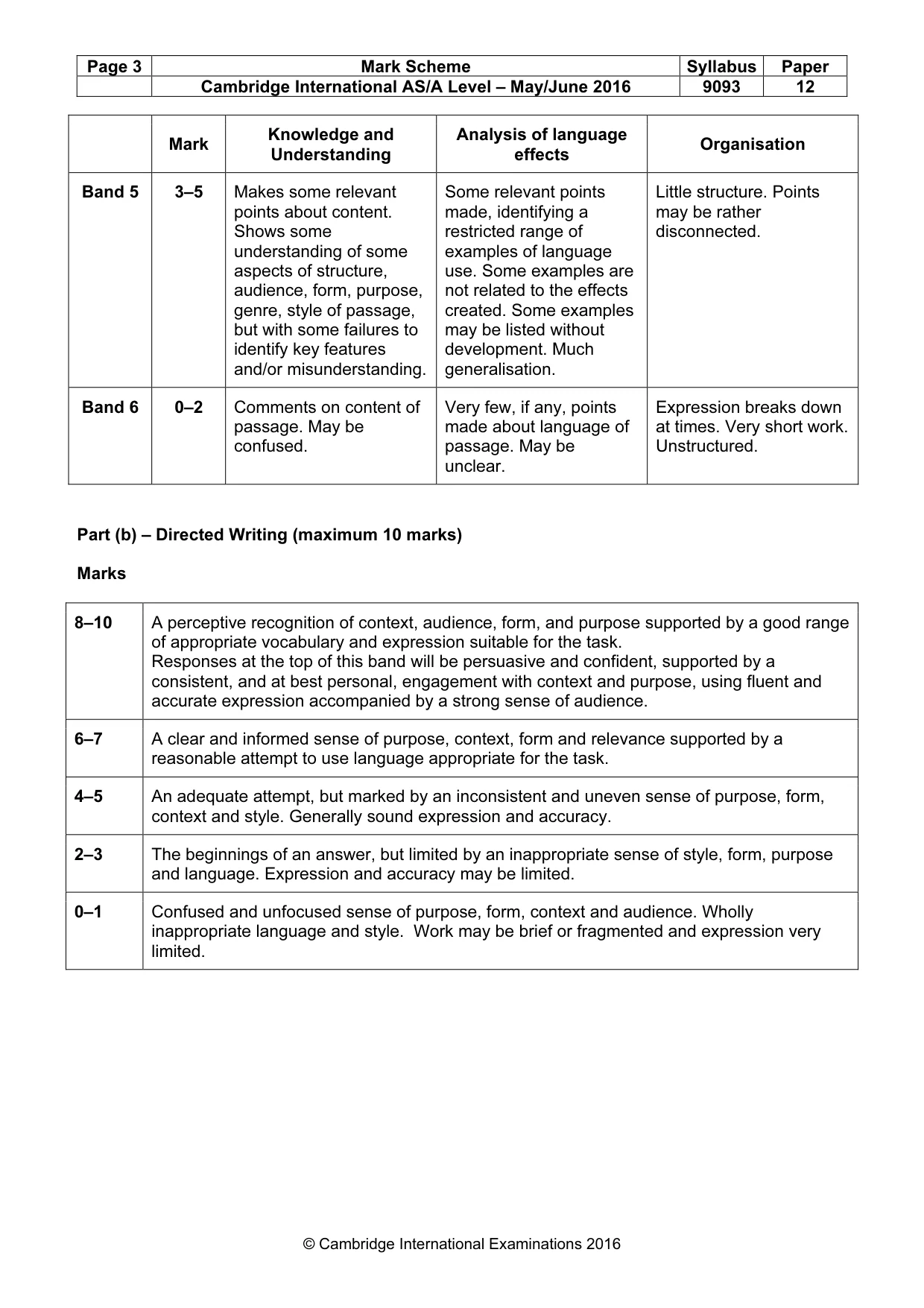
Page 3 Mark Scheme Syllabus Paper Cambridge International AS/A Level – May/June 2016 9093 12 © Cambridge International Examinations 2016 Mark Knowledge and Understanding Analysis of language effects Organisation Band 5 3–5 Makes some relevant points about content. Shows some understanding of some aspects of structure, audience, form, purpose, genre, style of passage, but with some failures to identify key features and/or misunderstanding. Some relevant points made, identifying a restricted range of examples of language use. Some examples are not related to the effects created. Some examples may be listed without development. Much generalisation. Little structure. Points may be rather disconnected. Band 6 0–2 Comments on content of passage. May be confused. Very few, if any, points made about language of passage. May be unclear. Expression breaks down at times. Very short work. Unstructured. Part (b) – Directed Writing (maximum 10 marks) Marks 8–10 A perceptive recognition of context, audience, form, and purpose supported by a good range of appropriate vocabulary and expression suitable for the task. Responses at the top of this band will be persuasive and confident, supported by a consistent, and at best personal, engagement with context and purpose, using fluent and accurate expression accompanied by a strong sense of audience. 6–7 A clear and informed sense of purpose, context, form and relevance supported by a reasonable attempt to use language appropriate for the task. 4–5 An adequate attempt, but marked by an inconsistent and uneven sense of purpose, form, context and style. Generally sound expression and accuracy. 2–3 The beginnings of an answer, but limited by an inappropriate sense of style, form, purpose and language. Expression and accuracy may be limited. 0–1 Confused and unfocused sense of purpose, form, context and audience. Wholly inappropriate language and style. Work may be brief or fragmented and expression very limited.
What you needed in this session
Cambridge’s own grade thresholds for 2016 May/June, Paper 1 · Variant 2. A higher threshold means an easier paper — the bar moves with how the cohort did.