Cambridge A Level English - Language AS and A Level (from 2014) 9093 — 2016 May/June Paper 1 · Variant 1
9093/11/M/J/16 · 50 marks · ≈56 min
The question paper and its mark scheme, free to read here and free to download. This is Cambridge’s own paper, exactly as it was sat.
Question paper8 pages

Mark scheme3 pages
Answers below. Sit the paper first if you are practising.
Paper as text
Question paper, page 1
This document consists of 6 printed pages, 2 blank pages and 1 insert. DC (CW) 106685/1 © UCLES 2016 [Turn over Cambridge International Examinations Cambridge International Advanced Subsidiary and Advanced Level * 8 2 4 1 3 0 0 9 3 8 * ENGLISH LANGUAGE 9093/11 Paper 1 Passages May/June 2016 2 hours 15 minutes No Additional Materials are required. READ THESE INSTRUCTIONS FIRST An answer booklet is provided inside this question paper. You should follow the instructions on the front cover of the answer booklet. If you need additional answer paper, ask the invigilator for a continuation booklet. Answer two questions: Question 1 and either Question 2 or Question 3. You should spend about 15 minutes reading the passages and questions before you start writing your answers. You are reminded of the need for good English and clear presentation in your answers. The number of marks is given in brackets [ ] at the end of each question or part question.
Question paper, page 2
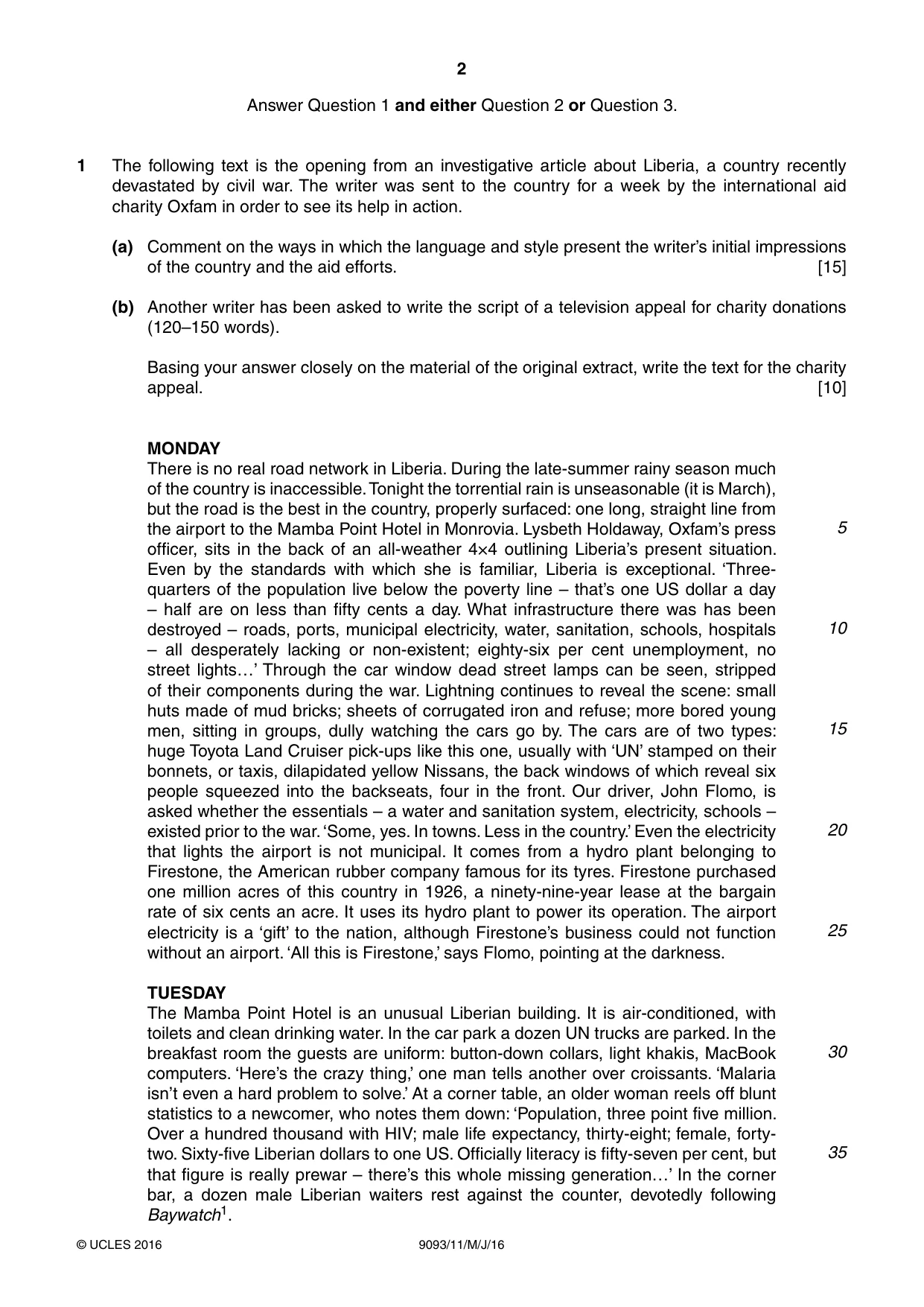
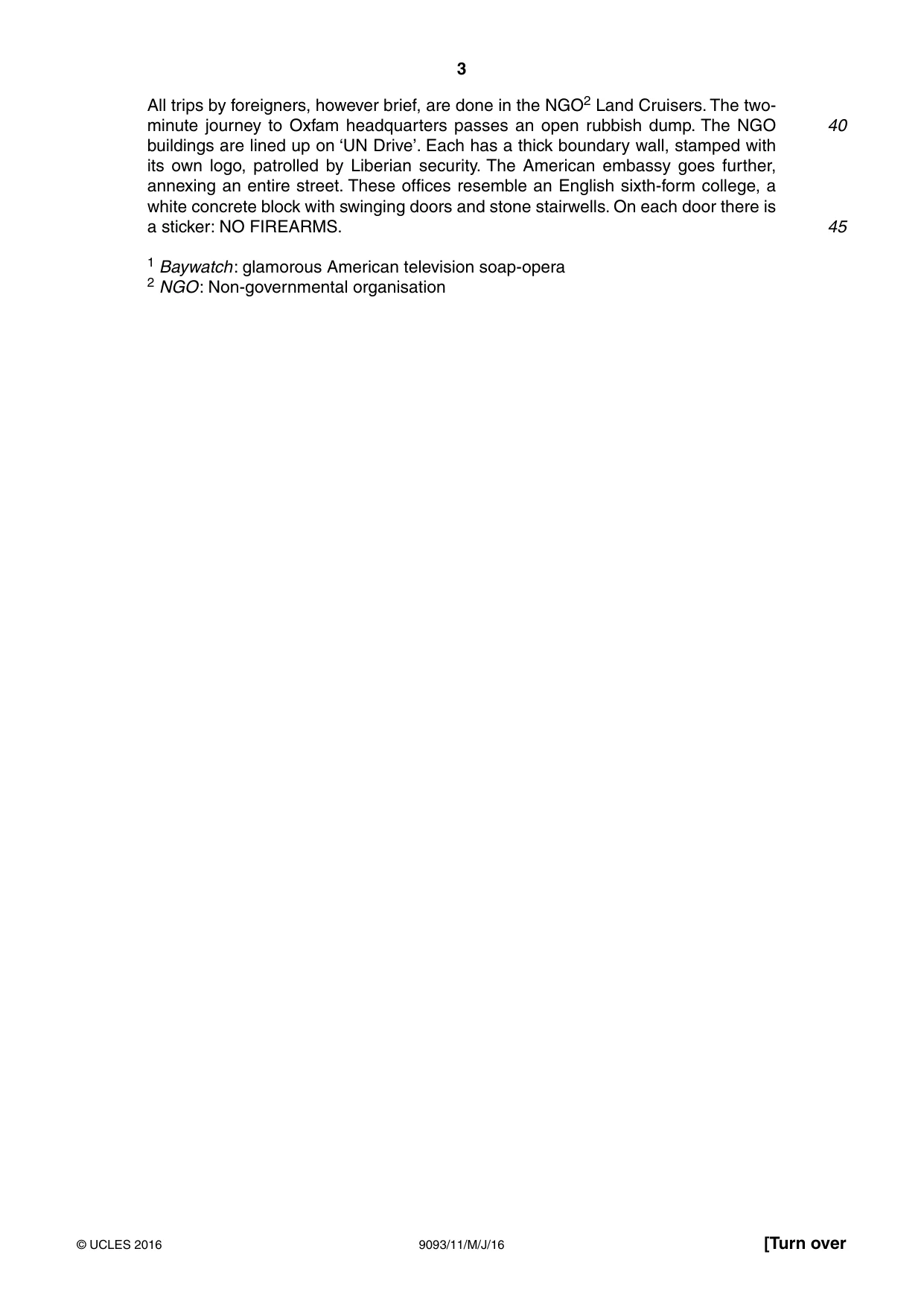
2 9093/11/M/J/16 © UCLES 2016 Answer Question 1 and either Question 2 or Question 3. 1 The following text is the opening from an investigative article about Liberia, a country recently devastated by civil war. The writer was sent to the country for a week by the international aid charity Oxfam in order to see its help in action. (a) Comment on the ways in which the language and style present the writer’s initial impressions of the country and the aid efforts. [15] (b) Another writer has been asked to write the script of a television appeal for charity donations (120–150 words). Basing your answer closely on the material of the original extract, write the text for the charity appeal. [10] MONDAY There is no real road network in Liberia. During the late-summer rainy season much of the country is inaccessible. Tonight the torrential rain is unseasonable (it is March), but the road is the best in the country, properly surfaced: one long, straight line from the airport to the Mamba Point Hotel in Monrovia. Lysbeth Holdaway, Oxfam’s press officer, sits in the back of an all-weather 4×4 outlining Liberia’s present situation. Even by the standards with which she is familiar, Liberia is exceptional. ‘Three- quarters of the population live below the poverty line – that’s one US dollar a day – half are on less than fifty cents a day. What infrastructure there was has been destroyed – roads, ports, municipal electricity, water, sanitation, schools, hospitals – all desperately lacking or non-existent; eighty-six per cent unemployment, no street lights…’ Through the car window dead street lamps can be seen, stripped of their components during the war. Lightning continues to reveal the scene: small huts made of mud bricks; sheets of corrugated iron and refuse; more bored young men, sitting in groups, dully watching the cars go by. The cars are of two types: huge Toyota Land Cruiser pick-ups like this one, usually with ‘UN’ stamped on their bonnets, or taxis, dilapidated yellow Nissans, the back windows of which reveal six people squeezed into the backseats, four in the front. Our driver, John Flomo, is asked whether the essentials – a water and sanitation system, electricity, schools – existed prior to the war. ‘Some, yes. In towns. Less in the country.’ Even the electricity that lights the airport is not municipal. It comes from a hydro plant belonging to Firestone, the American rubber company famous for its tyres. Firestone purchased one million acres of this country in 1926, a ninety-nine-year lease at the bargain rate of six cents an acre. It uses its hydro plant to power its operation. The airport electricity is a ‘gift’ to the nation, although Firestone’s business could not function without an airport. ‘All this is Firestone,’ says Flomo, pointing at the darkness. TUESDAY The Mamba Point Hotel is an unusual Liberian building. It is air-conditioned, with toilets and clean drinking water. In the car park a dozen UN trucks are parked. In the breakfast room the guests are uniform: button-down collars, light khakis, MacBook computers. ‘Here’s the crazy thing,’ one man tells another over croissants. ‘Malaria isn’t even a hard problem to solve.’ At a corner table, an older woman reels off blunt statistics to a newcomer, who notes them down: ‘Population, three point five million. Over a hundred thousand with HIV; male life expectancy, thirty-eight; female, forty- two. Sixty-five Liberian dollars to one US. Officially literacy is fifty-seven per cent, but that figure is really prewar – there’s this whole missing generation…’ In the corner bar, a dozen male Liberian waiters rest against the counter, devotedly following Baywatch1. 5 10 15 20 25 30 35
Question paper, page 3
3 9093/11/M/J/16 © UCLES 2016 [Turn over All trips by foreigners, however brief, are done in the NGO2 Land Cruisers. The two- minute journey to Oxfam headquarters passes an open rubbish dump. The NGO buildings are lined up on ‘UN Drive’. Each has a thick boundary wall, stamped with its own logo, patrolled by Liberian security. The American embassy goes further, annexing an entire street. These offices resemble an English sixth-form college, a white concrete block with swinging doors and stone stairwells. On each door there is a sticker: NO FIREARMS. 1 Baywatch : glamorous American television soap-opera 2 NGO : Non-governmental organisation 40 45
Question paper, page 4
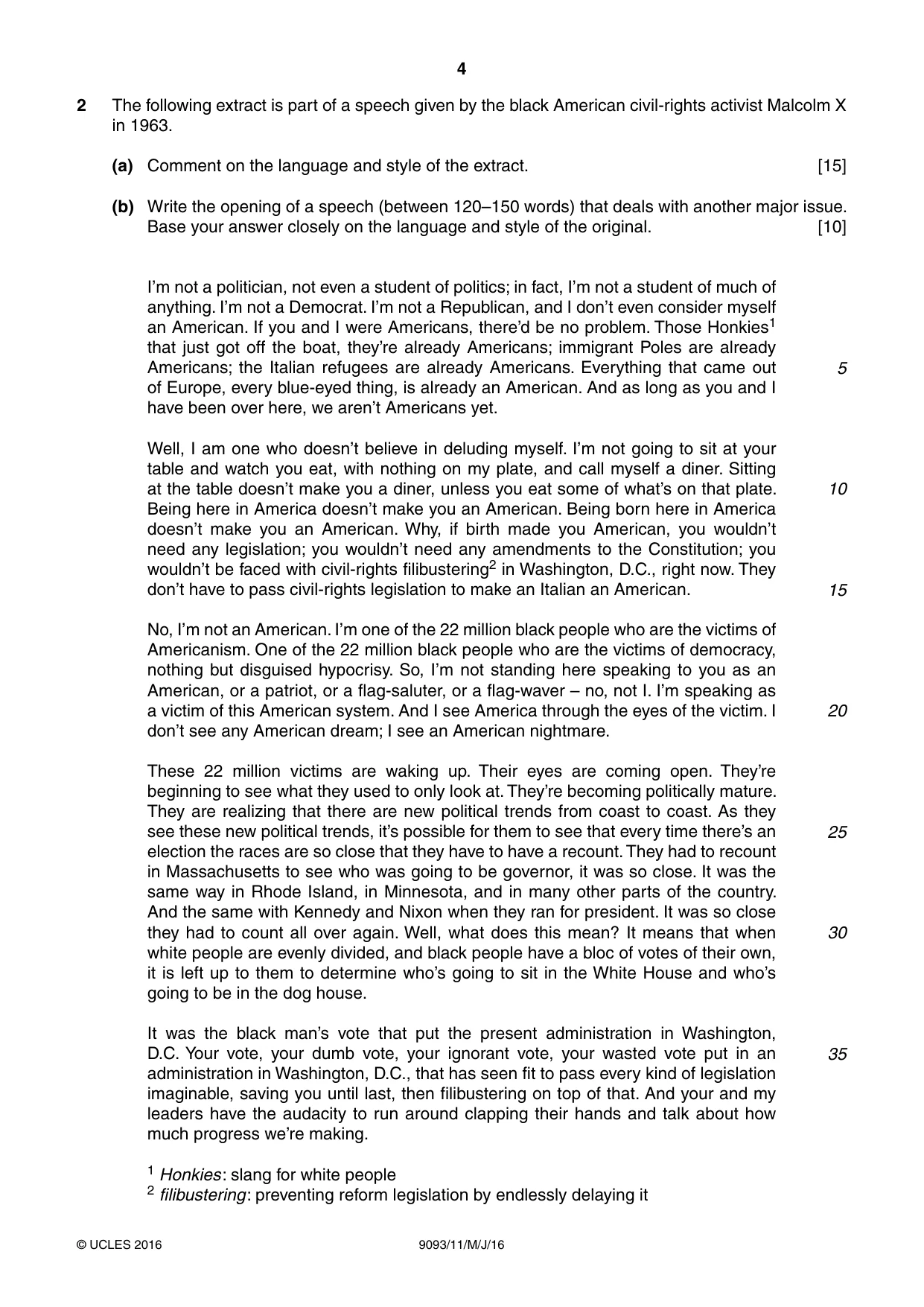
4 9093/11/M/J/16 © UCLES 2016 2 The following extract is part of a speech given by the black American civil-rights activist Malcolm X in 1963. (a) Comment on the language and style of the extract. [15] (b) Write the opening of a speech (between 120–150 words) that deals with another major issue. Base your answer closely on the language and style of the original. [10] I’m not a politician, not even a student of politics; in fact, I’m not a student of much of anything. I’m not a Democrat. I’m not a Republican, and I don’t even consider myself an American. If you and I were Americans, there’d be no problem. Those Honkies1 that just got off the boat, they’re already Americans; immigrant Poles are already Americans; the Italian refugees are already Americans. Everything that came out of Europe, every blue-eyed thing, is already an American. And as long as you and I have been over here, we aren’t Americans yet. Well, I am one who doesn’t believe in deluding myself. I’m not going to sit at your table and watch you eat, with nothing on my plate, and call myself a diner. Sitting at the table doesn’t make you a diner, unless you eat some of what’s on that plate. Being here in America doesn’t make you an American. Being born here in America doesn’t make you an American. Why, if birth made you American, you wouldn’t need any legislation; you wouldn’t need any amendments to the Constitution; you wouldn’t be faced with civil-rights filibustering2 in Washington, D.C., right now. They don’t have to pass civil-rights legislation to make an Italian an American. No, I’m not an American. I’m one of the 22 million black people who are the victims of Americanism. One of the 22 million black people who are the victims of democracy, nothing but disguised hypocrisy. So, I’m not standing here speaking to you as an American, or a patriot, or a flag-saluter, or a flag-waver – no, not I. I’m speaking as a victim of this American system. And I see America through the eyes of the victim. I don’t see any American dream; I see an American nightmare. These 22 million victims are waking up. Their eyes are coming open. They’re beginning to see what they used to only look at. They’re becoming politically mature. They are realizing that there are new political trends from coast to coast. As they see these new political trends, it’s possible for them to see that every time there’s an election the races are so close that they have to have a recount. They had to recount in Massachusetts to see who was going to be governor, it was so close. It was the same way in Rhode Island, in Minnesota, and in many other parts of the country. And the same with Kennedy and Nixon when they ran for president. It was so close they had to count all over again. Well, what does this mean? It means that when white people are evenly divided, and black people have a bloc of votes of their own, it is left up to them to determine who’s going to sit in the White House and who’s going to be in the dog house. It was the black man’s vote that put the present administration in Washington, D.C. Your vote, your dumb vote, your ignorant vote, your wasted vote put in an administration in Washington, D.C., that has seen fit to pass every kind of legislation imaginable, saving you until last, then filibustering on top of that. And your and my leaders have the audacity to run around clapping their hands and talk about how much progress we’re making. 1 Honkies : slang for white people 2 filibustering : preventing reform legislation by endlessly delaying it 5 10 15 20 25 30 35
Question paper, page 5
5 9093/11/M/J/16 © UCLES 2016 [Turn over 3 The passage below is an autobiographical memoir of an American sailor’s experience of Pearl Harbor, the attack on American territory in Hawaii by the Japanese in 1941. (a) Comment on the language and style of the extract. [15] (b) Continue the memoir for a further 120–150 words. You should base your answer closely on the language and style of the original extract. You do not need to bring it to a conclusion. [10] George Phraner’s Brush with Death Aboard the USS Arizona USS Arizona (BB-39) George D. Phraner Aviation Machinist’s Mate 1/c USS Arizona – (BB-39) Battle Station: Forward 5 inch Gun. As usual, there was a warm breeze that Sunday morning. We had just finished breakfast and drifted out of the compartment to get a little air. This was our normal routine on weekends as we had no work station to report to. It was fortunate for us that we were able to sleep in until 6:30 as many of us had been out the night before. Just as we left the mess area we heard this noise. We went outside to take a look because it’s usually very quiet. When we arrived we could hear and see there were airplanes. I looked across the bow of the ship and could see large plumes of smoke coming up from Ford Island. At first, we didn’t realize it was a bombing. It didn’t mean anything to us until a large group of planes came near the ship and we could see for the first time the rising sun emblem on the plane wings. The bombing was becoming heavier all around us and we knew this was REALLY IT! At first there was a rush of fear, the blood started to flow real fast. It was then that general quarters1 sounded over the speaker and everything became automatic. My battle station was on a forward 5 inch gun and it was standard practice to keep only a limited amount of ammunition at the guns. There was only one ready gun crew on each side and mine wasn’t one of them. There we were, the Japanese dropping bombs over us and we had no ammo. All the training and practicing for a year and when the real thing came we had no ammunition where we needed it. As unfortunate as this was, that simple fact was to save my life. Somehow the gun captain pointed at me and said, “you go aft and start bringing up the ammunition out of the magazines”. The aft magazines were five decks below. A few moments later I found myself deep below the water line in a part of the ship I normally would never be in. I remember getting these cases of ammo powder and shells weighing about 90 pounds each. I had begun lifting shells into the hoist when a deafening roar filled the room and the entire ship shuddered. It was the forward magazine. One and half million pounds of gun powder exploding in a massive fireball disintegrating the whole forward part of the ship. Only moments before I stood with my gun crew just a few feet from the center of the explosion. Admiral Kidd, Captain Van Velkenburg, my whole gun crew was killed. Everyone on top. Seconds after the explosion the lights went out and it was pitch black. Almost immediately a thick acrid smoke filled the magazine locker and the metal walls began to get hot. In the dark and not being able to breathe, we made our way to the door hatch, only to find it shut and locked. Somehow we were able to open the hatch 5 10 15 20 25 30 35 40
Question paper, page 6
6 9093/11/M/J/16 © UCLES 2016 and start to make our way up the ladder. A quick glance around revealed nothing in the darkness, but the moaning and sounds of falling bodies told me that some of my shipmates had succumbed to defeat and had died in their attempt to survive. Getting through that choking kind of smoke was a real ordeal, the kind of smoke that really hurt your lungs. After awhile I began to get weak and lightheaded. I could feel myself losing the battle to save my own life. I hung to the ladder, feeling good. I felt that it was all right for me to let go. At that moment I looked up and could see a small point of light through the smoke. It gave me the strength to go on. After what seemed to me like an eternity, I reached the deck gasping and choking. I laid down for a few moments. The warm Hawaiian air filled my lungs and cleared my head. I glanced over to the forward end of the ship to see nothing but a giant wall of flame and smoke. 1 general quarters : the call for the crew to go to battle stations 45 50
Question paper, page 7
7 9093/11/M/J/16 © UCLES 2016 BLANK PAGE
Question paper, page 8
8 9093/11/M/J/16 © UCLES 2016 BLANK PAGE Permission to reproduce items where third-party owned material protected by copyright is included has been sought and cleared where possible. Every reasonable effort has been made by the publisher (UCLES) to trace copyright holders, but if any items requiring clearance have unwittingly been included, the publisher will be pleased to make amends at the earliest possible opportunity. To avoid the issue of disclosure of answer-related information to candidates, all copyright acknowledgements are reproduced online in the Cambridge International Examinations Copyright Acknowledgements Booklet. This is produced for each series of examinations and is freely available to download at www.cie.org.uk after the live examination series. Cambridge International Examinations is part of the Cambridge Assessment Group. Cambridge Assessment is the brand name of University of Cambridge Local Examinations Syndicate (UCLES), which is itself a department of the University of Cambridge.
Mark scheme, page 1
® IGCSE is the registered trademark of Cambridge International Examinations. This document consists of 3 printed pages. © UCLES 2016 [Turn over Cambridge International Examinations Cambridge International Advanced Subsidiary and Advanced Level ENGLISH LANGUAGE 9093/11 Paper 1 Passages May/June 2016 MARK SCHEME Maximum Mark: 50 Published This mark scheme is published as an aid to teachers and candidates, to indicate the requirements of the examination. It shows the basis on which Examiners were instructed to award marks. It does not indicate the details of the discussions that took place at an Examiners’ meeting before marking began, which would have considered the acceptability of alternative answers. Mark schemes should be read in conjunction with the question paper and the Principal Examiner Report for Teachers. Cambridge will not enter into discussions about these mark schemes. Cambridge is publishing the mark schemes for the May/June 2016 series for most Cambridge IGCSE®, Cambridge International A and AS Level components and some Cambridge O Level components.
Mark scheme, page 2
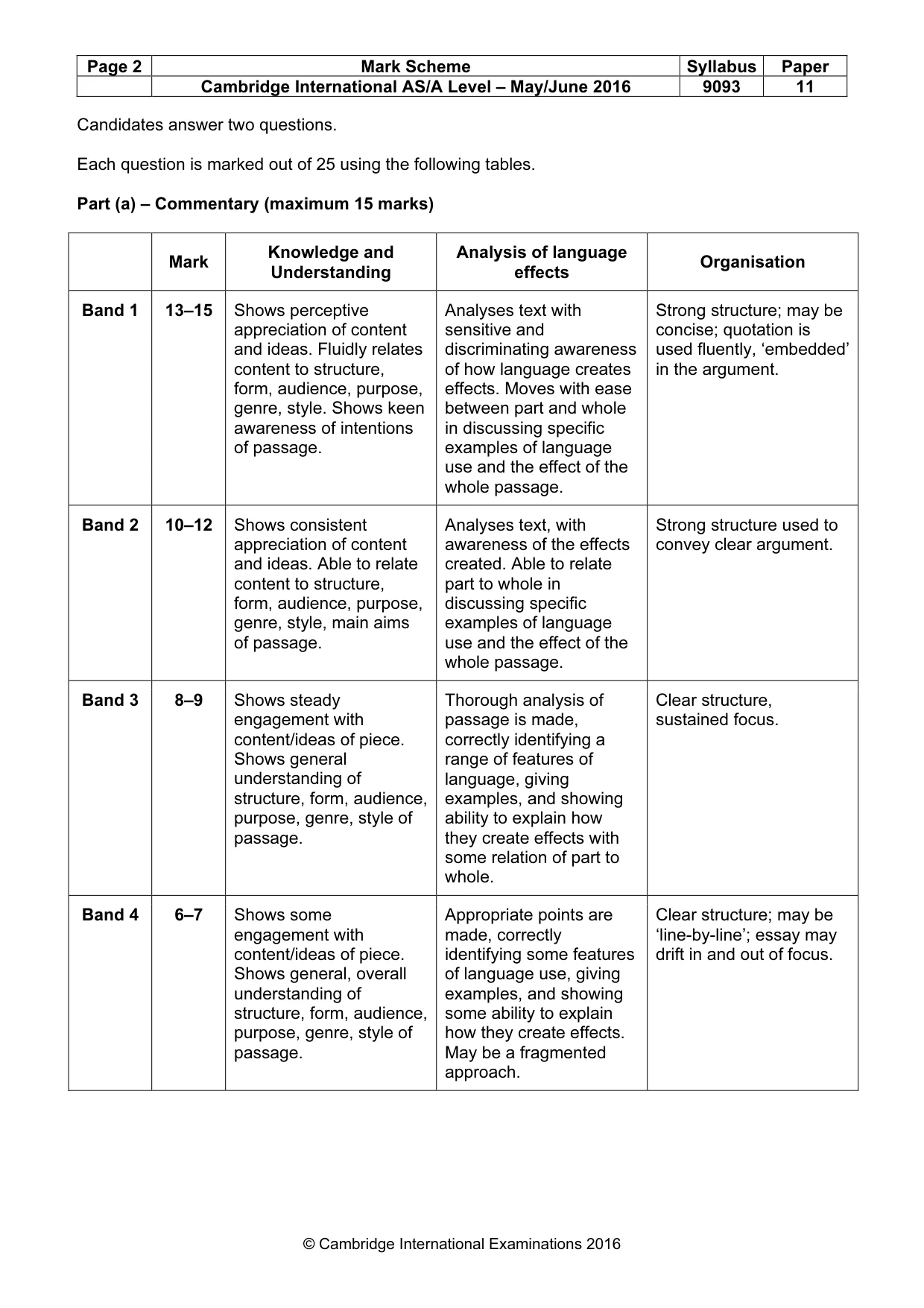
Page 2 Mark Scheme Syllabus Paper Cambridge International AS/A Level – May/June 2016 9093 11 © Cambridge International Examinations 2016 Candidates answer two questions. Each question is marked out of 25 using the following tables. Part (a) – Commentary (maximum 15 marks) Mark Knowledge and Understanding Analysis of language effects Organisation Band 1 13–15 Shows perceptive appreciation of content and ideas. Fluidly relates content to structure, form, audience, purpose, genre, style. Shows keen awareness of intentions of passage. Analyses text with sensitive and discriminating awareness of how language creates effects. Moves with ease between part and whole in discussing specific examples of language use and the effect of the whole passage. Strong structure; may be concise; quotation is used fluently, ‘embedded’ in the argument. Band 2 10–12 Shows consistent appreciation of content and ideas. Able to relate content to structure, form, audience, purpose, genre, style, main aims of passage. Analyses text, with awareness of the effects created. Able to relate part to whole in discussing specific examples of language use and the effect of the whole passage. Strong structure used to convey clear argument. Band 3 8–9 Shows steady engagement with content/ideas of piece. Shows general understanding of structure, form, audience, purpose, genre, style of passage. Thorough analysis of passage is made, correctly identifying a range of features of language, giving examples, and showing ability to explain how they create effects with some relation of part to whole. Clear structure, sustained focus. Band 4 6–7 Shows some engagement with content/ideas of piece. Shows general, overall understanding of structure, form, audience, purpose, genre, style of passage. Appropriate points are made, correctly identifying some features of language use, giving examples, and showing some ability to explain how they create effects. May be a fragmented approach. Clear structure; may be ‘line-by-line’; essay may drift in and out of focus.
Mark scheme, page 3
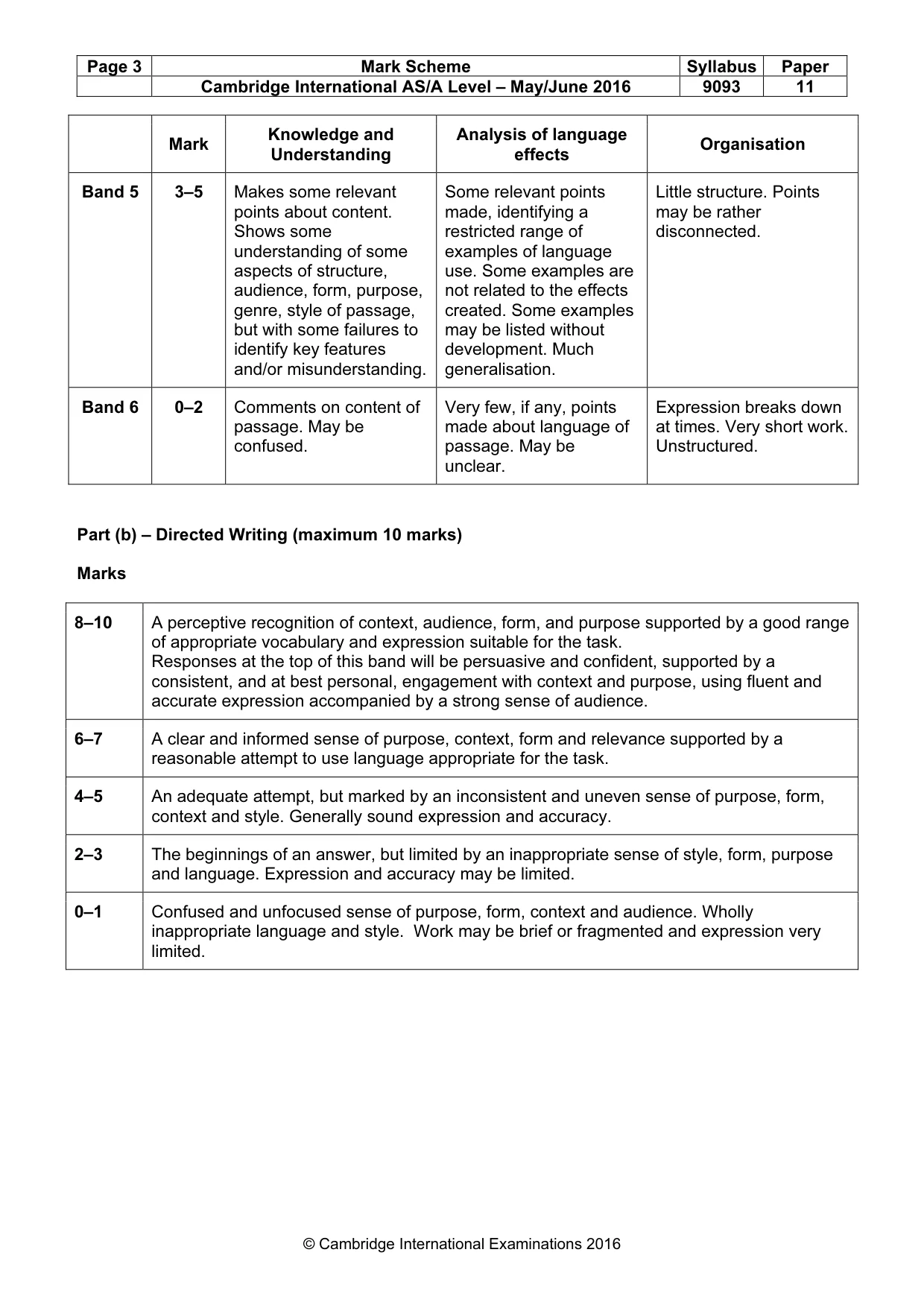
Page 3 Mark Scheme Syllabus Paper Cambridge International AS/A Level – May/June 2016 9093 11 © Cambridge International Examinations 2016 Mark Knowledge and Understanding Analysis of language effects Organisation Band 5 3–5 Makes some relevant points about content. Shows some understanding of some aspects of structure, audience, form, purpose, genre, style of passage, but with some failures to identify key features and/or misunderstanding. Some relevant points made, identifying a restricted range of examples of language use. Some examples are not related to the effects created. Some examples may be listed without development. Much generalisation. Little structure. Points may be rather disconnected. Band 6 0–2 Comments on content of passage. May be confused. Very few, if any, points made about language of passage. May be unclear. Expression breaks down at times. Very short work. Unstructured. Part (b) – Directed Writing (maximum 10 marks) Marks 8–10 A perceptive recognition of context, audience, form, and purpose supported by a good range of appropriate vocabulary and expression suitable for the task. Responses at the top of this band will be persuasive and confident, supported by a consistent, and at best personal, engagement with context and purpose, using fluent and accurate expression accompanied by a strong sense of audience. 6–7 A clear and informed sense of purpose, context, form and relevance supported by a reasonable attempt to use language appropriate for the task. 4–5 An adequate attempt, but marked by an inconsistent and uneven sense of purpose, form, context and style. Generally sound expression and accuracy. 2–3 The beginnings of an answer, but limited by an inappropriate sense of style, form, purpose and language. Expression and accuracy may be limited. 0–1 Confused and unfocused sense of purpose, form, context and audience. Wholly inappropriate language and style. Work may be brief or fragmented and expression very limited.
What you needed in this session
Cambridge’s own grade thresholds for 2016 May/June, Paper 1 · Variant 1. A higher threshold means an easier paper — the bar moves with how the cohort did.