Cambridge A Level English - Language AS and A Level (from 2014) 9093 — 2016 Feb/March Paper 4 · Variant 2
9093/42/F/M/16 · 50 marks · ≈56 min
The question paper and its mark scheme, free to read here and free to download. This is Cambridge’s own paper, exactly as it was sat.
Question paper8 pages


Mark scheme7 pages
Answers below. Sit the paper first if you are practising.
Paper as text
Question paper, page 1
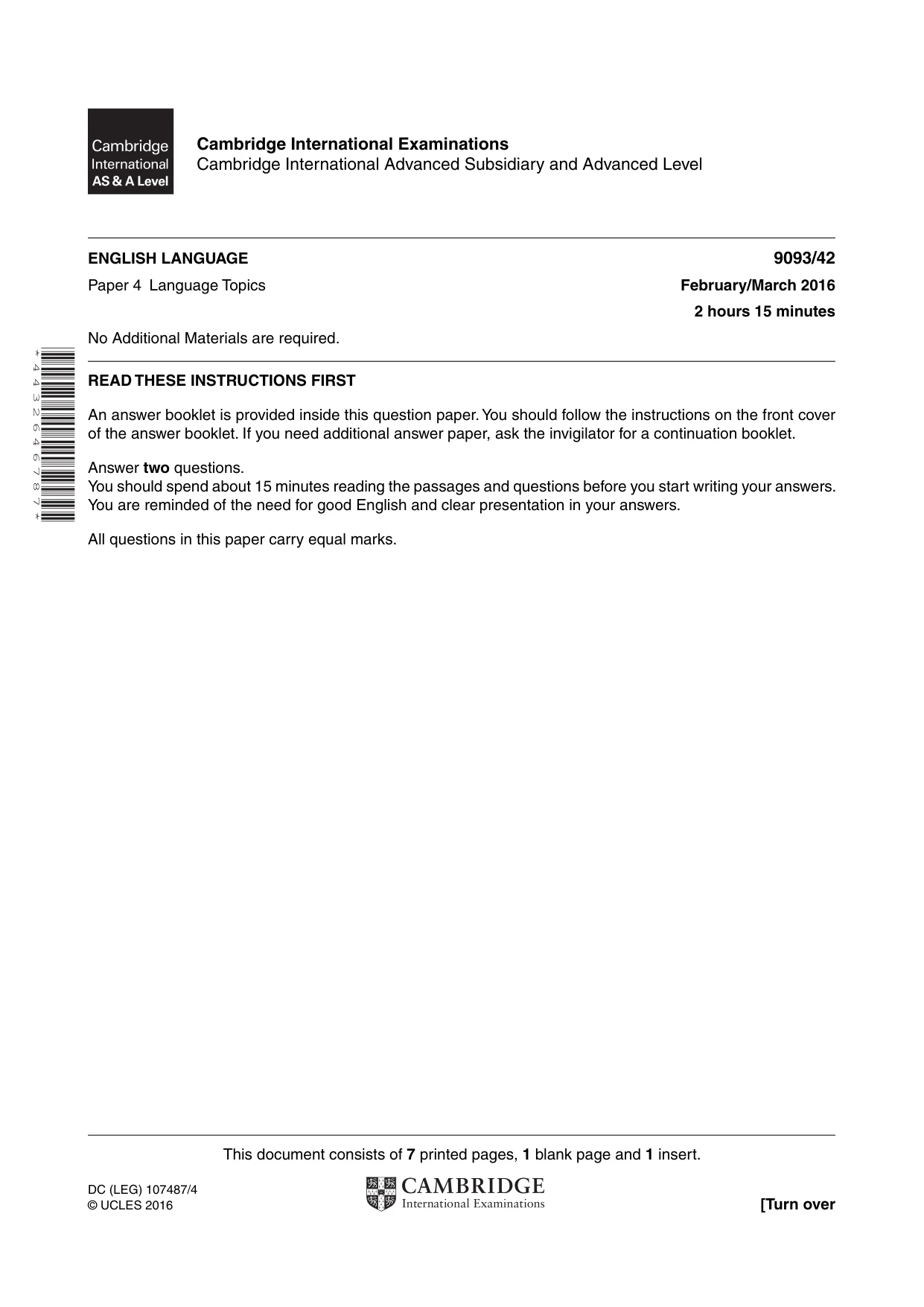
This document consists of 7 printed pages, 1 blank page and 1 insert. DC (LEG) 107487/4 © UCLES 2016 [Turn over Cambridge International Examinations Cambridge International Advanced Subsidiary and Advanced Level * 4 4 3 2 6 4 6 7 8 7 * ENGLISH LANGUAGE 9093/42 Paper 4 Language Topics February/March 2016 2 hours 15 minutes No Additional Materials are required. READ THESE INSTRUCTIONS FIRST An answer booklet is provided inside this question paper. You should follow the instructions on the front cover of the answer booklet. If you need additional answer paper, ask the invigilator for a continuation booklet. Answer two questions. You should spend about 15 minutes reading the passages and questions before you start writing your answers. You are reminded of the need for good English and clear presentation in your answers. All questions in this paper carry equal marks.
Question paper, page 2
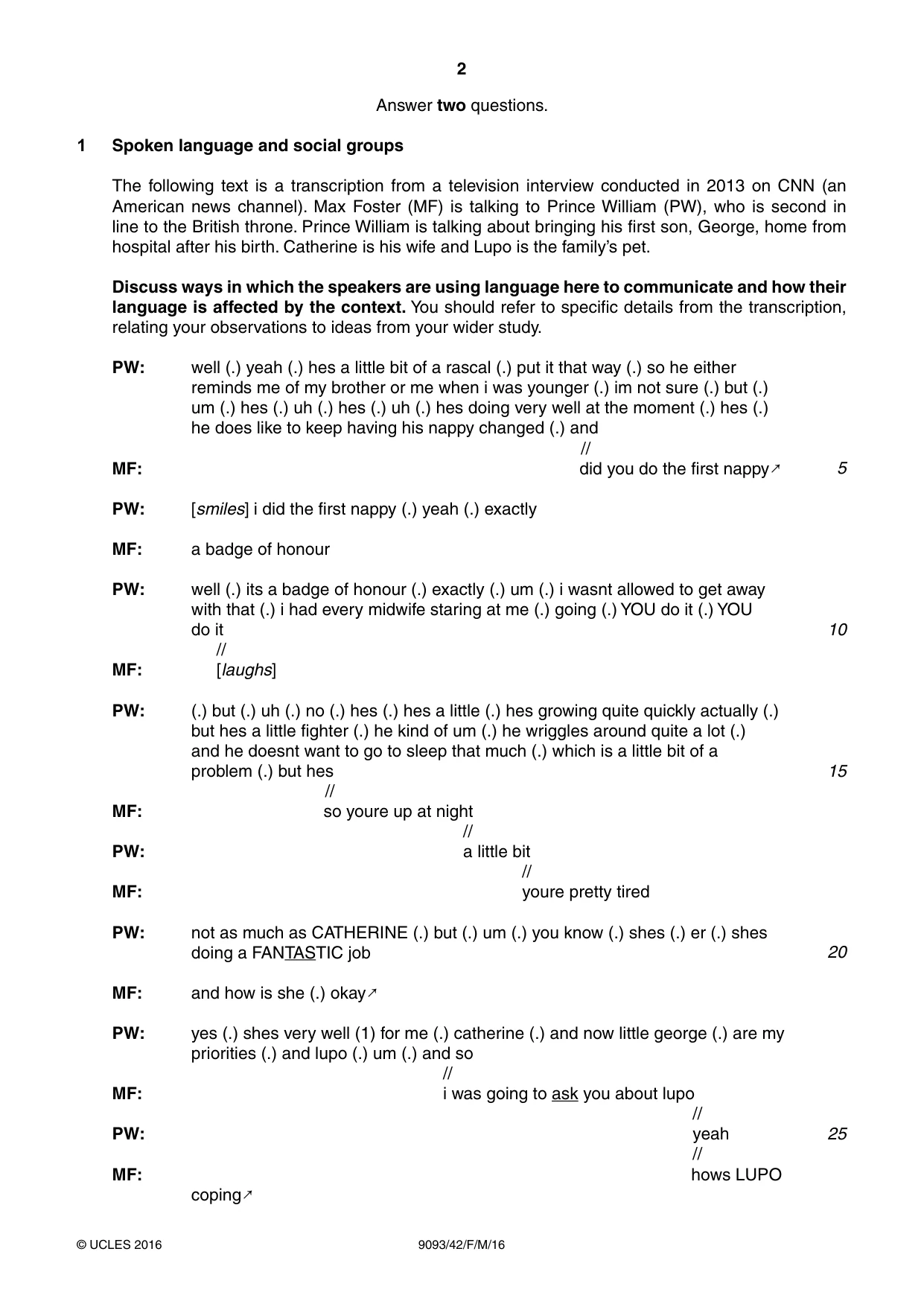
2 9093/42/F/M/16 © UCLES 2016 Answer two questions. 1 Spoken language and social groups The following text is a transcription from a television interview conducted in 2013 on CNN (an American news channel). Max Foster (MF) is talking to Prince William (PW), who is second in line to the British throne. Prince William is talking about bringing his first son, George, home from hospital after his birth. Catherine is his wife and Lupo is the family’s pet. Discuss ways in which the speakers are using language here to communicate and how their language is affected by the context. You should refer to specific details from the transcription, relating your observations to ideas from your wider study. PW: well (.) yeah (.) hes a little bit of a rascal (.) put it that way (.) so he either reminds me of my brother or me when i was younger (.) im not sure (.) but (.) um (.) hes (.) uh (.) hes (.) uh (.) hes doing very well at the moment (.) hes (.) he does like to keep having his nappy changed (.) and // MF: did you do the first nappy↗ PW: [smiles] i did the first nappy (.) yeah (.) exactly MF: a badge of honour PW: well (.) its a badge of honour (.) exactly (.) um (.) i wasnt allowed to get away with that (.) i had every midwife staring at me (.) going (.) YOU do it (.) YOU do it // MF: [laughs] PW: (.) but (.) uh (.) no (.) hes (.) hes a little (.) hes growing quite quickly actually (.) but hes a little fighter (.) he kind of um (.) he wriggles around quite a lot (.) and he doesnt want to go to sleep that much (.) which is a little bit of a problem (.) but hes // MF: so youre up at night // PW: a little bit // MF: youre pretty tired PW: not as much as CATHERINE (.) but (.) um (.) you know (.) shes (.) er (.) shes doing a FANTASTIC job MF: and how is she (.) okay↗ PW: yes (.) shes very well (1) for me (.) catherine (.) and now little george (.) are my priorities (.) and lupo (.) um (.) and so // MF: i was going to ask you about lupo // PW: yeah // MF: hows LUPO coping↗ 5 10 15 20 25
Question paper, page 3
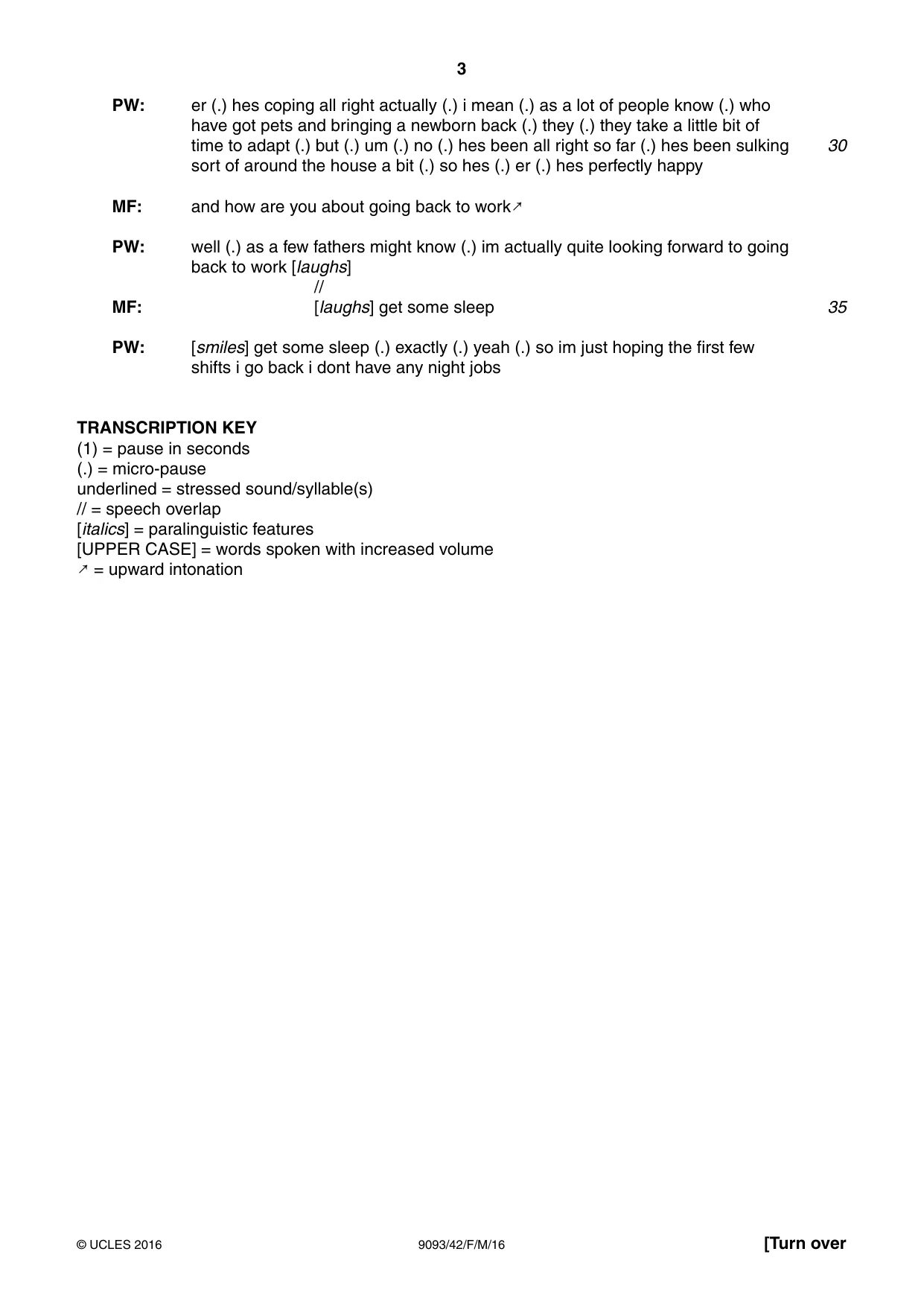
3 9093/42/F/M/16 © UCLES 2016 [Turn over PW: er (.) hes coping all right actually (.) i mean (.) as a lot of people know (.) who have got pets and bringing a newborn back (.) they (.) they take a little bit of time to adapt (.) but (.) um (.) no (.) hes been all right so far (.) hes been sulking sort of around the house a bit (.) so hes (.) er (.) hes perfectly happy MF: and how are you about going back to work↗ PW: well (.) as a few fathers might know (.) im actually quite looking forward to going back to work [laughs] // MF: [laughs] get some sleep PW: [smiles] get some sleep (.) exactly (.) yeah (.) so im just hoping the first few shifts i go back i dont have any night jobs TRANSCRIPTION KEY (1) = pause in seconds (.) = micro-pause underlined = stressed sound/syllable(s) // = speech overlap [italics] = paralinguistic features [UPPER CASE] = words spoken with increased volume ↗ = upward intonation 30 35
Question paper, page 4
4 9093/42/F/M/16 © UCLES 2016 2 English as a global language The passage on the next page deals with the idea of ‘Globish’ as a simplified, global form of English. It is an extract from an international business blog entitled Globish or Gobbledygook? Discuss what you feel are the most important issues raised here relating to the changing use of English as a global language. You should refer to specific details from the passage as well as to ideas and examples from your wider study.
Question paper, page 5
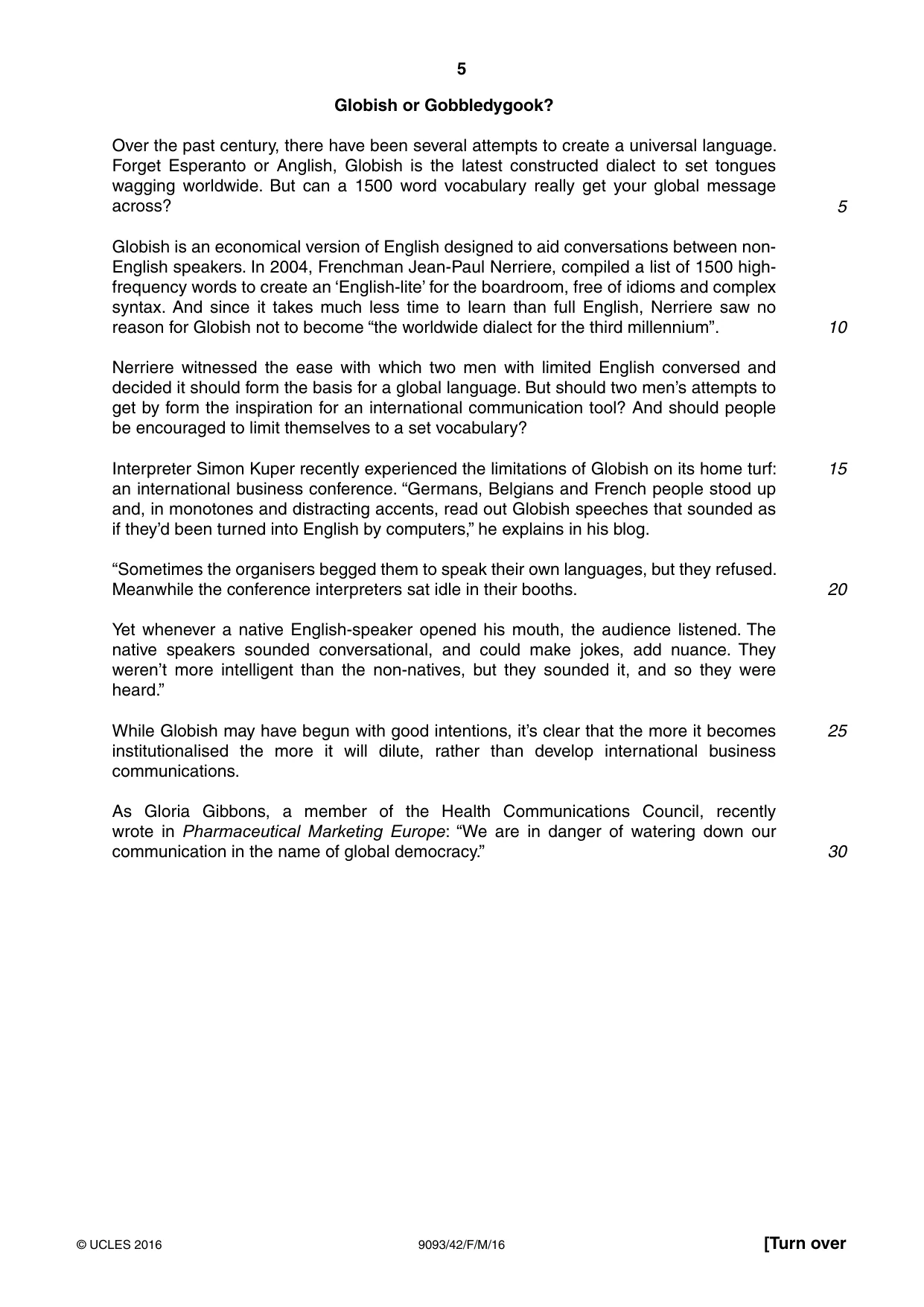
5 9093/42/F/M/16 © UCLES 2016 [Turn over Globish or Gobbledygook? Over the past century, there have been several attempts to create a universal language. Forget Esperanto or Anglish, Globish is the latest constructed dialect to set tongues wagging worldwide. But can a 1500 word vocabulary really get your global message across? Globish is an economical version of English designed to aid conversations between non- English speakers. In 2004, Frenchman Jean-Paul Nerriere, compiled a list of 1500 high- frequency words to create an ‘English-lite’ for the boardroom, free of idioms and complex syntax. And since it takes much less time to learn than full English, Nerriere saw no reason for Globish not to become “the worldwide dialect for the third millennium”. Nerriere witnessed the ease with which two men with limited English conversed and decided it should form the basis for a global language. But should two men’s attempts to get by form the inspiration for an international communication tool? And should people be encouraged to limit themselves to a set vocabulary? Interpreter Simon Kuper recently experienced the limitations of Globish on its home turf: an international business conference. “Germans, Belgians and French people stood up and, in monotones and distracting accents, read out Globish speeches that sounded as if they’d been turned into English by computers,” he explains in his blog. “Sometimes the organisers begged them to speak their own languages, but they refused. Meanwhile the conference interpreters sat idle in their booths. Yet whenever a native English-speaker opened his mouth, the audience listened. The native speakers sounded conversational, and could make jokes, add nuance. They weren’t more intelligent than the non-natives, but they sounded it, and so they were heard.” While Globish may have begun with good intentions, it’s clear that the more it becomes institutionalised the more it will dilute, rather than develop international business communications. As Gloria Gibbons, a member of the Health Communications Council, recently wrote in Pharmaceutical Marketing Europe: “We are in danger of watering down our communication in the name of global democracy.” 5 10 15 20 25 30
Question paper, page 6
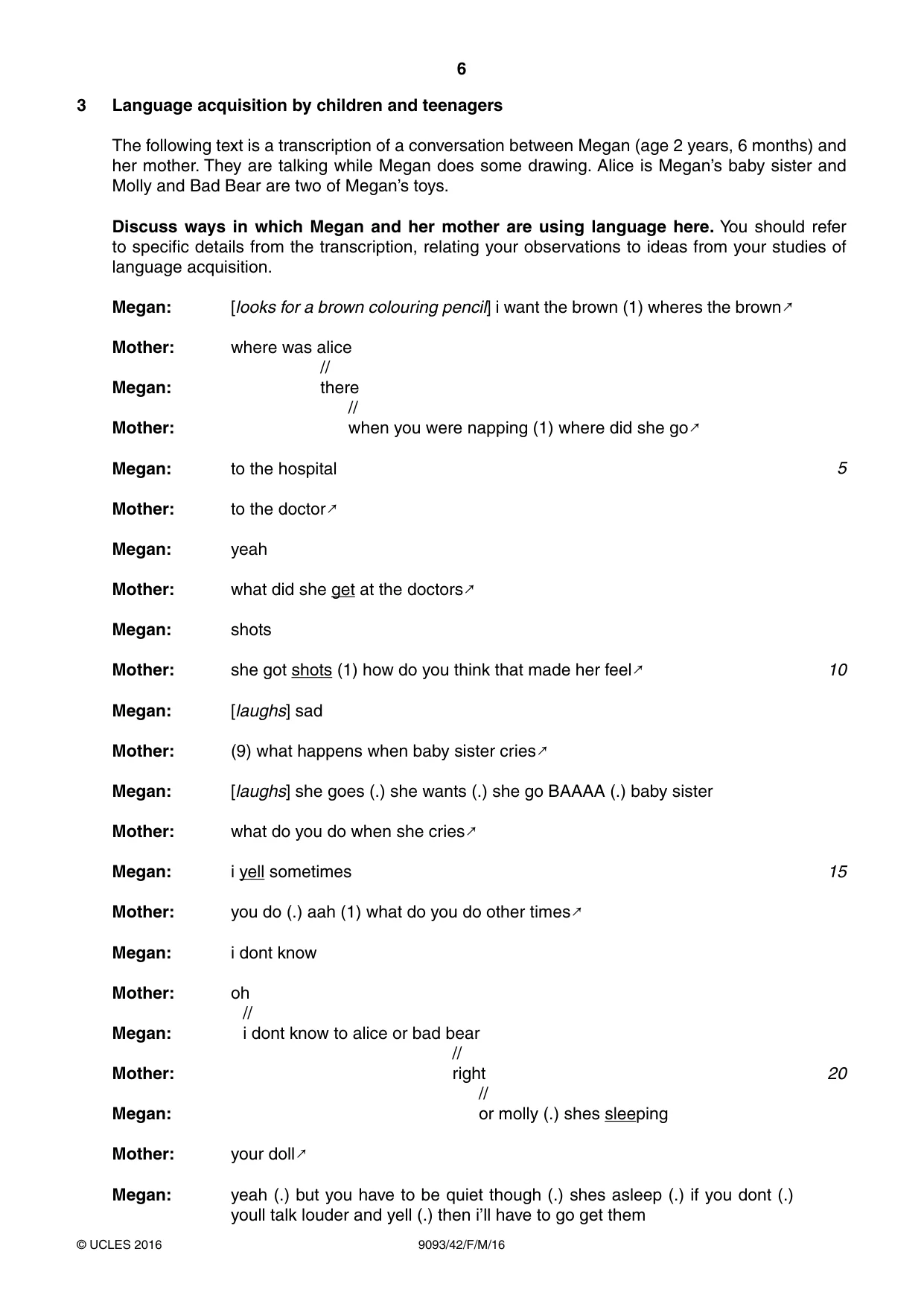
6 9093/42/F/M/16 © UCLES 2016 3 Language acquisition by children and teenagers The following text is a transcription of a conversation between Megan (age 2 years, 6 months) and her mother. They are talking while Megan does some drawing. Alice is Megan’s baby sister and Molly and Bad Bear are two of Megan’s toys. Discuss ways in which Megan and her mother are using language here. You should refer to specific details from the transcription, relating your observations to ideas from your studies of language acquisition. Megan: [looks for a brown colouring pencil] i want the brown (1) wheres the brown↗ Mother: where was alice // Megan: there // Mother: when you were napping (1) where did she go↗ Megan: to the hospital Mother: to the doctor↗ Megan: yeah Mother: what did she get at the doctors↗ Megan: shots Mother: she got shots (1) how do you think that made her feel↗ Megan: [laughs] sad Mother: (9) what happens when baby sister cries↗ Megan: [laughs] she goes (.) she wants (.) she go BAAAA (.) baby sister Mother: what do you do when she cries↗ Megan: i yell sometimes Mother: you do (.) aah (1) what do you do other times↗ Megan: i dont know Mother: oh // Megan: i dont know to alice or bad bear // Mother: right // Megan: or molly (.) shes sleeping Mother: your doll↗ Megan: yeah (.) but you have to be quiet though (.) shes asleep (.) if you dont (.) youll talk louder and yell (.) then i’ll have to go get them 5 10 15 20
Question paper, page 7
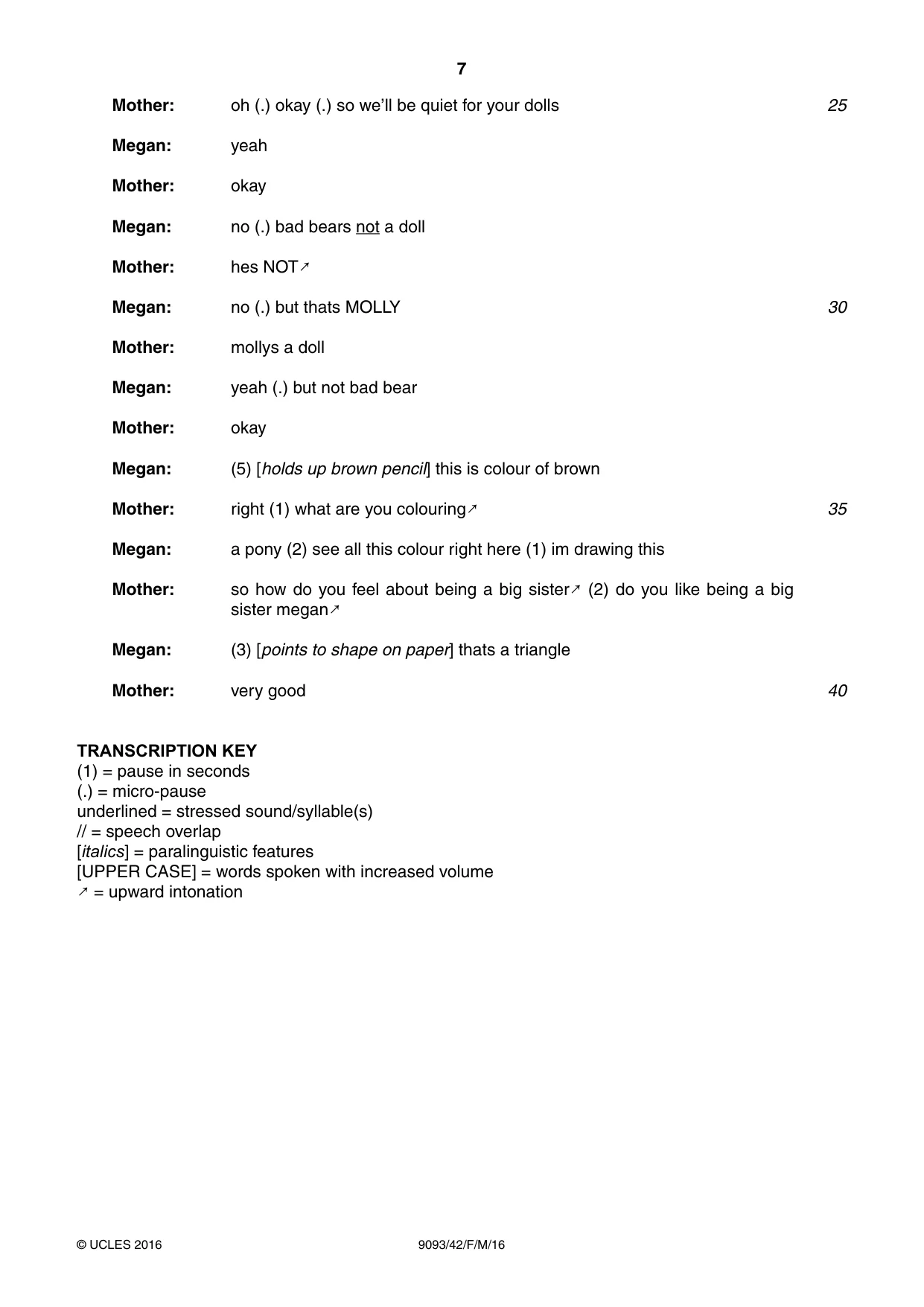
7 9093/42/F/M/16 © UCLES 2016 Mother: oh (.) okay (.) so we’ll be quiet for your dolls Megan: yeah Mother: okay Megan: no (.) bad bears not a doll Mother: hes NO T↗ Megan: no (.) but thats MOLLY Mother: mollys a doll Megan: yeah (.) but not bad bear Mother: okay Megan: (5) [holds up brown pencil] this is colour of brown Mother: right (1) what are you colouring↗ Megan: a pony (2) see all this colour right here (1) im drawing this Mother: so how do you feel about being a big sister↗ (2) do you like being a big sister megan↗ Megan: (3) [points to shape on paper] thats a triangle Mother: very good TRANSCRIPTION KEY (1) = pause in seconds (.) = micro-pause underlined = stressed sound/syllable(s) // = speech overlap [italics] = paralinguistic features [UPPER CASE] = words spoken with increased volume ↗ = upward intonation 25 30 35 40
Question paper, page 8
8 9093/42/F/M/16 © UCLES 2016 BLANK PAGE Permission to reproduce items where third-party owned material protected by copyright is included has been sought and cleared where possible. Every reasonable effort has been made by the publisher (UCLES) to trace copyright holders, but if any items requiring clearance have unwittingly been included, the publisher will be pleased to make amends at the earliest possible opportunity. To avoid the issue of disclosure of answer-related information to candidates, all copyright acknowledgements are reproduced online in the Cambridge International Examinations Copyright Acknowledgements Booklet. This is produced for each series of examinations and is freely available to download at www.cie.org.uk after the live examination series. Cambridge International Examinations is part of the Cambridge Assessment Group. Cambridge Assessment is the brand name of University of Cambridge Local Examinations Syndicate (UCLES), which is itself a department of the University of Cambridge.
Mark scheme, page 1
® IGCSE is the registered trademark of Cambridge International Examinations. CAMBRIDGE INTERNATIONAL EXAMINATIONS Cambridge International Advanced Subsidiary and Advanced Level MARK SCHEME for the March 2016 series 9093 ENGLISH LANGUAGE 9093/42 Paper 4 (Language Topics), maximum raw mark 50 This mark scheme is published as an aid to teachers and candidates, to indicate the requirements of the examination. It shows the basis on which Examiners were instructed to award marks. It does not indicate the details of the discussions that took place at an Examiners’ meeting before marking began, which would have considered the acceptability of alternative answers. Mark schemes should be read in conjunction with the question paper and the Principal Examiner Report for Teachers. Cambridge will not enter into discussions about these mark schemes. Cambridge is publishing the mark schemes for the March 2016 series for most Cambridge IGCSE® and Cambridge International A and AS Level components.
Mark scheme, page 2
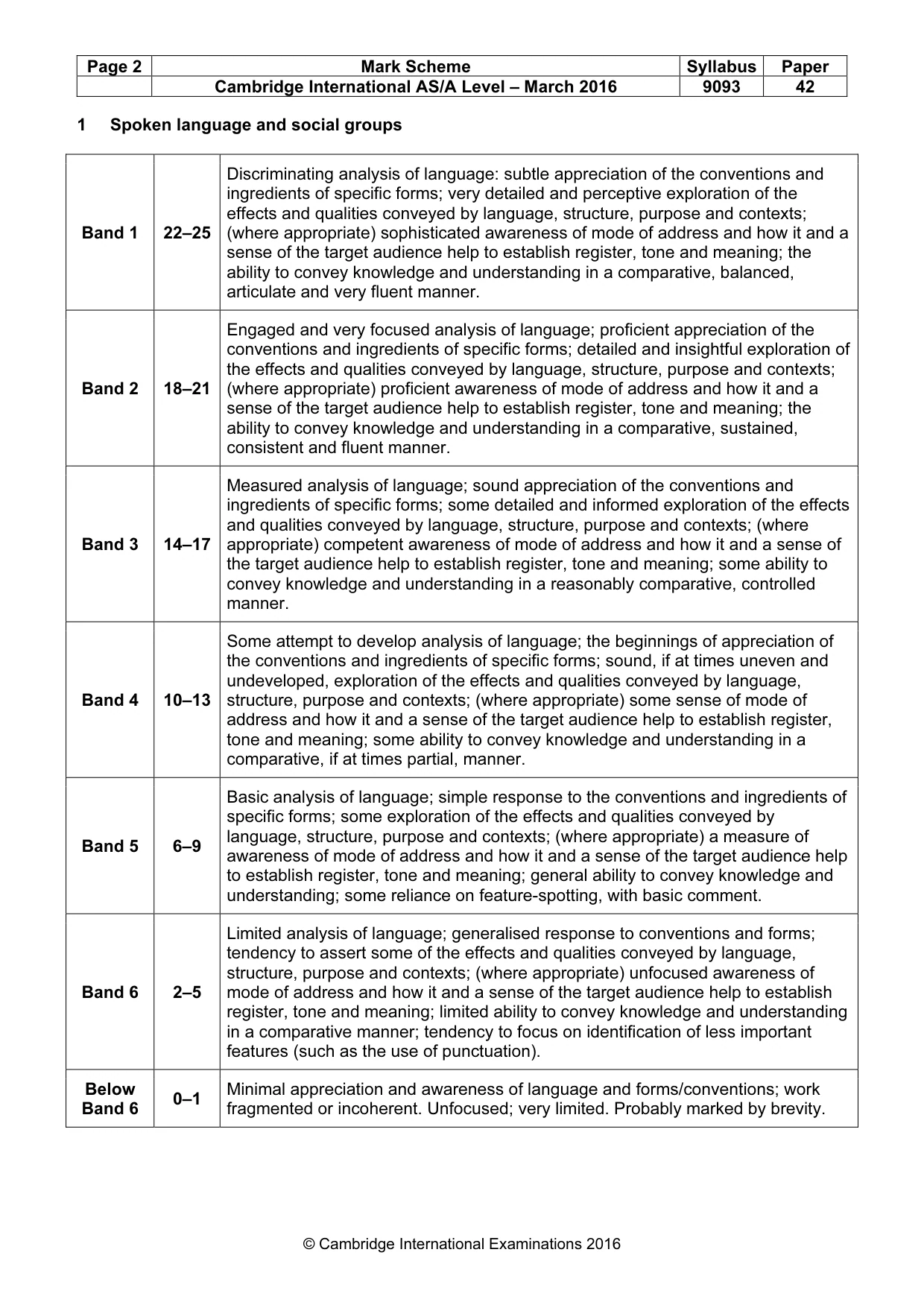
Page 2 Mark Scheme Syllabus Paper Cambridge International AS/A Level – March 2016 9093 42 © Cambridge International Examinations 2016 1 Spoken language and social groups Band 1 22–25 Discriminating analysis of language: subtle appreciation of the conventions and ingredients of specific forms; very detailed and perceptive exploration of the effects and qualities conveyed by language, structure, purpose and contexts; (where appropriate) sophisticated awareness of mode of address and how it and a sense of the target audience help to establish register, tone and meaning; the ability to convey knowledge and understanding in a comparative, balanced, articulate and very fluent manner. Band 2 18–21 Engaged and very focused analysis of language; proficient appreciation of the conventions and ingredients of specific forms; detailed and insightful exploration of the effects and qualities conveyed by language, structure, purpose and contexts; (where appropriate) proficient awareness of mode of address and how it and a sense of the target audience help to establish register, tone and meaning; the ability to convey knowledge and understanding in a comparative, sustained, consistent and fluent manner. Band 3 14–17 Measured analysis of language; sound appreciation of the conventions and ingredients of specific forms; some detailed and informed exploration of the effects and qualities conveyed by language, structure, purpose and contexts; (where appropriate) competent awareness of mode of address and how it and a sense of the target audience help to establish register, tone and meaning; some ability to convey knowledge and understanding in a reasonably comparative, controlled manner. Band 4 10–13 Some attempt to develop analysis of language; the beginnings of appreciation of the conventions and ingredients of specific forms; sound, if at times uneven and undeveloped, exploration of the effects and qualities conveyed by language, structure, purpose and contexts; (where appropriate) some sense of mode of address and how it and a sense of the target audience help to establish register, tone and meaning; some ability to convey knowledge and understanding in a comparative, if at times partial, manner. Band 5 6–9 Basic analysis of language; simple response to the conventions and ingredients of specific forms; some exploration of the effects and qualities conveyed by language, structure, purpose and contexts; (where appropriate) a measure of awareness of mode of address and how it and a sense of the target audience help to establish register, tone and meaning; general ability to convey knowledge and understanding; some reliance on feature-spotting, with basic comment. Band 6 2–5 Limited analysis of language; generalised response to conventions and forms; tendency to assert some of the effects and qualities conveyed by language, structure, purpose and contexts; (where appropriate) unfocused awareness of mode of address and how it and a sense of the target audience help to establish register, tone and meaning; limited ability to convey knowledge and understanding in a comparative manner; tendency to focus on identification of less important features (such as the use of punctuation). Below Band 6 0–1 Minimal appreciation and awareness of language and forms/conventions; work fragmented or incoherent. Unfocused; very limited. Probably marked by brevity.
Mark scheme, page 3
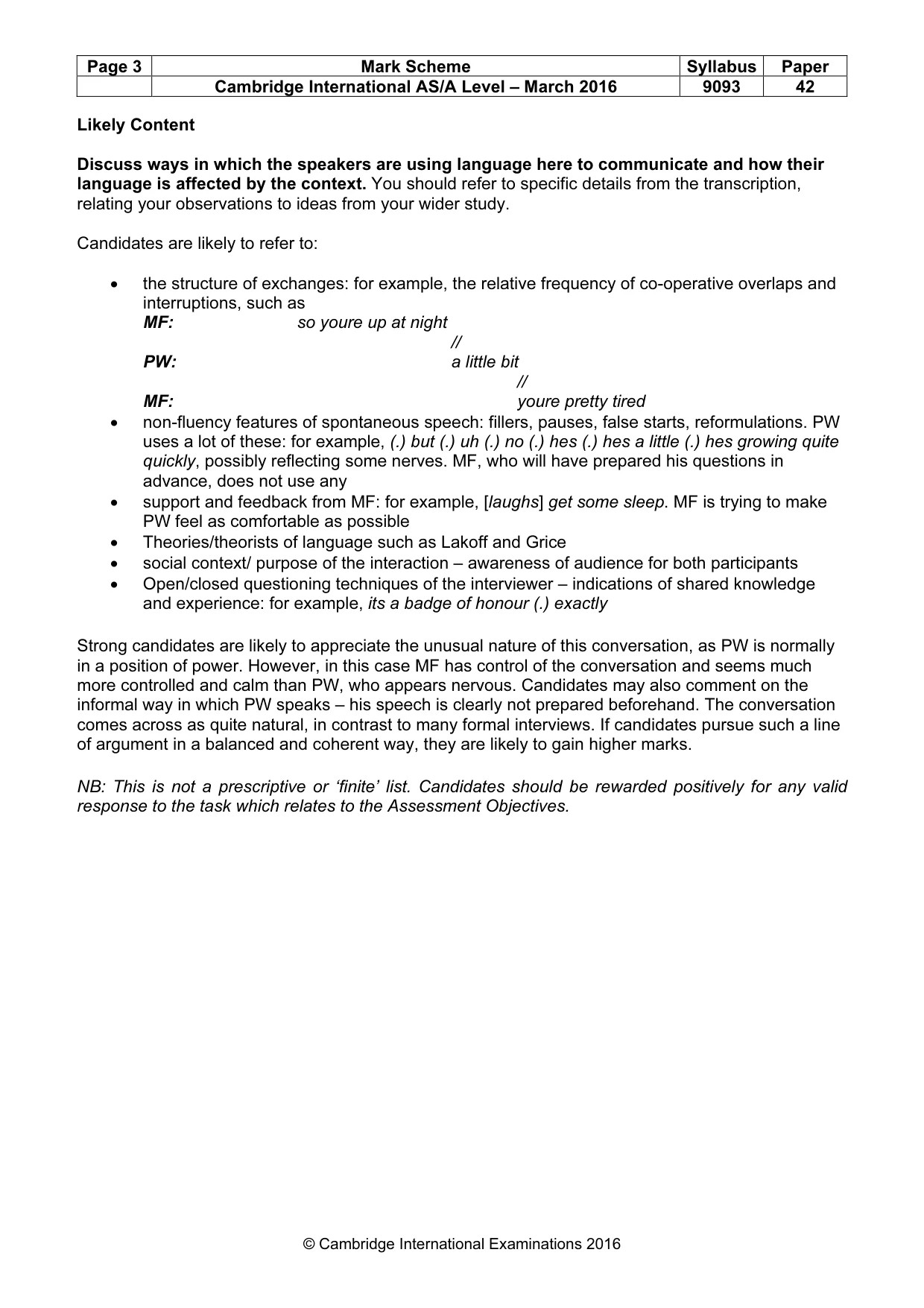
Page 3 Mark Scheme Syllabus Paper Cambridge International AS/A Level – March 2016 9093 42 © Cambridge International Examinations 2016 Likely Content Discuss ways in which the speakers are using language here to communicate and how their language is affected by the context. You should refer to specific details from the transcription, relating your observations to ideas from your wider study. Candidates are likely to refer to: • the structure of exchanges: for example, the relative frequency of co-operative overlaps and interruptions, such as MF: so youre up at night // PW: a little bit // MF: youre pretty tired • non-fluency features of spontaneous speech: fillers, pauses, false starts, reformulations. PW uses a lot of these: for example, (.) but (.) uh (.) no (.) hes (.) hes a little (.) hes growing quite quickly, possibly reflecting some nerves. MF, who will have prepared his questions in advance, does not use any • support and feedback from MF: for example, [laughs] get some sleep. MF is trying to make PW feel as comfortable as possible • Theories/theorists of language such as Lakoff and Grice • social context/ purpose of the interaction – awareness of audience for both participants • Open/closed questioning techniques of the interviewer – indications of shared knowledge and experience: for example, its a badge of honour (.) exactly Strong candidates are likely to appreciate the unusual nature of this conversation, as PW is normally in a position of power. However, in this case MF has control of the conversation and seems much more controlled and calm than PW, who appears nervous. Candidates may also comment on the informal way in which PW speaks – his speech is clearly not prepared beforehand. The conversation comes across as quite natural, in contrast to many formal interviews. If candidates pursue such a line of argument in a balanced and coherent way, they are likely to gain higher marks. NB: This is not a prescriptive or ‘finite’ list. Candidates should be rewarded positively for any valid response to the task which relates to the Assessment Objectives.
Mark scheme, page 4
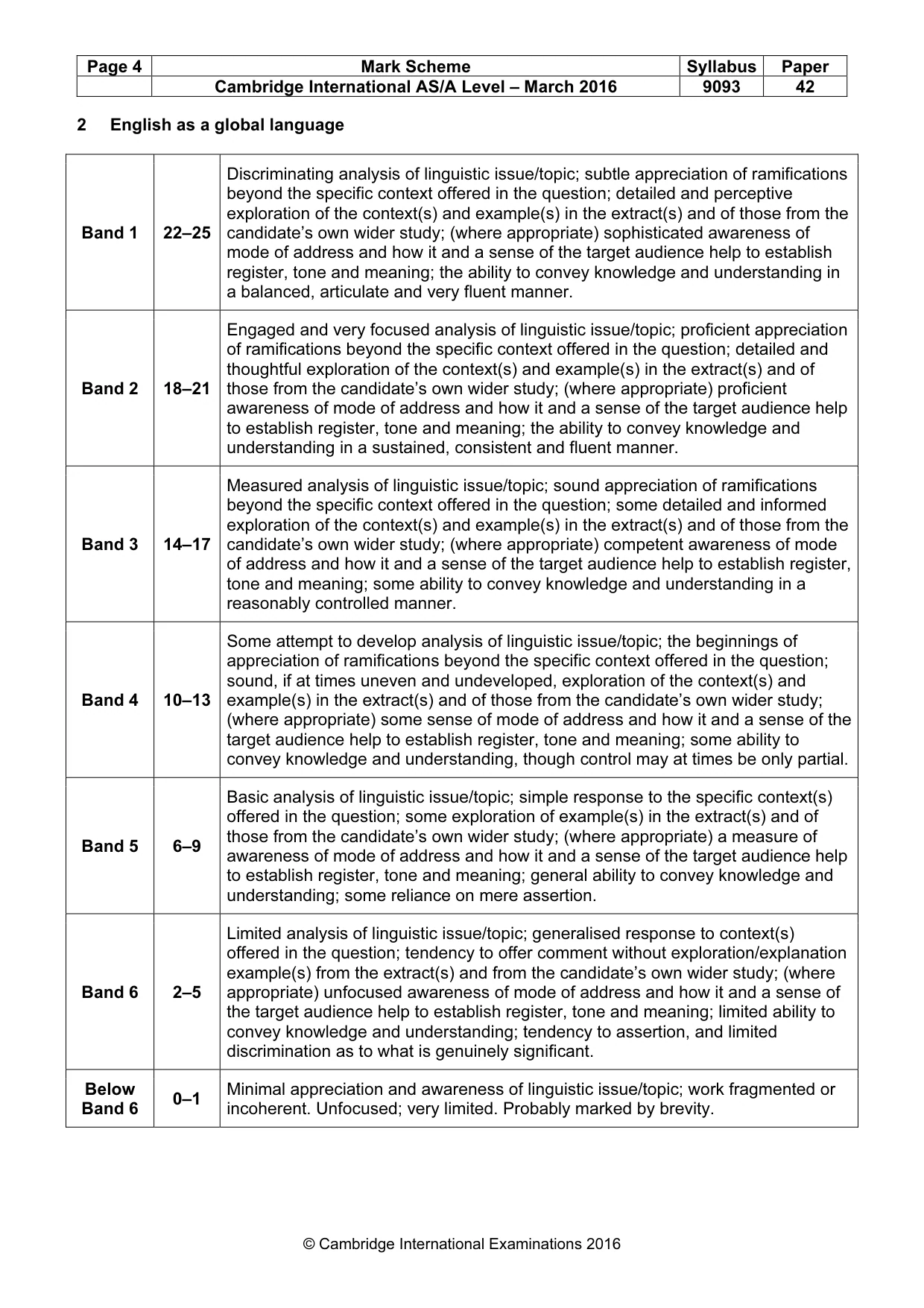
Page 4 Mark Scheme Syllabus Paper Cambridge International AS/A Level – March 2016 9093 42 © Cambridge International Examinations 2016 2 English as a global language Band 1 22–25 Discriminating analysis of linguistic issue/topic; subtle appreciation of ramifications beyond the specific context offered in the question; detailed and perceptive exploration of the context(s) and example(s) in the extract(s) and of those from the candidate’s own wider study; (where appropriate) sophisticated awareness of mode of address and how it and a sense of the target audience help to establish register, tone and meaning; the ability to convey knowledge and understanding in a balanced, articulate and very fluent manner. Band 2 18–21 Engaged and very focused analysis of linguistic issue/topic; proficient appreciation of ramifications beyond the specific context offered in the question; detailed and thoughtful exploration of the context(s) and example(s) in the extract(s) and of those from the candidate’s own wider study; (where appropriate) proficient awareness of mode of address and how it and a sense of the target audience help to establish register, tone and meaning; the ability to convey knowledge and understanding in a sustained, consistent and fluent manner. Band 3 14–17 Measured analysis of linguistic issue/topic; sound appreciation of ramifications beyond the specific context offered in the question; some detailed and informed exploration of the context(s) and example(s) in the extract(s) and of those from the candidate’s own wider study; (where appropriate) competent awareness of mode of address and how it and a sense of the target audience help to establish register, tone and meaning; some ability to convey knowledge and understanding in a reasonably controlled manner. Band 4 10–13 Some attempt to develop analysis of linguistic issue/topic; the beginnings of appreciation of ramifications beyond the specific context offered in the question; sound, if at times uneven and undeveloped, exploration of the context(s) and example(s) in the extract(s) and of those from the candidate’s own wider study; (where appropriate) some sense of mode of address and how it and a sense of the target audience help to establish register, tone and meaning; some ability to convey knowledge and understanding, though control may at times be only partial. Band 5 6–9 Basic analysis of linguistic issue/topic; simple response to the specific context(s) offered in the question; some exploration of example(s) in the extract(s) and of those from the candidate’s own wider study; (where appropriate) a measure of awareness of mode of address and how it and a sense of the target audience help to establish register, tone and meaning; general ability to convey knowledge and understanding; some reliance on mere assertion. Band 6 2–5 Limited analysis of linguistic issue/topic; generalised response to context(s) offered in the question; tendency to offer comment without exploration/explanation example(s) from the extract(s) and from the candidate’s own wider study; (where appropriate) unfocused awareness of mode of address and how it and a sense of the target audience help to establish register, tone and meaning; limited ability to convey knowledge and understanding; tendency to assertion, and limited discrimination as to what is genuinely significant. Below Band 6 0–1 Minimal appreciation and awareness of linguistic issue/topic; work fragmented or incoherent. Unfocused; very limited. Probably marked by brevity.
Mark scheme, page 5
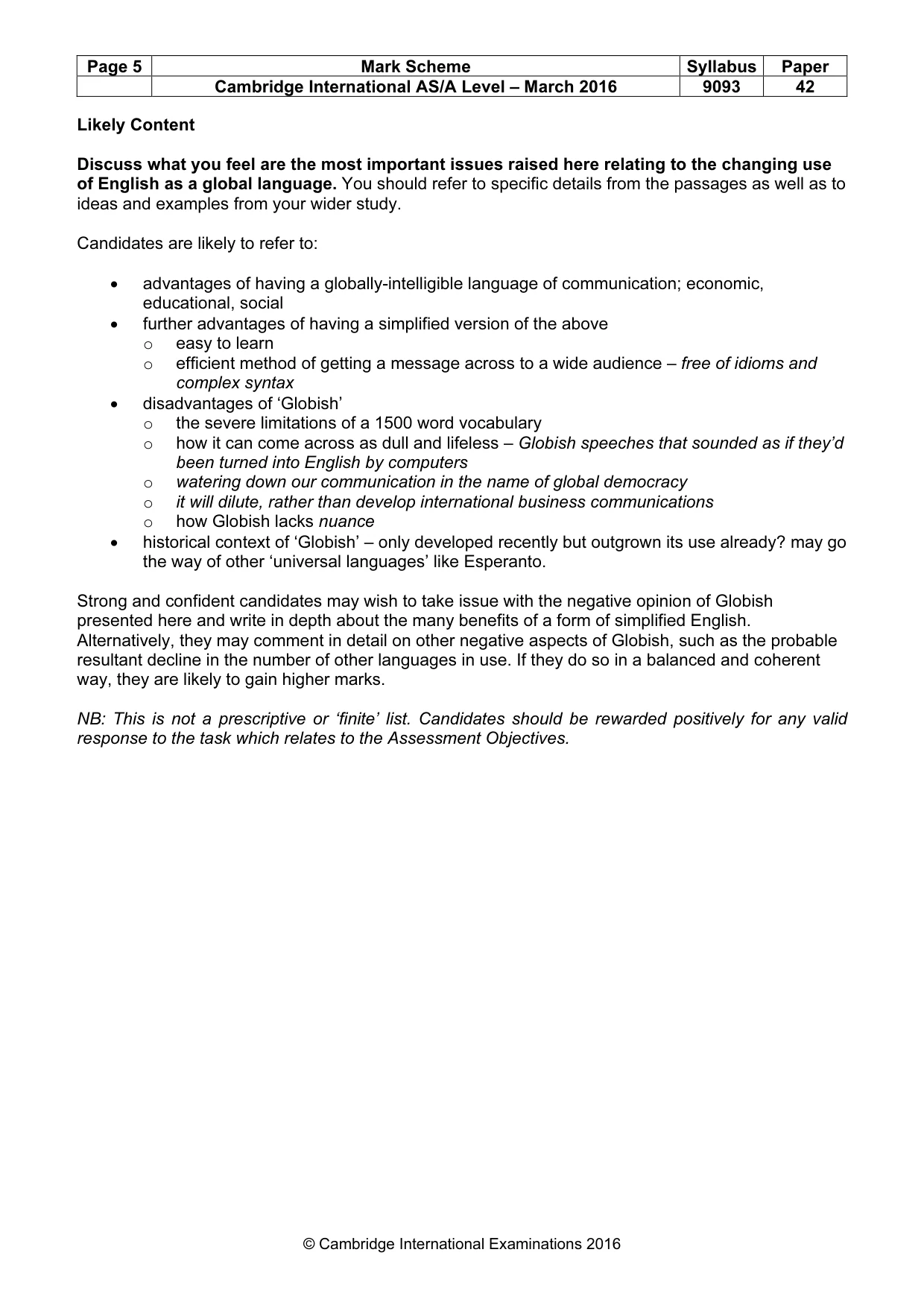
Page 5 Mark Scheme Syllabus Paper Cambridge International AS/A Level – March 2016 9093 42 © Cambridge International Examinations 2016 Likely Content Discuss what you feel are the most important issues raised here relating to the changing use of English as a global language. You should refer to specific details from the passages as well as to ideas and examples from your wider study. Candidates are likely to refer to: • advantages of having a globally-intelligible language of communication; economic, educational, social • further advantages of having a simplified version of the above o easy to learn o efficient method of getting a message across to a wide audience – free of idioms and complex syntax • disadvantages of ‘Globish’ o the severe limitations of a 1500 word vocabulary o how it can come across as dull and lifeless – Globish speeches that sounded as if they’d been turned into English by computers o watering down our communication in the name of global democracy o it will dilute, rather than develop international business communications o how Globish lacks nuance • historical context of ‘Globish’ – only developed recently but outgrown its use already? may go the way of other ‘universal languages’ like Esperanto. Strong and confident candidates may wish to take issue with the negative opinion of Globish presented here and write in depth about the many benefits of a form of simplified English. Alternatively, they may comment in detail on other negative aspects of Globish, such as the probable resultant decline in the number of other languages in use. If they do so in a balanced and coherent way, they are likely to gain higher marks. NB: This is not a prescriptive or ‘finite’ list. Candidates should be rewarded positively for any valid response to the task which relates to the Assessment Objectives.
Mark scheme, page 6
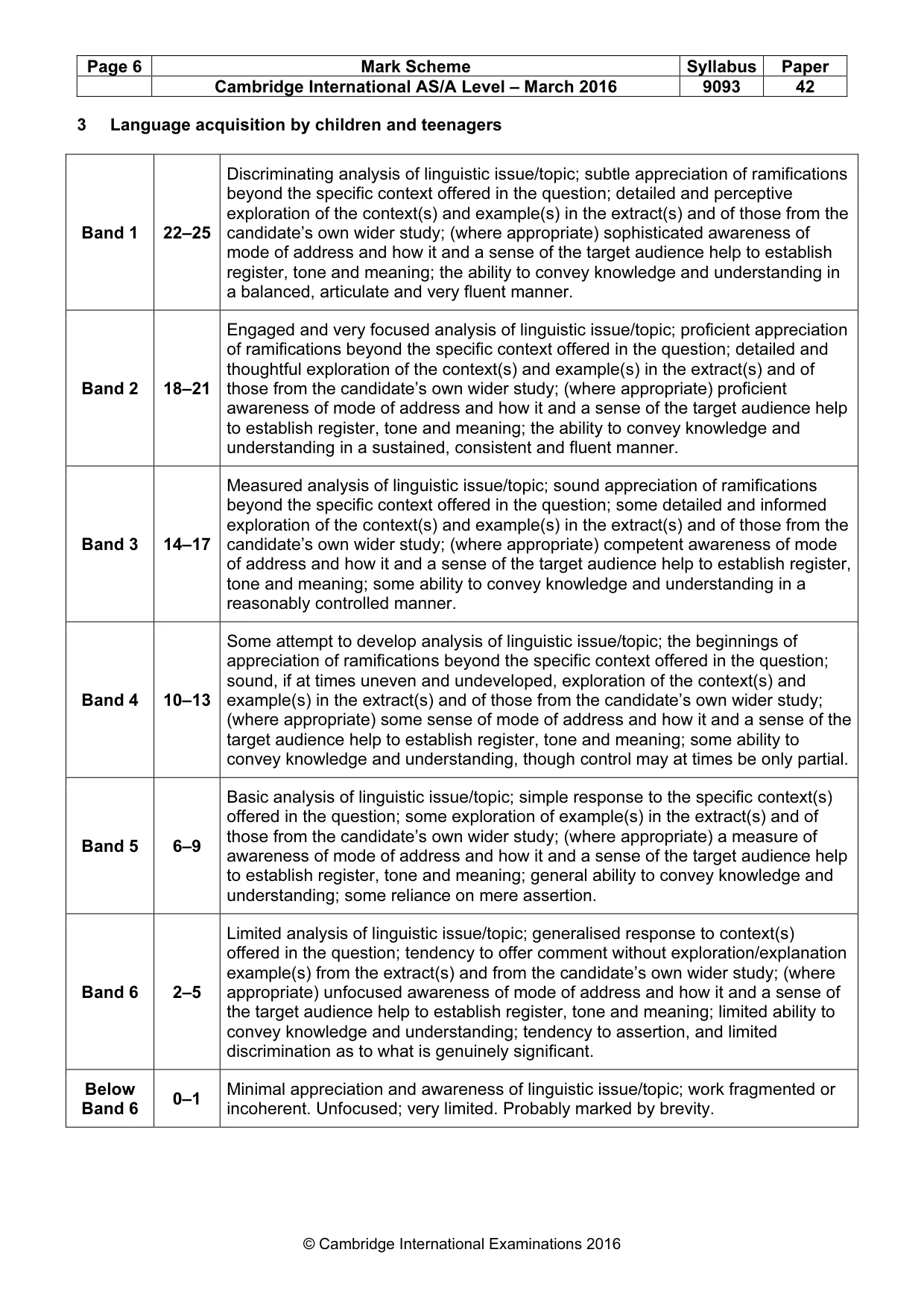
Page 6 Mark Scheme Syllabus Paper Cambridge International AS/A Level – March 2016 9093 42 © Cambridge International Examinations 2016 3 Language acquisition by children and teenagers Band 1 22–25 Discriminating analysis of linguistic issue/topic; subtle appreciation of ramifications beyond the specific context offered in the question; detailed and perceptive exploration of the context(s) and example(s) in the extract(s) and of those from the candidate’s own wider study; (where appropriate) sophisticated awareness of mode of address and how it and a sense of the target audience help to establish register, tone and meaning; the ability to convey knowledge and understanding in a balanced, articulate and very fluent manner. Band 2 18–21 Engaged and very focused analysis of linguistic issue/topic; proficient appreciation of ramifications beyond the specific context offered in the question; detailed and thoughtful exploration of the context(s) and example(s) in the extract(s) and of those from the candidate’s own wider study; (where appropriate) proficient awareness of mode of address and how it and a sense of the target audience help to establish register, tone and meaning; the ability to convey knowledge and understanding in a sustained, consistent and fluent manner. Band 3 14–17 Measured analysis of linguistic issue/topic; sound appreciation of ramifications beyond the specific context offered in the question; some detailed and informed exploration of the context(s) and example(s) in the extract(s) and of those from the candidate’s own wider study; (where appropriate) competent awareness of mode of address and how it and a sense of the target audience help to establish register, tone and meaning; some ability to convey knowledge and understanding in a reasonably controlled manner. Band 4 10–13 Some attempt to develop analysis of linguistic issue/topic; the beginnings of appreciation of ramifications beyond the specific context offered in the question; sound, if at times uneven and undeveloped, exploration of the context(s) and example(s) in the extract(s) and of those from the candidate’s own wider study; (where appropriate) some sense of mode of address and how it and a sense of the target audience help to establish register, tone and meaning; some ability to convey knowledge and understanding, though control may at times be only partial. Band 5 6–9 Basic analysis of linguistic issue/topic; simple response to the specific context(s) offered in the question; some exploration of example(s) in the extract(s) and of those from the candidate’s own wider study; (where appropriate) a measure of awareness of mode of address and how it and a sense of the target audience help to establish register, tone and meaning; general ability to convey knowledge and understanding; some reliance on mere assertion. Band 6 2–5 Limited analysis of linguistic issue/topic; generalised response to context(s) offered in the question; tendency to offer comment without exploration/explanation example(s) from the extract(s) and from the candidate’s own wider study; (where appropriate) unfocused awareness of mode of address and how it and a sense of the target audience help to establish register, tone and meaning; limited ability to convey knowledge and understanding; tendency to assertion, and limited discrimination as to what is genuinely significant. Below Band 6 0–1 Minimal appreciation and awareness of linguistic issue/topic; work fragmented or incoherent. Unfocused; very limited. Probably marked by brevity.
Mark scheme, page 7
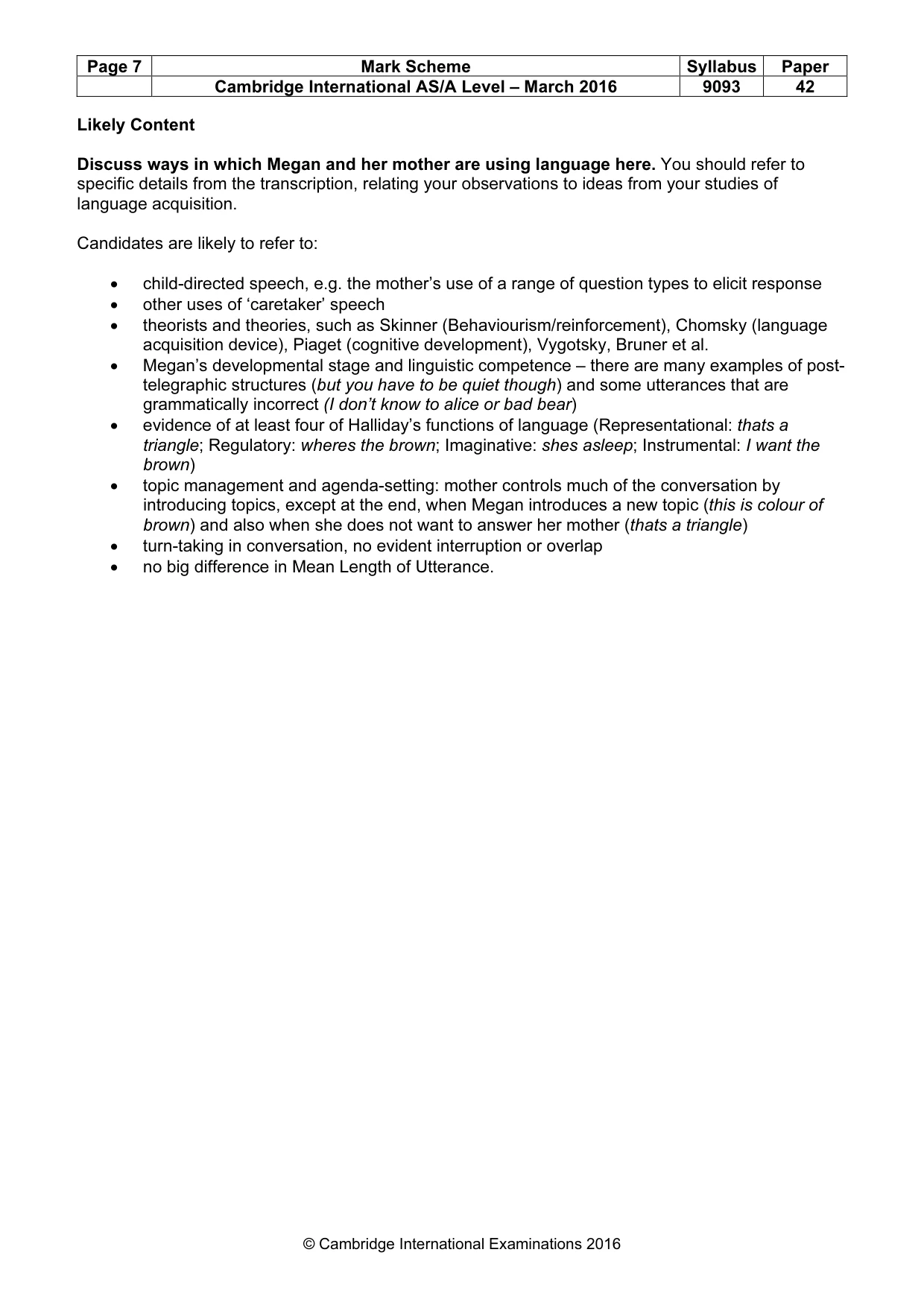
Page 7 Mark Scheme Syllabus Paper Cambridge International AS/A Level – March 2016 9093 42 © Cambridge International Examinations 2016 Likely Content Discuss ways in which Megan and her mother are using language here. You should refer to specific details from the transcription, relating your observations to ideas from your studies of language acquisition. Candidates are likely to refer to: • child-directed speech, e.g. the mother’s use of a range of question types to elicit response • other uses of ‘caretaker’ speech • theorists and theories, such as Skinner (Behaviourism/reinforcement), Chomsky (language acquisition device), Piaget (cognitive development), Vygotsky, Bruner et al. • Megan’s developmental stage and linguistic competence – there are many examples of post- telegraphic structures (but you have to be quiet though) and some utterances that are grammatically incorrect (I don’t know to alice or bad bear) • evidence of at least four of Halliday’s functions of language (Representational: thats a triangle; Regulatory: wheres the brown; Imaginative: shes asleep; Instrumental: I want the brown) • topic management and agenda-setting: mother controls much of the conversation by introducing topics, except at the end, when Megan introduces a new topic (this is colour of brown) and also when she does not want to answer her mother (thats a triangle) • turn-taking in conversation, no evident interruption or overlap • no big difference in Mean Length of Utterance.
What you needed in this session
Cambridge’s own grade thresholds for 2016 Feb/March, Paper 4 · Variant 2. A higher threshold means an easier paper — the bar moves with how the cohort did.