Cambridge A Level English General Paper 8021 — 2022 May/June Paper 1 · Variant 3
8021/13/M/J/22 · 30 marks · ≈34 min
The question paper and its mark scheme, free to read here and free to download. This is Cambridge’s own paper, exactly as it was sat.
Question paper4 pages


Mark scheme15 pages
Answers below. Sit the paper first if you are practising.
Paper as text
Question paper, page 1
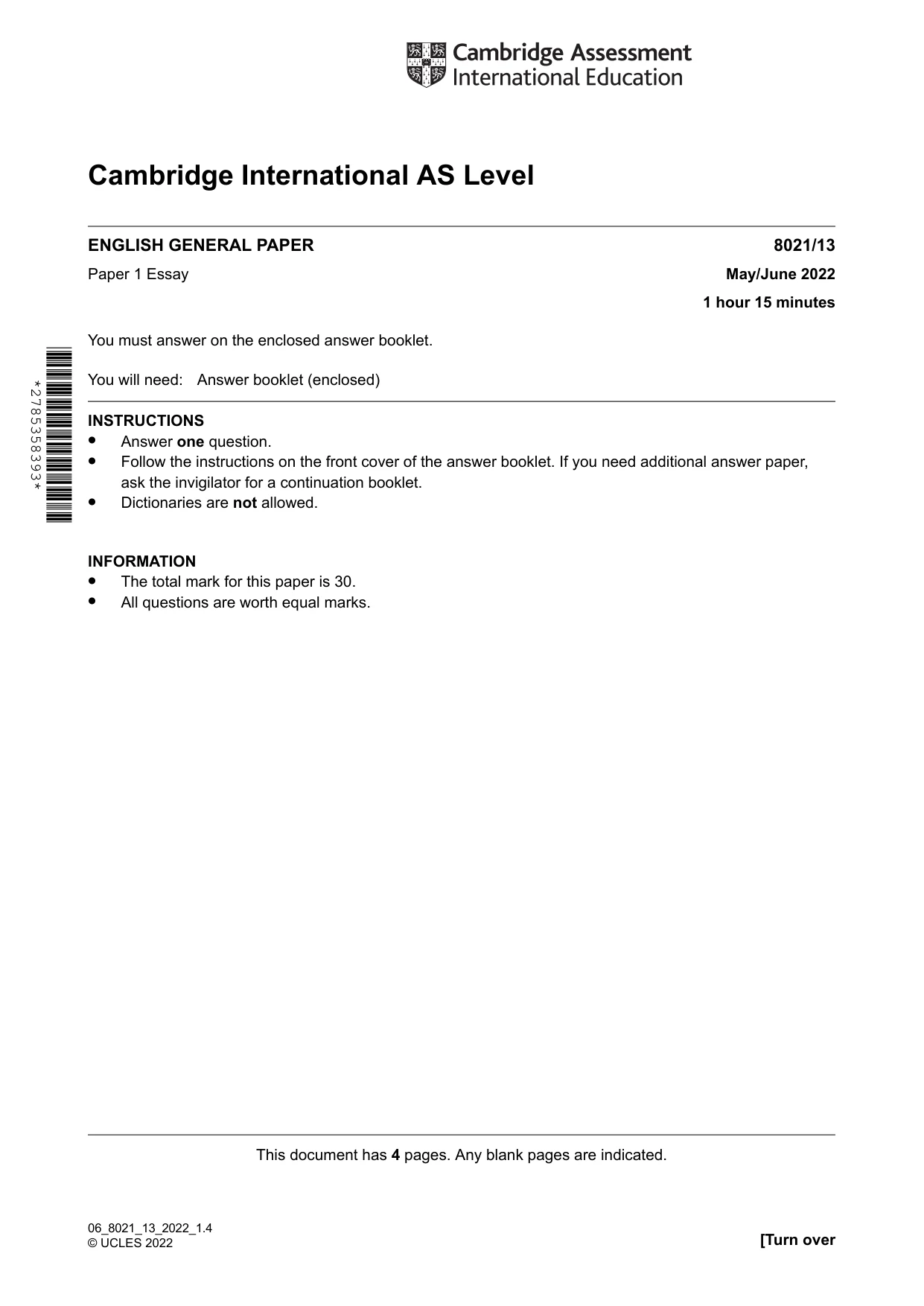
Cambridge International AS Level 8021/13 May/June 2022 1 hour 15 minutes ENGLISH GENERAL PAPER Paper 1 Essay You must answer on the enclosed answer booklet. You will need: Answer booklet (enclosed) INSTRUCTIONS • Answer one question. • Follow the instructions on the front cover of the answer booklet. If you need additional answer paper, ask the invigilator for a continuation booklet. • Dictionaries are not allowed. INFORMATION • The total mark for this paper is 30. • All questions are worth equal marks. This document has 4 pages. Any blank pages are indicated. [Turn over 06_8021_13_2022_1.4 © UCLES 2022 *2785358393*
Question paper, page 2
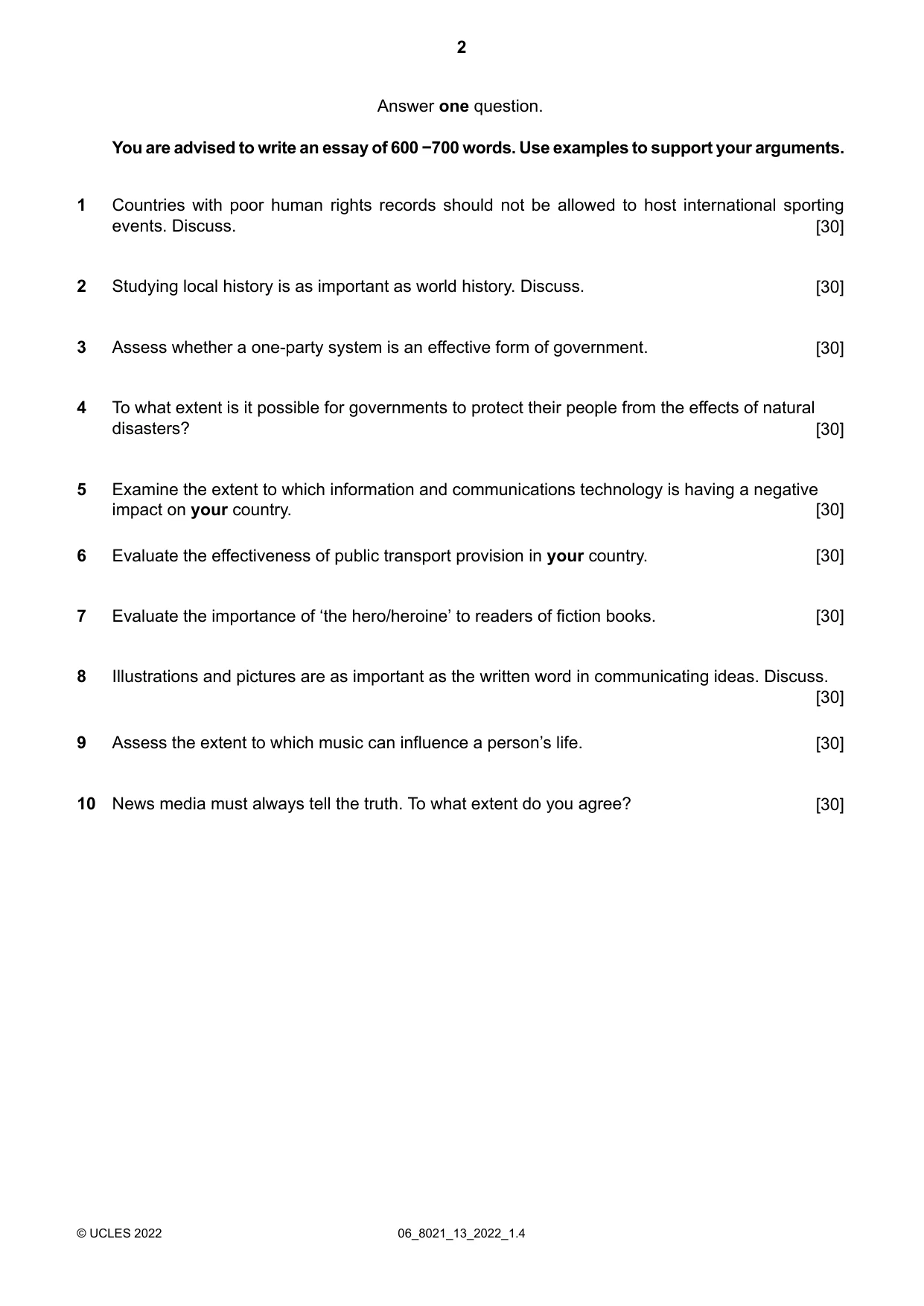
Answer one question. You are advised to write an essay of 600 −700 words. Use examples to support your arguments. Countries with poor human rights records should not be allowed to host international sporting events. Discuss. [30] 1 Studying local history is as important as world history. Discuss. [30] 2 Assess whether a one-party system is an effective form of government. [30] 3 To what extent is it possible for governments to protect their people from the effects of natural disasters? [30] 4 Examine the extent to which information and communications technology is having a negative impact on your country. [30] 5 Evaluate the effectiveness of public transport provision in your country. [30] 6 Evaluate the importance of ‘the hero/heroine’ to readers of fiction books. [30] 7 Illustrations and pictures are as important as the written word in communicating ideas. Discuss. [30] 8 Assess the extent to which music can influence a person’s life. [30] 9 News media must always tell the truth. To what extent do you agree? [30] 10 06_8021_13_2022_1.4 © UCLES 2022 2
Question paper, page 3
BLANK PAGE 06_8021_13_2022_1.4 © UCLES 2022 3
Question paper, page 4
BLANK PAGE Permission to reproduce items where third-party owned material protected by copyright is included has been sought and cleared where possible. Every reasonable effort has been made by the publisher (UCLES) to trace copyright holders, but if any items requiring clearance have unwittingly been included, the publisher will be pleased to make amends at the earliest possible opportunity. To avoid the issue of disclosure of answer-related information to candidates, all copyright acknowledgements are reproduced online in the Cambridge Assessment International Education Copyright Acknowledgements Booklet. This is produced for each series of examinations and is freely available to download at www.cambridgeinternational.org after the live examination series. Cambridge Assessment International Education is part of Cambridge Assessment. Cambridge Assessment is the brand name of the University of Cambridge Local Examinations Syndicate (UCLES), which is a department of the University of Cambridge. 06_8021_13_2022_1.4 © UCLES 2022 4
Mark scheme, page 1
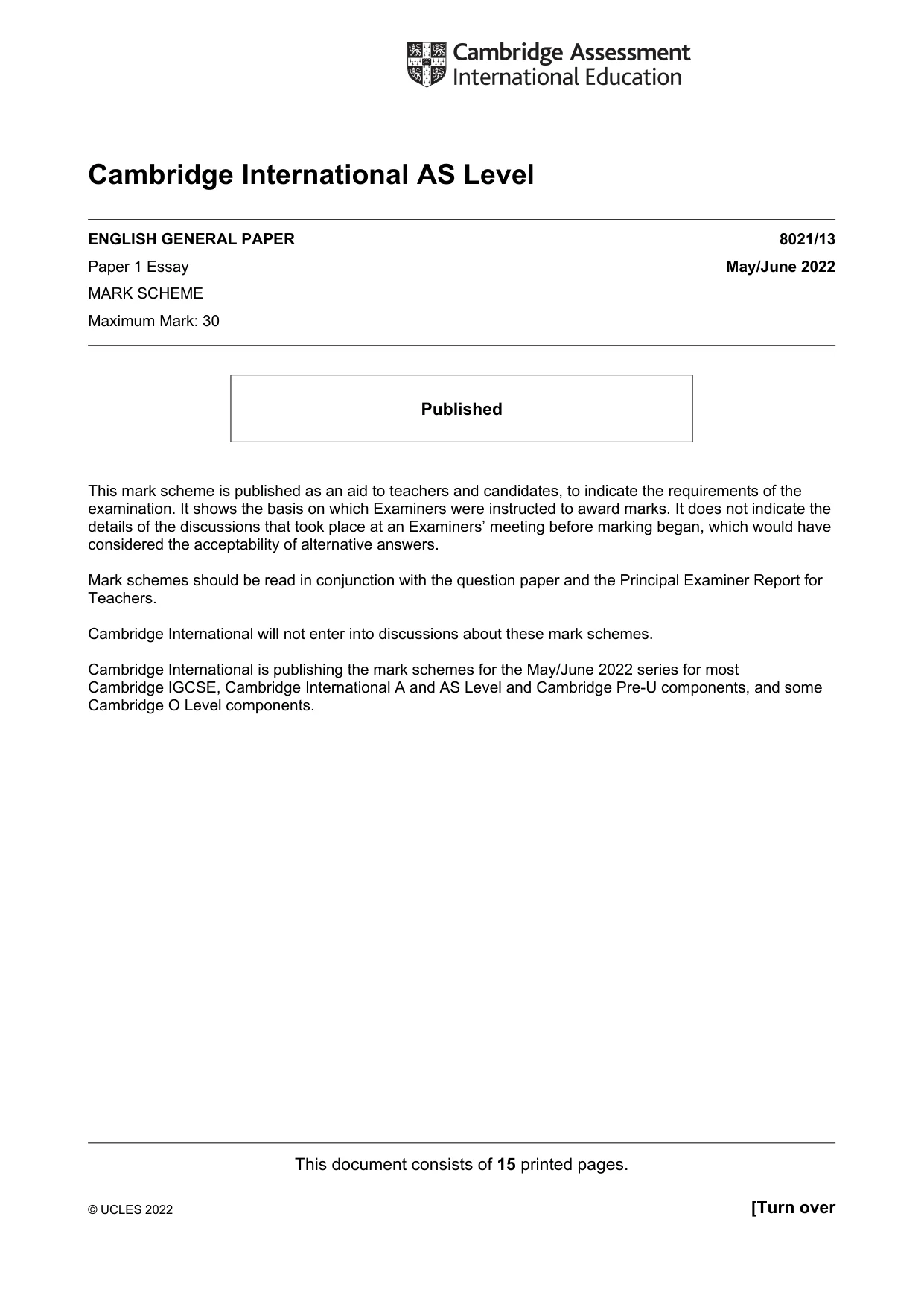
This document consists of 15 printed pages. © UCLES 2022 [Turn over Cambridge International AS Level ENGLISH GENERAL PAPER 8021/13 Paper 1 Essay May/June 2022 MARK SCHEME Maximum Mark: 30 Published This mark scheme is published as an aid to teachers and candidates, to indicate the requirements of the examination. It shows the basis on which Examiners were instructed to award marks. It does not indicate the details of the discussions that took place at an Examiners’ meeting before marking began, which would have considered the acceptability of alternative answers. Mark schemes should be read in conjunction with the question paper and the Principal Examiner Report for Teachers. Cambridge International will not enter into discussions about these mark schemes. Cambridge International is publishing the mark schemes for the May/June 2022 series for most Cambridge IGCSE, Cambridge International A and AS Level and Cambridge Pre-U components, and some Cambridge O Level components.
Mark scheme, page 2
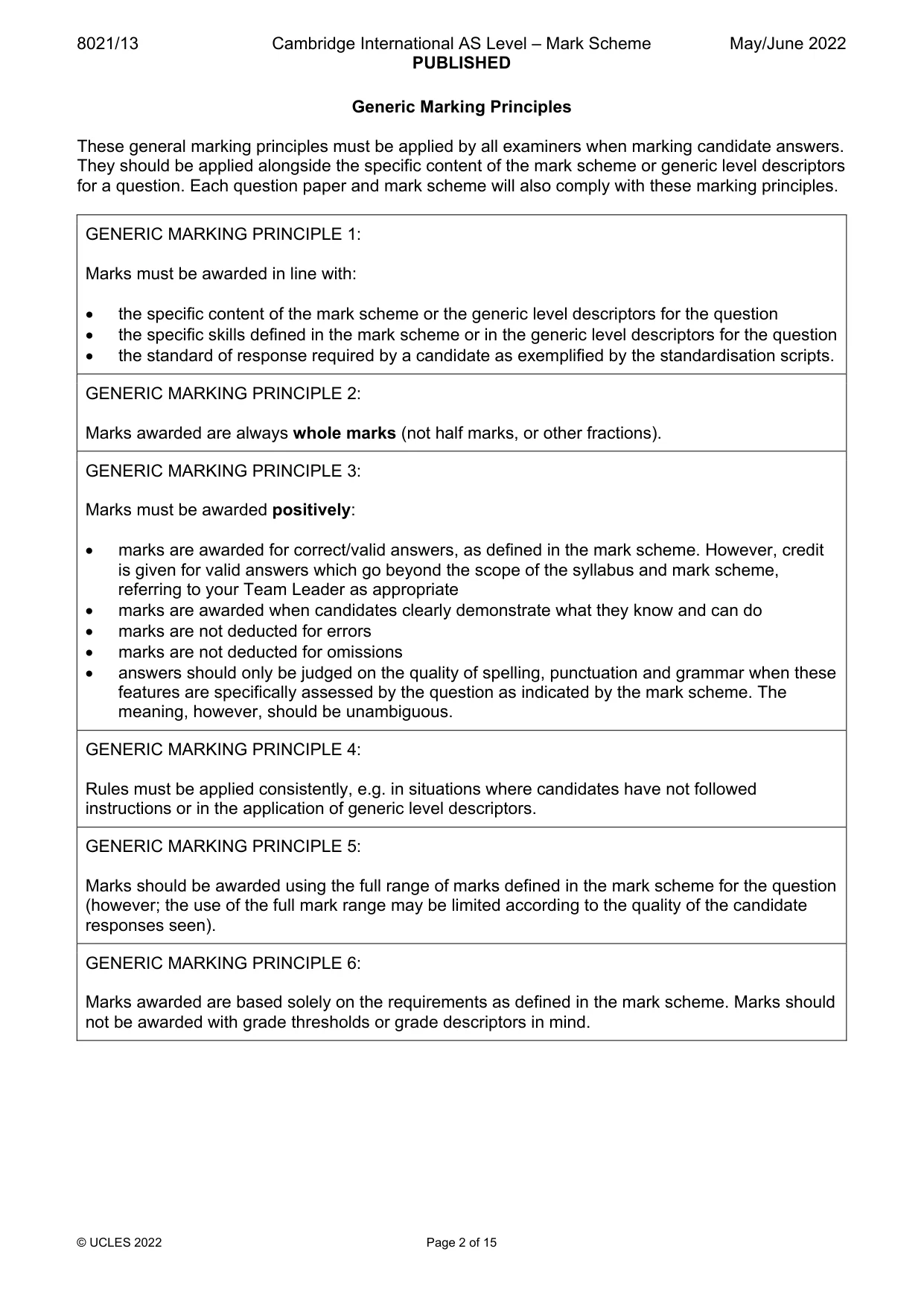
8021/13 Cambridge International AS Level – Mark Scheme PUBLISHED May/June 2022 © UCLES 2022 Page 2 of 15 Generic Marking Principles These general marking principles must be applied by all examiners when marking candidate answers. They should be applied alongside the specific content of the mark scheme or generic level descriptors for a question. Each question paper and mark scheme will also comply with these marking principles. GENERIC MARKING PRINCIPLE 1: Marks must be awarded in line with: the specific content of the mark scheme or the generic level descriptors for the question the specific skills defined in the mark scheme or in the generic level descriptors for the question the standard of response required by a candidate as exemplified by the standardisation scripts. GENERIC MARKING PRINCIPLE 2: Marks awarded are always whole marks (not half marks, or other fractions). GENERIC MARKING PRINCIPLE 3: Marks must be awarded positively: marks are awarded for correct/valid answers, as defined in the mark scheme. However, credit is given for valid answers which go beyond the scope of the syllabus and mark scheme, referring to your Team Leader as appropriate marks are awarded when candidates clearly demonstrate what they know and can do marks are not deducted for errors marks are not deducted for omissions answers should only be judged on the quality of spelling, punctuation and grammar when these features are specifically assessed by the question as indicated by the mark scheme. The meaning, however, should be unambiguous. GENERIC MARKING PRINCIPLE 4: Rules must be applied consistently, e.g. in situations where candidates have not followed instructions or in the application of generic level descriptors. GENERIC MARKING PRINCIPLE 5: Marks should be awarded using the full range of marks defined in the mark scheme for the question (however; the use of the full mark range may be limited according to the quality of the candidate responses seen). GENERIC MARKING PRINCIPLE 6: Marks awarded are based solely on the requirements as defined in the mark scheme. Marks should not be awarded with grade thresholds or grade descriptors in mind.
Mark scheme, page 3
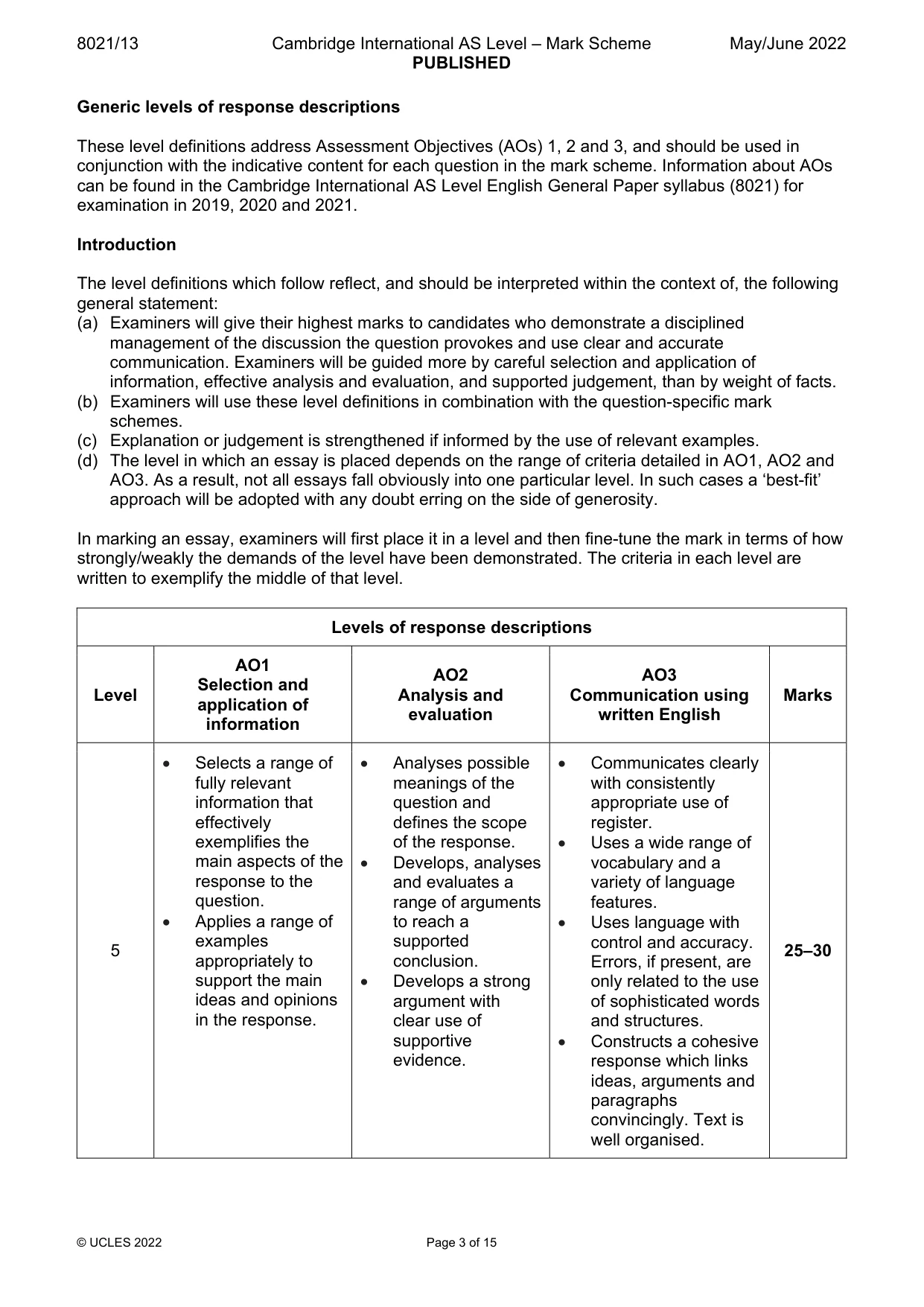
8021/13 Cambridge International AS Level – Mark Scheme PUBLISHED May/June 2022 © UCLES 2022 Page 3 of 15 Generic levels of response descriptions These level definitions address Assessment Objectives (AOs) 1, 2 and 3, and should be used in conjunction with the indicative content for each question in the mark scheme. Information about AOs can be found in the Cambridge International AS Level English General Paper syllabus (8021) for examination in 2019, 2020 and 2021. Introduction The level definitions which follow reflect, and should be interpreted within the context of, the following general statement: (a) Examiners will give their highest marks to candidates who demonstrate a disciplined management of the discussion the question provokes and use clear and accurate communication. Examiners will be guided more by careful selection and application of information, effective analysis and evaluation, and supported judgement, than by weight of facts. (b) Examiners will use these level definitions in combination with the question-specific mark schemes. (c) Explanation or judgement is strengthened if informed by the use of relevant examples. (d) The level in which an essay is placed depends on the range of criteria detailed in AO1, AO2 and AO3. As a result, not all essays fall obviously into one particular level. In such cases a ‘best-fit’ approach will be adopted with any doubt erring on the side of generosity. In marking an essay, examiners will first place it in a level and then fine-tune the mark in terms of how strongly/weakly the demands of the level have been demonstrated. The criteria in each level are written to exemplify the middle of that level. Levels of response descriptions Level AO1 Selection and application of information AO2 Analysis and evaluation AO3 Communication using written English Marks 5 Selects a range of fully relevant information that effectively exemplifies the main aspects of the response to the question. Applies a range of examples appropriately to support the main ideas and opinions in the response. Analyses possible meanings of the question and defines the scope of the response. Develops, analyses and evaluates a range of arguments to reach a supported conclusion. Develops a strong argument with clear use of supportive evidence. Communicates clearly with consistently appropriate use of register. Uses a wide range of vocabulary and a variety of language features. Uses language with control and accuracy. Errors, if present, are only related to the use of sophisticated words and structures. Constructs a cohesive response which links ideas, arguments and paragraphs convincingly. Text is well organised. 25–30
Mark scheme, page 4
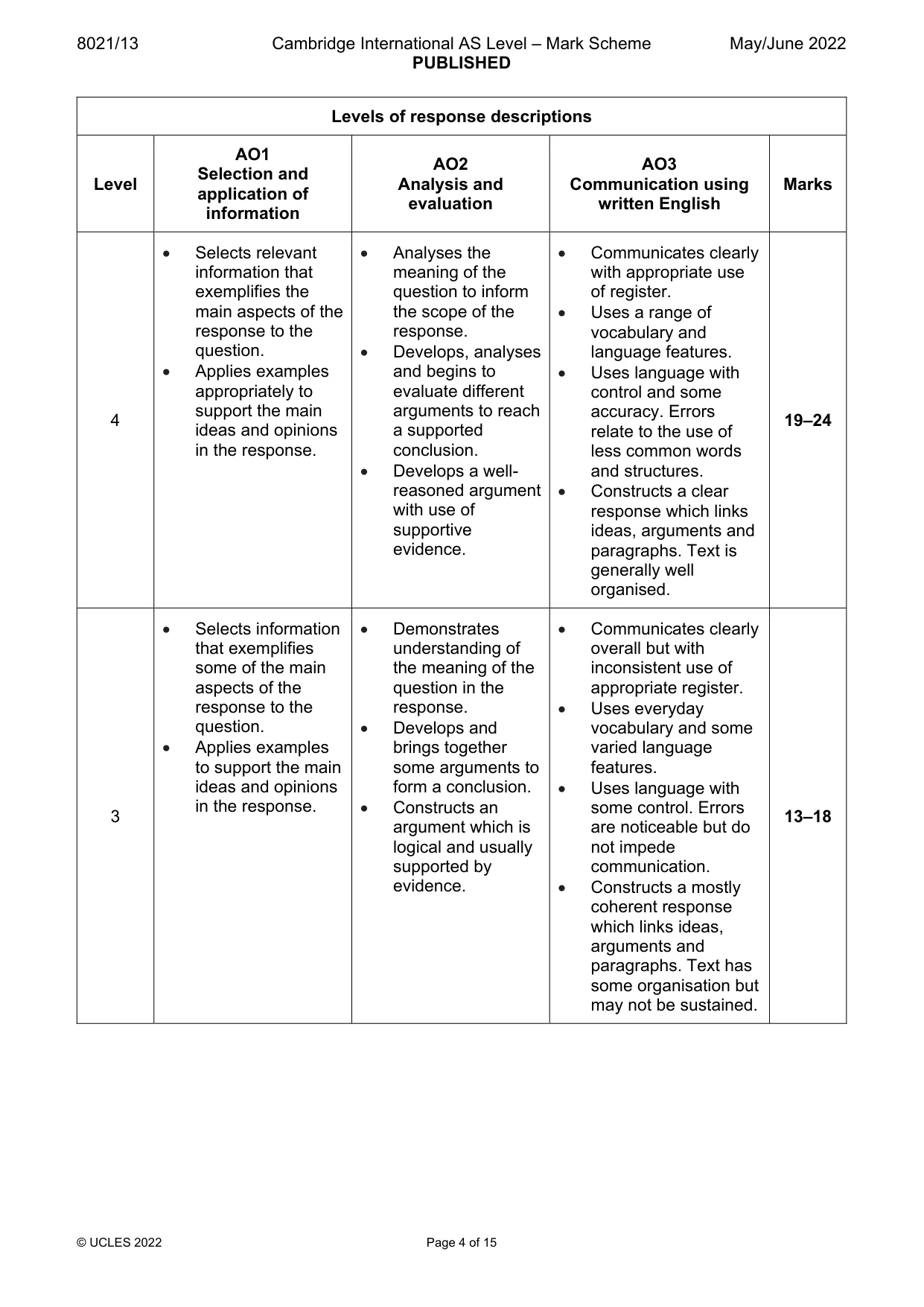
8021/13 Cambridge International AS Level – Mark Scheme PUBLISHED May/June 2022 © UCLES 2022 Page 4 of 15 Levels of response descriptions Level AO1 Selection and application of information AO2 Analysis and evaluation AO3 Communication using written English Marks 4 Selects relevant information that exemplifies the main aspects of the response to the question. Applies examples appropriately to support the main ideas and opinions in the response. Analyses the meaning of the question to inform the scope of the response. Develops, analyses and begins to evaluate different arguments to reach a supported conclusion. Develops a well- reasoned argument with use of supportive evidence. Communicates clearly with appropriate use of register. Uses a range of vocabulary and language features. Uses language with control and some accuracy. Errors relate to the use of less common words and structures. Constructs a clear response which links ideas, arguments and paragraphs. Text is generally well organised. 19–24 3 Selects information that exemplifies some of the main aspects of the response to the question. Applies examples to support the main ideas and opinions in the response. Demonstrates understanding of the meaning of the question in the response. Develops and brings together some arguments to form a conclusion. Constructs an argument which is logical and usually supported by evidence. Communicates clearly overall but with inconsistent use of appropriate register. Uses everyday vocabulary and some varied language features. Uses language with some control. Errors are noticeable but do not impede communication. Constructs a mostly coherent response which links ideas, arguments and paragraphs. Text has some organisation but may not be sustained. 13–18
Mark scheme, page 5
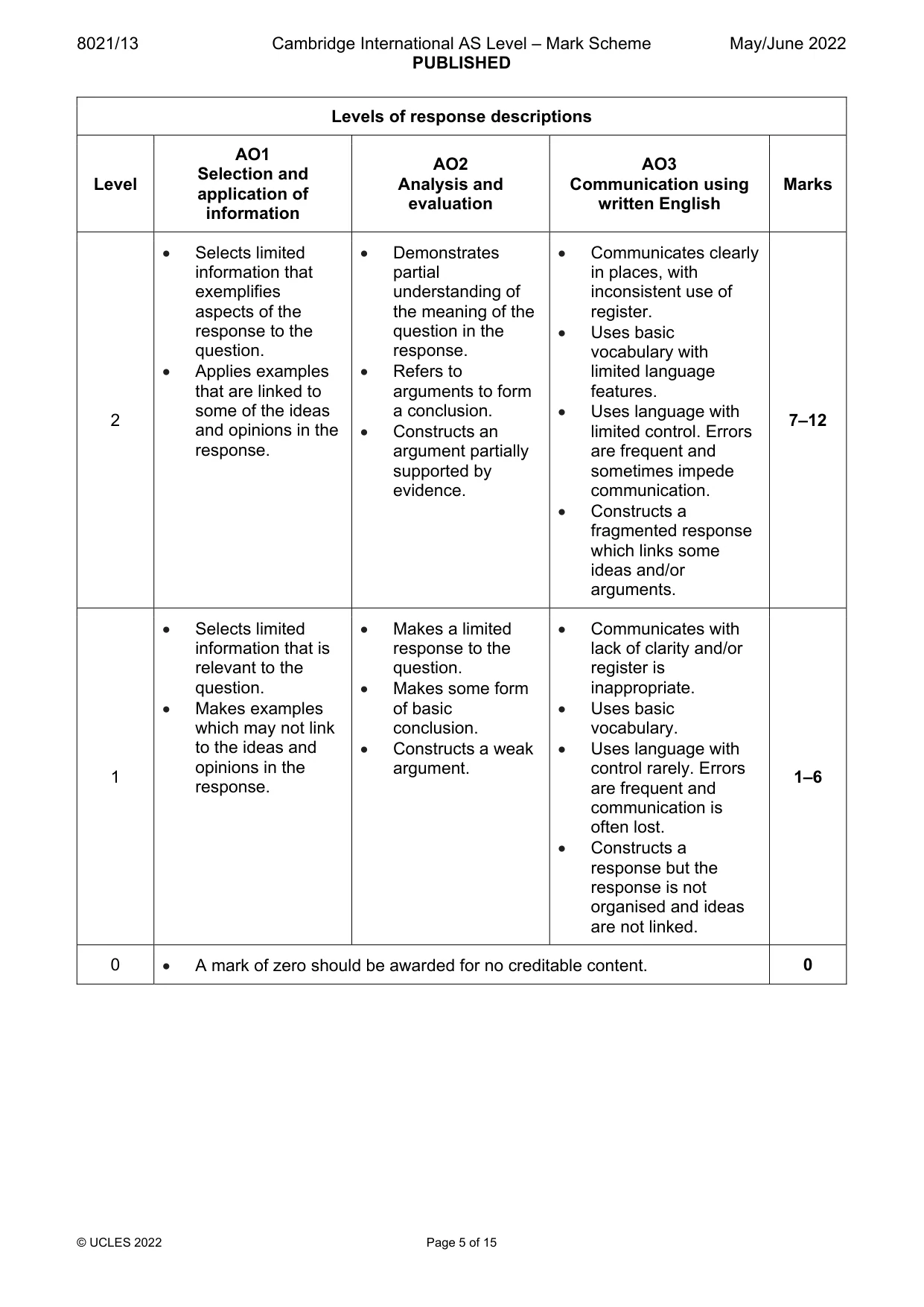
8021/13 Cambridge International AS Level – Mark Scheme PUBLISHED May/June 2022 © UCLES 2022 Page 5 of 15 Levels of response descriptions Level AO1 Selection and application of information AO2 Analysis and evaluation AO3 Communication using written English Marks 2 Selects limited information that exemplifies aspects of the response to the question. Applies examples that are linked to some of the ideas and opinions in the response. Demonstrates partial understanding of the meaning of the question in the response. Refers to arguments to form a conclusion. Constructs an argument partially supported by evidence. Communicates clearly in places, with inconsistent use of register. Uses basic vocabulary with limited language features. Uses language with limited control. Errors are frequent and sometimes impede communication. Constructs a fragmented response which links some ideas and/or arguments. 7–12 1 Selects limited information that is relevant to the question. Makes examples which may not link to the ideas and opinions in the response. Makes a limited response to the question. Makes some form of basic conclusion. Constructs a weak argument. Communicates with lack of clarity and/or register is inappropriate. Uses basic vocabulary. Uses language with control rarely. Errors are frequent and communication is often lost. Constructs a response but the response is not organised and ideas are not linked. 1–6 0 A mark of zero should be awarded for no creditable content. 0
Mark scheme, page 6
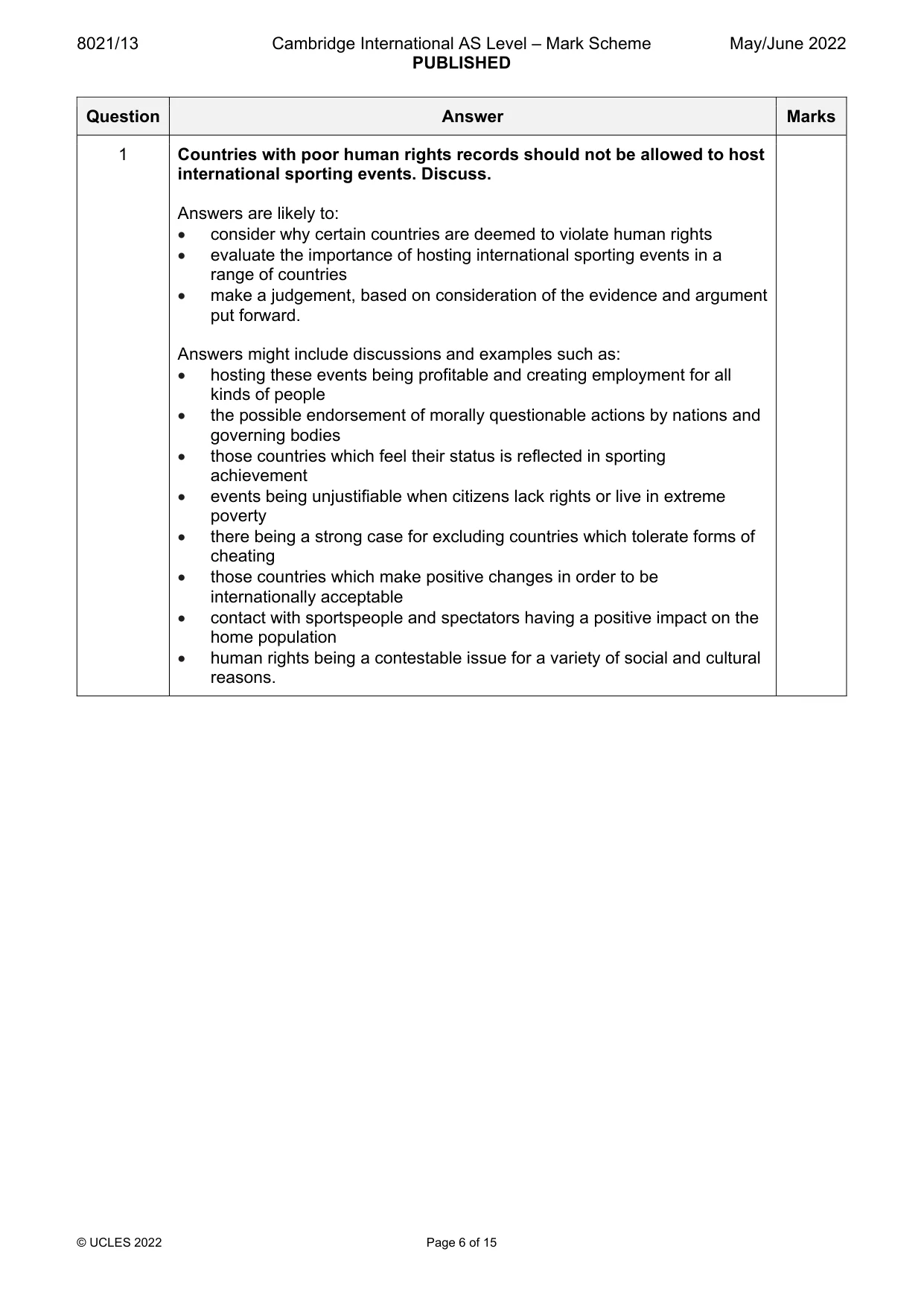
8021/13 Cambridge International AS Level – Mark Scheme PUBLISHED May/June 2022 © UCLES 2022 Page 6 of 15 Question Answer Marks 1 Countries with poor human rights records should not be allowed to host international sporting events. Discuss. Answers are likely to: consider why certain countries are deemed to violate human rights evaluate the importance of hosting international sporting events in a range of countries make a judgement, based on consideration of the evidence and argument put forward. Answers might include discussions and examples such as: hosting these events being profitable and creating employment for all kinds of people the possible endorsement of morally questionable actions by nations and governing bodies those countries which feel their status is reflected in sporting achievement events being unjustifiable when citizens lack rights or live in extreme poverty there being a strong case for excluding countries which tolerate forms of cheating those countries which make positive changes in order to be internationally acceptable contact with sportspeople and spectators having a positive impact on the home population human rights being a contestable issue for a variety of social and cultural reasons.
Mark scheme, page 7
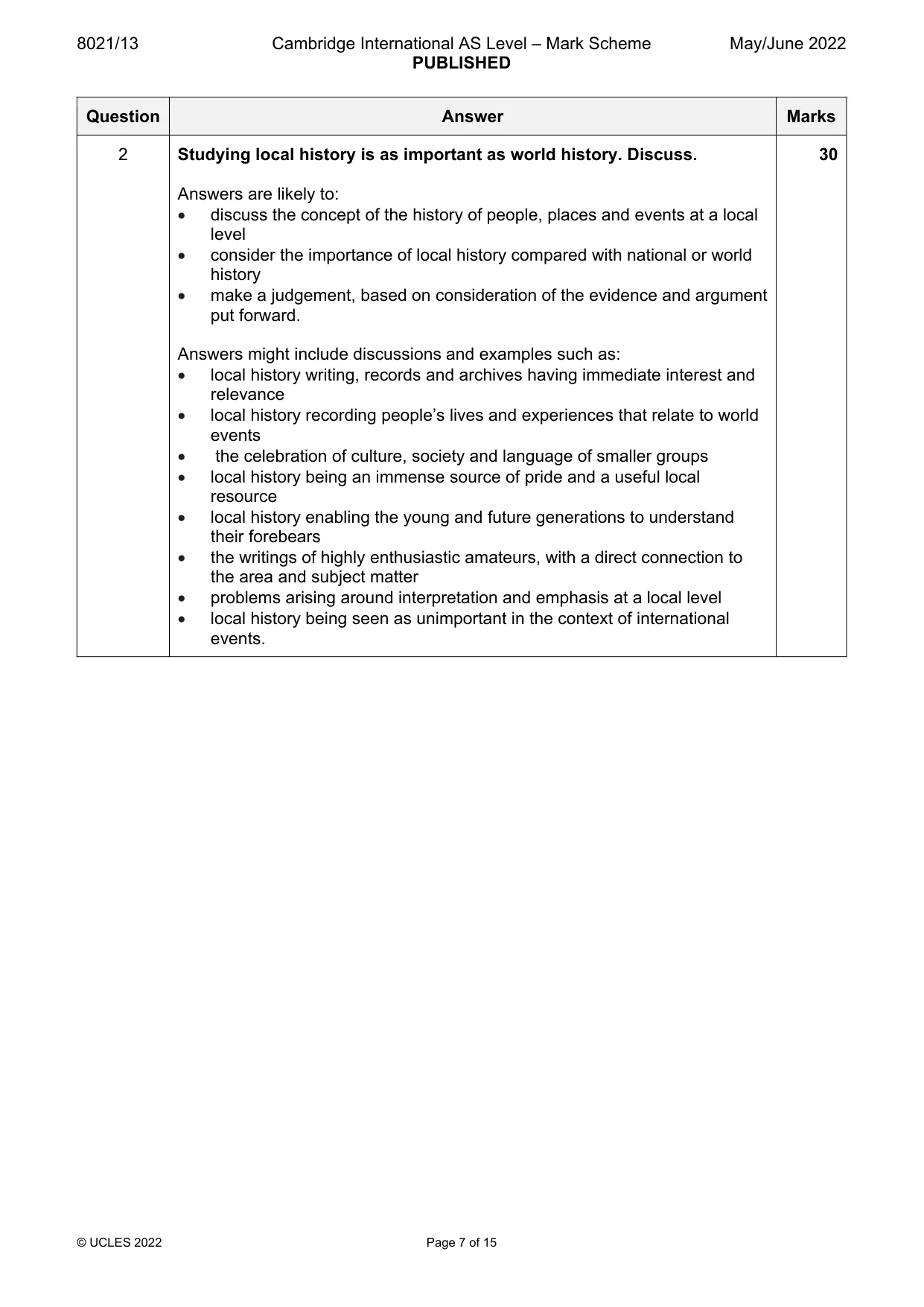
8021/13 Cambridge International AS Level – Mark Scheme PUBLISHED May/June 2022 © UCLES 2022 Page 7 of 15 Question Answer Marks 2 Studying local history is as important as world history. Discuss. Answers are likely to: discuss the concept of the history of people, places and events at a local level consider the importance of local history compared with national or world history make a judgement, based on consideration of the evidence and argument put forward. Answers might include discussions and examples such as: local history writing, records and archives having immediate interest and relevance local history recording people’s lives and experiences that relate to world events the celebration of culture, society and language of smaller groups local history being an immense source of pride and a useful local resource local history enabling the young and future generations to understand their forebears the writings of highly enthusiastic amateurs, with a direct connection to the area and subject matter problems arising around interpretation and emphasis at a local level local history being seen as unimportant in the context of international events. 30
Mark scheme, page 8
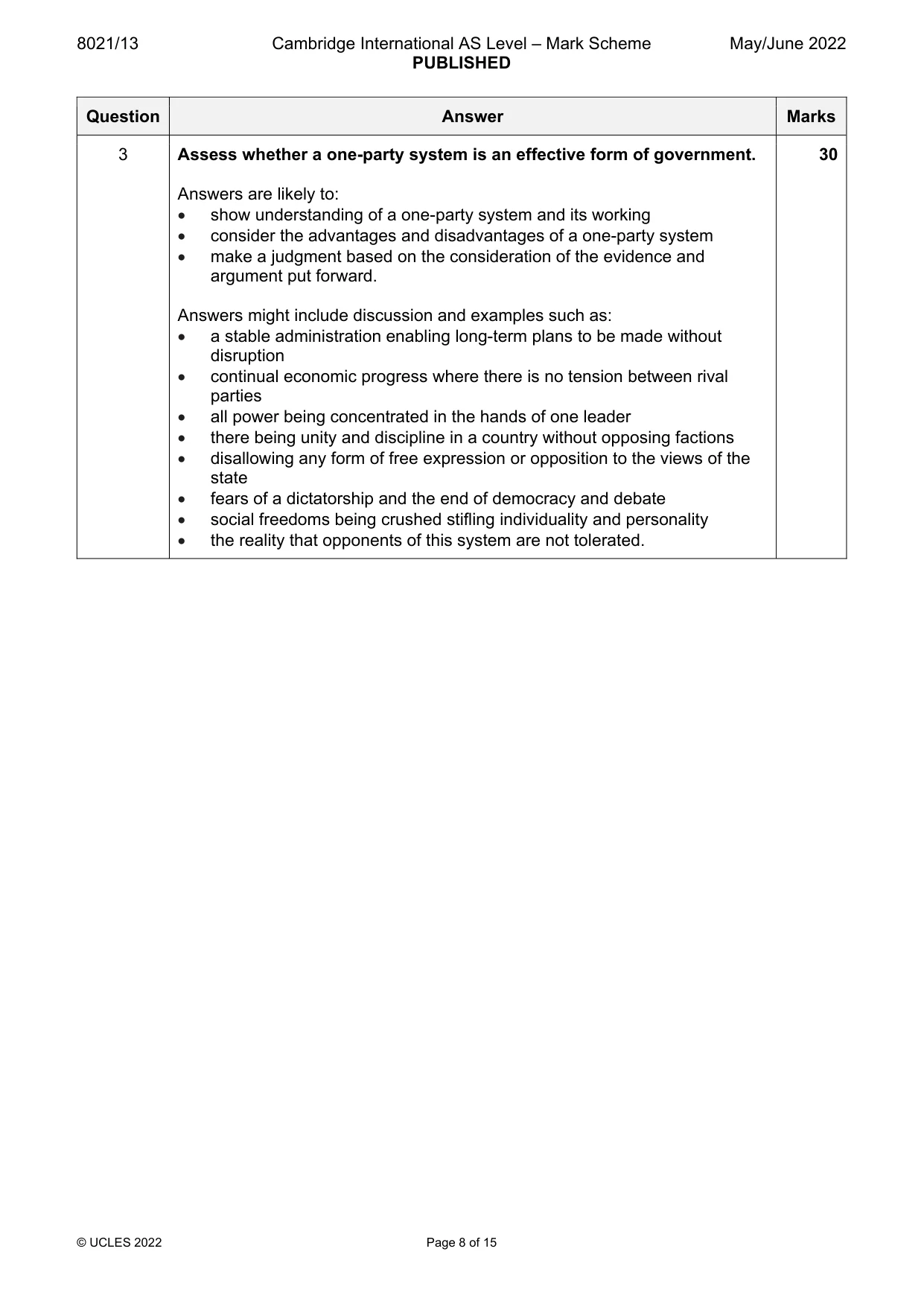
8021/13 Cambridge International AS Level – Mark Scheme PUBLISHED May/June 2022 © UCLES 2022 Page 8 of 15 Question Answer Marks 3 Assess whether a one-party system is an effective form of government. Answers are likely to: show understanding of a one-party system and its working consider the advantages and disadvantages of a one-party system make a judgment based on the consideration of the evidence and argument put forward. Answers might include discussion and examples such as: a stable administration enabling long-term plans to be made without disruption continual economic progress where there is no tension between rival parties all power being concentrated in the hands of one leader there being unity and discipline in a country without opposing factions disallowing any form of free expression or opposition to the views of the state fears of a dictatorship and the end of democracy and debate social freedoms being crushed stifling individuality and personality the reality that opponents of this system are not tolerated. 30
Mark scheme, page 9
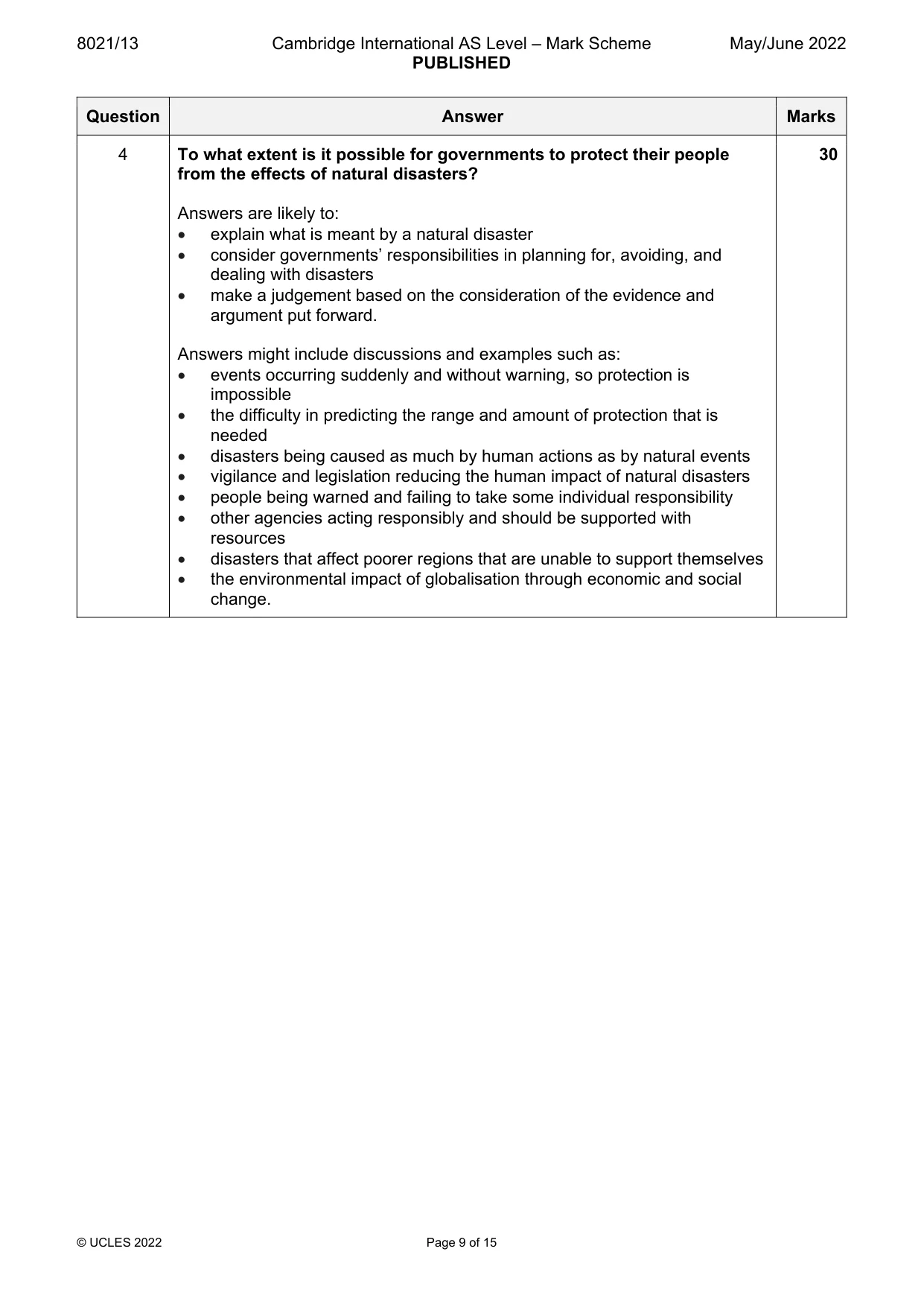
8021/13 Cambridge International AS Level – Mark Scheme PUBLISHED May/June 2022 © UCLES 2022 Page 9 of 15 Question Answer Marks 4 To what extent is it possible for governments to protect their people from the effects of natural disasters? Answers are likely to: explain what is meant by a natural disaster consider governments’ responsibilities in planning for, avoiding, and dealing with disasters make a judgement based on the consideration of the evidence and argument put forward. Answers might include discussions and examples such as: events occurring suddenly and without warning, so protection is impossible the difficulty in predicting the range and amount of protection that is needed disasters being caused as much by human actions as by natural events vigilance and legislation reducing the human impact of natural disasters people being warned and failing to take some individual responsibility other agencies acting responsibly and should be supported with resources disasters that affect poorer regions that are unable to support themselves the environmental impact of globalisation through economic and social change. 30
Mark scheme, page 10
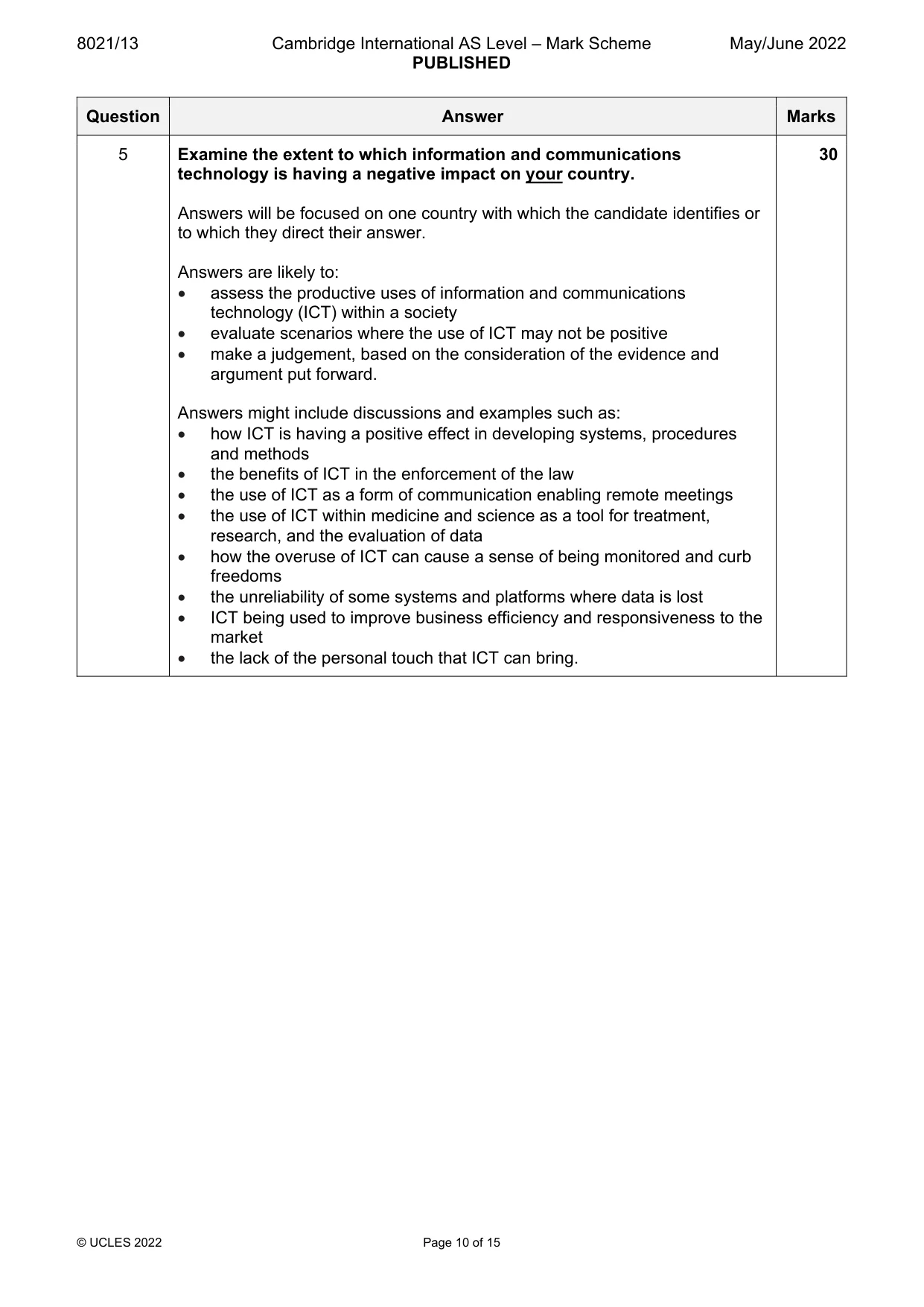
8021/13 Cambridge International AS Level – Mark Scheme PUBLISHED May/June 2022 © UCLES 2022 Page 10 of 15 Question Answer Marks 5 Examine the extent to which information and communications technology is having a negative impact on your country. Answers will be focused on one country with which the candidate identifies or to which they direct their answer. Answers are likely to: assess the productive uses of information and communications technology (ICT) within a society evaluate scenarios where the use of ICT may not be positive make a judgement, based on the consideration of the evidence and argument put forward. Answers might include discussions and examples such as: how ICT is having a positive effect in developing systems, procedures and methods the benefits of ICT in the enforcement of the law the use of ICT as a form of communication enabling remote meetings the use of ICT within medicine and science as a tool for treatment, research, and the evaluation of data how the overuse of ICT can cause a sense of being monitored and curb freedoms the unreliability of some systems and platforms where data is lost ICT being used to improve business efficiency and responsiveness to the market the lack of the personal touch that ICT can bring. 30
Mark scheme, page 11
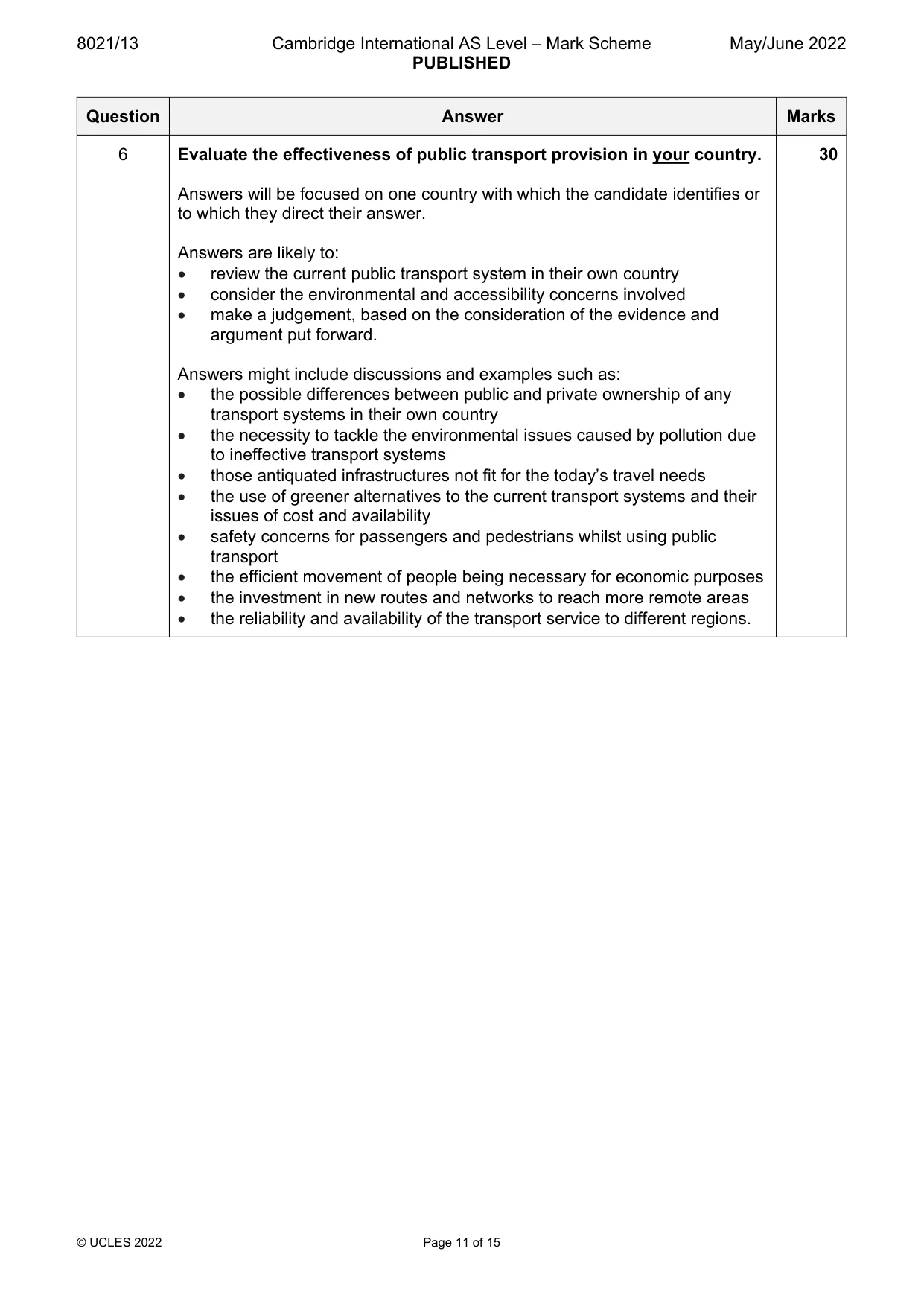
8021/13 Cambridge International AS Level – Mark Scheme PUBLISHED May/June 2022 © UCLES 2022 Page 11 of 15 Question Answer Marks 6 Evaluate the effectiveness of public transport provision in your country. Answers will be focused on one country with which the candidate identifies or to which they direct their answer. Answers are likely to: review the current public transport system in their own country consider the environmental and accessibility concerns involved make a judgement, based on the consideration of the evidence and argument put forward. Answers might include discussions and examples such as: the possible differences between public and private ownership of any transport systems in their own country the necessity to tackle the environmental issues caused by pollution due to ineffective transport systems those antiquated infrastructures not fit for the today’s travel needs the use of greener alternatives to the current transport systems and their issues of cost and availability safety concerns for passengers and pedestrians whilst using public transport the efficient movement of people being necessary for economic purposes the investment in new routes and networks to reach more remote areas the reliability and availability of the transport service to different regions. 30
Mark scheme, page 12
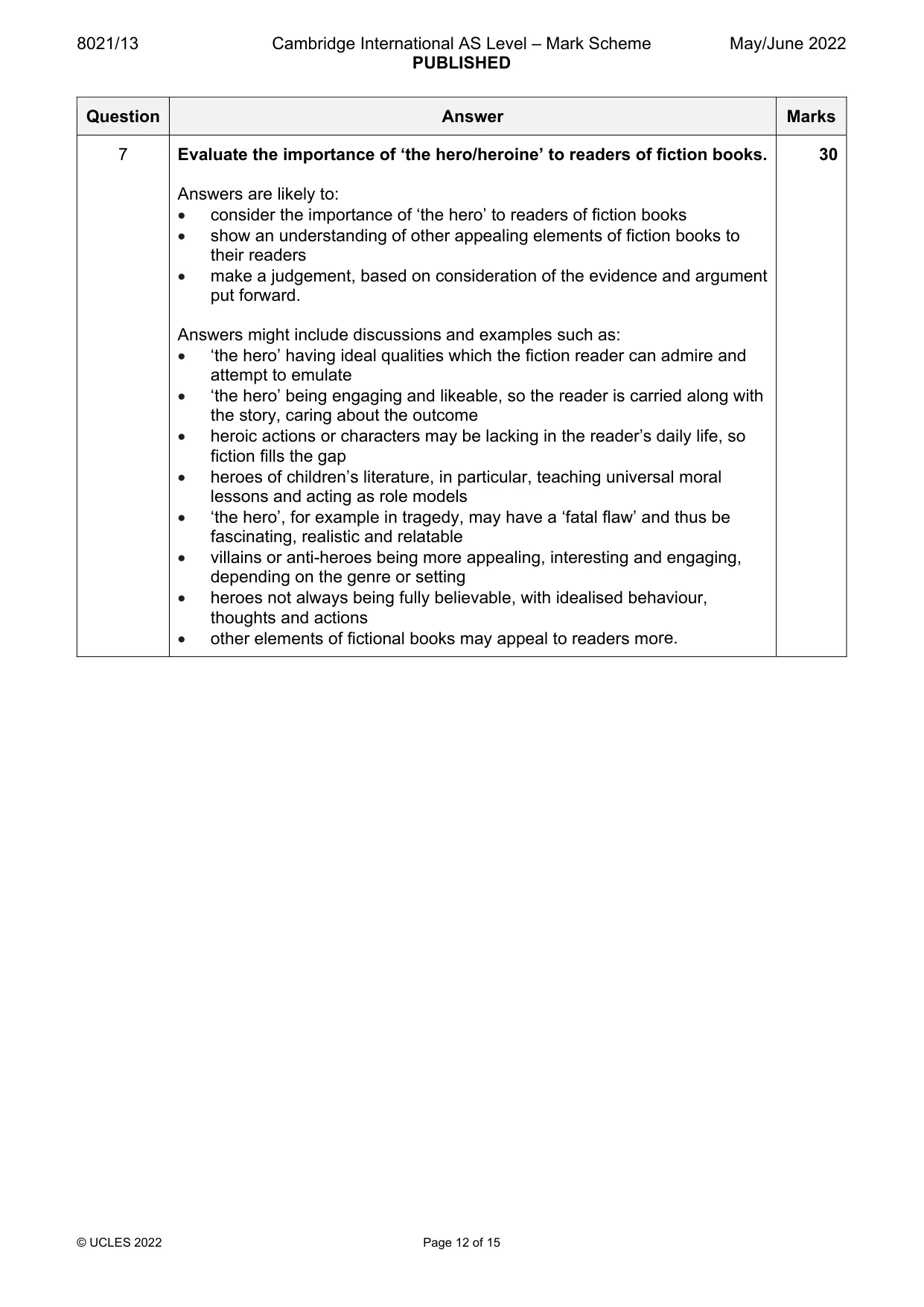
8021/13 Cambridge International AS Level – Mark Scheme PUBLISHED May/June 2022 © UCLES 2022 Page 12 of 15 Question Answer Marks 7 Evaluate the importance of ‘the hero/heroine’ to readers of fiction books. Answers are likely to: consider the importance of ‘the hero’ to readers of fiction books show an understanding of other appealing elements of fiction books to their readers make a judgement, based on consideration of the evidence and argument put forward. Answers might include discussions and examples such as: ‘the hero’ having ideal qualities which the fiction reader can admire and attempt to emulate ‘the hero’ being engaging and likeable, so the reader is carried along with the story, caring about the outcome heroic actions or characters may be lacking in the reader’s daily life, so fiction fills the gap heroes of children’s literature, in particular, teaching universal moral lessons and acting as role models ‘the hero’, for example in tragedy, may have a ‘fatal flaw’ and thus be fascinating, realistic and relatable villains or anti-heroes being more appealing, interesting and engaging, depending on the genre or setting heroes not always being fully believable, with idealised behaviour, thoughts and actions other elements of fictional books may appeal to readers more. 30
Mark scheme, page 13
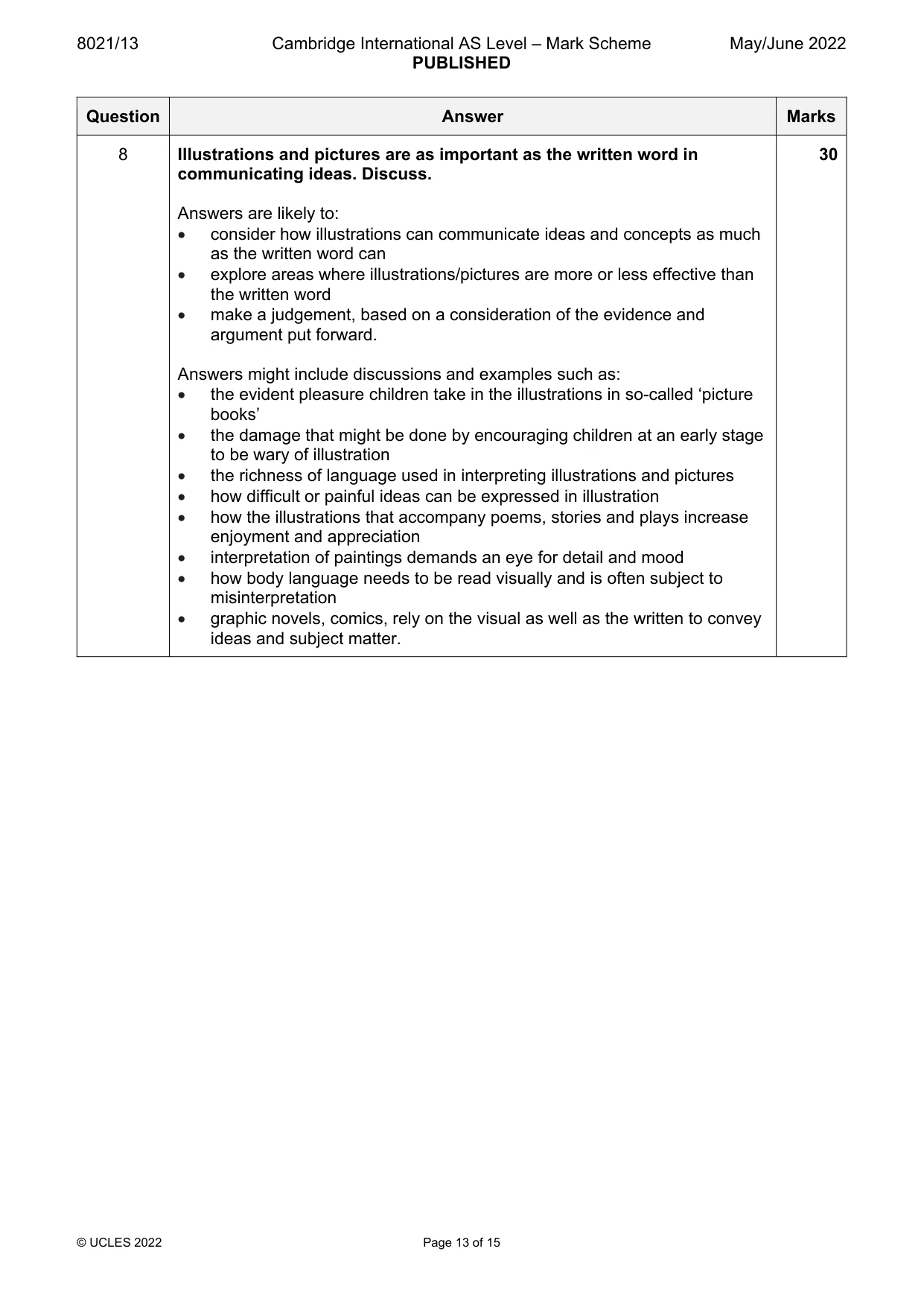
8021/13 Cambridge International AS Level – Mark Scheme PUBLISHED May/June 2022 © UCLES 2022 Page 13 of 15 Question Answer Marks 8 Illustrations and pictures are as important as the written word in communicating ideas. Discuss. Answers are likely to: consider how illustrations can communicate ideas and concepts as much as the written word can explore areas where illustrations/pictures are more or less effective than the written word make a judgement, based on a consideration of the evidence and argument put forward. Answers might include discussions and examples such as: the evident pleasure children take in the illustrations in so-called ‘picture books’ the damage that might be done by encouraging children at an early stage to be wary of illustration the richness of language used in interpreting illustrations and pictures how difficult or painful ideas can be expressed in illustration how the illustrations that accompany poems, stories and plays increase enjoyment and appreciation interpretation of paintings demands an eye for detail and mood how body language needs to be read visually and is often subject to misinterpretation graphic novels, comics, rely on the visual as well as the written to convey ideas and subject matter. 30
Mark scheme, page 14
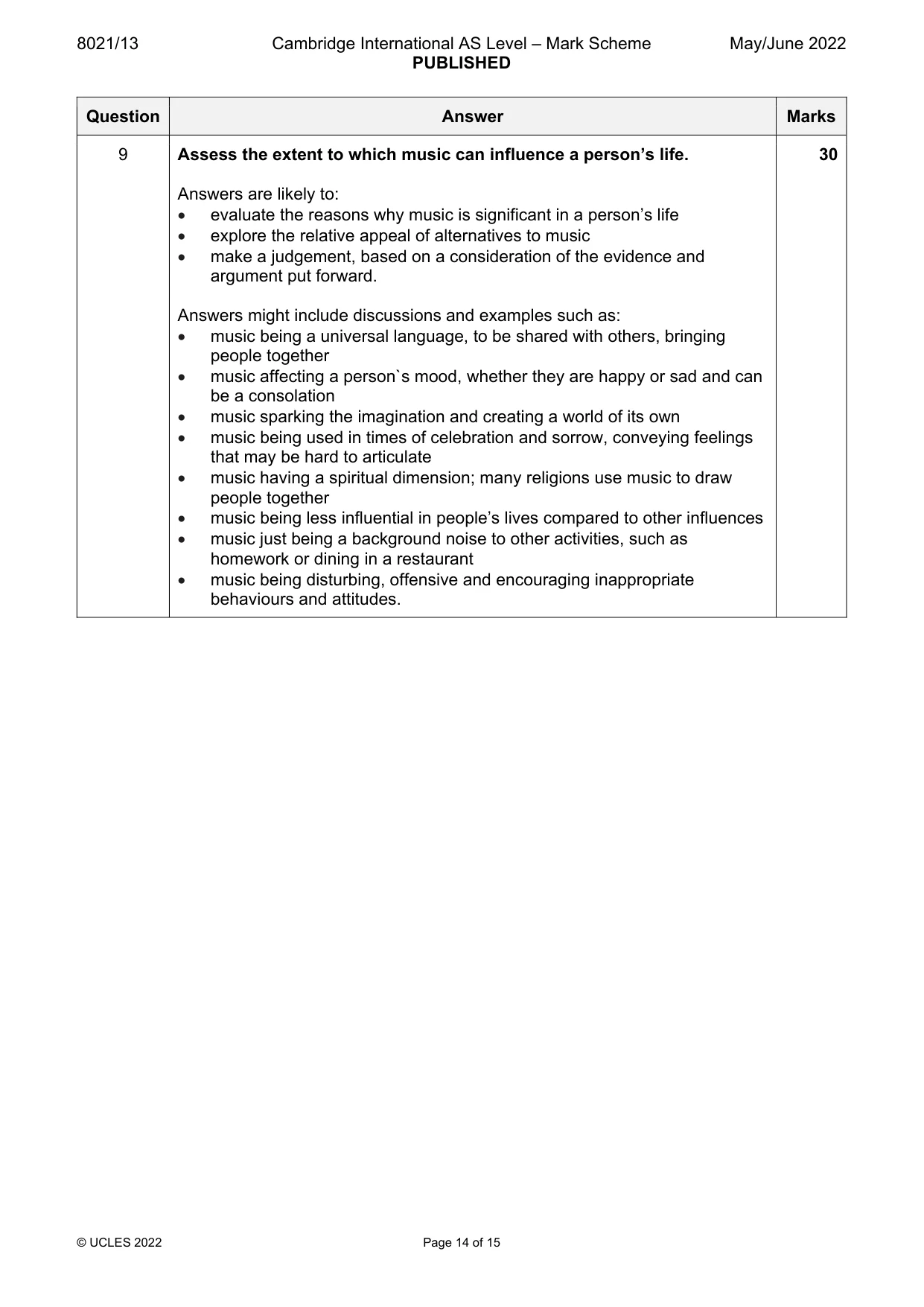
8021/13 Cambridge International AS Level – Mark Scheme PUBLISHED May/June 2022 © UCLES 2022 Page 14 of 15 Question Answer Marks 9 Assess the extent to which music can influence a person’s life. Answers are likely to: evaluate the reasons why music is significant in a person’s life explore the relative appeal of alternatives to music make a judgement, based on a consideration of the evidence and argument put forward. Answers might include discussions and examples such as: music being a universal language, to be shared with others, bringing people together music affecting a person`s mood, whether they are happy or sad and can be a consolation music sparking the imagination and creating a world of its own music being used in times of celebration and sorrow, conveying feelings that may be hard to articulate music having a spiritual dimension; many religions use music to draw people together music being less influential in people’s lives compared to other influences music just being a background noise to other activities, such as homework or dining in a restaurant music being disturbing, offensive and encouraging inappropriate behaviours and attitudes. 30
Mark scheme, page 15
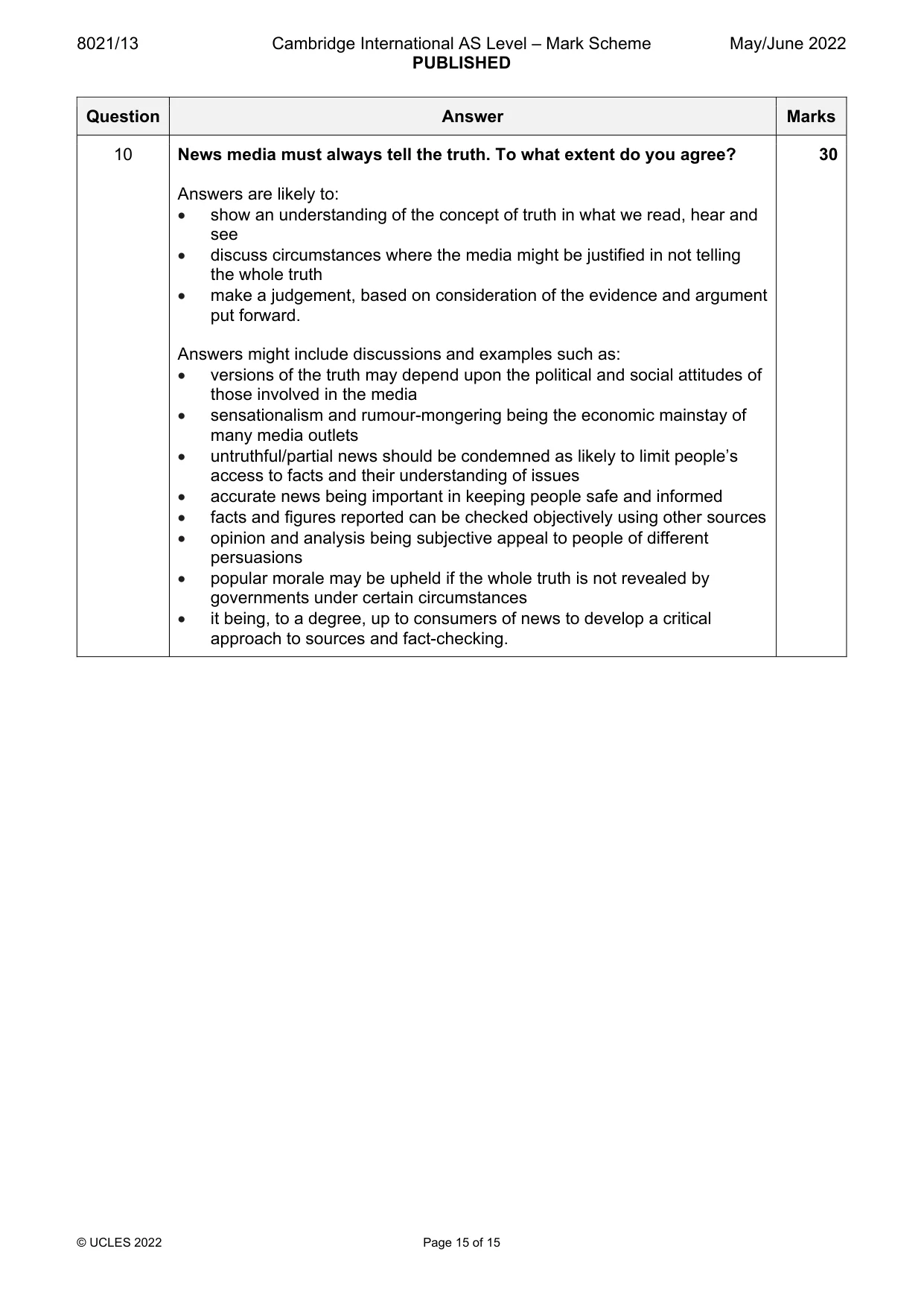
8021/13 Cambridge International AS Level – Mark Scheme PUBLISHED May/June 2022 © UCLES 2022 Page 15 of 15 Question Answer Marks 10 News media must always tell the truth. To what extent do you agree? Answers are likely to: show an understanding of the concept of truth in what we read, hear and see discuss circumstances where the media might be justified in not telling the whole truth make a judgement, based on consideration of the evidence and argument put forward. Answers might include discussions and examples such as: versions of the truth may depend upon the political and social attitudes of those involved in the media sensationalism and rumour-mongering being the economic mainstay of many media outlets untruthful/partial news should be condemned as likely to limit people’s access to facts and their understanding of issues accurate news being important in keeping people safe and informed facts and figures reported can be checked objectively using other sources opinion and analysis being subjective appeal to people of different persuasions popular morale may be upheld if the whole truth is not revealed by governments under certain circumstances it being, to a degree, up to consumers of news to develop a critical approach to sources and fact-checking. 30
What you needed in this session
Cambridge’s own grade thresholds for 2022 May/June, Paper 1 · Variant 3. A higher threshold means an easier paper — the bar moves with how the cohort did.