Questions as text
Q1 · A product with infinite elasticity of supply has sales of 1000 units a week at a price of… 9708/31 May/June 2011
8 A product with infinite elasticity of supply has sales of 1000 units a week at a price of $1 per unit. Price elasticity of demand is 1.5 over the relevant range. The government imposes a tax of 10 %. What will be the government’s weekly tax revenue? A $15 B $85 C $100 D $150
1 marks
Answer: B
This question in 9708/31 May/June 2011
Q2 · A government imposes a maximum price for electricity 9708/31 May/June 2011
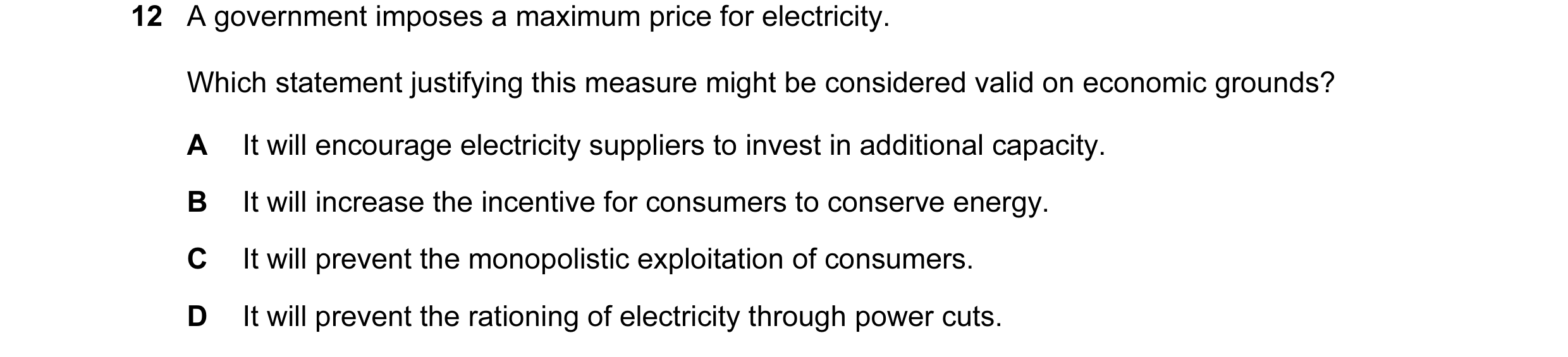
12 A government imposes a maximum price for electricity. Which statement justifying this measure might be considered valid on economic grounds? A It will encourage electricity suppliers to invest in additional capacity. B It will increase the incentive for consumers to conserve energy. C It will prevent the monopolistic exploitation of consumers. D It will prevent the rationing of electricity through power cuts.
1 marks
Answer: C
This question in 9708/31 May/June 2011
Q3 · A product with infinite elasticity of supply has sales of 1000 units a week at a price of… 9708/33 May/June 2011
7 A product with infinite elasticity of supply has sales of 1000 units a week at a price of $1 per unit. Price elasticity of demand is 1.5 over the relevant range. The government imposes a tax of 10 %. What will be the government’s weekly tax revenue? A $15 B $85 C $100 D $150
1 marks
Answer: B
This question in 9708/33 May/June 2011
Q4 · A government imposes a maximum price for electricity 9708/33 May/June 2011
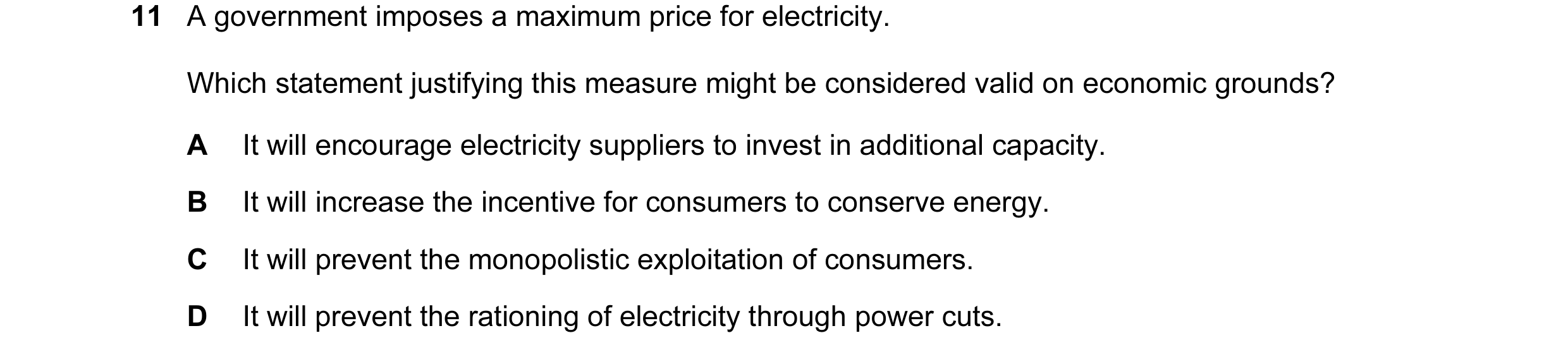
11 A government imposes a maximum price for electricity. Which statement justifying this measure might be considered valid on economic grounds? A It will encourage electricity suppliers to invest in additional capacity. B It will increase the incentive for consumers to conserve energy. C It will prevent the monopolistic exploitation of consumers. D It will prevent the rationing of electricity through power cuts.
1 marks
Answer: C
This question in 9708/33 May/June 2011
Q5 · The Chinese government is increasing the role of market forces in its economy 9708/31 Oct/Nov 2011
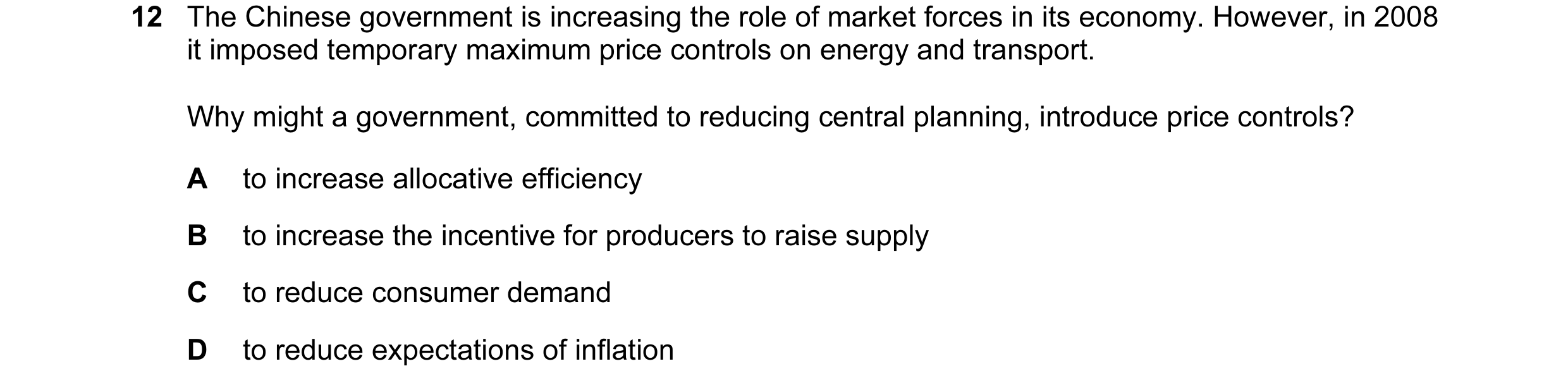
12 The Chinese government is increasing the role of market forces in its economy. However, in 2008 it imposed temporary maximum price controls on energy and transport. Why might a government, committed to reducing central planning, introduce price controls? A to increase allocative efficiency B to increase the incentive for producers to raise supply C to reduce consumer demand D to reduce expectations of inflation
1 marks
Answer: D
This question in 9708/31 Oct/Nov 2011
Q6 · To prevent a surplus of milk, each milk producer is given a production quota which… 9708/32 Oct/Nov 2011
3 To prevent a surplus of milk, each milk producer is given a production quota which specifies the volume of milk he is allowed to supply. Initially the quotas are not tradable, but then trade in quotas is allowed. Who would gain or lose when trade in quotas takes place? purchasers of sellers of quotas quotas A gain gain B gain lose C lose gain D lose lose
1 marks
Answer: A
This question in 9708/32 Oct/Nov 2011
Q7 · The Chinese government is increasing the role of market forces in its economy 9708/33 Oct/Nov 2011
11 The Chinese government is increasing the role of market forces in its economy. However, in 2008 it imposed temporary maximum price controls on energy and transport. Why might a government, committed to reducing central planning, introduce price controls? A to increase allocative efficiency B to increase the incentive for producers to raise supply C to reduce consumer demand D to reduce expectations of inflation
1 marks
Answer: D
This question in 9708/33 Oct/Nov 2011
Q8 · In the diagram the imposition of a tax on a commodity causes its supply curve to shift… 9708/31 May/June 2012
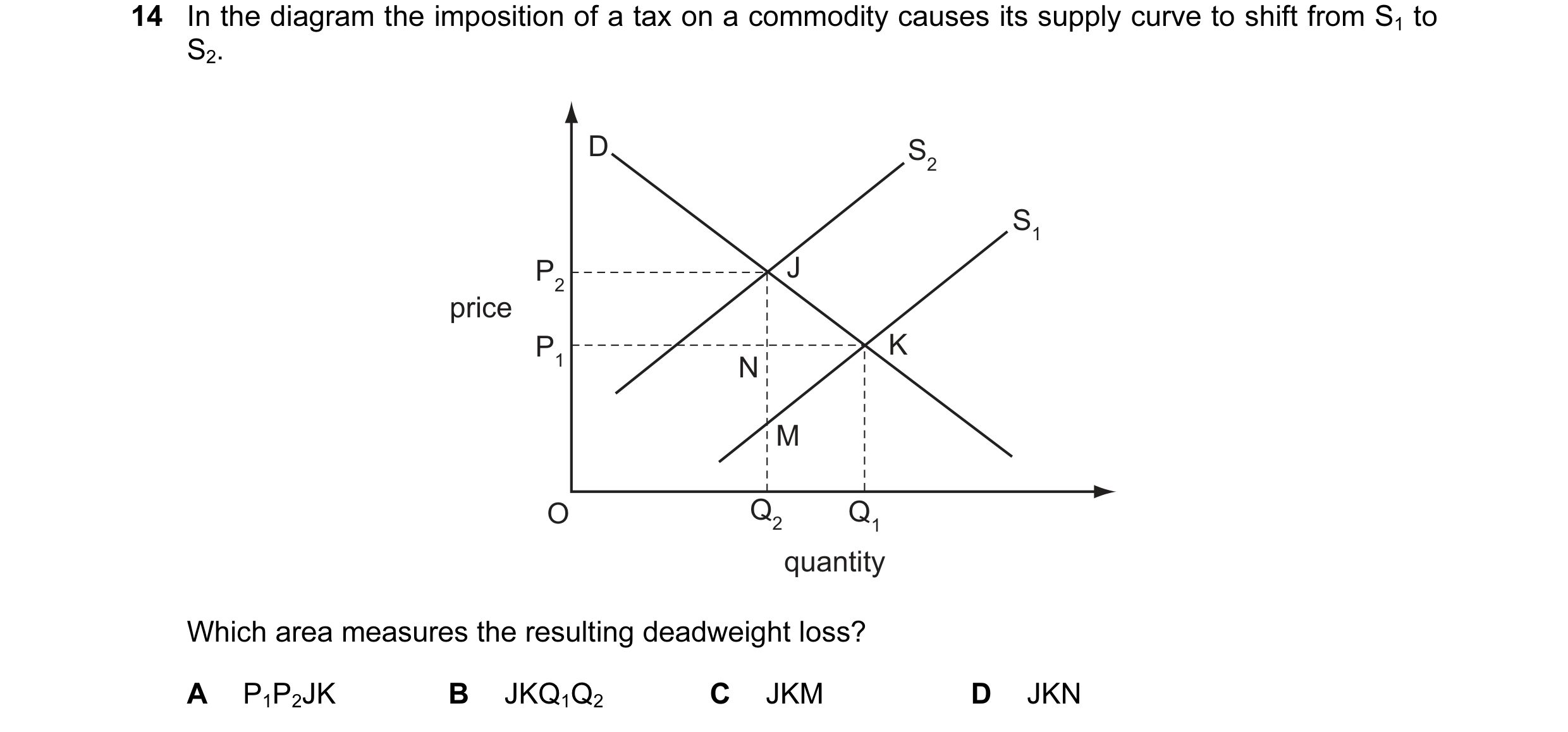
14 In the diagram the imposition of a tax on a commodity causes its supply curve to shift from S1 to S2. D S2 S1 P2 J price P1 K N M O Q2 Q1 quantity Which area measures the resulting deadweight loss? A P1P2JK B JKQ1Q2 C JKM D JKN
1 marks
Answer: C
This question in 9708/31 May/June 2012
Q9 · In the diagram the imposition of a tax on a commodity causes its supply curve to shift… 9708/32 May/June 2012
14 In the diagram the imposition of a tax on a commodity causes its supply curve to shift from S1 to S2. D S2 S1 P2 J price P1 K N M O Q2 Q1 quantity Which area measures the resulting deadweight loss? A P1P2JK B JKQ1Q2 C JKM D JKN
1 marks
Answer: C
This question in 9708/32 May/June 2012
Q10 · What would be the effect of imposing a specific tax on each item produced by a profit… 9708/32 Oct/Nov 2012
7 What would be the effect of imposing a specific tax on each item produced by a profit maximising monopolist? A Average revenue falls by the amount of the tax. B Marginal costs rise by the amount of the tax. C Price increases by the amount of the tax. D There will be no change in price or output.
1 marks
Answer: B
This question in 9708/32 Oct/Nov 2012
Q11 · The diagram shows the market supply and demand curves for corn 9708/32 May/June 2013
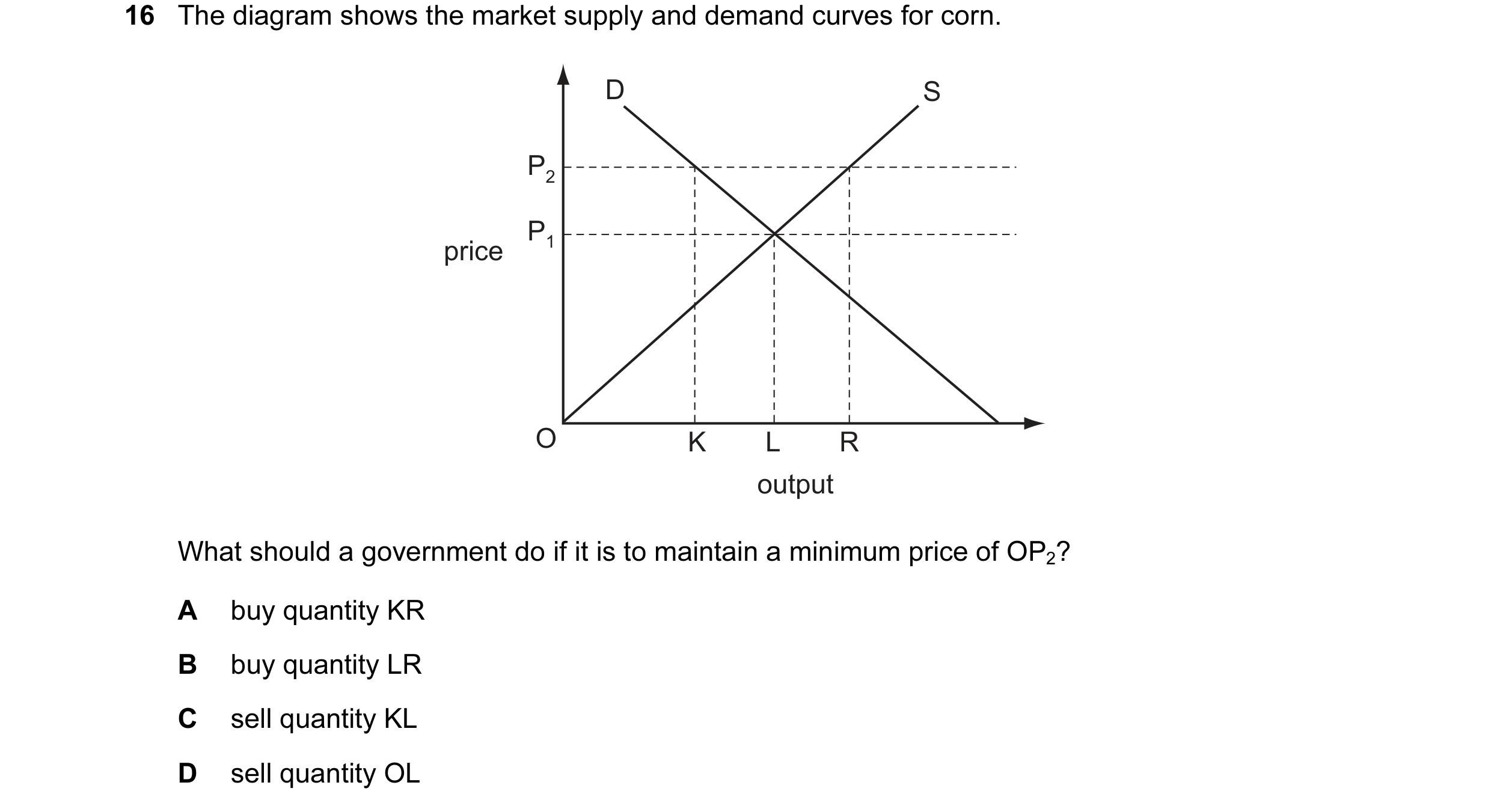
16 The diagram shows the market supply and demand curves for corn. D S P2 P1 price O K L R output What should a government do if it is to maintain a minimum price of OP2? A buy quantity KR B buy quantity LR C sell quantity KL D sell quantity OL
1 marks
Answer: A
This question in 9708/32 May/June 2013
Q12 · The table compares some of the properties of universal benefits and means tested benefits 9708/33 Oct/Nov 2013
14 The table compares some of the properties of universal benefits and means tested benefits. Which pairing is correct? universal benefits means tested benefits A greater disincentive effects targeted at those most in need B higher take-up rate more expensive C more expensive greater disincentive effects D targeted at those most in need higher take-up rate
1 marks
Answer: C
This question in 9708/33 Oct/Nov 2013
Q13 · In the diagram, MC and AC are a profit-maximising monopolist’s marginal and average cost… 9708/33 Oct/Nov 2014
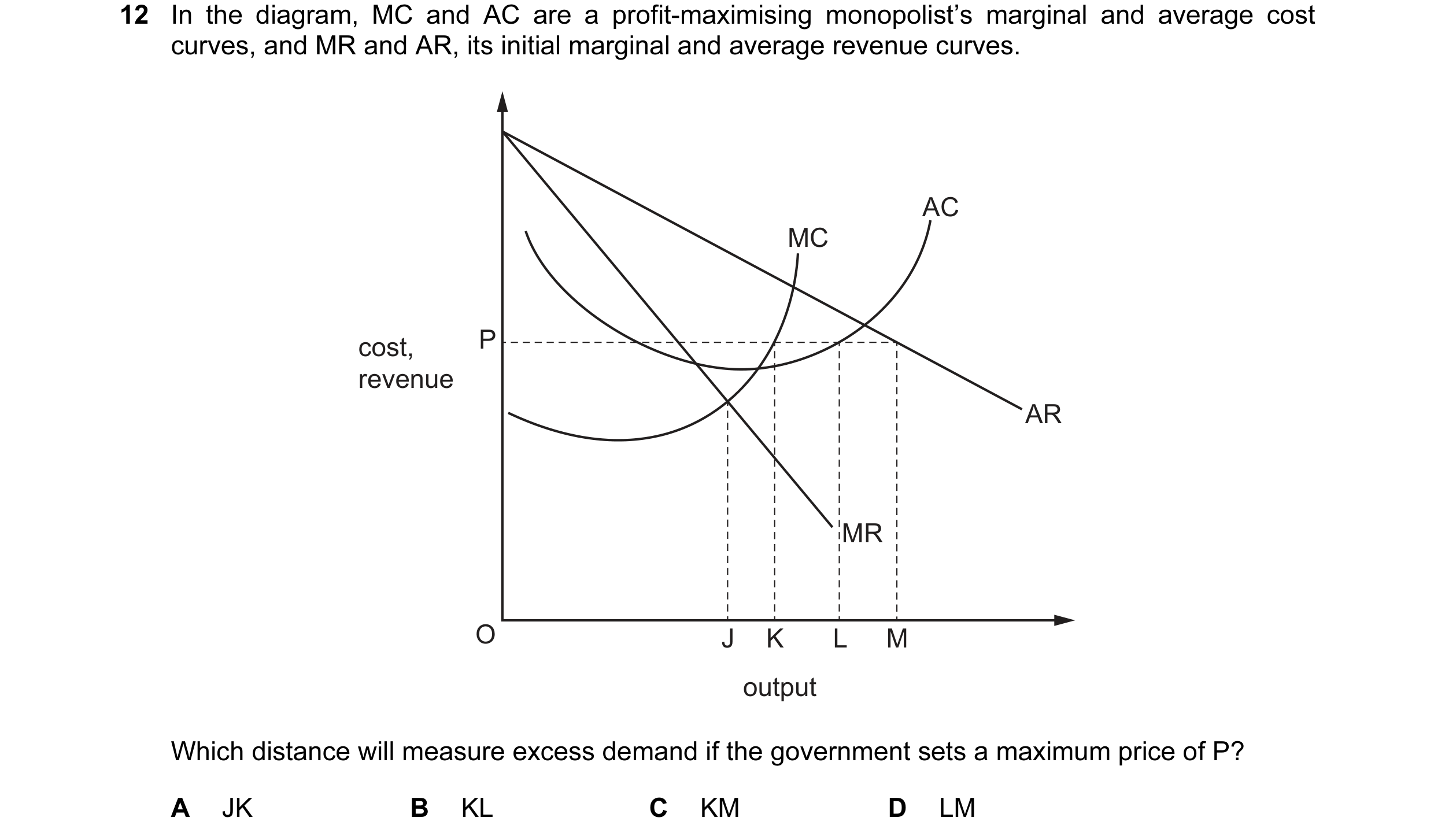
12 In the diagram, MC and AC are a profit-maximising monopolist’s marginal and average cost curves, and MR and AR, its initial marginal and average revenue curves. AC MC cost, P revenue AR MR O J K L M output Which distance will measure excess demand if the government sets a maximum price of P? A JK B KL C KM D LM
1 marks
Answer: C
This question in 9708/33 Oct/Nov 2014
Q14 · In the diagram, DD is the demand curve for an agricultural commodity, S1 is the supply… 9708/33 Oct/Nov 2014
15 In the diagram, DD is the demand curve for an agricultural commodity, S1 is the supply curve in period 1 and S2 is the supply curve in period 2. The broken curve XY is a rectangular hyperbola. X S1 D S2 P1 price P2 D Y O J K L M quantity The government operates a buffer stock scheme designed to keep farm revenue unchanged. In period 1 the price is fixed at P1. What action will the government need to take in period 2 to fix the price at P2? A add quantity JK to the buffer stock B add quantity KL to the buffer stock C release quantity KL from the buffer stock D release quantity KM from the buffer stock
1 marks
Answer: D
This question in 9708/33 Oct/Nov 2014
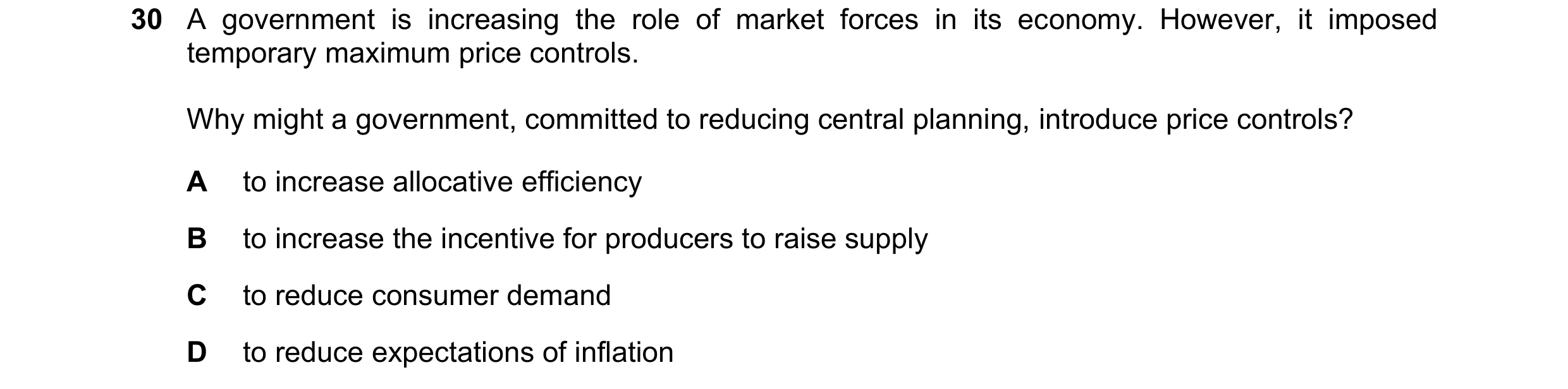
Q15 · A government is increasing the role of market forces in its economy 9708/31 May/June 2021
30 A government is increasing the role of market forces in its economy. However, it imposed temporary maximum price controls. Why might a government, committed to reducing central planning, introduce price controls? A to increase allocative efficiency B to increase the incentive for producers to raise supply C to reduce consumer demand D to reduce expectations of inflation
1 marks
Answer: D
This question in 9708/31 May/June 2021
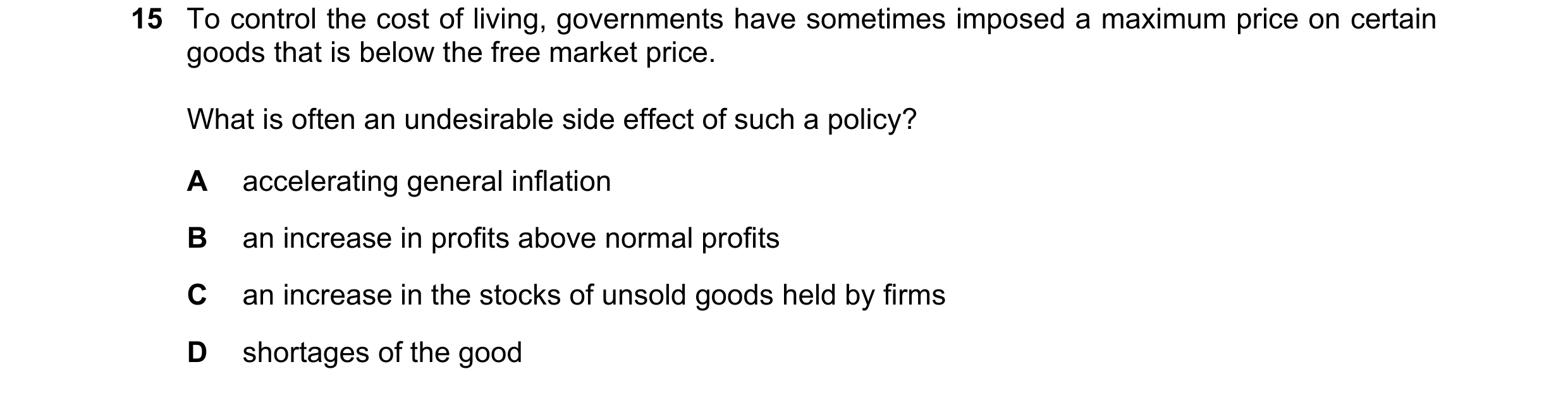
Q16 · To control the cost of living, governments have sometimes imposed a maximum price on… 9708/33 Oct/Nov 2023
15 To control the cost of living, governments have sometimes imposed a maximum price on certain goods that is below the free market price. What is often an undesirable side effect of such a policy? A accelerating general inflation B an increase in profits above normal profits C an increase in the stocks of unsold goods held by firms D shortages of the good
1 marks
Answer: D
This question in 9708/33 Oct/Nov 2023
Q17 · A government introduced a tax on soft drinks containing sugar 9708/32 Feb/March 2025
11 A government introduced a tax on soft drinks containing sugar. It was forecast that the tax would raise £520m per year for the government. However, the tax received was £240m. What is the most likely reason why the tax collected was lower than forecast? A a specific tax instead of an ad valorem tax was introduced B fewer drinks than originally forecast contained sugar C most retailers did not increase the price of soft drinks D the demand for soft drinks was price inelastic
1 marks
Answer: B
This question in 9708/32 Feb/March 2025


 1 / 6
1 / 6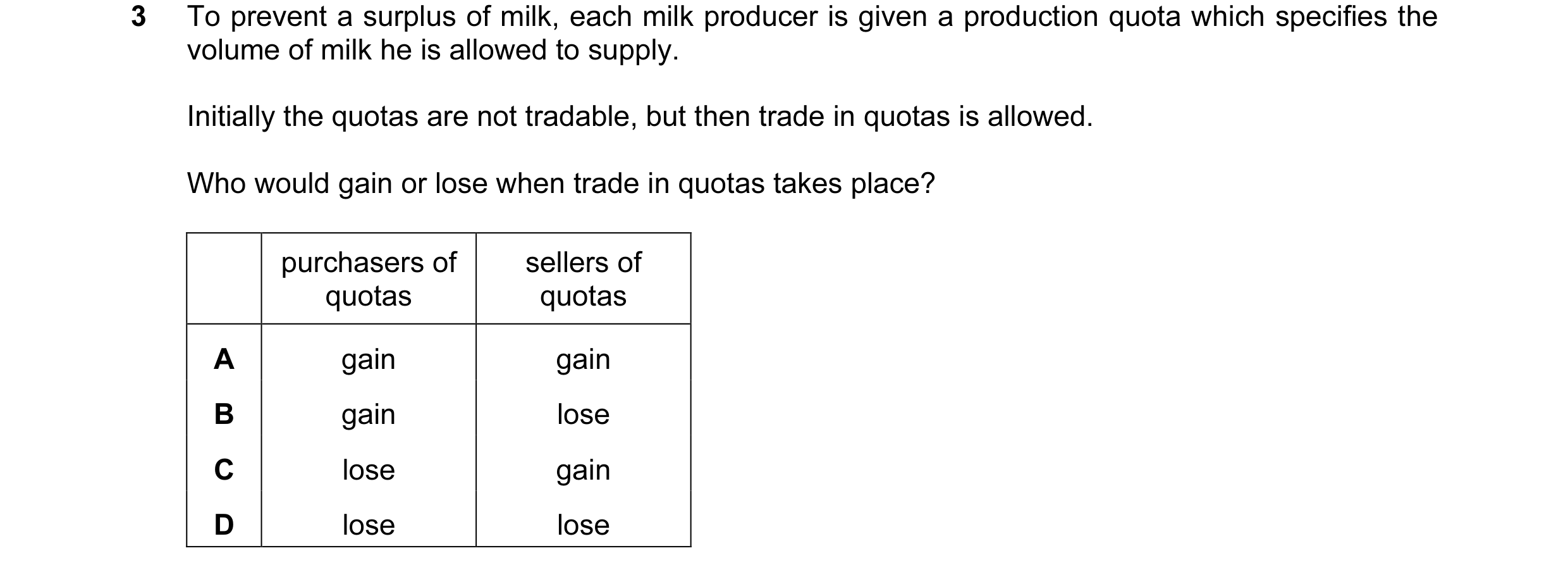
 2 / 6
2 / 6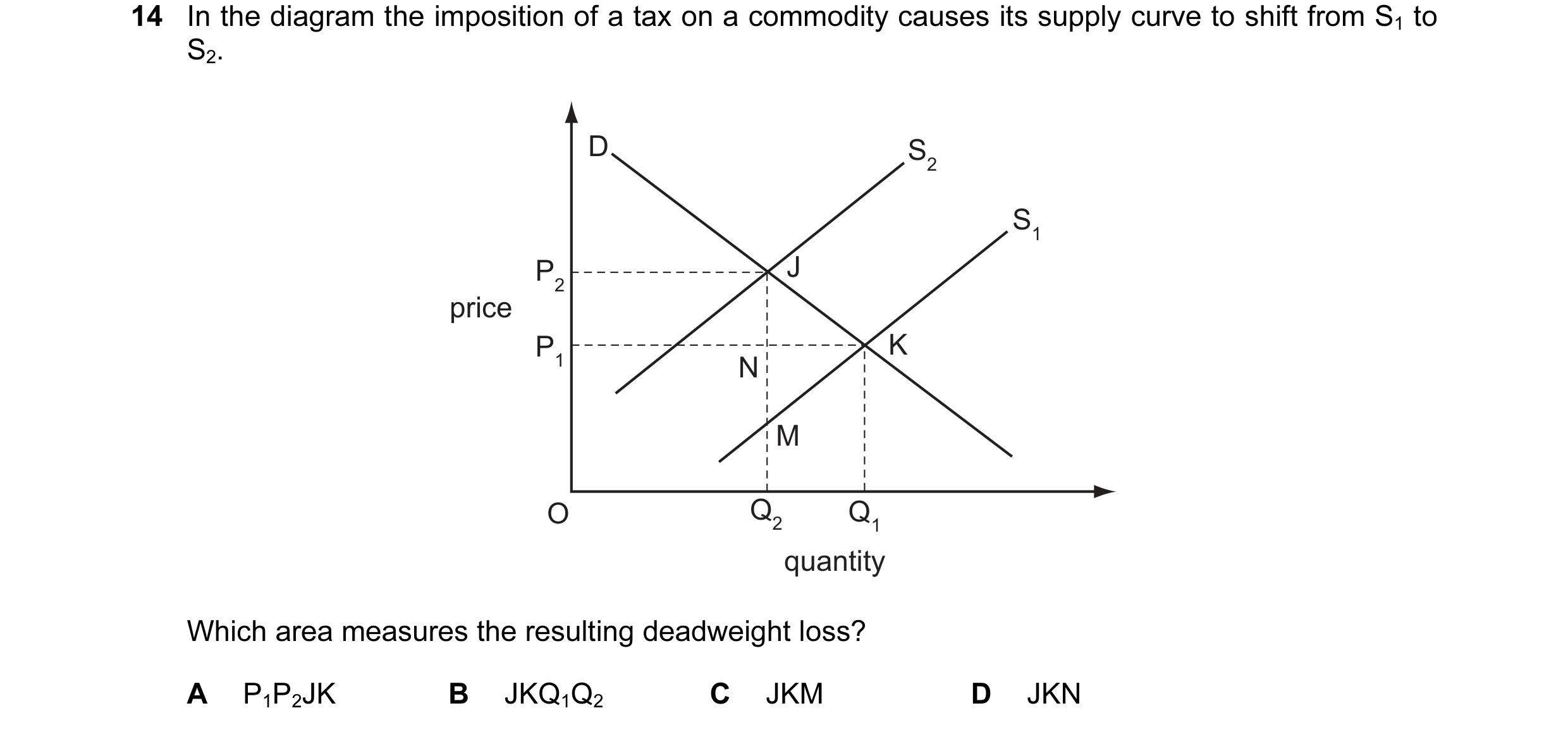
 3 / 6
3 / 6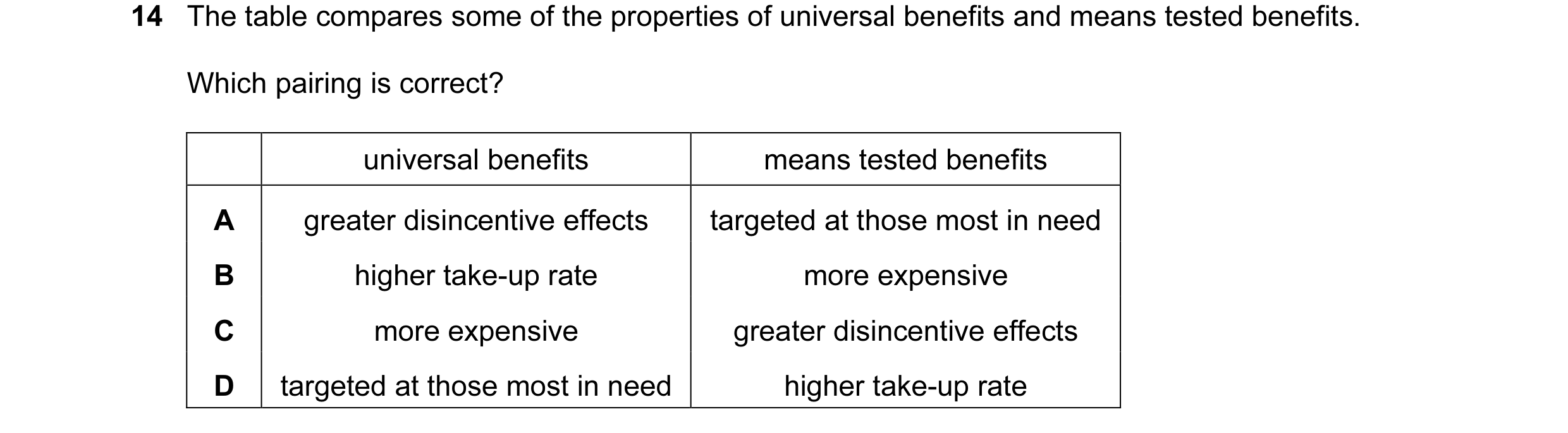
 4 / 6
4 / 6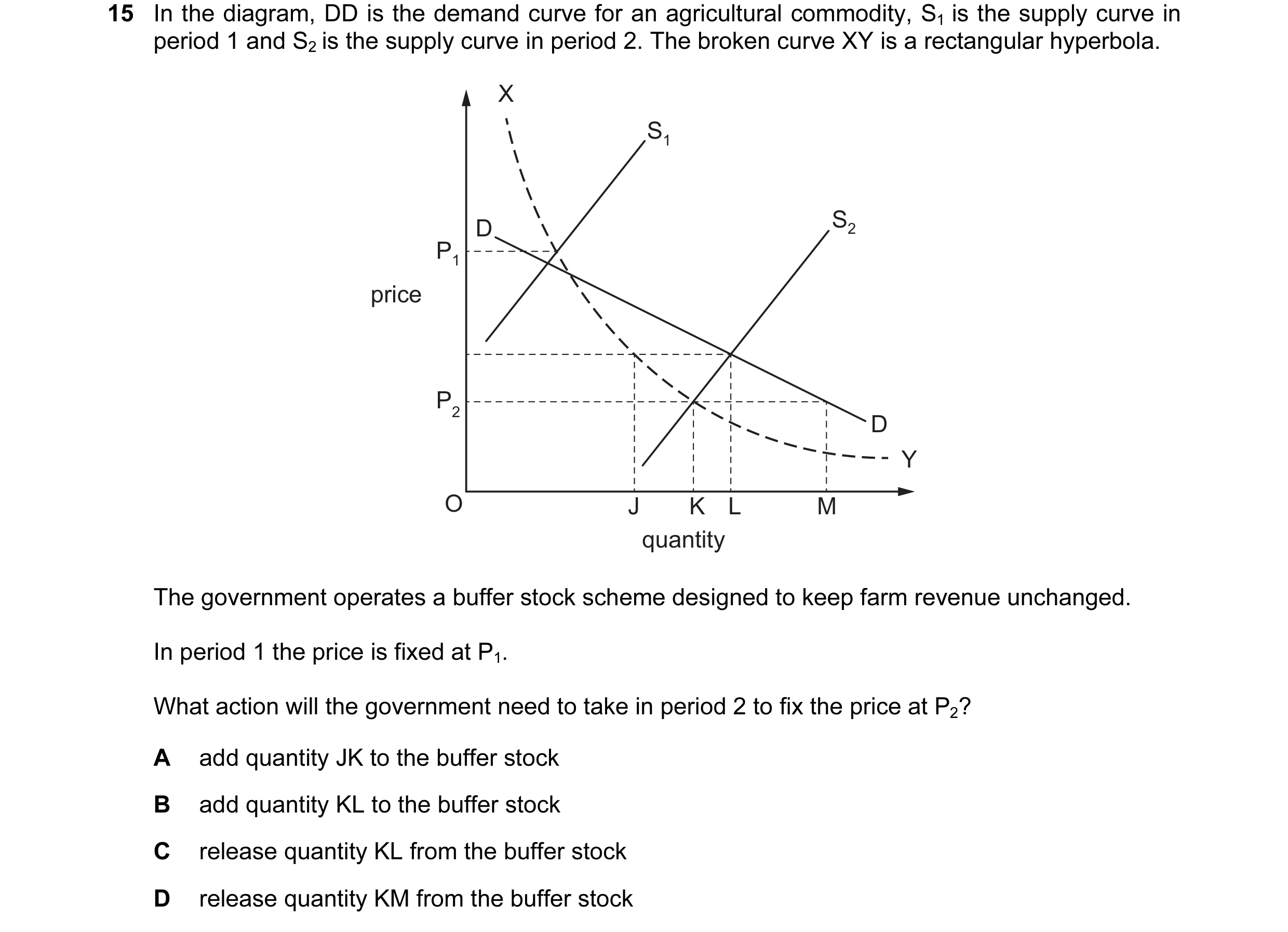
 5 / 6
5 / 6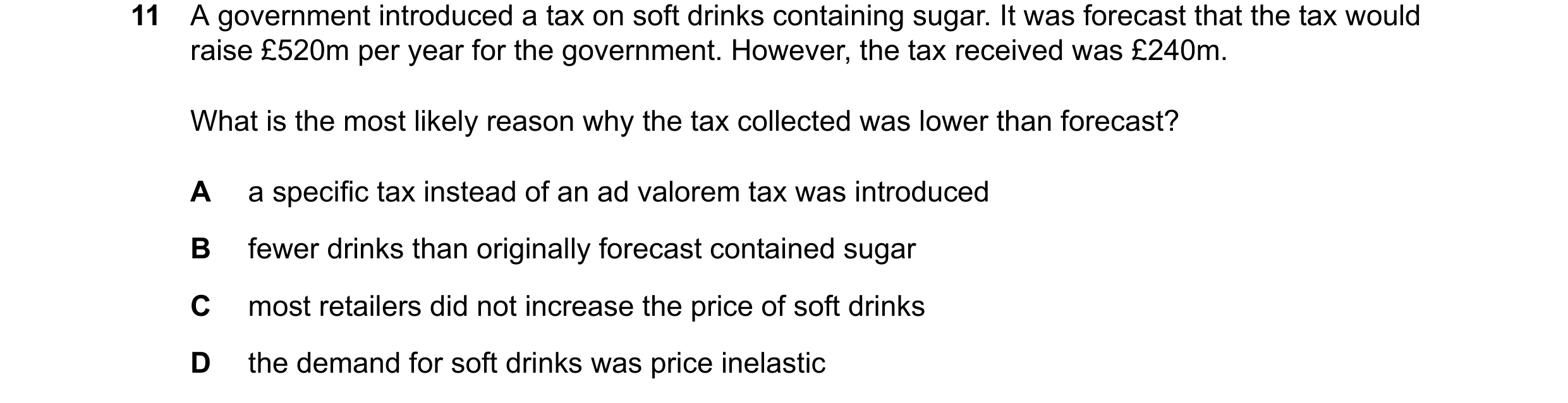 6 / 6
6 / 6