Cambridge A Level Design and Technology 9705 — 2024 Oct/Nov Paper 3 · Variant 3
9705/33/O/N/24 · 120 marks · ≈135 min
The question paper and its mark scheme, free to read here and free to download. This is Cambridge’s own paper, exactly as it was sat.
Question paper12 pages


Mark scheme16 pages
Answers below. Sit the paper first if you are practising.
Paper as text
Question paper, page 1
This document has 12 pages. Any blank pages are indicated. [Turn over * 0 4 3 8 1 1 4 2 6 6 * Cambridge International AS & A Level DESIGN & TECHNOLOGY 9705/33 Paper 3 October/November 2024 3 hours You must answer on the answer booklet/paper. You will need: Answer booklet/paper Coloured pencils A3 drawing paper (5 sheets) A range of design drawing equipment INSTRUCTIONS ● Answer three questions in total: Section A: answer two questions from one of the Parts A, B or C. Section B: answer one question. ● If you have been given an answer booklet, follow the instructions on the front cover of the answer booklet. ● Use a black or dark blue pen. ● Write your name, centre number and candidate number on all the work you hand in. ● Do not use an erasable pen or correction fluid. ● You may use an HB pencil, or coloured pencils as appropriate, for any diagrams, graphs or rough working. ● At the end of the examination, fasten all your work together. Do not use staples, paper clips or glue. INFORMATION ● The total mark for this paper is 120. ● The number of marks for each question or part question is shown in brackets [ ]. ● All dimensions are in millimetres. DC (DE/FC) 336406/3 © UCLES 2024
Question paper, page 2
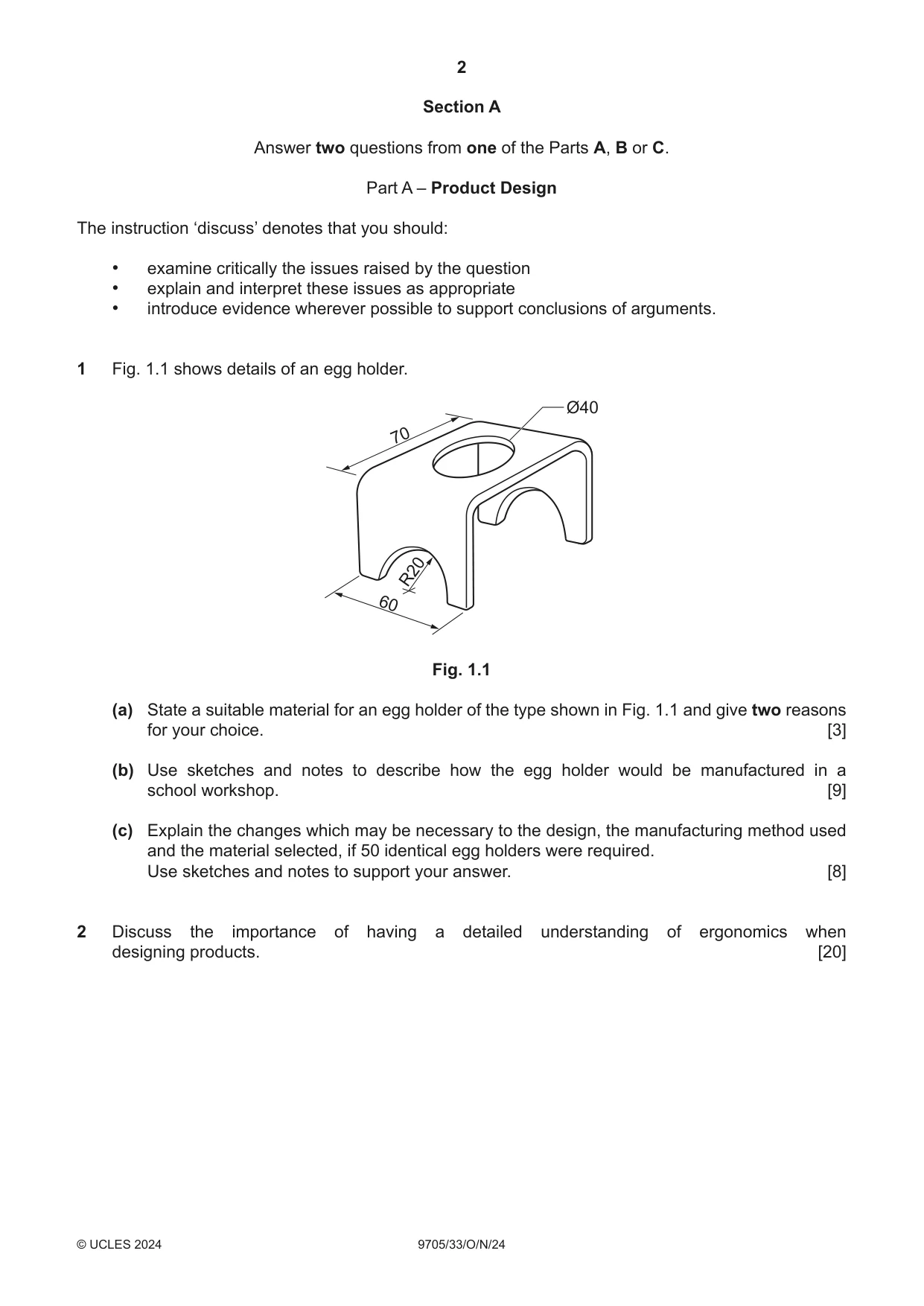
2 9705/33/O/N/24 © UCLES 2024 Section A Answer two questions from one of the Parts A, B or C. Part A – Product Design The instruction ‘discuss’ denotes that you should: • examine critically the issues raised by the question • explain and interpret these issues as appropriate • introduce evidence wherever possible to support conclusions of arguments. 1 Fig. 1.1 shows details of an egg holder. R20 60 70 Ø40 Fig. 1.1 (a) State a suitable material for an egg holder of the type shown in Fig. 1.1 and give two reasons for your choice. [3] (b) Use sketches and notes to describe how the egg holder would be manufactured in a school workshop. [9] (c) Explain the changes which may be necessary to the design, the manufacturing method used and the material selected, if 50 identical egg holders were required. Use sketches and notes to support your answer. [8] 2 Discuss the importance of having a detailed understanding of ergonomics when designing products. [20]
Question paper, page 3
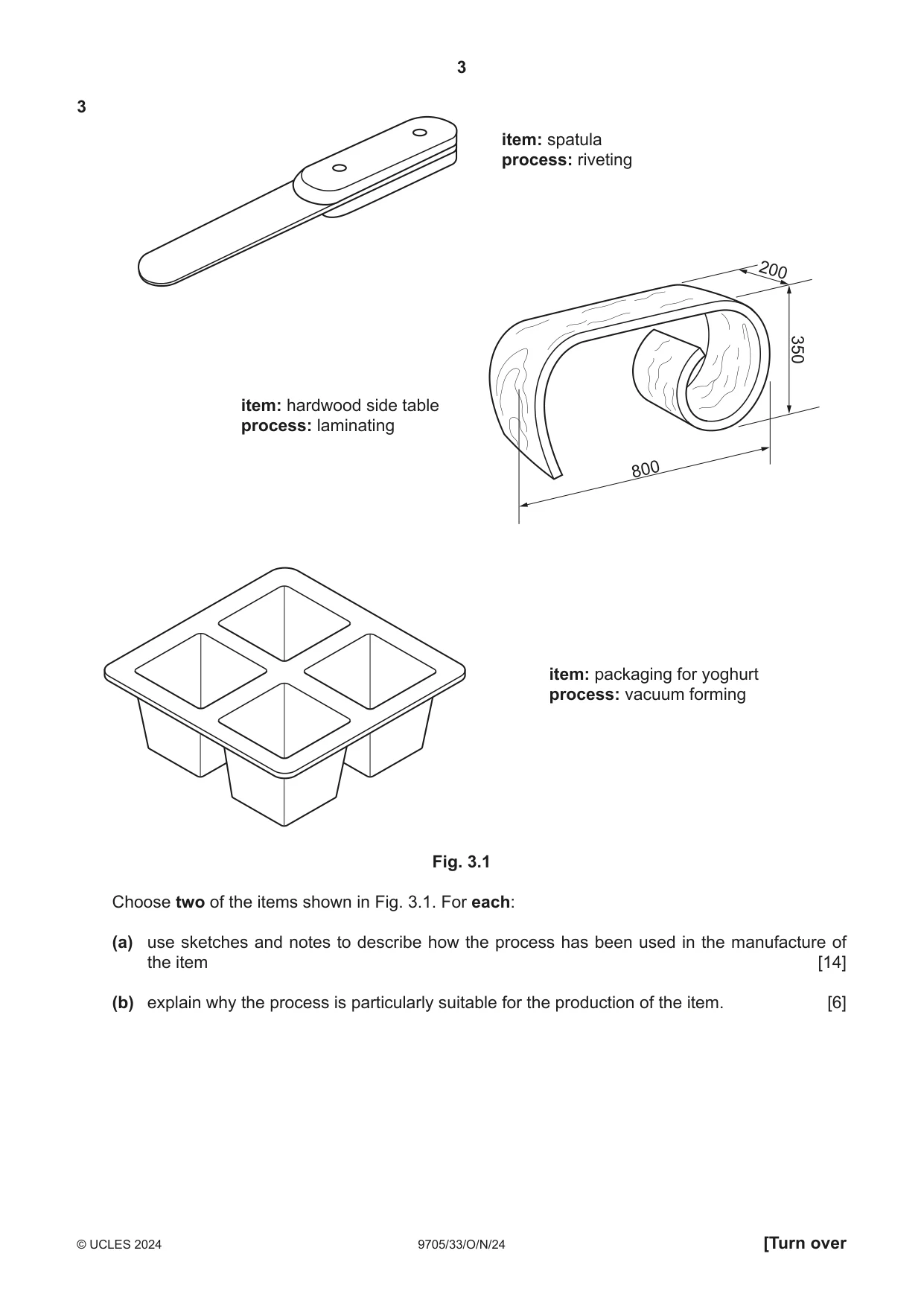
3 9705/33/O/N/24 © UCLES 2024 [Turn over 3 800 350 200 item: spatula process: riveting item: hardwood side table process: laminating item: packaging for yoghurt process: vacuum forming Fig. 3.1 Choose two of the items shown in Fig. 3.1. For each: (a) use sketches and notes to describe how the process has been used in the manufacture of the item [14] (b) explain why the process is particularly suitable for the production of the item. [6]
Question paper, page 4
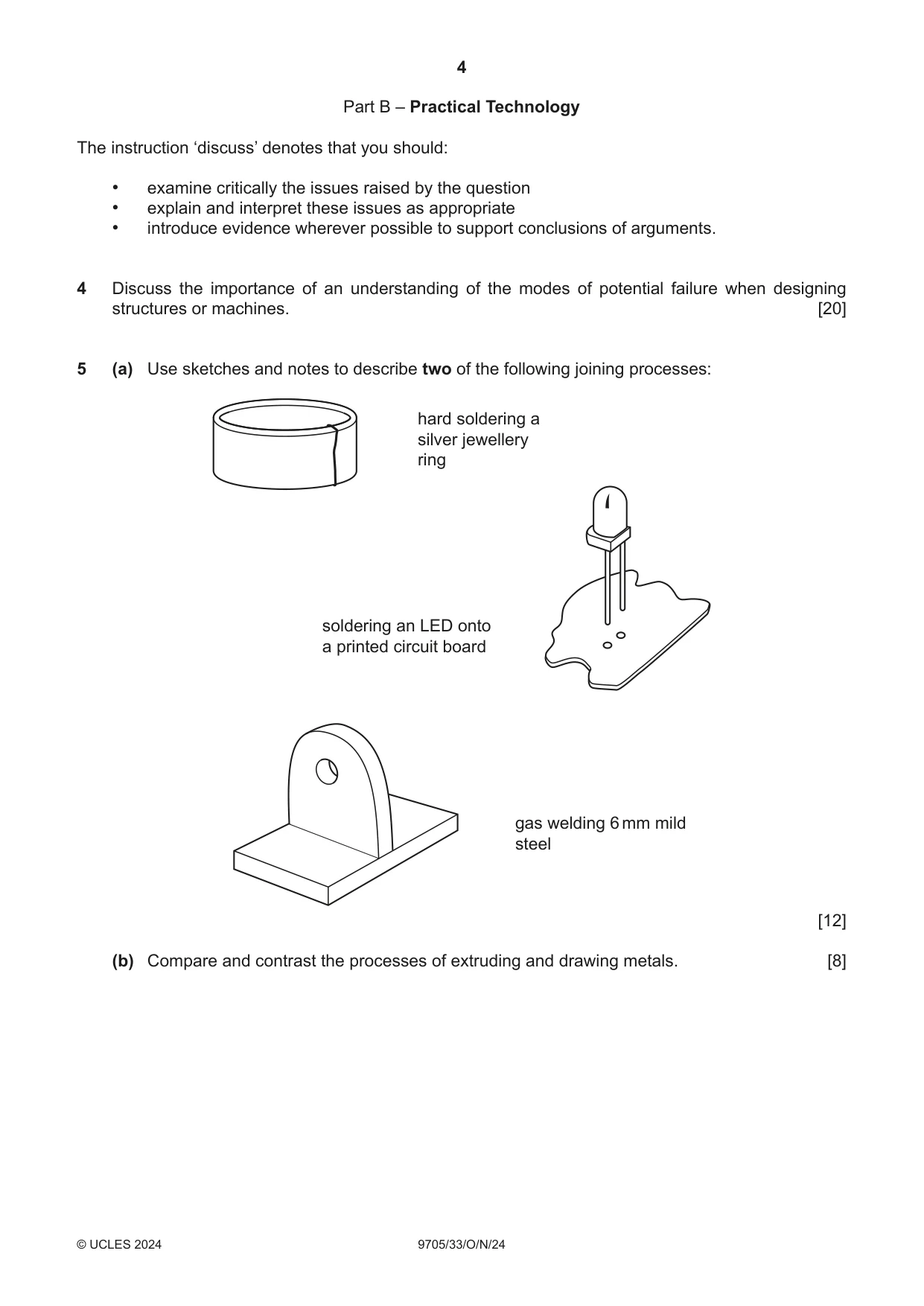
4 9705/33/O/N/24 © UCLES 2024 Part B – Practical Technology The instruction ‘discuss’ denotes that you should: • examine critically the issues raised by the question • explain and interpret these issues as appropriate • introduce evidence wherever possible to support conclusions of arguments. 4 Discuss the importance of an understanding of the modes of potential failure when designing structures or machines. [20] 5 (a) Use sketches and notes to describe two of the following joining processes: hard soldering a silver jewellery ring soldering an LED onto a printed circuit board gas welding 6 mm mild steel [12] (b) Compare and contrast the processes of extruding and drawing metals. [8]
Question paper, page 5
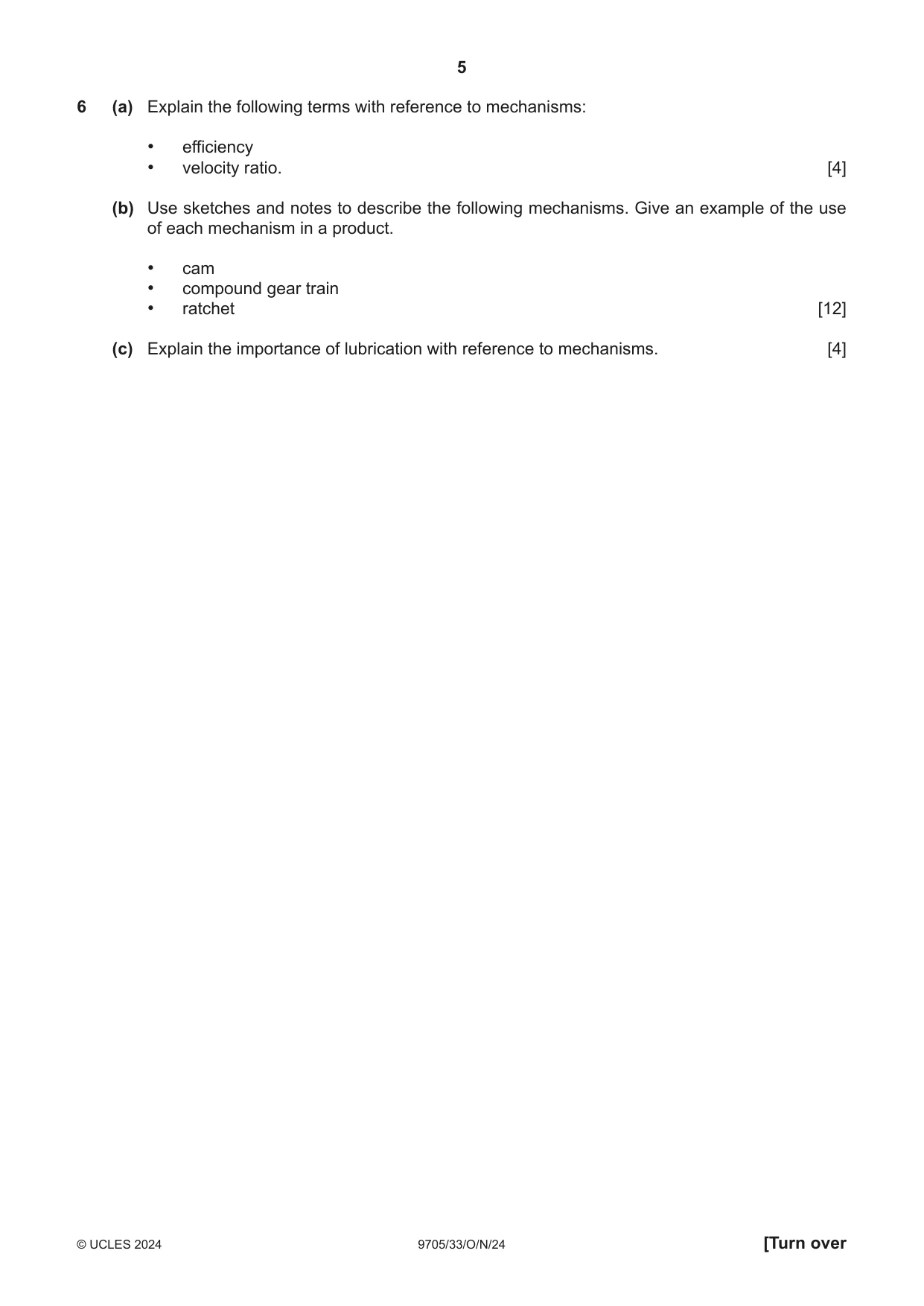
5 9705/33/O/N/24 © UCLES 2024 [Turn over 6 (a) Explain the following terms with reference to mechanisms: • efficiency • velocity ratio. [4] (b) Use sketches and notes to describe the following mechanisms. Give an example of the use of each mechanism in a product. • cam • compound gear train • ratchet [12] (c) Explain the importance of lubrication with reference to mechanisms. [4]
Question paper, page 6
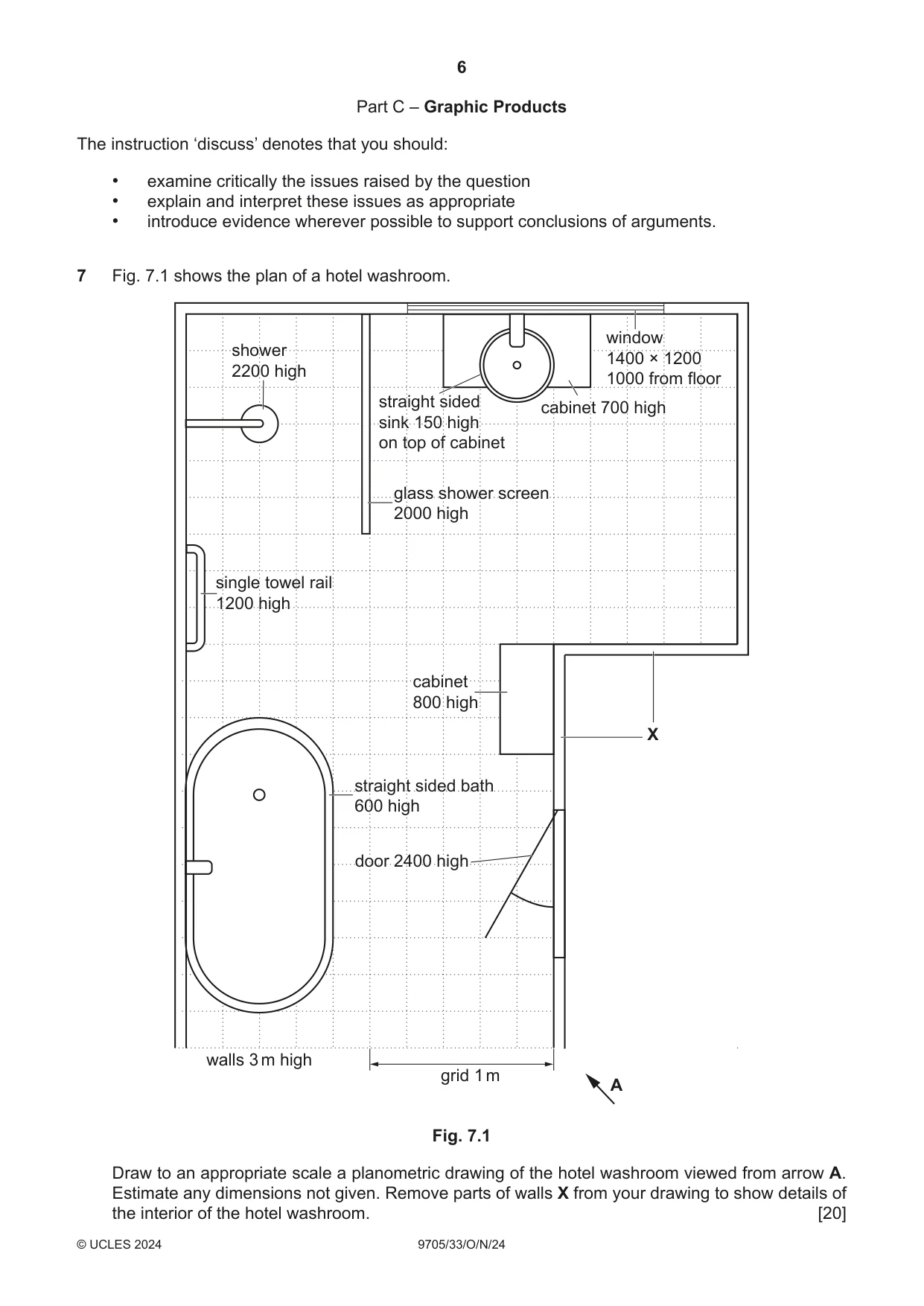
6 9705/33/O/N/24 © UCLES 2024 Part C – Graphic Products The instruction ‘discuss’ denotes that you should: • examine critically the issues raised by the question • explain and interpret these issues as appropriate • introduce evidence wherever possible to support conclusions of arguments. 7 Fig. 7.1 shows the plan of a hotel washroom. shower 2200 high window 1400 × 1200 1000 from floor walls 3 m high grid 1 m A glass shower screen 2000 high single towel rail 1200 high cabinet 800 high cabinet 700 high straight sided bath 600 high straight sided sink 150 high on top of cabinet door 2400 high X Fig. 7.1 Draw to an appropriate scale a planometric drawing of the hotel washroom viewed from arrow A. Estimate any dimensions not given. Remove parts of walls X from your drawing to show details of the interior of the hotel washroom. [20]
Question paper, page 7
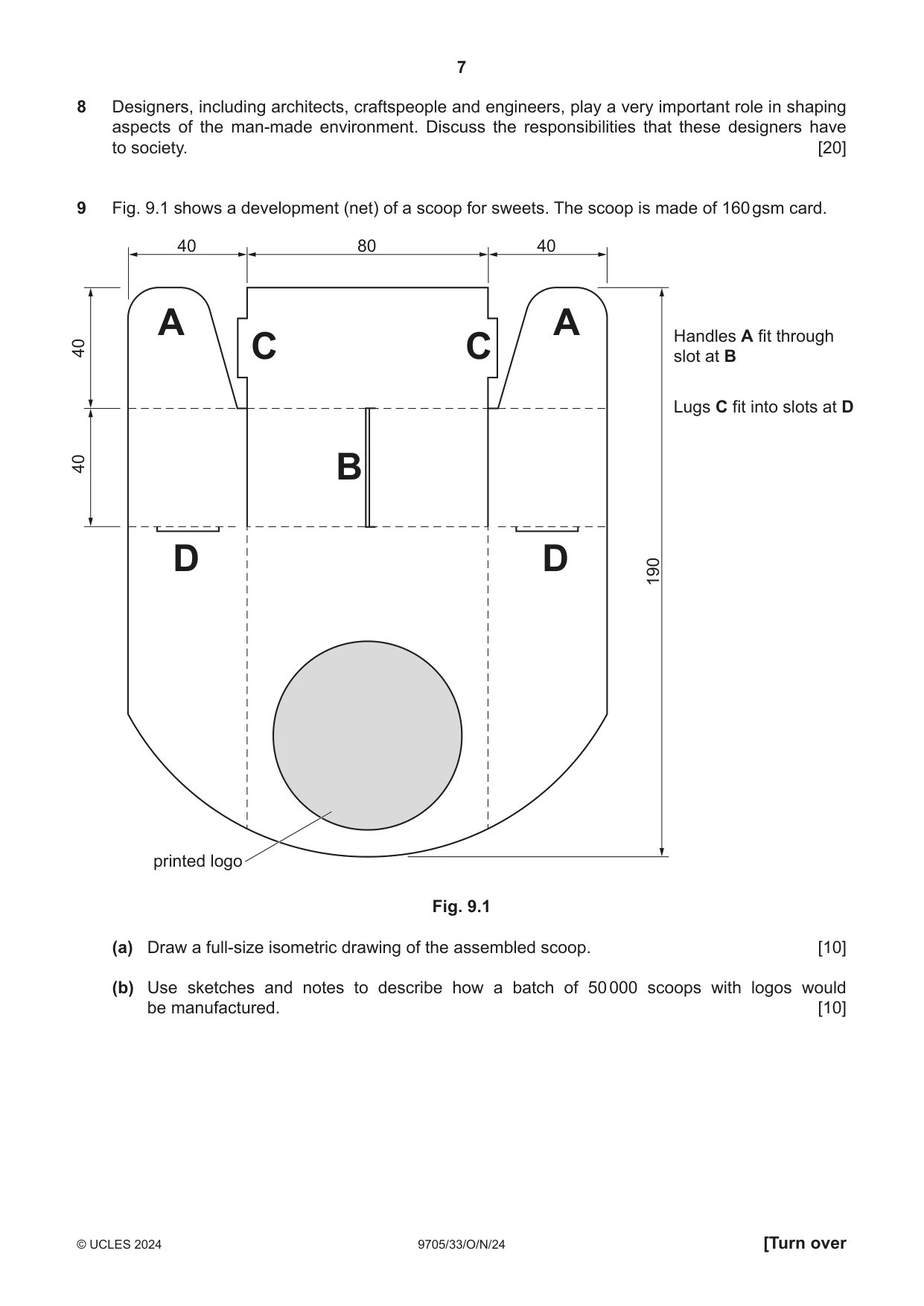
7 9705/33/O/N/24 © UCLES 2024 [Turn over 8 Designers, including architects, craftspeople and engineers, play a very important role in shaping aspects of the man-made environment. Discuss the responsibilities that these designers have to society. [20] 9 Fig. 9.1 shows a development (net) of a scoop for sweets. The scoop is made of 160 gsm card. printed logo Handles A fit through slot at B Lugs C fit into slots at D 40 40 40 80 40 190 D B C C D A A Fig. 9.1 (a) Draw a full-size isometric drawing of the assembled scoop. [10] (b) Use sketches and notes to describe how a batch of 50 000 scoops with logos would be manufactured. [10]
Question paper, page 8
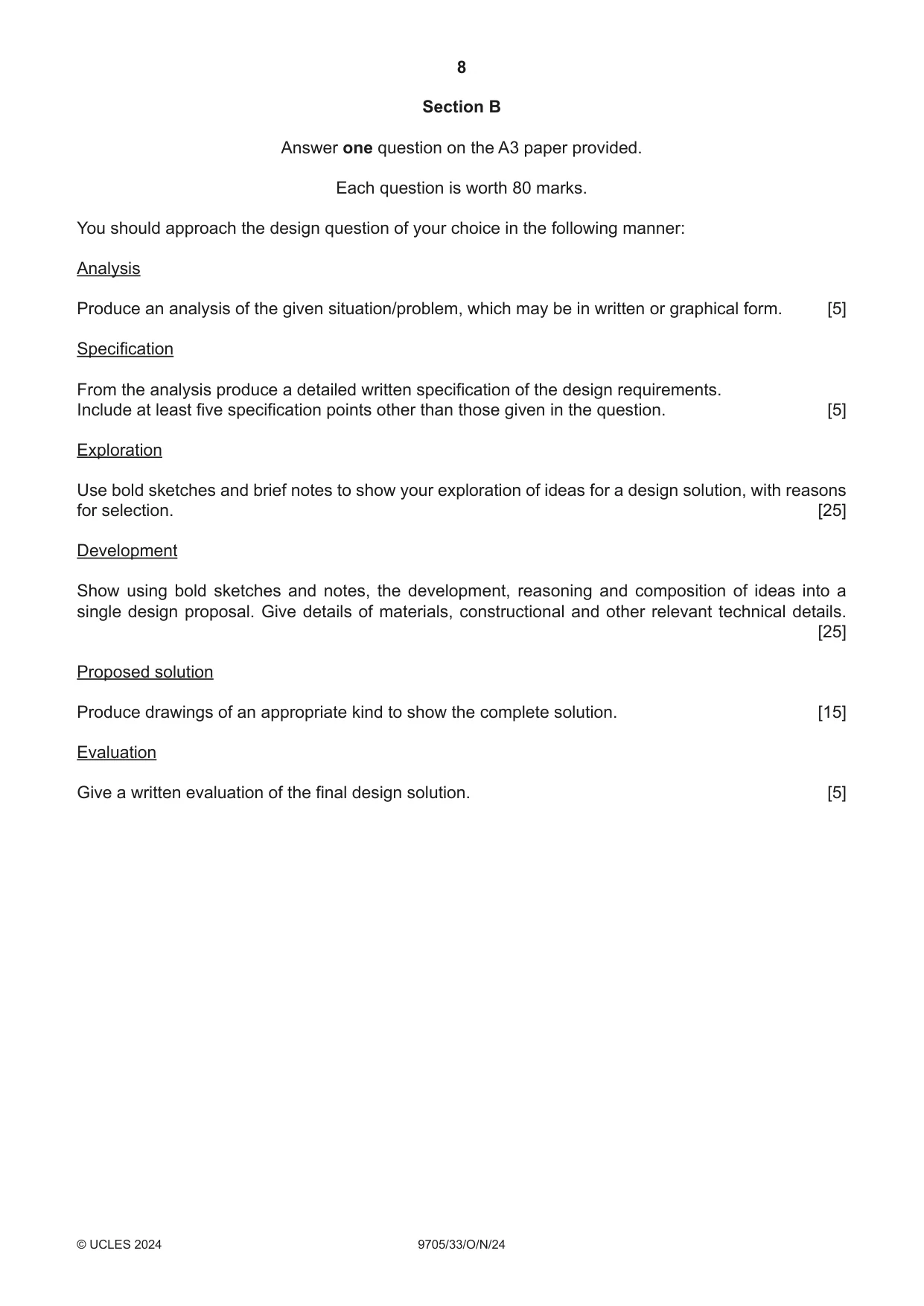
8 9705/33/O/N/24 © UCLES 2024 Section B Answer one question on the A3 paper provided. Each question is worth 80 marks. You should approach the design question of your choice in the following manner: Analysis Produce an analysis of the given situation/problem, which may be in written or graphical form. [5] Specification From the analysis produce a detailed written specification of the design requirements. Include at least five specification points other than those given in the question. [5] Exploration Use bold sketches and brief notes to show your exploration of ideas for a design solution, with reasons for selection. [25] Development Show using bold sketches and notes, the development, reasoning and composition of ideas into a single design proposal. Give details of materials, constructional and other relevant technical details. [25] Proposed solution Produce drawings of an appropriate kind to show the complete solution. [15] Evaluation Give a written evaluation of the final design solution. [5]
Question paper, page 9
9 9705/33/O/N/24 © UCLES 2024 [Turn over 10 A new school has a large hall and stage where teachers and guest speakers can address the assembled school. A lectern for speakers to stand at and access their speech notes is required. You are to design a lectern suitable for use by a range of speakers. The lectern must be: • adjustable in height • easily folded or disassembled for storage. [80]
Question paper, page 10
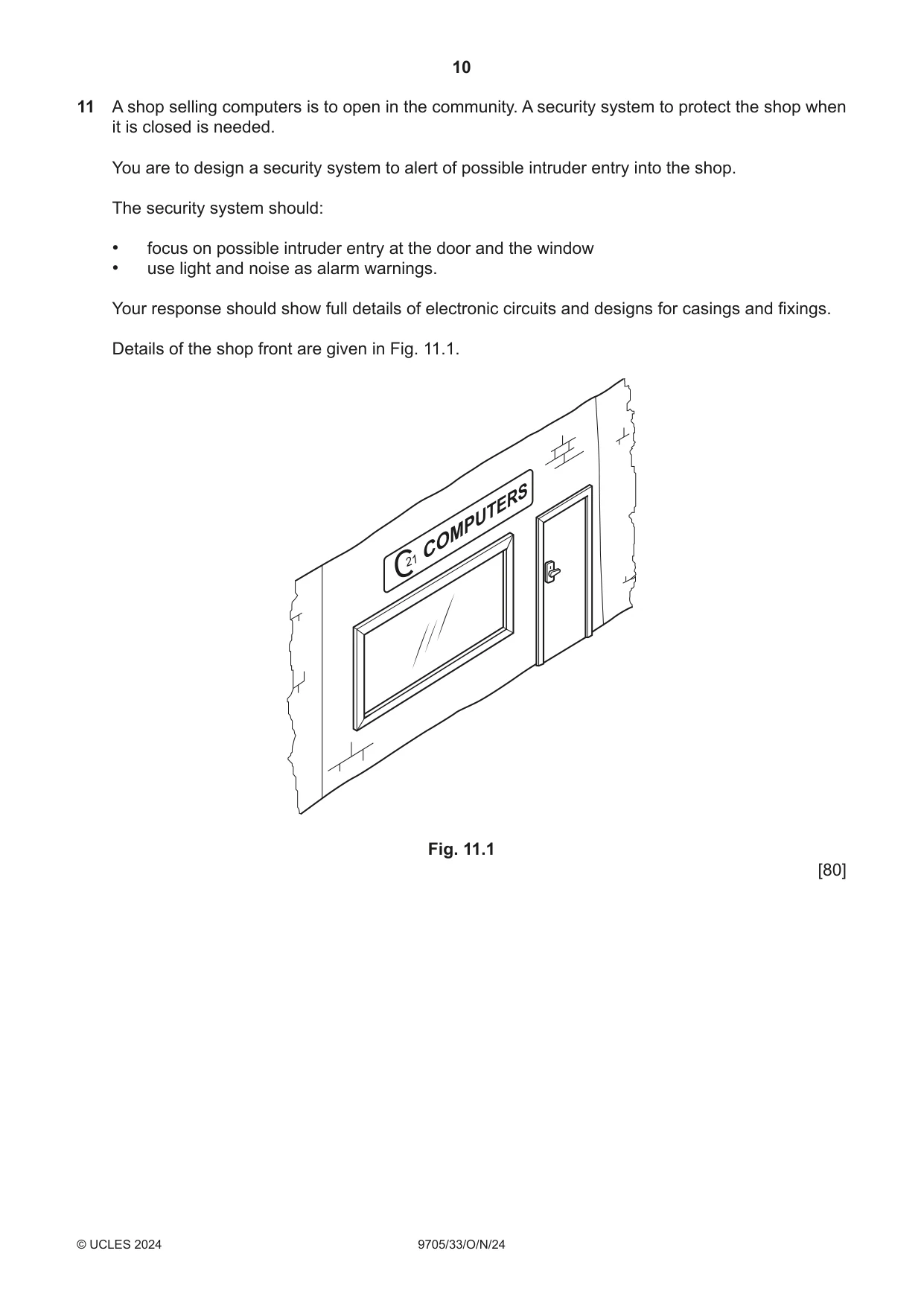
10 9705/33/O/N/24 © UCLES 2024 11 A shop selling computers is to open in the community. A security system to protect the shop when it is closed is needed. You are to design a security system to alert of possible intruder entry into the shop. The security system should: • focus on possible intruder entry at the door and the window • use light and noise as alarm warnings. Your response should show full details of electronic circuits and designs for casings and fixings. Details of the shop front are given in Fig. 11.1. 21 Fig. 11.1 [80]
Question paper, page 11
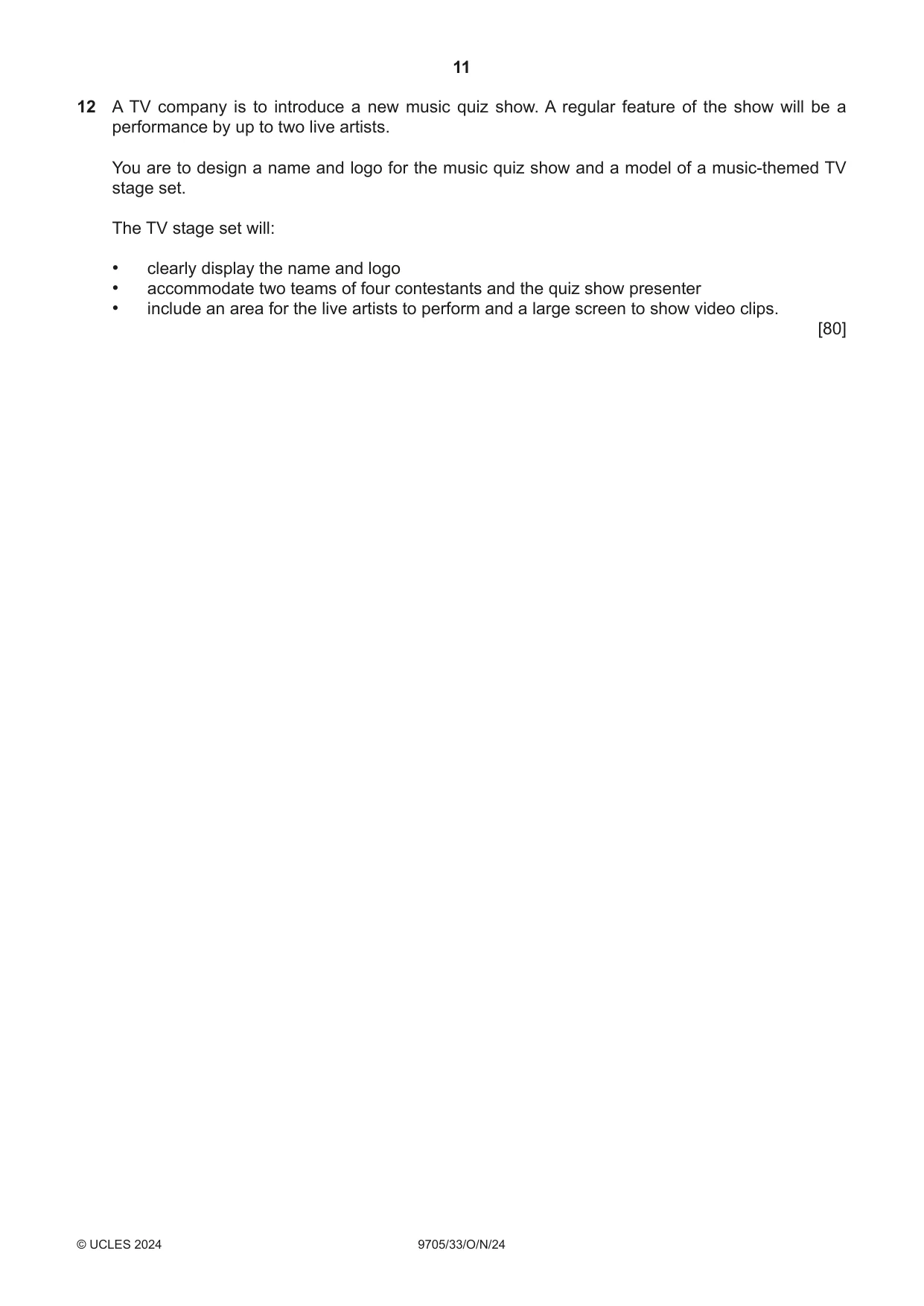
11 9705/33/O/N/24 © UCLES 2024 12 A TV company is to introduce a new music quiz show. A regular feature of the show will be a performance by up to two live artists. You are to design a name and logo for the music quiz show and a model of a music-themed TV stage set. The TV stage set will: • clearly display the name and logo • accommodate two teams of four contestants and the quiz show presenter • include an area for the live artists to perform and a large screen to show video clips. [80]
Question paper, page 12
12 9705/33/O/N/24 © UCLES 2024 Permission to reproduce items where third-party owned material protected by copyright is included has been sought and cleared where possible. Every reasonable effort has been made by the publisher (UCLES) to trace copyright holders, but if any items requiring clearance have unwittingly been included, the publisher will be pleased to make amends at the earliest possible opportunity. To avoid the issue of disclosure of answer-related information to candidates, all copyright acknowledgements are reproduced online in the Cambridge Assessment International Education Copyright Acknowledgements Booklet. This is produced for each series of examinations and is freely available to download at www.cambridgeinternational.org after the live examination series. Cambridge Assessment International Education is part of Cambridge Assessment. Cambridge Assessment is the brand name of the University of Cambridge Local Examinations Syndicate (UCLES), which is a department of the University of Cambridge. BLANK PAGE
Mark scheme, page 1
This document consists of 16 printed pages. © Cambridge University Press & Assessment 2024 [Turn over Cambridge International A Level DESIGN & TECHNOLOGY 9705/33 Paper 3 October/November 2024 MARK SCHEME Maximum Mark: 120 Published This mark scheme is published as an aid to teachers and candidates, to indicate the requirements of the examination. It shows the basis on which Examiners were instructed to award marks. It does not indicate the details of the discussions that took place at an Examiners’ meeting before marking began, which would have considered the acceptability of alternative answers. Mark schemes should be read in conjunction with the question paper and the Principal Examiner Report for Teachers. Cambridge International will not enter into discussions about these mark schemes. Cambridge International is publishing the mark schemes for the October/November 2024 series for most Cambridge IGCSE, Cambridge International A and AS Level components, and some Cambridge O Level components.
Mark scheme, page 2
9705/33 Cambridge International A Level – Mark Scheme PUBLISHED October/November 2024 © Cambridge University Press & Assessment 2024 Page 2 of 16 Generic Marking Principles These general marking principles must be applied by all examiners when marking candidate answers. They should be applied alongside the specific content of the mark scheme or generic level descriptions for a question. Each question paper and mark scheme will also comply with these marking principles. GENERIC MARKING PRINCIPLE 1: Marks must be awarded in line with: • the specific content of the mark scheme or the generic level descriptors for the question • the specific skills defined in the mark scheme or in the generic level descriptors for the question • the standard of response required by a candidate as exemplified by the standardisation scripts. GENERIC MARKING PRINCIPLE 2: Marks awarded are always whole marks (not half marks, or other fractions). GENERIC MARKING PRINCIPLE 3: Marks must be awarded positively: • marks are awarded for correct/valid answers, as defined in the mark scheme. However, credit is given for valid answers which go beyond the scope of the syllabus and mark scheme, referring to your Team Leader as appropriate • marks are awarded when candidates clearly demonstrate what they know and can do • marks are not deducted for errors • marks are not deducted for omissions • answers should only be judged on the quality of spelling, punctuation and grammar when these features are specifically assessed by the question as indicated by the mark scheme. The meaning, however, should be unambiguous. GENERIC MARKING PRINCIPLE 4: Rules must be applied consistently, e.g. in situations where candidates have not followed instructions or in the application of generic level descriptors.
Mark scheme, page 3
9705/33 Cambridge International A Level – Mark Scheme PUBLISHED October/November 2024 © Cambridge University Press & Assessment 2024 Page 3 of 16 GENERIC MARKING PRINCIPLE 5: Marks should be awarded using the full range of marks defined in the mark scheme for the question (however; the use of the full mark range may be limited according to the quality of the candidate responses seen). GENERIC MARKING PRINCIPLE 6: Marks awarded are based solely on the requirements as defined in the mark scheme. Marks should not be awarded with grade thresholds or grade descriptors in mind.
Mark scheme, page 4
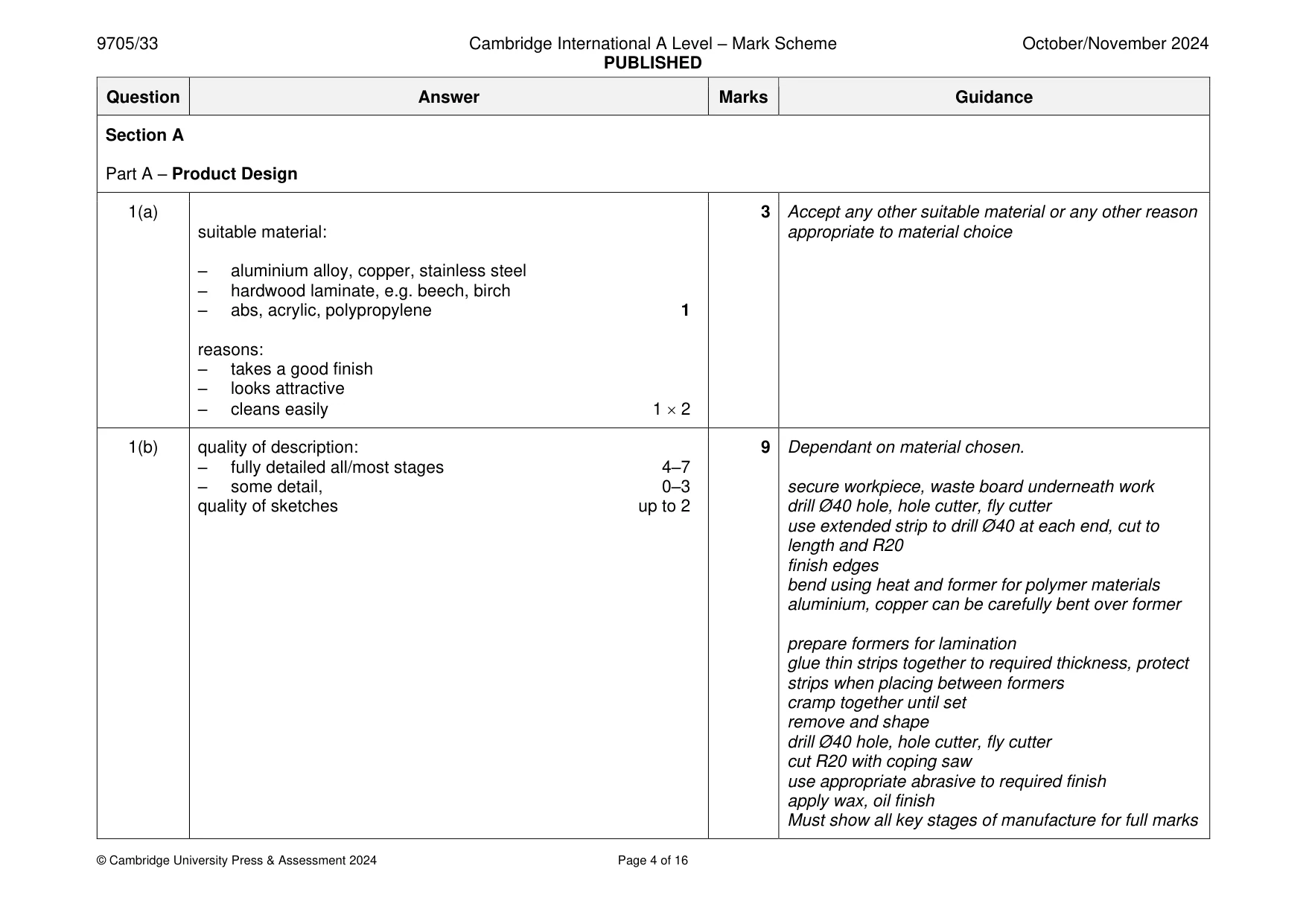
9705/33 Cambridge International A Level – Mark Scheme PUBLISHED October/November 2024 © Cambridge University Press & Assessment 2024 Page 4 of 16 Question Answer Marks Guidance Section A Part A – Product Design 1(a) suitable material: – aluminium alloy, copper, stainless steel – hardwood laminate, e.g. beech, birch – abs, acrylic, polypropylene 1 reasons: – takes a good finish – looks attractive – cleans easily 1 2 3 Accept any other suitable material or any other reason appropriate to material choice 1(b) quality of description: – fully detailed all/most stages 4–7 – some detail, 0–3 quality of sketches up to 2 9 Dependant on material chosen. secure workpiece, waste board underneath work drill Ø40 hole, hole cutter, fly cutter use extended strip to drill Ø40 at each end, cut to length and R20 finish edges bend using heat and former for polymer materials aluminium, copper can be carefully bent over former prepare formers for lamination glue thin strips together to required thickness, protect strips when placing between formers cramp together until set remove and shape drill Ø40 hole, hole cutter, fly cutter cut R20 with coping saw use appropriate abrasive to required finish apply wax, oil finish Must show all key stages of manufacture for full marks
Mark scheme, page 5
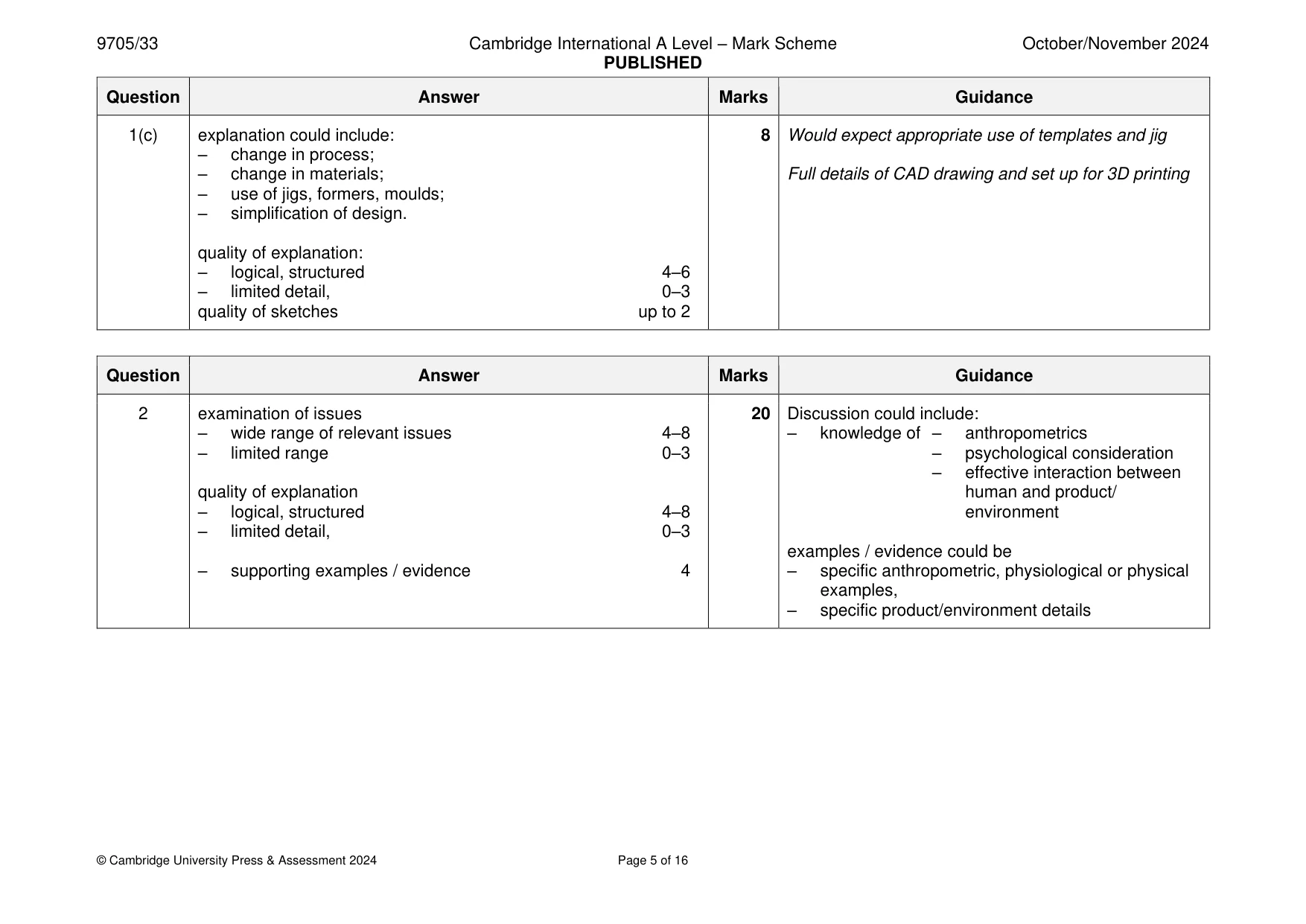
9705/33 Cambridge International A Level – Mark Scheme PUBLISHED October/November 2024 © Cambridge University Press & Assessment 2024 Page 5 of 16 Question Answer Marks Guidance 1(c) explanation could include: – change in process; – change in materials; – use of jigs, formers, moulds; – simplification of design. quality of explanation: – logical, structured 4–6 – limited detail, 0–3 quality of sketches up to 2 8 Would expect appropriate use of templates and jig Full details of CAD drawing and set up for 3D printing Question Answer Marks Guidance 2 examination of issues – wide range of relevant issues 4–8 – limited range 0–3 quality of explanation – logical, structured 4–8 – limited detail, 0–3 – supporting examples / evidence 4 20 Discussion could include: – knowledge of – anthropometrics – psychological consideration – effective interaction between human and product/ environment examples / evidence could be – specific anthropometric, physiological or physical examples, – specific product/environment details
Mark scheme, page 6
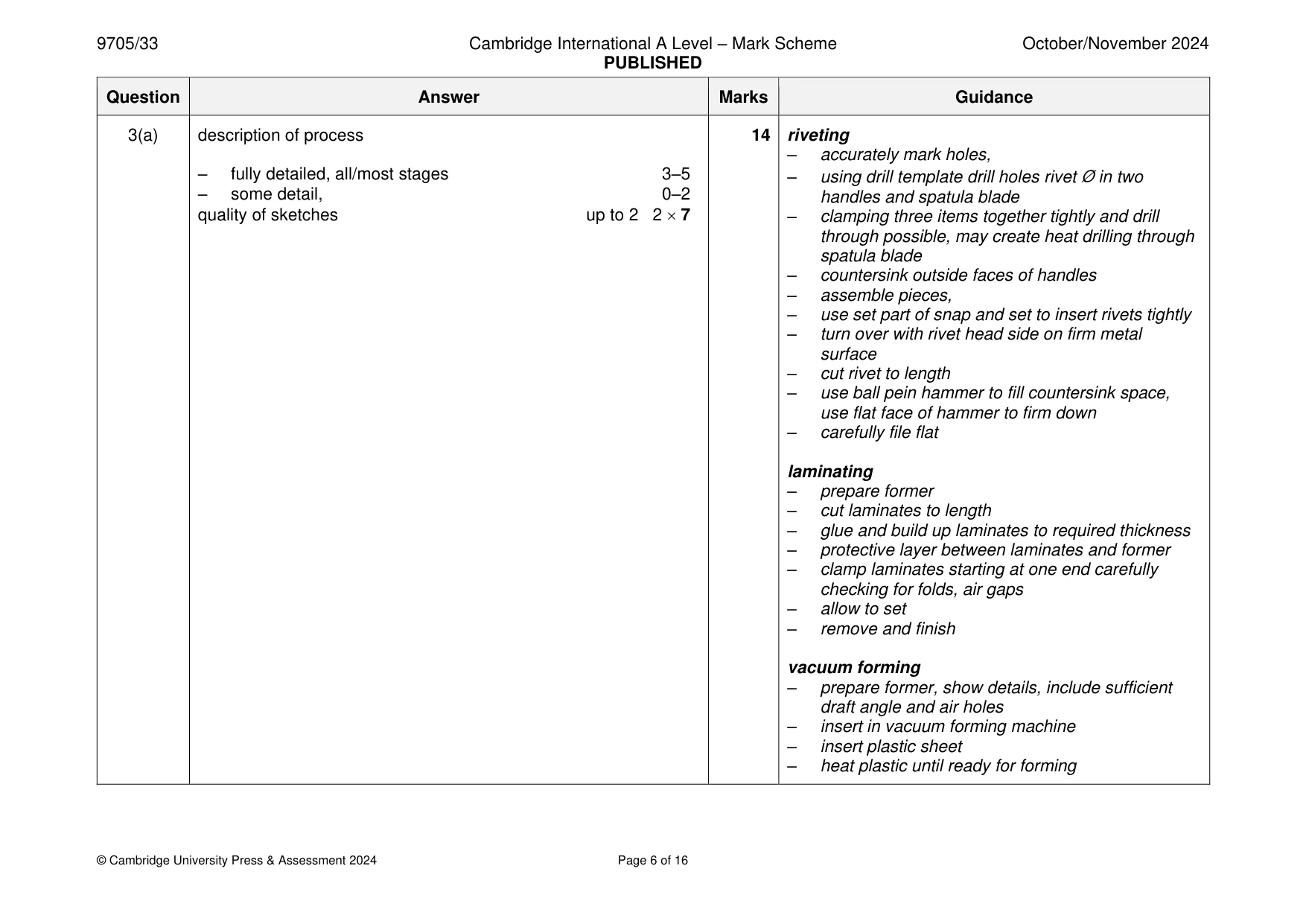
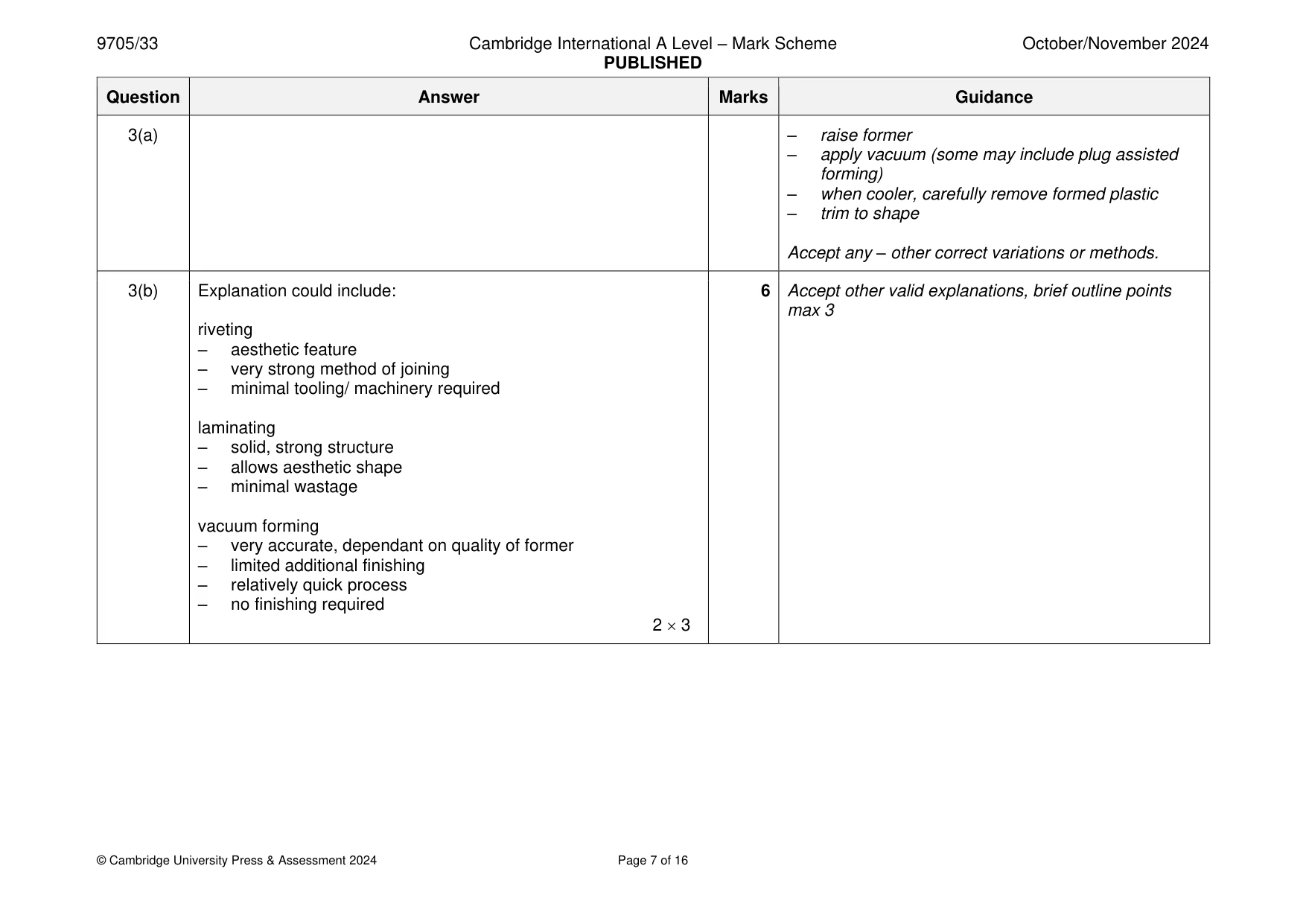
9705/33 Cambridge International A Level – Mark Scheme PUBLISHED October/November 2024 © Cambridge University Press & Assessment 2024 Page 6 of 16 Question Answer Marks Guidance 3(a) description of process – fully detailed, all/most stages 3–5 – some detail, 0–2 quality of sketches up to 2 2 7 14 riveting – accurately mark holes, – using drill template drill holes rivet Ø in two handles and spatula blade – clamping three items together tightly and drill through possible, may create heat drilling through spatula blade – countersink outside faces of handles – assemble pieces, – use set part of snap and set to insert rivets tightly – turn over with rivet head side on firm metal surface – cut rivet to length – use ball pein hammer to fill countersink space, use flat face of hammer to firm down – carefully file flat laminating – prepare former – cut laminates to length – glue and build up laminates to required thickness – protective layer between laminates and former – clamp laminates starting at one end carefully checking for folds, air gaps – allow to set – remove and finish vacuum forming – prepare former, show details, include sufficient draft angle and air holes – insert in vacuum forming machine – insert plastic sheet – heat plastic until ready for forming
Mark scheme, page 7
9705/33 Cambridge International A Level – Mark Scheme PUBLISHED October/November 2024 © Cambridge University Press & Assessment 2024 Page 7 of 16 Question Answer Marks Guidance 3(a) – raise former – apply vacuum (some may include plug assisted forming) – when cooler, carefully remove formed plastic – trim to shape Accept any – other correct variations or methods. 3(b) Explanation could include: riveting – aesthetic feature – very strong method of joining – minimal tooling/ machinery required laminating – solid, strong structure – allows aesthetic shape – minimal wastage vacuum forming – very accurate, dependant on quality of former – limited additional finishing – relatively quick process – no finishing required 2 3 6 Accept other valid explanations, brief outline points max 3
Mark scheme, page 8
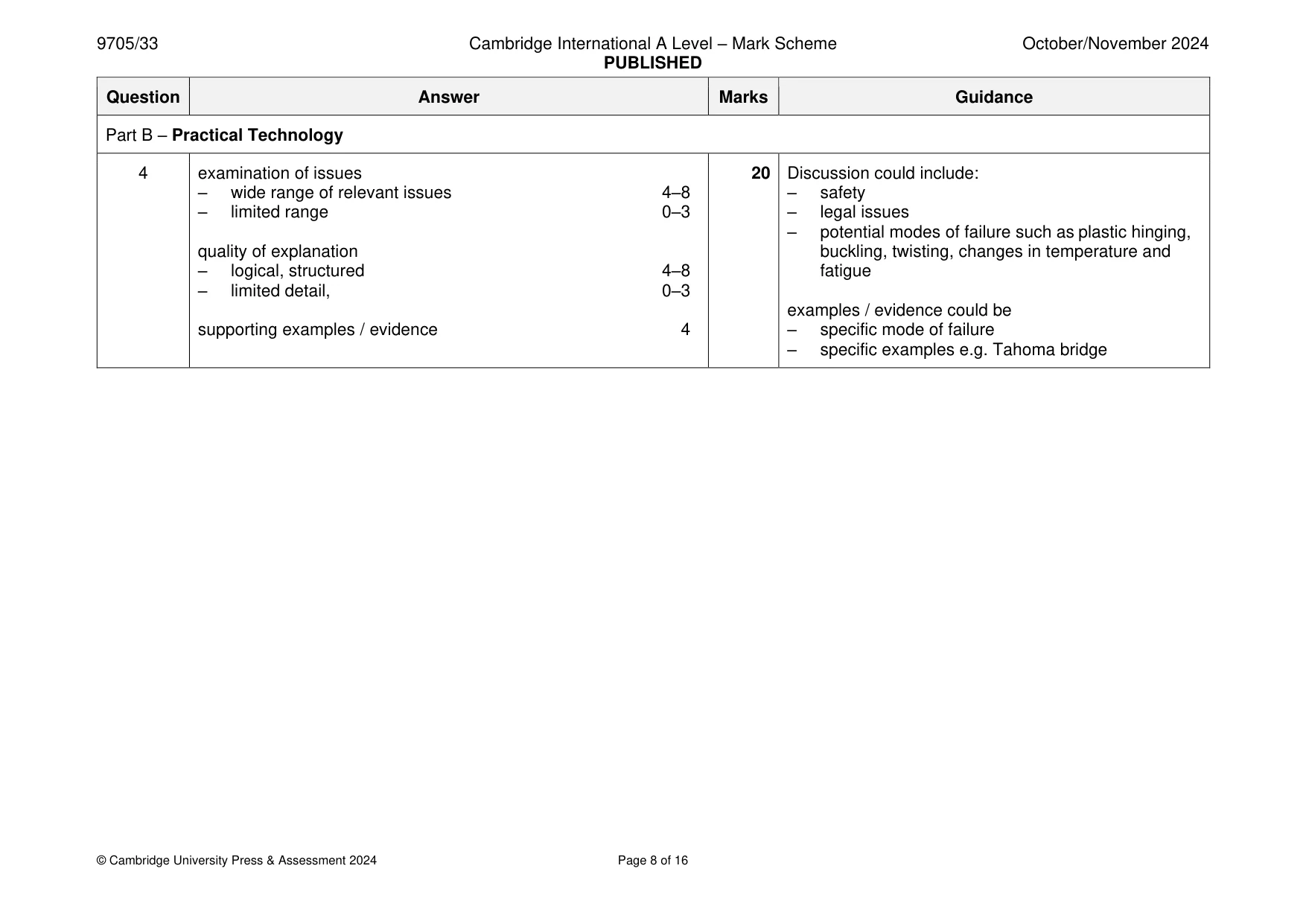
9705/33 Cambridge International A Level – Mark Scheme PUBLISHED October/November 2024 © Cambridge University Press & Assessment 2024 Page 8 of 16 Question Answer Marks Guidance Part B – Practical Technology 4 examination of issues – wide range of relevant issues 4–8 – limited range 0–3 quality of explanation – logical, structured 4–8 – limited detail, 0–3 supporting examples / evidence 4 20 Discussion could include: – safety – legal issues – potential modes of failure such as plastic hinging, buckling, twisting, changes in temperature and fatigue examples / evidence could be – specific mode of failure – specific examples e.g. Tahoma bridge
Mark scheme, page 9
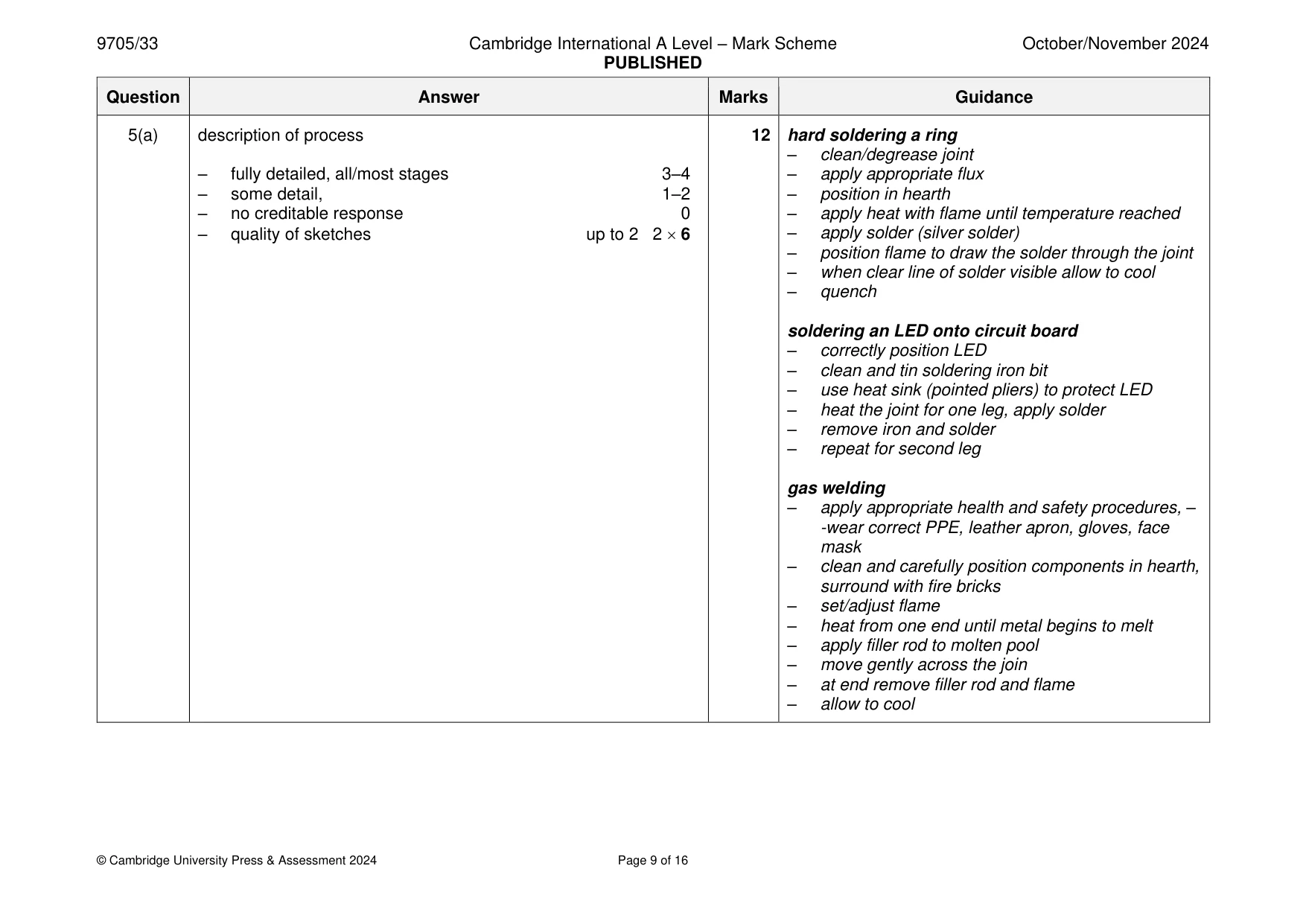
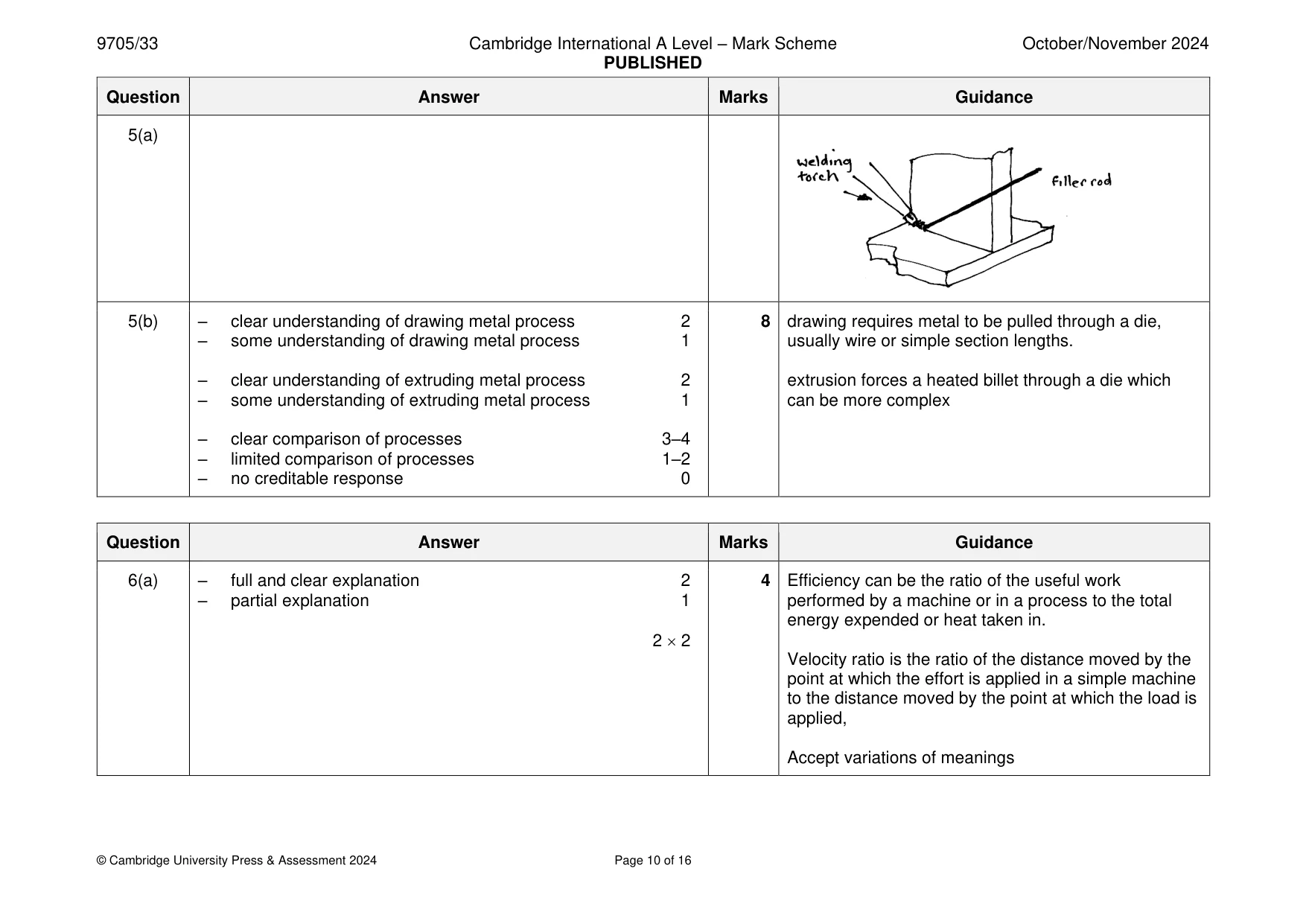
9705/33 Cambridge International A Level – Mark Scheme PUBLISHED October/November 2024 © Cambridge University Press & Assessment 2024 Page 9 of 16 Question Answer Marks Guidance 5(a) description of process – fully detailed, all/most stages 3–4 – some detail, 1–2 – no creditable response 0 – quality of sketches up to 2 2 6 12 hard soldering a ring – clean/degrease joint – apply appropriate flux – position in hearth – apply heat with flame until temperature reached – apply solder (silver solder) – position flame to draw the solder through the joint – when clear line of solder visible allow to cool – quench soldering an LED onto circuit board – correctly position LED – clean and tin soldering iron bit – use heat sink (pointed pliers) to protect LED – heat the joint for one leg, apply solder – remove iron and solder – repeat for second leg gas welding – apply appropriate health and safety procedures, – -wear correct PPE, leather apron, gloves, face mask – clean and carefully position components in hearth, surround with fire bricks – set/adjust flame – heat from one end until metal begins to melt – apply filler rod to molten pool – move gently across the join – at end remove filler rod and flame – allow to cool
Mark scheme, page 10
9705/33 Cambridge International A Level – Mark Scheme PUBLISHED October/November 2024 © Cambridge University Press & Assessment 2024 Page 10 of 16 Question Answer Marks Guidance 5(a) 5(b) – clear understanding of drawing metal process 2 – some understanding of drawing metal process 1 – clear understanding of extruding metal process 2 – some understanding of extruding metal process 1 – clear comparison of processes 3–4 – limited comparison of processes 1–2 – no creditable response 0 8 drawing requires metal to be pulled through a die, usually wire or simple section lengths. extrusion forces a heated billet through a die which can be more complex Question Answer Marks Guidance 6(a) – full and clear explanation 2 – partial explanation 1 2 2 4 Efficiency can be the ratio of the useful work performed by a machine or in a process to the total energy expended or heat taken in. Velocity ratio is the ratio of the distance moved by the point at which the effort is applied in a simple machine to the distance moved by the point at which the load is applied, Accept variations of meanings
Mark scheme, page 11
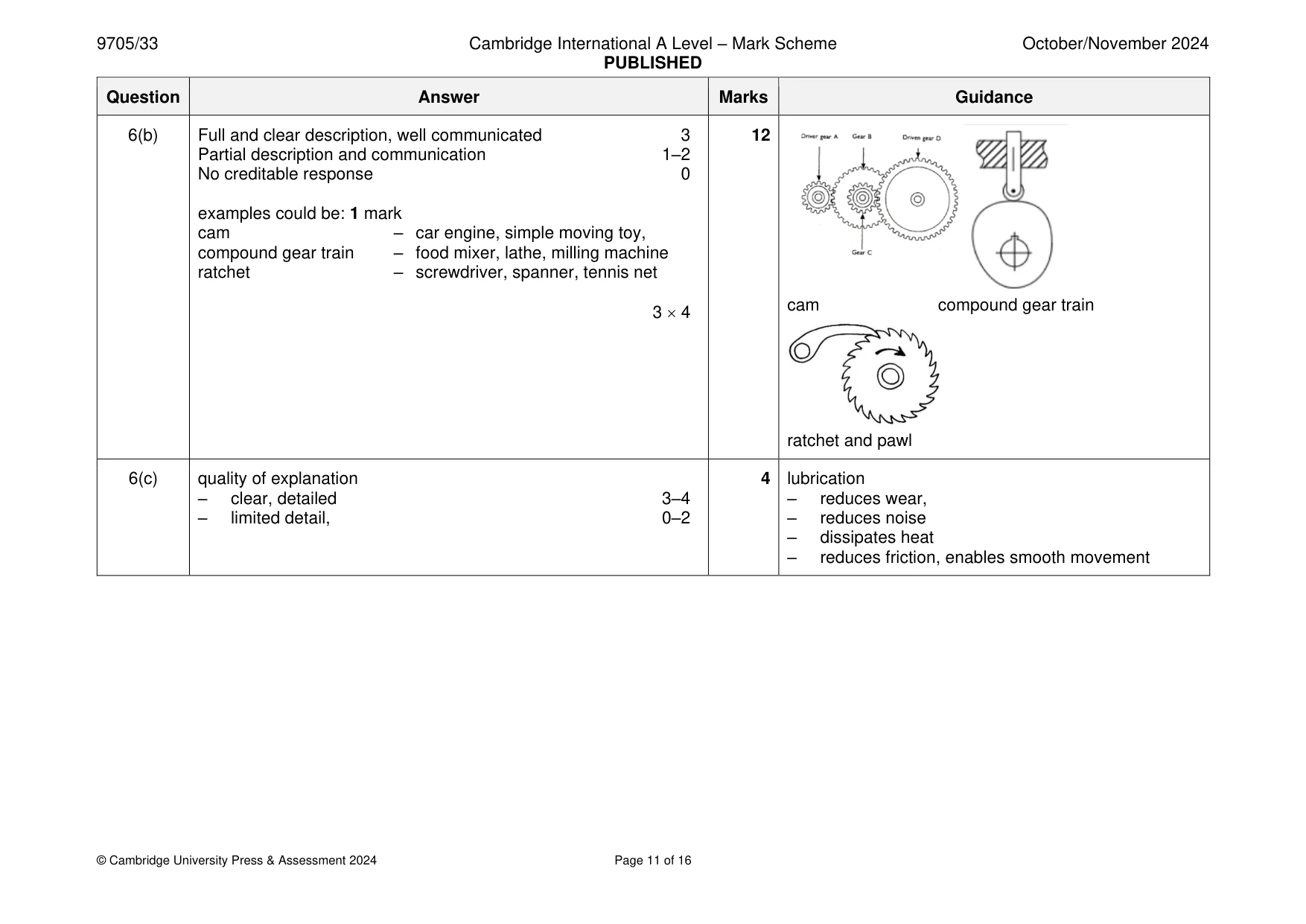
9705/33 Cambridge International A Level – Mark Scheme PUBLISHED October/November 2024 © Cambridge University Press & Assessment 2024 Page 11 of 16 Question Answer Marks Guidance 6(b) Full and clear description, well communicated 3 Partial description and communication 1–2 No creditable response 0 examples could be: 1 mark cam – car engine, simple moving toy, compound gear train – food mixer, lathe, milling machine ratchet – screwdriver, spanner, tennis net 3 4 12 cam compound gear train ratchet and pawl 6(c) quality of explanation – clear, detailed 3–4 – limited detail, 0–2 4 lubrication – reduces wear, – reduces noise – dissipates heat – reduces friction, enables smooth movement
Mark scheme, page 12
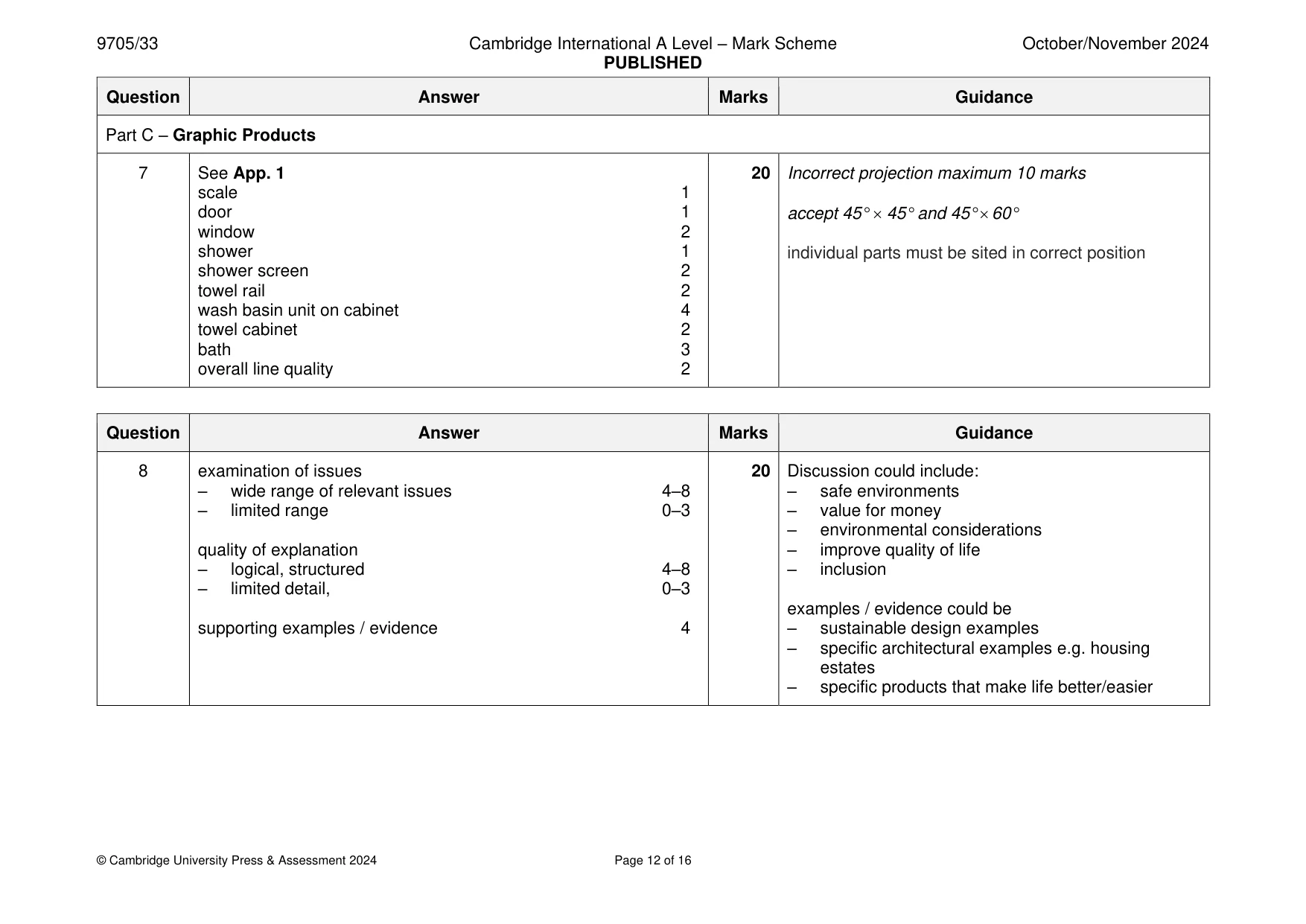
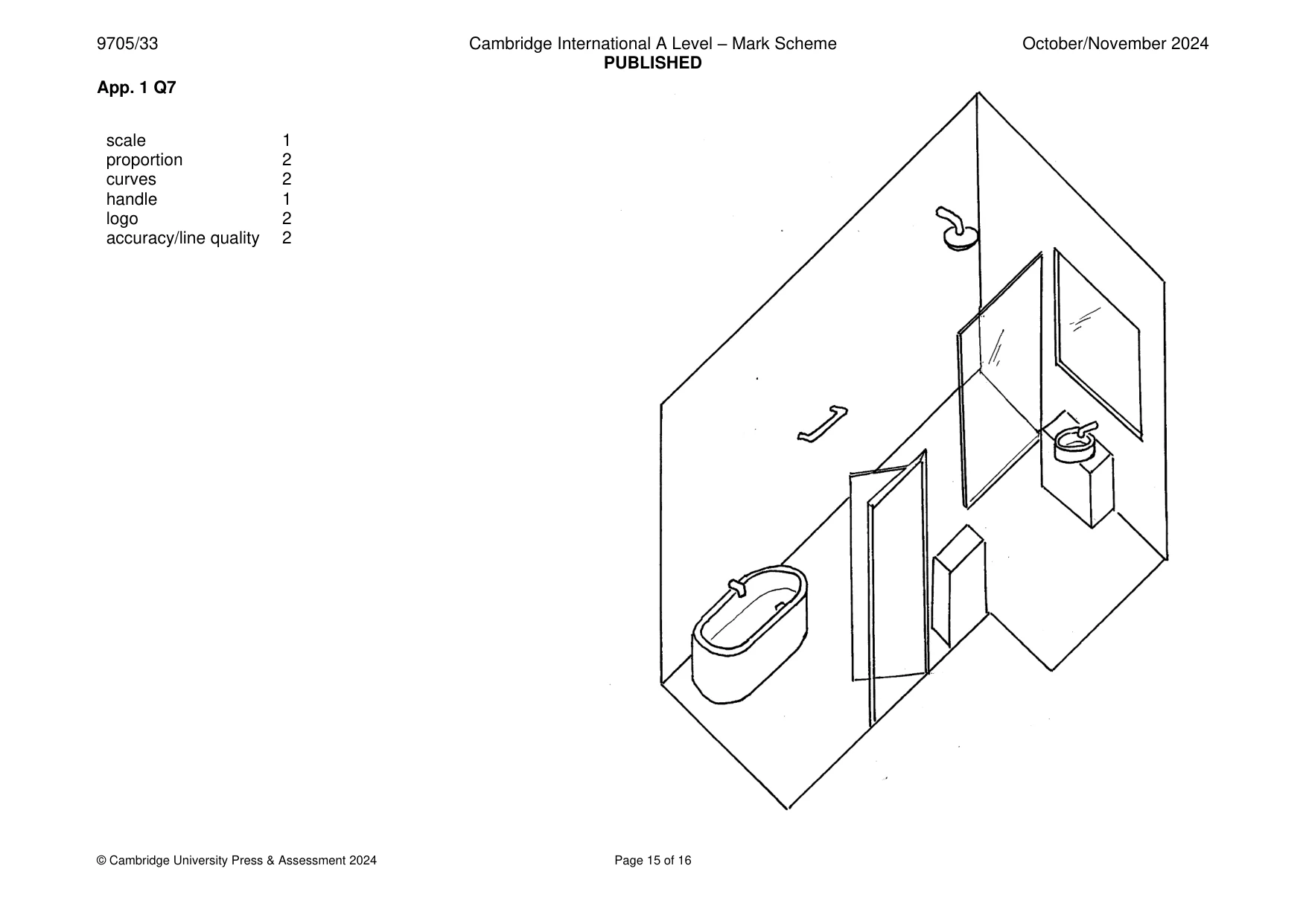
9705/33 Cambridge International A Level – Mark Scheme PUBLISHED October/November 2024 © Cambridge University Press & Assessment 2024 Page 12 of 16 Question Answer Marks Guidance Part C – Graphic Products 7 See App. 1 scale 1 door 1 window 2 shower 1 shower screen 2 towel rail 2 wash basin unit on cabinet 4 towel cabinet 2 bath 3 overall line quality 2 20 Incorrect projection maximum 10 marks accept 45° 45° and 45° 60° individual parts must be sited in correct position Question Answer Marks Guidance 8 examination of issues – wide range of relevant issues 4–8 – limited range 0–3 quality of explanation – logical, structured 4–8 – limited detail, 0–3 supporting examples / evidence 4 20 Discussion could include: – safe environments – value for money – environmental considerations – improve quality of life – inclusion examples / evidence could be – sustainable design examples – specific architectural examples e.g. housing estates – specific products that make life better/easier
Mark scheme, page 13
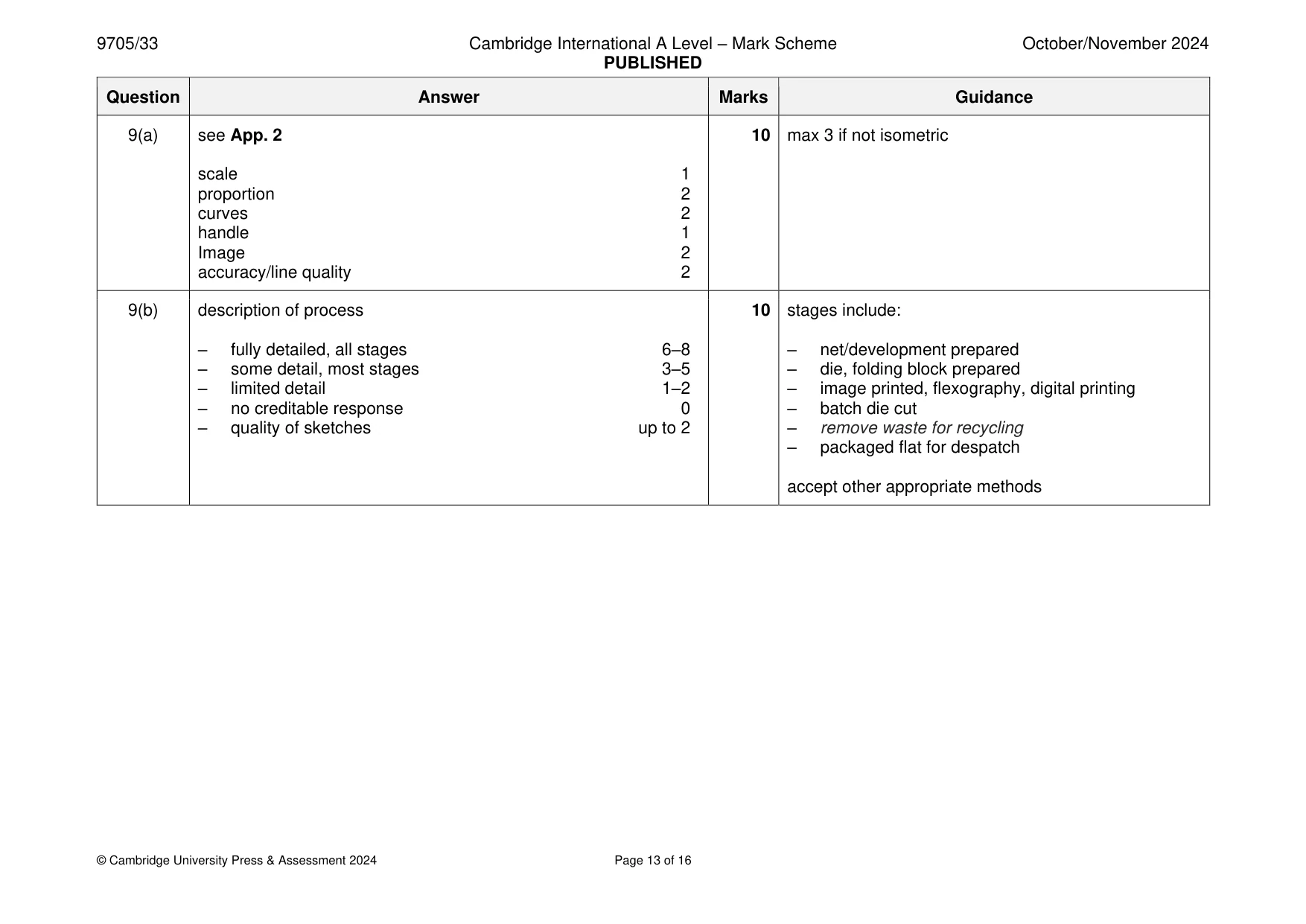
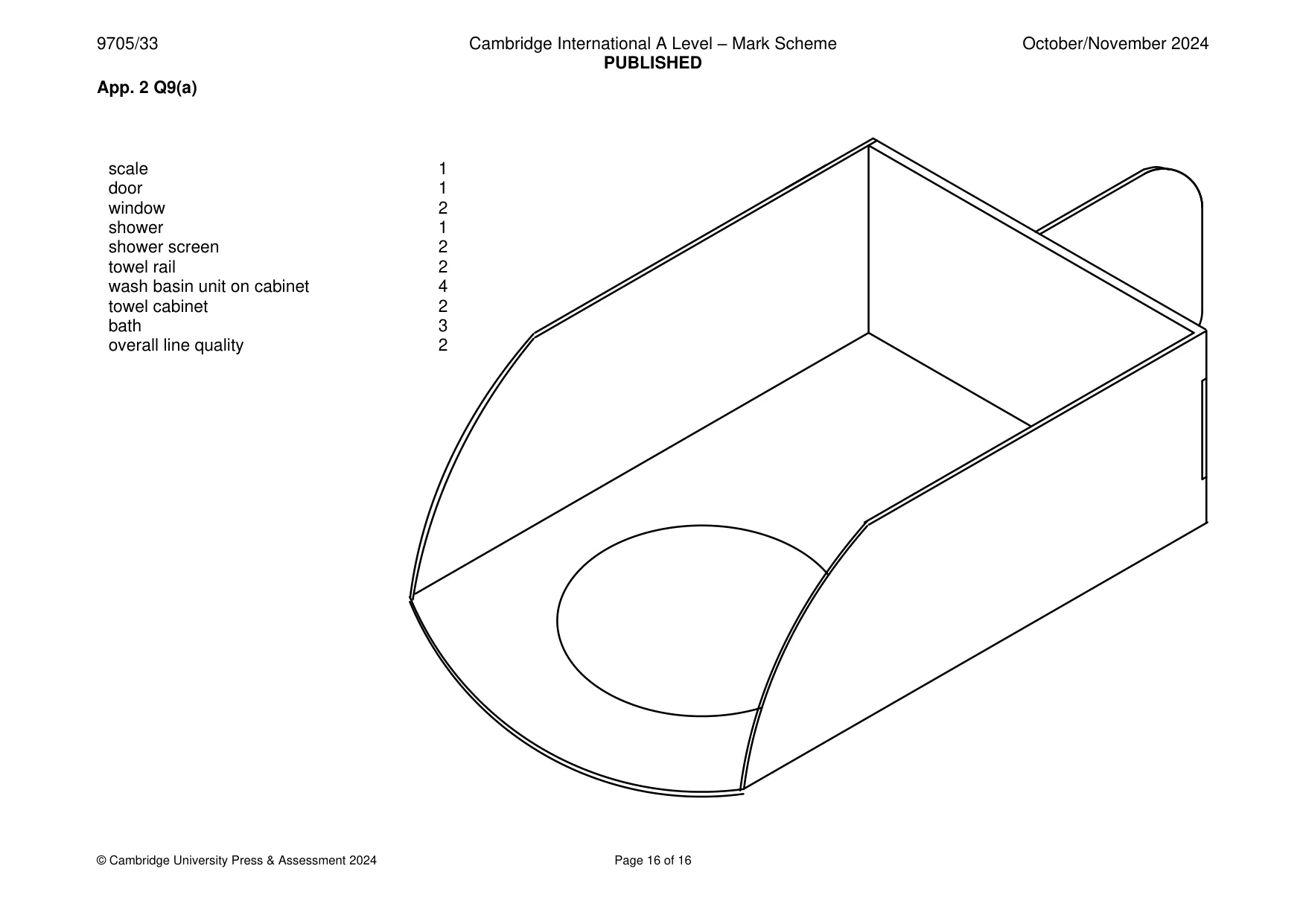
9705/33 Cambridge International A Level – Mark Scheme PUBLISHED October/November 2024 © Cambridge University Press & Assessment 2024 Page 13 of 16 Question Answer Marks Guidance 9(a) see App. 2 scale 1 proportion 2 curves 2 handle 1 Image 2 accuracy/line quality 2 10 max 3 if not isometric 9(b) description of process – fully detailed, all stages 6–8 – some detail, most stages 3–5 – limited detail 1–2 – no creditable response 0 – quality of sketches up to 2 10 stages include: – net/development prepared – die, folding block prepared – image printed, flexography, digital printing – batch die cut – remove waste for recycling – packaged flat for despatch accept other appropriate methods
Mark scheme, page 14
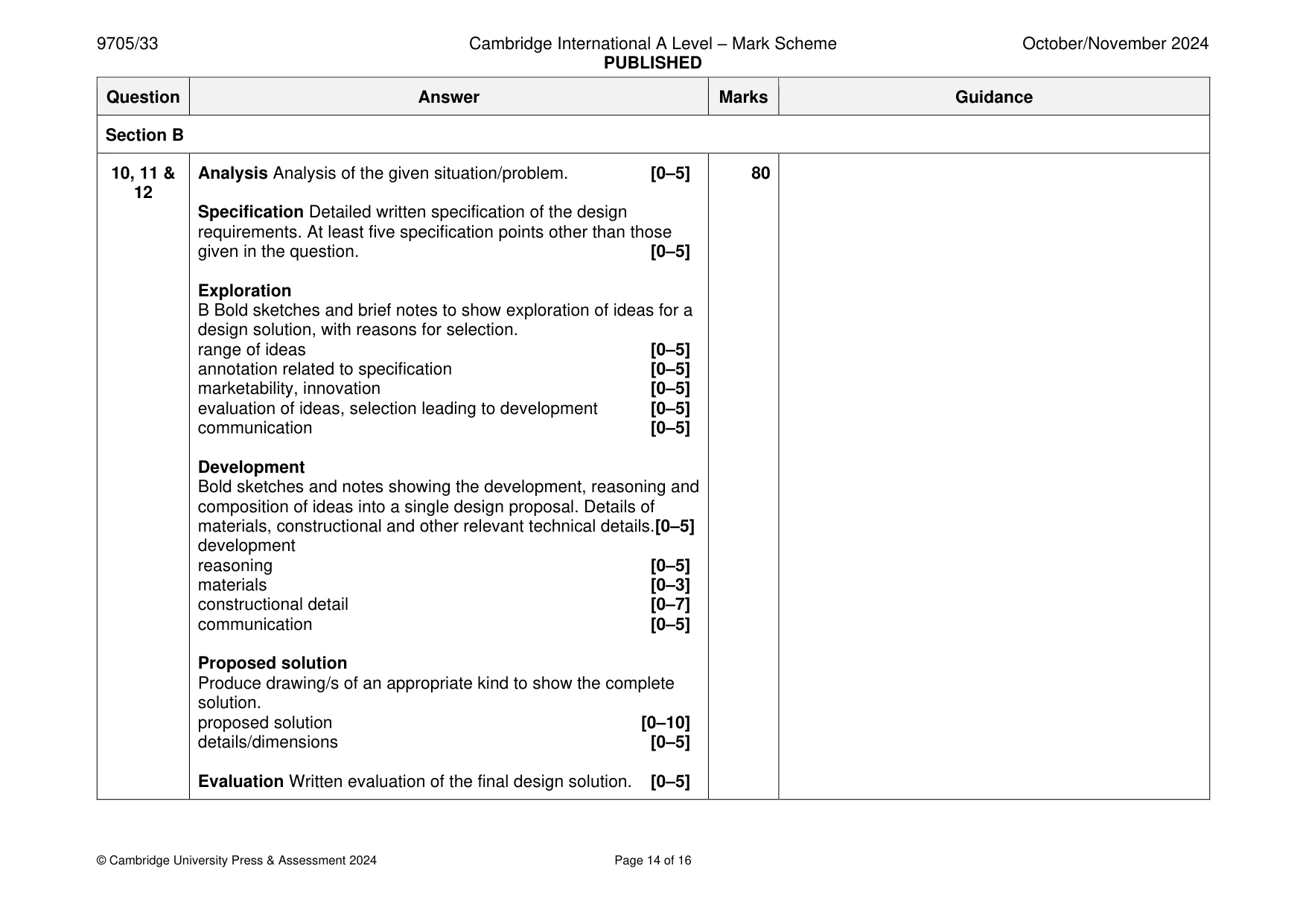
9705/33 Cambridge International A Level – Mark Scheme PUBLISHED October/November 2024 © Cambridge University Press & Assessment 2024 Page 14 of 16 Question Answer Marks Guidance Section B 10, 11 & 12 Analysis Analysis of the given situation/problem. [0–5] Specification Detailed written specification of the design requirements. At least five specification points other than those given in the question. [0–5] Exploration B Bold sketches and brief notes to show exploration of ideas for a design solution, with reasons for selection. range of ideas [0–5] annotation related to specification [0–5] marketability, innovation [0–5] evaluation of ideas, selection leading to development [0–5] communication [0–5] Development Bold sketches and notes showing the development, reasoning and composition of ideas into a single design proposal. Details of materials, constructional and other relevant technical details.[0–5] development reasoning [0–5] materials [0–3] constructional detail [0–7] communication [0–5] Proposed solution Produce drawing/s of an appropriate kind to show the complete solution. proposed solution [0–10] details/dimensions [0–5] Evaluation Written evaluation of the final design solution. [0–5] 80
Mark scheme, page 15
9705/33 Cambridge International A Level – Mark Scheme PUBLISHED October/November 2024 © Cambridge University Press & Assessment 2024 Page 15 of 16 App. 1 Q7 scale 1 proportion 2 curves 2 handle 1 logo 2 accuracy/line quality 2
Mark scheme, page 16
9705/33 Cambridge International A Level – Mark Scheme PUBLISHED October/November 2024 © Cambridge University Press & Assessment 2024 Page 16 of 16 App. 2 Q9(a) scale 1 door 1 window 2 shower 1 shower screen 2 towel rail 2 wash basin unit on cabinet 4 towel cabinet 2 bath 3 overall line quality 2
What you needed in this session
Cambridge’s own grade thresholds for 2024 Oct/Nov, Paper 3 · Variant 3. A higher threshold means an easier paper — the bar moves with how the cohort did.