Cambridge A Level Design and Technology 9705 — 2023 Oct/Nov Paper 3 · Variant 3
9705/33/O/N/23 · 120 marks · ≈135 min
The question paper and its mark scheme, free to read here and free to download. This is Cambridge’s own paper, exactly as it was sat.
Question paper12 pages


Mark scheme16 pages
Answers below. Sit the paper first if you are practising.
Paper as text
Question paper, page 1
This document has 12 pages. Any blank pages are indicated. [Turn over Cambridge International AS & A Level DESIGN & TECHNOLOGY 9705/33 Paper 3 October/November 2023 3 hours You must answer on the answer booklet/paper. You will need: Answer booklet/paper Coloured pencils A3 drawing paper (5 sheets) A range of design drawing equipment INSTRUCTIONS ● Answer three questions in total: Section A: answer two questions from one of the Parts A, B or C. Section B: answer one question. ● If you have been given an answer booklet, follow the instructions on the front cover of the answer booklet. ● Use a black or dark blue pen. ● Write your name, centre number and candidate number on all the work you hand in. ● Do not use an erasable pen or correction fluid. ● You may use an HB pencil, or coloured pencils as appropriate, for any diagrams, graphs or rough working. ● At the end of the examination, fasten all your work together. Do not use staples, paper clips or glue. INFORMATION ● The total mark for this paper is 120. ● The number of marks for each question or part question is shown in brackets [ ]. ● All dimensions are in millimetres. * 3 4 6 9 9 6 9 9 9 0 * DC (PQ/CT) 317629/1 © UCLES 2023
Question paper, page 2
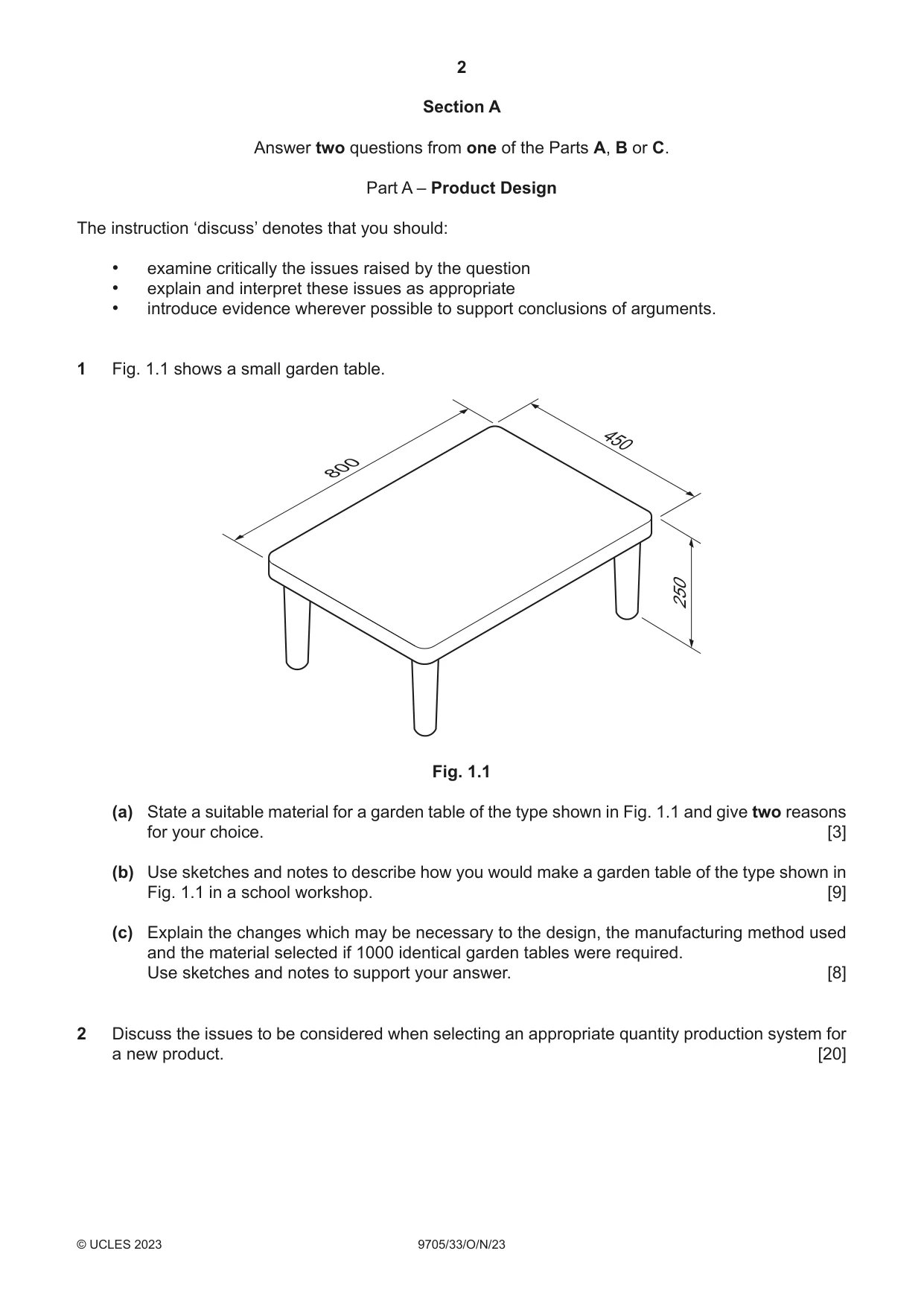
2 9705/33/O/N/23 © UCLES 2023 Section A Answer two questions from one of the Parts A, B or C. Part A – Product Design The instruction ‘discuss’ denotes that you should: • examine critically the issues raised by the question • explain and interpret these issues as appropriate • introduce evidence wherever possible to support conclusions of arguments. 1 Fig. 1.1 shows a small garden table. 800 450 250 Fig. 1.1 (a) State a suitable material for a garden table of the type shown in Fig. 1.1 and give two reasons for your choice. [3] (b) Use sketches and notes to describe how you would make a garden table of the type shown in Fig. 1.1 in a school workshop. [9] (c) Explain the changes which may be necessary to the design, the manufacturing method used and the material selected if 1000 identical garden tables were required. Use sketches and notes to support your answer. [8] 2 Discuss the issues to be considered when selecting an appropriate quantity production system for a new product. [20]
Question paper, page 3
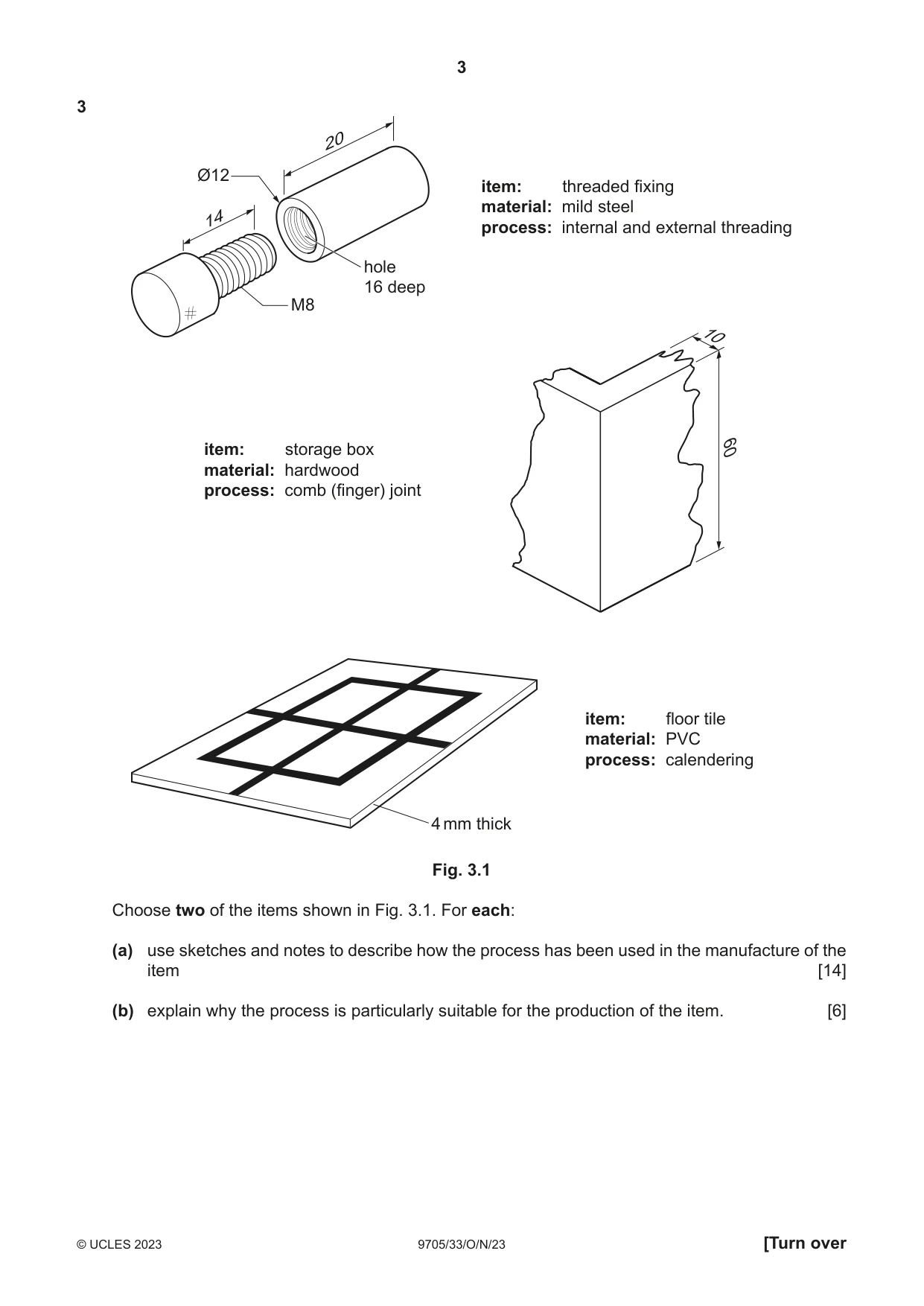
3 9705/33/O/N/23 © UCLES 2023 [Turn over 3 item: threaded fixing material: mild steel process: internal and external threading item: storage box material: hardwood process: comb (finger) joint item: floor tile material: PVC process: calendering 60 10 Ø12 14 20 M8 hole 16 deep 4 mm thick Fig. 3.1 Choose two of the items shown in Fig. 3.1. For each: (a) use sketches and notes to describe how the process has been used in the manufacture of the item [14] (b) explain why the process is particularly suitable for the production of the item. [6]
Question paper, page 4
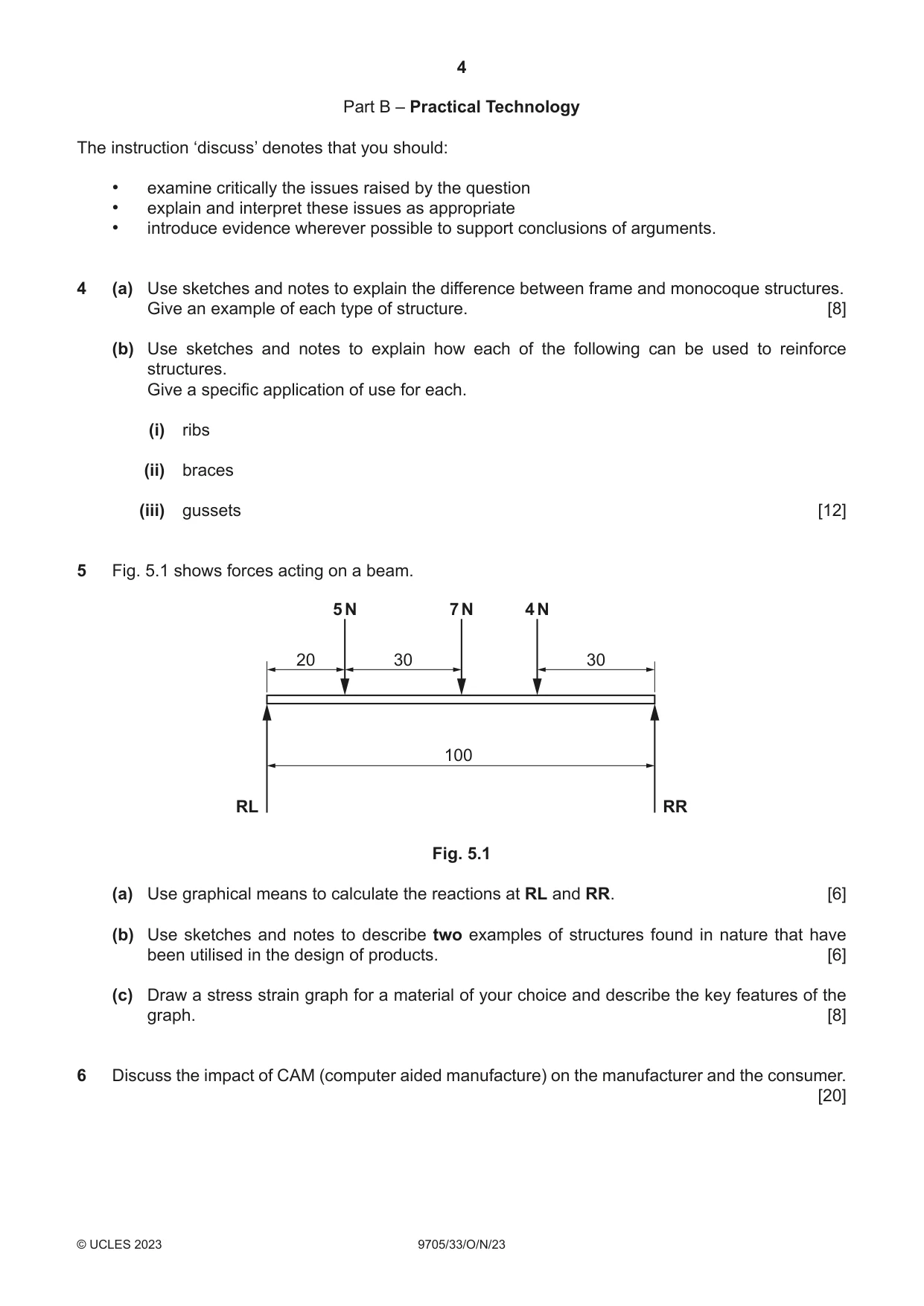
4 9705/33/O/N/23 © UCLES 2023 Part B – Practical Technology The instruction ‘discuss’ denotes that you should: • examine critically the issues raised by the question • explain and interpret these issues as appropriate • introduce evidence wherever possible to support conclusions of arguments. 4 (a) Use sketches and notes to explain the difference between frame and monocoque structures. Give an example of each type of structure. [8] (b) Use sketches and notes to explain how each of the following can be used to reinforce structures. Give a specific application of use for each. (i) ribs (ii) braces (iii) gussets [12] 5 Fig. 5.1 shows forces acting on a beam. 5 N 4 N 7 N RL RR 100 30 30 20 Fig. 5.1 (a) Use graphical means to calculate the reactions at RL and RR. [6] (b) Use sketches and notes to describe two examples of structures found in nature that have been utilised in the design of products. [6] (c) Draw a stress strain graph for a material of your choice and describe the key features of the graph. [8] 6 Discuss the impact of CAM (computer aided manufacture) on the manufacturer and the consumer. [20]
Question paper, page 5
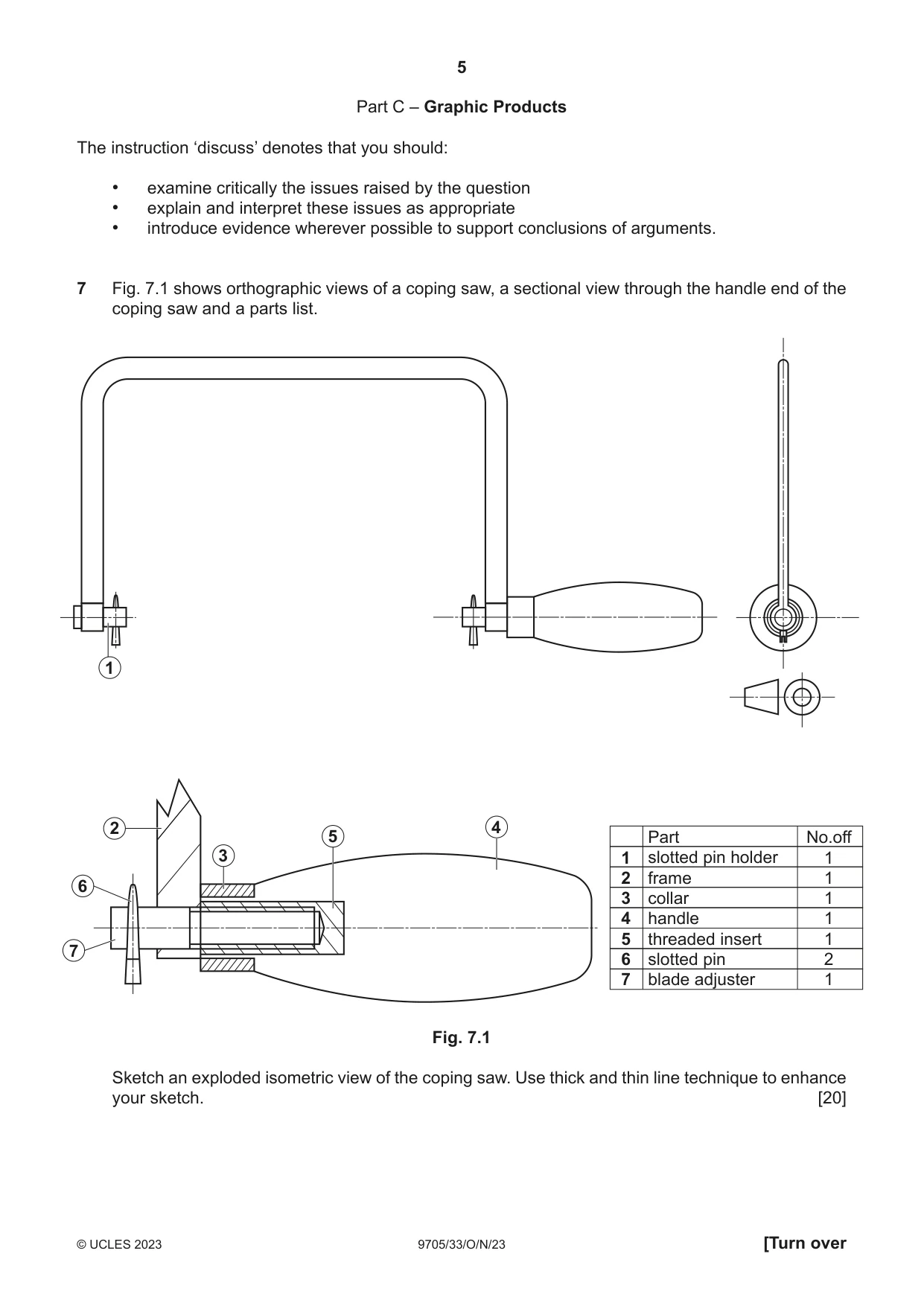
5 9705/33/O/N/23 © UCLES 2023 [Turn over Part C – Graphic Products The instruction ‘discuss’ denotes that you should: • examine critically the issues raised by the question • explain and interpret these issues as appropriate • introduce evidence wherever possible to support conclusions of arguments. 7 Fig. 7.1 shows orthographic views of a coping saw, a sectional view through the handle end of the coping saw and a parts list. 1 2 3 4 5 6 7 1 No.off Part slotted pin holder frame collar handle threaded insert slotted pin blade adjuster 1 1 1 1 2 1 4 2 6 3 5 7 1 Fig. 7.1 Sketch an exploded isometric view of the coping saw. Use thick and thin line technique to enhance your sketch. [20]
Question paper, page 6
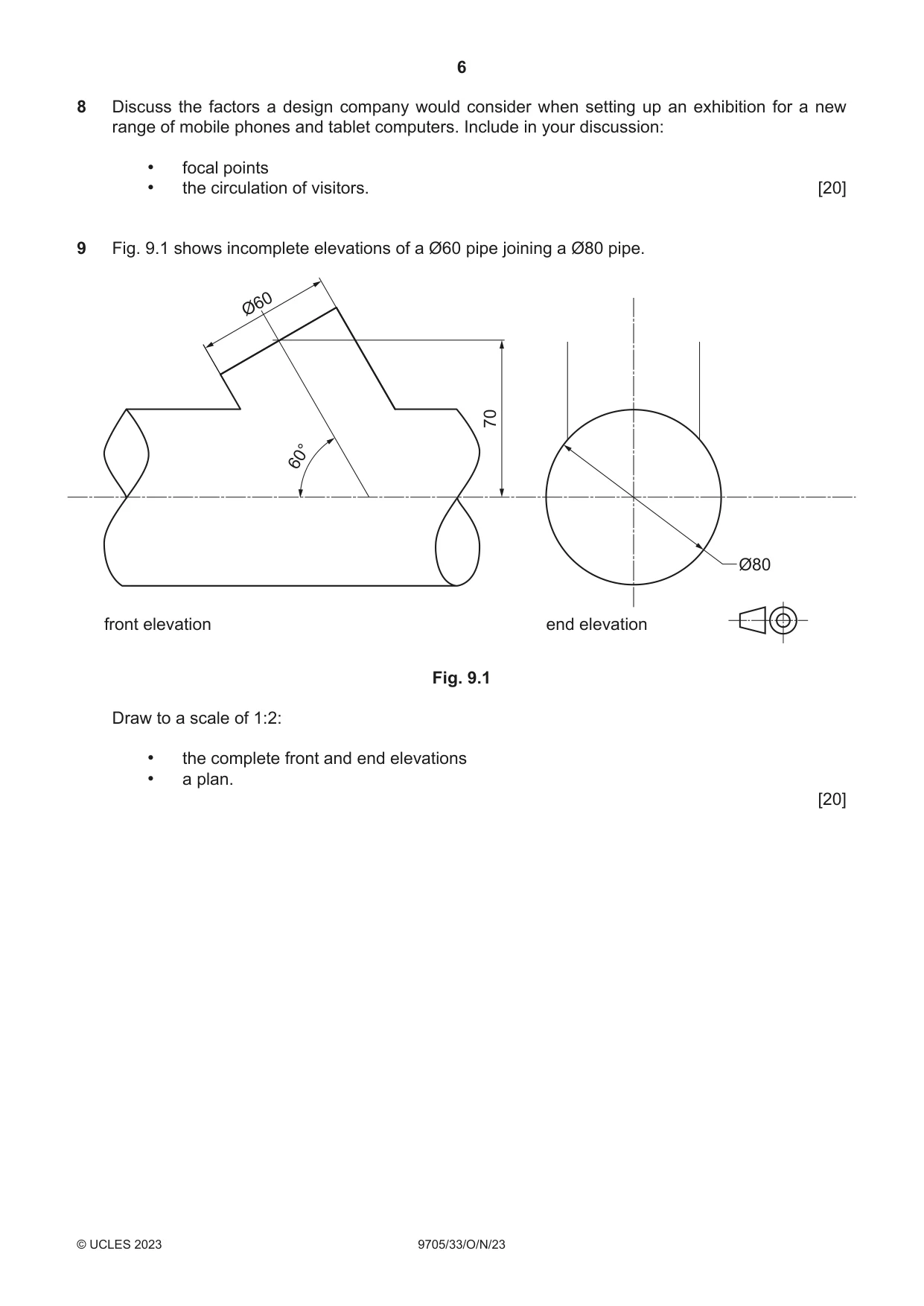
6 9705/33/O/N/23 © UCLES 2023 8 Discuss the factors a design company would consider when setting up an exhibition for a new range of mobile phones and tablet computers. Include in your discussion: • focal points • the circulation of visitors. [20] 9 Fig. 9.1 shows incomplete elevations of a Ø60 pipe joining a Ø80 pipe. 60° Ø60 70 Ø80 front elevation end elevation Fig. 9.1 Draw to a scale of 1:2: • the complete front and end elevations • a plan. [20]
Question paper, page 7
7 9705/33/O/N/23 © UCLES 2023 [Turn over Section B Answer one question on the A3 paper provided. Each question is worth 80 marks. You should approach the design question of your choice in the following manner: Analysis Produce an analysis of the given situation/problem, which may be in written or graphical form. [5] Specification From the analysis produce a detailed written specification of the design requirements. Include at least five specification points other than those given in the question. [5] Exploration Use bold sketches and brief notes to show your exploration of ideas for a design solution, with reasons for selection. [25] Development Show using bold sketches and notes, the development, reasoning and composition of ideas into a single design proposal. Give details of materials, constructional and other relevant technical details. [25] Proposed solution Produce drawings of an appropriate kind to show the complete solution. [15] Evaluation Give a written evaluation of the final design solution. [5]
Question paper, page 8
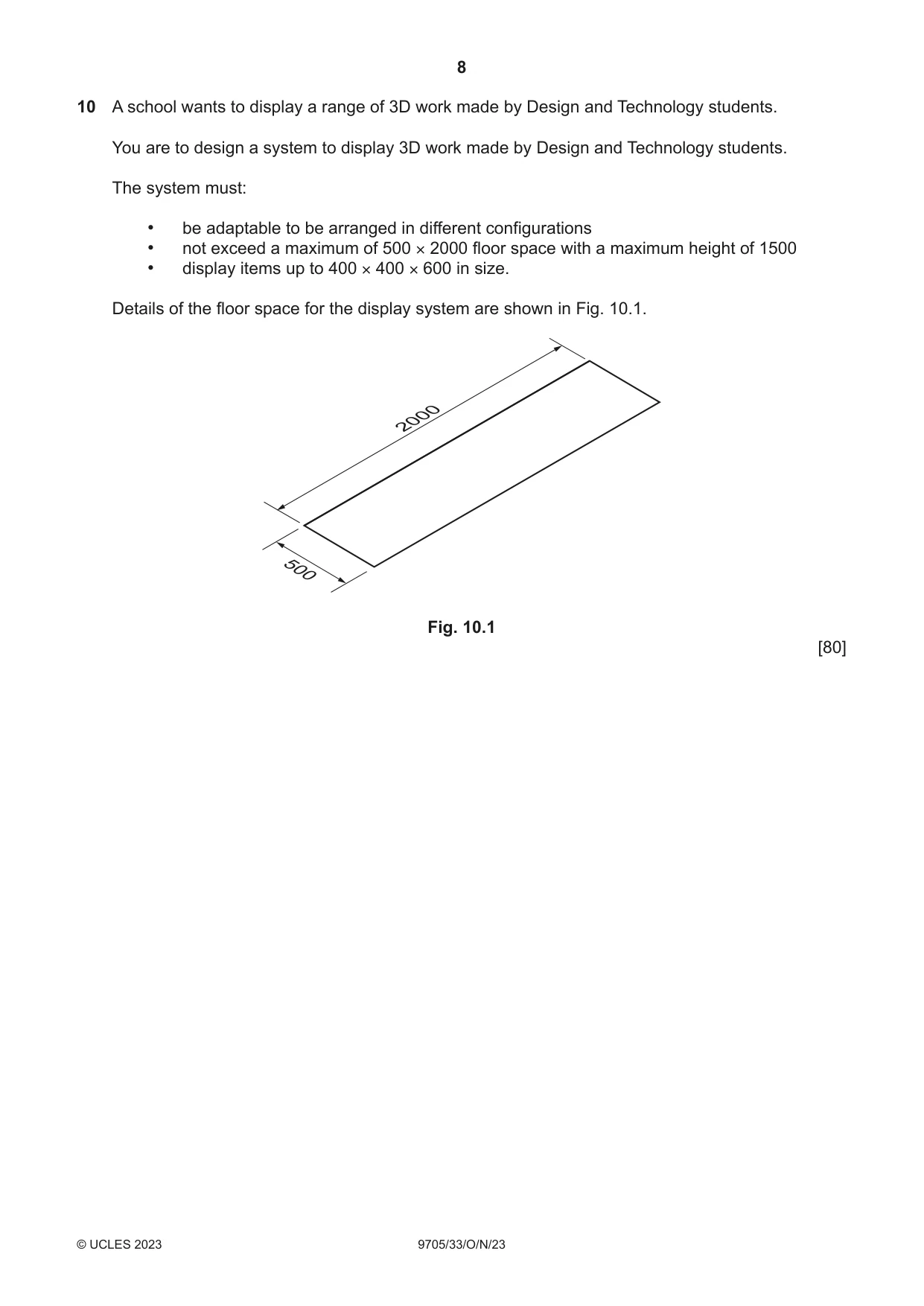
8 9705/33/O/N/23 © UCLES 2023 10 A school wants to display a range of 3D work made by Design and Technology students. You are to design a system to display 3D work made by Design and Technology students. The system must: • be adaptable to be arranged in different configurations • not exceed a maximum of 500 × 2000 floor space with a maximum height of 1500 • display items up to 400 × 400 × 600 in size. Details of the floor space for the display system are shown in Fig. 10.1. 2000 500 Fig. 10.1 [80]
Question paper, page 9
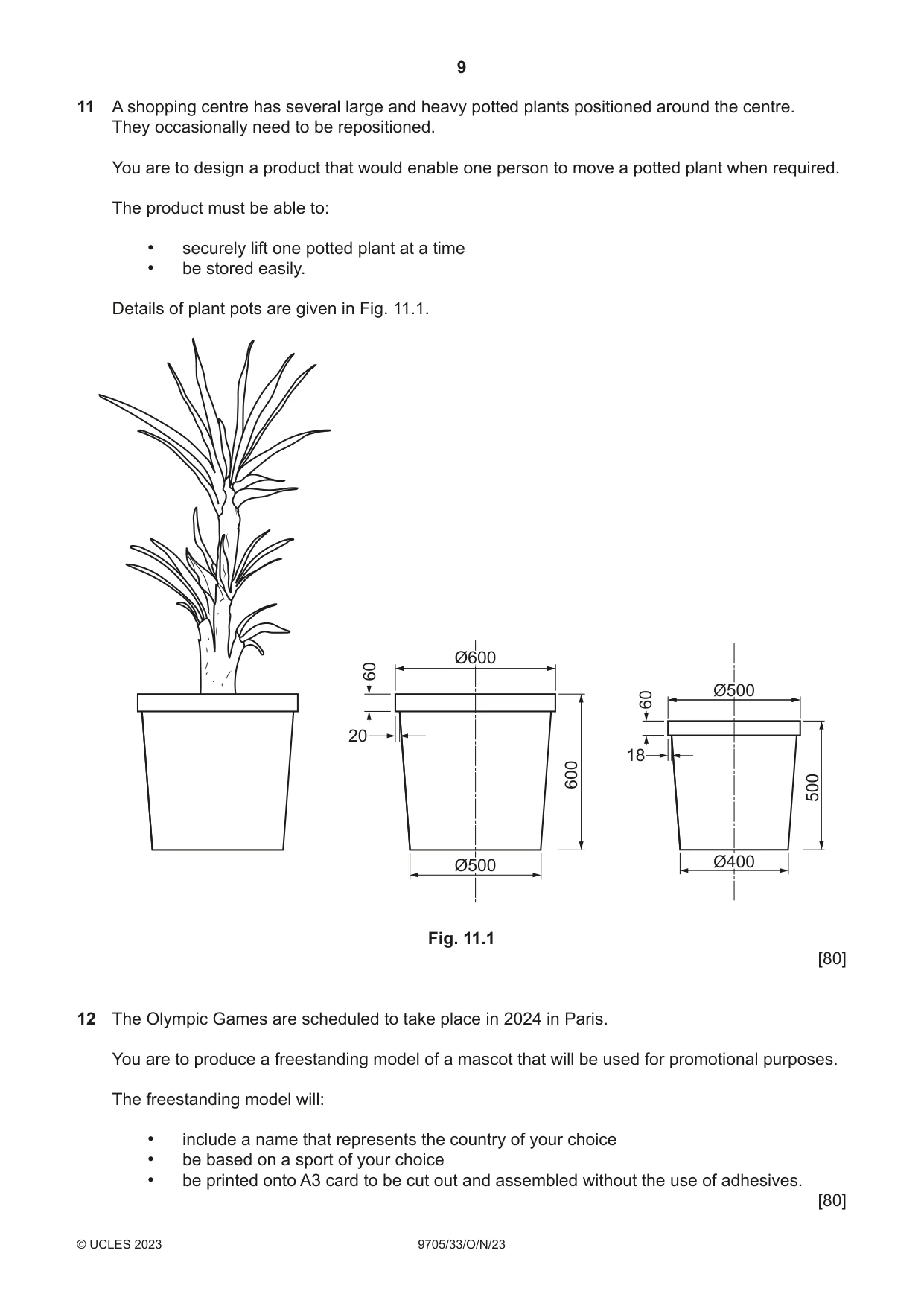
9 9705/33/O/N/23 © UCLES 2023 11 A shopping centre has several large and heavy potted plants positioned around the centre. They occasionally need to be repositioned. You are to design a product that would enable one person to move a potted plant when required. The product must be able to: • securely lift one potted plant at a time • be stored easily. Details of plant pots are given in Fig. 11.1. Ø600 Ø600 600 Ø500 Ø500 20 60 Ø500 Ø500 500 Ø400 Ø400 18 60 Fig. 11.1 [80] 12 The Olympic Games are scheduled to take place in 2024 in Paris. You are to produce a freestanding model of a mascot that will be used for promotional purposes. The freestanding model will: • include a name that represents the country of your choice • be based on a sport of your choice • be printed onto A3 card to be cut out and assembled without the use of adhesives. [80]
Question paper, page 10
10 9705/33/O/N/23 © UCLES 2023 BLANK PAGE
Question paper, page 11
11 9705/33/O/N/23 © UCLES 2023 BLANK PAGE
Question paper, page 12
12 9705/33/O/N/23 © UCLES 2023 Permission to reproduce items where third-party owned material protected by copyright is included has been sought and cleared where possible. Every reasonable effort has been made by the publisher (UCLES) to trace copyright holders, but if any items requiring clearance have unwittingly been included, the publisher will be pleased to make amends at the earliest possible opportunity. To avoid the issue of disclosure of answer-related information to candidates, all copyright acknowledgements are reproduced online in the Cambridge Assessment International Education Copyright Acknowledgements Booklet. This is produced for each series of examinations and is freely available to download at www.cambridgeinternational.org after the live examination series. Cambridge Assessment International Education is part of Cambridge Assessment. Cambridge Assessment is the brand name of the University of Cambridge Local Examinations Syndicate (UCLES), which is a department of the University of Cambridge. BLANK PAGE
Mark scheme, page 1
This document consists of 16 printed pages. © UCLES 2023 [Turn over Cambridge International A Level DESIGN & TECHNOLOGY 9705/33 Paper 3 October/November 2023 MARK SCHEME Maximum Mark: 120 Published This mark scheme is published as an aid to teachers and candidates, to indicate the requirements of the examination. It shows the basis on which Examiners were instructed to award marks. It does not indicate the details of the discussions that took place at an Examiners’ meeting before marking began, which would have considered the acceptability of alternative answers. Mark schemes should be read in conjunction with the question paper and the Principal Examiner Report for Teachers. Cambridge International will not enter into discussions about these mark schemes. Cambridge International is publishing the mark schemes for the October/November 2023 series for most Cambridge IGCSE, Cambridge International A and AS Level components, and some Cambridge O Level components.
Mark scheme, page 2
9705/33 Cambridge International A Level – Mark Scheme PUBLISHED October/November 2023 © UCLES 2023 Page 2 of 16 Generic Marking Principles These general marking principles must be applied by all examiners when marking candidate answers. They should be applied alongside the specific content of the mark scheme or generic level descriptors for a question. Each question paper and mark scheme will also comply with these marking principles. GENERIC MARKING PRINCIPLE 1: Marks must be awarded in line with: • the specific content of the mark scheme or the generic level descriptors for the question • the specific skills defined in the mark scheme or in the generic level descriptors for the question • the standard of response required by a candidate as exemplified by the standardisation scripts. GENERIC MARKING PRINCIPLE 2: Marks awarded are always whole marks (not half marks, or other fractions). GENERIC MARKING PRINCIPLE 3: Marks must be awarded positively: • marks are awarded for correct/valid answers, as defined in the mark scheme. However, credit is given for valid answers which go beyond the scope of the syllabus and mark scheme, referring to your Team Leader as appropriate • marks are awarded when candidates clearly demonstrate what they know and can do • marks are not deducted for errors • marks are not deducted for omissions • answers should only be judged on the quality of spelling, punctuation and grammar when these features are specifically assessed by the question as indicated by the mark scheme. The meaning, however, should be unambiguous. GENERIC MARKING PRINCIPLE 4: Rules must be applied consistently, e.g. in situations where candidates have not followed instructions or in the application of generic level descriptors.
Mark scheme, page 3
9705/33 Cambridge International A Level – Mark Scheme PUBLISHED October/November 2023 © UCLES 2023 Page 3 of 16 GENERIC MARKING PRINCIPLE 5: Marks should be awarded using the full range of marks defined in the mark scheme for the question (however; the use of the full mark range may be limited according to the quality of the candidate responses seen). GENERIC MARKING PRINCIPLE 6: Marks awarded are based solely on the requirements as defined in the mark scheme. Marks should not be awarded with grade thresholds or grade descriptors in mind.
Mark scheme, page 4
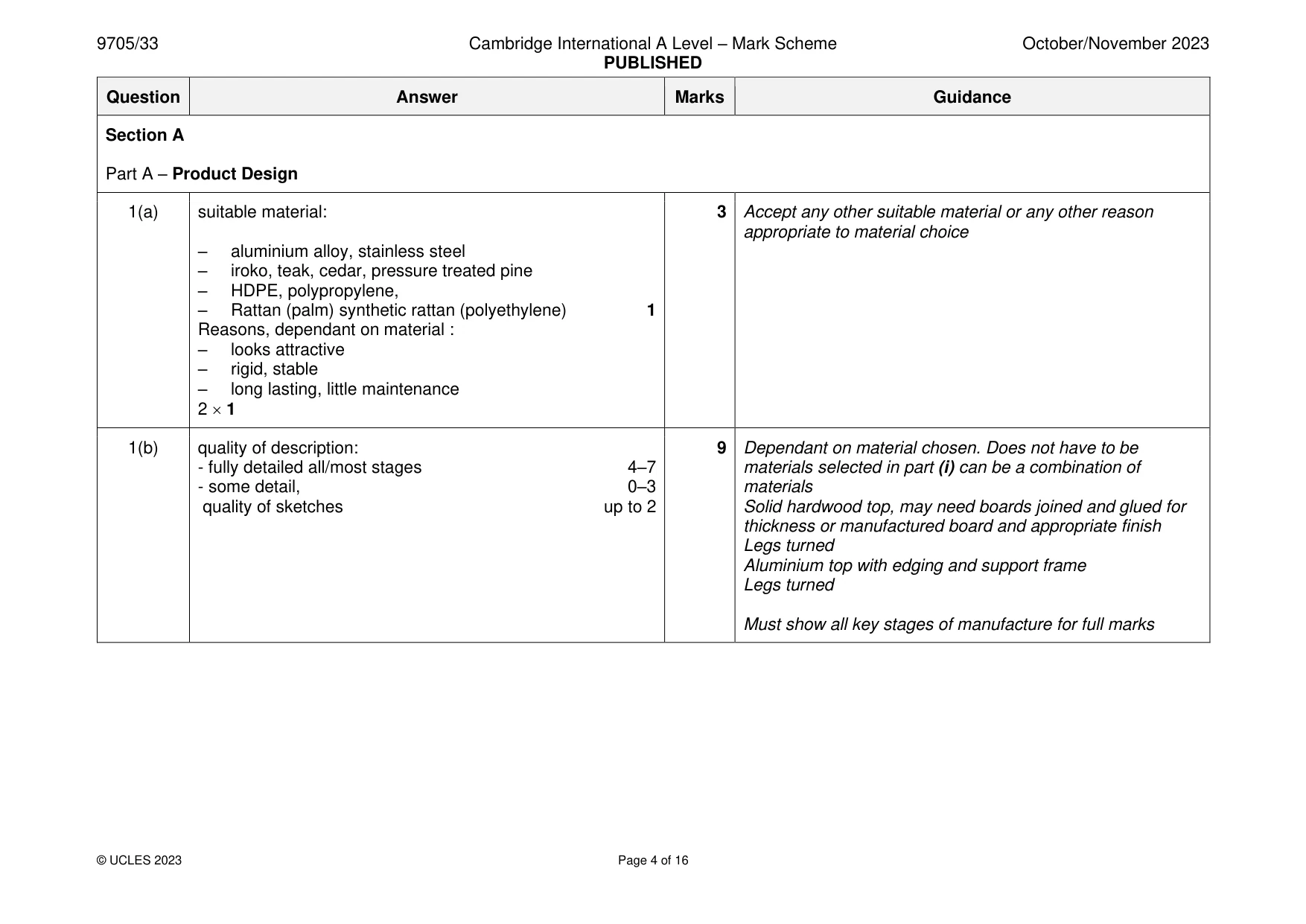
9705/33 Cambridge International A Level – Mark Scheme PUBLISHED October/November 2023 © UCLES 2023 Page 4 of 16 Question Answer Marks Guidance Section A Part A – Product Design 1(a) suitable material: – aluminium alloy, stainless steel – iroko, teak, cedar, pressure treated pine – HDPE, polypropylene, – Rattan (palm) synthetic rattan (polyethylene) 1 Reasons, dependant on material : – looks attractive – rigid, stable – long lasting, little maintenance 2 1 3 Accept any other suitable material or any other reason appropriate to material choice 1(b) quality of description: - fully detailed all/most stages 4–7 - some detail, 0–3 quality of sketches up to 2 9 Dependant on material chosen. Does not have to be materials selected in part (i) can be a combination of materials Solid hardwood top, may need boards joined and glued for thickness or manufactured board and appropriate finish Legs turned Aluminium top with edging and support frame Legs turned Must show all key stages of manufacture for full marks
Mark scheme, page 5
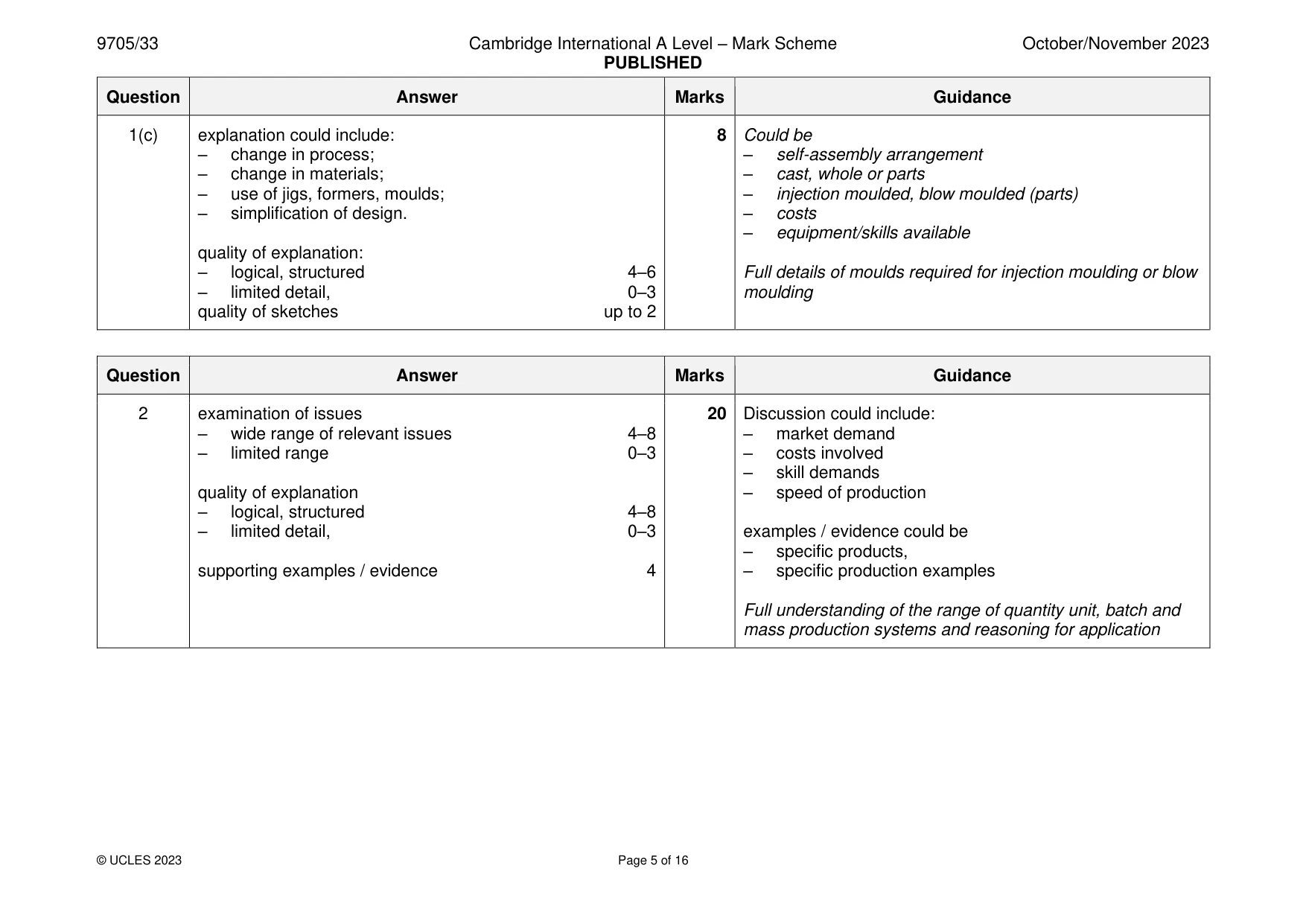
9705/33 Cambridge International A Level – Mark Scheme PUBLISHED October/November 2023 © UCLES 2023 Page 5 of 16 Question Answer Marks Guidance 1(c) explanation could include: – change in process; – change in materials; – use of jigs, formers, moulds; – simplification of design. quality of explanation: – logical, structured 4–6 – limited detail, 0–3 quality of sketches up to 2 8 Could be – self-assembly arrangement – cast, whole or parts – injection moulded, blow moulded (parts) – costs – equipment/skills available Full details of moulds required for injection moulding or blow moulding Question Answer Marks Guidance 2 examination of issues – wide range of relevant issues 4–8 – limited range 0–3 quality of explanation – logical, structured 4–8 – limited detail, 0–3 supporting examples / evidence 4 20 Discussion could include: – market demand – costs involved – skill demands – speed of production examples / evidence could be – specific products, – specific production examples Full understanding of the range of quantity unit, batch and mass production systems and reasoning for application
Mark scheme, page 6
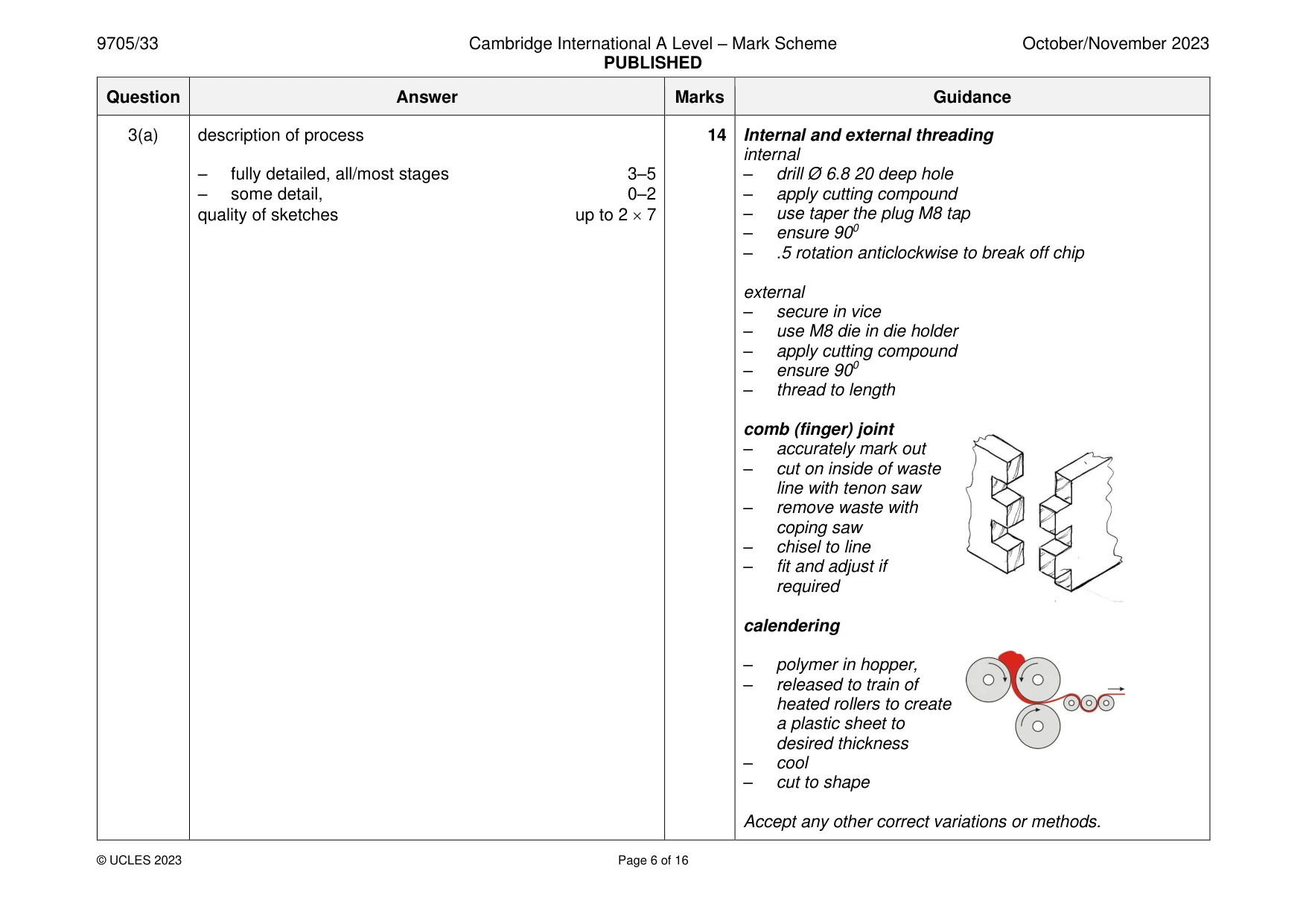
9705/33 Cambridge International A Level – Mark Scheme PUBLISHED October/November 2023 © UCLES 2023 Page 6 of 16 Question Answer Marks Guidance 3(a) description of process – fully detailed, all/most stages 3–5 – some detail, 0–2 quality of sketches up to 2 7 14 Internal and external threading internal – drill Ø 6.8 20 deep hole – apply cutting compound – use taper the plug M8 tap – ensure 900 – .5 rotation anticlockwise to break off chip external – secure in vice – use M8 die in die holder – apply cutting compound – ensure 900 – thread to length comb (finger) joint – accurately mark out – cut on inside of waste line with tenon saw – remove waste with coping saw – chisel to line – fit and adjust if required calendering – polymer in hopper, – released to train of heated rollers to create a plastic sheet to desired thickness – cool – cut to shape Accept any other correct variations or methods.
Mark scheme, page 7
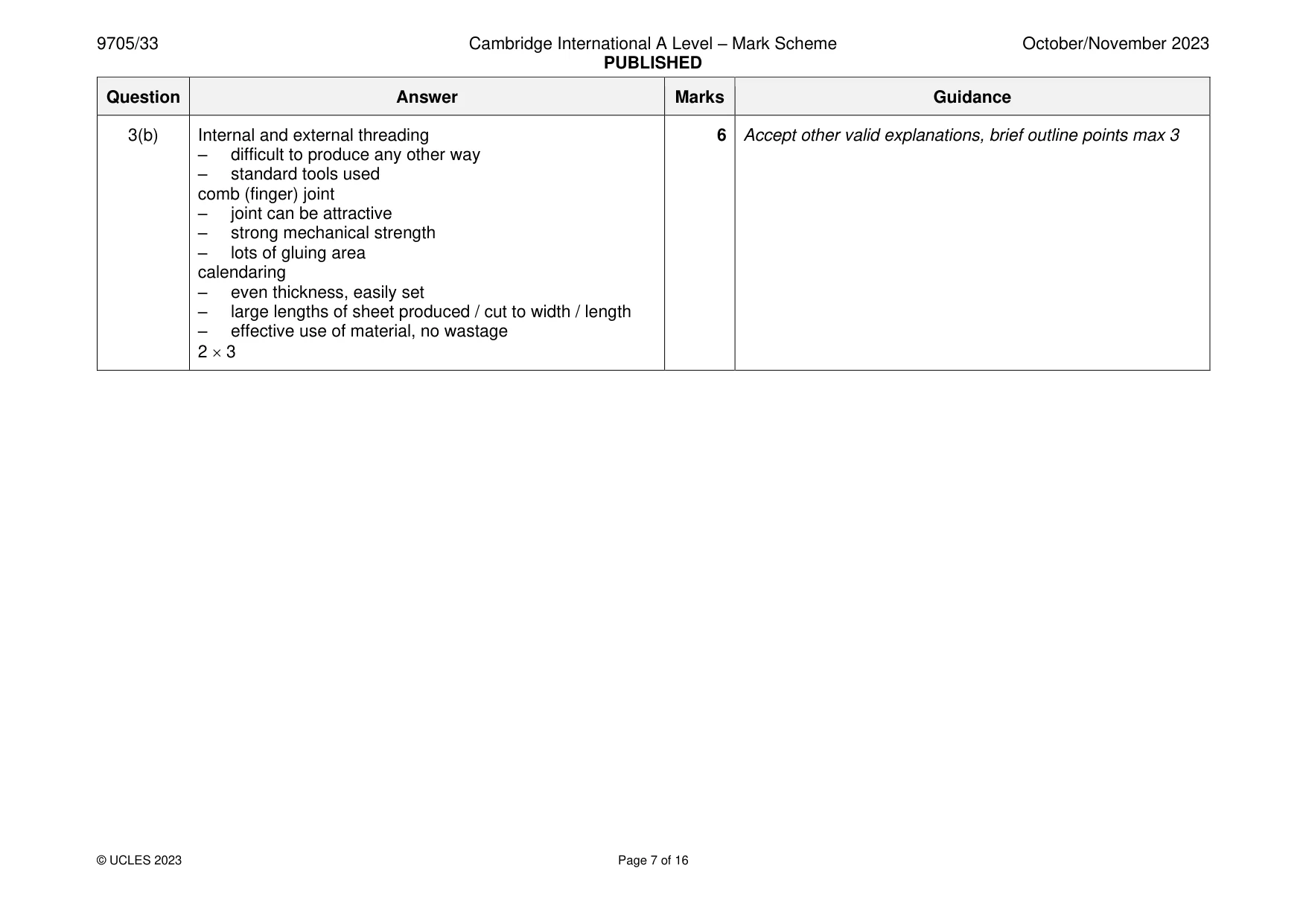
9705/33 Cambridge International A Level – Mark Scheme PUBLISHED October/November 2023 © UCLES 2023 Page 7 of 16 Question Answer Marks Guidance 3(b) Internal and external threading – difficult to produce any other way – standard tools used comb (finger) joint – joint can be attractive – strong mechanical strength – lots of gluing area calendaring – even thickness, easily set – large lengths of sheet produced / cut to width / length – effective use of material, no wastage 2 3 6 Accept other valid explanations, brief outline points max 3
Mark scheme, page 8
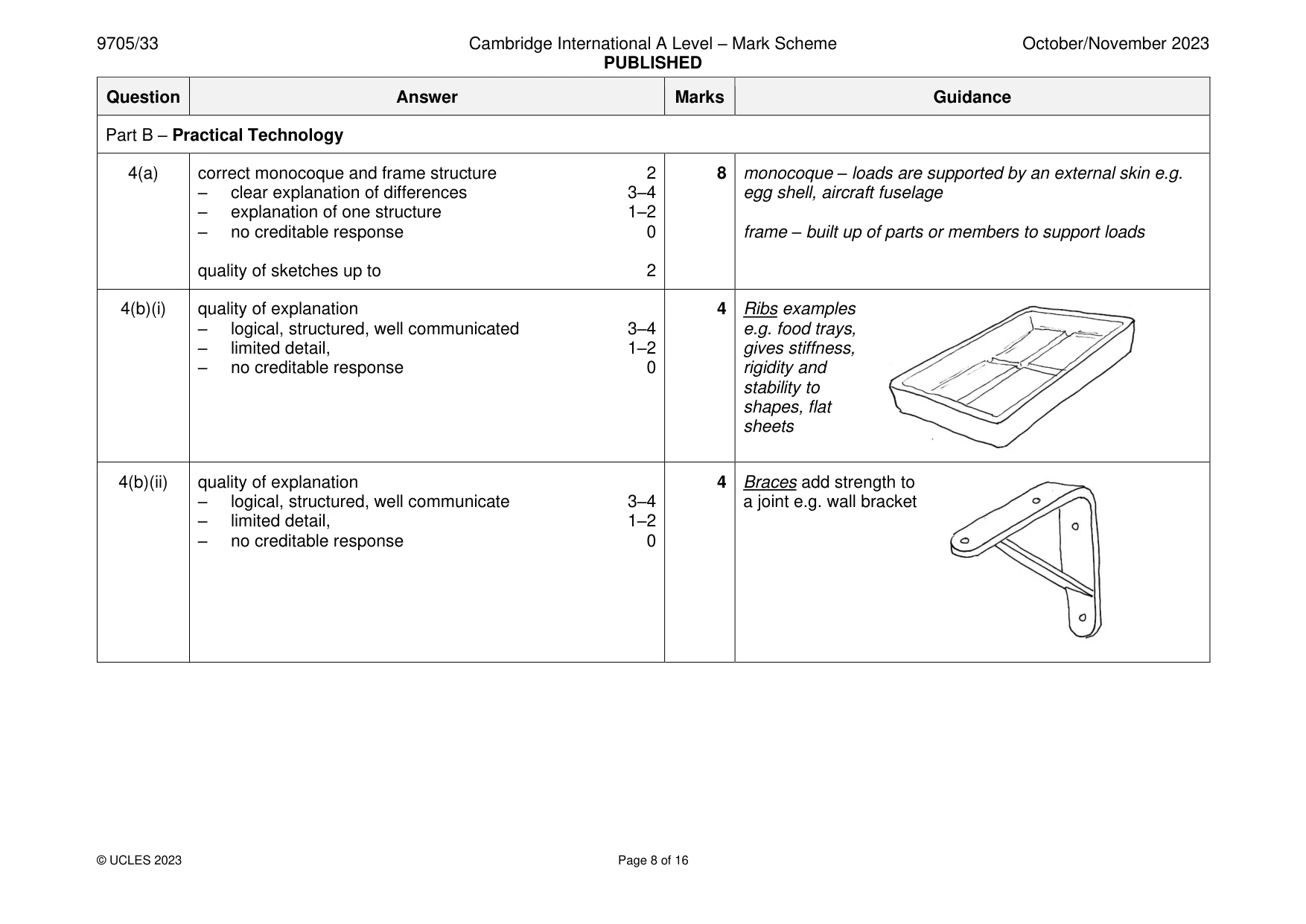
9705/33 Cambridge International A Level – Mark Scheme PUBLISHED October/November 2023 © UCLES 2023 Page 8 of 16 Question Answer Marks Guidance Part B – Practical Technology 4(a) correct monocoque and frame structure 2 – clear explanation of differences 3–4 – explanation of one structure 1–2 – no creditable response 0 quality of sketches up to 2 8 monocoque – loads are supported by an external skin e.g. egg shell, aircraft fuselage frame – built up of parts or members to support loads 4(b)(i) quality of explanation – logical, structured, well communicated 3–4 – limited detail, 1–2 – no creditable response 0 4 Ribs examples e.g. food trays, gives stiffness, rigidity and stability to shapes, flat sheets 4(b)(ii) quality of explanation – logical, structured, well communicate 3–4 – limited detail, 1–2 – no creditable response 0 4 Braces add strength to a joint e.g. wall bracket
Mark scheme, page 9
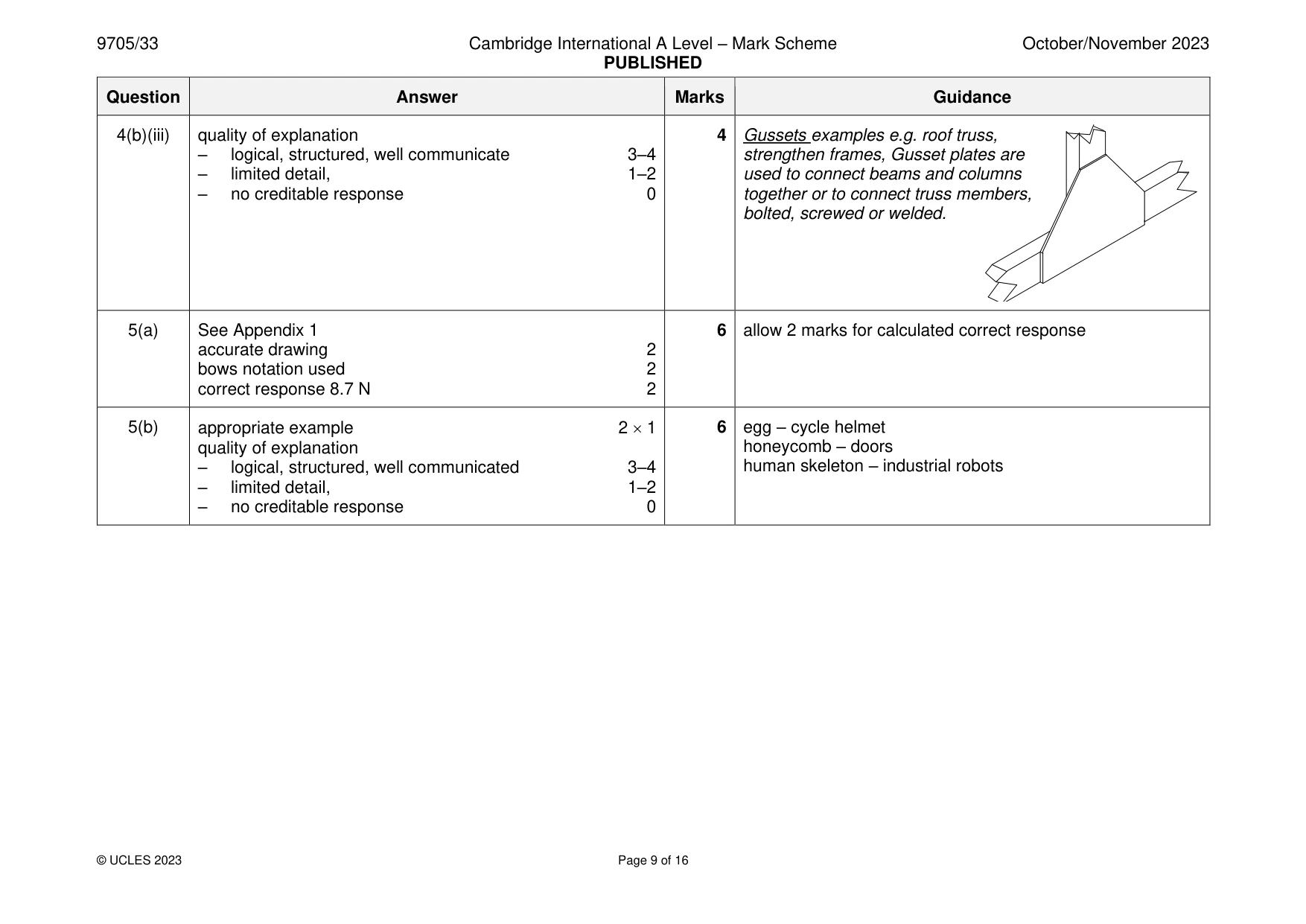
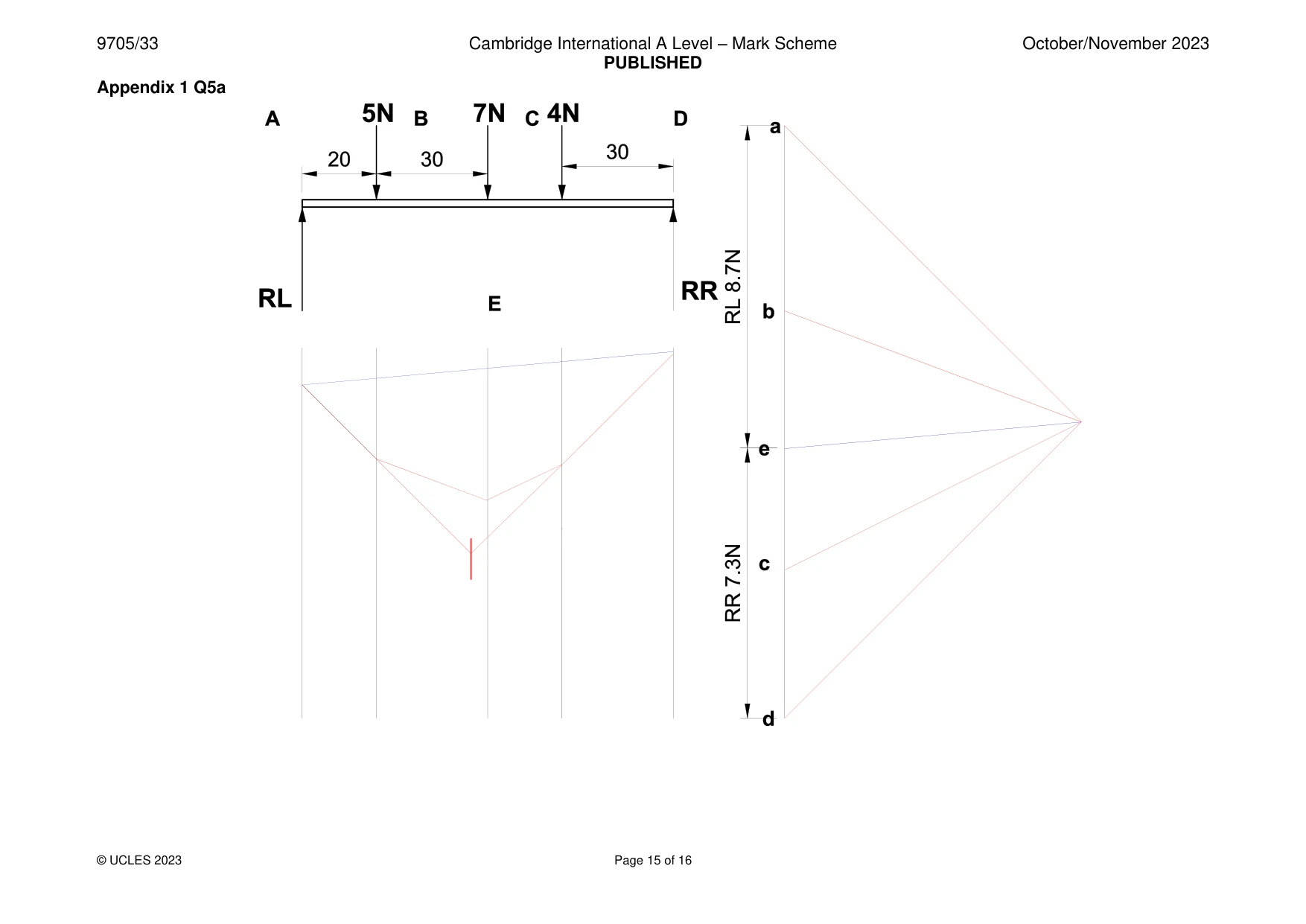
9705/33 Cambridge International A Level – Mark Scheme PUBLISHED October/November 2023 © UCLES 2023 Page 9 of 16 Question Answer Marks Guidance 4(b)(iii) quality of explanation – logical, structured, well communicate 3–4 – limited detail, 1–2 – no creditable response 0 4 Gussets examples e.g. roof truss, strengthen frames, Gusset plates are used to connect beams and columns together or to connect truss members, bolted, screwed or welded. 5(a) See Appendix 1 accurate drawing 2 bows notation used 2 correct response 8.7 N 2 6 allow 2 marks for calculated correct response 5(b) appropriate example 2 1 quality of explanation – logical, structured, well communicated 3–4 – limited detail, 1–2 – no creditable response 0 6 egg – cycle helmet honeycomb – doors human skeleton – industrial robots
Mark scheme, page 10
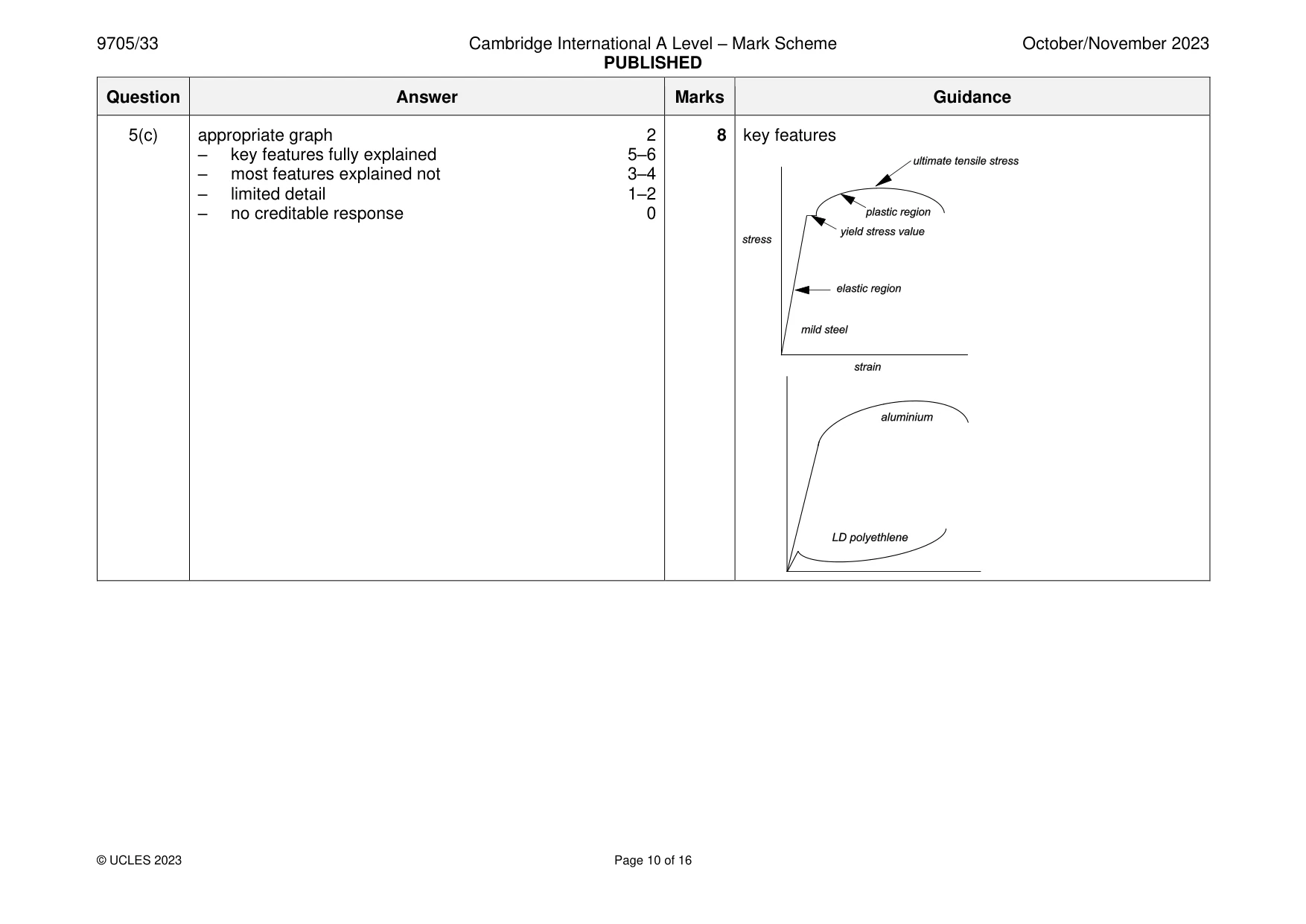
9705/33 Cambridge International A Level – Mark Scheme PUBLISHED October/November 2023 © UCLES 2023 Page 10 of 16 Question Answer Marks Guidance 5(c) appropriate graph 2 – key features fully explained 5–6 – most features explained not 3–4 – limited detail 1–2 – no creditable response 0 8 key features
Mark scheme, page 11
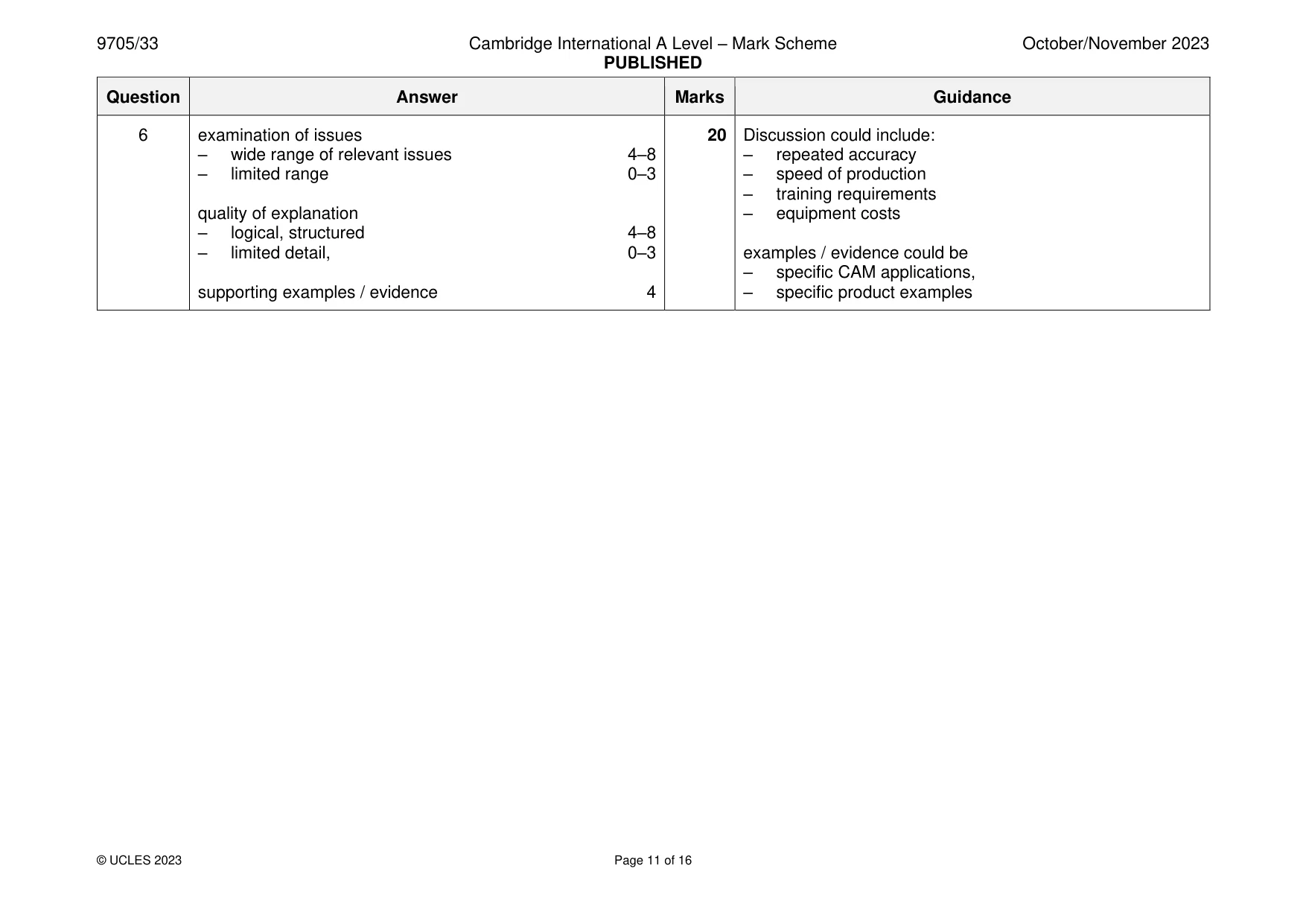
9705/33 Cambridge International A Level – Mark Scheme PUBLISHED October/November 2023 © UCLES 2023 Page 11 of 16 Question Answer Marks Guidance 6 examination of issues – wide range of relevant issues 4–8 – limited range 0–3 quality of explanation – logical, structured 4–8 – limited detail, 0–3 supporting examples / evidence 4 20 Discussion could include: – repeated accuracy – speed of production – training requirements – equipment costs examples / evidence could be – specific CAM applications, – specific product examples
Mark scheme, page 12
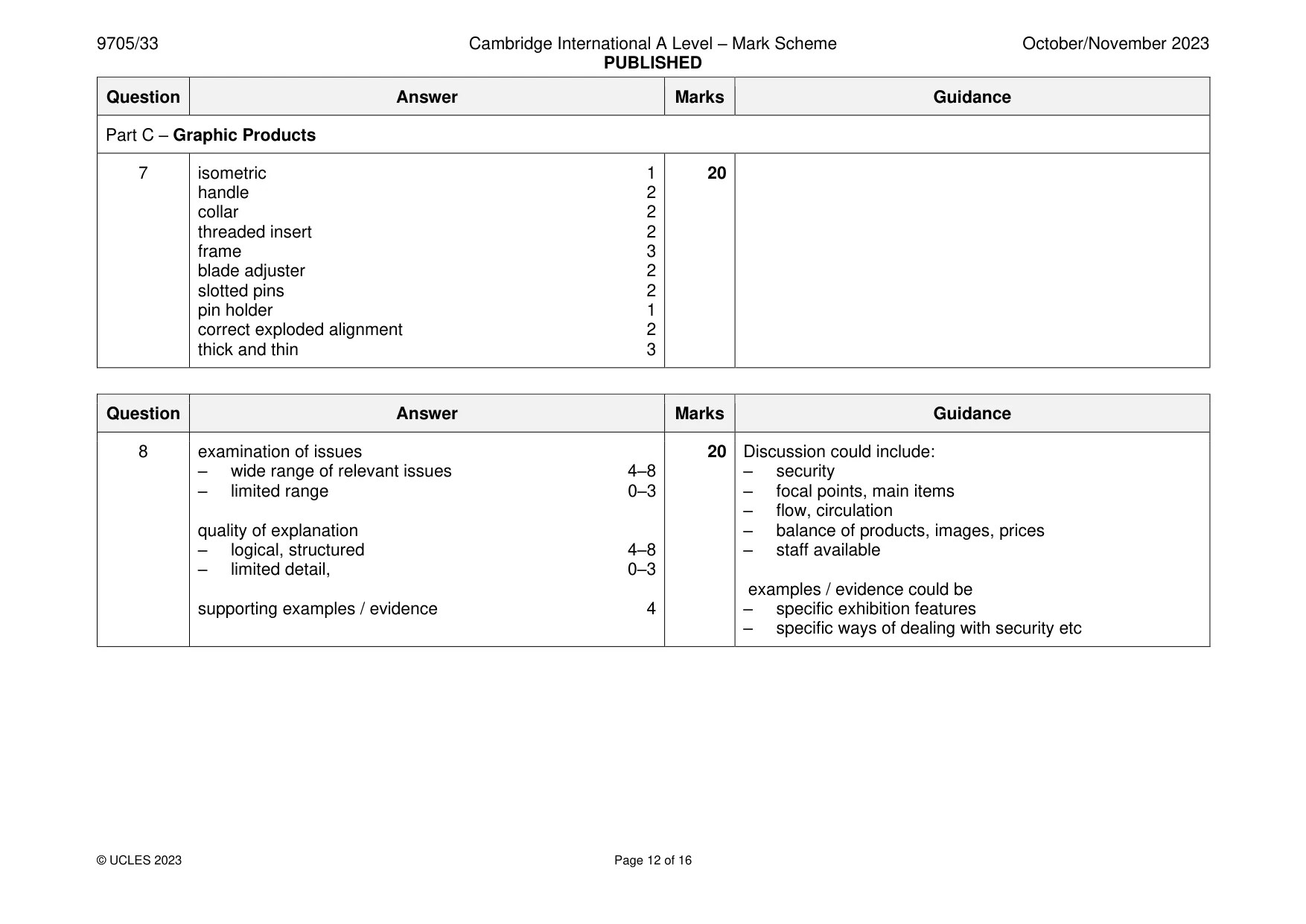
9705/33 Cambridge International A Level – Mark Scheme PUBLISHED October/November 2023 © UCLES 2023 Page 12 of 16 Question Answer Marks Guidance Part C – Graphic Products 7 isometric 1 handle 2 collar 2 threaded insert 2 frame 3 blade adjuster 2 slotted pins 2 pin holder 1 correct exploded alignment 2 thick and thin 3 20 Question Answer Marks Guidance 8 examination of issues – wide range of relevant issues 4–8 – limited range 0–3 quality of explanation – logical, structured 4–8 – limited detail, 0–3 supporting examples / evidence 4 20 Discussion could include: – security – focal points, main items – flow, circulation – balance of products, images, prices – staff available examples / evidence could be – specific exhibition features – specific ways of dealing with security etc
Mark scheme, page 13
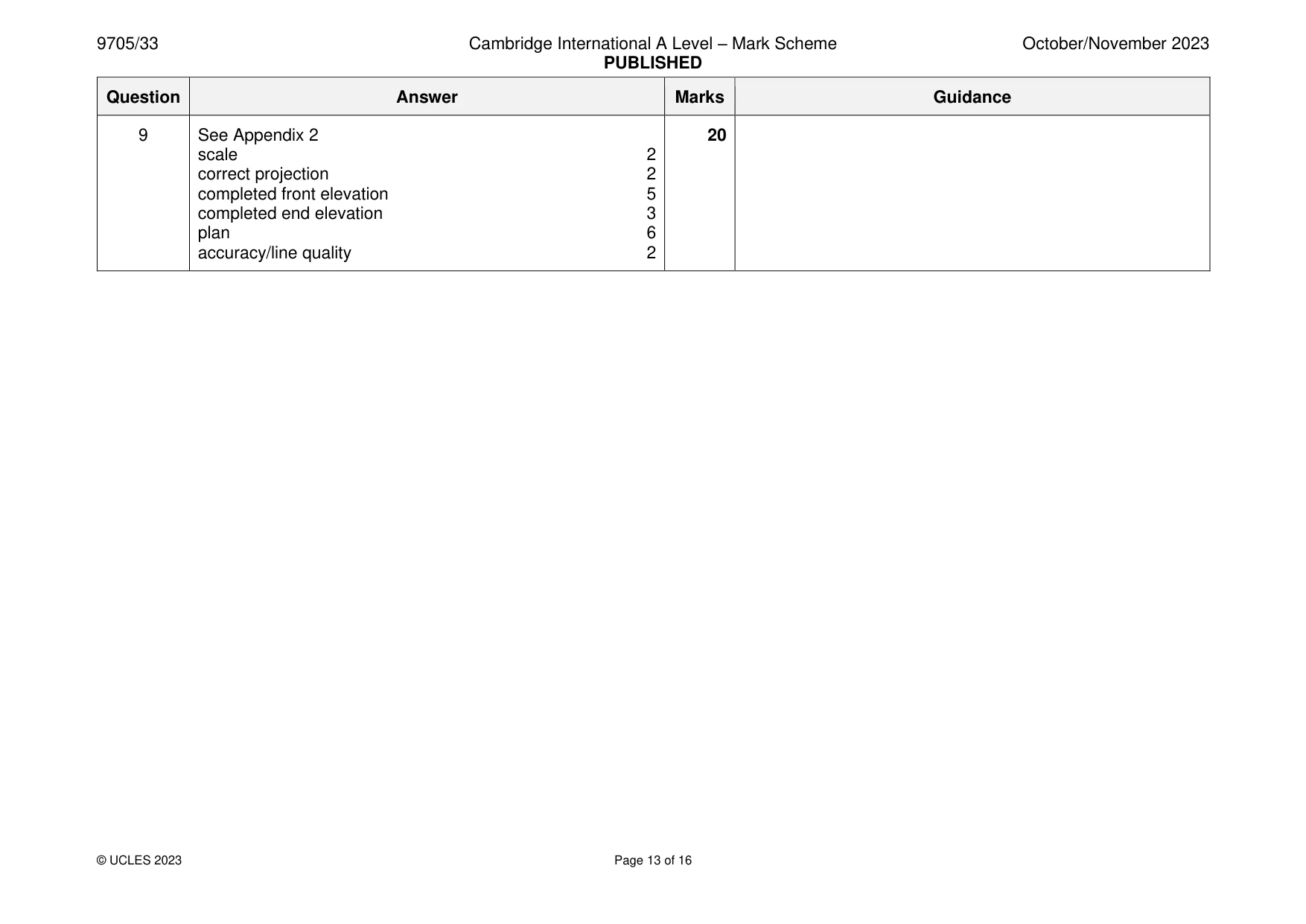
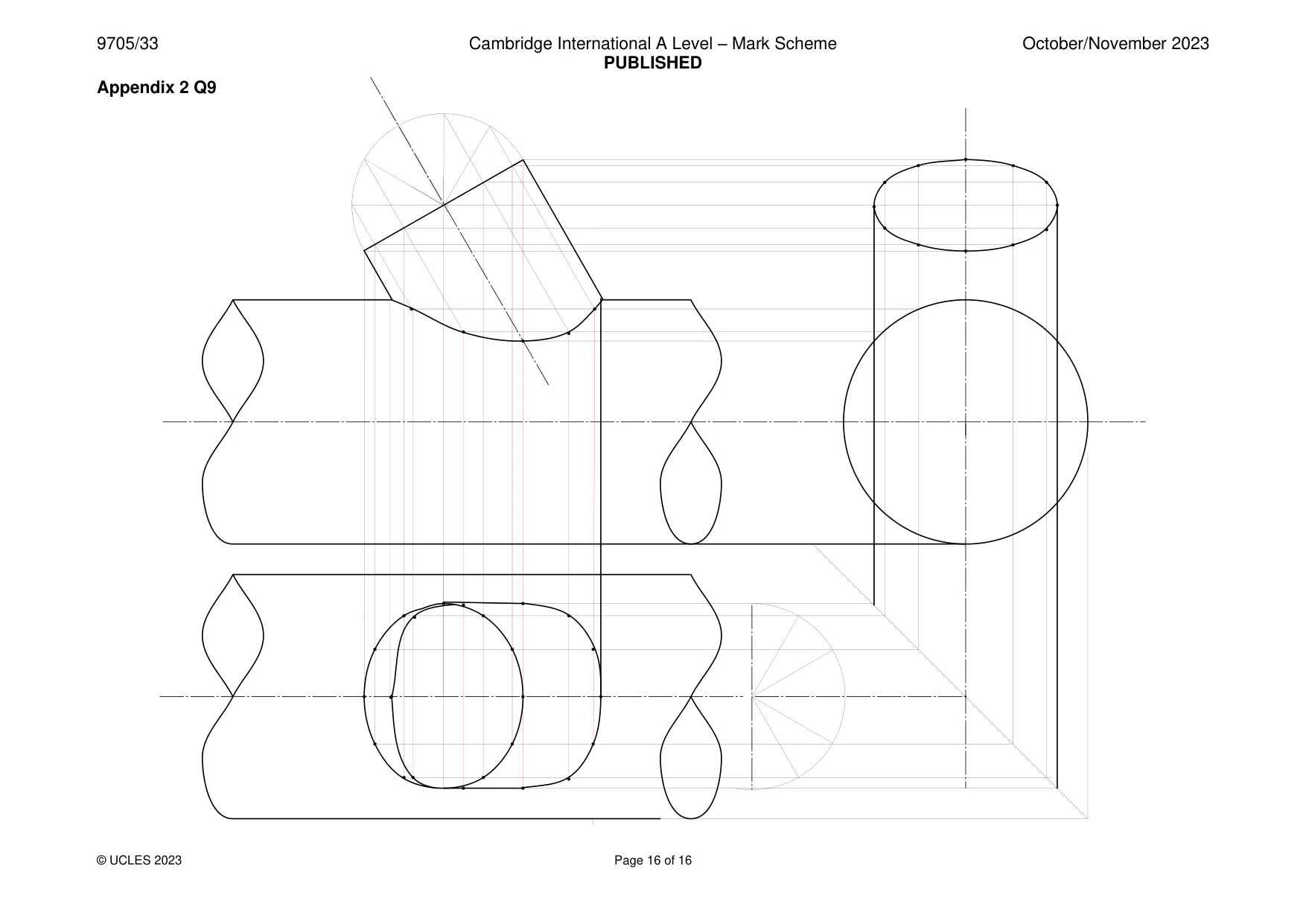
9705/33 Cambridge International A Level – Mark Scheme PUBLISHED October/November 2023 © UCLES 2023 Page 13 of 16 Question Answer Marks Guidance 9 See Appendix 2 scale 2 correct projection 2 completed front elevation 5 completed end elevation 3 plan 6 accuracy/line quality 2 20
Mark scheme, page 14
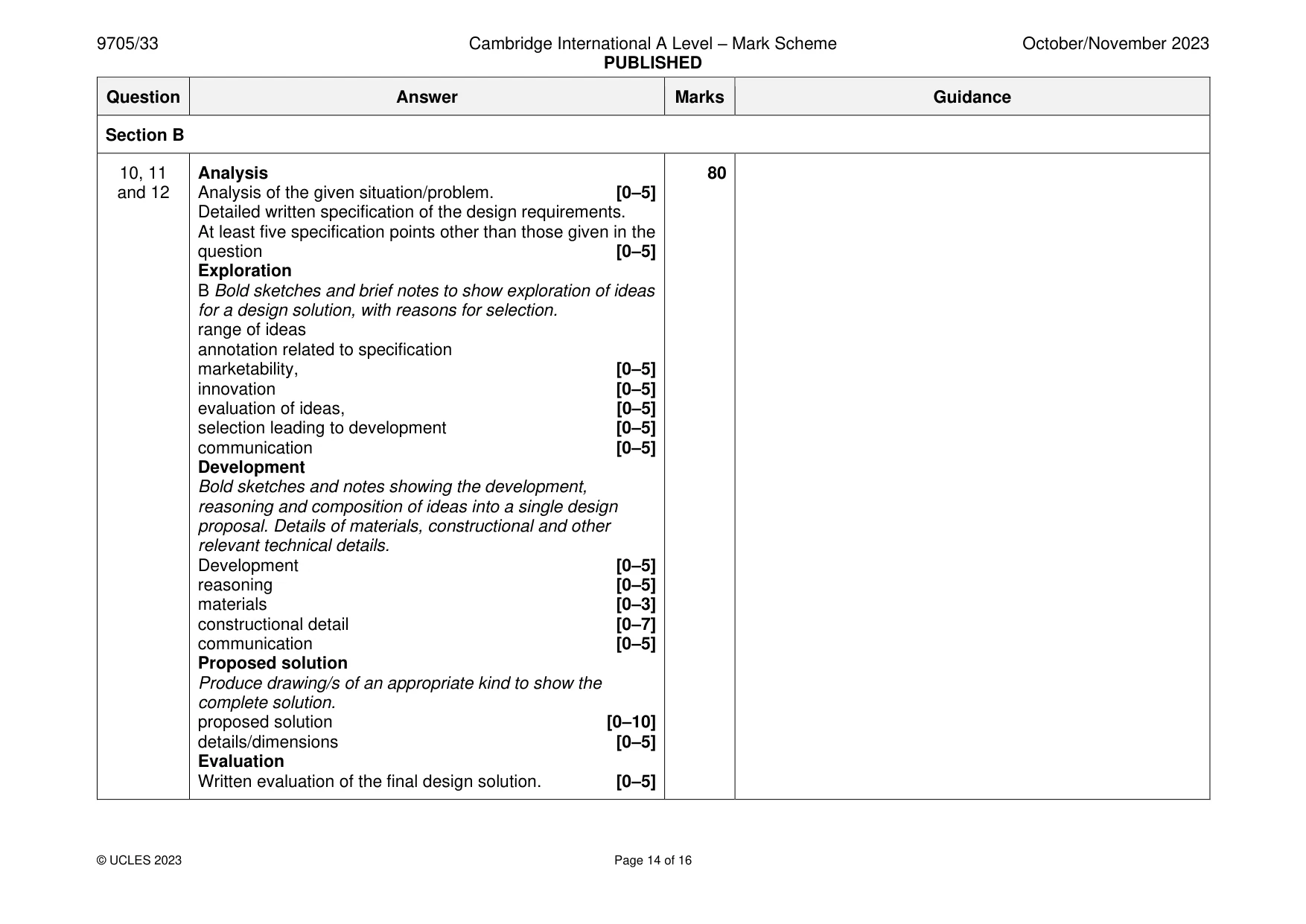
9705/33 Cambridge International A Level – Mark Scheme PUBLISHED October/November 2023 © UCLES 2023 Page 14 of 16 Question Answer Marks Guidance Section B 10, 11 and 12 Analysis Analysis of the given situation/problem. [0–5] Detailed written specification of the design requirements. At least five specification points other than those given in the question [0–5] Exploration B Bold sketches and brief notes to show exploration of ideas for a design solution, with reasons for selection. range of ideas annotation related to specification marketability, [0–5] innovation [0–5] evaluation of ideas, [0–5] selection leading to development [0–5] communication [0–5] Development Bold sketches and notes showing the development, reasoning and composition of ideas into a single design proposal. Details of materials, constructional and other relevant technical details. Development [0–5] reasoning [0–5] materials [0–3] constructional detail [0–7] communication [0–5] Proposed solution Produce drawing/s of an appropriate kind to show the complete solution. proposed solution [0–10] details/dimensions [0–5] Evaluation Written evaluation of the final design solution. [0–5] 80
Mark scheme, page 15
9705/33 Cambridge International A Level – Mark Scheme PUBLISHED October/November 2023 © UCLES 2023 Page 15 of 16 Appendix 1 Q5a
Mark scheme, page 16
9705/33 Cambridge International A Level – Mark Scheme PUBLISHED October/November 2023 © UCLES 2023 Page 16 of 16 Appendix 2 Q9
What you needed in this session
Cambridge’s own grade thresholds for 2023 Oct/Nov, Paper 3 · Variant 3. A higher threshold means an easier paper — the bar moves with how the cohort did.