Cambridge A Level Design and Technology 9705 — 2021 Oct/Nov Paper 3 · Variant 3
9705/33/O/N/21 · 120 marks · ≈135 min
The question paper and its mark scheme, free to read here and free to download. This is Cambridge’s own paper, exactly as it was sat.
Question paper12 pages
Mark scheme15 pages
Answers below. Sit the paper first if you are practising.
Paper as text
Question paper, page 1
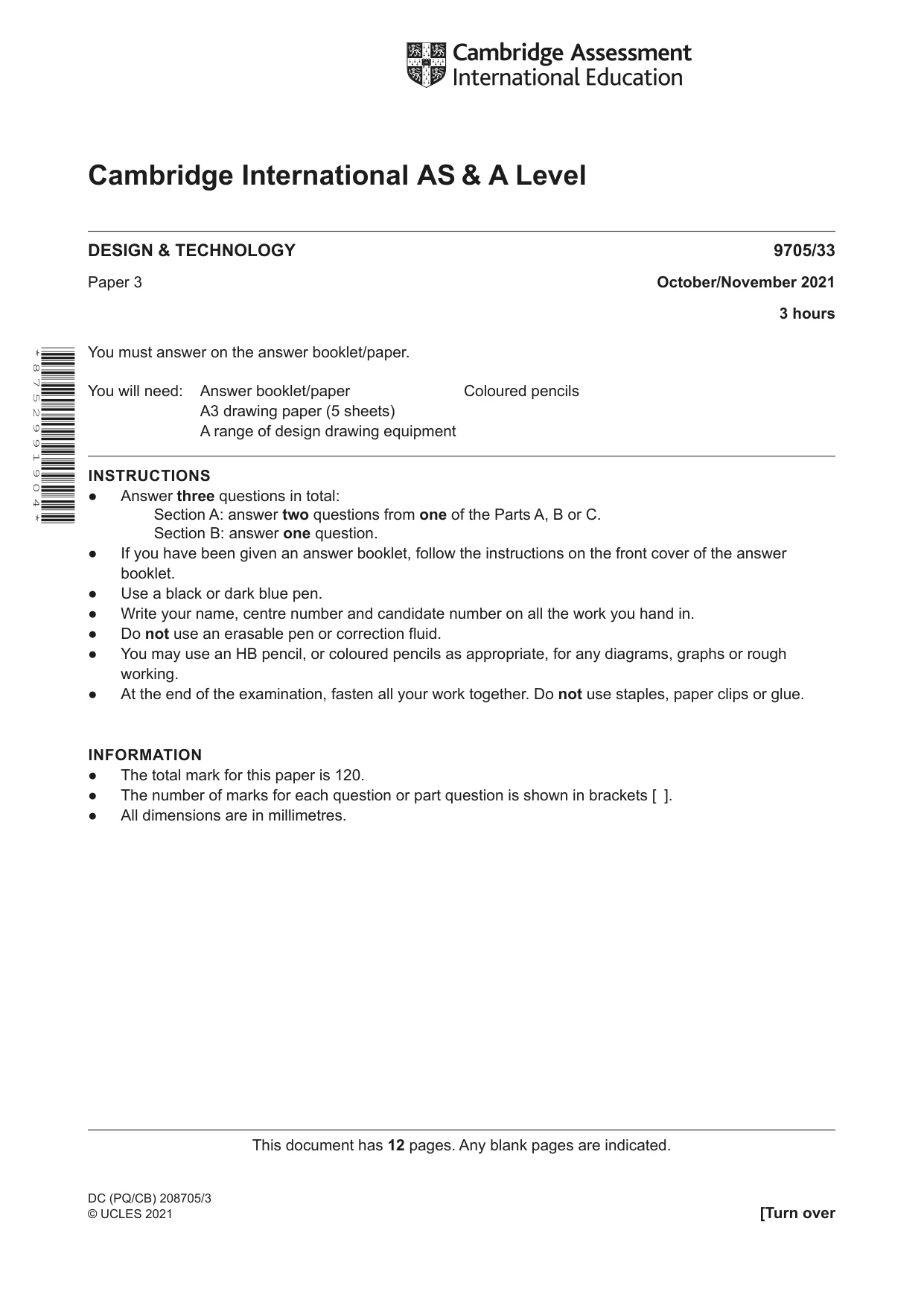
This document has 12 pages. Any blank pages are indicated. Cambridge International AS & A Level DC (PQ/CB) 208705/3 © UCLES 2021 [Turn over * 8 7 5 2 9 9 1 9 0 4 * DESIGN & TECHNOLOGY 9705/33 Paper 3 October/November 2021 3 hours You must answer on the answer booklet/paper. You will need: Answer booklet/paper Coloured pencils A3 drawing paper (5 sheets) A range of design drawing equipment INSTRUCTIONS ● Answer three questions in total: Section A: answer two questions from one of the Parts A, B or C. Section B: answer one question. ● If you have been given an answer booklet, follow the instructions on the front cover of the answer booklet. ● Use a black or dark blue pen. ● Write your name, centre number and candidate number on all the work you hand in. ● Do not use an erasable pen or correction fluid. ● You may use an HB pencil, or coloured pencils as appropriate, for any diagrams, graphs or rough working. ● At the end of the examination, fasten all your work together. Do not use staples, paper clips or glue. INFORMATION ● The total mark for this paper is 120. ● The number of marks for each question or part question is shown in brackets [ ]. ● All dimensions are in millimetres.
Question paper, page 2
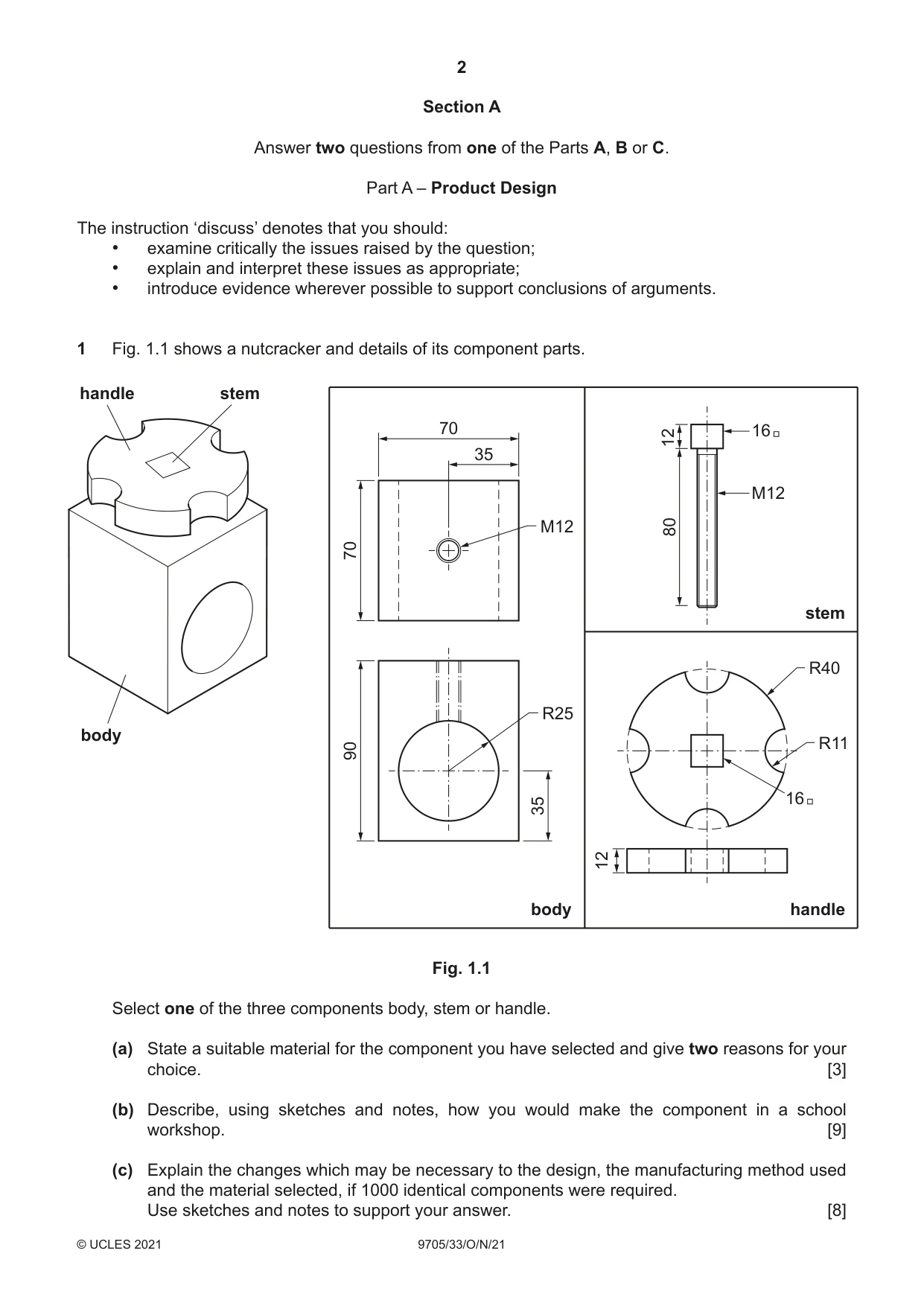
2 9705/33/O/N/21 © UCLES 2021 Section A Answer two questions from one of the Parts A, B or C. Part A – Product Design The instruction ‘discuss’ denotes that you should: • examine critically the issues raised by the question; • explain and interpret these issues as appropriate; • introduce evidence wherever possible to support conclusions of arguments. 1 Fig. 1.1 shows a nutcracker and details of its component parts. 70 M12 R40 R25 handle handle stem stem body body R11 70 12 80 12 90 35 16 16 M12 35 Fig. 1.1 Select one of the three components body, stem or handle. (a) State a suitable material for the component you have selected and give two reasons for your choice. [3] (b) Describe, using sketches and notes, how you would make the component in a school workshop. [9] (c) Explain the changes which may be necessary to the design, the manufacturing method used and the material selected, if 1000 identical components were required. Use sketches and notes to support your answer. [8]
Question paper, page 3
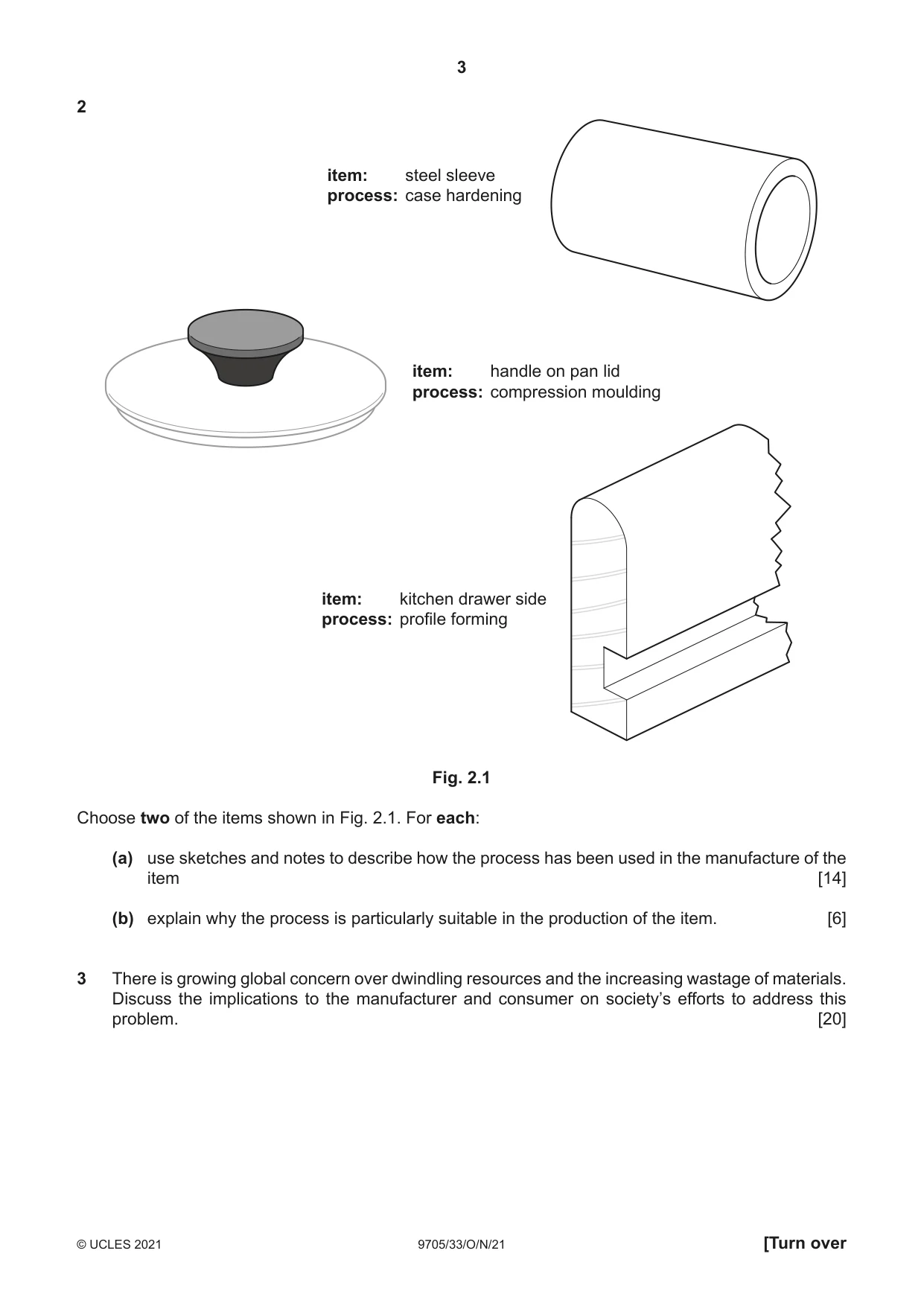
3 9705/33/O/N/21 © UCLES 2021 [Turn over 2 item: steel sleeve process: case hardening item: handle on pan lid process: compression moulding item: kitchen drawer side process: profile forming Fig. 2.1 Choose two of the items shown in Fig. 2.1. For each: (a) use sketches and notes to describe how the process has been used in the manufacture of the item [14] (b) explain why the process is particularly suitable in the production of the item. [6] 3 There is growing global concern over dwindling resources and the increasing wastage of materials. Discuss the implications to the manufacturer and consumer on society’s efforts to address this problem. [20]
Question paper, page 4
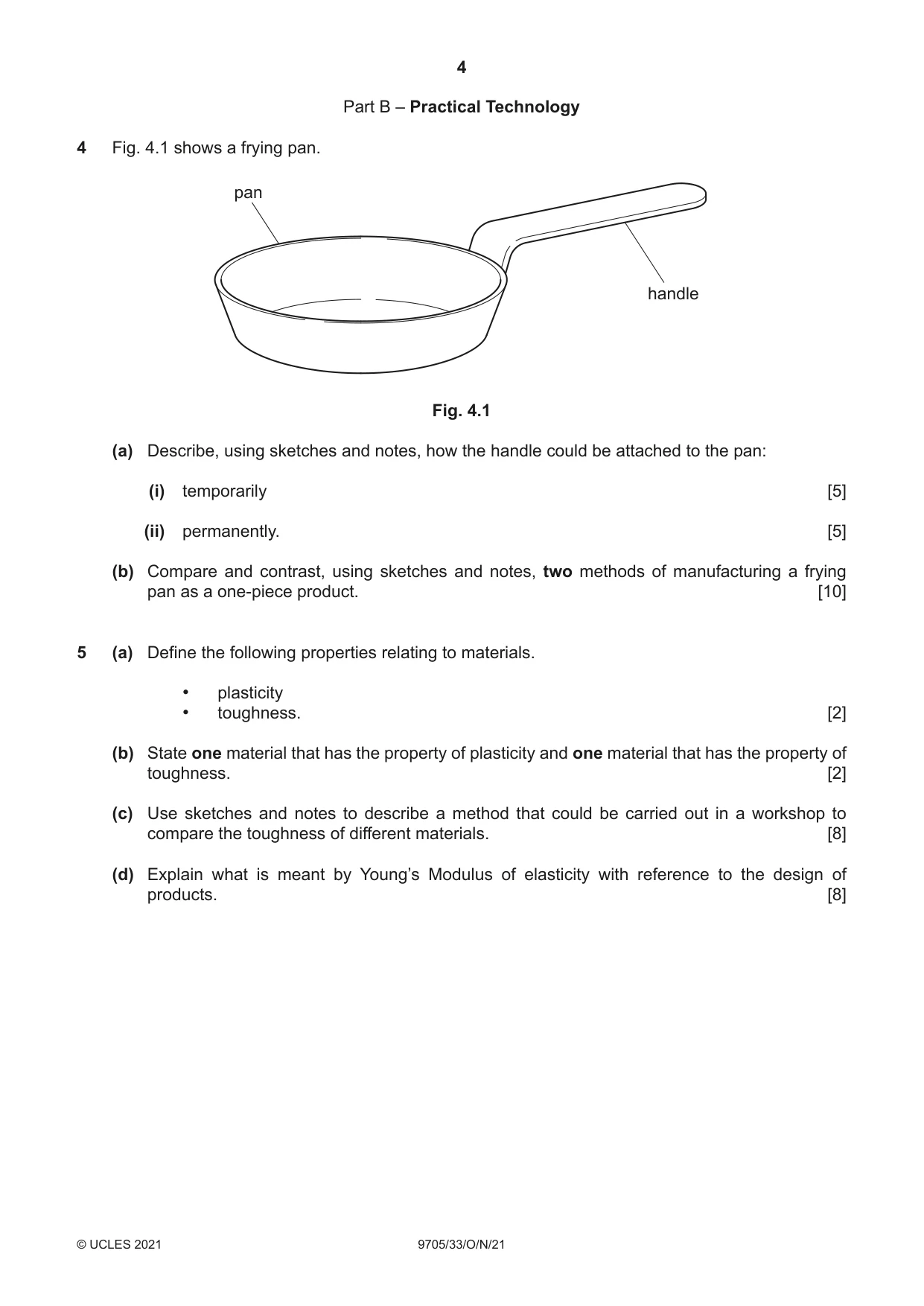
4 9705/33/O/N/21 © UCLES 2021 Part B – Practical Technology 4 Fig. 4.1 shows a frying pan. pan handle Fig. 4.1 (a) Describe, using sketches and notes, how the handle could be attached to the pan: (i) temporarily [5] (ii) permanently. [5] (b) Compare and contrast, using sketches and notes, two methods of manufacturing a frying pan as a one-piece product. [10] 5 (a) Define the following properties relating to materials. • plasticity • toughness. [2] (b) State one material that has the property of plasticity and one material that has the property of toughness. [2] (c) Use sketches and notes to describe a method that could be carried out in a workshop to compare the toughness of different materials. [8] (d) Explain what is meant by Young’s Modulus of elasticity with reference to the design of products. [8]
Question paper, page 5
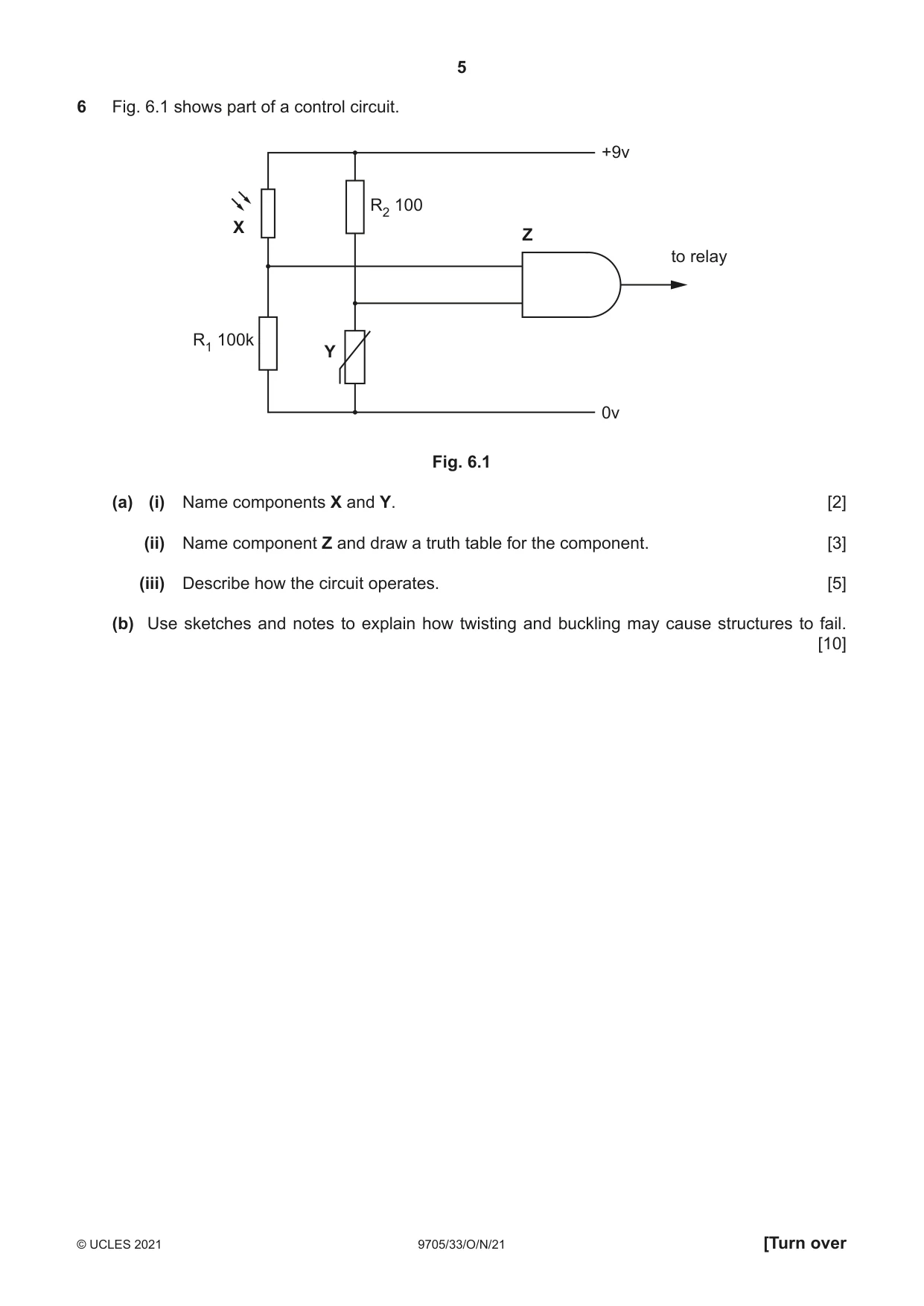
5 9705/33/O/N/21 © UCLES 2021 [Turn over 6 Fig. 6.1 shows part of a control circuit. +9v R2 100 R1 100k 0v to relay Z Y X Fig. 6.1 (a) (i) Name components X and Y. [2] (ii) Name component Z and draw a truth table for the component. [3] (iii) Describe how the circuit operates. [5] (b) Use sketches and notes to explain how twisting and buckling may cause structures to fail. [10]
Question paper, page 6
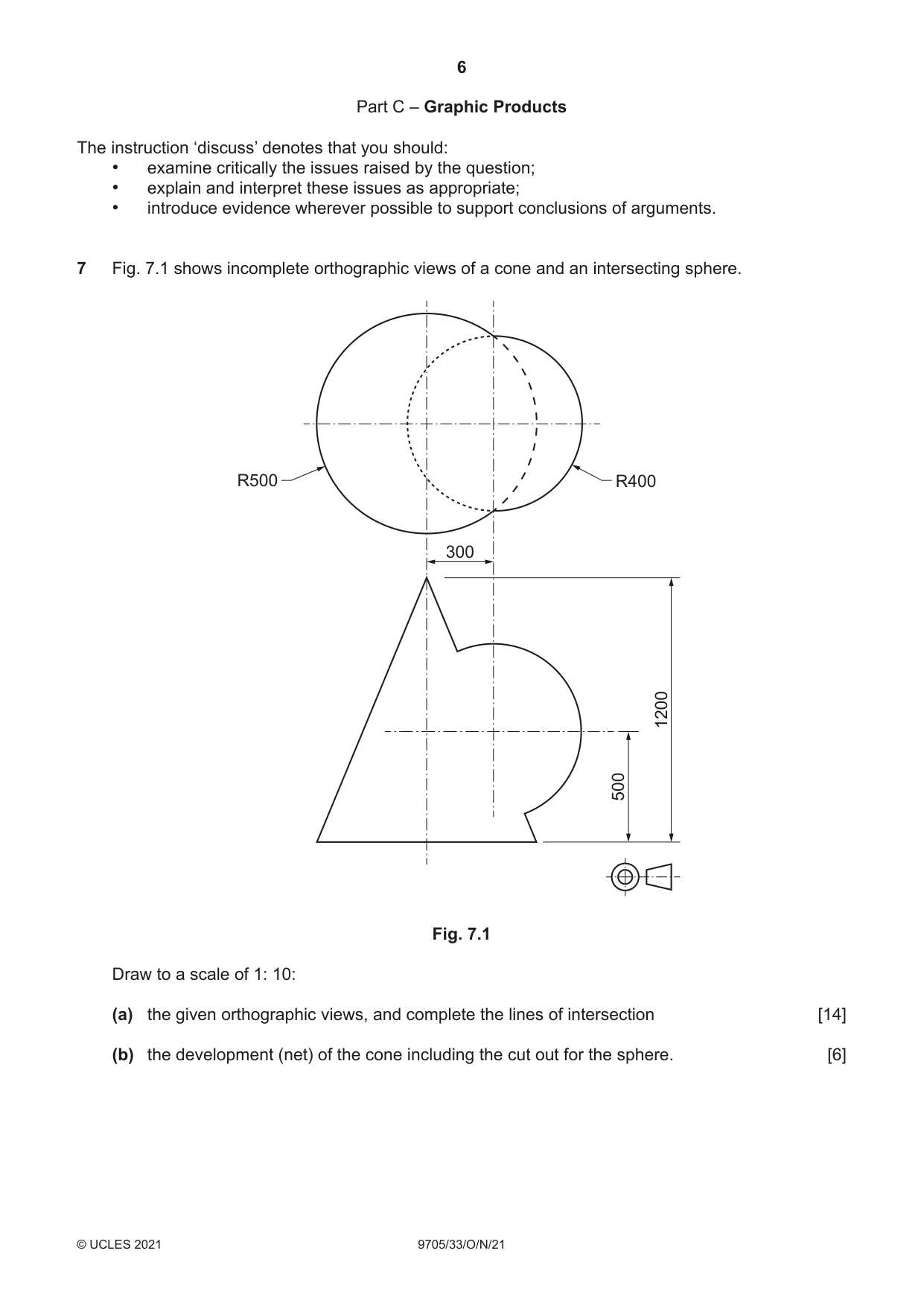
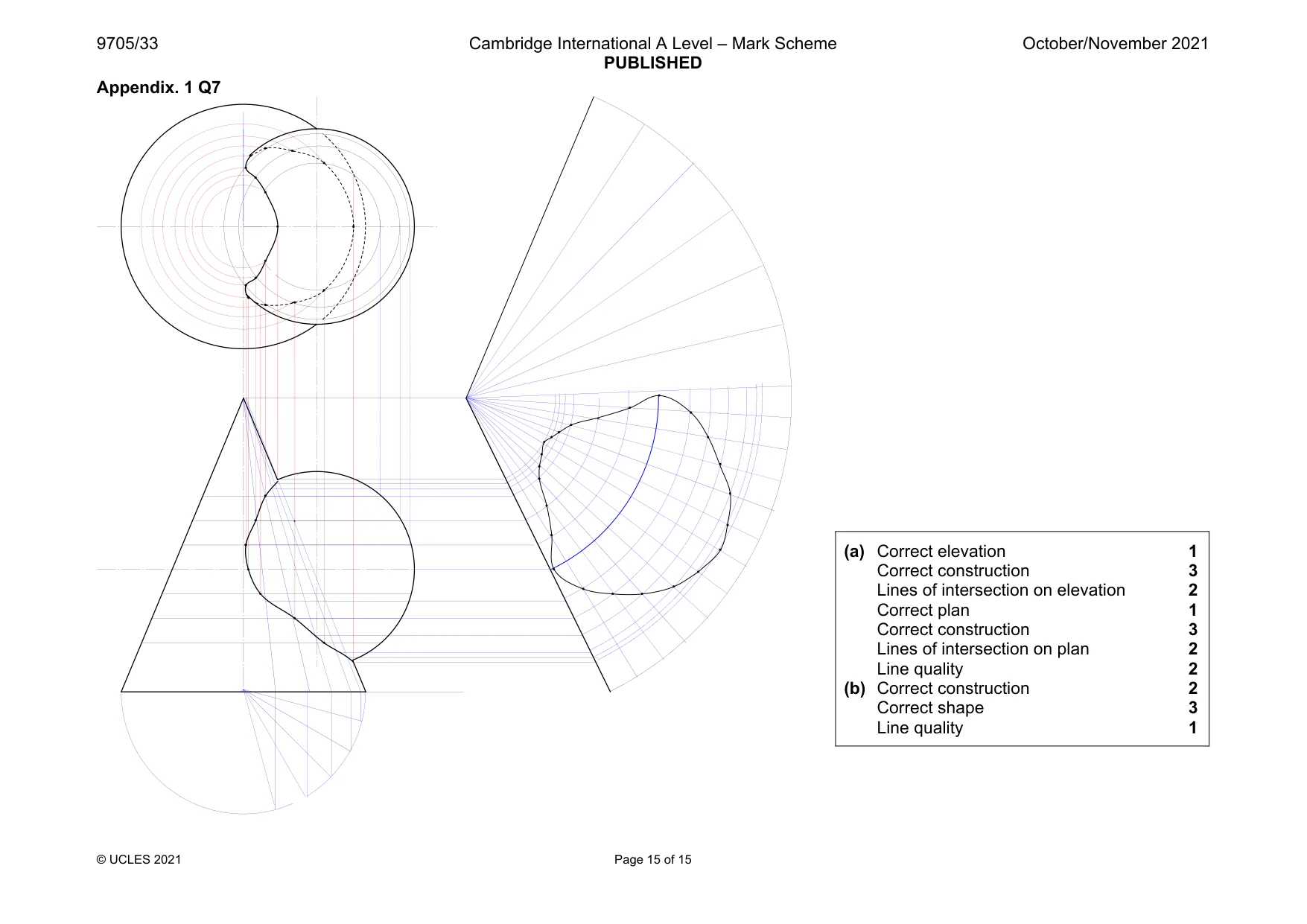
6 9705/33/O/N/21 © UCLES 2021 Part C – Graphic Products The instruction ‘discuss’ denotes that you should: • examine critically the issues raised by the question; • explain and interpret these issues as appropriate; • introduce evidence wherever possible to support conclusions of arguments. 7 Fig. 7.1 shows incomplete orthographic views of a cone and an intersecting sphere. 300 500 1200 R400 R500 Fig. 7.1 Draw to a scale of 1: 10: (a) the given orthographic views, and complete the lines of intersection [14] (b) the development (net) of the cone including the cut out for the sphere. [6]
Question paper, page 7
7 9705/33/O/N/21 © UCLES 2021 [Turn over 8 (a) Use two examples to demonstrate the influence of fashion and style on the design and manufacture of products. [6] (b) Describe two ways in which consumer research can be carried out by a company considering the development of a new product. [6] (c) Explain how the analysis of existing and older versions of products can be of use to a designer when designing a new product. [8] 9 Discuss the importance of packaging design with reference to: • the consumer • the manufacturer. [20]
Question paper, page 8
8 9705/33/O/N/21 © UCLES 2021 Section B Answer one question on the A3 paper provided. Each question is worth 80 marks. You should approach the design question of your choice in the following manner: Analysis Produce an analysis of the given situation/problem, which may be in written or graphical form. [5] Specification From the analysis produce a detailed written specification of the design requirements. Include at least five specification points other than those given in the question. [5] Exploration Use bold sketches and brief notes to show your exploration of ideas for a design solution, with reasons for selection. [25] Development Use bold sketches and notes to show the development, reasoning and composition of ideas into a single design proposal. Give details of materials, constructional and other relevant technical details. [25] Proposed solution Produce drawings of an appropriate kind to show the complete solution. [15] Evaluation Give a written evaluation of the final design solution. [5]
Question paper, page 9
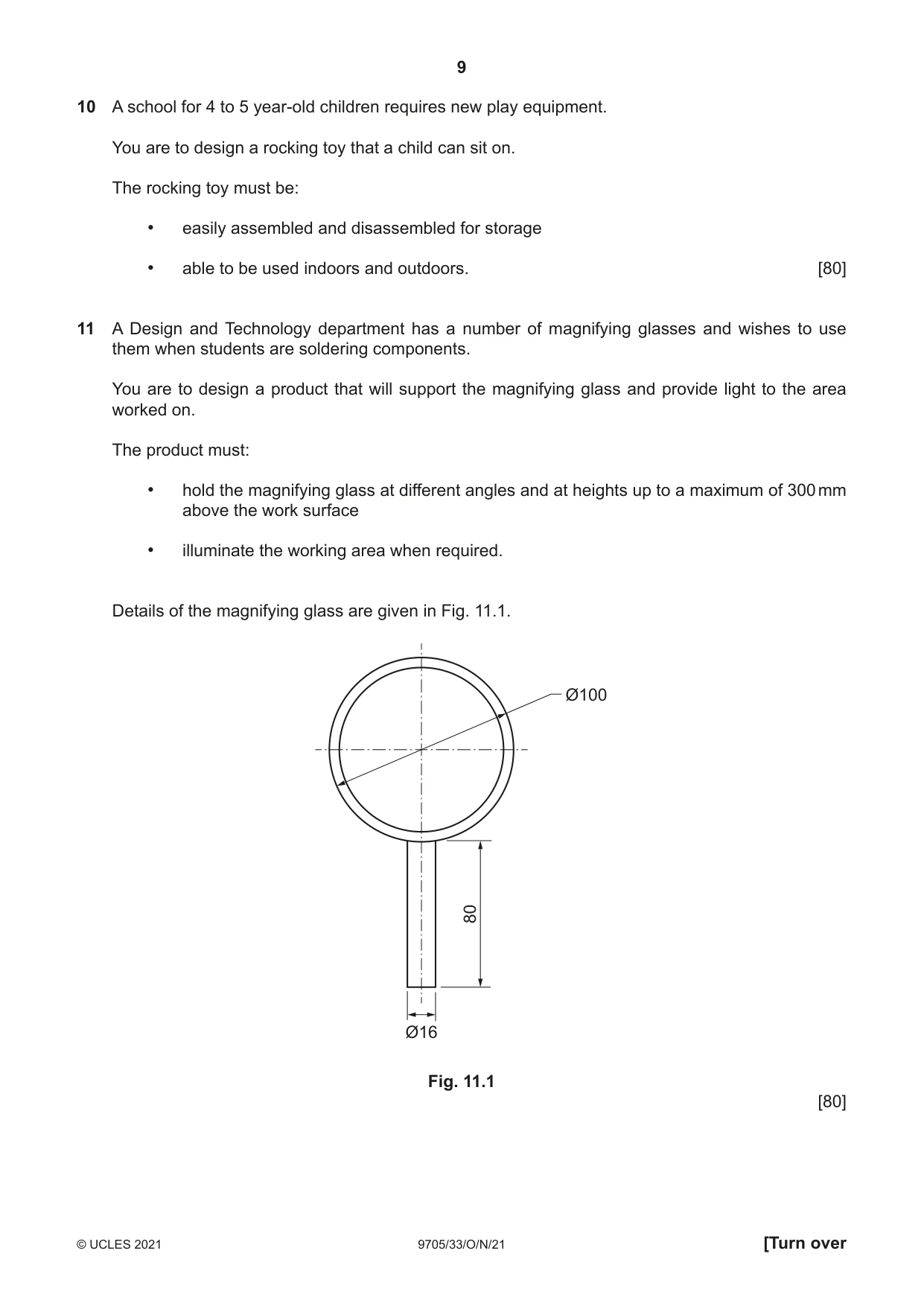
9 9705/33/O/N/21 © UCLES 2021 [Turn over 10 A school for 4 to 5 year-old children requires new play equipment. You are to design a rocking toy that a child can sit on. The rocking toy must be: • easily assembled and disassembled for storage • able to be used indoors and outdoors. [80] 11 A Design and Technology department has a number of magnifying glasses and wishes to use them when students are soldering components. You are to design a product that will support the magnifying glass and provide light to the area worked on. The product must: • hold the magnifying glass at different angles and at heights up to a maximum of 300 mm above the work surface • illuminate the working area when required. Details of the magnifying glass are given in Fig. 11.1. Ø100 Ø16 80 Fig. 11.1 [80]
Question paper, page 10
10 9705/33/O/N/21 © UCLES 2021 12 A company wishes to introduce a new range of healthy biscuits for young children. The biscuits are to be based on the theme of outer space. You are to design: • an innovative new biscuit shape • an exciting name for the new biscuit • innovative packaging for up to 12 biscuits • a promotional item to advertise the new biscuit brand. [80]
Question paper, page 11
11 9705/33/O/N/21 © UCLES 2021 BLANK PAGE
Question paper, page 12
12 9705/33/O/N/21 © UCLES 2021 Permission to reproduce items where third-party owned material protected by copyright is included has been sought and cleared where possible. Every reasonable effort has been made by the publisher (UCLES) to trace copyright holders, but if any items requiring clearance have unwittingly been included, the publisher will be pleased to make amends at the earliest possible opportunity. To avoid the issue of disclosure of answer-related information to candidates, all copyright acknowledgements are reproduced online in the Cambridge Assessment International Education Copyright Acknowledgements Booklet. This is produced for each series of examinations and is freely available to download at www.cambridgeinternational.org after the live examination series. Cambridge Assessment International Education is part of the Cambridge Assessment Group. Cambridge Assessment is the brand name of the University of Cambridge Local Examinations Syndicate (UCLES), which itself is a department of the University of Cambridge. BLANK PAGE
Mark scheme, page 1
This document consists of 15 printed pages. © UCLES 2021 [Turn over Cambridge International A Level DESIGN & TECHNOLOGY 9705/33 Paper 3 October/November 2021 MARK SCHEME Maximum Mark: 120 Published This mark scheme is published as an aid to teachers and candidates, to indicate the requirements of the examination. It shows the basis on which Examiners were instructed to award marks. It does not indicate the details of the discussions that took place at an Examiners’ meeting before marking began, which would have considered the acceptability of alternative answers. Mark schemes should be read in conjunction with the question paper and the Principal Examiner Report for Teachers. Cambridge International will not enter into discussions about these mark schemes. Cambridge International is publishing the mark schemes for the October/November 2021 series for most Cambridge IGCSE™, Cambridge International A and AS Level components and some Cambridge O Level components.
Mark scheme, page 2
9705/33 Cambridge International A Level – Mark Scheme PUBLISHED October/November 2021 © UCLES 2021 Page 2 of 15 Generic Marking Principles These general marking principles must be applied by all examiners when marking candidate answers. They should be applied alongside the specific content of the mark scheme or generic level descriptors for a question. Each question paper and mark scheme will also comply with these marking principles. GENERIC MARKING PRINCIPLE 1: Marks must be awarded in line with: • the specific content of the mark scheme or the generic level descriptors for the question • the specific skills defined in the mark scheme or in the generic level descriptors for the question • the standard of response required by a candidate as exemplified by the standardisation scripts. GENERIC MARKING PRINCIPLE 2: Marks awarded are always whole marks (not half marks, or other fractions). GENERIC MARKING PRINCIPLE 3: Marks must be awarded positively: • marks are awarded for correct/valid answers, as defined in the mark scheme. However, credit is given for valid answers which go beyond the scope of the syllabus and mark scheme, referring to your Team Leader as appropriate • marks are awarded when candidates clearly demonstrate what they know and can do • marks are not deducted for errors • marks are not deducted for omissions • answers should only be judged on the quality of spelling, punctuation and grammar when these features are specifically assessed by the question as indicated by the mark scheme. The meaning, however, should be unambiguous. GENERIC MARKING PRINCIPLE 4: Rules must be applied consistently, e.g. in situations where candidates have not followed instructions or in the application of generic level descriptors.
Mark scheme, page 3
9705/33 Cambridge International A Level – Mark Scheme PUBLISHED October/November 2021 © UCLES 2021 Page 3 of 15 GENERIC MARKING PRINCIPLE 5: Marks should be awarded using the full range of marks defined in the mark scheme for the question (however; the use of the full mark range may be limited according to the quality of the candidate responses seen). GENERIC MARKING PRINCIPLE 6: Marks awarded are based solely on the requirements as defined in the mark scheme. Marks should not be awarded with grade thresholds or grade descriptors in mind.
Mark scheme, page 4
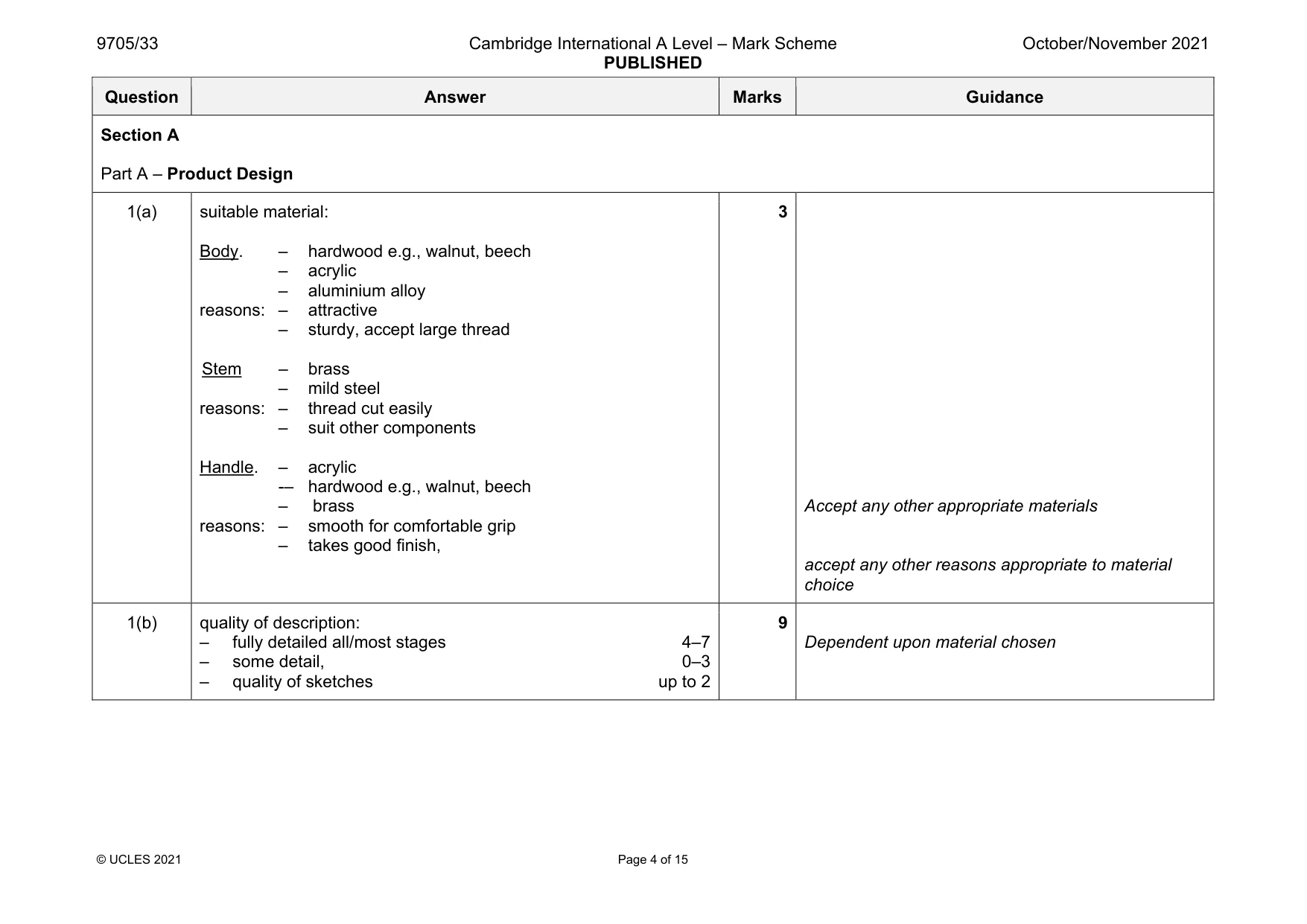
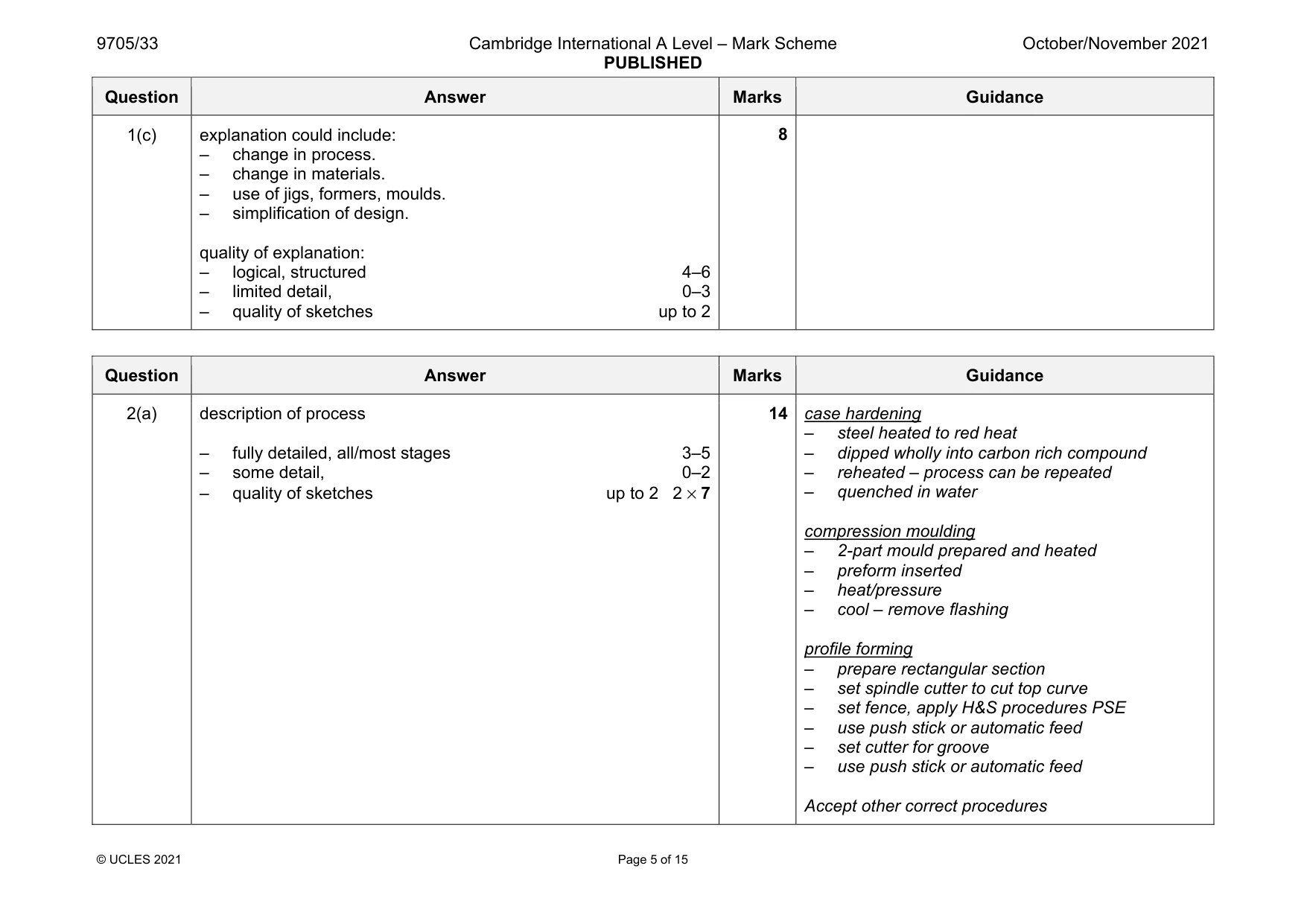
9705/33 Cambridge International A Level – Mark Scheme PUBLISHED October/November 2021 © UCLES 2021 Page 4 of 15 Question Answer Marks Guidance Section A Part A – Product Design 1(a) suitable material: Body. – hardwood e.g., walnut, beech – acrylic – aluminium alloy reasons: – attractive – sturdy, accept large thread Stem – brass – mild steel reasons: – thread cut easily – suit other components Handle. – acrylic -– hardwood e.g., walnut, beech – brass reasons: – smooth for comfortable grip – takes good finish, 3 Accept any other appropriate materials accept any other reasons appropriate to material choice 1(b) quality of description: – fully detailed all/most stages 4–7 – some detail, 0–3 – quality of sketches up to 2 9 Dependent upon material chosen
Mark scheme, page 5
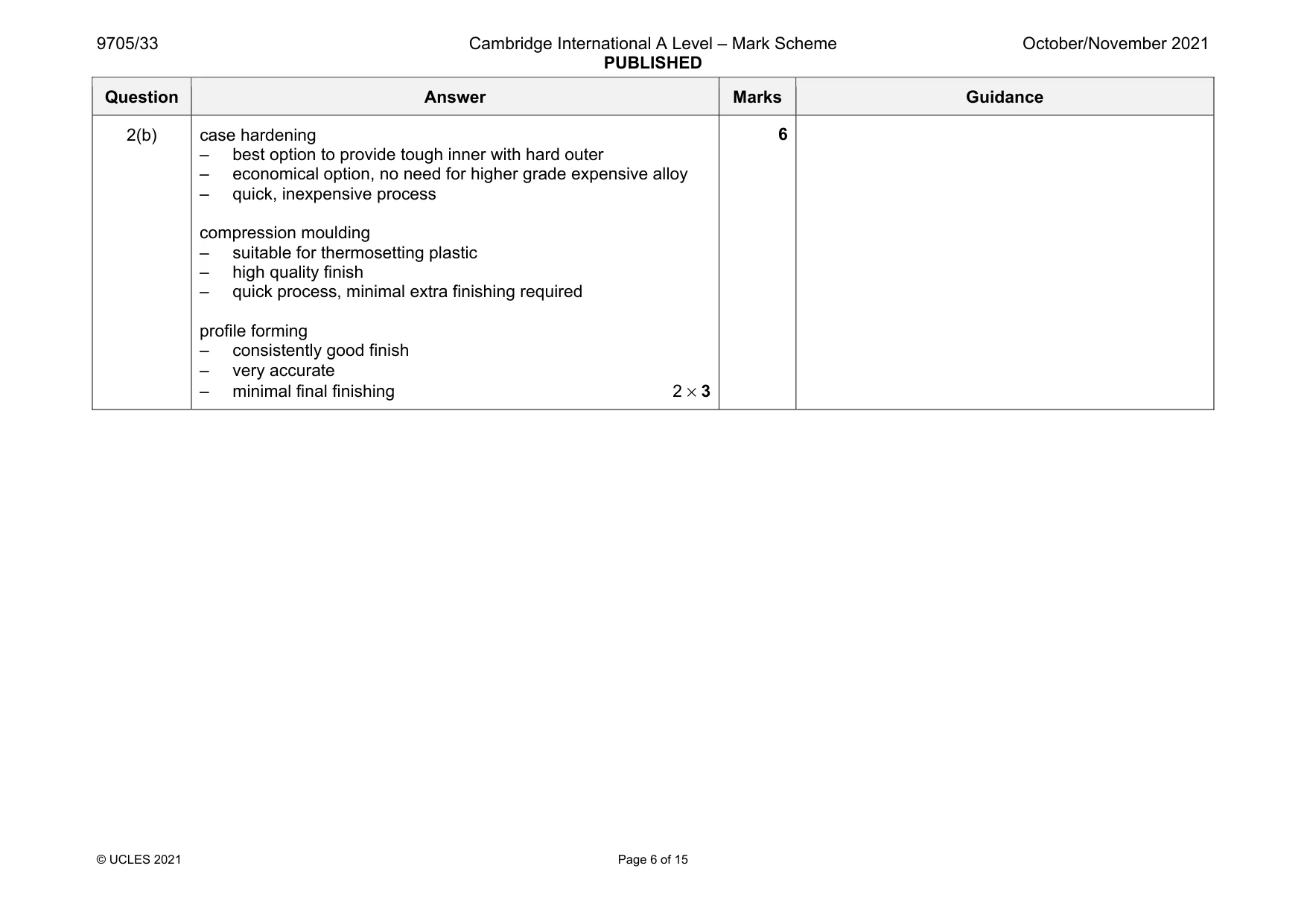
9705/33 Cambridge International A Level – Mark Scheme PUBLISHED October/November 2021 © UCLES 2021 Page 5 of 15 Question Answer Marks Guidance 1(c) explanation could include: – change in process. – change in materials. – use of jigs, formers, moulds. – simplification of design. quality of explanation: – logical, structured 4–6 – limited detail, 0–3 – quality of sketches up to 2 8 Question Answer Marks Guidance 2(a) description of process – fully detailed, all/most stages 3–5 – some detail, 0–2 – quality of sketches up to 2 2 × 7 14 case hardening – steel heated to red heat – dipped wholly into carbon rich compound – reheated – process can be repeated – quenched in water compression moulding – 2-part mould prepared and heated – preform inserted – heat/pressure – cool – remove flashing profile forming – prepare rectangular section – set spindle cutter to cut top curve – set fence, apply H&S procedures PSE – use push stick or automatic feed – set cutter for groove – use push stick or automatic feed Accept other correct procedures
Mark scheme, page 6
9705/33 Cambridge International A Level – Mark Scheme PUBLISHED October/November 2021 © UCLES 2021 Page 6 of 15 Question Answer Marks Guidance 2(b) case hardening – best option to provide tough inner with hard outer – economical option, no need for higher grade expensive alloy – quick, inexpensive process compression moulding – suitable for thermosetting plastic – high quality finish – quick process, minimal extra finishing required profile forming – consistently good finish – very accurate – minimal final finishing 2 × 3 6
Mark scheme, page 7
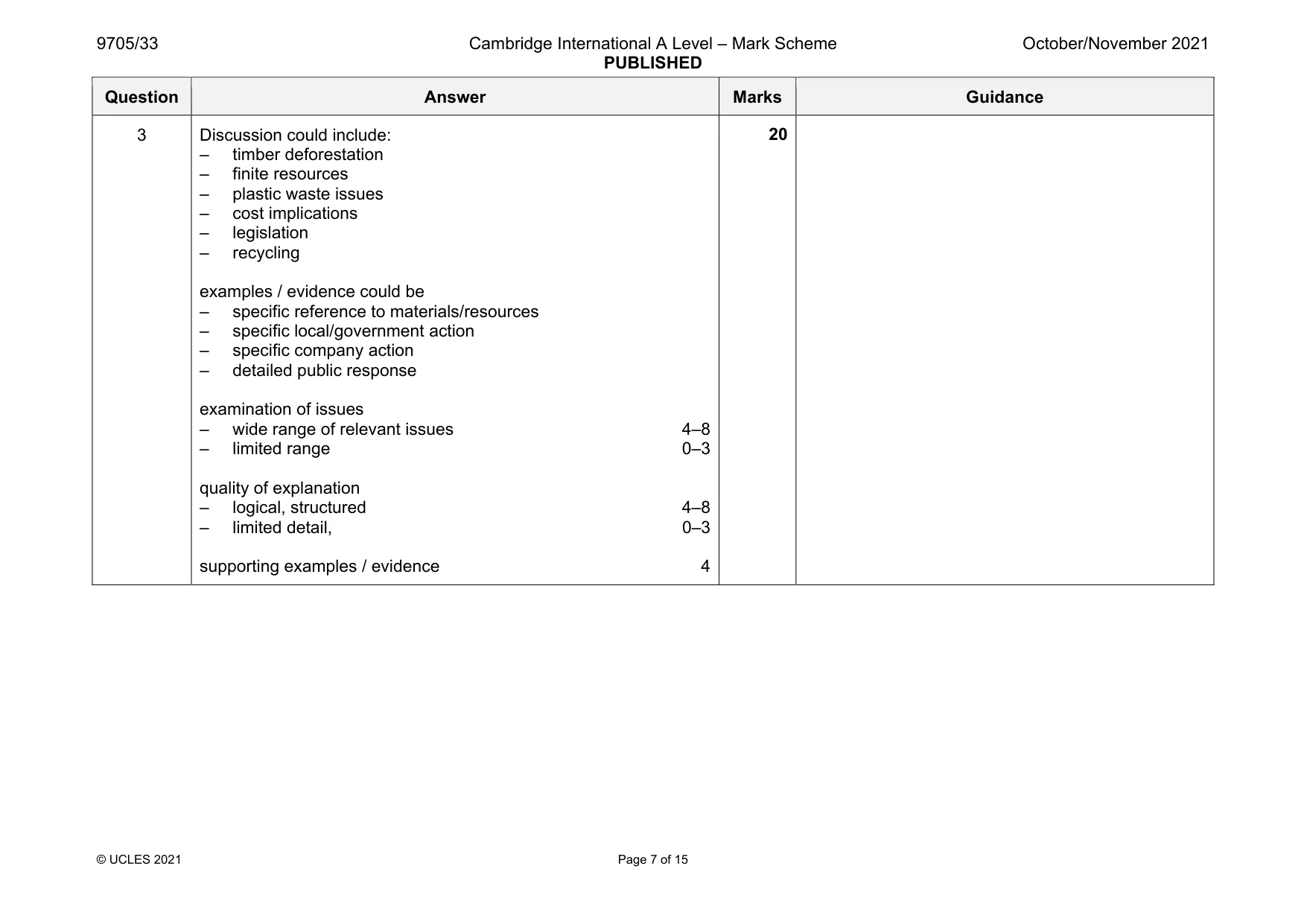
9705/33 Cambridge International A Level – Mark Scheme PUBLISHED October/November 2021 © UCLES 2021 Page 7 of 15 Question Answer Marks Guidance 3 Discussion could include: – timber deforestation – finite resources – plastic waste issues – cost implications – legislation – recycling examples / evidence could be – specific reference to materials/resources – specific local/government action – specific company action – detailed public response examination of issues – wide range of relevant issues 4–8 – limited range 0–3 quality of explanation – logical, structured 4–8 – limited detail, 0–3 supporting examples / evidence 4 20
Mark scheme, page 8
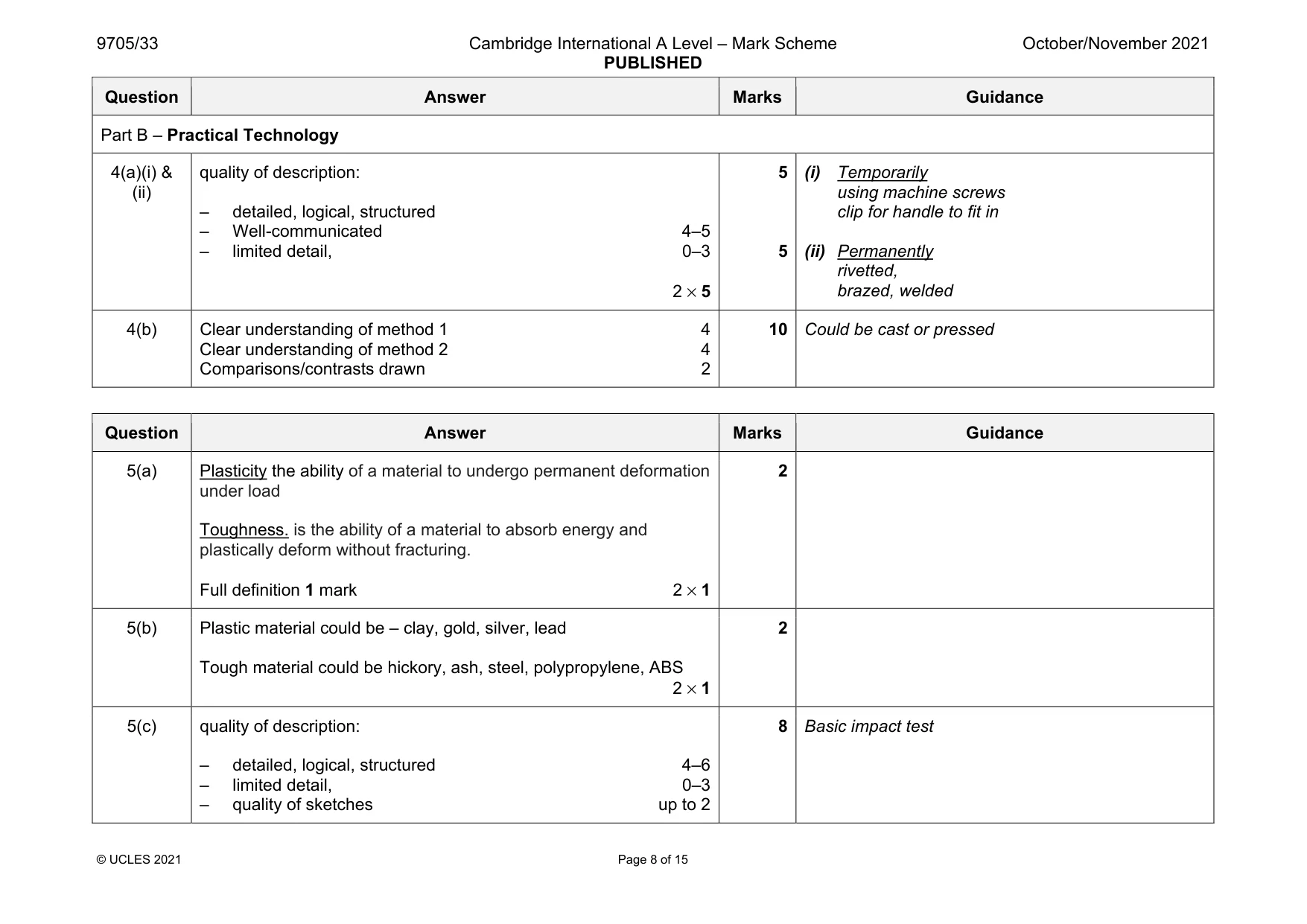
9705/33 Cambridge International A Level – Mark Scheme PUBLISHED October/November 2021 © UCLES 2021 Page 8 of 15 Question Answer Marks Guidance Part B – Practical Technology 4(a)(i) & (ii) quality of description: – detailed, logical, structured – Well-communicated 4–5 – limited detail, 0–3 2 × 5 5 5 (i) Temporarily using machine screws clip for handle to fit in (ii) Permanently rivetted, brazed, welded 4(b) Clear understanding of method 1 4 Clear understanding of method 2 4 Comparisons/contrasts drawn 2 10 Could be cast or pressed Question Answer Marks Guidance 5(a) Plasticity the ability of a material to undergo permanent deformation under load Toughness. is the ability of a material to absorb energy and plastically deform without fracturing. Full definition 1 mark 2 × 1 2 5(b) Plastic material could be – clay, gold, silver, lead Tough material could be hickory, ash, steel, polypropylene, ABS 2 × 1 2 5(c) quality of description: – detailed, logical, structured 4–6 – limited detail, 0–3 – quality of sketches up to 2 8 Basic impact test
Mark scheme, page 9
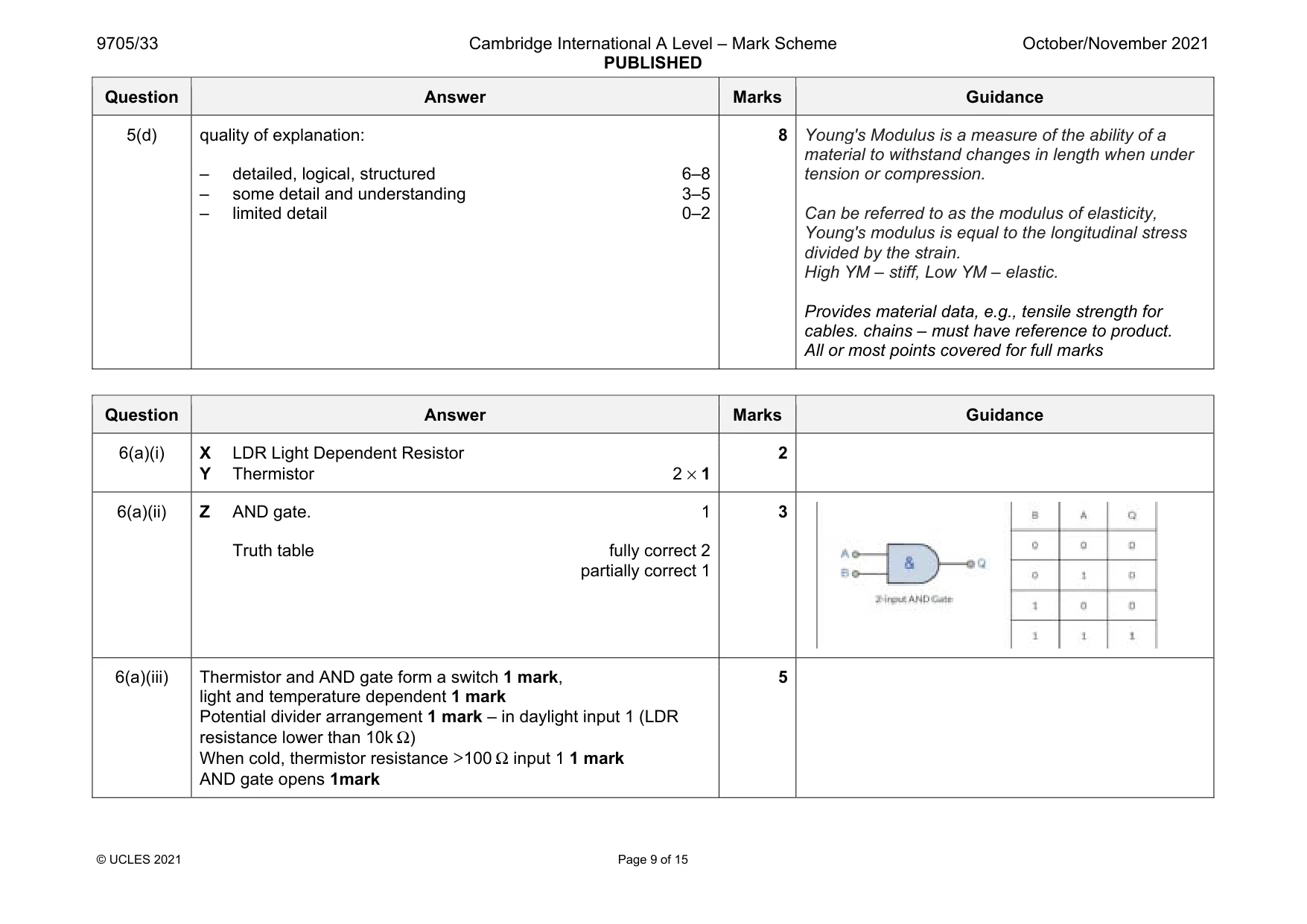
9705/33 Cambridge International A Level – Mark Scheme PUBLISHED October/November 2021 © UCLES 2021 Page 9 of 15 Question Answer Marks Guidance 5(d) quality of explanation: – detailed, logical, structured 6–8 – some detail and understanding 3–5 – limited detail 0–2 8 Young's Modulus is a measure of the ability of a material to withstand changes in length when under tension or compression. Can be referred to as the modulus of elasticity, Young's modulus is equal to the longitudinal stress divided by the strain. High YM – stiff, Low YM – elastic. Provides material data, e.g., tensile strength for cables. chains – must have reference to product. All or most points covered for full marks Question Answer Marks Guidance 6(a)(i) X LDR Light Dependent Resistor Y Thermistor 2 × 1 2 6(a)(ii) Z AND gate. 1 Truth table fully correct 2 partially correct 1 3 6(a)(iii) Thermistor and AND gate form a switch 1 mark, light and temperature dependent 1 mark Potential divider arrangement 1 mark – in daylight input 1 (LDR resistance lower than 10k Ω) When cold, thermistor resistance >100 Ω input 1 1 mark AND gate opens 1mark 5
Mark scheme, page 10
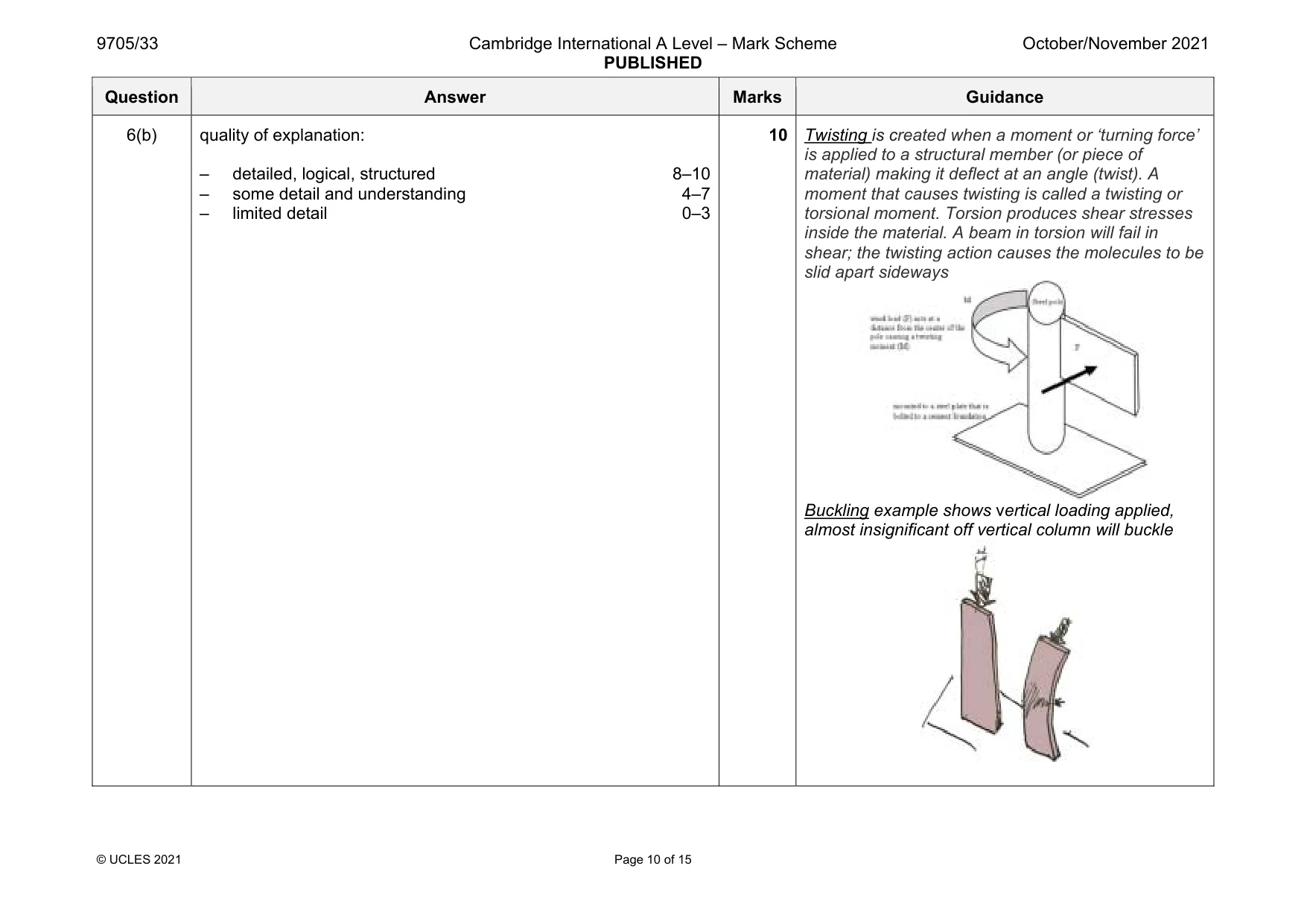
9705/33 Cambridge International A Level – Mark Scheme PUBLISHED October/November 2021 © UCLES 2021 Page 10 of 15 Question Answer Marks Guidance 6(b) quality of explanation: – detailed, logical, structured 8–10 – some detail and understanding 4–7 – limited detail 0–3 10 Twisting is created when a moment or ‘turning force’ is applied to a structural member (or piece of material) making it deflect at an angle (twist). A moment that causes twisting is called a twisting or torsional moment. Torsion produces shear stresses inside the material. A beam in torsion will fail in shear; the twisting action causes the molecules to be slid apart sideways Buckling example shows vertical loading applied, almost insignificant off vertical column will buckle
Mark scheme, page 11
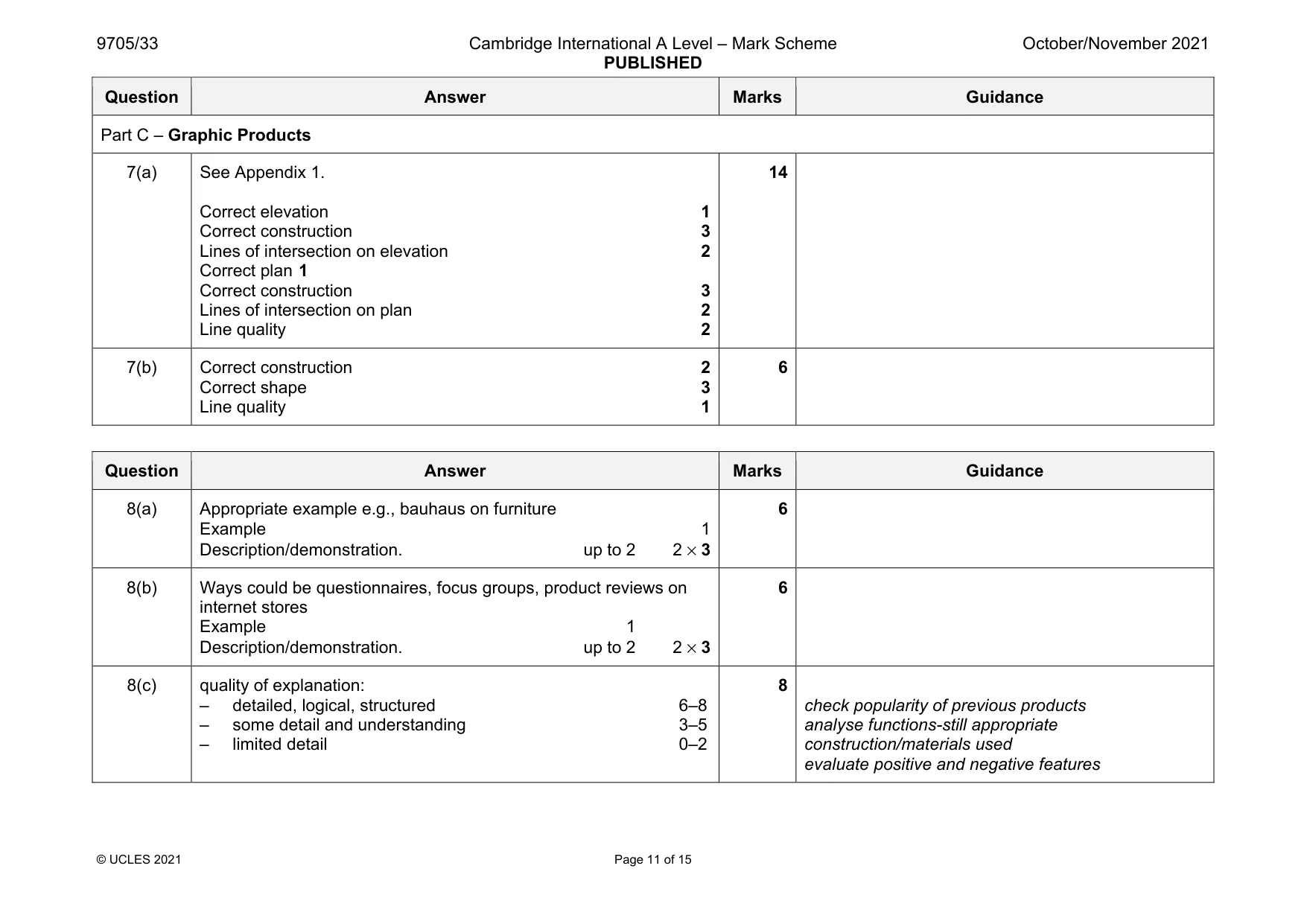
9705/33 Cambridge International A Level – Mark Scheme PUBLISHED October/November 2021 © UCLES 2021 Page 11 of 15 Question Answer Marks Guidance Part C – Graphic Products 7(a) See Appendix 1. Correct elevation 1 Correct construction 3 Lines of intersection on elevation 2 Correct plan 1 Correct construction 3 Lines of intersection on plan 2 Line quality 2 14 7(b) Correct construction 2 Correct shape 3 Line quality 1 6 Question Answer Marks Guidance 8(a) Appropriate example e.g., bauhaus on furniture Example 1 Description/demonstration. up to 2 2 × 3 6 8(b) Ways could be questionnaires, focus groups, product reviews on internet stores Example 1 Description/demonstration. up to 2 2 × 3 6 8(c) quality of explanation: – detailed, logical, structured 6–8 – some detail and understanding 3–5 – limited detail 0–2 8 check popularity of previous products analyse functions-still appropriate construction/materials used evaluate positive and negative features
Mark scheme, page 12
9705/33 Cambridge International A Level – Mark Scheme PUBLISHED October/November 2021 © UCLES 2021 Page 12 of 15 Question Answer Marks Guidance 9 Discussion could include: – type of product requirement – safety/security – advertising – additional cost – environmental concerns – increased use of online shopping examples / evidence could be – specific reference to products – specific types of packaging – changes in company practise – specific online packaging system examination of issues – wide range of relevant issues 4–8 – limited range 0–3 quality of explanation – logical, structured 4–8 – limited detail, 0–3 supporting examples / evidence 4 20
Mark scheme, page 13
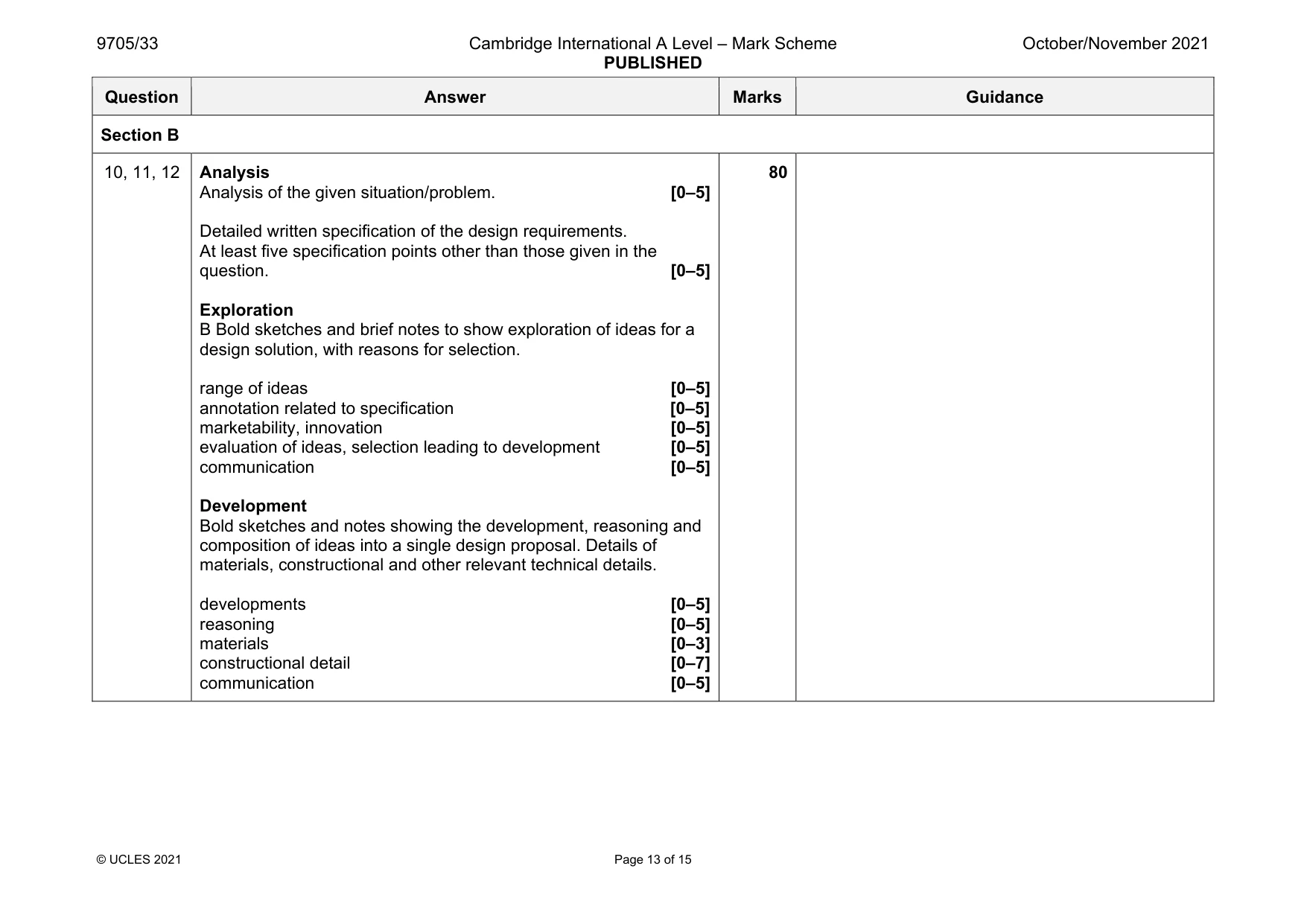
9705/33 Cambridge International A Level – Mark Scheme PUBLISHED October/November 2021 © UCLES 2021 Page 13 of 15 Question Answer Marks Guidance Section B 10, 11, 12 Analysis Analysis of the given situation/problem. [0–5] Detailed written specification of the design requirements. At least five specification points other than those given in the question. [0–5] Exploration B Bold sketches and brief notes to show exploration of ideas for a design solution, with reasons for selection. range of ideas [0–5] annotation related to specification [0–5] marketability, innovation [0–5] evaluation of ideas, selection leading to development [0–5] communication [0–5] Development Bold sketches and notes showing the development, reasoning and composition of ideas into a single design proposal. Details of materials, constructional and other relevant technical details. developments [0–5] reasoning [0–5] materials [0–3] constructional detail [0–7] communication [0–5] 80
Mark scheme, page 14
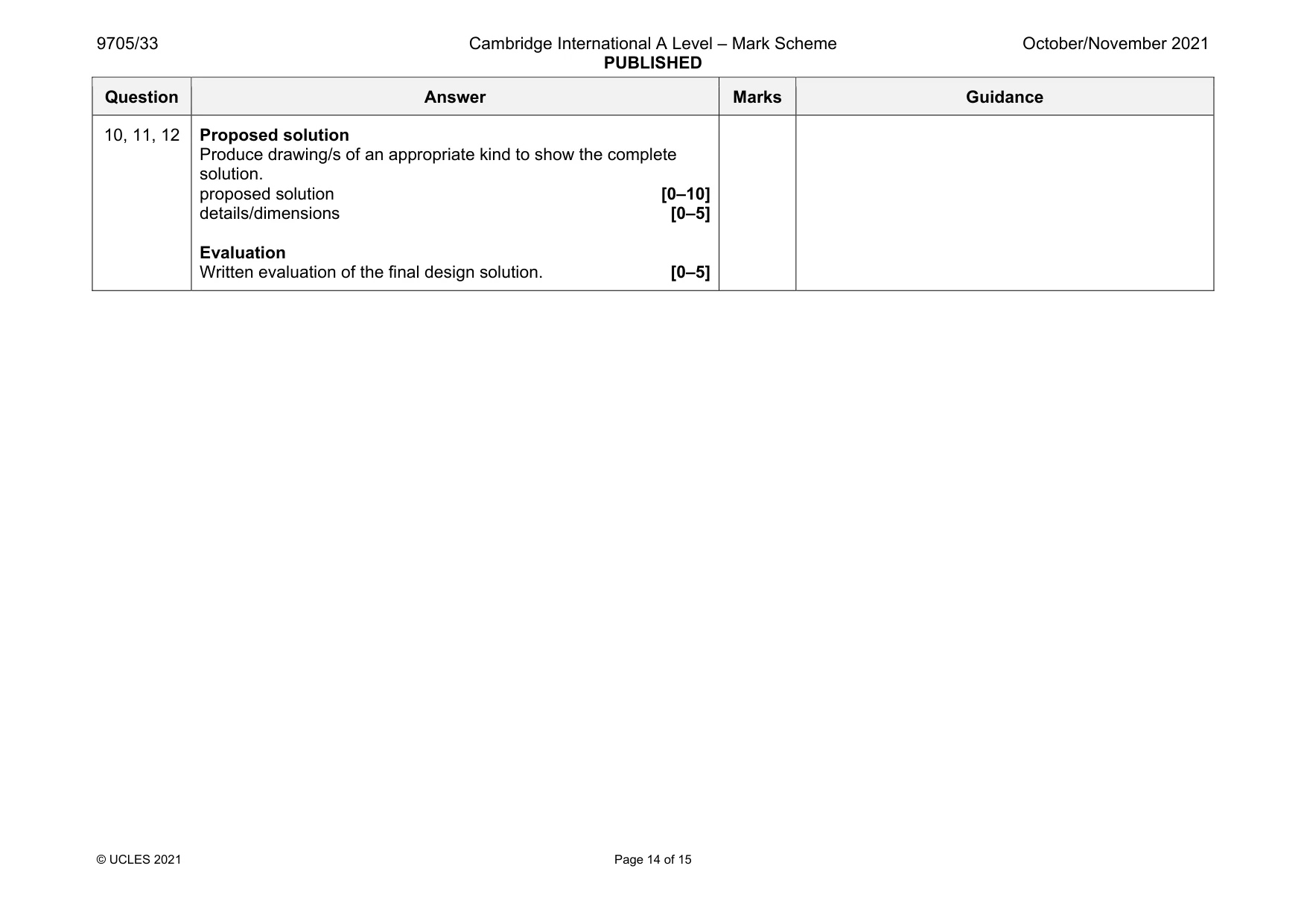
9705/33 Cambridge International A Level – Mark Scheme PUBLISHED October/November 2021 © UCLES 2021 Page 14 of 15 Question Answer Marks Guidance 10, 11, 12 Proposed solution Produce drawing/s of an appropriate kind to show the complete solution. proposed solution [0–10] details/dimensions [0–5] Evaluation Written evaluation of the final design solution. [0–5]
Mark scheme, page 15
9705/33 Cambridge International A Level – Mark Scheme PUBLISHED October/November 2021 © UCLES 2021 Page 15 of 15 Appendix. 1 Q7 (a) Correct elevation 1 Correct construction 3 Lines of intersection on elevation 2 Correct plan 1 Correct construction 3 Lines of intersection on plan 2 Line quality 2 (b) Correct construction 2 Correct shape 3 Line quality 1
What you needed in this session
Cambridge’s own grade thresholds for 2021 Oct/Nov, Paper 3 · Variant 3. A higher threshold means an easier paper — the bar moves with how the cohort did.